Imperial Portugal, Sri Lankan Diplomacy, and the Making of a Habsburg Conquest in Asia
ZOLTÁN BIEDERMANN
Great Clarendon Street, Oxford, OX2 6DP, United Kingdom
Oxford University Press is a department of the University of Oxford. It furthers the University’s objective of excellence in research, scholarship, and education by publishing worldwide. Oxford is a registered trade mark of Oxford University Press in the UK and in certain other countries
All rights reserved. No part of this publication may be reproduced, stored in a retrieval system, or transmitted, in any form or by any means, without the prior permission in writing of Oxford University Press, or as expressly permitted by law, by licence or under terms agreed with the appropriate reprographics rights organization. Enquiries concerning reproduction outside the scope of the above should be sent to the Rights Department, Oxford University Press, at the address above
You must not circulate this work in any other form and you must impose this same condition on any acquirer
Published in the United States of America by Oxford University Press 198 Madison Avenue, New York, NY 10016, United States of America
British Library Cataloguing in Publication Data Data available
Library of Congress Control Number: 2018947664
ISBN 978–0–19–882339–1
Printed and bound by CPI Group (UK) Ltd, Croydon, CR0 4YY
Links to third party websites are provided by Oxford in good faith and for information only. Oxford disclaims any responsibility for the materials contained in any third party website referenced in this work.
To my mother, in loving memory
Preface
When the idea for this book emerged around the turn of the millennium, global history writing was entering its golden age. The historiography of the Portuguese empire in Asia, in contrast, seemed past its prime. It had discretely pioneered global connective methods for three decades, gone through a moment of fame thanks to some widely read books written by Sanjay Subrahmanyam in dialogue with the best Portuguese scholars of his generation, and then failed to keep up with the hype. Over the past fifteen years, much has been written about Portuguese empire building in Asia of course, but very little has caught the attention of the wider profession, especially those doing their readings in English.
It was a frustrating situation at the time, and remains of concern now. Why should anyone not working specifically on Sri Lanka, the Portuguese, or the Asian fringe of the Spanish Habsburg empire read this book? Only one of the three polities in the title figures as an empire in John Darwin’s widely applauded After Tamerlane.1 In the great house of global history described by Jan de Vries, our story appears to live a modest life on the ground floor, far from the ‘mega-processes’ of globalization dwelling upstairs, in the ‘penthouse’.2 Yet that is precisely the problem. By separating apparently peripheral, minor interactions from an imagined canon of ‘great empires’, something crucial has been pushed out of the frame. Only once we appreciate the full range of European-Asian interactions that occurred beyond the great land-bound empires of Asia and before the arrival of British imperialism in the region will we be in a position to go ahead with two fundamental historiographical operations that are still largely absent from the panorama today. On the one hand, we shall be able to further our understanding of the beginnings of modern European imperialism and colonialism in Asia in conjunction with, rather than as a departure from, earlier encounters. On the other, we may start at last to explore the contrasts and connections between European expansion in Asia and the colonization of the New World.
When I came across, some years after completing the original research for this book, Philip J. Stern’s retelling of the story of the English EIC, I realized just what a treasure trove I was sitting on.3 Here are two comparable stories of empires apparently built on trade, but with an agenda of conquest written into their DNA. Both convinced themselves only gradually that it might be a good idea to take over territories in Asia. Both saw their histories told in ways that still hinder genuinely complex interpretations of their trajectories. There were some differences, too.
1 John Darwin, After Tamerlane. The Rise and Fall of Global Empires, 1400–2000 (London: Penguin, 2007).
2 Jan de Vries, ‘Reflections on doing global history’, in Writing the History of the Global. Challenges for the 21st Century, edited by Maxine Berg (Oxford: Oxford University Press, 2013), p. 32.
3 See Philip J. Stern, The Company-State. Corporate Sovereignty and the Early Modern Foundations of the British Empire in India (New York: Oxford University Press, 2011).
Preface
In the Portuguese case, part of the explanation for the territorialization of the Asian empire in the late sixteenth century had always been that, once Phillip II of Spain had taken the throne in Lisbon in 1581, policy changes occurred as a matter of Castilian influence. This meant that my study had to involve a critical incursion into the history of another body politic, which happened to be the greatest empire of its time. The other aspect distinguishing the story of the Portuguese in Sri Lanka— the largest territorial conquest in the region before the EIC campaigns of the late eighteenth century—was that, whilst the original DNA of the empire did in fact offer the possibility of conquest, the real driving force behind the blossoming of conquest discourse had been an Asian polity with its own imperial tradition: the seemingly obscure kingdom of Kōṭṭe which, for decades, fed its imperial ideas into Portuguese channels of communication. The challenges this poses to Eurocentric narratives of globalization are riveting. I wondered how such a powerful story could have evaded the attention of historians for so long.
Most of us are painfully aware of the complexity of early modern encounters across the early modern world, the unsettling combinations of commercial, diplomatic, military, and cultural exchanges they tended to involve. The study of Iberian-Asian materials, often neglected by global historians, is key for a deepened understanding of those dynamics. In many ways, the complexity of Iberian interactions in Asia prefigures and, from 1600 onwards, accompanies those of Dutch and especially British expansion. Sri Lanka is in fact an outstanding example of how similar developments occurred repeatedly in the same place, as three European powers in a row went—to put it bluntly for a moment—from commerce to conquest. Clearly, the way forward is not to depoliticize early expansion in Asia by dismissing it as merely commercial, or redistributive, or predatory in a petty way, but to re-politicize every bit of it.4 This is not just to reiterate how ‘merchant empires’ and ‘company states’ were common, and the early modern world full of ‘corporate bodies politic and hyphenated, hybrid, overlapping, and composite forms of sovereignty’.5 It is also to emphasize how every individual leaving a trace in the colonial archive—be it as a governor, a rāja, an ambassador, a monk, a merchant, or a mercenary—needs to be seen as part of the process that, without ever having been linear or inescapable, prepared the ground for European hegemony. There are abundant opportunities here for global historians. Since in the Atlantic the comparison of British and Iberian colonialism has made significant progress, the doors stand open for similar endeavours in Asia. There is scope to emulate John Elliott’s Empires of the Atlantic World or Jorge Cañizares-Esguerra’s Puritan Conquistadors. 6 Similarly, whilst much is known now about the ways British rule
4 Cf. most frustratingly Darwin, After Tamerlane, pp. 53–4, with a dismissal of Portuguese imperialism on grounds of M. N. Pearson, The Portuguese in India (Cambridge: Cambridge University Press, 1987).
5 Stern, The Company-State, p. 3.
6 John H. Elliott, Empires of the Atlantic World. Britain and Spain in America, 1492–1830 (New Haven, CT: Yale University Press, 2006); Jorge Cañizares-Esguerra, Puritan Conquistadors. Iberianizing the Atlantic, 1550–1700 (Stanford, CA: Stanford University Press, 2006); Stern, The Company-State, pp. 218–19 gives a list of the most valuable comparative works for Asia, including Sanjay Subrahmanyam, ed., Maritime India (Oxford: Oxford University Press, 2004), which offers a reprint
relied on local elites, almost nothing has been written about how such interactions extended their roots into earlier centuries.7 It is revealing that a book as groundbreaking as Sujit Sivasundaram’s Islanded could produce a bold new interpretation of early British rule and its capacity to reinvent Sri Lanka as an island colony, whilst refraining almost entirely—for its own strong reasons, to be sure—from engaging with earlier processes of a comparable nature.8
This book has been written in the hope that new bridges may be built, and there is no objective reason why imperial and global historians at large should not embrace the story it tells. But what about Sri Lanka? Is it legitimate to revisit the early colonial past of a country just emerging from almost three decades of civil strife? The scars that societies carry away from war are not always immediately perceptible, and sometimes people feel that they may be best left untouched. Yet such scars tend to linger on in the depth of collective bodies. To examine them is one of the most rewarding and, at the same time, daunting challenges a historian can face. In Sri Lanka, a little more than four centuries ago Europeans began to engage in a process of conquest and colonization that was only reversed in 1948. On the surface of it, many aspects of colonial culture have been well integrated into the fabric of Lankan society. English is a widely spoken language, Christian schools educate the nation’s elite, and western tourists are encouraged to spend time in the quaint colonial towns of Negombo and Galle.9
Against this backdrop, the past decade has also seen grievances re-emerge against European powers that brought their languages, religion, and material culture to replace the island’s own. Connected history—to which I will turn in this book— does not always go down well with Asian audiences. Before we dismiss such anxieties as signs of academic immaturity, it is worth pointing out that there is a potentially pernicious politics to global and connected history writing, especially when it emphasizes trade or culture over war and exploitation. As David Washbrook has put it, there is a danger that the ‘connections’ and ‘networks’ favoured by global historians may ‘stand in for relations of force and coercion’.10 This is particularly disturbing when one considers how, on the European side of the post-colonial divide, so much remains to be done to engage with the wrongdoings of the past. Time may give poetry to a battlefield, as Graham Greene had it, but it does so in very different ways among the victors and the vanquished. Whilst many in Sri Lanka
of Kenneth McPherson’s The Indian Ocean: A History of the People and the Sea, Sinnappah Arasaratnam’s Maritime India in the Seventeenth Century, and Furber’s Rival Empires of Trade in the Orient, 1600–1800.
7 See C. A. Bayly, Indian Society and the Making of the British Empire (Cambridge: Cambridge University Press, 1988).
8 Sujit Sivasundaram, Islanded: Britain, Sri Lanka, and the Bounds of an Indian Ocean Colony (Chicago, IL/London: University of Chicago Press, 2013). Earlier processes of a comparable nature are explored in Alan Strathern, Kingship and Conversion in Sixteenth-Century Sri Lanka. Portuguese Imperialism in a Buddhist Land (Cambridge: Cambridge University Press, 2007) and Michael Roberts, Sinhala Consciousness in the Kandyan Period 1590s to 1815 (Colombo: Vijitha Yapa Publications, 2003).
9 For a general overview of Sri Lankan history, John Rogers, A Concise History of Sri Lanka (Cambridge: Cambridge University Press, 2019).
10 David Washbrook, ‘Problems in global history’, in Writing the History of the Global. Challenges for the 21st Century, edited by Maxine Berg (Oxford: Oxford University Press, 2013), p. 27.
Preface
still count the losses suffered four centuries ago, Portugal and Spain (like other European countries) have abundantly studied and often celebrated their expansionist past without engaging in a sustained way with its darker side. Conquest often stands as an abstract, or indeed tacitly glorified concept in a vacuum, as if it had not involved massacre, rape, plunder, and enslavement on a colossal scale. A key text such as the Portuguese inventory of the objects pillaged from the Temple of the Tooth in Kōṭṭe in 1551, for example—an event that would have its equivalent in the emptying and desecration of Notre Dame of Paris by Ottoman or English invaders—has never been studied in any depth.11
All this does not mean, though, that we surrender to local nationalist narratives involving the sectarian targeting of religious and linguistic minorities, accused of being ‘less Lankan’ than others.12 There is a quandary but, as Steve Stern put it in 1992 regarding the challenges that New World historiography faced at the time, ‘the solution to the quandary is to welcome it’.13 I can see no other way forward than to tackle blunt simplifications of the past with full vigour, and mobilize scholarship against rose-coloured narratives of encounter as well as aggressively nationalistic, exclusionary stances. Once we are willing to set simple and straightforward, often chauvinistic readings of the sixteenth-century materials aside, a window opens up onto a richly textured, if painfully complicated past. It is a past of violence, conflict and usually brutal negotiations, but not a past that we can by any means lay to rest. There is no contradiction here between a revisionist reading of the early modern period (one that embraces the principles of connected history) and a firmly anti-colonial stance (one that observes critically early signs of hierarchization).
As Gary Tomlinson put it, postcolonial historiography should be about building a past that ‘resists our intellectual attempts to occupy it even while it takes its shape from us’.14 My hope is that once the reader reaches the end of this book, any reservations about the legitimacy of revisiting colonial history from the comfortable warmth of a European university department will have dissipated. This is not an attempt at whitewashing colonialism by devolving historical agency to people in the distant ‘South’. It is an exercise in digging deep into a dirty past that will always be hard to digest to all parts involved. This book does tell a story of connections and exchanges, but ultimately the story is also part of a larger process, which saw the emergence of a European project to dominate the world. The ideas of conquest dissected here may have been a tiny seed in the beginning, ignored, even ridiculed
11 Sousa Viterbo, O thesouro do rei de Ceylão (Lisbon: Typographia da Academia Real das Sciencias, 1904). An English translation is under preparation.
12 The most virulently chauvinistic approach of recent times is in Susantha Goonatilake, A 16th Century Clash of Civilizations. The Portuguese Presence in Sri Lanka (Colombo: Vijitha Yapa, 2010). A slightly more moderate work is C. Gaston Perera, The Portuguese Missionary in 16th and 17th Century Ceylon: The Spiritual Conquest (Colombo: Vijitha Yapa, 2009).
13 Steve J. Stern, ‘Paradigms of Conquest: History, Historiography, and Politics’, Journal of Latin American Studies, 24 (1992), p. 34.
14 Gary Tomlinson, ‘Unlearning the Aztec cantares (preliminaries to a postcolonial history)’, in Subject and Object in Renaissance Culture, edited by Margreta de Grazia, Maureen Quilligan, and Peter Stallybrass (Cambridge: Cambridge University Press, 1996), p. 261.
by Iberian authorities during much of the sixteenth century. Yet they grew into something mighty enough to have left a lasting imprint on the globe we inhabit.
*
This book was born in the archives of Portugal, Spain, and India, allowed to take shape in my mind during a prolonged stay in Sri Lanka, and written over the years in Paris, Lisbon, Los Angeles, Providence, Madrid, and London. It has been much too long in the making, and the debts that I have incurred are very substantial indeed. First and foremost, I wish to thank Dejanirah Couto and Luís Filipe Thomaz for supporting me as supervisors at the École Pratique des Hautes Études of Paris and the Universidade Nova of Lisbon between 1999 and 2006, and ever since as friends. Jean-Claude Waquet ploughed through my Portuguese dissertation with great intellectual vigour, bringing into focus the key aspects I wished to see recognized. Anthony Disney and Roderich Ptak offered scholarly and personal guidance in challenging times with a warmth that I did not dare to expect. Anthony Pagden and Sanjay Subrahmanyam helped me find my place in academia by taking me on as a post doc on the ‘Imperial Models in the Early Modern World’ programme at UCLA. Onésimo de Almeida gave me shelter at Brown University from the bureaucratic chores that threatened to derail the project after I started to work in London, and Sabine McCormack offered to publish this study at Notre Dame, shortly before her untimely death. Over the years, I received generous financial and logistic support from the Portuguese Foundation for Science and Technology (FCT), the William Andrews Clark Memorial Library (UCLA), the American Institute of Sri Lankan Studies (AISLS), and the Arts and Humanities Research Council (AHRC) of England. I can only hope that others will be able to benefit from such support in the future.
Alan Strathern, Chandra Richard De Silva, Gananath Obeyesekere, John Rogers, Jorge Flores, Michael Roberts, and Sujit Sivasundaram have been the most wonderful companions in my endeavours to understand Sri Lanka—and far beyond. Without their writings and suggestions, I would have struggled to grasp what my questions might be. Without their encouragement, I may well have given up on answering them. Amal Gunasena from SOAS did what he could to make me fluent in Sinhala. Among the colleagues at Birkbeck and UCL who supported me over the past nine years, I wish to give my special thanks to Carmen Fracchia, John Kraniauskas, Luís Trindade, Philip Derbyshire, Stephen Hart, Debbie Martin, and Alexander Samson. For Lisbon, Paris, and Colombo, the list of people who made the writing of this book possible is naturally longer. My special thanks go to André Murteira, Andreia Martins, Ângela Barreto Xavier, Catarina Madeira Santos, Francisco Bethencourt, Francisco Roque de Oliveira, Ira Unamboowe†, Ivo Veiga, Joana Estorninho, João Paulo Oliveira e Costa, Jorge Santos Alves, K. D. Paranavitana, Nuno Senos, Paulo Varela Gomes†, Pedro Cardim, Rui Loureiro, and Teresa Castro.
None of this would have been possible without the loving support of my family. I thank my father Reinhard, my brother Gábor, my wife Eva, and my daughter
Preface
Hannah for all the love and care that has kept me going over the years. Jean, José, and Érica Nieto McAvoy in Madrid have showered me with patience and affection, for which I thank them from the bottom of my heart. I dedicate this book to the memory of my mother Ildikó, who started it all off by travelling between worlds at a time when few people did.
of Illustrations and Maps
Introduction: Querying the Origins of European Conquest in Asia 1
1. (Dis)connecting Empires: Towards a Critical History of Early Modern Imperial Connections
2. Lords of the Land, Lords of the Sea: Establishing an Imperial Dialogue Against the Odds 37
3. The Matrioshka Principle and Its Discontents: Connecting Imperial Ideas Across the Continents 67
4. Conversion Diplomacy: Lankan Imperial Projects and the Politics of Catholic Universalism 94
5. Moving into the Native Ground: Turmoil and Diplomatic Diversification in the Middle of the Century 122
6. Translatio Imperii in the Tropics: Colombo, the Spectre of Cortés in Asia, and the Unification of Iberian Empires 143
7. From Allies to Invaders: Sri Lanka at the Crossroads of Global Iberian Imperialism 162
8. Anatomy of a Divergence: Habsburg Sovereignty and the End of the Lankan Island Empire
(Dis)connected
List of Illustrations and Maps
0.1 Nodes of global communication in the Iberian-Lankan encounter. 3
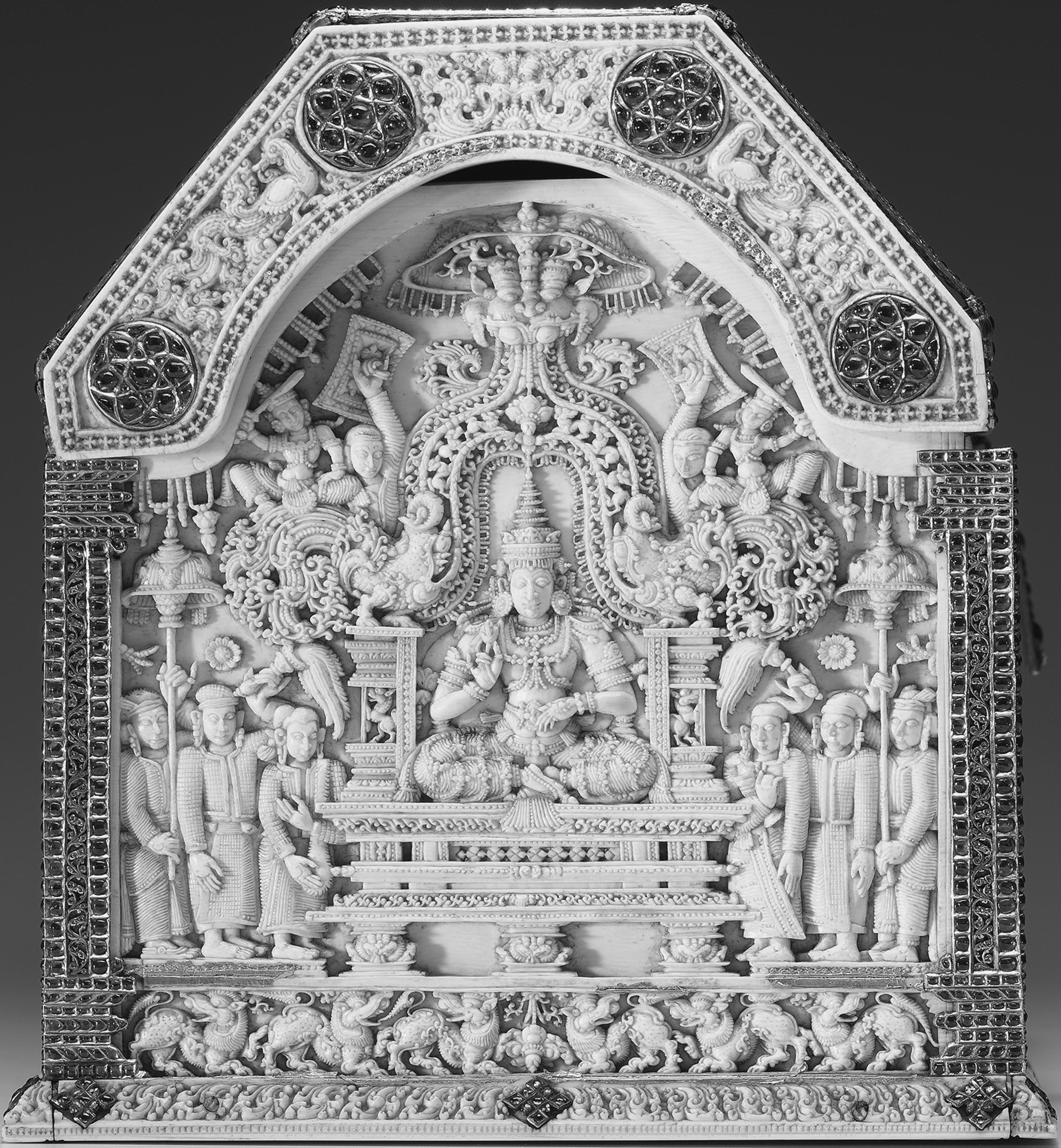
0.2 Dharmapāla meets John III. Front panel of the ‘coronation casket’, Kōṭṭe, c.1541. Munich, Bayerische Verwaltung der staatlichen Schlösser, Gärten und Seen, Residenz München, Schatzkammer, Inv.-Nr. 1241. 6
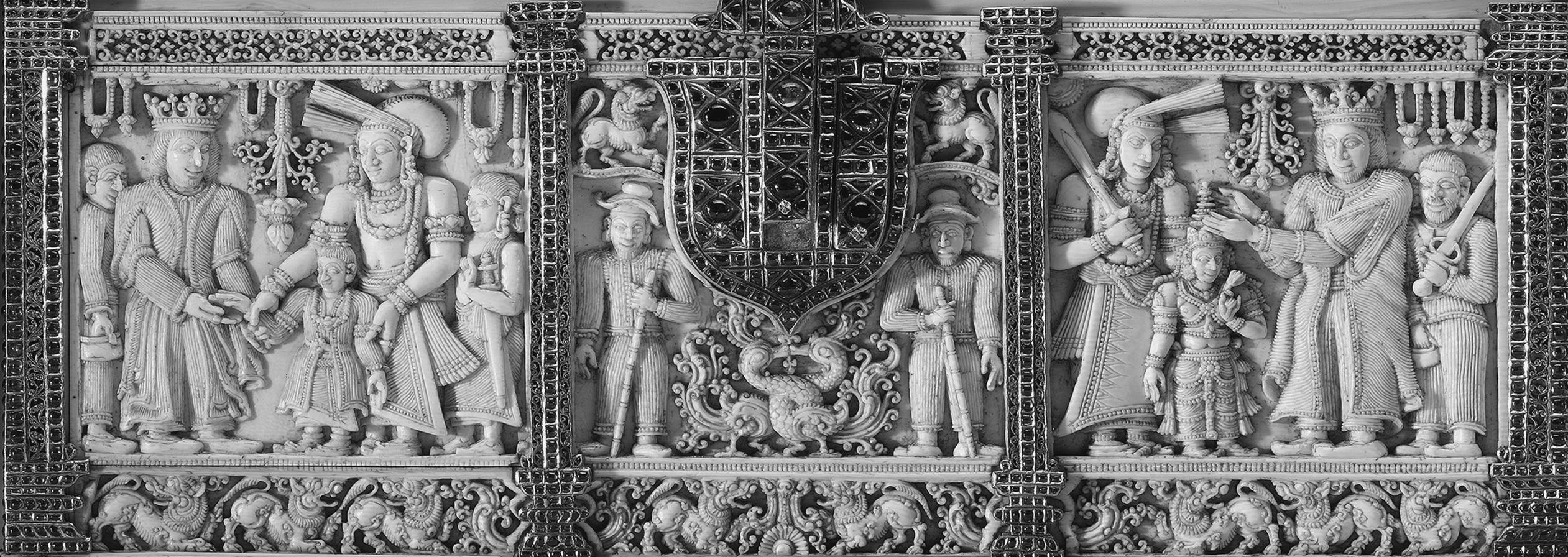
0.3 Bhuvanekabāhu VII as overlord of Lanka. Side panel of the ‘coronation casket’, Kōṭṭe, c.1541. Munich, Bayerische Verwaltung der staatlichen Schlösser, Gärten und Seen, Residenz München, Schatzkammer, Inv.-Nr. 1241. 7
2.1 Taprobane in the Geography of Ptolemy. Florence, late fifteenth century. The Huntington Library, San Marino, CA, Codex Wilton, HM 1092, fol. 53v–54. 40
2.2 Seillam in the shadow of the newly formed Indian subcontinent on the ‘Cantino Planisphere’, Lisbon, 1502. Biblioteca Estense Universitaria, Modena.
2.3 Main ports of the Indian Ocean region.
2.4 Sri Lanka in the sixteenth century.
41
42
49
2.5 The Portuguese fort built near Colombo in 1518. Hand-drawn copy of the original contained in the manuscript of Gaspar Correia’s Lendas da Índia, mid-sixteenth century. Copy published in the first printed edition of the Lendas, Lisbon, 1858. Image in the public domain. 62
6.1 Colombo as a capital with fortifications begun in 1565. Detail from a Dutch view drawn after 1656. Atlas Johannes Vingboons, Nationaal Archief, The Hague, Inv.-nr. VELH_619.115. South on top. Image in the public domain. 154
8.1 Sri Lanka as a galactic polity on a map in the Atlas of Fernão Vaz Dourado, Goa, 1568. Biblioteca de los Duques de Alba, Madrid. 202
8.2 Ceilan Insula as a conquerable territory. Map from the Mercator Atlas edited by Jodocus Hondius, Antwerp, 1606, based on a lost map by Cipriano Sánchez. David Rumsey Collection, Stanford. Image in Creative Commons. 206
Introduction
Querying the Origins of European Conquest in Asia
Why conquer? Taking possession of lands in Asia was not an idea that came to Europeans instinctively. It did not occur to Marco Polo, as has been famously noted, when he travelled to Cathay.1 Nor did it appear ex machina to Vasco da Gama when he reached Calicut in 1498, at a time when Columbus inaugurated Castilian possessive operations—first rhetorical, soon military—in the New World. As the Portuguese, and then their English, Dutch, Danish, and French followers ventured into Asian waters, the thought of taking over parts of the continent only came to them gradually. This is, then, the primary objective of this book: to explore how connections were established across cultural boundaries, how conversations arose between Iberian and South Asian agents of empire, and how the ground was slowly prepared for one of the largest European territorial possessions in the East before the advent of the British empire: the Conquista de Ceilão, or Conquest of Ceylon.
GLOBAL HISTORIES BETWEEN CONNECTION AND DISCONNECTION
Much emphasis has been placed during the past twenty years—since the publication, in 1997, of Sanjay Subrahmanyam’s widely received article on the ‘connected histories’ of early modern Eurasia—on the study of global connections.2 Connected histories are now everywhere, and rightly so. Less has been said, however, about how exactly connections worked or failed to work in local contexts, and how, in some instances, they paved the way for disconnection and colonial endeavour. This is, in part, to do with the ambition of ‘connected history’ to dismantle old Eurocentric narratives where agency had been too tightly bound up with expanding western nations. The de-centring and levelling of the playing field has been one of the great achievements of the past two decades.3 But since the fact remains that
1 Stephen Greenblatt, Marvelous Possessions. The Wonder of the New World (Chicago, IL: University of Chicago Press, 1991), p. 53.
2 Sanjay Subrahmanyam, ‘Connected Histories: Notes towards a reconfiguration of Early Modern Eurasia’, Modern Asian Studies, 31, 3 (1997), pp. 735–62.
3 This change is amply reflected in the structure and contents of the recent sixth volume of the Cambridge World History: Jerry H. Bentley, Sanjay Subrahmanyam, and Merry E. Wiesner-Hanks, eds., The Construction of a Global World, 1400–1800 CE (Cambridge: Cambridge University Press, 2015).
(Dis)connected Empires
parts of South and Southeast Asia were invaded by Europeans at various moments after 1500, and not vice versa, it is also crucial to ask where and when precisely connections evolved in such a way that conquest became a possibility.
As Jeremy Adelman recently put it, we need ‘narratives of global life that reckon with disintegration as well as integration, the costs and not just the bounty of interdependence’.4 To be sure, it would be unfair to say that global historians have ignored disintegration and disconnection, and that on such grounds connected history itself is obsolete. Global and critical connective methods remain powerful and legitimate tools for an understanding of how the world changed after 1500.5 But it certainly is worth emphasizing how a nuanced picture cannot emerge if we fail to come to terms with the forces that, within the freshly interconnected universe of the 1500s, and from its very inception, drove disconnection and hierarchization. How was it that some societies engaging in trans-continental diplomatic and commercial exchanges, often facing each other with comparable confidence, gradually drifted apart, while they were talking to each other, in such a manner that one could dream up the conquest of the other? Were divergences in political cultures, and ultimately disconnection, aspects as characteristic of the early modern world as connectivity was?
To answer such questions, this book goes on a global journey (see Figure 0.1). It explores the diplomatic, cultural, and military triangle built during the sixteenth century by the Portuguese empire, the imperial polity led by Kōṭṭe in Sri Lanka, and the Catholic Monarchy of the Spanish Habsburgs. Obviously, each of these imperial formations had very distinctive sizes, shapes, and histories. Portugal had pioneered explorations in the Atlantic, settled a number of uninhabited islands, waged wars in the North of Morocco, and established trading posts along the West African littoral during the fifteenth century. The rulers of the House of Avis, a young dynasty established in the late 1300s with a connection to the House of Lancaster, developed wider commercial and political ambitions and, in 1498, established the first maritime link between Europe and Asia. By the middle of the sixteenth century, there were Portuguese coastal establishments from Brazil to Japan, and tributary agreements with numerous rulers especially in the Indian Ocean region. Historians have, over the past decades, unveiled the tentative, often erratic nature of Lusitanian inroads into Asia in particular, offering a healthy departure from earlier, nationalist tales of a highly centralized empire.6 It has also been shown, however, that amidst all the improvization and internal rivalry, imperial ideas did play a role alongside with commercial and other considerations. To maintain that there was no Portuguese imperialism in Asia in the sixteenth century is
4 Jeremy Adelman, ‘What is global History now?’, Aeon (2017), https://aeon.co/essays/is-globalhistory-still-possible-or-has-it-had-its-moment (last accessed 20 September 2017).
5 See a rebuttal to Adelman, with abundant bibliography, in Richard Drayton and David Motadel, ‘Discussion: the futures of global history’, Journal of Global History, 13, 1 (2018), pp. 1–21.
6 See above, Luís Filipe F. R. Thomaz, De Ceuta a Timor, 2nd ed. (Lisbon: Difel, 1994); Sanjay Subrahmanyam, The Portuguese Empire in Asia 1500–1700. A Political and Economic History (London: Longman, 1993); Romain Bertrand, Le long remords the la conquête. Manille-Mexico-Madrid: l’affaire Diego de Ávila (1577–1580) (Paris: Seuil, 2011).
0.1 Nodes of global communication in the Iberian-Lankan encounter.
Goa Cochin Colombo Macao
Lisbon
Bahia
Hormuz
Malacca
Manila
Mexico
Madrid
Mozambique
Figure
today as untenable as older interpretations attributing the origin of all imperial evils to Vasco da Gama’s arrival in 1498.7 The question is not whether Portugal had imperial ambitions, but where and when it developed them, and how plans of conquest gained traction even when some sectors of Portuguese society opposed them.8
In South Asia, the Portuguese were observed with keen interest by the elites of the Buddhist and Hindu kingdoms of Sri Lanka. These kingdoms—above all, that of Kōṭṭe—had for centuries nurtured imperial ambitions in a regionally confined and, by 1500, purely insular geography. The Universalist symbolism of cakravarti (‘wheel-turning’) overlordship had come to fill little more than the space of Lanka itself, but this had been done in diplomatic and military cooperation with polities across mainland South and Southeast Asia. To impose their authority at home, Lankan rulers tended to rely on diplomacy abroad. It made much sense to engage the newly established Estado da Índia , the official apparatus of Portuguese possessions in Asia with its centre at Cochin and later Goa, as yet another Indian political formation capable of supporting Sri Lankan imperial projects. Gradually, Portuguese and Lankan discourses of empire became intertwined. Lankan imperial ideas were transfused into the Portuguese imperial system. Despite the fact that the match proved imperfect, the Lankan imperial ideal showed great resilience and vitality throughout the period. Almost nothing that happened before the 1590s can be explained without a thorough consideration of Lankan politics and diplomacy.9 Eventually a third player, the empire of the Spanish Habsburgs, entered the stage. It had grown back-to-back with the Portuguese empire, expanding mostly across the Atlantic and establishing ample colonial possessions in the Caribbean,
7 An explicit dismissal of Portuguese expansion as not being imperial is in Darwin, After Tamerlane, p. 53. The idea of an era inaugurated by the 1498 voyage is at the heart of K. M. Panikkar, Asia and Western Dominance. A Survey of the Vasco da Gama Epoch of Asian History, 1498–1945 (London: Alan & Unwin, 1953).
8 There is now a relative abundance of overview works in English on the Portuguese empire. The best points of entry are Anthony Disney, A History of Portugal and the Portuguese Empire, 2 vols. (Cambridge: Cambridge University Press, 2009); Subrahmanyam, The Portuguese Empire in Asia. A political and economic history (London: Longman, 1993); Francisco Bethencourt and Diogo Ramada Curto, eds., Portuguese Oceanic Expansion, 1400–1800 (Cambridge: Cambridge University Press, 2007); Jorge Flores, ‘The Iberian Empires, 1400–1800’, in The Cambridge World History, vol. 6; The Construction of a Global World, 1400–1800 CE, edited by Jerry H. Bentley, Sanjay Subrahmanyam and Merry E. Wiesner-Hanks (Cambridge: Cambridge University Press, 2015), pp. 271–96.
9 The key reference works on Sri Lankan history are still the University of Ceylon History of Ceylon, vol. I, parts 1 and 2, edited by H. C. Ray (Colombo: Ceylon University Press, 1959–1960), followed by the University of Peradeniya History of Sri Lanka, vol. II, edited by K. M. de Silva (Peradeniya: University of Peradeniya, 1995). Much of the factual history of the Portuguese presence in Sri Lanka has been established by Tikiri Abeyasinghe, Portuguese Rule in Ceylon 1594–1612 (Colombo: Lake House, 1966); Chandra Richard De Silva, The Portuguese in Ceylon 1617–1638 (Colombo: H. W. Cave & Co., 1972); George D. Winius, The Fatal History of Portuguese Ceylon. Transition to Dutch Rule (Cambridge, MA: Harvard University Press, 1971); Jorge Flores, Os Portugueses e o Mar de Ceilão, 1498–1543. Trato, Diplomacia e Guerra (Lisbon: Cosmos, 1998). The most sophisticated, theoretically informed study of the Portuguese materials, written specifically to tackle questions of Lankan kingship, religion and ethnicity, is Alan Strathern, Kingship and Conversion in Sixteenth-Century Sri Lanka. Portuguese Imperialism in a Buddhist Land (Cambridge: Cambridge University Press, 2007). Much of it resonates through the chapters of this book, especially those concerned with the reign of Bhuvanekabāhu VII. It also contains a thorough discussion of the source materials, which are overwhelmingly in Portuguese. Also see, more recently, Stephen C. Berkwitz, Buddhist Poetry and Colonialism: Alagiyavanna and the Portuguese in Sri Lanka (Oxford: Oxford University Press, 2013).
Central America, the Andes, and the River Plate region from the 1490s. In 1581, a decade and a half after the nominal conquest of the Philippines launched from New Spain, it incorporated the global Lusitanian empire and became a realm where, as Phillip II enjoyed hearing, the sun never set. Under the Iberian union of crowns (1581–1640), Sri Lanka became a theatre of state-sponsored Iberian conquest and colonization. The question arises whether this shift reflects a transmission of conquista tactics from the New World to the Old, as has been suggested, or something more complex. In what ways had sectors of Portuguese society prepared the ground for the shift? To what extent did the Lankan imperial project continue to shine through even the thickest layers of Iberian conquista discourse? Can the Spanish-Portuguese conquest be compared with other European endeavours in Asia, namely those of the English EIC and the Dutch VOC?10
The vibrancy and complexity of the relationships at stake, their global nature, but also the challenges posed to historians interested in trans-continental connectivity, emerge vividly from the reception, in 1542, of an ambassador from Sri Lanka at the royal court in Lisbon. In many ways, the event is a perfect example of how global connections could work. When Śrī Rāmarakṣa, a Tamil minister dispatched by Bhuvanekabāhu VII of Kōṭṭe (r.1521–51) to negotiate an inter-imperial agreement with John III of Portugal (r.1521–57), traversed hall after hall of a palace built on Lisbon’s riverfront to celebrate the oceanic expansion of the Avis dynasty, both parties stood in awe of each other’s magnificence. The Portuguese courtly elite marvelled at the refined gifts carried across the palace, testimonies to the economic prosperity, imperial ambition, and artistic sophistication of a distant Asian court. There were finely carved ivories and even, according to one account, a gold statue representing a Sinhalese prince soon to be crowned by the Portuguese monarch.
The prince, a three-year old child called Dharmapāla, had been chosen by the ruler of Kōṭṭe, Bhuvanekabāhu VII, to succeed him on the Lankan imperial throne. He was not next in line, but the embassy was sent precisely to secure him that position. Whilst bending the rules of succession was no novelty for the Lankan elite, the geography of the mission was. For the first time in history, legitimation for the next potential cakravarti of Sri Lanka was to be sought not within the island, nor even on the Indian or Southeast Asian subcontinent, but in a Christian land on the other side of the globe. Two royal dynasties were talking to each other over thousands of miles of distance and across deep cultural divides with relative success.
The principal events of the diplomatic encounter as imagined by the Lankan royal court are represented on a finely chiselled ivory casket (see Figure 0.2). On the left side of the panel, the Sinhalese prince is presented to the Portuguese monarch, his hand placed into the hands of John III as a widely readable sign of allegiance. On the right, John places a Lankan crown on the head of the prince, symbolically
10 In contrast with the vast amount of literature available on imperial Spain and its New World colonies, little has been written about Spanish activities in Asia, and even less about their impact on the Portuguese Estado. See Rafael Valladares, Castilla y Portugal en Asia (1580–1680). Declive imperial y adaptación (Leuven: Leuven University Press, 2001) and Romain Bertrand, Le long remords the la conquete. Manille-Mexico-Madrid: l’affaire Diego de Ávila (1577–1580) (Paris: Seuil, 2011). Further references to New World historiography are given below, in Chapter 5.
Figure 0.2 Dharmapāla meets John III. Front panel of the ‘coronation casket’, Kōṭṭe, c.1541. Munich, Bayerische Verwaltung der staatlichen Schlösser, Gärten und Seen, Residenz München, Schatzkammer, Inv.-Nr. 1241.
committing to his defence. Connections and converging imperial ideas were at the heart of the deal. For the ruling elite of Kōṭṭe, this was a moment of mutual recognition allowing two polities with commensurable and connectable imperial ambitions to cooperate; a moment, in fact, of mutual conquest. As Alan Strathern put it in his groundbreaking study of Lankan kingship in the sixteenth century, the iconography asserts how ‘one could be emperor and vassal at the same time’ in Sri Lanka, ambitioning hegemony on the home front whilst skilfully playing the global diplomatic game abroad.11 Kōṭṭe, it was thought, could maintain its claims to suzerainty within the island of Lanka while the Portuguese empire would thrive on the seas surrounding it—and, crucially, invest resources in the maintenance of the Lankan political order. Bhuvanekabāhu VII appears on the left and right hand ends of the casket in full majesty, riding a royal elephant and sitting on the lion throne of Kōṭṭe, displaying all the signs of authority of the foremost ruler of Sri Lanka (see Figure 0.3). For another five decades to come, Kōṭṭe was to maintain its symbolic prominence in Lanka against stiff competition from other polities thanks to the Portuguese connection.
All this being said, however, the story is also one of gradual divergence and, eventually, communicational breakdown. The house of Kōṭṭe intertwined its destiny with a society that began, roughly at the time when the embassy returned home, to forge new plans for its own imperial future in Asia. Whilst on the casket the Sinhalese king appeared in full imperial majesty, his and his successor’s days as truly independent, Buddhist rulers of Lanka were numbered. Reports of Śrī Rāmarakṣa’s diplomatic mission have reached us through works with such ominous titles as the Temporal and Spiritual Conquest of Ceylon, by the Jesuit Fernão de Queiroz, or the Spiritual Conquest of the Orient, by the Franciscan friar Paulo da Trindade. Whilst
11 Strathern, Kingship and Conversion, p. 66. For an exploration of this and other caskets, with further bibliography, see Zoltán Biedermann, ‘Diplomatic Ivories: Sri Lankan Caskets and the European-Asian Diplomatic Exchange, 1500–1600’, in Global Gifts. The Material Culture of Diplomacy in Early Modern Eurasia, edited by Zoltán Biedermann, Anne Gerritsen, and Giorgio Riello (New York: Cambridge University Press, 2018), pp. 88–118.
Figure 0.3 Bhuvanekabāhu VII as overlord of Lanka. Side panel of the ‘coronation casket’, Kōṭṭe, c.1541. Munich, Bayerische Verwaltung der staatlichen Schlösser, Gärten und Seen, Residenz München, Schatzkammer, Inv.-Nr. 1241.
1542 produced important gains for Kōṭṭe and is a delight to historians looking for global connections, the diplomatic offensive also prepared the ground for much more sinister developments, including the assassination of Bhuvanekabāhu VII in 1551; an increasing pressure on rulers to convert to Catholicism; and the gradual infiltration of the Lankan imperial project by Iberian ideas of spiritual and temporal conquest. There is a distinct possibility that Lankan indigenism itself was reinforced precisely through the confrontation with Portuguese aggressivity.
By 1557, king Dharmapāla was baptized and became Dom João. In 1580 he signed a will leaving his kingdom to the Portuguese crown in case he died without having produced a Sinhalese heir, and by the time he passed away in 1597 a military campaign aiming for the conquest of the island, ordered by Phillip II of Spain, was
(Dis)connected Empires
fully under way. The coastal lowlands of Sri Lanka became one of the largest theatres of terrestrial warfare involving any European power in Asia before the advent of British rule. And when the Portuguese were ousted in 1658, it was thanks to an alliance of a Lankan ruler in the mountainous interior with the Dutch, who soon replicated the Portuguese experience of going from maritime control to territorial conquest—only to be followed, after 1796, by the British, who conquered the island in 1815 and held it until 1948.12
At one level, the story of the collapse of the Luso-Lankan dialogue calls to be linked up with the developments described by Lauren Benton in A Search for Sovereignty. The imperial triangle unravelled tragically, towards the end of the period under consideration, under the weight of the binding together, in European minds, of royal authority with the notion of full territorial control.13 It was the new mental construct of sovereignty, I shall argue, that exploded into Sri Lanka around 1600 to cause the greatest damage after almost a century of softer, suzerainty-based interactions. This said, the bulk of the story is chronologically anterior to Benton’s, and it unfolds at a different level, in a more labyrinthine and culturally interconnected terrain. It is a story of connections that worked whilst being increasingly put under strain; and a story of a breakdown announced many decades before it materialized. A picture will emerge of the various layers of (dis)connectivity that prepared the ground, during the sixteenth century, for the disruptions of the early seventeenth century. Interactions during this period gained traction from the way that together South Asian and Iberian policy-makers cultivated, often against many obstacles, commensurable imperial ideas—but also considered the possibilities of not continuing the dialogue. This is a process that takes us not so much into the realm of laws and clashing legal cultures, but first and foremost into a world of ideas and utterances, at the heart of which we find what Frances Yates so aptly described, forty years ago, as the ‘Imperial Theme’.14
CHAPTERS OF THE LUSO-LANKAN ENCOUNTER
As we delve into the making of the global sixteenth century, we are confronted with a fundamental question: do we study empires (as they grow and confront each other), or empire (as an idea that resonates across the globe)? Yates found it notable how imperial ambitions proliferated across Europe precisely at the time when Charles V saw his dominions grow across the globe as the one and only legitimate Imperator. As Habsburg Spain expanded, France and England developed
12 Intriguingly little has been written about the transitions between colonial powers. See, however, Alicia F. Schrikker, Dutch and British Colonial Intervention in Sri Lanka, 1780–1815: Expansion and Reform (Leiden: Brill, 2007) and Zoltán Biedermann, The Portuguese in Sri Lanka and South India. Studies in the History of Empire, Diplomacy and Trade, 1500–1650 (Wiesbaden: Harrassowitz, 2014), pp. 103–48.
13 Lauren Benton, A Search for Sovereignty. Law and Geography in European Empires, 1400–1900 (Cambridge: Cambridge University Press, 2009).
14 Frances A. Yates, Astraea. The Imperial Theme in the Sixteenth Century (London: Routledge and Kegan Paul, 1975), p. 33.
their own imperial discourses. One symbolic figure in particular rose to glory in this context: Astraea. The virgin goddess under whose just government humanity would find its way back into the Golden Age, the child ‘destined to rule a reconciled world’, was at the heart of countless ramifications of European discourses on empire. This, Yates argued, was the key to understanding European politics in the Renaissance.
To Yates, Astraea and the reign of Saturn were a quintessentially European affair. Today, as I argue in Chapter 1, we are in a position to go further, and ask new questions about transcontinental connections and commensurable cultures of political violence. The imperial theme is a much broader occurrence than Yates was able to see in the 1970s, and one that can be made to work for us as it helps explain many of the contradictions of the early modern world. What makes it most fascinating is how its European expressions resonated with thriving, deeply rooted imperial themes in the Americas, in Africa, and in Asia. Sri Lanka, the case study at the heart of this book, carried on a heritage of Aśōkan, Buddhist-inspired imperialism that proved connectable with the Iberian Renaissance emulations of the Augustan imperial ideal against many odds. The question here is not so much what formations like the Portuguese Estado da Índia or the kingdom of Kōṭṭe were (though this book ventures some thoughts in this regard), but what people believed them to be. Even a network-like entity such as the Estado or a territorially undefined polity such as Kōṭṭe could think and act imperially with consequences going far beyond their geographical limits. Empire was a common vision of Iberians, South Asians and other peoples across the globe, notwithstanding diverse material conditions and many cultural differences. It was an idea with devastating consequences as it helped pave the ground for conquest and colonization. But it was a shared idea nevertheless, and opened up numerous opportunities for cross-cultural communications.
Chapter 2 delves into the beginnings of the Lankan-Portuguese encounter, highlighting the early obstacles to the unfolding of an inter-imperial dialogue. It dwells on the stark contrast between the lack of curiosity shown by early Portuguese agents of empire in Ceylon, and the vivid interest taken by the Lankan elites in the Portuguese. While Ceylon disappeared from the Portuguese imperial imagination, overshadowed by countless other fields of opportunity emerging across Asia, the elite of the kingdom of Kōṭṭe began to labour with remarkable diplomatic perseverance to entice Portuguese leaders into visiting the island. Requests were made for the establishment of a military base at Colombo, which, it was hoped, might help consolidate the authority of the ruler of Kōṭṭe in a highly unstable political environment against the fierce competition of other Lankan rulers. The culmination of the diplomatic efforts of the ruler of Kōṭṭe, Bhuvanekabāhu VII, with the 1541–3 embassy mentioned above, is the subject of Chapter 3. In addition to the ivory casket already mentioned, significant archival materials survive today to give us a detailed picture of how the inter-imperial deal—following what I have called the ‘Matrioshka principle’ of nesting empires—was imagined in the Lankan capital. The papers also go some way to show, however, the limitations of the conversation that Bhuvanekabāhu wished to maintain: the Portuguese monarch, John III, accepted