50 JavaScript Concepts Every Developer Should Know: The Perfect Guide Every JavaScript Developer Needs to Get Started (50 Concepts Every Developer Should Know Book 1)
Advance Praise for 50StudiesEvery AnesthesiologistShouldKnow
“The authors provide a riveting summary of the 50 most influential and important papers in the field of anesthesiology. They dissect each study, discussing the strengths, weaknesses, and relevance of each. Some of the particularly compelling sections include pain medicine, critical care, regional anesthesia, and obstetrics. For anesthesiologists interested in an easy way to brush up on the literature and improve the care of their patients, this book will be a valuable addition to their collection.”
Steven P. Cohen, MD, Chief of Pain Medicine & Director of Clinical Operations, Professor of Anesthesiology & Critical Care Medicine, Neurology and Physical Medicine & Rehabilitation, Johns Hopkins School of Medicine, Director of Pain Research, Walter Reed National Military Medical Center, Professor of Anesthesiology and Physical Medicine & Rehabilitation, Uniformed Services University of the Health Sciences, Baltimore, MD
“The pace of medical innovation continues to accelerate and the growth in the published medical literature has reached the point that it is nearly impossible to keep up. As we strive to understand the relevance of new research evidence to guide our clinical practice, it is important to understand the foundation on which current recommendations are built and new studies are developed. 50 Studies Every Anesthesiologist Should Know is a wonderful summary of articles relevant to clinical practice across the spectrum of anesthesiology practice. I highly recommend this to all current and future anesthesiologists.”
Richard W. Rosenquist, MD, Chairman, Department of Pain Management, Cleveland Clinic, Cleveland, OH
“Dr. Anita Gupta is a visionary – a humanistic physician who is truly driven by the betterment of patients and society. She has a long-standing commitment to medical education and patient care, which helped shape this wonderfully useful book. I know it will serve to educate many students and physicians and help them to improve the lives of many patients for many years to come.”
Stewart D. Friedman, PhD, Practice Professor Emeritus, The Wharton School, University of Pennsylvania, Philadelphia, PA
50 STUDIES EVERY DOCTOR SHOULD KNOW
50 Studies Every Doctor Should Know: The Key Studies that Form the Foundation of Evidence Based Medicine, Revised Edition
Michael E. Hochman
50 Studies Every Internist Should Know
Kristopher Swiger, Joshua R. Thomas, Michael E. Hochman, and Steven Hochman
50 Studies Every Neurologist Should Know
David Y. Hwang and David M. Greer
50 Studies Every Pediatrician Should Know
Ashaunta T. Anderson, Nina L. Shapiro, Stephen C. Aronoff, Jeremiah Davis, and Michael Levy
50 Imaging Studies Every Doctor Should Know
Christoph I. Lee
50 Studies Every Surgeon Should Know
SreyRam Kuy, Rachel J. Kwon, and Miguel A. Burch
50 Studies Every Intensivist Should Know
Edward A. Bittner
50 Studies Every Palliative Care Doctor Should Know
David Hui, Akhila Reddy, and Eduardo Bruera
50 Studies Every Psychiatrist Should Know
Ish P. Bhalla, Rajesh R. Tampi, and Vinod H. Srihari
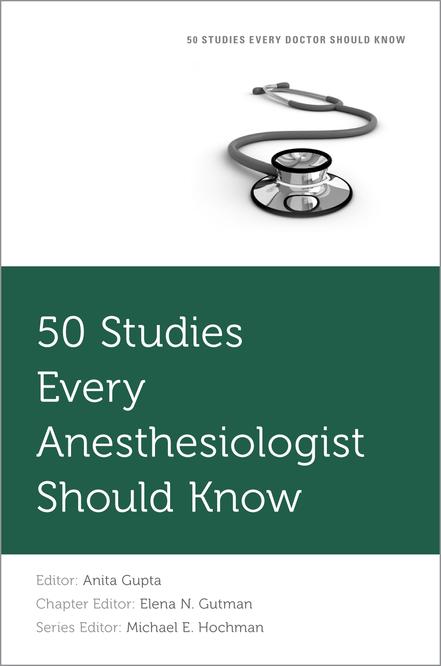
50 Studies Every Anesthesiologist Should Know
EDITED BY
A nitA G uptA , DO, p h A rm D, mpp
Robertson Fellow and Liechtenstein Institute Fellow
Graduate Associate, Julius Rabinowitz Center for Public Policy and Finance
Woodrow Wilson School of Public and International Affairs
Princeton University Princeton, NJ
CHAPTER EDITOR
E l E nA n. G utm A n , m D
Assistant Professor, Department of Anesthesiology
Yale School of Medicine
Yale University
New Haven, CT
SERIES EDITOR
m ich AE l E. h O chm A n , m D, mph
Associate Professor, Medicine
Director, Gehr Family Center for Health Systems Science
USC Keck School of Medicine
Los Angeles, CA
Oxford University Press is a department of the University of Oxford. It furthers the University’s objective of excellence in research, scholarship, and education by publishing worldwide. Oxford is a registered trade mark of Oxford University Press in the UK and certain other countries.
Published in the United States of America by Oxford University Press 198 Madison Avenue, New York, NY 10016, United States of America.
All rights reserved. No part of this publication may be reproduced, stored in a retrieval system, or transmitted, in any form or by any means, without the prior permission in writing of Oxford University Press, or as expressly permitted by law, by license, or under terms agreed with the appropriate reproduction rights organization. Inquiries concerning reproduction outside the scope of the above should be sent to the Rights Department, Oxford University Press, at the address above.
You must not circulate this work in any other form and you must impose this same condition on any acquirer.
Library of Congress Cataloging-in-Publication Data
Names: Gupta, Anita, 1975– editor. | Gutman, Elena N., editor. Title: 50 studies every anesthesiologist should know / edited by Anita Gupta ; chapter editor, Elena N. Gutman. Other titles: Fifty studies every anesthesiologist should know | 50 studies every doctor should know (Series)
Description: Oxford ; New York : Oxford University Press, [2019] | Series: 50 studies every doctor should know | Includes bibliographical references and index. Identifiers: LCCN 2018012948 | ISBN 9780190237691 (alk. paper)
Subjects: | MESH: Anesthesia—methods | Anesthesia—adverse effects | Intraoperative Complications—prevention & control | Postoperative Complications—prevention & control | Evidence-Based Medicine | Clinical Trials as Topic
Classification: LCC RD81 | NLM WO 200 | DDC 617.9/6—dc23 LC record available at https://lccn.loc.gov/2018012948
This material is not intended to be, and should not be considered, a substitute for medical or other professional advice. Treatment for the conditions described in this material is highly dependent on the individual circumstances. And, while this material is designed to offer accurate information with respect to the subject matter covered and to be current as of the time it was written, research and knowledge about medical and health issues is constantly evolving and dose schedules for medications are being revised continually, with new side effects recognized and accounted for regularly. Readers must therefore always check the product information and clinical procedures with the most up-to-date published product information and data sheets provided by the manufacturers and the most recent codes of conduct and safety regulation. The publisher and the authors make no representations or warranties to readers, express or implied, as to the accuracy or completeness of this material. Without limiting the foregoing, the publisher and the authors make no representations or warranties as to the accuracy or efficacy of the drug dosages mentioned in the material. The authors and the publisher do not accept, and expressly disclaim, any responsibility for any liability, loss or risk that may be claimed or incurred as a consequence of the use and/or application of any of the contents of this material.
9 8 7 6 5 4 3 2 1
Printed by WebCom, Inc., Canada
Dedicated to the beacons of my life, Sanjeev, Shaan, Jay, for their unconditional love.
Anita Gupta
CONTENTS
Foreword from the Series Editor Michael E. Hochman xi
Foreword by Lee A. Fleisher xiii
Foreword by Jonathan R. Pletcher xv
Preface xvii
Acknowledgments xix
SECTION 1 General Anesthesiology
1. Video vs. Direct Laryngoscopy: A Randomized Clinical Trial 3
2. Management of the Difficult Airway: A Closed Claims Analysis 8
3. Predictive Factors of Difficult and Impossible Mask Ventilation 13
4. Perioperative Normothermia and Incidence of Cardiac Events 18
5. Perioperative Normothermia, Incidence of Surgical-Wound Infection and Length of Hospitalization 23
6. Preventable Anesthesia Mishaps 28
7. Deliberate Increase of Oxygen Delivery in the Perioperative Period 34
8. Blood Sugar Control in Type 2 Diabetes 39
SECTION 2 Cardiac Anesthesia
9. Congestive Heart Failure and Pulmonary Artery Catheterization 45
10. Rate Control vs. Rhythm Control for Atrial Fibrillation 50
11. Early Use of the Pulmonary Artery Catheter and Outcomes in Patients with Shock and Acute Respiratory Distress Syndrome: A Randomized Controlled Trial 55
12. Statins and Perioperative Cardiac Complications 60
13. A Survey of Transesophageal Echocardiography 65
14. Statins and Perioperative Cardiac Complications 69
15. Effects of Extended-Release Metoprolol Succinate in Patients Undergoing Noncardiac Surgery (POISE Trial): A Randomized Controlled Trial 74
SECTION 3 Neuroanesthesia
16. Adverse Cerebral Outcomes After Coronary Bypass Surgery 81
17. Long-Term Cognitive Impairment After Critical Illness 86
18. Cerebral Perfusion Pressure 91
SECTION 4 Critical Care
19. An Intervention to Decrease Catheter-Related Bloodstream Infections in the Intensive Care Unit 97
20. Early Goal-Directed Therapy in the Treatment of Severe Sepsis and Septic Shock 104
21. Intensive Insulin Therapy and Pentastarch Resuscitation in Sepsis 109
22. Transfusion Requirements in Critical Care (TRICC) 114
23. Effects of Intravenous Fluid Restriction on Postoperative Complications 119
24. The Saline vs. Albumin Fluid Evaluation (SAFE) Study 125
SECTION 5 Perioperative Medicine
25. Prevention of Intraoperative Awareness in High-Risk Surgical Patients 133
26. Perioperative Medication Errors and Adverse Drug Events 138
27. Surgical Safety Checklist 143
28. Prevention of Postoperative Nausea and Vomiting 147
29. Postoperative Oxygen Desaturation: A Comparison of Regional Anesthesia vs. Continuous Administration of Opioids 153
30. Surgical Site Infections Following Ambulatory Surgery Procedures 158
31. Care Coordination 163
32. Pulmonary Aspiration: Clinical Significance in the Perioperative Period 168
33. Postoperative Pain Experience 174
SECTION 6 Pain Anesthesiology
34. An fMRI-Based Neurologic Signature of Physical Pain 181
35. Clinical Importance of Changes on a Numerical Pain Rating Scale 185
36. Postinjury Pain Hypersensitivity and NMDA Receptor Antagonists 189
37. Randomized Trial of Oral Morphine for Chronic Noncancer Pain 193
38. Epidural Glucocorticoid Injections for Spinal Stenosis 200
39. Magnetic Resonance Imaging of the Lumbar Spine in People Without Back Pain 205
40. Surgery vs. Rehabilitation for Chronic Lower Back Pain 211
41. Preoperative Multimodal Analgesia for Laparoscopic Cholecystectomy 217
SECTION 7 Regional Anesthesiology
42. Neuraxial Anesthesia and Postoperative Mortality and Morbidity 225
43. Epidural Anesthesia and Analgesia in High-Risk Patients Undergoing Major Surgery 230
44. Nerve Stimulator and Multiple Injection Technique for Upper and Lower Limb Blockade 235
SECTION 8 Obstetric Anesthesiology
45. Neuraxial Analgesia Given Early in Labor 243
46. Postdural Puncture Headache in Obstetrics: A Meta-analysis 247
47. Parental Presence During Induction vs. Sedative Premedication 253
48. Perioperative Pediatric Morbidity and Mortality 258
49. CRIES: A Neonatal Postoperative Pain Measurement Score 263
50. Emergence Agitation After Sevoflurane vs. Propofol in Pediatrics 268
Index 273
FOREWORD FROM THE SERIES EDITOR
When I was a third-year medical student, I asked one of my senior residents— who seemed to be able to quote every medical study in the history of mankind— if he had a list of key studies that have defined the current practice of general medicine which I should read before graduating medical school. “Don’t worry,” he told me. “You will learn the key studies as you go along.”
But picking up on these key studies didn’t prove so easy and I was frequently admonished by my attendings for being unaware of crucial literature in their field. More importantly, because I had a mediocre understanding of the medical literature at that time, I lacked confidence in my clinical decision-making and had difficulty appreciating the significance of new research findings. It wasn’t until I was well into my residency— thanks to considerable amount of effort and determination—that I finally began to feel comfortable with both the emerging and fundamental medical literature.
Now, as a practicing general internist, I realize that I am not the only doctor who has struggled to become familiar with the key medical studies that form the foundation of evidence-based practice. Many of the students and residents I work with tell me that they feel overwhelmed by the medical literature, and that they cannot process new research findings because they lack a solid understanding of what has already been published. Even many practicing physicians—including those with years of experience—have only a cursory knowledge of the medical evidence base and make clinical decisions largely on personal experience.
I initially wrote 50 Studies Every Doctor Should Know in an attempt to provide medical professionals (and even lay readers interested in learning more about medical research) a quick way to get up to speed on the classic studies that shape clinical practice. But it soon became clear there was a greater need for this distillation of the medical evidence than my original book provided. Soon after the book’s publication, I began receiving calls from specialist physicians in a variety of disciplines wondering about the possibility of another book focusing
on studies in their field. In partnership with a wonderful team of editors from Oxford University Press, we have developed my initial book into a series, offering volumes in Internal Medicine, Pediatrics, Surgery, Neurology, Radiology, Critical Care Medicine, and now Anesthesia. Several additional volumes are in the works.
I am particularly excited about this latest volume in Anesthesia, which is the culmination of hard work by two dedicated editors – Anita Gupta and Elena Gutman, who worked tirelessly to identify and summarize the most important studies in their field. There tend to be fewer rigorous randomized trials in the field of Anesthesia than in some other medical disciplines. Nevertheless, Drs. Gupta and Gutman found studies that offer important lessons on the central topics in their field. I believe 50 Studies Every Anesthesiologist Should Know provides the perfect launching ground for trainees in the field as well as a helpful refresher for practicing clinicians – physicians, nurse anesthetists, and other anesthesia professionals. The book also highlights key knowledge gaps that may stimulate researchers to tackle key unanswered questions in the field. A special thanks also goes to the wonderful editors at Oxford University Press – Andrea Knobloch and Emily Samulski – who injected energy and creativity into the production process for this volume. This volume was a pleasure to help develop, and I learned a lot about the field of Anesthesia in the process.
I have no doubt you will gain important insights into the field of Anesthesiology in the pages ahead!
Michael E. Hochman, MD, MPH
FOREWORD
Over the past several decades, there has been a movement from eminence-based care to evidence-based care. This has occurred in numerous specialties although the number and size of the clinical trials upon which to base care has varied greatly between specialties such as cardiology where mega trials have become common to anesthesiology where until recently much of the evidence base is smaller trials or closed claims given the incidence of rare outcomes such as anesthetic – related mortality. Importantly, the evidence base for anesthesiology has grown dramatically and there are numerous critical papers which help shape today’s best practices. Dr. Anita Gupta has added to the series of books published by Oxford on the 50 Studies Every Doctor Should Know by the inclusion of anesthesiology. She has used a templated approach in which her contributors have assessed the quality of the study, limitations and implications. This will allow the readers to better understand the database and make their own decisions on how it should be incorporated into care. Dr. Anita Gupta is the ideal individual to edit this book with her expertise in pain management, pharmacology and additional training through her Masters in Public Policy. Her recent experience that Princeton University’s Woodrow Wilson School of Public Health and International Affairs and work with the World Health Organization further provides are with the expertise to put together this important publication. This book should help all anesthesiologists improve their understanding of the literature and therefore the practice of evidence-based medicine.
Lee A. Fleisher, MD
Robert
D. Dripps Professor and Chair of Anesthesiology
and Critical Care Perelman School of Medicine of the University of Pennsylvania Philadelphia, PA
FOREWORD
I met Dr. Anita Gupta for the first time when she had just begun her health policy studies at the Woodrow Wilson School of Public Policy and International Affairs at Princeton University. She had decided to pause in the midst of a thriving career as an anesthesiologist at a major academic medical school in order to study health policy related to the ongoing opioid epidemic in Philadelphia. As I recall, I could not suppress my surprise that an anesthesiologist would make such a bold and progressive career move. She looked past my obvious bias, and explained that it was because of her career as an anesthesiologist that she felt a special purpose. Her goal was to leverage her professional experience with training at a premier university towards changing public policy in a way that is evidence-informed. She was persuasive in her conviction that physicians who understood the evidence base and had been on the front line of combating the epidemic were in dire need as policy makers. She made perfect sense, and I learned not to question one’s motives based on professional discipline. It was equally impressive that she had chosen perhaps the most rigorous program in the country to learn public policy. This too eventually made perfect sense, for as I came to know all too well, Dr. Gupta is not one to make a major decision without learning all that she could from the available evidence.
The evidence base is our guide, but there cannot possibly be a randomized control trial for each and every decision. When I learned that Dr. Gupta and her co-editors had spent years compiling a tome of fifty of the most critical studies for anesthesiologists, my first thought was that, yet again, this made perfect sense. This book serves as a guide for clinicians who must translate the best available evidence to unique clinical scenarios. Understanding why a study is important is sometimes the easy part- the art of medicine involves translating that study to inform real-life decisions that we, and more importantly, our patients, face every day. My supposition is that there is special value in learning from the perspective of a gifted and skilled physician. My hope is that the reader keep in mind that the Dr. Gupta’s voice is informed by her professional as well as her life experience. She teaches us that we, as physicians, have a special responsibility to be as skilled in translating the available evidence as we hope all doctors will be.
Jonathan R. Pletcher, MD Director, Medical Services
University Health Services
Princeton University Princeton, NJ
PREFACE
Do you remember the first day of medical school? It may be hard for many to recall all the details of the day, but when you ask physicians, most will remember how they felt. Usually, they will say that they recalled being excited, ambitious, and slightly nervous but overwhelmingly optimistic and filled with compassion for the patients we were about to take on. When I set out to compile this book, I thought about how pivotal it is to understand that what we feel on the first day of medical school should be how we feel every day and lifelong as a physician even with the rapidly changing world of medicine. To further this, physicians need to have a strong foundation of evidence so that we can always offer our patients the best possible care with the most amount of empathy, which often leads to better patient outcomes. Understanding evidence in medicine can be time-consuming and often cumbersome given the growing demands of the field, and much of those feelings of excitement may become fleeting very quickly with the inundation of required tasks.
To understand the evidence, physicians must have access to clear, concise, organized, and clinically relevant information. This book provides exactly that. I attempted to curate and organize information that can be critically important for any anesthesiologist anywhere in the world. This book summarizes the most relevant information in a concisely in a few pages for some of the most current and influential studies in our specialty.
How were the studies selected? It was by no means easy. Hundreds of landmark studies were narrowed down to the final 50. Numerous anesthesiologists reviewed the selections to determine the studies that should be included. There is no perfect way to decide which studies are the most critical. By the end of the selection process, it came down to what matters most to anesthesiologists and what may have a significant impact on our patients. In most cases, it came down to knowing which evidence may affect a patient’s life for all anesthesiologists. The most relevant studies were the final 50 that are included here for you to review.
I genuinely hope that you will find this book as informative as I have when preparing it over years of careful and diligent curation. I believe this book will help your practice and your understanding of how valuable evidence is essential to our work every day and to the care of our patients’ lives and their families. This evidence can help us to be compassionate, ambitious, and optimistic about every patient we treat and to ensure we are delivering the best medical care with the utmost empathy and evidence in hand as we take on the practice of medicine each and every day as anesthesiologists.
ACKNOWLEDGMENTS
I would like to acknowledge the countless individuals who have assisted with this book and many that have provided their insight and support to make this book a success.
I would like to thank Oxford University Press Senior Editor Andrea Knobloch, Associate Editor Rebecca Suzan, and Associate Editor Emily Samulski for making this book come to fruition and for their consistent vision and limitless encouragement, advice, and support. Andrea Knobloch is a true visionary, and I am proud to be an author with her mentorship. She has undoubtedly provided guidance to me both as a senior editor and mentor and as a friend through the many turns of life, and I am grateful that she has stood by every turn of this book to achieve its ultimate successful publication.
I would also like to thank my countless mentors over the years from all the institutions in which I have had the honor to learn anesthesiology, pain medicine, and health policy—Princeton University, Johns Hopkins University, Georgetown University, and the National Institutes of Health. Thank you for supporting my passion to advocate for change and to have an impact on public health, providing the best possible care to patients. And, thank you for truly making me understand the critical importance of strong evidence-based medicine, innovation, and policy to ensure that the change we make is always in the best interest of our patients.
I would like to thank the many esteemed faculty, graduate students, and medical students at the University of Pennsylvania School of Medicine, Drexel University College of Medicine, the University of Medicine and Dentistry of New Jersey, and most important, the American Society of Anesthesiologists for their endless support. This book would not be possible without their guidance and their ability to foster within me key leadership skills and a clear understanding of the importance of high-level evidence for delivering the highest level of medical care possible to patients.
I want to sincerely thank all the first authors of the 50 selected studies included in this book who generously reviewed the summaries for accuracy and completeness. I very much appreciate the assistance of these esteemed individuals. More important, I want to thank them for their dedication, commitment, and fine contribution to advancing the science of medicine, anesthesiology, critical care, and pain medicine.
1. The GlideScope Video Laryngoscope: randomized clinical trial in 200 patients. First author, D. A. Sun.
2. Management of the difficult airway: a closed claims analysis. First author, G. N. Peterson.
3. Incidence and predictors of difficult and impossible mask ventilation. First author, S. Kheterpal.
4. Perioperative maintenance of normothermia reduces the incidence of morbid cardiac events. A randomized clinical trial. First author, S. M. Frank.
5. Perioperative normothermia to reduce the incidence of surgicalwound infection and shorten hospitalization. First author, A. Kurz.
6. Preventable anesthesia mishaps: a study of human factors. First author, J. B. Cooper.
7. A randomized clinical trial of the effect of deliberate perioperative increase of oxygen delivery on mortality in high-risk surgical patients. First author, O. Boyd.
8. Effects of intensive glucose lowering in type 2 diabetes. First author, H. C. Gerstein.
9. Evaluation study of congestive heart failure and pulmonary artery catheterization effectiveness: the ESCAPE trial. First author, C. Binanay.
10. A comparison of rate control and rhythm control in patients with atrial fibrillation. First author, D. G. Wyse.
11. Early use of the pulmonary artery catheter and outcomes in patients with shock and acute respiratory distress syndrome. First author, C. Richard.
12. Statins decrease perioperative cardiac complications in patients undergoing noncardiac vascular surgery: the Statins for Risk Reduction in Surgery (StaRRS) study. First author, K. O’Neil-Callahan.
13. Safety of transesophageal echocardiography: a multicenter survey of 10,419 examinations. First author, W. G. Daniel.
14. Coronary revascularization in context. First author, R. A. Lange.
15. Effects of extended-release metoprolol succinate in patients undergoing non-cardiac surgery (POISE trial): a randomised controlled trial. First author, P. J. Devereaux.
16. Adverse cerebral outcomes after coronary bypass surgery. First author, G. W. Roach.
17. Long-term cognitive impairment after critical illness. First author, P. P. Pandharipande.
18. Cerebral perfusion pressure: management protocol and clinical results. First author, M. Rosner.
19. An intervention to decrease catheter-related bloodstream infections in the ICU. First author, P. Pronovost.
20. Early goal-directed therapy in the treatment of severe sepsis and septic shock. First author, E. Rivers.
21. Intensive insulin therapy and pentastarch resuscitation in severe sepsis. First author, F. Brunkhorst.
22. A multicenter, randomized, controlled clinical trial of transfusion requirements in critical care. First author, P. C. Hébert.
23. Effects of intravenous fluid restriction on postoperative complications: comparison of two perioperative fluid regimens: a randomized assessor-blinded multicenter trial. First author, B. Brandstrup.
24. A comparison of albumin and saline for fluid resuscitation in the intensive care unit. First author, S. Finfer.
25. Prevention of intraoperative awareness in a high-risk surgical population. First author, M. S. Avidan.
26. Evaluation of perioperative medication errors and adverse drug events. First author, K. C. Nanji.
27. A surgical safety checklist to reduce morbidity and mortality in a global population. First author, A. B. Haynes.
28. A factorial trial of six interventions for the prevention of postoperative nausea and vomiting. First author, C. C. Apfel.
29. Pronounced, episodic oxygen desaturation in the postoperative period: its association with ventilatory pattern and analgesic regimen. First author, D. M. Catley.
30. Surgical site infections following ambulatory surgery procedures. First author, P. L. Owens.
31. A reengineered hospital discharge program to decrease rehospitalization. First author, B. W. Jack.
32. Clinical significance of pulmonary aspiration during the perioperative period. First author, M. A. Warner.
33. Postoperative pain experience: results from a national survey suggest postoperative pain continues to be undermanaged. First author, J. L. Apfelbaum.
34. An fMRI-based neurologic signature of physical pain. First author, T. D. Wager.
35. Clinical importance of changes in chronic pain intensity measured on an 11-point numerical pain rating scale. First author, J. T. Farrar.
36. The induction and maintenance of central sensitization is dependent on N-methyl-D-aspartic acid receptor activation: implications for the treatment of post-injury pain hypersensitivity states. First author, C. J. Woolf.
37. Randomised trial of oral morphine for chronic non-cancer pain. First author, D. E. Moulin.
38. A randomized trial of epidural glucocorticoid injections for spinal stenosis. First author, J. L. Friedly.
39. Rapid magnetic resonance imaging vs radiographs for patients with low back pain: a randomized controlled trial. First author, J. G. Jarvik.
40. Randomised controlled trial to compare surgical stabilization of the lumbar spine with an intensive rehabilitation programme for patients with chronic lower back pain: the MRC spine stabilisation trial. First author, J. Fairbank.
41. Preoperative multimodal analgesia facilitates recovery after ambulatory laparoscopic cholecystectomy. First author, C. Mikaloliakou.
42. Reduction of postoperative mortality and morbidity with epidural or spinal anaesthesia: results from overview of randomised trials. First author, A. Rodgers.
43. Epidural anaesthesia and analgesia and outcome of major surgery: a randomised trial. First author, J. R. Rigg.
44. Nerve stimulator and multiple injection technique for upper and lower limb blockade: failure rate, patient acceptance, and neurologic complications. First author, G. Fanelli.
45. The risk of cesarean delivery with neuraxial analgesia given early versus late in labor. First author, C. A. Wong.
46. PDPH is a common complication of neuraxial blockade in parturients: a meta-analysis of obstetrical studies. First author, P. T. Choi.
47. Parental presence during induction of anesthesia versus sedative premedication: which intervention is more effective? First author, Z. N. Kain.
48. Pediatric anesthesia morbidity and mortality in the perioperative period. First author, M. M. Cohen.
49. CRIES: a new neonatal postoperative pain measurement score. Initial testing of validity and reliability. First author, S. W. Krechel.
50. Emergence agitation after sevoflurane versus propofol in pediatric patients. First author, S. Uezono.
SPECIAL THANKS
Hawa Abubaker, MD*
Washington University— St. Louis
Hemanth Adhar Baboolal, MD University of North Carolina
Edward A. Bittner, MD, PhD, FCCP, FCCM
Massachusetts General Hospital
Michelle Braunfeld, MD University of California—Los Angeles
Jack C. Buckley, MD University of California—Los Angeles
Steven P. Cohen, MD
Johns Hopkins University
Eleni H. Demas, BS* United Nations, Paris, France
Brian Egan, MD, MPH Columbia University
Nabil Elkassabany, MD University of Pennsylvania
Michael A. Erdek, MD
Johns Hopkins University
Michael S. Green, DO Drexel University College of Medicine
Melissa Haehn, MD University of California— San Francisco
Michelle Harvey, MD University of California—Los Angeles
Richard Hong, MD University of California—Los Angeles