[Ebooks PDF] download The oxford handbook of latin american social movements federico m. rossi (edit
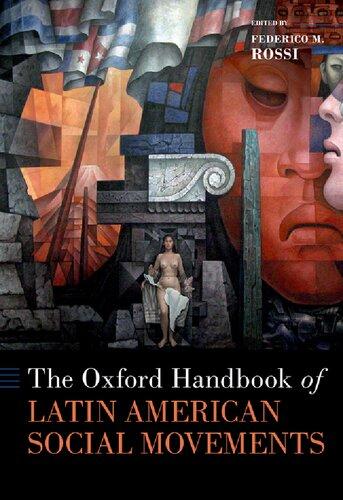
The Oxford Handbook of Latin American Social Movements Federico M. Rossi (Editor)
Visit to download the full and correct content document: https://ebookmass.com/product/the-oxford-handbook-of-latin-american-social-movem ents-federico-m-rossi-editor/
More products digital (pdf, epub, mobi) instant download maybe you interests ...
The Oxford Handbook of Central American History Robert Holden
Advance Praise for The Oxford Handbook of Latin American Social Movements
“A ‘must book’ for anyone interested in social movements in general and in Latin America in particular. Contributors address a range of theoretical perspectives, and provide rich analyses of a wide variety of social movements. The most comprehensive book!”
Susan Eckstein, Boston University
“Pervaded by inequalities of all sorts, Latin America has been a fertile terrain for the emergence of social movements and, therefore, of a remarkable production of analyses of their role and characteristics. In addition to an impressive and exhaustive array of different themes and analytical perspectives, this book has the crucial merit of opening space for significant theoretical contributions from Latin American scholarship on social movements, so often ignored by the English-language academia.”
Evelina Dagnino, Universidade Estadual de Campinas
“Latin America is as belligerent as it is unequal. The notable group of scholars assembled in this important volume tells us how and why social movements emerge and persist, offering students of contentious politics a vast array of insightful theoretical tools and empirical lessons.”
Javier Auyero, University of Texas at Austin
“The Oxford Handbook of Latin American Social Movements constitutes a major contribution to the field. It brings together in an interconnected way an important number of chapters, which cover a vast range of topics and problems, all of them of importance for the study of Latin American social movements. Recognizing the diversity of approaches applied to the study of social movements, it shows conceptual articulation and, in its full reading, offers an excellent overview of the field. This book is a significant contribution to the diffusion and debate of Latin American social and political sciences, the international circulation of the region’s research and specific issues, while it contributes to the global debate on social movement studies.”
Federico Schuster, Universidad de Buenos Aires
THE OXFORD HANDBOOK OF
LATIN AMERICAN SOCIAL MOVEMENTS
Edited by FEDERICO M. ROSSI
Oxford University Press is a department of the University of Oxford. It furthers the University’s objective of excellence in research, scholarship, and education by publishing worldwide. Oxford is a registered trade mark of Oxford University Press in the UK and certain other countries.
Published in the United States of America by Oxford University Press 198 Madison Avenue, New York, NY 10016, United States of America.
All rights reserved. No part of this publication may be reproduced, stored in a retrieval system, or transmitted, in any form or by any means, without the prior permission in writing of Oxford University Press, or as expressly permitted by law, by license, or under terms agreed with the appropriate reproduction rights organization. Inquiries concerning reproduction outside the scope of the above should be sent to the Rights Department, Oxford University Press, at the address above.
You must not circulate this work in any other form and you must impose this same condition on any acquirer.
CIP data is on file at the Library of Congress
ISBN 978–0–19–087036–2
DOI: 10.1093/oxfordhb/9780190870362.001.0001
Printed by Marquis, Canada
A te, Marco, che adesso capirai il perché del tuo nome.
1.
Federico M. Rossi
INTRODUCTION
Jeffery R. Webber 3.
Nicolás M. Somma
4.
5.
Rose J. Spalding
7.
Niki Johnson and Diego Sempol
8.
María Juliana Flórez-Flórez and María Carolina Olarte-Olarte
PART II: MAIN PROCESSES AND DYNAMICS
9. Protest Waves in Latin America: Facilitating Conditions and Outcomes
Paul Almeida
10. Social Movements and Nationalism in Latin America
Matthias vom Hau
11. Social Movements and Revolutions in Latin America: A Complex Relationship
Salvador Martí i Puig and Alberto Martín Álvarez
12. Social Movements under Authoritarian Regimes in Latin America
Charles D. Brockett
13. Social Movements and Democratization Processes in Latin America
María Inclán
14. Social Movements and Capitalist Models of Development in Latin America
Federico M. Rossi
15. Social Movements and Globalization in Latin America
Daniel Burridge and John Markoff
16. Movements and Territorial Conflicts in Latin America
Bernardo Mançano Fernandes and Cliff Welch
17. Demobilization Processes in Latin America
Pablo Lapegna, Renata Motta, and Maritza Paredes
PART III: MAIN SOCIAL MOVEMENTS
18. Transformations of Workers’ Mobilization in Latin America
Franklin Ramírez Gallegos and Soledad Stoessel
19. Peasant Movements in Recent Latin American History
Cliff Welch
20. Women’s Movements in Latin America: From Elite Organizing to Intersectional Mass Mobilization
Christina Ewig and Elisabeth Jay Friedman
Jordi Díez
Lucas G. Christel and Ricardo A. Gutiérrez
Marcelo
Leonidas Oikonomakis
PART IV: IDEATIONAL AND STRATEGIC DIMENSIONS OF SOCIAL MOVEMENTS
34. Social Movements in Latin America: The Cultural Dimension 573
Ton Salman
35. Identity in Latin American Social Movements 590
Lorenza B. Fontana
36. Ideas, Ideology, and Citizenship of Social Movements 607
Anthony Petros Spanakos and Mishella Romo Rivas
37. Religious Groups and Social Movements in Latin America 625
Robert Sean Mackin
38. Education, Pedagogy, and Social Movements in Latin America 643
Rebecca Tarlau
39. Repertoires of Contention across Latin America 660
Takeshi Wada
40. Shifting Geographies of Activism and the Spatial Logics of Latin American Social Movements 678
Diane E. Davis and Taylor Davey
41. Strengths and Blind Spots of Digital Activism in Latin America: Mapping Actors, Tools, and Theories 696
Emiliano Treré and Summer Harlow
PART V: INSTITUTIONAL POLITICS AND SOCIAL MOVEMENTS
42. Social Movements and Party Politics: Popular Mobilization and the Reciprocal Structuring of Political Representation in Latin America 715
Kenneth M. Roberts
43. Social Movement Activism, Informal Politics, and Clientelism in Latin America 731
Hélène Combes and Julieta Quirós
44. Legal Mobilization: Social Movements and the Judicial System across Latin America
Alba Ruibal
45. Social Movements and Participatory Institutions in Latin America
Rocío Annunziata and Benjamin Goldfrank
46. Social Movements and Modes of Institutionalization 777
Adrian Gurza Lavalle and José Szwako
About the Editor
Federico M. Rossi (PhD, European University Institute, Florence) is a ProfesorInvestigador of the Consejo Nacional de Investigaciones Científicas y Técnicas (CONICET) at the Universidad Nacional de San Martín in Buenos Aires, and a Senior Fellow of the Humboldt Stiftung at the German Institute for Global and Area Studies (GIGA) in Hamburg. He has published The Poor’s Struggle for Political Incorporation: The Piquetero Movement in Argentina (Cambridge University Press), Reshaping the Political Arena in Latin America: From Resisting Neoliberalism to the Second Incorporation (University of Pittsburgh Press), Social Movement Dynamics: New Perspectives on Theory and Research from Latin America (Routledge), and La participación de las juventudes hoy: la condición juvenil y la redefinición del involucramiento político y social (Prometeo).
About the Contributors
Paul Almeida, University of California, Merced, United States
Alberto Martín Álvarez, Universitat de Girona, Spain
Rocío Annunziata, Consejo Nacional de Investigaciones Científicas y Técnicas (CONICET)—Universidad Nacional de San Martín, Argentina
Charles D. Brockett, Sewanee: The University of the South, United States
Daniel Burridge, University of Pittsburgh, United States
Kia Lilly Caldwell, Washington University in St. Louis, United States
Lucas G. Christel, Consejo Nacional de Investigaciones Científicas y Técnicas (CONICET)—Universidad Nacional de San Martín, Argentina
Hélène Combes, Centre national de la recherche scientifique (CNRS)—Centre de recherches internationale (CERI) of Sciences Po, France
Taylor Davey, Harvard University, United States
Diane E. Davis, Harvard University, United States
Jordi Díez, University of Guelph, Canada
Kwame Dixon, Howard University, United States
Sofia Donoso, Universidad de Chile and Centro de Estudios de Conflicto y Cohesión Social (COES), Chile
Christina Ewig, University of Minnesota, United States
Bernardo Mançano Fernandes, Universidade Estadual Paulista “Júlio de Mesquita Filho” (UNESP), Brazil
María Juliana Flórez-Flórez, Pontificia Universidad Javeriana, Colombia
Lorenza B. Fontana, University of Glasgow, United Kingdom
Elisabeth Jay Friedman, University of San Francisco, United States
Manuel Antonio Garretón, Universidad de Chile, Chile
María Soledad Gattoni, Universidad Nacional de San Martín (UNSAM), Argentina
Tomás Gold, University of Notre Dame, United States
Benjamin Goldfrank, Seton Hall University, United States
Adrian Gurza Lavalle, Universidade de São Paulo and Centro de Estudos da Metrópole (CEM)—Centro Brasileiro de Análise e Planejamento (CEBRAP), Brazil
Ricardo A. Gutiérrez, Consejo Nacional de Investigaciones Científicas y Técnicas (CONICET)—Universidad Nacional de San Martín, Argentina
Sam Halvorsen, Queen Mary University of London, United Kingdom
Summer Harlow, University of Houston, United States
María Inclán, Centro de Investigación y Docencia Económicas (CIDE), Mexico
Niki Johnson, Universidad de la República, Uruguay
Pablo Lapegna, University of Georgia, United States
Robert Sean Mackin, Texas A&M University, United States
John Markoff, University of Pittsburgh, United States
Salvador Martí i Puig, Universitat de Girona, Spain
Renata Motta, Heidelberg University, Germany
Leonidas Oikonomakis, University of Crete (Πανεπιστήμιο Κρήτης), Greece
María Carolina Olarte-Olarte, Universidad de Los Andes, Colombia
Philip Oxhorn, Vancouver Island University, Canada
Maritza Paredes, Pontificia Universidad Católica del Perú, Peru
Leigh A. Payne, University of Oxford, United Kingdom
Sebastián Pereyra, Consejo Nacional de Investigaciones Científicas y Técnicas (CONICET)—Universidad Nacional de San Martín, Argentina
Julieta Quirós, Consejo Nacional de Investigaciones Científicas y Técnicas (CONICET)—Instituto de Antropología de Córdoba, Argentina
Franklin Ramírez Gallegos, Facultad Latinoamericana de Ciencias Sociales (FLACSO), Ecuador
Sybil Rhodes, Universidad del Centro de Estudios Macroeconómicos de Argentina (UCEMA), Argentina
Roberta Rice, University of Calgary, Canada
Kenneth M. Roberts, Cornell University, Unites States
Mishella Romo Rivas, Princeton University, United States
Alba Ruibal, Consejo Nacional de Investigaciones Científicas y Técnicas (CONICET)— Universidad Nacional de Córdoba, Argentina
Ton Salman, Vrije Universiteit Amsterdam, Netherlands
Nicolás Selamé, Facultad Latinoamericana de Ciencias Sociales (FLACSO), Chile
Diego Sempol, Universidad de la República, Uruguay
Nicolás M. Somma, Pontificia Universidad Católica de Chile and Centro de Estudios de Conflicto y Cohesión Social (COES), Chile
Marcelo Lopes de Souza, Universidade Federal de Rio de Janeiro, Brazil
Rose J. Spalding, DePaul University, United States
Anthony Petros Spanakos, Montclair State University, United States
Soledad Stoessel, Consejo Nacional de Investigaciones Científicas y Técnicas (CONICET)—Universidad Nacional de La Plata, Argentina
José Szwako, Instituto de Estudos Sociais e Politicos, Universidade do Estado do Rio de Janeiro, Brazil
Rebecca Tarlau, Pennsylvania State University, United States
Emiliano Treré, Cardiff University, United Kingdom
Matthias vom Hau, Institut Barcelona d’Estudis Internacionals, Spain
Marisa von Bülow, Universidade de Brasília, Brazil
Takeshi Wada, The University of Tokyo (東京大学), Japan
Jeffery R. Webber, York University, Canada
Cliff Welch, Universidade Federal de São Paulo, Brazil
Jonas Wolff, Goethe University Frankfurt and Peace Research Institute Frankfurt (PRIF), Germany
INTRODUCTION
Chapter 1 Multiple Paradigms for Understanding a Mobilized Region
Federico M. Rossi
Introduction
When humans get involved in the making of history, collective action is an essential component in the struggle for or against social change. The fate of societies is not written in stone but rather is made through a process of disputing contending ideas and interests about how we will live together. Social movements, as informal networks of conflictoriented interactions composed of individuals, groups, and/or organizations that, based on shared solidarities, are provided with a collective political identity and use protest as one means—among others—of presenting themselves in the public arena, are crucial actors in the battle to define what Latin America is and should be. Latin America is a region as diverse as it is immense, with a multiplicity of experiences and grievances and tied together by a shared Luso-Hispanic colonial legacy. The question of how to understand the struggles that have defined Latin American history since independence has produced very intense theoretical debate and the development of several ways of identifying the role of social movements. The multiplicity of movements that have been in constant struggle is fertile ground for theoretical innovation and interdisciplinary research, as this introduction will reveal in its presentation of the contributions to The Oxford Handbook of Latin American Social Movements.
Theoretical Perspectives
In such a huge territory as Latin America is not possible to expect a unified or hegemonic theoretical approach, as can happen in a single country. Thus, the development in
Latin America of social movement studies as a subdiscipline has been characterized by a great diversity of theoretical approaches and a pragmatic combination of perspectives in empirical studies. This volume reflects this wide variety of viewpoints. Its first section covers the main theoretical perspectives in the debate on social movements in Latin America, something that has never been done before. In this sense, this book is the first to present all the main theoretical approaches with some systematic application to Latin American social movements that have been developed in or applied to the region.
Much older than social movement studies and originally not focused on movements, the pioneering approach in the study of social conflicts has been Marxism. In past decades, many changes were seen within the realm of Marxist approaches in Latin America, emphasizing capitalism, totality, and class for the study of social movements. Studying the decisive influence of José Carlos Mariátegui, Antonio Gramsci, dependency theory and the contemporary contributions to the commons, autonomy, and social movement–state relations is at the core of Jefferey R. Webber’s chapter. The critical dialogue with Marxism provides the fuel for other main approaches. Resource mobilization theory and the political process approach emerged in the 1970s in the United States as a critique of modernization theories and Marxism, quickly becoming one of the most influential approaches for studying social movements. As Nicolás M. Somma shows, scholars of Latin American movements have long noted the relevance of resources, strategies, organizations, and political contexts, providing a promising setting for expanding and refining mainstream approaches. In the 1980s, there was no sign of change in the economic or class structure in Latin America, as seems to have taken place in Europe according to the New Social Movements approach. Instead, as argued by Manuel Antonio Garretón and Nicolás Selamé, the disintegration of the socio-political matrix and the traditional developmentalist state is more relevant to explain the emergence of New Social Movements in Latin America as an influential approach to social movements.
In the 2000s, relationality emerged as a crucial perspective in the study of social movements. However, there are different ways of understanding what relational means in social movement studies, according to Sam Halvorsen and Federico M. Rossi. Schematically, this depends on the main dimension(s) studied as the focus of research. Intersectional approaches examine relations across core categories of identity. Historical approaches examine relations between movements and other actors across time. Spatial approaches explore the co-constitution of the social and the spatial in social movements. Finally, ecological approaches focus on the relations between movements and nature. Among these relational approaches, prominent are network approaches on Latin American social movements. Rose Spalding’s chapter identifies two dominant ones: formal network analysis involving quantitative analysis of largen data sets in which relationships are depicted in matrices, sociogram visualizations, and graphs; and informal, small-n comparative studies of network structures found in specific movements, often analyzed across an extended period of time using process tracing techniques. Network analysis in Latin America draws attention to ways in which
activists interconnect across the region, and the consequences in terms of movement strength and impact.
The key theories and concepts informing feminist and queer perspectives on Latin American social movements are the focus of Niki Johnson’s and Diego Sempol’s chapter. They argue that these result from processes of translation and contestation of theories produced by academic research in the Global North, and from the development of locally grounded theoretical perspectives. The chapter discusses how feminist and queer perspectives in research have opened up avenues for analyzing the complexities of collective identity construction and the tensions within as well as among social movements. New developments in feminist and queer social and political theorizing and epistemological reflection in the region seek to decolonize knowledge production. Decolonizing approaches is precisely the topic of the last theoretical approach covered. Juliana FlórezFlórez and María Carolina Olarte-Olarte show that the theories on social movements mentioned above are colonial despite being critical of modernity. They argue that it is dialogue with movements—as opposed to discussion about movements—that makes it possible to evaluate collective action.
Within this rich diversity in theoretical approaches, common to them all has been that they have been built on a double dialogue within the region and with Europe or the United States (even the decolonizing critique implies a dialogue against the core). Yet if not all approaches are equally positivist, they are all historically rooted theoretical contributions that reflect Latin American social movements. In this sense, theoretical eclecticism dominates in pragmatic applications of literature and approaches. This obviously does not come without difficulties, creating an increasing multiplicity of studies that do not dialogue among themselves. Language barriers have been historically very relevant, and are still present, with three main language-confined debates (Portuguese, Spanish, and English) which are gradually merging into a regional debate. This publication is offered in English because the less established dialogue is the one this handbook aims to promote. Here many important contributions that are ignored by Englishlanguage academia can be accessed in a synthetic fashion across the chapters. However, this will not resolve a huge problem that exists beyond social movement studies in Latin America, which is the relative isolation of certain smaller or weaker national academic spaces. Beyond differences and problems, a common basic trend of all the literature in and about the region is the centrality of grievances, the economy, and a radical/revolutionary horizon in the actors studied and (sometimes also) in the scholars involved in the analysis of these movements.
Main Processes and Dynamics
As social movements are inserted in, are constituted by, and mold the key processes and contentious dynamics that define the history of Latin America, the second section examines each of the main macro-dynamics and the role played by social movements
in them. These dynamics are parallel and simultaneous, with movements dealing with them partially and—in a very few cases—intersectionally. The hegemon of each historical period of Latin American history (the Iberian Peninsula, Britain, the United States, and—soon–China) is one of the unifiers of so many struggles but, still, cross-grievance battles are extremely difficult if seen in relational terms. Not all approaches are relational, though, and the analysis of the macro-dynamics reflects the richness of Latin American social movement studies.
Among the multiple waves that intersect in Latin American history, protest waves are crucial for understanding periods of widespread popular mobilization by multiple sectors across the national territory, as Paul Almeida argues and demonstrates in his chapter. Protest waves and other mobilizational dynamics since the postcolonial era intersect with nationalism. As Matthias vom Hau argues, nationalism and social movements emerged during the early nineteenth-century struggles for the formation of independent national states, followed by the mid-twentieth-century decline of oligarchic rule and the emergence of mass societies, and since the late twentieth century due to the adoption of neoliberalism and the rise of multiculturalism and indigenous movements.
Throughout the twentieth century, successful revolutions in Latin America were engineered by broad inter-class, urban–rural coalitions led by insurgent elites. Salvador Martí i Puig and Alberto Martín Álvarez study the different types of relationships established between social movements and the revolutionary vanguard in the analyses of revolutionary dynamics across Latin America. Many revolutionary ambitions were stopped by coups or turned into authoritarianism. Charles D. Brockett’s chapter analyzes the vast and varied Latin American experience with confrontations between social movements and authoritarian regimes in a typology of personal dictatorships, military regimes, and competitive authoritarianism. The one constant found between cases and across regime types is that when an authoritarian regime possesses both the capacity and propensity to repress social movements it will almost always succeed. The transition from authoritarianism to democracy has been one of the main Latin American regional dynamics. María Inclán offers a review of the most salient cases of social movements and democratization processes in Latin America, evaluating the role that social movements have played in triggering democratizing processes in the region and exploring the movements that have emerged as democracy has deepened in the region.
Political dynamics are intertwined with economic dynamics. The capitalist models of development that predominated across Latin American history is the topic of Federico M. Rossi’s chapter. A political economy of social movements reveals multiple struggles for the expansion of the socio-political arena and the resistance to this expansion with plutocratic retrenchment periods that contract the socio-political arena. Globalization has been the central capitalist transformation of Latin America in the 1990s and beyond. As Daniel Burridge and John Markoff argue, the policies of globalized neoliberal capitalism coincided with regional democratization, new technologies of communication, and changing ideas on the left to both generate a number of grievances and facilitate varied forms of social movement resistance. In addition, the main long-term
dynamic against and within capitalism is the intense struggle for land across Latin America. Indigenous peoples, peasants, and the descendants of fugitive slaves have resisted the expropriation of their territories for five centuries. As Bernardo Mançano Fernandes and Cliff Welch argue, territorial clashes are also disputing divergent models of development.
All these processes and dynamics may produce enduring results and sustain protracted struggles across decades, which tend to go through some periods of increased disruption—as protest waves and revolutionary dynamics show—and others of latency and demobilization. As Pablo Lapegna, Renata Motta, and Maritza Paredes argue, demobilization is not simply the absence of mobilization, as it assumes the previous organization of contentious actions of organizations that are still active. The study of demobilization requires focusing on the role of agency and strategy to better understand how social movements refrain from mobilizing to advance their claims and achieve their goals.
The interconnection of processes and dynamics and the different roles of movements within them becomes evident as the chapters gradually add one after another new layers to the multidimensional process of social change. Social movements struggle within, against, and in favor of and constitute these processes and dynamics as much as they are constituted by them, as the centuries of history analyzed in this section show. However, to fully comprehend these contentious dynamics we need to understand the main social movements contending for the definition of grievances and the prefiguration of alternatives.
Main Social Movements
When observing the main social movements as the central focus of scrutiny we can perceive how the historical construction of struggles and their interconnection has produced paths that reflect specific theoretical debates that have dominated the Latin American scholarship. Even though is impossible to cover all types of movements that exist, the collection of movements studied in the third section allows for a quite clear understanding of the social movement field in Latin America from the mid-nineteenth to the early twenty-first century.
Labor movements, given their centrality in Latin American politics, are analyzed in the opening chapter. Franklin Gallegos Ramírez and Soledad Stoessel observe the link between changing economic contexts, state–society relations, and workers’ collective action to show that union dynamics for extending workers’ rights do not fully explain labor movements. Instead, successive waves of politicization of the “worker question” are a result of interactions of class, ethnicity, gender, and territory. If in the urban realm labor movements have been the central actors, in the rural one peasant movements have been the defining popular movement. As Cliff Welch argues, overlapping developments in diverse locations that are generally determined by the intensity of the
penetration of capitalist relations of production have marked peasant movements in Latin America.
As can be seen in the case of women’s movements, which have evolved from elite efforts into intersectional mass movements, not all movements have always been popular-based in Latin America. In the construction of a mass movement, Christina Ewig and Elisabeth Jay Friedman claim that women mobilized in response to a contradictory assortment of political opportunities, including the modernizing patriarchies of early states; the conservative gendered discourses and repression of authoritarian governments; the androcentric processes of democracy and neoliberal reform; and the ideals of revolutionary and left-leaning movements and parties across the twentieth century.
Race, ethnicity, and land are the historical roots of indigenous dispossession, and the characteristics and contributions of indigenous struggles for identity, territory, and autonomy help understand social movement theory and practice, according to Roberta Rice. The struggle for racial justice and human rights and the rise of Afro-Latin social movements, Black consciousness, and Afro civil society is analyzed by Kwame Dixon and Kia Lilly Caldwell. In both movements, the chapters show how the accumulation of efforts led to important multicultural and constitutional reforms in Latin America.
Among the two more mobilized middle-class actors are students and LGBTIQ+ movements. The role that student movements have played in Latin America’s political development is the topic of Sofía Donoso’s chapter. It examines their impact both in the field of education and in broader political reforms. Student movements have constituted a space of ideological renewal of and resistance to the various socio-political and economic inequalities that historically have characterized the region. In this renewal of ideas, lesbian and gay movements, despite their significantly smaller size compared to other movements, appear to be one of the most successful in the region given the speed with which they have emerged and strengthened as well as the scope of their political victories. As Jordi Díez explains, historically oppressed and marginalized, not only have gays and lesbians forced national debates on the regulation of sexuality, but, in several countries, their mobilization has resulted in the attainment of numerous rights, all in a relatively short period of time.
Many of these transformations are directly or indirectly related to the development of a human rights agenda that reaches beyond citizenship rights to social rights. Jonas Wolff eloquently shows how the narrow focus on a rather minimalist conception of human rights that had characterized the first generation of human rights movements has been replaced by a much broader human rights agenda, which encompasses social, economic, and cultural rights, as well as by more specific demands based on issue- or group-specific rights. As the rights agenda expanded and connected with the questioning of models of development and the struggle for land, environmental issues have produced—as shown by Lucas G. Christel and Ricardo A. Gutiérrez—an increased mobilization aiming to influence decisions regarding the political and economic regulation of the interactions between human beings and their environment. While the environmental question is global and quite recent, its contentious dynamics have been
overwhelmingly performed in rural areas and on the margins of urban areas. The urban question, instead, has been a central topic for much longer—as Philip Oxhorn argues in his chapter—leading to the emergence of a growing number of urban social movements and a focus on democratic politics and citizenship rights associated with a new model of citizenship in the region: citizenship as agency. The region’s commitment to relatively free and fair elections based on universal suffrage creates a unique opportunity for the mobilization of urban movements demanding improved collective consumption, respect for community culture, and political self‐governance.
The double transition to liberal democratic politics and market-based economies has been as much an opportunity for mobilization as a trigger for abrupt dislocation in Latin American societies. This huge transformation has favored the proliferation of movements and claims from both the left and the right that attempt to regulate the new status quo by making representatives accountable and controlling patterns of consumption, transforming how things stand with the prefiguration of alternative social practices, interconnecting actors and struggles across scales, and resisting transformations of all kinds. Sebastián Pereyra, Tomás Gold, and María Soledad Gattoni show how corruption as a social problem was progressively incorporated into the frame of social mobilization as a significant element of criticism and confrontation with party politics. Sybil Rhodes outlines the history of consumption and consumer mobilization in Latin America, showing how consumption differences between haves and have-nots remain as a fundamental point of tension. Marcelo Lopes de Souza argues that autonomist movements have emerged from the crisis of Marxism-Leninism, the rise of neoliberalism, and the reinvigoration/rediscovering of left-libertarian ideas and tactics such as self-management, horizontality, and decentralization. Autonomists sometimes resemble urban movements, while also participating in transnational networks. Latin America has been an important cradle for transnational social movements since the beginning of the twentieth century, as Marisa von Bülow explores. These movements not only launched reactive campaigns to counter threats but also built new organizational fora and events to think about policy alternatives in innovative ways. Novelty and change have been increasingly resisted by right-wing movements that have emerged in the region with a profound impact on Latin American social and political life. Leigh A. Payne proposes to deepen our understanding of this important global phenomenon with a typology of rightwing movements in the region: counter-movements, uncivil movements, and neoliberal militarized movements.
There has been plenty of innovation, as well as continuity, in social movement dynamics. In this sense, the armed struggle option of Latin American social movements has never disappeared, although it has metamorphosed in important ways. Leonidas Oikonomakis analyzes revolutionary movements in contemporary Latin America, arguing that while it seems that the age of Latin American Revolutions with a capital R is coming to an end, we may be entering an age of revolutions (with a small r, following John Holloway) in which Revolution has changed meaning, becoming more of a political process and less of a political event.
As the chapters in this section show in their cumulative analysis of the transformations of social movements and their struggles, we cannot fully understand movements without studying their ideational and strategic dimensions and the relationship of movements with institutional politics. The two last sections focus on the crucial theoretical debates in social movement studies that Latin American scholarship has quite thoroughly developed in these regards.
Ideational and Strategic Dimensions of Social Movements
The fourth section deals with ideational and strategic dimensions of social movements, both central components of any struggle for or against social change. The diversity of scholarship on Latin American social movements has produced interesting debates on topics that are now classical, such as the role of religion, identity, and ideology in movements, and on new ones, such as those involving spatial analysis or examining the party system and the internet.
Ton Salman starts these studies with an exploration of the three modes in which he proposes culture should be studied in social movement research: culture as an overarching, partially shared, and partially subconscious set of practices and routines that orient both contenders and authorities; culture as the issue social movements are addressing and criticizing; and the culture the movements attempt to embody and broadcast in their forms and operations.
Equally important to culture are identity, ideology, and religious beliefs on movements. Lorenza B. Fontana examines the origins of identity as a key concept in socio-political analysis and illustrates the role it has played both in making sense of social and political transformations and in influencing the very processes of collective mobilization in Latin America. Anthony Petros Spanakos and Mishella Romo Rivas examine how ideology and ideas about popular sovereignty highlight important nuances between movements that might otherwise be grouped together. While many social movements share left-wing roots, anti-neoliberal politics, and the making of demands for recognition of marginal groups as part of a process of a thick form of citizenship, they differ considerably on how and where they rule. The common beliefs and values of mobilized actors are sometimes composed of religious ideas, too. Thus, the historical role of Roman Catholicism and the more recent Pentecostalization of religion has been crucial for both the struggle for social justice and the mobilization of conservative movements to denounce so-called “morality” issues (such as birth control, abortion, or marriage equality).
For constituting the desired transformations in society, ideational components are as essential to social movements as strategic dimensions. The cultural battle has been at the core of all social movement strategies, and the role of education has been crucial within
Latin American social movements. Rebecca Tarlau’s chapter gives an overview of political education starting from the first half of the twentieth century, with a focus on the Communist Party and anarchists. She analyzes the impact, from the mid-1960s to the early 1980s, of Paulo Freire, and for the period after the re-democratization of the region focuses on non-formal education as well as the movement’s transformation of and cogovernance with public education.
The idea of repertoires of contention has become an integral part of the study of protest strategy in Latin American social movements. To explain the reasons why new and innovative forms of contention emerge in Latin America, Takeshi Wada looks for some of the main causal factors suggested in the repertoire literature including, among others, regime characteristics, material resources, cultural schemas, and collective identities. Expanding the repertoire of contention debate, according to Diane E. Davis and Taylor Davey, the repertoire has undergone historical changes in its geography and spatiality in Latin America. The authors identify new repertoires of mobilization, link them to changing social, political, and economic conditions, and assess the significance of these shifts for both the theory and practice of social mobilization in contemporary Latin America. Among the most radical changes in the repertoire has been the emergence of digital activism. However, according to Emiliano Treré and Summer Harlow, this trend has not yet produced a unified scholarly debate and is dominated by the propensity to adopt conceptual lenses from the Global North, displaying both methodological and conceptual shortcomings governing the Latin American literature.
The ideational and strategic dimensions of social movements are integrated in this section. Each chapter looks at one dimension in depth, which tends to leave no space for exploring in detail the interconnection between the ideational and strategic dimensions that all contributors to this section systematically assert. When all the layers added are interrelated, it becomes clear that in the formation of a movement and its repertoire, ideas and strategies are co-constituted through contentious dynamics. Consequently, ideas and strategies are all performed throughout the processes explored in the second section, evolving in the specific paths for each movement analyzed in the third section. All of this happens within the realm and in confrontation with an institutional context that is the topic of the last section.
Institutional Politics and Social Movements
The book’s last section deals with the interaction of social movements with the institutional arena, analyzing its formal as well as informal fields of struggle. The institutional realm is conceived as more than the rules and actors of the state (omnipresent across all the book in direct or indirect ways). Social movements strive to change or reinforce a preexisting institutional apparatus, and, in this battle, there are important theoretical