Introduction
In December 1971, production assistant Carolyn Wean wrote a memo to express her frustration about the workspace at For Women Today (1970–75), a locally produced show that aired on Boston’s WBZ-TV. In the memo, Wean reported to the station’s executive producer of programming and to the general services director that the “disappearance of things from the F[or] W[omen] T[oday] office continues” and requested that steps be taken to “insure that this stops.”1 Wean noted that in the previous week half a dozen books purchased for show research had gone missing and insisted that the station provide secure storage for their office. In other memos to station executives, Wean related more problems with the day-to-day functioning of the program ’ s production spaces: no one was assigned to clean the set before tapings, so the assistant director had to take on the task; dressing rooms were not maintained; and no one was free to answer phones while the production team was busy taping the program.
A second set of memos between management and workers at WBZ further illustrates difficulties at the station. On December 22, 1970, program manager Mel Bernstein issued a memo in which he asked ve men on staff to help him accompany nine women, four of whom worked on For Women Today, to a “ ‘Harem’ luncheon.” “Since most of them are shy in public,” wrote Bernstein, “rendezvous at my office around Noon and we’ll chauffeur them,” and warned, in closing, “Behave yourself!”2 e same day, For Women Today producer Raysa Bonow, associate producer Claire Carter, production assistant Carolyn Wean, and associate producer Connie Sanders issued a response to Bernstein. ey signaled their confusion at the “harem” moniker used to describe them and cited three different denitions of the word from Webster’s Dictionary: a secluded part of a Muslim household reserved for women, “ a group of women associated with one man, ” and a polygamous group of animals.3 e next portion of the women ’ s memo matches the
“humor” of the original correspondence, indicates refusal of sexist treatment, and sardonically dismantles its awed logic:
Since we nd it difficult to place ourselves with great enthusiasm into any of these categories, we nd against our better judgment and desire for a pleasant lunch that we will have to decline the invitation. However, if one pushes a little, I suppose that we could sneak into category 2., providing then that the memo be sent with only “CC” to all those listed and none to receive a memo addressed “TO” Perhaps, O Mighty Sultan of the Harem, you could send us a new memorandum more succinctly delineating our position.4
e tone of the memo subtly shis in the close when the women call for dignied and respectful treatment and request a revised, professional plan for the lunch: “e staff of For Women Today cannot speak for all those who received carbons of your original memorandum, but we anxiously await further word (anything that will enable us to attend the luncheon with some smidgen of dignity).”5 As they each signed off as “a.k.a. woman, ” the production team reclaimed the gendered identities that made them subject to the indignities of a sexist workplace.6
Correspondence generated around For Women Today characterizes the challenges women faced as they expressed feminist ideas within the television industry. It therefore typies the concerns of Producing Feminism. First, it relates how television workplaces become gendered through commonplace, even banal, circumstances: the security and maintenance of spaces, the many tasks that exceed official job titles and descriptions, and the cultivation and management of relationships among coworkers and management. Second, it reects the growing involvement of women in television, in “creative” (directly involved in production) and “noncreative” (support for the various needs of production) roles, during the 1970s. ird, it illustrates the demands and refusals women were making in light of untenable work conditions and sexist attitudes in the industry. Finally, it demonstrates the evidentiary value of workplace communications to concretize and chronicle how women experienced television work.
As one of the rst television programs to reect the impact of the women ’ s movement, For Women Today (later named e Sonya Hamlin Show) signaled its commitment to feminist principles by employing an all-woman production team and by altering traditions of women ’ s television to align
with movement politics. When in 1970 Sonya Hamlin was offered the job of hosting WBZ’s morning show for women, executives’ disregard for women ’ s television was obvious. Hamlin recalls coming into a room with eighteen men seated around a big table who assured her that she could retain her position as a cultural reporter for the station while she hosted the morning show because of the formulaic and simplistic nature of programming for women. “It’s easy, ” they told Hamlin, since she would have “dodo birds for viewers” and the labor required by the program would involve only “ a little make-up, a little hairdo, a chef you can cook with, and from time to time there will be a star coming through.” Hamlin initially refused the offer but, aer consulting with her husband, came back to the table with a counteroffer: the freedom to “hire an all-woman staff, producer, director . . . everybody” and to program what she wanted. To her surprise, WBZ management immediately agreed to these terms, something Hamlin credits to the inuence of “the beginning of the uprising of the women ’ s movement.”7
With “what at the time was the unusual goal of treating women who watched daytime television as intelligent viewers,” For Women Today featured feminist leaders and ideas as well as a range of forward-thinking topics.8 Hamlin recollects programming For Women Today “in a very different way, ” with the show focusing on a single topic in order to “look at every facet of it for a week,” which resulted in presenting the audience with “ very revolutionary things,” “ very novel things,” and “in-depth” assessments of topics previously deemed unsuitable for daytime television.9 When Hamlin le the show in 1975, the Boston Globe described the program ’ s impact through a number of “Firsts” in Boston television: “Homosexuals rst appeared on the air with Sonya and publicly discussed their lives. Ms. magazine was introduced on her show a full week before it was released nationwide to newsstands. Sex, of all kinds, was discussed openly, frankly, explicitly, and sometimes with illustrations.”10 A list of show topics from 1970 to 1972 attests to the progressive nature of For Women Today and included abortion (for at least three episodes), pornography, homosexuality (a twopart series), premarital sex, sex in marriage, birth control and the law, menopause (female and male), pregnancy, unwed mothers, venereal disease, natural childbirth, rape, and sex education.11
According to Broadcasting’ s 1972 report on the “ new shake” television was starting to give women viewers, For Women Today “ won plaudits from
feminist groups ” and nonfeminists alike.12 Along with the expected female demographic reach, For Women Today’ s audience also included 20 percent male viewership. Cross-gender viewership, along with the capture of a politicized as well as a traditional female audience, would have made the show viable to potential advertisers and buyers outside of the typical daytime market.13 Given its audience, For Women Today was a successful regional program, yet the show was never picked up for syndication, even though Hamlin was approached with a syndication offer. Hamlin le the program under disappointing circumstances, and the program was soon canceled aer that, never to reach an audience beyond local Boston viewership. For Women Today’ s contributions to women ’ s television have been overlooked in feminist television studies and television histories of the 1970s. With the exception of a book on Boston television that mentions the show briey, there are no scholarly accounts of the program.14
Recalling the innovative qualities of For Women Today presents an opportunity to assess both why and how such a program can be reevaluated. From its very inception, feminist television studies has demonstrated that “ genres and forms previously seen as ‘minor’ because they were produced and/or consumed by non-dominant groups may have even more to teach us about how culture operates and how ideology is enforced than the traditional canon. ”15 is perspective sidelines the issue of whether For Women Today, given its status as a daytime program for women with limited resources and a restricted, regional audience, is worthy of discussion. e question then becomes one of gauging the impact of the program for women and identifying where and how this impact occurred. Content and viewership provide grounds for evaluation, as do its many innovations in television for women. Yet For Women Today like the other television programs included in this book—also merits exploration because of the gendered operations of its workplace and feminist interventions by workers in those operations.
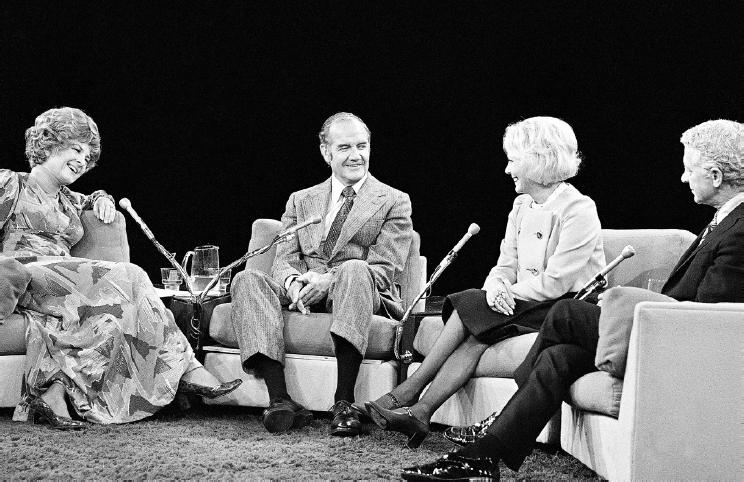
FIGURE 1. Sonya Hamlin (le) hosts (from le to right) Senator George McGovern, along with actor Joyce Susskind and producer David Susskind, on e Sonya Hamlin Show (formerly known as For Women Today), WBZ, October 16, 1972. (Getty Images)
Producing Feminism’ s primary objective is to understand the relationship between women ’ s liberation and television in the US through the means by which women got their feminist visions to air and into the workplace. is project assumes that television production cultures are created, sustained, and challenged through material, logistical, and interpersonal dynamics as much as they are through economics, policies, and industrial trends. From this perspective, the television workplace operates as what Daphne Spain calls a “spatial institution,” in which “the properties of a social system express themselves through daily activities at the same time those activities generate and reproduce structural properties of the social system.”16 Women’s encounters with patriarchal regimes of power in television oen happened in commonplace ways in the day-to-day functioning of the television workplace. When, during the 1970s, women were employed in greater numbers and occupied new and evolving positions in television, they
disrupted the industry’s spatial institutions and corresponding social systems. Consequently, the sites and working conditions of television production in addition to television’s on-screen products offer invaluable opportunities to understand the impact of the women ’ s movement on television.
PRODUCTION STUDIES AS AN EVALUATIVE TOOL
Production cultures are inextricably tied to identity and power. It follows, then, that feminist production studies show how interpersonal, invisible, and undercompensated labor falls disproportionately to women workers, particularly immigrant women and women of color. Scholarship on femalecentered occupations, such as costumers and clerical and secretarial workers, and women who broke into male-dominated occupations, such as stunt doubles, focuses explicitly on these issues.17 But as Miranda Banks argues, we might also understand production studies in general as fundamentally feminist. Feminist inquiry, with its analysis of discriminatory systems and its “recuperation of narratives long devalued,” proves instrumental in production studies scholarship, which is invested in marginalized labor and industries in their transitional moments.18
Given the feminist priorities of production studies, locating histories of women ’ s liberation in television production cultures is scarcely surprising. Yet as much work as has been done on the relationship between the US women ’ s liberation movement and television, surprisingly little scholarship has taken a production studies approach to the topic. Instead, landmark scholarship tends to belong to two categories: (1) mediated images of liberated women designed to “update” television content and engage politically progressive, lucrative viewers and (2) media reform efforts from feminist groups that operate outside the industry. ese foci have helped explicate why commercial media would be attracted to feminism and how feminist activism attempted to shi television’s sexist traditions. ey also have established analytic frameworks for representation and audiences, provided in- depth explorations of television programs, and constructed histories of media activism. Other concerns in the meeting of women ’ s liberation and television, however, fall outside these two dominant categories and warrant further attention.
In focusing on the worker herself, Producing Feminism looks beyond the on-screen image and activism from outside the industry to consider other ways that the women ’ s movement made inroads in television. is reorientation recognizes multiple types of feminist television reform, extends the timeline of the women ’ s movement’s inuence on television beyond a
short-lived existence as a media-worthy spectacle, and acknowledges feminists not typically or centrally featured in histories of television and the women ’ s movement. Issues of the mediation and co-optation of feminist politics shi as well in a production-oriented analysis, as this approach considers processes enacted by agentive women who actively challenged and reformed television workplaces and production protocols.
Assessing women ’ s gains in media industries requires multiple evaluative means, as scholarship by Natalie Wreyford and Shelley Cobb, Miranda Banks, and Vicky Ball and Melanie Bell demonstrates.19 By the early 1970s, with changing employment laws and regulatory pressure to hire more women, television stations across the country were compelled to hire women in greater numbers, and network television promoted women to executive positions. Program content also changed and included an archetype for a “ new implicitly feminist woman coping with her everyday world.”20 While the industry used these actions to announce a newfound awareness of feminism through quantitative (statistics on employment) and qualitative (program content) means, neither dataset on its own provides compelling evidence of feminist inuence over television. Rising employment numbers for women at stations were manipulated by recategorization of jobs; promotions at networks involved newly created job titles without corresponding increases in prestige, power, or compensation; and progressive on-screen content was not necessarily tied to women working on its production.21 erefore, an uptick in screentime for women characters, “improved” representation for women, and increased employment and promotions for women do not necessarily evince achievements of feminist goals.
A production studies approach to the advancements of women in television tells us what employment statistics or image analysis alone cannot. Workers’ perspectives and documents internal to the television workplace reveal how women actually experienced supposed or real opportunities. is evidence augments and complicates the “objective” information conveyed in industry press releases, formalized policies, and statistical reports. It also showcases how workers themselves enacted important political changes in television through logistical decisions, interpersonal dynamics, and the everyday operations of making television, as formative production studies scholarship demonstrates.
People who worked on innovative programs of the late 1960s through the 1980s offer particularly rich insights into how transformative moments in television happen. In her analysis of Soul!, a public television show of the late 1960s and early 1970s produced by and for Black Americans, Gayle Wald recognizes the plans made about set design, interviewing techniques, camera angles, and editing as vital contributions to the program ’ s “intimacy and connection with viewers.”22 In his carefully considered ideas about running the show, producer Ellis Haizlip cultivated “black cultural self-denition that refused to accept white aesthetic standards and, in so doing, contributed to the emotion and spiritual well-being of the collective.”23 Despite proclamations by the show’s producer that 1980s female-cop drama Cagney & Lacey was not a vehicle for feminism, Julie D’Acci charts how the production team craed “explicit general feminism” for the show.24 D’Acci’s research of communications and planning internal to the production reveals that “commentaries and memos on various dras of the scripts actually bespeak efforts to be blatantly and ‘correctly’ feminist” and counter public statements to the contrary.25 Jennifer Keishin Armstrong’s production history of 1970s single-girl workplace sitcom e Mary Tyler Moore Show locates the opportunities presented to women on the production team in small, interpersonal moments. Show cocreator Allan Burns promoted Pat Nando from secretary to writer when he walked her to her car and encouraged her to write for the show, saying, “I think you can do it.”26
ese accounts make it clear that progressive changes in the television industry take place not just through regulatory measures, industry-wide reform economic incentives, or other large-scale, systemwide factors. ese changes also, and perhaps more oen, transpire in the granular details of planning and logistics, conversations both personal and professional, and minutiae of behind-the-scenes relationships. In corresponding fashion, Producing Feminism calls upon interviews, memoirs, and primary documents generated in the workplace, just as it cites statistical data about employment numbers, ratings, salaries, and prots.
roughout the book, I turn to multiple narratives generated by women workers, as well as qualitative evidence from sources that were not publicfacing and that counterbalance data used for industry self-promotion. Using interview transcripts, journalistic interviews conducted by others, and my own interviews with workers, I relate rsthand accounts of the changing
nature of television labor across a wide array of occupations, including producers, hosts, actors, reporters, writers, researchers, consultants, creative directors, and executives. I call upon materials housed in archives including memos, workplace communications, meeting schedules and minutes, production plans, workplace memos, oor plans, diagrams of sets, and employee newsletters to further contextualize policies within experiential and informal aspects of their execution. ese materials are housed in a range of collections focused on television (Mass Media and Culture Special Collections, University of Maryland; Norman Lear Script Collection, Emerson College; University of Wyoming, Heritage Center; and Howard Gotlieb Archival Research Center, Boston University), women ’ s political and cultural history (Schlesinger Library, Radcliffe Institute for Advanced Study; Sophia Smith Collection of Women’s History, Smith College), state government (Commonwealth of Massachusetts State Archive), and corporate broadcasting (CBS News Reference Library). Collectively, these resources spotlight women who experienced and intervened in the gendered politics of television and reveal the operations of television workplaces as important sites of feminist reform.
TELEVISION RESPONDS TO THE WOMEN’S MOVEMENT
With the growth of the US women ’ s movement at the beginning of the 1970s, television was compelled to take notice. To capture an emerging demographic of women viewers and to capitalize on popular ideas about liberated women, ctional programs deployed what Bonnie J. Dow and Katherine Lehman identify as “lifestyle feminism.”27 is consumeristfriendly mediation of feminist politics, according to Patricia Bradley, was inevitable, as “the movement’s goals would be met only in ways that were consistent with the values of commerce. ”28 Lauren Rabinovitz’s assessment of feminist-inected sitcoms leads her to a similar conclusion. “A generic address of ‘feminism’ became an important strategy,” she argues, “because it served the needs of American television executives who could cultivate programming that could be identied with target audiences whom they wanted to measure and deliver to advertising agencies.”29
When feminists, like other activist groups, demanded that television be pressed to uphold its responsibility to the public, television tried to contain the impact of those demands. In 1969, WLBT-TV, a television station in Jackson, Mississippi, had its broadcasting license revoked when it refused to air civil rights perspectives and violated the Fairness Doctrine, the Federal Communications Commission (FCC) policy adopted in 1949 that stipulated equal airtime be given to opposing viewpoints on an issue. e case provided precedent for media reform groups to le similar petition-to-deny cases. Local stations needed to respond to such action, but they “regularized their relationship with activist groups in their communities,” as Kathryn Montgomery explains, and satised their demands by providing these groups with low-cost, low-impact programming; such tactics “placated the groups, without cutting into the stations’ prots.”30
Even though television reacted to the women ’ s movement through containment, co-optation, and supercial appeasement, feminist scholars identify triumphs and gains that were made despite such responses. While Bonnie J. Dow concurs with prevailing narratives about the feminist protest of the 1968 Miss America pageant as the source of “image problems that have plagued feminism ever since,” she also regards the event as a “ success in terms of energizing the radical wing of the second wave. ”31 Montgomery’s
scholarship on advocacy groups notes that reform efforts paid off when the National Organization for Women (NOW) began targeting network-owned stations and prime-time programming and identied them as “vulnerable” to protest.32 Regardless of the efficacy of NOW’s licensing challenges, Allison Perlman recognizes that the organization’s petitions-to-deny demonstrated feminism’s legitimacy as an organized political movement. By engaging in television reform, feminists insisted on their “ consumer or economic power as viewers” and dened themselves as “active citizens” who warranted recognition through federal policy.33 Bernadette Barker-Plummer demonstrates how feminist groups were able to exploit a “dialogical” relationship between themselves and commercial news outlets.34 As such nuanced scholarship on the meeting of the television industry and feminism in the 1970s makes plain, any analysis of this relationship must acknowledge the complexity of the dynamics involved. By focusing on women workers and their feminist inuences on their respective television workplaces and production cultures, Producing Feminism adds further ssures to accounts of the industry’s co-optation of, or blanket hostility toward, feminism.
To exemplify this point, I turn briey here to network television’s engagement with the Women’s Strike for Equality, a momentous public action of the women ’ s movement. NOW organized the strike, which took place on August 26, 1970, and involved a number of events across the country, including church sermons conducted by women, boycotts of products deemed demeaning to women, women refusing to provide unpaid domestic labor in their own homes, mothers bringing children to fathers’ workplaces to demonstrate the need for childcare, and radio stations giving over broadcasting to women staff and listeners for the day’s programming. A broadside published by Women’s Coalition Strike Headquarters encouraged women, “CONFRONT your own unnished business of equality at your office, on your job, or at home,” and exhorted them to join the march on Fih Avenue.35 Anne Ladky, women ’ s workplace activist and president of the Chicago chapter of NOW (1973–75), describes the strike as “ a big, big, big deal” that “launched Chicago NOW,” “brought all sorts of members in,” and “really did scare the forces of the status quo. ”36 When NOW “invited women from across a range of activist organizations to overlook their differences and unite for womankind,” it proved a successful call to action.37 e New York City march included “radical feminists, lesbians, Black Power advocates,
pacists,” women of all ages, and some men, and the “diversity of the crowd astounded even the NOW organizers.”38
Given the scale, coordination, and political signicance of the strike, television’s response to the event was both surprising and disappointing. Barbara Walters, who was working at Today (NBC 1952–) at the time, recognized that the collective action of the over y thousand women who marched in New York City’s Strike for Equality was a newsworthy event. But when she urged NBC president Reuven Frank to increase special coverage of the protest and to air informational reports on the women ’ s movement, the network did not respond favorably. Frank rejected Walter’s pitch for a onehour special, telling her, “Not enough interest.”39 Ultimately all three networks ended up covering the strike, but when they did, their treatment of the event, according to Patricia Bradley, “had not been sympathetic.”40 Coverage of the event reied the sexist representational practices of commercial television. In Bonnie J. Dow's assessment, all three networks framed the strike for the “visual pleasure” of an imagined male spectator and deployed “sheer spectacle,” “absurdist entertainment rather than reasoned protest,” and anxiety-fueled concerns about “femininity under attack” in their reportage.41 e investments of television and feminists in depictions of the strike were, according to Dow, fundamentally antithetical: “Although the feminists who created the strike were attempting to exert control over the image of the movement by making it visible, by demonstrating widespread support for it, and by dramatizing its demands television’s framing of the action within dominant cultural representational norms undermined those purposes. ”42 Feminist reaction to television reports on the strike was not favorable, and their “ anger at network coverage was profound.”43
Television coverage of the Strike for Equality marked an inauspicious start to the relationship of the women ’ s movement and television and seemed to forestall hope that feminism could make meaningful inroads into television. Yet responses to worker involvement in the strike suggest another way in which television could, and did, respond to feminist activism at this stage of its development. If on-screen images repurposed, diluted, and trivialized something as formative in the women ’ s movement as the strike, women workers at the networks experienced a different response to the very same event. is difference suggests the more successful impact of feminist activism from within, rather than from without, the television industry. In
anticipation of the event, CBS acknowledged that its employees might participate in the day’s activities and offered them the option of taking either unpaid time off or a paid vacation day. NBC and ABC had “ no enunciated policy” but instead “le it up to department heads” to determine how to deal with absent workers on the day of the strike.44 In contrast to on-air treatment of the Strike for Equality, network management’s policies about worker participation even if only a nonpunitive response marked acknowledgment of, and a degree of respect for, the event.
e single example of the Strike for Equality (something I discuss further in chapter 1), suggests a broader pattern of television’s responsiveness to feminism in workplace matters, which oen operated independently from the industry’s decisions about on-screen depictions of the women ’ s movement. By uncoupling television’s decisions about how to depict feminism from its internal responses to workers’ feminist politics, we can consider the impact of the women ’ s movement on television’s practices beyond representation. is perspective allows us to see, regardless of the messages about feminism that ultimately made their way to viewing audiences, the presence and efficacy of feminist inuence within the television industry.
To extend considerations of feminism’s impact on television beyond the screen, I call upon more-than-representational and material feminist frameworks. is approach helps locate feminist political activity inside the industry and through experiential aspects of the workplace. “More-thanrepresentational” theorization reorients analysis from assumptions about the xity and nality of images to considerations of “how life takes shape and gains expression in shared experiences, everyday routines, eeting encounters, embodied movements, precognitive triggers, practical skills, affective intensities, enduring urges, unexceptional interactions and sensuous dispositions.”45 In critical geography studies, this approach fosters scholarly emphasis not on landscapes that are texts to be read but rather on sites that are experiential, embodied, and affective. In its concerns with “actions and processes ” and with the uidity and mobility of prerepresentational moments, a “more-than-representational” framework translates well to studies of workers, labor, and experiences in image-producing realms.46
Although my project investigates feminist activism within the labor and spaces of production, it is not a refutation or rejection of the immense value
of representational analysis. With an emphasis on the “ more than” rather than the “anti-” or “not- representational, Producing Feminism does not entirely disregard the correlation between production cultures and their output. In instances when workers’ feminist practices resulted in meaningful changes in television content, I tend to the planning involved in creating images and the hoped-for impact on audiences. Creating images, however, is but one of many in the labors of television production, and I consider representations not as primary indicators of feminist inuence in television but as a correspondence with numerous other feminist efforts in production. Indeed, representations matter to this project because they reveal something to us about the nature of production. is perspective reverses traditions of television histories, in which industry issues offer a means by which to understand what happens on screen. Maya Montañez Smukler’s work on women lm directors of the 1970s offers a helpful model for this approach. While lm content and biographies are part of her examination of women directors, “textual analysis is not the framework for the project as a whole.” Instead, Smukler utilizes these texts to consider “ a crucial historical juncture during the 1970s” that afforded women greater inroads into the lm industries.”47 By regarding labor practices and the places in which they occurred, I am able not just to look at the product of women ’ s work in the television industry but to see the processes by which they created that product and the conditions that afforded that creation. is perspective gets at critical engagements and experiential qualities of television that exist alongside and sometimes apart from on-screen representations. is perspective also situates feminists as active and strategic agents in the production of television rather than only reactive critics or passive fodder for sensationalized media coverage.
SCOPE AND ARRANGEMENT OF PRODUCING FEMINISM
Producing Feminism focuses on the 1970s, with a start at the beginning of the decade. While the existence of the women ’ s movement preceded this time period, its popularization and everyday presence in American life reached critical mass in 1970. Feminist historian Sara Evans describes that year as one during which “ ‘ women ’ s lib’ was on everyone ’ s lips.”48 In its assessment of feminism’s growth, Newsweek identied 1970 as a watershed moment, “the year in which American women became intellectually aware of the modern feminist movement,” and predicted that, in the years to come, women ’ s liberation would “become part of [women’s] everyday lives.”49 is was the point at which feminism achieved visibility in legal and political realms and made signicant inroads into popular culture. New York State liberalized abortion laws; the House of Representatives passed the Equal Rights Amendment (ERA); and the aforementioned Women’s Strike for Equality in New York City became the “largest demonstration for female equality in American history.”50 Sexual Politics, e Dialectic of Sex, and Sisterhood Is Powerful all became bestsellers, and activist interventions in popular culture, such as the occupation of Ladies Home Journal’ s corporate office with demands for a “liberated issue of the magazine to be done by women, ” were highly publicized events.51
e year 1970 also marked television’s engagement with the women ’ s movement and feminist interventions in the industry. NOW established its Media Task Force and successfully lobbied the FCC to include “ sex ” as part of Equal Employment Opportunity rules. Bonnie J. Dow maintains that this was the time when network news “ gave their most sustained attention to the second wave as a movement. ”52 On May 25, 1970, ABC aired “Women’s Liberation,” a news report aimed to inform viewers about the “ unnished revolution of American women. ”53 Marlene Sanders, writer, producer, and on-air reporter for the program, served as a “feminist sympathizer” who was “self-conscious” in her attempts to “represent the movement fairly.”54 Sanders’s involvement marked a signicant opportunity for a woman to helm coverage of the movement and inuence how television news would pay attention to it.
While the relationship between television and women ’ s liberation has a clear origin point in 1970, the end point of the relationship is less certain. By and large, commercial television found feminism attractive when it provided compelling stories and easily digestible images and conveyed relatively conservative liberal feminist ideas. is limited perspective not only overlooked the complexity of the movement but also hastened a premature end to its media coverage. According to Patricia Bradley, workplace equality overshadowed concerns of the movement articulated early in its existence that “sought to put on the public agenda issues of how women ’ s secondary nature in U.S. society adversely reected attention to women ’ s health, child support concerns, rape and legal protections, and domestic abuse issues that were discrete problems to be corrected well as related to the overall pattern of culture.”55 Events like the high-prole televised tennis match between Billie Jean King and Bobby Riggs in 1973 helped conrm the narrative that women ’ s equality had been achieved. By 1975, this perception had solidied, and full-scale media interest in the movement had effectively come to an end.
By comparison, production cultures reveal more sustained investments between feminism and television. e investments and endeavors of women television workers extended the impact of the women ’ s movement on television beyond the 1975 expiration date that Bradley establishes. Women’s careers exceeded short-lived media interest in the movement, and their understanding of feminist issues surpassed the single issue of workplace equality with which television coverage was preoccupied. In tending to women whose career arcs continued throughout the 1970s and beyond, Producing Feminism acknowledges their continued energies and identies the ways that feminist investments operated in television years aer the industry’s initial interest had waned.
e rst chapter of Producing Feminism, “Women’s Groups and Workplace Reform at Network Television’s Corporate Headquarters,” explores women ’ s groups that formed at the headquarters of all three networks in the early 1970s, with a focus on the Women’s Advisory Council (WAC) at CBS.56 is chapter considers the impact of women ’ s workplace groups on corporate media culture. ese groups gave voice to feminist concerns at network television’s corporate headquarters, a sector of the industry that was notoriously inhospitable to activist reform efforts. As a workplace collective,
the women ’ s groups organized across occupational divisions and focused on employment concerns for all women workers employed at the corporation. WAC, in particular, harnessed the will of the collective to successfully modify policies and practices at CBS that ranged from reproductive health care, the sexism of the network’s office culture, and conscious-raising measures in the workplace to more expected issues of equitable promotion and job training.57
By starting Producing Feminism with workers oen employed at a remove from television production, conventionally dened, I signal the project’s investment in the breadth of labors women undertook and reformed in television throughout the course of the 1970s. Secretaries and support staff, researchers, and accountants, as well as “creatives,” participated in the network women ’ s groups and collectively agitated for improved workplace conditions. is community of media workers bridged hierarchical divisions of the corporation and recognized unpaid and undervalued labor as central to the operations of the network. In doing so, WAC provides an instructive model of successful, if atypical, feminist television reform. By focusing on the workplace and operating from within the industry, WAC was able to introduce eclectic feminist principles into network television at the very heart of its operations.
Producing Feminism’ s second chapter, “From ‘Jockocratic Endeavors’ to Feminist Expression,” explores television’s role in expressing the feminist potential of women ’ s sports. In a context where feminist leadership and female athletes were ambivalent, at best, about the need to join forces, commercial television provided an environment in which women could demonstrate the productive correspondence of feminism and athleticism. is chapter focuses on two gures who helped actualize this dynamic: tennis pro, television celebrity, and sports commentator Billie Jean King and Eleanor Sanger Riger, the rst woman producer at ABC Sports.
King’s famed Battle of the Sexes match with Bobby Riggs in 1973, her advocacy for legalized abortion and equal pay for women, and her sports celebrity made her one of the most visible and effective ambassadors for women athletes in the 1970s. Her celebrity translated to a television career as a commentator for ABC Sports, a position that Riger helped broker. Riger was hired as a direct result of feminist protests against ABC’s sexist employment practices and spent her career at the network championing female athletes as viable on-air talent, mentoring and training women to take
on the role of on-air announcers, and creating new types of programming for women ’ s sports. She challenged assumptions about voices, announcing styles, and color commentary that were implicitly and powerfully gendered and biased against women. Riger also created a cooperative and collegial workplace in sports television, which welcomed more women into its production and helped ensure their success there.
As a producer in a highly competitive, male-dominated preserve, Riger faced considerable challenges to her career advancement and to the changes she wished to bring to television. Despite these obstacles, Riger helped usher in a new era of women ’ s televised sports. When ABC invested in sports in the early 1970s, Riger helped modernize its aesthetics and outreach. She envisioned women ’ s sports in new ways, particularly through storytelling, training for on-air talents, and techniques of camerawork, which redened women ’ s sports as a viable part of television programming and helped establish ABC as a leader in the genre. is chapter considers how Riger’s efforts to showcase women in sports television evinced in her detailed scripts, shot setups, and correspondence to executives and colleagues successfully leveraged the industry’s economic self-interest to improve its treatment of women in sports, both in coverage and in the hiring and treatment of production staff.
Chapter 3, “Working in the Lear Factory,” turns to Tandem Productions, the inuential independent production company helmed by producers Norman Lear and Bud Yorkin. e notion of Tandem as a factory, as alluded to in the chapter’s title, circulated in popular coverage of the company at the height of its success and was deployed to both praise and critique the rapid, seemingly inexhaustible output of the company. A concept that Lear himself roundly rejected, the factory serves as a useful descriptor that decenters Lear as the singular, auteurist producer and makes room for the contributions women made to Tandem’s success. is perspective also acknowledges the workload women shouldered in keeping pace with the company ’ s output and the feminized skills such as writing efficiency and high levels of productivity honed in work on soap operas as central to the creation of Tandem’s renowned “relevant” television. Although Lear is credited with revolutionizing television in the 1970s, this chapter supposes that he was but one element in Tandem’s innovation and centers the multiple feminist forces
and players who were also responsible for the groundbreaking nature of the company.
To better understand the impact women had on the making and selling of Tandem’s programs, I consider women who played key roles in creative and executive capacities. eir output included the much-beloved cult series Mary Hartman, Mary Hartman (syndicated, 1976–77), as well as shorterlived and lesser-known programs, such as All at Glitters (syndicated, 1977). While the feminist sensibilities of these programs reect the outlook of the women who worked on them, they also inuenced Tandem’s production and employment practices that privileged unlikely decision-making by and around women. Whether hiring physicist Virginia Carter as director of creative affairs on the basis of her credentials as a feminist activist or creating a new distribution model necessitated by the networks’ reluctance to pick up provocative programs, Tandem’s business practices challenged prevailing industry models. To do so, it relied on the presence of women and feminist politics both on- and off-screen. e chapter concludes by tracing how women at Tandem translated their work experience there to other career accomplishments, to heightened creative control, and to increasingly feminist programs.
As the women ’ s movement gained momentum and visibility, the US television industry developed programs that challenged long-standing traditions in women ’ s television. Chapter 4 looks to television’s “serious sisters,” as a 1972 Broadcasting article called them, programs made for women that were produced for local, syndicated, and public television.58 Unlike commercial, network television, these programs were supported through modest nancial backing, employed large numbers of women, and articulated a wide range of feminist politics both on-screen and within the spaces of television production. In this chapter, I focus on Woman Alive! (1974–77) and Yes, We Can (1974), notable examples of television’s “serious sisters.” Coproduced by Ms. magazine and public television stations in Dallas and New York City, Woman Alive! employed a majority-female production team and used decidedly feminist approaches to making television for women. Coordinated with a woman ’ s fair by the same name, Yes, We Can aired on Boston station WBZ. Jointly produced by area feminists, women employees at WBZ, and members of the Governor’s Commission on the
Status of Women, the program was broadcast for sixteen hours on a single day, interrupted only by the local nightly news.
In this fourth chapter, I consider how the “serious sisters” managed educational outreach to their audiences and pragmatic and political issues involved in making their programs. e women on the production teams employed adaptive feminist politics to meet unique production challenges, from negotiating resources and workow informed by sexist traditions in the industry to balancing highly trained media acumen with antielitism and accessibility for viewers. eir innovative production practices resulted in distinctive aesthetics, storytelling devices, and production spaces that signaled a feminist ethos to those who worked on the program, to public and private funding agencies, and to audiences.
Collective cultural memory celebrates the impact of the women ’ s movement on television through programs and characters from the 1970s but largely overlooks women who worked behind the scenes in the industry to enact feminist change. While this tendency has shaped popular and academic understandings about recent history, it also has serious consequences for contemporary media reform. In a brief epilogue, I explore this concern within the context of the #MeToo movement and its aermath. As women ’ s experiences of exploitative and abusive conditions in media industries came to light yet again in the 2010s, little was ultimately done to systematically overhaul the workplaces that fostered such abuse. is is true, in part, because of the paucity of well-funded, high-visibility organizations dedicated to feminist media reform. ose that do exist, such as the Geena Davis Institute on Gender and Media and its corporate and academic partners, have dened the agenda of contemporary media reform with a focus on representation. Producing Feminism concludes with the suggestion that we should broaden our understanding of the legacies of the women ’ s movement and television beyond representation. In doing so, we could see how women workers engaged the television industry’s sexism in the past and learn important lessons about how to remedy the unacceptable conditions of media industries for women and other minoritized workers today.
Producing Feminism elucidates a range of relationships between television workers and television content. It begins with workers who were least involved with television production and moves to those who were increasingly identied with television content that they helped create. By
ending with productions that were directly under the control of women and that most evidently signaled feminist politics on-screen, the book’s organization suggests an arrival at the most successful examples of feminist reform of television in the 1970s. To be sure, women ’ s inuence over representations was and still is a hallmark of feminist media-making, and the book celebrates highly integrated relationships between feminist workers and feminist content. But rather than seeing the book’s narrative arc as one of progression that culminates in the epitome of feminist achievements in television, I understand the multiple nodes of women ’ s interventions in television explored in each chapter as operating in concert with one another. And, ultimately, I hope this project relates stories of women television workers who utilized feminist principles to alter production cultures and workplaces, regardless of whether they directly brought feminism to light for viewers.
As a 1970 TV Guide article, “Is Television Making a Mockery of the American Woman?,” makes clear, the problem of sexism in television was, by that point, becoming part of the public consciousness and was no longer a concern conned to feminist political groups. at such an industry-friendly publication would ponder the problem is an interesting enough development, but their solution to the problem proves even more surprising. In response to the question, “Is there any chance that the feminists still a tiny minority of American women will actually succeed in inuencing TV if they keep up this barrage?” the answer was, “Yes, there is.” While feminist organizations outside the television industry, such as NOW with its various media reform campaigns, seemed likely candidates for affecting change, TV Guide argued that television workers themselves offered the best hope for challenging the sexism of the industry. With “the entire communications world . . . studded with feminist Trojan horses,” TV Guide predicted that it would be “feminist borers from within” who would revolutionize television’s gender politics.59
e notion of “feminist borers from within” grounds Producing Feminism. It signals a mode of activism that came from the ranks of television workers, including writers, producers, on-air talent, clerical and administrative staff, executives, community volunteers, and below-the-line personnel. It indicates how feminist action shaped commercial and public broadcasting, corporate network headquarters, and independent production companies. It suggests the scope of inuence women had over television formats ranging from