Great Clarendon Street, Oxford, OX2 6DP, United Kingdom
Oxford University Press is a department of the University of Oxford. It furthers the University’s objective of excellence in research, scholarship, and education by publishing worldwide. Oxford is a registered trade mark of Oxford University Press in the UK and in certain other countries
All rights reserved. No part of this publication may be reproduced, stored in a retrieval system, or transmitted, in any form or by any means, without the prior permission in writing of Oxford University Press, or as expressly permitted by law, by licence or under terms agreed with the appropriate reprographics rights organization. Enquiries concerning reproduction outside the scope of the above should be sent to the Rights Department, Oxford University Press, at the address above
You must not circulate this work in any other form and you must impose this same condition on any acquirer
Published in the United States of America by Oxford University Press 198 Madison Avenue, New York, NY 10016, United States of America
British Library Cataloguing in Publication Data Data available
Library of Congress Control Number: 2020949424
ISBN 978–0–19–882635–4
DOI: 10.1093/oso/9780198826354.001.0001
Printed and bound by CPI Group (UK) Ltd, Croydon, CR0 4YY
Links to third party websites are provided by Oxford in good faith and for information only. Oxford disclaims any responsibility for the materials contained in any third party website referenced in this work.
Preface
Someone offering a book about Russia in 1837 has some explaining to do. People familiar with the Russian past will recall that Alexander Pushkin, Russia’s greatest poet, was killed in a duel that year. Some perhaps know that Russia’s first railway appeared then as well. But most would be hard-pressed to identify much else of note. Other years in Russian history would seem better candidates for the kind of ‘year book’ that has become so prominent in popular historical works.1 Yet the central task of this book is to demonstrate precisely that 1837, despite initial appearances to the contrary, was exceptionally eventful and consequential for Russian history, and that—exaggerating slightly—one cannot really comprehend Russia without understanding this year.
The project grows out of research I have done over nearly three decades, mostly on religious matters, that repeatedly drew my attention to critical shifts occurring in the 1830s. The more I explored diverse realms of Russia’s history, the more compelling I found that initial observation to be. In an ideal world, I might have focused on a quadrennium (1836–39), but neither the word (‘quadrennium’) nor the period (four years) works well from a marketing standpoint, so I concluded that a single year would have to do. Pushkin’s death created a strong argument for 1837, and further exploration revealed that, with some stretching here and there, I could make it work. When it occurred to me that both my home city of Chicago and my undergraduate alma mater (Knox College) were founded in 1837, I knew that fate was kicking me in the pants to get on with the project. Whether there is any merit to it is for the reader to decide.
1 At least three exist for Russia: Wayne Dowler, Russia in 1913 (DeKalb, 2010); Karl Schlögel, Moscow, 1937, trans. Rodney Livingstone (Malden, MA, 2012); and Kathleen Smith, Moscow, 1956: The Silenced Spring (Cambridge, MA, 2017). I propose that there were also important years before the 20th c.
Acknowledgements
Stephanie Ireland, David McDonald, Elizabeth Nelson, Willard Sunderland, and the late Andrew Bell (1963–2017) were enthusiastic about this project when I myself still feared it to be silly and self-indulgent. At an early stage, the Berkeley Russian history kruzhok offered confirmation that the project was indeed worth pursuing, and I thank Clarissa Ibarra for the invitation. Portions of the book benefited from discussions at the European University in St Petersburg, the University of Tokyo, the University of Washington, New York University, the Higher School of Economics in Moscow, Nazarbayev University (Kazakhstan), Arizona State University (the Desert Workshop in Russian History, Year Three), Ural Federal University (Yekaterinburg), and the University of Nevada in Las Vegas. Numerous individual colleagues provided me with ideas, critiques, materials, answers to questions, and in some cases alcohol: Yoko Aoshima, Nadezhda Balatskaia, Greg Brown, Elena Campbell, David Darrow, Mikhail Dolbilov, Jeff Eden, Catherine Evtuhov, Victoria Frede, Gary Hamburg, Mami Hamomoto, John Hay, James Howard, Hubertus Jahn, Joanna Kepka, Igor Khristoforov, Yanni Kotsonis, Scott Levi, Mariia Lukovskaia, Olga Maiorova, Mark Mazower, Susan McCaffrey, Natalia Mazur, Patrick Michelson, David Moon, Alexander Morrison, Norihiro Naganawa, Ekaterina Pravilova, Stephen Riegg, Jeff Schauer, Benjamin Schenk, Taku Shinohara, Jeff Simpson, Barbara Skinner, Susan Smith-Peter, Darius Staliūnas, Gulmira Sultangalieva, Benjamin Tromley, Ulzhan Tuleshova, Arya Udry, Teddy Uldricks, Elena Vishlenkova, Aleksei Volvenko, Richard Wortman, and Daniil Zavlunov. Several exceptional colleagues read the entire manuscript and must therefore accept greater responsibility for its faults: Andrew Jenks, Jay Johnson, Stephen Lovell, Laurie Manchester, Yekaterina Raykhlina, and William Rosenberg. The sabbatical committee at UNLV, the office of its Provost, the Dean of the College of Liberal Arts, and the Department of History all provided either funds for research and writing or time off for the same. Daniel Werth asked a question critical to Chapter 8. Elizaveta Zoueva sustained me throughout.
0.1
1.1
1.2 V. A. Zhukovskii, Pushkin in His Coffin, 30 January 1837
4.1
4.2
5.1
7.1
7.2
9.1 Friedrich von Martens, Arrival of the First Train from St. Petersburg to Tsarskoye Selo on 30 October 1837
10.1 Pierre Marie Joseph Vernet, Fire at the Winter Palace, 17 December 1837
1838
List of Tables
5.1 Number of newspapers in Russia, 1801–47
8.1 Numbers of Uniate parishioners, churches, and monasteries in 1827
9.1 Railway trips and passengers, 1838–41
List of Abbreviations
ChPSS (I and II) Z. A. Kamenskii (ed.), P. Ia. Chaadaev: Polnoe sobranie sochinenii i izbrannye pis’ma, 2 vols (Moscow, 1991)
When citing sources in notes I use the Library of Congress system of transliteration, but in the text itself I eliminate soft signs and use ‘y’ when this simplifies pronunciation for non-speakers of Russian (thus ‘Yaroslavl’). I sometimes use common English equivalents for first names in the text; thus ‘Alexander’ rather than ‘Aleksandr.’ For similar reasons of intelligibility, I use older but more familiar spellings of such terms as ‘Kazakhs’ (rather than ‘Qazaqs’) and ‘Khiva’ (even to refer to the entire khanate known as ‘Khvārazm’ in Central Asian sources). The emphasis, in short, is on accessibility, with acknowledgement that this might entail a dose of Russocentrism. All emphases within quotations are in the original, and dates are by the Julian calendar, twelve behind the Gregorian. In most cases I have converted obsolete Russian units of measure (versts and desiatinas) into (square) kilometres, as well as Réaumur degrees to centigrade.
St. Petersburg
Tsarskoe Selo Pavlovsk
Peter and Paul Fortress
Vasilievskii Island LittleNeva GreatNeva Neva River
Bolshoi Theater
Winter Palace
Admiralty
Tsaritsyn Square
Moika 12 (Pushkin’s residence)
Semenovskii Platz GorokhovaiaStreet Nevskii Prospekt
Catherine Canal Moika Fontanka Anichkov Palace
Figure 0.1. St. Petersburg and its environs. Map by Bill Nelson.
Introduction
Do you not find something grand in Russia’s present situation, something that will astonish the future historian?
Alexander Pushkin (19 October 1836)1
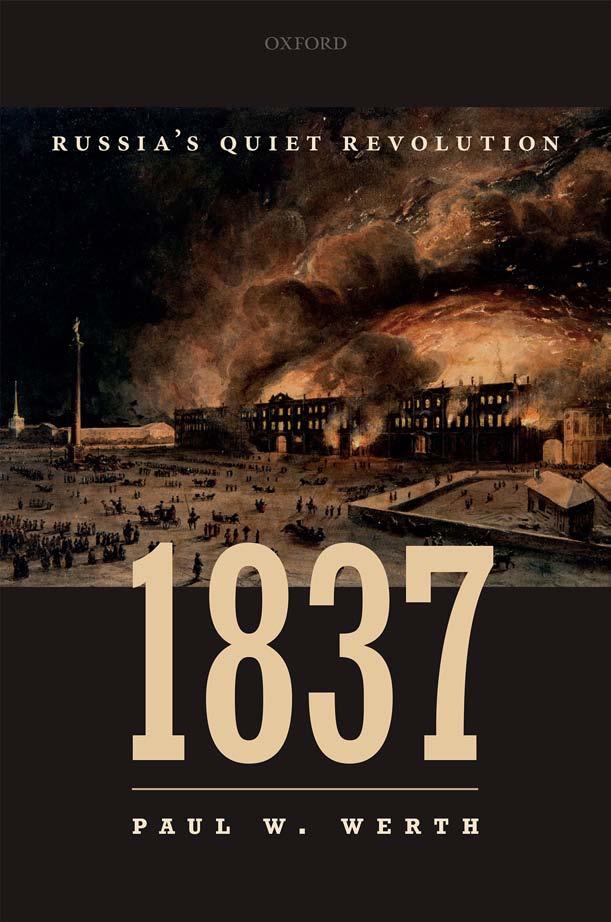
When the clock struck midnight at the start of 1837, few Russians could have imagined how much was in store for them before the next New Year’s Eve. Two great disasters stood as the year’s bookends. In January, the country lost its greatest poet, Alexander Pushkin, in a duel that killed the bard but also laid the foundation for a cult central to the country’s identity to this day. In December, Russia lost its greatest building, the Winter Palace, in a huge fire from whose ashes the edifice nonetheless rose again, phoenix-like, a mere 15 months later. These two tragedies only begin to account for the drama and dynamism of this remarkable year. The months in and around 1837 gave birth to Russian musical nationalism with the completion of Mikhail Glinka’s A Life for the Tsar, and initiated a flowering of regional life with the creation of a provincial press. Peter Chaadaev’s controversial texts riled society and have conditioned debates about backwardness, national character, and Russia’s place in the world ever since. In its west, Russia advanced an audacious plan to extend its eastern variant of Christianity at the expense of Catholicism, while in the east it prepared the century’s first major assault on an independent Central Asian state. The heir to the throne undertook a massive tour of the empire, with handlers exploiting media to promote his celebrity and forge images that would secure his subsequent rule. The half of Russia’s peasants who were not serfs acquired new bosses in a novel government ministry committed to aggressive reform and enlightened guardianship. And the quintessential symbol of industrial modernity—the steam railway—made its debut as well. The catalogue of the year’s noteworthy occurrences thus extends from the realms of culture, religion, and ideas to those of empire, politics, and industry.
The observant reader will note that these events differ in their character, duration, and significance. Some, such as Pushkin’s death and the palace fire, were chance occurrences. Those implicated in empire building reflect long-term processes that began before 1837 and ended after. Still others, such as Glinka’s opera and the railway, represent moments of metaphorical birth. Inquisitive readers will ask (heads politely cocked to one side) and sceptical ones will demand (arms folded in demonstrable defiance): What unites these disparate events and processes, aside from their chronological coincidence?
First of all, let us not write off chronological coincidence itself too quickly. Scholarly convention ordinarily demands focus on a single historical issue, thus isolating that one problem or process from the rest of history’s flow. The approach here is different. Embracing the inevitable randomness that characterizes those things that just happen to have occurred in a single year, I seek to show that for contemporaries, matters that we as scholars would not normally combine were actually occurring simultaneously. Multifariousness is precisely what people experienced at the time.
But we may go further. This book contends that the 1830s in Russia constituted a period of striking dynamism, innovation, and consequence, and that 1837 was a pivotal year for the empire’s entry into the modern age. Such a thesis may raise eyebrows. Historians traditionally think of the reign of Nicholas I (1825–55) as a time of conservative stasis, when the ‘gendarme of Europe’ secured order beyond Russia and entrenched the autocratic system at home. Similarly, most would see in 1837 nothing beyond an utterly ordinary year. There was no great upheaval, no change in the country’s ruler, no major foreign war, and no grand transformation in the country’s social or political order. The institution of serfdom continued to structure life in much of rural Russia, and autocracy remained immune to serious challenge until 1905. All of this is true. Yet my contention is that a substantial number of modern Russia’s most distinctive and noteworthy features can be traced back to this exceptional but inconspicuous year. Russia became what it did, in no small measure, because of 1837.
Indeed, I propose that diverse occurrences in and around 1837 amount to a ‘quiet revolution’—a formulation consciously designed to convey incongruity and even paradox. The revolution in question was not a rapid overturning of an existing political or social order (as in the French or Bolshevik revolutions) but rather a dramatic and wide-ranging alteration in the way something works or is organized, or at least in the ways people contemplate it (think the industrial or price revolution). Russia, I propose, underwent a set of transformations in the 1830s that introduced new institutions, novel conceptions, and unprecedented experiences. The year 1837 thus represents a profound moment of conjuncture, when diverse existing strands of historical development intersected and new ones emerged. The consequences can be traced far beyond 1837 to elucidate key attributes of Russia in the later tsarist, Soviet, and even post-Soviet eras. Thus while these twelve months stand at the centre of my narrative, the account contemplates the long-term implications of events described and elucidates later manifestations of the tendencies so strikingly present in that earlier moment. I thus offer not a discrete, isolated history of the year 1837, but rather the insertion of that one year into a longer timeline: 1837 in history.2
In order not to exaggerate these transformations, however, and to indicate the ways in which most people at the time experienced these changes without fully grasping their import, I label this revolution ‘quiet’. What occurred in Russia in
1837 was significant, at times openly dramatic; a few contemporaries—for example Pushkin, as revealed in the epigraph to this introduction—sensed that big things were afoot. But there was also a tranquil and discreet character to these processes, featuring less disturbance and bustle than calm and unobtrusiveness. In some cases, the significance of things could only be discerned in retrospect, with 1837 playing a key, if sometimes inconspicuous, role as a point of origin, a pivot, or a noteworthy segment on a longer continuum. In short, even as I propose that 1837 was highly consequential, I recognize that for many at the time that year remained unremarkable. It was at once exceptional and ordinary.
I submit further that for all of the diversity of the events I describe, each in its own way played an important role in promoting Russia’s unification. In some cases this function is obvious: the railway network that began in 1837 would eventually connect far-flung parts of the country to an extent unimaginable at the start of the century. The conversion of 1.5 million Greek Catholics to Orthodoxy united two branches of Christianity and bound Russia’s western provinces—part of Poland a mere half-century earlier—more thoroughly with its central ones. The creation of a ministry for state peasants unified administration for an enormous segment of the country’s population and proved a big step in the consolidation of a single peasantry in Russia. In other cases, the effect was more subtle, but no less real. The appearance of provincial newspapers imposed on sundry provinces a shared intellectual experience that paradoxically promoted unity precisely by revelling in the distinctiveness of each. The heir’s travels bound diverse subjects, strewn across vast geographical distance, in common affection and enthusiasm. Glinka’s opera offered musical expression that could (aspire to) unite monarch and masses for decades thereafter. Performing a similar function was the fire at the Winter Palace, which generated articulations of solidarity between people and tsar, and a shared commitment to reconstruction. Pushkin’s death united many in grief, and his cult, though it appeared only gradually, served as cultural glue for the late empire and the USSR—as it does still for contemporary Russia. Even the unsuccessful campaign in Central Asia proved part of the intervening steppe’s unification with the Russian ‘mainland’, a key stage in the incorporation of Kazakhs into Russia’s institutional and cultural orbit. In short, among the consequences of Russia’s ‘quiet revolution’ in 1837 was the country’s enhanced integration, the increased unification of its people through diverse institutions and practices, and the promotion of shared experience across vast spaces.
The 1830s, in other words, represented a crucial moment in Russian nationbuilding. Even as the empire continued to expand, and as imperial consciousness persisted in framing the thinking of its governing elite, elements of national consciousness also became prominent, and diverse parts of the country—or at least its predominantly Orthodox core—began consolidating into an integrated whole, distinct from more distant and diverse borderland territories. A Russian nation, in short, was emerging within the empire. Thus Pushkin became the national
poet (his cult enhanced by the romantic character of his death), while Glinka—so it seemed to many—gave Russia national music and its own opera. The conversion of Greek Catholics was designed, in part, to consolidate an emerging Russian nation (including Belarusians), and the Winter Palace’s destruction revealed that edifice as belonging to the nation as a whole rather than just the imperial family. Chaadaev’s contemplation of Russia’s place in the world likewise represented an inquiry into the character of the Russian nation. Provincial newspapers, meanwhile, documented this nation as it was coming into being and indeed served as midwives for that process. In the 1830s, then, the nation was becoming an ideological preoccupation for the regime and an inspiration for many thinking Russians. Close attention to 1837, I propose, reveals the embodiment of this nation in specific institutions and practices, from opera and poetry to newspapers and palaces.
Even as my central claims rest on the aggregation of the episodes that I explore, each chapter is designed to stand more or less independently as a discrete historical sketch that may be enjoyed or censured in its own right. A reader might adore railways but take no interest in religious matters. Another may enthuse over opera but refuse to bother with provincial newspapers. Of course, those who make such exclusions are misguided and deprive themselves of both pleasure and edification. But they are in no way obligated to read all chapters—or for that matter any at all. In writing each sketch, I have assumed that readers might know something about the topic in question, but not a great deal. Specialists may take issue with simplifications designed to keep the text accessible and brief. Upon reflection, they will realize that my humble narrative aspires to enhance readers’ curiosity for each topic, thus inducing them to explore the compositions of actual experts.
Many events in Russia in 1837 could have served as the basis for sketches in this book but do not. For example, the scientist Karl von Baer embarked on a trip to Novaia Zemlia, which proved a key moment in the birth of Russian ethnography. Russia was then engaged in a lengthy war of conquest in the Caucasus, and construction began on Moscow’s Christ the Saviour Cathedral. But the exclusion of these and other episodes does not mean that my choices were random. Some, I can freely admit, attracted me because I knew they would make for a good story (which, for all of the discipline’s conceptual and methodological innovation, remains at history’s heart). Overall, my aspiration was to represent different aspects of Russia: the provinces and borderlands as well as the capital; culture as well as industry; peasants as well as elites; foreign policy as well as domestic developments. This approach permits us not only to observe dynamism in diverse contexts but also to assemble a portrait of the country at this critical moment.
The first three chapters embrace culture—literature, music, and ideas—and focus on an intense period extending from the Autumn of 1836 into 1837. The fourth chapter, on the heir’s tour of the empire, takes us to the provinces, where we remain for the next two chapters to contemplate the local press and the reform of state peasants. Two chapters then engage the problem of empire, one in the east
(the attempted conquest of Khiva) and one in the west (the mass conversion of Greek Catholics). The last two chapters address building and rebuilding: Russia’s first railway and the Winter Palace.
Before beginning our first sketch, three brief tasks remain. One is to recount, with extreme concision and selectivity, what was going on elsewhere in the world so as to situate Russia’s 1837 in a global tableau. In June a young Victoria began her reign in Britain, which would last into the first month of the twentieth century, conferring her name on an entire era. In July one of her subjects, Charles Darwin, began assembling notebooks on variations of animals and plants that eventually produced the theory of evolution. In Spain, the Carlist wars raged, with whole armies engaged in savage conflict. In the New World, Texas had recently declared independence, and Nuevo México experienced popular insurrection (the Chimayó rebellion). The USA’s populist president Andrew Jackson ceded the land’s highest office to Martin van Buren in March, and in October the family-run candle and soap business of Procter & Gamble was founded in Cincinnati. In Asia, the failure of monsoon rains produced disastrous famine in India’s northwest, while the game of cricket was played for the first recorded time on the padang (field) that eventually became the Singapore Cricket Club. China meanwhile faced growing encroachments that would lead to the First Opium War in 1839, fundamentally altering the dynamics of power in East Asia.
The second task is to provide some core facts about Russia itself for the uninitiated. The country in 1837 was a near-complete autocracy, ruled by the Romanov dynasty since 1613. The tsar was Nicholas I, who came to the throne in December of 1825. His wife, the empress Alexandra (Prussian Princess Charlotte), had produced seven children between 1818 and 1832. St Petersburg, founded in 1703 by the Peter the Great, had been Russia’s capital since 1712 and had approximately 450,000 inhabitants. Russia’s historical capital, Moscow, was the country’s second largest city and the birthplace of both Pushkin and the heir to the throne, Alexander Nikolaevich. The country as a whole had a population of around 50 million people, which included ethnic Russians but also an extraordinary range of diverse ethnic and linguistic groups. Serfdom was the order of the day for half of the country’s enormous peasant population (we meet the other half in Chapter 6), and would remain in place until 1861. The country’s ‘ruling and predominant’ faith was the Orthodox Christian one, although more than a quarter of its inhabitants adhered to other faiths, from variants of Christianity to separate religions such as Buddhism, Islam, and Judaism. Geographically, the country extended from Norway and Austria to Persia and China, and across the Bering Strait into North America .
Finally, a word on the politics of the tsarist regime. While my narrative foregrounds Russia’s dynamism in the 1830s, of the autocracy’s own conservatism there can be no doubt. Shaping Nicholas’s views and indeed casting a long shadow on the 1830s were major challenges to the existing order in Russia and Europe
GRAND DUCHY OF FINLAND
Gulf of Finland
BALTIC SEA
BELOSTOK
VILNA ESTAND LIVLAND KURLAND PSKOV
ST. PETERSBURG
BARENTS SEA
White Sea
ARKHANGEL
KINGDOM OF POLAND
Black Sea GRODNO
MINSK
SMOLENSK
MOGILEV
OLONETS
NOVGOROD
YAROSLAVL
TVER MOSCOW
KALUGA
VOLOGDA
KOSTROMA
VLADIMIR
NIZHNII NOVGOROD
TULA OREL TAMBOV
VOLYNIA KURSK
POLTAVA
KIEV
I A
Sea of Azov Lake Ladoga
VORONEZH PENZA
KHARKOV
KHERSON YEKATERINOSLAV
TAURIDE
BLACK SEA
Caspian Sea Area of Map (Above)
PERM
KAZAN VIATKA
SIMBIRSK
SARATOV
ORENBURG
DON COSSACKS
RUSSIAN EMPIR E
ASTRAKHAN
ARCTIC OCEAN
CASPIAN SEA
KAZAKH STEPPE
ALASK A
PA CIFIC OCEAN
Figure 0.2. The provinces of European Russia. Map by Bill Nelson.
SIBERIA
Pa ul I (1754–1801, r. 1796–1801)
Maria Fedorovna (1759–1828)
Michael (1798–1849)
Nicholas I (1796–1855 r. 1825–55 )
Anna (1795–1865)
Olga (1792–95)
Catherin e (1788–1819)
Mari a (1786–1859)
Elen a (1784–1803)
Alexandra (1783–1801)
Constantine (1779–1831)
Alexander I (1777–1825, r. 1801–25)
Alexandra Fedorovna (Princess Charlotte, 1798–1860)
Michael (1832–1909)
Nicholas (1831–91)
Constantine (1827–92 )
Alexandra (1825–44)
Olg a (1822–92)
Mari a (1819–76)
Alexander II (1818–1881, r. 1855–81)
* Rulers in bold Figure 0.3. The Romanov Dynasty, 1796–1881.