Random
documents with unrelated content Scribd suggests to you:
But, eager though he was to discover what secret the letter addressed to him contained, it was not until late in the day that he went into the room of death, that he might open the safe, and find the envelope which his father had described to him. He had been much moved by his father's death; and, in his intense refinement of feeling, he shrank from too quickly bringing to light that which might possibly reveal to him something in his father's past life, which would bring discredit on his memory, and might cause him to think less kindly and tenderly of the dead.
It was the old man's intense anxiety that the paper should not be read in his lifetime, which led Captain Fortescue to surmise that the contents were in some way not creditable to him.
But in the evening, when all arrangements for the funeral were made, and the servants were below at their supper, he crept with a candle in his hand into the room of death. He felt almost as if he were a thief, as he crossed the floor, and passed the silent form on the bed.
His father had never allowed any one to open that safe. In the days of his childhood he had been accustomed to look at it with awe and wonder, as he speculated on the mysteries it might contain. Now—he was going to open it, and the hand that had so carefully guarded its contents was lying cold and lifeless on the bed. He felt almost as if he would hear his father's protesting voice, as he fitted the key in the lock. He even glanced back at the bed, as if to assure himself that there was no movement there.
The lock turned easily, and the massive iron door flew open. As he looked inside, he saw several packets of deeds tied up with red tape, a pile of account books, and countless old chequebooks. But he did not stop to look carefully at
what the safe contained, his eyes sought eagerly for the will, for had not his father told him that, underneath that will, he would find the secret information that he wished him to receive?
HE TURNED ROUND AND SAW WATSON STANDING BEHIND HIM.
Yes, the will was there; he saw the large envelope on which was written, in clear legal copper-plate characters,
"Last Will and Testament of Joseph Fortescue." But the will had little interest for him now. Of what avail to be told that so many thousands had been bequeathed to him, when he knew that those thousands did not exist, but had been swamped in the ruinous flooding of that distant mine? As his poor old father had said, the will was not worth the paper on which it was written. He took it up with beating heart, and looked underneath it.
Yes, there was the letter; he could see his father's crooked, illiterate writing upon it—he could read the words
"For my son, To be opened after my death."
He was just slipping it into his pocket, when he heard a movement in the room. Was the dead man rising, to make a protest against his reading its contents?
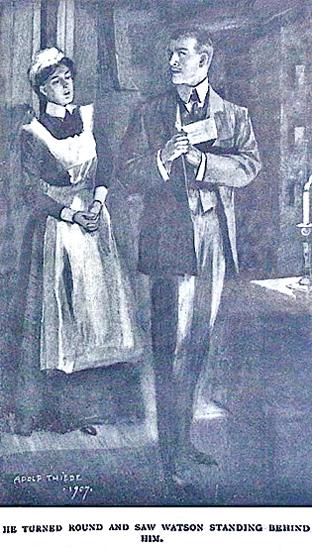
He turned round and saw Watson standing behind him; how she had crept into the room without his hearing her he could not imagine.
"What do you want, Watson?"
"I was passing the door, sir, and saw a light, so came in to see that all was right. You've soon found your way to the safe, sir!"
Captain Fortescue took no notice of this insolent remark; he was not going to give vent to his feeling of anger in the chamber of death; he knew that he would have another opportunity of letting Watson know what he thought of her behaviour to him. So, without deigning to
reply, he locked the safe, and taking the will and the keys in his hand he went out of the room.
Crossing the landing, he entered his own bedroom, and closed and locked the door. Now he was safe from intrusion and from Watson's prying gaze. He put his candle on the table, drew a chair near it, and sat down to open the letter. He wondered at himself that he could wait even to do this; but he had a nervous dread of the revelation he was about to receive, and, at the last moment, he actually feared to look upon that which before he had been so anxious to see.
He tore open the long envelope, which was securely fastened at one end, and drew out a sheet of foolscap paper.
He opened it and spread it before him; he turned over the page; he looked at the back of it.
Horror of horrors! Had sudden blindness fallen upon him? Was the loss of sight to be added to all his other losses? He could see nothing—not a single word appeared to be written on any one of the four pages. So far as he could see, it was simply a blank sheet, unused, unsoiled, utterly void of any information on any subject whatever. He held it up to the light; he tried to imagine that he saw secret marks in the tracing of the paper; he turned the pages over and over, but he could find nothing but emptiness—a plain, white surface which seemed to mock his scrutiny.
Surely he had brought the wrong envelope! But no, there was the address on the outside in his father's childish handwriting: "For my son,
To be opened after my death."
Could the old man have made a mistake, and have placed the wrong document in the cover?
He went back to the room of death, carefully locking the door this time, and he made a thorough investigation of the contents of the safe. But he found nothing whatever to repay his search, no other envelope, no other letter— nothing at all but old accounts and a few business papers.
He stood by the bed and looked at his dead father's face, and longed unutterably to ask him what he had done with the information which he had so much wished him to receive. But the lips were closed—the voice was still—and no message came from the other world to guide and direct him in his time of bewilderment and consternation. Fortescue went to his bedroom again, and once more examined the sheet of paper. Then a bright thought seized him. Could it be that his father, fearing lest the document should fall into other hands, had written it in invisible ink? Was it possible that, if he only knew how to deal with it, he might be able to fill those blank pages with words of weight and importance? He remembered, when he was a boy, having a bottle of ink of that kind, which made no mark upon the paper unless heat were brought to bear upon it. Perhaps his father had remembered it also, and, recollecting the fact that he had known the secret as a boy, he had adopted this means of making his letter even more private, and had thus considerably lessened the liability of its being deciphered by any eyes excepting those of his son.
Captain Fortescue therefore went into the library, and carefully held the foolscap sheet to the fire. But, beyond a
slight mark of scorching upon one page, it remained unchanged and exactly as he had found it.
Then it crossed his mind that possibly there might be chemicals, which, if applied to paper which had been prepared in a certain way, would bring to light hidden writing and make it legible. He thought he had read of something of the kind being used in time of war, in the place of the ordinary cipher. Possibly this was the explanation which he was seeking. He rang the bell, and Elkington answered it.
"What time do the shops close, Elkington?"
"Eight o'clock, sir."
The captain looked at his watch. "A quarter past nine! Too late, then!"
"What am I thinking of?" said the old butler. "Of course, it's Saturday night. They won't close till ten, or eleven, maybe."
"That's right. Can you send for a cab for me, Elkington?"
"Is it anything I can do, sir?"
"No, Elkington, thank you. I'm afraid not."
"Do you want the cab at once, sir?"
"Yes, at once. The sooner the better."
The old man hurried off to do his young master's bidding, and Kenneth, after placing the precious sheet of paper carefully in the breast pocket of his coat, stood
waiting in the hall until the cab arrived. He saw Watson come to the top of the stairs and look down, as if she were watching his movements. Then she came into the hall.
"Are you going out, sir? So late, too?" she added.
The cab drove up at this moment, so that he did not deem it necessary to answer, but he saw her craning her neck forward, that she might catch the direction that he gave to the cabman. Consequently, he altered what he had intended to say, merely naming the part of the town to which he wished to be driven.
The streets of Sheffield were brilliantly lighted as he drove through them; crowds of working people were thronging the main thoroughfares and filling the various shops. But the large chemist's, at which he told the cabman to stop, was practically empty, and the assistants were preparing to close for the night.
"Is Mr. Lofthouse here?" he inquired of one of them.
"He is in his private room, sir. I'll call him. You are only just in time to catch him!"
"Do you think I could speak to him for a few minutes on a private matter?"
"I'll ask him, sir."
In a few moments Kenneth found himself seated beside the old chemist, near the fast-dying embers of the fire in the room behind the shop. He brought the sheet of paper from his pocket and explained his errand. He told Mr. Lofthouse that this paper contained, at least so he believed, information of grave importance to him, and that, whilst it was impossible for him to read it at present, he suspected
and hoped that the action of some chemical might be sufficient to bring the writing upon it to light.
The chemist looked carefully at his visitor. Was he a lunatic who was labouring under some strong delusion, or had he good reason for imagining that those blank pages really contained hidden writing? It struck him as a strange time for such a visit, and that made him inclined to be suspicious of the sanity of the man before him. But the Captain's calm, quiet manner impressed him favourably, and when he presently took Mr. Lofthouse into his confidence, by telling him that a relative of his who had lately died had informed him on his death-bed that this paper contained information which it was important for him to receive, he became at once interested and at the same time eager and ready to help.
He inquired whether Captain Fortescue would be willing to entrust the paper to his care, that he might be able to experiment upon it; but when he found that Kenneth did not like the idea of doing so, inasmuch as the information which he supposed the foolscap sheet to contain was of a private nature and intended only for his own perusal, Mr. Lofthouse at once dismissed his assistants, locked the shop door, took his visitor into the laboratory, and proceeded to try the effect of various chemicals upon the paper which he had brought.
For more than an hour the two men worked away on the mysterious pages, but at the end of that time the old chemist declared his firm conviction that the captain was in some way mistaken, for that nothing whatever had been written upon the sheet of foolscap. He could find no evidence of the paper having been chemically treated, and he felt sure that, in some way or other, that paper had been
placed in the envelope in the place of the paper which Captain Fortescue had expected to find there.
It was late at night when Kenneth returned home; he was more tired than he realized, until he found himself in his own room, and he slept soundly for the first time since his arrival in Sheffield.
Then followed the long quiet Sunday, during which he sat in the darkened library, and thought of the changes that week had brought into his life, and of the uncertain and difficult future that lay ahead of him.
The funeral was fixed for Tuesday; there were no relations to summon, for he knew of none. He never in his life remembered seeing any one except his father who could claim any relationship to him, however distant. And now that only relation of his was gone, and he was left entirely alone in the world, so far as any natural tie was concerned.
Not only so, but he realized that that week he had lost all his former friends. The schoolfellows at Eton, the men he had known at Sandhurst, the friends he had made since he had entered the army, would now be parted from him by a social gulf which neither he nor they would be able to cross. He would have to sever his connection with them all; leaving the army, he would leave the link which bound him to them. He must begin life anew, and it must be, in future, the life of a man dependent upon his own exertions for his daily bread. How he was to enter upon this life, how that daily bread was to be obtained, he had no idea; what path he could cut out for himself in the hard rock of circumstances which blocked his way, he could not imagine. Nor did he know to whom to apply for advice; his friends were moving in such a totally different sphere that he did
not see how they could help him. He felt utterly and entirely alone.
But, at that moment, there suddenly flashed across him four lines which he had learnt to love in brighter and happier days, but which now came back to him with fresh meaning, as they seemed to express the inmost feeling of his heart:
"I do not ask my cross to understand, My way to see: Better in darkness just to feel Thy hand, And follow Thee."
CHAPTER VI
THE TWO ENVELOPES
CAPTAIN FORTESCUE followed his father to the grave, the chief and only mourner. No one else was present, except Mr. Fortescue's doctor and lawyer, who came in their official capacity. The extensive town cemetery looked the very picture of desolation and gloom. It lay in a narrow valley, the rising ground on either side and the stretch of lower ground between being densely covered with the resting-places of the dead.
In the quiet village churchyard, with its green mounds and neat flower-covered graves; its pure white marble crosses and the moss-covered headstones of earlier date; its neat well-kept paths, by the side of which are growing snowdrops and primroses planted by loving hands which are now, it may be, themselves lying in one of those newer mounds; the grave is robbed of some of its outward ghastliness and nakedness, and is clothed tenderly by the loving hand of mother earth.
But in this large town cemetery everything is unsightly and depressing, and the hosts of barren graves, which may be counted by their thousands, are marked only by blackened stones, upon which layer after layer of furnace smoke has settled, and is still settling as the years go by. No flowers will grow there, no trees will thrive; even the scanty grass is more black than green, whilst down in the hollow there lies, at the further end of the valley, a dismal pond, in which the body of a poor suicide was found not so long ago, and the memory of whom leaves an additional shadow upon that melancholy and dismal place.
"Earth to earth; dust to dust; ashes to ashes;" and so the poor earthly remains were left behind, and another leaf was added to the great heap of fallen leaves in the forest of mortal humanity.
When Captain Fortescue arrived home, and walked into the empty house which he would never again call home, he felt as if he were crossing the threshold of the life of hardship which lay in front of him. He determined, however, to face it bravely, and in higher strength than his own, and not to flinch from any duty, however unpleasant, which lay along its course.
In the strength of this resolution, he rang the bell, as soon as his solitary dinner was over, and requested all the servants to assemble in the library, as he had something which he wished to say to them.
He went in, carrying his father's will in his hand, and then he told them that he felt that it was only right they should know that their old master had remembered their faithful service, and had intended rewarding it by a handsome legacy, the amount of which was regulated by the length of time each had lived with him; but that it was his sad and painful duty to inform them that the whole of his father's invested money had been lost, and that therefore, he feared that these legacies existed merely in name.
"Do you mean to tell us, sir, that we shall get nothing?" inquired Watson.
"I fear not, Watson; time alone will show. My father's lawyer, Mr. Northcourt, who was here to-day, is winding up his affairs, of which I know practically nothing, and should there turn out to be money available, of course the legacies will be paid."
"It's very hard, sir, to be turned adrift after all these years!"
"It is hard, Watson; but you must remember I am a sufferer as well as you; it is very hard for me."
Watson gave a sniff of contempt. "You have your commission, sir, and your grand friends."
"Say had, Watson, not have; all that will be a thing of the past. I must leave the army."
"Dear, dear!" said the old butler. "Dear, dear! I do feel for you, sir."
"But surely," said Watson, "there will be something. Look at all this furniture, and the house and park; they haven't gone!"
"Yes, there may be something, Watson. I can't tell yet until I know what my father's obligations were. I fear that he was more than an ordinary shareholder in this mine, and that those who have lost by means of it may come upon his estate for such compensation as it may be able to yield. You may rest assured, however, that your legacies will be paid before I myself touch a single penny of my father's money."
"It's very good of you to say so," said the old butler; "but I'm sure none of us would like to rob you, sir."
"It would be no robbery, Elkington, only justice," said the Captain.
"Well, it's very hard!" said Watson. "Very hard; and what's to become of me, I'm sure I don't know. I can't take another situation at my time of life, and the old gentleman always promised he'd see I was provided for."
"Again I say, Watson, I am very sorry; I can't say more."
"And now there is something else I want to say to you," added the Captain, as he folded up the will; "and I would ask you to give very serious attention to what I am about to tell you. My father informed me, the day before he died, that he had addressed a letter to me, and had put it in the safe in his bedroom with his will. That letter I have never received. The envelope was there, addressed in my father's handwriting, but when I opened it, it contained nothing but
a blank sheet of paper. Now I am convinced that that envelope has been tampered with by some one. I am certain that it has been opened, that the paper my father expected me to find there has been removed, and that the blank sheet has been inserted in its place, and I want you to help me to discover how and when this was done, and by whose hands. Elkington, do you know where my father kept the keys of his safe?"
"The old master always had them about him, sir, day and night, as you might say. He carried them in his pocket by day, and at night they were either under his pillow or on the table by his bed. Did you ever know him leave them about, or forget them?"
"Never, sir, never once. He were as careful of these keys, and kept them as well within his reach as a cat does a mouse she has caught; he seemed always to have an eye on them."
"Well, then, we come to the day of his sudden seizure when the telegram was brought in. Where were his keys then?"
"In his pocket, sir. I know he had them, for the post-bag was brought up from the lodge a few minutes before, and I took it to him, and he brought the keys out of his pocket to open it."
"And put them back again?"
"Oh yes, sir, he never forgot to do that."
"Well, then the doctor came, and what happened next?"
"He was carried upstairs, sir. Dr. Cholmondeley helped us, and then we got him into bed."
"Who did?"
"The doctor, and me, and Watson."
"Where were the keys then?"
"Left in the pocket of his coat, sir; but, as soon as ever he came round a bit and opened his eyes, he asked for them; it was almost the first thing he said."
"And where did you put them?"
"On the table where you saw them, sir, close to his bed. They were there, as far as I know, till you took them away."
"Just after the old master breathed his last," ejaculated Watson.
"Now," said Captain Fortescue, "it seems to me we are getting the question into a very small compass. My father was taken ill early in the morning; for a short time those keys were left in his pocket. How long, Elkington?"
"About an hour, sir, I should say."
"Well, either at that time, or some time during the following night, some one must have gone to the safe and taken out my letter."
"How dare you speak like that?" shrieked Watson, "suspecting and accusing your poor father's faithful servants. I suppose you mean I'm the thief, or Elkington?"
"I accuse nobody, Watson. I only ask for an explanation of what is so mysterious to me."
But Watson bounced out of the room, saying she was not going to stay there to be called a common thief; she
should pack her box that very night, and get away from a house where she was so insulted.
The servants filed out of the room, but the old butler lingered behind.
"Sir," he said, "do you think that that woman has done it?"
"Elkington, I have no proof, and therefore I do not like to say that any one has done it. It may have been a mistake on my father's part."
"Not likely, sir, not likely; he was so slow and carefullike about things of that sort."
"Well, Elkington, I don't know what to think."
"I do know what to think," said the old butler to himself, as he went out of the room.
But the next day a solution of the mystery came to light. It was late in the evening, and when Elkington was waiting at dinner, that there was a loud ring at the front door. He went to open it, for, now Watson was gone, he was doing most of her work as well as his own. He came back with a card in his hand, which he said had been given to him by a gentleman who had just called, and who was now in the library.
"I told him you were at dinner, sir, but he said he would wait, as he particularly wished to see you to-night."
Captain Fortescue looked at the card. It was not a visiting card, but one evidently used as a tradesman's advertisement. It bore these words, printed in various styles of type—
"JOSIAH
MAKEPEACE,
Bookseller and Stationer, 149, York Street, Sheffield."
"Do you know this man, Elkington?"
"What's his name, sir?"
"Makepeace; he is a bookseller in the town."
"I've heard of him, sir; his shop is in York Street, isn't it?"
"Yes; 149, York Street."
"I believe my master dealt there sometimes. I think I remember seeing his name on parcels that came. Paper and such-like, I think they were."
"He has probably brought his bill, then, and wants to make sure he is paid before others come in for the spoil. Tell him I will see him in a few minutes, Elkington."
When Fortescue entered the library the man was standing with his back to him, gazing at the portrait of Mrs. Fortescue, which hung over the chimney-piece. He was a tall thin man, with black hair, and, as he turned round on his entrance, the Captain could see that his face was sallow, that he had a short beard and small rat-like eyes, and that he was wearing spectacles.
"Good evening, sir. I hope you will excuse my intruding at this hour, but I come on a matter of importance."
Captain Fortescue motioned him to a chair, and said he supposed it was a business matter which had brought him there.
"Not exactly, sir. Your father did do business with me at times, and it is in connection with one of these times that I want to see you. The fact is that a letter, which Mr. Fortescue wrote to you last week, has, by some mistake, come into my hands."
Kenneth looked eagerly at the envelope which Makepeace drew out of the breast pocket of his coat. What revelation did it contain? And how unfortunate that that revelation should have fallen into the hands of a stranger!
The envelope was a foolscap one, he could see that; precisely similar to the one he had found in the safe.
He stretched out his hand for it eagerly.
"Wait a minute, sir," said the man. "Allow me, if you please, to explain to you how this letter came into my possession. Last week—it would be Wednesday, I think your father came into my shop; it was the last time, I believe, that the old gentleman was out.
"'Makepeace,' he said, 'I want some foolscap paper.'
"My assistant brought some out and showed it to him. We have some blue and some white. He selected the white, sir, but when he looked at it, he declared that it was poorer in quality than what he had bought of me before. I told him that could not be the case, inasmuch as I had bought it all from the same firm and at the same time. Well, he seemed very much put out, and he shouted and stormed at me; it was a way he had, you know, sir, and he wanted to make
out I was trying to impose on him by giving him different paper.
"I didn't want to offend the old gentleman, for he was a good customer, so I told him if he would send me a sheet of the foolscap which I had sold him before, I felt sure that I could match it exactly. I meant to give him what I had in stock, for I knew it was exactly the same, but I thought this would satisfy and pacify him. Well, he came round after that, and said he knew I always did the best I could for him, and he told me he would slip it into an envelope as soon as he got home and send it to me by post. On Thursday the letter arrived, but I was from home, and my wife was away too. I've only got a young assistant, and he did not like to open my letters, so there it remained on my desk until I got home to-day."
"And then you opened it?"
"Yes, and found inside, not the sheet of foolscap as I expected, but a letter evidently intended for you, sir. It begins, 'My dear Ken,' and it ends 'Your loving Father.' I haven't read it, sir, I assure you. I wouldn't do such a thing, and I've brought it at once to you. Do you think he can have put it in the wrong envelope? Have you found any other envelope containing a blank sheet of foolscap paper?"
"Yes, I have," said Captain Fortescue, "and have been extremely puzzled by it, for my father expressly told me that he had written a letter which he particularly wished me to receive."
"Then I am only too glad to restore it to you, sir," said Makepeace, as he handed the envelope to him. "And now, sir, I will bid you good evening."
Captain Fortescue thanked him for taking the trouble to come up at once to see him, and assured him that the information which he had given him was an intense relief to his mind.
As soon as he was alone, he unfolded the letter which had at last come into his possession. His hand trembled as he did so, and as he wondered what disclosure it would make to him.
Yes, there was his father's uneven writing. Some of the capitals were printed, others written in the ordinary way. He began at once to read it. It was dated Wednesday, December 18, and ran as follows:
"MY DEAR KEN,
"I was glad to get your letter, and hope as this will find you well as it leaves me very middling, and Cholmondeley has given me a tonic, so hope soon to be better. There is something as I think you ought to be told, as it will come more easy to you if things goes wrong, as it seems likely they will. I have had a letter from Berkinshaw, a friend of mine in London, and he has found out that a certain concern, what I put my money in, is getting shaky and not likely to pay. So I'm going to sell out to-morrow, unless I hear better news from him by the morning post, and if I do sell out, I shan't be so flush of money by a long chalk, and that will mean I can't send you such a big allowance as you have been having. I thought it was better as I should tell you, in case you might be disappointed when I send your next
Welcome to our website – the ideal destination for book lovers and knowledge seekers. With a mission to inspire endlessly, we offer a vast collection of books, ranging from classic literary works to specialized publications, self-development books, and children's literature. Each book is a new journey of discovery, expanding knowledge and enriching the soul of the reade
Our website is not just a platform for buying books, but a bridge connecting readers to the timeless values of culture and wisdom. With an elegant, user-friendly interface and an intelligent search system, we are committed to providing a quick and convenient shopping experience. Additionally, our special promotions and home delivery services ensure that you save time and fully enjoy the joy of reading.
Let us accompany you on the journey of exploring knowledge and personal growth!