From the Wadsworth Series in Mass Communication and Journalism
General Mass Communication
Biagi, Media/Impact: An Introduction to Mass Media, Tenth Edition
Hilmes, Connections: A Broadcast History Reader
Hilmes, Only Connect: A Cultural History of Broadcasting in the United States, Third Edition
Lester, Visual Communication: Images with Messages, Fifth Edition
Overbeck, Major Principles of Media Law, 2011 Edition
Straubhaar/LaRose, Media Now: Understanding Media, Culture, and Technology, Seventh Edition
Zelezny, Cases in Communications Law, Sixth Edition
Zelezny, Communications Law: Liberties, Restraints, and the Modern Media, Sixth Edition
Journalism
Bowles/Borden, Creative Editing, Sixth Edition
Davis/Davis, Think Like an Editor: 50 Strategies for the Print and Digital World
Hilliard, Writing for Television, Radio, and New Media, Tenth Edition
Kessler/McDonald, When Words Collide: A Media Writer’s Guide to Grammar and Style, Eighth Edition
Rich, Writing and Reporting News: A Coaching Method, Sixth Edition
Public Relations and Advertising
Diggs-Brown, Strategic Public Relations: Audience Focused Approach
Diggs-Brown, The PR Styleguide: Formats for Public Relations Practice, Second Edition
Drewniany/Jewler, Creative Strategy in Advertising, Tenth Edition
Hendrix, Public Relations Cases, Eighth Edition
Newsom/Haynes, Public Relations Writing: Form and Style, Ninth Edition
Newsom/Turk/Kruckeberg, This is PR: The Realities of Public Relations, Tenth Edition
Research and Theory
Baran and Davis, Mass Communication Theory: Foundations, Ferment, and Future, Fifth Edition
Sparks, Media Effects Research: A Basic Overview, Third Edition
Wimmer and Dominick, Mass Media Research: An Introduction, Ninth Edition
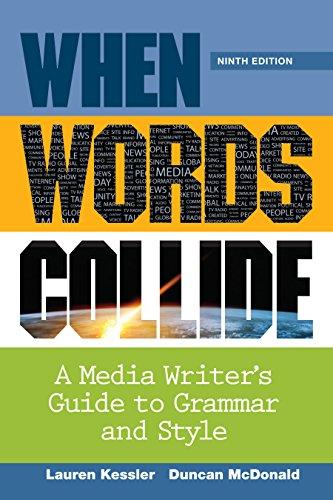
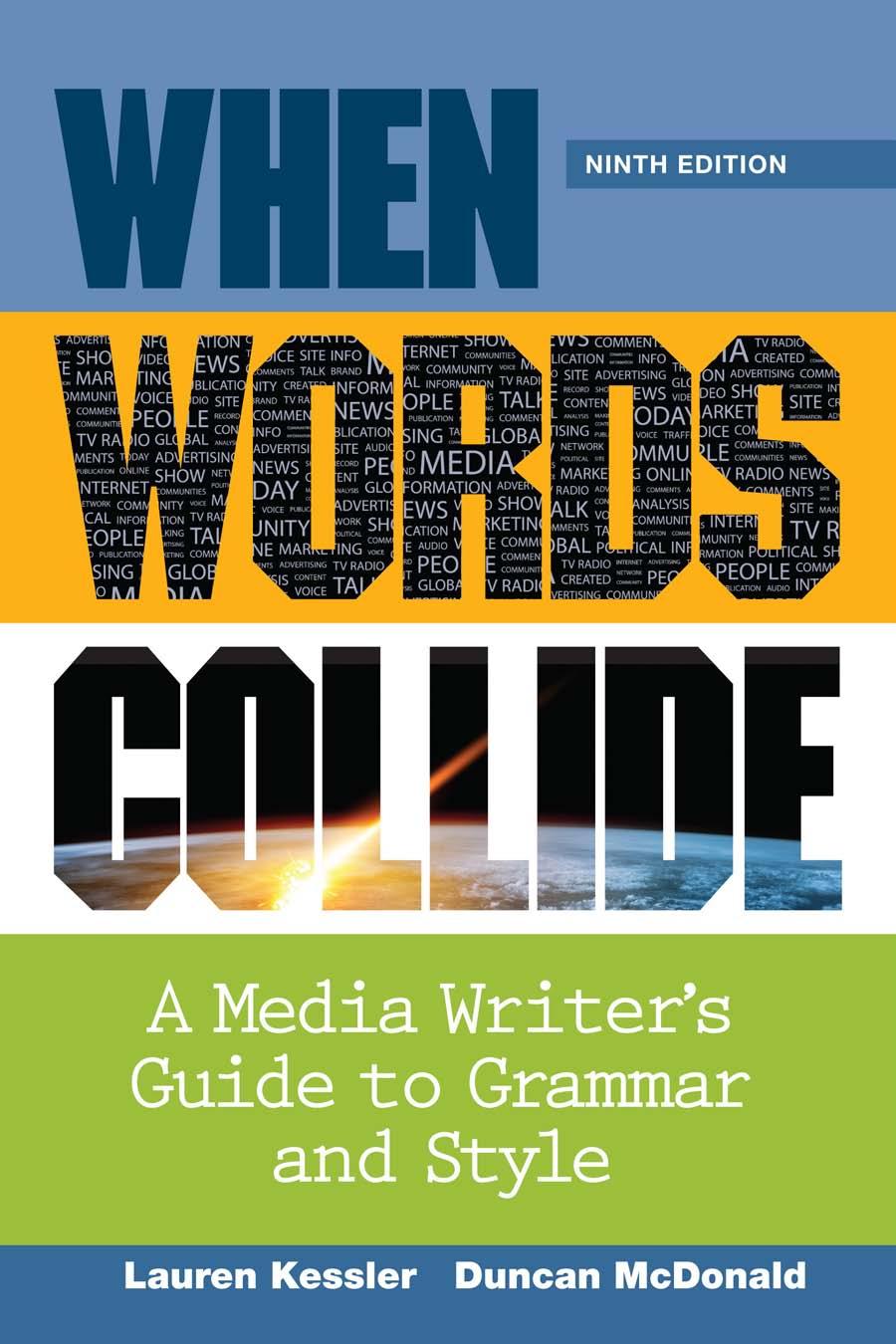
NiNth EditioN
When Words Collide
A Media Writer’s Guide to Grammar and Style
Lauren Kessler
University of Oregon
Duncan McDonald
University of Oregon
This is an electronic version of the print textbook. Due to electronic rights restrictions, some third party content may be suppressed. Editorial review has deemed that any suppressed content does not materially affect the overall learning experience. The publisher reserves the right to remove content from this title at any time if subsequent rights restrictions require it. For valuable information on pricing, previous editions, changes to current editions, and alternate formats, please visit www.cengage.com/highered to search by ISBN#, author, title, or keyword for materials in your areas of interest.
When Words Collide, A Media
Writer’s Guide to Grammar and Style, Ninth Edition
Lauren Kessler and Duncan McDonald
Product Director: Monica Eckman
Product Manager: Kelli Strieby
Content Developer: Kathy Sands-Boehmer
Product Assistant: Rachel Schowalter
Media Developer: Janine Tangney
Marketing Manager: Jillian Borden
Art and Cover Direction, Production Management, and Composition: Carolyn Deacy and Jitendra Kumar, MPS Limited
ALL RIGHTS RESERVED. No part of this work covered by the copyright herein may be reproduced, transmitted, stored, or used in any form or by any means graphic, electronic, or mechanical, including but not limited to photocopying, recording, scanning, digitizing, taping, Web distribution, information networks, or information storage and retrieval systems, except as permitted under Section 107 or 108 of the 1976 United States Copyright Act, without the prior written permission of the publisher.
For product information and technology assistance, contact us at Cengage Learning Customer & Sales Support, 1-800-354-9706.
For permission to use material from this text or product, submit all requests online at www.cengage.com/permissions. Further permissions questions can be e-mailed to permissionrequest@cengage.com
Library of Congress Control Number: 2014938526
ISBN: 978-1-285-05247-2
Cengage Learning 20 Channel Center Street Boston, MA 02210 USA
Cengage Learning is a leading provider of customized learning solutions with office locations around the globe, including Singapore, the United Kingdom, Australia, Mexico, Brazil, and Japan. Locate your local office at www.cengage.com/global
Cengage Learning products are represented in Canada by Nelson Education, Ltd.
To learn more about Cengage Learning Solutions, visit www.cengage.com
Purchase any of our products at your local college store or at our preferred online store www.cengagebrain.com
Printed in the United States of America
Print Number: 01 Print Year: 2014
Chapter 5 Working With the Verb: The Captain’s Crew 49
Nouns 49
Pronouns 50
Adjectives 53
Adverbs 56
Prepositions 58
Conjunctions 60
Interjections: Bwah-Hah-Hah! 62
Chapter 6 Making the Case for Agreement 63
Subject–Verb Agreement 63
Pronoun Reference: The Antecedent Search 70
Case: It’s All About Relationships 71
A Final Note 82
Chapter 7 Punctuation: Your Symphony of Signals and Stops 83
Some Basic Guidelines 83
Period 84
Comma 85
Semicolon 91
Colon 92
Dash 94
Quotation Marks 95
Hyphen 97
Apostrophe 98
Parentheses 101
Question Mark and Exclamation Point 102
Chapter 8 Clarity and Conciseness 105
Choosing Words 107
Putting Words Together 116
Making Sense 119
Clarity, Conciseness, Coherence 124
Preface
Online, on paper, on the air. Where will your writing appear?
Apps, podcast scripts, blog posts, news bulletins, essays. Speeches, ad copy. Investigative reports, narrative features, video documentaries, multimedia presentations. What will you write?
You may not know yet, and if you do know (and even if you are very, very sure), it’s more than likely you will change your mind and the direction of your career many times as you grow and change — and as the fast-paced world of communications grows and changes. What will remain, what is at the core of all of these endeavors, all these “delivery systems,” all the new and changing technology that will always be a part of our lives is this: correct, crisp, compelling prose. Good, solid writing. Writing that sparks discussion, ignites emotions, captures experience, tells stories. And do you know what is at the core of that? Good grammar. This brings us to the book you hold in your hands. Welcome to the new edition of When Words Collide, your friendly (yes, really) and authoritative guide to grammar and word use.
Whether you’re a veteran writer or a writer-in-training, a would-be, a wanna-be or a might-be, we welcome you to this book. We also welcome those of you brought kicking and screaming to a book on grammar. However you got here, we’re glad to have you. We’re glad to share our love of language and our commitment to great writing.
If you want to write well, When Words Collide can help you.
There are those who find the study of grammar endlessly fascinating. We wish them well, but we don’t number ourselves among them. Rather, we are writers who understand a fundamental concept: The better we know the tools of our trade, the better writers we will be. We don’t love grammar. We need it. We get frustrated, just like you, with its intricacies and inconsistencies, its sometimes finicky rules and occasionally exasperating exceptions. But we know from experience that the reward for mastering grammar is the ability to write with clarity, power and grace. And that means the ability to connect with an audience, to make people think and care—and maybe even laugh.
It is from our perspective as committed writers, avid readers, and (we hope) thoughtful teachers that we offer this ninth edition of When Words Collide. We want you to stick with us, read the book carefully and use it as a reference while you write. Learn grammar not for its own sake, not—please—to pass some test, but rather because grammar is one of the foundations of good writing. This is the best When Words Collide yet. We—your authors—have continued to grow and to challenge ourselves as writers and teachers. We’ve tracked, studied and been an active part of the new and ever-evolving world of cross-platform, multimedia journalism. This new edition comes out of our unshakable belief in and passion for the extraordinary power of crisp, clear, compelling prose. You will read, in the first chapter, why honing language skills is more important in today’s media world than ever before. We think you’ll be surprised why this is so. You’ll find that we’ve simplified grammatical rules and regulations throughout the book without sacrificing the goal of mastery. You’ll find that we talk to you. We don’t lecture or preach. We talk. We offer examples from a wide range of work including song lyrics, advertising copy, blogs and (just for the fun of it) worst-writing-ever contests as well as straight ahead journalism. In this edition we include boxed material to highlight, illustrate and entertain. We have also reorganized the grammar workbook so that it correlates more closely to the chapters in the text. Reading a book about writing should be a pleasure. We hope this one is. We hope this book helps you become the best writer you can be. We hope you keep it on your desk for years to come.
Resources
This text is accompanied by a printed student workbook that features detailed, hands-on exercises designed to reinforce each chapter’s key grammar and style concepts. The workbook is available for purchase at www.cengagebrain .com. Instructors can find the answer key to the workbook on the book’s Instructor Companion Site, at www.login.cengage.com. If students would like additional practice with the book’s grammar and style concepts, tutorial quizzes are available on the Student Companion Site, at www.cengagebrain.com.
Acknowledgments
We thank the following reviewers for their ideas and comments: Bernard Armada, University of St. Thomas; Susan Case, West Virginia University; Catherine Cassara, Bowling Green State University; Frank Coffman, Rock Valley College; Dan Connell, Simmons College; David Dixon, Malone University; Darryl Ewing, University of Houston; Jennifer Follis, University of Illinois; Neal Haldane
Madonna University; Rachel Kovacs, College of Staten Island; Jan Larson, University of Wisconsin–Eau Claire; Kathy Olson, Lehigh University; Syrenthia Robinson, Virginia Tech; Robin Street, University of Mississippi; and Joanne Washington, Clarion University. We especially thank the many teachers around the country who have enthusiastically supported our efforts and have made When Words Collide a part of their classes. We thank the thousands of students who have struggled with the complexities of the English language on the road to becoming professional writers. We dedicate this book to them and to our families.
Lauren Kessler
Duncan McDonald
Eugene, Oregon
Part 1 Understanding Grammar and Style
Another random document with no related content on Scribd:
The Project
Gutenberg eBook of Social devices for impelling women to bear and rear children
This ebook is for the use of anyone anywhere in the United States and most other parts of the world at no cost and with almost no restrictions whatsoever. You may copy it, give it away or re-use it under the terms of the Project Gutenberg License included with this ebook or online at www.gutenberg.org. If you are not located in the United States, you will have to check the laws of the country where you are located before using this eBook.
Title: Social devices for impelling women to bear and rear children
Author: Leta S. Hollingworth
Release date: August 10, 2024 [eBook #74224]
Language: English
Original publication: United States: The American Journal of Sociology, 1916
Credits: Richard Tonsing and the Online Distributed Proofreading Team at https://www.pgdp.net (This file was produced from images generously made available by The Internet Archive) *** START OF THE PROJECT GUTENBERG EBOOK SOCIAL DEVICES FOR IMPELLING WOMEN TO BEAR AND REAR CHILDREN ***
Transcriber’s Note:
New original cover art included with this eBook is granted to the public domain.
SOCIAL DEVICES FOR IMPELLING WOMEN TO BEAR AND REAR CHILDREN
LETA S. HOLLINGWORTH
Bellevue Hospital, New York City
“Again, the breeding function of the family would be better discharged if public opinion and religion conspired, as they have until recently, to crush the aspirations of woman for a life of her own. But the gain would not be worth the price.” E. A. R, Social Control (1904).
In this quotation from Ross we have suggested to us an exceedingly important and interesting phase of social control, namely, the control by those in social power over those individuals who alone can bring forth the human young, and thus perpetuate society. It is necessary that at the very outset of this discussion we should consent to clear our minds of the sentimental conception of motherhood and to look at facts. Sumner[1] states these facts as well as they have ever been stated, in his consideration of the natural burdens of society. He says:
Children add to the weight of the struggle for existence of their parents. The relation of parent to child is one of sacrifice. The interests of parents and children are antagonistic. The fact that there are or may be compensations does not affect the primary relation between the two. It may well be believed that, if procreation had not been put under the dominion of a great passion, it would have been caused to cease by the burdens it entails.
This is especially true in the case of the mothers.
The fact is that child-bearing is in many respects analogous to the work of soldiers: it is necessary for tribal or national existence; it means great sacrifice of personal advantage; it involves danger and suffering, and, in a certain percentage of cases, the actual loss of life. Thus we should expect that there would be a continuous social effort to insure the group-interest in respect to population, just as there is a continuous social effort to insure the defense of the nation in time of war. It is clear, indeed, that the social devices employed to get children born, and to get soldiers slain, are in many respects similar.
But once the young are brought into the world they still must be reared, if society’s ends are to be served, and here again the need for and exercise of social control may be seen. Since the period of helpless infancy is very prolonged in the human species, and since
the care of infants is an onerous and exacting labor, it would be natural for all persons not biologically attached to infants to use all possible devices for fastening the whole burden of infant-tending upon those who are so attached. We should expect this to happen, and we shall see, in fact, that there has been consistent social effort to establish as a norm the woman whose vocational proclivities are completely and “naturally” satisfied by child-bearing and childrearing, with the related domestic activities.
There is, to be sure, a strong and fervid insistence on the “maternal instinct,” which is popularly supposed to characterize all women equally, and to furnish them with an all-consuming desire for parenthood, regardless of the personal pain, sacrifice, and disadvantage involved. In the absence of all verifiable data, however, it is only common-sense to guard against accepting as a fact of human nature a doctrine which we might well expect to find in use as a means of social control. Since we possess no scientific data at all on this phase of human psychology, the most reasonable assumption is that if it were possible to obtain a quantitative measurement of maternal instinct, we should find this trait distributed among women, just as we have found all other traits distributed which have yielded to quantitative measurement. It is most reasonable to assume that we should obtain a curve of distribution, varying from an extreme where individuals have a zero or negative interest in caring for infants, through a mode where there is a moderate amount of impulse to such duties, to an extreme where the only vocational or personal interest lies in maternal activities.
The facts, shorn of sentiment, then, are: (1) The bearing and rearing of children is necessary for tribal or national existence and aggrandizement. (2) The bearing and rearing of children is painful, dangerous to life, and involves long years of exacting labor and selfsacrifice. (3) There is no verifiable evidence to show that a maternal instinct exists in women of such all-consuming strength and fervor as to impel them voluntarily to seek the pain, danger, and exacting labor involved in maintaining a high birth rate.
We should expect, therefore, that those in control of society would invent and employ devices for impelling women to maintain a birth rate sufficient to insure enough increase in the population to offset the wastage of war and disease. It is the purpose of this paper to cite
specific illustrations to show just how the various social institutions have been brought to bear on women to this end. Ross has classified the means which society takes and has taken to secure order, and insure that individuals will act in such a way as to promote the interests of the group, as those interests are conceived by those who form “the radiant points of social control.” These means, according to the analysis of Ross, are public opinion, law, belief, social suggestion, education, custom, social religion, personal ideals (the type), art, personality, enlightenment, illusion, and social valuation. Let us see how some of these means have been applied in the control of women.
Personal ideals (the type).—The first means of control to which I wish to call attention in the present connection is that which Ross calls “personal ideals.” It is pointed out that “a developed society presents itself as a system of unlike individuals, strenuously pursuing their personal ends.” Now, for each person there is a “certain zone of requirement,” and since “altruism is quite incompetent to hold each unswervingly to the particular activities and forbearances belonging to his place in the social system,” the development of such allegiance must be—
effected by means of types or patterns, which society induces its members to adopt as their guiding ideals.... To this end are elaborated various patterns of conduct and of character, which may be termed social types. These types may become in the course of time personal ideals, each for that category of persons for which it is intended.
For women, obviously enough, the first and most primitive “zone of requirement” is and has been to produce and rear families large enough to admit of national warfare being carried on, and of colonization.
Thus has been evolved the social type of the “womanly woman,” “the normal woman,” the chief criterion of normality being a willingness to engage enthusiastically in maternal and allied activities. All those classes and professions which form “the radiant points of social control” unite upon this criterion. Men of science announce it with calm assurance (though failing to say on what kind
or amount of scientific data they base their remarks). For instance, McDougall[2] writes:
The highest stage is reached by those species in which each female produces at birth but one or two young, and protects them so efficiently that most of the young born reach maturity; the maintenance of the species thus becomes in the main the work of the parental instinct. In such species the protection and cherishing of the young is the constant and all-absorbing occupation of the mother, to which she devotes all her energies, and in the course of which she will at any time undergo privation, pain, and death. The instinct (maternal instinct) becomes more powerful than any other, and can override any other, even fear itself.
Professor Jastrow[3] writes:
... charm is the technique of the maiden, and sacrifice the passion of the mother. One set of feminine interests expresses more distinctly the issues of courtship and attraction; the other of qualities of motherhood and devotion.
The medical profession insistently proclaims desire for numerous children as the criterion of normality for women, scornfully branding those so ill-advised as to deny such desires as “abnormal.” As one example among thousands of such attempts at social control let me quote the following, which appeared in a New York newspaper on November 29, 1915:
Only abnormal women want no babies. Trenchant criticism of modern life was made by Dr. Max G. Schlapp, internationally known as a neurologist. Dr. Schlapp addressed his remarks to the congregation of the Park Avenue M.E. Church. He said, “The birth rate is falling off. Rich people are the ones who have no children, and the poor have the greatest number of offspring. Any woman who does not desire offspring is abnormal. We have a large number, particularly among the women, who do not want children. Our social society is becoming intensely unstable.”
And this from the New York Times, September 5, 1915:
Normally woman lives through her children; man lives through his work.
Scores of such implicit attempts to determine and present the type or norm meet us on every hand. This norm has the sanction of authority, being announced by men of greatest prestige in the community. No one wishes to be regarded by her fellow-creatures as “abnormal” or “decayed.” The stream of suggestions playing from all points inevitably has its influence, so that it is or was, until recently, well-nigh impossible to find a married woman who would admit any conflicting interests equal or paramount to the interest of caring for children. There is a universal refusal to admit that the maternal instinct, like every other trait of human nature, might be distributed according to the probability curve.
Public opinion.—Let us turn next to public opinion as a means of control over women in relation to the birth rate. In speaking of public opinion Ross says:
Haman is at the mercy of Mordecai. Rarely can one regard his deed as fair when others find it foul, or count himself a hero when the world deems him a wretch.... For the mass of men the blame and the praise of the community are the very lords of life.
If we inquire now what are the organs or media of expression of public opinion we shall see how it is brought to bear on women. The newspapers are perhaps the chief agents, in modern times, in the formation of public opinion, and their columns abound in interviews with the eminent, deploring the decay of the population. Magazines print articles based on statistics of depopulation, appealing to the patriotism of women. In the year just passed fifty-five articles on the birth rate have chanced to come to the notice of the present writer. Fifty-four were written by men, including editors, statesmen, educators, ex-presidents, etc. Only one was written by a woman. The following quotation is illustrative of the trend of all of them:
M. Emil Reymond has made this melancholy announcement in the Senate: “We are living in an age when women have pronounced upon themselves a judgment that is dangerous in the highest degree to the development of the population.... We have the right to do what we will with the life that is in us, say they.”
Thus the desire for the development of interests and aptitudes other than the maternal is stigmatized as “dangerous,” “melancholy,” “degrading,” “abnormal,” “indicative of decay.” On the other hand, excessive maternity receives many cheap but effective rewards. For example, the Jesuit priests hold special meetings to laud maternity. The German Kaiser announces that he will now be godfather to seventh, eighth, and ninth sons, even if daughters intervene. The exPresident has written a letter of congratulation to the mother of nine.
Law.—Since its beginning as a human institution law has been a powerful instrument for the control of women. The subjection of women was originally an irrational consequence of sex differences in reproductive function. It was not intended by either men or women, but simply resulted from the natural physiological handicaps of women, and the attempts of humanity to adapt itself to physiological nature through the crude methods of trial and error. When law was formulated, this subjection was defined, and thus furthered. It would take too long to cite all the legal provisions that contribute, indirectly, to keep women from developing individualistic interests and capacities. Among the most important indirect forces in law which affect women to keep them child-bearers and child-rearers only are those provisions that tend to restrain them from possessing and controlling property. Such provisions have made of women a comparatively possessionless class, and have thus deprived them of the fundamentals of power. While affirming the essential nature of woman to be satisfied with maternity and with maternal duties only, society has always taken every precaution to close the avenues to ways of escape therefrom.
Two legal provisions which bear directly on women to compel them to keep up the birth rate may be mentioned here. The first of these is the provision whereby sterility in the wife may be made a cause of divorce. This would be a powerful inducement to women who loved their husbands to bear children if they could. The second provision is that which forbids the communication of the data of science in the matter of the means of birth control. The American laws are very drastic on this point. Recently in New York City a man was sentenced to prison for violating this law. The more advanced democratic nations have ceased to practice military conscription. They no longer conscript their men to bear arms, depending on the
volunteer army. But they conscript their women to bear children by legally prohibiting the publication or communication of the knowledge which would make child-bearing voluntary.
Child-rearing is also legally insured by those provisions which forbid and punish abortion, infanticide, and infant desertion. There could be no better proof of the insufficiency of maternal instinct as a guaranty of population than the drastic laws which we have against birth control, abortion, infanticide, and infant desertion.
Belief.—Belief, “which controls the hidden portions of life,” has been used powerfully in the interests of population. Orthodox women, for example, regard family limitation as a sin, punishable in the hereafter. Few explicit exhortations concerning the birth rate are discoverable in the various “Words” of God. The belief that family limitation will be punished in the hereafter seems to have been evolved mainly by priests out of the slender materials of a few quotations from Holy Writ, such as “God said unto them, ‘Multiply and replenish the earth,’” and from the scriptural allusion to children as the gifts of God. Being gifts from God, it follows that they may not be refused except at the peril of incurring God’s displeasure.
Education.—The education of women has always, until the end of the nineteenth century, been limited to such matters as would become a creature who could and should have no aspirations for a life of her own. We find the proper education for girls outlined in the writings of such educators as Rousseau, Fénelon, St. Jerome, and in Godey’s Lady’s Book. Not only have the “social guardians” used education as a negative means of control, by failing to provide any real enlightenment for women, but education has been made a positive instrument for control. This was accomplished by drilling into the young and unformed mind, while yet it was too immature to reason independently, such facts and notions as would give the girl a conception of herself only as future wife and mother. Rousseau, for instance, demanded freedom and individual liberty of development for everybody except Sophia, who was to be deliberately trained up as a means to an end. In the latter half of the nineteenth century when the hard battle for the real enlightenment of women was being fought, one of the most frequently recurring objections to admitting women to knowledge was that “the population would suffer,” “the essential nature of woman would be changed,” “the family would
decay,” and “the birth rate would fall.” Those in control of society yielded up the old prescribed education of women only after a stubborn struggle, realizing that with the passing of the old training an important means of social control was slipping out of their hands.
Art.—A very long paper might be written to describe the various uses to which art has been put in holding up the ideal of motherhood. The mother, with children at her breast, is the favorite theme of artists. The galleries of Europe are hung full of Madonnas of every age and degree. Poetry abounds in allusions to the sacredness and charm of motherhood, depicting the yearning of the adult for his mother’s knee. Fiction is replete with happy and adoring mothers. Thousands of songs are written and sung concerning the ideal relation which exists between mother and child. In pursuing the mother-child theme through art one would not be led to suspect that society finds it necessary to make laws against contraconception, infanticide, abortion, and infant desertion. Art holds up to view only the compensations of motherhood, leaving the other half of the theme in obscurity, and thus acting as a subtle ally of population.
Illusion.—This is the last of Ross’s categories to which I wish to refer. Ross says:
In the taming of men there must be provided coil after coil to entangle the unruly one. Mankind must use snares as well as leading-strings, will-o-the-wisps as well as lanterns. The truth by all means, if it will promote obedience, but in any case obedience! We shall examine not creeds now, but the films, veils, hidden mirrors, and half lights by which men are duped as to that which lies nearest them, their own experience. This time we shall see men led captive, not by dogmas concerning a world beyond experience, but by artfully fostered misconceptions of the pains, satisfactions, and values lying under their very noses.
One of the most effective ways of creating the desired illusion about any matter is by concealing and tabooing the mention of all the painful and disagreeable circumstances connected with it. Thus there is a very stern social taboo on conversation about the processes of birth. The utmost care is taken to conceal the agonies and risks of child-birth from the young. Announcement is rarely made of the true cause of deaths from child-birth. The statistics of maternal mortality
have been neglected by departments of health, and the few compilations which have been made have not achieved any wide publicity or popular discussion. Says Katharine Anthony, in her recent book on Feminism in Germany and Scandinavia (1915):
There is no evidence that the death rate of women from child-birth has caused the governing classes many sleepless nights.
Anthony gives some statistics from Prussia (where the figures have been calculated), showing that
between 1891 and 1900 11 per cent of the deaths of all women between the ages of twenty-five and forty years occurred in child-birth.... During forty years of peace Germany lost 400,000 mothers’ lives, that is, ten times what she lost in soldiers’ lives in the campaign of 1870 and 1871.
Such facts would be of wide public interest, especially to women, yet there is no tendency at all to spread them broadcast or to make propaganda of them. Public attention is constantly being called to the statistics of infant mortality, but the statistics of maternal mortality are neglected and suppressed.
The pains, the dangers, and risks of child-bearing are tabooed as subjects of conversation. The drudgery, the monotonous labor, and other disagreeable features of child-rearing are minimized by “the social guardians.” On the other hand, the joys and compensations of motherhood are magnified and presented to consciousness on every hand. Thus the tendency is to create an illusion whereby motherhood will appear to consist of compensations only, and thus come to be desired by those for whom the illusion is intended.
There is one further class of devices for controlling women that does not seem to fit any of the categories mentioned by Ross. I refer to threats of evil consequence to those who refrain from childbearing. This class of social devices I shall call “bugaboos.” Medical men have done much to help population (and at the same time to increase obstetrical practice!) by inventing bugaboos. For example, it is frequently stated by medical men, and is quite generally believed
by women, that if first child-birth is delayed until the age of thirty years the pains and dangers of the process will be very gravely increased, and that therefore women will find it advantageous to begin bearing children early in life. It is added that the younger the woman begins to bear the less suffering will be experienced. One looks in vain, however, for any objective evidence that such is the case. The statements appear to be founded on no array of facts whatever, and until they are so founded they lie under the suspicion of being merely devices for social control.
One also reads that women who bear children live longer on the average than those who do not, which is taken to mean that childbearing has a favorable influence on longevity. It may well be that women who bear many children live longer than those who do not, but the only implication probably is that those women who could not endure the strain of repeated births died young, and thus naturally did not have many children. The facts may indeed be as above stated, and yet child-bearing may be distinctly prejudicial to longevity.
A third bugaboo is that if a child is reared alone, without brothers and sisters, he will grow up selfish, egoistic, and an undesirable citizen. Figures are, however, so far lacking to show the disastrous consequences of being an only child.
From these brief instances it seems very clear that “the social guardians” have not really believed that maternal instinct is alone a sufficient guaranty of population. They have made use of all possible social devices to insure not only child-bearing, but child-rearing. Belief, law, public opinion, illusion, education, art, and bugaboos have all been used to re-enforce maternal instinct. We shall never know just how much maternal instinct alone will do for population until all the forces and influences exemplified above have become inoperative. As soon as women become fully conscious of the fact that they have been and are controlled by these devices the latter will become useless, and we shall get a truer measure of maternal feeling.
One who learns why society is urging him into the straight and narrow way will resist its pressure. One who sees clearly how he is controlled will thenceforth be emancipated. To betray the secrets of ascendancy is to forearm the individual in his struggle with society.
The time is coming, and is indeed almost at hand, when all the most intelligent women of the community, who are the most desirable child-bearers, will become conscious of the methods of social control. The type of normality will be questioned; the laws will be repealed and changed; enlightenment will prevail; belief will be seen to rest upon dogmas; illusion will fade away and give place to clearness of view; the bugaboos will lose their power to frighten. How will “the social guardians” induce women to bear a surplus population when all these cheap, effective methods no longer work?
The natural desire for children may, and probably will, always guarantee a stationary population, even if child-bearing should become a voluntary matter. But if a surplus population is desired for national aggrandizement, it would seem that there will remain but one effective social device whereby this can be secured, namely, adequate compensation, either in money or in fame. If it were possible to become rich or famous by bearing numerous fine children, many a woman would no doubt be eager to bring up eight or ten, though if acting at the dictation of maternal instinct only, she would have brought up but one or two. When the cheap devices no longer work, we shall expect expensive devices to replace them, if the same result is still desired by the governors of society.
If these matters could be clearly raised to consciousness, so that this aspect of human life could be managed rationally, instead of irrationally as at present, the social gain would be enormous— assuming always that the increased happiness and usefulness of women would, in general, be regarded as social gain.
1. W. G. Sumner, Folkways, 1906.
2. W. McDougall, Social Psychology, 1908.
3. J. Jastrow, Character and Temperament, 1915.
TRANSCRIBER’S NOTES
Typos fixed; non-standard spelling and dialect retained.
Used numbers for footnotes, placing them all at the end of the last chapter.
*** END OF THE PROJECT GUTENBERG EBOOK SOCIAL DEVICES FOR IMPELLING WOMEN TO BEAR AND REAR CHILDREN ***
Updated editions will replace the previous one—the old editions will be renamed.
Creating the works from print editions not protected by U.S. copyright law means that no one owns a United States copyright in these works, so the Foundation (and you!) can copy and distribute it in the United States without permission and without paying copyright royalties. Special rules, set forth in the General Terms of Use part of this license, apply to copying and distributing Project Gutenberg™ electronic works to protect the PROJECT GUTENBERG™ concept and trademark. Project Gutenberg is a registered trademark, and may not be used if you charge for an eBook, except by following the terms of the trademark license, including paying royalties for use of the Project Gutenberg trademark. If you do not charge anything for copies of this eBook, complying with the trademark license is very easy. You may use this eBook for nearly any purpose such as creation of derivative works, reports, performances and research. Project Gutenberg eBooks may be modified and printed and given away—you may do practically ANYTHING in the United States with eBooks not protected by U.S. copyright law. Redistribution is subject to the trademark license, especially commercial redistribution.
FULL LICENSE
THE FULL PROJECT GUTENBERG LICENSE
PLEASE READ THIS BEFORE YOU DISTRIBUTE OR USE THIS WORK
To protect the Project Gutenberg™ mission of promoting the free distribution of electronic works, by using or distributing this work (or any other work associated in any way with the phrase “Project Gutenberg”), you agree to comply with all the terms of the Full Project Gutenberg™ License available with this file or online at www.gutenberg.org/license.
Section 1. General Terms of Use and Redistributing Project Gutenberg™ electronic works
1.A. By reading or using any part of this Project Gutenberg™ electronic work, you indicate that you have read, understand, agree to and accept all the terms of this license and intellectual property (trademark/copyright) agreement. If you do not agree to abide by all the terms of this agreement, you must cease using and return or destroy all copies of Project Gutenberg™ electronic works in your possession. If you paid a fee for obtaining a copy of or access to a Project Gutenberg™ electronic work and you do not agree to be bound by the terms of this agreement, you may obtain a refund from the person or entity to whom you paid the fee as set forth in paragraph 1.E.8.
1.B. “Project Gutenberg” is a registered trademark. It may only be used on or associated in any way with an electronic work by people who agree to be bound by the terms of this agreement. There are a few things that you can do with most Project Gutenberg™ electronic works even without complying with the full terms of this agreement. See paragraph 1.C below. There are a lot of things you can do with Project Gutenberg™ electronic works if you follow the terms of this agreement and help preserve free future access to Project Gutenberg™ electronic works. See paragraph 1.E below.
1.C. The Project Gutenberg Literary Archive Foundation (“the Foundation” or PGLAF), owns a compilation copyright in the collection of Project Gutenberg™ electronic works. Nearly all the individual works in the collection are in the public domain in the United States. If an individual work is unprotected by copyright law in the United States and you are located in the United States, we do not claim a right to prevent you from copying, distributing, performing, displaying or creating derivative works based on the work as long as all references to Project Gutenberg are removed. Of course, we hope that you will support the Project Gutenberg™ mission of promoting free access to electronic works by freely sharing Project Gutenberg™ works in compliance with the terms of this agreement for keeping the Project Gutenberg™ name associated with the work. You can easily comply with the terms of this agreement by keeping this work in the same format with its attached full Project Gutenberg™ License when you share it without charge with others.
1.D. The copyright laws of the place where you are located also govern what you can do with this work. Copyright laws in most countries are in a constant state of change. If you are outside the United States, check the laws of your country in addition to the terms of this agreement before downloading, copying, displaying, performing, distributing or creating derivative works based on this work or any other Project Gutenberg™ work. The Foundation makes no representations concerning the copyright status of any work in any country other than the United States.
1.E. Unless you have removed all references to Project Gutenberg:
1.E.1. The following sentence, with active links to, or other immediate access to, the full Project Gutenberg™ License must appear prominently whenever any copy of a Project Gutenberg™ work (any work on which the phrase “Project Gutenberg” appears, or with which the phrase “Project Gutenberg” is associated) is accessed, displayed, performed, viewed, copied or distributed:
This eBook is for the use of anyone anywhere in the United States and most other parts of the world at no cost and with almost no restrictions whatsoever. You may copy it, give it away or re-use it under the terms of the Project Gutenberg License included with this eBook or online at www.gutenberg.org. If you are not located in the United States, you will have to check the laws of the country where you are located before using this eBook.
1.E.2. If an individual Project Gutenberg™ electronic work is derived from texts not protected by U.S. copyright law (does not contain a notice indicating that it is posted with permission of the copyright holder), the work can be copied and distributed to anyone in the United States without paying any fees or charges. If you are redistributing or providing access to a work with the phrase “Project Gutenberg” associated with or appearing on the work, you must comply either with the requirements of paragraphs 1.E.1 through 1.E.7 or obtain permission for the use of the work and the Project Gutenberg™ trademark as set forth in paragraphs 1.E.8 or 1.E.9.
1.E.3. If an individual Project Gutenberg™ electronic work is posted with the permission of the copyright holder, your use and distribution must comply with both paragraphs 1.E.1 through 1.E.7 and any additional terms imposed by the copyright holder. Additional terms will be linked to the Project Gutenberg™ License for all works posted with the permission of the copyright holder found at the beginning of this work.
1.E.4. Do not unlink or detach or remove the full Project Gutenberg™ License terms from this work, or any files containing a part of this work or any other work associated with Project Gutenberg™.
1.E.5. Do not copy, display, perform, distribute or redistribute this electronic work, or any part of this electronic work, without prominently displaying the sentence set forth in paragraph 1.E.1
with active links or immediate access to the full terms of the Project Gutenberg™ License.
1.E.6. You may convert to and distribute this work in any binary, compressed, marked up, nonproprietary or proprietary form, including any word processing or hypertext form. However, if you provide access to or distribute copies of a Project Gutenberg™ work in a format other than “Plain Vanilla ASCII” or other format used in the official version posted on the official Project Gutenberg™ website (www.gutenberg.org), you must, at no additional cost, fee or expense to the user, provide a copy, a means of exporting a copy, or a means of obtaining a copy upon request, of the work in its original “Plain Vanilla ASCII” or other form. Any alternate format must include the full Project Gutenberg™ License as specified in paragraph 1.E.1.
1.E.7. Do not charge a fee for access to, viewing, displaying, performing, copying or distributing any Project Gutenberg™ works unless you comply with paragraph 1.E.8 or 1.E.9.
1.E.8. You may charge a reasonable fee for copies of or providing access to or distributing Project Gutenberg™ electronic works provided that:
• You pay a royalty fee of 20% of the gross profits you derive from the use of Project Gutenberg™ works calculated using the method you already use to calculate your applicable taxes. The fee is owed to the owner of the Project Gutenberg™ trademark, but he has agreed to donate royalties under this paragraph to the Project Gutenberg Literary Archive Foundation. Royalty payments must be paid within 60 days following each date on which you prepare (or are legally required to prepare) your periodic tax returns. Royalty payments should be clearly marked as such and sent to the Project Gutenberg Literary Archive Foundation at the address specified in Section 4, “Information
about donations to the Project Gutenberg Literary Archive Foundation.”
• You provide a full refund of any money paid by a user who notifies you in writing (or by e-mail) within 30 days of receipt that s/he does not agree to the terms of the full Project Gutenberg™ License. You must require such a user to return or destroy all copies of the works possessed in a physical medium and discontinue all use of and all access to other copies of Project Gutenberg™ works.
• You provide, in accordance with paragraph 1.F.3, a full refund of any money paid for a work or a replacement copy, if a defect in the electronic work is discovered and reported to you within 90 days of receipt of the work.
• You comply with all other terms of this agreement for free distribution of Project Gutenberg™ works.
1.E.9. If you wish to charge a fee or distribute a Project Gutenberg™ electronic work or group of works on different terms than are set forth in this agreement, you must obtain permission in writing from the Project Gutenberg Literary Archive Foundation, the manager of the Project Gutenberg™ trademark. Contact the Foundation as set forth in Section 3 below.
1.F.
1.F.1. Project Gutenberg volunteers and employees expend considerable effort to identify, do copyright research on, transcribe and proofread works not protected by U.S. copyright law in creating the Project Gutenberg™ collection. Despite these efforts, Project Gutenberg™ electronic works, and the medium on which they may be stored, may contain “Defects,” such as, but not limited to, incomplete, inaccurate or corrupt data, transcription errors, a copyright or other intellectual property infringement, a defective or
damaged disk or other medium, a computer virus, or computer codes that damage or cannot be read by your equipment.
1.F.2. LIMITED WARRANTY, DISCLAIMER OF DAMAGES - Except for the “Right of Replacement or Refund” described in paragraph 1.F.3, the Project Gutenberg Literary Archive Foundation, the owner of the Project Gutenberg™ trademark, and any other party distributing a Project Gutenberg™ electronic work under this agreement, disclaim all liability to you for damages, costs and expenses, including legal fees. YOU AGREE THAT YOU HAVE NO REMEDIES FOR NEGLIGENCE, STRICT LIABILITY, BREACH OF WARRANTY OR BREACH OF CONTRACT EXCEPT THOSE PROVIDED IN PARAGRAPH
1.F.3. YOU AGREE THAT THE FOUNDATION, THE TRADEMARK OWNER, AND ANY DISTRIBUTOR UNDER THIS AGREEMENT WILL NOT BE LIABLE TO YOU FOR ACTUAL, DIRECT, INDIRECT, CONSEQUENTIAL, PUNITIVE OR INCIDENTAL DAMAGES EVEN IF YOU GIVE NOTICE OF THE POSSIBILITY OF SUCH DAMAGE.
1.F.3. LIMITED RIGHT OF REPLACEMENT OR REFUND - If you discover a defect in this electronic work within 90 days of receiving it, you can receive a refund of the money (if any) you paid for it by sending a written explanation to the person you received the work from. If you received the work on a physical medium, you must return the medium with your written explanation. The person or entity that provided you with the defective work may elect to provide a replacement copy in lieu of a refund. If you received the work electronically, the person or entity providing it to you may choose to give you a second opportunity to receive the work electronically in lieu of a refund. If the second copy is also defective, you may demand a refund in writing without further opportunities to fix the problem.
1.F.4. Except for the limited right of replacement or refund set forth in paragraph 1.F.3, this work is provided to you ‘AS-IS’, WITH NO OTHER WARRANTIES OF ANY KIND, EXPRESS OR IMPLIED,
INCLUDING BUT NOT LIMITED TO WARRANTIES OF MERCHANTABILITY OR FITNESS FOR ANY PURPOSE.
1.F.5. Some states do not allow disclaimers of certain implied warranties or the exclusion or limitation of certain types of damages. If any disclaimer or limitation set forth in this agreement violates the law of the state applicable to this agreement, the agreement shall be interpreted to make the maximum disclaimer or limitation permitted by the applicable state law. The invalidity or unenforceability of any provision of this agreement shall not void the remaining provisions.
1.F.6. INDEMNITY - You agree to indemnify and hold the Foundation, the trademark owner, any agent or employee of the Foundation, anyone providing copies of Project Gutenberg™ electronic works in accordance with this agreement, and any volunteers associated with the production, promotion and distribution of Project Gutenberg™ electronic works, harmless from all liability, costs and expenses, including legal fees, that arise directly or indirectly from any of the following which you do or cause to occur: (a) distribution of this or any Project Gutenberg™ work, (b) alteration, modification, or additions or deletions to any Project Gutenberg™ work, and (c) any Defect you cause.
Section 2. Information about the Mission of Project Gutenberg™
Project Gutenberg™ is synonymous with the free distribution of electronic works in formats readable by the widest variety of computers including obsolete, old, middle-aged and new computers. It exists because of the efforts of hundreds of volunteers and donations from people in all walks of life.
Volunteers and financial support to provide volunteers with the assistance they need are critical to reaching Project Gutenberg™’s goals and ensuring that the Project Gutenberg™ collection will
remain freely available for generations to come. In 2001, the Project Gutenberg Literary Archive Foundation was created to provide a secure and permanent future for Project Gutenberg™ and future generations. To learn more about the Project Gutenberg Literary Archive Foundation and how your efforts and donations can help, see Sections 3 and 4 and the Foundation information page at www.gutenberg.org.
Section 3. Information about the Project Gutenberg Literary Archive Foundation
The Project Gutenberg Literary Archive Foundation is a non-profit 501(c)(3) educational corporation organized under the laws of the state of Mississippi and granted tax exempt status by the Internal Revenue Service. The Foundation’s EIN or federal tax identification number is 64-6221541. Contributions to the Project Gutenberg Literary Archive Foundation are tax deductible to the full extent permitted by U.S. federal laws and your state’s laws.
The Foundation’s business office is located at 809 North 1500 West, Salt Lake City, UT 84116, (801) 596-1887. Email contact links and up to date contact information can be found at the Foundation’s website and official page at www.gutenberg.org/contact
Section 4. Information about Donations to the Project Gutenberg Literary Archive Foundation
Project Gutenberg™ depends upon and cannot survive without widespread public support and donations to carry out its mission of increasing the number of public domain and licensed works that can be freely distributed in machine-readable form accessible by the widest array of equipment including outdated equipment. Many