hope the new edition will stimulate natural curiosity in each reader to embark on their own path of nutritional inquiry.
CHAPTER FEATURES
Something new to this textbook is that each chapter was vetted for scientific accuracy by Tonia Reinhard, Registered Dietitian, author and professor of Nutrition and Food Science. With her contribution the reader can have confidence that all content is current and research supported.
This third edition presents consistent chapter organization. Each chapter begins with a related quote, learning objectives, and key terms that set the stage for learning. Every chapter has an introduction that is written to serve as a segue into more detailed content. At the end of each chapter is a Relate to Patient section that compiles and lists information for the reader, so they can incorporate lessons learned during patient education and nutritional counseling. The next section, Practice for Patients, offers an opportunity to critically think through a patient case, while applying information from the chapter. Finally, the Relate to You section includes challenges to the reader to self-apply the information, drawing from personal eating practices.
Nutritional content has been researched and referenced and is current for the moment. Even as you read this statement, new ideas are being discussed in the world of nutrition. As stated earlier, nutrition is not a static science, so it is very possible new trends are emerging.
NEW RESOURCES
New to this edition and available online is Chapter 18, Nutritive Value of Complimentary Therapies for Oral Care. This chapter complements information in Chapter 8, Dietary and Herbal Supplements. An introduction and history of holistic or complimentary therapies is explained. Content, including nutritional value, for progressive or nontraditional practices includes miswak, oil pulling, essential oils, aromatherapy, and teas. Step-bystep instructions for making a breathing inhaler, frozen oil bites, safety guidelines for using aromatherapy, and brewing tea for the best flavor and benefit are presented.
Five Nutritional Counseling Videos are posted for both students and instructors online. Chapter 16 teaches that Nutritional Counseling sessions are individualized according to patient need, allowing that each one is different. These videos are meant to serve as exercises for students to pick out good learning features and those that can be improved upon. A rubric is posted to assist instructors in guiding students to pick out important points. Examples of personalized nutritional counseling PowerPoint presentations are provided that illustrate the variety of ways that information can be packaged for patients.
Faculty Calibration PowerPoint can be placed on the dental department’s electronic learning platform, so instructors can access and view prior to grading students in clinic. This ensures consistent grading practices in clinic. Many instructors appreciate a refresher on nutrition as it relates to the oral cavity, especially if it has been many years since they completed their nutrition course.
Flash Cards serve as a learning aid to assist students with studying and learning. They prove to be very helpful when studying for National Boards as they include all the major key terms.
24-hour food recall and caries risk matrix is included in Chapter 16 and are also posted online for both students and instructors. These practical forms also relate to one of the new videos as their use is demonstrated while waiting for the doctor to check the patient.
New questions added to the test bank are in a format most likely to be seen on the National Board Exam. Questions from the previous edition remain allowing for different levels of assessing.
You will notice that color photos now adorn the chapters for enhanced learning. Tissue changes are discernable providing better examples than the previous black and white.
New and additional full-color graphics have been created for many chapters. New and previous illustrations assist students with understanding of more complex concepts.
Many chapters have suggestions for further content exploration through videos, Web sites, and books. Suggestions can be used to flip the classroom or used as part of online drop-box assignments and discussion threads.
Chapter Critical Thinking Challenges encourage students to process content and apply knowledge to a higher thinking order. These assignments can also
be used to flip the classroom or be used for online assignments. Basic new PowerPoint slides have been created to include new content. They are easy to customize to include or delete information or enhance with illustrations of your choosing. Special effects like progression/transition can be added to conform to instructor style.
Rebecca Sroda
Contributors and Reviewers
CONTRIBUTORS
Jill Gehrig, RDH, MA
Dean Emeritus
Division of Allied Health & Public Service Education
Asheville-Buncombe Technical Community College
Asheville, North Carolina
Deb Milliken, DMD
Professor and Faculty Chair
Department of Dental Education
South Florida State College
Avon Park, Florida
Dawn Pisarski, RN, MS, ANP-BC
Professor
Department of Nursing
South Florida State College
Avon Park, Florida
REVIEWERS
Judy Danielson, MDH
Clinical Assistant Professor
University of Minnesota School of Dentistry
Golden Valley, Minnesota
Heather Doucette, MEd
Assistant Professor
Dalhousie University
Halifax, Nova Scotia, Canada
Pam Kawasaki, RDH, MBA
Associate Professor
Pacific University
Hillsboro, Oregon
Connie Kracher, PhD
Associate Professor of Dental Education
Indiana University Purdue University
Fort Wayne, Indiana
Shawna Rohner, MS
Professor
Pacific University
Hillsboro, Oregon
Claire Tucker, MEd
Assistant Professor
University of Arkansas for Medical Sciences
Little Rock, Arkansas
Cynthia P. Wampler, MS
Professor of Dental Hygiene
Florida State College at Jacksonville
Jacksonville, Florida
Dedication
Preface
Contributors and
Chapter
17
Nutritional Considerations for Special Population Groups
Rebecca Sroda and Dawn Pisarski
Chapter 18 Nutritive Value of Complimentary Therapies for Oral Care (Available ONLINE through our Navigate 2 Advantage Access site)
Dawn Pisarski
Appendix Nutrients at a Glance
Glossary Index
PART I Introduction
Eating 101
In our fast-forward culture, we have lost the art of eating well. Food is often little more than fuel to pour down the hatch while doing other stuff surfing the Web, driving, walking along the street. Dining al desko is now the norm in many workplaces. All of this speed takes a toll. Obesity, eating disorders and poor nutrition are rife.
Carl Honore author of the book In Praise of Slow
Learning Objectives
Discuss the evolution of modern food industry
Create a patient flyer on choosing wisely when eating out
Describe the difference between a food habit and food craving
Explain the relationship between portion distortion and obesity
Outline the journey of food as it makes its way through the body
Conclude how our bodies receive needed nutrients for optimal functioning
Key Terms
Chyme
Comfort Food Consumption Norm
Enzyme
Food Craving
Food Habit
Gastrointestinal Tract
Jejunum
Nutrients
Nutrition
Peristalsis
Portion Distortion
Villi
INTRODUCTION
You are among the majority if you don’t cook like your mother you subscribe to a new generation’s feeding patterns. How you nourish yourself and family is not the same experience as it was for your parents. Meal planning, preparation, and eating are very different in the 21st century, which makes your eating routines unique compared with that of previous generations. The 20th century mutated the concept of family mealtime with the help of food processing plants, a prolific fast-food industry, and targeted mass-marketing concepts.1,2 Prepackaged meals and aisles of frozen meals predominate shopping carts and home pantries and freezers. Mom no longer spends hours in the kitchen preparing meals, and dinner is not always on the table when the bread winner returns home after a long, hard day at work.
(For better understanding of the major corporations that produce our food, watch the videos: Food, Inc. and Fed Up)
EATING IN THE 21ST CENTURY
Families find themselves without a chief cook in the kitchen and consuming one of every five meals (20%) in their cars.3 You probably swing through a drive-thru for breakfast on your way to school or work, grab a quick bite for lunch, and stop for fast food in the evening before going to the next engagement scheduled in your weekly planner. Thanks to the food industry’s 20th century influence, you can drink breakfast from a bottle, eat lunch out of a box, and dinner from a carton. With fast-food restaurants on every corner, you have the convenience your busy schedule demands, but beware….this new way of eating contributes to disease, and especially obesity.4–6 Figure 11: Do you have a street in your city/town that looks like this? FAST FOOD ROW
Here are some not-so-fun facts on current eating habits:
Consumption of soft drinks in the United States has more than doubled in the last 40 years. They are now the single most consumed food in the American diet.7
Average person in the United States consumes about 126 g of sugar/day, which is over two times the 50 g/day recommended by the World Health Organization. Compare that to India’s 5 g/day; Russia’s 20 g/day; Singapore’s 32 g/day; Canada’s 89 g/day; United Kingdom’s 93 g/day (www.euromonitor.com).
The average American eats fast food 159 times a year. The average meal contains 1,200 calories, which is 190,000 calories a year. To burn that many calories you would need to run 1,700 miles equivalent from New York City to Denver, CO.
Another random document with no related content on Scribd:
would find Beauty Number One, and many times since I have thought that I would give a very great deal to know the ultimate fate of my two gallinules.
CHAPTER XII
FIRST ACQUAINTANCE WITH PIGEONS
Soon after starting my aviary in Halifax, I began to think of keeping pigeons. I had always admired the tame birds about the streets, but I had never studied them. I knew nothing whatever of their habits, except that I had once heard a woman whose husband kept a stable, say that it was perfectly surprising to see the way in which great fat young pigeons that had grown to be as large as their parents, would follow these same parents about and make them put food down their throats.
Some one told me of a young man who kept fancy pigeons in Halifax, and one day my sister and I called on him. His birds were mostly white, and as I stood looking at this first collection of pigeons that I had ever intelligently examined, I was conscious of a feeling almost of ecstasy. Only those persons who are bird-lovers can understand this peculiar delight in the mere contemplation of the restless, beautiful creatures.
Birds arouse certain emotions, and touch a certain set of feelings that no other creature has power to stir. They are so beautiful, so finished, so fragile and elegant, and so helpless. Baby birds always remind me of human babies. The young of many animals will nose about and search for food. The tiny bird does nothing but open its beak. You might kill it—it cannot resist, but its helplessness is its chief claim to your love and protection.
In connection with the protective instinct of bird-lovers for birds, I was interested in hearing of a certain popular English general, who is said to have worried incessantly, not over the human beings that he had killed when fighting in defense of his country, but over the death of a helpless lizard that he one day thoughtlessly struck down with his walking-stick. He was strong, and the lizard was weak; and instead of protecting it, he killed it.
Possibly with regard to pigeons, I am too enthusiastic; but after keeping some hundreds of birds, and being devoted to them all, I prefer over and over again the bird we have always with us—the domesticated pigeon.
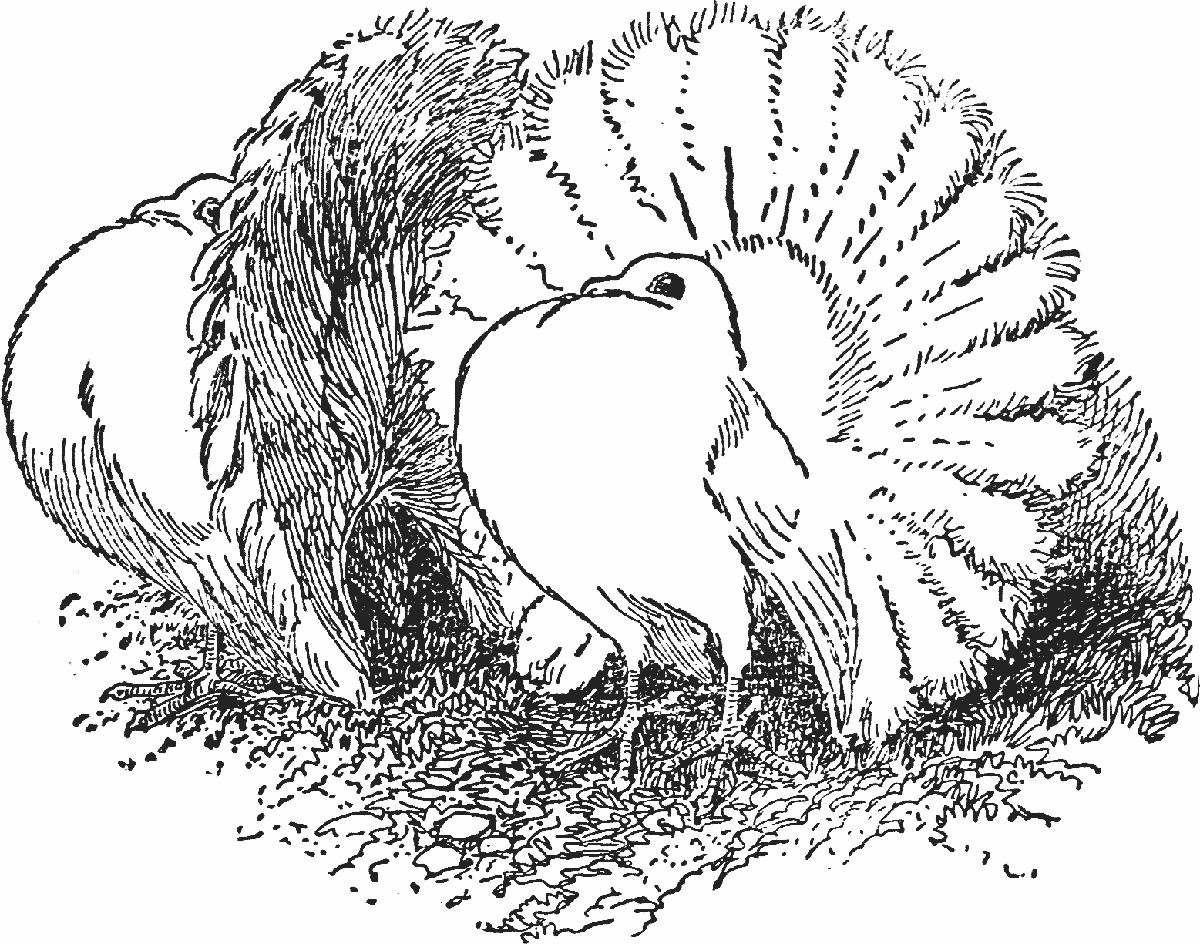
My first pair were fantails—white ones that my sister chose from the young man’s collection, and gave to me for a Christmas present. I used to spend hours in watching them. Their tip-toeing walk, their convulsive jerking and twitching of the neck and chest, and gently bouncing heads, were intensely interesting, and not painful to witness, as they seemed to enjoy their bodily peculiarities. However, much as I liked them, I would class them among the monstrosities in pigeon breeds. I prefer a straight bird to a deformed one. The only consolation was that they had never known anything different.
“That fellow lives pretty much in the back of his house,” said a man, who once stood gazing at a fantail.
Their appetites amused me, and I was informed that a pigeon is capable of eating in a day a quantity more than equal to its own weight, though fanciers estimate that one-tenth of a pound is a sufficient daily amount.
Their manner of drinking was also a revelation to me, and illustrated the lack of accurate observation in the average person. How many times I had noticed pigeons about the streets of cities, but now, for the first time, I was to find out how they drank.
I used to amuse myself by saying to my friends, “How do pigeons drink?”
Nearly every one answered, “I don’t know. Like a chicken, I suppose.”
“They drink as we do,” I used to respond, with pride in my superior information. “They thrust their bills into the water, and keep them there till they have had enough.”
My fantails were very fond of bathing in a big pan that I gave them, and used to keep their red feet beautifully clean. At night they did not go on a perch, but crouched on some projecting bricks in the wall.
After a time I concluded that pigeons liked a flat surface to sleep on, so I got some boxes from our grocer, had the fronts knocked
out, except one strip to confine the newspaper and straw I put in, and hung them on the wall.
The pigeons were delighted with them. They would fly inside the boxes, step about on the straw, coo excitedly, then would fly up on the flat tops and go to sleep.
Later on, when I got more pigeons, I found these big cracker boxes far more agreeable to them than nesting-pans. The female when setting, likes the protection of the covered top and enclosed sides. Then the male can always sleep above her, and hear her every movement, and he never allows any other bird to alight on his particular box. To clean them, I would roll up newspaper and straw lining and put in the furnace, then set the box aside to be whitewashed.
I usually kept vermin powder in the nests, and never was troubled with parasites. Clean bedding is absolutely essential for healthy creatures. Many persons say that birds are dirty. So is every created thing dirty that is not kept clean. Even when I had young pigeons I could clean the nests. I would warm a newspaper on the furnace for delicate birds, put a bunch of soft hay on it, carefully lift the little birds on it, and slip them in the box. The parents rarely resented my interference.
I must add to this that fanciers who keep large numbers of pigeons, and who do not change their nest linings as often as I do, never use hay and straw. Red nits crawl into the hollow stalks and breed freely. Tobacco stems and pine shavings are the nesting materials used, and birds are often allowed to make their own nests.
Pigeons kept in captivity do not usually lay eggs in winter, if they are kept in a cold place. If they are in a warm loft, they will lay eggs and rear young ones, but most fanciers separate the male from the female birds at the beginning of the winter. The spring and summer are enough for the raising of young ones.
I knew that my aviary was warm enough for the pigeons to lay in, and wondered why they did not do so. They fussed about the nest, giving each other resounding slaps with their wings, and finally the fancier discovered that he had not given me a pair, so he changed them, and I got two buff fantails instead.
These were two quiet, businesslike birds, and soon I found two eggs in one of the nests. The mother sat on them from four or five in the afternoon until about ten the next morning. Then, if her mate did not fly to the nest, she would groan ominously. He always hurried to her when she showed this sign of temper, and bowing and cooing prettily, would step patiently on the eggs.
The female would stretch her wings, shake herself, pick off the loose flakes of skin that pigeons shed like dust, trip around the aviary to see what there was for breakfast, stuff herself well, take a long drink, and perhaps a bath, then would sit in any ray of sunlight she could find.
The male bird had to stick to his post till five o’clock came. Then Mrs. Pigeon went back for the night. This was kept up for eighteen days, until my mother, who was a constant visitor to the aviary, reported at the breakfast table that she had found half an eggshell on the ground. I was quite excited about this news that meant the first bird had been hatched in my aviary. I hurried downstairs, and saw the buff pigeon fly off the nest with another half eggshell in her bill. She did not drop it near the nest, but took it to the other end of the aviary, making me wonder whether this was the survival of the habit of wild pigeons that would not want an enemy to find a shell near them, lest it might lead to the discovery of the young birds.
The instinct of birds is a wonderful thing. I am often amused in watching my canaries eat. For over three hundred years they have been domesticated birds, yet they never keep their heads down while eating. There is the dab at the seed, then the quick glance about, I suppose from the old habit of never for one instant giving up the guard against an enemy.
After I saw the mother pigeon fly back to her nest I approached it, and tried to push her aside, so that I might see what she had in there. She was in a terrible rage, exclaimed at my impertinence, and struck me so fiercely with her wing that I waited till the father pigeon went on at ten o’clock. He was very reasonable, and allowed me to look at his treasure, which was more like a tiny yellow blind worm than anything else. However, he was as proud of it as if it had
been fully fledged, and whenever it lifted its wobbling head, would pump some breakfast down its tiny throat.
The large crop of the pigeon becomes glandular during the breeding season, and secretes a milky fluid that softens the partly digested food on which the young are fed. This young fellow being alone—the other egg did not amount to anything—was so well stuffed that he soon became as fat as a lump of butter, and down began to appear on his wings.
I was very much interested in seeing him fed. The father pigeon would take the young one’s beak crosswise in his own, and pull out its neck as if it were made of rubber, and then send the milky fluid gurgling down his throat. When the young one had had enough, he would put his head under the parent’s breast. The father or mother would survey him closely, and if the squab raised his head in the slightest degree they would again try to feed him.
In a short time his eyes opened, and very pretty yellowish eyes they were. He had a big bill that reminded me of a duck, and the enterprising little creature actually snapped this bill at me when I went near the nest. He became covered with dark yellow pin feathers, and his fat body was almost hot to the touch. He breathed with great rapidity, and his mother soon gave up sitting on him at night, and perched near-by. Sometimes I felt afraid that he might be cold, and would push her toward him. She always grumbled at me, and soon I came to the conclusion that a mother pigeon knew better how to bring up a young one than I did. When the squab became fully fledged the mother drove him from the nest, and laid two more eggs in it. The young fellow, considerably surprised, and uncommonly shaky on his legs, hurried to his father, and trotted up and down the aviary with him.
The father, who was perfectly devoted to him, was now a pretty busy bird. Several times before ten every morning he had to look sharply about to see where were the best seeds for his own and his young one’s breakfast. Then he had to stuff his crop, and grunting amiably, walk to a water dish, and take a good long pull at it, for pigeons are heavy drinkers, particularly when feeding their young. All the time he was doing this I used to think that his nerves would
certainly give out, for the fat young one was waddling about close to him, flapping his wings, and screaming for food as desperately as if he had had nothing to eat for days instead of minutes. When the father was all ready, he would let the young one thrust his bill in his, then they would both shut their eyes, and the old work of pumping down the breakfast would go on. But now, if the young one thought he had not had enough, he would run all about the aviary after his father, cornering and enclosing him with his flapping great wings, and shrieking spasmodically, “More, more!” After a time he always quieted down, and took his morning stroll with his father about the aviary. Now that he had left the nest, he was no longer a squab, but a squeaker. When his father went to “spell” the mother, to let her have a run, pidgie would settle down near-by and have a nap. He really seemed to be fonder of his father than of his mother and—though, as I have said before, we must struggle against the tendency to humanize birds too closely—the father seemed to be fond of him.
CHAPTER XIII
THE HOMING PIGEON THE KING OF BIRDS
One day when the poor little squeaker, in attempting to fly, got one leg over the perch and could go neither forward nor backward, and hung with flapping wings, the father flew to his relief and helped him over.
No one knows until he has carefully observed birds, what untiring labor is required in bringing up young ones. The parents do nothing else but feed and watch their nestlings. Every bird seems to have the firm conviction that he is in the world for the purpose of raising healthy young ones, and as many as possible. He makes his nest, raises a brood, pushes them off in the world, makes another nest, raises another brood, and so on, until he is removed to bird paradise.
If human beings gave as much attention to the raising of their young, we should have an almost perfect race. However, we would scarcely lift sick young ones out of the nest to die. In that respect we are ahead of our bird friends. We might imitate them in one respect, and that is in the way they seem to prevent sick and delicate birds from becoming heads of families. I have noticed that ailing birds in my aviary, in some way or other, do not wish, or are not allowed to have mates.
One handsome but delicate canary never seeks a mate, but all day long flies by his father’s side. He is quite an old bird, but he never leaves this little yellow father, night nor day. The father makes nests, raises young ones, and flies about, always with his devoted trailer.
While my buff pigeons grew and prospered, and raised other young ones, I got another pair in rather a peculiar way. Being in town one morning I stepped into an auctioneer’s room, and there, in a cage, saw a pair of homing pigeons looking very disconsolate. I inquired what their history might be, and the auctioneer said that a
passenger on a steamer that had lately come into our fine harbor from England, had brought the birds with him, and on leaving the train for Northwestern Canada, had left the birds behind him.
“What a strange thing to do,” I remarked, as I looked at the traveling-cage and the pretty little drinking dish. Why did he suppose a man would undergo the expense of bringing birds on a long voyage from England and then drop them half-way to his destination?
The auctioneer said he would give it up, and then I further remarked that the cake crumbs in the box were not proper food for pigeons.
He said he knew it, and he wished I would buy them.
I asked him how much he wanted for them, and he said he had no idea how much they were worth, but I might have them for one dollar and seventy-five cents.
I had begun to read and inquire about pigeons, and knew there were many fancy breeds—fantails, pouters with long necks and globular crops, jacobins with their big hoods, snake-like magpies, short-faced tumblers and long-faced tumblers, tipplers, dragoons, swallows, owls, and many other kinds, but I did not know what the prices ought to be.
If these birds were trained homers, or working homers, as they are called, they would be worth more than one dollar and seventyfive cents. However, the auctioneer could not assure me of this, so I paid him the money, and sent the birds home.
It was touching to see the pleasure they took in getting out of their cage. They ate and drank and bathed and ran their pink tongues over the lumps of rock-salt I kept about. Nearly every bird I had, even canaries, would peck eagerly at this salt, though caged canaries would die if fed salt.
These two pigeons flew to the roof-veranda, and as soon as I discovered their preferred corner I gave them a box in it. There they laid not two but four eggs, and sat on them, one relieving the other, after the usual intervals. I was very proud and very boastful, until after I had a call from my friend the pigeon-fancier, who laughed heartily at my two birds.
“They are females,” he said, “a pair only lays two eggs for a nest.” This threw some light on the strange actions of the Englishman. The birds had probably laid four eggs in their traveling-cage, and in disgust at finding that he had two females sold to him instead of a pair that would have enabled him to raise young ones, he had decided not to give them a further trip of a few thousand miles.
The fancier exchanged one of them for me, and I got a fine blue homer, who took kindly to my gray one, and soon raised a number of healthy, handsome birds. I became very fond of these homers, and on learning something of the history of their kind, soon surveyed them with feelings of mingled admiration and respect.
They are our best and most wonderful birds, and they were our first, for did not one of them perform the first messenger service on record in carrying the sprig of green to the waiting Noah in the ark?
The dove was the ancestor of the carrier and the smerle and the cumulet and the carrier were the ancestors of the homer, and yet even to-day there are persons who do not know what a remarkable part pigeons play in times of peace, in times of war, and in times of love.
Ever since the days of Noah this chunky, round-headed, clearsighted, faithful, intelligent little creature has been the hard-working servant of many nations. The Romans used him in war-time for conveying messages from the armies, and an old song tells us of a warrior wounded in battle sending an outpouring of his heart to his lady-love by means of a carrier pigeon:
Fly away to my native land, sweet bird, Fly away to my native land; And bear these lines to my lady-love, I have traced with a feeble hand. She marvels much at my long delay, A rumor of death she has heard, She thinks, perhaps, I have falsely strayed; Fly away to her bower, sweet bird.
I read in a book about pigeons that, when Brutus was besieged in Mutina 43 B. C. by Mark Antony, by setting free carrier pigeons that flew over the heads of the besiegers and defied the blockade, he communicated with the Roman consuls who came to raise the siege.
A certain shrewd Mohammedan ruler of Syria and Egypt who reigned in A. D. 1145 had a pigeon postal service from one end of his dominions to the other. Towers were built for the protection of the little messengers, and from these towers watchmen strained their eyes to see that no hostile power attacked the birds in the service of the monarch.
To-day, in spite of telegraphy, telephones, and wireless communication, the brave birds hold their own. They are the messenger-boys of the air. Let us mention some of the errands they do.
They carry stock reports from large cities to the suburban residences of their owners. Ocean steamers carry them out to take last messages back. A lady in Boston once told me that she traveled through Europe and back again with a homing pigeon in her care. This valuable homer had been given to her in a basket, as the steamer left Boston. She was to release it when one day out. A thick fog came on, and as a fog is a deadly enemy to the brave little homer, she had to give him a trip abroad.
In Europe the end of a yacht race or a horse race is the signal for the release of a flock of homers, who carry the news to private lofts or newspaper offices.
While Gladstone was on his famous Midlothian campaign, homing pigeons carried reports from the different mining villages to Edinburgh. In the seclusion of their traveling-baskets the homers patiently awaited the conclusion of each speech of Gladstone’s at political meetings, and as soon as the last words had left the speaker’s lips, the reporters fastened their tiny slips to the birds’ legbands—for every pigeon has a ring slipped on when he is only a few days old—and gently opening the baskets, allowed them to fly up into the air.
Up, up, still farther went the keen-sighted birds, circling again and again to get their bearings, then off in the direction of their home-
lofts in Edinburgh, where tempting food, fresh water, and their loved nest-mates were awaiting them.
Had these home-lofts been at the South Pole they would still have started for them. To reach home or die is the pigeon’s motto, and thousands, nay millions of them have perished for “home, sweet home.”
Pigeons have several enemies. There is the cruel gunner waiting for them, and the dreaded hawk, that Chinese ingenuity circumvents by attaching shrill whistles to the tail feathers of certain of their homers. As the birds pass swiftly through the air the whistles blow and the hawks will not come near.
Then there are storms and variable winds, and often the birds’ overpowering sense of fatigue, for many fanciers give their homers cruelly long journeys to perform. What a temptation to a weary bird perching on a tree branch, to rest himself for a few minutes, to go with a strange pigeon who so politely invites him to his near-by loft, where he will find rest and refreshment.
I have often read with interest advertisements in English bird newspapers of homing pigeons in strange lofts. “So-and-so could have his property if he would tell the initials and number on the legband of a certain bird, and also pay the expressage on the roamer.” I think the foggy climate is largely to blame for these numerous lost birds. In a fog a pigeon must stop. He has nothing to guide him on his journey. Darwin, who studied these birds for twenty years, proved in the first place that their memory is phenomenal, and in the second, that their eye-sight is limited by the horizon only.
The United States, following the example of European governments, started some years ago an extensive system of lofts in the army and navy. Professor Marion, of the Naval Academy at Annapolis, Maryland, really began the organization of the messenger pigeon service for use in time of war.
Lieutenant Harlow, U. S. N., also started experiments at Key West, and when hostilities with Spain broke out, the navy department found on inquiry that Uncle Sam had a number of well-trained little war-birds at his disposal. Lieutenant Harlow’s cote at Key West being only ninety miles from Havana, the birds had not long distances to
fly. In every boat of the torpedo flotilla taken out to sea, these pacific, patient birds had their own quarters. They were released at intervals, and scarcely one pigeon failed to return to its cote at Key West, with its cipher message in the national water-tight message holder fastened on its leg.
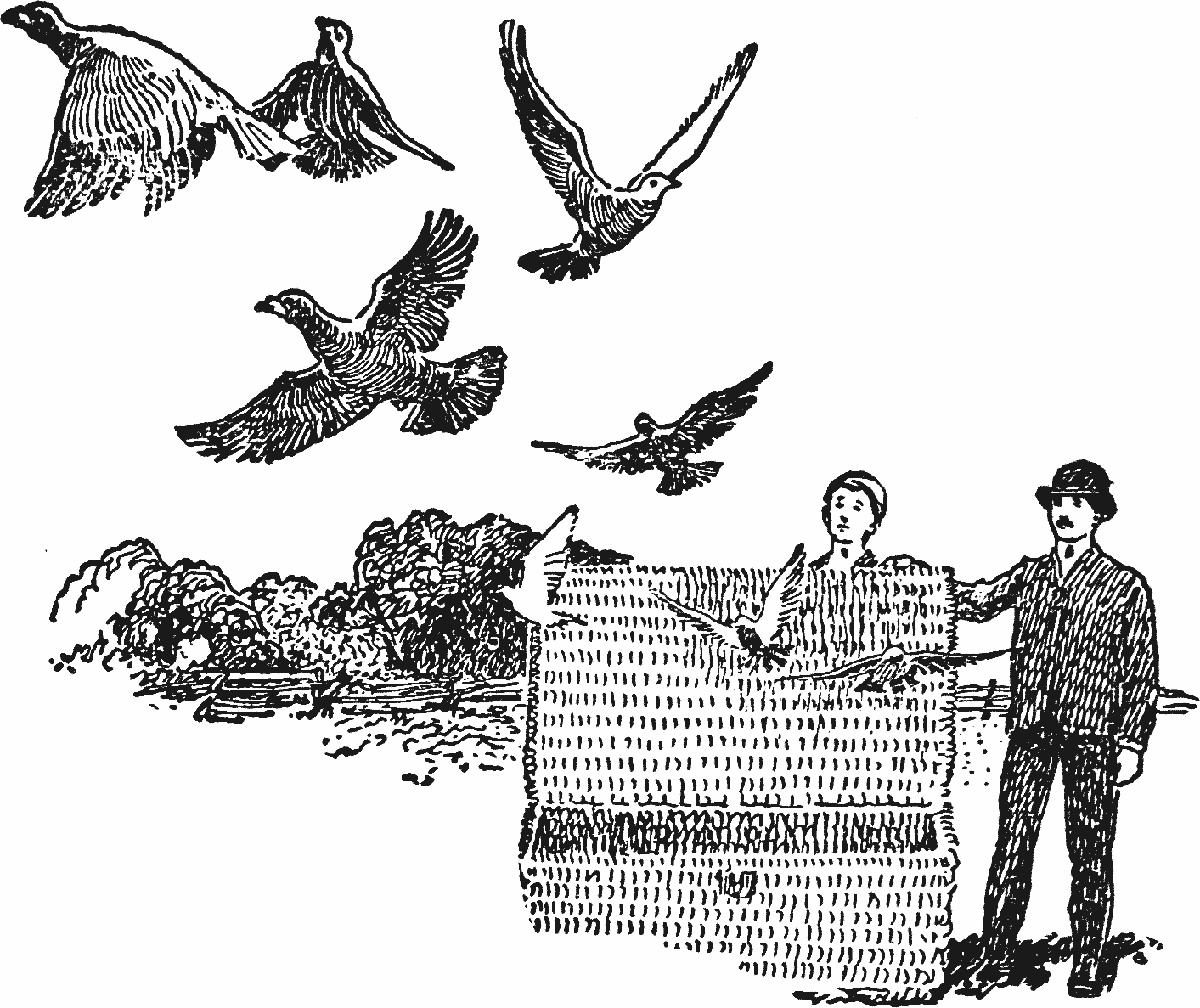
These patriotic birds are equally ready for peaceful campaigns, if one can call a presidential election by that name. Once, during a hotly contested election in Arizona, they did fine service in bringing the returns for outlying districts, some of them flying at the rate of a mile a minute.
France is very suspicious of foreign-trained homers, since her experience during the Franco-Prussian War. At that time she learned the great service done by pigeons in bringing relief to beleaguered Paris. Now she does foreign pigeons the honor of excluding them from France. An alien pigeon cannot take up its residence there except under such restrictions as any well-brought-up bird would resent.
Germany too has its pigeons. While traveling in that country I was amused at the military aspect of many of its inhabitants, and was not surprised to learn that it has military pigeons. One can imagine the proud carriage of a German war-bird.
CHAPTER XIV
PRINCESS SUKEY
The little kingdom of Belgium waxes most enthusiastic over pigeons. This is the great breeding center, this is the real home of the modern, thoroughbred homer. Pigeon-flying is the national pastime. One-fifth of the entire population are active fanciers, and their wonderful birds are sent away in such numbers that special trains are made up for them.
Why should it not be a national sport in America? One can think of no class of persons who would not be benefited by taking an interest in these most lovable and intelligent of birds. I have proved by my own experience that it is a delightful relief to turn from the strenuous fatigue of a modern day’s work to the quiet of a pigeonloft. Here are hard workers, but they are quiet, calm, reposeful.
Some famous trips have been made by American birds, though, as the number of lofts increases, the tendency is not to fatigue birds by too long a journey. Five hundred mile one-day records are made, but they are not very frequent. Homers can, however, fly much farther than five hundred miles. One owned by Mr. Samuel Hunter, of Fall River, Mass., flew home from Montgomery, Ala., a distance of over one thousand miles, and two homing pigeons lately arrived in their loft in Boston, Mass., greatly exhausted by a trip from Minneapolis. They had flown about twelve hundred miles.
Homers are especially valuable for physicians with a large country practice. They are faithful and trustworthy medical messengers. The doctor leaves a pigeon with a sick patient. In a few hours it can be released and will return to its physician-owner with the latest account of the condition of his patient.
One medical man relates in a book about pigeons a charming story of a child patient who was ill with fever. The doctor had left, and the child sat with his arm around the basket containing the
pigeon messenger, who was quietly waiting till the time came for him to be sent to report the boy’s condition to his master.
The mother, to interest her child, related the story of the dove that Noah sent from the ark. To her delight the bird in the story and the bird in the basket combined to soothe the child, who presently fell asleep with a smile on his weary face. He was better, and the birds had helped him.
While pigeons are excellent pets, and a means of relaxation for weary persons, I hold that of all classes to be benefited by their study and care I would put first boys and girls. Taking care of pigeons is easy work. They are hardy creatures, and books as to their management can be easily obtained. Nothing keeps a boy out of mischief like a loft of pigeons. Let him have homers by all means, rather than the elegant fancy pigeon monstrosities that care to do little but strut about a loft. Let him train his birds and have his traveling-basket to send them on railway journeys. Arrangements can be made with railway officials to release them at a given point.
The latest news that I can get of homing pigeons is from the Paris correspondence of the London “Standard.”
It seems that the French authorities in the African Congo district have had some trouble in communicating with each other. They could not keep up a telegraph system, for mischievous natives delighted in cutting down telegraph poles, and in using them for firewood. Wild elephants also amused themselves by uprooting one pole after another. Wireless telegraphy could not be practised on account of the tropical atmosphere often charged with electricity, and generally saturated with moisture.
What was the French government to do? A pigeon post was suggested, and they started with a main pigeon depot of one hundred birds at Brazzaville, and will have a chain of stations at a distance of about twenty-five miles. The chances of a bird being killed or going astray are put down at two per cent., so that a message sent over a hundred miles by four pigeons would have ninety-two chances out of a hundred of reaching its destination. A message of extra importance would be sent in duplicate by two birds. Besides the use of these pigeons for regular postal service, it
is planned that travelers, explorers, and military scouts will also carry a few.
One other item of interest about homers I find in a late newspaper: A bird was released from a balloon over Dover, Vt., eight thousand five hundred feet in the air, and above the clouds. The earth was invisible, but the homer in a short time arrived safely at its Fall River cote.
Now, after all my praise of the hard-working, clean-shaped homing pigeon, I must make the confession that the favorite bird in my aviary—the one that I am perhaps foolishly fond of, is not a homer, but a monstrosity. However, there is a reason for my fondness for her, and I will relate the peculiar circumstances that endeared her to me.
I had obtained a pair of ruffed, elegant jacobins, and they had settled down in the box of straw I gave them, and had hatched two tiny squabs. One morning later I found one of these squabs a short distance from the nest. I picked it up and examined it. It had one deformed wing, and had either perished in the nest, or had been gently lifted out to die on the bare ground. I suspect the latter explanation was correct, for the next morning on going into the aviary I found the other squab on the ground. It was opening and shutting its beak painfully, and was evidently just gasping its last. I ran to the furnace-room and laid its cold body on the warm iron.
Then I examined it. There was nothing in its crop, and its little yellow, languishing body was thin and miserable. I took it upstairs, wrapped it up, and put it on a hot water bag, then gave it some bread and milk. The only way I could get the little exhausted creature to eat was by putting its feeble beak to my mouth and letting it take the food from between my half-closed teeth.
When night came I was puzzled to know what to do with it. I did not seem to realize the finality of the parent birds’ act in putting a young one out of the nest, and carefully arranging a cloth nest on a hot water bag, so that it would not die of cold, even if the mother refused to sit on it, I took it down to the aviary and put it with its parents.
Of course, they did not go near it, and in the morning I found my pigeon again apparently drawing its last breath. I hurried it upstairs, and it did not go down again. I made it a bed in a little basket, and kept it near me night and day. It was powerfully ugly, and the family teased me a good deal about my pigeon, but I told them I had made a vow to save its life. I tried a good many experiments in feeding it, and very often in the middle of the night I would spring up and look at the basket to see if the little delicate creature were still alive.
Later on I learned how to bring up young pigeons successfully, but this one I almost killed by giving wrong food to it. I found later that a mixture of rolled oats, bread crumbs, and a few drops of milk and water—the whole made very fine and soft, agreed well with it. I got a medicine-dropper and a syringe, but for some time it would only eat from between my teeth or my fingers, this being the nearest approach to the parents’ beak. After a while I made different kinds of grain and seeds into pills and slipped them down its throat. The bird soon became very tame, and would flap its wings and scream for food whenever it saw me. It was dubbed Princess Sukey by my sister, but for some time she was a ridiculous looking princess. I found she had a form of indigestion, and as she has had this ever since, I fancy that her parents, discovering this, had made up their minds that she was not worth bringing up.
A curious thing happened as soon as she opened her eyes. The young pigeons in the aviary always hissed at human beings who went near them. Princess Sukey, on account of her upbringing, looked upon human beings as her friends, and when I showed her a bird for the first time, she rose up in her nest, clapped her beak, and hissed in terror.
She hated birds, and has hated them ever since. One day, when she was a plump young pigeon, her father walked up to her, bowing and scraping as polite pigeons do. I was greatly amused to see Sukey take him by the long neck feathers and give him a good shaking. She had made up her pigeon mind to give birds the go-by and join her lot with me and my family, for she liked all of us, though I was her chief favorite, as I represented her food supply.
This father of hers was rather an inconstant bird. Once, when his own mate was very much in need of his services to help her in bringing up young ones, he left her to play with a lively, attractive pigeon, called Fanny Fantail. This Fanny was a bird without a mate, and a lonely male or female pigeon, or any other kind of bird, makes more trouble in an aviary than half a dozen pairs. I had to separate her from the jacobin before he would go back to his own nest.
For months Sukey was one of the ugliest birds that I ever saw. She had a long, poor crop of feathers on her body, but her big hood did not develop until she was full-grown. Her bare neck, ugly head, and yellowish eyes, made her a kind of laughing-stock, but soon there was a transformation. The blue blood in her told, and when her lovely red and white feathers did start, she was a beauty. It was the story of the ugly duckling over again. Her superb indifference to birds amused us greatly. Through the summer she followed me about the roof-veranda, sat in my room with me, or waited patiently for me if I went out. During my absence she would sometimes attach herself to some other member of the family. She was very fond of playing with me. She would sit on my shoulder, and run her beak over my ear and cheek; and if I were reading, she would peck the leaves of my book. If I sewed, she caught my thread and sometimes so bothered me that I would put her out of the room and shut the door. Then she was in distress, and would trot up and down the window ledge outside, tapping the glass with her beak, and pleading eloquently to be allowed in again.
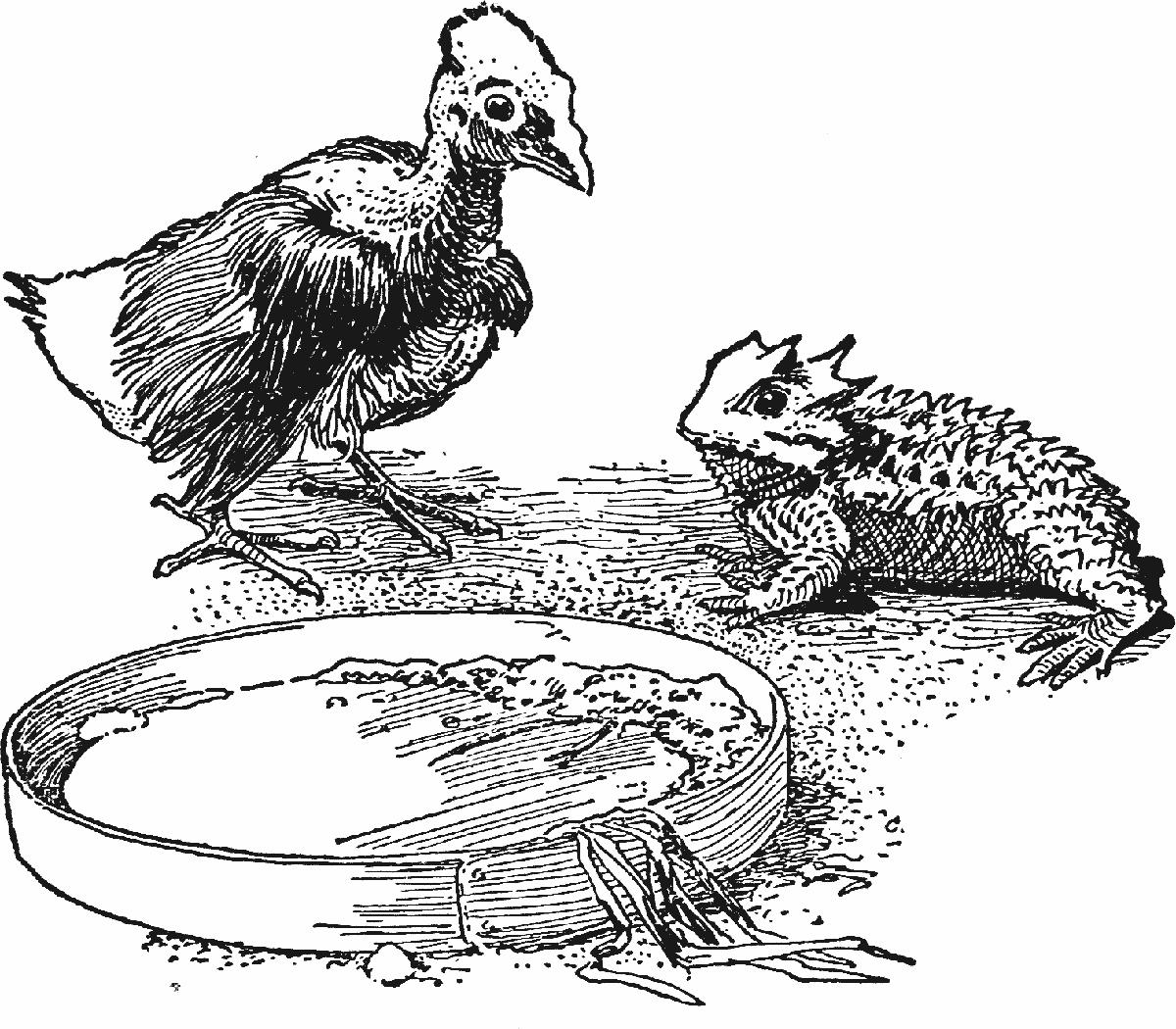
The veranda was alive with birds, but she paid no attention to them, unless one of them came near her, to have a sly peep in the tiny mirror on the window ledge. Any such presuming bird, if she could catch it, she would beat thoroughly. She had no curiosity about new things, except human beings. One day I placed her in front of a horned toad, and my sister took her photograph. She seemed to be looking intelligently and inquiringly at it, but in reality I don’t think she cared in the least about it.
These horned toads are really lizards, and in California we used to keep them in our rooms. Their most remarkable habit is that of ejecting blood from their eyes. My sister once saw a toad that was
being teased spurt blood from its eyes. After exercising this power the toad often becomes limp and exhausted.
The Mexicans call them “sacred toads,” because they weep these tears of blood. It is thought that this discharge of blood is a means of protection. When worried by a superior animal, the little toad can partly blind his enemy by shooting blood in his eye; and while the enemy is recovering from the pain, which the blood seems to cause him, the toad can make his escape.
The creature was not afraid of Sukey, and I never saw him shoot blood from his eyes while with us. Unfortunately he was stepped on and died.
Before Sukey was a year old she had a trying illness, brought on by a too rich diet and too much dancing.
One of my brothers had been with us for the Christmas holidays, and had brought his little girl with him. It amused us to see Sukey dance, so we used to blow lightly on her feet, and she would spin round and round for us. After a while her feet became purple and inflamed, and she went lame.
I put her in a basket, covered her up carefully, and took her to our kind family physician. He gave me an antiseptic wash, helped me bathe her claws and tie them up, for by this time they were very sore, and had turned black.
Sukey took this affliction so much to heart that she moped and would not eat. I had no intention of losing her, so I made pills of seeds and rolled oats and slipped them down her throat. In a short time she got well, but unfortunately lost two of the claws on one of her red feet. I cut short her supply of hemp seeds, for I had been too indulgent in the past. It is strange what a passion almost every bird has for this oily, rich seed. Even birds too small to crack it will eat voraciously of it when it is crushed.
CHAPTER XV
PIGEONS AND HAWKS
As Sukey grew older her indifference to other birds became stronger. I never saw her watch a bird or follow its motions with any interest, unless it was to get out of the way of a larger bird that she was afraid of, or to aim a blow at a little one that came too near her. She had identified herself with human beings; and if there were none near her, she drew her head into her hood and sat meditatively waiting for one to come along and play with her.
As she felt so keenly on the subject, I only allowed her to pay flying visits to the downstairs aviary. All winter, when she could no longer go out on the veranda, she trotted about the room I had given her, or sat buried in meditation on a box high up on the wall. That was her room, her big bed, her box, her pincushion, and her sunny window. She had driven me from it, though at first I had been willing enough to share it with her. She used to sleep at my feet, but when she developed an amusing but tiresome habit of waking up every morning at daylight, trotting up to the head of the bed and ordering me to play with her, I chose another room. She often visited me there, and when I was confined to my room by a cold, she always spent the day with me along with my books and newspapers. When my tray came up she was always excited and interested, and trotting up to it, examined it carefully. She particularly liked creamed toast and my little dish of butter.
One day I heard an outcry in the dining-room below, and found that she was being driven from the family butter plate there. When I hurried downstairs in the morning, fearful of being late at family devotions, I would often hear her coming after me, step by step, her little claws sounding plainly as she hopped, not flew down. She never used to fly unless obliged to do so to catch up with us. We did not fly, and identified with us as she was, she preferred our means
of locomotion. While prayers were going on she sat demurely on a sofa back, occasionally murmuring “Rookety cahoo!” After breakfast she flew to my shoulder and descended with me to the aviary, strutted over the earth floor, then followed me upstairs to her room.
My study was also a favorite place, and often as I sat writing I would hear a light footstep, then a rush of wings, and Sukey was on my shoulder. After writing awhile I would look up at her and ask, “Do you approve of that sentiment, Sukey?” She always bowed her head politely, and this pigeon habit of bobbing the head was a great source of amusement to the neighbors’ children, who often called on her.
“Are you glad to see the children, Sukey?” I would ask her, and her bow was always received with outbursts of laughter. Naturally I was careful only to ask questions that required an answer in the affirmative. If I became too much absorbed in my writing to play with her, she would get impatient, and descending to the desk, would catch at my pen or, naughtiest trick of all, drink from the ink bottle. Often I have looked up, discovered a dripping black beak, and have rushed from the room to wash her mouth.
Although she loved my study when I was alone, she hated it when it was full of company. Often visitors would beg to see the Princess, and I would send upstairs for her. She was not really afraid, but she hated a crowd, and after holding her by force a few minutes, I would put her on the floor, and with her ruff shaking with anger she would trot into the hall and go upstairs to her room.
One day she laid an egg on my writing-desk. I took it upstairs, made a nest of soft cloths for her, and put the egg in it. The third day she laid another egg. I advised her to take the bed for a nesting-place, and although she subsequently laid eggs in other places, this, for a long time, was her chosen home, and she would drive any other bird from its sacred precincts.
She seemed fascinated by these two eggs, and sat on them nearly all the time, caressing them, and turning them over and over with her beak. I was amused with her actions, for she had no shyness and no fear of human beings. Of course, every bird turns her eggs over to keep them in condition, but how seldom one sees a bird in
the act of turning them. Sukey’s actions with her eggs then and since convince me that she really had some kind of attachment for them. I had had an idea before this that the sitting on eggs was duty work, the only real pleasure coming with the nestlings.
If any bird dared alight near these precious eggs she would peck furiously at it. She was also reluctant to leave the eggs unless I would watch them. If I would sit down beside them she would at once step carefully off them, lift up her feet like a skirt dancer, and stretch first one long wing and then another, as if tired of sitting, then go for a walk about the room.
The instant I rose she would rush back to her nest, and if she got hungry before I had leisure to return to her, she would hurry to her seed-box and eat so rapidly that it seemed as if she would choke. She had made up her pigeon mind that she would not let those beloved eggs get cold.
Often as I sat by her nest she would bring me little wisps of straw, and would tuck them around the eggs, or would hold them out to me in her beak, meaning that I was to have the privilege of arranging them. Her actions were very curious and interesting, and I could not help wondering whether human beings were often honored by birds to the extent of being requested to assist in the work of making a nest.
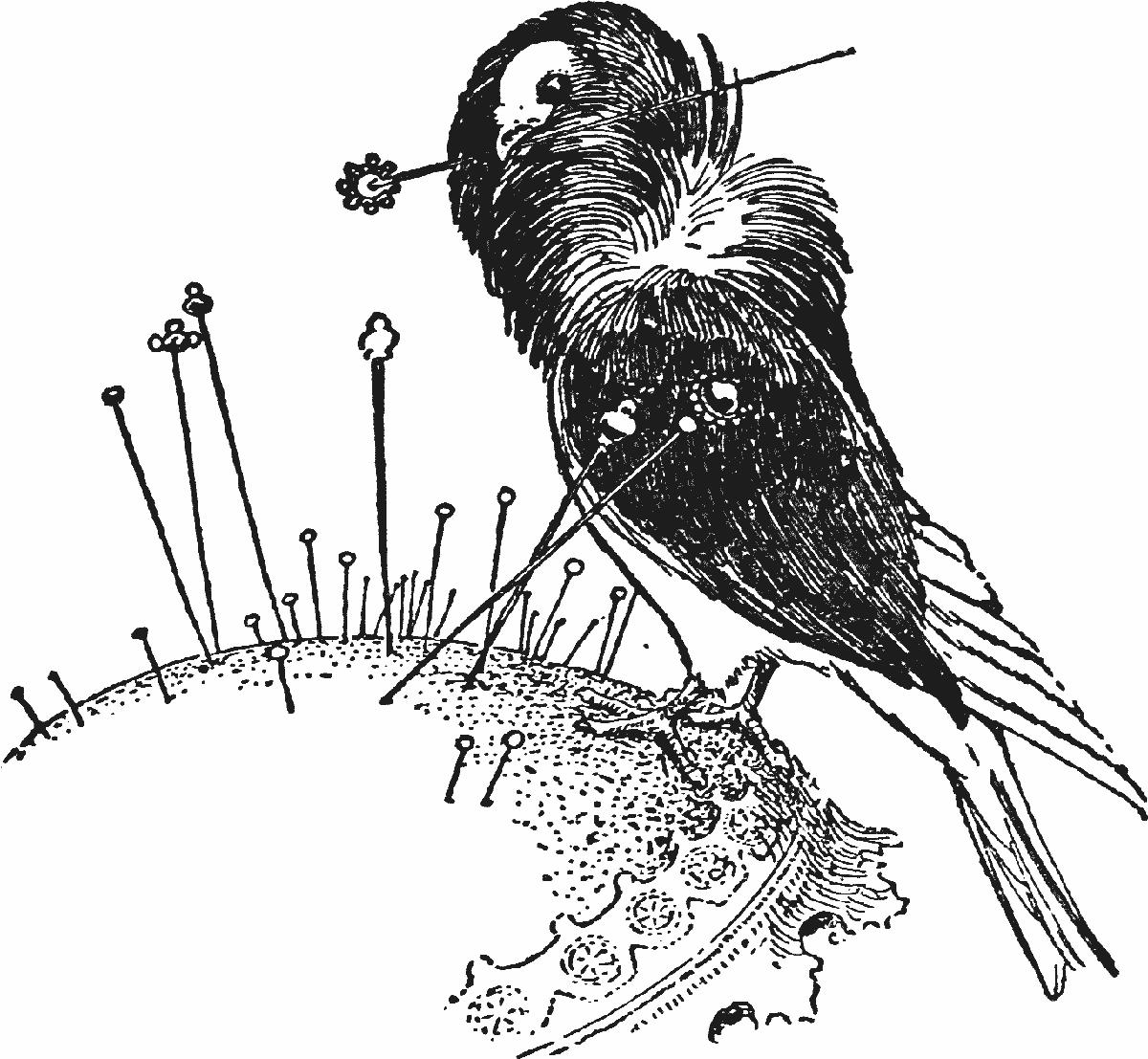
Better than straws were hairpins, hatpins, or safety-pins. She had been brought up in a bedroom, and my pincushion had always been an object of interest to her. I have seen her take a long hatpin in her beak, toss it up in the air, catch it, and go to her nest with it.
The invisible hairpins were her chief favorites, and one day my sister said to me, “I cannot imagine where all my invisible hairpins are.”
“Go to Sukey’s nest,” I said, and there she found neatly arranged around the eggs the missing hairpins. I have often taken sharp pins from her nest, in the fear that she might stick them into herself.
After a time I began to worry about her prolonged sitting. She had no mate to relieve her, and to sit day and night, except in the short intervals when I took care of her eggs for her, was too great a strain on her constitution. So one day I went down to the aviary, got a
youthful squab from one of the pigeon nests there, and taking away one of Sukey’s eggs, slipped the squab in its place. Her back was turned to me during this last maneuver, but presently she came trotting along with a straw in her beak.
When she saw the squab she stopped short with a dreadful stare, then dropping her straw she took squabbie by the neck and shook his tender flesh till I hastened to rescue him, and gave her back her egg.
Later on I took her eggs away from her and put them in a covered box. She seemed to know they were in the box, for one day I found her trying to worry the cover off, and a second day she had the cover off and was sitting on the eggs. A third time I found her standing on the box and fighting my doves away from it. This time I turned the doves away, lifted the cover, and she stepped in and sat on the eggs. One day, after I had put the eggs in the box, she flew to my shoulder, and I felt something tickling my ear. Looking around I saw that she had a straw in her beak and was trying to coax me to put it beside the eggs.
I have often felt sorry that I have not kept a record of the number of eggs that my Princess has laid. She begins in the spring and lays all summer, sometimes one, sometimes two eggs, and at intervals of about six weeks. When she was two years old I took her with my other pigeons to my farm in the country.
I now had quite a number of pigeons. Among them a special favorite was Crippie, a lame black tumbler. He was fat and in good condition, but had had since he began life an absurd walk or waddle, his legs being spread very far apart. I had been advised to kill him, but had refused. There was nothing the matter with him but his lameness, and he was a dear, gentle bird, and had been partly brought up by hand. A tumbler is supposed to turn over and over in the air as he flies, but Crippie never tumbled.
Two other pet birds were homers—Tweedledum and Tweedledee. Their parents had deserted them, and they too had been brought up by hand. Then I had magpie pigeons, an exquisite white owl pigeon called Owlie, some archangels, and specimens of a few other birds.
I had had a demure nun pigeon that I bought in Boston. At least she looked demure with her convent-like garb, but she turned out to be a vixen, and used to drive my guineapigs about the aviary till they succumbed with fright. At first it was amusing to see her marshaling the pigs and driving them before her, but I soon found out that what was fun for her was death for the pigs, so I sent her away. When I took all these fancy pigeons to the country I confined them in a loft for a time till they got used to their new quarters and began to make nests. Then I opened a window and allowed them to go out.
My whole family was impressed by the delight of these birds in real, untrammeled liberty. For generations their ancestors had been kept in confinement, but there was enough wild blood left to make them appreciate what was now spread before them. The first day I let them out they flew about uncertainly, then sat in a row on top of the carriage-house. The building was reasonably high, the barn was higher, the near-by house was surrounded by tall trees, below them were meadows, plowed fields, and a pine wood. They had altogether two hundred acres of their own property, and beyond stretched one large farm after another, along one of the most beautiful valleys in the world—the one which finally reaches the far-famed land of Longfellow’s “Evangeline.”
No wonder that the pigeons were delighted. They timidly tried another flight, then another, wheeling in wider and wider circles, always coming back to the carriage-house, and gazing about them as if they were “lost in wonder, love, and praise,” my father sagely remarked.
As the days went by they flew constantly about the farm. I never saw one leave it, though I heard of some of my old homers calling at distant farms. The young homers hatched on the place would, of course, not leave us.
Away beyond the farm was the long North Mountain, and beyond the mountain was the Bay of Fundy, well known for its high tides. So, in connection with my pigeons, I could truthfully recite Walter Prichard Eaton’s lines:
The doorway of their coop unloosed, they spring Straight up above the housetops noisily; An instant pause, a sudden swoop of glee, Then high against the blue on tireless wing Their wide-expanding, perfect circles fling; From that great height they look to open sea, The far green woods smile up invitingly But still the keeper counts their homecoming.
Unfortunately, when we first went to the farm, there were a few hawks about that succeeded in carrying off a number of my beautiful pigeons. These hawks came with such frightful celerity that unless one sat all the time with a gun in hand it was impossible to shoot them. We could protect the chickens, for when the hawk was coming, the little wild birds that were fed about the farmhouse would scurry through the air in a hurried, unnatural way. If we noticed them, and called to the chickens, the petted things would run for shelter. Not so the pigeons. They never hurried to their lofts. When they saw a hawk they rose swiftly in the air and flew madly round and round.
The hawk would get the poor flyers, and any that were handicapped, except Crippie and Owlie. He never got them, and I wondered at it. He carried off a fine, red jacobin that I had sent up from Halifax, hoping Sukey would be friendly with him. She beat him so persistently that I put him out with the others. He looked very handsome sitting up aloft with his red hood about his head, but one day he disappeared, and later I found a heap of his pretty feathers at the foot of a pine tree where the hawk had carried him to tear him to pieces.
I lost twenty pigeons, but only three chickens. It was very pathetic to see those three disappearing. On one occasion I was close by. The hawk seemed to fall like a bullet from a clear sky. He seized the poor little unfortunate and bore it off by the head, its legs dangling helplessly in the air.
These hawks were not large ones, and at a little distance looked like one of my big homers. After a time we were not so much troubled by them. I had tried to get rid of them by keeping guineahens, for the country people round about said that no hawk will approach a farm where a guineahen is kept. I thought I would try the experiment, and bought a fine pair of guineahens that never wandered, as many of the tribe do. The hawks did not mind them at all, and swooped down on the chickens when they were close by.
Our best friends were the crows and the kingbirds. A pair of crows built a nest in a tall tree close to the boundary of our farm, and one of them was always sailing through the air to keep the hawks away. More intrepid than the crows were the kingbirds or beemartins, so called because of their supposed fondness for the honey bee, though it is now asserted that they eat only the drones. These kingbirds had a nest close to us, and it was most gratifying to see the way in which they chased both crows and hawks. They were better than a gun, and I used to wish long and earnestly that there was some way in which I could reward them.