Instant download Philosophies and practices of emancipatory nursing: social justice as praxis – eboo
https://ebookmass.com/product/philosophies-and-
More products digital (pdf, epub, mobi) instant download maybe you interests ...
Understanding Social Welfare: A Search for Social Justice – Ebook PDF Version
https://ebookmass.com/product/understanding-social-welfare-asearch-for-social-justice-ebook-pdf-version/ Philosophies and Theories for Advanced Nursing Practice 3rd Edition, (Ebook PDF)
Social Justice in Nursing Pedagogy: A Postcolonial Approach to American Indian Health
SELINA A. MOHAMMED, PHD, MPH, RN
DEBBY A. PHILLIPS, PHD, PMHCNS
16 Teaching, Research, and Service Synthesized as Postcolonial Feminist Praxis
LUCY MKANDAWIRE-VALHMU, RN, PHD, PATRICIA E. STEVENS, PHD, RN, FAAN, AND PENINNAH M. KAKO, PHD, RN, FNP-BC, APNP SECTION IV
Critical Practice Approaches and Methodologies
17 Cultivating Relational Consciousness in Social Justice Practice
GWENETH HARTRICK DOANE, RN, PHD
18 Facilitating Humanization: Liberating the Profession of Nursing from Institutional Confinement on Behalf of Social Justice
DANNY WILLIS, DNS, RN, PMHCNS, DONNA J. PERRY, PHD, RN, TERRI LACOURSIERE-ZUCCHERO, PHD, RN, FNP-BC, AND PAMELA GRACE, PHD, RN, FAAN
19 Promoting Social Justice and Equity by Practicing Nursing to Address Structural Inequities and Structural Violence
COLLEEN VARCOE, RN, PHD, ANNETTE J. BROWNE, PHD, RN, AND LAURIE M. CENDER, RN, MSN
20 Military Sexual Trauma and Nursing Practice in the Veterans Administration
URSULA A. KELLY, PHD, RN, ANP-BC, PMHNP-BC
21 Through a Socio-political Lens: The Relationship of Practice, Education, Research, and Policy to Social Justice
JILL WHITE, AM, RN, RM, MED, PHD
AFAF I. MELEIS, PHD, DRPS (HON), FAAN, AND CAROLINE
G. GLICKMAN, MIM
PAULA N. KAGAN, PHD, RN
Acknowledgments
I offer many thanks to DePaul University for support of my scholarship in various forms including grants and paid leave. I am deeply appreciative of my colleagues, friends, and family for their encouragement and support. For their criticality, imagination, and determination I am grateful to and in awe of the authors of these chapters and the authors of chapters for which the limitations of the publication prevented their inclusion. Most importantly, I am indebted to my partners and co-editors, Marlaine and Peggy, two incredibly wonderful and visionary scholars whose continued friendship and collaboration during this journey of praxis has meant the world to me.
Paula N. Kagan
I am grateful to the authors who contributed to this volume. I learned so much from you! Editing this book with Paula and Peggy has been the quintessential experience of collegiality, and I am so grateful for their passion and patience. I acknowledge the many scholars in the fields of caring, unitary, and critical/post-structural perspectives who have influenced my thinking about social justice, participative, and emancipatory approaches to research and practice, and the uniqueness of nursing’s contribution to the world. This book was in process at the time of the birth of my first grandchild, Iyla. Her arrival calls me to our purpose: the audacious hope of creating a more humane, peaceful, and just world for all our children.
Marlaine C. Smith
Working with Paula and Marlaine has been one of the most gratifying experiences of my professional career. Thank you, Paula, for your awesome leadership in this project starting with your determination to engage a publisher for this work, your sharp intellect that has been invaluable to the editing process, and your intractable yet gentle capacity to keep us all on track. Thank you, Marlaine, for your inspiring ability to “walk the talk,” your gentle way of speaking truth to power, and your insights that always point to the core of nursing. You are both dear and cherished friends and
x Acknowledgments colleagues. Finally, I acknowledge the immeasurable value of my family— my partner Karen and our adult children who are integral to our daily lives, and their beautiful children who are growing up in culturally diverse worlds and who will grow to adulthood in a future we can only imagine. It is the imaginations portrayed in this book that I hope will inspire a future worthy of their dreams.
Peggy L. Chinn
Foreword: Social Justice: Continuing the Dialogue
“Although we may speak the words of social justice, it is how we act that clearly demonstrates our philosophy.”1(p29)
This book comes at a time when social justice as praxis has never been more urgent. The inequalities and inequities we are witnessing are not new. However, as we move deeper into the 21st century, wars and unrest in many parts of the world; increasing economic uncertainties locally and globally; income disparities with the widening gap between rich and poor; and perceived and actual inequities, all of which thwart life opportunities and profoundly influence health and well-being, make the enactment of social justice an urgent issue particularly in a discipline such as nursing, with its accompanying professional mandate. Bekemeier and Butterfield2 among others remind us that progressive nurse reformers—on whose shoulders we stand—“grew indignant from witnessing the destructive health outcomes of institutionalized poverty and of gender and ethnic inequalities. These nurses harnessed their indignation to work toward the creation of progressive health policies,”2(p153) and so must we! In Canada, the Canadian Nurses Association’s (CNA) commitment to advancing social justice has been articulated in various policy documents over the years, culminating with a policy discussion paper in 2010.3 Yet, despite our attentiveness to social justice in policy documents and scholarly discourse over many decades, the vexing problem of injustices and inequities remain visible in some of the populations with whom we, as nurses, work. At issue is the complexity of the concept of social justice, the competing and divergent theoretical perspectives that have informed the discourse and how we see our responsibility as nurses. But regardless of the perspectives from which we come, we might be in agreement with Amartya Sen4 that “justice cannot be indifferent to the lives that people can [emphasis added] actually live.”4(p18)
Given the opportunity to contribute to this book, there are a few points—implicit in any discussion of social justice—which I would like us to consider as we embark upon reading through this very fine collection of essays. I should point out that the intent of this foreword is not to review the
chapters—the editors have done this. Rather, I offer a few brief comments on issues I have observed as I have participated in nursing discourse through the years, and reflected on, and attempted to put social justice into action.
One of the issues, I believe, that has impeded our work as we strive towards the “ideal of social justice” in the discipline and profession of nursing pertains to the tension between “individual agency” and “structure”—a tension that is pervasive in many disciplines, but which is, perhaps, more poignant in disciplines such as nursing as we struggle with the complexity of these concepts and the boundaries of our responsibility as nurses. In discussions with health professionals over the years about the structures that shape the health and illness experiences of patients and their families, some (by no means all!) have seen the socioeconomic-political “structural constraints,” often highlighted in such conversations, as outside of their mandate and as independent of their individual actions. Some stressed their commitment to treating individuals equally, an approach that is sometimes coupled with the perspective that everyone should receive the same kind of care and information, e.g., patients and their families are encouraged to engage in post-discharge planning prior to admission to hospital (for example, filling up the fridge with food prior to elective surgery, preparing and freezing meals, etc.) to facilitate the transition from hospital to home. There is often the expectation that families ought to look after their loved ones when they are ill or needing care in old age. The subtext here, I believe, is that people ought to take responsibility for their care. Although there is merit in this approach—I certainly would not quarrel with the notion that people should make adequate preparations for post-discharge prior to being admitted to hospital—the risk is that the structural constraints of economics, social inequalities, and such like may be overlooked if we are not attuned to the varied social locations of people’s everyday lives. We should keep in mind that not only do some people have few social support networks, but also, there are those who have no home to return to after hospitalization.5 Nursing scholars through the years have been reminding us to do just that, including scholars such as Drevdahl and her colleagues1 in their article on “Reinvesting in Social Justice: A Capital Idea for Public Health Nursing?” I was struck by the trenchant insights in this excellent article. One sentence—“[a]lthough we may speak the words of social justice, it is how we act that clearly demonstrates our philosophy”1(p29)—the quote that appears at the beginning of this foreword— held my attention; clearly, these scholars, and others before them, are holding us to account to demonstrate socially just actions, which by their very nature would see us engage with the material context of human existence and the structural constraints that shape some lives more than others.
At the same time we should be mindful that critical discourses in nursing—at the level of discourse—often tend to privilege “structure” in so far as there is overriding emphasis on the structural constraints and injustices that shape the experiences of patients and their families. As I look back on my own writings, I must confess that I, too, have tended to put emphasis on structural constraints, often reifying economic and political structures as
Justice: Continuing the Dialogue xiii if they were “something” “out there,” to be critiqued. In other words, such processes may be conceptualized as created by a “ruling elite” and independent of our own actions. Yet Iris Marion Young6 reminds us that each one of us has a responsibility for social justice: “ when the injustice is structural there is no clear culprit to blame and therefore no agent clearly liable for rectification. . . . [S]tructural injustice is produced and reproduced by thousands or millions of persons usually acting within institutional rules and according to practices that most people regard as morally acceptable.”6(p95) But Young does not leave us with a feeling of helplessness. She points out that what we do matter, as do Drevdahl and her colleagues. These scholars all remind us that each one of us has a responsibility for structural inequalities; they tell us that we must find the political will to engage in conversations about social justice not only at the local level but at the global level as well. They hold us to account and marry the concept of social justice with praxis—as do the editors of this book—and, in so doing, illuminate the agency/structure dialectic.
The distinction between “treating people equally” and “treating people equitably”—the latter, a concept that grounds social justice—has consequences for our practice. Treating people equitably requires that we understand the complex context of health, illness, and suffering, including individual agency and resiliencies; the oppressive structures—often historically located—that are constraints to agency; and, that we grapple with the dialectics of theory and action. This, in my view, underpins what praxis means in nursing, and what is, from a critical perspective, aligned with social justice. Although praxis might be interpreted in different ways, I take it to mean translating the critical perspectives that we theorize about into action—action with the political intent of changing oppressive structures. Thus, it could be argued that working for social justice can never be from a politically “neutral” position that is unquestioning of the power structures and injustices within societies that profoundly influence health and well-being. As we have learned more about the social, political, and economic determinants of health, we have become acutely aware that although access to health care remains out of reach for many; having access, in and of itself, does not guarantee good health or recovery from illness. For instance, it became apparent to me in some of my early research with women who were balancing living with a chronic illness, minding a family, and holding down a job in the lower tiers of Canada’s workforce to make ends meet, that the mediating circumstances of women’s lives had a profound impact on their ability to manage their health, even when they had access to health care and worked with compassionate health care professionals whom they held in high regard. We know that the resources for managing illness and achieving health, even in societies as affluent as Canada and the United States, are inaccessible to many. Yet, theories and perspectives that do not take into account the texture of the structural constraints operating at the intersections of various social relations such as “race,” “gender,” “class,”
and “age,” among others, put the blame squarely on the shoulders of those who are not able to live up to the ideals of “good health” even when material deprivation makes everyday survival a struggle. So, the question to be considered is whether we can speak about social justice in nursing without critically examining and questioning the social, political, and economic structures in which inequities that profoundly influence health, well-being, and human suffering are embedded, and reflecting on the ways in which each one of us, by virtue of being members of a society, unwittingly maintain and reproduce the very structures we challenge and critique.
This book robustly addresses the complex issues of agency and structure, and in so doing, provides new insights to inform “emancipatory nursing.” We know from past experience that assumptions about “power” and “powerlessness”—which often deflect attention away from the structures that perpetuate social inequities—are often the subtexts for words such as “emancipatory,” “empowerment,” and the like.7 Although such terms have powerful meanings when examined in the context of “constraints” to agency—which the editors have done—as we continue the dialogue on social justice into the future, we need to be vigilant not to slip into using them to imply that those who live on the margins are bereft of human agency. Instead, we need to continue to focus on constraints to their agency and the triumph of agency over oppressive structures. From a postcolonial perspective, one is reminded of the words of Homi Bhabha8: “it is from those who have suffered the sentence of history—subjugation, domination, diaspora, displacement—that we learn our most enduring lessons for living and thinking.”8(p172) In articulating emancipatory perspectives, we have sometimes projected the notion, though unintended, that as health professionals and academics we are positioned to emancipate those whom we regard as “oppressed,” or living on the margins. In other words, we may see ourselves as having the “power” to “emancipate” the “powerless” by doing “for” them that which they cannot do for themselves. But Bhabha draws our attention to the lessons to be learned from subjugated and subaltern voices—those who have been positioned on the margins through the sentence of history. He beckons us to recognize their human agency and capabilities to be our teachers. Through the process of critical reflexivity on the historical processes that have shaped all of our lives, and the ongoing processes through which inequities are reproduced, we come to recognize that the emancipatory process touches all of us, in ways we may not have imagined. As the editors have so eloquently described, emancipatory nursing then becomes a process of critical reflection on our own history and positionality and how others have been positioned. The recognition of the human agency and potentialities of all of us calls for working in a partnership with, to use Bhabha’s words, “those who have suffered the sentence of history.” This engagement with, and learning from one another, is emancipatory for all and holds promise for transformative social and political action.
xiv Anderson
But how can emancipatory action be sustained? Mention of a knowledge translation study on translating “critical knowledge” into practice that colleagues and I conducted some years ago seems relevant here in light of one of sections in this book on critical practice approaches. Colleagues and I conceptualized critical knowledge as “constructed through methods of critical inquiry and as fostering an understanding of historical, political, economic, and other social processes that can be drawn on as explanatory resources as we engage with patients in promoting health and ameliorating the suffering of illness. Critical knowledge is both social and reflexive in nature, prompting us to question our assumptions, the status quo, and the taken-for-granted. It is linked to praxis as the dialectical relationship among knowledge, theory, research and action. Among its outcomes are equity and critical social justice in health and health care delivery.”9(p110)
We have argued that critical knowledge is central to a social justice agenda in nursing, as we draw upon theoretical perspectives that bring critical and political awareness into practice. This knowledge may serve to mobilize political action among nurses, not only to change the conditions under which we work but also, as a collective, to influence broader political structures to work towards addressing inequities in health and health care. Yet we have found that there are many challenges in sustaining the knowledge translation process for the integration of critical knowledge, which requires intensive engagement in clinical settings over a protracted period of time. Such initiatives may very well come to an end upon the completion of a research project, even when there is strong collaboration and solid team building in the organizations with which we work and “champions” within these organizations who wish to carry on the work. Perhaps as we think through issues of the sustainability of social justice in different organizational contexts, we might well consider models of academic/practice relations that go beyond building strong collaborative relationships between the academy and practice settings. Might we explore, for example, models in which academic nurses become the leaders and “expert practitioners” in practice settings to blur the division between the academy and practice settings? This would call for major organizational change in some jurisdictions, but might such a model provide the continuity within organizations that is needed for the translation of complex theoretical concepts into practice? Might it ensure sustainability over time? Clearly, this is an issue that requires ongoing conversation.
The focus on social justice as praxis in this book sets it apart as breaking new ground in nursing. The editors have assembled chapters that not only open up a discursive space to keep social justice on the agenda; the chapters provide rich conceptualizations of social justice and emancipatory nursing by drawing on research and different theoretical perspectives. Importantly, the authors challenge us to action not only within the universities in which some of us work, and in communities far from academia, but also in exploring interorganizational connections for sustainable social justice. The book
therefore provides significant knowledge for the enactment of social justice at the level of nursing practice, within the curricula of health professionals, and within the policy domain. The essays in this book provide a foundation for continuing the dialogue on social justice as praxis well into the future.
Joan M. Anderson
REFERENCES
1. Drevdahl D, Kneipp SM, Canales MK, Dorcy KS. Reinvesting in social justice: a capital idea for public health nursing? ANS. Advances in Nursing Science 2001;24(2): 19–31.
2. Bekemeier B, Butterfield P. Unreconciled inconsistencies: a critical review of the concept of social justice in 3 national nursing documents. ANS. Advances in Nursing Science 2005;28(2): 152–162.
3. Canadian Nurses Association (CNA). Social justice . . . a means to an end, and end in itself. 2nd ed. 2010. http://www2.cna-aiic.ca/CNA/documents/pdf/ publications/Social_Justice_2010_e.pdf. Accessed July 31, 2012.
4. Sen A. The Idea of Justice. Cambridge, MA: The Belknap Press of Harvard University Press; 2009.
5. Anderson JM. Discourse: the politics of home care: where is “home”? Canadian Journal of Nursing Research 2001;33(2) 5–10.
6. Young IM. Responsibility for Justice. New York, NY: Oxford University Press; 2011.
7. Anderson JM. Empowering patients: issues and strategies. Social Science & Medicine 1996;43(5): 697–705.
8. Bhabha H. The Location of Culture. New York, NY: Routledge; 1994.
9. Anderson JM, Browne AJ, Reimer-Kirkham S, et al. Uptake of critical knowledge in nursing practice: lessons learned from a knowledge translation study. Canadian Journal of Nursing Research 2010;42(3): 106–122.
Introduction
Paula N. Kagan, Marlaine C. Smith, and Peggy L. Chinn
This anthology is a work of audacious hope and optimism. It is a collection of papers in which nurse scholars share their musings, methodologies, and actions about creating social justice through nursing practice in novel ways. The genesis of the book emerged when the three editors, joined by our friend and colleague, Richard Cowling, published A Nursing Manifesto: An Emancipatory Call for Knowledge Development, Conscience, and Praxis in Nursing Philosophy in 2009.1 That article was inspired by our collective experiences attending the combined Nursing Knowledge Development and International Philosophy of Nursing (IPONS) Conference in Boston in 2008, whose theme was social change for the good of people and society. Our analysis of the Nursing Manifesto2 specified the philosophical frameworks grounding the manifesto and our own philosophical beliefs about nursing.
A FOUNDATION OF PRAXIS
We defined praxis then, as now, as professional practice directed by and toward social justice goals and outcomes—which include reflexivity, action, and transformation. We conceptualize an emancipatory framework as asserting that all persons, regardless of hierarchy, status, or privilege, should have full access in sharing awareness and participating in social processes. Praxis, as conceptualized by Paulo Freire, is simultaneous reflection and action in order to transform the world.3 Chinn, in extending Freire’s idea, has maintained that the nature of the transformation that emerges from praxis alters the social conditions and power dynamics that sustain disadvantage for some and privilege for others in the direction of equality, fairness, and justice for all persons.4 We believe that there exists a type of nursing—which we name emancipatory nursing—that is capable of bringing to the forefront new forms of nursing practice, research, and education that are grounded in a critical theory or philosophical awareness and intent. Freedom is an essential concept that underpins praxis and represents the ability to choose action. Freedom is the foundational component in arriving
Smith, and Chinn
at progressive social change, and reflects the essence of being human: freedom to think independently, live safely, in the manner of one’s choosing, perhaps even well, to speak one’s views, and to protect and advocate for others. Freedom, in an emancipatory context, only exists when each person shares equally in the rights and responsibilities of the culture so that no person or group is privileged or advantaged over others. Willis, Perry, LaCoursiereZucchero, and Grace, in their chapter titled “Facilitating Humanization: Liberating the Profession of Nursing from Institutional Confinement on Behalf of Social Justice,” emphasize the necessity for nursing as a profession to be liberated from institutional confinements in order to remain grounded in the ideals of nursing’s ontological, epistemological, and ethical foundations and exercise the freedom to transform health care. They state:
liberation of the profession from institutional confinement begins with the critically reflective and creative “essential freedom” of nursing consciousness that will devise the necessary changes to expand the range of “nursing effective freedom” for social justice action. Only then will we be able to become full actors in the efforts to transform society and facilitate humanization in the fullest sense. (Willis, Perry, LaCoursiereZucchero, and Grace, this volume, p. 263)
From an emancipatory nursing perspective, freedom for the professional nurse is viewed as:
• emancipation from the dogma and constraints of privileged dominant health and social discourses and practices;
• emancipation from medical model and illness-cure frameworks; emancipation from prescribed interventions derived from the experiences of white, middle-class, heterosexual, and male privilege; and
• professional emancipation from society’s misunderstanding and devaluing of nursing knowledge and expertise, an emancipation that fosters acknowledgment that the nurse is central in leading health policy, ethics, research, and practice from nursing science, critical, caring, and health promotion perspectives.
From our perspective as editors, this is emancipatory nursing: nursing that embraces and nurtures social justice goals and outcomes, where practice becomes praxis. It is nursing aimed at forms of knowing and doing in order to better humankind in all its variant and valued manifestations.
We hope that this anthology will inspire and guide other nurses, regardless of their area of practice, level of education, or years of experience, toward a praxis that encompasses awareness of social injustice, understanding of how social injustice is sustained, and the knowledge on which actions aimed at challenging social injustice may be based.
OVERVIEW OF AIMS AND GOALS
This anthology includes the philosophical, theoretical, and practice perspectives of nurse scholars whose work centers on frameworks of social justice and critical theories. It makes a unique contribution to the literature in that it contains original, new writings from leading nursing scholars whose works are informed by critical and/or unitary theoretical frameworks. The number of nurse scholars dedicated to non-traditional perspectives such as critical social theory, critical feminisms, intersectionality, post-colonial discourse, American Pragmatism, and unitary-transformative and caring nursing theories as underlying frameworks for practice, research, and pedagogy has increased worldwide.5–10 However, until this volume, there has been no single collection of works such as those forwarded here.
Currently, the discipline of nursing lacks a resource focused on praxiological approaches. Nurses, nurse educators, and students have identified a need for new concepts, models, and theories encompassing scholarship and practice aimed at purposive reformation of the nursing profession specifically and health care systems and practices generally. We believe the authors of the chapters in this book provide the pathways nurses need if they are to bridge critical theoretical frameworks, nursing science, and practice in a way that is understandable and useful for all nursing to embrace the practice of emancipatory nursing.
The International Council of Nurses,11 and other organizations and institutions, have stated that the complexity of contemporary issues facing human beings poses a broad array of questions that beg for answers; they have called for the development of suitable methods of addressing these questions. New answers need to be articulated and considered in relation to their potential for resolving the health problems of both individual persons and society as a whole. The Council further suggests that nurses’ work, ideas, and knowledge development efforts should not be limited to problems and solutions emerging from the dominant discourse or tradition. It is the ethical obligation of the profession to work towards establishing alternative forms of knowledge capable of capturing both the roots and complexity of contemporary problems as distributed across a wide diversity of people and communities.
This anthology aims to address these concerns. In different ways, the authors of the works collected here advance suggestions for envisioning and enacting reformed health care services and delivery that could lead toward more equitable, sustainable, and humane models of nursing praxis. We hope this book inspires inquiry that engages participants while providing evidence of the success of novel approaches. We hope that the book prompts significant shifts in nursing education that engage and inspire learners to experience concern for social justice as central to nursing practice.
Moreover, we hope that readers will find meaningful ways to understand and practice emancipatory nursing and health care that embody a variety of social justice and critical perspectives. We anticipate that readers will revise and expand their thinking, develop frameworks, and modify their practices based on the expertise of the authors collected here, all of whom make explicit their philosophical standpoints, methods justifications, and in many cases, practical ways to “just do it.” It was our goal, as editors, to offer the reader a collection that will be useful as well as inspiring and lead the reader to consider and engage in creating change for social justice.
PEDAGOGICAL APPROACHES IN NURSING AND ACROSS DISCIPLINES
In addition to appealing to nursing professionals and students, the works contained here may be helpful and informative to those from other disciplines. Educators and students in women’s and gender studies, public health, social work, education, and sociology are actively seeking innovative approaches to addressing health concerns, often consulting with and collaborating with nurse scholars. We believe this anthology will be accessible to readers across disciplines for application in fields other than nursing. Nurse scholars are developing perspectives and methods that uniquely combine thought and action reflecting an ideal that is valued as praxis in many disciplines. Health professionals across disciplines are actively seeking new research processes, methodologies, and ways to resolve health disparities. The individual works collected here provide progressive ideas for addressing health problems by way of health research, education, and practice innovation.
Those disciplines and programs that are grounded in critical studies are turning their focus to health as a content area. For example, students and scholars in women’s and gender studies have an increasing interest in health related to the varied way people live and identify as men and women including those of lesbian, queer, and transgender persons and communities. These researchers turn to nurse scholars for their expertise in the health, quality of life, and risks associated with such populations. Nurses have the disciplinary focus and knowledge base to guide the study of health. But without a clear commitment to issues and population health for minority and marginalized persons and communities, health knowledge alone will not adequately serve the interests of social justice in health care. Blending health knowledge with emancipatory knowledge, nurses as well as other professionals can achieve better health outcomes that respect community difference and diversity and seek methods that speak to health promotion, quality of life, and environmental sustainability. This book serves as a resource for professors and students working on health issues within critical, feminist, and/or postmodern frameworks.
Another random document with no related content on Scribd:
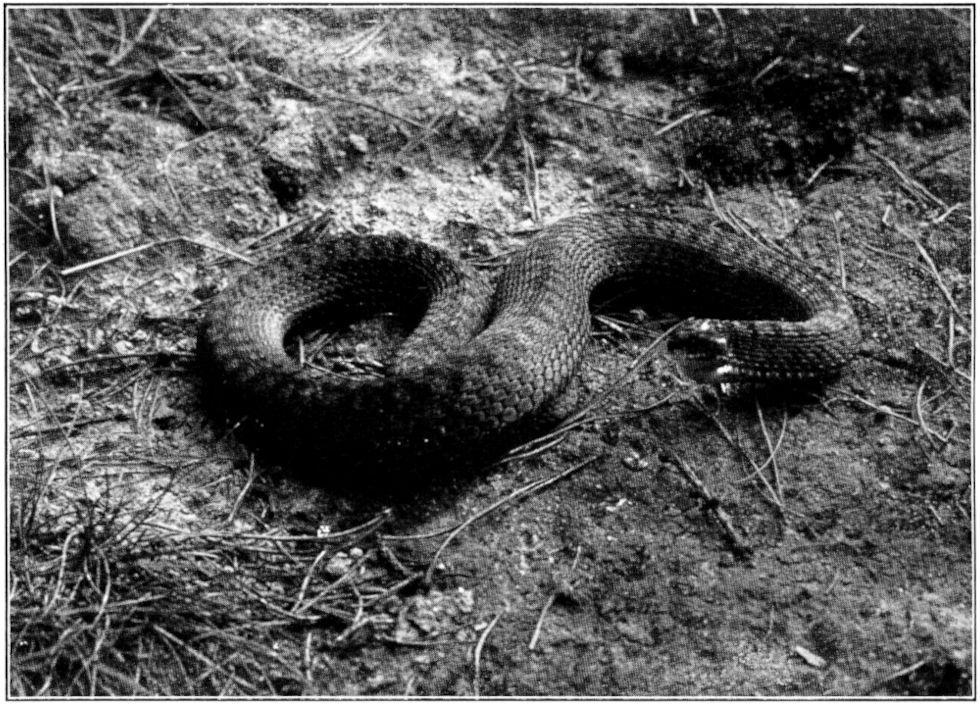
Abb. 2 Kreuzotter, Angriffsstellung
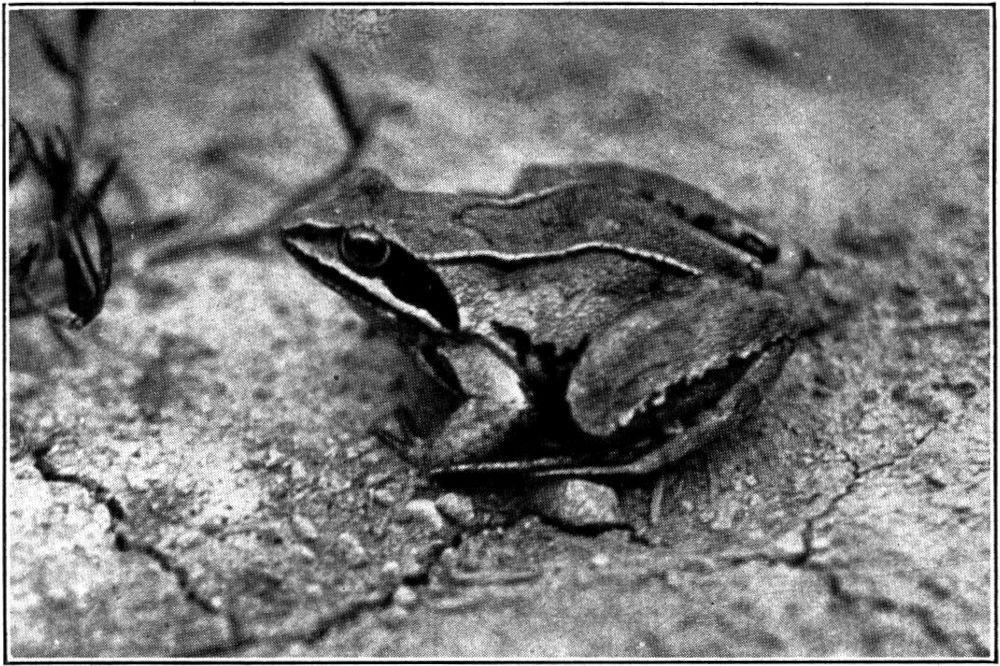
Der Moorfrosch z. B., der im nordsächsischen Flachlande weit verbreitet und besonders dessen ausgedehnten Teichgebieten eigen ist, steigt von hier aus auch in das Hügelland und unsere Mittelgebirge empor – das von mir festgestellte Vorkommen von Limbach gehört hierher –, und wird schließlich, obwohl er eigentlich ein Tieflandbewohner ist, an geeigneten Stellen selbst in höheren Lagen noch angetroffen, wie die von mir gemachten Funde des Tieres an den Großhartmannsdorfer Teichen, südlich Freiberg, beweisen. Die genaue Festlegung seiner südlichsten Verbreitungsgrenze, die zu ziehen uns heute in Ermangelung der notwendigen Unterlagen noch nicht möglich ist, wäre tiergeographisch aber von großem Werte. – Die Unterscheidung von unserem Grasfrosche, dem er äußerlich so auffallend ähnelt, daß er als eigene Art erst in verhältnismäßig später Zeit erkannt worden ist, und dann auch lange noch ein Streitobjekt gebildet hat, wird den
Anfänger allerdings noch einige Schwierigkeiten bereiten, ihm mit Sicherheit aber möglich sein, sobald er beide Arten einmal gleichzeitig nebeneinander gehabt hat und miteinander hat vergleichen können. Der Moorfrosch unterscheidet sich vom Grasfrosch durch die etwas schmalere Stirn und die spitzer auslaufende Schnauze, durch den stets ungefleckten Bauch (beim Grasfrosch ist er fast immer dunkel gefleckt) und untrüglich durch den sogenannten Fersenhöcker, eine längliche, schwielenartige Erhebung an der Wurzel der inneren Zehe der Hinterfüße, der allen Fröschen eigen ist und ein sicheres Artmerkmal bildet. Beim Moorfrosch ist er stark und hart, schaufelartig seitlich zusammengedrückt und immer länger als die halbe Innenzehe, beim Grasfrosch dagegen ist er schwach und weich und bildet einen länglich-stumpfen Wulst von jederzeit geringerer Länge als die Hälfte der Innenzehe.
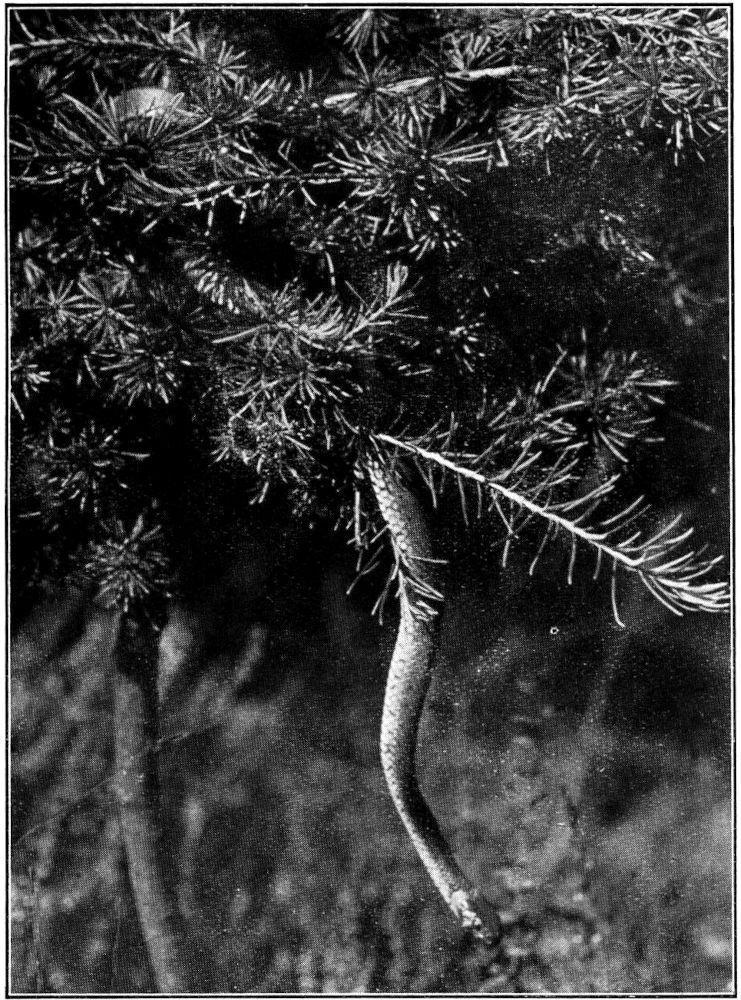
Abb. 3 Kletternde Ringelnatter Ähnlich wie beim Moorfrosch ist die genaue Festlegung der Südgrenze des Vorkommens auch von der Grünen und der Kreuzkröte vonnöten. Die Grüne Kröte ist eine häufige Erscheinung in der gesamten Leipziger Tieflandsbucht, aus der sie zum mindesten auch bis ins sächsische Mittelgebirge aufsteigt; ich konnte sie bei Göppersdorf bei Burgstädt als an den bisher bekannten südlichsten Fundort nachweisen. Dann tritt sie wieder zahlreich im
Flußgebiet der Elbe auf, in dem sie in der ganzen weiten Umgebung Dresdens vorkommt und stromaufwärts bis über Pirna hinauf ihr Vorkommen ausdehnt. Aus dem Osten unseres Landes waren Vorkommen unserer Art im Schrifttum bisher zwar noch nicht festgelegt, doch fehlt sie ihm keineswegs, sondern verbreitet sich von der Elbe aus in östlicher Richtung, zum mindesten über das gesamte Oberlausitzer Teichgebiet, in dem ich sie in den letzten Jahren wiederholt als durchaus nicht selten feststellen konnte. Aus dem Gebiete zwischen Mulde und Elbe ist sie bisher noch nicht nachgewiesen worden, wahrscheinlich, weil dieses bisher so herzlich wenig ihre Beobachtungen auch bekannt gebende Naturbeobachter aufzuweisen gehabt hat. Die Kreuzkröte kommt zunächst in der unmittelbarsten Umgebung Leipzigs vor, scheint sich aber von hier aus nicht wie die Grüne Kröte weiter südwärts zu verbreiten – mir wenigstens glückte bisher trotz jahrelanger Nachforschungen der Nachweis ihres Vorkommens hier noch nicht –, wird aber dann wieder, durch ein räumlich recht großes Gebiet vom Leipziger Vorkommen getrennt, von Chemnitz erwähnt und konnte von mir im Sommer 1919 in großer Zahl auch bei Limbach festgestellt werden. Das Chemnitz-Limbacher Vorkommen scheint ein völlig in sich Geschlossenes, inselartiges zu bilden. Dann ist sie auch, wiederum durch das Gebiet zwischen Mulde und Elbe von den westsächsischen Vorkommen getrennt, in der Umgebung Dresdens nachgewiesen. Aus der Lausitz war sie bisher nicht bekannt, dürfte aber wohl auch hier noch an manchem Ort nachzuweisen sein, nachdem ich sie im Sommer 1924 bei Königswartha aufgefunden habe.
Die drei Kröten sind äußerlich recht gut voneinander unterschieden und ihre sichere Bestimmung dürfte selbst dem Ungeübten keine großen Schwierigkeiten bereiten. Die Erdkröte, die verbreitetste und wohl überall gleich häufige der Sippe, ist von graubrauner, bald ins asch- und schwärzlichgraue, bald wieder ins gelblich- und oliven-graue und -bräunliche übergehender Farbe, die sich allmählich in den helleren Ton der Unterseite auflöst; die Grüne Kröte ist auf hellerem ledergelben bis gelbgrauen Grunde ziemlich dicht mit satten samt- bis grasgrünen Flecken gezeichnet, von denen sich besonders an den Seiten und am Halse zahlreiche rote Wärzchen abheben, während die unterseits ebenfalls wieder in hellere Töne übergehende Farbe der Kreuzkröte ein bald mehr ins gelbliche oder graue, bald wieder ins braune übergehendes Oliv ist, durch das längs der Rückenmitte ein etwas vertiefter, schwefelgelber Streifen verläuft.
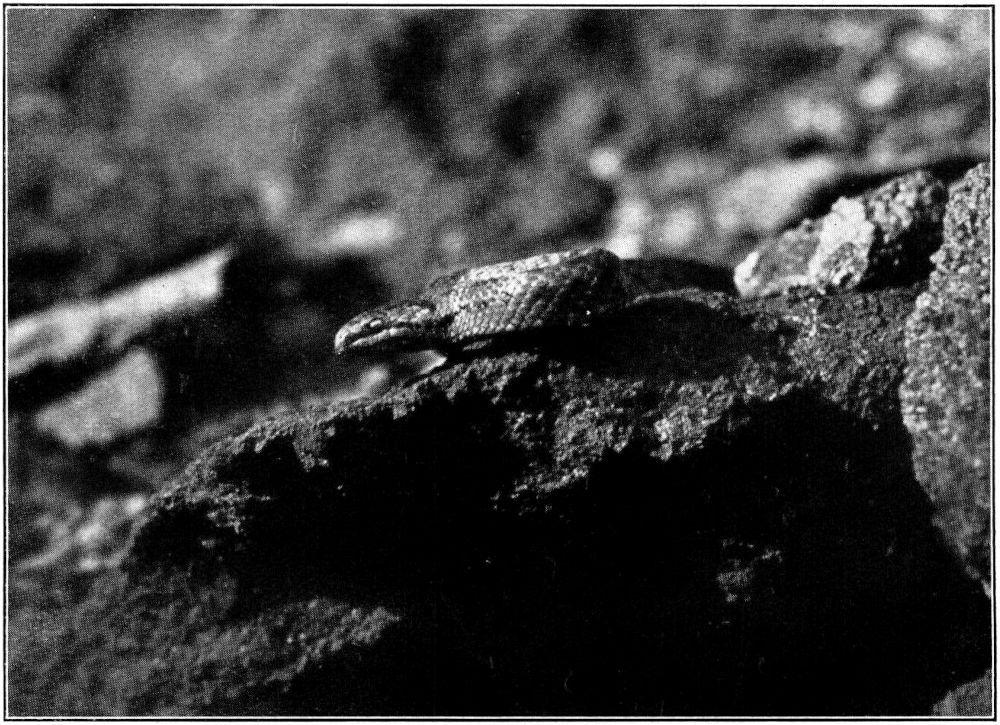
Abb. 4 Vor ihrem Schlupfwinkel sich sonnende Glatte Natter
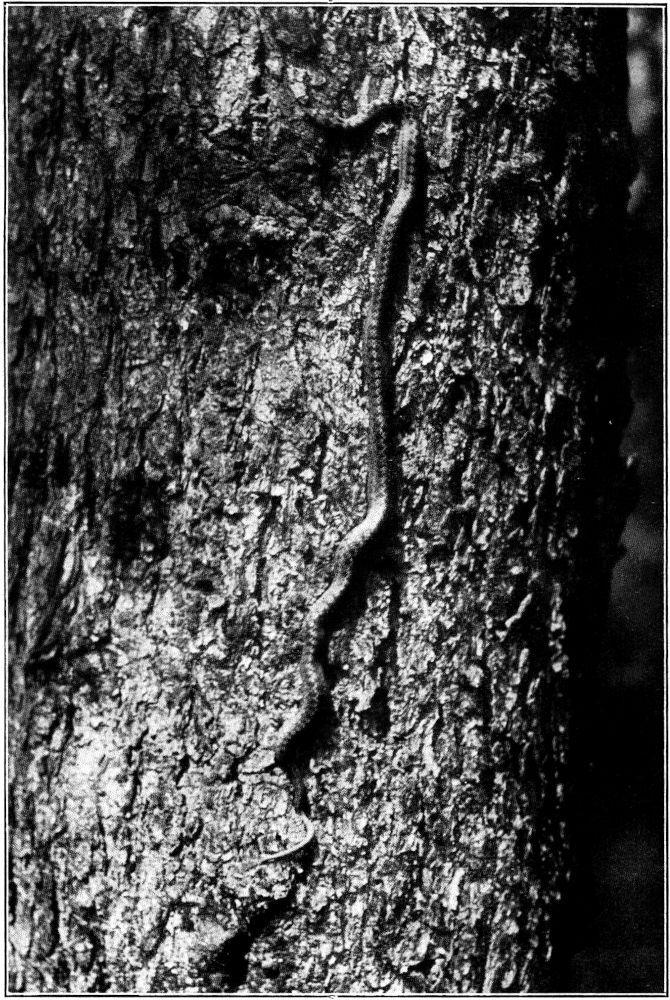
5 An einem senkrechten Baumstamm emporkletternde
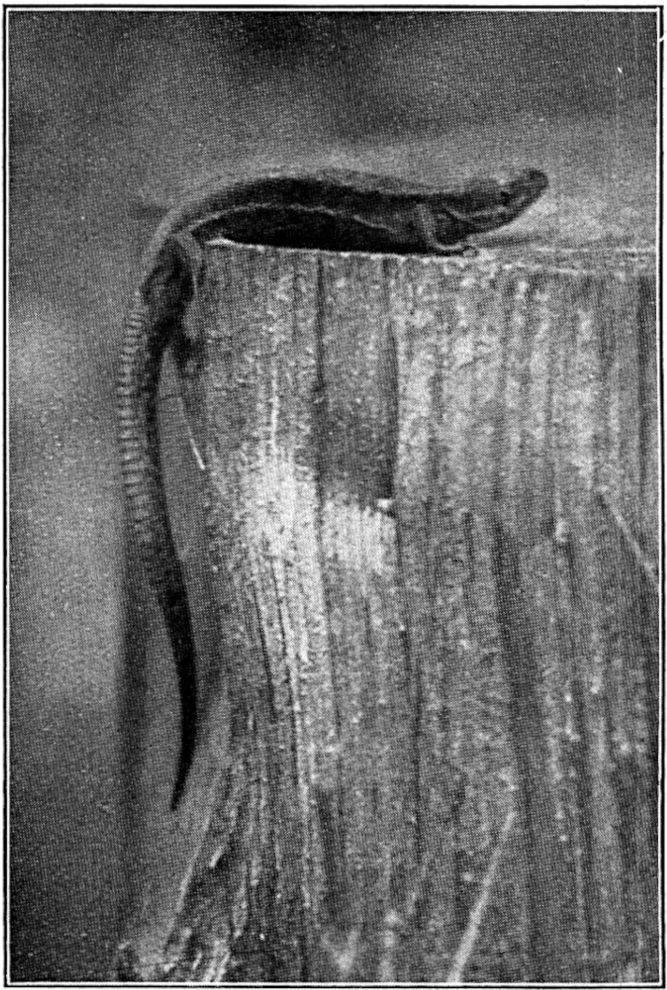
Abb.
Glatte Natter
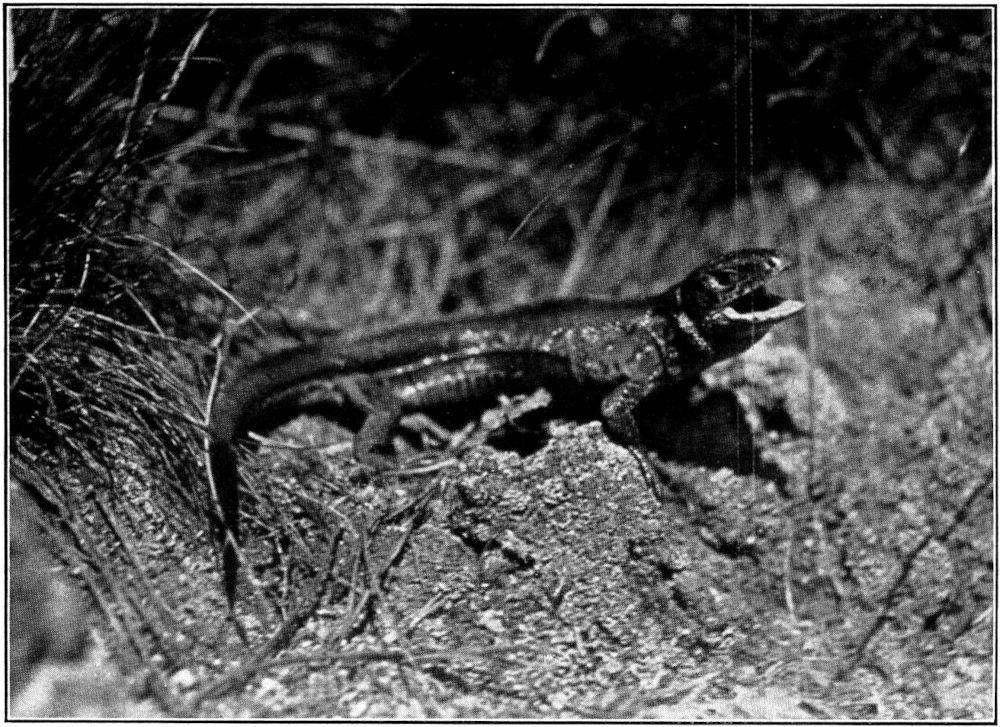
Abb. 6 Zauneidechse, Angriffsstellung
Eine ähnliche Verbreitung wie der Moorfrosch und die Grüne Kröte besitzt in Sachsen auch die froschähnliche (und der Familie der Froschkröten angehörende) Knoblauchskröte, die erheblich kleiner als die eben betrachteten Vertreter der echten Kröten ist, und der auch die für diese so bezeichnende warzige Hautoberfläche abgeht. Ihre Farbe ist ein helleres oder dunkleres Grau oder Braun, das mit kastanienbraunen bis schwärzlichen Flecken und allerlei roten Punkten und Tüpfelchen gezeichnet ist. Als ein Tier des Tieflandes verbreitet sie sich zunächst wiederum über die gesamte Leipziger Tieflandsbucht und steigt aus dieser dann auch ins Hügelland und ins Mittelgebirge empor, wo sie bei Lunzenau nachgewiesen werden konnte. Dann kommt sie gleichfalls wieder im Flußgebiet der Elbe vor und scheint sich hier stromaufwärts ähnlich wie die Grüne Kröte bis Pirna hinauf, und in östlicher Richtung über das Oberlausitzer Tieflandsgebiet zu verbreiten. – Nicht so weit südwärts wie die eben
genannten Arten scheint sich dagegen die Rotbauchunke zu verbreiten, die auch innerhalb ihres durch das nordsächsische Tiefland gekennzeichneten Vorkommens sehr lückenhaft verbreitet zu sein scheint.
Abb. 7 Berg- oder Waldeidechse
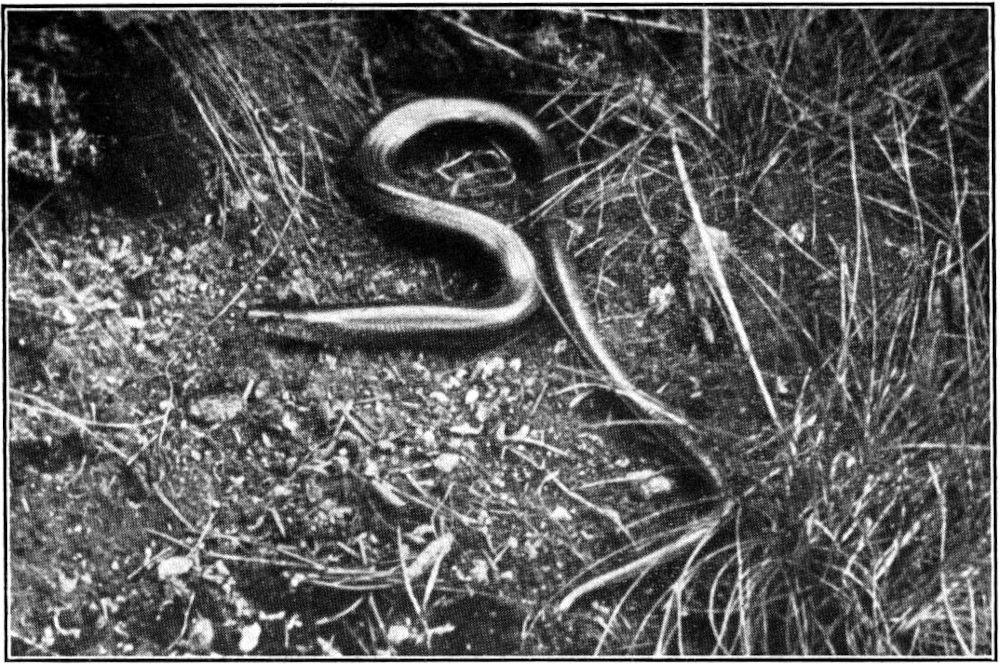
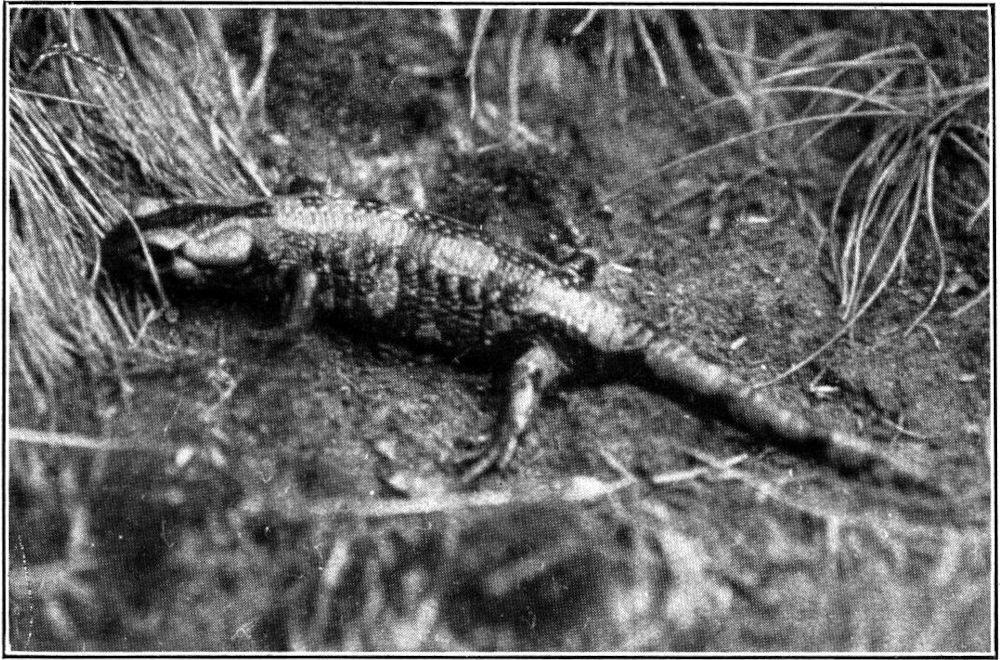
Abb. 8 Blindschleiche
Waren die bisher betrachteten Arten Tieflandsbewohner, deren genaue Verbreitungsgrenze vor allem gebirgswärts noch festzulegen ist, so besitzen wir im Feuersalamander und im Bergmolch zwei Lurche, die Bewohner des Berg- und Hügellandes sind und von denen neben ihrer genauen Verbreitung innerhalb desselben vor allem noch die unteren Verbreitungsgrenzen festzulegen sind. Der Feuersalamander erreicht in Westsachsen auf dem Rochlitzer Berge die Nordgrenze seiner Verbreitung und dehnt von hier aus sein Vorkommen nur im Muldentale noch bis in die Colditzer und Grimmaer Gegend aus, während ich ihn im Zschopautale am weitesten nördlich bei Waldheim gefunden habe. Die Grenzen des Vorkommens des Bergmolches dagegen liegen noch nördlicher, ich begegnete ihm noch bei Geithain und im Muldental ebenfalls bis in die Gegend von Grimma, von wo aus er sich dann noch bis in die Pflege von Beucha-Brandis verbreitet. Im Gebiete der Elbe scheint
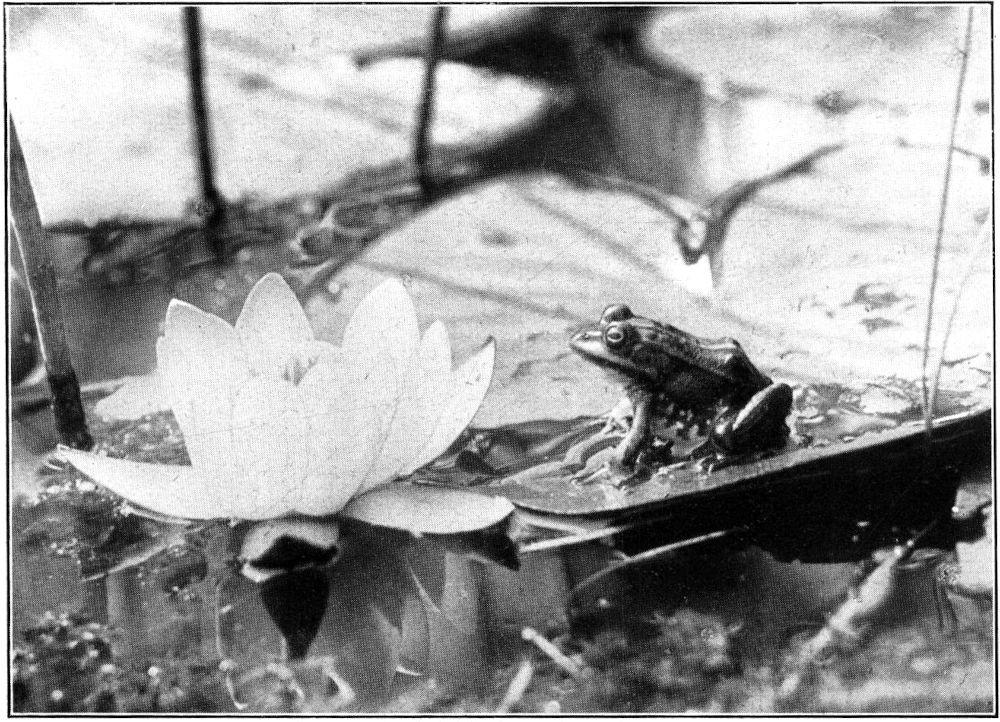
Abb. 9 Wasserfrosch
das Vorkommen des Feuersalamanders kurz vor Meißen auszuklingen, der Bergmolch aber auch hier noch weiter ins Tiefland vorzudringen. –
Abb. 10 Grasfrosch
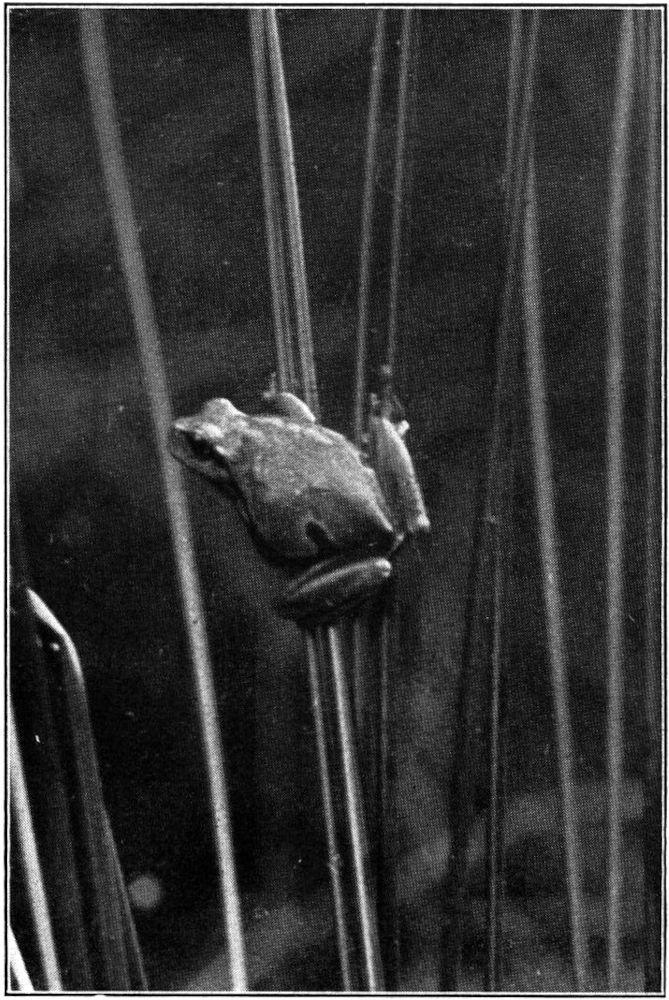
Abb. 11 Laubfrosch
Von den vier Schlangen Sachsens ist die Ringelnatter die häufigste und eine über das ganze Land verbreitete Art; es dürfte bei uns kaum ein größeres Gebiet geben, dem sie fehlt. Ihre größte Häufigkeit erreicht sie in den teich- und wasserreichen Landschaften
des Flachlandes, wo sie, wie z. B. an vielen Teichen der Oberlausitzer Niederung in manches Mal fast unglaublichen Mengen sich findet. –Groß (und jedenfalls bei weitem größer, als so mancher meint) ist auch das Verbreitungsgebiet der Kreuzotter, die aus den gebirgigen Teilen des Landes – Vogtland und Erzgebirge beherbergen sie in besonders großer Zahl – bis weit ins nordsächsische Flachland hinein und darüber hinaus vordringt. Als kreuzotterfrei gilt nur der äußerste von der Elsteraue eingenommene Nordwesten des Landes sowie ein Gebiet, das rechts der Vereinigten Mulde beginnt, im Süden auf die Freiberger Mulde trifft und sich bis nördlich Freiberg ausbuchtet, dann südlich Meißen die Elbe kreuzt und östlich Großenhain im Norden auf die Landesgrenze stößt. Gebildet wird es von Teilen der Amtshauptmannschaften Oschatz, Döbeln, Meißen und Großenhain. Kreuzotterfrei scheint endlich noch der äußerste Osten der Lausitz, etwa aus der Gegend von Bautzen an bis zu den Vorbergen des Zittauer Gebirges zu sein, während die nördlichen Teichgebiete – ich konnte erst im vergangenen Frühjahr wieder eine Anzahl diesbezüglicher Feststellungen machen – die Schlange überall noch beherbergen und durchaus nicht als »Storch«gebiete kreuzotterfrei sind.
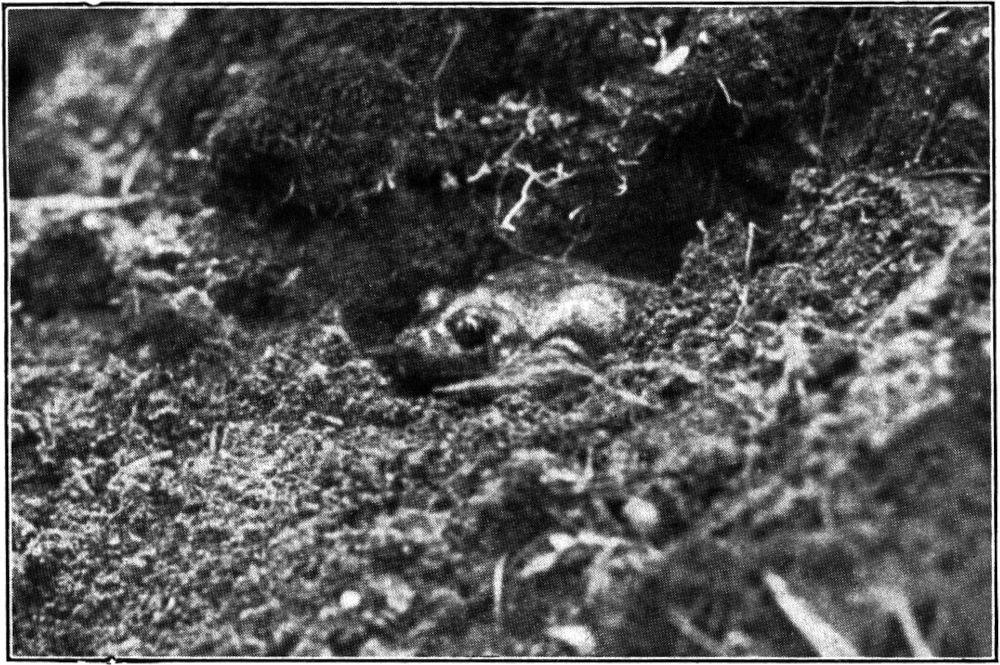
12 Knoblauchskröte (sich eingrabend)
Abb.
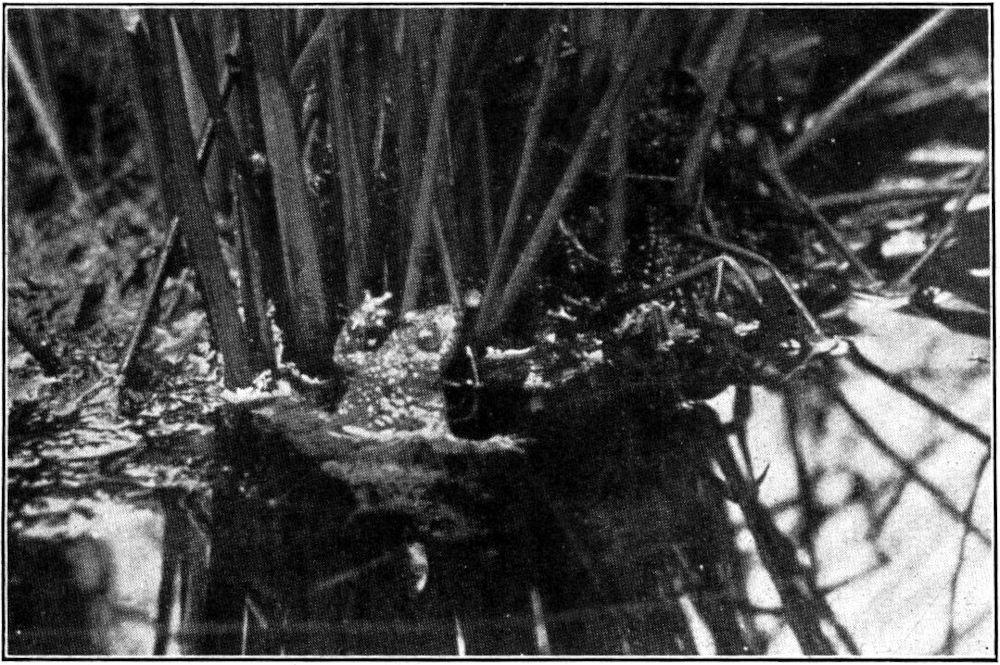
Abb. 13 Rotbauchunke
In vielem mangelhaft dagegen sind wir noch über die Verbreitung der Glatten Natter in Sachsen unterrichtet. Sie ist ebenfalls nicht selten, scheint aber ein kleineres Verbreitungsgebiet als ihre Verwandten zu besitzen. Sie steigt bei uns aus dem Flachland in das Hügelland, in dem sie in Sachsen auch ihre größte Häufigkeit zu erreichen scheint, und in die niederen und wärmeren Lagen der Gebirge empor; sie ist ungleich wärmebedürftiger als die Kreuzotter und scheint dazu allen höheren und rauheren Teilen völlig zu fehlen.
Abb. 14 Feuersalamander
15 Teichmolch (Aquarienaufnahme)
Bei diesen wenigen Hinweisen auf noch offene Fragen der Kriechtier- und Lurchverbreitung in Sachsen soll es jedoch für heute bleiben, obwohl ich sie leicht noch weiter ausdehnen könnte. Ihr Anschneiden an dieser Stelle soll lediglich eine Anregung für die Leser der »Mitteilungen« sein, nach Kräften an ihrer Lösung mitzuarbeiten. Mitteilungen nimmt der Verfasser (Dresden, Marienstr. 32) jederzeit mit Dank entgegen; sie werden Verwendung finden in der in Arbeit befindlichen »Sächsischen Wirbeltierfauna«, die ich zusammen mit R. Heyder und R. Zaunick bearbeite.
Fußnoten:
[1] Siehe auch: Zimmermann, Rud., Ein Beitrag zur Lurch- und Kriechtierfauna des ehemaligen Königreichs Sachsen. Archiv für
Abb.
Naturgeschichte 88, 1922 A, 8. Heft, 245–267.
[2] Zimmermann, Rud., Das Vorkommen der Sumpfschildkröte im Gebiet des ehemaligen Königreichs Sachsen. Fischerei-Zeitung 24, Neudamm 1921, 250–253.
Otto Altenkirch
Ein Maler der sächsischen Landschaft
Von EdgarHahnewald
Der Heller flimmert in brandigem Dunst. Die Sandflächen breiten ein fahles Gelbgrau über den Vordergrund, von dem sich einige schmale Heidekrautinseln in trockenem Braunviolett mit vereinzelten grünen Flecken darin abheben. Weiter hinten streckt sich eine Windgrassteppe, weich wie Haar und kupfern in der Farbe, vor einem Waldstreifen, dessen Kiefernwipfel einer schweren Wolke gleich tief auf der Fläche zu liegen scheinen und nur am Rande, wo der Wald sich lockert, von einzelnen Stämmen wie von Stützen über der Erde gehalten werden. Über dem Walde steht hoch, prachtvoll, in einem stumpfen, dunklen Stahlblau eine Gewitterwolke wie ein riesenhaftes Haupt ohne Antlitz, von einer Aureole hervorbrechender Lichter umstrahlt. Sie steht regungslos, als warte sie noch, ehe sie mit rollender Donnerstimme in die Landschaft spricht. Unter diesem Wolkenhaupt drängt sich das bißchen Landschaft noch enger an die bleiche Erde. Nur eine Birke steht ganz allein mitten in der Sandfläche auf einem kleinen zerrissenen Teppich von Heidekraut. Ihr von vielen Stürmen verbogener Stamm, vor dem Stahlblau unwahrscheinlich weiß, überschneidet den fernen Waldstreifen und hält einen Laubbüschel wie eine zerfetzte Fahne hoch vor die drohende Wand.
Und noch jemand steht in der spärlichen Fläche. Ein Maler vor seiner Staffelei. Die Krempe eines in vielen Wettern verblichenen Hutes beschattet seine Augen. Er trägt eine alte, mit allen Farben seiner Palette beklexte Jacke und blank getretene Holzpantoffeln, die ihm das stundenlange Stehen erleichtern. Er sieht in dieser Kleidung einem Handwerker ähnlicher als einem Künstler. Ein Blick auf seine Leinwand auf der Staffelei zeigt, daß er ein Künstler ist. Im kleineren
Abbild ist dort die Landschaft noch einmal, der Sand, das Heidekraut, das Windgras, der Wald, die Birke, die Gewitterwand. Das Bild läßt erkennen, was in dieser scheinbar kargen eintönigen Sandebene den Maler reizte: das einsame Aufstehen der Birke über dem ganz tiefgenommenen Horizont, ihr Hinaufweisen in die hohe drohende Wolke, die vier Fünftel des Bildraumes beherrscht. Aber nicht allein das, nicht nur die beinahe trotzige, beinahe tragische Einsamkeit der Birke mit der zerschlissenen Laubfahne in der kargen Landschaft macht diesen künstlerisch gesehenen Ausschnitt zum Bilde. Das rein malerische des Motivs zog den Künstler an. Die flimmernde, von sommerlichen Dünsten geschwängerte Atmosphäre, das irrende Spiel fliehender Lichter am Himmel und über den Farben des Sandes und der Heide, das beinahe Geängstete, Erschreckte dieser Landschaft unter dem schweren Dunkel der riesenhaften Wolke. Der eigenartige Gegensatz zwischen dieser drohenden Erscheinung, die in ihrer stahlblauen Ruhe und Ballung wie ein Dämon wirkt und doch schwere, sommerliche Sättigung verheißt –der Gegensatz zwischen ihr und der flimmernden Unrast, der Erregung in der kleinen Landschaft, die bleich in zitternder Luft sich hinschmiegt, den ersten Donnerschlag fürchtend und doch die Sättigung mit aller Glut des trockenen Sandes erwartend – das ist in freilich literarischer Übertragung der malerische Reiz dieser Landschaft, an der nach der Meinung des Laien »aber auch gar nichts« ist. Einfach: Anreiz für den Maler ist der unendliche Zauber des Lichts, und das landschaftliche Motiv ist nur der Träger, an dem dieser Zauber sichtbar wird.
Der Maler ist stumm an sein Werk hingegeben. Aus dem Hutschatten hervor prüfen die zusammengekniffenen Augen immer wieder bald die Landschaft, bald das Bild. Unter der großen Palette hervor sprießen bereit gehaltene Pinsel wie ein starrer Strauß. Der Maler arbeitet mit dem Spachtel, diesem kleinen Werkzeug aus federndem Stahl, an das hölzerne Heft angebogen wie eine Kelle und schmal wie ein Brieföffner. Auf der Palette mischt der Spachtel leise klingend die gebrauchte Farbe und mit einem Spachteldruck verwandelt sich das Klexchen Farbenpaste auf der Leinwand in einen
Büschel violetter Heide, der wie eine lebendige Flamme im bleichen Sande lodert.
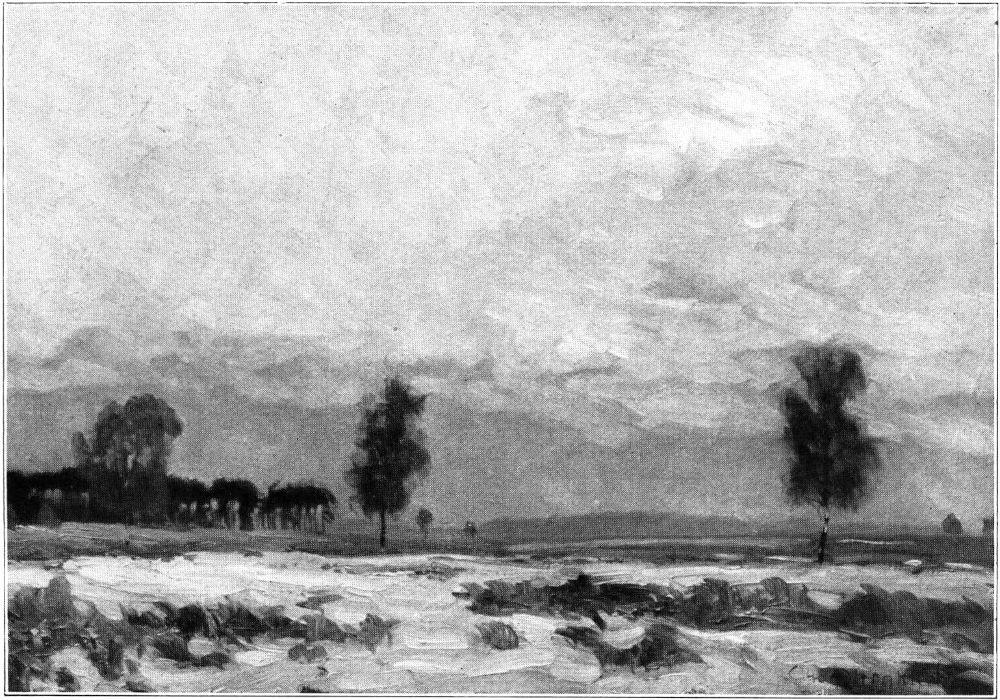
Trüber Tag
Dresdner Heller
Über den Heller kommen zwei Frauen mit Heidelbeerkrügen. Das drohende Gewitter hat sie aus dem Walde vertrieben. Beim Maler bleiben sie stehen. In seiner beklexten Jacke, in seinen Holzpantoffeln halten sie ihn für ihresgleichen, für einen erwerbslosen Malergesellen vielleicht, der auf diese Weise sich ein paar Mark zu verdienen sucht. Sie halten darum mit ihrer Kritik auch nicht hinterm Berge. Sie meinen, es gibt schönere Sachen, die man malen könnte als da den Sand und die dumme Birke. Aber die Wolke mit dem dahinter hervorbrechenden Licht findet ihre Anerkennung. Und wie lange er an einem solchen Bilde male? So – im Varieté hat die eine Frau einmal einen Schnellmaler gesehen, der malte in fünf Minuten ein Bild, größer als das hier, mit einem Fluß und Bergen,
Schiffen und einer Windmühle. Und gleich so mit dem Pinsel los. Der konnte was!
Der Maler antwortet auf die naiven Fragen der Frauen, ohne sich lustig zu machen. Er ist innerlich dem einfachen Volke nahegeblieben, aus dem er stammt. Ihm ist diese einfache Gedankenwelt vertraut. Und es gab eine Zeit, wo er als arbeitsloser Malergeselle in Bukarest Hintergründe für ein Panoptikum malte. Damals malte er an eine Kerkerwand, vor der Maria Stuart in Wachs sitzen sollte, einen Schwerverbrecher in stahlblauen Fesseln.
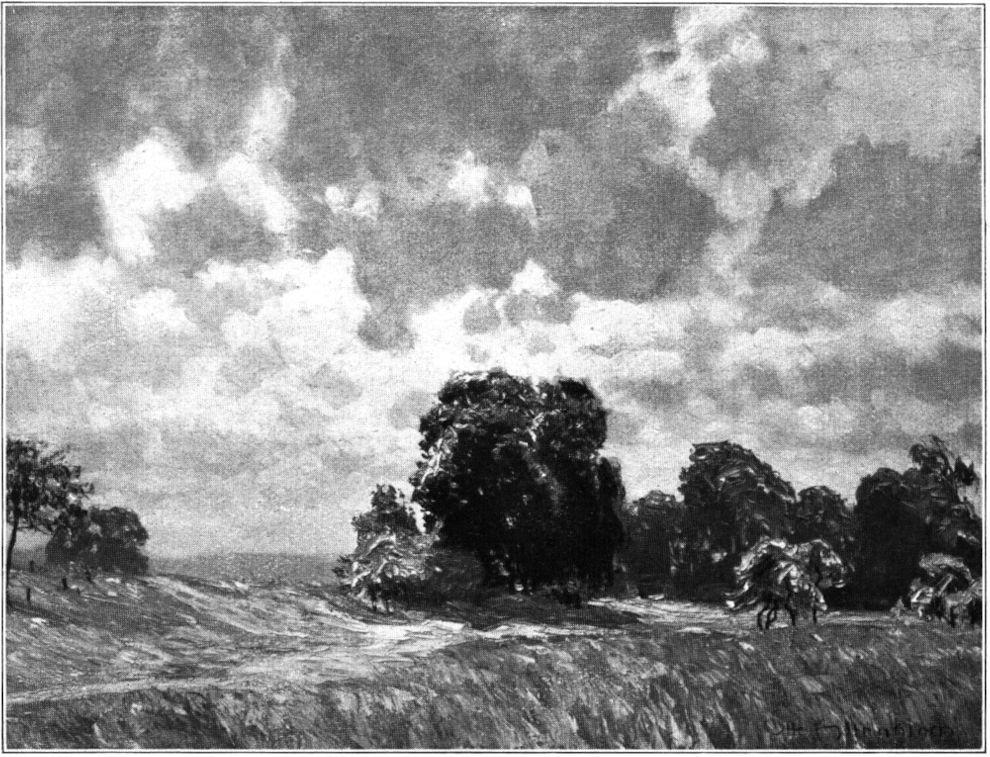
Sommermorgen Dresdner Hochland
Die eine der Frauen sieht den Spachtel, mit dem der Maler arbeitet. Vielleicht meint sie, der arme Teufel wolle die teuren Pinsel schonen. Aber ein bißchen muß sie doch lächeln darüber, daß der Maler mit diesem blechernen Ding »malt«. Dann fragt sie, wie viel er
denn für so ein Bild bekomme. Der Maler nennt mit einem leisen diabolischen Vergnügen den ungefähren Preis. Das Gelächter der Frauen schallt über den Sand. »Und das bringen sie Ihnen auch noch ins Haus, was!« Die eine lacht über den vermeintlichen Witz, die andere aber lacht mit einem Streifblick auf die Holzpantoffeln und mit einer Miene, die deutlich sagt: Es kann diesen Malern noch so schlecht gehen – große Aufschneider bleiben sie doch!
Das hohe Wolkenhaupt spricht einen ersten verhaltenen Donner in den von Spannung erfüllten Raum. Ein Schauer fährt in die Birke. Am Rande des Hellers erhebt sich eine graue hinwirbelnde Sandsäule.
Die Frauen verabschieden sich eilig und gehen.
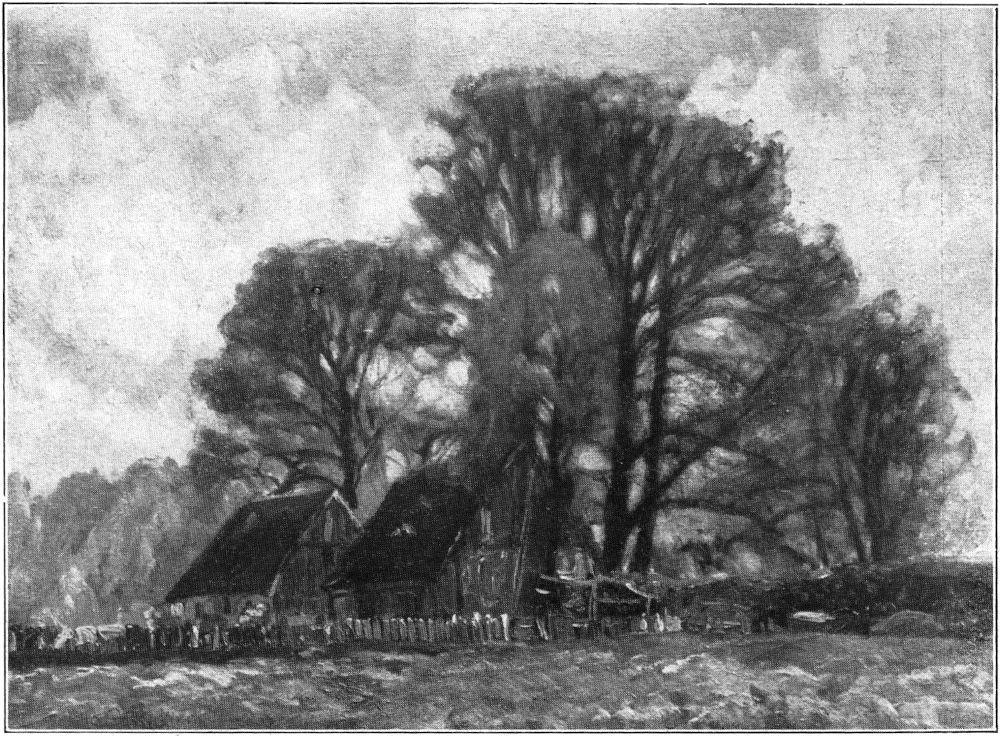
Novembertag Am Hellergut
Der Maler zeichnet mit dem Pinselstiel seinen Namen in die frische Farbe des Bildes: Otto Altenkirch. Dann packt er sein Malgerät zusammen. Während er die Mischfarben von der Palette wischt, sieht er den Frauen nach, die schon weit fort als zwei dunkle Körperchen über den bleichen Sand eilen. Er lacht leise, freundschaftlich, so wie jemand, der in andere Lebenskreise hineingewachsen ist, einmal über eine naive Äußerung seiner alten Mutter lacht, voller Liebe und voller Achtung vor der einfachen Tüchtigkeit, der er selber alles zu danken hat.
Mit erhobener Stimme donnert die Wolke. Sie reckt sich riesenhaft über den Himmel. Und während der Maler seinem Arbeitsquartier in der alten Hellerkaserne hinter den hohen Bäumen zuschreitet, schlagen die ersten groschengroßen Tropfen in den durstig zerfallenden Sand.
Am 2. Januar 1925 feiert Professor Otto Altenkirch seinen fünfzigsten Geburtstag. Er wird ihn im Kreise seiner Freunde feiern, lächelnd und wortkarg, wie es sein Wesen ist. In jener Gelassenheit, die es fertig bringt, mit einer Antwort, einem Einwand auf eine Frage zurückzugreifen, die acht Tage zuvor in der Runde besprochen wurde, und es so zu tun, als sei eben in diesem Augenblick die kleine Pause im Gespräch eingetreten, in der er nun sprechen kann. Es ist jene Gelassenheit des märkischen Blutes, neben der wir Sachsen, denen doch nicht gerade das Temperament aus den Poren spritzt, wie nervöse Wiesel wirken. Sie ist ohne Schwere, sie ist nur Ruhe.
Die Mark ist Otto Altenkirchs Heimat. In Ziesar, einem kleinen ereignislosen Städtchen bei Magdeburg, stand seine Wiege in der Behausung eines kleinen Sattlermeisters. Altenkirch ist später mit Malkasten und Staffelei auch in seine Heimat gegangen, und rund um das Ackerbürgerstädtchen entdeckte er die heimatliche Landschaft gewissermaßen noch einmal: flach hingebreitetes Land, verlorene Gehöfte unter aufragenden Bäumen, blinkende Wasser, in denen sich die Wolken spiegeln. Es stellte sich heraus, daß durch alle seine Bilder, so verschieden sie nach Motiv und Stimmung sein
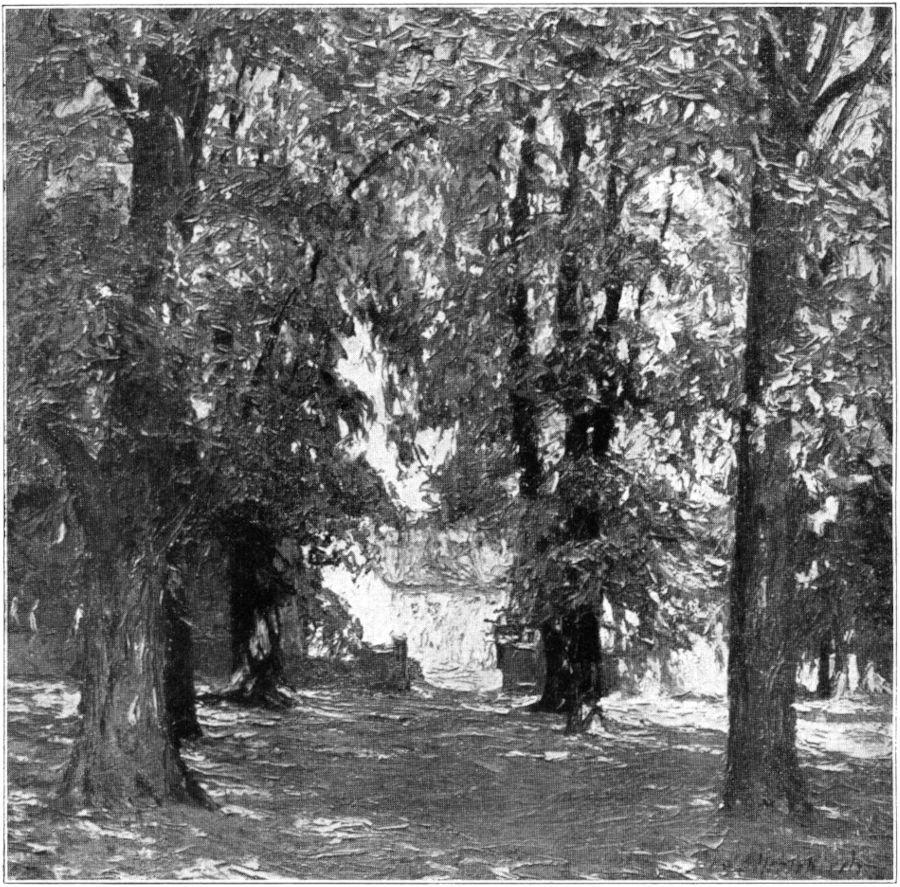
Alte Linden Am Hellergut
mögen, immer wieder die Heimat durchschimmerte. Wo deutsche und vornehmlich sächsische Landschaft die stillere und verhaltenere Sprache seiner Heimat redete, dort hat er sie aufgesucht, geliebt und gemalt. Und die nährenden Wurzeln seines künstlerischen Tuns führen in ihren letzten zarten Verästelungen in den Boden der märkischen Heimat.
In Ziesar trabt Altenkirch acht Jahre lang mit den Kindern der Kleinbürger und Bauern in die Volksschule damaliger Primitivität. Immerhin gibt es in dieser Schule schon einen Zeichenlehrer und Altenkirch macht die Entdeckung, daß man die Welt zeichnend und malend darstellen kann. Irgendwelche schlechte Öldrucke, vor denen er bewundernd steht, bekräftigen das und begeistern ihn. Und nun
Winterwald Hirschfeld
macht er vor den alten Gemäuern Ziesars die ersten Zeichenversuche, die seinen Lehrer so stark von einem vorhandenen Talent überzeugen, daß er Altenkirchs Vater rät, den Jungen Maler lernen zu lassen. Der Sattlermeister befolgt den Rat auch. –Altenkirch kommt nach Beendigung seiner Schulzeit in die Lehre zu einem Berliner Dekorationsmaler, dessen Stolz es ist, daß seine Werkstatt im Rufe steht, tadellose Fußbodenanstriche zu liefern. Die Lehrjahre verstreichen – Altenkirch »verstreicht« sie mit Ringpinsel und Bernsteinlack. Er arbeitet elf, zwölf, ja vierzehn Stunden täglich und schiebt den Malerkarren durch die Straßen Berlins in jener guten alten Zeit, als noch niemand sich um das Schicksal der Lehrlinge kümmerte. In heimlichen Stunden erwachen immer wieder noch ganz gestaltenlose Träume. Wer sieht einem armen geschundenen Lehrling an, daß der Kuß der Muse auf seiner Stirne glüht? Die tausendmal geschriebene Geschichte vom häßlichen Entlein schreibt das Leben immer wieder von neuem. Altenkirch bittet seinen Lehrmeister um die Erlaubnis, in die Zeichenstunde der Berliner Fortbildungsschule gehen zu dürfen. Es wird ihm erlaubt. Altenkirch ist glücklich. Er lernt, er zeichnet und malt nachts, Sonntags, in allen Freistunden. Seine Mitschüler machen ihm klar, daß er gar nicht so schuften brauche, das werde gar nicht verlangt. Für sie ist die Sonntagsschule nur eine begreiflicherweise begrüßte Gelegenheit, der Sonntagsarbeit in der Werkstatt des Meisters zu entgehen. Der Lehrer aber wird auf Altenkirch aufmerksam. Er hatte die Gepflogenheit, die talentierten seiner Schüler in die vorderen zwei Reihen zu setzen und sich nur um diese zu kümmern. Die übrigen, von denen er wußte, daß bei ihnen eine noch so eifrige Bemühung des Lehrers nicht vorhandene Talente nicht wecken könnte, vertaten im Hintergrunde ihre Zeit. Wie in einer Lesebuchgeschichte taucht dieser Lehrer über ein Menschenalter später, kurz vor Altenkirchs fünfzigstem Geburtstag noch einmal auf: als Besuch in Altenkirchs Atelier, in dem er vor den Gemälden seines ehemaligen Sonntagsschülers steht und fragt und Notizen macht für den Unterricht an der Kunstschule, zu deren Lehrer er selber sich heraufgearbeitet hat. Beide, der Lehrer und der Schüler von damals sind nun Professoren, und die mitgekommene Gattin des Lehrers
formuliert die Pointe dieser Anekdote: »Sehen Sie – erst haben Sie von meinem Mann gelernt und nun lernt mein Mann von Ihnen.«
Überschwemmter Weg Im Kamenzer Teichgebiet
Die Lehrjahre vergehen. Altenkirch ist nun Malergeselle. Am Tage arbeitet er auf Neubauten, die in Berlin wie Pilze aus der Erde schießen. Die Freistunden widmet er der sehnsüchtig erstrebten Kunst. Sein Lehrer im Zeichenkursus der Fortbildungsschule ist jetzt der Maler Hugo Händler, der wertvollen Einfluß auf den Gesellen
ausübt. Auch er kreuzt später noch einmal, und zwar entscheidend Altenkirchs Weg.
Vorfrühling
Muldental
Dann packt den jungen Malergesellen der alte deutsche Wandertrieb. Die Erzählung reisender Malergesellen in den Frühstückspausen zwischen Hobelspänen und Farbentöpfen hatten in ihm die Sehnsucht nach der Ferne geweckt. Altenkirch geht mit sechzig Mark in der Tasche auf Wanderschaft, die nach Rumänien, in die Türkei, nach Ägypten und über Italien und die Schweiz zurückführen soll. In Bukarest bleibt er hängen. In der rumänischen Metropole kennen die Gebrannten nur drei Malerwerkstätten, in denen es für geleistete Arbeit auch Lohn gibt. Altenkirch gerät als unerfahrener Neuling natürlich in eine der anderen. Statt Lohn zu zahlen, borgt der Meister seine Gesellen an. Dann brennt er durch. Ein Unglück kommt auch hier nicht allein: Altenkirchs Mantel mit
sämtlichen Papieren wird gestohlen und verschwindet in irgendeinem Trödlerladen der farbigen Balkanstadt. Betrogen und bestohlen sucht der Malergeselle Hilfe beim deutschen Konsulat. Er erhält drei Franken und vom Konsulatsarzt die Versicherung, daß er tauglich sei und seiner Militärpflicht in Deutschland genügen müsse. Altenkirch erarbeitet sich das Geld für die Heimreise. Er malt Hintergründe für die Wachsfiguren eines Panoptikums – es sind Vorspiele seiner späteren Theatermalerei, ohne daß er das ahnt. Nebenher füllt er seine Skizzenbücher mit den bunten Erscheinungen dieser für ihn so abenteuerlichen Stadt. Ein Brief der Mutter ruft ihn in die Heimat zurück. Die Träume von Konstantinopel, Jerusalem, Kairo versinken. Die Kaserne der Ortelsburger Jäger nimmt den unsicheren Kantonisten auf. Altenkirch dient seine zwei Jahre ab. Und auch in der Schoßtasche des Waffenrocks steckt das Skizzenbuch.
Nach der Militärzeit nimmt er wieder Unterricht beim Maler Händler. Der schickt ihn eines Tages mit einem Bündel Zeichnungen und einem Empfehlungsschreiben zu Eugen Bracht, der damals an der Berliner Akademie das Atelier für Landschaftsmalerei leitete. Der große Traum wird Wirklichkeit. Altenkirch kann 1899 als Hospitant und später als Vollschüler in die Landschaftszeichenklasse Paul Vorgangs eintreten. Seinen Lebensunterhalt erarbeitet er sich immer noch als Malergeselle. Nach drei ungewissen, an Arbeit, Hoffnungen und Entbehrungen überreichen Jahren wird er, obwohl ihm die sonst geforderte Schulbildung fehlt, als Studierender der Akademie in das Atelier Brachts aufgenommen. Als Bracht nach einem Vierteljahr einem Ruf an die Dresdner Akademie folgt, nimmt er Altenkirch mit sich. Er bleibt Brachts Schüler und Assistent bis 1906. Gleichzeitig treibt er bei Emanuel Hegenbarth Tierstudien. Die Tiermalerei spielt später keine Rolle in Altenkirchs Schaffen, aber Hegenbarth beeinflußte sein Werden mindestens ebenso stark wie Eugen Bracht. Altenkirch lernte von ihm die feine Einfühlung, die malerische Vollendung, die Hegenbarths Bilder auszeichnet. Und wer Altenkirchs malerisches Werk kennt, konnte in der HegenbarthGedächtnisausstellung, die der Sächsische Kunstverein im Herbst dieses Jahres in Dresden zusammenbrachte, erkennen, wie viel ihm