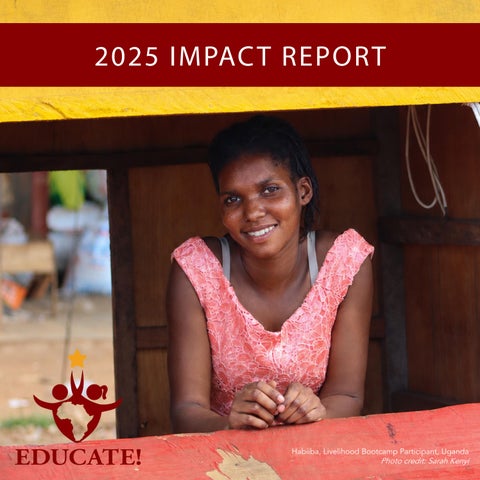
2025 IMPAC T REPORT
Habiiba, Livelihood Bootcamp Participant, Uganda
Photo credit: Sarah Kenyi
A Letter from Educate!’s CEO Over the next decade, Africa will contribute more young people to the global workforce each year than the rest of the world combined. I keep coming back to this fact — not just because of the sheer scale, but for what it makes possible. As technology, labor markets, and economies evolve, the question is no longer whether learning must change, but how quickly this transformation can happen — and whether it will reach all young people equally. This urgency drives our work at Educate! every day. We work in pursuit of a future where all youth, no matter their circumstances, develop the skills they need to thrive in a changing world. In 2025, we turned that urgency into action, leveraging new tech-enabled tools to build and strengthen impactful, scalable, and sustainable solutions for youth. Working alongside schools, governments, and communities, we scaled this impact to over 230,000 young people. As I reflect on the past year, I am encouraged by several milestones that have enabled progress and are driving toward our mission to uplift young people across East Africa. One highlight that I am especially proud of is Tanzania’s national launch of its new Business Studies subject — a major step toward placing practical, job-ready skills at the heart of secondary education. It was a milestone years in the making, built on strong partnership, learning, and continuous iteration with governments across East Africa. It also reflects something bigger than the recognition that learning must change — it represents innovation in how these reforms are designed, scaled, and built to deliver impact to generations of youth. But not every young person’s path runs through a classroom. That is why, in 2025, we also deepened our understanding of how best to reach those outside of traditional education — particularly rural girls and young women.
Secondary Students in Rwanda
Photo credit: Martin Kharuma
Through inclusive livelihood bootcamps in Kenya and Uganda, we tested innovative, tech-enabled initiatives, refined our approach, and expanded our reach. In the process, we uncovered critical insights into how to design solutions for young people facing the greatest barriers to economic opportunity. That same spirit of innovation runs through everything we do. Educate! has always been built to learn and adapt quickly, and in 2025 we harnessed new AI-enabled tools to push even further toward our goals. From piloting AI-enabled coaching that scales business support to budding young entrepreneurs, to delivering real-time teacher tools and data systems that help governments make faster, more informed decisions, we explored how this technology can strengthen impact while improving cost-effectiveness and scale. I believe we are only beginning to scratch the surface of what is possible. None of this progress happened in isolation. We are living in a time of immense change, and as I reflect on all we accomplished this year, I am struck by how much of this progress was driven by collaboration and a collective commitment to rethink what is possible — governments reimagining education, educators bringing new approaches into classrooms, communities continuing to believe in the potential of young people, and partners and champions like you investing in improved life outcomes for Africa’s youth. There is no denying that the challenge ahead remains immense. But 2025 reinforced my belief that meaningful change is not only possible — it is already underway — and so is our collective ability to meet it. I am excited to share the strides we made together this year in the pages that follow — and even more energized by what lies ahead. With gratitude and determination, Boris Bulayev CEO & Co-founder
Innovating for
Impact 06 Cultural Tenets 09 Core Learning Experience 10 Educate!’s Approach 11 Where We Work 12 2025 Impact 13 AI-Enabled Innovation 14 Transforming Ed Systems 24 Livelihood Bootcamps 32 Fazira’s Story 34 Shaping the Future 36 Supporters 37 Financials 38 Board of Directors
Livelihood Bootcamp, Uganda
Photo credit: Sarah Kenyi
Exceed Expectations
Educate!’s Cultural Tenets
We take pride in going above and beyond to achieve the best results.
Youth First, ImpactObsessed We never forget that Educate! exists to impact youth.
6
One Team, Many Views We say what we think while treating each other well.
Always Learning We are committed to seeking and applying new knowledge and ideas.
Startup Mindset We will always keep innovating to grow our impact.
7
Africa has the world’s youngest and fastest-growing population. 70% of the population across Eastern and Southern Africa is under the age of 30,¹ and by 2035, Africa will contribute more young people to the global workforce than the rest of the world combined.²
88
¹ United Nations Office of the High Representative for the Least Developed Countries (UN-OHRLLS) Carolyn, Tailor, Kenya ² International Monetary Fund (IMF)
Photo credit: X
Secondary School Student, Rwanda
Photo credit: Tresor Niragire Doux
Core Learning Experience Africa’s youth are a powerful force for change. Young people can drive economic growth and prosperity across the continent — if prepared with the practical skills to succeed in today’s economy. To meet this opportunity, Educate! has developed a core learning experience combining skills training, practical experience, and mentorship.
Mentorship
Skills Course
Youth develop transferable skills like communication and critical thinking, alongside business skills like budgeting and market research
Youth receive individualized support that helps them tackle challenges and drive towards goals
Practical Experience
Youth gain hands-on experience starting a business, building agency and real-world skills 9
Educate!’s Approach At Educate!, we’re obsessed with impact. We leverage iterative learning to build highly scalable youth employment solutions aimed at unlocking the potential of the world’s youngest continent. Educate! prepares youth in Africa to learn, earn, and thrive in today’s economy by:
10
Secondary School Student, Tanzania
Photo credit: FOX Media
1
introducing an employmentfocused school subject in secondary education, and
2
delivering livelihood bootcamps for young people outside traditional education, with a focus on girls and young women in rural communities.
Where We Work
Employment-focused school subject Livelihood bootcamps
11
Livelihood Bootcamp, Kenya
Photo credit: Brian Kolando
In 2025, Educate! measurably impacted
230,000+ young people across East Africa — scaling impact in and beyond the classroom to equip youth with practical skills to launch businesses, earn an income, and build livelihoods.
12
Accelerating Impact for Africa’s Youth through AI-Enabled Innovation The world that young people are stepping into is changing fast. Labor markets are shifting, new technology is reshaping futures, and the challenges facing youth are too urgent for static solutions. As we worked to reach hundreds of thousands of young people across East Africa in 2025, we also put Artificial Intelligence (AI) to work as a practical tool to deepen our impact, inclusion, sustainability, and reach. Since our founding, Educate! has drawn on insights and principles from across sectors to improve how we design, deliver, and scale. Integrating AI tools across our organization presents exciting new opportunities to learn and grow. This year, we tested how AI can strengthen our work through a series of experiments, targeted sprints, and rapid learning cycles. As you read through our 2025 report, we’re excited to share the active role AI is playing across our delivery pathways — deepening impact, expanding reach, and helping more young people build skills, access opportunities, and navigate the transition to work. 13
Transforming Education Systems: Embedding Real-World Learning at National Scale By 2030, half of all new entrants to the global labor force are expected to come from Eastern and Southern Africa.3 As millions of young people enter a rapidly changing labor market, what will it take to ensure they leave school with the skills to succeed? Working through national education systems is the most sustainable, non-aid-dependent pathway to equip generations of young people with the skills for life. To reach youth at scale, Educate! partners with schools and governments to integrate a practical employment-focused subject directly in secondary schools nationwide. Together, we work to make learning more relevant to today’s economy. We co-design policy and curriculum reform, train teachers, and build systems that help education reform stick — ensuring impact is sustained for generations of youth. When education reflects labor market realities, young people leave school not only with knowledge, but with the confidence, practical skills, and agency to shape their futures. 14 ³ International Monetary Fund (IMF)
Tanzania Launches New Business Studies Subject The nationwide reform is expected to eventually reach more than 3 million lower secondary students annually! In 2025, Tanzania reached an exciting milestone: the nationwide rollout of the country’s first-ever Business Studies subject. This marks a major step toward aligning education to the realities of work and life. The new subject was developed through a collaborative effort between the Tanzania Institute of Education and Educate!. The subject takes a hands-on approach, delivering engaging real-world projects that enable students to build critical skills through practical application of knowledge. The subject also fosters civic and economic engagement, encouraging students to identify challenges and opportunities in their communities, apply business concepts, and develop solutions — starting enterprises while still in school. Educate! signed a new six-year partnership with the Ministry of Education and the Prime Minister’s Office in 2025 — advancing our shared goal of strengthening future-ready education in Tanzania. 15
Wheels of Change: Business Studies Students Solve Community Challenges and Build Businesses At a secondary school in Bagamoyo District, Tanzania, Business Studies students identified a common challenge in their community: many people relied on bicycles for daily transportation, yet repair services were scarce and often far away. Drawing on classroom learning, the students recognized a market opportunity and set out to launch a bicycle repair business. They organized roles amongst themselves, researched and negotiated pricing, learned to manage common repairs, and promoted their service locally. What began as a school project quickly became an income-generating enterprise.
“Business Studies is practical and we work together as students. That is what has helped us. We learned how to look at our community, identify problems, and discuss how we can turn our ideas into solutions. That is exactly how we came up with the bicycle repair business.”
Khadija, Business Studies Student 16
Photo credit: FOX Media
Teachers Bring Business Studies to Life Throughout 2025, Educate! worked closely with teachers and government partners to bring Business Studies to life in classrooms across Tanzania. Through the country’s national teacher development system — MEWAKA (Mafunzo Endelevu ya Walimu Kazini) — we supported teachers and school leaders with the tools to deliver this new subject effectively. As an early step, Educate! partnered with the government to lead and co-fund a national subject orientation, reaching more than 1,960 newly hired teachers. This initiative was supported by Business Studies Mentors, who provide on-the-ground support designed to help teachers adopt and implement the subject. We also worked to deliver an administrator orientation that reached over 670 school leaders, strengthening their understanding of the new subject, its pedagogy, and how it will be assessed. This ensures schools are equipped to support effective adoption and uptake. This work is part of a broader initiative under Leaders in Teaching Tanzania, a Mastercard Foundation initiative supporting government-led efforts to strengthen secondary teaching and learning at scale. Together, we’re helping ensure that Business Studies is not just a policy shift, but a meaningful change in how students learn — one that is taking root in classrooms nationwide.
17
A Tech-Enabled Coach for Every Teacher In 2025, Educate! began the development of a new AI-enabled coach to provide teachers in Tanzania with ongoing, personalized support. Accessible through WhatsApp, the tool is designed to help teachers adopt the new instructional and assessment practices required by the Business Studies subject. It enables teachers to ask practical questions in real time and receive tailored guidance, from ideas for making lessons more interactive to strategies for explaining difficult concepts and improving student engagement. It can also surface relevant teaching resources, including Business Studies learning modules, helping teachers effectively navigate and deliver the syllabus. Following the initial prototyping phase, a pilot is planned to test the tool’s effectiveness.
18
A teacher enters a prompt and receives real-time feedback from the AI-enabled coach.
Assessing What Matters Most: Integrating Projects into Tanzania’s Exams Preparing teachers and school leaders is a critical step toward more relevant, real-world education, but lasting reform also depends on the systems that reinforce new approaches to learning. Without the right policies, tools, and assessment infrastructure in place, quality implementation remains out of reach — especially at scale. Educate! is working alongside the government to close this gap. One important piece of this work is Project-Based Assessment (PBA), an approach that evaluates students through practical skill demonstration rather than traditional exams alone. Over the course of 2025, Educate! worked with the National Examinations Council of Tanzania to strengthen the national assessment system and support the integration of PBA. This included codeveloping new tools and guidance to help school administrators and teachers record project-based assessment data, standardize project assignments, and apply consistent scoring rubrics, while also creating a platform to recognize project work as part of students’ final grades. Alongside this, we strengthened the examination management system and developed a PBA assessment dashboard to provide district and national education officials with greater visibility. This enables the government to monitor implementation quality, identify where additional support is needed, and use real-time data to strengthen decision-making. Together, these improvements ensure schools across the country are implementing quality projects and assessing students against similar criteria. This marks an important shift from rote memorization toward a more continuous approach to learning that values students’ ability to apply knowledge, solve problems, and demonstrate practical skills. 19
Government Partnership Drives Lasting Chan For over a decade, Educate! has partnered closely with the Government of Rwanda to strengthen the country’s national Entrepreneurship subject and embed skills for employment directly into school systems, reaching over 180,000 students in 2025. As project-based learning becomes increasingly recognized as an effective approach for building real-world skills across subjects and grade levels, Educate! trained more than 3,200 teachers to support effective implementation, equipping them to translate the curriculum into meaningful classroom experiences. Rwanda has also invested in the systems needed to sustain this approach at scale. One such effort is the country’s Comprehensive Assessment Management Information System (CAMIS), a national tech-enabled data platform. CAMIS captures assessment data across subjects, supports teachers with project lesson plans and rubrics, and provides insights to districts and policymakers to improve decision-making. In 2025, CAMIS supported assessment and data management across more than 6,000 schools nationwide, with 98% of teachers using the platform to deliver and assess project-based learning. As CAMIS continues to expand across Rwanda, Educate! is working alongside government partners to move beyond data collection toward deeper interpretation and action. In 2025, we explored how AI can help make assessment and learning data easier to analyze, understand, and use to inform decision-making. To support this shift, we tested AI-powered data visualization tools that transform complex datasets into clear charts, dashboards, and visual summaries. Rather than manually sorting through large spreadsheets, policymakers and education officials can quickly identify performance trends across schools, districts, and regions and use these insights to respond accordingly. Early pilots have focused on helping national and district education officials explore CAMIS data, ask questions, and interpret insights without requiring advanced technical expertise, opening new possibilities for more timely, data-informed decision-making. 20
Entrepreneurship Classroom, Rwanda
nge Across Rwanda
Photo credit: Tresor Niragire Doux
“AI has the potential to make education data far more accessible to decisionmakers. Our goal is to remove the advanced technical skills or hours of data analysis needed to identify trends. By making it easier for policymakers to explore information and ask questions in plain language, AI can help turn data into faster, better decisions for learners.”
Samson Mbugua, Director of Technology and Data Systems
21
Expanding Economic Opportunity for Young People in Schools Across Uganda In 2025, Educate! continued to embed skills for employment into classrooms across Uganda through the Educate! Experience, our direct delivery model supported by local youth Mentors. We partnered with more than 800 secondary schools across 79% of Uganda’s districts, reaching more than 36,000 students. Building on a strong evidence base demonstrating improvements in transferable skills, graduation rates, university enrollment, and gender equity outcomes, we conducted an internal study to further understand the model’s impact. The study tracked select students before and after participation and showed meaningful results.
Business ownership increased:
Proportion of youth earning increased:
Income increased:
119%
118% among girls
81%
among girls
79%
57%
60%
among girls
among boys 22
among boys
among boys
Beyond Skills: Unlocking Confidence and Agency Skills play a critical role in expanding economic opportunity, and evidence shows that they can become even more effective when young people have confidence, agency, and the belief that they will succeed, especially for young women. In 2025, Educate! partnered with The Agency Fund and researchers from Stanford University to explore how targeted mindset-focused interventions could strengthen the impact of our approach. Together, we developed new curriculum enhancements and implemented smallscale prototypes to test and refine delivery. The initial prototypes utilized fictional story-based lessons inspired by challenges commonly experienced by Ugandan youth, including financial hardship, self-doubt, peer pressure, and setbacks. Through discussions and guided reflection, students connected stories to their own experiences and explored strategies to overcome them.
“The mindset activities changed how I think about success. Instead of believing that achieving my goals depended on having the right connections, I started focusing on taking action and creating opportunities for myself. I decided to start my own baking business, and the money I earn is helping me plan for the future.”
Barbra, Secondary Student, Uganda
Students also engaged in goalsetting and visioning exercises designed to help them challenge limiting beliefs, recognize strengths, and map pathways toward goals. They then translated these goals into practical next steps, from dedicating more time to schoolwork to strengthening business ideas or pursuing employment opportunities. In early 2026, we iterated the prototypes and ran a mini-pilot across 4 secondary schools, reaching 80 students to validate and refine the curriculum. Looking ahead, we are eager to unpack the results of the pilot, and in late 2026 we will conduct an RCT in 36 secondary schools across Uganda, reaching 1,620 students. This will enable us to better understand how 23 strengthening young people’s self-perceptions can help them translate skills into action.
Livelihood Bootcamps: Empowering Young People Outside of the Classroom Across East Africa, traditional schooling remains the primary pathway for young people to build the skills needed for today’s labor market. Yet, across the region, over 50% of young people are not in secondary school.4 For girls in rural communities, access is even more limited — just 1 in 20 is on track to complete secondary education.5 For those who leave school early, few pathways exist to build the critical skills needed to earn a living. We’ve set out to tackle this challenge — reaching youth farthest from opportunity and driving income gains where they’re needed most through livelihood bootcamps. In 2025, we continued to build on this work and the impact achieved to date. Delivered across Uganda and Kenya, the bootcamps expanded practical skills training to over 13,000 young people in 2025, including 8,800 young women. The bootcamps were designed to be inclusive and gender-responsive, with participants engaging in hands-on learning to launch businesses while receiving mentorship and ongoing support from local youth trainers as they navigated challenges as budding entrepreneurs. Our goal is to build an accessible learning-to-employment pathway that helps the hardest-to-reach youth — those unable to complete their education — engage productively in local labor markets, achieve transformative income gains, and improve their lives. 24
4 5
UNESCO The Education Commission
Livelihood Bootcamp Participant, Kenya
Photo credit: Peter Dominic
Early results from a small internallycontrolled study show that participants in Educate!’s livelihood bootcamp earned 66% higher incomes and were more than twice as likely to own a business one year later compared to peers who did not participate.
25
Young People Turn Learning into Earning in In 2025, Educate! delivered four livelihood bootcamps across counties in Kenya, reaching a total of 7,300+ youth — the majority of them young women who face significant barriers to economic participation. Within the six-week experience, participants progressed through stages designed to build the skills, confidence, and hands-on experience needed to run a business: • Weeks 1–2: Mindset and Market Opportunities — Participants talked with local entrepreneurs, learned through lived experiences, and identified gaps and opportunities through hands-on market research directly in communities. • Weeks 3–4: Testing and Launching a Business — Participants created sample products identified through market research, conducted small-scale trials to test ideas, pitched to early customers, and raised funds to kickstart their businesses. • Weeks 5–6: Refining and Growing Businesses — Educate! trainers provided one-on-one mentorship, helping participants tackle specific challenges, refine business plans, and prepare for larger launches with clear, actionable steps. To ensure no participant was left behind, young people were supported through every stage of their learning journey — with practical barriers to attendance removed through targeted initiatives like onsite meals and transport reimbursement. Our goal is to ensure that young women and the hardest-toreach youth can show up, engage fully, and continuously grow. In 2025, this translated into the launch of businesses across food, retail, and personal services — from egg wholesale and juice blending to second-hand clothing and beauty services. 26
Livelihood Bootcamp Participant, Kenya
Kenya
Photo credit: Brian Kolando
27
Scaling Business Coaching and Support through Educate!’s AI Coach Over the course of 2025, Educate! rigorously evaluated our livelihood bootcamp model in Kenya to assess impact on key economic outcomes for young people. These evaluations surfaced important insights into both the model’s strengths and areas for deeper impact. Through this process, a clear opportunity emerged: strengthening long-term economic outcomes — income, savings, and business resilience — through continuous coaching. The data revealed that many early-stage businesses falter over time, not because young people lack drive, but because they lack insight into business profitability as well as access to ongoing support. In 2025, we began developing an AI-enabled business coach to support youth following the bootcamp experience. Accessible via chatbot through high-use channels like WhatsApp and SMS, the coach offers always-on business guidance as they work to build and grow their businesses. The tool is designed to be scalable and cost-effective, delivering real-time, personalized support that meets young entrepreneurs wherever they are. Each day, young people log sales and expenses, and the tool calculates profit, flags missing costs, and suggests immediate next steps. It also provides practical guidance on common business challenges, from managing customer credit and negotiating with suppliers to identifying target customers and making smarter restocking decisions. Every interaction begins with a clear prompt, with Educate!’s human support advisors available as needed. Advisors provide escalation for more complex challenges, as well as monitor coaching quality and youth safety. 28
Livelihood Bootcamp, Uganda We are developing the AI Coach through a rigorous discovery process, conducting Photo credit: Sarah Kenyi in-depth research with bootcamp alumni — both those with active businesses and those whose businesses had closed — to understand the real barriers to business survival. We are now prototyping the model, and early results are promising: young people who received coaching and support on the platform saw incomes increase by 62% from before the bootcamp to after.
“Educate!’s AI Coach bridges the gap between training and real-world business. It helps young entrepreneurs understand what’s happening in their business, make better day-to-day decisions, and take practical action to move forward. For the first time, youth can access consistent, personalized coaching to advance toward their goals — helping them run their businesses with clarity, confidence, and a stronger sense of control over their growth.”
Evans Munene, Product Lead Livelihoods, Kenya
An entrepreneur enters business data into the AI-enabled coaching tool and receives feedback.
29
Skills, Agency, and Ambition Drive Income Gains in Uganda In 2025, Educate! delivered three livelihood bootcamp cohorts in Uganda, reaching 5,700+ youth across two rural districts. Similar to Kenya, the bootcamp model combines practical business training, hands-on experience, and individualized support towards the goal of improving earnings and boosting livelihoods for young people outside Uganda’s education system. Across the cohorts delivered in 2025, our team explored how to more intentionally integrate growth mindset and agency-building into the bootcamp design. The young people we serve face some of the steepest barriers to economic participation, and for many, the main constraint is not skills but belief in their ability to act on them. Recognizing this, we piloted sessions grounded in evidence from the Empowered Entrepreneur framework.6 The sessions focused on equipping young people with the inner tools to take their newly developed business skills forward. For example, through a “Managing Fear and Failure” session, youth explored how to navigate setbacks through anonymized group activities that helped normalize failure as part of the entrepreneurial journey. Through a “Tree of Life” visioning exercise, participants reflected on and articulated personal and leadership goals with the support of their trainers. Helping youth name what they want — and believing it’s possible — is a foundation of long-term business success, turning skills into action. While we are continuing to evaluate the adapted curriculum, early feedback is promising: participants and trainers reported increased self-awareness, emotional resilience, and confidence in goal-setting — early signs that young people are building strong foundations linked to improved economic outcomes. 30
The Empowered Entrepreneur framework draws on the Empowered Entrepreneur Training Handbook (available through the SEE Change Initiative at Johns Hopkins University).
6
Livelihood Bootcamp, Uganda
Photo credit: Sarah Kenyi
31
“Yes, I Can:” The Mindset Shift Tha From an early age, Fazira, a young woman from rural Uganda, loved fashion. On special occasions, her mother made African print dresses for Fazira and her eight sisters — outfits that made her feel confident. Over time, Fazira’s admiration turned into a dream: one day, she hoped to become a fashion designer. But in secondary school, Fazira’s father passed away, and she had to leave school when the fees became difficult to afford. Soon after, she became a young mother herself. Without a stable source of income to support herself and her child, her dream for the future began to feel out of reach. When Fazira learned about Educate!’s livelihood bootcamp through local community networks, she saw an opportunity to turn her passion into something practical and income-generating, yet she wasn’t sure where to start. One of the first sessions Fazira participated in was called “Yes, I Can” — designed to help youth build confidence and self-belief in their abilities and as business owners. During one activity, Fazira was tasked with the challenge of selling a simple pencil to someone in her community, negotiating to exchange it for something of greater value. While daunting at first, the challenge pushed Fazira to practice communication, problem-solving, and taking initiative. 32
at Helped Fazira Build a Tailoring Business For the first time, she was able to put her ideas into action, marking a small but important shift in how she saw herself. Over the course of the next few weeks, Fazira continued to build on these skills, developing knowledge about how to run a successful business alongside a growing self-belief.
“The biggest thing I learned was ‘Yes, I can.’ After the bootcamp, I felt more confident,” says Fazira. Following the bootcamp, she confidently approached tailors in her community for advice on fabric suppliers and pricing, enrolled in a short tailoring course to advance her sewing skills, and leveraged a small amount of start-up capital to buy supplies. Fazira also experimented with ways to attract customers. She displayed fabric options, shared finished outfits on WhatsApp, and often wore her own creations — turning her personal style into a way to showcase her work. Today, Fazira is working towards her dream. She now runs a budding tailoring business. On her best days, she earns approximately UGX 40,000 (~$11.00). This income enables Fazira to contribute to her child’s education while also supporting her mother. As she looks ahead, Fazira is eager to grow her new business. She continues to pass along the message emphasized in her very first bootcamp session, encouraging others to keep working towards their dreams. “Yes, you can!” Photo credit: Sarah Kenyi
33
Shaping the Future of Learning for Life and Work J-PAL and YouthForesight Learning Series Meghan Mahoney, Global Director of Research, Measurement, and Evaluation, participated in this Monitoring, Evaluation, Research, and Learning (MERL) series, detailing Educate!’s approach to building skills and evaluating impact. World Bank’s Africa Skills for Jobs Policy Academy Boris Bulayev, CEO, was invited to a World Bank event in Nairobi to offer lessons on scaling employment-focused education reforms through co-design with government and project-based learning. GPE KIX Blog: “Tackling the Data Disconnect” A Global Partnership for Education Knowledge and Innovation Exchange (GPE KIX) publication explores how global initiatives — including Educate!’s work in Rwanda — are using data to strengthen policy. Uganda’s National Conference on Girls’ Education Educate!’s Edith Mukyala, Training Quality Specialist, and Claire Nimusiima, Evaluation Specialist, led a session highlighting our evidence-backed approach to challenging gender stereotypes and improving livelihood outcomes. 2025 Comparative and International Education Society (CIES) Conference Educate!’s team shared how embedding practical skills in secondary education, alongside strengthening national data systems, can prepare millions of young people for life after school. UN Girls’ Education Initiative (UNGEI) at 2025 UKFIET Conference Educate! contributed to a UNGEI session sharing insights from East Africa–based implementers on embedding gender equity into national secondary education systems.
EdHeroes Global Forum 2025 Educate! hosted a forum session demonstrating how Rwanda’s national tech-enabled assessment system, CAMIS, is connecting policy and practice and driving sustainable systems change. 2025 International Quality Education Conference (IQEC) Educate! joined education leaders and government stakeholders in Tanzania to advance coordinated partnerships for teacher professional development. Regional Education Learning Initiative (RELI) Africa Annual Convention This regional RELI event engaged local leaders to support the implementation of inclusive education practices. Educate!’s team was nominated to co-lead the Values and Life Skills thematic group in Uganda. 2025 Skoll World Forum At the annual forum in Oxford, Educate! led a roundtable session for the Livelihoods Impact Alliance, bringing together evidence-based practitioners and organizations using tech and data to drive income gains for youth. 80th United Nations General Assembly (UNGA) Members of Educate!’s global team convened in New York, joining key side events and convenings focused on practical youth-centered solutions for Africa’s growing workforce.
35
Supporters We are deeply grateful for the generosity of our partners and champions, including the many not listed here.
$250,000+
$100,000-$249,000+
$10,000-$49,999
Anonymous (2)
Anonymous (3)
Amy Kates
Bedrock Giving Group
Dag Skattum
Founders Pledge
Global Partnership for Education Knowledge and Innovation Exchange, a joint endeavour with the International Development Research Centre, Canada
Hampshire Foundation
Lind Foundation
Imaginable Futures
Medicor Foundation
Livelihood Impact Fund
Stichting Dioraphte
Pilot House Philanthropy
Stone Family Foundation
Children’s Investment Fund Foundation (CIFF) Echidna Giving
Ray and Tye Noorda Foundation
36
The Mastercard Foundation
$50,000-$99,999
UBS Optimus Foundation
ECOM Foundation
Wellspring Philanthropic Fund
John F. and Mary A. Geisse Foundation
Peter Cundill Foundation Radhika Malpani The West Foundation Vinay D’Souza
$2,000-$9,999 Anonymous Brian and Claire Makare Givinga Foundation Halle Family Kiran D’Souza Nancy and David Ratner
L’Oréal Fund for Women
Percent Impact Foundation
Umsizi Fund
Scott and Wendy Falk
This list reflects donations received from January 1, 2025 to December 31, 2025. Educate! makes every effort to ensure the accuracy of this list. Please contact us with any questions.
Financials The figures below represent unaudited financials for 2025. Full audited financial statements will be shared on our website when available.
Statement of Activities
Statement of Financial Position
REVENUE
CHANGE IN NET ASSETS Net assets beginning of year
$22,309,133
$875,329
Net assets end of year
$19,791,291
$12,876,284
CHANGE IN NET ASSETS
-$2,517,842
Grants & cash contributions
$12,000,955
Interest & other income
TOTAL REVENUE
ASSETS
EXPENSES Program services
$14,330,032
Current assets
$19,834,418 $2,982,849
Fundraising
$749,276
Other & long-term assets
General & administrative
$314,818
TOTAL ASSETS
TOTAL EXPENSES
$22,817,267
$15,394,126 LIABILITIES & NET ASSETS
NET INCOME
-$2,517,842
Current liabilities Other & long-termliabilities Net assets
TOTAL LIABILITIES & NET ASSETS
$2,879,500 $146,476 $19,791,291
$22,817,267
37
Board of Directors Boris Bulayev CEO and Co-founder, Educate!
Eric Glustrom, Chair Co-founder, Educate!; Founder and CEO, Watson Institute
Amy Kates, Treasurer Owner, Amy Kates Organization Design Advisory
Radhika Malpani, Strategic Planning Committee Chair Lecturer, Stanford University; Associate Adjunct Professor, UC Santa Cruz; Founder, Google Images; Former Senior Engineering Director, Google
Dzingai Mutumbuka Former Minister of Education, Zimbabwe; Former Senior World Bank Official; Former Chairman, ADEA
Mohamed Osman CEO, Spring Impact
Devang Vussonji Co-founder, Axum; Director, ElimuSoko 38
"What inspires me most about Educate! is that it is not simply helping young people find opportunities today — it is helping reshape the systems that determine what opportunities will exist tomorrow. By equipping youth with the skills, confidence, and agency to thrive, Educate! is investing in a more prosperous future for Africa." Devang Vussonji, Educate! Board Member
Livelihood Bootcamp Participant, Uganda
Photo credit: Sarah Kenyi
39
Livelihood Bootcamp Graduation, Uganda
Photo credit: Sarah Kenyi