SEPTEMBER 2016
September 2016 -
Western Cowman
1
These bulls sell plus 190 more just like them! BEEF SOLUTIONS B U LL S A LE
Fall Round Up
ngus A S
A ngus
im
IONE, CA
Circle Alumni C767 • 4/4/15 • Reg 3077168 • 1/4 SM 3/4 AN Power and substance; all while boasting a negative bw epd!
Bruin Rubicon 4356 • 12/14/14 • Reg 18162924 • Angus You won’t find a more powerful individual. Look him up!
190 BULLS
1 1 0 S IMA NGUS™ • 8 0 A NGUS
T H U R S D AY , S E P T E M B E R 2 2 At t h e Ci rc l e R a n c h He a d q u a r t e r s , Io n e , C A Pr i m e R i b Lu n c h a t No o n • Sa l e a t 1 p m Au c t i o n e e r s : R i c k Ma c h a d o a n d Jo h n Ro d g e r s
209-765-1815 • 530-392-0154
Bruin Rubicon 4356
Circle Calgary C813 • 3/12/15 • Reg 3075777 • 1/2 SM 1/2 AN Bruin Tradesman 4322 • An impressive phenotype and flawless structure!
11/8/14 • Reg 18162908 • Angus
A Full Power son and herd bull prospect with a great spread!
Circle Beef King C100 • 8/10/15 • Reg 3123409 • 3/4 SM
Bruin Torque 5261 • 8/2/15 • Reg +18248293 • Angus
A stout made Beef King son that is a definite sale highlight!
A maternal brother to Bruin Uproar 0070 with more guts!
Circle Game Plan C81 • 8/3/15 • Reg 3123397 • 1/2 SM 1/2 AN
Bruin Thrive 5244 • 7/29/15 • Reg 18248279 • Angus
Extremely good hipped and free moving!
Another maternal brother to Uproar with all the right tools!
SIMANGUS™ SIRES TFS BLACK OYNX 1442Y • WS BEEF KING W107 SDS ALUMNI 115X • HPF Optimizer A512 CIRCLE GAME PLAN A189
ANGUS SIRES CONNEALY CAPITALIST 028 • CONNEALY BLACK GRANITE BRUIN UPROAR 0070 • SAV INTERNATIONAL 2020 PA FULL POWER 1208
VIDEOS WILL BE AVAILABLE ON ALL BULLS AFTER SEPT 8. CALL TODAY TO REQUEST YOUR DVD COPY OR VISIT US ON YouTube.com.
CONTACT EITHER PRODUCER TO BE ADDED TO THE MAILING LIST OR DOWNLOAD A SALE BOOK FROM EITHER BREEDER WEBSITE
BRUIN RANCH
2
OFFICE: SACRAMENTO, CA • RANCH: AUBURN, CA Lloyd Harvego, Owner • www.BRUINRANCH.com W e s t e r n C o w m a n Joe - Fischer, S e p t Manager e m b e r •2530-392-0154 0 1 6
Circle Ranch
Tim and Jill Curran • 209-765-1815 • 209-765-0450 1000 Cook Rd. • Ione, CA 95640 circleranch@volcano.net • www.CIRCLERANCH.NET
Mark your Calendar
SPECIaL FaLL FEEDERS SaLES On WEDnESDayS • September 14 • October 5 • October 26
• November 9 • November 30 • December 14
CAll tO CONSiGN tO theSe WvM SAleS:
10-27 live internet Sale 11-30 from Reno, Nevada
THD ©
WAtCh AND BiD live eveRy WeDNeSDAy:
CAttleuSA.COM
Join Us Ringside at Galt annUaL FaLL PaIR & BRED COW SaLE FRiDAy, NOveMBeR 4
Join us for Our Annual Social Following the Sale
annUaL ‘WORLD OF BULLS SaLE’
Friday, November 4: Bull Grading, 9 a.m. Sat., November 5: 48th ‘World of Bulls’ Sale, 12 Noon
Representatives
Jake Parnell .....916-662-1298 George Gookin..209-482-1648 Mark Fischer ....209-768-6522 Rex Whittle .......209-996-6994 Joe Gates .........707-694-3063 Abel Jimenez ....209-401-2515 Jason Dailey .....916-439-7761
For more on upcoming sales and market reports, visit www.clmgalt.com. (209) 745-1515 Office (209) 745-1582 Fax 12495 Stockton Blvd. galt, California 95632
Central California 48th Annual
W rld ofbulls
Saturday, November 5
Galt, California
UPCOMInG PRODUCTIOn SaLES aT GaLT ARellANO BRAvO ANGuS PRODuCtiON SAle Saturday, September 10: 12:30 p.m.
MiD vAlley ANGuS Bull SAle Saturday, September 17: 1 p.m.
thOMAS ANGuS RANCh Bull SAle tuesday, September 20: 12 Noon September 2016 -
THD ©
Western Cowman
3
The Brand That Covers the Nation
11 A.M.
Thomas Angus Ranch
Fall Female & Bull Sale
October 20, 2016
Baker City, OR
Selling: 250 BULLS & 400 FEMALES Females Will Sell Immediately Following Bulls
Thomas Prophet 5576 18368207
Thomas Ten X 5616 18366143
CED MRB +10 I+1.14 RE BW +.6 I+.69 WW $W +77 +81.47 YW $F +132 +96.50 $B Milk +38 +128.88
Sire: GAR Prophet • Dam: Thomas Blackcap 3929 MGS: AAR Ten X 7008 SA
CED MRB I+1.03 +13 RE BW I+.60 -1.5 $W WW +59 +59.89 $F YW +110 +76.93 $B Milk +29 +140.18
Sire: AAR Ten X 7008 SA • Dam: Thomas Erica 2027 MGS: SAV Final Answer 0035
Also please join us -
September 20th
Galt, California
Selling: 125 BULLS SALE 131 Robin Ct. MANAGED Howell, MI 48855 BY: 517-546-6374 www.cotton-associates.com
4
Western Cowman
-
S e p t e m b e r 2 0 1 6
42734 Old Trail Rd. • Baker City, OR 97814 Rob & Lori Thomas - Home: (541) 523-7958 • Office: (541) 524-9322 Rob’s Cell: (541) 403-0562 • Lori’s Cell: (541) 403-0561 www.thomasangusranch.com • thomasangus@thomasangusranch.com
September 2016 -
Western Cowman
5
36
12
F E A T U R E S
18
12
Always Consistent Strang Herefords and Black Angus going strong for 54 years. By Tierra Kessler
18
CCW Promoting Promoting Beef and Educating the Consumers. By KayDee Gilkey
20
20
Good Eats Greeley, Colorado is home to this 34 year award-winning restaurant. By Kindra Gordon
26
Controlling Lice This cold weather problem and some great solutions. By Heather Smith-Thomas
36
Snake River Ranch Stop for a visit at the largest ranch in Teton County, Wyoming. By Heather Smith-Thomas
50
Wyoming Stockgrowers Land Trust Meet the recipient of the 2016 Kurt Bucholz Conservation Award.
52
Reminiscent of the Old West The Virginian restaurant is home to some of the best food in Wyoming. By Kindra Gordon
56
The World According to Hooter McCormick “Cow Stars.” By Wes Ishmael
26
re g u l ars 64
Index
The Bull Board
Thank you for your great advertising support.
7
Trails
66
62
Riding the Gap
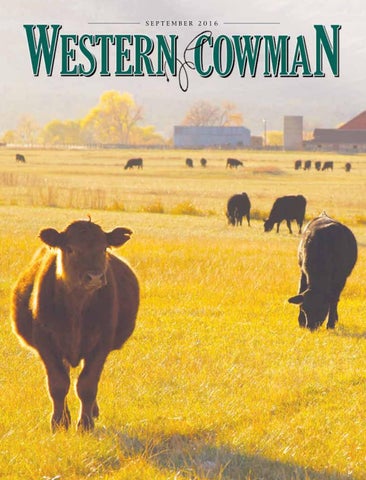
COVER
“Getting Settled.” By Sherry Danekas
Cost, Cost, Cost... By Wes Ishmael
6
Western Cowman
-
50
S e p t e m b e r 2 0 1 6
“Awaiting Autumn.”
52
66
BUSINESS&ADVERTISING
Editor
Sherry Danekas sherry@jdaonline.com
Associate Editor
Mercedes Danekas-Lohse mercedes@jdaonline.com
Advertising
Mercedes Danekas-Lohse (916) 837-1432 (916) 685-8980
Graphic Artist
Circulation
Hannah Ballard hannah@jdaonline.com Morgan Fryer morgan@jdaonline.com
Mailing Address P.O. Box 8629, Woodland, CA 95776 Office Phone P (530) 668-1224 National Sales Representative. THE POWELL GROUP, INC. 4162-B Carmichael Court Montgomery, AL 36106 (334) 271-6100 Attn: Davy Taff
Website www.westerncowman.com
Western Cowman, is owned and published monthly except May/June and July/ August combined by James Danekas & Associates, Inc., P.O. Box 8629, Woodland, CA 95776. Subscriptions are $20.00 per year. Presort Standard U.S. Postage Paid: Tucson, Arizona. Address corrections requested. contributing writers: Sherry Danekas, Heather Smith-Thomas, Kindra Gordon, KayDee Gilkey, Tierra Kessler, and Wes Ishmael.
TR AILS The reason most people do not recognize an opportunity when they meet it is because it usually goes around wearing overalls and looking like Hard Work. ~ Author Unknown ~ We finally got everything moved to Woodland and said a sad goodbye to Wilton as we made our last and final load. Sometimes looking like a redneck carnival caravan as we hauled our goats’ home, the bright red chicken coop and hodgepodge collection of panels, water troughs and those items that never make it on until the last load. Our trio of flatbeds received more than a few double takes on that hot Sunday afternoon as we made our way north on Interstate 5. The one big learning experience that I’m taking away from the last six weeks is that I’m never ever, ever going to move again. What a tasking experience, if I thought the house was a challenge I really wasn’t prepared for the barns and the shop. I can happily say we are beginning to settle in and finally getting the upper hand on our new normal. Our office here on the ranch is a newly renovated pump house that has three floors; the bottom floor is a kitchen, dining area and restroom. The second floor is where Morgan and I reside and the third floor is home to Mercedes and Hannah. We’re really not sure how Mercedes will be navigating that final set of stairs when she hits her ninth month of pregnancy, I’m sure it will get interesting. Speaking of interesting that’s what you’re going to find as you open the pages of this September issue where we feature the states of Colorado and Wyoming. This will be our second visit to these states and it never gets old as they both have so much to offer. Our first stop in Colorado is at the Strang Hereford and Angus Ranch where they’ve been raising Hereford and Angus bulls for the last fifty-four years; it’s a piece that I know you’ll enjoy. It never fails to capture our admiration as to how the Cattlewomen organizations in each state are so instrumental in education and promotion of our beef product, and Colorado is at the forefront. The Colorado Cattle Women’s will be marking their 75th year in 2017 and they’ve done a remarkable job in getting our message out. Everyone knows that Denver has more then it’s share of amazing restaurants, but we found one in Greeley that has been on everyone’s lips for the last thirty four years. It is Fat Albert’s and it offers up an exceptional downhome menu. This article will definitely tempt your taste buds. Winter brings with it more than just the cold weather, it’s also the time that lice become more prevalent, this is an article for all ranchers. From Colorado we travel north towards the Teton Range where the Snake River Ranch is located near Jackson Hole. This is a very noteworthy piece as it takes you through what it’s like to operate a ranch of its size so close to a tourist destination. It seems we find a lot of our iconic restaurants residing in hotels that are filled with colorful histories and “The Virginian” is no different as its backdrop is the Occidental Hotel that opened in 1880. Located in Buffalo, Wyoming the hotel and restaurant share a colorful chronicle that you’re going to enjoy. Next month we’ll take on two new states and we’re going to unveil a new voice to our Western Cowman family when we introduce Tyler Marchant with his column “Riding Drag”. Tyler hails from Idaho Falls, Idaho and we believe you’re really going to enjoy what he has to say. I’m working diligently at settling in on my new trail and enjoying our only real traffic jams that are the large number of tractors harvesting the tomatoes, sunflowers, cucumbers, peppers and almonds that surround us. My real thrill on this new trail I’m on is the views surrounding me from the Coastal Range a few miles west to the olive trees and grapevines that envelop us. I’m looking forward to watching changes in the scenery as the smell of autumn comes dancing in on the breeze. Next month we will be at the top of the fall frenzy and looking forward to Halloweens treats. For now as summer lingers on the September trail enjoy the last of the wild flowers and the warm evenings that will linger into our Indian summer. September is also going to be a busy month for California ranchers with the number of bull sales taking place each week; we want to wish each of them the best year yet. Happy Trails………………………….
September 2016 -
Western Cowman
7
8
Western Cowman
-
S e p t e m b e r 2 0 1 6
September 2016 -
Western Cowman
9
Trait
Breed Rank
CED BW WW YW MILK CW Marb RE $W $F $B
+13 +1.0 +84 +146 +40 +76 +.65 +1.66 +93.32 +125.97 +194.91
5% 1% 1% 1% 1% 1% 1% 5% 1%
Vintage Blackbird 5415 • Reg. No. 18212187
VINTAGE BLACKBIRD 6039 Reg. No. 18378633
A direct daughter of Vintage donor Blackbird 8809, the dam of “Herdsires.” Sired by Quaker Hill Rampage 0A36. Blackbird 5415 is a maternal sister to the $250,000 VAR Generation, $110,000 VAR Index, $42,000 VAR Foreman, $40,000 VAR Ranger, $95,000 VAR Commander, VAR Complete and VAR Reserve. Selling 1/2 Interest in this donor prospect. Join Vintage in writing breed history with this unique female.
A direct daughter of Blackbird 8809, the dam of herdsires. Sired by WR Journey 1X74, this beautifully made female displays her Multi-Trait Excellence with Index’s of $W top 1%, $F top 2%, $G top 1%, $QG top 5%, $YG top 2% and $Beef top 1%. Blackbird 6039 has everything it takes to be your next featured donor. Trait
Breed Rank
CED BW WW YW MILK CW Marb RE $W $F $B
+5 +2.7 +79 +140 +37 +74 +.69 +1.55 +81.05 +123.95 +198.90
1% 1% 1% 1% 1% 1% 1% 1%
Vintage Rita 5383 • Reg. No. 18212179
VINTAGE RITA 6079
A maternal sister to Rita 5383 was the $200,000 half interest female of the 2015 sale at VAR. Sired by Quaker Hill Rampage 0A36, Rita 5383 is a granddaughter of the world famous $Beef queen, DRMCTR 1I1 Rita 6108. The dam of Rita 5383 is the $100,000 valued Vintage donor SJH Complete of 6108 1564. This future Rampage donor dominates in Multi-Trait Excellence, ranking in the top 1% of the breed for 10 traits or Index’s: WW, YW RADG, Milk, CW, RE, $W, $F, $YG, and $B. Selling 1/2 interest in this dominate donor prospect.
This may be the stoutest WR Journey 1X74 female to be found. If you look for extra depth, bone and hip in your cattle then Rita 6079 is for you. The dam SJH Complete 6108 1564 has accounted for $540,000 in progeny sales in the last 12 months. Proven cow family, powerful data, outstanding phenotype, Rita 6079 has everything it takes.
Reg. No. 18378608
Breed Rank
Trait
CED BW WW YW MILK CW Marb RE $W $F $B
VINTAGE RITA 5490 • Reg. No. 18370799 A direct daughter of the carcass Queen DRMCTR 1I1 Rita 6108, sired by V A R Discovery 2240, who’s progeny has been topping sales from coast to coast. Only as a sale feature are we offering this young female who’s dam and maternal sisters have accounted for millions of dollars in progeny sales in the past few years, rivaling any cow family in the breed in popularity and demand.
10
Western Cowman
-
S e p t e m b e r 2 0 1 6
+2 +3.0 +75 +130 +35 +60 +.78 +.70 +78.27 +105.50 +174.14
1% 1% 1% 2%
1% 1% 1% Jim Coleman, Owner Doug Worthington, Manager Brad Worthington, Operations Manager 2702 Scenic Bend • Modesto, CA 95355 Office (209) 521-0537 www.vintageangusranch.com Email: vintageangus@earthlink.net
JOIN US OCTOBER 9TH IN MODESTO!
VINTAGE QUEENIE 6168
VINTAGE BLACKCAP 6024
Future power cow here. Sired by Quaker Hill Rampage, Henrietta Pride 6101 had four maternal sisters sell in the 2015 sale at VAR for an average price of $31,250 each. Her dam was a $42,500 half interest donor to Stratford in Kansas. Her grandam is the famous 643T the full sister to Sitz Upward. If you want cattle that can reproduce power and quality you have found the right family in 6101.
The Queenie cow family set the spring sale season on fire dominating the top of the charts for $Beef. The dam Queenie Y120 has been proclaimed the best producing daughter by all that have seen her. Join Vintage in exploring the next generation of this new family with Queenie 6168, a VAR Discovery daughter that is better than her famous dam for all these traits: WW, YW, RADG, SC, DOC, HP, Milk, Marb, Fat, $W, $F, $G, and $QG.
These VAR Foreman 3339 calves are fantastic and Blackcap 6024 is a standout in the best calf crop ever at Vintage Angus. A maternal sister to Blackcap 6024 was the $100,000 selection of Express Ranches in the 2015 sale at VAR. Sound, deep, easy-fleshing and attractive all describe this future donor. Also selling will be her outstanding dam and Vintage donor Blackcap 1752.
VINTAGE RITA 5011
VINTAGE CHLOE 5389
VINTAGE BLACKBIRD 5381
This VAR Discovery bred heifer is a flush mate to the $200,000 half interest female, VAR Rita 5063, top selling female of the 2015 VAR sale. Her dam the $100,000 Vintage donor SJH Complete of 6108 1564. Rita 5011 is bred and ready to calve and start flushing in the spring, so you can begin building your own Rita 6108 family. Sells bred to calve 2/26/17 to Quaker Hill Rampage.
Sired by ABS Herdsire Quaker Hill Rampage. Vintage Chloe 5389 represents the next generation of Chloe’s here at Vintage with a top 1% $Beef, a top 1% WW, a top 1% YW, a top 1% CW, a top 1% RE, and a top 1% $Feed. Powerful data and outstanding cow type in this fall yearling will make her a logical addition to any herd.
A direct daughter of last year’s selling cow VAR Blackbird 2189 the $150.000 half interest Complete daughter of Blackbird 8809 the dam of “Herdsires.” This fall yearling will be one of the best made Quaker Hill Rampage daughters to be offered in 2016. Big time big spread donor prospect from the all time top income cow family at Vintage, the hunt for your next donor is over.
44 BLACKCAP 1752
QUAKER HILL BLACKCAP 0A35
SJH COMPLETE OF 6108 2570
Proven producer best describes Blackcap 1752. In the 2015 sale at Vintage a VAR Discovery daughter of 1752 commanded a bid of $100,000 as the top selling fall yearling going to Express Ranch. In the 2016 sale Blackcap 1752 will be accompanied by two daughters of VAR Foreman 3339, that will be a crowd favorite. Blackcap 1752 is due to calve 10/1/2016 to VAR Rancher 4412 and will be fresh to start flushing in your program.
Selling full interest in the full sister to the hottest bull in the breed today, Quaker Hill Rampage. A flush sister to Blackcap 0A35 recently sold private treaty for more than $500,000 to High Roller Angus in Texas. October 9th will be your opportunity to take home one of the featured females in the breed today. Sell’s due to calve 2/23/2017 to WR Journey 1X74.
A proven Vintage donor here. 2570 is a full sister to SJH Complete of 6108 1564 the donor responsible for the top selling female at VAR in 2015. Another full sister sold half interest for $175,000 at Deer Valley in 2015 and a bred heifer from her went on to sell for $115,000 while three sons of her’s dominated EXAR bull sales at $210,000, $100,000 and $116,000 for 1/2 interest in EXAR stud. Sells bred to calve 3/20/2017 to VAR Discovery 2240.
VINTAGE HENRIETTA PRIDE 6101 Reg. No. 18380211
Reg. No. 18066032
Reg. No. 17007357
Reg. No. 18407861
Reg. No. 18212151
Reg. No. 16925770
Reg. No. 18376058
Reg. No. 18212159
Reg. No. 17322755
S e p tVintage ember 2016 W e sBook tern Cowman Call, Email or Visit us Online to Receive Your Sale
11
11 22 WWees stteerrnn CCoowwmmaann
- - SSe ep ptte emmbbe err 2200116 6
C
attle must be rugged and easy fleshing to survive the sub-zero winter temperatures at Strang Herefords & Black Angus in Meeker, Colorado. These cattle are known for their ability to thrive in a tough environment and to adapt to all other climates, as well. For 54 years, the Strangs have been producing cattle that fit these parameters for the commercial producer. Their bulls have gone into a variety of environments and have been successfully tested in 17 states and Alberta, Canada. Strang Herefords was founded by Bart and Mary Strang in 1962 with 10 registered Hereford heifers. Bart, a true breeder of livestock, paid close attention to the direction of the Hereford breed and utilized its genetic improvements to build a productive, line-bred cow herd. His life’s work continues to be the basis for today’s Strang Hereford program. Outcross genetics on these foundation cows, are delivering high performing bulls and replacement females with smaller birth weights, in-
Mary Strang September 2016 -
Western Cowman
13
Bart Strang (6/7/1928 - 12/3/2009)
creased maternal and carcass traits. Fertility, structural correctness, thickness and muscle, good udders with small teats, easy fleshing ability, eye pigment and low PAP (Pulmonary Arterial Pressure) are primary to this time tested program of 125 females. Strang Hereford bulls go into baldy, straight Hereford, and terminal cross programs. The purpose of PAP testing is to avoid brisket disease at high altitudes. While it is not an exact science, it is the only tool the industry has for producers who graze at extremely high elevations. Many Strang customers graze their cattle at elevations over 10,000 feet. While the Strang herd is not run in an excessively high altitude, Dr. Tim Holt, DVM, confirms that their 6,500-foot elevation is plenty high enough to generate meaningful PAP scores for their customers. In 1991, twenty-five foundation Black Angus cows were added. Adding this breed was a natural choice. Like Herefords, Angus can be marketed as a straight-bred, are the foundation for many crossbreeding programs and, make an 14
Western Cowman
-
Bulls on the Strang Herefords and Black Angus ranch.
excellent cross with Herefords. Strang Black Angus has been a closed herd and line-bred with known low PAP (Pulmonary Arterial Pressure) genetics to ensure predictable PAP scores. Generally, Angus are more predisposed to a higher PAP than Herefords. The consistency of low PAP in this herd can be attributed to genetics and a selection process through 25 years of PAP testing. The Strangs’ line-bred Angus herd provides their customers with significant hybrid vigor. The cattle, like Strang Herefords, are bred for fertility, easy fleshing ability, muscle and structure correctness along with strong maternal traits. Today the 60 head cowherd is stouter with increased capacity. They are three dimensional, have greater longevity and resilient to the White River Valley’s harsh winters. The down side of a closed herd is that EPDs become flat and do not reflect the herd’s proven ability to perform. Today, Mary’s daughter Lisa and her husband, Tom Walsh and family, are on the ranch
S e p t e m b e r 2 0 1 6
with her. This family operation strives to meet commercial producers’ needs with consistent, predictable bulls that have a balance of economically important traits - fertility being the most important. “We want our breeding programs to produce cattle which will work for the commercial producer,” Mary says. “Although we don’t advertise herd bulls, purebred breeders can find what they’re looking for as well.” Visitors are welcome at any time. Additionally, the Strang family invites you to join them on Tuesday, October 18th, as they will host the 37th Strang Herefords & Black Angus Annual Sale of High Altitude PAP tested Herefords and Angus. The sale will feature 65 Angus and Hereford coming two-yearold bulls. Private treaty Hereford and Angus bred heifers will also be available. The sale will be broadcast on LiveAuctionsTV. For further information please call (800) 351-5362 or email strangherefords@gmail. com and visit www.strangherefords.com.
rward We Look Fo u in o y g n i e e S o t ! Idaho Falls
Riverbend Ranch GENETIC EDGE FEMALE SALE
October 15, 2016
Selling 300 Head from the Breed’s Top Families RITA 9Q15 OF 5F56 GHM 16408440
Sire: Gardens Highmark Dam: Rita 5F56 of 1I98 FD CED +6, BW +.9, WW +47, YW +89 Milk +22, CW +45, MB +1.31 RE +1.56, Fat +.030, $W +45.45 $F +61.85, $G +61.13, $B +174.84 Selling choice in three heifer pregnancies from the $140,000 new addition to the Riverbend Ranch donor program, Rita 9Q15. These choice pregnancies are sired by the proven growth sire, Discovery, the $100,000 Index and the multi-trait sire, Generation 2100. Rita 9Q15 is a direct daughter of the herd sire producer, Rita 5F56 and a full sister to the longtime REA and $B leader, Rito 9Q13. A special opportunity from the Riverbend embryo program!
RIVERBEND BLACKCAP Z721 17312409
RIVERBEND LUCY C709 18126372
Sire: Summitcrest Complete 1P55 • Dam: Rita 2811 of 2536 BVND 878
Sire: Baldridge Waylon W34 • Dam: Basin Lucy S161
CED +6, BW +1.0, WW +51, YW +92, Milk +37, CW +39, MB +.75 RE +.85, Fat +.009, $W +60.37, $F +62.62, $G +44.23, $B +146.26
CED -6, BW +2.5, WW +63, YW +110, Milk +30, CW +64, MB +.53 RE +.96, Fat -.057, $W +62.95, $F +74.43, $G +40.45, $B +170.01 Selling half interest in this sensational daughter of the now-deceased Riverbend Ranch donor, Lucy S161 sired by the proven MB and $B sire, Waylon. Lucy C709 is one of the top bred heifers ever offered at Riverbend Ranch and she was produced by the powerful full sister to the growth and CW leaders, Payweight 006S and Payweight 107S. Lucy C709 sells due January 27, 2017 to VAR Generation 2100.
This direct daughter of the $330,000 valued Riverbend Ranch donor, Rita 2811 sired by the REA leader, Complete sells as a special headliner of the Blackcap family. Blackcap Z721 post s a BR 1@99 and a WR 1@101 while selling due January 30, 2017 to WR Journey-1X74.
2880 N 55 W • Idaho Falls, Idaho 83402 • 208-528-6635 www.riverbendranch.us
SALE MANAGED BY:
Steve Harrison, General Manager • 208-681-9815 Dale Meek, Purebred Operations Manager • 208-681-9840 Chris Howell, Director of Customer Service • 208-681-9821
517-546-6374
bulls@riverbendranch.us
Bid Online: DISH Network 231
S e p t e m b e rDIRECTV 2 0 1 6345 -
Western Cowman
15
16
Western Cowman
-
S e p t e m b e r 2 0 1 6
September 2016 -
Western Cowman
17
I
n June, the new slate of officers were elected for the Colorado CattleWomen. The new president is Heather Stinnett, a rancher from Burlington, Colorado. She is a sixth generation Colorado rancher and a second generation Colorado CattleWomen. She has served as different roles in both the local and state organizations. The Colorado CattleWomen has approximately 600 members from around the state and is one of the nation’s largest state CattleWomen organization. The state is divided up into four quadrants and there are a total of 35 local CattleWomen groups that make up the membership of the state organization. In 2017, the
18
Western Cowman
-
CCW will celebrate its 75th year as a Colorado beef industry membership organization. They have a strong partnership with the Colorado Beef Council and receive beef checkoff funds for promotion and education projects. Their legislative activities are supported by their membership dues. Stinnett said, “We have several events throughout the year that our fabulous members spend hundreds of hours volunteering their time and talent promoting beef and educating consumers.” Each January the CCW’s year begins 16 with days at the National Western Stock Show in Denver. They assist the Colorado Beef Council in
S e p t e m b e r 2 0 1 6
their booth promoting beef and educating the public about issues like antibiotics, how beef is raised as well as providing recipes. “This is one of our biggest opportunities to promote beef. The Stock Show provides a lot of exposure to urban folks that many of us from rural parts of the state don’t usually have that kind of interaction,” explained Stinnett. In addition to volunteering at the event, the CCW also has their mid-year meeting during the Stock Show. During Colorado Agricultural industry’s annual Legislative Day at the state capitol in March, the CattleWomen are there to helping both the legislators and their staff begin their busy day with beef breakfast burritos. “We take this opportunity to thank our legislators for their service and visit about the issues important to our industry,” said Stinnett. In addition to the beef industry, more than 40 ag organizations join in the day’s festivities which also features the teaming up of local chefs and lawmakers in a cook-off competition using Colorado ag products. Each year, a check is given to the Colorado’s Food Bank of the Rockies demonstrating the ag community’s support for their state’s food banks. In 2015, the total value of Colorado ag products donated by the state’s five food banks amounted to about $15 million. During the Colorado State Fair in late August, the CattleWomen sponsor a cook-off where mothersons teams compete against fatherdaughter teams to see who will win the honor of the best beef recipe. This event is supported by the Colorado Beef Council and the beef checkoff. “This is one of our biggest events of the year for the Colorado CattleWomen. We are again able to directly engage with consumers. The teams love competing and showcasing great beef recipes,” Stinnett explained. In the fall, the CattleWomen participate with support from the Colorado Beef Council in two big food and gift shows in Denver and
Colorado Springs. “During both events, we hand out tasty beef samples from recipes we are sharing with attendees. It provides us with great opportunities to again engage in conversation with consumers not only about nutritious beef but also discuss some of the other industry’s issues,” said Stinnett. A new program that the CCW have just recently began getting involved in called AgFest and happens in eastern part of the state. This is a partnership with Cooperative Extension and provides hands-on education for elementary students. AgFest has 10 different stations, each providing a 10 minute educational hands-on activity that helps students to learn different commodities and sectors of the state’s ag industry. This fall will be the first year that the beef industry has been involved. The CCW in conjunction with the Colorado Beef Council is busy now developing the new station which will have puzzle project for students promoting the many uses of a cow. “It is a traveling road show, we go to the students at multiple schools. Last year for example, they gave eight different presenta-
tions and impacted more than 2,200 students,” Stinnett said. “This is a wonderful opportunity to get out the positive message about beef as well as other ag commodities to our youth.” One of the challenges the CCW faces — no different than many agricultural and volunteer organizations face — is declining membership and less volunteer hours available from current members. “Today, women have even less time to give to activities outside of their busy family activities. We are trying to provide many different options of involvement for our members. Many don’t have days away from home to give us, but they may be able to do something closer to home from time to time,” Stinnett said. “Growing up I watched my mother volunteer for our both our local CattleWomen’s group as well as the state organization. It helped me to realize the value of volunteering and promoting our ranch’s product — beef. I hope I’m modeling that to my children.” The CCW has some very talented women who help with both their Facebook page and their website www.coloradocattlewomen.org. If you are not following them on
Facebook you should — regardless of where you live. They regularly post educational information, glimpses of members’ ranches as well gorgeous scenery from around the state. “Being active on social media is important. We know we need to reach the different generations and having a presence on Facebook, helps us to engage with the Millennial consumer,” Stinnett said. Although the organization would welcome more members, Stinnett praises the talents and commitment of the current members of the Colorado CattleWomen — from the individual members to the local groups that cover the entire state. “We do our best to recognize our members and their amazing service and time given on behalf of the CattleWomen,” she said. Stinnett added, “Our members’ dedication to our organization and to the beef industry is amazing and makes us the vibrant and successful organization that we are today. Throughout our state we have members who are passionate about our industry and the role we play in educating, promoting and protecting the beef industry in Colorado.”
September 2016 -
Western Cowman
19
L
Fat Albert’s serves up award-winning fare.
ocated just an hour north of Denver, Greeley is often known for being equal parts cow town and college town. It is home to the University of Northern Colorado and has several cattle feedlots, as well as the JBS packing facility, in the vicinity. So for those who find themselves in the area, it’s also worth a visit to Fat Albert’s – a family owned diner with a down home menu and atmosphere. The restaurant has been in business for 34 years in the same location, and the food here is so stellar in 2014 Fat Albert’s was named one of the 11 best Colorado restaurants outside of Denver by Thrillist.com. Sue and Roger Albert opened the restaurant on March 1, 1982. The couple had met at college in Greeley and after graduating and marrying did a couple other things but eventually decided to open the restaurant. Roger’s college buddies had given him the nickname “Fat Albert,” and Sue says when they were looking for a fun name for the restaurant it just seemed to fit.
20
Western Cowman
-
Roger passed away 10 years ago, but Sue and their two sons have kept Fat Albert’s going. In fact, on the July morning that she visited with Western Cowman she was in the kitchen making homemade blueberry pies. Older son Christopher currently has a restaurant in Denver, while son John works with Sue in Greeley. Homemade Heaven Sue is proud to say that everything in the restaurant is made from scratch and she designed the menu, which includes a variety of sandwiches, salads, homemade soups and award winning desserts. And, the restaurant features a full bar. Their signature item has been the Monte Cristo sandwich – which features a crisp twist. Sue explains that she always found Monte Cristo’s to be on the soggy side – akin to French toast. But long ago it was suggested to her to use the tempura that is used for fried veggies and use that to batter the Monte Cristo. That made the sandwich
S e p t e m b e r 2 0 1 6
into magic! Fat Albert’s Monte Cristo features layers of thinly sliced ham, turkey and Swiss cheese on fresh bread. It is cut into 4 triangular pieces and dipped in tempura batter and deep fried to a golden brown and served with a side of honey. Sue says it’s also great with raspberry jam. Some of the other tempting menu items include: the French Hen made with garlic bread, melted cheddar and Monterey Jack, deep-fried chicken strips, tomato, and hollandaise sauce; the Reuben with lean corned beef, Swiss cheese, sauerkraut and Thousand Island dressing on grilled dark rye and the Avocado Club Melt – a triple-decker sandwich on sourdough bread combining Swiss, cheddar, avocado, fresh mushrooms, bacon, turkey, sour cream, lettuce and tomato. Sue notes that they also have a unique veal liver entrée, which
is “loved by the older clients.” She adds, “We don’t sell a bunch of it, but if I took it off the menu, I’d be in trouble.” Given that Fat Albert’s originally opened in March, they held their grand opening on St. Patrick’s Day. Every year since then they hold a big celebration each March and feature corned beef for the two weeks prior to St. Patrick’s Day. They also have an annual Fat Albert’s St. Patrick’s Day t-shirt, which is different each year and has become something of a collector’s item. Because patrons enjoy the restaurants corned beef so much, on the 17th of every month corned beef and cabbage with Irish potatoes, as well as green beer and Irish coffee drink specials are featured. Local Culture Sue says the restaurant business has been a fun adventure. During their early years, she says they even had a visit from John Elway. “He was just a baby back then,” she says, noting the many years that have gone by. In the late 80’s the Broncos training camp was in Greeley so some of the coaches and Broncos staff would frequent the restaurant. Of the challenges of the restaurant business, Sue says it is typically staffing. She notes that the employment market is always changing. But she calls it a blessing to be in a college town as there are often students who seek part-time employment during their college years. Looking forward, she is excited to continue serving up great homemade food and keeping customers happy. She notes that the “foodie trend” over the last few years has brought many customers “off the beaten path” to find Fat Albert’s. She concludes, “The Internet and people seeking ‘Mom and Pop’ places to eat when they travel, has been good for us.” Learn more and see the menu at fat-alberts.com.
O n T he H orizon
Special Calf & Yearling Sale
Tuesday September 13th 1 PM
14th Annual October Fest Calf & Yearling Sale Saturday October 22nd 1PM
Weekly Sale
Every Tuesday
MONTE BRUCK, Manager
775/867-2020 September 2016 -
Western Cowman
21
22
Western Cowman
-
S e p t e m b e r 2 0 1 6
PW GILLBRAND CATTLE COMPANY Quality Bulls to Compliment Any Breeding Program
5T RED BULL TARGET 15011 REG# P43631574 DOB: 08/27/2015 BW: 92 Starting Weight: 935 Ending Weight: 1220 ADG: 2.94 Adj. Yr Weight: 1242 Test Index: 103.9
CED
BW
WW
YW
Milk
REA
Marb
BMI
CHB
+5.1
+2.6
+65
+109
+22
+0.48
+0.15
+$25
+$35
CHURCHILL DOMINO 5339C REG# 43631812 DOB: 08/18/2015 BW: 80 Starting Weight: 882 Ending Weight: 1183 ADG: 3.10 Adj. Yr Weight: 1176 Test Index: 103.4
CED
BW
WW
YW
Milk
REA
Marb
BMI
CHB
+1.7
+2.8
+63
+101
+34
+0.55
+0.19
+$20
+$34
CHURCHILL STUD 5312C REG# P43631787 CED
BW
WW
YW
Milk
REA
Marb
BMI
CHB
+0.2
+3.3
+62
+101
+26
+0.54
+0.15
+$20
+$31
DOB: 08/12/2015 ADG: 3.41
5T BONANZA APACHE 15014
BW: 80 Adj. Yr Weight: 1178
REG# P43631578
Starting Weight: 872 Test Index: 108.5
Ending Weight: 1203
GCC KNIGHT GILLIBRAND 15015 REG# 43631563
CED
BW
WW
YW
Milk
REA
Marb
BMI
CHB
CED
BW
WW
YW
Milk
REA
Marb
BMI
CHB
+5.6
-1.9
+41
+69
+25
+0.15
+0.29
+$24
+$24
+5.3
+0.1
+57
+92
+26
+0.56
+0.19
+$24
+$31
DWIGHT JOOS
Ranch Manager • (805) 428-9781 Simi Valley, California • PWGCattle.com September 2016 -
Western Cowman
23
6 0 t h C a l P o ly B u l l T e s t
24
Western Cowman
-
S e p t e m b e r 2 0 1 6
6 0 t h C a l P o ly B u l l T e s t
dob: 08/27/2015
September 2016 -
Western Cowman
25
L
ice are a common winter problem in cattle. Summer heat, sunlight, and short hair make it more difficult for lice to survive and multiply; their numbers increase dramatically when weather is cold and they have long winter hair to hide in. With short summer hair, cattle can more readily pull off lice with their rough tongue. Sucking lice (that feed on blood) and chewing lice (that feed on skin) can both be a problem for cattle. They are generally present on the animal year-round, but numbers increase dramatically during cold weather. Julie Walker, Beef Specialist, South Dakota State University, says lice can usually be found along the back and topline, and if an animal has lice there’s generally some hair rubbed off because of the continual itching. “Generally we don’t notice that a cow has lice until we see the rubbing, and areas of hair missing,” she says. Sonja Swiger, PhD (Livestock/Veterinary Entomologist, Texas A&M) says lice are spread from one animal to another by direct contact. “If you buy new cattle, we highly recommend that you quarantine those animals until you know whether or not they have lice, before you add them to your herd. You can check them for lice, or quarantine and treat them, then wait a couple weeks and treat them again—to make sure you get any new lice that may have hatched after you treated.” The eggs are not killed by treatment (with most products) and there will be lice hatching afterward, to re-infest that animal. “Many people don’t take the time to quarantine and treat, but it’s so much easier (and less costly) to treat just a few animals than to have to do the whole herd if they become exposed to the new ones with lice,” says Swiger. Cattle readily share lice when confined and in close contact with one another, or with fenceline contact. “They often share lice in winter when they are more confined for feeding, or transmit from one animal to another by contact. There are two kinds of lice—sucking lice with neighboring cattle nose to nose through a and biting/chewing lice. The sucking lice feed fence,” she says. on blood, and high numbers of these parasites Adult lice don’t live very long apart from the host, and in cold weather the eggs on the hairs can make cattle anemic, weak, and vulnerable to don’t last long, so the main way lice are spread disease. Several species of sucking lice infest catis by direct contact, rather than by coming in tle including the short-nosed louse, long-nosed contact with hair that was rubbed off on a fence louse, little blue louse and tail louse. There is only one species of chewing louse, or feeder. In winter, however, cattle are often closely congregated for feeding, so there’s more but most cattle are infested with this one, which opportunity for spread of lice via body contact. causes a lot of irritation and misery; the cattle If weather is changeable, like cold days followed rub on anything and everything and are conby warm days, lice tend to come out farther on stantly licking at themselves trying to get rid of the hair on the warmer days, so they are easier to these itchy critters. High | Continued on page 28
26
Western Cowman
-
S e p t e m b e r 2 0 1 6
Without a pedigree, she’s just another cow. With pedigree and DNA, she’s an American Akaushi.
Her “Certificate of Registration” is assurance for superior genetics authenticated and fully confirmed by DNA verification. Now that’s more than just another piece of paper. She’s not alone. Every breeding and terminal animal entered in The American Akaushi Association registry database must be DNA verified. No exceptions. She helps you and the breed. Successful bloodlines set her apart as do proven performance programs, research, marketing and other progressive services offered by the American Akaushi Association. We know, so you’ll know. She is American Akaushi.
Nature’s Healthy Beef ®
Member Since 2009 National Assn. Animal Breeders (NAAB) National Pedigreed Livestock Council (NPLC)
For Information: Bubba Bain, Executive Director 830/540-3912 • www.Akaushi.com 5th Annual Convention 10/28-30 Lubbock,Texas September 2016 -
Western Cowman
27
numbers of chewing lice can disrupt feeding because the cattle are so intent on trying to get rid of the itch. They may rub out large patches of hair, which can be detrimental in winter when they need a good hair coat for insulation against the cold, and may rub some areas raw. If cattle are constantly rubbing they are also hard on fences, buildings and other facilities. “If you see an animal itching and scratching a lot, check for lice. If you can hit the source early, and treat those animals, you may prevent a major lice outbreak in the herd,” Swiger says.
Continued from page 25 |
TREATMENT Treating for lice is not easy; the cattle generally need to be confined for spraying or put through a chute to administer a pour-on or injectable product. “If you spray, cattle need to be heavily doused, all over their bodies,” says Swiger. “You have to treat them again 2 weeks later, to get the ones that hatched afterward—to make sure there are no adults left to lay any new eggs. These methods work; it just takes some effort.” Most products do not kill the eggs, and many people fail to do the second treatment--and then wonder why the cattle have lice again later in the winter. “The producer blames the product and thinks it’s not effective, and may try another product,
28
Western Cowman
-
but the problem occurred because they didn’t use the first product properly,” says Swiger. Sometimes cattle do become readily re-infested, and the products we use don’t seem to be as effective as they were in earlier years. In some instances the lice become resistant to the product being used and it is not as effective in killing them all. “Many people still are not aware that there are different classes of insecticides and that we need to change occasionally, to make sure the parasites do not become resistant to the ones we are using,” she says. Walker says there are some precautions when using more than one insecticide, such as pouring the cattle and also having a dust bag out for them to use. “Make sure that both products are in the same family of insecticides. You can rotate the class (family) of insecticides, but do it after you finish with one, like changing to a different one the next year; don’t use both of them together.” Then the lice won’t become resistant to all of these products so quickly. “One of the problems we’re running into nowadays is that we don’t have all the classes we once used,” says Swiger. “We are losing a lot of our organophosphate products (taken off the market) and we only have the pyrethroids and the avermectins.” “Here in Texas where our cli-
S e p t e m b e r 2 0 1 6
mate is warmer we don’t see a huge number of lice (since they reproduce more readily on the host animal in cold temperatures), but in other states where people have to treat more often, it’s wise to not use the same product over and over.” Every few years a person should change to a different class of insecticide. The avermectin products that work systemically (including ivermectin or its generic forms, moxydectin, doramectin or epriomectin) are macrocyclic lactones. These kill internal and external parasites. They are good at killing sucking lice (any parasite that feeds on blood will be killed) but not so good at killing the chewing/biting lice that feed on skin rather than blood. Chewing lice won’t be affected at all by an injectable product, nor totally eliminated by a pour-on avermectin product that doesn’t spread through the hair over most of the body. “Even though a lot of people don’t use the dust bags, sprays and back rubbers anymore, those still work great for killing chewing lice. The dusts, sprays and oilbased products stay in the hair and when the lice crawl through the hair they come into contact with the insecticide, and are killed,” explains Swiger. Walker says dust bags work best if placed where animals have to go through a gateway, such as toward a water source. “Dust bags and/or back rubbers typically need to be re
charged periodically, but sometimes producers put them out there and forget about them. These need to be monitored to make sure they are still working. These methods probably don’t kill all the lice; they mainly suppress them. Their numbers are less, so they are more tolerable for the animals,” she says. “Pour-on products are probably the most popular control method due to ease of application and reduced stress for the animals (compared to spraying them in cold weather),” says Walker. “With a pour-on you can give each animal the proper dose for size/body weight, and every animal gets treated. A person needs to follow label directions and adjust the dose, based on size.” Also follow label directions for retreatment. “Some producers choose not to give a second treatment, thinking the lice are under control after one treatment—and only re-treat if they see evidence of more problems. One treatment may knock the lice back for a certain period of time, but then the lice reinfest the animal,” says Walker. For late winter treatments, the choice of product will vary depending on the situation. “One of our concerns is how to handle the late winter populations of lice,” says Greg Johnson, DVM (Veterinary Entomologist at Montana State University). He suggests that if producers are going to do something about lice, they should do it
before calving so the cows won’t pass lice to their calves. “Producers can use one of the avermectins if they have leftover product to use up or use a pyrethroid. I recommend using a synergized pyrethroid pour-on (such as Ultra Boss, Synergized DeLice, Ultra Saber or other trade names) which contains a pyrethroid plus the synergist piperonyl butoxide. The synergist is not toxic to lice but extends the lethal activity of the pyrethroid. The pyrethroid insecticides are not systemic (they doesn’t kill internal parasites); they kill external parasites like adult and immature lice on contact. According to the label, these pyrethroid products should be applied twice, in order to get the lice that hatch out from eggs after the first treatment. None of them kill the eggs,” Johnson says. “The only product I am aware of that will control adults, immature lice and the eggs is called Clean-Up II. It contains permethrin (a pyrethroid) plus it has diflubenzuron which is an insect growth regulator. I recommend this product fairly often to producers. Since it’s a single application, this is much handier for producers since it can be difficult to treat the animals twice during the winter,” he says. “Issues with lice include lower feed efficiency and lower weight gain; we’re not concerned so much about milk production in fall and winter, unless the cows are fall calving,” says Walker. Then lice could be a bigger problem. Losses from lice are hard to measure; you don’t know how much time the animals are rubbing instead of eating. “You have to think about the life cycle. A female adult lays several eggs per day, attaching them to hairs. Adults live about 35 days. The eggs incubate for 4 to 15 days and then hatch. The immature lice soon become adults. Time from egg hatch to adults is about 3 to 4 weeks. You want to make sure that you kill the newly hatched eggs as well as the adults, to eliminate the lice. It is difficult to completely eliminate them; we try to get them down to a man-
ageable number that doesn’t impact the cattle,” Walker says Timing of treatment is difficult. If you treat too early, surviving lice rebuild population to a large number. Wait too long and the animals can lose performance due to heavy lice infestation. Walker recommends treating in October or November, since this offers less time for rebuilding a high population which would require retreatment. If cattle become heavily infested by mid-winter, the lice are taking a toll on them when they can least afford the drain on their energy—and they are rubbing their hair out when temperatures might be sub-zero! Lice are not considered a problem in summer, but some survive and their population increases again in winter. “They can’t live more than a few hours away from the host, and they don’t reproduce very well in hot weather. But some persist during summer on a few ‘reservoir animals’—which are usually older animals,” says Walker. In summer, there is more heat on the animal’s back, and lice tend to leave that area. Lice are very sensitive to high temperatures. Lethal limit for adults and eggs is around 104 degrees Fahrenheit, and the back of an animal in full sunlight gets warmer than that. Lice | Continued on page 32
September 2016 -
Western Cowman
29
30
Western Cowman
-
S e p t e m b e r 2 0 1 6
September 2016 -
Western Cowman
31
Continued from page 29 | tend to retreat to cooler places on the animal. Studies of summer distribution of lice on cattle (done many years ago in Nebraska), checked for lice on cattle hides at slaughter and found lice present on cattle even in summer.
SOME CATTLE ACT AS CARRIERS A carrier is usually an older cow that always harbors an unusually high number of lice. These cows don’t develop resistance like the other cattle, and their lice are not killed as readily by treatments. Some lice on a carrier go ahead and lay eggs before they die. Also, the cow is carrying so many that the treatment does not kill them all. There is swift re-infestation on that animal, and she serves as a source of lice to reinfest the rest of the herd. There are often a few individual animals in a herd that seem more susceptible to lice and have higher numbers. “According to the research I’ve seen, there’s no good way to tell which animals might be carriers. Some have an immune system that’s not quite as strong, or there’s just something about that animal that makes them a preferred host,” says Swiger. “If after a while you recognize that you have an animal that continually gets lice, it might be worth culling that animal from the herd.
32
Western Cowman
-
She continually spreads lice to the others and you can never get rid of them. She is probably costing you more in the long run than if you remove her. She will always infest all her calves, and any animals she or they come into contact with.” If you have even just one carrier animal, lice can spread through a herd very quickly during cold weather if the cattle are confined, and they may share lice even in summer when they are bunched trying to find shade. If ranchers don’t cull carriers, the lice population in the herd can build up again after treatment, necessitating further treatments through winter. A survey done in 1994 on cattle in North Dakota, Wyoming and Nebraska showed some ranchers were giving as many as 5 treatments for lice during winter, which means the treatment was ineffective. This could be due to the presence of carrier animals, or partly due to the type of treatment being used. For instance, ivermectin injectable products only kill sucking lice, but not chewing lice. TREATMENT FAILURES Russ Daly, DVM (Extension Veterinarian/Professor, South Dakota State University) says cattle lice have not been a topic of recent research. “Relative to other issues, lice control is not an area that people are looking into. We see many issues with lice, and here on the northern plains we see good years and bad years. We commonly observe treatment failures, sparking the question of whether lice are becoming resistant to the products we are using. We don’t have a good answer to that question, but there are years that we have a lot of problems in late winter—in cows that had been previously treated for lice,” he says. “We remind producers and veterinarians that even though some current products work pretty well, their effectiveness doesn’t last. They need to be used properly, and timing of use is important. Proper timing is sometimes not handy for producers; often the cattle are treated for lice in the fall when the cows are being vac-
S e p t e m b e r 2 0 1 6
cinated and preg-checked and this may be too early for optimum lice treatment,” he explains. In many instances the cattle need to be re-treated in late winter but producers may or may not have a chance to do that. There are many different kinds of cattle operations, with different needs and capabilities for handling/treating cattle at that time of year. In severe infestation it might be necessary to re-treat animals. The eggs that have already been laid are resistant to the effects of most chemicals and will go ahead and hatch after treatment. “The life cycle is 3 to 4 weeks from egg to egg, and even though we hopefully have products that would last that long (and still be active by the time the previously laid eggs hatch, to kill the new emerging lice), in some cases we need to retreat. This is important if we want good control, especially in purebred cattle going to sales, where the stakes are higher and appearances are important. If there is any hint of infestation, you might want to put on the calendar to do another treatment in 3 to 4 weeks, depending on the label instructions,” says Daly. This will kill the next batch of lice that hatch out later. “In many instances we are asking a lot from these products, to have them last as long as we want them to. Most of them won’t last from preg-check time in the fall all the way through the winter. When we have lice pop up again in herds, it may be more related to timing than to failure of the product,” he says.
September 14th ~ Coeur d’ Alene, Idaho
Only the Finest!
An array of elite Wagyu genetic packages 6PM Cocktails & Bites ~ 6:30PM Auction ~ 7:15PM Cocktails, Bites & Socializing
During the A.W.A. Convention Sale Highlights Include: Pick of a Heifer Calf from the Bar R Cattle Company 2016 Spring Calf Crop Semen from the First Ever Black Full Blood Polled Bull Pick of Flushmates from Lucky 7 Cattle Ranch’s Famed “L7 504A” Dam
Rare Black and Red Genetic Packages and Much More! Consignments From Crescent Harbor, Delta Wagyu, Bar R Cattle Co., Lucky 7 Cattle Ranch, Legendary Akaushi Genetics, Buck Mountain Cattle Co., Kay Ranch, Rocky Mountain Wagyu, Ultimate Kobe Beef, Muddy Flats Cattle Co., Tennessee Wagyu, Bar V Wagyu, Platinum Wagyu, UKB & Many More!
LiveAuctions. TV Live on the Internet, Live Audio, Video Bidding
For Details & The Catalog www.jdaonline.com September 2016 -
Western Cowman
33
2 0 1 6 C AL I F O R N I A STATE F A I R
34
Western Cowman
-
S e p t e m b e r 2 0 1 6
2 0 1 6 C AL I F O R N I A STATE F A I R
Supreme Champion & Champion Hereford
RESERVE Supreme Champion Bull
JUNIOR SHOW RES CHAMPION AOB BULL & OPEN SHOW RES CHAMPION RED ANGUS BULL
ROYCE’S DUN RIGHT 44 Reg# 1670767
CED+9 BW-3.1 WW+64 YW+107 Milk+22 Marb+0.95 CW+29
September 2016 -
Western Cowman
35
T
his ranch is the largest cattle operation in Teton County, Wyoming, located near Jackson Hole. It was started in 1929 as a typical cowcalf operation that put up hay all summer. Like all the other ranches of that era, it was very labor intensive. It all began when an 11-year old boy named Stanley Resor came out to this area from Connecticut to spend the summer. He called his father to tell him that this place was for sale, and thought they should buy it. His father was a businessman, and he thought it might be a good idea. The following summer, he came out and looked at it, and made a deal with the people who owned it, purchasing 400 acres of undeveloped land. That was the start of it all, and the family kept adding to the ranch, buying homesteads around the valley—land that people wanted to sell for various reasons. What started out as 400 acres eventually became a fairly large unit and the family kept adding
3 36 6
onto it, and put up the buildings. “At that time the ranch was remote, quite a ways from ‘civilization’ so the family became very self-sufficient,” says Lance Johnsen, the present-day manager. “They had an ice house that is still here today, and built their own power plant, utilizing a stream they diverted from the nearby Snake River. This stream pushed a water wheel to turn the turbines to generate power, and supplied all the power for the ranch until the late 1950’s. The little mill house for the water wheel is still here,” he says. With a short growing season-with heavy frost in late spring and early fall--the family was also innovative in gardening, since they grew all their own vegetables. “They had what they called a potting shed, to protect young plants and keep them from freezing until later in the season when they could set them outside. They had elevated gardens, covered at night.” This part of the country has frost nearly every month of the year.
W W ee ss tt ee rr nn CC oo ww mm aa nn -- SS ee pp tt ee mm bb ee rr 22 00 11 6 6
“They also raised turkeys and milked cows. The old style bunkhouses accommodated 8 or 10 hired men, since it took a lot of labor to run the ranch. They hayed with teams of horses and fed the cattle with teams,” says Johnsen. The ranch is now owned by the 3rd generation. “It’s gone from one person to 15, in the current generation, and they are all very dedicated to keeping it as an agricultural unit. I have to compliment them on this accomplishment. Today the family is very diversified, and have a wide range of professions. The young man who started it all, Stanley Resor, was Secretary of the Army under Eisenhower. The original owners wanted the ranch as a place where their eastern family could come and enjoy it in the summer, and learn how to work on a ranch. This was one of the driving forces behind putting this together,” says Johnsen. “The ranch ownership is now moving into the fourth generation, and the number of people involved is increasing with each generation. It was 15 people when I came here and it will soon be 31. They are all still on the same page in what they want for the ranch, however, and have done a good job of planning. They have it restricted so that no one person can come in and decide to sell any part of it. Any future planning has to be a unanimous decision,” he explains. “It’s a great family, and they’ve done a great job of keeping the ranch together and going forward. In the tough times and the fluctuating cattle markets, they have prevailed and diversified so they can keep the ranch as a viable unit. I have been here 20
years, and I don’t think I would have lasted this long if the ranch had been treated any other way,” says Johnsen. Anyone who works here can have a lot of pride in this ranch. “They have done a great job of structuring this for the future. It would be so tempting for someone to sell it off and retire several generations, but that’s not their goal. A lot of the family members come out in the summer for a week or 10 days and enjoy their heritage. It’s not a modern place. The buildings are still the original ones from the 1930’s, so there is a lot of history here, and family legacy. When they come out here from their busy lives, there’s no TV, and only one telephone— though everyone has cell phones today (and we do have cell service on much of the ranch). The buildings have indoor plumbing, so it’s the best of both worlds!” In earlier years, the cattle summered on grazing permits on the Forest, but as time went on this became more and more impractical. “They had to cross the Snake River with the cattle when the water was low, and drive them up into the Gros Ventre. Larkspur was a major problem on those allotments and still is, but we no longer run on any Forest permits. It became too problematic having cattle there with all the tourists, bicycles, motorbikes and other recreational uses. It is a tougher challenge today, and I don’t feel bad about not being out on the Forest anymore.” Today the ranch runs yearlings on deeded land. “We are the last of a disappearing breed; we’re the largest ranch in the area but much of the land was | Continued on page 38
September 2016 -
Western Cowman
37
locked up in conservation easements years ago, so it can’t be developed. I don’t always agree with conservation easements, but these (for this ranch) are working. Otherwise it might be tempting to sell parcels off for development because land here has become so valuable. The ranch surrounds Teton Village on three sides, which restricts outward expansion—so that’s a good thing,” says Johnsen. The ranch provides an open corridor to Teton Park. “The road goes right through the ranch, where people view cattle on both sides. Tourists like to see that. We have a bike path, and people stop and look at the cattle. Yearlings are curious, and come check out the tourists, who often try to pull handfuls of grass to feed them.” Continued from page 37 |
THE CATTLE “We are all natural and run steers that I buy in northern California, northern Nevada and eastern Oregon as weaned
38
Western Cowman
-
calves—from ranches we’ve been working with for 10 to 20 years. We know the cattle, and know what our buyers want. These are good quality cattle, either black or red Angus or a cross with one of these breeds—but no dairy or Brahman influence,” says Johnsen. “These cattle spend the winter in California on grass, when there’s not a drought there. This year we had a few yearlings in California, but none the year before. The year before that, we had to leave in January—which was much too early. So we took them up to Mud Lake, Idaho and backgrounded them. I don’t like to do that, partly because some of our cattle go into a grass finished program, and any that are backgrounded would have to go a different marketing direction,” he explains. “Our cattle do better if they come off grass in California, get on the truck for 20 hours and step off into green grass. They don’t have any setback; they just keep
S e p t e m b e r 2 0 1 6
on grazing. The transition is so simple, compared to sending cattle to a feed yard,” he says. “We hire really good trucks, have the yearlings loaded by daylight in California, and they are rolling into our pasture here at 2 or 3 a.m. the next morning. We usually unload them into a small field that is lit, so they can see their boundaries. We put some hay out, just enough to fill their bellies and get them rested up, and then they are turned out on grass and are good to go,” he says. Many of the cattle are processed and vaccinated on the ranch, if it’s some new cattle purchased in the spring, or if the California yearlings need boostered when they arrive. “We have good working facilities, and practice low-stress handling. We still do everything horseback, and do what many of the cowboys did years ago; we call the cattle to move them. We run them in groups of 1000 to 1400 and two cowboys can go out and move a group in 30 | Continued on page 42
Sorting cattle in the corral for shipping.
&
World of Bulls Sale on November 5
September 2016 -
Western Cowman
39
Bred Heifers, Show Heifer Prospects & Project Steers! Sale Sponsored by the Washington Angus Association
12:30 P.M. PST
Grant County Fairgrounds • Moses Lake, Washington
BDR Lucy 830 • 2/12/15 Sire: O’Reilly Factor • Bred to Connealy Final Product
Contact Cory Crouthamel For More Information 509•948•6304 Beus Delicious 601 • 1/25/16 Sire: Connealy Black Granite
Junior Incentive Program, Annual Banquet & More!
McCoy Eila Eila 551-716 • 8/29/15 Sire: PVF Insight 0129
Banquet October 7th at 7PM Contact 509•751•6800 for tickets RSVP by 10 - 1 - 16 McCoy Ever Entense 617-6063 • 3/13/16 Sire: McCoy Raven 915-N179
BDR Lucy 871 • 3/02/16
Watch 4 0 Sire: W e s tSilveiras ern Cow m a n Out - S0514 e p t e m b e r 2 0 1 6
For More Information Including the Catalog Visit:
Slash/E Eline D02 • 2/28/16 Sire: PVF Insight 0129
www.jdaonline.com or www.washingtonangus.com
SK Tophand • 1/18/15 Sire: Thomas Top Hand 0536 • Bred to Deer Valley Patriot
Bringing Our Best 7 Top Quality Females Sell October 8th!
BW: +1.2 WW: +57 YW:+104 BDR LUCY 830 • 2/12/15 Sire: O’Reilly Factor • Bred to Connealy Final Product
BDR LUCY 871 • 3/02/16 Sire: Silveiras Watch Out 0514
Horizon Hay
BW: +2.9 WW: +62
RANCH
YW:+112
Eric Celigoy & Charlie Stewart Ellensburg, WA 509-607-9486
HH LUCY 601 • 1/20/16 Sire: Baldridge Waylon W34
October 8th 12:30 pm
Nathan Allemand Ellensburg, WA 509-929-6065
Bred Heifers, Yearling & Spring Born Show Prospects!
Moses Lake, WA
11 Females Available
McCoy Winnie 5576-8455 • 9-02-15 Sire: Silveiras Style 9303
McCoy Anita 6602-135 • 2-21-16 Sire: Barstow Cash
Sired By: Silveiras Style PVF Insight Barstow Cash B/R New Frontier 095 Connealy Packer McCoy Raven McCoy Freightliner
66284 Hunter Rd. LaGrande, OR 97850 541-786-2962 • 541-975-3492
McCoy Rebae 564-S026 • 9-20-15 Sire: McCoy Raven 915-N179
McCoy Cami 623-4229 • 4-12-16 Sire: McCoy Raven 915-N179 September 2016 -
Western Cowman
41
minutes. One guy gets in front and calls them and the other follows,” says Johnsen. “We have a foot rot issue here, unfortunately, because of our irrigated, rocky ground. Our valley is an old riverbed. We feed a mineral that helps combat foot rot but we’ll never elimiCongrats to Cade on a successful nate it. Our cowboys still have to year with “Connie” rope cattle, just like they did 100 years ago, since that’s the easiest Many Time way to get hands on to treat a Champion! case of foot rot. We can’t ignore it, because it won’t go away, and Beus Connie 571 Purchased By Cade Lyyski at the 2015 Evergreen Exclusive Sale if you treat it quickly, one treatment will clear it up. We’ve been very successful with our treatments, but then we mark the ones that have been treated— Sired by Connealy Black Granite & Hoover Dam notching their ear tags—because Brad Beus they are no longer in the natural 502 E. Vineyard Lane program. There is a percentage Pasco, WA 99301 of the group each year that get 509/727/2082 marketed a different way,” he says. The pasture management is intensive grazing, moving the cattle every 2 to 4 days, depending on the size of the field. “Once they have been here a few weeks they have it figured out pretty well. They know that every time they move they are going to better grass and they are eager to move—sometimes too eager. The trick is to get them to slow down! We want them to be fat, not fast!” The ranch doesn’t use any 4-wheelers for C4 Contess T904 • 1/04/16 C4 Blackcap 2716 • 2/07/016 cattle work; everything is done horseback. “If Sire: Quaker Hill Rampage 0A36 Sire: Gohr First String 1323 you put a cowboy on a 4-wheeler chasing cattle it’s not low stress for the cattle, and he’s either going to get hurt or wreck | Continued on page 44
Home Of
Continued from page 38 |
Champions Like This
2 Show Heifer Prospects Sell in 2016
Highlights to Choose From
C4 Blackbird 314 • 3/14/16 Sire: Gohr First String 1323
Selling these show heifer prospects, a bred heifer & project steer!
October 8th 12:30 pm Moses Lake, WA
42
Western Cowman
-
cattle
Tenino, WA The Chambers Sean, Tara, Coulson & Dalton 360/239/6380
S e p t e m b e r 2 0 1 6
Cowboy heading out to check cattle. Cowboy heading out to check cattle.
OCtObEr 8th
3 You Should See
Let your business be heard! THE MOST ECONOMICAL
LOT 80 WCA EriCA 2726 • 1/18/16 SIRE: CONNEALY CAPITALIST 028
E-Blast Promotion Around!
CED: +9 BWEPD: +0.6 WWEPD: +55 YWEPD: +93 MILK: +24
LOT 79 WCA EriCA 2846 • 1/16/16 SIRE: SAV RENOWN 3439
CED: +3 BWEPD: +2.4 WWEPD: +52 YWEPD: +88 MILK: +22
FREE DESIGN! COMPLIMENTARY WITH A FULL PAGE AD PURCHASE!
Call us today!
(916) 685-8980
LOT 78 WCA ritA 1136 • 1/15/16 SIRE: SAV RENOWN 3439
Gayle SukSdorf 4210 E. WAvErly rOAd SpAnglE, WA 99031 509/279/4210
CED: +5 BWEPD: +1.7 WWEPD: +53 YWEPD: +97 MILK: +26
www.westerncowman.com
www.jdaonline.com September 2016 -
Western Cowman
43
Snake River Ranch headquarters in the winter.
the 4-wheeler,” says Johnsen. The cattle are handled quietly and are always easy to move. “One of the things our buyers like is the disposition of these cattle. Calm, trusting cattle do better all the way through the system. We have learned that disposition is of paramount importance. I get a lot of positive feedback about our cattle. They get to the feedlot, put their heads down and start eating. They don’t get upset or stressed out by a train going by or a feed truck, or strange people going through them. They have already been exposed to a lot of things happening—including people on bicycles, hot air balloons landing in the pasture, para-gliders, and so on.” Calm cattle are partly the result of genetics (disposition is heritable) and partly how they are handled. “This is something we really work on, keeping cattle quiet. We have a few challenges, such as having to cross the highway. When you have 1400 head crossing the highway it can go really well, or really bad! We haven’t had very many problems, mainly because
Continued from page 42 |
44
Western Cowman
-
the cattle are pretty manageable by the time we have to take them across the highway. The only time we ever had a problem was when the highway had just been resurfaced and had bright yellow lines. The cattle freaked out. I think they thought it was a hole; they didn’t want to step over that line and fall in a hole! The bright black, slick surface bothered them, too, because the footing was bad. That made things kind of interesting, but we got them across it,” he says. “For the most part, the cattle are pretty easy to handle. We use a lot of electric fences, which is a good training tool for the cattle. This keeps them out of the places they don’t belong. We can split a field with just a little electric rope fencing that we can roll and unroll very easily. Elk don’t respect electric fences at all, but with this little electrified cord/rope we can just tie it back together if the elk break it. It’s very simple and easy to put up and easy to take down and roll up.” There are more and more elk coming into the ranch every year. “Reportedly it’s because of
S e p t e m b e r 2 0 1 6
the wolves and more grizzly pressure to the north, pushing the elk down into the valleys and civilized areas where the elk feel safer. They come down into people’s yards and they are literally everywhere. That’s just another thing we have to deal with, along with the geese,” he says. “The geese are very hard on some of our pastures. They eat a lot and have wiped out the clover in some of our fields. I don’t know what we are going to do, to scare them off. The Fish and Game gives us cannons that make noise, but the geese get used to those after awhile, and just ignore them,” says Johnsen. The cattle are marketed mainly into natural beef programs. “We sell to feedlots that feed for companies like Meyer Natural Angus, Tysons, JBS or National. We have also sold cattle into a couple different grass fed programs,” he says. “We like to be current with all the programs, which gives us the option of going several routes. A lot of our cattle today qualify for source and age verified, GAP, NHTC, natural, | Continued on page 46
2016
Females, Embryos, Bulls,
Registered Hereford Steers & Hereford Cross Steers
Will Sell! October 8 th, 2016 Jefferson County Fairgrounds • Madras, Oregon
Sale Managed by For additional information, contact the Sale Management: (530) 668-1224 • www.jdaonline.com • mercedes@jdaonline.com September 2016 -
LiveAuctions. TV Live on the Internet, Live Audio, Video Bidding
Western Cowman
45
Lance Johnsen saddling up.
etc. Whatever the buyer wants, we give them. We try to accommodate the buyers in every way we can. First and foremost, however, is quality. We always buy good quality cattle, and I only buy calves that are weaned 45 to 60 days and preconditioned,” says Johnsen. He really likes the high desert cattle that come from eastern Oregon and northern Nevada. “They are hardy. When we get them out of their harsh environment and send them to California grass they do very well (if there’s been rain). Then when they come back here, it’s the same thing. They are leaving dry grass in California and coming to green grass, and life is good. They keep right on growing,” he says. “We don’t have very many health issues, other than foot rot, just because these animals have been raised natural from day one, and theoretically they’ve never had any respiratory issues and have never been treated for any disease. We generally don’t treat more than 1 or 2 respiratory issues out of 3800 head each year.” The ranchers who supply the calves are on this same kind of natural program. “Some years, and this is one of them (just because of what the market dictates), we are actually leasing out a lot of pasture, as opposed to owning all of the cattle. We are lucky to have this flexibility in these turbulent markets and are not locked into anything. We prefer to own the cattle, just Continued from page 44 |
46
Western Cowman
-
S e p t e m b e r 2 0 1 6
Working cattle
because the cattle that we own ourselves are less problematic, but the markets dictate what we have to do,” he says. The drought in California has also made it more difficult to have a ready supply of cattle for the ranch in the spring. “I hope that cycle breaks pretty soon,” says Johnsen. ADDITIONAL ENTERPRISES Ranchers generally have to take advantage of all their assets, to optimize profits. “Because of our location, one of our biggest assets is scenery. We are at the base of the Tetons, with the Snake River on one side and the Tetons on the other. We host a lot of events on the ranch, with recreational leases, and have also tapped into the wedding market. People stand in line to book an outdoor scenic setting
River Ranch cowboy
for weddings. We don’t have enough spots to accommodate all the people who want to get married out here!” he says. “We have adapted to these activities and also host corporate events. If a company wants to impress employees and hold meetings and conferences amidst our scenery, we can accommodate those, along with parties, anniversaries, retirement parties, etc. These events are held outdoors in large tents, which can be rented from a local enterprise. We don’t use our own buildings for anything public. The people who come here for events primarily want to do it outdoors; we are just leasing them the land, green grass and scenery, and the rest is up to them to provide. There is a big tent company here, and a company that will bring out porta potties | Continued on page 48
r our o f SEMI-ANNUAL s u Join HEALTH & HANDLING SALE WEDNESDAY, OCTOBER 5TH Oakdale Location Only FREE LUNCH 11:30 A.M. TO 1 P.M.
Also, attendees can enter to win raffle prizes of products, gift cards, and other goodies!
Catered by:
Copper Spur Bar-B-Que
Cookies provided by:
Moss Rose Bakery
Shop our comprehensive selection of animal health and handling equipment featuring products and services by these industry-leading manufacturers and more...
576 Warnerville Rd. Oakdale, CA
(209) 847-8977 www.conlinsupply.com
7x4.5” Western Cowman
September 2016 -
Western Cowman
47
and many caterers. We don’t want to be in that part of this business; we just provide the land for them to use,” he explains. “We’ve hosted numerous events and commercials for various companies and corporations—and some of those happen in the winter, which is really better for us because we have more time. We don’t winter any cattle here, just the horses.” The winter scenery can be beautiful too, with the snow. The ranch also leases out a few sites to various companies for different purposes. “A balloon company uses the ranch to take off and land their balloons. A rafting company launches from the ranch and floats their rafts about 15 miles to our southern ranch, where they get out of the river and serve their customers a lunch or dinner. Since floating and fishing on the river is such big business here in the summer, and our launch site is private, it is highly sought after,” says Johnsen. “The ranch still owns some land within Teton Village and we lease it to a horse concession that does a booming business. Riding is a popular activity; the concession is located right next to the Four Seasons and another big hotel. Many people come to Jackson Hole to see the parks, ride horses and float the river.” The ranch has found numerous opportunities to generate additional income, since cattle don’t always pay all the bills. “We like to think we could make this ranch prosper on cattle alone, but that’s unrealistic in this day and age, in our location. We have a higher cost of operating, just because of where we are, in a non-ag area. It’s also difficult to get good seasonal employees, since we have Continued from page 46 |
48
Western Cowman
-
such a short season. Irrigation is crucial for our operation, and we always need irrigators. We don’t use wheel lines or pivots so it is all flood irrigated,” he explains. The ranch needs people who know how to irrigate and who enjoy working outdoors in the summertime. “It’s a great summer job, in beautiful country. The job is not that difficult because we use 4-wheelers for the irrigators and for fencing.” LONG-TIME MANAGER Johnsen loves the cattle business and enjoys being the ranch manager for Snake River Ranch. “We are basically grass farmers, on this ranch. We have to grow grass, to grow our beef product. My wife Donna and I came here from eastern Montana. We’ve both been in agriculture all our lives, and this was a natural step for us. Donna grew up in Kalispell, Montana where her dad was ranching, until that ranch was squeezed out by the growth of that town. They moved to a little town on the Missouri River in central Montana, called Winifred, in very harsh country. They loved it, and that’s where they raised all their family except Donna; she was the oldest of six.” He and Donna raised their family at Malta, Montana, up on the High Line. “That’s where they raise great big mosquitoes, grasshoppers and have a lot of cold wind in the winter,” says Johnsen. While he has been a manager at Snake River Ranch, Donna has had her own career as a therapeutic riding instructor, working with special needs people, until her retirement last year. For 15 years she worked with many children, and with adults recovering from injuries, a heart attack or some other situation requir-
S e p t e m b e r 2 0 1 6
ing therapy to regain their abilities. Therapeutic riding provides great physical and mental/emotional rehabilitation. “We still take care of the therapeutic riding horses here at the ranch and provide summer grass for them. This enables these horses to be turned out on weekends to just be horses. They are brought out here Friday afternoon and even though they are old and dependable, they still run and kick up their heels and roll—enjoying their vacation from work. Then Monday morning they are taken back to their jobs. Those horses are worth their weight in gold because they are so good at what they do. We are glad to be able to provide some pasture for them,” he says. “We do a few other things here for the community. Every year we give a tour and local people come out on a bus to the ranch. Many people drive by here every day but don’t know anything about ranching. Our tours give them an educational experience. The first time we did it I thought it would be tedious but it turned out to be fun. People are curious and ask questions and want to know what goes on. They wonder how we get the cattle here from California, asking if we have a cattle drive or if they get on a train. They had no idea that they get on a truck.” These urban folks enjoy the opportunity to learn a little bit more about ranching. “We enjoy doing this, and we also have some of the kids from school come out now and then. We take them on hay rides and do different things so they learn a little bit about the ranch, too. We are surrounded by high-end homes, Teton Village, etc. so we like to let people know what we are doing, and then they respect what we do,” says Johnsen.
1. Contestants must be from
the following states: California, Arizona, Utah, Nevada, Washington, Oregon, New Mexico, Montana, Idaho, Wyoming, and Colorado. Contestants must be paid subscribers to the Western Cowman magazine.
2. Photos are to be 8 x 10-inch
color or black and white prints, mounted on 11 x 14inch black poster board. Photos not securely mounted will be disqualified. Make certain your name., address, and phone numbers are attached to the back.
3. Photo must depict our western ranching lifestyle. Photos can’t be altered or image-emhanced in any way.
4. Categories will be divided up after all of the entries have been received.
5. Junior category is for shutterbugs 15 years of age and younger.
6. A maximum of 25 photos
per contestant can be entered. Entries cannot have appeared in any other contest.
7. Photos become the proper-
ty of the Western Cowman for use in the publications and promotions.
8. Winning entries will be published in the November 2017 issue of the Western Cowman magazine.
9. Cash awards will be given
to first place winners. Photo chosen as the “Editor’s Choice” will appear on the November 2017 Western S e p t e m b e r 2 0 1 6 -Cowman W e s t e r ncover. Cowman 4 9
Patrick O’ Toole Chosen as Recipient of the 2016 Kurt Bucholz Conservation Award The Wyoming Stock Growers Land Trust (“WSGLT”) announced today that Patrick (“Pat”) O’ Toole will be the recipient of the 2016 Kurt Bucholz Conservation Award. Pat and his wife Sharon, together with their family, manage the Ladder Ranch in the Little Snake Valley on the Wyoming/Colorado border. Pat manages the rangeland of the Ladder Ranch to produce healthy livestock with optimal genetics, while also ensuring the health of the landscape, watershed and streams. Pat is a true proponent of Wyoming conservation efforts and has drawn on the knowledge that he has gained as a steward of the land, to be a steward of policy. He was a member in the Wyoming House of Representatives and sat on the Select Water Committee and President’s Western Water Policy Commission. Pat has testified in front of national committees including U.S. House Resource Committee and the U.S. Senate Energy Committee on issues impacting the agricultural industry. Currently, Pat presides over the Family Farm Alliance where he speaks about water use and irrigation issues. Pat commented on being chosen as the Bucholz Award recipient, and on the work that he has done, and continues to do in the area of water conservation. “Receiving the Bucholz Award is a great honor for me and my family,” Pat said. “It has been said ‘that water is the new gold.’ It is more than that. Water is life. I have had the great fortune to work with many of Wyoming’s Water Buffalo, including my friend Kurt Bucholz. Our challenge is to treat our water as the valuable resource it is for Wyoming’s future.” The Bucholz Conservation Award is given in memory of the late Dr. Kurt Bucholz DVM, an early supporter of the WSGLT and rancher from Carbon County. The Bucholz Award winner encompasses the values and stewardship goals that Kurt exemplified in his life. Kurt had a unique understanding of water and land issues and worked to protect the historic water rights that are fundamental to the North Platte Valley. Laura Bucholz commented on this year’s award. “I am happy to present the award to someone who is such a strong advocate for conservation on a local, and state level.” The Bucholz award will be presented at the WSGLT’s 15th Annual Barbeque at the C-Bar-B Ranch outside of Buffalo, on August 27th. Pat will be presented with a bronze statue sculpted by the talented Wyoming artist, Jerry Palen. About the Wyoming Stock Growers Land Trust The Stock Growers Land Trust is dedicated to conservation through ranching. Based in Cheyenne, the non-profit organization serves the entire state and is Wyoming’s only agricultural land trust. Through partnerships with ranch families, the Stock Growers Land Trust holds and stewards conservation easements on more than 223,946 acres of land on ranches and farms throughout Wyoming. Founded in 2000 by the 140-year-old Wyoming Stock Growers Association, it is one of the largest among the 1,659 regional land trusts in the United States. For more information, visit www. wsgalt.org.
50
Western Cowman
-
S e p t e m b e r 2 0 1 6
Without a Team even the best don’t meet their full potential.
Put the best team in the industry behind you.
Livestock Marketing & Promotion
Let us assist you to make your next sale or promotion be the best it can be. With over 40 years in the business, our team has both the knowledge and experience.
Join us for these upcoming events: September 13 • Bullfest • Oakdale, California September 14 • Grandeur Frozen Genetics Sale • Coeur d’Alene, Idaho October 8 • California Breeders’ Bull Sale • Turlock, California October 8 • Fall Festival Hereford Sale • Madras, Oregon October 8 • Evergreen Exclusive Angus Sale • Moses Lake, Washington November 12 • California Female Expo • Turlock, California January 18, 2017 • Mile High Wagyu Experience Sale • Denver, Colorado
www.jdaonline.com • 916/837/1432
September 2016 -
Western Cowman
51
“Stepping back into the Old West” is how most patrons describe their visit to the Occidental Hotel and The Virginian Restaurant in Buffalo, Wyo. From the historic façade of the building’s exterior and authentic furnishings of the interior – including original bullet holes in the saloon – to the delicious and delightful dining options in the restaurant, this establishment offers a special experience. The beginnings of this story can be traced to 1880 – when the Occidental Hotel was established on the edge of Fort McKinney territory. The hotel was the first building structure of what would become downtown Buffalo. The hotel was housed in a two-story log building with a lobby, restaurant and saloon on the ground floor and six rooms upstairs. Nearby outbuildings contained a livery stable and a kitchen.
52
Western Cowman
-
S e p t e m b e r 2 0 1 6
Early on, the Occidental had a reputation for hospitality and fine food, and with its location near the Bozeman Trail at the foot of the Bighorn Mountains, it was a popular gathering place. Over the years, the Occidental was expanded and re-built into a grand hotel, with elegant decor and service. It was visited by many famous people of the Old West as they traveled along the Trail. Among its famous visitors were Buffalo Bill Cody, Teddy Roosevelt, Calamity Jane, and General Phil Sheridan. As well, Butch Cassidy and the Sundance Kid are said to have rode to the Occidental from their hideout at the nearby Hole-in-the-Wall. Famous cattle detective and killer, Tom Horn, and legendry frontier sheriff “Red” Angus were also said to be regulars at the bar. Adding to the legendary lore, history has it that Owen Wister, author of The Virginian, visited The Occidental while writing the book. He frequented the front of the hotel where he is said to have enjoyed watching the local population. It is believed some of the characters in his novel were based off those observations. In fact, many
historians believe that the shoot-out at the climax of the book actually took place in front of the Occidental. It was indeed the Wild West – the saloon today still boasts 23 bullet holes in the walls! Pages of Time During the Great Depression of the 1930s, the splendor of the hotel began to fade. Business picked up temporarily during World War II, but after the war, the slow decline of the hotel continued. | Continued on page 54
September 2016 -
Western Cowman
53
By the 1970s and 1980s, the Occidental was barely functioning as a hotel, and many of its rooms had been turned into apartments for retirees. In 1986, the hotel closed its doors. A few small businesses continued to occupy shops on the ground floor of the building, but little money was available to keep up the structure. The building became more and more dilapidated and unsafe – and demolition of the Occidental seemed close at hand. But instead, Dawn Dawson and John Wexo purchased the building in 1997 and embarked on a 10-year restoration process. As a result, the Occidental Hotel and The Virginian Restaurant have become of the fine hotels of the West once again, featuring 14 elegant suites and rooms, a beautiful saloon, and one of the finest restaurants in Northern Wyo-
Continued from page 53 |
ming. The authenticity of their efforts is evident with the period antiques and décor – many of which are original furnishings, including the embossed tin ceilings in the lobby and the saloon. The magnificent back bar in the saloon is also original. While all rooms and suites are furnished with antiques and decorated in elegant period style, the renovation also added modern amenities. Most rooms have large private baths, Queen or King beds, central air conditioning, cable television and free WiFi. A few economy rooms feature full-size beds for those folks on a budget who want to experience the Occidental. Delightful Menu Dining at The Virginian is as delightful as the Old West setting. While a tender and succulent bison ribeye is the signature entrée, the menu also features
an array of options. Appetizers include bacon wrapped scallops, shrimp cocktail and crab stuffed mushrooms. Entrees include elk tenderloin, cowboy cut ribeye, grilled salmon, salads and a large selection of fine wines. The restaurant features a wood floor and is adorned throughout with antiques and Western décor. It is open Tuesday through Saturday beginning at 5 p.m. For more information visit www.occidentalwyoming.com. Photos of each individual hotel room and suites are pictured on the website. Editor’s Note: True West Magazine recognized The Occidental Hotel as “The Best Hotel in the West” and National Geographic Traveler included the Occidental Hotel in the top 129 Hotels to visit in North America in 2009.
Full Dispersal Sale Bar LR Angus Ranch St.David • Arizona
_
L
R
SATURDAY OCTOBER 22nd 1:00pm for more information & auction catalog contact:
520-241-3333
info@ucanbid.com ucanbid.com
54
Western Cowman
-
LiveAuctions TV S e p t e m b e r 2 0 1 6
_
L
R
TRUCK SCALES • LIVESTOCK SCALES • WAREHOUSE SCALES • RENTAL SCALES
Your Truck and Livestock Scale Specialists NEW SCALES
USED SCALES
MOBILE
STATIONARY
Main Office Powell Scales NW, Inc. 39120 West Scio Rd. Scio, OR 97374 503.394.3660 Toll Free: 1.800.451.0187
Since 1959 - Manufactured in Scio, Oregon
Spokane Office Inland Scales NW 5602 E. Desmet Ave. P.O. Box 11335 Spokane, WA 99211 509.535.4295
www.scalesnw.com • SteveOrr@scalesnw.com • Steve Orr • 503-510-3540
Silveiras Style 9303 16427563
Vin-Mar O’Reilly Factor 16400429
EXAR Denver 2002B 17160560
Styles Cash R400 17571309
SCALE SERVICE • SYSTEMS • PARTS • SALES & CONSTRUCTION
September 2016 -
Western Cowman
55
By Wes Ishmael
H
ooter McCormick followed the signs of the moon as best as he could. He’d also developed some of his own theories regarding natural laws, such as how a dappled bull’s hide equated to performance—in some breeds— and how you never gave good news or bad news before Tuesday or after Thursday. Hooter wasn’t beyond superstition, either. There was the horsehair bracelet braided for him by his long-time friend, Pockets Geronimo, who began prowling the eternal hunting grounds a long while back. There was also his habit of tapping the metal lid of his chew can three times for good luck, making sure there was a genuine rabbit’s foot in the glove box, etc. “It’s not superstition as much as it is seeing no reason to tempt fate,” he’d tell those who asked. For all of that, Hooter was never much into astrology and horoscopes. Foremost, he understood when he was a kid that only God knows the future. As for fun or any practical use, he figured any truth people found in horoscopes had to do with common sense and how broadly they were written. But, Hooter’s market compass remained busted, unable to find a useful North, detached from any pole resembling fundamental forces. Cattle futures continued to whipsaw for no apparent reason. So, he paid attention when a friend in Louisiana sent him a cowboy horoscope obtained in some ancient shack from an old women who claimed to be a direct descendent of the legendary Voodoo queen, Marie Laveaux. “It couldn’t hurt,” his buddy
56
Western Cowman
-
breeds are classified that way for a reason. At least you followed through on something.
said. Hooter tapped the lid of his Copenhagen can three times and read: Aquarius (January 20-February 19) In case you don’t know by now—and you very well may not, considering your inherent independence and lack of predictability–this is the year of the monkey—not just any Collie-riding rodeo monkey, either, but the fire monkey. Plus, in Chinese astrological charts, you sun sign is also known as the monkey, so you know what that means…well, let us know when you do. Pisces (February 20-March 20) We don’t want to say that you’re easily led, but we’re betting we could persuade you. Taking all that time tracking down some Milking Devon semen to use on heifers may have been a unique strategy, but what did you expect? Goof grief, the breed started out in Yankeeville and you’ve got nothing but fescue. Heritage
S e p t e m b e r 2 0 1 6
Aries (March 21-April 19) You and Mars are joined at the proverbial comet tail, you can’t do anything about that. But, just because you think it, doesn’t mean you have to say it. Telling your new neighbor that you’ve seen tighter fences built in quicksand might be accurate, but may erode his willingness to lend a hand should you need it. Oh that’s right, you never do. Taurus (April 20-May 20) Making the kids pull and straighten nails to use over again doesn’t necessarily mean you’re greedy or tight-fisted, what with life lessons, frugality and whatnot—no matter what your sun sign might suggest. But sending used semen straws back to the stud for recycling and expecting a credit might be a bit of a stretch. There’s a gnat’s eyelash between persistence and stubbornness. Gemini (May 21-June 20) Boo! You’re not seeing things, and neither are you; there’s two of you where your sun sign is concerned. That’s why you could justify paying too much for that last set of calves and then apologize to the bank for being such an impulsive borrower. Both indecisiveness and over-thinking are written in red ink. At least you have company.
Cancer (June 21-July 22) Remember that bull named Night Witch that flattened your belly button back in the 80’s…and you figured he just got lucky…then the same thing happened the next week and the next week and…Sometimes you’ve got to let it go, first loss being the cheapest loss and so on. Keep that in mind as you run those puttogether calves through the chute for treatment a fourth time. Leo (July 23-August 22) Sure, the in-laws are a bunch of meddlers and freeloaders, especially with Jupiter rising. But refusing to talk to your cousin-in-law, Ed, because he left the gate open two decades ago is overkill. Goose him with the hotshot and send him down the road for a more recent transgression; you know there is one. Do keep in mind, however, that you and Donnie Trump might view confrontation as a spectator sport, but not everyone does. Just sayin’… Virgo (August 23-September 22) Despite the logic you covet, and your never-ending analysis, the airlines didn’t lose your luggage last spring. At least not technically. Neither did your broker drop the ball on that order for Feeder Cattle futures that would have made your fancy shmancy crush work like a charm. Those things happen when Mercury is in retrograde, which it will be for most of September. The same planet also rules your sign, so think about letting others handle the heavy equipment during that period. It’s not like they could do any worse. Libra (September 23-October 23) One set of calves gathered; the same set busting out and heading for the timber. Did you really think
there was a chance of snowball in Hades that those special-deal panels at prices lower than a slouching snake’s behind could possibly be a real deal? Trust and compromise are admirable, but sometimes you’ve got to take a stand, even if that means offending someone. Hang loose; you always do. Scorpio (October 23-November 22) Spoiler alert: the folks you work with can’t read your mind. Consider that the next time you shout Geronimo, dive into the job at hand—without offering instruction or guidance—and then wonder why the idiots didn’t know what to do. One more thing, you don’t own your order buyer, veterinarian, accountant, etc.; they’ve got other clients, too. Sagittarius (November 22-December 21) Indeed, why do today what could be postponed until tomorrow, next week or next year? What you see as fact gathering and the quest for truth in every situation, others see as sloth. You might view shipping those heifers to a new buyer without payment until next week as rational optimism; others deem it irresponsible. Yes, you might be misunderstood, but quit sulking; we’ve seen lightning bugs with thicker skin. Capricorn (December 22-January 19) We know you can find the dark cloud to go with any silver lining, but lighten up, what’s the worst that could happen? Well, besides that? Yesterday may loom idyllic in your rearview mirror, but it ain’t coming back. Try a little intuition for the heck of it, as opposed to say, buying heifers at the top of the market because that’s what they cost and that’s the time of year you always buy them.
Wyoming Stock Growers Agricultural Land Trust is seeking reaccreditation with the Land Trust Accreditation Commission Cheyenne--The Land Trust Accreditation Commission (the “Commission”) recognizes and accredits land conservation organizations that meet national quality standards for protecting important natural places and working lands forever. The Wyoming Stock Growers Agricultural Land Trust (“WSGALT”) is pleased to announce it is applying for renewal of its 2012 accreditation. A public comment period is now open. The Commission, an independent program of the Land Trust Alliance, conducts an extensive review of each applicant’s policies and programs. “Accreditation helps ensure land trusts create and implement solid policies and procedures,” noted Bo Alley, executive director of the WSGALT. The Commission invites public input and accepts signed, written comments on pending applications. Comments must relate to how ‘WSGALT’ complies with national quality standards. These standards address the ethical and technical operation of a land trust. For the full list of standards see http://www.landtrustaccreditation.org/help-and-resources/ indicator-practices.
September 2016 -
Western Cowman
57
ALGOMA GOLDEN MR TEN X 757B
ANGUS MEANS BUSINESS. A reliable business partner is difficult to come by. Contact your regional manager to locate Angus genetics, select marketing options tailored to your needs, and to access Association programs and services. Put the business breed to work for you. To subscribe to the Angus Journal, call 816.383.5200. Watch The Angus Report on RFD-TV Monday mornings at 7:30 CST.
ALGOMA GOLDEN MR TEN X 757B Sire:
DOB 12-28-2014
A A E Ten X 7008 S A
Jake Troutt, Regional Manager
Terry Cotton, Regional Manager
6344 Beacon Light Road Eagle, ID 83616 208.921.6774 jtroutt@angus.org
3201 Frederick Avenue St. Joseph, MO 64506 816.390.3227 tcotton@angusjournal.com
Idaho Oregon Washington Hawaii
Arizona California Nevada Utah
Sire of Dam: Connealy Confidence 0100
Contact us today to put Blue Mountain to work for you Steve & Carolyn Mullin • 64444 Indian Creek Rd. Prairie City, OR 97869 • (541) 820 3371
ANGUS
• Bred Ready • Born Proven • • Balanced Genetically •
Ron and Barbara Jones 685 King Ave. Ontario, OR 97914 541/889-4563
Home of Quality Calving-Ease and Growth Bulls David & Jeanene Dal Porto 694 Bartlett Ct. • Brentwood, CA 94513
925/634-0933
2001 CBCIA Seedstock Producer of the Year
58
Western Cowman
-
S e p t e m b e r 2 0 1 6
P.O. Box 12822 Everett, WA 98206 425-350-1455 rollin_carlson@msn.com
Sires:
Consensus, Hoover Dam, Brilliance, Mytty in Focus, and New Design 878
3201 Frederick Ave. | St. Joseph, MO 64506 816.383.5100 | www.ANGUS.org © 2016-2017 American Angus Association
ANGUS
Ken & Sandy Coleman
7337 Northwest Ryegrass Rd.
Prineville, OR 97739 541/749-8986
the
PROFITABLE WEIGH
is the SILLER WAY…
The Home of Generations of National Champions st
Use Siller Profitable Weigh ANGUS BULLS
Production Sale
1 Saturday in November
Salmon, ID 83467 Clyde Nelson 208/756-2454
Bulls, Project Calves and Females Available
Steve Herbst 208/756-4748
Kay Siller 1453 Bogue Road Yuba City, CA 95993 530/674-7136 • 530/755-7357 kzangus@neteze.com
Beef Up The Range With
WENDELL STARKE, CURTIS GAY & FAMILY
www.pristinespringsangus.com
619 East 400 South • Jerome, Idaho 83338 (208) 308-8220
pristinespringsangus@yahoo.com
Jim Coleman, Owner Doug Worthington, Manager
Brian & Joan, Managers “Angus Cattle With Practical Balanced Genetics”
2702 Scenic Bend • Modesto, CA 95355 209/521-0537 • www.vintageangusranch.com
3623 W. King Road Kuna, ID 83634 (208) 465-4516 (208) 899-0530
ANGUS BULLS November 19, 2016 Producers Livestock Auction Jerome, Idaho
Tehama Angus Ranch “Generations of Performance” 23820 Tehama Ave. • Gerber, CA 96035 Ranch: 530-385-1570 • Kevin: 530-624-6564 Mike: 530-736-3428 • Bryce: 530-526-9404 • Bill: 530-384-2788 tehamaranch@gmail.com • www.tehamaangus.com
TLC Angus
Willis & Cindy Kinder • Laura Hooper • Roderick Atwood 2225 S. 1200 E., Bliss, ID 83314 • 208.358.2322 Email: tlcangus@hotmail.com
Sugar Top
Doug, Jackie & Jake Kohntopp 1078 Hwy 25, Jerome, ID 83338 • 208.324.5342 Email: j.kohntopp@yahoo.com
September 2016 -
Western Cowman
59
BR ANGUS
CHAROL AIS
Romans Brangus Production Sale March 14th, 2017
Bulls with Beef.
Bulls available at the ranch Carolyn Belden 1483 Lone Tree Rd. Oroville, CA 95695 530-534-0585
Registered Brangus Bulls and Females Greg Romans Cell: (541) 212-1790 Vale, OR • 541/473-3822
150 Bulls • Westfall, Oregon Ask us about our Bull Buyer Incentive Program with Agri Beef
Bill & Cindy Romans 541-358-2921 Jeff & Julie Romans 541-358-2905
www.romanscharolais.com
MULTI BREEDERS
hereford
Annual Bull Sale
February 11th, 2017 Composite Bulls Make Optimizing Heterosis Easy
Mike, Margo & Crystal Alley Steve & Katey Farley
87925 SW Green Dr., Culver, OR 97734 mike@barckcattle.com • www.barckcattle.com
541-948-3521 FEEDLOT
GELBVIEH
Angus • Sim-Angus • Gelbvieh-Angus Composite Cattle Available Tom Price 541-969-8970 43215 Old Wingville Road, Baker City, OR 97814 Email: interwest@wtechlink.us WAGY U
Customized Feeding Experience Management Modern Facilities • Great Location Satisfied Customers
Snyder Livestock Company, Inc. Lucy Rechel • Eddie Snyder P.O. Box 550 • Yerington, NV 89447 Office (775) 463-2677 Home (775) 463-4924 Fax (775) 463-4319 Web Site: www.slcnv.com
Registered & Commercial
Cattle in Volume
lease program Performance Tested •Bull •Semen and Embryos from birth to plate
•Cow rental
50 Years of working with the
Registered & Commercial Industry
Feeder Contracts available
Dr. Neal Dow•PH/FAX (541) 477-3332 28000 SE Paulina Hwy•Prineville, OR 97754 Contact: R.L. Freeborn•PH (541) 480-2471 RLFreeborn@aol.com
SALE MANAGEMENT
RED ANGUS
Double Eagle Ranch
Livestock Sale Management
The finest in Red Angus genetics.
Producing Quality, Dependable Red Angus Bulls & Heifers Mark Peacemaker
1704 Gregory Mountain Road, Montague, CA 96064
530-340-0223 • pbarranch@sbcglobal.net 60
Western Cowman
-
S e p t e m b e r 2 0 1 6
Over 42 Years Experience! Make your next event a JDA sanctioned event. Brown Alliance X7795 Reg# 1384813 Doug, Betty, Dave Dunn
9695 Lowerbridge Way Terrebonne, OR
541-923-1705 doubleeagle@uci.net
Contact JDA at............. (916) 837-1432
www.jdaonline.com
AUC TION YARD
Competitive Livestock Marketing Weekly Auction Schedule Monday – Beef Wednesday - Dairy Friday - Small Animals
Miguel A. Machado President
JAKE PARNELL........................... (916) 662-1298 GEORGE GOOKIN....................... (209) 482-1648 MARK FISHER............................. (209) 768-6522 REX WHITTLE.............................. (209) 996-6994 JOE GATES.................................. (707) 694-3063 ABLE JIMENEZ............................ (209) 401-2515 JASON DAILEY............................ (916) 439-7761
25525 E. Lone Tree Road • Escalon, CA 95320 Office: (209) 838-7011 • Fax (209) 838-1535 Cellular (209) 595-2014
MontE Bruck, Manager
12495 STOCKTON BLVD., GALT, CA 95632 (209) 745-1515 Office • (209) 745-1582 Fax Web: www.clmgalt.com
HEREFORD
775/867-2020 INSUR ANCE
Top Quality Hereford Bulls for Sale at Leading Sales and Private Treaty
Livestock Mortality Insurance
Put your trust in this Emblem.
James F Bessler Inc Livestock Mortalit y Insurance
Your American Livestock Insurance Company
321 Brownstone Dr. St. Charles, IL 60174-2843
SHERRY DANEKAS
Carl, Susan & Tracy (530) 846-4354
Steven, Amanda & Joseph (530) 864-2855
P.O. Box 410, Wilton, CA 95693 (916) 685-8980
P.O. Box 391 • Gridley, CA 95948 e-mail: ricencows@schohr.com www.schohrherefords.com
630/945.3483 Office 815/762.2641 Cell 630/945.3584 Fax jim@jamesfbessler.com www.jamesfbessler.com
SUPPLY
SEMEN
FENCING
1 800-207-3115 KLP2@charter.net
SORTING FLAGS
SORTING POLES
(flexible style) 52-inch & 60-inch: $10.25 & $10.75 With print add $1.00 each
$5.20 each per 100 for the 4 1/2 ft. golf grip pole with 8-inch decal. 9 colors to choose from.
Semen & Embryo Sales • AI & ET Equipment Sales • AI Consulting AI/Palpation Clinics • Professional Exporting • Semen & Embryo Warehousing
SORTING PADDLES With print from $8.50 - $10.00.
For more information, contact
Chris Hanneken at:
(925) 200-6566
SEMEN STOR AGE
GIF TS
Convenient custom collection in the stud or at the ranch. Certified semen service Approved lab providing semen eligible for domestic or foreign markets. Secure and sheltered sire housing and collection facilities.
Logan • Semen, Storage and shipping • Liquid Nitrogen, tanks and A.I. supplies available • Semen marketing assistance through Hoffman A.I. Breeders sire directory
Doug Coombs 435/245-4325
1950 S. Hwy. 89-91 Logan, UT 84321
435/753-7883 (phone) • 435/753-2951(fax) hoffmanaibreeders@gmail.com September 2016 -
Western Cowman
61
At the risk of sounding like the proverbial busted record, while revenue matters to the fortunes of cow-calf operations, cost matters more. Since beef producers are price takers rather than price setters, profitability can be controlled best through cost management, says Dustin Pendell, Kansas State University (KSU) livestock economist. “When compared to the revenue differences, the differences in costs between operations were much larger,” explains Pendell and co-authors of the Analysis of 20102014 Kansas Farm Management Association (KFMA) Cow-Calf Enterprise. “High-profit operations had a $282 per cow cost advantage over low-profit farms (24% advantage) and a $97 cost advantage over the mid-profit farms. High-profit operations had a cost advantage in every cost category compared to the mid-profit and low-profit operations, except for pasture.” Combining the gross income and cost advantages for the highprofit farms results in a net return advantage of $415.03 and $189.26 per cow compared to the low-profit and mid-profit farms, respectively. The purpose of the analysis was to break down the different factors between high-profit, medium-profit and low-profit cow-calf producers. It also updates a similar publication that analyzed cow-calf enterprises from 2008-2012. Data were compiled from available information about revenue and expenses from producers enrolled in KFMA. In the current analysis, twothirds of the differences between net returns come from costs; the 62
Western Cowman
-
remaining third comes from gross income. The highest-profit beef producers in the analysis tended to allocate a higher percentage of their labor to livestock production when compared to crop production; they also tended to be more specialized. The highest-profit producers had larger herds, slightly heavier cows at marketing time and generated 16% more revenue per head (close to $134 more per head). “It is important to point out that being a large operator does not guarantee low costs and high profits, as a number of mid-sized to smaller operations were competitive,” according to the analysis summary. “Operations that specialized in the cowherd enterprise, relative to crop enterprises, based on their labor allocation, tended to have lower costs and be slightly more profitable. The factor that is extremely important regarding profit and cost differences between producers is how well they manage their non-feed costs.” Time perspective Kansas beef producers enjoyed their largest average annual return in 2014 since 1975—$589.50 per head, according to KFMA data. Just six years earlier, the average annual return was the lowest in 40 years at a negative $76.40 per cow. Pendell says there are several reasons for the almost $670 difference in average return per cow between 2009 and 2014, including: cow-calf herd expansion the past couple of years; decreased beef demand from 2008 to 2009; the widespread drought in 2012; increased in beef demand in 2014.
S e p t e m b e r 2 0 1 6
By Wes Ishmael
All contributed to the fluctuations within a relatively short timespan. “Using the KFMA data – the returns over total costs over the past 40 years – there were six years that had a positive (average) return,” Pendell says. “The other 34 years resulted in a negative return per cow.” So, six years of profit out of four decades. Not for everyone, though. “Even when the macroeconomic conditions led to an average loss of $119.65 per cow over this 5-year time period, the top third of the producers fared much better than the average (average gain of $81.62),” according to the study. “Furthermore, 21 of the 79 producers realized a positive return over total costs (average of $107.86 per cow) over this time period. In other words, even though cowcalf enterprise returns are highly variable over time due to hard-tomanage macro-economic factors, the variability across producers at a point in time is even larger. These larger differences across individual operations can potentially be managed and therefore represent opportunities.” Natural and economic production limits Keep in mind that various data suggest average production may be maxed out if an operation is already harnessing cost-effective opportunities to add weight to calves—things like implants, ionophores and crossbreeding. David Lalman, Extension beef
cattle specialist at Oklahoma State University, explained at this year’s annual meeting of the Beef Improvement Federation, “On average, minimal improvement in weaning weight and no improvement in reproductive efficiency has been achieved in the nation’s commercial cow herd over the 24year time period evaluated. This is surprising because genotypic and phenotypic trends indicate substantial positive change in breed association data.” Lalman shared results of an evaluation conducted by him and other researchers at OSU and KSU that looked at cow-calf benchmarking data from KFMA, as well as from the Southwest Standardized Performance Analysis coordinated by Texas A&M University, the Cow Herd Appraisal Performance (CHAPS) program at South Dakota State University and FINBIN, data from the Center for Farm Financial Management at the University of Minnesota. Overall reproductive efficiency did not changed significantly throughout the time period in any of the datasets. “This data suggests a substantial reproductive efficiency gradient declining from the northern to the southern Great Plains region of the United States,” Lalman explained. Although regression analysis suggests that average weaning weight increased at the rate of about 1.1 lbs./year in the KFMA herds, it was unchanged in the other three datasets. “Genetic improvement would be expected to lag in the commercial segment by several years,” Lalman and fellow researchers explain. “Regardless of the reason, commercial operators should be asking the question, ‘Does continued aggressive selection for
growth improve my bottom line?’ Certainly, potential antagonisms of continued aggressive selection for growth should be considered.” He cites increased appetite and maintenance requirements in retained females, as an example. Moreover, based on these data, Lalman explained that the value of adding a pound of weaning weight is about the same as its cost over time. Accurate Data Pays Spinning another dog-eared album, it’s plumb tough to manage costs without accurate records. “If you’re keeping records, that allows you to make betterinformed management decisions,” Pendell says. “From a management standpoint, if producers track their records they can use those records to figure out if there’s any opportunity for improvement, and that’s probably going to come on the cost side.” “Even in the good years, some producers are losing money, and even in the bad years some producers are making money,” say the study authors. “This is important because it indicates there are management changes producers can make to seek to improve their operations.…there is tremendous variability across producers, which means there is room for producers to improve their relative situations.” “Although certainly not new or revolutionary, a shift towards more emphasis on minimizing production cost in the cow/calf enterprise is appropriate,” say authors of the evaluation presented at BIF. “This shift should not come at the expense of industry gains made in post-weaning characteristics over the past 20 years.”
(530) 668-1224
September 2016 -
Western Cowman
63
index 5 J Angus ...........................................................................58 9 Peaks Ranch...................................................................68 All West/Select Sires.........................................................65 American Akaushi Association......................................27 American Angus Association.........................................58 American Livestock Mortality .................................61, 63 American Red Angus Association.................................55 B Bar 6 ...............................................................................25 Bar CK Cattle Company .................................................60 Bar LR Angus Ranch........................................................54 Beef Solutions ....................................................................2 Beus Cattle Company .....................................................42 Blue Drifter Ranch...........................................................41 Blue Mt. Angus ................................................................58 Bovine Elite ......................................................................61 Broken Arrow Angus Ranch.......................................... 58 Buchanan Angus.............................................................. 58 C4 Cattle ...........................................................................42 C.D. Butch Booker.......................................................... 65 Cain Ranch .......................................................................25 California Breeders Bull Sale ...........................................8 Cal Poly Bull Test..............................................................22 Cal Poly, SLO Animal Science .......................................24 Cattle Visions....................................................................55 Cattlemen’s Livestock Market.....................................3, 61 Conlin Supply...................................................................47 Crouthamel Cattle Company....................................16, 17 Dal Porto Livestock..........................................................58 Dos Palos Y Auction Yard...............................................65 Double Eagle Ranch.........................................................60 Dow Ranches....................................................................60 Eagle Pass Ranch..............................................................67 Escalon Livestock Market................................................61 Evergreen Exclusive Angus Sale.....................................40 Fallon Livestock Exchange ......................................21 , 61 Genoa Livestock...............................................................60 Gianandrea Angus............................................................24 Grandeur Frozen Genetics Sale......................................33 Hoffman AI Breeders ......................................................61 JDA, Inc. ........................................................ 43, 51, 59, 60 James F. Bessler ................................................................61 64
Western Cowman
-
S e p t e m b e r 2 0 1 6
KC Angus .........................................................................59 Kernt Livestock Products ...............................................61 Kessler Angus ...................................................................59 Leachman Cattle Company ......................................30, 31 Lewis Livestock ................................................................58 Mark Holt .........................................................................65 McCoy Angus ..................................................................41 Multimin ...........................................................................47 Nelson Angus Ranch .......................................................59 Oregon Hereford Fall Festival.........................................45 O’Reilly Polled Herefords................................................24 P Bar Ranch.......................................................................60 Pheasant Trek .............................................................39, 59 Prestige Angus..................................................................59 Price Cattle Company......................................................60 Pristine Springs Angus....................................................59 P.W. Gillibrand Cattle Company....................................23 Reynolds Bros...................................................................59 Riverbend Ranch..............................................................15 Rancher Lives Matter.................................................61, 65 Romans Brangus...............................................................60 Romans Ranches Charolais.............................................60 San Juan Ranch.................................................................60 Scales Northwest...............................................................55 Schohr Herefords .............................................................61 Siller Ponderosa Angus....................................................59 Snyder Livestock ..............................................................60 Southwest Fence & Supply Co. Inc. ...............................61 Sudden & Hollister Cattle Company.............................25 Tehama Angus Ranch......................................................59 Thomas Angus Ranch........................................................4 Trent Stewart.....................................................................65 Turlock Livestock Auction Yard.......................................9 TLC - Sugar Top Angus...................................................59 Universal Semen Sales.....................................................61 Vintage Angus Ranch......................................... 10, 11, 59 Western Cowman Cookbook ..................................61, 65 Western Cowman Photo Contest ..................................49 Western Stockman’s Market .............................................5 Willow Creek Angus........................................................43 Wyman Creek Brangus ...................................................60
CONTACT INFO:
1/8 mile south of HWY 152 on HWY 33. 16575 S. HWY 33 Dos Palos Y, CA 93620 Office .............................. (209) 387 4113 Joel E. Cozzi .................. (209) 769 4660 Joel A. (Joey) Cozzi ..... (209) 769 4662
FIELD REPRESENTATIVES:
Mike Vieira ..................... (209) 761 6267 Bill Enos ......................... (209) 761 1322
AUCTIONEER/REPRESENTATIVE: Doug Gallaway ............. (209) 617 5435 Garrett Jones ................. (209) 710 7904
Established in 1950
GMA ANGUS RANCH BULL SALE
EAGLE PASS BULL SALE
WEDNESDAY, SEPTEMBER 14, 2016
WEDNESDAY, SEPTEMBER 28, 2016
WEEKLY SALE SCHEDULE
MONDAYS: DAIRY • FEEDERS • SLAUGHTER BULLS & COWS THURSDAYS: FEEDERS • SLAUGHTER BULLS & COWS
www.dpyauction.com 809 N. Main • Colfax, WA 99111 (509) 397-4434 Cell: (509) 989-2855 Email: cartha@colfax.com
Trent Stewart Auctioneer
(541) 325-3662 tsauctions@gmail.com
WESTERN REGION FIELD REPRESENTATIVE AZ, CA, ID, NV, OR, UT, WA (208) 369-7425 mholt@hereford.org
The WESTERN COWMAN Cookbook
Your favorite recipes all in one place!
Order Now!
receptionist@jdaonline.com September 2016 -
Western Cowman
65
66
Western Cowman
-
S e p t e m b e r 2 0 1 6
September 2016 -
Western Cowman
67
PRST STANDARD U.S. POSTAGE PAID Tucson, AZ Permit No. 271
c/o James Danekas & Associates, Inc. P.O. Box 410 Wilton, CA 95693
Running our cows outside, we’ve learned the value of a good cowdog. Likewise, we’ve learned how to produce cattle that fit a tougher environment. Join a growing customer base that appreciates our difference.
Selling 65 Spring Yearling & 50 Fall Yearling ANGUS RANGE BULLS
Zippy surveys the progress moving spring bulls out of our forest allotment down to BLM.
Photo taken Aug 1 after bulls have run outside for more than three months.
SIRE
BW
WW
YW
MK
MB
RE
$W
$B
S CHISUM 6175
+2.8
+67
+114
+20
+.31
+.83
80.91
150.36
MAR INNOVATION 251
+2.0
+76
+119
+16
+.65
+.88
68.56
107.80
PVF INSIGHT 0129
+1.5
+61
+109
+35
+.45
+1.09
70.32
127.20
COLE CREEK CEDAR RIDGE 1V
-1.1
+42
+74
+35
+.23
+.75
79.97
81.80
BRUIN UPROAR 0070
+1.4
+65
+119
+20
+.78
+.60
59.76
147.17
CONNEALY CAPITALIST 028
-.2
+62
+105
+20
+.56
+.94
66.48
93.44
S e p t+61 e m b e r 2 +116 0 1 6
+22
+.57
+.30
51.69
125.72
6 8SITZ LOGIC W e sY46 t e r n C o w m a n+2.4 -
Aaron and Rebecca Borror
Aaron’s Cell: (541) 633-3284 Rebecca’s Cell: (541) 771-4151 www.9peaksranch.com P.O. Box 38, Fort Rock, OR 97735