Dear IMGA Members: Increasing Interest in Goat Meat I had a couple very encouraging calls last week from people interested in exploring ways with the IMGA membership to begin supplying goats for the East coast market. One person who called currently organizes, purchases, and sells a large volume of rabbit and lamb meat to various outlets in New York City each week. He is contac ng goat associa ons all over the country in an a empt to establish consistent suppliers of goats. Please call me at 515-971-1949 or email me at iowameatgoat@gmail.com, if you are interested to learn more about these inquiries and to discuss any ideas you have about how we, as a group, can organize ourselves or work with local or regional buyers of goats to develop these types of opportuni es.
Talking Goats Last November, Molly and I took the kids on a once in a life me trip, for all of us, to the Big Island in Hawaii. One of the first things we saw driving away from the Kona airport was a dozen plus wild goats! Going to Hawaii and viewing goats hadn’t even been on our radar; however a er spo ng the wild goats, which according to several of the locals the total wild herd on the Big Island is 15,000 or more, we decided to check the ABGA website for any herds residing in Hawaii. Sure enough, less than 20 minutes away from our resort was Kalopi Ranch (www.kalopiranch.com). Kalopi Ranch encompasses 80 acres in one of the most beau ful places on earth. Standing on the front porch of Kalopi Ranch owner, Judy Hancock’s home enables one to have a view from the top of the Kohala Mountains of what seems like the en re West coast of the Big Island. Judy made the comment that she gets calls all the me from tourists wishing to visit a ranch; however since we men oned goats, she had to call us as soon as she received our message because she loves to talk goats. Thank you Judy for the tour of your ranch and for the opportunity to meet you! Judy is another great example of the terrific people involved in goat produc on and how much one can learn by networking and finding ways to “Promote the Goat.” 2013 Promote the Goat IniƟaƟves The IMGA has a number of exci ng events planned for 2013 to “Promote the Goat.” We will get things started on April 13 th promo ng goats as a youth project at the IMGA Youth Project Meat Goat sale in Colfax, IA. In June, we will host the first IMGA goat meat food stand at the Iowa Sheep and Wool Fes val. Other events include sponsorship of a special category barbeque contest in late fall, educa onal field days, two summer fun shows, and the fall ABGA sanc oned show. Thank you to those who have volunteered to become involved in these events. If you are interested in taking part in the planning of any of these events or have ideas on other exci ng ways to “Promote the Goat”, please give us a call or email. Thank you for your con nued support of the Iowa Meat Goat Associa on. Rob Vincent
Wylde Green Acres Rob, Molly, Allison, Andrew Vincent
3077 NW 126th Ave Polk City IA 50226
515-971-1949
rmvincent@isualum.com
www.wyldegreenacres.com
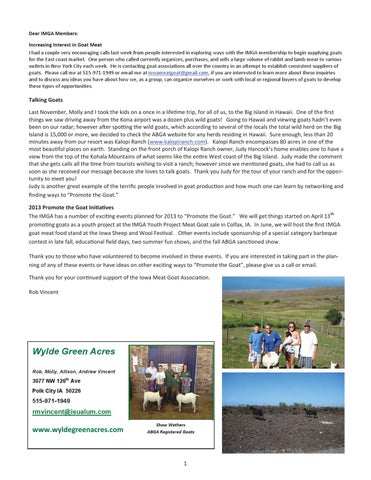
Show Wethers ABGA Registered Goats
1
Index Presidents Le er
Page 1
Rob Vincent
Page 1
Index
Page 2
Disclaimers
Page 2
Schedule of Events
Page 3
Iowa City Boers
Page 3
PJ Boers Boer Goats
Page 3
S tch ‘N Room
Page 3
J Bar K Boer Goats
Page 4
Iowa Sheep & Wool Fes val Page 5 Weaning Goats
Page 6
Killian Boer Goats
Page 6
Diemers Hill Top Boers
Page 6
Weaning Goats con nued
Page 7
Promote the goat
Page 7
Castra ng Goats
Page 7
Windrush Boer Goats
Page 8
Commi ee Volunteers Needed
Page 8
Windrush Boer Goats
Page 8
Castra ng Goats
Page 8
Castra ng Goats
Page 9
Trickman Boer Goats
Page 9
JRCN Boer Goats
Page 9
Handy Boer Goats
Page 10
JB Boer
Page 10
Goat Nutri on Chat
Page 10
Opinions Needed
page 10
1st Annual IMGA Youth Project Sale
Page 11
Silly Goats
Page 12
Iowa Meat Goat AssociaƟon We Promote the Goat Board of Directors
AdverƟsing rates for the
Robert Vincent, President
IMGA NewsleƩer
Shawna Fe ers , Vice President Janis Johnson, Secretary Myron Smalley, Treasurer Rose Shepard, Director
When ads are submi ed for the newsle er, payment must accompany the ad. The adver sing costs are for members and business that are non members. (see disclaimer) Costs (per issue)
NewsleƩer Disclaimer Submissions welcomed and encouraged Only those of construc ve and informa ve informa on will be published. The author’s views do not necessarily reflect the views and opinions of the
Full Page— $80.00
IMGA.
Half Page—$40.00
Mike Harman, Director
Fourth Page—$20.00
We reserve the right to refuse or edit any and all material.
Kelly Adey, Director
Business Card $10.00 per issue/$30.00 per year (4 issues)
Please ask permission before reproducing IMGA newsle er content.
The Iowa Meat Goat Associa on is a non-profit organiza on and any dona ons are tax deduc ble up to 50% of your income.
Classified—$5.00 for to 7 lines
Authors retain all copyrights, responsibilies and privileges thereof.
Send your ad and payment to: Rose Shepard 4872 103rd St Montezuma IA 50171
2
This is a “community built” project and we try to compile helpful informa on. For veterinary assistance, please seek the advise of a licensed veterinarian.
Schedule of Events Club Wether Sale Saturday, April 13th, 2013 Jasper County Fairgrounds, Colfax, IA Kelly Adey @ adeyos@yahoo.com or 515-967-5207 April 20, 2013 Tall Corn Meat Goat Wether AssociaƟon, Inc.’s 7th Annual Jackpot Wether Sale Kalona Sales Barn, Inc., Kalona, Iowa 9:00 AM Parade of Wethers 10:30 AM Tall Corn Sale For more informa on, contact Vern Thorp 641-660-1390 April 27, 2013 2013 Meat and Boer Goat Extravaganza Sponsors: Tall Corn Meat Goat Associa on, Inc., Washington County Extension Topics: Nutri on, Health, Conforma on, Structure, Fi ng & Showing, Featured Speakers: Evie Gates, Pla num Boer Goats, Beth Mason, ABGA Judge, Bruce Read, Kent Feeds, Inc., Dr. Janet Sears, Oelwein Veterinary Clinic, Washington County Fairgrounds, Washington, Iowa For more informa on, contact Susan Thorp, 641-660-1388 North Missouri Meat Goat Producers May 5th Tisha Diefenbach Phone: (816) 519-1668 Email: , tisha_diefenbach@hotmail.com
Henry County Fair Cambridge IL June 23rd Burt Walker Phone: (309) 853-6988 Email: , mckenzie0810@yahoo.com Web: h p://wwwhenrycountyfairillinois.com Tall Corn Meat Goat Wether AssociaƟon (ABGA) August 4th-5th | Washington, IA Susan Thorp | (641) 660-1388 Nebraska Super Fair 2 shows in 1 day August 10th Misty Logsdon Phone: (402) 770-4469 Email: , diversified_farms@hotmail.com Web: h p://www.superfair.org Missouri State Fair August 13th Edna Vollmer Phone: (660) 530-5616 Email: , edna.vollmer@mda.mo.gov Iowa State Fair 4-H & FFA Market Meat Goat - August 15th 4-H & FFA Breeding Meat Goat - August 16th ABGA Open Meat Goat - August 17th Iowa State Fairgrounds Des Moines, IA
2013 Corydon Spring Fling (ABGA) May 18 | Wayne County Fairgrounds Contact: Jason Smith - 641-876-2213
IMGA Open Show 1 & Show 2 September 7-8, 2013 | Indianola, IA Contact Shawna FeƩers at 515-231-2208 bskmfeƩers@yahoo.com
Boer-Nanza (ABGA) June 1st | Central City, IA Barbie Waltz | (519) 560-0854
Minn-e-goat-a (ABGA) July 6th-7th | Jordan, MN Shelly Pitlick | (952) 492-5180
IMGA Open Show 9th Annual Iowa Sheep & Wool FesƟval June 8, 2013 | Adel, IA
Nebraska State Fair (ABGA) August 28th | Grand Island Nebraska
Wapello County Fair Open Goat Show Eldon IA June 15, 2013 Contact InformaƟon and Further Details to come
3
Hello Iowa Meat Goat AssociaƟon Members: Thank you for your past membership in the Iowa Meat Goat Associa on (IMGA) and thank you if you have already renewed your membership in 2013. If you s ll need to renew, print a membership renewal form on the website by accessing the Join tab in the upper le hand corner or by prin ng the a ached copy and returning it along with your dues to Janis Johnson. Goat produc on is s ll a very new venture in Iowa and your support of the Associa on will con nue to help the industry grow. With 2013 underway, the IMGA Board would like to provide you with some addi onal informa on about the IMGA plans for 2013. We plan to con nue with several of the main associa on ini a ves as well as add a few new things to the mix. As the year progresses, please check the website periodically for updates on what is happening as an Associa on and what is happening with fellow members. Speaking of the IMGA website....Here is some more informa on about the new look and flow of the website. You can now access the quarterly newsle er online via the Members Only/NewsleƩer page. Upon renewal, Janis Johnson will send you the username and password to access the Members Only informa on. If you have already renewed and haven't received the username and password, please email Janis Johnson. As the page evolves we will also add more informa on beyond the newsle er. Another new page that will evolve is the Members Stories page. Please share highlights and successes of your opera ons. The IMGA wants to know how you, someone else or some other group has or is working to increase the awareness of goat produc on or goat meat consump on. Other pages include the ever popular Classified Ads page and the Youth page with informa on about the 2013 Youth Points Chase. To see who is a member of the IMGA click on the CONTACT MEMBERS tab in the upper right hand corner of the website. The MarkeƟng/PR page is where you can find out what is happening within the IMGA membership to promote goats and goat meat consump on. We hope you will find the new website user friendly and interes ng. If you have any ideas on how the website can be further enhanced to become more beneficial for IMGA members let us know! Below are some of the planned events for 2013: IMGA will be ge ng things started right away this spring promo ng goats by holding the 1st Annual IMGA Youth Project Sale on Saturday, April 13th in Colfax, IA. If interested please contact Kelly Adey at kadey@yahoo.com or call 515 967-5207 (leave message) by March 10th. At the Iowa Sheep and Wool FesƟval, the IMGA has been granted approval to host a Goat Meat Concession Stand on Saturday, June 8th, 2013. This event will become a success through ac ve par cipa on by all IMGA members to help organize the event and serve at the food stand. To volunteer for the event, please contact Board Member Shawna Fe ers. The IMGA will also be increasing awareness of goat meat consump on through our sponsorship of a special goat meat category contest at the Southern Iowa Barbeque AssociaƟon Contest being held in November 2013. The IMGA will work with members to conduct a couple of Field Days this year. The IMGA will once again provide addi onal opportuni es for Youth members to u lize their goat projects by parcipa ng in the 2013 Youth Points Chase program. We already have one new show added to the list, The Corydon Spring Fling being held, May 18th. For contact informa on, go to the Shows page for further informa on. Another exci ng change in the works is plans for holding the Annual MeeƟng later in the year on November 16th. Further details....however Mark Your Calendar Now! Again, thank you for your current/past support of the Iowa Meat Goat Associa on. Please let us know what we can all do to improve the Goat Meat Industry in Iowa and increase the consump on of goat meat. Sincerely, The IMGA Board
4
Come see how the IMGA is promo ng goat at the
Meat Goat Fun Show
th
9 Annual Iowa Sheep & Wool FesĆ&#x;val
Saturday, June 8 th @ 2:00pm
Saturday, June 8th, 2013 Dallas County Fairgrounds, Adel, IA www.iowasheep.com
Check-In/Weigh-In: 12:00-1:00pm Judge: Troy Sloan, Cameron, MO ISU Livestock Judging Team Member MO State Fair Highlights:
Please help make this event a great success by joining our team of volunteers!
*Exhibited Grand Champion Meat Goat *Produced Reserve Champion Meat Goat
Classes: *Market Wethers & Does *Breeding Does *NO Bucks
Volunteers are needed in the following areas:
Show *Set-up *Check-In & Weigh-In *Ring & Gate Stewards *Announcer *Placing Record keeper *Clean-up
Health Papers Required
Contact: Shawna Fetters 515-231-2208 or bskmfetters@yahoo.com
Goat Nutritional Seminar Saturday, June 8 th @ 1:30pm
Contact: Shawna Fe ers @ bskmfe ers@yahoo.com
(In the Show Ring)
Seminar
Presented by
*Set-up *Tear Down Contact: Rob Vincent@rmvincent @isualum.com
Concession Stand
Archer Daniels Midland Company
*Meat Dona ons *Food Prepara on *Set-up *Servers *Clean-up
Kaylee Keppy; Show Feed Specialist ADM is also an IMGA 2013 Youth Points Chase Sponsor
Contact: Rose Shepard@dcc3200@gmail.com
Goat Meat Concession Stand
The IMGA has requested 100 hardcopies of the 9th Annual Iowa Sheep and Wool Fes val Booklet. Inside, readers will find a schedule of events and a centerfold featuring the IMGA!
Saturday, June 8th; 11:00am-3:00pm NEW for 2013!!!
If you or a local agriculture business would like to receive a booklet prior to the event, please contact any of the 2013 IMGA Board Members.
Experience goat meat for the first time or
Satisfy a seasoned craving
An electronic copy of the booklet can be viewed at www.iowasheep.com.
Offering: *Walking tacos *Slow cooked meat sandwiches Make it a combo.. Add a drink & chips or dessert
5
WEANING KIDS
may not wish to breed.
Livestock guardian dogs should have been placed with the dams and their kids once kids bonded with and were following their mothers By Onion Creek Ranch Weaning is done early in the morning of a (around a month of age) so that kids got used good-weather day (not rainy, very hot, or exto the presence of LGD's. If this has not been tremely cold). Kids are separated from their Weaning kids from their dams is a stresspreviously done, the introduc on of the LGD is inducing experience for both mothers and kids. dams at the central working pens at the Vet Building. If the distance is great, kids are trail- another hurdle that the producer has to cross. Stress can cause illness and some mes even Herd protec on animals are essen al in pasdeath, so a wise producer will try to minimize ered to their new loca on. If the distance is tures of newly-weaned goats. Most livestock short but the alleys are dusty from lack of rain, stress at all mes. Intact bucklings should be then the route that the kids will travel on foot guardian dogs won't hurt kids but they can weaned at three months of age to avoid the frighten them when the dogs try to move a will be watered to avoid dust-induced inhalapossibility that they might be able to breed stray kid back to the herd by slobbering all on pneumonia. The goal is to always avoid their dams, sisters, or other females in the over its neck and face. stressing just-weaned kids. herd. Doelings can stay with their dams for a longer period of me. This writer has found that doelings grow out be er if they are reWhen weaning kids (bucklings in par cular but The weaning process has a profound effect on moved from their dams no later than four both sexes in general), never wean one or two the dam. Wean one kid per dam each week, star ng the first week of weaning with the months of age. While some producers believe kids and place them into a herd of alreadybiggest buckling. that it is be er to leave the weaned kids in a weaned kids. They will be harrassed to the familiar loca on and move the dams, space limita ons on most goat ranches usually make this op on unlikely.
point of exhaus on as the pecking order is reestablished within the herd. Polled bucklings in hot climates can collapse and die of heatstroke. Horns act as radiators to remove heat The weaning regimen at Onion Creek Ranch is from the body, and polled goats by defini on as follows: All kids will have had two deworm- have no horns. This is one more reason not to ings as well as their first and second CD/T vac- disbud kids. Doelings are not as aggressive as bucklings, but they too will mount and pursue cina ons before weaning me (at one month and again at two months of age). The Colorado new doelings un l everyone accepts their individual posi ons in the group. Establish a miniSerum pneumonia vaccine Mannheimia Haeherd of weanlings, then wait to introduce moly ca Pasteurella Multocida Bacterin vaccine (first injec on) will also be given at wean- three (3) or more kids into the main weaned ing, with a follow-up booster injec on adminis- herd early in the morning of a good-weather day. Ride your fences and pastures before tered in two to four weeks. Depending upon circumstances such as bad weather condi ons, nigh all and at daylight to make sure that newly-weaned kids haven't go en themselves the weanlings may be dewormed again prior to moving them to a weaned-kids pen/pasture caught in fences or into other lifethreatening situa ons. as far away from their dams as possible. Kids and dams calling to each other is both stressful Feed the kids a er they are in their new pasto them and nerve-racking to producers. tures. Ea ng together is a familiar group ac vity that will distract them from harrassing each Males and females from weaning age and up other and add some "rou ne" to the expanded are kept in pastures on opposite sides of a herd. Kids tend to wander, ge ng lost from wide center alley that divides the ranch into the main group, therefore becoming poten al west and east sec ons. targets for predators. Herding kid goats is like trying to herd chickens; it just doesn't work A common fenceline between males and feun l one animal takes a leadership role. This males is not good management because it can be done by introducing one or two older allows direct access of males to females, regoats of the same sex into the herd. sul ng in "party girls" who get bred too young through the fence to males that the producer
6
This process allows the doe's body to adjust to lower milk output. Weaning all kids at one me sends her body into milk overload. Dairy and dairy-influenced goats, including Boers, makes lots of milk. Remove all kids at one me and the dam's udder is going to be uncomfortably ght by the next day. A too-full udder makes her miserable, the poten al for mas s is increased, and the producer must milk the dam. Do not take the dam off water. Repeat: Do not take the dam off water - ever. Meat-goat breeds without dairy influence seldom have this milking issue but it is a fact of life with dairy-influenced goats that the producer has to learn how to handle. Meat -goat dams raising kids on forage, browse, or pasture should not have as much difficulty drying up a er weaning. Around the beginning of the third month of the kids' lives, begin cu ng back slightly on grain fed to the dam. Kids should be ea ng more solid feed and should be requiring less milk. This is, of course, subject to evalua on since a doe with mul ple kids, i.e. triplets or quads, has different nutri onal needs from a dam with a single kid or twins. At me of first kid's weaning, cut back a bit more on grainbased feed to the dam.
Weaning Kids Con nued from Page 6 Do not ever suddenly take goats off one type of feed and change to another feed type -- whether open doe, pregnant doe, buck, kid, or wether. Rumen problems will arise and sick goats will be the result. If the producer will follow this writer's o -men oned rule of learning to think like a goat, many problems can be avoided and the weaning process will be less stressful for all involved - kids, dams, and you.
Castrating Most goat owners prefer to castrate all young males which are not going to be kept for breeding purposes. We will talk about the advantages and disadvantages of doing this and take a look at the two most popular methods of doing so. We will describe in detail the process of using rubber bands to remove the tes cles because that is the procedure that almost everyone will choose to use. CASTRATING — Advantages: Young male goats can become fer le at a very early age; you certainly do not want a bunch of poten al li le breeders running around with your does. But most importantly, you are castra ng them to prevent them from becoming bucks in the future. This is done for a variety of reasons. You want to save only the very best of blood lines and their characteris cs for subsequent breeding programs, either on your farm or someone else’s. "Young bucks" can be very troublesome to have around—sort of like a li le testosterone army. If you have dehorned and castrated them you’ll just be a whole lot happier, believe me. And, you’ll be much less likely to have "accidental" pregnancies. Some commercial buyers of young or yearling goats who sell them for meat purposes (even if they’re not of the "meat" breeds) will prefer to have them castrated for easier handling and shipping. Disadvantages: Males that are not castrated will tend to outgrow those that are. There is some disagreement as to whether the meat of the intact male has a more "bucky" taste; I do not have any first-hand knowledge on this. Almost all castra ng procedures are non-reversible, meaning that once you’ve done it there is no changing your mind. Sooner or later you will say, "I wish I’d le him a buck" when you see an unusually nice wether that would obviously have made a great breeder for yourself or someone else. Such is the nature of farming! Finally, most forms of castra ng are unpleasant. Either you adjust to it or get someone else to do it for you (or have a bunch of horny, smelly macho kids running around).
Cuƫng This is where the bo om part (or side) of the scrotum is cut off and the tes cles are pulled loose (If they do not come free easily, use a scraping mo on along the cord with the knife blade; do NOT just cut it.)
Stay in the know of promoƟng GOAT! Check the IMGA website periodically for updates on upcoming events, member stories & classifieds.
www.iowameatgoat.com 7
CastraƟng Goats Con nued from page 7 Cuƫng Advantages: Although there is obviously quite a bit of pain and bleeding right at first, all the agony is pre y much over with right away. There is less danger of infec on in the wound or of tetanus from a long-standing open sore. There is less need for follow up and a ercare. You do not need to buy any special equipment. Disadvantages: It takes more "personal for tude" than many goat raisers can muster up. It can cause considerable bleeding, which is unsightly to some. In some rare instances, bleeding cannot be stopped and the animal dies. There is immediately an open wound which can become infected; but healing is usually fairly rapid. Banding Advantages: The procedure is rela vely simple, which makes it easier for the novice to learn. Since the skin is not broken, there is no bleeding. One person can (but with some difficulty) perform the opera on alone. If a band accidentally ends up in the wrong place it can usually be removed (if done quickly). Disadvantages: There is considerable pain which lasts for about an hour. The kid will frequently lie on his side with his legs stretched out and act like he’s about to depart this earthly toil. (If so, just get him up and make him walk around a li le.) Others will show no problems whatsoever. The younger they are done (and the smaller the tes cles), the easier it is on them. The biggest problem is that an open sore can occur along the abdomen before the tes cles fall off. If it occurs, this is an area of serious poten al infec on, including tetanus. In a few very rare instances, the vessels going to the scrotum can herniate and separate from the abdominal wall causing a real scary looking mess. Comments: Many people feel that castra ng too early can lead to an increased incidence of urinary calculi ("stones") because the hormonal produc on of the tes cles aids in the development of the urethra. The Art of Banding First, of course you have to buy a pair of elastrator pliers. Do NOT try to make some homespun sort of device or buy one of those cheap ring things that are promoted as the latest thing in humane or bloodless castra on.. Get some real elastrator pliers and a package of li le green bands (lamb size, not ca le). Have handy an iodine dispenser and a pair of small sharp pointed scissors (in case you want to remove the band; generally, it’s a whole lot easier to do it right the first me). You can have someone hold the kid in their lap. Some prefer to have the kid standing so the tes cles drop naturally; we usually do it with the kid in an upright posi on, legs facing me and hanging free. Examine the scrotum to see how easily the tes cles can be forced down into the sack and held there. It may take some firm pressure applied to the lower abdomen to make them become available. Do this a couple of mes to make sure that in the heat of ba le you can do it rapidly and with only one hand. If you cannot force the tes cles out of the abdomen (it may take a li le pracce) it may indicate that you need to wait a few days and try again. Before you make this decision, place the kid in a standing posi on on all four feet and try again (you may have to stand on your head to do this!) Once you’ve determined that you will be able to proceed, make sure that your partner, the kid and you are all nice and comfortable.
The IMGA is looking for volunteers who would like to join the 2013 IMGA Show Commi ee! Please contact Shawna Fe ers bskmfe ers@yahoo.com 515-231-2208 8
CastraƟng Con nued from page 8 Paint around the whole area (360 degrees) just above the tes cle with 7% ncture of iodine. Then place one band on the elastrator. Grip it firmly with your preferred hand and with the prongs poin ng up and your hand poin ng down. Squeeze it a couple of mes to make sure the band isn’t going to pop off and fly across the room. (Have the band about half way down the prongs.) Grab the skin of the very bo om of the scrotum (NOT the tes cles) with the other hand and pull this through the band. You have now reached the point where if you let go, he will experience pain and you will have a hard me retrea ng. Move the band (by means of the elastrator) up and over the tes cles while expanding the band about as far as possible. When the band is near the abdomen and above the tes cles or where the tes cles should be, the real serious part of the program begins. If the tes cles are above the band, you will have to lower the tes cles below it by forcing them out of the abdomen with your free hand as we prac ced earlier. It may take a few tries to do this but keep squeezing the handle all the me. If you find that you cannot get the tes cles below the band, withdraw the elastrator and decide whether to rest and try again or come back another day. Do not put the band on the sack with one or more of the tes cles up in the abdomen unless you wish to inten onally create a cryptorchid male (will have all male characteris cs but be sterile.) Once the tes cles are safely below the band, squeeze off the upper sack above the band with your free hand so they cannot slip back up in. With the elastrator, posi on the band so that it is down almost ght against the top of the tes cles. If it is posi oned too far up against the belly a serious rupture can occur; also, it tends to be more stressful to the animal later on. There are tales among the old- mers that calves can die if the band is placed too high, but I don’t know if this is true or not. When the band is in the posi on you want it, you must release the handles of the elastrator and pull the band off the prongs with your free (CLEAN)hand. This is when you are apt to get kicked in the face as the kid will no ce that suddenly something just went terribly wrong. Look quickly at where the band ended up and make another applica on of iodine. Make the kid stand up and walk around. He will have some unhappy moments for about an hour or so but then will resume playing with the other kids. Every 2 or 3 days, check the wound and put iodine on it to prevent infec on. If there are areas of rawness, we frequently apply NTZ Puffer powder to aid drying. If it is fly season, you may want to apply some type of fly repellent. The sack will start to shrink and dry up in a few days and eventually fall off. Some mes, it will hang there by a ny thread. If this is real ny, it is OK to go ahead and cut it to prevent further problems. Hopefully, the kid has had his CD/T vaccina ons to guard against tetanus. If not, you may want to give tetanus an -toxin. Disaster Care: Every once in a while things will go awry! This is usually an injury which results in a hernia on of the tubes and vessels that join the tes cles to the abdominal cavity. You are presented with an ugly, bloody stub of a thing that is devoid of any skin or protec ve covering and which may or may not be bleeding profusely. It is one of those moments that can make you wish you’d never go en into this goat business in the first place. You can haul the kid off to the vet. Or, you can take a clean piece of string and e the thing off ( ghtly) even with the surface of the abdomen. Then apply iodine and a coa ng of an sep c powder such as NTZ or Wonder Dust®. Put the kid in a very clean well-bedded area for a few days un l healing takes place. Should you be unable to stop the bleeding with a string, plan on a visit to the vet. (Hold a pressure bandage against the area un l you get there.) Banding (castra on) Langston Langston Univ CONSULTANT © Cornell's Diagnos c program
9
Your Thoughts: What is the best structure for the IMGA Board? With spring being a me of change, I wanted to present a couple of by-law changes for the IMGA membership to consider implemen ng in 2014 to aid in the growth of the associa on. These are simply some ideas to generate discussion. To enact any changes to the by-laws; the discussions have to begin sooner rather than later to meet the melines for bringing any bylaw changes to a vote by the en re membership. Currently, the board has seven members. Over the last few years as the Associa on membership has grown, the volunteer me that the seven board representa ves have available to allocate to the increasing list of ini a ves designed to promote the advancement of the Iowa goat industry has been stretched. With this in mind, I would be very interested to hear comments from the membership about the poten al of expanding the board from seven to nine members. Since my me on the board, I feel we have an ever increasing par cipa on by the membership to implement the expanding list of ini a ves; however with me being so valuable in today’s fast paced world, would two more people in defined leadership roles enable the ini a ves to occur even more effec vely and provide be er representa on of the group when deciding on the direc on of the Iowa Meat Goat Associa on. Another thought is to define the board member seats on a geographical or opera onal focus basis. It would require par cipaon from different parts of the state or could be designed to create a balance between the number of board representa ves focused on show/youth projects, breeding stock, and commercial produc on. Please call me at 515-971-1949 or email me at iowameatgoat@gmail.com with your thoughts. Thank you, Rob
Power Up With Protein IMGA will be “Promo ng the Goat” at VEISHEA 2013! The ISU Collegiate Beef Team is hos ng a “Power up for Protein” tent at the Year’s VEISHEA celebra on on Saturday, April 21. The IMGA has been invited to join other livestock industry associa ons to promote meat as a tremendous source of protein in diets. An IMGA display will be setup and sample of goat meat provided. If you are interested in volunteering an hour of me to man the booth, please contact Rob for more informa on.
10
1st Annual IMGA Youth Project Sale IMGA Members asked for it‌IMGA Board Members are planning it! SELLERS *Consignments are open to all IMGA members on a first interested, first registered basis *Limit of four goats – of which only 1 can be a doe; all others must be wethers *Cost of consignment is $25 per goat plus vet fees for health papers Interested members should contact Kelly Adey at kadey@yahoo.com or 515-967-5207 by March 10th! BUYERS *Open to all; targeted for 4-H, FFA and Open Class youth exhibitors *40 lot minimum; 70 lot maximum *Payment will be made direct to seller (If mul ple animals are purchased, buyer must be prepared to accommodate mul ple payees)
11
Iowa Meat Goat Associeaton Rose Shepard 4872 103rd St Montezuma IA 50171
February 2013 Newsle er
Silly Goats Rose Shepard My Granddaughter Alice (6 months) is ge ng her first close up look at goats and is not sure what to think of them. She wouldn’t pet them un l the li le one stole her ra le. It was just to funny not to share. The two babies are from a set of quads that the “Does code of Honor” failed to show us during the ultra sound. She was a first me mom the kid here weighed 3.2 lbs at birth. I have talked to so many people this year that have been having strange things happening with their goats and somehow I keep thinking it had something to do with the drought. So I hope we get our normal weather back soon. If you have anything you would like to contribute to the Silly Goat page please feel free to send it on to me. I would love to print your stories.
I M G A 12