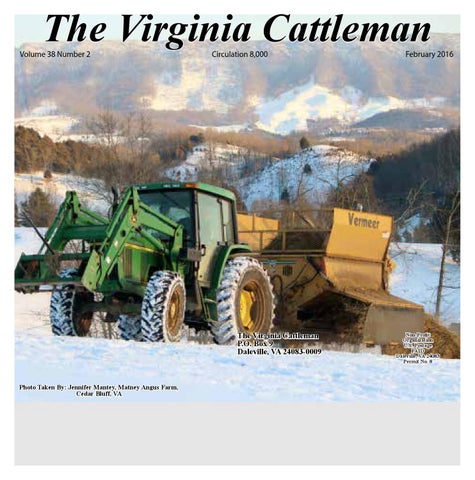
The Virginia Cattleman
Volume 38 Number 2 Circulation 8,000 February 2016
The Virginia Cattleman P.O. Box 9 Daleville, VA 24083-0009
Photo Taken By: Jennifer Mantey, Matney Angus Farm, Cedar Bluff, VA
Non-Profit Organization U.S. Postage PAID Daleville, VA 24083 Permit No. 8
Opportunities
PAGE 2, FEBRUARY 2016, THE VIRGINIA CATTLEMAN
By: Jason Carter
Due to the nature of our monthly paper’s publication deadline, I typically write this piece around seven days prior to the actual month The Virginia Cattleman is published for. So most of the time I write in a subtle combination of reflection and perception with the hope that you feel as though what you are reading is in real time. What is most certainly in real time as I write this piece today is the 20+ inches of snow falling in earnest outside my window in the Shenandoah Valley. The members and the people of the industry that we represent at Virginia Cattlemen’s Association work hard, and while days like today are an exception, each day it is never far from my mind how important the work I do at VCA is in respect to the effort invested by the people I work for. 2015 wrapped up dramatically different for many cattle producers than the year before. Lower cattle prices tugged back on profits never before seen in 2014. While input costs have remained
reasonably priced it is nonetheless important as producers to look hard at the current value of your females when making borrowing decisions for new fixed capital or adding breeding stock. Risk management is as important in our business now as well managed pasture and rental agreements. VCA sponsored sales were down roughly 14,000 head in the barns and up just over 4000 head in field sales. This had a significantly negative effect on the VCA bottom line but I am encouraged by the continued growth of the Virginia Quality Assured feeder cattle program, which added an average of $89/head value to all calves, and field sales of yearling cattle. 2015 was a positive year for growth in newspaper and membership sales with both growing over 40%. The changes at VCA in the past three years demonstrate that VCA can indeed serve our industry’s collective interests and many cattle producers have desired this common voice and advocate. The Virginia General Assembly is in session and we are watching and working on several issues that I will
WHAT’S INSIDE Page 8 - 2015 Dietary Guidelines Support Lean Beef in a Healthy Diet Page 10 - Argentina To Revive - Beef Exports Page 18 - Prevention and Treatment of Cow Prolapse Page 21 - Record December Boosts 2015 to Second Warmest Year Page 40 - Culpepper BCIA Bull Sale Reports Page 42 / 43 - VA Beef Expo and Jr. Beef Round-up April 14-17, 2016
highlight. Granted the status of bills can change rapidly and I encourage you to contact members of the Policy & Industry Advocacy Board for updates or concerns. We are working for legislation that will provide Virginia livestock producers an avenue to work with USDA Wildlife Services and begin a focused approach to legally tackling the Black Vulture issue (Senate Bill 37). Food safety continues to be a priority to defend each year and two bills introduced (House Bills 62 & 619) seek to undermine liability protection for producers and consumers. It is always difficult to appear to be holding back cottage industry and alternative enterprise development on the farm, however the reality of our position always will be to advocate for a safe food supply through adequate assurance of risk management we get through inspection. Animal welfare is always a topic and this year is no exception. We have successfully worked to kill Senate Bill 123 that would have required an affidavit system for newborn calf care. The companion animal world has skewed the average citizen’s view of animal welfare and unfortunately production agriculture often has good animal
husbandry scrutinized in the context of animal welfare. There are a number of other bills involving unmanned aerial vehicles, nutrient management, funding for Best Management Practices, Commodity Boards & Assessments, bio-solids and land use assessment that we are following. Feel free to contact myself, Policy Board members or go to the Virginia Legislative Services website for information related to current General Assembly issues. I will leave you this month by emphasizing that partnerships among Associations are agriculture’s greatest ally in the changing world of regulatory pressure. Our efforts on the farm and at VCA are amply rewarded when we work together with our dairymen, Farm Bureaus and allied agriculture industries where common ground lies. These groups along with the Virginia Agribusiness Council strengthen VCA and all of us collectively. Encourage others producers to join VCA and build our advocacy team in 2016. VCA has, is and will continue to accomplish plenty with your support.
SAVE THE DATE 7/8/2016
Virginia Cattlemen’s Association Annual Meeting & Field Day McCormick Farm Raphine VA
THE VIRGINIA CATTLEMAN, FEBRUARY 2016, PAGE 3
20th Annual Angus Bull Sale
Saturday March 19, 2016, 1pm Rockingham County Fairgrounds, Harrisonburg, VA
Featuring Low Birth Weight, Heavy Muscled Bulls with Maternal Value, including these Herd Sire Prospects:
Tattoo: C4 Sire: Mystic Hill Mack 2181 EPD’s: BW: -0.8 WW: 59 YW: 96 Milk: 33
Tattoo: C19 Sire: WRA Cedar Run A7 EPD’s BW: -3.3 WW: 50 YW: 91 Milk: 29
Tattoo: C10 Sire: Mystic Hill Mack 2181 EPD’s BW:-0.4 WW: 57 YW: 92 Milk: 31
Tattoo: 7355 Sire: Benfield Colt A45 EPD’s BW: -1.6 WW: 60 YW: 101 Milk: 20
Tattoo: C12 Sire: Mystic Hill Mack 2181 EPD’s BW: -0.8 WW: 56 YW: 95 Milk: 31
Tattoo: 1255 Sire: Benfield Colt A45 EPD’s BW: 2.0 WW: 60 YW: 102 Milk: 24
Video preview will be available on YouTube. Search Headquarters for Hindquarters.
For your free sale catalog contact:
White Ridge Angus Bobby Grove (540) 850-0266 Somerville, VA wrabobby@gmail.com
Tattoo: 2855 Sire: Benfield Colt A45 EPD’s BW: 0.1 WW: 54 YW: 91 Milk: 23
Tattoo: 6155 Sire: WRA Whitley Z10 EPD’s BW: -0.1 WW: 57 YW: 96 Milk: 25
Tattoo: 2955 Sire: Benfield Reality 6211 EPD’s BW: 2.9 WW: 60 YW: 98 Milk: 20
Benfield Angus, Deerfield, VA Don & Juliana Benner (540) 939-4608 don@benfieldangus.com www.benfieldangus.com
Virginia’s Weekly Market Reports
PAGE 4, FEBRUARY 2016, THE VIRGINIA CATTLEMAN The Virginia Cattlemen’s Association Affiliated with the National Cattlemen’s Beef Assoc. P.O. BOX 9 Daleville, Va 24083-0009 www.vacattlemen.org The Virginia Cattlemen Phone: 540-992-1009 Fax: 540-992-4632 jdavis@vacattlemen.org Published monthly by the Virginia Cattlemen’s Association Jason Carter……….Stuarts Draft Executive Secretary Butch Foster……….Bristol Field Manager Troy Lawson……….Churchville Field Manager FEEDER COUNCIL Glenn Wheeler……….Atkins Region 1 Chuck Miller……….Crockett Region 2 Joe Meek……….Dublin Region 3 Forrest Ashby……….Staunton Region 4 Rick Matthews……….Browntown Region 5 Steve Hopkins……….Lousia Region 6 Tom Nixon……….Rapidan Region 6 Brett Stratton……….Evergreen Region 7 Andy Smith……….Rosedale Director at Large POLICY & INDUSTRY ADVOCACY BOARD Gene Copenhaver……….Meadowview District 1 Joey Davenport……….Glade Spring District 1 George Stovall……….Stuart District 2 OPEN SEAT District 2 Bill Tucker……….Amherst District 3 Jon Repair……….Glasgow District 3 Jared Burner……….Luray District 4 Allen Heishman……….Edinburg District 4 John Goodwin……….Orange District 5 James Kean……….Lousia District 5 Jay Calhoun……….Callands District 6 Mike Henry……….Chesterfield District 6 Editor……………Jason Carter jcarter@vacattlemen.org Publications Coordinator…Jacquelynn Davis jdavis@vacattlemen.org Issued the first week of every month. Copy deadline the 15th Of previous month. The Virginia Cattleman is sent to members of the Virginia Cattlemen’s Association. Annual dues are $50/year or Participation in the Association’s Feeder Cattle Marketing Program Complimentary copies are sent to various Supporters of the Virginia Cattle Industry. A Member of: (LPC) Livestock Publications Council
January 8
ly 134.00-145.00, average 137.85
State Graded Feeder Steers, Medium and Large 1
State Graded Feeder Heifers, Medium and Large 1
400-500 lbs 170.00-195.00, 175.00-195.00, average 185.60
mostly
400-500 lbs 115.00-159.00, mostly 140.00159.00, average 141.23
500-600 lbs 131.00-176.50, 169.00-176.50, average 171.73
mostly
500-600 lbs 101.00-144.00, 130.00-144.00, average 137.32
mostly
600-700 164.77
lbs
153.00-167.00,
average
600-700 lbs 102.00-131.00, mostly 114.00129.75, average 122.26
700-800 144.76
lbs
134.00-152.00,
average
700-800 lbs 111.00-127.00, average 122.67
State Graded Feeder Heifers, Medium and Large 1 400-500 lbs 82.00-153.00, mostly 135.00152.00, average 140.83 500-600 136.03
lbs
120.00-142.00,
average
600-700 124.35
lbs
116.00-134.00,
average
700-800 lbs 90.00-126.00, mostly 116.126.00, average 120.36 Slaughter Cows Boning, 800-1200 lbs, 58.0080.00, average 69.84 Breakers, 1200-1600 lbs, 62.0081.00, average 71.22
January 14 State Graded Feeder Steers, Medium and Large 1 400-500 lbs 103.00-201.00, mostly 186.00-201.00, average 189.13 500-600 lbs 105.00-185.00, mostly 160.00-181.00, average 168.14 600-700 lbs 91.00-169.50, mostly 153.00-169.50, average 153.93 700-800 lbs 113.00-145.00, most-
500-600 lbs 136.00-199.50, 177.00-199.50, average 178.98
mostly
600-700 lbs 130.00-172.00, 154.50-166.00, average 159.18
mostly
700-800 lbs 132.00-165.00, 145.00-165.00, average 154.81
mostly
State Graded Feeder Heifers, Medium and Large 1 400-500 lbs 103.00-150.50, 141.50-148.25, average 144.37
mostly
Slaughter Cows
500-600 lbs 120.00-155.00, 135.00-155.00, average 139.12
mostly
Boning, 800-1200 lbs, 48.00-79.00, average 70.69
600-700 lbs 107.50-151.75, 133.00-151.75, average 138.46
mostly
Breakers, 1200-1600 lbs, 64.00-82.50, average 74.36
700-800 lbs 113.00-141.50, mostly 120.00141.50, average 138.58 Slaughter Cows
January 21 State Graded Feeder Steers, Medium and Large 1 400-500 lbs 151.00-200.00, 184.00-200.00, average 186.08
mostly
Boning, 800-1200 lbs, 53.00-77.00, average 67.05 Breakers, 1200-1600 lbs, 64.00-83.00, average 73.47
VIRGINIA CATTLEMEN'S ASSOCIATION Sponsored Graded Sales Schedule Check our Website at www.vacattlemen.org for updates CONTACT LIVESTOCK MARKETS OR VCA STAFF FOR QUESTIONS VCA 540-‐992-‐1009 BUTCH FOSTER 423-‐360-‐0434 TROY LAWSON 540-‐430-‐0042 FEBRUARY 2016 Radiant 2/2/16 10:30 AM FEEDERS Virginia Cattle Company 540-‐662-‐4889 Front Royal 2/2/16 7:30 PM FEEDERS Virginia Livestock Sales 540-‐662-‐7752 Tel-‐O-‐Auction 2/8/16 6:00 PM FEEDERS Virginia Cattlemen's Association 540-‐992-‐1009 Radiant 2/9/16 10:30 AM FEEDERS Virginia Cattle Company 540-‐662-‐4889 Rockingham 2/11/16 7:00 PM FEEDERS Rockingham Livestock Sales 540-‐490-‐9050 Radiant 2/16/16 10:30 AM FEEDERS Virginia Cattle Company 540-‐662-‐4889 Tel-‐O-‐Auction 2/22/16 6:00 PM FEEDERS Virginia Cattlemen's Association 540-‐992-‐1009 Radiant 2/23/16 10:30 AM FEEDERS Virginia Cattle Company 540-‐662-‐4889
THE VIRGINIA CATTLEMAN, FEBRUARY 2016, PAGE 5
KCF Bennett Fortress
KCF Bennett Absolute
KCF Bennett Southside
KCF Bennett Revolution X51
KCF Bennett Homestead
KCF Bennett Encore Z311
Bulls Featuring 100 Commercial 90 Bred Heifers
H Angus H Polled Herefords H
KCF Bennett Y6
KNOLL CREST’S
KCF Bennett Y504
Elite Genetics From Three Breeds With The Industry’s Best Guarantee
TOTAL PERFORMANCE BULL SALE SATURDAY • APRIL 9, 2016
James D. Bennett (434) 376-7299
Jim G. Bennett (434) 664-7935
Paul S. Bennett (434) 941-8245
Brian R. Bennett (434) 664-8309
Dalton G Bennett (434) 664-7946
H Balancers H Gelbviehs H Baldies H
17659 Red House Road • Red House, Virginia 23963 Martha Johnson, Office Manager (434) 376-3567 • Fax (434) 376-7008 knollcrest@hughes.net • www.knollcrestfarm.com
Brad Fahrmeier 816.392.9241
Scott R Bennett (434) 660-7268
Serving the beef industry since 1944!
Sale book available upon request. ANGUS SIRES:
KCF Bennett Absolute EXAR Denver 2002B AAR Ten X 7008SA KCF Bennett Southside ANGUS KCF Bennett Homestead Sale Bulls Average: VAR Reserve 1111 CE +11 DOC +22 GAR Momentum BW +0.2 MARB +0.70 Baldridge Waylon W34 Connealy Final Solution WW +64 REA +0.66 Connealy Black Granite YW +109 $W +72.06 Connealy Covenant Connealy Earnan 076E MILK +29 $B +133.12 Connealy Beacon
BALANCER Sale Bulls Average: POLLED HEREFORD Sale Bulls Average: SC CED +4.8 +1.5 REA +0.67 BW +2.2 WW +67 MARB +0.42 YW
+107
MILK
+28
BMI INDEX CHB INDEX
+$28 +$39
POLLED HEREFORD SIRES: KCF Bennett Encore Z311 KCF Bennett Revolution X51 NJW 73S W18 Hometown 10Y Hyalite On Target 936 CRR 719 Catapult 109 HH Advance 8050U EF Beef TFL Tested X651 RST 0124 Times A Wastin 2107 Churchill Sensation 028X
BALANCER SIRES:
KCF Bennett Y6 KCF Bennett U556 REA BW -1.1 KCF Bennett Homestead EXAR Denver 2002B WW +73 MARB KCF Bennett Y353 FPI YW +120 INDEX +85.13 GW Premium Beef 021T5 CE
+13
MILK
+29 +0.61 +0.40
GELBVIEH SIRES:
GELBVIEH Sale Bulls Average: MILK +35 CE +9 REA +0.66 BW +1.0 WW
+86
MARB
-0.20
KCF Bennett X593 FPI KHR 33A YW +121 INDEX +76.15
PAGE 6, FEBRUARY 2016, THE VIRGINIA CATTLEMAN
WOTUS Gets A Thumbs Down From The House
In an effort more symbolic than substantive, the U.S. House passed a resolution stating its disapproval of the Waters of the United States (WOTUS) rule. The measure passed 253166. The resolution cleared the Senate last November but faces a certain veto by President Obama since neither body has the votes to override. Still, House Agriculture Chair Mike Conaway claimed passing the resolution was a “critical step” to reworking the WOTUS rule. The resolution, if signed by the President, would nullify the rule submitted by the Environmental Protection Agency and U.S. Army Corps of Engineers to redefine Waters of the United States under the Clean Water Act. The rule, which took effect in August of 2015, remains on hold by federal courts. NCBA Statement Regarding the House Vote Another attempt to stop the Waters of the U.S. rule has taken place in the House. The House voted and passed S.J. Res. 22, a resolution to disapprove the Waters of the United States rule. The Senate passed a similar measure in November by a vote of 53-44. While the vote doesn’t have force of law, it does send a strong message from Congress to the White House and the Environmental Protection Agency (EPA) regarding WOTUS. National Cattlemen’s Beef Association (NCBA) Vice President of Government Affairs Colin Woodall said this House vote is a priority issue for NCBA. “It’s very important that the House of Representatives follow the lead of the U.S. Senate by passing this resolution of disapproval,” Woodall said. “By doing so, it sends a very clear signal to the President that Congress is not happy with the Waters of the United States rule and that they want to see it go away or be significantly changed. So, I think it’s just another step in our continuing effort to try to ultimately kill the Waters of the United States rule.”
Woodall said he is thankful the U.S. Sixth Circuit Court of Appeals in Cincinnati judges have issued a temporary nationwide stay preventing implementation of WOTUS in all 50 states. He said reminds cattle producers that the action is temporary. “Producers really need to understand that this stay is temporary, so while it is providing us a little relief, it is not relief that we are going to be able to rely upon,” Woodall said. “In order to make sure that we take this threat away and protect producers and make sure that EPA cannot come on your land, Congress has to act and they have to stop this rule. This motion or effort to try to do the resolution of disapproval is one step in the overall process, but there is still more Congress is going to have to do in order to ultimately win, because the last thing we want is for this to linger in the courts for four to five years and ultimately leave our entire fate to a decision that could go as high as the Supreme Court.” Woodall said it’s important that cattle producers keep pushing on their lawmakers when it comes to issues related to EPA. The agency will move on to other issues and there are always regulations that threaten or impact cattle producers. He said that’s why the cattle industry needs to stay on top of these issues to get Congressional action to push back. Without action, Woodall said the President will put out more rules and regulations. If the House and Senate both pass this resolution of disapproval of WOTUS, Woodall said President Obama will have to think about his next action, knowing he is getting a clear signal from Congress that the actions EPA have taken so far have been the wrong ones.
Genetic Investment Sale At the Virginia Beef Expo
Friday, April 15, 2016 • 12 Noon
Rockingham County Fairgrounds • Harrisonburg, VA In addition to these pictured females, offering will include 60 high production females sired by leading proven bulls and out of solid cows from some of the leading breeders in Virginia. Ankony Miss Primrose 014W
Rita 9Q15 of Rita 5F56 GHM
Cox R27 A116
From Ultamont and Ankony Selling a pregnancy sired by Quaker Hill Rampage and out of a daughter of 6807 who traces back to the full sister of EXT. Donor Reg. 16659042. Due September 2016.
From Woodside Farms Selling a pregnancy out of the #1 REA daughter of Connealy Impression and sired by the #10 BEEF bull in the breed, VAR Discovery. Donor Reg. 17799894. Due October 2016. Wild Wind Blackcap Lady 2G73
Quaker Hill Blackcap 3N23
From Hill Crest Selling a pregnancy by Now Look or Double Vision out of a maternal sister to Rita 9Q15, sired by Rito 6EMA of 4L3 Emblazon. Donor Reg. 16340284. Due October 2016. Wilks Blackcap 0D82
Owned by Hill House
From Quaker Hill Farm and WRB Angus Selling a pregnancy sired by VAR Discovery and out of the powerful donor Quaker Hill Blackcap 3N23. Donor Reg. # 17805166. Due September 2016.
From Wild Winds Angus Selling a pregnancy out of a Black Granite daughter of 2G73 and sired by VAR Discovery. Also sellling a full brother to the donor dam of this pregnancy. Donor Reg. #18281541. Due December 2016.
QHF Blackcap 6E2 of 4V16 4355
From Wild Winds Angus Selling a pregnancy out of a Black Granit daughter of 0D82 and sired by AAR Ten X 7008 SA. Blackcap 0D82 is a full sister to Quaker Hill Rampage Donor Reg. #18281592. Due December 2016.
NEW Highlight for 2016: Selling 3 yearling bulls from Wild Winds Angus
Selling several pregnancies stemming from this prolific producer, including a pregnancy out of a AAR Ten X 7008 SA daughter of 6E2 sired by Journey. A full brother to the donor dam sold for $40,000 in Las Vegas for Wild Winds Angus. Donor Reg, #18220578. Due December 2016.
• Break of Day: Sired by Black Granite, out of Wilks Blackcap 0D82 • Architect: Sired by Denver, out of Wild Wind Blackcap Lady 2G74 • Ace of Spades: Sired by Black Granite, out of Wild Wind Blackcap Lady 2G73 For more information or to request a catalog, please contact Tom Templeton at 540-421-8341 Bidding will be available online through CowBuyer.
THE VIRGINIA CATTLEMAN, FEBRUARY 2016, PAGE 7
26th Annual
PerformAnce TesTed Bull sAle
Saturday, February 20, 2016 • 11 a.m.
Selling
180 BullS Yon Bulls Add VAlue
a a a a
Many Calving Ease Bulls with Excellent Growth Quiet Dispositions Developed on a High Roughage Ration Sound Feet and Legs
Selling
150 Angus Bulls 30 SimAngus Bulls Select offering of 75 Females also sell! Request a sale book today!
Preview the cattle on our website at www.yonfamilyfarms.com Kevin & Lydia Yon Sally, Drake, & Corbin Yon PO Box 737 • Ridge Spring, SC 29129 Email: kyon@pbtcomm.net
Free Bull Delivery in FL, GA, SC, NC
(803)685-5048 or (803)622-8597
Satisfaction Guaranteed
Live, on-line bidding available through
Anywhere in Continental US with $5000 purchase www.dvauction.com
PAGE 8, FEBRUARY 2016, THE VIRGINIA CATTLEMAN
2015 Dietary Guidelines Support Lean Beef in a Healthy Diet
The 2015 Dietary Guidelines for Americans, released January 7th by the U.S. Department of Health and Human Services and the U.S. Department of Agriculture, reaffirm the role of lean beef in a healthy diet and confirm that Americans are, on average, consuming lean meat in daily amounts that are consistent with the recommendations for protein foods. National Cattlemen’s Beef Association President Philip Ellis commended HHS Secretary Sylvia Burwell and USDA Secretary Tom Vilsack for ensuring the final recommendations were based on the latest nutrition evidence available. Dr. Richard Thorpe, a physician and Texas cattle producer, agreed, saying he is pleased the guidelines recognize all the strong science that supports the many Americans who are looking to build a healthful diet with lean beef. “As a physician, I appreciate the Secretaries making sure the dietary guidelines are based on the latest nutrition science,” said Thorpe. “Numerous studies have shown positive benefits of lean beef in the diet, and I commonly encourage my patients to include beef in their diet to help them maintain a healthy weight and get the nutrients they need to be physically active. Lean beef
W H
L
F
QUALITY GELBVIEH, BALANCER AND ANGUS CATTLE
is a wholesome, nutrient-rich food that helps us get back to the basics of healthy eating, providing many essential nutrients such as zinc, iron, protein and B vitamins, with fewer calories than many plantbased sources of protein.” Updated every five years, this report serves as the foundation for federal nutrition policy and shapes the recommendations found on USDA’s MyPlate. While there is no one-sizefits-all diet, Dr. Thorpe said consumers can feel confident about putting lean beef on their plate knowing the Dietary Guidelines recommend Americans choose lean meat. Thirty-eight cuts of beef now meet government guidelines for lean, including some of America’s favorite cuts like sirloin steak and 95 percent lean ground beef. “Over the last decade or so, a significant amount of research shows that many people can lose and maintain a healthy weight, support a healthy metabolism and age more vibrantly when they consume more high-quality protein, within calorie goals,” said Thorpe. “As a physician, I see an opportunity to improve the health of Americans in all age categories by choosing nutrient rich protein foods, like lean beef, more often and by pairing them with more
Little Windy Hill Farms Doug & Sue Hughes
6916 Peppers Ferry Road Max Meadows, Va 24360
H 276-637-3916 LWHF@Wiredog.com Cell 276-620-4271
vegetables, fruits and whole grains.” Ellis, a Wyoming rancher, noted the changes in today’s retail meat case and said cattlemen and women provide a healthful product consumers demand. “U.S. cattle producers work each and every day to provide safe, wholesome and nutritious beef for consumers around the world,” said Ellis. “Since the first Dietary Guidelines were released in 1980, external fat on beef has decreased 81 percent and 65 percent of the most popular beef cuts sold at retail are lean, a prime example of beef producers responding to consumers’ nutritional preferences.”
Scott: Ironically, Armed Ranchers have a Point Travis Fain, Daily Press
While U.S. Rep. Bobby Scott frowns on bands of armed men taking control of remote federal buildings, he’s got some common ground with the group occupying a government compound in Oregon. Neither like mandatory minimum sentencing laws. “While I hope that their occupation ceases immediately and ends peacefully, their actions, ironically, highlight the injustice inflicted by mandatory minimum sentencing laws,” Scott, D-Newport News, said in a statement released Tuesday afternoon. The Atlantic news service made the same basic point Tuesday,
noting that liberals might find more that they agree with than expected in this armed demonstration. It was kicked off by the federal government’s case against a pair of ranchers, who illegally burned on federal land. “The statute imposed a mandatory minimum sentence: 5 years imprisonment under the Orwellian-sounding Antiterrorism and Effective Death Penalty Act of 1996,” The Atlantic reports. “U.S. District Judge Michael Hogan felt that five-year sentences were “grossly disproportionate” and would “shock his conscience,” given the context of the case. He sentenced the older man to three Continued on Page 10.
THE VIRGINIA CATTLEMAN, FEBRUARY 2016, PAGE 9
If you’re buying a utility tractor, have you thought through the true costs of ownership?
Choosing what kind of tractor to buy can be confusing and stressful. Lots of brands offer claims of greater productivity, KLJKHU HIĆ&#x;FLHQF\ DQG VR RQ $QG LWŤV DOO WRR HDV\ WR JHW FDXJKW up in the hype — and then be lured by low-ball pricing and huge discounts. But the true purchase cost of any tractor is often EXULHG GHHS ZLWKLQ WKH RSHUDWRUŤV PDQXDO $QG WKLV VXUSULVH PD\ end up costing you thousands. :KDWŤV KLGLQJ LQ WKH Ć&#x;QH SULQW One brand of utility tractor in the 75 to 125 hp class has routine maintenance requirements that would have you replacing up to 27 parts every two years. This includes oil, DLU DQG IXHO Ć&#x;OWHUV SOXV DOO sorts of hoses, cables, and lines. The costs really add up.
Now, compare the John Deere 5M Series. $ VLPSOH RLO FKDQJH LV WKH RQO\ URXWLQH PDLQWHQDQFH \RXŤOO QHHG WR SHUIRUP GXULQJ WKH Ć&#x;UVW WZR years of ownership. We design our tractors with built-in durability – with components and parts designed to last and last. Need a little proof? Our 5Ms feature durable steel brake lines — unlike the less-costly and fatigue-prone rubber hoses found on other tractor makes. Then consider our abrasion resistant braided wire hoses used in our steering system and rear hitch – they are simply stronger, and longer lasting than the conventional hoses used by some other manufacturers. 6R ZKHQ \RXŤUH UHDG\ WR EX\ \RXU QH[W WUDFWRU EH VXUH WR DVN RQH YLWDO question: “What will it cost to maintain – year-after-year?â€? The answer might surprise you. Then, talk to your John Deere dealer. See how a new 5M delivers one RI WKH ORZHVW FRVWV RI RZQHUVKLS RI DQ\ XWLOLW\ WUDFWRU LQ LWV FODVV ,WŤV D TXHVWLRQ \RX ZRQŤW UHJUHW DVNLQJ
JohnDeere.com/5Family
64998-18_10x11.5.indd 1
1/5/16 3:43 PM
PAGE 10, FEBRUARY 2016, THE VIRGINIA CATTLEMAN
Argentina to Revive Beef Exports, Bolster Producer Profitability
Joe Schuele, BEEF Magazine Once a leading beef exporter, Argentina’s presence in the global marketplace has declined in recent years, due in no small part to volatile trade policies that included occasional freezes on beef exports and tariffs on beef shipments leaving the country. But newly-elected Argentine President Mauricio Macri is moving forward with his pledge to reform the country’s agricultural sector and make it more competitive globally, including a shift in beef export policies. One of Macri’s main initiatives is to phase out tariffs on Argentina’s agricultural exports, including its 15% tariff on beef exports. His predecessors used these tariffs to generate revenue and try to keep food and feedgrain prices affordable for domestic consumers. But the export tariffs often backfired by hurting the profitability of Argentine farmers and ranchers, causing them to cut production. “Argentina serves as an excellent case study of how exports impact beef industry profitability, and how lack of access to global markets will eventually hinder beef production,” says U.S. Meat Export Federation (USMEF) President and CEO Philip Seng. “We look for Argentina to be a more formidable competitor going forward, now that it is moving away from export policies that have not served it well economically. Removing export tariffs will make existing beef supplies more affordable, and cattle producers may also be more inclined to expand their operations – although shifting crop land back to cattle
production is not an easy task, and will take time.” The impact of previous regimes’ policies is well-evidenced by a significant decline in cattle numbers. Argentina’s beef cattle herd shrank from a high of 55.6 million head in 2008 to just 48 million in 2011. USDA estimates that the herd will rebound to about 52 million head in 2016. At one time, Argentina was the world’s third-largest beef exporter, but steadily lost ground to competitors and is now only the fourth-largest exporter on its home continent. Brazil is by far the largest South American beef exporter, and Uruguay surpassed Argentina in export volume in 2011. By 2013, Argentina also trailed Paraguay in export volume. That year, Argentina fell to 10th place among the world’s leading beef and beef variety exporters at 236,390 metric tons (mt). The weaker Argentine peso (down 11% on average versus the U.S. dollar in 2015) also contributed to lower export values, and this is another area in which the Macri government is making changes in an effort to make Argentina’s exports more competitive. The government allowed the peso to devalue on Dec. 17, when it lost nearly 30%, before rebounding to some degree. Producers, importers and exporters will be watching for a newly-established trading range for the peso before making large sales. In anticipation of the new administration taking office, Argentina’s cattle prices have jumped to new highs, climbing above those in any other major beef-exporting country, including the United States. In
HIGH ROAD LIVESTOCK PHOTOGRAPHY & VIDEO MARTIN MACQUEEN
www.highroad.photoreflect.com
101 Pioneer Road * Covington, VA 24426 * 540-965-2199
mid-December, carcass prices averaged $2.20 per pound, up 21% from November and up 36% year over year. Argentina is already capitalizing on its direct access to China, which is now its leading volume destination for beef muscle cuts. From January through October 2015, exports to China increased 151% year over year to 36,520 mt, accounting for 27% of Argentina’s muscle cut export volume. Other top markets for Argentine beef include the European Union, Chile, Israel and Hong Kong.
From Page 8
Armed Ranchers months in federal prison and the son to concurrent one-year sentences.Those punishments inspired no radical activism. “What happened next, did. The Department of Justice appealed the sentences, won in the 9th Circuit, and is forcing the men to return to prison after they thought they had done their time. Both will now serve the mandatory-minimum sentence.” Mandatory minimums, Scott has said many times, waste money, disrupt “rational sentencing systems,” discriminate against minorities
and “far too often require judges to impose sentences that violate rationality, proportionality, justice and commonsense.” “Instead of considering the underlying facts, circumstances and characteristics of the offense and the offender, as the judge in the Hammond’s case did over a two-week trial and sentencing hearing, the law requires the judge to rubber stamp the five-year mandatory sentence without any casespecific consideration,” Scott said.
Striving to be the most comprehensive performance evaluation program in the country!!!
Forage Diet • Moderate Gain • Optimum Condition • Growth and Maternal Absentee bidding and transportation assistance available!
bulltest.ext.wvu.edu Dr. Kevin Shaffer (304) 293-2669 Kevin.Shaffer@mail.wvu.edu
West Virginia Cattlemen’s Association Jim Bostic (304) 472-4020 WVCA@wvbeef.org
THE VIRGINIA CATTLEMAN, FEBRUARY 2016, PAGE 11
Dietary Guidelines Focus on Healthy Eating Patterns
Jacqui Fatka, Feedstuffs
The U.S. Department of Agriculture and the U.S. Department of Health & Human Services released updated nutritional guidelines January 7th that encourage Americans to adopt a series of sciencebased recommendations to improve how they eat to reduce obesity and prevent chronic diseases like type 2 diabetes, hypertension and heart disease. Updated every five years, this report serves as the foundation for federal nutrition policy and shapes the recommendations found on USDA’s MyPlate. Over the past year, the dietary guidelines created concerns when the draft report looked like it would incorporate sustainability into food considerations and would no longer consider lean meat as part of a “healthful diet.” In the end, the final recommendations reaffirmed the role of lean beef in a healthy diet and confirmed that Americans are, on average, consuming lean meat in daily
amounts that are consistent with the recommendations for protein foods. HHS and USDA noted that the eighth edition of the “Dietary Guidelines for Americans” reflects advancements in scientific understanding about healthy eating choices and health outcomes over a lifetime. “This edition recognizes the importance of focusing not on individual nutrients or foods in isolation but on the variety of what people eat and drink — healthy eating patterns as a whole — to bring about lasting improvements in individual and population health,” HHS and USDA said in a joint statement. “The latest edition of the dietary guidelines provides individuals with the flexibility to make healthy food choices that are right for them and their families and take advantage of the diversity of products available, thanks to America’s farmers and ranchers,” Agriculture Secretary Tom Vilsack said. The specific recommendations
fit into five overarching guidelines in the new edition: 1. Follow a healthy eating pattern across one’s life span. Eating patterns are the combination of foods and drinks a person consumes over time. 2. Focus on variety, nutrientdense foods and amount. 3. Limit calories from added sugars and saturated fats, and reduce sodium intake. 4. Shift to healthier food and beverage choices. 5. Support healthy eating patterns for all. The North American Meat Institute (NAMI) praised the government’s affirmation of meat and poultry nutrition. “Meat and poultry products are among the most nutrient-dense foods available. They are rich sources of complete protein, iron, zinc and B vitamins, and many peer-reviewed studies show the contributions they make to healthy diets and the potential deficiencies that can occur when people exclude animal proteins,” NAMI
president and chief executive officer Barry Carpenter said. “The dietary guidelines confirm that a variety of dietary patterns can be followed to achieve a healthy eating pattern. Consumers who choose to eat meat and poultry, as 95% of Americans do, can continue to enjoy our products as they have in the past.” The National Cattlemen’s Beef Assn. also welcomed the inclusion of lean beef. Thirty-eight cuts of beef now meet government guidelines for “lean,” including some of America’s favorite cuts, like sirloin steak and 95%-lean ground beef. “Lean beef is a wholesome, nutrient-rich food that helps us get back to the basics of healthy eating, providing many essential nutrients such as zinc, iron, protein and B vitamins, with fewer calories than many plantbased sources of protein,” said Dr. Richard Thorpe, a physician and Texas cattle producer. “Numerous studies have shown
positive benefits of lean beef in the diet, and I commonly encourage my patients to include beef in their diet to help them maintain a healthy weight and get the nutrients they need to be physically active.” The dietary guidelines also remove a daily limit on dietary cholesterol and include eggs in all three recommended healthy eating patterns: the Healthy U.S.-style, the Healthy Mediterranean-style and the Healthy Vegetarian-style. This generated praise from the American Egg Board and Egg Nutrition Center. “The U.S. has joined many other countries and expert groups like the American Heart Assn. and the American College of Cardiology that do not have an upper limit for cholesterol intake in their dietary guidelines,” said Dr. Mitch Kanter, executive director of the Egg Nutrition Center. One egg has varying amounts of 13 essential vitamins and minerals, high-quality protein Continued on Page 14.
We Built Our Name On Trust
Keith Phillips
Gene Copenhaver
Senior Vice President/Ag Division Harrisonburg 540-437-0604
Everett Johnson
Wytheville 276-228-1125
Abingdon 276-623-0128
Roy Settle
Johnson City 423-282-3850
Gary Britt
David Kiracofe
Bridgewater 540-828-2020
Richmond 540-292-5943
Bradley Webb
H. B. Hunter
Harrisonburg 540-437-0604
Jamie Whitacre
Woodstock/Winchester 540-459-7228
Lynchburg 434-455-0888
Mark Cox
Fairlawn 540-633-3793
Micah Owens
Harrisonburg 540-437-0604
One Bank. One Company. Since 1979. The entire agricultural industry is a complex and serious business. That’s why it’s important that you choose an experienced financial partner. Our agricultural advisors have 130 combined years of experience financing the farming operations in the regions we serve. We listen, we understand your goals, and we offer solutions to help you achieve those goals. We’re the best choice when it comes to being your financial partner because, quite simply, we understand the agri-business industry.
First Bank & Trust Company
Your bank for life. Because times change, values don’t.
Agricultural Lending Division www.firstbank.com
Member FDIC
PAGE 12, FEBRUARY 2016, THE VIRGINIA CATTLEMAN
China’s Slowdown Affecting Ag
Jacqui Fatka, Feedstuffs
China’s slowing economic growth has been well documented in the last year due to concerns that the slowdown could derail several industries globally. China is the world’s largest consumer and importer of several agricultural commodities, and its downward economic trajectory has set off alarms about whether the nation can maintain the demand growth it has in years past. However, China’s economic slowdown is not the primary cause of what is expected to be a significant decline in its agricultural imports in 2015 and 2016, according to a new report produced by CoBank’s Knowledge Exchange Division. Instead, the decline can be attributed to multi-year highs of supplies in several different commodities: corn, wheat, cotton, milk powder and soybeans (Figure). The issue brief, titled “Don’t Blame China’s Economy for Its Slowing Agricultural Imports,” notes that despite slowing economic growth, China’s urban disposable incomes — which drive the country’s consumption of food and agricultural products — are increasing 10%
year over year. In actuality, China’s subsidization of its agriculture sector, which has yielded mounting stockpiles of commodities and strained storage capacity, is the real culprit behind decreased imports in most categories. Abundant supplies, rather than lack of consumption, will drag China’s imports of corn, cotton and milk powder to multi-year lows in 2015-16. Replenished stocks will also cause soybean import growth to slow considerably. The CoBank report cites U.S. Department of Agriculture figures that project China to import 46% less corn, 34% less cotton and 35% less milk powder during the current marketing year. Its imports of wheat, soybeans and other food grains are expected to rise, but by smaller margins than in prior years. China is expected to import only 2-3% more soybeans than last year. Soybean meal supplies in China are reported to be very large, storage area is near capacity and the domestic hog herd still has not recovered from a disease outbreak earlier in 2015. USDA is less bearish on China’s appetite for wheat, projecting imports to rise 4% in 2015-16.
Futures and Options Marketing Series All Times 6:30-9:30 pm Interested in learning more about reducing price risk for your cattle or grain operation? Want to learn the basics of hedging with futures and trading options? This program is for you.
Session I: Wednesday Feb 10, Augusta Extension Office: Intro to futures markets and basic hedging Session II: Wed. Feb 17, Augusta Extension Office: Intro to Options Session III: Wednesday Feb 24, Augusta Government Center : Review of hedging, options, account setup, Understanding Basis, LRP Insurance Contact John Benner benner89@vt.edu at the Augusta Extension Office (540)245-5750 to register by Feb. 8. There is a minimum of 10, maximum of 25 participants for these workshops!
If you are a person with a disability and desire any assistive devices, services or other accommodations to participate in this activity, please contact John Benner at (540-245-5750/TDD*) during business hours of 8 a.m. and 5 p.m. to discuss accommodations 5 days prior to the event. *TDD number is (800) 828-1120.Virginia Cooperative Extension programs and employment are open to all, regardless of age, color, disability, gender, gender identity, gender expression, national origin, political affiliation, race, religion, sexual orientation, genetic information, veteran status, or any other basis protected by law. An equal opportunity/affirmative action employer.
See us at the Southern Farm Show! Both inside and outside the Kerr Scott Building Contact us for more information or the dealer nearest you.
Transforms a Common Valve into a Full Flow Valve! Unleashes the potential of your water supply Fit your hose quickly & easily without twisting the hose Fits most over the top clamp on float valves Convert your existing float in seconds Made tough to last - Easy to clean Has internal filter
HTC3 Heavy Fixed-Knot fencing for cattle, goats, exotic animals and confinement pens.
Pre-stripped rolls save labor, time and money! Unique fixed-knot prevents slipping both horizontally and vertically! Save money on installation by using fewer posts and requiring less labor! 9 styles always in stock!
Providing superior products and exceptional service to the agricultural industry since 1991!
THE VIRGINIA CATTLEMAN, FEBRUARY 2016, PAGE 13
A GREAT HERD BEGINS WITH A ONE-COW FOCUS.
Three ways to improve profitability with Angus.
1 2 3
Reduce risk. Angus females are the industry’s best-known risk reducers, allowing you to rebuild herd numbers with confidence – not guesswork. For more than a century, the Angus cow has been defined by her trouble-free nature. Calving ease. Performance. Beef quality. Three things that are always in demand, despite market changes. Purchase an Angus bull.
BREED
BW*
YW* MARB*
Angus
1.7
88
0.54
Hereford
6.0
50
-0.25
Red Angus
2.2
56
0.12
Simmental
5.6
82
-0.26
*Average 2013-born bull, adj. to Angus base, U.S. Meat Animal Research Center Across-breed EPD Adjustments, BIF 2015.
Every registered Angus bull is backed by the industry’s most comprehensive genetic evaluation program and offers a better balance of the traits you need to stay profitable. Compared to Hereford, Red Angus, Simmental and others, Angus bulls offer significantly lower birth weight, equal or greater yearling weight and substantially higher marbling. * Outperform the competition. Angus-sired calves bring more premiums in good times and bad. The 16-year “Here’s the Premium” study from Certified Angus Beef LLC shows Angus calves fetch higher prices than calves of any other breed. In fact, 2014 data show Angus calves brought a combined average of nearly $7 per cwt. more than all other calves of similar size and condition.
great herd_1pg_4c_VirginiaCattleman.indd 1
3201 Frederick Ave. • St. Joseph, MO • 64506 www.ANGUS.org To subscribe to the Angus Journal®, call 816.383.5200. Watch The Angus Report at 7:30 a.m. CST every Monday on RFD-TV.
1/7/16 9:48 AM
PAGE 14, JANUARY 2016, THE VIRGINIA CATTLEMAN
FDA Antibiotic Report Needs Clarification
By Dr. Richard Raymond, and is not the reason I took the former USDA Secretary for Food time to do some research for Safety this column.
A December headline from AgriPulse read: “FDA Report Shows Antibiotic Sales on the Rise.” This echoed Meatingplace.com’s headline: “FDA Report Shows Rise in Sales of Antibiotics for Animal Use.” Food Safety News changed the title a bit with: “Antibiotics Sales to Farms up 23% since 2009.” Technically, the titles are correct, with the exception that the Food & Drug Administration report states quite clearly that 2014 sales represent “product being sold to various outlets from the manufacturer, not the volume of product being sold by the outlets to patients.” In other words, these are not “sales to farms.” In fact, these antibiotics are also sold to pet owners for inhome use for their companion animals. But that is nitpicking
First, the truth is that of the antibiotics most commonly prescribed by medical doctors, the amount sold for use in animals has decreased over the last two years (more on that later). It is true that sales rose from 2009 to 2014, but nowhere is the size of the herds and flocks mentioned. In the report, FDA cautions against comparing animal use to human use for four reasons: (1) the sizes of Virginia Cattlemans Newspaper VirginiaCattlemans 1/2 Page 1/2 pg 5”W x 5.5”H) 4/C animal and human populations, A201504-03_Testimonial-DeerValley Feb2016 (2) physical characteristics such as weight and physiology, (3) intended indications and uses and (4) the duration of treatment and dosage. Second, the increase is mostly in the ionophore and tetracycline classes of antibiotics, both of which climbed approximately 25% in the last six years (2009 Continued on Page 15.
From Page 11
Dietary Guidelines
and the antioxidants lutein and zeaxanthin — all for 70 calories. Eggs are also one of the few foods that are naturally a good source of vitamin D, which was identified by the 2015 Dietary Guidelines Advisory Committee as a nutrient of concern for under-consumption and necessary for helping build strong bones. Healthy eating patterns also allow fat-free or low-fat dairy, including milk, yogurt, cheese and/or fortified soy beverages. A variety of protein foods, including seafood, lean meats and poultry, eggs, legumes (beans and peas), soy products and nuts and seeds, also are included in a healthy eating pattern. The DGA notes that current intakes of dairy foods for most Americans “are far below recommendations of the Healthy U.S.-Style Pattern,” and they call for a shift to consume more dairy products. A joint statement from dairy groups noted that because
of dairy foods’ nutrient-rich package, it can be challenging for most Americans, mainly those aged nine and older, to meet nutrient recommendations without eating three servings of dairy a day. “When foods from the dairy group are removed from daily eating patterns, or replaced with sugar-sweetened beverages, calcium, iron, magnesium, vitamin A and riboflavin dropped below 100% of goals. What’s more, levels of vitamin D and potassium, as well as choline, dropped substantially,” the groups said. Healthy eating patterns limit saturated and trans fats. The guidelines suggest that less than 10% of daily calories should come from saturated fats. Foods high in saturated fat include butter, whole milk, meats that are not labeled as lean and tropical oils such as coconut and palm oil. Saturated fats should be replaced with unsaturated fats, such as canola or olive oil, the report notes.
From Page 14
THE VIRGINIA CATTLEMAN, FEBRUARY 2016, PAGE 15
antibiotics as livestock growth they did indeed, but none of the Two of the three antibiotics of promoters starting Jan. 1, 2017. authors’ reports I read bothered key importance to both human I looked back at 2012 sales as a to research the facts and point and animal medicine actually good point in time when things out the good changes that saw sales declines from 2012 to hospital orders. They are: began to change, and change happened in the last two years. Continued on Page 16. penicillin, cephalosporin, sulfa, fluoroquinolone and macrolide. Two of those — cephalosporins and fluoroquinolones — have very strict FDA limitations for use in animals raised for food. These two drugs combined, according to the cited FDA report, accounted for less than 2% of all medically important antibiotics sold for use in It’s never been easier to record, track, and analyze your herd animals in the 2014 total. information right from the pasture, home, or office. However, these two classes do represent 25% of all human Instantly update key management data including: antibiotic sales. So, my main interest is in the penicillins, Breeding • Medical • Weights sulfas and macrolides Calving • Purchases & Sales (numbers one, three and five, respectively). Compared to 2009, penicillin and macrolide For commercial and registered herds of all sizes sales are up, but not by the 23% touted in one headline. Sulfa sales actually dropped 10%. In 2011-12, FDA and the animal agriculture industry began serious discussions about federal guidance documents www.CattleMax.com #209 and #213, along with the Veterinary Feed Directive. 1-800-641-2343 These are efforts to voluntarily reduce antibiotic use by eliminating medically important
FDA Antibiotic Report was the first year FDA gathered such data). Ionophores have never been approved for use in humans. Ionophores treat or prevent coccidiosis, a parasitic disease that’s deadly to animals. They are also used as a dewormer for dogs. The European Union decreased the noise about antibiotic use in animals by relabeling ionophores as antiparasitics instead of antibiotics. Since ionophores represent more than 30% of all sales of antibiotics for use in animals, maybe FDA should do the same. Tetracyclines are very rarely used in human medicine anymore. They have lost their effectiveness, and U.S. health care providers favor other newer antibiotics. Tetracyclines make up 70% of the medically important antibiotics sold for use in animals. Third, and probably most important, is taking a look at sales trends for the most commonly prescribed antibiotics for people. The top five classes of antibiotics used in human medicine comprise 88% of all prescriptions and ANGUS MEANS BUSINESS. A reliable business partner is difficult to come by. At the American Angus Association®, a team of skilled Regional Managers can guide your operation toward success. Contact Chris Jeffcoat to locate Angus genetics, select marketing options tailored to your needs, and to access Association programs and services. Put the business breed to work for you.
Chris Jeffcoat, Regional Manager 282 Saint Lukes Road Littlestown, PA 17340 717.476.1496 cjeffcoat@angus.org
3201 Frederick Ave. • St. Joseph, MO 64506 816.383.5100 • www.ANGUS.org To subscribe to the Angus Journal, call 816.383.5200. Watch The Angus Report on RFD-TV Monday mornings at 7:30 CST. © 2014-2015 American Angus Association
Cattle record keeping that works!
sign up for your Free 21 day test drive!
PAGE 16, FEBRUARY 2016, THE VIRGINIA CATTLEMAN
Final Rule Expands Organic Exemption From Checkoff Programs
USDA has finalized its rules regarding organic producers’ exemption from participating in the various checkoff programs: The rule, required by the most recent farm bill, was passed on the last day of 2015, and takes the exemption allowing 100-percent organic farms and businesses to decline participation in marketing efforts under various checkoff programs, and expands it to include operations that are not 100-percent organic. The final rule notes that all organic products certified under the USDA National Organic Program will be eligible for the exemption as will all crops and products grown on farms or marketed by producers that also offer non-organic products. The change centers on the concept
that non-organic products sold in any conventional markets will continue to be subject to the checkoff tax, which pays for marketing and other promotions that may or may not affect organic goods. The exemption does not, however, cover farm production research, which could affect products from organic farms. The new rule is expected to become effective in two months and will apply to farmers, processors, feeders, handlers, manufacturers, marketers and
importers, according to the specifics listed in the Federal Register. USDA is currently considering an organic checkoff proposal, but the rule expansion will be in force until a final decision on that specific proposal is confirmed, the report noted.
Davis GMC Truck, Inc. G.R. Cyrus, Jr. Sales Call me for a quote on a new or used truck. Davis GMC Truck 2707 W. Third St. Farmville, VA 23901
Bull and Elite Female Sale NOON • Saturday
March 5, 2016 At the farm Willow Spring, NC
From Page 15
Selling: Service-Age Bulls Cow/Calf Pairs Bred and Open Heifers
FDA Antibiotic Report
2013 and also from 2012 to 2014. Penicillin sales from 2012 to 2014 dropped by about 8%, as did sulfa sales. Macrolide sales dropped 9% from 2012 to 2013 but then in 2014 rose back to the same level as 2012. Macrolides are critical to preventing liver abscesses in feedlot cattle. It is my understanding that alternatives are around the corner, but their pricing must get in line with current costs of preventing abscesses to increase their use outside of the “raised without antibiotics” classification. The Animal Health Institute (AHI) stuck with its standard line on antibiotics, quoted by AgriPulse as saying that sales data do “not represent actual use.” While this is true, I doubt any veterinarians, drug stores or warehouses are buying these medications without a clear-cut plan for their further sale and use by farmers and ranchers. Were they perhaps sold in December and not used until January? If so, why didn’t AHI take this opportunity to say, “We have a new trend, and that is a decrease in sales in the last two years of antibiotics for animals that are in the top five classes of antibiotics used in human medicine”? On the other hand, the Natural Resources Defense Council was also quoted by AgriPulse as saying that “the ‘dangerous overuse’ of antibiotics in agriculture has been on the rise for several years.” I hope this column has clarified which levels are rising and which are dropping. To put it simply, when I was practicing medicine, nearly 100% of my antibiotic prescriptions fell into the top five classes, and it does appear that the trend for use of those antibiotics in animal health is going in the right direction.
434-392-4911 www.davisgmctruck.com grcyrus@embarqmail.com
SAV EMBLYNETTE 8514 – She sells. This special feature of the 2016 Wood Angus Sale is a proven daughter of the productive and prolific Pathfinder® Dam SAV Emblynette 7261. Maternal sisters include the iconic SAV donor SAV Emblynette 7566 and SAV Emblynette 8411, the dam of the featured Lot 1 bull of the 2016 SAV Sale. Her dam’s full sister, SAV Emblynette 7260, is also a Pathfinder® Dam and the grandam of SAV International 2020.
SAV EMBLYNETTE 7261
This fifth generation Pathfinder® Dam continues to work along with her full sister, SAV Emblynette 7260, in the donor program at Schaff Angus Valley at 19 years of age.
Featured Sires: SAV Resource 1441, SAV International 2020, SAV Final Answer 0035, SAV Brilliance 8077, SAV Ten Speed 3022, SAV Angus Valley 1867, SAV Harvestor 0338, SAV 004 Density 4336, EXAR Blue Chip 1877B, Gambles November Rain, Gambles Safe Bet and more.
721 Honeycutt Road • Willow Spring, NC 27592 • (919) 275-4397 (O) Russell & Elaine Wood, Owners • rwood146@centurylink.net Home (919) 639-2926 • Russell (919) 801-1892 • Elaine (919) 801-5328 Jeremy Feller • (919) 901-5079 • jfeller@woodangus.com
For your free reference sale booklet, contact anyone in the office of the Sale Managers, TOM BURKE/KURT SCHAFF/JEREMY HAAG, AMERICAN ANGUS HALL OF FAME at the WORLD ANGUS HEADQUARTERS, Box 660, Smithville, MO 64089-0660. Phone (816) 532-0811. Fax (816) 532-0851. E-mail: angushall@earthlink.net • www.angushall.com
wood angus aj 2-16.indd 299
1/11/16 3:34 PM
THE VIRGINIA CATTLEMAN, FEBRUARY 2016, PAGE 17
VIRGINIA ANGUS ASSOCIATION
Virginia Angus Breeders Page AREHART ANGUS
Gift Sale
FA M & O ILY PE OW RA NE TE D D
E OM LC IT E W IS WE UR V YO
POOR HOUSE ANGUS
HILL CREST FARM The John Rucker Family 2394 Deleplane Grade Rd. Delaplane, VA 20144 540-364-2875
Jerry & Connie Hall P.O. Box 528 Uppersville, Va 20185 540-364-2875 FAX 540-364-3315 CELL 540-454-1512
Cattle Available by Private Treaty Watch for our consignments in Virginia Sales.
WE MEAT YOU NEEDS!!
Family Business Since 1960
John Thurman 540-493-6025
Consignments due March 1st, sale April 15th at VA Beef Expo
703 Woodman Rd. Rock Mount, VA 24151
Jason Thurman 540-493-4813
Steve Furrow 540-520-4804
FOUR LOCUST ANGUS Keysville, Virginia
Zach, Dara & Dalton Tucker
Calendar of Events 2016 February VAA Annual Meeting, TBA March 11-‐13 MAJAC Show March 19 Headquarters for Hindquarters Bull Sale, Harrisonburg, VA March 26 G & E Farms Premium Assured Bred Heifer Sale, Gretna, VA March 26 BCIA Southwest Performance Tested Bull Sale, Wytheville, VA March 26 Whitestone Bull Sale, Aldie, VA April 9 Knoll Crest Bull Sale, Red House, VA April 14-‐16 VA Beef Expo, Harrisonburg, VA April 16 Southwest Angus “Double Header” Sale, Abingdon, VA April 30 Quaker Hill Bull & Female Sale, Louisa, VA James D. Bennett Paul S. Bennett 434-376-7299 434-941-8245
Jim G. Bennett 434-664-7935 Dalton G. Bennett 434-664-7946
www.fourlocustangus.com
AI BRED BULLS & HEIFERS AVAILABLE PRIVATE TREATY Annual Spring Bull & Female Sale Last Friday in April
The Arehart’s 2835 Shutterlee Mill Rd. Staunton, VA 24401 CELL 540-290-2240 CELL 540-290-4251
Annual Spring Bull & Female Sale Last Friday in November
Quaker Hill Farm Charles and Lee Rossen 5728 Poindexter Road * Lousia, VA 23093 FARM 540-967-1045 * CHARLES 540-894-3523 crossen@quakerhillfarm.com www.quakerhillfarm.com
BULL AND FEMALE SALE SATURDAY, NOVEMBER 28, 2015 www.edgewoodangus.com
MAILING ADDRESS 400 Angus Lane, Williamsburg, VA 23188 FARM ADDRESS 28225 King William Road, West Point, VA 23181 PETE 757-880-7274 pete@hendersoninc.com PETER 757-298-6300 peter@hendersoninc.com
Brain R. Bennett 434-664-8309 Scott Bennett 434-660-7268
Dennis J. Pearson
211 Four Locust Lake Lane Keysville, VA 23947 434-735-8161 * 434-736-9407 zach@spauldingequipment.net
The Program with A Plan The Plan with A Purpose
“Serving the Beef Industry Since 1944” 17659 Red House Road Red House, VA 23963 OFFICE 434-376-3567 * FAX 434-376-7008 Private Treaty Female Inquires Welcomed.
8459 March Wales Road Warrenton, Virginia 20186 540-326-2222 EMAIL SoldiersHillAngusFarm@hughes.net WEBSITE www.soldiershillangusfarm.com
PAGE 18, FEBRUARY 2016, THE VIRGINIA CATTLEMAN
Prevention and Treatment of Cow Prolapse Heather Smith Thomas, BEEF Magazine
Cows can prolapse before or after calving. While both are situations that must be corrected, there are some differences in the type and severity of a prolapse. Vaginal prolapses will typically occur before calving - usually in the heavily pregnant cow, according to Robert Cope, veterinarian at Salmon, ID. A uterine prolapse can occur directly after the cow calves. The vaginal prolapse is more common and looks like a pink mass of tissue about the size of a large grapefruit or volleyball. Prolapse of the uterus is a larger, longer mass, deeper red and covered with the “buttons” on which the placenta attached. A veterinarian should be consulted for a uterine prolapse because it can be life threatening. A common cause of vaginal prolapse is the pressure and weight of a large uterus in late pregnancy, Cope says. Some heavily pregnant cows will strain when passing manure while lying down, or begin straining from the irritation of a mild prolapse. Vaginitis (inflammation of the vagina), estrus, breeding or the presence of the calf’s head or feet within the pelvic canal can also cause a cow to strain until the vagina prolapses, Cope says. Mild prolapses (a bulge the size of an orange or grapefruit) will usually go back in when the cow gets up. But if she starts to prolapse each time she lies down, or if she strains while lying there, the tissues may be forced out farther, to the point they cannot go back in. Then she has a mass of vaginal tissue bulging out, becoming damaged, dirty and possibly infected. According to Cope, the vaginal wall is not a sterile environment, so infection is not the primary concern. Instead, he says, “Once these tissues are turned inside out, the returning blood supply from the prolapsed area becomes restricted, making the tissue swell. The longer it is left outside the cow’s body, the
more swelling occurs, and the harder it becomes to replace. If the cow is near calving, this swelling may make the birth process difficult.” If the prolapse is large (volleyball size), the urinary passage may also have pressure on it and the cow cannot urinate until the prolapsed tissue is pushed back inside. She may strain to urinate (unsuccessfully), aggravating the problem further. For these reasons, vaginal prolapses should be repaired as soon as possible, even though the condition is not ordinarily lifethreatening, Cope adds. A prolapse can be life threatening, however, if the cow is not treated early. Heidi Smith, veterinarian at Terrebonne, OR, says some cows prolapse in Continued on Page 19
Valley Feed Company 316 New Hope Rd/PO Box 514 Staunton, VA 24402
Email: susan@valleyfeed.com Toll Free: 1-888-886-2311 Mill: 540-886-2311 Fax: 540-886-4394
DOES YOUR MINERAL 1. Improve efficiency (Bovatec, Rumensin, CTC) 2. Control Coccidiosis (Bovatec or Rumensin) 3. Suppress Pink Eye (CTC) 4. Counter Fescue Toxicity (CTC) 5. Decrease Respiratory Problems (CTC) 6. Reduce Flies (Altosid or Clarifly) 7. Increase Conception Rate
A GOOD MINERAL PROGRAM CAN DELIVER BETTER HERD HEALTH & PERFORMANCE CALL SUSAN FOR IDEAS AND QUOTES - NOW 1-888-886-2311
The Original Poly Hay Feeder!
THE VIRGINIA CATTLEMAN, FEBRUARY 2016, PAGE 19
Julie Kelly of the Genetic Literacy Project, published originally in The Wall Street Journal
Despite what you may hear from the culinary elite, genetic engineering is winning the day and gradually overcoming their “Frankenfood” fear-mongering. A flurry of good news this year ought to convince the public, more than ever, of the safety and the tremendous promise of this technology. On December 8, 2015 the Food and Drug Administration approved a new chicken that has been genetically modified to treat a rare and potentially fatal disorder called lysosomal acid lipase deficiency. The chicken, which won’t be available as meat, produces eggs with an enzyme that replaces a faulty
The March of Genetic Food Progress
human enzyme, addressing the underlying cause of the disease. Add it to the small but growing class of “farmaceuticals,” including drugs made by transgenic goats and rabbits. In November 2015 the FDA approved, for the first time, a genetically engineered animal intended for human consumption. After a 20-year review, the agency gave the green light to the AquAdvantage salmon. The fish is an Atlantic salmon with a gene added from a Chinook salmon that allows it to grow faster with less feed. It makes aquaculture more appealing and could ease pressure on overfished salmon stocks in the wild. In February 2015 the Agriculture Department approved the Arctic Apple, a new variety
developed by silencing the genes that cause the fruit to bruise and brown when sliced. Two versions of the apple, the Granny Smith and Golden Delicious, could be in stores by the end of next year. Okanagan Specialty Fruits, the Canadian company that developed the varieties, is testing how to apply the same technique to other highly perishable fruits, like pears and cherries, which has huge potential to prevent food spoilage and waste. The second-generation Innate potato, which includes a gene from a wild variety that allows it to resist late blight, bruising and browning, was approved in August. More progress is on the way. The rapidly developing genome editing method
From Page 18 - Cow Prolapse
earlier stages of pregnancy. If they are on summer range where they are not being observed daily, the vaginal tissue that is prolapsed and swollen may eventually become infected and make the cow seriously ill. Correcting a Prolapse If the tissue has been prolapsed for several hours, it should be cleaned off before being pushed back into the cow. Otherwise, the irritation from the contamination will cause inflammation and infection. Smith recommends washing it gently with warm water and a mild disinfectant before pushing it back in. If a prolapse has been out for several days before discovery, the tissues may be dry, damaged and more difficult to clean and push back in. Some cows prolapse every calving season during late pregnancy, and continue to prolapse after the tissues are replaced. To correct this chronic problem, restrain the cow, clean the protruding ball of tissue and push it back in, then take several stitches across the vulva to hold it closed and prevent future prolapses. Umbilical tape is ideal suture material for this purpose - less apt to pull out than regular suture thread. A curved surgical needle (large size) is best for making
the stitches, says Smith. The stitches should be anchored in the haired skin at the sides of the vulva, according to Smith. This skin is thick and won’t tear as easily as the skin of the vulva. It’s also less sensitive and less painful for the cow. At least three cross-stitches are usually needed to keep the vulva safely closed so the inner tissue cannot prolapse if the cow strains. The cow is still able to urinate through the stitches, but the vulva cannot open enough for further prolapse. The stitches must be removed when she starts to calve, or she will tear them out or have difficulty calving. When she goes into labor, the stitches can be cut (with surgical scissors, tin snips or a very sharp knife), and gently pulled out. Once she has calved, the pressure that caused the prolapse will no longer exist. Once a cow has prolapsed, there’s a high chance she will repeat the situation next year. This is due to an inherited problem in which some cows have a structural weakness of the reproductive tract that allows part of the vagina to prolapse during late pregnancy. Some bulls - whose mothers or female ancestors had this weakness - sire daughters that prolapse easily and they may
known as Crispr—named this month as Science magazine’s “breakthrough of the year”— holds amazing potential for agriculture. Researchers at the University of Missouri and Kansas State University are breeding pigs that resist a viral respiratory disease
that kills piglets and costs the pork industry more than $600 million a year. The pigs’ genes have been concisely edited to stop the expression of a protein vital to the disease’s transmission. Scientists at Cambridge University in the Continued on Page 21.
Division of Ashby Herd Health Services, Inc. 2420 Grace Chapel Road Harrisonburg, VA 22801 Day/Night (540) 433-0430 1-800-296-COWS (2697) Randall H. Hinshaw, D.V.M. (540) 246-2697
pass this tendency on to their offspring. To avoid prolapse problems, a cow that prolapses should be culled. And, both male and female offspring from such a cow should never be kept for breeding.
The Most Versatile and Economical
AmeriAg PATENT PENDING
MINERAL FEEDER
Spill-Proof
pp
Bull-Proof
Portable
Durable for Years of Trouble-Free Use! Durable, For Years of Trouble-Free Use!
Weather proof
Keep Minerals In! Keep Wind, Rain, Snow Out.
“Keeps“Keeps blowing rain and snow out” blowing rain and snow out” - Lyle Kemp - Elizabeth, WVWV Lyle Kemp - Elizabeth, “Minerals are always clean and dry”
- Mikeare Moretti - Moretti Dairy - Sonoma, “Minerals always clean andCAdry” “Cut my mineral and salt billDairy by 40%” -Mike Moretti - Moretti - Scott Wadsworth - St Ignatius, MT Sonoma, CA
“Cut my mineral and salt by 40%” -Scott Wadsworth - St. Ignatius, MT
Perfect for rotational grazing systems! g g Perfect for rotational grazing systems! MIG Management Intensive Grazing or MOB Grazing
Fly Control
Calf-Friendly
Works great for fly and pinkeye control. Works great for fly and pinkeye control. Logical insecticide application station
Babies to Mature Cattle! Large capacity holds 250 lbs of mineral. Babies to Mature Cattle! Large capacity holds up to 250 lbs of mineral.
Possibly the last mineral feeder you will ever buy! Pays for itself by preventing wasted mineral! BURLINGTON, NC 27215
•
1-877-551-4916
www.ameriag.com MADE WITH PRIDE IN THE USA • DEALER INQUIRIES WELCOME
PAGE 20, FEBRUARY 2016, THE VIRGINIA CATTLEMAN
From Page 19
March of Genetic United Kingdom are developing a genetically modified chicken that could help stop the spread of the avian flu that this year decimated American chicken and turkey flocks. Predictably, anti-GMO activists are howling. They are also spending millions trying to force food manufacturers to label products with the meaningless letters “GMO.� But that effort has suffered major setbacks. GMO-labeling ballot measures in Oregon and Colorado were defeated last year; similar initiatives have failed in California and Washington state. In July 2015 the House of Representatives passed, 275-150, the Safe and Accurate Food Labeling Act, which would pre-empt state and local GMO-labeling laws. Debbie Stabenow, the ranking Democrat on the Senate Agriculture Committee, said earlier this month that a similar bill is on the radar in her chamber: “I think it will be the first thing we have to work on in January.� The FDA recently rejected a “citizen petition,� filed by activist groups, demanding mandatory GMO labels. The FDA response noted that the petition presented no evidence that “such foods present any different or greater safety concerns than foods developed by traditional plant breeding.� But if you need an anecdote for how 2015 unfolded for the antiGMO movement, look no further than Chipotle. Last spring the fast food company announced with great fanfare that it would take GMO ingredients off its menu. It was all downhill after that. As was quickly pointed out, Chipotle wasn’t being fully truthful, since its soft drinks and cheese contain genetically modified ingredients, and its meat comes from animals fed genetically modified grains. A lawsuit filed in California, which is pending, accused Chipotle of false advertising and deceptive marketing. Then cases of food-borne illnesses hit Chipotle locations across the country. Supporters of
traditional agriculture, who have felt maligned by the burrito company, started keeping a tally of the number of people sickened by Chipotle’s food (ongoing, but more than 300) versus the number sickened by GMOs (zero). As the year winds
to a close, the company that once wore the restaurant industry’s health halo is apologizing, preparing for lawsuits, recentralizing its vegetable preparation and cutting locally sourced ingredients. GMOs never looked so harmless. As science advances and consumers become more informed about genetic engineering’s benefits for
human health, animal welfare and food safety, the anti-GMO movement will look ever more like an outdated ideological crusade. Denouncing those three little letters doesn’t make your food safer or healthier—as Chipotle, and Americans, are now learning.
BREEDERS BULLETIN BOARD WOODBROOK LIMOUSIN FARMS
WHEN YOU ARE LOOKING FOR THE VERY BEST IN LIMOUSIN GENETICS! ALEX ANDERSON Farm Manager (276) 623-3623 Cell
14210 Whites Mill Rd. Abingdon, Virginia 24210
Blue Ridge Herefords “FREE� BULLS FOR SALE
Positive contributions toward temperament, fertility and cowherd retention makes for a strong case to utilize Heterosis in the many Black cowherds of Virginia. Polled Hereford Bulls with complete performance and carcass data for sale. Call for current date and video. R J LESTER * BLUE RIDGE HEREFORDS * AXTON, VIRGINIA
434-334-1376
Gennin Longhorns
George Gennin
737 Quarker Run Road Madison, VA 22727 (540) 923-5486 ggennin@earthlink.net
Longhorn Bulls and Heifers For Sale Easy Calving - Disease Resistant - Gentle
Advertise Your Farm Today On The Breeders Bulletin Board Please Call Jacquelynn Davis @ 276-780-4924 or Email: jdavis@vacattlemen.org
2070 Walnut Springs Road Blacksburg, VA 540-552-2520 * 540-230-6225 www.mcdonaldfarms.com BLACK POLLED SIMMENTAL AND ANGUS CATTLE “Our cows work for us; so our bulls will work for you!�
TRIO FARMS, INC. Jerry Burner 3070 US HWY BSN 340 Luray, VA 22835 HOME (540)743-3446 CELL (540) 742-1220 EMAIL triofarms@comcast.net WEBSITE www.triofarmsinc.com
SIMMENTAL-ANGUS-SIMANGUS Bulls Availablre Year-Round
Replacement Purebred / Commercial Females Available
SUPPLYING QUALITY CATTLE SINCE 1971
Double J Farm LLC
Registered Polled Herefords Located in Traphill, N.C. “Quality Cattle for Quality People�
John Wheeler Headquarters 910/489-0024 775 Clacton Circle Earlysville, VA 22936 doublejfarm@yahoo.com 2IĂ€FH ORFDWHG LQ )D\HWWHYLOOH 1 &
THE VIRGINIA CATTLEMAN, FEBRUARY 2016, PAGE 21
Record December Boosts 2015 to Second-Warmest year
The 2015 annual average U.S. temperature was 54.4°F, which is 2.4°F above the 20th-century average and the second-warmest year on record, according to a newly released National Oceanic & Atmospheric Administration (NOAA) report. In fact, only 2012 was warmer in the U.S., with an average temperature of 55.3°F. “This is the 19th consecutive year the annual average temperature exceeded the 20th-century average,” NOAA noted. “The first part of the year was marked by extreme warmth in the West and cold in the East, but by the end of 2015, record warmth spanned the East, with nearaverage temperatures across the West. This temperature pattern resulted in every state having an above-average annual temperature.” Average precipitation for the contiguous U.S. was 34.47 in. — 4.53 in. above average — and ranked as the third wettest year in the 121-year period of record. Only 1973 and 1983
were wetter, NOAA said. human deaths and had significant in 2015 will be updated when “The central and southeastern economic effects. Further cost data are finalized later this year, U.S. were much wetter than figures on individual events NOAA said. average, while parts of the West and Northeast were drier than average,” NOAA said, adding that the national drought footprint shrank about 10% during the course of the year. In 2015, there were 10 weather and climate disaster events, each with losses exceeding $1 billion. These events included a drought, two floods, five severe storms, a wildfire event and a winter storm. Overall, the events resulted in 155
te shipment Take immedia r take in February. O h – May delivery Marc via contract.
IT’S MINERAL
e See store for mor
information.
SAVINGS TIME $50 OFF PER TON OR $1.25 OFF PER BAG FROM FEBRUARY 1ST – 29TH, 2016
NO PAYMENTS/ NO INTEREST* uNTIl JuNE 1, 2016
Feed questions or comments: (888) 221-8987 or sscfeedquestions@sscoop.com
*Offer expires 5/31/16. No payments and no interest until 6/1/16. Offer limited to agricultural multi-use account customers. Some transactions may occur prior to actual product delivery. After the promotional period, interest charges will begin to accrue at the rate provided in the multi-use account credit agreement. Subject to John Deere Financial, f.s.b. approval and merchant participation. Offer limited to qualifying products. See your retailer for complete details. Plan #22546.
Qualifying Products Include: Feeders, Fencing, Handling Equipment, Herd Health Items, Pasture Renovation and Selected Beef Feeds and Minerals
southernstates.com 52889_VCA_10x5.5_MineralSavings.indd 1
11/24/15 8:45 AM
PAGE 22, JANUARY 2016, THE VIRGINIA CATTLEMAN
By: Kris Ringwall, Beef Specialist, NDSU Extension Service
I was watching a video of what appeared to be a wiggling thing inside a very small sack. The wiggling thing was actually a small parasite larva inside the egg sac attached to a small blade of grass. The larva was about to hatch. I was watching a video of what appeared to be a wiggling thing inside a very small sack. The wiggling thing was actually a small parasite larva inside the egg sac attached to a small blade of grass. The larva was about to hatch. Some time has passed since I watched the video, but the concept of parasites has not changed. Parasites are something that make a living off others. Parasites are not a problem of just one type of animal, but all living things. Sometimes parasites can exist without even affecting the host, but other times they can be fatal to the host. I was reminded of this video because the Dickinson Research Extension Center utilizes sheep for small-pasture grazing on the center’s replicated agronomy plots. The sheep were starting to show signs of parasitism; their feces where quite loose, with some even starting to show evidence of diarrhea. With my background of raising sheep, I was reminded of how sheep producers can get caught in a parasite trap when raising sheep. Sheep are more sensitive to parasite infestation than some of our other domesticated species and are quick to manifest the symptoms of parasite infestation. Sheep producers always need to be monitoring their flock and implementing an aggressive parasite control program. More times than not, when a sheep producer experiences general un-thriftiness in the flock, parasite control should be the first response. Although the sheep sensitivity to a parasite infection served as a reminder to me to implement a parasite control program for the center’s sheep, the sheep actually reminded me of the
BeefTalk: Parasites, the Unwanted Guest need for producers to keep a constant vigil of all that is going on around the ranch. The question producers often find themselves asking is, “Why now?” The answer probably was evident in the subtle workings of the ranch at some time prior to the actual problematic
outbreak. If we use parasites as an example, all parasites have a rather defined life cycle, a life cycle that often includes an external and internal component. Regardless of what parasite, timely managerial intervention that is based on the life cycle of each parasite and seasonal cycles of the host is
critical. Picked from global_cache_ settings Main style sheets for CSS2 capable browsers Custom style sheet if available Although I am using the sheep as an example, cattle also are hosts to parasites, and the general principles are no different. Each parasite/
host relationship is different, requiring a broad understanding of the relationship, as well as a professional relationship with a herd health consultant. In simplistic terms, the issue, and the reason for this article, was a sheep’s response to the Continued on Page 49.
2016 DUBLIN FEEDER CATTLE ASSOCIATION SPRING GRADED SALES MARCH 9, 2016 Graded Sale 7:30 PM ALL Sales held at Pulaski Livestock Market Sale Time 7:30 PM Dublin, VA 540-674-5311 Sale Time 7:30 PM
For Info Contact: Joe Meek OFFICE 540-674-5311 HOME 540-674-6080 Malcolm Boothe HOME 540-980-6914
Double J Livestock LLC WEEKLY BUYING STATION
4176 Silling Rd., Dayton,VA 7145 Polly Pitcher Hwy, Greencastle, PA
540-879-BULL (2855)
Direct Agents for Slaughter&FeederCattleSales NEED GRAZING CATTLE? We purchase & sell “Farm Fresh” calves to meet your needs. JBS FED Cattle Buying Station
Grade and Yield Your Fed Cattle HERE. MikeAllen•540-476-4680-LoadLots JamesHousden • 540-476-0269• Feeder/Fats Barry Wilkins, Jr.• 540-607-6032 • Feeder/Fats
VIRGINA CATTLE COMPANY RADIANT, VA 540-672-1760 GRADED FEEDER CATTLE SALE EVERY TUESDAY 10:30 A.M. TEL-O-AUCTION HOOK-UP AVAILABLE
BOARD CATTLE AND PRIVATE TREATY SALES ALSO AVAILABLE GARY VANCE 540-622-4889
THE VIRGINIA CATTLEMAN, FEBRUARY 2016, PAGE 23
TARTER IS YOUR CATTLE HANDLING CENTER Handling your livestock can be a big chore, and that’s why we take pride in providing the equipment that will help make your day-to-day tasks easier. For over 70 years, Tarter equipment has been made in the U.S.A. for farmers and ranchers like you, offering American-made products fit for any job. Durable. Dependable. American Made. That’s Tarter!
HAY FEEDERS
BUNK FEEDERS
CHUTES, TUBS & ALLEYS
MINERAL FEEDERS
GATES & PANELS
Be sure to stop by booth #2729 at the NCBA to see Tarter’s full line of Cattle Handling Equipment
TANKS & WATERERS
www.tarterusa.com The Virginia Cattleman-01.2016.indd 1
1/6/16 3:44 PM
PAGE 24, FEBRUARY 2016, THE VIRGINIA CATTLEMAN
Plum Branch Farm, LLC Purebred Devon Cattle
Plum Branch Farm, LLC 855 Quarter Round Road Pacolet, SC 29372
John & Linda Hendrix * 864-497-2744 Delivery Available!!
THE VIRGINIA CATTLEMAN, FEBRUARY 2016, PAGE 25
Livestock Groups Testify on Impact of TPP Jacqui Fatka,
Before the U.S. International Trade Commission (USITC), a panel of agricultural groups outlined some of the possible economic benefits and impacts of the Trans-Pacific Partnership (TPP). The TPP is trade agreement among Australia, Brunei, Chile, Canada, Japan, Malaysia, Mexico, New Zealand, Peru, Singapore, the U.S. and Vietnam. Negotiations concluded in November, and now the agreement must be ratified by each country and, in the U.S., debated and passed by Congress. USITC held three days of hearings to gather information for an economic analysis of TPP, as mandated by trade promotion authority legislation. That analysis includes the pact’s impact on specific business sectors, such as agriculture. The legislation mandates that USITC deliver its assessment to the President and Congress no more than 105 days after the President signs the agreement. The earliest the President can sign the agreement is Feb. 4, which would make the USITC report due by May 18. Many mainstream agricultural groups support the TPP deal, even if the final package does not
ROANOKE-HOLLINS STOCKYARD HOLLINS, VIRGINIA
Sales Every Monday 2:00 P.M.
Quality FeederCattle Graded Steers,Bulls and Heifers Weekly Chris Theimer, Manager
540-992-1112
have everything each industry sought in an agreement. Among those on the list who testified to USITC included the U.S. Dairy Export Council and National Cattlemen’s Beef Association. Kevin Kester, California rancher and policy division chair for the National Cattlemen’s Beef Assn., testified, “TPP is not perfect, but it is a vast improvement over the status quo. We cannot afford to wait on TPP, or we will continue to lose market share to our competitors.” His testimony focused on some of the important value beef exports add to the domestic industry, with roughly 10-15% of overall U.S. beef production being sent overseas. That amounts to more than $7.1 billion in total export sales and an average of $350 per head in export value for every fed steer and heifer. Kester noted that opponents of trade believe that the U.S. produces enough beef to feed the domestic market and that exports shouldn’t, therefore, be a priority. He explained that it is difficult for the U.S. to produce enough beef to meet the demand for higher-value muscle cuts like rib-eyes, tenderloins and flat-iron steaks as well as the growing demand
for lower-value ground beef. In fact, the U.S. imports large volumes of frozen beef from Canada, Australia and New Zealand and mixes this leaner, likely grass-finished beef with domestic excess trimmings to fulfill commercial ground beef demand. Asia and Latin America also make great markets for beef cuts like tongues, livers and hearts that are not popular with American consumers but fetch a premium overseas, sometimes three times as much. Kester also said without TPP, the U.S. relinquishes leverage to lead the future of trade with the Pacific Rim. “Without TPP, we will have no leverage to address market access problems we have with Taiwan, Indonesia, the Philippines and Korea — countries who want to join TPP,” he added. The U.S. Dairy Export Council (USDEC), working with the National Milk Producers Federation and other organizations in the dairy industry, is still completing its overall analysis of TPP, USDEC president Tom Suber said. “The deal falls short in providing the degree of market access we had been seeking, but it also avoids a disproportionate opening of the U.S. market to dairy
exporters. While we don’t give the pact a failing ‘grade’ until we have come to a final analysis of its net benefits, we felt it was important to participate in USITC’s assessment and identify points we believe the agency should consider in its economic analysis,” Suber said.
The agreement, for example, contains landmark non-tariff achievements dealing with SPS rules and geographical indication (GI) provisions. TPP is the first U.S. trade agreement to include rules and disciplines on SPS measures that go beyond Continued on Page 26.
Quality Equipment at Competitive Prices. Call About New Portable Squeeze Chute. For Information or Brochures: Peter Hostetler 540-810-4605
PAGE 26, FEBRUARY 2016, THE VIRGINIA CATTLEMAN
Obama Highlights Trade, Climate Change in State of the Union
Jacqui Fatka, Feedstuffs
Some familiar subjects again surfaced in this year’s State of the Union address from President Obama as he highlighted the need for passing the TransPacific Partnership and need to address global issues such as climate change. He noted that the TPP agreement opens up
markets, protects workers and the environment, and advances American leadership in Asia. “With TPP, China does not set the rules in that region; we do. You want to show our strength in this new century? Approve this agreement. Give us the tools to enforce it. It’s the right thing to do,� he said.
The next day after the speech, Secretary of Agriculture Tom Vilsack urged small business leaders to continually tell their stories of the benefits that can be realized under TPP. Vilsack said the timing of TPP passage it “critically important� and reiterated that member Continued on Page 27.
From Page 25. - Livestock Groups
those contained in the World Trade Organization’s SPS agreement. Furthermore, prior to TPP, U.S. trade deals were virtually silent on GIs. The groundbreaking GI provisions in TPP establishes a more equitable international model for approaching the issue of GI registration — in sharp contrast to the fundamentally flawed European Union approach that uses GIs in trade negotiations as bargaining chips for market access. “These achievements may be difficult to quantify through traditional economic modeling but are certainly relevant to the economic gains the United States may hope to
achieve through TPP,� Suber said. USDEC also identified a number of additional factors pertinent to USITC’s assessment efforts and urged the agency to take them into account. Those factors include: * TPP’s impact on U.S. exports in existing free trade agreement partner markets (like Mexico and Peru) and elsewhere in light of TPP-region competition from Australia and New Zealand; * The impact of U.S. tariff elimination on milk powders and specific cheeses; * The expected level of exports from Canada to the U.S.;
All prices FOB Wytheville VA, subject to change
* The likelihood of intentionally obstructive regulatory barriers; * The degree of flexibility created by the agreement’s rules of origin, and * The use of new TPP safeguard provisions by the U.S.
3FBTPS 4JNNFOUBMT TLSMLS!FNCBSRNBJM DPN
4JNNFOUBM 4JN"OHVT #VMMT GPS 4BMF
Calendar of events 2016
2/27 Va Tech Surplus Property Auction, Blacksburg "Now Booking Auctions for 2016" Special thanks to the bidders and buyers of the Reasor Simmental bulls at the Culpepper BCIA bull sale. Buyers include 401 Dennis Vass, Hillsville, VA 403 Tabor Farms, Dublin, VA 404 Roy A. Watson, Cumberland, VA 405 John Courter, Amelia, VA
THE VIRGINIA CATTLEMAN, FEBRUARY 2016, PAGE 27
From Page 26.
Obama Highlights countries of the TPP discussions are watching for American leadership on getting it pass the finish line. American Soybean Assn. president Richard Wilkins said the commitment of this administration to trade is something that ASA has appreciated at every turn, and the President’s final State of the Union address shows that course will continue throughout the year. “We understand that the Trans-Pacific Partnership is going to be a heavy lift this year, but we are excited to continue our press to see it passed by our Congress and ratified. The promise of the TPP for soybean farmers is too great to accept anything less, and we are very
encouraged to hear the president continue his focus on the TPP in the year to come,” Wilkins said. Obama also took the opportunity to call for continued changes in regard to Cuba policy where a self-imposed embargo has limited the ability to sell to the island nation’s 11 million people just 90 miles from American shoes. “Fifty years of isolating Cuba had failed to promote democracy, and set us back in Latin America,” he said. The administration has taken steps to restore diplomatic relations and tried to reopen the door to travel and commerce. Vilsack said Cuba is an opportunity for the U.S. to “retake an agricultural priority and trading area” where the U.S. used to dominate in
Don’t Just Buy a Bull…. Invest in a Program Lease a Roseda Black Angus bull and become a partner in an innovative branded beef program.Roseda Farm will purchase your Roseda sired calves at competitive prices plus a premium based on your level of management and record keeping. Bulls start at $2500 with bull leases at $1500/season. For information contact: Dean Bryant Roseda Farm 410-472-2697 www.roseda.com roseda@roseda.com
exports. Cuba imports 80% of its foods and many products such as poultry, rice and many others could see U.S. imports increase significantly because of the competitive closeness, especially when compared to the European Union or South America, Vilsack said. “So if you want to consolidate our leadership and credibility in the hemisphere, recognize that the Cold War is over -- lift the embargo,” Obama told members of Congress. Obama also focused on how the nation needs to reignite the spirit of innovation to meet our biggest challenges including climate change. He also said that climate change is just one of the many issues where U.S. security is linked to the rest of the world. Obama said in his speech, “Sixty years ago, when the Russians beat us into space, we didn’t deny Sputnik was up there. We didn’t argue about the science, or shrink our research and development budget. We built a space program almost overnight. And 12 years later, we were walking on the moon.”
PAGE 28, FEBRUARY 2016, THE VIRGINIA CATTLEMAN
THE VIRGINIA CATTLEMAN, FEBRUARY 2016, PAGE 29
VIRGINIA SIMMENTAL ASSOCIATION
Plan now to consign to the 2016 VSA SimSensation sale to be held during Virginia Beef Expo on April 15th. More information on the sale will be coming soon.
VIRGINIA SIMMENTAL ASSOCIATION Dana Campbell, VSA Secretary / Treasuer 4nelsoncampbells@gmail.com 3764 Lowesville Road Lowesville, VA 22967 434-277-9104 * www.virginiasimmental.com
PAGE 30, FEBRUARY 2016, THE VIRGINIA CATTLEMAN
Corn Export Sales Jumped in January
BY: Tony Dreibus
Corn sales jumped in the week that ended Jan. 14 as Mexico and Saudi Arabia stepped up purchases. Exporters sold 1.16 million metric tons of corn to overseas buyers last week, up 73% from the prior week and 91% from the prior four-week average, according to the U.S.
Department of Agriculture. Mexico bought 466,900 tons and Saudi Arabia purchased 146,500 tons. Unknown importers bought 255,600 tons, the USDA said. Soybean sales totaled 985,100 tons, down 13% from the previous week and 5% from the prior four-week average. China bought the bulk of the total,
purchasing 717,900 tons. Wheat exporters sold 362,000 tons last week, up 32% from the prior seven days and down a third from the average. Mexico was the biggest buyer at 100,100
Established 1948
tons. Total commitments to purchase U.S. grains and oilseeds are still down from last year. Corn sales since the start of the marketing year are off 27% vs. the same
time frame a year earlier, commitments to buy soybeans are down 9%, and wheat sales have dropped 15%, according to the USDA.
MAYMONT ANGUS One of America’s Pioneer Performance Herds Rich With the N Bar Heritage Stout powerful production oriented bulls sell! Yearling and 18 month bulls Commercial bred and cow calf pairs will also be selling.
These are the kind of bulls you will see at the sale.
Noon • Saturday
March 26, 2016 At the Farm, 5020 Orchard Drive, Timberville, VA
Maymont Featured Sires PLUS, Hundred Oaks Rito, N Bar Emulation EXT, N Bar Emulation EXT A174, OCC Kiddo 832K, Sinclair Eclipse, Sinclair Extreme 4V2, Sinclair In Time 6BT39, Sinclair Pioneer 1RF1, Sinclair Shadow Rider 9S34, Sinclair Telecast 01S3 and Sinclair Timeless 8BA4.
SINCLAIR EMULATION XXP
Bull Boarding Available to May 1st.
SINCLAIR EXCELLENCY 5X25
SINCLAIR FORTUNATE SON
MAYMONT ANGUS
Jonathan May 5689 Getz Drive Timberville, VA 22853-2413 maymontfarm@aol.com (540) 271-1017
maximize your profits by staying within your budget Ultralyx.com l 1-888-478-5450
You work hard for a living and know the importance of a balanced budget. You need a supplement that works for you 24-7 without breaking the bank. ULTRALYX® Nutritional Supplements provide local cattle producers with the quality and nutrition you need in a supplement at an affordable price.
THE VIRGINIA CATTLEMAN, FEBRUARY 2016, PAGE 31
VIRGINIA CHAROLAIS ASSOCIATION
2015 - 2016 VCA Officers
Bill Thompson - President 1295 Park Avenue Clifton Forge, VA 24422 540-968-1987 Kaitlin Smith - Vice President 454 Old Farm Road Lexington, VA 24333 540-463-6778 Deidre Harmon - Secretary 1445 Pipers Gap Road Galax, VA 24333 276-233-8852 Walt Winkler - Treasurer 124 Kindig Road Waynesboro, VA 22980 540-943-6144
more pounds at weaning!
Rob Farmer- Past President 8030 Greenwich Road Catlett, VA 20119 540-270-3886
more pounds at yearling! Data from the Spring 2012 Across-Breed EPD Genetic Trends presented at the Beef Improvement Federation documents Charolais and Charolais-influenced genetics lead all major breeds compared for both weaning and yearling weights. In fact, Charolais cattle were proven to excel at adding more pounds at weaning and yearling.
Chad Joines Junior Advisor Virginia Tech Dept Animal & Poultry Science Blacksburg, VA 24061 540-557-7263
Every beef producer knows profitability starts with more pounds.
More pounds. More profits. Simple math.
Charolais Bulls for Commerical Cattlemen
Increased Red Meat Yield Optimum Growth ■ Moderate Stature Hybrid Vigor ■ Consistent Breed Identity Reproductive Efficiency ■ Docility AMERICAN-INTERNATIONAL CHAROLAIS ASSOCIATION 11700 NW Plaza Circle ■ Kansas City, Missouri 64153 816.464.5977 ■ Fax: 816.464.5759
Our 24th annual superior Charolais genetics sale at the VA Beef Expo will be on April 15th, 2016 at about 2:30 pm. If you are a member of our Virginia Charolais Association and would like to consign registered Charolais cattle in our spring sale, let us know soon. We want quality Charolais cattle consigned that will represent the Charolais breed and your herd well. You can contact our sales manager, Dennis Adams at outfrontcattle@gmail.com or cell 979-229-4472. Dennis has mailed post cards about our sale. If you did not get a notice, do not wait. Contact us to let us know if you want to consign. You may also contact Bill Thompson at mountainmeadows@ highlandcomputers.com or cell 540-968-1987. All members of the Virginia Charolais Association are entitled to join all the sales we sponsor.
www.charolaisusa.com © American-International Charolais Association 2014
D o W h a t Wo r k s Charlottesville, VA, 434-566-2750 8.5x11 4c (bull).indd 1
M
ountain eadows
William (Bill) Thompson 1295 Park Ave Clifton Forge, VA 24422 CELL 540-968-1987 MountainMeadowsCharolais.com FOR SALE Quality Charolais Embryos
River Croft Charolais Breeding Polled - Registered Performance Charolais William and Agnes Anerson P.O. Box 304 Altavista, VA 24517 434-369-5366 “Keeping the commerical producers in mind”
3/10/14 1:04 PM
Charolais bulls for most discriminating buyer
Colonial Farms
Cross Mountain Cattle Co.
Robert Farmer 8030 Greenwich Rd. 124 Kindig Road Catlettt, VA 20195 Waynesboro, VA 22980 540-270-3886 Walt Winkler Gerry Scott 540-379-1975 540-943-6144
CREWS FARMS Registered Charolais
784 Payneton Rd. Chatham, VA Billy Crews, Barry Crews Billy C. Crews, Brent Crews 434-656-2361 434-656-3771
PAGE 32, FEBRUARY 2016, THE VIRGINIA CATTLEMAN
Photo Taken By: Jacquelynn Davis at Sinking Creek Grass -Fed
When Pounds Matter You need Quality Hay and Grazing Like This Legend Lespedeza
Marion
LEGEND LESPEDEZA 800-753-6511
www.LegendLespedeza.com
Now is the time to improve your Forage Program! Legend Lespedeza is tried and tested for over 15 years and proven to provide: •Higher Leaf to Stem Ratio • Superior Yields •Tremendous Reseeding • Drought Tolerant
THE VIRGINIA CATTLEMAN, FEBRUARY 2016, PAGE 33 KNOLL CREST FARM JAMES, PAUL, JIM, BRIAN BENNETT 17659 RED HOUSE RD. RED HOUSE, VA 23963 434-376-3567 OFFICE 434-376-7008 FAX JAMES BENNETT - 434-376-7299 PAUL BENNETT - 434-941-8245 JIM BENNETT - 434-664-7935 DALTON G. BENNETT - 434-664-7946 BRIAN BENNETT - 434-664-8309 SCOTT BENNETT - 434-660-7268
HARRY & BARBARA KNABE 2074 GRAVEL HILL RD DILLWYN, VA 23936 434-983-3110 2.2 MI. EAST OF U.S. 15 ON 617
FAUQUIER FARM
6470 BEVERLYS MILL ROAD BROAD RUN, VA 20137 HOME 540-347-4343 OFFICE 540-905-2667 NORTHERN VA area CATTLE FOR SALE fauquierfarm@yahoo.com
CEDAR PLAINS FARM
R.E. BALTIMORE, OWNER, MANAGER, FEILD HAND 150 CARTERSVILLE EXT. CARTERSVILLE, VA 23027 HOME 804-375-3071 OFFICE 804-399-7409 “All Cattle Made in America”
COTTAGE HILL FARM
MIKE TAYLOR 20 COTTAGE HILL ROAD PETERSTOWN, WV 26847 mwta.ylor@frontiernet.net HOME 304-257-1557 CELL 304-668-0580
NORVUE FARM
JACK SHEEHAN 4442 FACTORY MILL RD DABNEYS, VA 23102 PHONE 804-556-4947 EMAIL norvujack@gmail.com
FROGTOWN ACRES
JERRY FUNKHOUSER REBECCA WEBERT 417 FROGTOWN LANE EDINBURG, VA 22824 HOME 540-984-8833 JERRY CELL 540-333-1020 REBECCA CELL 540-333-1019 EMAIL jerry@shentel.net
MEADOW RIDGE FARMS, INC. DOUG & MELISSA HARRISON 2184 HILLYARD DRIVE BROADWAY, VA 22815 540-896-5004 harrisonmeadow@aol.com
MAPLEWOOD FARM
JOHN AND KAREN FLEISHMAN DANIEL AND ELIZABETH 5442 DANIEL CUPP ROAD DAYTON, VA 22821 JOHN 540-421-9511 DANIEL 540-383-1688 jdfdeere@att.net
MOUNTAIN LION MEADOW
TODD, LYDIA, LAYLA, AND LILLY SCOTT 1191 SPRING MILL ROAD CONCORD, VA 24538 434-665-1224 434-993-2502
OAK CREEK FARM
BILLY AND JACKIE KOONTZ 25840 INDEPENDENCE ROAD UNIONVILLE, VA 22567 540-854-6567 oakcreekfarm@gmail.com
POTTS CREEK FARM
JASPER & ALICE PERSINGER, JR. 2917 POTTS CREEK ROAD COVINGTON, VA 24426 540-747-3261 PottsCreekFarm@netelos.net
DOUBLE J FARM, LLC
You Won’t Want to Miss This... Friday, April 15 • 2 p.m. Rockingham County Fairgrounds Harrisonburg, VA Top Hereford Bulls and Females...from Top Hereford Breeders
Mid-Atlantic Spring Bonanza Sale And be sure to check out some of the great Junior events during Beef Expo: Friday, April 15th - State Stockman’s Contest Beef Advocacy Contest Saturday, April 16th - State Youth Cattle Working Contest Youth Sales Contest Youth Fitting Contest Saturday and Sunday, April 16 & 17 - Beef Expo Junior Show
Also, mark your calendars for the consignor social on Thursday, April 14th at 5:30 p.m.
REGISTERED POLLED HERFORDS “QUALITY CATTLE FOR QUALITY PEOPLE” JOHN WHEELER CATTLE IN TRAPHILL, NC HEADQUARTERS: 775 CLACTON CIRCLE EARLYSVILLE, VA 22936 OFFICE: FAYETTEVILLE, NC 910-489-0024 doublejfarm@yahoo.com
DIAMOND “W” FARM
KEN & DORIS WORLEY 25052 RICH VALLEY RD ABINGDON, VA 24210 276-944-3458 CELL 276-356-3458 kworley123@earthlink.net
DEER TRACK FARM
3320 DEER TRACK RD SPOTSYLVANIA, VA 22551 BOB SCHAFFER 540-582-9234 FARM bob@deertrackfarm.com www.deertrackfarm.com “Virginia Finest” Performance Tested Bulls for sale
HICKORY SPRINGS FARM JOHN BRASUK RT. 2 BOX 211-A FAIRMONT, WV 26554 304-363-5918 jhb470@aol.com
BAY BROOK FARM
RODNEY & BARBARA PHILLIPS 4277 FACTORY MILL ROAD DABNEYS, VA 23102 804-556-3810 rodney@baybrookherefords.com “Hereford Bulls for sale at all times.”
DUNROVIN
us today to consign or for Virginia Contact more information about the sale by emailing Hereford Association secretary@virginiaherefords.org
PIONEER FARM
CHARLES, MEREDITH AND OLIVIA WILLIAMS 485 HEREFORD CROSSING FAIRFIELD, VA 24435 herefordxing@gmail.com 540-460-8803
ROCK MILLS HEREFORDS PAUL AND KIM NOVAK 240 THUNDER VALLEY LANE CASTLETON, VA 22716 540-937-5553 rockmillsfarm@hughes.net
HEREFORD HILLS FARM ROY AND KIM DEAN 9311 BRADY LANE HARRISONBURG, VA 22802 540-432-9805 Rdean81333@aol.com
DON & SHEILA RICHARDSON 3473 DUNROVIN FARM CROZET, VA 22932 434-823-4438 EMAIL dunrovinva@hotmail.com THICK, DARK RED, HEAVY MILKING COWS DR WORLD CLASS DR MR CONSERVATIVE
LVP LIVESTOCK, LLC KENT FIRESTONE 33525 NEWSTEAD LANE UPPERVILLE, VA 20184 561-603-0133 lvplivestock@gmail.com
PAGE 34, FEBRUARY 2016, THE VIRGINIA CATTLEMAN
Genevieve Slocum, On Pasture
Improved forage crabgrass varieties are not weeds, but high-quality, high-producing forages that fit well from the Mid-Atlantic region through the Southeast. With good fertility and moisture conditions, crabgrass forage can yield 3-5 tons of dry matter. As a lowgrowing summer annual crop, crabgrass maintains quality over the course of its rapid growth – unlike many taller summer grasses that require more lignin
Crabgrass is Good Forage
early on to structurally support the plant. It rivals many cool season small grain forages for quality. Easily spot crabgrass by its creeping growth habit and long, fine hairs that emerge from the stem at 90-degree angles. It has clumping growth that spreads by stolons, or runners. It is fairly drought tolerant and prefers well-drained sandy loam soils; its ability to grow in a wide pH range – 5.5-7.5 – makes it handy and adaptable. Versatile Forage
Crabgrass can be creatively built into a double-crop rotation with annuals and perennials. In a perennial rotation, filling in with crabgrass and other summer annuals increases overall carrying capacity and improves animal performance. Its forage quality is high in summer when most perennial forages are stalled out and low in quality. It’s often managed as a reseeding companion in a perennial pasture. The resulting volunteer crabgrass
makes up a minority percentage in the stand and helps fill in thin areas and boost forage production from June through September in the southeastern climate. Toward the end of the season, the crabgrass is left to go to seed (remove animals 2-3 weeks before the first frost), and results can be improved by working the ground lightly the following spring. Late summer and fall production is lower in quality (becoming basically unpalatable after a killing frost),
so leaving this last growth for seed production is convenient this time of year. Planting Crabgrass Crabgrass’ light, fluffy seeds are rough in texture, qualities that can interfere with its flow through equipment. Coated seed improves results by adding bulk and weight to the seed. Raw seed is also sometimes mixed with a fertilizer application for improved establishment. If you are rotating with a winter annual Continued on Page 35.
TurnKeySolutions from Accelerated Genetics
Beef Sire Selection | Synchronization Expertise | Professional Technician Service | Low Stress Cattle Handling | Full-Service Programs
CHARLO
014AN00426 Reg # 16879074
SENSATION
014HP01032 Reg # 43347360
SUPERSTOUT
014SM03072 Reg # 2560245
Contact your local Accelerated Genetics representative today! MIKE BAZZLE Harrisonburg, VA 540-421-7411
TIM BARBOUR Chatham, VA 434-841-5230
CHAD JOINES Blacksburg, VA 540-557-7263
JERMY COLLINS Nickelsville, VA 423-914-6192
SCOTT BOYLES Galex, VA 276-233-2405
Focused on the things that matter!
| 1-800-451-9275 | www.accelgen.com
Virginia Feb 2016.indd 1
1/6/16 4:52 PM
THE VIRGINIA CATTLEMAN, FEBRUARY 2016, PAGE 35
From Page 34. Crabgrass
small grain forage or removing a pasture, the crabgrass can be drilled into a prepared seedbed (up to 1/4 inch deep for best results; sunlight is needed to stimulate germination). Alternatively, crabgrass can be overseeded into the standing small grain. This is especially effective if you have plans to graze the small grain forage, as the animals’ hooves will help work the seed into the ground. Germination of volunteer stands can be improved with a harrowing or light tillage the spring following a selfreseeding. Mixtures with annual ryegrass are more difficult to manage than those with small grains, since ryegrass will be more aggressive in spring and can smother the crabgrass. Grazing or Hay Crabgrass should be rotationally grazed. Start grazing at 12 inches and remove animals at 3-6 inches. A 30 day cycle will be the norm with adequate
moisture. Unlike perennials, most of the energy reserves for regrowth come from the leaves, not root or crown stores. Leaving some leaf material is the best way to ensure thick, rapid regrowth. Hay cuts can be taken at boot or heading stage, 18-24 inches. It makes a good companion to bermudagrass or bahiagrass – often improving quality of the hay – although it dries a little more slowly (yet quicker than sorghum-sudan or millet). If the mixed hay is to be sold, it can also cause purely cosmetic problems, since its color and texture is conspicuous in the hay bale, and many customers associate a more uniform bale appearance with higher quality. The hay is also darker, which may also lead to (incorrect) assumptions of lower quality – both in a mixed or pure crabgrass bale. Disease “Merick will donate $1 per empty Ralgro wheel returned to the Virginia Cattlemen’s AssociaLike many forages, disease isn’t tion for support of the Virginia 4-H Livestock Judging Program. Our goal is to get at least 1250 Continued on Page 37. to help this youth program.”
What do you mean you don’t have enough hay!!!!
Stretch hay supplies with these KENT products
Mid-Atlantic Hay Extender Cube
EnergiLass tubs
Co-Product Balancer (to reduce sulfur toxicity due to feeding gluten)
Details call 336-575-5462 or 717-606-7622 www.kentfeeds.com
PAGE 36, FEBRUARY 2016, THE VIRGINIA CATTLEMAN
Flowing Spring Gelbvieh 6235 LEE HWY. ATKINS, VA 24311 CHARLES E. ATKINS OWNER 276-783-6100
MONEY MAING MATHEMATICS:
2+2=5
Add as much as $1,000 over the life of a crossbred cow with planned crossbreeding.
LITTLE WINDY HILL Farms Doug & Sue Hughes 6916 Peppers Ferry Road Max Meadows, VA 24360 HOME 276-637-3916 OFFICE 276-637-4271
TRIPLE D
Wyndemere Farm L.L.C.
HOME 276-228-6347 CELL 401- 714-6812
Registered Gelbvieh Red and Black Polled Bulls 13052 Ivor Rd., Sedley, Va 23878 Willie Diggs 770-591-3454 Alan Diggs 757-653-0174 Milton Diggs (H) 757-859-6118 Milton Diggs (C) 757-328-8459 EMAIL tridlaser@yahoo.com www.wd-trid.com
SOUTHFORK FARMS
Treble W Ranch
2157 BLACK LICK RURAL RETREAT, VA 24368 JUDITH A. SWEETEN REGISTERED NO. 48890
Registered Gelbvieh Cattle
GELBVIEH & BALANCER CATTLE
17462 Fenton Drive Abingdon. VA 24210 Dr. Daryl Wilson / Tyler Wilson 276-676-2242 Joe & Gwen Wilson 276-628-4163 treblewranch@aol.com
Nathan and Sue Ellen Haver 969 Little River Rd Goshen, VA 24439 540-997-5376 540-997-5358 FAX 866-580-5335 (toll free) EMAIL nate@southforkfarms.com James D. Bennett 434-376-7299
HANDFULA GELBVIEH
Paul S. Bennett 434-941-8245
Black, Polled, Purebred & Balancer Gelbvieh Cattle Stephen, Vivian, Megan & Caltlin Fanning 7278 East Blue Grass Trail Bland, VA 24315 276-722-2034 276-620-0054
17659 Red House Road Red House, VA 23963 Office 434-376-3567 Fax 434-376-7008 Jim G. Bennett 434-664-7935 Dalton G. Bennett 434-664-7946
Brian R. Bennett 434-664-8309 Scott Bennett 434-660-7268
LAST CALL GELBVIEH Tom Lavelle, DVM 2984 Peppers Ferry Rd. Wytheville, VA 24382 OFFICE 276-223-4488 HOME 276-223-0104
GELBVIEH BREEDERS OF VIRGINIA, INC. 2157 Black Lick Road Rural Retreat, Va 24368
President: Nathan Haver 540-997-5376 Vice President: Tom Lavelle 276-223-4488 Secretary: Joe Wilson 276-628-4163 Treasurer: Judith Sweeten 276-228-6347
REGISTERED POLLED GELBVIEH C.H. Morris & Sons 928 Morris Road Appomattox, Va 24522 Roger L. Morris 434-574-6592 434-315-4294
THE VIRGINIA CATTLEMAN, FEBRUARY 2016, PAGE 37
Positive Growth of U.S. Retail Sales of Small Tractors U.S. retail sales of small (less than 40 hp) farm tractors continued their positive growth trend in December 2015, showing an increase of 11.4% compared to the same period last year, according to the Association of Equipment
Manufacturers (AEM), an organization for off-road equipment manufacturers and suppliers. Conversely, AEM said retail sales of 40-100 hp tractors continued to decrease, showing a 16.2% drop in December, which was the
largest year-over-year drop in 2015, with only 5,685 units sold last month. Additionally, yearover-year total retail sales of large equipment fell 3.3%, with 409 units sold in December. “Last year was a challenging year for the ag industry as farm
incomes dropped due to low commodity prices, decreased exports from a strong dollar and an oil price that eroded ethanol margins,” said Charlie O’Brien, AEM senior vice president. “Although these issues are still of great concern to U.S. farmers,
the good news for 2016 is that Section 179 has been extended and is retroactive, which will help encourage production ag equipment sales.”
Want a shorter calving interval? Use the blood pregnancy test as early as 28 days post breeding
Coalfield VQA Cattle Weigh Up
Diagnosis for open cows is 99.9% accurate Get test results fast by email, text, fax and dropbox
From Page 35. Crabgrass
often a challenge because the vegetation grows rapidly and is generally harvested before disease pressure can impact productivity. Conservation with Crabgrass Crabgrass fills the conservation niche well. We know that it shines in minimum-till and
no-till systems (in addition to clean-till), and can leave winter killed protective residue after frost. Crabgrass is good for rapid soil cover, spreading into a moderate sod. Annuals like crabgrass are great helpers in diversifying a forage system. A solid perennial foundation is important (especially in grazing systems), with annuals to fill in during the less productive times, like summer. Perennials’
Twisted Wire Design Customized Embroidery
Let Us Personalize Jackets, Windbreakers, Sweatshirts, or Hats for You and Your Farm Shipping Available
Contact : Allison Osborne 276-780-0452 Chilhowie, Virginia
deep root systems find water more reliably, but annuals have greater growth potential and performance during a short time.
245 White Oak Rd, New Holland, PA 17557nformation www.precisiond.com | (717)354-2178 | pdlab@precisiond.com
Our new Parasal Hyd Chute
No Broken Fingers, No choked cows.
CALL US TO SCHEDULE VETERINARY SERVICES FOR SAFER VACCINATIONS, PREG CHECKS EMBRYO PLACEMENT AND BREEDING
- Embryo Transfer & On-Farm Freezing o (Cattle, Sheep & Goats) o International Shipment - Reproductive Ultrasound o Fetal Sexing & Aging - Bull Semen Collection & Evaluation - Estrus Synchronization - Artificial Insemination o Cattle, Sheep, Goats and Swine
Patrick Comyn, DVM C: 540-829-3625 pcomyn@verizon.net Office: 540-948-5238 Fax: 540-948-3564 www.vhhms.com
Amanda Weakley, DVM C: 540-718-5176 hokievet14@gmail.com 110 South Main Street PO Box 555 Madison, VA 22727
Health Services for your Cattle, Goats, Sheep & Swine
PAGE 38, FEBRUARY 2016, THE VIRGINIA CATTLEMAN
A Dirt Road Diary
A Valentine’s Day Warning Steve Lucas
Now girls, one thing I know for certain, Cowboys are sure good at flirtin.’ Don’t let a sly smile and wink Let you for a moment think That it’s a sign that he’s transmittin’ He’s a candidate for committin’ To some long term romance. I warn you, do not take a chance. ‘Cause the cowboys that I’ve know by far Were born under a wanderin’ star. His teasin’s not a real good sign That he’ll become your valentine.
Springwood Livestock Management Services COMPLETE ULTRASOUND SERVICES Cattle & Sheep Repro & Carcass HERD HEALTH, A.I. PROGRAMS Andrew W. Meadows, MS, DVM 1891 Rockdale Road Wytheville, VA 24382 ameadowsdvm@yahoo.com * 540-520-2609
If you encourage him with a smile, He might stay ‘round a little while. You might get candy or a flower, And time together for an hour Or two to check the pasture fold. It’s called a cowboy date, I’m told. He might even sing you a song, But in the morning, he’ll be gone. It’s just a young cowboy’s way To live to love another day. So for now, ignore his flirtin’, Let his ego do some hurtin’. Let hearts he’s broken haunt his mind. Let him grow up, then you’ll find, There’ll come a time, he’ll come to stay And profess his love on Valentine’s Day.
HUCKLEBERRY BEEF
Production Cow Sale * 1st Saturday each December Commercial Bull Sales Each Spring Out of AI Sires & Dams All Home Bred & Raised Our young stock program makes the difference. For further information call: Curtis Sowers @ 540-230-6957 Mark Sowers @ 540-230-0177 1145 WILLS RIDGE RD. FLOYD, VA 24091 HuckleberryCattle.com Quality Breeding Stock you can count on!
We Feed What We Sell Economically priced and more feed value for your money.
PERFORMANCE FEEDS YOUR PROFITABLE FEED SOLUTION *16% Performance Extra *Soyhull Pellets *Corn Gluten Feed S.G. Spangler Farm Supply P.O. Box 310 Scottsville, VA 24590 434-286-3200 A.W. Tomlin 826 Possum Island Rd. Madison Heights, VA 24572 434-213-5572 Coleman Farm Supply 152 Main Street Appomattox, VA 24522 434-352-7298 West End Feeds 2065 W. Lee Hwy Wytheville, VA 24382 276-620-1821 Donald Price 1058 Turkey Island Rd. Crew, VA 23930 434-294-1772 Angell's Feed & Supply Zonne Angell Nimitz, WV 25978 304-466-3100
*14% Performance Plus *13% Feeder Blend *Bull Developer
Hominy, Cottonseed Hulls, DDG’s and other feed ingredients
Find the Dealer nearest you:
G & E Feed George Winn Grenta, Va 434-489-4458 Dodd’s Farm Supply 1103 Lynchburg Avenue Brookneal, VA 24528 434-665-7591
Moneta Farm & Home Center Crop Production Services P.O. Stuart Woodford Box 64 11739 Moneta Rd. 501 West Danville Moneta, Va 24121 South Hill, VA 23970 540-297-5558 434-447-7603 Amelia Equipment R.G. Cattle, Co. Tanyard Branch Feed Service, L.P. Stephen Hite Floyd, VA 24091 732 Hite Drive 18085 Genito Rd. Amelia, VA 540-651-8626 Nelson, VA 24580 23002 804-561-5885 Carroll County Coop. Inc. Carroll County Coop. Inc. 201 Meadow Street 505 East Stuart Drive Galax, Virginia Hillsville, VA 24343 276-236-2181 276-728-2912 Frank Walton 222 Smokey Haven Rd. Amherst, VA 24521 434-944-1830
Call toll free 888/777-5912 Family owned and operated Mark Pendleton Jason Pendleton
Hoof N Paws Feed & Farm Supply 35529 Gov. G. C. Perry Hwy North Tazewell, VA 24630 276-322-3604 S&S Feed Kenny Lambert Princeton, West Virginia 304-445-7000
Non bagged bulk feed available for delivery • MUST order a min. of 3 tons • Call for pricing and scheduling 50 Years of Protable Stocker Cattle Operation Visit www.performancefeedco.com
Replacing Hay with CornBased Feeds in Winter Cow Diets
Replacing hay in your ration with corn this winter could be beneficial. By: Warren Rusche, Cow/Calf Field Specialist, SDSU Extension
The drop in corn prices in recent months represents a tremendous change in the feed cost environment for cattle producers. Corn and corn-derived feeds such as distiller’s grains and silage are much lower in price compared to recent history. Hay and roughage costs are lower as well, but on a percentage basis the price decline has not been as dramatic as compared to corn prices. Taking into account differences in energy concentration corn becomes a much cheaper source of energy than hay. Is there an opportunity to exploit these differences in feed prices to reduce winter feed expenses? Three different rations for 1400 lb. cows in late gestation are shown in Table 1. Rations were formulated to meet protein requirements and maintain body condition. Ration #1 is a traditional hay based diet using alfalfa hay (19% CP) and grass hay (7% CP). Ration #2 is a limit-fed diet consisting of corn silage, grass hay, and modified distiller’s grains. Ration #3 is a limit-fed diet using grass hay combined with corn and modified distillers. Mineral content was not considered for the purposes of this illustration.
The prices are based on published price data from SD feed markets in early October.
These examples illustrate that diets based on corn or cornderived feeds are more cost effective in comparison to diets based completely on hay. Of course every situation is different and hay costs in some markets may not be as high as the values used here. It should be noted that the corn price is for dry corn (15% moisture). In some cases there may be an opportunity to utilize wetter corn for cattle diets, which would avoid drying charges and shrink resulting in reduced costs for corn growers that also feed cattle .There are also potential advantages in harvesting corn at higher moisture content due to greater flexibility in harvest timing and reduced risk of inclement weather causing harvest delays and losses. Implementing some of these strategies requires limiting feed intake to match cattle nutrient requirements. In order to do that successfully, there are some management factors that need to be considered. Some of these include: • Diets should be based on actual nutrient analyses. • The body weight of the cows also needs to measured or estimated Continued on Page 41.
THE VIRGINIA CATTLEMAN, FEBRUARY 2016, PAGE 39
EDGEWOOD FARM 150 Spring Calving Heifers Mid Feb. to March 2016 50 Fall Calving Heifers Mid Oct. to Nov. 2016 30 Cow with calf ready in May 2016 All Heifers are Black Angus. •
AMERICAN ANGUS SIRE SUMMARY SPRING 2016
TRAIT EPD ACC
CED +18 .86
BW 205 365 SC YFS/FS Weight Height Born: 1/16/05 TRAIT
CEM
BW WW YW RADG -1.6 +52 +95 +.21 .94 .91 .88 .56 Individual Performance 72 769 111 ratio N/A N/A 42 Mat. 6 2550 Mat. 58 Mat. MIL K
H/Dt
MW
EPD
+12
+31
116
-6
-0.2
ACC
.70
.79 MAR B
396
.50
.34
REA
FAT
+.68
+.38
TRAIT
CW
EPD
+46
ACC
.58
-15.24
$EN
Calving Ease:
HP +10. 0 .21
Carc
+.09 9 2 .64 .63 .62 29 $ VALUES $W $G +68.78 +22.36
Str
SC +1.26 .86
DOC 4 .85 Total
1
324
3
979
$B +135.84
All Heifers AI sired by “SPECIAL FOCUS” Grass finished on fescue and mixed, high nutrient specialty seeded pastures, intense rotational grazing, currently grazing stockpiled fescue with high protein, high TDN hay with added molasses on demand. All heifers carefully culled for calving ease, pelvic measurement and preg checked with sonogram to insure calf health and soundness. Call for Volume and Small GroupPricing Edgewood Farm at Rapidan Inc.
www.edgewoodcattle.com Arnold Pent * 817-829-2875 575 Arcadian Way, Orange, VA 22960
MH
YH -0.1 .88
PAGE 40, FEBRUARY 2016, THE VIRGINIA CATTLEMAN
2015 CULPEPER SENIOR BCIA BULL SALE RESULTS
Scott Greiner Extension Animal Scientist, Beef, VA Tech
The Virginia Beef Cattle Improvement Association hosted the 58th Annual Culpeper Senior Bull Sale on Saturday, December 12, 2015 at Culpeper Agricultural Enterprises near Culpeper, Virginia. Fifty-one fall-born bulls representing the top end of the 86 bulls developed sold for an average price of $3671. The sale included 42 Angus bulls which averaged $3481, 6 Simental and SimAngus bulls at $4908, and 3 Gelbvieh and Gelbvieh Balancers at $3850. The high-selling bull was SimAngus Lot 405, consigned by Reasor Simmental, Smith Reasor of Rural Retreat, Virginia and sold to Courtfield Farm of Amelia, Virginia for $7,750. This homozygous black, polled September 2014 son of S A V Bismarck 5682 had a test YW ratio of 110 and test ADG ratio of 119, along with +17.7 CED EPD, -1.9 BW EPD, +74.5 WW EPD, +113.6 YW EPD, +0.89 RE EPD. Lot 401, a purebred Simmental also consigned by Reasor Simmental, commanded a strong $5700 from Dennis Vass of Hillsville, VA. This homozygous black MR NLC Upgrade U8676 son scanned an adjusted REA of 15.2, along with a test ADG of 4.42 and EPDs of +11.0 and +112 for CED and YW, respectively. Another Reasor SimAngus, Lot 403 commanded $5100 from Tabor Farms, Inc. of Dublin, VA. This homozygous black September 2014, S A V Final Answer 0035 son posted API and TI indexes of +158 and +83 respectively, along with a CED EPD of +15.5, BW EPD of -0.7 and YW EPD of +117. The high selling Angus bull was lot 19, consigned by Edgewood Angus of Williamsburg, Virginia. This September 2014 son of Sitz Upside 547W commanded $5900 from Joe
Henshaw of Madison, Virginia. This bull posted ratios of 110, 108 and 114 for WW, test YW, and RE respectively. He also ranked in the top 1% for his YW EPD of +132. The high station index Angus bull was consigned by Legacy at Pine Hill of Forest, Virginia. This Benfield Substance 8506 son sold for $5200 to Hollow Hill Farm of Doe Hill, Virginia. This September 2014 bull had a test YW of 1425, ratio 116 and test ADG of 5.80, ratio of 138, as well as YW EPD of +105, Milk EPD of +30 and $W of +61. The high-sale index bull, lot 16, consigned by Silver Creek Angus of Danville, Virginia, commanded $5000 from Knight Cattle Corporation of Montpelier Station, Virginia. This Coneally Capitalist 028 son had the highest test YW ratio at 122, along with a test ADG ratio of 121. This October 2014 bull also posted EPDs of +62, +109 and +0.88 for WW, YW, and RE, respectively. Silver Creek Angus was also recognized as the Angus Breeder Group award winner for their consignment of six Continued on Page 40.
STRONGER, HEALTHIER CALVES ARE IN YOUR FUTURE
Crystalyx.com l 800.727.2502
The two most critical times of the year for proper trace mineral and vitamin supplementation in your cow herd are prior to calving and prior to breeding. With many forages, protein supplementation will also be needed at this time. CRYSTALYX® Breed-Up® products differ from the more standard CRYSTALYX® supplements in three ways; higher levels of vitamins, more concentrated levels of trace minerals and all CRYSTALYX® Breed-Up® supplements contain organic forms of trace minerals. Your future looks bright with CRYSTALYX®.
THE VIRGINIA CATTLEMAN, FEBRUARY 2016, PAGE 41
From Page 40
an adjusted REA of 14.6. Lot Association, and the auctioneer Bull program can be found at 602 was a September 2014 son was Mike Jones. Additional http://bcia.apsc.vt.edu . of HYEK Black Impact and details on the Virginia BCIA commanded $4000 from David Danner of Max Meadows, VA. This homozygous black, homozygous polled Gelbvieh Balancer bull posted a test YW ratio of 107, test ADG ratio of 106 and IMF scanned ratio of 111. All bulls in the test and sale were consigned by members of the Virginia Beef Cattle Improvement Association. Bulls were tested at the Culpeper bull test station operated by Glenmary Farm, owned by Tom and Kim Nixon of Rapidan, Virginia. The sale was managed by Virginia BCIA and the Virginia Cattlemen’s Photo taken at McDonald Farm in Blacksburg, VA
BCIA Sale Results Angus bulls. The strong Angus offering also included Lot 53, consigned by John Gundzik of Manchester, Maryland, which sold to J. L. Smith Farm of Charlottesville, Virginia for $5,000. This calving ease son of KCF Bennett Consensus Y99 had a CED EPD of +11, BW EPD of -1.4 and CEM EPD of +13. This Angus bull also posted a test IMF ratio of 165, along with a $B EPD value of +169. Another Angus bull, lot 27 was consigned by Monomoy Farm of Warrenton, VA and sold to Holly Hill Farm of Mt. Sidney, VA for $5000. This Deer Valley All In son posted a +16 CED EPD, -1.0 BW EPD, +64 WW EPD, +117 YW EPD, +32 Milk
EPD and a $W value of +84. Lot 21, consigned by Goforth Angus of East Bend, NC commanded $4750 from Daniel Flora of Grottoes, VA. This Koupals B&B Identity son posted a YW EPD of +116, DOC EPD of +19 and ratios of 111 and 110 for WW and test YW, respectively. The strong group of Gelbvieh and Gelbvieh Balancer bulls was led by Lots 601 and 602 consigned by Little Windy Hill Farms of Max Meadows, Virginia. Lot 601 was a homozygous black, homozygous polled purebred Gelbvieh bull out of JKGF Future Investment X037 and sold to Belle Plaine Farm of Orange, VA for $4250. This bull posted a test ADG of 4.15, ratio 100 and scanned
Selling 16 Yearling Registered Red Angus Bulls & 14 Females (Open Heifers, Bred Heifers, Cow Calf Pairs)
From Page 39.
“Calving Ease to Carcass - Total Performance Genetics” Sale Date Saturday, March 12, 2016 at Mill Hall, PA Lunch at Noon • Auction at 1:00 pm Joint Sale with
Replacing Hay
accurately. Feeding 1500 lb. cows a ration developed for cows weighing 1300 or 1400 pound could result deficiencies sufficient to affect this year’s or next year’s calf crop. • Gradually adapt cattle to diet changes, especially if high-starch diets are used (e.g., greater than 70% corn inclusion). • Proper bunk management is extremely important to avoid digestive upsets, as well as some way to accurately weigh and/ or mix limit-fed diets. • Allow plenty of room at the bunk and in the lot (at least 30 inches of bunk space and 500 ft2 per cow).
• Limit-fed rations will meet the cows’ nutrient needs, but won’t satisfy their appetite. Strong fences are essential. Providing access to low-quality (cheap) roughage such as baled or grazed corn stalks may help satisfy their appetite and provide additional fill. • Just like under more traditional management systems, body condition needs to be monitored to make sure that the cattle are on track to meet production goals. For a more in-depth discussion of limit feeding cows, producers can check out Limit Feeding Strategies for Beef Cows.
Jim Jones • New Kensington, PA • jim@swankco.com • 724-309-8995 Dan & Erica Chappell Mill Hall, PA
570-263-0410
for Sale Information and Catalog contact us at
www.chappellredangus.com ~ email: chappellredangus@yahoo.com
PAGE 42, JANUARY 2016, THE VIRGINIA CATTLEMAN
February Beef Herd Management Advisor
Scott P. Greiner Extension Beef Specialists, Virginia Tech sgreiner@vt.edu
February marks the midst of winter for the region, although the days are gradually getting longer and spring season and return of green grass is around the corner. Take the time now to think and prepare for the warmer days ahead. Winter soil sampling allows plans to be formulated for addressing identified nutrient needs in pastures and hay fields. Likewise, February is the time to frost seed clover. Incorporating clover to pastures is an economical management practice that easily pays its way. Clover addition to tall fescue pastures results in improved forage quality and dilution of endophyte infected fescue and its associated toxins. Clover is also valued for its nitrogen fixing abilities, and is has benefit as a low-cost method of adding nitrogen to pastures. Be sure check with you local extension office for variety and planting tips. February is also a good time to summarize and evaluate annual production costs, and identify cost and income factors which impact your bottom line Enterprise budgets are an excellent tool to use for this purpose. Enterprise budgets can be constructed for a number of components of the operation, including replacement heifer development, implementation of an AI program, creep feeding, and calf backgrounding. By combining budgets with key assumptions it is possible to consider the adoption (or change) of certain management practices in terms of their costs and potential returns. Grazed forages are our best value for the cow. As highlighted earlier, the addition of clovers to pastures, along with strategic weed control and stockpiling are management options worthy of consideration in the upcoming year to reduce reliance on harvested forages/feedstuffs and decrease annual feed costs. Spring Calving Herds (JanuaryMarch)
General Prepare for calving season by checking inventory and securing necessary supplies (ob equipment, tube feeder, colostrum supplement, ear tags, animal health products, calving book, etc.) Move pregnant heifers and early calving cows to calving area about 2 weeks before due date Check cows frequently during calving season. Optimal interval is to check calving females is every 4 hours.
Utilize calving area that is clean and well drained. Reduce exposure to scours by moving 2-3 day old pairs out of calving area to separate pasture (reduce commingling of newborn calves with older calves). Identify calves promptly at birth. Record birth weight, calving ease score, teat/ udder score, and mothering ability of cow.
60-65% of mature weight by breeding. Depending on forage quality, supplementation maybe needed to meet weight gain target. Feed better quality hay during late gestation and early lactation. If quality is unknown, submit sample for nutrient analysis (local extension office can assist). Target quality is 1112% crude protein and 58-60% TDN. Supplement protein and/ or energy as needed. Nutrition and Forages Frost seed clovers Evaluate growth of yearling mid to late month. Four lbs heifers with goal of reaching red clover and 2lbs of ladino
is recommended. Best success will be achieved by choosing areas with little or no plant residue. Herd Health Ensure colostrum intake first few hours of life in newborn calves. Supplement if necessary. Newborn calves need 10% of body weight in colostrums first 24 hours of life. Provide selenium and vitamin A & D injections to newborn calves Castrate commercial Continued on Page 43.
2016 Virginia Beef Expo April 14—17, 2016— Rockingham County Fairgrounds Featuring: Beef Cattle Sales, Industry Trade Show & Junior Beef Roundup Thurs, April 14th: Cattle and Vendors in place Beef Expo “Kick-Off” Party Fri, April 15th: Trade Show State Stockmens’ Contest Angus Sale Simmental Sale Hereford/Commercial Baldy Sale Charolais Sale All Other Breeds Sale (immediately following Charolais Sale)
For More Information : Tom McCall, President mclivestock@gmail.com 540-292-0192
Sat, April 16th: Highland Cattle Show Saturday and Sunday: Jr. Beef Roundup
All cattle sales offered on-line thru Cowbuyer.com
Follow us on Facebook
Chris Wojciechowski, Vendors Chad Joines, Cattle Sales cjoines@vt.edu cwojocattle@gmail.com 540-557-7263 540-292-0841
THE VIRGINIA CATTLEMAN, FEBRUARY 2016, PAGE 43
The Virginia Beef Expo and The Junior Beef Round-up Partner Again For Another Great Event! The 2016 Virginia Beef Expo and Junior Beef Roundup will be held on April 14 – 19, 2016 in Harrisonburg, VA. This year’s Expo and Junior Beef Roundup will feature a wide variety of activities for all those involved in the beef and livestock industries. The 2016 Virginia Beef Expo will kick-off with their Consignor “Kick-Off” party on Thursday, evening. This event will allow buyers the ability to preview the cattle, as well as visit with the consignors. The Virginia Beef Expo and the Junior Beef Round-up officially begin the weekend with an industrywide trade-show and the 2016 State 4-H/FFA Junior Stockmen’s Contest. This contest will be held Friday, April 15th at 10:00 AM.
This state level event tests a youth’s livestock industry knowledge, which includes identification classes of meats, feeds, equipment and breeds, as well as evaluation of meats, hay, sheep, swine, and beef, a knowledge based quiz, and an applied team problem. This contest is open to enrolled members of a 4-H Club or FFA chapter. Beginning at noon on Friday, the Virginia Beef Expo will feature several seedstock and commercial sales. This years’ Expo will feature Angus, Simmental, Hereford, and an All-Other Breeds sale. Commercial cattle will also be available for sale during some of these breed specific sales. Information on the sales will be featured on the Virginia Beef Expo Facebook page. Virginia Cooperative Extension
From Page 42 - Herd Management
calves at birth Monitor calves closely for scours, have treatment supplies on hand. Evaluate lice control program and consult your veterinarian for recommendations.
Genetics Make plans for spring bullbuying season. Evaluate current herd bulls for progeny performance and soundness. Establish herd genetic goals, and selection criteria for AI sires and new herd bulls. Order semen.
check heifers as soon as possible post breeding. Nutrition and Forages Begin creep feeding or creep grazing calves if desired. Once breeding concludes, supplementation should be adjusted to mid-lactation nutritional requirements. Frost seed clovers mid to late month. Four lbs red clover and 2lbs of ladino is recommended. Best success will be achieved by choosing areas with little or no plant residue.
Collect yearling performance Herd Health data (weight, height, scrotal, Monitor calves closely ultrasound) in seedstock herds. for health issues, particularly respiratory disease. Fall Calving Herds (September- Administer 7-way November) clostridial vaccine and respiratory vaccinations General (especially if killed products Monitor cows closely during are used; booster dose given at breeding season for signs preweaning) to calves. of returned estrus. Contact Evaluate lice veterinarian to evaluate fertility control program and consult of bull if many cows repeat your veterinarian for cycle. recommendations. Remove bulls for to Genetics maintain controlled calving Make plans for spring bullseason (60-90 days). buying season. Evaluate Begin planning current herd bulls for progeny marketing strategy for calf crop. performance and soundness. Plan to pregnancy
will host a Youth Meat Quality Assurance (YMQA) training on Saturday morning, April 16. This YMQA training program educates youth on proper animal management, husbandry, and handling techniques. Through the classroom YMQA training, youth will be certified in the Youth Pork Quality Assurance Plus program. On Saturday afternoon, a chuteside training activity which compliments the classroom instruction will be held for those youth interested in becoming Beef Quality Assurance certified. All youth interested in attending the 2016 State Fair of Virginia must attend a YMQA training session in 2016. The State Youth Cattle Working contest is also scheduled to begin Saturday morning. The State Youth
Cattle Working contest features the top teams that have advanced from the five regional contests held around the state. The Youth Cattle Working contest develops a youth’s skills in animal management and handling. Working as a team, youth efficiently process three stocker calves utilizing Beef Quality Assurance guidelines. The Junior Beef Roundup will also feature a Cattle Sales contest and a Cattle Fitting Contest on Saturday. The Cattle Sales contest is open to enrolled 4-H and FFA members, and serves to help youth gain a working knowledge of performance and pedigree information, along with marketing skills. The Cattle Fitting Contest is open to those youth competing in the Junior Beef Roundup Youth Beef Shows.
The Junior Beef Roundup will finish out the weekend with the Youth Beef Shows. Showmanship competitions will take place Saturday afternoon, and the shows for purebred cattle, commercial heifers, and prospect steers will be held Sunday. Information, including rules, registration forms and detailed schedules for the Junior Beef Roundup can be found at www.ext. vt.edu/youthlivestock under Shows and Virginia Beef Expo. Updated information on the Virginia Beef Expo can be found on the Beef Expo’s Facebook page at www. facebook.com/vabeefexpo or click on the Expo banner on the Virginia Cattlemen’s web site www. vacattlemen.org.
You can’t manage what you can’t measure Let Tru-Test scales measure your herd’s performance, increase efficiencies, and MAXIMIZE your profits. Scales starting out as low as $1899 †
B e st n P r ice i r s a e 10-Y ED LIMIT E M I T ONLY!
AP600 Scale Platform $585 $300 - $200
$100
MSRP Promo Price
(you pay this at the store)
Plus Mail-in Rebate*
After Mail-in Rebate
AP800 Scale Platform $855 $500 - $200
MSRP Promo Price
(you pay this at the store)
Plus Mail-in Rebate*
$300 After Mail-in Rebate
$200 Mail-in Rebate
on ANY Squeeze Chute Scale System* *Promotion valid January 1 – March 31, 2016 when purchased with any Tru-Test indicator and Tru-Test load bars. Learn more at www.tru-test.com. †After discount and rebate. 2475TTSM02.LSAN.VA
PAGE 44, FEBRUARY 2016, THE VIRGINIA CATTLEMAN
Ten Steps to Buying the Right Bull
Scott P. Greiner. Ph.D. Extension Animal Scientist Virginia Tech
With the spring bull sales just around the corner, now is the time to spend some time planning for those new purchases. From a genetic perspective, bull selection is the single most important decision for the cow-calf producer. This is underscored by the fact that the bull represents 50% of the genetics of the current calf crop, and 87.5% of the genetics of replacement heifers reflect bulls in her three-generation pedigree. Therefore, some prior thought along with some planning is warranted heading into bull buying season. The following outline provides some simple steps to establish a plan: Examine Herd Goals- Herd goals serve as the foundation
for sire selection and provide guidance as to traits with the most economic importance. Defining the production and marketing system, along with management strategies and environment are key factors. Determine Herd Strengths and Weaknesses- Basic records are necessary to identify herd strengths and weaknesses. Performance parameters such as calving percentage, weaning percentage, weaning weights, sale weights, carcass merit, feed usage, etc. are necessary to serve as the basis for assessing areas of strength and those needing attention. Establish Selection PrioritiesConcentrate on those factors which stand to have the largest impact on profitability. Remember that income is derived from performance which in influenced by both
genetics and environment/ management. Focus on the handful of priority traits rather than attempting to change many traits simultaneously. Utilize Selection Tools- Genetic differences across breeds have been well established, and utilization of different breeds in a complimentary fashion through structured crossbreeding plans provides the opportunity for improvement in multiple traits. Most importantly, heterosis attained through crossbreeding has been shown to have significant favorable impacts on traits such as reproductive efficiency and cow longevity which are critical for herd profitability. EPDs and indexes are available for many traits of economic importance. Again, with the large number of EPDs at our disposal, the critical step is to determine the EPDs which
are most important and establish benchmarks relative to each. Establish Benchmarks- Several tools can be utilized to assist in the determination of EPD specifications. EPD values for current and past sires can be used as benchmarks. With these benchmarks, EPD specifications can be set to reflect desired increase, moderation, or stabilization of performance for a particular trait. Find Source- There are many sources of bulls that warrant consideration- production sales, test stations, and private treaty sales. Of critical importance is that the bull be from a reputable source and breeder which will stand behind their product. Do Your Homework- Closely study the sale catalog, performance pedigree, and data. On paper, determine which bulls meet the EPD and
other specifications that have been established and eliminate those which do not. Stay firm to the selection criteria and qualifications/specifications that have been established. All this can and should be accomplished prior to attending a bull sale. Take a Look- Once the list has been narrowed to only bulls which meet the criteria, these bulls can be further evaluated and selection refined. Having a list of suitable bulls prior to arrival at the auction or farm will not only save time, but also assist in making sure the right bull for the situation is purchased. Upon narrowing the potential candidates on paper, the bulls can be evaluated for suitability of phenotypic traits and the potential candidate list shortened even further. Make a Sound InvestmentContinued on Page 45.
THE VIRGINIA CATTLEMAN, FEBRUARY 2016, PAGE 45
Retail Beef Price
Retail All Fresh beef prices came in at $5.89 per pound, almost $0.10 below December 2014. Retail pork prices sat at $3.85 per pound, down $0.15 compared to a year ago and retail chicken (whole fresh) prices were $1.44 per pound in December which was $0.10 lower than 2014’s. Turkey prices were $1.45 per pound, $0.12 higher than 2014’s. As a reminder, retail prices do tend to be sticky, that is they do not adjust very fast compared to live animal and wholesale prices. In the case of beef though, it appears retailers are becoming convinced that relatively lower live cattle and beef wholesale prices (compared to record highs of 2014 and first half of 2015) are here to stay at least for a while.
From Page 44 Right Bull
For many cow calf producers, purchasing a new bull is a relatively infrequent occurrence. This emphasizes the importance of selecting the right bull, particularly in single sire herds. The value of the right bull cannot be underestimated. Investments in good genetics will pay dividends both short and long-term through the influence the bull has on each calf crop as well as his daughters that are retained in the herd. Proper Management- Lastly, proper management and nutrition are essential for the bull to perform satisfactorily during the breeding season. With most new herd sires purchased as yearling bullsmanagement prior to, during, and after the first breeding season is particularly important. Plan ahead by acquiring a new yearling bull at least 60 to 90 prior to the breeding season so that ample time is available to allow for adjustment to a new environment, commingling with other bulls, and getting the bull in proper breeding body condition.
Mobile Shade
Call Today
(855)-247-4233 “The Shade Haven is so easy to fold up, I can jump on the 4-wheeler and be back in 10 min” Ben Taylor. VA
www.shadehaven.net
EQIP
Funding Available
PAGE 46, FEBRUARY 2016, THE VIRGINIA CATTLEMAN
2016 SOUTHWEST BULL TEST: SALE, OPEN HOUSE, & BRED HEIFER SALE
By Scott P. Greiner Extension Animal Scientist, Beef Virginia Tech
An open house will be hosted at the Virginia Beef Cattle Improvement Association’s Southwest Virginia Bull Test on Sunday afternoon, March 20th from 1:00 to 4:00 PM. Cattle producers and others interested are invited to attend. The Southwest Bull Test Station is located at Hillwinds Farm, owned and operated by Tim Sutphin of Dublin, Virginia. The station is located just outside Dublin. From Dublin, travel south on
Route 11 just over two miles, and turn right on Thornspring Road/Rt. 643 (Cougar Express convenience store on corner). Proceed on Thornspring Road a little over a mile and the facility is on the left. Approximately 150 bulls will sell at the Virginia BCIA Southwest Bull Test Sale on Saturday, March 26th, 12:00 noon at the sale facility just outside Wytheville. These bulls will represent the top end of the 92 fall-born senior bulls and 132 spring-born junior bulls currently
being developed. Breeds include Angus, Braunvieh, Charolais, Gelbvieh & Gelbvieh Balancers, Polled & Horned Hereford, Simmental and SimAngus. Only bulls which meet stringent BCIA criteria will sell. This includes complete breeding soundness exams (including semen evaluation) on fall-born bulls, volume buyer discounts, and an enhanced soundness and fertility guarantee on all bulls selling. The
BCIA-
G & E Virginia PREMIUM ASSURED HEIFER SALE Saturday * March 26, 2016 * 12:30 P.M.
Influenced Bred Heifer Sale will be held in conjunction with the bull sale. A select group of approximately 40 fall-calving bred heifers from leading producers will be offered immediately following the bulls. All heifers will be certified through the Virginia Premium Assured Heifer Program, which verifies health, genetics, and management procedures.
Service sires for the heifers will feature highly proven, AI sires selected for calving ease and performance. For complete details and progress reports visit the Virginia BCIA website http://www.bcia. apsc.vt.edu or phone 540-2312257. Video clips of the bulls and an online catalog will also be posted.
Shenandoah County Office 600 North Main Street, Suite 100, Woodstock, Virginia 22664-1855 540-459-6140 FAX: 540-459-6147 raclark@vt.edu
Graze 300 Virginia Meeting How to Graze Your Cow/Calf Herd 300 Days Per Year
Come Hear How the Experts Consistently Graze their Cow/ Calf Herds 300 Days Per Year. February 23 10:00 a.m.-2:00 p.m. Toms Brook Fire Hall 3342 South Main Street, Toms Brook, VA 22660
SUPERIOR GENETICS GROWTH & PERFORMANCE SELLING: 75 - 100 Angus based mostly black bred commerical heifers & Commerical Spring Pairs and Bred Cows
These four speakers have been successfully grazing their cow/calf herds for 300 days per year or more for several years.
** All females are AI serviced prior to clean up ** All females are from leading Southside Breeders
David Fiske, Superintendent, Virginia Tech Research Farm, Steeles Tavern Roy Baldridge, Cow/Calf Producer Jon Repair, Grazing Consultant and Cow/Calf Producer Jess Herbers, Cow/Calf Producer
To find out more information call: Buddy Shelton * 434-251-7149 Graham Winn * 434-251-1766 George Winn * 434-489-4458 Mike McDowell * 434-575-4850 Auctioneer * Smith Reasor * 276-620-3123
$10 registration fee, payable at the door or in advance (check payable to: “VCE-Shenandoah County”) VCE’s policy is that there will be a $50 charge for all returned checks.
Please register by February 18 To register (and in case of Inclement Weather), call 540-459-6140 Speakers
How to Stockpile Early Summer Growth for Use in July/August Extending the Grazing Season through Dry Years How Rotational Grazing Improves Both Productivity and Efficiency Getting Off to a Good Start in the Spring How Cattle Perform on Graze 300 Systems
The information given herein is for educational purposes only. References to commercial products or trade names are made with the understanding that no discrimination is intended and no endorsement by Virginia Cooperative Extension is implied. If you are a person with a disability and desire any assistive devices, services, or other accommodations to participate in these activities, please contact Robert A. Clark, Senior Extension Agent, Agriculture and Natural Resources, at the Shenandoah County Office of Virginia Cooperative Extension at (540) 459-6140/TDD* during business hours of 8:00 a.m. and 5:00 p.m. to discuss accommodations five days prior to the event. Virginia Cooperative Extension programs and employment are open to all, regardless of age, color, disability, gender, gender identity, gender expression, national origin, political affiliation, race, religion, sexual orientation, genetic information, veteran status, or any other basis protected by law. An equal opportunity/affirmative action employer. Issued in furtherance of Cooperative Extension work, Virginia Polytechnic Institute and State University, Virginia State University, and the U.S. Department of Agriculture cooperating. Edwin J. Jones, Director, Virginia Cooperative Extension, Virginia Tech, Blacksburg; M. Ray McKinnie, Interim Administrator, 1890 Extension Program, Virginia State University, Petersburg.
Grass-Fed Vs. Grain-Fed Ground Beef -No Difference In Healthfulness By Stephen B. Smith, Texas A&M University
Is ground beef from grass-fed cattle healthier than that from conventionally raised ground beef? Texas A&M University research says no. The Internet is awash in websites that proclaim the nutritional benefits of ground beef from grass-fed cattle. However, researchers in Texas A&M University’s Department of Animal Science have published the only two research studies that actually compared the effects of ground beef from grass-fed cattle and traditional, grain-fed cattle on risk factors for cardiovascular disease (CVD) and type II diabetes in men. Was ground beef from grass-fed beef actually more healthful? No, the study found. Americans consume about 40% of their total beef intake as ground beef, which is much higher in total fat than most intact cuts of beef. In fact, ground beef is one of the most important sources of the healthful monounsaturated fatty acid – oleic acid – in the diet. Ground beef from grass-fed cattle naturally contains more omega-3 fatty acids than from grain-fed cattle (three times as much), but is higher in saturated and transfat. At the other end of the spectrum is premium ground beef, such as from conventionally produced Certified Angus Beef or cattle with Japanese genetics (available as Wagyu or Akaushi ground beef). Ground beef from these cattle is very high in oleic acid, and also much lower in saturated and transfat, than ground beef from grass-fed cattle. The information below is based on TAMU research that compared the fatty acid composition of ground beef from grass-fed and grain-fed Continued on Page 48.
THE VIRGINIA CATTLEMAN, FEBRUARY 2016, PAGE 47
PAGE 48, FEBRUARY 2016, THE VIRGINIA CATTLEMAN
From Page 47
Grass Fed VS. Grain Fed
cattle. Ground beef from grassfed and grain-fed cattle that contains 10%-15% total fat (85%-90% lean) is available in retail stores, so the values listed below are for a 4-oz. ground beef patty (quarter-pound) that contains 85% lean (15% fat).
The most abundant omega-3 fatty acid in our foods is α-linolenic acid (ALA), one of the two essential fatty acids that must be obtained from the diet; tthe other is linoleic acid, which is an omega-6 fatty acid. ALA is found in flax seed and walnuts,
but Americans obtain most of their ALA from canola oil. Although the scientific studies aren’t conclusive, ALA may slow the growth rate of cancer cells and reduce risk factors for CVD. The Daily Reference Intake (DRI) of ALA is 1.1 grams (g)/day for women and 1.6g/day for men. So, a quarterpound ground beef patty from grass-fed cattle contains 0.055 of the 1.1g ALA required by women, and 0.055 of the 1.6g ALA required by men.
Virginia Cow-Calf Conference Planning for Profitability: 2016 and Beyond… February 25, 2016 Weyers Cave Community Center 682 Weyers Cave Rd, Weyers Cave, VA 24486 8:00 AM—2:30 PM Program Fee (prepay requested by Feb. 19) includes Lunch: $10 To Register: Please Call the Augusta County Extension office at (540)-245-5750 or email John Benner at benner89@vt.edu Guest Speakers: Dr. Andrew Griffith—UT Dr. Griffith is the ag extension economist at University of Tennessee. Dr. Kevin Shaffer—WVU Dr. Shaffer is the Livestock Extension Specialist at WVU and is the program coordinator for the Wardensville Bull Test.
Photo taken by Travis Waddle at Waddle Angus Chilhowie, VA
If you are a person with a disability and desire any assistive devices, services or other accommodations to participate in this activity, please contact John Benner at (540-245-5750/TDD*) during business hours of 8 a.m. and 5 p.m. to discuss accommodations 5 days prior to the event. *TDD number is (800) 828-1120.Virginia Cooperative Extension programs and employment are open to all, regardless of age, color, disability, gender, gender identity, gender expression, national origin, political affiliation, race, religion, sexual orientation, genetic information, veteran status, or any other basis protected by law. An equal opportunity/affirmative action employer.
From Page 22 Beef Talk
season this year. This year, bountiful moisture, moderate temperatures and ample forage set in play many life cycles. If you watch the numerous documentaries on interesting animals and insects or other
life forms, you will see that many come to life with rain after months, if not years, of inactivity. When Mother Nature provides moisture, many life forms engage. That is true of parasites as well. As noted earlier, many parasites require a period of time outside of the host. Eggs are passed out of the host via the feces. These eggs may very well do nothing if the weather is not appropriate for development. A side note: Growing up on a farm or ranch that involved many types of plants and animals certainly taught many young minds the diversity of life and how each week, in different seasons, brought different challenges. The bad always came with the good. The managerial question was sorting the difference and ending the season with more good than bad. Anyway, many parasites are no different. When all is good for the grass to grow and
THE VIRGINIA CATTLEMAN, FEBRUARY 2016, PAGE 49
calves to gain, the armies of keep parasite impacts on health monitor parasites. One egg and weeds, parasites and other very at bay. a nice damp blade of grass can small life forms also will take As producers, when times are make for a troublesome meal advantage and grow as well. good and forage seems ample, for a young calf or lamb. Unfortunately, with parasites, always keep in mind the need to May you find all your ear tags. when the external environment is ideal for their eggs to hatch, they can and will overwhelm the host. Young calves and lambs are more susceptible because they have not developed immunity to the many biological pathogenic invaders that constantly challenge all living things. A good point to keep in mind, just as the ewe or cow seeks out good pasture for the summer, is that parasites always are seeking out a good host for the summer. Yes, natural immunity is required for long-term survival, but as producers, you have managerial interventions Sales every Wednesday and Saturday that will handicap Special State Graded Feeder Cattle Sales the the parasite First Saturday of Every Month population and
Shenandoah Valley Livestock Sales
Harrisonburg, Virginia In the heart of Beautiful Shenandoah Valley.
A good supply of Quality Feeder Cattle at Every Saturday Sale Special State Graded Holstein Steer Sales Wednesday, February 3rd, March 16h, and April 13rd Saturday Sales Times Sheep,Goats, and Hogs - 11:30 am Cattle Sale - 1:30 pm State Graded Feeder Cattle Sales - 5:00 pm Wednesday Sale Times 6pm State Graded Sales - 7:00 pm Phone Bidding Available for all graded Sales. (Order Buying Available)
For more information, please contact Michael Ritchie at 540-820-1117 or visit us on the web at www.shenvalleylivestock.com or on Facebook. Photo Taken By : Jacquelynn Davis
Shenandoah Valley Livestock Sales 1044 Edom Road - Harrisonburg, VA 22802
Beef Council Update PAGE 50, FEBRUARY 2016, THE VIRGINIA CATTLEMAN
Enhancing consumer preference for beef & sustaining Virginia families.
2015 Dietary Guidelines Support Lean Beef in a Healthy Diet NCBA – The 2015 Dietary Guidelines for Americans, released in early January by the U.S. Department of Health and Human Services and the U.S. Department of Agriculture, reaffirm the role of lean beef in a healthy diet and confirm that Americans are, on average, consuming lean meat in daily amounts that are consistent with the recommendations for protein foods. National Cattlemen’s Beef Association President Philip Ellis commended HHS Secretary Sylvia Burwell and USDA Secretary Tom Vilsack for ensuring the final recommendations were based on the latest nutrition evidence available. Dr. Richard Thorpe, a physician and Texas cattle producer, agreed, saying he is pleased the guidelines recognize all the strong science that supports the many Americans who are looking to build a healthful diet with lean beef. “As a physician, I appreciate the Secretaries making sure the dietary guidelines are based on the latest nutrition science,” said Thorpe. “Numerous studies have shown positive benefits of lean beef in the diet, and I commonly encourage my patients to include beef in their diet to help them maintain a healthy weight and get the nutrients they need to be physically active. Lean beef is a wholesome, nutrient-rich food that helps us get back to the basics of healthy eating, providing many essential nutrients such as zinc, iron, protein and B vitamins, with fewer calories than many plantbased sources of protein.” Updated every five years, this report serves as the foundation for federal nutrition policy and shapes the recommendations found on USDA’s MyPlate. While there is no one-size-fits-all diet, Dr. Thorpe said consumers can feel confident about putting lean beef on their plate knowing the Dietary Guidelines recommend Americans choose lean meat. Thirty-eight cuts of beef now meet government guidelines for lean, including some of America’s favorite cuts like sirloin steak and 95 percent lean ground beef. “Over the last decade or so, a significant amount of research shows that many people can lose and maintain a healthy weight, support a healthy metabolism and age more vibrantly when they consume more high-quality protein, within calorie goals,” said Thorpe. “As a physician, I see an opportunity to improve the health of Americans in all age categories by choosing nutrient rich protein foods, like lean beef, more often and by pairing them with more vegetables, fruits and whole grains.” Ellis, a Wyoming rancher, noted the changes in today’s retail meat case and said cattlemen and women provide a healthful product that consumers demand. “U.S. cattle producers work each and every day to provide safe, wholesome and nutritious beef for consumers around the world,” said Ellis. “Since the first Dietary Guidelines were released in 1980, external fat on beef has decreased 81 percent and 65 percent of the most popular beef cuts sold at retail are lean, a prime example of beef producers responding to consumers’ nutritional preferences.”
MOROCCAN BEEF AND SWEET POTATO STEW
Let your slow cooker do the work, while your house is filled with the scent of cinnamon, garlic and onions. Serve over couscous for a balanced meal. • Total Recipe Time: HIGH 4 to 6 hours or on LOW 8 to 9 hours • Makes 6 servings INGREDIENTS 2-1/2 pounds beef Stew Meat, cut into 1 to 1-1/2-inch pieces 3 tablespoons all-purpose flour 2 teaspoons ground cumin 1 teaspoon ground cinnamon 1 teaspoon salt 1/4 to 1/2 teaspoon ground red pepper 1 pound sweet potatoes, peeled, cut into 1-inch pieces (about 3 cups) 1/2 cup regular or golden raisins 1 can (14-1/2 ounces) diced tomatoes with garlic and onion Salt Hot cooked couscous Chopped toasted almonds (optional) Chopped fresh parsley (optional) INSTRUCTIONS FOR MOROCCAN BEEF AND SWEET POTATO STEW 1 Combine flour, cumin, cinnamon, salt and red pepper in 3-1/2 to 5-1/2-quart slow cooker. Add beef, sweet potatoes and raisins; toss to coat evenly. Pour tomatoes on top. Cover and cook on HIGH 4 to 6 hours or on LOW 8 to 9 hours or until beef and potatoes are forktender. (No stirring is necessary during cooking.) Season with salt, as desired. 2 Serve over couscous. Garnish with almonds and parsley, if desired. Test Kitchen Tips For smaller slow cookers, it may be easier to combine ingredients in a separate bowl before adding to slow cooker.
THE VIRGINIA CATTLEMAN, FEBRUARY, PAGE 51
7SM82 | 2854437 | Top Grade x Taurus PB SM | Homo Black | Homo Polled Broadway is a sound-structured, soft-made performance bull with plenty to offer in terms of phenotype and mating options. He jumped through all the hoops at Hook Farms against strong contemporaries. The most highly soughtafter herdsire of the Spring 2015 bull sale season, expect Broadway to see heavy use in progressive Simmental and SimAngus programs alike. From Hook Farms, MN; Cow Camp Ranch, KS and Gibbs Farms, AL Spring 2016 ASA Sire Summary CE BW WW
YW
MCE
Milk MWW Stay
Doc
CW
YG
Marb
Fat
REA
API
TI
EPD 12.7 -1.7 61.9 95.6 10.7 25.2 56.1 N/A 10.8 24.4 -.43 .44 -.048 1.14 154.1 78.8 Acc .29 .45 .40 .44 .25 .25 .30 .18 .35 .26 .40 .25 .31 % Rank 15 3 25 10 2 3 2 4
Select Sire Power, Inc. b 2623 Carolina Springs Road | Rocky Mount, VA 24151 b Phone: 800.423.7473 | Fax: 540.483.7286 b office@selectsirepower.com
PAGE 52, FEBRUARY 2016, THE VIRGINIA CATTLEMAN
Farm Management
Institute
You’re Invited to Join Us Positioning for Success Join us for the 2016 Farm Management Institute sessions that will be held in the Farm Credit of the Virginias footprint. This year’s content and lecture will be relevant to those who are lifelong learners, including young farmers, potential young farmers, parents, FFA students and those continuing or expanding their farming operations. Dr. Dave Kohl and Dr. Alex White will provide insight, materials and techniques to enhance your growth and success in agriculture. • Global and domestic economics, including marketing news and trends • Financial and business management and transition planning • Communication with family, business partners and the general public
Attend one of these institutes of lifelong learning to enhance your knowledge, build key relationships and broaden your opportunities for 2016 and beyond.
Dates and Locations Thursday, February 18, 2016 The Country Club of Culpeper 2100 Country Club Road | Culpeper, Va. 9:00 a.m. - 4:00 p.m.
Thursday, March 3, 2016 Wytheville Meeting Center 333 Community Blvd. | Wytheville, Va. 9:00 a.m. - 4:00 p.m.
There is NO cost to attend! For more information about the Farm Management Institute, please call your local branch office or
800-919-3276
Monday, April 4, 2016
The South Branch Inn 1500 US 220 North | Moorefield, W.Va. 9:00 a.m. - 4:00 p.m.