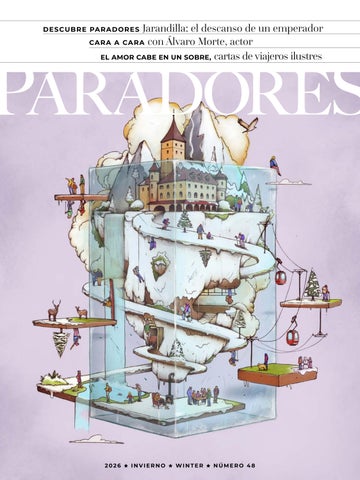
PARADORES nº48 2026

Page 1


DESCUBRE PARADORES Jarandilla: el descanso de un emperador

CARA A CARA con Álvaro Morte, actor

EL AMOR CABE EN UN SOBRE, cartas de viajeros ilustres

Paseos de invierno

AL ABRIGO DE PARADORES

Winter walks sheltered by Paradores

Los inviernos se viven de otra manera. Con tiempo para detenerse, mirar alrededor y disfrutar sin prisas. Estos meses nos invitan a viajar más lento, saboreando cada instante y reencontrándonos con lo esencial. Una estación para disfrutar a lo grande en un país lleno de historia, cultura y naturaleza, de mano de Paradores.

Comenzamos este nuevo año con ilusión renovada y con la satisfacción de ver cómo muchos de los proyectos que hemos impulsado empiezan a dar sus frutos. Entre las páginas de este número te contamos cómo ha quedado el renovado Parador de Jarandilla o de Sigüenza, dos de los establecimientos que han abierto sus puertas con una nueva y mejorada imagen. Espacios que recuperan su esplendor para seguir siendo puntos de encuentro, motores de vida local y puertas de entrada a la autenticidad de cada territorio.

Te invitamos a recorrer paisajes que hablan en voz baja y a descubrir historias que han dejado huella en nuestra geografía. Desde la presencia de los dinosaurios en la península ibérica hasta la herencia vikinga en nuestras murallas, pasando por la majestuosidad de la cueva de El Soplao, auténtica Capilla Sixtina de la geología. Un viaje que conecta ciencia y emoción.

Pero también queremos que pares, escuches y sientas. El turismo del silencio nos lleva a monasterios, desiertos, montañas y costas donde el sonido de la naturaleza lo envuelve todo. Lugares para respirar hondo, mirar alrededor y reconectar con nosotros mismos

Winters are experienced differently. With time to pause, look around, and enjoy without haste. These months invite us to travel more calmly, savouring every moment and allowing ourselves to reconnect with what truly matters.

A season to be enjoyed to the fullest in a country rich in history, culture, and nature, hand in hand with Paradores.

We begin this new year with renewed enthusiasm and the satisfaction of seeing how many of the projects we have promoted are starting to bear fruit. In the pages of this issue, we tell you how the renovated Parador de Jarandilla and Parador de Sigüenza have turned out—two establishments that have reopened their doors with a new and improved look. Spaces that have regained their splendour to continue serving as meeting points, drivers of local life, and gateways to the authenticity of each territory.

We invite you to explore landscapes that whisper and to discover stories that have left their mark on our geography. From the presence of dinosaurs in the Iberian Peninsula to the Viking heritage in our walls and the majesty of the El Soplao cave, a true Sistine Chapel of geology. A journey that connects science and emotion.

But we also want you to stop, listen, and feel. Silent tourism takes us to monasteries, deserts, mountains, and coastlines where the sound of nature envelops everything.

en un entorno que invita a la calma. Acompañados, por qué no, de bonitas palabras. Las cartas de amor viajeras nos acercan a los sentimientos de grandes escritores y escritoras que supieron crear puentes con las letras para acortar la distancia. Y celebramos el 150 aniversario de Manuel de Falla, recordando cómo su música supo unir, al igual que hacemos nosotros, tradición y modernidad para convertirse en símbolo de nuestra identidad cultural.

No faltan en estas páginas nuestras tradiciones más antiguas, los calendarios agrícolas que guiaban la vida rural, la gastronomía que sabe a territorio –como el lingote de cochinillo del Parador de Úbeda– o las entrevistas que nos acercan a voces contemporáneas, como el actor Álvaro Morte o el autor David Uclés.

Recorramos juntos estas páginas como quien da un paseo invernal: con calma, con curiosidad y con ganas de dejarse sorprender.

RAQUEL SÁNCHEZ

PRESIDENTA DE PARADORES

Espacios que recuperan su esplendor para seguir siendo puntos de encuentro, motores de vida local y puertas de entrada a la autenticidad

Parador de Jarandilla

Una estación para disfrutar a lo grande en un país lleno de historia, cultura y naturaleza, de mano de Paradores

Places to take a deep breath, look around, and reconnect with ourselves in surroundings that entice calm. Accompanied, why not, by beautiful words. Travelling love letters bring us closer to the feelings of great writers who were able to build bridges with words to shorten distances. And we celebrate the 150th anniversary of Manuel de Falla, recalling how his music managed to unite, just as we do, tradition and modernity to become a symbol of our cultural identity.

These pages also feature our oldest traditions: the agricultural calendars that guided rural life, gastronomy that tastes of the land—such as the suckling pig ingot from the Parador de Úbeda—and interviews that bring us closer to contemporary voices, such as actor Álvaro Morte or author David Uclés.

Let us browse these pages together as one would take a winter walk: calmly, full of curiosity, and with the desire to be surprised.

CONTENIDOcontents

CARTA D e l A PR e SID e NTA 03

Paseos de invierno al abrigo de Paradores

Winter walks sheltered by Paradores

D e SCUBR e PARADOR e S 10

El descanso de un emperador An emperor’s retreat

Descubre

NATURA le ZA

PARA l OS S e NTIDOS 29 CARA A CARA 35

CA le NDARIOS AGRÍCO l AS 56

Ventanas a la vida mediaval

Windows into medieval life

CARTAS D e AMOR 41

Jarandilla de la Vera

CA le NDARIO CU l TURA l 17

ART e Y CU e RPO 23

No hay distancia entre arte y cuerpo: la experiencia física se convierte en metáfora de su propuesta estética There is no distance between art and body: physical experience becomes a metaphor for her aesthetic proposal

El amor cabe en un sobre Love fits an envelope

e SCAPADAS CON HISTORIA 47

Tras la huella de los dinosaurios Following in the footsteps of dinosaurs

Donde rompe el oleaje Where the waves break

Un paseo por la ciudad del doncel

A stroll through the city of doncel

Victoria Ramos Viaira

Conocer a nivel personal algunos

Paradores ayuda a la hora de elegir uno para una reunión corporativa

Knowing some Paradores on a personal level helps when choosing one for a corporate meeting

¿Cuánto sabes de Paradores? Paradores, how much do you know?

Ricardo Mar Ruipérez

Silvia Zancajo García

COORDINADORA

Alba Zafra Espejo

CONS e JO e DITORIA l Conchi Antón Ana Martínez R e DACCIÓN Y

Editorial MIC

DIAGRAMACIÓN Y

Editorial MIC

FOTOGRAFÍA

Archivo Paradores

Editorial MIC

PUB l ICIDAD

Editorial MIC 902 271 902 987 27 27 27

Madrid: Jesús Pérez

Barcelona: Belén Matè Àngel Ferrándiz

León: Esther García · Benita Espadas

Valladolid: Virginia de la Bastida

Valencia: Esther G. Pablo

Alos pies del Moncayo se encuentran La Estanca, La estanquilla y Ginestares, las fincas donde reside el corazón y la excepcionalidad del aceite de Trujal de Tudela. Tradición y sabor son algunos de los atributos que se encuentran en cada botella de nuestro oro líquido. El aceite de oliva virgen extra de inigualable calidad es lo que se embotella en nuestros productos ganadores de competencias internacionales de calidad.

Un año más, Trujal de Tudela se posiciona como la almazara referente en Navarra y en el norte peninsular, con una cosecha espectacular gracias al clima privilegiado del Valle del Ebro, lo que favorece el correcto desarrollo del olivar y sus frutos.

Londres, Nueva York, Los Ángeles, Ámsterdam entre otros han sido los concursos de renombre internacional que han reconocido a los cuatro “Sibaritas del Trujal” como una colección de personalidades únicas. Los “Sibaritas del Trujal” han recibido premios al packaging tan especial y único que tienen. Sin embargo, lo que más han destacado los jurados de los certámenes ha sido la extraordinaria calidad de nuestros cuatro sibaritas: Don Arróniz, Doña Arbo-

sana, Doña Arbequina y Don Koroneiki. nuestros maestros de almaentre

riedad autóctona de Navarra, y Arbequina, la favorita del

La campaña 2025-2026 ha traído la última incorporación a las joyas del Trujal, nuestro AOVE más navarro, un coupage único creado por nuestros maestros de almazara, El DOP Aceite de Navarra. La fusión perfecta entre la variedad Arróniz, variedad autóctona de Navarra, y Arbequina, la favorita del público. No te pierdas esta unión perfecta y balanceada de verdor, sabores y aromas. www.trujaldetudela.com y norte

Jarandilla Vera de la

EL DESCANSO DE UN EMPERADOR

AN EMPEROR’S RETREAT

A los pies de gargantas y cascadas, entre bosques de robles y castaños, el castillopalacio de los condes de Oropesa domina el caserío de Jarandilla de la Vera. Tras casi diez meses de obras y una inversión de seis millones de euros, el Parador abrió de nuevo sus puertas en octubre con una propuesta más accesible, contemporánea y sostenible.

At the foot of gorges and waterfalls, among oak and chestnut forests, the castle-palace of the Counts of Oropesa dominates the hamlet of Jarandilla de la Vera. After almost ten months of construction and an investment of six million euros, the Parador reopened its doors in October with a more accessible, contemporary and sustainable offering.

Convertido en Parador en 1966, Jarandilla conjuga naturaleza e historia al abrigo de las montañas. En este enclave, la comarca de La Vera –junto a los ríos Tiétar y Jerte– despliega gargantas de agua y piscinas naturales en un territorio de bosques de castaños, mientras el castillo-palacio ofrece al viajero una hospitalidad de raíz señorial.

La reapertura culmina una intervención orientada a mejorar eficiencia energética, sostenibilidad y accesibilidad. Entre otras actuaciones, Paradores ha acometido la reforma integral de la sala de calderas para eliminar el uso del gasóleo y sustituirlo por una fuente energética más eficiente, que reducirá un 49 % el consumo energético en climatización, con un

Converted into a Parador in 1966, Jarandilla combines nature and history in the shelter of the mountains. In this enclave, the region of La Vera – next to the Tiétar and Jerte rivers – boasts water gorges and natural pools in a territory of chestnut forests, while the castle-palace offers travellers stately hospitality.

The reopening culminates a project aimed at improving energy efficiency, sustainability and accessibility. Among other measures, Paradores has undertaken a comprehensive renovation of the boiler room to eliminate the use of diesel fuel and replace it with a more efficient energy source, which will reduce energy consumption for air conditioning by 49%, with an estimated annual saving of more than thirty thousand euros and a reduction in the

ahorro anual estimado superior a treinta mil euros y una reducción de la huella de carbono de 115 toneladas de CO 2 . A esto se suman las actuaciones en la denominada «zona noble», que contará con 14 habitaciones más amplias y baños acondicionados para mejorar la accesibilidad. En paralelo, se ha dotado a la cocina de una nueva climatización, al igual que la zona de lavandería, para mejorar estos espacios de trabajo y el confort de las personas trabajadoras.

La intervención se completa con una redecoración integral y una propuesta artística contemporánea que dialoga con el territorio: Lin Calle evoca el paisaje del Valle del Jerte; Sonia Navarro rinde homena je al trabajo textil tradicional en Esparto Nacho Zubelzu visibiliza el mundo rural y la trashumancia, elementos arraigados en la cultura de Extremadura. Estas actuaciones se enmarcan en el plan de transformación que Paradores impulsa de cara a su centenario de 2028, con una inversión histórica de más de 250 millones de euros para la reforma de más del 50 % de la Red.

Patrimonio en primer plano

Un retiro imperial entre bosques y ríos

Catalogado como Bien de Interés Cultural, el edificio ha sido objeto de actuaciones impulsadas por Turespaña con fondos europeos Next Generation. Destaca la restauración integral del Patio de Armas –con nuevo sistema de evacuación de agua, limpieza y restauración de fachadas y reestructuración del pavimento–, además de la rehabilitación de la torre noroeste implementando más medidas de seguridad para habilitar el acceso público. El conjunto se realza con la recuperación del acceso histórico mediante la rehabilitación del foso original y la conservación de la muralla perimetral. A estas actuaciones se añade la certificación Starlight y la iluminación monumental del todo el recinto (torres, fachadas históricas, barbacana, foso, patio de armas y caminos peatonales, entre otros elementos), además de la redacción de un Plan Director de Conservación para conocer mejor las necesidades del edificio.

El Parador ocupa el antiguo castillo-palacio de los condes de Oropesa, fechado entre los siglos XV y XVI, del que se conservan el foso y las murallas torreadas, además de una excepcional galería gótica de dos pisos en el patio interior. Entre 1556 y 1557, el edificio fue el refugio elegido por el emperador Carlos V tras su abdicación: residió aquí durante varios meses antes de instalarse definitivamente en el cercano monasterio de Yuste.

En el entorno, la mirada se abre hacia gargantas naturales como la de Jaranda y la Reserva Natural Garganta de los Infiernos, y hacia un mosaico de localidades declaradas Conjunto HistóricoArtístico: Pasarón de la Vera, Garganta la Olla, Valverde de la Vera, Villanueva de la Vera y Cuacos de Yuste. Para caminar con el pulso de la historia, la Ruta del Emperador recorre el itinerario entre Jarandilla y Yuste, siguiendo el paso del séquito imperial.

Al regresar, la piscina –rodeada de olivos y naranjos– prolonga el sosiego del patio y las torres: un descanso que hoy suma, a su memoria, una mirada contemporánea.

carbon footprint of 115 tonnes of CO2 Added to this are the actions in the socalled “noble area”, which will have 14 more spacious rooms and bathrooms adapted to improve accessibility. At the same time, the kitchen has been equipped with new air conditioning, as has the laundry area, to improve these workspaces and the comfort of the workers.

The project is completed with a comprehensive redecoration and a contemporary artistic proposal that dialogues with the territory: Lin Calle evokes the landscape of the Jerte Valley; Sonia Navarro pays tribute to traditional textile work in Esparto; and Nacho Zubelzu highlights the rural world and transhumance, elements deeply rooted in the culture of Extremadura. These actions are part of the transformation plan that Paradores is promoting ahead of its centenary in 2028, with a historic investment of more than £250 million to renovate more than 50% of the network.

Heritage in the spotlight

Listed as a Site of Cultural Interest, the building has been the subject of actions promoted by Turespaña with European Next Generation funds. Highlights include the comprehensive restoration of the Patio de Armas (with a new water drainage system, cleaning and restoration of façades and restructuring of the paving), as well as the refurbishment of the northwest tower, implementing more security measures to enable public access. The complex is enhanced with the restoration of the historic access through the rehabilitation of the original moat and the conservation of the perimeter wall. In addition to these actions, the sitehas been installed throughout the grounds has been awarded Starlight certification and monumental lighting (towers, historic façades, barbican, moat, parade ground and footpaths, among other elements), and a Conservation Master Plan has been drawn up to better understand the building’s needs.

An imperial retreat among forests and rivers

The Parador occupies the former castle-palace of the Counts of Oropesa, dating from the 15th and 16th centuries, of which the moat and towered walls remain, as well as an exceptional two-storey Gothic gallery in the inner courtyard. Between 1556 and 1557, the building was the refuge chosen by Emperor Charles V after his abdication: he resided here for several months before settling permanently in the nearby monastery of Yuste.

The surrounding area offers views of natural gorges such as Jaranda and the Garganta de los Infiernos Nature Reserve, and a mosaic of towns declared Historic-Artistic Sites: Pasarón de la Vera, Garganta la Olla, Valverde de la Vera, Villanueva de la Vera and Cuacos de Yuste. To walk in the footsteps of history, the Emperor’s Route follows the itinerary between Jarandilla and Yuste, tracing the path of the imperial entourage.

LA GASTRONOMÍA DE LA VERA

En el restaurante, la cocina tradicional extremeña se expresa con claridad: jamón de bellota de la Dehesa de Extremadura, chacinas ibéricas y quesos de la región; y, como especialidades, paletilla de cabrito, patatas revolconas y repápalos con anisete y canela. En la mesa asoman también los sabores que definen la comarca –con el pimentón de La Vera como acento indispensable– en platos como las migas extremeñas o la sopa de tomate.

On the way back, the swimming pool – surrounded by olive and orange trees – prolongs the tranquillity of the courtyard and the towers: a rest that today adds a contemporary touch to its memory.

THE CUISINE OF LA VERA

In the restaurant, traditional Extremaduran cuisine is clearly expressed: acorn-fed ham from the Dehesa de Extremadura, Iberian cured meats and cheeses from the region; and, as specialities, shoulder of kid, patatas revolconas (mashed potatoes with bacon) and repápalos (fried potatoes) with aniseed and cinnamon. The flavours that define the region also appear on the table – with La Vera paprika as an essential accent – in dishes such as Extremaduran migas or tomato soup.

TEATRO

GEN

FERIAS

LUCES DE BOHEMIA, DE RAMÓN DEL VALLE-INCLÁN

Fecha: del 23 de enero al 7 de marzo de 2026

Lugar: Teatro Español de Madrid

Horarios y entradas: teatroespanol.es El Teatro Español de Madrid acogerá Luces de bohemia, la obra maestra de Ramón del Valle-Inclán que dio origen al esperpento, ese espejo deformante donde la realidad se convierte en sátira. A través del último viaje nocturno de su protagonista, Max Estrella, por un Madrid grotesco y lúcido, la puesta en escena recupera la crítica social y el lenguaje brillante del autor gallego. Con una cuidada dirección y escenografía que evocan la decadencia modernista, la producción revisita los límites entre arte y miseria, y humor y tragedia. Una cita imprescindible del teatro español contemporáneo.

LUCES DE BOHEMIA (BOHEMIAN LIGHTS), BY RAMÓN DEL VALLE-INCLÁN

Date: 23 January to 7 March 2026

Place: Teatro Español, Madrid

Time and tickets: teatroespanol.es

The Teatro Español in Madrid will host Luces de bohemia, Ramón del ValleInclán’s masterpiece that gave rise to esperpento, that distorting mirror where reality becomes satire. Through the final night-time journey of its protagonist, Max Estrella, through a grotesque and lucid Madrid, the staging recovers the social criticism and brilliant language of the Galician author. With careful direction and set design that evoke modernist decadence, the production revisits the boundaries between art and misery, humour and tragedy. An essential event in contemporary Spanish theatre.

22ª FERIA DE LA TRUFA DE SORIA

Fecha: 15 y 16 de febrero de 2026

Lugar: Abejar, Soria

Horarios y entradas: feriatrufasoria.es

Reúne al sector de la truficultura, la gastronomía y el turismo rural en torno a la preciada trufa negra de Soria. Es la única monoespecífica en Castilla y León, y combina expositores, showcookings , talleres de cata, concursos de trufa mayor y de búsqueda asistida por perros, además de conferencias técnico-científicas sobre el cultivo y comercialización del hongo, entre otras actividades. La cita refuerza la posición de Soria como referente nacional e internacional del mundo trufero, impulsando el desarrollo del medio rural, el micoturismo y el aprovechamiento sostenible de sus montes.

22ND SORIA TRUFFLE FAIR

Date: 15 and 16 February 2026

Place: Abejar, Soria

Time and tickets: feriatrufasoria.es

This fair brings together the truffle farming, gastronomy and rural tourism sectors around the prized black truffle of Soria. It is the only single-species fair in Castile and León, and combines exhibitors, show cooking, tasting workshops, competitions for the largest truffle and truffle hunting with dogs, as well as technical and scientific conferences on the cultivation and marketing of the fungus, among other activities. The event reinforces Soria’s position as a national and international benchmark in the world of truffles, promoting the development of rural areas, mycological tourism and the sustainable use of its mountains.

ARCOMADRID

Fecha: 4 al 8 de marzo de 2026

Lugar: recinto ferial de IFEMA MADRID Horarios y entradas: ifema.es/arco/ Es la Feria Internacional de Arte Contemporáneo de España que, desde su creación, se ha consolidado como una de las principales plataformas del mercado del sector. En 2026 celebrará su 45ª edición, con ARCO2045 como tema central: dos espacios dentro de la feria, comisariados respectivamente por José Luis Blondet y Magali Arriola, que invitarán a reflexionar sobre posibles futuros y lenguajes tentativos del arte con el fin de vislumbrar nuevos horizontes. ARCO divide su calendario en dos celebraciones: ARCOmadrid y ARCOlisboa, celebrada en el mes de mayo en la capital portuguesa. Ambas ferias reúnen a galerías, artistas, profesionales e instituciones, convirtiendo las dos sedes en epicentros del arte contemporáneo y su mercado.

ARCOMADRID

Date: 4 to 8 March 2026

Place: IFEMA MADRID exhibition centre

Time and tickets: ifema.es/arco/

This is Spain’s International Contemporary Art Fair, which, since its creation, has established itself as one of the main platforms for the sector’s market. In 2026, it will celebrate its 45th edition, with ARCO2045 as its central theme: two spaces within the fair, curated respectively by José Luis Blondet and Magali Arriola, which will invite reflection on possible futures and tentative languages of art in order to glimpse new horizons. ARCO divides its calendar into two events: ARCOmadrid and ARCOlisboa, held in May in the Portuguese capital. Both fairs bring together galleries, artists, professionals and institutions , turning the two venues into epicentres of contemporary art and its market.

JEREZ FESTIVAL 2026

Date: 20 February to 7 March 2026

Place: Jerez, various venues

Time and tickets: festivaldejerez.es

Jerez de la Frontera will once again become the world capital of flamenco with the celebration of the 30th edition of the Festival de Jerez, an essential event for Spanish dance and flamenco art. The event will bring together leading figures and new voices

EXPOSICIONES

in flamenco at iconic venues such as the Villamarta Theatre, as well as historic wineries and courtyards. With more than forty international courses and workshops, the festival reinforces its educational vocation and global reach. For two weeks, Jerez will vibrate to the rhythm of flamenco, combining shows, master classes and the welcoming atmosphere of its streets, tabancos (flamenco bars) and squares.

LOS NABIS, PROFETAS DE UN ARTE NUEVO (1888-1900)

Fecha: del 6 de marzo al 28 de junio de 2026

Lugar: La Pedrera-Casa Milà, Barcelona

Horarios y entradas: fundaciocatalunya-lapedrera.com

Comisariada por Isabelle Cahn y organizada junto al Musée d’Orsay, la muestra reúne cerca de doscientas obras que revelan la belleza y diversidad de este grupo de artistas franceses que, entre el simbolismo y el decorativismo, transformaron la pintura en un lenguaje espiritual y moderno. Nacidos en torno a Paul Sérusier, los Nabis buscaron un arte total en sintonía con la vida contemporánea. La Casa Milà, joya del modernismo catalán de Gaudí, ofrece el escenario perfecto para este diálogo entre forma, ornamento y pensamiento estético. La exposición se completa con actividades que exploran la conexión del movimiento con la música, la poesía y el simbolismo.

THE NABIS, PROPHETS OF A NEW ART

Date: 6 March to 28 June 2026

Place: La Pedrera-Casa Milà, Barcelona

Time and tickets: fundaciocatalunya-lapedrera.com

MÚSICA

FESTIVAL

DE JEREZ 2026

Fecha: del 20 de febrero al 7 de marzo de 2026

Lugar: Jerez, varios lugares

Horarios y entradas: festivaldejerez.es

Jerez de la Frontera volverá a convertirse en capital mundial del flamenco con la celebración de la XXX edición del Festival de Jerez, una cita imprescindible con la danza española y el arte jondo. El evento reunirá a grandes figuras y nuevas voces del flamenco en escenarios emblemáticos como el Teatro Villamarta, además de bodegas y patios históricos. Con más de cuarenta cursos y talleres internacionales, el festival refuerza su vocación formativa y su proyección global. Durante dos semanas, Jerez vibrará al ritmo del compás, combinando espectáculos, clases magistrales y el ambiente acogedor de sus calles, tabancos y plazas.

Curated by Isabelle Cahn and organised in collaboration with the Musée d’Orsay, the exhibition brings together nearly two hundred works that reveal the beauty and diversity of this group of French artists who, between symbolism and decorativism, transformed painting into a spiritual and modern language. Born around Paul Sérusier, the Nabis sought a total art in tune with contemporary life. Casa Milà, Gaudí’s jewel of Catalan modernism, provides the perfect setting for this dialogue between form, ornamentation and aesthetic thought. The exhibition is complemented by activities that explore the movement’s connection with music, poetry and symbolism.

Reconocida por su originalidad, solemnidad y más de 700 años de historia, la Semana Santa de Tarazona se ha convertido en uno de los acontecimientos más emblemáticos del calendario aragonés. Cada primavera, la ciudad se transforma. Las calles empedradas de Tarazona resuenan con el eco profundo de 400 instrumentos —cornetas, tambores, timbales y bombos— que acompañan el paso solemne de más de 1.000 cofrades pertenecientes a diez cofradías. Casi uno de cada diez vecinos participa directamente en esta celebración que combina arte y tradición en un mismo latido colectivo. El pregón, la exaltación de tambores y bombos, el sobrecogedor Descendimiento, el Sellado del Sepulcro, la Procesión de las Siete Palabras y la Procesión de los Ensacados son algunos de los momentos que convierten esta cita en una experiencia única. Todo culmina el Viernes Santo, con la Procesión General del Santo Entierro, donde las cofradías marchan unidas en una manifestación de fe y tradición que envuelve a toda la ciudad. La Entrada, la Flagelación, la Oración en el Huerto, las Siete Palabras, el Descendimiento, el Sellado del Sepulcro o Las Dolorosas, compuesta íntegramente por mujeres. Llegó a tener 850 componentes, pero ahora mismo cuenta con más de 600. Son las custodias de la bella imagen de la Virgen de los Dolores, una de las tallas más llamativas de la villa. El patrimonio artístico que desfila por Tarazona es digno de admiración. La Virgen de la Piedad, obra del escultor de Cámara de Carlos III, Francisco Gutiérrez, y el Santo Cristo del Rebate, entre las más antiguas y de mayor valor, de finales del siglo XVI. Llamativa es también la de la Borriquilla: sus 550 kilos de peso exigían que la portaran 14 cofrades.

Semana Santa de Tarazona : siete siglos de devoción a los pies del Moncayo

La Semana San ta turiasonense es mucho más que un to religioso: es una expre sión viva de la historia, la espiritualidad y el pa- trimonio artístico de una localidad que, como escribió Gustavo Adolfo Bécquer, es “la Toledo aragonesa”. Y no es para menos. En esos días, Tarazona se tiñe de tonos sepia y de un silencio solemne que contrasta con el retumbar de los tambores y el brillo de sus monumentos renacentistas y mudéjares. El propósito del alcalde de Tarazona, Tono Jaray, es conseguir que la Fiesta de Interés Turístico Regional, título obtenido en 2005, sea pronto reconocida como Fiesta de Interés Turístico Nacional, algo que ya disfruta otra de las celebraciones más importantes de la ciudad, el Cipotegato. “Tarazona lo combina todo, la fiesta de la Semana Santa, el potencial turístico y patrimonial y el entorno natural del Parque Natural del Moncayo”, cuenta el edil turiasonense.

Puedes visitar la página web: Semanasantatarazona.es

CINE

29 FESTIVAL DE MÁLAGA

Fecha: del 6 al 15 de marzo de 2026

Lugar: Málaga, varios lugares

Horarios y entradas: festivaldemalaga.com

Málaga reafirma su condición de gran capital del cine español e iberoamericano con la 29.ª edición de su festival. Por primera vez, se incorpora la sección «América, América», destinada a dar visibilidad al cine de comunidades indígenas y rurales del continente americano. Además, la ciudad acogerá previamente la programación expandida MaF – Málaga de Festival, entre el 12 de febrero y el 5 de marzo, centrada en Europa y el centenario del guionista Rafael Azcona. Con esta propuesta, el certamen refuerza su vocación internacional y su capacidad de combinar industria, cine de autor y participación ciudadana.

DEPORTE

TENERIFE BLUETRAIL BY UTMB 2026

29TH MALAGA FILM FESTIVAL

Date: 6 to 15 March 2026

Place: Malaga, various venues

Time and tickets: festivaldemalaga.com

Malaga reaffirms its status as the capital of Spanish and Latin American cinema with the 29th edition of its festival. For the first time, the festival will include the section “America, America”, aimed at raising the profile of cinema from indigenous and rural communities in the Americas. In addition, the city will host the expanded MaF – Málaga de Festival programme between 12 February and 5 March, focusing on Europe and the centenary of screenwriter Rafael Azcona. With this proposal, the festival reinforces its international vocation and its ability to combine industry, auteur cinema and citizen participation.

Fecha: del 19 al 21 de marzo de 2026

Lugar: Isla de Tenerife, con salida desde la costa, subida al Teide y meta a pie de mar Horarios y entradas: tenerife.utmb.world/es

Con participantes de más de sesenta países, es una de las carreras de montaña más impresionantes del planeta. Recorre la isla de Tenerife desde las playas atlánticas hasta las cumbres nevadas del Teide, a 3555 m de altitud. Incluida en el prestigioso circuito UTMB World Series, ofrece distintas modalidades: desde los 110 km de la ultra hasta distancias más accesibles, además de pruebas inclusivas y familiares. Atraviesa paisajes volcánicos, bosques de laurisilva y el Parque Nacional del Teide, Patrimonio de la Humanidad.

TENERIFE BLUETRAIL

BY UTMB 2026

Date: 19 to 21 March 2026

Place: Island of Tenerife, starting from the coast, climbing Mount Teide and finishing at the sea

Time and tickets: tenerife.utmb.world/es

With participants from more than sixty countries, it is one of the most impressive mountain races on the planet. It crosses the island of Tenerife from the Atlantic beaches to the snow-capped peaks of Mount Teide, at an altitude of 3,555 metres. Included in the prestigious UTMB World Series circuit, it offers different modalities: from the 110 km ultra to more accessible distances, as well as inclusive and family events. It crosses volcanic landscapes, laurel forests and the Teide National Park, a World Heritage Site.

Yoko Ono

INSOUND AND INSTRUCTURE

DESIRÉ ALIJA
FOTOS D. ALIJA
Yoko Ono. Parts of a Lighthouse (detalle), 1965

El Museo de Arte Contemporáneo de Castilla y León (MUSAC) acoge la mayor retrospectiva dedicada a Yoko Ono en España en la última década. Más de setenta piezas y seis décadas de creación se despliegan sobre 1700 m2 de salas convertidas en territorio vivo.

Insound and Instructure se inscribe en la relectura internacional de la trayectoria de Yoko Ono, tras grandes retrospectivas como Music of the Mind (Tate Modern, Londres, 2024). En León, la artista japonesa ofrece una síntesis de su pensamiento estético y político, donde la poesía se confunde con la acción y la utopía con la materia. Esta antología no solo revisa seis décadas de creación: coloca al MUSAC en el mapa global del arte contemporáneo, en el marco de su 20.º aniversario, reafirmando su papel como institución pionera en la difusión del arte actual.

Desde el umbral mismo, Ono rompe la pasividad del visitante. Para entrar, hay que atravesar una cortina de cuentas, avanzar por un pasillo de espejos o deslizarse por un tobogán. No hay distancia entre arte y cuerpo, la experiencia física se convierte en metáfora de su propuesta estética: no muestra, convoca. Su obra sucede en quien la recorre.

El título de la muestra recupera una acción fundacional: un concierto y exposición que Ono realizó en 1964 en Kioto, donde articuló dos conceptos que definirían su lenguaje: el sonido y la instrucción. De esas raíces nacerían sus célebres Instructions, obras que no se limitan al objeto, sino que invitan a imaginar, ejecutar o completar un gesto. El arte, entonces, se desmaterializa para volverse pensamiento, presencia, acto de conciencia compartido. La artista abrió así una vía decisiva en el arte conceptual y la performance, que todavía hoy interroga la frontera entre idea y experiencia.

El recorrido propuesto por el MUSAC atraviesa las distintas metamorfosis de su obra. De los años sesenta emergen piezas icónicas como Cut Piece (1964) o Voice Piece for Soprano (1961), auténticos manifiestos de vulnerabilidad y participación. En diálogo con ellas, instalaciones más recientes como Doors (2011) o Invisible Flags (2015) subrayan su compromiso pacifista y humanista, tan vigente como su radicalidad formal. La exposición incluye también una selección de films –algunos en colaboración con John Lennon– como Rape (1968), FLY (1970/71) o Freedom (1970), que prolongan en la pantalla su poética del gesto mínimo y la mirada insistente.

Entre las instalaciones que articulan la exposición, Arising ocupa un lugar de hondo simbolismo. Compuesta por testimonios de mujeres que han sufrido por el hecho de serlo, esta obra se construye de manera abierta, antes y durante la muestra. En Arising, la participación se convierte en acto de sanación y memoria, y el arte en refugio y denuncia a un tiempo. Participar también es sanar.

NO HAY DISTANCIA ENTRE ARTE Y CUERPO:

LA EXPERIENCIA FÍSICA SE CONVIERTE EN METÁFORA DE SU PROPUESTA ESTÉTICA

Yoko Ono. MEND PIECE (detalle), 1966

THERE IS NO DISTANCE BETWEEN ART AND BODY: PHYSICAL EXPERIENCE BECOMES A METAPHOR FOR HER AESTHETIC PROPOSAL

The Museum of Contemporary Art of Castilla y León (MUSAC) is hosting the largest retrospective dedicated to Yoko Ono in Spain in the last decade. More than seventy pieces and six decades of creation are displayed across 1700 m2 .of rooms converted into living space.

Insound and Instructure is part of the international reinterpretation of Yoko Ono’s career, following major retrospectives such as Music of the Mind (Tate Modern, London, 2024). In León, the Japanese artist offers a synthesis of her aesthetic and political thinking, where poetry merges with action and utopia with matter. This anthology not only reviews six decades of creation: it places MUSAC on the global map of contemporary art, in the context of its 20th anniversary, reaffirming its role as a pioneering institution in the dissemination of contemporary art.

Yoko Ono. En Trance (detalle), 1990

MUSAC, Museo de Arte Contemporáneo de Castilla y León Salas 3–6 · Av. de los Reyes Leoneses, 24, León

Del 8 de noviembre de 2025 al 17 de mayo de 2026

De martes a domingo, de 11:00 a 14:00 h. y de 17:00 a 20:00 h. Visitas guiadas gratuitas con inscripción previa (aforo limitado)

MUSAC, Museum of Contemporary Art of Castilla y León Galleries 3–6 · Av. de los Reyes Leoneses, 24, León

From 8 November 2025 to 17 May 2026 Tuesday to Sunday, 11:00 a.m. to 2:00 p.m. and 5:00 p.m. to 8:00 p.m. Free guided tours with prior registration (limited capacity)

From the very threshold, Ono breaks the visitor’s passivity. To enter, one must pass through a curtain of beads, walk down a corridor of mirrors or slide down a slide. There is no distance between art and body; the physical experience becomes a metaphor for her aesthetic proposal: she does not show, she summons. Her work happens in those who experience it.

The title of the exhibition recalls a seminal event: a concert and exhibition that Ono held in Kyoto in 1964, where she articulated two concepts that would define her language: sound and instruction. From these roots would spring her

famous Instructions, works that are not limited to the object, but invite us to imagine, execute or complete a gesture. Art, then, is dematerialised to become thought, presence, a shared act of consciousness. The artist thus opened up a decisive path in conceptual art and performance, which still today questions the boundary between idea and experience.

The exhibition proposed by MUSAC traces the different metamorphoses of her work. From the 1960s emerge iconic pieces such as Cut Piece (1964) and Voice Piece for Soprano (1961), authentic manifestos of vulnerability and participation. In dialogue with these, more recent installations such as Doors (2011) and Invisible Flags (2015) underline her pacifist and humanist commitment, as relevant today as her formal radicalism. The exhibition also includes a selection of films—some in collaboration with John Lennon—such as Rape (1968), FLY (1970/71) and Freedom (1970), which extend her poetics of minimal gesture and insistent gaze to the screen.

Among the installations that make up the exhibition, Arising occupies a place of deep symbolism. Composed of testimonies from women who have suffered because of their gender, this work is constructed in an open manner, both before and during the exhibition. In Arising, participation becomes an act of healing and remembrance, and art becomes both a refuge and a denunciation. To participate is also to heal.

Creada por Meraki Cultura Audiovisual para el Cabildo Primado, Lumina Catedral de Toledo es una experiencia inmersiva única en el mundo, un recorrido sensorial que transforma la manera de descubrir la Catedral Primada. A través de videomapping de última generación, luz, sonido envolvente y un cuidado guión, Lumina invita a contemplar el Templo desde una perspectiva inédita, llenando de vida cada rincón para hacer visible su fuerza artística y espiritual

Desde el primer paso, el visitante descubre una nueva forma de mirar el espacio sagrado: la Catedral parece respirar, revelando su esencia en una puesta en escena donde pasado y presente se funden con una sensibilidad extraordinaria. Cada parada del recorrido (entre ellas, en espacios tan emblemáticos como el Coro, la Capilla de la Descensión, el Altar Mayor o El Transparente) se convierte en un momento de asombro, una invitación a detenerse, mirar y dejarse emocionar y sorprender.

Entre las muchas distinciones recibidas por su calidad técnica y artística, Lumina ha sido reconocida con el premio a Mejor Video Mapping de España 2024, galardón que subraya la maestría con la que la experiencia integra tecnología, narrativa y patrimonio

En un recorrido de 50 minutos de duración, Lumina está disponible en español, inglés, alemán, italiano y francés, lo que refuerza el carácter universal de esta experiencia capaz de emocionar más allá de cualquier idioma.

Quienes lo han vivido coinciden: durante el día, eres tú quien entra en la Catedral, pero de noche, en Lumina, es la Catedral la que entra en ti. No es solo una visita; es una vivencia que permanece, una forma nueva y profunda de vivir un encuentro con lo extraordinario

Consigue tus entradas en la tienda de la Catedral de Toledo y en la página oficial de la experiencia: www.luminacatedraldetoledo.com

Para saber más: www.merakiculturaaudiovisual.com

Naturaleza para los sentidos

El invierno impone su propio compás: la naturaleza se aquieta, el aire gana nitidez y la luz se vuelve más íntima. Es la estación de la escucha y la mirada demorada. En Paradores, ese espíritu toma forma en “Naturaleza para los Sentidos”, un programa de experiencias inmersivas que enlaza grandes paisajes con el saber discreto y esencial de quienes los habitan.

En enclaves como Mazagón, Soria, Vielha, Artíes, Guadalupe, Ciudad Rodrigo o Cruz de Tejeda, la naturaleza deja de ser decorado para convertirse en argumento. El programa se despliega actualmente en 27 Paradores, y propone vivencias pensadas para afinar la atención y reconciliar el viaje con el territorio.

No se trata de contemplar: se trata de comprender. Las experiencias nacen de la colaboración con agentes locales, productores y guías que conocen los ritmos de la tierra, y que convierten cada actividad en una forma de lectura del entorno: oficio, memoria, paisaje, sabor. Una hospitalidad que, además, refuerza la economía de proximidad y promueve un turismo responsable.

Nature for the senses

A TIME FOR TRANQUILLITY

Winter imposes its own rhythm: nature becomes still, the air becomes crisp and the light becomes more intimate. It is the season for listening and lingering gazes. At Paradores, this spirit takes shape in Nature for the Senses, a programme of immersive experiences that links great landscapes with the discreet and essential knowledge of those who inhabit them.

In enclaves such as Mazagón, Soria, Vielha, Artíes, Guadalupe, Ciudad Rodrigo and Cruz de Tejeda, nature ceases to be a backdrop and becomes the main attraction. The programme is currently available at 27 Paradores and offers experiences designed to sharpen the senses and reconcile travel with the local area.

It is not about contemplating: it is about understanding. The experiences are born from collaboration with local agents, producers and guides who know the rhythms of the land and who turn each activity into a way of reading the environment: craft, memory, landscape, flavour. A hospitality that also strengthens the local economy and promotes responsible tourism.

PARADOR DE CRUZ DE TEJEDA

CAFETAL DE AGAETE

En el Valle de Agaete (Gran Canaria), el café se cultiva al abrigo de un paisaje volcánico y del alisio atlántico. La visita culmina con degustación: un gesto pequeño, casi ceremonial, que concentra origen y carácter.

AGAETE

COFFEE PLANTATION

In the Agaete Valley (Gran Canaria), coffee is grown in the shelter of a volcanic landscape and the Atlantic trade winds. The visit culminates in a tasting: a small, almost ceremonial gesture that encapsulates the origin and character of the coffee.

PARADOR DE SORIA

EL ACEBAL DE GARAGÜETA

Las tierras sorianas guardan el acebal más extenso y mejor conservado de Europa: un bosque de hoja perenne donde el verde resiste al invierno y la tradición se mezcla con el repertorio de leyendas del lugar. El recorrido, guiado por un especialista, revela claves de conservación y lectura del paisaje.

THE ACEBAL DE GARAGÜETA

Descubre nuestras actividades/ Discover our activities

The lands of Soria are home to the largest and best-preserved olive grove in Europe: an evergreen forest where greenery resists winter and tradition blends with the repertoire of local legends. The tour, guided by a specialist, reveals the keys to conservation and interpretation of the landscape.

TIEMPO DE SOSIEGO
Parador de Cruz de Tejeda

PARADOR DE GUADALUPE

EL SUSURRO DEL BOSQUE

Paseo entre castaños y senderos del Geoparque Mundial UNESCO Villuercas-Ibores-Jara: aire limpio, relieve antiguo y tradiciones que aún sostienen el pulso de la comarca.

THE WHISPER OF THE FOREST

A walk among chestnut trees and trails in the Villuercas-IboresJara UNESCO Global Geopark: clean air, ancient landscapes and traditions that still sustain the pulse of the region.

PARADOR DE LA SEU D’URGELL

GASTRONOMÍA Y TRADICIÓN: EL PIRINEO A TRAVÉS DE SUS

HISTORIAS

Degustación que propone entrar en el Pirineo por la vía más elocuente: la del producto y el relato. Saberes heredados, memoria culinaria y paisaje se trenzan en una experiencia sobria y sugerente.

GASTRONOMY AND TRADITION: THE PYRENEES THROUGH ITS STORIES

A tasting experience that invites you to enter the Pyrenees in the most eloquent way: through its products and stories. Inherited knowledge, culinary memory and landscape are woven together in a sober and evocative experience.

Parador de Guadalupe

PARADOR DE MAZAGÓN

EL BOSQUE DE LAS ANTÍPODAS

Ruta interpretativa por el entorno del Parador, de la mano de un guía local, para descifrar la flora y la biodiversidad del paisaje cercano: una invitación a caminar con método, con curiosidad y sin prisa. El itinerario atraviesa uno de los paisajes menos conocidos de Doñana hasta el Arboreto del Villar.

THE FOREST OF THE ANTIPODES

An interpretive route around the Parador, led by a local guide, to decipher the flora and biodiversity of the surrounding landscape: an invitation to walk methodically, with curiosity and without haste. The itinerary crosses one of the least known landscapes of Doñana to the Arboreto del Villar.

PARADOR DE CIUDAD RODRIGO

CULTIVADORES DE ACEITE

Visita a una almazara para acercarse a la tradición olivarera con mirada sensorial: aromas, amargos, frutados, matices. La degustación final enseña a reconocer, con precisión, lo que el aceite cuenta del territorio.

OIL GROWERS

PARADOR DE VIELHA Y ARTÍES

CAMINOS DE NIEVE

Visit an oil mill to learn about the olive-growing tradition with a sensory approach: aromas, bitterness, fruitiness, nuances. The final tasting teaches you to recognise, with precision, what the oil tells you about the territory.

Ruta guiada con raquetas de nieve por el Alto Pirineo invernal, concebida para favorecer la conexión con la montaña y descubrir los secretos del entorno.

SNOW TRAILS

Guided snowshoe route through the winter High Pyrenees, designed to encourage connection with the mountains and discover the secrets of the environment.

Alvaro MORTE

«OJALÁ QUE MI CARRERA ESTÉ EN EL PRINCIPIO, QUE LE QUEDEN MUCHOS AÑOS»
“I HOPE MY CAREER IS JUST BEGINNING, THAT IT WILL LAST FOR MANY YEARS TO COME”
LUIS TEJEDOR
FOTOS: PAPO WAISSMAN

Lo que podría haber sido un camino predecible se ha convertido en una travesía de elecciones exigentes: Álvaro Morte explora nuevos territorios con un pulso firme y una curiosidad infatigable. Desde ficciones contemporáneas de alta tensión hasta la recreación de episodios de la historia reciente, su carrera es la de un actor que no se conforma. El presente ya es suyo.

What could have been a predictable path has become a journey of demanding choices: Álvaro Morte explores new territories with a steady hand and tireless curiosity. From high-tension contemporary fiction to the recreation of episodes from recent history, his career is that of an actor who is not content to settle. The present is already his.

Estudiaba Telecomunicaciones y la interpretación se cruzó en un camino que le llevó a Finlandia para formarse como actor. Da la impresión de que la vocación le atropelló…

Sí que es verdad que es algo que yo no tenía dentro desde pequeño, ni muchísimo menos. Fue que, de casualidad, me crucé con un anuncio para hacer un corto y conocí a gente relacionada con el teatro que me enganchó muchísimo con la interpretación y, a partir de ahí, me cambió la vida, efectivamente.

¿Qué peso le da usted al azar en el éxito dentro de su profesión? ¿Cómo se convive con esta realidad siendo tan meticuloso?

Bueno, dentro de mi profesión, la suerte es un factor fundamental. Lo que pasa es que yo considero que hay que estar formado, hay que estar entrenado y trabajar mucho para que, en el momento en el que te pueda llamar a la puerta –si es que te llama– esa suerte, te sientas preparado.

¿Cómo elige sus proyectos? ¿Se deja llevar por el guion, por el director o por el reto que supone el personaje?

Pues un poco de todo. Por supuesto, lo primero que considero es la historia que se va a contar, si me interesa; quién va a estar a las órdenes, quién es el director que le va a dar su visión al proyecto, y es verdad que, si el personaje no me supone ningún reto, es mucho más difícil que tenga el más mínimo interés en él.

¿Sigue ansiando un papel cómico que le atraiga?

¿No le ha llenado el ojo ninguna propuesta o, directamente, no le ofrecen comedias?

Pues no me ofrecen demasiadas comedias. Se ve que la gente piensa que soy mucho más intenso de lo que en realidad soy y los personajes que me suelen dar distan bastante de ser cómicos, pero me encantaría.

You were studying telecommunications when acting crossed the path, leading you to Finland to train as an actor. It seems as if your vocation took you by surprise...

It’s true that it’s not something I had inside me from a young age, far from it. It was by chance that I came across an advertisement for a short film and met people involved in theatre who got me really hooked on acting, and from then on, it changed my life, yes.

How much importance do you give to chance in your professional success? How do you live with this reality when you are so meticulous?

Well, in my profession, luck is a fundamental factor. The thing is, I believe that you have to be educated, trained and work hard so that when luck comes knocking on your door – if it ever does – you feel prepared.

How do you choose your projects? Are you drawn to the script, the director, or the challenge of the character?

A bit of everything. Of course, the first thing I consider is the story that’s going to be told, whether it interests me; who’s going to be in charge, who’s the director who’s going to bring their vision to the project, and it’s true that if the character doesn’t pose a challenge for me, it’s much harder for me to have the slightest interest in them.

Are you still longing for a comedy role that appeals to you? Haven’t any proposals caught your eye, or are you simply not being offered any comedies?

Well, I don’t get offered many comedies. People seem to think I’m much more intense than I really am, and the characters I’m usually given are far from comical, but I’d love to.

«Interpretar personajes históricos que todos tenemos en la memoria, como Adolfo Suárez, supone un riesgo, pero hay que salir de la zona de confort»

Dentro de su carrera, el estreno en Londres de Barcelona, la obra teatral junto a Lily Collins, es toda una rareza. ¿Se quedó con ganas de más? ¿Qué le aportó esa experiencia?

Hacer teatro es algo que me viene desde el principio. Allí me formé y tenía muchas ganas de retomar las tablas después de haber trabajado tanto delante de la cámara. Fue una oportunidad estupenda poder hacerlo en un lugar tan importante, teatralmente hablando, como es Londres. Lily Collins resultó ser una compañera estupenda. Una experiencia maravillosa que avivó mis ganas de volver a hacer teatro, ojalá aquí, en mi país, y ojalá pronto.

Desde luego, no tiene motivos para quejarse del último año…

Pues, efectivamente, el año lo arranqué acabando mi proyecto teatral en Londres. Luego he estrenado Dos tumbas, que ha ido muy bien, con el personaje de Rafael Salazar, que me ha dado también muchas alegrías. Y ahora, con el estreno de Anatomía de un instante, también estoy muy contento con la reacción de toda la gente. ¿Cómo veo mi carrera? Ojalá que esté en el principio y le queden muchos años.

Tenemos muy fresca su interpretación en Anatomía de un instante. Usted no imita a Adolfo Suárez, pero resulta indudable que es Adolfo Suárez.

Esa era un poco la pretensión. La intención era hacer del personaje sin imitar al personaje. Siempre pensamos que era mucho más interesante alejarnos de la imitación, no solo yo, sino el resto de los compañeros que interpretaban a personajes que la gente conoce, como Carrillo, Gutiérrez Mellado o el Rey.

¿Tuvo vértigo a la hora de meterse en la piel de un personaje histórico tan reciente y conocido? Un resbalón hubiera supuesto su crucifixión en las redes sociales.

Con las redes sociales, todos estamos expuestos últimamente a que cualquier cosa que hagas pueda ser criticada en cualquier momento. Atreverse a hacer personajes históricos que todos tenemos en la memoria, efectivamente, supone un riesgo, pero creo que los riesgos hay que asumirlos y salir de la zona de confort.

¿Qué le suele preguntar la gente cuando le reconoce por la calle que le sorprenda? ¿Aún tienen gracia estas cosas?

La gente es tremendamente cariñosa conmigo cuando se acerca, no he tenido malas experiencias. Ha habido gente que me ha dicho que les hemos ayudado a soportar enfermedades. Recuerdo que cuando estaba en Puente Viejo había mucha gente joven que se me acercaba diciéndome que sus abuelas estaban enamoradas de mí. Hay cosas muy graciosas, pero procuro no pensar demasiado en ello.

Con tanto trajín, ¿cómo valora los descansos para recuperar el aire? ¿Conoce la red de Paradores?

Sí, conozco la red de Paradores, he estado en algunos de ellos y siempre intento, cuando tengo tiempo libre –que no es demasiado–, encontrar lugares donde, efectivamente, pueda descansar y conectar un poco conmigo mismo.

¿Tiene algún Parador favorito?

El Parador de Almagro, porque con 300 Pistolas, con la compañía, tenemos una historia muy bonita con Almagro y el festival de teatro. Siempre nos hemos alojado en el Parador de Almagro. Por esa razón es mi favorito, sin lugar a duda.

In your career, the London premiere of Barcelona, the play with Lily Collins, is quite a rarity. Were you left wanting more? What did that experience bring you?

Theatre is something that has been with me from the beginning. I trained there and I was eager to return to the stage after working so much in front of the camera. It was a wonderful opportunity to be able to do it in such an important place, theatrically speaking, as London. Lily Collins turned out to be a great partner. It was a wonderful experience that rekindled my desire to return to theatre, hopefully here in my country, and hopefully soon.

Of course, you have no reason to complain about the last year...

Well, yes, I started the year by finishing my theatre project in London. Then I premiered Dos tumbas, which went very well, with the character of Rafael Salazar, who has also given me a lot of joy. And now, with the premiere of Anatomía de un instante, I’m also very happy with everyone’s reaction. How do I see my career? Hopefully, it’s just beginning and will continue for many years to come.

We still have a vivid memory of your performance in Anatomía de un instante. You don’t imitate Adolfo Suárez, but there’s no doubt that you are Adolfo Suárez.

That was kind of the aim. The intention was to play the character without imitating him. We always thought it was much more interesting to move away from imi tation, not just me, but the rest of my colleagues who played characters that people know, such as Carrillo, Gutiérrez Mellado and the King.

“Playing historical figures that we all remember, such as Adolfo Suárez, is risky, but you have to step outside your comfort zone”

Did you feel nervous about stepping into the shoes of such a recent and well-known historical figure? One slip-up would have meant crucifixion on social media.

With social media, we are all exposed to the possibility that anything we do could be criticised at any moment. Daring to play historical figures that we all remember is indeed a risk, but I think you have to take risks and step outside your comfort zone.

What do people usually ask you when they recognise you on the street that surprises you? Are these things still funny?

People are extremely affectionate towards me when they approach me; I haven’t had any bad experiences. Some people have told me that we have helped them cope with illness. I remember when I was in Puente Viejo, lots of young people would come up to me and tell me that their grandmothers were in love with me. There are some very funny things, but I try not to think about it too much.

With so much going on, how do you value breaks to catch your breath?

Are you familiar with the Paradores network?

Yes, I know the Paradores network. I’ve been to some of them and I always try, when I have free time – which isn’t much – to find places where I can really rest and connect with myself a little.

Do you have a favourite Parador?

The Parador de Almagro, because with 300 Pistolas, with the company, we have a very nice history with Almagro and the theatre festival. We’ve always stayed at the Parador de Almagro. That’s why it’s my favourite, without a doubt.

Parador de Almagro

cabe en un sobre El amor

CARTAS DE AMOR

VIAJERAS

Dicen que quien escribe viaja dos veces: una por el mundo y otra por su interior. Cartas de amor de grandes escritores se abren para viajar por su paisaje más íntimo: aquel donde la distancia no separa, sino que inspira. /

They say that those who write travel twice: once around the world and once within themselves. Love letters from great writers open up to take us on a journey through their most intimate landscapes: those where distance does not separate, but inspires.

CELIA TURGUÉ

When Rosalía de Castro married Manuel Murguía in 1858, she not only embarked on an emotional journey, but also an epistolary journey that became internal exile and heartbreak: “I should not write to you today, for you, who tell me to do so every day, write as little as you can, and coincidentally, on the two worst days I have had, I even had the misfortune of not receiving a letter from you. [...]”1 , Rosalía wrote to her husband from Santiago de Compostela.

Her letters were always a reflection of her personal geography: Galicia as her homeland, Madrid as her destination and the unknown of her return. They discussed the details of everyday life, but also appealed for literary advice: “The country is the one that needs to rehabilitate itself in the eyes of writers, who, even if only for their good faith and enthusiasm with which they have worked for it, deserve an esteem and respect that they do not know how to give them and that they reserve for what I do not want to mention now. What is this uproar that has been raised against me, when the love I profess for my land is well known?”2.

The writer, possessed of a heart-rending sensitivity, found in the Galician landscape the beauty of a mysterious nature surrounded by sadness and melancholy. Hers was a true love for the land where she was born.

1 De Castro, R. Letters. Miguel de Cervantes Virtual Library.

2 Op. cit.

Cuando Rosalía de Castro se casó con Manuel Murguía en 1858, no solo emprendió un viaje sentimental, sino un viaje epistolar que se convirtió en exilio interior y desconsuelo: «No debía escribirte hoy, pues tú, que me dices lo haga yo todos los días, escaseas las tuyas cuanto puedes, pues casualmente los dos días peores que he tenido, hasta me aconteció la fatalidad de no recibir carta tuya. […]»1, escribió Rosalía a su esposo desde Santiago de Compostela. Sus cartas fueron siempre un reflejo de la geografía personal: Galicia como patria, Madrid como destino y la incógnita del regreso. Discurrían entre los detalles de la cotidianeidad, pero también apelaban al consejo literario: «El país sí que es el que tiene que rehabilitarse para con los escritores, a quienes, aun cuando no sea más que por la buena fe, y entusiasmo con que por él han trabajo, les deben una estimación y respeto que no saben darles y que guardan para lo que no quiero ahora mentar. ¿Qué algarada ha sido ésa que en contra mía han levantado, cuando es notorio el amor que a mi tierra profeso?»2.

La escritora, dueña de una sensibilidad desgarradora, encontró en el paisaje gallego la belleza de una naturaleza misteriosa rodeada de tristeza y melancolía. El suyo fue un amor verdadero hacia la tierra que la vio nacer.

1 De Castro, R. Cartas. Biblioteca Virtual Miguel de Cervantes.

2 Op. cit.

Durante más de veinte años, Benito Pérez Galdós y Emilia Pardo Bazán compartieron una intensa relación que combinó admiración intelectual, complicidad y amor. Sin embargo, el tiempo solo ha conservado las cartas que Emilia escribió a Galdós. En ellas se exhibe una mujer adelantada a su época, dueña de su voz y su deseo, que no temía hablar abiertamente del placer y de la pasión.

Al principio, las cartas fueron una exaltación de la adoración mutua. Más tarde, las misivas evolucionaron hacia el deseo y el impulso fogoso. De los primeros saludos: «admirado maestro» y «querido amigo», se pasó a «ratonciño» y «miquiño mío», palabras llenas de ternura con las que la autora gallega denominaba al escritor canario.

Una de sus misivas más famosas y ardientes relata la pasión y la absoluta libertad de Bazán en una época llena de restricciones hacia la mujer: «Yo me acuesto contigo y me acostaré siempre y si es para algo execrable, muy bien, sabe a gloria, y si no también muy bien, siempre será una felicidad, inmensa que contigo, y solo contigo se puede saborear, porque tienes la gracia del mundo y me gustas más que ningún libro. Debería renunciar a la lectura y deletrearte a ti solo»3. O esta otra en la que el anhelo de vivir lucha contra la imposición de un mundo encorsetado: «Nada eleva el espíritu como el amor: estoy convencida de que de él nacen no solo las más bellas acciones, como opina Dante, sino el fuego artístico […]. Le hemos hecho la mamola al mundo necio, que prohíbe estas cosas; a Moisés que las prohíbe también, con igual éxito; a la realidad, que nos encadena; a la vida que huye»4

3 Hernández, J. M., Pardo Bazán, E., Parreño, I. Miquiño mío. Cartas a Galdós. Madrid: Ed. Turner.

4 Op. Cit.

My dearest Miquiño

For more than twenty years, Benito Pérez Galdós and Emilia Pardo Bazán shared an intense relationship that combined intellectual admiration, complicity and love. However, only the letters that Emilia wrote to Galdós have survived. They reveal a woman ahead of her time, in control of her voice and her desires, who was not afraid to speak openly about pleasure and passion.

At first, the letters were an exaltation of mutual adoration. Later, the missives evolved into desire and fiery passion. From the initial greetings of “admired master” and “dear friend”, they moved on to “little mouse” and “my dear Miquiño”, words full of tenderness with which the Galician author referred to the Canarian writer.

One of her most famous and passionate letters recounts Bazán’s passion and absolute freedom in an era full of restrictions on women: “I sleep with you and I will always sleep with you, and if it is for something despicable, very well, it tastes like glory, and if not, very well too, it will always be immense happiness with you, and only with you can it be savoured, because you have the grace of the world and I like you more than any book. I should give up reading and spell you out to myself”3 . Or this other one, in which the desire to live struggles against the imposition of a constricted world: “Nothing lifts the spirit like love: I am convinced that it gives rise not only to the most beautiful actions, as Dante believes, but also to artistic fire [...]. We have given the finger to the foolish world that forbids these things; to Moses, who also forbids them, with equal success; to reality, which chains us; to life, which flees”4

4 Op. cit.

3 Hernández, J. M., Pardo Bazán, E., Parreño, I. My Miquiño. Letters to Galdós. Madrid: Ed. Turner.

Viaje de amor y duelo

Antonio Machado vivió dos grandes afectos: primero hacia su joven esposa Leonor Izquierdo y luego hacia la figura de «Guiomar». Tras la muerte de Leonor, Machado escribe a Unamuno una carta estremecedora: «La muerte de mi mujer dejó mi espíritu desgarrado. Mi mujer era una criatura angelical segada por la muerte cruelmente. Yo tenía adoración por ella; pero sobre el amor, está la piedad. Yo hubiera preferido mil veces morirme a verla morir, hubiera dado mil vidas por la suya. No creo que haya nada extraordinario en este sentimiento mío. Algo inmortal hay en nosotros que quisiera morir con lo que muere»5

Más tarde, ya cincuentón, vivió el amor tardío. En 1950, Concha Espina recoge retazos de misivas hacia una mujer a la que enmascaraba con el seudónimo de Guiomar: «Mis otros amores sólo han sido sueños a través de los cuales vislumbraba yo la mujer real, la diosa. Cuando ésta llegó, todo lo demás se ha borrado. Solamente el recuerdo de mi mujer queda en mí, porque la muerte y la piedad lo han consagrado».

El propio Machado confiesa a Guiomar en una carta: «Sueño con verte. ¡Ojos y labios de mi diosa! ¡Su cuerpo tan precioso y tan defendido por el alma que lleva dentro! Todo para mí se ilumina cuando te veo. ¿Cómo has conquistado a tu poeta? Tú tan serena, tan suave, ¡tan fuerte! ¿De qué sustancia invisible es la cadena que me echaste al cuello?».

La carta adquiere una dimensión distinta con Miguel Hernández y su esposa, Josefina Manresa. Él desde el encierro, ella fuera, ambos unidos por el aliento del papel y la tinta. Precisamente a la correspondencia entre Josefina y el poeta se debe el poema «Nanas de la cebolla», inspirado en una carta que recibió en la cárcel, donde le contaba que ella y su hijo sólo comían pan y cebolla: «El olor de la cebolla que comes me llega hasta aquí, y mi niño se sentirá indignado de mamar y sacar zumo de cebolla en vez de leche. Para que lo consueles, te mando esas coplillas que le he hecho, ya que aquí no hay para mí otro quehacer que escribiros a vosotros y desesperarme».

5 Prieto de Paula, Á. L. «Tres tiempos en un poema de Antonio Machado (reminiscencia, reviviscencia, conciencia en acto)». Biblioteca Virtual Miguel de Cervantes.

Journey of love and mourning

Antonio Machado experienced two great loves: first for his young wife Leonor Izquierdo and then for the figure of “Guiomar’” After Leonor’s death, Machado wrote a moving letter to Unamuno: “The death of my wife left my spirit torn apart. My wife was an angelic creature cruelly cut down by death. I adored her, but above love is pity. I would have preferred a thousand times to die myself rather than see her die; I would have given a thousand lives for hers. I do not believe there is anything extraordinary about this feeling of mine. There is something immortal in us that wants to die with what dies”5

Later, in his fifties, he experienced late love. In 1950, Concha Espina collected fragments of letters to a woman she masked with the pseudonym Guiomar: “My other loves have only been dreams through which I glimpsed the real woman, the goddess. When she arrived, everything else was erased. Only the memory of my wife remains in me, because death and pity have consecrated it.”

Machado himself confesses to Guiomar in a letter: “I dream of seeing you. Eyes and lips of my goddess! Your body so precious and so defended by the soul within! Everything lights up for me when I see you. How have you conquered your poet? You so serene, so gentle, so strong! Of what invisible substance is the chain you have thrown around my neck?”

The letter takes on a different dimension with Miguel Hernández and his wife, Josefina Manresa. He from confinement, she from outside, both united by the breath of paper and ink. It is precisely the correspondence between Josefina and the poet that inspired the poem “Nanas de la cebolla” (Onion Lullabies), inspired by a letter he received in prison, in which she told him that she and their son were eating only bread and onions: “The smell of the onions you eat reaches me here, and my child will be indignant at suckling and drinking onion juice instead of milk. To console him, I am sending you these little verses I have written, since here I have nothing else to do but write to you and despair.”

5 Prieto de Paula, Á. L. “Three moments in a poem by Antonio Machado (reminiscence, revival, consciousness in action)”. Miguel de Cervantes Virtual Library.

Correspondence in exile

The correspondence between Juan Ramón Jiménez and Zenobia Camprubí is undoubtedly a journey in two stages: courtship, marriage, exile, inner silence.6 Residencia de Estudiantes is responsible for the gradual publication of the correspondence between Juan Ramón Jiménez and Zenobia Camprubí, a volume of more than 700 letters, many of them unpublished: “All my outbursts have turned into sweetness... I thought I was going to wake up mad today, and I woke up as if I had spoken to the angels last night. I want something lasting to remain from this love, unique in my life, besides my pain.”

The letters reveal Zenobia’s direct and expansive tone, in contrast to Juan Ramón’s more ‘literary’ and introspective style. Zenobia sums it up very well in 1952: “You and I are two sides of the same coin when we write to each other: you tell me everything about your emotional life and I have to deduce what is going on, while I tell you everything that is happening and you have to deduce the rest.”

6 Jiménez, J. R., Camprubí, Z. (2017). Monument of love. Letters and poetry. Correspondence 1913-1956. Madrid: Residencia de Estudiantes.

Correspondencia en el exilio

El epistolario de Juan Ramón Jiménez y Zenobia Camprubí es, sin duda, un viaje en dos tiempos: el cortejo, el matrimonio, el exilio, el silenciamiento interior. A la Residencia de Estudiantes6 se debe la paulatina edición de la correspondencia de Juan Ramón Jiménez y Zenobia Camprubí, un volumen de más de 700 cartas, muchas inéditas: «Todos mis arrebatos se han trocado en dulzura… Creí que iba hoy a amanecer loco, y he amanecido como si hubiera esta noche hablado con los ángeles. Quiero que, de este amor, único en mi vida, quede algo perdurable, además de mi dolor».

Letters from Paradores

The landscape of Galicia, the melancholy and beauty of the rain, permeated the work of Rosalía de Castro and Emilia Pardo Bazán. Rosalía herself was born in the Niño Jesús room and was baptised in a font in the chapel of the Parador de Santiago de Compostela. The Paradores of Baiona, Cambados, Castillo de Monterrei, Muxía, Ferrol, Monforte de Lemos, Pontevedra and Ribadeo offer a unique opportunity to discover the roots of these two great ladies of Galician literature.

To discover the poetic soul of Antonio Machado, visit the Paradores in Soria and Jaén, which invite you to enjoy an evocative landscape. The traces of Miguel Hernández shine through in Alicante, at the Parador de Jávea, where the view sparkles with the colour of the sea. Very close to the Parador de Mazagón is Moguer, the birthplace of Juan Ramón Jiménez. In Huelva, the Parador de Ayamonte stands above a beautiful village of white houses.

Las cartas ponen de manifiesto el tono directo y expansivo de Zenobia, frente al más «literario» e introspectivo de Juan Ramón. Zenobia lo sintetiza muy bien en 1952: «Tú y yo somos el reverso de la medalla escribiéndonos: tú me cuentas todo lo de tu vida afectiva y lo que pasa tengo que deducirlo, mientras que yo te cuento todo lo que pasa y tú tienes que deducir lo demás».

Cartas desde Paradores

El paisaje de Galicia, la melancolía y belleza de la lluvia, empaparon la obra de Rosalía de Castro y Emilia Pardo Bazán. La propia Rosalía nació en la sala del Niño Jesús y fue bautizada en una pila de la capilla del Parador de Santiago de Compostela. Los Paradores de Baiona, Cambados, Castillo de Monterrei, Muxía, Ferrol, Monforte de Lemos, Pontevedra y Ribadeo ofrecen una oportunidad única para conocer las raíces de estas dos grandes damas de la literatura gallega. Del alma poética de Antonio Machado cabe recorrer los Paradores de Soria y Jaén que invitan a gozar de un paisaje evocador. Las huellas de Miguel Hernández irradian en Alicante, en el Parador de Jávea, donde la estampa brilla con el color del mar. Muy cerca del Parador de Mazagón se encuentra Moguer, pueblo natal de Juan Ramón Jiménez. También en Huelva, el Parador de Ayamonte se alza sobre un precioso pueblo de casitas blancas.

6 Jiménez, J. R., Camprubí, Z. (2017). Monumento de amor. Epistolario y lira. Correspondencia 1913-1956. Madrid: Residencia de Estudiantes.

TRAS LA HUELLA DE LOS

FOLLOWING IN THE FOOTSTEPS OF DINOSAURS

dinosaurios

RECORRIDO POR LAS ICNITAS DE LA PENÍNSULA IBÉRICA

A TOUR OF THE FOSSIL SITES OF THE IBERIAN PENINSULA

ANA FERNÁNDEZ

¿Cuánto cabe en la imaginación? ¿Hasta dónde alcanza el hombre a comprender tiempos y espacios que jamás habitó y que solo la ciencia ha podido dibujar en su imaginario? Es sencillo recorrer un acantilado y admirar su belleza, pero no lo es tanto pensar en quienes lo recorrieron antes que nosotros, mucho antes. Cuando ese acantilado tenía otra forma, cuando el hombre no había entrado en el juego y eran otras criaturas –majestuosas, diversas y casi mitológicas– las que campaban a sus anchas por el mundo. Los dinosaurios pertenecen a esa parte de la historia que, por ajena a nuestra especie, se percibe casi como fantasía, pero en España existe un legado imponente que recuerda que antes del hombre había vida, una vida que se abrió paso por toda la península y hoy regala un valiosísimo registro cultural y científico.

La costa jurásica

Entre Colunga, Ribadesella y Villaviciosa se dibuja una de las mejores rutas para disfrutar del rastro que estas criaturas extintas dejaron hace unos 150 millones de años. La costa asturiana, cuya belleza salvaje le otorga un atractivo único, oculta un preciado tesoro que revela a su antojo con el ir y venir de las mareas. Apenas cuarenta minutos en coche separan los Paradores de Cangas de Onís o Gijón del imponente museo al aire libre de la Playa de la Griega, en Colunga, donde pueden admirarse icnitas perfectamente conservadas de saurópodos y terópodos que habitaron estas llanuras costeras y bosques primitivos durante el Jurásico superior.

La playa de Merón, el puerto y el faro de Tazones, los acantilados de Lluces, Llastres o Tereñes, la playa de Vega o la de Ribadesella completan una ruta

que permite seguir huellas petrificadas en los abruptos perfiles del litoral asturiano.

En lo alto de los acantilados que abrigan estas icnitas, se alza desde 2004 el MUJA (Museo del Jurásico de Asturias). El edificio, con forma de huella tridáctila, alberga fósiles y reproducciones de los dinosaurios más extraordinarios hallados en Europa.

Una puerta al pasado

Adentrándose en la Península, el territorio que guarda la memoria de los primeros hombres en Atapuerca comparte protagonismo con un pasado aún más remoto: el de los dinosaurios de Salas de los Infantes, próximo al Parador burgalés de Lerma. Muy cerca, en el yacimiento de Costalomo, se conserva uno de los conjuntos de icnitas más singulares de Europa.

Allí aparece el rastro de Atila , una espectacular sucesión de huellas en relieve, sorprendente en el registro de pisadas de dinosaurio. La alusión al rey de los hunos no es casual, el tamaño y la profundidad de estas marcas hablan del paso de un coloso de unos cuatro metros de altura y 10 de longitud. No muy lejos, en el yacimiento Oterillo II, se identificaron los restos de Europatitan eastwoodi , uno de los mayores dinosaurios descritos en Europa cuyo cuello podía alcanzar diez metros de longitud. El Museo de Dinosaurios de Salas de los Infantes permite reconstruir ese mundo perdido y poner rostro, tamaño y contexto a los restos de la zona.

Huella intacta

La serranía conquense también fue hogar de dinosaurios. A lo largo de la provincia se conservan numerosos yacimientos con icnitas, pero si hay un lugar excepcional en el registro paleontológico de Cuenca es el yacimiento de Las Hoyas, a menos de una hora de la capital. Un antiguo ecosistema lacustre donde han aparecido fósiles de peces, reptiles, aves primitivas y dinosaurios, muestra de la rica diversidad de vida que pobló esta región durante el Cretácico inferior.

El Museo Paleontológico de CastillaLa Mancha alberga buena parte de este legado, entre el que destaca la figura de Pepito, el célebre Concavenator corcovatus: un depredador de unos qui nientos kilos del que no solo se conservan huesos, sino también impresiones de piel y otros tejidos blandos.

Ruta huellas Jurasico, La Griega, Colunga. Foto: MUJA

How much can the imagination hold? How far can humans comprehend times and spaces they never inhabited and that only science has been able to draw in their imagination? It is easy to walk along a cliff and admire its beauty, but it is not so easy to think about those who walked there before us, long before us. When that cliff had a different shape, when humans had not yet entered the picture and other creatures – majestic, diverse and almost mythological – roamed the world at will. Dinosaurs belong to that part of history which, because it is so alien to our species, is perceived almost as fantasy, but in Spain there is an impressive legacy that reminds us that before man there was life, a life that made its way across the entire peninsula and today provides us with an invaluable cultural and scientific record.

The Jurassic coast

Between Colunga, Ribadesella and Villaviciosa lies one of the best routes for enjoying the traces left by these extinct creatures some 150 million years ago. The Asturian coast, whose wild beauty gives it a unique appeal, hides a precious treasure that is revealed at will with the ebb and flow of the tides. Just forty minutes by car separate the Paradores of Cangas de Onís and Gijón from the impressive openair museum of Playa de la Griega, in Colunga, where you can admire perfectly preserved ichnites of sauropods and theropods that inhabited these coastal plains and primitive forests during the Late Jurassic period.

Merón beach, the port and lighthouse of Tazones, the cliffs of Lluces, Llastres and Tereñes, and the beaches of Vega and Ribadesella complete a route that allows you to follow petrified footprints along the rugged coastline of Asturias.

At the top of the cliffs that shelter these ichnites, the MUJA (Asturias Jurassic Museum) has stood since 2004. The building, shaped like a three-toed footprint, houses fossils and reproductions of the most extraordinary dinosaurs found in Europe.

A gateway to the past

Moving inland, the territory that holds the memory of the first humans in Atapuerca shares the limelight with an even more remote past: that of the dinosaurs of Salas de los Infantes, near the Parador de Lerma in Burgos. Nearby, at the Costalomo site, one of the most unique sets of ichnofossils in Europe is preserved.

There, the trail of Attila appears, a spectacular succession of footprints in relief, surprising in the record of dinosaur footprints. The reference to the king of the Huns is no coincidence; the size and depth of these marks speak of the passage of a colossus some four metres high and 10 metres long. Not far away, at the Oterillo II site, the remains of Europatitan eastwoodi, one of the largest dinosaurs described in Europe, whose neck could reach ten metres in length, were identified. The Dinosaur Museum in Salas de los Infantes allows us to reconstruct that lost world and put a face, size and context to the remains in the area.

Foto: MUJA

The dinosaur trail

La senda de los dinosaurios

En la zona oriental de La Rioja, una ruta a pie de apenas siete kilómetros une tres de los yacimientos de icnitas más importantes de la región: Valdecevillo, Senoba y Virgen del Campo. Es un recorrido sencillo, apto para mayores y niños, que se adentra en el corazón de la Reserva de la Biosfera de los Valles del Leza, Jubera, Cidacos y Alhama, un paisaje de barrancos, laderas erosionadas y pinares a menos de una hora del Parador de Calahorra.

A lo largo del sendero, entre arcillas rojizas y relieves modelados por el tiempo, aparecen innumerables huellas de dinosaurio: pisadas de grandes herbívoros y ágiles carnívoros que cruzaron estas tierras durante el Cretácico inferior, hace unos 120 millones de años. Algunas conservan incluso rastros del movimiento, marcas que sugieren el balanceo del cuerpo o el arrastre ocasional de la cola. El recorrido se completa con recreaciones a tamaño real de aquellas criaturas y con varios miradores desde los que contemplar el paisaje actual.

Intact footprint

The mountains of Cuenca were also home to dinosaurs. Numerous sites with ichnites are preserved throughout the province, but if there is one exceptional place in the palaeontological record of Cuenca, it is the Las Hoyas site, less than an hour from the capital. An ancient lake ecosystem where fossils of fish, reptiles, primitive birds and dinosaurs have been found, it is evidence of the rich diversity of life that populated this region during the Lower Cretaceous period.

The Palaeontological Museum of Castilla-La Mancha houses a large part of this legacy, including the figure of Pepito, the famous Concavenator corcovatus : a predator weighing around 500 kilos, of which not only bones have been preserved, but also impressions of skin and other soft tissues.

In the eastern part of La Rioja, a walking route of just seven kilometres links three of the most important ichnite sites in the region: Valdecevillo, Senoba and Virgen del Campo. It is an easy route, suitable for adults and children, which leads into the heart of the Biosphere Reserve of the Leza, Jubera, Cidacos and Alhama Valleys, a landscape of ravines, eroded slopes and pine forests less than an hour from the Parador de Calahorra.

Along the trail, among reddish clays and reliefs shaped by time, countless dinosaur footprints appear: footprints of large herbivores and agile carnivores that crossed these lands during the Lower Cretaceous period, some 120 million years ago. Some even preserve traces of movement, marks that suggest the swaying of the body or the occasional dragging of the tail. The route is completed with life-size recreations of those creatures and several viewpoints from which to contemplate the current landscape.

Life in suspension

Where the Pyrenees rise today, some 66 million years ago a landscape of warm forests and exuberant biodiversity dominated. Just over half an hour from the Parador de La Seu d’Urgell, you can admire an extraordinary concentration of dinosaur eggs from Coll de Nargó, one of the most important in Europe. These delicate structures have kept life in suspension for millions of years, in an amazing state of preservation that allows us to study in detail how the last species of dinosaurs that inhabited these lands reproduced and coexisted.

Vida en suspensión

Donde hoy se alzan los Pirineos, hace unos 66 millones de años dominaba un paisaje de bosques cálidos y una biodiversidad exuberante. A poco más de media hora del Parador de La Seu d’Urgell, se puede admirar una extraordinaria concentración de huevos de dinosaurio de Coll de Nargó, una de las más importantes de Europa. Estas delicadas estructuras han mantenido la vida en suspensión durante millones de años, en un estado de conservación asombroso que permiten estudiar con precisión cómo se reproducían y convivían las últimas especies de dinosaurios que habitaron estas tierras.

Plateosaurio. Foto: MUJA

LOS MARIDAJES DE PARADORES / PARADORES’ PAIRINGS

LINGOTE

DE COCHINILLO LECHAL ,

CHIRIVÍA

PERAS AL VINO &

Parador de Úbeda

Con el corazón en la mano, hay que reconocer que el animal que más querencias despierta en España no es el toro –tan icónico y soberbio– sino el cerdo, más humilde y nutritivo. Tanto es así que, la matanza ha sido históricamente una fecha señalada en el calendario de muchas áreas rurales, celebrada como un día grande. Ya lo dice el refranero: «Del cerdo, hasta los andares».

Honrando esta tradición, el Parador de Úbeda propone un plato que la actualiza sin desvirtuarla: Lingote de cochinillo lechal, chirivía y peras al vino. La pieza de lechón, delicadamente confitada y prensada hasta adquirir forma de lingote, rinde homenaje a los asados castellanos, reinterpretados con técnica contemporánea. La piel crujiente contrasta con una carne melosa, fruto de una cocción lenta que preserva sabores y matices.

El acompañamiento de la chirivía, tratada con delicadeza hasta lograr una consistencia suave y aromática, aporta un matiz ligeramente dulce que realza el carácter del plato. A su lado, las peras al vino evocan antiguas recetas festivas, elaboradas con paciencia hasta concentrar sus fragancias especiadas. Este contrapunto de fruta y carne es un acierto sensorial por su equilibrio. El conjunto se vertebra mediante el AOVE de Jaén, sello identitario de una provincia definida por sus paisajes

SUCKLING PIG INGOT,

IN WINE & PARSNIPS

PEARS

Receta

Contiene alérgenos

INGREDIENTES PARA 20 PAX

Para el lingote de cochinillo lechal

Cochinillo lechal 7 kg

AOVE c/s

Sal Maldon c/s

Cardamomo 2 und Clavo 1 und Laurel seco 2 hojas

Para la chirivía

Chirivía 1 kg

AOVE c/s

Cebolleta fresca

Caldo de jamón

200 grs

500 ml

Sal fina c/s

Recipe

Contains allergens

INGREDIENTS FOR 20 PEOPLE

For the suckling pig ingot

Suckling pig

7 kg

EVOO to taste

Maldon salt to taste

Cardamom 2

Cloves 1

Dried bay leaves 2 leaves

For the parsnips

Parsnips 1 kg

EVOO to taste

Fresh spring onion

Ham stock

200 g

500 ml

Fine salt to taste

Para las peras al vino

Peras conferencia

300 grs

Vino tinto 300 ml sulfitos

Azúcar

400 grs

Canela rama 1 und

ELABORACIÓN

Cochinillo lechal

Limpiar y secar el cochinillo.

Cortar a la mitad y meterlo en una bolsa de vacío con el resto de los ingredientes.

Hornear a 120 mixto durante 3 horas.

En una bandeja, poner papel sulfurizado y deshuesar, dejando la piel debajo de la bandeja para que, al darle la vuelta, se quede la piel por arriba.

Quitar bien el exceso de huesos y guardar en frío para que se solidifique. Racionar el lingote de unos 170 gramos.

Hornear a 180 grados hasta que la piel se quede crujiente.

Admite un golpe de plancha para obtener la piel más crujiente.

Chirivía

Pelar y cocer la chirivía, guardando la parte de la carne para luego freírla.

En un rondón aparte, añadir AOVE para calentar y cebolla para fondear.

Incorporar el resto de los ingredientes y cocer todos junto.

Triturar y reservar en un biberón.

Peras al vino

Pelar las peras.

Cocer todos los ingredientes juntos, hasta que la pera quede tierna y se haya hecho un caramelo con el agua, el vino y el azúcar.

Cortar la pera a la mitad y en rodajas.

Reservar en frío.

For the pears in wine

Conference pears

Red wine

Sugar

300 g

300 ml sulphites

400 g

Cinnamon stick 1

PREPARATION

Suckling pig

Clean and dry the suckling pig.

Cut it in half and place it in a vacuum bag with the rest of the ingredients.

Bake at 120 degrees for 3 hours.

Line a tray with greaseproof paper and debone the piglet, leaving the skin underneath the tray so that when you turn it over, the skin is on top.

Remove any excess bones and refrigerate to solidify.

Cut into portions of approximately 170 grams.

Bake at 180 degrees until the skin is crispy.

You can also grill it to make the skin even crispier.

Parsnips

Peel and cook the parsnips, saving the flesh to fry later.

In a separate pan, add EVOO to heat and onion to sauté.

Add the rest of the ingredients and cook everything together.

Blend and set aside in a bottle.

Preparation of the pears in wine

Peel the pears.

Cook all the ingredients together until the pears are tender and the water, wine and sugar have caramelised.

Cut the pears in half and slice them.

Set aside to cool.

With our hearts in our hands, we must admit that the animal that arouses the most affection in Spain is not the bull – so iconic and proud – but the pig, more humble and nutritious. So much so that, historically, the slaughter has been a significant date in the calendar of many rural areas, celebrated as a big day. As the saying goes: “Everything is good in the pig, even the way it walks”.

Honouring this tradition, the Parador de Úbeda offers a dish that updates it without distorting it: suckling pig, parsnips and pears in wine. The suckling pig, delicately confited and pressed into the shape of an ingot, pays homage to Castilian roasts, reinterpreted with contemporary techniques. The crispy skin contrasts with the tender meat, the result of slow cooking that preserves flavours and nuances.

The parsnip accompaniment, delicately treated to achieve a soft and aromatic consistency, adds a slightly sweet nuance that enhances the character of the dish. Alongside it, the pears in wine evoke old festive recipes, patiently prepared to concentrate their spicy fragrances. This counterpoint of fruit and meat is a sensory success due to its balance. The whole dish is brought together by Jaén EVOO, the hallmark of a province defined by its olive groves.

.

Torre de

Hamdon

Procede de la cercana localidad de Torreperogil –de climas secos y suelos arcillosos–, y cuenta con la IGP Vino de la Tierra de Torreperogil. Elaborado por la Cooperativa Ntra. Sra. de la Misericordia con las variedades Cencibel y Garnacha, es un tinto adecuado para disfrutar con carnes, embutidos y quesos curados. Su crianza en roble americano durante doce meses redondea el vino y aporta equilibrio y profundidad en boca.

Fase visual: vino de color rojo rubí con capa alta e irisaciones atejadas.

Fase olfativa: en nariz, presenta un aroma complejo con notas especiadas procedentes de la barrica.

Fase gustativa: redondo en boca, suave a la entrada, bien estructurado, con sensaciones torrefactas y un final persistente.

Comes from the nearby town of Torreperogil, with its dry climate and clay soils, and has the Torreperogil Wine of the Land PGI. Made by the Cooperativa Ntra. Sra. de la Misericordia with Cencibel and Garnacha varieties, it is a red wine suitable for enjoying with meat, cold meats and cured cheeses. Aged in American oak for twelve months, this wine is well-rounded with balance and depth on the palate.

Appearance: ruby red wine with a deep colour and straw-coloured iridescence.

Nose: complex aroma with spicy notes from the barrel.

Palate: round on the palate, smooth on entry, well-structured, with roasted sensations and a persistent finish.

Vino Tinto Red Wine
Tapiz de la creación, siglo XI-XII. Catedral de Girona. Foto: Kippelboy

Calendarios agricolas

VENTANAS A LA VIDA MEDIEVAL

AGRICULTURAL CALENDARS

WINDOWS INTO MEDIEVAL LIFE

Durante siglos, la humanidad vivió a merced del cielo y de la tierra. El trabajo campesino –siempre pendiente de la lluvia, el frío o la maduración del fruto– marcaba el paso de los días y, con él, la supervivencia. De ese pulso nacieron los calendarios agrícolas: imágenes donde cada mes queda fijado con la claridad de una tarea y la belleza de un mundo ya remoto.

/

For centuries, humanity lived at the mercy of the heavens and the earth. Farming work – always dependent on rain, cold weather and the ripening of fruit – marked the passing of the days and, with it, survival. From this struggle, agricultural calendars were born: images where each month is fixed with the clarity of a task and the beauty of a now distant world.

En la vida contemporánea, las estaciones apenas alteran la rutina. Durante siglos, en cambio, el calendario se leía en los campos: el clima dictaba el ritmo y las cosechas imponían su urgencia. Sembrar, podar, segar, vendimiar… Cada labor exigía su momento exacto. Esa disciplina del tiempo –tan práctica como inexorable– se convirtió en motivo artístico y se plasmó en pintura, escultura, bordado o mosaico. Cuatro obras permiten recorrer ese ciclo con nitidez: los frescos del Panteón Real en la basílica de San Isidoro (León), los capiteles del claustro del monasterio de Santa María la Real de Nieva (Segovia), el llamado tapiz de la Creación en la catedral de Girona, y los mosaicos de la villa romana de Fortunatus, en Fraga (Huesca).

In contemporary life, the seasons barely alter our routine. For centuries, however, the calendar was read in the fields: the weather dictated the rhythm and the harvests imposed their urgency. Sowing, pruning, reaping, harvesting... Each task demanded its exact moment. This discipline of time – as practical as it was inexorable – became an artistic motif and was captured in painting, sculpture, embroidery and mosaics. Four works allow us to trace this cycle with clarity: the frescoes in the Royal Pantheon in the Basilica of San Isidoro (León), the capitals in the cloister of the monastery of Santa María la Real de Nieva (Segovia), the socalled Creation tapestry in Girona Cathedral, and the mosaics in the Roman villa of Fortunatus in Fraga (Huesca).

El afán de cada mes

Entre todas, el calendario agrícola leonés es el que ha llegado en mejor estado pese a los siglos transcurridos. Integrado en la llamada «Capilla Sixtina del arte románico», su ejecución en el intradós de un arco invita a seguir los meses como lo haría un campesino medieval: de gesto en gesto, de herramienta en herramienta.

The focus of each month

Of all of them, the León agricultural calendar is the one that has survived in the best condition despite the passing of the centuries. Integrated into the socalled “Sistine Chapel of Romanesque art”, its execution on the intrados of an arch invites us to follow the months as a medieval peasant would: from gesture to gesture, from tool to tool.

Conservadas en museos y edificios históricos, estas obras invitan a enlazar lugares distintos mediante una misma forma –visual y narrativa–de entender el tiempo

Enero abre el año con el dios Jano, bifronte, mirando al pasado y al porvenir: una presencia pagana, sorprendente y elocuente, en el reposo cristiano de los monarcas leoneses. Abril anuncia la primavera con un joven sonriente y los brotes recién nacidos en las manos.

La cosecha se impone en julio; la vendimia, en septiembre; en noviembre llega la matanza del cerdo. El detallismo de vestidos y utensilios –tan concreto como verosímil– convierte la pintura en documento: además de su valor artístico, estos frescos ofrecen una lectura histórica de la vida cotidiana medieval.

January opens the year with the twofaced god Janus, looking to the past and the future: a surprising and eloquent pagan presence in the Christian repose of the monarchs of León. April heralds spring with a smiling young man holding newly sprouted shoots in his hands.

The harvest takes centre stage in July; the grape harvest in September; and in November comes the slaughter of the pig. The detail of the clothing and utensils – as concrete as it is realistic – turns the painting into a document: in addition to their artistic value, these frescoes offer a historical insight into medieval daily life.

De izquierda a derecha. Cosecha mes de julio, septiembre y octubre. Créditos Museo de San Isidoro de León.

Vida en piedra

Declarado monumento nacional en 1920, el monasterio de Santa María la Real de Nieva conserva un claustro gótico de extraordinaria riqueza, con más de ochenta capiteles en notable estado. Cada uno funciona como una escena breve: un repertorio donde el mundo medieval aparece sin solemnidad, con su mezcla de oficio, devoción y entretenimiento.

Nobleza, clero y pueblo llano se reconocen en sus quehaceres; junto a lo religioso asoman lo militar y lo agrario. La cetrería ocupa varios capiteles vinculados a la vida nobiliaria, del mismo modo que la caza –lobo, jabalí u oso– irrumpe con una energía sorprendentemente directa.

Enero se representa con un joven y un viejo que comen al calor de la lumbre, sutil alegoría del año que se apaga y del que empieza a despuntar. Y, según avanza el ciclo, los campesinos siegan, trillan o trabajan el vino en odres y toneles tallados con esmero en la caliza segoviana.

Life in stone

Declared a national monument in 1920, the monastery of Santa María la Real de Nieva preserves an extraordinarily rich Gothic cloister with more than eighty capitals in remarkable con dition. Each one functions as a brief scene: a repertoire where the medie val world appears without solemnity, with its mixture of work, devotion and entertainment.

The nobility, clergy and common people are recognised in their daily tasks; alongside the religious, the military and agricultural aspects also appear. Falconry occupies several capitals linked to noble life, just as hunting – wolves, wild boars or bears – bursts in with surprisingly direct energy.

January is represented by a young man and an old man eating by the warmth of the fire, a subtle allegory of the year that is ending and the one that is beginning. And, as the cycle progresses, the peasants reap, thresh or work the wine in wineskins and barrels carefully carved from Segovian limestone.

Preserved in museums and historic buildings, these works invite us to link different places through the same visual and narrative way of understanding time
Tareas agrícolas, monasterio de Santa María la Real de Nieva. Créditos Turismo Diputación de Segovia.
Tapiz de la creación, siglo XI-XII. Catedral de Girona.
Foto: Clara Prieto
En piedra, en hilo o en pigmento, los calendarios agrícolas retratan el trabajo del campo mes a mes, como una coreografía de supervivencia

Bordados y mosaicos, la memoria de los siglos

Con su gran formato (3,65 × 4,67 metros), el tapiz –en realidad, bordado– de la Creación, custodiado en la catedral de Girona, impresiona por su ambición iconográ fica. El Génesis convive con las estaciones, los vientos y los meses, como si la explica ción del mundo incluyera, necesariamente, la manera de habitarlo.

El verano se encarna en un hombre provisto para la cosecha; la primavera, en otro que ara; el invierno, en una figura femenina recogida junto al fuego doméstico. Abril muestra la labranza; octubre, ya tardío, se asocia a la vendimia. Seguir estos calenda rios es también viajar en el tiempo: cambian las costumbres, los cultivos y los modos de trabajo según la época y el lugar donde se posa la mirada.

Los mosaicos de la villa Fortunatus trasladan el relato a una Antigüedad tardía: un calendario agrícola del siglo IV d. C., del que se conservan seis meses, basado en animales y frutos característicos. Hallados en Fraga, la mayor parte de sus paneles se conserva en el Museo de Zaragoza.

Febrero llega con el trote de un asno junto a un granado; abril despliega la ligereza de una liebre bajo las aves; noviembre, ya vecino del frío, se anuncia con un gran oso en busca de madroños. Fragmentos de un tiempo en que la naturaleza marcaba, con precisión implacable, la vida de cada día.

Embroidery and mosaics, the memory of the centuries

With its large format (3.65 × 4.67 metres), the tapestry – actually embroidery – of the Creation, kept in Girona Cathedral, is impressive for its iconographic ambition. Genesis coexists with the seasons, the winds and the months, as if the explanation of the world necessarily included the way to inhabit it.

Summer is embodied by a man prepared for the harvest; spring by another plough ing; winter by a female figure gathered around the domestic fire. April shows tillage; October, already late, is associated with the grape harvest. Following these calendars is also like travelling through time: customs, crops and ways of working change ac cording to the season and the place where one’s gaze falls.

The mosaics of Villa Fortunatus take the story to late Antiquity: an agricultural cal endar from the 4th century AD, of which six months are preserved, based on char acteristic animals and fruits. Found in Fraga, most of its panels are preserved in the Museum of Zaragoza.

February arrives with the trot of a donkey next to a pomegranate tree; April displays the lightness of a hare under the birds; November, already neighbouring the cold, is heralded by a large bear in search of strawberry trees. Fragments of a time when nature marked, with relentless precision, everyday life.

In stone, thread or pigment, agricultural calendars portray the work of the fields month by month, like a choreography of survival

CALENDARIO DE GASTRONOMÍA

La diversidad agrícola que muestran estos calendarios sugiere un itinerario gastronómico por sus escenarios. La red de Paradores permite articular esa ruta con cocinas atentas al producto y a la temporada.

En León, el monumental Parador de San Marcos –uno de los grandes iconos de la Red– queda muy cerca de la basílica de San Isidoro y de sus pinturas románicas. Su propuesta enogastronómica, con especial atención a los vinos leoneses, dialoga con la escena de septiembre del Panteón Real: el tiempo de la uva y la vendimia.

A poca distancia de Santa María la Real de Nieva, el Parador de Segovia ofrece calma y panorámicas sobre el casco histórico. Su cocina pone en valor los asados tradicionales y otros platos vinculados al recetario castellano.

En la Costa Brava, el Parador de Aiguablava se asoma al Mediterráneo desde un promontorio de gran belleza. Pescados de roca, mariscos y arroces prolongan la experiencia tras la visita al bordado de la Creación en Girona.

Por último, el Parador de Veruela –en el monasterio de Vera de Moncayo (Zaragoza)– tiene prevista su apertura en 2026, un aliciente más para acercarse a las tierras del Moncayo y completar la escapada con una visita al Museo de Zaragoza.

GASTRONOMY CALENDAR

The agricultural diver sity shown in these cal endars suggests a gastro nomic itinerary through their settings.

The Paradores network allows you to follow this route with cuisines that are attentive to the product and the season.

In León, the monumental Parador de San Marcos – one of the great icons of the network – is very close to the Basilica of San Isidoro and its Romanesque paintings. Its food and wine offering, with a special focus on León wines, dialogues with the September scene in the Royal Pantheon: the time of the grape and the harvest.

A short distance from Santa María la Real de Nieva, the Parador de Segovia offers tranquillity and panoramic views of the historic quarter. Its cuisine highlights traditional roasts and other dishes linked to Castilian recipes.

On the Costa Brava, the Parador de Aiguablava overlooks the Mediterranean from a promontory of great beauty. Rock fish, seafood and rice dishes prolong the experience after visiting the embroidery of the Creation in Girona.

Finally, the Parador de Veruela – in the monastery of Vera de Moncayo (Zaragoza) – is scheduled to open in 2026, providing yet another incentive to visit the Moncayo region and round off your getaway with a visit to the Museum of Zaragoza.

Villa Fraga. Créditos: José Garrido Lapeña. Museo de Zaragoza

Donde rompe el oleaje

WHERE THE WAVES BREAK

LA HERENCIA VIKINGA EN LAS MURALLAS DE ESPAÑA

THE VIKING LEGACY IN SPAIN’S WALLS

DESIRÉ ALIJA
Para los europeos de los siglos IX al XI, los vikingos fueron primero un rumor y después una certeza

Evocar las murallas medievales que aún perfilan numerosas ciudades de la península es traer a la memoria siglos de historia y poder: luchas fratricidas entre reinos cristianos, defensa frente al empuje musulmán del sur… Pero existe un capítulo menos conocido: las incursiones vikingas que, entre los siglos IX y XI, azotaron las costas de Galicia y del Cantábrico. Los hombres del norte, célebres por su pericia naval y su fiereza en el saqueo, obligaron a monarcas y obispos de la España altomedieval a mirar hacia el mar con recelo y a reforzar las defensas urbanas y costeras.

Hablar de los lordomani, los hombres del norte, fue para los cronistas medievales un ejercicio marcado por un temblor que aún se adivina en las páginas. Para los europeos de los siglos IX al XI, los vikingos fueron primero un rumor y después una certeza: velas que surgían en el horizonte, humo elevándose sobre las aldeas, saqueo y destrucción. Galicia, extremo occidental del continente, se convirtió pronto en uno de sus destinos. La llamaban Jakobsland, la tierra de Santiago, porque aquí se custodiaba el sepulcro del Apóstol. Una promesa de botín y de prestigio que justificaba la travesía de mares embravecidos.

Su presencia no fue tan continuada como en las islas británicas o Normandía, pero su intensidad fue capaz de marcar la geografía, la memoria y hasta el mapa del poder eclesiástico. Entre los siglos IX y XI, Compostela, Iria Flavia, Bretoña o Tui conocieron la violencia de sus expediciones. Asturias, con Oviedo como

capital y Gijón como puerto expuesto, también sintió su sombra. Las piedras que hoy admiramos como patrimonio —murallas, torres vigía, castillos— nacieron en buena medida como respuesta a esas incursiones.

El primer gran golpe llegó en el año 844. Una flota desviada por tormentas atacó la costa gallega y tanteó el faro romano de Brigantium, la actual Torre de Hércules. El rey Ramiro I contuvo aquel desembarco, pero la advertencia estaba dada.

Apenas una década más tarde, un centenar de naves entraba por la ría de Arousa. Saquearon Iria Flavia y pusieron sitio a Compostela. La ciudad pagó tributo para evitar la destrucción, pero no fue suficiente: los

For Europeans of the ninth to the eleventh centuries, the Vikings were first a rumour and then a certainty

To evoke the medieval walls that still trace the outline of many cities across the peninsula is to summon centuries of history and power: fratricidal struggles between Christian kingdoms, defences raised against the Muslim advance from the south… Yet there is a lesser-known chapter: the Viking incursions that, between the ninth and eleventh centuries, ravaged the coasts of Galicia and the Cantabrian shore. The men of the north, renowned for their naval prowess and ferocity in plunder, compelled the monarchs and bishops of early medieval Spain to look to the sea with suspicion and to reinforce both urban and coastal defences.

For medieval chroniclers, to speak of the lordomani, the men of the north, was an exercise marked by a tremor still perceptible in their pages. For Europeans of the ninth to the eleventh centuries, the Vikings were first a rumour and then a certainty: sails appearing on the horizon, smoke rising above villages, plunder and destruction. Galicia, the westernmost edge of the continent, soon became one of their destinations. They called it Jakobsland, the land of St James, because here lay the tomb of the Apostle. This promise of booty and prestige justified crossing stormy seas.

Their presence was not as continuous as in the British Isles or in Normandy, but its intensity was enough to leave a mark on the geography, the memory and even the map of ecclesiastical power. Between the ninth and the eleventh centuries, Compostela, Iria Flavia, Bretoña and Tui all experienced the violence of their expeditions. Asturias, with Oviedo as its capital and Gijón as its exposed port, also felt their shadow. The stones we now admire as heritage — walls, watchtowers, castles — were in large part born as a response to those incursions.

The first major raid came in the year 844. A fleet driven off course by storms attacked the Galician coast and tested the Roman lighthouse of Brigantium, today’s Tower of Hercules. King Ramiro I repelled that landing, but the warning had been given.

Barely a decade later, a hundred ships sailed up the Ría de Arousa. They plundered Iria Flavia and laid siege to Compostela. The city paid tribute to avoid destruction, but it was not enough: the Vikings persisted until Count Pedro finally defeated them, setting part of their fleet ablaze. Consequently, the episcopal seat was moved from Iria to Santiago, consolidating the Jacobean city. The Apostle became not only a centre of pilgrimage, but also of political and defensive power.

Planos del levantamiento de la muralla de Santiago de Compostela, 1595

Galicia […] se convirtió pronto en uno de sus destinos. La llamaban Jakobsland, la tierra de Santiago, porque aquí se custodiaba el sepulcro del Apóstol

vikingos persistieron hasta que el conde Pedro logró derrotarlos, incendiando parte de su flota. Como consecuencia, la sede episcopal se trasladó de Iria a Santiago, consolidando la urbe jacobea. El Apóstol se convirtió en centro no sólo de peregrinación, sino también de poder político y defensivo.

Sin embargo, la invasión más brutal llegaría un siglo más tarde, en 968, cuando doscientas naves guiadas por un caudillo llamado Gunderedo —mencionado en las crónicas, aunque su origen exacto todavía es incierto— remontaron de nuevo el Ulla. En Fornelos, el obispo Sisnando intentó detenerlos, pero murió atravesado por una flecha. Durante tres años, los vikingos camparon por Galicia, saqueando hasta el Courel, destruyendo Bretoña y sembrando el terror. Finalmente, al intentar regresar con prisioneros y botín, fueron derrotados en la ría de Ferrol por Gonzalo Sánchez, que dio muerte a Gunderedo y prendió fuego a buena parte de sus naves.

La huella de aquel asedio quedó fijada en piedra en Catoira, donde el obispo Cresconio ordenó levantar las Torres del Oeste. Estas fortificaciones bajas y robustas, situadas en el estrechamiento de la ría, actuaban como llave hacia Compostela. No eran sólo muros: en su interior se erigió una capilla al Apóstol, símbolo de que la defensa militar y la espiritual iban de la mano. Pasear hoy entre esas ruinas, a la orilla del Ulla, es evocar un tiempo en que el tañido de cada campana podía ser señal de peligro.

Tras la derrota de Gunderedo, las incursiones se hicieron más esporádicas, aunque no desaparecieron. En 1015, Olaf Haraldsson, que después sería San Olaf de Noruega, lideró ataques en Tui, Betanzos y Ribas de Sil. En 1028, Ulf «el Gallego» asaltó de nuevo la ría de Arousa, pero fue rechazado por el obispo Cresconio, que reforzó las Torres del Oeste.

Poco a poco, la historia cambió de signo. Aquellos que habían sido saqueadores se convirtieron con el tiempo en peregrinos. El camino marítimo del Vestvegr unía Ribe, en Dinamarca, con Galicia en apenas ocho días de travesía. Se sabe que el rey Sigurd de Noruega hizo escala en Galicia en 1108, durante su viaje a Tierra Santa, y algunas fuentes sugieren que pudo visitar Compostela. Lo cierto es que, en aquellos años, las iglesias escandinavas comenzaron a llenarse de advocaciones a Santiago, y lo que empezó como guerra terminó en devoción compartida.

Más allá de torres de vigilancia y leyendas, Galicia guarda un lugar en el que la arqueología insinúa la posible presencia de lo que fue un asentamiento vikingo: O Vicedo, en la costa de Lugo. En la playa de San Román, en el promontorio de Os Moutillóns, los arqueólogos han identificado restos que podrían corresponder a un campamento nórdico. No se trata de una colonia como las de Irlanda o Inglaterra, sino de una base provisional, un fondeadero discreto, un abrigo natural desde el que lanzar incursiones o reparar naves. El hallazgo es de un

Los vikingos no se limitaron al noroeste de la Península. En Sevilla, en 844, remontaron el Guadalquivir y llegaron a tomar la ciudad durante varias semanas, hasta ser derrotados por el emir Abd al-Rahmán II. Lisboa sufrió varios asaltos en 844, 966 y 971. Pamplona fue saqueada en 859, cuando los vikingos capturaron al rey García Íñiguez y lo liberaron sólo tras el pago de un alto rescate. En Algeciras, en 858, incendiaron mezquitas tras un asedio de tres días. Incluso en las Baleares y en Murcia se conserva memoria de su paso.

La Porta Faxeira de Santiago de Compostela en un grabado de Pier María Baldi de 1669
Galicia [...] soon became one of their destinations. They called it Jakobsland, the land of St James, because here lay the tomb of the Apostle

Nevertheless, the most brutal invasion would come a century later, in 968, when two hundred ships led by a chieftain named Gunderedo —mentioned in the chronicles, though his exact origin remains uncertain— once again sailed up the Ulla River. At Fornelos, Bishop Sisnando tried to stop them, but he died struck by an arrow. For three years, the Vikings roamed through Galicia, raiding as far as the Courel, destroying Bretoña and spreading terror. At last, when they tried to return with prisoners and plunder, they were defeated in the Ría de Ferrol by Gonzalo Sánchez, who killed Gunderedo and set much of their fleet ablaze.

The mark of that siege was carved in stone at Catoira, where Bishop Cresconio ordered the construction of the Towers of the West. These low, sturdy fortifications, built at the narrowest point of the estuary, served as the key to Compostela. They were not only walls: inside them stood a chapel dedicated to the Apostle, a symbol that military and spiritual defence went

hand in hand. Today, to walk among those ruins, on the banks of the Ulla, is to recall a time when the ringing of every bell could signal danger.

After Gunderedo’s defeat, the raids became more sporadic, though they did not disappear. In 1015, Olaf Haraldsson —later to become St Olaf of Norway— led attacks on Tui, Betanzos and Ribas de Sil. In 1028, Ulf “the Galician” once again assaulted the Ría de Arousa, but was repelled by Bishop Cresconio, who reinforced the Towers of the West.

Little by little, history took a different turn. Those who had once been raiders eventually became pilgrims.

The maritime route of the Vestvegr linked Ribe in Denmark with Galicia in barely eight days of sailing. We know that King Sigurd of Norway called at Galicia in 1108 on his journey to the Holy Land, and some sources suggest that he may have visited Compostela. What is certain is that, in those years, Scandinavian churches began to be filled with dedications to St James, and what began as war ended in shared devotion.

Beyond watchtowers and legends, Galicia preserves a place where archaeology hints at the possible presence of a former Viking settlement: O Vicedo, on the coast of Lugo. On San Román beach, on the promontory of Os Moutillóns, archaeologists have identified remains that could correspond to a Norse camp. It was not a colony like those in Ireland or England, but rather a temporary

The Vikings did not restrict themselves to the north-west of the peninsula. In Seville, in 844, they sailed up the Guadalquivir and took the city for several weeks, until they were defeated by Emir Abd al-Rahmán II. Lisbon suffered several assaults in 844, 966 and 971. Pamplona was sacked in 859, when the Vikings captured King García Íñiguez and released him only after a heavy ransom was paid. In Algeciras, in 858, they burned mosques after a three-day siege. Even in the Balearic Islands and in Murcia, memory of their passage still remains.

Romería Vikinga de Catoira
Galicia guarda un lugar en el que la arqueología insinúa la posible presencia de lo que fue un asentamiento

vikingo: O Vicedo

Galicia preserves a place where archaeology hints at the possible presence of a former Viking settlement: O Vicedo

valor incalculable, puesto que sería la única huella material de un campamento vikingo en toda la península ibérica. Hoy, cada verano, el pueblo recuerda esa posibilidad con una fiesta donde recrean desembarcos. Más allá de la celebración, basta caminar por San Román para entender su lógica: un arenal amplio, buena visibilidad de la costa, fácil acceso a los ríos que se internan en Galicia. Exactamente lo que una expedición necesitaba.

El miedo al horizonte hizo florecer un paisaje defensivo. Galicia y Asturias se llenaron de atalayas, fachos y campanarios. En los cabos se encendían hogueras que dialogaban entre sí, avisando a las poblaciones del interior. La costa se convirtió en una conversación de fuego y humo.

En Gijón, la vieja muralla romana de Cimadevilla, levantada en el siglo III, se convirtió en refugio de emergencia frente a las incursiones. A lo largo de la Edad Media fue reforzada y acompañada de torres vigía que oteaban desde los acantilados. En Oviedo, Alfonso II había rodeado el núcleo real y la catedral con murallas prerrománicas, más tarde ampliadas en época medieval. Aunque la capital asturiana no veía el mar, sus muros hablaban del clima de amenaza que envolvía al reino.

El castillo de Gauzón, en Avilés, se convirtió en símbolo de resistencia. Allí se custodiaba la Cruz de la Victoria, emblema de la monarquía asturiana, en un enclave que dominaba el litoral. Y en Lugo, la muralla romana —hoy intacta— representaba la solidez de una ciudad que, aunque alejada de la costa, se sabía parte de esa frontera contra lo inesperado.

base, a discreet anchorage, a natural shelter from which to launch raids or repair ships. The find is priceless, as it would be the only material trace of a Viking camp in the entire Iberian Peninsula. Today, each summer, the town recalls this possibility with a festival that re-enacts landings. Beyond the celebration, it is enough to walk along San Román to grasp its logic: a wide stretch of sand, clear visibility of the coast, easy access to the rivers leading inland into Galicia. Exactly what an expedition would have needed.

Fear of the horizon gave rise to a defensive landscape. Galicia and Asturias filled with watchtowers, fachos and belfries. On the headlands, bonfires were lit that spoke to one another, warning the inland populations. The coast became a conversation of fire and smoke.

In Gijón, the old Roman wall of Cimadevilla, built in the third century, became an emergency refuge against the incursions. Throughout the Middle Ages it was reinforced and accompanied by watchtowers that looked out over the coast from the cliffs. In Oviedo, Alfonso II had enclosed the royal precinct and the cathedral with pre-Romanesque walls, expanded in medieval times. Although the Asturian capital lay far from the sea, its walls spoke of the atmosphere of menace that hung over the kingdom.

The castle of Gauzón, in Avilés, became a symbol of resistance. There the Cross of Victory, emblem of the Asturian monarchy, was kept in a site that controlled the coastline. And in Lugo, the Roman wall —still intact today— embodied the solidity of a city that, although far from the sea, knew itself part of that frontier against the unexpected.

Gonzalo Sánchez

El Soplao

CAPILLA SIXTINA DE LA GEOLOGÍA

THE SISTINE CHAPEL OF GEOLOGY

PABLO SANTAMARTA
FOTOS: CUEVA EL SOPLAO

Bajo la Sierra de Arnero, entre los municipios de Herrerías, Valdáliga y Rionansa, se esconde un mundo subterráneo de novela fantástica. Descubierta hacia 1908 durante los trabajos mineros de la explotación de La Florida, es hoy uno de los referentes geológicos más singulares de España. Su interior, universo de cristal y piedra, conserva un perfecto equilibrio entre naturaleza y memoria del trabajo humano.

Formada hace millones de años por la disolución de dolomías y roca caliza, El Soplao se extiende a lo largo de más de veinte kilómetros, cuatro visitables. La cueva es un excelente ejemplo de relieve kárstico, producido por la disolución de rocas solubles a causa de la acción del agua. Alberga un variado repertorio de formaciones geológicas: estalactitas, estalagmitas, columnas, banderas y helictitas. Estas últimas, también llamadas excéntricas, desafían la gravedad con un entramado de filamentos blancos que crecen en direcciones imposibles.

Conocida como la «Capilla Sixtina de la geología», esta joya subterránea fue descubierta por azar. Al perforar la montaña en busca de zinc y plomo, los mineros abrieron galerías que conectan con este singular espacio. Durante décadas, las labores extractivas convivieron sin interferir con el hallazgo, ya que solo utilizaban las galerías para transporte y almacenaje, conservando la mayoría de las galerías su estado natural. Vestigios de aquella época –herramientas, vías, captadores de agua y escombreras–se integran hoy en el recorrido para docu mentar la labor minera de la región.

La visita comienza con un breve tra yecto en una recreación de tren minero que conduce al corazón de la montaña. Desde allí, pasarelas iluminadas guían a través de una sinfonía subterránea de luz, color y formas caprichosas. El silencio, absoluto, acentúa el embrujo de adentrarse en las

Conocida como la «Capilla Sixtina de la geología», esta joya subterránea fue descubierta por azar

Beneath the Sierra de Arnero, between the municipalities of Herrerías, Valdáliga and Rionansa, lies a subterranean world straight out of a fantasy novel. Discovered around 1908 during mining work at La Florida, it is now one of Spain’s most unique geological landmarks. Its interior, a universe of crystal and stone, preserves a perfect balance between nature and the memory of human labour.

Formed millions of years ago by the dissolution of dolomite and limestone, El Soplao extends over more than twenty kilometres, four of which can be visited. The cave is an excellent example of karstic relief, produced by the dissolution of soluble rocks due to the action of water. It houses a varied repertoire of geological formations: stalactites, stalagmites, columns, flags and helictites. The latter, also called eccentrics, defy gravity with a network of white filaments that grow in impossible directions.

Known as the “Sistine Chapel of geology”, this underground gem was discovered by chance. While drilling into the mountain in search of zinc and lead, miners opened galleries that connect to this unique space. For decades, mining operations coexisted without interfering with the discovery, as the galleries were only used for transport and storage, with most of them remaining in their natural state. Remnants from that era – tools, tracks, water collectors and spoil tips – are now integrated into the tour to document the region’s mining history.

The visit begins with a short ride on a replica mining train that takes you to the heart of the mountain. From there, illuminated walkways guide you through an underground

symphony of light, colour and whimsical shapes. The absolute silence accentuates the enchantment of entering the bowels of a living organism and is only interrupted by the intoxicating dripping of water.

There are three types of visit, all led by professional guides: the “tourist” visit, which is 100% accessible, allows you to explore some of the galleries that preserve the most remains of mining activity. It has lighting designed to highlight textures and nuances without altering the balance of the ecosystem. The “caving” tour goes into unconditioned galleries and is ideal for beginners in an underground sporting activity that combines caving and mining heritage. Finally, the more demanding “mining via ferrata” is a unique experience in Europe that

Known as the “Sistine Chapel of geology” this underground gem was discovered by chance
Complejo Turístico

entrañas de un organismo vivo y solo es interrumpido por el embriagador goteo del agua.

Existen tres modalidades de visita, todas dirigidas por guías profesionales: la «turística», 100 % accesible, permite recorrer algunas de las galerías que conservan más restos de la actividad minera. Cuenta con una iluminación estudiada para resaltar texturas y matices sin alterar el equilibrio del ecosistema. La visita «espeleológica» se adentra en galerías no acondicionadas y es ideal para iniciarse en una actividad deportiva subterránea que combine cueva y legado minero. Por último, la «ferrata minera», más exigente, es una experiencia única en Europa que

transcurre por galerías mineras con tirolinas, puente tibetano, descuelgues, peldaños ferrateros y rampas mineras.

Las tres modalidades discurren por rincones emblemáticos de la cavidad. La sala de los Fantasmas, en la visita turística, debe su nombre a las estalagmitas blancas que emergen del suelo con formas casi humanas, iluminadas por una luz tenue que resalta su relieve. La sala de la Ópera concentra algunas de las formaciones más delicadas y caprichosas de la cueva, auténticas estructuras cristalinas que le han reportado fama en todo el mundo. En otras, como la sala Campamento en la visita espeleológica, las dimensiones son mayores y pueden apreciarse vestigios de la antigua explotación minera y de un antiguo rio

Vestigios de aquella época –herramientas, vías, captadores de agua y escombreras– se integran hoy en el recorrido para documentar para la labor minera de la región

amplias bó vedas salpicadas de formaciones calcáreas.

La cueva no es solo un espectáculo visual, es también un laboratorio natural donde todavía se estudian los procesos geológicos que nos hablan de la historia del planeta. La profusa actividad investigadora llevada a cabo en su interior ha dado lugar a descubrimientos científicos de impacto internacional, como los estromatolitos –que representan la primera evidencia de vida en la Tierra–, documentados por primera vez en un ambiente subterráneo en El Soplao. El entorno suma alternativas a la visita. Todas con mucho encanto. La Sierra de Arnero, a medio camino entre la costa y los Picos de Europa, se enmarca en un paisaje de bosques atlánticos, prados y generosos montes. Multitud de balcones abiertos a mar, bosque y montaña se conectan por un denso entramado de rutas verdes y parques naturales.

Sala Opera

takes you through mining galleries with zip lines, Tibetan bridges, descents, iron steps and mining ramps.

All three routes pass through emblematic parts of the cave. The Ghost Room, on the tourist route, owes its name to the white stalagmites that emerge from the ground in almost human forms, illuminated by a dim light that highlights their relief. The Opera Room contains some of the most delicate and whimsical formations in the cave, authentic crystalline structures that have made it famous throughout the world. In others, such as the Campamento Room on the caving tour, are larger in size and feature traces of the old mining operation and an ancient underground river

under wide vaults dotted with limestone formations.

The cave is not only a visual spectacle, it is also a natural laboratory where geological processes that tell us about the history of the planet are still being studied. The profuse research activity carried out inside has led to scientific discoveries of international impact, such as stromatolites – which represent the first evidence of life on Earth – documented for the first time in an underground environment in El Soplao.

The surrounding area offers a range of alternatives to visiting the city, all of them equally charming. The Sierra de Arnero mountain range, halfway between the coast and the Picos de Europa, is set in a landscape of Atlantic forests, meadows and lush mountains. A multitude of balconies overlooking the sea, forests and mountains are connected by a dense network of green routes and natural parks.

Visita Espelológica. Sala Organo
El Soplao. Mirador
Grupo escultórico homenaje Mineros.

Descansar con gusto

Para reposar la experiencia y degustar lo mejor de Cantabria, Paradores ofrece cuatro alternativas singulares que suman confortabilidad, exquisitez y belleza. El corazón de Santillana del Mar, villa declarada Monumento Nacional, acoge una magnífica casona del siglo XVII, hoy Parador de Santillana Gil Blas. Su restaurante sorprende con contundentes guisos, platos de cuchara y excelentes carnes, sin descuidar los mejores pescados y conservas del Cantábrico. Otra alternativa es el Parador de Limpias, erigido sobre el Palacio de Eguilior, donde el rey Alfonso XIII fijó su residencia de verano. Su restaurante es un elegante espacio de evocación indiana, ideal para saborear la señorial cocina cántabra.

Por último, en la comarca de Liébana y en pleno Parque Natural de Picos de Europa, se encuentra el Parador de Fuente Dé. Es el destino perfecto para los amantes del turismo rural, de aventura y naturaleza. Punto de partida para rutas de senderismo que llevan al mirador de Álica o a los Horcados Rojos, im presionante pared vertical de casi 300 m que cae sobre el camino de subida al refugio Cabaña Verónica. Y para finalizar con buen gusto, una carta con suculentas recetas de la contundente cocina comarcal, como el cocido lebaniego, quesos, carnes de ternera y lechazo y los pescados recién llegados del Cantábrico.

Relax in style

To reflect on the experience and sample the best of Cantabria, Paradores offers four unique alternatives that combine comfort, refinement and beauty.

The heart of Santillana del Mar, a town declared a National Monument, is home to a magnificent 17th-century mansion, now the Parador de Santillana Gil Blas. Its restaurant, surprises with hearty stews, spoon dishes and excellent meats, without neglecting the best fish and preserves from the Cantabrian Sea.

Another alternative is the Parador de Limpias, built on the site of the Palace of Eguilior, where King Alfonso XIII established his summer residence. Its restaurant is an elegant

space evoking the Indian era, ideal for savouring the stately cuisine of Cantabria.

Finally, in the Liébana region and in the heart of the Picos de Europa Natural Park, is the Parador de Fuente Dé. It is the perfect destination for lovers of rural tourism, adventure and nature. It is the starting point for hiking trails that lead to the Álica viewpoint or the Horcados Rojos, an impressive vertical wall almost 300 metres high that falls onto the path leading up to the Cabaña Verónica refuge. And to finish off in style, there is a menu featuring succulent recipes from the hearty regional cuisine, such as cocido lebaniego (a type of stew), cheeses, beef and lamb, and fish freshly caught in the Cantabrian Sea.

Parador de Santillana del Mar

La Romería de la Virgen de Fátima

tradición viva y atractivo turístico en el corazón de Arona

Cada mes de mayo, Valle San Lorenzo se convierte en el escenario de una de las celebraciones más queridas de Arona: la Romería en Honor a la Virgen de Fátima. No es una romería más. Es la más antigua del municipio, una tradición nacida en 1957 que, con el paso de las décadas, se ha consolidado no solo como un símbolo de identidad para la comarca, sino también como un evento de especial interés turístico para quienes visitan el sur de Tenerife.

Hoy, más de sesenta años después, miles de personas continúan acompañando a la imagen de la Virgen en un recorrido que aúna emoción, folclore y un entorno natural privilegiado. Para quienes viajan a Arona durante estas fechas, la romería supone una inmersión auténtica en la cultura popular canaria: una oportunidad única de descubrir el espíritu festivo, cálido y acogedor que caracteriza a este municipio y que se ha convertido en uno de sus grandes atractivos culturales y turísticos.

La celebración comienza en la Parroquia de San Lorenzo Mártir, donde la emoción se respira desde primera hora. El sonido de las chácaras y los tambores marca el inicio del camino que asciende pausadamente hacia el Mirador de La Centinela, uno de los enclaves paisajísticos más emblemáticos de Arona. A medida que avanza la romería, el sendero se transforma en una estampa tradicional: carrozas engalanadas, grupos folclóricos, trajes típicos y visitantes que se suman a la esta con entusiasmo.

El paso por La Centinela regala una de las postales más icónicas de la jornada: una hilera multicolor que serpentea entre música, risas y aromas a productos locales. Desde aquí, la subida nal hacia la Cruz de La Centinela invita tanto a admirar el paisaje que se abre sobre el valle como a formar parte de un momento cargado de simbolismo: la ofrenda oral y la bendición del municipio, un gesto que permanece inalterable desde hace décadas.

Tras la ceremonia, la esta continúa con el esperado Almuerzo Romero, donde papas arrugadas, go o amasado, plátanos, huevos duros y vino de la tierra se comparten en un ambiente festivo y familiar. Comer al aire libre, rodeado de música y de personas de todas las edades, es una experiencia que atrapa a quienes buscan conectar con la tradición canaria más genuina.

La Romería de la Virgen de Fátima no es solo un evento, sino una experiencia cultural y paisajística que re eja la esencia de Arona. Su combinación de historia, naturaleza, música, hospitalidad y tradición la convierten en una cita imprescindible tanto para los residentes como para quienes descubren Tenerife desde una mirada más auténtica. Un patrimonio vivo que continúa creciendo en interés turístico y emocional, rea rmando su lugar destacado dentro del calendario festivo del sur de la isla. www.arona.travel

Daytrip SIGÜENZA

UN PASEO POR LA CIUDAD DEL DONCEL

A STROLL THROUGH THE CITY OF DONCEL

DIEGO ÁLVAREZ

Recorrer Sigüenza, joya de la provincia de Guadalajara y declarada Conjunto Histórico-Artístico, es aceptar que el tiempo aquí se mide en piedra. Entre cuestas, callejuelas empedradas y plazas de traza renacentista, la ciudad ofrece en una sola jornada un itinerario completo: fortaleza, catedral, arte sacro y un final sereno en el casco histórico.

To explore Sigüenza, the jewel of the province of Guadalajara and declared a Historic-Artistic Site, is to accept that time here is measured in stone. Amongst slopes, cobbled streets and Renaissancestyle squares, the city offers a complete itinerary in a single day: a fortress, cathedral, sacred art and a peaceful end to the day in the historic quarter.

Del castillo al casco histórico

From the castle to the historic quarter

La silueta más reconocible de Sigüenza es la del castillo que domina la ciudad, hoy Parador. Desde su altura, el descenso hacia el casco histórico permite entender la lógica defensiva del trazado: murallas, portadas y un tejido urbano que conserva el pulso medieval.

A media ladera aparece la Catedral de Santa María la Mayor, con su carácter de iglesia-fortaleza: torres, contrafuertes y una fachada occidental que recuerda más la entrada de un castillo que la de un templo. Su construcción se inicia en el siglo XII y, con el paso de los siglos, suma formas románicas y góticas, además de aportaciones posteriores.

La visita puede organizarse con la entrada conjunta de catedral y Museo Diocesano. Conviene reservar también, si el horario lo permite, el recorrido por la necrópolis medieval: un subsuelo de estructuras funerarias que añade una lectura arqueológica a la experiencia.

Vidriera Altar Mayor.

Autor: Óptima Cultura

The most recognisable silhouette of Sigüenza is that of the castle that dominates the city, now a Parador hotel. From its height, the descent towards the historic quarter allows you to understand the defensive logic of the layout: walls, gateways and an urban fabric that preserves its medieval character.

Halfway up the hillside stands the Cathedral of Santa María la Mayor, with its church-fortress character: towers, buttresses and a western façade that is more reminiscent of the entrance to

Castillo.

Autor: Óptima Cultura

/ Óptima Cultura

a castle than a temple. Its construction began in the 12th century and, over the centuries, Romanesque and Gothic forms were added, as well as later contributions.

The visit can be organised with a combined ticket for the cathedral and the Diocesan Museum. If time allows, it is also worth booking a tour of the medieval necropolis: an underground complex of funerary structures that adds an archaeological dimension to the experience.

Parador de Sigüenza

El Parador ocupa una fortaleza medieval del siglo XII, levantada sobre una alcazaba árabe. En el interior, el patio empedrado, la capilla románica del siglo XIII y el comedor abovedado con muros de piedra componen un marco de gran potencia histórica.

En la mesa, la cocina regional se apoya en los asados y en el recetario alcarreño: migas, torreznos, cabrito lechal y dulces tradicionales como los borrachitos seguntinos.

The Parador occupies a 12th-century medieval fortress, built on top of an Arab citadel. Inside, the cobbled courtyard, the 13th-century Romanesque chapel and the vaulted dining room with stone walls create a setting of great historical significance.

At the table, the regional cuisine is based on roasts and recipes from La Alcarria: migas, torreznos, suckling kid and traditional sweets such as borrachitos seguntinos.

Claustro

Tarde de arte en un palacete urbano

An afternoon of art in an urban palace

Tras el almuerzo, el Museo Diocesano de Arte Antiguo ofrece una pausa de mirada lenta. Se ubica en la Antigua Casa de los Barrena, frente a la catedral, y reúne piezas de arte religioso desde la Edad Media hasta época contemporánea.

Entre sus obras más celebradas figuran una «Inmaculada Concepción» de Francisco de Zurbarán y además de fondos de escultura, orfebrería, textiles y manuscritos que ayudan a comprender la densidad patrimonial de la diócesis seguntina.

After lunch, the Diocesan Museum of Ancient Art offers a pause for slow viewing. It is located in the Old House of the Barrena family, opposite the cathedral, and brings together pieces of religious art from the Middle Ages to the contemporary period.

Among its most celebrated works are an “Immaculate Conception” by Francisco de Zurbarán and “The Annunciation” by El Greco, as well as collections of sculptures, gold and silverwork, textiles and manuscripts that help to understand the rich heritage of the diocese of Sigüenza.

Los must

DE PARADORES

Catedral de Santa María la Mayor

Planta de cruz latina con tres naves, transepto y capilla mayor rodeada por la girola; en el exterior, portadas románicas y un rosetón que ilumina la nave mayor.

El Doncel

El sepulcro de Martín Vázquez de Arce, caballero de la Orden de Santiago, se conserva en la capilla del Doncel.

Museo Diocesano de Arte Antiguo

Colección de arte sacro y patrimonial en la Antigua Casa de los Barrena, frente a la catedral.

Plaza Mayor

Abierta a finales del siglo XV por el cardenal

Atardecer entre plazas y callejas

Sunset among squares and alleyways

Con la luz declinando, el mejor plan es caminar sin prisa. La piedra dorada, los balcones y los callejones estrechos construyen una atmósfera que invita a detenerse en detalles: un dintel, un escudo, una reja.

Si queda margen, merece la pena completar el triángulo románico con las iglesias de San Vicente y de Santiago, y volver después al centro para despedir el día en la Plaza Mayor, donde la ciudad se abre y respira.

As the light fades, the best plan is to take a leisurely stroll. The golden stone, balconies and narrow alleys create an atmosphere that invites you to linger over the details: a lintel, a coat of arms, a grille.

If you have time, it is worth completing the Romanesque triangle with the churches of San Vicente and Santiago, and then returning to the centre to end the day in the Plaza Mayor, where the city opens up and breathes.

Mendoza; se consolidó en el siglo XVI con arcadas de piedra y reúne el palacio renacentista que hoy alberga el Ayuntamiento y la Casa del Mirador (siglo XVII).

Casa del Doncel

Casa-palacio civil gótica (siglo XV) vinculada a la figura del Doncel y restaurada por la Universidad de Alcalá; conserva salas mudéjares y espacios culturales.

THE MUST-SEE OF PARADORES

Cathedral of Santa María la Mayor

Latin cross plan with three naves, transept and main chapel surrounded by an ambulatory; on the outside, Romanesque doorways and a rose window that illuminates the main nave.

El Doncel

The tomb of Martín Vázquez de Arce, knight of the Order of Santiago, is preserved in the chapel of El Doncel.

Diocesan Museum of Ancient Art

Collection of sacred and heritage art in the Old House of the Barrena family, opposite the cathedral.

Plaza Mayor

Opened at the end of the 15th century by Cardinal Mendoza; it was consolidated in the 16th century with stone arcades and includes the Renaissance palace that now houses the Town Hall and the Casa del Mirador (17th century).

Casa del Doncel Gothic civil palace (15th century) linked to the figure of Doncel and restored by the University of Alcalá; it preserves Mudejar rooms and cultural spaces.

Casa Doncel / Javier Bravo Andrés y Antonio López Negredo / Ayto. de Sigüenza.
Catedral de Santa María la Mayor / Óptima Cultura

Turismo del

silencio

UN VIAJE EN CALMA

SILENT TOURISM: A PEACEFUL JOURNEY

En un mundo que corre a velocidad de vértigo, viajar se ha convertido en un refugio para detener el tiempo. Cada vez más viajeros buscan destinos donde el ruido urbano desaparece, el wifi es una rara avis y el sonido de una cascada o el eco entre las piedras componen la banda sonora. España, diversa y sorprendente, guarda rincones donde la naturaleza y la historia han hecho un pacto con el silencio.

In a world that moves at breakneck speed, travelling has become a refuge where time stands still. More and more travellers are looking for destinations where urban noise disappears, Wi-Fi is a rare commodity and the sound of a waterfall or the echo between the stones provide the soundtrack. Spain, diverse and surprising, has corners where nature and history have made a pact with silence.

CELIA TURGUÉ

Este recorrido propone un mapa de serenidad: monasterios que resisten al paso del tiempo, desiertos donde el viento susurra y bosques sin estruendos. La primera parada se encuentra en el Monasterio de Piedra, en Zaragoza, fundado en 1194 por los monjes cistercienses. Es conocido por su parque jardín histórico, donde el río Piedra crea un paisaje de cascadas, grutas y lagos que evocan la ensoñación. Del monasterio impactan el claustro, la sala capitular y la iglesia, además de un museo sobre la vida monástica y la historia del chocolate en España -los monjes fueron los primeros en elaborar chocolate caliente en Europa-.

El siguiente paso conduce al Monasterio de San Juan de los Reyes, construido por los Reyes Católicos a partir de 1477. Está en pleno casco histórico de Toledo, pero el claustro gótico-isabelino, con su jardín evocando el paraíso terrenal, es uno de los espacios más apacibles del arte gótico español.

En la ruta del Císter catalana, junto al río Gaià, se encuentra el Monasterio de Santes Creus en Tarragona. El entorno rural refuerza la sensación de aislamiento histórico y los sentidos invitan

a revivir un tiempo en el que la pureza y el alejamiento del mundo se concretaban entre los infranqueables muros de piedra. Fundado en el siglo XII, destaca por su austera arquitectura que invita a disfrutar del silencio.

Los monasterios de Suso y Yuso en San Millán de la Cogolla (La Rioja) son Patrimonio de la Humanidad desde 1997. Su origen surgió de la comunidad

creada por el santo eremita Millán que vivió 101 años dedicado a la oración. Suso es el monasterio más antiguo (s. VI) y conserva las cuevas rupestres donde vivían los eremitas. En Yuso (s. XI) se encontraron las glosas emilianenses con las primeras palabras en castellano y euskera. En este recodo de la historia cuesta escuchar el mundanal ruido y todo está pensado para la abstracción.

Monasterio de Piedra, ©Turismo de AragónGobierno de Aragón
Monasterio de San Juan de los Reyes ©Turismo Ayuntamiento de Toledo

This tour offers a map of serenity: monasteries that have stood the test of time, deserts where the wind whispers and forests without noise. The first stop is at the Monasterio de Piedra in Zaragoza, founded in 1194 by Cistercian monks. It is known for its historic garden park, where the Piedra River creates a landscape of waterfalls, caves and lakes that evoke a dreamlike atmosphere. The monastery’s cloister, chapter house and church are impressive, as is the museum on monastic life and the history of chocolate in Spain- the monks were the first to make hot chocolate in Europe- .

The next stop is the Monastery of San Juan de los Reyes , built by the Catholic Monarchs from 1477 onwards. It is located in the heart of Toledo’s historic centre, but the Gothic-Isabelline cloister, with its garden evoking earthly paradise, is one of the most peaceful spaces in Spanish Gothic art.

On the Catalan Cistercian route, next to the River Gaià, is the Monastery of Santes Creus Monasterio de Santes Creus in Tarragona. The rural setting reinforces the feeling of historical isolation, and the senses invite you to relive a time when purity and detachment from the world were embodied within the impenetrable stone walls. Founded in the 12th century, it stands out for its austere architecture that invites you to enjoy the silence.

The monasteries of Suso and Yuso in San Millán de la Cogolla (La Rioja) have been a World Heritage Site since 1997. They originated from the community created by the hermit saint Millán, who lived for 101 years devoted to prayer. Suso is the oldest monastery (6th century) and preserves the cave dwellings where the hermits lived. In Yuso (11th century), the Emilian glosses were found, containing the first words in Castilian Spanish and Basque. In this corner of history, it is difficult to hear the noise of the world, and everything is designed for abstraction.

Monasterio de Yuso San Millan de la Gogolla, La Rioja
Santes_Creus,_Tarragona ©PMRMaeyaert

Cañón de Añisclo. Archivo Prames. Turismo de Aragón / Gobierno de Aragón

El sonido de los pasos

Considerado el único desierto árido de Europa, la quietud de Tabernas muestra un paisaje grandioso famoso por sus badlands, ramblas y colinas erosionadas. La zona es un reducto de biodiversidad adaptada a la aridez. Este paraje almeriense, escenario de numerosos rodajes cinematográficos, transita entre rutas señalizadas que incitan a oír el sonido de los pasos.

La Reserva de la Biosfera de las Bárdenas Reales, en Navarra, exhibe un espectáculo extraterrestre. Sus emblemáticas formaciones componen uno de los territorios erosivos más importantes del continente europeo. Esculturas naturales como la bárdena blanca y negra son propias de una película de ciencia ficción. La mejor hora para visitarlas es durante la salida y puesta del sol, cuando el rojo brillante de la arcilla refulge con la luz.

En el Parque Nacional de Picos de Europa se respira quietud. Las montañas rocosas y el verde esmeralda de los valles glaciares garantizan la desconexión urbanita en un paraje que ha resistido imperturbable al paso del tiempo.

En la inmensidad de la naturaleza, el Parque Regional de la Sierra de Gredos atesora silencio y serenidad. Sus tranquilas lagunas, circos de roca, gargantas abruptas y afilados cuchillares crean un entorno único, donde solo el chillido de los buitres y las águilas perturban la calma.

En el Parque Nacional de Ordesa y Monte Perdido, reconocido como Patrimonio de la Humanidad por la UNESCO, la espectacularidad geológica y el clima han cincelado un paisaje de altura, cuyas escarpadas pendientes enmarcan la vida humana y animal. El enigmático quebrantahuesos, cuya estampa imperial hace sombra a los pasos del viajero, hacen de este enclave un reducto de paz.

Valle de Ordesa © Turismo de Aragón, Gobierno de Aragón
Bárdenas Reales

The sound of footsteps

Considered the only arid desert in Europe, the stillness of Tabernas reveals a magnificent landscape famous for its badlands, ravines and eroded hills. The area is a stronghold of biodiversity adapted to aridity. This spot in Almería, the setting for numerous film shoots, is criss-crossed by signposted routes that encourage you to listen to the sound of footsteps.

The Bárdenas Reales Biosphere Reserve in Navarre offers an otherworldly spectacle. Its iconic formations make up one of the most important eroded landscapes on the European continent. Natural sculptures such as the black and white sand dunes look like something out of a science fiction film. The best time to visit them is at sunrise and sunset, when the bright red clay glows in the light.

The Picos de Europa National Park exudes tranquillity. The rocky

mountains and emerald green glacial valleys guarantee an escape from city life in a setting that has remained untouched by the passage of time.

In the immensity of nature, the Sierra de Gredos Regional Park treasures silence and serenity. Its tranquil lagoons, rock cirques, steep gorges and sharp ridges create a unique environment, where only the cries of vultures and eagles disturb the calm.

In the Ordesa y Monte Perdido National Park, recognised as a UNESCO SiteWorld Heritage, the spectacular geology and climate have carved out a high-altitude landscape whose steep slopes frame human and animal life. The enigmatic bearded vulture, whose imperial stature casts a shadow over the traveller’s footsteps, makes this enclave a haven of peace.

LA CALMA EN PARADORES

En esta ruta del silencio, la estancia en Paradores invita a conocer entornos excepcionales, muchos de ellos alejados del bullicio y en plena conexión con la tranquilidad. Desde los establecimientos cercanos a espacios naturales como los de Gredos (Ávila), Fuente Dé (Cantabria), Cangas de Onís (Asturias), Mojácar (Almería), Bielsa (Huesca), a los Paradores con ecos históricos: Calahorra y Santo Domingo de la Calzada (La Rioja); Parador de Sos del Rey Católico (Zaragoza); Tortosa (Tarragona); el Parador de Toledo; Olite (Navarra); Pontevedra y Baiona (Pontevedra), o los de nueva arquitectura como el de Cádiz.

THE CALM AT PARADORES

On this route of silence, staying at Paradores invites you to discover exceptional surroundings, many of them far from the hustle and bustle and in complete harmony with tranquillity. From establishments close to natural areas such as Gredos (Ávila), Fuente Dé (Cantabria), Cangas de Onís (Asturias), Mojácar (Almería) and Bielsa (Huesca), to Paradores with historical echoes: Calahorra and Santo Domingo de la Calzada (La Rioja); Parador de Sos del Rey Católico (Zaragoza); Tortosa (Tarragona); the Parador de Toledo; Olite (Navarra); Pontevedra and Baiona (Pontevedra), or those with new architecture such as the one in Cádiz.

Parador Santo Domingo de la Calzada (La Rioja)
Picos de Europa

El rumor del mar

El silencio traza sus propias rutas cuando se agranda con el murmullo del mar. La playa de Gulpiyuri, en Asturias, es una rareza geológica: una pequeña playa interior conectada al mar Cantábrico a través de cavidades subterráneas a la que se accede solo caminando. El fenómeno más llamativo es el oleaje que recuerda a un escondite de piratas o personajes de leyenda. No cuenta con servicios ni chiringuitos para evitar su degradación; lo que la convierte en un paraje especial para la calma.

El Cabo de Gata es ideal para los amantes de las costas que aún quedan libres de la masificación turística. Uno de sus principales atractivos son las calas, todas ellas catalogadas como áreas de alto valor ecológico. En Cádiz, la playa de Bolonia, muy amplia y de aguas transparentes, goza de una urbanización contenida y permite disfrutar del viento y una costa para el ensimismamiento.

En Galicia, las Islas Cíes forman un paraje lleno de leyendas y completamente aislado de la civilización. Al ser parte del Parque Nacional Marítimo-Terrestre de las Islas Atlánticas, tienen el acceso limitado por mar en cupos diarios, lo que asegura la ausencia de coches y la inexistencia de bullicio. Desde las islas, los impactantes acantilados recuerdan las historias de corsarios y la bravura de un mar que invita al recogimiento.

The sound of the sea

Silence traces its own paths when it is amplified by the murmur of the sea. Gulpiyuri Beach in Asturias is a geological rarity: a small inland beach connected to the Cantabrian Sea through underground cavities that can only be accessed on foot. The most striking phenomenon is the waves, reminiscent of a hideout for pirates or legendary characters. There are no services or beach bars to prevent its degradation, making it a special place for tranquillity.

Cabo de Gata is ideal for lovers of coastlines that are still free from mass tourism.

One of its main attractions are the coves, all of which are classified as areas of high ecological value. In Cadiz, Bolonia beach, with its wide expanse and crystal-clear waters, has limited development, allowing visitors to enjoy the wind and a coastline that is perfect for contemplation.

In Galicia, the Cíes Islands form a landscape steeped in legend and completely isolated from civilisation. As part of the Atlantic Islands Maritime-Terrestrial National Park, access by sea is limited to daily quotas, ensuring the absence of cars and hustle and bustle. From the islands, the striking cliffs recall stories of pirates and the ferocity of a sea that invites contemplation.

Playa de Gulpiyuri / Turismo de Asturias - Mampiris
Islas Cies / Turismo de Galicia
LUIS TEJEDOR. FOTOS: ARCHIVO MANUEL DE FALLA

A

CIENTO CINCUENTA AÑOS DE SU NACIMIENTO Y OCHENTA DE SU MUERTE, MANUEL DE FALLA VUELVE AL CENTRO DE LA ESCENA

CULTURAL

ONE HUNDRED AND FIFTY YEARS AFTER HIS BIRTH AND EIGHTY YEARS AFTER HIS DEATH, MANUEL DE FALLA RETURNS TO THE CENTRE OF THE CULTURAL SCENE

Falla

la musica interior

THE INNER MUSIC

Manuel de Falla fue un creador poco dado al gesto y mucho a la escucha. Trabajó la música con la paciencia del relojero y la fe del creyente, atento siempre a la tradición, sin enrocarse en la nostalgia. En 2026, cuando se cumplen ciento cincuenta años de su nacimiento y ochenta de su fallecimiento, España y vuelve la mirada hacia una figura que hizo de la raíz un lenguaje universal. No se trata de recuperar una memoria nunca perdida, sino de recorrerla con mayor sosiego. /

Manuel de Falla was a creator who was not given to grand gestures but rather to listening. He worked on his music with the patience of a watchmaker and the faith of a believer, always attentive to tradition, without becoming mired in nostalgia. In 2026, on the 150th anniversary of his birth and 80th anniversary of his death, Spain turns its gaze to a figure who turned his roots into a universal language. It is not a question of recovering a memory that was never lost, but rather of revisiting it with greater calm.

Nacido en Cádiz el 23 de noviembre de 1876, frente a un mar que nunca abandonaría del todo su imaginario, Manuel de Falla creció en un entorno familiar donde la música formaba parte de la vida cotidiana. Aprendió solfeo de su madre, pianista, y de su abuelo, y muy pronto mostró una curiosidad que desbordaba las teclas blancas y negras. Le interesaban la literatura, el pensamiento y el periodismo, disciplinas que cultivó desde joven y que contribuyeron a forjar una mirada amplia, poco común en un músico de su tiempo.

Su paso por el Conservatorio de Madrid y el encuentro con Felipe Pedrell, figura clave en su formación, marcaron el inicio de una búsqueda consciente: encontrar una voz propia sin traicionar la tradición española. Falla entendió pronto que el folclore no debía ser un adorno, sino una materia viva, susceptible de ser transformada con rigor y profundidad. Esa convicción lo acompañaría siempre.

El traslado a París en 1907 fue decisivo. En la capital francesa, una Babilonia moderna, entró en contacto con la vanguardia europea y con figuras como Debussy, Ravel, Albéniz o Stravinski. Allí afinó su lenguaje, despojándolo de excesos, y consolidó una modernidad discreta, basada en la precisión y el equilibrio. Obras como las Cuatro piezas españolas revelan ya esa escritura clara y contenida que sería una de sus claves expresivas.

Granada, el retiro fecundo

Tras el estallido de la Primera Guerra Mundial, Falla regresó a España. En los años siguientes estrenó algunas de sus obras más celebradas: El amor brujo, Noches en los jardines de España y El sombrero de tres picos, esta última presentada en Londres con gran éxito. Aunque nunca fue un compositor prolífico, cada una de sus creaciones parecía destinada a ganarle el pulso al olvido.

En 1920 se instaló definitivamente en Granada, en el Carmen de la Antequeruela. Allí encontró el espacio de recogimiento que necesitaba y vivió una etapa de plenitud creativa y personal. Su carácter austero, profundamente religioso, convivía con una intensa vida intelectual. En la ciudad entabló una amistad profunda con Federico García Lorca, con quien compartió viajes por la provincia en busca de canciones populares y una misma preocupación por la dignidad de la tradición oral. Aquellos viajes debieron ser una auténtica delicia.

Fruto de ese compromiso nació el Concurso de Cante Jondo de 1922, celebrado en la Alhambra, una pasión pionera que aspiraba a dar lustre al cante primitivo andaluz. En esos años, Falla ya se había labrado una reputación que casaba bien con la realidad: un hombre de paciencia infinita, un alfarero exigente de la música, capaz de trabajar durante años en una sola obra, si lo requería.

Exilio, legado y conmemoración

La Guerra Civil marcó un punto de ruptura, para él y para todo el país. Falla intentó proteger a amigos de ambos bandos y vivió con especial dolor la muerte de Lorca. En 1939 partió voluntariamente al exilio argentino y dedicó sus últimos años a

Born in Cádiz on 23 November 1876, facing a sea that would never completely leave his imagination, Manuel de Falla grew up in a family environment where music was part of everyday life. He learned music theory from his mother, a pianist, and his grandfather, and very soon showed a curiosity that went beyond the black and white keys. He was interested in literature, philosophy and journalism, disciplines he cultivated from a young age and which helped to forge a broad outlook, unusual in a musician of his time.

His time at the Madrid Conservatory and his encounter with Felipe Pedrell, a key figure in his training, marked

the beginning of a conscious search: to find his own voice without betraying Spanish tradition. Falla soon understood that folklore should not be an ornament, but a living material, capable of being transformed with rigour and depth. That conviction would always accompany him.

His move to Paris in 1907 was decisive. In the French capital, a modern Babylon, he came into contact with the European avant-garde and figures such as Debussy, Ravel, Albéniz and Stravinsky. There he refined his language, stripping it of excesses, and consolidated a discreet modernity based on precision and balance. Works such as the Four Spanish Pieces already reveal the clear and restrained style that would become one of his key expressive features.

Granada, the fruitful retreat

After the outbreak of the First World War, Falla returned to Spain. In the following years, he premiered some of his most celebrated works: El amor brujo, Noches en los jardines de España and El sombrero de tres picos, the latter presented in London to great acclaim. Although he was never a prolific composer, each of his creations

seemed destined to beat the pulse of oblivion.

In 1920, he settled permanently in Granada, in the Carmen de la Antequeruela neighbourhood. There he found the space for contemplation he needed and enjoyed a period of creative and personal fulfilment. His austere, deeply religious character coexisted with an intense intellectual life. In the city, he struck up a deep friendship with Federico García Lorca, with whom he shared trips around the province in search of popular songs and a shared concern for the dignity of oral tradition. Those trips must have been a real delight.

The result of this commitment was the 1922 Cante Jondo Competition, held in the Alhambra, a pioneering passion that aspired to bring prestige to primitive Andalusian singing. By then, Falla had already carved out a reputation that matched reality: a man of infinite patience, a demanding potter of music, capable of working for years on a single piece, if necessary.

Exile, legacy and commemoration

The Civil War marked a turning point for him and for the whole country. Falla tried to protect friends on both sides and was particularly saddened by the death of Lorca. In 1939, he voluntarily went into exile in Argentina and devoted his last years to working on the unfinished Atlántida, his most ambitious project. Sick and tired, he died on 14 November 1946, after rejecting offers from Franco’s regime to return. His remains were transferred to Cádiz, his hometown, where he received a state funeral and was buried in the crypt of the cathedral.

trabajar en la inacabada Atlántida, su proyecto más ambicioso. Enfermo y cansado, falleció el 14 de noviembre de 1946, después de haber rechazado los ofrecimientos del régimen franquista para regresar. Sus restos fueron trasladados a Cádiz, su ciudad natal, donde recibió un funeral de Estado y fue enterrado en la cripta de la catedral.

Hoy su música vuelve a situarse en primer plano gracias a una conmemoración de alcance excepcional que subraya su dimensión cultural y el consenso en torno a su legado. Así, la Fundación Archivo Manuel de Falla, bien acompañada de entidades públicas y privadas, coordina una programación oficial que abarcará actividades musicales, científicas y divulgativas con especial atención a la etapa de plenitud creativa del compositor.

En este contexto confluyen, además, otros aniversarios significativos: los de obras centrales de su catálogo, como El amor brujo, Psyché o el Concerto para clave y cinco instrumentos, sin olvidar su Atlántida

La dimensión exterior de la conmemoración es uno de sus rasgos más destacados. El Ministerio de Asuntos Exteriores, la Delegación Permanente de España ante la UNESCO, Acción Cultural Española, el Instituto Cervantes y el Centre Européen de Musique participan en una iniciativa que busca proyectar la figura de Falla más allá de nuestras fronteras, confirmando su condición de músico universal. Sus obras, presentes de manera habitual en los programas de concierto de los cinco continentes, vuelven así a dialogar con nuevas generaciones de intérpretes y oyentes. La eternidad también es esto.

Lejos de limitarse a una celebración puntual, el año Falla propone una mirada reposada sobre un creador que entendió la música como un espacio de profundidad. En 2026, conciertos, encuentros y proyectos culturales invitan a volver a escuchar una obra que sigue hablando con claridad, hecha de rigor y silencio.

Today, his music is back in the spotlight thanks to an exceptional commemoration that highlights its cultural significance and the consensus surrounding his legacy. The Manuel de Falla Archive Foundation, together with public and private entities, is coordinating an official programme that will include musical, scientific and educational activities, with a special focus on the composer’s creative peak.

This context also coincides with other significant anniversaries: those of key works in his catalogue, such as El amor brujo, Psyché and the Concerto for Harpsichord and Five Instruments, not to mention his Atlántida

The international dimension of the commemoration is one of its most notable features. The Ministry of Foreign Affairs, the Permanent Delegation of Spain to UNESCO, Acción Cultural Española, the Instituto Cervantes and the Centre Européen de Musique are participating in an initiative that seeks to project the figure of Falla beyond our borders, confirming his status as a universal musician. His works, which are regularly featured in concert programmes across five continents, thus return to engage with new generations of performers and listeners. This, too, is eternity.

Far from being limited to a one-off celebration, the Falla year offers a leisurely look at a creator who understood music as a space of depth. In 2026, concerts, meetings and cultural projects invite us to listen again to a work that continues to speak clearly, made of rigour and silence.

Manuel de Falla 150 aniversario 1876-2026

«En España nos cuesta mirar más allá de aquellos que no son iguales que nosotros»
LUIS TEJEDOR
«Hay una oposición al contrario, un poco agresiva, que está en nuestra forma de ser»

Que la Guerra Civil pudiera contarse desde las claves del realismo mágico, es algo que no vimos venir. La península de las casas vacías es un mosaico de Historia y de historias en el que lo fantástico baila con la realidad más trágica. Este guiso ha terminado por convencer a una gran multitud de lectores y a los santones de la crítica, que han emitido su veredicto: David Uclés es, con todo merecimiento, el nuevo chico maravilla de la literatura española. Prueba de ello es el flamante Premio Nadal que acaba de ganar con La ciudad de las luces muertas, un paso adelante en su estilo, marca de la casa.

La península de las casas vacías se ha ganado la consideración de fenómeno editorial. No sé si le gusta esta etiqueta…

Me guste o no, es lo que ha pasado. Más que editorial, prefiero llamarlo fenómeno literario. Hago mías las palabras del maestro Gabilondo, que diferenció –hablando de este libro– esos dos conceptos. Un fenómeno literario puede vender mucho, lo pretenda o no, por circunstancias que tienen que ver con su calidad más que con el marketing

Sea sincero, ¿de verdad esperaba gustar a tantas personas?

No. Pensaba que, si tenía suerte, la novela se haría un hueco en el panorama literario, pero para eso era necesaria mucha fortuna. No me imaginaba la acogida que ha tenido.

La novela es el colofón a quince años de trabajo. ¿Cómo evolucionaron sus planteamientos a lo largo de este tiempo?

Al principio solo me planteé escribir una historia de mi familia en clave de realismo mágico, suaviza las escenas más grotescas y encaja muy bien con episodios traumáticos como estos. Después consideré la idea de que estos personajes vivieran toda la Guerra Civil y, por último, tuve la ambición de construir una épica que transcurriera por todo el mapa peninsular. Fue una evolución de familia, guerra, territorio…

Ha calificado esta novela como un «retablo barroco enorme». Barrunto una estructura casi artesanal.

Cuando imagino la estructura de la novela, pienso en un andamio que parece que se va a

caer, pero se mantiene firme. Es lo que tienen los textos épicos, algo que quería hacer desde jovencillo. Por eso el nombre del protagonista es Odisto, un guiño a Odiseo.

Llamar Iberia a España en su novela es una forma de hablar de ella de una manera más libre. ¿A este país le cuesta mirarse al espejo?

Le cuesta ver más de un reflejo en el espejo. En el momento en que una parte de su propio cuerpo no es igual, se aturde, cuando en realidad todos somos muy distintos. El abanico de prototipos españoles –y de sus pensamientos– es amplísimo. En España nos cuesta mirar más allá de aquellos que no son iguales que nosotros.

¿Qué le llevó a elegir ese formato de saga familiar?

Todo partió de una necesidad. Mi abuelo me contaba muchas historias de mi familia y me parecía bonito recuperarlas. También era difícil, porque desde el principio me daba vértigo llevar muchos personajes al mismo tiempo. De hecho, lo próximo que escribiré solo tendrá un protagonista.

Con espíritu camaleónico, mezcla lo histórico, lo fantástico y lo costumbrista. ¿Cómo ha salido ileso de este reto?

La forma del libro puede ser onírica, pero el contenido es riguroso. No me inventé ni tergiversé los datos históricos. Al final, con esa premisa, no fue muy difícil hacerlo. En este caso había que guardar un gran respeto hacia las víctimas que sufrieron este conflicto. Me siento capaz, mediante el realismo mágico, de afrontar cualquier tema. Uno sabe cuándo puede

We did not see coming that the Civil War could be told through the lens of magical realism. La península de las casas vacías (The Peninsula of Empty Houses) is a mosaic of history and stories in which the fantastic dances with the most tragic reality. This concoction has won over a large number of readers and the critics, who have delivered their verdict: David Ucl é s is, deservedly so, the new golden boy of Spanish literature. Proof of this is the brand-new Nadal Prize he has just won with La ciudad de las luces muertas (The City of Dead Lights), a step forward in his signature style.

La península de las casas vacías has earned the status of a publishing phenomenon. I don’t know if you like that label...

Whether I like it or not, that’s what has happened. Rather than a publishing phenomenon, I prefer to call it a literary phenomenon. I agree with the words of the master Gabilondo, who differentiated between these two concepts when talking about this book. A literary phenomenon can sell a lot, whether it intends to or not, due to circumstances that have more to do with its quality than with marketing.

Be honest, did you really expect so many people to like it?

No. I thought that, if I was lucky, the novel would find a place in the literary scene, but that would require a lot of luck. I never imagined the reception it has had. The novel is the culmination of fifteen years of work. How did your approach evolve over this time?

At first, I only considered writing a story about my family in a magical realist style, which softens the more grotesque scenes and fits very well with traumatic episodes like these. Then I considered the idea of these characters living through the entire Civil War, and finally, I had the ambition to construct an epic that would span the entire peninsula. It was an evolution of family, war, territory...

You have described this novel as a “huge baroque altarpiece”. I sense an almost artisanal structure.

When I imagine the structure of the novel, I think of scaffolding that looks like it’s about to fall down, but remains standing. That’s what epic texts are like, something I wanted to do since I was a young man.

That’s why the protagonist’s name is Odisto, a nod to Odysseus.

Calling Spain Iberia in your novel is a way of talking about it more freely. Does this country find it difficult to look in the mirror?

It struggles to see more than one reflection in the mirror. The moment a part of its own body is not the same, it becomes confused, when in reality we are all very different. The range of Spanish prototypes – and their thoughts – is vast. In Spain, we find it difficult to look beyond those who are not like us.

What led you to choose the family saga format?

It all started out of necessity. My grandfather told me many stories about my family, and I thought it would be nice to bring them back. It was also difficult, because from the beginning I was daunted by the idea of having many characters at the same time. In fact, the next thing I write will only have one protagonist.

With a chameleon-like spirit, you mix the historical, the fantastic and the traditional. How did you emerge unscathed from this challenge?

The form of the book may be dreamlike, but the content is rigorous. I didn’t invent or distort the historical facts. In the end, with that premise, it wasn’t

“I’m not just talking about the division between left and right: we rejoice in our neighbour’s misfortune”

very difficult to do. In this case, it was necessary to show great respect for the victims who suffered in this conflict. I feel capable, through magical realism, of tackling any subject. One knows when one can modify an event in a dreamlike way and when one cannot; one must avoid a line that can lead to frivolity.

Looking at Spain today, I am not sure whether too much or too little has been written about the Civil War.

Much has been written about the Civil War, but, although it may sound arrogant, it has often been done in a similar way. The texts written during the Transition and in democracy are very similar in that, for example, they narrate the drama of a Republican family in a specific territory. There was also a need to tell all the dramas. Much has been written, yes, but not in a comprehensive way.

Teenagers have no idea about the vicissitudes of 20th-century Spain. Should we regret this or envy them? We should regret it! We must know the past, especially the recent past. What is the point of knowing the history of the Carlist Wars or the Catholic Monarchs if we do not know what happened a few decades ago? It is essential that students, when they are fifteen or sixteen years old, are taught contemporary history early and well. If it is not taught in school, they will learn it on social media, and that is not the best way.

«No hablo solo de la división entre izquierda y derecha: nos alegramos del mal del vecino»

modificar un acontecimiento de forma onírica y cuándo no; hay que evitar una línea que puede llevarte a la frivolidad.

Viendo la España actual, no tengo claro si se ha escrito demasiado sobre la Guerra Civil o demasiado poco.

Se ha escrito mucho sobre la Guerra Civil pero, aunque suene arrogante, se ha hecho muchas veces de forma parecida. Los textos escritos durante la Transición y en democracia se parecen mucho, en tanto que, por ejemplo, narran el drama de una familia republicana en un territorio concreto. Faltaba también contar todos los dramas. Hay mucho escrito, sí, pero no de una manera global.

Los adolescentes no tienen ni idea de las vicisitudes del siglo XX español. ¿Deberíamos lamentarnos o envidiarles?

¡Hay que lamentarse! Debemos conocer el pasado, sobre todo el reciente. ¿De qué sirve saber la historia de las guerras carlistas o de los Reyes Católicos si no sabemos qué ocurrió hace unas décadas?

Es fundamental que a los estudiantes, cuando tienen quince o dieciséis años, se les enseñe pronto y bien la historia contemporánea. Si no se enseña en el colegio, la aprenderán en las redes, y no es la mejor manera.

Viendo estos debates actuales sobre la Guerra Civil, es constatable que la mala leche española sigue en buena forma.

¿Somos incorregibles?

Es cierto que tenemos un carácter especial. No hablo solo de la división entre izquierda y derecha: nos alegramos del mal del vecino. Hay una oposición al contrario, un poco agresiva, que está en nuestra forma de ser. Seguramente por la misma razón que somos muy creativos y cantamos mucho en las fiestas. Nos damos hacia afuera. Tenemos una manera de expresarnos muy directa.

Nos condenan nuestras mejores virtudes.

¡No se puede tener todo! Los finlandeses están aburridos en su casa y no conocen a nadie. Nosotros nos conocemos demasiado y por eso nos tiramos puyas.

A propósito de historia, ¿conoce la Red de Paradores? ¿Algún favorito?

Me encanta el de Jaén.

Por razones obvias, digo yo… Usted es hijo de esta provincia. Es muy bonito, aunque estuviera en cualquier otro lugar. Es impresionante, chauvinismos aparte. También me gusta mucho el de Plasencia: ¡parece Hogwarts! Dentro de poco dormiré en el de los Reyes Católicos, en Santiago de Compostela. El trato siempre es excelente. Hace cuatro años, cuando gané la Beca Leonardo, invité a mis padres a comer al Parador de Úbeda. Somos una familia austera, que no solía ir a restaurantes; si eso, íbamos a un bar de tapas. Para ir a comer al Parador, mis padres se pusieron de punta en blanco. En mi imaginario, Paradores tiene el significado de las celebraciones especiales.

Looking at the current debates about the Civil War, it is clear that Spanish bad blood is still alive and well. Are we incorrigible?

It is true that we have a special character. I am not just talking about the division between left and right: we rejoice in our neighbour’s misfortune. There is a somewhat aggressive opposition to the opposite side, which is part of our nature. Probably for the same reason that we are very creative and sing a lot at parties. We express ourselves outwardly. We have a very direct way of expressing ourselves.

Our best virtues condemn us.

You can’t have everything! The Finns are bored at home and don’t know anyone. We know each other too well and that’s why we tease each other.

Speaking of history, are you familiar with the Parador hotel chain? Do you have a favourite?

I love the one in Jaén.

For obvious reasons, I would say... You are a son of this province.

It’s very beautiful, even though it’s located elsewhere. It’s impressive, chauvinism aside. I also really like the one in Plasencia: it looks like Hogwarts! Soon I’ll be staying at the one in Santiago de Compostela, named after the Catholic Monarchs. The service is always excellent. Four years ago, when I won the Leonardo Scholarship, I invited my parents to lunch at the Parador de Úbeda. We are an austere family who didn’t usually go to restaurants; if anything, we went to a tapas bar. To go to lunch at the Parador, my parents dressed up in their Sunday best. In my imagination, Paradores has the meaning of special celebrations.

Lecturas

Cuando ellos se van

Julia Navarro

Esta emotiva obra de la escritora madrileña rinde homenaje al mejor amigo del ser humano: el perro. Navarro ensalza la lealtad, el cariño y la alegría que estos animales aportan a la vida de sus dueños, así como el duelo que provoca su pérdida. Desde su propia experiencia de despedidas inevitables, la autora reivindica lo mucho que se aprende de ellos. «No hay animal más leal que un perro. Puedes contar con ellos hasta la muerte. Te lo dan todo a cambio de nada», afirma la galardonada novelista, que vuelve a conectar con sus lectores mediante una reflexión luminosa sobre el vínculo afectivo entre personas y animales. Cuando ellos se van es, en esencia, una celebración de la fidelidad y la enseñanza silenciosa que los perros ofrecen.

When they leave Julia Navarro

This moving work by the Madrid-based writer pays tribute to man’s best friend: the dog. Navarro extols the loyalty, affection and joy that these animals bring to their owners’ lives, as well as the grief caused by their loss. Drawing on her own experience of inevitable farewells, the author emphasises how much we learn from them. “There is no animal more loyal than a dog. You can count on them until death. They give you everything in return for nothing,” says the award-winning novelist, who reconnects with her readers through a luminous reflection on the emotional bond between people and animals. When They Leave is, in essence, a celebration of the loyalty and silent teaching that dogs offer.

Mi nombre es Emilia del Valle

Isabel Allende

En la última entrega de la saga Del Valle, Isabel Allende amplía su vasto universo narrativo con la historia de Emilia, nacida en 1866 en San Francisco, hija de una monja irlandesa y un aristócrata chileno que termina abandonándola. Dueña de un espíritu inconformista, rompe las rígidas normas sociales de su época, publica novelas bajo nombre masculino y halla en el periodismo su verdadera vocación, que la lleva a convertirse en corresponsal del conflicto interno chileno. En esta novela, la autora de  La casa de los espíritus aborda el amor, la guerra y la supervivencia a través de la reinvención constante de su protagonista, empeñada en descubrir su identidad y el paradero de su padre. La maestría narrativa de Allende traslada al lector al siglo XIX y lo atrapa desde la primera página.

My name is Emilia del Valle Isabel Allende

In the latest instalment of the Del Valle saga, Isabel Allende expands her vast narrative universe with the story of Emilia, born in 1866 in San Francisco, the daughter of an Irish nun and a Chilean aristocrat who ends up abandoning her. A non-conformist at heart, she breaks the rigid social norms of her time, publishes novels under a male name, and finds her true calling in journalism, which leads her to become a correspondent covering the internal conflict in Chile. In this novel, the author of The House of the Spirits addresses love, war and survival through the constant reinvention of her protagonist, who is determined to discover her identity and the whereabouts of her father. Allende’s narrative mastery transports the reader to the 19th century and captivates them from the very first page.

MARKEL SIERRA

La chica del lago

Mikel Santiago

Quintana Torres, escritora de éxito apodada «la nueva reina del thriller», firma ejemplares en Bilbao cuando un antiguo compañero del instituto le entrega un sobre negro. En su interior aparece una fotografía del diario de Alba, la joven cuya misteriosa muerte inspiró la novela más célebre de Quintana:  La chica del lago Ese inesperado hallazgo impulsa a la autora a abandonar la promoción de su obra para indagar en lo ocurrido la Noche de San Juan de 1999, última vez que Ana fue vista con aquel diario. Mikel Santiago despliega un ritmo implacable y una precisión narrativa que consolidan el misterio como su territorio natural, tal como demostró también en  El hijo olvidado. El resultado es un thriller envolvente, anclado en secretos del pasado que reclaman ser desvelados.

The Girl from the Lake

Mikel Santiago

Quintana Torres, a successful writer nicknamed “the new queen of thrillers”, is signing copies of her book in Bilbao when a former high school classmate hands her a black envelope. Inside is a photograph of the diary of Alba, the young woman whose mysterious death inspired Quintana’s most famous novel: The Girl from the Lake. This unexpected discovery prompts the author to abandon the promotion of her work to investigate what happened on the night of San Juan in 1999, the last time Ana was seen with that diary. Mikel Santiago displays a relentless pace and narrative precision that consolidate mystery as his natural territory, as he also demonstrated in El hijo olvidado. The result is an engaging thriller, anchored in secrets from the past that demand to be revealed.

El puente donde habitan las mariposas. Biosofía de la respiración

Nazareth Castellanos

Nazareth Castellanos –física, neurocientífica y divulgadora– articula su reflexión en torno a tres verbos esenciales: construir, habitar y pensar. La autora explora cómo la arquitectura que nos rodea y que heredamos de nuestros antepasados moldea la experiencia humana y nuestras relaciones. A partir de esta premisa, propone técnicas de respiración destinadas a fortalecer determinadas zonas del cerebro para favorecer la salud mental. Su trabajo, que tiende puentes entre ciencia y humanidades, facilita la comprensión de cuestiones complejas relacionadas con el mundo interior. «Todos podemos ser escultores de nuestro propio cerebro (si nos lo proponemos)», sostiene Castellanos. El libro invita, en última instancia, a un encuentro profundo con uno mismo.

The bridge where butterflies live.

Biosophy of breathing

Nazareth Castellanos

Nazareth Castellanos – physicist, neuroscientist and populariser – articulates her reflection around three essential verbs: to build, to inhabit and to think. The author explores how the architecture that surrounds us and that we inherit from our ancestors shapes human experience and our relationships. Based on this premise, she proposes breathing techniques designed to strengthen certain areas of the brain to promote mental health. Her work, which builds bridges between science and the humanities, facilitates the understanding of complex issues related to the inner world. “We can all be sculptors of our own brains (if we set our minds to it),” Castellanos argues. Ultimately, the book invites us to a profound encounter with ourselves.

Mis tardes en el pequeño café de

Tokio

Michiko Aoyama

En el ajetreo de Tokio existe una diminuta cafetería con solo tres mesas de madera, donde los clientes encuentran refugio, escucha y un espacio para afrontar sus temores. El encargado no solo sirve bebidas: acoge historias. Por allí pasan una joven que escribe cartas a alguien ausente, una publicista empeñada en no decepcionar a nadie y una profesora que sueña con romper la rutina mediante un proyecto que teme iniciar. Aoyama muestra cómo un té caliente y un gesto amable pueden ofrecer el impulso necesario para seguir adelante. Con ternura y sabiduría, la galardonada autora reafirma su lugar como reina japonesa del healing fiction, recordando que la bondad cotidiana puede iluminar incluso los días más difíciles.

My Afternoons in the Little Café in Tokyo

Michiko Aoyama

In the hustle and bustle of Tokyo, there is a tiny café with only three wooden tables, where customers find refuge, a listening ear and a space to face their fears. The manager not only serves drinks: he welcomes stories. Among the regulars are a young woman who writes letters to someone who is absent, a publicist determined not to disappoint anyone and a teacher who dreams of breaking the routine with a project she is afraid to start. Aoyama shows how a hot cup of tea and a kind gesture can provide the necessary impetus to keep going. With tenderness and wisdom, the award-winning author reaffirms her place as the Japanese queen of healing fiction, reminding us that everyday kindness can brighten even the most difficult days.

La Mussona y el

espíritu

del Carnaval de Águi s

UN VIAJE A LA TRADICIÓN MÁS SALVAJE DEL MEDITERRÁNEO

Cada invierno, Águilas despierta a un mundo donde la fantasía, la música y la emoción inundan sus calles. Su Carnaval, declarado Fiesta de Interés Turístico Internacional, convierte a la ciudad en un gran escenario al aire libre, donde vecinos y visitantes celebran juntos una tradición centenaria llena de color, ingenio y carácter mediterráneo. El símbolo más ancestral del Carnaval de Águilas es La Mussona, un personaje único que fascina a quien lo descubre. Su vestimenta, elaborada artesanalmente con fibras de esparto, representa el lado más instintivo y libre de la fiesta, mostrando el contraste entre lo salvaje y lo civilizado. Este traje no solo conecta al visitante con un ritual antiguo que transforma la ciudad y anuncia el inicio del carnaval, sino que también rinde homenaje a los antiguos oficios locales. A lo largo del año, artesanos de Águilas mantienen viva esta tradición mediante talleres y actividades que permiten conocer de cerca la fibra natural y su importancia cultural.

La noche del Jueves de Carnaval se vive uno de los momentos más intensos: desde el Castillo de San Juan de

las Águilas, se celebra la liberación de La Mussona. Tras una ceremonia cargada de simbolismo, desciende hacia el centro histórico acompañada por su corte, el sonido de caracolas y cientos de personas que la siguen entre música, risas y emoción. Durante el recorrido, corre, salta y se mueve de forma imprevisible, mientras el Músico-Domador intenta guiarla con el pandero y el público participa coreando el tradicional “¡Mussona-na!”. Finalmente, en la Plaza de España, La Mussona es domada y se celebra la invocación final, marcando con música y una gran traca el inicio oficial del Carnaval de Águilas. Visitar Águilas durante su carnaval es vivir una experiencia auténtica, donde tradición y diversión se mezclan en un entorno privilegiado junto al mar. La Mussona se convierte en la puerta de entrada a la esencia más profunda de la ciudad, invitando a participar en días de desfiles, comparsas, humor y celebración continua. Águilas te espera del 12 al 21 de febrero para disfrutar de uno de los carnavales más singulares del Mediterráneo, con rituales ancestrales, música, color y participación popular.

Uruena

VILLA DE LETRAS

VILLAGE OF BOOKS

ANNA BURGSTALLER

Cuando la inmediatez digital parece relegar al olvido el aroma del papel y la palabra impresa, persisten, en pleno siglo XXI, lugares donde los libros reinan con nombre propio. Urueña, joya amurallada en la provincia de Valladolid, es un raro refugio literario. Con más librerías que bares, este singular municipio fue distinguido en 2007 como la primera Villa del Libro de España. A partir de ahí, se empeña en un ambicioso propósito: convertirse en faro cultural sin perder su esencia medieval. Diecinueve años después, el proyecto no solo ha florecido, sino que ha consolidado el destino como imprescindible para bibliófilos, viajeros y amantes de la historia.

A poco más de veinte minutos del Parador de Tordesillas, Urueña se alza como evocador pueblo medieval. Con menos de doscientos habitantes, la villa es un auténtico santuario para los amantes de los libros. Su idilio con la literatura comenzó en 1992, cuando abrió sus puertas la primera librería y marcó el inicio de una transformación cultural que alcanza su punto culminante en 2007. Es entonces cuando, a instancias de la Diputación de Valladolid, fue declarada primera Villa del Libro de España, inspirándose en modelos internacionales como Hay-on-Wye en Gales y Redu en Bélgica, dos localidades que habían demostrado cómo la literatura podía ser motor de la revitalización económica y cultural. Desde entonces, la iniciativa ha encontrado eco en otras poblaciones como Bellprat, Montblanc, Cervera, La Pobla de Segur y l’Escala

Ejemplos unidos por el mismo objetivo: fusionar historia y literatura para dinamizar el turismo y la vida cultural.

El trazado de las calles de Urueña refleja un universo impregnado en tinta y papel. Entre sus librerías, cuidadosamente distribuidas por el casco histórico, se pueden encontrar ediciones descatalogadas, primeras impresiones, literatura infantil, cine, arte y viajes. Algunas están especializadas en la encuadernación artesanal y el coleccionismo, ofreciendo ejemplares únicos y de segunda mano. El Grifilm, por ejemplo, fusiona literatura, cine, teatro y poesía, con estanterías repletas de ediciones especiales y un área donde se proyectan clásicos del séptimo arte. Por otro lado, El Rincón del Ábrego, adosado a la muralla medieval, es un espacio perfecto para perderse entre libros, vinilos y rarezas bibliográficas.

At a time when digital immediacy seems to relegate the scent of paper and the printed word to oblivion, there still exist, in the 21st century, places where books reign supreme. Urueña, a walled gem in the province of Valladolid, is a rare literary refuge. With more bookshops than bars, this unique town was designated in 2007 as Spain’s first Book Village. From that moment on, it embraced an ambitious mission: to become a cultural beacon without losing its medieval essence. Nineteen years later, the project has not only flourished but has firmly established the village as a must-visit destination for bibliophiles, travellers, and history lovers alike.

Just over twenty minutes from the Parador of Tordesillas, Urueña rises as an evocative medieval village. With fewer than two hundred inhabitants, the town is a true sanctuary for book lovers. Its romance with literature began in 1992, when the first bookshop opened its doors, marking the beginning of a cultural transformation that reached its height in 2007. That year, at the initiative of the Provincial Government of Valladolid, Urueña was declared Spain’s first Book Village, inspired by international models such as Hay-on-Wyein Wales and Redu in Belgium—two towns that had proven literature could be a driving force for economic and cultural revitalization. Since then, the initiative has echoed in other towns like Bellprat, Montblanc, Cervera, La Pobla de Segur, and l’Escala—examples united by a common goal: blending history and literature to promote tourism and cultural life.

The layout of Urueña’s streets reflects a universe steeped in ink and paper. Carefully scattered throughout the historic centre, its bookshops offer everything from out-of-print titles and first editions to children’s books, cinema, art, and travel literature. Some specializes in traditional bookbinding and collecting, offering unique and second-hand books. El Grifilm, for instance, merges literature, film, theatre, and poetry, with shelves full of special editions and a space where classic films are screened. On the other hand, El Rincón del Ábrego, next to the medieval wall, is the perfect spot to get lost among books, vinyl records, and rare bibliographic treasures.

Entrada la muralla

Centro e-LEA Miguel Delibes

El compromiso de Urueña con la cultura se extiende al Centro e-LEA Miguel Delibes, un espacio dedicado a la promoción del libro y la lectura. Con una biblioteca especializada, exposiciones y talleres, invita a disfrutar del placer de la literatura en un entorno privilegiado. En su jardín, la lectura se convierte en ejercicio de contemplación, mientras que su auditorio acoge presentaciones y encuentros literarios a lo largo del año. La villa ofrece también talleres de caligrafía y encuadernación artesanal, así como actividades dedicadas a la música y la gastronomía, convirtiéndose en un destino cultural completo.

Historia, patrimonio y folclore

Los museos de Urueña añaden una dimensión histórica a su oferta cultural. La Fundación Joaquín Díaz, ubicada en una casona del siglo XVIII, alberga un valioso archivo de música y tradiciones populares de Castilla y León, con más de treinta mil grabaciones sonoras, instrumentos y docu mentos etnográficos Es posible descubrir desde romances medievales hasta canciones populares que han sobrevivido al paso del tiempo. Junto a este espacio, otros museos y colecciones completan el paisaje cultural de la villa, haciendo de cada visita una experiencia enriquecedora.

Declarada Conjunto Histórico-Artístico en 1975, Urueña conserva uno de los cascos medievales mejor preservados de la provincia. Sus calles empedradas, sus robustas murallas y las dos puertas medievales que aún permanecen en pie transportan al visitante a otra época. Los restos de su castillo del siglo XI, las majestuosas casonas de piedra y la iglesia parroquial de Santa María del Azogue, una joya del gótico-renacentista, refuerzan su aura de intemporalidad. Sin olvidar la Ermita de Nuestra Señora de la Anunciada que es el único ejemplar completo de estilo románico-lombardo que se conserva en Castilla-León.

El entorno cuenta también con rutas de senderismo que permiten disfrutar de la serenidad del paisaje castellano. Desde sus miradores se obtiene una panorámica excepcional del mar de campos de cereal, que cambia de tonalidad con las estaciones.

Ermita de Nuestra Senora de la Anunciada

Miguel Delibes e-LEA Centre

Urueña’s commitment to culture extends to the Miguel Delibes e-LEA Centre, a space devoted to the promotion of books and reading. With a specialised library, exhibitions and workshops, it invites visitors to experience the joy of literature in a truly exceptional setting. In its garden, reading becomes an act of contemplation, while the on-site auditorium hosts literary events and meetings throughout the year. The village also offers workshops in calligraphy and traditional bookbinding, as well as events dedicated to music and gastronomy — making it a well-rounded cultural destination.

History, Heritage and Folklore

Urueña’s museums add a historical layer to its cultural offering. The Joaquín Díaz Foundation, located in an 18th-century mansion, houses a valuable archive of the music and popular traditions of Castile and Leon, with more than thirty thousand sound recordings, instruments and ethnographic documents. Visitors can explore everything from medieval ballads to popular folk songs that have stood the test of time. Together with this space, other museums and collections complete the town’s cultural landscape, making each visit an enriching experience.

Vista de la muralla

Declared a Conservation Area in 1975, Urueña has one of the best-pre served medieval centres in the prov ince. Its cobbled streets, sturdy walls and two remaining medieval gates take the visitor back in time. The remains of its 11th-century castle, the majestic stone mansions and the parish church of Santa María del Azogue, a Gothic-Renaissance jewel, enhance its timeless aura. Not to mention the Hermitage of Nuestra Señora de la Anunciada, the only fully preserved example of Lombard-Romanesque style in Castile and León.

The surrounding countryside is full of footpaths where you can enjoy the quiet beauty of the Castilian countryside. From the viewpoints you can enjoy exceptional panoramic views over a sea of cereal fields that change colour with the seasons.

REMANSO DE PAZ CON AIRES NUEVOS

La sobria cocina tradicional castellana es la clave de la oferta gastronómica del Parador de Tordesillas: guisos de legumbres, asados de lechazo y cochinillo, sin descuidar productos y recetas propias de la zona como el gallo de corral turresilano o tordesillano y los vinos vallisoletanos. Todo ello, servido en un remanso de paz, a la sombra de los pinos que rodean la casa solariega, hoy convertida en Parador. Tras una inversión de 3,4 millones de euros, el Parador ha reabierto recientemente sus puertas con mejoras energéticas que permitirán reducir la huella de carbono en 350 toneladas de CO2 al año, cantidad equivalente a quinientos 500 árboles. La reforma se extiende al spa y a la decoración de habitaciones y zonas comunes, así como una cuidada selección de obras artísticas Un cuidado jardín con piscina de temporada invita al descanso y la tranquilidad del visitante. El ambiente es perfecto para seguir leyendo a la sombra de los pinos.

A HAVEN OF PEACE WITH A FRESH OUTLOOK

Simple, traditional Castilian cuisine is the key to the gastronomic offer of the Parador of Tordesillas: vegetable stews, roast lamb and suckling pig, and local specialities such as turresilano or tordesillano free-range chicken and wines from Valladolid. All of this is served in a haven of peace, beneath the shade of the pine trees that surround the former manor house, now transformed into a Parador. After an investment of 3.4 million euros, the Parador has reopened its doors with major energy efficiency improvements that will reduce its carbon footprint by 350 tonnes of CO2 per year — the equivalent of 500 trees. The renovation also includes the spa area and the decoration of the rooms and common areas, as well as a collection of carefully selected pieces of art. A well-maintained garden with a seasonal pool invites guests to rest and relax. The atmosphere is perfect for continuing reading in the shade of the pine trees.

Hazte Amigo de Paradores

Acumula puntos para conseguir noches gratis

Ofertas y promociones exclusivas

Copa de bienvenida en todas tus estancias

¡Regístrate y disfruta de tu primer desayuno gratis!*

*Con tu próxima reserva como Amigo. Consulta condiciones. y mucho más...

Amigos de Paradores: 91 374 26 00 / amigos@parador.es

paradores.es

Nacida en León, criada en La Coruña y afincada en Madrid, Victoria Ramos Vieira acumula 35 años de trayectoria en TotalEnergies, una vida profesional tan sólida como su pasión por descubrir el mundo. Viajera desde la infancia y «siempre con la maleta preparada», reconoce que basta escuchar la palabra viaje para que su mente se active antes incluso de conocer el destino. Urbanita convencida, disfruta descubriendo ciudades, su cultura, su gastronomía y todo aquello que convierte cada escapada en una experiencia única.

¿Qué criterios tiene en cuenta TotalEnergies a la hora de seleccionar un espacio para organizar sus eventos corporativos?

La seguridad y el bienestar de los asistentes es nuestra máxima prioridad. Además, valoramos que los espacios seleccionados cuenten con políticas activas de sostenibilidad y respeto medioambiental, alineadas con nuestro compromiso corporativo. Tras este punto, consideramos la calidad del servicio, la restauración, el precio y, muy especialmente, la colaboración con proveedores locales, ya que creemos en el fomento de la economía local.

¿Qué elementos son imprescindibles para responder a los estándares de una compañía internacional como TotalEnergies?

Somos una compañía multienergías comprometida con el medio ambiente y la seguridad. Por eso, valoramos que Paradores implemente prácticas sostenibles, gestione eficientemente los residuos, utilice energías renovables y promueva la movilidad sostenible. Además, la cercanía y la capacidad de adaptación del equipo son fundamentales para garantizar la excelencia en el servicio.

¿Qué factores diferencian a Paradores para considerarlo un socio fiable en la organización de sus eventos?

El servicio y la atención recibida por parte del personal, y la resolución rápida de incidencias que puedan surgir en el último momento. En resumen, saber que el evento se desarrollará con total tranquilidad, sin sobresaltos, y que los asistentes vuelvan a casa con buena percepción. La calidad-precio es buena. Por nuestro tipo de negocio, no siempre nos alojamos en el centro de la ciudad, y Paradores ayuda mucho en este aspecto por su distribución en el «mapa de España». Nuestros viajeros pueden dormir en un alojamiento acorde a la política de viajes de la compañía, en la que el confort y la seguridad del viajero es lo más importante. Paradores se adapta perfectamente al mundo corporativo. Para

Victoria

Born in León, raised in La Coruña and based in Madrid, Victoria Ramos Vieira has 35 years of experience at TotalEnergies, a professional life as solid as her passion for discovering the world. A traveller since childhood and “always with her suitcase packed”, she admits that just hearing the word “trip” is enough to set her mind racing, even before she knows the destination. A committed city dweller, she enjoys discovering cities, their culture, their cuisine and everything that makes each getaway a unique experience.

What criteria does TotalEnergies take into account when selecting a venue for its corporate events?

The safety and well-being of attendees is our top priority. We also value venues that have active sustainability and environmental policies in line with our corporate commitment. After that, we consider the quality of service, catering, price and, most importantly, collaboration with local suppliers, as we believe in promoting the local economy.

What elements are essential to meet the standards of an international company such as TotalEnergies?

Paradores se adapta perfectamente al mundo corporativo

Es importante que Paradores fomente la economía local y ofrezca experiencias auténticas que enriquecen tanto a los asistentes como a las comunidades donde se ubican.

Paradores is perfectly suited to the corporate world

It is important that Paradores promotes the local economy and offers authentic experiences that enrich both attendees and the communities where they are located

We are a multi-energy company committed to the environment and safety. That is why we value Paradores’ implementation of sustainable practices, efficient waste management, use of renewable energy and promotion of sustainable mobility. In addition, the proximity and adaptability of the team are essential to ensuring excellence in service.

What factors set Paradores apart as a reliable partner in organising your events?

The service and attention received from the staff, and the quick resolution of any incidents that may arise at the last minute. In short, knowing that the event will run smoothly, without any surprises, and that attendees will return home with a positive impression. The value for money is good. Due to the nature of our business, we do not always stay in the city centre, and Paradores is very helpful in this regard due to its distribution across the ‘map of Spain’. Our travellers can stay in accommodation in line with the company’s

AMIGA DE PARADORES
RAMOS VIEIRA
DESIRÉ ALIJA

nosotros, es importante que fomente la economía local y ofrezca experiencias auténticas que enriquecen tanto a los asistentes como a las comunidades donde se ubican.

A la hora de planificar un evento, ¿qué servicios le aportan más valor?

Todos los elementos son importantes, pero destaco la excelencia en el servicio, la sostenibilidad de las instalaciones y la integración de productos y experiencias locales. Las salas deben ser amplias, con luz natural y tecnología óptima; las habitaciones, confortables y con mesa de trabajo; la gastronomía, basada en productos locales; y el entorno, propicio para actividades al aire libre y el contacto con la naturaleza.

Es Amiga de Paradores desde 2016. ¿Qué significa para usted formar parte del programa Amigos?

Tener oportunidades de alojamiento a buen precio en unos edificios emblemáticos con un entorno excepcional y todas las ventajas que ofrecen. Te

hacen sentir especial, yo me quedo con las experiencias de las visitas guiadas y las escapadas temáticas.

¿Cómo influye su experiencia dentro del programa en la fidelidad hacia los establecimientos, tanto a nivel personal como profesional?

Conocer a nivel personal algunos Paradores ayuda a la hora de elegir uno para una reunión corporativa. Al haber estado me hago idea de cómo puede resultar el evento. Cuando viajo a título personal siempre me fijo en las instalaciones por si me pueden servir para un evento, no puedo evitarlo, no es la primera vez que mis acompañantes me han dicho: «relájate, no estás trabajando».

¿Qué escapadas le ayudan a desconectar cuando deja atrás la agenda corporativa?

Depende de cómo me sienta en el momento de elegir un viaje, si tengo ganas de conocer lugares o si quiero relajarme y desconectar del trajín

diario recargando las pilas para volver al trabajo con energía renovada, aunque opto mucho más por viajes donde pueda hacer rutas turísticas por la urbe para conocer lugares.

¿Hay algún beneficio que considere especialmente útil para sus viajes o estancias de ocio personal?

Siendo sincera, conseguir noches gratis a cambio de puntos o el descuento en los spas ayuda. Para mí, es muy útil poder optar a las experiencias de visitas guiadas y escapadas temáticas. Compartir con los tuyos este tipo de experiencias es muy agradable y gusta a todos.

Después de tantos años de relación, ¿tiene algún Parador favorito?

Tengo muchos favoritos, pero si tengo que quedarme solo con uno, sería el de Baiona. Solo el entorno y el olor del mar te transporta a otro mundo. Aquí me relajo solo con mirar el mar y escuchar el sonido del agua. Será, a lo mejor, por morriña, no lo sé.

travel policy, in which the comfort and safety of the traveller is paramount. Paradores is perfectly suited to the corporate world. For us, it is important that it promotes the local economy and offers authentic experiences that enrich both attendees and the communities where they are located.

When planning an event, what services add the most value?

All elements are important, but I would highlight excellence in service, sustainability of the facilities and the integration of local products and experiences. The rooms must be spacious, with natural light and optimal technology; the bedrooms must be comfortable and have a desk; the cuisine must be based on local products; and the surroundings must be conducive to outdoor activities and contact with nature.

You have been a Amigos de Paradores since 2016. What does being part of the Friends programme mean to you?

Having affordable accommodation options in iconic buildings with

exceptional surroundings and all the advantages they offer. They make you feel special. I’ll take away the experiences of the guided tours and themed getaways.

How does your experience within the programme influence your loyalty to the establishments, both personally and professionally?

Knowing some Paradores on a personal level helps when choosing one for a corporate meeting. Having been there, I have an idea of how the event might turn out. When I travel on a personal basis, I always look at the facilities to see if they could be used for an event. I can’t help it. It’s not the first time my companions have said to me, “Relax, you’re not working.”

What kind of getaways help you disconnect when you leave your corporate agenda behind?

It depends on how I feel when choosing a trip, whether I want to discover new places or relax and disconnect from the daily hustle and bustle, recharging my batteries so I can return to work with renewed energy. However, I much prefer trips where I can go sightseeing in the city to discover new places.

Are there any benefits that you find particularly useful for your personal leisure trips or stays?

To be honest, getting free nights in exchange for points or discounts at spas helps. For me, it’s very useful to be able to choose guided tours and themed getaways. Sharing these kinds of experiences with your loved ones is very enjoyable and everyone likes it.

After so many years of relationship, do you have a favourite Parador?

I have many favourites, but if I had to choose just one, it would be Baiona. Just the surroundings and the smell of the sea transport you to another world. Here, I relax just by looking at the sea and listening to the sound of the water. Maybe it’s nostalgia, I don’t know.

La identidad del Carnaval de Navalmoral la marcan los moralos y moralas, sin ninguna duda. La gente que pasa meses preparando su traje, que se junta con amigos, con la peña, con los del cole, con las comparsas o con la chirigota. En 1986 el Carnaval de Navalmoral fue declarado Fiesta de Interés Turístico Regional. Ese reconocimiento dio impulso, abrió puertas, dio visibilidad y marcó el inicio de una etapa de crecimiento que aún continúa.

Cada año el Carnaval de Navalmoral incorpora novedades, y 2026 no será una excepción. Siempre añadimos actividades dentro de la programación que complementan lo que es la raíz del carnaval, esa parte que nunca se toca porque es nuestra columna vertebral: el gran desfile de carrozas y comparsas, las Murgas y Chirigotas, la gala de elección de reinas… Todo eso no solo se mantiene, sino que se refuerza.

El carnaval es, sin duda, el mayor referente turístico de Navalmoral de la Mata. No solo dentro de la comarca, sino a nivel regional y también fuera de Extremadura. Es una fiesta que atrae a muchísima gente, que aparece en ferias y eventos turísticos tanto regionales como nacionales y que año tras año va consolidando su nombre.

HALL 10, AISLE C, STAND C03

NATURE, SUSTAINABILITY AND HERITAGE IN A UNIQUE STAND

NATURALEZA, SOSTENIBILIDAD Y PATRIMONIO EN UN STAND ÚNICO

PABELLÓN 10 PASILLO C

Un año más, Paradores participa en la Feria Internacional de Turismo, FITUR 2026, que se celebra en IFEMA Madrid del 21 al 25 de enero. Una cita imprescindible para el sector turístico y una excelente ocasión para reencontrarnos con nuestros clientes, colaboradores y con todos aquellos viajeros que sienten pasión por el patrimonio, la naturaleza y la cultura.

Once again, Paradores is participating in the International Tourism Fair, FITUR 2026, which is being held at IFEMA Madrid from 21 to 25 January. This is an essential event for the tourism sector and an excellent opportunity to reconnect with our customers, partners and all those travellers who are passionate about heritage, nature and culture.

Durante los primeros días, del miércoles al viernes, la feria tiene un carácter más institucional y profesional, mientras que el fin de semana abre completamente sus puertas al público. Paradores recibirá a sus clientes en su stand para compartir las novedades de 2026, incluidas las próximas aperturas y proyectos, además de disfrutar de distintas actividades pensadas para todos los públicos, como el tradicional cóctel de bienvenida a los Amigos de Paradores, que tendrá lugar el sábado y el domingo a partir de las 12:00 h, o un taller familiar el sábado por la tarde.

During the first few days, from Wednesday to Friday, the fair has a more institutional and professional character, while at the weekend it opens its doors to the general public. Paradores will welcome its customers to its stand to share the latest news for 2026, including upcoming openings and projects, as well as enjoying various activities designed for all audiences, such as the traditional welcome cocktail for Friends of Paradores, which will take place on Saturday and Sunday from 12 noon, or a family workshop on Saturday afternoon.

In this edition, Paradores proposes a sensory journey that combines nature, architecture and sustainability, turning the space into an experience that can be explored and felt. The concept is based on the idea of bringing the natural closer to the built environment, merging tradition and progress, and reinterpreting historical architecture from a contemporary perspective that respects the environment. Visitors will thus enter a forest that stands like an ancestral construction, evoking the magic and timeless character that define Paradores.

This year’s main inspiration is the Parador de Santo Estevo, located in the heart of the Ribeira Sacra forests. A former Benedictine monastery and artistic and historical monument, Santo Estevo exudes a special charm, marked by spirituality, legend and its privileged location among chestnut and oak trees. Its Romanesque, Gothic and Renaissance cloisters are reinterpreted in the stand’s design through double columns, and its capitals are transformed into tree trunks that rise like the forest that protects it, while the domes and ribbed vaults become elements of light that run through the space and envelop the visitor.

As every year, sustainability is present in this project, which is committed to the use of 100% sustainable and reusable materials. In this way, the design transcends the exhibition space and will be reintegrated into nature, minimising the consumption of energy and artificial elements.

En esta edición, Paradores propone un viaje sensorial que une naturaleza, arquitectura y sostenibilidad, convirtiendo el espacio en una experiencia que se recorre y se siente. El concepto parte de la idea de acercar lo natural a lo construido, de fusionar tradición y progreso, y de reinterpretar la arquitectura histórica desde una mirada contemporánea y respetuosa con el entorno. Quienes nos visiten se adentrarán así en un bosque que se alza como una construcción ancestral, evocando la magia y el carácter atemporal que definen a los Paradores.

La inspiración principal de este año es el Parador de Santo Estevo, situado en pleno corazón de los bosques de la Ribeira Sacra. Antiguo monasterio benedictino y monumento artístico e histórico, Santo Estevo desprende un encanto especial, marcado por la espiritualidad, la leyenda y su privilegiada ubicación entre castaños y robles. Sus claustros de estilo románico, gótico y renacentista se reinterpretan en el diseño del stand mediante columnas dobles y sus capiteles se transforman en troncos que se elevan como el bosque que lo protege, mientras que las cúpulas y bóvedas nervadas se convierten en elementos de luz que recorren el espacio y envuelven al visitante.

Como cada año, la sostenibilidad está presente en este proyecto que apuesta por el uso de materiales 100 % sostenibles y reutilizables. De este modo, el diseño trasciende el espacio expositivo y se reintegrará en la naturaleza, minimizando el consumo de energía y de elementos artificiales.

NOTICIA FUE EN PARADORES

MARCA

Paradores debuta en Estampa con el proyecto artístico de Ibiza

(El Parador de Ibiza, número 99 de la Red y primero en las Islas Baleares, presentó su proyecto artístico en la feria de arte contemporáneo Estampa, donde Paradores participó por primera vez con estand propio. La cita sirvió para presentar un atractivo programa artístico que apuesta por obras de nueva adquisición, de distintos estilos y artistas. Se vestirá con una colección de piezas contemporáneas que incluyen pintura, fotografía, grabado, escultura, instalación o cerámica, y convivirán con otras piezas de la colección, como un gran tapiz del siglo XVII.

Paradores debuts at Estampa with the Ibiza art project

The Parador de Ibiza, number 99 in the network and the first in the Balearic Islands, presented its art project at the Estampa contemporary art fair, where Paradores participated for the first time with its own stand. The event served to present an attractive artistic programme that focuses on newly acquired works of different styles and artists. It will be decorated with a collection of contemporary pieces including painting, photography, engraving, sculpture, installation and ceramics, which will coexist with other pieces in the collection, such as a large 17th-century tapestry.

(Paradores apuesta por el mercado chino con su nueva web oficial

Como estrategia de posicionamiento y consolidación de marca en China, Paradores lanza su nueva web específica para este mercado bajo el nombre de Palanduo. La Red se encuentra en un momento especialmente favorable, marcado por el refuerzo de la conectividad aérea entre España y el gigante asiático, que fomenta el crecimiento del turismo chino, ya relevante desde 2024. La nueva web permite la indexación en Baidu, principal buscador del país, e integra enlaces a las redes sociales más relevantes del mercado chino, como WeChat y Xiaohongshu, donde ha abierto perfil oficial. La plataforma facilitará el uso de los principales métodos de pago locales, como WeChat Pay, UnionPay o Alipay, elementos clave para generar confianza entre los usuarios chinos.

Paradores commits to the chinese market with its new official website

As part of its brand positioning and consolidation strategy in China, Paradores is launching its new website specifically for this market under the name Palanduo. The network is at a particularly favourable moment, marked by the strengthening of air connectivity between Spain and the Asian giant, which is promoting the growth of Chinese tourism, already significant since 2024. The new website allows indexing on Baidu, the country’s main search engine, and integrates links to the most relevant social networks in the Chinese market, such as WeChat and Xiaohongshu, where it has opened an official profile. The platform will facilitate the use of the main local payment methods, such as WeChat Pay, UnionPay and Alipay, which are key elements in building trust among Chinese users.

Spain Is (Much) More 2025

Del 19 al 23 de octubre, periodistas, creadores de contenido e influencers internacionales recorrieron distintas regiones de España en la primera edición de Spain Is (Much) More, iniciativa impulsada por Turespaña con la colaboración de Paradores. En esta primera edición, participaron nueve comunidades autónomas y la Asociación de los Pueblos Más Bonitos de España. El proyecto pretende reforzar la proyección internacional del turismo de interior, experiencial y del slow travel. Cada uno de los seis itinerarios propuestos –Ruta del Norte, Ruta del Noreste, Ruta del Este, Ruta del Sur, Ruta del Oeste y Ruta del Centro– estaba vinculado a un mercado emisor de origen distinto, de los denominados principales para Turespaña.

Spain Is (Much) More 2025

From 19 to 23 October, international journalists, content creators and influencers toured different regions of Spain in the first edition of Spain Is (Much) More, an initiative promoted by Turespaña in collaboration with Paradores. Nine autonomous communities and the Association of the Most Beautiful Villages in Spain participated in this first edition. The project aims to strengthen the international profile of inland, experiential and slow travel tourism. Each of the six proposed itineraries – Northern Route, North-Eastern Route, Eastern Route, Southern Route, Western Route and Central Route – was linked to a different source market, known as the main markets for Turespaña.

( (ECOSTARS en toda la Red

(SOSTENIBILIDAD INVERSIONES

Paradores ha completado con éxito el proceso de renovación de la certificación Ecostars en todos sus establecimientos activos por su compromiso con la sostenibilidad, tras cumplir criterios como la eficiencia energética, gestión del agua o emisiones de carbono. La evaluación se llevó a cabo con datos relativos a 2024. Para Ecostars, organización líder en certificación de sostenibilidad para el sector hotelero en Europa, esta acreditación destaca el compromiso de Paradores con la sostenibilidad y resalta la idiosincrasia de una cadena que ha sido capaz de equilibrar la preservación del patrimonio histórico con una apuesta decidida por el turismo responsable y el desarrollo local.

ECOSTARS tourism sustainability seal throughout the network

Paradores has successfully completed the process of renewing its Ecostars certification in all its active establishments for its commitment to sustainability, after meeting criteria such as energy efficiency, water management and carbon emissions. The assessment was carried out using data from 2024. For Ecostars, the leading sustainability certification organisation for the hotel sector in Europe, this accreditation highlights Paradores’ commitment to sustainability and emphasises the unique nature of a chain that has been able to balance the preservation of historical heritage with a firm commitment to responsible tourism and local development.

Reapertura del Parador de Jarandilla

El pasado octubre reabrió sus puertas tras acometer importantes obras de renovación en las que Paradores ha invertido algo más de dos millones de euros para avanzar en un modelo de turismo más responsable y sostenible. La actuación reducirá en un 49% el consumo energético en climatización, lo que supondrá un ahorro estimado superior a los treinta mil euros al año y reducirá la huella de carbono en 115 toneladas de CO2, equivalente a la capacidad de absorción de más de trece mil árboles adultos. A esto hay que sumar el proyecto artístico, que incorpora tres obras de arte contemporáneo a su colección, el proyecto integral de decoración y las actuaciones en la denominada «zona noble» del Parador, con catorce habitaciones más amplias y reacondicionadas.

Reopening of the Parador de Jarandilla

Last October, it reopened its doors after undergoing major renovation work in which Paradores invested just over 2 million to advance a more responsible and sustainable model of tourism. The work will reduce energy consumption for air conditioning by 49%, which will mean estimated savings of more than 30,000 per year and reduce the carbon footprint by 115 tonnes of CO2, equivalent to the absorption capacity of more than 13,000 mature trees. Added to this is the artistic project, which incorporates three contemporary artworks into its collection, the comprehensive decoration project and the work carried out in the so-called “noble area” of the Parador, with fourteen more spacious and refurbished rooms.

Sello de sostenibilidad turística

El Parador de Monforte de Lemos se renueva completamente

Durante cinco meses se someterá a una reforma integral para modernizar sus instalaciones, mejorar la eficiencia energética y conservar el valor patrimonial del conjunto monumental. Para la presidenta de Paradores, Raquel Sánchez, esta reforma permitirá ofrecer una experiencia más confortable, accesible y sostenible en uno de los grandes símbolos de la Ribeira Sacra y del patrimonio cultural gallego. La reforma de instalaciones, interiorismo y accesibilidad supondrán una inversión global de 3,5 millones de euros, entre las aportaciones de la cadena hotelera pública y de Turespaña.

The Parador de Monforte de Lemos is being completely renovated

Over a period of five months, it will undergo a comprehensive renovation to modernise its facilities, improve energy efficiency and preserve the heritage value of the monumental complex. For the president of Paradores, Raquel Sánchez, this renovation will make it possible to offer a more comfortable, accessible and sustainable experience in one of the great symbols of the Ribeira Sacra and Galician cultural heritage. The refurbishment of the facilities, interior design and accessibility of the Parador de A Coruña will involve a total investment of 3.5 million, between the contributions of the public hotel chain and Turespaña.

(Renovación del Parador de Nerja

Coincidiendo con el 60.º aniversario de su inauguración, el Parador de Nerja, referente turístico de la Costa del Sol, afronta una reforma integral. Según la presidenta de Paradores, Raquel Sánchez, «esta transformación profunda y necesaria permitirá modernizar la instalación con la renovación total de las habitaciones y baños, la reconfiguración de algunos espacios y la actualización de todas las instalaciones eléctricas, térmicas y de saneamiento. Asimismo, se acometerán mejoras en las zonas comunes, la cocina, los aseos públicos y las áreas de personal, y se llevará a cabo la reforma del aparcamiento y de las áreas exteriores de piscina y jardines. El proyecto se completará con un plan de redecoración integral.

Renovation of the Parador de Nerja

Coinciding with the 60th anniversary of its inauguration, the Parador de Nerja, a tourist landmark on the Costa del Sol, is undergoing a comprehensive renovation. According to the president of Paradores, Raquel Sánchez, “this profound and necessary transformation will modernise the facility with the total renovation of the rooms and bathrooms, the reconfiguration of some spaces and the updating of all the electrical, heating and sanitation installations. Improvements will also be made to the common areas, the kitchen, the public toilets and the staff areas, and the car park and the outdoor areas around the swimming pool and gardens will be refurbished. The project will be completed with a comprehensive redecoration plan.

50 Aniversario del el Parador de Sos del Rey Católico

El Parador conmemora el 50º aniversario de su apertura con el objetivo de reforzar su papel como motor socioeconómico, turístico y cultural de la comarca de las Cinco Villas. Durante el acto institucional organizado con motivo de esta efeméride, Raquel Sánchez, presidenta de Paradores, anunció una inversión de 2,5 millones de euros para modernizar sus instalaciones: «nuestro propósito es continuar ofreciendo el nivel de calidad que nuestros clientes merecen, al mismo tiempo que avanzamos en eficiencia energética y reforzamos nuestro compromiso con la sostenibilidad ambiental y social».

(50th anniversary of the Parador de Sos del Rey Católico

The Parador is commemorating the 50th anniversary of its opening with the aim of strengthening its role as a socio-economic, tourist and cultural driving force in the Cinco Villas region. During the official ceremony organised to mark this milestone, Raquel Sánchez, president of Paradores, announced an investment of 2.5 million to modernise its facilities: “Our aim is to continue offering the level of quality that our customers deserve, while improving energy efficiency and strengthening our commitment to environmental and social sustainability.”

INSTITUCIONAL

Programa Caminos Naturales

El ministro de Agricultura, Pesca y Alimentación, Luis Planas, y la presidenta de Paradores, Raquel Sánchez, han firmado un convenio de cooperación para impulsar el Programa Caminos Naturales, una red de arterias verdes que permite conocer el territorio, la excepcionalidad del medio rural español y su interesante y variado patrimonio natural. Fruto de este acuerdo, los usuarios de la Red de Caminos Naturales tendrán información sobre los Paradores cercanos a los itinerarios del programa mediante señalización, mapas, fotografías y puntos de interés en la web y en la app. Por su parte, los establecimientos hoteleros informarán a sus clientes interesados y se promocionará expresamente el Pasaporte de Caminos Naturales y Vías Verdes, pudiendo obtenerse y sellarse en los 47 Paradores próximos a los itinerarios.

Natural Paths programme

The Minister of Agriculture, Fisheries and Food, Luis Planas, and the president of Paradores, Raquel Sánchez, have signed a cooperation agreement to promote the Natural Paths Programme, a network of green arteries that allows visitors to discover the territory, the exceptional nature of the Spanish countryside and its interesting and varied natural heritage. As a result of this agreement, users of the Natural Paths Network will have information about the Paradores near the programme’s itineraries through signage, maps, photographs and points of interest on the website and in the app. For their part, the hotels will inform interested customers and will expressly promote the Natural Paths and Greenways Passport, which can be obtained and stamped at the 47 Paradores near the itineraries.

Campaña de invierno

El artista Oscar Llorens trae de nuevo a Paradores una ilustración fantástica, “de otro mundo”. La imagen de un invierno que le recuerda a su relación con la sierra de Gredos, donde regresa cuando llega el frío. “Cuando viajo en invierno a mi pueblo, que está muy cerca del Parador de Gredos, tengo la sensación de entrar en otro mundo. Eso es lo que he querido transmitir en esta ilustración”, explica el artista. En esta imagen se plantea el Parador como un refugio en plena montaña, rodeado de nieve, caminos y pequeñas escenas de vida invernal que transmiten esa calma, ese ritmo distinto y esa conexión con la naturaleza que se vive en Gredos durante los meses más fríos como si se tratase de otro mundo.

Winter campaign

Artist Oscar Llorens brings another fantastic, “otherworldly” illustration to Paradores. The image of winter reminds him of his connection to the Sierra de Gredos mountains, where he returns when the cold weather arrives. “When I travel to my village in winter, which is very close to the Parador de Gredos, I feel like I’m entering another world. That’s what I wanted to convey in this illustration,” explains the artist. In this image, the Parador is presented as a refuge in the middle of the mountains, surrounded by snow, paths and small scenes of winter life that convey the calm, the different pace and the connection with nature that is experienced in Gredos during the colder months, as if it were another world.

¿Cuánto sabes de Paradores?

Paradores

How much do you Know?

concurso

02

04 03

01 OUT IN & PREGUNTA QUESTION

¡Atrévete y participa! Si conoces las respuestas, remite la solución al correo electrónico antes del 23 de marzo de 2026: prensa@parador.es

PARTICIPA Y GANA

No olvides aportar el nombre completo, DNI y un número de teléfono. Entre las respuestas acertadas, Paradores sorteará una estancia de dos noches para dos personas en habitación estándar y régimen de alojamiento y desayuno *

Dare to participate! if you know three answers, forward the answer to the following email address before March 23, 2026: prensa@parador.es

Ganador/Winner:

José Álvarez Vázquez

P. de Albacete

P. de Alcalá de Henares

P. de Lorca

P. de Trujillo

SOLUCIÓN NÚMERO ANTERIOR

Nada mejor que disfrutar del calor que desprende la magia de una chimenea. ¿Sabrías decir en qué Parador se hallan estos cálidos rincones?

There’s nothing better than enjoying the warmth of a magical fireplace. Can you guess which Parador hotels have these cozy corners?

Do not forget to provide your full name, identity card number and a telephone number. Among the correct answers, Paradores will raffle a two night stay for two people in a standard room, on bed and breakfast basis*.

Turn static files into dynamic content formats.

Create a flipbook
Issuu converts static files into: digital portfolios, online yearbooks, online catalogs, digital photo albums and more. Sign up and create your flipbook.