Volume 60 - Issue 3 September 23, 2026 theeyeopener.com @theeyewideopen Since 1967
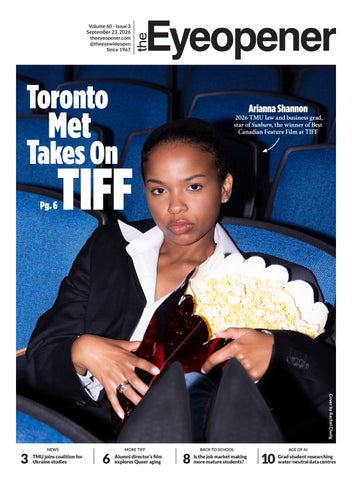
Toronto
Arianna Shannon
Met
2026 TMU law and business grad, star of Sunburn, the winner of Best Canadian Feature Film at TIFF
Takes On
TIFF
Pg. 6
Cover by Rachel Cheng
3
NEWS
TMU joins coalition for Ukraine studies
6
MORE TIFF
Alumni director’s film explores Queer aging
8
BACK TO SCHOOL
Is the job market making more mature students?
10
AGE OF AI
Grad student researching water-neutral data centres
YOUR SPACE. YOUR COMMUNITY. YOUR SCC.
The SCC is your space on campus, home to student-driven services, organizations, and amenities to support your journey at TMU.
In the building youʼll find: Oakham Café The Met Pub Student Jobs
Events Room Bookings Good Food Centre
Student Unions Equity Service Centres Office of the Ombudsperson The Eyeopener Met Radio
55 GOULD ST.
News
THE EYEOPENER WEDNESDAY, SEPTEMBER 23, 2026 theeyeopener.com/news
TMU becomes 5th Canadian institution to join Global Coalition of Ukrainian Studies Justine Hopkins contributing reporter
The Global Coalition of Ukrainian Studies gained Toronto Metropolitan University (TMU) as one of its newest members on Sept. 11. Launched in 2024 by First Lady of Ukraine, Olena Zelenska, the coalition is a worldwide educational initiative aiming to strengthen Ukrainian Studies across the globe. The coalition's mandate is to build relationships with international academic and educational institutions. The coalition agreement was signed at an in-person ceremony on Sept. 11 by Roberta Iannacito-Provenzano, TMU’s provost and vicepresident. Present at the ceremony were Ukrainian First Lady Olena Zelenska and Diana Fox Carney, wife of Prime Minister Mark Carney. Zelenska started her visit to Canada by stopping by Alberta Children's Hospital and the Marian and Jim Sinneave Centre for Youth Resilience in Calgary. In Toronto, she met with the new coalition members and the Canada-Ukraine foundation. The coalition offers opportunities to members depending on their level of involvement. Course resources, joint courses with Ukrainian universities and the possible establishment of a centre for Ukrainian studies are among some of the potential benefits of joining the coalition. In a phone call with The Eyeopener, TMU President Mohamed Lachemi said that the school's decision to join the coalition happened independently of Canada's recently announced 100-year partnership with Ukraine. "Internationalization is an important part of TMU's future and this international network can have meaningful connections to research, academic exchange, faculty and student mobility and shared education," he said. "We hope that the coalition creates new possibilities for academic cooperation and for relationships that can grow and deepen over time."
Members of TMU’s Ukrainian community said joining the coalition is a positive step for the university. Sophia Salyk is a fourth-year biology student and president of the Toronto Metropolitan Ukrainian Students’ Club (TMUSC). “A big part of what we want to do is promote Ukrainian culture, history and our identity on campus. Seeing TMU make an even larger academic commitment to that was meaningful to me,” said Salyk. In a statement posted to LinkedIn, Iannacito-Provenzano said, “These partnerships are about more than institutions. They are about people: students discovering new perspectives, scholars learning from one another and communities building relationships that can grow and endure.” In 2025, the University of Manitoba became the first Canadian institution to join the coalition. They received support for Ukrainian studies programs, academic exchange programs and organized Ukrainiancentred events and presentations as part of their collaboration with the coalition. TMU, alongside the University of Alberta, the University of Toronto's Munk School of Global Affairs and Public Policy, MacEwan University and the Ukrainian Museum of Canada are the five newest Canadian institutions to join the coalition. In just two years, the coalition has grown to span 27 countries and host 100 members across the world. “Joining the coalition is an important step towards giving Ukrainian studies a stronger and more permanent presence at TMU. It’s nice to know that the work we are doing as a club can now be supported by a broader initiative within the university." Salyk added. Anna-Maria Protsyk is a third-year commerce student and the director of sponsorships at TMUSC. She believes TMU joining the coalition is an opportunity for
RACHEL CHENG/THE EYEOPENER. IMAGE COURTESY OF THE OFFICE OF THE PRESIDENT OF UKRAINE Ukrainian voices, culture and history to be heard on a global scale. “I feel like we are put on a stage where we have a bigger voice living in Canada and anywhere past Ukrainian borders,” she said. "Because of the fact that we're exposed to so many diverse cultures, ethnicities, different people from different backgrounds, we are able to have a bigger reach to spread the truth, our history and what's currently happening during the war to put things into perspective for other people." Protsyk said propaganda and "educational warfare” is one of the kinds of warfare used against Ukraine. She said it's easy for those who are not aware of Ukrainian history to fall for false information they see about the country and the war with Russia, which has been ongoing since 2014 and escalated with the full-scale invasion of Ukraine in February 2022. The coalition's site states that one of its goals is to counter disinformation about Ukrainian history in the context of “Russian aggression.” Global Affairs Canada has accused the Kremlin of spreading disinformation and propaganda
about Ukraine and monitors suspected disinformation campaigns on a database on the Government of Canada website. Fourth-year biomedical science student and vice-president of TMUSC, Sophia Zoriy, attended Ukrainian schools in Canada growing up, as a way of enriching her within her culture. "I think having a Ukrainian community on campus is almost like having a piece of home with me at university," said Zoriy. She continued: "I grew up going to Ukraine almost every summer to visit my family. So I had a very real connection to the country itself, not just Ukrainian culture here in Canada. And since the full scale invasion, I haven't been able to go back and I think that absence has made me appreciate that connection even more." Salyk remarked she feels bittersweet about the coalition because she is in her last year of her program. “I'm really happy to see it happening now because, you know, better late than never. But it is bittersweet because I would really love to take a class to even further my own knowledge."
Hamde Ahmed elected new TMSU VP student life The election was held after a previous run-off election planned for August was delayed Zanoah Plummer news editor
Business management student Hamde Ahmed has been elected as vice president of student life of the Toronto Metropolitan Students' Union (TMSU) after a run-off election held from Sept. 14 to 18. Ahmed will take over from fifth-year creative industries student, Ahmmad Haidary, who held the position after the leading vice president student life candidate was disqualified in the Winter 2026 General Election. Under the Elections Procedures Code (EPC) section 11.5, the TMSU must hold another election for the position if a winning candidate is disqualified. The September run-off election was held after a previous run-off election announced for Aug. 21, 24 and 25 was delayed. The TMSU said in a statement to The Eyeopener the reason for the delayed summer election was because "an administrative error resulted in a communication that saw the
run-off campaign and voting dates being announced prematurely." The run-off election restricts new candidates from running and prohibits the returning candidates from making new campaign promises or new platforms. The TMSU said this was done in order to protect the integrity of the election. In the statement to The Eye, the TMSU wrote: "An important distinction is that TMSU is treating this as a continuation of the 2026 General Election, not the beginning of a new election. We are closing the loop on the outstanding Vice-President Student Life race and following the process set out in the EPC." According to Ahmed’s candidate statement, she ran to help create a campus culture where, “student life is accessible, inclusive, and shaped by the voices of students themselves.” Ahmed wrote that if elected, she would be a, “visible, approachable and proactive VP who students feel comfortable approaching with ideas and perspectives.
Ahmed will be the only member of the TMSU’s executive committee who was not a member of Team Justice, the slate which won the remaining four executive positions
during the Winter 2026 General Election. The Eye reached out to Ahmed for comment but did not receive a reply in time for publication.
PIERRE-PHILIPE WANYA-TAMBWE/THE EYEOPENER
4 | Editorial
THE EYEOPENER WEDNESDAY, SEPTEMBER 23, 2026
TMU's got talent
The Eyeopener Vol. 60 | 2026-27 EDITOR-IN-CHIEF
PHOTO EDITORS
Edward “MacDonald” Lander PRODUCTION EDITORS
Amira “Worst Commute” Benjamin Jasmine “Bedazzler” Makar
Rachel “WYA” Cheng Daniel “Lucas Mode” Opasinis Pierre-Philipe “Pierre-Philipe Wanya-Tambwe” WanyaTambwe
NEWS EDITORS
MEDIA EDITORS
ARTS & CULTURE EDITOR
DIGITAL PRODUCER
BUSINESS & TECHNOLOGY EDITOR
GENERAL MANAGER
COMMUNITIES EDITOR
DESIGN DIRECTOR
FEATURES EDITOR
CONTRIBUTORS
Nadine “100 Calls” Alsaghir Zanoah “Lachemi” Plummer
Oliver “Night Agent” Ulster Luke “Drifter” Turner Dee S. “Lake America” Troy Keesha “Prairie Wedding” Levesque Shreya “Zoom Zoom” Basu
Victoria “0.302 per cent” Andrade Ava “Eyes on Her” Whelpley
Sophie “Star” Wallace
Lucas “Treehouse” Bustinski
Mishael “Water cycle” Taruc
Liane “BoD” McLarty CONNECT
Rin “Access” Yanase
Vanessa “nickname” Kauk
@theeyewideopen theeyeopener.com CONTACT
Daniyah “Oldie But Goodie” Yaqoob FUN & SATIRE EDITOR
Dylan “1 Meat, 1 Veg” Marks SPORTS EDITORS
Francesco “Hoco” Cautillo Naomi “Champs” Low
Charlotte “Friends” Ligtenberg Sidney “Practical” Shaw Hannah “Email Tracker” Thompson Victoria “Queen Vee” Cha Justine "Mr. Worldwide" Hopkins Noah “Game of the Year” Curitti Francesco “Fabrizio” Cautillo
T: 416-979-5262 ext. 2338 E: editor@theeyeopener.com 55 Gould Street, Suite 207 Toronto, Ont. M5B 1E9 ADVERTISING
advertising@theeyeopener.com The Eyeopener is published by a non-profit corporation owned by the students of TMU.
The 'TMU Mafia' at TIFF is hard to miss
Edward Lander EDITOR - IN - CHIEF I'm old enough to remember when this campus hosted Toronto International Film Festival (TIFF) red carpets. Hollywood royalty like Leonardo DiCaprio and Emma Stone graced Gould Street, and The Chrysalis (then Ryerson Theatre) held film screenings. Though these were nixed in the pandemic, Toronto Metropolitan University’s (TMU) connection to the festival hasn't gone away. Increasingly, Toronto Met talent is heading to TIFF to grace their King Street red carpets, not the other way around. And looking at this year's TIFF lineup, it's not hard to spot TMU students and alumni. Across two pages, arts & culture editor Sophie Wallace has curated coverage of the many current and former TMU students making waves at this year's festival. On page six, we meet Rodrigo Barriuso, a TMU film alum and
director of Neverman, a film about Queer aging that follows a Trans woman entering long-term care. On the same page, Shreya Basu covers an on-campus panel with the director of Drifter, a film he calls a "love letter to car culure." On page seven (and on the cover) we meet law and business grad Arianna Shannon, who stars in Sunburn, a film about a group of youth weathering a blackout in St. James Town. That film went on to win TIFF's Best Canadian Feature Film award. That's not all. Documentary film Darlene Love: I Know Where I've Been from director Barry Avrich— who studied film at TMU in the early 80s—took home the People's Choice Documentary Award. It’s no secret Toronto is Hollywood North. And more of that talent is coming from one place—this campus. At a time when Canadian media is in a rare spotlight, this is even more exciting. So if this year's lineup is any indication, we couldn't be more eager for what's to come.
’s o t n o r o T n w o t n w Do
S M O O R E P A C S E NEWEST
Grand Opening Special
$29.99 PLUS
Use code TMU20 for
an additional 20% OFF for a limited time.
LOBBY LEVEL | THE CHELSEA HOTEL | 33 GERRARD STREET W.
B O O K TO D AY !
TIMEZONEESCAPES.COM
News | 5
THE EYEOPENER WEDNESDAY, SEPTEMBER 23, 2026
Group of international students facing financial pressures granted tuition relief after years of advocacy The decision follows petitions, protests and an Ombudsman complaint led by students and faculty Nadine Alsaghir news editor
After nearly two years of advocacy, Toronto Metropolitan University (TMU) has extended domestic tuition eligibility to a group of international students who were approved for reclassification before a policy change in July 2024. This policy allowed a group of international students with open work permits to pay domestic fee rates. However, on July 10, 2024 an email sent to affected students from the Office of the Registrar announced that starting Fall 2025, the policy would no longer include those with open work permits. To remain eligible for an international tuition exemption, students needed to submit new documentation of a closed work permit, the email read. The Eyeopener has obtained both emails. The change to exemption eligibility affected over 200 TMU students, most of whom are Iranian, forcing them to pay close to five times as much in tuition. This policy was originally put into place after the federal government made it easier for Iranian citizens to stay in Canada if they were already here, amid brutal crackdowns in Iran by the Islamic Republic (IR), as previously reported by The Eye. Now, TMU is extending the exemption for students with open work permits who were approved for domestic fee rates prior to the updated eligibility change on July 10, 2024, according to an email sent by Provost and Vice-President Roberta Iannacito-Provenzano on Aug. 27. In the email, which was sent to the president of TMU's Iranian Students' Association (ISAMET), Iannacito-Provenzano wrote that the goal of the extension is to, "ensure students receive the domestic fee assessment and any applicable account adjustments as efficiently and accurately as possible." The email also stated that all impacted students will later receive an update from the Office of the Registrar, "outlining what this extended exemption means and the next steps to be taken." Karan Kaviani, a fourth-year biomedical sciences student and president of ISAMET, said in an interview with The Eye that reading the email was both a shocking and happy moment. "It proved to me one more time that if we keep pushing and we don't give up, we're finally gonna get the achievement that we are looking for, or at least motivate
Members of ISAMET Karan Kaviani (left) and Amirreza Foroughifar (right) have been advocating for a group of international students facing financial pressures amid sanctions in Iran for years. PIERRE-PHILIPE WANYA-TAMBWE/THE EYEOPENER other people to continue the work that we started," Kaviani said. He said that in a conversation with Saied Vafa, co-founder of the University of Toronto Students for a Free Iran, Vafa described ISAMET's advocacy as one of the biggest student campaigns he'd seen produce a positive result. The nearly two years of advocacy included numerous meetings, petitions, protests, conversations with members of provincial parliament (MPPs) and an Ombudsman complaint, as previously reported by The Eye. This included an in-person demonstration in front of Jorgenson Hall on June 17. Kaviani said pursuing peaceful negotiations and meetings could encourage the university to acknowledge its actions, which helps build trust between the two sides. Amirreza Foroughifar a firstyear master of occupational and public health student, and advocacy lead and vice-president of ISAMET said the decision felt "too good to be true," given how long they had been pursuing this effort. "All the indications we had was that it's not going to work…we were in the depth of the darkness and we were kind of brought back from it," he said. Kaviani said he believes the turning point was a petition they created with the help of three Iranian professors at TMU, collecting 110 signatures from faculty members and staff at the university. He also said he reached out to the former Ontario Minister of Colleges and Universities, Reza Moridi. Kaviani said Moridi sent
a letter on behalf of ISAMET to TMU President Mohamed Lachemi, which he believes may have also played a role in the decision. Kazem Fayazbakhsh, an associate professor of aerospace engineering at TMU, was one of the professors who helped create the petition. He said he sees his role much larger than simply instructing courses. "International students need much more help, because they don't really have a support network, like domestic students have. So when they come to me after classes, I always try to help them more," he said. Fayazbakhsh said he is also motivated to help because he understands the students’ challenges and the desire to build a future, having moved to Canada from Iran to pursue his PhD. "Now I know that those students can really focus on their studies, because this was a huge burden for them…distracted by whether you can make the tuition payment and what you're going to do, and about your expenses and the fact that you cannot get money out of the country," Fayazbakhsh said. In February, the IR cut off
The Eye is looking for new student members of our Board of Directors
internet access to Iran following bombing by the United States and Israel, according to Al Jazeera. This, combined with international bank sanctions, have made money transfers from the country difficult or impossible. As of late May, internet access began to be restored but restrictions remain for most. In an interview with The Eye, Lachemi said over the past two years, the university also introduced "a number of financial and other support measures to help Iranian students." He said this included, "suspending late fees and collection activities, as well as other measures to provide students with additional flexibility and support." Kaviani said there are some international students who did not get approved before the July 10, 2024 deadline that are excluded from the exemption eligibility and are facing the same financial barriers as before. Foroughifar is one of these individuals, despite knowing he would not personally benefit if any changes were made because he had applied after the deadline. He said he continued advocating because
he wanted to support friends and peers facing financial hardships. He said he continues to face financial pressures and is working three jobs in order to pay for food and the international tuition rate. "I'm kind of trying to juggle it all and balance it all…it impacts my sleep, it impacts my quality of eating and my mental state…but I have no other choice," he said. Kaviani said ISAMET plans to continue advocating for students who were not included in the policy extension. He said they are also working with faculty members to find a solution for students in Iran who want to study abroad but are no longer able to take English proficiency exams. According to The New York Times, expanded sanctions were implemented on Aug. 24. Foroughifar added these students remain in the association's thoughts and ISAMET will continue working to raise their voices. He hopes their advocacy work will inspire other students who may come from marginalized or racialized communities. "There are things on our plate. The advocacy and the work doesn't stop," he said.
Are you a student in one of the following faculties? • The Creative School • The Faculty of Engineering and Architectural Science • The Faculty of Arts • The Faculty of Community Services Want your resume to stand out? Want to make $? Serve on our administrative board for the 2026-27 year. Email generalmanager@theeyeopener.com to get involved.
Arts&Culture
THE EYEOPENER WEDNESDAY, SEPTEMBER 23, 2026 theeyeopener.com/arts
Neverman poses the question: “What are we doing to protect our elder Queer people?”
TMU alum and director Rodrigo Barriuso’s Neverman premieres at TIFF Sophie Wallace arts and culture editor
Rodrigo Barriuso, a graduate of Toronto Metropolitan University’s (TMU) film studies program, often hears that people haven’t seen a film like this before. “It gives me pause, you know, it’s like how am I the first person to make a film about this?” he said. His film Neverman premiered on Sept. 10 at the Toronto International Film Festival (TIFF). “Thinking about this film in the past tense is really weird, because we literally handed it to TIFF on [Sept. 4],” said Barruiso, in an interview with The Eyeopener. Neverman follows Lucia, played by Broadway icon Justin Vivian Bond, a 74 year-old Trans woman and gay rights activist, as she manages her early-stage Alzheimer’s diagnosis. She has no choice but to move from her peaceful lakehouse to a nursing home in Toronto which claims to be “Trans-friendly.” However, where supportive safety was promised, instead austere, intrusive staff and indifferent management attempt to slowly erode Lucia’s identity.
“The reality is that for the first time we're seeing a generation of openly Queer people age,” said Barriuso. “This is the generation that was denied the right to marry, the right to occupy high-paying jobs…the generation that lost so many members of their chosen family to the AIDS pandemic.” “You see a generational cohort aging without the benefits, without the pensions, without the children and the families, and entering institutions that are really ill-equipped to provide the specific care that they might need,” he said. Despite wanting to draw attention to this critical issue, Barriuso’s feature is full of colour, moments of joy and the quiet ways Queer people show up for one another. Barriuso said he and his co-writer, Kyah Green, wanted “to challenge the notion that Queer lives are only marked by sacrifice.” He achieves this partly through using flashbacks to Lucia’s life as an activist in the 1970s. “We wanted to portray this woman as…someone who was loved and someone who found joy and someone who experienced life and colour and exuberance,” Barriuso said.
SUPPLIED BY RODRIGO MICHELANGELI The film follows a paper trail of Lucia’s younger self, from a newspaper clipping of Lucia on the frontline at a protest, to a typewritten flyer which reads “I AM A Queer androgyne feminist trannie pervert stonebutch tomgirl dyke and SO ARE YOU.” The film starkly contrasts bleak scenes in the long-term care facility with snapshots of the glamour, and violence, of Toronto’s underground Queer nightlife. One painful flashback shows Lucia arrested during a police raid on
the bathhouse where she works. In another, she laughs with her partner at a crowded disco. The Lucia of the present dances in a dementia haze, imagining herself still there. Despite the casual transphobia and homophobia from the nursing home staff, Lucia finds connections in other residents. She grows close to the woman next door to her, and the two share a tender evening in a striking but moving depiction of elderly lesbians as sexual beings.
For Barriuso, this was an intentional choice. “You don't expect to find beauty in older bodies or nursing homes or these types of interactions and I want to challenge that,” he said. Barriuso said he hopes people take his efforts to highlight the beauty and resilience of elderly Queer people and the inadequacy of how society cares for them as a “call to action.” “I hope it opens the door for people to think about the very little things that we can do to make people's lives better.”
TIFF’s Drifter comes to TMU: Behind the scenes with Sung Kang The creative team behind the film talk vulnerability and belonging within the car community
Shreya Basu contributing reporter
“We’re a bunch of dreamers that came into town wanting to make believe and never felt like we had a seat at the table.” This is the sentiment of Sung Kang, the Fast and Furious alum who directs and stars in the new highly-anticipated film Drifter. On Sept. 18, the cast and crew behind Drifter, premiering at the Toronto International Film Festival (TIFF), came to Toronto Metropolitan University (TMU) to give students the opportunity to dive into the world of the car community. Prior to the panel discussion, moderated by Creative School’s Dean Natalie Álvarez, students were surprised with a screening of the first seven minutes of Drifter. The title, Drifter, is a nod to the driving technique where the driver deliberately oversteers their vehicle, losing traction
while maintaining complete control of their car through a turn. The film follows the life of Tree, a solitary racetrack janitor with a love for drifting. Tree gets a shot at a professional circuit, but grapples with his tragic past. Under a tough mentor, he learns that talent alone isn’t enough to succeed. During the panel discussion, actor-writer-director Sung Kang, best known for his role as Han Lue in the Fast & Furious franchise, talked about his own love of drifting and why he felt drawn to creating this story. “Drifter is a love letter to the amazing car community that has been there [for me]. In my darkest hours, spending time in a garage, going to a car event, I realized that this is a community made up of such amazing human beings,” he said. Kang said despite the online connections provided by the age of
social media, people are in search of community more than ever before. “When I go to a car event, it does not matter what I look like, what my politics are, or my religion, bank account or social class is, as long as I come with an authentic love for these machines…I am welcomed.” Producer and longtime collaborator Brian Yang discussed the birth of the idea for Drifter, explaining how Kang was approached by car lovers all over the world. Wherever he went, people wanted to talk cars with him.
“...I realized that this is a community made up of such amazing human beings." “[Kang] has a garage door clicker to everyone’s garage. That privilege is something we wanted to lean into,” said Yang. For editor and co-producer, Lam Nguyen, and director of
SIDNEY SHAW/THE EYEOPENER photography, Bruce Thierry Chung, to the choice to work on the film was a no-brainer for them. They spoke to the life Kang's writing breathed into the script and the vulnerability that shone through the pages. “Sung brings out this curiosity and wanting to discover when you work with him,” said Chung. A student attendee asked about cars serving as characters in the movie and navigating the balance of portraying both human and mechanical characters. For this, Kang credited Nyugen with the idea of associating animals with each car. “That influenced how he was able to bring those cars to life… he would put these really loud animal
noises that gave each car a distinct voice or energy,” Kang said. In the wake of the event, student attendees expressed feeling motivated and hopeful for their futures. Hannah Schermann, a thirdyear creative industries student, said the event was informative and inspiring as a student hoping to work in the media industry.
“Sung brings out this curiosity and wanting to discover when you work with him.” “I think [they] showed us that there is still hope, especially in this climate that is ever challenging, when we’re competing with each other, AI and all sorts of adversities,” she said.
Arts & Culture | 7
THE EYEOPENER WEDNESDAY, SEPTEMBER 23, 2026
“It’s a hangout film…but with kids who look like me:” Sunburn premieres at TIFF starring Arianna Shannon
Sunburn, starring the recent TMU grad, also won TIFF’s 'Best Canadian Feature Film Award' Sophie Wallace arts and culture editor
For most people, the first September after graduation is a strange one. For Arianna Shannon, this was no different. She graduated from Toronto Metropolitan University’s (TMU) from the business management program earlier this year. “This is my first September, I'm not going back to school, so I'm like, oh my god.” But for Shannon, there’s another factor adding to the surreality—she plays a central character in one of Toronto International Film Festival’s (TIFF) most highly anticipated premieres: Sunburn (2026). “We did not necessarily expect to be at TIFF. Like this was extremely low-budget,” said Shannon, in an interview with The Eyeopener. The film, directed by Toronto’s own Serville Poblete, won the Best Canadian Feature Film Award, TIFF announced Sunday. Sunburn follows a group of neighbourhood kids during a
citywide blackout on one of Toronto’s hottest days on record. A hypnotic, visually striking coming-of-age film set over 24 sweltering hours, Sunburn captures the almost imperceptible way childhood slips into adulthood. Shannon’s character, Cee Cee, shares an apartment with her older brother and his best friend. She doesn’t have her own room and struggles to be vulnerable in the shared space—claustrophobia is mirrored through the film's towering apartment blocks and shimmering heat. But through unexpected connections and following her curiosity, irritation makes way for joy and tenderness over the course of an afternoon. The movie was shot during August and early September last year. Most of the filming happened in St. James Town, with scenes also shot in widely-recognisable Toronto locations such as Riverdale Park. Shannon was born in North York and grew up around the Greater Toronto Area. “It was kind of comforting just filming in a place that was already home to me,” she said.
SUPPLIED BY NICOLA PENDER
The characters' micro-dramas play out against the backdrop of a very recognizable Toronto. The city’s problems of extreme heat, the cost of living crisis and urban condo development are not left in ambiguity. “These are issues that are always circulating front-of-mind,” said Shannon. “I have to give props to Serv’s writing because there's so many, so many issues like that touched on, but then there's also a philosophical aspect to it. And then somehow he made this into like an ensemble comedy,” said Shannon. The film’s lilting rhythm skips between aching silences and bursts of comedic relief, capturing Toronto’s summer through atmospheric sun-baked wideshots and pops of close-up colour. Sunburn certainly leaves room for moments of joy and lightheartedness: kids drop everything and scramble at the first sound of the neighborhood ice cream truck and in one scene, Cee Cee reluctantly admits she never learned how to ride a bike. When asked what that was like to film, Shannon laughed. “I know how to ride a bike! But it wasn't that different because that bike was so tall and I'm only like five three.” The crew’s off-screen relationships shine through on camera. “By the end of it, we were sad that it was over because we labelled it ‘summer camp.’ Like we would come into work every day and then just be laughing and having fun. And then you leave, and you're looking forward to coming in the next day cause you're just going to have more fun,” said Shannon. In a written statement to The Eye, Poblete wrote “it’s a hangout film…but with kids who
RACHEL CHENG /THE EYEOPENER look like me: darker skin, curly hair, raised in immigrant and working-class Toronto, usually shown through grit or stereotype and rarely through beauty or tenderness.” When speaking about their collaboration, Shannon was full of admiration for the director. “We just tried to make something, and Serv was our fearless leader,” she said. Shannon is a firm believer in the idea you don’t have to choose
only one path for yourself. Despite always having loved the arts, Shannon majored in law and business at TMU, taking acting classes and starring in CBC Gem’s Plan B alongside her studies. “I just wanted to see if I would even like acting,” she said. “It's good to pour into different parts of you.” Sunburn made its world premiere on Sept. 14 at TIFF 2026, with theatrical release dates to be announced.
PHOTOGRAPHER NAME/THE EYEOPENER Dolupturio. Itasima voluptatquid quis et expe nobis expe provitis noasdf asdf bitatat. Pella natur aut exerupta nihilit rest quosand issitaeces nes andandem vellaut et harita qui apiet hiliquis adicimi, volum verchit lique nos iur sectem quibus, si tempore ritatquibus porum exera vere doluptis eum event et asit, nos sim ducimenis que plia imagnih icaessit lacerum doluptibus sam et fugia et quaes ut laniscium inctur, este
con con cor simus modi ad quis simus, ut eum accus excepernam, utatur adissunt acesciis apist, essi utenihil ma nulles debis nus nias nos ellam ulpa plabo. Ut ape volup tat ur? Volupitis diae ma qui tet quos elles dolut esto beriani scipsantius, cus venecaborum et archil explit occum quam eic tor sunt lam, et dit accabor poreped ignimpedi as volo tota di idiaspictata sinum reicipsandit ommod quam que ipis de-
riorat lia dolo omnitatur simus sed et molesto berum utet dolorepudit rem aut repe dolendiae porio quamus latis nobite excereraeris eum vel idus endundande dolo omnis rerioreium quaspicit pro blabo. Et modiasp elignim acest harum doluptaes modi quundit isquam quae earcimi nulparc ipsaperibus quatur aut ut faccus dipsantionet aperem de sinverum esto volor ad enimoluptaes ducid enis sum harchilitas pos doles exernam
EYEOPENER 8 | THE WEDNESDAY, SEPTEMBER 23, 2026
FEATU
Mature students, or “non-traditional students” as van Rhijn often calls them, play a critical role in deepening intergenerational learning. They help expand discussions by naturally incorporating their experiences with family, work and community involvement. Van Rhijn notes that definitions of a mature student varies, with her work centering around age 25 and up, depending on university admission policies. “Mature students bring a different perspective about why they go back to school. Many traditional learners go to school because they feel they have to,” said van Rhijn. However, most mature students enroll because they choose to.
And for their next act... Fuelled by economic pressures and a desire for self-fufillment, an increasing number of older adults are pursuing post-secondary education. Writer Keesha Levesque dives into the world of TMU's mature students
P
ROUDLY DISPLAYED FOR passersby on Gould Street hangs a blue and yellow banner declaring “You Belong Here.” The banner, which goes up during orientation week, welcomes over 5,000 first-year students to Toronto Metropolitan University (TMU). Inspired by TMU’s coat of arms, the banner’s azure blue represents loyalty and truth. For Shontelle Allwood, the banner represented a nerve-wracking fear. It was September 2022, and she stood at the paved entrance of the university, looking up at what was meant to be an inspiring affirmation: you belong here. “I’m not sure I do,” she thought. “Did I make a mistake?” Like most of her freshmen peers, Allwood was new to campus and many facets of university life were a foreign concept. But one thing set Allwood apart from other incoming students—her age. At 49-years-old, she had already travelled the world, married and raised a family. But nevertheless, she felt an accomplishment was missing. After her husband had a work opportunity that relocated the couple to Toronto, Allwood made the decision to apply for a Bachelor’s of Science in nutrition and food. She submitted the application just ahead of TMU's deadline. Allwood classifies as a mature student. For undergraduate programs at TMU, this applies to students at least 21 years old during the year they begin their studies and who have been away from formal education for at least two years. But outnumbered on most campuses in the country, their experiences and adjusting to university life can be different—especially when their institution may not cater to them as much as their younger counterparts. Statista reports that over 780,000 students aged 25 or older were enrolled at Canadian universities in 2024—making up a third of the student population. Data from
Statistics Canada shows there was a spike in total university credentials during the 2020 school year. For age groups 20 to 24 and 29 and up, the numbers have stayed roughly the same, give or take a couple thousand. For the age group of students 30 and above, their enrolment numbers for degrees and diplomas has been on a steady rise for the last several years. In the 2026 year, TMU welcomed 198 mature students; the average for the last 10 years has been around 200 annually. Their presence can be seen in Reddit threads where users discuss their struggles with adapting to a younger landscape, especially when it comes to making friends. One user writes, “Starting fresh at 24, it definitely feels weird being in a room full of people who have no idea who they are as people!” Another said, “I’ve graduated from two college programs in the past, and TMU is definitely the least social post-secondary environment I’ve experienced.” While most posts show that the age difference between them and their peers may initially feel strange or unrelatable, many still describe a desire to connect and form friendships with their classmates. At the end of the day, everyone wants a friend to talk to after class or to grab a quick drink with at the campus pub. AS ALLWOOD SETTLED INTO school, she quickly realized that the people in her cohort came from all kinds of backgrounds; the youngest were around her youngest child’s age. But there were also some students in the program who had returned for a second degree, in their 30s. “It was so far from the truth, so far from my expectations,” Allwood says. Allwood completed her degree this past April, and said she realized she could turn to much of her cohort—including the youngest among them—and call them friends. Over the course of her degree, Allwood found that
mentorship as a mature student was a twoway street. She could provide guidance from her life experiences, but she was unfamiliar with using technology to study, such as organizing with Google Calendar. Younger classmates stepped in to help, showing her how to navigate the online space. “While I was the oldest, one of my closest friends is the youngest in the cohort. So it just really put aside any of those sort of ageist feelings,” says Allwood. This desire to connect across age groups is a key component of an age-diverse community which, according to an article by The Gerontological Society of America, can support “increased intergenerational understanding and exchange of knowledge, and reduced ageism.” The research also suggests integrating different ages often enhances learning opportunities and representation. Tricia van Rhijn, a professor at the University of Guelph whose expertise covers mature students, says age diversity is important in the classroom. “We want students to kind of see beyond their own limits, their own experiences. When they have very little life experience, it’s harder for them to incorporate broader perspectives,” van Rhijn says. Research on age-diversity in the workplace shows that a multigenerational workforce promotes employee well-being and effective collaboration. TMU also recognized this benefit in a statement to The Eyeopener: "They bring their unique perspectives, professional experience and a broader understanding of the world to our campus. In the classroom, this shows up as real-world insights that enrich group discussions and, in some cases, as mentorship." Van Rhijn’s interest in the topic is an extension of her own experience as a mature student. She had returned to school for her Bachelor's, and remembers taking a university statistics course 12 years after taking the high school prerequisite.
"Mature students fall into this awkward group where nothing is necessarily targeted for us."
RENEE PEACE-MILLER FOUND herself back in the world of university applications because she didn’t want to work retail for the rest of her life. She had tried the high school to post-secondary pipeline earlier, pursuing the journalism program at Humber Polytechnic. She picked the credential largely out of fear she’d be left behind if she didn’t choose school— afterall, her friends seemed to be ready to move onto the next chapter. Ultimately, journalism wasn’t for her. A few years into the program, Peace-Miller realized it wasn’t what she wanted to do. After giving it up, she turned to retail work and spent roughly the next five years building up to a managerial position. But despite all her effort, Peace-Miller felt a strong sensation of boredom and fatigue. “I wasn’t really feeling satisfied in my professional life and I knew I needed to do something different,” she says. At 27, she found herself on TMU’s admissions portal. She sent only one application, for the urban planning program. She ended up on the wait-list, and later, found herself admitted to the environmental and urban sustainability program at the school, a program she's since grown a liking to. In her first-year, Peace-Miller could tell who the straight-from-high-school students were; sometimes, their baggy dressing style gave them away—Peace-Miller is from the skinny jeans and Converse era. Other times it’d be the way her peers talked, using slang that reminded her she was closer to her 30s, while her classmates hadn't hit 20. But now in her second-year, she says it’s getting harder to tell the students apart. Many she assumes are attending right out of high school reveal to her that they’re in their mid-20s, after flipflopping between various programs. Occupation is one of three main motivators for students to return to school, according to a survey by a group of University of Guelph professors, including van Rhijn. Their research, which recorded responses from mature students with children across four Canadian universities, found three primary motivation categories: occupation, education and family. The survey results suggested that “student parents”—those pursuing post-secondary studies with dependent children—are mostly looking for personal fulfillment and future opportunities. Van Rhijn also referenced the motivation differences between non-traditional learners and younger students, saying she’s heard of students choosing to pursue a master’s program after an undergraduate simply because a parent told them to. “Mature students are there for specific reasons and they often treat going to school like a job… they’re costing their families money to
URES
THE EYEOPENER WEDNESDAY, SEPTEMBER 23, 2026
many of them he’s at TMU for one reason: “My main focus is just to get through school and get my bachelor’s.” While it may not always be perceived, there’s one major disparity between mature learners like Sukhadia and fresh faces. Sukhadia’s younger peers typically have more resources than him. Many clubs, sports, associations and even student services are geared toward students under 25 years, according to van Rhijn. “We often talk about returning to school because often there’s a gap from their last formal schooling as mature learners, and universities are not the greatest at actually welcoming mature learners,” says van Rhijn. She knows from firsthand experience. During one fall in the late 2000s, van Rhijn was standing amongst the other students at Guelph’s University Centre, a main indoor hub for student activRenee Peace-Miller went back to school at 27 to pursue Environmental and Urban Sustainability at ity. It was the start of term and student TMU after years working in retail. PORTRAIT BY RACHEL CHENG/THE EYEOPENER associations lined the space, beckoning people to stop at tables on their way to grab food at the cafeteria. Hundreds of people passed by, but van Rhijn remembered one pardo this, they’re taking time away from work- him to step away from school. After years ticular student all this time later. places… kids or partners,” says van Rhijn. Van Rhijn was covering a table at a club on medications, and finally, a surgery to Although Peace-Miller doesn’t have any remove his colon, his condition improved. day information event with the Mature children, she acknowledges the additional So Sukhadia’s brother, a TMU gradu- Students Association, a group that still exsupport student parents might need. Having ate, suggested he should return to school. ists almost 20 years later. It wasn’t as popto work a part-time job to stay afloat—as Sukhadia, now 30, found himself in the ular compared to other tables, which had she says can’t go back to live with her par- chemistry program, though he hopes to candy and free swag to entice onlookers, ents now—overwhelms her every now and switch to computer science soon. and van Rhijn questioned if it was worth again. She has groceries to buy, errands to Like Peace-Miller and Allwood, Sukhadia sticking around with so few people stoprun, appointments to schedule. But on sun- recognized differences between himself and ping by. She and one other student were nier days, she finds fulfillment in her edu- younger classmates but didn't always find manning the table. They had set up an “old cation, and an extra decade of experience the differences to be a barrier. school” trifold poster board with informaleaves her feeling less stressed about post“[We all] go to class, talk to friends, hang tion about the association and where to graduate life than her classmates. find them. out after school,” Sukhadia says. Weaving through the crowd was a maHe clearly remembers his first day of IN THE NINE YEARS BETWEEN class during his freshman year. Sukhadia ar- ture student, backpack on and head down. leaving and returning to school, Yash rived early, observing the classroom as stu- They were uninterested in the surrounding Sukhadia also considers his life experience dents began to fill their seats. The professor student tables, most of which didn’t cater an advantage. walked into the room and began reviewing to them. The student passed by van Rhijn’s “[For] people… starting their first year in the course outline. table. A few seconds later, they stopped and university, transferring from high school, “It kind of felt like I belong here,” Sukhad- circled back. it can be a big shift,” Sukhadia says. “But I ia says. Despite being enrolled at Guelph for a already knew what it was like since I first He doesn’t deny the internal monologues couple years, the student had no idea there went into York [University].” he sometimes has—“Damn, I’m old,” he ad- was a space designed for them. Sukhadia began his academic journey mits to thinking every now and again, when “What their experience tells them is that at York almost 11 years ago, but a chronic high school graduates take their seats next there’s nothing for them—that they’re alone, health condition, ulcerative colitis, forced to him in class. But he doesn’t mind it. Like that they’re not recognized,” says van Rhijn.
The youngest in Allwood's cohort were around her youngest child's age.
|9
While she hasn’t done a comprehensive review of academic institutions in Canada, van Rhijn said she’s heard of around two institutions with designated services for mature students—and the funding, she believes, didn’t continue for either. “One of them had an actual mature student program counselor focused for mature students, and the other one had started a student service,” van Rhijn says. The Chang School of Continuing Education has a program called Spanning the Gaps, but it’s designed to help older students reenter education by providing weekly tutorials to help deepen students’ understanding of coursework, not necessarily to socialize and meet others like them. Van Rhijn describes the Chang School as a “great example” of an institution that helps people dip their toes back into education. While the school doesn’t have a listed support group on its website, there are a host of free events for students to learn how they can progress in their careers. The Chang School, named after philanthropist and businessman G. Raymond Chang in 2003, hosts over 800 courses with 75 per cent being available for degree credit. The website boasts that over 26,000 “active learners” are enrolled. Beyond the Chang School resources, TMU Community Wellbeing occasionally schedules drop-in sessions for the Mature Student Alliance, a peer support group for “mature students who are navigating university life a little differently.” However, besides those sporadic sessions and Spanning the Gaps, there’s no consistent service for mature learners. With this pitfall, mature students have taken it upon themselves to build community. Sukhadia’s part of a group chat with other mature students, but he’s not an active participant and is unsure of whether it’s specific to TMU. “I kind of wish there was more support targeted for mature students around accessibility and stuff like that,” Peace-Miller says. “I’m not really sure what that support would look like, but I find that a lot of supports are targeted towards people that are coming straight out of high school, which those people do need. They’re all very new to this too,” she says. “But I do feel like mature students kind of fall into this awkward group where nothing is necessarily targeted for us.” ALTHOUGH THE FORAY BACK TO post-secondary as a mature student can be daunting, Allwood quickly found herself falling in love with her degree. She returned this semester as a Master’s student in nutrition communication, hoping to become a dietitian down the line. But not just any kind of dietitian. While pursuing her undergrad, Allwood went through menopause. The experience shifted her understanding of where in the industry she wanted to work, now focusing her research on nutrition and menopause. Through TMU’s Zone Learning, she’s even started a business that is menopausefocused. Going back to school as a mature student didn’t just give her a degree, she says, it gave her a purpose. “Even though it was later than most, I just feel it fell into place,” she says. It's a story that echoes other mature students'. Now, at 53, when Allwood stands at TMU’s threshold, the Student Learning Centre beside her and the university buildings just ahead, staring up at the “You Belong Here” banner is no longer scary. Now, it feels just right.
10 | Business & Technology
THE EYEOPENER WEDNESDAY, SEPTEMBER 23, 2026
Hear it from the budget managers: How to plan and finance a student production
Fourth-year media production students raise funds to take their projects from script to screen Mishael Taruc business & technology editor
Desserts, trinkets, pre-loved clothes and live photobooths livened up the hallways of the Rogers Communications Centre on Sept. 18, as fourth-year media production students set up booths to raise funds and recruit crews for projects in the annual practicum fair. Students in the program can opt to take a practicum course, where they work in groups to complete a production project. Sport media and media production instructor Karen Sebesta said, “those projects can be anything from immersive experiences, live events, podcasts, music events, short films, scripted television, multi-camera live shows.” Students engage in fundraising activities as they plan their production budget, weighing which expense to splurge on versus which to save on. According to the Canadian Centre for Policy Alternatives (CCPA), TV and film production in Canada went down by 18.5 percent in 2023-24 and rebounded slightly in 2024-25.
Total production in the country saw a 4.6 per cent increase, brought by foreign productions. “Total Canadian feature film and television production slipped by a further 2.2 per cent,” CCPA said. Fourth-year media production student Michael Giacobbe was the business manager for his team, which pitched an educational arts and crafts show for kids. He said producing the pilot would cost about $2,500. To finance the project, his group launched a campaign on GoFundMe and contributed out of their own pockets, according to Giacobbe. During the fair, Giacobbe’s group sold make-your-own bracelets and keychains, and set up a live photobooth in which they sold live drawings of patrons—in theme with the nostalgic children’s programming they’re bringing back. Shea Hamblin, a fourth-year, media production student, served as creative director for her group and was also in charge of the budget. She said they sold shirts, pins and stickers to add to the money they raised through GoFundMe and from reaching out to their community.
Hamblin’s group is producing a horror-comedy about “two YouTubers who were cancelled. And they want to regain their virality by doing a ghost investigation video, but it kind of goes south.” She said their budget is roughly $3,600. Sebesta said students’ production budgets vary depending on the type of project they pursue. Groups who do audio-based projects usually have no expenses because sound equipment is available at the Creative School Equipment Distribution Centre (EDC). “The middle ground is probably between $500 and $1,000,” Sebesta said, for students who produce a documentary or a pilot for a television show. Those come with costs for a set, props or transportation. Film projects are typically most expensive, costing anywhere from $1,000 to just under $4,000 for the most ambitious groups. Giacobbe’s group is not pinching pennies when it comes to the honorarium for the cast. “We wanted to ensure that our child actors were being paid,” he said. Besides art supplies, a chunk of his group’s budget is going to catering and snacks. Giacobbe said,
SIDNEY SHAW/THE EYEOPENER “our snack budget's pretty high because we have a cast of eightyear-olds and so having snacks on hand is really important.” However, his group will be saving money on wardrobe as they opted to use clothes their cast already have. The EDC will take care of the equipment. Giacobbe’s group is shooting in Kerr Hall, which is free. “As the business manager, it always makes me happy when there's zeros,” he said, since they are not splurging on location costs. The opposite is true for Hamblin’s horror-comedy project. “We have a very specific aesthetic that we want to portray and we want to convey that to the audience, not try to fake it too much so we're renting a house,” she said. Their production crew would
need to travel to the location but they save on transportation costs by carpooling. According to Sebesta, students learning to plan a production budget keeps them grounded about the feasibility of their ideas. “We want them to dream,” she said. However, she reminds her students that they “don't need a lot of bells and whistles.” Both Giacobbe and Hamblin advised their juniors to plan and budget their production way ahead of time. “If things go wrong, you have time to make up,” said Hamblin. More importantly, Giacobbe said, “don't be afraid to make what you want…Just go for it and make it because there'll be other people out there that will also like to see it.”
Student paper explores possibility of 'water-neutral' AI data centres
Though far from practical application, research proves feasibility of system that reuses water from AI data centres Yuna Cho contributing reporter
Gianluca Provenzano, a fourthyear industrial engineering student at Toronto Metropolitan University (TMU), presented a “closed-loop system” at the 2026 Canadian Nuclear Society Annual Conference this summer. The system would reuse heat and cooling water generated by data centres. “Data centres produce a lot of heat. It's actually a really big topic right now in sustainability groups,” he said in an interview with The Eyeopener. As access to water resources becomes increasingly challenging, Provenzano said, freshwater availability could eventually become a serious concern. According to IEEE Spectrum, up to 60 per cent of the water used in data centres can be lost due to evaporation and not returned to the water system. “This approach could reduce
water losses from consumption to nearly zero, while also having the advantage of being compatible with existing technologies” which Provenzano defined as “water-neutral.” Erfan Shahab, an editor at Soft Computing and an industrial engineering PhD student at TMU, said “the concept is worth serious consideration.” He said one of the strengths of the proposed system is that it is based on existing technologies and engineering principles rather than relying on hypothetical or unproven technologies. However, Shahab said there are more steps before the concept can move toward actual implementation. He noted that whether commercial facilities can achieve complete water neutrality would need to be practiced through detailed engineering analysis and realworld operational data. “The biggest challenge would probably be integration,” Shahab said. Connecting multiple tech-
nologies and making sure they can work reliably together will be key to whether the system can actually be put into use. He said that even if the system is technically efficient, its commercial value could be limited if it creates operational problems. In Canada, up to $700 million was invested in new or expanded data centres in 2024, according to CBC. However, rapid development in the AI industry has raised a range of concerns. Municipalities in Ontario are studying guardrails and policies around data centres. Dario Amodei, CEO of AI company Anthropic, has called for a slower pace of artificial intelligence development. He warned in a post on his website that if society fails to manage the potential risks of the technology, “we could all die in the immediate future.” This since has been criticized as a publicity move. Maheer Kazi, a master of electrical engineering student at TMU, said he is largely opposed to the use of AI,
DANIEL OPASINIS/THE EYEOPENER raising concerns about issues such as ‘AI psychosis.’ This refers to when generative AI systems induce, amplify, or reconstruct the psychotic experiences which diminish one’s sense of self-existence. This can result in the loss of immediacy of experience that mirror the nature of psychosis and schizophrenia. Kazi raised concerns about people using generative AI to spread disinformation through creating fake and misleading images. Eric Alchin, a fourth-year marketing management student, said his own opposition to the technology is over its potential sociocultural impact. “People will just keep asking [AI] until they get a ‘yes’ answer,” he said.
He argued that as people increasingly rely on AI to do their thinking, they may become more vulnerable to misinformation and more likely to reinforce their existing biases. As more researchers and experts raise concerns about the pace and scale of AI development, “the issue should be taken seriously,” he said. Provenzano said the focus should not be on stopping AI development, but on asking “how much environmental impact society is willing to accept” to make the technology accessible. Though the paper proved the system technically feasible, he said remaining hurdles have to be addressed before implementation.
Communities | 11
THE EYEOPENER WEDNESDAY, SEPTEMBER 23, 2026
Disabled scholars have long been asking universities to think critically about access. TMU is just catching up A former TMU PhD fellow says academia needs to be truly inclusive for disabled scholars to flourish Sophie Wallace ARTS & CULTURE EDITOR
On Aug. 26, Toronto Metropolitan University’s (TMU) School of Disability Studies hosted British scholar Kirsty Liddiard to present her research in a talk titled ‘The Power, Place and Potentiality of Disability in the University.’ Liddiard is currently a senior research fellow at the University of Sheffield, U.K. But in 2012-2014, she was the TMU School of Disability Studies’ first ever postdoctoral fellow. “TMU was one of the first places in my mind to go back to,” when deciding where to share her research outcomes, Liddiard said in an interview with The Eyeopener. Liddiard is a self-described feminist disabled researcher. Her work centres on making research more inclusive by building a more equitable academic environment for racialized, disabled, Trans and Queer people. Liddiard wants universities to think critically about the experiences of students and scholars who “don’t fit a standardized mould.” “If you nurture disabled researchers and students and bring them into university, then the knowledge that we end up creating is ultimately different and more centred on the needs of disabled people,” she said. A fundamental belief underpins Liddiard’s work: that universities are inherently ableist institutions. “When I think about ableism in a university...it's about being someone who's unexpected, unwelcome, excluded and who experiences forms of poor access in many different ways,” said Liddiard. “The university tends to think about access as an instrumental problem that needs to be solved for the individual,” she said. Instead, she argues that access is a collective responsibility, and should be built into the design of cultures, spaces and courses so disabled scholars can “flourish, not just survive and make do.” In her talk, Liddiard touched on the recent tragic death of Jason Arday, the youngest ever
Black professor at the University of Cambridge in the U.K., who specialized in the sociology of race and education. According to Liddiard, his role at Cambridge was once hailed as a progressive move for universities’ equity, diversity and inclusion policies. But his work was held up to immense scrutiny, leading to his resignation this summer amidst accusations of academic misconduct and plagarism. As reported by The Guardian, Arday was diagnosed with autism spectrum disorder at the age of three. “There are discourses of equity and diversity and inclusion in policy and in culture in our universities…to what extent does this work, to what extent does this protect people,” said Liddiard. Disabled researchers have long been doing the work of thinking critically about inclusion, according to Tali Cherniawsky, the lab coordinator of the Disability Publics Lab, a research institution within the School of Disability Studies. “It was through lots of work by disabled scholars to set up something like [the Disability Publics Lab],” they said. “Disabled scholars are really good at finding one another in the [university] and working together to think through those systems.” According to Liddiard, the School of Disability Studies is a huge asset to TMU. “To have a dedicated intellectual space where disability is thought about critically is really important,” she said. The Disability Publics Lab is currently undertaking research projects involving disabled students on how to make work-integrated learning, such as mandatory co-op placements in programs, more accessible. “It's a really complicated area to think about accessibility, because the responsibility…becomes unclear when you start to involve industry in that process,” said Cherniawsky. “It's very difficult to imagine any ‘easy solutions’. But I think part of this is not trying to offer easy solutions.” Megan Suggitt graduated from the School of Disability Studies in 2022. She
RACHEL CHENG/THE EYEOPENER. PORTRAIT SUPPLIED BY KIRSTY LIDDIARD. completed her degree entirely online, also gaining a certificate in Indigenous Knowledges and Experiences from the Chang School of Continuing Education. “As a disabled and neurodivergent person, [the program] was incredibly meaningful as it gave me an opportunity to explore disability through a social justice [lens]...it also allowed me to share my lived experience and to incorporate disabled storytelling,” she said. Despite feeling empowered through being part of the School of Disability Studies, Suggit was often frustrated by the lack of support within the wider university. Suggit said the process of applying for accommodations was “tedious” and required a psychoeducational assessment. “You have to almost prove you’re disabled enough,” she said. Even though Suggitt graduated in 2022, in order to register for Academic Accommodation Support (AAS), current TMU students still need to provide documented proof of their disability according to Policy 159. A central pillar of disability studies is the concept of ‘crip time,’ which means how time can be a form of exclusion for people whose bodies and minds work in different ways, according to Liddiard. “If you're a researcher who lives with chronic illness and you need time away sick or for hospital admissions…that impacts your work in particular ways that mean you can't possibly meet that normative time scale,” she said.
Suggitt said that although she learned about crip time during her time at the School of Disability Studies, it could be better incorporated by TMU on the whole. In a emailed statement to The Eye, a representative from university "aims to be a leader of excellence in accessibility and inclusion of persons with disabilities.” “Students can work directly with Academic Accommodation Support (AAS) which provides resources, educational and awareness initiatives, and direct services such as individualized accommodation planning and learning and skill development,” the statement read. The university also said it evaluates the success of its accessibility measures through “the enrolment and retention of students from underrepresented groups—namely persons with disabilities.” However, in the same statement they later said that “Diversity Self-ID data analysis does not currently include dropout rates disaggregated by disability status.” At the core of Liddiard’s research is the belief that “everybody should have a right and a space and an opportunity to co-create knowledge.” She asks academic institutions to consider: “What should our research cultures be doing to be able to welcome in disabled people and their knowledges into the university, not just as participants or tokenised others, but creators, thinkers, academics, scholars, intellectuals?”
Sports
Catch up with post-game recaps at theeyeopener.com/sports
THE EYEOPENER WEDNESDAY, SEPTEMBER 23, 2026 theeyeopener.com/sports
Sport Media introduces Buck Martinez Scholarship
Incoming TMU Sport Media students eligible for scholarship honouring legendary Blue Jays personality Hannah Thompson contributing reporter
Sport media students at Toronto Metropolitan University (TMU) are balancing school, work and career-building opportunities as they try to break into an industry where early experience can often come without pay. But new scholarship created by the Jays Care Foundation—the philanthropy wing of the Toronto Blue Jays—and named for Buck Martinez offers financial aid to a sport media student who shows exceptional passion for sport, storytelling and their surrounding community. Buck Martinez, a former Blue Jays player, manager and commentator, announced his retirement from Sportsnet following the 2025-2026 season after 38 years of calling games. The scholarship was announced following his induction into the Blue Jays Hall of Excellence on Aug. 29. Emily Bancroft, a 2026 sport media alumna, said many students face financial challenges while trying to gain experience in the industry. “Sports are really expensive, and I think one of the hardest parts about our program, specifically, is that a lot of starting work is unpaid,” said Bancroft. Bancroft said students with more
financial support can often pursue more opportunities on top of their academics, which eventually leads to foundational industry connections. “A lot of people that I knew who had access to more financial aid were able to go a lot further than other people who were working a lot more part-time jobs,” she said. Sarah Yee, a second-year sport media student, said career opportunities also come with additional expenses. “I think it can make a huge difference because sometimes our pains could come with costs like travel or equipment and taking time away from your part-time job or your full-time job… Having [financial] support can make it a lot easier for us as students to just say yes to opportunities that could really help our careers,” said Yee. In addition to their education, sport media students balance other tasks while attempting to stand out in the fast-paced sports industry. “We’re balancing school, as well as also trying to build our own portfolios and then making connections and getting real-life experience,” said Yee. On top of this, Joseph Recupero, an associate professor in sport media, said the pressures students face extend beyond tuition and missed networking opportunities.
PIERRE-PHILIPE WANYA-TAMBWE & VANESSA KAUK/THE EYEOPENER “There’s a high cost of going to university nowadays. Tuitions are high, rents are high in Toronto. We’re in one of the most expensive markets in the whole country… There’s a lot of things that are pressured on students to participate in: go to class, be in extracurriculars, do all these things that aren’t paid,” said Recupero. Recupero also said scholarships can help alleviate some pressure, even if they do not cover every expense. “It’s not completely taking it away. It’s not like a completely free ride for
students, but any bit helps,” he said. The Buck Martinez Scholarship is also part of a broader history and legacy for sport media students and those working in the industry. “It’s fantastic to see our program recognized at such a high level on a network broadcast on Sportsnet," said Recupero. For Bancroft, the scholarship also represents an opportunity for students to have an iconic figurehead in Canadian sports media intertwined with their education. “Buck is, I think he really is,
the epitome of sport media excellence in Canada, and he’s such a recognizable name and voice for us,” said Bancroft. Yee hopes this will give future students the freedom to pursue chances they might have often turned down. “I’d hope it allows us as students to say yes to opportunities we’re genuinely excited about,” said Yee. “Whether that’s working at a major sporting event or travelling for an opportunity. Or just getting ourselves out there and getting experience.”
Bold hold off Excalibur in nervy 1-0 win Moynihan free-kick seals TMU victory
Francesco Cautillo sports editor
The Toronto Metropolitan University (TMU) Bold women’s soccer team held their nerve in a 1-0 win against the Trent University Excalibur at Downsview Park on Saturday. Their previous match marked a 1-1 draw between TMU and the No. 10 nationally ranked Queen's University Gaels, where an early second half equalizer from Bold fourth-year midfielder Becca Bartosh proved enough to match the teams and end the game in a tie. The Bold came into this game with a .500 win percentage after one win, one loss and two ties, entering game five of the regular season. Although TMU currently sits sixth in their conference ranking, they have proven themselves a challenge against worthy Ontario opponents such as Queen's last week, as well as University of Toronto, whom they lost to in a narrow 2-1 defeat on Aug. 29. For now, they hoped to boost their confidence against a Trent
side who was still in search of this season's first win. As the opening whistle sounded, TMU established themselves quickly at the start of the game, collecting many free kicks and chances deep in the Trent zone. This would promptly pay off as third-year midfielder Natalie Moynihan would loft a free kick shot over the Excalibur wall and bounce into the bottom right corner. After only thirteen minutes of play, the Bold took a 1-0 lead, keeping the pressure on in hopes of extending the lead and maintaining the momentum. Trent tried to counter these dangerous set-pieces with an offside trap and force stoppages from the ref, testing the awareness of the TMU players. However, this strategy left them scrambling and adapting on defence and once again resorting to foul play, resulting in a continued increase of Bold set pieces. Moynihan nearly grabbed a second free-kick goal, this time hitting the crossbar from nearly 30 feet out. Even with the high
OLIVER ULSTER/THE EYEOPENER pressure from the Bold, it wasn’t enough to grab a second goal, meaning TMU headed into the break with a one-goal lead while confidently carrying the momentum of the match. Although the Bold returned from the break mentally alert on their offence, they struggled to settle their defence after things got heated between to two sides. Frustrations began to stir up uncontrollably, resulting in second-year striker Taylor Fazzari being sent off with a red card while trying to mark her player off the Excalibur set piece.
With 30 minutes remaining and one player down, the Bold kept the pressure on, hoping to find a second goal and switch to full-on defence. Trent took notice and matched the intensity, opening up their passing lanes for quicker possession and build-up. The scoreboard showed 80 minutes, and the game was still endto-end, with the Bold showing the majority of the attacking prowess. Frustrated and cornered, the Excalibur were unable to find a solution to their lack of offence against an outnumbered TMU side.
Stoppage time came to a close as TMU were able to fend off any late pushes from their opponents, capturing their second victory of the season in a hard-fought 1-0 win. All eyes are on TMU's next game, as they will face another skill-proven team in the nation's capital. UP NEXT: The Bold head to Ottawa, Ont., to take on the undefeated University of Ottawa Gee Gees at Matt Anthony Field. The Ottawa side has yet to concede a goal this season, as TMU hope to be the first. Kick-off is set for 1 p.m.
Sports | 13
THE EYEOPENER WEDNESDAY, SEPTEMBER 23, 2026
Not 'just sports': leveraging advocacy over attention
TMU women in sports unpack ad messaging, strive to redefine controversey into conversation Victoria Cha contributing reporter
While there are those who take part in the push for women in sports, there are others who make different choices—others like Sydney Sweeney and American sports betting company Novig, which released an advertisement that seemingly did the opposite. Released on Sept. 9, the ad is a minute-long showcase of a nude Sweeney covering herself in different sports equipment as a means of promoting the gambling site. Since its release, a wave of women in sports across the industry, including those in the Toronto Metropolitan University (TMU) community, are refusing to let the matter be diminished without conversation. Jasmine Andrew, a third-year media production student who works in sport media for the TMU Bold and Maple Leaf Sports & Entertainment (MLSE), believes that, "[Women are] always already seen in such a sexualized way." The world of sport media has always been one dominated by men. In 2021, ESPN reported that women made up only 16.7 per cent of sports editors across 100 news outlets in the U.S. Not to mention the clear and ongoing athlete pay gap between the two, where RBC Wealth Management reports men make 21 times as much on average. According to Andrew, women have been underappreciated and misrepresented from the beginning, constantly needing to “go the extra mile” to simply reach the same milestone as their male counterparts. Though the line of progress for women in sports has never been completely linear, to many, Sweeney sexualizing herself in the name of sports has seized attention away from countless women in the industry. This has left women fending off the implications of it on their own. “It has made my work, and the things that I've done to get where I am, not even seen…I think it's just taking away from any work that I have done,” said Andrew. For TMU sport media instructor Tasala Tahir, Sweeney had little to no consideration for the people she would be affecting through her involvement in the ad. “If one of the youth that I work with so closely sees an ad like that, what does that tell them about themselves?” Tahir is surrounded by young women and youth, not only as an instructor but also as a research and evaluation manager at MLSE Foundation and MLSE Launchpad. Because of this, she emphasizes the rhetoric that should be communicated rather than what the ad supports. “We need to remind ourselves that our role in sport goes way beyond how we look. I think when you see images like that, some-
times you feel so defeated because you're like, ‘Well, I'm trying to go against this sort of narrative, and yet it's still happening.’” Fellow TMU instructor and senior contributor at CBC Sports, Shireen Ahmed, echoed the frustration of Tahir and many of those online. Ahmed adds that, "There’s a particular kind of betrayal when women do this…It's not nice to feel like you’re being torn down by somebody who would understand and should be on your side,” said Ahmed. On Sep. 15, Ahmed penned an opinion piece for CBC in opposition to the ad, discussing the conversations it has raised, even in the Canadian sport community. As disappointing as it may be, Ahmed reiterates how Sweeney’s participation, sexualized and all, was an opportunity taken upon herself. “I think that’s one thing that's a hard pill to swallow for a lot of women, that she’s choosing to do this. It wasn't forced upon her. She chose.” Whether Sweeney knew it or not, the ad served as a grim message from her to the women who watched it. “Coming to terms with the fact that not all women will champion women is a very difficult thing,” said Ahmed. Unlike what it could do for herself, Sweeney’s ignorance could not protect those who watched the ad and were not entertained by her body. “I think this is one of those cases where she’ll be like, ‘Oh, I’m not offending anybody. I’m just doing my own thing’ which is fine, but it doesn't mean that people won’t be offended by what [she’s] doing,” said Ahmed. Many of those who Sweeney did offend are using this conversation to give voice to the yearslong battle advocating for women in sport. Since the ad’s release, many have gone online to share and create montages of women in sports in their respective fields, acting as a symbol to restore focus to the “real” women in sports who deserve airtime. When asked to define what a real woman in sport is, Ahmed believed that "everybody" fits the term. “I think it’s good that I don’t have a specific answer. It’s so broad, it’s so wide. There should not be one specific answer. The answer is so many women doing so many incredible things.” As the online posts express, the image of a woman in sport that Sweeney painted is far from who they actually are. And while this is only the most recent instance of the fight women must bear, Sweeney’s own irrelevance to sport poses the question of whether all this attention is showing her too much generosity. Ahmed added that "I see too many women doing too much work to let
PIERRE-PHILIPE WANYA-TAMBWE/THE EYEOPENER this person in whatever equipment and whatever poses and whatever script she’s reading insert herself." Although encouraged by the online responses to the ad, for Ahmed, who has been outspoken about marginalized communities and representation in sport for most of her career, her feelings of positivity end there. “I don’t want this next generation of athletes to have to fight the same fights that I’m always fighting, and my colleagues and my friends and my comrades are fighting. We’re tired. I hate that this is happening,” said Ahmed. In wake of the ad, the industry must move on. However, this cannot happen until changes and different choices are made, something that Tahir emphasizes in her personal teaching philosophy, directed to the next generation of sport media students. “You're not teaching this person in front of you, or however many people in front of you, to be sports journalists and sports reporters or PR people…it's not about that, it's actually about developing the human being that ends up going to write.” For Tahir, a student who knows how to think critically and work on who they are as a person is of paramount importance above all else. Ahmed stresses the importance of allyship to those who must continue the fight for equal footing. Ahmed mentioned that "It’s not even just about accountability, it’s looking towards what responsibility is and the conversations we’re having about it." The battle for women’s existence within the sports world has been everlasting. As time passes, so will this fight. But victory—if that’s what a woman’s right to respect must be seen as—cannot be won if narratives from people like Sweeney and those who created this ad can so easily be produced. Despite this, the world of women’s sports will keep spinning.
Women will continue to work, play and push. What matters is not the ad itself, but the conversations that will transpire and the willingness of students to change the
world that they watch through their screens. In the ad, Sweeney asks, “Think you know sports?” She should be relieved to know these women clearly do.
TMU win 11-goal homecoming thriller against Queen’s Noah Curitti contributing reporter
The Toronto Metropolitan University (TMU) Bold men’s hockey team earned its first win of the season on Thursday night, defeating the Queen’s University Gaels with a final score of 6-5 at the Mattamy Athletic Centre (MAC). The highly anticipated homecoming game brought plenty of energy, with Bold fans creating an electric atmosphere throughout the night. The home side delivered a spectacular comeback win, down as many as three goals, to secure the victory and send the Bold fans home happy. “It was a lot of fun, a great atmosphere. Anytime we can showcase our brand of hockey to the student population, I think that’s awesome. It was a great show tonight,” said Bold head coach Johnny Duco. The first period showed two teams fired out of a cannon, with physicality at an all-time high. Queen’s fourth-year forward Cameron Tolnai opened the scoring, but TMU responded quickly with a goal of their own, as fifth-year captain Connor Bowie tied the score in his final homecoming game. “It was great to get that goal to get the year started, an awesome way to cap things off,” said Bowie. Queen’s continued their push,
creating chances that paid off. They scored two more goals in a matter of minutes, with secondyear forwards Sebbie Johnson and Colin Holmes leading the onslaught. Holmes swiftly doubled his efforts before multiple fights broke out. None would change the score before the period’s end. “I don’t think we expected it to be that physical. Queen’s is a physical team, but we didn’t expect that type of scrum vibe in a league where you can’t fight,” said Bowie Physical and proactive, TMU’s hard work would pay off with second-year forward Carter MacAdams scoring off a rebound. The Bold would convert again this time as second-year forward Ryan Cooper cut the Gaels’ lead to one. Passive defending meant Queen’s extended their lead as Johnson scored his second goal of the night. TMU would respond immediately with third-year defender Joseph Ianniello firing a long-range shot into the net, notching the ninth goal of the night. TMU went into the break down by one goal. “We knew they [Queen’s] played three games down in Quebec last weekend, so they’re up to speed. They were ready to play,” said Duco. Read more at theeyeopener.com
14 | Fun & Satire
THE EYEOPENER WEDNESDAY, SEPTEMBER 23, 2026
Buildings TMU plans on tearing down next Dee S. Troy FREELANCE FREELANCER
Disclaimer: While TMU doesn’t actually intend on tearing any of these places down, I’m sure at some point in the future they probably will. Following this summer’s demolition of the once sacred Toronto landmark, the Imperial Pub, in favour of a new 21-storey Toronto Metropolitan University (TMU) residence, Facilities Management and Development has announced a list of buildings it plans to demolish next. These places will be torn down to make way for big buildings that are so big... mmmfgghh.
Atrium on Bay
This 1,000,000-square-foot retail and office complex, as the name suggests, is on Bay Street, right across from campus. The building is home to a Muji, an LCBO where first-years flaunt their fake IDs and the worst St. Louis Bar & Grill in all of Ontario (though that's not a high bar). Following a totally legal
procurement by TMU, the school will be tearing down the complex to make way for a second Kerr Hall (which will be called Kerr Hall extraWest) and will make finding and navigating the first one even harder.
The Tenor
While the anti-loitering music played outside this building may be loud, the sound of the bulldozers getting ready to tear it down to dust are even louder. In place of this complex filled with overpriced restaurants, an overpriced movie theatre and overpriced bowling, TMU plans to put an overpriced residence capable of housing up to almost 100 students. Sign up for the waitlist now and you’ll only be 19,670th in line!
Sankofa Square
Whether you call it Yonge–Dundas or Sankofa soon won’t matter now that TMU has its grubby hands on the deed to this property. TMU plans to tear down the square and replace it with several new alleyways where urine can run free.
Lake Ontario America
Newly renamed Lake America is apparently the perfect place to expand the ever-expanding TMU campus. With a proposal set for late 2031, TMU plans to drain the entirety of the lake, fill it with dirt and build a large swimming pool on top of it for recreation and leisure.
City Hall
Everyone knows this iconic Toronto office building, the home to Toronto's leaders and all the crack that they have smoked there. This curvy building will forever be known as “that thing that used to be where the president’s tower now stands.” In place of the structure, TMU plans to put a fresh and new 1,000-storey tall president’s building that will house the lineage of future TMU presidents' for millennium to come.
Campus
TMU is planning on tearing down the TMU campus and replacing it with a new, better TMU
DANIEL OPASINIS/THE EYEOPENER campus instead of the boring old TMU campus that already exists. According to the recentlyreleased plans, where Kerr Hall South is where Kerr Hall North will be, where the MAC is now the RAC will be, the RAC will be where VIC is and VIC will be where Kerr Hall East is now, the SCC and RCC will swap and the Monetary Times building will stay in its place because contractors aren’t sure where it currently is.
The Entire City of Toronto
On Feb. 3, 2032 a bomb will be dropped on the Toronto and a new city will be born. A city filled with beauty, a city filled with learning and grit, one that’s Bold and Metropolitan. A new dawn for a new TMU. And as a new day dawns on a beautiful university campus spanning across what once was the City of Toronto, Mohamed Lachemi and Roberta Iannacito-Provenzano will finally rest and watch the sun rise on a grateful university.
your friendly neighbourhood bookstore
your friendly f iendly neighbourhood fr neig i hbourhood bookstore ig
your next great read awaits...
your next nex eext great read awaits... awaits t ... ts
benmcnallybooks benmcnallyb benmcnallybooks y ooks yb 108 Queen 108 Queen St. St. E E (at (at Jarv Jarvis) Jarvis) rvi rv vis)
Games & Giveaway | 15
THE EYEOPENER WEDNESDAY, SEPTEMBER 23, 2026
My U of T Girlfriend
Tim Hortons Giveaway! The Eyeopener is giving away two $25 gift cards to Tim Hortons! Find the giveaway rules through the link in our Instagram bio. 1. Complete the crossword! Only 100 per cent correct crosswords will be accepted. 2. Complete the Google Form via the QR code on the page and add a photo of your completed crossword! 3. Await an email! The form will close end-of-day on Sept. 28 and winners will be contacted shortly afterwards and asked to come into our office for photos!
Submit Completed Crossword Here
Dylan Marks FUN & SATIRE EDITOR
DOWN 1. A quiet place with many books. 2. A political system where people vote to choose leaders. 5. A musical instrument with black and white keys. 7. A mechanical being capable of performing tasks. 8. The largest rainforest in the world. 9. A Japanese dish made with rice and raw fish. 12. The gas we breathe. 13. Country famous for pyramids. 15. Famous tower in Paris. 16. A planet with beautiful rings. 17. Appears in the sky after rain and has 7 colors. ACROSS 3. A giant block of ice floating in the sea. 4. Desert animal with humps. 6. The second-largest continent. 10. Earth's natural satellite. 11. A sweet treat made from cacao. 14. We use it to search, chat, and learn online. 16. An arachnid with eight legs. 18. A black and white bird that cannot fly. 19. A mountain that erupts with lava.
Sponsored by Purina Fancy Feast®
Aries: March 21–April 19 - You are going to turn into a cat tonight, prepare by purchasing several packs of Purina Fancy Feast®. Taurus: April 20–May 20 - Great fortune will soon come your way, including but not limited to, Purina Fancy Feast®. Gemini: May 21–June 21 - In the next few days your life will play out similar to the 2016 film Nine Lives in which the main character gets trapped in the body of a cat named Mr. Fuzzypants and must reconnect with his family to break the spell. Cancer: June 22–July 22 - You should buy Purina Fancy Feast®. Leo: July 23–August 22 - Investing now will bring you good fortune in the future. Start by investing in your pets future by purchasing the Purina Fancy Feast® Pâté Wet Cat Food Variety Pack from your local Petsmart. Virgo: August 23–September 22 - Try to figure out if this link works: https://www.purina.ca/fancy-feast. Libra: September 23–October 23 - Your death is near, good thing you have nine lives thanks to Purina Fancy Feast®. Scorpio: October 24–November 21 - You will miss 100 per cent of the shots you don't take, so why not take a shot at the Purina Fancy Feast® Delights with Cheddar? Sagittarius: November 22–December 21 - Meow. Capricornus: December 22–January 19 - The best ingredient is love, Purina Fancy Feast®. Aquarius: January 20–February 18 - You will land on your feet. Pisces: February 19–March 20 - Just go buy the goddamn cat food or bad things are going to happen.
Disclaimer: I have a girlfriend and she is totally real and she totally goes to U of T, however these accounts of my feelings towards her superior schooling may be exaggerated for comedic and artistic effect. Yes I have a girlfriend and yes she goes to University of Toronto (U of T). First of all, she is real, ok? It's not that thing where someone from the United States says, "oh ya my girlfriend exists, she's just from Canada." It's not that. She is actually real. Now that we got that out of the way I have some things I need to say to “Little Miss U of T.” Just because you go to U of T doesn’t make you better than me. You think you’re so cool with your beaver mascot and your multiple libraries that make our single library look like an urban prison. Robarts? More like Ro-farts because that place stinks. And even though all of your different campuses look like they were painted by artists with a perfect vision of how a big city university campus should look like, you guys don’t have one big street that always smells like garbage so the joke is on you! Do you guys even have a building where one floor is a quiet floor that is excruciatingly loud and another is the beach? I don’t think so. And yes, maybe your quad is double the size of ours, and there are five of them, and you may have a football field that’s bigger than our entire campus, but at the end of the day, which of us has classes in a dirty movie theatre? Exactly. So darling, if you get bored of all 45 of your school's different newspapers and you are reading this, just know that every time you think you are better than me because you go to U of T and I go to Toronto Metropolitan University, that’s only because I didn’t get into U of T so haha, gotcha! Fun & Satire corrections for Sept. 16, 2026
Page 14: - Advertisment was incorrectly spelled as "advertisment." - The writer of "New study shows everybody has friends and you don’t" is no longer enrolled at TMU and quite possibly was never enrolled in the first place (oopsie). - Every piece of information was made up and is not based on truth or any form of factuality.
Members get $0 Delivery Fee Because tuition.
Save on Uber and Uber Eats Benefits apply on eligible rides & orders only. 3 months free subject to eligibility and member terms, see app for details
3 MONTHS FREE
JOIN TODAY
Eligibility & member terms apply.