YOUR SPACE. YOUR COMMUNITY. YOUR SCC.
The SCC is your space on campus, home to student-driven services, organizations, and amenities to support your journey at TMU.
In the building youʼll find: Oakham Café The Met Pub Student Jobs
Events Room Bookings Good Food Centre
Student Unions Equity Service Centres Office of the Ombudsperson The Eyeopener Met Radio
55 GOULD ST.
THE EYEOPENER WEDNESDAY, SEPTEMBER 16, 2026 theeyeopener.com/news
Online exclusive: TMU Station platform barriers cause stir
Students pinched by OSAP cuts
News
Less grants and more loans have some students rethinking their finances and future plans
RACHEL CHENG/THE EYEOPENER
GO Transit raises fines for fare evasion Fines seek to recoup millions in losses Lucas-Matthew Marsh contributing reporter
DANIEL OPASINIS/THE EYEOPENER Abel Berhane contributing reporter
Students at Toronto Metropolitan University (TMU) are rethinking their finances this semester as Premier Doug Ford’s changes to the Ontario Student Assistance Program (OSAP) take effect. In February, the province passed a bill lowering the proportion of OSAP assistance provided through grants. The change reduced the maximum amount of grant funding students can receive from 85 per cent to 25 per cent. The change means at least 75 per cent of students’ provincial OSAP funding will become loans upon graduation, according to the Ontario government. The province also lifted a postsecondary tuition freeze that had been in place since 2019. Institutions will be able to increase tuition by two per cent each year for the next three years. Afterwards, increases can be up to two per cent or the three-year average rate of inflation, whichever is lower. The changes took effect Aug. 1, making this fall the first semester affected by the changes. Now, signs of pressure have emerged as financial need grows. Ellen Yarr, a policy and research analyst with the Canadian Alliance of Student Associations, says the financial pressures are affecting how students decide to approach their futures. "More of these decisions are coming down to financial concerns rather than what a student actually wants to pursue as a career and a student's academic abilities," she said.
Hisham Gedi, a first-year business technology management student, said financial considerations played a major role in his decision to leave mechanical engineering, a program he attended during the 2025–26 academic year, for a less expensive program. "It made me realize that I would have to just be smart with what I take in university. Don’t just throw my money away and hopefully just be smarter going forward,” Gedi said. Yarr said there is a lot more pressure for lower-income students to take on debt. "They would see [more debt] as a barrier to completing post-secondary education and it might be unrealistic for them to take on that amount of student debt in order to get a post-secondary education," Yarr said. Although not a determining factor, Yarr also said there is a "generational pattern" in which a child is more likely to attend postsecondary if their parents have also attended post-secondary education. She said the pattern could continue if financial aid through grants isn't provided.
"More of these decisions are coming down to financial concerns rather than what a student wants" Aderinsola Ore Joseph, a second-year creative industries student, said OSAP provided financial support that made continuing her education more manageable as a first-generation immigrant. "It [OSAP] has definitely helped me put my foot in the ed-
ucational path, because without it I don't think I'd have the opportunity to be in school because I would just be in complete debt," she said. Joseph said during her first semester, she struggled to focus on school while working to pay for it. Now, she says the decreased grants have made this even harder. She signed up for counseling and peer support sessions to avoid "dwelling too much" on her student loans. Signs of financial pressure are appearing elsewhere. The Toronto Metropolitan Students’ Union (TMSU) paused new applications for its Emergency Bursary program after receiving more than 150 applications between May 15 and May 30, 2026, as previously reported by The Eyeopener. The program offers grants of up to $500. The number surpassed the 125 applications the program received during the entire Winter 2026 term. In response to the changes, advocacy efforts against the changes are growing across Ontario. The Canadian Federation of Students– Ontario (CFS-O) is organizing a province-wide student walkout and demonstrations on Nov. 5 as part of its Hands Off Our Education! campaign. Joseph said the rising student debt has made her concerned about what the future holds for students. "Technically we are the future of the world, right? If the government is not thinking about how to build a good foundation for us to have a good support system, it just feels like they’re setting us up for failure," Joseph said.
On Sept. 8, Metrolinx, which operates GO Transit and UP Express, reformed its fare evasion policy and raised the minimum fines distributed to fare evaders. In some instances, fines have jumped as much as 471 per cent. The transit agency says the new policy will make up for the approximately $21 million lost yearly due to fare evasion. Prior to their changes, firsttime fare evaders were fined $35. Now, offenders will face a $200 fine, with Metrolinx adding on an additional $100 for every following offence. At the sixth or higher offence, evaders will receive a court summons and up to $1,000 in fines if convicted.
"Increasing fines helps protect a transit system that’s reliable and sustainable for all riders" Metrolinx's own estimates say only five per cent of riders evade fares, a statistic that Peter Miasek, president of Transport Action Ontario, says puts the fine increase's reasoning into question. “I think it's too high,” Miasek said. Miasek described a time where he forgot to tap while rushing to catch the train and received a ticket from a fare inspector, even after explaining the situation. He believes most people evade their fare for similar reasons and the system should start with a warning, rather than the current policy which fines fare evaders on their first offence. Last summer, second-year media production student Alice* was on the GO Train when her older sister showed her a "trick" to pay a lower fare. “On the GO train, there's a button that you can click where you can set your destination,” she said.
“So instead of setting it…to the end of the line, we're doing a few stops before, so at least it's cheaper.” While on board, a fare inspector noticed they had passed their stop and let the pair off with a warning. Alice said that the experience made her reconsider fare evading again. GO Transit has had a zero-tolerance policy for fare evasion since 2019. In a statement to The Eyeopener, a Metrolinx spokesperson advised Toronto Metropolitan University (TMU) students to tap on and off at the start and end of every trip, carry a valid student card in case of a fare inspection and arrive at stations with enough time to activate their etickets or group passes to avoid fare evasion fines. “Fare evasion affects everyone,” the statement read. “Increasing fines helps protect a transit system that’s reliable and sustainable for all riders.” According to a study published by TMU in 2020, over 77 per cent of TMU students relied on regional transit to commute to school, more than any other university in the Greater Toronto Area. The average commute time was 56 minutes, the second-highest commute of all post-secondary schools in Toronto. TMU students' commute times were just under a minute shorter than York University, whose students had the longest average commute at 57 minutes. Mustana Maeen, a first-year biochemical engineering student at TMU, said his daily commute to school from Milton goes far beyond that, totalling approximately four hours every day. “It works pretty well, but sometimes if you miss the train, the waiting hours can get pretty bad,” Maeen said. *This source has been granted anonymity as fare evasion is a provincial offence. The Eyeopener has verified this source.
4 | Editorial The Eyeopener Vol. 60 | 2026-27
THE EYEOPENER WEDNESDAY, SEPTEMBER 16, 2026
Are we living in the same Toronto, Brad Bradford?
editor-in-chief
Edward Lander editor-in-chief
production editors
Toronto councillor and mayoral candidate Brad Bradford has spent much of his campaign criticizing the state (and name) of Sankofa Sqaure. But last week, he turned his attention to another Toronto landmark: good old Union Station. On Thursday, he posted to social media that the station is the picture of Toronto’s supposed decline. He claimed the facility is overrun with drug use and homelessness, promising that if elected, he’d install permanent police presence inside in the building. He later told reporters at a press conference the move would deter "bad guys." And while the connection between a police presence and reducing drug use and homelessness in the station eludes me, this
Edward “nickname” Lander Amira “77” Benjamin Jasmine “per cent” Makar news editors
Nadine “Kerning” Alsaghir Zanoah “Sk8r” Plummer arts & culture editor
Sophie “360” Wallace
business & technology editor
Mishael “First One” Taruc communities editor
Rin “Pop-up” Yanase features editor
Daniyah “Redditor” Yaqoob fun & satire editor
Dylan “No Family Guy” Marks sports editors
Francesco “Host” Cautillo Naomi “In-office” Low photo editors
Rachel “Pink!” Cheng Daniel “George Costanza” Opasinis Pierre-Philipe “Three Busses” Wanya-Tambwe media editors
Victoria “Peace & Love” Andrade Ava “Book the MAC” Whelpley digital producer
Lucas “BZZZZZ” Bustinski general manager
Liane “Sorry!” McLarty design director
Vanessa “Back ache” Kauk contributors
Sorousheh “Can I Call?” Salman Charlotte “ASAP” Ligtenberg Julia “By Friday” Herrick Zahra “Rookie of the Year” Nazar Keyvan “Analogue” Mohammadi Rad Yuna “Impressionist” Cho Hannah “Sparts” Thompson Nolan “MIP” Boivin Joshua “Phone a Friend” Lui-Yee Ariyana “End-to-End” Richardson Sophia “Seasoned” Blew Lucas-Matthew "On the GO" Marsh Abel "Finance Focused" Berhane Mohamed “$500 Pants” Ali Molly “Matcha Enjoyer” Simpson Riddhi “Experimental Chef” Dhingra connect
@theeyewideopen theeyeopener.com contact
T: 416-979-5262 ext. 2338 E: editor@theeyeopener.com 55 Gould Street, Suite 207 Toronto, Ont. M5B 1E9 advertising
advertising@theeyeopener.com The Eyeopener is published by Rye-Eye Publishing Inc., a non-profit corporation owned by the students of TMU.
wasn’t the most puzzling part of the proposal. What shocked me most was just how different his description of the station was from my own experiences—and likely the experiences of commuters who use it every day. Yes, homelessness is a real and growing issue and drug use has become more visible (in no small part because of the closure of supervised consumption sites). But Bradford seems to have little sympathy for unhoused people or those struggling with substance use, only the commuters he believes their presence represents a danger to. As we get into the weeds of the mayoral race, the Toronto that Brad Bradford spends his time campaigning against is becoming unrecognizable from the one we actually live in. After the shooting at Salsa on
St. Clair festival in July, which saw the death of two young men, Bradford jumped at the opportunity to comment on the fear the city was feeling. He lambasted Oliva Chow and city council, claiming not enough is being done to prevent violent crime. When the chief of police assured Torontonians that violent crime is, in fact, down 26 per cent from last year, Bradford claimed city officials were “hiding behind” numbers and ignoring how residents actually feel. Bradford has campaigned hard on ‘saving’ Toronto from a supposed Chow-induced descent into crime and chaos. But I’d question how many voters actually feel like they’re living in the city he describes. Like three-quarters of Toronto Metropolitan Univiersity
students, I take transit to campus every day. For myself and many of these students, passing through Union Station is a wholly uneventful affair. The station is clean and spacious. Probably thanks to the $824 million all three levels of government have poured into revitalizing it over the past two decades. If anything, Union Station is one of the things that makes me proud to live in Toronto. In a July op-ed for Spacing, John Lorinc called Bradford’s approach a “city-is-on-fire routine,” and that’s exactly how it feels. But you can only yell “fire” so many times before someone looks around and realizes nothing is burning. Editorials published in The Eyeopener reflect the opinion of the editor-in-chief.
Letter to the editor: TMSU runoff election The Toronto Metropolitan Students’ Union (TMSU) has announced plans to hold a runoff election from Sept. 14 to 18 to fill the position of Vice President of Student Life. This violates the TMSU by-laws and the TMSU Elections Procedures Code and should not continue. The following is a list of violations TMSU has committed, concerns about the integrity of such actions, and demands for TMSU to abide by its by-laws. By-law 6.14.1 allows the executive committee to appoint an interim executive, provided that a by-election is held in the fall term to fill said position. In the TMSU board of directors meeting on May 27, this by-law was misquoted to omit the requirement of a by-election and only included the executives’ ability to fill vacancies. Not only did this potentially mislead TMSU board members, but this by-law is now being violated by the impending runoff election. The TMSU executives used this by-law to appoint their friend to a paid position of power, then ignored it when it worked against them. Elections Procedures Code 11.5.1 requires a runoff election to be held within two weeks of the disqualification of a winning candidate. On April 30, the winning candidate for VP Student Life was disqualified, leaving no winner. Now, four months later, TMSU thinks it's appropriate to hold a runoff election when the student body has just returned and while the executives’ personal friend has had three months in correction An Aug. 19 editorial
incorrectly referred to TMSU executive directors Sally Lee and Scott Miller Berry as lawyers. We regret this error.
the very position he is running for. Did the other candidates receive such a benefit in the extra four months since the disqualification? It is an egregious misuse of the Elections Procedures Code to attempt to hold a runoff election so long after the original election, more than eight times longer than allowed. The TMSU represents all students through their elected officers. But these decisions have been happening in meetings that are almost entirely hidden via in-camera sessions or without notifying the student body at all, in violation of
by-law 4.18.4. It is imperative that these decisions be made in meetings that are accessible to the students, or they are invalid per by-law 4.22.1. It is unthinkable that a union that claims to hold its members as the ultimate decision-makers would neglect to honor its responsibility to communicate meeting times where they discuss the elections of the student representatives. The TMSU has repeatedly claimed there are legal issues that prohibit them from offering any explanation for their actions, but the best and most legal solution must be the one outlined in the by-
law they have already used: 6.14.1. Hold a by-election. This would allow for all potential candidates to go through the nomination, campaign, and voting process. TMSU has already suffered plenty of scandal and corruption; although I believe there is still plenty of work to do, I have hope for a more fair and equitable union. Sincerely, Xavier Loose, Politics and Governance student Letters to the editor reflect the opinion of the author and the author alone.
ANNUAL VIC BOOK SALE Thousands of wonderful, well priced books in all subject areas. Featuring a large collection of The Legal Classics Library leather bound, gilt decorated and privately published and a wide-ranging assortment of Military, Canadian and US History. Location: In Old Vic, 91 Charles St. (Museum Subway Exit) Dates & Times: Thu. Sept. 24 – 2–7 PM (First day: Admission $5, Students free with ID) Fri. Sept. 25 – 11 AM–7 PM Sat. Sept. 26 – 11 AM–5 PM Sun. Sept. 27 – 11 AM–5 PM Mon. Sept. 28 – 11 AM–7 PM Payment: Cash & cards accepted Proceeds: Support Victoria University Library & Students Contact: vic.booksale@utoronto.ca | tinyurl.com/vicbooksale
News | 5
THE EYEOPENER WEDNESDAY, SEPTEMBER 16, 2026
VIC, IMA still running on generator power 2 weeks after storm Edward Lander editor-in-chief
DANIEL OPASINIS/THE EYEOPENER
Residence students get better grades, study from TMU researchers shows
The study used academic records from 2007 to 2018 and survey data on students' proximity to campus Nadine Alsaghir news editor
Students who live on or close to campus achieve higher academic performance, a study by four Toronto Metropolitan University (TMU) researchers has concluded. Published in the journal Housing Studies, the study reviewed records from 750,000 students across four Toronto universities, finding that academic performance tends to decline as distance from campus increases, particularly among lower-achieving first-year students. According to the study, between seven to nine per cent of students in Toronto live in on-campus housing for a given year. This figure has decreased substantially in recent years due to universities moving away from residence construction as a response to less infrastructure funding since the 1990s. The study adds that as a result of these demands, housing prices in Canada increase near university campuses. This compels many to live further away from campus or remain at home, significantly increasing their commuting times. Cynthia Holmes, one of the co-authors of the study and the dean of the Ted Rogers School of Management (TRSM) , said her interest in student success and housing motivated her to explore the connection between the two. Holmes said the main audience for the study was to inform government policymakers about the importance of supporting students.
"[Housing] is a factor that contributes to student success and it should be funded in this way," she said. Students told The Eyeopener the study’s findings echo their own experiences. Fuzail Khan, a second-year business technology management student, commutes between an hour and a half to two hours to campus. "It drains me a lot because I end up being super tired by the end of [the day], and then end up prioritizing taking a nap over studying because I'm waking up so early to commute," Khan said. Another recent study published in the Journal of Transport & Health found psychological factors that can make commuting a negative experience and affect commuters' well-being. It found commuters were more satisfied when they could reliably predict their commute, regardless of its length, because predictability increased their “perceived autonomy." In addition, the TMU researchers' study found living on campus was associated with a 0.305-point increase in GPA for students beyond their first year. For first-year students, living on campus was associated with an even larger 0.776-point improvement in GPA. The study used academic records from 2007 to 2018. They also used data from the National Survey of Student Engagement (NSSE), a survey conducted every three years asking students about their university experience, including how long they spend commuting and their educational satisfaction.
As stated in a piece written by the researchers in The Conversation, the four researchers of the study from different fields—Kiana Basiri, Shelagh McCartney, Cynthia Holmes and Ximena Rosenvasser —came together through StudentDwellTO, a multi-university initiative. The initiative was created by four Toronto university presidents to understand the student experience as a result of unaffordable housing in the city. Sylvia Ignas, a second-year occupational health and safety student, said she’s adjusting to commuting just over an hour after living in residence during her first year. She says the lack of study spaces on campus affects her study habits. "I can never find [any study spaces] in the SLC, the library is always so packed. My program doesn't specifically have a lounge, so that makes me go home rather than look for something," she said. Ignas said after lectures, she is already in a "learning groove" and wants to continue studying. The long commute home makes it much harder for her to maintain momentum. The study found residence programs–such as study groups, academic workshops and residential tutoring–contribute to students’ integration into the university community. It describes "learning productivity" as the positive outcomes students achieve through the time and effort they devote to studying, interacting with faculty and peers, participating in cultural activities and using on-
campus university resources. Ignas is also second base on TMU's softball team. She said if she wasn't in residence during her first year, she would have struggled managing her time. The study also states that early academic research on commuter students show that they have a "far less immersive university experience, less socialization and fewer new friends." Kyzen Gudonis, a first-year psychology student, said living on campus has given her a range of social opportunities. "I'm in residence and I'm just always around, I'm always in the quad, and I'm always just walking around doing errands, always seeing people," Gudonis said. She said if she lived at home, she would be "in and out" of campus, reducing her opportunities to interact with people. Gudonis also said residence events have been useful, which made the transition to university less stressful. "I feel like everyone has a place here if they look for it, just because there's so much effort being put into sort of creating a community," she said. Holmes suggests students who are not living in residence should try to build similar experiences as those provided by residence life. "By connecting with others, joining clubs, participating in things where you get to build on the academics that you have and build other skills and knowledge…this is just something that is so valuable for your experience," she said.
Multiple campus buildings are currently running off rented diesel generators after sustaining damage during severe thunderstorms on Sept 3. In an emailed statement to The Eyeopener on Sept. 9, Facilities Management and Development said the Victoria Building, Image Arts and The Image Centre are being temporarily run on generator power. “TMU experienced flooding in the basement of the Victoria Building during the storm on September 2, as well as damage to electrical infrastructure within the building,” they wrote. According to the statement, the damage affected the power supply to surrounding buildings. The storms, which saw a month’s worth of rainfall hit Toronto in just a few hours, according to an Environment Canada climatologist, also led to outages for more than 65,000 Toronto Hydro customers. In an update to media on Sept. 3, Toronto Mayor Olivia Chow said Toronto Fire Services responded to over 1,000 calls for service during the storm. The outage saw the buildings close for three days, leading to the cancellation of some Frosh events and activations including the Free Store, organized by the Sustainability Office. The G. Raymond Chang School for Continuing Education, which also lost power, remains closed. The university said this building mostly contains administrative activities. The university told The Eye they are working with external partners, including Toronto Hydro, to restore power. In an email to The Eye, Toronto Hydro said they, “helped safely isolate the affected electrical equipment so TMU can assess the damage and carry out repairs.” The university and Toronto Hydro were unable to provide a timeline on when repairs will be completed.
DANIEL OPASINIS/THE EYEOPENER
Sports
Catch up with post-game recaps at theeyeopener.com/sports
THE EYEOPENER WEDNESDAY, SEPTEMBER 16, 2026 theeyeopener.com/sports
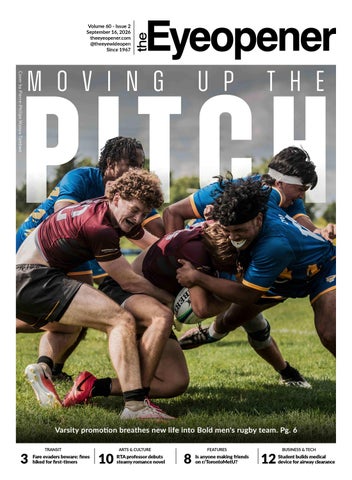
The Battle Begins: Men’s Rugby achieves OUA promotion
As the Bold head to the OUA, the team hopes to use its historic promotion to grow the rugby community Joshua Lui-Yee contributing reporter
For the first time in program history, the Toronto Metropolitan University (TMU) Bold men’s rugby team is heading to the Ontario University Athletics (OUA) division. Though the official announcement was made on social media on July 10, the team learned the news several months earlier. Head coach Christopher Thomas said there was substantial work involved in applying for the promotion, with the entire process taking several years to complete. Thomas believes the promotion will open up rugby to the broader TMU community and encourage attendance at games, boosting interaction with the team. He said he hopes this season will, "teach people about the sport of rugby and hopefully put on a good show in the meantime.” Calum Roberts joined men’s rugby in 2022—the same year as Thomas—and is now a veteran on the team, going into his third year with the Bold's main team after two years with the reserve team. Roberts said the team was very hopeful about the promotion throughout the summer and it
was a big moment when they got the news. “Everybody's been getting out there in the summer playing more rugby,” said Roberts. “It's a big build-up as we head into the season, so we're all looking forward to it.” Thomas said in the past, the team has only played on an exhibition schedule against teams in the OUA. This promotion has TMU as a regular-season competitor. “It also means that we get to compete at a level which is going to challenge us,” Thomas said, knowing the jump to the OUA comes with a higher level of skill and intensity. Starting this fall, both Thomas and Roberts are looking to continue their strong training regimens and focus on the team’s performance. “The process to get us here has been one that we started probably three years ago,” Thomas said. "So every practice is going to be like the best practice of the year. We have to get better and incrementally improve from practice to practice.” “We're aware that there's gonna be a skill jump for sure, but I think we're ready for it,” Roberts said. “We're fired up for it, and we certainly aren't gonna be trying to pull any punches, per se.”
PIERRE-PHILIPE WANYA-TAMBWE/THE EYEOPENER For the team, this promotion is the culmination of years of hard work, both on and off the field. After describing some of the administrative work and financial allocation needed, such as budgeting and creating a multi-year plan, Thomas also thanked leadership, alumni and coaches. “The leadership and coaching group is very stable, and we have a very, very good group of recruits
and young players coming through our program,” Thomas said. “One of the big beliefs that I always have is that you can't have a high-performing team without a community around it.” “TMU fans, we love you. The support throughout the years when we haven't really had a concrete schedule or stability, but we still have people coming out to our games, means the world to our players and
to our coaches,” Thomas said. “We hope that we can continue performing and building into something that gets really, really fun to be a part of.” The Bold already kicked off their season against McMaster at Brampton RFC on Sept. 13, where they recorded a 47 to 7 loss to the Mauraders. Fans can catch TMU’s first home opener against Trent at Lamport Stadium at 2 p.m. on Sept. 26.
Behind the scenes of TMU Homecoming Months before puck-drop, the Bold begin planning with the goal of uniting students for an incredible night Nolan Boivin contributing reporter
Homecoming is one of the biggest sporting events of the varsity athletics calendar. It’s both a celebration of athletics and the arrival of the new school year. Packed stands, loud cheers and battles on the ice make it a night not to miss. But while students will witness the full arena as the Bold clash against the Queen’s University Gaels on Thursday, what they won’t see are the months of behind-thescenes planning that make the event come to life. Preparation for homecoming begins as early as June, with the Bold working on partnerships, sponsorships, marketing and game-day activities long before students return to campus. Elizabeth Farsang is Toronto Metropolitan University's (TMU) athletics and recreation marketing and events coordinator. She said securing partnerships is one
of the most important steps in preparing for the event. For homecoming, the Bold are working with the Toronto Metropolitan Students’ Union, which will be sponsoring the loudest fan section. Before this year’s game, a backyard barbecue will take place in the Pitman Quad, dishing out free food, games, and music before students march together to the Mattamy Athletic Centre (MAC) for the Bold’s contest. The Bold’s marketing campaign is divided between its graphic design, digital media and social media teams. These three groups work together to ensure the campaign stays consistent across all fronts. “We all have to be intertwined at all times because if one of us is not in line with the other, then we’re going to be producing stuff that doesn’t mesh together well and that is going to be confusing to the fan base,” Farsang said. To refresh this year’s homecoming, the Bold are placing a
PHOTO ILLUSTRATION BY DANIEL OPASINIS deeper emphasis on the students and the role they play in creating the atmosphere at games. “Obviously, we want students to be in seats and students are the most important part of game day,” Farsang said. Farsang also mentioned the relationship between the team and the students go hand in hand, and building this relationship is the ultimate goal of her preparation. “The athletes feed off of the fans and vice versa…As soon as the whistle goes, my planning is done,” Farsang said.
While Farsang’s role ends once the game starts, the baton is handed over to the Bold’s media team to capture the atmosphere at the MAC and deliver live content for students to view and engage with online. For Bold Media photographer Lazar “Laki” Mihajlović, his role extends beyond supplying content and has instead shifted to creating an experience that students will remember long after the night ends. “This is a 'can’t-miss' event that will be a way to get new students and continuing students to show their pride for the university, a way
to create a culture in the university with sports,” Mihajlović said. Preparing content begins before game day. Mihajlović said photographers usually begin about two weeks before an event like homecoming, while other roles such as video and graphics can begin a month or more in advance. Before the game, photographers work with coordinators to determine where media personnel will be positioned and which moments to focus on and capture throughout the game. Read more at theeyeopener.com
Sports | 7
THE EYEOPENER WEDNESDAY, SEPTEMBER 16, 2026
Bold women's hockey open preseason with 3-2 win
McKee's late winner seals thrilling victory over York Lions Ariyana Richardson contributing reporter
The Toronto Metropolitan University (TMU) Bold women’s hockey team recorded a 3-2 win against the York University Lions in their first preseason game at the Mattamy Athletic Centre (MAC) on Sunday. Dropping two preseason and two regular season games to the Lions last year, this matchup gave the Bold their first opportunity to establish a new tone ahead of the season. “How we played today is the floor, and we need to play to the ceiling…every week we get an opportunity to take another step toward that,” said Bold head coach Lisa Haley. TMU hoped to use this opportunity to shake off any offseason rust, aiming to dictate the game's early pacing following the first draw. Though the Bold initially
controlled puck possession during the opening minutes, York’s second-year forward, Ginger Fast, opened the scoring in the eighth minute when a tripping penalty was given to first-year TMU forward, Jeevin Khehra. A subsequent York power play put the Bold behind by one. In the 10th minute, the Bold swooped in on another power play opportunity. Effective teamwork between Khehra and fourth-year forward Neely Van Volsen created an opening for first-year forward Anna McKee to land TMU’s first goal, evening the score at 1-1. “I base my game off my speed, quick feet and resilience and I’m going to bring rocket-like shots from Ridley [College] to [TMU],” Khehra said. The second period was marked by multiple penalties as both teams struggled to capitalize on their power play opportunities. As the second period waned down and swiftly approached its
18th minute, York received two penalties, leaving TMU with a 4-3 power play and eventually a 5-on-3 power play. By the end of the second period, the teams were left tied 1-1, with TMU having totalled 10 shots on goal in comparison to York’s 17. Early in the third period, Fast scored again, giving the Lions a quick lead. York swiftly consolidated their offence, to which TMU responded with equal intensity. “I think we finally got desperate enough…[York] scoring the goal to take the lead was probably the wake-up call our group needed,” Coach Haley said. With just three minutes left in the period, second-year forward Jade LeBlanc tied the score back up to 2-2. Boosting the Bold’s morale with momentum, McKee broke the tie in the 18th minute, notching her second goal of the game and sealing TMU’s first
SOPHIA BLEW/THE EYEOPENER preseason win, 3-2. The energy after the final buzzer was one of electric excitement, relief and pride for everyone attending, as the Bold not only started their year off with a win, but also reintroduced the game of hockey back into their routines. “I was really trying to nail it down and just score a spicy goal, and that’s what I wanted to do,
and I did it,” McKee said. “We had some flaws and mistakes that we’ve seen, and we are going to work on them through the week in practice.” UP NEXT: The Bold will journey to North Bay, Ont., to face the Nipissing Lakers on Sept. 18 at the Boart Longyear Memorial Gardens. Puck-drop is set for 6 p.m.
’s o t n o r o T n w o t n Dow
S M O O R E P A C S E T S E NEW
Grand Opening Special
$29.99
PHOTOGRAPHER NAME/THE EYEOPENER
PLUS
Use code TMU20 for
an additional 20% OFF for a limited time.
LOBBY LEVEL | THE CHELSEA HOTEL | 33 GERRARD STREET W.
B O O K TO D AY !
TIMEZONEESCAPES.COM
FEATURES | THE EYEOPENER 8 | WEDNESDAY, SEPTEMBER 16, 2026
Each fall, TMU’s dedicated Reddit group floods with students searching for friends. But in an anonymous chat room, how much companionship can you really find? Sorousheh Salman speaks with the brave students who gave it a shot
F
OR
Won't you be my friend?
ISHIKA GUPTA,
December 2025 was as dark a winter as ever. The chilly nights were made even frostier when she lost a friendship she'd spent years pouring energy into. She had other friends, but the fallout left her grieving. The emotions of having lost someone close pushed her to begin finding a meaningful connection elsewhere. Her search culminated on Reddit, more specifically, the Toronto Metropolitan University (TMU) subreddit, r/TorontoMetU. There, she came across a series of posts made by TMU students who, like her, were looking for friends online. Behind the anonymity of Reddit’s alien mascot Snoo, Gupta made a post of her own looking for a new friend. The act of searching for a companion, in what is often described as the internet’s pits of hell, yielded all kinds of results, from vulgar requests to ghosting. But perhaps most surprisingly, her callout succeeded in finding new friend.
TMU HAS A DIVERSE STUDENT population, two-thirds of whom commute to campus from the far reaches of the Greater Toronto Area and beyond. For many, this makes it hard to build connections solely through everyday campus life. Though, trouble finding friendship in university is far from a TMU-specific predicament. According to a 2023 study in the Journal of American College Health, around 31 per cent of Canadian post-secondary students reported experiencing loneliness. Forming friendships can involve uncertainty. Ryan Persram, an assistant professor in TMU's Department of Psychology says in a face-to-face world, when young people are sharing an environment such as school, the uncertainty around making a friend can come from fear the friendship could fall apart and leave long-lasting implications. As online social interaction became more common during the COVID-19 pandemic, platforms like Reddit have only grown in popularity as places for students to find companionship. Reddit, an online platform built around smaller communities known as subreddits, was launched in 2005 by former college roommates Steve Huffman and Alexis Ohanian. The site is now a space where users can connect based on interests and shared experiences. It didn’t take long for students at many post-secondary institutions to create
their own dedicated subreddits, with students at TMU jumping on the university subreddit bandwagon in 2008. Now, as new semesters begin each fall, first-year students (or those just looking for companionship) flock to r/TorontoMetU, to make their own variation of a “DM if you want to be friends” post. Unlike a dating app, Reddit was designed for discussion—so there’s not always a straightforward path to finding friends on the site. Gupta, a 2026 graduate in applied math with a specialization in computer science, said connecting with students on Reddit was difficult. When she created her post on r/TorontoMetU, she clearly specified she was looking for platonic female friends, more specifically, to find “a friendship that genuinely feels like home." “I’m not looking for someone to text for a week and then disappear,” her post read. “I want the kind of friend where we actually choose each other. Someone who’ll randomly ask if I’ve eaten, send me a meme at 2 a.m., drag me to try a new café, go on random walks, dance in the kitchen, celebrate
ries of messages behind their Snoos, arranging an in-person meeting was a significant next step for Gupta. Three months ago, she met her online friend and they decided to attend a movie night hosted in The Chrysalis, TMU’s on-campus theatre. Being in-person allowed Gupta to develop trust and a connection with her—they shared personal stories of coming from India and their transition to studying abroad. Persram says face-to-face interactions allow people to learn more about one another in ways that technology-based communication doesn't. “Physical proximity is not necessarily a requirement, but it does help,” he says. Persram says the value of nonverbal interactions and cues is developing a deeper understanding of another person. On Reddit, people don’t see someone’s body language or how they interact with their environment—and this may prevent them from understanding certain aspects of an individual’s personality and behaviour.
Why is it LOWKEY hard to find people w the same interests as me Anyone likes hiking, billiards, working out, anime, boxing and studying?! Please dm me ion really care who dms me or who you are I JUSY WANNA FIND PEOPLR WITH THE SAME INTERESTS AS ME Posted to r/TorontoMetU on Oct. 6, 2025
birthdays properly, take silly pictures, hype each other up before interviews, cry together when life gets hard, and still be around years later.” Even then, over a dozen online users sent her vulgar messages—a direct rejection of the boundaries she’d tried to set. “That was bad, like a horrible experience,” she says. But among the range of undesirable responses, there were some people who reached out earnestly, too. And after exchanging a se-
TMU student Matthew Serban says he finds the disembodiment makes online friendships feel distant. Like Gupta, Serban found himself scrolling through r/TorontoMetU, and among the first posts he’d seen was someone asking to make friends. Feeling outgoing, Serban joined the conversation. But in his experience so far, he hasn’t found interactions with these kinds of posts successful. When he sends Redditors direct messages, they
either take days to reply, or respond in as few words as possible. “I didn't know their enthusiasm compared to an in-person interaction because I never saw their facial reaction, their verbal tone, how excited or how enthusiastic they were,” Serban says. The fifth-year marketing student said not having access to a profile picture on Reddit—or a name that wasn’t a string of random numbers and letters—challenged his ability to connect with people. To make friends online, he prefers Instagram, where he can see a user's face, or at the very least, could ask for their real name. IT’S NO SECRET TMU IS A commuter campus. In 2020, a universityled poll found that 77 per cent of students take public transit to school. And until 2030, when a new residence will double the number of residence beds, there are a meagre 1,144 beds for around 48,000 undergraduate students—a ratio far lower than most Canadian universities. That, and Toronto’s ever-rising cost of living, can make it less desirable to spend excessive time in the city. Serban ranked the difficulty of finding a community on campus an “eight out of 10,” thanks to his hour-long commute. With this, platforms like Reddit are the seemingly logical, yet illogical place to make friends. Persram says the internet has removed all physical boundaries—and made making friends more accessible, in a sense. Instead of having to coordinate class schedules to find an opening to meet a friend on campus, students can now carry friends
FEATURES | THE EYEOPENER WEDNESDAY, SEPTEMBER 16, 2026
is. “Calm down. You're a random on Reddit,” she thought to herself. "Besties is a bit much.” The chat request is still sitting unanswered in her Reddit inbox: “Hell no, I'm not doing that.” Cox then connected with another student who had replied to the Reddit post. She was a year older than Cox but studied a creative degree similar to hers. She felt an immediate sense of familiarity. Their conversation initially stayed on Reddit before moving to Discord, where Cox began to feel more comfortable—now they knew each other’s names. This new online connection reminded Cox of friends she already knew. “I've seen this personality before; it always ends well for me,” she says.
ILLUSTRATION BY RACHEL CHENG around in their pocket. Instead of spending a lecture alone, they can text away on a Reddit tab with professors being none the wiser. THE FIRST TIME GUPTA hopped on the internet to make friends was before university. She was taking a computer science class online in India in 2021, at the height of the pandemic, just before she was set to jet across the world for school. As she prepared to leave for Canada, Gupta joined the International Student Support group on Facebook, where she began talking to other students who were preparing for a similar transition. There, she found someone to connect with. Though she was residing in Delhi and her friend in Punjab—seperated by a severalhour car ride—the two international students eventually took a leap of faith in their friendship by booking a flight together from India to Canada. Gupta, an introvert at the time, says, “It was really interesting; [my friend] wouldn’t stop sharing her stories from the past.” When the pair made it to Toronto, they kept their friendship alive, living closer to each other for some time and resorting to call or text to console each other through school-induced melancholy, especially on Toronto’s cold winter nights. Transitioning from high school to university can be drastic for some students, says Persram. “It's almost a similar jump that you make from going into high school from elementary school. You're changing schools, you're changing your entire environment,” he says.
FOR GUPTA, in the journey from country to country, she found her online friendship had paid off. And after
So im transferring to tmu in the winter sem for comp sci and im kinda nervous. ive always gone to uni with my friends and im so scared to start fresh but i was wondering if people find it easy to make friends at tmu since its a commuter school Posted to r/TorontoMetU on Dec. 10, 2025
For Phoebe Cox, a fourth-year English student at TMU, the way she finds new people to connect with as a university student changed over the course of her four years. “You get busier and busier and busier," she says. "The friends that you used to hang out with all the time sometimes are too busy to do that now." Facing this challenge, Cox ended up searching for new friends on Reddit. She joined r/TorontoMetU to learn more about her courses, but when she found a post from another student looking to make friends, she reached out. The student never replied to her. Other attempts also proved fruitless. Cox couldn’t get over how short the responses were or how abbreviations like ‘wyd’ seemed to make their exchanges so impersonal. Cox started conversations with three users, but never met any. One user asked her “Wanna be besties?” flat-out, without expressing interest in getting to know who she
arriving in Toronto, it didn’t have to stay online, and that allowed for the friendship to grow. Similarly, Serban says, in-person interaction felt easier when there was a natural reason to approach someone. Last March, his professor had called for a break in the lecture when he decided to approach someone in class to talk about a group project. “It's more natural, because you don't have to have a starting point of speaking,” Serban says. “On Reddit, you have to ask a question, you don't get to tell someone's body language.” He and the classmate ended up being in the same group project and continue to talk to this day. For Cox, online friendships aren’t simply an alternative to an in-person connection; it opens the door to meeting a range of people, even internationally. “My best friend,” she explains, “is an internet friend from the UK and she's flown over to meet me a couple of times now.”
|9
She admitted to feeling ‘jittery’ and nervous when they began speaking virtually, thinking, ‘Will this person like me?’ but eventually they clicked and it felt like hanging out with any other friend. Being able to talk about her interests online felt easier for Cox. “If I want to be a complete nerd about a certain show I watched, and I'm already friends with someone in that fandom, I know I have a safe space to do it. If I want to be a nerd in person, I gotta test the waters.” This phenomenon of feeling less judged online is explained by Sukhjeet Sidhu, a qualifying registered psychotherapist who works with youth in Toronto. “If I'm behind a screen, my entire self is not attached to this username; it’s just my words. It's not my face, my personality or my history. It's not really me.” Once Cox feels comfortable with an online friend, she’s ready to bring the relationship into the physical world. One of her longtime internet friends, whom she met through a fandom community on Instagram as a teenager, also ended up attending TMU. She described their first in-person interaction as strange but not uncomfortable. “It was like, ‘Oh, you’re actually real,” she says, “‘You’re standing in front of me. And you're actually a person that I can talk to, not online.’” A lot of people will go and visit their online friends in person, explains Sidhu, “It doesn't stay as a username. It stays as a person. So calling it a friendship is accurate, whether it's online or in person.” SCROLLING BACK SEVERAL years through r/TorontoMetU’s history, dozens upon dozens of TMU (and when it was r/Ryerson, then Ryerson) students have asked to make friends on one of the internet’s most ridiculed platforms. “Transferring unis and kinda nervy to make friends,” one of the most recent callouts says, to Redditors encouraging in-person interactions. “A little bit about me, I enjoy drawing, going on nature walks, gaming, and reading. If you are interested in studying and/or hanging out with me, please send me a DM,” a fourthyear accounting student posted, to zero replies and six upvotes. “Please dm me ion really care who dms me or who you are I JUSY WANNA FIND PEOPLR WITH THE SAME INTERESTS AS ME,” another user wrote. “Lmao,” was the one-word reply of another Snoo-hidden person. As much as some students will find success in building friendships on Reddit, the platform will always have its drawbacks; for Cox, it’ll be a resounding “hell no” to whether she’d share her real name over the app. And without a real name, the question might be how legitimate the friendship really is. But Persram and Sidhu drive home that friendship—be it in-person, or online on the internet’s pits of hell—is often valid in providing company and comfort amid a loneliness crisis. No one will stop the brave TMU students from trying to find company.
Arts&Culture
Next week: TMU students and alumni take on TIFF
THE EYEOPENER WEDNESDAY, SEPTEMBER 16, 2026 theeyeopener.com/arts
RTA professor debuts steamy academia romance
Laurie Petrou's novel The Rayburn Affair explores relationships, inspiration and art in the age of AI
Hannah Thompson contributing reporter
For Laurie Petrou, the university classroom and the writer’s desk aren’t two separate worlds. As a professor in Toronto Metropolitan University’s (TMU) RTA School of Media and an author, she's spent years moving through academia and creative writing—experiences which collide in her newest novel: The Rayburn Affair, released Sept. 2. The novel follows Dr. Ruth Morgan, a lecturer at the fictional ‘East Toronto University’ who is trying to make a name for herself as a writer. Her world shifts when she meets Shelby Rayburn, a celebrated author she's long admired. Morgan becomes involved with Shelby's personal and professional life, and what begins as romantic intoxication soon puts Ruth's own ambitions, relationships and ideas about success into question. The Rayburn Affair is Petrou’s sixth novel and the second to be set on a university campus, following Stargazer (2022). This time, however, she wanted the university in a downtown setting, something she hadn't written before. She was also drawn to the idea of a university with blurred lines between reality and facade—the novel's fictional campus was once used as a film set. “I love a campus novel,” Petrou said in an interview with The
Eyeopener. “It’s always been one of my favourite genres of books.” Although East Toronto University is fictional, Petrou's experiences at TMU helped shape the campus in the novel. She said her time as a professor gave her insight into the inner workings of a university, providing a foundation for her to explore the tensions which can unfold within them. “I wouldn’t say that it was based in any way on TMU,” Petrou said, “but my experience as a faculty member and as a professor has given me an inside track into what [working in a university] is like.” That experience also manifests in Morgan, who balances being a professor and a writer like Petrou. Though the two share similarities, Petrou said she had to dramatize Morgan as a fictional character. “I had to, as you do when you’re writing fiction, you have to really dial up the volume on anything that might be true in your own life or the life of people you know,” she said. “I would say that kind of the outer lines might be a resemblance to me, but filling her in was completely an imagination exercise.” Petrou’s experience as a writer also shapes the way she teaches at TMU. She teaches RTA 808: First Draft, a course where students develop their own creative writing while learning from someone who has experience navigating the writing world herself.
PHOTO ILLUSTRATION BY RACHEL CHENG. PORTRAIT COURTESY OF PAM WEST PHOTOGRAPHY, COVER COURTESY OF HOUSE OF ANANSI PRESS “My experience as a writer has greatly informed the way that I teach that class,” she said. For Petrou, writing is closely connected to reading and the simple enjoyment of creating something of her own. “I write because I love to read and I love to write,” she said. Petrou's academic background has also influenced the themes she explores in her writing. She has a PhD in communication and culture
from York University, which she said has helped shape her interests, while her background as an artist led her to explore questions of authorship and inspiration. Those ideas are especially important to The Rayburn Affair, which has artificial intelligence as one of its main themes. Petrou is strongly opposed to generative AI—particularly what it means for young writers and artists who are learning to develop their own creative voices.
“I’m not afraid of it stealing my voice. I’m afraid it’s stealing my students’ voices,” she said. Petrou sees creativity as the process of making mistakes, experimenting with your work and discovering something unexpected. “Half of creativity comes out of mistakes,” she said. “If you can press a button and get something instantaneously, you are missing exploration and failure and really amazing accidental wonder.”
TMU film preservation students join in on the analogue film revival Keyvan Mohammadi Rad contributing reporter
Amira Benjamin
production editor
"The purpose of having a film collection is ultimately to project it." This is the belief of Ryan Shea, a second-year film and photography preservations and collections management student, and a member of the Association of Moving Image Archivists (AMIA) chapter at Toronto Metropolitan University (TMU). "What we're dealing with everyday is film and magnetic media, how to preserve it correctly and what kind of life it can have," said Shea. Throughout their first year, Shea and his "tight-knit" cohort have used the programme’s collection of 16mm films to learn preservation techniques. It includes classics like the Spanish comedy-drama Viridana (1961) and Jean-Luc Godard’s Weekend (1967), but also rare archival shorts from the National Film Board of Canada. On Aug. 20, the students set up a public screening of one of the
films for the first time. They chose the 1966 cult psychological Swedish thriller, Persona, also from their learning material. "We've seen over the course of our first year so many kinds of interesting titles that we just decided we would start up projecting them for an audience," he said. "We have all of these films and it seems like the perfect opportunity to create these kinds of events to share these with other people. It's almost like, 'why not?'" There's been a major resurgence in analogue film projection in recent years, best exemplified by Christopher Nolan's The Odyssey. The film, which had a 70mm format, grossed $66 million in revenue from just the 41 screens playing it in that format worldwide— two of which were located in the Greater Toronto Area. Paul Moore, a professor of sociology and film historian at TMU, said directors such as Nolan intend for audiences to see their films in analogue formats, which can draw in moviegoers seeking a more unique experience.
"My first film after lockdown [was] Nolan's Tenet [on IMAX film]. I went really far out of my way to see [it], even with social distancing," he said. Moore said independent Toronto cinemas, such as the Revue Cinema in the west end, are playing a big part in popularising seeing movies on film. “When you look at the Revue schedule, [you can see] whether a film is being shown on film, whether it's being shown on 16mm, 35mm, 70mm and it draws an audience. Now that's just one theater in a big city [like] Toronto, but it’s enough to put together an audience of 300 or 400 people almost every day." According to Moore, analogue film has a unique draw in the age of the exponential growth of digital technologies. “What's at play is knowledge or even the self-awareness in the back of your head that this image, when it's projected on film, has been cared for by real people, has been cared for by professionals, has been put together skill-
KEYVAN MOHAMMADI RAD/THE EYEOPENER fully by people who know how to craft the experience,” he said. “Some people are certain that they can hear the difference, that it's a more full spectrum on the screen when it's a light through film projection as opposed to a digital projection, [the way that] some people kind of like playing LPs on record versus listening to digital music.” Quin Bright is also a second-year film and photo preservation and collections management student and member of AMIA TMU. "Part of what we've been learning [is] the experience of viewing film in [its] original format on celluloid is part of preserving it…culturally," she said. Zoe Xu and her sibling, Connie,
attended the Persona screening. "I like the grain [of analogue films]. I like seeing the little circles for the projectionists so that they can change the reel, like the sound of the projector," explained Connie. "It's interesting to be in a darkroom with everyone and experience something that somebody worked on. [It's] quite personal and tactile." Shea highlighted that the screenings are free not just to be accessible to the university community, but also so AMIA TMU members can learn outside the classroom. "Part of the purpose…is not just for people to enjoy the films, but for us to get to learn all the ins and outs of running events and projecting film."
Arts & Culture | 11
THE EYEOPENER WEDNESDAY, SEPTEMBER 16, 2026
From the “inconvenience store” to impressionism: a summer arts retrospective Yuna Cho contributing reporter
From a viral floating convenience store to the Art Gallery of Ontario’s (AGO) striking Impressionist exhibition Monet to Matisse, Toronto’s art scene offered a diverse range of artistic experiences this summer. An inconveniently-placed convenience store An outdoor installation titled Global Convenience by Torontobased artist Trevor Wheatley went viral on social media this summer, catching the attention of many Toronto Metropolitan University (TMU) students. Second-year biomedical sciences student Shiza Anwar visited the exhibit with her sister after hearing about it from friends. “I honestly kind of already knew what it looked like online but I just thought it would be cute to go.”
The installation features a fullystocked, life-sized convenience store, located on a floating platform about 40 feet offshore of Toronto’s waterfront. What caught Anwar's interest was the idea of taking something as ordinary as a convenience store and placing it somewhere unexpected. “[It’s] the irony of calling it a convenience store. We would jokingly call it the inconvenience store,” she said, echoing a name many Torontonians have begun to dub Wheatley’s piece. In an interview with Waterfront Toronto, Wheatley said “By translating this shared urban experience into a floating public artwork, Global Convenience invites visitors to reflect on the cultural exchange that unites Toronto and cities worldwide.” He also noted that, in connection with the World Cup, the installation reflects Toronto’s connection to the wider world.
4.2 kilometres of outdoor art The newly-opened Lassonde Art Trail, which runs for 4.2 kilometres through Biidaasige Park, features contemporary artworks within the natural environment. The trail was unveiled in June and is open year-round. November Paynter, chief curator and artistic director of the Lassonde Art Trail, said the project is a key part of Waterfront Toronto’s revitalization efforts in the Port Lands neighbourhood. She said the park is part of a major flood protection program for downtown Toronto and that cultural elements were a priority for the project from the beginning. “It is a destination park, so they wanted to have many reasons for people to experience this park system and contemporary art can tell stories,” she said. “By working with artists, we could sort of reveal the complexities of the site, the bioengineering,
PIERRE-PHILIPE WANYA-TAMBWE/THE EYEOPENER the history, the industrial history, Indigenous histories, the flood protection program.” Impressionism hits the AGO At Toronto’s art mecca, the AGO, a landmark exhibit on impressionism chronicled how the style emerged from existing artistic traditions and influenced later generations of artists, continuing to shape art today. As visitors follow the connections between works, they can experi-
ence the full scope of the impressionist movement. At the centre of the exhibition are several works by Claude Monet, the French Impressionist painter who sought to capture what he perceived rather than simply reproduce the world according to established artistic conventions. The exhibition, which runs through to mid-October, features works from the Dallas Museum of Art, including pieces by Monet, Vincent van Gogh, Paul Gauguin and Henri Matisse.
your friendly neighbourhood bookstore your friendly neighbourhood bookstore
your next great read awaits... your next great read awaits...
Dolupturio. Itasima voluptatquid quis et expe nobis expe provitis noasdf asdf bitatat. Pella natur aut exerupta nihilit rest quosand issitaeces nes andandem vellaut et harita qui apiet hiliquis adicimi, volum verchit lique nos iur sectem quibus, si tempore ritatquibus porum exera vere doluptis eum event et asit, nos sim ducimenis que plia imagnih icaessit lacerum doluptibus sam et fugia et quaes ut laniscium inctur, este
PHOTOGRAPHER NAME/THE EYEOPENER con con cor simus modi ad quis simus, ut eum accus excepernam, utatur adissunt acesciis apist, essi utenihil ma nulles debis nus nias nos ellam ulpa plabo. Ut ape volup tat ur? Volupitis diae ma qui tet quos elles dolut esto beriani scipsantius, cus venecaborum et archil explit occum quam eic tor sunt lam, et dit accabor poreped ignimpedi as volo tota di idiaspictata sinum reicipsandit ommod quam que ipis de-
riorat lia dolo omnitatur simus sed et molesto berum utet dolorepudit rem aut repe dolendiae porio quamus latis nobite excereraeris eum vel idus endundande dolo omnis rerioreium quaspicit pro blabo. Et modiasp elignim acest harum doluptaes modi quundit isquam quae earcimi nulparc ipsaperibus quatur aut ut faccus dipsantionet aperem de sinverum esto volor ad enimoluptaes ducid enis sum harchilitas pos doles exernam
benmcnallybooks 108 Queen St. E (at Jarvis)
benmcnallybooks 108 Queen St. E (at Jarvis)
12 | Business & Technology
THE EYEOPENER WEDNESDAY, SEPTEMBER 16, 2026
Grad student builds device for airway clearance The device seeks to deliver chest percussion for patients in long-term care
Mishael Taruc business & technology editor
A Toronto Metropolitan University (TMU) graduate student and startup CEO is developing a medical device to assist in clearing airways and mobilizing mucus for patients with respiratory issues in long-term care. Ali Abedinpour, a master of engineering innovation and entrepreneurship student and founder of Atabazh Medical, was only 23 years old when he watched his grandfather struggle with chronic obstructive pulmonary disease. In his grandfather’s case, mucus had to be expelled from his lungs regularly, which being bedridden made even more difficult, Abedinpour said. Caregivers administered manual chest percussion on him at least once every two days. To perform the treatment, caregivers cup their hands with their fingers close together as if trying to catch water. They then tap the patient’s chest rhythmically, creating a hollow sound to unblock airways, according to the U.S. National Institutes of Health. “That moment stayed with me,” said Abedinpour, now 37. Seeing a loved one struggle inspired the idea behind Abedinpour’s Smart Lung Physio, a
handheld medical device with a soft cup attachment that delivers controlled mechanical chest percussion. He said it measures the applied force and frequency, helping the user be consistent in providing the treatment. If done manually, the effectiveness of chest percussion depends on the caregiver's experience, Abedinpour said. “There is no consistency,” he said, so he built “something that can make this process more standardized and more measurable.” Measurability is important because force and frequency may have to be adjusted from patient to patient, he said. Tarek Sadek, the executive director of the Centre of Engineering Innovation & Entrepreneurship at TMU, said patients not getting the proper treatment can lead to "long-term deteriorations in their lung functions.” He has been supporting Abedinpour’s journey as his instructor and advisor. At the moment, Abedinpour focuses on seniors. "I'm hoping in the future...it can be used at home by a simple caregiver," said Sadek. "This also will alleviate a lot of pressure from our hospitals and nursing homes." Abedinpour built two versions of the device in Iran before coming to Canada in 2023 to pursue graduate
DANIEL OPASINIS /THE EYEOPENER studies. He said his program taught him to not only think like an engineer but also like an entrepreneur. Abedinpour said he had to learn the nitty-gritty of building and running a startup—including speaking with stakeholders, pitching the product, seeking grants, talking with investors and testing assumptions. Atabazh Medical was among the 27 startups exhibited in the Brampton Venture Expo on Sept. 10 where he introduced his product to investors, industry partners and fellow innovators.
He said aspiring engineer-entrepreneurs should listen to their customers before building the technology. For those who want to build medical devices, thinking about how it fits in real-world clinical workflow is necessary. “I found that the problem is real. So that gives me more energy to continue,” he said. Sadek’s advice for aspiring innovators with big ideas is to focus their work on a problem they want to solve. “Don't make the idea about the
solution, make the idea about your understanding of the problem.” The Smart Lung Physio is now in its third iteration, over a decade after the idea’s inception. Still, Abedinpour said more work has to be done before it could become commercially available. His grandfather never got the chance to use his innovation. All the same, Abedinpour is determined to bring his product to the market. “If I can help someone, or I can save a life...that's everything for me. That's why I'm living.”
Students fuel the 'little treat economy' as milestone purchases remain out of reach
Gen Z buying small “luxuries” rather than saving for the future Molly Simpson contributing reporter
As students face struggles in the job market and a non-promising future around home ownership, many are treating themselves to small luxuries instead. The "boomerism" advice of curbing impulse buys in favour of milestone purchases does not always work, said Nicholas Li, an associate professor of economics at Toronto Metropolitan University (TMU). “Why not get the eight dollar latte and $15 avocado toast?…There's no amount of not consuming those things that's ever gonna let you reach that goal so that's where the boomers are kind of wrong,” said Li. According to a Statistics Canada labour force survey, youth unemployment was recorded at 12.6 per cent in July. This is still higher than the pre-pandemic (2017-19) levels of 10.8 per cent. Despite this, students who spoke to The Eyeoepner say they still partake in getting a “sweet treat” often. Nevaia Whyte, a third-year fash-
ion design student, sees her “sweet treat” habit as a good start to the morning or a reward for a difficult day, and often finds herself buying a Crumbl cookie every Sunday. “There's always this notion of, ‘Oh, I can make that back if I work,’ but the more that you spend on these certain things, it does decrease your chance of achieving a bigger goal that you could have one day,” she said. “So there's definitely that knack of picking and choosing your battles when it comes to what you spend, especially when it comes to a good treat.” Li said research supports the idea that people are willing to save more for larger purchases when there is an achievable goal ahead of them. “You're willing to save and sacrifice for those things directly related to how far away those objects appear,” he said. However, when large purchases are out of reach, people are much less likely to save. “'I'm just gonna go eat some delicious greasy fried thing today… because there's just no chance I'm never gonna be able to afford a single-family home in the Toronto
suburbs like my parents had',” Li said of youth discouragement. Caterina Rossiti, a fourth-year media production student, said her finances have sometimes given her anxiety. Not having a job has made her more aware of her spending habits, especially as she saved up for a new laptop. “My computer was a bit expensive, it was more than $1,000 so whenever I would spend on something, I would think, 'oh, I maybe shouldn't have',” said Rossiti. Despite this, Rossiti still makes small purchases at times. Often, she buys a coffee or a pastry, saying she likes having something to do with her hands while working on something else. Fourth-year media production student Olivia Presti felt similarly about noticing her bank account balance drop during periods of unemployment. “When I'm preparing to make a big purchase…then I'm being super aware of my bank account. So after I had that awareness, it was a lot easier to stop buying random
RACHEL CHENG/THE EYEOPENER [stuff] for no reason,” she said. In the U.S., young people are more likely to make impulse purchases than their older counterparts, according to Marketing Charts, an American marketing organization. Their 2022 survey showed that 23 per cent of Gen Z and 22 per cent of millennials make impulse purchases—higher compared to 19 per cent of Gen X and 17 per cent of baby boomers. Most of young people’s spending went to apparel, food and drink categories. Zahra Salehi, a fourth-year new media student, said that with inflation, getting her treat of choice (coffee
and often a donut) has become more difficult. She said enjoying these purchases is harder now because she looks more closely at the price. According to Trading Economics, Canada’s inflation rate was three per cent for July 2026. Whyte gave advice for balancing saving money amid a high cost of living while also indulging in sweet treats. “I don't think you need to get rid of one thing in your life to gain another,” she said. “It really is a matter of budgeting and knowing your limit to something because you don't have to abandon something that you like.”
Communities | 13
THE EYEOPENER WEDNESDAY, SEPTEMBER 16, 2026
The World Cup celebrated Toronto's multiculturalism. Will it last? A summer of unity constrasted growing divisions in the city Riddhi Dhingra contributing reporter
Downtown patios sizzled, Sankofa Square filled with rhythmic Ghanaian music and inside east end bars, jersey-clad fans cheered out of their seats. Third-year media production student Mia Greenidge, whose mother’s side of the family is from Ghana, fondly recalls the Ghana vs. England match she watched at the FIFA Fan Festival at Fort York and The Bentway. “There was holding your breath, and then the release when you see that they didn't get a goal,” she said. When Ghana secured victories against England and Panama, the emotions reached beyond venues and into public plazas throughout downtown Toronto, bringing pride to many people. “It feels very cool to see a group of people represent a whole nation and a whole diaspora,” said Greenidge. For the five weeks of the FIFA World Cup, Toronto Metropolitan University (TMU) students with roots outside of Canada felt interim unity of a city celebrat-
ing multiculturalism. But with rising political tensions, some say this looks different from their daily realities. According to Statistics Canada, there were 1,074 racially and ethnically motivated hate crimes in Ontario in 2025, a sharp increase from the pre-pandemic average of 365 from 2016 to 2019. Isa Nadeem is a Pakistani second-year accounting and finance student, who was raised in Saudi Arabia. He recalled the moments when he saw his favourite team score, saying “it was as euphoric as it gets.” Nadeem commented on how the event brought together groups with historical divisions, such as Indian and Pakistani fans through love for the game. “To be honest, it just felt united,” he said. “It’s a good thing that everyone can actually enjoy something that’s going on around the world.” Christopher De Sousa, professor of urban and regional planning at TMU, said that events such as the World Cup brings diverse communities together. De Sousa described Toronto as “a city of neighbourhoods,” which lays the groundwork re-
garding these cultural celebrations throughout established cultural enclaves. “You have streets that are ethnically branded where communities gather, like Corso Italia where we used to have a lot of Italians, Little Portugal, Little Jamaica, Greektown on the Danforth, and Little India.” “Because Toronto is so multicultural, people have been allowed to grow up and celebrate their ethnic roots. It honestly makes for a much better World Cup because when it comes, I become Portuguese, even though I grew up in Canada,” he said. Standing in the crowd of thousands of fans in Sankofa Square was never just about football for an international student like Greenidge. It was a rare moment of seeing public enthusiasm for diversity, he says. After seeing “two sides of the coin,” Greenidge said the celebration during these world competitions felt almost forced. “You can have thousands of people cheering for one country while on the other side, people are trying to limit international students or keeping closed minds
DANIEL OPASINIS/THE EYEOPENER to anyone from a different background,” she said. Greenidge said Canada can sometimes feel as if it is neglected compared to the U.S or other countries. “At the end of the day, it makes sense that the World Cup would be hosted somewhere where there are people of literally all different backgrounds,” she added. “[In Toronto], I definitely don’t feel like I have to tone down my identity,” Greenidge said. “That is the beauty of going to school at TMU in the heart of the city. You can find your community.” For Nadeem, living in Toronto presents very different cultural contrasts regarding social and cultural norms. “You can do anything and people usually don’t mind. In Saudi Arabia, people actually stare at you.” Bryan Kolahzari, a third-year
arts and contemporary studies student, recalls when he attempted to connect with other Persian students during the tournament. “We were talking about Persian food, and I didn’t know a lot of it because my dad doesn’t cook,” he said. “I didn’t feel like an imposter, but I felt like I was missing out.” Jonathan Mirkalam, an Iranian fourth-year history student, said he felt the disconnection stemming from deeper political fractures which surrounded the national teams themselves. “We were in the World Cup, but there wasn’t really community representation,” Mirkalam said. “Because of political stuff in Iran right now a lot of people don’t even support the team. People are split—there was no situation where we could all just come together.”
Shein pop-up at Frosh brings mixed student reactions
Shein said 240 students signed up as campus ambassadors
Rin Yanase communities editor
Fast fashion retailer Shein set up shop on campus during orientation week and met a mix of student reactions. The one-day pop-up on Sept. 9 was part of Shein’s campus ambassador program, which saw campus events at universities across North America. The Toronto Metropolitan University (TMU) pop-up was the first in Canada. The event was hosted in partnership with the Toronto Metropolitan Students’ Union (TMSU), bringing a photobooth, mini games and a sign-up booth for the ambassador program. The program invited students to earn commission by creating content and recommending the company’s products on campus as brand representatives. Fatima Jafri, a third-year nursing student, signed up for the ambassador program along with two of her classmates. “We buy from these companies sometimes, so it's kind of cool that they were here,” Jafri said.
The event was held at the Student Community Centre after relocating from Gould Street due to rain. Not all students were excited to see the pop-up. Fifth-year biology student Mariam Mohamed was critical of the company’s pop-up event, saying it feels “weird” to have the event running on campus. Mohamed said she tries not to buy from Shein due to ethical concerns, and believes the products are, “not even that good at the end of the day.” The ultra-fast fashion retailer has had several high-profile controversies. In 2024, CNN Business reported that Shein found two cases of child labour at its suppliers. According to France 24, French department store BHV Marais ended its partnership with Shein, due to the alleged sale of childlike sex dolls. According to the statistics Shein shared with The Eyeopener, over 240 TMU students signed up for the program at the pop-up event. Jafri’s classmate Jadeinne Sadiarin acknowledged the company's controversies, saying she is critical of the company. “But honestly,” Jafri added, “all
brands in the West have done similar things and still do. Shein is more exposed about it. So if someone just boycotted Shein, it doesn't make sense because there's Zara and other brands that have also admitted.” Rishad Habib is an associate professor in marketing at Ted Rogers School of Management. She says it's interesting that sometimes a consumer's awareness of ethical issues steers them away from trying to make ethical decisions, calling it the ‘intention-action gap.’ “We want to be sustainable,” she said. “We want to have less of a negative effect on the climate, on the environment and on other people. But it also takes a lot of effort, a lot of time and a lot of money to be able to do that. So if you are a little strapped for resources like that, it makes sense.” Habib said for most people, when they choose fast fashion retailers like Shein over other fast fashion retailers, price is often a stronger factor than ethical considerations—especially among university students. In an 2020 article in The Guardian, moral philosopher Matt
RIN YANASE/THE EYEOPENER Beard argues that making more sustainable, ethical purchases is not always financially realistic for everyone. Habib adds, “we can't really blame people who choose this because it really is a practical choice.” “It might be more effective, instead of saying ‘don't buy from this brand,’ to kind of redirect people towards other options that are also cheaper and more sustainable,” she said. Habib pointed students toward other options close to campus, specifically the Free Store and repair workshops hosted by TMU’s sustainability office. Mohamed resonated with this sentiment. “We have a lot of local vendors here and students who have their own things. I think it's better to promote that rather than something…like this.”
In an emailed statement to The Eye, the TMSU said they, “want to ensure student concerns are prioritized, and having heard dissenting voices around the activation, will take all feedback into account on any further activations moving forward. TMSU said student feedback can be directed to their email. In an emailed statement to The Eye, a Shein spokesperson commented on students’ concerns over their ethical standards. “We take our responsibilities as a global company seriously and remain committed to operating responsibly, continuously improving our practices and maintaining high standards across our business. We also believe in open dialogue and welcome questions from students and others who want to learn more about Shein and how we operate.”
14 | Fun & Satire
THE EYEOPENER WEDNESDAY, SEPTEMBER 16, 2026
New study shows everybody has friends and you don’t Zahra Nazar contributing wiseguy
Disclaimer: Much like the friends you told your parents you made during orientation, this story is completely fabricated. A new study from Toronto Metropolitan University (TMU) this week has confirmed every new student on campus has already found at least one friend—except you. The study, conducted by The Lab of Observational Network & Engagement Levels in Youth (LONELY), surveyed over 48,000 TMU students and found that nearly everyone has formed a friend group, posted them on Instagram to make their old friends jealous and made a big group chat where the name is a reference to an inside joke. The study also showed some have even successfully brought their multiethnic friend-groups to sit on the freshly-mowed grass after class and throw around a frisbee. “Every single person we spoke to said they’d met some really great people that weren’t just great because they were the only options they had,” said lead researcher Dr. Noah Lott. While your classmates have effortlessly met lifelong friends through orientation events, residence, and the most seemingly daunting method “just talking to people,” you have spent the first week perfecting the art of avoiding contact with any seemingly close-knit friend group, which surprisingly required a great amount of skill. According to the study, you walk around campus wearing headphones without any sound
just so people won’t come up to you, you are curious about posters displayed around campus but refuse to look up at them in case somebody notices and tries to talk to you, you receive seemingly important emails while standing in crowded places so you can observe your phone instead of somebody else's face and you would rather get lost around campus than ask for help with directions. “Honestly, it’s astonishing how effortlessly they can avoid contact with another person,” Lott said. “Most students have at least two people they can rely on to grab food with at a place with AI menus.” Meanwhile, you have zero and the only thing you can rely on is making awkward eye contact with the security guard on the eighth floor at the Library while pretending to study. First-year chemistry student Bea Phorrell said making friends has been surprisingly easy, despite moving here less than two weeks ago. “I just sat beside someone during my first class and started talking,” Phorrell said. “It’s pretty simple if you ignore every instinct in your brain and just blurt out words in hopes that the person next to you is nice and not one of those people that would raise their hand and tell the professor you were talking during the lecture.” When prompted to give advice for students who may be struggling with meeting people, Phorrell said, “Just go up to someone and start blabbering on about how Love Island is the best show in the world or the worst show in the world. You’ll have to scope out their vibe first.”
CHARLOTTE LIGTENBERG/THE EYEOPENER
Is it possible to finish my undergrad four years early? Julia Herrick julia herrick impersonator
My Dearest Darlingest President Lachemi, I am a first-year business management student who just arrived at this fine educational institution and I was wondering if it would be possible for me to already be done before I’ve even barely just begun? I know the typical path for a young mind such as myself would be to toil away with my head in a book for four years straight but I’d rather just wrap this up real quick so I can move on to bigger and better things like staying in my bed until noon and trying to learn all the words to Yakko’s World. I’m already up to the third verse so this extra time would really help. I realize this may sound unusual but I really think this would
Real Advertisment
benefit everyone involved. I will pay for all four years up front using the money I got from the court settlement after being hit by a car in Grade 11. I originally forged several OSAP forms in hopes that I would get enough money to cover it all but they just gave me $40 in grants and $152,000 in loans so that kind of screwed me. I would be happy to complete all of my course work for every class I would ever have to take all at once in one sitting, let’s say during one afternoon. Or maybe I could be given some kind of examination worth 400 per cent of my grade? That’s 100 per cent for each year if that math flew over your head. I also wanted to ask whether attendance is mandatory for every class I would be taking all at once because I haven’t quite figured out the concept of cloning, however with the extra time this expedited
education would give me I’m sure I could crack it. In my life I have already written so many emails and read enough books in order to educate myself that surely some of these must count towards credits right? I am also willing to compromise on the quality of my university experience. I don’t need to join any clubs or study abroad or even make lifelong friendships or “find myself.” I already know who I am, and currently that person would like to graduate immediately. I’ve already illegally downloaded all the textbooks I would ever need on my phone, so please let that reflect on my commitment to my higher education. Please let me know if this acceleration is possible as I am hoping to graduate by Friday. Sincerely, Done with this
Games & Giveaway | 15
THE EYEOPENER WEDNESDAY, SEPTEMBER 16, 2026
Oakham Cafe and Met Pub Giveaway! The Eyeopener is giving away two $25 gift cards to The Oakham Cafe and/or The Met Campus Pub. Find the giveaway rules through the link in our Instagram bio. 1. Complete the crossword! Only 100 per cent correct crosswords will be accepted. 2. Complete the Google Form via the QR code on the page and add a photo of your completed crossword! 3. Await an email! The form will close end-of-day on Sept. 21 and winners will be contacted shortly afterwards and asked to come into our office for photos!
Submit Completed Crossword Here
TIFF Word Search
M W Y T F
Medium
E V W I
S
I
A E N M Z
A E
I
L O N
I
B G X D A F M I W S
H H Y
F
C C R
I
L D E
S
Z G K W D H Z H Y
S W A
J
V T
K
E
F
I
Y
I
K R T Y N F O R N E
F
R
L
R G
C L U B K
S
E A D R
F A V V H O I
D M V U X R
I
D R I
P
L G
Q S
K D O N T
T U B
E D E H T C E O D
L O B
E U K
F
J
K B H N Q N U N P
I
R H D R Y U U Y M Z
J
N N S
L
J
Q
J
F
E V O L
E
N E
C N D B D N E U O L G Q O P
Y
B G A
J
I
X K H B
T K E
P S
E H S O D O V V W G H P
INK THE DEBUT JOSEPHINE THE STUNT DRIVER FJORD CLUB KID
E
L
B
I
S
S O P
TENZING MISTY GREEN POSSIBLE LOVE YAGA BUNKER WILD HORSE NINE
T W
DOWN 2. A word or phrase that reads the same backward and forward. 4. This enormous planet is composed mostly of hydrogen and helium and is the largest in our solar system. 6. The world's largest hot desert, stretching across much of North Africa. 7. The three-horned dinosaur with a large bony frill. 8. The Roman city famously buried by the eruption of Mount Vesuvius in 79 CE. 9. A mixture of flour and liquid used as the foundation of many baked foods.
ACROSS 1. The speed at which a piece of music is performed. 3. The part of the brain primarily responsible for balance and coordination. 5. The process by which green plants convert light energy into chemical energy. 10. A person who studies the origins and development of words. 11. The sudden shaking of Earth's surface caused by movement beneath the crust. 12. This nocturnal mammal navigates primarily by using echolocation. 13. A mythical creature traditionally depicted with the head of a human and body of a lion.
The Tale of The Lone TMU Station Barrier
MYRTLE MANICAD
Members get $0 Delivery Fee Because tuition.
Save on Uber and Uber Eats Benefits apply on eligible rides & orders only. 3 months free subject to eligibility and member terms, see app for details
3 MONTHS FREE
JOIN TODAY
Eligibility & member terms apply.