The Eyeopener will be returning next semester for Volume 60: See you next year!
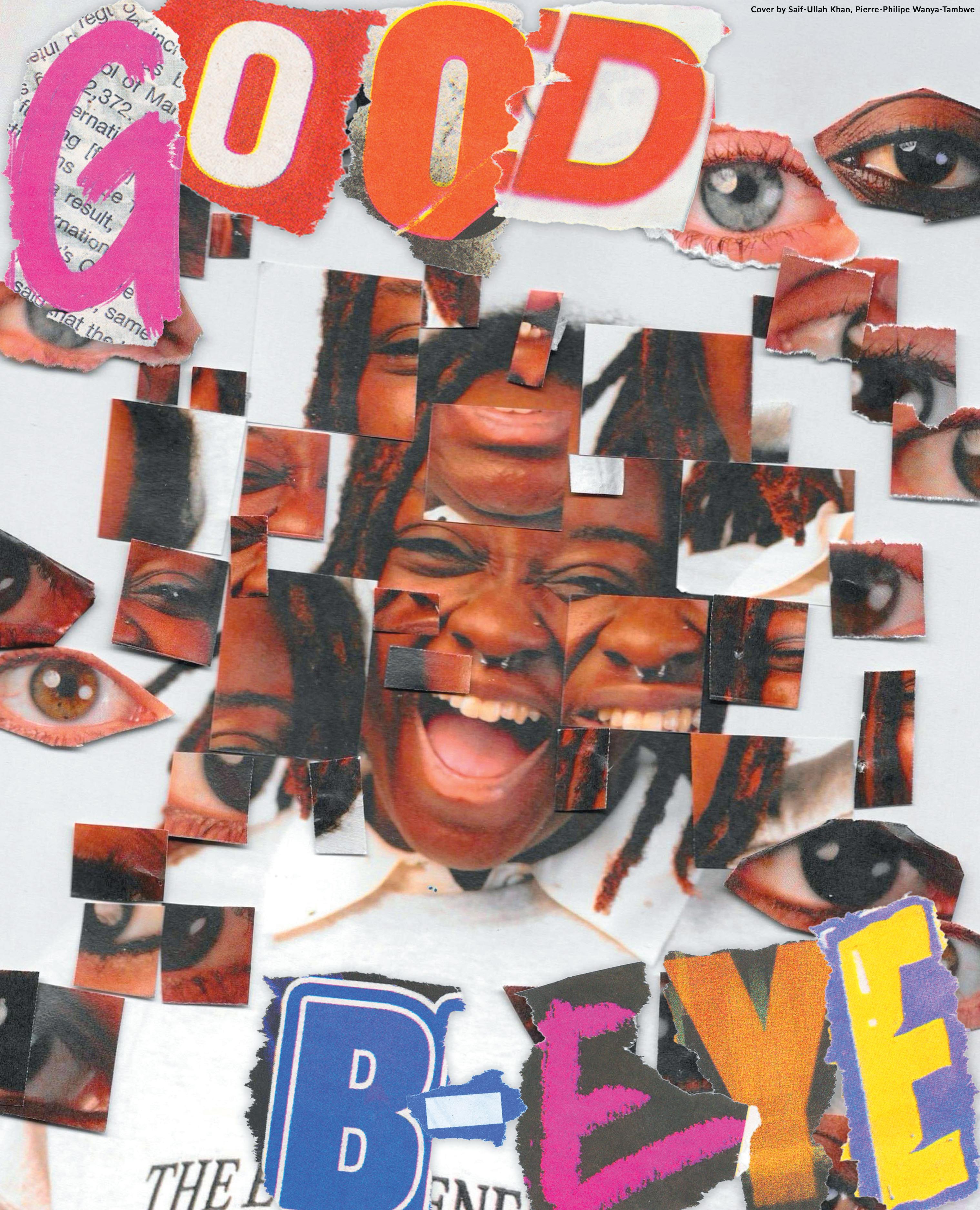
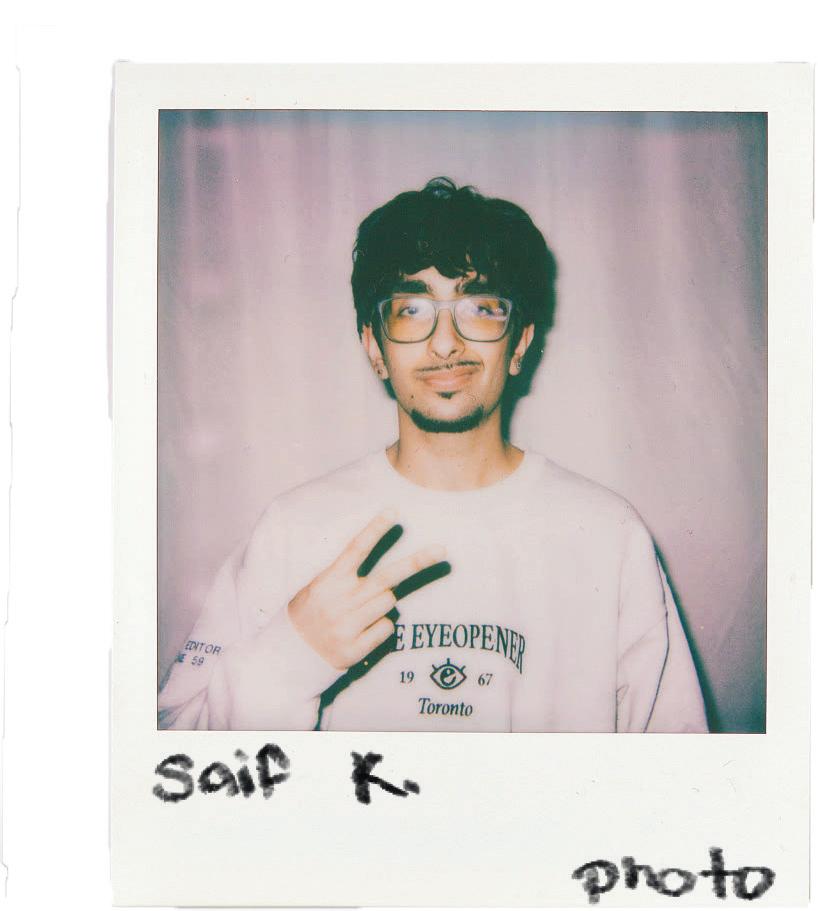
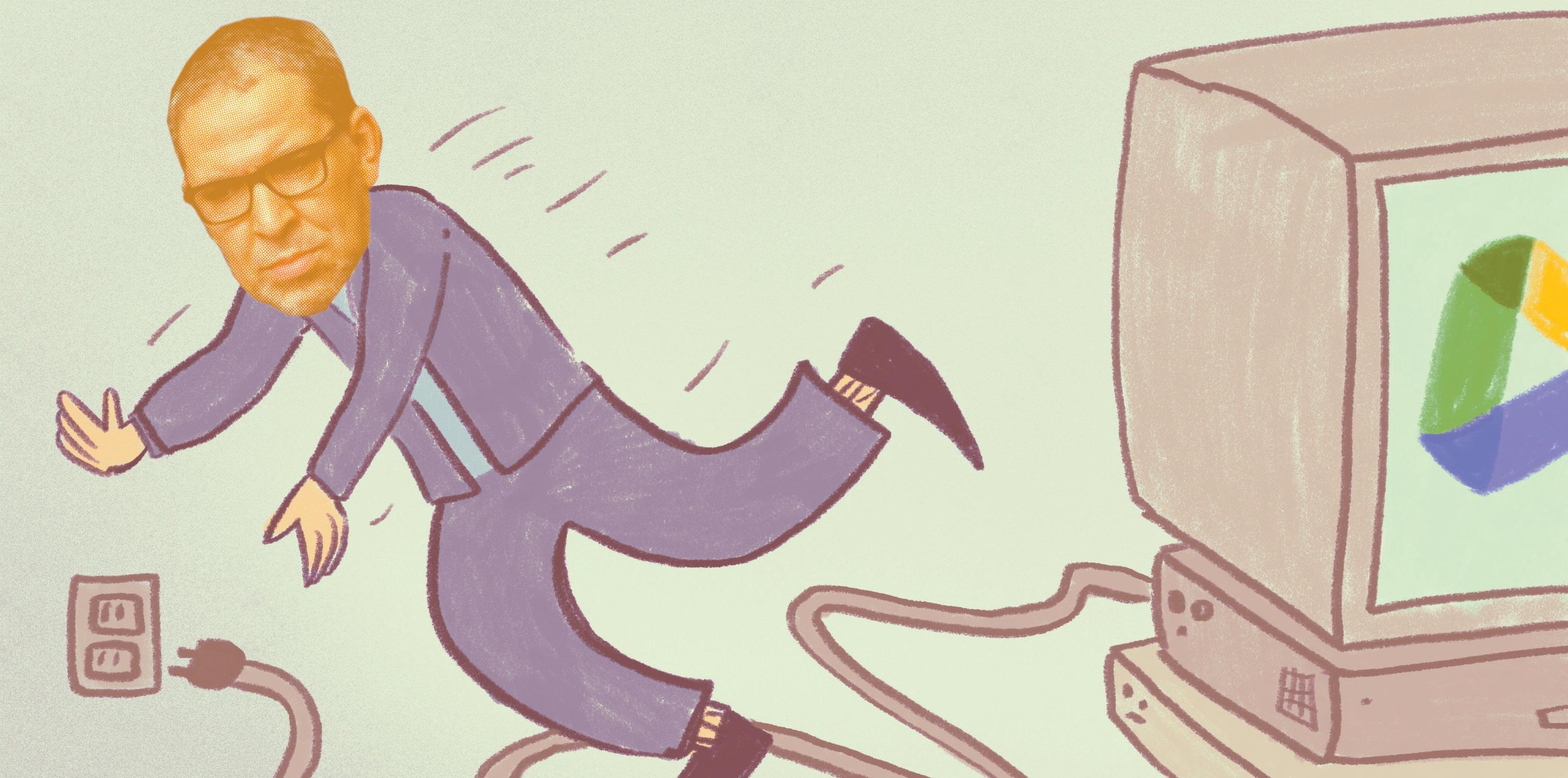
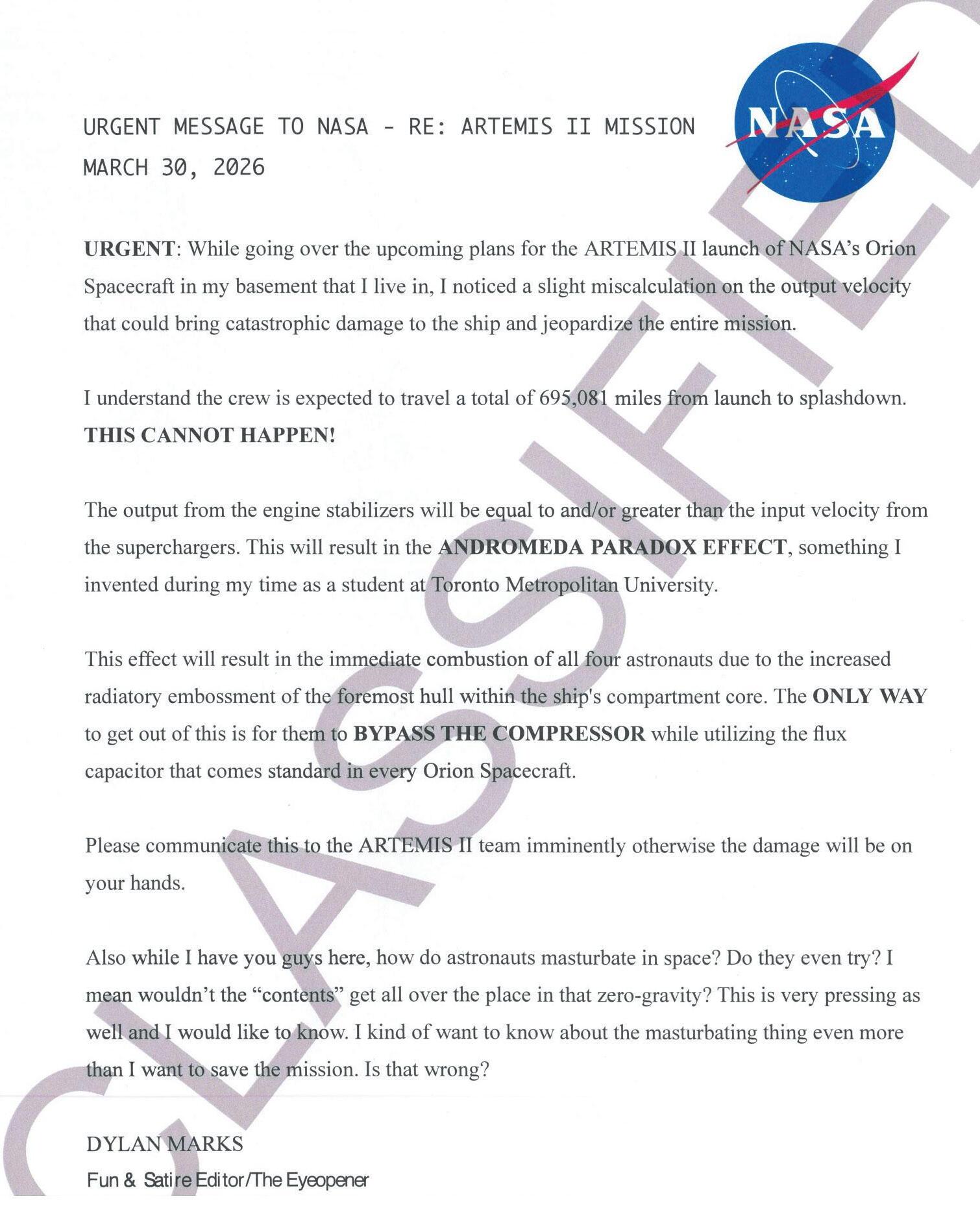
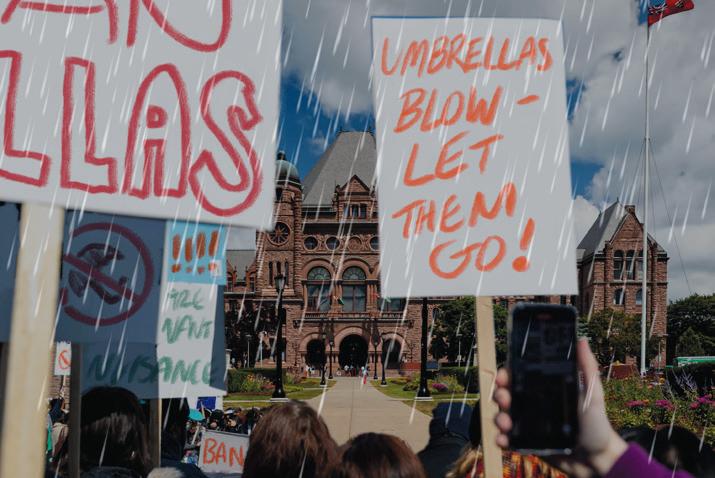
Photos by Ava Whelpley and Pierre-Philipe Wanya-Tambwe, Design by Saif-Ullah Khan
The Eyeopener
Masthead
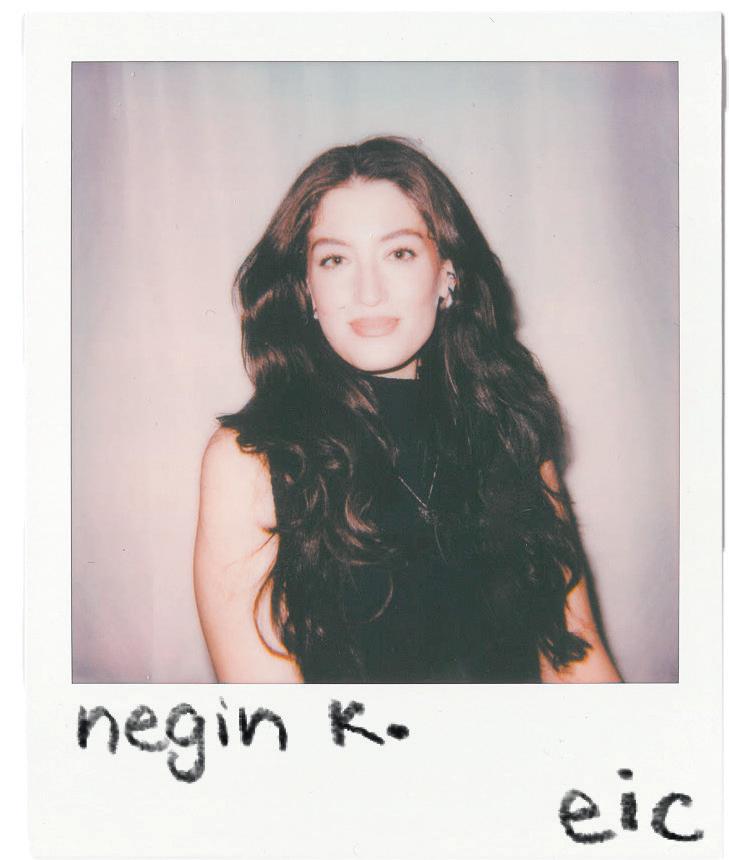
Editor-in-Chief
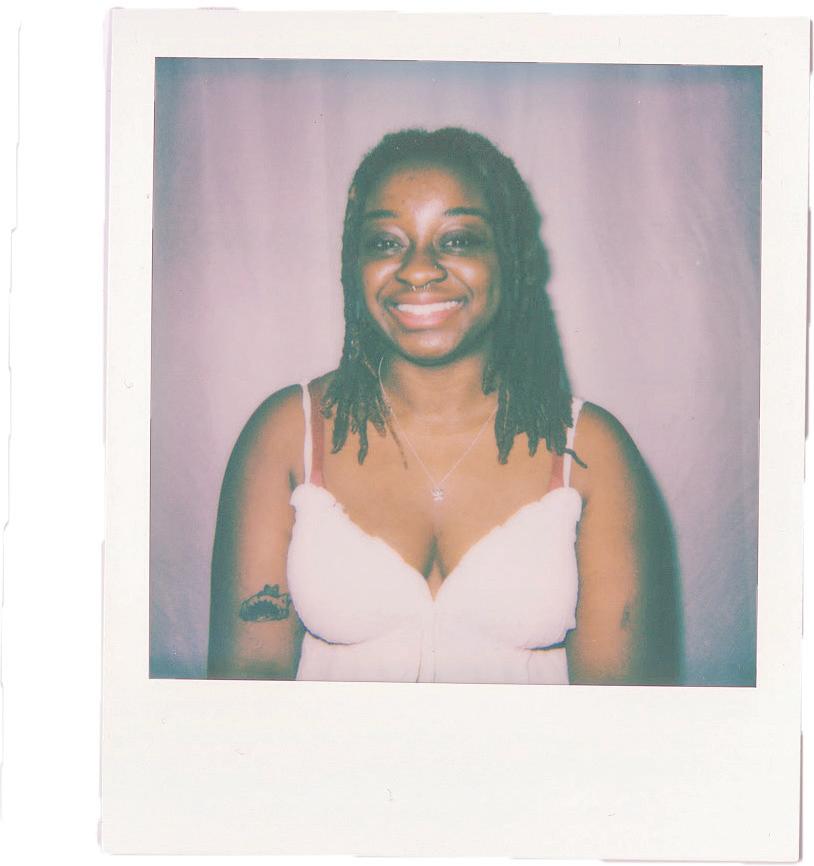
Negin “Fin.” Khodayari
News Editors
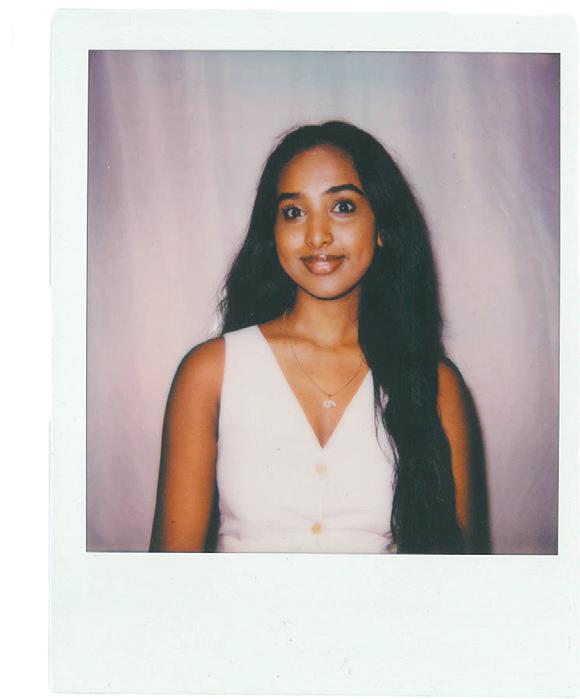
Shaaranki “Tweaking Boots” Kulenthirarasa
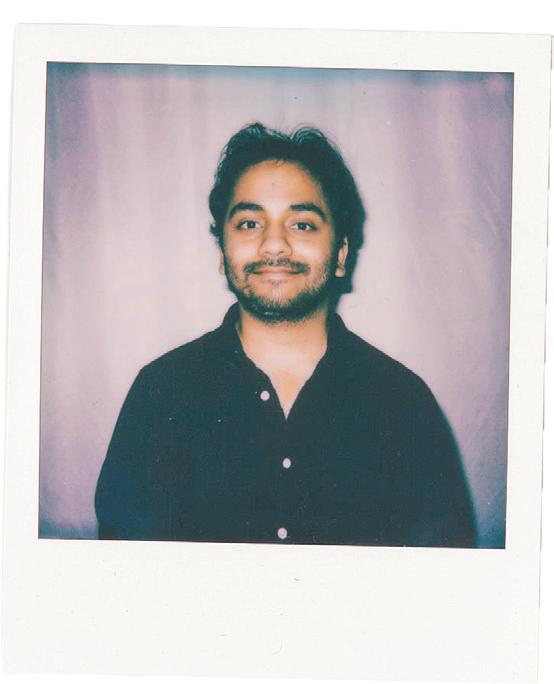
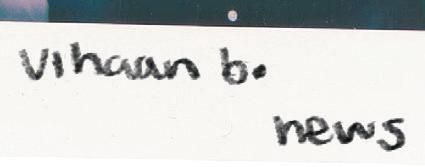
Vihaan “Butter, Layered” Bhatnagar
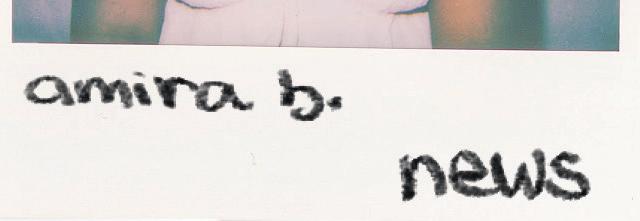
Amira “Producer” Benjamin
Arts & Culture Editor
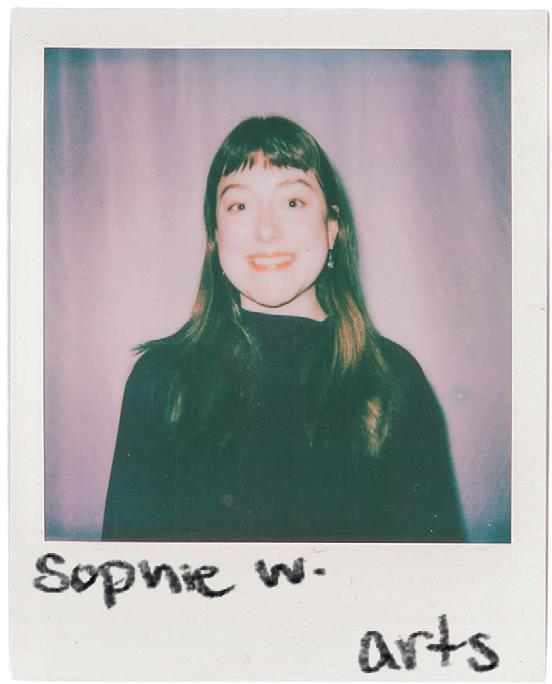
Sophie “What’s Kijiji” Wallace
Business & Technology Editor
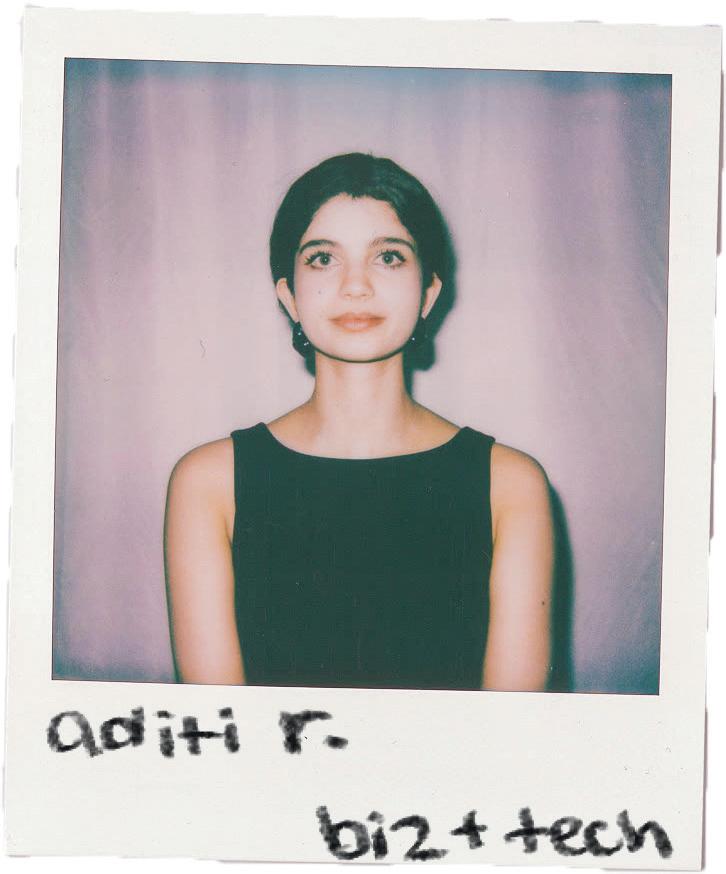
Aditi “Rescue” Roy
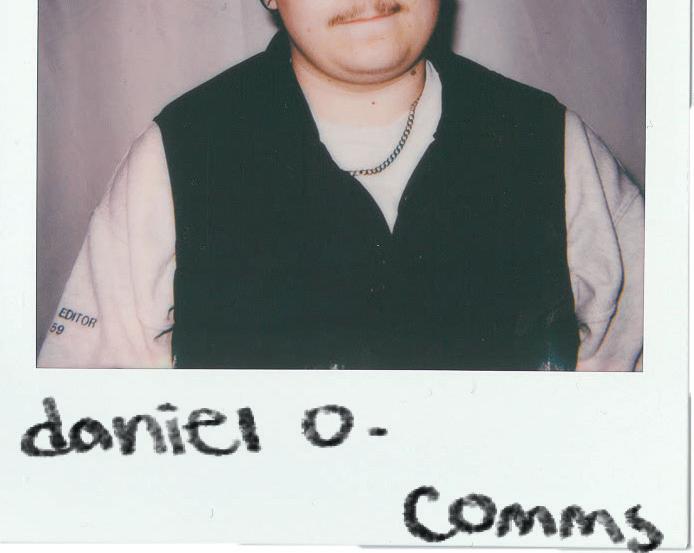
Communities Editor
Daniel “Shore” Opasinis
Features Editor
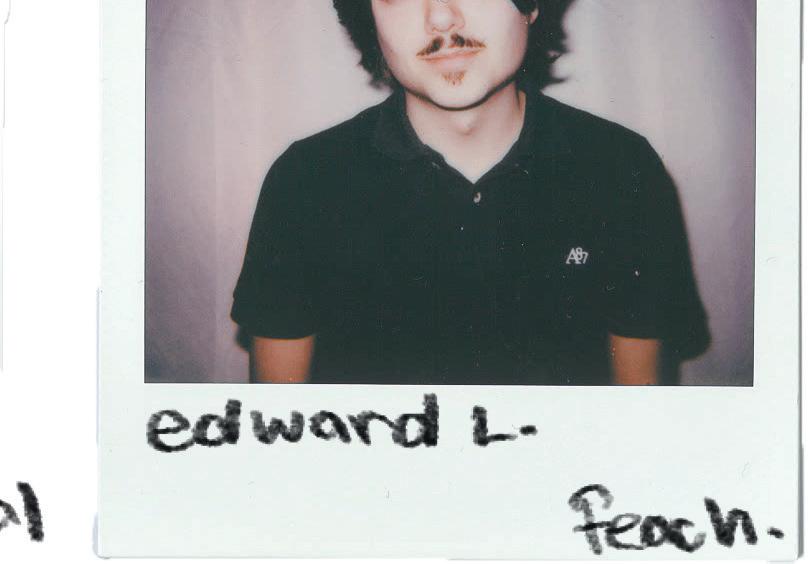
Edward “You’re Fired” Lander
Fun & Satire Editor
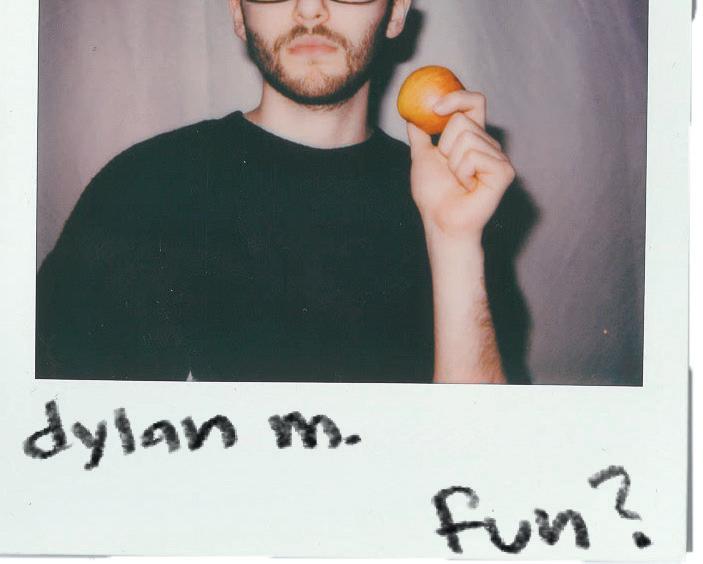
Dylan “Jewish Boy” Marks
Sports Editors
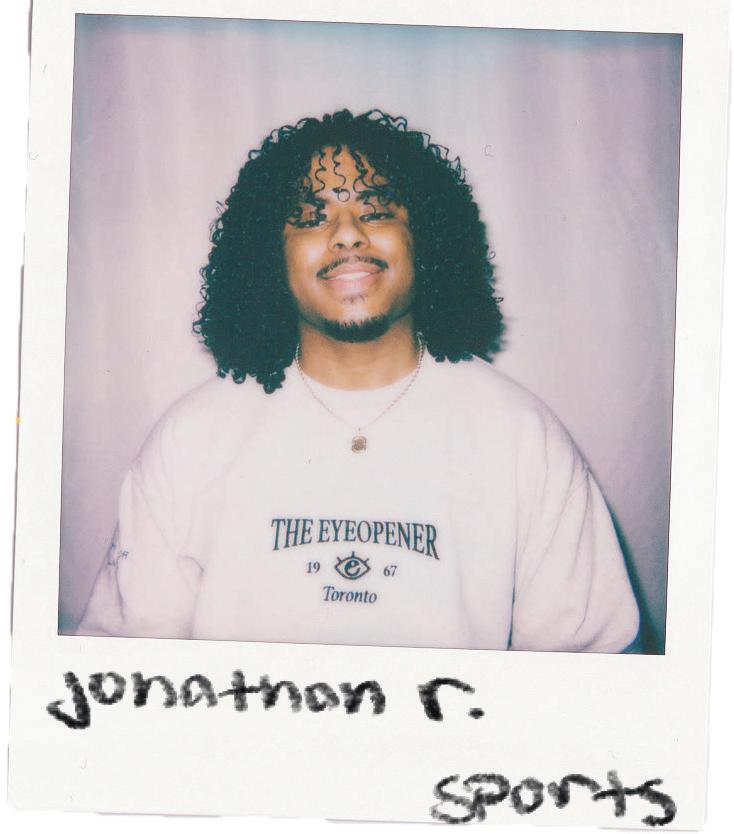
Jonathan “Click!” Reynoso
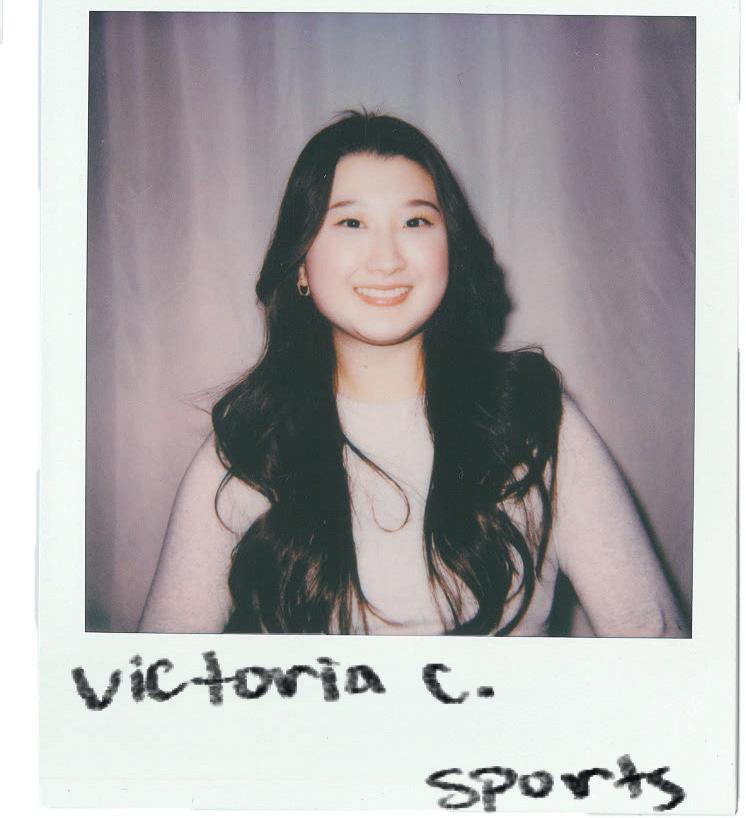
Victoria “Iron Deficient” Cha
Production Editors
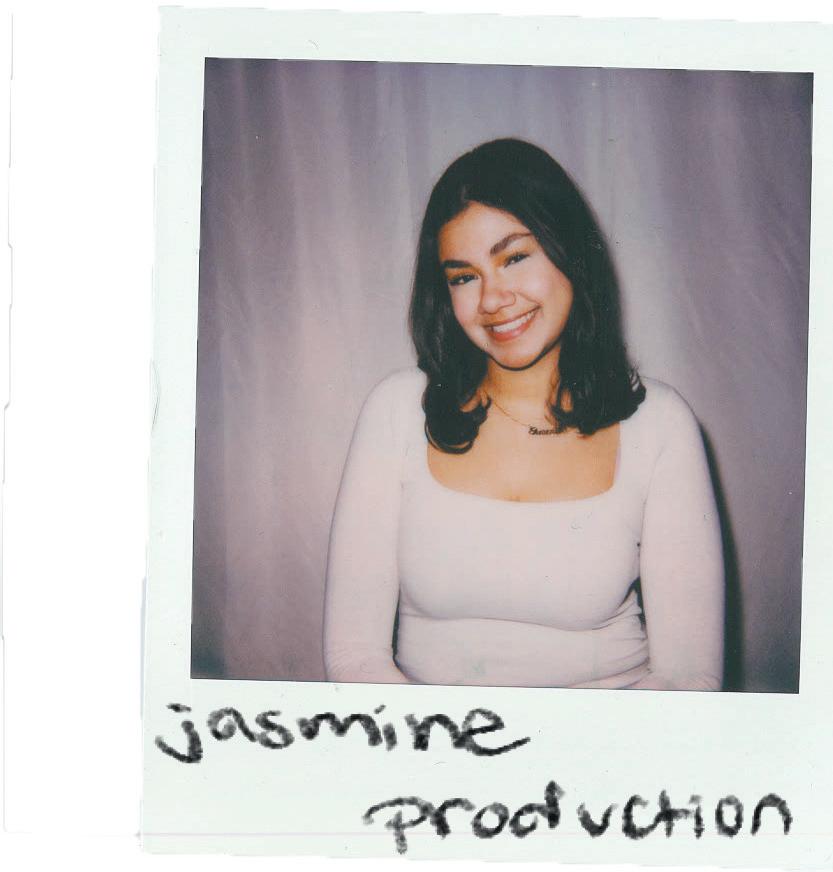
Jasmine “Sophie Wallace” Makar
Sarah “Dollarama Ghost Pepper” Grishpul
Photo Editors
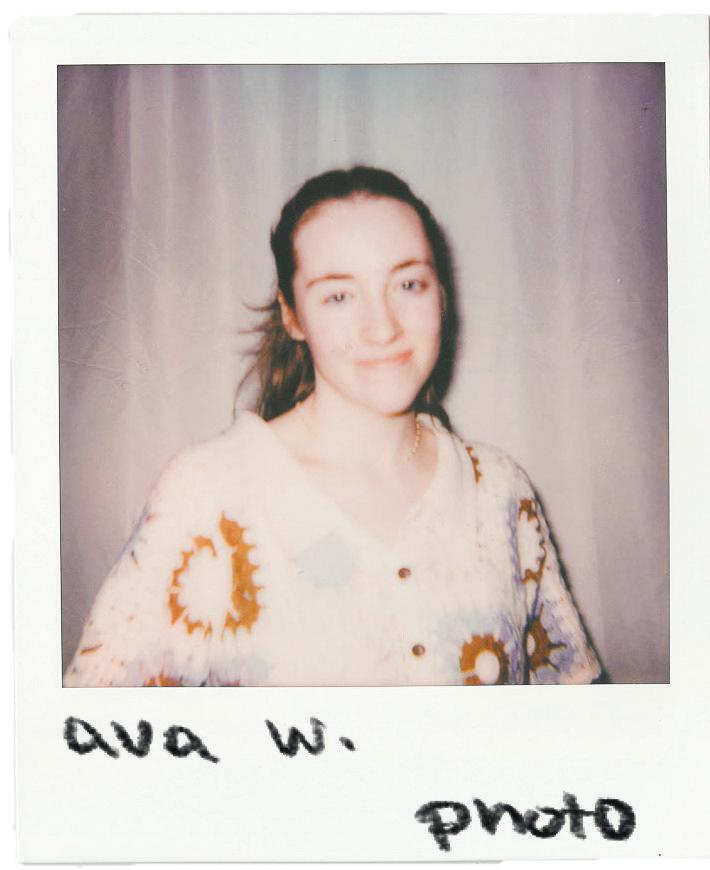
Ava “Motion Pictures” Whelpley
Saif “Best Comeback” Ullah-Khan
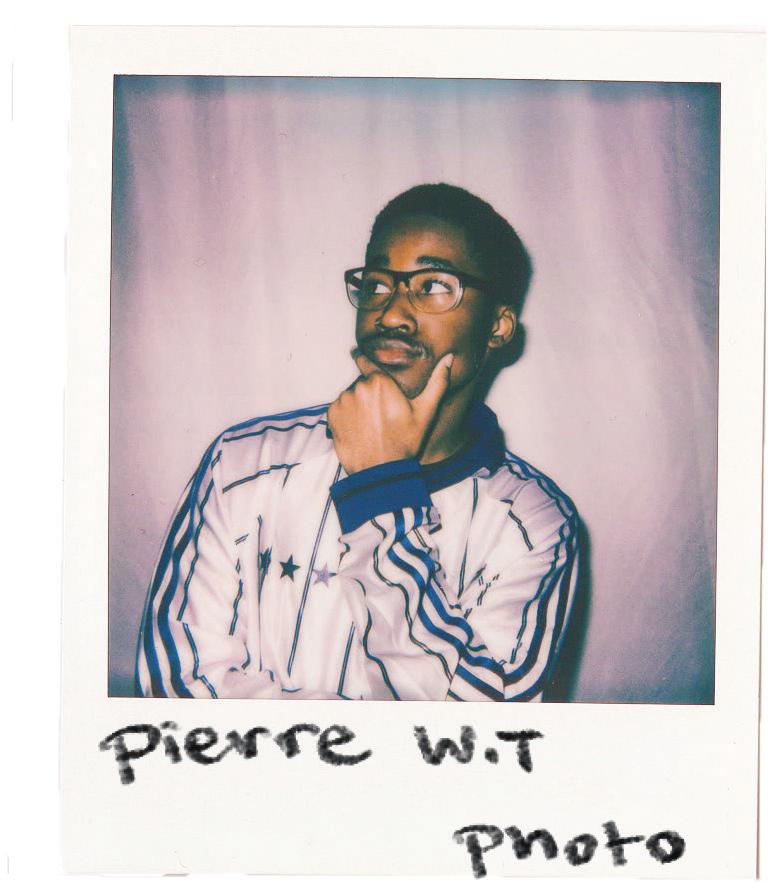
Pierre-Philipe “Philipe” WanyaTambwe
Media Editors
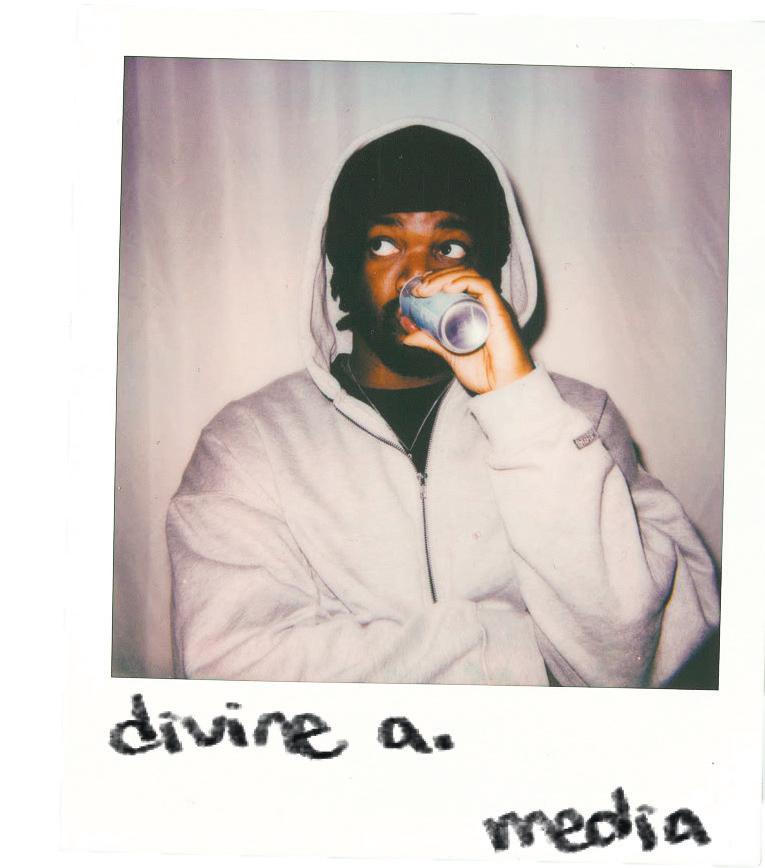
Divine “Jerkers” Amayo
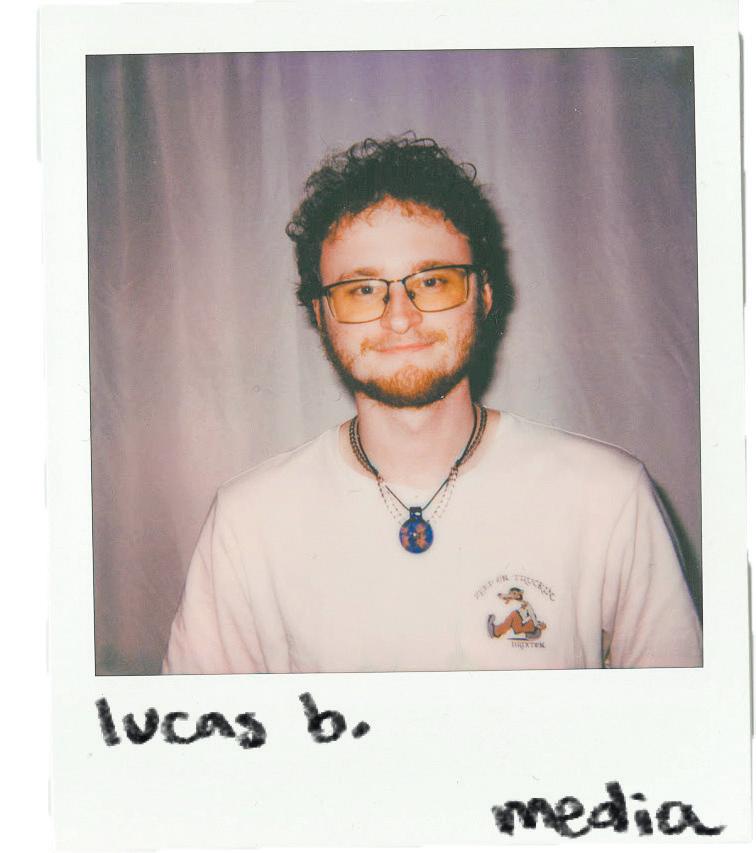
Lucas “Bussin” Bustinski
Digital Producer
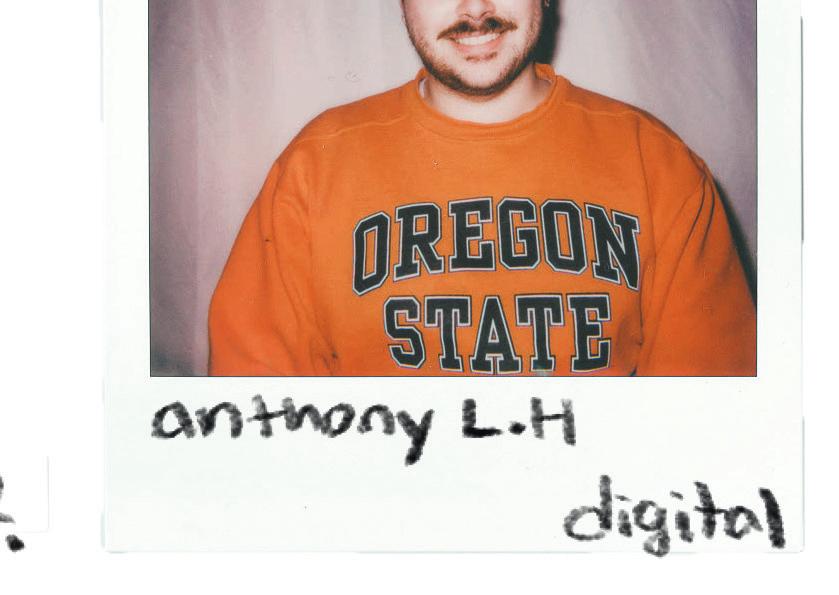
Anthony “My EiC” Lippa-Hardy
General Manager
Liane “Go Home, Lucas” McLarty
Design Director
Vanessa “Everyone Likes Parfais” Kauk
Contributors
Francesco “The Future” Cautillo
Avari “Quan Millz” Nwaesei
Julian “King” Sharma
Miriem “Share” Nour
Nadine “New News” Alsaghir
Naseema “Waiting” Raja Mohamed
Olivia “Top-Secret” Blake
Olivia “Greg” Quain
Charlotte “Maxxing” Ligtenberg
Mishael “Hamster Inn” Taruc
It was a pleasure spending my early twenties with you
By Negin Khodayari
The heavy air in the subway shifts as people rush to find an empty seat. I hear a murmur of laughter in the distance buried behind the sound of the tapping feet of the person sitting next to me. The quiet humming of the air conditioning and the subtle lack of oxygen slowly put me to sleep but just as I’m dozing off I hear it: “Arriving at TMU, TMU Station. Doors will open on the right.”
I’ve been taking this commute for eight years.
I’ve lived several lifetimes at Toronto Metropolitan University (TMU). I was first an undergraduate student during the COVID-19 pandemic, then a graduate student and landed a job as communities editor at The Eyeopener. I later became the editor-in-chief (EiC) of The Eye, then a part-time instructor with the RTA School of Media—and now both.
When I first stepped foot on this campus in 2018 to drop off my journalism portfolio, I wouldn’t have imagined all the lessons these halls would teach me. The first time I walked into The Eye’s office in the Student Campus Centre (SCC) in November 2022, I again had no idea the whirlwind I was about to embark on.
I was 22, overwhelmed by the state of the world and terrified of what was to come. But my thendebilitating fear of staying stagnant forced me to seek new experiences and when the communities editor position opened up in late2022, I went for it and I haven’t looked back since.
I can’t adequately articulate my experience as the communities editor but I can confidently say if it wasn’t for The Eye I may have never left my bed that winter.
In September 2022 Mahsa Zhina Amini died in custody of the Islamic Republic’s (IR) so-called “morality police” in Iran. She was detained for allegedly not properly abiding by the regime’s mandated dress code. Her death sent shockwaves across the Iranian diaspora. For months, protests and rallies were held in Iran and internationally in what became the Woman Life Freedom movement.
In Iran, the Islamic Revolutionary Guard Corps (IRGC) murdered innocent protestors for months, blinded and arrested civilians. As of October 2022, the IRGC began sending student protesters to psychiatric institutions. As of November 2022, a series of chemical attacks began mass poisoning school girls across the country. As of December 2022, the regime began executing protestors following
sham trials. As an Iranian woman, I was distraught.
But at The Eye I slowly discovered I could turn my anger into conversation, and while I wasn’t necessarily writing about Iran, I was given one page a week to talk about anything that mattered.
This is where I learned almost everything I know about journalism. About the responsibility of telling people’s stories and telling them right. About how a simple 15-minute interview can make someone feel heard for the first time. But most of all, I learned how to stay curious.
By my third month at The Eye I was nominated to become EiC of the next volume and so began one of the most exhausting, tedious, exciting and fulfilling journeys of my life.
In April 2023 I was elected as EiC of volume 57. The world continued to unravel in ways that felt impossible to hold in a small student newsroom.
First came Bill C-18—the Online News Act. This piece of legislation was meant to bolster Canadian journalism but due to Meta’s response it in turn reshaped how we access news online for the worse. As a newsroom we were left to grapple with what this meant for us, for our visibility and our survival. How do we reach our readers?
And then, almost immediately after, the world shifted again.
In October 2023 the genocide in Palestine began unfolding. I remember scrolling on my phone and feeling like I was split in two: trying to be a journalist, trying to be a human being, trying to find the right words that always felt too small for what the world was witnessing. While hospitals, schools and homes were reduced to dust,we were expected to report on it with clarity, with accuracy, while the internet screamed in every direction.
We didn’t always get it right, no newsroom did. But I’m proud our group of twenty-somethings showed up every day with empathy. I’m proud that we tried and we held conversations some journalists fail to ever come to.
When I walked away from The Eye in April 2024, I thought it’d be forever—but in a funny turn of events, in spring 2025. I was asked to return as the EiC of volume 59. By the time we started production in August of 2025, the world hadn’t gotten any quieter.
The first curveball was Bill 33, the provincial government’s Supporting Students and Children Act, another piece of legislation which threatened student services, access and the very funds which keep The Eye alive. And
again our job wasn’t simply to report on what was happening, it was to understand how it impacted the real people who were suffering the consequences.
And then, Iran.
Iran never really leaves me but during volume 59 it became impossible to hold it at a distance.
In January the situation there deepened into something heavier, more painful and more relentless every day. A mix of protests, ongoing repression, arrests, executions, global silence and irrelevant noise all at once. I was forced to remember how quickly the world decodes what to pay attention to and what to forget. I think about it often—how selectively outrage gets distributed online and how easily people online speak over those who are actually living through it.
On Feb. 28 the U.S. and Israel began striking Iran under the guise of liberation. Civilian infrastructure is being threatened, and it’s yet again Iranians who are paying the price. Meanwhile the IR has shut off the internet for the longest period in history.
There have been over 2,000 casualties in Iran alone since the start of the war. And this comes after the regime killed an estimated over 30,000 civilians on Jan. 8 and 9 during anti-government protests.
Iranians are stuck between a repressive regime and foreign bombs.
And I need to say this clearly: governments that abuse power, that silence people, wrongfully imprison or kill their own citizens are never the victims. They are the perpetrators, even when that doesn’t align with your political opinion. If you are only outraged when it fits your narrative, then it was never about justice in the first place.
What I’ve learned by now is that listening has to come first. Listening before speaking, before posting, before assuming you understand.
Somewhere between the early mornings, late nights and never-ending deadlines, I started to understand what journalism truly means.
It means having patience in a world that rewards speed. Seeking varied perspectives in a culture that rewards certainty. And it means carrying empathy for your sources, for your readers, for yourselves.
Cancel culture, or whatever you want to call it, has made our choices feel permanent and final. One mistake becomes your identity. I don’t say this to dismiss accountability but I do think we’ve lost something in how quickly we discard people instead of trying to understand them. How quickly we attack instead of asking questions without giving each other space to grow.
At The Eye I was given that space. It wasn’t without tension or criticism but it was enough space to make mistakes and keep going. And I don’t take that lightly, I know how rare it is. I hope I’ve been able to create that environment for my mastheads.
I think that’s what I’m most grateful for. Not the titles, not the number of issues we published or the amount of stories we told.
I’m most grateful for learning, for making mistakes, for having conversations that changed my mind. The moments we tried to get it right even when we had no idea what “right” was.
My wish for the world is to build more spaces like this one— for journalists, students and for anyone trying to make sense of a world that often feels like it’s moving too fast to understand.
Because if there’s one thing I know after all these years, all these volumes, all these stories, all these versions of myself, is that we need patience with each other. Not less.
Now I’m 26, overwhelmed by the state of the world and excited for what’s to come. I’m honoured to have spent my early twenties with you all.
The doors of the subway open and I dash out with the wave of students trying to make it to class on time. I speed walk on the edge of the platform, go up the stairs that lead me to Yonge and Dundas Streets. I walk through Victoria Street and pass Lake Devo. I look into the Balzac’s windows in hopes of catching the gaze of someone I know but to no avail. I keep walking to the SCC, tap my OneCard and enter. I struggle to get up the stairs to the second floor and as I walk to our office doors I see everyone laughing. The lights are dimmed, slow music is playing, the air is stuffy and no one has done the dishes.
I think I’m gonna miss this.
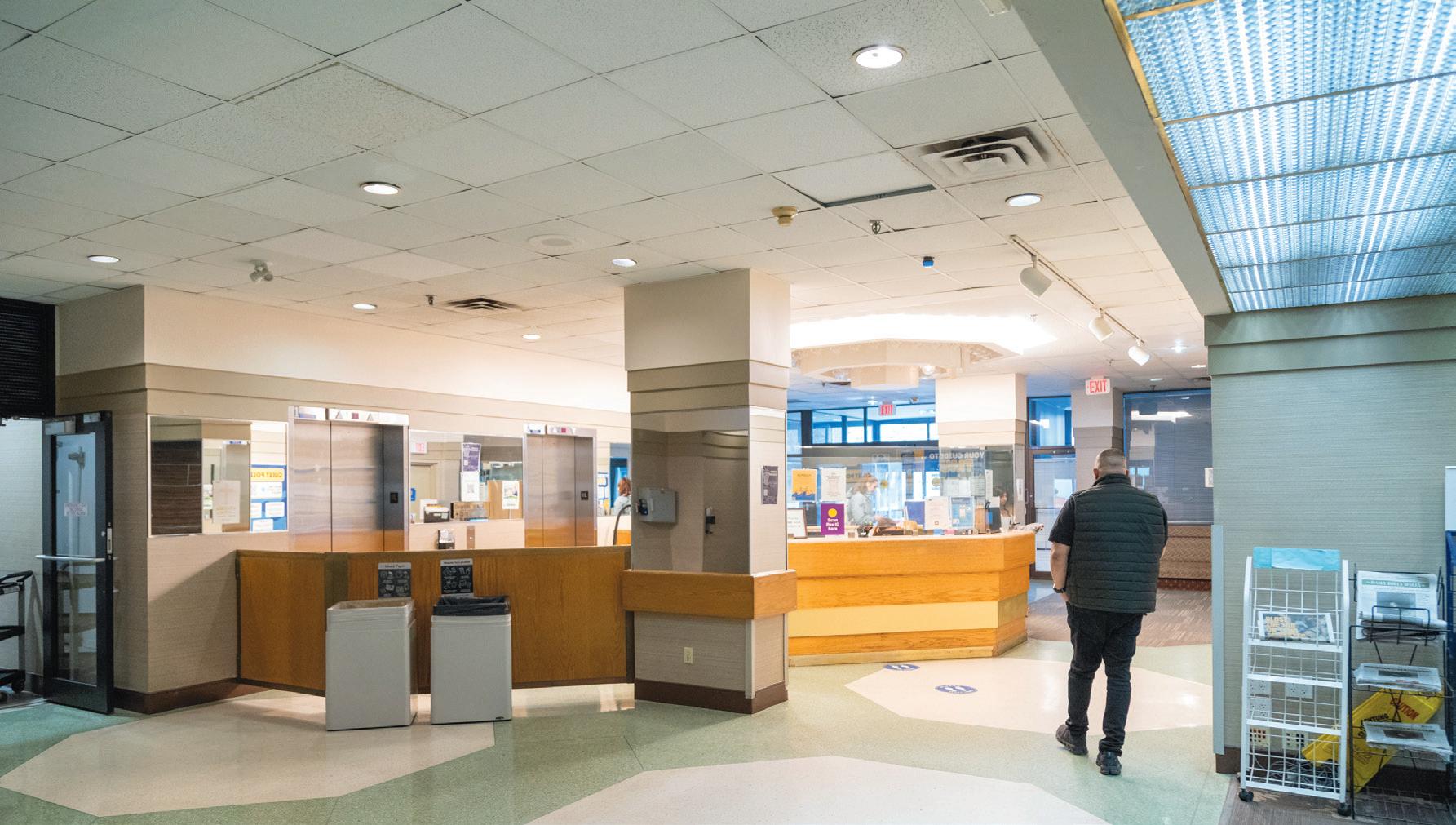
Delayed response to medical emergency reveals bigger concerns in TMU housing
From delayed 911 calls to temporarily disabled residence ID cards, students in residence are struggling during medical emergencies
By Amira Benjamin, Vihaan Bhatnagar and Shaaranki Kulenthirarasa
The alleged mishandling of a student’s allergic reaction by staff at the International Living Centre (ILC) is raising concerns about how medical emergencies are dealt with in Toronto Metropolitan University (TMU)’s residence buildings.
Jess*, a first-year student at TMU with a soy allergy, said ILC staff delayed calling 911 on March 20 after she went into anaphylactic shock.
On the day of the incident, Jess said she asked the dining room staff if the food had soy in it. After staff repeatedly told her the food did not contain soy and that it was safe for her to eat, Jess had an allergic reaction. She said she had to go back three times before the staff confirmed the food had soybeans in it.
“They [went and] check[ed], and then [came] back and [said], ‘Oh, yes, that has soybeans in it, do not eat it,’ after I had already eaten it and had an allergic reaction,” she said.
Jess said she informed the dining hall of her allergies multiple times and requested them to label products that contained it.
However, she said they failed to accommodate this request.
“I had actually asked them why they don’t have the restaurant standard allergen sheet where the common ones are at least listed…and they said that it’s too much work,” she said. In an email statment to The Eyeopener, Housing & Residence Life stated that they cannot comment on speciifc incidents but “we are committed to the health, safety and wellbeing of our students, faculty and staff.”
Jess said she usually uses overthe-counter medication to manage her allergies reactions, but she had run out by the day of the incident.
According to the Government of Canada’s website on food labelling, “Health Canada developed amendments to the Regulations to enhance labelling requirements for specific priority allergens.” This includes soybeans.
However, these requirements apply to prepackaged foods, but do not apply the same way to food served in dining halls and restaurants.
When Jess had her allergic reaction, she said she requested the staff to call 911. But they contacted TMU security instead to make the call.
Housing & Residence life also stated that “TMU Community Safety and Security’s protocol is to notify 911 immediately in the event of an emergency on campus, and that we also
encourage our students, faculty and staff to do the same.”
When security arrived, she said she was expected to explain everything that happened while she was in anaphylactic shock.
Jess said despite her lips turning visibly red and her describing swelling inside her mouth and throat, security did not call 911 immediately. Instead they started monitoring her heart rate.
When her heart rate stated showing inconsistencies, that’s when Jess claims they called 911.
The Eyeopener reached out to the univiersty for comment but did not recivce a response in time for publication
After returning to the ILC following treatment at the Toronto General Hospital, Jess said she was unable to re-enter her residence using her ID card and had to wait 30-40 minutes before getting access.
“It was really confusing, because I was tired,…I was going around all day. I still had the probes on me from the hospital,” she said.
“...After I had already eaten it and had an allergic reaction”
Jess said after explaining her situation, the front desk staff needed to call management, who weren’t answering their phone calls. It was only when her Residence Advisor (RA) contacted them that she was granted access again.
This is not the first time residence staff’s actions during a medical emergency have been under scrutiny. In [2024], front desk attendants at Pitman Hall refused to let first responders through with the responders eventually forcing their way to the elevator, as previously reported by The Eye.
The student who called 911 was told by security they should have been called instead of first re-
sponders because they are trained in the exact same way as paramedics, a fact she later learned was untrue.
In an emailed statement to The Eye in 2025, the university said that “some of TMU’s full-time front-line crew members also have advanced medical knowledge, including: Emergency Medical Responder (EMR) training.”
EMR’s are equipped to provide some out-of-hospital care in medical emergencies, however EMR’s cannot replace the role of Emergency Medical Technicians (EMTs) or Paramedics. The university did not share how many TMU Security staff members are trained as EMR’s.
“If I see someone getting a heart attack, I’m not calling security, I’m calling 911”
Alex Fontanin, a first-year accounting and finance student at TMU who lives in Pitman Hall, had a medical emergency after taking too many laxatives, causing him “the worst pain of [his] life” and leading him to vomit multiple times.
Fontanin called 911 and asked for paramedics, who had no issue coming through the security desk at Pitman Hall and coming up to his room.
He said he did not know that he should have called security first.
“I don’t understand why that’s a rule. I feel like that shouldn’t be a rule, honestly. If I see someone getting a heart attack, I’m not calling security, I’m calling 911,” he said.
Fontanin spent the night in an emergency room and after returning to Pitman Hall the next morning found his residence keycard had been temporarily disabled. However, it only took a brief explanation that he was alright with the residence staff for his keycard
Bike Share Toronto expands to meet growing demand
By Nadine Alsaghir
Students say Bike Share Toronto’s March plan to add 200 e-bikes and 750 regular bikes must be matched with safer streets and better bike quality.
Zain Fayaz, a first-year civil engineering student at Toronto Metropolitan University (TMU), said biking is his most practical option. “If I wanted to prioritize speed and health, biking made the most sense for me as an able-bodied man,” he said.
Fayaz emphaszized the convenience of Bike Share Toronto due to the proximity of stations near his home and campus.
The service had a 40 per cent increase in individual riders in 2025 compared to 2024, according to its annual operating plan.
to start working again.
“I was kind of annoyed, not going to lie, because I hadn’t slept the whole night, and I just want[ed] to go to my bed…I [was] like, ‘Why are you blocking my res ID?’” he said.
Jess said some of her friends have faced similar issues of their residence ID being temporarily disabled after coming back from the hospital.
Students not only report facing issues during a medical emergency while living in residence but also during their recovery phase.
Josephine Millard, a third-year performance: dance student at TMU who has lived in Pitman Hall for the past three years, had to get surgery after she started feeling pain that was later determined to be appendicitis.
She said due to not being able to walk properly, she needed her partner to help with her recovery.
Despite Millard’s partner being given a note signed by residence management allowing her to go up without needing Millard to get her, there were still challenges.
“I know that they have to be careful about who they sign in, but having said that she would show them the note signed by housing residents and the staff would be like, ‘We just don’t know if she can come up.’ Meanwhile, I’d be waiting for my bed for my medication,” she said.
Millard said there were times when she would be taking a nap and front desk representatives would call her to confirm whether her partner was actually a guest.
“I feel like it’s kind of on the people at Housing & Residence Life to communicate with their staff,” she said.
*This student has chosen to remain anonymous. The Eye has verified this source.
Fayaz said e-bikes which are faster than regular ones become more important on streets like Dundas, which he calls “incredibly dangerous for cyclists” because of streetcar tracks and cars passing closely.
Albert Koehl, executive director of Community Bikeways, said the lack of a connected network can make people feel it’s unreliable.
“The network is still not in place, so there’s still lots of gaps and...many people will say, ‘Well, I can’t get from my home to TMU’,” he said.
Koehl suggested integrating Bike Share Toronto with Presto would be more practical.
New federal funding for TTC
By Meriem Nour
The federal government is investing $183 million in the City of Toronto to help improve the city’s transit system.
The funding comes through the Canada Community-Building Fund (CCBF), which supports infrastructure projects across the country.
For many commuter students at Toronto Metropolitan University (TMU), improvements can’t come soon enough.
Zainab Kashif, a commuter student at TMU said coming to campus takes her about an hour and 15 minutes using GO Transit and the TTC subway.
“[Delays] affect my commute, because if there’s a delay, then I’m obviously late to class, and…if the TTC is like down entirely, then I have to either walk to campus, which is like 25 minutes [long], or if the weather is really bad or something, then I end up having to spend money on Uber,” she said.
Kashif believes safety and cleanliness should be the TTC’s top priorities.
In a March 19 statement, Jamal Myers, chair of the TTC board, said stable funding is essential for the system’s future.
“We know that functional public transit is essential for growth, freedom of movement and reducing congestion on our roads,” Myers said.
AVA WHELPLEY/THE EYEOPENER
Off-campus event with IDF soldier brings calls to revoke SSI student group status
A petition to revoke Students Supporting Israel’s student group status has over
By The Eyeopener
Following another Students Supporting Israel (SSI) event off-campus which again saw an Israeli Defense Forces (IDF) soldier in attendance, some Toronto Metropolitan University (TMU) students and community members are urging the administration and students’ union to take action.
The first SSI TMU event to host an IDF soldier this academic year took place on Nov. 5, 2025 where six people, including TMU students, were arrested and charged following a pro-Palestinian demonstration, as previously reported by The Eyeopener
The second event was part of the same ongoing tour in North America titled “Triggered: From Combat to Campus,” and was set to take place on March 26 at an undisclosed location, according to an Instagram post by SSI TMU, which has since been deleted. The post stated further details would be provided upon registration.
Jenin*, a member of Students for Justice in Palestine (SJP) at
TMU, said she believes the university and the Toronto Metropolitan Students’ Union (TMSU) have enabled these events.
“It keeps happening because the TMU administration refuses to take accountability or implement any policies that ban foreign war criminals from coming and TMSU [is] attempting to absolve themselves from guilt and refusing to [take] material action as well,” she said.
“I know students here have family in Palestine who are directly affected by this”
TMU President Mohamed Lachemi said in an email to The Eye that the university has not approved SSI events that “host soldiers” on campus and cannot comment on “why they are choosing to host events offcampus in their own time.”
According to the TMSU website, SSI is a registered group under the students’ union. However, a statement posted to Instagram and their website on March 24 said the TMSU has
“not provided any funding or support for SSI.”
The statement also claims the TMSU does not have the authority to ban a student group’s event. They referenced the two independent investigations by TMU and the TMSU into the Nov. 5 incident, where six people, including TMU students, were arrested by Toronto Police Services, as previously reported by The Eye
In the post, TMSU said they do not endorse this event and under their Issues Policy #9, oppose, “the aggressive use of force by police or military against protestors or any civilians in an attempt to repress dissent.”
Prior to last November, SSI had previously held similar speaker series involving IDF soldiers. According to an October article by The Grind, IDF soldiers visited Toronto in April 2025 for another “Triggered” event which was initially planned to be hosted at TMU by SSI. SJP has also posted on Instagram, claiming Hillel TMU hosted the event after the university denied campus space to SSI.
13,000 signatures
In an email statement to The Eye in November regarding the fall SSI event, the university said the event was not sanctioned by TMU. “SSI’s request to host the event on campus was denied due to a lack of transparency about the topic and guest speakers,” the email read.
However, some TMU students like Emily*, who is also a spokesperson for the Student Mobilization Committee (SMC), said this sparked questions amongst students.
“A question that came up is ‘why is there no policy for the TMSU to ban war criminals from campus groups’,” she said.
According to a video posted to SJP’s Instagram, 12,000 emails have been sent to the university’s administration demanding action against SSI for hosting IDF soldiers. The video showed students outside president Lachemi’s office leaving printed copies of the emails.
Many student groups and course unions released statements on social media condemning this event and expressing their support for SJP, such as TMU Muslim Students’ Association (MSA), Med-
Bloc TMU, International Centre of Justice for Palestinians and Faculty for Palestine TMU.
“It wasn’t a surprise that this was happening, it was just a lot of sadness, disappointment and anger…I know students here have family in Palestine, who are directly affected by this,” said Emily.
Abdelrahman Elkazaz, a second-year aerospace engineering student and vice-president of Islamic education with the MSA, echoed this sentiment.
“Especially after the incident with the security guard at TMU and how they handled one of our students very violently, [there is] definitely a mixture of shock, intimidation and disappointment [towards administration],” he said.
All promotional material regarding the event is no longer available on the SSI Instagram account. The Eye is unable to confirm if and when the event was held.
The Eye reached out to SSI and Hillel TMU for comment but did not hear back in time for publication.
Iranian student groups call on province for tuition support
By Amira Benjamin
Iranian student groups across Ontario are calling upon the Ministery of Colleges and Universities to temporarily convert tuition fees for international students amid the U.S. and Israel’s strikes on Iran.
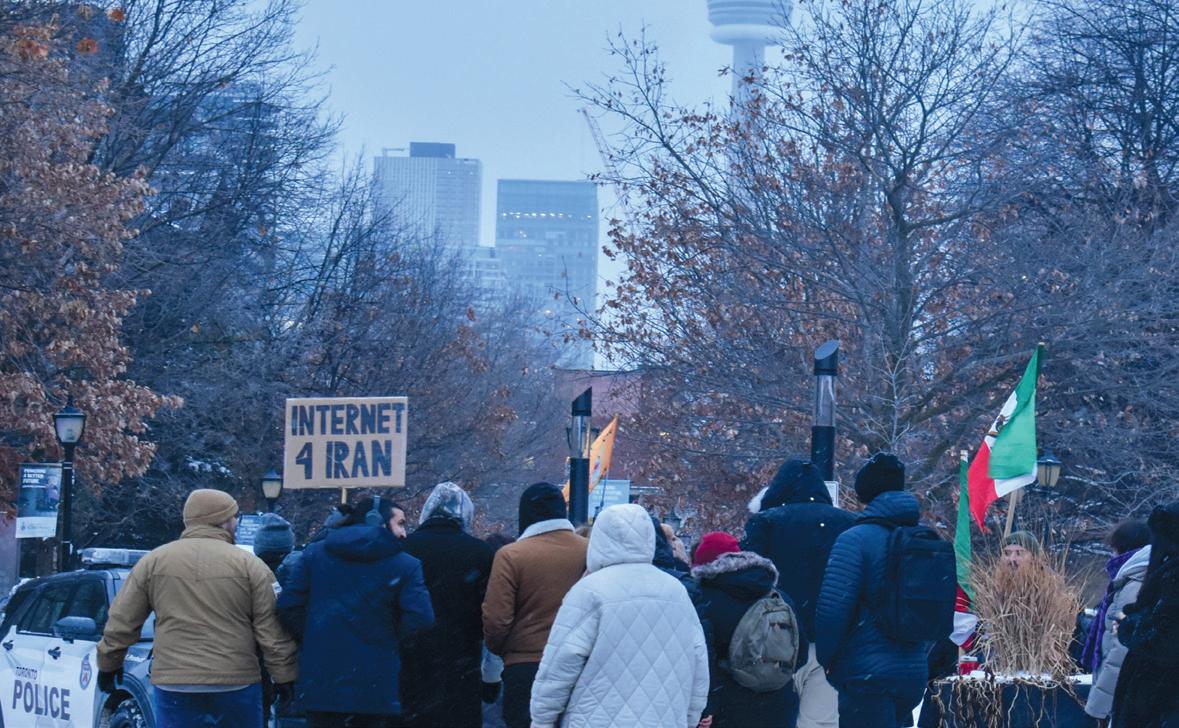
Internet access in Iran has been shut off by the Islamic Republic (IR) since the U.S. and Israel first bombed the country on Feb. 28. Iran’s internet blackout is now the longest nation-scale internet shutdown on record in any country, according to cybersecurity watchdog organization NetBlocks.
Before the war, the IR had also shut down the internet and communication lines from Jan. 8 to late-January during the anti-regime protests in Iran, as previously reported by The Eyeopener
For Iranian international students, the blackouts can make it difficult to send or receive funds to pay tuition and other school costs.
On April 2, five Iranian student associations from Toronto Metropolitan University (TMU), York University, University of Toronto, Queen’s University and Western University posted a statement on Instagram demanding, “immediate action from the Ontario government as Iranian international students confront a worsening humanitarian crisis.”
The students demand a response from the Ministry of Colleges and Universities within seven days of the release, the statement reads.
In fall 2025, TMU rescinded a policy that allowed international students with open work permits to pay domestic student tuition, as previously reported by The Eye
The policy was put into place after the Canadian government allowed Iranian students’ visitor visas to be changed into study permits following the 2022 death of Mahsa (Jina) Amini.
The Canadian Press has reported that several other Canadian universities, such as Queen’s University and Carleton University, are offering exam deferrals, tuition relief and counselling services for affected students on a case-bycase basis.
Al Jazeera reported as of April 3, at least 2,076 civilians have been killed in the strikes in Iran, with 26,500 people injured since the war began. This is on top of the estimated over 30,000 civilians who were killed on Jan. 8 and 9 alone by the IR during widespread protests.
Shervin Akhlaghi, a student representative for TMU’s board of governors and a fifth-year civil engineering student, coordinated with student groups to write the statement.
“We have a lot of Iranian international students here, [who] could not predict this [war] happening, in
a sense that the internet would be cut for 35 days straight,” he said.
“One of the biggest issues is… if [students] can’t pay their tuition, and they can’t complete their degree in a certain time, that’s going to impact their study permit or their immigration status in Canada.”
Akhlaghi said Iranian international students in Canada who have been protesting the IR but cannot pay their tuition may risk deportation. “At the end of the day, it’s a humanitarian issue rather than a political one,” he said.
Karan Kaviani, the presidentelect of the Iranian Students Association at TMU (ISAMET) and third-year biomedical student, said some Iranian students who were unable to pay their previous term’s tuition due to [the January and the current] blackouts cannot enroll in summer courses due to a hold on their student accounts by the university.
“We tried to communicate with [the university] saying, ‘it’s a blackout in Iran, most of the banks are shut down and that’s really hard for many people to even afford their living expenses, much [less] their tuition fees,” said Kaviani.
He said he met with the Registrar’s office to explain the situation faced by Iranian international students and suggest the university provide some financial relief to affected students, but hasn’t
heard back.
“We didn’t hear back from [TMU] at all. So we came together and said, ‘maybe we have to publish a joint statement with other big universities in Ontario’,” he said.
Akhlaghi said there should be a shift in university policy to better accommodate international students who may be navigating times of conflict or “humanitarian crisis.”
“It’s a really complicated situation that I don’t think universities have had to deal with before. But that doesn’t justify their lack of vision or creativity in terms of how to deal with this situation,” he said.
Many students struggle to call their friends and family due to the internet blackout and the time difference and need to wait for incoming calls from Iran—which
are expensive and often surveilled.
“If you ever miss a call, it’s your only chance. Your phone should always be turned on, unmuted so you don’t miss anything,” said Kaviani. Arman Naderi, a fifth-year computer science student at TMU and an executive officer of ISAMET, said the war has been “significant and destabilizing.”
“I have a Canadian passport but my brother is back home. After three months, he called me and I was at work and I just did not see his call,” said Naderi.
“I’m [in] debt and I was gonna apply for graduate programs because I’m in my last year of my undergrad. I applied and I also recently got accepted, but I have no idea how I’m gonna pay the funds, because the [Iranian] economy is in shambles right now.”
AMIRA BENJAMIN / THE EYEOPENER
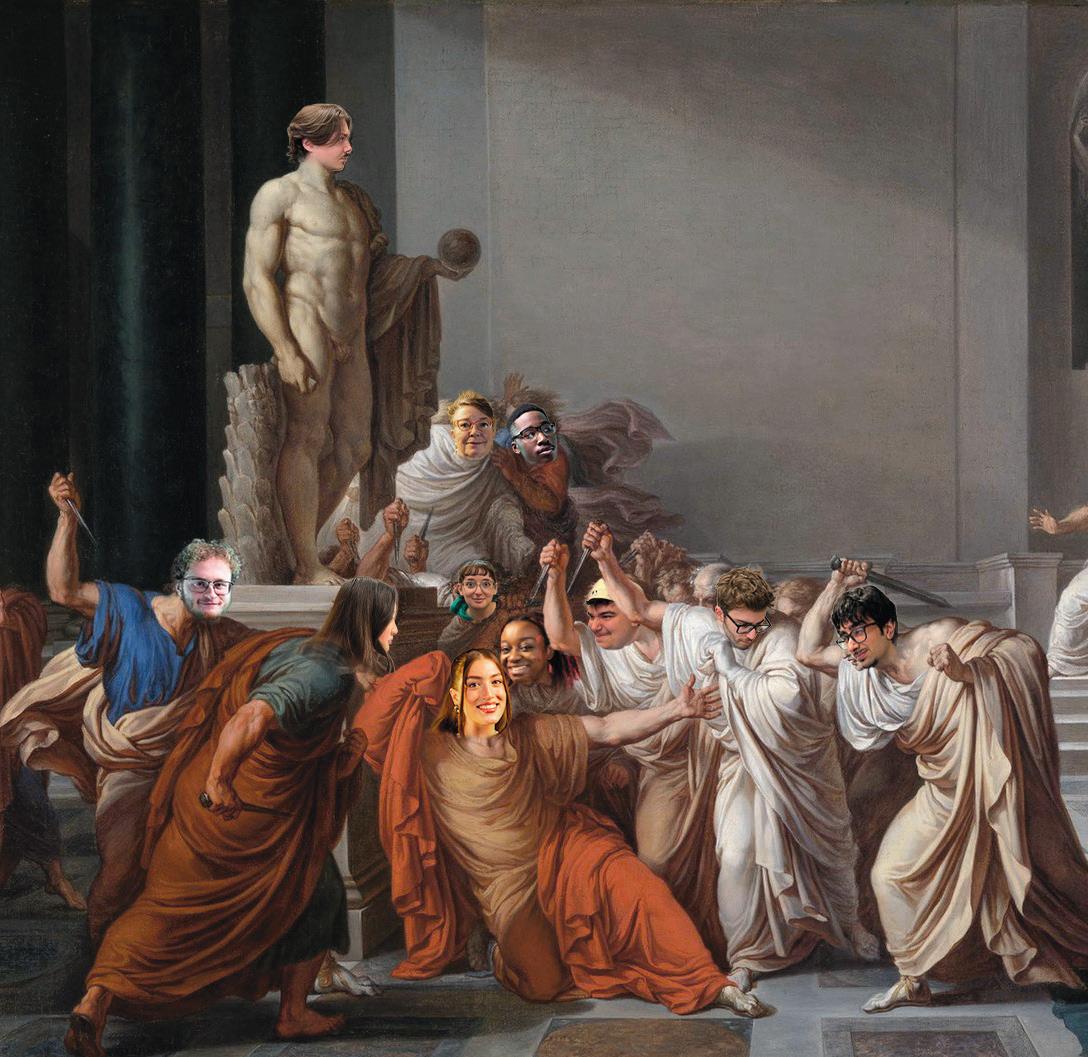
Emperor-in-Chief struck down in vicious power grab by underlings
Features editor will claim throne as ruler of campus newspaper
By The Eyeopener
Disclaimer: This story is a work of fiction. Emperor Khodayari is alive and her masthead remains loyal as ever—for now.
Negin Khodayari, the editor-inchief (EiC) of The Eyeopener was assassinated on April 2 in an epic betrayal by a group of aggrieved masthead members.
Khodayari served as the 57th and 59th EiC of Toronto Metropolitan University (TMU)’s student newspaper. She was ambushed after the paper’s annual Eyelections by a group of assailants which allegedly included masthead members Marcus Junius Brutus, Gaius Cassius Longinus, Decimus Junius Brutus Albinus and Lucas Bustinski.
Khodayari was taken to hospital but was declared dead on arrival.
She was hired for a second term as EiC—the second of only two people in history to hold the position more than one term. She also served as an instructor at TMU. She leaves behind a grieving former circulation manager.
Upon Bustinski’s alleged attacking of Khodayari, she was heard asking, “Et tu, Lucas?”
The assassination happened 18 days after the Ides of March (March 15), a date made infamous by the 44 BC assassination of Roman dictator Julius Caesar.
While Caesar was killed by over 60 senators, Khodayari’s downfall was at the hand of 18 masthead members.
The conspiracy to take her down was seemingly spurred by a recent declaration of her desire to run for EiC of The Eye a third time—and also maybe a fourth...or fifth.
Khodayari told masthead members, “I just need one more
year guys. I promise I’ll get it right this time.”
She was allegedly considering making the position of EiC a lifetime appointment, according to sources close to the now deceased EiC.
In testimonies before a high court judged by the great general manager, Lianus McClartis, masthead members explained their motivations behind the attack.
The news team, Amira Benjamin, Shaaranki Kulenthirarasa and Vihaan Bhatnagar led the mutiny against their EiC, the only time the three ever worked together.
Digital producer Anthony Lippa-Hardy told McClartis his last straw was Khodayari’s hogging of the office fan. “It’s hot as Pompeii in that goddamned place,” he said.
Media editor Divine Amayo said his greivances were based in Khodayari’s intolerance for tardiness. “Let a guy be late,” he said.
Production editors Jasmine Makar and Sarah Grishpul said Khodayari relegated the pair to a remote corner of the office. “Nobody puts Jasmine in a corner,” said Grishpul.
Business & technology editor
Aditi Roy and arts & culture editor Sophie Wallace sought revenge after Khodayari mistakenly bought regular raisins rather than chocolate-covered raisins, to the dismay of the entire masthead.
Fun & satire editor Dylan Marks and communities editor Daniel Opasinis attacked Khodayari for not letting them write this story.
Photo editors Saif-Ullah Khan, Ava Whelpley and Pierre-Philipe Wanya-Tambwe said their motivations were borne from one too many last-minute cover pivots.
Edward Lander, the features editor, said his particiaption was out of anger over Khodayari’s edict that feature deks couldn’t be 35 words.
Sports editors Jonathan Reynoso and Victoria Cha told McLartis they were enraged over the EiC’s persistent mogging of them. “Where does she shop? Seriously,” said Reynoso.
Following the power vacuum left by her assassination, members of the masthead decided to hold an anonymous vote for who they believed would be bestsuited for the position. Lander
reigned victorious and is now expected to hold the throne until at least 2027—provided no one kills him first.
Khodayari’s assassination and Lander’s succession violates bylaw no. 2 of The Eye’s constitution as well as Canada’s Criminal Code, including section 231 (1) which says murder is not allowed.
Lander’s first act as EiC will reportedly be creating a new paid
position solely to bring
Following Khodayari’s death, Lander has reportedly planned to create a series of booby traps and barricade himself in his office to thwart any attempts on his life.
An autopsy of Khodayari later revealed her cause of death was not the attack, but rather getting a little tiny bit overheated.
Editor-in-chief Negin Khodayari is viciously betrayed by her masthead in the year
2026 A.D. (AVA WHELPLEY/ THE EYEOPENER)
him food from the Food From East Express shawarma truck on Gould Street.
Meet the people defending Egerton Ryerson’s name
Friends of Egerton Ryerson aims to restore the former minister’s name against
By Sophie Wallace and Daniel Opasinis
A small crowd gathered in the low-lit basement of 304 Parliament St. in downtown Toronto. Guests were welcomed at the door with enthusiastic handshakes, cups of tea and pastries. A projector flickered on, displaying in bold lettering: “Egerton Ryerson: Humanist.”
The gathering aimed to discuss a matter which was once top of mind at Toronto Metropolitan University (TMU)—the legacy of the school’s former namesake, Egerton Ryerson. The lecture, which took place on March 25, was hosted by Friends of Egerton Ryerson (FoER), a self-proclaimed advocacy group which aims to, “restore and defend his reputation,” according to their website.
Lynn McDonald, co-founder of FoER, commenced the evening by sharing an unconventional land acknowledgement. “Please accept our meeting on the traditional territory of any Indigenous peoples, most notably, the Mississaugas of the Credit, with whom Ryerson himself lived, learned their language, made lasting friendships and whom he supported their very struggles,” she said.
After McDonald’s remarks, Patrice Dutil, a professor of politics at TMU since 2006, moved to the front and addressed the seated audience.
“My talk tonight is a slightly different perspective on Egerton Ryerson,” he said.
Nods and murmurs of agreement echo around the room. He said the guest lecture is the first in a proposed annual series to take place on or around Ryerson’s birthday, March 24.
Reporters from The Eyeopener were amongst the only people of colour in the audience, not to mention some of the only young adults.
Earlier in March, FoER attempted to advertise the March 25 lecture in The Eye. The advertisement was pulled before production, after masthead members lodged a complaint, prompting a vote from the newspaper’s Board of Directors.
FoER criticized The Eye through a note on their website’s homepage. “Clearly, our mandate to amplify the truth about Egerton Ryerson’s legacy is perceived by some as ‘harmful messaging toward marginalized groups on campus,”’ the website reads.
Public opinion on Egerton Ryerson has changed significantly since the university was named after the Methodist Minister and writer in 1948—a change largely propelled by Canada’s ongoing reconciliation with the residential school system and Ryerson’s connection to it.
In November 2020, then-Ryerson University created the Standing Strong Task Force (Mash Koh Wee Kah Pooh Win), a group of faculty, community members and Indigenous advisors tasked with seeking, “an understanding of both Egerton Ryerson’s life and legacy and the role of commemoration in our community,” according to TMU’s website. The group produced a list of 22 recommendations to the university, one of which was to change the name.
In August 2021, president Mohamed Lachemi announced the university would be changing its name per the task force’s recommendation, as previously reported by The Eye. This came just two months after the statue of Egerton Ryerson which once stood outside Kerr Hall South was toppled and beheaded by protestors.
According to their website, FoER aims to restore the name of Egerton Ryerson against “erroneous” claims, such as those from the university. They publish a newsletter, pen letters
to officials and create content supporting Ryerson—including a video series in which a member of FoER portrays him in a sort of role play, defending himself in his ‘own words.’
According to meeting minutes published to their website, topics of discussion include the plaque describing Ryerson’s legacy on campus, location of the statue’s misplaced head, and campaigns in support of other historical figures whose legacies have been tarnished—like British politician Henry Dundas.
Mary Jane McCallum is a professor and Canada research chair in Indigenous people, history and archives at the University of Winnipeg and a band member at Munsee-Delaware Nation in Southwestern Ontario.
She believes efforts to protect the reputation of Ryerson and other controversial historical figures are born from a fear of altering traditional narratives of Canadian history and “heroes of the past,” even when they contradict lived Indigenous histories.
“These are people who feel, I think, offense by a view of the past that includes more than just simply a one-line story of progress,” she said.
Rose Dyson has been a part of FoER since its inception in 2021. She’s a University of Toronto graduate with a doctorate in education as well as a self-employed writer and media education consultant.
“I think that there is too much distortion of historical facts and inclinations of people to assess or judge the legacy of some of our predecessors or forefathers on the basis of today’s value systems,” she said in an interview with The Eye, a sentiment shared by many on the night of Dutil’s talk.
Members of FoER that The Eye spoke with acknowledged residential schools’ harm to Indigenous communities, however perspectives on what took place in those schools varied.
For instance, the discovery of unmarked graves at residential schools—including at Kamloops Indian Residential School, where what are believed to be approximately 200 unmarked graves were discovered in 2021 by way of ground-penetrating radar. In May of that year, Tk’emlúps Te Secwépemc First Nation—where the school is located—released a statement claiming the survey combined with previous knowledge and oral history indicated 215 children had been buried at the site.
A book that has brought her attention to the misinterpretation of historical facts is Grave Error: How The Media Misled Us (and the Truth about Residential Schools), published by True North—a now-defunct right-wing Canadian publisher. She stated that this book, along with another, are what have informed her on historical and social justice misinterpretations.
“There’s such a clear bias in this academic space that really denies the lived history and experience of our people”
“[Grave Error] was inspired primarily when there was that, the rumor—I guess you call it— of missing and murdered, or children, the 210 graves—or something—in Kamloops residential school, well that’s never been established,” Dyson said in an interview with The Eye
Although she admits abusing kids is “terrible,” she believes it was—at the time—the “conventional wisdom on how you raise children,” she said. “Sexual abuse in particular, was inexcusable.”
“I personally—and this may not be some view that everybody shares—feel that every-
“erroneous”
claims
thing that went on in the residential schools was not necessarily bad,” Dyson said. McCallum called this “residential school denialism” and said there is conclusive evidence of the violence and abuse inherent within the system.
“The denialist approach is to reject all of that work and to create a sense of doubt in the Canadian public about those studies and those histories,” McCallum said. “To basically kind of undermine the Truth and Reconciliation Commission and to really kind of undermine the whole project.”
Talulla* is an Indigenous fourth-year Faculty of Arts student at TMU. She said knowing TMU professors are involved in groups such as FoER makes her question the credibility and quality of the education for Indigenous students at TMU.
She said she has already felt “severely uncomfortable” many times throughout her degree as an Indigenous student, especially when it comes to feeling seen in academic spaces.
In one tutorial, Talulla recalls an instructor speaking about their research on an Indigenous community. “They talked about it in a way that I thought was respectful towards Indigenous people, until they said, ‘and none of us in this class will ever experience any of that,’” she said.
“You’re telling the story of my life and then acting like there’s not even a single possibility that I could be sitting in this classroom right now,” she said.
Talulla added that she has seen the effects of the residential school system on her family and community all her life.
“There’s such a clear bias in this academic space that really denies the lived history and experience of our people and once again, makes it an unsafe space for Indigenous students to learn,” she said.
In 2021, Dutil signed an open letter, along with 55 historians, condemning the Canadian Historical Association (CHA)’s Canada Day Statement.
“We write to express our grave disappointment with the Canadian Historical Association’s “Canada Day Statement”. The Council of the CHA claims that “the existing historical scholarship” makes it “abundantly clear” that Canada’s treatment of Indigenous peoples was genocidal and that there was “broad scholarly consensus” as to the evidence of “genocidal intent,” the letter reads.
Ronald Stagg, a member of FoER taught in TMU’s History Department for more than 30
years. He also spoke at the March 25 lecture.
In an interview with The Eye, Stagg explained FoER’s perspective on Ryerson’s connection to the residential school system.
He said the organization does not deny Ryerson’s ideas contributed to the “Industrial Schools” which he explains taught children farming skills. He also claims that the purpose of an industrial school was very different from residential schools. However, they do reject the idea that these schools led to the broader residential school system.
“Ryerson was suggesting—again, he wasn’t involved—but the schools he was suggesting were very in tune with the times,” he said.
While FoER does disagree with the renaming of the university, Stagg does not believe it is reasonable to expect them to change it back.
“Once the task force was set up at Ryerson and they changed the name, we recognized that we’re not going to get a change back. The university was spending money to rebrand,” he said.
The group has however taken aim at a plaque on Gould Street, writing letters to president Lachemi petitioning for its removal.
“Conversations with V.P. Michael Forbes led us to believe that the university wanted the plaque down,” FoER wrote in the letter. “For us, it is shameful that a public university, to which we contribute our tax dollars, should be the source of a disinformation campaign.”
The plaque in question reads, “As Chief Superintendent of Education, Ryerson’s recommendations were instrumental in the design and implementation of the Canadian Residential School System.”
In an email statement to The Eye, the university admitted to meeting with Friends of Egerton Ryerson on multiple occasions, as they said they would with any stakeholder group.
“The university is discussing how to best preserve the plaque and is working closely with the Indigenous community at TMU on potential next steps,” they wrote.
Talulla spoke to those next steps, saying that for her, reconciliation isn’t just a one-off act, but a continuous process of working with Indigenous people.
“I think my hope for the school is just a safe space for Indigenous students all the time,” she said.
*This source requested to remain anonymous, The Eye has veried this source.
AVA WHELPLEY/THE
Landlords gouge, scam and exploit STUDENT RENTERS who don’t know their rights. JULIAN SHARMA speaks with tenants who aren’t putting up with it any longer
REBECCA* HAD BEEN LIVING IN CANADA
for two years when she decided to move out of her aunt’s house. She turned to a site called University Living, which connects students with accommodation in 10 popular countries for international students like her. She was contacted by an agent who showed her a room in a downtown Toronto highrise from Urby Housing, a property management company which rents units largely to international students.
According to a 2023 story in The Local, Urby has claimed to manage properties for landlords, arranging tenancies and renovating rooms for renters.
After viewing the room once, Rebecca decided to move in. It was what Urby calls a “flex room”—a space that’s been created by subdividing a larger room. There were five rooms in total—two flex rooms and three standard bedrooms. It seemed strange, she thought, but the price was good—$1,200 a month for the room, the building amenities were nice and the location was convenient for her—not far from George Brown College’s waterfront campus where she studies. She was 18 at the time and didn’t know much about housing in Canada, but if anything went wrong, she thought, she could always move back in with her aunt.
between the ceiling and the top of the wall, there was a large empty space.
“Literally, looking at that wall made me cry so much,” Rebecca says.
She reached out to Urby again, and was essentially told, ‘if you don’t like it, you can leave.’ They declined to send in someone again, so Rebecca attempted to mend the issue herself, using various materials to cover the gaps.
Rebecca’s housing woes don’t exist in a vacuum. She’s one of many student renters who face difficulties with their landlords.
However, not long after she moved in, things took a turn for the worse. She began to be bothered by gaps in the makeshift walls around her room, which allowed her roommates to see inside, leaving her with almost no privacy.
Rebecca reached out to Urby multiple times, who eventually sent someone to fix the problem—but the issues didn’t stop there. They showed up without prior notice, rearranged the layout of her room but her privacy concerns remained. Rebecca said
Students are one of the most vulnerable groups when it comes to renting. Many are living in rented spaces for the first time— and many more have never lived away from home. It’s common for young people and students not to know their rights when it comes to renting. And it’s just as common for landlords to take advantage of this lack of knowledge.
double for Rebecca. According in 2024, international likely to experience conditions Language miliarity with and financial which make to unsafe conditions. Recently, making attempts tory landlords.
Chow introduced RentSafeTO are tasked with maintenance city council of a colour-coded which buildings and which influenced apartment so poor that mail to the Students across the rier from Housing Observer and Housing
On-campus many campuses ing to Global dent housing enough aff market, a tawa according Metropolitan are approximately dent population when the Residence ber will only dents can’t housing, This sense
“It was really creepy, so it need to move out,” she says. what happens, I need to
According to the National Right to Housing Network and the Canadian Centre for Housing Rights, young people are more likely to be evicted or exploited by landlords. This goes
dents even themselves landlords, access to Additionally, the time action against has seen rise, particularly ants at three went on in their 75 Spencer building, kinds of to undertake demanding also feel who may Benjamin Toronto roots organization
for international students, like According to Statistics Canada international students are more experience unsuitable housing than their domestic peers. barriers, stigmas, a lack of fawith Canada’s housing system financial challenges are all factors make them particularly vulnerable conditions.
Recently, Toronto City Council has been attempts to crack down on predalandlords. In March, mayor Olivia introduced a motion to hire more RentSafeTO officers—bylaw officers who with ensuring landlords comply maintenance standards. In July 2025, council also approved the introduction colour-coded system to publicly display buildings are meeting these standards aren’t. Chow’s motion was largely by 500 Dawes Rd., an East York complex where conditions were that Canada Post stopped delivering the building earlier this month. Students are facing issues with housing country. Affordability is a barcoast to coast, according to The Observer at the Canada Mortgage Housing Corporation.
On-campus housing is also scarce at campuses across Canada. AccordGlobal News, in Saskatchewan, stuhousing is at capacity and there aren’t affordable options available on the similar story to Calgary and Otaccording to CBC. Here at Toronto Metropolitan University (TMU), there approximately 1,144 beds for a stupopulation upwards of 44,000. Even recently-announced Bond Street Residence is completed in 2030, the numonly rise to around 2,500. If stucan’t rely on universities to provide they have to find it themselves. sense of desperation can leave stu-
it was like, I says. “No matter move out.”
even more reluctant to stand up for themselves when facing problems with landlords, so as to not jeopardize their to housing. Additionally, students may not have time or necessary resources to take against their landlords. Toronto seen collective action from renters particularly since 2023, when tenthree Thorncliffe Park high-rises on a rent strike, sparking others their wake. In March, residents at Spencer Ave., a Parkdale apartment building, went on strike. But these of actions can be more difficult undertake while keeping up with the demanding life of a student. They can feel less worthwhile for students may not intend to stay long-term.
Benjamin Deans, the founder of the Toronto Centre Tenant Union, a grassorganization which provides re-
sources for tenants, puts it simply. “You’re sort of balancing priorities,” he says. “Do you want to spend your time fighting your landlord or studying for your exam?”
For many students, these factors create a perfect storm for exploitation from landlords. And when the resources or protections students need aren’t available, many learn the hard way that landlords don’t always have their best interests at heart.
IN JUNE 2025, Clare Anderson was preparing to move out of her downtown Toronto apartment, when she was told by her property management company she had to have her unit professionally cleaned before moving out.
Under section 33 of the Ontario Residential Tenancies Act (RTA), tenants are required to maintain “ordinary cleanliness” within the unit, but this doesn’t indicate a requirement for professional cleaning. Anderson, who is a fourthyear creative industries student at TMU, and her roommates decided to clean the apartment themselves. The day the lease ended, a representative came to pick up the keys and inspect the apartment. He walked around the unit, taking pictures of small marks or scratches on the walls, which Anderson says were typical wear and tear.
Once the inspection ended, Anderson asked about the $500 key deposit they’d given the company at the start of their lease, with the expectation that they would get it back once the lease was complete. The representative told her they would not be getting their deposit back.
After he left, Anderson received an email stating that due to ‘damages’ in the unit, they would not be receiving their key deposit. Only if they were to come back and have the apartment professionally cleaned and paint the walls, would the deposit be returned.
Anderson said if it had been a security deposit, it would’ve made sense for them to keep the money. However, because it was charged as a key deposit, not a security, she knew she was owed the money.
She communicated with the company first, sending emails that cited the RTA and telling them what they were doing was against the law.
After more refusals, Anderson turned to the Rental Housing Enforcement Unit, a free provincial government agency tasked with assisting tenants who believe their landlord is violating the RTA. After around two months, Anderson and her roommates got their deposit back.
Persistence is key when dealing with landlord problems, Anderson says. “That’s the rebellion to all of this, you just need to follow through,” she says. “You need to fight them on it. Don’t let them take advantage of you.”
JESSICA* MOVED OUT of her first apartment to escape one bad landlord, only to find herself living with one who was even worse.
She had moved into a house near Bayview and Finch at the end of May 2024. She’d found a listing on Kijiji and after speaking with the landlord, she thought he seemed really nice. He offered her the chance to move in a week early and to help her move out of her current unit after hearing her qualms with the landlord. Come winter, she found him to be a lot less accommodating. When the heater broke in her unit and Jessica asked him to fix it, he refused, blaming her for the cold because she was ‘wearing shorts during the wintertime.’
Then one morning, Jessica woke up and found a small space heater sitting in her room. Her landlord had seemingly bought a heater,
came into her room at night while she was sleeping, and placed it inside her bedroom. It was then that she knew she couldn’t stay there anymore.
“It was really creepy, so it was like, I need to move out,” she says. “No matter what happens, I need to move out.”
The incident was the last straw, but it was far from the first time he’d made her uncomfortable.
A few months into her lease, Jessica got a cat on the condition her landlord could raise her rent by $50. She says once she got the cat, her landlord began asking her for help with small things, like assistance with his phone. He’d say she owed him because he let her keep a cat in the house.
Her landlord had written in the listing he had an apartment downtown where he lived while renting out the house. But after moving in, she realized he was running some kind of business in the basement of the house and ended up sleeping there more often than his apartment. When Jessica would dress up to go out, he’d make comments, calling her sexy.
Jessica was an international student at Seneca Polytechnic while living in the apartment. During her walkthrough of the unit prior to moving in, the landlord asked Jessica what her ethnicity was and if she was an international student. The majority of her roommates were also international students.
student taking six courses a semester.
“I basically have my entire life in this room right now,” she says. “So it’s hard to just pack everything up and leave, you know?”
Rebecca is still studying at George Brown College. It’s up to her to decide if the stress of her unit is worth enduring for the convenience of having a place to stay, or if leaving and finding somewhere new is the next logical step for her future.
*These sources are anonymous for privacy reasons. The Eyeopener has verified these sources.
“I basically have my entire life in this room right now,” she says. “So it’s hard to just pack everything up and leave”
Deans says this is not uncommon. “I’ve heard about landlords threatening international students with immigration issues,” he says. In 2024, CityNews reported some international students in Brampton were being sexually harassed by their landlords. They were afraid to speak out for fear of legal repercussions.
Jessica felt targeted by her landlord for seven months before she managed to move out in February 2025.
She and her roommates also experienced continuous problems with utilities. They didn’t have hot water for almost a week in the winter and had to boil water and keep a bucket in the bathtub for showers. The basement unit of the house flooded and the landlord paid one of the tenants staying there just $50 to clean it.
Jessica now lives in a new apartment with a friend. She’s glad to have gotten out of the situation with her previous landlord. “I don’t know how I lasted that long.”
TWO YEARS LATER, ing in the same unit.
Rebecca
is still liv-
She says it’s exhausting for her to have to constantly reach out to Urby and it’s frustrating to have to deal with dismissals from agents.
“As long as they get their money they don’t care,” Rebecca says.
She says she has stayed for so long because moving out would’ve been complicated. She’s a full-time international
Finding solace in language during political chaos
For some Iranian TMU community members, poetry has long grounded them in their culture
By Sophie Wallace
Visuals by Danny Opasinis
Disclaimer: a source in this story, Negin Khodayari is the outgoing editor-inchief of The Eyeopener. She was not involved in the production or editing of this story.
On March 2, U.S.-Israeli air strikes caused irreparable damage to Iran’s historic Golestan Palace, a 14thcentury cultural treasure with an intricate hall of mirrors.
On Feb. 28, Al Jazeera shared that 56 sites of historical and cultural significance have been damaged since the beginning of the US-Israeli war with Iran. The bombs fell, despite UNESCO supplying coordinates of cultural properties protected under the 1954 Hague Convention.
Shaya Rahmani, a first-year Master of Journalism student at Toronto Metropolitan University (TMU), hasn’t been back to Iran since he was 17. Born in Toronto
to Iranian parents, Rahmani said he used to visit Iran at least once a year throughout his childhood and adolescence to stay with family in Tehran.
Even though Rahmani was born outside of the country, Iran’s theocratic regime conscripts all male Iranian citizens over the age of 18 for two years of mandatory military service. So for his last trip, his parents decided to take him around the country to visit some of Iran’s historical, cultural wonders.
“Every Persian kind of carries a pride for [those historical artifacts],” he said.
This year, Nowruz, otherwise known as Persian new year, fell on March 20, almost a month into the current conflict.
Negin Khodayari, an instructor at TMU and The Eyeopener’s outgoing editor-in-chief, said “there was almost this fire under all of us to make sure that we celebrate and to make sure that we continue to observe, even though it might not feel right.”
According to Khodayari, Persian poetry is a foundational part of her language and culture. “It’s kind of just a given every family gathering, every party, always, always comes back to us sitting in a circle and
singing songs and reciting some sort of poetry,” she said.
Similarly, Rahmani said his mother’s relationship with Persian poetry is akin to a kind of “religion.” “It’s a faith, hope—maybe a direction towards life—a destiny in some sense…it is a part of your history, you might have grown up in it…it’s all you know, pretty much,” he said.
Khodayari said she too grew up in awe of her parents’ knowledge of Iranian poetry. “Someone who is well versed in poetry and literature and has this vast knowledge holds an almost sacred kind of position in society and in families and in friendships.”
When she was young, Khodayari describes poems existing as a kind of currency in her family. Whenever she wanted something, her mother would ask her to memorize verses by Hafez, Rumi or Sa’adi—whether she got what she wanted depended on whether she could recite the poem by a set date.
the year ahead.
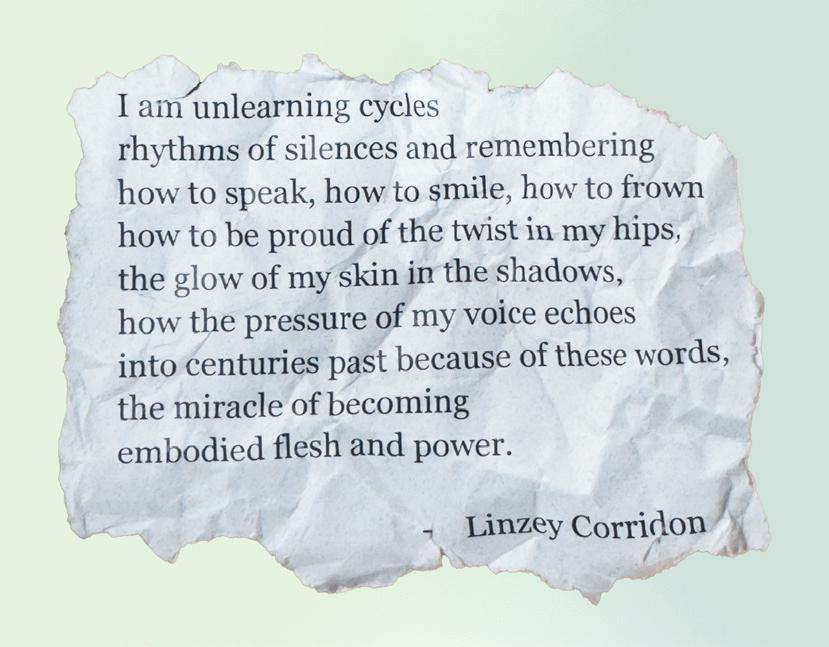
Linzey Corridon, a postdoctoral fellow in TMU’s department of English said, “poetry is one of the oldest forms of expression we have as a species.”
Corridon shared with The Eye that he believes language carries an
have lost meaning in their situation,” she said.
Verissimo recently published a poetry collection titled Circumtrauma , which navigates the inherited grief, divisions and resilience from the Nigeria-Biafra war (1967-70). “Back in Nigeria during the military dictatorship, poetry helped many survive.”
innate ability to move people as well as providing solace and community.
According to Verissimo, in times of conflict, “[poetry] provides an opening for wounds that do not heal, and it teaches them how to heal because you find a language for the things that you do not know how to speak.”
As an Iranian outside of Iran, Khodayari said, “there’s a beauty in realising that Persian poetry has reached all crevices of the earth.”
Khodayari believes her mother chose to do this partly because, “she felt the greatest gift she could give to her country was to relay language to her children.”
Khodayari cites the many Iranian holidays that revolve around poems. For example, on Yalda, the Persian winter solstice, people stay up all night with family reading the poetry of Hafez, using his book to divine their fortunes for
“If a piece of poetry is able to stir anger or to sort of conjure concern in someone, then I think that, in my opinion, could be considered the beginnings of potentially some kind of activist desire...some kind of radical desire to not only feel but to hopefully act on those feelings,” he said.
Jumoke Verissimo, an assistant professor of English at TMU agreed, saying poetry can be a powerful survival tool in times of conflict. “Poetry tries to, through looking through the silences in the words that are brought together, create meaning for people who
“There’s a deep pride that comes with it. There’s a deep sorrow that comes with it. But I think both of those demand to be felt and demand attention,” she said.
According to Dale Smith, the undergraduate English program director at TMU, the rhythms of poetry can create a shared bodily experience, creating opportunities for empathy. Smith also shared a poem called Alibi Lullaby by Canadian poet Norma Cole with The Eye. Poetry has the potential to place you concretely on the ground on the other side of the world, said Smith. It asks you not to look away.
Is the ‘very Chinese time’ in your life just a phase?
When Chinamaxxing fades, Chinese TMU students question if there will be a return to Asian hate
By Mishael Taruc
Hate the Chinese. Love the Chinese. Rinse and repeat.
John Shiga, a professor in the School of Professional Communication at Toronto Metropolitan University (TMU), said the pendulum has swung from the heightened sinophobia of the COVID-19 pandemic to today’s ‘Chinamaxxing’ boom on TikTok.
However, Chinese TMU students question whether the latest For You page darlings—Tai Chi, hot tea, herbal skin care—could lead to a deeper understanding of their culture.
A surge of Gen Z users on TikTok are proclaiming to be in a “very Chinese time” of their lives. They’re adopting Chinese lifestyle habits such as keeping the neck and feet warm, drinking hot instead of cold drinks, wearing slippers inside the house and practicing Tai Chi every morning. In short, Chinamaxxing.
Veronica Chan, a third-year biomedical engineering student, said it felt nice that her culture is appreciated. However, it felt like China-
maxxers were “taking the very simple aspects of it and appreciating those and kind of ignoring” the others, she said.
At first, Audrey Chen, a thirdyear global management student, felt represented seeing her culture viewed positively.
However she, “realized it was becoming one of those things where non-Chinese people are profiting and benefiting off of this Chinamaxxing content,” she said.
“There’s a real sort of flattening of a culture,” said Shiga.
The love-hate relationship of the West with Eastern cultures is nothing new
The trend simplifies a culture into a handpicked list of wellness tips because it’s quick and loweffort to put together in a shortform video, without extensive cultural knowledge, he said.
Chen still remembers the 2020 lockdowns when Chinese people endured threats and harassment, including being called “bat eaters.”
After all the damage done, she
said the wave of appreciation for Chinese culture online “feels like the celebration of progress, but only as a function of hindsight.”
“We’re not taking accountability in the moment,” Chen said.
The love-hate relationship of the West with Eastern cultures is nothing new, said Shiga. “Surges of interest in Asia happen after a period of hostility or suspicion.”
After the Second World War, martial arts were all the rage in the 1960s and 70s, he said. Sushi had the spotlight in the 80’s and 90’s. In the 2000s, K-pop music gained North American fans.
However, Shiga said the Chinamaxxing trend does not have to be short-lived and surface-level.
“It’s possible that for some folks it is an opening to, hopefully, a longer-term and deeper engagement,” he said.
Catherine Cho, a first-year fashion student, however, finds that East Asian trends blowing up in the West can help the diaspora youth connect better with their roots.
Growing up Korean-Canadian,
Cho felt “whitewashed” and disconnected from her heritage.
However, Korean trends popularized in the West became the bridge between her and her new international student friends who grew up in Korea. They found common ground in the globalized online space they navigate.
Chen enjoys the cross-cultural learning online, as long as content creators do their research and are “knowledgeable on the things
you’re sharing to the world.”
Non-Chinese people interacting with the trend should lead with openness and respect, especially when exploring parts of her culture that may be less appealing to the Western palate, said Chan.
Chen hopes that genuine appreciation for her culture continues beyond social media trends and won’t be replaced by hate once the pendulum swings away from her, her people and her culture.
CHARLOTTE LIGHTENBERG/THE EYEOPENER
The Eye’s Unofficial Sports Awards
By Victoria Cha and Jonathan Reynoso
With the 2025-26 Toronto Metropolitan University (TMU) Bold athletic season done and dusted, The Eyeopener’s sports section wanted to recognize some teams, athletes and staff that fueled our coverage throughout the year.
From August to March, close to 180 games were played across the Bold varsity teams with noteworthy moments throughout. After reviewing the past season, we are pleased to announce The Eye’s 2025-26 Unofficial Sports Awards:
Game of the year
In a rare U Sports and National Collegiate Athletics Association showdown, the men’s volleyball team went up against the Princeton Tigers on Jan. 3. After a long winter break, spectators readily filled the stands of the Mattamy Athletic Centre (MAC) home court—only standing room remained as the match went on. Although the Bold ended the night with a 3-0 loss, the packed MAC fuelled every play and set their tone for 2026.
Team of the year
The women’s basketball team shone as the best Bold varsity team this season. They finished at the top of their Ontario University Athletics (OUA) conference with a 20-2 record and were crowned the Critelli Cup champions in the OUA playoffs on Feb. 28.
Athlete of the year
Fourth-year women’s basketball guard Myriam Kone was an oncourt force all season. She finished third in scoring in the entirety of U Sports averaging 21.3 points per game and broke a TMU program record for most points in a single season (448 in 2025-26). She was awarded with the following for her 2025-26 achievements: OUA FirstTeam All-Star, Critelli Cup Player of the Game and U SPORTS FirstTeam All-Canadian.
Storyline of the year
Women’s basketball head coach Carly Clarke has had a year of accomplishments. In August 2025, she was named head coach of Canada’s under-23 women’s national team for Globl Jam 2025 and led them to a gold medal victory.
After winning the OUA playoffs, Clarke and the Bold made their way to the U Sports Final 8 where they ended in sixth.
On March 30, it was announced that Clarke has joined the WNBA’s Toronto Tempo as assistant coach. The team will begin its inaugural season on April 29.
Grad student athletes at TMU navigate sports and academics
By Avari Nwaesei
For some varsity athletes, graduation marks the end of their university sports careers, but for those taking graduate programs, these careers are prolonged. At Toronto Metropolitan University (TMU), graduate student athletes are being introduced to not just a heavier workload but a shift in mindset and role on their team.
Currently in the third year of his Commission on Accreditation of Medical Physics Education PhD at TMU, men’s volleyball middle Bobby Tang was influenced by the option of playing a sport.
“Volleyball was very much a grounding tool in my decision, in the sense that I felt that it would have been very beneficial for my work-life balance to have it in my life,” said Tang. “I felt that, throughout my years here at TMU, I’ve been able to really benefit from having played university sports.”
Men’s hockey forward Brock McLeod viewed studying for a masters of business management (MBA) as the natural path forward.
“I think just getting to further your education while still playing hockey can’t really go wrong. It was sort of the best of both worlds for me,” said McLeod.
Continuing to play the sport they have been part of for years while continuing their academic career works in these athletes’ favour but team dynamics are prone to change. McLeod, who previously played hockey with the York University Lions, admits that his role on the ice is “definitely” a bit different now that he’s with TMU.
“I was relied upon a little bit
more at York offensively, but I’ve tried not to change my game regardless of the amount of minutes that I’m getting here in comparison to York,” said McLeod.
Another player who can relate to McLeod’s change in team is men’s hockey defenceman Hunter Donohoe. He left the MacEwan University Griffins in Edmonton to pursue an MBA while playing for TMU’s “pretty established” hockey team.
“It was sort of the best of both worlds for me”
“I’m brand new, so I’m sort of like a rookie, in a sense, to the team, but I have a bit of a veteran presence playing out West, having some experience balancing school and playing,” said Donohoe.
The general consensus among athletes with an undergraduate degree under their belt is that it comes with a certain level of respect from other players.
“My word does have a lot more weight than I think it does,” said Tang. Years of balancing both athletics and academics unlocks a new position for postgraduate athletes—being a role model.
“I’ve tried to be a calming presence in the room and a guy that the guys can look up to and learn from, not only on the ice but away from the rink and off the ice,” said McLeod.
A role change within the team isn’t the only development players experience as they reach graduate student athlete status—their priorities change, too.
“Now coming into my later years, you sort of see the end of
your playing career upon you. So, there’s definitely a little bit of a different perspective in terms of time winding down on the career,” said McLeod.
“I think it brings a lot more emphasis on wanting to win and less on personal gains in terms of points and whatnot.”
According to McLeod, thoughts about what comes next get in his head in the middle of games. “You try to block it out when you’re playing, but it’s definitely something that’s in the back of your mind,” said McLeod.
Due to this change in perspective, athletes can end up putting pressure on themselves in relation to how well they play.
“It hasn’t been a straight line to success, there’s been a lot of ups and downs. So, I think going through that has helped me in terms of finding my place on the team,” said McLeod.
Being a postgraduate athlete comes with challenges that make themselves known within the classroom—graduate studies can come with an “intimidation factor,” McLeod added.
“I don’t think I’m quite ready to hang up the skates yet”
“I almost felt like there was a little bit of imposter syndrome for us because we are athletes and we’re not working full time,” said McLeod. However, after reflecting on how things have gone throughout the year, McLeod said the worry was unnecessary: “You just got to go in there and be confident and be a good person.”
The classroom environment
compared to undergraduate studies draws similarities in athletes’ abilities to stay on top of their game.
“It’s super motivating and fun to be in those classes and it makes learning a lot easier because, if you surround yourself with like-minded people, you’re going to try and keep up with them or drive the pace of the classroom in learning,” said Donohoe.
While dealing with an increased workload, varsity athletes view their sport as a way to wind down rather than it being a stress inducer. “It can be very taxing and busy, but being able to have that outlet with varsity volleyball has been quite a blessing, to say the least,” said Tang.
As an athlete looking to get into graduate studies, fourth-year nursing student and women’s hockey forward Gaby Gareau is open to continuing her hockey career if it means getting an education out of it for her future as well. “I don’t think I’m quite ready to hang up the skates yet,” said Gareau.
Gareau believes playing a sport on top of the extra work of a graduate program is a good “tradeoff.”
“Work ethic and commitment have been such crucial things that I’ve learnt and developed during my stay here and definitely things that I’m going to be using moving forward,” said Gareau.
Graduate studies offer student-athletes the opportunity to continue their athletic and academic careers but it doesn’t come without drawbacks.
“The fear of letting your team down and going to a different university or potentially playing against the program you’ve been developing for the past four years is a scary thing,” said Gareau.
No one wants to club and pub
Students and experts say inaccessibilty and financial barriers are crashing the party
By Aditi Roy
Young people are partying far less than their parents and an univited guest may be to blame: the rising cost of living. A 2024 report from the Guardian stated that 71 per cent of Gen Z prefer staying in rather than going out. At Toronto Metropolitan University (TMU), some students said this shift is driven by a growing financial burden, coupled with the recent trend of sober curiosity.
Alexis Illes is a PhD student in management, specializing in organizational behaviour and human resources. “[Its] definitely the cost of living and inflation…now it feels like a big, steep increase in prices,” she said.
Illes’ observations ring true for many, as for students, a night out comes with the stress of budgeting for drinks, cover and transportation.
John*, a student from University of Toronto (U of T) and an avid party goer said he spends nearly $100 each time he goes out clubbing in Toronto.
“$20 for entry and the boys love to drink, so…four or five beers inside, a couple cocktails and then if you’ve had enough, you’re getting a couple shots after,” he said, breaking down his costs excluding transportation.
John attributes his ability to party frequently to working jobs in the summer and having wealthy parents.
Enya Jovicik is a third-year English student at TMU and bartender in downtown Toronto.
“It’s so expensive to go out, you go somewhere and you have to pay for entry and if you want to drink…a cocktail, it’s like $16 plus tax, like 20 bucks, and that’s not including a tip,” she said, explaining why she doesn’t frequently go out.
Jovicik sees the decline of nightlife at her work where managers are actively organizing “bar crawls and [similar] events catered to-
wards more college age students,” to increase their reach and profitability.
In 2024 nightlife transactions were down 41 per cent in Toronto, pointing to a fall in the participation of the city’s bustling club and bar scene, according to payment processing company Square.
Jovicik said there’s a certain lifestyle needed to even be able to party on the weekends. “Especially with the cost of living [in] Toronto, you need work a lot to sustain it…a lot of people don’t have a Friday night off or Saturday night off, I rarely have those kinds of peak days off.”
Jovick said her job often competes with her ability to go out—something echoed by other students. A 2023 PayChex survey revealed that 93 per cent of young adults sampled held multiple jobs to make ends meet.
Cigna International Health’s 2022 survey detailing workplace stress reported that 98 per cent of Gen Z respondents were dealing with burn-out symptoms and felt unable to keep up with their professional demands.
Illes also adds that young people are more conscious about their social media presence, as their digital footprint factors into not just their social interactions but their jobs.
“With social media, you just don’t really want the kind of drunken behaviour to be around strangers who may post that [and] impact my future,” she said.
Illes reflects on her unique position as a PhD student. “I’m not a professor, but I’m not just a regular student, I teach undergraduates, so I am mindful of how I appear not only in person, but online,” she said.
In addition, the trend of sober curiosity and health consciousness has also altered people’s desire to go partying.
Pritam Mandal is a second-year sports media student at TMU. Mandal has recently ad-
opted a sober lifestyle, straying away from alcohol and nightlife in an effort to stay healthy.
“As [I am in my] mid 20s, instead of going out to clubs or pubs after my work or during weekends, I try my best to go to gyms,” he said, repurposing his time for health and productivity.
Mandal said he notices an increase in disposable income now that he is actively not partaking in nightlife and drinking. “I can [buy] better groceries, I have some money for my skincare, for my hair care or maybe to go out somewhere else, or maybe enjoying a different kind of activity.”
Mandal’s choice of sobriety isn’t uncommon among his age demographic. 53 per cent of people aged 18 to 29 don’t consume alcohol as of 2025, according to LendingTree. The generation has garnered a reputation for being “sober curious,” opting for energy drinks and fruit juices instead, according to market research firm Mintel.
For many female students, the issue seems to lie in the lack of safety offered at clubs.
Who soaked up the most sun in 2025?
By Jasmine Makar
The Ontario Government has dropped the 2025 Public Sector Salary Disclosure list, showing an increase in Toronto Metropolitan University’s (TMU) top earners’ salaries from the previous fiscal year.
The list is released annually by the government and includes all public sector employees earning over $100,000. Referred to as the “Sunshine List,” it was introduced in 1996 to monitor public sector pay, according to the CBC.
There are currently 2,039 TMU staff members on the 2025 Sunshine List compared to 1,935 in 2024—marking a 5.37 per cent increase.
172 staff members at TMU raked in more than $245,000 this year, with the highest paid employee being president Mohamed Lachemi earning $471,070.
Lachemi’s current salary is nearly double that of Toronto Mayor Olivia Chow, who earns $240,349 and Premier Doug Ford, who earns $269,567.
Lachemi has maintained his spot at the top of the list since 2016, when he became president of the university, following Sheldon Levy. Even prior to his presidency, Lachemi was among TMU’s top 10 earners since 2012, when he served as the dean of the Faculty of
Engineering and Architectural Science and later as provost.
This year Pamela Sugiman made her debut among the 10 highest-paid faculty members at TMU. Sugiman is a sociology professor who was previously the dean of the Faculty of Arts. Sugiman was abruptly removed from her position in 2024, followed by her $2-million lawsuit against TMU, which was filed in September, 2025 as previously reported by The Eyeopener.
Since 2024, Sugiman remains at TMU as a professor and her salary has increased by $41,879.
The University of Toronto (U of T) has a contrasting salary structure. Its president,
Melanie Woodin is ranked as the 71st-highest-paid faculty member and all top 10 earners are professors from different disciplines.
Alan Aspuru-Guzik, a U of T chemistry and computer science professor earned a whopping $649,993, making him U of T’s highest paid employee in 2025.
U of T records 7,392 employees on the 2025 list, up 520 from 2024.
Next year’s list may be subject to change given that Lachemi’s term is coming to an end in 2026 and Premier Doug Ford has allocated $6.4 billion to post-secondary institutions over the next four years along with planned tuition increases, according to The Government of Ontario.
Mila Bjelaković is a second-year creative industries student who enjoys going out regularly but is always wary of her safety. She said she avoids getting too intoxicated to be cautious of her surroundings.
“It comes from a fear, especially for women in the last 10 years [there were] so many stories, if you’re gonna have to Uber home alone, you don’t want to be drunk,” she said.
Bjelaković notes this fear also dictates her clothing choices, in hopes of preventing unwanted male attention as she walks or uses public transportation for her commute.
Illes still feels uneasy despite having experience handling herself in uncomfortable situations.
“I feel less safe going out as a woman as I did when I was younger, even though, over the years, I’ve gained more skills with safety, but now the culture feels less safe,” she said.
*This source has requested to remain anonymous for privacy reasons, The Eyeopener has verified this source.
1. Mohamed Lachemi- President $471,070
2. Roberta Iannacito-Provenzano - Provost and VP Academic
$427,000
3. Krishan Mehta - VP University Advancement and Alumni Relations
$416,525
4. Teresa Chan - Dean School of Medicine
$416,014
5. Atefeh Mashata - Associate Professor
$376,535
6. Steven Liss - VP, Research and Innovation
$357,680
7. Donna Young - Dean, Faculty of Law
$354,449
8. Pamela Sugiman - Professor $347,490
9. Saeed Zolfaghari - VP Administration and Operations
$345,000
10. Tanya De Mello - VP Equity and Community Inclusion
$329,000
PIERRE-PHILIPE WANYA-TAMBWE/THE EYEOPENER
TMU exceeds Google Workspace storage after Lachemi trips on wire
“Wuh, wuh wuh, whoops!” said the president
By K. Lutz
Disclaimer: The Google Workspace outage actually happened but Lachemi refuses to admit he tripped on a wire so that part is either not true or just unconfirmed.
Access to the Toronto Metropolitan University (TMU) Google Workspace was temporarily paused after the school announced that the outage resulted from the university exceeding its 1.08 petabyte storage limit.
While access has now been restored, it was also revealed that the true cause of the outage was not a storage limit but instead the president & vice-chancellor Mohamed Lachemi tripping comically on a wire within the Computing and Communications Services (CCS) office.
Brian Lesser, chief information officer at the CCS, said Lachemi happened to be in their office at the time for a general checkup on how things were going.
“He came in hot, like he had just downed two double-double’s and a farmer’s wrap from Tim’s and it just wasn’t sitting right in his Latummi,” said Lesser. “Next thing I knew he was running through our office looking for the nearest place to empty his Labowels and the entire Google Workspace was down.”
Lesser added that while the fix for the issue was simply to plug it back into the wall, but before he could, Lachemi commandeered the situation and began crying, weeping and pleading for everyone in the office to keep his embarrassment a secret.
“He kept going on about how Roberta would never let him out of the of -
fice anymore if she found out,” one CCS worker said.
“There was a point where he actually got into the fetal position on the floor and sucked his thumb until we all ‘pinky promised’ that we would keep it a secret,” another said.
When asked why he was in such a rush that he tripped on the wire, Lachemi explained that he was dealing with important “presidential matters.”
“If you must know I was running to catch a rare Torkoal on Pokémon GO and I wasn’t paying attention to my surroundings, only the Torkoal. I mean come on, it’s a Torkoal. When else am I going to get one of those?” Lachemi said.
Mike Donaldson, a third-year computer engineering student said the outage had
interrupted his studies but when he found out Lachemi had made the mistake, he was rather amused.
“I was working on one assignment for this class I hate and just as I was trying to switch to another one, I couldn’t open anything,” he said. “Then I found out it was Lachemi who caused the whole thing and I started live hate-tweeting about him on Threads.”
“It also didn’t really matter because I was going to watch reels until I passed out on my aunt’s couch instead of working anyway,” he added.
All files are once again accessible in Google Drive and the CCS has confirmed all wires in the office are now taped to the ground with bright yellow caution tape for safety.
Anti-umbrella protest at Queen’s Park delayed by rain
Many set to attend also protesting the weather app
By Raye Ning
Disclaimer: There was not actually an anti-umbrella protest but nowadays who knows right?
Students, community advocates and anti-umbrella groups’ plan to gather at Queen’s Park on Tuesday to protest the use of umbrellas was delayed due to unforeseen rain.
The protest was set to mark the oneyear anniversary of the forming of the Defiant Rebels Embracing Natural Climate Hardships (DRENCH) group.
Brett Wett, founder and co-president of DRENCH, said he believes the setback could have been avoided though he is unsure how.
“It pisses me off because we could have had the protest if there was something that we could kind of hold up in the air that would stop the rain from getting all over us,” Wett said. “But not a fucking umbrella.”
Wett started the anti-umbrella movement when his umbrella he had purchased from Dollarama for $3 broke in the wind while he was stranded in the middle of a torrential downpour.
“I powered through and showed those brella-using baby bitches that I ain’t no grandma in the park hiding from the sun,
I’m a real fucking man and I reserve the right to protest umbrellas instead of going to work,” said Wett.
In response to the protest, an anti ‘antiumbrella’ protest was held with many in attendance advocating for the necessity of the covering.
“I’m literally made out of sugar. I mean it gets to a point,” said the Gingerbread Man.
“I kind of have a thing with water and I like CANNOT get wet, it’s this whole big thing and it’s like I don’t even want to talk about it but it’s such a thing,” said the Wicked Witch of the West.
Others in attendance that were in favour of umbrellas included the two gay fish kids from Luca, Gizmo the Gremlin, several of the Mako Mermaids and the Sandman.
PHOTO ILLUSTRATION: SAIF-ULLAH KHAN/THE EYEOPENER
OUT OF THIS WORLD GIVEAWAY!
The Eyeopener is giving away two $25 gift cards to Metro.
Find the giveaway rules through the link in our Instagram bio.
1. Complete the crossword! Only 100 per cent accurate crosswords will be accepted.
2. Complete the Google Form via the QR code on the page and add a photo of your completed crossword!
3. Await an email! The form will close end-of-day on April 14 and winners will be contacted shortly afterwards and asked to come into our office for photos!
Submit Completed Crossword Here
ACROSS
3. Measure of distance used for light
4. Space ranger from Toy Story who goes to “Infinity and Beyond”
6. First human to walk on the moon
8. Ringed planet in our solar system
DOWN
1. 1968 film directed by
Advice: I’m dating a pigeon
Stanley Kubrick that changed the landscape of sci-fi films
2. Object sent into orbit around Earth, typically used for communication and photography
4. Region of space where gravity is so strong not even light escapes
5. 2014 sci-fi film directed by Christopher Nolan starring Matthew McConaughey
7. Recent NASA mission that sent 4 astronauts farther than any humans before them
MISSED CONNECTIONS
I NEED THE SONG PLEASE
You were walking through the Kerr Hall Quad on Tuesday, and you have pink hair, and you were listening to this FUCKING SONG. Bum bum ba dum ba dum ba bu dam ba ba dum ba dum ba. FUCK PLEASE I CANT STOP HUMMING IT AND I NEED TO KNOW WHERE TO FIND IT. I’ll be waiting on the steps of the RAC for the foreseeable future.
TA for POG110
This is literally just for the TA for POG110 that ran this semester. I think your name is Jessica? Well you wear these pants with buttons instead of a zipper. And like, girl you’re supposed to button them all up. That’s shit’s just hanging out in Sally Horsefall.
Bill #1 I burn for you
If you get coffees at Oakham Cafe while wearing over-ear headphones and a cross body bag, and were also Bill #1 in the 33 bills video at The Eye , this is for you. I think you are just the cutesiest patootsie ever and you could Oa-come with me to get another coffee. Just drop your number at… um… The Eyeopener office… anytime.
I feel like I’m going coo-coo but really it’s my girlfriend, the pigeon, that’s going “coo-coo” all day long. Everyone I ask for advice tells me I’m nuts but if I were nuts my girlfriend, the pigeon, would pick at me and eat me. Instead she gives me nothing. No attention, no affection, no love. It’s almost like this entire aviationship is one-sided with me being the only one who initiates kissing and plans out our dates. And speaking of dates, all she ever wants to do is walk on Gould Street and eat scraps from Balzac’s. What can I do to make her love me? This is her and I love her hair
A letter to TMU Chairs...
From Your Biggest Fan
Dearest TMU Chairs,
I’m no Shakespeare but I have some words that I need to say to you. Where art thou? Everyday I wake up, make myself a cup of Folgers Instant Coffee Crystals and then open Instagram hoping, praying, that I will see a new video from you pop up on my feed. There are so many seats you have yet to sit in, so many chairs you have yet to chill in, so many cathedra’s you have yet to conquer, so many...so many. I’m starting to sound a little obsessive but I don’t know what to do with myself. I refuse to sit in chairs I know you haven’t reviewed yet and that’s leaving me with fewer and fewer options as I enter my sixth year here at your palace where you once blessed us with your prescence. If there is something someone did wrong, or if our chairs aren’t to your liking, I can fix that for you. Please return so that I may sit down and watch the sun rise upon your kingdom and bask in the chairitable essence of your decision making glow. Your biggest fan.
Weird guy on Gould?
A guy walked up to me yesterday on Gould Street and spat on the ground before saying “fart on it.” He was wearing a navy blue Olivia Coleman shirt and I just want to know why dude. Just an explanation that’s all.
Lake Devo busker
There was this guy playing guitar by Lake Devo. He stopped me and my friends, think he was asking for a tip but I think he chose me for a reason. He had this “I rub cucumbers on my pits as deodorant” vibe but I was kind of digging it?
Pitman Hall floor 7
I’m looking for the guy that lives on floor 7 of Pitman, across the hall from the toilet that overflows into the hallway. Whatever you and your roommate do is your business, but the walls are really thin and your JOI is really loud.
Sneeze apology
We bumped into each other on the SLC sixth floor. When you bent down to pick up my books I couldn’t hold back my sneeze. I am so sorry but there is a wild loogie somewhere in your hair and now everywhere you go, you carry a piece of me with you.
NEILL-WYCIK CO -OPERATIVE COLLEGE
THE BEST KEPT SECRET IN STUDENT HOUSING
CHOOSE CO-OPERATIVE LIVING
AFFORDABLE STUDENT HOUSING & CO-OPERATIVE LIVING IS JUST STEPS AWAY...
NEILL-WYCIK CO-OPERATIVE COLLEGE IS A NOT-FOR-PROFIT STUDENT HOUSING CO-OPERATIVE ESTABLISHED IN 1970. WE WERE FOUNDED BY TMU (FORMERLY RYERSON) STUDENTS AND HAVE PROVIDED AFFORDABLE HOUSING TO STUDENTS ACROSS THE CITY FOR 50+ YEARS.
NOW ACCEPTING:
WHAT WE OFFER
FLEXIBLE 8-MONTH LEASES FURNISHED ROOMS 14+ ON-SITE AMENITIES COMMUNITY SOCIAL ACTIVITIES & MUCH MORE! WWW.NEILL-WYCIK.COOP
FALL 2026 HOUSING APPLICATIONS TO OUR DORM STYLE UNITS. PRIVATE BEDROOMS SHARED LIVING SPACES & KITCHENS CURATED ROOMMATE-MATCHING 8-MONTH LEASES & MORE
CURRENT HOUSING RATES RANGE FROM $700-$800/MONTH PAID BY SEMESTER