
The Eyeopener: Vol. 59, Issue 18

Page 1


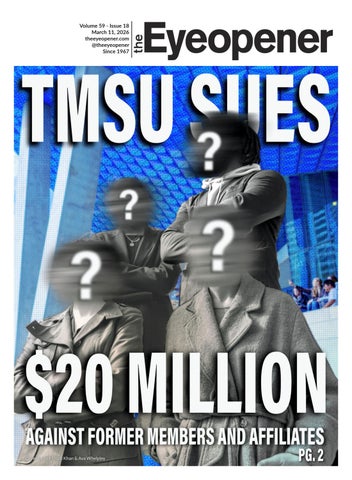
TMSU files $20 million lawsuit against former executives for corruption, fraud, breach of privacy and more

Former

president Ali Yousaf is one of 17 defendants, which include “TMSU Saviour”

The Toronto Metropolitan Students’ Union (TMSU) filed a $20 million lawsuit against former TMSU president Ali Yousaf and 16 other former and current affiliates of the union, on March 6.

The lawsuit includes claims of breach of confidentiality, election interference and “financial gain.” This lawsuit is the largest in the union’s history.

TheupdatewassharedtoToronto MetropolitanUniversity(TMU)studentsinanemailblastlateonMarch

7 as part of an ongoing independent investigation into the TMSU over the past several months, as previously reported by The Eyeopener.The announcement came hours after the TMSU concluded a Board of Directors (BoD) meeting, around half of which was conducted as a closed doors “in-camera” session.

The email blast stated “Ali Yousaf, a former TMSU President with no official role in the Union since 2021, has repeatedly conspired to manipulate the student union’s electoral process to ensure hischosencandidateswereelected.”

The statement of claim obtained by The Eye also names former TMSU executives such as former president Nikole Dan, former president and vice-president student life Nadir Janjua, and former vice-president of operations Muhammad Awais, among others.

Koby Biya, who ran for president in the 2025 TMSU Fall By-Election, is also named as a defendant in the lawsuit. Biya previously served as vice-president of student life in the 202425 academic term. His 2025 slate, Students Leading Tomorrow, received 744 demerit points in the 2025 Fall By-Election, as previously reported by The Eye.

According to the TMSU email, the lawsuit alleges these defendants “engaged in civil conspiracy, fraud, breach of fiduciary duty, and breach of contract, among other serious claims.”

Interim co-executive director Scott Miller Berry said in the email blast that the lawsuit is about “defending the integrity of TMSU’s democratic process” by targeting “bad actors at the heart of this ongoing corruption.” The lawsuit follows over a decade of alleged corruption, financial mismanagement and fraud. Previous reports of misconduct include the ‘credit card scandal’ of 2019 totalling to an alleged $250,000 in mismanaged funds, and various corrupted elections including the Spring Election 2023, the Spring Election 2025 and the Fall By-

Election 2025.

Co-interim executive director Sally Lee also said in email that TMSU has “taken decisive steps” to address issues at the core of the lawsuit, including “disciplining members, terminating staff…and strengthening policies and by-laws.”

Election Tampering

The lawsuit comes just days before TMSU’s general election period is set to begin, with campaigning starting on March 9.

The 2025 Fall By-Election saw its executive vote null and void following over 75 complaints regarding two slates, as previously reported by The Eye

The statement of claims alleges Yousaf and several defendants have “continually and wrongfully interfered in the operations of TMSU and infiltrated TMSU’s elections for their ultimate personal gain.”

One means, according to the statement of claim, was to allegedly hire chief returning officers (CRO) who were not qualified or didnotholdrelevantexperienceto oversee TMSU’s elections.

For example, the statement of claim alleges that Qin Yi Huang, the CRO for the 2024 general election “worked in concert with the Defendant Yousaf by sending him confidential information regarding the vote count to ensure that Mr. Yousaf’s preferred candidates–the Executive Directors’ slate–won the election.”

The winning Celestial slate, which included Janjua, Biya and Aneesa Masood—who is also named as a defendant in the lawsuit—had won with nearly 60 per cent of the vote in each executive position, with a voter turnout of seven per cent, as previously reported by The Eye

These allegations extend to the 2025 general election, in which Dan, Janjua, and the other members of the ERC “conspired with Defendant Yousaf to ensure that Team Re-Elect would win the 2025 general election.”

Financial irregularities

The statement of claim also alleges that “TMSU has been buffeted by a series of financial scandals,” for over a decade.

It alleges that during Yousaf’s term as TMSU president, he and two other executive members (who were not named in the statement of claim) were the focus of an independent investigation after the then executive director found “numerous financial irregularities.”

Page 19 of the statement of claim also alleges Yousaf, Janjua, Awais, Hafsa Iqbal (another defendant) and Dan “colluded to have TMSU enter into contracts and make payments for their own personal financial gain, or… for the financial gain of others who interests are personal and do not represent the best interests of TMSU.”

Among many incidents, the statement of claim also alleges that defendant Iqbal was behind the over $100,000 purchase of low-quality, defective cramping devices for an inflated price for a ‘giveaway’ in late 2024.

“Defendant Iqbal improperly and secretly arranged with the Defendant Yousaf to procure the heating pads” from Code Street Global, who “was not and is not” a regular TMSU supplier according to the statement of claim. Iqbal and Yousaf received board approval to spend $50,000 on 500 cramping devices. The statement of claim lists the total amount spent on the 500 units came to $50,754.40 but the cost per unit outlined was $91.08 including nearly $30 in TMSU customizations, custom magnetic boxes and gift bags. There is a roughly $5,000 descrepency in this document. The Eye cannot confirm where the additional $5,000 was spent.

Iqbal and Dan allegedly continued to order 600 more cramping devices for $54,470.52, in addition to the 500, without board authorization or permission according to the claim.

Page 20 of the statement of claim said Yousaf was directly involved in the “scheme” and Iqbal and Dan “breached” their fiduciary duties in the transaction, while the other Executive Defendants failed in “oversight and control.”

The statement of claims also critiques Janjua and Awais’s signing of a contract with Gallivan Student Health and Wellness as the union’s healthcare insurance provider. According to the statement of claims, the 10-year contract, signed in 2024, is valued at approximately $15 million.

Page 22 of the statement of claim states a referendum should have been held to ask students if they wanted to increase membership fees to pay for the new services associated with the contract–which allegedly Janjua and Awais were aware of, but signed the contract withoutdoingso.TheBoDwasnot consulted or gave approval before the contract signing.

At the 2025 semi-annual general meeting, independent investigator MNP also reported financial irregularities of $1.4 million to 11 vendors between 2021 and 2024, as previously reported by The Eye

One of these vendors, ImagineXperience, is named as a defendant in the lawsuit. According to the email sent by TMSU, ImagineXperience and “three other related businesses received over $1.175 million from TMSU during the 2024-25 academic year.”

Thestatementofclaimallegesthat several defendants, including Dan, Janjua and Biya, have been “unjustly enriched” by ImagineXperience and were compensated for their roles within TMSU as executives, board members or employees. ImagineXperience has “benefitted directly fromoverpayments”, suchasTMSU payments that were “fraudulent or improper and dishonestly obtained” according to the statement ofclaim.

Gallivan allegedly agreed to give TMSU “an annual $50,000 sponsorship” for the union’s 2024 and 2025

fall orientations. Janjua and Awais, without board authorization, allocatedbothyears’sponsorships“aspartial payment to ImagineXeperience for the Week of Welcome Concert.”

TMSU Saviour

There are four anonymous defendantslistedinthestatementofclaim as Jay Doe 1, 2, 3 and 4 which, according to page 63 of the statement of claims, are connected to the “TMSU Saviour” emails allegedly breaching the confidentiality of informationbelongingtoTMSU.

TMSU filed a $70,000 lawsuit against “TMSU Saviour” according to the claim.

“TMSUSaviour”isanaliasgivento one or more anonymous writers of a seriesofemailssenttolargegroupsof the TMU student body and media— including The Eye—detailingincriminating allegations against the TMSU regarding elections misconduct and financial mismanagement. This series ofemailsbeganinDecember2024. Information obtained and allegedlybreachedbytheseindividualsinclude “passport numbers, permanent residency numbers, diverse license numbers, home addresses” of current andformerTMSUmembers.

Details regarding the private hiring process of the TMSU were also obtained by these individuals. “The Saviour Defendants knew that this information was confidential and wilfully disseminated for their own purpose despite this knowledge,” page 64 of the statement of claims reads.

TMSU has previously filed lawsuits against three of its former executives in 2023 for its general election, but the parties had reached a settlement, as previously reported by The Eye.

The press release further states TMSU and MNP remain in “active communication” with Toronto Police Service regarding the investigation, who will determine if charges will be laid.

This is a developing story and will be updated as new details emerge.

SAMMY KOGAN/THE EYEOPENER

Hundreds protest against OSAP cuts at Queen’s Park, two arrested

Students from across the province gathered at Queen’s Park last Wednesday

Hundreds of students and community members from across Ontario gathered at Queen’s Park on March 4 to protest Doug Ford’s Provincial Government’s recent cuts to OSAP.

On Feb. 12, the provincial government announced its decision to cut OSAP grants and increase domestic tuition by two per cent over the next threeyears.Thisisthefirsttuitionincrease since the province cut tuition by10percentandfrozeitin2019.

The Ford government stated that the maximum OSAP grants a student can be eligible for would be reduced from 85 per cent to 25 per cent, with a minimum of 75 per cent of funding being loans. The annual funding to universities was also increased along with a $6.4 billioninvestmentinthepost-secondary sector, as previously reported by The Eyeopener. The protest, organized by the Canadian Federation of Students Ontario (CFS-Ontario), saw high school, university and college students decry the government’s decision.TheQueen’sParkrallywasjust one of several student actions that occurred on March 4, joining cohorts in Ottawa and Waterloo, Ont.

Towards the end of the protest near 3:00 p.m., police arrested an individual who allegedly spray painted a statue, leading to a confrontation between the protestors and the police officers. Another individual was arrested after allegedly spitting on a police officer according to a Toronto police news release. Both were releasedlaterthatnight.

An emailed statement to The Eye from a spokesperson for CFSOntario described police presence near the end of the protest as “heavy and disproportionate” and that it “resulted in the arrest of [the] two attendees.”

Students carried signs, many criticizingthePremier’scomments to avoid taking “basket-weaving courses” and chanted, “Hey hey, ho ho, Doug Ford’s got to go.”

“The financial burden is going to really increase for sure”

Ella Brigham, a second-year early childhood studies student at the University of Guelph-Humber said the Premier’s comments overlooked the importance of her field.

“We’re educating the future, that’s my job. So for [Ford] to [tell us to] go into programs that matter, well there’s not going to be a future if these children aren’t being educated,” she said.

Brigham also expressed concerns about increased debt if the cuts to OSAP are not reversed.

“I personally want to go to grad school, that’s four more years of education. The financial burden is going toreallyincreaseforsure,”shesaid.

In an email statement to The Eye press secretary for Nolan Quinn, Bianca Giacoboni said that “Due to billionsofdollarsofpressureonthe program from the federal government’s decision to remove grant eligibility from students at private career colleges, coupled with increased program uptake in recent years, the OSAP framework was no longer sustainable.”

“They also emphasized that the ‘enhanced’ Student Access Guarantee, the Ontario Learn and Stay Grant and the First Nations Resource and Development scholarship has aided thousands of students in covering the costs of tuition, books and mandatory fees,” the email read.

Ava Bozzo, a second-year baking and pastry arts management student at George Brown College, echoed similar frustrations to Brigham.

“[Students] don’t know how they’re going to continue going to college and doing the stuff that they love because they can’t afford school already,” she said.

The Ontario legislature has been on a three-month break since December 2025 and will return to Queen’s Park on March 23. However, Marit Stiles, the leader of the New Democratic Party (NDP) and John Fraser, the interim leader for Ontario’s Liberal party and MPP of Ottawa South, were in attendance at the rally.

“We’re educating the future, that’s my job”

Stiles emphasized the importance of coming together as a community to continue advocating against the cuts, saying student can get the government to “flip flop” on the decision.

“We won some big battles [such as] saving the Greenbelt, fighting for education workers when [the provincial government was] attacking them, but what it takes is everybody coming together,” she said.

Fraser added that many students and community members have approached him to express how important it is for him to advocate against the cuts.

“We want [the Ontario government] to reverse the cuts, we want them to reverse the reliance on loans as opposed to grants. It’s unfair to change gears literally midstream. They have to fix it,” he said.

Trudy Kuropatwa Trent, a third-year production and design student at TMU and a member of the Student Mobilization Committee (SMC), which advocates for free education, said students seem to understand the importance of acting fast.

The Eyeopener Masthead

Editor-in-Chief

Negin “Sunshine” Khodayari

News Editors

Shaaranki “OSAP” Kulenthirarasa

Vihaan “Sleeping” Bhatnagar

Amira “Blinded” Benjamin

Arts & Culture Editor

Sophie “Stressed” Wallace

Business & Technology Editor

Aditi “Tylenol” Roy

Communities Editor

Daniel “Kickflip” Opasinis

Features Editor

Edward “Cairo” Lander

Fun & Satire Editor

Dylan “You Can’t Say That” Marks

Sports Editors

Jonathan “Oui” Reynoso

Victoria “Oui” Cha

Production Editors

Jasmine “Swiss Army Knife” Makar

Sarah “Vaughan” Grishpul

“We took the whole city block walking up here [...] There’s a lot of support for students fighting against these OSAP cuts,” she said.

Kuropatwa Trent, who is also president of the performance student union, said people were honking their vehicles in support of the students on their way to Queen’s Park.

Students were joined by other unions and organizations including the Canadian Union of Public Employees (CUPE) who held up signs and chanted with students.

CUPE represents workers in several sectors including healthcare, emergency services, early learning and childcare, education and education.

Kerry Webb, the vice-president of CUPE Local 1022 in Belleville, Ont., described the cuts to OSAP as unfair.

“Children are struggling now to be able to survive and go to school with the high cost of food and education...they deserve to be supported fully by the government,” she said.

Members of the Ontario Public Service Employees Union (OPSEU/SEFPO) also showed up, sharing their frustrations onstage. Their remarks were met with cheers by the crowd.

OPSEU/SEFPO president JP Hornick said in a video posted to the union’s Instagram account, “the onethingthatDougFordscrewsup every fricking time is that when he punches down on workers, when he punches down on students, he starts a revolution.”

The CFS will be holding another protest outside Queen’s Park, in collaboration with CUPE and OPSEU/SEFPO on March 24 at 1:30 p.m. the day after the Ontario legislature returns to office.

With files from Amira Benjamin

Photo Editors

Ava “MAC Ghosted” Whelpley

Saif-Ullah “Two Covers” Khan Pierre-Philipe “Moi Aussi” Wanya-Tambwe

Media Editors

Divine “Passport” Amayo Lucas“PassportToo!”Bustinski

Digital Producer

Anthony “1080p” Lippa-Hardy

General Manager

Liane “Cheddar” McLarty

Design Director

Vanessa “Met Pub” Kauk

Contributors

Adrian “50-50” Ord

Francesco “Elite Ball Knowledge” Cautillo

Charlotte “Networking” Ligtenberg

Aidan “ASAP” Clark

Rin “She’s Ghosting Me!!” Yanase

Ali “Alarm” Mesaf

Milla “Go Get Em’“ Ewart

Address

55 Gould Street, Toronto, ON, M5B 15B, Suite 207

AIDAN CLARK/ THE EYEOPENER

Spotlighting TMU’s up-and-coming design labels

Four student designers share insights on their evolving brands

PHOTOGRAPHS SUPPLIED: ADRIANA ELCENA, ETHAN CORDNER, ALICIA UNWIN, JINA KIM. PIERRE-PHILLIPE WANYA-TAMBWE/THE EYEOPENER

According to CourseCompare, Toronto Metropolitan University (TMU) has one of the most renowned fashion programmes in Canada.

A handful of TMU fashion students and alumni have taken the plunge on creating their own

brands, offering the public an opportunity to buy and borrow pieces from their distinctive collections.

1. Ethan Cordner

Cordner is a second-year fashion student at TMU who owns an independent label under his own name, featuring gothic and eerie collections.

His recent 2025 collection titled The Midnight Prayer was inspired by his own experience with deteriorating mental health and feeling the need to remain silent due to social stigma.

“I conceptualize what a man would wear at midnight, praying to God for whatever it is that they’re going through,” he added.

Cordner said he adopts a “zero waste mentality” and sources upcycled materials to divert waste from landfills.

“Idon’treallythrowfabricoutever…I kind of use every bit,” he said.

2. Alicia Unwin

Unwin is a fourth-year fashion student at TMU. Her label’s name, lil little girl in red, was inspired by her staplecolour,atrademarkofherpersonality. Her designs are playful and imaginative—using light pastels and charming plaid prints.

Unwin’s collection Pélagia releases on April 11, and will feature a fusion of a sea-toned blues and sand-like beiges.

“The theme is imagined as the ocean meeting the sand, two elementsthatareverydifferentbutbalanceeachotherwhichI’mrelatingto the idea of genderfluidness in fashion,” she said.

Unwin said she has made a commitment to use at least 40 per cent deadstockinhercollectiontoensure thatherpiecesareethicallyproduced.

3. Adriana Elcena ElcenaisaTMUfashionalumna.Her work draws heavily on her Caribbean roots, featuring vibrant jeweltonesandcrocheted-lacedetailing.

“My great grandmother crocheted at the time, and my grandmother held on to that...it inspired me to put crochet in my collections,” she said.

Elcena said she is open to making custom stage pieces and has worked with local Toronto artists like Sofinarri and Erin B.

For her latest 2025-26 collection titled Drift and Depart, she drew inspiration from 1960s fashion—specificallyfromBlackflightattendants’ formal wardrobe. Elcena hand paints the patterns found throughout her pieces. “I get inspiration frommypaintings,andthenItransfer it to my clothing,” she said.

4. Jina Kim

Kim owns the label sixnineosix, which she says is known for her surreal evening wear. The 2024 fashionalumna’sworkisbrightand visually striking.

Kim plays with shape distortion anddramaticpatterns,herworkdisplays her love for the “Tim Burton aesthetic. Kim’s work has been featured in Vainqueur Magazine after Heated Rivalry star Nadina Bhabha wore her signature Burtonesque dress for the 2024 Screen Awards.

Read more at theeyeopener.com

“She loves me. She loves me not:” A deep dive into the ‘Feminist Archives’

“She loves me. She loves me not.”

The voice of a young woman echoes through the blurry neon lights of Seoul on screen. It’s Feb. 26 and Helen Lee’s short film about adoption and motherhood, Subrosa (2000), is screening at The Commons in Toronto.

MaternityVexed:DialogueswithHer, isthenewesteventin This is the Feminist Archive: Canadian Film and Video 1970s - 90s, an ongoing screening series founded in 2024 by award-winning filmmaker and former Toronto Metropolitan University professor emeritus,MarusyaBociurkiw.

Theeventscreenedatotalofseven films and videos by six filmmakers, followed by a discussion and Q&A session with Helen Lee, the director of Subrosa, and Caroline Langill, the director of Nora (1997) and Angel in the House (1998).

The films struck visitors with their delicate and bold portrayals of mother-daughter relationships. All works were filmed in the last three decades of the 20th century.

“Part of the goal was to create a program that also delves into the archive of BIPOC women’s cultural production [in the 70s to 90s],” said Bociurkiw.

While acknowledging the flaws of past waves of feminism, Bociurkiw

also sees them as something that we can learn from. She is particularly interested in showcasing how female artists historically engaged with severe oppression while building “new formsofcritiqueandnewaesthetics.”

Helen Lee, a Korean-Canadian filmmaker, talks about her experience filming her film, Subrosa, in Seoul. “I was almost like the character in the film, a little bit lost and trying to find my place,” said Lee.

Subrosa tells the story of a young woman who was taken away from South Korea as an adoptee. The woman travels back to her roots, hoping to find her biological mother.

According to the BBC, South Korea’s international adoption program began in reaction to the poverty and the large number of orphans the country was facing in the aftermath oftheKoreanWarinthe1950s.

The program continued for decades, but is set to end by 2029 at the latest due to reported human rights issues, according to CityNews Toronto.

Having met many adoptees who were brought to Europe and the U.S. from South Korea, Lee decided to make a film to show how mentally draining it is to be taken away and unable to reconnect with their homecultureandbiologicalparents.

Lexie Corbett, who is a PhD stu-

dent in cinema & media studies at York University, curated and hosted the event.

In the Q&A session, Corbett articulated the bizarre ambivalence of the mother-daughter relationship.

“It’s also interesting how mom is often more of an experience or a feeling than a person,” she said.

During the curating process for Maternity Vexed, Corbett’s experience of becoming a new mother gave her the idea.

Although she was initially looking through films about

PHOTO ILLUSTRATION: AVA WHELPLEY/THE EYEOPENER, SUPPLIED BY: MARUSYA BOCIURKIW

pregnancy and giving birth, over time, she realized more films focused on the theme of motherdaughter relationships.

Bociurkiw said her work reflects on how patriarchal systems have concealed the complexity and nuance of motherhood, framing it as a mere necessary, natural step in women’s lives.

Thescreeninghighlightscreative works by women in the second wave of feminism, which played a role as a counter movement to those misconceptions.

The works featured shifting perspectives from mother to daughter and vice versa, capturing the audience’s attention.

“I liked the combination of films, how they’re in dialogue with each other,” said one of the attendees.

As the series continues to grow, Bociurkiw hopes to build it into a larger platform while preserving its intimacy. “It’s an experiment–we’ll see how that goes!”

The schedule for the next event screening will be updated on their Instagram [at] the.femsarchive.

Highlighting 3 female social ventures

Toronto Metropolitan University’s women-identifying students, community members and faculty have capitalized on their entrepreneurial spirit creating social ventures that benefit society. These social entrepreneurs strive to create change in the realm of gender equity, carbon emissions and literacy.

Rise and Repaint

The National Museum of Women in the Arts reports that women artists account for only 13.7 per cent of the art in European and North American galleries.

Despite not knowing each other, Pegah Kargar and Liezel Strauss launched their ventures the same year of the same month in two different continents. Driven by the same mission of providing support and opportunities to underrepresented artists, they consolidated their network and rebranded themselves as Rise and Repaint.

The founders are also mothers navigating atrickyworkscheduleacrosstwotimezones. What keeps them going is the numbers.

“Women and non-binary artists represent two [per cent] of the global art world,” said Strauss, who has been in the art industry for more than a decade.

“Between 50-60 [per cent] of art school graduates are women but when they enter the art industry, that number drops significantly,” said Kargar. “The mechanics of the art industry are set up in a way where women and non-binary artists can’t thrive.”

Rise and Repaint has automated a lot of their services so they are always able to serve their few hundred member artists.

According to their website, their goal is to “offer templates and tools that make artists’ lives easier” through weekly sessions, guest speakers from the art world, a library of 40+ videos and a private member community. Globally, they have created an engaged community of 100,000+ women and nonbinary artists.

“We have big dreams for [Rise and Repaint] but we want to do it sustainably. That’s not always what’s preached out there, this slow and steady approach.” Together, they’re working to build the knowledge, tools and education artists need to sustain their practice.

Artists often struggle to find a way to make ends meet sustainably. Eventually, the co-founders hope to “create a ripple defect, where the starving artist’s myth is crushed.”

The two got involved with the Social Venture Zone (SVZ) while they were doing their rebranding.

“[The SVZ] has been phenomenal with helping us, supporting us, providing mentorship and giving us the right tools. We have found incredible mentors, who have been with us for [all together] two years now.”

Seafoam Materials

A 2023 United Nations report attributed 37 per cent of global emissions to the construction sector due to their heavy use of materials such as cement, steel, and aluminum. To help combat this problem, cofounders Chloe Doesburg and Amy Yang have created a carbon-storing, seaweedbased building insulation to reduce the carbon footprint left by construction.

Is there a funding gap for women in business?

Some student entrepreneurs say they feel female-centric funding and mentorship on campus is insufficient

Disclaimer: Negin Khodayari, the editor-inchief of The Eye is an instructor teaching a Zone-affiliated course this semester. She was not involved in the reporting of this article.

While female entrepreneurship is on the rise, access to funding remains a major barrier to success. Business owners at Toronto Metropolitan University (TMU) said they require stronger support personalized to them, in order to close the gap.

In Canada, women entrepreneurs make up 20 per cent of the market—yet less than 5 percentofventurecapitalisdirectedtowards female businesses according to the Women Entrepreneurship Knowledge Hub. Female entrepreneurs at TMU said the university provides a foundation for student entrepreneurs, but women-centric funding and community building is vital to future growth.

The Office of Zone Learning & Strategic Initiatives at TMU is home to 10, non-credit programs that support start-ups in their early stages.TheTorontoMet’s10Zoneseachfocus on a distinct industry, providing mentorship to students with experts, access to workspaces and guidance on how to tap into funding opportunities, according to their website.

Fahmida Parvage and Jazmyne Mohamed are both fifth-year students in chemical engineering and mechanical engineering—they’re also co-founders of Project CAHTA, a sustainable fishing venture. They were awarded a Norman Esch Engineering Innovation and Entrepreneurship Award last year, valued at $5,000,andtheirpitchearnedthemaspotina variety of TMU’s Zones.

“It’s really competitive and we were really lucky enough to get that spot,” said Parvage, adding that “through the funding, we were able to directly work on the technical side of things.”

The duo said they feel lucky to have each other not only as engineers in a business together but also as women in a male-dominated industry, considering only one quarter of tech-startups are founded by women

according to Womentech Network.

“There are a lot of startups at the university, but they are mostly male-led, right? And so it’s kind of tough to sometimes see yourself,” said Parvage.

Wendy Cukier, a professor of entrepreneurship and innovation, and founder of the Diversity Institute at TMU, said the historical gap of funding stems from how lenders assess women-led businesses. In an email to TheEyeopener , she said investors view these firms as riskier “due to their smaller firm sizes, their focus on the services sector and collateral shortages,” referring to a lack of money that could help secure a loan.

She said to improve the funding, they need to “celebrate success across sectors, to challenge stereotypes and mainstream inclusion across incubators and accelerators, training programs, financing and other supports.”

Mays Abdullrazaq is a third-year business management student and has also found it increasingly difficult to get a spot within these zones. Abdullrazaq runs Crown Hair Oil, a product that stimulates hair growth and stems from an heirloom Eritrean recipe.

Abdullrazaq said the 10 Zones do not have a program dedicated to the beauty industry, making it difficult to find an incubator to provide her funding and support for her specificity.

The support Abdullrazaq has received over the year has been through student organizations. Last year, the Black Business Student Association hosted a Shark Tank style pitch competition, where she won second place.

Abdullrazaq said that most of the other competitors in the competition were either tech-based or all-male teams.

“I feel like people underestimate the beauty business in general, which is why they find it to be not as profitable,” she said.

The Eye reached out to the Zone Learning regarding this commetn but did not get a response in time for publication.

This struggle is not uncommon among women in business. Heather Cannings is the Women Entrepreneurship Program lead at NVenture, a non-profit organiza-

tion dedicated to providing financing and strategy for entrepreneurs.

She said that a negative bias towards women-owned businesses still exists, and they are “not seen as legitimate or as having the potential to be as successful as male-led businesses.”

Cannings added that because much of the investment industry is male-dominated, certain business ideas, particularly those focused on women’s needs, may be overlooked if investors do not see them as relevant to their own experiences.

Alison Dec is a fourth-year retail management student and is the president of Women In Leadership (WIL) at TMU. She said “having a pool of funding that’s just for women initiatives would go a long way on campus.”

Abdullrazaq also saw the need for this type of initiative.

“I would love for maybe women-only Shark Tank competitions or workshops with mentors…that would really inspire me,” said Abdullrazaq.

Parvage and Mohamed emphasized the importance of being able to network and find community with other women entrepreneurs, hoping the university could work more with groups like WIL to promote their networking events.

“Having a community for women entrepreneurs, where they can talk about their problems and help each other solve them is super beneficial to their business growth,” said Cannings.

The women founders sampled at TMU emphasized the importance of community and support among each other.

“Go out and find women to build relationships with—it helps you remain confident and powerful wherever you stand,” said Parvage.

“We’ve been told…to change the world but you have to start one step at a time, start from one community, one, one industry and move from there” added Mohamed.

When asked to describe how it feels being a female entrepreneur at TMU, Abdullrazaq had a one word response, “bold.”

Left: Jazmyne Mohamed Right : Fahmida Parvage. (PHOTO COMPOSITION: AVA WHELPLEY/THE EYEOPENER, ASSET SUPPLIED: FAHMIDA PARVAGE)

In 2022, TMU welcomed 39 students to a state-of-the-art satellite campus in Egypt’s capital. But less than a year later, they shut it all down—what went wrong?

INSIDE THE MESSY CLOSURE OF TMU’S CAIRO CAMPUS

IN 2017, EGYPT HAD A PROBLEM.

Top scholars were beginning to trickle out of the country to study at universities in the West. And worse, those leaving weren’t coming back. While the country’s population had more than doubled to 100 million between 1994 and 2014, economic growth was being bottlenecked by a volatile political climate and high inflation—which had ballooned to 30 per cent for most of the year, according to Universities UK International.

But the government had a solution to the ‘brain drain’: bring the Western schools to the East.

This wasn’t the first time Egypt had tried this. In 1919, the American University in Cairo opened as a new Western-style education institution in the country. In the early 2000s it ramped up even more. The French University inEgyptopenedin2002,followedbyaGerman one in 2003 and a British university in 2005.

So when the brain drain came back, the Egyptian parliament pushed it even further by passing Law No. 162 in 2018, which for the firsttime,permittedaccreditedforeignuniversities to open branch campuses in the country.

At the same time, the Egyptian government was busy with another venture—since 2015, they had been constructing the New Administrative Capital (NAC), a massive planned city 45 kilometres east of Cairo. It would serve as a new seat for the government, far from the congestion and aging infrastructure of the old capital,accordingtotheEgyptiangovernment.

As a blank slate in the desert, it was yet another opportunity for investment from foreign education institutions. Canadian schools took notice. That year, the Universities of Canada in Egypt (UCE) opened inside the NAC—an organization which was set up as a hub for future Canadian branches. The University of Prince Edward Island (UPEI) got on board and opened a branch within the year.

aware of the organization’s sterling record with UPEI, which had enrolment numbers jump to 1,000 by its second year. And because of Law No. 162, they could set up shop in Egypt without worrying about funding, facilities, recruitment, marketing or any kind of student services. All that fell on TMU was the curriculum.

In a report to the senate in October 2020, TMU’s Academic Standards Committee stated that the university’s presence at UCE would “immediately demonstrate Ryerson’s Global Leadership and the goal of expanded Internationalization.”

On Feb. 19, 2021 the university publicly announced it’d be joining UCE and opening a branch in Egypt. TMU wouldofferahandfulof programsspanningtwo faculties—TheCreative School and the Faculty of Engineering and Architectural Science.

To Hamada* it all sounded exciting. He was born in Cairo and was interested in pursuing something in media but programs in the specific niche he wanted to pursue hardly existed in Egypt, he says. But from how TMU-Cairo was marketed, he thought he’d be able to get his foot in the door through its programs.

He was aware of other foreign branch campuses which had opened in the city after Law No. 162 came into effect—like Coventry University and Hertfordshire University both host-

LACHEMI CALLED THE CAMPUS “STATE OF THE ART” AND SAID IT WAS CLEAR A “BRIGHT FUTURE” IN STORE

Toronto Metropolitan University (TMU) has been making attempts to go global for years now. Since 2019, the university has had a lofty goal of landing itself in the top 200 of internationally-ranked universities. They currently sit between 600 and 800 according to Times Higher Education. To meet their goal, they’d need to prove they’re among the best schools to teach and study at on a world stage. This is part of what’s behind TMU’s International Strategy, which focuses on boosting the school’sglobalbrandandcreatingpartnerships with institutions outside of Canada. When the strategy was launched in 2019, a big part of the venture was setting up some form of transnational education—which are programs where students study in their home country but earn a degree from a foreign university.

In a January 2022 senate meeting, TMU’s— then Ryerson University—administration explained the type of transnational education they sought was dependent on a partner who coulddealwiththefinancialandadministrative hurdles, letting TMU focus on academics.

In UCE, they found this partner. TMU was

ed by The British University in Egypt. However, Hamada felt TMU was a step above the rest.

The campus would be housed in a gray and blue six-storey building directly across from UPEI’s. According to a TMU promotional video, it would house “industry-level” facilities including an “innovation studio,” a fashion sewing lab, a radio institute and a handful of Mac computer labs.

After a visit to UCE in November 2022, TMU president Mohamed Lachemi called the campus “state of the art” on his LinkedIn and said it was clear a “bright future” was in store.

The campus was expected to open in 2021 but was delayed a year due to COVID-19 restrictions and incomplete facilities, according to the university. Hamada applied for the Fall 2022 semester and got in. The semester began on Sept. 27, 2022. Hamada and the other students arrived on the campus alongside UPEI’s new cohort for UCE’s Stranger Things themed orientation.

Each day of classes, a bus chartered by UCE would collect him and other students from across Cairo, driving him 40 minutes

An unfinished upper floor building at UCE. Parts of never completed, according

to campus, not far from the capital’s new presidential palace which was under construction at the time.

Although classes were small, he was doing the kind of work he wanted to do.

That October, then-Creative School dean Charles Falzon hosted a virtual meeting for the faculty’s students with famed Egyptian footballer Ahmed “Mido” Hossam. Hamada says this solidified his hopes for the opportunities the school could bring.

floor in TMU’s of the building were according to TMU

“It looked like they had connections and whatnot—itlookedexciting,” he says.

The rest of the year was incredibly gratifying, Hamada says. He got close with the other students—which wasn’t difficult since there were only 39 across both faculties. He also became friends with professors and academic assistants (AA) as well—they were essentially on a first-name basis. “It genuinely felt like a second family,” he says.

On the morning of Aug. 10, 2023—a few months after his first year ended—Hamada wakesuptoacallfromanotherstudent.Hetells Hamada to look in a group chat they’re part of with other Cairo students and AAs. Someone has said that the campus is closing—that TMU puttingaholdonadmissionstoCairoandthe status of current students hangs in the balance. Later, the university confirms it.

Hamada calls his parents, who are in shock. “Ittookusacoupledaystoprocessthat,”hesays.

The program Hamada was so eager to continue in—the one only being offered at TMU—seemed like it would be disappearing.

IF YOU ASK TMU, the closure was the fault of a rocky economy in Egypt. At least that’s what Lachemi told the senate in October 2023—a year after the campus opened.

There’struthtothis—inflationhit41percent that summer, according to the Central Bank of Egypt.WhenRussiainvadedUkrainein2022,it caused significant disruptions to North Africa’s supply chain, causing a sharp increase in food and fuel prices. According to the United Nations, prior to the war, Egypt imported around 75 per cent of its grain from Russia or Ukraine.

These issues quickly found their way between the university and UCE. Lachemi told the senate that given the state of the economy in the country, UCE “experienced a lot of difficulties to provide us with the necessary support and the necessary infrastructure to run our programs.”

More recently, the university said in an emailed statement to The Eyeopener that the closure largely boiled down to the incompleteness of these facilities. In a phone call with The Eye, Lachemi corroborated this.

“Learning conditions like labs and studio spaces that were required to deliver our programs were not complete,” he said. Lachemi added that only courses which did not require these facilities and equipment were able to be held. “Because of this deficiency, we decided not to continue operations.”

Students had taken notice of this. Hamada says the top floors of the building were never completed and studios for Creative

School students in the basement never came to fruition. He says when they were unable to use these studios, TMU brought them to the Egypt Media Production City, a massive professional movie-making campus in 6th of October City, 65km west of Cairo.

As per Law No. 162, the completion of these facilities was the responsibility of the host organization—UCE. In an emailed statement to The Eye, UCE declined to comment on the state of the facilities at the time of the closure.

Following a public announcement on Aug. 18, both TMU and UCE met with students and parents to try and find a way to move forward. Members of TMU’s administration held a virtual meeting where attendees aired grievances and discussed what kind of restitution might be given to the displaced students.

Hamada says the meeting held by UCE, however got heated. Some parents had allegedly reached out to officials from the Egyptian Ministry of Education—others fought with members with UCE leadership for what they believed would be better accommodation.

After the consultation, each student was presented with two options. They could remaininEgyptandattendanotherinstitution— with a full scholarship provided by TMU—but they couldn’t transfer their credits and would have to redo their first year. Alternatively, they could pack their bags and move 9,000 kilometres to Toronto and complete their degrees on TMU’s home campus. Tuition would be waived, they’d receive a free residence space until they graduate and a one-time $10,000 stipendtocoveranyadditionalcosts.Butthisalso meant uprooting their lives in Egypt, leaving families behind and moving to a country many had never even visited.

For Hamada, making this decision came down to finances. He and his parents calculated the costs of both options and found they were essentially identical. But if he came to Canada he wouldn’t have to start all over again—so he decided to stay at TMU.

Youssef*, an engineering student at TMUCairo, had already spent time away from his family in his youth at school. He felt going away to Canada wouldn’t be much different. He ended up choosing to come to Toronto as well—and his parents were glad he was getting the opportunity.

Each student signed a written document declaring their acceptance of the terms. That agreement went both ways. While the students would receive a full ride, they agreed to never make another demand to TMU or UCE. “You hereby agree to release and forever discharge the University of and from any and all past, present or future claims…,” reads one of the documents obtained by The Eye.

Either way, it didn’t matter much—Hamada and Youssef were more than satisfied. “If they did leave us and close and just ignore us…they could do it, but they didn’t do it,” says Youssef. “They did their best to find a solution for the situation.”

In total, 29 students elected to come study in Toronto. However, of those 29 only four were Canadian citizens and able to immediately move to the country. The remaining 25 spent their next two semesters learning virtually from Egypt while waiting for their study visas to be approved.

Some of these classes were synchronous with those taught in Toronto—straddling a seven-hour time difference. Hamada says one class took place between 1 a.m. and 4 a.m. When their visas were approved, the full cohortofstudentstravelledononeEgyptAirflight to Pearson Airport, alongside faculty members.

Many of these students currently live in rooms throughout Pitman Hall and are ap-

proaching graduation this spring. Those in engineering, however, will remain here another year until their five-year program is complete in 2027.

Youssef has become well-adjusted to the change. “We have a good community. When we came to TMU we met a lot of students who are Arab. It’s like we’re at home,” he says.

Hamada believes many were less competitive or applicable in the actual Egyptian market. Compared to UPEI, which offered bachelor’s degrees in STEM programs and a Masters in Business Administration, TMU’s niche selection of programs seemingly only appealed to a small group of students, he says.

The circumstances which brought Hamada

IF YOU ASK TMU, THE CLOSURE WAS THE FAULT OF A ROCKY ECONOMY IN EGYPT

Hamada still lives with two others from the Cairo cohort in Pitman Hall.

Although many of the students were happy with the outcome, it came at a high price for the university. A conservative estimate of just the tuition costs covered by TMU for the remainder of their degrees (if paid at the same rate as in Cairo—$17,000 per year) sits around $1.5 million. And that’s excluding the 10 students who remained in Egypt, whose tuition to other universities was also paid by TMU, or the several years of residence fees waived for those who came to Canada—which would have been severalhundred thousand dollars alone. Considering all this—plus the $10,000 stipend—the university could very well be spending upward of three million dollars.

Before it became clear the campus couldn’t remain open, UCE was seemingly hoping to expanding it. According to their website in 2022, UCE claimed in the “near future Business and Arts will be available at Ryerson Cairo Campus as well as Graphic Communications Management and Interior Design.”

Youssef says he saw a noticeable difference in the quality of facilities when he came to Toronto. The contrast between the labs he studied in on the Cairo campus and those in the George Vari Engineering and Computing Centre was night and day. He says he didn’t know what kinds of facilities he was supposed

and his peers to Canada were extraordinary but to many of them it’s now a second home. Hamada has friends here, and the roots of a career. Even with the closure two years behind them,heandmanyoftheotherstudentsremain in a kind of limbo, caught between two places.

THE UNIVERSITY OF Prince Edward Island has remained the sole partner of UCE since TMU pulled out. While members of McMaster University’s administration met with UCE’s leadership in March 2024, seemingly nothing has come of it.

In an emailed statement to The Eye, UCE confirmed that the partnership between TMU and UCE concluded in 2023 and the matter between the institutions has “since been resolved through a mutually agreed settlement,” the statement read. “In accordance with the terms of that agreement, we cannot comment on the details of the circumstances surrounding the conclusion of the partnership.”

When Mark Carney took office last year, he brought a swift end to Trudeau-era immigration policies, cutting in half the amount of international student permits being granted. This put an end to many of the opportunities international students had to come study at universities like TMU.

Combined with the closure of TMUCairo, the cap seems as though it’d be a sig-

ALTHOUGH MANY OF THE STUDENTS WERE HAPPY WITH THE OUTCOME, IT CAME AT A HIGH PRICE FOR THE UNIVERSITY

to have, and it was only when he arrived in Toronto that he realized what he was missing.

“We didn’t have any of this in Egypt,” he says. Hamada is unsure whether he’ll stay in Canada after graduating—which he’s set to do this spring. The degree he’s nearly earned in Toronto is useful but in Egypt, he says, it won’t take him as far.

Lookingback,Hamadaisn’tsosuretheventure was all it was cracked up to be from the beginning. While the programs at TMU-Cairo appeared prestigious and well-connected,

nificant blow to the International Strategy the university embarked on in 2019. If less international students are studying here and its presence in other countries is diminished, what hope does TMU have for stepping out onto a world stage? And in the end, one has to ask the question—was the closure of the campus more of a hinderance than a help to these global goals?

*These sources are remaining anonymous for privacy reasons. The Eye has verified these sources.

Recap: Bold women’s basketball end nationals in sixth

From March 5 to 8, the Toronto Metropolitan University (TMU)

Bold women’s basketball team joined seven of Canada’s best teams to compete in the U Sports Women’s Final 8. Hosted by Laval University in Quebec City, the Bold took to the Amphithéâtre Desjardins court three times and ended their nationals run in sixth place.

Days after they secured the Critelli Cup in the Ontario University Athletics playoffs on Feb. 28, as previously reported by The Eyeopener, the first seed Bold journeyed to Quebec to kick off their National Championship stint.

In their first match on March 5, they battled the eighth seed Laval Rouge et Or and were swept in

an upsetting 57-54 defeat.

Despite the quarter-final loss, the Bold were promised a consolation match on March 6 where they went against the University of British Columbia (UBC) Thunderbirds and ended the match in a redeeming 68-66 victory.

Bold head coach Carly Clarke applauded her team’s determination to secure a win after their loss to Laval. “We really pride ourselves on that resilience. I don’t think we’ve lost two games in a row all season, and that’s a product of responding and learning and finding a way,” said Clarke.

In what was a neck-and-neck game where both teams traded the lead by mere margins, the Bold ultimately found the lead and maintained it until the end,

highlighted by first-year guard Ella McDonald who managed to bury a dagger to solidify their lead. “I felt so excited, our teammates felt excited, we got that adrenaline and it was a great feeling,” said McDonald.

Their victory against UBC propelled TMU to the consolation finals where they faced off with their familiar foe the Carleton University Ravens—the same team they defeated in the Critelli Cup Final.

In a fight for fifth place in the championship, the Bold were unable to defeat the Ravens a second time.

TMU entered another back and forth match, trading the lead with their Ontario opponent.

With just over a minute left in overtime, Carleton managed to

sink a set of three-point shots, taking a 59-56 lead, putting pressure on TMU.

After forcing a missed free throw, the Bold were given a chance to keep their season alive with a successful basket. Despite 25 points, 16 rebounds and 44 minutes of playing time, fourth-year guard Myriam Kone was unable to bury a game-tying shot, giving Carleton a 60-58 victory.

With this loss, the Bold ended the Final 8 in sixth place.

Recap: Bold men’s basketball finish season in Final 4

Following their Wilson Cup victory in the Ontario University Athletics (OUA) playoff final on Feb. 28, as previously reported by The

Eyeopener, the Toronto Metropolitan University (TMU) Bold men’s basketball team made their way to the U Sports Men’s Final 8 at the University of Calgary. From March 6to8,thebesteightteamsinthena-

tion fought to bring the championship title to their respective homes.

The Bold’s win over the Carleton University Ravens in the OUA Final ranked the Bold second overall heading into nationals,

trailing only to the University of Victoria Vikes.

On March 6, TMU was met with early trouble against the University of British Columbia (UBC) Thunderbirds, finding themselves with a deficit of 18 points. The Bold were able to band together and fight back, led by a 21-point fourth quarter from second-year guard Kevin Toth who propelled his team to claim a 97-91 win.

This victory would advance TMU to the semi-finals on March 7, where the blue and gold faced off against familiar foe Carleton. This time however, TMU was unable to pull through late, falling 58-52.

Even though this loss forced them out of contention for the national title, they claimed a chance to compete for third place against Victoria and a chance to cement themselves as the third best team in the country.

Thegamecamedowntothewire, as fourth quarter execution would decide the outcome of this match.

It was a back and forth affair, with eight ties and 11 lead changes with standout performances from third-year guard Gabriel Gutsmore who poured in 20 points and was awarded the player of the game for the Bold, and fourth-year forward Shadynn

Smid who had 19 on 65 per cent shooting, and was awarded the player of the game for the Vikes.

TMU came into the fourth with a 70-67 lead over Victoria but the lead would not be enough—the Vikes were able to execute down the stretch and close it out against the Bold, ending their season ranking fourth in the nation.

For Bold veteran fifth-year forward Aidan Wilson, even though his team didn’t acheive the results they wanted, they still had a great overall experience.

“Despite a loss, it was a successful season for the program, and being able to put your mak on Ontario basketball is a special thing,” said Wilson.

The bronze medal match was the final game with the Bold for senior players Wilson and fifth-year guard Aaron Rhooms, who was named the U Sports Player of the Year prior to the start of the championship. Though he’ll be leaving his beloved teammates,Wilsonispositivethey’ll continue performing at a high level.

“I’m confident in the guys, I think the group is great,” said Wilson. “There’s a good foundation here and guys can carry the torch. Maybe there’s a few new pieces added for next year [but] it would be great to see most of the guys come back,” he added.

PIERRE-PHILIPE WANYA-TAMBWE/THE
SUPPLIED
CHARLES VANEGAS

Campus grind: TMU prof launches skateboarding class

Professor John Barnes teaches skateboarding as a cultural bridge in the GTA

In the valley at Christie Pits Park, all kinds of recreation goes down. Baseball players occupy the three diamonds, smokers on blankets lounge on the hill and basketballers dribble on the courts. But throughout it all is the sound of cracking wood on pavement—perhaps the park’s most distinctive regulars: skateboarders.

In the corner of the park, a plot of pavement which may have at one point been used for sport has turned into a jungle of graffiti-covered do-it-yourself (DIY) ledges and quarter pipes. The DIY park hosts a frenzy of movement; someone is practicing a new grind on a waxed concrete slab, while a pair of shy beginners stay on the edge practicing their ollies next to a father covered head to toe in protective gear skating the ramps with his son.

On the sidelines of the park, skaters and non-skaters alike lounge on a set of picnic tables and bleachers which function as the watering hole where stories are told, joints are passed and acquaintances are made. A new skater arrives and greets everyone— regardless if they know them or not— as per the unwritten social contract of the skatepark.

Over the past 76 years, skateboarding has evolved significantly, according to the skatedeluxe website. What started in California and Hawaii as surfers attaching wheels to flat wooden planks to cruise on widewalks, has grown into an Olympic sport practiced all across the globe.

Pioneers like Rodney Mullen and Kareem Campbell showed a new form of expression through skateboarding by inventing tricks like the kickflip and Ghetto Bird in the 80s and 90s, or Ishod wair who became the first Black Skater in Thrasher Magazine’s Skater of The Year in 2013 and Brazilian skateboarder Felipe Nunes, who became a professional sponsored skater all without the use of his legs.

“I just enjoy the idea of popping a skateboard, that sense of weightlessness on individual levels, there’s a real sense of freedom,” says John Barnes, a language and intercultural relations professor at Toronto Metropolitan University (TMU).

No one is more passionate about skateboard culture than Barnes, who says he has dedicated an entire course to the importance of skateboard culture. LIR 208 - Skateboarding as a Cultural Bridge, describes itself as a Language and Intercultural Relations course—first ran in Winter 2025—that “aims to develop a critical understanding of how skateboarding and skateboarding culture contributes to intercultural communications globally,” according to it’s website.

“I pitched the ideas that skateboarding is sort of the socio-cultural bridge that allows oftentimes marginalized communities, a medium of expression and to sort of advocate on behalf of themselves and maybe other aspects of their identity via skateboarding,” says Barnes. “If I can go into a class and talk about Kareem Campbell and Rodney Mullen and the proliferation of skateboarding now internationally as an Olympic event, that’s a really cool thing, right?”

Barnes says he got into skateboarding in the summers of sixth and seventh grade.

“The kind of aesthetic, the sort of demarcations of skateboarding and skateboarding culture was really intriguing to me. And I really liked the sense of not having to go through adult channels in order to do things,” he says.

The sense of freedom and connection that comes with skateboarding has become enjoyed by many. A study conducted in 2020 by Pullias Center for Higher Education, funded by Tony Hawks’ nonprofit organization ‘The Skatepark Project’ found that skateboarders saw value in the connection with other skaters and the gaining of a deep understanding of others’ race, gender and age.

Around the world, groups have been using skateboarding as an avenue for their expression. Like the Bolivian women’s skate group called Imilla, whose members skate in traditional Indigenous garb as a form of political protest.

Jaden Mah, a first-year fashion student, says skateboarding influenced his decision on what to study in university. He says he feels attached to the culture’s “rugged, baggy” style.

“If you skate a lot, you can get on deep levels with your connections. Because

one thing that grows deeper connection is polarity between high and low. So going high and low with your relationships and going through the struggle of landing a trick together with someone…will build a strong relationship because you experience that load together,” says Mah.

With spring just around the corner, the ground will be dry, temperatures will be higher and the skateboarding season will be back in full swing.

The return of the skateboarding season will be marked on campus by skater activity in TMU’s Lake Devo, which has become revered by some skateboarders With its smooth ground, wide space and perfect ledges, Lake Devo is an open sandbox for skateboarders, where campus security tends to leave you alone, as previously reported by The Eyeopener

First-year philosophy student Noah Niles says Lake Devo’s smooth ground and ledges are one of many reasons he skates there.

“I probably at least meet five to six random people. Because you always have someone walking by, there’s always people there,” Niles says.

Barnes stated that the safeguarding of skateboarding is a common discussion within his class. “Students I’ve taught within the context of LIR 208…felt like

there is an element of gatekeeping per se,” says Barnes.

Barnes says his course covers this. He teaches that the culture has become a deterring factor for many who are starting—or are interested in starting— skateboarding. Used as a way to protect skateboarding from mainstream coopting, gatekeeping has left a lingering impact that deters many beginners from going to skateparks due to a fear of immediate ostracization.

However, Barnes mentioned a student in his class had interviewed her immigrant aunt who started skateboarding after moving to Canada. “just seeing that perseverance and that dedication, she eventually was very much welcomed into the community,” he says.

A 2010 study by The Journal of Occupational Science concluded that taking risks while skateboarding with others provides a core sense of freedom. So this spring, dust off that old skateboard and head to a parking lot or Lake Devo with some friends, fall on your ass and meet some new people.

“You’re not competing against other teams. There’s no formalized rules. There’s no Ivy League, this, that and the other thing, it’s more just skating for the love of skating,” says Barnes.

SAIF-ULLAH KHAN/THE EYEOPENER

Student with plague still comes to class

According to the student, he “lowkey HAD to be there.”

Disclaimer: Unlike the girl with the crunchy cough who sits next to you in your English lecture, this story is not real.

A group of students who attended an engineering lab on Friday are up in arms and under the weather after one of their classmates reportedly came to class with 14th-century disease, the Bubonic Plague.

Godric Westerthorpe, a thirdyear computer engineering student, allegedly spread the medieval disease to several of his peers and his professor.

According to his classmates, when it came to symptoms Westerthorpe had the whole kit and caboodle. Fever, sweating, limbs turning blue and a severe cough with which he spewed disgusting germs throughout the lecture hall.

Judy Li is one of the students concerned over Westerthorpe’s attendance. She said she caught the disease and now fears she’s nearing death.

“That guy was literally so inconsiderate because he came to class that day now I’m going to die, which is going to throw a wrench in my whole semester,” she said.

Li says that despite his condition, Westherthorpe continued with the class material and even put up his hand to answer questions.

“He raised his hand to say something but when he started speaking he vomited green puke all over the desk,” she said. “And when he lowered his arm it fell off which made a huge scene.”

When The Eyeopener got in contact with the student, he argued that he had no choice but to attend that day due to an inclass assignment.

“I did what I had to do,” he said. “And that included spreading the

plague-ridden lice crawling all over me onto my classmates so they may feast on their unsuspecting bodies.”

“You would have done the same thing,” added Westerthorpe.

A spokesperson for the university told The Eye that students should never consider it necessary to complete assignments if illness prevents it.

“We take the health of all students very seriously. If a student believes they’re going to miss an

assignment due to illness, they simply need to predict this several weeks in advance and file an accommodation,” they wrote.

One student came to the defence of Westerthorpe, saying attending the lecture is his right as a student.

“If you don’t want to get the plague and die while you attend your class then just don’t show up,” he said. “That’s not his problem.”

When asked how he got the disease in the first place—which

is transferred to humans through rodents and fleas— Westerthorpe said this.

“I spent the weekend at a petting zoo for mice and rats and I just went crazy. Those darn things are so cute,” he said.

“Also I don’t do vaccines and I’ve had COVID eight times,” he added. We reached out to the class’ professor for comment, but she has since died of unrelated causes. She was, like, super old, students say.

Sued TMSU execs pull fire alarm to get out of court

Disclaimer: The crimes the former TMSU executives are accused of may be real but somehow this story isn’t quite true.

Following the announcment by the Toronto Metropolitan Students’ Union (TMSU) of a $20 million lawsuit against a group of former executives, it has been reported a fire alarm was pulled during the court preceedings.

The former TMSU executives tried an innovative method to get out of their trial. Halfway through the proceedings on the first morning of the trial, former TMSU president Ali Yousaf decided to run from the witness

stand to the back of the room to pull the fire alarm in an attempt to stall the proceedings.

Before he made it past the viewing gallery, he was tackled by a police officer who said, “I don’t know what kind of place you’re used to but we don’t do that here.”

Later that day, The Eyeopener spoke with Yousaf from his holding cell in the Toronto South Detention Centre where he told us this.

“I have never in my entire life not seen that move work before…not that I’ve ever tried it.”

The twelve executives will be appearing in court again in one week. The fire marshall has been warned of potential false alarms.

GIVEAWAY!

The Eyeopener is giving away two $20 gift cards to Subway.

Find the giveaway rules through the link in our Instagram bio.

1. Complete the crossword! Only 100 per cent accurate crosswords will be accepted.

2. Complete the Google Form via the QR code on the page and add a photo of your completed crossword!

3. Await an email! The form will close end-of-day on March 17 and winners will be contacted shortly afterwards and asked to come into our office for photos!

Submit Completed Crossword Here

ACROSS

5. Her tour, much like herself, was Short n’ Sweet

8. His newest album includes instant classics like “I Just Might” and “Risk It All”

DOWN

1. British singer who gained viral success with songs like “Break It Off” and “Boy’s a Liar Pt.2”

2. British neo-soul and pop singer who is known for the hit song “Man I Need”

3. Canadian pop star and dancer from Calgary who has got a “Sports Car”

4. Latin superstar who rocked the entire world during the 2026 Superbowl halftime show

6. British singer/songwriter who’s new album “This Music May Contain Hope” releases on March 27

7. His newest album gives us instructions to kiss all the time and disco occasionally

Q&A: Sun finally comes out!

Q: Why did you decide it was time for you to come out?

A: Well I finally told my parents after 4.603 billion years of waiting around and I felt like it was time for me to start having casual sex again.

Q: How can you have sex, you’re the sun.

A: What I do with my sun penis is none of your concern and quite frankly I find it rude you even asked.

NEW MUSIC GUIDE

What new stuff to listen to...

THE

for a few weeks.

time on Hinge.

Q: How did the moon react to your news?

A: The moon and I have a very interesting relationship that I feel like everyone misunderstands. The moon is homophobic and I don’t want to be associated with him.

I need to apologize to Hoppers...

So...I just saw Hoppers and I have a few things to say. I would like to apologize to you, the reader, for comments I foolishly made on the back page of the Issue #16 of The Eyeopener released on Feb. 25, 2026. I noted that Hoppers was “like Avatar but for kids and bad,” this is where I was mistaken. After having experienced this film I have to say it has changed my life. The call to action is clear and I have heard it, I am a hopper for life. Mabel, King George, Insect Queen, Tom Lizard, Mayor Jerry, Fish Queen and any others, I am sorry. Your film is nothing like Avatar apart from its grandeur.

KISS ALL
TIME. DISCO, OCCASIONALLY Harry Styles
Harry Styles is BACK with 12 new songs that are guaranteed to make your sister annoying
THE ROMANTIC Bruno Mars
This is the perfect album to cry to after being ghosted for the 15th
THE GUMMY BEAR ALBUM Gummibär
Look for the gummy bear album in stores on Nov. 13, with lots of music, videos and extras.
BIRDS DON’T CRY, THEY FLY Lil Frankie B.
Frankie B. Bold, known now as Lil Frankie B., has flocking released his first official album and it fucks HARD.
CX5VTHY$% Ungo Bloop (feat. Trill)
This one
Propery of Disney/Pixar

DAYTIME HOURS DAYTIME HOURS

TUESDAY-FRIDAY

12:00-5:00PM

Play, watch, and relax in our gaming area with Oakham Café takeout and Pub drinks!

No outside food allowed!

Turn static files into dynamic content formats.
Create a flipbook
The Eyeopener: Vol. 59, Issue 18 by The Eyeopener - Issuu