


The gutting of OSAP, the lifting of the tuition freeze and Bill 33 signal a bleak future for
By Edward Lander On behalf of The Eyeopener masthead
On Feb. 12, the Ontario government gave us good news and bad news. The good: colleges and universities will be receiving a 30 per cent funding increase. The bad: we’ll be the ones paying for it.
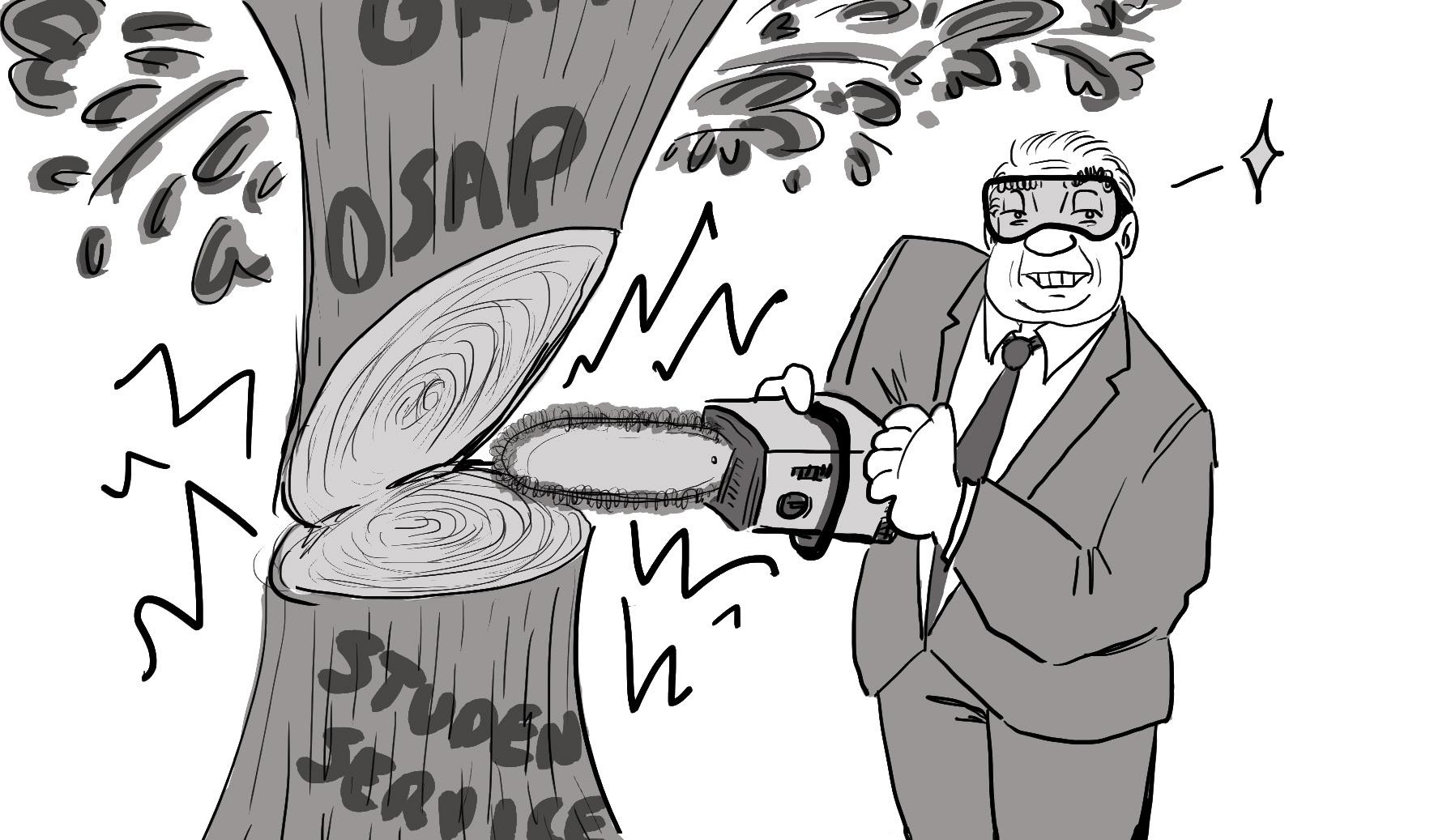
Ontario’s minister of colleges and universities Nolan Quinn announced the province will be lifting a domestic tuition freeze that’s been in place for seven years and overhauling the Ontario Student Assistance Program (OSAP) to give less grants and more loans—dramatically increasing the amount of debt OSAP recipients will leave university with. Quinn said the change will bring “sustainability” to post-secondary institutions.
This is all in addition to recently-passed Bill 33, the “Supporting Children and Students Act,” which will make ancillary fees—the fees which fund student groups and services—optional, as previously reported by The Eyeopener.
These two sweeping changes to education in the province must be understood for what they are: an attack on our education.
In the face of this, it’s crucial we don’t remain apathetic—and there’s reason not to be. Students in Canada have a history of fighting education cuts like these—and sometimes winning
In 2012, students in Quebec brought down a massive tuition hike imposed by their provincial government.
In the face of economic troubles following the 2008 financial crisis, the Quebec Liberal government of Jean Charest wanted to cut taxes and red tape to encourage investment in the province. To do so, they slashed the amount of provincial spending on universities and offloaded the remaining costs onto students in the form of a 75 per cent tuition increase.
Following months of organization among students’ unions and societies, they elected to strike indefinitely until the hike was reversed. Over the course of a semester, they ditched classes and organized demonstrations against their government until Charest came to realize students would not accept the hike.
When anti-protest measures failed, Charest called a snap election and made his campaign promise one of “law and order” against the chaos of the student protests. Charest lost, a new Parti Québécois government was elected, which canned Bill 78 and froze tuition at the pre-Charest figures.
Tuition for domestic students in Quebec remains among the lowest in Canada, according to Statistics Canada.
While the students in Quebec were facing a 75 per cent tuition hike, high above what the Ford
government is presenting us with (two per cent per year, according to the province), we are facing something they weren’t: a gutting of student services in the form of Bill 33.
Universtiy is more than academics, it’s also the groups and societies which surround them. To defund these—even partially—is an effort to turn universities into degree mills, not the spaces for meaningful discussion we need for the health of our democracy.
However, we cannot entirely blame students if they choose to opt out of these services given the opportunity. The cost of living is higher than ever and youth unemployment is skyrocketing nationwide. The youth unemployment rate hit 16.5 per cent in August, the highest in decades, according to the provincial government’s figures.
Broke students aren’t the ones to blame here. The person to blame is Doug Ford, who has been underfunding Ontario’s post-secondary institutions for years. According to the provincial government, Ontario has had the lowest perstudent post-secondary funding of any Canadian province—providing around half as much funding to students as the average province.
We wouldn’t be forced to pick and choose whether to fund academics or student services if there was enough money for both.
We’ve seen time and time again that this government does not listen to appeals to their empathy.
When a reporter brought up the hundreds of concerned calls Ford has received over the OSAP cuts, he responded by encouraging students not to enroll in “basket-weaving courses,” and suggesting students are spending their OSAP funds on “fancy watches and cologne.”
This isn’t the first time Ford has come for post-secondary funding.
In 2019, the Ford government made a 30 per cent cut to OSAP, according to the Canadian Federation of Students. They also introduced the Student Choice Initiative, a bill similar to Bill 33 which also made ancillary fees optional, as previously reported by The Eye. The bill was only scrapped when an Ontario court found it had not followed correct procedure. Bill 33, on the other hand, is watertight.
We can’t rely on the courts this time—only on student action, the kind that worked in Quebec.
The protests in Quebec didn’t come from nowhere. These students were inspired by movements like the Arab Spring and Occupy Wall Street in 2011. Months of organization took place, students created committees, held assemblies and democratically elected to strike. At its core was student democracy—without the interest and direct participation of average students, it likely would not have materialized.
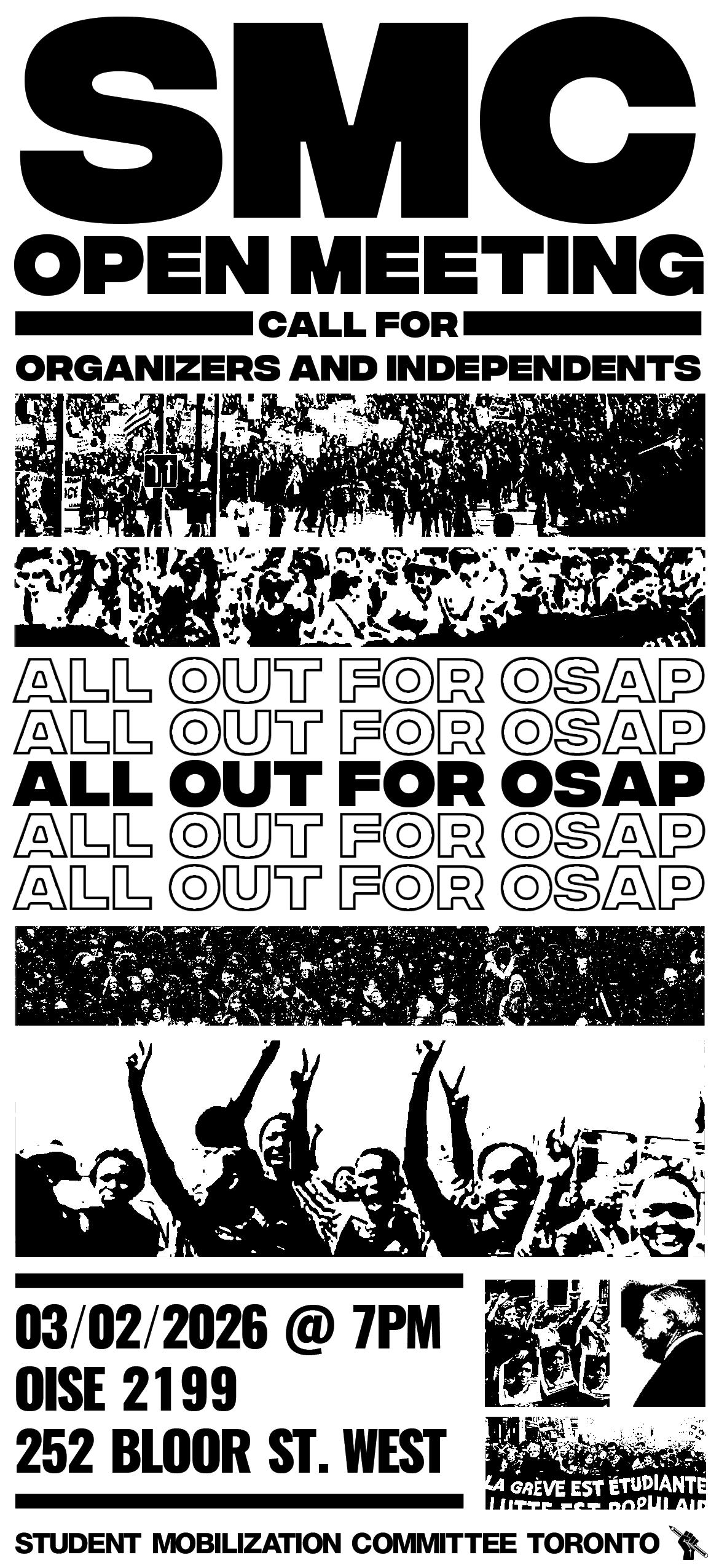
We too have examples to follow. Many students in Canada have been engaged in a yearslong fight against our universities’ investments in companies contributing to the genocide in Gaza. The Palestine solidarity encampments were some of the largest student mobilizations the country has seen in decades. We know that when it matters, students aren’t apathetic. And right now, it matters.
OSAP kickstarts students’ futures and helps make Ontario the “place to grow” Ford spends his time saying it is. Less grants and more loans will saddle students with insurmountable debt and place education entirely out of reach for others. The tuition increase, may seem marginal now, but it will pile on year-afteryear, hitting students’ wallets hard.
The situation we are in today closely parallels 2012, where both the provinces and the federal government under Stephen Harper were enacting massive programs of austerity—cutting public services in the name of balancing the budget. Now, in the face of economic uncertainty caused by tariffs, our governments are doing the same and offloading the costs onto the most vulnerable members of society.
Prime minister Mark Carney has already promised five per cent cuts to public services this year, 10 per cent the next and 15 per cent the year after that—amounting to billions of dollars. Canadian Union of Public Employees (CUPE) national president Mark Hancock said in a press release last year that “not even Stephen Harper could dream of cuts this deep.”
We are entering a period where we’re going to be told we need to pay more and expect less.
We can sit idly while our provincial and federal governments dismantle the institutions and services we’ve relied on for decades—or we can stand up to them. The more we accept austerity, the more they’ll throw at us. It’s on us to draw the line.
By Amira Benjamin, Vihaan Bhatnagar and Shaaranki Kulenthirarasa
Students at Toronto Metropolitan University (TMU) are grappling with the Ontario government’s decision to end the provincial post-secondary domestic tuition freeze and making cuts to Ontario Student Assistance Program (OSAP) grants.
Doug Ford’s Progressive Conservatives (PC) government announced on Feb. 12 that OSAP grants will be cut from 85 per cent to 25 per cent.
This means if a student from Ontario owed $20,000 in student loans, they were eligible for up to $17,000 in grants that they don’t need to pay back. Starting this September, they would only be eligible for up to $5,000.
It was also announced that at least 75 per cent of students’ OSAP funding will become loans. OSAP loan repayments may begin six months after graduation.
The average debt for a student who graduates with a bachelor’s degree in Ontario was $30,800 in 2020, according to a 2024 survey conducted by Statistics Canada.
“The federal government’s decision to remove grant eligibility from students at private career colleges, coupled with increased program uptake in recent years, has put billions of dollars of pressure on [OSAP],” said Bianca Giacoboni, press secretary for Nolan Quinn, the minister of colleges and universities, in an email to The Eyeopener.
The changes to Ontario’s student financial support frameworkwere made to align the province with other jurisdictions in Canada, Giacoboni added.
In 2024-25, the Ontario government spent $1.7 billion on OSAP grants alone—145 per cent more than 2026. In 2025-26, OSAP cost s increased to $2.7 billion.
The government also announced that starting this September, post-secondary institutions will be allowed to increase tuition every year by two per cent for three years. Afterwards, they must either follow the three-year average rate of inflation or an increase of an additional two per cent every year, whichever is lower.
Jolie Malik, a first-year media production student, said the planned cuts to OSAP grants will make her finances unmanageable.
“It’s really making it hard for me to want to continue going to school. I don’t think [cuts to OSAP grants] is the best move,” she said.
The PC government also announced their intention to raise the annual operating funding for post-secondary institutions to $7

billion and add $6.4 billion in new funding. TMU published a statement to their website on Feb. 23 explaining the changes to students.
In an interview with The Eye, TMU president Mohamed Lachemi said TMU will “continue to look for ways to…find efficiencies and cost savings to limit impacts on our students.”
President Lachemi said it’s too early to know how the funding will be allocated across the province and will affect the post-secondary sector but “the majority funding is to be used as operating budget.”
Glen Jones, a professor of higher education at the University of Toronto (U of T) and former dean of the Ontario Institute for Studies in Education, says the OSAP cuts are a “relatively regressive policy.”
Jones believes the wealthiest families in Ontario will only “spend a couple hundred bucks” more on education, while lower-income individuals “will pay several thousand dollars more” because of the shift to loans from grants.
“It’s not about increasing access. It’s essentially rewarding, to some extent, the wealthiest population and taking money to fund the system from the most needy,” he said.
“If you want to fund a higher education system, tuition is a good way to do it because everyone pays and then you can provide financial support, both loans and grants, to the population that need it most.”
This will be the first tuition
increase since 2019, when the PC government cut tuition by 10 per cent and froze it.
Jones thought the 2019 tuition cut and freeze was a “terrible decision.”
“You had lower tuition income to the institutions and you had a government that decided not to provide any additional money, even though there’s been inflation over this time period,” he said. “They essentially drove universities and colleges towards international student fees as the primary mechanism of generating revenue.”
Ontario universities have been financially struggling in recent years. The tuition freeze and receiving the lowest provincial funding in the country have led universities to significantly hike international undergraduate student tuition, increasing by 19 per cent since 2021. However, last fall, the federal government cut the number of study permits issued to international students by 49 percent, as previously reported by The Eye.
Trudy Kuropatwa Trent, a thirdyear performance design and production student and president of the Performance Student Union (PSU), says students who have reached out to her are “freaked out” over the news.
“Because of the new loan system…it makes it impossible to graduate without student [loan] debt,” she said.
“It’s impacting you, not just
throughout your educational career when you’re in school [and] you’re working part-time if you can, even if you’re in full-time classes. You’re still going to have that debt follow you around as you enter the workforce.”
Elizabeth Buckner, an associate professor of higher education at U of T, finds the OSAP changes, especially as part of a package with increased post-secondary funding and lifting the tuition freeze, “really disappointing.”
“Honestly, the stabilization of the sector is being done on the backs of particularly lower-income students,” she said. “There are many students who do not rely on OSAP for higher education, so it’s not all students who are going to be affected equally.”
“I think that that’s important to keep in mind students, who need financial support to attend college or university, are now going to essentially have to take out a substantially larger proportion of loans, as opposed to grants.”
Bernalli Rosales, a third-year performance: design and production student who has been receiving OSAP grants for their disability, believes that without the financial assistance, they may not be in school.
“I personally don’t know if I would be able to finish my degree with these cuts because at the moment, I am not in a mental space where I can work and study at the
same time,” they said.
Ekram Yimer, a second-year economics and management science student, believes the change to 25 per cent grants and 75 per cent loans will make accessing OSAP worse.
“That’s my main concern, that I’ll have to pay more out-of-pocket,” she said. “Because OSAP didn’t cover what I needed to be covered in the first place.”
Yimer also believes that her goal of graduating debt-free is no longer viable.
Kuropatwa Trent believes believes Ford’s comment that students shouldn’t take “basket weaving course” are a “distraction by the provincial government.
“Healthcare has the same problem that education has, which is privatization [and] chronic underfunding,” she said.
“Yes, you’re going into these programs that are reported to have higher employment after graduation, but that so often is not the case, and because of the privatization of our education, you’re not going to school.”
Kuropatwa Trent has been organizing with student advocacy groups to increase awareness and protest the changes.
“In the short term, what we hope to do is get as many students out and organized as possible, because when we’re united, we can and will achieve what we want, which is bringing an accessible education,” she said.
“We can’t afford, economically, not to fight back.”
By Daniyah Yaqoob AVA WHELPLEY/THE EYEOPENER
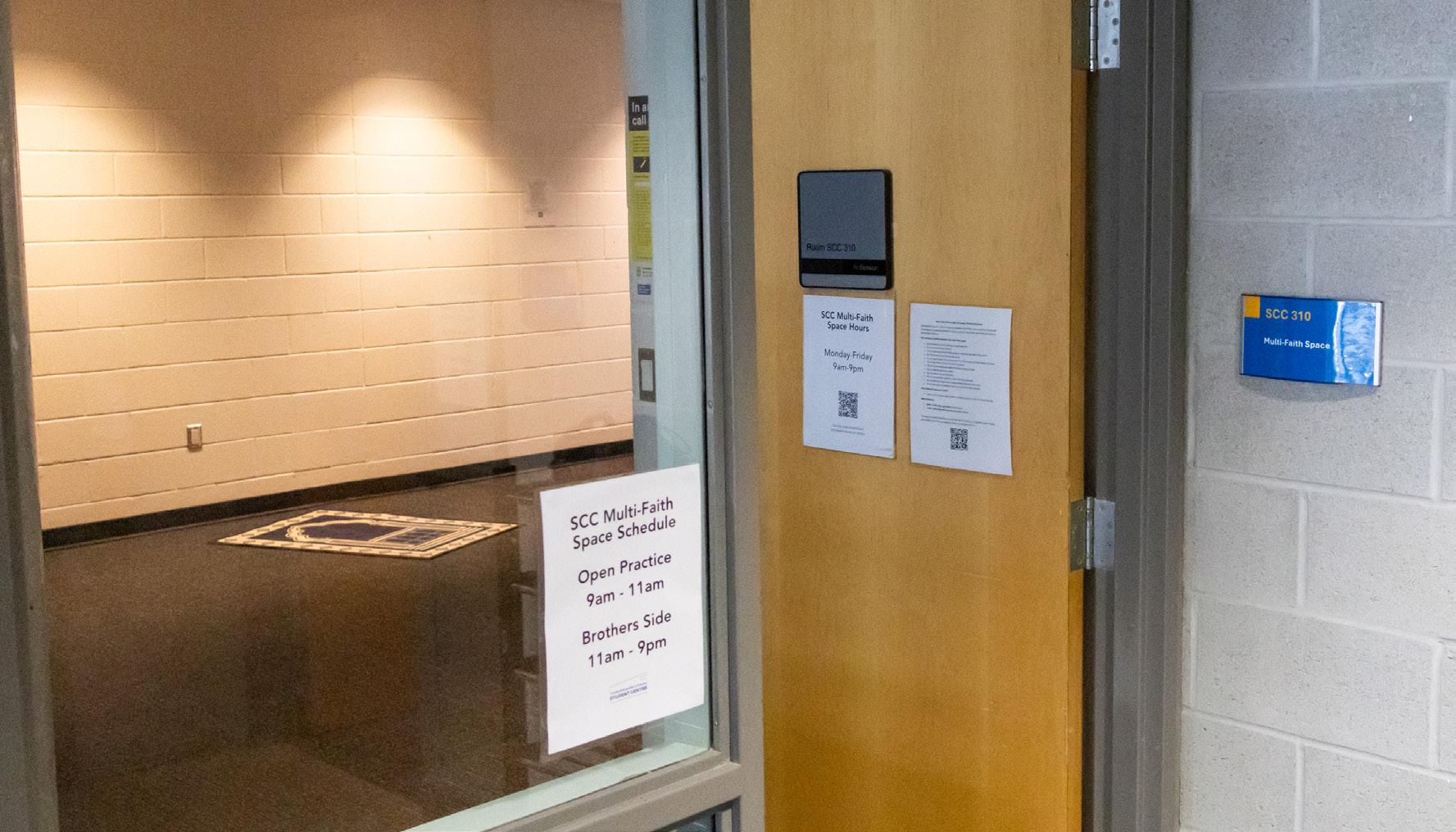
The multi-faith space in the Student Campus Centre (SCC) was relocated over reading week, to two rooms down the hall: from OAK 319 to SCC 309 and SCC 310. Muslim students who used the previous space are unsure why the room relocated—and what the change will mean for them, especially as Ramadan is underway.
The prayer room in OAK 319 was expected to close Feb. 17, with the space at SCC 309 and 310 opening on Feb. 19—either the first or second day of Ramadan for students observing, depending on the calendar they follow.
The SCC staff said the reason for the relocation was student feedback, health and safety concerns.
“Our student community has expressed issues with the existing multifaith space in OAK 319 relating to accessibility, a lack of communal space and heating/cooling issues,” building staff said in an emailed statement.
The statement also mentioned concerns about a blocked fire door due to personal items left in the hallway—hinting at the shoe rack, where Muslim students remove their footwear before stepping on prayer mats inside the multi-faith room.
Kashaf Alvi, a fourth-year politics and governance student at
Toronto Metropolitan University (TMU), who uses the room often—and even more during Ramadan—said while she understands the concerns, the old room had become a safe space to practice her faith, away from distractions.
OAK 319 is located in the back corner of the third floor of the SCC, secluded from the rest of the building. Meanwhile, the new room is right in front of the thirdfloor stairs, adjacent to the elevator and across the hall from the Toronto Metropolitan Student Union (TMSU) office, where activity is constantly bustling.
“It [would] be kind of sad, because the infrastructure over there is really good. They have a proper window area, the bathrooms and everything,” Alvi said. It is unclear if those ablution rooms will stay in the hallway and if students will have access to it after the relocation, or if it will also relocate.
Despite posters plastered around the SCC indicating the change, Alvi said she was unaware of the relocation. She felt the community was not adequately consulted in the decision.
The SCC staff said in an email their decision to move the multifaith space was made in collaboration with TMSU, the Toronto Metropolitan Graduate Students’ Union (TMGSU), Toronto Metropolitan
Association of Part-time Students (TMAPS) and the Muslim Students’ Association (MSA).
However, MSA’s vice-president of Islamic education, Abdelrahman AlQazzaz, said it felt more like they were notified of the change, than consulted.
“They told us this in advance, but I feel like they didn’t really consult us with this decision. It was very matter of fact,” said AlQazzaz. In an emailled statement to The Eyeopener, the MSA said they were given two weeks’ notice.
The relocation comes just weeks after the multi-faith prayer space had been closed for “repairs” during the winter break.
AlQazzaz said the MSA had been optimistic about the muchneeded improvements to the space. The MSA said in their statement that some students had raised complaints about ventilation and overall comfort in the room as it was.
But when students returned, they discovered little in the way of renovations.
Now, she said she’s unsure of how to feel regarding the room’s relocation and how it will impact the Islamic practices of prayer— will segregation be upheld? Will congregational prayers still take place?
“I wouldn’t necessarily say I’m excited or hopeful considering how they have done renovations in the past. It just seems like they don’t really have our interests in mind,” Yussuf said.
Read more at theeyeopener.com
By Shaden Aly
Applications for international students at Toronto Metropolitan University (TMU) have increased by 20 per cent from 2025, according to data presented at the Jan, 21 Board of Governors meeting. Students from the U.S., Nigeria, Pakistan, Saudi Arabia and South Korea saw the largest increases.
In 2025, the federal government capped the number of study permits issued at 437,000, about 10 per cent lower than 2024. In Dec. 2025, 9,665 new students arrived in Canada, a striking decline from the 95,320 students who arrived in Dec. 2023—an 89 per cent decrease—according to data published by Statistics Canada. Even as federal restrictions remain in place, international student interest in Canada remains strong.
A fall 2025 survey of future international students conducted by Applyboard, a Canadian application platform for international students, showed that 58 per cent of students surveyed said they were "extremely interested" in
studying in Canada. Only five per cent said they had no interest in studying in Canada.
For Jaewon Lee, a second-year mechanical engineering student from South Korea, safety was the main deciding factor.
He described the country as a more peaceful alternative to the U.S.
“I chose Canada over the States because I thought Canada is a safer place, especially in terms of guns and shootings,” he said.
Following the Ontario government's 2019 domestic tuition freeze, many post-secondary institutions turned to international students as a source of revenue.
At TMU, undergraduate international fees have increased by five per cent for all programs since the 2021-22 school year, the last year for which the university's annual budget reports are publicly available. The only exception is engineering, where fees did not increase in 2022-23.
Sheridan College, one of Ontario’s major destinations for international students, announced it would suspend around 40 programs and restructure its admin-
istration following significant revenue losses tied to reduced international student intake.
On Feb. 12, the provincial government announced they were lifting the tuition freeze, cutting the maximum of OSAP grants down to 25 per cent and giving $6.4 billion in new funding to universities and colleges.
The federal government also announced a decrease in the number of study permits issued for master’s and doctoral students last November—down from 73,000 in 2025 to 49,000 in 2026.
Ashika Niraula, a senior research associate at Canada Excellence Research Chairs (CERC) in Migration, explained that Canada still has an appeal, relative to other countries, that helps interest among future international students remain high.
“Canada has long been perceived as offering high-quality education and a relatively safe environment,” she said. “Even as the federal government introduced strict caps in 2024, there is still demand or attraction towards coming to Canada.”
For Mariam Abdelaziz, a
third-year interior design student from Saudi Arabia, having relatives in Canada helped ease the transition. “I would rather be somewhere where I have some -
she said.
The Eyeopener
Masthead
Editor-in-Chief

Negin “26!!!!!!!!!” Khodayari
News Editors
Shaaranki “Spammed” Kulenthirarasa
Vihaan “Afriad of Class” Bhatnagar
Amira “Food Trucks?” Benjamin
Arts & Culture Editor
Sophie “Host W/ The Most” Wallace
Business & Technology Editor
Aditi “Fact Checking” Roy
Communities Editor
Daniel “Banana Matcha” Opasinis
Features Editor
Edward “In Print” Lander
Fun & Satire Editor
Dylan “Hair” Marks
Sports Editors
Jonathan “Playoff” Reynoso
Victoria “Ready” Cha
Production Editors
Jasmine “Hayu” Makar
Sarah “Illustrator” Grishpul
Photo Editors
Ava “Dunk” Whelpley
Saif-Ullah “December 10” Khan
Pierre-Philipe “RIP Manon”
Wanya-Tambwe
Media Editors
Divine “Extension” Amayo
Lucas “Cut” Bustinski
Digital Producer
Anthony “Honk” Lippa-Hardy
General Manager
Liane “More Max!” McLarty
Design Director
Vanessa “Caught an Edge” Kauk
Contributors
Molly “What Theme??” Simpson
Courtney “Democratic” PowersLuketić
Hannah “The Best” Thompson
Kyla “Time Sensitive” Pugen
Daniyah “JHM Winner” Yaqoob
Shaden “Choosing Canada” Aly
Milla “Voicenote” Ewart
Gray “One Week Later” Moloy
Doug “Danny“ Ford
Old “EIEIO“ MacDonald
Marc “F*#k off!” Kennedy
Zainab “Manual Focus” Usman
Francesco “GOAT” Cautillo
Charlotte “Notes” Ligtenberg
Evan “History Buff” Perry

ing her undergrad. Long said her commute has become more dangerous without bike lanes.
TMSU announces a general election after last two declared invalid
declared invalid in January over multiple violations of the Election Procedures Code (EPC).
By Hannah Sabaratnam
Cyclists at Toronto Metropolitan University (TMU) are showing support for the group of bike riders who challenged the removal of bike lanes in an Ontario court in January.
In November 2024, provincial legislation to remove bike lanes in the city—Bill 212—received royal assent. Cycle Toronto, the group spearheading the challenge, successfully argued in court that the removal is unconstitutional.
Mary Long, a first-year master’s student in urban development, used to bike regularly to the University of Toronto dur -
“Back [on Bloor Street], it was nice and protected. You could go slow, it was chill, it was fun,” said Long. “I would not use any of those words to describe my commute now.”
Albert Koehl, the executive director and coordinator of the Toronto Community Bikeways Coalition, feels that more affluent people who do not use bike lanes are influencing their removal.
“Other residents in the neighbourhood who aren’t as wealthy, [who] aren’t as well connected, their interests seem to be forgotten,” said Koehl.
For him, bike lanes are a part of the solution to the multiple problems on our roads. “They’re part of the solution to getting people healthy…” said Koehl.
By Courtney Powers-Luketic
The Toronto Metropolitan Students’ Union (TMSU) announced an upcoming general election, with the voting period set to be from March 16-18.
In an emailed statement to The Eyeopener, the TMSU said that recent by-law amendments and changes to their election procedures “will limit the risks of interference in the upcoming election.”
This comes two months after the winter 2025 elections were declared invalid due to concerns about fairness and outside interference.
The fall 2025 elections’ results for the executive team were also
The TMSU added in their emailed statement that “We are confident in the work of our CRO Ghallia Hashem, who has proven herself to be fair and highly effective during the Fall By-Election despite extraordinarily challenging circumstances. All complaints were judiciously investigated and handled together with the Elections and Referenda Committee (ERC).”
The nomination period for these general elections will run from Feb. 23 to March 2. Then, the TMSU will spend March 3-8 validating the nominations and approving materials. From March 9-13, candidates will be able to campaign.









MAXWELL BECKETT WAS A student at Wilfrid Laurier University in 2019 when the federal government first allowed Canadians to list the letter ‘X’ as the sex designation on passports—instead of just an ‘M’ or ‘F.’ Beckett, who is non-binary, was thrilled.
For them, the ‘X’ signified the government’s acknowledgement of identities outside the gender binary. Despite being indifferent to the government’s perception of their identity, the ability to choose the marker was “a very validating thing,” they say.
Last year, however, the U.S. halted issuing the ‘X’ marker via an executive order on the first day of president Donald Trump’s second term. Since then, a friend of Beckett’s who lives in the U.S. has had their marker changed to something they don’t identify with.
“My first reaction was, in many ways, grief,” they say.
The decision’s consequences haven’t remained south of the border either. Trans and non-binary Canadians are feeling the blowback too.
NEXUS, a pre-approved traveler card designed to make U.S.-Canada travel easier for citizens of either country, was also amended as part of the order. As of August 2025, Canadians can no longer apply or renew a NEXUS card with an ‘X’ marker, according to the Canadian Border Services Agency in a statement to the CBC.
The Canadian Department of Global Affairs has also issued an advisory for Canadians with ‘X’ markers on their travel documents entering the U.S.
“Federal systems in the U.S. are changing to no longer accept markers of gender identity. Sex assigned at birth may now be requested by federal forms and processes,” according to the Canadian federal government website.
Beckett says they understood changing their marker to ‘X’ may come with consequences, that there may be countries they’d no longer be able to visit, but they never considered it would be so widespread.
“It was this era of hope where it felt like so much change was happening in the positive,” they say. They never expected it to change this fast.
NIKKI*, A THIRD-YEAR URBAN and regional planning and LGBTQ2S+ studies student at Toronto Metropolitan University (TMU), feels disappointment in the Canadian government for removing the option of ‘X’ on NEXUS cards.
“It’s partially run by the Canadian government and they just conceded and went, ‘no, we can just do what the U.S. wants us to do,’” she says.
Nikki, who is Transgender, has yet to make changes to her government documents. Though at one point she considered choosing the ‘X’, she says it’s now more likely she’ll choose an ‘F’ to avoid any future complications. She worries the change south of the border could make its
An executive order banning the ‘X’ sex marker on U.S. passports has bled into Canadian law—for Trans and non-binary Canadians, crossing the border has gotten a whole lot harder. By Gray Moloy
way to Canada, possibly losing the option to choose ‘X’ altogether.
El-Farouk Khaki is an immigration and refugee lawyer based in Toronto.
Khaki‘s practice has represented 2SLGBTQ+ people fleeing persecution for their sexual orientation, gender identity or both. As well as those facing persecution because of their HIV status and women fleeing gender-based violence.
Khaki says for many, a fear of crossing the border is in no way a new concern, but rather something that’s always been present in racialized communities.
“It’s a white privilege to think that borders are just checkpoints or just gateways,” he says.
Crossing the border for racialized people is rarely a comfortable experience, says Khaki. “It’s not a privilege that racialized folks take for granted.”
He points to the discrimination Muslims, racialized communities as well as Queer and Trans people are already fearing at the border. These communities have been left fearful of leaving the country or having their passports taken away.
For her, moving to the U.S. feels like a necessity if she wants to pursue this field. Not only for the choice of a school, but she says the academic community that surrounds it is much larger in the U.S.
Michaela considered applying for an ‘X’ marker but ultimately made the decision to apply for an ‘F’ instead.
“I’ve travelled internationally once since getting it, there was a lot of anxiety going through the airport,” she says.
For Michaela, changing the name on her identification (ID) was a more important step than changing her gender marker, but nevertheless it brought her comfort when navigating the world, especially when going to places where she may be ID’d.
“Having a piece of ID on me that verifies that I am what I say I am does come with a level of comfort…it feels affirming,” she says.
Michaela says she understands the risks that would come with pursuing academia in the U.S.
She believes she wouldn’t be able to leisurely cross the border as it would pose a risk to her safety. “If I did go to school in the U.S.,

“I can’t imagine why white Canadian folks with ‘X’ markers on their passports would want to cross,” says Khaki.
The choice to not cross is not always easy, given family or other obligations.
Entering the U.S. if you are a part of a marginalized community is not a safe option, says Khaki. Especially considering the discrimination even white Americanborn citizens are now facing across the U.S., he explains.
An estimated 3,600 Canadians have ‘X’ listed as the sex marker on their passport, according to the Canadian government in January 2025.
Given the travel advisory, Khaki says Canadians should be well-informed about the risks of travelling to the U.S. at this time.
“People have to decide for themselves and as to what risks they’re willing to take and what risks are acceptable and what risks are not,” he says.
MICHAELA* IS A STUDENT AT an Ontario university expecting to graduate this spring. She’s a Trans woman and is planning to attend a graduate program with the goal of becoming a researcher in Trans media studies.
Andrea Houston is a journalist and 2SLGBTQ+ advocate based in Toronto. She’s also a contract lecturer at TMU, where she teaches a course on Queer Media.
“There’s way more involved than just that one piece of legislation. I think it’s really easy, also to lose sight of history,” she says.
To Houston, the state of affairs surrounding Queer people in the U.S. parallels that of Germany during the interwar period.
During this time, famed sexologist Magnus Hirschfeld performed some of the first recorded gender transitions in human history. During that period he faced backlash and was later targeted by the Nazi government for his outspoken advocacy for sexual minorities—and for being Jewish and gay.
Houston says the kind backlash Hirschfeld faced—before the Second World War broke out—is similar to what Queer people are facing in the U.S.
“I mean, you could draw a straight line, frankly, in many ways, from that era to now,” she says.
As of this year, 648 active anti-Trans bills are being considered by U.S. lawmakers,
according to watchdog site Trans Legislation Tracker. This legislation is causing many to feel frustrated, isolated or stuck.
Houston worries these changes will cause Queer people to be less outward in their identities.
“People will retreat into the proverbial closet, whether that is not being outwardly and proudly existing as Trans. And that includes the marker on your passport and your identity document but also how you live your life, how you publicly present to the world,” she says.
As uncertainty grows in both the U.S. and Canada, Khaki says it’s important to understand the risks when travelling and crossing the border, especially for racialized Queer and Trans folk, who face a heightened risk.
Khaki advises everyone to be aware of the current state of surveillance by the government through technology, social media and the internet.
“There is an ongoing limitation of freedom of speech and freedom of association that has become evident,” says Khaki.
“It’s going to continue and most likely increase over the next while, that’s going to affect all of our communities.”
Those with marginalized identities will continue to face discrimination when crossing the border with no expectation of change.
BECKETT HAS MADE THE decision to no longer travel to the U.S.— but for them, this hasn’t been easy. Beckett is married to a U.S. citizen who lives with them in Canada. But due to the U.S.’s restriction on travel for those with the ‘X,’ they’ve been unable to travel to visit their wife’s family.
When Beckett last crossed the U.S. border in April of 2025, they knew it would be their last time in the country for a while.
Before the election, Beckett and their wife were making plans to host a family get-together in the U.S. for members of their wife’s family who are unable to travel. They were hoping to celebrate their wedding with any family that wasn’t able to attend their Canadian ceremony. “That is no longer on the table,” says Beckett.
Avoiding the U.S. because of safety concerns is becoming a common reality for marginalized communities. Unfortunately, this impact will be felt most deeply within families, friends and future possibilities. Over the holidays, Beckett was unable to join their wife’s family in the U.S. for Christmas. With uncertainty of what could potentially happen at the border if they did attempt to cross, Beckett spent the holidays alone while their wife visited family in the U.S.
As more uncertainty grows at the border, many like Beckett are up against an ultimatum: stay in the country, or travel and face the danger it may bring.
*These sources have requested to remain anonymous for privacy reasons. The Eye has verified these sources.
While the centres aim to be more inclusive for students, they often fall short
By Ava Whelpley
The Accommodated Test Centre (ATC) at Toronto Metropolitan University (TMU) is meant to be a refuge from the kind of distractions you’ll find in a large exam hall—pens clicking, students shuffling in and out, the irritating buzz of fluorescent light. And yet, I found myself writing my test in the middle of that same chaos.
The ATC is located in the basement of the Victoria Building but often classrooms are booked out on other floors as well to accommodate all the students. I typically write on the fifth floor in a classroom that sits about 30 students. I also once wrote an online exam in a basement room with roughly the same amount of seats.
The classrooms are usually half full so that everyone is spaced out. Students will come in and out of the room at different times to write their exams so there is always a lot of commotion around.
I have utilized the ATC multiple times throughout my first two years at TMU to write all sorts of exams and tests and never once have I had an experience free from distractions. While I applaud the simplicity of the test booking process, that’s about as far as I would go handing out roses.
A majority of the reason I avoid standard lecture halls is because of the anxiety I experience surrounding test-taking. Something as simple as a noisy environment is enough to make it worse, not to mention feeling ill-prepared and overthinking my future grade.
Morgan Grotewiel, associate professor and department chair of psychology at the University of Webster, said test anxiety is a real struggle for many students.
“People with anxiety can experience increased arousal in response to any type of stressor, including an exam. So this is going to look like increased heart rate, maybe muscle tension and sweating,” Grotewiel said. “This impairs working memory because the body’s resources are being used to respond to that threat, and this can trigger a blinking or freezing response while taking a test.”
For Molly*, a sport media student at TMU, relying on the ATC staff to set up her exam and accommodations is always a gamble.
“I showed up one time, and they literally looked at me and said, ‘we don’t have your test,’” she explained.
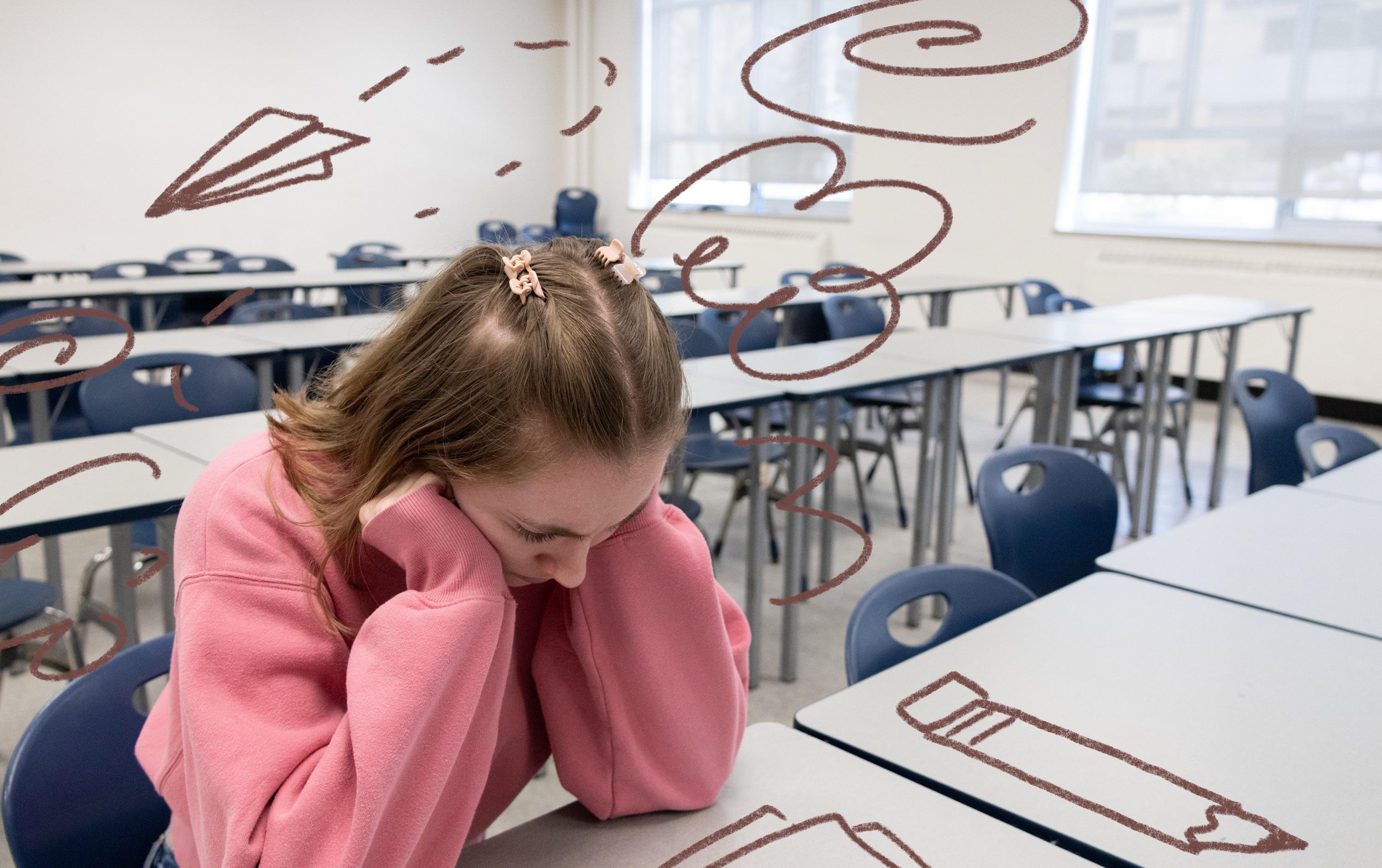
Molly recalled another occasion where the invigilators at the ATC failed to provide the password for her online test and she had to personally seek out the professor to retrieve it.
In an email statement to The Eyeopener , a TMU spokesperson said all invigilators are put through “a comprehensive onboarding process” and that each ATC room is carefully reviewed and assigned based on students’ needs.
“They literally looked at me and said, ‘we don’t have your test’”
Emma Lorez, a fourth-year occupational health and safety student at TMU, said the signin process in the basement at the ATC can be “a little chaotic.”
“There will be a lot of people down there in this small little hallway that gets really hot. [I] almost wish that I could start my test 15 minutes before most people so that I didn’t have to be in that chaos of everybody getting signed in,” she said.
When you make it past and finally get to the correct seat with your specific accommodations, the stress and distractions continue.
Without fail, every experience I have had at the ATC has involved the invigilators talking to each other during my exam. While often it is done in hush voices, it is enough to pull my focus and cause frustration.
Lorez had similar experiences with the invigilators at the ATC
before she told her facilitator and they moved her to a private room to write her exam.
“They were talking the whole time,” Lorez said. “So [eventually] I said something. I said, ‘Hey, can you please be quiet?’ They’re like, ‘Oh yeah, sorry, sorry.’ And then they kept going.”
Personally, I have not yet called them out for their unprofessional behaviour, hoping a lot of side-eying and glaring would be enough but it has yet to be effective.
Aside from the chatter, the invigilators do not seem properly equipped to deal with complications surrounding accommodations.
“Students who have concerns while writing in the Test Centre are encouraged to speak with Test Centre staff directly, and to also submit feedback through the annual Benchmark Survey,” the TMU spokesperson said to The Eye
Molly explained a situation in which the CD player provided by the ATC died mid-exam. She uses the CD player to play pre-approved, unopened CDs to assist her focus during the test-taking process.
“They were talking the whole time”
When Molly had told the invigilators that her CD player died they looked at her in confusion. She then explained that she could not complete the exam without her music, as per her accommodation. They looked at her as if they did not know what to do.
“It’s a lot of: ‘give me a second,’
‘I’ll be back,’ ‘I have to ask.’ They seem like very simple things, and that’s got to be frustrating for them as well. And those moments take up time,” she said. I also struggle with the spaces the ATC provides me with. Prior to my experience at the ATC I was studying at the University of Toronto (U of T), where I wrote exams in their test centre. One time, I wrote an exam comprising multiple sections including multiple choice, short answer and essay questions. It took me longer than 3 hours to complete but I remember feeling comfortable the whole time.
“It’s hard when you go in and your accommodation or your disability feels like an inconvenience”
A major difference was how calm and quiet U of T’s test centre was. In my specific room, there were barriers between each desk so that I could not see anyone around me while taking the exam and I did not notice people coming in and out. Because of these borders, I also could not see the invigilators watching me and I was provided with a digital clock to keep track of time. Also, the area to take a break had couches and low lighting that was very relaxing. Ultimately, the entire experience made it much easier for me to regulate my anxiety.
“You definitely don’t want people coming in and out and don’t want the proctors talking
to each other. You want good lighting, comfortable furniture in the room, maybe some white noise for background, but no other noise,” Grotewiel said.
Lorez also wrote at another post-secondary test centre before studying at TMU. She outlined all the elements that made the test centre comforting.
“There were lots of waiting rooms…there was no overhead light. I remember it had nice pot lights that [omitted] warm [light which] makes you feel relaxed.”
Many factors go into creating an accommodating environment for students with disabilities and—in my experience—the ATC has yet to achieve that.
Additionally, the ATC has failed to properly equip invigilators with the necessary tools to support students with their accommodations.
“Sometimes it’s hard when you go in and your accommodation or your disability feels like an inconvenience,” Molly explained.
Often it feels that the invigilators do not want to be there, which causes me to feel like a burden. But we need to be there, we need a space where we can feel supported and be exposed to less distractions.
“Accommodations are about leveling the playing field for students. They’re not about giving them some type of advantage,” said Grotewiel.
*This source has requested to remain anonymous due to the nature of the topic. The Eye has verified this source.
By Hannah Thompson
Disclaimer: Zoha Naghar and Mercedes Gaztambide are TMU journalism alumni. Naghar has previously contributed to The Eyeopener.
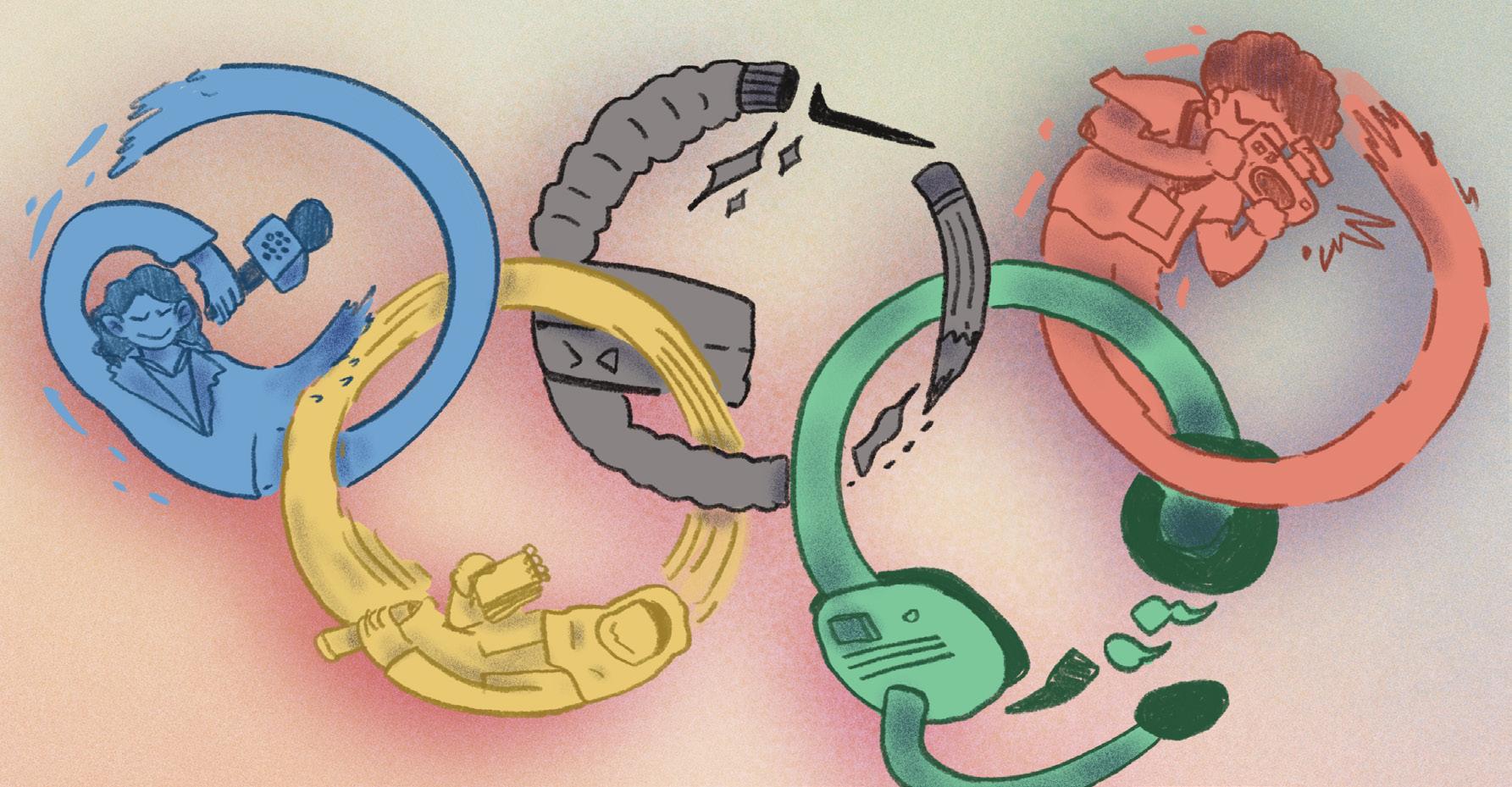
Since early February, the 2026 Winter Olympic Games have been underway in Milan and Cortina d’Ampezzo. Fans across the world have been glued to screens, cheering for every medal, watching closely for every crash, every incredible moment. But for the Toronto Metropolitan University (TMU) community, the games are more than something to watch. They provide an opportunity to create, produce and bring millions of Canadians together in real time.
At 2 a.m. in a downtown Toronto media office, everyone is watching the same screen.
A medal result is seconds away. The graphic is built. The caption is written. A finger hovers over “post.”
The moment it’s official, it goes live.
For TMU students and alumni, part of Canada’s Olympic coverage is happening thousands of kilometres away in production rooms and, in one case, high in the Italian Alps.
“It’s a 2 a.m. start,” said Ishaan Thandi, a fourth-year sport media student.
As a shotlister with CBC, Thandi monitors multiple live event feeds, tagging every crash, podium finish and reaction shot producers might need later. On any given shift, he flips between snowboarding, skiing, curling or hockey, marking the moments that will eventually become highlight packages and social clips.
The job started with a cold email.
After asking classmates how they landed Olympic roles, Thandi reached out directly to a hiring manager. That email turned into an interview and a shift schedule that runs while most of campus is asleep.
“Just being in the office when Canada has won gold medals has been unreal,” he said.
Balancing overnight shifts with classes hasn’t been easy. But the experience feels bigger than the exhaustion.
“A lot of what goes on in sport media is networking,” he said. “Meeting people and getting your name out there is huge. You learn as much from your peers as you do from the work itself.”
Across the office, Zoha Naghar’s day begins later but ends with just as much pressure.
Naghar, a 2025 journalism graduate, is the lead evening social producer for CBC’s Olympic coverage. After 3 p.m., she oversees what goes out across national social accounts, coordinating with writers, video editors and other producers to ensure Canada’s Olympic moments reach audiences in real time.
“There’s not a single hour in this office that someone isn’t putting something out,” she said.
On potential medal days, the atmosphere shifts. Everyone has a laptop open. Graphics are prepped before results are confirmed. Once the moment happens, there’s no delay.
“When you say it out loud—that you’re working for the official Canadian broadcaster—you’re like, ‘Oh my God, I’m on that team,’” she said. The scale is national. The mar -
gin for error is small. A typo isn’t just a typo anymore.
“Everything I push out from here is being seen by millions of Canadians,” said Naghar.
Still, she says the work doesn’t feel foreign.
“I felt like I belonged here,” she said. “Because I learned all of this for the past four years.”
Thousands of kilometres away, 2022 journalism alumna Mercedes Gaztambide was sent to Livigno, one of the Alpine hubs of the Games.
As a producer in CBC’s content production unit, she works directly with athletes affiliated with major sponsors, producing digital and broadcast content between competitions and interviews.
Her days move quickly, prepping questions, coordinating deliverables, assisting on broadcast segments, often all within the same stretch of time. She is constantly shifting between creative
tasks and technical ones, making sure each moment is captured accurately and compellingly.
She credits TMU’s journalism “story days” for preparing her. Though no longer part of the program curriculum, story days required journalism students to produce same-day articles about current events.
“They really throw you into the fire,” she said. “At first, it feels intense. But it forces you to get comfortable being uncomfortable. It teaches you how to make quick decisions and trust your instincts, skills you need every day in this job.”
One moment in particular stays with her.
Gaztambide watched Canadian freestyle skier Megan Oldham win gold in the women’s freeski big air final. She stood in the crowd as the national anthem played.
The next day, she interviewed her.
“To see her smile and to see her
holding that gold medal…it represented not just her as an athlete, but our entire country,” Gaztambide said. She remembers watching Oldham interact with young girls near the podium, medal still around her neck.
“There was something that really struck me about how young girls can be inspired by athletes like her.”
Within 24 hours, she saw the full arc, from competition to podium to personal interview, and captured it for audiences back home.
From overnight shifts in Toronto to mountaintop interviews in Italy, TMU students and alumni are shaping how Canadians experience the Olympics. The Games may happen in Italy but for the school’s student—past and present —community, every medal, every highlight, every athlete moment is built, produced and shared. It is a reminder that the Olympics are as much about those behind the scenes as those on the podium.
By Kyla Pugen
The roar of an ambitious crowd, the seemingly impossible catch, the disregarded underdog rising to victory—these are the moments that arguably define sports. Yet, a new force seems to quietly be taking part in the making of such moments from the sidelines. Artificial Intelligence (AI) has shifted from a novelty into a core aspect of athletics.
While data has always been part of the game, the pivot to true AI use began to normalize around 2013.
During this time the National Basketball Association began using in-arena ball and player tracking technology, which marked the beginning of modern basketball analytics. This continued with the National Football League launching the use of Next Gen Stats, which captured real-time, location-based data for every single play.
A 2024 study found that the market for AI in sports reached over $1 billion, and as of 2026, it no longer is an experiment; it is key to how
games are officiated and managed. In October, Calgary Flames head coach Ryan Huska admitted to using ChatGPT to help him understand his team’s shortcomings.
As algorithms continue to advance, a fundamental question emerges—is the pursuit of perfection and overuse of AI stripping the “soul” from the game, or is it simply the ultimate tool for human enhancement?
Some athletes, like Toronto Metropolitan University (TMU) softball shortstop/catcher Grayce Cooper, haven’t seen the integration of AI in their sport yet. AI is still at its beginnings with sports—2026 can expect to see more of its innovations and integration.
From a student-athlete’s perspective, Cooper says “AI technology in sports is good and bad,” explaining that “in baseball, [teams] are using automatic balls and strike zones which would be helpful with the close strike zone, and in soccer they use [AI] to determine if people are offside or not.”

Laurel Walzak is an associate professor of sport media at TMU and founder of the Global Experiential Sport Lab (GXSLab). She highlights the emerging technologies reshaping sports business and audience engagement.
In her recent article for Maclean’s, Walzak explored the imple-
mentation of AI in games and how it has the potential to “improve fairness in judging, make talent discovery more consistent and update training regimens.”
She also touches on how AI can combat human judgement to help identify the most physically talented amongst a group of athletes. Walzak
explains how quarterbacks in American football “were overwhelmingly white…because entrenched systems and expectations shaped who scouts saw as a natural fit for the position,” and illustrates the objectivity AI could produce.
Read more at theeyeopener.com
By Kyla Pugen
Before Toronto Metropolitan University (TMU) alum Rachel Phan was a celebrated author on the Canada Reads 2026 longlist, she was a self-described “restaurant kid” from small town Southern Ontario. Phan’s childhood was centred around the May May Inn–a Chinese restaurant in Kingsville, Ont. that her parents opened in 1991.
For Phan, the trajectory from the corners of the May May Inn to the newsrooms of TMU’s Master of Journalism program (Class of 2013) has come full circle.
Phan’s parents immigrated to Canada from Vietnam in 1978, fleeing the persecution of ethnically Chinese (Hoa) people in the aftermath of the Vietnam War.
While the restaurant was a symbol of achievement for her parents, Phan describes it as “both a blessing and a curse.” Growing up in Kingsville, she was one of only two racialized children in her class.
The conflict between being the “good daughter” at the restaurant and the young woman longing to find her own voice is explored in her debut memoir, Restaurant Kid: A
Memoir of Family and Belonging.
Today, Phan’s personal history has become a national bestseller being debated as one of the most important books in Canada right now.
Phan credits her time at TMU, specifically her time working at On The Record (then called The Ryersonian), with giving her the tools to transform her personal stories into professional narratives. “I feel like I’m the writer I am today, I’m the person I am today, because I went to school at TMU,” Phan said.
Phan described the nature of writing as “inherently a very isolating activity.” It was through her time at TMU that she learned about feelings “of camaraderie and the collaborative spirit…It taught me that you don’t have to do this on an island.”
These lessons proved to be crucial to navigate a publishing industry she described as “opaque” and stressful. By learning to view fellow writers as collaborators rather than competitors, she was able to find the support system necessary to be able to write such a vulnerable memoir.
Phan noted that the racism she experienced was often tied to an exhausting pressure to cater towards the white gaze. She recalls receiving messages from peers who projected

their stereotypes onto her, “I was getting messages from my peers about ‘oh I saw a Chinese girl in this XYZ, whatever movie or show, are you like this too?’”
“I just thought this is what I have to be if so many people are telling me this is what an Asian girl is,” she reflects. “I might as well be palatable
to them in this way, because this is how they’ve told me that they can digest [me].”
She describes the sense of a “pushpull” relationship, between feeding into what those at school wanted and what her parents at home wanted. She felt as though she was receiving the same underlying message of how
“you can never live as yourself or be yourself, because others are expecting you to be a certain thing.”
The diverse environment of TMU and Toronto provided Phan with a sense of safety she had not always felt in her youth.
Read more at theeyeopener.com
By Molly Simpson
Disclaimer: Winner Jerry Zhang previously worked for The Eyeopener but was not interviewed for this story.
Over 30 third-year photography media arts students showcased photobooks in the 2026 First Edition Book Show hosted with Artspace TMU on Feb. 5, 2026.
Students had the freedom to experiment within two overarching themes while creating the books, said Eliot Wright, the contract lecturer for MPS 507: The Photographic Book The theme ‘ new meaning’ saw students contrast old and new creations to provide a novel meaning, while ‘mapping’ invited students to capture images happening in a specific time and place to create a narrative.
Some projects weren’t books at all. One work was laid on a kitchen table display as a deck of cards for the audience to flip thorough. Another photobook consisted of record covers in a milk crate set up beside an armchair. The more traditional photobooks were displayed on a thin shelf lining the room.
Third-year photography media arts student Rowena Gao’s photobook relied heavily on her love of colour. The black-bound book hid its bright colours beneath tempera-
ture sensitive paint; when held, the paint became transparent and revealed the photo beneath.
“It’s just really amazing to have this piece of their history here with us”
Though the room was too hot to fully show the effect, Gao says she was proud of her innovative idea. Visiting the archives with gloves inspired her toward the colour-changing concept: “I really want people to touch the papers and kind of feel it.”
Third-year photography media arts student Gordon Nyenhuis’ work was used as the event poster, displaying a composite of black and white images of a man’s head in motion. Nyenhuis said he wanted to depict headaches as a “state of being.”
He was drawn toward this theme after jaw surgery left him with frequent headaches and migraines.
“When you have a headache it just kind of takes over everything…it’s such a small banal thing but it just feels very all-encompassing,” he said.
Wright said the class encourages students to consider more than individual photos, instead placing their work into “sequence and narrative.”
“Some books…might be like a Chopin piece that’s very calm and occasionally has this little frill but overall it’s very delicate. Some books

are like heavy metal, they’re just like an onslaught of full volume, very loud photographs with very little relief. And others weave back and forth between…melody and the cacophony at different points, and that just really depends on the subject and how they want to communicate their ideas,” he said.
“...operating in the art world doesn’t have to be scary”
The winning works will be housed in the TMU Library Archives & Special Collections. Since the first award in 2015, the collection is now 81 pieces strong.
Winners included Nyenhuis, Ethan Barruch, Carter Henry, Evva Sofia Pereira and Jerry Zhang.
Alison Skyrme, the TMU special collections librarian, convened the judging panel tasked with selecting the winners. Image arts assistant professor Michèle Pearson Clarke, previous year winner Aidan Clark and Lee Chapman, multimedia and graphic designer for the TMU Library, made up the panel.
Panelist criteria looked at the “cohesiveness of the design, the images and the text,” said Skyrme.
Skyrme discussed the legacies winners leave behind. Many have showcased successful exhibitions
or become professors of photography. “It’s just really amazing to have this piece of their history here with us,” she said.
This year the award was funded by the Photographic Historical Society of Canada.
Syd Deneau, the Artspace TMU installation coordinator, wants students to remember the event is a celebration even if their works didn’t win.
“I hope they know that operating in the art world doesn’t have to be scary. It’s kind of just a room of your friends, and peers and mentors coming together not to critique, but to talk about your work,” they said.
By Jasmine Makar
Toronto Metropolitan University
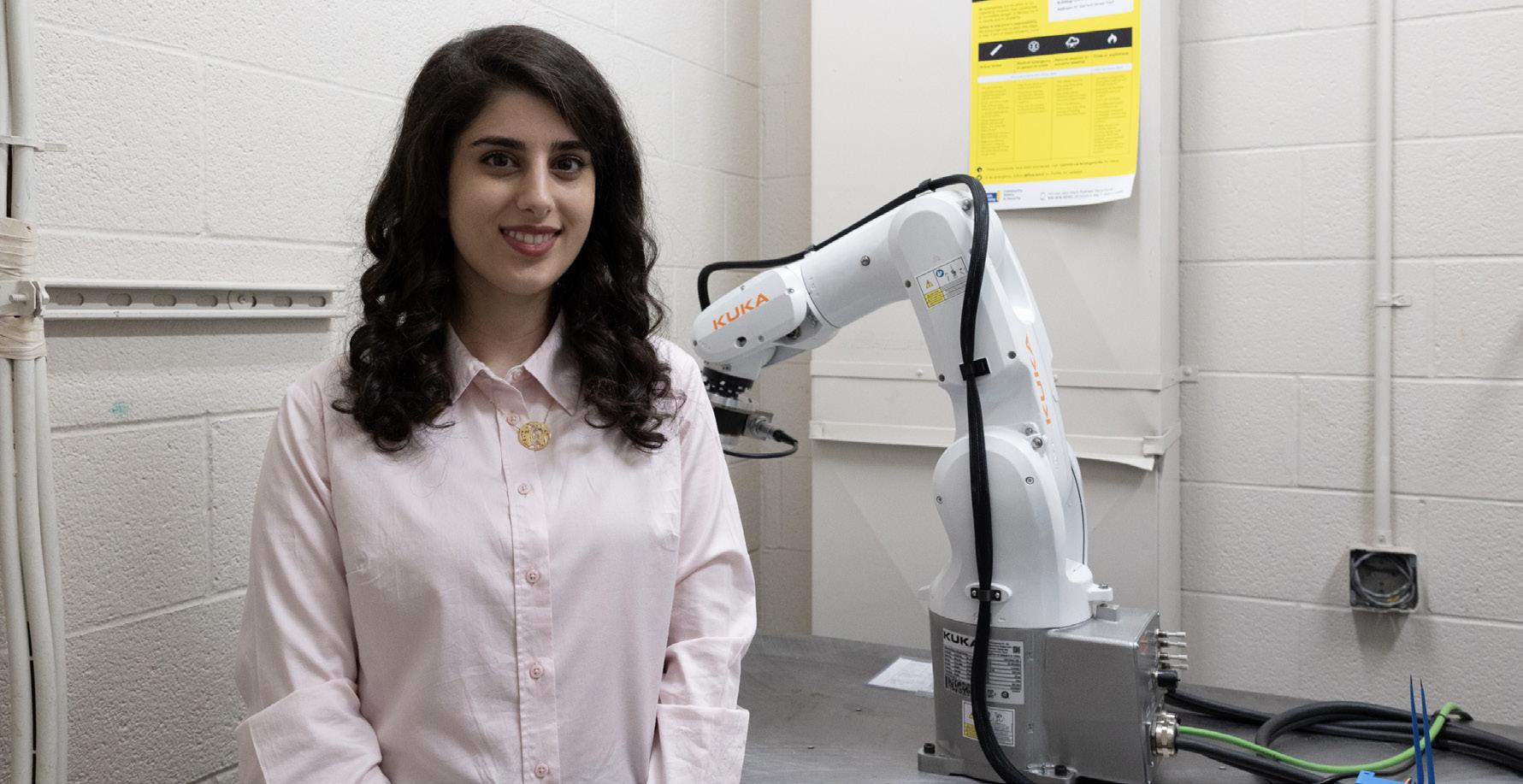
PhD candidate Haniyeh Altafi is developing a robotic arm designed to perform remote surgeries to help healthcare shortages in rural areas around the world.
The fourth-year mechanical engineering and robotics PhD student is mainly focused on developing a way for doctors in larger cities to be able to perform surgeries without having to travel, while shortening patients’ wait time for adequate care. She describes her largest hurdle in this project to be the internet and other issues that arise in such a high-stakes environment.
“Even milliseconds of delay can have a detrimental effect on the patient. So we have to make sure our system is reliable in a remote location working perfectly,” said Altafi in reference to internet delays.
Altafi admitted that this problem is more or less inevitable, but she is looking at what “other things we can do to make sure the procedure is done safely.”
She was initially inspired by her own experience with rural healthcare. Altafi’s grandmother suffered from breast cancer while living in a rural area in Iran. The healthcare options in the area were sparse, and by the time she had gotten a hold of a doctor, it was too late.
While robotic arms that conduct surgeries do exist in the field already, Altafi’s version will have the ability to perform it remotely, opening up new possibilities.
“So da Vinci robots, in 2025, added this feature of force feedback, but they’re not working in a longdistance or teleoperation system. There they are in the same room,” she explained.
Da Vinci were cleared by the U.S. Food and Drug Administration (FDA) in 2000 for operations, but the surgeon controls them within the same operating room. The main goal of this three-four armed robot is to increase the dexterity of the surgeon and the general range of motion for hard-to-reach areas, according to the Cleveland Clinic.
Altafi is currently working on a “force feedback” feature in her robot that the da Vinci robots also possess.
“What that means is that whoever is running the operation will be able to feel what it’s like. When you’re working with your hand…you can feel if it’s soft, if it’s solid, rigid, or any kind of texture. But when you’re working with a robot, you cannot understand how much you’re pushing and how much force you’re putting into the system” said Altafi.
Altafis robot is still in the testing phases and is waiting for ethical approval. She is currently working on inviting participants to experiment
with the robot and gather the data to be able to modify the prototype.
Kourosh Zareinia, associate professor in the department of mechanical, industrial, and mechatronics engineering, has been Altafi’s research supervisor for the past four years having first-hand experience with robotic surgical arms.
Zareinia started getting involved with the project neuroArm in Calgary following his PhD. According to their website, neuroArm is “a global first MRI-compatible image-guided robot for brain surgery.” Following that experience, he continued research in similar fields. Both Altafi and Zareinia emphasize that despite the robot being prototyped now, there is still a lot of work needed before they bring this arm to the market, it will likely take several more years.
“Usually, these types of research that are done, are the base for future developments and improvement [for] those robots. So if you do something today, let’s say you design a new needle, for example, today it gets to the market after 10-15 years,” said Zareinia.
He stressed the need for extensive testing given the ambitious nature of Altafi’s project.
Existing robotic systems do not take into account internet and communication problems because of the close proximity of the surgeon and robot, but in this case, “doing teleoperations from a distance where the quality of the communication tunnel and delay become important,” said Zareinia.
He also spoke to the complexity of skills needed to a design such a concept, especially with its niche technicalities. “In robotics projects, you need to know a lot. You need to know about mechanical engineering, about materials. You need to know about programming computers, programming electrical circuits, and many other stuff and obviously, no one has all these skills.”
In 2025, the median wait time from a referral to treatment was 28.6 weeks, and across 10 provinces in Canada, patients waited for 1.4 million surgeries, according to the Fraser Institute. The Canadian Journal of Surgery also
By Milla Ewart
A Toronto Metropolitan University (TMU) class of 2020 alumnus is building a prediction exchange that aims to comply with Ontario guidelines as Polymarket faces a two-year ban.
Prediction markets let users trade on yes-or-no contracts whether a specific result will happen by a certain date. As interest continues to grow, particularly among young people, a TMU alum using the pseudonym MJ is developing a Canadian prediction exchange, arguing regulation is better than prohibition.
MJ says his creation, the Toronto Prediction Exchange (TPX), is corresponding with the Ontario Securities Commission (OSC) to become a regulated exchange using Canadian dollars, saying “we’re funded and ready to have these conversations and explain why we’re not binary options.”
Canada has banned such platforms due to concerns of manipulation and
ethicality. Users can still access USbased platforms, such as Polymarket and Kalshi, through VPNs.
As they fall under the categorization of binary options, prediction markets were banned by the Canadian Securities Administrators in 2017.
Binary options are short-term trades with only two outcomes—if the prediction is right, one receives their pre-determined payout. If wrong, their investment is lost.
Polymarket, an Americanbased cryptocurrency prediction market, was available to Ontario investors between June 2020 and May 2023. Polymarket did not obtain approval from the OSC, and was able to provide services to Ontarians by operating online from outside the country.
After breaching OSC rules, the company reached a settlement in 2025, paying CA$200,000 and is currently under a two-year trading ban.
While prediction markets are
still outlawed in Canada, the business of these markets have seen explosive growth in the United States—growing from less than US$100 million monthly trades in early 2024 to more than US$13 billion per month by the end of 2025.
The TPX website launched on Dec. 25, 2025, recreating the experience of a prediction market using virtual currency, with no monetary value.
“We have the opportunity to do a real good thing here and give a regulated environment for Canadians to participate,” said MJ.
To further reduce risk, he adds that the team is working with data scientists and researchers to develop algorithms that can detect unusual activity and market manipulation on the platform.
“People have to realize, if you’re a student with no mathematics background, your competition is a data scientist who is an expert and they have a desk of people of like four or five traders, with a team of like
states that despite at least 18-30 per cent of the population living in rural areas across the country, only 8 per cent of general surgeons work in rural hospitals, leaving a disproportionate gap.
“Because of the volume of the patients and the population that grows and the need for more doctors, we get to a point [where] not all these procedures can be performed by humans…so we have to move towards that.”
Ontario urologist and member of the Society of Rural Physicians of Canada, Dr. Emmanuel Abara is optimistic about this technology. His medical practice mainly focuses on “using technology like telemedicine and has established satellite rural urology clinics in Northern Ontario for teaching and mentoring.”
In regard to the future of remote surgeries, Abara believes that it is appropriate to introduce this type of innovation if the technology is available and there are resources to fund the service.
Read more at theeyeopener.com

20 engineers supporting them,” MJ warns students.
For MJ, the intention of the TPX is not to encourage risky behaviour, but to acknowledge the reality behind these platforms.
The idea behind MJ’s platform seems to resonate with students as they continue to express interest in the field of prediction markets.
Michel Tadros, a third-year business management student, would “absolutely” use prediction markets
if legalized in Ontario. “I find it very fun… I know a lot of my friends and peers would also, it would be something that they’d be very interested in,” he adds.
Sebastian Kokalov, a third-year business management student, says “I think because it gives them a little more control in their life. They want to sort of make money where they originally think they couldn’t have.”
Read more at theeyeopener.com
By Doug Ford
Disclaimer: While Doug Ford is actually fucking your chance at financial freedom right up the ass, he did not actually write this article.
You kids are really making a ruckus over this OSAP stuff, so I’ve come to set the record straight. There’s no ‘fast lane’ to success, trust me, I tried to get them to add one onto Highway 401.
It all started with my ma and pa, the shining pillars of the Ford Clan. From a young age they pushed me and my brother to become the people we’d always dreamed of. I remember their positive affirmations, “you’re easy,” “you’re cheap,” “you’re open for business.” We’d repeat them as a family in the mirror every morning.
To all the students—I made that basket-weaving comment as someone who’s walked in your shoes. I spent two long months attending Humber College. Back in my day, useless industries like basket-weaving would never be taught in schools. Then I dropped out, aiming for a real homegrown Ontario industry—my family’s label-making company. It wasn’t easy without OSAP.
From those two months spent studying I owed Humber College $5,000. It was closer to $250 but I’m adjusting for inflation. The inflation that all you greedy students are causing.
I worked tirelessly at our family business to pay off my student loans, expanding our business into Chicago and later acquiring another label business out of New Jersey, in a country where people make real money. There’s no business like taking your business elsewhere!
My message to students today is simple — if you want it, work for it! Take all that time you spend protesting outside of Queen’s Park and go get a job, there’s tons of them out there. Better yet, drop out of whatever rinky-dink major you’re studying and go into healthcare, a career where you can really pay off your loans.
And if that doesn’t work, wait for mom and dad to kick the can and pay your loans with your inheritance! If only those weren’t taxed amirite?
Look, I’m trying to solve the problem here. I’m building a whole spa for you hooligans to work at. Pretty soon you’ll be able to scrape the bottom of my fourth cousin’s cankled feet for twice what they pay those ladies

in Thailand. And you can thank our shareholders for that.
When I was elected a City of Toronto councillor I donated my $100,000 annual salary to community organizations. Yeah, and I still made it here today. You all wanna be like “oh how did he afford to do that,” and “oh he must be rich,” how about a thank you? It’s actually so lame that you guys are complaining about this. Like, embarrassing much? Just

say that you’re poor. Not me, I’m stinkin’ fucking rich. I’m rolling in cash like a greased up hog on a mudslide. My pockets are so lined the greenbelt couldn’t hold them up.
You all honestly just have to get like me. I don’t even know what else to say. Why don’t we just forget all this “education” bullcrap and start heading up to Northern Ontario for some real work. Our province’s bright -
est minds could make sooooo much money doing backbreaking labour and mining through Indigenous land. Oh yeah also the Science Centre’s closing, I’ll give you dollar beers, anyone against me wants porn in our schools, the carbon tax is why you’re poor, CUPE is a terrorist organization, yada yada yada. All your racist uncles are going to vote for me anyway so see ya next term!

The Eyeopener is giving away two $25 gift cards to IKEA
Find the giveaway rules through the link in our Instagram bio.
1. Complete the crossword! Only 100 per cent accurate crosswords will be accepted.
2. Complete the Google Form via the QR code on the page and add a photo of your completed crossword!
3. Await an email! The form will close end-of-day on March, 1 and winners will be contacted shortly afterwards and asked to come into our office for photos!
Submit Completed Crossword Here

Nikki Yanofsky’s 2010 epic anthem
‘I Believe’ is an all time classic for any Canadian. And legally, if we say the song is super great and that you should go listen to it, we can use the photo below! GO LISTEN!!!!!!!

Q: I’m pretty sure the guy I just started dating is a part-time cocaine user. Will this put a strain on our relationship?
A: I have two things to say here. Firstly, why would coke put a strain on a relationship? You could go places you’ve never dreamed of together. Secondly, if he’s only a “part-time” user, how can he stay committed to you if he can’t even commit to coke? Originally published Sept. 21, 2011.

I’m the guy who “cheated” in Olympic Curling
By Marc Kennedy
Ok first of all, I did not touch it, I literally swear on my freaking life. Second, even if I did, which again I swear on my freaking LIFE I didn’t, who even cares? Most of you slop munchers and fuddruckers online throwing @’s at me in the comments don’t even know the kind of sacrifice it takes to gently hurl and curl those beautiful rocks down the sheet. So, as I said on international television, you can f**k off.
DOWN
1. He stayed calm, cool, and collected in the dual moguls final, defeating Japan’s Ikuma Horishima to claim gold.
4. Canadian freestyle skiers chased medals in this bump-filled event.
6. Canada’s national winter sport heartbreak in the gold-medal final.
2. Ice sport where Canada was accused of cheating against Team
3. He was named Team Canada’s Most Valuable Player in Men’s Hockey.
5. The combined name for the first Olympic Games to be officially co-hosted by two cities.
7. Canadian Olympic hero who scored the “Golden Goal” in 2010.

Scream 7 (Paramount) I guess nobody heard the first six screams.
Nirvana The Band The Show The Movie (Neon) It’s like if Back to the Future and Popstar: Never Stop Never Stopping had beautiful intercourse and made a baby.
Wuthering Heights (Warner Bros) She Jacob on my Elordi till my wuthering heights.
Hoppers (Disney/Pixar) It’s like Avatar but for kids and bad.
The Moment (A24)
If you take your grandfather to see this movie he will die.
by