
per
can now only receive maximum $600 in base funding per year, with the option of grant funding
By Shaaranki Kulenthirarasa
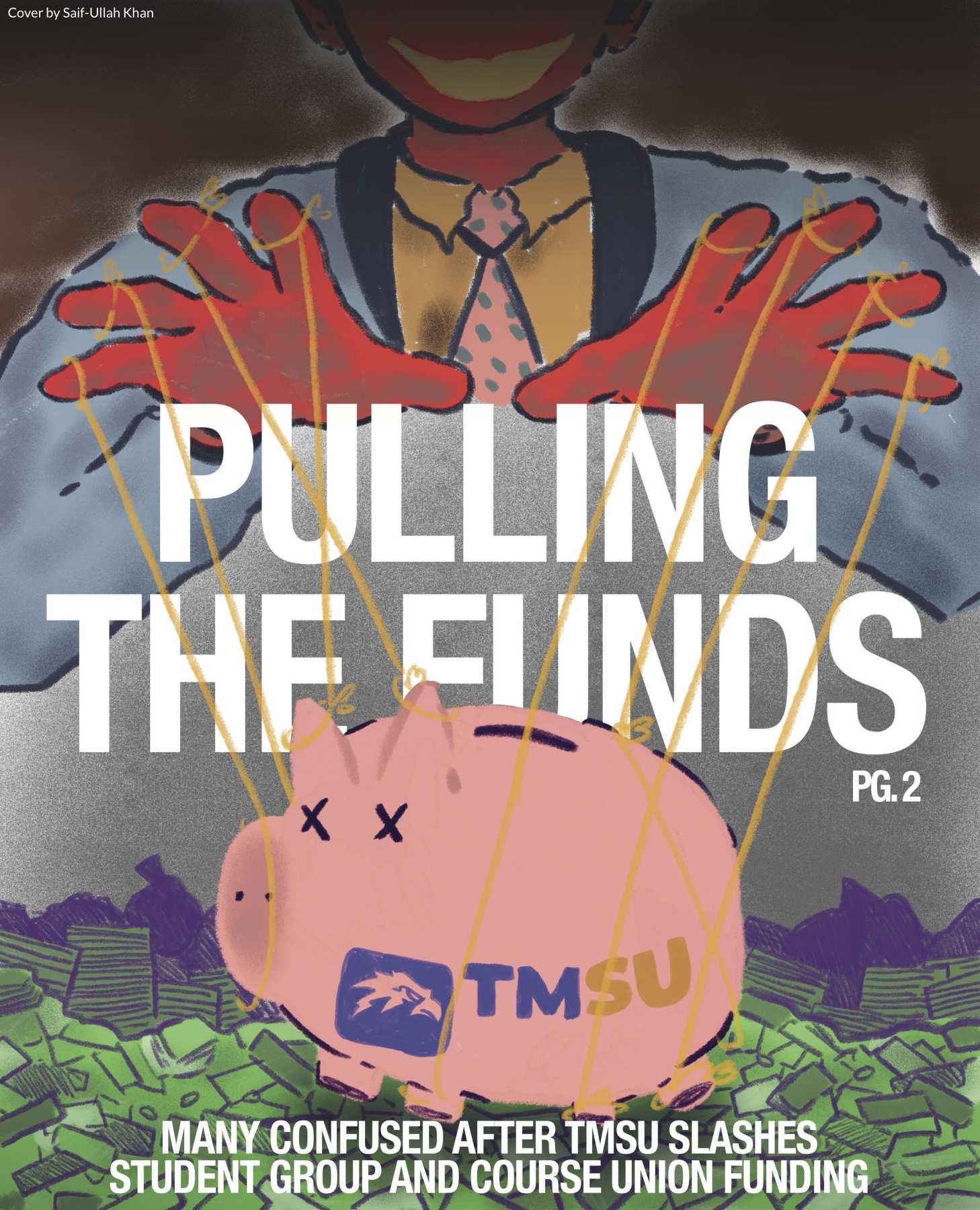
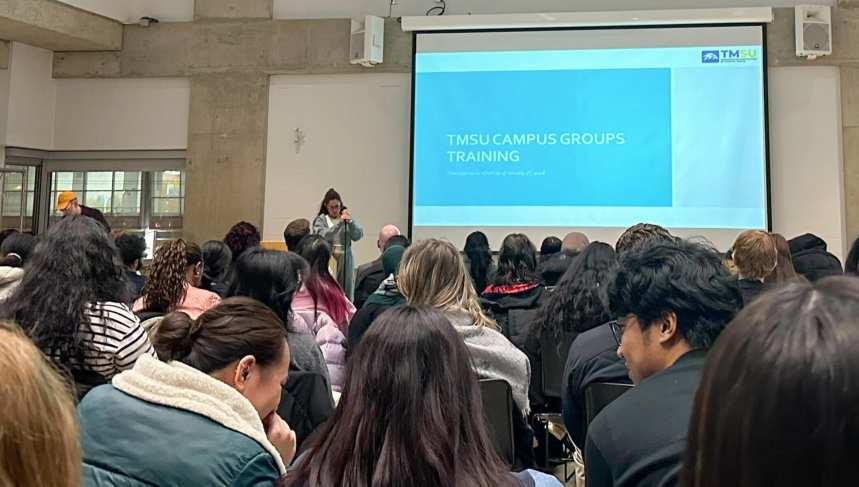
The Toronto Metropolitan Students’ Union (TMSU) announced last week they will be reducing annual funding for student groups and course unions from $1,500 to $600 per year in base funding. The announcement was made at campus groups training sessions on Jan. 28 and 30.
The changes were passed in an omnibus motion—all at once—at the Semi-Annual General Meeting on Dec. 2, 2025 and came into effect onJan.1.
The TMSU held the mandatory campus groups training event to discuss changes to policies that would apply to student groups and course unions. All campus groups had to attend one of the two training sessions with a minimum of two executive members from each group required toattend.
According to the TMSU’s website, there are 139 campus groups under them.
Many students say they left the training sessions with questions still unanswered, including Batool Qasim, fourth-year professional communication student at Toronto Metropolitan University (TMU).
“There are clear demarcations of what base funding is, what event funding is and what exceptional circumstances mean, but these policies don’t make sense in many ways,” she said.
Qasim says many questions regarding funding for the 2025-26 school year remain unanswered.
“Many student groups have been left in the dark because we have submittedrequisitionsthathavenotbeen answered and the TMSU changed their policies overnight without informing students that these policies willbechanging,”shesaid.
The following is a rundown of the changes announced in the training sessions:
Base funding application, which can be used as operational costs for a campus group, will run from Feb. 2 to Feb. 11 . Campus groups must now apply for base funding and can receive a maximum of $600 per school year.
Examples of expenses that are eligible under base funding include promotional materials such as banners and promotional items such as water bottles and website fees.
Event funding is provided to host social, academic, cultural, recreational and athletic events.
Campus groups can apply for up to $6,000 in event funding per-year with each event costing a maximum of $3,000.
Co-hosting events will not increase the maximum amount that can be spent.
Due to the delays in funding for the 2025-26 school year, campus groups can apply for $6,000 in funding just for this winter term.
Application for event funding opened Jan. 28 and will close Feb. 9. Groups can still apply for event funding for events held in January.
Course unions must request orientation week funding, and this should be sent in early August moving forward.
Exceptional circumstance funding is for unexpected events such as the requirement of urgent IT services, accessibility or inclusion support and emergency travel costs. Exceptional circumstance fund requests under $1,000 should be submitted three weeks in advance.
Fund requests over $1,000 should be submitted four weeks in advance. If last minute circumstances arise, students should reach out to the TMSU’s Campus Groups Coordinator.
“Exceptional circumstance fund-
ing is to be applied for three weeks in advance but if something was happening three weeks in advance, it’s not an exceptional circumstance, it’s a planned event, so it makes no sense,” Qasim said.
Students must apply for funding within the time period that is specified and unused funding will not roll over to the next year. To be reimbursed, students must be itemized and should be submitted within 30 days of purchase.
In certain circumstances, the TMSU can issue vendor payments directly by cheque. Applications must be submitted as one PDF file.
Qasim’s student group, the Professional Communications Course Union (PCCU) has received funding from sources outside of the TMSU including the Society of the Creative School (SCS). However, she notes that the circumstances are not the same for all student groups.
“The money is being lowered [for base funding]. It’s 600 dollars for an entire year which is
By Emily Nascimento
While some use the WalkSafe program, many Toronto Metropolitan University (TMU) students say they have never used WalkSafe, raising questions on its effectiveness and visibility on campus.
WalkSafe is a free program that partners students with security guards, who escort them where they need to go.
To use the WalkSafe service, students can send a text message to their number, which will send a uniformed guard to their location.
“Our campus is located at one
of the busiest intersections in the country…This means that challenges in the broader downtown community also materialize on campus,” said a representative for TMU’s community safety and security team.
“Walksafe is considered a priority call and dispatched immediately,” they said.
The university said they track walksafe requests to confirm requests received and completed. They said they have no plans to make changes to the program and said they have not received any negative feedback, but they encouraged the community to share their experiences with the service.
Johanna Minga, a first-year creative industries student who has used the service before, said it was helpful during late hours.
“At the time I was living on Jarvis Street...[and] some of my courses would wrap up late...It just made me feel more comfortable going home at that hour,” she said.
“I have an app that sends me crime alerts and it pings constantly, so it just makes me feel more comfortable [knowing I] have someone [to] walk me home,” said Minga.
However, some students on campus haven’t used this service themselves, sharing how they
not enough for a student group that is relying only on TMSU for funding.”
Affiliate groups—groups that belong to a third-party organization, but operate specifically on the TMU campus—are now considered student groups.
Jini Moon-Kwon, a fourthyear arts and contemporary studies student and member of HanVoice TMU, said paying for events can be difficult for groups that run large-scale events.
HanVoiceTMUwasoneofmany affiliate groups that now fall under the student group category .
“I think it might be harder for [campus groups] when [they can’t be paid] upfront for something but they can only receive reimbursement...if they don’t have money in their trust accounts, I feel like there should be a workaround around,” she said.
The process to apply to become a student group has not changed. New student groups are still required to complete a cover letter, a constitu-
tional letter, an executive signing offer list and a member sign-up list of at least 20 full-time TMU students. This application will now have to be submitted to the TMSU website and notthecoordinator.
The application period for the fall term is from Sept. 10 to Oct. 5 and from April 10 to May 5 for the winter term according to the slides presented at the training—it is unclear exactlywhatthisincludes.
Existing groups have to submit a renewal application. If an existing group fails to do so, the group would bedeemedinactive.
Groups cannot host events during theapplicationrenewalperiod.
The majority of the changes were made to the funding process. Despite the shifts, students like Rezwan Karim, a fourth year computer science student at TMU hope these changes are for the better.
“I’m pretty sure [the TMSU is] trying their best to avoid whatever happened in the past, and I do feel that if we do support this, it might turn out to be [better],” he said.
heard about it through friends and classmates, or not at all.
Emerson Setto, a second-year English student, said promotion might play a part in students’ lack of knowledge.
“They promote it at orientation events and whatnot with [the] business cards that they give,” said Setto, “But that being said, I feel like there could be a bit more of a push to encourage the system.”
Sunny Poonwassie, a second-year aerospace engineering student hasn’t used the program because she normallywalkswithfriends,buthasseen a student use it before. She thinks WalkSafeisanimportantprogram.
“I think it works well [not only for] defense, but the fact that someone’s with you, it kind of scares off other people that might want to [do harm],” said Poonwassie.
However, Poonwassie says it would be nice if the school extends the route of the service.
“I know it is a lot to ask but there are some shady areas like Sherbourne and such,” she said.
Santiago Gomez, a third-year electrical engineering student agreed. He said TMU security guards should be present at TMU station to safely escort students to and from campus.
“[It’s] the best place for people to know that it exists.”
By Nadine Alsaghir
The Toronto Centre Tenants Union (TCTU) gathered at The 519 Community Centre on Jan. 28 to host a tenant organizing and training session, highlighting the importance of combining multiple tactics for success in tenant campaigns.
The meeting outlined several step-bystepprocessestoadvocateforbetterhousing rights. It begins with talking to neighbours and hosting social events, then following up with a tenant survey.
Cost of living was the dominant issue among Canadian voters in the 2025 federal election, with housing affordability being one of the top issues as well, according to the Spring 2025 Focus Canada survey by the Environics Institute.
Founded in November 2023 and inspired by the York South–Weston Tenants Union, TCTU organizes tenants across Toronto.
Benjamin Deans, founder and leader of the union, said the focus of the training was practical action. “The first thing is we want people to just keep fighting for better housing,” Deans said.
The “grace period” of 14 days when a landlord cannot file to evict you was shortened to seven days on Nov. 24, 2025, when Bill 60 passed in Ontario. As it
raised a huge concern for renters, Deans adds that it is particularly a concern around own-use evictions.
“If there’s an own-use eviction, so like your landlord moves into your apartment and they evict you for that, or their family moves in, like before they basically had to pay you some money and now they could sort of get out of that if they give you more notice,” Deans said.
For Lenny Devereux, a Toronto Community Housing Corporation tenant, the training taught them the importance of community.
“I liked the sort of escalation of tactics, obviously starting with community building, because without community and trust, you can’t really have solidarity,” Devereux said, noting that there are people on their floor they didn’t get the opportunity to speak to.
Haley O’Halloran, another attendee at the training, shared a concern about the stress of the rental crisis. “I think there’s an extra anxiety and I think it also makes you more nervous about your employment and anything along those lines,” she said.
Devereux emphasized that tenant unions mobilize people who aren’t part of a more traditional union, such as a workplace union.

“It’s kind of like a self-strengthening sort of process, you get involved and maybe you have a loss, but you’re still angry and that energy has to go somewhere,” Devereux said.
Zain Fayaz, a first-year engineering student, is renting an apartment just off the University of Toronto campus.
“I’m on the tail end of using the last of my savings from jobs I worked throughout the summers for the City of Mississauga,” he said.
Fayaz mentions his family support has
been essential and significantly helped towards his payment. According to a recent report by consumer insights group Studenthaus, Toronto students pay almost $500 more in rent than the national average.
Fayaz added that he will need parental assistance in future years. Without that support, he said, continuing his education would have meant “financial suicide.”
Fayaz said he is already considering leaving Toronto after graduation for cities like Montreal, where housing costs are significantly lower.
By Jane McDowell
Toronto Metropolitan University (TMU) students say they will be negatively affected by Premier Doug Ford’s recent mandate—a full-time, five-days-a-week, inoffice return for all Ontario Public Service (OPS) workers.
Before Jan. 5, OPS operated on a hybrid, flexible work model, allowing workers to split their time between corporate offices and online locations, with a significant portion using a three-days-a-week in-office policy, a model well-loved by OPS workers.
However, now all OPS workers— around 60,000—will be required to work in the office five days a week.
With many university students working or wanting to work for OPS, concern grows for how this mandate will deter and affect students’ ability to work for government and public service jobs, and whether they’ll be able to at all.
Visalini Ragurajan, a fourth-year accounting and finance student at TMU who has worked for the federal government and has considered working for OPS in the future.
She said the in-person mandate poses challenges to students.
“Hybrid work saves [student] employees a lot of time and money because as a student, I know that commuting from the east side to the city can take so much time. It nearly takes me two hours back and forth,” she said.
Another student who is doing her co-op
placement as a job evaluation specialist at Job Evaluation Initiative Branch (JEIB) under OPS who wishes to be anonymous due to protecting her job agrees.
The student said that most employees in their department work from home after submitting accommodation requests.
“Even coming in[to] the office, it’s just mostly sitting behind a screen and [...] none of the meetings are in-person, they’re all online. So, it kind of defeats the purpose of coming in office versus staying at home,” they said.
The Ontario Public Service Employees Union’s (OPSEU) Central Employee Relations Committee chair, Amanda Usher, reached out to students across the province about their struggles with this mandate change.
“The return-to-office mandate is actually hitting the students and young workers the hardest. These are students earning student wages as per our collective agreement, which is often minimum wage or just above, who don’t own cars and rely on transit, said Usher. “And now they’re being told to commute into Toronto five days a week and for some of them, that commute can cost like a huge chunk of their paycheque.”
Not only are there now new struggles with university students’ ability to manage OPS jobs, but now students’ ability to keep their jobs is at risk.
“The more that the government still has to spend money on office space, the less like-
ly that they’re gonna get hired for a full-time position—and often younger workers are the first to be laid off, especially if they are new, if the government decides to start cutting,” said Gerard Di Trolio, a labour studies professor at McMaster University.
As an upper year student, Ragurajan is concerned about this.
“I think a lot of people graduating are a hundred per cent looking for full time opportunities in this job market [...] if there [are] still limitations, it is going to be challenging for graduates who are just going to find work spaces,” she said.
People have expressed distaste online about this mandate change, not only with the little consideration for workers but the lack of transparency and conversation the Ontario government had with organizations like OPSEU, who were given less than
45 minutes’ notice and were not consulted on this change.
This has caused students to question whether they want to work for the OPS and other government organizations.
“A lot of [students], we’re hearing, are also balancing classes, exams, placements at the same time. So adding those two or three hours of commuting a day means less time to study and more burnout,” said Usher.
“These students are the future of public service, right? If their first experience in the government is financial stress and rigid rules instead of flexibility and support, we’re going to lose them,” said Usher.
University president Mohamed Lachemi said in an interview with The Eyeopener that TMU is a complex institution and “we will not have a one-size-fits-all approach” to remote or on-site working.
The Eyeopener Masthead

Editor-in-Chief
Negin “Anyone Else?” Khodayari
News Editors
Shaaranki “Mini Eggs” Kulenthirarasa
Vihaan “Last Minute” Bhatnagar
Amira “Commuter” Benjamin
Arts & Culture Editor
Sophie “Workshire Pudding” Wallace
Business & Technology Editor
Aditi “Silenced” Roy
Communities Editor
Daniel “Pages?” Opasinis
Features Editor
Edward “Pickle” Lander
Fun & Satire Editor
Dylan “Barrel” Marks
Sports Editors
Jonathan “I Know!” Reynoso Victoria “Influencer” Cha
Production Editors
Jasmine “Huggies” Makar
Sarah “$10 Tim’s” Grishpul
Photo Editors
Ava “Track Star” Whelpley
Saif-Ullah “Export” Khan
Pierre-Philipe “Ghost” WanyaTambwe
Media Editors
Divine “It’s BHM!” Amayo Lucas“Doggy...”Bustinski
Digital Producer
Anthony “Love’s Vihaan” LippaHardy
General Manager
Liane “John P!” McLarty
Design Director
Vanessa “John P!” Kauk
Contributors
Zanoah “Theatre Kid” Plummer
Courtney “Sparkles” PowersLuketić
Nadine “Know your rights” Alsaghir
Jane “Working remotely” Mcdowell
Mishael “What’s Bill 33” Taruc
Emily “Walking Warrior” Nascimento
Jerry “Retired?” Zhang
Peyton “Bjorn Alism” Andino
Sadaf “FUCK” Ahmed
Chad “Chadley” Football
Charlotte “Back and Forth” Ligtenberg
Evan “Winner Winner” Perry
Rogene “Matter of Flax” Teodoro
By Mishael Taruc
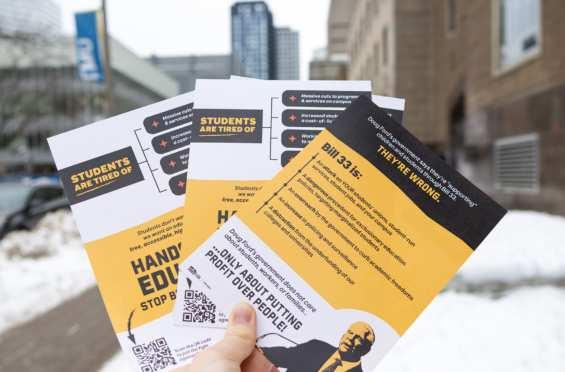
Student groups, at and outside of Toronto Metropolitan University (TMU) are worried Bill 33 may restrict student-led equity resources and the support they can provide to students.
“Our worries right now lie with how the bill could impact the sustainability of student services and the value they provide to the on-campus experience, whether that be for their health, wellbeing, or socialization,” said Sayak Sneddon-Ghosal, president of the Ontario Undergraduate Student Alliance (OUSA), in a statement to The Eyeopener
The Trans Collective is one of the equity service centres of the Toronto Metropolitan Students’ Union (TMSU), according to the student union’s website.
Jay Ashdown and Aisha Sharma, co-leads of the collective, said transgender students at TMU are looking for help with navigating the healthcare system, dealing with transphobia and finding community support with their service.
However, Bill 33 or the Supporting Children and Students Act, which was passed on Nov. 20, 2025, can change this.
The TMSU announced last week it is reducing the annual base funding for campus groups and course unions from $1,500 to $600. Students are now required to apply for base funding.
Equity Support Centres do not fall under campus groups or course unions.
The legislation allows Ontar-
io to regulate student fees and how these are used to fund student services.
“It’ll take away a lot of autonomy from student unions,” said Ashdown. Provision 22.1 of Bill 33 allows the Lieutenant Governor of Ontario to “make regulations governing any fees” that a college or publicly-assisted university may require students to pay.
“It’ll take away a lot of autonomy from student unions”
Sharma emphasized the value of community among students from marginalized communities, describing how she found most of the information she needed about gender-affirming care through other trans people online.
“My only resource was calling insurance companies who didn’t know anything, being transferred from person to person or having to book appointments, waiting multiple days,” she said.
“The [province] can...fund universities instead of pushing the burden...onto students”
While some student leaders continuetocontestthebill,throughinterviews, The Eye found that many members of student groups are still in the dark about the potential impact of the legislation.
The OUSA calls for more funding for the post-secondary sector, said Sneddon-Ghosal.
More investments would ensure “institutions are well-funded to
provide the high-quality education and support services that the province needs,” especially for students from marginalized communities, he said.
While it is still uncertain how the bill will be implemented and the regulations that may come from it are unknown, SneddonGhosal said the student alliance will be submitting its recommendations to the province to ensure that student voices are represented.
Ashdown believes the provincial government should publicly fund universities, instead of pushing the burden of tuition onto students and parents.
This will “allow students to fund their autonomous bodies and universities to also fund their own services, which are helpful to students as well,” he said.
In 2024, the Ontario government announced its investment of almost $1.3 billion in new funding to “stabilize” universities and colleges over three years.
In2022-23,Ontariohadthelowest provincial funding for full-time universitystudentsamongallprovinces, compared to the national average of $16,756.
This is according to a review of the Ministry of Colleges, Universities, Research Excellence and Security spending plan as outlined in the 2025 Ontario Budget by the Financial Accountability Office of Ontario.
According to Statistics Canada data, in Ontario, student fees still compose a large part of universities’ revenues at 39.75 per cent, compared to provincial funding at 21.08 per cent in fiscal year 202324. Provincial funding was 34.40 per cent of the revenues for British Columbia universities during the same timeframe.
In an interview with The Eye, university president Mohamed Lachemi, said the university is “actively engaged with the Ministry of Colleges, Universities, Research Excellence and Security to understand the implications of Bill 33.”
By Daniel Opasinis
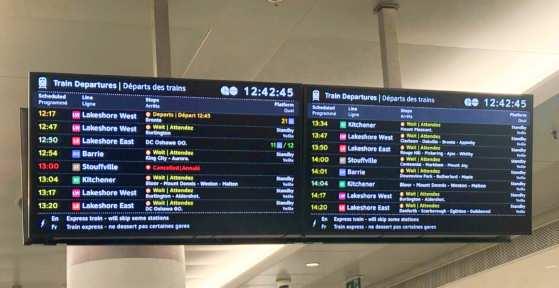
A disabled GO train near Union Station left Toronto Metropolitan University (TMU) students with delays of up to two hours on Monday morning, according to the Metrolinx website.
Alina Elzanaty, a first-year biomedical sciences student at TMU said what started off as a 20 minute delay soon became trains going out of service.
“Everyone had to resort to getting an Uber or [use] the subway […]. The uber costed nearly 40 dollars from Exhibition GO to Kerr Hall,” she said.
Elzanaty said she was nearly 45 minutes late to class.
Onboard announcements originally cited a “signal issue” outside
Toronto’s downtown train station according to Eyeopener staff, while photos published in the Toronto Star show a train stopped in its tracks.
The transit authority said there was a “complete shutdown” on the Lakeshore East Line, per onboard announcements. Delays also affected Lakeshore West, Kitchener, Barrie and Stouffville lines.
GO Transit staff are urging those on stuck trains to take TTC or GO buses instead.
Accordingtotheirwebsite,Milton and Richmond Hill GO train lines had “good service,” until they were alsodelayedaroundnoon.
At the same time, subways from St. George Station to St. Andrew Station experienced delays due to an investigation at Museum Sta-
tion, an Eye staff member reported.
Aisha Gul, a first-year chemistry student at TMU said there were also delays between BloorYonge and King Station. Passengers across the city were stuck for hours, one said it’s “a complete shitstorm,” overheard by an Eye staff member.
Students have already taken to Reddit, sharing their inconvenienced morning commutes. One user said “I didn’t even go to class, I turned straight back home around 9:50am after being on the GO for 1 hour.”
This is a developing story

By Shaaranki Kulenthirarasa
Disclaimer: The author of this article has an academic relationship with the Carnatic music teacher interviewed.
Despite being born and raised far away from their ancestral homelands, many Tamil students at Toronto Metropolitan University (TMU) find themselves turning to traditionalartformstoconnectwith their heritage.
But for many Tamil students at TMU, practicing these ancient forms of art extends well beyond a single month.
Aishvini Partheepan is a fourthyear architectural science student at TMU. She has been learning Car-
natic music—a South Indian form of music—since she was five years old and Silambam—a traditional Tamil martialartsform—sinceshewas10.
“I did have a thing for being creative at a very young age, so when I was introduced to [Carnatic music], that was one of the main extracurricularsIdidgrowingup,”shesaid.
Partheepan said learning Carnatic music has allowed her to implement tradition into her home during cultural festivals despite being born and raised in Canada.
“The unique thing about [Carnatic music] is that there’s always a composition [about] a certain part of our culture,” said Partheepan. She recollects singing songs for Thai Pongal celebrations, a
Tamil harvest festival in January.
According to Britannica, Carnatic music is an ancient form of South Indian classical music closely linked to Hinduism. This form of art carries the long history of the Tamil language and the principles of Hinduism through compositions.
Purandara Dasa, also known as the Father of Carnatic music, was a composer and poet from the 15th century. He established the teaching structures of Carnatic music and composed a number of pieces that students like Partheepan still sing.
Saibruntha Arunthavashanmuganathan, a Carnatic music artist and teacher at Saibruntha, The
Conservatory of Carnatic Music, stresses the need to pass down ancient Tamil compositions.
“I think it’s so important for [students] to understand where they come from, where our roots lie, what our traditions talk about and what our culture truly is,” she said.
Arunthavashanmuganathan said the most rewarding part about being a Carnatic music teacher is beingabletopassdowngenerationsof knowledge to the next generation.
“There’s never a class when I haven’t taught something new [...] That means everything because I know that in the future, if [my students]everdecidetocarryitforward or if they were to perform it, teach it or even talk about it amongst their peers,Iknowtheywillbeabletopass downthatknowledge,”shesaid.
Arunthavashanmuganathan decided to pursue Carnatic music full-time after realizing that she was able to resonate with her Tamil culture through it, especially being a child of parents who left a war-torn country.
“[It] started off as a passion […], as I grew older, I started to understand that this is storytelling, it’s not just art,” she said.
For Partheepan, Carnatic music has served as a foundation in encouraginghertoexploreotherforms of music including Western styles, deepeningherloveforit.
“Music is always something that I’ve drawn to whenever I’m feeling stressed,wheneverIjustwanttosing orhavesomefreetime,”shesaid.
Brinthavi Sivarajasingham, a fourth-year computer engineer-
ing student at TMU can relate, but throughdance.
Sivarajasingham has been learning Bharatnatyam, a classical dance form that originated in Tamil Nadu, India, since she was seven years old. She said that through learning this dance form, she has been able to learn her family’s stories and better understand her parents’ upbringing.
“Growingup,[mymom]didn’treally have the ability to complete her studies in dance. However, she really pushed me to pursue any type of passions or artistic forms outside of studies,”shesaid.
Partheepan, who grew up seeing her father participate in Silambam, developed an interest in the artform too. This later played a huge part in educating her about another aspect of her culture.
“The reason I got very into [Silambam] was because I started to learn more about it, how it is a Tamizhar Thatkaapu Kalai (an ancient form of Tamil Martial Art) that has been carried on [through] dynasties,” she said.
AccordingtotheWorldSilambam Organization, this form of martial art is practiced with a stick, often made of bamboo—individuals focus on movement and precision. Silambam dates back to the Chera, Chola and Pandya dynasties, the kingdoms that ruled parts of South India, Sri Lanka and Southeast Asia. These dynasties made Silambam mandatory for all soldiers of their militaries.
Read more at theeyeopener.com
By Rogene Teodoro
Toronto Metropolitan University’s (TMU)’s fashion program and urban farm opened an exhibition on January 21, showcasing their work ‘The Flax Project’.
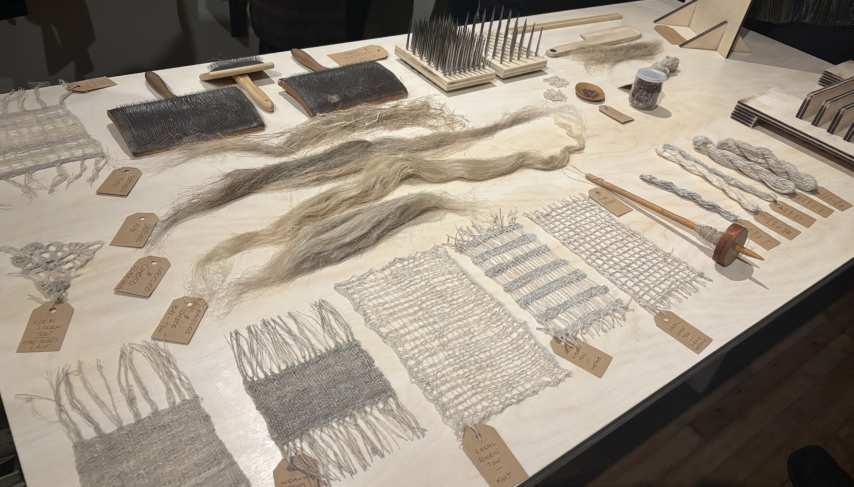
The exhibition explores the roots and revival of manufacturing linen from flax.
‘The Flax Project’ began as an extension of professor Rachel MacHenry’s Natural Dye Garden at The Urban Farm Living Lab. The plants wereusedforanaturaldyeworkshop course, appealing to students interestedinsustainablefashionpractices.
Mika Soetaert, a fifth-year fashion student, got involved in the project through MacHenry’s natural dye class. With family from West Flanders, Belgium, she grew up around flax farms.
“I was talking to my relatives about this project, and learned that I do actually have direct ancestors that worked in linen production,” she said. She felt The Flax Project was her chance to further explore her own cultural
history and allowed her to grow closer to her homeland.
The production of linen is a time-consuming, but collaborative effort. Soetaert said understanding the amount of labor that goes into making linen was eye opening.
“We’d been working on this project for essentially a year and a half before [the team] actually got any textile samples,” she said.
The tools the team used are the sametools“thathavebeenusedfora millennium,” a flax brake, a skutching board, skutching knife and a set ofhackles.Soetaertsharessheenjoys knowing that “we still make things the same way…using knowledge from thousands of years ago.”
TMU Urban Farm’s operations coordinator Jess Russell said she is passionate about proving farms can do more than just provide food.
“We’re growing medicines. We’re growing traditional Indigenous plants. We’re growing pollinator plants, flower crops, and then we have this little demonstration garden that shows that plants can also be turned into dyes and fabrics,” she said.
Soetaert added that linen production in Ontario was once abundant. She says The Flax Project proved that especially with a large team and enough funding, “there’s really no reason why we
can’t have our own local linen textile production in Ontario.”
MacHenry explained in a statement that the flax seed variant used to manufacture linen has few growers in Canada.
MacHenry said the project has
been a way for people to put sustainability ideas into practice. She feels hopeful that it is “possible to raise and forage” plants in Ontario that can be incorporated “within local and circular production systems.”
When the City of Brampton handed over a community centre to serve as home for TMU's School of Medicine, keeping the 400-seat theatre inside was part of the deal—now, a local theatre troupe says that's not what's happening
MATT SIMPSON IS astonished when he learns the Bramalea Civic Centre is being given away.
He’s the treasurer at Brampton Music Theatre (BMT) which has been performing in the building’s Lester B. Pearson Memorial Theatre (LBP) for decades—and now its future is up in the air.
BMT is Brampton’s only community theatre group. Formed in 1963, the volunteer-run organization hosts both junior and adult productions around the city. Before moving their adult performances to downtown Brampton's Rose Theatre within the past 10 years, nearly all their shows were staged at LBP. After that, LBP became home to the massive seasonal shows from their youth troupe— starring young performers aged eight to 16 years old.
BMT wasn’t the only one who loved the civic centre—Toronto Metropolitan University (TMU) alsohaditssightsonthebuildingfor averydifferentpurpose—ahomefor its brand-new medical school.
TMU had been exploring potential homes for its Brampton campus since 2021 when it was announced they were pursuing the city for an expansion beyond their small, downtown Toronto campus.
Before the civic centre was selected in 2023, Simpson didn’t even think a community centre would be on the table.
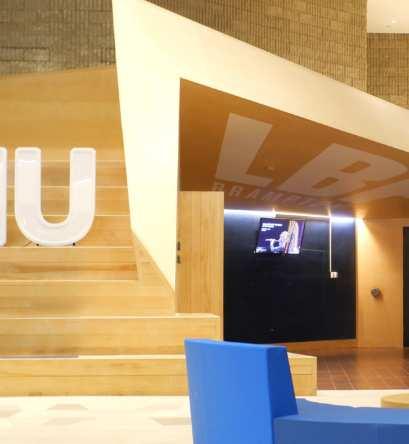
However, this wasn't a curtain call on BMT’s relationship with the theatre. Alongside the announcement was news that LBP would be spared and leased back to the city on a 99-year term. The venue's hours would be split between the university and rentals managed by the city. Lectures would take place during the day and live performances in the evenings and on weekends, according to the city. In fact, BMT would still be able to use the space during much of the construction.
However, what ensued was anything but smooth. And now, BMT worries their time at the theatre has come to an end.
SCAFFOLDING FOR the modernized lobby obstructs the foyer, reducing the spacious entryway down to a thin hall at BMT's late 2024 production of Newsies Jr. The concession stands typically set up outside of the theatre are absent and during intermission, audience members and performers struggle to intermingle outside the doors.
The junior show wound up being the last they performed at LBP. The state of the building during the conversion had been a harbinger of BMT’s uncertain future with the theatre.
due to an alleged ‘communication error’, the hammering continues above. Dust covered set pieces and props are hastily cleaned off before being moved onstage. Performers dressed in newsboy caps and oversized slacks wait backstage for their cue, but are met with remnants of the ceiling caught on their costumes.
Little pieces of debris are falling onto the children.
For Bel Archer, the facilities manager of BMT, this was an upsetting sight.
“I know for a lot of people that have come to see the show, this was their first time being in there since our last show so they hadn't seen the construction.” says Archer. Seeing parts of the building gutted was a wake up call to many attendees, says Archer. “I think that's when it really cemented that ‘wow, we won't have this space anymore. Where are you guys gonna go?’”
BMT had a production scheduled for late November to early December 2025, several months after the school's opening date in September 2025. In May, however, Brampton on Stage—the city-run organization which manages the venue—refused their booking of the theatre without reason, says Simpson.
“Sincethen,wehavetriedtobookthefacilityandweweretoldthatwewouldonlybeable torentthatfacilityonedayatatime,”hesays.
BMT’s junior performers spend up to a year preparing for their shows and were met with disappointment when the show had to be cancelled.
With bookings at the mercy of school hours, only able to be held during time slots in the evening and weekends—and can seemingly be cancelled on a whim— the future for Simpson, Archer and the rest of their troupe is uncertain.
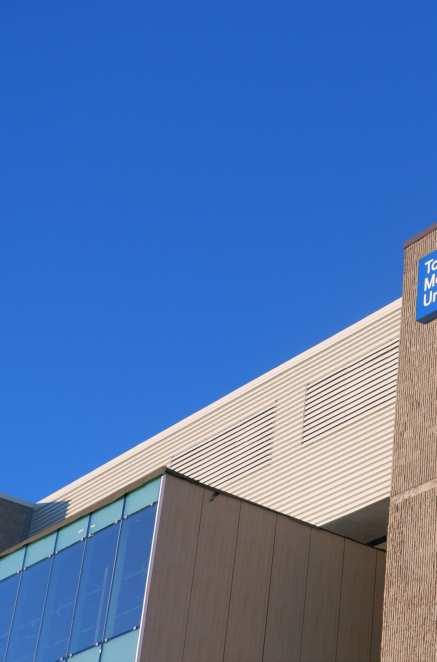
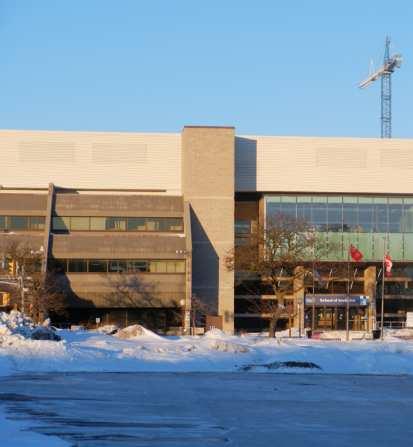
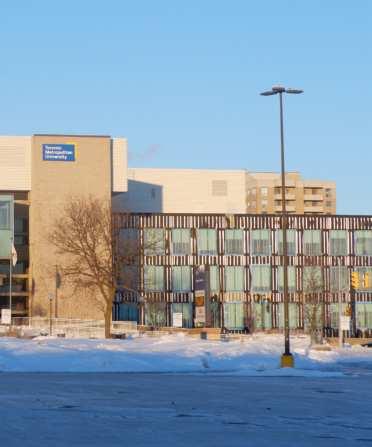
THE BRAMALEA CIVIC CENTRE is a bulky brutalist-style building along Queen Street, one of Brampton’s busiest thoroughfares. It’s clad in concrete brick and sandwiched between a bus terminal, Peel Region’s administrative offices and Bramalea City Centre—the city’s largest mall with over 300 stores. The building has stood in this spot since it was constructed in the late 1970s as a multipurpose community centre for the then-new neighbourhood. Its central location was also one of the reasons TMU selected it in early 2023.
The other reason was proximity to hospitals. TMU cited the closeness to Brampton Civic Hospital, Peel Memorial Hospital and Brampton’s need for physicians as reasons why the Civic Centre was selected for the school. The city of Brampton is also one of the worst victims of Ontario’s doctor shortage, with a staggering 70 family doctors per 100,000 residents.
By ZANOAH PLUMMER
While the young performers are onstage, banging noises are heard as the construction crew upstairs is working. Work is supposed to have paused during the hours of the show, but
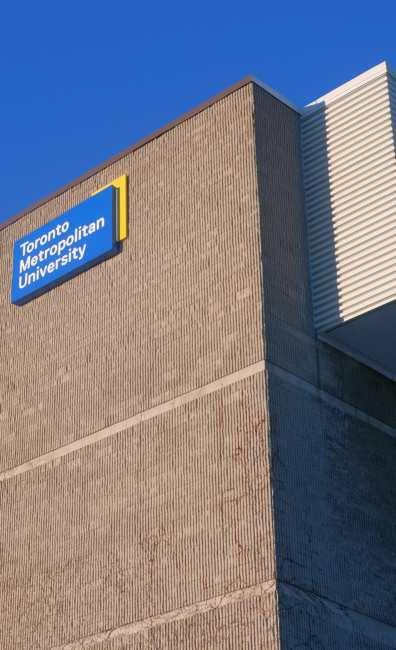
Where there’s now a ‘TMU’ sign on the building, there was once one reading “Brampton Library.” Before being handed over to the university, the civic centre housed the Chinguacousy Library, one of Brampton’s flagship branches. Chinguacousy had undergone a $2-million renovation in 2017 which, in addition to a facelift, introduced an audio recording studio, a makerspace and doubled the computer lab space. Residents in Bramalea—which is one of the city’s lowest-income neighbourhoods according to the 2021 Canadian Census—welcomed the investment in their community.
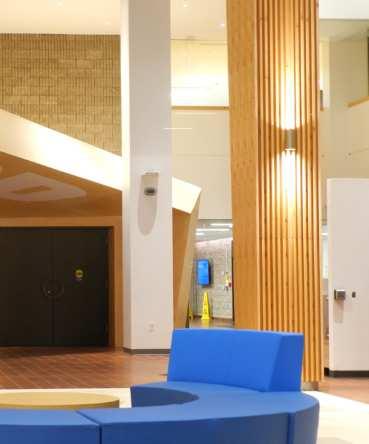
Residents were promised a replacement for the library in April 2023 after TMU came onto the scene. Plans were unveiled in January 2025 to move the library into an expanded Howden Recreation Centre, but construction on that project has yet to begin. The library is temporarily being housed in the significantlysmaller Chinguacousy Park Ski Chalet. The City of Brampton has the lowest number of branches and library space per capita among Canada's 10 largest cities according to a 2022 report from Brampton Library.
As one of only three indoor theatres in the city, LBP has been an important cultural space since it opened. It’s where many of Brampton’s performers got their start. Big names have appeared there—like internationally-celebrated Bramptonborn poet Rupi Kaur.
In 2019, it underwent a $2.6-million renovation. With the COVID-19 pandemic pausing live events, Brampton residents never really got a chance to use it before the transfer to TMU.
Adyan Owusu*, a fourthyear mechanical engineering student at TMU has lived in Brampton his whole life. He says the building was a staple in the neighbourhood.
“This is one of the things that everyone in Brampton knows about. If you go to any school that's within that area, that's the main spot you're going to after school to study,” Owusu says.
In high school, Owusu spent long afternoons at the library to study with his friends. He was a part of a choir which performed at LBP in the past. His first performance ever was there and with his mother and sister in attendance, he got his first feel of what the limelight feels like. When he sees the theatre now, Owusu reminisces on his first and favourite performance.
Brampton’s arts scene has had stagnant growth compared to other cities and the lack of venues and rehearsal spaces may be a factor. Theatre groups in Brampton have slowly been disappearing, with Peel Panto Players closing the curtain for the last time in 2018.
Brampton Arts Organization (BAO) is a non-profit created to support the arts in Brampton. Resources for the performing arts are noticeably absent from recent reports publicized on its website. BAO was previously housed inside the civic centre but has since moved downtown. The organization supports artists with access to spaces and recording studio hours, but with limited stage access, performance artists are practicing for an audience that may never arrive.
The university says it’s aware
“Sometimes I think to myself, if Bramalea Civic Centre was some sort of ice rink or indoor recreation centre for sports, whether or not we would even consider turning it into a medical school.”
Rowena Santos, Brampton Councillor
of the importance of arts in Brampton, and doesn't think the theatre’s new ownership will impact the scene.
“Toronto Metropolitan University recognizes the importance of the Lester B. Pearson Theatre as a valued arts and community space in Brampton and continues to work collaboratively with the City on scheduling to support ongoing artistic and community use.” said the university in a statement to The Eyeopener. “While TMU’s academic programming is generally scheduled during weekday daytime hours, TMU and the City work closely and collaboratively to coordinate schedules in advance and to minimize conflicts.”
BMT wasn't the only frustrated party at the time of the handover.
Councillor Rowena Santos, who was elected in 2018 and represents wards 1 and 5 says she wasn't aware the civic centre was even being considered. Santos has come forward in recent years as a supporter of the arts. In 2023, she wasoutspokeninherconcernover TMU’s overtaking of the theatre.
“Are they willing to make sure that they work with the arts community so that we don't lose that space and see a further decrease in our per-capita investment in the arts?” asked Santos in a March 2023 council meeting. Santos continued, "As a theatre production company, how do you prepare for a week run of shows if you can't set your stage?”
At one point, she called out TMU’s president, “I’m happy to have a direct call with president Lachemi about the importance of maintaining performing arts in the City of Brampton,” she said.
“Sometimes I think to myself, if Bramalea Civic Centre was some sort of ice rink or indoor recreation centre for sports, whether or not we would even consider turning it into a medical school.”
WHEN BMT MOVED operations to Mississauga, Ont. in 2024, they never intended it to be permanent. The construction at the civic centre had become overwhelming, so BMT began hosting its junior shows at the Maja Prentice Theatre in Mississauga. While inconvenient, there was an expectation that this was temporary and Archer says the theatre has been courteous. Now, due to the scheduling fiasco at LBP, they’re remaining there for the time being.
Maja Prentice is half the size of LBP, with a 198-seat auditorium. While it’s the same size as Brampton’s Cyril Clark Theatre, Cyril Clark has a smaller stage and just one dressing room. For a large cast composed of over 30 young performers, Maja Prentice better fits the needs of BMT, says Simpson
“We did use Cyril Clark for
a bit, but we had to drastically reduce our cast size. Which goes against our mandate, especially for junior shows and for all communitytheatre.Andyou'llfindthisacrossall community theatres.”
The relocation has come with issues, as some members of the cast are from neighbouring smaller towns and have a longer commute to Mississauga. LBP’s proximity to the bus terminal also made it convenient foraudiencesandcastmemberswhodidnot haveaccesstoavehicle,accordingtoArcher.
“I think it's a deterrent for a lot of our children's friends to come see them because now it's not in the city,” she says.
Performers from BMT's youth troupe often go on to join the adult troupe when they ageout,accordingtoArcher.Sothepotential consequences of losing LBP are significant for the operations of the entire organization—and the future of theatre in Brampton. Without a space to explore the art when they'reyoung,gettingafootinthedoorcould be a challenge for performers in the future
Bizarrely, while Santos mentioned BMT by name several times during the 2023 council meeting, BMT says they have not received much response from Santos nor city council about the theatre.
Simpson says questions the group posed at a special arts-focused roundtable for the 2026 city budget chaired by councilor Santos were not answered.
Brampton on Stage did not get back to The Eye in time for publication and Santos’ team—originally willing to go on the record—withdrew their offer for comment.
Having been in the area for five decades, the civic centre is as iconic to the Bramalea neighbourhood as Gage Park is to downtown Brampton. But to city council, Simpson says, the building may be as small as the daffodils planted around its entrance with thelackofattentionpaidtoitinrecentyears.
Santos nor any other member of city council has brought up the theatre in the past few years. However, the city’s 2026 budget unveiled $30 million in funding towards building a new arts & culture centre.
Despite an initial announcement in 2023, little has been publicized on plans for the centre, including whether or not the centre will feature a stage and performance space.
ARCHER SAYS SEEING this happen to a space where she grew is the hardest part.
“Being backstage for the whole week, those memories I'll always cherish. But when I was a child, I used to dance and we used to perform at Lester B. Pearson before the Rose Theatre was constructed,” she says.
One of Archer’s first memories of dance was at LBP. She had worn a white tutu, in the backstage illuminated by black light. When she looked down at herself the tutu glowed purple, her favorite color.
In her teen years, she used the library as a study spot and a place to wait for the GO bus. The civic centre’s multipurpose use allowed for it to grow with its visitors. Simpson's wife attended prenatal classes at the centre and the library was adored by all ages.
“We would love the opportunity for Lester B. Pearson to take us back. We love performing in our city. We're Brampton Music Theatre, not Mississauga Music Theatre,” says Archer.
*This source is a member of The Eyeopener's Board of Directors. They are not a journalism student and had no involevement in the production of this story.
The Metro Hoops Classic begs the question of a missing element in the matchup between the two schools
By Courtney Powers-Luketić
Founded in 1827, the University of Toronto (U of T) has built a reputation as Canada’s most prestigious university. For over 100 years, U of T stood alone as Toronto’s uncontested champions. Then something new came along. Toronto Metropolitan University (TMU) officially became a university in 1993. Loud, unapologetic and bold, TMU dared to claim a city once owned by the historic giant. Since then, these schools have gone head-to-head on the basketball court to take their position on Toronto’s throne.
This contest will be on full display when U of T’s Varsity Blues and TMU’s Bold face off in this year’srenditionoftheMetroHoops Classic. The event was born from the rivalry between the two teams, endeavouring to showcase the talent and passion in each school’s basketball programs.
Even though the teams have matched up numerous times before, the first edition of the classic was played last year as a two-game series, with one round in the fall semester and a second in the winter. The Bold’s women’s team won both their games, crowning a clear winner, while the men’s team split the series.
This year, the teams will only get one opportunity to make a statement—one do-or-die game on the evening of Feb. 11.
The history and geography of these teams form a natural rivalry as ingrained within the city as the subway line connecting the two campuses. However, for many, the tension is more urban legend than way of life.
“We pride ourselves on trying to be the best team in Toronto”
Catrina Garvey of TMU’s women’s basketball team said, “I don’t think we, if I’m being honest, really see it fully as a rivalry, but it’s still somethingthatwewanttoconquer because they are in our city.”
She explains, “We’re both in Toronto. We’re basically neighbours. You walk five minutes one way and there’s U of T, so for sure, neighbouring-wise, for the city, 100 per cent it’s a rivalry. It would be with really anyone in Toronto. For us, we kind of just take it as any other game.”
Aidan Wilson from TMU’s men’s basketball team agrees that the two teams are position to have heated games.
“Ithinkthere’salwaysarivalrybecause it’s two teams from the same city; you naturally want to beat each other, and there’s naturally some competitiveness that goes on with a gamelikethat,”hesaid.“Butasfaras a tough opponent that we’ve lost to andthatwegobackandforthwith,I wouldn’t say as much.”

According to Garvey and Wilson, a strong rivalry is rooted most deeply in close competition, something that, right now, TMU and U of T lack.
In the last eight years, TMU has been a clear force against their neighbour. The Bold’s men’s team has won 10 of 15 meetings, with the women’s team further edging out the Blues, having won 12 of 15.
In their last meeting on Nov. 2, 2025, the TMU women’s basketball team beat U of T by over 30 points. On the same night, the men’s team let the gavel drop even harder, declaring their superiority over U of T with a 40-point win. The decisive victories hint that TMU, at its current skill level, has maybe outgrown its rival.
Bold women’s basketball coach Carly Clarke has been with TMU for 13 seasons. Having observed these teams face-off for more than a decade, she said there are times when the competition tilts too far in one direction.
“[The rivalry] has gone up and down as both our teams fluctuate in strength,” she said.
Clarke’s team has a decisive hold on first place of the central division of the Ontario University Athletics (OUA), four wins ahead of second place. In stark contrast, U of T sits next to last, having won only two of its 17 games.
The men’s teams are in a slightly closer race, with the Bold three wins ahead of the Blues.
Garvey said that although games against U of T in past years were harder-fought, her team always treats their rivals as worthy opponents.
“I think in previous years, it was a bit more of a rivalry, and we won’t ever underestimate any team because that will get us in a lot of trouble,” said Garvey. “For the three yearsthatI’vebeenhere...itwasdef-
initely a bit more of a closer match, but we still fight for our own city.”
Although they try not to treat any opponent differently, Garvey said Clarke makes it a point to “win the city.”
Clarke said, “We pride ourselves on trying to be the best team in Toronto. We’re always excited to play Toronto–U of T and York University–and try to hold down that title annually.We’reinthesamedivision, so that’s kind of how we frame it.”
Fans also shared mixed feelings about the rivalry.
First-year business technology management student Jacob Arcega has been to three Bold sporting events, two of which have been against U of T.
“Usually, the energy is louder in here, so it’s more fun to watch,” Arcega explained about the appeal of rivalry games.
But Arcega said this energy isn’t always enough to draw people out.
“The seats aren’t always full, I think more people could show up,” said Arcega.
“I think it’s a natural rivalry that we can build on and make something special”
TMU’s men’s basketball coach David DeAveiro said there’s a lack of tangible tension between the schools, which he attributes to a lack of effort.
“Idon’tseethesignificanceofthe rivalry right now,” said DeAveiro. “I think it’s a natural rivalry that we can build on and make something special, but it’s gonna take a lot of people to get on board to do it. And if we don’t do it that way, then we’re never really gonna have that game that we’re hoping to have, or that atmosphere, and that ambiance that we want to really have. It’s gonna take some work.”
For DeAveiro, the work required for a good rivalry comes from all across TMU. He said the marketing team, student unions, the community and students need to come together.
He explained the idea simply: “You’ve got to have your school pride, right?”
DeAveiro has previously coached for McGill University and the University of Ottawa (uOttawa), which each have their own hometown rivals in Concordia University and Carleton University, respectively.
Carleton and uOttawa are known for their bad blood, which comes to a head at their homecoming football game, called the “Panda Game.” This year, the teams duked it out at TD Place Stadium in front of a sold-out crowd of 24,372.
DeAveiro said when uOttawa plays Carleton, it transcends being a game—it becomes an event.
He said, “If you ask the students who won the game, they probably don’t know or don’t care. They just want to be at the event and all the stuff that leads up to the event or happens during the event.”
The coach, in his fifth year with the Bold, recognizes the unique challenges that Toronto poses when trying to create an event.
“Especially in Toronto, you’re dealing with other things, distractions. Saturday night in Toronto, do you want to be in the gym, or do you want to be out having a drink, or hanging out with friends?” He explains, “You’re competing against the city, which is really, really hard to do.”
The resounding feeling is that the Bold versus the Blues could be so much more. Given the right attention, the rivalry could become all it’s made out to be.
“If it’s done correctly, and you get the involvement, it’s something
that the students circle on their calendar every year,” said DeAveiro.
As a fan, Arcega said that better promotion and cheaper food prices at the Mattamy Athletic Centre would push him to attend more.
“You’re competing against the city, which is really, really hard to do”
Fans are exactly what Garvey and Wilson are looking for. And the crowds that do come out for Bold basketball games already make an impact on the team.
Wilson said, “It’s always fun playing in front of as many people that are supporting you as possible. Just feeding off the crowd’s energy, it’s always fun. As basketball players, that’s what we live for, what we play for, so it’s awesome when that happens.”
Garvey said all it might take for students to become interested in athletics at TMU is one good game that draws them out.
“I think that the more we do things like this, it brings people out more, and once they get a taste of that, they’ll want to come back for more,” she said. “Because I know with both basketballs—men’s and women’s—we love to have people outforourgames,andIbetabunch of other sports and athletics would also agree with that.”
TMU has the opportunity to make a mark in the Metro Hoops Classic. A court in an iconic downtown Toronto arena will become a battleground, if only for a few hours, for two schools. A battleground to win a game, to get a point in the standings, to make students proud. But the battle won’t just be against U of T—it’ll be against the doubt that this rivalry even exists. It will be a fight to prove Toronto is a city worth fighting for.
Photos by Ava Whelpley
By Jasmine Makar
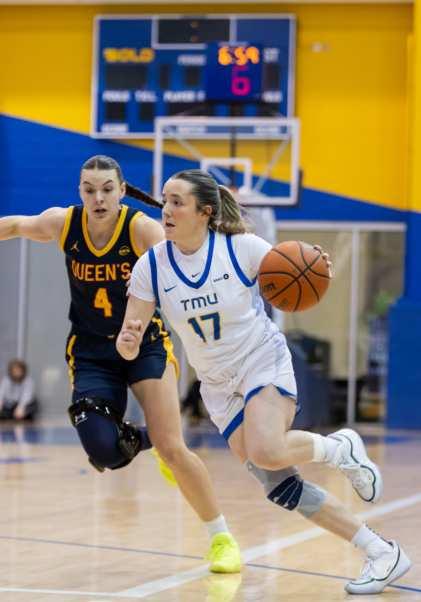
The Toronto Metropolitan University (TMU) Bold women’s basketball team took down the undefeated Queen’s University Gaels in a tense face-off at the Mattamy Athletic Centre (MAC) after a furious fourth quarter comeback.
Queen’s immediately brought the energy to the court after winning 17 straight games in the regular season. The game started off with the Gaels’ second-year point guard Brooke Hussey, scoring the first point of the game.
The Gaels continued to dominate with their defence blocking back-to-back shot attempts made by third-year guard Catrina Garvey. After a missed shot from the three-point line, Garvey was able to corral the rebound that landed inside of the paint and scored the putback for TMU.
With the Bold still finding their footing, Queen’s took advantage, increasingtheirlead,provingtheir offence to be dominant. Fifth-year forward Mikayla McFarlane attempted a tough shot while falling to the ground and was successful, immediately sparking cheers from Queen’s fans who filled the stands.
The first quarter also showed off fourth-year guard Myriam Kone’s on-court presence. A force throughout the match’s entirety, Kone would end the night with a game-high 28 points.
The second quarter started slowly with Queen’s maintaining their lead and their supporters growing scrappier from the stands, many of whom directed their comments towards Kone. Unbothered by their noise, she just used it as more motivation. “I mean, I love it, you love to hear it…but at the end they were silent, so that’s all I gotta say.”
Despite TMU’s efforts, they were unable to take the lead due to Queen’s dominant defence and physicality, leaving the second quarter with a 28-36 score.
“Their size but also their physicality really disrupted us and took us out of our rhythm a little bit,” said head coach Carly Clarke on the Gaels’ strength during the first half.
TMU came in hot at the start of the third with Garvey stealing the ball and scoring from behind the arc. Soon after, Kone immediately jumped into action with a layup off a steal from Garvey, running past Queen’s defence and bringing their lead down to seven.
With a minute left in the frame, the Bold had an opportunity to take the lead for the first time but couldn’t capitalize,
ending the quarter with Queen’s leading 52-51.
TMU came into the fourth quarter with even more energy, the MAC filled with a heightened sense of electricity.
“In the first half, we were kinda like ‘Energy is flat, we need to bring it and we need to bring more effort, we need to work harder,’ and I think everybody that came in today had a great shift and impacted in some way,” said Kone.
The Bold eventually tied the score thanks to a basket by thirdyear forward Hailey Franco DeRyck. The atmosphere and tension in the room became increasingly apparent with Garvey scoring another three to advance them further ahead.
“It really all stemmed from our grit…we had to be the first team on the floor, hustling through loose balls, getting those rebounds, not letting them get second chances. So all of that combined, plus our connection that grew during the second half, really built us up to get us that victory,” Garvey said about her team’s efforts in the final stretch.
The Bold pushed through and wrestled Queen’s for the lead, but with 35 seconds left on the clock, Kone sank a three-pointer, bringing the crowd to a frenzy. The match ended 75-66 in the Bold’s favour, with the blue and gold flooding the court to celebrate their win as they ended the longest winning streak in the OUA.
“We turned them over a bunch, which was critical to us getting some easy scores and getting going offensively,” said Clarke. “You always wanna beat a great team… and it’s proof that we can contend if we keep doing the things we need to do.”



By Aditi Roy
As Toronto Metropolitan University (TMU) students have taken to investing in hopes of capitalizing on compound interest and securing higher savings, experts caution the risk of large losses and falling prey to misinformation.
Students across campus are starting their investment journeys, influenced by social media and their peers, to startearning passive income via stocks and Exchangetraded Funds (ETFs). A CFA Institute of Research and Policy report from 2023 states that 65 per cent of American Gen Z’s invest in some form.
A 2025 Yahoo Finance article, states that this generation has preceded the average age of investment, with the average millennial investor being 25, and Gen Z investors being 19.
WillemZhangathird-yearglobal management studies student started his Tax Free Savings Account (TFSA) within hours of turning 18. He sees the rise in young investors as a generally positive trend.
“I think everyone’s investing in stocks,” he said, referring to the trend among his cohort.
Jonathan Attalla, a second-year business technology management student, began his journey after being influenced by his surroundings. “I started because [of] my friend…[I had also seen] a couple of videos on social media about how it’s important to grow your money,” he said.
Radha Maharaj, a finance professor at the University of Toronto Mississauga (UTM), categorizes this trend as a byproduct of “fear meets opportunity.”
“Gen Z’s are investing, because there’s a lot of financial anxiety, high student debt [and] housing [is not] affordable,” she said.
Maharaj attributes the increase in opportunity to the growth of technology and advanced investing systems. “Young people start investing really early because there are no minimums,nocommissionsandthe interfaces are designed like social media,” she added.
Piraveen Mahadevan, a thirdyear business technology managementstudent,alsonotestheanxiety behind these investments. “Students are trying to find multiple ways of income, whether that be a part-time job, investments, side hustles […] that’s why Gen Z wants to start investing early,” he said.
Experts fear that the presence of social media is severely altering students’ judgments when it comes to investing.
Maharaj points to the gamification of investment as a potential threat to young adults’ investment strategies. She also questions the legitimacy of popularized finfluencers, “some of them are just giving bad advice…some of them [are only giving] partial advice,” she said, adding that many don’t possess the credentials to be giving financial advice.
Mahadevan stays clear of such influencers, pointing his peers to
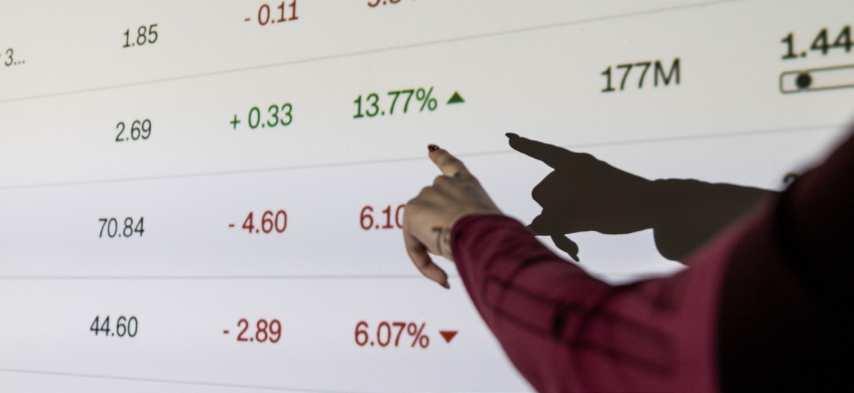
established sources like Berkshire Hathaway and Yahoo Finance for information. “You’ll see [an] Instagram reel about a content creator who’s pitching a stock—I think lots of people might get swayed by that idea,” he said.
Zhang believes the social media pull is evoking students to make uninformed decisions. People around him “invest based on emotions and based on hype,” he said.
“Which is why a lot of students have quick wins, but also very quick losses,” he added.
A 2025 CBC article would second Zhang’s observation, reporting that the younger generation is tending to invest based on “vibes not research.”
Students say that their experiences with the stock market have taught them to tread lightly.
Attalla has realized the importance of the big picture and long
term goals. “I was very impulsive [before]—I have been slowing down,” he said. He recounts his impulse purchase during the beginning of his investment journey, slowly realizing that hyperfocusing on stock fluctuations wasn’t healthy, and is now opting for a more holistic approach.
Mahadevan echoes this sentiment, advising students that “it’s all about playing the long game.”
He recognizes the volatility of the market and how “there are times where the stock market crashes or your portfolio is red, it does scare users [initially…] like me,” he adds.
Experts caution students from investing before forming a strong base knowledge of finance.
Daniel Richards, associate professor at the school of administrative studies at York University teaches a basic personal finance
course offered at most universities to build their confidence. He notes the importance of “a structured program where we don’t really have an agenda” in comparison to internet personalities who may insert their own biases.
Zhang also feels concerned about the growing impatience of young investors.
“Not a lot of people are well informed about the process and the structural reasoning behind investing in the first place,” he said. “I think you do need that academic rigor to understand stocks.”
Though Maharaj sees early investment as a positive, she urges students to seek resources like their bankmanagersanduniversityinformation sessions.
She notes that if investment is done “badly, you can be really burned, lose a lot of money, get discouraged and have burnout.”
With Gen Z’s credit scores plummeting, students feel anxious—experts point to structural flaws
By Jerry Zhang
As the economic landscape grows more uncertain, some Toronto Metropolitan University (TMU) students say managing credit has become harder, describing the system as emotionally taxing and increasingly unforgiving.
Data from TransUnion, a credit reporting agency in Canada, suggests these concerns are not unique to TMU students. The 2025 report stated that Gen Z has lower than average credit scores, but experts say this reflects broader economic and institutional issues rather than just reckless spending.
Wyatt Ewart, a third-year mechatronics engineering student, got his first credit card a year ago. He expected clear guidance from his bank but instead was left with more questions than answers.
“Even to this day, I don’t really know how much I should use my credit card,” Ewart said. “I’ve always gotten very different opinions.”
Some told him to use no more than 10 per cent of his credit limit—others advised him to use the card for every purchase and pay it off in full. He said both sounded confident in their advice.
This uncertainty shapes how Ewart interacts with his credit card, making sure to pay his balances immediately and avoiding relying on it heavily.
Even as rising costs have forced him to cut back on food spending and sometimes skip meals, Ewart said he remains unwilling to rely on his credit card.
According to Cristián Bravo Roman, a professor and the Canada Research Chair in banking and insurance analytics at Western University, the increasing pressure on credit scores is further amplified by the “K-shaped” economy, where higher-income earners gain faster, while earlycareer workers face higher pressure due to rising costs.
Some students said they understand the unforgiving nature of the credit system.
Kyle Kim, a second-year business management student, said his credit score is in the high 700s.
“As soon as I turned 18, I got a credit card,” Kim said. “And then I started spending it, but not too much, because I know that’s the fastest way to raise it.”
Kim said research and financial discipline have helped him avoid debt-related stress, which he sees among his peers.
“I think they just didn’t learn it ‘cause schools don’t really teach that,” he said. “People are paying it off paycheque by paycheque, and it’s just so sad to see that at an early age.”
Kim said he went through a trial-and-error phase to secure his confidence in his credit.
“Originally, when I first got it, I thought, the more you spend, the higher [thescore]will go,” He said. “But I later found out that the less you spend, the better.”
Somestudentssaytheknowledge gap needs to be addressed earlier.
Arin Hincer, a fourth-year film studies student, said she wants fi-

nancial literacy education to be taught before post-secondary.
“This is the important thing that we should be learning in school,” said Hincer.
“You’re slowly going into your teen years and then adulthood. [All of a sudden, it’s] here’s what a credit card is, here’s what not to do, here’s how you pay it off.”
Hincer said she actively avoids using credit because the delayed repayment makes her anxious.
“I see how it could be a very slippery slope,” she said.
Hincer added that the delay between purchases and seeing her balance update makes overspending inevitable and prefers paying withcashordebittostaygrounded.
“IhaveXamountofmoneyright now…I could ration this [amount of money] off, and then I’ll pay [for it] right now,” she said.
Readmoreattheeyeopener.com
With punches swinging, one student pays the price for asking too many questions
By Peyton Andino
Disclaimer: Like the concept of feeling safe on campus, this story is fully satirical.
First-year journalism student
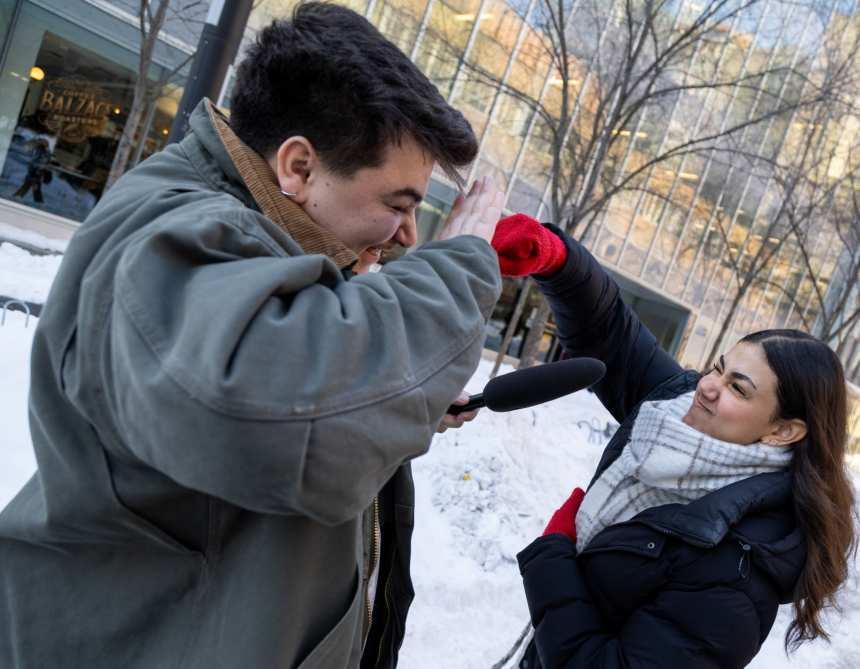
Bjorn Alism got beat up this past Monday on Gould Street following an intense exchange between him and another student over a journalism interview request.
On an equally unsurprising note, campus security will not be pursuing charges against the alleged puncher Rachel Amy Biguous as they did not show up this morning, or the morning before or the morning before that one.
According to witness statements, Alism approached Biguous and shoved a phone in their face while loudly saying, “As a queer person of colour, I think your perspective on the gradual decline of third spaces would be essential.”
The Eyeopener was able to secure an interview with both stu-
dents involved in this incident.
“I don’t even know what a third space is,” said Biguous. “And I’m not even gay. I mean, my family thinks I am, but it’s just because no one wants me. I blame my face and personality.”
Eyewitness Ai Sawdat, who was interviewed in the Journalism Lounge by The Eye shared he believes that Alism should be charged instead.
“I don’t even know what a third space is”
“I hate journalism students,” said Sawdat, a third-year journalism student, “I have never hated another group of people more in my life.”
When asked if that’s it, Sawdat doubled down.
“Yes.”
This assault follows the disturbing trend of Toronto Metropolitan University (TMU) students, staff and educators alike being harassed by journal-
ism students in the quest for at least an 80 per cent on their upcoming assignment.
“I hate journalism students...I have never hated another group of people more in my life”
The first years are not just one year gone rogue. Repeatedly, students hailing from the journal-
ism program at TMU have been known to go out of their way to get a story, no matter how invasive and annoyingly inconsiderate it takes for them to be.
As of winter 2026, journalism students are now being restricted from covering Indigenous stories on campus after several events were overwhelmed by student reporters.
Alism disagrees with this ban,
citing the boundary-pushing that previous journalists have done.
“Look at all the great journalists that have gone out of their way to get the best story. Candace No-wens, Jared Rogan and one day… Bjorn Alism,” he said, starry-eyed.
Alism’s story concerning third spaces can be found on his personal Substack, titled “I’m Alisming It All Over The Place.”
By Sadaf Ahmed
Disclaimer: This story is a satirical exaggeration. No exams were missed however the Toronto Transit Commission (TTC) is really this annoying.
It was exam season, and the impending doom of my final grades was already looming over me like a debt collector who knew where I lived. I was running on 23 minutes of sleep, ZYNs and one Red Bull that had fully replaced my blood-
stream. I wasn’t a person anymore, I was walking, talking corpse.
My exam was at 9:00 a.m., so naturally I planned to leave an hour and a half early like a responsible adult just to give myself ample time to reach my impending doom. My commute is usually only 45 minutes, so I thought nothing could possibly go wrong.
What I failed to consider that morning was that I was taking the TTC, an organization that does not recognize time as a linear concept.
I left my house as usual and abandoned all my dignity by running to the station like a brave lion hunting its prey.
At first, everything was fine. The train moved, stations passed and I relaxed. I was going to make it. I thought I might even get there early enough to sit on the floor outside the exam room and stare at my notes while pretending I was actually learning something.
The train kept going as normal and reached Ossington Station when it suddenly came to an
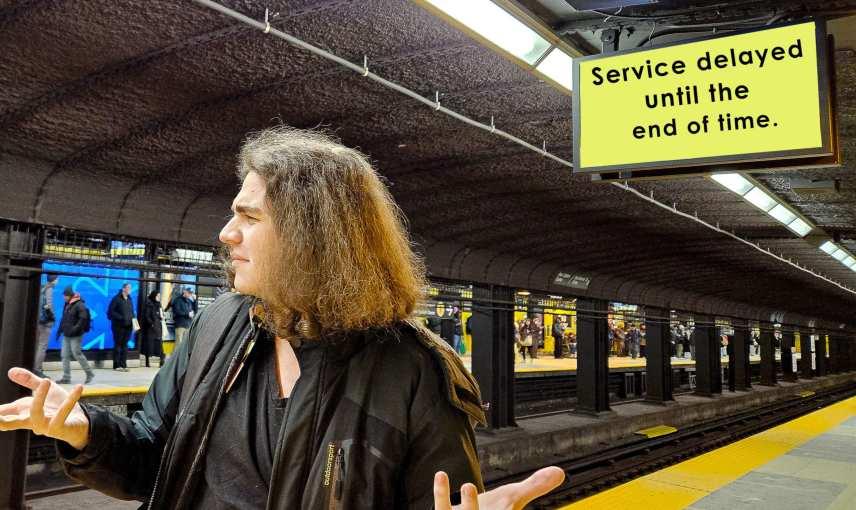
abrupt stop. My heart sank. “Why the FUCK aren’t we moving,” I thought to myself.
The speakers crackled to life, “THETRAINWILLBEHOLDING AT OSSINGTON STATION DUE TO A SECURITY INCIDENT.”
I tried consoling myself. It should only be a few minutes right? We can’t be stopped for too long right? Right? Five minutes passed. 10 minutes passed. 20 minutes passed. The train was dark and silent. To make things worse we were stopped in the middle of fucking nowhere. No wifi, no ventilation, just sweat and anxiety.
The stress of possibly missing my exam and the stench of urine mixed with sweat was making me nauseous. If I puked right here right now would that exempt me from the exam?
I could email in sick or better yet: dead. After minutes of dread, another barely understandable announcement came.
“THIS TRAIN IS NOW OUT OF SERVICE SHUTTLE BUSES WILL NOW BE RUNNING.”
My hands started shaking, I was going to cry. Shuttle buses. The TTC’s final form of punishment. Getting off the train, finding the shuttle and crawling through traffic would take at least another fifteen minutes: fifteen minutes I absolutely did not have.
I put my earphones in, but there was no music powerful enough to distract me from the reality that my GPA was now in the hands of a man wearing a fluorescent vest holding a clipboard.
A few minutes passed and I frantically tried opening my phone for other options. No service. I had no choice but to wait and think about my fate. After what felt like hours of silence came another announcement, “THE SITUATION HAS BEEN CLEARED THE TRAIN WILL BE COMMENCING SHORTLY”.
I let out a deep breath. I was going to make it. We started moving again after changing lines and after another 45 minutes, I reached TMU Station.
I had not run in years. Not for a bus. Not from danger. Not for my health.ButthereIwas,sprintingfor seven minutes straight, my lungs collapsing, my vision blurring, my ancestors watching in disappointment.BythetimeIreachedtheexam room, I was 27 minutes late and spiritually broken.
Another three minutes and I would have missed the entire exam and failed the class.
As I finally took my seat, drenched in sweat and shame, I whispered the only thing that felt true anymore: “Fuck the TTC.”
The Eyeopener is giving away two $25 gift cards to Balzacs
Find the giveaway rules through the link in our Instagram bio.
1. Complete the crossword! Only 100 per cent accurate mazes will be accepted.
2. Complete the Google Form via the QR code on the page and add a photo of your completed maze!
3. Await an email! The form will close end-of-day on Feb. 7 and winners will be contacted shortly afterwards and asked to come into our office for photos!
Submit Completed Crossword Here
DOWN
1. Classic board game where players buy railroads
2. Blue tank engine who says “I think I can”
3. Person who checks tickets on a train
5. London’s underground railway nickname

7. Underground pedestrian passage connected to Toronto transit
8. Luxury train in an Agatha Christie mystery
No Stupid Questions:
Q: Can I use the bathroom?
A: No.
Q: How far away are the stars?
A: No.
Q:CanyoutellI’mpeeingmypants?
A: Yes.
NOW THAT WE’VE GOT YOUR ATTENTION...
The Eye’s annualLove&Sex surveyisback.Wewanttohear whatstudentsareinto,notinto andeverythinginbetween.
Scan the QR code to submit your response
As always, responses are anonymous.
President’s Corner: Ask Lachemi
LOWLY STUDENT: President
Mohamed I want to ask you, as someone surrounded by wealth and all the riches the greater Toronto area has to offer, how do you remain so humble? How do you tread between total normalcy and utter professionalism in a world that villainizes those like you?
DR. L. MACHEMI PhD: Your question is stupid, you’re stupid aren’t you?
Lowly student, there’s more to life than fancy cars and penthouse apartments, theres also yachts, caviar and cheeses freshly flown in from Parìs. I stay grounded by living my life like any other Tom, Dick and Lachemi out there. I drink soda, I eat pizza and I can eat ice cream whenever I want.
ACROSS
3. The sound word often written for a steam train
4. Toronto’s subway system initials
6. Animated movie featuring a train that carries children to Santa Claus
9. Famous children’s book train that “could”
10. Union Station rail service for commuters across the GTA

By Chad Football
Let me make one thing clear: I’m not gay at all. However, an experience I had recently has led some of my peers to question this, so I’m writing to put these rumours to bed. It all started with that new Crave show Heated Rivalry. I was watching with some of my boys (as a joke, obviously), when one of them pointed out a protrusion in the groin area of my jeans. Now, I wear baggy jeans because I have what they call “style.” And if you’ve ever worn these kind of jeans, you’ll know they tend to curl when sitting down, giving the illusion of an erection. So that’s pretty much what happened—and it doesn’t mean I’m gay. Now, do I get goosebumps when Ilya says “Hollander”? Yes. Do I feel a hollow pain in my chest when I think about Shane and Ilya having to hide their love from the world? Also yes. But none of that means I’m gay.
Seeking tenant to sublet my room for two weeks
Hey Reddit—I mean, The Eyeopener—I’m a business student who’s traveling to Bali to catch some killer waves and make some epic business deals. In the meantime, I need someone to rent out my apartment in King West. $3,600 plus utilities and cleaning fees.
In Search Of: Girlfriend
I thought this was just going to be a high school thing but it seems my romantic woes have followed me to TMU. So, if you’re a chick who’s into guys who are 5’6 and just dying to see that new The Devil Wears Prada movie—consider reaching out.
Selling snow (no lowballers)
Selling authentic vintage snow from last week’s blizzard. This is rare stuff—I know what I’ve got. No lowballers or snowballers. Serious offers only. I know what I’ve got. $50 or best offer. I know what I’ve got.
Seeking reparations
In honour of Black History Month I’m looking for our white allies on campus to start paying up. This school’s been standing for 58 years and the only white man getting shit used to be our namesake. I encourage you all to find your nearest Black friend, give them everything in your pockets, take a knee and raise your fist. Make sure to do it in a public space though, it will be well received I promise.
Help needed: do my homework
Seeking a freakin nerd to do my science homework for me. I just have so much sex and partying to do in Pitman that I couldn’t be bothered. I don’t have anything to pay you, but if you could bring your lunch money that would be great. You can find me leaning against your closest dumpster, smoking a Virginia Slim.