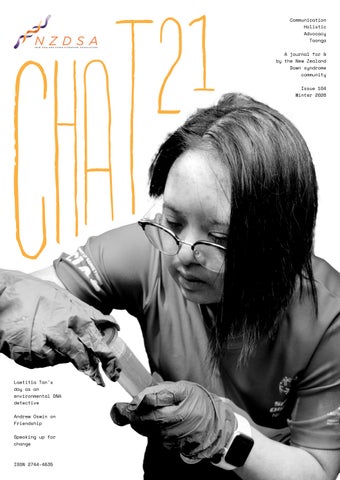
Communication Holistic Advocacy Taonga A journal for & by the New Zealand Down syndrome community Issue 104 Winter 2026
Laetitia Tan's day as an environmental DNA detective Andrew Oswin on Friendship Speaking up for change
ISSN 2744-4635
NZDSA 45 Years
CHAT 21 Winter 2026
2
Call for submissions Be a part of our 45th anniversary celebration The final edition of Chat 21 for this year is going to be something special. We’re celebrating the New Zealand Down Syndrome Association’s 45th anniversary, and we want to fill Chat 21 with the voices, stories, creativity, and achievements of people with Down syndrome from across Aotearoa. This is your chance to be featured in a special anniversary issue. We’re looking for photos, artwork, poems, stories, achievements, adventures, work successes, sporting moments, creative projects, and the everyday moments that make life with Down syndrome worth celebrating. Whether you’ve already written something or simply have a story you’d love to share, we’d love to hear from you. If writing isn’t your thing, that’s okay - get in touch with the editor and we can work on your story together. Let’s make this issue a celebration of our community, our strengths, and everything people with Down syndrome contribute to the world. Send your contribution to editor@nzdsa.org.nz by 15 October 2026, and be a part of this very special edition of Chat 21. We can’t wait to celebrate with you!
3
CHAT 21 Winter 2026
Contents
Editorial
4
Around the world
6
On the socials
7
A day as an environmental DNA detective
8
Friendships
12
Who Keeps the NZDSA Going and Growing?
14
President’s Pen
21
The Rose Awards
22
Asher Phillips
24
Speaking Up for Change
26
IHC Library
28
NZDSA Contact Directory
30
Notices
33
Editor and lead writer: Maddie Daybell Proofreading: Franco Vaccarino Feature writer: Andrew Oswin Lead creative: Daniel te Kaat @ You Are Here. Production: Spectrum Print Coordination: Zandra Vaccarino & Maddie Daybell @ NZDSA Disclaimer: Through the quarterly Journal, the New Zealand Down Syndrome Association will attempt to report items of interest relating to Down syndrome. The NZDSA does not promote or recommend any therapy, treatment, agency, product, political position, religion or advice. The opinions expressed in CHAT 21 are not necessarily those of the NZDSA. The editor reserves the right to make corrections to materials submitted for publication. All photos sent in to the journal become the property of the NZDSA and can be used in other NZDSA publications.
CHAT 21 Winter 2026
Editorial Regular feature
4
Editorial
Kia ora koutou, It’s been an uneasy and hectic time in the sector, with many of us trying to navigate our way through changes, challenges, and heavy conversations. With the general election looming, it can be very overwhelming keeping up with the constant announcements of new policies and bills, and what they mean for you and your whānau. We have reached out to every major political party for a statement, and their position on a few key areas and are hoping to share these in our next edition, which will be a short and semi-sweet special election edition. Our last journal for the year will be dedicated to the NZDSA’s 45th anniversary, with a huge focus on celebrating life with Down syndrome. For right now, I want to celebrate a small win: our brand-new sibling support project, Plus One, led by Siobhan Vaccarino. Being a sibling is a pretty normal part of life. Most people are one; most people have them. But having a sibling with Down syndrome can be a completely different journey, at least in my experience. Being Tim’s sister was one of the wildest rides of my life. Don’t get me wrong, my sisters were pretty cool too, I guess…but Tim was the sibling all my friends would walk straight past me to say hi to. If Tim was around, you knew he was going to find a way to make himself the centre of attention. And I mean that literally… at my own wedding he somehow managed to kick me out of the spotlight so he could dance in it instead (yes, I have the photo to prove it). You never quite knew what his next move was going to be, but you did know that whatever it was would make your day a lot more interesting.
5
CHAT 21 Winter 2026
Editorial Regular feature
There were definitely hard times and moments I struggled with having a sibling with Down syndrome; most of my problems were to do with frequent hospital visits due to his complex health issues, increased sense of responsibility, and the fact that I didn’t really know anyone else who had a sibling with Down syndrome, other than my own sisters. That is what is so great about this sibling support project, Plus One. It is a place for siblings to get together and talk about the things that we are uniquely experiencing in our lives. By the time you are reading this, the first meeting would have already happened, and I hope that I would have seen you there if you are a sibling! If you missed it, consider joining us for our next event. The best place to keep up to date with these is through our social media.
stay up watching American Idol on his old TV box. I would always be the one to get up and give the antenna a little jiggle to try and get a clearer picture, because Tim would rather watch static than give up his premium viewing spot in the centre of the couch.
Maybe this is something some of you can relate to, but my favourite memories of my brother Tim have nothing to do with his Down syndrome. They’re the mundane things you don’t think much about until one day you realise you don’t do them anymore.
I’d like to sign off by sharing a message I’ve been seeing circulating on social media a lot lately... A diagnosis is not the end destination, it is the start of a journey full of hope, overcoming, and potential.
Back in the day, and I’m talking the early 2000’s here, Tim and I used to
When I was at university I’d catch the ferry home, and when I got to the wharf, Mum and Tim would be waiting for me. Tim would run straight past the line of people walking into the terminal, occasionally bumping a few shoulders, just to jump on me and give me the biggest hug known to mankind. Most people watching would think it was cute, but I was always more concerned about making sure I caught him and didn’t drop him in front of a crowd of strangers. And of course, the ride home wasn’t complete without making Mum go through the Macca’s drive-thru for a cheeky chocolate sundae. Being a sibling is a wonderful, confusing, love-filled, complex journey that we don’t have to be on alone. To all my fellow siblings out there, I see you, your successes and your struggles. And I hope to see you at our next Plus One event.
Ka kite anō au i a koutou, Maddie Daybell
Around the world Regular feature
CHAT 21 Winter 2026
6
Around the world Bucharest, Romania In March, Romania shone the spotlight on models with Down syndrome at a special fashion show celebrating confidence, creativity, and inclusion. The event, held for World Down Syndrome Day, saw dozens of models with Down syndrome proudly walk the runway wearing outfits designed especially for them. Around 50 designers created custom pieces that reflected the personality and individuality of each model. For th participants, it was an exciting chance to try something new, express themselves, and feel celebrated. The event was about more than fashion; it was a meaningful celebration of the diverse talents, creativity, and abilities of the Down syndrome community.
Ireland On World Down Syndrome Day, Ireland celebrated by announcing an expansion of specialist support services for people with Down syndrome. The initiative brought Down Syndrome Ireland and public health services together to improve access to important support for individuals and families. The expanded programme focuses on providing more opportunities for early intervention, including increased access to therapies such as speech and language therapy, occupation therapy, and physiotherapy. The announcement was a positive step towards creating stronger support systems and ensuring people with Down syndrome have the resources they need to reach their full potential.
Washington D.C., USA The Global Down Syndrome Foundation held its annual AcceptAbility Gala in May, bringing people with Down syndrome together with their families, researchers, politicians, advocates, and celebrities to celebrate progress and possibility. The event highlighted the importance of continued research, improved healthcare, and creating more opportunities for people with Down syndrome. The evening raised an incredible $430,000 USD, which will be used to fund research and medical care for the Down syndrome community. The gala was a powerful display of the many strengths of the Down syndrome community.
7
CHAT 21 Winter 2026
On the socials Regular feature
On the socials Color Book Netflix In mid-June, the film Color Book premiered on Netflix, bringing a heartwarming story about family, grief, and love to audiences around the world. The film follows Lucky, a grieving father adjusting to life as a single parent after the loss of his wife as he raises his son Mason, who has Down syndrome. A journey to attend Mason’s first baseball game turns into an unexpected adventure that explores the meaning of resilience, connection, and the bond between a father and son. The film has been praised for its authentic representation, and highlighting the everyday experiences, good and bad, of people with Down syndrome and their whānau.
@gracestrobel Instagram Grace Strobel is a model, advocate, and social media influencer who is shifting the way the world views people with Down syndrome. Grace has built a successful career in fashion and advocacy, using her platform to promote inclusion, confidence, and self-love. She has worked with major brands, appeared in campaigns, and shares her life with her over 350,000 followers. Her main message for her followers is that Down syndrome is a diagnosis, not a destination: “It is the beginning of a journey full of overcoming, where the challenges do not prevent the realisation of dreams.”
jacksbasket.org Jack’s Basket is a website and community resource created to support families who receive a Down syndrome diagnosis. Founded by parents who wanted to provide hope, information, and connection to others, Jack’s Basket sends welcome baskets filled with helpful resources, books, and messages of encouragement to families around the world. The organisation focuses on celebrating the lives and possibilities of people with Down syndrome, while helping parents feel supported from the very beginning of their journey. Their “You Make Me Better” story project encourages people to share how someone in their life with Down syndrome makes their life better, changing the narrative one powerful story at a time.
Feature article Teen & adult
CHAT 21 Winter 2026
8
A day as an environmental DNA detective By Jackie Russell with Laetitia Tan
A desire to be eco-friendly, save animals and the environment motivated Laetitia Tan to join a citizen science conservation project at a village in north Auckland. Laetitia was asked to help Friends of Awa Matakanakana (FOAM) collect water samples from an urban stream as part of the tuakana-teina (older sibling, younger sibling) project the catchment group was working on with the Environmental Protection Authority. Th e g o a l wa s fo r g e n e ra t i o n s o f volunteers to work together to collect six environmental DNA (eDNA) samples that would produce a snapshot of every living organism that had recently shed its DNA in the stream. When the young science enthusiast arrived at Matakana with her dad, Ben,
FOAM volunteers were ready to share their knowledge and mentor Laetitia. It was also an opportunity for a greyhaired bunch to learn about the testing process from Laetitia’s perspective – for her to share her skills and infectious enthusiasm. From previous work experience in a Unitec lab, Laetitia knew about the requirement to avoid contaminating the testing space by wearing gloves. Many of the FOAM volunteers struggle with getting their large hands into sticky and stretchy sterile gloves, but Laetitia methodically managed the task with patience. “My supervisor at Unitec told me an easy way to put them on. Get the gloves ready and spread my hand out when pulling them on,” says Laetitia.
9
CHAT 21 Winter 2026
Martin Evans, an experienced FOAM volunteer, demonstrated the process of collecting water samples – sucking u p s t re a m wa te r w i t h a sy r i n g e , squirting out the excess and then pressing a precise amount through a small filter. It was important to always collect samples upstream and squirt downstream to prevent eDNA contamination. “When he did a demonstration, he helped me and supported me to learn how to do it.” Then, it was Laetitia’s turn to do the mahi. She braced herself on the stream edge, collected and measured 50 millilitres of water in the syringe before pushing it through the filter. Some FOAM volunteers struggle with bending and balancing on the stream edge, but
Feature article Teen & adult
Laetitia has worked on her balance at the gym and during taekwondo training, which gave her strength and confidence in the uneven terrain. Ben kept tally of how many times Laetitia had repeated the process. The aim was to push through one litre of stream water – 20 full pushes of the syringe, which became more difficult when sediment clogged the filter. “I thought the stream was going to be cleaner than it was, but when I tested it, I found out it was completely filthy. Dad was helpful but sometimes he was annoying. I know he was trying to make me laugh.” Laetitia often reassured her dad that she knew what she was doing.
Laetitia collecting one of 20 water samples from an urban stream in Matakana
Feature article Teen & adult
Friends of Awa Matakanakana volunteer, Martin Evans, demonstrates the eDNA filtering process to Laetitia.
CHAT 21 Winter 2026
When Laetitia pushed the total volume of water though the filter, preservative was added and the filter was packaged into a sterile bag, ready to be couriered to Wilderlab, along with six other samples collected by FOAM volunteers. At the lab, the eDNA was analysed and a report was sent to FOAM. The eDNA of thousands of critters, plants, bacteria and fungi were present in the stream but the results indicated the biodiversity score of the Matakana stream was poor.
10
because I want to inspire people to be more eco-friendly.” FOAM volunteers learned to never underestimate the enthusiasm and capabilities of rangatahi, our young people. Sharing the mahi with L a e t i t i a m e a n t o n e m o re p e r s o n has experienced the excitement of learning what lives in our streams and is empowered to protect and enhance Aotearoa.
However, Laetitia’s eDNA sampling had high hits for the native giant bully, a little known about freshwater fish that lives in slow flowing coastal habitats, and left-handed sinistral snails which are rare. There were several other native freshwater fish, insects and macroinvertebrates but very few native plants. Rats and invasive weeds, such as arum lilies and willows, were identified – all threats to the biodiversity and health of the stream. “I learned how to test the water and that people don’t know about contaminants in the water,” says Laetitia. “It was fun and I love science. I would do it again
The filter packaged and ready to be sent to Wilderlab for analysis. Job done.
Andrew Oswin - Feature article Teen & adult
CHAT 21 Winter 2026
12
Friendships By Andrew Oswin, CHAT 21 Feature Writer
New Zealanders with Down syndrome should make friends at early intervention, kindergarten, church, their local schools, clubs such as Special Olympics, New Zealand Up Club, Jolt Dance and Recreate, and also at work.
had a similar interest to me. I was able to get to know them. This included getting to meet their friends as well.
Here are some easy tips on how to become a good friend:
• Ten Pin Bowling • Playing games at Timezone (there might be one near you if you have one) • City2Surf Walk or Run • Organising morning tea, lunch, afternoon tea or dinner outings e.g. how to handle money safely and how much it will cost • Going on walks • Going for coffée • Dancing at the Unforgetaball • Going to food and culture markets
• Treat people with respect • Be kind • Speak with a positive attitude • Have fun • Show them you can be supportive • Be a good role model • Be a good listener • Trust your friendships A s a n a d u l t yo u c a n m a ke s o m e adult friends as well such as through t h e I H C ’s Vo l u n te e r fo r a F r i e n d Programme. Their aim is to match you up with someone of around your age who has some similar interests to you, so that you can do leisure activities and recreational things in and around your home communities. W h e n I f i r s t p a r t i c i p a te d i n t h i s programme, I made some wonderful friends who were close to my age who
Here are some leisure and recreational activities you can do with your friend:
Keeping in touch with friends is very important because it is an interactive and social skill and it’s enjoyable. How can you stay in contact with your friend? • Type an email • Send a text message • You can ring them
13
CHAT 21 Winter 2026
Special Olympics All Ages
Rochelle, Peter and I having morning tea at Coffée Culture.
• Talk to them on a Video Call such as WhatsApp with a responsible adult in the same room, and Zoom when you are attending STRIVE Afternoon Tea Clubs What are some online resources people with Down syndrome can use safely, preferably being monitored by their parents? • Facebook • Instagram • Twitter • LinkedIn • YouTube • Snapchat • Microsoft Teams We need to make sure that our Down syndrome community members across New Zealand can make friends in a safe society because it is very important for them to learn health and safety, and also when talking to people they do not know. What are some challenges and barriers of our Down syndrome community members facing?
• Meeting with someone for the first time • Making friends • Challenging behaviours • Harassment • Bullying e.g. online, physical, verbal, social, sexual • Talking to strangers you do not know As I am now an adult in my mid-30’s, I have had a lot of experiences about how to make and keep friendships, learning to be careful who to trust and talk to in difficult situations, and most importantly to be honest to yourself. When I represented the New Zealand Down Syndrome Association at the World Down Syndrome Congress in Brisbane, Australia in 2024, I attended Dr Brian Skotko’s presentation which was based on SMART Tips of How to Prevent the Development of Alzheimer’s Disease in people with Down syndrome. I learned from his research presentation that the letter S for SMART stands for to Socialise. Research shows that people with Down syndrome around the world, including New Zealand, lead better lives when they socialise more and get out in the community with their friends. It helps them to feel less lonely and may help to prevent the development of Alzheimer’s Disease. I would like to encourage everyone in our Down syndrome communities all over New Zealand to get a Volunteer Friend today and socialise more.
NEO notes Regular feature
CHAT 21 Winter 2026
14
Who Keeps the NZDSA Going and Growing? As we celebrate our 45th anniversary, I often reflect on the whakataukī: “He aha te mea nui o te ao? He tangata, he tangata, he tangata.” What is the most important thing in the world? It is people, it is people, it is people. The answer to the question in this heading is simple: people keep the NZDSA going and growing. What has sustained the NZDSA for 45 years is, quite simply, people. I would like to take a moment to acknowledge and raise awareness of all the people who contribute in a variety of ways to support our work and our community.
CELEBRATING 45 YEARS OF PEOPLE POWER
15
CHAT 21 Winter 2026
NEO notes Regular feature
Their contribution is another example of a simple but powerful truth that runs through everything we do: the NZDSA is sustained and strengthened by people.
Donors and Financial Supporters – Sustaining and Growing Many people are surprised to learn that the NZDSA does not receive ongoing government funding for our core services and advocacy work.
Volunteers – The Heart of the NZDSA This year’s National Volunteer Week, marked from 14–20 June and themed Your Year to Volunteer – Tōu tau ki te tūao, was an opportunity to celebrate the people who generously give their time to support the NZDSA and, through their contribution, strengthen communities across Aotearoa, while also encouraging others to begin their own volunteering journey. As the NZDSA celebrates its 45th anniversary, it is an opportunity to reflect on the thousands o f vo l u n te e r s w h o h ave h e l p e d s h a p e o u r organisation and supported people with Down syndrome and their whānau over the past four and a half decades. From our founders to today’s National Committee members, regional leaders, support parents, self-advocates, community champions, volunteers, and funders, each has played a vital role in building a stronger and more connected Down syndrome community. To all our past and present volunteers, thank you. Your generosity, commitment, and advocacy continue to make a meaningful difference in the lives of people with Down syndrome and their whānau throughout Aotearoa.
Committee Members – Shaping Strategic Direction Nationally and regionally, our volunteer committee members wear many hats, providing strategic direction and governance oversight, while also often undertaking hands-on work to advance the interests of the community they serve. The NZDSA National Committee is unique in that all committee members are parents or siblings with lived experience. It is this lived experience, along with their passion, range of skills, and commitment to the mahi, that has helped steer the NZDSA over the past 45 years.
As a result, securing funding remains an ongoing challenge. It takes the dedication of people working in a variety of ways to ensure the NZDSA can continue to provide information, support, education, awareness, and systemic advocacy for people with Down syndrome and their whānau. The continued success of the NZDSA has only been possible because of the thousands of people and organisations that have supported us over the years. Members, donors, volunteers, grant funders, sponsors, fundraisers, regular givers, and people who have left bequests have all played a vital role in ensuring NZDSA can continue to support people with Down syndrome and their whānau throughout Aotearoa. Over the past four and a half decades, this support has taken many forms, from cake stalls and sausage sizzles to community events, fundraising campaigns, sponsorships, grant applications, te l e p h o n e a p p e a l s , a n d co u n t l e ss a c t s o f generosity. Every contribution, no matter its size, has helped sustain our work. I would like to take this opportunity to sincerely thank everyone who has supported the NZDSA ove r t h e ye a r s . W h e t h e r yo u h ave p a i d a membership, made a donation, attended a fundraiser, volunteered your time, sponsored a project, provided grant funding, participated in our annual telephone appeal, or left a bequest, your contribution has made a meaningful difference. We are also grateful to Southern Stars Charitable Trust for managing our annual telephone appeal and to the many people who continue to donate through this programme. If you would like to support our work, one of the most valuable things you can do is maintain your membership. You may also wish to become a regular giver, make a donation, organise a fundraiser, or consider leaving a bequest. Please take a moment to look at the notices page to see the many funders and supporters who help make our work possible. If you would like to learn more about supporting the NZDSA, please contact me, at neo@nzdsa.org.nz.
NEO notes Regular feature
CHAT 21 Winter 2026
16
Fundraising Heroes
syndrome and their whānau across Aotearoa.
The NZDSA has been fortunate to have many f u n d ra i s i n g h e ro e s ove r t h e ye a r s , w h o s e contributions have made a real impact on our support services and the work we do alongside people with Down syndrome and their whānau.
Donate here: https://www.justgiving.com/page/ george-harrison-1769642425300
One current example is George Harrison from New Plymouth. George completed an extraordinary challenge, riding a unicycle around New Zealand to raise funds and awareness for people with Down syndrome and their whānau. He chose to support the NZDSA because the cause is close to his heart. Having grown up with a family friend who has Down syndrome, he has seen firsthand the importance of inclusion, connection, and community. On behalf of everyone at the NZDSA, thank you, George, for your determination, generosity, and commitment. Your remarkable journey has raised both awareness and valuable funds, and we are incredibly grateful for your support. If George’s fundraising page is still active when you read this, I encourage you to consider making a donation or sharing it with your networks. Every contribution helps ensure the NZDSA can continue providing information, support, education, awareness, and advocacy for people with Down
Self-Advocates – Voices for Change Self-advocates are at the centre of everything we do. Their voices, experiences, and leadership are essential in shaping the direction of the NZDSA and ensuring that the perspectives of people with Down syndrome are heard in all areas of our work. Through networks and initiatives established and supported by the NZDSA, including STRIVE, STEP UP, self-advocacy workshops, and the Youth Development Camp, self-advocates are building confidence, developing leadership skills, and connecting with peers both nationally and internationally. These opportunities help ensure that advocacy is not only about speaking on behalf of people with Down syndrome, but about creating space for self-advocates to lead the conversation themselves. Self-advocates contribute in many ways, including participating in advisory groups, engaging in consultation processes, speaking at events, and helping to inform the NZDSA’s advocacy priorities. Their lived experience strengthens our
17
CHAT 21 Winter 2026
understanding of what is working, what is not, and what needs to change. Their contribution is a powerful reminder that the most important voices in shaping change are those of people with Down syndrome themselves.
Advocates – Driving Change I’m often asked what the NZDSA does, and one of our important roles is to ensure that the needs, rights, and perspectives of the Down syndrome community are considered when policy decisions are made. To achieve this, the NZDSA engages in systemic advocacy. This includes participation in stakeholder and advisory groups, and the preparation of submissions that reflect the voices of people with Down syndrome and their whānau. Through these channels, we work to influence policies that shape lives, promote equity, and safeguard rights. Systemic advocacy is an important part of the NZDSA’s core work. It also relies on ongoing connection with our community, so we can understand what people want the NZDSA to say in submissions and consultations. We also want to keep people informed about changes that may affect them, to ensure the community is empowered to participate in systemic advocacy.
NEO notes Regular feature
Since the COVID-19 pandemic, we have seen a growing need for systemic advocacy across the disability sector. Since 15 March 2024, ongoing reviews, reforms, and policy changes have further increased this demand, making it an increasingly central part of the NZDSA’s work and impacting the time and capacity available for other core services. Since April 2026, the disability sector has experienced a particularly active period of policy, funding, and service changes affecting people with Down syndrome and their whānau. Responding to these developments has required sustained and focused advocacy from both the NZDSA and members of our community who have contributed their lived experience to help shape our submissions, engagement, and community updates, including: • Early April 2026 – Disability Support Services purchasing restrictions removed and a return to more flexible funding arrangements • Late April 2026 – Changes to Lottery Grants funding settings • 8 May 2026 – Kāinga Ora removal of the 15% universal design target in new public housing builds • May 2026 – Renewed discussion about the Total Mobility Scheme subsidy change from 75% to 65%, effective 1 July 2026
NEO notes Regular feature
CHAT 21 Winter 2026
18
World Down Syndrome Day
The Big Connect 26 • 18 May 2026 – Disability Support Services Bill which potentially has far-reaching legislative changes under consideration • 21 May 2026 – Social housing reforms, including Income-Related Rent and Accommodation Supplement settings • 21 May 2026 – Temporary Additional Support settings • 28 May 2026 – Budget announcements • 29 May 2026 – Social Security (Modernisation) Amendment Bill, including automated decisionmaking within MSD • 2 June 2026 – Health and Disability Commissioner advocacy guidelines review consultation from the 2–30 June 2026 • 7 June 2026 – Disability Support Services community consultation from 8 June–31 July 2026 focussing on further improvements to services In this environment, it is more important than ever that people with Down syndrome and their whānau are heard and represented clearly, consistently, and constructively in national conversations.
Voters – Shaping the Future The advocacy issues outlined above also highlight the importance of considering disability issues when casting your vote. Elections shape the policies, funding decisions, and services that affect the daily lives of people with Down syndrome and their whānau.
As voters, we have an opportunity to consider which political parties and candidates will support our community to live good lives, remove barriers to participation, uphold rights, and promote equity. Equally important is considering which policies may create additional barriers or weaken the protections and supports that people with Down syndrome and their whānau rely upon. Every vote has the potential to influence the future direction of disability policy in Aotearoa. Government decisions have real and lasting impacts on housing, education, employment, h e a l t h , t ra n s p o r t , d i s a b i l i t y s u p p o r t , a n d community inclusion. To help inform voters, Maddie, our talented editor, is engaging with political parties to better understand their disability policies and priorities. We hope to provide a special election edition of the journal that will help our community make informed decisions about where to place their valuable vote. The NZDSA is also one of a number of organisations working with IHC to host a disability election forum in the lead-up to the General Election. The forum will take place at Wharewaka on Wednesday, 7 October, starting at 4pm, and will also be available online. As the election approaches, I encourage everyone who is eligible to vote to take the time to learn about the issues, ask questions, and consider
19
CHAT 21 Winter 2026
which candidates and parties will best support the rights, aspirations, and wellbeing of people with Down syndrome and their whānau.
Campaigners – Changing Hearts and Minds People across our community play a vital role in changing hearts and minds, challenging stereotypes, and building a more inclusive society. Campaigns are one way this happens—by raising awareness, sharing lived experiences, and helping others better understand the lives, rights, and contributions of people with Down syndrome. While advocacy influences policy and services, campaigning focuses on attitudes and understanding. Both are essential, and both rely on the involvement of people in our community. This year, our campaigning and awareness work has taken place across Aotearoa, internationally, and through ongoing global collaboration. In Aotearoa, World Down Syndrome Day provided an important opportunity to celebrate and raise awareness across the country. We were delighted to host The Big Connect, bringing together people with Down syndrome, their whānau, and supporters from across the country in a shared celebration of connection and inclusion. Internationally, we joined the CoorDown campaign, helping to amplify a powerful global message about inclusion, rights, and the importance of seeing people with Down syndrome as valued members of their communities. Looking ahead, Down Syndrome Awareness Month will provide another opportunity to educate, connect, and celebrate our community. The NZDSA will once again host its virtual conference, bringing together speakers, self-advocates, families, professionals, and supporters to share knowledge, lived experience, and ideas for change. Campaigning also happens on a global stage. The NZDSA is currently participating in the Down Syndrome International Self-Advocacy Global Consultation, which is seeking input from selfadvocates and organisations around the world to help shape the future direction of international self-advocacy work. The consultation reflects the growing recognition that people with Down syndrome should be at the centre of decisions that affect their lives. The NZDSA is proud to be involved in this initiative. Self-advocacy groups from around the world have
NEO notes Regular feature
been divided into two consultation networks. Andrew Oswin, a member of STEP-UP, and I are facilitating one of these international groups, supporting self-advocates and organisations to share their experiences, priorities, and aspirations for the future. If you would like to take part in the consultation, you can find more information and the participation link here: https://ds-int.org/dsi-self-advocacy-networkgroup-consultation/ This work reinforces an important message: lasting change happens when people with Down syndrome are visible, heard, and leading conversations that shape attitudes and understanding in our communities and beyond.
Researchers – Collecting Evidence for Change Research plays an important role in improving understanding of disability, education, and life outcomes. This includes academic studies, scoping work, and the collection of data that helps build a clearer picture of what is happening for people with Down syndrome and their whānau. Research and reports enable the NZDSA to move beyond anecdotal information and ground our systemic advocacy in evidence, making our work stronger, more robust, and more credible. A valuable resource is the second Data to Dignity report published by IHC. It remains a sobering read and reinforces why sustained advocacy is so important. The Health and Disability Commissioner ’s thematic report, Disabled People’s | Tāngata Whaikaha Experiences of Health Services: report on complaints to HDC, also provides important insights into the experiences of disabled people within the health system. A further report, State of Caring, will be published shortly and is expected to have significant relevance for our community. Early findings are not surprising, but they highlight ongoing and significant concerns about carers’ wellbeing. Research such as this helps ensure that the experiences of people with Down syndrome and their whānau are seen, understood, and responded to. Ultimately, it reinforces a simple truth at the heart of all our work: it is people, and their lived experiences, that must guide change.
NEO notes Regular feature
Allies – Our Community Heroes Our allies include individuals such as those nominated for the Rose Award. The Rose Award is an opportunity to recognise individuals and organisations that support people with Down sy n d ro m e a n d t h e w i d e r D ow n sy n d ro m e community, and to celebrate those who promote inclusion, participation, and connection in everyday life. Beyond individual recognition, our allies also include the many people and organisations involved in stakeholder groups that the NZDSA participates in. These partnerships enable us to work collectively on issues across education, health, housing, disability support, and other areas that affect people with Down syndrome and their whānau. In this period, we have also seen strong collective responses from families and whānau in relation to issues such as the Disability Support Services Bill. More broadly, our engagement with stakeholders spans all areas of life, helping ensure that lived experience informs decision-making at every level.
Staff – Enabling Our Work The NZDSA staff play a vital role in enabling the work of the organisation and supporting our wider community. While much of our impact is seen through advocacy, campaigns, events, and community engagement, it is our staff who help turn this work into action on the ground. Our team supports people with Down syndrome and their whānau, coordinates national and regional activities, manages communications, and works alongside volunteers, self-advocates, committee members, and external partners to ensure the NZDSA can deliver on its purpose. A unique feature of the NZDSA staff is their lived experience as parents or siblings of people with Down syndrome. This brings a deep understanding of the issues facing our community and strengthens the connection between our work and the people we support.
CHAT 21 Winter 2026
20
They help connect the many strands of our work— advocacy, education, information, and community support—ensuring the NZDSA can respond to the needs of our community in a coordinated and meaningful way. Their contribution is another example of the many people who help sustain the NZDSA and ensure our work continues to make a difference across Aotearoa.
Wrapping Up Across all of these roles, one simple truth stands out. The NZDSA is not sustained by one group alone, but by many people working in different ways, at different levels, and with different experiences, all contributing to a shared purpose. From volunteers, self-advocates, and committee members to donors, allies, researchers, staff, and campaigners, each plays a part in strengthening our community and advancing our collective voice. As we reflect on 45 years of the NZDSA, we acknowledge and thank every person who has helped shape, support, and sustain our work. It is, and always has been, people who make the difference. Hei konei rā Zandra Please see the notices page for important announcements, including the AGM notice, the call for nominations for the National Committee, and other essential information. All our events are also advertised through Enews, our website, and Facebook. I look forward to seeing you either online or at inperson events soon.
21
CHAT 21 Winter 2026
President's Pen Regular feature
President’s Pen As New Zealand heads toward the 2026 General Election, the national mood feels tense but energised. Cost of living pressures, climate resilience, and social cohesion remain front of mind—but this year, one issue is cutting through more sharply than expected: the future of disability support in Aotearoa. Voters across the motu are asking the same big questions. How do we build a fairer economy? How do we prepare for climate impacts? And how do we protect the wellbeing of communities who rely most on stable, well funded public services? The answers will shape the next three years—and beyond. The current Government has signalled several significant shifts in disability policy, particularly around Individualised Funding, Equipment and Modification Services, and the structure of Whaikaha – Ministry of Disabled People. These proposals have sparked strong reactions from disabled communities, carers, and advocacy groups. Here are the key areas drawing national attention: • Tighter funding rules — The Government has proposed narrowing what disability funding can be used for, aiming to reduce cost overruns. Critics argue this may limit flexibility for disabled people to tailor support to their real lives. • Reassessment of Whaikaha’s role — Some responsibilities may shift back to larger ministries. Supporters say this could streamline services; others fear it could dilute the disabilityled approach that Whaikaha was created to protect.
• Changes to Equipment & Housing Modifications — Faster processing is promised, but budget constraints may affect availability or eligibility. • Review of the Enabling Good Lives (EGL) approach — The Government has indicated interest in “refocusing” EGL. Many disabled people see EGL as essential to autonomy, so any change is being watched closely. These shifts could reshape daily life for thousands of New Zealanders—making disability policy one of the most consequential issues of this election cycle. For many families, disability support isn’t an abstract policy area—it’s the difference between independence and isolation, between stability and crisis. That’s why this election is becoming a moment of reckoning about what kind of society Aotearoa wants to be. The big themes remain: • Economic stability • Climate resilience • Social cohesion • Equity for disabled New Zealanders But the disability sector—often overlooked in past elections—is now firmly part of the national conversation. Elections are more than political contests. They’re a chance for the country to pause, reflect, and decide what values should guide the next chapter. For many voters in 2026, the question is simple: How do we build a future where everyone can participate fully?
The Rose Award All ages
CHAT 21 Winter 2026
22
The Rose Awards Presented to Joanna (Jo) Richards
Evie Leech nominated Joanna (Jo) Richards for a Rose Award in recognition of her outstanding contribution to people with Down syndrome. Jo began volunteering as a swim coach with Howick Pakuranga Special Olympics when she was a teenager. Remarkably, 34 years later, she is still coaching every Sunday and continues to give her time and energy to supporting athletes. Her commitment spans two training sessions each week, as well as numerous competitions and events throughout the year. Jo goes above and beyond to ensure every swimmer feels supported, included, and valued. At competitions, she is often seen wearing bunny ears or other fun accessories to help athletes feel relaxed and confident. She takes photographs of every athlete from the club, makes sure everyone knows when their races are due to start, and encourages each swimmer to do their very best. Wh a t st a n d s o u t m o st i s t h e re s p e c t a n d dignity with which Jo treats every athlete. At the National Games last year, Evie observed her speaking positively and respectfully with older women swimmers, encouraging them about the importance of staying active and healthy. She has a wonderful ability to connect with people and make them feel valued.
23
CHAT 21 Winter 2026
When Jo first became involved with Special Olympics, she did not have a family connection to Down syndrome. Since then, she has welcomed a nephew with Down syndrome into her family, whom she loves dearly. However, her dedication to people with Down syndrome began long before this personal connection and has remained unwavering for more than three decades. Jo's heart is enormous. Through her kindness, encouragement, respect, and long-term commitment, she has helped countless swimmers with Down syndrome participate fully in their
The Rose Award All ages
community, develop confidence, build friendships, and achieve their goals. Evie summed it up best when she said, "I think Jo deserves some chocolates because her heart is enormous in the way she helps our swimmers with Down syndrome." The New Zealand Down Syndrome Association is delighted to recognise and thank Jo for creating a welcoming and inclusive swimming environment where people with Down syndrome can participate, belong, and thrive. Jo, we think you are amazing.
Fowler Family Award Regular feature
CHAT 21 Winter 2026
Fowler Family Award,
Asher Phillips To enter, all you need to do is email na@nzdsa. org.nz about something your young person has achieved that is a significant milestone for them and/or your family. It is not always about the big things in life that our young ones achieve – this award is for any achievement, big or small, that means a lot to you and your young one. Entry is open to all ages. The only condition is that the winner will be announced in each journal after the draw, hopefully including a photo of them and their voucher. Some achievements that you might want to consider entering for, include: • Using the toilet for the first time • Going to the toilet on their own • Brushing their hair independently
24
The winner of our latest prize draw was Asher Phillips, who to the absolute delight of his family, has conquered his fear of dogs (as long as they don’t bark too much!). He is now able to visit the homes of friends who have dogs without being afraid. What an awesome achievement, Asher!
• Eating their dinner without help • Catching the bus • Putting on their shoes independently • Organising themselves without prompts • Sleeping all night • Getting a job • Achieving something great in sport. The list is endless & all entries are equal. The winner will be chosen at random by drawing a name out of a hat. Every submission matters, and no entry will be judged as being better than any other.
Fowler Family Award Regular feature
The Election Teen & adult
CHAT 21 Winter 2026
26
Speaking Up for Change written by Maddie Daybell On July 25th I watched a Social Services and Community livestream where Luka Willems spoke up in front of a select committee of politicians to say no to the new disability support bill. Luka was among dozens of individuals to talk about how the bill would affect their lives; I was so moved by how bravely he spoke in such an intense situation despite admitting he was nervous, and I was very excited to see how well received his submission was. I messaged Luka immediately after watching him speak to ask if I could share what he had to say with all of you, and he gave me the green light. “Kia ora. I’m Luka. I live a mainstream life. I went to a mainstream school and have even been to Ara, my local polytechnic. I had choice. I have a job and swim in my local club. I have chosen to do these things, just like everyone else. Now you are deciding my future without discussing it with me. I would like to go flatting. I would like an independent life. My family do so much for, and with me, but they can’t do it all. I need support so I can contribute to my community and have a good life. That means having a government with some social responsibility. My friends and I have value. Sadly, you are making me scared about my future.”
Although Luka was nervous, it did not hold him back from making his voice heard by those making decisions about his life. With an election imminent, I hope you all can find inspiration in Luka’s courage to speak up in your own lives. When there is a call for submissions on something that affects your life, share your lived experience. Make an appointment with your local MP, ask questions that are important to you, and make your voice heard. The decisions we make today will shape the world we live in tomorrow; our best way of influencing positive change is by getting involved, staying informed, and voting for policies that we believe in.
I WOULD LOVE TO HEAR FROM YOU AHEAD OF THE ELECTION What questions do you really want the answers to? What issues are having the biggest impact on your life? How do you make your voice heard in your local community? Send me an email at editor@ nzdsa.org.nz or message us on our social media platforms to share your thoughts and help shape our next edition of CHAT 21.
IHC Library Regular feature
CHAT 21 Winter 2026
28
IHC Library In this issue we highlight some of the resources in the collection around the theme of independence. There’s a lot happening in the library this year! They’ve changed to a new eBook supplier, EBSCOhost, and by the time you’re reading this, the new eBooks should be live on the IHC Library catalogue. Next on the way are online audiobooks. Their Easy Read collection keeps growing, with new titles added throughout the year to support accessible reading for everyone. They’re pleased to share that the latest IHC / Kōtata Research Report - From Data to Dignity 2026 also has an Easy Read version. They have a great selection of educational games designed to help people learn about social skills, feelings, and emotions in a fun and supportive way. These games make learning easier by creating a relaxed space to explore emotions, practice communication, and build confidence. They’re especially helpful for people who benefit from hands-on, visual, or interactive ways of learning. They’re practical, engaging, and a great tool for families, teachers, and support staff. Browse the collection and try them out.
When things are alive they hum / by Hannah Bent.
"Marlowe and Harper share a bond deeper than most sisters, shaped by the loss of their mother in childhood. For Harper, living with what she calls the Up syndrome and gifted with an endless capacity for wonder, Marlowe and she are connected by an invisible thread, like the hum that connects all things. For Marlowe, they are bound by her fierce determination to keep Harper, born with a congenital heart disorder, alive. Now 25, Marlowe is finally living her own life abroad, pursuing her studies of a rare species of butterfly secure in the knowledge Harper's happiness is complete, having found love with boyfriend, Louis. But then she receives the devastating call that Harper's heart is failing. She needs a heart transplant but is denied one by the medical establishment because she is living with a disability. Marlowe rushes to her childhood home in Hong Kong to be by Harper's side and soon has to answer the question - what lengths would you go to save your sister?" -- Provided by the publisher.
29
CHAT 21 Winter 2026
IHC Library Regular feature
Beautiful lives: how we got learning disabilities so wrong
"Beautiful Lives is a personal and pragmatic account; told through the eyes of a father whose son has severe learning disabilities. From early civilisation to the chilling realities of twentieth-century eugenics, this powerful book uncovers a startling and rarely told history – one deeply embedded in the challenges still faced today.
/ by Stephen Unwin
Unwin shapes this history into a powerful story of love, lived experience and the long struggle for a better future.’ -- Provided by the publisher. There is an excellent review online at https://citizen-network. org/library/beautiful-lives.html
Keep busy, connect and learn: a guided activity pack for those supporting people with intellectual disabilities to make everyday life more interesting / by Julie Thorpe and Teresa Randon
“This practical, fully illustrated manual is packed with easy-torun, fun activities for individuals and groups of people with intellectual disabilities who may be at risk of boredom and under-achievement. This hands-on manual brings together a wealth of tried and tested ideas, specially designed to engage people with diverse learning, physical or behavioural needs, with or without support as needed. Each of the 52 clearly structured activities has plain English guidance to help the person to achieve, plus options to extend it further, utilising everyday resources available in most homes and other settings. The accompanying guidance, based on Adult and Community Education principles, enables support staff and others to provide fulfilling activities led by the interests and needs of the person, and to reflect on delivery of each activity and lessons learned.” -- Provided by the publisher.
Please contact the IHC library team on 0800 442 442, email them at librarian@ihc. org.nz or visit the online catalogue at https://ihc.mykoha.co.nz/ You can watch the library videos at https://ihc.mykoha.co.nz/cgi-bin/koha/opacmain.pl And a reminder about their Free Book Scheme that gives a free book to families who have a family member aged 0-24 years who is autistic or who has an intellectual disability. Please check it out at https://ihc.org.nz/ihc-library-free-book
NZDSA contact directory
CHAT 21 Winter 2026
30
NZDSA Committee Gwen Matchitt President and Zone 3 Representative Waikato, BOP & Taranaki 0800 693 724 president@nzdsa.org.nz
Bev Smith Zone 1 Representative Northland 0800 693 724 northland@nzdsa.org.nz
Deborah Jones Zone 5 Representative Wellington & Wairarapa 0800 693 724 zone5@nzdsa.org.nz
Averill Glew Angelique van der Velden Zone 7 Representative, Vice President and Treasurer, Self-Advocacy Zone 6 Representative Portfolio Ashburton & all areas above All areas below Ashburton 0800 693 724 0800 693 724 zone6@nzdsa.org.nz zone7@nzdsa.org.nz
Kirsten McDonald Zone 2 Representative Auckland 0800 693 724 auckland@nzdsa.org.nz
Vacant Zone 4 Representative Whanganui, Manawatū, Gisborne & Hawke’s Bay 0800 693 724
NZDSA Staff Zandra Vaccarino National Executive Officer 0800 693 724 neo@nzdsa.org.nz
Maddie Daybell National Administrator 0800 693 724 na@nzdsa.org.nz
Maddie Daybell CHAT21 Editor editor@nzdsa.org.nz
Jess Waters Social Media & Information Officer kiaora@nzdsa.org.nz
Siobhan Vaccarino Administration Support Officer hello@nzdsa.org.nz
Melissa Helg Helpline Support Officer help@nzdsa.org.nz 0800 693 724
Kathryn Sadgrove Northland Coordinator 0800 693 724 ksadgrove@xtra.co.nz
Sheridan Davies Auckland Community Liaison Officer 0800 693 724 community@adsa.org.nz
Daniel te Kaat Graphic Designer 021 22 333 93 danielyouarehere.co.nz
Regional Liaison Officers Ashleigh Downing Taranaki Community Liaison Coordinator 0800 693 724 taranakidownsyndrome @gmail.com
Pauline Marshall Canterbury Community Liaison Officer 0800 693 724 cdsainc@gmail.com
NZDSA Membership
NZDSA Socials
Membership is now done online. For all details please go to www.nzdsa.org.nz or for any queries please ring 0800 693 724. If you have not received an email to update your membership online please call the number above.
The NZDSA has a Facebook page that serves as a community forum and notice board for relevant issues, events and stories. facebook.com/NZDSA
Donations The NZDSA receives no Government funding and relies solely on donations and grant applications to keep us running. If you can make a donation big or small, please go to www.nzdsa.org.nz or ring 0800 693 724.
Follow us on Instagram to see what our communities are up to @the_NZDSA Check out the NZDSA’s website at nzdsa.org.nz
31
CHAT 21 Winter 2026
Our People CDSA
On a recent chilly, but sunny school holiday morning, a few CDSA families headed for a fun round of Mini Golf at Alice in Putterland; a fun venue with an Alice in Wonderland theme.
NZDSA notices
32
CHAT 21 Winter 2026
Call for Nominations for the NZDSA National Committee The current members of the NZDSA National Committee are all volunteer parents whom the NZDSA members have elected within their respective zones. The NZDSA invites nominations to the NZDSA National Committee for zones, 3, 4, and 7 The zones 1,2,5 and 6 representatives, as well as the President, are continuing their term of office on the National Committee.
GEOGRAPHICAL ZONES.
No. of National Reps
Zone 1
Northland Bev Smith will continue with her current term
1
Zone 2
Auckland Kirsten McDonald will continue with her current term
1
Zone 3
Waikato, Bay of Plenty and Taranaki We are calling for nominations for elections
Zone 4
Whanganui, Manawatū, Gisborne and Hawke’s Bay We are calling for nominations for elections
Zone 5
Wellington and Wairarapa Deborah Jones will continue with her current term
Zone 6
Canterbury and all areas above Ashburton Angelique van Veelden will continue with her current term
1
Zone 7
All areas below Ashburton We are calling for nominations for elections Averill Glew is seeking election
1
President
Gwen Matchitt will continue with her current term
1
The term for all positions will start at the AGM in November 2026. The NZDSA will post all the information on our website or you can contact Melissa help@nzdsa. org.nz and she will email you a nomination form and all the relevant information. Please Note: • Nominations must be received by Thursday 30th September 2026.
1
1
1
• Only financial NZDSA members may nominate, vote or be elected. Basic and Partner members are not eligible to nominate, vote or be elected. • Prior to election or appointment, every nominee must consent in writing to be a Committee Member, complete a police check and certify in writing that they are not disqualified from being appointed or holding office as a Committee Member by the Rules, Election policy of the NZDSA, the Incorporated Societies Act and the Charities Commission requirements.
33
NZDSA notices
CHAT 21 Winter 2026
NZDSA AGM
Tell us your story!
You are invited to attend the NZDSA’s Annual General Meeting.
We are looking for adults with Down syndrome to tell their life stories! We will either publish these stories in a book or include them in CHAT21 or on the NZDSA’s website. We will be looking at different aspects of life stories, for example education, work, friends, love, leisure time, spirituality, inclusion, and dreams for the future. If you are interested in being part of this project, please contact Zandra at neo@ nzdsa.org.nz and we will send you a list of questions that you could have a look at. We will organise a Zoom meeting where you can tell us your life story. You are welcome to bring a support buddy or whānau member to this Zoom session.
19th November 2026, 7:30pm, Online via Zoom Meeting ID: 858 8676 8191 Passcode: 289008 We will share the Zoom link on our Facebook page.
Save the Date- Virtual Conference 3rd -21st October 2025. Remember to save the date! During Down Syndrome Awareness Month, the NZDSA will once again host the Virtual Conference to celebrate and mark this important occasion.
Hope to hear from you soon!
Rose Awards
Are you interested in loaning the NZDSA Numicon kits?
The Rose Awards provide the opportunity to thank individuals or organisations who either support individuals with Down syndrome or the Down syndrome community. Please email me on neo@ nzdsa.org.nz any nominations for an individual, family, or organisation explaining what they have done to “promote the participation of people with Down syndrome in their community”. We will acknowledge the person in CHAT21 and will post them a letter outlining why they were selected and include a box of Rose’s chocolates.
Numicon is a multi-sensory, structured maths programme. If you would like to know more about Numicon, the website is www.numicon.co.nz/
Thanks
More details coming soon.
NUMICON KITS CALLING FOR EXPRESSION OF INTEREST
• The NZDSA has 16 kits to loan to NZDSA members. • These kits can be used at home or school. • The loan period is from February/March to the end of November. • The NZDSA does require you to pay a refundable bond of $60.00. • The NZDSA will reimburse you the $60.00 bond if the kits are returned clean and complete. • The only cost to you is the courier and handling fee which is $40.00 and the cost of returning the kit to the NZDSA. If you would like to loan a kit please email Maddie Daybell at na@nzdsa.org.nz.
Thanks to the following funders and sponsors who have made donations to the NZDSA this financial year: • IHC Foundation • Whaikaha Ministry of Disabled People • COGS Kahungunu Ki Heretaunga • COGS: Hamilton • COGS: Auckland City • COGS Southland • COGS Whangārei • COGS Manawatū • COGS Wellington • Holdsworth Charitable Trust • Joyce Fisher Charitable Trust • Pub Charity • Southern Stars
OUR PEOPLE, GEORGE HARRISON George Harrison has officially finished unicycling the length of New Zealand to raise money for the New Zealand Down Syndrome Association - an extraordinary achievement that we deeply appreciate. If you've been following George's journey, this is your last chance to support his fundraiser and help make a difference.
To donate visit www.justgiving.com and search for "George's fundraiser for New Zealand Down Syndrome Association"