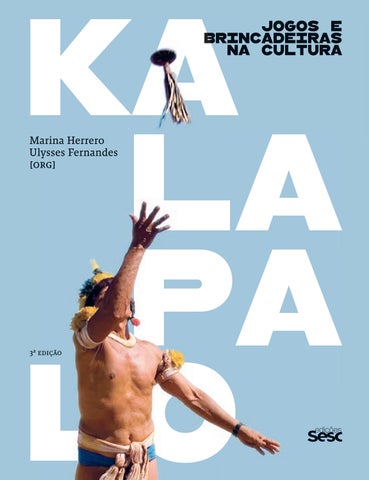
KA LA PA LO jogos e brincadeiras na cultura
Marina Herrero Ulysses Fernandes [oRg]
3ª Edição
, professor, antropólogo e uma das pessoas que participou da produção deste livro quando ele nasceu, lá em 2006. Naquele tempo, estávamos começando a registrar com nossas próprias palavras e imagens aquilo que faz parte da nossa vida desde pequenos: os jogos, as brincadeiras e os aprendizados da infância Kalapalo. Foi uma forma de mostrar que, para nós, brincar não é só diversão – é também um jeito de aprender, de viver junto, de se tornar gente dentro da aldeia. Agora, em 2025, vejo com muita alegria e orgulho essa nova edição ganhando forma. Mais do que uma republicação, é um reencontro com nossas memórias e um convite para que as novas gerações, tanto indígenas quanto não indígenas, conheçam melhor esse universo cheio de movimento, canto, corpo e cuidado. Os jogos e brincadeiras que aparecem aqui fazem parte de um modo de viver que continua pulsando no Alto Xingu. Ao reler essas páginas, me lembro das vozes das crianças, dos risos, das correrias na aldeia… e percebo o quanto é importante seguir registrando e fortalecendo nossos saberes. Que este livro continue sendo uma ponte entre mundos e uma forma de valorizar as infâncias indígenas – com sua potência, beleza e sabedoria. Professor, antropólogo e membro do povo Kalapalo
Elaborado a partir de pesquisas, uma conferência e uma expedição ao Alto Xingu, este livro registra 25 jogos e brincadeiras da aldeia Kalapalo. Traz também artigos de especialistas e retrata adornos, objetos, armas, máscaras e pintura corporal, bem como os indígenas em atividades cotidianas ou rituais. Um vídeo documentário sobre a cultura e as brincadeiras Kalapalo pode ser acessado por meio de QR code incluído.
978-85-9493-329-4
KA LA PA LO kalapalo_miolo_completo_250509.indd 1
10/06/25 14:40
SERVIÇO SOCIAL DO COMÉRCIO Administração Regional no Estado de São Paulo Presidente do Conselho Regional Abram Szajman Diretor Regional Luiz Deoclecio Massaro Galina Conselho Editorial Carla Bertucci Barbieri Jackson Andrade de Matos Marta Raquel Colabone Ricardo Gentil Rosana Paulo da Cunha Edições Sesc São Paulo Gerente Iã Paulo Ribeiro Gerente Adjunto Francis Manzoni Editorial Clívia Ramiro Assistente: Rafael Fernandes Cação Produção Gráfica Fabio Pinotti Assistente: Ricardo Kawazu
kalapalo_miolo_completo_250509.indd 2
10/06/25 14:40
KA LA PA LO
jogos e brincadeiras na cultura
OrganizaçãO Marina Herrero Ulysses Fernandes
FOtOgraFias da expediçãO Haroldo Palo Jr.
3ª ediçãO
kalapalo_miolo_completo_250509.indd 3
10/06/25 14:40
© Marina Herrero, Ulysses Fernandes, 2006 © Edições Sesc São Paulo, 2010 Todos os direitos reservados 2ª edição, 2010; 3ª edição, 2025 Preparação Maria Lúcia Leão Revisão Beatriz de Freitas Moreira, Ana Lúcia Sesso, Vanessa Paulino da Silva Projeto gráfico e diagramação TUUT Versão para o inglês John Norman Revisão do inglês Verônica Mantovani Bueno, Vanessa Paulino da Silva Fotografias da expedição Haroldo Palo Jr., Ulysses Fernandes (pp. 65 superior, 73 superior, 111 superior), Maurício Azzolini (pp. 29, 74 superior, 120, 184-5, 187, 188-9, 192-3) Fotografias em estúdio André Fortes Serviços fotográficos Walter Fukuhara Ilustrações Indiara Duarte
Desenhos Kuna Kalapalo, Jahu Kalapalo, Kainahu Lua Kalapalo, Sapuia Kalapalo, Matayatsi Kalapalo, Sepei Luti Kalapalo, Utsulü Kalapalo, Jumuiganan Kalapalo, Hínhuka Kalapalo, Kahunuma Kalapalo, Tewe Viola Kalapalo, Mazuda Kalapalo, Tawana Kalapalo, Meruri Kalapalo Equipe das expedições 2002 e 2005 Haroldo Palo Jr., Ligia C. Fernandes, Marina Herrero, Maurício Azzolini, Ulysses Fernandes Colaboradores Faremá Kalapalo, Ugise Kalapalo, Jeika Kalapalo Agradecimentos Adriane Costa da Silva, Aida Nardão Martins, Alessandra Gotti Bontempo, Bárbara Caloi, Carlos Fausto, Cláudio dos Santos Romero, Cláudio Nascimento, Eduardo Sá, Élon Brasil, Essio Pallone, Fabio Ventura, Guete, Valdurinho, Indiara Duarte, Ine Karajá, Ligia Cezarino Fernandes, Mário Paiva, Paiê Kaiabi, Paulinho Madi, Robson Gonçalves, Rosemeire Rurico Saco, Sueli Azzolini, Walter Fukuhara, Sergio A. Koisimi (Tussa)
Dados Internacionais de Catalogação na Publicação (Cip) J595
Jogos e brincadeiras na cultura Kalapalo / Organização Marina Herrero; Ulysses Fernandes; Fotografias da expedição Haroldo Palo Jr. – 3. ed. – São Paulo: Edições Sesc São Paulo, 2025. – 252 p. il.: fotografias. Bilíngue: português/inglês. – isBn 978-85-9493-329-4 1. Indígenas da América do Sul. 2. Vale do Xingu. 3. Indígenas no Brasil. 4. Etnia Kalapalo. 5. Nação Kalapalo. 6. Cultura. 7. Jogos e brincadeiras. 8. Jogos. 9. Brincadeiras. 10. Recreação. i. Título. ii. Herrero, Marina. iii. Fernandes, Ulysses. iV. Palo Jr., Haroldo. Cdd 980.41 Elaborada por Maria Delcina Feitosa CrB/8-6187
Edições Sesc São Paulo Rua Serra da Bocaina, 570 – 11º andar 03174-000 – São Paulo SP Brasil Tel.: 55 11 2607-9400 edicoes@sescsp.org.br sescsp.org.br/edicoes /edicoessescsp
kalapalo_miolo_completo_250509.indd 4
10/06/25 14:40
5
14 – IntroduCAo –
6
Apresentação Luiz Deoclecio Massaro Galina
10
Prefácio Ellen Becker Basso
17
A experiência de entender outra cultura Marina Herrero
25
Quem são, onde estão e em que contexto vivem João Veridiano Franco Neto
47
Mitologia e simbolismo Ellen Becker Basso
63
A cultura material e suas relações com o cotidiano Ulysses Fernandes
117
Processo e pesquisa Marina Herrero
121
25 jogos e brincadeiras indígenas do Alto Xingu Marina Herrero
186 194 196 251
Sobre os autores Convenções ortográficas English version Documentário
22 O povo Kalapalo
60 Cultura material
114 Jogos e brincadeiras
kalapalo_miolo_completo_250509.indd 5
10/06/25 14:40
Luiz Deoclecio Massaro Galina Diretor do Sesc São Paulo
apre sen ta— cao — kalapalo_miolo_completo_250509.indd 6
10/06/25 14:40
7
o
brincar na cultura kalapalo: um registro afetivo
As brincAdeirAs e os jogos estão presentes em todas as culturas humanas e, pode-se arriscar, também entre outras espécies na natureza. Eles propiciam vivências de sentimentos complexos, como alegria, tristeza, competitividade, medo, frustração, agressividade, cooperação, amizade, entre outros. Por vezes, cumprem o papel de simulacros da realidade, dos desafios e perigos cotidianos. A dimensão lúdico-educativa e a transmissão de saberes e valores estão na base das interações produzidas nesses contextos. Os tempos atuais encontram-se fortemente influenciados pelas rápidas transformações tecnológicas, provocadoras da hiperexposição ao ambiente virtual. Em decorrência disso, a maior parte das experiências significativas das pessoas, nas mais diferentes faixas etárias, passou a ser mediada por múltiplas telas. Tais circunstâncias geram diversos tipos de consequências. É possível que haja ganhos cognitivos diferenciados, dadas as possibilidades de estímulos sensoriais e criativos que tais mecanismos permitem, além de poderem se conectar com muita gente. Por outro lado, há riscos de perdas sensíveis no campo das relações sociais e do movimento corporal. Trata-se de um fenômeno contemporâneo: uma tendência ao recolhimento e à segurança, com deslocamentos mínimos, na qual as pessoas vivem reclusas em espaços controlados. Tais comportamentos têm consequências importantes no âmbito da saúde física e mental. Diante desse quadro, pesquisadores, educadores e tutores familiares têm se mobilizado para defender a inclusão de mais jogos e brincadeiras analógicos na rotina das pessoas, especialmente as nascidas em ambientes nato-digitais, visando promover mais momentos de desconexão. Nesse sentido, brincadeiras tradicionais, jogos de rua e/ou de tabuleiro, além de outras iniciativas não estruturadas, têm feito sucesso entre aqueles que buscam
kalapalo_miolo_completo_250509.indd 7
10/06/25 14:40
8
maior equilíbrio na convivência incontornável no mundo virtual e, com isso, a retomada dos contatos presenciais com todos os ganhos e riscos decorrentes das interações entre os seres vivos, do mesmo modo que a reconexão com o ambiente natural. Em sociedades industriais, a organização da vida social e individual esteve marcada pela disciplina do trabalho, e a dimensão lúdica engendrada pelos jogos e brincadeiras ficou, de certa forma, restrita aos tempos de não trabalho julgados mais adequados: tempo livre das obrigações para o lazer, tempo extraescolar na infância e na juventude, tempo de descanso na aposentadoria, entre outros. Como contraponto a isso, o Sesc São Paulo compreende, segundo os princípios da animação sociocultural, a importância de formas alternativas de interações lúdicas, distribuídas no dia a dia das pessoas. Jogos, brincadeiras, expressão corporal e atividade física integram esse leque, com a intenção de dar oportunidades àquelas potencialidades restringidas pelo estilo de vida urbano. Nesse conjunto, pesquisas e projetos educativos especiais, compostos por oficinas, debates e publicações, complementam nossas ações, como esta que ora apresentamos, fruto da imersão afetiva de um grupo multidisciplinar. Concebida para ser acessível a um público heterogêneo, esta edição sobre o brincar na cultura Kalapalo permite que o conhecimento advindo desses elementos culturais tão importantes possa ficar registrado e circular para diferentes pessoas interessadas em nossa diversidade cultural ou, simplesmente, difundidos como brincadeiras brasileiras. Cada jogo e brincadeira, como se poderá conferir, tem um nome e uma descrição que inclui a época do ano, a situação e as regras de participação. Além de suas características mais específicas, no entanto, é desejável aguçarmos nosso espírito investigativo para também perceber semelhanças ou diferenças existentes entre as culturas alto-xinguanas e outros repertórios lúdicos mais conhecidos. Com isso, ampliamos as analogias sobre o éthos que vigora na sociedade Kalapalo e o entendimento integrado do brincar como parte de sua expressão material e simbólica. A valorização de modalidades diversas de se relacionar com os jogos e as brincadeiras pode contribuir para que as pessoas descubram outro equilíbrio possível. Esperamos que esta publicação sobre a cultura Kalapalo – já plenamente justificada pelo caráter de salvaguarda de um patrimônio ameaçado de desaparecimento – ajude a qualificar, particularmente nos tempos que correm, a dimensão lúdica da vida, por meio dos jogos e brincadeiras, e amplie as percepções sobre a diversidade cultural brasileira.
kalapalo_miolo_completo_250509.indd 8
10/06/25 14:40
kalapalo_miolo_completo_250509.indd 9
10/06/25 14:40
pre/ fa cio
Ellen Becker Basso
kalapalo_miolo_completo_250509.indd 10
10/06/25 14:40
11
este projeto concentrou, em um único local, um conjunto extremamente interessante de descrições dos jogos e brincadeiras dos Kalapalo, práticas que em todos os lugares, entre todos os seres humanos, envolvem momento a momento estratégia e manipulação simbólica dos contextos sociais, por meio de relações deliberadamente estabelecidas entre jogadores e observadores. O fato de tais eventos serem universais na vida humana leva pesquisadores com características humanísticas (como os autores do presente livro) a buscar mais sobre o “quê” e o “como”, pois esse tipo de pergunta induz o observador científico a indagar “por quê”. Respostas a ambos os tipos de questão são muito complicadas para serem esgotadas neste breve relato, mas eu gostaria de sugerir algumas formas de refletir sobre esse assunto. A primeira abordagem envolve a concepção daquilo que costumava ser denominado “cultura”, as manifestações de cognição e comportamento humanos, como emergentes da atividade interpessoal, em vez de simplesmente “ideias” ou “princípios” “transmitidos” de uma geração para outra de forma abstrata. Situações interpessoais representam algo mais que a presença de duas pessoas em algum lugar; elas se referem a duas ou mais pessoas envolvidas entre si. Como escreveu o psicólogo americano Harry Stack Sullivan tempos atrás, “uma situação interpessoal é integrada por – trazida à existência por, mantida junto por e, no desenrolar dos eventos, de certo modo determinada por – algo interior das duas pessoas envolvidas, que é recíproco, e cujas manifestações coincidem relativamente no tempo” (The psychiatric interview, p. 50). Como aprendi nos muitos anos em que me foi permitido participar da vida dos Kalapalo, e particularmente ouvindo os Kalapalo contarem histórias entre si, seu entendimento ocorre por participação ativa e por troca com os demais do mundo. Suas comunidades desenvolvem-se através de validação
kalapalo_miolo_completo_250509.indd 11
10/06/25 14:40
241 gAme number 13
/ / Agu kaka COnditiOn little-known, remembered only by some adults. MateriaL Used a tree trunk stood in the ground. nUMBer OF partiCipants undefined. WHO partiCipates men and women of all ages. LOCaLe the village’s central plaza. OCCasiOn during the Monkey festival, together with the game of Tsine. WHat it deVeLOps endurance and strength. This game is very similar to that of Tsine, the difference being that here the men are in a different position. The first step is to take the trunk of a stout adult tree and bury its base in the ground, leaving about 1.5 meter exposed. The men and boys, in this order, come out of the men’s house in a long line, moving gracefully and singing “agú kaká, agú kaká, agú kaka,” each with his hands on the shoulders of the person in front of him. Upon reaching the trunk, the first one kneels down with his legs apart, hugging the tree. The second one hugs the first, and so on, forming a line of bodies. Then the women come with the aim of removing them, one by one, from this position, beginning with the last one in the line. They start with a strong punch in the middle of the back, followed by a “tickling session,” slaps and strong tugs. In this way they pull each one off the back of the line, sending him out of the game, until they succeed in “unsticking” the last one in the line who is hugging the trunk. Depending on the resistance of the males, the process takes more are less time, but the women always win. Agú Kaká is the Karib name for a manylegged arthropod (of the centipede type) that appears in January stuck to the lower leaves in the forest and forming small towers stacked one on top the other. This game takes its name from this arthropod, and resembles
kalapalo_miolo_completo_250509.indd 241
its formation somewhat, since the men are “stacked” one behind the other.
gAme number 14
Tsine COnditiOn little-known, remembered only by some adults. MateriaL Used none. nUMBer OF partiCipants undefined. WHO partiCipates men and women of all ages. LOCaLe the village’s central plaza. OCCasiOn during the Monkey festival, together with the game of Agú Kaká. WHat it deVeLOps endurance and strength. Here are the older men accompany the game with a song, while the younger men lie on their stomachs, side-by-side, with their arms intertwined When all the male participants are on the ground, the women come to tickle them and pull them by their arms; using some brute force as well, they try to make them turn over and to let go of each other’s arms, taking them out of this position one by one. Those who cannot resist and come out of their position are out of the game. This game can last for a long or short time, but the women always win. The girls try to move the boys, and the women the men, respecting the corresponding relations of size and strength.
10/06/25 14:43
242 gAme number 15
gAme number 16
.. Uketimuho.. .. konugu
.. .. .. Ipukuilu
COnditiOn little-known, remembered only by some adults. MateriaL Used mud for camouflaging. nUMBer OF partiCipants undefined. WHO partiCipates men, both adults and children. LOCaLe near water and the forest. OCCasiOn undefined. WHat it deVeLOps strategic thinking. Boys and men participate in this game that resembles our “hide-and-seek.” It is thus a game of hunter and hunted. One of the players, the “hunter,” lies on his stomach at the edge of the water, while another stays with him to check up on him, making sure that he does not spy as the “hunted” hide in the forest, covering their bodies with mud as camouflage. After everyone has hidden, the “checker” tells the hunter he can begin, and then quickly hides as well so he can participate in the game. Then the “hunter” goes out to find the others, singing, “tuá, tuá tuálhu,” to warn of his approach. When someone is found, he comes out of hiding with his hands on his face. After a time, if the “hunter” cannot find the hidden players, he gives up. Those who were not found come out yelling and playfully engage the “hunter” in guessing games, and sometimes he has to lie down while they slap his body. The game takes place in the forest, near the water of a river or lake, places with excellent hiding pieces, mud for camouflaging, and water to take a bath when the game is over. It can be played at any moment, whenever anyone proposes it.
kalapalo_miolo_completo_250509.indd 242
COnditiOn little-known, remembered only by some adults. MateriaL Used none. nUMBer OF partiCipants undefined. WHO partiCipates children and adults. LOCaLe beach along lake or river, and in the water. OCCasiOn undefined. WHat it deVeLOps reaction time, speed of movement and agility. This is another version of Emusi, the above-described “tag.” In this game the participants run in places where it is difficult to move quickly, such as in the water or in the sand along a lake or river. To get away from the “hunter” the players execute various kinds of acrobatics, maneuvers and dives. Besides this, instead of touching the body of the other, they give him/her a pinch – one of those that hurt! Those who want to show their courage expose themselves to the pinches without trying to escape. It develops reaction time, speed of movement and agility.
10/06/25 14:43
243 gAme number 17
gAme number 18
Water okon
Toloi .. .. Kunhugu
COnditiOn little-known, remembered only by some adults. MateriaL Used none. nUMBer OF partiCipants undefined. WHO partiCipates men and children. LOCaLe lake or river. OCCasiOn undefined. WHat it deVeLOps reaction time, speed of movement, strength and agility. This game is played in the water. Okon means wasp. The players form a large circle around the “owner of the game,” who is generally the person who proposes it. The ones that make the circle hit their hands on the water with their arms open, and the player in the center dives. When this player comes back up, those in the circle ask: “How is the wasp’s nest?” He/ she responds by showing the size with his/ her hands, and then takes his/her place in the circle. The player to his/her right then goes to the center and dives, and this process is repeated for successive players to be in the center. The size of the wasp’s nest as shown by the center player’s hands gradually increases. Once all the players have had their turn in the center, it is once again the turn of the “owner of the game” to be there. He/she dives again, and when he/she comes up the other players ask “How is the wasp’s nest?” He/she gestures that it does not exist anymore and then starts “stinging” (pinching) whoever he/she can reach, provoking great excitement and a lot of action. Even though the ending comes as no surprise, the game’s energy gradually increases with each dive, and the fun anticipation of what is known will come. Men and boys of all ages participate. It fundamentally develops reaction time, speed of movement, agility and strength.
kalapalo_miolo_completo_250509.indd 243
COnditiOn forgotten, it was played anew in August 2005. MateriaL Used none. nUMBer OF partiCipants undefined. WHO partiCipates undetermined number of children plus a teenager or adult male. LOCaLe beach along lake or river. OCCasiOn undefined. WHat it deVeLOps concentration, speed of movement, agility and reaction time. An adult or child proposes the game and automatically becomes the “hawk” and “owner of the game.” He/she draws a picture in the sand of a large tree with many branches, and each child invited to play pretends to be a little bird. Each little bird puts together his/her nest with sand on the branch he chooses and sits there. When the hawk begins to hunt the little birds, the latter come out of the nest and gather together, stamping their feet on the ground, provoking the hawks with a teasing song, in a place very close to the “tree.” The hawk approaches slowly and low to the ground (with body contracted, squatting down) in the direction of the little birds. When the hawk is close to the group he leaps up and tries to catch them while the birds run in every direction, maneuvering to distract the hawk and, when necessary, they take refuge in the nests drawn earlier on the ground. When the hawk manages to touch one of them he puts its “prey” in its lair, close to the trunk of the tree. When all the birds except one have been caught, this last one becomes the new “hawk” and the “owner of the game,” and the game begins again.
10/06/25 14:43
244 gAme number 19
gAme number 20
Land Okon
Kagihugu
COnditiOn little-known, remembered only by some adults. MateriaL Used none. nUMBer OF partiCipants undefined. WHO partiCipates boys. LOCaLe beach along river or lake. OCCasiOn undefined. WHat it deVeLOps precision, concentration, speed of movement, agility and reaction time.
COnditiOn forgotten, it was played anew in August 2005. MateriaL Used mud for camouflaging, an earthenware pan with water, buriti brooms and a lit fire. nUMBer OF partiCipants undefined. WHO partiCipates adults, men and women. LOCaLe inside the houses. OCCasiOn rainy days. WHat it deVeLOps flexibility and strength.
*
In this case, the “owner of the game” draws a spiral in the sand representing the wasp’s nest, and he is the wasp. Using his index finger, each player then “retraces” the spiral as accurately as possible. If one of the players makes a mistake and his finger goes out of the spiral, even if just by a little bit, the wasp starts hunting for him. To confuse the “wasp,” all the participants make momentary fleeing movements, but only the player who made the mistake continues to escape while the others quickly return and try to erase the original drawing. The “wasp” tries to prevent this from happening, while simultaneously “stinging” the fleeing boy with a pinch, which winds up causing a series of confused, desperate movements along with a lot of yelling. Children and adolescents participate in this game, which is exclusively for males. * see also Water Okon.
kalapalo_miolo_completo_250509.indd 244
During the rainy season, a group of friends arrange to get together and invade the house of another family group, with the aim of putting out the fire that the family members light near the hammocks when they gather to sleep. The invading group, camouflaged with mud, come quietly sneaking up to the chosen house, and one of them – who does not participate in the invasion properly speaking – carries an earthenware pan full of water and places it on the ground outside the house. Each of the invaders fills his/her mouth with water, and imitating frogs they jump into the house to spit the water into the fire. While the invaders, emitting the sounds of frogs with their mouths closed, try in every way to come near the fire and put it out, the women of the house defend the fire, hitting the invaders with buriti brooms, while the men of the house only watch the action, laughing, from their hammocks.
10/06/25 14:43
245 gAme number 21
Katuga / ikugu COnditiOn forgotten, it was played again in August 2005. MateriaL Used mangaba ball. nUMBer OF partiCipants 20 players WHO partiCipates men, with no age limit. LOCaLe the village’s central plaza. OCCasiOn undefined. WHat it deVeLOps aim, teamwork, concentration. For this game a ball is made about the size of a tennis ball, with the leaves and latex of the mangaba, a fruit-bearing tree of the region. To begin, a chief organizes the selection of the teams and the pairs. Twenty players are divided onto two teams of 10 players each, and each player is assigned a corresponding player on the opposing team. Then a goal is marked on the ground on each side the field, and the players lined up facing each other, nine in a line and one approximately 1.5 meter in front of this line and about 4 meters away from his opponent. One of these two players will throw the ball with his hand in the direction of his opponent, who will try to shoot the ball into the thrower’s goal, using his knees or his head. Each time a goal is made the teams switch sides. The two players continue to play, switching the roles of thrower and shooter. If the goal is not made, the two players are replaced. This process repeats until all the pairs have played, and all the players have taken a turn at being the thrower or the shooter. The team that scores the most goals wins. Numã Kalapalo, the shaman of the Kalapalo Aiha village, describes the game’s history and the making of the ball as follows: “This is Katuga, which our ancestors played. That’s why I know how to play like in older times, because I saw the people play it Nowadays it is no longer played This year the people will begin to know how to play at again
kalapalo_miolo_completo_250509.indd 245
We used to bring the children to spread liquid over their bodies The liquid became a little ball and afterwards we played in the center of the village This game is very old, Marina… This is Katuga, this is how we did it Make the cut and spread it on the body08 When it is ready, when it is dry, take a leaf to remove it09 Take a leave to tiu tiu (remove) all of it from the body, To make a sort of little ball. Then finish it. When you have finished it, then cut it tik tik, and take a leave from the inside10 After that, once again, cut the tree to take out more liquid, To close the cut of the ball11 Afterwards After this, wrap up the leaves and you can bury it under the fire It stays a little while buried, then take it out and make little holes in the ball, and afterwards beat it (in the mortar). Hit it in the mortar, tuk tuk, afterwards make a new ball and try it, Throw it on the ground to see if it bounces Then the game begins at the center of the village from 4 to 5 p.m. Before playing, everyone paints their body and decorates themselves Before playing with this ball They played with his ball in olden times, it is not a recent thing,
08 Use a machete to cut the mangaba tree trunk to let the latex out. Take it off with your hand and put it on the skin in thin layers, allow it to dry for about three minutes. 09 Pick about three or four leaves and wad them up to make a small ball. Stick one of its ends onto the strip of latex, then roll the ball to remove the latex from the skin, which will then stick to the ball of leaves, eventually covering it completely. 10 Use the machete to cut the ball, and take the leaves from the inside. 11 Repeat the operation to take the latex from the mangaba tree, put it on the skin, let it dry and then use latex to close the cut in the ball.
10/06/25 14:43
246
It is our tradition The ancestors played it Our grandparents (Maivutsinim – a Demiurge) made this katuga to play with it We haven’t forgotten it This is how one makes the katuga, when one decides to play it, then one takes out the liquid Then remove, tiu tiu, the liquid with the leaf and it’ll be good, Then play the game.”
gAme number 22
gAme number 23
/ Hola COnditiOn little-known, remembered only by some adults. MateriaL Used buriti string and a calabash. nUMBer OF partiCipants one. WHO partiCipates men and women, adults and children. LOCaLe undefined. OCCasiOn undefined. WHat it deVeLOps concentration, rhythmic abilities and precision.
Ija COnditiOn forgotten, it was played anew in August 2005. MateriaL Used rope. nUMBer OF partiCipants at least two. WHO partiCipates men and children. LOCaLe undefined. OCCasiOn undefined. WHat it deVeLOps agility, rhythmic abilities and strength. A game of jump rope, similar to that of the caraíba. Two of the players swing the rope and another jumps over it. When there are only two players, one player holds one end of the rope and swings it parallel to the ground, with the other end free but tied to something heavy, while the other player jumps over the rope as it moves around. As the game progresses, others may come and join in. It is interesting to note that, when they jump, they bring up their knees close to their chest, realizing a kind of strong abdominal contraction, without moving the height of their head very much in relation to the ground between the movements of pushing the body up and jumping. When the rope hits someone’s leg, the person normally falls, tangled up in it.
kalapalo_miolo_completo_250509.indd 246
The Holá is a toy a made with buriti string and a piece from a calabash drilled to the middle, with teethlike indentations cut around the edges. Stretching and loosening the string in rhythmic movements makes the piece from the calabash rotate first in one direction than in the other, producing a humming sound. The fun part is developing the ability to make the toy spin around and make noise. More recently, the children have tried making the toy with the round top of a tin can.
gAme number 24
Ketinho .. Mitselu COnditiOn widely known. MateriaL Used a braided buriti string, knotted at the ends. nUMBer OF partiCipants one. WHO partiCipates men and women of all ages. LOCaLe undefined. OCCasiOn undefined. WHat it deVeLOps creativity, memory and precision. Using a long, braided buriti string, knotted at the ends – in the same way as the string is held in the popular game of “cat’s cradle” – the player quickly manipulates the strings with his/her fingers to form various patterns. There
10/06/25 14:43
247
appear animals, figures from Upper Xingu mythology, and well-humored references to human and sexual activities. The adults make complex patterns, while the children practice simpler ones, at an amazing speed. The children make these patterns and afterwards pass them to the hands of another, who transforms the drawings and afterwards returns them to the original form.
gAme number 25
Ikindene COnditiOn widely known. MateriaL Used none. nUMBer OF partiCipants two at a time. WHO partiCipates men and women of all ages. LOCaLe the village’s central plaza (when it occurs within the Kwarìp), and undefined places (when the objective is to train). OCCasiOn Kwarìp and Jamugikumalu ceremonies. WHat it deVeLOps strength, courage, endurance and concentration. This activity is a kind of fighting or martial art, which, during the Kwarìp, takes the form of a championship involving only men, while during the Jamugikumalu it involves only women. The training sessions are held throughout the year between individuals of the same village, and without a viewing public. The objective is to knock down the opponent; the preferred way to win is to knock one’s opponent down, however, one also wins by simply touching the opponent’s leg. The wrestlers wear knee protection bought in the city and souari oil in strategic places of the body to make the opponent’s grabbing more difficult. This is not a fun activity; it is taken very seriously. The champions are anxious and very concerned not to lose, and the young nonwrestlers who are obliged to participate during the Kwarìp ceremony are afraid of their opponent, and of being hurt. In the case
kalapalo_miolo_completo_250509.indd 247
of the matches between children, many of them do not want to wrestle, but their parents oblige them to. This makes them angry and they therefore wrestle with a certain amount of violence. It is an activity that develops strength, meditation and concentration. After the competition between the adults, the children participate without any competitive obligation, as a way of training the abilities of future wrestlers. The wrestling match is always held between two competitors, at the end of the Kwarìp ceremony. After the champions of all the ethnicities present have wrestled, various simultaneous wrestling matches take place, in which teenagers and children participate. This type of wrestling, besides being a widespread and popular sport, bears three cultural features that are very strong for the Upper Xingu: their manner to understand mankind, their concept of evolved society, and the model of humankind they set as an ideal. The cultural feature that most clearly separates the Upper Xingu ethnicities from the Lower and Middle Xingu peoples is the fact that they are not hunters or warriors. Their ideal food consists of fish and beiju. The only hunted food that they accept is the monkey (rarely, most say that they do not like it) and some birds on special, restricted occasions – as the case of a couple who has just given birth to their first child, a great responsability. On these occasions, the so-called couvade takes place. Some behaviors are imposed, including dietary restrictions. The couple cannot eat fish and must therefore hunt birds as a substitute food. Hunting is a model of war. And war is something they really abhor. The model behavior, the proper way to act for the Upper Xingu man is to be a wrestler and a fisher. They even speak depreciatively about the other indigenous who live at war: “They’ve always done that and they always do that,” they say, “the caraíba are always at war too.” They do not like it, they do not accept it. In their opinion this is a characteristic of social underdevelopment, that is, only
10/06/25 14:43
248
underdeveloped societies make war. A Mehinaku man once said, “We don’t make war, we wrestle” (Gregor, 1982). Instead of war, the Upper Xingu interrelate by way of a competition of wrestle, a kind of contained “war” the Ikindene. For the Kwarìp ceremony the wrestlers decorate themselves with body paintings, belts, anklets, snail-shell necklaces and strips of wool on their arms and knees.
saberes e ações (Indigenous Brazil: Histories, Knowledge, and Actions). She directed and developed concepts for six films, including Kwarìp: mito e rito no Xingu (Kwarìp: Myth and Rite in the Xingu), A vitória dos netos de Makunaimi (The Victory of Makunaimi’s Grandchildren), and Sawé: as lutas do movimento indígena (Sawé: The Struggles of the Indigenous Movement). ulysses feRNaNdes
elleN beckeR basso
Indigenist. Bs in Biological Sciences from the Universidade Metodista de Piracicaba (Unimep), 1986. Member of the Sociedade Brasileira de Entomologia (Brazilian Society of Entomology) and cultural producer.
PhD, University of Chicago, 1969. Professor Emerita of Anthropology, University of Arizona. Member, American Ethnological Society (President during 1991–1993).
Typographical conventions
About the authors
haRoldo palo jR. Graduated in Electronic Engineering and Computing from University of São Paulo – São Carlos. Naturalist photographer with a collection of over 280 thousand photographs, with pictures published in books, magazines, calendars and temporary and permanent exhibitions. joão veRidiaNo fRaNco Neto Ba in Social Sciences from the Universidade Federal de São Carlos (UFsCar), 2005. Master’s degree in Social Anthropology from the Universidade Estadual de Campinas (Unicamp), 2010. maRiNa heRReRo Indigenist and cultural manager, she created the Cultural Diversity program and the Indigenous Peoples area at Sesc São Paulo. She is author and editor of publications such as Baré: povo do rio (Baré: The River People), Prêmio Culturas Indígenas (Indigenous Cultures Award), and Brasil indígena: histórias,
kalapalo_miolo_completo_250509.indd 248
In the English version of these essays the treatment of typographical details such as capital letters and italic font follows standard use in English. For the sake of easier reading, it would be helpful to review these considerations. First, where a word is linguistically bound to the Kalapalo cultural universe (or is taken from Brazilian Portuguese), not otherwise used in English, it is given in uncapitalized italics if it is not a proper name. Examples of this are beiju, a typical food, and kagutu, a type of flute. On the other hand, proper names are capitalized, in normal font. An example of this are cultural names such as Kalapalo and Kuikuro, which are capitalized, just like “European” or “Apache” would be. The name of a supernatural being is capitalized if it is an individual, such as Jakuikatu (an entity who lives in the water), just as the names of “Medusa” or “Thor” would be in Greek or Scandinavian mythology. However, where a term denotes a class of supernatural beings, such as itseke, this name is not capitalized as a proper name, but given in italic font, just as the generic words “spirit” or “angel” would be. Names of games are given in italic
10/06/25 14:43
249
font rather than capitalized, just as names of traditional games in Western culture, such as “tag,” “hide-and-seek,” “baseball,” etc., are not capitalized. A festival such as Kwarìp – held one a year – is a proper noun, and capitalized, like Western civilization’s Christmas or Labor Day. A word associated with a proper name is capitalized even if it is, itself, a common noun (a common example of this in English would be “June bug”); in these texts, an example of this is the game of Hagaka, whose name is the same as the holiday on which it is played. A word from the Kalapalo (or Brazilian Portuguese) universe will either be a common noun, and italicized, or a proper noun, and capitalized; it is never both. In most cases the spelling of the cultural names follows the usage in the Portuguese source text, which follows the spelling used by the Kalapalo themselves with a recently introduced spelling system using the Roman alphabet with accent marks. However, in cases where a word is already well known in English with another spelling – as is the case of the Kwarìp festival (Kwarìp in the Kalapalo graphic system) – this well-known English spelling is used. The spelling of names of the ethnicities in the English texts is generally the same as in the Portuguese texts in this book, which follows the convention established in 1953 by the aBa (Brazilian Anthropology Association), except in those cases where a clear precedent has been established for the group’s spelling in English. The typographical treatment of these names follows accepted usage in English, with capital letters, whether used as a noun or an adjective.
forest, the fire, a log, the house structure, the body, the other person’s body. The documentary presents twenty-five games and plays in the Kalapalo culture, sixteen of which are unknown to the majority of the Aiha village, remembered only by a few elderly people and adults.
Images, script and direction Haroldo Palo Jr. Editing Isadora Puntel de Almeida Narration PT Daércio Neto Narration EN Oliver Earl Cain Soundtrack Carlinhos Antunes and Sérgio Bartolo Text Ulysses Fernandes Sound editing Estúdio Som de Cinema English version Beverly Victoria Young Karib-Portuguese translation Ugise Kalapalo and Jeika Kalapalo Technical support Sandra R. Karaoglan Backing Instituto Socioambiental (isa) expeditioN Village images Mauricio Azzolini Testimonial images Wellington Moura External assistants Dimas Soares and Felipe Ventura Script Ana Carolina Maglio Editing Marcelo Azevedo Direction Cláudio Nascimento Translation Beverly Victoria Young
Documentary Games and play in Kalapalo culture Cooperation and solidarity; the physical development of strength and speed of reaction and marksmanship or the simulation of wars and hunts are just some of the characteristics present in games and play. Toys are rarely used; they take advantage of what nature has to offer: the earth, the water, the
kalapalo_miolo_completo_250509.indd 249
10/06/25 14:43
250
The very existence of the game is a permanent confirmation of the supralogical nature of the human condition. If animals are able to play, it is because they are something more than mere mechanical beings. If we play and engage in games, and we are conscious of this, it is because we are more than mere rational beings, since the game is irrational. JOHan HUizinga, 1938
They thus created a world inhabited by forces and powers that follow people closely, interfering in an open way in their lives. The myths are a good clue for finding one of the threads of this complex web. CarMen JUnQUeira, 2005
The game is not to be understood through the antithesis of wisdom/craziness, true/falsity, or good/evil. Although it is an immaterial activity, it does not have a moral function, as it is impossible to apply notions of vice and virtue to it. JOHan HUizinga, 1938
The game is an element of life, but it defies exact definition in logical, biological or aesthetic terms. JOHan HUizinga, 1938
kalapalo_miolo_completo_250509.indd 250
10/06/25 14:43
251
docu / men tario Jogos e brincadeiras na cultura Kalapalo
Cooperação e solidariedade; desenvolvimento físico de força e velocidade de reação e pontaria ou simulação de guerras e caças são apenas algumas características presentes nos jogos e brincadeiras. O brinquedo raramente é utilizado, aproveita-se o que a natureza oferece: a terra, a água, a mata, a fogueira, um tronco, a estrutura da casa, o corpo, o corpo do outro. O documentário apresenta 25 jogos e brincadeiras na cultura Kalapalo, sendo 16 desconhecidos da maioria da aldeia Aiha, lembrados apenas por poucos idosos e adultos. Imagens, roteiro e direção Haroldo Palo Jr. Edição Isadora Puntel de Almeida Narração PT Daércio Neto Narração EN Oliver Earl Cain Trilha sonora Carlinhos Antunes e Sérgio Bartolo Texto Ulysses Fernandes Mixagem Estúdio Som de Cinema Versão em inglês Beverly Victoria Young Tradução Karib-português Ugise Kalapalo e Jeika Kalapalo Acompanhamento técnico Sandra R. Karaoglan Apoio Instituto Socioambiental (isa) expedição Imagens aldeia Mauricio Azzolini Imagens depoimentos Wellington Moura Auxiliares externa Dimas Soares e Felipe Ventura Roteiro Ana Carolina Maglio Edição Marcelo Azevedo Direção Cláudio Nascimento Tradução Beverly Victoria Young Acesse o código Qr para assistir ao documentário.
kalapalo_miolo_completo_250509.indd 251
Aponte a câmera do seu celular para o código ao lado e acesse o link que irá surgir. (Alguns celulares precisam de aplicativo para ler o código.)
10/06/25 14:43
FOntes Malaga e HWt Konopo papeL Supremo alta alvura 250g/m2 (capa) e Alta alvura 90g/m2 (miolo) iMpressãO Maistype data junho 2025
selo FSC
kalapalo_miolo_completo_250509.indd 252
10/06/25 14:43