NO. 84
FALL 2026
EAT • DRINK • SHARE • GROW
edible SAN DIEGO
LIMITED EDITION
HOMEMADE
COOK THE COVER • FARM-TO-PRESCRIPTION • SUPER GRAINS SERVING SAN DIEGO COUNT Y | MEMBER OF EDIBLE COMMUNITIES | EDIBLESANDIEGO.COM
Truly a hidden gem in Fallbrook’s emerging wine scene and the newly established San Luis Rey AVA (American Viticultural Area) It’s all about slowing down, connecting with the land, and enjoying the care that goes into every vine and bottle here. Friday nights feature live music, and on weekends we have amazing local food vendors. We host seasonal events, holiday celebrations, and private events such as dine-in-the-vines dinners and stargazing nights which have become fan favorites. We’re a small but mighty team and we work with local businesses and charities because that’s what good neighbors do. Our wine club gives members discounts, first dibs on new releases and special events, and you can shop our wines online. We’re also working towards organic, regenerative, and SIP certifications because taking care of the land is important to us. Bring the family, bring the dog, bring friends who swear they don’t like wine. We’ve created a place where you can relax with a glass, take in these incredible views, and just enjoy yourself.
40740 Vía Ranchitos, Fallbrook, CA 92028 OPEN Wednesday – Sunday 12 pm to 7 pm adobehillwinery.com
Spend the Holidays in Santa Ysabel Celebrate the season in Santa Ysabel—where holiday traditions, beautiful gardens, and unforgettable shopping come together. This holiday season, trade the rush for a day of charm, discovery, and timeless treasures in the heart of historic Santa Ysabel. Begin your journey at Olive & Oak, where you’ll find beautifully curated home décor, unique gifts, festive tabletop collections, linens, vintageinspired accents, and thoughtful holiday finds for everyone on your list. Stroll through our peaceful garden, take in the fresh mountain air, and enjoy the slower pace that makes holiday shopping a pleasure instead of a chore. As you wander through the garden, continue on to Mo’s, where every room is filled with authentic antiques, one-ofa-kind pieces, and unexpected treasures waiting to be discovered. Whether you’re searching for the perfect heirloom gift or something special for your own home, you’ll enjoy the thrill of finding pieces with history and character. Make a day of it. Wander. Explore. Find inspiration. Create memories.
Olive & Oak • Mo’s Two unique shopping experiences connected by a beautiful garden in the heart of historic Santa Ysabel.
Olive & Oak Antiques Thur - Sun, 10 a.m. to 5 p.m 30275 Highway 78, Santa Ysabel, CA 760-419-8795 • oliveandoakantiques.com @oandoantiques
Vintners Table
Uncorked in Fallbrook Adobe Hill Winery 40740 Via Ranchitos Fallbrook, CA
MEMBER OF
2011 Publication of the Year
edible SAN DIEGO PUBLISHER AND EDITOR IN CHIEF Katie Stokes EXECUTIVE EDITOR Maria Hesse COPY EDITOR Dawn Mobley ADVERTISING Katie Stokes COVER BY DEANNA SANDOVAL DESIGN BY MARIA HESSE
ADVERTISING
For information about advertising options, rates, and deadlines please contact katie@ediblesandiego.com.
Edible San Diego magazine is a quarterly publication made available by subscription and free distribution at select locations throughout San Diego County. No part of this publication may be used or reproduced without permission from the publisher. Information in this magazine has been obtained from sources believed to be reliable. The publisher disclaims all liability for any occurrence that may arise as a consequence of the use of information or recipes. Every effort is made to avoid errors, misspellings, and omissions. If an error comes to your attention, please accept our sincere apologies and notify us. © 2026 All rights reserved. This magazine is made possible thanks to Edible San Diego advertisers and subscribers. Subscriptions available online or by mailing $25 to:
EDIBLE SAN DIEGO 3451 Via Montebello #192-313 Carlsbad, CA 92009 601-526-1919 info@ediblesandiego.com ediblesandiego.com Instagram @ediblesdmag Facebook @ediblesandiego YouTube @ediblesandiego JORDAN YOUNIS
Saturday, October 24, 2026 | 12:30–3:30pm | Live DJ Wine pours by Adobe Hill Winery + bites by Taco Bros
In honor of Breast Cancer Awareness Month in October, a portion of the proceeds will benefit Michelle’s Place Cancer Resource Center. 2 e d i b l e s a n d i e g o. c o m
Tickets at Please reshare and recycle
local MARKETPLACE Unforgettable Experiences in North County San Diego
Best Selection in SoCal Unique Lamps & Shades Expert Lamp Repair
The Lampshade
Gallery 858-793-0702
(760) 401-5968
Innovative | Natural | Beauty
Del Mar thelampshadegallery.com
Family-Owned
Now at Salon Sultry
in Downtown Escondido. Offering Longevity Biofacials
Plasmatique Cold Atmospheric Plasma for Skin and Hair Restoration
Feed & Homestead Supply
217 East Grand Ave, Escondido CA 92025 www.salonsultryongrand.org for online booking (760)705-1250
FALLBROOK • ESCONDIDO SANTEE
&
STORES IN:
GET THE EFFECT
EFFECT
Vincent Ripol
AC E C e r t ifie d Pe r s o n a l Tr ain er
Contact today and try a free session! vripol@yahoo.com FA L L 2 0 2 6 |
edible SAN DIEGO
3
Issue 84 • Fall 2026
CONTENTS IN THI S I S S UE 6 Publisher’s Note E AT 8 Field Notes: Stehly Farms Organics 9 Market Explorer: Say Cheese 10 Local Markets Guide 13 Cooking Together: Recipes That Inspire Remembrance from the Great Beyond 16 Cook the Cover: The Many Stories Behind a Dish D RI N K 22 Through the Grapevine: The Untold True Story of California Wine 27 Fall Word Play S HA RE 29 Why Is It So Hard to Get Local Produce to San Diego Patients? 34 The Hottest Place for Farm Stand Visits and Stargazing, Maybe on the Planet 37 Beyond the Postcard: The State of Hunger in San Diego County 39 Kids’ Plate: Pumpkin Parts! GROW 42 Sow It Goes L AS T B I T E 46 Super Grains
JOIN EDIBLE SAN DIEGO’S FREE E-NEWSLETTER • Digital magazine • Cooking tips and recipes • Garden inspiration • Food and dining destinations + MORE Scan the QR code to sign up for free
L IS T E N • Edible Communities Radio podcast available on ediblecommunities.com 4
e d i b l e s a n d i e g o. c o m
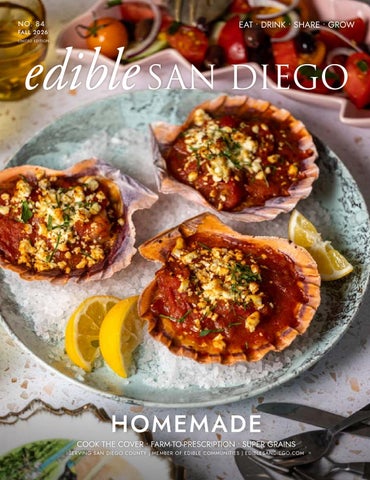
ON THE COVER: A memorable fishing tale from Biscayne Bay makes its way from one coast to another with this dish. Try making the 2026 Cook the Cover recipe Bayshore Court Baked Shrimp from reader Dianne F. Collatos for yourself. Recipe on page 18. THIS IMAGE: Chef Eduardo Cortes slices an onion for his Cook the Cover recipe selection. See which dish he made on page 16.
STEPHANIE ARSENAULT
E D IB LE SA N DI EGO.COM
PUBLISHER’S NOTE
RECIPES FOR A LOCAL LIFE
I
t’s that time of year again when sharing recipes from Edible San Diego readers sets the mood for autumn. The change of season invites us to savor the longer, cooler nights when we can rest, celebrate, or give our creativity some free rein. The fourth annual round of recipes submitted for our Cook the Cover feature were as enticing as ever. Our guest chefs reviewed them all and selected three that touched their hearts: one family’s twist on Taco Tuesday, a boat-to-table brainstorm, and shrimping “by the light of the silvery moon.” We hope you try each dish. The Cookbook Club selection this fall might surprise you, opening up a whole dimension about how sharing beloved dishes transcends time and nurtures connection. Then there are other unexpected stories about vines, desert climes, food for thought about how food heals, and some skinny on grains (give carbs a chance!). As the earth tilts towards the winter solstice, we can heartily enjoy all that fall offers in San Diego County. Get outside with hands in the dirt, or toast friends at a local winery. Invite some people over for the most casual potluck imaginable! We appreciate your interest in the magazine and hope you tell people about it, our newsletter community, magazine subscriptions, website treasure trove, events, and more. When it comes to local food and drink, we believe gratitude is in season all year. We salute the hardworking people who grow, harvest, prepare, sell, buy, and serve local crops, meats, beverages, innovative foods, and other healthy lifestyle products proudly made here in San Diego County. When it’s time to go out or online, please use our Advertisers Guide as inspo (see page 48). They support Edible San Diego’s editorial mission and want the opportunity to dazzle you. We all can be a local champion wherever we may visit, dine, or shop. Every purchase makes a big difference to the business and the local economy, which feels incredibly hopeful when we pause to notice. Wishing you and your circle a healthy, joyful, meaningful fall and holiday season. May we keep sharing and caring ever more … because that’s what it’s all about.
LA N D ACKNOWLEDGEMENT Edible San Diego recognizes the Kumeyaay, Luiseño/Payómkawichum, Cahuilla, and Cupeño/Kuupangaxwichem people who have lived in relationship with the earth, flora, fauna, waters, and sky for thousands of years as the original stewards of this region. This publication commits to building greater awareness of and appreciation for the traditional ecological knowledge, wisdom, and experiences of San Diego County’s first peoples as an essential part of the health and vitality of our local food system.
6
e d i b l e s a n d i e g o. c o m
IN MEMORIAM: WENDELL BERRY August 5, 1934–August 31, 2026
A farmer and writer who influenced me deeply, among other things, bringing me to these very pages.
Sorting through an amazing antique collection brought by Logan Mitchell, co-owner of Tablespoon and Collins & Coupe in North Park, to style Cook the Cover dishes. See the final looks on page 18.
STEPHANIE ARSENAULT
Katie Stokes Publisher and Editor in Chief Edible San Diego
100% Estate Grown, 100% Estate Produced andGrown, Bottled Produced and Bottled
SAN DIEGO RAMONA VALLEY WINES Zinfandel | Sangiovese | Malbec COUNTY WINES Cabernet Franc | Dry Rosé Zinfandel | Sangiovese | Malbec Cabernet Franc | Albarino Open for Tasting and Sales Open for tasting and sales Saturdays & Sundays 11-5 Saturdays & Sundays 11–5 910 Gem Lane, Ramona, CA 910 Gem Lane, Ramona, CA chuparosavineyards.com chuparosavineyards.com
Visit our farm MON-SAT 9AM-5PM
HAPPY-HENS.COM
RAMONA, CA
SOY free
corn free
Water, not fire!
A gentle & eco-friendly alternative to traditional flame-based cremation. WHITEROSEAQUACREMATION.COM
FA L L 2 0 2 6 |
edible SAN DIEGO
7
Stehly Farms Organics BY JULIE PENDRAY
D
riving through bucolic Valley Center, with ancient, shady oaks arching over the roads, is worth the trip in itself. But finding the biggest, deeply colored, juiciest strawberries and blackberries among the rows and flowering vines at Stehly Farms Organics is even better. If you ever doubted how much tastier fruit is when it’s freshly picked, organic, and locally grown, this is your proof. If that’s not enough, the little goats will win your heart!
good stewards of the land,” the farm states on its website.
CSA Selections for Fall
Stella explains that the Kensington store is a farmers’ market for shoppers seven days a week, so people don’t have to drive to different farmers’ markets on various days, which may not fit their schedule. The Stehly family’s produce arrives at their market the same day it’s picked.
BY JULIE PENDRAY
JULIE PENDRAY
EAT FIELD NOTES
“The extra flavor is because it’s picked at the right time. It’s ripened while still on the vine or in the soil,” Stella says. ”We also use our farm’s produce in the store’s juice bar for juices and smoothies, and in our baked goods.”
Produce from other local growers is also available for purchase, along with breakfast and lunch options in the market’s deli. Stehly Farms sells some of its harvest to other regional grocers, such At a Stehly “no frills, U-pick” event, you can connect with nature, help children understand as Jensen’s Foods, Cream of the Crop, Seaside Market, Jimbo’s, and Frazier Farms. where and how food grows, shop at a farm stand, and greet a variety of animals in a play “In a typical grocery store, the produce would area. Tours and annual attractions, like their be picked, then go to a distributor, and it may October pumpkin patch, are also offered at sit there for a week or a month or more before this 278-acre farm. it goes to a retailer,” Stella says. “It could be Surrounded by citrus groves and towering hillsides, visitors can expect to find themselves chatting with others at the farm stand about how much they enjoy the fresh juices and flavorful carrots. Some share zucchini recipes while another shares they’ve been bringing their sons down from Temecula annually to pick berries for 10 years. Stehly (pronounced “Stay-lee”) family farming dates to the 1920s, when Nicholas J. Stehly began growing in Orange County. Jerome Stehly Sr. moved the operation to Valley Center in 1964. Sons Jerome and Noel acquired the farm in 2002, and together the brothers and their wives, Chris and Stella, own Stehly Farms Organics in Valley Center and Stehly Farms Market, a grocery store in the Kensington neighborhood of San Diego. They offer CSA boxes that can be picked up on Thursdays at the farm, their market, or at designated locations in Clairemont, Mission Hills, and Point Loma.
longer to go to a distributor if it sits on a ship for a month. And that affects the carbon footprint.” Stehly Farms Organics belongs to the Independent Natural Food Retailers Association, a co-op that represents more than 400 members to improve purchasing power and operational efficiency. At Stehly Farms Market, they carry the same types of products regular grocery stores sell, but only from producers that align with their mission, like grass-fed beef and Smart Chicken. When asked about the future of California farming, Stella stresses that it’s becoming increasingly challenging due to increases in taxes, fees, and assessments. “Farmers are already having a hard time with water rates. Businesses have to pass along these costs to consumers. Small businesses are being killed. It’s all going to corporations now.” The family emphasizes the importance of consumers knowing where food comes from and how it’s produced. They underscore what they call “the simple life,” and they invite the public to come enjoy it on their property. D
“By purchasing a share at the beginning of the season, you are allowing a small farm to do what they do best: feed the community and be » stehlyfarmsorganics.com 8
e d i b l e s a n d i e g o. c o m
Investing in Community Supported Agriculture (CSA) means local food dollars support local farmers who are more likely to spend locally too. Shoppers can save on gas, time, and reduce their carbon footprint, according to the San Diego County Farm Bureau. Check CSA websites and social media to see what farmers are planting and harvesting and which benefits are accepted. Be Wise Ranch Escondido
» bewiseranch.com Dassi Family Farms Encinitas
» dassifamilyfarm.com Eli’s Farm Fallbrook
» elisfarms.com Foodshed Cooperative City Heights
» foodshedcooperative.com J. R. Organics Escondido
» jrorganicsfarm.com MAKE Farm San Diego
» sdmake.org Rodney Kawano Farms Oceanside
» rodneykawanofarms.org Sage Mountain Farm Fallbrook and Anza
» sagemountainfarm.com Sand n’ Straw Vista
» sandnstraw.com Yasukochi Family Farms Oceanside
» yasukochifamilyfarms.com Contact farms directly for more details. Scan to bookmark the digital CSA guide on ediblesandiego.com.
MARKET EXPLORER: SAY CHEESE BY MICHELLE STANSBURY
I
n San Diego, the local cheese scene is thriving, fueled by passionate neighborhood purveyors who act as part curator, part storyteller. Here’s a tour of five local spots cutting to order—and the standout cheeses they can’t stop talking about.
B O U G I E ’ S CH EE S E SHOP
What they’re loving right now
Midnight Moon gouda, which has buttery caramel notes and a pleasant nutty aroma. » carruthcellars.com
La Mesa
JAY B I RD S U P ERE T TE
Jackie Bougie and Melanie Estes opened Bougie’s as a retirement passion project inside the Reuben M. Levy House, a 1920s Craftsman kit home on La Mesa’s historical registry, where they now showcase approximately 80 cheeses at a time. The cheese selection is primarily from American artisan and farm craft makers, based on the co-owners’ personal connection of knowing the struggles of small farmers from their own families.
The county’s newest cheese shop has been open since February 2026 on Soledad Mountain. Hannah Kinney and Peter Kobulnicky relocated from the East Coast, where they met working at Formaggio Kitchen, to open what they describe as a fancy bodega. Expect 60+ cheeses cut to order along with around 20 grab-and-go cheeses, plus charcuterie and sandwiches on bread Kobulnicky bakes himself.
La Jolla
What they’re loving right now
What they’re loving right now
Deer Creek Cheese’s Imperial Buck, which gives the owners a chance to explain what a clothbound cheddar is and how that influences texture and flavor. » bougiescheeseshop.com
C A RRUTH CELL A R S WI N EG A RD EN & CH EE S E S H O P
Hornbacher’s Little Brother, a raw cow’s milk alpine cheese from Gourmino (from the same maker that won best cheese in the world with their 18-Month Gruyère last November, which Jaybird Superette also carries). » instagram.com/jaybirdsuperette
S M A LLG O O DS CH EE S E S H O P & C A FE
Liberty Station
ALINAN
The food menu also offers cheese flights to pair with wines, including a vegan pairing from San Diego’s Full Moon Foods.
A full gourmet cheese shop built into a 12,000-square-foot urban winery, the cheese shop serves 15–20 different cut-to-order cheeses. Look for local selections like burrata from Amano Cheese.
La Jolla
Jenny and Mike Eastwood built Smallgoods out of farmers’ market stalls in La Jolla, Little Italy, and Hillcrest before opening a shop on La Jolla Boulevard. They stock small-batch American makers
exclusively, and their beach boxes are built for a walk down to the water. What she’s loving right now
Her current favorite cheesemaker is Pat Morford at River’s Edge in Logsden, Oregon. The Up in Smoke is a fresh goat cheese smoked over applewood and wrapped in maple leaves. » smallgoodsusa.com
VEN I S S I M O CH EE S E Mission Hills, North Park, Del Mar
Ownership of San Diego’s cheese institution turned over in April 2025 when founders Gina and Roger Freize sold to Rob Graff, who had worked there since 2008. Known to regulars as “Professor MacCheese,” Graff is focused on deepening Venissimo’s experience offerings, such as classes through the Academy of Cheese and the annual Cheese & Libation Expo. What he’s loving right now
TomaRashi from Point Reyes Farmstead— their classic Toma with shichimi togarashi mixed right in. You get a slow build of heat, a little citrus, and a little nori, and it’s just as good on a board as it is melted into eggs. » venissimo.com D
LOCAL FARM FRESH
Da-Le-Ranch.com
FA L L 2 0 2 6 |
edible SAN DIEGO
9
EAT
San Diego County Fa r m e r s ’ a n d F i s h e r m e n ’s M a r k e t s Escondido—Welk Resort √ 8860 Lawrence Welk Dr. 3–7pm
TUESDAY Coronado √ Near 1st St. & B Ave. 2:30–6pm Escondido √ * ! 262 E. Grand Ave. 2:30–6pm Mira Mesa √ * Mira Mesa High School 10510 Reagan Rd. 2:30–7pm (3–7pm Nov–Dec) Otay Ranch—Chula Vista √ Otay Ranch Town Center 2015 Birch Rd. 4–8pm Pacific Beach Tuesday √ † ! 901 Hornblend St. 2–7pm
WEDNESDAY Carlsbad √ State St. & Carlsbad Village Dr. 2:30–7pm Little Italy Mercato √ † * Date St. from Kettner Blvd. to Front St. 9:30am–1:30pm Ocean Beach √ 4900 block of Newport Ave. 4–8pm Santee √ † * ! Pathway Center Carlton Hills Blvd. & Mast Blvd. 3–7pm South Bay √ 4475 Bonita Rd. 3–7pm
THURSDAY Linda Vista √ * Linda Vista Plaza 6939 Linda Vista Rd. 2–7pm North Park √ † * ! 3000 North Park Way at 30th 3–7:30pm 10
e d i b l e s a n d i e g o. c o m
Oceanside Morning √ * ! 511 Pier View Way & Hwy. 101 9am–1pm Ramona Grange Growers Exchange Grange Hall 215 7th St. 4–7:30pm Scripps Ranch √ Newtopia Cyder 10045 Carroll Canyon Rd. 3:30–7:30pm
FRIDAY La Mesa Village √ * ! La Mesa Blvd. btwn Palm Ave. & 4th St. 3–7pm (Oct–Apr) Marina District ASCENDKemet Collective † 180 West Island Ave. 3–7pm Rancho Bernardo √ Bernardo Winery 13330 Paseo del Verano Norte 9am–1pm San Marcos √ † 251 North City Dr. 4–8pm
SATURDAY Cardiff √ † * Miracosta College San Elijo Campus 3333 Manchester Ave. 10am–2pm City Heights - ASCENDKemet Collective Farmers’ Market † 4325 Wightman St. 10am–2pm Del Mar √ Del Mar Civic Center 1050 Camino Del Mar Noon–4pm El Cajon Back Roads Certified 14335 Olde Hwy. 80 9am–1pm Fallbrook Main Avenue √ * ! Main Ave. btwn Hawthorne & Fig 9am–1pm Little Italy Mercato √ † * ! Date St. from Kettner Blvd. to Front St. 8am–2pm
Mission Valley √ Civita Park 7960 Civita Blvd. 9am–1pm Poway √ * Old Poway Park 14134 Midland Rd. at Temple 8am–1pm Santa Ysabel √ 21887 Washington St. Hwy. 78 & Hwy. 79 Saturday & Sunday 11am–4pm Tuna Harbor Dockside Market 598 Harbor Ln. 8am–1pm (or until sold out) Vista √ † * ! 345 S. Melrose Dr. 8am—noon
SUNDAY Broadway Pier ASCENDKemet Collective † 900 W Broadway 10am–2pm (Nov–Apr) Carmel Valley √ † Torrey Pines High School 3710 Del Mar Heights Rd. 10:30am—1pm Chula Vista √ 300 Park Way & Third Ave. 10am–2pm Fishermen’s Market of North County Oceanside Harbor 320 Harbor Dr. 8am–2pm Hillcrest √ * University Ave. btwn Herbert St. & Park Blvd. 9am–2pm
San Carlos 600 Laurel St. Fourth Sunday 11am–2pm Santa Ysabel √ 21887 Washington St. Hwy. 78 & Hwy. 79 Saturday & Sunday 11am–4pm Solana Beach √ 444 So. Cedros Ave. Noon–4pm
MOBILE MARKETS People’s Produce Mobile Farmers’ Market † Servicing nine different market locations throughout Southeastern San Diego, National City, Barrio Logan, and Lemon Grove. Visit projectnewvillage.org for days and locations. LEGEND √ Markets certified by the San Diego County Agricultural Commissioner, ensuring that the produce is grown by the seller or another certified farmer in California, and meets all state quality standards. † Market vendors accept EBT (Electronic Benefit Transfer). * Market vendors accept WIC (Women, Infants, Children) Farmers’ Market checks. ! Market vendors accept WIC Fruit and Vegetable checks.
La Jolla Open Aire √ 7335 Girard Ave. & Genter St. 9am–1pm
All listings are subject to change. Please contact markets directly to confirm hours of operation, locations, and what benefits are accepted.
Leucadia √ NEW LOCATION Oak Crest Middle School 675 Balour Dr. 10am–2pm
Bookmark the digital market guide on ediblesandiego.com for links to market websites and more complete information.
Rancho Santa Fe √ Del Rayo Village 16079 San Dieguito Rd. 9:30am–2pm
STUDIOTOPIA
MONDAY
Green Thumb Nursery 1019 West San Marcos Boulevard, San Marcos CA 92078
www.greenthumb.com Sign up for our Newsletter
Gardening Store/Nursery
Green Thumb Nursery - San Marcos
(760) 744-3822
80 years in business. 50 years at this location. Green Thumb Nursery, proudly family-owned and located in San Marcos. We are dedicated to providing high-quality products and exceptional customer service. Explore our extensive selection of indoor and outdoor plants, fountains, garden decor, outdoor patio furniture, gardening supplies, and bird feeders. Our diverse range includes drought-tolerant and native plants, fruit trees, vibrant flowers, water plants, perennials, annuals, succulents, and more. Visit us and discover why Green Thumb Nursery is your ultimate destination for all gardening needs.
S A N D I E G O C O U N T Y V I N T N E R S A S S O C I AT I O N
ORGANIC GOODS FOR NATURAL LIVING
SAN DIEGO WINE WEEK 5/31–6/6 2027
SHOP
VIBRANT ORGANIC HERBS, SPICES, OILS, TEAS, GIFTS, & MORE 115 S Palm Canyon Drive, Palm Springs, CA 442.998.4085
Sign up to host a simple experience featuring San Diego wines and get one FREE ticket to the festival!
• ONLY FESTIVAL LIMITED TO SAN DIEGO WINERIES • MUSIC + FOOD INCLUDED SANDIEGOWINERIES.ORG
12
e d i b l e s a n d i e g o. c o m
EAT
Cooking Together
Recipes that inspire remembrance from the great beyond R o s i e G r a n t ’s To D i e Fo r : A C o o k b o o k o f G ra ve s t o n e R e c i p e s o f f e r s a s e l e c t i o n o f s we e t t re a t s f o r t h e s h a r i n g s e a s o n REVIEW BY ARIANNA LITRENTA BOOK BY ROSIE GRANT PHOTOGRAPHY BY JILL PETRACEK AND ROSIE GRANT
T
here’s a sense of nostalgia that fall brings. Halloween movies, family recipes simmering on the stovetop, and crisp evenings echo a simpler time that invites us to turn inward. It’s a season built on memory, where comfort and tradition take center stage. To Die For: A Cookbook of Gravestone Recipes embodies this wistful spirit. With its ghostly edge and collection of comfort classics, it’s a cookbook made for autumn. For Edible San Diego’s fall Cookbook Club, we’re digging deeper with author Rosie Grant and highlighting three standout recipes ideal for the season ahead.
A Living Archive An archivist by training, Rosie Grant has spent years documenting recipes etched onto gravestones and unearthing the stories behind them. The result is a cookbook that feels like an heirloom, filled with well-loved recipes and family lore. Grant describes it as a “treasured cookbook that you would inherit from your grandmother,” and that timelessness runs throughout the pages. What sets To Die For apart is its collaborative nature. Grant worked closely with families, friends, and communities to piece together the lives behind each recipe. Her dedication created a living archive, one that yields stories which might otherwise have been lost. Her work gently reframes how we think about loss. “Losing a person is like losing a library,” she explains. Despite the theme of death, the cookbook is far from somber. “There’s something very joyful about a recipe in a cemetery,” Grant says. “It’s so for the living.” By pairing food with remembrance, To Die For adds warmth and even celebration to grief.
Three Desserts, Three Legacies For this fall’s Cookbook Club, we’re sharing three dessert recipes well suited for gifting or personal enjoyment: Annabelle’s Snickerdoodles, Date Squares, and Kay’s Fudge. Each recipe offers a glimpse into how food carries memory forward. With their soft, fluffy texture, Annabelle’s Snickerdoodles are the ultimate crowd-pleasing cookie. The secret? Shortening. Grant laughs as she describes how her partner calls them “more-ish”—essentially, the kind of cookie you can’t stop eating. Simple and quietly comforting, the Date Squares prove that even the most straightforward recipes can endure. Their old-fashioned roots feel surprisingly current, as dates have enjoyed renewed popularity in modern baking. This classic treat is ideal for beginners and sure to be loved by all. Kay’s Fudge stands out for its unconventional method. There is no candy thermometer or evaporated milk, just a recipe perfected over decades. While this is both impressive and slightly Marie Patenaude Dupuis looking through a well-loved cookbook. FA L L 2 0 2 6 |
edible SAN DIEGO
13
A n n a b e l l e’s Sn i c k er d o o d l e s BY ANNABELLE GUNDERSON Annabelle’s life embodies the essence of Americana. Known for her adventurous spirit, she was an avid fisher, woodchopper, knitter, and crocheter. She became famous for her dishes, particularly her snickerdoodle cookies, which she generously shared with neighbors, delivery workers, and visitors. MAKES 5–6 DOZEN COOKIES
intimidating, Grant wanted to reflect the recipe exactly as the original author intended. This recipe will test bakers before rewarding them with a decadent result. It’s no coincidence that many of the recipes in To Die For are desserts. The foods we associate with loved ones are often sweet or comfort classics rooted in tradition and tied to moments of celebration. Later, those same dishes offer comfort when needed most and become part of the legacy our loved ones leave behind.
Dishes Worth Remembering “Food really is everything,” Grant says. “Food is death. Food is love. Food is memory. Food is pain.” This belief is the foundation of To Die For, reminding us that legacy recipes are rooted in memory and meaning.
Preheat the oven to 375°. Into a large bowl, sift the flour, cream of tartar, baking soda, and salt through a sieve and set aside. In a stand mixer, thoroughly cream together the shortening, margarine, 3 cups of the sugar, and the eggs. Fold in the sifted ingredients until the dough becomes firm.
JILL PETRACEK
Martha Kathryn “Kay” Kirkham Andrews stirring her famous fudge on a marble slab.
5 ½ cups all-purpose flour 4 teaspoons cream of tartar 2 teaspoons baking soda ½ teaspoon salt 1 cup shortening 1 cup margarine or 2 sticks butter 3 cups plus 6 tablespoons sugar 4 eggs 6 teaspoons ground cinnamon
Scoop out 1- to 2-tablespoon portions of the dough and roll into balls. In a separate bowl, mix together the remaining 6 tablespoons sugar and the cinnamon, then roll the balls gently in the mixture until coated. Place the dough balls 2 inches apart on an ungreased cookie sheet. Bake for 8 to 10 minutes, until lightly browned but still soft.
Grant sees food as an essential piece of family history, one often left undocumented. She urges readers to question, “What are our food traditions, and how are we preserving them?” It’s this sentiment that invites readers to reflect on the dishes that shaped their own families.
From the book TO DIE FOR. Copyright © 2025 by Rosie Grant. Published on October 7, 2025 by William Morrow, an imprint of HarperCollins Publishers. Reprinted by permission. Rosie’s author photo and recipe photos are by Jill Petracek. Gravestones photography by Rosie Grant. Scan to purchase 14
e d i b l e s a n d i e g o. c o m
ROSIE GRANT
Preserving tradition can be as simple as recording recipes or cooking together with intention. By gathering and sharing food, we actively create lasting memories that carry our family’s legacies into the next generation. D
EAT
Ka y’s Fu d g e BY MARTHA KATHRYN “KAY” KIRKHAM ANDREWS
JILL PETRACEK
Kay’s recipe is a testament to the gathering spaces she created for her community. Through her, a simple fudge recipe became a tradition, a reminder to serve others, and a symbol of the power of gathering around something sweet to share.
ROSIE GRANT
MAKES 2–2½ POUNDS
Date Squares BY MARIE PATENAUDE DUPUIS Marie was a woman of contrasts: sweet, loving, and quiet, but also known for a sharp wit and the ability to swear like a trucker when the situation called for it. Her hands, worn and calloused from years of cooking and gardening, were as much a part of her story as her soft heart. Her family recalls that cooking was not just a duty or a necessity for Marie—it was a way to bring everyone together, to express love, and to create a legacy of memories tied to the taste and smell of her food. MAKES ONE 8-INCH SQUARE PAN
CRUMBLE 1 cup all-purpose flour ½ teaspoon baking soda ⅛ teaspoon salt 1 cup (2 sticks) butter 1 cup brown sugar 2 cups rolled oats
Preheat the oven to 325°. Grease an 8 × 8-inch baking dish. Make the filling: In a medium saucepan, combine the dates, ½ cup water, and the brown sugar and boil until soft and smooth (add more water if needed to prevent sticking). Add the vanilla and stir to combine.
JILL PETRACEK
FILLING ½ pound pitted dates 1 teaspoon brown sugar 1 teaspoon vanilla extract
2 squares (2 ounces) unsweetened Baker’s chocolate 2 tablespoons salted butter 3 cups sugar 1 cup 1% milk Pinch salt 1 teaspoon vanilla extract Chopped walnuts (optional)
Special Equipment: Marble slab (or a parchment-lined 8 × 8-inch pan), candy thermometer In a heavy-bottomed saucepan, melt the chocolate squares and butter. Once melted, mix in the sugar, milk, and salt with a wooden spoon. Place the saucepan over medium heat and stir constantly until the mixture is smooth. Cook the mixture until it reaches 240°, known as the soft-ball stage (see note). Once it reaches the soft-ball stage, remove the saucepan from the heat. Mix in the vanilla just before pouring the liquid fudge onto a marble slab (or a parchment-lined pan) and immediately begin stirring vigorously with a metal spatula. Continue to beat the fudge until it thickens, loses its gloss, and becomes more opaque. Keep mixing and scraping until it thickens enough to form into two logs that hold their shape, 10 to 15 minutes. Add in the walnuts, if desired. Wrap the two logs each in wax paper. Let the fudge cool completely at room temperature until firm, 1 to 2 hours. Once cooled and set, cut it into thick slices. Kay’s Peanut Butter Fudge: Drop 2 tablespoons or more of chunky peanut butter onto the liquid fudge after it’s on the slab. Mix it in with the metal spatula during the mixing stage.
Spread half of the crumble into the baking dish and pat it smooth. Cover the crumble evenly with the filling. Cover the filling with remaining crumble. Pat it smooth. Bake until the crumble is golden brown, 30 to 40 minutes.
ROSIE GRANT
Make the crumble: Into a large bowl, sift the flour, baking soda, and salt. Cut in the butter. Add the brown sugar and rolled oats and mix well.
*NOTE: Kay herself didn’t use a candy thermometer to measure the soft-ball stage, but it is helpful. To determine its readiness, she held up the wooden spoon and could tell by the drip if it was ready to test. She then let a few drips fall into a small dish of cold water. If she could gather it into a ball shape, it was ready to pour. FA L L 2 0 2 6 |
edible SAN DIEGO
15
The Many Stories Behind a Dish BY STEPHANIE ARSENAULT
PHOTOGRAPHY BY STEPHANIE ARSENAULT AND DEANNA SANDOVAL
E
very recipe has a reason behind it; some are passed on through family traditions, others begin with whatever happens to be in the fridge, and some are simply dishes that someone loves enough to make again and again. Those reasons are at the heart of Cook the Cover, where local San Diego home cooks share their recipes and the stories that go with them. This year’s test kitchen brought together returning chef Rocío Siso-Gurriarán of MIHO, Ashley McBrady of MAKE Cafe, and Eduardo Cortes of Alchemy – Choose Thy Poison to recreate three recipes. Each chef was invited to select one recipe that spoke to them, and the resulting group of dishes is a mix that all of us can add to our repertoire. For Siso-Gurriarán, food has always been tied to family and gathering. She grew up in Galicia, Spain, in a winemaking family, where meals, wine, and time around the table shaped everyday life. Before becoming a chef, Siso-Gurriarán
16
e d i b l e s a n d i e g o. c o m
Rocío Siso-Gurriarán, Eduardo Cortes, and Ashley McBrady.
studied art history at the Universidad de Salamanca, then she rose from unpaid intern to sous chef at Casa Marcelo, a Michelin-starred restaurant in Santiago de Compostela. After moving to San Diego in 2001, she worked at Tapenade, Cavaillon, The Smoking Goat, and Nine-Ten. She joined MIHO during its Gastrotruck days, helping it grow into a catering and events operation. In 2021, she returned as MIHO’s culinary visionary, leading menu development, sourcing, and the culinary team. Her recipe selection for Cook the Cover, Bayshore Court Baked Shrimp, fit naturally with her appreciation for fresh ingredients and food that doesn’t need to be complicated to feel special. She added a touch of Spanish influence, then baked the shrimp in scallop shells. “This variety of scallop is not harvestable anymore, so the shells are kind of precious,” she said. Nestled into mounds of rock salt to keep them steady, the shells became an elegant
STEPHANIE ARSENAULT
STEPHANIE ARSENAULT
EAT
vessel for serving. McBrady’s love of food began with her family’s sourdough bread business, where she saw firsthand how thoughtfully made food could bring people together. That early connection inspired her to study food science in Portland before building a career in restaurant kitchens, where she gained expertise in cooking, menu development, operations, and leadership. Today, as executive chef of MAKE Cafe in Normal Heights, she brings those experiences together through ingredient-driven cooking and meaningful relationships with local producers. The café is part of MAKE Projects, a San Diego nonprofit that provides paid job training. Participants gain experience on a farm, in the kitchen, and in café roles, all while building skills in communication, teamwork, and hospitality. McBrady chose Not Your Nonna’s Meatballs!, a playful spin on a familiar comfort food. “If you’ve never had fish meatballs,” she said, “you’ll love them.”
STEPHANIE ARSENAULT
STEPHANIE ARSENAULT
Tips from the 2026 Cook the Cover Test Kitchen
His recipe choice embodies his cooking philosophy. The dish is approachable, comforting, and rooted in tradition while still leaving room for personality, and Cortes added plenty of his own.
STEPHANIE ARSENAULT
Chef Cortes didn’t have to think long about his selection: Crispy Mashed Potato Tacos. “They’re a staple that is so simple but so delicious, and I feel like it’s one of those things that anyone can do,” Cortes said.
Located in Logan Heights near Barrio Logan, Alchemy showcases Cortes’s experimental approach to cooking, shaped by memories of Mexico City and his interest in looking at familiar dishes in new ways.
Chef Rocío Siso-Gurriarán added wine, a bay leaf, and paprika to the sauce for her take on Bayshore Court Baked Shrimp, giving an Iberian flair to this savory dish. Chef Ashley McBrady stayed fairly close to the recipe for Not Your Nonna’s Meatballs!, but felt called to give it a Mediterranean twist. She added crumbled feta to keep the meatballs moist, extra lemon for brightness, and eggs to help bind everything together a little better. These meatballs will be delicious served over any pasta, rice, or even sautéed greens, but McBrady made fresh orecchiette in honor of all Nonnas.
Made with locally sourced ground opah and served up family-style, the dish reflected her personal approach to cooking: welcoming, communal, and unafraid to find something new in familiar flavors.
Originally from Mexico City, Cortes already knew and loved potato tacos as a humble, satisfying food found in homes and on the street. A lifelong home cook, he entered the professional food world through Barracruda, the Mexican seafood pop-up he operated before opening Alchemy – Choose Thy Poison.
The three recipes for this year’s Cook the Cover were delicious as submitted, but our guest chefs still had a little fun in the test kitchen. As chef Eduardo Cortes put it, they simply couldn’t resist “cheffing it up.”
This year’s Cook the Cover recipes show that some of the most meaningful dishes are often the most familiar. Each recipe offers a story about the person who submitted it, and each chef brought inspiration from their background to the table. At the end of the day, all three found something worth celebrating in dishes meant to be cooked, shared, and enjoyed. D
Food for Cook the Cover proudly sponsored by Jimbo’s.
Chef Cortes took the most dramatic approach to Crispy Mashed Potato Tacos, putting his own spin on a Mexico City staple. He mixed squid ink into half of the yellow corn masa, creating a striking black-and-yellow tortilla, then folded crumbled, sautéed chorizo into the potato filling. The result was a crisp tortilla filled with cheesy potato and chorizo that still felt surprisingly light and balanced. Cortes finished the tacos with avocado salsa, pickled tomatillos and onions, a drizzle of crema, and fresh mint. While each chef imparted flavorful practices and playful personal touches to elevate the presentation of their chosen dish for a chance at having it featured on the cover, the results stayed true to the original recipes. And that’s the thing about recipes—they’re always part original, part making do with what ingredients are on hand, part adding in techniques and seasonings you’re partial to, and discovering new ways to make them your own. Cook the Cover recipes are edited for clarity and published to reflect the original submissions.
A special thank you to MIHO creative event studio for generously hosting the Cook the Cover test kitchen. Opah gifted by TunaVille Market and Grocery. FA L L 2 0 2 6 |
edible SAN DIEGO
17
4 cloves garlic, minced Black pepper, coarsely ground to taste Sea salt to taste ½ pound feta cheese Dried oregano to taste 2 lemons, cut into wedges, for serving 6 scallop shells, for serving
BAYSHOR E C OU RT BA K E D SH R I M P Recipe by Dianne F. Collatos Selected by Rocío Siso-Gurriarán "Miami Pinks" run through Biscayne Bay all winter long. They peak during full moons, in obscenely large schools. Back in the early ‘90s, my mother Flossie and her friend Everette Swan often ventured out to catch them. By the light of the silvery moon, they gunned his Whaler into the bay from our home on Bayshore Court in Coconut Grove, FL. Their laughter (undoubtedly aided by martinis and Crown Royale) could be heard by many who lived along our sea-walled waterfront. Once at the bridge, they would drift with lights ablaze, dipping their handheld nets to catch bucketloads of shrimp. The night waters were illuminated by large lamps hung all over boats and from the bridge by a united nation of fishermen. It was the most memorable and fun time of the winter season when they ran. The next day at lunch, we would cook up this simple and fresh meal—the best! There were always plenty of shrimp to share with the neighbors and friends, plus friendly cats and dogs that "Swannie" entertained from under his umbrella out on the bay until the wee hours of the night.
2 pounds whole shrimp 1 tablespoon olive oil 2 medium Vidalia onions, diced 2 pounds handpicked fresh tomatoes, chopped Fresh parsley to taste 18
e d i b l e s a n d i e g o. c o m
Soak the shrimp in clean water and begin to remove the shells and devein while your sauce is sautéing. (Sipping ouzo outside under an umbrella is an appropriate venue for this task. An accompaniment of kalamata olives and a taramasalata with pita slices is strongly encouraged.) Lightly sauté onions in olive oil over medium heat. Add tomatoes, chopped parsley, garlic, a generous twist of fresh ground black pepper, and sea salt. Cover the mixture and simmer on low for about 30 minutes. Gently add the cleaned shrimp into the sauce and turn to coat. Spoon the mixture into the scallop shells and top each serving generously with crumbled feta cheese. Sprinkle with a shake of oregano. Bake uncovered for 10 to 15 minutes. Finish with a squeeze of lemon and a sprig of parsley before serving. Place on a plate accompanied by a mixed green salad with vinaigrette and crusty bread.
MEATBALLS 1 pound opah ground abductor ⅓ cup panko ½ shallot, minced 3 tablespoons extra-virgin olive oil Italian parsley to taste 3 tablespoons grated Italian cheeses (like Quattro Formaggi blend from Trader Joe’s—the beauty of this is you can just use Parmesan or any mix of your favorite Italian cheeses) Zest of 1 medium lemon Sea salt and pepper to taste SAUCE 48 ounces tomatoes, canned or fresh* Garlic cloves, smashed, to taste Pinch freshly grated nutmeg Dried oregano to taste Lemon zest to taste Sea salt and freshly ground pepper to taste Calabrian chile flakes to taste, optional Cooked pasta (your choice) Fresh basil and parsley, for serving Parmesan Reggiano, for serving *See note in the recipe description and chef’s approach in Tips From the 2026 Cook the Cover Test Kitchen on page 17.
Enjoy! Kali Orexi!
NO T YOU R NON NA’ S M E AT BA L L S! Recipe by Laura Oversmith Selected by Ashley McBrady This recipe was inspired by combining my love of Italian cooking with an unconventional meat that truly reinvents Nonna’s meatballs. It honors my traditional family meatballs and pasta while supporting our local fishing community with ground opah from TunaVille Market and Grocery. I used herbs and lemons from my garden to flavor the meatballs, and the sauce I made was simple, with simmered red pomodoro datterino and yellow datterino tomatoes (I like the Giadzy brand and have also used the Di Napoli brand), smashed garlic cloves, a grating of nutmeg, dried oregano, sea salt, lemon zest, and pepper. If you like it hot, add some Calabrian chile flakes.
DEANNA SANDOVAL
DEANNA SANDOVAL
Preheat oven to 400°.
This recipe will work well with any reader’s Nonna’s sauce and favorite pasta shape. The meatballs do not taste like fish at all—instead, they’re a celebration of thinking outside a traditional recipe to create a version that goes from boat to table!
EAT Mix all the meatball ingredients together, then form the meatballs to a size of your liking, big or small. Sauté in olive oil until brown on all sides. Remove and set aside until ready to add to the sauce. For the sauce, simmer tomatoes with garlic, nutmeg, oregano, lemon zest, sea salt, and pepper for about 15 to 20 minutes. If you like it spicy, add some Calabrian chile. Serve on your favorite pasta shape and garnish with basil and parsley. Finish with big curls of Parmesan Reggiano cheese … Mangia!!
C R I SPY M A SH E D P O TAT O TAC O S Recipe by Lindsay Smith My grandmother was an amazing self-taught cook. The woman had no limits. She killed it at baking, could grill the perfect steak, and prepare a scallop like nobody’s business. Whether it was veal parm or grilled cheese, it was always restaurant quality. But she really excelled at Thanksgiving. Always inherited recipes, always the same menu, and always an abundance of leftovers. When she passed away when I was 17, I took over. I didn’t want that tradition to go away. While I’ve added to and updated her original dishes, the leftovers are still in abundance—and what to do with them is always a question. After I had my children, one of the traditions we started as a family was celebrating Taco Tuesday in various iterations. So what else was I going to do with leftover mashed potatoes but turn them into a crispy taco? I layer Thanksgiving mashed potatoes smothered with cheese in tortillas, then fry them up. Served alongside crema and fresh tomatillo salsa, you have a dish that’s not just leftover-worthy, but craveable all year round.
CLASSIC MASHED POTATOES* 5 russet potatoes, peeled and cut into sixths 8 tablespoons (1 stick) butter, cut into tablespoon portions ½ cup heavy cream ½ teaspoon salt FRESH TOMATILLO SALSA 6 large tomatillos, peeled, washed, and quartered Handful cilantro leaves 2 scallions Juice of 1 lime
DEANNA SANDOVAL
Selected by Eduardo Cortes
STYLING: LOGAN MITCHELL MACENTIRE, DEANNA SANDOVAL, AND KATIE STOKES.
½ jalapeño (seeds for spice, no seeds for mild) 1 clove garlic 1 tablespoon avocado oil 1 teaspoon salt ½ teaspoon ground black pepper 1 avocado, pitted and scooped
Drain water, then return potatoes and pan to low heat. Add butter, cream, and salt.
TACOS 2 cups avocado oil 12 flour tortillas, street taco size Shredded cheddar cheese 2 scallions, sliced, plus more for serving Salt to taste Chopped cilantro, for serving Crumbled cotija cheese, for serving 1 avocado, pitted and sliced, for serving Crema, for serving
Prepare the tacos: Heat avocado oil in heavy-bottomed pan over medium-high heat to 350°. Reduce to medium heat to maintain frying temperature.
Using a potato masher, mash until combined and potatoes are fluffy. Taste for additional salt if needed. For the salsa: Add all salsa ingredients to a blender. Purée until combined.
Place a scoop of mashed potatoes inside each tortilla, sprinkle with cheddar cheese, scallions, and a pinch of salt. Fold tortillas in half around the filling and use a toothpick to close and seal.
*Leftover mashed potatoes work great for this recipe.
Fry batches of 2 to 3 tacos at a time, flipping halfway through and cooking until golden, about 3 to 5 minutes.
For the potatoes: Place potatoes in a large saucepan filled with cold water and 3–4 hefty pinches of salt. Bring water to a boil and cook until potatoes are forktender, about 15 minutes.
For serving: Top tacos with scallions, cilantro, cotija, avocado, and a drizzle of crema. Dip in fresh tomatillo salsa and enjoy. FA L L 2 0 2 6 |
edible SAN DIEGO
19
READER’S CHOICE
2026 Top Five Restaurants Top 5 Restaurant READER’S CHOICE in all of San Diego Service
RUNNER UP
Authentic Italian Cuisine @SolareSanDiego
20
e d i b l e s a n d i e g o. c o m
Italian
CRITIC’S & READER’S CHOICE
Wine List
SPECIAL PARTNERS
Through the Grapevine The untold true story of California wine BY RYAN RIZZUTO PHOTOGRAPHY BY ADRIANA DELGADO
W
ords tangle over time, and histories are often told through the loudest, most dominant voices. In recent years, a less-recorded history has come to light as innovative Native American winemakers in Southern California rewrite the past, present, and future of wine. Meet Chris A. Lobo, a descendant of the original winemakers of Alta California, a member of the Juaneño Band of Mission Indians Acjachemen Nation, and the director of government affairs for his tribe. With a lineage that dates back before sustained contact with colonialists and a tribal history of over 10,000 years in what’s now known as San Juan Capistrano, Lobo aims to restore the history of California wine for his community. It was at the Mission San Juan Capistrano where grapes were planted in California in 1779, cared for by the Mission Band of Indians for the sole purpose of making wine for the sacrament of Catholic communion. The first vintage of wine was produced in 1782. Although grapes may have been planted at the Mission San Diego de Alcalá, the property was destroyed when 15 tribal villages attacked and burned the Mission San Diego during the Kumeyaay Revolt of 1775. For 52 years, Spanish colonists claimed lands throughout California as their own, expanding a brutal Catholic mission system dependent on exploiting the labor, knowledge, and resources of the Indigenous peoples. The vines at Mission San Juan Capistrano remained after secularization when Mexico established independence in 1821. While the original vineyard was likely destroyed around statehood in 1850, it opened the doors for what would eventually become a 22
e d i b l e s a n d i e g o. c o m
formidable industry in the state. After 40 years of experience in the beverage industry, working for hospitality concepts like Ritz-Carlton, Lobo wants to shine a light on the first winemakers of Alta California. His wine label, Native Hands, celebrates seasons, ceremony, and ancestry. “Our ancestors were the first to plant vines in Alta California. This is a celebration for all Southern California Mission Indians. We actually started this multibillion-dollar industry,” Lobo shared. “I’m taking a piece of history, and I’m giving it back; that is my intention.” He shares the sentiments and passions of other members of the Mission Band of Indians who are making their impact on California wine known. In the foothills of Pa'áaw (otherwise known as Palomar Mountain), Edward Calac, a vineyard supervisor for the Pauma Tribe, planted their first vines in 2021 at Pauma Tribal Farms. The planting of cabernet sauvignon, merlot, viognier, errante, paseante, and camminare grapes was part of a tribal economic development plan to advance the Payómkawichum (Luiseño) lineage, which dates back to time immemorial. Like Lobo, Calac implores people to learn the truth of the region’s wine history. “I’m reclaiming our rightful place in the story. In California wine history, what happened was on Indigenous homelands. They used our labor and agricultural knowledge to help build these early systems.” When starting the vineyard, Pauma Tribal Farms tasked Calac to first look to his neighbors for guidance—members of the Rincon Band of Luiseño Indians, who planted grapevines nearby a decade earlier at Hunter & Mazzetti Vineyards. Calac also apprenticed with Luke McCollom and Devon Rosales of Fallbrook Winery to build foundational knowledge and become a vineyardist himself. This collaborative effort is one that Calac believes is crucial for the benefit of all Indigenous people. “There’s a larger world of us, and we can really move mountains,” declared Calac. Hunter & Mazzetti Vineyards is situated at the convergence of Pu'chordival (otherwise known as Rodriguez Mountain) and the
Chris Lobo at Mission San Juan Capistrano.
San Luis Rey riverbed. “If you dig about a foot down, you’ll hit red clay,” said Michael Hunter, a tribal member of the Jamul Indian Village and a member of the vineyard’s founding family. “Red clay was important to the Luiseño people to make pottery. The combination creates a mystic environment that makes for great soil for growing grapes.” Hunter’s uncle John Mazzetti planted three and a half acres of cabernet sauvignon, syrah, and muscat grapes 16 years ago. In 2015, the family planted another four and a half acres of sauvignon blanc, falanghina, sangiovese, and tempranillo grapes. Today they sell their grapes to small wineries around San Diego County and in Temecula and save some to make their own wines, which has proven to be a successful enterprise. Their 2021 Tempranillo won best of class at the San Francisco Chronicle Wine Competition, earning their wines national attention. “If one vineyard or winery does well in the area, other vineyards and wineries can do well,” Hunter emphasized. “Being a small minority of the country, you want to do it well because you’re not only representing your family but you’re representing tribal people. When we’re growing our grapes or making our wine, we are showing people what we can do.”
DRINK
A few miles north in Santa Barbara County, a Chumash winemaker is doing just that. Tara Gomez is the first Native American winemaker to be recognized by the California State Legislature. Her tribe, the Santa Ynez Band of Chumash Indians, was also the first tribe recognized by the state for having a Native American winemaker, winery, and vineyard operated solely by the tribe. Gomez, who entered the wine industry through the looking glass of a microscope, was fascinated by the science of winemaking at an early age. As a child, she joined her wine connoisseur parents on tours across the Central Coast. Her interest was piqued when she saw workers in white lab coats tinkering with the wine tanks and barrels. With the collective support of her tribe, Gomez attended California State University, Fresno, later becoming one of two women to graduate with a degree in enology, the scientific study of wine and winemaking. Today, she and her winemaker wife, Mireia Taribó, make wine from organic, biodynamic, and regeneratively grown grapes in San Benito County and Sta. Rita Hills, an American Viticultural Area (AVA)
in Santa Barbara County. Camins 2 Dreams, their winery, focuses on boosting underrepresented grape varietals like grüner veltliner, cabernet pfeffer, mencía, and aligoté, a rare Burgundian variety whose white grapes express a pink hue on the vine. “It’s being able to work with Mother Nature,” Gomez said of winemaking. “I think what I love most about winemaking is that not every vintage is the same. You have to be in tune with Mother Nature and the seasons,” said Gomez. Together, winemakers like Lobos, Calac, Hunter, and others are amplifying their place in California wine history. Through their own vines, they exemplify their community’s impact on the industry and the region. “Not only has it been whitewashed,” Lobo said of native winemaking history, “but no one has wanted to step over that line to claim it because there is so much pain. How do you reclaim something so painful?” With this lens, each of these winemakers is retelling, reviving, and reshaping history— the roots and vines now woven into their story. <>
WHERE TO FIND NATIVE AMERICAN WINES CAMINS 2 DREAMS Visit their wine tasting booth in the Lompoc Wine Ghetto or sign up for their wine club for biannual shipments.
» camins2dreams.com HUNTER & MAZZETTI VINEYARDS Visit Hunter & Mazzetti’s tasting room at Mazzetti’s Gift Shop on the Rincon Indian Reservation.
» hunterandmazzettivineyards.com NATIVE HANDS WINE Available throughout San Diego County at retailers such as Native Star in Gaslamp, Meritage Wine Market, Holiday Wine Cellar, Jensen’s Point Loma, La Costa Wine Co., and Seaside Market in Cardiff. You may also find Chris Lobo pouring his wines at Sage Hill Farm events.
» nativehandswine.com PAUMA TRIBAL FARMS Keep an eye out for Pauma Tribal Farms’ Dine in the Vines farm-to-table dinner events.
» paumatribe.com/farms
ABOVE: Hunter & Mazzetti Vineyards is privately owned and located on the Rincon Indian Reservation. Bottles can be purchased at Mazzetti’s Gift Shop, a perfect place to stop for tastings on the way to Harrah’s Resort SoCal. RIGHT: Michael Hunter, Isabella Mazzetti, Frank Mazzetti III, and Frank Mazzetti IIII are expanding the winery for multiple generations. FA FALLLL 22002266 || edible edibleSAN SANDIEGO DIEGO
23
CALIFORNIA CUISINE HAS NEVER LOOKED BETTER Daily Breakfast, Lunch and Dinner Weekend Brunch Al Fresco Dining | Sushi & Seafood Options | Complimentary Parking OceanaCoastalKitchen.com | (858) 539-8635
Celebrating the harvest, the vines, and two decades of Ramona Wine Country Fall is in the air in Ramona’s wine country, bringing cooler mornings, golden afternoons, and the promise of a beautiful harvest season. It’s the perfect time to toast with both bold red wines and crisp, refreshing whites. From sun-soaked vineyards to cozy tasting rooms, autumn invites us to slow down, savor the scenery, and enjoy the flavors of wine country.
www.rvva.org Ramona Valley Vineyard Association
RVVA_edible 1-2 pg hor ad_fall_26.indd 1
8/26/26 9:36 PM
100% vegetarian
100% organic produce
vegan deli & bakery
low waste bulk & refill
health foods
wellness & vitamins
Ocean beach
People’s
food co-op
community owned since 1971
OPEN DAILY 8AM - 9PM FA L L 2 0 2 6 |
edible SAN DIEGO
25
You’re in the right place for great seafood.
11am - 10pm Wednesday - Sunday Closed Monday & Tuesday 5040 Cass Street, Pacific Beach, California 92109 858-272-9985 • www.thefishery.com 26
e d i b l e s a n d i e g o. c o m
Fall Word Play Across
1 Cereal grass grown for forage or grain 4 Khorasan wheat, a large-grained ancient cereal grain 8 Moves fast, as a tide 10 Relating to a flavor that is very strong, concentrated, and powerful on your tongue 11 Biblical apple picker 12 Agricultural, abbr. 13 Feed and protect 16 Green light 17 Licorice-flavored spice 18 Dark-skinned wine grape used to make red wine 20 C opy slavishly 22 M erlot or pinot, e.g. 23 Hen’s home 24 Started a campfire 26 Crème de la crème 27 A rich, creamy blue cheese dressing made with mayonnaise, sour cream, buttermilk, and blue cheese crumbles is often used with this type of salad 29 Conclusion 30 Former 32 Ocean motion 33 Germinates
AD
ELENA IAKOVLEVA
Down
15 Blew air through harvested grain to remove the waste parts called chaff 19 Edible fish common in Pacific waters 21 BBQ cooking area 22 Whole ___ toast 25 I nclude in a recipe 28 C ompass direction, abbr. 30 Medical TV show 31 Love message, when repeated
PAGE
1 Fresh milk cheese from Italy 2A sian food staple 3 Intrinsic nature 4 Do-it-yourselfer’s purchase 5 Chop finely 6 It’s used to ensure a steak is cooked correctly 7 It can be used to check soil health or to identify plant diseases 9E lectric car, abbr. 14 Not ready to eat yet
Carlsbad resident Myles Mellor is one of the top crossword and puzzle writers in the world. He has published over 55 crossword and word search books, producing dozens of puzzles each month. » mylesmellor.com » themecrosswords.com
Answer key on page 48.
Breakfast
LOCAL FISH FROM LOCAL FISHERMEN
Served Daily 8AM - 10:30AM
1403 Scott St. San Diego, CA 92106 www.mitchsseafood.com
FA L L 2 0 2 6 |
edible SAN DIEGO
27
THE HOLIDAYS START HERE. Gather. Celebrate. Let us take care of the feast.
From fresh, range-grown Diestel turkeys—conventional and organic— to complete Thanksgiving dinners and everything in between, Jensen’s has everything you need to gather, celebrate and enjoy the holiday.
Choose the centerpiece. Pick up all the trimmings. Or let our chefs prepare the entire feast.
RAMONA VALLEY
Specializing in red wines made only from estate grown and other Ramona Valley grapes.
FRESH RANGE-GROWN DIESTEL TURKEYS Conventional & Organic
COMPLETE THANKSGIVING DINNERS CHEF-PREPARED SIDES Family-owned since 1940. Proudly serving Point Loma.
955 CATALINA BLVD., SAN DIEGO JENSENSFOODS.COM | EST. 1940 28
National and international award-winning wine. Tasting veranda open Sat. and Sun. and by appointment. Bring in this ad to receive Two Tastings for the Price of One. marilyn@woofnrosewinery.com 760-788-4818 woofnrose.com
Woof ‘n Rose Winery Ramona Valley
e d i b l e s a n d i e g o. c o m
SHARE
Why Is It So Hard to Get Local Produce to San Diego Patients? THE ROAD FROM REGENERATIVE FARMS TO MEDICAL MEAL PLANS IS BENEFICIAL, BUT DESPITE POSITIVE OUTCOMES, FUNDING HAS RUN OUT BY MACKENZIE ELMER PHOTOGRAPHY BY ZOË MEYERS
F
abiola Hernández had dangerously high blood sugar. She wakes at 4am before her full-time job at an elder care center, then comes home to tend to her 92-year-old father. Her diabetes is difficult to manage largely due to a lack of time to travel outside her neighborhood for healthier produce. She defaults to something quick and easy, often a dish she learned to make growing up but with processed, cheaper ingredients from a discount supermarket. “I come home, and I’m tired and think, oh, I’ll make whatever. I would buy chicken and rice, tortillas. Something to fill the stomach,” Hernández said. In February, Hernández’s doctor at Family Health Centers of San Diego wrote her a prescription for local, farm-grown produce. A grant from the Kaiser Foundation paid for Hernández and 19 other diabetic or hypertensive patients in the City Heights area to receive $24 worth of weekly produce from the Foodshed Cooperative, a local aggregator that sources and sells produce FA FALLLL 22002266 || edible edibleSAN SANDIEGO DIEGO
29
grown without pesticides inside or near San Diego County. The benefit also came with optional Saturday cooking classes hosted by a physician and a local farmer who grew something for sale that day. “Our diabetic patients are more likely to get admitted to the hospital at the end of the month if they don’t have enough good food,” said Kristin Brownell, a physician and educator at Family Health Centers of San Diego, a system of federally backed health clinics. “Eating healthy food is important for everyone, but [diabetics] have to be more careful about what they eat.” The idea is simple: Let doctors write a prescription that covers the cost of healthy produce for patients suffering from diabetes and high blood pressure. Part of the treatment for these patients is a change in diet, Brownell said, to control weight gain, blood sugar, and cholesterol. As a result, these patients are less dependent on medications and aren’t showing up at the emergency room. But there’s a problem. The grant supporting Hernández and the other patients has run out. Doctors like Brownell are trying to convince health insurance providers that work with the region’s most economically disadvantaged populations to cover food prescriptions at community food hubs like Foodshed. Right now, many health insurance providers won’t cover the purchase of fruits and vegetables. In this case, doctors and farmers are banding together to argue
such a step would not only support human health, but also bolster the local farming economy using climate-friendly practices. Brownell doesn’t see a downside. “Wouldn’t you rather give money to local farmers and help people feel healthy instead of waiting for them to get so sick?” she said.
HOW THE SYSTEM WORKS AT FOODSHED
The underpinning of these proposed healthy food prescriptions is Foodshed, located in City Heights. The cooperative established a network of local farmers using regenerative practices—meaning no pesticides and no chemical fertilizers with a focus on soil health—to stock its twice-a-week market and farm boxes. Farmers like CJ Andrews, owner of Avocado Bliss Retreat in Valley Center, appreciate Foodshed’s program because farmers can plan for what produce will be in demand every six months. Foodshed acts like an aggregator for small farmers scattered across the county countryside. Instead of farmers having to battle for business across several farmers’ markets and restaurants with waxing and waning demand, Foodshed has dependable orders for the organizations it contracts with—like food banks and schools. “I know I can put seeds in the ground and it’s going to be bought,” Andrews said. “Whereas when I’m selling to restaurants and markets, it’s on their whim.” Andrews has been weighing whether the drive to drop orders at
“I know I can put seeds in the ground and it’s going to be bought.” —CJ Andrews, Avocado Bliss Retreat
30
e d i b l e s a n d i e g o. c o m
SHARE
individual restaurants and markets is worth the expense since gas prices began skyrocketing in spring. Selling directly to Foodshed cuts out a lot of that drive time because farmers can drop produce at one of the network’s collection hubs.
to get insurance providers under Medi-Cal, California’s version of Medicaid, to cover food prescriptions with produce that comes from local farmers.
On an afternoon in April, Andrews pulled beets from dusty rows growing between her avocado and citrus trees. She boxed the beets, along with other produce grown by neighboring farms that she gathered at a drop-off point in town. After boxing it together, she schlepped the groceries to a refrigerated shipping container at an old warehouse on Quince Street in Escondido. The VINE, a University of California Agriculture and Natural Resources initiative, leased the building from the city of Escondido to transform it into a space that supports local farmers and entrepreneurs. Foodshed is opening its San Diego Food Hub there as part of the Escondido AgX Innovation Hub. The Escondido location receives all the orders from North County farms, then the driver takes the container to the City Heights Food FARMacy location, where the produce is sorted and packed for distribution and sale to the community.
California has used a specific piece of Medicaid funding called the 1115 waiver to test out innovative approaches to healthcare. That’s the avenue Foodshed and Family Health Centers of San Diego are trying to use to unlock money that would cover this farm-toprescription pipeline they’ve created.
THE MONEY HAS RUN OUT Getting locally grown produce into the hands of San Diegans who need it most is a bureaucratic wormhole. The grant money that supported Hernández and the other patients ran out in June. Doctors and Foodshed staff are working
Progress is slow.
“Food as medicine and produce prescriptions are already happening, but local farmers are being left out of the conversation,” said Monica Lin, a food-as-medicine specialist at Foodshed. In the meantime, Lin said she’s also working with the county to create a pathway to require this Medicaid money be spent on local produce—be it at a place like Foodshed or local farmers’ markets.
A RECIPE FOR STEADY BLOOD SUGAR Back in City Heights on a recent April morning, the cohort of patients with this experimental prescription gathered at Foodshed’s Food FARMacy market for a cooking demo. Two Family Health Centers physicians sat nearby while local promotoras— neighborhood women and vanguards of the City Heights community—walked the attentive crowd through a vegetable FA L L 2 0 2 6 |
edible SAN DIEGO
31
SHARE lentil soup recipe. A grower from La Chispa Farm in Ramona grew these lentils and stood by to answer questions about his process. “Every day, instead of eating a cup of rice, eat[ing] a cup of beans and fruits and vegetables will help a lot with blood glucose and cholesterol—all the things you’re looking for in your health,” said Donia Clark, a doctor at Family Health Centers of San Diego. Hands shot up. “What do we do if we have a craving and our blood sugar is high? What do we do for a better option?” asked one member of the crowd. “The most important thing is to have a balanced meal, and that will lower your cravings, especially in the morning,” Clark said, pointing to an egg recipe that paired protein with fiber. After the lesson, Hernández turned to leave with her bag full of zucchini, fresh garlic, onions, lemons, and spinach. Before this benefit, she was accustomed to looking at prices first. “I changed my mentality. If I will buy a pair of shoes that cost $100, why wouldn’t I buy myself vegetables of better quality?” Hernández said. Her blood sugar has come down overall, she said. She’s hopeful her weight will follow. “This program has helped us learn how to eat [better],” Hernández said. “And I am so grateful.” D
32
e d i b l e s a n d i e g o. c o m
RESOURCES » fhcsd.org » foodshedcooperative.com » avocadoblissretreat.com/farm » ucanr.edu/site/innovate/ucanr-connect
Elevate Everyday Occasions A favorite dining destination for gathering with friends and family, The Grill at Torrey Pines offers delicious dishes from its wood-burning rotisserie, local craft beers, an outdoor patio with fire pits, and incredible Torrey Pines views. TheGrillTorreyPines.com | (858) 777-6641 | 11480 North Torrey Pines Road | La Jolla, California
The Hottest Place for Farm Stand Visits and Stargazing, Maybe on the Planet Plus, six things you must do on staycation in Borrego Springs STORY AND PHOTOGRAPHY BY LUKE SCHMUECKER
A
t first glance, Borrego Springs looks like a small, quiet desert town—and, well, it kind of is. That’s part of its charm. Home to the Anza-Borrego Desert State Park, the largest state park in California and one of the largest in the country, Borrego is roughly 50 miles from the nearest traffic light, and as an International Dark Sky Community, locals hope to keep it that way. With only about 3,000 full-time residents, life here is shaped by the realities of the desert and a healthy respect for nature. The landscape is otherworldly: a vast, flat basin framed by mountain ranges and populated with ocotillos, creosote bushes, and other hardy plants that have adapted to one of California’s hottest environments. You can almost picture it underwater as it was millions of years ago, with the ocotillos emulating underwater plants in an upside-down version of the Borrego we see today, hot and bone dry. Borrego has a lovable, deadpan sense of humor. Trail names like “Hellhole Canyon” set the tone, as does the pamphlet
34 34
e d i b l e s a n d i e g o. c o m
outside the visitor center titled, “DON’T DIE IN THE DESERT.” A skull illustration and photo of a makeshift gravesite captioned “They didn’t bring enough water” furthers the point. In Borrego, survival tips and comedy aren’t mutually exclusive. The original draw for the Cahuilla people who first settled here was, ironically, water. The Cahuilla relied on springs, seasonal washes, and native plants for survival. Although the landscape appears impossibly dry, the valley sits atop a groundwater basin fed over thousands of years by runoff from the surrounding mountains. This hidden water source is the reason Borrego Springs exists where it does. One of the biggest misconceptions about the desert is that nothing grows here. Is it easy to live in the desert? No. Can it be done? Absolutely. In addition to bighorn sheep often spotted along Palm Canyon Trail and the famous spring wildflower blooms, Borrego is home to a variety of farms and agricultural products, including, most notably, the red grapefruit.
SHARE Seley Ranches began growing red grapefruit varieties in the late 1960s and currently produces both Marsh Ruby and Rio Red grapefruits, which are prized for their sweetness and low acidity. Some citrus trees, such as Meyer lemons, set their fruit on the outside of the leaf canopy to maximize sunlight exposure, making them ideal for moderate climates closer to the coast. The red grapefruit trees grown at Seley, however, shelter their fruit beneath a dense canopy of leaves, naturally protecting the fruit from the blazing desert sun. Borrego’s hot days aid in increased sugar production, while crisp nights of the fall and early winter gradually break down chlorophyll, turning the peel a dusty coral. In true small-town fashion, Seley operates an honor-system farm stand on the north end of Borrego Valley Road, open roughly November through April, depending on the harvest. Along with grapefruits, you’ll often find seasonal citrus including tangelos and tangerines. Less than 10 minutes from Seley’s is Riviera Farms, a 22-acre organic farm. Melissa Huston and Chad Foreman took over the property in 2024 and are already well-known for their beautiful and delicious rainbow eggs, which are available for purchase and pickup through their website. On average, they collect around 90 eggs a day, but in the presence of predators such as coyotes, production can drop to 25 for several days. To deal with predators, they keep donkeys, which, due to their size and surly attitude, act as security for the flock and farm. Beyond chickens, Riviera is home to a wide range of animals with varying degrees of utility, including goats, Sonoran tortoises, rabbits, dogs, and a large pig who goes by the name of Kevin Bacon. They also grow a rotating selection of crops, including tomatoes, basil, Swiss chard, pumpkins, okra, and collard greens.
FA L L 2 0 2 6 |
edible SAN DIEGO
35
Next up for Riveira is opening a farm store and café on the property this fall. Between organic farms in the middle of the desert and lush grapefruit orchards in one of the driest places in California, Borrego Springs has a habit of making the improbable seem perfectly normal. The Borrego Art Institute’s Art Park is one of the town’s gems, hidden in plain sight. Run by Wade Beane, who also happens to be the honorary mayor of Borrego Springs, this vibrant space feels right at home in the middle of the rural East County town. The Art Park features more than 65 fruit trees, raised garden beds, and an outdoor kitchen with picnic tables. There are four learning labs that, fittingly for Borrego, resemble UFOs. Open 24/7, visitors can wander through demonstrations on irrigation, xeriscaping, soil health, and aquaponics. They can also purchase seasonal produce or stop by during one of the park’s full moon gatherings, pizza dinners, or rotating art installations. Relying heavily on volunteers and donations, it’s one of the best examples of the town’s generous community spirit and a must-visit when in Borrego. Across the street is the Anza-Borrego Desert Natural History Association, known locally as ABDNHA. The nature center’s gift shop skips the usual touristy souvenirs in favor of vintage copies of Desert Magazine, out-of-print books, and locally produced goods, including dates and Desert Bee Co. honey.
Like many foods produced in the desert, where water is scarce and temperatures are high, Desert Bee Co. honey has an unusually concentrated flavor. This small, family-run business produces two types: Wildflower and, my personal favorite, Buckwheat, a dark, rich, and luxuriously waxy honey made by honeybees following seasonal wild buckwheat blooms from Borrego up the mountains to Julian. To really experience Borrego Springs, spend the night and allocate some time to do absolutely nothing except looking up at the stars. Book a room at Hacienda del Sol, a quiet mid-century desert motor lodge. If you can, reserve one of the casitas with a kitchenette. Pick up grapefruits from Seley’s, eggs from Riviera Farms, honey from Desert Bee Co., and whatever is in season at the Art Park, then cook yourself breakfast before wandering past lizards and roadrunners on the way to the pool. It’s one of those simple vacation mornings that somehow feels unforgettable. Borrego’s greatest asset may be its space, but there isn’t enough of it here to cover everything worth doing. So for brevity’s sake, here are a few more suggestions: Start at the Anza-Borrego Desert State Park Visitor Center. Hike Palm Canyon and keep an eye out for bighorn sheep. Wander through Ricardo Breceda’s enormous steel sculptures scattered across the valley. Play tennis (or simply lounge by the pool) at The Courts. Grab a burger and a beer at Carlee’s. Before you leave town, find a quiet place after sunset, lie back, and remember just how many stars are visible when there isn’t a traffic light for as far as the eye can see. D » anzaborrego.net » haciendaborrego.com 36
e d i b l e s a n d i e g o. c o m
SHARE
Beyond the Postcard STATE OF HUNGER IN SAN DIEGO COUNTY
BY ALONDRA ALVARADO, PRESIDENT & CEO, SAN DIEGO HUNGER COALITION
W
hen someone thinks of San Diego, it’s easy to picture sunshine, beaches, and perfect weather nearly every day of the year. However, this postcard image can sometimes be misleading. Behind it is one of the most expensive regions in the country, where an affordability crisis is quietly pushing thousands of neighbors to choose between rent, medicine, and food. For a growing number of San Diegans, something as basic as three meals a day is not guaranteed. This is what San Diego Hunger Coalition (SDHC) means by nutrition security: consistent access to three nutritious meals per day that every person needs to thrive. However, nutrition insecurity looks different from household to household—the working parent skipping meals so their kids don’t have to, the senior stretching a fixed income past its limit, the student choosing between textbooks and dinner. According to our latest research using data from June 2026, approximately 835,000 people in San Diego County—more than one in four San Diegans—are estimated to be nutrition insecure,
with children, seniors, and people with disabilities among the most vulnerable. For more than 50 years, SDHC has served as the backbone organization for hunger relief across the region, supporting a network of 500+ community partners such as food banks, pantries, schools, health clinics, and government agencies. We do the research, coordination, and advocacy that strengthens the entire system by identifying gaps, training partners, and pushing for policies that improve food assistance programs like CalFresh (California’s version of SNAP), WIC, and school meal programs. We strive to put resources directly into the hands of our neighbors in need. We often say, “Ending hunger takes a community,” because no single organization can solve hunger alone. The Jacobs & Cushman San Diego Food Bank, Feeding San Diego, and hundreds of nonprofit partners are critical in moving millions of pounds of food each year. Community gardens, neighborhood pantries, and faith-based programs fill the gaps that larger distributions are unable to reach. Schools provide meals year-round, and programs like SNAP, CalFresh, and SUN Bucks (known as summer EBT) stretch food dollars further at checkout. Together, these players form a regional safety net. D
BE PART OF THE SOLUTION On November 16, 2026, join SDHC at the Mingei International Museum for the 8th Annual State of Hunger event to learn more. Understanding the true scope of hunger in San Diego County is the first step toward ending it—and we all have a role to play. This article is produced in partnership with the San Diego Hunger Coalition. Learn more at sdhunger.org.
FA FALLLL 22002266 || edible edibleSAN SANDIEGO DIEGO
37
Fuel up before heading to the wineries!
Serving breakfast & lunch • Sunday Brunch Live Music & Dinner Thursday Nights Fresh, organic grab & go case • Sandwiches, salads, soups
a’s Best! Voted Ramon
325 6th Street, Ramona 760-787-5987 ramonafamilynaturals.com | @ramonafamilynaturals
38
e d i b l e s a n d i e g o. c o m
KIDS’ PLATE
pumpkin parts! Everyone gets pumpkins in the fall, but did you know they actually grow all summer long? Farmers plant pumpkin seeds in the summer so they have a long time to soak up warm sunshine and drink lots of water. They are finally ready to be picked just as the weather cools down in autumn.
Pumpkins have three important parts that help them grow: The Seed - In early summer, tiny pumpkin seeds are planted in the warm dirt. The Vine - A few weeks later, a long, twisty green vine starts to grow along the ground. The vine acts like a straw and takes water and nutrients from the leaves and soil to the seed to help it grow. These vines can grow up to 6 inches in a single day! The Flower - Bright yellow flowers bloom on the vines. Baby pumpkins begin to grow at the bottom of these flowers. Over the summer, these little green pumpkins get bigger, heavier, and, eventually, turn bright orange. By the time fall arrives, they are completely ripe and ready to be picked!
harvest sensory magic • Pumpkin Oobleck: Mix cornstarch with the inside pulp of the pumpkin and pumpkin seeds for a fun way to explore textures and states of matter. • Sensory Bags: Seal the slimy pumpkin pulp inside a ziplock bag for a mess-free squish experience. • Washing Station: Give little ones some dish soap, water, scrub brushes, and mini pumpkins to practice fine motor skills.
FA FALLLL 22002266 || edible edibleSAN SANDIEGO DIEGO
39
KIDS’ PLATE
pumpkin playdough* Ingredients
Instructions
• 1 (15-ounce) can of pumpkin purée • 1 tablespoon pumpkin pie spice (optional, for a cozy autumn scent) • 2–2½ cups cornstarch
1. In a large bowl, mix the pumpkin purée with the (optional) pumpkin pie spice. 2. Slowly add the cornstarch, about ½ cup at a time, and mix. 3. Keep adding and mixing the cornstarch until it forms a thick, moldable dough. *Pumpkin playdough is not recommended for eating and must be stored in the refrigerator in an airtight container when not in use. Prior to play, inspect for any signs of mold or sour odors. Discard after 5–7 days.
pumpkin patch masterpiece 1: Green 2: Orange 3: Red Orange
This article was created in partnership with the Children’s Museum of Discovery in Escondido, CA, inspiring young minds and strengthening our community through play-based learning. Learn more at visitcmod.org
FA L L 2 0 2 6 |
edible SAN DIEGO
41
Sow It Goes FROM GERMINATING YOUR FIRST SEEDLINGS TO SAVING SEEDS FOR FUTURE HARVESTS, HERE’S HOW TO KEEP YOUR GARDEN (AND ITS LEGACY) GROWING
I
n the 2015 blockbuster Mad Max: Fury Road, the old woman known as “The Keeper of the Seeds” bore the responsibility of protecting, preserving, and planting heirloom seeds in the toxic world. In such a brutal landscape, her responsibility was so crucial that in the moment of her death, she cried out not for a family member or loved one; instead, she reached for her seeds. While the seed industry today is slightly less apocalyptic, humans should still know how to propagate seeds to maintain the foundation of our food supply system. I suspect few hobbyist gardeners harbor the precious last seeds of plants on the brink of total extinction, but it certainly doesn’t hurt to know how to start, save, and share seeds, whether they be a variety of rare bean or common turnip. There is a difference between seed starting and seed saving, explains Brijette Peña, founder of the San Diego Seed Company. Do you remember planting seeds in an egg carton as a kindergartener and anxiously waiting for the tiny green sprouts to emerge from the soil? That’s seed starting. Essentially, starting from seed is a process where you germinate a seed in a controlled environment (like your house or a greenhouse) before transplanting the plant into a more natural environment (like a garden bed or larger pots) to give their roots room to grow. Peña says there are three crucial elements to seed starting: good seeds, good soil, and plenty of water. Seed saving takes place when “anyone saves seeds in the garden for their own needs, or to also share with their community members,” Peña explains. “It’s about making sure the plant has produced a fully ripe seed and then deciding whether or not it needs to be wet-seed harvest or dry-seed harvest.” According to Peña, “Dry seed is what you think of when you go up to a flower, touch the flower pod, and the seeds crumble off or rattle—they’re dry,” she explains. These include plants like beans, peas, dill, basil, and marigolds. “Wet seeds are things like tomatoes that have to be fermented to improve their germination and to get good seeds for production.” Plants that are wet-seed harvested include cucumbers, squash, eggplants, melons, and Jack-in-the-pulpit wildflowers. When successful, seed-starting gardeners tend to find themselves with an overabundance of seeds from certain plants. After all, how much basil can one household really eat? Enter: seed saving and seed swapping.
42 42
e d i b l e s a n d i e g o. c o m
Saving and swapping seeds with others are time-honored traditions in the gardening community, and seed libraries are a convenient and low-cost way to participate. There are around two dozen seed libraries across San Diego, including some City of San Diego libraries, County of San Diego libraries, and the Museum of Us in Balboa Park. It can feel intimidating to grow from seed. The first step is to figure out what you want to grow and how to do it. Do you want to grow food to eat or flowers to arrange? Do you have a climate-controlled space indoors for nurturing early seed growth or are you working outside? Are you going to check your local seed library for what they have in stock or select your own from a trusted local source like San Diego Seed Company? What sort of growing season are you in right now? You can figure out what planting zone you’re in by checking the USDA’s Plant Hardiness Zone Map. Much of San Diego City falls in Zone 10, which means the average annual extreme minimum winter temperature only tends to fall between 30–40°. Refer to handy calendars from trusted sources like planting guides for suggestions on what, when, and how to plant. San Diego Seed Company’s YouTube channel offers over a thousand videos with advice for planters of all levels, including first-timers, plus in-person classes and workshops for more hands-on guidance. There are also opportunities to join or create networks for seed collecting and starting with friends, neighbors, community gardens, and the Master Gardener Association of San Diego County. Starting out doesn’t have to be costly. Check OfferUp or your local Buy Nothing Facebook group to see what’s out there for containers like nursery pots, tools such as spray bottles or watering cans, and soilless seed-starting mix. Made with ingredients like peat moss and perlite, soilless mix is ideal for starting plants from seed rather than typical garden soil, thanks to its fluffier texture and absence of invasive elements like weeds or pests.
KEITH RIVERA, MD REZUAL KARMIN, IVASHKO KRISTINA, LIZAVETA KADOL, ROSEBERRY, MYHO DIGI, CHELSEA GONZALES
BY BETH DEMMON
GROW
Troubleshooting common seed starting challenges Planting at the wrong time of year
Seed saving struggles (and how to fix them)
San Diego’s year-round growing season doesn’t mean you can plant anything at any time. Refer to local and regional planting schedules to see how long certain plants take to germinate and around what time of year is best for sprouting. This will help you avoid more delicate plants maturing in the hottest summer months or coldest winter frosts.
Saving too early
Using the wrong soil
Seeds must be fully cleaned and dried before putting them into storage. Gently wash the seeds and lay them out in a well-ventilated area (not in direct sunlight) and test for dryness by gently pressing your fingernail into the seed. It should crack when bent; if it simply flexes or your nail leaves an indent, it’s not quite dry enough.
Don’t scoop dirt from outside to start a bed. Instead, use soilless mix to ensure the most comfortable environment for these baby plants.
Not providing enough light
Photosynthesis is a 24/7 process, and most stationary indoor beds won’t receive enough sunlight to trigger the growth cycle. Consider using an LED grow light for a more constant and natural-feeling light source.
Overwatering
More often than not, eager gardeners tend to overwater rather than underwater, although both extremes are a risk. If the garden bed feels soggy and you notice fuzzy mold or yellow leaves, these are signs of overwatering. Make sure your container allows for drainage, and you can even poke holes in the mix to encourage aeration.
Not thinning out seedlings
It seems to go against nature to trim off growing sprouts, but it’s actually the best way to ensure that enough of them have sufficient light, water, and nutrients to thrive.
Using stale seeds
Seeds need to be relatively fresh for the best chance at germination, and the shelf life of seeds is three to six years when stored in the right conditions (a cool, dark space without temperature swings in an airtight container, if possible).
Often, the best window for seed harvesting is after a plant blossoms or reaches full maturity. For example, cucumbers should be past peak ripeness, bordering on softening, for the best seed retrieval.
Not drying seeds enough before storage
Incorrect temperature control
Leaving seeds for a few months at room temperature is fine for most seeds. However, anything longer than that should go in a refrigerator for long-term storage. Anywhere that’s dark, cool, and doesn’t go through temperature swings should suffice.
Improper labeling
It should go without saying, but you should label your stored seeds with the type of plant and date of storage. You’d be surprised how many people forget what they have!
Tapping into the cycle of seeds is to join a circle of time that never ends. “You should plant as though you will live forever,” says Peña. “When you produce a seed, and you are perpetuating it, and you are sharing it with people, that will go on forever and ever and ever and ever. You can never stop that. It’s very soothing to know.” D » sandiegoseedcompany.com » mastergardenersd.org
FA L L 2 0 2 6 |
edible SAN DIEGO 43
EUROPEAN JAMÓN CONSORCIOSERRANO Crafted in Spain, Perfected by Time Some traditions cannot be hurried. For generations, Spanish ham makers have understood that exceptional flavor requires patience. Jamón ConsorcioSerrano is the result of that philosophy: authentic Serrano ham crafted according to tradition and perfected through time.
natural process, the ham develops its delicate aroma, balanced flavor, and characteristic texture. Each piece is then individually inspected by expert ham masters, ensuring that only the finest hams earn the ConsorcioSerrano certification.
Every piece carrying the ConsorcioSerrano seal is cured for a minimum of 52 weeks—far longer than the minimum required for Serrano ham TSG (Traditional Speciality Guaranteed). During this slow,
The result is a versatile ingredient that brings a taste of Spain to any occasion. Serve it with crusty bread and olive oil, add it to a charcuterie board, or use it to elevate simple recipes with authentic European flavor.
A simple way to enjoy it For an easy appetizer, pair Jamón ConsorcioSerrano with creamy strained yogurt cheese, roasted cherry tomatoes, fresh thyme, and a drizzle of extra virgin olive oil. The sweetness of the tomatoes and the richness of the cheese perfectly complement the savory character of the ham, creating a dish that is simple, fresh, and perfect for sharing. Because some of the best things in life are worth waiting for.
Do you want to know more? Visit our website
Funded by the European Union. Views and opinions expressed are however those of the author(s) only and do not necessarily reflect those of the European Union or the Ministry of Agriculture, Fisheries and Food of Spain. Neither the European Union nor the granting authority can be held responsible for them.
44
e d i b l e s a n d i e g o. c o m
Behind every meal, there’s a story It begins in the soil, in the field, and in the hands of the farmers and ranchers who feed us. Filmmaker and chef Oliver English has built his work around telling these stories. His deep appreciation for regenerative agriculture and farm-to-table cuisine led to his documentary Feeding Tomorrow and connected him to American Farmland Trust (AFT). “Farmers are the backbone of America,” Oliver says. “And they’re often underappreciated or unseen.” Oliver and his team at Common Table Creative are visiting farms across the United States, hearing how AFT’s farm viability grants, farmland protection efforts and research have helped farms survive and thrive. “It’s one thing to read about these programs on a website,” says Oliver. “It’s another thing entirely to sit at a farmer’s kitchen table and hear that a grant helped to keep their farm running, to protect their land from development, or to transition to more resilient practices.” The stakes are real. “If we lose our farmland, there is no future,” Oliver says. The farmers who steward our farmland need advocates, resources, and people committed to the land that sustains us all. That’s what AFT does. Join Oliver and thousands of others helping to keep America’s farms and ranches thriving for the next generation. Become a member today at farmland.org/edible.
Become a member at farmland.org/edible
Photo Simon English
Oliver English Co-Founder and CEO, Common Table Creative Filmmaker, Chef, and AFT Member
American Farmland Trust (AFT) believes in thriving farms and ranches. AFT protects agricultural land, promotes environmentally sound farming practices, and keeps farmers on their land. It is the only national agricultural organization of its kind recognizing the connection between land, practices, and farmers. Because of AFT, millions of acres of farmland that otherwise would have been converted into house lots and shopping malls remain in farming, and tens of thousands of farmers and ranchers have adopted better farming practices. FA L L 2 0 2 6 | edible SAN DIEGO 45
46 46
e d i b l e s a n d i e g o. c o m
LAST BITE
Super Grains BY DR. SABRINA A. FALQUIER PHOTOGRAPHY BY JEN LO
I
n late summer and early fall, golden landscapes remind me that fields of grain are nearing harvest, on their way to becoming the flour for our bread, the oats in our breakfast bowls, and the rice beside our favorite meals. Because grains are so woven into daily eating, it’s easy to take them for granted. Yet the diversity of grains grown around the world is remarkable, and many more varieties are now within reach. This season, let’s explore whole grains, how to use them, and why they deserve a regular place in your kitchen.
Which Grains Whole grains contain three parts: the bran, germ, and endosperm. The bran provides fiber, the germ contributes healthy fats, and together they supply vitamins, minerals, and phytonutrients. When grains are refined, the bran and germ are removed, leaving only the starchy endosperm. The result is a softer texture, but with far less fiber and fewer nutrients. Whole grains have nourished people around the world for thousands of years and remain part of many healthy eating patterns. Choosing to eat a variety of whole grains over highly refined, ultra-processed grain products offers us greater nutritional benefits. While some people avoid gluten, several whole grains, including rice, corn, millet, sorghum, teff, quinoa, and amaranth, are naturally gluten-free and offer tremendous variety, flavor, and nutrition. Rice is a wonderful place to start. Enjoyed across Asia, the Americas, and beyond for thousands of years, rice comes in white, brown, red, and black varieties. Black rice owes its deep purple-black color to anthocyanins, the same antioxidant compounds found in blueberries and blackberries. As a general rule, the darker the grain, the higher its fiber and protein content. Beyond rice, there’s a wide world of grains to explore. Corn, another global staple, has long been central to food cultures throughout the Americas. When corn is traditionally prepared through nixtamalization and used to make masa for handmade corn tortillas, tamales, and other staples, or left whole as hominy, the dried kernels are soaked in cal (food-grade calcium hydroxide, not citrus lime), increasing the bioavailability of B vitamins. Mesoamerican cultures developed this process centuries before science understood its benefits.
Once limited to regional cuisines, ancient grains like quinoa, farro, barley, millet, freekeh, bulgur, teff, sorghum, and amaranth are now widely available. Each offers its own flavor, texture, and balance of protein, fiber, and micronutrients.
How to Use Them Grains are incredibly versatile and serve as the foundation for meals across cultures. Enjoy them as a side, folded into soups and stews, tossed into salads or grain bowls, or mixed into meatballs or bean-based patties. If you’ve been hesitant to try whole-grain pasta, start with familiar shapes like capellini or fusilli. Serve with roasted vegetables, your favorite sauce or extra-virgin olive oil, and a protein such as beans, fish, or chicken.
Why Include Them Carbohydrates often get a bad reputation, but they’re not all the same. Each type of whole grain offers a different array of vitamins, minerals, fiber, and protein. We digest whole grains more gradually than highly refined grain foods, which means we feel satisfied and energized over time. Whole grains also aid digestion and help regulate blood sugar and cholesterol. Long before scientists understood the chemistry, cultures across the globe developed preparation methods that improved nutrient availability and digestibility. The nixtamalization of corn is one example, reminding us that nutrition depends not only on what we eat, but also how we prepare it.
Why Bring Them Into Your Kitchen? Build balanced meals by filling half your plate with fruits and vegetables, one-quarter with whole grains, and one-quarter with thoughtfully chosen protein. Explore grains by buying small amounts from bulk bins and cooking one or two varieties each week. Every new grain is an opportunity to discover new flavors, textures, and culinary traditions. I hope you’ll find a few favorites for your table. ¡Salud! D
Legal disclaimer: Information in this article is for educational purposes only and should not replace individualized medical advice. Always consult your healthcare provider regarding personal health concerns. STYLING: DR. SABRINA A. FALQUIER, HALEY HAZELL, MARIA HESSE, AND JEN LO. FA L L 2 0 2 6 |
edible SAN DIEGO 47
The people that help make this publication possible Each season, a group of inspiring people help create this unique and important collection of stories, recipes, and images representing the vibrant food system in San Diego County. Freelance writers and photographers give voice to local food and drink producers, eaters, and this region’s biodiverse and multifacted ecosystem, while Edible San Diego’s advertisers believe in independent media dedicated to creating connection through good food. We invite you to discover what our contributors and advertising partners have to offer.
Issue 84 Contributors
Children’s Museum of Discovery sparks a love of learning so all children can discover their wildest dreams. The museum is located in the heart of downtown Escondido and creates exciting hands-on and purposeful play opportunities for children ages 0–10 Stephanie Arsenault is an Oceanside-based food and travel writer and photographer who is also WSET-certified and a Prud’homme-certified beer geek. She loves nothing more than spending a day baking, pickling, or gathering friends around the table for a dinner party. Get your hands on a copy of Stephanie’s book, 111 Places in San Diego That You Must Not Miss, and follow her culinary and travel adventures on Instagram @globaldish or her website globaldish.ca. Adriana Delgado is an editorial and documentary photographer dedicated to telling authentic stories through compelling visuals. With a passion for capturing the essence of people, places, and moments, her work highlights the richness of local culture and community. When not behind the lens, she enjoys exploring new environments with her family in their Volkswagen van, finding inspiration in everyday details, and connecting with creatives who share a love for food, wine, and travel. Find her work at @__adelgado__/ or adrianadelgado.photo. Beth Demmon is an award-winning San Diego-based freelance writer, beer and cider judge, and author of The Beer Lover’s Guide to Cider: American Ciders for Craft Beer Fans to Explore. You can view all of her work at bethdemmon.com or find her on Instagram @thedelightedbite. MacKenzie Elmer covers what crawls, creeps, and lurks in San Diego’s multitude of microclimates—both literal and political. She writes full-time as the environment reporter for Voice of San Diego and the biweekly Environment Report newsletter. Sabrina A. Falquier, MD, CCMS, DipABLM is a triple-board-certified physician. As founder and owner of Sensations Salud, LLC, she focuses on culinary medicine education and consulting and serves on the board of Olivewood Gardens. Find her on Instagram @sensationssalud. Haley Hazell is a San Diego-based art director, photographer, food stylist, and recipe developer. She attended culinary school at San Francisco Cooking School and now resides in San Diego with her husband and children. For Haley, it is all about balance—balancing careers, tastes, and textures. She loves to cook and eat with the seasons, letting the amazing peak produce from her local farmers’ markets inspire her recipe writing. Maria Hesse is the executive editor and designer of Edible San Diego. Her interest in functional arts led to a degree in interior design, which inspires her passion to be an advocate for sustainable living through food. Find her @mariafromediblesd on Instagram. Arianna Litrenta is the founder of Sunflower Creative Co., a content services agency specializing in the food, wine, and travel industry. Established in 2020, Sunflower Creative Co. provides recipe development, food photography, and written content to restaurants, brands, magazines, and cookbooks. Jen Lo is a San Diego-based editorial and commercial food photographer who is passionate about travel and capturing new perspectives. Jen loves exploring and finding new places to eat with her husband and daughter. Follow her on Instagram @jenlophotography. Zoë Meyers is an independent photo and video journalist based in San Diego. She has worked throughout California, Mexico, and Central America and often focuses on stories connected to immigration and environmental justice. You can view her work at zoekinslowmeyers.com. Logan Mitchell is a queer chef at Cellar Door, small business owner of Collins & Coupe and Tablespoon in North Park, and healthy soil advocate with Zero Foodprint. Find her around town cheering on other small businesses, connecting with friends, and taking up space. Julie Pendray is an award-winning journalist with an environmental background. She’s also a master composter and community gardener. Ryan Rizzuto is a chef, entrepreneur, and event curator in San Diego. You can taste his work at his own soul food popup, Southside Biscuits. Chef Ryan was nationally recognized as a 2020 Food Hero by Edible Communities and Niman Ranch for his Covid-19-related hunger relief operations at Kitchens for Good. Follow him on Instagram at @chefryanrizzuto and his soul food and public events at @southsidebiscuits. ANSWER KEY Deanna Sandoval is a food and lifestyle photographer based in San Diego. As a culinary FALL WORD PLAY (PAGE 27) graduate of the Art Institute, Deanna realizes her love for textures and colors, transitioning her culinary prowess into food photography. Her insight and knowledge of kitchens and restaurants helps her tell her version of a culinary story dear to our city through bold, vibrant, and playful visual presentation. Luke Schmuecker is a creative director, photographer, and the founder of Farnam West Creative, a brand strategy and creative collective based in San Diego. He has worked on projects for everyone from Food & Wine to the Tennis Channel. In his free time you can find him wandering the aisles of grocery stores, analyzing branding, seeing what’s new, and trying to predict the future. Michelle Stansbury is a freelance writer and the author of the best-selling book From Mad Men to Modern Marketing. 48 48
e d i b l e s a n d i e g o. c o m
ADVERTISERS GUIDE Your patronage of these businesses helps ensure we continue sharing stories and recipes meant to nourish communities.
ADOBE HILLS WINERY AMERICAN FARMLAND TRUST CARLA AND LINDA’S LOCAL FOOD TOURS CATALINA OFFSHORE PRODUCTS CHOCOLATES BY E - FRENCH DOOR CAFÉ CHOUETTE DESIGNS CHUPAROSA VINEYARDS CONSORCIO DEL JAMÓN SERRANO CORDIANO WINERY DA-LE RANCH DOCKSIDE 1953 EDIBLE COMMUNITIES FALLBROOK CHAMBER OF COMMERCE THE FISHERY GINGER ROAD GOLDEN DOOR GRANGETTO’S FARM & GARDEN GREEN THUMB NURSERY THE GRILL AT TORREY PINES HAPPY HENS HAWTHORNE COUNTRY STORE HOLIDAY WINE CELLAR JENSEN’S MARKET THE LAMPSHADE GALLERY LOST LANTERN WHISKEY LUCKYBOLT MAINSTREET OCEANSIDE FARMERS’ MARKET MITCH’S SEAFOOD MOUNTAIN ROSE HERBS OCEANA COASTAL KITCHEN OCEAN BEACH PEOPLE’S FOOD CO-OP OLIVE AND OAK ANTIQUES PETALUME SHRUB COMPANY RAMONA FAMILY NATURALS RAMONA RANCH WINERY RAMONA VALLEY VINEYARD ASSOCIATION THE RIPOL EFFECT INC. SAFARI COFFEE ROASTERS SAN DIEGO COUNTY VINTNERS ASSOCIATION SAN DIEGO FOOD + WINE FESTIVAL SOLARE RISTORANTE SPECIALTY PRODUCE STATE STREET FARMERS’ MARKET CARLSBAD VILLAGE ASSOCIATION WHITE ROSE AQUA CREMATION WOOF’N ROSE WINERY ZELENÝ SAUCE
ADRIANA DELGADO
It Takes a Village
ALFRESCO DINING | DAILY SPECIALS | WEEKEND BRUNCH | LIVE MUSIC Dockside1953.com | (858) 539-7634 | 998 West Mission Bay Drive | San Diego, California
In Standard or Exclusive Gold Embossed Edition
TRANSFORMATION IS SERVED Is it a cookbook or a delicious way of life? Experience our renowned culinary approach to wellness with The Golden Door Table. Discover Chef Greg’s most beloved recipes, every one bursting with whole food goodness. Your taste buds will think you’re at the #1 Destination Spa in the world.
Order yours at
The Iconic Retreat