NO. 81
WINTER 2026
EAT • DRINK • SHARE • GROW
edible SAN DIEGO
LIMITED EDITION
COOL & BRIGHT
SURPRISING CITRUS RECIPES • CALAVO GARDENS • SUPER FUNGI SERVING SAN DIEGO COUNT Y | MEMBER OF EDIBLE COMMUNITIES | EDIBLESANDIEGO.COM
Elegant & Upscale Destination Experience Santa Ysabel in Timeless Style Step into the charm of a historic California landmark, where refined antiques and curated treasures await.
Our collection features one-of-a-kind antiques, distinctive gifts, luxurious skincare, specialty teas, and pure essential oils.
Stroll through our elegant garden pathways, designed to delight the senses and inspire relaxation. Discover beauty, history, and craftsmanship in an unforgettable setting. Spend the day with us in Santa Ysabel, California—a destination where time slows down and every visit becomes a memory.
30275 Highway 78, Santa Ysabel, CA 92070 « 760-419-8795 www.oliveandoakantiques.com
Protecting Farmland Means Protecting Our Future. Mel Coleman, Jr., Colorado Rancher & American Farmland Trust member since 2005
For Mel Coleman Jr., a fifth-generation Colorado rancher, protecting farmland isn’t just about preserving open spaces—it’s about safeguarding the foundation of our food system. “Throughout my life, I’ve met good, hard working people all trying to do the right thing with the land and animals they care for,” Mel says. “American Farmland Trust (AFT) helps them do just that.” As a long-time member and former board member, Mel has seen firsthand how AFT connects farmers and ranchers across the country with the tools, policy support, and resources they need to thrive. From championing farmland protection in Washington, D.C. to helping family farms remain economically viable, AFT ensures that good stewardship—of land, water, and community—endures for generations. “AFT isn’t just an organization,” Mel adds. “It’s a family that believes in the power of small farms and the people behind them. There’s no better way to make a real difference than to be part of that.” Join Mel—and thousands of other members—who are protecting America’s farmland and the people who farm it.
Become a member at farmland.org/edible
American Farmland Trust believes in thriving farms and ranches. AFT protects agricultural land, promotes environmentally sound farming practices, and keeps farmers on their land. It is the only national agricultural organization of its kind recognizing the connection between land, practices, and farmers. Because of AFT, millions of acres of farmland that otherwise would have been converted into house lots and shopping malls remain in farming, and tens of thousands of farmers and ranchers have adopted better farming practices.
2011 Publication of the Year
Children’s Museum of Discovery sparks a love of learning so all children can discover their wildest dreams. The museum is located in the heart of downtown Escondido, CA, and creates exciting hands-on and purposeful play opportunities for children ages 0–10.
edible SAN DIEGO
Sabrina A. Falquier, MD, CCMS, DipABLM is a triple-board-certified physician. As founder and owner of Sensations Salud, LLC, she focuses on culinary medicine education and consulting and serves on the board of Olivewood Gardens. Find her on Instagram @sensationssalud.
PUBLISHER AND EDITOR IN CHIEF Katie Stokes EXECUTIVE EDITOR Maria Hesse COPY EDITOR Dawn Mobley ADVERTISING Katie Stokes COVER BY OLIVIA HAYO DESIGN BY MARIA HESSE
ADVERTISING
For information about advertising options, rates, and deadlines please contact katie@ediblesandiego.com.
Edible San Diego magazine is a quarterly publication made available by subscription and free distribution at select locations throughout San Diego County. No part of this publication may be used or reproduced without permission from the publisher. Information in this magazine has been obtained from sources believed to be reliable. The publisher disclaims all liability for any occurrence that may arise as a consequence of the use of information or recipes. Every effort is made to avoid errors, misspellings, and omissions. If an error comes to your attention, please accept our sincere apologies and notify us. © 2026 All rights reserved. This magazine is made possible thanks to Edible San Diego advertisers and subscribers. Subscriptions available online or by mailing $25 to:
EDIBLE SAN DIEGO 3451 Via Montebello #192-313 Carlsbad, CA 92009 601-526-1919 info@ediblesandiego.com ediblesandiego.com Instagram @ediblesdmag Facebook @ediblesandiego YouTube @ediblesandiego
Please reshare and recycle
2
Issue 81 Contributors
e d i b l e s a n d i e g o. c o m
Alyssa and Christian Frutos are the farmers to the vegetables growing at Ranchito Milkyway. They carry a drive (sometimes mistaken as insanity) to feed healthy food to the people they love. In addition to the farm, Alyssa teaches Organic Gardening 101 at Southwestern Community College and the first lesson in the Master Composters course at The Living Coast. Ranchito Milkyway is a vegetable farm in Bonita with a focus on growing vegetables and connecting folks to their food and farmers. Join the newsletter at ranchitomilkyway.farm or follow @ranchitomilkywayfarmstand on Instagram or Facebook. Madhushree Ghosh is the author of the award-winning memoir Khabaar: An Immigrant Journey of Food, Memory, and Family. Her work has been featured in the Best American Food Writing 2023, Vogue India, LA Times, and more. Madhushree is also the founder of Khabaar Co., a global supper club community, and her forthcoming nonfiction title SAFAR: Finding Home, History, and Culture Through Punjabi Food in the American West will be published in summer 2026. Find her @writemadhushree on Instagram. Heidi Greenwood is the founder of Campestre Mag, a biannual indie zine celebrating the dynamic wine culture of San Diego and Baja California. She is also the visionary behind Esquina Wine Shop and The Puente House, spaces dedicated to fostering community and sustainability through wine. Olivia Hayo is a chef, recipe developer, and photographer. She has a masters in food culture, communications, and high-quality products from the University of Gastronomic Sciences in Italy and lived throughout the Mediterranean for six years. When she’s not creating recipes, you can still find her in the kitchen or at the farmers’ market. Haley Hazell attended culinary school at San Francisco Cooking School before relocating to San Diego, where she is getting to know this amazing county one taco shop at a time. As a freelance food stylist, visual designer, and recipe developer, for Haley it is all about balance––balancing careers, tastes, and textures. She loves to cook and eat with the seasons, letting the amazing peak produce from her local farmers’ market inspire her recipe writing. To her, simple and delicious recipes start with quality ingredients and end with full bellies and plates licked clean. Maria Hesse is the executive editor and designer of Edible San Diego. Her interest in functional arts led to a degree in interior design, which inspires her passion to be an advocate for sustainable living through food. She enjoys balcony gardening and designing crochet patterns in her downtime. Find her on Instagram @mariafromediblesd. Arianna Litrenta is the founder of Sunflower Creative Co., a content services agency specializing in the food, wine, and travel industry. Established in 2020, Sunflower Creative Co. provides recipe development, food photography, and written content to restaurants, brands, magazines, and cookbooks. Jen Lo is a San Diego-based editorial and commercial food photographer who is passionate about travel and capturing new perspectives. Jen loves exploring and finding new places to eat with her husband and daughter. Follow her on Instagram @jenlophotography. Julie Pendray has experience working in the natural resources and environmental field as well as moonlighting in the food industry and traveling for stories. She is a certified master composter, an avid gardener, loves to learn about nutrition, and has covered California as a journalist for over four decades. Luke Schmuecker is a creative director, photographer, and the founder of Farnam West Creative, a brand strategy and creative collective based in San Diego. He has worked on projects for everyone from Food & Wine to the Tennis Channel. In his free time you can find him wandering the aisles of grocery stores, analyzing branding, seeing what’s new, and trying to predict the future.
JEN LO
MEMBER OF
RANCHO GUEJITO produces its beef on a 23,000 acre ranch which includes hundreds of acres of organic avocados, citrus and vineyards. Located in northern San Diego County, our cattle operation started in 1845 when the ranch was founded. That means we’ve been raising beef for our customers for over 180 years. Our beef is grass fed and sustainably raised on what is by far the largest, most beautiful ranch in the county. You will taste the difference in the flavor. Come and join the others who have enjoyed our beef, wine and produce for so many decades. Visit our wine tasting room on weekends. Taste our outstanding wines, and sample our legendary beef as well. Hope to see you soon!
ranchoguejitobeef.com
ranchoguejitovineyard.com
Order online or at our tasting room. We hand deliver anywhere in SD county.
(800) 677-8887 | 17224 San Pasqual Valley Rd, Escondido, CA
Issue 81 • Winter 2026
CONTENTS I N T HI S I S S UE 6 Publisher’s Note E AT 8 Field Notes with MAKE Farm CSA Boxes for Winter 11 Local Markets Guide 13 Cooking Together: Surprisingly Bright Ways to Indulge in Citrus 14 Winter Cookbook Club D RI N K 17 Where Can I Find Local Wine? 18 Winter Word Play
JOIN EDIBLE SAN DIEGO’S FREE E-NEWSLETTER • Digital magazine • Cooking tips and recipes • Garden inspiration • Food and dining destinations + MORE Scan the QR code to sign up for free
L IS T E N • Edible Communities Radio podcast available on ediblecommunities.com
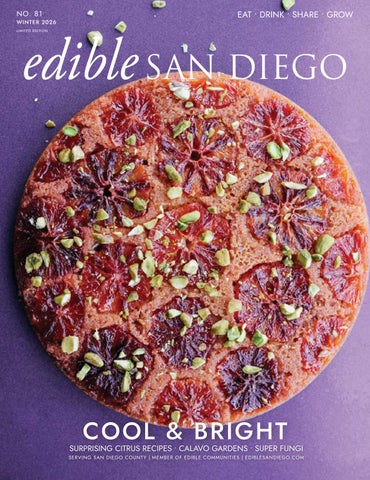
ON THE COVER: Andalusian Orange & Almond UpsideDown Cake. Find the recipe on page 15. THIS IMAGE: A ripe pomegranate hanging from a tree in Calavo Gardens. Story on page 21.
S HA RE 21 Calavo Gardens 24 A Case for Renewal: Food in Barrio Logan 28 A Nation Celebrated, a Tradition Preserved 31 Kids’ Plate: Florets of Fun! created in partnership with Children’s Museum of Discovery GROW 34 Set Up Your Winter Garden for Year-Round Success LAST BITE 38 Super Fungi
LA N D ACK NOWLEDGEMENT Edible San Diego recognizes the Kumeyaay, Luiseño/Payómkawichum, Cahuilla, and Cupeño/Kuupangaxwichem people who have lived in relationship with the earth, flora, fauna, waters, and sky for thousands of years as the original stewards of this region. This publication commits to building greater awareness of and appreciation for the traditional ecological knowledge, wisdom, and experiences of San Diego County’s first peoples as an essential part of the health and vitality of our local food system. 4
e d i b l e s a n d i e g o. c o m
LUKE SCHMUECKER
E D IB LE SA N DI EGO.COM
CALIFORNIA CUISINE HAS NEVER LOOKED BETTER Daily Breakfast, Lunch and Dinner Sunday Champagne Brunch
Daily Breakfast, Lunch and Dinner | Weekend Brunch | Complimentary Parking OceanaCoastalKitchen.com | (858) 539-8635
PUBLISHER’S NOTE
THE PARTICULARS CAN WAIT
W
elcome to the winter issue of Edible San Diego magazine, where we won’t urge you to make resolutions. It’s time for taking a post-holidays breath as rains turn the hills green and prepare us and the land for spring. Go grab something warm to drink and find a comfortable spot to give yourself a few minutes of peace and quiet. We gathered stories and recipes that felt grounding in this batch of velvety pages. Stories about fruit trees, neighborhoods, and mushrooms invite us to pause and consider how living soils generate such abundant food, our attachment to place, and how nutrition flows in and all around us. For cooking at home and growing some food this season, it’s time for a change of pace. Feeling awash in all the baking recipes and soups? SoCal citrus offers a surprising and nourishing zing to cool-weather menus. And for the garden, a quiz helps us make choices based on our preferences. As always, we hope that this print edition and the many recipes, features, and guides on our website provide inspiration and usefulness in your busy life. Have you played around on our updated Wineries Guide page? Use the navigation map on your phone to go wine tasting, or get to know our beautiful county on the Google Earth version. And join some lively table talk between quarterly issues by clicking on our newsletter community portal on our homepage, right at the top. Local food is why we publish. It has never been more important or more vulnerable. Our advertising partners enable us to keep this conversation flowing—join us in thanking them by giving them a try, and tell them we sent you! Lastly, we are deeply grateful that you value how the print medium brings us into awareness, caring, and community. May we make time this winter to slow down and go inwards a little, nurturing the spark we take with us as we connect and share all year long.
ISTOCK.COM/IANMCDONELL
Katie Stokes Publisher and Editor in Chief Edible San Diego
6
e d i b l e s a n d i e g o. c o m
al c o l ic n a g r o
le b a n i susta
organic grocery store + deli & bakery Check us out @obpeoplesfoodcoop Visit Us! 4765 Voltaire St. San Diego, CA Straight from the end of I-8, left at Voltaire in Ocean Beach
www.obpeoplesfood.coop
LOCAL FARM FRESH
Da-Le-Ranch.com
100% Estate Grown, 100% Estate Produced andGrown, Bottled Produced and Bottled
SAN DIEGO RAMONA VALLEY WINES Zinfandel | Sangiovese | Malbec COUNTY WINES Cabernet Franc | Dry Rosé Zinfandel | Sangiovese | Malbec Cabernet Franc | Albarino Open for Tasting and Sales Open for tasting and sales Saturdays & Sundays 11-5 Saturdays & Sundays 11–5 910 Gem Lane, Ramona, CA 910 Gem Lane, Ramona, CA chuparosavineyards.com chuparosavineyards.com
WINTER 2026 |
edible SAN DIEGO
7
EAT
CSA BOXES FOR WINTER
Field Notes with MAKE Farm
Tap into the wealth of fresh fruit and vegetables available year-round from Community Supported Agriculture BY JULIE PENDRAY
Be Wise Ranch Escondido
Nearly 30 pickup locations throughout the county. Leafy greens, beets, broccoli, cabbage, carrots, radishes, winter squash, strawberries, herbs, and more. » bewiseranch.com
Eli’s Farms Fallbrook
JULIE PENDRAY
BY JULIE PENDRAY
M
any drivers on Interstate 8 or the 15 through Mission Valley are probably unaware of an important educational farm that’s sprouted up in Thrive Park at Snapdragon Stadium. Here, on one acre northeast of the Trolley Stadium Station, a nonprofit called MAKE Projects is helping low-income refugees and immigrants gain agricultural and culinary skills. MAKE—an acronym for Merging Agriculture, Kitchens, and Employment— launched in 2017, after incubating through a period of early development under the International Rescue Committee. Growing crops at this sustainable farm helps people develop employment readiness. “They don’t just learn job skills, they build confidence,” says Anchi Mei, founder and executive director. “We’ve had a very diverse group of people since we started, representing 30 countries.” Some participants have come back to be coaches or assistants. Some entered the program with little education, while others already had advanced degrees. Since participating, 70% of program graduates have found permanent jobs. In turn, participants introduce San Diegans to recipes, flavors, spices, and produce staples from the Middle East, Africa, the Caribbean, and beyond. Locals also benefit from the Community Supported Agriculture (CSA) program operating at the site. Subscribers receive a weekly email about the contents of the boxes, which include five seasonal items like 8
e d i b l e s a n d i e g o. c o m
Delivery and pickup locations throughout the county. Confirm the latest options on their website. » elisfarms.com
Foodshed Cooperative beets, carrots, greens, cucumbers, peppers, green beans, eggplant, squash, radishes, or turnips, plus herbs, olives, grapes, apples, and flowers. Add-on pantry items, such as hummus, pickles, and jams, are also offered. Students, CSA members, and the general public often connect with the hibiscus flowers, says Caroline Feeney, education programs manager. “They are a huge conversation starter for all visitors to the farm. Our participants from different cultures often have a connection to hibiscus tea. Our young students have been helping to save seeds from the plants for future planting. They are so colorful and vibrant that people can’t stop talking about them.” The farm is open for CSA box pickup on Saturdays, 9am to noon, or Saturday through Wednesday at Sahara Market in Normal Heights or Parkside Market in the Altadena neighborhood. Educational farm experiences are available for school field trips on Thursdays and Fridays, as well as for camps during school breaks. Volunteers are welcome (see website for details) and visitors can access the farm via Cottonwood Lane and Innovation Parkway. In early 2026, MAKE Projects plans to reopen its restaurant featuring global cuisine in a new location at 4712 Felton Street, off Adams Avenue, in Normal Heights. It will include an outdoor bar, culinary garden, and a classroom. To learn more about MAKE Projects, visit sdmake.org and find them on social media.
City Heights
Foodshed Cooperative sources directly from 40 regional farms and offers home delivery or pickup at 13 locations. Accepts EBT. Winter squash, sprouts, apples, pasture-raised eggs, and more. » foodshedcooperative.com
MAKE Farm San Diego
The farm is located in Thrive Park at Snapdragon Stadium in Mission Valley. Pick up at the farm on Saturday mornings or at two San Diego markets. Greens, beets, radishes, herbs, and more. Check their veggie library online. » sdmake.org
Sage Mountain Farm
12630 Santa Catalina Rd., Valley Center Pickup and home delivery in San Diego County. Beets, broccolini, carrots, celery, citrus, greens and herbs, melons, potatoes, and summer squash. Add-ons include eggs, honey, poultry, beef, lamb, quail, goat, and tallow. » sagemountainfarm.com
Sand n’ Straw
629 Mar Vista Dr., Vista Pick up at the farm Wednesdays through Sundays. On-site farm stand, crafts, events, and animals. Check website for seasonal items. Add-ons include eggs, sourdough bread, honey, and jam. » sandnstraw.com CSA offerings are subject to change. Contact farms directly for more details. Scan the QR code to find more CSAs on ediblesandiego.com.
Fuel up before heading to the wineries!
Hosts Julia Collin Davison and Bridget Lancaster
ON SAL E NOW
An Evening with America’s Test Kitchen
Feb. 5, 2026 at 7 p.m. | $65 / $120 Serving breakfast & lunch • Sunday Brunch Live Music & Dinner Thursday Nights Fresh, organic grab & go case • Sandwiches, salads, soups
Join KPBS for a fun-filled, live behind-the-scenes experience into America’s Test Kitchen. It’s a night for food lovers filled with ideas and inspiration with two of the culinary world’s best.
GET TICKETS
Get tickets at: kpbs-atk.eventbrite.com
a’s Best! Voted Ramon
325 6th Street, Ramona 760-787-5987 ramonafamilynaturals.com | @ramonafamilynaturals
KPBS is a public service of San Diego State University.
Visit our farm MON-SAT 9AM-5PM
HAPPY-HENS.COM
RAMONA, CA
SOY free
corn free
WINTER 2026 |
edible SAN DIEGO
9
You’re in the right place for great seafood.
11am - 10pm Wednesday - Sunday Closed Monday & Tuesday 5040 Cass Street, Pacific Beach, California 92109 858-272-9985 • www.thefishery.com 10
e d i b l e s a n d i e g o. c o m
San Diego County Fa rm e rs’ and Fish e rme n ’s Markets
MONDAY
Escondido—Welk Resort √ 8860 Lawrence Welk Dr. 3–7pm
TUESDAY Coronado √ Near 1st St. & B Ave. 2:30–6pm Escondido √ * ! Juniper St. btwn Grand Ave. & Valley Pkwy. 2:30–6pm
Scripps Ranch √ Newtopia Cyder 10045 Carroll Canyon Rd. 3:30–7:30pm
FRIDAY Borrego Springs √ Christmas Circle Community Park 8am–noon
Mira Mesa √ * Mira Mesa High School 10510 Reagan Rd. 2:30–7pm
La Mesa Village √ * ! La Mesa Blvd. btwn Palm Ave. & 4th St. 3–7pm
Otay Ranch—Chula Vista √ Otay Ranch Town Center 2015 Birch Rd. 4–8pm
Rancho Bernardo √ Bernardo Winery 13330 Paseo del Verano Norte 9am–1pm
Pacific Beach Tuesday √ † ! 901 Hornblend St. 2–7pm
San Marcos √ † 251 North City Dr. 3–7pm
WEDNESDAY
SATURDAY
Carlsbad √ State St. & Carlsbad Village Dr. 2:30–6pm
Cardiff √ † * Miracosta College San Elijo Campus 3333 Manchester Ave. 10am–2pm
Little Italy Mercato √ † * Date St. from Kettner Blvd. to Front St. 9:30am–1:30pm Ocean Beach √ 4900 block of Newport Ave. 4–8pm Santee √ † * ! Pathway Center Carlton Hills Blvd. & Mast Blvd. 2:30–6:30pm South Bay √ 4475 Bonita Rd. 3–7pm
THURSDAY ISTOCK.COM/OLGA BARANOVA
Ramona Grange Growers Exchange † NEW Grange Hall 215 7th St. 4–7:30pm
Linda Vista √ * Linda Vista Plaza 6939 Linda Vista Rd. 2–7pm North Park √ † * ! 3000 North Park Way at 30th 3–7:30pm Oceanside Morning √ * ! 511 Pier View Way & Hwy. 101 9am–1pm
City Heights - ASCENDKemet Collective Farmers’ Market † 4325 Wightman St. 10am–2pm Del Mar √ Del Mar Civic Center 1050 Camino Del Mar Noon–4pm El Cajon NEW Renegade Country Bar sponsored by Ramona Grange 14335 Olde Hwy. 80 9am–1pm Fallbrook Main Avenue √ * ! Main Ave. btwn Hawthorne & Fig 9am–1pm Imperial Beach † * SunCoast Market Veterans’ Park 1075 8th St. Third Saturday, 8am–2pm Little Italy Mercato √ † * ! Date St. from Kettner Blvd. to Front St. 8am–2pm
Mission Valley √ Civita Park 7960 Civita Blvd. 9am–1pm
Santa Ysabel √ 21887 Washington St. Hwy. 78 & Hwy. 79 Saturday & Sunday 11am–4pm
Point Loma √ NEW location 2306 Cushing Rd., Lot K 9am–2pm
Solana Beach √ 444 So. Cedros Ave. Noon–4pm
Poway √ * Old Poway Park 14134 Midland Rd. at Temple 8am–1pm Santa Ysabel √ 21887 Washington St. Hwy. 78 & Hwy. 79 Saturday & Sunday 11am–4pm Tuna Harbor Dockside Market 598 Harbor Ln. 8am–1pm (or until sold out)
MOBILE MARKETS People’s Produce Mobile Farmers’ Market † Currently servicing eight different market locations throughout Southeastern San Diego, National City, Barrio Logan, and Lemon Grove. Visit projectnewvillage.org for days and locations.
Vista √ † * ! 345 S. Melrose Dr. 8am–noon
SUNDAY Carmel Valley √ † NEW (Previously Hidden Escondido) Torrey Pines High School 3710 Del Mar Heights Rd. 10am–2pm Chula Vista √ 300 Park Way & Third Ave. 10am–2pm Fishermen’s Market of North County 320 Harbor Dr. 8am–2pm Hillcrest √ * NEW location University Ave. btwn Herbert St. & Park Blvd. 9am–2pm La Jolla Open Aire √ 7335 Girard Ave. & Genter St. 9am–1pm Leucadia √ Paul Ecke Elementary School 185 Union St. 10am–2pm Rancho Santa Fe √ Del Rayo Village 16079 San Dieguito Rd. 9:30am–2pm
LEGEND √ Markets certified by the San Diego County Agricultural Commissioner, ensuring that the produce is grown by the seller or another certified farmer in California, and meets all state quality standards. † Market vendors accept EBT (Electronic Benefit Transfer). * Market vendors accept WIC (Women, Infants, Children) Farmers’ Market checks. ! Market vendors accept WIC Fruit and Vegetable checks. All listings are subject to change. Please contact markets directly to confirm hours of operation, locations, and what benefits are accepted. Bookmark the digital market guide on ediblesandiego.com for more complete information and links to market websites.
San Carlos NEW 7849 Tommy Dr. 11am–2pm
W WI INNTTEERR 22002266 | | edible edibleSAN SANDIEGO DIEGO
11
Experience La Dolce Vita at Bianchi Authentic Neapolitan cuisine, signature cocktails, and warm Italian hospitality in a cozy setting.
BianchiPizzaPasta.com | For reservations, call (858) 539-7646
EAT
Cooking Together Surprisingly bright ways to indulge in citrus
W
hen life hands you lemons—and oranges, grapefruits, and tangerines—try them in a salad, a shrub, or a decadent and healthy cake. There are few places in the world where citrus grows in backyards, farms, and orchards like it does here. As a food magazine dedicated to highlighting seasonal ingredients, we take the responsibility of being obsessed with winter citrus seriously. Each recipe from the ediblesandiego.com archive celebrates the season’s juiciest gems, proving that sometimes the best local winter produce doesn’t come from a greenhouse—it comes from a grove.
CITRUS IN A SALAD
Winter Citrus and Radicchio Salad with Poppy Seeds RECIPE BY HALEY HAZELL PHOTOGRAPHY BY OLIVIA HAYO
ISTOCK.COM/EKATERINA MOLCHANOVA
Bright ruby red grapefruit segments are layered with bitter radicchio and peppery arugula in this seasonally inspired salad. A generous sprinkling of poppy seeds adds subtle crunch, visual contrast, and a pop of unexpected flavor. SERVES 2 ½ cup Greek yogurt ¼ cup extra-virgin olive oil, divided Salt to taste 1 ruby red grapefruit 2 teaspoons apple cider or red wine vinegar 1 tablespoon honey Freshly ground black pepper to taste 1 head radicchio, thinly sliced into ribbons ½ red onion, thinly sliced, rinsed, and patted dry 1 cup arugula 1 tablespoon poppy seeds
In a small bowl, mix Greek yogurt with 1 tablespoon of olive oil and a pinch of salt. Set aside. Segment or supreme the grapefruit: Using a paring knife, remove the peel by following the natural contour of the fruit, taking care to remove all of the bitter pith. Hold the peeled grapefruit securely in one hand, and then carefully use your knife to cut along the membrane on both sides of the natural segments. Continue all the way around the grapefruit. Set cut segments aside and squeeze the juice from the remaining grapefruit membrane into a medium mixing bowl. Make the dressing: Add 3 tablespoons of olive oil to the mixing bowl with the grapefruit juice, vinegar, honey, a pinch of salt, and a few cracks of black pepper. Whisk to combine. Add radicchio, red onion, arugula, and
grapefruit segments into the mixing bowl with the dressing and toss to coat. To serve, swoosh Greek yogurt onto a plate. Arrange the dressed salad on top of the yogurt and sprinkle generously with poppy seeds. Originally published March 3, 2020.
WATCH how EasY It is to make this salad here
WINTER 2026 |
edible SAN DIEGO
13
EAT
MAKE CITRUS SHRUBS FOR SALAD DRESSINGS AND REFRESHMENTS
Grapefruit Rosemary Shrub 1 grapefruit 1 cup white sugar 1 cup organic, unfiltered apple cider vinegar with the “mother” 2 sprigs rosemary (optional) ISTOCK.COM/CANDICE BELL
COURTESY OF COOL HAND CO. Most shrub recipes use a 1:1:1 ratio of fruit, sugar, and vinegar. Macerate acidic fruits like citrus, berries, apples, pears, or stone fruit with white sugar and add your choice of raw vinegar. The resulting shrub is good enough to sip on its own, with a splash of seltzer, or added to a favorite cocktail. Shrubs can also add next-level flavor dimensions to basic vinaigrettes.
Remove the zest from the grapefruit and set aside (do not discard). Cut away the peel and chop the flesh into large chunks. Pour sugar into a medium, nonreactive bowl, add the zest, and massage to extract the fragrant oils. Add the chopped grapefruit flesh and gently toss. Cover with plastic wrap and store in the refrigerator until the mixture resembles a thick syrup, about 24 hours. Strain the mixture through a fine-mesh sieve into
a large measuring cup. Press down lightly on the fruit to extract the juices and scrape in any remaining sugar. Whisk in vinegar and pour into a glass bottle or jar. Add the rosemary (if using), cap the bottle, shake well, and store in the refrigerator for an additional 24 hours. Shake the mixture before using, as the sugar may not fully dissolve for several days. Shrubs can last a few months in the fridge. Over time, the vinegar flavor will mellow out. You can sip the shrub on its own, but most people like to add it to seltzer or water to make the taste more delicate. Shrubs are great for adding layers of
flavor to cocktails.
Originally published in issue 51.
Explore the world of clever concoctions dreamed up by these San Diego-made shrub makers: » coolhandco.com » highervibrationtonics.com » gardenpartyshrubs.com
WINTER COOKBOOK CLUB BY ARIANNA LITRENTA If there was ever a time to cozy up with the selections from our Cookbook Club series, it’s now. With winter in full swing, this selection feels like an invitation to slow down, reflect, and cook with intention. The three cookbooks featured here may appear vastly different at first glance, but they share a common theme of seasonality, nourishment, and warmth. Together, they strike the perfect balance to inspire a delicious and restorative start to 2026. MEATEATER’S WILD + WHOLE: SEASONAL RECIPES FOR THE CONSCIOUS COOK With the continued emphasis on the importance of protein in everyday eating, Wild + Whole opens the reader’s eyes to a new perspective on utilizing meat. Author Danielle Prewett wholeheartedly believes in a conscious, sustainable way of eating and approaches food with curiosity, a philosophy that shines through in the unique wild game dishes presented in her debut cookbook. Prewett’s love for hunting, fishing, foraging, and gardening comes across on the page both through her personal stories and 80 thoughtful recipes. By dividing the recipes into seasons, Prewett encourages readers to cook in harmony with nature’s rhythm and choose ingredients at their peak. Wild + Whole brings an invigorating sense of purpose to the table and reminds us that nourishment begins with awareness. IN GOOD HEALTH: UNCOMPLICATED, ALLERGEN-AWARE RECIPES FOR A NOURISHED LIFE “You are what you eat” takes on a new meaning in this vibrant, health-centered cookbook. In her debut cookbook, Rachel Riggs reflects on her personal experience battling chronic conditions and approaches food as both medicine and joy. Her recipes are
14
e d i b l e s a n d i e g o. c o m
nutrient-dense, easy to follow, and designed for those with dysregulated immune systems, chronic illnesses, or food sensitivities. Yet they’re equally appealing to anyone seeking balance through whole, unprocessed foods. While common allergens like gluten are omitted, In Good Health never feels restrictive. Bold flavors, bright herbs, and seasonal produce take center stage, proving that healing foods can also be deeply satisfying. With over 75 recipes, Riggs has crafted a cookbook designed for people looking to fuel their bodies and promote health from the inside out. THE KOREAN VEGAN: HOMEMADE In her second cookbook, James Beard Award-winning author Joanne Lee Molinaro invites readers into her kitchen to share her beloved recipes, Korean pantry staples, and the memories behind her unique dishes. Molinaro is known for intertwining her veganized Korean cooking with intimate stories of her life, and Homemade dives even deeper, offering a more intentional look into the influences and experiences that shaped her. Her goal, she shared, was to convey comfort and tenderness through her recipes, much like her mother and grandmother had nurtured her. In that sense, this cookbook mothers its readers and is much more than a collection of recipes. Homemade is a book of stories told with authenticity and heart, carrying a powerful sense of love and nourishment through every dish, from her signature Kimchi Mac ‘n’ Cheese to the decadent yet straightforward Apple Paht Tartlets.
TREAT YOURSELF AND FEATURE CITRUS IN AN ALL-OCCASION CAKE
Andalusian Orange & Almond Upside-Down Cake RECIPE AND PHOTOGRAPHY BY OLIVIA HAYO This coverworthy cake offers warming spices and a protein-rich base, making a good excuse to have it ready for everyday occasions like breakfast, lunch, and dinner. Inspired by the almond blossoms and sun-warmed oranges of Andalusia, a hint of lemon with navel and blood oranges from the Little Italy Mercato brighten this gorgeous cake recipe that is sure to become a favorite meal plan staple. MAKES A 9-INCH CAKE 2 navel oranges 3–4 blood oranges 3 tablespoons salted butter ½ cup brown sugar ½ lemon, juiced 2 tablespoons water 4 free-range eggs 2 teaspoons orange blossom water 1 ¾ cups almond meal ¾ cup granulated sugar 1 teaspoon baking powder ¼ teaspoon sea salt 1 teaspoon ground ginger 1 teaspoon ground cinnamon 1 teaspoon ground cardamom ⅓ cup pistachios, chopped, for serving Greek yogurt, for serving Place whole navel oranges in a medium pot and cover with water. Bring to a boil and simmer over medium heat until extremely soft and easy to pierce with a fork, 1 to 1 ½ hours. Remove navel oranges from water and let them cool completely. Remove any seeds and purée navel orange halves in a blender until smooth. Set aside. Prepare blood oranges by cutting off ½ an inch from each end and removing peel and pith with a sharp knife. Slice into ¼-inch rounds. Set aside. Preheat oven to 325°. Heat a small saucepan over medium heat. Melt butter, then add brown sugar, lemon juice, and water. Stir continuously until sugar is melted, smooth, and sauce is slightly thickened, about 5 minutes. Pour sauce into a 9-inch round cake pan (at least 2 inches deep) and put aside until set and cooled. Arrange blood orange rounds on top. Set aside.
In a large mixing bowl, beat the eggs using an electric mixer, add 1 cup of navel orange purée and the orange blossom water, and beat again. Add almond meal, granulated sugar, baking powder, salt, and spices. Mix thoroughly with a rubber spatula until smooth. Pour batter into prepared cake pan and bake for 40 to 60 minutes. Beginning at 40 minutes, check the cake by inserting a toothpick in the center; it should come out almost clean (it’s a very moist cake). Remove and let cool in the pan before turning over onto a plate. Top with chopped pistachios and serve with a dollop of plain Greek yogurt.
Originally published March 11, 2018.
Find more ways to preserve citrus on ediblesandiego.com.
WINTER 2026 |
edible SAN DIEGO
15
Escape to Hungry Hawk Vineyards Hungry Hawk
Vineyards & Winer y
RAMONA VALLEY
Specializing in red wines made only from estate grown and other Ramona Valley grapes. National and international award-winning wine. Tasting veranda open Sat. and Sun. and by appointment. Bring in this ad to receive Two Tastings for the Price of One. marilyn@woofnrosewinery.com 760-788-4818 woofnrose.com
Woof ‘n Rose Winery Ramona Valley
Family owned & operated since 2009, Hungry Hawk Vineyards is a boutique wine haven where elegance fills every glass. Discover meticulously crafted wines, born from passion and precision, and enjoy our shaded patio boasting panoramic vineyard views. Indulge in a refined tasting experience with our attentive, knowledgeable staff in our all-adult and pet-free environment.
Can’t wait for you to visit!
3255 Summit Drive, Escondido • (760) 489-1758 16
e d i b l e s a n d i e g o. c o m
DRINK
WHERE CAN I BUY OR TRY LOCALLY MADE WINE? BY HEIDI GREENWOOD
ILLUSTRATED BY MARIA HESSE
WINTER 2026 |
edible SAN DIEGO
17
WI NTE R WORD PLAY Across
1 Tiny organism that can cause fermentation 5M ushrooms, for example 8 Kitchen stove 9 In good physical condition 10 Baseball stat, abbr. 11 Cheese with a red wax coating 12 Using the oven 14 Snug and comfortable 15 Thoroughfare abbreviation 16 Winter precipitation 19 Accountant’s credential, abbr. 21 Moist 22 G olden state, abbr. 23 Instructions for preparing a dish 24 “Green” energy source 26 D egree of sourness 27 Glossy coating for food 30 Breakfast, lunch, or dinner 31 Aromatic herb used in Mediterranean cooking 33 Honey-making insect
1 Farmers’ _____ 2S pice from tree bark 3 One way to cook an egg: _____easy 4 Moral principle 5G ive zest to 6 Substances that provide nourishment 7 Very cold 13 Underground network of fungal threads
15 Wet, weather-wise 16 Compass direction, abbr. 17 Coldest season 18 French pastry with cream filling 20 Desktop computer, for short 21 Type of salad 25 S auces for chips 28 R esearch facility, for short 29 Barley brew 30 “I did it __ way” Frank Sinatra
Carlsbad resident Myles Mellor is one of the top crossword and puzzle writers in the world. He has published over 55 crossword and word search books, producing dozens of puzzles each month. » mylesmellor.com » themecrosswords.com
Answer key on page 40.
Award-winning Italian Cuisine, Chef, Service, and Wine List Michelin Guide Restaurant Open 7 days a week in Liberty Station for Indoor & Heated Patio Dining and Take-Out/Delivery 2820 Roosevelt Rd, San Diego | 619-270-9670 | solarelounge.com 18
e d i b l e s a n d i e g o. c o m
JEN LO
Down
VI N E TO G L A SS STUN N I NG VI E WS FAMI LY OW N ED & OPE R AT E D
socials: miamarievineyards
Breakfast
www.MiaMarie.com
LOCAL FISH FROM LOCAL FISHERMEN
Served Daily 8AM - 10:30AM
1403 Scott St. San Diego, CA 92106 www.mitchsseafood.com
WINTER 2026 |
edible SAN DIEGO
19
settingthesetting the earth’s earth’s tABLE tABLE
Nutrition | Lifestyle | Independence
Toni Kraft
Partners
tastemaker / founder 12226 Lomica Dr San Diego, CA 92128
858-243-1046 antoinettkraft@sbcglobal.net
Rosalba Recipes?
Theearthstable.org 20
e d i b l e s a n d i e g o. c o m
SHARE
Calavo Gardens STORY AND PHOTOGRAPHY BY LUKE SCHMUECKER
C
alifornia, the “Golden State” since the Gold Rush and later dubbed “the land of milk and honey,” attracted visionaries and settlers to lands long inhabited and cared for by Indigenous peoples. Twentieth-century country and folk music extoled the aspirations of immigrants, workers, and their descendents, focusing on the dream of owning some land and a secure future. From Cole Porter’s 1934 plea in “Don’t Fence Me In”—“Give me land, lots of land under starry skies above”—to Jordan Davis’s 2022 CMA-winning “Buy Dirt,” the land promises well-being. In the 1920s and ‘30s, as the state’s first avocado boom took hold, developer Fred J. Hansen was selling not only land but a promise: If you bought a few acres on the east side of Mount Helix, you could grow your own version of the good life beneath the shade of your avocado trees. When Hansen developed the neighborhood of Calavo Gardens, he bet big on the avocado. While not as widely used today, the name Calavo itself was a crowdsourced linguistic invention. The Aztecs had called the fruit ahuacatl; the Spanish, aguacate. In the US, it was sometimes referred to colloquially as an “alligator pear.” But in 1924, California growers decided the avocado needed an easy-to-pronounce, marketable name. A contest was held to rebrand the fruit, with the
winning entry, Calavo, being a mash-up of California and avocado. By the time Hansen adopted it to market his new development, the word already carried an air of optimism thanks to a statewide marketing campaign. Calavo Gardens was an avocado-centric neighborhood, with its streets named for different varieties, including Fuerte, Puebla, and Mayapan. Groves were planted throughout, and as part of the sale, the Hansen Organization agreed to maintain each property’s trees until they produced a commercial harvest. The profits from the crops went to the homeowners, allowing many to pay off their land with remarkably little cash. One advertisement for the neighborhood from the F. J. Hansen Organization shows a man in a crisp white shirt, utterly relaxed, leaning against a stucco archway beneath a roof of red Spanish tile. He gazes out over the neat rows of his avocado grove, the hazy rise of Mount Helix in the distance. Floating above him in the sky is a single word—“Contentment.” Another advertisement proclaimed “The ‘Green Gold’ Rush Begins Today,” enticing would-be buyers with a free avocado salad lunch. In the 1920s and 1930s, avocados were an exotic, high-margin crop. Prices spiked as the fruit’s popularity surged among early adopters seeking something novel and vaguely healthful. Like so much of the Golden State’s marketing at the
WIIN NTTEERR 22002266 || edible W edibleSAN SANDIEGO DIEGO
21
SHARE
time, the ads straddled the line between pastoral idealism and spiritual manifesto. In reality, the groves were dusty, the water costly, and the labor hard to find. But none of that intruded on Hansen’s image. In Calavo Gardens, the American Eden had been arranged in clean rows, and the homeowner (at least in print) was reaping the harvest. Even as San Diego’s postwar suburbs pushed eastward, Calavo Gardens remained largely unchanged. The hills, irregular lots, and stubborn topography resisted the gridded efficiency of tract-home development. Like much of Mount Helix, the neighborhood today is still a patchwork of large parcels, each home reflecting its owner’s personality rather than a uniform plan. That individuality, paired with the continuing love of the avocado, helped preserve many of the original trees. While an avocado’s most productive years are concentrated in a 20- or 30-year run, the trees can live and bear fruit for over 200 years. Last spring, a house off Puebla Drive, whose backyard is still home to at least six trees likely planted in the 1960s or earlier, lost a branch that had cracked under the weight of its fruit. From that one branch alone, the neighbors gathered 380 Fuerte avocados. Calavo Gardens’ soil is almost purpose-built for fruit trees. A mix of sandy loam and clay, the sand assists with drainage and prevents root rot, while the clay holds moisture and nutrients. It’s not always a perfect balance: miss planting season and by midsummer the earth hardens so densely that a pickax works better than a 22
e d i b l e s a n d i e g o. c o m
shovel for digging. Still, the blend has proved ideal for everything from avocados to citrus, persimmons, and pomegranates. Over time, the neighborhood’s agricultural focus diversified. What began as a monoculture of avocado groves evolved into a more eclectic form of edible landscaping. Residents planted oranges and lemons, persimmons that blaze orange in the fall, and pomegranates that split open like red jewels. Another homeowner on Puebla Drive even went so far as to establish a full macadamia orchard—an experiment in Southern California abundance. Today, walking through Calavo Gardens feels a bit like wandering through the produce aisle of an upscale grocery store. As you stroll down the street, you’re likely to come across multiple varieties of avocado, citrus, stone fruit, and loquats. It’s the type of neighborhood you might think no longer exists. Neighbors wave from driveways, pausing to ask if you might help them pick from a tree grown too tall for their reach, or beg you to take avocados or a bag of pomegranates before the animals get to them. The abundance is casual, almost excessive, but entirely homegrown—a century-old vision of self-sufficiency that somehow never went out of season. Today, Hansen’s promise is still growing in the neighborhood. The avocado groves have thinned, but the idea endures. In an age when owning land is elusive for most, Calavo keeps the dream alive and thriving—a place where meaning can be measured in roots, in shade, and in the slow patience of trees. D
Winter in Ramona Winter in the vineyard is a time of quiet preparation.
Harvest is over. The days are shorter. The land breathes, and everything waits patiently for spring’s renewal. We snuggle up for a cold California winter and pray for rain. Just 35 miles to the east of San Diego, hand crafted, awardwinning wines are being produced by over 45 boutique wineries. Try a unique selection of red or white wines. Come visit the Ramona Wine Region and experience a tradition of excellence from the finest winemakers in the country.
www.rvva.org Ramona Valley Vineyard Association
RVVA_edible 1-2 pg hor winter 25.indd 1
11/19/25 8:47 PM
SAN DIEGO’S PREMIERE
FISH MARKET PLUS GRASS-RAISED BEEF
(619) 297-9797
Local Fish, Sushi Specialties, Poke, Sushi Rolls, Ceviche, Shellfish, Spices, Sauces, Make Your Own Sushi Kit, Uni, Prime Grade Beef & More! Sign up online to receive our weekly specials at www.CatalinaOP.com. 5 20 2 L ove l o c k S t ( o f f M orena Blvd , N ea r USD )
Tues-Fri 10am-5pm | Sat-Sun 10am-3pm
CatalinaOffshoreProducts WINTER 2026 |
CatalinaOP
edible SAN DIEGO
23
SHARE
A CASE FOR RENEWAL
FOOD IN BARRIO LOGAN BY MADHUSHREE GHOSH PHOTOGRAPHY BY JEN LO
O
ver nine decades ago, a cash-only, single-table Mexican restaurant, Las Cuatro Milpas, opened on Logan Avenue in the working-class neighborhood of Barrio Logan. Run by Petra and Natividad Estudillo, the restaurant offered locals a limited menu of slow-cooked meats, rolled tacos, tamales with beans cooked in lard, and the best handmade tortillas. A space frequented by Mexican refugees and immigrants working in the Port of San Diego, shipyards, and tuna canning factories, the restaurant became an iconic landmark of the neighborhood.
and Natividad. In the open kitchen, flour is mixed and rolled into pillowy tortillas, while masa is turned into taco shells with a press.
By 2025, the restaurant’s dining areas expanded into two large rooms, with a central open kitchen and a busy automated tortilla maker. A vintage peg letter board menu sits high on a wall above massive stockpots filled with simmering beans, rice, and tamales on a roaring gas stove next to a vat for frying tacos in lard and oil. Each taco is fried to order for extra crunch right before serving. Piles of warm packaged tortillas sit on the counter, ready for guests to purchase and enjoy with their meal or take home. Though it’s still a cash-only joint, the line of customers regularly extends down the block, their orders fulfilled in quick precision by Tita Margarita Hernandez and her sisters, all granddaughters of Petra
Margarita’s crew rattled off my order while I stammered a reply in rudimentary Spanish.
24
e d i b l e s a n d i e g o. c o m
Dulce Beltran stands in the fast-moving line with her sons. “When I lived in El Centro, my parents brought me here for special occasions. Now I bring my children. Everything’s great here—can’t choose tortillas over the arroz con frijoles!” At the cash register, one of Petra’s granddaughters calls me forward. It’s July 2025, and Margarita, who is in her late 70s and has no time to waste, asks, “Quick, what did you get?”
“Go, go,” Margarita waved me away, laughing. “It’s 3pm, and the line just doesn’t end!” I join the other Las Cuatro Milpas diners sitting at casual community tables. Collectively, we eat crispy rolled tacos, slurp rice and beans with chorizo, and sigh with joy. For millennia before San Diego became a border town and America’s Finest City, the Kumeyaay people migrated through
a village called Matt Xtaat near the bay in present-day Barrio Logan. Spanish missionaries renamed it Las Chollas and referred to Indigenous villages as rancherias after settling in the late 1700s. At the start of the Mexican-American War in 1846, the Indigenous people were forcibly relocated east toward the rancherias of Pala and Barona, taking Indigenous knowledge, food practices, and pre-contact history of the area with them. At the end of the war in 1848, California was acquired by the United States through the Treaty of Guadalupe Hidalgo. Mexican refugees and immigrant workers moved to the San Diego Bay waterfront, transforming it into one of the largest MexicanAmerican communities on the West Coast by 1940. Over time, Barrio Logan became a neighborhood united by pride in its history and culture, including its Mexican cuisine, Chicano activism, and art, with a landmark comforting eatery central to it all. Las Cuatro Milpas and the neighborhood have kept pace as San Diego has grown and changed. What’s transformed rapidly are the people who now move in—real estate groups with development interests and city and Port of San Diego needs— nudging out residents and businesses. Still, as architect and Barrio Logan resident Hector Perez notes, the neighborhood intentionally seeks to continue traditional eateries in mixeduse spaces. Newer buildings, such as Mercado del Barrio, have become home to affordable housing and businesses like Northgate Gonzalez Market. Two weeks after my visit, Margarita and her sisters listed the building that is home to Las Cuatro Milpas for sale. Foodies and culinary leaders ruminated on whether it would be the end of the mom-and-pop restaurant. I returned for another meal, and the line seemed longer. Social media buzz piqued the interest of many locals who hoped to experience the signature dishes, perhaps for the last time. Margarita shared, “I don’t want to shut the restaurant down, but how long can we keep doing this? Not sustainable, and we are getting old.” A dedicated customer asked Margarita for the realtor’s number. “I would like to propose a price for this place,” he said. When I nudged him for details, he wished to remain anonymous. “I just want this restaurant to stay—I’ll work with them and the neighbors. I’ll leave them to run this as they do now. This is an institution. Nothing needs to change.” Margarita explained the family’s desire to sell the property. “Whoever buys the building takes the restaurant. We hope they’ll keep it running, but for us [sisters], we can take it only so far.” She punched the next customer’s order into the cash register, telling me she had to head to her dialysis appointment soon. The end of an era doesn’t mean new generations haven’t created their own Barrio Logan signatures. W WIIN NTTEERR 22002266 || edible edibleSAN SANDIEGO DIEGO
25
SHARE
Within a 10-minute walk from Las Cuatro Milpas, you’ll find Fish Guts, a sandwich and taco shop that uses 90% local seafood. In early 2023, chef Pablo Becker opened this 500-square-foot eatery, attracting tourists and locals alike. The restaurant occupies the ground floor of La Esquina, one of the mixed-use apartment buildings developed in 2012 by Perez. He envisioned it to fit within the Barrio Logan cultural context, saying, “It was a good addition to the neighborhood that’s poised to stay for the long run.” With its glass storefront and street art, Fish Guts’ uniquely San Diego tacos include the Estilo Baja, a beer-battered local white fish taco with fresh pico de gallo and chipotle aioli, and the al pastor featuring opah with onion, cilantro, pineapple, and chile guajillo plus achiote chile. The restaurant is buoyed by neighboring diners, ensuring its place as an anchor restaurant, as well as support from an enthusiastic stream of tourists and local diners. Carmen Velasco-Favela runs the all-Latinaowned Mujeres Brew House. The daughter of Sinaloan and Sonoran parents, Carmen was born in Barrio Logan and raised between San Diego and Los Angeles. With her husband, David Favela, owner of Border X Brewing (the first Latino brewery in Barrio Logan), Carmen realized women of color were most of their customers. Mujeres Brew House is next to the popular art and events space Bread and Salt, whose owners, Isabel Dutra and Jim Brown, champion Carmen’s initiative. Founded on the premise that women were among the 26
e d i b l e s a n d i e g o. c o m
original craft brewers, the space is a rare and inviting brew house for women to experience Barrio Logan’s craft beer and history, a reflection of Carmen’s mantra: craft, culture, diversity, community. “Look,” Carmen said, seated in her pink bar, “our elders have brought Barrio Logan to this point. Now, craft beer brings people, especially women, here from all over Southern California.” She pours a startling blue So Cal Dreamin’ Ube IPA. Fermented in silos on-site, one sip reveals it’s bright and lively like the beer garden itself. Barrio Logan is also known for its building owners and associations that encourage a variety of businesses. Slow-fashion designer Claudia Rodríguez-Biezunski of Sew Loka, whose Logan Avenue store has been an attraction for more than a decade, remains hopeful. “This neighborhood…is vibrant with creativity. And that’ll stay, no matter what.” Mujeres Brew House owner Carmen concurs: “At least I know I tried. I brought good change to my neighborhood.” Change is as constant in Barrio Logan as it is elsewhere. Las Cuatro Milpas and the Estudillo family did more than feed a community every day they were open; they helped shape the history, influential flavors, and heart of a neighborhood that’s a true San Diego original. D As this article goes to print, Las Cuatro Milpas is under contract to sell. The restaurant is expected to close at the end of December 2025.
WIIN NTTEERR 22002266 || edible W edibleSAN SANDIEGO DIEGO
27
SHARE
A Nation Celebrated, a Tradition Preserved HOW THE SAN DIEGO COUNTY FAIR HONORS 250 YEARS OF AMERICAN CRAFT
A
s America approaches its 250th anniversary, the spirit of community and tradition takes center stage—not just in monuments and parades, but in handmade quilts, heirloom tomatoes, and blue-ribbon pies. This summer, the celebration of the United States’ Semiquincentennial extends into one of the most enduring and heartfelt expressions of local culture: the San Diego County Fair’s culinary, craft, and agricultural competitions. County fairs have long served as community cornerstones, connecting generations to the region’s agricultural and artisanal traditions. At the San Diego County Fair, this legacy is always on vivid display. Since 1880, San Diegans have proudly presented their most treasured recipes, hand-stitched quilts, and backyard harvests to be judged, celebrated, and admired. And this year, these traditions take on new resonance as the Fair joins the national America250 commemoration. The 2026 San Diego County Fair will run from June 10 through July 5, just as the festivities ramp up, with the theme “Once Upon a Fair”—a
celebration of storytelling, literacy, and the narratives that connect us. One of those stories is the ongoing creativity of America, which unfolds through every entry, exhibit, and ribbon awarded.
Crafting a Nation: Where Heritage Is Handmade In a world of digital reality and artificial intelligence, the San Diego County Fair offers a deeply human counterbalance: stories told through stitches, sauces, and soil. Special competition classes for 2026 will honor the diversity of American stories through the handmade. Entrants in these competitions are encouraged to submit works that reflect their cultural lineage—perhaps a sourdough starter passed down from great-grandparents, or a quilt stitched with patterns from a homeland once left behind. Submissions in fine art, photography, woodworking, needle arts, and more are curated into exhibitions that rival gallery showcases, open for 20 full days of public viewing. From sweetly preserved jams to intricately beaded jewelry, each piece—and the person behind it—has a unique story to tell. Katie Mueller, chief operating officer of the San Diego County Fair, has overseen the event for over two decades and emphasizes the importance of these traditions: “These exhibitions are the true heart of the Fair. They tell our community’s stories—through craftsmanship, creativity, and culture—and they keep our roots strong, even as we grow. There’s a real sense of pride that comes from winning a blue ribbon at the Fair.” 28
e d i b l e s a n d i e g o. c o m
SPECIAL PARTNER
Celebrate America by Sharing What You Make Entering is easy. The process is handled online for convenience, and Fair staff is available to offer guidance and answer questions. While all competitions require a small entry fee, participants receive complimentary admission to the Fair for themselves and a guest. Entry details, deadlines, and category information can be found at sdfair.com/entry, with most deadlines beginning in April. The payoff? The pride of seeing your work admired by thousands, connecting with fellow creators, and contributing to a celebration that bridges past and present. As America commemorates its 250th year, this is your invitation to be part of something enduring, uniquely American, and so San Diego! Gather your recipes, dust off your sewing machine, tend your tomatoes, and join the San Diego County Fair in a celebration of homegrown excellence. COMPETITIONS | EXHIBITIONS • Fine Art • Flower & Garden • Gems, Minerals & Jewelry • Home Arts & Hobbies • Photography • Student Showcase • Woodworking
The story of America isn’t just told in textbooks—it’s stitched, baked, brewed, and grown. And at the Fair, there’s always a place to share your talents and your story.
2 026 S A N D I EG O CO U N T Y FA I R Once Upon a Fair June 10–July 5 (closed Mondays and Tuesdays) Del Mar Fairgrounds 2260 Jimmy Durante Blvd., Del Mar
» sdfair.com
Culinary Traditions: Recipes Worth Remembering The culinary arts competitions invite home chefs to celebrate America’s edible heritage. With divisions for jams, jellies, pickles, baked goods, and more, these entries serve as a delicious time capsule. Think your Meyer lemon marmalade could wow a judge? Or your grandmother’s Dutch apple pie might earn that coveted blue ribbon? This just might be your year! But it’s not only about the accolades. Participating in Fair competitions offers a meaningful way to connect with a larger community of makers and tradition-keepers. Many categories offer cash awards and prizes, adding an extra incentive. The revived garden competition is also a reason to plant that extra row of squash or nurture your showstopper tomato—entries can range from the most perfect heirloom to the most impressive or whimsically oversized.
More Than a Fair—A Living Museum Each entry to the Fair becomes part of a collective cultural exhibit, and there’s room for every kind of maker. With categories spanning decorative arts and crafts, clothing, miniatures, and collections, the Fair welcomes everyone from seasoned artisans to budding hobbyists to share in the celebration of creativity and tradition.
WINTER 2026 |
edible SAN DIEGO
29
ALFRESCO DINING | DAILY SPECIALS | WEEKEND BRUNCH | LIVE MUSIC Dockside1953.com | (858) 539-7634 | 998 West Mission Bay Drive | San Diego, California
KIDS’ PLATE
florets of fun! When fall and winter arrive, the air turns crisp and cool. Some vegetables love this chilly weather; it actually helps them grow! These veggies don’t mind the cold and can even handle frost, those tiny ice crystals you see on grass, leaves, or windows when the air gets cold and below freezing. Beets, carrots, onions, and radishes are all root vegetables—plants we eat that grow under the ground—and they shine in the cooler seasons. Leafy greens like kale, chard, and spinach thrive in the crisp weather. One cool-weather superstar is broccoli! The cold weather makes broccoli sweeter, stronger, and even more delicious. Ready to explore the garden together?
broccoli brush art In art, texture is how something looks or feels. Artists use texture to make their work more interesting and to spark our five senses. When you paint or draw, texture can help people imagine if something feels rough, smooth, bumpy, or soft. So how do artists create texture? One way is by using different tools to paint! Brushes or sponges can make strokes look bumpy, glassy, or scratchy. Today, we’ll explore texture with three fun painting tools, including one from the garden!
Materials: • Broccoli template • Paper plate • Green paint • Painting tools: ɛ 2–3 broccoli florets ɛ Pom-poms ɛ Bubble wrap Step 1: Cut out the broccoli template. Ask a grown-up if you need help! Step 2: Dip one of your painting tools in the paint. Try stamping it on the broccoli. What texture does it create? How does it make your painted broccoli look or feel? Step 3: Experiment with your other painting tools to see what different textures you can create!
WIIN NTTEERR 22002266 || edible W edibleSAN SANDIEGO DIEGO
31
KIDS’ PLATE
word scramble 1. OLCBRIOC 2. SEEBT 3. RDCHA 4. PESA 5. RTRSCAO 6. PSCHIAN 7. RHIDSA 8. NINOO Answer Key: 1) broccoli 2) beets 3) chard 4) peas 5) carrots 6) spinach 7) radish 8) onion
cooking up curiosity Cooking in the kitchen with children helps to foster family bonding, as well as support fine motor skills, healthy eating habits, and even foundational academic skills like early numeracy and problem-solving. Changing how you prepare broccoli can alter its texture and flavor, which can make it more appealing to kids and eaters of all ages! Playful tasting games and activities •
Create a broccoli forest. Arrange cooked broccoli florets on a plate to look like mini trees. You can add a “sandy beach” of hummus, ranch, or a creamy cheese sauce for dipping.
•
Run the “Crunch Olympics.” Hold a taste-testing game to see which vegetable makes the loudest crunch, with raw broccoli as a contender.
•
Make broccoli “paint.” Create a tasty green paint purée by blending steamed broccoli with a little bit of cheese sauce or yogurt. Kids can use small paint brushes to “paint” it onto crackers.
This article was created in partnership with the Children’s Museum of Discovery in Escondido, CA, inspiring young minds and strengthening our community through play-based learning. Learn more at visitcmod.org.
WINTER 2026 |
edible SAN DIEGO
33
GROW
Set Up Your Winter Garden for Year-Round Success
Take this quiz to discover the best plants for you BY ALYSSA AND CHRISTIAN FRUTOS
W
inter is a time for incredible carrots, addictive sugar snap peas, citrus that has tons of flavor, and herby dishes and soups with lots of greens tossed in. While we as farmers always have one foot in the present, tending to our crops and basking in their flavors, we also have to have one foot in the future, preparing ourselves for our summer crops. When it comes down to it, our decisions during winter are taking
WINTER GARDEN CROPS Veggies Sugar Snap Peas Snow Peas Kale Swiss Chard Spinach Broccoli Cauliflower Beets Carrots Radishes Turnips Mustard Greens Lettuce Arugula Cilantro Parsley
Flowers Nigella Feverfew Godetia Snapdragons Columbine Yarrow Scabiosa Sweet Peas
two things into consideration: our soil health (will the soil be healthy by the time it needs to support heavy feeders like tomatoes, cucumbers, etc.?) and how to balance soil preparation with feeding our customers during winter. We get it. Garden advice can be extremely disappointing. There is always some piece of it that sounds like a rule, but when you put it into practice, exceptions always pop up. Let’s embrace the caveats and flip gardening advice on its head with a quiz. Rate yourself on each question, then add up the total once you’re done. Find your advice where your number fits in. If you choose a nutritious cover crop or a round of your favorite beets, that’s all up to you! Considering your own soil health and eating preferences, we hope this helps you create a balance in the garden. Keeping your soil occupied with growing plants will keep it fed in some way or another. For info on cover cropping and more, check out the No-Till Growers online, and for San Diego-specific vegetable growing, the San Diego Seed Company has many great resources and an annual planting calendar available for purchase. [
HUMUS
hu·mus /'(h)yo'oməs/ the organic component of soil, formed by the decomposition of leaves and other plant material by soil microorganisms
» notillgrowers.com » sandiegoseedcompany.com » mastergardenerssd.org » sandiegoseedswap.org » waterwisegardener.com » ediblesandiego.com/category/home-garden 34 34
e d i b l e s a n d i e g o. c o m
ISTOCK.COM/REDMAL
ONLINE GARDENING RESOURCES
GARDENING QUIZ Do you like eating the vegetables that grow during San Diego’s winter? Scale of 1–3 (1 being the least) Do you like winter veggies so much you can plant your entire space with green leafy vegetables, roots, herbs, and sugar snap peas and be able to eat it all? Scale of 1–3 (1 being the least) Do you like summer veggies like tomatoes, peppers, corn, eggplant, etc. MORE than winter veggies? Scale of 1–3 (1 being summer veggies more, 2 loving both, 3 being winter veggies more) Is your soil robust with life and humus? Scale of 1–3 (1 being poor soil, 3 being rich soil) Is this your first few years growing in the soil? Scale of 1–3 (1 being the first few years, 3 being more than 3 years) Are there plants currently in the ground? Scale of 1–3 (1 no plants, 2 some plants, 3 all planted out) TOTAL SCORE GARDEN ADVICE
January
February
March
Plant a cover crop (like fava beans)—yes, everywhere that you plan to grow your summer vegetables!
Keep your cover crop alive. If you missed planting a cover crop in January, plant it now!
Kill your cover crop and let it decompose in the ground, ideally with a tarp over it. Start your summer seedlings for April planting.
Keep planting your winter veggies, identify where you want to plant your most prized summer veggies, and plant a nutritious cover crop there.
Keep harvesting your winter veggies, succession plant one more round of your favorite winter veg, and keep your cover crop alive.
Kill your cover crop and let it decompose in the ground, ideally with a tarp. Start your summer seedlings.
Make sure all of your growing space is currently growing vegetables (leave no soil bare). If you don’t have any starts, direct seed your favorite carrots, beets, radishes, or greens mix.
Keep succession planting your favorite winter veggies, take note of what you’ll be harvesting next month, and start seedlings to replace them.
It’s not too late to keep planting sugar snap peas, roots, and your favorite leafy veggies. If any of your beds are harvested in March but you want to keep them open for your summer veggies, plant an extra round of radishes or a cover crop of buckwheat to keep photosynthesis going until you’re ready to plant your summer veggies in April–May. Start your summer seedlings now if you plan to plant in April, though it is OK to wait to plant summer crops in May.
6–9 Likely to prefer summer veggies, relatively poor soil, nothing is in the ground 10–15 Enjoys winter veggies, still building soil
ISTOCK.COM/RYANJLANE
16+ Loves winter veggies, thriving soil
W edibleSAN SANDIEGO DIEGO WIIN NTTEERR 22002266 || edible
35
Sealed with Excellence from Europe D.O. CAVA AND JAMÓN CONSORCIOSERRANO
Each piece of Jamón ConsorcioSerrano comes from 100% Spanish pigs and is produced using traditional methods. But what truly sets it apart is the rigorous manual selection process: master ham experts personally examine every single piece, checking its texture, aroma, and flavor by hand to ensure it meets the highest standards. This dedication to craftsmanship has resulted in over 20 million pieces certified to date, representing 30-35% of all high-quality Serrano ham from Europe exported worldwide. Both Cava and Jamón ConsorcioSerrano are perfect examples of how time-honored craftsmanship, underpinned by the European Union’s commitment to quality and tradition, creates products that are unmatched in their category. Their seals are more than marks on a label— they are promises of authenticity, excellence, and the patient dedication that only time can deliver. Whether enjoyed on a special occasion or as part of your daily life, Cava and Jamón ConsorcioSerrano bring the best of Europe to your table.
Look for the Seal
The D.O. Cava and Jamón ConsorcioSerrano seals are your guarantee of true Spanish excellence. Two seals, one promise: the finest taste of Spain.
Learn more on our website Funded by the European Union. Views and opinions expressed are however those of the author(s) only and do not necessarily reflect those of the European Union or the Ministry of Agriculture, Fisheries and Food of Spain. Neither the European Union nor the granting authority can be held responsible for them.
THE EUROPEAN UNION SUPPORTS CAMPAIGNS THAT PROMOTE HIGH QUALITY AGRICULTURAL PRODUCTS.
Enjoy wine in moderation. Min. 11º Max. 12,5º
In a world that often prioritizes speed over substance, there remains proof that good things, and excellent taste, take time. D.O. Cava and Jamón ConsorcioSerrano are two such treasures, each representing a unique blend of Spanish tradition and authenticity, guaranteed by seals that signify uncompromising quality. D.O. Cava is a prestigious Designation of Origin from Europe renowned for its exceptional quality and versatility, crafted using the traditional method, which involves a second fermentation in the bottle. To receive the green, silver or gold quality label, or “marchamo”, a Cava wine must be wine certified by the Cava Regulatory Council. The regulatory body ensures that strict standards are met to maintain the excellence and authenticity of Cava, allowing it to consistently rank among the best sparkling wines internationally. As of 2025, all Cava under the D.O. Cava designation is 100% organic, making it the first major sparkling wine appellation in the world to achieve this milestone. Similarly, the ConsorcioSerrano seal on Jamón Serrano is your assurance of exceptional quality. For 35 years, the Consorcio del Jamón Serrano Español has been dedicated to preserving the authenticity and excellence of this emblematic product. While European standards already require an impressive 30 weeks of curing, the Consorcio demands a minimum of 52 weeks— more than a year of patient perfection.
WINTER 2026 |
edible SAN DIEGO
37
Super Fungi BY DR. SABRINA A. FALQUIER PHOTOGRAPHY BY JEN LO
W
elcome to this cozy season, when we can look ahead to a new year and reclaim moments of slowing down and grounding. It’s a pleasure to begin another year exploring ingredients through a culinary medicine lens and consider not just what we eat, but how and why. This season’s spotlight is on mushrooms—which ones to consider choosing, how to cook them, and why to include them more often in your meals.
Which Mushrooms
How to Use Them
My go-to mushrooms are cremini, lion’s mane, and king trumpet, each of which are unique in texture, flavor, and use.
Mushrooms are true culinary chameleons, and cooking brings out their best. Not only does cooking enhance flavor, it improves digestibility and unlocks nutrients by breaking down cell walls. Marinate to highlight texture, or roast to deepen their umami. Acting like sponges for flavor, mushrooms readily absorb herbs, marinades, and sauces, making them perfect for creative, plant-forward cooking.
Cremini, or baby bellas, are versatile and easy to find. They can complement or replace ground meat in burgers, lasagna, or chili. Try a blended burger by swapping in finely chopped cremini for half, or all of, the meat—you’ll add flavor, moisture, and nutrients while keeping the same satisfying bite. Lion’s mane has a delicate, shaggy texture and subtle briny taste that, when sautéed, sliced, or shredded, makes a wonderful plant-based taco or “crab” cake. King trumpet mushrooms are meaty and satisfying. Slice them thin and grill, sauté, or roast with olive oil, butter, and garlic for that pleasant, savory bite. Beyond these, explore the wide range of mushrooms available, each with its own aroma, flavor, and nutritional profile. Variety is key to both pleasure and health.
38
e d i b l e s a n d i e g o. c o m
A favorite preparation is a plant-based Bolognese: Sauté chopped mushrooms with olive oil, seasonal herbs, and vegetables until moisture cooks off and flavors deepen, then pulse with tomato paste and a splash of water for a rich sauce that pairs beautifully with whole-grain pasta or spaghetti squash. Whether folded into risottos, tacos, soups, or grain bowls, mushrooms shine when cooked until just golden and aromatic— the moment their umami truly comes alive.
LAST BITE
Why to Include Them
Why Bring Them Into Your Kitchen
Beyond versatility, mushrooms offer remarkable health benefits. They contain compounds that support metabolism, immunity, and heart health. Some will produce vitamin D when exposed to sunlight before cooking, a nutrient many people lack. Their soluble fiber helps lower cholesterol and steady blood sugar, while antioxidants reduce inflammation—powerful reasons these fungi are recognized as true superfoods.
Whether you’re looking to try more plant-forward meals or simply open to experimenting, mushrooms, with their hearty texture and umami richness, make every dish satisfying and full of flavor.
Equally fascinating is how mushrooms communicate underground. A vast web of filaments called mycelium connects trees and plants, exchanging nutrients, water, and chemical signals. It’s a reminder that growth and connection, both in nature and in our kitchens, go hand in hand. Mushrooms are impressively sustainable, as they require little land and can grow on plant matter that would otherwise go unused. With water needs of just 1.8 gallons per pound (compared with nearly 2,000 for beef ), they’re a flavorful reminder that nature wastes nothing.
Here in San Diego, we’re fortunate to have local farms and markets brimming with mushrooms. Each visit offers something new: an invitation to play, experiment, or even grow your own at home with a simple kit. Talking with growers supports local agriculture and deepens appreciation for the care behind these remarkable fungi. Mushrooms remind us to pause, cook slowly, and savor the beauty of simple ingredients. They bring depth, richness, and irresistible umami to every dish—a reminder that true flavor and well-being often come from curiosity, connection, and joy in the kitchen. A true win-win. ¡Salud! D
Disclaimer: This article is for informational purposes only and should not replace recommendations from your medical team.
W WIIN NTTEERR 22002266 || edible edibleSAN SANDIEGO DIEGO
39
local MARKETPLACE Unforgettable Experiences in North County San Diego
Great Wine. Great Brandy. Great Service.
Farm to Cocktail
The only Ramona winery with a distilling license
Tasting Room. Events. Online Store. Pets welcome. Bring a picnic.
Crafted with fresh fruit and herbs Partnering with local farmers
25352 E. OLD JULIAN HWY. RAMONA, CA 92065
(760) 401-5968
www.oldjulianvineyards.com
gardenpartyshrubs.com
Innovative Natural Beauty
Advanced Biotech Aesthetics PRP Facial Treatments Plasmatique Cold Atmospheric Plasma
Brunch, lunch, pastries and catering. Order Online.
HaloIR Breathe & Detox Suite Salt Therapy Celluma LED Treatments for Acne & Skin Rejuvenation Stress Free Peels | Oncology Trained Professional Skin Care | Gifts 146 East Grand Ave Escondido CA 92025 442-891-8891 www.gingerroad.com
2 locations: 12640 Sabre Springs Pkwy, Sabre Springs 13771 Danielson Street, Suite E, Poway
FRESH CAFE
WINTER WORD PLAY (PAGE 18)
Bowls, wraps & toasts made from scratch Responsibly sourced meats & wild-caught salmon GF & Vegan options
Tue-Fri: 7:30am-3pm Saturday: 8am-3pm Sunday: 8am-2pm
www.freshcafeco.com 258 E. 2nd Ave. | Escondido, CA
40
e d i b l e s a n d i e g o. c o m
www.thewineriesonhighway94.com
ANSWER KEY
F r e s h n e s s, E m b o d i e d
Private Events
A Wine Tasting Trail Less Than 30 Minutes From San Diego
Over 27 years of experience using fresh, locally sourced ingredients for the highest quality and flavor.
7091 El Cajon BLVD, San Diego www.terracatering.com
ADVERTISERS GUIDE
Family-Owned
Community-Driven Media
Appreciation for these businesses Feed & Homestead Supply STORES IN:
FALLBROOK • ESCONDIDO SANTEE
Edible San Diego’s print and digital advertisers believe in the need for an independent media company dedicated to creating connection and enriching our community through good food. We invite you to discover what our advertising partners have to offer. Your patronage of their businesses helps ensure we continue sharing stories and recipes meant to nourish communities. AMERICAN FARMLAND TRUST BIANCHI PIZZA AND PASTA BLACK HAT BREADS
MIA MARIE VINEYARDS
CARLA AND LINDA'S LOCAL FOOD TOURS
MITCH'S SEAFOOD MONSTROUS COOKIES
CATALINA OFFSHORE PRODUCTS
NAVORE MARKET
CAVA JAMON
NUTMEG BAKERY & CAFE
CHUPAROSA VINEYARDS
OCEANA COASTAL KITCHEN
DA-LE RANCH
OCEAN BEACH PEOPLES’ FOOD CO-OP
DOCKSIDE 1953
A gentle & eco-friendly alternative to traditional flame-based cremation. WHITEROSEAQUACREMATION.COM
MAINSTREET OCEANSIDE FARMERS’ MARKET
EARTH’S TABLE
OLD JULIAN VINEYARDS
FALLBROOK CHAMBER OF COMMERCE
OLIVE AND OAK ANTIQUES ORIGIN PROVISIONS
FARMHOUSE GETAWAYS
PURE PROJECT BREWERY AND GASTROPUB
THE FISHERY FRESH CAFÉ FRUITMOMMY GARDEN PARTY COCKTAIL SHRUBS GINGER ROAD GOLDEN DOOR COUNTRY STORE GOLDEN GINKGO SIGNATURE TRAVEL GRANGETTO’S FARM & GARDEN GRILLWORKS HAPPY HENS HAWTHORNE COUNTRY STORE HEAL NONETHELESS HUNGRY HAWK VINEYARDS & WINERY JAMUL DULZURA VINTNERS ASSOCIATION KPBS LUCKYBOLT
RAMONA FAMILY NATURALS MARKET RAMONA RANCH WINERY RAMONA VALLEY VINEYARD ASSOCIATION RANCHO GUEJITO SAFARI COFFEE ROASTERS SAN DIEGO COUNTY FAIR SAN DIEGO COUNTY FARM BUREAU SAND N’ STRAW COMMUNITY FARM & FARMSTAND SOLARE RISTORANTE SPECIALTY PRODUCE STATE STREET FARMERS’ MARKET CARLSBAD TERRA HOSPITALITY WHITE ROSE AQUA CREMATION WOOF’N ROSE WINERY YOUR CHEF 911
Join the good food movement here. Advertise with Edible San Diego
WINTER 2026 |
edible SAN DIEGO
41
CREATE YOUR FAIRYTALE YOUR STORY. YOUR CRAFT. YOUR FAIR. The 2026 San Diego County Fair, “Once Upon a Fair” isn’t just our theme—it’s your story waiting to be told. Every great story begins with imagination—and for more than a century, the San Diego County Fair has been the place where the creativity of our community takes center stage. The pride and prestige of winning a ribbon at the San Diego County Fair is a treasured tradition dating back to 1880! Show off your talent and join generations of makers, dreamers, and doers who’ve shown off their talent at the Fair. With a vast array of creative categories to choose from— fine arts, photography, culinary arts, gems and jewelry, woodworking, and so much more. Competitions for the cultivation of agricultural products include landscape design and installation, houseplants and container gardens, cut flowers and floral design, winemaking and craft brewing. Whether you’re a seasoned artist or just beginning your next creative chapter, your creativity belongs at the Fair. There’s a place for everyone to express their passion, talent and skill. Enter one of our many competitions now and celebrate creativity with us this summer!
JUNE 10–JULY 5 closed Mondays & Tuesdays
SDFAIR.COM
CELEBRATING 42
e d i b l e s a n d i e g o. c o m
CREATIVITY SINCE 1880