
Edible Rio Grande Valley - Spring 2026

Page 1


EAT. DRINK. THINK. LOCAL.

As I sit down to write this letter, I find myself more emotional than I expected.

For the past four years, Edible Rio Grande Valley has been a love letter to this place we call home. With every issue, we have celebrated the richness of our culture: from ranching traditions and citrus groves to family recipes, small businesses and the hands that harvest, cook and create. Every page has told the story of a region that is vibrant, resilient and deeply connected to the land.

This Spring issue is no exception. Inside these pages, you’ll find stories that reflect the heartbeat of the Rio Grande Valley — from the energy and legacy of our rodeo culture to a new generation of florists cultivating immersive, meaningful experiences. We celebrate seasonal cooking, highlight local markets and honor culinary excellence with recognition on a national stage. Each story is a reminder that what we have here is special — layered with tradition, talent and pride.

Celebrating the Valley in every issue has been one of the greatest privileges of my life.

And because I love it so much, I have chosen to do something that is both difficult and necessary: It is time to pass the baton to a new owner.

This magazine is now officially up for sale.

Edible RGV deserves leadership that will continue to nurture it, grow it and champion this region with the same care and intention. We are looking for a new owner who truly loves our culture — someone who understands how unique and often underappreciated the Valley is, and who feels called to continue telling its story through food, agriculture, art and community.

This publication has always been more than a magazine. It is a platform for our farmers, our pitmasters, our bakers, our ranchers, our entrepreneurs and our families. It is proof that worldclass talent and deep-rooted tradition live right here in South Texas.

As I reflect on what we’ve built, I am filled with gratitude for our contributors, our advertisers, our readers and everyone who has supported our vision. You trusted us to share your stories, with honor and pride. That trust has meant everything.

If you feel called to carry this forward — if you believe in celebrating local, honoring culture and investing in the continued growth of the RGV — I would love to talk with you.

Please give me a call (956.496.4920) so we can chat.

With gratitude and heart,

PUBLISHER

EDITOR

Letty Fernandez

CONTRIBUTORS

Stella Beuchat

Sara Cantú

Eddie Cuellar

Brooke England

Letty Fernandez

Robert Jokl

Kelly Tietsort

Al Lino

Yvette Vela

PHOTOGRAPHERS

Michelle del Castillo-Davis

Alma Gomez

Robert Jokl

Ismeal Martinez

Yvette Vela

Jennifer Wilson

LAYOUT DESIGN

Matthew and Tina Freeman

COPY EDITORS

Doug Adrianson

Marci Caltabiano-Ponce

Sara Cantú

Sammy Jo Cienfuegos

ADVERTISING

advertise@edibleriograndevalley.com

CONTACT US hola@ediblergv.com

TO SUBSCRIBE

Visit us online at edibleriograndevalley.com

edible Rio Grande Valley is published quarterly by GC Publishing LLC. Subscription rate is $28 annually.

No part of this publication may be used without written permission of the publisher. Every effort is made to avoid errors, misspellings and omissions. If, however, an error comes to your attention, please accept our sincere apologies and notify us at hola@ediblergv.com. Thank you.

©2026. All rights reserved edibleriograndevalley.com

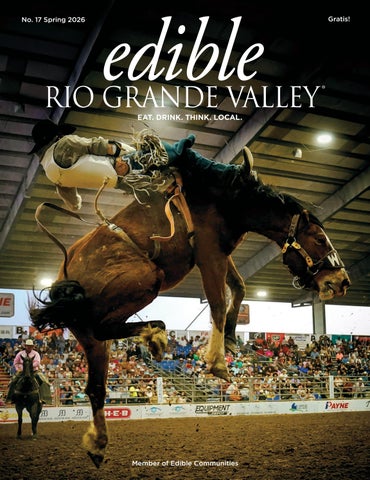
Above: Saddle Bronc Riding at Los Fresnos Rodeo.
Opposite page, left: 4-H and FFA showing a Beefmaster heifer in the Junior Breeding Beef Heifer Show.
Top right: Flag girls present the American flag at the RGVLS Rodeo.
Photo courtesy of Los Fresnos Rodeo

The Biggest Little Rodeo in Texas

Just 10 miles north of Brownsville rests the agricultural and ranching community of Los Fresnos. With a population of fewer than 10,000 banded together by small-town pride, every February it quadruples in size, attracting more than 30,000 visitors to its annual three-day rodeo.

What started as an idea among a group of friends at a backyard barbecue has grown to be “The Biggest Little Rodeo in Texas,” said Larry Cantú, Los Fresnos Rodeo chairman of the board. A volunteer for more than 33 years, Cantu has personally experienced the rodeo’s growth and attributes its success largely to the Los Fresnos community.

“We are a small, family-oriented community and the guys who started the rodeo had one goal in mind,” he said: “to put Los Fresnos on the map.”

And they sure did.

A member of the Professional Rodeo Cowboys Association since 1990, the Los Fresnos Rodeo is a household name not only throughout the RGV, but also across the nation, attracting some of the biggest names in the sport to its outdoor arena every year.

However, according to Cantú, “It’s not just a rodeo, it’s entertainment.” Guests are encouraged to arrive early to experience the carnival midway acts, live music performances from local artists and the Cameron County Junior Livestock Show, which is held adjacent to the rodeo grounds and open to the public.

Cantu said that more than 400 4-H and FFA junior exhibitors will compete in the livestock show this year as a warmup for the Rio Grande Valley Livestock Show and Rodeo, set for March 12–22.

“We are a small, family-oriented community and the guys who started the rodeo had one goal in mind: to put Los Fresnos on the map.”

A South Texas Tradition

In the heart of the Valley sits the state’s sixth-largest livestock show and third-best rodeo. Whether you were born in the Valley or are just passing through, chances are you have heard of the Rio Grande Valley Livestock Show and Rodeo (RGVLS).

RGVLS is truly a South Texas tradition, and the Valley’s flagship event, attracting more than 300,000 visitors from around the world to the show grounds in Mercedes each year.

“What makes this event so special is that we have identified generations of families who have been involved in RGVLS in one way or another, as either an annual guest, a livestock exhibitor, food vendor, sponsor or volunteer,” said Executive Director and General Manager Luis Saldaña.

Photo courtesy of RGVLS
“The future of agriculture is lying in those barns. RGVLS is a reminder that agriculture is part of our everyday life from the food that we eat to the clothes that we wear.”

What started out as just a livestock show in 1939, RGVLS has grown to an 11-day event consisting of 33 junior and open livestock competitions, 19 competitive events, and seven rodeo performances, celebrating its 87th year this March. A team of more than 600 volunteers work alongside a small staff to facilitate the “largest event south of San Antonio,” said Saldaña.

The rodeo alone attracts more than 35,000 guests across the performances and draws the top athletes from across the world including past competitors: Stetson Wright, 10-time PRCA World Champion Bull and Saddle Bronc Rider; and J.B. Mauney, the $7 Million Bull Rider—all-time highest-earning athlete in the sport of rodeo. In 2025, the rodeo drew athletes from 13 states and three countries and was broadcast live on the Cowboy Channel for the world to see.

In addition to the rodeo performances, RGVLS has one of the best carnivals in the country, with a midway lined with food stands featuring the tastiest fair foods from the show’s 100-plus food vendors.

Photo by TJ Tijerina courtesy of RGVLS
Photo courtesy of RGVLS

More Than a Rodeo—Inspiring the Future

Kiran Abrigo, a senior at McAllen High School and 2025 RGVLS Cover Girl Second Runner Up, has been attending the rodeo since before she could walk. “My first time participating in a cattle show was at RGVLS when I was 6 years old,” she said.

Abrigo is one of 3,000 4-H and FFA junior exhibitors who will exhibit a combined 7,200 livestock projects. For Abrigo, events like RGVLS are important because they expose the public to agriculture.

“The future of agriculture is lying in those barns,” she said. “RGVLS is a reminder that agriculture is part of our everyday life from the food that we eat to the clothes that we wear.”

With dreams of majoring in journalism with a focus on sports broadcasting, Abrigo is proof that these events are more than just a rodeo. “Showing livestock and competing in the Cover Girl Contest has taught me patience and responsibility and has given me the confidence to be a leader and share my story with others,” she said.

The Valley is fortunate to have two of the largest rodeos right in their backyard that not only provide entertainment for the public but also a platform for youth development and family-oriented fun. Saldaña said it best: “People who have never been here [to the RGV] have an impression of what this place is like, and it's like nothing they have ever seen. It’s so much more.”

Brooke England is a local rancher, business owner and marketing professional with a background in journalism and communications. She lives in Mercedes on a registered Brahman ranch that has been in her husband, Benton’s family for over 100 years. Her greatest joy in life is being a mom to her 2-year-old son, Burton.

Opposite page, top: Breakaway Roping during the Los Fresnos Rodeo. Bottom: The littlest rodeo stars compete in the Mutton Bustin' at the RGVLS Rodeo. This page, top left: Kiran Abrigo with Snowball, her Brahman heifer, who placed in the top of their class in the Junior Breeding Beef Heifer Show. Top right: Barrel Racing event at the RGVLS Rodeo. Bottom right: Bull Riding at the RGVLS Rodeo.

Photo by Sunnybrook Photo Co.
Photo courtesy of RGVLS

Congratulations to George Watts III on his James Beard Award Nomination!

“Honestly, it’s surreal. The James Beard Awards are something you dream about as a chef. For me, it’s incredibly humbling. I did not expect it at all.”

It was a friend and fellow chef who told George Watts III, owner and pitmaster of GW’s BBQ Catering Co., that he had been named a semifinalist for the James Beard Award for “Best Chef: Texas.”

“He called congratulating me, and I was, like, ‘For what?’ He proceeded to tell me. I told him not to be messing with me because I couldn’t believe it.”

Still not sure, Watts went to the James Beard Foundation website to see if it was true.

“I looked it up online and saw the article and I was overwhelmed by emotions. It was such an incredible feeling.”

Often described as the “Oscars of food,” the James Beard Awards are among the most respected honors in the U.S. restaurant industry, the highest honor for culinary professionals. In the “Best Chef: Texas” category, Watts is one of 20 chefs to make the semifinalist list. He joins chefs from Houston, Dallas, Austin and San Antonio.

“I know we work hard and I know our food is special, but there are so many incredible chefs in Texas and across the country. To be named alongside them is something I never imagined. I’m incredibly grateful.”

At GW’s BBQ, it’s a family affair. Watts and his father opened the restaurant in 2020. They specialize in classic barbecue with a Tex-Mex fusion and a menu that rotates seasonally. Be prepared to wait in line but it is so worth it.

“It means everything,” he says. “My family has been part of every step of this journey: the ups, the downs, the stress, the financial risk, the exhaustion. They’ve watched me chase this dream with everything I have. So this nomination isn’t just mine, it’s theirs too.”

On March 31, the James Beard Foundation will announce the restaurant and chef nominees and the winners will be celebrated on June 15.

“I hope this puts a spotlight on our region and shows that worldclass food is coming out of places people don’t always expect. I’m just proud that our food, and our story, are being seen on a national level.”

GW’S BBQ Catering Co. is located at 107 N. Nebraska Ave. in San Juan, Texas. Visit their website at gwsbbqco.com or follow on Instagram and Facebook.

What’s in Season

March – May

Beets**

Bell Peppers ***

Broccoli **

Cabbage**

Cantaloupes ***

Cucumbers **

Field Peas **

Green Onions **

Greens ** Honeydews *** Melons *** Onions **

Spinach * Strawberries ***

Sweet Peppers ***

Watermelons ***

What to

Plant

Corn * Cucumbers*

Eggplant * Hot Peppers * Snap & Lima Beans * Sweet Peppers ** Tomatoes*

March Only * March & April ** May Only ***

YVETTE VELA

The sun was beginning to set, and a cool fall breeze drifted through the brushlands of the historic Hacienda Yturria Ranch. Nestled in the heart of Willacy and Kenedy counties, this storied property stretches across thousands of acres and has long been a destination for hunters from across the nation, known for its world-class pursuits — from trophy white-tailed deer to South Texas specialties like the exotic Nilgai antelope, introduced locally in the 1920s from southern Asia.

It was the perfect backdrop for the second annual Ranchto-Table Dinner held in mid-November and hosted by Edible Rio Grande Valley magazine. Driving along the dusty road onto the ranch, visitors were greeted by longhorns grazing in lush grass, vibrant green jays darting from mesquite to mesquite, and herds of cattle clustered beneath broad shade trees.

The evening began as guests toasted the sunset with beer, wine and cocktails including a signature agave margarita created for this dinner. Guests then moved to the community tables to taste and enjoy six delicious courses, which were paired with wines from two California wineries.

This year’s featured chef was George Watts III of GW’s BBQ in San Juan, Texas. Watts was recently named a semifinalist for the James Beard Awards for “Best Chef: Texas.” His family-owned restaurant ranked fifth on Texas Monthly’s 2025 list of “Best BBQ Joints in Texas” — a recognition that Watts said came as a surprise as he is still relatively new to the barbecue scene. He always knew, though, that he wanted to create and serve food made with heart and intention, food meant to honor the traditions and bold flavors of South Texas BBQ. Earning these accolades affirms he is on the right path toward building a legacy rooted in craft, culture and community.

Opposite page: Nilgai Lomo over mole ranchero shot on the Hacienda Yturria Ranch.
Top: Cocktail hour at Sunset.
Center: George Watts III is drizzling dulce de leche on the dessert.
Bottom left: Place setting
Most of the food for the dinner was sourced right here in the Rio Grande Valley or elsewhere in Texas — from the Nilgai, quail and ribs to the vegetables to the chipotle honey and dulce de leche ice cream.

For this dinner, Watts designed a menu that paid tribute to the South Texas ranchlands, the history of the ranch hands and the unique flavors drawn from the area. Much of the meal was prepared over an open fire using mesquite harvested directly from the Hacienda Yturria Ranch.

As guests progressed through each course, Watts ensured the ingredients were locally grown and harvested, sourcing proteins from nearby ranches and vegetables from community gardens. Each plate was executed with precision, but one of the most captivating courses featured Nilgai, a robust antelope native to India and Pakistan that has thrived in the South Texas brushlands since being introduced by hunters in the 1920s. Nilgai adapt remarkably well to the hot, arid climate and their meat — lean, tender and exceptionally flavorful — is considered a regional delicacy. A mature bull can yield more than 100 pounds of

meat, making it a valuable resource for many ranchers and hunters.

The featured Nilgai came from the Yturria Ranch. Days before the dinner, Watts and members of his culinary team hunted the Nilgai, Watts’ first time participating in the hunt and harvest. “Hunting and harvesting the meat gave us an ultimate appreciation for the animal,” he said. “We wanted to make sure we honored it in the best way possible.”

For this course, Nilgai Lomo, Watts leaned into his creative instincts, presenting the dish as a visual homage to the animal’s natural habitat. Perfectly seared medallions rested atop a deep, complex mole ranchero, a sauce that took him days to prepare and symbolized the land the Nilgai roam. A fire-roasted carrot and radish salad, reminiscent of the wild brush, completed the dish, offering guests a truly authentic taste of South Texas terrain and tradition.

Top right: Smoked Short Rib. Bottom left: Wine selections Left: Wine selctions for the evening served from Arrietta Winery and J. Cage Cellars

True to Edible ’s mission, the dinner was truly a farm-to-table dinner. The first course began with a Land Air Sea Trio of beef tartare, quail pâté and smoked trout dip. It was so delicious we had to stop eating or we would not have had room for what was to come.

The fire-roasted squash soup with chile oil, pumpkin seed pesto, creme fraîche, rosemary focaccia and fried sage was delicious, along with the smoked and braised short rib with ancho demi-glace, confit garlic potatoes, fire-roasted vegetables and crispy leeks.

And the Veldhuizen plate was a cheese lovers delight, featuring mixed milk gouda, Texas gold cheddar, smoked paprika Havarti with chipotle honey, figs and almonds.

Each course featured white and red wines from well-known wineries in California’s Napa and Sonoma Valleys. To make the evening even more special, the winemakers Fritz Hatton of Arietta and Roger Beery of J. Cage Cellars attended the dinner and shared their expertise on the featured selections.

Dessert, not to be missed, was a spiced apple galette: a beef tallow four tortilla, with oat streusel, and dulce de leche ice cream with a drizzle of caramel.

Most of the food for the dinner was sourced right here in the Rio Grande Valley or elsewhere in Texas — from the Nilgai, quail and ribs to the vegetables to the chipotle honey and dulce de leche ice cream.

“We are so grateful to our hosts Cassandra and Brad Wolfe, to Chef GW and his team, to our winemakers who traveled far to celebrate with us, to our local vendors and to our guests for making this evening so special,” said Jacqueline Folacci, Edible RGV publisher.

The next dinner in the To Table series will be the second annual Gulf-to-Table Dinner. Please sign up at the newsletter at ediblergv.com and be the first to get the details.

Yvette Vela is a Kingsville, Texas–based freelance photojournalist and former Brownsville Herald staff photographer. Drawn to all things food and nature, she uses her lens to tell authentic, grounded stories.

Do

You Love the 956? Own the platform that tells its story.

A well-established regional lifestyle magazine celebrating the people, culture, businesses, and beauty of the Rio Grande Valley is now available for acquisition.

This is more than a publication — it’s a voice for the RGV.

Ideal for an entrepreneur, media visionary, or community leader ready to shape the narrative and grow a powerful local brand.

Serious inquiries only.

Text or Call 956.496.4920

In Full Bloom

A New Generation of Rio Grande Valley Florists Cultivates Immersive Experiences in South Texas

STORY BY SARA CANTÚ | PHOTOS COURTESY OF WILDAUGUST FLOWER FARM

My love of flowers feels not like something I developed, but something I inherited. Some of my fondest memories of growing up in the Rio Grande Valley include visiting my grandmother’s house in Raymondville, where bougainvilleas in fuchsia, purple, and white spilled across the yard.

Flowers are deeply embedded in Tejano culture. In South Texas, flowers are used to enhance celebrations like quinceañeras and weddings, and to honor religious traditions like Día de la Virgen de Guadalupe and Día de los Muertos. Illuminating marigolds, or cempasúchil, are a hallmark of this sacred Mexican holiday. To be ready for Día de los Muertos, they must be planted during la canícula, the Spanish term for “the dog days of summer.” Growing them can be challenging.

Opposite page: A field of blooming butterfly ranunculus at WildAugust Flower Farm in Harlingen.Top: A field of larkspur, statice, and ammi visnaga. Center: Snapdragon "Potomac Orange" in boom in Olmito. Bottom left: Jennifer Wilson, owner of Wild August, holding clarkia.

I learned about cempasúchil from Jennifer Wilson, founder of WildAugust Nursery and Flower Farm in Harlingen. Tending to the flower fields — filled with over 50 species like ranunculus, anemones, and phlox — is a labor of love for Wilson, who founded WildAugust after a period of challenges, uncertainty and deep soul-searching. On Friday evenings, the farm comes alive as the community flocks to the tree-lined property for a nighttime market filled with food, music and homemade goods and crafts.

Photo by Michelle del Castillo-Davis

WildAugust designs florals for celebrations like weddings, but sympathy flowers offer a unique opportunity to use native flowers to capture the true essence of a recently departed loved one. Wilson is drawn to requests like these. She recalls creating an arrangement for a family’s dear grandmother, a Mission native who was deeply proud of her hometown roots. Using foraged local flowers, greenery, citrus and bold blooms not found in traditional arrangements, Wilson curated a piece that embodied the spirit of the Rio Grande Valley.

“Sustainable, eco-friendly, local [flowers] celebrate the place you’re in,” said Wilson. “What else can we take from this place, and celebrate the Rio Grande Valley through flora and fauna that’s already here?”

Flowers, just like the people who grow them, must be resilient to bloom here. WildAugust is one of the local, women-owned businesses forging a new path in the South Texas floral industry. In Olmito, Adrienne Davis, owner of The Petal Patch, turned a passion for flowers into a flourishing business. From her backyard, she grows zinnias, sunflowers, celosia and gomphrena, timing growing patterns carefully to adapt to the

Top left: Erika Ramirez, owner of boutique flower studio Fleurish in Edinburg. Top right: Zinnias in bloom. Bottom: Gomphrena "Fireworks" blossoming at The Petal Patch in Olmito.
Photo courtesy of Fleurish
Photo by Michelle del Castillo-Davis
“Sustainable, eco-friendly, local, celebrates the place you’re in,” said Wilson.
“What else can we take from this place and celebrate the Rio Grande Valley through flora and fauna that’s already here?”

local climate. “Flowers are a beautiful lesson in delayed gratification — from the seed to the bloom.,” she said. “The bloom represents all of the days I spent nurturing and bringing it to life.”

Beyond harvesting flowers, a growing industry of Valley florists hopes to spread their passion for flowers to a new generation. Mariana Linaldi, founder of Southern Roots, combined a love of flowers and delicious food to forge a new brunch destination in South Texas. Its newest venture is located in a fast-growing area in Pharr, and has quickly attracted the brunch crowd. Adorned with sparkling chandeliers and vibrant floral wallpaper, it offers an immersive experience beyond a florist studio.

“Everybody is trying to live a life of intention, and I think that’s what we’ve created,” said Linaldi. “I think the Valley is so open to new things now. I tried really hard to incorporate that Texas, Mexican, Southern hospitality. Immersing ourselves in that culture of things that are lovely and beautiful and hospitable.”

Fleurish, a new floral studio in Edinburg, was born from a similar love of flowers. Specializing in modern Korean wrapping techniques, owner Erika Ramirez carefully curated her space to offer a flower bar, a DIY craft room, and flower-themed trinkets available for purchase. Her grand opening in December saw a two-hour wait.

“I decided to open the flower shop because I wanted to have peace in my life,” she said. “Flowers have really helped me build friendships here in the Valley.”

For many in South Texas, flowers are about connection — to our loved ones, to Mexican heritage, and to our grandmothers’ yards in Raymondville.

Sara Cantú is a freelance writer and communications professional with deep roots in the Rio Grande Valley. In her spare time, she enjoys reading, writing, tending to Como La Flor (her mobile bloom bar), and spending time with her husband, Mark, as well as family friends, and their two pugs.

The Taste of Spring

RECIPES BY STELLA BEUCHAT AND ROBERT JOKL, CHEFS AND OWNERS OF SPREADS GOURMET IN BROWNSVILLE, TEXAS.

PHOTOS BY ROBERT JOKL

“Spring cooking doesn’t need complexity, it needs clarity. Fresh herbs, bright citrus and a light hand are all it takes to wake up the palate after winter. These three sauces are designed to do exactly that: add vibrancy, movement and balance to everyday meals: A pesto that leans green and citrusy. A vinaigrette that works as effortlessly as a marinade as it does on tender greens. And a creamy dill yogurt ranch that cools, rounds and refreshes. Simple by design. Flavorful by instinct.”

Spring Herb Pesto

Yields 1¼ cup

This pesto is all about freshness — less weight, more lift. Basil brings sweetness, parsley adds snap and lemon zest keeps everything pointed toward the season ahead. Fresh basil and parsley form the base, blended with toasted nuts, a single clove of garlic, bright lemon, good olive oil and finely grated aged cheese. Salt and cracked black pepper finish it cleanly. It’s as comfortable tossed with warm pasta as it is spooned over grilled vegetables or fish.

1½ cups pesto

1 cup packed fresh basil leaves

1½ cup packed flat-leaf parsley

¼ cup toasted pine nuts or walnuts

2 cloves garlic

Zest of ½ lemon

1 to 2 tablespoons fresh lemon juice

½ cup extra virgin olive oil

¼ cup parmesan or pecorino cheese, finely grated

½ teaspoon salt, or to taste

¼ cracked black pepper

Pulse the herbs, nuts, garlic and lemon zest until just broken down.

Stream in olive oil until smooth but still textured.

Fold in cheese, season and finish with lemon juice to taste.

Serve with roasted spring vegetables, folded into grains or spread onto warm bread.

Creamy Dill Yogurt Ranch

Yields 1½ cups

A fresh, modern take on ranch — lighter, brighter and herb-forward. Greek yogurt replaces heaviness with tang, while dill and lemon keep the finish clean and cooling. This is the sauce that disappears first at the table.

1 cup Greek yogurt (full-fat preferred)

2 tablespoons fresh dill, finely chopped

1 tablespoon fresh lemon juice

1 small clove garlic, finely grated

1 tablespoon olive oil

½ teaspoon salt, or to taste

Stir all ingredients until smooth.

Taste and adjust seasoning. Chill briefly to allow flavors to settle.

Serve with roasted vegetables, grilled meats, seafood or as a dressing for crisp spring salads.

Note: For more recipes and information, reach out to Stella and Robert on Instagram @spreads.gourmet.

Citrus Vinaigrette for Salads & Marinades

Yields ¾ cup

This vinaigrette is intentionally versatile — sharp enough for greens, gentle enough to marinate chicken, fish or vegetables without overpowering them. Dijon adds body, honey brings balance and citrus keeps it light. This vinaigrette can be used for salads, marinades or bread dipping. It’s versatile and delicious.

¼ cup fresh lemon juice (or lemon + orange blend)

1 tablespoon Dijon mustard

1 tablespoon honey or maple syrup

½ cup extra virgin olive oil

½ teaspoon salt, or to taste

¼ teaspoon cracked black pepper

1 large clove of minced fresh garlic

1 teaspoon thyme

Whisk citrus juice, Dijon and honey until smooth.

Slowly incorporate olive oil until emulsified. Add garlic, herbs and spices to our taste,

Use immediately on tender greens or let proteins marinate for up to an hour.

South Texas Smoked Spring Lamb

“This recipe has won us some championships. I messed around with a couple of recipes. I wanted to stay true to South Texas with the comino (cumin) and the Mexican spices but also adding a Texas flair, with the 16-mesh coarse pepper.

For someone being introduced to lamb for the first time, this recipe is very good — and for the lamb lover, you still get that lamb taste. Even my mother and grandmother, who don’t enjoy the gaminess of lamb, loved it.”

1 rack of lamb

For the lamb seasoning:

1 teaspoon smoked paprika

1 teaspoon chili powder

2 teaspoons ground cumin

1 teaspoon Sugar in the Raw

2 teaspoons ground coriander

1 teaspoon coarse garlic powder

2 teaspoon coarse sea salt

½ teaspoon 16-mesh black pepper

Sprigs of rosemary

Instructions for Preheat:

Preheat offset smoker to 350–375°F with a bed of mesquite charcoal; 15 minutes prior to putting the lamb on, add hardwood charcoal.

I prefer smoking hardwood, mesquite chunks with little to no bark.

Prepping and Seasoning:

You may or may not French your bones. This is a personal preference that does not affect taste. (Frenching means to trim meat and fat from the end of a rib or lamb chop so that the bone is exposed. This is done with racks of lamb, beef and pork for presentation.)

Remove membrane of the lamb from backside.

Use duck fat spray as a binder. Season rack of lamb till all is covered. Let seasoning sit for 10 minutes and season with fresh rosemary. Pat in and let sit for 5 minutes .

Let’s BBQ:

Place lamb on grate with bones facing smokestack.  Close doors, open a beer and relax; you’re almost done. Get an aluminum pan ready and grease bottom with butter.

Pull lamb at an internal temperature of 130°F. I recommend you have a good meat thermometer.

Place meat in pan and cover with aluminum foil. Place in a small ice chest or cover pan with a towel to rest for 10 minutes.

Slice, pour remaining au jus over lamb, and enjoy!

by

Photo
Ismael Martinez

Market to Market

All Across the Rio Grande Valley

Market Locations & Available CSAs

Brownsville

Brownsville Farmers Market

Linear Park, 1495 E. 7th St.

Saturdays 9am–noon brownsvillewellnesscoalition.com

@brownsvillewellnesscoalition

Donna Heart of the Valley

Farmers Market

120 S. Main St.

3rd Sunday of every month  2–5pm @heartofvalleyfm

Edinburg

Hub of Prosperity Urban Farm

3707 W. University Dr. Saturdays 9–11am openfoodnetwork.net @hub_of_prosperity

Harlingen

Harlingen Farmers Market

Tyler Avenue & 2nd Street Saturdays 3–4:30pm Mid October–mid June harlingenfarmersmarket.com @harlingenfarmersmarket

HOPE Farmers Market

19833 Morris Rd.

Mondays & Thursdays–Saturdays 10am–6pm yahwehfarm.com yahwehs.farmgarden@gmail.com @yahwehsfarm hopeforsfs@yahoo.com hopeforsfs.org

Wild August Nursery & Flower Market

16802 Garrett Rd.

October–May

Saturdays 9am–noon June–September Fridays 6–9pm wildaugust.com @themarketatwildaugust

Laguna Vista

SPIGCC Community

Farmers Market

South Padre Island Golf Course

1 Ocelot Trail Rd.

1st & 3rd Tuesday of the month  4–6pm

McAllen

Farm-to-Table Tres Lagos

Farmers Market

4350 Tres Lagos Blvd.

First Sunday of every month 2–5pm visitmcallen.com

@treslagosmcallen

Grow’n Growers

Farmers Market

Firemen’s Park, 201 N. 1st St. Saturdays 9am–noon visitmcallen.com @farmersmarketatfiremenspark

McAllen Farmers Market

4001 N. 23rd St. Saturdays 10am–1pm mcallenfarmersmarket.com @mcallenfarmersmarket

Mission

Buena Vida 77

Farmers Market

Bannworth Park 1822 N. Shary Rd.  Sundays 2–4:30pm Buenavida77gardens.com  512.554.9713

Neighborhood

Farmers Market

The Bryan House 1113 E. Mile 2 Rd. Wednesdays 3–7pm thebryanhouse.com @thebryanhouse

Primera

Primera Market

City Hall, 22893 Stuart Place Rd. 3rd Thursday of the month 4:30–7:30pm 956 .423.9654 or ecavazos@ primeratx.gov

Rancho Viejo

Rancho Viejo

Farmers Market

3301 Carmen Ave. Every other Sunday  3–6pm facebook.com/RanchoViejoFarmersMarket @ranchoviejofarmersmarket

San Benito

El Pueblito Market

101 N. Reagan St. 2nd Saturday of the month 11am–3pm elpuebelitomarket956@gmail. com

South Padre Island

South Padre Island

Farmers Market 8605 Padre Blvd. Sundays 11am–1pm facebook.com/SouthPadreIslandFarmersMarket/ Weslaco

La Cebollita Mid-Valley Farmers Market Weslaco City Hall 255 S. Kansas Ave. Last Saturday of every month 11am–2pm @weslaco_chamber weslaco.com

Available CSAs in the RGV Community-supported agriculture (CSA) is one way consumers can directly support local farms. You connect directly with the farmer, and every week your farmer delivers or you can pick up a variety of fresh nutritious food.

All CSAs have different financial structures and procedures, so we suggest you reach out to the CSA for more information.

Nature’s Heartland Farm Offers produce and eggs 11920 N. Mile 16, Edinburg Saturdays 10am–4pm naturesheartlandfarm.com @naturesheartland

Sentli Center for Regenerative Agriculture Offers produce CSA from Terra Preta Farm, Food Bank RGV, Vida Farms, The Hour Farm & Sunshine’s Bounty. Contact Shakera Raygoza to sign up 956.472.7436

Valley Green Growers Cooperative (VGG) Offers fresh produce and protein boxes CSA

19833 Morris Rd., Harlingen vggcoop@hopeforsfs.org

Shop farm-fresh in a SNAP at participating farmers’ markets! Just look for the logo You can use your Lone Star (EBT) Card to buy SNAP-eligible products like fruits and vegetables, meat, eggs, dairy products, spices and even food-producing seeds and plants! Many markets also have programs that provide free bonus dollars when shoppers use their SNAP benefits to buy local fruits and veggies. Visit your local farmers’ market website or info booth for details.

Please send updates to letty@ediblergv.com

Olive Oil Cake with Valley Lemon Curd and Ricotta Frosting

When I think of spring, I think of lemons—especially the Valley lemons that grow in the Rio Grande Valley (also known as Meyer lemons). My grandparents have a lemon tree, and as a kid I loved seeing it heavy with fruit and picking lemons straight from the branches. Now I juice and freeze as many as I can each season.

Every year for my mother’s birthday, I bake her a special cake. This year it was an olive oil cake with Valley lemon curd and ricotta frosting. Ricotta isn’t common in frosting, but I wanted to bring in a subtle Mediterranean feel while keeping the flavors familiar.

Each bite is moist, creamy and bright with lemon. To me, this cake tastes like spring. I hope you enjoy it.

For the Olive Oil Cake:

3½ cups flour

2 teaspoons baking powder

6 eggs

2½ cups sugar

1½ teaspoons salt

1 1/3 cup good olive oil

1½ cups milk

Preheat oven to 350°F.

Evenly coat the bottom and sides of two (8-inch) cake pans with butter, then dust with flour to create a self-release coating.

In a bowl, sift together flour and baking powder. Set aside.

In the bowl of a stand mixer fitted with the whisk attachment, whip eggs, sugar and salt on high speed for 5 minutes.

Once the egg mixture is pale in color, thickened and doubled in volume, gently stream in olive oil while whipping on high speed.

Reduce mixer speed to low and add the flour mixture in 3 additions alternating with the milk making sure to begin and end with the dry ingredients.

Stop the mixer just as the last of the flour is incorporated into the batter. Use a rubber spatula and fold the batter several times, scraping the bottom and sides of the bowl to fully incorporate the wet and dry ingredients

Fill the prepared cake pans and gently tap on a work surface several times to level the batter.

Bake at 350° for 35 to 40 minutes, or until a toothpick inserted to the center of the cake comes out clean.

For the Valley Lemon Curd:

1½ cups sugar

½ cup unsalted butter at room temperature

4 eggs

½ cup Valley lemon juice

In the bowl of a stand mixer fitted with the paddle attachment, mix the room-temperature butter and sugar until combined.

Add the eggs, 1 at a time, and then add the lemon juice. Mix until combined.

Pour the mixture into a medium saucepan and cook over low heat until thickened, stirring constantly. Remove from the heat and cool.

For the Ricotta Frosting

½ cup unsalted butter at room temperature

½ cup cream cheese

½ cup ricotta cheese

4 cups powdered sugar

Combine butter, cream cheese and ricotta in the bowl of a stand mixer and beat until smooth.

With mixer on low, add powdered sugar and mix until combined.

Note: Bogarts Bakery is more than a bakery. They are also known for their lattes, matcha, and espresso drinks. Their passion fruit cheesecake matcha latte is especially popular. The bakery is located at 1012 E. Owassa Rd., Unit 1, Edinburg, Texas. Follow @bogartsbakery on Instagram.

Photo by Ismael Martinez

The Fitzgerald

“I wanted to create something that was delicious and beautiful and that a guest could begin to experience the drink before it hit their palate. This drink is earthy and bright. It is refreshing and I even like it as a brunch cocktail. It’s really good with the bright lemon juice and the thyme and the cucumber. This is a very popular drink.”

1½ ounces Wanderlust thyme and cucumber syrup*

1½ ounces gin

½ ounce fresh lemon juice

Add all to a shaker with ice. Shake it, don’t break it. Strain into a chilled coupe glass. Top with a splash of tonic. Garnish with a cucumber ribbon and fresh thyme sprig.

Note: The Wanderlust thyme and cucumber syrup featured in this recipe is available for purchase. Kelly creates her own syrups and juices, sugar and salt rims, garnishes and cocktail kits. For information, visit The Wanderlust Cocktail Co. on Instagram.

Photo by Alma Gomez

Sealed with Excellence from Europe D.O. CAVA AND JAMÓN CONSORCIOSERRANO

In a world that often prioritizes speed over substance, there remains proof that good things, and excellent taste, take time. D.O. Cava and Jamón ConsorcioSerrano are two such treasures, each representing a unique blend of Spanish tradition and authenticity, guaranteed by seals that signify uncompromising quality.

D.O. Cava is a prestigious Designation of Origin from Europe renowned for its exceptional quality and versatility, crafted using the traditional method, which involves a second fermentation in the bottle. To receive the green, silver or gold quality label, or “marchamo”, a Cava wine must be wine certified by the Cava Regulatory Council. The regulatory body ensures that strict standards are met to maintain the excellence and authenticity of Cava, allowing it to consistently rank among the best sparkling wines internationally. As of 2025, all Cava under the D.O. Cava designation is 100% organic, making it the first major sparkling wine appellation in the world to achieve this milestone.

Similarly, the ConsorcioSerrano seal on Jamón Serrano is your assurance of exceptional quality. For 35 years, the Consorcio del Jamón Serrano Español has been dedicated to preserving the authenticity and excellence of this emblematic product. While European standards already require an impressive 30 weeks of curing, the Consorcio demands a minimum of 52 weeks— more than a year of patient perfection.

Each piece of Jamón ConsorcioSerrano comes from 100% Spanish pigs and is produced using traditional methods. But what truly sets it apart is the rigorous manual selection process: master ham experts personally examine every single piece, checking its texture, aroma, and flavor by hand to ensure it meets the highest standards. This dedication to craftsmanship has resulted in over 20 million pieces certified to date, representing 30-35% of all high-quality Serrano ham from Europe exported worldwide.

Both Cava and Jamón ConsorcioSerrano are perfect examples of how time-honored craftsmanship, underpinned by the European Union’s commitment to quality and tradition, creates products that are unmatched in their category.

Their seals are more than marks on a label— they are promises of authenticity, excellence, and the patient dedication that only time can deliver. Whether enjoyed on a special occasion or as part of your daily life, Cava and Jamón ConsorcioSerrano bring the best of Europe to your table.

Look for the Seal

The D.O. Cava and Jamón ConsorcioSerrano seals are your guarantee of true Spanish excellence. Two seals, one promise: the finest taste of Spain.

Learn more on our website

Protecting Farmland Means Protecting Our Future.

For Mel Coleman Jr., a fifth-generation Colorado rancher, protecting farmland isn’t just about preserving open spaces—it’s about safeguarding the foundation of our food system.

“Throughout my life, I’ve met good, hard working people all trying to do the right thing with the land and animals they care for,” Mel says. “American Farmland Trust (AFT) helps them do just that.”

As a long-time member and former board member, Mel has seen firsthand how AFT connects farmers and ranchers across the country with the tools, policy support, and resources they need to thrive.

From championing farmland protection in Washington, D.C. to helping family farms remain economically viable, AFT ensures that good stewardship—of land, water, and community—endures for generations.

“AFT isn’t just an organization,” Mel adds. “It’s a family that believes in the power of small farms and the people behind them. There’s no better way to make a real difference than to be part of that.”

Join Mel—and thousands of other members—who are protecting America’s farmland and the people who farm it.

Mel Coleman, Jr., Colorado Rancher & American Farmland Trust member since 2005

Turn static files into dynamic content formats.
Create a flipbook