Celebrating the Local Food and Drink of Santa Cruz, Monterey and San Benito Counties
A
A
Lolla Cafe in
13 Simple Summer Cucumber Salad Tzatziki Yogurt
The
A
The
A
Unlocking
A
COVER PHOTOGRAPH
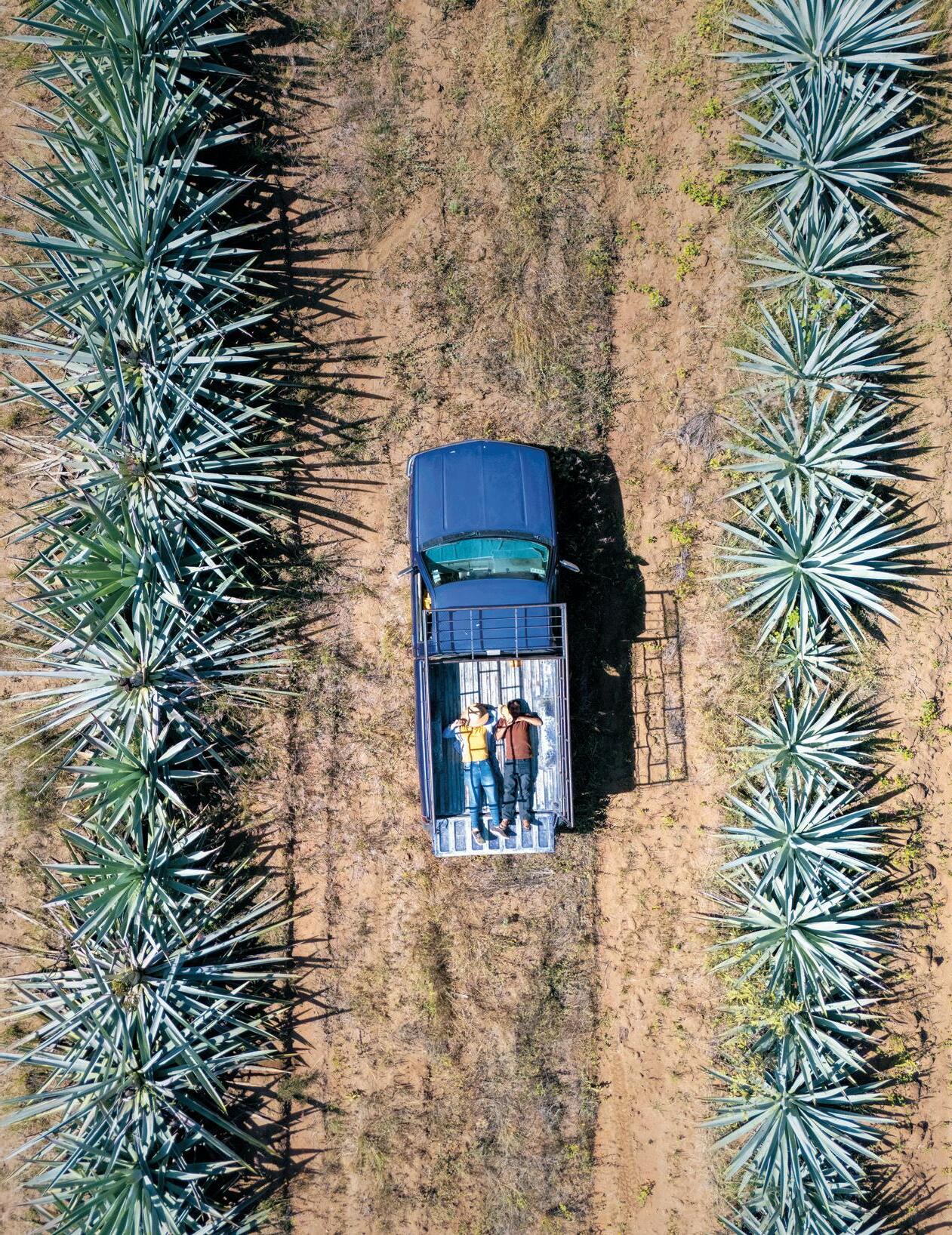
Daughter-and-papa mezcalero team Fabiola and Don Bernardo take a break amid the agave (see p. 34 for more).
Photo by Ángel Persego
CONTENTS PHOTOGRAPH
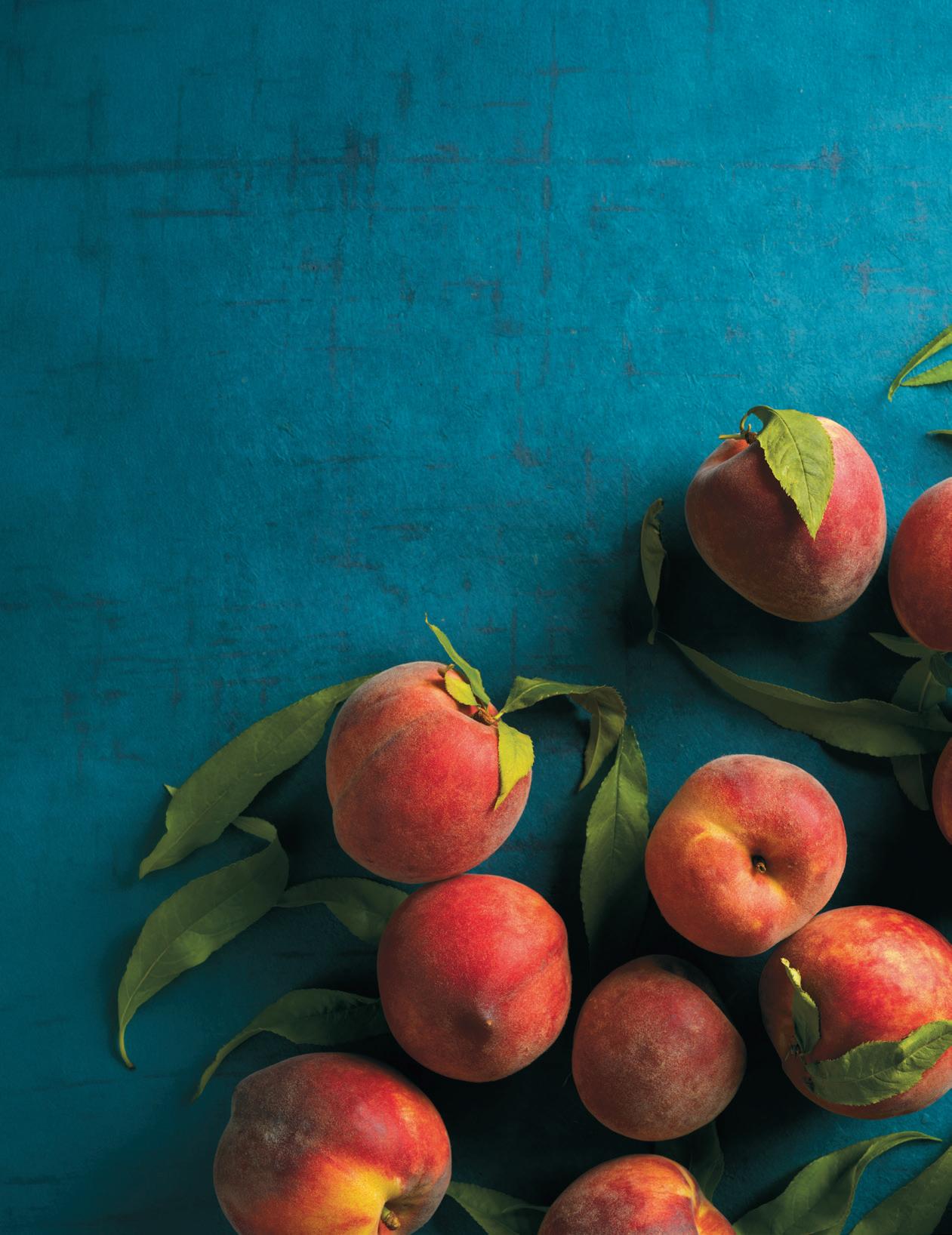
The peaches from Kashiwase Farms at summertime Barnyard Carmel Farmers Market make for a selective chef’s dream (p. 23).
by Patrick Tregenza
Photo
GRIST FOR THE MILL
This week I picked the first sugar snap peas of the season from our summer garden. My 1-year-old granddaughter was astonished when I broke a pod open to reveal the neat row of baby peas inside. We squished one so she could pop it in her mouth without choking, and she quickly decided fresh peas taste great and wanted more. Smart girl!
That’s how we learn about the world, of course—by seeing, hearing, touching and tasting—but every day it’s getting harder to know if what we see and hear is real.
The internet is an avalanche of misinformation, fake images, AI-generated content, along with annoying algorithms and intrusive pop-up ads. It’s no wonder many people have had enough.
I’m proud that Edible Monterey Bay can provide a real analog alternative to digital burnout, by working with very real, very talented local reporters and photographers to cover stories of very real local people doing things that make a very real difference in our community.
I’m grateful that by picking up this tangible copy of the magazine you are inviting us into your home, and by sitting down to quietly read an article in a mindful way you are giving us permission to entertain and educate.
Food—as my baby granddaughter is learning—is another good way to stay grounded in reality and maintain some control in a fast-moving world.
When we grow our own gardens or buy food from folks we know at the farmers market or at locally minded grocery stores we are getting something real we can appreciate with all our senses. It’s not just analog; it’s elemental to our health and well-being.
This issue of Edible Monterey Bay includes an especially strong lineup of reports, including our cover story on the mezcal connection in Santa Cruz, a visit to an unusual strawberry farm, advice on how to stay cool as a cucumber and seven pro cooking tips that promise to turn average cooks into kitchen stars.
We look forward to celebrating the solstice and meeting readers at our Summer Issue release party Saturday, June 20, at the scenic Tira Nanza winery in Carmel Valley. Watch our weekly newsletter to get party details and keep up on local food news.
Happy summer!
Deborah Luhrman Publisher
Our Mission
At Edible Monterey Bay , our mission is to celebrate the local food culture of Santa Cruz, San Benito and Monterey counties, season by season. We believe in sustainability, and we believe everyone has a right to healthful, clean and affordable food. We think knowing where our food comes from is powerful, and we hope our magazine, website and newsletters inspire readers to get to know and support our local growers, fishers, chefs, vintners and food artisans.
EDITOR AND PUBLISHER
Deborah Luhrman
deborah@ediblemontereybay.com
831.600.8281
FOUNDERS
Sarah Wood and Rob Fisher
MANAGING EDITOR
Mark C. Anderson
COPY EDITOR
Doug Adrianson
LAYOUT & DESIGN
Matthew Freeman and Tina Bossy-Freeman
AD DESIGNERS
Louise Androlia • Julie Greene • Cat Kahnle • Coline LeConte • Sarah Owens • Sarah Williams
CONTRIBUTORS
Kera Abraham • Daniel Avila • Analuisa Béjar
Jamie Collins • Robert Eliason • Kelly Rose Evans
Diane Gsell • Henry Hopkins • Alex Luhrman
Walker Mason • Ryan Masters • Kathryn McKenzie
Laurel Miller • Laura Ness • Ángel Persego
Genevieve Rico • Patrick Tregenza • Amber Turpin
ADVERTISING SALES
ads@ediblemontereybay.com • 831.600.8281
Shelby Lambert shelby@ediblemontereybay.com
Kate Robbins kate@ediblemontereybay.com
Aga Simpson aga@ediblemontereybay.com
Fran Fitzharris fran@ediblemontereybay.com
DISTRIBUTION MANAGER
Mick Freeman • 831.419.2975
CONTACT US:
Edible Monterey Bay P.O. Box 487
Santa Cruz, CA 95061 ediblemontereybay.com 831.600.8281 info@ediblemontereybay.com Edible Monterey Bay is published
All rights reserved. No part of this publication may be used without written permission of the publisher. Subscriptions are $28 per year at ediblemontereybay.com. Every
CONTRIBUTORS
Here assemble the reporters and photographers documenting the local farms, fishersfolk and purveyors who inspire EMB’s work, listed in reverse chronological order.
Amber Turpin, a freelance food-and-travel writer based in the Santa Cruz Mountains, has been a contributor to Edible Monterey Bay since the first Fall 2011 issue. She loves wine, but deeply believes that drinking out of glass is the only way to enjoy it.
Patrick Tregenza realized long ago that drumming in jazz bands wouldn’t provide a stable living, so he turned his lens toward commercial food photography—and highlighting the incredible produce emerging from his native Salinas, while honing his ability to identify any field’s crop while zooming by at 60mph. More at ptfoto.com.
Genevieve Rico is a Watsonville-loyal filmmaker and photographer who loves turning real moments into cinematic stories. When she’s not behind the camera, she’s probably chasing golden light, or a Frijolito burrito.
Lau ra Ness spent the summers of her youth dutifully weeding and joyfully eating from the massive garden her family maintained in New York’s Hudson Valley. Her mother teasingly called her “The Queen of Salad.” Little did she know.
Ángel Persego documents the relationship between fire, memory and food in Oaxaca. His photography explores the lives of traditional cooks, mezcal producers and rural communities, creating visual narratives rooted in identity, territory and human connection. He is the cofounder and creative director of Leche con Tuna.
Laurel Miller is a food, spirits and travel writer, and the former editor of Edible Aspen. She grew up on a California ranch and has been writing about regenerative agriculture and craft spirits for 25+ years. When she’s not tethered to her laptop, she works at Santa Cruz farmers markets and enjoys the outdoors.
Kathryn McKenzie’s garden includes heirloom tomatoes, fruit trees and a lone artichoke plant. She helps run her husband’s Christmas tree farm in North Monterey County, and co-authored Humbled: How California’s Monterey Bay Escaped Industrial Ruin
Ryan Masters is a writer, performing musician and bigwave bodysurfer who’s also spent time as a Santa Cruz Mountains firefighter and Pacific Grove’s first poet-inresidence. More at RyanMasters831.com.
Henry A. Hopkins is a filmmaker and photographer centered in the Santa Cruz Mountains. Surfing is his favorite activity, but fostering baby squirrels (on behalf of Native Animal Rescue) is a close second. He believes good vegan food doesn’t try to imitate anything—it just does its own thing well.
Diane Gsell is a Monterey-based food stylist, recipe developer and lifestyle writer whose first foray into the pro food world was selling ice cream from a pushcart in NYC.
Kelly Rose Evans, a former field hockey coach, takes her own fish off the hook, loves hummingbirds, enjoys a good mountain bike single track, and finds her favorite treat is a chocolate chip cookie.
Robert Eliason, a lover of grass-fed burgers and Cienega Valley Negrette wine, has delighted in the wonder of the diverse and ever-growing culinary scene of San Benito County for 16 years—and is passionate about spreading the word.
Jamie Collins owns and operates Serendipity Farms, now celebrating 25 years growing certified organic vegetables and fruit in five microclimates. Her passions include helping fellow farmers as a CCOF educator, and designing a gorgeous display of seasonal produce at her many farmers market stands. More via @serendipity_fabulous_farm.
Analuisa Béjar loves to write, talk, teach and create community around food, and has done just that, across a career spanning roles as a cookbook author, magazine editor, restaurant critic and chef. Originally from Mexico City, she heads a great team at her own Sunny Bakery Café in Carmel Valley.
Mark C. Anderson, EMB’s managing editor and former Willamette Valley wine cellar intern, cohosts “Friday Found Treasures” on KRML every Friday a little after noon, and “Edible on the Air” on KSQD every last Friday of the month at 5pm.
Kera Abraham is thankful for the stream orchids growing among the maidenhair ferns on the granite walls of the Big Sur River Gorge. She works to repair the broken links to our creature nature. Find her at keraabraham.com.
EDIBLE NOTABLE
SPINNING CUPS
An atypical coffee roasting–pottery startup comes grounded in the mountains, and amid a local boom
By Amber Turpin
PHOTOS BY HENRY
HOPKINS
“At its core, Gold Dot is about sharing joy and simplicity,” its website testifies.
“[T]he quiet warmth of a great morning cup, the beauty of things made with care, and the routines that ground us while bringing the sensory experience of life into focus.”
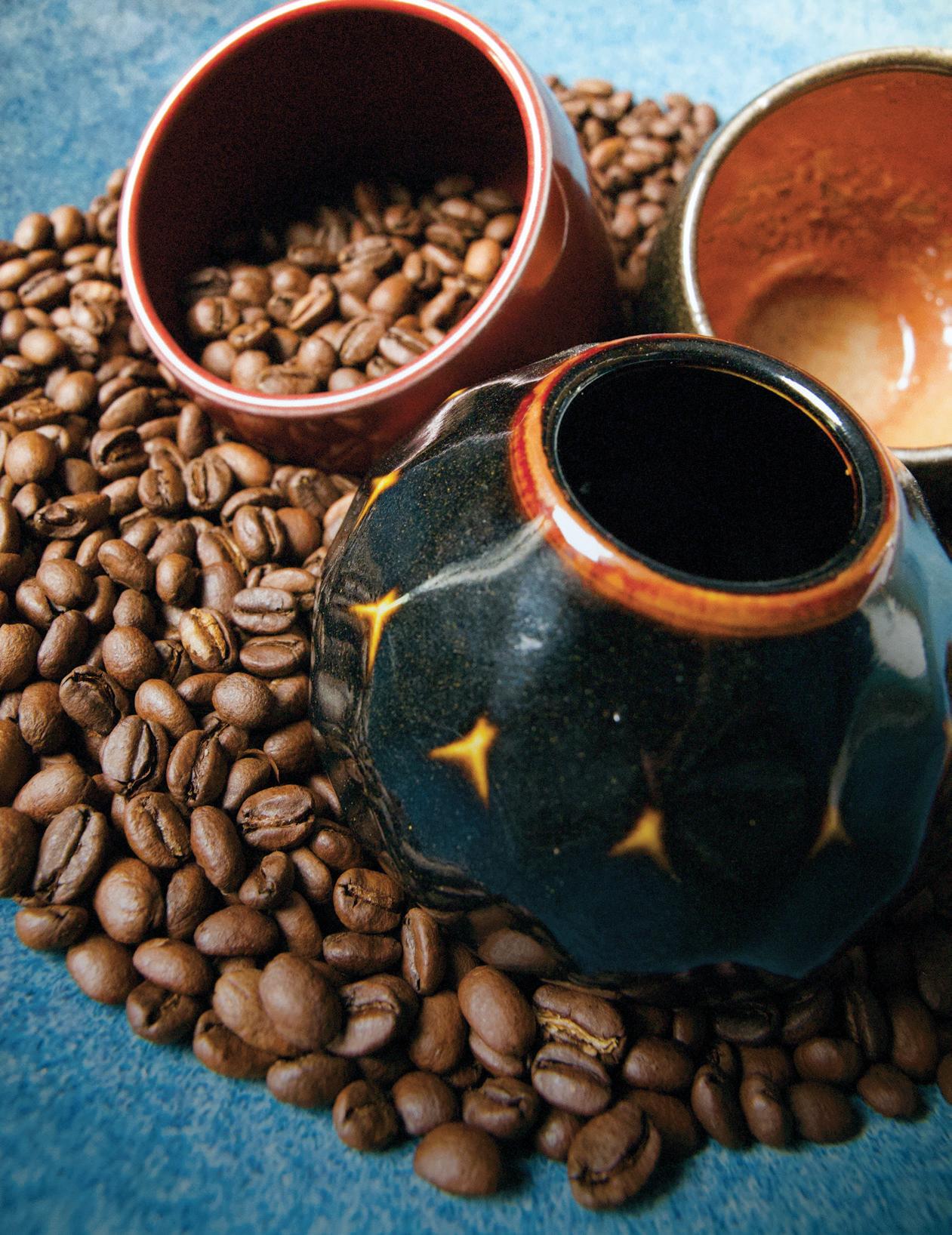
When you receive your box of coffee from Gold Dot Roasting of Boulder Creek, packaged in a cylindrical box, then cut open the gold stickers that seal the lid, your first glimpse is a small note of instructions.
They tell you to get a bowl. Then pour the coffee into it—carefully.
As you do, a ceramic vessel gently tumbles out, unveiling itself amidst a small landslide of coffee.
This bit of theatrical reveal arrives by design, according to co-creator Rocky Lewycky.
“Uncovering the cup out of the coffee is the magic, the moment,” he says. “We like the element of surprise, uncovering a piece you have never seen before.”
The style and shape of the pottery match the season.
For example, the winter vessel, their debut shipment, was modeled after a traditional Korean moon jar, the texture inspired by fractals of snowflakes, with a dark chocolate brown glaze. Spring brought a bulb-shaped pot with a blue and pink translucent finish.
Ceramics and coffee present a poetic pairing for Lewycky and his life partner—and fellow pottery enthusiast—Mitra Mostofi, as they highlight on their website.
“We’re makers at heart,” they write. “Between us we share four decades of ceramic work and a lifetime appreciation for coffee. We’re especially drawn to process and to the parallels between roasting coffee and firing gas kilns. Both require patience, intuition, and attention to subtle transformation.”
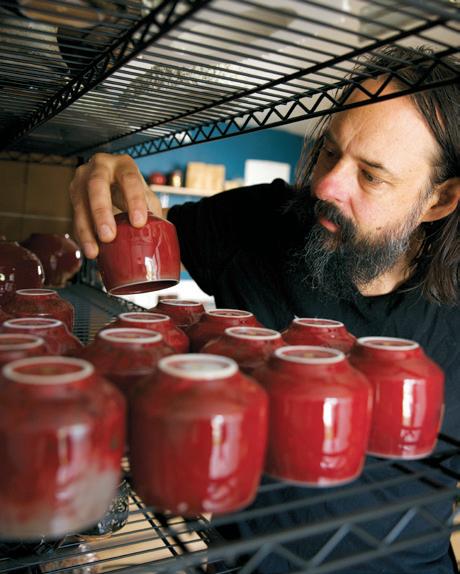
“We believe in being in the flow as much as we can,” says Mitra Mostofi (right). “[My] breathing is the speed of me working through the clay,”
notes Rocky Lewycky (left).
Both found pottery to be a meaningful part of their lives before they met.
Lewycky started creating ceramics 30 years ago when he took a class at Diablo Valley College.
“After one day, it was over—I was [already] having dreams of throwing cylinders,” he says. “I had never had that feeling before, being so inspired and challenged at the same time.”
He proceeded to earn both his undergrad and master’s degrees in ceramics, then moved to Santa Fe to teach and delve into his art.
“Everything really unfolded for me there and my art career blossomed,” he says.
Eventually he moved to Santa Cruz, continuing with his art and showing his work in various places. He now has a 2,000-square-foot studio in Boulder Creek, actively creating bodies of work to exhibit while also running the ceramics department at De Anza College in Cupertino.
“It has been a whole ride,” he says of the circuitous evolution of his craft and career. “When it comes down to it I just really love sitting at the wheel. It’s very meditative for me. My breathing controls the speed of me pulling the vessel.”
For Mostofi, her fascination with pottery was planted as a child in Iran when she would watch traditional kick-wheel potters in the mountain city of Hamadan, while visiting with her parents on trips from Tehran, where she grew up.
“The magic of that was memorable the rest of my life,” she says.
Her professional life would shift from a career in architecture to working with adults with developmental disabilities, but ceramics continued to provide a calming constant.
“The repetition of the wheel is almost like self-hypnosis: When you get caught up in [your thoughts], it fails you immediately,” she says. “I love the honesty it offers me when I’m not present in the moment.”
For Gold Dot subscribers, the coffee varieties—like the pottery— change every three months. (You can also make one-time and coffeeonly orders.)
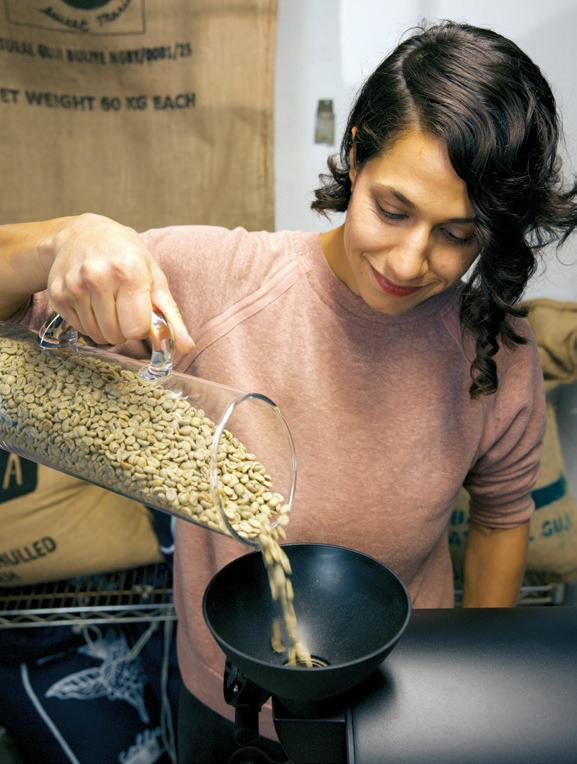
Lewycky and Mostofi select green coffee beans from Sweet Maria’s in Oakland, a well-respected hub for ethical sourcing and open-source roasting coffee education. As they choose, they think about the flavor and aroma characteristics that will emerge once roasted, and how those might reflect the feeling of the season.
For instance, one bean might present nutty and warm notes in the finished cup, a good choice for autumn, while another unlocks a more acidic, light and floral brew, good for spring or summer.
“That choice is very intuitive,” Mostofi says.
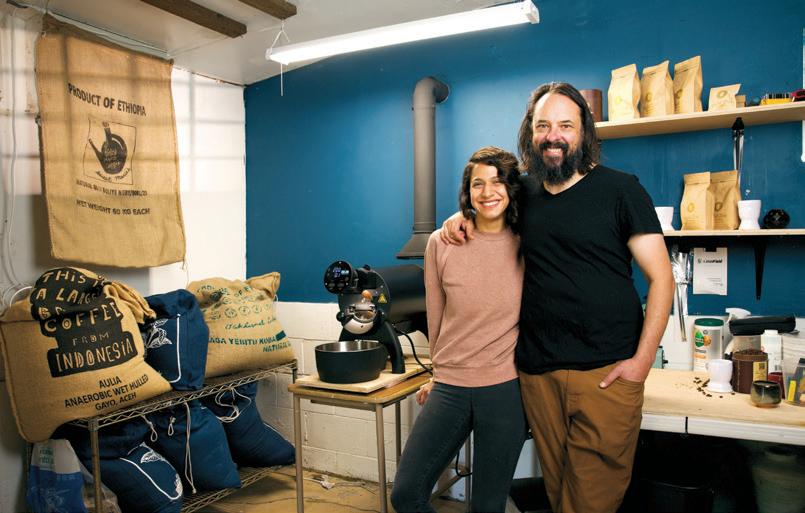
Gold Dot Roasting is headquartered in the garage of the couple’s Boulder Creek home, licensed as a cottage food operation.
Their little Aillio Bullet R2 turns out one kilo at a time. The roaster has special software called Roastime and it hooks into a computer via a USB cable. With that they program all the schedules, recipes and settings, and then the roaster does the rest, locking in consistent batches guided by attentive sensors.
Then they set about preheating, measuring beans, pouring beans, monitoring beans and testing the batches by slowing down or speeding up the end of the roast for a targeted flavor profile.
They do all of these steps together, the two of them, down in their spick-and-span garage space, hours of discussing, comparing, considering and coordinating.
“When we are roasting coffee together, it’s really special,” says Lewycky. “It’s the heart.”
“That’s the collaborative part,” adds Mostofi.
Mostofi and Lewycky share four decades of passion for ceramics between them, and— in their words—“a lifetime” of coffee enthusiasm.
It’s also one that syncs with their other shared passion.
“There’s a focus that’s involved there, it’s alive,” Lewycky says. “It's like a gas kiln.”
Both Mostofi and Lewycky are delving deeper into the nuances of the different coffees, hoping to advance their understanding of all the subtleties each variety presents, both with Sweet Maria’s Coffee and trainings through CoffeeMind out of Denmark.
“It’s craftmanship, and [we] want to get better at that craft,” Lewycky says. “We are already buying incredible beans, and roasting them on the top roaster you can buy. We have 95% of it there, and the extra 5% is that tiny nuance that [we] want to dig into.”
The name for their business is a nod to Lewycky’s artist signature. About 20 years ago, he was reevaluating how he wanted to sign his pieces, and decided on a simple gold dot. When the coffee idea was born, they landed on continuing with the gold dot, as a connection between the ceramics and the coffee. You’ll notice a tiny coffee bean in the middle of the dot on their logo.
But aside from the verbal and visual symbolics behind the brand, it could be said that Gold Dot roasting is a story of many connected dots.
The first dot appeared as a gift of a home coffee roaster that paved the way into a new hobby.
The second dot materialized when a family trip inspired the pair to launch the business, and an accompanying tip sent them to Sweet Maria’s—not far from Santa Cruz—where Lewycky encountered a long lost high school friend who happens to be a 20-year coffee pro.
“The synchronicities are just nonstop!” admits Lewycky.
More at golddotroasting.com.
Feel the Rush
A burst of homespun operations give Santa Cruz coffee new kick
An abundance of great coffee keeps Santa Cruz County caffeinated. Just stand on a corner of Swift Street and turn in any direction for your next latte.
But even potential over-concentration cannot dampen the buzz for more: Check out the recent bump in new and reinvigorated coffee spots, exemplified by these standouts.
Alta Organic Coffee Warehouse & Roasting Co.
Alta has been a pioneering coffee roaster with founder Patti Spooner at the helm for decades. As the company shifted from headquarters in Davenport to the warehouse location on Santa Cruz’s Mission Street, it has also transitioned into a new chapter, while adding a full-blown coffee shop. Patti’s granddaughters, Melia Spooner and Lilly Spooner, are officially the co-owners as of this year, with the next generation redefining the brand and the roasts, while certified organic, transpar ent and conscious coffee bean sourcing remains at the core. More at altaorganiccoffee.com.
Cliffside Coffee Bar
Owner Sean Burau operates his aptly named Cliffside Coffee Bar above The Hook on Pleasure Point on the east side of Santa Cruz. Under a Microenterprise Home Kitchen Operation permit, his cute, custom, home-built cart slings out legit espresso drinks, matcha, teas and housemade syrups and local donuts. The cart has been popping up in other locations recently, like all the way out in Felton at a recent Santa Cruz Moun tains Makers’ Market. Fun giveaways and deals—like the $3 latte happy hour between 8 and 9am!—are brewing on Burau’s IG. More at instagram.com/cliffsidecoffeebar.
Foolhardy Coffee
Coffee caterers Steven and Kate launched as Foolhardy Coffee in 2024. You will see them, along with new baby Elliot in tow, with their La Marzocco-laden cart at the Saturday Westside and Sunday Marina farmers markets, as well as local events like the wildly popular pop-up markets in the former Logos building in downtown Santa Cruz. They specialize in high-quality espresso drinks and pour-overs, as well as interesting specials like the recent Flower Power Latte with rose, lavender and chamomile. More at foolhardycoffee.com.
—Amber Turpin
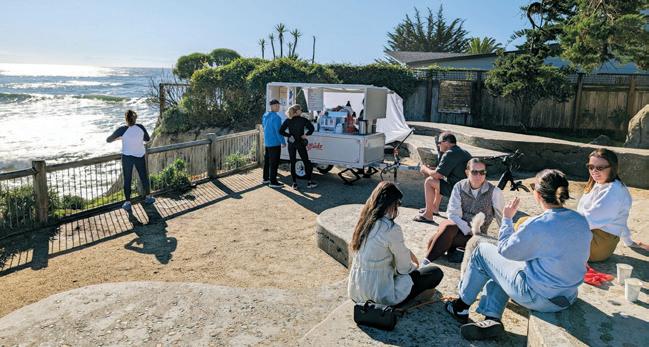
Cliffside Coffee started pouring at Pleasure Point (pictured) before moving its hand-crafted cart down the block to another storied Surf City bluff, The Hook.
Photo by Mark C. Anderson
Solar energy, recycled water, sustainable Sambrailo Packaging containers, and elevated beds designed to ease harvesting (right) all fit into the Ichigo philosophy for greater good.
EDIBLE NOTABLE Berry Unbelievable
Ichigo Farms’ family-sown quest to grow a dreamy strawberry includes rare revelations
By Kathryn McKenzie
PHOTOS BY Genevieve Rico
On the Central Coast, we’re a bit spoiled when it comes to strawberries.
After all, major growers like Driscoll’s and California Giant headquarter here. But for true berry devotees, there’s a more exquisite choice available at farmers markets and independent grocers that hasn’t always been an option.
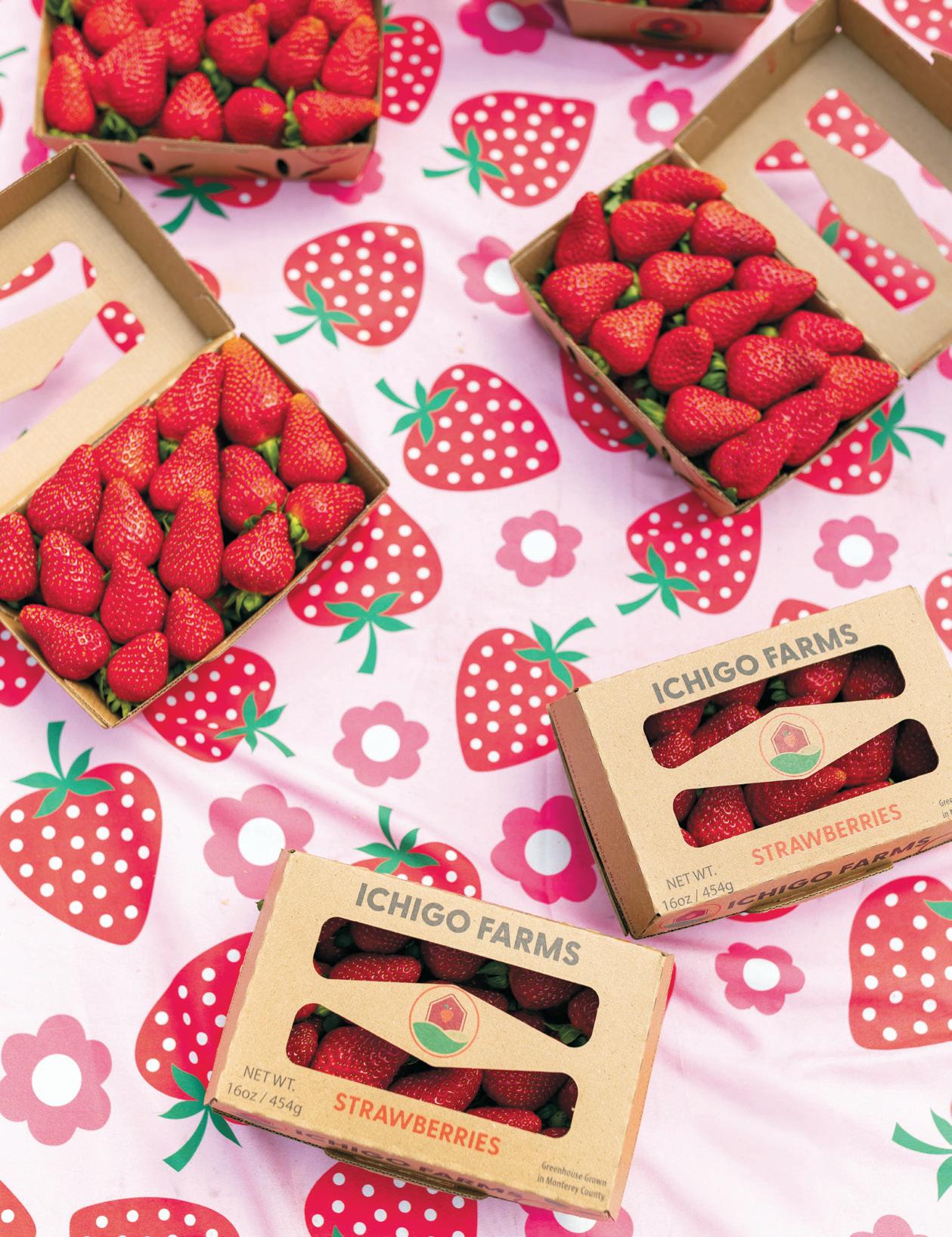
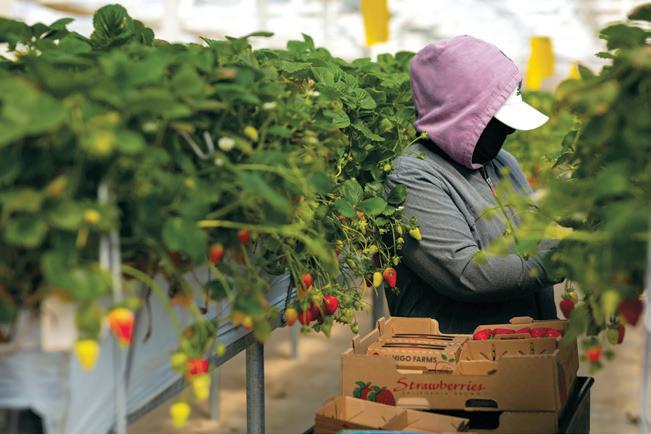
Ichigo Farms—ichigo is Japanese for strawberry—isn’t likely to displace the titans of the berry-growing world, nor is it trying to. What the Salinas farm offers is something unique, and of far-smaller scale: fruit grown as a hydroponic greenhouse crop, via techniques that allow berries to be exceptionally sweet and succulent.
This contributes to a sustainable system of cultivation that uses far less water, discourages pests, skips fuel-guzzling tractors and proves less backbreaking to harvest.
Because Ichigo Farms’ berries are picked precisely when ripe, they are only available in a limited area—the Monterey Bay region and, to a lesser extent, San Francisco.
Which adds to the experience.
People start lining up early at the Ichigo’s table at Aptos, Monterey, Pacific Grove, Santa Cruz and Carmel farmers markets to snag a basket of berries, and if you lag, you may end up emptyhanded.
Shoppers testify it’s worth the wait, and the price.
“I eat them plain, tops and all,” Monterey Peninsula resident Linda McDermed Forsythe comments in a Facebook foodie group. “They are wonderful.”
John Louie, the third-generation farmer who often tends to the farmers markets, hears such refrains frequently.
“Many people ask us if the berries are fake because
of how deep-red and perfect they look,” he says.
That the berries have become such a phenomenon is gratifying for him, who with his family took a chance on growing strawberries in a very specific way because they wanted to offer a boutique high-value product.
“We are enjoying it, though it’s not easy,” he writes in a recent email. “My dad has been farming for 30 years and he believes this is the most difficult crop he has ever grown.”
Because the requirements for greenhouse strawberries are so precise—humidity and temperature must fit within narrow ranges to discourage plant disease and yet produce the quality they were after—it was frought at first.
In addition, assembling an expensive automated water and fertilizer system was something they hadn’t done before, and placing beneficial insects in the greenhouses—like the bumblebees, which are essential for pollination and fruit production—also involved a learning curve.
“Many people ask us if the berries are fake.”
Even with the Louies’ prior experience growing cut flowers in greenhouses, adapting to an edible crop was a whole different thing.
Mike Matsuno, John’s 92-year-old grandfather, began growing cut flowers in the late 1960s, following a difficult path to the Salinas Valley. His home country, devastated by World War II, offered few jobs. He had the chance to enter the U.S. through the 1953 Refugee Relief Act, according to his daughter Janet Louie, who works with him in the family business.
He agreed to a three-year apprenticeship for room and board, later settling in Los Altos and working as a gardener. After marrying his wife, Tomi, another Japanese immigrant, the couple began to look for other opportunities, and Mike and his uncle bought land in Salinas where they could grow flowers.
“My parents got their U.S. citizenship as soon as they could,” says Janet. “It was a proud moment for my father. They’ve always been so pro-American … their attitude is gratitude.”
Today, their company Green Valley Floral continues to thrive, specializing in Instagram-worthy heirloom roses, dahlias, ranunculus and other unusual blooms.
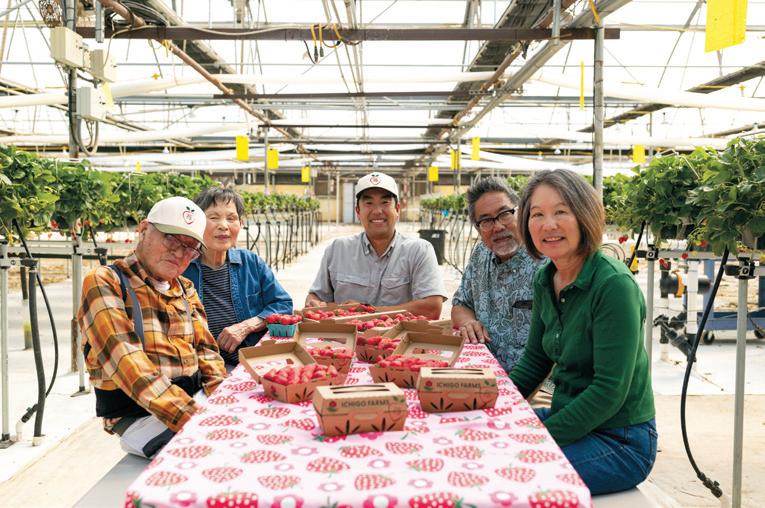
What hasn’t changed: The Matsunos are still working at their business, alongside daughter Janet and son-in-law Curtis Louie, John’s parents.
John, now 33, positioned himself for a job in the financial world after college, but had the urge to come back to the family farm.
His parents insisted that he first show them he was serious by getting some experience elsewhere, so John went to work for Salinas produce giant Tanimura & Antle for five years.
After coming back to Green Valley Floral, he urged his parents
to diversify as a bulwark against fluctuations in their flower business. Growing strawberries was something that everyone could agree on as an experiment.
“We liked the idea of growing tasty strawberries in greenhouses … and we already had the [greenhouse] expertise,” says Janet, who handles food safety and compliance. “Not knowing how to sell a food product, in the beginning, was a challenge.”
The Louies built their new business on years of research in Japanese methods, as well as knowledge from the Netherlands, where hydroponic gardening allows a similarly small nation to grow intensively using limited resources.
“Strawberries are really special in Japanese culture,” John says.
In fact, the berries are considered a luxury gift, with only the most luminous fruit presented for rare occasions—and can cost as much as hundreds of dollars per pound.
In the United States, only a handful of farms—fewer than 1%— grow hydroponic greenhouse strawberries. The techniques the Louies learned have been refined and improved upon during the past four years, resulting in fruit that is completely red—no white “shoulders”—with sky-high brix, or sugar content.
After a few trials, Curtis and John settled on Albion as the main cultivar, which thrives in the heat of the greenhouse, with a solarpowered boost.
“Albion does like long days and plenty of light, so we [decided] to install lights—and then a solar field—to produce our own electricity to be environmentally sustainable,” Curtis says.
All of the irrigation tail water is gathered and reused. That conserves H20, and prevents fertilizers such as nitrogen and phosphorus from en-
tering natural waterways. A computerized system circulates water and nutrients through the planters, responding to sensors that measure what the plants require.
“At midday, the plants are transpiring a lot, so they need more water then,” John says. “Then we can slim down [water use] at night.”
Meet the fam: Grandma and grandpa Matsuno (left) handbuilt the first greenhouses for growing flowers, and the two succeeding generations perpetuate the hands-on hustle.
Because there is no soil involved—roots are nestled in a mixture of redwood bark and coconut fiber—pest problems are limited, and the crop doesn’t require pesticides used in conventional production. Insect threats are further thwarted by releasing beneficial bugs like ladybugs and lacewings.
Automated greenhouse vents open and close to regulate sunlight, temperature and humidity for optimal growth. The elevated planters allow workers to harvest without stooping.
Inside one of the greenhouses built by John’s grandparents a half century ago, glossy strawberries dangle over the sides of elevated planters, and a heavenly scent of sweet fruit fills the air.
John pauses to demonstrate the proper picking technique.
Patience and observation are key—“The redder, the better,” he says, showing how the seeds of the Haruhi berries turn just a little bit darker when they reach peak ripeness— then you tug gently.
So far, the crop occupies about two acres of greenhouse space. Because of the strawberry varieties and the techniques that are used, crop yield is lower than with conventional berries.
Those factors amount to higher prices, about twice or more the retail price of conventional berries. But aficionados who prize taste and texture are happy with the investment.
“People can’t believe how clean the berries are,” says John. “They like the fact that they are grown indoors in a clean environment.”
While strawberries rank among the most popular summer crops locally—the Watsonville Strawberry Festival lands at the start of August for a reason—the Louies’ main production season is October through June, with a break to replant. That way, the Ichigo crop doesn’t have to compete so much with the conventional crop.
In addition to farmers markets, the berries are available at Elroy’s Fine Foods in Monterey, Nielsen Brothers Market in Carmel and a handful of other independent grocers. Restaurants, including Foray and Michelin-starred Aubergine in Carmel, also order Ichigo Farms’ berries.
John Louie says he’s grateful for the chance to cultivate this idea, as daring as it was. “Luckily my parents and grandparents are very supportive,” he says.
If you detect a sweetness beyond the berries, it’s there in that Louie family love, which nourishes the alchemy that will help their business blossom for years to come.
QUEEN DREAMSRealized
Sabrine Rodems channels Goddess energy and relentless problem-solving to make some of the best wine in the region
By Laura Ness
PHOTOS BY Genevieve Rico
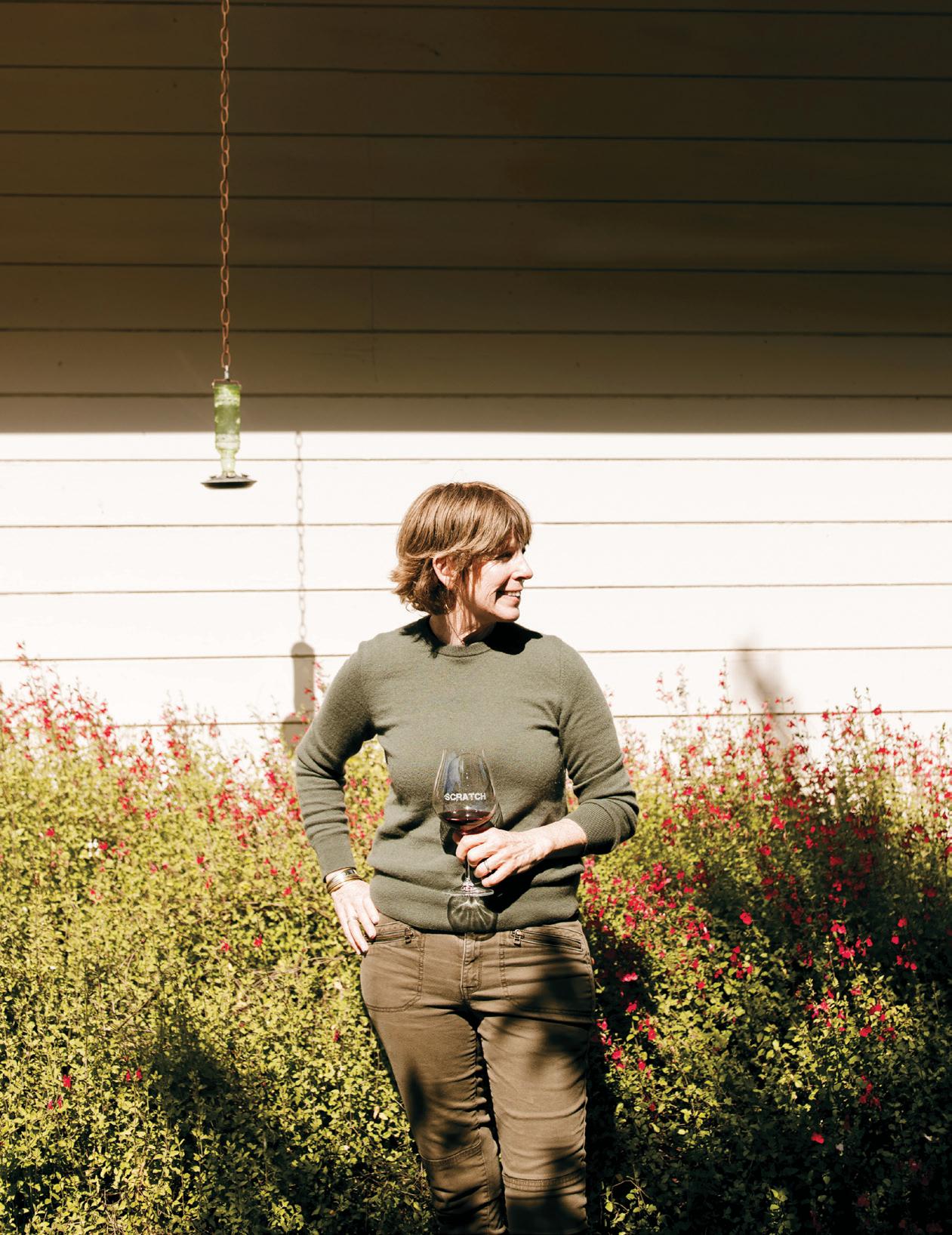
As Edible reported when Sabine Rodems debuted her own Scratch label’s tasting room, she “prides herself on being edgy, ardent and forthright: you won’t catch her mincing words, and her wines are equally expressive and full of boundless energy.”
Streaming through the western wall of redwoods, dazzling spring rays illuminate a magnificent magnolia, and the beauty responsible for its survival.
Sabrine Rodems, area winemaking royalty, is gesturing at the tree, and a menagerie of buildings scattered like dice around it.
“We’re going to totally remodel this place,” she says.
She and her husband, Kooresh, are blessed with the sunniest spot in this old Ben Lomond neighborhood, where they got married in 2011.
That tree—she suspects it’s an Alexandrina, a magnolia known for its dramatic purplish-pink and white goblet-shaped flowers—has held stately court here as dreams were dreamed, cabins were built and lives were well-lived for over 100 years.
It’s like the gatekeeper to the house, to which it grows perilously close.
Her oldest sister thinks she should get rid of it.
“No way,” says Rodems, superstar woman winemaker of Wrath, Scratch and Kori wines, and before that, San Saba. Contractors and architects, be forewarned: The tree is staying.
It’s just another challenge for her to embrace. Wrath assistant winemaker Rafael Vidales sees her welcome such opportunities.
“I’ve witnessed Sabrine deliver a master class on winemaking, put up a fence and mend a busted finger—mine, bottling incident—with the same level of skill and determination,” he says.
Rodems makes everything she does look routine, even if her avenue to winemaking was anything but.
After earning a bachelor’s in theater at UCLA, she worked backstage in a San Francisco troupe, then enrolled in a post-baccalaureate program at S.F. State on a medical school track.
One night—Dec. 2, 1998—between calculus studies, she met a man at a San Francisco bar called Mars. He had decided to walk across town and stopped in for a glass of water.
“I like to say we met on Mars!” Rodems says. Kooresh Afshari— then 36, now her husband—a professional mediator, was crushed when he learned of her intended medical career: “Wait! I’m not gonna see you until I’m 45?!”
At the same time, her physician sister made a subtle suggestion: “We need an enologist in the family, not another doctor.”
When Sabrine decided to pursue viticulture at UC Davis, her mother was unfazed by the switch.
“Sabrine has never sought approval or needed to,” says Carole Rodems. “She has always made decisions regarding her life choices knowing we would support and honor them.”
At UC Davis, in the lab of esteemed professor Andy Walker, her master’s thesis involved studying the enzymes of grapevines resistant to phylloxera, the deadly root louse. Walker urged her to stay on at Davis to pursue her doctorate.
Tempted, Rodems opted instead for the grit of making wine in the real world.
“Heck, I hadn’t made money for six years,” she says, “and although I loved the university environment, I wanted to go out and make money.”
So, she took the first wine job that came up, an assistant winemaker position at San Saba Winery in Soledad. Backstage theater work in high school and her mechanical aptitude from being a stagehand would come in handy with a job out in the middle of nowhere.
“You have to be able to fix stuff out here,” the hiring winemaker told her. “You can’t just call a plumber.”
A few years later, when Michael Thomas—an archeologist dedicated to unearthing the secrets of ancient Italy— inherited San Saba Winery upon the death of his stepfather, its founder, he realized he had inherited a treasure.
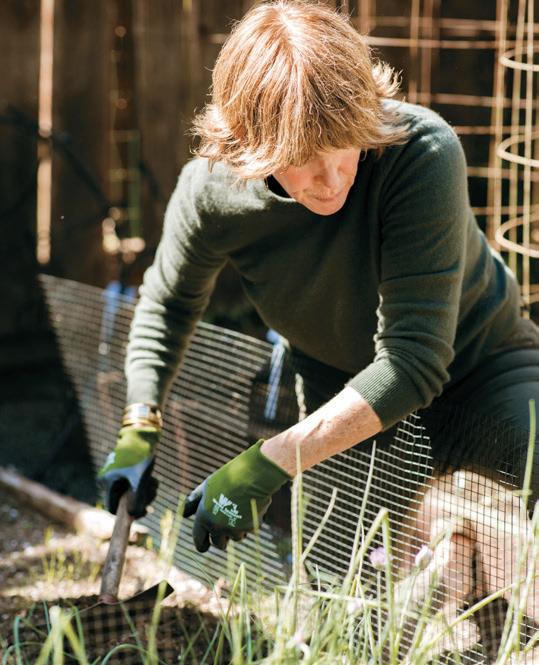
Rodems tends to her backyard on a spring day. “Winemaking is the best of both worlds,” she says, “the amalgamation of science and art.”
Rodems was just the energetic superwoman needed to fulfill his vision for what would morph into the now-celebrated Wrath brand.
Valuing her academic approach to winemaking and willingness to experiment, he came to her with the idea of growing Falanghina grapes and fermenting them on skins, then aging the wine in terracotta.
“She didn’t even blink,” says Thomas. “Sabrine has fearless creativity.”
“She didn’t even blink. Sabrine has fearless creativity.”
That creativity was overflowing from the dozens of bottles awaiting our attention on the coffee table in her enormous oak-floored and firewood-lined living room.
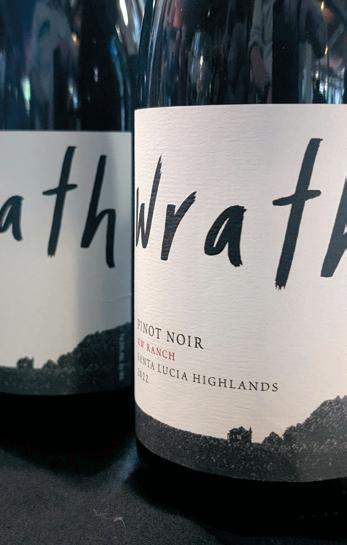
Some—sporting the traditional Wrath haunted house icon—sat next to her Scratch labels and their street art designs, with the daring new Wrath EX wines standing out like purple hair.
I was truly relieved to see she had a dump bucket, water and cheese. This would be a marathon.
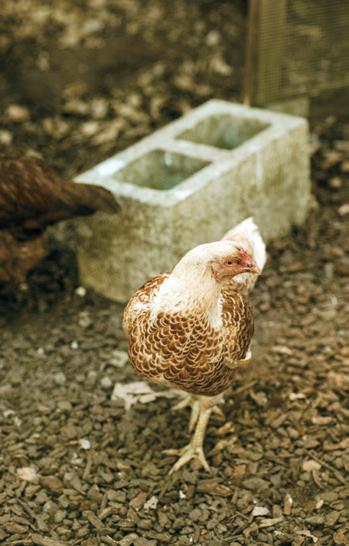
We settled in on the low-slung couch, surrounded by the things she and her husband love, including her dozen or so beloved chickens, some nearing 13 years old. They busy themselves about the yard, while wild birds feed on leftovers. Squirrels impatiently wait for her to plant her goal of 23 types of tomatoes in the raised garden beds.
This is truly her happy place, but anything involving plants, birds and wine seems to bring her joy.
Both her parents are natural optimists. Her dad, John, who passed in 2017, made a valiant effort at priesthood, lasting until age 30, when he succumbed to Carole’s charms.
“Wait, what?” Carole said when he announced he had quit the seminary. They wasted no time producing six children in rapid succession.
“Yep, they got down to business!” Rodems, the youngest, chuckles. It was a wild ride of a childhood, and she remembers spending weekends exploring wineries all over the North Bay with her siblings.
“Wineries were places where parents with no money could bring their kids for the afternoon and have a good time,” she says. “Wine was no big deal. We were all having tastes at the dinner table.”
Save $10 per person with a complimentary lemonade, coffee & tea package when you book before May 20, 2026
After tasting the 13th wine, each one worthy of far more devotion than we are giving them, I wonder if this job is going to kill me. But Rodems was just getting started, this time on a rant.
“Honestly, I don’t understand how winemakers can put out some of the wines they do,” she says. “Can they actually drink those things with dinner? They’re too edgy, too sweet. We talk about balance with food and wine: You cannot have fat without acid. It drives me crazy when a Chardonnay has no acid!”
Her Chardonnays are never found guilty of this crime. Nor her Pinot Noir.
Perhaps said winemakers are too caught up in high scores, which often require wines to exhibit the opposite of finesse. Those numbers mean little to her.
Many of her growers say the same. She wants maximum flavor, good acid and wines that come in under 14.5%.
“Sabrine is always one of the last of the winemakers to pick my fruit,” says Joe Allarid of Tondre Grapefields, one of the five growers she works with for the Wrath Single Vineyard Pinot Noir series.
“Some years, I’m calling her saying, ‘Hey! You might want to come get this fruit pretty soon!’”
He says she doesn’t worry about brix numbers like others do. Somehow, it always manages to turn out.
What motivates her now, according to her mom, is helping others, like her assistant winemaker Rafael Vidales and her former assistant winemaker, Miguel Lepe, to make excellent wine and hone their craft.
“She also loves demystifying wine for consumers,” Carole says, “and getting them to taste for fun and experience, and not take it so seriously.”
Rodems won’t disagree.
“I think wine needs to be less intimidating and a lot more fun,” she says. “We should do a podcast on what winemaking is really all about.”
Kori Violini, for whom Sabrine made Kori Wines, recalls one of those moments vividly: “It was a super windy day, and we’re in the middle of a lemon grove and Sabrine’s up 20 feet high on a forklift, trying to string a banner for my release party!”
Violini’s stepfather, Kirk Williams, of KW Ranch, one of Rodem’s grower partners for 17 years now, says he remembers the first time he visited Sabrine at the winery.
“She was in her rubber boots and she’s using the pressure washer and managing the water hoses and the steam cleaner,” he says. “She never stops!”
Well, almost never.
There was that time she got the forklift stuck in the mud in the San Saba vineyard and had to get towed out. But no matter what, at harvest, there are always more grapes to bring in.
Rodems admits things always break when you need them most.
“Just throw some dry ice on the grapes and wait until the destemmer, or whatever, gets fixed,” she says.
More likely than not, it will be her doing the fixing. Going into her 24th harvest, this lady shows no sign of stopping.
Plus there’s that little business of remodeling the house. The vintage pink tile and 1930s light fixtures in the bathroom will definitely stay, along with the magnolia.
Santa Cruz County’s original Health Foods Grocer offering the largest selection of local organic produce, healthy and delicious bakery and deli food, full butcher, bulk bins and the most trusted vitamin and supplement department around!
Organic Pioneers Since 1969
More at wrathwines.com.
WHAT’S IN SEASON
SwoonSong
Composing romantic nonfiction, with cucumbers as the love interest
By Jamie Collins
by
Ihaven’t met a cucumber I didn’t like. They are prolific in the garden, easy to grow, easier to prepare and extremely refreshing on a hot day.
They’re versatile, mild in flavor and a great low-calorie fruit high in potassium and vitamin C.
Whether you eat this quintessential summer crop raw, pickled or even grilled, the cucurbits family—aka Cucurbitaceae, more than 950 species all told—are a great choice for a tasty snack, if not a life partner.
Cucumbers started as a bitter wild plant first discovered in India over 3,000 years ago. They spread through ancient civilizations, ended up becoming a common garden crop through the Middle Ages and eventually traveled with explorers to the Americas.
Once it was discovered that they could be fermented, they gained value. Cukes could be traded, taken on long voyages and eaten when other food was scarce in darker seasons. Now they are one of the most widely cultivated crops in the world.
There are many varieties of cucumbers—from thin-skinned and greenhouse-grown, which are best for salads, to thick-skinned pickling candidates.
Some are sweeter, with hints of citrus.
But all varieties retain their refreshing essence. Because they are mostly water, the varieties can often be interchanged in recipes.
Most importantly, any type can be made into pickles! Some are just better suited to long ferments, while thinner-skinned cucumbers are better for a quick refrigerator pickle.
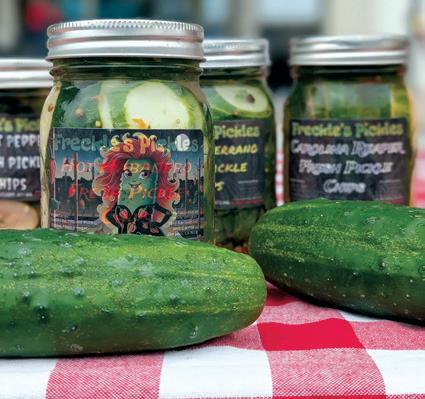
Freckle’s Pickles—owned by two angel-kissed gingers Chris and Debbie Ley—have been selling their cold-cured pickles at the various Santa Cruz farmers markets for well over a year. The founders can regularly be spotted wearing pickle costumes and sampling various cold-cured pickles made with family recipes.
Photo
Mark C. Anderson
Photo by Jamie Collins
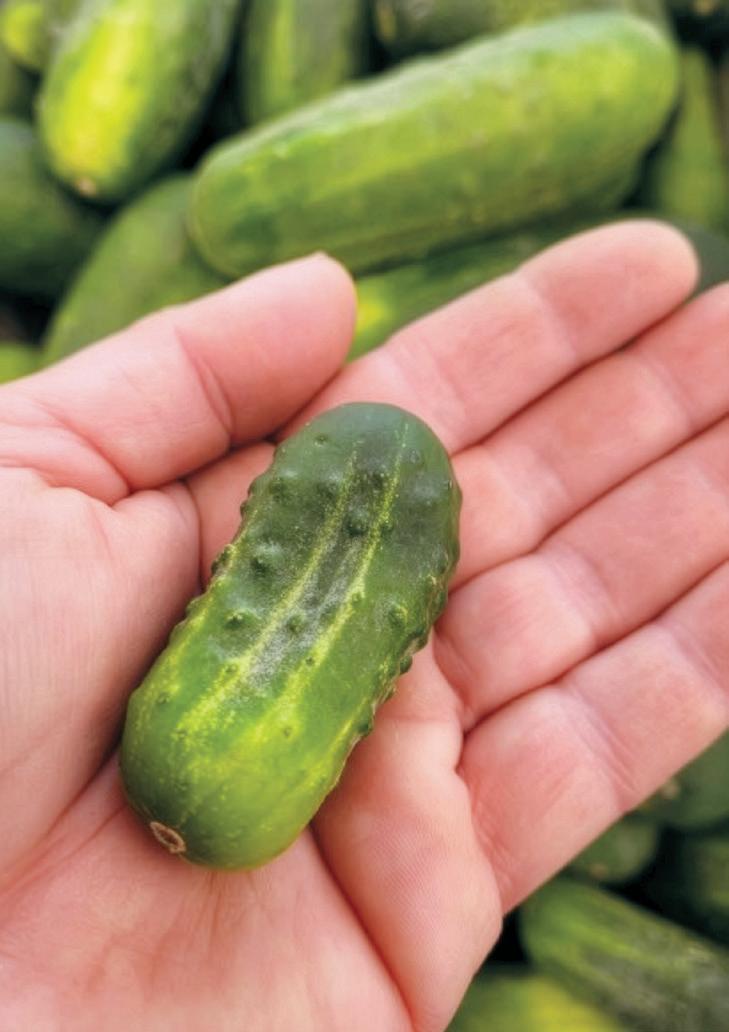
A tiny pickling cucumber puts the cute in cucumber; Freckle’s Pickles (top right) doesn’t shy away from bold fermentation blends.
There are various heat and sweetness levels to calibrate for every customer, like their bread-and-butter pickle, jalapeño dill, ghost pepper, chipotle and more. They also sell pickle juice in all the flavors, which is an alternative to artificial electrolytes and quite tasty to swig.
They use many cucumber varieties and say it doesn’t matter what type of cucumber since they use a hybrid pickling process that does not require thick skins as a fermented pickle would.
Currently they are trying to raise $10,000 to move their operation into a commercial kitchen instead of using a cottage food permit to prep at home. This would allow them to get into wholesale markets in addition to selling at farmers markets. If you would like to support these folks, go to their Instagram page (@freckles.pickles) and click on the link in their bio.
Beyond the standard green cucumber found at grocery stores, there are many unique types that are tastier and offer a desirable visual appeal.
A few of the favorites I grow are Armenian cucumbers, white Japanese Itachi, tiny Cucamelons (“mouse melons”) and I am always sure to plant some pickling cucumbers, which I salt ferment with fresh dill and garlic, adding lots of fresh grape leaves which— due to their tannins—help retain pectin in the cell walls, keeping the pickles crunchy.
ARMENIAN CUCUMBERS
Also known as Snake Melons, these beauties aren’t a true cucumber, but in the melon species (Cucumis melo)! The striped ones, which are my favorite, are called Painted Serpents. Armenian cucumbers can get as long as 3 feet and are frequently curved, sometimes creating a circle.
They are light green with dark green stripes going the length of the fruit, and slightly ridged. When they are young they have a slightly fuzzy texture, but when mature they have a smooth skin that is so tender it does not need to be peeled.
by Jamie Collins
Sante Adairius Rustic Ales Portal
Photo
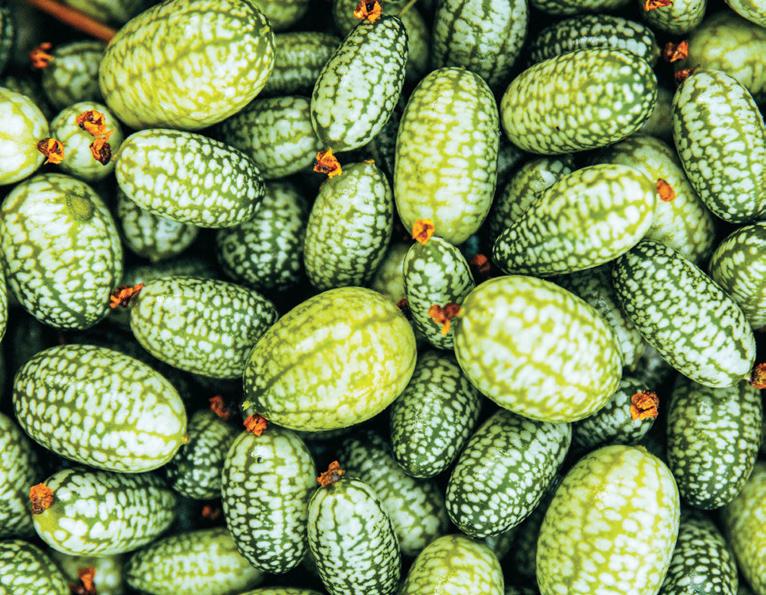
Itachi cukes (below left) earn affection for their color, shape and sweet flavor profile; mouse melons (right) can make a cheese plate pop.
I love these cucumbers because they are sweeter than a regular cucumber, probably because they are technically a melon. Armenian cucumbers never get bitter no matter how big they grow; the seeds stay soft and the flesh does not get watery. These are best harvested at 12–18 inches, but if one gets away from you they are still going to be tasty!
These are best used raw in salads or made into tzatziki yogurt dips. (See recipe, p. 22.) I also like these made into bread and butter pickles—they are tender while still being crisp and the stripes are so pretty.
Another fascinating thing you can do with these is grill them like a zucchini. Just a minute on the grill will bring out their sweetness. Armenian cucumbers are a wonderful garden option because they are very prolific and yield plenty from just one plant.
ITACHI CUCUMBERS
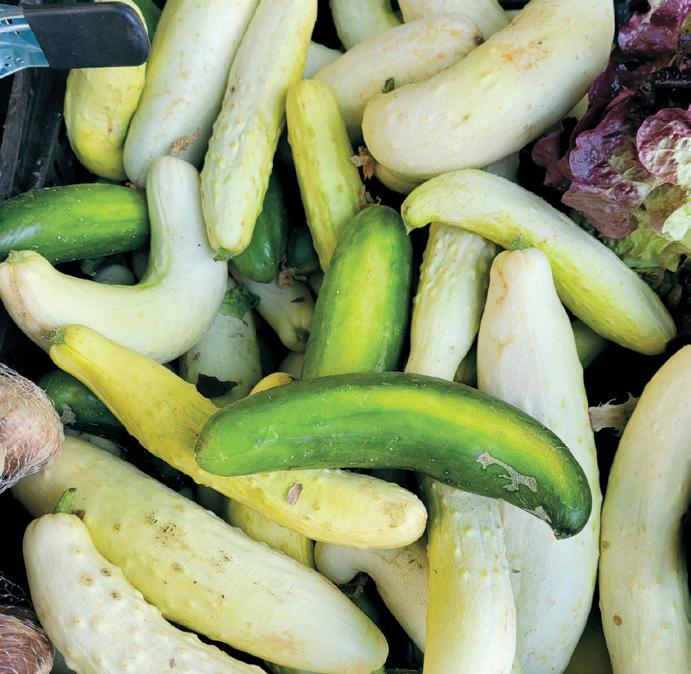
White Japanese Itachi cucumbers are a true cucumber (Cucumis sativus) with a creamy white skin and the typical “bumps” that green slicing cucumbers tend to have. They grow straight and are best harvested at medium size as the seeds will get large if the fruit gets too big.
These cucumbers are mild, slightly sweet and never bitter. Itachi cucumbers tend to digest better than thicker-skinned varieties and have a lower seed count, which also may contribute.
I like these cucumbers sliced thinly and served in a light rice vinegar and sesame oil dressing, used in sandwiches with cream cheese, cut into spears and paired with dips like Bitchin Sauce or hummus.
These are not the best for fermented pickles or heavy pickling, because their skin is tender and will not stay crisp. They can, however, be made into quick pickles—a short soak in vinegar, salt and sugar will preserve their natural texture and sweetness.
MOUSE MELON
These tiny cucumbers are about the size of a grape but look like mini watermelons due to the striped pattern on the skin. I can’t help but think of a family of mice having a picnic enjoying this little melon.
Fun for kids and pretty on a charcuterie platter, these little mouse melon cukes also deliver with their citrusy flavor. Toss them whole in salad; spear them with a toothpick betwixt cheese chunks, pitted olives and prosciutto; or pickle them whole—they absorb the brine easily and quickly.
Combine vinegar, water, fresh dill, garlic and salt or make them sweet using sugar, pickling spices instead or in addition to the dill and garlic. Pour mixture over the cucumbers and refrigerate for a few days to give the flavors a chance to infuse.
GROWING INFO
Cucumbers do best in warmer areas, but we are able to grow lovely cucumbers on the coast near Carmel. If growing near the shore, it is best to choose smaller cucumber varieties.
Most cucumbers thrive with a trellis, especially thinned-skinned and long ones that would touch the ground and could potentially be in contact with moist soil.
The three cucumbers mentioned above differ in how they grow. Serpent cucumbers are best grown in warmer areas. They need to be trellised because the vines grow very long and keeping the fruit off the ground helps to keep the fruit straighter and prevents blemishes and rot from the fruit resting on the soil.
Itachi cucumbers, on the other hand, can be grown more like a traditional green field cucumber without being trellised. They grow quickly, have a thicker skin than the Serpent cucumber and are harvested sooner, therefore they don’t need trellising.
Cucamelons have vigorous vines that look like a miniature version of a cucumber plant. A few lines of low string trellis will help with ease of harvesting and locating the fruit and keep you from stepping on them while harvesting.
As a busy farmer, I love how easy it is to pack cucumbers in my lunch for a low-calorie snack. Another favorite thing I like to do with cucumbers is infuse them in water with mint and lemon slices, keeping it cold in the refrigerator.
It helps me hit my water goals each day because it tastes so delicious. I also like to put the same infused water in a spray bottle and mist myself on hot days, especially on my face. Be sure to keep this in the refrigerator.
You can find slicing cucumbers at Pinnacle Farms and Live Earth Farm stands at the Santa Cruz markets downtown on Wednesdays, Saturdays at the Westside market and we at Serendipity will have the weird varieties at Live Oak on Sundays.
Cucumber love is in the air, and it’s growing from the ground up.
Photo by Aaron Cook
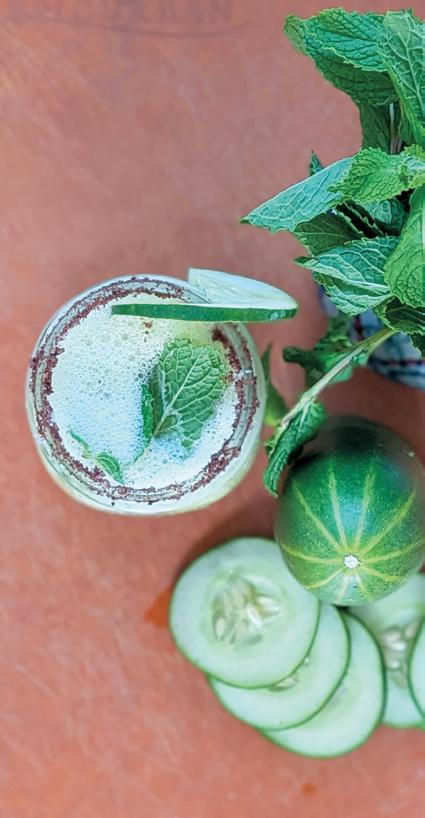
The Cucumber Sumac Margarita
Courtesy of Talya Lutzker, Ayurveda Every Day with Talya Certified ayurvedic practitioner and lifestyle coach Talya Lutzker of Santa Cruz empowers women around health and self-care so they can feel energized, strong and vital at all ages. She also dabbles in what she calls “a refreshingly tart and earthy” take on a classic lemon-forward mocktail big on cuke-centric vitamin C. “Wildly delicious,” she says, “with a tangy flavor profile that’s visually vibrant.”
1 teaspoon mineral-rich salt
½ teaspoon ground sumac
1 cup limeade or lemonade*
1 tablespoon fresh lime or lemon juice
1 teaspoon apple cider vinegar
1 medium cucumber, roughly chopped
Optional: Maple syrup or liquid stevia to taste
10 fresh mint leaves
1 cup still or sparkling water
Mix the salt and sumac together on a small plate.
Wet the rim of your two favorite 8-ounce glasses. Sweep the rims in salt and sumac.
Combine the limeade, fresh lime juice, apple cider vinegar and cucumber in a blender. Sweeten to taste with maple syrup or stevia.
Pour the mixture into each glass**. Add the mint and still or sparkling water.
Muddle with a tall spoon and enjoy!
*Prefer to use limeade made from scratch?
Zest one or two limes and set the lime zest aside. Combine 2 cups of water, ¾ cup sugar or maple syrup and 1 cup of fresh lime or lemon juice in a small saucepan over medium heat. Stir until the sugar is completely dissolved. Remove from heat, cool completely, add the lime zest and refrigerate.
**Ice is optional, but does not keep with Ayurvedic tradition, which holds that chilled beverages dampen digestive intensity (agni).
Serves 2.
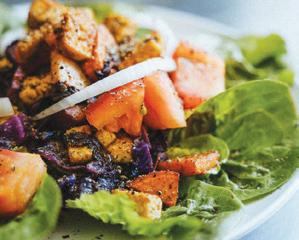
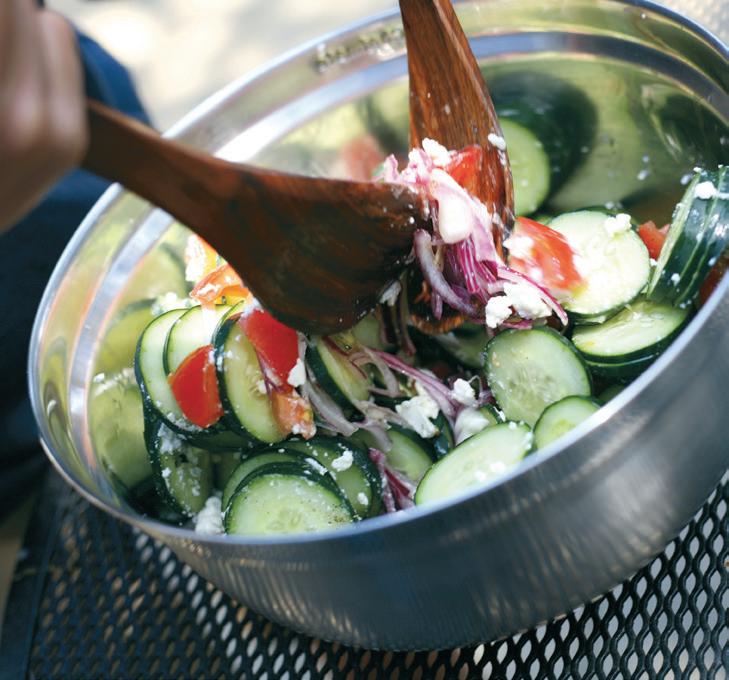
Simple Summer Salad
2–3 cucumbers, sliced
1–2 tomatoes
¼ red onion, thinly sliced
Feta cheese
2 tablespoons olive oil
Juice of ½ lemon
Salt and pepper
Toss everything in a bowl; let sit 3 minutes before eating
Add parsley, dill or olives if you like
Tzatziki Yogurt Dip
1 cucumber
1 cup Greek yogurt
1 garlic clove
1 tablespoon olive oil
1 tablespoon lemon juice
Salt and pepper
Juice of Meyer lemon, cucumber, mint
Photo by Kelly Rose Evans
Photo by Mark C. Anderson
WHAT’S IN SEASON
CHEF NOTE
Monterey Bay Certified Farmers Markets turns 50 without wavering from its fundamentals
BY ANALUISA BÉJAR
PHOTO BY PATRICK TREGENZA
Get to know your farmers market, as slowly as your time allows.
It builds ties to your community, feeds your inspiration, and reminds you what matters: the connections among humans, and to our food.
While you’re there this summer, you can taste a perfect-work-ofart peach that brings joy, and might make any other perfectly respectable peaches fade into oblivion.
The opposite of oblivion: an organization that lasts for 50 years.
Monterey Bay Certified Farmers Markets (MBCFM), the largest and oldest organization of its kind on California’s Central Coast, celebrates a half century this year.
The nonprofit began with a small market in Aptos with a welldefined guideline that continues today, and—ideally—indefinitely: Farmers sell what they grow.
Today MBCFM hosts four markets. The original Saturday Aptos venue is the biggest, featuring over 60 vendors year-round. Friday (year-round) and Sunday (May–September) markets happen at Del Monte Shopping Center in Monterey, with a rich variety of offerings.
And on Tuesdays May–September, Carmel at the Barnyard— while the smallest of the crop—is my personal favorite because it works like a collection of greatest hits.
That includes Pinnacle Farms, which unleashes a varied basket of allorganic produce, like eggplant that takes 100 days to get to market size.
That time table sticks out to me because a common excuse I hear for missing out on markets is that going takes too much time.
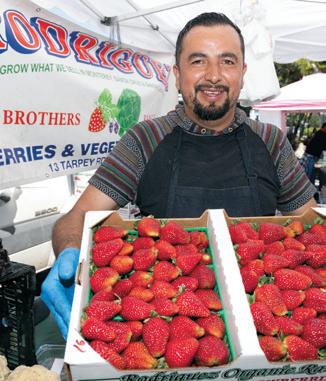
It takes five months for the P&K Farms Albion variety strawberries to reach their bright red, ripe, sweet, complex transcendence. They are worth that wait—and the wait in the line that always forms at their stall.
The fact the line is shorter at the Barnyard than Del Monte Center presents another reason to visit.
They’re so sought-after they sell out in under two hours, and that’s
understandable: The first basket I get hardly makes it a few minutes through the drive home. (Chef tip: Don’t overlook their “jam berries,” for smoothies and sauces.)
Blue Heron Farms, another personal love, grow their spectacular little lettuce jewels over the course of 40 days, and also stock loudly aromatic basil, among other delights.
But I love the Barnyard market most because of family-owned Kashiwase Farms, which appears locally there and at Aptos, sharing their specialties: stone fruits and nuts.
Their peaches take nearly 5 months. Once harvested, however, they are delicate delicacies that can’t be stored for a long time.
Nothing compares to biting into their velvety juiciness and the resulting symphony of flavors—blossoms, cream, almond—with the freshness accentuated by tanginess and acidity.
What to do with the haul? There is no need to complicate things. The most honest use of prime produce is to do the least possible and let it shine on its own.
In this case, feast on a peach, straight up. If you feel fancy, slice it thin like a carpaccio, top with honey, tarragon, green almonds, stracciatella or blue cheese.
I chop peaches that are on the tart side and toss them with a simple whole-grain-mustard vinaigrette, feta and jewel lettuce. Basil sometimes sneaks in and it’s always welcome.
Catherine Barr, executive director MBCFM, has led this family of farmers and product vendors—think honey, artisan bread, cheeses, pasta, soups and chocolate—for more than three decades.
She has seen trends come and go, while playing a defining role in the shape and quality of the offerings, and retaining a clear focus.
“It’s all about the farmers,” she says. “We are one big family that spans for several generations. If you want to know where, how and by who your food is grown, come to our markets and talk to them.”
And take your time.
Blue Heron Farms’ “little jewels” are harvested a couple of hours before they head to market.
What happens in the fields shapes everything we do in our kitchens.
For Colorado-based Chef Daniel Asher, the phrase No Farms No Food® belonging to American Farmland Trust (AFT) isn’t just a slogan—it’s reality. As a chef and restaurant founder and owner, he knows that everything we eat begins with farmers and ranchers. “What happens in the fields—weather, soil, seasonality—shapes everything we do in our kitchens,” he says. “It’s a relationship built on trust, reverence, and deep interdependence.”
That understanding led him to become a longtime member of American Farmland Trust. To Asher, AFT stands apart as a steady, credible voice for agriculture—deeply connected to what’s happening on the ground and willing to advocate for farmers at every level. AFT works to address complex challenges that America’s farmers and ranchers face today in the halls of Congress, at kitchen tables, and everywhere in between.
Protecting farmland, Asher believes, is inseparable from protecting our collective health. “The wellness of our soil, water, and air is the foundation of human wellness,” he says. Membership in AFT is a way to stay connected—to land, to food, and to community—at a time when those connections matter more than ever.
“Jump on in,” he says. “Eat delicious local food. Protect the land. And help keep agriculture—and community—alive.”
Join Chef Daniel Asher—and thousands of others—who are keeping America’s farms growing strong.
Become a member at farmland.org/edible
American Farmland Trust believes in thriving farms and ranches. AFT protects agricultural land, promotes environmentally sound farming practices, and keeps farmers on their land. It is the only national agricultural organization of its kind recognizing the connection between land, practices, and farmers. Because of AFT, millions of acres of farmland that otherwise would have been converted into house lots and shopping malls remain in farming, and tens of thousands of farmers and ranchers have adopted better farming practices.
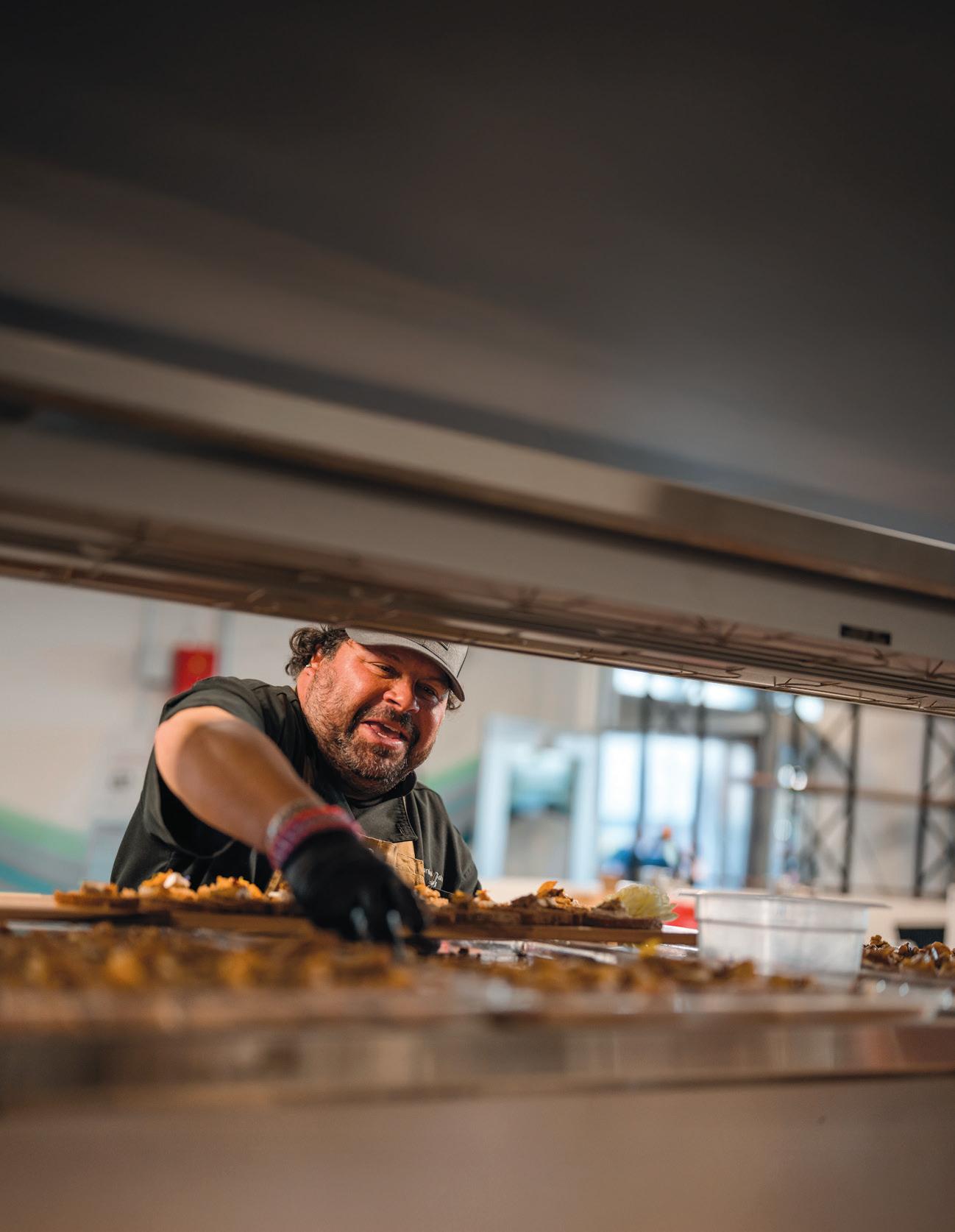
American Farmland Trust member and chef, Daniel Asher, plates River and Woods appetizers at a farm-to-table community event in Denver, Colorado.
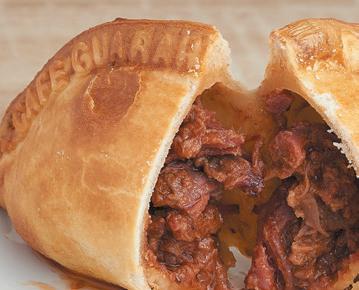
At Café Guaraní, every empanada is handmade with love, tradition, and rich South American flavor. Enjoy gluten-free, vegan, and classic varieties, paired with our signature yerba mate or spiced mocha. Discover the heart of Paraguay in every bite.
Empanadas with Soul
Enjoy outdoor garden patio seating! 111 Central Ave, Pacific Grove cafeguarani.com | @cafeguarani
Abalone • Halibut, California • Lingcod • Rock Cod (aka Snapper, Rockfish) Sablefish (aka Black Cod) • Salmon, Chinook/King • Seabass, White Squid, Market • Sole (Dover, Petrale) • Spot Prawns • Tuna (Albacore)
*Comes into season in June **Ends in June ***Comes into season in July ****Comes into season in August
All fish listed are rated “Best Choice” or “Good Alternative” by the Monterey Bay Aquarium’s Seafood Watch program and are found in abundance in local waters. See www.seafoodwatch.org for more information.
Curated by Aga Simpson
Photo by Walker Mason & Daniel Avila
SANTA CRUZ COUNTY | SUMMER 2026
Farmers Marke t
Does anyone else think about ideas for fun new game shows or reality TV challenges? I would definitely win the “create a new meal out of leftovers” challenge. Another idea could be “make an entire meal of only farmers market-sourced ingredients.” Locals would enjoy a nice edge on that one, with our farmers markets being so abundant and diverse— especially in the summer! Olive oil, tomatoes, goat cheese, oysters, fresh pasta, ice cream, lettuce, mushrooms, nuts…it’s almost too easy. I dare you to try it. And if anyone wants to pitch these ideas to a studio in LA, I’ll drive. —Amber S. Turpin tear out and keep
Tuesday
Felton Farmers Market
1:30−5:30pm • May through October 120 Russell Ave.
831.454.0566 santacruzfarmersmarket.org
Wednesd ay
Downtown Santa Cruz Farmers Market
1pm−5pm • Year-round Lincoln and Cedar Streets • 831.454.0566 santacruzfarmersmarket.org
El Mercado
10am–2pm • April through October
Watsonville Community Hospital 75 Nielson Street 831.726.4257 • pvhealthtrust.org
Friday
Mountain Farmers’ Market
2:30 6:30pm • May to October 23845 Summit Rd, Los Gatos mountainmarket2024@gmail.com www.instagram.com/mountain_market
Watsonville Certified Farmers Market
2–7pm • Year-round
Watsonville City Plaza, Peck & Main Streets 831.588.7366 facebook.com/watsonvillefarmersmarket
10am–2pm • First Saturdays June to October Ben Lomond County Park • 831.218.5172 villagemarket@benlomondvillage.org benlomondvillage.org
Scotts Valley Farmers Market 9am 1pm • May through November 5060 Scotts Valley Drive, Boys & Girls Club Parking Lot 831.454.0566 santacruzfarmersmarket.org
Westside Santa Cruz Market 9am–1pm • Year-round 2801 Mission Street • 831.454.0566 santacruzfarmersmarket.org
Sunday
Live Oak Farmers Market 9am–1pm • Year-round 15th and East Cliff Drive • 831.454.0566 santacruzfarmersmarket.org
Corralitos Farm & Garden Market 11am–3pm • Year-round 127 Hames Road • 831.724.1332 wayne@catalyst2001.com https://www.instagram.com/corralitosfarmandgardenmarket/ See next page for
Monday
Pacific Grove Certified Farmers Market
3–7pm • Year-round Central and Grand Avenues
831.384.6961 everyonesharvest.org
Tuesday
Carmel Barnyard Certified Farmers Market
9am−1pm • May through September 3690 The Barnyard • 831.728.5060 montereybayfarmers.org
Old Monterey Marketplace & Farmers Market
4–7pm • Year-round Alvarado Street
831.655.2607 oldmonterey.org
Wednesday
Hollister Certified Farmers Market
3−7pm • April to October San Benito Street between 5th and 7th 831.636.8406 downtownhollister.org/farmers-market
Natividad Certified Farmers Market
10am−2:30pm • April to October 1441 Constitution Blvd., Salinas 831.384.6961 everyonesharvest.org
Thursday
Carmel–by-the-Sea Farmers Market
10am–2pm • Year-round 6th and Mission Streets 831.402.3870 goodrootsevents.com
North County Farmers Market
2−7pm • Year-round Castroville Recreation Center 11261 Crane Street ncrpd.org
Seaside Certified Farmers Market
3–7pm • Year-round Laguna Grande Regional Park 1259 Canyon del Rey Blvd. 831.384.6961 everyonesharvest.org
Soledad Certified Farmers Market
4–8pm • April to October 137 Soledad Street • 831.678.3504
Friday
Monterey Certified Farmers Market
8am–noon • Year-round 1410 Del Monte Center 831.728.5060 montereybayfarmers.org
Salinas Valley Memorial Certified Farmers Market
11:30am−4:30pm • May to November 450 E. Romie Lane, Salinas • 831.384.6961 everyonesharvest.org
Saturday
Old Town Salinas Farmers Market
9am–2pm • Year-round 300 block Main Street
650.815.8760 wcfma.org/salinas
Sunday
Carmel Valley Certified Farmers Market
10am–2pm • Year-round
Mid-Valley Shopping Center 9550 Carmel Valley Road 650.290.3549 wcfma.org
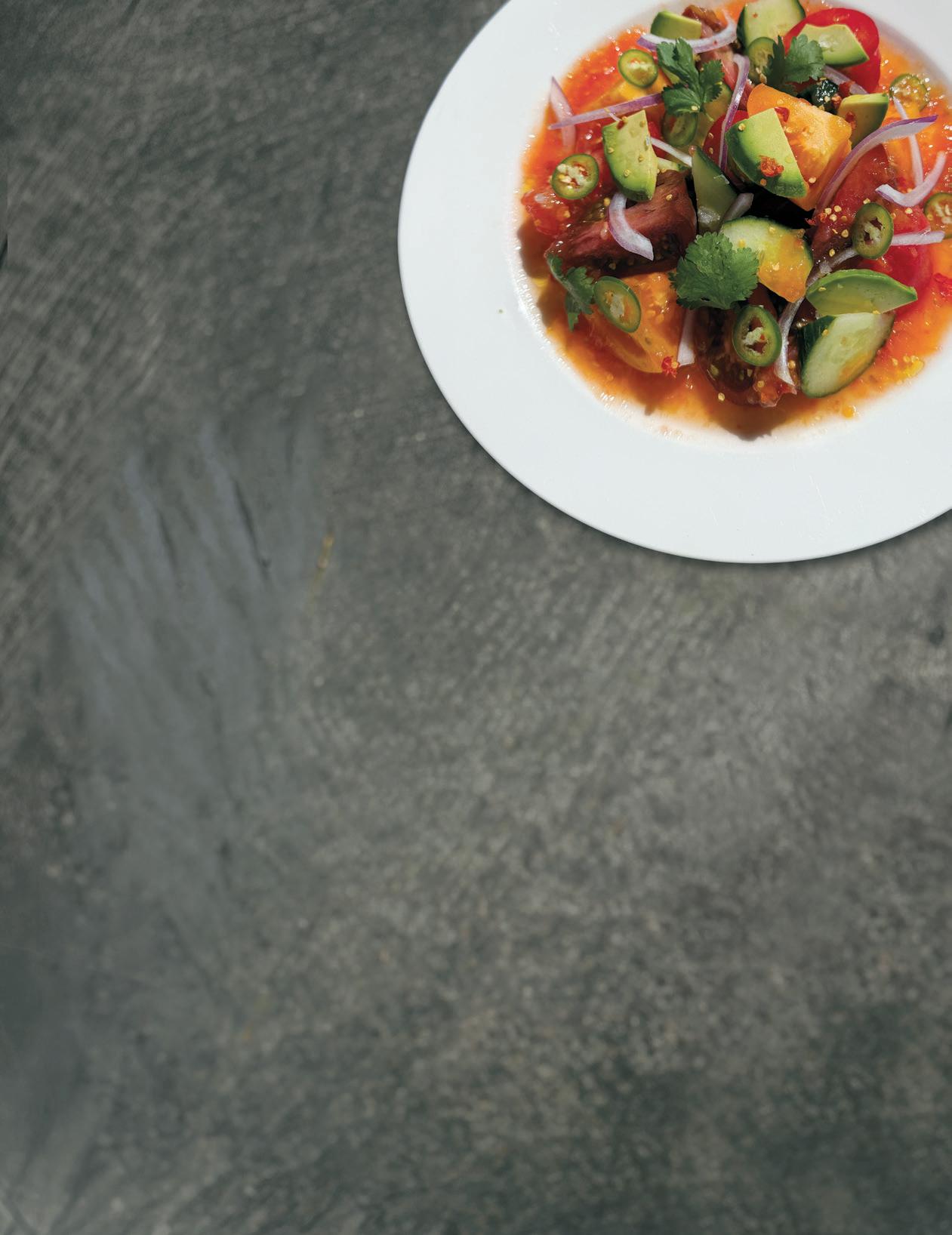
Recipe by Antonio Vargas, Organizational Well-Being Coordinator, Live Well Project, Salinas Valley Health
Inspired by the seasonal produce available at the Salinas Valley Health Farmers Market, this plant-forward recipe highlights the natural nutritional benefits of fresh ingredients. Tomatoes are rich in vitamin C and antioxidants like lycopene, which support heart health. Cucumbers add hydration and a refreshing crunch, while avocado provides heart-healthy fats that help keep you satisfied. Fresh herbs and chiles add flavor and contribute beneficial plant compounds.
Grating ripe tomatoes—similar to the Spanish tradition of pan con tomate—creates a fresh, vibrant base that pairs with the bright citrus and heat of a classic Mexican aguachile. Using familiar ingredients like lime, chile, onion, and cilantro, often found in salsa or pico de gallo, this dish offers a refreshing, no-cook way to enjoy the flavors of the season.
2 pounds ripe heirloom tomatoes, divided
¼ cup fresh lime juice (2-3 limes)
2–3 whole chiltepín peppers, crushed (plus a pinch more for garnish)
1 small cucumber
¼ small red onion, thinly sliced
¼ cup fresh cilantro leaves
½ avocado, sliced
1 serrano pepper, thinly sliced
1 tablespoon olive oil salt to taste
Cut 1 pound of the tomatoes in half.
Grate them on a box grater into a bowl, discarding skins. Stir in lime juice, crushed
chiltepín, and ½–¾ tsp salt. Taste and adjust until the mixture is bright, tangy and lightly spicy.
Cut the remaining tomatoes into small, bite-sized chunks. Cut the cucumber into similar bite-sized pieces.
Combine tomatoes and cucumber in a bowl. Add about ¼ cup of the aguachile base and a pinch of salt. Gently toss to coat.
Transfer to a shallow serving dish. Spoon remaining aguachile base over the top, letting it pool slightly.
Salinas Valley Health Farmers Market
May 8th – November 6th, 2026
Top with red onion, avocado slices, serrano, and cilantro leaves. Drizzle with olive oil and sprinkle with a pinch of crushed chiltepín. Serve immediately. Serves 4.
For more recipes, visit: salinasvalleyhealth.com/recipes
Salinas Valley Health is consistently recognized for delivery of high-quality healthcare, yet our commitment to the community extends far beyond the walls of our medical center. Our community farmers market held every Friday May through November provides a great array of fruits and vegetables, locally grown florals and delicious prepared foods. Our staff enjoy shopping at the market and connecting with colleagues, while community members appreciate the welcoming atmosphere and wide variety of delicious and nutritious options.
Our Friday farmers market is located at the Salinas Valley Health Medical Center, 450 East Romie Lane, Salinas; located at the corner of Wilgart Way and East Romie Lane.
IN THE FIELD
SPIRIT OF CONNECTION
Huxal Mezcal roots Santa
to Oaxaca through incredible flavor and family
BY LAUREL MILLER
BY ÁNGEL PERSEGO AND MARK C. ANDERSON
Cruz
PHOTOGRAPHS
Deep within the Sierra Sur region of southeastern Oaxaca lies the tiny village of Tecolote Miahuatlán de Porfirio Diaz.
Despite its diminutive size, Tecolote maintains a curious connection to Santa Cruz, California—one that transcends distance and cultural barriers.
Miahuatlán, which refers to the municipality, is famed for its mezcal production. Oaxaca produces 80% of Mexico’s Denominacion de Origen (or DO) agave spirit, and Miahuatlán’s iron-rich soil and varied microclimates yield mezcals with distinctive mineral qualities.
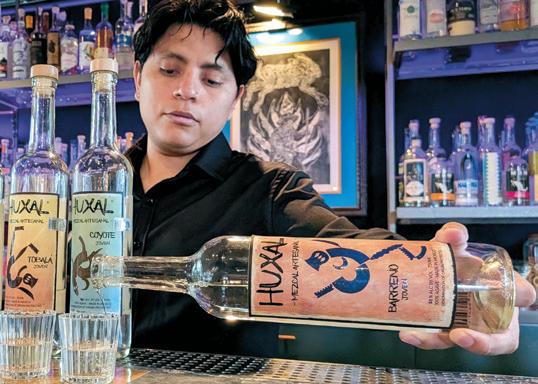
It is here, in Tecolote, that third-generation maestro mezcalero Don Bernardo crafts Huxal Mezcal, a 9-year-old Santa Cruz–based brand made entirely in Oaxaca, including the bottles and their components.
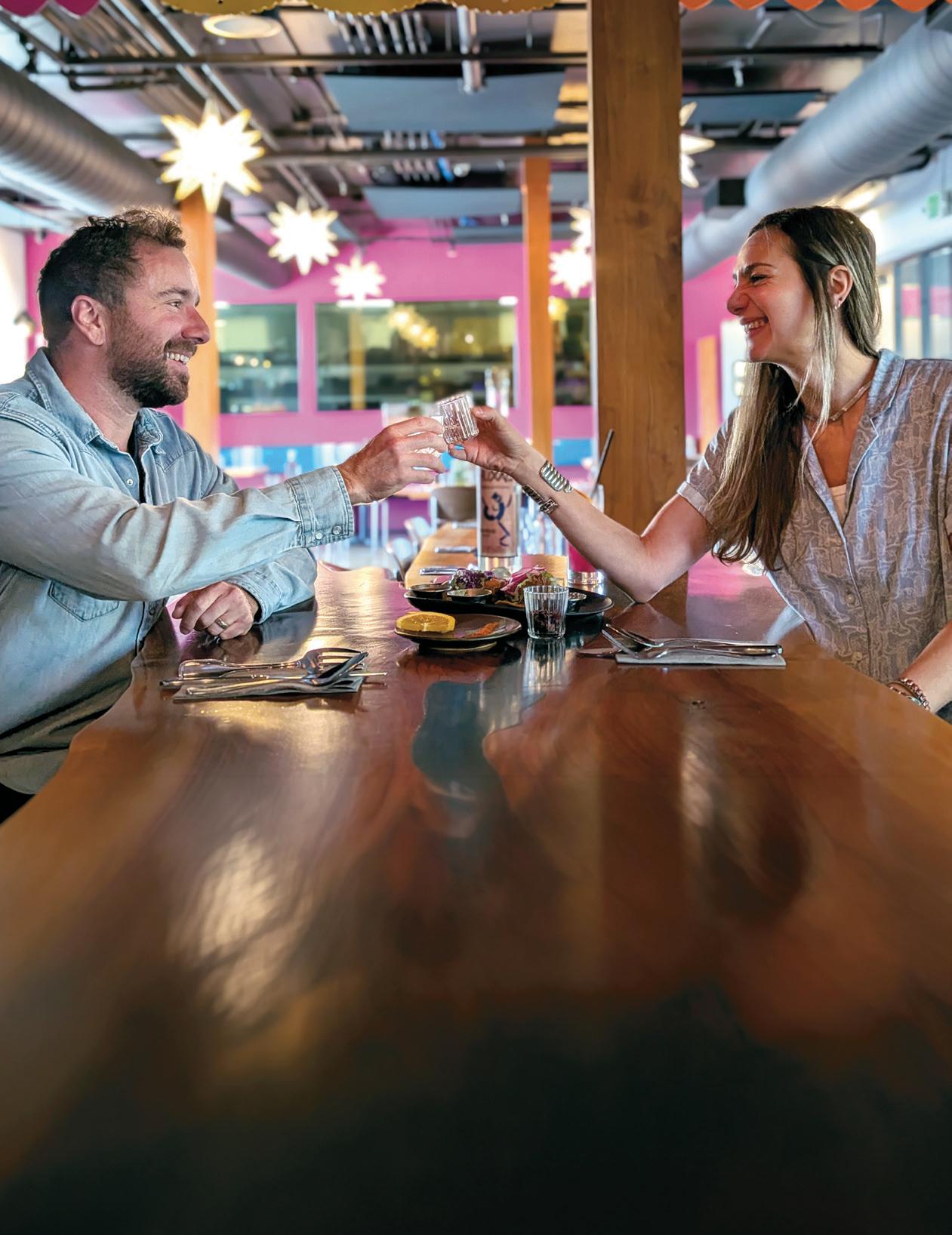
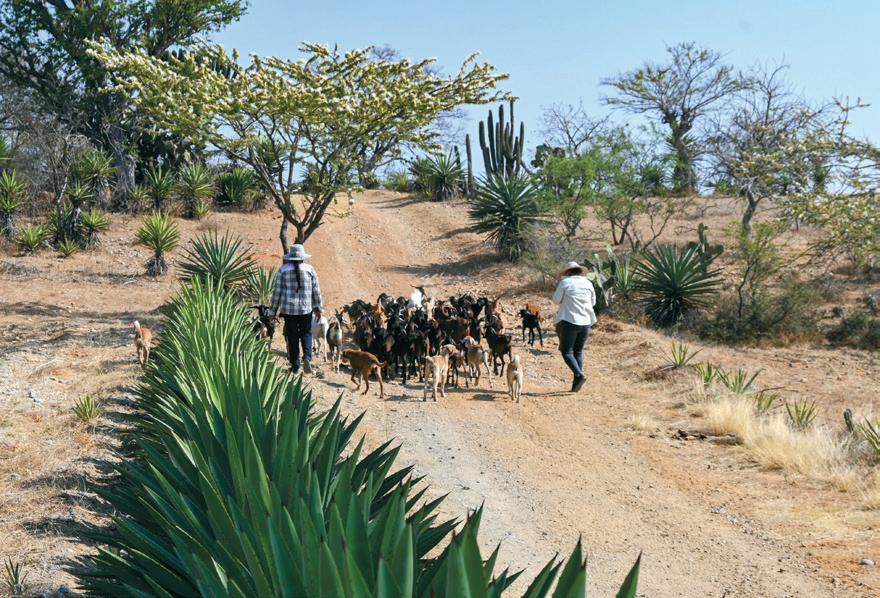
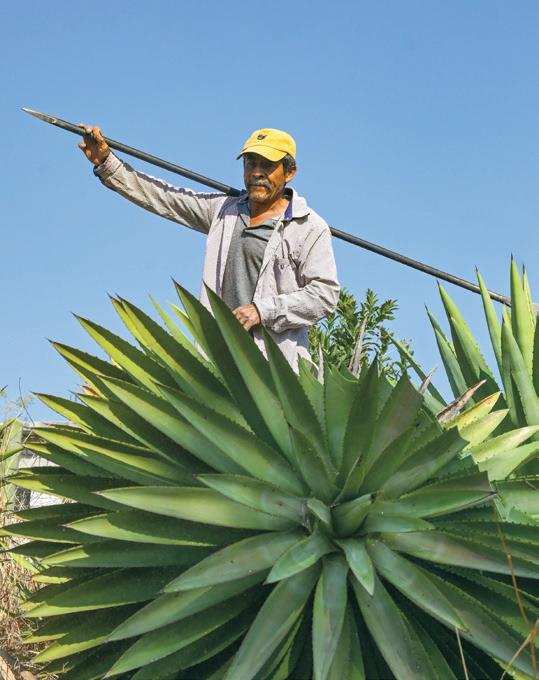
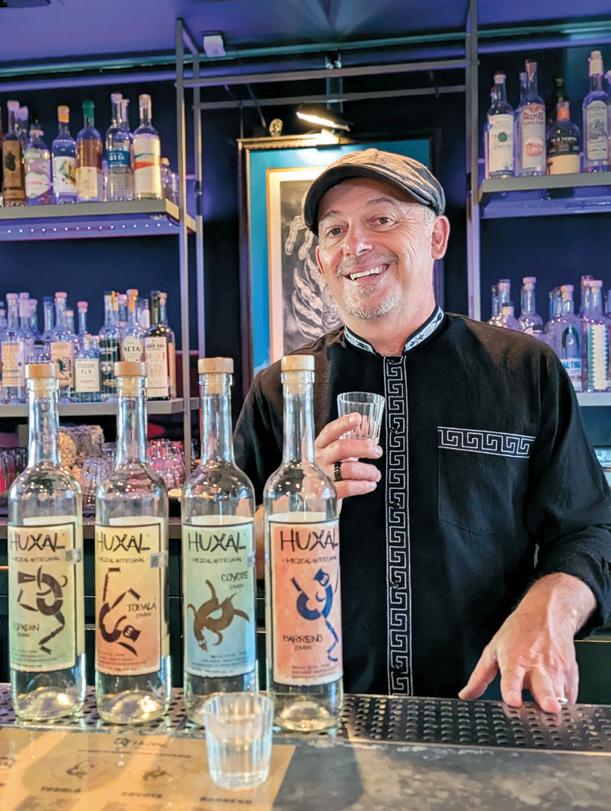
(Clockwise from far left) Franco Boffi and Larissa Hernández Boffi toast her father Sam Hernández; the Sierra Sur team tends goats alongside agave; Don Bernardo scopes his plots; Alexis Hernandez (no relation) helps craft the constellation of mezcalcentric cocktails at Copal.
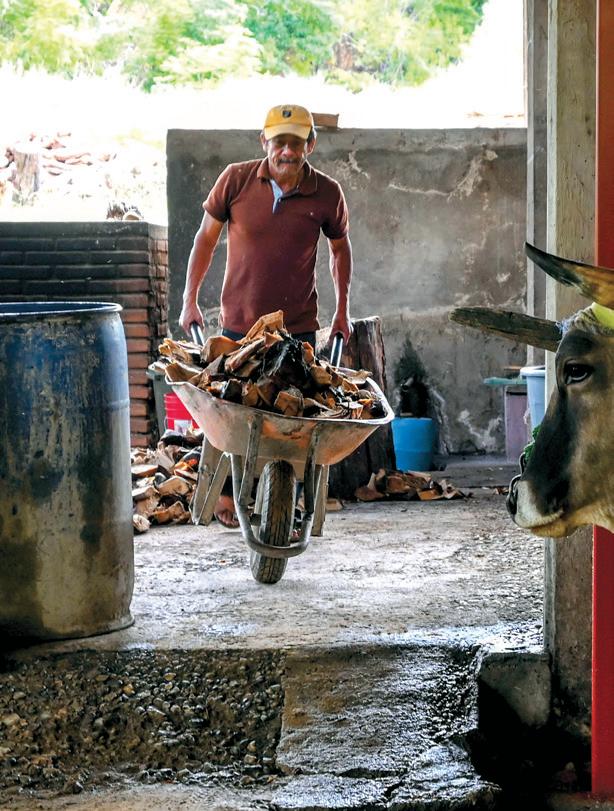
He is assisted by his daughter Fabiola and two oxen, Tamarindo and Melón, who pull the mezcal distillery’s tahona, a large stone wheel used for crushing the roasted agave cacti.
Huxal is the brainchild of a small group of Santa Cruz– and Silicon Valley–based friends, among them the late sculptor, painter, and professor emeritus Sam Hernández.
Although he made his home in Santa Cruz, Hernández spent many years traveling throughout Spain and Mexico, finding inspiration in their art, culture, and foodways.
“The way he spoke about mezcal was like poetry.”
In the process, he developed a passion for mezcal.
During a trip to Oaxaca, Hernández and his friends hit upon the idea of starting a mezcal brand as a philanthropic endeavor. Upon learning that the Oaxaca City fire department was seriously underfunded, they decided to donate proceeds from their thenhypothetical agave spirit to fund firefighting equipment.
The project eventually led the men to Tecolote and Don Bernardo, who has operated his own small palenque, or mezcal distillery, for over 21 years.
“Sam had a unique charisma and showed us a lot of trust,” Don Bernardo recalls. “We believe that we didn’t just build a working relationship, we built a real friendship with him and his family.”
In 2017, Huxal Mezcal launched—sporting labels designed by Hernández.
When Hernández passed away unexpectedly in 2022, his friends found themselves unable to carry on with their passion project. Hernández’s daughter Larissa and his Argentine son-in-law, Franco Boffi, took over coownership of Huxal, making Don Bernardo their partner.
Boffi, an industrial designer by trade, first met the mezcalero in 2020, and like Hernández before him, became a good friend.
“Sam was my mentor. The way he spoke about mezcal was like poetry,” says Boffi.
“And Don Bernardo is also an artist. The quality of the product is the most important thing, and he’s able to craft mezcal that truly showcases the agave’s terroir and diverse flavor profiles.
“We want consumers to understand that mezcal is nuanced like wine.”
And, like wine, mezcal is a drink that “requires a lot of work and respect,” says Don Bernardo. “It’s not meant to be taken as a shot, but sipped slowly, to appreciate the flavors each agave variety has to offer.”
THE PLANT SPEAKS
Over the last three years, the Boffis have squashed any lingering perceptions that Huxal is a novelty— instead of a meticulously crafted, micro-batched, Latino-owned agave spirit.
They have expanded Huxal’s retail and wholesale accounts from Santa Cruz to over 50 outlets throughout California, and last October the company initiated online sales to 39 states.
Their mezcals are now on the menus of some of the nation’s most lauded bar and agave spirit programs, including Trick Dog in San Francisco, Cultura in Monterey and Copal in Santa Cruz.
“We were one of the first to carry Huxal because their ethos resonated with us,” says Copal co-owner Stuyvie Bearns Esteva, who was born and partially raised in Mexico. “The first way I gauge a brand’s sincerity is to see if their representatives can answer the question ‘How are the profits remunerated with your producers?’ If they can’t answer that, and they often can’t, it’s usually a dealbreaker.”
(Clockwise from left)
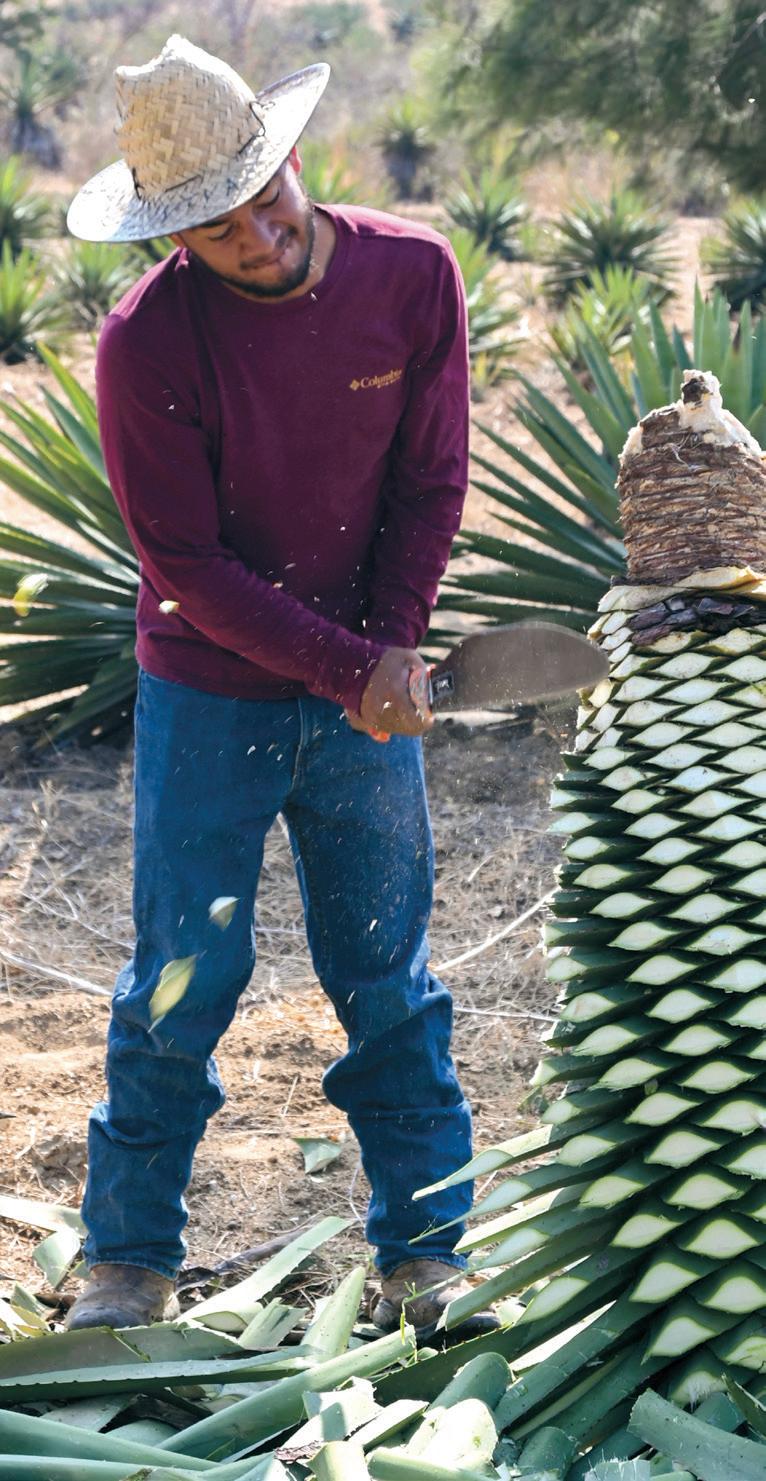
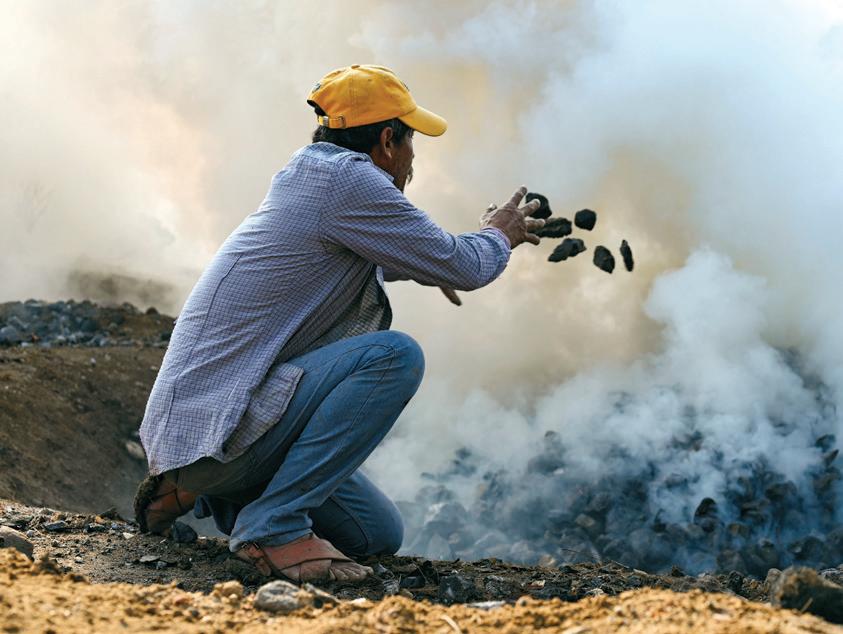
A peek at the process at Tecolote: chopping the piña to prepare it for roasting; ferrying the oak wood for the subterranean bake, while collaborator Tamarindo the ox looks on; Don Bernardo tosses volcanic rock into the cooking pit to extend its heat.
Bearns Esteva adds that Huxal’s philosophy also reflects the cultural and environmental aspects he looks for in a brand.
“To us, mezcal is more than just another spirit,” he says. “It’s a special distillate that has only recently become commodified on a global scale, so we strive to only carry brands that honor the communities they come from, adhere to sustainable practices, and are willing to stand up to the immense pressure for continued growth.”
Mexico City native Stuyvie Bearns Esteva developed his family’s mezcal program at Copal with inspiration borrowed from repeat childhood trips to Oaxaca, and a fierce belief in fair trade.
Huxal currently produces four different mezcals, each bearing the common name of the agave from which it is made. Coyote (Agave lyobaa) is a blend of both wild and farmed plants, and the Tobalá (Agave potatorum) is also made from wild plants that take 12 to 15 years to mature.
These wild agaves are harvested mindfully so as not to deplete the supply or impact the landscape. Some wild species can take up to 35 years to reach maturity, so it’s critical that palenques practice restraint during harvest, especially because agave plants only bloom once, then die.
“For us, it’s very important to preserve the endemic agave varieties from our region,” says Don Bernardo.
Huxal’s mezcals from farmed agaves are Espadín (Agave angustifolia) and Barreno (Agave karwinskii), a rare subspecies found only in Miahuatlán.
Much of the Espadin used for the mezcal industry is cultivated, which, depending upon the method, can be a controversial practice. Huxal uses propagation for its Espadin and farmed Coyote, meaning they plant hijuelos, or offshoots, from mature mother plants. These “pups” each have their own DNA and thus promote biodiversity on the plantation.
Cloning, by contrast, refers to the practice of replicating tissue excised from the mother plant in a lab. These lab-generated pups share the same DNA, which reduces genetic diversity and makes the agave more susceptible to disease and pests.
Huxal also has a goal to become Certified Organic. Larissa works for California Certified Organic Farmers Foundation, which can legally certify in Mexico. The palenque has always shunned the use of synthetic pesticides and herbicides to maintain healthy soil for its farmed agave.
The plants are harvested by Huxal’s seasonally employed jimadores (agave workers) from Tecolote, the piñas roast for two days in earthen pits lined with volcanic rocks, before being crushed with the tahona. The agave pulp is fermented in a vat with the aid of ambient yeast, before being transferred to a copper still.
Unlike many palenques that perform multiple distillations to lessen the intensity of the agave flavor for consumers in foreign markets, Huxal only performs one distillation. A high-quality mezcal should smell and taste like agave but isn’t necessarily intensely smoky.
“Some element of smoke is part of the production process, but any mezcal that’s overly smoky is a bad mezcal,” says Bearns Esteva. “The amount varies depending upon the wood and how long the piñas are roasted.”
Huxal doesn’t make reposado, or aged mezcal, because the process of barreling the spirit in oak changes the flavor.
For example, Boffi points to Huxal’s Coyote. “I call it the gin of agaves for its floral notes,” he says. “That profile is just the plant talking, showcasing its distinctive qualities.”
Bearns Esteva and Michael Marcy, managing partner of Cultura, are both fans of the Coyote. “Under the right mezcalero’s hands, it produces a slightly sweet mezcal with a great earthy character punctuated by spice,” says Bearns Esteva. “It pairs perfectly with our mole negro.”
CULTIVATING LONGEVITY
With Huxal becoming more established in the marketplace, the Boffis’ next goal is to give back to their respective communities in a more tangible way. Since Hernández passed, Boffi says he’s been striving to create a new path forward based on the late artist’s legacy. He and Larissa are developing a plan for Huxal to support Oaxacan artists as well as the Tecolote community through micro-grants.
For Don Bernardo, Huxal has provided steady income for his family, and enabled him to maintain their heritage as mezcaleros. When he retires, Fabiola will take over as mezcalera, which will likely create opportunities for other young women in Tecolote. “There are increasingly more women in the industry, and still face challenges,” says Don Bernardo. “But women are finally receiving the recognition they deserve. I’m very proud of Fabiola.”
For Boffi, the industrial-designer-turned-mezcal-entrepreneur, the journey has been “incredibly humbling, rewarding and challenging.”
“What started as a hyper-local passion project has grown into an adventure that’s also keeping Sam’s artwork and spirit alive,” Boffi adds. “If he were still here, I know that Huxal would be a labor of love for us both.”
Find a recipe for Copal’s OaxacAloha cocktail paired with this story at ediblemontereybay.com.
Ground Level
Strategies to select worthy—and wisely produced—mezcal
The global demand for tequila and mezcal has led to agave shortages, the use of additives such as sugars in place of allowing plants to reach maturity, agave worker welfare issues, soil and groundwater contamination (which can impact pollinator populations) and other issues.
“Unfortunately, the boom in mezcal has led to a wave of exploitation of producers by nascent entrepreneurs wanting in,” says Stuyvie Bearns Esteva. “There are also large, multinational corporations that have purchased brands like Del Maguey, which has changed the previous relationships the brand had with palenques.”
Today, a number of palenques are taking these problems into account, but due diligence is important if you’re concerned about what’s in your bottle and how it was made.
Below appears an abbreviated checklist of what to look for when purchasing mezcal.
Know the source
Small palenques can’t always grow their own agave, but how and where they’re getting it matters. Look for producers that clearly state their sourcing or growing practices and are committed to supporting biodiversity and sustainable agriculture.
“Overharvesting of wild agaves has pushed some species to the brink of extinction,” says Bearns Esteva. “Many regions are also arid with little rainfall, and overproduction of cultivated agave strains already has depleted water tables.”
Look at labels
The more information a bottle’s label contains, the better. Some brands also donate partial proceeds to health, education or environmental initiatives if their palenque(s) are located in underserved areas.
Peek behind the brand
Not all celebrity- or gringo-owned brands are bad, but purchasing mezcal from small palenques, multigenerational mezcaleros or from a distributor that works exclusively with small producers is a more reliable way to ensure growers and makers earn a profit from it.
Consider waste products
The agave industry produces high-volume waste products like bagasse, spent agave fiber and pulp. Burning bagasse impacts air quality, and vinasse, a byproduct of distillation, contaminates groundwater and soil. The technology to safely dispose of these waste products is costly and doesn’t guarantee the quality of the spirit, but some brands do have green initiatives.
Make your dollars
count
Ask questions, and support liquor stores and bar programs that support responsible brands. “Our philosophy is to buy from small, family-owned and -operated palenques who adhere to traditional production methods,” says Michael Marcy. “We also look for brands that don’t contain additives and provide a fair market share to producers.”
—Laurel Miller
IN THE ECOSYSTEM
Back fromBrinkthe
As it celebrates 50 years, Monterey Bay Salmon and Trout Project survives long odds
By Ryan Masters
Photos by Kelly Rose Evans and Mark C. Anderson
On a rainy Friday morning in April, I carry two five-gallon plastic buckets down a muddy forest trail.
The way is slippery and, in places, steep and littered with exposed roots.
I watch my step, keenly aware of my fragile burden.
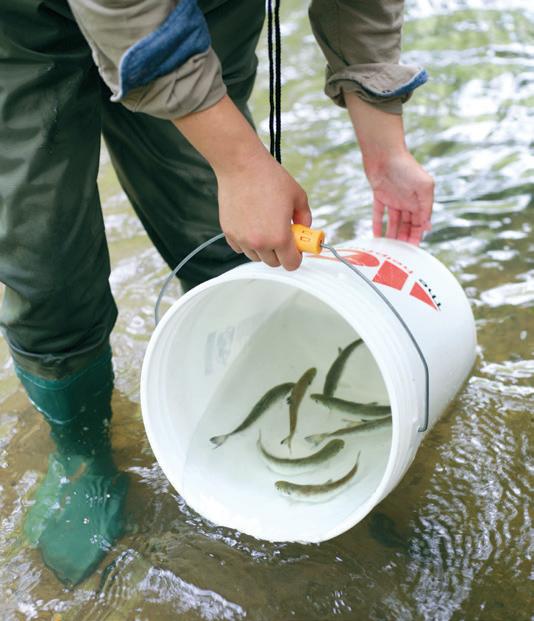
Within the water of each bucket writhe 30 or so young coho salmon.
These bright, silvery smolt are roughly 1 year old. Their greenishblue backs glisten in the buckets like gems. White-tipped fins and black-spotted upper tail lobes froth the water, threatening to spill over the bucket's lip.
Biceps burning, I pick my way down the final section of trail to the bank of Scott Creek and carefully hand the buckets off to a Watershed Stewards Program corps member with the National Oceanic and Atmospheric Administration (NOAA).
One at a time, she dips the buckets into the clear water of the creek and, in a flash, the fish are gone, darting instinctively downstream toward the lagoon. In 24 hours or so, they’ll be swimming in the Pacific Ocean.
The corps member hands the buckets back and I return the way I came on the trail, emerging from the forest and onto a dirt road beside Cal Poly’s Swanton Pacific Ranch.
I approach a white pickup truck and hand the buckets up to Connor Greenwood of the Monterey Bay Salmon and Trout Project (MBSTP), which honors its 50th year on Aug. 1 in Watsonville.
Dressed in brown waders and balanced in the bed of the truck, Greenwood leans over a large water tank full of fish and checks dissolved oxygen levels with a short plastic wand.
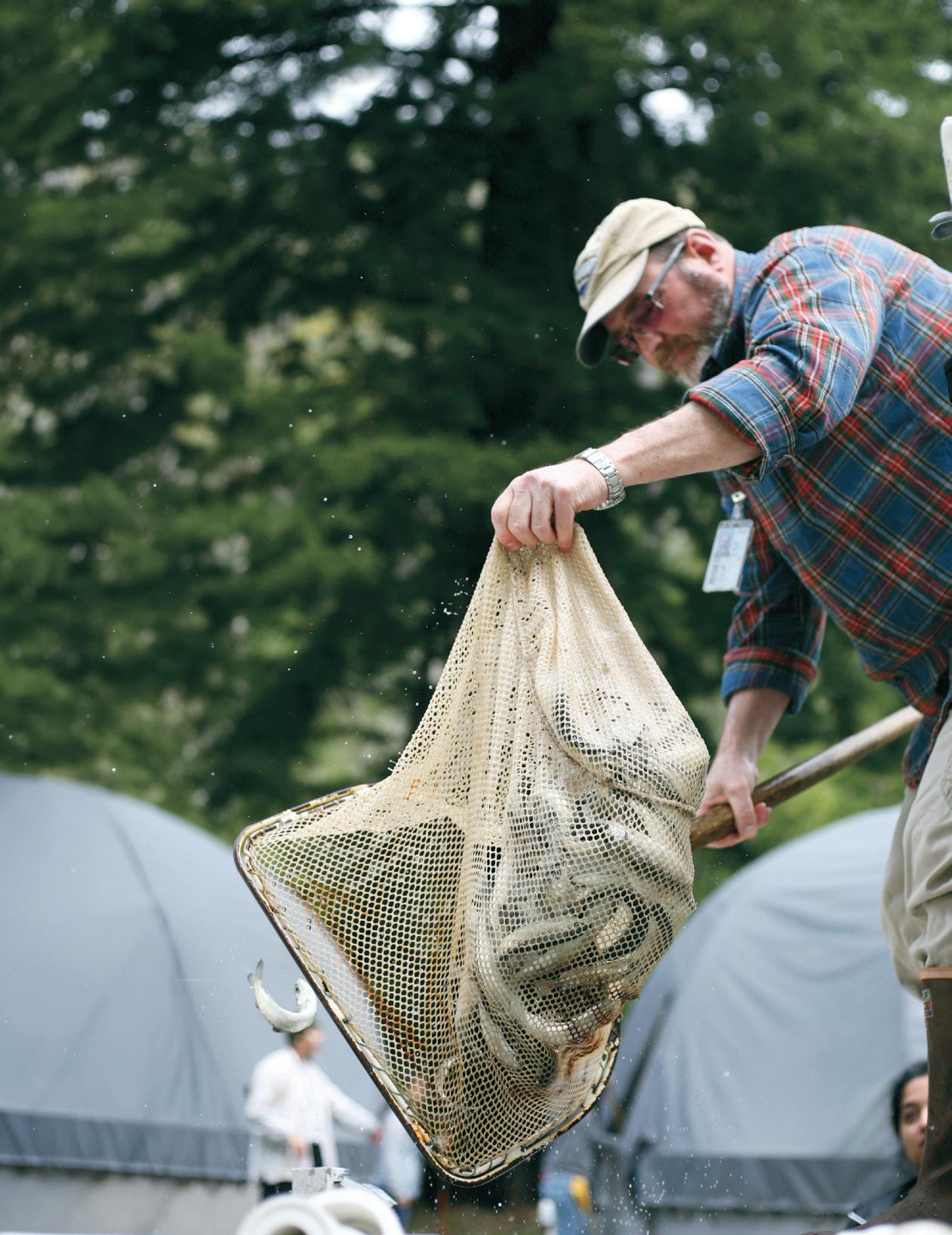
Ultra-focused, he dips a long-handled net into the tank and refills my buckets with coho smolt.
“This is some really manual science,” I say.
“Tell me about it,” he laughs. “I can never really relax until we get them into the creek. That’s really the final step. From there, it’s up to nature.”
The volunteer-aided rescue push in May took young salmon from the fire-scarred redwoods of the hatchery (pictured below) to the river for a bucket-born release and sprint to the open sea.
Greenwood’s tension is justified. He carries the weight of a species on his shoulders. As manager at MBSTP’s Kingfisher Flat Hatchery, which is located on Big Creek, a tributary of Scott Creek, Greenwood is responsible for the last Central Coast coho south of San Francisco Bay.
MBSTP also supports the recovery of coho’s slightly hardier cousins, the wild steelhead trout, through a rescue and monitoring program, and partners with the California Department of Fish and Wildlife to release 160,000 hatchery-raised chinook salmon from the Santa Cruz Wharf every year.
However, the coho’s dire situation has made it the program’s first priority.
Consider this: In the 1940s, somewhere between 200,000 to 500,000 coho spawned up 50 or more waterways in Santa Cruz and San Mateo counties.
By the 1960s, that number dropped to fewer than 10,000 coho spawning up 11 waterways. In 1995, the annual spawning population of native and naturalized coho salmon was generally restricted to Waddell and Scott Creeks and an estimated 50 to 60 adults.
The following year, they were listed as threatened. In 2006, they landed on the endangered list.
Without the combined efforts of the Salmon Project, NOAA Fisheries and the CDFW, coho south of the Golden Gate would’ve gone extinct and their genetics would have been lost. But this unique species of salmon isn’t out of the woods yet. Not by a long shot.
Coho only live for three years. In general, they spend 9 to 16 months in freshwater, swim out into the ocean for most of their adult lives, and return to their natal streams to spawn and die.
As a result, Greenwood’s team is tasked with rearing, releasing, monitoring, and breeding three-year “classes” of coho at the Kingfisher Flats hatchery.
It’s a delicate, high-maintenance process.
Every year, MBSTP workers incubate a new generation of eggs for two months in moist metal closets. Once hatched, they’re moved into 16-foot-long troughs. At this point, they look more like tiny amphibians than fish. They have large, bulging eyes and carry an orange yolk sac attached to their bellies.
Over the course of the next few weeks, they develop into inch-long juveniles and are moved by hand into rearing pools on the hatchery grounds. In preparation for their release into Scott Creek as smolt, they’ll spend a year in these tented tanks swimming against artificial water currents and eating fresh-frozen krill from Antarctica.
Once mature, the fish with the most desirable genetics are set aside and saved to strengthen the species’ overall genetics.
“This kind of program is basically a way to preserve their genetics so they can someday totally repopulate their native habitat,” says Greenwood. “Anything that is sub-optimal, that might not survive in nature, we don’t want to put out on the landscape.”
To complicate matters, Greenwood and his team inject a coded wire tag into the nose of each smolt before its release.
This crude but effective technology gives biologists a rough idea of how many coho survive their years in the ocean. When they return up Scott Creek at the end of their lives, the tags ping a “lifecycle monitoring system” operated by NOAA.
Another 10,000 or so are injected with transponder tags. These tiny,
(Clockwise from top left) hatchery manager Connor Greenwood feeds krill to juvenile salmon; university interns Eleanor Massey and Ava Sabella tend to a tented school of fish before release; Director Ben Harris looks over the tiny smolt tanks with a look that belies his optimism.
battery-free chips act as a unique ID to provide even more information, including migration tracking and habitat use, as well as return rates.
So what are the return rates for coho? Of the 30,000 smolt released by Greenwood and his team this spring, they expect roughly 200 to 300 fish to survive long enough to return to Scott Creek.
“I know it doesn’t sound like it, but those are actually good numbers,” Greenwood says. “We’re happy with that return right now. If we can get that up to 1,300 or so, we can get Central California Coast coho [taken off the endangered list].”
Each stage bringing coho back from the precipice is fraught with peril. Any number of complications can decimate—or even wipe out—the species. In addition to disease and polluted water, coho are threatened by climate-change-driven extremes.
There’s also the possibility of less predictable catastrophe. On August 19, 2020, the CZU August Lightning Fire roared down the steep canyon hillsides around the hatchery, destroying four holding tanks and disrupting water flows to nearby pools stocked with 60,000 salmon fry. Half of the fish suffocated. In addition, chemicals and metals from burning structures seeped into the waterways, contaminating the fish.
“You can see where it burned,” says MBSTP Director Ben Harris, pointing out the scarred trees surrounding the hatchery. “We had to rebuild these four tanks and a bunch of infrastructure like that bridge you crossed to get here.”
Then, between late December 2022 and January 2023, a series of nine intense atmospheric rivers hit Central California. These storms created a 23-day period of near-continuous precipitation—the longest in 70 years of records.
The deluge caused severe flooding and major landslides into Scott Creek and its tributaries, further hampering the coho program’s progress.
While Greenwood and his team labor year-round to ensure that 30,000 of the most genetically diverse coho are released each spring into the waters of Scott Creek, most will die in the ocean, eaten by sea lions, harbor seals, larger fish, and a host of birds, including cormorants, herons and egrets.
In addition, rising ocean temperatures pose a severe threat to coho, a cold-water species, by reducing available food, boosting metabolic stress, and increasing the risk of disease.
Despite the challenges, Greenwood remains optimistic.
“It’s a slow process, but we’re making gains,” he says. “The last few years have really felt like wins.”
As the rain continues to fall, I carry two more buckets full of gleaming coho down the wet forest trail to Scott Creek.
As the buckets meet the crystal clear water, the smolt dart into the current, disappear downstream toward the ocean, and I wish them good luck.
Celebrate MBSTP’s 50th anniversary from 5–8pm Saturday, Aug. 1, at the Crosetti Hall on the Watsonville Fairgrounds, 2601 E. Lake Ave., Watsonville. For more information about the event, MBSTP’s programs or becoming a member, visit mbstp.org.
Coho Downlow
A quick primer on a mighty and majestic fish
Despite the fact that coho have declined to 1% of their historic population levels in California, they remain popular in commercial and recreational fisheries in Alaska, the Pacific Northwest and elsewhere in the world.
Coho has a delicate, mild and slightly sweet flavor with a firm, flaky texture. It’s considered less oily and intense than king or sockeye salmon.
Coho were a major part of the Amah Mutsun’s culture and diet for thousands of years. The indigenous peoples of the south-San Francisco and north-Monterey Bay area, also collectively referred to as Ohlone, considered the “silver salmon” a sacred gift.
The Amah Mutsun observed sustainable fishing management practices to ensure strong and healthy coho populations, yet that balance was upended when the human population in the region exploded, particularly in the 20th century.
While there isn’t one factor to blame for coho’s precipitous decline in California, agriculture and early logging practices altered rivers and streams and deforested river banks.
Meanwhile, increased water use for activities like watering lawns lowered river and creek levels.
In 2023, a chemical in car tires called 6PPD-quinone was found to be particularly lethal for the coho of Santa Cruz County. Scientists discovered that levels of 6PPD-quinone were entering rivers and streams as urban runoff during periods of major rainfall.
In short, the upstream swim continues.
—Ryan Masters
Fab Crab
Delicious seasonality via challenges and progress
This summer marks a historic—and unique—season for two major Monterey Bay fisheries, and that’s well beyond the Salmon & Trout Project 50th anniversary (see p. 42).
For the first time in three years, local sport and commercial boats are actually getting to fish king salmon, albeit in dramatically decreased numbers.
Response from the fleet and eaters was euphoric: “Our dock sale felt like a party,” Monterey fisherman Joe Lucido told Edible in early May.
At the same time, experts like Golden State Salmon Association Executive Director Vance Staplin hastened to put the joy in context.
“I don’t want to be a downer,” he says. “It’s wonderful that we’re fishing, but the fishery is far from wonderful.”
Summer proves unprecedented for crabbers, too, because it’s still happening at all. That reality is the love child of both crisis and creativity.
In the past—and during the main crabbing season—fishermen drop crab pots and let them linger on the ocean floor for several
days with long vertical lines tied to buoys at the surface. But increasing whale entanglements led California Department of Fish & Wildlife (CDFW) to shorten seasons dramatically. Fresh local crab for Christmas became a memory.
Flash forward to April 2026, wherein the development of new “ropeless” or “on demand” traps now allows all boats with appropriate permits to submerge and summon with GPS tracking and Bluetooth signals. Which meant CDFW could extend the season into mid-July.
One of the best places to celebrate that development would be Coastal Kitchen and its sister spot Schooners at Monterey Plaza Hotel & Spa on Cannery Row.
That’s where crab lovers will find decorated Executive Chef Michael Rotondo so into crab that he stuffs it into prodigious seafood omelets, makes it a touchstone of his levitational tasting menus, and offers it as a delightful addition to his huevos rancheros.
He also wants to democratize a simple yet hard-to-stop-thinking-about rice bowl shared here.
“Dungeness crab is one of those ingredients
that defines the season on the California coast,” he says. “When it’s at its peak, I like to keep the preparation minimal—just enough yuzu kosho butter and fresh vegetables to highlight its sweetness without overpowering it.”
—Mark C. Anderson
Chef Michael Rotondo’s tasting menus engage both curiosity and appetite, brain and belly, thought and plot.
Courtesy of Executive Chef Michael Rotondo, Coastal Kitchen in Monterey
For the rice:
1½ cups sushi rice
1¾ cups water
3 tablespoons rice vinegar
1 tablespoon sugar
1 teaspoon kosher salt
For the yuzu kosho butter:
½ cup (1 stick) unsalted butter, softened
2–3 teaspoons yuzu kosho (to taste)
1 teaspoon finely grated lemon zest
2 teaspoons fresh lemon juice
1 teaspoon honey
1 teaspoon chopped garlic
Pinch of salt
For the crab & vegetables:
1 cup snap peas or asparagus, cut into bite-sized pieces
1 small shallot, finely chopped
1 tablespoon olive oil
1 pound cooked Dungeness crab meat, picked over Salt, to taste
To finish:
2 tablespoons chopped fresh chives
Optional: Toasted sesame seeds or furikake
Optional: Lemon wedges or a splash of yuzu
Rinse the rice under cold water until the water runs clear. Combine with the water and cook on stovetop or in a rice cooker. Once cooked but still warm, gently fold in the rice vinegar, sugar and salt. Cover and let sit for 10 minutes. The rice should be glossy and lightly seasoned—not overly vinegary.
In a separate small bowl, mix the softened butter with the yuzu kosho, lemon zest, lemon juice, honey, garlic and a pinch of salt. Taste and adjust—the flavor should be rich and buttery up front, with a bright citrus lift and a gentle heat at the end.
Blanch the snap peas or asparagus in salted boiling water for 1–2 minutes, until just tender and bright green. Drain and let cool slightly. Toss lightly with olive oil, a pinch of salt and a spoonful of chives.
Place the crab pieces in a skillet with a few tablespoons of water and a small spoonful of the butter. Warm gently over low heat just until heated through. Avoid overcooking— the crab should stay delicate and juicy.
To assemble, spoon the warm rice into shallow bowls. Add a generous dollop of yuzu kosho butter and let it melt into the rice.
Top with the warm crab and arrange the vegetables alongside. Finish with chives, a sprinkle of sesame seeds or furikake and a squeeze of lemon, if desired. Sometimes, at home, I’ll serve nori crisps on the side so one can make their own hand rolls if desired. Fresh lemon will be key to the success of this dish. Don’t be shy!
Serves 4
BIG PICTURE PROGRESS
SECOND SHELF LIFE
Food relief organizations find synergies, meet a state law and generate community
By Kera Abraham
PHOTOS BY MARK C. ANDERSON AND KELLY ROSE EVANS
Staff are busy before opening at The Hub, a little market inside the Student Center at California State University Monterey Bay. Giovanni “Gio” DoCanto, food recovery coordinator for CSUMB OtterCare, has already made two runs this morning—to Smart & Final in Seaside and Safeway in Salinas—and his crew is now unpacking the haul from rolling carts.
They’re stocking everything you might find at a corner store: bread, pastries, fruits and vegetables, meat, dairy and eggs, cereal, crackers, canned goods, flowers.
A few hours ago the shelves were nearly bare; students emptied them the day before. By the time The Hub’s doors open at noon they’ll be full again, organized into colorcoded zones with item limits based on the day’s supply.
Most of these groceries were recovered— pulled from supermarkets when they were near their sell dates and donated under a California law that most people have never heard of.
The Hub at CSUMB is one of countless food relief organizations across California that’s scaling up to handle a surge of donated food driven by SB 1383, a 10-year-old climate bill that includes recently phased-in regulations to keep edible food out of the landfill.
California’s Short-Lived Climate Pollutant Reduction Strategy (SB 1383), passed in 2016, is making an impact in the Monterey Bay region: for the agencies enforcing it, for the stores and event organizers complying with it, and for the food relief organizations doing the daily work of getting recovered food to the people who need it.
SB 1383 is a climate action first. It aims to keep organic materials like yard trimmings and food out of landfills to curb the methane they emit when they rot.
SB 1383 does that in two ways: implementing curbside composting (the green bins) for residents and businesses, and requiring large food merchants to donate edible food instead of throwing it away.
The food recovery requirements phased in starting in 2022 for grocery stores and wholesale vendors, expanding in January 2024 to include big hotels, restaurant chains, event venues and colleges. Smaller businesses are exempt.
Affected businesses are finding different ways to reduce their waste, like ordering fewer ingredients, sending leftovers home with staff and marking down items close to expiration.
Whatever edible food they would’ve thrown away, they’re now required to donate to a food relief organization under contract. Jurisdictions make sure those contracts are in place and report compliance to CalRecycle.
Monterey County’s biggest waste management agencies, ReGen Monterey and Salinas Valley Recycles, are making compliance easier in partnership with an app called CareIt, which matches food generators with food relief organizations and tracks the exchanges.
“It’s like a Craigslist, where these entities can do exchanges,” says Zoë Shoats, communications director for ReGen Monterey.
Though SB 1383’s authors couldn’t have anticipated it, California’s food recovery mandate is kicking in just as the federal government slashes funding for food assistance. Trump’s budget bill, H.R. 1, is designed to disqualify millions of people from the Supplemental Nutrition Assistance Program (SNAP, or CalFresh in California).
It also slashes $500 million from the Emergency Food Assistance Program, curtailing USDA deliveries to food banks.
To help food relief organizations build capacity in this critical moment, ReGen and Salinas Valley Recycles are providing nearly $100,000 per year in local grants (see sidebar).
At CSUMB’s OtterCare, one of those grants funded Gio DoCanto’s position, enabling the team to level up their student market.
The Hub feels more like a grocery store than a food pantry. Any enrolled student can shop once a day by scanning their student ID and shopping without cost. In the past year, more than 4,000 students have used The Hub an average of nine times each.
Hub Coordinator Robyn DoCanto (Gio’s spouse), in bright strawberry-print pants and a corduroy hat, gives a quick tour of the space while student assistants stock the shelves.
FOUR WINDS GROWERS
Growing and Shipping since 1949
California’s Premier Citrus Grower
Now offering a large selection of other Ornamental Edibles Available in leading California Nurseries or at fourwindsgrowers.com
(Clockwise from top left) Danielle Wong helps stock goods for Grey Bears; CSUMB students shop at The Hub, which organizers hope has the feel of “an eclectic community grocery store.”
Gio’s heading out on his next pickup and invites me to ride along to Trader Joe’s in Marina.
As Gio pulls up to the store’s garage, staff meet him with packed boxes. Gio stacks them neatly in the OtterCare van while I chat with Trader Joe’s Team Captain Christian Robins.
Robins says the process of pulling almost-expired or less-than-perfect food for donation is part of the daily shifts—and not just because it’s required under SB 1383.
“It’s what we would normally do anyway,” he says. “It’s our community, too.”
Back at The Hub, four students weigh the haul and inspect the produce for anything that looks off, which will be set aside for composting. Then they restock the store, holding back a portion of the food so they can refresh the shelves throughout the afternoon.
The team at Grey Bears also gets creative about providing food to people who need it. The Santa Cruz–based nonprofit serves free hot lunches every weekday and delivers 4,000 Healthy Food Bags per week to seniors.
Most days, the team picks up donated food along an ambitious route of 25 bakeries and grocery stores, according to Danielle Wong, Grey Bears’ healthy food program director.
The organization had been rescuing food for more than a decade before SB 1383 went into effect, she says, so it was fairly simple to add the paperwork to their routines.
The bigger change was in the volume of donations. From 2020 to
2023 the amount of food Grey Bears received nearly doubled, from just under 1 million pounds to 1.9 million, with the big jumps happening after the regulations went into effect.
The rapid expansion happened as the organization made moves for more space. In 2024 they bought a two-story warehouse next door to their current spot on Chanticleer Avenue. They plan to be fully moved into the renovated space, the Kristina Mailliard Center for Healthy Seniors, by 2028. (They’re fundraising for the last $2 million of their $9.6 million goal.)
The past two years, the volume of food coming in to Grey Bears stabilized around 1.7 million pounds. Wong sees stores recalibrating, using smarter ordering systems and adjusting stocking patterns to reduce excess.
Two years after SB 1383’s food-recovery phase went into full effect, most large food generators are aware of the law but still working out the details, according to Leslie O’Malley, waste reduction manager for the City of Santa Cruz.
“Businesses and food recovery organizations are finding the groove of their routines,” she says.
Stores that had been donating regularly before the law—including big grocery chains like Trader Joe’s and smaller ones like New Leaf Community Markets—had a head start.
“Eliminating food waste and feeding our neighbors has been our commitment for more than 40 years,” says New Leaf Community Programs Manager Robin Nardello.
For other businesses, SB 1383 is an adjustment. “It’s one more
Aid in Action
Food relief advances around Monterey Bay
California’s SB 1383 requires large food generators—including grocery chains, produce companies and event venues—to donate their surplus to food relief organizations.
In both Monterey and Santa Cruz counties, the regional food banks hold contracts with large food generators. The food banks partner with food relief organizations, which pick up and distribute most of the donations; food banks handle the pickups too big for their partners.
Together, they form a local food recovery network that gets millions of pounds of food per year to people in need.
In Monterey County, the biggest waste management districts are teaming up to help local food recovery organizations grow their capacity and distribute more food.
Through their Edible Food Recovery Grant Program, ReGen Monterey and Salinas Valley Recycles have awarded over $475,000 in five grant cycles. The funding, con tributed by member jurisdictions, is used for scale-up costs including refrigerators, vehicles and staff time.
Santa Cruz County and its city partners have taken a narrower approach, pooling $250,000 in grant funding over two years to offset SB 1383 compliance costs for local food recovery organizations.
Find food in Santa Cruz County (Second Harvest Food Bank): thefoodbank.org/ food-distribution-nutrition-education-locations-times/
Find food in San Benito County (Community Food Bank of San Benito County): communityfoodbankofsbc.org
Find food in Monterey County (Food Bank for Monterey County): foodbankformontereycounty.org/food-assistance/ —Kera Abraham
thing to do, one more thing to track,” O’Malley says. “This law was created because it’s the good and right thing to do, but how you implement it and get everyone on board—that’s where we’re in the thick of it.”
For now, jurisdictions are enforcing the law lightly. Cities and counties typically give businesses warnings before assessing modest fines for violations, according to Zoë Shoats of ReGen.
She says Monterey County is recovering more unsold food than the California average: “As a region, we’re ahead of the state.”
CSUMB is a part of that momentum. OtterCare Director Amy Zamara describes The Hub as a model for CSUs and community colleges across the state.
She gives credit to Robyn DoCanto for growing what was a shoestring program in 2022 into a thrumming operation in a bigger space, with more staff and equipment,
serving five times as many students.
“We’re the first one to scale it onto this level,” says Zamara as students mill past her in the Student Center.
By tomorrow morning the shelves at The Hub will be nearly bare again, and the Ot terCare team will make their rounds and re stock them.
They keep showing up because the systems that cause food insecurity are equally relentless.
One thing I hear from several local food relief organizations is that they typically don’t end up with extra food at the end of the day. No matter how much they expand their capac ity, there’s enough need to get the food out.
More people are showing up, and these organizations are determined to feed them all.
As DoCanto puts it: “We’re never going to turn someone away.”
Photo by Eugene Golovesov
FLAVOR SURVEY
DOING 60 IN SCOTTS VALLEY
The one-time roadside attraction celebrates six decades by blossoming into an underrated destination
BY RYAN MASTERS
PHOTOGRAPHY
BY
MARK C. ANDERSON
Scotts Valley, the Santa Cruz Mountains community located on the Highway 17 corridor between Santa Cruz and the Silicon Valley, is perched upon an ancient seabed full of 20-million-year-old fossils.
For thousands of years, it was a gathering place for Native Americans traveling and trading between the San Francisco and Monterey bays.
Fifty years ago, it was primarily famous for being the
home of roadside attractions like Santa’s Village, the Lost World dinosaur theme park and a small airport.
Today, this valley of redwoods and sandhills is more than just a place to pass through. It contains commuter homes, thriving businesses and a host of truly undervalued eateries.
As the city toasts 60 years as an incorporated entity— anchored by a week-long celebration Aug. 2-9 (more at scottsvalley.gov)—Edible takes a closer look at some of those finds.
“I didn’t intend to create my own international food court.”
Jia Tella’s, JT’s Two Doors, JT’s Bar Next Door
In Victor Square, right off Highway 17’s Granite Creek Road exit, you’ll encounter a locally owned three-for-one unlike any other in the Monterey Bay region: Jia Tella’s, a highly acclaimed Cambodian restaurant; JT’s Next Door, a whiskeyand-craft-beer sports bar; and JT’s Two Doors, a mountain-bike-themed pub Americana joint that also serves authentic Italian-style pizza and gelato.
This unusual triple play is the brainchild of local boy Jason Revino, a businessman who relies on his gut, both literally and figuratively.
“Everything on my menus—behind my bar and even on the walls of my restaurants—are things I love,” Revino says. “I’ve always assumed that others will love the food I’m passionate about.”
He acknowledges that his naming conventions are like an Abbott-and-Costello routine (the Next Door bar is next door to Jia Tella’s and the Two Doors restaurant is two doors down from Jia Tella’s, and next door to the Next Door), yet the serial entrepreneur is batting three for three.
Revino began in 2007 with Jia Tella’s, a rare local Cambodian restaurant inspired by San Jose’s Chez Sovan. His decision to bring a menu that emphasizes fresh herbs, rice, fish and complex curries to Scotts Valley was driven by his desire to “stand out in the local scene and be different.”
It was an immediate hit. The spicy basil chicken and “highly addictive” chicken curry developed a fanbase.
“The curry isn’t spicy like an Indian curry,” he explains. “It’s sweeter, with more garlic and coconut milk. People can’t get enough.”
I fell in love with the amok, which I’ll admit is not for the casual Cambodian fan. It features catfish, lemongrass, kaffir limes, galanga, coconut milk and eggs wrapped and steamed in banana leaf and served with coconut milk sauce.
Two years after launching Jia Tella’s, Revino opened JT’s Next Door. This “whiskey sports bar” boasts a standout selection of craft beers, whiskeys and cocktails.
Then, in 2017, Revino opened Two Doors, arguably the best Americana-pub joint in the mountains.
Two Doors offers six different burgers, five types of sliders, seven sandwiches, plus a litany of appetizers. Most of the items on the menu have odd names like Stump Jumper and Emma McCrary, Revino’s nod to mountain bike culture and Santa Cruz Mountains bike trails.
In addition to biking he’s also a big Italophile. (“I just got back from mountain biking the Dolomites,” he says.) As a result of his travels through Il Bel Paese, Two Doors features superb Italian-style pizza cooked on almond wood and using Double Ought (00) flour, plus some of the more authentic gelato you’ll find in California.
JT’s Two Doors draws steady traffic for its pizzas, burgers and regular specials, but its craft beer and overall bar program has a strong following too.
“I didn’t intend to create my own international food court in Scotts Valley,” he jokes. “It just sort of happened naturally.”
18 Victor Square, Scotts Valley • jiatellas.com
RESTAURANT AWARD WINNER
Heavenly Roadside Cafe Blink and you’ll miss Scotts Valley’s best breakfast/brunch/lunch spot. Tucked into wooded hills full of ancient shark teeth, the Heavenly Roadside Cafe’s got all your homey faves: exceptional pancakes, French toast, biscuits and gravy, bacon and eggs—plus fresh takes on old favorites. Chef Danny Voutos recommends the crab cake Benedict, loaded potatoes, the California scramble and the barbecueflavored John Wayne Burger topped with housemade onion rings.
Plus, in true Santa Cruz Mountains fashion, the Bloody Marys, margaritas, and mimosas are all primo. Don’t forget to ask about the weekend specials like the picante huevos divorciados with red and green salsa, homemade Belgian Oreo waffle, and Nutella-stuffed French toast with fresh fruit!
1210 Mt. Hermon Road, Scotts Valley heavenlyroadsidecafe.com
Otoro Sushi
It’s not often Edible Monterey Bay’s pages pair the terms strip mall and sushi, but I assure you this is not your run-of-the-mill strip mall, nor is it your everyday sushi spot.
If you look closely at the cement promenade outside these stores and restaurants, you’ll find fossilized shark teeth set into the mall’s walkways. Step inside Otoro and you’ll be treated to some of the most striking sushi in Santa Cruz County.
Thanks to Scotts Valley’s proximity to Santa Cruz, the sashimi, sushi rolls and poke are as fresh as the Tsukiji Outer Market. Highlights include expertly crafted creations like the Chirashi and Sashimi Medley and the stunning bluefin nigiri.
235 Mt. Hermon Road, Ste G, Scotts Valley otoro-sushi.goto-where.com
The catfish-lemongrass-galanga “amok” comes steamed in a tidy banana leaf purse with coconut milk sauce and optional local beer.
The Redwood Sandwich Co.
There’s a lot to be said for a great sandwich. In a world full of unsatisfying ingredients crammed between subpar breads (looking at you Subway, Jersey Mike’s, etc.), the Redwood Sandwich Co. provides farmers-market-fresh ingredients in surprising and inspired combinations.
Since 2015, they’ve provided mouthwatering meats served on breads and rolls from local bakeries. Favorites include the tri-tip with blue cheese; the salami, capicola, and provolone; the chicken caprese; and the chipotle turkey sandwiches. Great for a quick bite on your way through town.
3105 Scotts Valley Drive, Ste B, Scotts Valley redwoodsandwichco.com
(Clockwise from the top left) The Redwood Sandwich Co. salami-capicola-provolone becomes habit-forming fast; the Cambodian yum ranges far and wide at Jia Tella’s; Jason Revino stands ready to throw open the two doors to all comers.
Laughing Monk Brewing
One of the newest additions to Scotts Valley’s restaurant scene, Laughing Monk Brewing is perched at the edge of Skypark. As the name sort-of implies, this park was once a functional airport. (In fact, my dad was on hand in 1981 when Steve Wozniak of Apple fame nearly killed himself taking off from this strip in his Beechcraft Bonanza.)
Today, it’s a nice place to hang out and quaff Laughing Monk’s award-winning beers whilst gnarfing spiced squash salad, sweet potato fries and blackened ahi tuna. Don’t pass up the beer can nachos, fried pickles, cauliflower Buffalo wings or IPA onion rings.
This isn’t your dad’s bar food. This menu is as ingenious and forward as The Woz himself.
262 Mt. Hermon Road, Unit 103, Scotts Valley scottsvalley.laughingmonk.com
take care of your baby, let me take care of you!
Coffee, pastries and Sunday toasts. Cheese boards available upon request.
Peek through the observation window and see small-batch,
Chef-owner Regelio Guzman earns loyal regulars with the help of towering burgers like the Heat Meister.
Valley Highs
More higher elevation reasons to make a SV pilgrimage
Scotts Valley merits a food quest for all sorts of reasons.
One of the most magnetic among them would be 1440 Multiversity, where hands-on cooking, garden digs and communal meals beam the power of food as medicine, and pair with a stunning Teaching Kitchen surrounded by redwoods.
Some might compare it—and fairly so— with world-class Esalen Institute, albeit in a more accessible place at a more doable price point.
And it turns there are still other questworthy spots, on top of the jewels already detailed (see story, p. 52), because every single one can make the case as the best representative of their genre in Greater Santa Cruz. Full stop.
That includes Adorable French Bakery, with a following built by rabid farmers market fans, and croissants that match any in the area.
Same goes for Ambrosia Bistro, simply a top flight Indian joint, with sister spots in Aptos, Los Gatos and Monterey.
Simultaneously, The Pizza Series ranks near the top of wider Santa Cruz’s disproportionately large amount of great pizza, thanks to Detroit-to-New York style versatility, authenticity and execution.
But if there’s one spot that channels a neighborly vibe, diverse magnetic elements, and the hidden away feel of Scotts Valley as it turns 60—or you have only one spot to visit on your way through— the move is Bruno’s Bar and Grill. (As locals already know.)
Its incognito positioning at the back of Kings Village Shopping Complex adds to the power of its reveal and disguises its depth.
What appears to be an inviting strip-mall pocket spot unlocks thousands of square feet across two stories and at least five different types of hangout zones, from restaurant to sportsbar to speakeasy to concert deck overlooking the valley.
The supreme values—including daily/ weekly specials ($10-$15)—and towering burgers would be enough to mint this as an institution, but they’re but the beginning of the draws.
Note the signature Bloody Mary overstuffed with a pork slider, buffalo wing, bacon and a mass of fresh and pickled vegetables ($16), the nonstop activities like regular girls nights and Whiskey and Wings Wednesdays.
It’s all held together by hands-on owneroperators Joanna and Regelio Guzman, who handle the social calendar and the kitchen, respectively, earning relentless repeat customers.
A lot of would-be foodie philosophers like to talk about the power of a chef or a venue having “a point of view.”
Here the perspective isn’t so overwrought. It appears in the constant content and caloric creativity, and goes like this: Let’s have fun, and layer in mad flavor.
Or as Rogelio says, with a knowing smile: “Every day is a different day.”
—Mark C. Anderson
IN THE PANTRY
Low-Key MVPs
Here come seven (semi)secret kitchen weapons to craft and deploy in a bunch of tasty ways
BY DIANE GSELL
PHOTOGRAPHY BY KELLY ROSE EVANS
We’ve all got them, home cooks and professional chefs alike.
Some of yours are the same as mine— flaky Maldon salt, shallots, quality olive oil …
These are the items that comprise the short list of pantry staples we just can’t live without.
Most go-tos among them are fairly standard.
But every now and then you stumble upon a more obscure item that you just can’t quit. That's when it gets bumped up to prized ingredient status, its identity revealed only to those who’ve proven worthy.
The items below qualify. On top of amping up your pantry, four of them work together in a recipe that I’m willing to bet—once you’ve tried it—your refrigerator will rarely lack.
AQUAFABA
Many have heard intriguing tales of the magical properties of this “bean water” that we used to discard. Gaining traction as a vegan egg substitute, the viscous liquid that surrounds canned chickpeas is now used for everything from nondairy aiolis to meringues or even cocktail foams.
It’s really fun to play with this stuff, and it’s a pretty cheap experiment. I’m always amazed at how light and creamy it ends up and how stable it is as the sauces I make with it never separate.
Next up on my culinary curiosity list is to see if the water I use to cook dried chickpeas behaves the same way. I’m also going to try a vegan spin on carbonara with veggie bacon, brewer’s yeast and aquafaba.
However you choose to use it, don’t forget about the chickpeas you have left over. Roast them up for a crunchy snack, stir up a hummus or simply throw them on a salad.
Keeping with the spirit of this cheat sheet, oven-dried tomatoes are a faster and easier way to preserve summer produce than the alternatives, without sacrificing flavor.
JULIA’S
BOILED CIDER
This one’s just like it sounds: a dark, tangy liquid made by reducing fresh apple cider down to a syrup. To be clear, this is neither fermented apple cider vinegar nor sap-based maple syrup. It is simply apple cider sans much of the liquid.
You can buy this premade from an outfit based in Vermont or, when apple season is upon us, you can DIY it with the remains of a local jug.
Simply place the cider in a nonreactive pot and boil it down until it’s about one eighth of the original volume (it will thicken further as it cools). There’s something about the tanginess of this syrup that adds a whole new dimension to sweetness.
I love to use it in marinades, meat glazes and fruit pies, and I imagine it would be great in an autumnal artisan cocktail. A food-styling colleague and friend uses it to add amazing flavor to her homemade caramels.
When I order boiled cider from Vermont I always buy two bottles because in-
evitably a dinner guest will ask for a recipe that I’ve served and I’ll send them home with what’s left in bottle number one and move on to bottle number two.
CARAMELIZED ONION PURÉE
My mom taught me that if you don’t have a rack on which to roast your chicken, simply slice some onions extra thick and place your bird on top of them.
I’ve modified that rule of thumb to say that even if you do have a rack, go the onion route instead. Why? Because while your bird is roasting, the onions are being basted with its juices, taking them to a silky next level.
I serve some of the roasted onions with the chicken, but the rest I purée and freeze into cubes that I use in sauces, soups, stews, rice or beans.
Best to use this ingredient in moderation, though, because when onions caramelize their sugar content increases and it’s easy to accidentally over-sweeten your dish if you’re using them in quantities equivalent to raw onions.
The star players on the Low-Key MVP roster pause to pose for a group picture.
Not into roasting chickens? Just chop up a few onions and roast them in the oven, deglazing the pan with a little chicken or vegetable stock before puréeing.
CHINESE BLACK VINEGAR
Are you in a vinegar slump? I’ve always relied on a dash of sherry vinegar to add just the right punch to liven up a sauce, gravy, soup or vinaigrette.
More recently I got turned on to Chinese black vinegar and it’s adding a whole new dynamic to my pantry.
I’ve always found most balsamics to be a bit too sweet for my tastes, especially when reduced to a syrup and inexplicably paired with an already sweet fruit-topped salad. But I find Chinese black vinegar to have all of the richness of a balsamic without the overwhelming sweetness and with a compelling complexity that some describe as malty and woody.
If you’ve ever had a totally addicting potsticker sauce from a great Chinese restaurant, chances are you’re already a fan.
MISO
Miso is having a moment.
Widely known as the eponymous ingredient in the standard soup at your favorite sushi joint, this fermented, umamirich paste is starting to show up more and more in non-Asian cooking.
Last Thanksgiving I whipped up an apple pie for traditionalists, but I served it with a miso caramel sauce on the side for trendier palates.
My lemony house dressing wouldn’t be the same without the healthy dose of miso that provides its addicting salty tang.
I like to peruse the wide selection of misos at Asian markets, where I’m a sucker for the most intriguing packaging.
A note of caution for those with gluten sensitivities: While most white misos are born from a rice-based fungus and thus are gluten-free, other versions of the fermented soybean paste can lose that distinction when barley or wheat is the grain of choice. If that’s a concern, best to ask for help or stick with packaging you can read.
BOTTOMLESS LEMON STASH
What’s so obscure about lemon, you ask? Nothing, I reply, unless you’re stockpiling it in versatile little parcels in your freezer.
Here on the Central Coast it’s common to come into a bounty of lemons whenever your neighbor’s trees are at peak production mode. When this happens, I wash and dry them all, remove the zest in big strips with a serrated knife and get to juicing.
I freeze the juice in ice cube trays or silicone mats and then store the juice cubes in a freezer bag or tub.
The large strips of zest go in the freezer as well and are easily minced should a recipe call for a finer zest.
It’s amazingly convenient to have this stash of fresh juice and zest always at hand. Conjuring cocktails, dressings, marinades or lemonades becomes so quick and easy.
OVEN-DRIED TOMATOES
More versatile than sun-dried tomatoes and far quicker than canning, this technique is an easy way to preserve tomatoes before they’re past their prime.
Farm to Fork Benefit Dinner
August 29th
I like to use my small side oven set at 225°F for this one. I slice my tomatoes into wedges and stand them skin-side down on a rack-lined small baking sheet. I sprinkle with salt, pepper, garlic powder, dried herbs and a light drizzle of olive oil.
After about four hours, the shrunken tomatoes are amazingly condensed in both flavor and color and their skins have gotten feather light and delicate.
I leave the tomatoes on the pan to cool then pop the whole thing in the freezer so the wedges freeze without sticking together. Once frozen, the tomatoes are transferred to a freezer bag for storage.
I draw upon this stash when jazzing up a canned sauce or making a quick pomodoro, or give them a rough chop and throw them in soups and stews, or when making beans.
An added bonus is that while they’re drying out in the oven your entire kitchen takes on a comforting aroma that will convince you that your long lost Italian grandmother has taken up residence in your home.
Photo by Jim Clark
Creamy Vegan Salad Dressing
This dressing gets its creaminess from aquafaba and it stays amazingly emulsified indefinitely in the fridge so no need to shake. I once served it to guests on a lightly dressed salad and put an extra small pitcher of it on the table for those who prefer a heavier dose of dressing. I noticed one guest unabashedly pouring it all over his chicken because he couldn’t get enough of it. “Let’s just call it sauce,” he proclaimed. So yes, use it as dressing, use it as sauce. In either mode I predict it will be a permanent fixture in your fridge.
Zest and juice of 1 lemon (either fresh or from your freezer stash)
3 cloves garlic
3 tablespoons white miso
1 tablespoon Dijon mustard
1 teaspoon agave syrup
1 teaspoon onion powder
½ teaspoon fresh ground black pepper
3 tablespoons apple cider vinegar
1 tablespoon Chinese black vinegar
1/3 cup aquafaba
¾ cup sunflower oil
Place lemon juice and zest, garlic, miso, mustard, agave, onion powder and black pepper in a food processor and blend until zest and garlic chunks are small, scraping down walls of processor as needed. (Alternatively, if your food processor is on the larger side, consider using an immersion blender instead).
Add vinegars and blend until combined. Add aquafaba and, with machine running, drizzle oil in a small, steady stream. Process until creamy.
Turn off machine and taste to adjust. Lemons come in different sizes and acidities.
Add more lemon if you feel it needs it. Misos come in different degrees of saltiness.
Add some kosher salt if you feel it’s not salty enough.
Agave syrup is quite sweet and a little goes a long way but add a little more if you feel your dressing is too tart.
This recipe makes a pint of dressing, enough for multiple salads or to use as a sauce over salmon or chicken.
Dine Local GUIDE
All of these restaurants emphasize local ingredients and they also advertise in Edible Monterey Bay! Please check hours online before you go and tell them we sent you.
APTOS
Cavalletta 9067 Soquel Drive
831-661-5010 • cavallettarestaurant.com
Chef-owners Shawn Ryberg and Nick Sherman (who also operate Trestles in Aptos) offer seasonal Italian-inspired fare in a laid back environment that includes a leafy deck overlooking Aptos Creek. Pizzas, salads, pastas and entrées are all made in-house using locally sourced ingredients. Short rib rigatoni, seafood scampi, focaccia with burrata and lasagna, served Mondays only, are fan favorites. The partners spent nearly a year perfecting their pizza dough, which is light and tangy, and blisters to perfection in the wood-fired oven. Open Th–F, M 5–9pm. Sa–Su 4:30–9pm.
Mentone
174 Aptos Village Way
831.708.4040 • mentonerestaurant.com
A fun twist on the cuisine of the Riviera, Mentone is a casual restaurant and cocktail bar from David Kinch—one of the country’s most acclaimed fine dining chefs. Kinch loves the Mediterranean coast where France meets Italy, and Mentone brings some of those flavors to California with appetizers like duck rillettes and stracciatella with olive oil produced just down the road. There are housemade pastas and a handful of bistro-style entrées like pan-roasted black cod and steak frites, but the main draw is pizza—pulled bubbling hot from the Valoriani woodfired oven and loaded with Italian toppings. Open W–M 5–9pm. Lunch Sa–Su noon–2:30pm.
Persephone
7945 Soquel Drive
831.612.6511 • persephonerestaurant.com
With a namesake like the mythic Persephone, this restaurant in Aptos proclaims its deep reverence for seasonal cooking. Themes central to harvest, winter and spring are core to Persephone’s story, and are reflected in the changing menu at this fine dining destination, where chef Cori Goudge-Ayer presents inventive, ingredient-driven creations. The restaurant is a family-run passion project, bringing together parents, siblings and a long history of culinary
Taste of Monterey Executive Chef Bruce Finch often cooks paella live for the oceanside spot’s signature food-and-wine events.
arts in a beautifully redesigned space overlooking Aptos Creek. Open for dinner W–Sa 5–8:30pm. Fourth Sundays, Winemaker Dinner with five-course pairing menu.
New Leaf Community Markets
161 Aptos Village Way
831.685.8500 • newleaf.com
The Aptos branch of the beloved local market group occupies the remodeled Hihn Apple Barn, built in 1891. In addition to local groceries and organic produce, New Leaf Aptos has made-to-order sandwiches, pizza, freshly rolled sushi, soup and hand-prepped salads, as well as a coffee bar, juice and smoothie bar and organic Straus soft serve ice cream. Open daily 8am–9pm.
The Penny Ice Creamery
141 Aptos Village Way, Suite 2 831.204.2523 • thepennyicecreamery.com
Open Su–Th noon–9pm, F–Sa noon–10pm. See The Penny description under Santa Cruz for more.
Seascape Foods
16B Seascape Village • 831.685.3134
A charming family-owned market with an ample deli counter featuring daily chef specials, salads, breakfast items, freshly squeezed juices and sandwiches on housemade organic sourdough bread. The grocery section includes organic produce, artisanal products, local beer and wine, and gifts. Eat outside next to the fountain on the patio or take your goodies to the beach nearby. Open daily 8am–8pm.
CAPITOLA
New Leaf Community Markets
1475 41st Avenue
831.479.7987 • newleaf.com
Just opened in 2024, the new Capitola New Leaf Community Market occupies a larger footprint at 24,000 square feet, allowing expanded sections for organic produce, meat and seafood. The store also has increased its natural wellness section and its hot and cold food to go options. Enjoy California BBQ, fresh sushi and a self-serve poke bar. A coffee and juice bar offers locally roasted drip coffee and juices in reusable glass bottles. Open daily 7am–10pm.
(Photo: Alex Luhrman)
The Penny Ice Creamery
820 41st Avenue
831.204.2523 • thepennyicecreamery.com
Open Su–Th noon–10pm, F–Sa noon–11pm. See The Penny description under Santa Cruz for more.
Trestles
316 Capitola Avenue
831.854.2728 • trestlesrestaurant.com
Just steps away from the iconic Capitola train trestle, chefowner Nick Sherman’s passion for great food is evident in every dish at his popular neighborhood bistro. Local seasonal ingredients star in appetizers like chicory salad, roasted fairytale pumpkin with goat cheese and mole negro, Brentwood street corn and crispy pork belly with watermelon radish. Entrées include smoked eggplant gnocchi, Niman Ranch pork chop and fresh fish—all served with local wines and craft beers on tap. Open W–F 5–9:30pm, Sa–Su 4:30–9:30pm.
CARMEL
Earthbound Farm’s Farm Stand
7250 Carmel Valley Road
831.625.6219 • earthboundfarm.com
Earthbound Farm’s 100% certified organic kitchen delights with specialty coffee and tea, soft serve ice cream and a made to order breakfast and lunch menu—including soups, sandwiches, salads, baked goods, fresh juices and smoothies. Food is available to be enjoyed on the beautiful grounds or for takeaway. In addition to certified organic produce, the Farm Stand offers a selection of natural, organic, local beer and wine, groceries, gifts and flowers. Stroll through the gardens and learn about Earthbound’s commitment to organic integrity. Open daily, but check hours online as they change seasonally.
Grasing’s
6th Avenue and Mission 831.624.6562 • grasings.com
Chef-proprietor Kurt Grasing’s namesake restaurant has expanded since opening in 1998 to include two large dining rooms, multiple outdoor dining areas and the everpopular bar/lounge. A Carmel classic located in the heart of the village, Grasing’s serves California cuisine, with an award-winning wine list and a vintage spirits program featuring classic cocktails made with rare Mad Men-era gins, whiskeys, Camparis and amaros. Open daily M–F 11am–9pm, Sa–Su 10:30am–9pm.
Named for an island known as the “Hawaii of Korea” that grows divine produce, Jeju Kitchen is a buzzy spot with a mix of Californian and updated classic Korean dishes. Inspired by her mother’s home cooking, owner Ashley Wolff serves up Korean pancakes alongside coconut prawns and chili oil wontons. The fusion menu includes a kimchi smashburger, a fried chicken sandwich, a traditional Jajangmyeon noodle dish, kimchi mac n cheese and customer favorites—like spicy bulgogi chicken and a salmon rice bowl. Open daily 11am–8pm.
Sea Harvest Fish Market & Restaurant
100 Crossroads Boulevard, Suite A 831.626.3626 • seaharvestfishmarketandrestaurant.com
The Deyerle family that owns this local gem has its own fishing boats for the freshest catch on the Monterey Peninsula. Sea Harvest doubles as a fish market and casual restaurant with indoor and outdoor seating. The oysters and clam chowder are customer favorites, but don’t miss
the fried combo platter, grilled fillets and fish tacos. Open daily 8am–8pm.
Stationaery
San Carlos Square, Between 5 th and 6 th avenues 831.250.7183 • thestationaery.com
Stationæry is a neighborhood restaurant in Carmel operated by Anthony and Alissa Carnazzo. Offering brunch, dinner, specialty coffee, and natural wines, they celebrate comforting flavors with elegant presentation. Led by chef Amalia Scatena, Stationaery primarily sources from Monterey and Santa Cruz county farms and ranches, according to what is fresh and in season. A take-away and bottle shop next door allows for to-go orders and a unique selection of Old World and domestic wines. Brunch daily 8am–3pm. Dinner Th–Sa 5:30–9pm.
Woody’s at the Carmel Valley Athletic Club
27300 Rancho San Carlos Road
831.624.2737 • woodsmontereyairport.com
Serving lunch for club members and the general public, Woody’s at CVAC offers signature salad, burgers, sandwiches and snacks, along with local beer, wine and cocktails. See Woody’s description under Monterey for more. Open Th–Tu 11am–3pm.
Yafa
Junipero and 5th Avenue
831.624.9232 • yafarestaurant.com
Recognized with the Monterey Bay area’s first ever Michelin Bib Gourmand, indicating good value, Yafa offers a wide selection of Mediterranean dishes in a warm atmosphere that’s popular with locals. Diners can choose from a vast menu of appetizers like Lebanese hummus, baba ganoush, Jerusalem lentil soup and the highly-recommended grilled octopus. Entrées include something for everyone, with pasta plates, substantial salads and perfectly grilled kebabs, steaks and rack of lamb. Open nightly 5–10pm.
CARMEL VALLEY
Ad Astra Bread Co.
320 Mid Valley Center
@ad.astra.aterlier.cv
Atelier, the cafe branch of Monterey’s popular Ad Astra bakery, has become a favorite with Carmel Valley locals. Stop in for Dune Coffee Roasters espresso drinks, tea, pastries, breakfast and lunch items that make good use of Ad Astra Bread Co.’s wildly popular sourdough breads. Follow their Instagram @ad.astra.atelier.cv or newsletter to stay up to date on their culinary pop-up events. Open Wed–Mon 7am–3pm. Closed Tuesdays.
Carmel Valley Creamery
1 Esquiline Road
831.200.9532 • carmelvalleycreameryco.com
French-born cheesemaker Sophie Hauville crafts artisan cheeses and brings new life to the historic Rosie’s Cracker Barrel, a 1927 Comstock building near the Carmel Valley River and Garland Park hiking trails. The Creamery has become a community gathering spot where locals meet up for coffee, Ad Astra pastries and Revival ice-cream. Visitors can watch cheese being made through glass windows or enjoy a picnic on the large patio by the firepits. The store also features a selection of French wines, beer, artisanal foods, gifts and house-made cheeses: fromage blanc, bloomy rind cheese, feta and aged specialties infused with herbs or peppercorns. Custom cheese and charcuterie boards are available with 24 hours notice. Open daily 7:30am–5pm.
“West Coast Community Bank understands our business, our history and the realities of operating in Big Sur. When we need flexibility and fast action, they are there.”
Kirk Gafill President and Chief Financial Officer Nepenthe/Phoenix Corporation
Serving the Central Coast Since 2004 831.457.5000 | wccb.com
Enjoy the Area’s Finest Sustainable Seafood
Savor our innovative and organic cuisine from local farmers and fishermen. Indoor dining and special outdoor heated patio. Full bar, craft cocktails, gluten-free menu.
from 11:30 am - 3:00
Weekdays 5:00 pm - 8:30 pm
Jerome’s Carmel Valley Market
2 Chambers Lane
831.659.2472 • jeromescarmelvalleymarket.com
A chef-owned, friendly neighborhood market, Jerome’s offers local and organic produce, natural meats and seafood, and a great selection of domestic and imported wine, beer and microbrews. French-trained chef and owner Jerome Viel prepares delicious hot foods, sandwiches and salads for eating at outdoor seating or take-away. The offerings start with breakfast burritos, croissants and other French pastries in the morning, followed by favorites such as coq au vin, spaghetti carbonara and chicken enchiladas for lunch and dinner. Open M–Sa 7am–7pm, Su 7am–6pm.
Tune in Fridays around noon for Edible’s Mark C. Anderson and his Friday Found Treasures on 94.7 FM and streaming worldwide at KRML.com!
Lucia Restaurant & Bar
Bernardus Lodge & Spa • 415 West Carmel Valley Road
831.658.3400 • bernarduslodge.com
Indulge in artisanal California wine country cuisine, award-winning wines and an expansive heated outdoor terrace with the finest restaurant views in Carmel Valley. At this Forbes 4-Star charmer, named for the Santa Lucia Mountains and wine appellation that beckons to the south, executive chef Gus Trejo offers seasonal dishes a la carte. Wine list is equally notable. A chef’s table and wine cellar are also available for private dining and special occasions. Open daily 7am–9pm. Brunch Th-Su 11am–2:30pm.
Sunny Bakery Cafe
18 E. Carmel Valley Road 831.659.5052 • sunnycarmelvalley.com
Friendly local café offering homemade pastries, espresso drinks and light fare. Warm, welcoming service and a great array of treats made daily on site with wholesome ingredients that honor the seasons. Owner Analuisa Bejar heads the locally-minded kitchen with favorites like egg sandwiches, quiches, frittatas, and irresistible BLTs. Buttery pastries, cookies, cinnamon rolls, muffins and cakes round out the list. Open W–M 7am–1pm.
Woody’s at Del Mesa
500 Del Mesa
831.624.1854 • woodysmontereyairport.com
Featuring Carmel Valley favorites like “Wills Fargo” steak bites, Cobb salad, Dungeness crab cakes and calamari steak, chef Tim Wood’s second restaurant also serves weekend brunch, with green eggs and ham Benedict and a build-your-own Bloody Mary bar. See Woody’s description under Monterey for more. Open W–F 11am–2:30pm and 4:30–8:30pm, Sa–Su 10am–2:30pm and 4:30–8:30pm.
Wild Roots’ 100% organic produce, natural groceries, organic meats and FishWise-certified seafood all go into the prepared foods offered by the store’s full-service deli, salad and soup bar and juice bar. Enjoy on the patio out in front or take home. Open daily 9am–9pm.
HOLLISTER
36° North
1996 San Juan Oaks Dr.
831.636.6113 • sanjuanoaks.com/dining
36° North at San Juan Oaks blends an elevated dining experience with a warm, inviting atmosphere. Centered around a striking olive tree wrapped in twinkling lights and surrounded by sleek, modern seating, the space feels both refined and relaxed. The menu highlights thoughtfully
sourced ingredients and creative craft cocktails. Whether you’re celebrating a special occasion or enjoying a night out, 36° North offers a memorable dining experience designed to be savored. Featured specials available Thursdays and live music on select evenings. Open Th–Sa 4:30–9pm.
McCann’s Bar & Grill
1996 San Juan Oaks Dr. 831.636.6113 • sanjuanoaks.com/dining
McCann’s Bar & Grill brings together a welcoming atmosphere, scenic views and relaxed indoor-outdoor dining at San Juan Oaks. The menu features American favorites made with fresh, locally-sourced ingredients, alongside a full bar and rotating specials. Whether you’re unwinding after a round of golf, catching up at lunch or meeting friends for Sunday Brunch, McCann’s offers a comfortable setting that feels easy to settle into. Open M–Th 8am–6:30pm, F–Su 7am–6:30pm, with Sunday brunch served 10am–2pm.
Dunneville Market & Kitchen
5970 San Felipe Rd.
831.637.9191 • dunneville.com
Open since 1910, historic Dunneville Market & Kitchen is a regional draw for its tri-tip sandwiches, available in nine variations—not counting add-ons like avocado, Ortega chiles or sautéed mushrooms. The San Benito County institution was purchased in 2021 by chef Sean Shelton and his wife Sophia, who have amped up the menu with homemade soups, salads and hot sandwiches to rival the tri-tip, like the fried chicken, smoked pulled pork and calamari. Breakfast platters include chicken fried steak, biscuits and gravy, and Dunneville’s breakfast burrito. A market carrying local wines, beers, Vertigo coffee beans and other delicacies make Dunneville a destination worth seeking out. Open T–Sa 7am–6pm.
MONTEREY
A Taste of Monterey
700 Cannery Row, Suite KK (2nd floor)
831.646.5446 • atasteofmonterey.com
With its tall wrap-around windows offering spectacular views of Monterey Bay, a Taste of Monterey is a celebration of everything that makes the county unique. Start with the impressive collection of local wines available by the glass, in educational tasting flights or in bottles to take home. New owners Britt and Belynda Talbert make sure the food also trends local with specials like artichoke crab dip, Brussels sprouts with Baker’s bacon, cheese and charcuterie plates, salads and flatbread pizzas. Open Su–Th noon–6pm, F–Sa noon–7pm.
Ad Astra Bread Co. 479 Alvarado Street adastrabread.com
Come for the legendary all-organic sourdough—Seaside sourdough, olive sourdough or seeded sourdough— slow-fermented in a two-day process. (Or the focaccia, or French baguette.) Stay for the Dune Coffee Roasters espresso drinks, sweet and savory pastries, and sandwiches while enjoying a view of the entire bread baking process through the window separating the cafe and production area. Open daily 7am–4pm.
Coastal Kitchen
400 Cannery Row
831.645.4064 • coastalkitchenmonterey.com
Executive chef Michael Rotondo’s tasting menu at Mon terey Plaza Hotel’s flagship restaurant represents one of the most habit-forming in the region, but there’s a lot
more to recommend this spot. From a refreshed dining room, sweeping views of the Pacific await from each seat. Local delicacies receive elevated treatments: tempura artichoke with black button sage honey, wood- roasted black cod with shishito, squash blossom and charred coconut jus, and king salmon with raspberry, aromatic herbs and seasonal tomatoes—paired with hand-picked top-shelf wines. An indulgent new prix-fixe Sunday Brunch with endless Champagne is also well worth the splurge. Open Tu–Sa 5:30–8:30pm, Su 10am–2pm.
Coniglio Brothers Italian Deli
750 Cannery Row, Suite 108
831.901.3175 • conigliodeli.com
For authentic Italian deli sandwiches perfect for munching on a bench along the Coastal Trail, this Cannery Row deli is the place to go. Helmed by Jason Coniglio, the next generation of the family behind Carmel’s legendary and much-missed Mediterranean Market, deli sandwiches are named in tribute to Uncle Philly, Uncle Peter and Uncle Johnny. Try the muffaletta on a partially-cored french roll and throw in a couple of Italian sodas, then maybe pick up some colorful dried pasta to take home. Open Su–Th 10am–5pm, F–Sa 10am–6pm.
Estéban Restaurant
700 Munras Avenue
831.375.0176 • estebanrestaurant.com
At the heart of the downtown Monterey dining scene, Estéban Restaurant serves Spanish-inspired California cuisine made from local, seasonal ingredients, which can be enjoyed on the Mediterranean garden patio that now includes a classic pergola with toasty heaters. The menu features a selection of long-time Estéban favorites, as well as new dishes like Vieiras con Jamón (seared scallops, Baker's bacon, citrus oil, basil English pea purée, citrus supreme and asparagus ribbon) and grilled Secreto de Ibérico pork, with charred sweet peppers, ñora pepper paste, scarlet mustard frill and Picual olive oil. Open for dinner Su–Th 4:30–8:30pm, F–Sa 4:30–9pm. Brunch Sa–Su 9am–1:30pm. Grab & Go Breakfast M–F 7–10am. Tapas Happy Hour from 4:30–6pm daily.
Jacks Monterey
2 Portola Plaza
831.649.7830 • jacksatportola.com
Jacks Monterey provides a refreshing culinary experience in downtown Monterey, inside the Portola Hotel & Spa. Emphasizing local ingredients, high-quality seafood, and an award-winning wine and cocktail program, Jacks philosophy derives from globally-inspired traditions of California Cultural Cuisine. The atmosphere at Jacks is sophisticated—never pretentious. Open daily for breakfast 6:30–10:30am, dinner 4–10pm, and bar only F-Sa 10–11pm.
Peter B’s
2 Portola Plaza
831.649.2699 • peterbsmonterey.com
Peter B’s blends bold, craft beer with wall-to-wall sports action on 25 HDTVs. As Monterey’s original craft brewery, it is known for hop-forward brews, crave-worthy comfort foods, $5 happy hour specials, and a lively, petfriendly patio with fire pits—perfect for game day or laid-back gatherings. Peter B’s go-to spot for locals and visitors alike. Open Th–Tu from 4–10pm, with nightly happy hour from 4–6pm, as well as late night happy hour 9–10pm.
Schooners Monterey
400 Cannery Row
831.372.2628 • schoonersmonterey.com
Residents regularly vote Schooners Best Drink With a View, and they’re not wrong. The eye candy rolls from the waves crashing on the tidal zone below to Seaside and Santa Cruz beyond, and the sippers are memorable. But that’s only part of the program. The seafood-centric menu ups the atmospheric effect with contemporary takes on a Monterey cioppino pot, seared sea scallops, Dungeness crab dip and Thai-style steamed mussels. Specialty cocktails, organic fresh-pressed juices and curated small batch beers and wine complete the affair. Open 7am–9pm daily.
Sea Harvest Restaurant & Fish Market
598 Foam Street
831.626.0547 • seaharvestmonterey.com
This fresh and casual seafood spot near Cannery Row is perfect after a day exploring the Monterey Bay Aquarium. There are grilled entrées and lots of fried options with chips, including calamari, clams, prawns, scallops and oysters. Try Sea Harvest’s popular clam chowder or a basket of crispy artichoke hearts. Open daily 9am–7pm.
Tidal Coffee
400 Cannery Row
831.645.4030 • tidalcoffeemonterey.com
Thoughtful coffee blends with organic beans headline here, but picnic-lunch goodies and house-made sandwiches also come recommended. Monkey bread, maple scones and almond croissants feature in early, followed by soups, salads and panini like the roast beef with horseradish aioli, grilled onion, sliced tomatoes, smoked mozzarella and pickled peppers. The coffee shop aesthetic is cute, but the adjacent decks overlooking Monterey Bay present a superior spot to spoon a fig-mascarpone or vegan chocolate-hazelnut gelato with a fresh cortado. Open Tu–Th 6am–noon, F–M 6am–4pm.
Tidewater
2600 Sand Dunes Drive
831.394.3321 • tidewatermontereybeach.com
The only truly beachfront dining experience on the Monterey Bay, Tidewater is located outside the newly redesigned Monterey Beach Hotel. It’s a perfect spot to watch the waves and catch a sunset, while indulging in Tidewater’s handcrafted cocktails or a glass of local wine or beer. Cozy up to the fire pits complete with blankets and lounge seating. Nibble on light bites like oysters, shrimp tacos or steamed mussels in Thai coconut curry broth or order a cheese and charcuterie plate to share. Open daily 4–9pm.
The Wild Plum Café & Bakery
731 Munras Avenue
831.646.3109 • thewildplumcafe.com
Located in Old Monterey in a vibrant and diverse neighborhood, Wild Plum draws people from all walks of life with sustainable bistro fare that uses organic, locally sourced produce, hormone-free Diestel turkeys roasted on site, grass-fed beef and house-baked bread and pastries. Breakfasts include scrambles, omelets, and breakfast tacos and burritos and for lunch, soups, salads, paninis and burgers. Wild Plum has a new grab-and-go location at Ryan Ranch, with breakfast, lunch, bakery items and espresso drinks. Open W–M 7:30am–3:30pm. Closed Tu.
Woody’s at the Airport
200 Fred Kane Drive
831.373.1232 • woodysmontereyairport.com
Voted best airport restaurant in the country by readers of USA Today, Woody's works its magic in an oldschool way—think rustic plates and big pours. Located
upstairs at Monterey airport before security checks, Woody’s offers generous portions of sand dabs, steaks and more, with a full complement of sides. The level of friendly service and produce sourcing, born from face-to-face relationships that chef-owner Tim Wood enjoys with area farms and fishermen would be habit-forming in a fancy restaurant. The fact that it happens at an airport creates added liftoff. Open daily 9am–9pm.
MOSS LANDING
Sea Harvest
2420 Highway 1
831.728.7081 • @seaharvestmosslanding
Outdoor tables on a wooden deck overlooking Elkhorn Slough are the perfect place to enjoy fresh seafood from one of the Deyerle family’s fleet of fishing boats, the same family that runs the restaurant. Choose from grilled catch of the day, shrimp Louie, fish and chips or some of the best Baja-style battered fish tacos around. Open daily 11am–7pm.
Woodward Marine Market
10932 Clam Way
831.632.0857 • woodwardmarinemarket.com
Moss Landing, population a few dozen, enjoys an outsized number of beaches, marine research institutes and, thankfully, eateries. Its newest ranks among the most inviting. WMM occupies a historic location at the Moss Landing Harbor fuel dock that delivers place-appropriate fuel for the eager eater. Clam chowder and Monterey Bay calamari lead the way on the appetizer front. A pair of salads offers roughage with style. Plates and bowls round out the menu—think bouillabaisse, fish and chips, Woodward burger, artichoke-prosciutto sandwiches and seared fish tacos. Local wines and Prosecco available, as well as local craft beer, including Alvarado Street, Other Brother, Fruition and Corralitos brewing. Open Tu–Sa 11:30am–6pm, Su 11:30am–4pm.
PACIFIC GROVE
Asilomar Conference Grounds
800 Asilomar Avenue
888.635.5310 • visitasilomar.com
Historic Crocker Dining Hall boasts high ceilings, stone pillars, hardwood floors and incomparable views of the dunes and forest of Asilomar State Beach. In the kitchen, executive chef Rosario Garcia works with fresh, seasonal, locally sourced ingredients from regional organic farms preparing three healthy and delicious meals each day. There are always vegetarian and gluten-free options. In addition, Phoebe’s Cafe offers all-day coffee drinks, grab-and-go snacks and local beer and wine with scenic seating on the outdoor deck. Open daily 7:30–9am, noon–1pm, 6–7pm.
Café Guaraní
111 Central Avenue
831.747.1551 • cafeguarani.com
Family owned and operated, Café Guaraní is devoted to bringing traditional South American empanadas to the Monterey Peninsula. These are Paraguayan versions, with baked or fried options, meat filled or vegan. Chef-owner Liliana Rodas de Araujo has been making empanadas since she was six years old and is also known for her special occasion cakes, available by pre-order. The café also serves lunch sandwiches, yucca fries, croquettes and vegetarian chili. There’s a robust coffee program and several variations of yerba mate—a stimulating South American herbal tea. Open M–F 8am–3pm, Sa–Su 8am–5pm.
Julia’s Vegetarian
1180 Forest Avenue, Suite F
831.656.9533 • juliasveg.com
Voted the best vegetarian/vegan restaurant on the Monterey Peninsula for more than 10 years running, Julia’s features inspired vegan, vegetarian and gluten-free food with a touch of class. Julia’s is well known for its fresh seasonal exotic mushrooms, elevated vegan desserts and house-brewed kombucha on tap. Julia’s expanded breakfast menu is a great way to start your day, featuring egg sandwiches, candy cap French toast and a cordyceps brunch bowl. Plus, everything can be made vegan! Open daily for breakfast, lunch and dinner.
Passionfish
701 Lighthouse Avenue
831.655.3311 • passionfish.net
Specializing in sustainable seafood and locally grown produce, Passionfish is a perennial award winner and a James Beard Award finalist for its Outstanding Wine Program—with an extensive selection of local and European wines at close-to-retail prices. Mother-son owners Meral Alpay and Rasit Berk Guvenc continue the restaurant’s legacy with favorite dishes like Dungeness crab salad with avocado and spicy ginger vinaigrette, smoked trout ceviche tostaditas, albacore tuna with artichoke-basil caponata and sea scallops with tomato-truffle butter, poached lettuce and savory rice custard. Open nightly 5–9pm.
The Perfect Crumb Bakery
650 Lighthouse Avenue #100
831.241.6269 • theperfectcrumbbakery.net
A veteran of local farmers markets, baker Susan Carter recently opened in this convenient new location in Pacific Grove. The cafe gets rave reviews for its croissants, cookies, blueberry scones and cinnamon buns. It’s also a charming spot to enjoy breakfast or lunch with a full menu of coffee drinks, breakfast burritos, and sandwiches—don’t miss the grilled cheese and Mediterranean turkey sandwich with roasted peppers and sun-dried tomato aioli. Open Th-Su 8am–2pm.
Spotted Duck
542 Lighthouse Avenue, Suite 102
831.920.2662 • spottedduckpg.com
Spotted Duck brings a welcoming environment to down town Pacific Grove. Chef/ owner Jerry Regester is hands on each night, preparing the menu with his creativity and capturing the essence of the changing seasons. A small res taurant with big flavor, a bistro-style menu and a French perspective, its motto is, “Duck is the new chicken!” Also offering great wines, local beer on tap and fun soju-based cocktails. Located in the historic Holman Building at the gateway to downtown Pacific Grove, Spotted Duck is con sidered one the best neighborhood restaurants by locals. Come eat, come experience the memorable food and hos pitality that will have you coming back for more. Open Th–M 5pm.
Wild Fish
545 Lighthouse Avenue
831.373.8523 • wild-fish.com
Owners Liz and Kelvin Jacobs welcome you to feast on the bounty of nearby waters and farms at their 100% local and organic seafood restaurant, enjoying exquisite dishes like crispy sablefish, halibut and petrale sole, accompanied by local vegetables. You’ll also enjoy fresh oysters, innovative salads, house-baked bread and sides like fingerling potatoes with poppyseed crème fraîche or baby carrots with wild nettle pesto, that make this a dining destination. Did we mention English sticky toffee pudding for dessert? Open for lunch daily 11:30am–3pm and for dinner M–Th 5–8:30pm, F–Sa 5–9:30 and Su 5–9pm.
For 25 years, Rancho Cielo has empowered Monterey County youth to become accountable, productive citizens and professionals through high school education, vocational training, life skills and, importantly, hope. With your support, we can continue to help them build a brighter future for themselves and our community.
ediblemontereybay.com
SALINAS
Rancho Cielo
710 Old Stage Rd.
831.444.3533 • ranchocieloyc.org
Enjoy a memorable 3-course prix fixe dinner that supports culinary training of underserved youth on Friday evenings at Rancho Cielo’s Drummond Culinary Academy. Savor a menu inspired by the seasons, featuring fresh produce harvested from the organic garden. Under the guidance of Executive Chef Estevan Jimenez, students prepare and serve outstanding California cuisine, gaining hands-on culinary and hospitality skills. Advance reservations needed, as these dinners typically sell out quickly. Open Friday evenings October to May, 5–7 pm.
SAN JUAN BAUTISTA
Vertigo Coffee Roasters
81 Fourth Street
831.623.9533 • vertigocoffee.com
Artisanal coffee roasted on site as well as brunch items, local craft beers and wines, plus wood-fired pizzas with naturally leavened, twice fermented sourdough crust have made Vertigo a locals’ favorite as well as a great find for visitors en route to the San Juan Mission, Pinnacles or other area attractions. See their website and social media for more information.
SANTA CRUZ
Avanti Restaurant
1917 Mission Street
831.427.0135 • avantisantacruz.com
A local’s favorite since the 1980s, Avanti pioneered farmto-table dining and the use of organic, local vegetables, pasture-raised meats and sustainable seafood. Favorite dishes include calamari fritti, Brussels sprouts with roasted butternut squash and fresh pappardelle pasta with pork meatballs. On Sundays it offers Fogline Farm fried chicken dinners. Diners can choose the upscale contemporary dining room, a heated outdoor patio or the garden room. A full bar features seasonal cocktails, along with local wines and craft beer. Open W–Su 5–9pm.
Bookie’s Pizza
1315 Water Street bookiespizza.com
Located inside the Santa Cruz outpost of Sante Adairius Rustic Ales, Bookie’s Pizza is owned by fine dining veteran chef Todd Parker and offers “inauthentic” Detroit-style square pies. Each pizza is made using the best seasonal ingredients from local farms, fishermen and foragers. Dough is made with organic flour, naturally leavened for 48 hours, and each pizza comes with its own unique sauce. Open Su–Th noon–9pm. F–Sa noon–10pm.
Charlie Hong Kong
1141 Soquel Avenue
831.426.5664 • charliehongkong.com
Charlie Hong Kong has been providing the Santa Cruz community with healthy, sustainable, affordable and high-quality food since 1998. The colorful, casual eatery’s delicious fusion of Southeast Asian influences and the Central Coast’s local organic produce have made it an inclusive, family-friendly, neighborhood favorite. Its slogan is “love your body, eat organic,” and its cuisine is proof that fast food can be good for you. All signature dishes are vegan with the option to add meat or fish. Gluten-free options are available. Dog friendly. Open daily 11am–10pm.
Crow’s Nest
2218 E. Cliff Drive
831.476.4560 • crowsnest-santacruz.com
A perfect spot to enjoy breakfast and lunch or catch a dinnertime sunset over the harbor, the nautical-themed Crow’s Nest is a Santa Cruz institution that never goes out of style. There’s always something happening, from live music to comedy nights and happy hours. Famous for its salads, house-smoked salmon and seafood entrées, the Crow’s Nest is a member of Seafood Watch and is a certified green business. Open M–F 9am–8:30pm, Sa–Su 8am–8:30pm.
Far West Fungi
224 Laurel Street, Suite A101
831.226.2626 • farwestfungi.com
The air surrounding the cozy café in downtown Santa Cruz is always infused with the delightful scents of savory mushrooms and truffles. Each visit offers a fresh experience with the seasonal menu featuring a variety of cooked and fresh mushrooms, while the extensive selection of dried mushrooms, tinctures, books and cultivation supplies ensures your pantry stays stocked with rare foraged treasures. Indulge in must-try delights like candy cap mushroom cookies, hot mushroom by locally brewed kombucha on tap. Open daily 11am–5pm
The Grille at DeLaveaga 401 Upper Park Road
831.423.1600 • delaveagagolf.com/dining
DeLaveaga earns obsessive attention for its trails, golf and disc golf, and it also enjoys a worthy epicurean program. The Grill’s backdrop enhances the experience, with absorbing views, an outdoor patio and deck, welcoming fireplace and well-appointed bar. Food goes continental-Californian, local and organic, starring breakfast and lunch dishes like the croissant Benedict, the Monte Cristo breakfast sandwich, the DeLa Black Angus burger and Wagyu Pastrami Reuben. Open for breakfast and lunch W–Su 8am–3pm. Bar service M–T 1–8pm and W–Su 8am–8pm.
Hook & Line
105 Walnut Avenue
831.225.0434 • eathookandline.com
Chef Santos Majano makes a welcome return to the Santa Cruz dining scene with his own seafood concept restaurant. Hook & Line taps local fishermen for the best fish and shellfish, then adapts the menu, whether it’s octopus, mussels, California halibut or just-caught Monterey Bay sardines. Oysters play a big role with a custom designed shucking station and several varieties on offer at all times. Happy hour all night Mondays and 4–5pm Th–Su features $2 oysters and special prices on wine and craft cocktails. Open Th–M 4–9pm.
Johnny’s Harborside
493 Lake Avenue
831.479.3430 • johnnysharborside.com
With sweeping views of the Santa Cruz Yacht Harbor, Johnny’s location assures fresh off the boat seafood. Steamed Dungeness crab with drawn butter is always a good choice in season, but don’t miss the clam chowder, sourdough fish and chips or Johnny’s petrale sole schnitzel. Grilled swordfish with risotto and smoked maitake mushroom seafood pasta are customer favorites, along with local rockfish tacos, burgers and saffron citrus steamed mussels. Don’t miss Taco Tuesday and Happy Hour specials 3–5pm daily. Open for lunch and dinner T–Th, Su noon–8:30pm, F–Sa noon–9p. Closed M.
REGAN Vineyards Winery
The Midway 1209 Soquel Avenue
831.427.7187 • themidwaysantacruz.com
Acclaimed Santa Cruz chef Katherine Stern pivoted from running a popular farmers market stand during the pandemic to opening her own restaurant at the end of last year. The vibe is sleek and modern, and the food is sophisticated. Whether you try the lemon verbena pancakes, the chicken chile verde or one of the salads from the daytime menu, all dishes star seasonal produce and ingredients from Stern’s farmers market friends. Dinner options change frequently and always include a house-made pasta and a vegetarian entrée. Check website for the most updated menu. Carefully selected wines, beer and coffee roasted by Cafe Delmarette are available. Open Th–M 11am–2pm and 5–8:30pm, Sa–Su until 9pm.
New Leaf Community Markets
1101 Fair Avenue • 831.426.1306
650 River Street • 831.621.0777 newleaf.com
The Westside New Leaf has a large deli counter and coffee bar, with a big selection of sandwiches, salads, bakery items, soups and other hot foods. You can eat at an in-store counter or at tables outside. The beautiful new Downtown New Leaf at the intersection on Highway 1 and River St. has a similar selection of hot foods, fresh pressed juices and to-go items, but more of them, in a huge store that occupies 29,000 square feet and includes an ample in-store dining area. Open daily 7am–9pm.
The Penny Ice Creamery 913 Cedar Street 831.204.2523 • thepennyicecreamery.com
Lines out the front door of its converted Spanish bungalow are evidence of Penny’s popularity. All ice cream, including bases, is made from scratch on the premises using local organic ingredients when possible. Dozens of exotic flavors rotate seasonally, but two favorites are chocolate caramel sea salt and strawberry pink peppercorn. Open daily noon–11pm.
The Picnic Basket 125 Beach Street 831.427.9946 • thepicnicbasketsc.com
Across the street from the main beach, owners of The Penny Ice Creamery offer an alternative to boardwalk fast food. Sandwiches, organic salads, coffee and beer, all from local food artisans, and of course Penny’s popular ice cream, are all on offer to eat in or outside with your feet in the sand. A selection of grab-and-go foods, drinks and beach essentials are available in the newly expanded restaurant. Open daily 7am–4pm.
Staff of Life
1266 Soquel Avenue
831.423.8632 • staffoflifemarket.com
A Santa Cruz landmark, Staff of Life started in 1969 as a small natural foods bakery and has grown over the years into a full service natural foods supermarket known for its local organic produce, seafood and natural meats as well as an extensive bulk department. Deli items and foods from the hot bar can be enjoyed at the Café del Sol. Open daily 8am–9pm.
Vim Dining & Desserts
2238 Mission Street
831.515.7033 • vimsantacruz.com
Chef-owner Jesikah Stolaroff brings creativity and precision to her elegant New American cuisine, giving diners a clue to her background as a fine dining pastry chef. The seasonal menu might include appetizers like kimchi rice
fritters, lamb meatballs or cherry burrata, with entrées such as pineapple trout, leek butter fettuccine or coriander crusted filet mignon—served in a tasteful dining room with a full bar or on the outdoor patio. Save room for unforgettable desserts and check website for their monthly Afternoon Tea Party. Open W–Sa 5–8:30pm.
Veg on the Edge
725 Front St. Suite 106
831.750.3344 • vegontheedge.com
Opened in 2016 and located at Abbott Square Market in downtown Santa Cruz, this fast-casual eatery serves only vegan food. The menu incorporates West African cuisine you can savor in the stews and soups, along with eclectic California favorites created on site including wraps, tacos, burgers, bowls, and fries. Veg on the Edge uses only fresh produce and brings high quality fair-trade products to the community whenever possible. Open Su–Th 11am–9pm, F–Sa 11am–10pm.
SCOTTS VALLEY
The Penny Ice Creamery
262 Mount Hermon Road, Suite 104
831.204.2523 • thepennyicecreamery.com
Open Su–Th noon–9:30pm, F–Sa noon–10pm. See The Penny description under Santa Cruz for more.
SEASIDE
Bayview Grille
1 McClure Way
831.899.7271 • bayonetblackhorse.com
The Bayview Grille at the clubhouse of Bayonet & Black Horse Golf Course is a hidden gem with sweeping views of green fairways and the Monterey Bay. Locals in the know stop by for the build-your-own breakfast burritos, waffles and French toast. The all-day menu, starting at 11am, features classics including tempura artichoke hearts, salads, fish and chips, a prime rib French Dip sandwich and a highly rated double smashburger that goes well with the Bayview’s irresistible beer-battered fries. Open daily 7am–5pm.
WATSONVILLE
Coffeeville 948 East Lake Avenue facebook.com/coffeevillesantacruz
Local family owned and operated, Coffeeville prides itself on its dedication to single origin coffees roasted in small batches. It’s the perfect spot to enjoy a cappuccino or an espresso, offering a warm and lively atmosphere that gives a great start to your day. Organic teas, affogatos, pastries and breakfast sandwiches are also on the menu. Open M–Sa 7am–4pm, Su 8am–3pm.
Fruition Brewing & Kitchen
918 East Lake Avenue fruitionbrewing.com
Fruition serves seafood and comfort food with delicious craft beers made on-site. The brewpub offers a rotating selection of beers with attention to balance, using the finest local, organic and California-grown ingredients with attention to balance and refreshing precision. The kitchen cooks with the seasons, featuring stunning snacks, salads, soups, outstanding oysters and gourmet grilled cheeses to pair with the super fresh beers, local cider and wine. Check their calendar for events in the tasting room and on the pet-friendly patio, including First Friday art, trivia nights and karaoke. Open W–Th noon–9pm, F–Sa noon–10pm, Su noon–8pm.
A Perfect Place For FoOd, Wine, Friends!
YOUR LOCAL HEALTH FOODS STORE
Hong Kong Garden
1012 East Lake Ave.
831.724.1188 • qmenu.us
Watsonville’s go-to spot for fresh Chinese food, Hong Kong Garden offers dine in and take out service. There is a friendly, family vibe and a large dining room tucked into a corner of the East Cliff Village shopping center. Reasonably priced classic Chinese dishes are prepared to order, including Hong Kong style noodles and sizzling rice soups. Two dozen lunch specials, including rice, come in at $10 or $11. Open W–M 11:30am–8:30pm.
Ozzy’s Pizzeria
1036 East Lake Avenue
831.319.4464 • ozzyspizzeria.com
Ozzy’s motto is “Pizza is Life,” and owner Tim Silva’s casual yet creative style translates to both the ambiance and the food. Crowned World Pizza Maker of the Year in 2015, Silva makes sure everything is made from scratch, using organic ingredients, including the sauces and the outstanding sourdough crust—which is expertly charred in the wood-fired oven. Vegan, vegetarian and gluten-free options are available, and online orders can be placed through the website. Open Su–M noon–8pm, W–Th noon–8pm, F–Sa noon–9pm. Closed Tuesday.
Silver Spur
1040 East Lake Avenue
East Lake Village is excited to add a Santa Cruz County institution to its dining roster, Silver Spur! Just opened in March of this year, the new restaurant specializes in breakfast and lunch, offering a similar menu to the original Silver Spur restaurant in Soquel, opened in the 1960s. Loyal customers come for signature orange rolls, cinnamon rolls, bread pudding and dozens of egg dishes. Father and son owners Juan Valencia and Daniel Govea also offer homemade soups, sandwiches and heartier items like chickenfried steaks, oven-roasted turkey and roast beef.
Staff of Life
906 East Lake Avenue
831.726.0240 • staffoflifemarket.com
Opened in 2021, Staff of Life’s second store in Watsonville is its first and only branch. The store is sustainable down to its bones and includes all the natural groceries, organic produce and includes all the natural groceries, organic produce and baked goods you would find at the Santa Cruz store, along with a juice and smoothie bar, freshly made sushi, a gelato bar, a full deli and a hot bar. Open daily 8am–8pm.
Sushi Qu
952 East Lake Avenue
831.319.4567 • instagram.com/sushiqu1
The place to go for sushi, sashimi, tempura and other Japanese specialties, Sushi Qu puts the emphasis on freshness and flavor. Menu items are available for dine-in or take-out, and if you’re in need of platters for your next event, Sushi Qu can do that as well. Check out the monthly specials on Instagram and Facebook. Open Tu–Th 11:30am– 2pm and 5–8pm, F 11:30am–2pm and 5–8:30pm, Sa 11:30am–2:30pm and 5–8pm.
Woody’s at the Airport
100 Aviation Way
831.722.7077 • woodysmontereyairport.com
Opening soon with the same old school hospitality as Woody’s at the Airport in Monterey. See Woody’s description under Monterey for more.
HONG KONG GARDEN
Drs. Sellars, Fleck and Farley
CALIFORNIA CUISINE
SMALL WONDER
Lolla packs a tiny shop with massive flavors and a must-try melt
STORY AND PHOTO BY ROBERT ELIASON
Eight years ago, Sarah Griss transformed San Juan Bautista’s smallest commercial space, once home to the town switchboard, into Lolla, a destination cafe known for beautifully crafted sandwiches.
“It’s such a cool little shop,” says resident Jose Aranda. “There’s an overall vibe to the sandwiches with a style that’s not complicated or heavy. It’s simple, but amazing.”
The restaurant's 150-square-foot confines have been part of the brand from the start. With no room for customer seating, business is conducted at the shop’s bright red Dutch front door. No space for a freezer means everything that goes into Griss’s food arrives straight from the farm.
Griss, a San Juan native, has fond memories of the location from her childhood, when it was an ice cream shop. An artist by training, she says she was drawn to opening the shop as another expression of her art.
“It’s just using a different medium to speak to people,” she says. “It’s being able to share the food that you’ve made with your own hands and with love.”
Lolla’s regular fare includes turkey sandwiches with a choice of chipotle sauce or almond parsley pesto, served with mozzarella; the Mission Melt, a blend of cheese with a side of Kalamata sauce; and a realdeal Reuben with pastrami, Swiss cheese and sauerkraut served on rye.
Griss’s specials often outnumber the standards on the menu, and veer towards whimsy. Take the unique vegetarian BLT that contains neither bacon nor tomato. The sandwich gets its meatiness from pressed
organic mushrooms, sautéed in olive oil with a little salt and pepper.
Neighborhood pal Sumano’s Bakery provides the inch-thick Texas Toast for another special, an ooey-gooey concoction that Griss describes as “yummy and delicious, an entire charcuterie board, melted together.”
It’s a combination of mozzarella and French brie, topped with thick slices of bacon and a house-made organic blackberry jam, making it part breakfast, part lunch, and mostly a direct appeal to the 8-year-old in all of us.
“One of the reasons I opened Lolla was to highlight our great local produce, arguably the best in the country,” she says. “I let the seasons and the produce dictate what we’re making.”
Griss also thrives on one-shot collaborations with other San Juan businesses. She has previously worked with Inaka and Brewery 25, and her sandwich made with Jardines de San Juan chiles rellenos has become an in-demand quarterly treat.
“I worked there when I was a kid, and the chile relleno was my favorite thing ever,” she says, describing her combo of fontina and mozzarella with chipotle aioli. “It’s a truly decadent grilled cheese.”
Her incessant promotion of all things local contributed to her being named Humanitarian of the Year at the 2025 National Philanthropy Day dinner.
“We have all the perks of living in a small town,” she says. “There is a neighborhood feel that I love so much. Our regulars have become our family, and sometimes they stop by just to chat. That’s the beauty of being downtown on that corner.”
The uncommon vegetarian BLT (left) builds on pressed mushrooms, while the brie-bacon-jam works with two types of cheese and Texas toast.