Celebrating the Local Food and Drink of Santa Cruz, Monterey and San Benito Counties
Immerse yourself in an unforgettable food and wine celebration at the 6th Annual Carmel-by-the-Sea Culinary Week with four village-wide signature events and ongoing chef-curated menus, culinary experiences and exclusive offers at more than 30 restaurants. Join us for all the action get tickets at carmelculinaryweek.com experience the art of the plate in storybook carmel
Immerse yourself in an unforgettable food and wine celebration at the 6th Annual Carmel-by-the-Sea Culinary Week with four village-wide signature events and ongoing chef-curated menus, culinary experiences and exclusive offers at more than 30 restaurants. Join us for all the action in our storybook village and stay steps away at Carmel-by-the-Sea hotels and inns. get tickets at carmelculinaryweek.com
Immerse yourself in an unforgettable food and wine celebration at the 6th Annual Carmel-by-the-Sea Culinary Week with four village-wide signature events and ongoing chef-curated menus, culinary experiences and exclusive offers at more than 30 restaurants. Join us for all the action in our storybook village and stay steps away at Carmel-by-the-Sea hotels and inns. get
Those crinkles are
Try out your visual scavenger hunt skills, then compare with how it tastes
The untold tale wherein our own local chef-baker changed the Mexican food game
Fog’s End Is Just Beginning
The ways that an old standby is achieving fresh vitality proves memorable
IN THIS ISSUE
Bloomsdale Spinach Cannelloni 22 Rockfish with Guajillo Herb Beurre Blanc and Roasted Tomatoes 24 Chicken Breasts in Avocado Leaf and Orange with Artichokes Barigoule
46 California Wild Sea Bass with Wild Wood Sorrel Beurre Blanc
55 Strawberry Citrus Pavlova
A
An Uncommon and Time-Tested
How longtime collaborating chefs find
The Full Belly Farm & Kitchen cook book proves
a
His sister fell hard for several of the selections, and will be
COVER PHOTOGRAPH
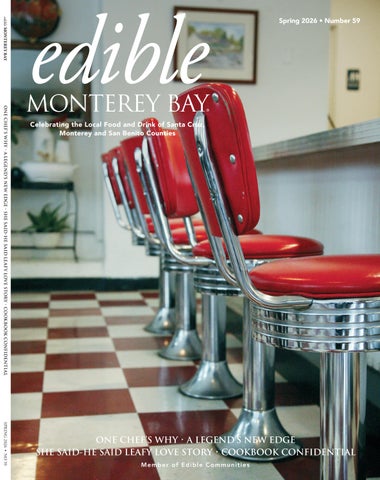
At JJ’s Homemade Burgers in San Juan Bautista, counter stool seating allows for peeks into the kitchen—and transmits old-school vibes, relatively speaking—until you view the carved scrawl on a weathered cement block, in the floor, by the front window, under a table, bordered by the vintage checkered flooring. It reads: “Dec 1 1919.”
Photo by Kelly Rose Evans
CONTENTS PHOTOGRAPH
Despite its bright color, the front door at Cella slips under the radar compared to that of its more prominently placed sibling Alta Bakery, making what awaits inside that much more of a reveal.
Photo by Patrick Tregenza
GRIST FOR THE MILL
Where should we eat? That simple question can be a little fraught at my house.
Do we pick one of our tried-and-true restaurants and, most likely, order the same favorite dish as always? Or should we try someplace different and risk being disappointed with our meal?
Do we feel like changing into nice clothes and splurging? Or is it better to just duck out for a quick casual bite?
Do we want to eat light or are we super hungry? Will it be Mexican? Thai? Seafood?
Seems like my husband and I are rarely on the same wavelength when it comes to dining out. I imagine readers often face the same dilemma, but Edible Monterey Bay is here to help.
Our Dine Local Guide, found at the back of every issue and on our website, should be your first stop when deciding where to dine. Restaurants listed there prioritize local, seasonal cuisine and through their advertising dollars help us publish this magazine.
This Spring Issue you’re reading is especially rich in restaurant intel. Our reporters have been out roaming the tri-county area and in these pages reveal some of their favorite haunts from Soquel to San Juan Bautista.
We also take a look at the remarkable career of Cal Stamenov—one of the best-loved chefs on the Monterey Peninsula, and a mentor whose influence extends into the kitchens of countless local restaurants, beyond the one where he currently works at Cella in Monterey.
Contributor Analuisa Béjar recounts the fascinating tale of how she helped chefs in Mexico gain the respect they deserve and participate year after year in the prestigious Bocuse d’Or competition in France.
Wine writer Laura Ness spots a rising young winemaking talent in the Santa Cruz Mountains, farmer Jamie Collins explains why you need to look for Bloomsdale spinach at the farmers market this spring, while first-time contributor and KRML radio personality Jeff White searches out local spirits.
Spring is always my favorite season. I love the longer days and can’t wait to plant my vegetable garden. All of us at Edible Monterey Bay look forward to celebrating the season and meeting readers at our Spring Issue Release Party March 27 at lovely Asilomar Conference Grounds in Pacific Grove. Sign up for our weekly newsletter to get party details and keep up on local food news. See you there!
Deborah Luhrman Publisher
Our Mission
At Edible Monterey Bay , our mission is to celebrate the local food culture of Santa Cruz, San Benito and Monterey counties, season by season. We believe in sustainability, and we believe everyone has a right to healthful, clean and affordable food. We think knowing where our food comes from is powerful, and we hope our magazine, website and newsletters inspire readers to get to know and support our local growers, fishers, chefs, vintners and food artisans.
EDITOR AND PUBLISHER
Deborah Luhrman
deborah@ediblemontereybay.com
831.600.8281
FOUNDERS
Sarah Wood and Rob Fisher
MANAGING EDITOR
Mark C. Anderson
COPY EDITOR
Doug Adrianson
LAYOUT & DESIGN
Matthew Freeman and Tina Bossy-Freeman
AD DESIGNERS
Louise Androlia • Julie Greene • Cat Kahnle • Coline LeConte • Sarah Owens • Sarah Williams
CONTRIBUTORS
Analuisa Béjar • Jamie Collins • Molly DeCoudreaux • Robert Eliason • Kelly Rose Evans • Glen McDowell • Laura Ness • Geneva Rico • David Schmalz • Sarah Thornton • Stuart Thornton • Patrick Tregenza • Amber Turpin • Jeff White
ADVERTISING SALES
ads@ediblemontereybay.com • 831.600.8281
Shelby Lambert shelby@ediblemontereybay.com
Kate Robbins kate@ediblemontereybay.com
Aga Simpson aga@ediblemontereybay.com
Fran Fitzharris fran@ediblemontereybay.com
DISTRIBUTION MANAGER
Mick Freeman • 831.419.2975
CONTACT US: Edible Monterey Bay P.O. Box 487 Santa Cruz, CA 95061 ediblemontereybay.com 831.600.8281 info@ediblemontereybay.com
CONTRIBUTORS
For those who hope to know who grows their blackberries and catches their black cod, here are the folks who compose the storytelling on Edible Monterey Bay’s pages.
Mark C. Anderson, EMB’s managing editor and former Orcas Hotel dishwasher, believes in bidets, travel, composting, food waste reduction and the idea every American should work in a restaurant in order to graduate high school. “Ring” him via mark@ediblemontereybay.com.
Analuisa Béjar —a native of Mexico City and award-winning writer, editor, food critic, recipe developer and culinary teacher—continues exploring flavor at her Sunny Bakery Cafe in Carmel Valley.
Jamie Collins is an active farmer-entrepreneur at Serendipity Farms, avid cyclist, recreational fisherwoman and best-practices coach for CCOF, offering support for farmers on organic certification. More at ccof.org.
Robert Eliason has been joyfully documenting the wineries, breweries, and artisanal food wizards of San Benito County for 16 years from his base in San Juan Bautista.
Kelly Rose Evans is a fan of family, photography and all the adventures in between. She also waits for crab season every year with baited breath and is wed to a Red Vines superfan.
Ryan Masters is a writer, musician and bodysurfer from Santa Cruz. More at RyanMasters831.com.
Laura Ness is a daydreamer, treehugger, vine lover and idealist who could live on butter lettuce, sourdough, burrata and Pinot Noir.
Geneva Rico is a pizza-loving photographer based in Watsonville, the heart of the Central Coast, who specializes in creative filmmaking, as well as wedding and commercial photography.
Sarah Thornton is a Monterey County native, music afficionado and theater enthusiast who believes good food is worth paying attention to, especially when eaten close to home.
Stuart Thornton fell in love with the California coast while working at the Big Sur Ranger Station. Currently, he travels the state to uncover finds for Moon Travel Guides. More at stuartthornton.com.
Patric k Tregenza has been drumming in local bands and elevating local lifestyle-, agriculture- and beverage-inspired imagery for several decades. More at ptfoto.com.
Amber Turpin is a freelance food-and-travel writer based in the Santa Cruz Mountains, where she writes from her kitchen table while gazing at flocks of wild turkeys and blooming quince trees.
Davi d Schmalz is a freelance writer who spent a decade as a staff writer at the Monterey County Weekly and believes anise is the most underrated spice.
Jeff White co-hosts “Friday Found Treasures” with EMB’s Mark C. Anderson every tail end of the week around noon on KRML 94.7, where he’s general manager. More at krml.com.
EDIBLE NOTABLE
NATURAL CARETAKER
Full Circle Wine makes a striking debut with bold terroir and old wisdom
PHOTOS BY GENEVA RICO
BY LAURA NESS
Tyler Wister feels at home in the outdoors—and behind the wheel of a tractor.
Felton native Tyler Wister has striking blue eyes. Unlike the steely gaze of Clint Eastwood’s, these are pools of serenity. Windows into a Zen mindset.
He exudes the calm of a born caretaker, reminiscent of a ship’s captain to whom you would trust your life.
So it’s fitting Wister ended up being a tender of the vines. Fulfillment in life can follow a poetic path, which helped inspire the name for his label.
“Full Circle Wines came about because I was [already] growing fruit and wanted to see it come full circle,” Wister explains. “Wine is a closed-loop system, from shoot growth and the process of converting sunlight energy into fruit, and eventually a wine glass.” (See “Taking Shape” sidebar, p. 9.)
One look at the image on a Full Circle bottle—a dandelion about to scatter its seeds to the wind—and you get a sense of the man’s philosophy.
“I’m attracted to recurring patterns in nature, and while I was mowing the lawn, I saw this dandelion and took a closeup shot,” he says. “There is beauty all around. We just need to take a closer look.”
There are other circular aspects to his life. Long before he developed a passion for working with dirt full time, he was simply at home outside.
“The family was always camping,” he says. “Plus, I was an avid Boy Scout.”
Classes like horticulture, solar design and green buildings at Cabrillo College, where he was majoring in construction and energy management, engendered his love of ag.
At the time, he was a social worker specializing in assisting the developmentally disabled, empowered by years of caring for his brother, who has Down syndrome. Then a high school pal, who was connected to Roberts Ranch Vineyards in Ben Lomond, asked him to assist with the 2016 harvest.
“I took time off work and helped them out for a week—and fell in love,” Wister says.
Suddenly, when he wasn’t doing social work, he was working to build a crush pad. Then his first real wine job came as a cellar rat working for Ryan Beauregard at Beauregard Vineyards. It was grunt work, but it’s a vital part of the feeder system in the wine business.
From there his fascination with organic farming, biodynamics and permaculture led to what he calls “a rabbit hole of seminars and retreats,” including a year-long course at the Bolinas Regenerative Design Institute, and more biodynamic wine conferences after that.
“I read loads of books and was self-educated and got involved with a community garden,” he recalls, “but I was not necessarily into wine.”
Beauregard, who is famously hard to impress, describes Wister as “an incredibly nice guy”—and knows him to be a hard worker after they spent the 2018 vintage together. But he still wanted to test Wister’s mettle.
“Basically, it was low-level stuff: clean this, repair that, build a fence,” he says. It’s the kind of grind Beauregard himself did at his first job in the wine industry, at Hallcrest Vineyards.
Wister was all in, eager to learn his new mentor’s gentle techniques for maximizing the expression of terroir, and learning about native fermentations from an expert.
“I wanted to follow the native and whole-cluster method of ‘natural’ wine, where you utilize the yeast that comes in on the fruit,” says Wister.
After making his first vintage of wine at Beauregard, and then some in his home cellar, Wister moved his barrels to winemaker John Benedetti’s Sante Arcangeli Winery in Aromas.
Wister met Benedetti while farming Lester Family Vineyard in Corralitos, where Benedetti is also the winemaker. Wister asked if Benedetti needed a cellar assistant, and when an opening emerged, Wister had another gifted mentor.
“[Benedetti] is super calm and has a lot of tools in the toolbox,” Wister says, emphasizing Benedetti’s ability to limit intervention. “He knows just how to handle things to make beautiful wines.”
The transcendent lesson: Spend more time in the vineyard than you do in the cellar. Shepherd the grapes to capture the best of sun, soil and weather. Let the wine tell the story of that trip around the sun. Embrace the circle.
As Wister says, “I fell in love with wine through the act of farming.”
Wister took over as vineyard manager at Lester in 2020, working closely with Benedetti, grower and maker. I can see them in the cellar, moving in the mirrored play of harmony. The two are very much alike.
“I have so many people to be thankful for in the wine industry, especially my mentors, like Ryan Beauregard and [legendary Sonoma winemaker] James MacPhail,” Benedetti says. “One of the greatest honors of my life is to be able to pay it forward. Tyler is a fantastic investment in that regard.
“I’m so proud of him and the wines he is making.”
Five years after becoming vineyard manager, Wister debuted his
“I’m attracted to recurring patterns in nature. There is beauty all around. We just need to take a closer look.”
own brand. (He continues to work as a consultant at Lester, as well as for Saveria and Christie, two other Santa Cruz Mountain vineyards.)
These days Benedetti lets Wister do pop-up tastings at the Sante Arcangeli tasting room in Aptos. Those sessions reveal some subtle differences in the loyal colleagues’ approach: Wister is strictly into native fermentations and neutral oak, whereas Benedetti inoculates and leans towards some new wood.
Unsurprisingly, given his influences—and passion for natural expressions—Wister describes his style as non-manipulative.
“I tend to pick earlier and fresher with bright acidity, and I love [using] whole cluster,” he says. “Both my Pinot Noir and Syrah have way more than 50%.”
Wister jumped at the chance to source some of his heartthrob varietal, Syrah, from Zayante Vineyard in 2021. He also cherishes the fact that he once caught a glimpse of the man who planted Zayante by hand, the late Greg Nolten, at the farmers market in Felton.
“It’s my favorite vineyard and fruit,” says Wister. “It checks off all the boxes: It’s old and wild and the vines are own-rooted. I love it. Zayante should seriously be put on the map—and on a pedestal. It is a beautiful, world-class vineyard, and worthy of a Grand Cru designation.”
If the Zayante Syrah Wister is now pouring is any indication, the storied vineyard and its latest advocate are already enjoying a full circle journey together.
Follow Full Circle Wines & Vineyard Services via @full_circle_wines on Instagram.
TAKING SHAPE
A two-step taste test reveals a truth: This new brand is a wowser to watch
There are some promising wines on the way from Tyler Wister, a 50/50 Lester and Split Rail Chardonnay, which represents the first time he was able to score fruit from the latter. That’s resting in a concrete egg and will be bottled early spring. Also to come: a 2025 Rosé of Grenache from Zayante. He’s contemplating the addition of an aromatic white, or two. Stay tuned. For now, he has two impressive examples of his bottled philosophy.
2023 Full Circle Pinot Noir, Lester Vineyard
Wood-tinged whole-cluster dominates here, with brazen notes of sassafras, wild cherry, dark licorice and deep woods herbaceousness. Yet, it has a floral element that is so appealing. At 12.9%, this wine punches way above its ABV and delivers stewed strawberry jam with cinnamon stick, toying with pomegranate and red licorice. Smooth and supple, this is high-toned and jazzy Pinot Noir.
2023 Full Circle Syrah, Zayante Vineyard
Nostril-ripping pepper and spice take your sensory organs on a thrill ride with this fresh and unstoppable roller coaster of a Syrah. Seamless, layered and relentless, it has earthgrounded power, yet soars with red- and blue-fruited energy. Frankly, all Syrah should be completely engaging, although few will attain this level of riveting.
WHAT’S IN SEASON
Bloomsdale Spinach
How a textured varietal triumphs over other greens in the field and on the plate
BY JAMIE COLLINS
STORY
Popeye the Sailor never had it so good.
Bloomsdale spinach ( Spinacia oleracea ) is an heirloom variety that was developed in the 1800s, but was not popular in the U.S. until the 19th century. It was grown before hybrid spinach cultivars were developed, and earned popularity because it was one of the earliest spinach varieties slow to bolt (or flower) when temperatures got warmer.
Because of its crinkly leaves, it also naturally repels water better than flat-leaf spinach, making it less likely to rot in wet weather. In an era before fungicides and plastic row covers, this made Bloomsdale spinach desirable, protecting it from disease.
Its sturdy leaves also hold up better to cooking, sauces and salad dressings than flat-leaf types. The wrinkles in the leaf change how the flavor hits your tongue and trap the important components that make a meal taste great—the acids, oils and salt!
Bloomsdale might still be more mainstream if the signature wrinkles didn’t have a downside: They’re harder to wash, and take up more space because the leaves don’t lie flat, which means Bloomsdale didn’t stack as many pounds per crate as flat-leaf.
It is safe to say that modernization and convenience factors caused Bloomsdale to be a rare leafy green that’s difficult to locate unless you visit the farmers market, though even there it can be a hard find.
Heirloom Organics out of Hollister grows it—if you are willing to drive beyond the Monterey Peninsula you can also find it at the Saratoga, Palo Alto or Menlo Park farmers markets on Sundays or the Ferry Plaza in San Francisco on Saturdays.
The local restaurants that buy Heirloom Organic Gardens’ spinach are largely centered in Carmel: La Bicyclette, Mission Bistro, Anton & Michel.
“All of my customers say that Bloomsdale is the best-tasting spinach out there,” says farmer Grant Brians. “It has lower oxalic acid, therefore you get higher nutrition. It is harder to grow than regular, flat-leaf spinach but because the flavor is so good it’s worth the extra effort and potential for crop loss.”
At Serendipity we have a dedicated following for our Bloomsdale spinach—customers enjoy the deep, dark green color and the earthy and sweet flavor so much it has them filling several bags each week. Some get absolutely giddy when they discover we are harvesting it, which is a treat for me to experience.
They boast about how delicious it is and how good it makes them feel to eat it. I describe the spinach as “mineral-y” and customers agree, saying that is exactly the word to describe it.
It could also be the rich Carmel
soil that adds to the taste, but Bloomsdale spinach in general retains more flavor and holds up much better than the watery flat-leaf types that wilt away to nothing when cooked. Bloomsdale—aka savoy spinach—is great for both cooked and raw applications.
Bloomsdale has more eye-protective compounds than regular spinach due to the slower growth and thicker leaves, which accumulate more lutein and zeaxanthin. Spinach is also rich in iron and folate and has substantial amounts of vitamin K; its nutrients support healthy circulation, vision, brain function, bones, memory and workout recovery due to the high amounts of potassium and magnesium.
Growing Bloomsdale Spinach
The heirloom variety is the original “Bloomsdale” spinach but there are now hybrids with mildew resistance that are just as delicious and come from the original genetics. Platypus is a variety I have used for many years as an all-purpose, highly savoy variety that can be grown spring through fall and even in drier winter months.
Platypus is bred from Rijk Zwaan seeds—they do seed trials right in San Juan Bautista—and are constantly bringing new hybrid Bloomsdale seeds to market based on the newest mildew race resistance. Often the varieties have animal names like Raccoon and Kookaburra, both of which we have planted successfully.
The heirloom Bloomsdale is still a great variety to grow; however, it is best for a summer crop when mildew is not an issue because it does not have as much resistance as the hybrids.
Like many, Bicyclette Chef Obdiel Luna Narciso (opposite) prizes Bloomsdale spinach, aka savoy spinach, for its earthy richness and tangy aftertaste.
The wrinkles in the leaf change how the flavor hits your tongue and trap the important components that make a meal taste great—the acids, oils and salt!
Bloomsdale spinach can be grown almost year-round in mild climates such as coastal Monterey County. All types of spinach prefer cooler temperatures that do not receive frost. It takes about 50–60 days from seed to harvest for spinach to mature.
weeks to have a steady harvest without gaps in production.
Eating Bloomsdale
RESTAURANT AWARD WINNER
We harvest our Bloomsdale with the little pink stems attached and tell customers to be sure not to trim them off, because they are the sweetest part. Once plants are 3 to 4 inches tall, they can be harvested and left for a second crop to regrow if the inner baby leaves are left intact, meaning do not cut the spinach so low that it does not have any leaves left.
Spinach is typically planted in early spring through fall, unless you are on the temperate coast where certain varieties can be grown through the winter. However, excess rain may turn the leaves yellow, so it is important to plant into well-drained soil and to not overwater. Top dress your newly planted beds with high-quality compost to keep the plants healthy.
Plant seeds directly in full sun and welldrained soil, about ½ inch deep. If you want to harvest baby spinach, plant the seeds three inches apart, or for full-size spinach plant them 6 inches apart. (The best flavor comes from baby to medium-size leaves.)
There is no need to grow spinach from transplants because they sprout in just 7 to 14 days, which is quick compared to a crop like carrots where weeds grow much quicker.
The first leaves—called cotyledons— are about a half inch in length and straight, looking nothing like the wrinkly first true leaves of the spinach plant. Keep the baby plants weed free; weeding with a hula hoe between the plants helps aerate the soil and keeps the roots happy. Replant every 2 to 3
I love Bloomsdale spinach simply sautéed with olive oil, or garlic and salt and pepper. Or add cream to this sauté, a dash of nutmeg, and top with a sprinkle of Parmesan cheese. Lemon and chili oil or flakes also uplifts a spinach sauté.
Spinach is also delightful paired with risotto and mushrooms and a 50/50 ratio of spinach to rice. When I am baking a whole chicken, I will stuff the bird with chopped spinach and sweet onions, which makes a delicious side dish due to the drippings from the chicken.
Because Bloomsdale has body, it is the best type to make salads with. Try making a salad with blueberries, a strong cheese, smoked salmon and toasted nuts like walnuts or pine nuts and a vinaigrette.
Another idea is an upgraded spinach dip: Sauté the spinach with garlic and onions and let cool, then fold into plain Greek yogurt, add some avocado-oil mayo, freshly grated parmesan, the juice of one lemon and its zest, salt, pepper and bake it at 375° for 20 minutes, until it bubbles. Top with fresh chives.
How about adding it to the top of pizza or putting it in a quesadilla? I am always looking for ways to make meals healthier and spinach is an easy one to add to almost everything.
I hope you get to try some local Bloomsdale spinach and see for yourself how it compares in flavor to basic prewashed spinach. Since availability seems to be limited to a few restaurants, you might have to visit your local farmers market and scout it out for yourself!
Bloomsdale Spinach Cannelloni
Courtesy of Executive Chef Obdiel Luna Narciso, La Bicyclette in Carmel
At the wildly popular La Bicyclette, Executive Chef Obdiel Luna Narciso likes to believe he brings more than skill to the kitchen. As his bio describes, he evokes a story, namely one centered around “a deep reverence for the land, the people, and the quiet beauty found in a well-prepared meal.”
This dish, like many of his, comes rooted in French-Italian country tradition, but borrows from his own travels and memories. “For me, cooking is about more than technique,” he says. “It’s about bringing a sense of place and history to the table, and making people feel truly at home in the moment.” The fresh and indulgent comfort of his cannelloni achieves precisely that.
Spinach–Ricotta Filling
1 pound fresh spinach
1 pound ricotta cheese
¼ cup pesto
¼ cup finely grated Parmesan cheese
Pinch of nutmeg
½ tablespoon freshly ground black pepper
1 tablespoon salt
Olive oil, for sautéing
Béchamel Sauce
100 grams unsalted butter
90 grams all-purpose flour
4 cups milk, warmed if possible
Pinch of nutmeg
1 bay leaf
Tomato Sauce
1 can San Marzano tomatoes
4 tablespoons olive oil
1 yellow onion, finely diced
4 cloves garlic, finely diced
1 bunch fresh basil, chopped
Salt, to taste
Cannelloni pasta tubes
Extra Parmesan cheese, for baking (optional)
To make Spinach–Ricotta Filling: Warm a drizzle of olive oil in a wide pan over medium heat. Add the spinach and sauté until completely wilted. Remove from the heat and allow to cool fully, then squeeze out any excess moisture and chop very finely.
In a large bowl, combine the spinach with the ricotta, pesto, Parmesan, nutmeg, black pepper and salt. Mix until smooth and well blended. Transfer the filling to a piping bag and set aside.
To make Béchamel Sauce: Melt the butter in a saucepan over low heat. Add the flour and cook, stirring constantly, for about 3 minutes, taking care not to let it brown. Remove the pan from the heat and gradually whisk in the milk until smooth.
Return the saucepan to low heat, add the nutmeg and bay leaf and cook gently, stirring, until the sauce thickens slightly, about 5 minutes. Remove and discard the bay leaf. Let cool briefly, then transfer to a piping bag if desired.
To make Tomato Sauce: Heat the olive oil in a heavy pot over low heat. Add the onion and garlic and cook gently until soft and translucent, about 5 minutes, without browning. Add the tomatoes, crushing them by hand or with a spoon, then stir in the basil. Simmer over low heat for about 1 hour, stirring occasionally, until rich and fragrant. Season with salt to taste.
To assemble and finish: Preheat the oven to 375°F (190°C). Spread a thin layer of tomato sauce over the bottom of a baking dish.
Pipe the spinach–ricotta filling into the cannelloni tubes and arrange them in a single layer in the dish.
Spoon the remaining tomato sauce over the pasta, then pour the béchamel evenly on top. Finish with a scattering of Parmesan, if using. Makes 18 tubes.
Cover the dish with foil and bake for 30 minutes. Remove the foil and continue baking until bubbling and lightly golden, 10–15 minutes more. Let rest for 10 minutes before serving.
Serves 6.
The Spring Table
A vernal gathering of local wines and provisions from around the Monterey Bay
HOSTED BY A TASTE OF MONTEREY
Hiding in plain sight upstairs on Cannery Row, A Taste of Monterey enjoys extraordinary views of the bay, marine life and nautical activity. Now under the new ownership of Britt Talbert, it offers a menu to match the setting and strong selection of local wines. Executive Chef Bruce Finch and General Manager Jasmine Hernandez invite you to stop by for a salad, panini, flatbread pizza or sharable appetizer with a flight of wine or local craft beer. They welcome groups and it’s a perfect spot for private events. atasteofmonterey.com
Cold Pressed Lemon Olive Oil and Estate Grown Tuscan Extra Virgin Olive Oil from Santa Cruz County Belle Farms | Farmers Markets and Independent Grocers bellefarms.com | @bellefarmsevoo
2021 Blanc de Blanc Sparkling Wine, Escolle Vineyard
Borba Family Farms | Aromas borbafamilyfarms.com | @borbafamilyfarms
2022 Estate Pinot Noir Bell Ranch, 2024 Sauvignon Blanc Zabala Vineyard, 2024 Estate Rosé of Pinot Noir
Corral Wine Co. | Carmel Valley corralwine.com | @corralwineco
Assorted Chocolates and Sea Salt Caramels
Lula's Chocolates | 2 Harris Ct. Monterey, Crossroads Carmel and Carmel Plaza lulas.com | @lulaschocolates
Curated by Aga Simpson
Photo by Glen McDowell
Photo by Mark C. Anderson
CULINARY IDENTITY
A Recipe for Why
How this chef-author braved the world’s toughest culinary competition and helped change Mexican cuisine
BY ANALUISA BÉJAR
Pierre Orsi, our mentor, was yelling in French. “Il est mort! Il est mort!” (“He’s dead! He’s dead!”)
Orsi was evaluating the chances of one Gerardo Rivera, the young chef who, in a few hours, would be representing the entire country of Mexico, in front of the whole world, at the prestigious Bocuse d’Or in Lyon, France.
The competition was—and still is—the World Cup, the Olympics, the ultimate worldwide showdown related to food.
Participating nations prep for months and their teams include 24 members. For decades it has been the stage where innovation, trends and star chefs all rise.
Its creator, the legendary Paul Bocuse, was a close friend of Orsi, and the original celebrity chef, the philosophical leader of a generation.
The year was 1999.
The twist: Chef Gerardo Rivera was standing right there as Orsi repeated the same phrase, the tone of his voice going up and down.
Rivera didn’t speak French.
Besides helping with chef training alongside my friend/ colleague/fellow chef Olivier Lombard, I was in charge of logistics, shopping and—not always happily—translating.
Rivera stared at me inquisitively, wondering what Orsi was shouting about.
The author at her Sunny Bakery Cafe counter in Carmel Valley, riding a career move she compares to Remy’s choice at the end of Ratatouille, when the resourceful rodent shifts from big city bustle to a modest shop in a more relaxed community. Guests can expect both French- and Mexican- inspired pastries, with plenty of Monterey Bay-centered inspiration too.
I didn’t know what to say, and wasn’t really thinking about it. I was wondering whether all this chaos was worth it. In other words, I was wondering why we were doing it.
Maybe it wasn’t the best time for personal reflection.
THE FIRE’S INTENSITY
It was not our first Bocuse d’Or rodeo, nor the second. But despite Orsi’s misgivings, it was our best shot to impress— though that wasn’t saying much.
To date, Mexico’s participation in the competition had been less than stellar. In our defense, we were the first Latin American country to take part, with barely enough resources to travel, and contestants with limited experience. But we didn’t give up.
The first time, the only reason we didn’t place last was because two other teams did not finish on time. So we had that.
The American team, by comparison, had a budget several zeroes larger. Thomas Keller was their trainer. They reproduced a full-scale contest kitchen, equipment included, behind the French Laundry’s kitchen, where they worked for a year, with Daniel Boulud as consultant.
This year the platters they were using to serve their entries had an internal heating element that hid cables and batteries under a pristine mirror finish—and kept their food warm while it was paraded around pre-tasting.
We had hand-painted ceramics over a simple platter. And our food could get cold.
Orsi’s opinion carried serious weight. He was not only Bocuse’s closest friend, but his disciple. He had personally taken on working with our team at Bocuse’s request, at Bocuse’s namesake school near Lyon, while getting produce at Bocuse’s namesake market.
The American team had a budget several zeroes larger. Thomas Keller was their trainer.
Apparently Bocuse had a weak spot for us rowdy Mexicans. We had invited him to Mexico City to share a few extremely fun meals, while observing and advising on our own smaller-scale contests.
When we finally made it to France, he loved how we brought a cheering section equipped with uniforms, flags and chants. Many European delegations, accustomed to respectful silence, took offense. Bocuse found it hilarious—and eventually the vocal support became the norm.
Meanwhile this latest competition carried additional gravitas because the way that many young chefs perceived the profession in Mexico was starting to change.
For generations, being a chef wasn’t anything glamorous or aspirational—and certainly nothing parents would be proud of.
Inclusion on stage in Lyon—and our news conferences back home introducing our delegation—legitimized a way of life: Once-lowly chefs could dream lofty dreams, and represent Mexico and our rich food culture at the highest level.
It also meant the hopes of countless Mexican chefs rested on Rivera.
Now he and his assistant were sleep deprived, stressed and declared “Dead!” by their mentor.
PREHEATING
Rivera arrived in Lyon by winning one of our regional and then a national showdown. A few months before the trip, he took a big risk in quitting his chef job and left co-ownership of a small neighborhood restaurant to train full time on a contract with our sponsors, Nestlé Foodservices. He bet his future on a risky endeavor.
My trip there took a different path, one that began in 1994, when I started out as a food and travel writer in Mexico City.
I had studied cooking in Canada and additional courses in New York, then worked with a food researcher back home. But I had always loved photography and design, and for me, food has always been about sharing knowledge and creating meaningful connections around the table, so I pursued the communication side.
It was then that I met Chef Lombard while covering his work. He was born in Paris, trained with the best in France and worked as a chef in Mexico City.
He headed a five-star hotel where the whole crew walked out because of his impossibly high standards.
Nestlé had hired him as a consultant because they wanted to create a publication for chefs, and I was offered the editor position.
The author (center opposite) with Olivier Lombard (left) and Paul Bocuse (right); the 100th anniversary of Bocuse’s birth on Feb. 11 touched off a wave of remembrances from the likes of Daniel Boulud and Thomas Keller.
Left, Mexico’s World Pastry Cup team in 2001, including pre-celebritystatus Paulina Abascal.
So began endless hours plotting the blueprint for what we envisioned as a better future for Mexican culinary professionals. Fortunately, there was plenty of food and wine on hand.
The first step was to cultivate more chefs, so we founded an association, the Vatel Club. Our motto, “Amistad Gastronómica, hermandad por México,” translates awkwardly—“Gastronomic friendship, brotherhood for Mexico”—but you get the idea. The key objective was to exchange expertise and help each other grow.
Back then, European chefs, most of them French, led the higher-end hotels and restaurants in Mexico. Most native cooks lacked access to culinary schools or formal training, and were not respected as professionals or bearers of the region’s incredible tradition.
Alongside the magazine, we launched a certified apprenticeship program and modest cooking-and-service contests. Done well, competitions are drivers for creating, learning, resilience building and idea sharing. They attract media and synergies with sponsors. Most of all, they open young eyes to possibilities.
Lombard got his French friends—including Bocuse, Orsi and other renowned
chefs—to visit Mexico and support our work, while sharing unforgettable meals, splashed with tequila.
We traveled the country to regional competitions, secured a prime space at a trade fair and created more contests: cooking, ice sculpture, pastry, bread. Our national competitions became the playoffs to make it to the Bocuse d’Or and the sibling World Pastry Cup, another hyper-competitive showdown in the same space.
Ultimately, we petitioned Sepelcom, the company that organizes those events, to become the official selecting body for Latin America’s entrants for both the Bocuse d’Or and World Pastry Cup.
That 12-year journey was chronicled in our magazines, De Chef a Chef, and later, Sobre la mesa
Every two years we traveled to France for the contests and trained during a couple of weeks what had been developed back home for months, so the team could familiarize with the grueling circumstances, different ingredients and even the lower altitude and its effects on cooking. (Mexico City sits at 7,350 feet.)
Some team members had never flown on a plane, nor tasted the competition’s main ingredients.
I wrote about so much more than food, and enjoyed a front row seat watching how a food revolution happened on our Mexican tables
Over the years we refined the routine: I would make sure everybody was up and ready to go at odd hours, and drive our budget van in the snow to the Halles Paul Bocuse market.
We would meet vendors, shop and drive to the training kitchen. The chefs would gradually work into completing the five hours and two dishes the contest required, and serve the results, study feedback, have dinner together, plan ahead, go to bed for a few short hours and start again.
There were tears, drama, and nostalgia for home—especially food. One entrant couldn’t feel his feet as his socks were too thin, having never experienced winter weather. For others, the lack of proper chiles in French cuisine was the most disorienting challenge of the whole trip.
Once I had to use my press pass to go backstage and talk a candidate into continuing. At the time he was sitting on a box, weeping with stress. Inside I was weeping with him, but not letting on.
There were also incredible meals, like a dinner at Bocuse’s legendary L'Auberge du Pont de Collonges, where we sat down in a private room with 10 of his closest chef friends in Lyon as he portioned his famous whole loup en croute, stuffed seabass in a flaky puff pastry, with a pristine Béarnaise sauce, while laughing about how his million-dollar restaurant wine cellar would flood every January.
Or one with Orsi feeding us truffles as if they were potato chips—all while standing in his Restaurant Pierre Orsi kitchen as he multitasked during a whirlwind service, huge trays laden with plates zooming
by as he ran the pass.
Over years of attending, I eventually learned the organizers loved our underdog spirit—and saw the potential for growth in Latin America—so even if our earlier contestants placed close to last, we earned their camaraderie and companionship.
They did bestow “Best Team Spirit,” “Best Poster and Promotion” and “Best Assistant” awards on us, hoping the good news reported back home would buy us another round of support from sponsors. Those experiences also paved the way to fantastic opportunities for me.
I developed recipes for food companies and collaborated on other publications. I co-authored an award-winning pastry book collection with one of the contestants who had participated at the World Pastry Cup, Paulina Abascal, who’s now a full-blown celebrity chef in Latin America.
And I was invited by Reforma, one of the biggest and most influential newspapers in Mexico City, to be part of the food section’s editorial board—and later, take the dream job of being an anonymous restaurant critic in bustling Mexico City, when its greater metro area included 18 million people, before it became a global gastronomic destination.
I wrote weekly about chefs and their struggles, servers and their dance to be there without overwhelming, and other complexities in sourcing, light, music, noise.
Some were written out of disappointment and dark humor, as a consumer hoping to share insight; others, out of love and admiration.
I wrote about Lalo Garcia, whose restaurant is Maximo—one of my favorites that I have dined in, ever—from the first week it opened. It offers modern Mexican touches, food grown organically in the storied canals of Xochimilco, with zero fear of butter. That was all made more meaningful by what he overcame, including younger years in a migrant fieldworking family, and deportation from the U.S., where he had worked in kitchens.
And young chef Lucho Martinez—now a Michelin star chef himself—as he introduced a new generation unafraid to experiment but resolute on retaining regional identity. He has a new discipline, pride and respect for the profession I could taste across Japanese, Mexican and French nuances.
I highlighted my favorite quesadilla in the city, which came from a super-basic stall in the Coyoacán market, and how all the elements of a great dish can be found sitting on cheap plastic stools around a weathered comal.
For a dozen years, I wrote about so much more than food—about gestures and intuition, knowledge that starts in the kitchen and extends well beyond—and enjoyed a front row seat watching how a food revolution happened on our Mexican tables.
Part of it had to do with the professionalization of the cooks and chefs that I was proud to help develop.
BACK TO BOILING
Back at our training kitchen at Bocuse’s school, pre-competition, Chef Rivera asked, softly, what Pierre Orsi was yelling about.
Awkward silence.
I saw dread in Gerardo’s eyes. I can remember them perfectly. But he was also squinting—almost defiantly, like, “What else?”
He knew something was wrong. But he had survived the tirades already: Just the night before, famously difficult Lombard said Rivera should give up and go polish shoes in Chapultepec Park. Lombard hoped he would break him, force him to have a good cry and release the building tension. But he did not.
Orsi was upset about the subtle differences that were not quite there, and would have to be to earn top grades. Timing, precise cuts, stunning visuals and the right temperature weren’t enough.
Taste had the highest marks.
Rivera asked again. I didn’t translate literally.
I reassured the young chef he needed to work on seasoning, that we had come so far, and so many people were rooting for him to succeed.
Then I added, “Todo en orden.” We’re good to go.
FLASH POINT
That was a long night for everyone, especially Rivera. But through the grueling selection and training process, he always showed a willingness to learn and grow. And I knew he had the necessary skills.
The Vatel Club’s epicurean education efforts extend to youth workshops, including one attended long ago by the author’s son (second from right).
But there were more, and different, ingredients becoming mainstream. Sustainability and a strong sense of place became part of the dialogue. Chefs at the top of their game from other Mexican regions—and from Italy, Japan, even the San Francisco Bay Area—came to create new places. Many strong and diverse voices, with lots to say.
They just needed to come out at the right time, despite the pressure, and the odds.
The moment the competition started he had a peaceful focus that aided his time management immensely. He just got to work, no distractions or doubts allowed.
Watching him and our team hustle, I couldn’t stop the smile from breaking my game face. This was why the chaos was worth it.
We placed ninth out of 24 countries; sixth in the meat category with their pigeon with avocado leaf jus, which was spectacular. Our fish with confit tomato received a wave of good comments, for its touch of guajillo chile specifically, which I’ve always remembered.
It was the highest Mexican competitive achievement yet.
LETTING IT COOL
So as it turned out, Rivera wasn’t dead yet. And he’s thriving now, one of the greatest success stories of the early Vatel Club: He went on to become the executive chef of Grupo Posadas, a network of 200 hotels in Mexico and Latin America.
Twenty-seven years later, you can taste his creative and technically masterful cuisine in their top gourmet resorts. He still reflects on the lessons learned at Bocuse d’Or—on the importance of technique as a
Signature craveables at Sunny Bakery Cafe include cinnamon rolls, cookies, BLTs and everything bagels loaded with the likes of smoked salmon and seasonal produce.
building block for executing, for instance—with delicacy.
Most importantly, he has trained thousands of people in different areas of the industry. That gets back to why I—we—did what we did: to share knowledge that would open possibilities.
I continue to ponder why I do what I do. Nowadays it’s centered around my Sunny Bakery Cafe in Carmel Valley, and how to offer a better experience and be a better part of my newish and welcoming community. It’s really the same core idea we applied with our underdog Mexico team: build.
Food—like so many things—is fleeting. It changes fast. It reflects only a moment. But it’s also an opportunity for connection, and a mirror of who we are as humans.
And one of the better parts of being human is elevating those around us, whether by teaching, writing or fortifying them with a good meal, ideally with a gentle kick of Mexican chile.
More at sunnycarmelvalley.com.
Save $10 per person with a complimentary lemonade, coffee & tea package when you book before May 20, 2026
Rockfish with Guajillo Herb Beurre Blanc and Roasted Tomatoes
Courtesy of chef Analuisa Béjar, Sunny Cafe in Carmel Valley
This recipe combines the flavors that received great comments at the Bocuse d’Or, and reflects the era it was created, including a super-classic French sauce with confit tomatoes that were rising as a trend.
Guajillo and herb beurre blanc
1 tablespoon white wine vinegar
½ cup white wine
1 tablespoon finely chopped shallot
150 grams butter, cut into cubes
1 tablespoon guajillo chile purée
1 tablespoon dill or any other fresh herb, chopped
Salt and pepper
Simmer the vinegar, wine, shallot and pepper in a saucepan until reduced to about a tablespoon.
Strain through a fine sieve and return to a small saucepan. Warm the mixture gently and whisk in the butter gradually, being careful not to heat it too much—this will help create a smooth emulsion without melting the butter completely.
If trying the sauce for the first time, adding a tablespoon of heavy cream to the reduction helps keep the sauce stable. Season with salt. Add fresh herbs and guajillo purée when serving.
Roasted tomatoes
12 large grape or small plum tomatoes
Celery salt and pepper
1 cup olive oil
1 large clove garlic, thinly sliced
1 sprig thyme
Cut the tomatoes in half and place them in a shallow baking dish.
Season with celery salt and pepper. Cover with olive oil, then add garlic and thyme. Bake in a 200 ºF oven (no need to preheat) for 1 hour, or until the tomatoes are reduced without browning and the skins peel off easily.
Save the tomato-infused olive oil for cooking the fish and for use in salads or pasta.
For the fish
4 rockfish fillets (or substitute with local fish, shrimp or scallops)
1 small chayote squash or zucchini, blanched
Salt and pepper
Season the fillets with salt and pepper. Warm ¼ cup of the reserved tomato-infused olive oil in a skillet over medium heat, and sauté the fish fillets for 2–3 minutes per side, until barely cooked through.
Serve the fish on top of blanched chayote, along with the confit tomatoes. Finish with the guajillo beurre blanc sauce and herbs.
Serves 4.
Photo by Patrick Tregenza
Chicken Breasts in Avocado Leaf and Orange with Artichokes Barigoule
Courtesy of chef Analuisa Béjar, Sunny Cafe in Carmel Valley
Avocado leaves are a staple in Oaxacan cooking, valued for their mild anise scent and ability to enhance beans, tamales and moles. They are great with fish or poultry. This is a simplified version of the recipe we served at the Bocuse d’Or. Barigoule is a classic Provençal garnish that is simple and perfect for artichokes, mushrooms or a combination of both.
4 avocado leaves (see note)
2 boneless skin-on chicken breasts
4 tablespoons butter
1 small white onion, sliced
1 small navel orange
3 cloves garlic
½ cup white wine
1 cup chicken stock
Salt and pepper
4 tablespoons olive oil
1 slice bacon, chopped
2 tablespoons chopped shallot
1 garlic clove, smashed
½ onion, thinly sliced
1 carrot, thinly sliced
¾ cup white wine
4 small or baby artichokes
1 sprig thyme
Salt and pepper
To make the Chicken Breasts: Preheat oven to 400ºF. On a griddle or dry pan, slightly toast the avocado leaves and crumble them with your hand.
Season the chicken breasts with salt and pepper and about a tablespoon of the crushed avocado leaves.
Butter a baking dish and arrange on the bottom the remaining avocado leaf, sliced onion, orange, whole garlic; and pour in the wine. Place the chicken breasts on top, cover with foil and bake for 15 minutes.
Remove foil and continue baking for 15 minutes more, or until done. Transfer the breasts to a plate and let them rest. Meanwhile, pour the chicken stock into the baking dish. Use a spoon to scrape up the browned bits. Simmer the liquid on the stovetop or return to the oven for about 5 minutes, until slightly reduced. Strain the sauce and serve over chicken.
To make the Artichokes Barigoule: Warm a saucepan and add oil, sauté bacon, shallot
garlic, onion and carrot, until softened but not browned. Season with salt and pepper.
Pour in wine and lower the heat.
Trim the artichokes by removing outer leaves, slice the top off, and cut in half. Take out the choke with a spoon. Add them to the pan as you go to prevent darkening. Incorporate thyme.
Simmer for 10 minutes or until the artichokes are cooked through. Serve.
Serves 2.
Note: Not all avocado leaf varieties are used for cooking; the appropriate examples have a pronounced anise smell when fresh. You can find them dried at Mexican grocery stores. They can be swapped out for dry oregano or sliced fennel.
Photo by Patrick Tregenza
Discover The Flavors of Downtown Salinas
Taste your way through Downtown Salinas. Indulge in mouthwatering meals at local eateries, cozy up with a cup of coffee from neighborhood cafés, and sip on craft brews at vibrant breweries and bars. Dine, Sip, Explore — Your next culinary adventure starts here!
Lingcod, Pacific • Rock Cod, aka Snapper or Rockfish • Sablefish, aka Black Cod • Salmon, King • Sanddabs, Pacific • Seabass, White
Sole (Dover and Petrale) • Spot Prawns • Squid
* May only ** March and April only
***April and May only
All fish listed are rated “Best Choice” or “Good Alternative” by the Monterey Bay Aquarium’s Seafood Watch program and are found in abundance in local waters. See www.seafoodwatch.org for more information.
Sealed with Excellence from Europe D.O. CAVA AND JAMÓN CONSORCIOSERRANO
In a world that often prioritizes speed over substance, there remains proof that good things, and excellent taste, take time. D.O. Cava and Jamón ConsorcioSerrano are two such treasures, each representing a unique blend of Spanish tradition and authenticity, guaranteed by seals that signify uncompromising quality.
D.O. Cava is a prestigious Designation of Origin from Europe renowned for its exceptional quality and versatility, crafted using the traditional method, which involves a second fermentation in the bottle. To receive the green, silver or gold quality label, or “marchamo”, a Cava wine must be wine certified by the Cava Regulatory Council. The regulatory body ensures that strict standards are met to maintain the excellence and authenticity of Cava, allowing it to consistently rank among the best sparkling wines internationally. As of 2025, all Cava under the D.O. Cava designation is 100% organic, making it the first major sparkling wine appellation in the world to achieve this milestone.
Similarly, the ConsorcioSerrano seal on Jamón Serrano is your assurance of exceptional quality. For 35 years, the Consorcio del Jamón Serrano Español has been dedicated to preserving the authenticity and excellence of this emblematic product. While European standards already require an impressive 30 weeks of curing, the Consorcio demands a minimum of 52 weeks— more than a year of patient perfection.
Each piece of Jamón ConsorcioSerrano comes from 100% Spanish pigs and is produced using traditional methods. But what truly sets it apart is the rigorous manual selection process: master ham experts personally examine every single piece, checking its texture, aroma, and flavor by hand to ensure it meets the highest standards. This dedication to craftsmanship has resulted in over 20 million pieces certified to date, representing 30-35% of all high-quality Serrano ham from Europe exported worldwide.
Both Cava and Jamón ConsorcioSerrano are perfect examples of how time-honored craftsmanship, underpinned by the European Union’s commitment to quality and tradition, creates products that are unmatched in their category.
Their seals are more than marks on a label— they are promises of authenticity, excellence, and the patient dedication that only time can deliver. Whether enjoyed on a special occasion or as part of your daily life, Cava and Jamón ConsorcioSerrano bring the best of Europe to your table.
Look for the Seal
The D.O. Cava and Jamón ConsorcioSerrano seals are your guarantee of true Spanish excellence. Two seals, one promise: the finest taste of Spain.
Learn more on our website
Protecting Farmland Means Protecting Our Future.
For Mel Coleman Jr., a fifth-generation Colorado rancher, protecting farmland isn’t just about preserving open spaces—it’s about safeguarding the foundation of our food system.
“Throughout my life, I’ve met good, hard working people all trying to do the right thing with the land and animals they care for,” Mel says. “American Farmland Trust (AFT) helps them do just that.”
As a long-time member and former board member, Mel has seen firsthand how AFT connects farmers and ranchers across the country with the tools, policy support, and resources they need to thrive.
From championing farmland protection in Washington, D.C. to helping family farms remain economically viable, AFT ensures that good stewardship—of land, water, and community—endures for generations.
“AFT isn’t just an organization,” Mel adds. “It’s a family that believes in the power of small farms and the people behind them. There’s no better way to make a real difference than to be part of that.”
Join Mel—and thousands of other members—who are protecting America’s farmland and the people who farm it.
Mel Coleman, Jr., Colorado Rancher & American Farmland Trust member since 2005
SANTA CRUZ COUNTY | SPRING 2026
Farmers Marke t s
Despite how silly it may sound for us to bid farewell to winter to the ears of folks in eastern states, we can still celebrate the arrival of spring here in the Monterey Bay. And while I had an iris bloom in early January at my house, I’m still excited about tender green peas and the first juicy strawberries and all the rest that our markets and gardens give forth this time of year. Because by now, haven’t we all learned that everything is…hardly definitive, just like the merging of our vague seasons?
Amber S. Turpin
Wednesd ay
Friday
Downtown Santa Cruz
Farmers Market
12:30-5pm • Year-round Cedar and Church Streets 831.454.0566 santacruzfarmersmarket.org
1 2
El Mercado
2-6pm • April through October Crestview Drive and Madison Street Watsonville 831.726.4269 • pvhealthtrust.org
Felton Farmers Market
1:30-5:30pm • May through October 120 Russell Avenue • 831.454.0566 santacruzfarmersmarket.org
Watsonville Certified
Farmers Market
2–7pm • Year-round Watsonville City Plaza, Peck & Main Streets 831.588.7366 facebook.com/watsonvillefarmersmarket
A husband and wife renew their vows for salads they would marry
By Sarah Thornton with Stuart Thornton
Photo by Kelly Rose Evans
The Cowboy Steak Salad
Three years ago, I was dubbed “the burger whisperer” by Edible Monterey Bay, reflecting my passion for the ground beef patty greats of the Western States—most memorably my enthusiastic endorsement of the happy-hour sliders at The Sardine Factory in Monterey.
But ultimately I was left with an aching question: Where do I go from here? Digestion issues contributed to my crisis.
That’s when a section of the menu I had long overlooked resurfaced: entrée salads.
What I had once dismissed as a compromise revealed itself as an opportunity to indulge my serious love of protein, in harmony with leafy greens.
My husband, State Parks guide and travel author Stuart Thornton, has long been ordering entrée salads with the quiet confidence of a man who knows what he likes.
So we set out to catalog our shared love of standout entrée salads, in service of the area’s eaters. Our aim was not to declare champions but to notice what keeps us coming back.
Navigating the tri-county area, we picked a few favorites and made some new discoveries.
From four different cities, here they come, north to south, he says–she says style.
—Sarah
Cosmos Bar & Grill
Hollister
He says: Knowing that Hollister is acclaimed more for its motorcycle rallies than its greens, we stop into the biker bar Johnny’s for a strong sipper before proceeding. Then we strike gold (and green) at Cosmos on Hollister’s main drag, San Benito Street.
Inside, the restaurant gives a classic steakhouse vibe. Having opened in September 2024 in a space that has seen other restaurants come and go, Cosmos is co-owned by two hospitality industry veterans who have worked at Ladera Grill, a fine-dining restaurant in Morgan Hill, and Pupusa Loca in Los Banos.
There are nine salads on the menu at Cosmos, including the popular beet and spinach salad, but it’s the Cowboy Steak Salad that gets our attention and order.
A true find, the artfully done entrée features a 10-ounce grilled New York steak on a bed of mixed lettuces topped with a peeled avocado curled into a flower, and some nice surprises including mounds of grilled corn and caramelized onion.
With a 14-ounce New York steak dinner entrée on the menu priced at $46, the steak salad at $26 presents a heck of a deal.
She says: When we roll up, we find Hollister’s main street tidy, quiet and traced by happy trees hung with twinkling white lights.
My ride-or-die and I are ready for anything, but we aren’t quite anticipating the elegance we encounter at Cosmos Bar and Grill—a romantic chophouse with moody lighting, roomy booths with plush seats and a full bar where the bartender can be heard shaking martinis.
The brilliance of the Cowboy Steak Salad comes from the ingredients resting beneath the juicy medium-rare steak: ripe avocado, sweet and smoky grilled corn and grilled onion transports one to a cookout in pastures of heaven at magic hour, surrounded by rose gold-tinted foothills.
500 San Benito St., Hollister • facebook.com/people/ Cosmos-Bar-Grill/61580266318614
Café Cruz Rosticceria & Bar
Soquel
He says: A go-to for us in the Santa Cruz area, Café Cruz on 41st Avenue is a personal favorite due in no small part to their large salads, which take up a quarter of the lunch menu.
Having celebrated its 30th anniversary last year, the popular Soquel restaurant dependably delivers with attentive service, killer cocktails and creative locally sourced cuisine, if one can survive the gladiatorial parking lot situation.
The chop salad and the blackened fish taco salad are the two most popular on the menu, according to our friendly and informative server, who has been at Café Cruz for over a decade.
Usually opting for the chop, I go with the fish taco salad this time so Mrs. T can get her favorite (and I can nibble from hers).
The seafood atop the greens rotates according to what’s fresh, and includes rockfish or ahi that is sourced sustainably with Stagnaro Brothers or Ocean2Table, the latter a collective of fishermen, farmers and community members.
Today it is two slabs of ahi with a blackened top and Barbie-pink interior. Tender and smartly seasoned, the ahi stands out, but the dish gets able assistance from shredded greens and cabbage—which almost enter slaw territory.
Along with beans, a light cayenne buttermilk dressing and sliced avocado artfully fanned out along the side of the bowl, big housemade seasoned tortilla chips complete the experience.
It’s a stellar salad. But then I taste Mrs. T’s chop salad, which is less visually stimulating but even more flavorful. I’m glad we share.
She says: This time I have the winter version of the chop salad—a concert of apples and cranberries against smoky bacon, gorgonzola, dried cranberries, pumpkin seeds and a creamy-but-delicate lemon-basil vinaigrette.
In warmer months, they swap the apples for watermelon, which is my favorite. I usually ask for dressing on the side but the kitchen has mastered the art of drizzling just enough to lightly coat every leaf.
The power here lies in the tension between smoke, tartness and creamy cheese. But all exist in service to the real star: the rotisserie chicken.
The chicken is slow-roasted for dinner, pulled from the thighs at closing, chilled and served on the salad the next morning, a reminder why “rosticceria” belongs in the restaurant’s name.
2621 41st Ave., Soquel • cafecruz.com
5970 San Felipe Rd. Hollister
Hollister’s Favorite Market & Kitchen
Catering • Events • Dog Friendly dunneville.com
The Seasonal Chop Salad
Photo by Mark C. Anderson
Amapola Kitchen & Wine Merchant
Salinas
She says: I first tried the Chinese Chicken Salad at Amapola as a selfassigned sentence for showing up to jury duty at the nearby Salinas Courthouse.
The dressing took it to greater heights than mere settlement.
After closing for a remodel in 2024, Amapola re-emerged in 2025 with counter ordering instead of table service.
Salads are assembled in stages—bases prepped daily, proteins and toppings added to order, dressing on the side, all served in a compostable container. It’s a system that sacrifices a little romance to more efficiently feed a lunch crowd. The Chinese Chicken is the most popular of the five salads on the menu.
Before diving into it, we snack on the goat cheese triangles. Delicate phyllo dough with folds of melted goat cheese drizzled in honey makes it an appetizer that behaves suspiciously like dessert.
The Chinese Chicken delivers as it had existed in my memory: crisp romaine, shredded carrots, cilantro, and airy wonton pieces are carried by a killer tangy dressing made from rice and sesame vinegars emulsified with Dijon and sprinkled with white sesame seeds that are toasted in house.
And the chilled shredded chicken, marinated in a sweet Thai chili sauce, cuts with a fork.
I rest my case.
He says: Co-owner and sommelier Jeffrey Birkemeier says that his
pected zip from the presence of lemon juice and Dijon mustard.
The Greek includes more arugula than most comparable salads, giving the greens a little more kick. My only complaint is that I could do with more of the shaved gyro meat that topped the creation.
Having forgone heartier fare, including their daily Blue Plate Special, we go all in on dessert.
The chocolate budino is rich and satisfying, while the Basque cheesecake deploys depth and complexity.
Both echo the beauty of an entrée salad: You can have your greens, a slice of cake and eat it too.
32 W. Gabilan St., Salinas • amapolakitchenandwine.com
The Chinese Chicken Salad and Greek Gyro Salad
Photo by Mark C. Anderson
Lalla Grill
Monterey
She says: Lalla Grill is our de facto spot for dining before a film at Del Monte Cinema, and sometimes lingering over their exceptional dessert coffee liquor drinks after the credits roll.
I’ve indulged in rich pasta and steak on multiple of my own birthdays celebrated there, though I was usually faithful to their robust burger and sandwich offerings.
That is, until I tried their Pistachio Crusted Chicken Salad. Now I find it difficult to order anything else.
Tapping into local chatter I learned I’m not alone. This entrée salad is a cult icon.
Its backbone is Lalla’s consistency: The greens are always crisp, the chicken never dry and the goat cheese is mild, not cloying. A triangle of their signature cheese crust bread wedged on the side is a satisfying bonus carb.
He says: When I think of Lalla, I think of their entrée salads. With 13 large plates of greens on the menu, Lalla’s covers the basics—a Cobb, a Greek, etc.—and creates new favorites including the Red Organic Quinoa Salad with blackened chicken, bacon and a slew of tasty toppings.
But it is the Pistachio Crusted Chicken Salad there that garners a lustful stare from Sarah and me during our many date nights in the restaurant.
The symphony starts with organic greens from Salinas Valley topped with a tender, breaded and diced chicken breast.
From there, it’s an explosion of flavors: sweet dried cranberries, tart green apple chunks, indulgent beads of goat cheese and a powerful honey mustard dressing.
No burger needed.
The Pistachio Crusted Chicken Salad
BACK OF THE HOUSE
REFUSING TO SIT STILL
History and a remarkable chef combo crowd Old Monterey with flavorful newness
BY DAVID SCHMALZ
PHOTOS BY PATRICK TREGENZA
Seven days a week, Cooper Molera is open, lived in, worked in.
Unlike most historic properties—in a city packed with them, nearly all saddled with historic protections that greatly limit their use— it’s too busy to collect dust.
Captain Cooper, the patriarch of the Cooper Molera Adobe, would approve.
Born John Rogers Cooper on a British island in 1791, Cooper lost his father to the sea when he was 2. He took to sea himself at 14, and by the time he sailed into Monterey in 1823 he was captain of his own ship, Rover.
Nicknamed Juan El Manco (“Juan the Maimed”) by the Californios due to an injury to his left arm suffered in his youth, Cooper still proved able to thrive in business and in courting Encarnación Vallejo, whom he married in 1827.
Then it was time to find a home, and the Cooper Molera Adobe was constructed.
“Chef Cal and I work really well together,” Ben Spungin (opposite right, with Stamenov) said when he brought Stamenov (left) aboard. “We all know what he can do in the kitchen, and he has such a following with the community—and not only that, he knows all the farmers and cool foragers and fishermen of the area.” Alta Bakery’s packed-house popularity (above) allowed Spungin et al to slow-play the Cella’s debut. Now they’re hungry for more respect.
More than anyone else, Cooper brought international trade to Monterey. He was the first rancher in Big Sur, and instilled a Spanish tradition of hospitality on that coast that defined its pioneering years. All Cooper’s vacqueros were Californios, and for a few decades they rode once a month into Monterey on horseback in the dark of night, smuggling goods taken off ships illicitly.
Cooper was a quintessential Californian—ever-adapting, always striving, often succeeding, constantly willing to take an adventure.
That spirit is alive again at Cooper Molera, and chef/coowner Ben Spungin, who launched Alta Bakery + Cafe there in April 2019, is channeling it.
“I’m in the kitchen every day,” he says. “I love this career because you’re always learning and always making new things, and it’s fun where things are so busy that we can constantly rethink what products we’re making [and] we can constantly try new flavors.”
Alta bustles to the point that a hungry line often spills out onto the street.
For those who’ve lived in the area for some time, there can be something delightfully disorienting about this feeling, because it didn’t use to feel this way.
It previously felt like a heart that lost its beat.
“I love this career because you’re always learning and always making new things … constantly trying new flavors.”
Before this corazón got its jump start, its future was unknown.
In December 2016, California State Parks’ 30-year lease of the property—which is owned by nonprofit National Trust for Historic Preservation—ended.
During the Great Recession, developer Doug Wiele, who built the adjacent Trader Joe’s shopping center, called National Trust with a proposal: How about, instead of a State Parks–run museum property, we redevelop the site for commercial uses? The National Trust had been thinking the same thing, it turns out, and the vision materialized from there.
When Alta finally debuted, dreams came true. The place was a hit with the community—an instant classic—and just six years later it already feels like an institution, like it could have been there a century and has another one ahead.
Cella, which opened next door in early 2022, is Alta’s partner res-
taurant, and both resemble the vision of co-owner and operating chef Spungin, whose resume includes Bernardus, Post Ranch Inn (twice), Restaurant 1833 and a year at The French Laundry.
About a decade ago, Spungin heard the Cooper Molera property was being developed, and that another restaurant group had shown interest.
There wasn’t much activity to track—volunteers ran a store selling souvenirs in the corner where the bakery is now, and the interior courtyard was overgrown with wild fennel.
“It was absolutely beautiful, but it wasn’t maintained,” he says. “It was strange—it was open to the public, but no one knew about it.”
Spungin set up some meetings, and once the other group pulled out, he moved in.
“For me it was a no-brainer,” Spungin says, and remembers thinking, “This place is going to be epic … and I’d love to be part of it.”
Cal Stamenov (left), who foraged fruit from neighborhood trees as a kid, in the historic Cooper Molera gardens. Celebrated barkeep Josh Perry (below) prioritizes fresh botanicals in his cocktails.
From the outset, Spungin’s vision included someone else: Chef Cal Stamenov, who joined Spungin when he initially toured the property.
The two teamed up at Bernardus for nine years starting in 2005, a time they remember fondly.
Stamenov encouraged him to experiment, to take chances and have some fun, which Spungin enjoyed because that offered freedom uncommon from executive chefs at the time.
“Cal sees the meal as a full circle—he didn’t stop caring after the entree came out,” Spungin says. “Together, we came up with a lot of very innovative things— Instragram-worthy creations before Instagram.”
Those included a dessert board game— “like a thick Monopoly board”—with chocolate dice, where you’d move painted corks onto wooden disks, under which might be, say, a chocolate tart.
Or, their “Illicit sweets” with desserts fashioned to look like illegal drugs: a joint made with edible rice paper, some chocolate inside with cannabis marshmallow, or round mirrors with lines of vanilla powder.
“In an elevated room, we definitely
wanted people to be a little shocked and a little amused for their final courses,” Spungin says.
Stamenov, a local culinary legend (see story, p. 45), left Bernardus in 2021 after 22 years—he was the chef who first opened its kitchen in 1999. He then spent a year and a half at Grasing’s in Carmel before taking the lead at Cella in May 2023, when the two stars finally realigned.
“It was always the dream to have Cal at the restaurant,” Spungin says.
One reason for that: Stamenov stays deeply connected with local purveyors.
“He’ll call them and say, ‘Send me what’s best,’ and if a forager comes by with product—mushrooms, apples—Cal takes what’s available and creates the menu with it,” Spungin says.
And that’s not to mention the small garden at Cooper Molera, or Stamenov’s own bountiful plot at his house in Carmel Valley. Its two acres produce kiwi, avocados, apricots, oranges, kishu mandarins, finger limes, Meyer lemons, peaches, olives, persimmons, quince—100+ trees all told—with honey bee boxes and heirloom chickens too.
“Cal’s got one foot in the garden and one foot in the kitchen, and that’s what I’d like my mantra to be,” Spungin says.
“It’s such a luxury to have fresh-picked product,” Stamenov says, “to work the food around the ingredient, not the other way around.”
At Café Guaraní, every empanada is handmade with love, tradition, and rich South American flavor. Enjoy gluten-free, vegan, and classic varieties, paired with our signature yerba mate or spiced mocha. Discover the heart of Paraguay in every bite.
Empanadas with Soul
OCHEESE COFFEE
WINE BEER
OPEN EVERYDAY
7:30AM - 5PM 1
n a recent wintry evening, the tables at Cella are mostly full, both inside and in the outdoor dining area in the property’s interior courtyard. Cella’s outdoor area, softly lit and partly walled in, sits just adjacent to the historic Spear warehouse, built in 1836, where the restaurant lives.
The dining room inside resonates with warmth, but feels airy, on account of the historic redwood truss work in the ceiling, something weathered and beautiful to ponder before the menus arrive.
Service at Cella is attentive and friendly, like they’re genuinely happy to see you.
The menu is a la carte, with apps, a raw section, a few sides and a full slate of entrees with a range of proteins from land and sea—pork chop, chicken breast, scallops, steak—and a few pastas too.
Wanting to sample a number of things, and having already eaten from the light and lovely raw menu on a previous visit—Japanese hamachi crudo and steak tartare—my companion and I went with warmth. And a little fun from the drink menu.
What jumped out in the latter was the “Thai Fighter,” a mixed-metaphor mocktail ($12) with a pineapple base and imbued with ginger, lemongrass, coriander and sesame, all topped by foamy “grapefruit air.”
The drink was a revelation, as celebrated bartender Joshua Perry somehow captured the bitter essence of grapefruit within the foam’s bubbles, chased by a welcome punch of pineapple with a further tip of the glass.
The thick and hearty Futsu squash bisque ($19) was more straightforward, and enlivened by the addition of sautéed Carmel Valley chanterelles ladled on top. It was filling app for two, especially when enjoying it with the grilled Alta bread that accompanies it.
We also wanted to try the warm duck leg confit ($33), which was served alongside the soup. The confit, which was served with frisée, a soft egg and a green lentil cassoulet enriched with a strip of pork belly, was fall-off-the-bone tender, and when one was dexterous enough to capture all the ingredients in one bite, the
Cella’s Bergamot & Smoke (left) parlays vermouth, Islay scotch, bergamot orange, Demerara sugar, rooibos and chipotle. Alta’s rotating pastries draw a queue that often overflows out the door and down the sidewalk.
payoff was heavenly, the smoky sweetness from the pork belly adding umami that makes it all sing.
When it came time for the entrees, we opted for the Alaskan halibut and red-wine-braised beef cheek, as the latter seemed apt: Cooper raised cattle on his ranch at El Sur, and in Mexican California beef was the food of choice.
The cheek arrived glistening with the caramelized shallot jus that sat on top under a light bed of pea shoots, and red juices lined the plate around the mashed potatoes, carrots and broccolini.
The beef was 1) tender enough to be cut with a spoon, which was served with the dish in order to ladle dollops of horseradish cream onto the meat, which provided a soft, pungent counterpoint to the richness of the cheek; 2) an uncommon combo of patience, simplicity and
technique—outside of restaurants twice the price—that help Cella pull off an approachable wow.
The halibut was a more restrained offering, unfussy and light, the fish cooked juicy, tender and in a pool of saffronChardonnay sauce dotted with delicate cuts of root vegetables. The dish leans into the freshness of the fish and lets the saffron do the rest of the talking.
For dessert, we went with the vanilla crème brûlée with chocolate mousse and raspberry, not quite knowing what to expect. It came out with a thick layer of raspberry sugar broiled on top, with each spoonful coming up with both crème and mousse, a sort of neapolitan with a crunch.
And though each bite demanded another, it was huge, more than we could finish, the largest portion of crème brûlée I’ve seen.
The meal, in sum, was full-bodied, vibrant and rustic in a way that fits the space and Cooper’s Old California spirit.
“The vision is always bold,” Stamenov says, “starting with flavor, and definitely not tweezer food.”
Alta opens at 7am, seven days a week. Once inside, it’s best to waste no time in scoping out the freshly baked options that beckon behind the pastry case—croissants and cakes, tartines and biscuits—because the line moves fast and you might be making your order sooner than you expect.
And sometimes, just as you think you know what you want, it sells out, or a fresh tray of enticing delights drops and you’re rethinking things.
For those who like to mix it up, ordering can be a challenge at Alta, because you want to try everything in sight.
And that doesn’t include offerings from the morning and afternoon menus, like the waffle, “obligatory” avocado toast, kale “Caesar” salad or croque monsieur, as well as three pizzas.
On a recent visit just after 10:30am, much of the pastry case was sold out, with vacancies still awaiting fresh arrivals. Among the offerings left, a blue corn cookie and bacon cheddar biscuit jumped out.
One of the most historic properties in Monterey, Cooper Molera dates back to 1827. By contrast, Alta’s salads build upon produce fresh from the field.
Enjoyed separately, they both hit all the notes they promise, with the cookie surprising with an earthy, savory depth that, despite being a dessert, somehow made it feel wholesome.
Seating at Alta is a choose-your-ownadventure affair, with a range of options inside and out in the interior courtyard, a location hard to beat anywhere on the Central Coast—no cars, lovely trees and landscaping, plus sun if it’s shining.
It invites one to linger, perhaps walk around and check things out, maybe absorb a little history, which is precisely on mission for the National Trust. There’s even a museum in the house open Friday and Saturday.
The fact that the old adobe, and its history, house one of Monterey Bay’s best bakery-restaurant combinations, of any era—and one that fits the place with natural ease—only elevates the present.
Additional reporting by Mark C. Anderson.
KNIFE’S EDGE
The new intensity with the area’s preeminent chefs’ chef proves telling
There’s something different about Cal Stamenov these days. It’s subtle. Because in most every way, he’s the same exacting, creative and restless chef he’s always been, which is why it took me a while to place what exactly changed.
For context, I looked back on what industry achievers observe about him, and thoughts he’s shared himself.
Longtime friend and fellow celebrated chef Kurt Grasing had this: “The safe thing would be to be safe,” and “He could go off into retirement, but he still wants to do things he hasn’t.”
Glenn Hammer, longtime leader of local gastronomic groups, offered this: “A lot of people want to be in the restaurant business, but not many people give true hospitality like [he does].”
Then there was this from David Fink, who way back when hired Stamenov at Highlands Inn, then home of The Masters of Food & Wine, to help legitimize the area’s culinary street cred: “To have a chef of his caliber cooking on the Monterey Peninsula for more than 20 years is just a legacy.”
That all brought me back to a thought Stamenov relayed as we discussed what might be his latest, potentially greatest and perhaps last restaurant chapter in Cella. (Which would be newsworthy by itself because his “chef tree” resembles the huge oak in Cella’s courtyard, with his former lieutenants like Tim Wood, Jerry Regester, Jerome Viel and Matt Bolton—among dozens—now extending their own branches.)
Stamenov’s most helpful thought: “I’m trying to teach our team food is about so much more than cooking.”
Eddie Jimenez, 26, gets it. He’s now in his sixth year with the kitchen
monk he credits with his path, and his spiritual belief in culinary technique.
“He keeps pushing me to grow, and not just me, but the whole team,” Jimenez says. “He’s a teacher.”
Jimenez, the latest acolyte to earn the Stamenov sacraments of local sourcing and foie gras, acknowledges his reverend is unforgiving, but adds it’s not exclusive.
Stamenov rides the rest of the kitchen, including its leader.
“He could kick back, but he keeps challenging himself,” Jimenez says. “He’s not the type of person who’s going to accept less than perfect.”
When I get the chance to ask him, Stamenov acknowledges something has indeed changed in him.
As he reflects, he starts to traverse frustrations that contribute: staffing challenges, foundational skills no longer practiced, lack of recognition for an A+ Cella team, while pausing to apologize for rambling, a bit of trademark Stamenov self-consciousness.
Then he lands on a renewed freedom from past constraints.
“I have the opportunity to be more intense, and be more disciplined,” he says. “Plus my patience is a little shorter.”
He adds he remains happy working, serving, pushing. “I really enjoy what I do. I know that sounds cliché.”
So the change I detected was not Stamenov adding or subtracting qualities or abilities. It was intensifying those already there.
Chef Cal is simply more Cal than ever.
—Mark C. Anderson
California Wild Sea Bass with Wild Wood
Sorrel Beurre Blanc
Courtesy of chef Cal Stamenov, Cella in Monterey
This recipe arrived in the form of two handwritten legal pad pages. The immediately impressive element: It looks like it’s been conjured in the moment, yet is immaculate in the handwriting. “I wanted to share something simple, and very spring, in colors—white, green, yellow—and flavor,” Stamenov says. “People can get too complicated with their recipes. I like to be sophisticatedly simple.”
2 pounds sea bass (cut into 6 portions)
3 tablespoons extra virgin olive oil
2 tablespoons fresh lemon juice
½ teaspoon fresh ground pepper
½ cup shallots, sliced
1 cup white wine (Sauv Blanc)
1 cup wood sorrel (coarse chop)
8 ounces nice butter (Normandy)*
½ cup mustard flowers
Salt to taste
1 head cauliflower (organic)
½ yellow onion, sliced
2 tablespoons butter
½ cup white wine
1 tablespoon kosher salt
Sea Bass: Place portioned fish on a flat surface. Drizzle fish with olive oil & treat both sides. Season to taste. Place a flat sauté pan onto a burner on medium-high heat. Use some of the olive oil from the marinated
fish to treat pan. Add fish to hot pan.
Place fish skin side down into the hot oil, making sure the fish does not stick to the pan. Place pan in hot oven (400°) until medium-rare 8–10 minutes depending on the thickness of the filets.
Pull pan from oven to check doneness. You can flip over to the other side if more doneness is desired.
Reserve in a warm place or serve fresh from the pan.
Beurre Blanc: In a small saucepot, add shallots, white wine, wood sorrel; reduce on high and slow simmer 8 minutes. Strain and add back to small saucepot. Whisk in butter until sauce consistency. Add mustard flower petals.
With a small burr mixer, blend in butter and mustard flowers until smooth and saucy. Keep warm.
Cauliflower Purée: Remove florets from head of the cauliflower. Cut into uniform pieces.
Grab a pot with a lid, add butter, sliced onion, cauliflower florettes. Steam slowly over medium heat. When 90% cooked through, remove lid and reduce remaining liquid till dry. Purée in blender; should be smooth & thick. Reserve warm.
Note: I prefer French Normandy or Irish gold butter for flavor and color.
Nestled within the historic Cooper-Molera Adobe in downtown Monterey, Alta Bakery and Cella Restaurant offer an inviting setting to experience the flavors of the Central Coast through thoughtful cuisine and exceptional hospitality. From private dining and curated catering to an award-winning beverage program, every event is designed to feel effortless, elevated, and unforgettable.
For 25 years, Rancho Cielo has empowered Monterey County youth to become accountable, productive citizens and professionals through high school education, vocational training, life skills and, importantly, hope. With your support, we can continue to help them build a brighter future for themselves and our community.
COOKBOOK
Farm Fed
Fifteen years of dinners alongside the fields at Full Belly Farm inspire a new cookbook of seasonal recipes
BY Deborah Luhrman
PHOTOGRAPHY BY MOLLY DECOUDREAUX
Amon Muller was working his family’s stand at the farmers market when a regular customer told him she was about to celebrate the big 6-0. Having her birthday party on the farm would be a dream come true, she said, and that turned out to be the first event Muller and his wife, Jenna, organized on Full Belly Farm for paying customers.
Fifteen years later, monthly farm dinners, weekly pizza nights and occasional weddings or birthday parties have become integral parts of the lush 400-acre organic farm located in the Capay Valley northwest of Sacramento.
“Welcoming people from close by and really far away has been an important part of the farm since the beginning,” says Jenna. “We try to make it a place where people can have a real connection to where their food comes from.”
School groups, tours and international delegations are frequent visitors to Full Belly Farm. Edible readers may know it best from the huge Hoes Down Harvest Festival it hosts every fall. Several thousand people visit the farm on festival weekend to camp alongside the orchards and enjoy farm-fresh food, live music, workshops and wellness activities all in support of community groups and the Ecological Farming Association.
Amon, the eldest son of Full Belly founders Paul Muller and Dru Rivers, grew up on the farm, a childhood he describes as quiet and remote.
“I always dreamed of the city and pavement and rollerblades,” he said. “I liked the farm a lot, but I also really wanted to escape.”
Eventually that’s what he did, moving to San Francisco and working a series of stages, or internships, with chefs who work with Full Belly produce at high-profile harvest-totable restaurants like Chez Panisse, Quince and Coi.
“I really had an interest in seeing where our produce went and how it was turned into these amazing meals,” says Amon. “It was an education for me too as a farmer, learning how we could make our products better and more designed towards chefs.”
In the city he also met Jenna, a lawyer working at a prestigious San Francisco firm. The couple married and the farm beckoned them back.
Their first few farm dinners were held under the walnut trees in Amon’s mother’s backyard. But before long they built a unique home for their growing family with a large commercial kitchen on the ground floor, living quarters upstairs and space for a long communal table outside.
Jenna and Amon Muller host one of the on-farm al fresco meals that inspired the robust catalog of recipes in the new soil-to-soul cookbook.
The kitchen is used to prepare food for farm events and make valueadded products like jams and pickles to sell at the farmers market and offer to Full Belly’s community-supported agriculture (CSA) subscribers. Their new cookbook Full Belly Farm & Kitchen: Recipes and Stories from a Family Farm, released March 10, is a combination of recipes for hearty meals and techniques for preserving the harvest. Short essays about life on the farm accompany the recipes and beautiful pastoral photos.
Arranged season-by-season, the book includes springtime dishes like Roasted Leg of Lamb with Pounded Green Garlic and Mint Salsa Verde along with summery Peach Leaf Crème Brulée, and several
Full Belly Farms’ commercial kitchen and adjacent lawns help host the annual Hoes Down fundraiser, which provides support for the annual EcoFarm at Asilomar Conference Grounds in Pacific Grove.
tempting seasonal pizza recipes—including secrets for making the farm’s famous pizza dough.
“As a cook I just love moving through the seasons, looking for those things that are in peak season,” says Amon.
He laments the way supermarket shoppers can buy anything at all, at any time of year. “To me that takes some of the joy and excitement out of eating—especially here in California, where we have really wonderful distinct seasons.
“One of our biggest goals with the book is to try to get folks to feel that rhythm and maybe try to eat a little bit like that,” he says. “It’s such a magical experience.”
humanminded.co hmnminded
Human Minded
Strawberry Citrus Pavlova
Courtesy of Jenna Muller of Full Belly Farm in Capay Valley
Strawberry season is short at Full Belly Farm, because the Capay Valley doesn’t get cooling summer fog like we do on the coast. So this dessert is highly anticipated each spring. Pavlovas are the forgotten superheroes of the sweets table, according to Jenna. They are easy to make, look fancy and have endless potential—you can use any combination of fruit on top. The meringues can be made ahead of time, kept in an airtight container for several days. Once you top them with fruit, they will absorb the juices, so that step should happen right before you serve.
For the meringue
4 large egg whites
1 cup granulated sugar
1 teaspoon vanilla extract
1 teaspoon fresh lemon juice
1 teaspoon cornstarch
For the topping
1 pint (about 2 cups) strawberries, hulled and sliced
3 mandarins, peeled and cut into pieces
2 tablespoons sugar
1 to 2 sprigs fresh lemon verbena, leaves picked and finely chopped
1 cup freshly whipped cream, lightly sweetened or unsweetened
Make the meringue: Preheat the oven to 250°F. Line a sheet pan with parchment paper and draw a 9-inch circle on the paper if making a large meringue or several smaller circles for individual servings. For smaller meringues, I use the lid of a wide-mouth mason jar to make my circles, which is approximately 3 inches wide. You can also free-form this. Once you have drawn circles, flip the paper over so the circles are underneath.
In a stand mixer fitted with the whisk (or in a large bowl with a hand mixer), beat the egg whites at medium speed until soft peaks form. Gradually add the sugar, a tablespoon at a time, and continue beating until stiff, glossy peaks form. This may take 5 to 7 minutes. Add in the vanilla and lemon juice and sift the cornstarch over the top, then gently fold together. This helps stabilize the meringue and adds a slight tanginess to complement the sweetness of the fruit.
Spoon the meringue mixture onto the prepared sheet pan, shaping it into a round (for the large pavlova) or individual nests inside the circle(s). Smooth the sides and top, making a small well in the center, which will eventually hold the fruit.
Bake the meringue(s) until crisp on the outside but soft and marshmallow like inside, 1 hour for smaller meringues or 1½ to 2 hours for a large pavlova. Turn off the oven and let the meringue(s) cool completely in the oven with the door slightly ajar.
Make the topping: Place the sliced strawberries and mandarin pieces in a bowl. Sprinkle with the sugar and lemon verbena. Let the fruit macerate for 15 to 20 minutes to release its juices and intensify the flavors.
Once the meringue has cooled, spoon the macerated fruit mixture on top. Dollop with whipped cream.
Serve immediately.
Makes 8–10 mini pavlovas or one 9-inch pavlova.
Excerpted with permission from Full Belly: Recipes and Stories from a Family Farm by Amon and Jenna Muller, published by Hardie Grant Publishing, March 2026, RRP $40 Hardcover.
History, Heritage & Hospitality Are Served Daily
Cannery Row’s favorite deli— where every bite tells a story. From their family’s legendary Mediterranean Market to today’s beloved shop, each sandwich is a tribute to the people who shaped this legacy.
FLAVOR SURVEY
Family Meals
A countywide culinary ride with three square meals and a bunch more discoveries
By Robert Eliason
PHOTOS BY KELLY ROSE EVANS AND MARK C. ANDERSON
When you’ve written more than 300 food stories for a specific expanse of California, as I have with San Benito County, you tend to make a lot of dining suggestions, solicited or not.
And my sister Karlene Zunino, my most dedicated reader in Montana, is always eager to try the restaurants I’ve covered when she visits.
This year, she made a quick trip to San Juan Bautista for El Teatro Campesino’s 400-year-old Christmas pageant, La Pastorela. To plan a peak sequence of lunch, dinner and breakfast, I sent her 10 articles I had composed about restaurants there and in nearby Hollister, featuring spots I frequent but that were new to her.
She quickly chose three. In retrospect, given my lifetime of dining with her, her choices were obvious. Here they are, in order of experience:
The levitational French dip at Cosmos, where Karla Lobos (right) runs the front of the house, drink program included, while her husband mans the kitchen and their daughter waits tables.
Lunch • Hot Dip
Cosmos opened 16 months ago on the ground floor of the four-story Pendergrass Building (built in 1927), which once housed a bank, a restaurant and a hotel. The old vault now stores wine and liquor behind the long, polished bar.
Karlene called the interior “gorgeous,” full of old-fashioned elegance: square wooden columns, high ceilings, tall windows, warm wood floors and a feel of stepping back into history.
It’s the kind of place always buzzing with long tables of families feasting, or groups of women enjoying a midday social. As it sits around the corner from City Hall, you’ll often spot local mucky-mucks deep in lunchtime conversation.
Karlene’s grail on this trip was the French dip sandwich, which she will invariably order any time she sees it on a menu. (For me, a blackened chicken Caprese sandwich.)
Chef and co-owner Elpidio Diego, always at work in the small, open kitchen, says the key to the French dip is using prime top sirloin and slow-roasting it for two hours.
“It’s a classic sandwich,” he says, “and it goes with everything. My secret is I use the highest-quality products I can find, and I make my food with love and passion.”
My sister agreed. “This is the best French dip ever,” she says. “The meat was so thinly shaved, and there was no fat. The bun was fresh and buttery, and the au jus was rich and flavorful. The whole thing was mind-altering. Just wonderful.”
Diego started his career at 18 at the Golden Oak Restaurant in Morgan Hill, moving on to the Ladera Grill and then Mama Mia’s, also in Morgan Hill. The experience has helped him pivot the restaurant quickly since opening.
Last August, for example, when construction on the Pendergrass enveloped the building—and the entrance to Cosmos—with protective netting, like a lost Christo project, he lured customers in with a limited breakfast menu.
He has tripled it since then, adding favorites like the Cosmos omelet (with bacon, Italian sausage, mushrooms, tomatoes, avocado, mozzarella and sour cream) and variations on variations, like his versions of chilaquiles: red, green and chili verde.
FOUR WINDS GROWERS
Growing and Shipping since 1949
California’s Premier Citrus Grower Now offering a large selection of other Ornamental Edibles Available in leading California Nurseries or at fourwindsgrowers.com
Dinners impress, with dishes like gnocchi Calabrese (with bell peppers, tomatoes and spicy sausage); chicken Valdostana (with prosciutto and provolone); or osso bucco (served with seasonal vegetables over garlic mashed potatoes).
Smoke Point BBQ & Provisions in San Juan Bautista pairs bespoke pantry items with slowcooked meats that rival any in a county studded with strong grilled options.
Diego met his wife, Karla Lobos, while working at the Golden Oak. She learned to bake at Gilroy’s Garlic City Cafe and makes all of Cosmos’s desserts, like the French loaf bread pudding with caramel sauce and vanilla ice cream.
She went on to master cocktails at Gilroy’s La Hacienda. The Cosmos “signature martini,” made with vodka, passion fruit, fresh lime and grapefruit juices and served with a shot of champagne, is her latest stunner.
“We are always making changes,” she says. “We are always looking for something new that people will enjoy. And they are responding.”
As the business grows, the couple nearly lives in the restaurant, and they will soon spend more time there, with plans to stay open until midnight on Fridays and Saturdays.
“At the end of the day, we have to pay the bills,” Diego says. “But we enjoy what we do. I enjoy seeing families come to the restaurant and have a good time with the kids. I feel the love. You know, that's how I get paid.”
500 San Benito St., Hollister • cosmosbarandgrill.hollister on Instagram
Dinner • All the Smoke
My sister’s dream dinnertime destination was San Juan’s The Smoke Point BBQ, helmed by Michelin-starred chef Jarad Gallagher. He’s down-to-earth, coming off as that smiling, talented neighbor who— when he rolls up to the backyard barbecue—everyone happily steps back to let him work his magic.
He’s got a massive torpedo-shaped indirect smoker that produces a bountiful stream of ribs, sausage, tri-tip, brisket and the pulled pork my sister and I both cherish.
Karlene had hers as a sandwich, topped with a South Carolina pepperoncini slaw and a side of sweet pickles, while I opted for the two-meat platter, with pork and a roasted quarter-chicken, along with a side of husky and rich baked beans.
I also ordered some of Gallagher’s brilliantly accented Fuji apple and ginger coleslaw, which I get every time, and a thick slab of his honey-butter-drenched cornbread.
As much a connoisseur of pickles as she is of French dip, Karlene pronounced them “mouthwateringly tart and tasty.” She was even more impressed by the pulled pork, which comes doused in a housemade vinegar-based Central Texas BBQ sauce, one of five sauces offered tableside.
“It was so good,” she says, “You hear ‘melt-in-your-mouth,’ but that really describes it. It had a great flavor, especially with the sauce, and was so amazingly tender it was falling apart.”
206 4th St., San Juan Bautista • thesmokepoint.com
Breakfast • Fire Finish
When owner Jesus Zavala moved into Mission Cafe’s former location a year ago, he expanded into the morning hours and introduced a strong breakfast menu.
JJ’s has been my go-to for a decade and a half, and I usually grab the Tex Burger (a third of a pound of Harris Ranch beef, topped with bacon, barbecue sauce and onion rings) or the El Jefe Burger (with bacon, avocado, pineapple, jack cheese, grilled onions and jalapeños).
The author’s lead alternative to his
Between the two, they feed every imaginable craving.
But it was breakfast, and I went for the fiery Chapito’s Garlic Lover omelet (with tomato, avocado, roasted jalapenos and extra garlic). Karlene’s choice was even more predictable than the French dip: the Belgian Waffle with strawberries, powdered sugar and whipped cream.
“The waffle was light and fluffy,” says my sister. “The strawberries seemed really fresh, and the whole dish had a wonderful taste. The waitress really went out of her way to make me happy, and really fancied it up for me.”
300 Third St., San Juan Bautista • instagram.com/jjs_burgers
go-to JJ’s Tex Burger: its grilled chicken twin.
Breakfast + lunch at the cafe.
Catering for every occasion.
Scratch-made. Local. Loved.
Sequel Scenario
A peek at the options for sis’s next trip to Hollister
The following are the other choices I gave her—and next year, I’ll be adding Catch 25 in Hollister, with its phenomenal fish & chips, and Inaka Fusion, the recast Japanese restaurant in San Juan. And maybe, by then, one of the celebrated Hapa Bros. chicken sandwiches at their rumored brick-and-mortar.
—Robert Eliason
Grillin’ & Chillin’ Alehouse
With a 14-page bar menu listing 30 beers on tap and more than 100 in bottles and cans, along with bourbons, whiskeys and a tower of fine tequilas, owner Chuck Frowein has made the “chillin’” part easy. The “grillin’” part is covered as well, with the 831 Bacon Cheeseburger (affectionately known as the “crackburger” for its can’t-eat-just-one addictiveness), the D-Lo Dog (smothered in Alehouse Stout chili) and a loaded BBQ tri-tip baked potato (which I dare anyone to finish in one sitting).
401 McCray St. • 831beer.com
Harvest Time Roadhouse
Just off Highway 156, this welcoming watering hole offers a diverse menu that includes hearty standouts like the Road Warrior steak sandwich—featuring thin-sliced steak piled with green chiles, bacon and melted Swiss cheese—or my favorite, the authentic fish & chips, a recipe from the now-closed Claddagh Irish Pub in Gilroy. But the star of the menu is the tri-tip, prepared by the rarely seen “Uncle Roger,” who keeps the secret to this juicy and flavorful meat to himself.
3650 San Juan Hollister Rd. • @harvesttimeroadhouse
Johnny’s Bar and Grill
A motorcycle fracas in front of this legendary bar inspired Marlon Brando’s The Wild One. Beyond being a mecca for bikers, the half-pound burger made with local beef is one of the county’s best. Owner Peter Lago brands the buns with his trademark (horseshoe and spark plug atop crossed wrenches) and personally welds and awards these horseshoe tokens to any rider who’s traveled 1,000+ miles.
526 San Benito St. • johnnysbarandgrill.com
Downtown Hollister (top left) enjoys a bunch of savory spots within walking distance. Further afield, Harvest Time Roadhouse (top right) knows how to stack a proper adult grilled cheese, and McCann’s (below) does classy and creative pub food next to scenic San Juan Oaks.
Las Micheladas Bar & Grill
I thought Karlene would have enjoyed the family-recipe quesabirria, slow-roasted for four hours, or one of the Baja-influenced dishes, like the Hot Cheeto Roll, with cream cheese and shrimp tempura. The micheladas are worth the trip on their own, especially the Super Michelada, garnished with 12 grilled shrimp, which is almost a meal in itself. 427 San Benito St. • @lasmicheladasbarandgrill
McCann’s
You can’t beat the view overlooking the San Juan Oaks Golf Club course, and the menu incorporates the same quality ingredients as the club’s upscale dinner venue, 36º North. Chef Diane Sturla’s favorite is the green papaya chicken salad with a Thai sweet chili dressing, and the Freitas club is a down-home delight, with grilled chicken, coleslaw and bacon on sliced sourdough. Try the short rib grilled cheese, a flavor bomb with bourbon bacon jam and barbecue sauce on sourdough.
1996 San Juan Oaks Rd. • sanjuanoaks.com/dining/mccanns
Paine’s Restaurant
Nearing its 100th anniversary, Paine’s is the epitome of downtown fine dining. Owner Gustavo Gonzalez vowed to change nothing when he bought the place in 2022, keeping the menu and the loyal staff intact. Lunchtime features casual fare, such as the Spinach Salmon Salad or the Firecracker Burger with pepper jack and jalapeños. Dinner dishes shine with a classic elegance, offering the Paine’s Steak, a New York strip finished with a sautéed mushroom gravy, or my favorite, the delicate Petrale Sole, slathered in lemon and garlic.
421 East St. • paineshollister.com
Phở Nhà
I took a trip to Vietnam last March, and my sister tracked every step of my journey. This place, to me, was her best local shot at tasting authentic beef phở and bánh mì sandwiches, as prepared by the former owners of Carmel’s Noodle Palace. The showstopper is the deep red bún bò Huế with beef flank, noodles, green onions and a shot of chili oil, perhaps best paired with a fresh puréed mango-passionfruit tea. 1709 Airline Highway • phonhahollister.com
Dine Local GUIDE
All of these restaurants emphasize local ingredients and they also advertise in Edible Monterey Bay! Please check hours online before you go and tell them we sent you.
APTOS
Cavalletta 9067 Soquel Drive
831-661-5010 • cavallettarestaurant.com
Chef-owners Shawn Ryberg and Nick Sherman (who also operate Trestles in Aptos) offer seasonal Italianinspired fare in a laid back environment that includes a leafy deck overlooking Aptos Creek. Pizzas, salads, pastas and entrées are all made in-house using locally sourced ingredients. Short rib rigatoni, seafood scampi, focaccia with burrata and lasagna, served Mondays only, are fan favorites. The partners spent nearly a year perfecting their pizza dough, which is light and tangy, and blisters to perfection in the wood-fired oven. Open Th–F, M 5–9pm. Sa–Su 4:30–9pm.
Mentone
174 Aptos Village Way
831.708.4040 • mentonerestaurant.com
A fun twist on the cuisine of the Riviera, Mentone is a casual restaurant and cocktail bar from David Kinch— one of the country’s most acclaimed fine dining chefs. Kinch loves the Mediterranean coast where France meets Italy, and Mentone brings some of those flavors to California with appetizers like duck rillettes and stracciatella with olive oil produced just down the road. There are house-made pastas and a handful of bistro-style entrées like pan-roasted black cod and steak frites, but the main draw is pizza—pulled bubbling hot from the Valoriani wood- fired oven and loaded with Italian toppings. Open W–M 5–9pm. Lunch Sa–Su noon–2:30pm.
Persephone
7945 Soquel Drive
831.612.6511 • persephonerestaurant.com
With a namesake like the mythic Persephone, this restaurant in Aptos proclaims its deep reverence for seasonal cooking. Themes central to harvest, winter and spring are core to Persephone’s story, and are reflected in the changing menu at this fine dining destination, where chef Cori Goudge-Ayer presents inventive, ingredient-driven creations. The restaurant is a family-run passion project, bringing together parents, siblings and
a long history of culinary arts in a beautifully redesigned space overlooking Aptos Creek. Open for dinner W–Sa 5–8:30pm. Fourth Sundays, Winemaker Dinner with five-course pairing menu.
New Leaf Community Markets
161 Aptos Village Way
831.685.8500 • newleaf.com
The Aptos branch of the beloved local market group occupies the remodeled Hihn Apple Barn, built in 1891. In addition to local groceries and organic produce, New Leaf Aptos has made-to-order sandwiches, pizza, freshly rolled sushi, soup and hand-prepped salads, as well as a coffee bar, juice and smoothie bar and organic Straus soft serve ice cream. Open daily 8am–9pm.
The Penny Ice Creamery
141 Aptos Village Way, Suite 2
831.204.2523 • thepennyicecreamery.com
Open Su–Th noon–9pm, F–Sa noon–10pm. See The Penny description under Santa Cruz for more.
Seascape Foods
16B Seascape Village • 831.685.3134
A charming family-owned market with an ample deli counter featuring daily chef specials, salads, breakfast items, freshly squeezed juices and sandwiches on housemade organic sourdough bread. The grocery section includes organic produce, artisanal products, local beer and wine, and gifts. Eat outside next to the fountain on the patio or take your goodies to the beach nearby. Open daily 8am–8pm.
CAPITOLA
New Leaf Community Markets
1475 41st Avenue
831.479.7987 • newleaf.com
Just opened in 2024, the new Capitola New Leaf Community Market occupies a larger footprint at 24,000 square feet, allowing expanded sections for organic produce, meat and seafood. The store also has increased its natural wellness section and its hot and cold food to go options. Enjoy California BBQ, fresh sushi and a self-
At Mad Pursuit Brewing in Hollister a Smokin’ Michelada pairs with barbecue from resident restaurant Danny’s Smoke N’ Grill. (Photo: Geneva Rico)
serve poke bar. A coffee and juice bar offers locally roasted drip coffee and juices in reusable glass bottles. Open daily 7am–10pm.
The Penny Ice Creamery
820 41st Avenue
831.204.2523 • thepennyicecreamery.com
Open Su–Th noon–10pm, F–Sa noon–11pm. See The Penny description under Santa Cruz for more.
Trestles
316 Capitola Avenue
831.854.2728 • trestlesrestaurant.com
Just steps away from the iconic Capitola train trestle, chef-owner Nick Sherman’s passion for great food is evident in every dish at his popular neighborhood bistro. Local seasonal ingredients star in appetizers like chicory salad, roasted fairytale pumpkin with goat cheese and mole negro, Brentwood street corn and crispy pork belly with watermelon radish. Entrées include smoked eggplant gnocchi, Niman Ranch pork chop and fresh fish— all served with local wines and craft beers on tap. Open W–F 5–9:30pm, Sa–Su 4:30–9:30pm.
CARMEL
Bruno’s Market & Deli
6th Avenue & Junipero Street
831.624.3821 • brunosmarket.com
Where the locals have been shopping for the past 72 years, Bruno’s Market & Deli is known for its quality groceries and friendly service. An array of specialty foods, as well as popular brands, an award-winning meat department and locally grown, organic produce await shoppers. For those with no time to cook, Bruno’s chef prepares fresh entrées to go, including its renowned hand-carved prime rib dinners Thursday to Saturday from 4pm until sold out. There is also an extensive wine selection for the connoisseur. Open daily 7am–8pm.
Earthbound Farm’s Farm Stand
7250 Carmel Valley Road
831.625.6219 • earthboundfarm.com
Earthbound Farm’s 100% certified organic kitchen delights with specialty coffee and tea, soft serve ice cream and a made to order breakfast and lunch menu—including soups, sandwiches, salads, baked goods, fresh juices and smoothies. Food is available to be enjoyed on the beautiful grounds or for takeaway. In addition to certified organic produce, the Farm Stand offers a selection of natural, organic, local beer and wine, groceries, gifts and flowers. Stroll through the gardens and learn about Earthbound’s commitment to organic integrity. Open daily, but check hours online as they change seasonally.
Edwin’s
6th Avenue & San Carlos Street
831.250.7744 • edwinscarmel.com
One of the liveliest corners of Carmel, Edwin’s combines live music with a flavorful menu of Asian fusion dishes rooted in the Philippines and Indonesia. This family-owned and operated spot always attracts a crowd to the bar, where guests can enjoy appetizers like satay and lumpia, with local wines and craft beers. The cozy dining room turns a meal into a group experience, with chef’s choice combo baskets and individual entrées like Balinese fried chicken and Singapore chili prawns. Open for lunch F–Su noon–3:30pm and for dinner W–M 5pm–close.
Grasing’s
6th Avenue and Mission 831.624.6562 • grasings.com
Chef-proprietor Kurt Grasing’s namesake restaurant has expanded since opening in 1998 to include two large
dining rooms, multiple outdoor dining areas and the ever-popular bar/lounge. A Carmel classic located in the heart of the village, Grasing’s serves California cuisine, with an award-winning wine list and a vintage spirits program featuring classic cocktails made with rare Mad Men-era gins, whiskeys, Camparis and amaros. Open daily M–F 11am–9pm, Sa–Su 10:30am–9pm.
Named for an island known as the “Hawaii of Korea” that grows divine produce, Jeju Kitchen is a buzzy spot with a mix of Californian and updated classic Korean dishes. Inspired by her mother’s home cooking, owner Ashley Wolff serves up Korean pancakes alongside coconut prawns and chili oil wontons. The fusion menu includes a kimchi smashburger, a fried chicken sandwich, a traditional Jajangmyeon noodle dish, kimchi mac n cheese and customer favorites—like spicy bulgogi chicken and a salmon rice bowl. Open daily 11am–8pm.
Sea Harvest Fish Market & Restaurant
100 Crossroads Boulevard, Suite A 831.626.3626 • seaharvestfishmarketandrestaurant.com
The Deyerle family that owns this local gem has its own fishing boats for the freshest catch on the Monterey Peninsula. Sea Harvest doubles as a fish market and casual restaurant with indoor and outdoor seating. The oysters and clam chowder are customer favorites, but don’t miss the fried combo platter, grilled fillets and fish tacos. Open daily 8am–8pm.
Stationaery
San Carlos Square, Between 5 th and 6 th avenues 831.250.7183 • thestationaery.com
Stationæry is a neighborhood restaurant in Carmel operated by Anthony and Alissa Carnazzo. Offering brunch, dinner, specialty coffee, and natural wines, they celebrate comforting flavors with elegant presentation. Led by chef Amalia Scatena, Stationaery primarily sources from Monterey and Santa Cruz county farms and ranches, according to what is fresh and in season. A take-away and bottle shop next door allows for to-go orders and a unique selection of Old World and domestic wines. Brunch daily 8am–3pm. Dinner Th–Sa 5:30–9pm.
Yafa
Junipero and 5th Avenue
831.624.9232 • yafarestaurant.com
Recognized with the Monterey Bay area’s first ever Michelin Bib Gourmand, indicating good value, Yafa offers a wide selection of Mediterranean dishes in a warm atmosphere that’s popular with locals. Diners can choose from a vast menu of appetizers like Lebanese hummus, baba ganoush, Jerusalem lentil soup and the highly-recommended grilled octopus. Entrées include something for everyone, with pasta plates, substantial salads and perfectly grilled kebabs, steaks and rack of lamb. Open nightly 5–10pm.
CARMEL VALLEY
Ad Astra Bread Co. 320 Mid Valley Center @ad.astra.aterlier.cv
Atelier, the cafe branch of Monterey’s popular Ad Astra bakery, has become a favorite with Carmel Valley locals. Stop in for Dune Coffee Roasters espresso drinks, tea, pastries, breakfast and lunch items that make good use of Ad Astra Bread Co.’s wildly popular sourdough breads. Follow their Instagram @ad.astra.atelier.cv or newsletter to stay up to date on their culinary pop-up events. Open Wed–Mon 7am–3pm. Closed Tuesdays.
“West Coast Community Bank understood our opportunity to grow, and helped
Charlie Wilcox and Kelly Dillon Owners
Marianne’s
Enjoy the Area’s Finest Sustainable Seafood
Carmel Valley Creamery
1 Esquiline Road
831.200.9532 • carmelvalleycreameryco.com
French-born cheesemaker Sophie Hauville crafts mouthwatering artisan cheeses and brings new life to a historic Carmel Valley building that sits close to the river and used to house a community gathering spot, Rosie’s Cracker Barrel. There is fresh goat cheese, fromage blanc, a bloomy rind Camembert and aged cheeses infused with coriander and peppercorns. Customers can watch cheese being made through glass windows, while they sip espresso drinks, nibble Ad Astra pastries or shop a curated selection of artisanal food products and gifts. Open daily 7:30am–5pm.
Jerome’s Carmel Valley Market
2 Chambers Lane
831.659.2472 • jeromescarmelvalleymarket.com
A chef-owned, friendly neighborhood market, Jerome’s offers local and organic produce, natural meats and seafood, and a great selection of domestic and imported wine, beer and microbrews. French-trained chef and owner Jerome Viel prepares delicious hot foods, sandwiches and salads for eating at outdoor seating or takeaway. The offerings start with breakfast burritos, croissants and other French pastries in the morning, followed by favorites such as coq au vin, spaghetti carbonara and chicken enchiladas for lunch and dinner. Open M–Sa 7am–7pm, Su 7am–6pm.
Tune in Fridays around noon for Edible’s Mark C. Anderson and his Friday Found Treasures on 94.7 FM and streaming worldwide at KRML.com!
Lucia Restaurant & Bar
Bernardus Lodge & Spa • 415 West Carmel Valley Road
831.658.3400 • bernarduslodge.com
Indulge in artisanal California wine country cuisine, award-winning wines and an expansive heated outdoor terrace with the finest restaurant views in Carmel Valley. At this Forbes 4-Star charmer, named for the Santa Lucia Mountains and wine appellation that beckons to the south, executive chef Gus Trejo offers seasonal dishes a la carte. Wine list is equally notable. A chef’s table and wine cellar are also available for private dining and special occasions. Open daily 7am–9pm. Brunch Th-Su 11am–2:30pm.
Sunny Bakery Cafe
18 E. Carmel Valley Road
831.659.5052 • sunnycarmelvalley.com
Friendly local café offering homemade pastries, espresso drinks and light fare. Warm, welcoming service and a great array of treats made daily on site with wholesome ingredients that honor the seasons. Owner Analuisa Bejar heads the locally-minded kitchen with favorites like egg sandwiches, quiches, frittatas, and irresistible BLTs. Buttery pastries, cookies, cinnamon rolls, muffins and cakes round out the list. Open W–M 7am–1pm.
FELTON
The Grove Cafe and Bakery 6249 Highway 9
831.704.7483 • thegrovefelton.com
It’s no wonder this cafe and bakery is bustling for breakfast, lunch and midday snacks. Chef Jessica Yarr brings her creative and culinary talents to this community-focused space and offers a made-from-scratch menu brimming with bright flavors and local, seasonal produce. A variety of breads—sourdough, mountain rye and Japanese milk bread—are made in-house, along with a delicious array of sweet and savory pastries. Breakfast bowls, hearty salads, small plates, local beer, natural wines and 11th Hour Coffee drinks round out the menu. Special events and catering available. Open M–W 8am–3pm, Th–F 8am–4pm, Sa 8am–5pm and all-day Sunday brunch 8am–4pm.
Wild Roots’ 100% organic produce, natural groceries, organic meats and FishWise-certified seafood all go into the prepared foods offered by the store’s full-service deli, salad and soup bar and juice bar. Enjoy on the patio out in front or take home. Open daily 9am–9pm.
HOLLISTER
36° North 1996 San Juan Oaks Dr. 831.636.6113 • sanjuanoaks.com/dining
Airy, ambitious and elegant, the dining room at 36° North surrounds a life-sized faux olive tree decked with twinkling fairy lights and flanked by sleek leather booths. The upscale ambience extends to the menu, which includes appetizers like fritto misto, lamb lollipops and prime rib flatbread. Entrées make the most of carefully sourced ingredients like Snake River Farms Kurobuto Pork Belly, Mary’s chicken and Swank Farms vegetables. Creative craft cocktails with housemade mixers are another specialty. Open Th–Sa 4:30–9pm. Closed Su–W.
Dunneville Market & Kitchen 5970 San Felipe Rd.
831.637.9191 • dunneville.com
Open since 1910, historic Dunneville Market & Kitchen is a regional draw for its tri-tip sandwiches, available in nine variations—not counting add-ons like avocado, Ortega chiles or sautéed mushrooms. The San Benito County institution was purchased in 2021 by chef Sean Shelton and his wife Sophia, who have amped up the menu with homemade soups, salads and hot sandwiches to rival the tri-tip, like the fried chicken, smoked pulled pork and calamari. Breakfast platters include chicken fried steak, biscuits and gravy, and Dunneville’s breakfast burrito. A market carrying local wines, beers, Vertigo coffee beans and other delicacies make Dunneville a destination worth seeking out. Open T–Sa 7am–6pm.
MONTEREY
A Taste of Monterey
700 Cannery Row, Suite KK (2nd floor) 831.646.5446 • atasteofmonterey.com
With its tall wrap-around windows offering spectacular views of Monterey Bay, a Taste of Monterey is a celebration of everything that makes the county unique. Start with the impressive collection of local wines available by the glass, in educational tasting flights or in bottles to take home. New owners Britt and Belynda Talbert make sure the food also trends local with specials like artichoke crab dip, Brussels sprouts with Baker’s bacon, cheese and charcuterie plates, salads and flatbread pizzas. Open Su–Th noon–6pm, F–Sa noon–7pm.
Ad Astra Bread Co.
479 Alvarado Street adastrabread.com
Come for the legendary all-organic sourdough—Seaside sourdough, olive sourdough or seeded sourdough— slow-fermented in a two-day process. (Or the focaccia, or French baguette.) Stay for the Dune Coffee Roasters espresso drinks, sweet and savory pastries, and sandwiches while enjoying a view of the entire bread baking process through the window separating the cafe and production area. Open daily 7am–4pm.
small production, estate grown wines family farmed, certified organic vineyards
Winery & Ranch Carmel Valley Tasting Room Carmel-By-The-Sea
book your experience at tirananza.com
Nourishing Expecting & Postpartum Mothers
You take care of your baby, let me take care of you!
Alta Bakery + Cafe
502 Munras Avenue
831.920.1018 • altamonterey.com
Now in its seventh year, Alta is a local favorite with outdoor seating in an early California setting at the historic Cooper Molera Adobe. Chef/owner Ben Spungin has worked up and down the coast in Big Sur, Monterey and Carmel Valley for more than two decades, and his cooking philosophy is based on locally grown, seasonal ingredients and bright flavors that balance savory and sweet. Prioritize Alta’s pastries, but keep some space available for the strawberry-whipped cream waffles, smoked salmon toast and the croque monsieur. Kombucha, beer and wine on tap too. Open daily 7am–4pm.
Cella
525 Polk Street
831.920.1046 • cellarestaurant.com
At the historic Cooper Molera Adobe in the heart of Old Monterey, Cella restaurant and bar is a sleek venue that reimagines early California and includes outdoor dining on a heated pergola patio. Legendary chef Cal Stamenov crafts a dynamic menu inspired by the bounty of the Central Coast. Barkeep Joshua Perry lines up creative cocktails and Cella boasts an exceptional wine program. Cella hosts winemaker dinners, cocktail classes, private events and Sunday brunch, alongside its dinner service. Open Tu–Sa 5:30–9pm.
Coastal Kitchen
400 Cannery Row
831.645.4064 • coastalkitchenmonterey.com
Executive chef Michael Rotondo’s tasting menu at Monterey Plaza Hotel’s flagship restaurant represents one of the most habit-forming in the region, but there’s a lot more to recommend this spot. From a refreshed dining room, sweeping views of the Pacific await from each seat. Local delicacies receive elevated treatments: tempura artichoke with black button sage honey, woodroasted black cod with shishito, squash blossom and charred coconut jus, and king salmon with raspberry, aromatic herbs and seasonal tomatoes—paired with hand-picked top-shelf wines. An indulgent new prixfixe Sunday Brunch with endless Champagne is also well worth the splurge. Open Tu–Sa 5:30–8:30pm, Su 10am–2pm.
Coniglio Brothers Italian Deli
750 Cannery Row, Suite 108
831.901.3175 • conigliodeli.com
For authentic Italian deli sandwiches perfect for munching on a bench along the Coastal Trail, this Cannery Row deli is the place to go. Helmed by Jason Coniglio, the next generation of the family behind Carmel’s legendary and much-missed Mediterranean Market, deli sandwiches are named in tribute to Uncle Philly, Uncle Peter and Uncle Johnny. Try the muffaletta on a partially-cored french roll and throw in a couple of Italian sodas, then maybe pick up some colorful dried pasta to take home. Open Su–Th 10am–5pm, F–Sa 10am–6pm.
Estéban Restaurant
700 Munras Avenue
831.375.0176 • estebanrestaurant.com
At the heart of the downtown Monterey dining scene, Estéban Restaurant serves Spanish-inspired California cuisine made from local, seasonal ingredients, which can be enjoyed on the Mediterranean garden patio that now includes a classic pergola with toasty heaters. The menu features a selection of long-time Estéban favorites, as well as new dishes like Vieiras con Jamón (seared scallops, Baker's bacon, citrus oil, basil English pea purée, citrus supreme and asparagus ribbon) and grilled Secreto de Ibérico pork, with charred sweet peppers, ñora pepper
paste, scarlet mustard frill and Picual olive oil. Open for dinner Su–Th 4:30–8:30pm, F–Sa 4:30–9pm. Brunch Sa–Su 9am–1:30pm. Grab & Go Breakfast M–F 7–10am. Tapas Happy Hour from 4:30–6pm daily.
Heirloom Pizza
700 Cass Street, Suite 102
831.717.4363 • heirloompizzapie.com
Known for its award-winning Chicago style and thin crust pizzas, Heirloom has a deep dedication to fresh ingredients. Everything is made in house from the sauces to the salad dressings. The baked, not fried, wings are a local favorite. To pair with the pies, Heirloom offers select local craft beers and a curated collection of international wines. There’s a dog friendly patio, plenty of parking and take out is available, including half-baked pizzas to finish at home. Open Su–M and W–Th 5–8pm, F–Sa 5–9pm.Closed Tuesday.
Jacks Monterey
2 Portola Plaza
831.649.7830 • jacksatportola.com
Jacks Monterey provides a refreshing culinary experience in downtown Monterey, inside the Portola Hotel & Spa. Emphasizing local ingredients, high-quality seafood, and an award-winning wine and cocktail program, Jacks philosophy derives from globally-inspired traditions of California Cultural Cuisine. The atmosphere at Jacks is sophisticated—never pretentious. Open daily for breakfast 6:30–10:30am, dinner 4–10pm, and bar only F-Sa 10–11pm.
The Lantern Room 2600 Sand Dunes Drive
831.899.4544 • lanternroom.com
With incomparable views of the Pacific Ocean, The Lantern Room on the fourth floor of the Monterey Beach Hotel specializes in fresh seafood paired with produce from local farms and wines curated by renowned Monterey County winemaker Ian Brand. Culinary advisor Paul Corsentino and executive chef Jose Velasquez have enlisted a roster of passionate fishermen and farmers to delight diners, and also offer a full bar with carefully crafted cocktails. Don’t miss the crispy Monterey Bay grenadier appetizer and the black cod cioppino or the mushroom forager’s omelet for breakfast. Open daily for breakfast 7–11am and dinner 5–10pm.
Peter B’s
2 Portola Plaza
831.649.2699 • peterbsmonterey.com
Following a multi-million dollar renovation, Peter B’s debuts a fresh look and a fresh menu of beer-friendly foods and craft beers brewed on site. Featuring wood, stone, and copper accents inspired by Monterey Bay, Monterey’s original craft brewery and favorite sports bar offers a rotating selection of beers on tap, two happy hours, a lively sports bar atmosphere, and outdoor dining on a pet-friendly, heated patio with fire pits. A go-to spot for locals and visitors alike. Open Th–M 4–10pm.
Schooners Monterey
400 Cannery Row
831.372.2628 • schoonersmonterey.com
Residents regularly vote Schooners Best Drink With a View, and they’re not wrong. The eye candy rolls from the waves crashing on the tidal zone below to Seaside and Santa Cruz beyond, and the sippers are memorable. But that’s only part of the program. The seafood-centric menu ups the atmospheric effect with contemporary takes on a Monterey cioppino pot, seared sea scallops, Dungeness crab dip and Thai-style steamed mussels. Specialty cocktails, organic fresh-pressed juices and curated small batch beers and wine complete the affair. Open 7am–9pm daily.
Sea Harvest Restaurant & Fish Market
598 Foam Street
831.626.0547 • seaharvestmonterey.com
This fresh and casual seafood spot near Cannery Row is perfect after a day exploring the Monterey Bay Aquarium. There are grilled entrées and lots of fried options with chips, including calamari, clams, prawns, scallops and oysters. Try Sea Harvest’s popular clam chowder or a basket of crispy artichoke hearts. Open daily 9am–7pm.
Tidal Coffee
400 Cannery Row
831.645.4030 • tidalcoffeemonterey.com
Thoughtful coffee blends with organic beans headline here, but picnic-lunch goodies and house-made sandwiches also come recommended. Monkey bread, maple scones and almond croissants feature in early, followed by soups, salads and panini like the roast beef with horseradish aioli, grilled onion, sliced tomatoes, smoked mozzarella and pickled peppers. The coffee shop aesthetic is cute, but the adjacent decks overlooking Monterey Bay present a superior spot to spoon a fig-mascarpone or vegan chocolate-hazelnut gelato with a fresh cortado. Open Tu–Th 6am–noon, F–M 6am–4pm.
Tidewater
2600 Sand Dunes Drive
831.394.3321 • tidewatermontereybeach.com
The only truly beachfront dining experience on the Monterey Bay, Tidewater is located outside the newly redesigned Monterey Beach Hotel. It’s a perfect spot to watch the waves and catch a sunset, while indulging in Tidewater’s handcrafted cocktails or a glass of local wine or beer. Cozy up to the fire pits complete with blankets and lounge seating. Nibble on light bites like oysters, shrimp tacos or steamed mussels in Thai coconut curry broth or order a cheese and charcuterie plate to share. Open daily 4–9pm.
Located in Old Monterey in a vibrant and diverse neighborhood, Wild Plum draws people from all walks of life with sustainable bistro fare that uses organic, locally sourced produce, hormone-free Diestel turkeys roasted on site, grass-fed beef and house-baked bread and pastries. Breakfasts include scrambles, omelets, and breakfast tacos and burritos and for lunch, soups, salads, paninis and burgers. Wild Plum has a new graband-go location at Ryan Ranch, with breakfast, lunch, bakery items and espresso drinks. Open W–M 7:30am–3:30pm. Closed Tu.
MOSS LANDING
Sea Harvest 2420 Highway 1
831.728.7081 • @seaharvestmosslanding
Outdoor tables on a wooden deck overlooking Elkhorn Slough are the perfect place to enjoy fresh seafood from one of the Deyerle family’s fleet of fishing boats, the same family that runs the restaurant. Choose from grilled catch of the day, shrimp Louie, fish and chips or some of the best Baja-style battered fish tacos around. Open daily 11am–7pm.
Woodward Marine Market 10932 Clam Way
831.632.0857 • woodwardmarinemarket.com
Moss Landing, population a few dozen, enjoys an outsized number of beaches, marine research institutes and, thankfully, eateries. Its newest ranks among the most inviting. WMM occupies a historic location at the Moss
Landing Harbor fuel dock that delivers place-appropriate fuel for the eager eater. Clam chowder and Monterey Bay calamari lead the way on the appetizer front. A pair of salads offers roughage with style. Plates and bowls round out the menu—think bouillabaisse, fish and chips, Woodward burger, artichoke-prosciutto sandwiches and seared fish tacos. Local wines and Prosecco available, as well as local craft beer, including Alvarado Street, Other Brother, Fruition and Corralitos brewing. Open Tu–Sa 11:30am– 6pm, Su 11:30am–4pm.
PACIFIC GROVE
Asilomar Conference Grounds
800 Asilomar Avenue
888.635.5310 • visitasilomar.com
Historic Crocker Dining Hall boasts high ceilings, stone pillars, hardwood floors and incomparable views of the dunes and forest of Asilomar State Beach. In the kitchen, executive chef Rosario Garcia works with fresh, seasonal, locally sourced ingredients from regional organic farms preparing three healthy and delicious meals each day. There are always vegetarian and gluten-free options. In addition, Phoebe’s Cafe offers all-day coffee drinks, grab-and-go snacks and local beer and wine with scenic seating on the outdoor deck. Open daily 7:30–9am, noon–1pm, 6–7pm.
Café Guaraní 111 Central Avenue
831.747.1551 • cafeguarani.com
Family owned and operated, Café Guaraní is devoted to bringing traditional South American empanadas to the Monterey Peninsula. These are Paraguayan versions, with baked or fried options, meat filled or vegan. Chef-owner Liliana Rodas de Araujo has been making empanadas since she was six years old and is also known for her special occasion cakes, available by pre-order. The café also serves lunch sandwiches, yucca fries, croquettes and vegetarian chili. There’s a robust coffee program and several variations of yerba mate—a stimulating South American herbal tea. Open M–F 8am–3pm, Sa–Su 8am–5pm.
Julia’s Vegetarian 1180 Forest Avenue, Suite F
831.656.9533 • juliasveg.com
Voted the best vegetarian/vegan restaurant on the Mon terey Peninsula for more than 10 years running, Julia’s features inspired vegan, vegetarian and gluten-free food with a touch of class. Julia’s is well known for its fresh seasonal exotic mushrooms, elevated vegan desserts and house-brewed kombucha on tap. Julia’s expanded break fast menu is a great way to start your day, featuring egg sandwiches, candy cap French toast and a cordyceps brunch bowl. Plus, everything can be made vegan! Open daily for breakfast, lunch and dinner.
Passionfish
701 Lighthouse Avenue
831.655.3311 • passionfish.net
Specializing in sustainable seafood and locally grown produce, Passionfish is a perennial award winner and a James Beard Award finalist for its Outstanding Wine Program—with an extensive selection of local and European wines at close-to-retail prices. Mother-son owners Meral Alpay and Rasit Berk Guvenc continue the restaurant’s legacy with favorite dishes like Dungeness crab salad with avocado and spicy ginger vinaigrette, smoked trout ceviche tostaditas, albacore tuna with artichokebasil caponata and sea scallops with tomato-truffle butter, poached lettuce and savory rice custard. Open nightly 5–9pm.
The Perfect Crumb Bakery
650 Lighthouse Avenue #100
831.241.6269 • theperfectcrumbbakery.net
A veteran of local farmers markets, baker Susan Carter recently opened in this convenient new location in Pacific Grove. The cafe gets rave reviews for its croissants, cookies, blueberry scones and cinnamon buns. It’s also a charming spot to enjoy breakfast or lunch with a full menu of coffee drinks, breakfast burritos, and sandwiches—don’t miss the grilled cheese and Mediterranean turkey sandwich with roasted peppers and sun-dried tomato aioli. Open Th-Su 8am–2pm.
Spotted Duck
542 Lighthouse Avenue, Suite 102
831.920.2662 • spottedduckpg.com
Spotted Duck brings a welcoming environment to downtown Pacific Grove. Chef/ owner Jerry Regester is hands on each night, preparing the menu with his creativity and capturing the essence of the changing seasons. A small restaurant with big flavor, a bistro-style menu and a French perspective, its motto is, “Duck is the new chicken!” Also offering great wines, local beer on tap and fun soju-based cocktails. Located in the historic Holman Building at the gateway to downtown Pacific Grove, Spotted Duck is considered one the best neighborhood restaurants by locals. Come eat, come experience the memorable food and hospitality that will have you coming back for more. Open Th–M 5–8pm.
Wild Fish
545 Lighthouse Avenue
831.373.8523 • wild-fish.com
Owners Liz and Kelvin Jacobs welcome you to feast on the bounty of nearby waters and farms at their 100% local and organic seafood restaurant, enjoying exquisite dishes like crispy sablefish, halibut and petrale sole, accompanied by local vegetables. You’ll also enjoy fresh oysters, innovative salads, house-baked bread and sides like fingerling potatoes with poppyseed crème fraîche or baby carrots with wild nettle pesto, that make this a dining destination. Did we mention English sticky toffee pudding for dessert? Open for lunch daily 11:30am–3pm and for dinner M–Th 5–8:30pm, F–Sa 5–9:30 and Su 5–9pm.
SALINAS
Heirloom Pizza
344 Main Street
831.998.8824 • heirloompizzapie.com/salinas/live
With the same award-winning Chicago style and thin crust pizzas as its Monterey location, live@heirloom pizza in Salinas offers weekly live music, karaoke and comedy on an intimate stage. Or watch the big game on the giant screen TV, while enjoying the full bar. A huge upstairs room is available for banquets, corporate functions and private parties. Check website for upcoming events or get on the mailing list. Open Su–M and Th 5–8pm, F–Sa 4–10pm. Closed Tuesday and Wednesday.
Rancho Cielo
710 Old Stage Rd.
831.444.3533 • ranchocieloyc.org
Enjoy a memorable 3-course prix fixe dinner that supports culinary training of underserved youth on Friday evenings at Rancho Cielo’s Drummond Culinary Academy. Savor a menu inspired by the seasons, featuring fresh produce harvested from the organic garden. Under the guidance of Executive Chef Estevan Jimenez, students prepare and serve outstanding California cuisine, gaining hands-on culinary and hospitality skills. Advance reservations needed, as these dinners typically sell out quickly. Open Friday evenings October to May, 5–7 pm.
SAN JUAN BAUTISTA
Vertigo Coffee Roasters
81 Fourth Street
831.623.9533 • vertigocoffee.com
Artisanal coffee roasted on site as well as brunch items, local craft beers and wines, plus wood-fired pizzas with naturally leavened, twice fermented sourdough crust have made Vertigo a locals’ favorite as well as a great find for visitors en route to the San Juan Mission, Pinnacles or other area attractions. See their website and social media for more information.
SANTA CRUZ
Avanti Restaurant
1917 Mission Street
831.427.0135 • avantisantacruz.com
A local’s favorite since the 1980s, Avanti pioneered farm-to-table dining and the use of organic, local vegetables, pasture-raised meats and sustainable seafood. Favorite dishes include calamari fritti, Brussels sprouts with roasted butternut squash and fresh pappardelle pasta with pork meatballs. On Sundays it offers Fogline Farm fried chicken dinners. Diners can choose the upscale contemporary dining room, a heated outdoor patio or the garden room. A full bar features seasonal cocktails, along with local wines and craft beer. Open W–Su 5–9pm.
Bookie’s Pizza 1315 Water Street bookiespizza.com
Located inside the Santa Cruz outpost of Sante Adair ius Rustic Ales, Bookie’s Pizza is owned by fine din ing veteran chef Todd Parker and offers “inauthentic” Detroit-style square pies. Each pizza is made using the best seasonal ingredients from local farms, fishermen and foragers. Dough is made with organic flour, natu rally leavened for 48 hours, and each pizza comes with its own unique sauce. Open Su–Th noon–9pm. F–Sa noon–10pm.
Crow’s Nest
2218 E. Cliff Drive
831.476.4560 • crowsnest-santacruz.com
A perfect spot to enjoy breakfast and lunch or catch a dinnertime sunset over the harbor, the nautical-themed Crow’s Nest is a Santa Cruz institution that never goes out of style. There’s always something happening, from live music to comedy nights and happy hours. Famous for its salads, house-smoked salmon and seafood entrées, the Crow’s Nest is a member of Seafood Watch and is a certified green business. Open M–F 9am–8:30pm, Sa–Su 8am–8:30pm.
Far West Fungi
224 Laurel Street, Suite A101
831.226.2626 • farwestfungi.com
The air surrounding the cozy café in downtown Santa Cruz is always infused with the delightful scents of savory mushrooms and truffles. Each visit offers a fresh experience with the seasonal menu featuring a variety of cooked and fresh mushrooms, while the extensive selection of dried mushrooms, tinc tures, books and cultivation supplies en sures your pantry stays stocked with rare for aged treasures. Indulge in must-try delights like candy cap mushroom cookies, hot mushroom by lo cally brewed kombucha on tap. Open daily 11am–5pm.
SLOW FOOD for Seabright, Santa Cruz
and the world since 2006
5387 Seabright Ave
831.457.2782
Wednesday through Sunday Open at 5pm
Reservations and Weekly Menu lapostarestaurant.com
Hook & Line
105 Walnut Avenue
831.225.0434 • eathookandline.com
Chef Santos Majano makes a welcome return to the Santa Cruz dining scene with his own seafood concept restaurant. Hook & Line taps local fishermen for the best fish and shellfish, then adapts the menu, whether it’s octopus, mussels, California halibut or just-caught Monterey Bay sardines. Oysters play a big role with a custom designed shucking station and several varieties on offer at all times. Happy hour all night Mondays and 4–5pm Th–Su features $2 oysters and special prices on wine and craft cocktails. Open Th–M 4–9pm.
Johnny’s Harborside
493 Lake Avenue
831.479.3430 • johnnysharborside.com
With sweeping views of the Santa Cruz Yacht Harbor, Johnny’s location assures fresh off the boat seafood. Steamed Dungeness crab with drawn butter is always a good choice in season, but don’t miss the clam chowder, sourdough fish and chips or Johnny’s petrale sole schnitzel. Grilled swordfish with risotto and smoked maitake mushroom seafood pasta are customer favorites, along with local rockfish tacos, burgers and saffron citrus steamed mussels. Don’t miss Taco Tuesday and Happy Hour specials 3–5pm daily. Open for lunch and dinner T–Th, Su noon–8:30pm, F–Sa noon–9p. Closed M.
La Posta
538 Seabright Avenue
831.457.2782 • lapostarestaurant.com
A cozy neighborhood bistro not far from the Santa Cruz yacht harbor, La Posta chef Rodrigo Serna prepares traditional rustic Italian cuisine using local ingredients. The emphasis is on simple, seasonal selections, with the balance of the menu reflecting whatever produce is freshest right now. La Posta also offers a great selection of Italian wines and a heated outdoor patio. Open W–Th 5–8:30pm, F–Sa 5–9:30pm, Su 5–8:30pm. Closed M–Tu.
The Midway
1209 Soquel Avenue
831.427.7187 • themidwaysantacruz.com
Acclaimed Santa Cruz chef Katherine Stern pivoted from running a popular farmers market stand during the pandemic to opening her own restaurant at the end of last year. The vibe is sleek and modern, and the food is sophisticated. Whether you try the lemon verbena pancakes, the chicken chile verde or one of the salads from the daytime menu, all dishes star seasonal produce and ingredients from Stern’s farmers market friends. Dinner options change frequently and always include a housemade pasta and a vegetarian entrée. Check website for the most updated menu. Carefully selected wines, beer and coffee roasted by Cafe Delmarette are available. Open Th–M 11am–2pm and 5–8:30pm, Sa–Su until 9pm.
New Leaf Community Markets
1101 Fair Avenue • 831.426.1306
650 River Street • 831.621.0777
newleaf.com
The Westside New Leaf has a large deli counter and coffee bar, with a big selection of sandwiches, salads, bakery items, soups and other hot foods. You can eat at an in-store counter or at tables outside. The beautiful new Downtown New Leaf at the intersection on Highway 1 and River St. has a similar selection of hot foods, fresh pressed juices and to-go items, but more of them, in a huge store that occupies 29,000 square feet and includes an ample in-store dining area. Open daily 7am–9pm.
Drs. Sellars, Fleck and Farley
The Penny Ice Creamery
913 Cedar Street
831.204.2523 • thepennyicecreamery.com
Lines out the front door of its converted Spanish bungalow are evidence of Penny’s popularity. All ice cream, including bases, is made from scratch on the premises using local organic ingredients when possible. Dozens of exotic flavors rotate seasonally, but two favorites are chocolate caramel sea salt and strawberry pink peppercorn. Open daily noon–11pm.
The Picnic Basket
125 Beach Street
831.427.9946 • thepicnicbasketsc.com
Across the street from the main beach, owners of The Penny Ice Creamery offer an alternative to boardwalk fast food. Sandwiches, organic salads, coffee and beer, all from local food artisans, and of course Penny’s popular ice cream, are all on offer to eat in or outside with your feet in the sand. A selection of grab-and-go foods, drinks and beach essentials are available in the newly expanded restaurant. Open daily 7am–4pm.
Pizzeria La Bufala
Abbott Square Market, 725 Front St.
831.999.0301 • pizzerialabufala.com
Located in downtown Santa Cruz’s lively Abbott Square Market, Pizzeria La Bufala has been serving authentic Neapolitan pizza since 2017. This cozy spot offers a wide variety of wood-fired pizzas along with favorite Italian dishes like lasagna, gnocchi, meatballs, eggplant parmigiana and tiramisu. The authentic Italian tradition shines through in every dish, making it a beloved destination for tourists and locals alike. Open Su–Th 11:30am–8:30pm, F–Sa 11:30am–9pm.
A Perfect Place For FoOd, Wine, Friends! on the beach in santa cruz
Staff of Life
1266 Soquel Avenue
831.423.8632 • staffoflifemarket.com
A Santa Cruz landmark, Staff of Life started in 1969 as a small natural foods bakery and has grown over the years into a full service natural foods supermarket known for its local organic produce, seafood and natural meats as well as an extensive bulk department. Deli items and foods from the hot bar can be enjoyed at the Café del Sol. Open daily 8am–9pm.
Vim Dining & Desserts
2238 Mission Street
831.515.7033 • vimsantacruz.com
Chef-owner Jesikah Stolaroff brings creativity and precision to her elegant New American cuisine, giving diners a clue to her background as a fine dining pastry chef. The seasonal menu might include appetizers like kimchi rice fritters, lamb meatballs or cherry burrata, with entrées such as pineapple trout, leek butter fettuccine or coriander crusted filet mignon—served in a tasteful dining room with a full bar or on the outdoor patio. Save room for unforgettable desserts and check website for their monthly Afternoon Tea Party. Open W–Sa 5–8:30pm.
Veg on the Edge
725 Front St. Suite 106
831.750.3344 • vegontheedge.com
Opened in 2016 and located at Abbott Square Market in downtown Santa Cruz, this fast-casual eatery serves only vegan food. The menu incorporates West African cuisine you can savor in the stews and soups, along with eclectic California favorites created on site including wraps, tacos, burgers, bowls, and fries. Veg on the Edge uses only fresh produce and brings high quality fair-trade products to the community whenever possible. Open Su–Th 11am–9pm, F–Sa 11am–10pm.
scan to check out our Entertainment calendar
EAST LAKE VILLAGE Heart
SCOTTS VALLEY
The Penny Ice Creamery
262 Mount Hermon Road, Suite 104 831.204.2523 • thepennyicecreamery.com
Open Su–Th noon–9:30pm, F–Sa noon–10pm. See The Penny description under Santa Cruz for more.
SEASIDE
Bayview Grille
1 McClure Way
831.899.7271 • bayonetblackhorse.com
The Bayview Grille at the clubhouse of Bayonet & Black Horse Golf Course is a hidden gem with sweeping views of green fairways and the Monterey Bay. Locals in the know stop by for the build-your-own breakfast burritos, pineapple upside down pancakes and coffee cake French toast. The all-day menu, starting at 11am, features classics including tempura artichoke hearts, Cobb salads, fish and chips, a prime rib French Dip sandwich and a highly rated double smashburger that goes well with the Bayview’s irresistible beer-battered fries. Happy hour daily 3–5pm. Open daily 7am–5pm.
WATSONVILLE
Coffeeville 948 East Lake Avenue facebook.com/coffeevillesantacruz
Local family owned and operated, Coffeeville prides itself on its dedication to single origin coffees roasted in small batches. It’s the perfect spot to enjoy a cappuccino or an espresso, offering a warm and lively atmosphere that gives a great start to your day. Organic teas, affogatos, pastries and breakfast sandwiches are also on the menu. Open M–Sa 7am–4pm, Su 8am–3pm.
Fruition Brewing & Kitchen
918 East Lake Avenue fruitionbrewing.com
Fruition serves seafood and comfort food with delicious craft beers made on-site. The brewpub offers a rotating selection of beers with attention to balance, using the finest local, organic and California-grown ingredients with attention to balance and refreshing precision. The kitchen cooks with the seasons, featuring stunning snacks, salads, soups, outstanding oysters and gourmet grilled cheeses to pair with the super fresh beers, local cider and wine. Check their calendar for events in the tasting room and on the pet-friendly patio, including First Friday art, trivia nights and karaoke. Open W–Th noon–9pm, F–Sa noon–10pm, Su noon–8pm.
Gizdich Ranch
55 Peckham Road
831.722.1056 • gizdich-ranch.com
Visitors from all over love this fourth-generation, family-run farm business that popularized the “pik-yor-self” experience just east of Watsonville. Tour the farm, pick fresh apples or berries or watch the action inside the juicepressing barn. No one leaves hungry if they spend time at the bakery-deli that pleases with its fresh pies, shortcakes and pastries, along with hearty sandwiches and box lunches. This family-friendly experience is also a treat for kids, who will enjoy the wide-open spaces and the homemade popsicles. Open daily 9am–5pm.
Hong Kong Garden
1012 East Lake Ave.
831.724.1188 • qmenu.us
Watsonville’s go-to spot for fresh Chinese food, Hong Kong Garden offers dine in and take out service. There is a friendly, family vibe and a large dining room tucked into a corner of the East Cliff Village shopping center. Reason-
HONG KONG GARDEN
ably priced classic Chinese dishes are prepared to order, including Hong Kong style noodles and sizzling rice soups. Two dozen lunch specials, including rice, come in at $10 or $11. Open W–M 11:30am–8:30pm.
Ozzy’s Pizzeria
1036 East Lake Avenue
831.319.4464 • ozzyspizzeria.com
Ozzy’s motto is “Pizza is Life,” and owner Tim Silva’s casual yet creative style translates to both the ambiance and the food. Crowned World Pizza Maker of the Year in 2015, Silva makes sure everything is made from scratch, using organic ingredients, including the sauces and the outstanding sourdough crust—which is expertly charred in the wood-fired oven. Vegan, vegetarian and gluten-free options are available, and online orders can be placed through the website. Open Su–M noon–8pm, W–Th noon–8pm, F–Sa noon–9pm. Closed Tuesday.
Silver Spur
1040 East Lake Avenue
East Lake Village is excited to add a Santa Cruz County institution to its dining roster, Silver Spur! Just opened in March of this year, the new restaurant specializes in breakfast and lunch, offering a similar menu to the original Silver Spur restaurant in Soquel, opened in the 1960s. Loyal customers come for signature orange rolls, cinnamon rolls, bread pudding and dozens of egg dishes. Father and son owners Juan Valencia and Daniel Govea also offer homemade soups, sandwiches and heartier items like chicken-fried steaks, oven-roasted turkey and roast beef.
Staff of Life
906 East Lake Avenue
831.726.0240 • staffoflifemarket.com
Opened in 2021, Staff of Life’s second store in Watson ville is its first and only branch. The store is sustainable down to its bones and includes all the natural groceries, organic produce and includes all the natural groceries, organic produce and baked goods you would find at the Santa Cruz store, along with a juice and smoothie bar, freshly made sushi, a gelato bar, a full deli and a hot bar.
Open daily 8am–8pm.
Sushi Qu
952 East Lake Avenue
831.319.4567 • instagram.com/sushiqu1
The place to go for sushi, sashimi, tempura and other Japanese specialties, Sushi Qu puts the emphasis on freshness and flavor. Menu items are available for dinein or take-out, and if you’re in need of platters for your next event, Sushi Qu can do that as well. Check out the monthly specials on Instagram and Facebook. Open Tu–Th 11:30am– 2pm and 5–8pm, F 11:30am–2pm and 5–8:30pm, Sa 11:30am–2:30pm and 5–8pm.
LAST CALL
THE END BEGINS AGAIN
New leadership energizes Fog’s End and its flagship gin
BY JEFF WHITE
PHOTO BY OTIS CONKLIN
While Monterey Bay has yet to earn the reputation as a mecca for spirits, there are a few folks pushing the liquor envelope with creative concepts and, in turn, compelling cocktails.
One among them is enjoying a bit of a resurrection and renaissance at the same time.
Fog’s End Distillery, the longest-running craft distillery in California, was originally founded by retired sheriff Craig Packish, who did his best to legitimize moonshine. For the most part, he succeeded, bringing his brand out of any misty misconceptions of the bootlegging scene in the Salinas Valley.
When the world turned sideways in 2020, it beckoned for a new chapter of Fog’s End and, on cue, in walked Steven Wales.
While Wales has family in the spirits world—his cousin helped make High West a whiskey legend—the more meaningful driver for this career change was a long stint in East London pursuing a career in music.
Along the way he picked up an affinity for the sauce scene across the pond. His specific passion therein: gin.
Fog’s End 2.0’s 17 Mile Gin channels his enthusiasm, tipping its hat to the scenic thoroughfare that traverses Pebble Beach.
Not that Fog’s End stops there, with liquid homages to local landmarks like Carmel’s main street (Ocean Avenue Vodka) and Point Lobos (Whaler’s Cove Rum), while continuing the brand’s time-honored commitment to Monterey Rye Whiskey.
Each part of the portfolio reflects Wales’ perspective, which resonates as heady and humble.
“We’re doing a lot of applied theory from what I learned in the U.K.,” he says, evoking the drink-building principles that prioritize balance, dilution, density and temperature. “But a spirit has gotta be good on its own.”
Wales picked up inspiration from London’s condensed bar scene: With a lot of people trying to innovate and differentiate in a small geographic area, he drew lessons applicable here on the Central Coast, namely the chance to showcase natural regional flavors—though he’ll remind you, “It’s good to be local, [and] it’s better to be good.”
Fog’s End has been able to pull off both.
The spirits are ambitious in their use of ingredients—coriander from Monterey Bay Herb Co., Buddha's hand from Pearson’s Ranch in Porterville—and more importantly, uplift the experience.
The sum of the botanicals works solo (on ice, chilled or straight). At the same time 17 Mile also elevates whatever cocktail you choose to tackle, whether a classic negroni or a gussied-up gimlet.
If I’m left with one notion that will bring me back to the reborn brand, it’s the nose and palate of Fog’s End limited release of the 17 Mile Gin Winter Expression. Leaning on birch bark, it brings a warmth built around notes of sassafras and a crisp finish that beckons another sip.
While that offering may not last long, I'll be looking forward to Fog’s End’s next release—as well as what the future holds with Wales and the Monterey Bay distillery scene.
More at fogsenddistillery.com.
Steven Wales eyes the horizon at The Beach House at Lovers Point while sipping The Metropolitan with 17 Mile Gin, cranberry and elderberry liqueur.
CALIFORNIA CUISINE
Seasonal cuisine. Handcrafted cocktails. Award-winning wines. Enjoy breakfast or dinner indoors or outdoors on our pet-friendly terrace with fire pits.