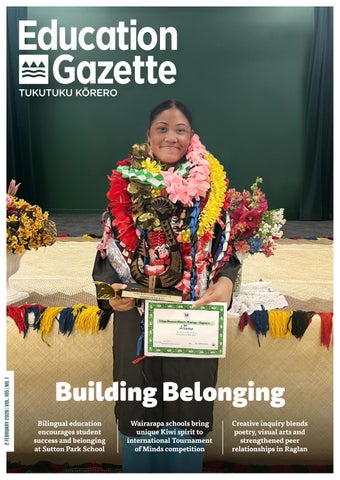
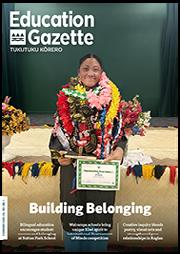
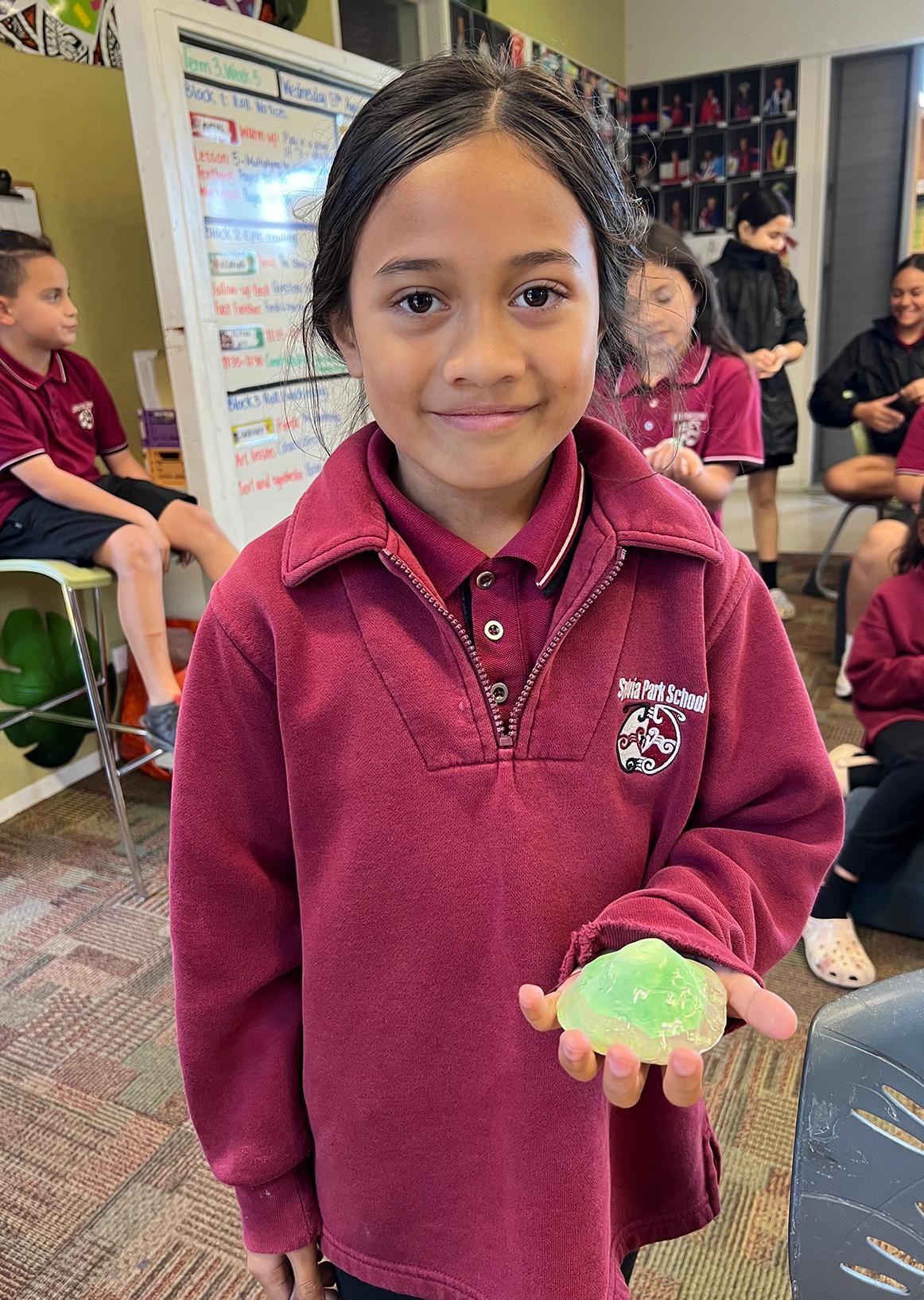
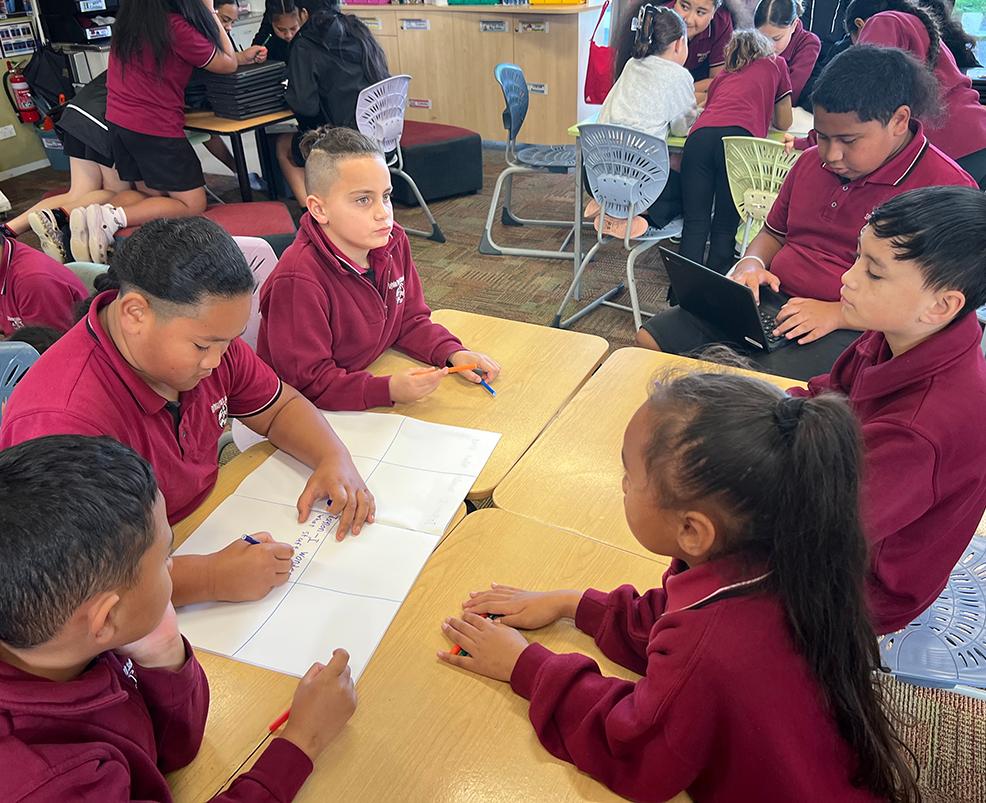
Bilingual education encourages student success and belonging at Sutton Park School
Wairarapa schools bring unique Kiwi spirit to international Tournament of Minds competition
Creative inquiry blends poetry, visual arts and strengthened peer relationships in Raglan
Building belonging in the classroom
Nau mai, haere mai to the first issue of 2026!
We first want to acknowledge the whānau who have lost loved ones, and the school communities who are coming together to grieve ākonga and kaimahi, following the devastating events in the Bay of Plenty. We also think of those who were affected by the flooding in Northland.
Kia kaha, kia māia, kia manawanui.
In these early weeks of the school year, many tumuaki and kaimahi are busy meeting new ākonga, or welcoming existing students back. Names are learned, routines and values explained, reminded and established. A lot of work goes into those early days of building belonging in the classroom.
This issue looks at examples of what belonging in learning looks like for different kura. At Raglan Area School, a creative inquiry based on poetry and art resulted in a published book ākonga are proud of, and strengthened belonging among peers. In Te Tauihu, Rapaura School drew its whole community in to revisit its core values, vision and logo to create long-lasting belonging for ākonga.
In Tāmaki Makaurau, Sutton Park School’s successful bilingual education units foster belonging through language and culture, contributing to student success and attendance.
And for three Wairarapa schools that competed in the international Tournament of Minds competition, purposely building team belonging through shared strength and enthusiasm proved crucial to their success, and their pride.
A sense of belonging at school can shape futures. Winner of the Prime Minister’s Space Prize, Southland Girls’ High School student Sophie, talks of the support and opportunities provided by her teachers that helped her achieve success.
PUBLISHED BY
Education Gazette is published by the Ministry of Education
PO Box 1666, Wellington. ISSN 2815-8423 (online)
The Ministry of Education and Education Gazette do not endorse, approve, or accept responsibility or liability for the accuracy of information belonging to third parties, including but not limited to information on third party websites we link to.
In Franklin, the founder of a grassroots science initiative for rural schools reflects on a biology teacher who set her on her path. We hope you enjoy these stories of inspiring mahi, and look forward to sharing more throughout this year.
Ngā manaakitanga
Maike
van der Heide
Ētita | Editor
KEY CONTACTS
Editorial gazette.education.govt.nz
Vacancies and notices listings gazette.education.govt.nz
0800 GAZETTE (0800 429 3883)
Send us your story ideas
What’s happening at your school or kura in 2026?
We would love to tell your stories. Our upcoming three issues will focus on leadership, learning support and literacy and language.
Join us online
Get the latest vacancies, notices, and stories: gazette.education.govt.nz
Follow us on Instagram: @edgazettenz
Nurturing a love for science: Southland teen wins PM Space Prize
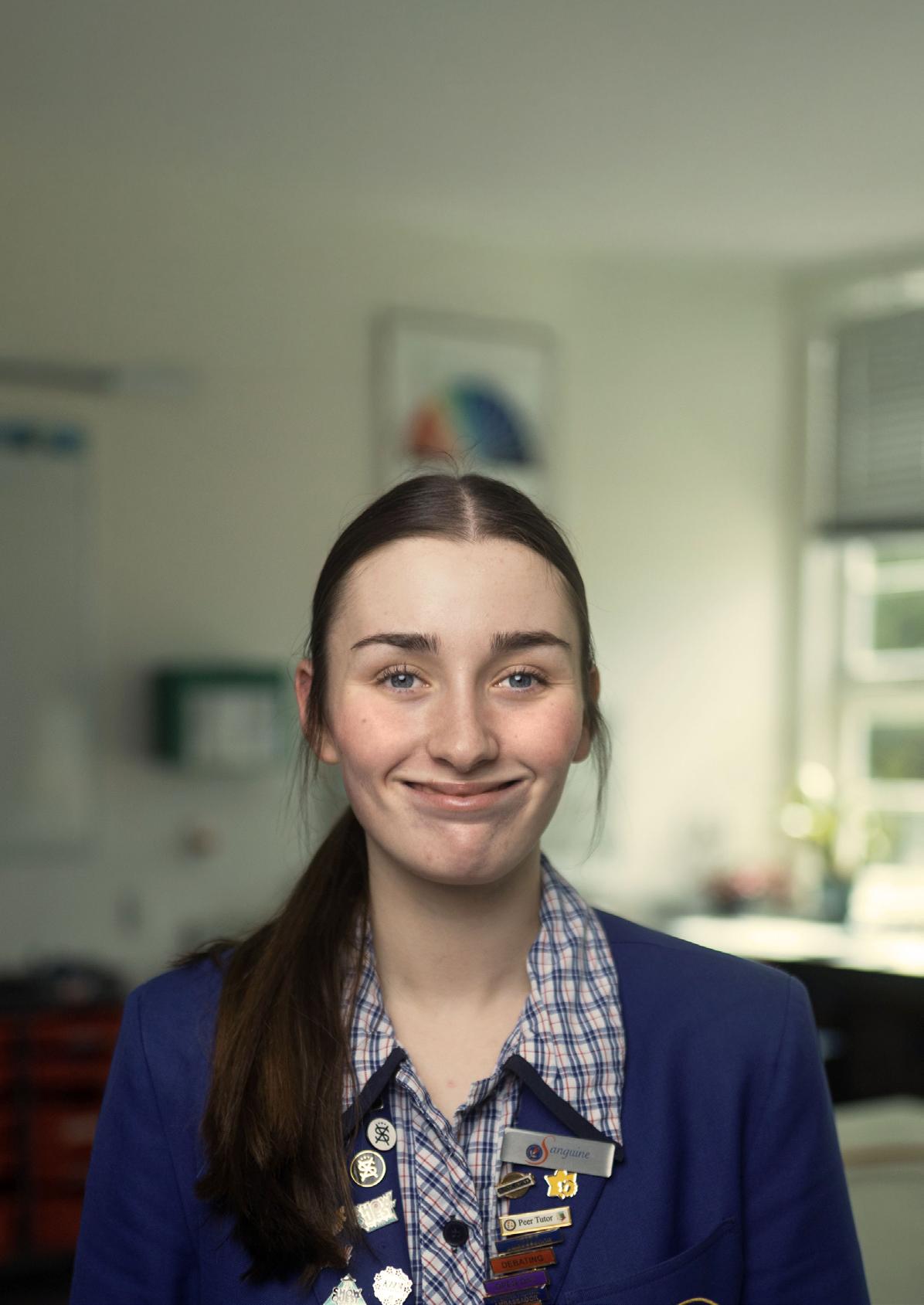
Winning the Prime Minister’s Space Prize is just one of the many science accolades Southland Girls’ High School student Sophie has received over the years. She says the support of teachers and opportunities provided by her school have led her to where she is now.
Southland Girls’ High School student Sophie won the Prime Minister’s Space Prize for Student Endeavour.
Sophie fondly recalls evenings with her grandmother watching the International Space Station pass overhead.
She was only seven years old at the time, but it sparked a burgeoning interest in space which remains today.
“It made me feel quite special that this was Nana’s interest that she was willing to share with me.”
Now, the senior Southland Girls’ High School (SGHS) student has won the $50,000 Prime Minister’s Space Prize for Student Endeavour for her Hydro-Heal project, designing a two-layer hydrogel wound dressing with an outer shield and inner contact layer.
The project involved nearly nine months of research and trials and started after Sophie learned that in microgravity, wounds heal more slowly, slowing tissue repair and increasing the risk of infection.
Nurturing an early interest in science
Sophie says a variety of experiences, from attending a Nanogirl show to an inspiring trip to NASA in America in 2018, piqued her curiosity in science and shaped her pathway at school.
”After I came back from NASA I entered the science fair and I did a project about what colour space suits will conduct the most heat or keep the astronaut the coolest. From there I’ve entered the science fair every single year,” she says.
One of the first competitions Sophie entered was the Fair Go Consumer Hero Scheme which was designed to get more women into space science. Sophie, Year 7 at the time, won the competition and earned money and a printer for her school, along with a video call with Rocket Lab for herself and her peers.
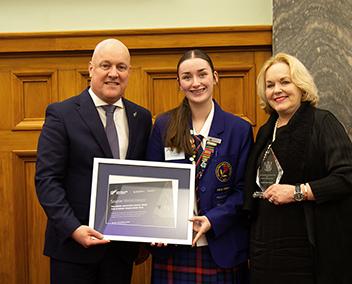
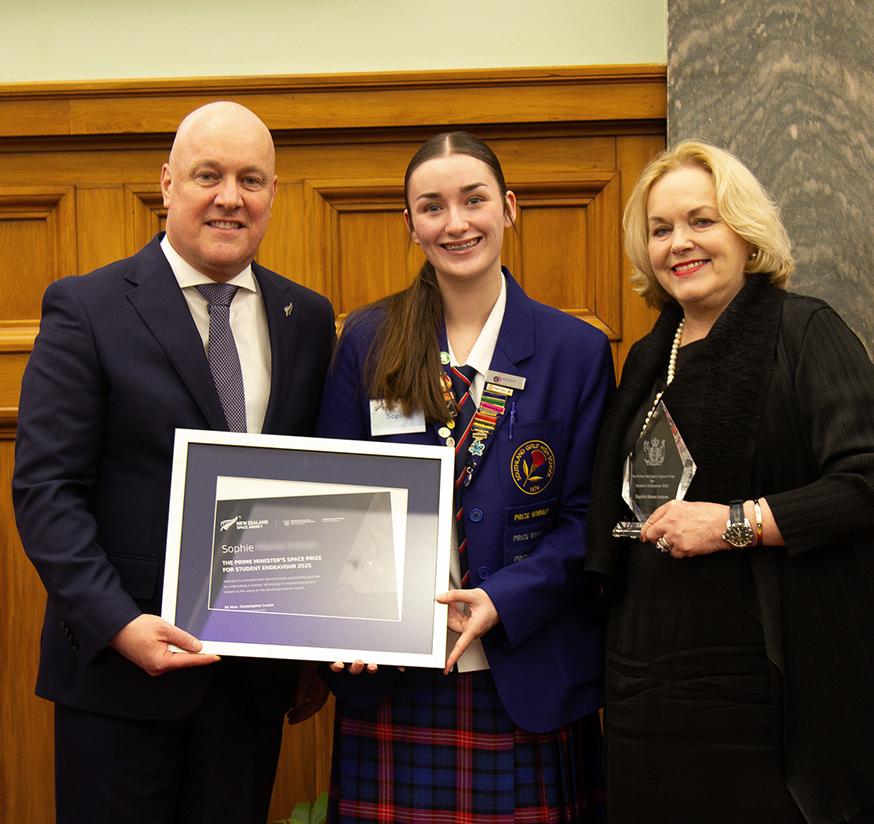
Sophie with Prime Minister Christopher Luxon and Minister for Space Judith Collins.
“Not only is that influencing me, but it’s also influencing other people within the school,” she says.
Sophie has also twice won the NASA Scientist for a Day writing competition, winning two telescopes – one of which she donated to the Deep Cove Outdoor Education Trust so other students have the opportunity to experience it too.
A foundation of support
Sophie says her teachers at SGHS have continuously supported her passion.
“The teachers I’ve had at school have never shut me down or have never said that my ideas are too big. Maybe they’ve rerouted me slightly, but they’ve never said no, you can’t do that.”
Brenda Goodwill, Head of Science at SGHS, says when the school became the first Year 7 to 13 state girls’ school in 2005, Year 7 and Year 8 students were immersed into the science curriculum in laboratories by science-trained teachers.
“Sophie arrived as a Year 7 student already curious about science in general but quite passionate about space. As a school we provide access for students to complete science badges through the Science Awards Scheme. This allows students at a younger age to explore different areas within science,” she says.
Brenda says the astronomy badge was one of the first that Sophie completed.
“It wasn’t solely science that created her pathway. It was also engagement and curiosity across the social sciences, dance and performance, and opportunities through clubs and societies,” she says.
“We’ve come to learn that 99 percent of Sophie’s ideas are good ideas.”
Sophie says one of the key ways SGHS supported her was allowing her to multi-level. In 2024 as an NCEA Level 1 student she completed Level 2 dance and biology. This allowed her to do more of the subjects she enjoys during the time she has at school.
She has now completed Level 3 dance, allowing her to pick up Level 3 biology this year.
“I’ve ultimately been able to fit in a whole subject that I wouldn’t have been able to do if I wasn’t allowed to multilevel,” she says.
Brenda says having the student at the centre of their learning journey is key to their success.
“This means that their age doesn’t determine their level of learning. SGHS offers both New Zealand Curriculum and IGCSE Cambridge Curriculum for Year 9 and 10 students in English, mathematics, science and global minds. Students who show that they are academically capable can move ahead of their year group.”
Reaching for the stars
Brenda says she was “beaming” when she learned Sophie had won the Prime Minister’s Space Prize.
“Nominating Sophie in an area of her passion was easy and in winning this prize it validated her effort, perseverance and out of the box thinking. I was especially pleased that the amount of time that Sophie had invested in her project had been recognised by the judging panel.”
Sophie was “overwhelmed with happiness” when she discovered she’d won and is excited to give back to her community through the innovateHER club she started for students in Year 7 to Year 10.
“I have a real interest in taking science further and working through investigations. I learn so much from these experiences so I wanted to make sure others could see how they could extend their interests too outside of our classroom lessons. I thought maybe it’s because they’re just not aware of the different opportunities or topics that are actually considered science, that they could enter in a science fair,” she says.
“I definitely wanted to encourage the younger students at school, not only to open their eyes to what is science, but also hopefully spark something within them that science may be the path for them.”
And, as they were with many of her other ideas, the school and science department were behind her.
“Sophie spoke about creating a science club that no doubt sprang from her realisation that with a little bit of encouragement, a passion for science similar to hers would be kindled in other students who have similar curiosity and questions that might not be answered by curriculum learning,” says Brenda.
“We’ve come to learn that 99 percent of Sophie’s ideas are good ideas. We gave Sophie the physical and academic space to create this club and created a Google Classroom where I could view her ideas.”
Sophie says she has already seen an impact.
“We’ve got quite a big number of juniors who had entered the science fair for the first time in quite a few years, which was pretty awesome to see that I had helped start that.”
The future is bright
This year Sophie is taking Level 3 biology, chemistry, psychology, statistical maths and English.
She says while the Prime Minister’s Space Prize sparked an interest in neuroscience, during the school holidays she spent time at Hands-On Otago, a week-long residential camp for senior secondary school students at the University of Otago.
Sophie says she is now “really interested” in pharmacy and psychology.
“Hands-On was a fantastic week, I learned so much as pharmacy was my major and I met amazing mentors within pharmaceutical science.”
“I definitely wanted to encourage the younger students at school, not only to open their eyes to what is science, but also hopefully spark something within them that science may be the path for them.”
Sophie’s interest in space has been nurtured from a young age.
LANGUAGE AND CULTURE
Bilingual education builds belonging for ākonga at Sutton Park School
Sutton Park School in Māngere, Tāmaki Makaurau, is a hub for Pacific and Māori bilingual learning. There, identity, language and culture drive student success, stronger engagement and attendance, and show how bilingual education empowers ākonga to thrive in both worlds.
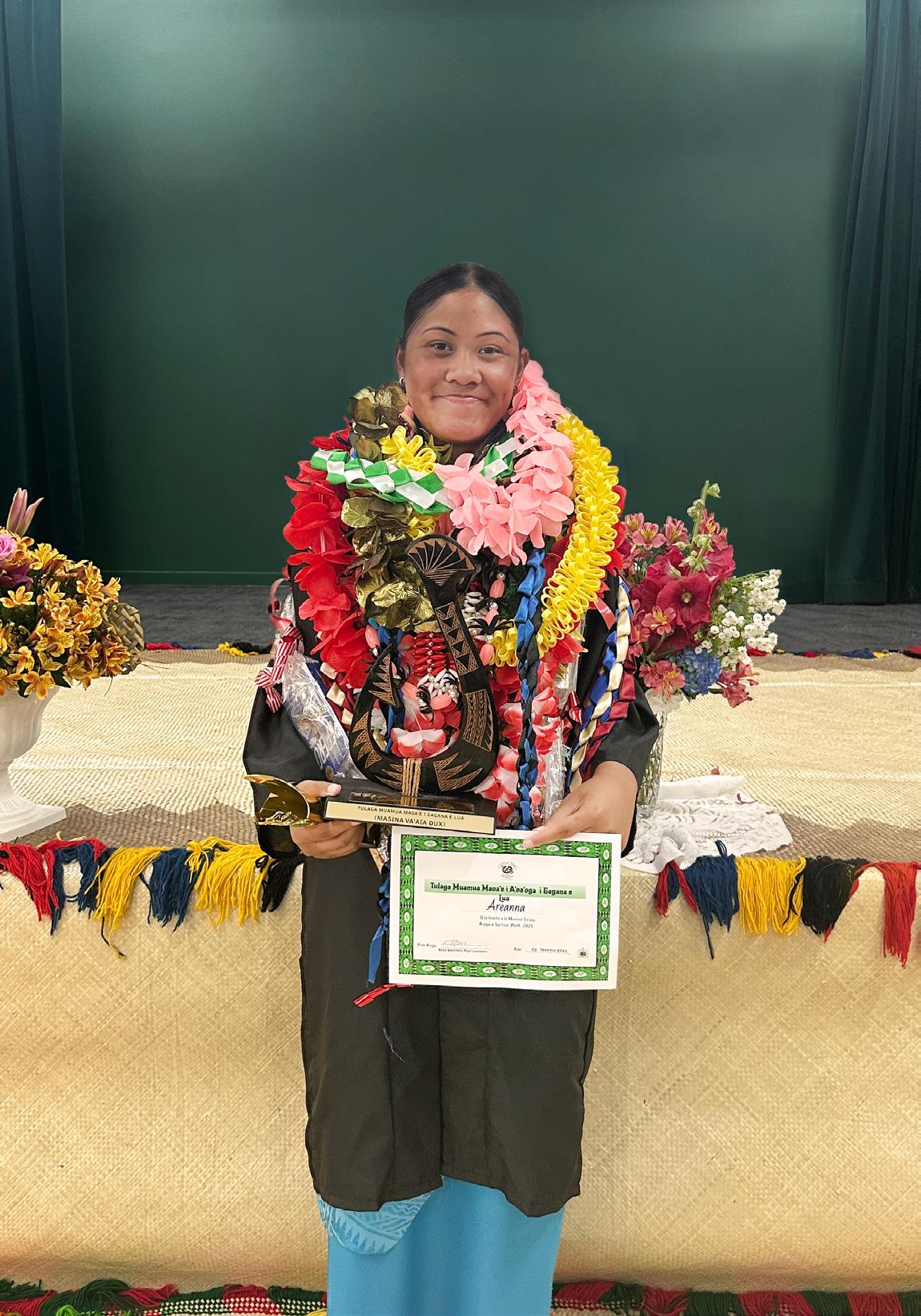
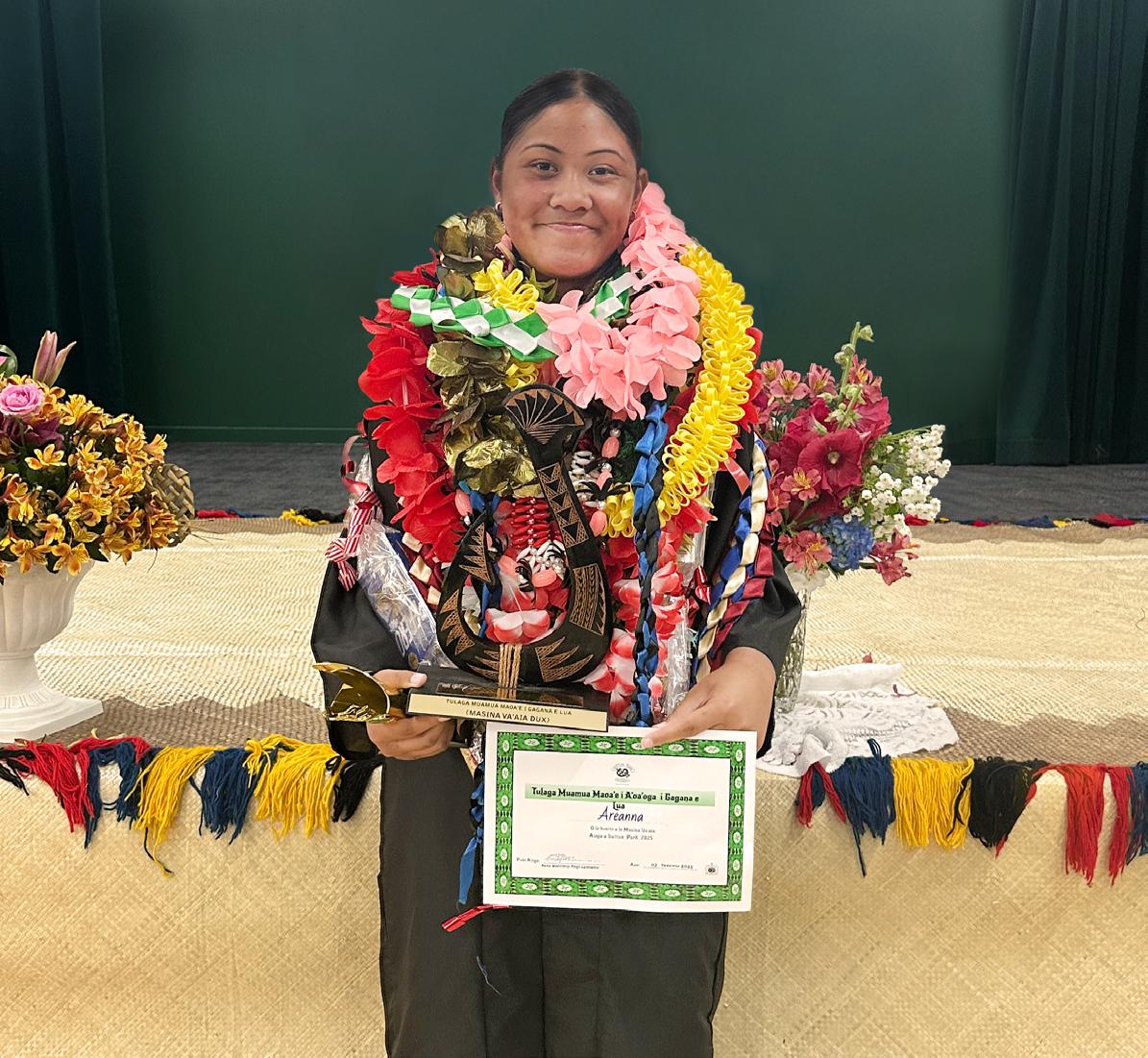
Sutton Park School student Areanna won many awards for public speaking in Samoan and English.
As Sutton Park School senior student Areanna stood in front of the crowd gathered for the national final of the FAGASA Speech Competition, she felt the emotions of knowing she wanted to make her parents proud.
And make them proud she did. After winning the annual Samoan speech competition at school, then coming third in Auckland, she placed second in the New Zealand final. It had been her last opportunity to compete at intermediate level, after coming third equal at national level in 2024.
“I knew that either way they’ll be proud of me for my achievements throughout my past four years,” says Areanna.
Those four years of speaking achievements were at Auckland’s Sutton Park School, where Areanna attended the Samoan bilingual class from Year 5 onwards.
She started entering speech competitions after her teacher asked her to give it a try.
“She gave me the opportunity of doing my speech and she helped me to write it. And she didn’t just help me write it, she helped me understand my speech and ever since then, I knew that I loved doing speeches. I loved talking in front of huge crowds.”
Areanna’s speaking skills in both English and Samoan – the language of her family – were further polished at school for welcoming speeches to visitors and during ceremonies.
“There were just a lot of opportunities that I got to speak my language.”
Sutton Park School principal Fata VaitimuTogi Lemanu says Areanna arrived with a grounded knowledge of both the Samoan and English languages. This, along with her confidence, made it easy for the bilingual education model to extend and support her to become a leader and succeed in speeches in both languages.
“The pinnacle moment was when she won the overall Auckland Champion of Champions speech competition in English. That just comes with the confidence of knowing who she is.”
“It’s helped me discover more about my culture, especially about who I am.”
A growing hub of bilingual education
Sutton Park School in Māngere provides Pacific bilingual and immersion education in Gagana Sāmoa, Lea Faka-Tonga and te reo Māori.
Fifteen of Sutton Park’s 23 classes are bilingual. The Tongan bilingual unit, Sia Ua, has nine classes from Years 0 to 8. The Samoan unit, Masina Va’aia, has five classes and the Rumaki Reo unit has one. The remaining classes are English medium.
“We’re kind of a bilingual hub for Māngere,” says Fata Vaitimu.
Born, bred and educated in Māngere, Fata Vaitimu taught at primary and secondary levels before becoming deputy principal at Sutton Park. After seven years in that role, he became principal three years ago.
“I just wanted to give back to the community where everything started for me.”
As a first-year teacher in 1999, Fata Vaitimu taught in a bilingual unit at Sir Douglas Bader Intermediate. He learned early on it was important to bring whānau on board by building understanding of what bilingual education looks like.
“It’s using both languages to deliver the New Zealand Curriculum. Once they got their heads around that, all their mindsets around understanding what bilingual education was, our classes flourished.
With that in mind, Sutton Park School held 10 trial sessions around bilingual education for parents. As a result of fostering this understanding, the school has the support of the community, Fata Vaitimu says, and a high number of students are enrolling from out of zone.
“They can be successful in both worlds. Bilingual units build on the strengths that the students bring.”
Bilingual education boosting confidence and attendance
Elizabeth Keresoma is Lead Advisor, English, Languages and Pacific at the Ministry of Education. Her focus is specifically on bilingual education and she supports schools with starting a unit to maintaining and sustaining it.
Elizabeth also provides support such as access to professional learning and development, and resource development to support the implementation of the curriculum in Pacific bilingual and immersion settings.
She says the number of bilingual units is growing, with most being opened by those who participated in Reo Moana professional learning development.
“They just recognise the strength and importance of bilingual education for Pacific learners.”
The achievements of ākonga like Areanna are great examples of that strength, she adds. “Performing well in both their Pacific languages and English medium speech competitions showed how bilingual and biliterate the students are.
“They can be successful in both worlds. Bilingual units build on the strengths that the students bring.”
Sutton Park works with three other schools to build bilingual education. Elizabeth hopes those sorts of relationships will continue to grow through visits and shared expertise.
“Other than the academic world, it’s our leaders and teachers in those settings who hold the knowledge and the skills and the expertise to be able to carry out their teaching and learning and design appropriate curriculum programmes for their learners here.”
Fata Vaitimu says the bilingual model helps ākonga better engage and understand what they are being taught.
“It’s that switching of the languages. If they don’t understand one, they can switch if they wish.
“Once again I always have to go back to the teachers and how competent they are and proficient they are in the language.”
He has seen how the setting boosts confidence among ākonga, as well as attendance, which he says is high in the school’s bilingual units.
“So once again it’s that we get better engagement because of both languages that are used.
“Ākonga become confident in themselves and they’re fully engaged, more engaged in the teaching and learning of the different learning areas and the school.”
Building belonging to build achievement
The vision behind creating bilingual units around Aotearoa was to promote a strong sense of belonging, says Elizabeth.
“It’s about achievement and it’s also about the identity, language and culture of the students and supporting that growing, nurturing it and strengthening as they journey through our school system.”
Fata Vaitimu agrees that identity, language and culture play a vital role in their school and others.
“Those are the three core values that we instil in our students in the units and it’s really successful.”
Elizabeth says bilingual settings can share not only the same language as students may speak at home, but also the same values and expectations.
“So when they come to school, it’s just continuing that same behaviour, same expectations and it’s not something new for them.”
That familiar environment provides students with the confidence to learn and ask questions, says Elizabeth.
“They focus on growing their understanding, their knowledge, their skills and engage in practice that they are familiar with. And that challenges them to make those next steps and progress well.”
For Areanna, those next steps are now at high school, which she started this month. Inspired by the teacher who helped her with her very first speech, she hopes to go on to university to study teaching.
She is grateful to have had the opportunity to learn in a bilingual setting.
“It’s helped me discover more about my culture, especially about who I am.”
“Ākonga become confident in themselves and they’re fully engaged, more engaged in the teaching and learning of the different learning areas and the school.”
Pets at the End of the World featured Lucy and her dog Daisy.
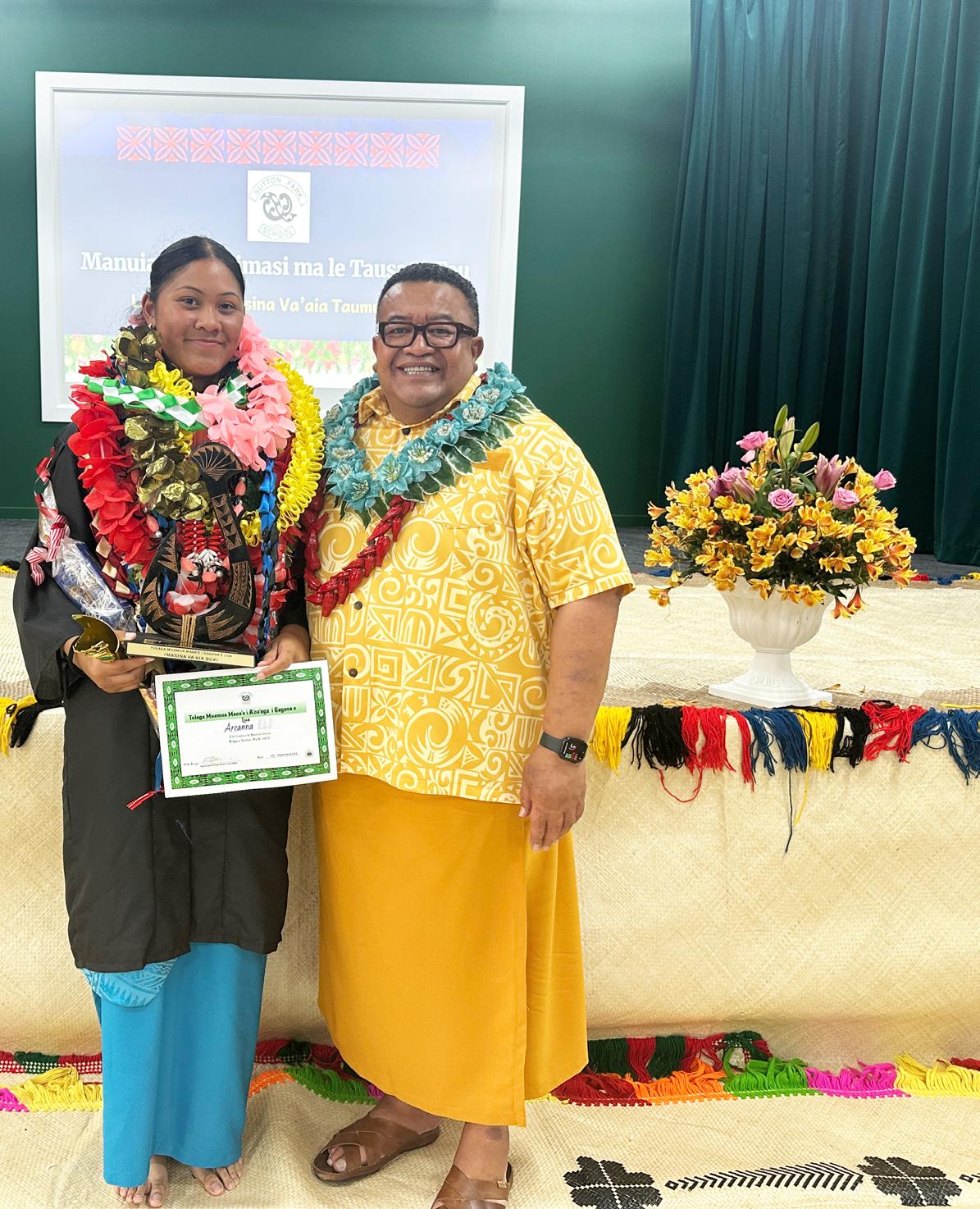
Sutton Park School student Areanna was named 2025 dux of Masina Va’aia, the school’s Samoan bilingual unit, as well for English medium. She is pictured with principal Fata Vaitimu Togi Lemanu.
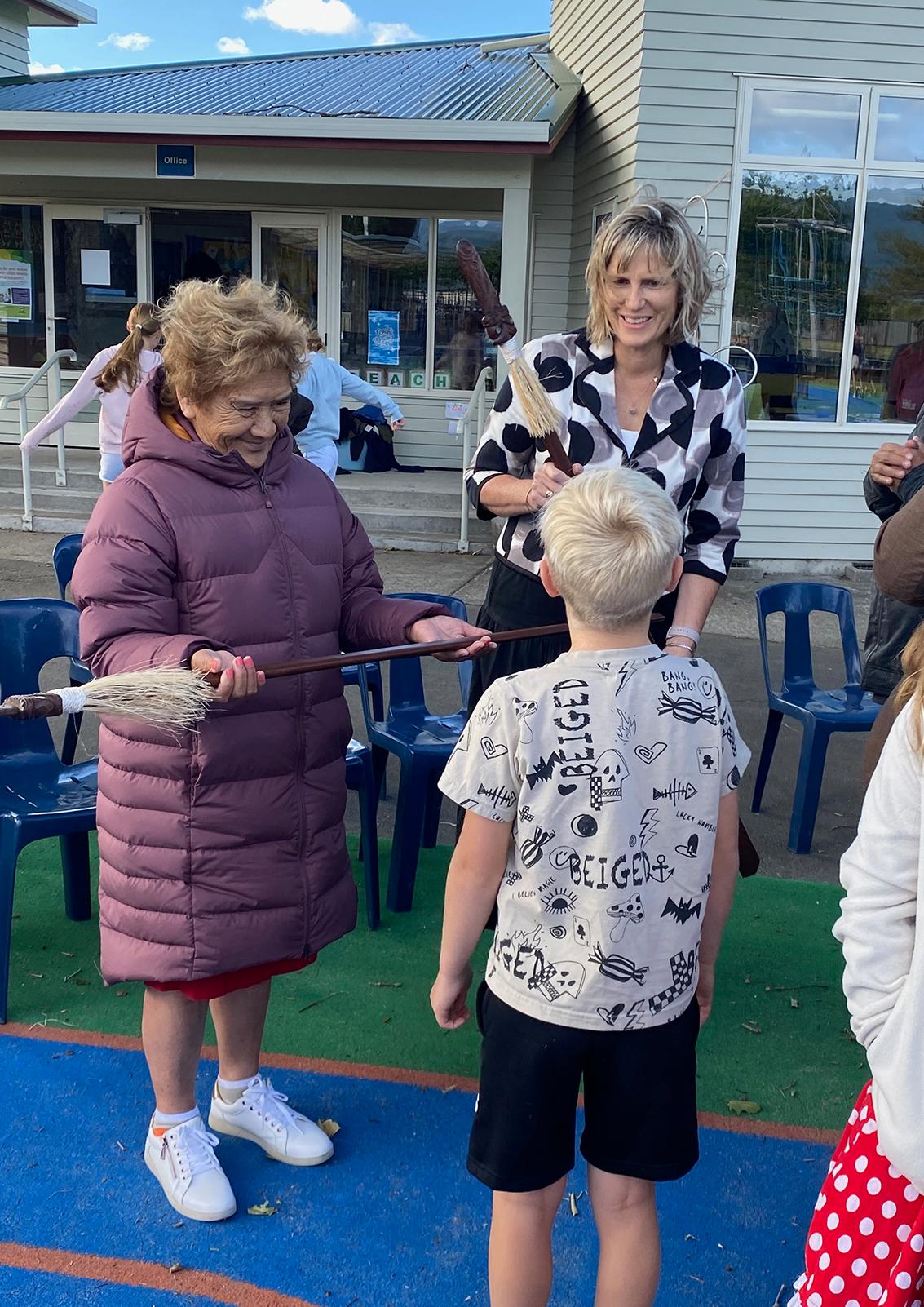
Kuia Merehira Wills and Rapaura School principal Carey Huria in 2023 with the gifted taiaha that inspired the new school logo.
SCHOOL IDENTITY
Strengthening values to strengthen belonging at Rapaura School
With more than 150 years of history, Rapaura School in Marlborough has revisited its core values, school vision and logo to create a sense of belonging for ākonga. These are now connecting values to everyday learning.
Seven students first attended Rapaura School when it opened in 1862. Now, the rural school near Blenheim is a community serving 110 ākonga and their whānau.
“This was the first school we went to, and it just felt right to be here,” senior student Max remembers. “I started here as a Year 2. When I got here, I was really nervous, but then I realised that everybody here was really nice and kind, so I felt like I fitted right in.”
Following a revised vision statement
in 2023, tumuaki Carey Huria says Rapaura School wanted its values to reflect that sense of belonging and the community “as it stands now”.
The kura wanted to acknowledge the past and continue preparing its ākonga for the future, says Carey. That included bringing Arthur Phillips on board as advisor, “bringing the perspective of our rangatira iwi, Ngāti Rārua, to the conversation, provoking thinking”.
“We have reviewed every layer of the school to create a narrative that tells who we are.”
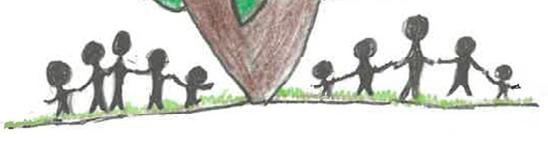
Students are at the heart of Rapaura School’s new logo.
Belonging that starts with community
Students were invited to submit their own ideas for the logo in a schoolwide competition.
The winning designers, including student Tamatea, met with local graphic designer Leanne Hayes, who created the final logo from their creations.
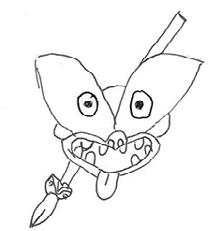
“I was inspired by the taniwha on our school taiaha,” says Tamatea. “I came up with the idea that the taniwha was the protector of our school.”
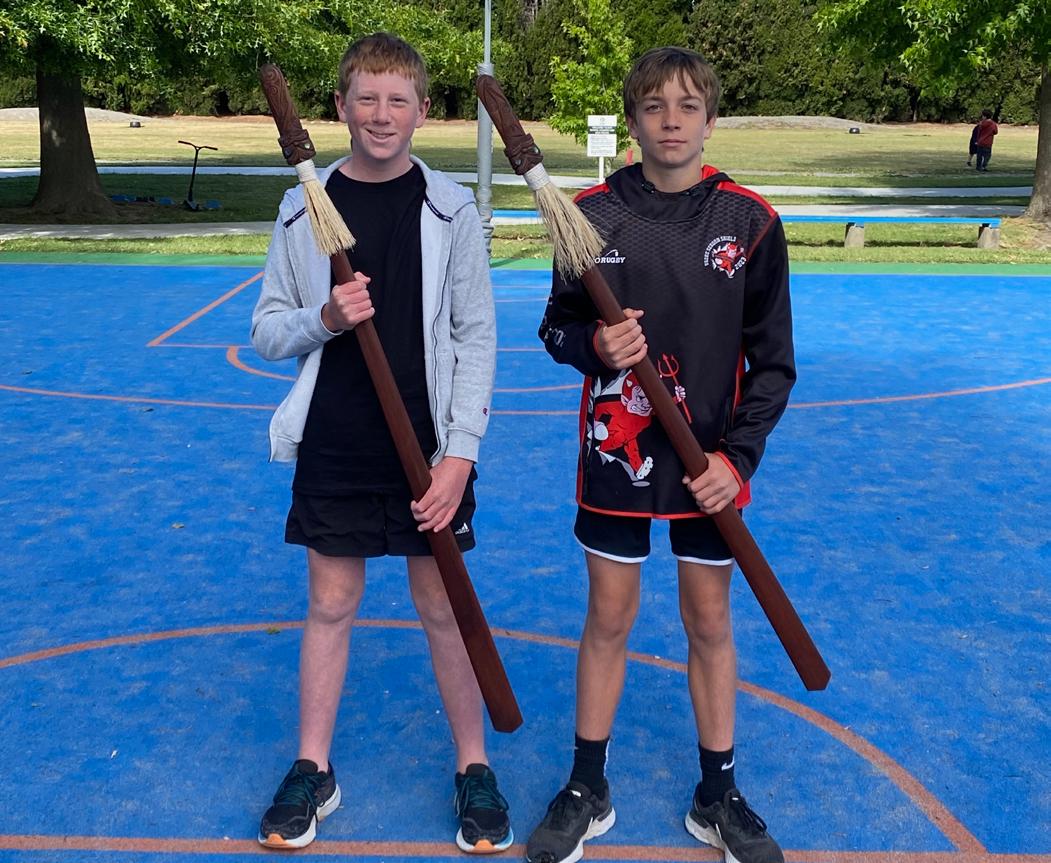
The taiaha were gifted to the school by former students, Dylan and Chase, explains Carey. “We held a mihi whakatau in 2023 for the taiaha, which was attended by Te Rūnanga o Ngāti Rārua Pouwhakahaere Shane Graham.”
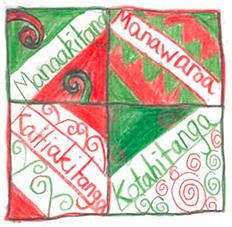
Manaakitanga, kaitiakitanga, manawaroa and kotahitanga were adopted as the school’s new values. They now form the foundation of a student’s learning and symbolically sit at the base of the new school logo.
The values are represented as a koru and all elements enclosed in a protective circle, “representing the partnership between whānau, staff, the board and the wider community, all working together to create a high-quality learning environment that fosters high achievement and positive behaviour”, says Carey.
“All aspects of behaviour across the school are linked back to how students are showing manaakitanga.”
The six larger leaves integrated into the design represent the key competencies incorporated in all inquiry learning, planning and teaching.
“We are developing these as part of the curriculum review and work to connect what we believe is fundamental to a whole child’s development and the Government’s priorities.”
Rapaura School also revised its whakataukī to be ‘Poipoia te kākano kia puāwai’, or ‘nurture the seed so it will grow.’
Belonging through positive behaviour
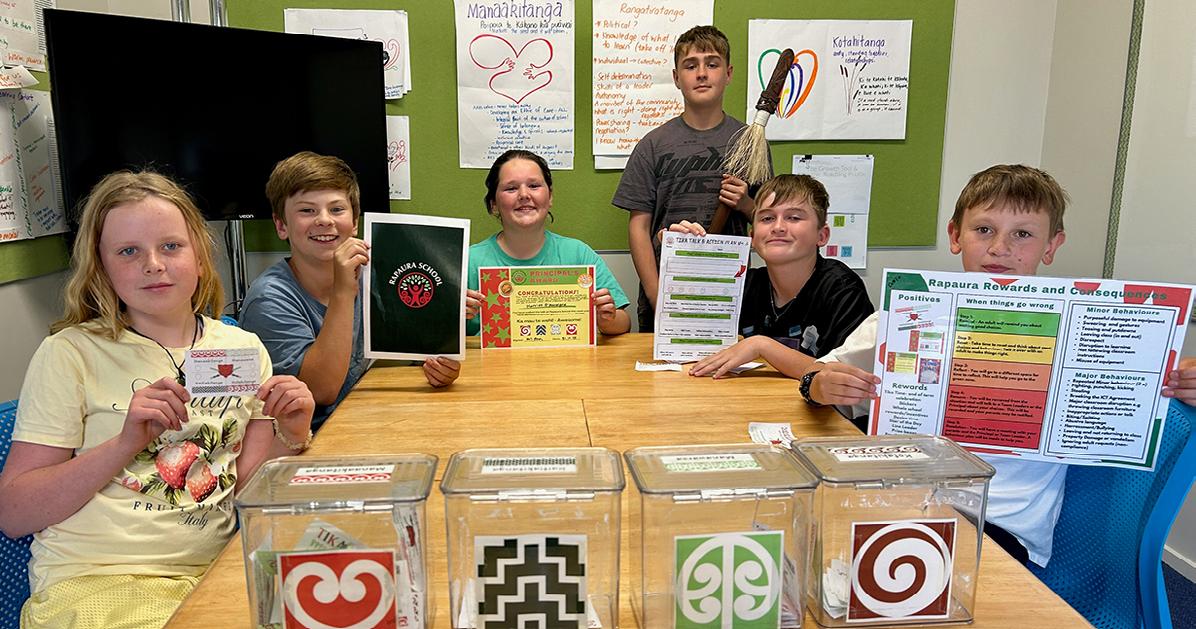
Tamatea’s taniwha design inspired the ‘Tika Token’, which encourages positive behaviour, student leadership and fosters a sense of belonging through peer nominations for actions that reflect the school values.
“The four values relate to the Tika Token,” explains Tamatea. “Depending on what you do, there’d be a different value you’d be appreciated for.”
Students write Tika Tokens for each other and the teachers, adds Isabella, who has nominated a few people for “being really good at including others” in her class, under the value manaakitanga.
“They choose a school value and nominate someone for doing something really good for the school – like picking up rubbish is kaitiakitanga.”
Carey says all aspects of behaviour across the school are linked back to how students are showing manaakitanga.
“How are we caring for each other, working in teams, during play times and off-site activities?”
Max adds that manawaroa – resilience – is also an important value. “If you go on a path and get knocked off, you try to find your way back onto that path again.”
The initiative extends to the Tika Talk Action Plan. Going to get themselves a plan allows students time to “calm down and get in a better mood”, student Liam explains.
“You reflect on how you’re behaving and how it affects others, and tell the teacher what you’ve done and what you can do to make it better. It’s really helped me.”
Student Harriet says there’s also a chart of rewards and consequences, where green can lead to awards and Tika Tokens, and red can lead to whānau being contacted.
Harriet herself was awarded a principal’s award at the last assembly. “I displayed manawaroa and achieved my goals. I felt really good, very proud of myself,” she says.
Carey adds that Harriet was leading the assembly that day. “So, it was extra special. She was showing all those leadership qualities at assembly.”
The Tika Token connects values and learning.
The historic tree within the design signifies growth and represents the generations of families who have attended Rapaura School in the past 150 years.
Student Tamatea was inspired by the taniwha on Rapaura School’s taiaha.
Belonging through empowerment and possibility
When students first step onto Rapaura School grounds at age five, they immediately become kaitiaki of the school’s values, learning the same language that applies to both learning and behaving in class.
As students grow, they bring this same language into their leadership positions, such as leading the assembly or running events.
The student kaiwhakahaere are selected by their fellow students.
“This gives a sense of empowerment and possibility for the younger students,” says Carey. “We’re often consulting and
talking about what’s happening in the school; adults aren’t making all the decisions.”
Student Thomas says letting students make those decisions meant he’s felt able to step up as a role model and taken the lead in events such as Gumboot Friday.
“It’s much better because I get to make some calls.”
Carey explains that by seeing themselves and their culture in the school environment, the students feel like they belong to the school.
“We turn the curriculum into something the children will have success with, linking it to our school values, so they feel confident and are empowered to be happy and have good lives in the future.”
“I was inspired by the taniwha on our school taiaha... I came up with the idea that the taniwha was the protector of our school.”
The taiaha were gifted to the school by former students, Chase and Dylan, pictured in 2023.
Mind over matter: Wairarapa schools dominate Tournament of Minds
Wairarapa dominated Tournament of Minds last year, with three schools from the region representing New Zealand at the international final in Australia. Their success at the annual problem-solving competition was down to a powerful combination of preparation, shared expertise and a strong culture of regional collaboration and tuakana-teina partnership.
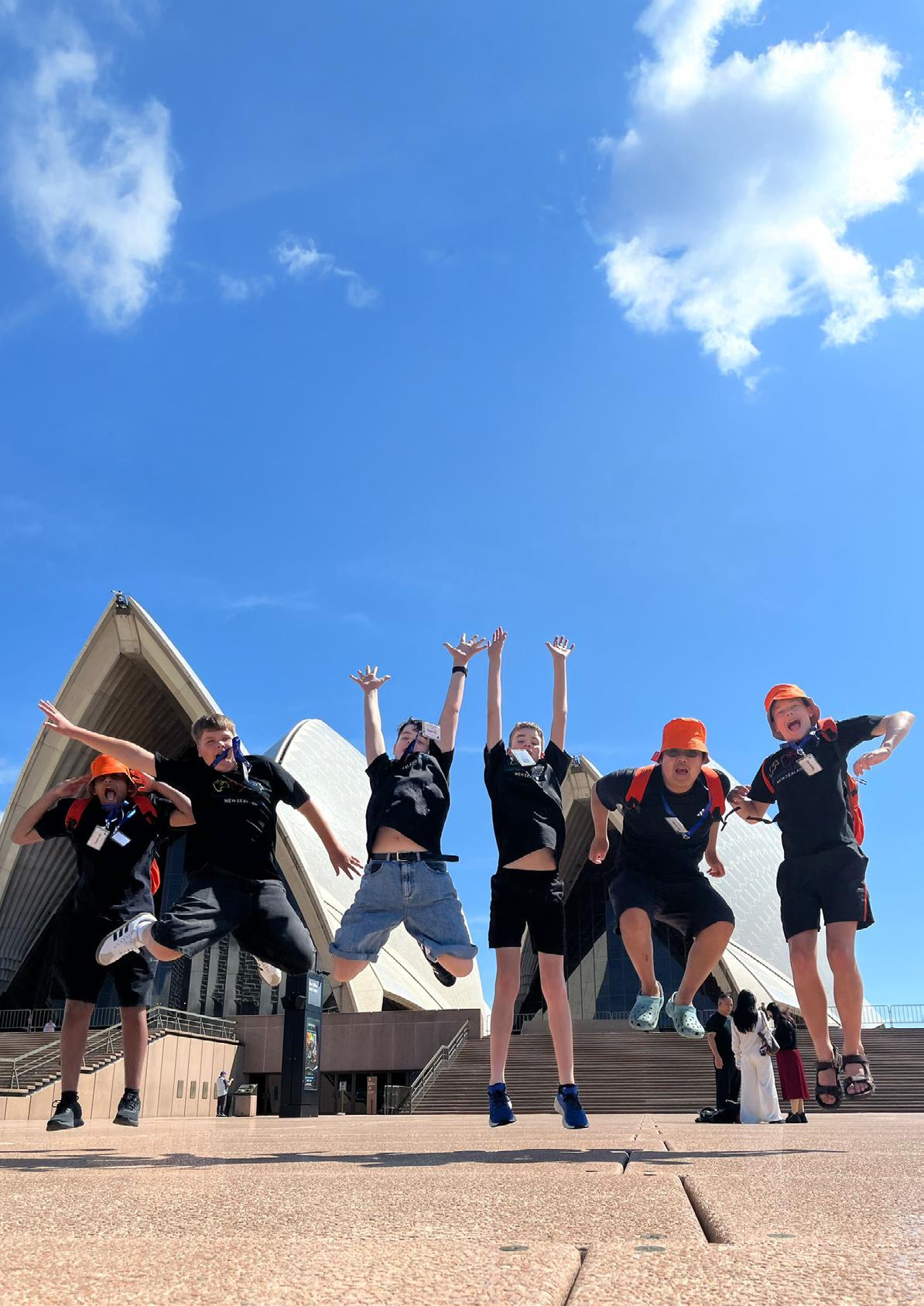
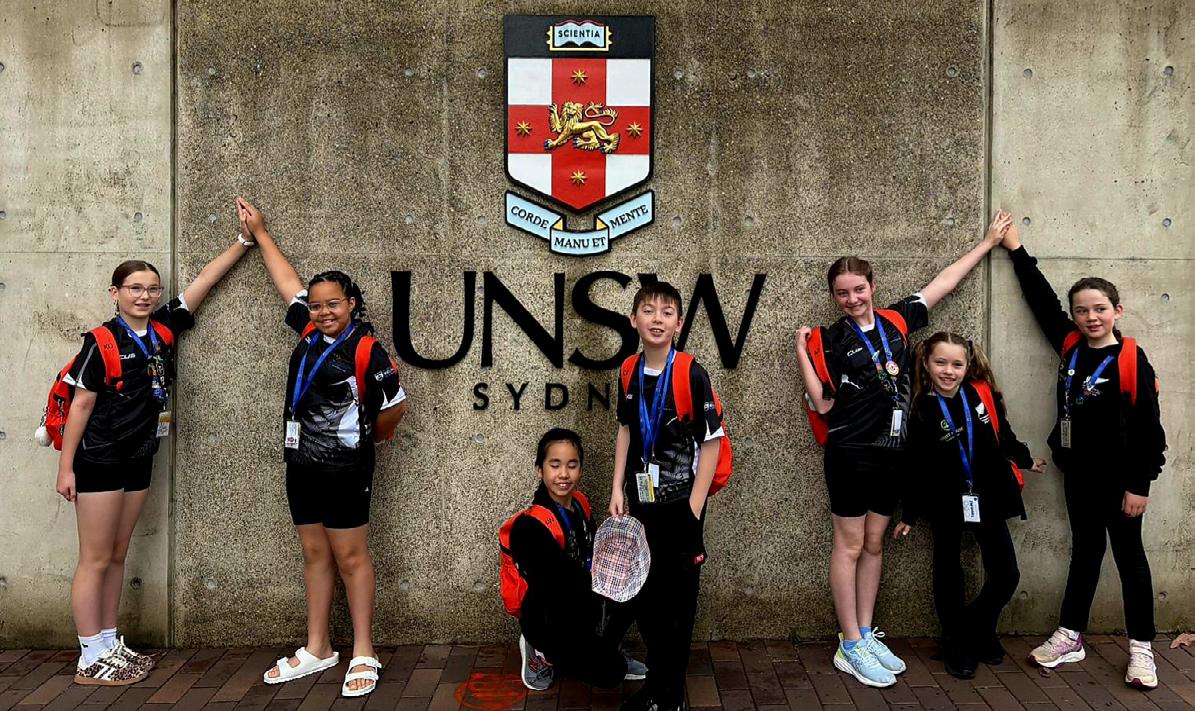
The Rathkeale College team in front of the Sydney Opera House before the finals: Moksh, Xav, Atticus, Oscar, Brenden and Ethan.
The Hadlow School team ready for their 10-minute presentation at the international final.
Last year, Tournament of Minds Aotearoa NZ co-director and teacher Ruth Olds wasn’t sure if she could facilitate a team for her school like she normally would. Having just started teaching in secondary at Rathkeale College after almost 20 years in primary, she felt she should focus on finding her feet.
“Tournament of Minds (TOM) is one of those things that really needs passionate, committed teachers to get it going in a kura – kind of like launching a new sports team with the right coach and manager behind it.”
Ultimately, Ruth’s many years of involvement in the international problem-solving competition won out.
“After getting to know some of the Year 9 and 10 students, it was clear there were so many potential TOM stars, and I couldn’t let that go to waste.”
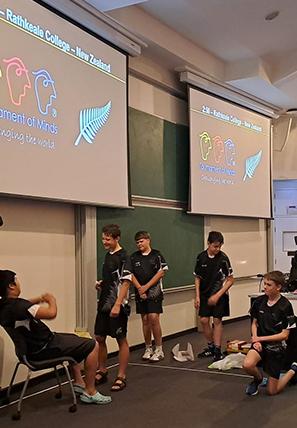
TOM is an international creative, critical and collaborative problem-solving competition. At national and international level, participants have three hours to solve a challenge, which they present to judges in a 10-minute dramatic performance with presentation skills, such as costumes and props. There is also a ‘spontaneous challenge’, where the team of five to seven students has less than five minutes to solve a quick challenge using out-of-the-box thinking.
Challenges are presented to a panel of judges and assessed against rigorous criteria.
“TOM aims to enhance the potential of students by developing diverse skills, enterprise, time management and the discipline to work collaboratively within a challenging and competitive environment,” says TOM Aotearoa NZ director Jocelyn Pollock.
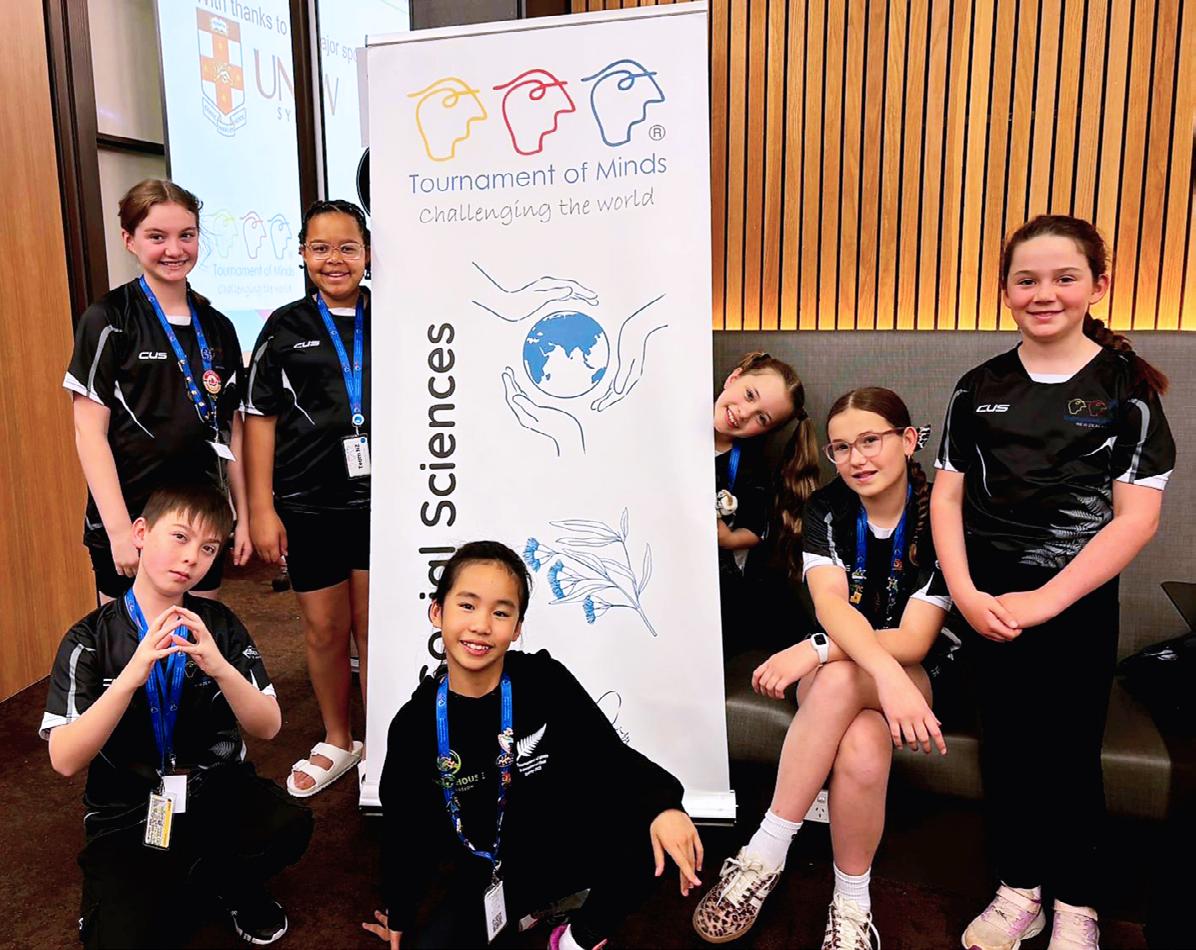
Teams at primary, intermediate and secondary levels in Years 5 to 11 compete in one of four disciplines: Language Literature, Social Sciences, STEM, or The Arts.
“We promote a team activity that thrives on overcoming challenges and values creativity, originality, diversity, respect and encouragement,” says Jocelyn.
Rathkeale College won the TOM regional competition. Then, the national competition. Suddenly, they were off to the Tournament of Minds International Final (TIF) at the University of New South Wales in Sydney, along with seven other New Zealand teams. They included two more Wairarapa kura: Hadlow Preparatory School, which also competed in 2024, and TOM first-timer Wairarapa College.
It was the first time in many years that so many schools from a single rural region qualified for TIF.
Building a team for success
Hadlow School entered 20 students from Years 5 to 8 in The Arts, Social Science and STEM disciplines.
Rathkeale entered one team of six Year 9 students in the secondary Language Literature division, while Wairarapa College had two teams of Year 9 and 10 students in the secondary division of The Arts and STEM.
Ruth says teamwork was crucial to their success, which began at team selection.
“This meant understanding one another’s strengths and weaknesses, which took a bit of time – and some socialising –to develop.”
At Hadlow School, teacher Rev Mannie Marara says ākonga learned about the skills needed for TOM before teachers targeted key skills.
“Teamwork, quick critical thinking, plus an ability to articulate ideas in such a way that others could understand, were some of the skills we looked at.”
Hadlow student Katie says teams needed connection.
“You can’t be randomly put together, you have to get to know your team and become friends.”
Teammate Aisling adds: “You need to be always working together as a team even if sometimes you disagree with what the other person is saying.”
At Rathkeale, the student librarians quickly answered the call for interested TOM team members, making the Language Literature discipline an obvious fit, says Ruth. School librarian Maxine Hartley became the boys’ number one supporter.
“The students already knew each other well, shared similar strengths, and the dynamic just clicked naturally from the start. This was especially important when it came to the time-ticking spontaneous challenge, where students had to generate creative ideas, decide collaboratively on a solution, and report back according to the success criteria. No mean feat for a bunch of students in less than five minutes!”
Wairarapa College offered the opportunity to ākonga in their gifted programme first, resulting in two teams, says programme coordinator and teacher Rory Hughes.
“It really came down to grouping like-minded students who enjoyed thinking creatively, problem-solving, and bouncing ideas off one another. The students gravitated toward those they worked well with, and the teams evolved quite organically from their shared strengths and enthusiasm.”
Wairarapa College student Isabelle says the team included strong personalities. “Sometimes it was hard to be heard, but it taught me how to speak up and back myself.”
Over time their teamwork became “solid”, says Rory, and they exceeded his and their own expectations.
“Seeing that growth made my role as teacher and facilitator so much easier, and it was a real highlight of the whole journey.”
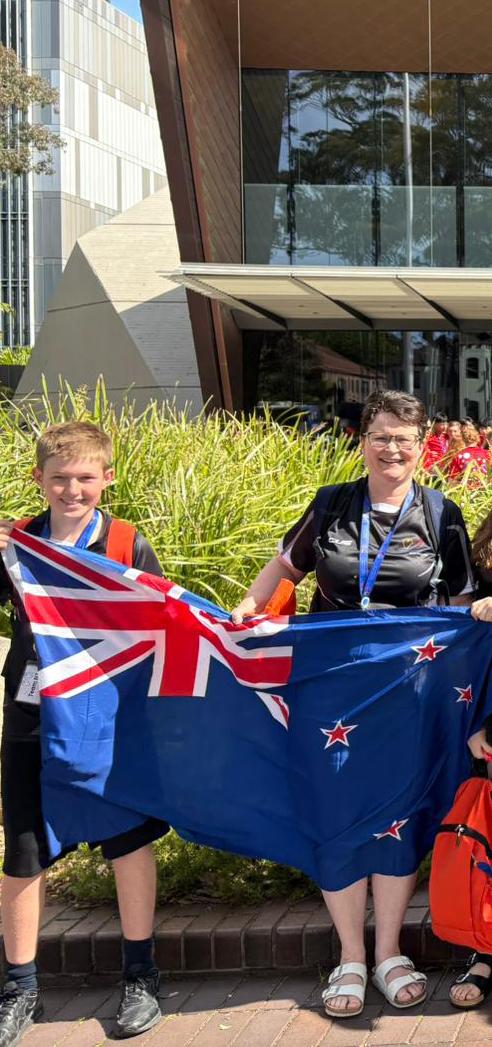
Wairarapa College team and kaiako preparing to represent their country in the STEM challenge at TIF 2025. From left: Leo, Claire, Isabelle, Alby, Robert, Brent, Vlad, Sam, and Rory.
“A legacy of experienced students moving to new schools and bringing their knowledge with them created a natural tuakana-teina model, where learners supported and taught one another.”
Regional collaboration key to success
With just weeks to prepare and fundraise, practices were held at school, after school and on weekends.
Collaboration between schools was crucial, Ruth says, and experienced competitors helped create a natural tuakana-teina model, where ākonga supported and taught one another.
“In-person workshops at all three schools, regular kōrero between kaiako and ākonga leading up to TIF, and weekend practices, helped sharpen teams’ creative and critical thinking skills,” she says.
“Altogether, this culture of collective growth and crossschool support gave the Wairarapa its edge and helped secure three places at TIF.
“They already knew the buzz of the competition and were keen to give it another crack. Their enthusiasm was infectious. The students really drove the momentum.”
Rory says their team included legacy TOM students from schools like Masterton Intermediate.
One of those students was Alby, a legacy TOM student of three consecutive years.
“We met often, practised different challenge types, and spent a lot of time figuring out how to work well together. I also tried to keep things fun – humour definitely helped when things got stressful!”
Playing to their strengths
Teams select one discipline for the regional round of the competition, based on six-week challenges released at
the beginning of term 3. Teams successful at regional level stick with their discipline for the sequential national and international competitions.
Jocelyn says key competencies in the New Zealand Curriculum are foundational to those disciplines.
“As well as a focus on the curriculum areas aligned to their chosen challenge discipline, literacy and maths are integral to how teams work through their chosen challenge and prepare their dramatic response.”
Rathkeale student Atticus says for them, that was Language Literature.
“The regional challenge was based on the works of Shaun Tan. The national challenge focused on circular narratives and the misplacement of commas. The international challenge – described by the team as a real doozy – required them to connect two landmarks and use anthropomorphism.”
Isabelle from Wairarapa College says they chose STEM “because it was hands-on, creative and really pushed us to think outside the box”.
Katie from Hadlow, who also participated in TOM in 2024, says their team chose Social Sciences at the start of the competitions and “stuck with it”.
Teammate Amanda says they had to create an artificial intelligence (AI) system that would help with understanding an historical event. She enjoyed this, “because I got to explore and learn about different things”.
Aisling also liked this discipline, “because I love looking at real-world issues and thinking of ways that everyone can do their part to solve them”.
The Hadlow School team placed in the top three of the Social Sciences division. From left, Katie, Aisling, Amanda, Coby, Alice, Heidi and Caia.
judges.
A unique team spirit
In Sydney, Hadlow finished in the top three of the Social Sciences category for the primary school division.
Hadlow School’s Alice says she felt proud to represent New Zealand in another country. “It was amazing to meet people from all the Australian states and other countries too.”
Ruth was the New Zealand team manager for the Sydney competition, and a spontaneous challenge judge, along with Mannie and Rory. She managed to watch all teams.
“Their creativity was incredible – they came up with ideas most adults would never dream of!”
Isabelle says being part of TIF was “incredible”.
“It felt surreal to be representing New Zealand alongside teams from all over the world. The atmosphere was exciting, a little overwhelming at times, but amazing. It was cool seeing how creative and clever other teams were too.”
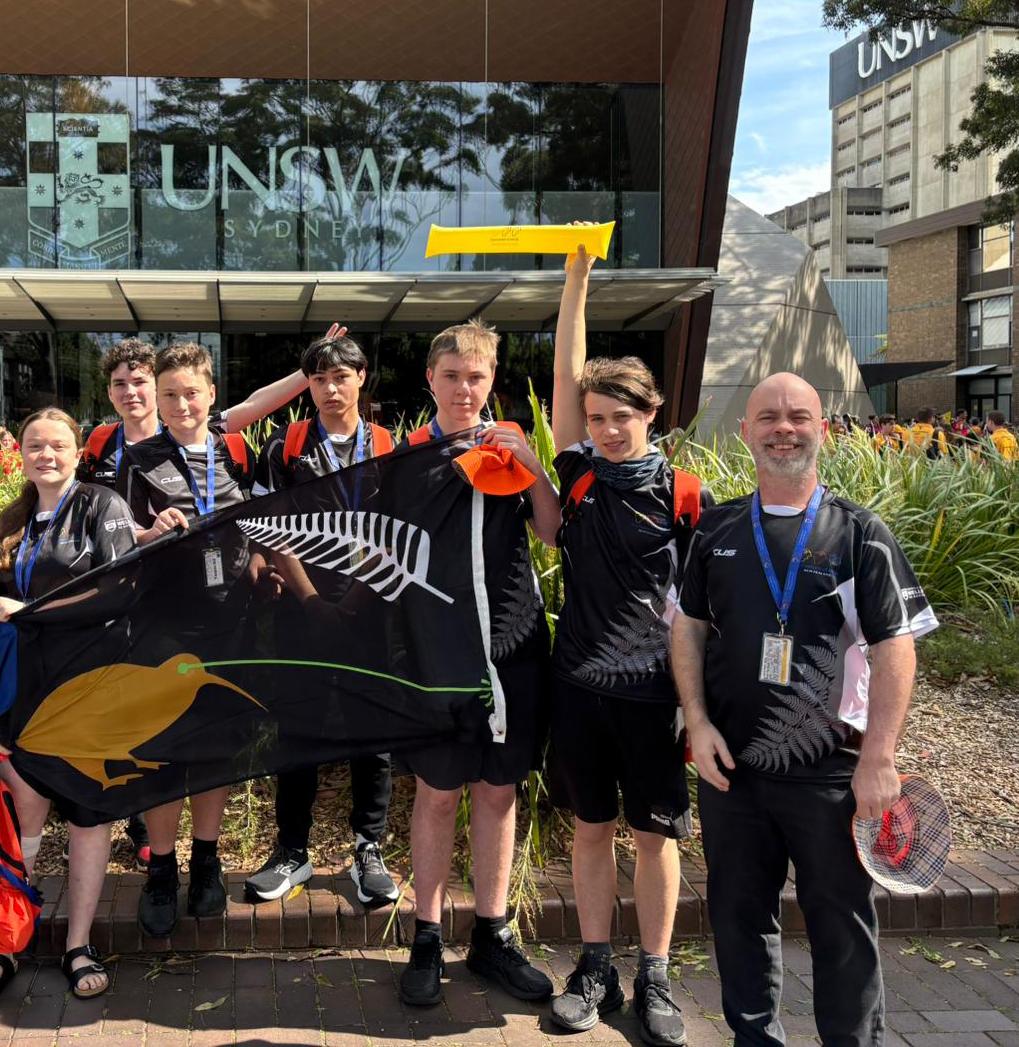
The teams also led the haka, waiata, karakia and team spirit.
“I was so proud as we showed unique team spirit,” says Mannie. “Our waiata, karakia and haka were not prepared just for TOM. They are an integral part of our New Zealand identity and this showed as the passion and feeling that was different compared to other teams present.”
Rory says the moment gave him goosebumps.
“It was super special – a moment that made me feel so proud, humbled and excited all at once.”
Putting ideas out into the world
Jocelyn says TOM is dedicated to increasing students’ chances of success and that, “as a society, we capture and grow the gifts and talents of as many students as possible”.
Amanda from Hadlow says TOM taught her to “put my ideas out there”.
“Even though your idea may be super wacky and weird and you don’t think it is good, still put it out there. Because you never know if it will be the winning one.”
Rathkeale College student Moksh says he learned to manage his nerves, including by going over the script at least 10 times and making sure he had everything he needed.
“One of the skills that I learned is that you have to be confident, but that’s challenging.”
Oscar, also from Rathkeale, agrees and says TOM helped grow his confidence.
“Working with my team to solve challenges was heaps of fun, and it felt great seeing how well we all worked together when things got tough. One of the best moments was on the bus after the competition when some of the New Zealand teams were singing and celebrating. It was such a cool feeling – everyone was proud and happy, and it showed how much we were all enjoying the experience.”
Alby says there were “moments where things felt intense”.
“TOM taught me how to stay calm, focus on the task and support my teammates.”
Growing minds of the future
All three Wairarapa schools will enter TOM again. Mannie says the competitions bring many benefits to teaching and learning.
“TOM is providing students with team-based critical thinking, dramatic presentation and problem-solving skills that are not always tackled fully in other areas. These are not just TOM specific but essential life skills that are having a huge and very positive impact on students’ learning in other areas.”
Rory considers TOM an asset to Wairarapa College’s Gifted Programme and he’s keen to see the student legacy grow and improve.
“I’ve seen firsthand how powerful it can be in uplifting students who might not find that same boost through sport or cultural activities. TOM gives space for academic strengths to shine, which is especially valuable for our gifted learners.
“It offers opportunities, challenge and confidence-building that many of our students genuinely thrive on.”
Ruth, of course, will have a team ready for the 2026 competitions.
“I don’t think I could ever not do TOM!”
The TOM website and Facebook page have more information.
Tournament of Minds Tournament of Minds NZ Facebook
The Rathkeale team showcases their 10 minute presentation at TIF to a full international audience and panel of three
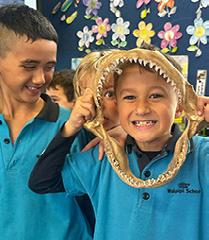
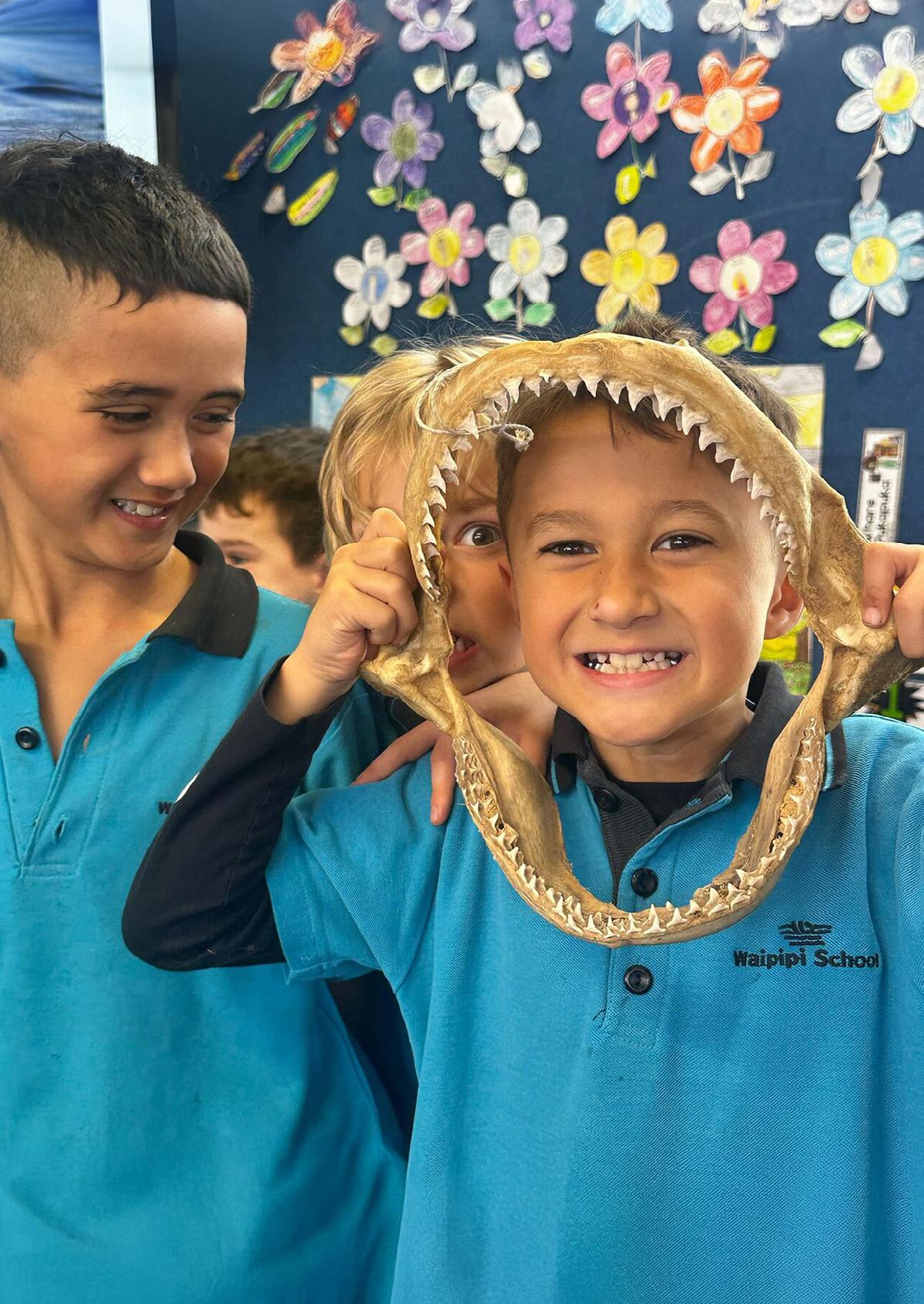
Fossils and shark skeletons bring the natural world to life.
Little Labs fuels science learning in rural primary schools
If not for an exceptional teacher, Laura Torpey may have had a completely different career. That high school biology teacher reshaped her view of science entirely, and now she’s repaying the favour to schools in her area with Little Labs, a science programme that’s turning country kids into science fans.
Laura Torpey, a farmer and agronomist in Franklin, says her eureka moment came after going from a rural primary school to high school science.
“When I was in primary school, we didn’t have any science stuff, so when I got to Year 9, that was quite a shock to the system.
“I vividly remember thinking, ‘Oh I’m too dumb for this, it’s not for me, I’m not even going to bother...’ . I spent a lot of time focusing on English class and writing stories.
“But I was lucky I ended up with a fantastic biology teacher in Year 11 and she really clicked with me. To this day I am so thankful to have encountered this teacher… and from then
on, I decided I’m going to university and I’m going to do a science degree.”
After studying biomedicine, Laura found herself in conversation with a younger cousin who had had a similar transition to high school science, and an idea began to form.
In 2019, while still farming, Laura began offering local schools real hands-on science sessions, a programme she called Little Labs.
Her key focus is student engagement. Laura says science can be “very talky-talky,” so whether it’s dinosaurs or marine biology, rockets or forensics, the topics she chooses have to be hands-on and have the “wow factor”.
Franklin-based farmer and scientist Laura Torpey uses all the tools – visuals, hands-on tasks, storytelling and student-led inquiry – to give rural students a practical taste of science.
“The human heart and the microbiology ones have proven the most popular because they’re really visual but they’ve got the gross factor, which gets them hooked.”
“The human heart and the microbiology ones have proven the most popular because they’re really visual but they’ve got the gross factor, which gets them hooked.”
Little Labs also aims to get students thinking more widely about the range of science-based careers, including the trades, nursing and especially farming.
“And it really is all about locals helping locals. When we’ve got these career sessions, I’ll be calling upon a lot of my mates who are dairy farmers and builders, all these cool career people, to come into the school and talk to the kids.”
Knowing that enrichment opportunities can be scarce and geographically challenging for rural schools, Laura decided early on to make the classes free.
“I bring all the resources, I bring all the teaching materials, I bring the paper, the coloured pencils, the glue sticks, I bring everything so the school doesn’t have to use anything of its own.”
Her stocktakes have shown school science supplies can range wildly, from “random magnets” to a fancy set of materials bought by a long-departed teacher.
With the resources barrier removed, five schools have now used Little Labs. This meant that in 2024 Laura was teaching 420 students, ending the year with an inter-school science fair to celebrate their learning.
Megan Allen, the principal of Awhitu District School, says students really looked forward to Little Labs and the programme extended their scientific knowledge.
“We teach science but to have that expert knowledge behind what she was doing and to be able to get equipment for them to use, it was really good.”
In more formal feedback, teachers have reported long-lasting learning from the programme, with the hands-on nature of the lessons appealing to a wide range of learning styles.
Laura has since registered Little Labs as a charity. Though it is still largely self-funded by her, it has received support from the Ministry of Business, Innovation and Enterprise’s sector workforce engagement programme (SWEP), and community donors like the Wright Family Foundation, FMG and Delta Education.
Ulitmately, Laura would love to see Little Labs expand further afield, connecting other science educators to schools in their area.
But she’s also excited about the Government’s recent funding of science kits for all Year 0 to 8 students, a $39.9 million investment over four years to support the new science curriculum.
The kits, which will also be available in te reo Māori, will be available from the start of this year.
Ākonga engaging with one of the ‘hands-on’ microbiology projects.
“I would say that’s going to be a huge help to the schools,” says Laura.
Growing up in a rural environment is a benefit which Laura believes makes STEM quite a natural fit for students at rural schools.
“There’s no reason that a future rocket engineer, radiographer, or agricultural scientist, can’t come from a rural dairy farm or an isolated sheep station,” she says. “We just have to give them the spark.”
Article written by Catherine Harris.
For more information about Little Labs, go to their website. littlelabs.co.nz
Sylvia Park School’s inquiry curriculum fosters kaitiakitanga and connection to place
At Sylvia Park School in Tāmaki Makaurau, inquiry learning has long been central to the school’s culture. Their latest inquiry, a deep dive into local maunga, weaves together pūrākau, science, history, literacy and design, and has left ākonga with a powerful connection to place.
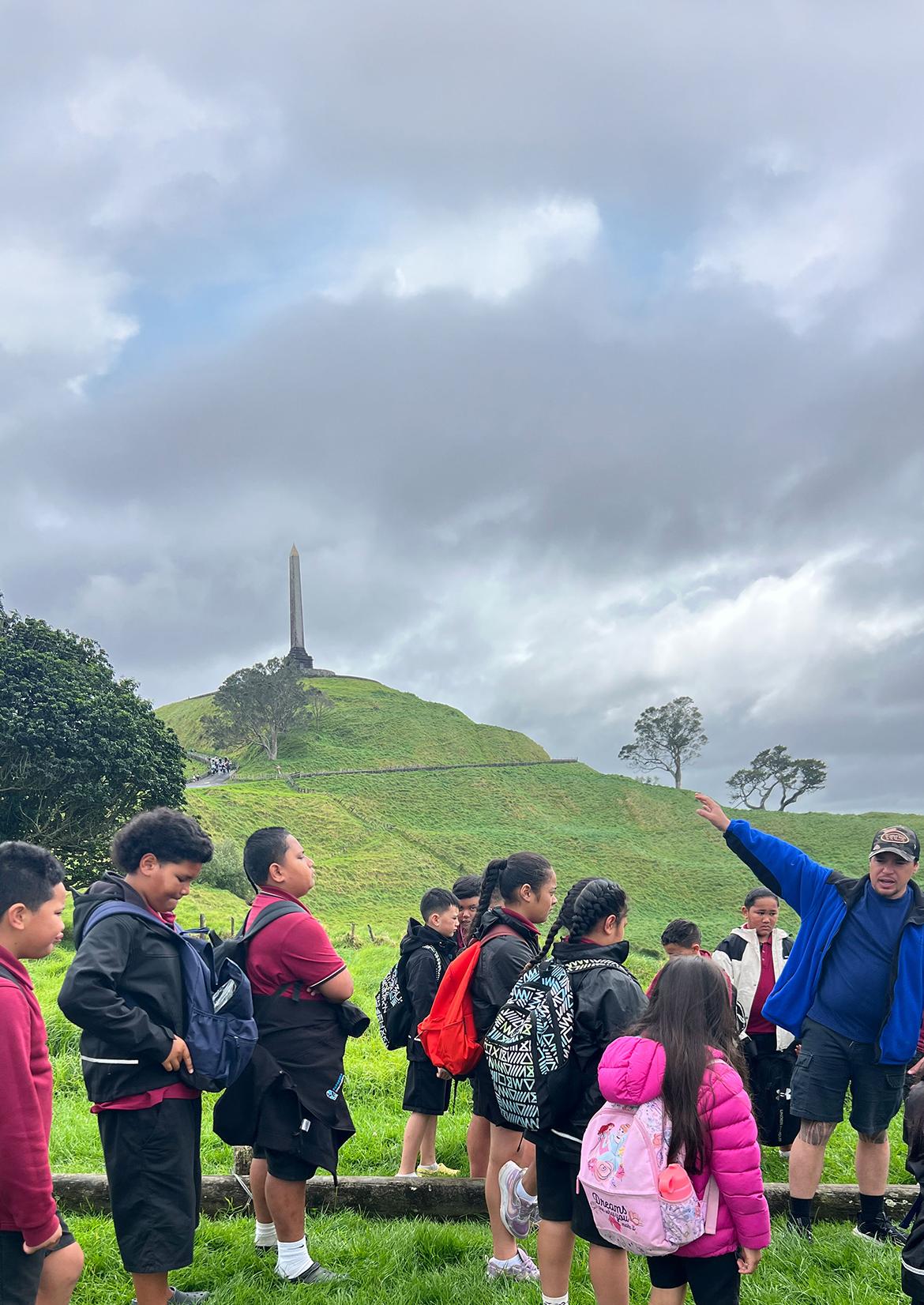
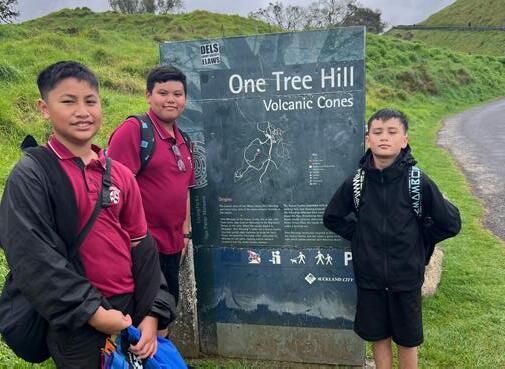
Sylvia Park School ākonga hīkoi up local maunga Maungakiekie, guided by Thomas Rawiri.
Before the inquiry began, most Sylvia Park School students could name the maunga they passed on the way to school. By the end, they could also explain how those maunga were formed, retell pūrākau with confidence, describe how the land had been used over time and explain why caring for these places matters.
During term 3 of last year, students explored the stories of four local maunga: Maungakiekie, Maungarei, Ōtāhuhu and Mutukāroa. The learning grew from the school’s whole-school inquiry curriculum, called Pakirehua, and in term 4 was extended through a smaller, mixed-age group known as the COMET KIDS.
Grounded in place-based learning, the project wove together te ao Māori, history, earth science, literacy, design thinking and partnerships with community and industry. It positioned students as researchers, storytellers and teachers of others.
Starting with what students already know When asked what they knew before the project began, students described a basic understanding of names and locations.
“Before we started COMET, I only knew that the English name of Maungarei was Mount Wellington, Maungakiekie was One Tree Hill, Ōtāhuhu was Mt Richmond and Mutukāroa was Hamlin’s Hill,” says Saviour.
Others had heard parts of local pūrākau but had not yet connected them to the landscape around them.
“One thing that I knew before this whole project was the stories of how Maungarei was created and how Maungarei got its name from two sisters,” says Denzel. “I knew that Mataaoho brought up Maungakiekie, Ōtāhuhu and Maungarei. He didn’t bring up Mutukāroa because it’s not a volcano.”
Sepi had picked up some specific facts.
“What I knew before all of this started was that Ōtāhuhu is the shortest maunga, but it’s also the oldest maunga. Maungarei is named after two sisters, Reitu and Reipae, and Maungarei is basically named after Reipae.”
These early understandings became the foundation for deeper inquiry.
Inquiry grounded in place
The project sat within Pakirehua. All 537 ākonga took part in the term 3 inquiry, learning about the maunga that their school houses are named after.
Lead teacher Oriana Hansell-Pune says inquiry learning has long been central to the school’s culture.
“I am a Year 7 and 8 teacher, but I’m also the lead teacher in charge of planning and organising our wholeschool inquiry curriculum, which we call Pakirehua. I get to come up with some really amazing ideas that inspire our students to explore more and create incredible outcomes,” she says.
“I think if our school wasn’t doing inquiry, the culture of our school would be very different. It’s something that’s been ingrained in our school for a really long time, and we’re very proud of our inquiry curriculum.”
Alongside the whole-school inquiry, Oriana applied for funding through Te Hononga Akoranga COMET Auckland to extend the learning with a smaller group of students from Years 3 to 7.
Once approved, 28 students formed the COMET KIDS group, meeting weekly during Oriana’s release time.
For Oriana, inquiry creates space to weave literacy and numeracy naturally into learning.
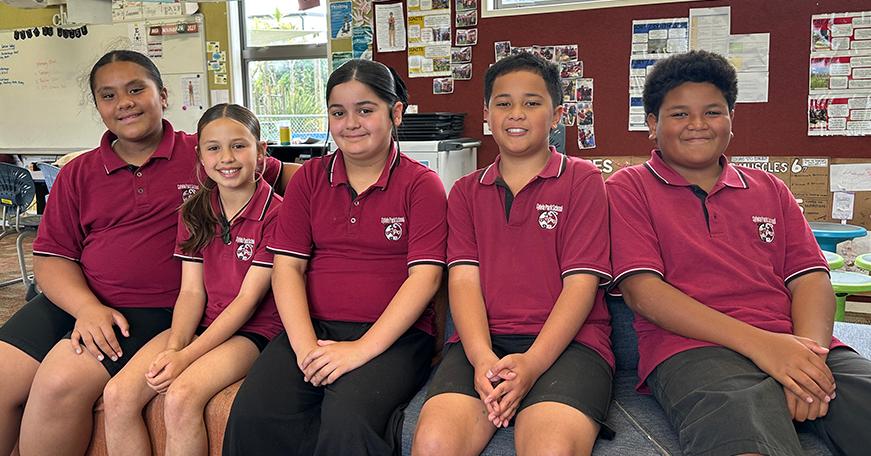
Sylvia Park School ākonga, from left, Sepi, Zara, Eva, Denzel and Saviour.
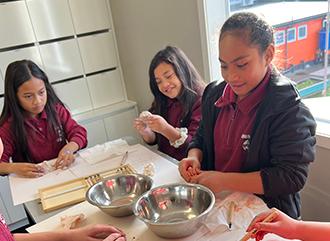
One lesson focused on modelling the four maunga using clay as shown by Sisilia, Year 3. This was in preparation for designing them in 3D using TinkerCad before 3D printing.
“You can weave so much rich literacy and numeracy learning through inquiry,” she says. “We try and do that as best as we can. They read a story about the fight between Tongariro and Taranaki over Pīhanga, who they both fell in love with. Those types of rich stories help them make strong connections.”
Learning through hīkoi and pūrākau
To ignite the inquiry, ākonga took part in hīkoi across local maunga, guided by Thomas Rawiri, who works alongside the Tūpuna Maunga Authority through his mana whenua-led education service, Explore Tāmaki Ltd.
For many students, the hīkoi were a turning point.
“My favourite part was going on trips because we got to go up the maunga,” says Saviour. “For example, Maungakiekie with Matua Thomas Rawiri, and he was teaching us about different things.”
Thomas says these experiences help students connect learning to place.
“Our maunga are more than landmarks, they are tūpuna,” he explains. “When ākonga learn the stories of the land beneath their feet, they gain a sense of belonging and responsibility.”
During the hīkoi, Thomas shared kōrero tuku iho and pūrākau, alongside historical and contemporary perspectives.
“We explored pūrākau such as the atua Mataaoho and the shaping of Tāmaki Makaurau, the arrival of tūpuna from Hawaiki, life on the maunga including pā, māra and mahinga kai, and the roles of rangatira and the interconnectedness between the tribes of Tāmaki,” he says. “We also discussed Te Tiriti o Waitangi, the impacts of colonisation and the collective redress that now sees the maunga protected for future generations.”
For Oriana, learning directly from mana whenua supported students to think critically about history.
“I approached it by connecting with Thomas Rawiri and learning through him what the pā site used to look like,” she says. “He had these amazing photos of what Maungakiekie was like when it was lived on, and he could tell stories about the historical significance of the maunga and how they were used.”
The physical challenge of the hīkoi also became part of the learning.
“The hardest part was walking up. It was tiring because it was a really steep hill,” says Zara. “My favourite part was probably getting to the top and seeing the view and how nice it was.”
The whole school learned about the maunga that their school houses are named after.
It was also a significant moment for Eva.
“My favourite part was getting to see the maunga in person and the statue and hearing the stories about Maungakiekie. It was my first time, and it was very exciting.”
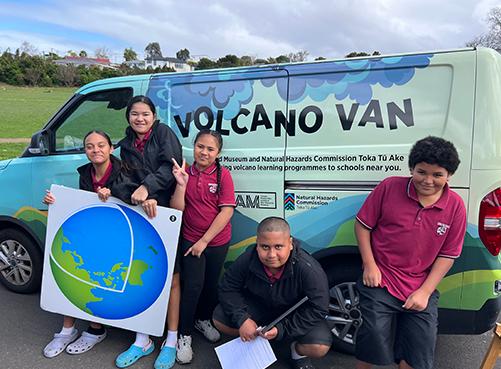
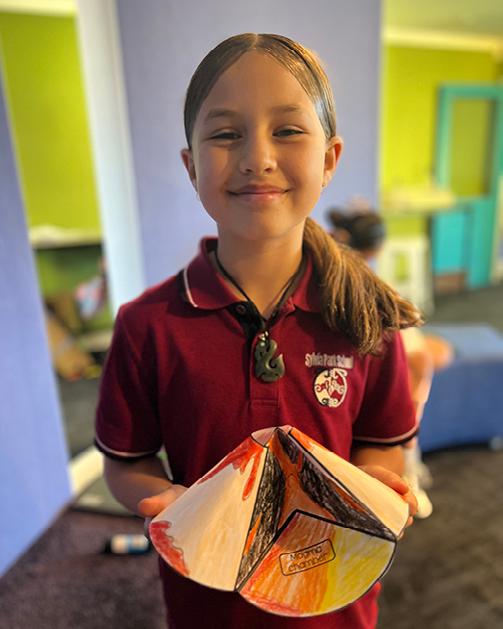
Students also connected pūrākau with science through classroom learning and visits from Auckland Museum’s Volcano Van.
Designing and creating learning resources
Through workshops with 3D printing company VAKA, students learned how to use TinkerCad and design for 3D printing.
“My favourite thing was doing our taonga,” says Zara. “We made taonga that represented our cultures. We could pick a design, and then pick a pattern.”
Denzel valued the practical skills.
“My favourite part was learning new skills that could be useful. So if you wanted to be a 3D designer, for example, those skills that the VAKA staff taught us could be useful.”
Eva says seeing their designs come to life was exciting.
“My favourite part of this COMET project was the Maungakiekie trip and printing our own taonga and maunga.”
Students also designed a large, double-sided jigsaw puzzle to help others visualise pūrākau, history, and characters connected to the maunga. The 3D printed items will become shared resources to sit alongside the inquiry plan and be used by other classes and schools.
“I wanted the outcome to be something that could be shared among schools,” says Oriana. “I think it should be a shared resource that goes to other schools that might want to learn about local maunga that are important not just to their area, but to their students.”
Connecting learning to the wider world COMET supported the project by connecting the school with industry partners, including engineers and architects from GHD Engineering.
“That’s what we’ve done for 25 years,” says Katheren Leitner, chief executive of COMET. “We work with schools that recognise the value in inquiry-based learning and giving young people agency.”
Students visited GHD’s Auckland office to present their learning.
“My favourite part was how we got to go to GHD Engineering and how they helped us,” says Sepi. “We got to meet Emma and talk to her, and she told us how engineering works, and how water engineering works at GHD.”
“The standout for me was seeing all of these young people stand with so much confidence and speak with so much credibility in a really intimidating space,” says Katheren. “They were presenting in a room probably three or four times the size of their classroom, facing professionals they didn’t know, and they were incredible.”
“My favourite part was getting to see the maunga in person and the statue and hearing the stories about Maungakiekie.”
Ākonga connected pūrākau with science through classroom learning and visits from Auckland Museum’s Volcano Van.
Sylvia Park School ākonga Jaylon on Maungakiekie.
Activities were interactive so everyone could learn together.
Ākonga took part in hikoi to local maunga to ignite the inquiry.
Ākonga then rotated through four stations.
“They moved around a water engineer station, a geotechnical engineer station, an architect station, and a transport station. Their work and their questions were incredible,” says Katheren. “When I left, the team told me they were shattered because the students asked such great questions and made them think hard. That’s what we aim for.”
Oriana agrees.
“I knew the students were going to be amazing at presenting because they live and breathe it here at our school,” she says. “But they blew it out of the park. I was there running the slides, but I wasn’t the one running the show. They were, and that was really amazing.”
“You can weave so much rich literacy and numeracy learning through inquiry.”
Learning that lasts
Working across year levels was one of the strongest features of the project.
“One of the highlights that the students and whānau brought up was that they really loved working across year levels,” says Oriana. “The older students were helping the younger ones, and the younger students were coming up with these dream-big ideas.
“I didn’t really differentiate for year levels. I planned activities in an interactive way so everyone could learn together.”
Feedback from whānau showed tamariki were taking learning home.
“A lot of parents said that when they’re driving around and their child sees a maunga, it sparks a conversation,” says Oriana. “They’re explaining what they’ve learned.”
For Thomas, this is the impact that matters.
“I love seeing the pūrākau come to life through the children’s imagination. When tamariki realise that these places and stories belong to them too, and that they are part of the continuum, their confidence grows,” he says.
“Many of the students were visiting their maunga for the first time, and watching their confidence grow as they shared pepeha, asked questions, and made connections was incredibly rewarding.”
Ākonga Zara and Saviour share their favourite pūrākau
“My favourite pūrākau is where all the maunga were fighting over a maunga called Pīhanga,” says Zara.
“And, in the end, Tongariro won, ending with Pīhanga as his wife. And then they got to live really close. And then Taranaki went to be all by himself, away from everyone, because he was so sad.”
After Zara finishes, Saviour adds: “His love was so strong for Pīhanga that on his journey away from her, he kept turning back and tears fell from his face, which created a river, the Whanganui.”
Zara shares one of the earth science activities where ākonga learned to identify parts of volcanoes and what makes them active.
Challenges and change push limits and growth at Outward Bound
For almost 65 years, Outward Bound’s New Zealand school has been teaching leadership by instilling resilience and confidence. Four Wellington Girls’ College students recall how their three-week experience in the depths of a Marlborough Sounds winter challenged them, and what that has meant for their outlook and futures.
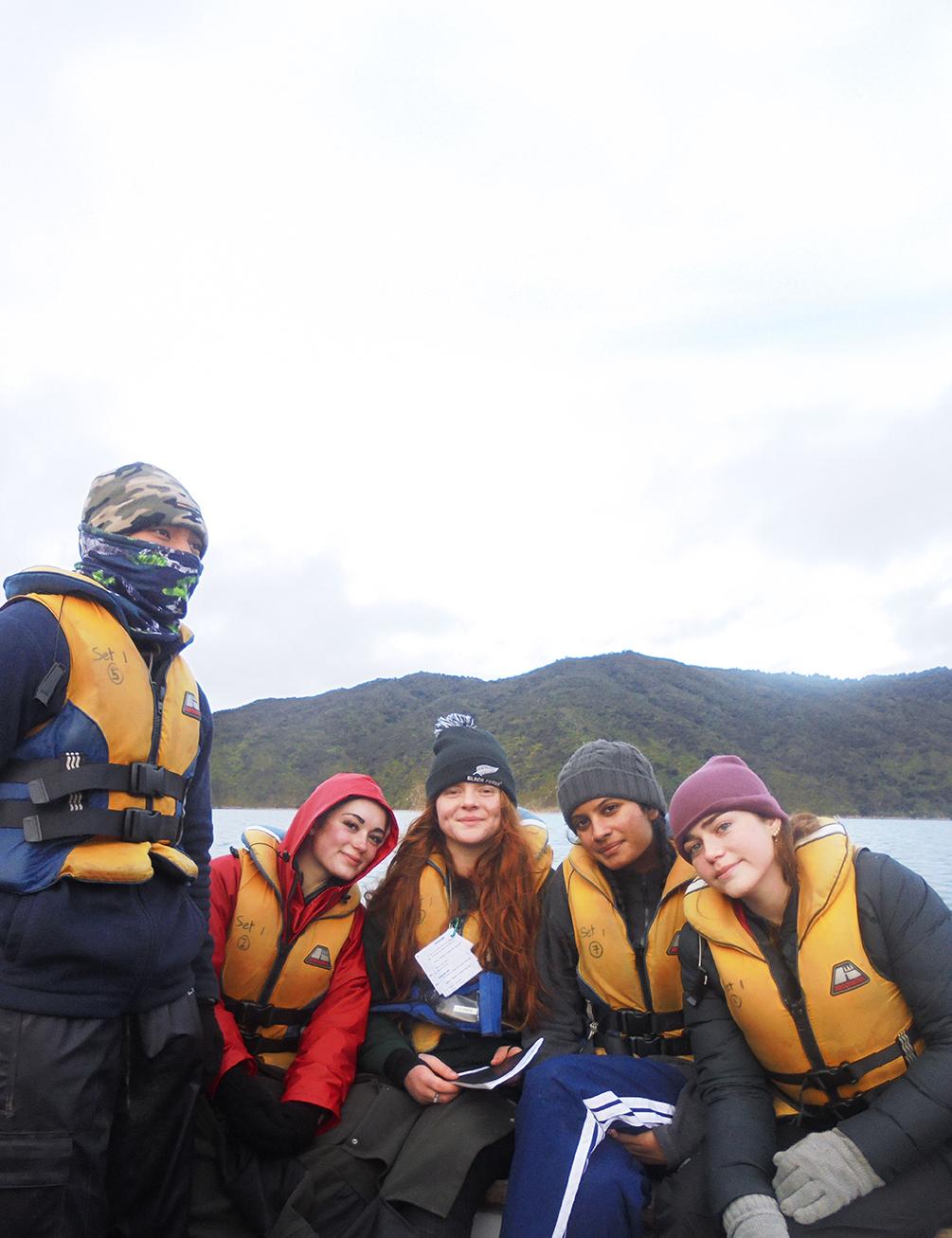
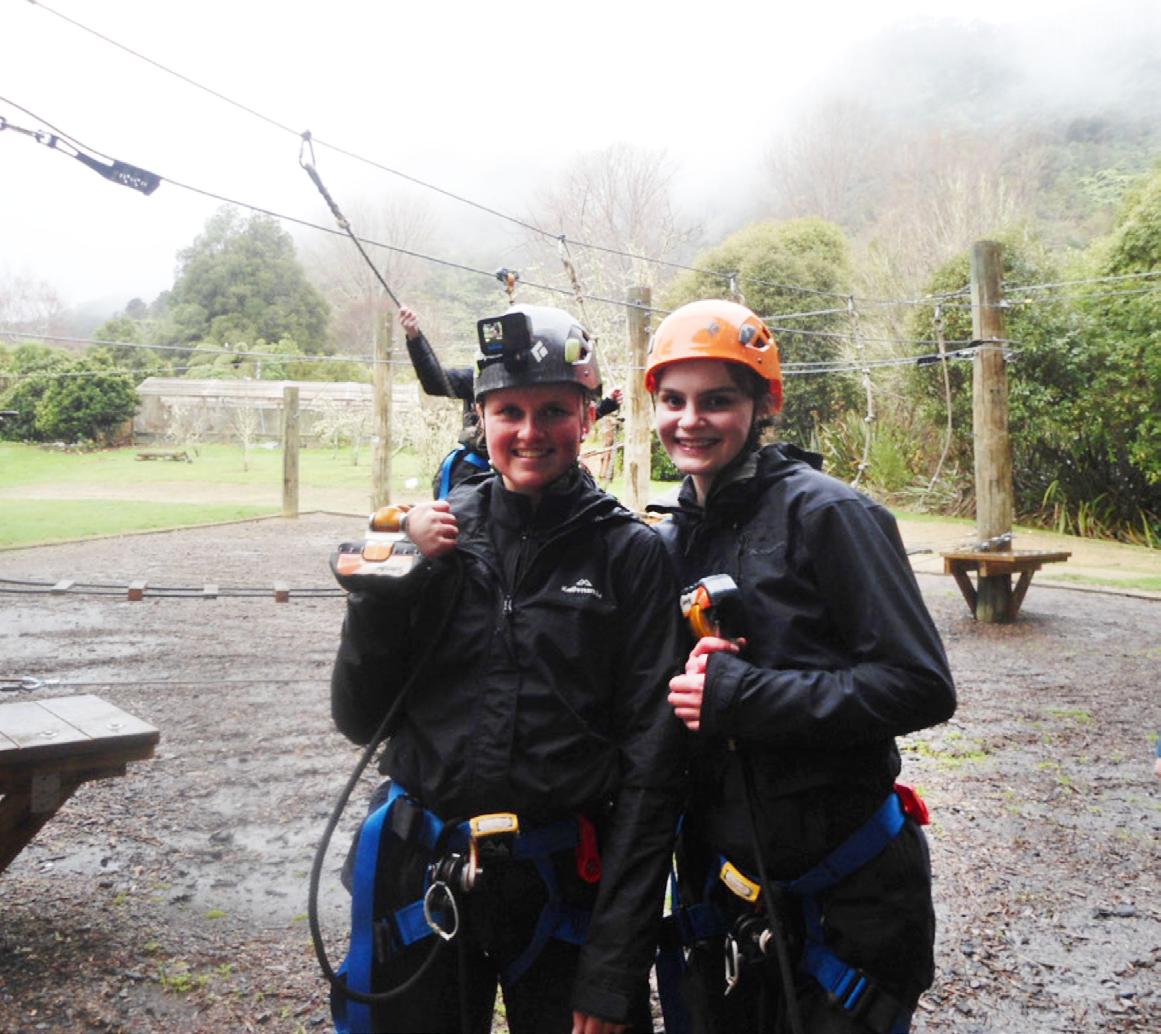
Wellington Girls’ College students during their 21-day Outward Bound course.
Senior Wellington Girls’ College student Shreeya had never heard of Outward Bound when an email about a course arrived in her inbox.
“I was getting bored with everyday life, waking up for school and then coming home and studying. I needed a change, a huge one for that.” She knew the course described in the email would push her outside of her comfort zone – exactly what she wanted.
Shreeya and three fellow Wellington Girls’ students took part in a three-week course for rangatahi at the Anakiwabased school in July last year.
Suddenly, they were waking up to a three kilometre run followed by a dip in the chilly sea, and then working as a team to clean their sleeping areas. If the group failed to meet the high cleaning standards, they had to repeat the whole morning routine.
Outward Bound courses challenge students’ whare
tapa whā: whānau (family and social), tinana (physical), hinengaro (mental and emotional) and wairua (spiritual).
Student Korimako says her taha whānau was tested by having to work closely with rangatahi she had never met before. Her taha hinengaro and taha wairua were pushed as she had to “deal with pressure, face tight timeframes, and keep going even when it got tough”.
“And of course, my taha tinana was constantly challenged through all the tramping, sailing, and physical challenges. It was hard, but I kept reminding myself that I am capable.”
Shreeya learned that effective teamwork means everyone has to contribute, stay organised, and hold each other accountable. “If one person slacked off, the whole group paid the price, but when everyone put in effort, we achieved success together,” she says. “Success is rarely achieved alone.”
Wellington Girls’ College students at Outward Bound.
Disconnecting to re-connect
Outward Bound was established in Wales in 1941 and now has 37 schools worldwide. Outward Bound New Zealand has been running courses from its school near Picton since 1962. This year, it will hold five three-week courses for rangatahi aged 16 to 18. They also offer one-week courses for this age group, as well as 13- to 15-year-olds accompanied by a parent or caregiver.
Through their activities, students gain valuable soft skills that support their transition into adulthood and help build community, says Outward Bound community development leader Krishan Kumar.
Technology is also removed from students’ lives for the course’s duration – disconnecting to re-connect.
“I had never been away from home for a long period of time and especially without my phone,” student Olivia says. Although she felt homesick, Olivia says she found strength, reassurance and belonging in talking about this with her adopted family for those three weeks.
With early mornings and long days, the tauira had to ‘dig
deep’ and keep going. On some days, they would be walking for eight hours in tough physical conditions. But they learned to keep pushing – one foot in front of the other with their teammates puffing beside them.
Student Keiana says relationships were built with fellow participants through the shared challenges. She speaks of an uncomfortable and cold climb up the 1,000-metre Mt Cullen, after which the group giggled together over a hot meal in the evening.
Learning leadership
Encouraging the students to be leaders is another key aspect of the course. Olivia took on the role of leader during the tramping trip by planning the route, making the main decisions and keeping her group motivated.
“It was hard being in charge of everyone, especially when I was tired and sick of walking, but it taught me that leadership is about listening, staying calm under pressure, and bringing out the best in others,” she says.
Time on the boat was one of Shreeya’s favourite parts of the course.
“It
taught me that teamwork isn’t about everyone being perfect – it’s about supporting each other, communicating clearly, and staying positive even when it’s hard.”
“It’s great to look forward to what’s next, but it’s equally important to unwind, breathe, and appreciate the now and acknowledge what’s right in front of you.”
During tramps, instead of spreading out because of different walking paces, the group stuck together, sharing both words of encouragement and the weight of gear.
“That showed me that real teamwork means putting the group’s success above your own comfort,” explains Olivia. As she moves into a university hall of residence this year, she says she now has the confidence to communicate with different personalities.
Shreeya’s leadership ability was strengthened as she took on the role of camp cook, feeding 11 hungry students each night.
“Success is rarely achieved alone.”
“Taking on this responsibility taught me that leadership isn’t always about being the loudest or most visible person –it can also mean stepping up in practical ways that support the group,” she says.
“I learned that good leadership requires organisation, patience under pressure, and making sure the needs of others are met before your own.”
Sailing was where the importance of teamwork really shone for the ākonga.
“None of us really knew what we were doing at the start, and it was frustrating when things went wrong. But we had to rely on each other to get the sails up, steer, and keep moving forward,” says Olivia.
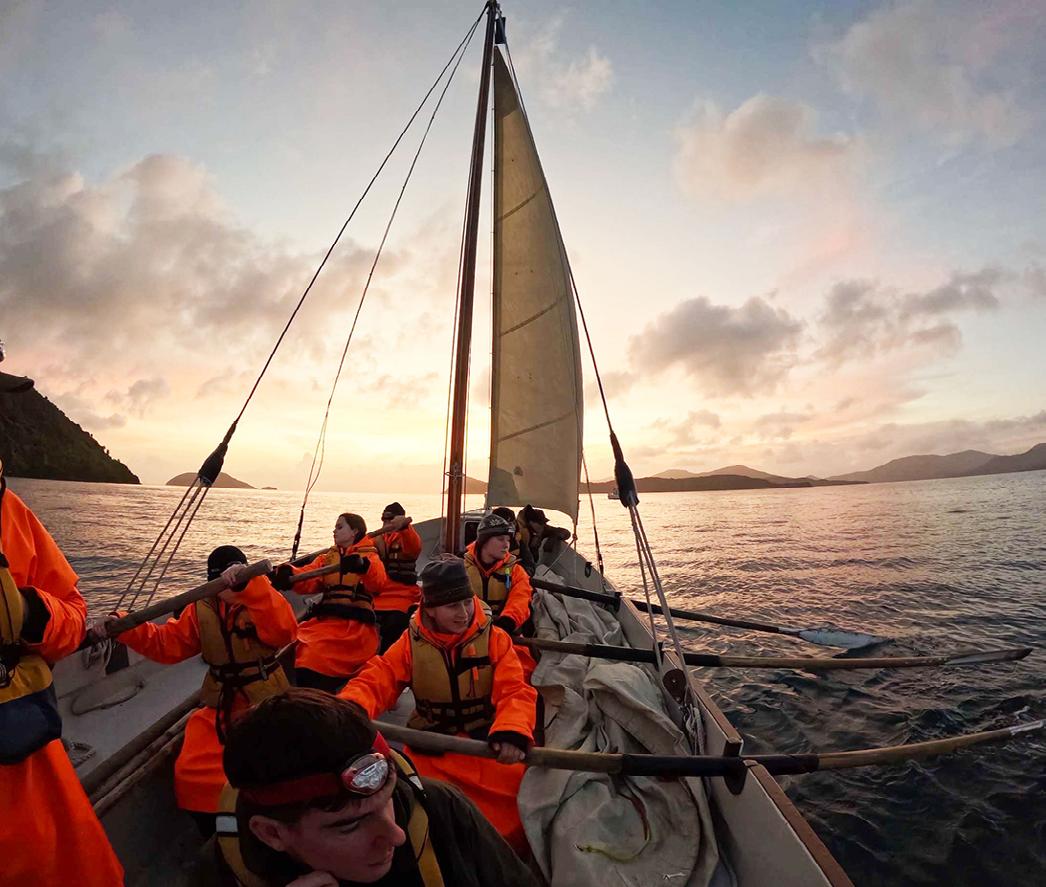
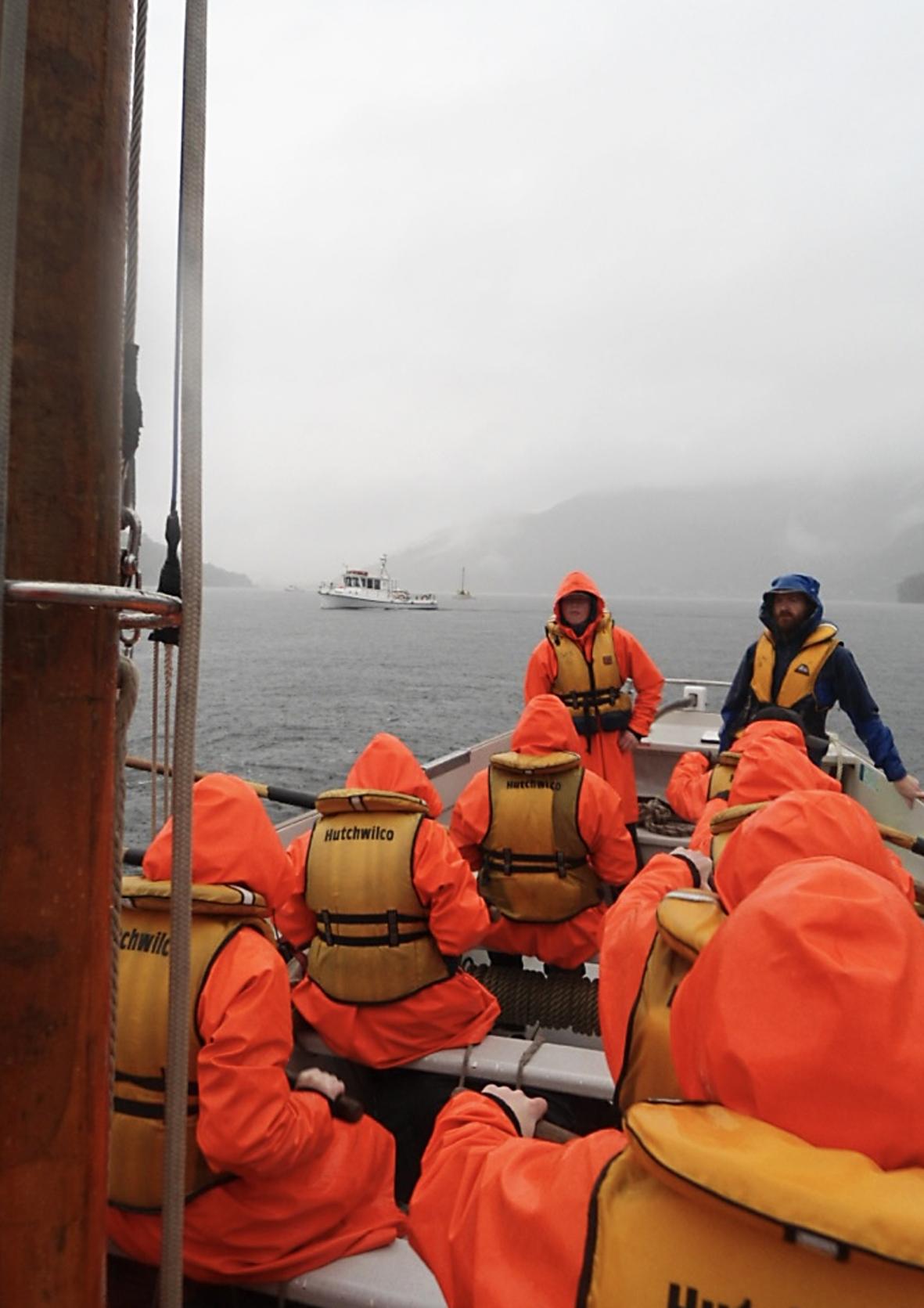
With 12 people on the boat, only three could rest at a time, and everyone had to match their coordination and row in time with each other. If they didn’t, the boat wouldn’t move at all in the windless and wet weather conditions.
“It taught me that teamwork isn’t about everyone being perfect – it’s about supporting each other, communicating clearly, and staying positive even when it’s hard,” Olivia adds.
This sailboat mission ended up being one of Shreeya’s favourite parts of the trip. Not the eight hours of rowing, she clarifies, but the camaraderie on board, when a guitar came out, and everyone’s voices joined together in song.
Mā te wā
When students ask instructors what was next in their schedule, they are answered with ‘mā te wā’: “Time will tell.”
Krishan explains this phrase is used to encourage tauira to be open to the unexpected and lean into their own skills to cope with this change or challenge.
This ‘live in the moment’ stuck with Korimako. “It’s great to look forward to what’s next, but it’s equally important to unwind, breathe, and appreciate the now and acknowledge what’s right in front of you.”
One of those unexpected challenges was significant flooding in the Marlborough region last winter. As supporting the community is another key aspect of Outward Bound courses, the students cleared a damaged track, built a bridge, cleared campsites of debris, and re-dug flooded drains.
They say it felt good to give back and see that even a small contribution of their time could have a big impact on the wider community.
“It also gives you a break from everyday distractions like phones and social media, allowing you to connect more deeply with the people around you,” says Olivia.
For more information about Outward Bound and courses for rangatahi aged 16 to 18 in 2026, contact Krishan Kumar or look at ‘teen courses’ on their website.
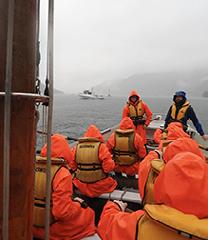
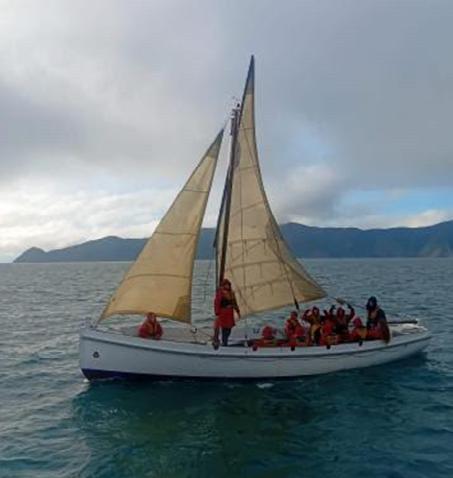
Sailing in the Marlborough Sounds, where Outward Bound is based.
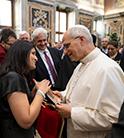
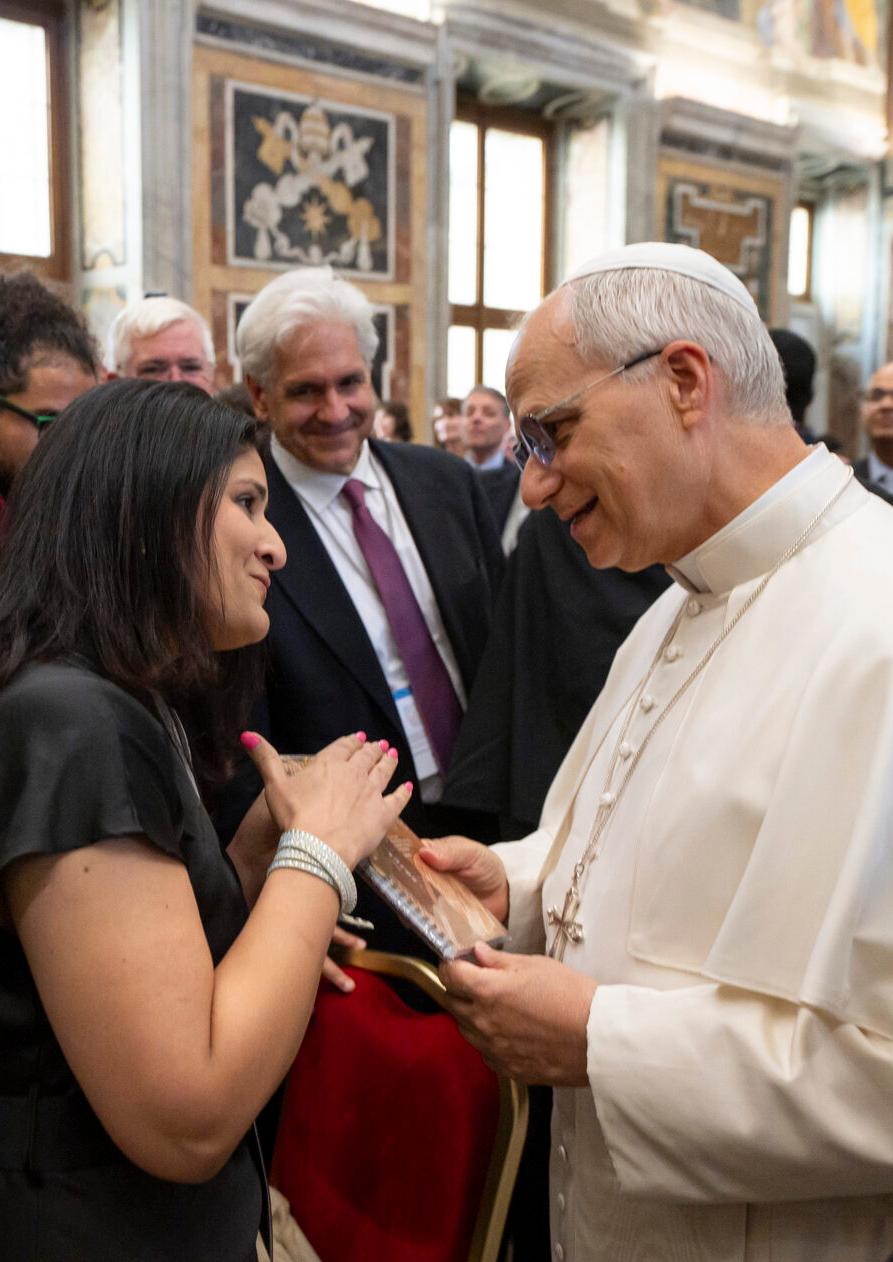
Saniya Surani meets the Pope.
A mother’s story: Education expert brings refugees’ stories of resilience and hope to the world
Saniya Surani, a senior advisor with the Ministry of Education, explored the educational experiences of refugee mothers in New Zealand as part of her master’s degree. Now she’s taking her research, and the womens’ stories of resilience and hope, to the international stage – a journey that resulted in a private audience with the Pope.
For three years, Saniya Surani, Senior Advisor Refugee and Migrant Education, delved deeply into what it’s like for refugee women from Pakistan to settle in New Zealand.
As part of her Master’s in Education through the University of Auckland, Saniya focused on factors that supported their children’s education and the barriers they faced.
The result was a research paper, Resettlement experiences of Pakistani refugee mothers in Auckland, New Zealand that is now being noticed on the global stage – including the Vatican City.
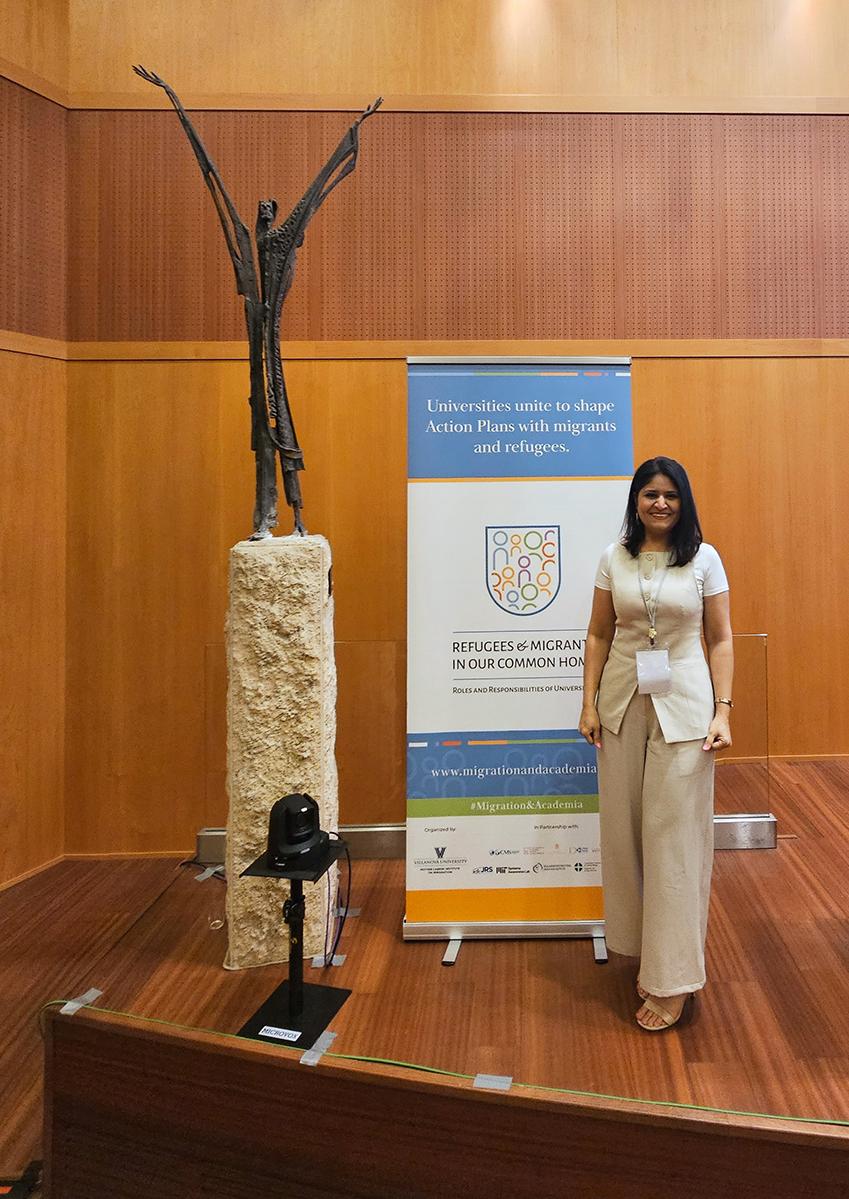
Last year, Saniya was invited to present her research at global conference Refugees and Migrants in our Common Home in Rome, Italy, which included a private audience with the Pope.
Saniya says a unique aspect of her research was examining the relationship between refugee communities and Māori, including how the pōwhiri at Māngere Refugee Centre helped foster connections with tangata whenua.
This relationship is globally unique, she explains, and includes innovative practices the world can learn from. That’s why she’s motivated to tell the stories of refugees in New Zealand more widely, while also learning from the fresh perspectives of others.
A
global journey through education
Saniya works within the English for Speakers of Other Languages (ESOL) Migrant and Refugee Education team. Based in Auckland, she’s worked for the Ministry for eight years, and in the education sector for 12.
Saniya was born in Karachi, Pakistan, and now proudly identifies as a Kiwi Pakistani. She moved to New Zealand nine years ago with her husband and oldest daughter who is now 10. Their second daughter is now 3.
At the start of her career, Saniya worked for a global education initiative, Teach For All, as part of Teach For Pakistan. There, she contributed to high-impact work in public schools across Pakistan.
Before arriving in New Zealand, Saniya lived and worked in Dubai, where she served as the assistant head of the ESOL department at an international school.
She holds a Master’s in Education from Aga Khan University and a Diploma in Education from Australian Catholic University.
Embarking on her second Master’s in Education in Auckland, Saniya worked around her young family and her job, taking three years to complete the degree.
“The Ministry supported me through its study assistance programme, and my colleagues provided emotional support throughout the journey even when I welcomed a baby during this time,” she says.
“I was fortunate to design a special paper with faculty support, allowing me to tailor the course to my prior experience, qualification and interest.”
The road to Rome
Saniya travelled to the conference in Rome on a full scholarship provided by its American organiser, Villanova University.
“Schools and communities can play a vital role in promoting gestures of reconciliation and lifting up stories of resilience and hope among refugee families.”
The three-day conference brought together participants from 40 countries to discuss refugee and migrant issues. Saniya was the only representative from New Zealand and was invited to talk about her research as a ‘lightning talk’ presenter.
“The delegates included education professionals, academics, international agencies such as UNHCR and the International Organization for Migration, Catholic institutions, the Aga Khan Development Network and many other global stakeholders,” says Saniya.
Her presentation session attracted significant interest from the audience, she adds, particularly around how New Zealand manages its refugee resettlement programme.
An audience with the Pope
“I had the incredible honour of a private audience with His Holiness Pope Leo XIV during the conference at the Vatican,” says Saniya.
She presented a notebook with proverbs about education in different languages, representing refugee and migrant communities in New Zealand. The notebook was developed as part of a Ministry of Education project to celebrate cultural diversity and the universal value of learning.
“The experience was deeply humbling and inspiring. Pope Leo XIV’s address emphasised the urgent need to respond to the challenges of migration and displacement through teaching, research, service and advocacy, and to place the dignity of every human person at the centre of solutions,” says Saniya.
“His call to foster a culture of encounter, reconciliation and hope resonated strongly with me, as these principles align closely with my work in refugee and migrant education.”
Meeting the Pope has reinforced Saniya’s belief that education is a bridge for inclusion.
“Schools and communities can play a vital role in promoting gestures of reconciliation and lifting up stories of resilience and hope among refugee families.”
The power of dialogue, belonging and resilience
Saniya says her research deepened her understanding of refugee families’ needs. Her findings were that:
» refugee mothers valued education highly but faced challenges such as language barriers, limited access to culturally responsive resources and navigating unfamiliar systems
» positive engagement with Māori culture through pōwhiri and community events created a sense of belonging and strengthened relationships
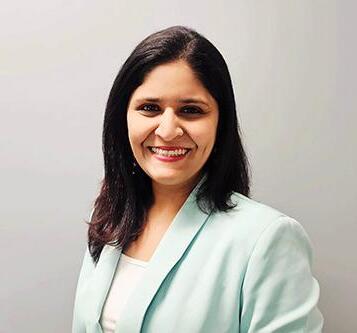
Saniya Surani, Senior Advisor Refugee and Migrant Education with the Ministry of Education.
» support networks both formal (schools, government and non-government agencies) and informal (community groups) played a critical role in successful resettlement and educational outcomes.
“My key takeaways include the power of intercultural dialogue in fostering belonging and resilience, and the importance of strong community partnerships to provide wraparound support for refugee learners and their families,” says Saniya.
Learning from the experiences of others
Saniya is now looking for opportunities to publish her research findings and share best practices internationally. She is also working on another paper further exploring migrant women’s experiences and career aspirations in New Zealand.
In the meantime, her research continues to inform her role at the Ministry. She says a key focus is to provide a strong sense of belonging for migrant and refugee students by recognising and valuing the richness they bring to the school community.
“Building trusting relationships with refugee families is essential for meaningful engagement.”
Schools play a pivotal role by connecting families with community resources and creating spaces for authentic cultural exchange, she adds.
“This means creating opportunities for courageous conversations about identity, and making sure diversity is celebrated.”
Saniya travelled to Rome on a full scholarship from Villanova University to present her research.
Creativity and belonging through poetry and art in Raglan
Year 7 and 8 ākonga at Raglan Area School recently embarked on a creative inquiry that blended poetry, visual arts and the explicit teaching of language features. The results were a published book of poems and art that students are proud of, and strengthened peer relationships. Teacher Felipe Queriquelli explains the process and outcomes of the inquiry to Education Gazette.
The aim of this inquiry was simple yet powerful:
Help students recognise how metaphor, alliteration, personification, imagery, and other features shape meaning, then give them the freedom to craft something authentically their own.
Throughout term 3 last year, all poems were handwritten. This was to make sure genuine voice was used. Students were encouraged to avoid digital shortcuts – including artificial intelligence (AI) writing tools – and instead engage deeply with their own thinking, drafting, and creative decision-making.
Creative and critical thinking were at the heart of this inquiry, especially when students faced an open-ended task requiring experimentation and reflection. Students navigated poetry structures, visual semiotics and symbolic representation through both writing and art.
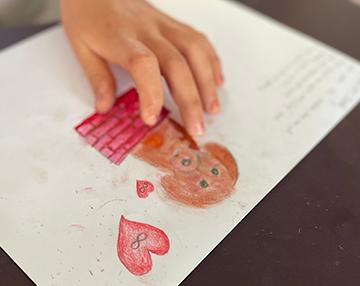
Once their poems were complete, students transformed their writing into visual artworks, creating drawings or paintings that communicated the emotions, themes and imagery of their poetry. The theme of each poem was entirely open, as was the artistic technique. Students explored everything from abstract symbolism to portraiture and landscape illustration.
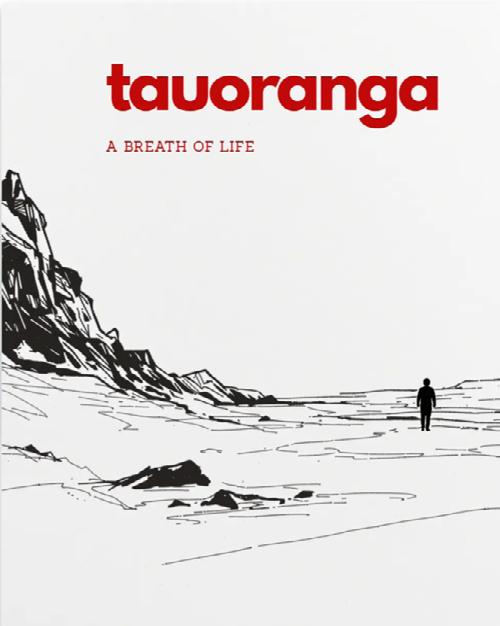
Their poems and illustrations were then compiled into a book titled Tauoranga – A Breath of life, which was published in November. Whānau and the community were invited to come in and talk to ākonga about their poems and art.
Creative freedom as a challenge
Initially, many students found the level of freedom they were given challenging. With no prescribed topic and no template to follow, they struggled to decide where to begin.
This challenge quickly evolved into a catalyst for discovery.
Poems and illustrations were compiled into a book titled Tauoranga – A Breath of life.
Freed from constraints, students experimented with personal interests, meaningful experiences, and inventive metaphors. Some explored environmental themes. Others wrote about identity, relationships, sport, or fantastical worlds.
“Students not only developed literacy skills aligned with curriculum expectations, but also discovered joy in creative expression and connection with their peers.”
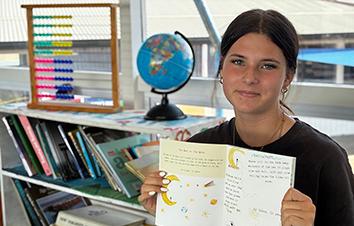
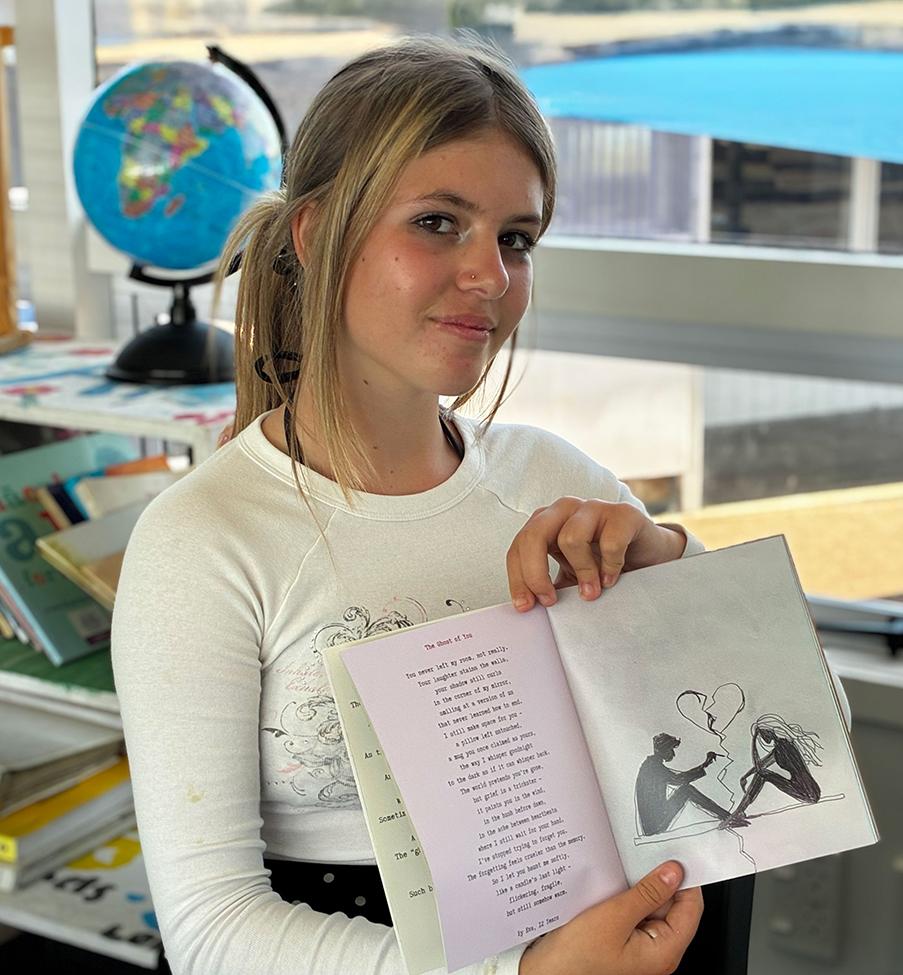
Eva with her poem, The Ghost of You and her artwork.
Jimmy’s poem, The Basketball Night was inspired by one of his favourite sports. Handwriting his poem was “good, in a different way compared to the typing in Chromebooks”, he says. Jimmy enjoyed the drawing because he likes art and says he learned how to write a poem and “all possibilities we can have to create such a thing”. Having his work published felt “amazing”, he says.
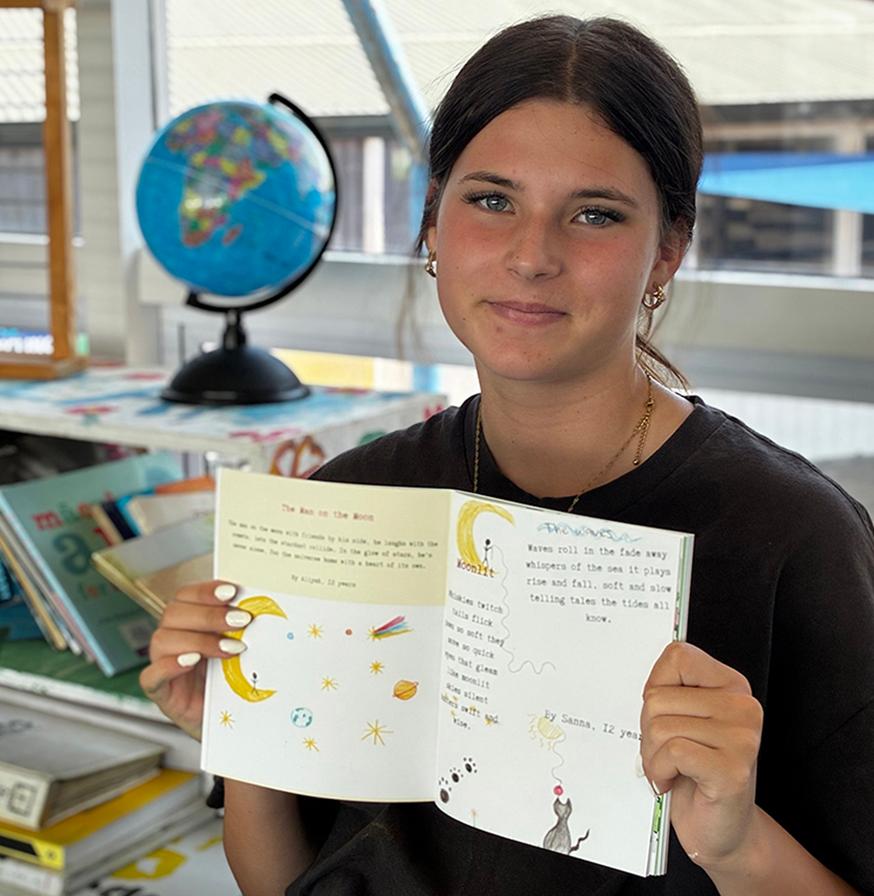
Aliyah got her idea for The Man on the Moon from the DreamWorks Animation logo.
“I drew a man and he is sitting on the moon, quite basic and straightforward I think worked well. I enjoyed colouring all the planets, I like painting, and it makes more sense to me to see
the picture and reading it... having an image or something by the side.”
Handwriting poems, redrafting, and independently developing artworks required personal responsibility and sustained focus. Several students chose to write more poems beyond the required task.
Chelsea was one of the students who learned she enjoys writing poems and wants to do more. She wrote Lost which was inspired by her interest in philosophy. Handwriting her work felt “more rustic and more creative than writing online”, she adds.
To create her artwork, Chelsea imagined her poem as the drawing, “and you really have to read deep into it”.
Sanna wrote Moonlit and The Waves.
Others expanded their artworks or collaborated with classmates for feedback, colour ideas and alternative interpretations.
Over time, poetry became not just a language activity, but a social and creative anchor within the classroom.
Tamoe, whose poem My Story was inspired by a book, enjoyed “everything” about the project.
“It is fun and gives the purpose to create something original.
“I started researching for images online that could represent my poem, and started drawing inspired by the images I found.”
Having that work published felt “very important” to Tamoe: “Like being proud of my mahi.”
“As students shared their poems and artworks, they developed trust, empathy and pride in one another’s work.”
Strengthened belonging and peer connections
One of the most valued outcomes of this project was the strengthening of relationships. The shared process of poetry creation fostered inclusion and strengthened the learning community. Peer feedback, collaboration, and collective celebration of work contributed to a supportive classroom culture.
Through handwritten poems and original artwork, students demonstrated that creative freedom, when guided by strong teaching of language features, can foster confidence, identity and powerful literacy growth. As students shared their poems and artworks, they developed trust, empathy and pride in one another’s work.
The classroom culture shifted toward deeper peer support – ākonga were not only celebrating each other’s creative ideas, but also encouraging risk-taking, persistence and self-expression.
This sense of belonging was especially visible during peer-review sessions, where students confidently read aloud, offered constructive feedback and connected over shared themes.
Poetry became a vehicle for whanaungatanga and collective identity in our kura. It was one of the highlights of our school year. Students not only developed literacy skills aligned with curriculum expectations, but also discovered joy in creative expression and connection with their peers.
By allowing ākonga to explore their own ideas through language and art, we witnessed a profound shift in engagement, confidence and classroom culture, proving that creativity remains a vital pathway for learning, wellbeing and belonging in Aotearoa New Zealand schools.
Read Raglan Area School’s book of original poems and illustrations ‘Tauoranga – A Breath of life’.