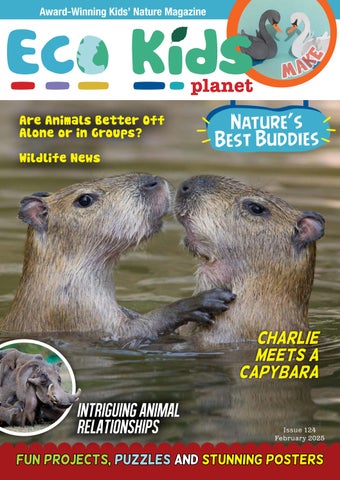
Are Animals Better Off Alone or in Groups? Wildlife


![]()

Are Animals Better Off Alone or in Groups? Wildlife


I’m Willa the Wolverine, coming to you from the freezing, snow-covered forests of northern Finland. It’s cold out here, but I’ve got a warm friendship to keep me going – Raven, my best buddy!
Sometimes I travel more than 25km in one night looking for food. We wolverines have a bad reputation for being ferocious predators… Just look at my large paws armed with sharp, curved claws! I can take on prey as big as moose and even fight against wolves for a carcass. Fier-r-r-r-ce! But to tell you the truth, my aggressive shrieks and hisses are often just a bluff – after all, I’m only the size of a medium dog.
Raven and I help each other survive. She’s got sharp eyes and can spot food from the air, and I’ve got the strength to
break off frozen meals. When Raven finds something good, she calls me over, and we share the feast.
Ravens are amazing at staying alert. When we’re both preoccupied with feeding, Raven acts as another set of eyes and ears. She’ll call out if danger is near, keeping us safe from predators. We’ve learned to rely on each other to survive this freezing cold.
So, next time you spot a raven or a wolverine, think about our chilly adventures in the Finnish wilderness. Together, we make it through!
Until next time, Willa the Wolverine (and Raven, too!)

By JD Savage
Some animals get surprisingly creative to attract a mate.
Divers in Japan first spotted beautiful circular patterns carefully carved into the sandy seabed in 1995. They had no idea who – or what – the great underwater artist was.
Surprise! It turned out to be white-spotted pufferfish. The tiny male fish sinks his body into the seabed’s sand and uses one flapping fin to sculpt his undersea art.
Creating that patterned circle takes 24 hours a day of non-stop fin-spinning for a week! If he takes more than a moment’s rest, the sea current may wash his masterpiece away. He even breaks and carefully places shells he finds into the pattern!
It’s all to attract a passing female pufferfish. It’s not that females are big fans of art or sculpting. They do prefer highly detailed patterns, but they may not care how lovely the circle looks. They’re more interested in practical things.
They want to lay their eggs in its centre – where the male has swept the finest grains of sand – and for its ridges and patterns to protect them from those pesky sea currents. Even the seashells may not be for decoration but for their babies to nibble on when they hatch.
Australia’s male great bowerbirds aren’t just another of nature’s great builders and decorators – but sneaky tricksters, too!

Don’t reveal my secret!
The male bowerbird builds an attractive avenue from criss-crossing sticks, leading to a ‘courtyard’. He decorates the area around it with brightly coloured flowers, leaves, butterfly wings, snail shells, plastic bottle tops – whatever he can find.

He carefully arranges these objects by size, putting smaller ones close to the bower and larger ones further away. This creates an optical illusion that makes them all appear the same size when the female views them from inside the bower.
The illusion likely makes the male look bigger than he really is as he struts around, showing off. Sneaky, but smart.
Male bowerbirds even paint their bower walls with spit and chewed-up plants, using their beaks or a twig as a brush!
In nature, showing off to attract a mate can be dangerous. Flashy displays might catch a female’s eye –but they could attract predators, too!
Male jumping spiders take even bigger risks. To attract a female, a male jumps and waves his legs in a fancy dance. He also rubs his body parts together to send vibrations through the ground, like a spider love song – with beats and different verses! But if the female isn’t impressed, she eats him.

and dancers on
easy. Imagine being under that kind of pressure to perform!
North American porcupines impress a female by soaking her in an explosive jet of wee!
It’s so romantic!
Vocabulary
Bower: A shady or pleasant place in a wood, often under tree branches.

Of course, many birds dance to attract partners, too. Did you know that flamingos can perform up to 136 combinations of dance moves when trying to attract a mate? Some are so tricky, they take years to perfect!

They ‘sing’ like them! It’s not only songbirds that sing complex love songs to attract females. So do mice! It’s an ultrasonic sound – too high for humans to hear.

Hi, Rusty fans!
As the world’s top dinosaur expert, I often remind you that dinosaurs evolved into birds. Well, some gigantic, meat-eating dinos may have danced to attract mates, just like them!
In Colorado, USA, researchers found about 50 deep dinosaur claw marks scratched into 100-million-year-old sandstone. They reckoned the dinosaurs’ claws were making dance moves similar to those of some of today’s birds.
The mouse directs a small air jet from his windpipe into his voice box to create a super-high-pitched whistle. The parts of his throat that make the sound work like the mechanisms in supersonic jet engines (ones that power aircraft that fly faster than the speed of sound)!


Male mice sing more complex and louder songs when they can smell the wee of a female mouse but not actually see her!
Meanwhile, walruses whistle and warble, bark and bellow, and clack and clang to attract mates. Some of their vocal ‘tunes’ even sound just like bum noises!

It was my voice, honest!
Explain those bubbles, then!
It’s just one more reason why everyone – especially Rhona – should respect dinosaurs!

But I wouldn’t want a dino stepping on my foot if I danced with one!

The result is a tie!
Some animals prefer fighting to dancing. Adders mix fighting and dancing – with a bit of wrestling thrown in, too!
When two of the snakes compete for a female, they entwine their bodies and rear up. Each tries to drive the other to the ground. The strongest wins!

Do you ever see just one magpie? They often move in pairs and stick with their partners.
In the 1960s, researchers believed birds were the most loyal animals, with 90% of them sticking to just one partner. You may still read that. However, now our testing methods are more advanced, we know it’s not true.
Yet mute swans are another bird species that tends to form a strong pair bond for
life. It usually only breaks if they don’t breed successfully, or one dies.

It’s all to do with raising a family. They breed once a year and it’s a long time between the start of nesting season and when their kids, the cygnets (say “signets”), finally leave. Both adult swans are devoted parents, teaching their cygnets lots of life lessons during that time.
Mute swan cygnets are grey when they hatch, before turning brown over the first six months, and are mostly white after a year.

Have you ever seen swan families swimming by? It’s a fantastic sight – but keep your distance. The adults are very protective of their children, and may see you as a threat!
Read on to discover more about how and why animals bond…

By JD Savage

It’s me, Charlie, the Eco Kid who can chat with animals. This time, I’m meeting the world’s largest rodent!
Charlie: I’m in Brazil, shortly after dawn, hoping to interview a capybara. They may be not just the largest, but the friendliest rodents, too. I’ve seen pictures of them in captivity mixing with monkeys, rabbits, turtles, cats and other creatures.
They might also be the loudest! I can hear lots of them grunting, whistling, chirping and squeaking in the river ahead. Ah, one’s coming out of the water. I’ll see if they’re as friendly in the wild. Mr Capybara, can you chat?
Capybara: My first visitor and I’ve only just finished breakfast. I’m too popular for my own good!
Charlie: Did you have a nice brekkie?
Capybara: Yes, it was an early one, too, because I’m expecting lots of friends –as usual. You really should have made an appointment.
Charlie: What did you eat?
Capybara: My poo. There’s no better breakfast.
Charlie: Really???
Capybara: Yes, these grasses we eat are hard to digest. I absorb much more of their goodness when they go through me a second time.
Charlie: Okaaay… That’s one way to start the day. But why not just eat softer food?
Capybara: These grasses do more than feed me – they keep my teeth from getting too long. My chompers never stop growing, you know. I’d better munch on some greens right now.
Charlie: Go ahead. Hey, I see at least 25 more capybaras over there.
Capybara: That’s my capy-crew. Capybaras love a crowd! Listen – we chatter away to keep track of everyone, and we keep each other groomed.
Charlie: Maybe that’s why you get on well with other animals. You’re used to lots of company. I see the smallest pups don’t go in the water like you adults.
Capybara: They can’t swim in their first few weeks. They’ll learn – but for now, they’ll just have to hide in undergrowth if a predator comes.

Charlie: Are predators a problem?
Capybara: Yes, we have to constantly keep watch for jaguars, eagles and snakes. That’s why I never stray far from water – if one comes, I dive in.
Charlie: Jaguars are super swimmers, though.
Capybara: We’re harder to catch in the river. We’re strong swimmers, too, and I can stay underwater for a few minutes. I’d make friends with the fish down there, but I already have too many buddies to cope with.
Charlie: Which other animals hang out with you?
Capybara: Birds, mostly. Ah, here’s one now.
Charlie: Hey, a bird – a smooth-billed ani –has landed on your back.
Smooth-billed ani: Hello! Pardon me while I have lunch.
Charlie: Hey, she’s pecking at your fur.
Capybara: She’s grooming me. Very kind of her.

Smooth-billed ani: Yum, some nice ticks in this fur. Thanks for that. Must fly.
Charlie: And off she goes.
Capybara: Don’t worry, there are plenty more bird friends where she came from. I’m always in demand!
Charlie: Well, here’s another one coming in to land on your back.
Second ani: Ta-dah. Perfect touchdown!
Charlie: And why do you like riding around on a capybara’s back?
Second ani: He stirs up insects as he walks – great snacks I can easily spot from here. Plus, he’s got a loud bark to warn his group if danger’s nearby. Food and a predator alarm. Win-win.
Capybara: Ahem – and I’m excellent company!
Second ani: Oh, right. Yes, that’s what I meant to say!
Capybaras are such chilled, gentle animals, they are lovely company – but I suspect some birds also think of them as nature’s chairs!

By Josette Reeves
Imagine a night filled with strange, booming calls echoing through the forest of New Zealand. These haunting sounds aren’t from a ghostly tale, but the love call of the kakapo, a rare parrot with a spectacular way of finding a mate.
The kakapo is no ordinary parrot. Known as the night parrot, it spends most of its day sleeping in trees, coming out to forage at night. It can’t fly – its wings are too small for its heavy body – but this bird is surprisingly agile. The kakapo runs swiftly on the ground and climbs trees using its large, clawed feet and powerful beak.

Kakapos only breed when rimu trees bear fruit – about once every two to three years. No rimu fruit, no kakapo chicks.
Most of the time, it prefers to stay on the ground. Draped in soft, mossy-green feathers, the kakapo blends effortlessly into New Zealand’s forests. When startled, it doesn’t flee – it freezes, making it nearly impossible to spot. You could walk right past this rare bird and never notice.
Herbivorous by nature, the kakapo feeds on a variety of plants, fruits and seeds, with a particular love for rimu fruit. This small, fleshy fruit is key to the parrot’s survival and breeding.


When it’s time to find a mate, male kakapos gather at a lek – a forest clearing –to put on a captivating show.
As dusk falls, they unleash deep, booming calls. These calls can travel up

©NaturePictureLibrary/AlamyStockPhoto
to seven kilometres and reach volumes comparable to a jet engine. Male kakapos can boom to 100 times a night, often competing for hours to outshine their rivals.
But it’s not all about noise. Some males also add dramatic movements, puffing out their chests and bowing to showcase their strength and energy. Females choose their mates based on these dazzling performances.
Sadly, with so few kakapos left in the wild, these breathtaking displays are becoming rarer.
Once roaming freely across New Zealand, this quirky parrot is now critically endangered. Only around 250 kakapos are left today.
Their decline began 800 years ago when humans arrived in New Zealand, bringing predators like rats, stoats and cats. These
introduced animals wreaked havoc on the defenceless, flightless kakapo. By the 1970s, the species was thought to be extinct.
Then, in 1977, conservationist Don Merton and his team found a small population of about 50 kakapos on Stewart Island. This remarkable discovery sparked a rescue mission unlike any other.
To protect the species, predator-free sanctuaries were created on New Zealand’s islands, including Codfish Island and Maud Island. By the 1990s, these safe havens became home to relocated kakapos, where they could live without fear.
A captive breeding programme was also launched in 1991, producing 20–30 chicks each breeding season. These chicks receive round-the-clock care, and some are even hand-reared to ensure their survival.
The kakapo’s recovery is part of a broader mission to protect New Zealand’s native wildlife. The Predator Free 2050 initiative aims to eliminate invasive predators from the entire country by 2050.

A fascinating and rare bird, the kakapo is a true treasure of the natural world. But its future remains fragile, relying on continued efforts to protect its habitat.
The kakapo is one of the heaviest parrots, weighing up to four kilograms – that’s roughly the same as a house cat!
Extinct: No longer existing. Hand-reared: Fed and cared for by a human.
Invasive: Not native to a place and causes harm.
By JD Savage
Amy: We’re all here…
Rhona: …except for Rusty, who’s late!
Amy: So, what’s the topic?
Rhona: Some animals like companionship and live in groups. Others prefer to go it alone. Which is best – and which type would you be?
Simon: I’d be a herd animal – a zebra! Group living means better protection against predators.
Amy: And why a zebra?
Simon: If a hyena went for me, my hardkicking zebra buddies would circle around me and drive them away. Plus, I look awesome in stripes!
Amy: You wouldn’t get lonely. Zebras migrate in huge herds. Sometimes, thousands travel together.
Charlie: One told me they even let antelopes and wildebeests tag along, too.
Simon: Herds have perks! When zebras pack together, their stripes may dazzle and confuse predators – possibly even insects that bite, too.
Rhona: Well, I’d be in an elephant community. Females help to raise each other’s calves and guard their water hole. I have experience from guarding my biscuit tin from Rusty.
Rusty: Hi, Rusty fans!

Rhona: Finally! Rusty, you’re late. Where have you been?
Rusty: At my football practice. What are we debating? Best dinosaur? It’s a tie between these 15…
Rhona: No, Rusty! We’re debating whether animals should live in groups or keep to themselves. I’d be with the elephant herd, mostly for the companionship.
Amy: Making friends is much easier when you mix in big groups – like at school.
Rhona: Tell me about it! It was hard for us to find friends because we’re homeschooled.
Charlie: How do you and Rusty make friends?
Rhona: I go to library events, have music classes, do some volunteer nature work and go on field trips.
Rusty: I have my football practice, and I hang around the dinosaur skeletons at the museum when they have dino events.
Amy: To make friends with other kids who love dinosaurs? Sweet.
Rusty: No, to make friends with the dinosaurs.
Amy: I agree with Rhona. When Chinese and Australian scientists studied nearly 1,000 mammal species, they discovered that mammals that live in groups live the longest.

Simon: But would you be an elephant or a zebra?
Amy: I might be an insect, instead: one of the worker bees that care for the young. I also love how the bees huddle together in the hive over winter to stay warm.
Rhona: Emperor penguins do that, too! Thousands of fluffy dads press together, sharing body heat to survive the brutal Antarctic winters.

Simon: It’s cool how wolves and other pack animals sleep close together for warmth and protection.
Charlie: Have you seen otters snoozing together, floating on their backs and holding hands to keep from drifting apart?

Rhona: Meerkats sleep together in big fuzzy piles in their burrows underground. I bet their leaders snooze near the bottom for extra protection. Truly toasty!

Simon: I’m surprised humans don’t sleep in groups, too. Babies love sleeping next to their parents. And most kids love sleepovers!
Rusty: But what if one of your family snores?
Rhona: Stop looking look at me, Rusty – I do not. And at least I don’t roar, like when you have your dinosaur dreams!
Amy: Humans slept in groups more in the past, Simon.

Rusty: Well, I’m not much of a team player. The other kids at football called me a hog today.
Amy: Adult male pigs do keep to themselves.
Rusty: They meant I was a ball hog. But if I pass it, how can I score all the goals?
Charlie: You know, I’d rather go solo.
Simon: Really, Charlie – with no friends to protect you from predators?
Charlie: Skunks are loners who don’t need gangs to protect them. They shoot their stink spray – that could be fun. And a big group might attract predators.
Rhona: I’ve heard bird colonies attract more predator attacks than single nests.
Amy: It’s easier to stay hidden if there’s only one of you.
Simon: But group animals like meerkats and capybaras have lookouts. If danger’s coming, they call out warnings!
Charlie: Animal groups seem fine if you’re a leader but less cool if you’re a lowranking member.
Amy: There are often fights to rank higher in the group.
Charlie: And fights for partners or food, too. I’m not competitive – and I’d hate getting injured.
Simon: On the negative side, you’d have nobody to groom you if you had lice.
Charlie: But you’re more likely to get parasites in a group –and disease could spread fast, too.
Simon: I’ll admit, living solo means less competition for food and space. So, which is best?

Amy: It depends on the environment and animal. Either being alone or being in a group can help you survive.
Rusty: Some experts think T. rexes lived in groups and hunted in packs like wolves. Hey, is it too late to change the debate to Best Dinosaur?


Lots of news about nice people helping out animals this time – and plenty of rewilding items!
Will we lose interest in nature over the next few years, Eco Kids? No way –we’ll turn into Eco Teens, that’s all! Yet rewilding charity Rewilding Britain says there’s often a sudden lack of connection with nature when the teen years come.
So, it’s awarding up to £15,000 each to 11 projects through its new Rewilding Innovation Fund. This twice-yearly cash boost supports new, inventive and creative rewilding projects to put young people at the forefront of rewilding – and keep us there!
Rewilding means restoring nature until it can take care of itself – and us –again. The projects focus on bringing rewilding’s benefits to kids and young people. They include youth-led rewilding, interactive rewilding education and rewilding play spaces!

And don’t forget about me – Rusty!
Rhona’s helper: JD Savage
They’re based across the UK, from the Highlands of my wonderful country Scotland to inner-city London. One is led by the Scouts. Their funding goes to four of their Scout Adventure Centres, which offer kids safe spaces to explore nature.
Check out the Rewilding Britain website to see if any projects are near you.
When I’m prime minister, I’ll back oodles more great schemes like these to help kids and teens make the UK wilder!
Yet you went into moan mode when I rewilded my bedroom by refusing to clean it. It’s already got a
dust mite ecosystem, and some spiders and insects have moved in.
Rusty Rusty, kindly keep to your OWN page!
And what about when I tried to rewild your bedroom carpet when you were away by scattering wildflower seeds and keeping it well watered?
Close to Christmas, a majestic barred owl flew down the chimney of a family in Virginia, USA, and perched on top of their Christmas tree!


Major wildfires have raged across Los Angeles, USA, since first erupting on 7th January. Firefighters are battling the blazes as best they can, but some fires are still burning. Our hearts go out to the hundreds of thousands of people affected.
I’m sure many of you also worry about the wildlife. Can it ever recover after so much of its highly flammable habitat has been destroyed? I’ll be honest: some animals, like snakes and other reptiles, may struggle to flee the flames. Mammals might escape, but could have trouble
Nine-year-old Orran O’Brien from Guildford hiked over 50km –taking 14.5 hours – to raise money for a new hedgehog incubator for a local wildlife charity. He aimed for £832 but smashed that goal, raising £2,867 – enough for three!
finding food while the ecosystem recovers. Many birds are likely to survive, as they can fly to safety.
The habitat will recover over the next few months, although it may come back differently. New plants will take root, and wildlife will return. Hopefully, mountain lions and many other animals can hold out elsewhere for now.
Did you know that an incredible network of

volunteers has been working around the clock to rescue pets and livestock? They’ve been helping to evacuate horses, chickens, cows, pigs and many other animals from the danger zones. So kind!
Humpback whales are back in Britain big time, with a rise in sea sightings from Kent to the Isles of Scilly. There seems more chance than ever of seeing one of their enormous tails slapping the sea surface here!

The RSPCA rescued a cygnet trapped in ice on the Leeds and Liverpool Canal in Lancashire during the recent cold spell.
A dog walker spotted the young swan and realised it had been in the same position for at least two days!

Using a reach-andrescue pole, RSPCA inspector Carl Larsson carefully broke the ice around the bird, guiding it towards an unfrozen area under a nearby bridge.
Grey seal colonies are booming along England’s east coast after being absent or scarce for years!

In December, 1,329 peasized snails were set free on Bugio, a remote Atlantic island. Bred in Chester Zoo, the release brought two species of the tiny, endangered Desertas Island snail back to the wild!
Two loose pairs of lynx were caught in humane traps in Cairngorms National Park, Scotland. One of the lynx died shortly after. These medium-sized wild cats went extinct here around 500 years ago, so how did they get there? Police are still baffled.
Were they ex-pets whose owner let them go because they were too much to

handle? Or did someone take rewilding into their own hands?
You see, many people think this lost species should be properly reintroduced to the Scottish Highlands to create a richer ecosystem. Others would be scared to have such large predators roaming free – although they’re shy of humans. Even many lynx fans think it’s a bad idea to release them illegally.
Bristol’s Noah’s Ark Zoo Farm asked people to donate their used Christmas trees for the fifth year running. The elephants chomp and chuck them, the rhinos snuffle through them on foraging missions, and the meerkats turn them into an epic playground!


A tiny Colombian tree frog was discovered hiding in roses at a florist’s in Sheffield after hitching a ride all the way from South America! It’s a reminder of how non-native animals can sneak in on imported plants.

A dolphin had to be rescued and released after swimming 9.6km up Cornwall’s River Fowey! Its rescuers helped guide it back to sea.
Oh well, now I must hand you over to Rusty. Please forgive me. (Or forgive our mum – she’s the one who still makes me give him a page. WHY?)

Hi, Rusty fans!
Edinburgh Zoo lets visitors feed its tigers now. It only costs TWO THOUSAND QUID!!! (£500 for kids to tag along.) You use tongs to poke meat through a wire mesh fence, so it’s safe.
I bet they could still wee on you. Tigers spray wee

to mark their territory. Ask my Uncle Angus. When he took me to the zoo once, he laughed at me because it was sunny and I had my stegosaurus umbrella up (it has steggy plates and a tail-handle!). Well, he wasn’t laughing when the tiger sprayed us. Actually, he was quite angry, because it went in his ice cream.
Anyway, you also get three half-hour sessions feeding other animals. That got me thinking… What if I ran a ‘Wild Experience’ here and charged a bomb for it?
You could throw some seeds for the garden birds. Give a blob of jam to the
ants. Feed a lettuce leaf to the snails. (Dad hates snails on his veg, but I always put them there. I like snails.) Then you’d come inside and feed our cat Luke Skywhisker. You could even feed the spiders in my room if you bring your own flies!
Would you pay £2,000 for that? What about £200…?
A few zoos and at least one safari park are doing pricey ‘be a zookeeper’ experiences to raise funds, but some people think it’s bad for the animals. What do you think?
And how about if I only charged £1?
Rusty
Don’t all rush at once, readers!

What’s my share of the dosh?

These relationships work because of something called SYMBIOSIS.
“What’s that?” you’re probably wondering.
Symbiosis is when creatures from two different species depend on each other for survival. And NATURE is full of it!
If the relationship benefits BOTH species, it’s called MUTUALISM (mutually beneficial, see?).
I’ve explored my favourite examples of MUTUALISM here. (Although one friendship does get a little close for comfort, as you’ll see when you read number three… Ouch!)

Hello, Amy here! This issue of Eco Kids Planet is all about animal friendships. I discovered that some of them are extraordinary! Who would imagine a mongoose and a warthog would be best pals?
1. Warthogs and banded mongooses – a playful and adaptive kind of mutualism!
It is extremely unusual for one species of mammal to groom another, but that’s exactly what happens here. Warthogs in Uganda enjoy the services of striped mongoose cleaning crews! These brave critters pick out the warthogs’ ticks as a tasty snack – scrummy! The warthogs get a cleaning and the mongooses get a meal.

Banded mongoose group grooming warthog
The wild pigs have even learnt to lie down in the presence of a mongoose. They let them climb on top to gain access to more parasites.
How does it work? This relationship relies on TRUST. These particular warthogs and mongooses live near humans, so they each have a plentiful food supply. This means both species are relaxed and well fed. If this were not the case, a grumpy warthog might not be quite so friendly to a little mongoose (if you know what I mean – gulp!).
2. Ants and aphids – a mutualism that’s existed for 50 million years!
Aphids are very small insects that suck the juices of plants for food. They leave behind large quantities of delicious, sugary waste called honeydew. It becomes a nutritious food for busy ants. They even move the aphids on to better plants to ensure the production of their sugar-rich meal. Some ants are so hungry for honeydew that they ‘milk’ the tiny insects to make them excrete the sweet substance. They do it by stroking the aphids with their antennae!

Kudu with 10 oxpeckers
Oxpeckers are small, red or yellowbeaked, beady-eyed birds. They enjoy picking the ticks off the backs of large mammals. But the relationship sometimes goes a bit further…
The oxpecker, as its name suggests, often pecks deeper to drink the animal’s blood – YIKES!

4. Plover birds and crocodiles – a perfect example of mutualism –or a MYTH?

What do the aphids get in return?
The ants fiercely protect the aphids from predators. Well, they have to look after their grub, don’t they?
3. Oxpeckers and ungulates – when mutualism goes a bit ‘vampire’…
Ungulates are large, hooved mammals, such as zebras, rhinos, giraffes and water buffalo.
This has to be one of the most remarkable relationships I explored. Does the tiny plover bird really get into a crocodile’s mouth to clean its teeth?
The story began way back with Greek philosopher Herodotus. He described seeing these plucky birds picking bits of meat from between the teeth of basking Nile crocodiles.
Unfortunately, there has been no proper evidence of this since, apart from several hoax photographs.
No one has actually seen it, but ... you never know!
5. Remora fish and sharks and rays – a fishy meals-on-wheels deal
Remora have evolved a sucking device to hang on to larger fish, such as sharks and rays. These big fish provide the remora with protection, transport and constant food. Remora even attach themselves closer to the ray’s mouth when it eats –to catch the scraps!
In return, the remora and pilot fish keep the sharks and rays clean. They eat their old skin and copepod parasites. How’s that for a tasty snack?

Chilean devil ray with remora

6. Clownfish and sea anemones – this perfectly balanced relationship inspired the Disney movie Finding Nemo!
This is a wonderful example of how far mutualism can go. The symbiosis between clownfish and sea anemones is so important that one could not exist without the other.
Clownfish are even known as anemonefish!
How does it work? Sea anemones may look like plants, but they are actually animals! Their stinging tentacles can capture and paralyse any fish that come too close. But not the clownfish! Instead, the spongy anemones provide these

little orange fish with a safe place to lay their eggs and a home for life. Clownfish never venture further than a few metres from their anemone haven – they don’t need to. If threatened by a predator, they quickly swim into the anemone, hiding within its tentacles.
What do the clownfish give the anemones in return? These cheerful fish keep their anemone friends spick and span! They also protect them from predators, such as the anemone- munching butterflyfish.
Hey, how come the clownfish don’t get stung by the anemone’s poisonous tentacles?
Because the clownfish are covered by a protective mucus, of course! Evolution is a beautiful thing, my friends.
Last, but not least, I have to mention PLANTS AND POLLINATORS.
Plant-pollinator mutualisms involve almost 170,000 plant and 200,000 animal species.
Without these CRUCIAL interactions, our world would be a completely different place!
And before I go, here are some JUST-FOR-FUN FRIENDSHIPS
Sometimes, an unlikely friendship forms between animals from different species. Purely because they just seem to enjoy each other’s company…

BFFs: Diane the emu and Jack the donkey
Like the emu and donkey who live on a rescue farm in South Carolina, USA. They “like to cuddle and sleep together”, say farm workers. “They are in love!”
At Noah’s Ark Animal Sanctuary in Georgia, a bear, a tiger and a lion were an inseparable trio for 15 years. United by their traumatic past, they took refuge in each other’s company.

BFFs: Balloo and Henry
When the owners of a rescue dog called Henry realised he was lonely, they went to the animal sanctuary to find him a friend. They returned home with Balloo, a beautiful little… kitten. Dogs and cats hate one another, right? How do you suppose Henry reacted to this new feline family member? You can guess the answer! The two are TOTAL BFFs. They sleep, play, cuddle, eat, go hiking (with Balloo riding in a specially adapted backpack on Henry) and even SWIM together!
Maybe you have a dog and cat that are best friends.
Do you know any other unusual animal friendships?

BFFs: Leo the lion, Baloo the bear and Shere Khan the tiger

Simon’s helper:
JD Savage

Nature has plenty of peculiar partnerships –but I was determined to track down the weirdest of all!
Some animals even have a buddy-buddy thing going on with plants! Here’s the evidence.
Meet one of Borneo’s flesh-eating pitcher plants. If you were a tiny bat, would you dare to roost inside that vase-shaped trap? Me? No chance!
Yet Hardwicke’s woolly bats clamber inside without fear – sometimes bringing their kids. They do provide the bat pitcher plant with meals, but instead of being dinner, they deliver it. They pay their night’s rent in poo –straight into the plant’s belly! It supplies nitrogen, which helps to keep the plant healthy.

That preytrapping ‘pitcher’ is actually a kind of leaf!
Tree shrews have a similar deal with Low’s pitcher plants, also in Borneo. The mini mammals scramble on to the pitcher’s rim to feed on the sweet nectar at its lid. The plant’s hollow body acts like a shrew
poo loo as the shrew drops its plops inside. Sweet snacks for the shrews – and dung dinners for the plant!

Where’s the loo paper?
Meanwhile, in the Spanish Balearic Islands, Lilford’s wall lizards cooperate weirdly with dead horse arum lilies. These plants don’t just look like rotting horse meat – they smell like it, too.
We’d be grabbing nose pegs, but that foul pong attracts blowflies. The flies crawl inside a flowery chamber, where tiny spines stop them from escaping.
The lily’s plan? Keep the blowflies stuck long enough to spread plenty of pollen before finally letting them escape.


What a blow!
Ah, but those lizards often turn up for a tongue-flicking feast of trapped blowflies. And they’re still hungry, so they also crack open the plant’s tough seed heads to snack on its berries. So, what does the plant get out of that?
I cracked the case. If the lily’s seeds pass through a lizard’s gut, they’re twice as likely to sprout!
Those lilies even produce their own heat to make their stink even stronger!
Mystery Case History: Are you an avocado fan? If you enjoy their green, fleshy fruit, I bet you’ve noticed the large, hard seed – or pit – inside. Fruit is nature’s way of tricking animals into gobbling up seeds and spreading them far and wide in their poo. But avocado seeds are huge!
Avocado trees come from Central and South America. Surely some big animals there must be on giant pit-pooping patrol. Nope!

Sure, some say jaguars nibble on avocados sometimes, but these carnivores mostly stick to meat.

We’re being used!
Rodents called agoutis have been spotted burying some pits, but that’s rare, too.
Neither explain how so many avocado trees spread far and wide over millions of years. And let’s get real – you can’t imagine those stonking seeds floating around on the breeze!

Something doesn’t add up. A plant growing giant seeds without animal partners to swallow and spread them? And why are those seeds so huge, anyway? Turn over for my findings…


Do I look like I’m hunting fruit?!
Turns out, avocado seeds evolved to be eaten by huge prehistoric animals that roamed the Americas over 13,000 years ago!

I’m talking giant ground sloths, including Megatherium, which stood as tall as a giraffe.
Next, I examined the weird gifts animals give each other…
Meerkats introduce their pups to hunting by giving them prey to play with – including scorpions. Scorpions have venom-packed tail stingers, so I’m glad they bring dead ones. But do they bring their pups live scorpions when they get a little older?


Guess and then check your answer on the right!

Another animal, named Glyptodon, was an armadillo the size of a small car!
These and other monsters could gulp down whole avocados, plopping their seeds out far from the mother tree. But when they died out, the poor trees kept producing fruit for mega seed spreaders who no longer turned up. So, who’s been spreading those seeds for the last 13,000 years?
It’s us – human farmers took over!
A male scorpion fly tries to impress a mate by offering her a blob of protein-rich saliva (yes, his spit!). It’s a big dripping dribble dollop, equal to about 10 per cent of his body weight. If she eats the gooey glob, that means she’s accepted him!
Now, I bet you’ve unwrapped a gift to discover it’s something you didn’t really want. No probs – it’s the thought that counts, right? But what if you unwrapped a halfchewed bug’s leg?

they bring live scorpions, but bite their stingers off first!
Male nursery spiders offer freshly killed prey to females, all nicely wrapped in spider silk. Yet they often cheat, wrapping up some prey they’ve already sucked dry or even part of a dead plant!

Gentoo penguins give nicer gifts. The male scoops up a super-smooth, perfect pebble, polished by the ocean waves, in his beak for the female. It’ll help to build the nest that will keep their eggs dry and warm.

Now let’s investigate whether animals give gifts to us.
There are many reports of wild crows dropping off gifts for humans – including kids – who feed them. It may be shiny
foil, a locket, stones, buttons – or something icky. Are they really giving us a present to say thanks?
Even we worldclass weirdness detectives can’t be 100 per cent sure. The ‘gifts’ may just be objects they’ve lost interest in and left behind. Maybe that makes an excited human leave more food out. Next thing, the crows have learned that leaving objects means bigger meals –after all, they’re smart!


Rusty’s cat Luke Skywhisker sometimes leaves a tiny dead mouse in his shoe for him. Why do cats often leave their humans gruesome ‘gifts’ like this from time to time?

They’re likely not pressies. They may be showing off their hunting skills – or simply leaving their prey where a rival predator can’t steal it. Some people think they may even be trying to train their humans to hunt!
Or maybe cats are just weird!

Across:
4. A small gift often offered by a gentoo penguin to its partner
5. Small mammals that ‘sing’ ultrasonic love songs
7. A bird that cleans ticks off large mammals
10. Another name for clownfish
12. A wolverine’s bird-friend
Down:
1. A relationship between two different species where both benefit
2. A fish that attaches to sharks and rays
3. A bird known for its elaborate dance moves to attract a mate
6. The world’s largest rodent, known for its friendly and social nature
8. Creator of intricate sand patterns to impress a mate
4. A small gift often offered by a gentoo penguin to its partner
9. Flightless nocturnal parrot from New Zealand 11. Warthhog’s unlikely friend
5. Small mammals that “sing” ultrasonic love songs
7. A bird that cleans ticks off large mammals
10. Clownfish
12. Wolverine’s bird-friend
Down
1. A relationship between two different species where both benefit
2. A fish that attaches to sharks and rays
3. A bird known for its elaborate dance mo attract a mate
6. The world’s largest rodent, known for its friendly and social nature.
1 The oxpecker bird sometimes drinks blood from the animals it cleans.
8. Creator of intricate sand patterns to impress a mate
2 To impress their partner, swans perform elaborate dances, which take years to perfect!
9. Flightless nocturnal parrot from
3 Male nursery spiders present their mates with daisy petals to win their affection.
4 Male kakapos have one of the loudest calls of all birds.
5 Male bowerbirds use only the finest natural items to decorate their nests.
6 Capybaras only socialise with other capybaras.
7 Kakapos only breed when rimu trees bear fruit – once every two to three years.
unlikely friend


We were truly amazed by the creativity and imagination displayed in this year’s Dive and Discover competition! From exciting underwater adventures to unique sea creature creations, your entries showcased the wonders of the deep in such fun and vibrant ways. A huge thank you to everyone who participated.

Caleb, age Nottingham11, Stenacanthus, a prehistoric but still existing relative of a goblin shark
Hannah, age 11, and Gemma, age 9, Hythe Pleater
5

, age 8,
1. T
2. F – Swans do not perform elaborate dances to impress their mates. Flamingos do.
3. F – Male nursery spiders offer freshly killed prey wrapped in silk.
4. T – In fact, male kakapos have the loudest call of all birds.
5. F – Male bowerbirds use a variety of items to decorate their nests, including manmade objects like plastic bottle caps.
6. F – Capybaras are known to interact peacefully with various animals, including monkeys, rabbits and even cats.
7. T

Download the template for this papercraft from www.ecokidspanet.co.uk/papercraft-swans and follow these step-by-step instructions to create your paper swan pair.
1. Cut out the templates for the larger swan. Colour the swan and its wings in a dark grey shade on both sides of the templates.
2. Colour the eye area of the swan in black; be sure not to colour in the dots for its eyes (these are to remain white). Colour the beak detail in orange.
3. Apply glue to the swan’s head to join both sides of the head together.
4. Fold the wings and ruffle the feathers to make the wings look 3D. Add glue to the glue spots. Attach these to the swan’s body as numbered.
5. Colour the base in blue on both sides of the template. Add some glue to the glue spot and attach to the underside of the swan.
6. Cut out the smaller swan templates. Leave the swan’s body white. Follow steps 2-5 to complete the smaller swan.
Your papercraft swans are complete! These will make a lovely Valentine’s Day gift.
For this month’s competition, we want you to write a story about two unlikely animal pals. Perhaps it’s a lion and a lamb, or a tiny mouse and a mighty elephant. How did they meet? What challenges did they face together? How do they have each

other’s back? Write a short story (150-200 words) about this unique friendship and let your creativity soar!
Four lucky readers will win a charming Wentworth wooden fox puzzle.
By Randy Wollenmann
This sweet, shaped puzzle features 15 larger pieces with fun, fox-themed whimsies, perfect for little puzzlers. It comes in a keepsake box with a handle, making it a wonderful gift. Plus, all Wentworth puzzles are made from sustainably sourced wood, and their packaging is plastic-free!

RRP: £11.50 See more whimsical puzzles at www.wentworthpuzzles.com

Nature's Sand Survivors
Spooky Sands
Simon investigates…
Which Desert Animal Are You?
Take a quiz

Charlie Meets a Screaming Hairy Armadillo!


Desert Animals That ‘Disappear’