Fostering a better quality of life in community associations through education, advocacy and networking.
Echo 5669 Snell Ave., #249 San Jose, CA 95123 408.297.3246 | info@echo-ca.org www.echo-ca.org
BOARD OF DIRECTORS & OFFICERS
PRESIDENT
Mark T. Guithues, Esq.
VICE
PRESIDENT
Sarah Dunia
TREASURER
Karl Lofthouse
SECRETARY
Jessica Roberts
DIRECTORS
Brian Campisi
Rolf Crocker
John Gill, Esq.
Adam Haney
David Levy
Nathan McGuire, Esq.
Ali Nekumanesh
Louis J. Sarmiento, Esq.
Bridgette Tabor
EMERITUS BOARD MEMBER
David Hughes
BENEFACTOR MEMBERS
Donald W. Haney, CPA CID Consortium, LLC
Paul Collins Collins Management
CHIEF EXECUTIVE OFFICER
David Zepponi | dzepponi@echo-ca.org
OPERATIONS MANAGER
Connor Zepponi | connor@echo-ca.org
MEMBERSHIP & SALES MANAGER
Jacqueline Price | jprice@echo-ca.org
MEMBERSHIP DEVELOPMENT MANAGER
Leila Saeed | lsaeed@echo-ca.org
PUBLICATIONS EXPEDITOR
Pam Grove | pgrove@echo-ca.org
MARKETING MANAGER
Taylor Barnes | tbarnes@echo-ca.org
The Echo Journal is published quarterly by the Executive Council of Homeowners (Echo). The views of authors expressed in the articles herein do not necessarily reflect the views of Echo. We assume no responsibility for the statements and opinions advanced by the contributors to the magazine. It is released with the understanding that the publisher is not engaged in rendering legal, accounting or other professional service. If legal advice or other expert assistance is required, the services of a competent professional should be sought.
Acceptance of advertising does not constitute any endorsement or recommendation, expressed or implied, of the advertiser or any goods or services offered. We reserve the right to reject any advertising copy or image.
Echo member information is never released to any outside individual or organization, unless agreed to by the member.
HOA Education On Demand!
Get more from your Echo membership
Echo members have exclusive access to our entire library of HOA-focused educational programming including Community Conversations, Educational Seminars, Workshops, Ask the Attorneys, and Ask the Experts.
The presentations referenced below are a sampling of what is available to our valuable members. Click a title to watch!
Ask the Experts: Construction and Maintenance
Discrimination: Cultural Sensitivity & Reasonable Accommodations
All Things Paving
Privacy, Cameras, & Recordings ... What Can We Do?
Tree Care and Defensible Space
Case Law
AB-130: Mandatory Changes to the HOA Fine Process
The Truth About Compliance with Non-Functional Turf & Water Conservation
DANIEL C. HEATON, ESQ.
HOAs: California’s Affordable Housing Solution –Or a Long-Term Challenge?
Raison d’Etre – The Reason for Boards
Last month, Echo partnered with the Santa Cruz County Association of Realtors to provide HOA training for real estate agents. The program generated thoughtful discussion, but one topic stood out: Many participants were surprised to learn that the overwhelming majority of future residential housing in California (approximately 90%) will be built within common interest developments (CIDs) governed by homeowners associations (HOAs).
For many agents, this realization was striking. New housing construction is increasingly concentrated in higher-density developments where residents share common amenities and infrastructure. As a result, most future new home sales will be in HOA-governed communities that share common interest components. More important, policymakers are generally not aware of this reality. And they continue to pass laws and policies that burden HOA communities with mandatory increased costs that often address a near-term issue but in the long term are at counter-purposes to California’s affordable housing strategy.
attainable to buyers than residential housing outside of a CID. However, those involved in community management understand that affordability is not merely a date-of-sale issue. The homeowner may be excited to be able to financially squeeze into a home, but can they continue to afford the home in the long run? Home ownership is a long-term challenge that extends well beyond the initial purchase and is dependent on reasonably predictable component cost estimation.
What a beautiful phrase, raison d’etre (reason for being). It is a every board member should consider and collectively agree.
The phrase engenders humanity. The words roll from one’s tongue. stark business senses and adds the element of humanity to the a board: Strategic planning, execution and evaluation; mission management. The business realities should be reflective of community common values of individuals in the community.
Communities are not built overnight. Strong neighborhoods develop over decades through shared experiences, relationships, and ongoing investment in community assets. While a home may be affordable when purchased, maintaining that affordability over time is far more complicated.
Communities are imperfect – because they are made of humans. relating. Humans using. Human living. Basically, humans being being human, communities sometimes forget that management establish norms for a successful community. In a sense, the board the community. Its purpose is to establish order and elevate or progress and pace by establishing norms and constraints to balance to benefit all.
The logic is straightforward. Policymakers believe that increasing housing supply will help reduce housing costs. To make development financially feasible, housing density must increase, requiring shared amenities, infrastructure, and maintenance responsibilities. CIDs fit this model well because the government and developers shift many ongoing costs of repair, maintenance, and replacement of common assets from local governments to homeowners. Thus, the financial burden of these common areas falls on the HOA and is paid through homeowner assessments. The government entities no longer have an obligation that would have been paid by tax levies, and the developer is free to build without delays and can justify increased impact fees.
It seems apparent that board leadership must understand and owners in order to orchestrate a sense of community and generate and protect community values. The purpose of a board, therefore, build community based on common values for the good of all.
The current model assumes that household incomes will grow sufficiently and predictably enough to keep pace with the increasing costs of maintaining, repairing, and replacing community infrastructure. Unfortunately, experience suggests otherwise. Many HOA communities built in the 1970s and 1980s now face significant maintenance and replacement obligations. Roofs, balconies, plumbing systems, paving, and other common components eventually reach the end of their useful lives. The cost of repairing or replacing these assets can be substantial, often exceeding what homeowners anticipated when they purchased their homes.
It takes time to orchestrate a community. It takes time to know your time to listen to the voices and build a vision reflective of community and you will be more effective as a board member and satisfied your reason for being on the board.
In the short term, this approach can work. New homes are available at prices that may be more
When this occurs, HOA boards face difficult decisions. They have a fiduciary responsibility to maintain the community, but they also recognize homeowners’ financial limitations. Balancing these competing
ECHO is committed to helping homeowner boards and residents ing and advocacy – this is our “raison d’etre”.
Continued on page 14
ECHO CHIEF EXECUTIVE OFFICER
David Zepponi Executive Director
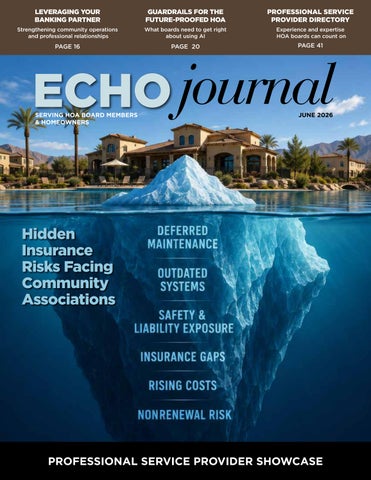
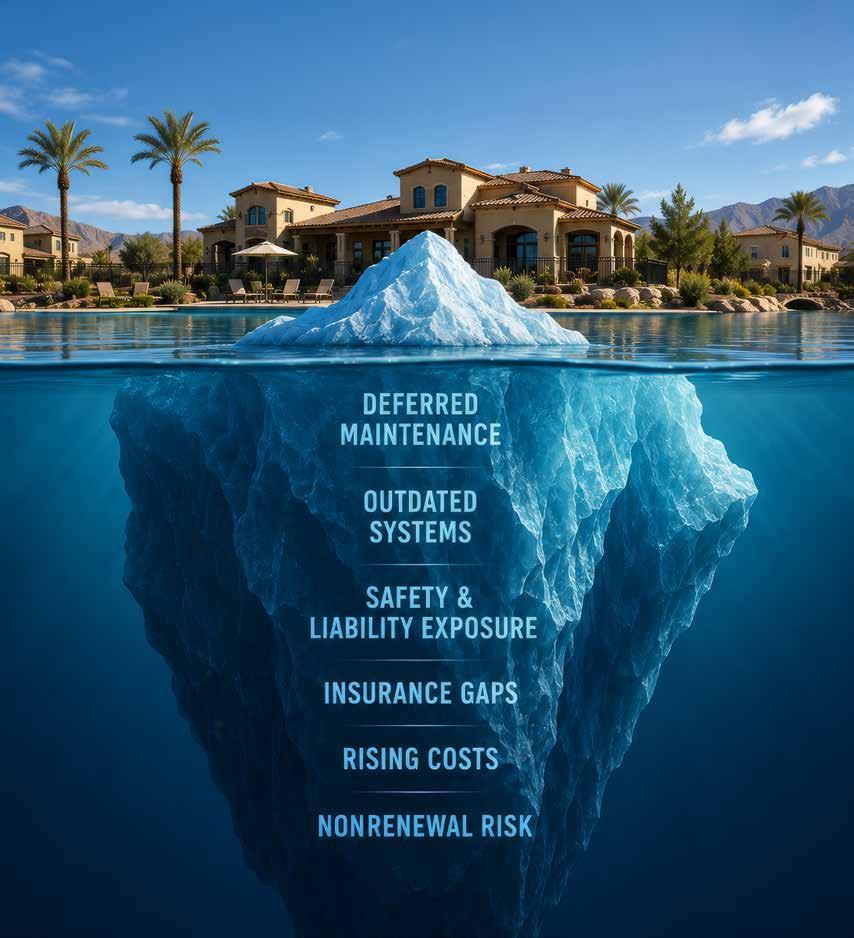
Hidden Insurance Risks
Facing Community Associations
The insurance marketplace for homeowners associations has changed dramatically in recent years.
BY CHRISTI SPINA
The insurance marketplace for homeowners associations has changed dramatically in recent years. Carriers that once approached HOA insurance with flexibility are now tightening underwriting standards, conducting more inspections, and closely scrutinizing how communities maintain their buildings. Boards that fail to understand these changes may find themselves facing higher premiums, fewer carrier options, or even nonrenewal of their policies.
Today’s insurance environment requires associations to be far more proactive about risk management. Underwriters are conducting more site inspections, requesting documentation up front, reviewing reserve studies, and closely evaluating claims history. Communities with poor risk profiles are increasingly being non-renewed, while others are being required to update critical building components such as electrical systems, plumbing, roofing, and HVAC.
Associations that delay upgrades, rely on outdated interpretations of their governing documents, or assume that certain issues are not the association’s responsibility may find themselves with limited insurance options. In many cases, these communities are forced into the surplus lines marketplace, where premiums are significantly higher and deductibles can place a substantial financial burden on owners.
Understanding the risks insurers are focusing on today can help boards better prepare their communities and maintain access to affordable coverage.
Why Loss Control Inspections Matter
Insurance carriers use loss control inspections to identify conditions that could lead to claims, such as fire hazards, safety issues, or maintenance problems that create liability for the association. Because insurers are financially responsible for paying these claims, they have become much more proactive about inspecting properties.
As a result, inspections are occurring more frequently, and carriers are increasingly requiring associations to address any deficiencies identified during these visits. If an association fails to correct the issues noted by the inspector, the consequences can include higher premiums, coverage restrictions, or even policy nonrenewal.
For this reason, boards should take the initiative to identify potential problems in their communities before the insurance carrier does.
Common Issues Identified During HOA Inspections
While the list of items reviewed during inspections can be extensive, several areas consistently raise concerns for insurance carriers:
• Property Maintenance Inspectors frequently evaluate the overall condition of buildings, including roof age and condition, structural concerns, and the safety of decks, balconies, and railings.
• Electrical Systems
Outdated or hazardous electrical panels are a major concern for insurers. Panels manufactured by companies such as
Continued on page 10
Zinsco, Challenger, and Federal Pacific have welldocumented safety issues and are often flagged during inspections. Carriers also look for overloaded panels and unsafe electrical modifications.
• Fire Safety Inspectors evaluate fire prevention measures such as the presence and maintenance of fire extinguishers, sprinkler systems, and fire alarms. They also look for combustible materials stored near buildings and unsafe practices such as gas or charcoal grills placed too close to structures or used on balconies.
• Plumbing and Water Damage Prevention
The age and condition of plumbing systems are closely examined. Inspectors may look for signs of leaks, corrosion, outdated water heaters, and the presence of accessible shut-off valves.
• Life Safety and Liability Hazards
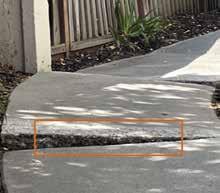
Trip-and-fall hazards are another common concern. Cracked sidewalks, uneven pavement, damaged stairways, inadequate
lighting, unsafe playground equipment, and improperly secured pool areas can all create liability exposure for associations.
• Grounds and Common Areas
Inspectors often review tree maintenance, drainage issues around buildings, parking lot conditions, and pavement cracks that could create safety hazards.
• Building Systems
The condition of HVAC systems, elevator inspection certificates, and maintenance records are also commonly reviewed.
• Signs of Deferred Maintenance
Perhaps most important, inspectors look for visible signs of neglect such as peeling paint, wood rot, rusting metal components, and other indications that necessary repairs have been postponed.
The Risks of Deferred Maintenance
Deferred maintenance can create serious financial and insurance challenges for HOAs because problems that are ignored or delayed rarely stay small. Issues such as aging roofs, deteriorating balconies, outdated electrical systems, and failing plumbing can gradually worsen and eventually lead to significant
property damage or safety hazards.
Insurance carriers closely evaluate how well a community maintains its buildings, and visible signs of deferred maintenance signal a higher likelihood of future claims. As a result, associations that postpone necessary repairs may face higher premiums, stricter underwriting requirements, coverage restrictions, or even policy nonrenewal.
Beyond insurance concerns, deferred maintenance can also lead to costly special assessments, disputes among homeowners, and declining property values. Addressing maintenance issues proactively not only protects the physical property but also strengthens the financial stability of the entire community.
Outdated Governing Documents and Insurance Gaps
Another challenge many associations face is reliance on governing documents that are decades old. It is not uncommon to review CC&Rs (covenants, conditions, and restrictions) that were written 20, 30, or even 40 years ago and have never been updated since the community was originally developed. These documents were often created under very different legal, construction, and insurance environments. Unfortunately, relying on outdated governing documents can leave associations exposed during an insurance loss.
The insurance marketplace has evolved rapidly over the past several years. Carriers have tightened underwriting standards, increased deductibles, and placed greater scrutiny on how responsibility for building components is defined. Older governing documents often fail to align with modern insurance policies, which results in gaps between what the association’s master policy covers and what unit owners are expected to
Hidden Insurance Risks Facing Community Associations Continued from page 9
insure individually.
When a loss occurs, these gaps can lead to confusion, disputes, and unexpected financial burdens for both the association and its members. Updating governing documents to reflect current insurance practices and clearly define maintenance and insurance responsibilities is an important step in protecting the community.
“The Association Is Not Responsible for That”
If HOAs made a dollar every time someone said, “The association is not responsible for maintaining that,” they would probably never need another special assessment.
Many governing documents state that the association is not responsible for maintaining items inside individual units. Boards sometimes interpret this language to mean that the association has no exposure related to interior
IMPROVING COMMUNITIESTM
Continued from page 11
systems and that the master policy should not be affected by interior conditions. In many communities, it is assumed that electrical systems, plumbing, and HVAC equipment within units are solely the responsibility of the unit owner. From an insurance carrier’s perspective, however, the situation is not that simple.
Insurers evaluate risk at the building level, not solely based on the maintenance responsibilities outlined in the CC&Rs. For example, if an outdated electrical panel inside a unit causes a fire, the association’s master policy typically responds to the structural fire damage. Similarly, if aging plumbing within the walls causes water damage affecting multiple units, the association’s policy may again be triggered.
Because the insurance carrier is responsible for paying these claims,
underwriters focus on the overall condition of the property and whether critical building systems are being properly maintained and updated. In practical terms, insurers are less concerned with who the governing documents say is responsible for maintenance and are more concerned with whether those components are actually being maintained.
For this reason, associations should take a more active role in ensuring that critical systems within the community are properly maintained, even when governing documents assign responsibility to individual owners.
Best Practices for HOA Boards
To protect insurability and help stabilize insurance premiums, boards should consider the following best practices:
• Conduct Electrical Evaluations
Identify outdated electrical panels and develop a phased replacement plan where necessary.
• Maintain Accurate Reserve Studies
Ensure that reserve funding reflects realistic replacement timelines for roofs, plumbing, electrical systems, and other major components.
• Document Maintenance Schedules
Underwriters value wellorganized communities that can demonstrate consistent maintenance and risk management practices.
• Review Governing Documents with Insurance Professionals
Updating outdated CC&Rs can help ensure that maintenance responsibilities and
insurance coverage align with current industry standards.
• Communicate with Homeowners
Educating owners about how interior systems affect the community’s overall insurance risk can help prevent costly problems.
The Bottom Line
Insurance carriers do not evaluate risk the same way governing documents assign responsibility. Insurers view the entire building as a single exposure. If one unit contains outdated wiring, the entire structure is at risk. If maintenance is deferred, the increased likelihood of loss affects every owner through higher premiums and deductibles. When responsibilities between the association and individual owners are unclear, claims can become complicated, leading to disputes and delays in repairs.
In today’s insurance market, insurability is earned through proactive maintenance, modernized building systems, and strong risk management, not simply through policy language.
Associations that address these issues early position themselves for better insurance options, more stable premiums, fewer coverage restrictions, and stronger long-term financial protection for their communities.
Christi Spina is an insurance professional specializing in coverage solutions for community associations. She works closely with HOA boards and property managers to help communities navigate the evolving insurance marketplace and manage risk effectively.
CID CONSORTIUM, LLC
Since its inception, CID Consortium, LLC (CIDC) strives to provide excellent financial and operational guidance to communities, board members, managers, and owners of communities big and small in an ever-changing environment.
We believe in building relationships by doing our business transparently and keeping our clients informed. Before sending a proposal, we take the time to uncover what success looks like for your community. Once we are aligned, we will propose a combination of Governance, Finance, and Organizational services specific to your unique needs.
Owners and operators Donald (”Don”) W.Haney, CPA, and Adam P. Haney, CPA, are well known for their role in developing homeowner association industry standards and technology. Don originally started in the industry in 1979 when he formed two corporations: CEO, Inc. and Haney Accountants, Inc. Both organizations laid the foundation for CIDC led by Adam P. Haney, CPA.
Today, CID Consortium, LLC has grown into a team armed with passion and expertise for improving the community living experience of its members. Pulling from 45 years of business, CIDC has accumulated a wealth of experience and expertise through a relentless pursuit of perfection. Fueled by technology and incessant process improvement, the team engages with members on a rich platform, ensuring the community living experience continues to be exceptional. For more information about the services we provide, please visit our website at cidcllc.us.
demands is rarely easy and often unpopular. In practice, boards typically prioritize immediate health and safety concerns. Necessary but less urgent projects are deferred, and discretionary improvements are postponed indefinitely. Over time, deferred maintenance accumulates, creating even greater financial pressures for future homeowners.
This highlights a fundamental weakness in the affordable housing model. The model addresses affordability at the time of purchase but often fails to account for the longterm costs of community ownership. As communities age, maintenance expenses increase, and affordability can erode. Compounding the challenge is the fact that maintenance and replacement costs frequently rise faster than general inflation. Construction materials, petroleum products, labor, insurance, and regulatory compliance expenses have all increased dramatically in recent years. Household incomes, however, have not consistently kept pace. The result is a growing gap between what communities need to remain safe and functional and what homeowners can reasonably afford to pay.
Adding to these pressures are legislative and societal changes that often impose significant new costs on HOA-governed communities. For example, California SB-1007, as now amended by the Senate, would limit HOA assessment increases by the board to 8% per year, down from 20% (in current law), without a homeowner vote. This would restrict an association’s ability to generate the revenue needed to address extraordinary growth in the cost of maintenance obligations. Also, new legislation that requires balcony inspections
and repairs, while intended to improve safety, has created substantial unexpected expenses for many communities. These legislative mandates are just two examples of many governmental requirements that are at counterpurposes to the state’s affordable housing strategy.
It’s not just governmental mandates that oppose predictable affordable housing. Wildfires and other natural disasters have introduced another layer of uncertainty. Insurance markets throughout California have experienced significant disruption, resulting in higher premiums, reduced coverage options, and, in some cases, policy cancellations. These costs ultimately fall on homeowners.
Additional requirements— such as electric vehicle charging infrastructure, turf replacement, building electrification initiatives, water conservation measures, façade inspections, and code compliance upgrades—may each serve worthwhile public policy goals. However, every mandate carries a cost. When multiple mandates are imposed simultaneously, and especially if they were not predicted, the cumulative financial burden can become overwhelming.
These impacts are felt most acutely by homeowners with limited financial flexibility. Retirees on fixed incomes, young families, and lower-income households often have little capacity to absorb unexpected assessment increases or special assessments. For many, even well-intentioned policies can create serious financial hardship.
This is why policymakers must consider not only how housing is built but also how communities will be sustained over time. A housing model that delivers affordability on day one but does not consider the implications of
social inflation and economic shocks over the following decades is not a complete solution. It sets communities up to fail or, worse, fall into calamitous disrepair, as occurred in the Berkeley balcony and Surfside condo collapses.
Equally important, volunteer HOA board members should not become the targets of frustration when communities face difficult financial choices. These individuals are doing their best to fulfill fiduciary responsibilities while navigating complex legal requirements, aging infrastructure, rising costs, and homeowner concerns. In many cases, they are managing the consequences of policies they did not create and cannot control.
California’s reliance on HOAgoverned communities as a primary affordable housing solution deserves a more comprehensive discussion. Increasing housing supply is important, but long-term affordability requires equal attention to maintenance obligations, reserve funding, insurance costs, regulatory mandates, and economic realities. If these factors are not addressed, the financial pressures facing HOA communities will continue to grow. The result may be housing that appears affordable at purchase but becomes increasingly difficult to sustain and, therefore, to afford over time. If California is serious about an affordable housing strategy, it must focus not only on building houses today but also on ensuring that communities remain financially viable and affordable for generations to come.
CITIZENS BUSINESS BANK
Delivering personalized strategies that evolve with your business
As a full-service financial partner, we offer a comprehensive suite of solutions tailored to your industry, your company, and your goals.
Since 1974, Citizens Business Bank has been creating banking relationships by focusing on our customer and helping them achieve more for their business, their employees, and the communities they serve.
Our founder, George A. Borba, Sr., was an enterprising dairy farmer and small business owner from Southern California. George saw a need to support other business owners in his community by helping them preserve and enhance the value of their companies. He shared his vision with a group of local business leaders who cared deeply about their community, and together they set out to design a new banking experience.
Chino Valley Bank was established in August of 1974. Over 50 years later, Citizens Business Bank has grown to more than $20 billion in assets with 3 trust offices and over 75 banking locations throughout California. We changed our name to Citizens Business Bank along the way, but we still hold true to our original vision.
We understand that your business is unique—and so are your financial needs. That’s why we go beyond traditional banking. As a full-service financial partner, we offer a comprehensive suite of solutions tailored to your industry, your company, and your goals.
Our relationship bankers take the time to get to know you, your business, and your long-term vision. This deep understanding allows us to deliver personalized financial strategies that evolve with your business.
Whether you’re starting a new venture, expanding operations, or planning for the future, Citizens Business Bank is here to ensure your banking experience is smooth, convenient, and aligned with your success.
Leveraging Your Banking Partner
Strengthen Community Operations and Professional Relationships
BY MARCY KRAVIT
When focusing on professional service providers in community associations (managers, engineers, attorneys, reserve specialists, insurance brokers, contractors), there is a tendency to view each as a separate spoke in the wheel of community operations. But one partner is often overlooked as a strategic force multiplier: the bank.
A community association’s financial institution is far more than a place to store operating and reserve funds. The right banking partner can act as a connector, a problem-solver, and a stabilizing presence that supports both the board and the professionals who serve the community. When leveraged effectively, the bank becomes a core advisor that helps improve workflows, promotes financial resilience, and strengthens the relationships that keep a community functioning smoothly. A strong banking relationship transforms not just the association’s financial health but also its entire ecosystem of partnerships.
1. The Bank as a Strategic Advisor in Capital Projects
Whether it’s a roof replacement, structural restoration, elevator modernization, or a full-scale infrastructure overhaul, large projects can strain a community’s cash flow and test every relationship involved. This is where the bank can step in as a stabilizing force.
Construction Loans and Project Financing – A well-structured construction loan provides the association with flexibility, allowing progress to continue while assessments are collected over time. Banks experienced in HOA lending understand:
• How to structure draws
• How to work with engineers and contractors
• How timelines and cost escalations impact reserve projections
• How to align financing with long-term planning
When the board relies on the bank early in the process, everyone benefits. Managers gain clarity, vendors are paid promptly, and homeowners see confidence and organization from leadership.
2. Optimizing Cash Flow Through Smart Treasury Management
Associations often underestimate how much their cash-management strategy impacts operations and vendor relationships.
CD Laddering and Reserve Optimization – Banks can help boards build structured CD ladders that do the following:
• Improve liquidity
• Maximize insured coverage
• Capture better yields without sacrificing safety
• Align with projected reserve expenditures
When an HOA’s cash flow is predictable and stable, service providers experience fewer delays, and managers can work more efficiently.
Digital Payment Tools and Fraud Prevention –Modern treasury tools, lockbox services, online payment portals, ACH controls, and fraud and payment monitoring reduce administrative strain and strengthen transparency. This creates smoother interactions with vendors, prevents delays, and ensures that critical payments never slip through the cracks.
3. A Bank as a Trusted Resource for Vendor and Professional Connections
Banks that specialize in community associations maintain extensive networks of qualified experts across the following disciplines:
• Engineers
• Reserve analysts
• Construction firms
• Legal counsel
• Insurance professionals
• CPAs
• Management companies
Continued on page 18
Leveraging Your Banking Partner
Continued from page 17
If a board struggles to find the right service provider, the bank can often bridge the gap. This does not replace the board’s due diligence, but it can give the association a vetted, credible starting point. Over time, this creates a more cohesive ecosystem where all partners work in alignment rather than in silos.
4. Strengthening Relationships Between Boards and Their Professional Teams
A bank’s role is not just to provide financial solutions; it is also to help foster collaboration. When shared goals and open communication exist between the board, the manager, and the service providers, projects move faster and with fewer surprises.
The bank can facilitate better partnerships in several ways:
• Clear reporting helps managers relay accurate information to boards.
• Project financing ensures that vendors are paid promptly, which improves trust.
• Strategic planning sessions with the bank, manager, and board align expectations.
• Education for new board members helps reduce misunderstandings and prevents friction.
When each partner understands the financial framework of the association, decisions become easier, and the entire community experiences more stability.
5. Building Financial Resilience for the Future
Communities today face rising insurance costs, aging infrastructure, economic uncertainty, and evolving legislation. A proactive banking relationship benefits the board and its service providers in several ways:
• Identifying risk early
• Strengthening reserves
• Increasing homeowner confidence
• Building continuity across board transitions
• Preparing for unexpected events without panic
A bank that knows the community’s history and financial patterns becomes a long-term asset, one that supports both the immediate operational needs and the broader strategic vision.
The Bottom Line
Professional service providers are essential to community success, but an association’s bank can be the thread that ties everything together.
When a board views its financial institution not just as a vendor but as a strategic partner, it can unlock better communication, stronger relationships, and more efficient operations across the entire community ecosystem.
• Condominium Associations
• Planned Unit Developments
• Mixed Use Associations
• Commercial Associations
provide general counsel to Associations including the following services:
• Construction Defect and Civil Litigation
• Dispute Resolution
• Governing Document Interpretation
• Governing Document Revisions
• CC&R and Rules Enforcement
• Contract Review and Negotiation
• Election and Operating Rules
• Fiduciary Obligations & Director Education
In other words, an HOA’s bank is one of its most powerful professional service providers, and it should be fully utilized.
Marcy Kravit (CMCA, AMS, PCAM, CFCAM, CSM) has over 25 years of experience in community association management and governance. Serving as vice president on her own association board gave her insight into the needs of HOA communities. She is a SmartStreet team member for Banc of California, providing services in conflict management, team building, project management, managerial finance, public speaking, and HOA management solutions.
VALIANT PRIVATE SECURITY
Licensed | Professional | Experienced
“...If you are considering Valiant Private Security, you are considering the VERY BEST.”
James A. Gaggero, Police Officer,West Valley-Mission P.D.
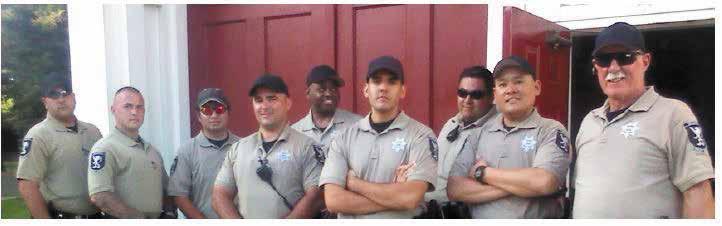
VALIANT Private Security provides professional, proactive, service-oriented, full-spectrum security that adds value to homeowner associations by creating safer environments and communities. We aim to set the standards high and then meet or exceed those standards.
At VALIANT Private Security we hire and train only the best in the security field. By providing customtailored security services that help to keep communities safe, we are raising the bar for private security. We work in partnership with local resources to better serve and protect our client’s property, employees, and interests.
We specialize in designing security programs around existing security budgets for services including:
• Security Assessments
• Parking Enforcement
• Access Control
• Foot Patrol
• Mobile Patrol
• Safety Escorts
• CCTV Installation
Are you and your property as safe and secure as you would like? Maybe it’s time to re-evaluate your current security situation. Call VALIANT Private Security for today.
Our Values
Vision: Forward-thinking, we are forging a path for a future of more professional security
Adaptability: We find ways to add value to all environments and assignments.
Loyalty: We are loyal to our teammates and to all of our stakeholders.
Integrity: Our thoughts, our words, and our deeds must and will always be one.
Accomplishment: We seek to accomplish our objectives in performance and professionalism.
Nobleness: We strive to accomplish our duties at the highest levels of morality.
Teamwork: Working together, we see our team effort as integrated with each other, with peer and support organizations, and with our clients and community.
Guardrails for the Future-Proofed HOA
What Boards Need to Get Right About Using AI
BY DANIEL C. HEATON, ESQ.
Serving on a community association board has never been simple, but it feels particularly unforgiving now. Costs keep climbing, regulations keep changing, and homeowners increasingly expect communication that is immediate, accurate, and tailored to their specific concern. Into that environment comes AI, promising faster drafts, cleaner summaries, and answers at any hour of the day.
Used well, AI can reduce administrative drag and give boards more time for actual governance and community-building. Used casually, it can just as quickly create legal, privacy, and trust problems larger than the administrative headaches it was supposed to solve.
This article is not about whether AI is “good” or “bad.” AI is already embedded in management platforms, vendor portals, and tools directors may already be using on their own each day. The practical question for boards is whether they can capture the benefit without losing privilege, mishandling owner data, or letting software quietly displace board judgment.
The “Helpful” Chatbot That Made Things Worse
Imagine a community that has just activated an online portal with an AI-powered assistant to answer owner questions. The board is pleased. Response times are down, and the chatbot is handling routine questions that previously consumed management time.
One evening, a homeowner types: “Our roof has been leaking for months. Can I withhold my assessments until the association fixes it?”
The chatbot has been trained on a mixture of generic “landlordtenant” content and some association FAQs. It confidently responds: “Yes. If the association fails to make necessary repairs, you may withhold payments until the issue is resolved.”
Nobody intended to create a collections dispute. But the association now has a homeowner relying on the association’s own portal, a board trying to enforce assessments, and a management team explaining why the automated answer was wrong. The problem was not the effort to modernize. It was adopting such a powerful tool without guardrails.
AI Can Help, But Only in the Right Lanes
Before focusing on risk, boards should be clear about why AI is attractive in the first place. The benefits are real when the tool is used for the right task and with the right level of human review.
Used carefully, AI tools can do the following:
• Turn bullet points from management into well-
organized draft newsletters and community-wide emails.
• Draft first-cut agendas, meeting recaps, and task lists based on open-session discussions.
• Help convert dense reserve and budget information into graphs and plain-language explanations owners can understand.
Continued on page 22
Continued from page 21
• Assist managers with creating RFPs, comparison tables, and checklists for vendor proposals.
These uses are not hypothetical. Management platforms, banking systems, compliance tools, and vendor portals are already building AI features into products that associations use. In the right environment, the combination of speed and pattern recognition can be genuinely helpful.
The same power that makes AI useful also makes it risky. It can produce a polished answer faster than a human can review whether that answer is correct, complete, confidential, or appropriate for the audience.
For most associations, the risks cluster in three core areas.
Risk Zone 1: Privilege, confidentiality, and “the AI in the room”
Boards already live with a constant tension between transparency and confidentiality. Some information must be shared broadly with members. Other information must be kept within the board, management, and counsel to protect the association and comply with the law.
Most generative AI tools are not designed around the distinctions that matter in association governance: attorneyclient privilege, executive session confidentiality, open records, and owner-specific information. Instead, these tools are designed to take the information provided and generate the most likely response.
Typical problem patterns:
• A director pastes a legal opinion from the association’s attorney into an AI tool and asks it to “summarize this for the rest of the board.”
• A manager drops a full delinquency history, including notes on payment plans and personal circumstances, into a chatbot to “draft a stronger demand letter.”
• A committee member uploads a complaint about harassment or safety and asks AI to “turn this into a formal complaint for the board.”
In each example, information that should stay within a limited circle (board, management, counsel, and other necessary agents) is pushed into a thirdparty system that the association does not control. Depending on the tool and its terms of service, this could undermine privilege, breach confidentiality expectations, or create avoidable privacy exposure.
Board-level guardrail:
If a document would not be shared with the general membership, it should not be pasted into a general AI tool. That includes attorney communications, litigation or threatened-claim materials, executive session topics (violations, delinquencies, or member discipline), or sensitive safety complaints.
Any exception should be narrow, documented, and tied to an enterprise-grade AI product approved by management and counsel. At minimum, the
contract should treat the AI provider as a confidential service provider, prohibit unauthorized training use, require reasonable security controls, and define exactly what information may be processed.
AI can help draft. It should not become the silent extra participant in an attorney-client conversation.
Risk Zone 2: Homeowner data and association records in the AI ecosystem
Associations already generate a large amount of data: rosters, ledgers, violation logs, architectural records, maintenance history, reserve studies, meeting minutes, and more. AI tools are attractive because they promise to turn that pile of information into something easier to use.
The catch is that once association data is pushed into AI-enabled portals, dashboards, and chatbots, it does not stop being association data. It is simply being stored and processed in new places.
This raises several questions boards need to think about early: 1. What counts as an “association record”?
When AI systems generate financial dashboards, owner account summaries, violation reports, or chat logs, those outputs may become records the association needs to access, retain, or explain, even if they do not fit neatly into the statutory inspection categories. Boards cannot manage, preserve, or respond to records they cannot retrieve from a vendor system.
Continued on page 24
RELIABLE PAVEMENT SERVICES
Our Goal is Your Goal... Plan for Success, Control the Budget & Finish on Time
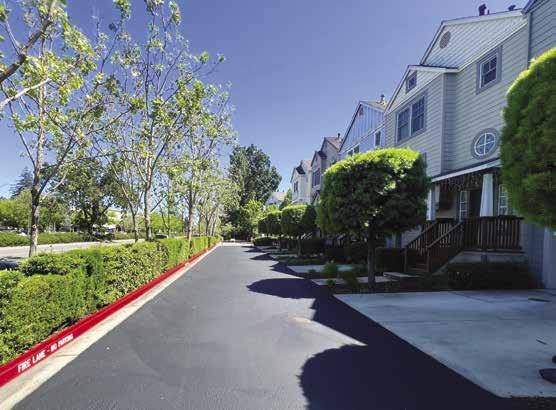
Since 2012, Reliable Pavement Services (RPS) is proud to have served Northern California planned communities with an estimated $10 million in project involvement annually.
With over 45 years of paving experience, our staff works hard to continue to build the business on the core values of Accountability, Competency, and Integrity. Our WHY is the belief that life is about the Win-Win-Win – and we strive to make that happen daily.
RPS handles projects of all sizes and scopes. From large to small projects, single or multi-year plans, the finished
product provides increased value to your community.
RPS design specifications allow seal coat applications to last up to eight years, while the results of other contractors last three to five years, with minimal increases over multi-year plans. We pride ourselves in going above and beyond for our clients. RPS maintains a strong focus on details which allows homeowners, community/ property managers and installation contractors to use one set of documents to track the project from beginning to end. From budget planning to bidding, contract assignment to project
management and successful project completion – RPS does it all.
Nothing serves a community better than an accurate, long-term plan for your paving projects. Budget planning and reserve funding adjustments are part of the overall project scope and one of the extras Reliable Pavement Services proudly provides to clients.
Contact RPS today and let’s find a way to work together.
• Consulting Agreement fee-based services
• Prime Contract % of the project*
• Flat Rate 10% of the project *
• Project Management Service Fee
*Not available for all projects
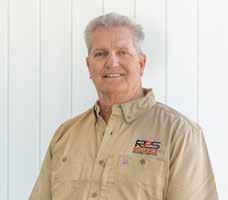
Rick Scheibley, Owner 877 Serene Court Morgan Hill, CA 95037 (408) 858-2117
rick@RPSpaveman.com RPSpaveman.com
Continued from page 22
2. How are confidential and non-confidential data separated?
Associations hold data that is open to inspection and data that is not, including detailed delinquency information, disciplinary records, certain owner communications, employee information, and privileged communications. Feeding everything into a single AI environment without proper access controls invites accidental disclosure.
3. What happens if there is a breach?
The more that detailed owner information is concentrated in one place, the more serious the impact if that system is ever compromised. Boards do not get to point at “the vendor” and walk away. Directors will be expected to show they selected and supervised vendors with reasonable care.
Board-level guardrails:
Before adopting AI-driven platforms, boards should work with management and counsel to create a basic data map and decide the following:
• Classify association data into clear categories, such as “open record,” “confidential association record,” and “privileged.”
• Decide which categories may be used with AI tools and which are off-limits.
• Confirm the following on contracts with vendors:
– Identify who owns the data.
– Define how long data is kept, how it can be exported, and in what formats.
– Describe how confidential data is segregated and accesscontrolled.
– Include reasonable security and breachnotification obligations. The message to vendors should be simple: Data ownership is not a slogan. The association must be able to access, compartmentalize, export, and, when appropriate, delete its records in a way that aligns with its legal obligations.
Risk Zone 3: Governance by algorithm
The last risk zone is more subtle but no less important. AI does not just process information. It shapes decisions by influencing how information is presented, which options are highlighted, and which facts may be left out.
In the association context, this can play out in several ways:
• AI tools auto-draft violation letters, and the board simply clicks “approve” on a queue without really reviewing the facts or tone.
• A budgeting assistant generates recommended increase levels and reserve contributions, and directors feel pressure to adopt them as-is, even if the underlying assumptions are not well understood.
• A resident-facing chatbot answers rule interpretation questions slightly differently over time, leading to uneven enforcement (e.g., one owner is told a certain patio structure is permitted, another is told it is prohibited).
Boards cannot outsource fiduciary duties to software, even
highly sophisticated software. Associations are still judged based on whether enforcement is fair and consistent, decisions are made in good faith and in the best interests of the membership, and processes comply with applicable statutes and governing documents. None of that changes because AI tools are involved.
Board-level guardrails:
• Treat AI output like a consultant’s memo. It is input, not a decision.
• Keep rule interpretation, enforcement decisions, and assessment decisions firmly in the hands of the board, at properly noticed meetings, with minutes that reflect human deliberation.
• Require that any AIgenerated violation notices, delinquency letters, or owner-specific communications receive human review before they are sent.
If the board would be uncomfortable defending a decision by saying, “That is just what the software recommended,” human judgment has slipped too far to the sidelines.
First, Decide What Problem AI Is Supposed to Solve
Before adopting any AI product, boards should identify the task they are trying to improve. Is the goal to write clearer newsletters, sort maintenance requests, summarize board packets, or answer owner questions after hours? Those are different risk profiles. A tool that drafts a general newsletter is not the same as a tool that interprets CC&Rs (covenants, conditions, and restrictions) for
a particular owner. If the board cannot describe the problem, the data being used, and the human who remains responsible for the final answer, the association is not ready to turn the feature on.
Build the Guardrails Before Turning the Feature On
The good news is that boards do not need to be technology experts to set workable boundaries. A practical AI use policy does not need to read like software code. It should give directors, managers, vendors, and owners an understandable framework for when AI may be used and when it may not.
At minimum, the policy for most associations should cover at least four areas.
1. Where AI is allowed, and where it is not
“Safe lanes” and “prohibited lanes” should be defined in language that a volunteer director, manager, and homeowner can understand.
Examples of appropriate uses:
• Drafting community-wide messages from bullet points provided by the board or management
• Drafting first-cut agendas, open-session summaries, and task lists
• Generating educational materials that explain already-adopted policies and budget decisions in plainer language
• Assisting with RFPs, vendor comparison matrices, and internal checklists
Examples of prohibited uses:
• Processing, summarizing, or rewriting communications with the association’s attorneys
• Making or communicating decisions on individual violations, disputes, or collection matters without human review
• Creating or revising formal policy language, governing
document amendments, or settlement terms, except as a drafting aid reviewed and finalized by counsel.
Clarity here prevents later disputes. It also gives managers and directors something concrete to point to when a convenient shortcut would create unnecessary risk.
Guardrails for the Future-Proofed HOA
Continued from page 25
2. Tool standards: consumer versus enterprise
Volunteer directors and on-site managers are understandably tempted to reach for whatever AI tool is easiest to access on a phone or browser. That usually means consumer-grade tools with click-through terms, uncertain retention practices, and limited administrative controls.
For association business, that is rarely acceptable.
Boards should insist on the following:
• Any AI tools used by management or vendors for association work are business or enterprise products, not personal accounts.
• The association is a named customer or a named beneficiary under the contract, or at minimum is expressly protected by its terms regarding confidentiality and data handling.
• Training and retention settings are configured so that association data is not casually used to improve public products in ways the board did not intend.
• It is not realistic to prevent every director from ever touching a consumer AI tool. It is realistic to say, “You may not use that tool to process association documents or owner information.”
3. Humans stay in the loop
“Human in the loop” is a phrase that gets used often and implemented poorly. For an HOA,
it should mean that a responsible person reviews AI-assisted work before it affects a homeowner, a vendor relationship, or a board decision.
For resident-facing tools:
• Owner-specific communications that apply rules to individual facts, especially violation and collection communications, should be reviewed by management or the board before release.
• There should be a simple, clear way for an owner to escalate a concern to a human if they believe an AIassisted response is wrong or unfair.
• Periodic audits should be done of chatbot logs or templated responses to confirm that they are accurate and consistent with current policies and documents.
For board decision-making:
• AI-generated summaries, risk flags, or recommendations should be included in the board packet, just like any other consultant’s report.
• The board packet and meeting process should show that directors had a real opportunity to review the information, ask questions, and make their own decision. Minutes should reflect the action taken without turning into a transcript of every AIgenerated point considered.
• Directors should feel free to disagree with AI-assisted analyses, not treat them as automatically correct.
4. Vendor and management coordination
AI is not arriving just through tools that boards choose for themselves. It is also being integrated into management software, banking portals, compliance platforms, and other vendor systems.
Boards should build AI into the normal oversight cycle they already use for vendors:
• By asking management and major vendors, at least annually, to describe what AI-related features they are using or planning to roll out that will touch association data or owner interactions
• By reviewing proposed new features in light of the association’s AI use policy before turning them on
• By involving legal counsel when AI features are tied to contract changes, data handling, or new categories of information moving into vendor systems
The goal is not to slow everything to a halt. The goal is to make sure the board, not the vendor or a default software setting, is in charge of how association data and owner relationships are handled.
Explain AI Use Before Owners Discover It By Accident
Owners do not need a technical lecture, but they do deserve clarity before an AI-assisted tool starts answering questions or shaping communications that affect them. When a board adopts AI tools in a meaningful way, it should communicate that decision in plain language. That communication may include the following:
• A short article in the newsletter explaining where AI is being used (e.g., to help draft newsletters or to provide answers to common questions through the portal), and where it is not (e.g., legal decisions, individual enforcement decisions, or board deliberations).
• A statement that governing documents, properly adopted policies, and board decisions always have control over any automated or AI-generated response.
• A reminder that owners can always request clarification from management or attend board meetings to raise concerns.
Transparency builds trust and reduces the perception that “the software” has silently taken over community governance.
Innovation Without Shortcuts
AI will keep moving into the HOA world whether boards are ready or not. The choice is whether boards will set the
terms of AI use or let vendors, volunteers, and software defaults set them by accident.
Used in the right lanes, with clear guardrails, AI can reduce administrative overload, improve communication, and help boards present financial and planning information more clearly to the members. What it cannot do is replace judgment, fiduciary duty, or the obligation to treat owners fairly and consistently.
The future-proofed HOA is not the one chasing every new tool. It is the one that uses technology deliberately, protects the information entrusted to it, and keeps human beings responsible for the decisions that define the community.
Daniel C. Heaton, Esq., is a senior associate at DeNichilo Law APC, exclusively representing community associations throughout California. Daniel advises boards on complex areas of corporate governance, statutory compliance, enforcement of governing documents, and resolving complicated homeowner disputes or litigated matters.
Get ready for the most up-todate resource in community association law – Echo’s 2026 Statute Book is now available for order! Whether you prefer the convenience of a searchable digital version or the feel of a professionally bound printed copy, this essential reference includes the latest California laws affecting homeowners associations. Perfect for board members, managers, and legal professionals, the 2026 edition helps you stay informed and compliant all year long. Don’t miss out – order your electronic or printed copy today!
Now available to order in the Echo online store. Visit echo-ca.org and log in for store menu.
Email jprice@echo-ca.org with any questions.
Don’t miss an opportunity to get the education you need – and the networking and connection you want. Register today!
Educational Seminars
Learn from an acclaimed faculty delivering essential knowledge for HOA boards and homeowners.
• Ask your questions of on-site attorneys
• Visit with industry experts at exhibit tables
• Meet and connect with board members from neighboring communities
Visit echo-ca.org/events for more information on upcoming events.
Click a button or use the link to sign up to receive information on Resource Panel meetings near you!
Resource Panel Meetings
Come and reconnect with your peers and attend an upcoming Resource Panel in your region. These events are held in a casual atmosphere to enable homeowners, board members, managers, and other professionals to hear about important topics presented by experts in the HOA industry. Click a Resource Panel meeting location below to sign up to receive information.
Wine Country Resource Panel Santa Rosa
North Bay Resource Panel Novato
Sacramento Resource Panel Roseville
San Pablo Bay Resource Panel Benicia
The Echo Club at Rossmoor (TECAR) Walnut Creek East Bay Resource Panel San Ramon South Bay Resource Panel San Jose Northern California Educational Seminar South Bay Area
Central Coast Resource Panel Santa Cruz County San Francisco Resource Panel Legislative Update & Educational Seminar East Bay Area
Register Today to Attend a Resource Panel Meeting!
Sacramento Resource Panel 8/4 • 11:30 AM - 1:30 PM
The Echo Club at Rossmoor 8/5 • 9:30 AM - 11:30 AM
East Bay Resource Panel
8/6 • 11:30 AM - 1:30 PM
Los Angeles Resource Panel 8/11 • 11:30 AM - 1:30 PM
Orange County Resource Panel 8/12 • 11:30 AM - 1:30 PM
Wine Country Resource Panel 8/18 • 11:30 AM - 1:30 PM
North Bay Resource Panel 8/19 • 11:30 AM - 1:30 PM
San Francisco Resource Panel 8/19 • 5:30 PM - 7:30 PM
South Bay Resource Panel 8/26 • 11:30 AM - 1:30 PM
Central Coast Resource Panel 8/27 • 11:30 AM - 1:30 PM
Los Angeles Resource Panel Burbank
Orange County Resource Panel Irvine
Southern California Educational Seminar Laguna Hills
San Diego Resource Panel San Diego
WELCOME TO ECHO’S
New Professional Service Providers
Eco-friendly Landscape Maintenance Service
We are Optiwise Landscape, a Company that emerged combining the professional creation of natural beauty with environmentally friendly practices.
We provide sustainable landscaping services to Homeowners Associations, multi-family properties and singlefamily homes in the South Bay / Silicon Valley area.
We are much more than a landscaping company: we are also a remodeling service that provides minor repairs to our clients’ spaces.
At OptiWise Landscape, reducing emissions is our priority; that’s why we add to all our experience, solutions and Zero-Emissions equipment that contribute to the care of the environment and the well-being of our clients and collaborators.
California Communities is the most trusted partner that specializes in premier HOA and property management. With a dedicated team, we provide exceptional service to a diverse portfolio of communities across the state. From financial management to administrative support and maintenance coordination, our comprehensive approach ensures seamless operations and enhanced property values.
Partner with California Communities for professional, responsive, and personalized management that fosters thriving, well-maintained communities.
California Communities (415) 489-0632
californiacommunities.biz
Avelar is a Walnut Creek based firm, providing comprehensive forensic architectural, construction, and reconstruction management services on a variety of residential, commercial, and industrial projects throughout California, Nevada, Texas, Hawaii, and Arizona since 1976.
The firm’s principal architects and contractors have combined experience in architectural and building services, including new construction, renovation, construction defect analysis, reconstruction, construction management, and litigation support services. Our
services range from construction litigation support and expert witness services for arbitration, settlement and/or jury proceedings to providing drawings and details for the repair and renovation of defined areas within each project.
We also specialize in providing such services as project management and construction administration during construction, quality assurance reviews, ADA/ Accessibility review, building code compliance review, reserve studies, and homeowner representative services for associations undergoing reconstruction.
Diversified professional backgrounds of the principals contribute to Richard Avelar & Associates’ wealth of experience in different project types, including multi-unit condominium and townhouse complexes, single family homes, churches, theaters, libraries, retail and office spaces, health-care facilities, school facilities, restaurants, fire and police stations and projects in public works.
Avelar (925) 954-4978
avelar.net
Over the last 10 years Empire has become one of the largest and most successful reconstruction and repainting companies in the United States. Our story made up of great clients, many beautiful projects, ethical business practices and the best workforce in the industry. Continuing our tradition of “Easy To Do Business With”. Here are the Regions we serve.
EmpireWorks reconstruction services are available throughout California. We specialize in working within
occupied space multi-family low, mid, and high-rise HOAs, and commercial properties to ensure that they are maintained, repaired, and restored to preserve the home values while keeping their communities safe.
We have a team of experienced professionals knowledgeable about the unique challenges of these types of properties. We understand the sensitivity of the community when approaching construction projects. EmpireWork’s approach to the project starts with gaining that trust back through excellent communication and dedicating a reconstruction team to work closely with you to develop a plan that meets your specific needs, budget, and schedule. We are committed to providing the highest quality services, advanced processes, and procedures to make your community’s reconstruction smooth. Contact us today to learn more about our reconstruction services in California.
The Browning Reserve Group (BRG) has specialized exclusively in reserve studies since 1999, helping community associations and nonprofit organizations make informed, long-range capital planning decisions.
Clients often praise the clarity of our reports and the professionalism of our field staff, but the feedback we value most is, “You listened to us.” That commitment reflects our thoughtful engagement with boards and managers. Even when delivering difficult findings or navigating challenging circumstances with
boards or managers, we strive to ensure that all parties feel heard, treated fairly, and confident that the final work product serves the best interests of the community.
BRG professionals hold national volunteer leadership roles with the Community Associations Institute (CAI) and the Association of Professional Reserve Analysts (APRA), and maintain their Reserve Specialist (RS) and Professional Reserve Analyst (PRA) designations. In addition, our team actively supports and provides training for California Association of Community Managers (CACM) and CAI and is a proud member of ECHO.
Browning Reserve Group (916) 393-0600 browningrg.com
Maven Management & Consulting
Maven Management and Consulting is one of the premiere Homeowners’ Association (HOA) companies located in the heart of Silicon Valley. Managing all ranges of residential and commercial properties, we set ourselves apart with our boutique feel, enabling us to focus on your specific needs.
We at Maven understand that every community is unique. This allows us to customize your needs, so your property is always at its fullest potential. We look forward to hearing from you.
nexova ai integrates experienced community managers with modern management systems to deliver clear, consistent experience for boards and homeowners.
We focus on protecting and strengthening long-term property value through responsible operations, transparent financial oversight, proactive vendor coordination, and engaged community support. Our approach helps communities operate efficiently, manage costs responsibly, and maintain well-run, attractive neighborhoods.
Administrative Support
We support day-to-day community operations with structured processes that promote consistency, compliance, and effective board governance.
Financial Management
Our services include transparent accounting, budgeting, and detailed financial reporting designed to support fiduciary responsibility and informed board oversight.
Vendor Management
We coordinate vendor relationships through competitive bidding, clear communication, and cost-conscious oversight to help communities control expenses.
Project Management
We oversee maintenance projects and insurance coordination to support cost control, risk management, and timely execution.
nexova ai (206) 482-0213 nexovaai.io
Continued on page 32
Echo Board of Directors Candidacy and Election Announcement
Echo will conduct the annual election of its board of directors in early fall.
The results of the election will be announced at the Echo annual membership meeting, which will be held on Thursday. November 19, 2026, from 9:00 to 9:15 a.m. The meeting will be online only. Candidate nomination application forms can be requested via the following email: elections@echo-ca.org.
For the application to be considered by the Echo nominating committee, it must be completed and received by Echo no later than 5:00 p.m. on July 31, 2026.
New Professionals
Continued from page 29
Hardiman Construction’s Trenchless Titan (HCTT) specializes in underground pipeline repair, replacement, rehabilitation and inspection. HCTT performs CCTV inspections on smaller diameter pipes that serve single-family residences, condominiums, apartments, etc. as well as larger diameter sewer mainlines, common laterals and drainage pipes using push-cameras and crawler camera technology.
HCTT generates reports based on the information discovered during CCTV inspections/assessments and based on the specifications/code of the local governing body. HCTT is NASSCO certified (MACP, LACP and PACP). HCTT rehabilitates large diameter drainage and sewer pipelines via the UV-Cured-In-Place (CIPP) lining and slip-lining methods. HCTT performs sewer line, waterline and drainage line repairs/replacements via pipe bursting and other trenchless methods when possible. HCTT performs traditional open-trench pipeline installation/replacement when necessary.
HCTT also specializes in manhole rehabilitation, manhole installation and manhole lining. HCTT is a reputable company with many references for work performed for municipalities, sanitary districts, homeowners’ associations and individual homeowners.
Hardiman Construction, Inc. (415) 924.2555 trenchlesstitan.com
One Structural is a family-owned and operated company dedicated to delivering high-quality engineering & repair solutions for HOAs and multifamily properties. With over 20 years of industry experience, we understand the importance of protecting both your investment and the residents who call it home. Our team prioritizes safety, clear communication, and efficient project execution at every stage.
We offer engineering, permitting, construction, and project management services. Our expertise spans waterproofing, structural repairs, plumbing and drainage, stucco, leak detection, seismic retrofitting, and SB326 balcony inspections and repairs.
At One Structural, we take pride in being a reliable partner to property managers and HOAs – delivering thoughtful solutions, minimizing disruption, and ensuring long-term performance for every community we serve.
One Structural 844-473-8761 onestructural.com
For more information, contact Dave Zepponi at dzepponi@echo-ca.org.
At RowCal, we don't just manage properties — we manage relationships, protect assets, and help communities thrive.
Whether you're a board member trying to keep things running smoothly or a homeowner wondering if your association is in good hands, here's what we bring to the table every single day.
At the core of everything we do is one goal: to enhance the value of every community we manage. That means serving as a true operational backbone for the board — organized, responsive, and proactive. It means delivering real communication and service to every homeowner. And it means helping boards stay compliant with ever-evolving California HOA law while thinking strategically about where the community is headed. We're not here to just keep the lights on. We're here to help your community grow stronger, year over year.
A well-maintained community doesn't happen by accident — it's the result of deliberate planning and strong vendor relationships. For capital improvement projects, we provide full project management from start to finish. For standard maintenance needs, we coordinate competitive bids so your board can make informed decisions. We've built lasting vendor partnerships across key trade categories, which means faster response times and better outcomes. And because reactive maintenance is never a strategy, we help boards develop roadmaps that prioritize spend and protect long-term community assets.
Sound financial management is one of the most important things an association can have. We provide timely, accurate financial reporting that gives boards the clarity to make confident decisions.
We offer access to financial services including loan programs and investment opportunities tailored to your community's needs. Every homeowner ledger is maintained in detail, and when collection activity is required, we handle it with professionalism and in full accordance with the law. Your community's financial health is something we take personally.
Board members volunteer their time because they care. We support that commitment by guiding boards through meeting preparation, agenda setting, and minutes documentation. We help navigate difficult conversations, advise on policy enforcement, and ensure decisions are made with the right information. RowCal also proudly offers board training — because a well-informed board is an effective one.
To our current clients: thank you. Your trust means everything, and we work every day to earn it.
To those exploring what's possible: we'd love to connect. Let's have a real conversation about what your community needs — and whether we're the right fit to deliver it.
LEGISLATIVE UPDATE June 2026
BY NATHAN McGUIRE, ESQ.
(Note: The information in this report is as of June 5, 2026)
We are now in the heart of the legislative session. At this stage, bills either progress through the committee process (often with significant amendments along the way) or they stall—sometimes quietly—when they are held in committee, placed on a suspense file, or simply not set for hearing. Legislators will take their summer recess on July 2 and reconvene on August 3. Once they are back in session, the push begins to get bills to the governor’s desk before the August 31 deadline for each house to pass bills.
In California, a bill generally starts in its house of origin (Assembly or Senate) and is heard in one or more policy committees (for HOA bills, often Housing and Judiciary committees). If the bill has a fiscal impact, it may also be referred to Appropriations, where it can be placed on the “suspense file” for later consideration. Bills that clear committees move to the floor for a vote of the full house; if they pass, they “cross over” to the other house and repeat a similar committee-andfloor path. If the second house amends the bill, it returns to the house of origin for concurrence. Bills that pass both houses are sent to the governor for signature or veto.
Below are (1) the HOA-related bills we’re actively watching as they work their way through committees and floor votes, followed by (2) “watch bills” that currently appear stalled but could still be revived later in the session.
Because there are a some extremely harmful bills which seem to be heading toward passage, Echo has determined to formally oppose the following bills:
• AB-1903, which would significantly limit an HOA’s ability to pursue lawsuits for construction defects.
• SB-1007, which would require member approval to increase regular assessments more than 8% from the prior fiscal year.
Follow Echo for more information about how you can help in the efforts across the industry to oppose these bills.
AB-739
ASSEMBLY BILLS
(JACKSON) – ASSOCIATION FEES
This bill, originally introduced last year, would have required a managing agent of a common interest development to hold a real estate broker license issued by the DRE (Department of Real Estate). The bill was amended on January 5, 2026, and January 15, 2026, changing gears completely to require the board of directors of the association to review, on an annual basis, fees charged by the managing agent, as specified. The bill would also require the association to deliver through electronic means a statement of these fees upon written request by a member.
STATUS: The bill passed out of the Assembly 75-0 and has been referred to the Senate Housing and Judiciary committees.
AB-956
(QUIRK-SILVA) – ADUs
This bill was amended in May to expand the prohibition of unreasonable restrictions on ADUs/JADUs from planned developments to all common interest development lots zoned to allow single-family homes. The bill also increases the number of ADUs permitted on a lot, subject to ministerial review, from one to two detached ADUs.
STATUS: The amended bill has been re-referred to the Housing Committee.
AB-1184 (PATTERSON/DEMAIO) –GOVERNANCE
This bill, originally introduced last year, has been amended and now appears to be the followup to AB-21, a “kitchen sink” bill which failed to move last year. This bill would:
• Require the general notice for an emergency rule change to include the text of the rule change, a description of its purpose and effect, and the date when the rule change will expire.
• Prohibit a majority of the directors of the board, outside an authorized meeting, from using a series of communications of
any kind, directly or through intermediaries, to discuss, deliberate, or take action on any item of business within the board’s subject matter jurisdiction, except in an emergency. The bill would also exempt from this prohibition certain informational and ministerial communications.
• Require the board, if the association becomes involved in litigation, to provide notice of the occurrence as part of the annual budget report distributed to members, as prescribed.
• Require, if open session meetings of the board are electronically recorded using audio, or audio and video, that the recordings be considered a record of the association and be made available to members on the same basis as written meeting minutes. The bill would require notice to be given at the beginning of every open session of the board that the meeting is being recorded.
• Prohibit the imposition of a charge for minutes that are distributed electronically. The bill would allow minutes posted on the association website to meet minute distribution requirements. The bill would require the minutes, or proposed minutes, to include specified information, including the date and time of the meeting.
STATUS: The bill passed out of the Assembly 69-0 and has been referred to the Senate Housing and Judiciary committees.
COMMENTS: The most impactful requirement of this bill would be that it would eliminate the email exception to the Open Meeting Act, which was expressly ruled as legal by the appellate court in the LSNU v. Alta Del Mar case.
AB-1684 (WARD) – COOLING SYSTEMS
This bill would make any provision of the governing documents, architectural guidelines, or policies void and unenforceable if the provision prohibits or restricts the installation, upgrade, replacement, or use of a cooling system. The bill would also make void and unenforceable any covenant, restriction, or condition contained in any, among other specified agreements, deed that effectively prohibits or restricts the installation, upgrade, replacement, or use of a cooling system. The bill would make it unlawful for an association to prohibit or restrict a member from installing, upgrading, replacing, or using a cooling system in the member’s separate interest, or to take other specified actions in connection with the installation, upgrade, replacement, or use of a cooling system, subject to specified exceptions. Finally, the bill would make an association that willfully violates these provisions liable to the member for actual
damages occasioned thereby, and for a civil penalty paid to the member in an amount not to exceed $2,000.
STATUS: The bill passed out of the Assembly 74-0 and has been referred to the Senate Housing and Judiciary committees.
AB-1892 (DAVIES) – MAINTENANCE AND ELECTIONS
This is a cleanup bill to 2024’s SB-900. Under SB-900, an association is responsible for repairs and replacements necessary to restore interrupted gas, heat, water, or electrical services that begin in the common area even if the matter extends into another area, as specified, unless the utility service that failed is required to be maintained, repaired, or replaced by a public, private, or other utility service provider, or otherwise provided in the declaration. This bill would attempt to clarify that requirement by replacing “that begin in the common area” with “when the interruption begins in.” Unrelated to SB-900, the bill would change the 90-day notice for an association intending to use election by acclamation to 30 days. And finally, the bill would clarify that electronic ballots are to be delivered only to members who are voting electronically.
STATUS: The bill passed out of the Assembly 72-1 and is being referred to committees in the Senate.
COMMENT: This bill makes a few minor but important tweaks to the Davis-Stirling Act, the most impactful of which would be reducing the initial notice of intent to use acclamation from 90 to 30 days, which would better align with the overall election timeline and not unnecessarily extend the time it takes to conduct an election allowing for the possibility of acclamation.
AB-1903 (WICKS/BECKER) – CONSTRUCTION DEFECTS
This bill would amend multiple civil code provisions related to construction defect actions, including Davis-Stirling Act provisions (including Civil Code Sections 5980 and 6150). Among other changes, it would create an alternative process for construction defect actions for “certified buildings” (where the builder obtains a private inspection by a licensed architect, engineer, or general contractor) and would modify the content and verification requirements for construction defect notices. For HOAs, the bill would require (1) notices involving separate interests to be signed by each affected homeowner and (2) notices involving common areas to be verified by the association’s president.
Continued on page
STATUS: The bill passed out of the Assembly 70-0 and is set for hearing on June 23, 2026, before the Senate Judiciary Committee. The bill was amended on April 23, 2026, to eliminate the 75% vote requirement, clarify that it applies only to condo projects and townhouse developments (constructed after January 1, 2027), and prohibit the recovery of investigative costs by abrogating the Stearman v. Centex Homes ruling. Further amendment on May 18, 2026, significantly tightens prelitigation and evidence requirements for homeowners, limits recoverable construction defect damages, insulates HOA board members from fiduciary liability regarding defect litigation, and introduces a voluntary “certified building” program that offers builders expanded liability releases.
COMMENT: The bill, if passed, would be a fundamental shift in how HOAs address construction failures, making the path to litigation significantly more difficult and expensive. The inability to recover expert fees would limit an HOA’s recovery dramatically. Echo has taken a position to formally oppose this bill.
AB-2035
(DIXON) – AMENDMENTS
This bill would lower the threshold for petitioning the superior court to reduce the percentage of votes necessary for an amendment to more than 37 percent of the votes if the court finds that the common interest development is a senior citizen housing development, as defined, the separate interests in the common interest development meet specified criteria, and the declaration has not been amended in at least 35 years.
STATUS: The bill passed out of the Assembly 73-0 and has been referred to the Senate Housing and Judiciary committees.
COMMENT: While the concept works, the bill applies so narrowly there would be no benefit for most HOAs.
AB-2050 (CALOZA) – RESERVE ACCOUNTS
This bill would, beginning January 1, 2032, revise the requirement to perform a study of the reserve account requirements to, among other things, include the minimum reserve contribution level to prevent the projected association reserve account balance from falling below zero over the following 30 years. The bill would require an association to fund the reserve account on an annual basis in at least the minimum reserve contribution level. If the association is unable to fund the reserve account in at least the minimum reserve contribution level without exceeding the above-described specified limitations on increases on assessments, then,
notwithstanding those specified limitations, the bill would require the association to levy a reserve special assessment in an amount necessary to allow the association to fund to minimum contribution level without a reserve special assessment within nine (9) fiscal years, as provided.
STATUS: The bill passed out of the Assembly 59-7 and has been referred to the Housing, Judiciary, and Appropriations committees. The bill was amended on April 16, 2026, to extend the time an HOA has to levy a reserve special assessment from three (3) to nine (9) fiscal years.
COMMENT: The bill seeks to ensure that HOAs proactively fund the long-term maintenance of their essential infrastructure. By mandating a minimum funding floor, the bill protects homeowners from the financial devastation of sudden special assessments while securing property values and lending eligibility for the future.
This bill was gutted and amended. As amended, it would prohibit governing documents from imposing restrictions on a member’s use of public roads. It would also make changes related to collections, including requiring associations to notify members by certified mail of a change in the person authorized to receive payment of assessments within 60 days of the change. Finally, it would add potential liability for “boards” that fail to comply with statutory collection procedures (including reconveyance fees, owner costs tied to the noncompliance, and a $1,000 civil penalty).
STATUS: The bill passed out of the Assembly 74-0 and has been referred to the Senate Housing and Judiciary committees.
COMMENT: This bill would significantly increase the financial risk for HOA boards by introducing a $1,000 civil penalty for even minor procedural errors in the lien process, moving beyond the current strict compliance standard, which already requires restarting collection processes. What is most concerning is that the $1,000 penalty could be applied to “the board,” not the association.
AB-2579 (PETRIE-NORRIS) – MEMBER DISCIPLINE
This is a cleanup bill to last year’s AB-130. The bill would amend Civil Code Sections 5850 and 5855, and add 5851, regarding member discipline. It was significantly amended on April 29, 2026. The deleted exception for the $100 fine cap for “adverse health or safety impacts on the common area or another association member’s property” has been added back. And now, instead of a list of additional specified exceptions in the Davis-Stirling
Continued on page 38
HOA Boards, Associations and Property Managers each have recently ranked Deferred Maintenance as their biggest threat to their businesses.
1
STUDY DIGITALLY
360 Degree Hi-Res Spectral
Thermal - Moisture Detection, Solar Panel Efficiency
LiDAR - Measure, As-Built Plans
MONITOR PROPERTY HEALTH
Summary-view of All Issues
Dynamic Access to Reports & Status
Auto-send Violation & Notice Letters
2
It is no surprise given the near-perfect storm conditions:
- Added Regulatory Compliance Requirements
Current Issues Emerging Issues Issue Size & Severity Changes Over Time
5
- Sharply Rising Labor and Material Costs
- Localized Weather Extremes
- Skyrocketing insurance
- Aging property assets.
3
4 ALERTED by MindMe’s PROPERTY INDICATOR LIGHTS High Risk Areas Moderate Risk Areas Lower Risk Areas
Geotagged Issues & Assets
Time & Date Stamped Identify Claim Risks
Issue-specific SOW, RFP and Budgets
6
Detect Early Independently Scope & Scale
Mitigate Insurance Claims
Model Asset Decay Smartly Prioritize Expenditures
Act (including environmental hazards, architectural improvements, pets/animals, maintenance, activities in the common area, violent acts, and short-term rental policy violations), a list would be developed and published by the California Department of Real Estate (DRE) pursuant to newly added 5851.
STATUS: The bill passed out of the Judiciary (12-0) and Housing (12-0) committees and, since there would be a fiscal impact to the state, it was referred to the Appropriations Committee. It was then ordered to the inactive file at the request of the author.
COMMENT: The fact that the DRE would be involved made this a more difficult process. The bill will not be going anywhere this year.
AB-2692
(IRWIN) – REINSTATEMENT OF TERMINATED DECLARATIONS (LA COUNTY)
This bill would add Civil Code Section 4276 to allow covenants, conditions, and restrictions (CC&Rs) that have been terminated by operation of a declaration’s stated term to be reinstated in Los Angeles County if approved by the percentage of members required by the CC&Rs for extending the term. It would be limited to Los Angeles County and would sunset on January 1, 2028. The bill was amended on April 29, 2026, to make it an urgency measure, which means it would take effect immediately if passed.
STATUS: The bill passed out of the Assembly 66-0 and has been referred to the Senate Housing and Judiciary committees. It has been deemed to be an urgency measure, so if it passes it will take effect immediately.
SENATE BILLS
SB-222
(WIENER/ALLEN/BECKER/STERN) –APPLIANCES AND UTILITIES
This bill would make any provision of the governing documents, architectural guidelines, or policies void and unenforceable if the provision prevents the replacement of a fuel-gas-burning appliance with an electric appliance. The bill would also make any covenant, restriction, or condition contained in any, among other specified agreements, deed, and any provision of a governing document, that effectively prohibits or restricts the installation or use of a residential heat pump water heater or heat pump HVAC system, void and unenforceable.
STATUS: The bill passed out of the Senate 29-8 and has been referred to the Assembly Housing and Local Government committees.
SB-876 (PADILLA) – FIRE AND RESIDENTIAL PROPERTY INSURANCE
This bill would substantially expand insurers’ payment obligations, coverage requirements, and regulatory oversight for residential property insurance, particularly in the context of declared states of emergency. It would accelerate and increase mandatory claim payments following a total loss by requiring prompt payment of actual cash value and undisputed replacement cost amounts, with interest penalties for delays. It would broaden and mandate enhanced replacement cost, guaranteed replacement cost, and building code upgrade coverage, limiting insurers’ ability to issue or renew policies unless higher levels of coverage are affirmatively offered and, in some cases, automatically increased after disaster losses. It would tighten insurer compliance by eliminating exemptions from rebuilding cost estimates, extending those obligations to FAIR Plan policies, and exposing insurers to liability up to full replacement cost for noncompliance. Additional provisions expand additional living expense benefits, increase contents payouts after total losses, restrict adjuster reassignments, and impose stricter reporting and disaster planning requirements on insurers. While the bill is directed at insurers, its practical effect may be increased premiums, reduced underwriting flexibility, and tighter scrutiny of property condition and valuation—impacts that could be felt acutely by homeowners associations insuring large, multi-structure residential communities in high-risk areas.
STATUS: The bill passed out of the Senate 30-9 after making it off of the Appropriations suspense file, a relatively rare occurrence.
This bill would preclude governing documents from limiting or prohibiting owners from replacing existing residential windows with “California Energy Codecompliant windows,” as defined (by reference to the California Energy Code’s fenestration requirements, and as further described in proposed Government Code Section 65850.73).
STATUS: This bill passed out of the Senate 32-7 and has been referred to the Assembly Housing and Local Government committees.
SB-1007 (MENJIVAR) – DISCLOSURES AND ASSESSMENTS
This bill would require the annual budget report to include a high-level summary breakdown of what the regular assessments fund and a statement regarding compensation of a management company, as provided. The bill would require a summary of an annual budget or policy statement to also include
a high-level breakdown that describes what the regular assessments fund, as specified. This bill would prohibit an association from increasing a regular assessment, unless the board includes the above-referenced information pertaining to regular assessments. The bill would, instead, prohibit a board from imposing a regular assessment for the association’s preceding year, adjusted for inflation, without the approval of the majority of a quorum of members. This bill would require the association to make any physical evidence used to determine that a violation of the governing documents has occurred available to the member at least five (5) business days before the hearing or deadline for the member’s response if the association seeks to impose a monetary penalty against a member for violation of the governing documents, as provided.
STATUS: The bill passed out of the Senate 24-13, one of the closer votes for an HOA bill this year.
COMMENT: This bill would have a massive harmful impact on HOAs, limiting the ability to increase assessments beyond the inflation amount and eliminating the current cap of 20% from the prior year. The bill would harm member property values by limiting an HOA’s ability to adequately fund reserves (which are woefully low in many cases), which is an important policy objective and would make it harder to obtain loans for purchase or refinancing. For these reasons, Echo has formally opposed this bill.
UPDATE: The bill was amended on May 21 to cap assessment increases at 8% (reduced from the current 20% cap) without member approval, instead of tying the cap to inflation. It also changes the requirement for the summary of an annual budget to include a comparison breakdown of anticipated expenses versus actual expenditures of the previous fiscal year and a statement regarding compensation of any management company.
SB-1238 (WAHAB) – MANAGEMENT AND MAINTENANCE
This bill would make broad revisions to the Davis-Stirling Act aimed at increasing transparency, accountability, and consumer protection in common interest developments. However, some of the requirements would be unworkable in practice. This bill would significantly expand the regulatory and administrative obligations placed on homeowners associations, with a particular focus on management practices, reserve funds, and structural safety disclosures. It would broaden the definition of association “agents” to capture managers and third parties involved in key disclosure and financial functions, expressly subjecting them to fiduciary duties owed to the board and members. It would substantially increase disclosure requirements for homeowners, associations, and managers in connection with sales and refinances, especially
where balconies or other exterior elevated elements are involved, and ties those disclosures to evolving federal lending standards and “critical repair” concepts. The bill would tightly restrict boards’ ability to use or transfer reserve funds for litigation or legal services involving owners or their relatives, even at the threat stage. In addition, it would integrate exterior elevated element inspections into the reserve study framework, emphasizing occupant safety and requiring that identified repairs be prominently summarized and incorporated into reserve planning and disclosures. Taken together, the measure would increase compliance complexity, documentation burdens, and risk exposure for volunteer boards, while narrowing board discretion over reserves and heightening scrutiny of how associations plan for, disclose, and fund major repair obligations.
STATUS: This bill, sponsored by CAR (California Association of Realtors), has been referred to the Housing, Judiciary, and Appropriations committees. The bill was amended on April 16, 2026, to impose a “duty of care that is prudent and provides the highest good faith effort to the association and its members.” The bill passed out of the Senate 36-2 and has been referred to the Assembly Housing and Judiciary committees.
COMMENT: This bill would significantly increase operating costs for HOAs and would create a heightened standard of care that would discourage vendors and managers from working with HOAs or motivate them to shift even more liability to HOAs via contract or insurance obligations.
SB-1267 (ALLEN) – ELECTRIC VEHICLE CHARGING STATIONS
This follow-up bill to last year’s SB-770 (precluding HOAs from requiring insurance naming the association as an additional insured) aims to provide liability protection for associations that permit installation of EV charging stations. The bill would make each owner and successive owner responsible for any damages resulting from installation of an EV charging station and would further require installers to indemnify or reimburse the association or its members for loss or damage caused by the installation of the EV charging station. The bill was amended on February 19, 2026, to clarify that an association may require an owner to enter into a maintenance and indemnity agreement to transfer liability for damage arising from the charging station and that installers are only liable for the installation, not maintenance or use of the charging station.
STATUS: The bill passed out of the Senate 36-0 and has been referred to the Assembly Housing and Judiciary committees.
Continued from page 39
TAKE A STAND AGAINST AB-1903
Join Echo and voice your opposition to AB-1903, the developers’ bill to subvert a fair process for homeowners to fight poorly constructed new homes in California.
Use the QR code below or click here for more information and to sign the petition opposing this proposed bill: Safe Homes California Oppose AB-1903.
WATCH BILLS
These bills don’t appear to be moving, but could still be picked back up again at this point in the session:
• AB-6 (WARD)—This bill was introduced last year and ended up in the suspense file. It would require the Department of Housing and Community Development (HCD) to convene a working group to research and consider recommending building standards.
• AB-21 (DEMAIO)—This kitchen-sink bill would make numerous changes negatively impacting operations and management of HOAs. It failed to advance out of committee. The author is working with Assemblymember Patterson on a related bill, AB-1184.
• AB-69 (CALDERON)—This bill would require a broker of record to determine if a FAIR Plan policy can be moved to a voluntary market insurance company before the policy is renewed. Introduced last year, it passed out of the Assembly 78-0. The hearing in the Insurance Committee was cancelled at the author’s request, and the bill failed to move from there.
• AB-1240 (LEE/PEREZ)—This bill would prohibit a business entity that has an interest in more than 1,000 single-family residential properties from purchasing additional single-family residential properties for rental purposes. It passed out of the Assembly 42-18 but was held up in the Senate Judiciary Committee and did not make it to the Senate floor.
• SB-282 (WIENER)—This bill would void any restrictions in governing documents that prevent the replacement of a fuel-gas-burning appliance with an electric appliance or prevent the installation or use of a residential heat pump water heater or heat pump HVAC system. It was returned to the Senate due to its failure to advance.
• SB-448 (UMBERG)—This bill would implement procedures for removal of squatters. It was returned to the Senate due to its failure to advance.
• SB-570 (ALVARADO-GIL)—This HOA spot bill was never amended to include substantive changes to the law.
• SB-681 (WAHAB)—This bill contained the language that was incorporated into AB-130 but could be amended to make related changes.
• SB-750 (CORTESE)—This bill would establish the California Residential Mortgage Insurance Fund in the State Treasury and would continuously appropriate moneys to the California Housing Finance Agency (CalHFA) for the purpose of insuring construction loans and permanent loans for affordable housing.
Be sure to check Echo’s website frequently for the most current information on pending legislation: www.echo-ca.org/echo-legislationtracker/.
Nathan McGuire, Esq., is a founding partner of McGuire Schubert Sohal LLP, a law firm specializing in representing community associations of all types. He has been engaged in legislative advocacy for HOAs for most of his 20-plus-year career and serves on the board of directors for Echo. He was named Super Lawyers magazine’s “California Rising Star” for six years running; Super Lawyer in 2021-2026; and is the recipient of an AV Preeminent Peer Review designation from Martindale-Hubbell, which signifies the highest level of excellence in the attorney profession.
ACCOUNTANTS & CPAs
Allen & Cook, Inc.
1550 The Alameda, Ste. 208 San Jose, CA 95126 (408) 293-3004 www.allenandcookinc.com
Butner Homeowner Association Services P.O. Box 1999 Mammoth Lakes, CA 93546 (760) 934-8589 www.butnerhoaservices.com
CID Consortium, LLC
Brenda Lynch 919 Reserve Dr. Roseville, CA 95678 (888) 786-6000 (707) 484-9729 (cell) blynch@cidcllc.us www.cidcllc.us
See our advertorial on page 13
CondoCPA, Inc. 101 Cooper St., #307 Santa Cruz, CA 95060 (831) 296-0645 www.condocpa.com
Condominium Financial Management, Inc., CMF 60 Mayhew Way Walnut Creek, CA 94597 (925) 566-6800 www.condofinancial.com
HOA Accounting Services
2261 Market St., Ste. 4100 San Francisco, CA 94114 (925) 332-2200 www.hoa-accounting.com
Lara Accountancy Group, Inc. 303 Twin Dolphin Dr., Ste. 600 Redwood City, CA 94065 (650) 632-4211 www.lara-cpa.com
Levy, Erlanger & Company
Bill Erlanger 100 Montgomery St., Ste. 715 San Francisco, CA 94104 (415) 981-9350 bill@hoa-cpa.com www.hoa-cpa.com
See our ad on the Inside Back Cover
ARCHITECTURE AND DESIGN
Avelar 590 Ygnacio Valley Rd., Ste. 200 Walnut Creek, CA 94596 (925) 954-4978 www.avelar.net
DLC Construction Management 1350 Hayes St., #C13 Benicia, CA 94510 (707) 750-5155 info@dlccm.com www.dlccm.com
See our ad on page 5
BOOKKEEPING
CID Consortium, LLC
Brenda Lynch 919 Reserve Dr. Roseville, CA 95678 (888) 786-6000 (707) 484-9729 (cell) blynch@cidcllc.us www.cidcllc.us
See our advertorial on page 13
Community Financials 7 W. Figueroa St., Ste. 300 Santa Barbara, CA 93101 (833) 266-3646 communityfinancials.com
CABLE & INTERNET SERVICES
Sail Internet, Inc. 305 Laurelwood Rd. Santa Clara, CA 95054 (844) 438-8484 www.sailinternet.com
COLLECTIONS
Alterra Assessment Recovery
Ramona Acosta, PCAM 33332 Valle Rd., Ste. 100 Mission Viejo, CA 92675 (888) 818-5949 www.alterracollections.com
A.S.A.P. Collection Services
6980 Teresa Blvd., Ste. 150 San Jose, CA 95119 (408) 363-9600 www.asapcollect.com
CONSTRUCTION & GENERAL CONTRACTORS
Advance Construction Technology 48995 Milmont Dr. Fremont, CA 94538 (800) 353-2940 www.actconstruction.net
All Bay Construction Solutions, inc. 818 East 18th St. Antioch, CA 94509 (925) 308-5919 www.allbayconstruction.com
BTC Bob Tedrick Construction, Inc. 2021 Las Positas Ct., Ste. 151 Livermore, CA 94551 (925) 454-0358 www.btcquality.com
CalPro Construction & Painting 1076 Horizon Dr., Ste. 16 Fairfield, CA 94533 (800) 373-1352 www.thinkcalpro.com
EmpireWorks Reconstruction & Painting 840 Williams St. San Leandro, CA 94577 (510) 881-6823 (888) 278-8200 www.empireworks.com/california/
The GB Group, Inc. 780 Jarvis Dr., Ste. 100 Morgan Hill, CA 95037 (408) 848-8118 www.gbgroupinc.com
Good Life Construction 3720 Madison Ave. North Highlands, CA 95660 (916) 884-6132 www.goodlifeconstruction.com
Giuliani Construction & Restoration 2151 Stone Ave. San Jose, CA 95125 (833) 337-9688 www.giulianiconstruction.com
IQV Construction & Roofing
Mariel Barraza, Marketing Mgr. 877 Chestnut St. San Jose, CA 95110 (408) 638-5520 mbarraza@iqvinc.com www.iqvinc.com
See our ad on page 11
CONSTRUCTION
& GENERAL CONTRACTORS CONT’D.
Recon360, LLC
99 S. Almaden Blvd., Ste. 600 San Jose, CA 95113 (408) 444-9303 www.recon-360.com
Saarman Construction, Ltd. 1900 N. Loop Rd. Alameda, CA 94502 (415) 749-2700 www.saarman.com
Silicon Valley Site Services 481 Auzerais Ave. San Jose, CA 95126 (408) 320-0014 www.svsiteservices.com
Skuba Construction Services, Inc. 5356 Clayton Rd., Ste. 125 Concord, CA 94521 (925) 689-5900
TARC Construction 3240 Darby Common Fremont, CA 94539 (408) 224-2154 www.tarcinc.com
Kimberly Bohn, SVP, HOA Industry Mgr. 224 Airport Pkwy. San Jose, CA 95110 (844) 489-0999 (408) 200-8730 (Direct) klbohn@cbbank.com www.cbbank.com/California
See our advertorial on page 15
SmartStreet HOA Banking | Banc of California
3 MacArthur Pl. Santa Ana, CA 92707 (702) 335-3580 www.bancofcal.com/industries/communityassociations/
GREEN SOLUTIONS
Green Water & Power 16517 Arminta St. Van Nuys, CA 91406 (888) 928-6016 www.greenwaterandpower.com
HOA BOARD CONSULTING
McMills Duffy Consulting Group
Heather McMills- Partner
Jill Duffy - Partner
1 Belvedere Pl., Ste. 200 Mill Valley, CA 94941 (800) 919-4351
Allied Brokers Insurance Agency, Inc. 591 Lytton Ave. Palo Alto, CA 94301 (650) 328-1000 www.alliedbrokers.com
Bay Area Insurance Agency, Inc. 3 Lagoon Dr., #260 Redwood City, CA 94065 (650) 654-9750 www.bai-online.com
Building Bridges Communities, LLC 10636 Scripps Summit Court, Ste. 110 San Diego, CA 92131-3965 (619) 822-0756
Daniel W. Davis Insurance Solutions, LLC
888 N. 1st St., Ste. D San Jose, CA 95112 (408) 888-5410 www.inszoneinsurance.com
George Petersen Insurance Agency
Rachel Adams
175 W. College Ave. Santa Rosa, CA 95401 (707) 525-4186 radams@gpins.com www.gpins.com
See our ad on page 25
Kelly Lux State Farm Insurance 2221 Harbor Bay Pkwy. Alameda, CA 94502 (510) 521-1222 www.kellylux.com
The Kevin Boland Insurance Agency, Inc. 1202 Grant Ave., Ste. E Novato, CA 94945 (415) 898-4370 www.kevinbolandinsurance.com
Kevin Davis Insurance Services
725 S. Figueroa St., Ste. 1860 Los Angeles, CA 90017 (213) 833-6191 www.kdisonline.com
Motus Earthquake Insurance
166 Mercer St., Ste. 3F New York, NY 10012 (833) 668-8746 www.motusins.com
Prendiville Insurance Agency
24661 Del Prado, #3 Dana Point, CA 92629 (949) 407-6322 www.prendivilleagency.com
Socher Insurance Agency, Inc.
6101 Bollinger Canyon Rd., Ste. 150 San Ramon, CA 94583 (877) 317-9300 www.hoainsurance.net
Spina Insurance Agency
Christi Spina, Owner-Agent 1221 Farmers Lane, Ste. 200 Santa Rosa, CA 95405 (415) 382-9714 or (707) 523-3006 cspina@farmersagent.com www.agents.farmers.com/cspina
See our ad on page 11
ILLUMINATION SPECIALISTS
Illumination Management 1048 Murray St. Berkeley, CA 94710 (510) 725-6463 www.illuminationmanagement.com
INTERIOR & SPACE DESIGN
Sayler Design, Inc. 611 South B St. San Mateo, CA 94401 (650) 348-0100 www.saylerdesign.com
Del Conte’s Landscaping, Inc. 41900 Boscell Rd. Fremont, CA 94538 (510) 353-6030 www.dclandscaping.com
Elite Maintenance and Tree Service 2972 Larkin Ave. Clovis, CA 93612 (559) 292-2900 www.emtscorp.com
Cagwin & Dorward Landscape Contractors
Lisa Starratt P.O. Box 6004 Petaluma, CA 94955 (800) 891-7710 lisa.starratt@cagwin.com www.cagwin.com
See our ad on page 10
Common Ground Landscape Management
725 Lenzen Ave. San Jose, CA 95126 (408) 278-9807
www.commongroundlandscapeinc.com
Gachina Landscape Management 1130 O’Brien Dr. Menlo Park, CA 94025 (866) 266-6940 www.gachina.com
Green Vine Landscaping, Inc. 1400 Dutton Ave., Ste. 21 Santa Rosa, CA 95401 (707) 217-7507 www.greenvinelandscaping.com
Landesign Construction & Maintenance, Inc.
Kelley Lazzareschi P.O. Box 2326
Santa Rosa, CA 95405 (707) 578-2657
kelley.l@landesign-inc.com www.landesign-inc.com
OptiWise Landscape
28 Geary St., Ste. 650 #215 San Francisco, CA 94108 (408) 826-4684 www.optiwiselandscape.com
SavATree
1993 E. Bayshore Rd. Redwood City, CA 94063 (888) 969-8733 www.SavATree.com
MANAGEMENT SOFTWARE
BIMINI Corp. 11626 Wolf Rd. Grass Valley, CA 95949 (530) 205-6912 www.biminicorp.com
Community Financials 7 W. Figueroa St., Ste. 300 Santa Barbara, CA 93101 (833) 266-3646 www.communityfinancials.com
Gigaly 44 Montgomery St., Ste. 2-320 San Francisco, CA 94104 (647) 509-2235 www.gigaly.com
PAINTING CONTRACTORS
C & A Painting & Construction 1260 Yard Court, Ste. A San Jose, CA 95133 (408) 712-9674 www.candapainting.com
Ekim Painting 10200 Imperial Ave. Cupertino, CA 95014 (408) 996-3897 www.ekimpainting.com
JLM Painting, Inc. 1728 Corporate Circle Petaluma, CA 94954 (707) 782-3652 www.jlmpaintingco.com
MB Jessee Painting 1552 Beach St., Ste. G Oakland, CA 94608 (855) 625-3773 www.mbjessee.com
Urban Painting & Urban Waterproofing
Tyra LaMar Director of Marketing & Business Development 630 Las Gallinas Ave., 2nd Floor San Rafael, CA 94903 (415) 320-0474 tyra.lamar@urbanco.com www.urbanco.com
Whit’s Painting, Inc. 4070 Nelson Ave., Ste. K Concord, CA 94520 (925) 429-2669 www.whitspaintinginc.com
PAINT MANUFACTURERS
Bee Green Recycling & Supply 725 Julie Ann Way Oakland, CA 94621-4037 (510) 636-0852 www.beegreen.green
Dunn-Edwards Paint Corporation 407 Aaron St. Cotati, CA 94931 (707) 790-9385 www.dunnedwards.com
PAVING, ASPHALT & CONCRETE
Action Asphalt and Concrete P.O. Box 418352 Sacramento, CA 95841 (916) 947-5425 www.actionasphalt.com
Reliable Pavement Services, LLC
Rick Scheibley, CEO 877 Serene Ct. Morgan Hill, CA 95037 (408) 858-2117
rick@rpspaveman.com www.rpspaveman.com
See our advertorial on page 23
PLUMBING | BOILERS | HVAC
Flowing Water
150 Mason Circle, Ste. L Concord, CA 94520 (925) 255-6333 www.flowingwater.net
RESERVES
Association Reserves, Inc. 2339 Jones St., Ste. #2 San Francisco, CA 94133 (415) 694-8931
www.reservestudy.com
Browning Reserve Group
Christian Colunga 3435 Mission Ave. Carmichael, CA 95608 (916) 393-0600 christian@browningrg.com www.browningrg.com
The Helsing Group 6101 Bollinger Canyon Rd., Ste. 200 San Ramon, CA 94583 (800) 443-5746 www.helsing.com
Reserve Studies, Inc. PO Box 3007 Cerritos, CA 90703 (800) 485-8056 www.reservestudiesinc.com
SmartProperty
600 B St., Ste. 300 San Diego, CA 92101 (619) 384-2887
www.smartproperty.com
RESTORATION & CLEAN-UP
Authentic Restoration & Waterproofing, Inc.
25005 Viking St. Hayward, CA 94545 (510) 732-5400
www.authenticrestoration.com
Fire & Water Damage Recovery 2495 Washington Ave. San Leandro, CA 94577 (510) 394-0980
www.waterdamagerecovery.net
ROOFING CONTRACTORS
All Seasons Roofing and Waterproofing 1720 Smith Ave. San Jose, CA 95112 (408) 971-4455 www.allseasonsroof.com
Fidelity Roof Company, Inc. 1075 40th St. Oakland, CA 94608 (510) 547-6330
www.fidelityroof.com
San Diego Roof Doctor 3110 S. Santa Fe Ave. San Marcos, CA 92069 (760) 471-7131
www.sandiegoroofdoctor.com
ROOFING PRODUCTS
Westlake Royal Roofing Solutions 721 Monroe Way Placentia, CA 92870 (714) 412-6244 www.westlakeroyalroofing.com
SECURITY SERVICES
Valiant Private Security
Hiram Libby, CEO P.O. Box 1303 Aptos, CA 95001 (408) 649-8386 vps102@yahoo.com www.valiantprivatesecurity.com
See our advertorial on page 19
SEWER PIPE REPAIR AND REPLACEMENT
Trenchless Titan 3 Heather Way Larkspur, CA 94939 (415) 924-2555 www.trenchlesstitan.com
TOWING & PARKING SERVICES
Morris and Sons Towing 300 E. Gish Rd. San Jose, CA 95112 (408) 995-6900 www.morrisandsonstowing.com
Rebello’s Towing Services, Inc.
Jonathan Lewis 696 Kings Row San Jose, CA 95112 (408) 292-8300 jonathan@rebellos.net www.rebellos.net
See our ad on page 7
TREE SERVICES
Arbor MD 7041 Koll Center Pkwy., Ste. 120 Pleasanton, CA 94566 (707) 730-8632 www.arbormd.com
SavATree
Gina Phillips - Regional Business Development 1993 E. Bayshore Rd. Redwood City, CA 94063 (888) 969-8733 (510) 695-1686 mobile gphillips@savatree.com www.SavATree.com
2026 IN-PERSON & ONLINE EVENT CALENDAR
5
8 REASONS TO CHOOSE LEVY, ERLANGER & COMPANY LLP CPAs
1
Almost of our clients are homeowners associations, planned unit developments, condominiums, condominium conversions, COOPs, tenancies in common and timeshare projects ...
3
6
Which enables our professional sta of
12
including 6 CPAs and 6 CPA candidates (growing to almost 20 professionals during “tax season” from January to April) to ...
7
2
Since 1977 more than experience
4
150
Working with approximately management companies in Northern California out of a total of 300 serving community associations
2,500
Serving more than community associations (3 to 6,700 units) in Northern California out of a total of approximately 17,000
Provide a wide range of services to community associations including …
• Financial statements and income tax returns — audits, reviews and compilations
• Comparative 2-year financial statements— more meaningful to readers
• Reserve funding plans, or updates
• 2020 Condominium Greenbook™, the 290-page financial reference book for Association treasurers
• 2020 Community Association Financial Survey of over 1,500 associations