October | 2026 VOL 36 NO 2
IN THIS ISSUE
SYNODAL DEANERIES MARTYRS A4 Diocese A6 PAINTING of Knoxville deaneries East Tennessee artist's host Synod gatherings for East Tennessee delegates
sacred artwork will be on exhibit at beatification
YOUTHFUL MASS B1 ABishop Beckman has a
message for young-adult parishioners
Catholic commentary ....................... A3 Parish news ....................................... B4 Diocesan calendar ............................ B5 Columns ..........................................B6-7 Catholic schools ............................. B10 La Cosecha ............................Section C
‘What would Jesus do?’ Diocese of Knoxville hosts regional immigration forum, press conference to address the continuing plight in U.S. By Dan McWilliams
DAN MCWILLIAMS
B
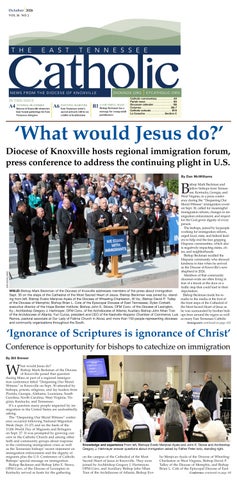
ishop Mark Beckman and fellow bishops from Tennessee, Kentucky, Georgia, and West Virginia, in a press conference during the “Deepening Our Moral Witness” immigration event on Sept. 30, called for meaningful immigration reform, changes in immigration enforcement, and respect for the God-given dignity of every person. The bishops, joined by laypeople working for immigration reform, urged local, state, and federal leaders to help end the fear gripping Hispanic communities, which also is negatively impacting states, cities, and neighborhoods. Bishop Beckman recalled the Hispanic community who showed kindness to him when he arrived as the Diocese of Knoxville’s new shepherd in 2024. Members of that community diocesan-wide are often living in fear of a knock at the door or a traffic stop that could lead to their deportation. WWJD Bishop Mark Beckman of the Diocese of Knoxville addresses members of the press about immigration Sept. 30 on the steps of the Cathedral of the Most Sacred Heart of Jesus. Bishop Beckman was joined by, standBishop Beckman made his reing from left, Bishop Evelio Menjivar-Ayala of the Diocese of Wheeling-Charleston, W.Va.; Bishop David P. Talley marks to the media at the foot of of the Diocese of Memphis; Bishop Brian L. Cole of the Episcopal Diocese of East Tennessee; Dylan Corbett, the front steps of the Cathedral of executive director of the Hope Border Institute; Bishop John E. Stowe, OFM Conv, of the Diocese of Lexington, the Most Sacred Heart of Jesus as Ky.; Archbishop Gregory J. Hartmayer, OFM Conv, of the Archdiocese of Atlanta; Auxiliary Bishop John Nhan Tran he was surrounded by brother bishof the Archdiocese of Atlanta; Yuri Cunza, president and CEO of the Nashville Hispanic Chamber of Commerce; Luis ops from around the region as well Ramos, pastoral associate at Our Lady of Fatima Church in Alcoa; and more than 150 people representing dioceses as many East Tennessee Catholic and community organizations throughout the South. Immigrants continued on page A11
‘Ignorance of Scriptures is ignorance of Christ’ Conference is opportunity for bishops to catechize on immigration By Bill Brewer
BILL BREWER
W
hat would Jesus do? Bishop Mark Beckman of the Diocese of Knoxville posed that question during Mass as part of a regional immigration conference titled “Deepening Our Moral Witness” in Knoxville on Sept. 30 attended by bishops, priests, religious, and lay leaders from Florida, Georgia, Alabama, Louisiana, South Carolina, North Carolina, West Virginia, Virginia, Kentucky, and Tennessee. It’s a question many people impacted by immigration in the United States are undoubtedly asking. The “Deepening Our Moral Witness” conference occurred following National Migration Week (Sept. 21-27) and on the heels of the 112th World Day of Migrants and Refugees on Sept. 27. It was prompted by growing concern in the Catholic Church and among other faith and community groups about response to the continuing immigration crisis as well as the Tennessee bishops’ recent statement on immigration enforcement and the dignity of migrants plus the U.S. Conference of Catholic Bishops’ special message on immigration. Bishop Beckman and Bishop John E. Stowe, OFM Conv, of the Diocese of Lexington in Kentucky served as hosts for the gathering
Knowledge and experience From left, Bishops Evelio Menjivar-Ayala and John E. Stowe and Archbishop Gregory J. Hartmayer answer questions about immigration asked by Father Peter Iorio, standing right. on the campus of the Cathedral of the Most Sacred Heart of Jesus in Knoxville. They were joined by Archbishop Gregory J. Hartmayer, OFM Conv, and Auxiliary Bishop John Nhan Tran of the Archdiocese of Atlanta, Bishop Eve-
lio Menjivar-Ayala of the Diocese of WheelingCharleston in West Virginia, Bishop David P. Talley of the Diocese of Memphis, and Bishop Brian L. Cole of the Episcopal Diocese of East Conference continued on page A8
Papal-French cuisine Pope Leo XIV gets to taste ‘St. Thérèse cake’ made by students in France
T
he students at Sainte Thérèse de La Guerche, a high school in the northeastern French region of Brittany, are still overjoyed to know that Pope Leo XIV tasted their “St. Thérèse cake” on Sept. 26 in Paris, before going on to celebrate Mass at the Place de la Concorde. Founded in 1990 and named in honor of St. Thérèse of Lisieux, the high school specializes in training students for careers in the hospitality and restaurant industries. It is located in La-Guerche-de-Bretagne, a small rural town of 4,500 residents that is a two-and-a-half-hour drive from the Normandy town of Lisieux. For Vanessa Piquet, the school's assistant principal, the event is a major one. “This cake has been around for 20 years,” she told OSV News. “We had the idea of organizing a trip to Rome
Sr. Regina
OSV NEWS PHOTO/SAINTE THÉRÉSE DE LA GUERCHE
By Caroline de Sury OSV News
Sacred sweets Students from Sainte Thérèse de La Guerche high school in the French region of Brittany pose with Archbishop Celestino Migliore, apostolic nuncio to France, at the Vatican nunciature in Paris on Sept. 24, after delivering their "St. Thérèse cake" for Pope Leo XIV. to mark the anniversary of its creation. But in the end, it was the pope who came to meet us!” “Today, the students are all very proud that this cake has reached the pope,” Ms. Piquet emphasized. “It © 2026 Handmaids of the Precious Blood
is a cake rich in symbolism. Its heart shape evokes the love that is at the center of St. Thérèse's message, and is both love for God and love for others.” Ms. Piquet also mentioned the rose
petals that are part of its decoration, which evoke the “shower of roses” St. Thérèse spoke of as the graces her prayers would obtain after her death. Like many Catholic high schools in France, Sainte Thérèse welcomes many students who are not baptized or are not practicing Catholics. “The six students who prepared the cake on the afternoon of Wednesday, Sept. 23, however, are committed Catholics,” she said. “They participate in pastoral activities at the high school, and they were happy to take on this mission, which for them was a way to bear witness to their faith before the pope.” To deliver the cake to the nunciature, where the pope was staying and having his meals, the students left for Paris by minibus very early in the morning on Sept. 24. “They were deeply impressed by the warm welcome they received at the nunciature,” Ms. Piquet said. Cake continued on page A21
How to sign up and qualify for Diocese of Knoxville’s safe-environment program
T The Handmaids of the Precious Blood this year celebrate the 79th year since their founding in 1947; more than three-quarters of a century of prayer and sacrifice for priests. To receive weekly cartoons and short reflections and news from the Handmaids of the Precious Blood, visit their website, nunsforpriests.org, and sign up for the FIAT newsletter.
An October prayer intention for mental health ministry “Let us pray that the mental health ministry be established throughout the Church, helping to overcome the stigma and discrimination of persons with mental illnesses.” –– Pope Leo XIV
DIOCESE OF KNOXVILLE PROCEDURE FOR REPORTING SEXUAL ABUSE
Anyone who has actual knowledge of or who has reasonable cause to suspect an incident of sexual abuse should report such information to the appropriate civil authorities first, then to the McNabb Center victim's assistance coordinator, 865.321.9080.
he Diocese of Knoxville has implemented the CMG Connect platform to administer the Safe Environment Program, which replaces the former Safe Environment Program (VIRTUS “Protecting God’s Children”). CMG Connect is a web-based platform that will assist in ensuring that all employees and volunteers who are in a position of trust with children and vulnerable adults within Diocese of Knoxville schools and parishes are trained to recognize behavior patterns of potential abusers and provide pro-active measures for preventing abuse in any context. “Safe Haven-It’s Up to You” is a three-part video that provides vignettes of real-life situations to educate the viewer about methods of grooming, desensitization, bullying, and neglect, all of which can lead to abuse. Each part of the video is immediately followed by a brief questionnaire to further develop understanding. Education is a key
element of the Safe Environment Program. All clergy, employees, contracted school personnel, volunteers, members of groups and organizations over the age of 18 who work, volunteer, or participate in any capacity are required to complete the diocesan Safe Environment training and a criminal-background check before they can begin employment, volunteer, or participate with ministries, groups, and organizations affiliated with the Diocese of Knoxville. In addition, the mandatory renewal training must be completed every five years and a new background check submitted before the five-year expiration of prior training. The Diocese of Knoxville Safe Environment compliance training and renewal training is a condition of employment and for volunteer ministry in the Diocese of Knoxville.
The CMG Connect platform contains all three elements of the Diocese of Knoxville’s Safe Environment Program: n Annual review of the Diocese of Knoxville’s Policy and Procedures Relating to Sexual Misconduct; n CMG Connect Safe Haven training program to be completed every five years; n Criminal background check to be completed every five years. In compliance with the Diocese of Knoxville’s Safe Environment Program, all affiliates require that volunteers and employees complete the requirements prior to working and/or volunteering in a parish, school, or through Catholic Charities of East Tennessee and/ or St. Mary’s Legacy Clinic. Go to https:// dioknox.org/safeenvironment on the Diocese of Knoxville website for more information. ■
STAY CONNECTED WATCH UPDATES CHECK US OUT FOLLOW US knoxdiocese dioknox KnoxDiocese DioKnoxTV
ADVERTISE IN THE EAST TENNESSEE CATHOLIC
> CONTACT US AT 865.584.3307 OR bbrewer @ dioknox.org.
> FIND US AT dioknox.org.
NEWS FROM THE DIOCESE OF KNOXVILLE PUBLISHER EDITOR
Bishop Mark Beckman Bill Brewer bbrewer@dioknox.org COMMUNICATIONS DIRECTOR ASSISTANT EDITOR
John Mecklenborg Dan McWilliams
THE EAST TENNESSEE CATHOLIC (USPS 007211) is published monthly by The Diocese of Knoxville, 805 S. Northshore Drive, Knoxville, TN 37919-7551. Periodicals-class postage paid at Knoxville, TN. Printed by the Knoxville News Sentinel. THE EAST TENNESSEE CATHOLIC is mailed to all registered Catholic families in East Tennessee. Subscription rate for others is $15 per year in the United States. Make checks payable to The Diocese of Knoxville. POSTMASTER: Send address changes to THE EAST TENNESSEE CATHOLIC, 805 S. Northshore Drive, Knoxville, TN 37919-7551.
A2 n OCTOBER 2026
www.di o k no x .o rg
jmecklenborg@dioknox. dan@dioknox.org org MULTIMEDIA DIGITAL MEDIA REPORTER PRODUCER Bee Goodman Emily Booker bgoodman @dioknox. ebooker@dioknox.org org CONTACT US 865.584.3307 VISIT US ONLINE dioknox.org | etcatholic.org
TH E EA S T TEN N ES S EE C ATH OLI C
A Word from the Bishop
by Bishop Mark Beckman
St. Michael the Archangel, pray for us Prayers (but not all of them) are vital elements in the Mass liturgy
H
aving recently celebrated the feast of the Archangels (Sts. Michael, Raphael, and Gabriel) and the feast of the Guardian Angels, I am reminded once again of the great care God has for us in sending his messengers among us. Since the second grade, when a wonderful Sister of Mercy taught us the Prayer to Your Guardian Angel (she had a statue of an angel on her desk that she said represented her guardian angel!), I have been grateful for the care of God in giving us an angel to accompany us on the path of life “to light, to guard, to rule, and guide.” As St. Gregory the Great reminds us in the Office of Readings, archangels have a key role of prominence in God’s providential care for they are entrusted with the greatest of missions. Pope Leo XIII composed the original Prayer to St. Michael in 1886 and had a shorter form officially recited after every “low Mass” at that time, along with other prayers that included three Hail Marys, the Hail Holy Queen, and a prayer for the Church. During the reform of the liturgy called for by the council fathers during the Second Vatican Council, one of the underlying principles of the reform was to restore “a noble simplicity” to the Roman Rite. Under the authority of St. Paul VI, the revised liturgy promulgated in 1964 removed the so called “Leonine” prayers including the Prayer to St. Michael as part of the liturgy. The current Roman Missal is indeed marked by a return to the noble simplicity of the Roman Rite that showed more clearly the character and connection of the different parts and facilitated the “devout and active participation of the faithful.” As I have traveled throughout the Diocese of Knoxville, I have noticed that in some of our parishes additional prayers, including the Prayer to St. Michael, the “Prayer of St. Francis,” a Prayer
Hearing God's messengers All faithful are encouraged to incorporate additional prayers in their devotional lives. to the Holy Spirit, and others have been added regularly to the liturgy—recited together, sometimes before the entrance hymn, or immediately after the dismissal. Recently at a gathering of our priests I spoke to these customs that have become part of some of our parishes, many of which are indeed beloved by our people. Having reflected on the importance of celebrating the liturgy in accordance with the mind of the Church, I do not think it
appropriate to add additional prayers associated with the celebration of the Mass itself. Therefore, I have asked our priests to catechize the people of God as we move away from additional prayers recited together immediately before, during, and immediately after Mass. I know that change is often difficult, especially when particular prayers are loved and have become customary. The regular addition of prayers to the liturgy, to my mind, is ultimately the decision of the Holy Father and something that pastors should not permit on their own. Many of these prayers, including the Prayer to St. Michael, are a very important part of the treasury of prayer that has come down to us in the Church. St. John Paul II encouraged the faithful to pray the St. Michael Prayer as part of the life of devotion, and Pope Francis specifically encouraged its use at the end of the rosary. I encourage our pastors and indeed all the faithful to find ways to incorporate these beautiful prayers into the devotional lives of our families and communities beyond the celebration of the liturgy. Reflecting on the great wisdom of the Church in celebrating together the archangels, in our world today we do indeed need the ongoing protection of St. Michael, we need the healing remedy of St. Raphael, and we need especially the Good News announced by St. Gabriel of the coming of the Messiah who has conquered sin and death by the power of His cross and resurrection and opened for us the way to eternal life. We thank God for this infinite gift and are especially mindful of the care of His angels sent to guard us on the way. It is chiefly at life’s end when we trust most importantly in the care of our guardian angels to guide us safely to the kingdom of heaven. ■
Remembering St. Francis of Assisi An homage to Franciscan legacy on 800th anniversary of saint’s death By Teresa Tomeo National Catholic Register
St. Francis of Assisi (1181-1226)
Francesco di Pietro di Bernardone accepted the call from God and with single-minded devotion. Regardless of the obstacles, he gave away everything, even his clothes, to set forth to spread the Gospel in strict poverty, serving the poor and even lepers. Suffering with chronic ailments most of his life, he had a deep mystical relationship with Christ that carried him through Italy and even to the Holy Land to serve the Savior and those in dire need. Toward the end of his life, partially blind, crippled with pain from sicknesses and the stigmata (the wounds of Christ), he wrote the beautiful poem Canticle of the Sun, honoring God through His creation. Those men who were his followers, drawn to live like Francis, who begged for food while preaching, were brought together in 1209 into the “Friars Minor,” the first Franciscans. St. Clare, a devotee of Francis, overcoming her wealthy family’s great objections, started the “Poor Clares,” a cloistered religious order of women following a rule of strict poverty, manual labor, silence, and prayer. Francis also founded the “Brothers and Sisters of Penance,” eventually called the “Third Order” for those already in consecrated life (hermits) and secular members, who wanted to live their lives like Francis, for the Gospel. From these orders branched out other orders, TH E EAST T E N N E S S E E C AT HO L I C
OSV NEWS PHOTO/MIHOKO OWADA
H
ere we find ourselves in 2026, in the midst of the special Jubilee Year of St. Francis of Assisi proclaimed by Pope Leo XIV. This month, Assisi and the world are marking the 800th anniversary of the saint’s passing from this life into the next. On this auspicious anniversary, a look at his ties to the United States and the rich Franciscan history of America is called for. How ironic that this saint’s nickname was “Il Poverello,” which means “little poor one.” He may have been poor in the eyes of the world when it comes to material wealth. But Francis was a spiritual billionaire. His contributions not only to the Church but the rest of the world, including the United States of America, were so great that we see his zeal for God, the Catholic faith, and nature reaching across the centuries and the miles. As we continue to mark the 250th anniversary of the United States, we should recognize that this country would not be what it is today without the many Franciscan connections that can be found in those who helped build our great nation. St. Francis of Assisi, pray for us.
In St. Francis' footsteps Franciscan friars process through the Brookland neighborhood of Washington, D.C., near the Franciscan Monastery of the Holy Land on Oct. 3, marking the 800th anniversary of St. Francis of Assisi’s death. and together they work, even today, to aid the poor and spread the Gospel of Jesus Christ. In the “New World,” as the Americas in the Western Hemisphere would come to be known, Franciscans were instrumental in serving the poor and ignorant in the peoples they found there. Their journeys to spread the faith also Ms. Tomeo resulted in the discovery of unknown routes and lands that opened the way to expansion of what would be the United States of America. Later Franciscans served the people of the country who needed their physical and spiritual assistance.
Christopher Columbus (1451-1506)
Throughout the country’s history there were many noted Franciscans who shaped the country for the better, even though they may spark controversy now. The best known of these Franciscans was Christopher Columbus, the man who discovered the Americas in 1492. A Third-Order Franciscan who often wore the Franciscan habit, he took his faith very seriously and lived a life of deep devotion, frequently requesting missionaries from the Church to travel across the ocean to spread the Gospel. His flagship on his first voyage was named Santa Maria de la Inmacuwww.di o k no x .o rg
Commentary lada Concepción (Holy Mary of the Immaculate Conception). American Jesuit Father John Hardon said, “It is one thing to say that Columbus discovered America. It is something else to realize that he opened the door to the most phenomenal spread of Christianity since the time of St. Paul.”
Venerable Antonio Margil of Jesus (1657-1726)
Born in Valencia, Spain, Antonio Margil joined the Franciscan Order in 1673 and volunteered to go to the missions in Veracruz. He traveled rough terrain to minister in the Yucatán, Guatemala and Costa Rica, and back through Mexico to direct colleges, and then north into East Texas, founding missions along the way. He always walked barefoot, fasted daily, and ate no meat or fish, and spent much of every night in prayer. Called the “Flying Father,” he was a fierce preacher, a miracle worker who multiplied food for entire villages to eat for months, struck a rock in a dry stream to release fresh, gushing water for his traveling companions, and had the ability to read souls. The Talamanca Indians tried to burn him on a pyre but he walked out unharmed. He was St. Francis continued on page A21 OCTOBER 2026 n A3
A synodal Church takes shape Delegates from across the Diocese of Knoxville call on the Holy Spirit for guidance By Jim Wogan
A4 n OCTOBER 2026
JIM WOGAN
F
Synodality across the diocese Above: Chattanooga Deanery parishioners gather at St. Jude Church on Sept. 19 to discuss the topics of the Synod as they relate to the Diocese of Knoxville. Left: Synod delegates in the Cumberland Mountain Deanery meet at St. Alphonsus Church on Sept. 19.
COURTESY OF TERRY PARADIS
or a few years now, Church leaders in Rome—including, not unimportantly, two popes—have been asking dioceses around the world to embrace the concept of synodality and to seek guidance from the Holy Spirit as they discern how to live it out. “The Spirit, whom the Father sends in Jesus’ name and who teaches everything, guides believers in every age into all the truth.” That line, based on holy Scripture, comes directly from the Final Document of the XVI General Assembly of the Synod of Bishops, held at the Mr. Wogan Vatican in 2024. It appears in a section titled “Ecclesial Discernment for Mission,” where the document explains why the Church believes we, the people of God, can discern together: because the Holy Spirit speaks to all of us. Understanding the Holy Spirit’s role in guiding synodality is not simply a theological idea being discussed in Rome. It is finding its way into the life of our own diocese. On Saturday, Sept. 19, delegates from the Diocese of Knoxville came together at four deanery gatherings to learn about and experience what synodality can be. The gatherings, hosted by St. Alphonsus Parish, Crossville; St. Jude Parish, Chattanooga; St. Mary Parish, Johnson City; and the Cathedral of the Most Sacred Heart of Jesus Parish, Knoxville, brought together pastors, deacons, members of religious orders, and laypeople appointed by their pastors. The daylong journey was divided into two parts. The morning session asked delegates to “enter the synodal journey” by considering it as a way to “dialogue, discern, and decide.” The afternoon session put the synodal concept into practice by returning to three “guiding questions” previously offered by Bishop Mark Beckman: How can we build stronger communities? How can we foster a more collaborative relationship between laity and clergy? And how can we recognize our shared responsibility for all of God’s creation? Delegates navigated their small-group conver-
Analysis sations using the “Conversation in the Spirit” method, a practice that encourages participants to listen, pray, and engage in silent discernment before sharing their thoughts on a particular topic.
www.di o k no x .o rg
Near the end of the day, the groups shared those thoughts with the entire room, speaking about what moved them, what challenged them, what inspired them, and what concerned them. The work of the delegates was not just a matter of discussion for discussion’s sake. They were pracSynod continued on page A20
TH E EA S T TEN N ES S EE C ATH OLI C
Blessed Franciscan friars
Oct. 31 beatification for five Georgia Martyrs is 429 years in the making By Bee Goodman
Life on the mission
Long before Jamestown or Plymouth, Spanish Franciscans were serving along the Southeastern coast, working out of St. Augustine, Fla. The five friars were sent north to minister to the Guale, Native Americans whose towns lined what is now the Georgia shoreline. Life there was hard. The friars lived as the Guale did, in huts of tree trunks, branches, and mud, thatched with palmetto fronds. They ate what they could gather or grow: acorns, shellfish, a little game. Even vestments for Mass were sometimes hard to come by. Mosquitoes, ticks, and sand gnats tormented them through the heat of the year, and the nearest Spanish soldiers were far away in St. Augustine. Father Corpa, a skilled preacher and confessor, arrived in Florida in 1587 and was sent to the village of Tolomato, near present-day Darien, Ga. Father Blas arrived in 1590 and served at Tupiquí, near Eulonia, Ga. Father Miguel, who had been in Florida only two years, led the mission on St. Catherines Island, where Brother Antonio, who spoke the Guale language well, served as his interpreter. Father Francisco, born into a Basque family in 1564, arrived in 1595. He was nicknamed
TH E EAST T E N N E S S E E C AT HO L I C
OSV NEWS PHOTO/COURTESY OF CLORINDA GALDÓS BELL
O
n a Sunday morning in September 1597, a Franciscan priest on the Georgia coast was preparing to celebrate Mass. He never reached the altar. Father Pedro de Corpa and four fellow Franciscans, Father Blas Rodríguez, Father Miguel de Añón, and Father Francisco de Veráscola Sáez de Castañiza, and Brother Antonio de Badajóz, will be declared Blessed 429 years later. The Diocese of Savannah on the coast of Georgia will celebrate the beatification Mass on Saturday, Oct. 31, at 11 a.m. at the Savannah Convention Center. Cardinal Frank Leo of Toronto will preside as papal legate, representing Pope Leo XIV. It will be the first beatification in Georgia and the first in the American South. According to the diocese, it will also be only the sixth on American soil. The Franciscans are known as the Georgia Martyrs. They were five ordinary missionaries who stayed when staying was dangerous.
Marriage defenders This oil on canvas of the five Georgia Martyrs titled "Faith breaks language barriers of the five martyrs" was created in 2021 by artist Clorinda Galdós Bell.
Saints & Souls the “Cantabrian Giant” for his size and strength, and his athleticism made him popular with Guale youth, who invited him to join their wrestling and spear-throwing, and a game that resembled soccer. These were not distant figures. They were neighbors.
A promise broken
Ms. Goodman
Among the hardest things the friars had to teach was the Church’s understanding of marriage: a lifelong union of one man and one
www.di o k no x .o rg
woman. The Guale culture allowed polygamy. The friars’ practice was not to baptize an adult man unless he vowed to live in a permanent marriage with one wife. Trouble came when a baptized Guale chief named Juanillo broke that promise and took a second wife. Father Corpa admonished him, and Father Blas, from the neighboring mission, supported the correction. Juanillo left in anger and gathered warriors to drive out the friars he saw as meddlesome. Before dawn on Sunday, Sept. 14, the feast of the Exaltation of the Holy Cross, the war party crept into the mission compound at Tolomato. As Father Corpa was about to leave his cabin to celebrate morning Mass, they killed him.
A final homily
The war party then went to Tupiquí and seized Father Blas. During the two days he Martyrs continued on page A6
OCTOBER 2026 n A5
Attracting a following East Tennessee artist’s paintings of Georgia Martyrs to be displayed at beatification By Bill Brewer
BILL BREWER
A
s a gifted artist who resides in the Diocese of Knoxville, Clorinda Galdós Bell finds herself with an abiding connection to Catholic parishes in Georgia. Her works of sacred art are increasingly being hung throughout the Archdiocese of Atlanta, and there is an emerging trend feeding that connection: the five Georgia Martyrs who have been named Blessed and will be beatified on Oct. 31 in Savannah. Mrs. Bell’s paintings of the martyrs will be exhibited in the Savannah Convention Center, where the beatification will take place. And she has learned that she and her paintings of the martyrs will be featured on EWTN, which plans to cover the beatification. Since the Vatican declared the martyrs venerable in January 2025, leading to their beatification, Mrs. Bell has seen an uptick in commissions specifically for Georgia Martyrs artwork. She also is a finalist in an art exhibition and competition commemorating the beatification of the martyrs. Mrs. Bell recalled that in 2019 a priest commissioned her for a painting of St. Rose of Lima that would be hung in Our Lady of the Mountains Church in Jasper, Ga. The commission was accepted shortly after she appeared in 2018 on an EWTN program with popular Catholic media
Blessed artwork Artist Clorinda Galdós Bell holds one of her paintings of the five Georgia Martyrs that will be on exhibit at the Savannah Convention Center when the martyrs are beatified Oct. 31. host and evangelist Pepe Alonso. The Jasper priest in 2021 then commissioned a painting from her of the five Georgia Martyrs. “We presented the painting at Our Lady of the
Mountains. Everything was so beautiful. After that, probably in 2021, he contacted me again for commissioned artwork for the five Martyrs
Martyrs continued from page A5 was held, he was allowed to celebrate Mass and preach one last time. Father Blas told his captors, “My sons, for me it is not difficult to die.” He reminded them that every person must die someday and that all of us must be ready at all times. What truly grieved him, he said, was that they had been led to commit an offense against their Creator and had forgotten what the missionaries had done to teach them the way to eternal life. He gave away his few possessions to the people of his flock. On Sept. 16, he was killed. The next day, the war party reached St. Catherines Island, where the local chief refused to harm Father Miguel and Brother Antonio. He warned them and offered a canoe and rowers to take them to safety. Brother Antonio did not believe the warning, or perhaps he would not flee. When the war party arrived, the chief offered everything he owned to spare the friars. The offer was refused. It was the feast of the Stigmata of St. Francis. Father Miguel celebrated Mass, and the Gospel of the day included Jesus’ words that whoever loses his life for His sake will find it. The friars spent hours in prayer. Then they were killed. Father Francisco was the last. He was returning by canoe from St. Augustine with supplies for Mass, materials for his unfinished mission, and gifts for his Guale flock. He was killed on arrival, sometime before the end of the month. A sixth Franciscan, Francisco de Ávila, survived, and his account is among the sources historians rely on.
the way for beatification. Martyrdom cases differ in one important way. The Church requires a miracle before beatification and two before full canonization, but miracles must be investigated through the Vatican. For recognized martyrs, that requirement is waived. A miracle will be needed, however, before any of the five can be canonized.
Nativity of Our Lady Church in Darien, a designated pilgrimage site for the martyrs, sits near the coast where Father Corpa once served. Parishioners there have spent years telling visitors about a chapter of Georgia history that many residents never learned in school. One of those volunteers, Laura Daniel, plans to attend the Mass with her husband. Bishop Parkes has called the beatification a new beginning, a chance for Georgia Catholics to learn more about the deep roots of their faith in the state and to ask for the martyrs’ prayers.
Why martyrs?
Away from the convention center, the preparation has been quieter and more personal.
Soon after the fatal events, the friars of Florida saw it as martyrdom. A Franciscan report to King Philip III in 1612 said the friars were killed because of the law of God they taught and the moral precepts that clashed with Guale customs, especially their refusal to permit a married Christian more than one wife. According to that report, the Guale themselves gave this as the reason. In January 2025, Pope Francis approved the decree declaring that the five were true martyrs, killed in odium fidei, a Latin phrase meaning “in hatred of the faith.” Bishop Stephen D. Parkes of the Diocese of Savannah has emphasized the friars’ witness to the sanctity of marriage and has asked the faithful to seek their intercession for marriage and family life. The Franciscan friars of the Province of Our Lady of Guadalupe, who have worked with the diocese on the cause for decades, see a broader message for America: that the love of Christ is stronger than hatred, and that we are called to set aside violence and division.
A Mass that outgrew its room
Organizers first planned for about 2,000 people to attend the beatification. Then registrations began arriving from across the country. The diocese has since reconfigured the space inside the convention center to hold roughly 12,000. Attendance is free, though the diocese asks everyone planning to attend to register. Registration does not guarantee a particular seat. It helps organizers manage traffic and the distribution of Holy Communion, and gives them a way to send updates. Some parishes that hoped to charter buses have told parishioners to make their own travel arrangements, and Savannah hotel rooms are expected to fill quickly. The Oct. 31 date carries a double significance. Bishop Parkes has said it matters to Catholics in both the Diocese of Savannah and the Archdiocese of Atlanta. And the friars will be named Blessed in the same year the Church marks the 800th anniversary of the death of St. Francis of Assisi, who died in 1226.
Back to the coast
Sacred art continued on page A20
Five ordinary men
The Church has not yet declared them saints. But on the last day of October, after more than four centuries, they will be called Blessed, and thousands of people will gather in Savannah to say thank you. Father Corpa never reached the altar that Sunday morning in 1597. On Oct. 31, thousands of Catholics will gather around one in his honor. And for readers of this column, the friars’ story offers a simple but profound invitation: holiness is not reserved for the remarkable. It is available to anyone willing to stay, again and again, for the people they have been sent to serve, and to be ready, as Father Blas told his captors, at all times. They came from Spain as friars, teachers, and neighbors. They will be remembered in Georgia as Blessed. ■ Bee Goodman is a multimedia journalist for the Diocese of Knoxville who writes for The East Tennessee Catholic. She is a member of the Cathedral of the Most Sacred Heart of Jesus.
The path to sainthood
The Church moves slowly in these matters, and the cause of the Georgia Martyrs has taken the better part of a century. The Franciscans began promoting the cause for canonization in 1950. Changes to the Church’s process meant the formal investigation did not open until February 1984, when Bishop Raymond W. Lessard of Savannah launched the diocesan cause. After 23 years of work, the diocesan inquiry closed in 2007. Its official records, nearly 500 notarized pages, were carried by hand to Rome. Then, on Jan. 27, 2025, came the decree that gave the five men the title venerable and cleared A6 n OCTOBER 2026
www.di o k no x .o rg
TH E EA S T TEN N ES S EE C ATH OLI C
Archbishop Sheen declared ‘Blessed’ Beatification Mass in St. Louis draws an estimated 50,000 attendees By Gina Christian OSV News
OSV NEWS PHOTO/BOB ROLLER
A
A Blessed event Above: Cardinal Luis Tagle, pro-prefect of the Dicastery for Evangelization, concelebrates the beatification Mass for Archbishop Fulton J. Sheen on Sept. 24 at The Dome at America's Center in St. Louis. Left: Blessed Fulton J. Sheen, pictured in an undated photo, is remembered as one of the most influential and innovative evangelists in American history.
OSV NEWS FILE PHOTO
rchbishop Fulton J. Sheen—the 20thcentury theologian, evangelizer, Catholic communications pioneer, teacher, and preacher—is now Blessed Fulton J. Sheen. Cardinal Luis Antonio Tagle, a pro-prefect for the Holy See’s Dicastery for Evangelization and papal delegate, pronounced the Church’s declaration on Archbishop Sheen’s holiness of life and witness to Jesus Christ at a Sept. 24 Mass celebrated in The Dome at America’s Center in St. Louis. To the applause of pilgrims, Cardinal Tagle described Archbishop Sheen as a “son of Illinois, son of the United States of America” and “indeed, son of the world.” Hundreds of clergy, including dozens of bishops and cardinals (among them Cardinal Justin Rigali and Cardinal Timothy Dolan), had processed into the arena for the Mass as choirs, accompanied by an orchestra, performed a succession of hymns. The priests’ vestments were embroidered with “JMJ,” Archbishop Sheen’s signature dedication to Jesus, Mary, and Joseph. The location had been selected by Archbishop Sheen’s home Diocese of Peoria, Ill., to accommodate the number of pilgrims who arrived for the beatification and its surrounding events. Around 50,000 people were in attendance, according to organizers. During a press conference a few hours prior to the Mass, Bishop Louis Tylka of Peoria said that almost every U.S. state and several additional nations were represented by pilgrims. A number of the faithful hailed from Italy, Poland, and Brazil, he said. Close to 90 bishops, some 1,000 priests, an estimated 1,600 men and women religious, and almost 250 deacons were present, added Bishop Tylka, who wore Archbishop Sheen’s pectoral cross. Among the concelebrating prelates was Archbishop Gabriele G. Caccia, apostolic nuncio to the United States. The beatification—a papal act affirming an individual’s presence in heaven is worthy of belief—officially occurred between the liturgy’s Penitential Rite and the Gloria. Bishop Tylka made a formal request for Archbishop Sheen’s beatification to Cardinal Tagle. A short biography of Archbishop Sheen, who was born in El Paso, Ill., in 1895 and died in New York in 1979, was read by Archbishop Sheen’s great-nephew, Paul Cunningham, after which Cardinal Tagle proclaimed the apostolic letter from Pope Leo XIV declaring the beatification in Latin. Bishop Tylka then read the letter in English, as applause followed both. With the papal decree’s public proclamation, Archbishop Sheen became formally counted among the Church’s beati, from the Latin word for “blessed.” James Fulton Engstrom—whose revival from stillbirth in 2010 is attributed to Archbishop Sheen’s intercession, was formally declared the miracle that moved Archbishop Sheen to beatification—processed with his parents and siblings to present a major relic of Archbishop Sheen during the liturgy. Enclosed in a special case called a reliquary, the relic is Archbishop Sheen’s mandible, or jawbone, chosen because it represents the archbishop’s tremendous gifts as an orator, teacher, and evangelist. As part of the beatification, a portrait of a haloed Blessed Fulton Sheen was also unveiled. In the image, he is notably holding a piece of chalk, which he famously used—along with a blackboard—during his Emmy-winning television show, “Life Is Worth Living.” The image was also simultaneously unveiled in the Diocese of Peoria at the Cathedral of St. Mary of the Immaculate Conception. The first reading from the beatification Mass, Isaiah 52:7-10, was delivered in Spanish, with the second reading, 2 Corinthians 4:1-2, 5-7, proclaimed in Portuguese, while the Gospel taken from Mark 16:15-20 was proclaimed in English. The prayers of the faithful were offered in a variety of other languages, illustrating both the universal character of the Church and also the missionary mindset of Blessed Fulton J. Sheen, who served as the U.S. director for the Society for the Propagation of the Faith. In his homily, Cardinal Tagle praised Archbishop Sheen as a “storyteller of Jesus” and “a “missionary who digs deep into the heart of the poor to meet Jesus there.” The cardinal noted then-Bishop Sheen’s passionate advocacy for the poor during the Second Vatican Council. During the 1964 discussions on the document Ad Gentes, on the missionary activity of the Church, then-Bishop Sheen asked his brother bishops to “affirm” the notion of poverty and the bishops who came from poor and suffering parts of the Church.
Building Faith. Inspiring Futures. A Sacred Space for Our Parish Community Your Pledge. Our Legacy. His Kingdom.
HELP US BUILD THE FUTURE OF HOLY GHOST
118 YEARS
For 118 years, Holy Ghost Catholic Church has been a place of worship, friendship, formation, and community. Today, our parish has grown from 500 families to more than 1,100 families—and we need space to continue serving our parishioners and future generations.
1,100+
Our Parish Life Center project will restore the historic church originally dedicated in 1908 and transform it into a vibrant center for parish life.
FAMILIES AND GROWING
MORE THAN 10,000 SQ. FT. OF NEW MEETING & MINISTRY SPACE
YOUR GIFT HELPS MAKE THIS POSSIBLE.
Every gift matters. We invite you to prayerfully consider making a gift or pledge above and beyond your weekly offering to help build a home for the ministries and families of Holy Ghost for generations to come.
For the glory of God and the good of souls.
PRAY. GIVE. BUILD OUR FUTURE. LEARN MORE & DONATE:
holyghostknoxville.org/new-parish-center
HOLY GHOST CATHOLIC CHURCH KNOXVILLE, TENNESSEE
Sheen continued on page A20 TH E EAST T E N N E S S E E C AT HO L I C
OF FAITH & COMMUNITY
www.di o k no x .o rg
OCTOBER 2026 n A7
Bishops attending the immigration conference were, clockwise from left, Bishop John E. Stowe, OFM Conv, of Lexington, Ky., Bishop David P. Talley of Memphis, Archbishop Gregory J. Hartmayer, OFM Conv, of Atlanta, Bishop Mark Beckman of Knoxville, Bishop Brian L. Cole of the Episcopal Diocese of East Tennessee, Auxiliary Bishop John Nhan Tran of Atlanta, and Bishop Evelio Menjivar-Ayala of Wheeling-Charleston, W.Va.
BILL BREWER
Dylan Corbett, executive director of the Hope Border Institute, gives a talk on "Migration & Catholic Social Teaching" during the Deepening Our Moral Witness conference on Sept. 30 in Cathedral Hall on the campus of the Cathedral of the Most Sacred Heart of Jesus. The conference was a regional gathering on the Catholic Church's solidarity with migrants.
BILL BREWER
BILL BREWER
Deepening Our Moral Witness
DAN MCWILLIAMS
Mely Felipe, a Knoxville leader of Tennessee Immigrant & Refugee Rights Coalition (TIRRC) and a member of Holy Ghost Parish in Knoxville, offers insight into the plight of immigrants in East Tennessee.
DAN MCWILLIAMS
BILL BREWER
Blanca Primm, director of Hispanic Ministry for the Diocese of Knoxville, speaks to conference attendees on Hispanic ministry and defending immigrant communities.
Luis Ramos, pastoral associate and coordinator of high-school and young-adult ministry at Our Lady of Fatima Parish in Alcoa, serves as master of ceremonies for the Deepening Our Moral Witness immigration conference.
EMILY BOOKER
Deacon Chris Gutiérrez, director of Hispanic/Latino Ministry in the Diocese of Owensboro, Ky., gives insight into Hispanic ministry and defending immigrant communities.
Religious Sisters attend Mass in the Cathedral during the immigration conference.
Conference continued from page A1 Tennessee. The conference was held in collaboration with the Hope Border Institute based in El Paso, Texas, and the Center for Migration Studies of New York. A key moment of the event was a press conference on the steps of Sacred Heart Cathedral, where the bishops and more than 150 conference attendees joined in standing with all immigrant families and calling for meaningful immigration reform and changes in immigration enforcement. A8 n OCTOBER 2026
BILL BREWER
DAN MCWILLIAMS
Bishop Mark Beckman, joined at the podium by Bishop John E. Stowe, leads conference attendees in prayer.
Bishop Brian L. Cole of the Episcopal Diocese of East Tennessee gives remarks during a press conference on the steps of the Cathedral of the Most Sacred Heart of Jesus as part of the Deepening Our Moral Witness immigration conference on Sept. 30.
The daylong conference featured speakers who addressed Catholic social teaching on immigration, the impact of increased deportations on families, and communication strategies, and called for orderly immigration reform rooted in compassion and due process. The regional gathering also highlighted how the Catholic Church is responding to the plight of immigrants. In his Mass homily, Bishop Beckman thanked his brother bishops and priests for concelebrating the Mass, which was held on the feast of St. Jerome, who is renowned as a theologian and a www.di o k no x .o rg
doctor of the Church. St. Jerome is recognized for his comment, “Ignorance of Scripture is ignorance of Christ.” When it comes to immigration in the United States, just what would Jesus do? “Most of you have heard the four initials, WWJD, right? What would Jesus do? That question is often asked about many things in life. As a lot of folks today gathering to reflect on the reality of immigrants in our own country have been listening to the stories of what is going on, we could ask that same question,” Conference continued on page A9 TH E EA S T TEN N ES S EE C ATH OLI C
BILL BREWER
DAN MCWILLIAMS
Deepening Our Moral Witness
Bishop Mark Beckman gives the homily at Mass during the Deepening Our Moral Witness immigration conference at Sacred Heart Cathedral on Sept. 30.
Kevin Appleby, senior fellow for policy and communications at the Center for Migration Studies, engages the immigration conference attendees.
DAN MCWILLIAMS
DAN MCWILLIAMS
Astrid Liden, communications officer with the Hope Border Institute, delivers a talk on effective communication strategies on faith and migration during the immigration conference.
DAN MCWILLIAMS
DAN MCWILLIAMS
Bishop Mark Beckman receives the gifts during Mass at Sacred Heart Cathedral. The women presenting them immigrated to the United States and were attending the Deepening Our Moral Witness immigration conference. The bishop is assisted by Deacon Fredy Vargas and altar server Scott Barron.
Yuri Cunza, president and CEO of the Nashville Hispanic Chamber of Commerce, addresses the media during a press conference as part of the regional immigration conference on Sept. 30.
Elizabeth Elfers with the Cabrini Connection at Christ the King Church in the Diocese of Nashville discusses advocating for immigrants in the community.
BILL BREWER
BILL BREWER
John Mecklenborg, Diocese of Knoxville communications director, gives an immigration talk during the Deepening Our Moral Witness conference.
BILL BREWER
DAN MCWILLIAMS
Immigration lawyer Emily Jones, legal director for the New American Initiative, discusses immigration enforcement realities and local preparedness.
Bishop Mark Beckman, Archbishop Gregory J. Hartmayer, and Bishop John Nhan Tran distribute Holy Communion during Mass at Sacred Heart Cathedral as part of the Sept. 30 immigration conference on the cathedral campus.
Conference continued from page A8 Bishop Beckman said. “What would Jesus do? WWJD.” Bishop Beckman assured the noon Mass congregation that there is indeed an answer to the question, thanks to the feast-day saint. “The answer that St. Jerome gave was ‘Ignorance of the Scriptures is ignorance of Christ,’” the bishop said. “If we want to know what Jesus would do, then we have to immerse ourselves in the Word of God. It is listening to that Word, allowing that Word to enter our hearts and change us, that makes us the people that TH E EAST T E N N E S S E E C AT HO L I C
William Canny, executive director of the U.S. Conference of Catholic Bishops' Secretariat of Migration, discusses the USCCB "You Are Not Alone" campaign.
God has called us to be.” He reminded the Massgoers of Scripture, which teaches that the decisive question in determining the eternal destiny of the individual is “what have we done for the least of our brothers and sisters? That is the criterion that the Lord gives us at the end of Matthew’s Gospel.” “He’s very specific, too. ‘When you fed Me, I was hungry.’ When did we feed you when you were hungry, Lord? ‘When you did it for the least.’ When were you a stranger and we welcomed you? ‘When you did it for the least, www.di o k no x .o rg
you welcomed Me.’ When did we see You as a stranger and not welcome You? ‘When you did not welcome the least, you did not welcome Me.’ Powerful reminders from the Word of God on who we are called to be and what we are called to do,” Bishop Beckman continued. In a world that is bombarded by information telling the public what to believe and how to respond in life’s challenging circumstances, Catholics and other Christians can find themselves at the mercy of popular culture. “For those of us who believe in Jesus, our Conference continued on page A10 OCTOBER 2026 n A9
Conference continued from page A9 response must always be formed by the Word of God, by the Gospel of Jesus Himself. What would Jesus do?” the bishop asked. During the conference, attendees heard from William Canny, executive director of the USCCB’s Secretariat of Migration, about the U.S. bishops’ “You Are Not Alone” immigration campaign. Dylan Corbett, executive director of the Hope Border Institute, spoke on migration and Catholic social teaching. And Mely Felipe, a member of Holy Ghost Parish in Knoxville who is a leader of the Tennessee Immigrant and Refugee Rights Coalition, delivered compelling remarks on how immigrant families are being affected by government policies and actions. Luis Ramos, pastoral associate and coordinator of high-school and young-adult ministry at Our Lady of Fatima Parish in Alcoa, was the master of ceremonies for the conference. Blanca Primm, director of Hispanic Ministry for the Diocese of Knoxville; Deacon Chris Gutiérrez, director of Hispanic/Latino Ministry for the Diocese of Owensboro in Kentucky; and Elizabeth Elfers, who has organized the Cabrini Connection at Christ the King Church in the Diocese of Nashville, gave talks on Hispanic ministry and the importance of defending immigrant communities. Emily Jones, an immigration lawyer from Lexington, Ky., who is the legal director for the New Americans Initiative, informed the gathering on immigration-enforcement realities and local preparedness. John Mecklenborg, communications director for the Diocese of Knoxville, and Astrid Liden, communications officer for the Hope Border Institute, discussed effective communications strategies on faith and migration. And Kevin Appleby, senior fellow for policy and communications at the Center for Migration Studies, gave a talk on diocesan and parish planning involving immigration.
BILL BREWER
Important topics of interest
Above: Archbishop Gregory J. Hartmayer of the Archdiocese of Atlanta leads a table discussion on immigration issues during the Deepening Our Moral Witness conference in Cathedral Hall on the campus of the Cathedral of the Most Sacred Heart of Jesus on Sept. 30. Below left: Bishop Evelio Menjivar-Ayala of Wheeling-Charleston, W.Va., and Bishop John Nhan Tran of Atlanta process into Mass during the daylong immigration conference. Below middle: Yuri Cunza, president and CEO of the Nashville Hispanic Chamber of Commerce, is joined by bishops from the Southeast and more than 150 people at a press conference on the steps of Sacred Heart Cathedral on Sept. 30. Below right: Bishop John E. Stowe provides remarks during the immigration conference.
Preaching the Gospel
Father Peter Iorio, Diocese of Knoxville vicar general and moderator of the curia who also serves as pastor of Our Lady of Fatima Parish, was the moderator of a panel of bishops during the “Preaching the Gospel of Jesus Christ Present in Those Who Migrate” segment. Archbishop Hartmayer, Bishop MenjivarAyala, and Bishop Stowe were the panelists. Father Iorio asked each bishop the one thing they most wanted people in the South and across Appalachia to understand about people who migrate that Southerners and Appalachia residents might not already know. Archbishop Hartmayer said the immigration process also affects priests and seminarians from other countries who are serving the Church in the United States. “Those of us with dioceses that have a lot of foreign-born priests, it’s a big concern for us because those priests and seminarians are serving God’s people in our dioceses. Without them, we are without, and that is a big concern,” the archbishop said. Archbishop Hartmayer also noted that there are priests and seminarians who come under the Deferred Action for Childhood Arrivals (DACA) provision, which is another layer of immigration uncertainty. “We need priests from outside the country because they speak languages that we need in our dioceses. It’s a dilemma for us,” he said. Bishop Stowe shared that he is often asked why immigrants don’t enter the United States legally and point out that they have family members such as grandparents who entered this country legally. “It is such a broken system that there is no legitimate way to get in line. There is no program that will get you into this country in less than 25 years in most cases, so that would be the one thing I would want people to know,” the Diocese of Lexington bishop said. Bishop Menjivar-Ayala pointed out that the immigrants who settled in the mountains of West Virginia 100 to 150 years ago arrived in the United States in circumstances very similar to those faced by today’s immigrants. “I would like them to know and understand that they are human beings, and as our brothers and sisters, they have so much to contribute,” he said. “They are the same.” Archbishop Hartmayer said that while many immigrants in the Archdiocese of Atlanta are filling church pews, there are many more who are no longer attending Mass because they are afraid. “Fear is the underlying experience that I think most of our people who are undocumented experience. And that is a terrible way to live your life,” he said, noting that children can sense when their parents feel anxiety about their immigration status. “They come here out of fear. And then they live here in fear of a different kind because they will either be arrested or sent back to where they came from, where life was miserable,” he added. Father Iorio pointed out that Bishop Menjivar-Ayala’s episcopal motto is “He walked with A10 n OCTOBER 2026
DAN MCWILLIAMS
them,” and he asked the bishop to recount his immigration story. The West Virginia bishop was born in El Salvador and migrated to the United States when he was 19 in 1990 as his native country was suffering from a civil war. He said his only options were to be drafted by the Salvadoran Army and be killed, be conscripted into war by guerrillas and be killed, or flee the country. He was imprisoned in Mexico as he tried to emigrate, and that is where he first encountered the Catholic Church. Catholics brought food and rosaries to him in prison. He was returned to El Salvador. He fled El Salvador three times, and on the third time he successfully made it to Los Angeles and then to the Washington, D.C., area. He continued to follow the Catholic faith and entered seminary while living in the Washington, D.C., area. Then 19 years after fleeing his country, he became the first Salvadoran bishop in the United States. Pope Leo XIV earlier this year named him the bishop of WheelingCharleston, whose Hispanic population is less than 3 percent. “When I talk about immigration, it is not an option for me. It is part of who I am. It is part of my identity,” Bishop Menjivar-Ayala said, adding that he believes U.S. families who are descendants of immigrants generations ago “have forgotten who they are.” “When I go to the cemetery in Wheeling where most of the Catholics are buried, you see the last names. The whole world is buried there. That tells me the people who populated these hills of Appalachia in the United States are immigrants from all over … Italians, Polish, Irish, from the whole world,” he added. He believes his call as a priest, as a bishop, is to walk with people, to assist them in encountering Jesus, especially through “the breaking of the bread.” Bishop Stowe has been outspoken on the immigration issue and has called some immigration policies “immoral.” He told the conference that everything he says and all that he believes comes from Scripture. “The theological grounding is the same as with anything else we teach and believe as Catholics: Scripture and tradition, right? There’s no admonition that is more frequently proclaimed in the Old Testament than remember that you are a stranger and an alien in a foreign land, and do not oppress the alien; welcome the stranger,” Bishop Stowe said. “Of course that is reinforced in the New Testament. The communities themselves were migrants themselves. We have no lasting home in this world. Our eternal home is in heaven. St. Francis of Assisi told his friars they were going to be pilgrims and strangers of this world because their real home is in the next. So, we’re www.di o k no x .o rg
DAN MCWILLIAMS
BILL BREWER
all migrants. “But the immorality of denying the humanity of another, practically, not necessarily philosophically, by separating children from their parents—the cruelty that we see—I don’t know any moral code that would say that is fine. Very often, what we hear is ‘What about illegal don’t you understand?’ ‘They broke the law when they came here.’ How do you compare the crossing of a boundary to jailing people or putting people in inhumane conditions like sleeping on floors, or places where the lights are on 24 hours where immigrants are being detained, or where they are fed food with maggots? All these things are clearly immoral. I don’t know that there should be a question about it. “Scripture, tradition, look at the Catechism of the Catholic Church, look at the compendium of Catholic social teaching, they talk about the right to migrate and defend the dignity of the human person. Then the political side of that. I’m not worried about calling things political. I know that is unpopular. But if you remember, if we don’t resolve issues politically, then how do we resolve them? With violence? Politics is about how people get along in a multicultural society or in a group of people with a difference of opinions. We have to have policies in the polis—in the city—and that makes it political. It doesn’t have to be partisan. Clearly, neither party has been good on migration. One has been worse than the other, but none of them have been good on migration. I’m not afraid of that word politics, or political,” Bishop Stowe said. Archbishop Hartmayer emphasized that people in the United States often fail to realize the contribution that people from other countries make in America. “We’re a country of immigrants. We all have ancestors who came from somewhere else,” he said, noting that misinformation and confusion compound the immigration crisis, with the government unable to process immigrants who already are in this country or are wanting to enter. “It’s a very difficult time because we don’t realize the ramifications,” he added. “There is no simple answer. But what we’re going through right now is not an answer.” Bishop Beckman was pleased with the lineup of speakers at the conference and the robust attendance from around the South. “It has been a fantastic success. We have had a huge number of people present from our own Diocese of Knoxville and throughout the region. I have been very impressed with the dedication and commitment on the part of the many people who showed up,” Bishop Beckman said. “My hope is that we can build some constructive momentum to move toward concrete support for our immigrants, some action steps to really help. This is the beginning.” ■ TH E EA S T TEN N ES S EE C ATH OLI C
A message of Hope
Dylan Corbett, executive director of the Hope Border Institute in the Diocese of El Paso, Texas, opened the press conference. Hope Border Institute was one of the co-sponsors of the immigration conference in Knoxville. “I’m happy to be here on behalf of Catholic IMMpact, an initiative of the Hope Border Institute and the Catholic Center for Migration Studies of New York, to assist the Church in standing with communities affected by policies of mass deportation,” Mr. Corbett said. “I want to thank Bishop Beckman, the bishop of Knoxville, as well as his staff here at the Diocese of Knoxville for hosting us at the cathedral and for this media conference today. “Thank you for being here to the members of the media. Who’s here today? You’re seeing here on the steps of the cathedral bishops and church leaders from Tennessee, from Kentucky, from Georgia, from West Virginia, joined by ecumenical partners, joined by community partners and business partners. And behind them you see leaders from the Catholic Church in the region, folks from Catholic Charities, folks from social ministries, folks from Hispanic ministry, communication staff, clergy, religious Sisters, priests, deacons—these are the people who see what’s happening in parishes and in local communities every day.” Mr. Corbett explained “why are we gathered here today?” “Families across the country, families across the region here in Tennessee and in surrounding states, are living with fear, which has become part of daily life,” he said. “Parents think twice before driving to work, going to Mass, picking kids up from school. Children are listening for a knock at the door. These aren’t strangers—they’re parishioners, co-workers, neighbors, and many families, which include U.S. citizen children. “When we talk about immigration, national attention often goes to the border, but the South and Appalachia are home to growing immigrant communities that are woven deeply into parishes and local community life. Parishes, faith communities, and small businesses here are on the frontlines and often with few resources. In a word, the Church stands with families who are afraid. The Church affirms the God-given dignity of every person, and the Church is calling on public leaders for meaningful immigration reforms that respond to that dignity, that respond to the contributions of migrants.” Bishop Beckman followed Mr. Corbett, and Bishop John E. Stowe, OFM Conv, of the Diocese of LexingTH E EAST T E N N E S S E E C AT HO L I C
unmarked vehicles, intimidating the vulnerable. That’s not strength. That’s fear masquerading as resolve. Our migrant brothers and sisters have suffered enough. It’s time to end the cruelty. We won’t soften that message. We will keep saying it because the Gospel calls us to mercy and justice.”
EMILY BOOKER
‘Standing with the Catholic Church’
Meet the press Above: Dylan Corbett, executive director of the Hope Border Institute, addresses the media during a Sept. 30 press conference as part of the Deepening Our Moral Witness immigration conference. The press conference was held on the steps of the Cathedral of the Most Sacred Heart of Jesus. Below: Members of the media report on the regional immigration conference co-sponsored by the Diocese of Knoxville.
BILL BREWER
Immigrants continued from page A1 faithful and several people from other faith traditions. The Diocese of Knoxville bishop made reference to his Bearing the Light of Christ in East Tennessee pastoral vision launched on Sept. 18. “I want to take a moment to say that one of my first moments as bishop in this diocese, this beautiful Diocese of Knoxville, was a welcome at St. Patrick’s Church up in Morristown. And it was largely our Spanishspeaking community who were present for that first deanery Mass that I celebrated,” Bishop Beckman said in his first comments during the press conference. “The sense of warm welcome that they gave me here in East Tennessee is what Appalachia is really all about, what it’s like to live in Tennessee. “And because of that, I feel this special obligation now when I know that members of that community are suffering and struggling, that I, as a member of this community and a faith leader, with all of these other faith leaders around me and our business leaders, that I have something that I have to do in responsibility to care for God’s people. All of us together are called to build a civilization of love, to share the light of Christ, and when one person is suffering, as Paul puts it, all of us are suffering. And we have a responsibility to care for the dignity of each and every human person and to respect the rights and due process that are due to citizens and anyone who lives on U.S. soil.”
ton, Ky., Bishop Brian L. Cole of the Episcopal Diocese of East Tennessee, and Yuri Cunza, president and CEO of the Nashville Hispanic Chamber of Commerce, spoke after Bishop Beckman before all of them fielded questions from the media. Also present were Archbishop Gregory J. Hartmayer, OFM Conv, and Auxiliary Bishop John Tran of the Archdiocese of Atlanta, Bishop David P. Talley of the Diocese of Memphis, and Bishop Evelio Menjivar-Ayala of the Diocese of Wheeling-Charleston, W.Va.
The bishops speak
“I’m very grateful to be standing with our immigrant brothers and sisters today, and I will tell you I was in St. Augustine, Fla., last week for a regional conference, and I was reminded that Spanish speakers arrived here before the pilgrims did, creating the first Mass in that community almost 100 years before the pilgrims,” Bishop Beckman said. “So, it’s been a long time that we’ve been here together. “The other thing that I heard was the story of one of our Hispanic Sisters who was trying to give comfort to a little boy who was in tears because his family has to leave this country. And he looked up at Sister in tears and he said, ‘This is my country.’ This is the only country this little boy has ever known, and now they have to leave, so she was trying to give him comfort. I would like to say that we together as a community of hope can make a positive difference in the world today. And that difference is responding to the needs of each and every person in front of us that we see needs a response not only of compassion but also of justice. So, today, let’s work together to build a world where everyone has a home.” Bishop Stowe was speaking as a Franciscan almost to the day of the 800th anniversary of the Transitus of St. Francis, his passing into eternal life. “As a Franciscan, I was formed by a saint who knew the importance of crossing boundaries. He embraced the untouchable leper, entered a Muslim camp unarmed in the midst of the Crusades, and recognized every creature as a brother and sister,” Bishop Stowe said. “He understood 800 years ago that Christ will be found at the margins, not at the center. God allpowerful became incarnate among the outcast, and that is where the Church must stand right now, with the powerless—not adjacent to the suffering, not issuing statements about it from a safe distance, but right in the midst
and in solidarity with immigrants and migrants.” Deportation can result in the splitting-up of families, the Lexington bishop said. “These sisters and brothers of ours, millions of them, our neighbors, live in fear, not fear of judgment but fear of separation,” he said. “Fear that a mother will not come home from work. Fear that a child will be left standing outside a locked door, backpack still on her shoulders, waiting for a parent who may or may not come. I’ve sat at the table with these families. I’ve heard these stories in confession, in hospital rooms, in requests for prayers for safety after Masses, in requests for accompaniment to hearings. These folks know that God is with them and God has been with them all along, but they wonder why they’re seen as a threat and treated as less than human by other people.” Bishop Stowe said both he and the Church must be “very clear and unambiguous at this time” on immigration. “Migrants and refugees are not an issue, are not a problem to be solved, and not a population to be managed. They are members of the one human family,” he said. “Jesus makes it clear that He identifies with them. ‘I was a stranger and you welcomed me,’ not tolerated me, not merely permitted me to remain—welcomed me. That’s why Catholic bishops from across this region—Knoxville, Lexington, Atlanta, Wheeling-Charleston, Memphis— stand together today, joined by my friend and brother in Christ, Bishop Brian Cole of the Episcopal Church, along with leaders from the business community who know something that political rhetoric too often gets wrong.” Immigrants and refugees “are not criminals,” Bishop Stowe added. “They are not a drain on society. They built this country. They feed this country. They bury their dead in this country and raise their children beneath the American flag. They worship in it alongside the rest of us every single Sunday,” he said. “If we could recognize the dignity and basic human rights of each person, we could find a way to fix the immigration system. We’re not naive about the complexity of immigration policy, but we know the simple truth that complexity is not an excuse for cruelty. “We’re not just deporting criminals. We are deporting our brothers and sisters by people in masks and
www.di o k no x .o rg
Bishop Cole said “the Episcopal Church stands with the Catholic Church in support of dignity and Christian hospitality and welcome to migrants. In our biblical story, we see again and again that the Spirit of God moves with people when they have to leave home and find refuge in the new land. The Episcopal Church, through our actions at General Convention, has consistently supported policies that afford protections to migrants and refugees and asylum seekers.” Those baptized in the Episcopal Church make promises to carry out that spirit of supporting dignity and welcome, Bishop Cole said. “We ask all gathered, will you serve Christ in all persons, loving your neighbor as yourself? We ask, will you strive for justice and peace among all people and respect the dignity of every human being? To both questions, the people gathered respond, ‘I will, with God’s help,’” Bishop Cole said. “So, the call to respect the dignity of all is rooted in our baptism. The God who welcomes us in baptism calls us to welcome the stranger who comes to us to see the stranger as Christ before us. In a time when policies impacting migrants appear to be intended to dehumanize those who are most in need of help and welcome, it is good to join as one of the ecumenical partners today in proclaiming that these policies fail all of us.” Bishop Cole added that “as Christians, we are called to welcome the migrant and the stranger. We are commanded by Jesus to welcome. We are all living in a time of fear and chaos and brutality. Increasingly, fear and chaos and brutality appear to be the point in immigration policy. As Christians, we are reminded in 1 John that perfect love casts out fear. We have to remain committed to perfect love with God’s help. Our perfect fear will cast out love. “Again, it is good to join with the Catholic Church in renewing the Gospel call, the biblical call, to welcome the stranger, for we were once strangers, too. God has made us all, and we all belong to each other.”
‘Immigration is not an abstract issue’
Mr. Cunza of the Nashville Hispanic Chamber of Commerce was the final speaker before the bishops and he took questions from the media. “For nearly three decades, our chamber has worked directly with businesses, employers, workers, and families across Nashville and Middle Tennessee. So, for us, immigration is not an abstract issue. We live it every day,” Mr. Cunza said. “And right now, Nashville is feeling it. We’re seeing businesses with fewer customers and lower sales. Employers are (telling) workers to stay home. People are afraid to go out, including citizens and legal residents. And recent reporting shows millions of dollars in economic losses following increased immigration enforcement.” The Hispanic community “respects the law,” he said. “We respect the responsibility of a government to protect public safety and maintain an orderly immigration system. But we also have to recognize reality. What happens to immigration enforcement does not affect only the person being targeted. It affects workers, it affects families, it affects businesses, and ultimately it affects entire communities,” Mr. Cunza said. “That is why I have joined business and community leaders from across the country, including through the American Business Immigration Coalition, the U.S. Hispanic Chamber of Commerce, in conversations with members of Congress from both parties. That’s something really hard to do, given the state of divisiveness that our country is experiencing, political divisiveness. Immigrants continued on page A12 OCTOBER 2026 n A11
Why speak out now?
The first question during the press conference, from a reporter with WBIR-TV in Knoxville, asked the bishops and others why they were speaking out then as the problems migrants face have been going on for some time. “There’s never a time when this is not important. From the beginning of the most recent Trump administration, we’ve seen the types of deportations that are happening, the disruption of our communities and families affected incredibly, and we continue to see it get worse and worse,” Bishop Stowe said. “We just heard the Supreme Court say it’s OK to deport people to countries that they don’t even come from and don’t know. So, now is the time, and we hope we don’t have to keep doing it again and again, but we have to do it now.” Another question, on what parishioners are saying to the leaders, was fielded by Bishop Beckman. “I’ve experienced a wide variety of responses. I have had a lot of people who have directly come up to me and expressed gratitude that we as a Church continue to speak about the foundations of faith that underlie our response to people who are in need,” he said. “There are some people at times who do raise questions about, are we concerned about border security? And of course, there’s a balance to be held with safe borders and yet at the same time the response to human dignity. So, it’s a matter of responding to those ongoing concerns and questions about where we’re going as a country, I think.” Bishop Beckman was asked if policy changes to support migrants more were possible. “It’s hard to say how people will respond, but I do know that anything significant that has been done in our A12 n OCTOBER 2026
BILL BREWER (2)
Immigrants continued from page A11 “And the message we have taken to Washington is simple: America should not have to choose between secure borders and immigrants. We can have order. We can have respect of the law. We can protect our borders, and we can have a stable workforce and recognize the dignity of the people who are already helping build this country because these are not statistics. These are the construction workers helping build Nashville. They are the people working our hotels and restaurants and welcoming millions of visitors to our city. They are entrepreneurs, taxpayers, parents, neighbors, and members of our community.” Mr. Cunza said that is why he came to Knoxville to stand “alongside these faith leaders.” “It means so much to me. I’m very honored. Thank you. I come from the business community. They bring the moral witness to faith, but those two voices meet in a very important place: human dignity,” he said. “Because behind every economic number is a person, behind every worker is a family, and behind every immigration case is a human story. We cannot allow people to become invisible simply because this is a difficult issue. “So, today I want to make a very simple appeal to our government leaders. Do what is right. Yes, respect the law, protect our borders; yes, protect our communities, but we can do all of that without losing our humanity. Hispanic immigrants and immigrants from many other parts of the world are not outside the American story. They’re a part of it. They have helped build our cities, grow our businesses, raise our families, pay taxes, create jobs, and strengthen this country generation after generation, and that American story is still being written. “We need an immigration system working for the country we believe America can be, one that respects the law, recognizes economic reality, keeps family and communities in mind, and never forgets the dignity of a human being. We can protect our country without forgetting who we are as a country, and we can recognize the dignity, work, history, and humanity of the immigrants who continue helping write the American story, that American story we want to be part of.” Mr. Cunza concluded with brief remarks in Spanish.
Making a point Above: Bishop David P. Talley of the Diocese of Memphis speaks to the media about immigration concerns shared by dioceses across the country. Below: Bishop Brian L. Cole of the Episcopal Diocese of East Tennessee makes remarks during the Sept. 30 press conference.
nation’s history to help expand human dignity and rights always takes ongoing work on the part of a lot of people,” he said. “And it spreads over time. And you don’t give up just because you don’t get a yes on the first question.” A reporter asked the bishops if they had heard any individual stories from the migrant community and the challenges its members face. “Early on I spoke to our director of Hispanic Ministry and I said, is this happening here in East Tennessee? Because it wasn’t as visible here as it was in some other parts of the country,” Bishop Beckman said. “And the response I got was yes. And then I heard directly the story of a grandmother in the Chattanooga area who got in a fender-bender. She’d been in this state for many years. Her daughter is actually serving in the Marine Corps of the United States. As a result of that encounter, she was detained. “And I thought, this is happening to real human beings who are faithfully worshiping in our parishes and have been part of our community for a long time. So, that was one of those moments when I realized this is happening to our community right here.” Bishop Beckman said an ecumenical outreach is needed to support migrants. “I think it’s important that we build bridges across the spectrum with a lot of faith communities,” he said. “A couple of weeks ago, we had an interfaith effort, a letter was written on the behalf of many faith leaders of many traditions, and I think the signatories were around 200, and it represented a whole broad variety of faith communities. We work together with anyone of goodwill who is desiring to build up the common good of our community and to help us to develop respect for the dignity of every single human being. So, we’re partners with everyone who’s willing to do that.” Bishop Cole said he found common ground with Bishop Beckman on the issues migrants face from their first meeting. “When Bishop Beckman came to Knoxville, at our first lunch together, I asked, I hoped there’d be things that we could do together, to work together on some issues of common support and common witness,” Bishop Cole said. “And again, the biblical witness is clear. The biblical witness is clear that God invites us to welcome the stranger. On the cross, Jesus makes all of us, returns all of us to God and makes us belong to each other. “And so, while Christians often disagree about many things, I think we can agree about the biblical witness that God is consistent in welcoming the stranger, that Jesus and His family were exiles in Egypt, and that call to
continue to be a people of welcome, people of care, people of kindness, to say no to brutal policy, to say yes to mercy—that’s a biblical story, and Christians of all different kinds of stripes can agree on that story, that common witness.” Bishop Talley offered his perspective as the leader of West Tennessee Catholics. “To all of the disciples of Jesus, the 4 percent in my diocese of West Tennessee who are Catholic, but all who are baptized into His life and death and resurrection, I want to say this: I give myself to all the speakers (at the press conference). I say amen to all that they have said,” Bishop Talley remarked. “But for me, it’s a simple message to our disciples of Jesus. This is not a political issue. It shouldn’t be framed as a political issue. It’s a moral issue. “And secondly, I want to remind all that the crucified and risen Lord is the king. He is the king. He is the one who gives us the law of life, the law of love, and we are called to build His kingdom, a civilization of love, following His plan for the future and not the simple politics that come and go every November at the ballot box.”
Responding as if the other person ‘were Jesus Himself’ Bishop Stowe said that a pro-life response to migrants “begins with un-
derstanding that each person, made in the image and likeness of God, is given inalienable rights. It’s not just words from our Constitution. That’s something that comes to us from our faith. We reflect God’s image. That doesn’t require documents. That doesn’t require papers. It doesn’t matter where we were born, which none of us chose a place to be born, right? We are all made in God’s image and likeness. So, to be pro-life means not only to affirm the unborn child but to affirm life at all of its stages, to affirm the dignity of the human person and the human’s right to life and full life and flourishing.” The bishop of Lexington said the spirit of the immigration conference must carry on after the Sacred Heart conference ended. “We continue to try to change hearts and minds, to give a real human face to the story of the migrants, to recognize we’re not talking about statistics, we’re not talking about threats, we’re not talking about people who are here to do harm. We are here to talk about brothers and sisters who are striving to survive and striving to provide for their families,” Bishop Stowe said. “And so, our work is to continue to humanize the story. Our work is to continue to help people recognize that this kind of cruelty that we’re witnessing is not part of our American tradition—at least it shouldn’t be—and that everybody is to be afforded due process under the law, and everybody’s human dignity should be affirmed, respected, and promoted.” Bishop Beckman closed the press conference by thanking all present for their attendance. “The work of building a civilization of love does not happen overnight,” he said. “This is an ongoing journey that the Christian community began in its very beginnings. It started in the Roman Empire, and the empire was transformed slowly over time by the lived witness and service and compassion and love of many Christians through the centuries. So, in our own modern world today, I think that we are called to bring to bear the light of Christ to each and every person that we meet on the streets, wherever we live, wherever we work.” “We’re called to respond to the face of the other person as if it were Jesus Himself,” the bishop continued. “And that is the final reminder that Jesus gives us in Matthew’s Gospel when He tells us, ‘whatever you do for the least brother or sister, you do for me.’ So, it’s what we do for the little ones, the least, the people who need us the most—that’s how we respond to the love of God: in loving our neighbor. So, my prayer is that that light that’s been given to us by God Himself, that we’ll continue to spread that light, and so will everybody who hears this message. Let’s bring the light of Jesus into the world.” ■
YOUNG CATHOLIC
PROFESSIONALS Working in Witness for Christ
You Y ou aare re iinvited n vited tto oh help elp Y YCP CP K Knoxville... noxxv ville... nv Kn
Launch! L aau u n cch h! La unch! un nc Bring the nation’s largest young Catholic professional network to Knoxville!
DONATE TODAY
For more info contact:
w ww.di o k no x .o rg
Brody Susnjar Vice President of YCP Knoxville brodyns@proton.me 424-477-4886 www.youngcatholicprofessionals.org/donate
TH E EA S T TEN N ES S EE C ATH OLI C
Bearing the Light of Christ - Building a Civilization of Love
Food for East Tennessee Catholic Charities, Latter-day Saints partner to distribute a truckload of goods By Dan McWilliams
DAN MCWILLIAMS (3)
C
atholic Charities of East Tennessee and the Church of Jesus Christ of Latterday Saints partnered last month to bring a 33,000-pound truckload of donated food to help the needy in the Diocese of Knoxville. Representatives of parish ministries and other CCETN partner organizations arrived at a warehouse in Mascot in northeast Knox County on the morning of Sept. 17 to await the 18-wheeler bearing 24 pallets of food and other goods that traveled from Utah. The Latter-day Saints’ JustServe community-service platform, as part of the nation’s 250th-anniversary celebration of the signing of the Declaration of Independence, sent 250 truckloads of food to help communities in all 50 states. The tractor-trailer delivering to East Tennessee dropped off 40,000 pounds of food, which is enough for 33,000 meals, or enough to feed 1,400 people for a week, according to Laura Cannon, an assistant communications director for the Church of Jesus Christ of Latterday Saints. Deacon David Duhamel, executive director of CCETN, spoke to those gathered in the warehouse before they unloaded the food about the importance of their mission. Catholic Charities also distributed food from the truck through its ministries, and Deacon Duhamel said CCETN is “very fortunate” to have the JustServe partnership. “We’ve been gifted by the Church of Latter-day Saints a tractor trailer full of food,” the deacon said. “And our goal today is to receive the 24 pallets coming off the truck and then disperse them to not just our ministries or programs at Catholic Charities but also share this gift with some of our community partners. Today we have a group out of Claiborne County called REC (Regional Education Center Ministries food bank). They’re an evangelical Christian organization that runs a food ministry in Tazewell. We found out about them from a deacon, Chad Shields, who’s at Christ the King (Parish) there in Tazewell. “We also have the Knights of Columbus from St. John Neumann (in Farragut), the Knights of Columbus from St. Mary’s in Johnson City, and then Catholic Charities.” Deacon Duhamel serves at St. Mary Parish in Oak Ridge and had some fellow parishioners and Knights with him at the warehouse. “Those are my buddies,” he said. “Larry (Carignan) and Rick (Sample) are two of my stalwart volunteers and they’re helping distribute food as well.” The number of people the donated food will help is in the triple digits. “We’re hoping we’ll probably go out and help hundreds of people here in East Tennessee,” Deacon Duhamel said.
JustServing East Tennessee Above: The team of Catholic Charities of East Tennessee and Church of Jesus Christ of Latter-day Saints volunteers greet a tractor-trailer filled with food and other goods to be distributed to those in need. Below: Volunteers collect boxes of food in a warehouse in Mascot. Bottom: CCETN executive director Deacon David Duhamel, left, is with Daniel Lee Tobler, Church of Jesus Christ of Latter-day Saints state president. Daniel Lee Tobler, state president for the Latter-day Saints, was also at the warehouse and said the JustServe ministry “really is” a huge effort. “Today is a wonderful opportunity for us to collaborate with Catholic Charities and help five food banks here in our area,” Mr. Tobler said. The Deseret Transportation truck carried mainly food but also had a pallet of dish detergent, with the load having “just basic essentials to help people to have their basic needs met,” Mr. Tobler noted. “Two hundred-fifty of these trucks have been delivered or are in process of being delivered throughout the nation to many facilities,” he added. “We’re honored to be here and to link arms and collaborate with this wonderful effort.” Rob Girardi, who is Grand Knight of Council 8781 at St. John Neumann, said he believed his men would be unloading “somewhere around 6,000 pounds” of food from the truck into a trailer and other vehicles they brought to the warehouse. “I think we’re supposed to take about one-sixth of it. We can’t fit everything in this trailer. We’ve got some vans and pickup trucks,” Mr. Girardi said. The St. John Neumann Knights deliver food every week to the Newcomb-Jellico area in Campbell County near the Kentucky state line and assist many other needy families closer to home. “Last year, we delivered 199,000 pounds of food to the general Knoxville area and Jellico,” Mr. Girardi said. The Grand Knight said four members of Council 8781 and from other councils assisted with the unloading of food at the warehouse. Helping those dealing with food insecurity is “a big part of what we do,” Mr. Girardi said, adding that the Knights of Columbus council also delivers food to Catholic Charities’ Samaritan Place, which is a residential shelter for seniors who are homeless or experiencing hous-
ing instability. Peter Szrama and Lucy Simmons of St. Mary in Johnson City came to the warehouse to pick up the food their parish food pantry will distribute. “We were told that about 6,000 pounds of food would go to our pantry,” Mr. Szrama said. St. Mary received “more than dozens” of boxes of food at the warehouse. The Johnson City parish has two food distributions per month “I believe the number is somewhere around 300 families we help,” Mr. Szrama said. “Then every week we also have organizations that come like a women’s shelter, a men’s shelter, a women’s halfway
house. They come and we distribute food to them.” “Plus, during the week, the (parish) office distributes food,” Ms. Simmons said. “We have bags made up for the office when people come in desperate need, and they’re ready and sent out. It’s hard really to keep track of the exact numbers, but it’s a lot and it seems to have increased.” The JustServe truck is “a huge blessing” for the parish food pantry, Ms. Simmons said. Mr. Szrama pointed out that he and Ms. Simmons have no official title with the Tri-Cities food-pantry ministry other than “helpers doing something good for the community.” ■
Scrolls Mass celebrated Bishop Mark Beckman celebrated the annual scrolls Mass at the Cathedral of the Most Sacred Heart of Jesus on Sept. 12 for the Knoxville section of the Knights and Dames of the Equestrian Order of the Holy Sepulchre of Jerusalem. The vigil Mass was attended by some 600 parishioners and guests. During his homily, Bishop Beckman recognized members of the order for the charity and good works they do and for their enduring support for Christians and humanitarian efforts in the Holy Land. Photos by Dr. Kelly Kearse TH E EAST T E N N E S S E E C AT HO L I C
www.di o k no x .o rg
OCTOBER 2026 n A13
Creating Scholars and Saints, One Grade at a Time
Two Opportunities to Support St. Jude School Contact: 423-877-6022 | info@mysjs.com
For this ONE day, To this ONE fund, For OUR St. Jude
A14 n OCTOBER 2026
Refresh our classrooms and campus, For generations to come
w ww.di o k no x .o rg
TH E EA S T TEN N ES S EE C ATH OLI C
Young Readers Yo
s d i K s o r i a K
The ETC
ALL SAINT SAINTs’ Ts’ DAY Date: Dat ate at te: SSu Sunday, unday, November 1, 2026 MMea eaani ning: A Christ s ian fe st ffeast ast s day honoring all saints and st Meaning: Christian m art rttyyrs in heaven, bot rt o h known and unkn ot martyrs both unknown. CCatholic a holic St at SStatus: tat ta atus: It I is a Holy Day of Oblig Obligation in the RRoma oman Cat a holic Church, meaning Cat at a holics are required to at Roman Catholic Catholics aat ttttteenndd Mass. Because it i fa ffalls lls on a Sunday in 2026, the attend rregular egulllar Sunday obliga gat ga ation already applies. obligation
Allhallowtide Triduum: Oct October cto ct tober 31: All Hallows' Ev EEvee (H ((Halloween) alloween) N ovember 1: All Saints t ' Day ts November Saints' November 2: All Souls' Day (praying fo fforr the faithful depart rte rt ted) departed)
Pray for your loved ones!
Día de los Muertos proper / All Souls' Day): Honors deceased adults and all the faithful departed, mirroring the Catholic commemoration of All Souls' Day where the Church prays for souls in transit to God's mercy.
Wrap your candle! Do you have a prayer you recommend ffo forr young Cat a holics to at t grow in their ffa i h? — John, 5t it 55thh grade Catholics faith?
Th e sk Th A sk Biissshh oopp
ett et tte ter prayer than the “Our Yes, I think there is no bet better FFa ather” since iit is the prayer that at aat Jesus ta ttaught ught h us to ht t Father” pray. Spending time medit iitta tat ating on each line can be meditating very helpfu f l! fu helpful!
“Children are a heritage from the Lord, offspring a reward from Him.” - Psalm 127:3 thecatholickid.com
By: Mary-Hannah MacCurdy
TH E EAST T E N N E S S E E C AT HO L I C
www.di o k no x .o rg
OCTOBER 2026 n A15
A second chance at choice
Dr. Delgado, abortion-pill-reversal pioneer, leads Tennessee Right to Life banquet By Dan McWilliams
Dr. Delgado founded the Abortion Pill Reversal Network in 2012. He is the author or co-author of three articles in the peer-reviewed literature on mifepristone and abortion-pill reversal. “Before we start, I just want you all to think, why are we here tonight? Why is each and every one of you called to be here tonight?” Dr. Delgado said as he began his talk. “I think it’s because we’re called to be transformative. Each and every one of us tonight is called to be transformative, to help Tennessee Right to Life transform this community and continue to transform this great pro-life state, and to bring the good news of abortion-pill reversal to your community to those who don’t know about it.” Women who have started the chemical-abortion process “if they change their minds, they have a second chance at choice” with abortion-pill reversal (APR), Dr. Delgado said. “That’s what I’m here to tell you about tonight. I hope you can share with all those around you, all those in your sphere of influence.”
FOCUS names new chief executive By Gina Christian OSV News
A
longtime Catholic youth ministry is welcoming a new leader whose work draws on Church history while developing new evangelization outreaches. FOCUS, or Fellowship of Catholic University Students, announced on Oct. 7 that Jonathan Reyes has been selected to succeed founder Curtis A. Martin, who announced his retirement in December 2025. The organization, founded in 1998, now has more than 1,000 missionaries serving on Dr. Reyes over 200 college campuses and in close to 40 parishes throughout the United States. Earlier this year, FOCUS’ annual SEEK conference drew some 26,000 participants to its three locations in Denver, Columbus, Ohio, and Fort Worth, Texas. Dr. Reyes—who will take over from interim CEO Tim Toman effective Nov. 16—comes to the role after serving most recently as the Knights of Columbus’ senior vice president of communications. Prior to his tenure with the Knights, Dr. Reyes was the executive director of the U.S. Conference of Catholic Bishops’ justice, peace, and development department, and later the USCCB’s assistant general secretary for integral human development. Having been FOCUS’ vice president of ministry and formation from 2004-2005—a position he accepted at Mr. Martin’s request—Dr. Reyes said his prior experience with the organization he will now lead was transformative. “That invitation (from Mr. Martin) changed my life in ways I never could have imagined,” he said. “Over the years, I have watched God
A second chance at choice Above: Dr. George Delgado, a pioneer in abortion-pill reversal, gives the keynote address at Tennessee Right to Life-Knox County chapter's annual Celebrate Life Banquet on Sept. 24 at the Bridgewater Place event center in Knoxville. Below: Mary Dunn, a founding member of Tennessee Right to Life 50 years ago, front row center, is joined at the banquet by, from left, Paul Simoneau, vice chancellor and director of Justice and Peace for the Diocese of Knoxville; Dominican Sisters Maria Trinity Dagher, Faustina Raymond, and Evangeline Marie Burr; Stacy Dunn; Bill Dunn; Father Michael Raj Joseph, associate pastor of St. John Neumann Parish in Farragut; Father Julius Abuh, pastor of St. Joseph the Worker Parish in Madisonville; Father Mark Schuster, pastor of St. John Neumann Parish; Will Brewer; and Angel Brewer. Misconceptions exist regarding the difference between a morning-after pill and the abortion pill, Dr. Delgado said. “The morning-after pill is usually a highdose oral contraceptive. It’s taken with a contraceptive intent by a woman who’s not pregnant, or if she is, she doesn’t know she’s pregnant. It’s taken with the intent to not become pregnant. Truth be told, at least some of the time, those morning-after pills are abortifacient,” he said. “However, the abortion pills are taken by a woman who is pregnant, who knows she’s pregnant, with the intent to abort her pre-term baby. It’s approved for up to 10 weeks of pregnancy in the United States. It’s been used very commonly up to 11 weeks of pregnancy and even beyond by women who know they’re pregnant and BILL BREWER
Reversing the abortion pill
DAN MCWILLIAMS
D
r. George Delgado, a pioneer in abortion-pill reversal, delivered the keynote talk at the annual Celebrate Life Banquet sponsored by the Knox County chapter of Tennessee Right to Life. The banquet was held on Sept. 24 in the Bridgewater Place event center in Knoxville and fell during the 50th-anniversary year of the state TRL organization. One of the founders of TRL 50 years ago, Mary Dunn, was recognized during the dinner program and received a standing ovation from more than 300 people in attendance. Dr. Delgado is president of the board of directors of the pro-life Steno Institute in California, named after Blessed Nicolas Steno, a renowned 17th-century Danish scientist, physician, and Catholic bishop who was beatified in 1988. Dr. Delgado is the author of Abortion Pill Reversal: A Second Chance at Choice, published by Ignatius Press in 2025, copies of which he signed for banquet attendees at the end of the evening. Speakers at the banquet also included Carol Zimmerman, president of the Knox County TRL chapter; Will Brewer, the state TRL legal counsel and legislative liaison; Stacy Dunn, state TRL president; and Angel Brewer, executive director of the Knox County chapter. Father Job Watts, pastor of St. Nektarios Orthodox Church in Lenoir City, gave the invocation at the banquet. Tomi Robb sang the national anthem, and Pastor Danny Anderson of Grace Lutheran Church in Knoxville led the closing prayer. Those attending included more than a halfdozen priests, deacons, and Sisters.
want to terminate their pregnancies.” Surgical and chemical abortions result in the death of the baby, but the second type doesn’t always have to, Dr. Delgado said. “There is one difference, of course, and that’s Banquet continued on page A17
LEAD
II NN HH II SS II M MA A GG EE A Diocesan Retreat for All Men Saturday, October 24 Cathedral Hall
The Cathedral of the Most Sacred Heart Of Jesus
8:05 AM Mass 8:30 AM Breakfast 9:00 AM Opening Prayer 11:00 PM Lunch 2:30 PM Dismissal
Dig into Scripture & Reflect on “The Role of Men as Fathers & Spiritual Leaders” with Deacon Bob Hunt
Register with QR code or at www.dioknox.org/events
THE FATHERHOOD OF GOD THE FATHERHOOD OF THE SAINTS THE VITAL ROLE OF FATHERS IN THE DOMESTIC CHURCH PRACTICAL IDEAS FOR CATHOLIC FAMILIES
FOCUS continued on page A19 A16 n OCTOBER 2026
w ww.di o k no x .o rg
TH E EA S T TEN N ES S EE C ATH OLI C
Inspired by the Holy Spirit
Dr. Delgado told the banquet audience about women who took the abortion pill but changed their minds and ultimately gave birth to healthy babies. In the first case, before he had developed APR, he said he received an assist from above. “It was right there that the Holy Spirit put two and two together in my mind. Because I had a lot of knowledge of using progesterone in early pregnancy with women with low progesterone levels, who have a situation called threatened miscarriage, where they were cramping or spotting. And in those situations, you give the woman added progesterone to save their babies and save their pregnancies. “I also had an inordinate interest in mifepristone, even before it was approved in the U.S. in the year 2000. I had read about it, I studied it, I know exactly how it works—it works by blocking progesterone receptors. So, the idea that the Holy Spirit put in my mind was, well, although these women might have normal progesterone levels, the levels are being made ineffective by the mifepristone that’s blocking them. I thought, well, perhaps I could treat them like I treat these other women with low progesterone levels and give extra progesterone and outcompete the mifepristone.” Another patient of his who took the abortion pill changed her mind after she had an ultrasound, Dr. Delgado said. “The moment I put the ultrasound transducer on her abdomen, we could see the baby and we could see the heart beating,” he shared. “At that moment (the couple) decided they would do whatever it took to save the life of their pre-born baby. She started treatment there that night. Well, the pregnancy went very well. And when she delivered, she delivered a very healthy term baby boy that they named Christian.” Then Christian learned the story of his birth when he was 14 years old as his mother was writing a chapter for Dr. Delgado’s book. “She left her computer open on the table. He didn’t know anything about this story. He went over like a nosy teenager would and read what his mom had written. He said, ‘Mom, is this about me?’ And before she could answer, he had a big smile on his face and he said, ‘I’m a miracle baby.’ And indeed, Christian is a miracle baby, just like the over 8,000 babies who have been saved by abortion-pill reversal and their mothers whose lives have been transformed,” Dr. Delgado said. Common themes among those who take the abortion pill are “almost immediate regret, someone in that woman’s corner supporting her in her choice to reverse her chemical abortion,” and third, “almost all of these women have some faith background and have some faith in God,” the doctor said. Dr. Delgado said that mifepristone is like a “false key” that “lands on the receptor, but it doesn’t activate the receptor, so the door does not open. The door not opening means that the progesterone effects are being blocked.” Progesterone, on the other hand, “does many things for the pregnancy and for the mom when she’s pregnant,” he continued. “But the most important thing for our purpose is that it acts like a super glue. It keeps the placenta very well adhered to the wall of the uterus so that the baby can get nutrition, oxygen, and fluid from the mother and discharge his or her waste products back to the mother. “With mifepristone being that false key, it blocks the progesterone receptors. You don’t get the hormone effect. So, what happens? That super glue dissolves. The placenta separates off of the wall of the uterus. The baby’s lifeline is cut off. The baby TH E EAST T E N N E S S E E C AT HO L I C
DAN MCWILLIAMS (2)
Banquet continued from page A16 the reason why you invited me here tonight,” he said. “And that is that now chemical abortion is reversible if a woman changes her mind. On the other hand, with surgical abortion, once the instrument enters the uterus, it’s over—the pre-born baby’s life has ended. But with chemical abortion now, a woman does have the opportunity for a second chance at choice.”
Speaking with authority Above: Dr. George Delgado, author of Abortion Pill Reversal: A Second Chance at Choice, uses facts and figures to sound the warning about the danger of abortion pills. Below: Newly elected Knox County Mayor Betsy Henderson delivers remarks in support of life and against abortion during the Celebrate Life Banquet on Sept. 24.
"Thank you to Tennessee Right to Life and the work that you do to protect the unborn every day, keeping the grassroots and our legislators informed about model legislation that can advance awareness surrounding the issue of abortion while also doing everything possible to save a single life as a full-time job. " — Betsy Henderson, Knox County mayor starves and dehydrates to death. And that leads to the death of the preborn baby. So, what we do with the progesterone is we get more of the good-guy keys in front of the lock, in front of the receptors, so that we outcompete the mifepristone. The second the false key comes out, there’s a good-guy key ready to go in to turn that off, open the door, and keep the placenta well adhered to the wall of the uterus. That in a nutshell is how abortion-pill reversal works.” Dr. Delgado and his team have “helped women in all 50 states, including the great state of Tennessee, and in 99 countries around the world. Our success rates are anywhere from 55 to 68 percent successful reversals. And we found that there’s no increased risk of birth defects. The babies do very well. And the preterm birth rate is actually lower when we give the progesterone because progesterone helps maintain the pregnancy. And we found that in our latest study … that the side effects and complications of women going through abortion-pill reversal are less than 5 percent, things like bleeding and infection. So, it’s very, very safe for the baby, and it’s very, very safe for the mother.”
A cultural civil war
The United States is “very much in a cultural civil war” with “fault lines along the lines of abortion,” Dr. Delgado said, saying that coastal states, Minnesota, New Mexico, and Colorado are “very, very pro-abortion” while states in the South and other states in the Midwest are pro-life. He said he considers his pro-abortion state of California “to be mission territory” and praised states like Tennessee for trying to prevent “predator states” from mailing abortion drugs into states where they are illegal. “I really applaud your efforts to pass laws to go after these predators. And I’d also like to point out that the United States of America has a law called the Comstock Act from the 1800s that makes it illegal to ship abortifacient substances across state lines,” Dr. Delgado said. “It’s our duty as prolifers to call on our federal legislators and our Department of Justice to enforce that law. There’s no reason why that law can’t be enforced. And I think after the midterms (elections) there’s going to be movement in that regard.” Dr. Delgado also spoke of the
abortion abolitionist movement, which supports prosecuting women who attempt abortions. “I really very much feel that a woman who goes to have an abortion, starts an abortion, or has the abortion, is very much like a patient who commits suicide,” he said. “We don’t prosecute (suicide attempts). We give them help. And we know that women who have abortions, 60 percent of the time, they’re under coercion. They were really the second victims. They were the victims of what I call in my book the medical-abortion complex. This is a big business that’s preying on these women. … After 50 years of having it drummed into our collective consciousness that abortion is a constitutional right, now is not the time to try to prosecute. Maybe in the future when the whole audience is different. But right now is the time to be very compassionate and to be very merciful to these women.” In order “to go like gangbusters and prosecute the abortionists, we need to increase the criminal penalties for abortion, both on the state level and the national level,” he continued. “And especially Tennesseans need to go after these predators who are coming, sending (abortion pills) in from out of state. … These are the ones we need to go after. These are the ones that we need to put in jail.” APR is “the new tip of the spear for pro-life women,” Dr. Delgado said. “In 2026, 70 percent of all abortions in the United States are chemical abortions. This is where it’s going. In Scotland, 90 percent of all abortions are chemical abortions. Here in the state of Tennessee, unless a woman drives out to a pro-abortion state, any abortion that’s happening in this state is a chemical abortion. So, 100 percent of the abortions that are happening in your state are chemical abortions. That’s why abortion-pill reversal is so important. That’s why it’s so important to give these women a second chance at choice.” That “brings us to what I call the wild, wild west of the abortion landscape,” he said. “One year after Roe v. Wade was overturned with the Dobbs decision, the Biden administration lifted most of the restrictions on mifepristone chemical abortions. No longer was a person-to-person, face-to-face visit necessary. They then allowed telehealth chemical abortions. … You
www.di o k no x .o rg
go on a computer, you have a video encounter with a nurse practitioner or a physician, and then they make the diagnosis and order some tests or send you medications. Well, that’s how you can order chemical abortions now.” There are even “mail-order abortions,” the keynoter said. “That is where you just go on a website and you answer a few questions and they send you the chemical abortion drugs. I was on a website several months ago where after only six clicks, the website was requesting my credit-card information to send me the chemical abortion drugs,” he said. A colleague, Dr. Christina Francis, CEO of the American Association of Pro-Life Obstetricians and Gynecologists, “went on one of these websites recently. She videotaped it, and it was actually used for a congressional hearing, a Senate hearing, on the dangers of mifepristone. She posed as a 13-year-old who supposedly had two previous caesarean sections, had a previous ectopic pregnancy, and was taking blood thinners, and they still mailed her the chemical abortion drugs,” Dr. Delgado said. “This is big abortion. This is the medical-abortion complex who’s only interested in two things: ideology and money. The rest of it, they don’t care. They don’t care about the health of the mother. They don’t care about anything else. APR is transformative “because when society looks around and sees, wow, this woman started her chemical abortion, she changed her mind, and now she saved her baby, that means that that baby is very special. That baby made in the image and likeness of God really has value. And maybe we as a society, we need to protect that baby and protect that mother and vulnerable mothers like her,” Dr. Delgado said. “And so, I ask you now in this spirit of transformation, think about how you can transform your community. Think about how you can bring the gospel of life and the good news of APR to all those in your sphere of influence, to your family, to your coworkers, to the public square. Take that chance. Speak your mind. Speak the truth about the gospel of life.”
Knox County mayor speaks
Mrs. Zimmerman began the banquet by recognizing church liaisons who work with TRL as well as members of the Knox County chapter’s board. Mr. Brewer mentioned several county and state leaders who support TRL, including new Knox County Mayor Betsy Henderson, Anderson County Mayor Terry Frank, and state Reps. Lowell Russell, Jason Zachary, and Elaine Davis, as well as Tennessee state Republican committeewoman Staci Beeler, West Knox Republican Club president Gary Loe, former state representative and current state Senate candidate Jimmy Matlock, and TRL political action committee director Roger Kane. Mrs. Henderson told the banquet audience that “we get to celebrate life together this evening.” “Thank you to Tennessee Right to Life and the work that you do to protect the unborn every day, keeping the grassroots and our legislators informed about model legislation that can advance awareness surrounding the issue of abortion while also doing everything possible to save a single life as a full-time job,” she said. “And we are so thankful for Stacy Dunn, your board of directors, and your donors for the invaluable contributions you have made and will continue to make in defense of the pre-born here in Tennessee.” The Knox County mayor added that “being pro-life and supporting life in 2026 is no small feat. “That’s why voting matters, selecting leaders who support this work matters,” she said. “I don’t believe it will come as a surprise for anyone in this room to hear that our country’s moral resolve has been and is continuing to be tested every day. From challenges our children face in school to the abandonment of a biblical worldview in our culture, we as leaders in the community must decide to live, lead, and worship boldly. “Such necessary leadership begins with standing for those who cannot Banquet continued on page A18 OCTOBER 2026 n A17
DAN MCWILLIAMS (2)
Banquet continued from page A17 stand for themselves. Being pro-life isn’t something we can passively support. We must actively advance the issue until we protect every life possible.” Mrs. Henderson said she is pro-life because of her two children; because “every child is a gift from God and deserves the opportunity to build a life, family, and relationship with their heavenly Father,” and because of her father, “a Greek immigrant … who traveled here as a 16-year-old young man to the land of opportunity to fulfill the American dream.” “Opportunity abounds for anyone who chooses to pursue it in America. And with that opportunity comes limitless hope for the future. To deny access to that hopeful opportunity based on an event or even difficult circumstances stands to potentially cut short the beautiful life that God has in store for someone. Someone who maybe doesn’t cross the Atlantic in pursuit of the American dream, but someone born right here in Knox County in difficult circumstances whose life can one day serve as a beautiful testimony to the amazing things God can accomplish,” she said. Mr. Brewer said regarding Mrs. Henderson that ‘the moderate Republicans and Democrats would tell you that it doesn’t matter whether you have a pro-life or pro-choice person in county government, but that proves otherwise. Thank you, Mayor Henderson. We’re honored to have you.”
Faith-filled fellowship Above: Tennessee Right to Life state president Stacy Dunn addresses more than 300 people attending the Celebrate Life Banquet on Sept. 24. Below: Sisters Maria Trinity Dagher, Faustina Raymond, and Evangeline Marie Burr with the Dominican Sisters of St. Cecilia Congregation share vocation experiences with Maria Mondello, who has since entered the Carmelite Sisters for the Aged and Infirm.
Celebrating a golden anniversary
Stacy Dunn, a parishioner of Holy Ghost in Knoxville, talked about TRL’s golden anniversary. “The horrible Roe v. Wade decision was handed down in 1973. Three years later, all the paperwork had been done and all the hoops jumped through to start a recognized organization with a charter and everything,” she said. “Tonight we celebrate that milestone: 50 years of life in our state. “Some very fine folks took it upon themselves to start this journey that many years ago, and we are all so glad that they did. When Tennessee Right to Life was founded, as Tennessee Volunteers for Life back then, our mission was never simply to oppose abortion. Our mission was and remains to protect every human life created in the image of God. Our goal has always been to build a culture that protects and respects the dignity of human life in every age, stage, and condition. That calling has led us into legislative chambers, pregnancy resource centers, churches, classrooms, county fairs, community meetings, and countless conversations with families facing unimaginable circumstances.” Everything TRL does “begins and ends with the God-given dignity of every human life,” Mrs. Dunn said. “There are some who are now, after all these years, accusing us of not doing enough or not doing it correctly. They say that the work that we have done hasn’t accomplished anything.” The state has gone from allowing abortions following Roe to the passage of Amendment 1 to the state constitution in 2014, “restoring the people’s ability—that’s us—to protect unborn children through our elected representatives,” before enacting in 2019 “the Human Life Protection Act so that Tennessee could protect unborn children when Dobbs overturned Roe v. Wade. Tennessee now has one of the strongest pro-life laws in the nation,” she noted. The state TRL president said “Planned Parenthood and the abortion industry continue searching for new ways to promote their agenda. Abortion drugs continue threatening women and unborn children, and organizations continue working to expand physician-assisted suicide and euthanasia into our state. We know better than anyone that our work is not over. “Tonight, we recommit ourselves to this work that God has placed before us. Some of our founders are no longer with us on this earth, but we honor the work they started 50 years ago. And when we continue that work today, we are a link in this beautiful chain of life. Through these 50 years, Tennessee Right to Life has remained committed to protecting every human life. That is our mission. A18 n OCTOBER 2026
And by God’s grace, it always will be. Thank you again for being here and thank you for all you do for life. I’m honored to be in this work with you.”
Getting and staying involved
Mr. Brewer then recognized Gianna Giglio, a 2026 graduate of Knoxville Catholic High School who won the Knox County TRL chapter’s annual pro-life art contest, and Felicity Thaller, co-winner of the art contest. Miss Giglio came up to stand next to her artwork for a round of applause. “These two young ladies are the future of this cause and this movement. We’re thrilled to pass the torch on to them,” Mr. Brewer said. Mr. Brewer, a parishioner of St. John Neumann in Farragut, has been traveling to Nashville for 12 years in his TRL liaison role “to lobby the General Assembly to pass pro-life laws and to not pass laws that are not pro-life. We have had, praise God, many victories in those 12 years and certainly before my time.” The state has outlawed surgical abortions along with abortion pills, but “there continues to just be a mass influx of illegal abortion pills flooding into our state,” Mr. Brewer said, adding that Rep. Gino Bulso has sponsored a bill for the last two years “to combat that by increasing civil penalties for abortion providers that are sending these pills into our state. It would allow our state attorney general to go after these providers and to prosecute them civilly, to impose massive civil fines. It would elevate the criminal nature of the offense from what it is now to an even higher level of offense. And it would also impose medical-board regulatory sanctions against these ‘doctors,’ abortionists in other states who continue to ship abortion pills into our state illegally.” The problem of shipping in abortion pills illegally to Tennesseans is a unique one, Mr. Brewer said. “We don’t have gallbladder doctors in Chicago trying to consult patients in Tennessee about gallbladder surgery or appendicitis. It is unique and confined to the abortion issue because it is a moneymaker,” he said. “They don’t care who suffers. They don’t care who dies. They don’t care who bleeds out in the bathroom not knowing what kind of medication they just took. All they care about is the money that comes over the Internet on their black-market website.” Legislative victories for pro-lifers included passing a law “to further criminalize aiding and abetting suicide and adding an element to it that if
anybody uses AI to coerce or advise or help somebody commit suicide, that is added to the offense of assisted suicide,” Mr. Brewer said. “We passed a bill … that creates a stricter regulatory framework around IVF clinics so that it’s not so much the wild, wild west of medicine, that there are more governmental entities, both state and federal, that are overseeing that process. It doesn’t do a whole lot, but it at least adds some oversight that wasn’t already there so that these doctors feel the pressure that they are being watched and they can’t just dispose of fertilized embryos at will.” Another bill passed “creates Sanctity of Life Day on Jan. 22 of every year. So that will be a great flip from mourning Roe v. Wade to celebrating Sanctity of Life Day and all the lives that were lost that we now pray for going forward,” Mr. Brewer said. The pro-life cause’s “greatest victory” has come “in a place that we wouldn’t think our greatest victory would come,” he said, referring to a close vote in both the state House and Senate to repeal the 2018 state law 1-3-121.
www.di o k no x .o rg
“Several years ago, Tennessee passed a law that has nothing to do with abortion but that allowed individuals and groups to have more freedom to sue the state of Tennessee even if they themselves haven’t suffered harm from a Tennessee law. And as conservatives, we think, oh, we’re giving people more freedom. That’s wonderful. And that’s what the Republican legislature thought in 2018 when they passed this law. We were the only state in the country to pass such a law. And it’s never good when you’re the first and only state to pass something and nobody follows suit,” Mr. Brewer said. “They are using this law … as the basis for their lawsuit to have legal standing, which means the ability to sue the state. And so, the attorney general took notice of this and thought, you know, we’re seeing this 1-3-121 statute pop up all over the place in cases that the attorney general’s office is tasked to defend. And so, what if we repeal that?” The state also made sure a law “that would have criminalized women for having an abortion … received horrible headlines,” Mr. Brewer said, adding that “we were able to make sure that law didn’t even get a debate in committee. So that was another victory.” Mrs. Brewer spoke at the end of the banquet and introduced Mary Dunn, 94, a founding member of the state TRL. Mrs. Dunn received a long ovation. “She was one of the women sitting at the kitchen table that started this organization,” Mrs. Brewer said. “And when she started it with her cohorts at that kitchen table, she never would have believed that 50 years from now we’d still be doing this because they thought if we can just get people to understand the atrocity of abortion, it won’t happen. A civilized society will not kill babies in the womb. So, she is shocked that 50 years later we’re still here fighting, but we are still here fighting, and we all know it’s God’s fight. We’re just doing His work.” Mrs. Brewer encouraged her audience to support TRL in its mission of education and legislation. “We’re going to continue to fight in Nashville, like Will said, and we’re going to continue to educate the community.” One important way to do that, she said, is through a TRL billboard on abortion-pill reversal that calls the medication “a hard pill to swallow.” “We are launching this billboard tonight to stop women from ever taking the abortion pill,” said Mrs. Brewer, who also is a Holy Ghost parishioner. For more information on Dr. Delgado and his work, visit stenoinstitute.org. Tennessee Right to Life-Knox County chapter’s website is prolifeknox.org. ■
TH E EA S T TEN N ES S EE C ATH OLI C
United States Postal Service
FOCUS continued from page A16 use this apostolate to transform thousands of lives on college campuses and in parishes.” Dr. Reyes described “that fruit” as “a sign of God’s blessing and a testimony to the faithful leaders and missionaries who have given themselves completely to the Great Commission,” a reference to Christ’s command to proclaim the Gospel to all. Along with his time at FOCUS, the USCCB, and the Knights of Columbus, Dr. Reyes cofounded and led the Augustine Institute, a Catholic formation initiative, and Christ in the City, a youth-oriented formation and volunteer program. Dr. Reyes also served as president and CEO of Catholic Charities of the Archdiocese of Denver and as vice president for academic affairs at Christendom College, where he taught history. In its announcement, FOCUS described Dr. Reyes’ work as “grounded in deep study of the Church’s history.” Dr. Reyes holds a doctorate in European history from the University of Notre Dame, with his research focusing on the work of British Catholic historian Christopher Dawson, who emphasized the relationship between religion and culture. FOCUS said that Dr. Reyes’ study of Dawson “continues to inform his conviction that evangelization is the foundation for transforming communities and culture.” Archbishop Paul S. Coakley of Oklahoma City, president of the U.S. Conference of Catholic Bishops, said he welcomed Dr. Reyes’ appointment “with great joy,” according to a statement shared by FOCUS. “The friendship Jonathan shares with Curtis Martin gives this transition a special continuity,” Archbishop Coakley said. Mr. Martin said that he and Dr. Reyes have known each other “for more than 25 years,” and pointed to his friend’s “extensive leadership experience working with the Church and his deep desire to help others encounter Jesus Christ.” ■
TH E EAST T E N N E S S E E C AT HO L I C
Statement of ownership, management, and circulation Required by 39 U.S.C. 3685 1. Publication title: The East Tennessee Catholic 2. Publication number: 0007-211 3. Filing date: Sept. 24, 2026 4. Issue frequency: Monthly 5. Number of issues published annually: 12 6. Annual subscription price: $15 7. Complete mailing address of known office of publication: 805 S. Northshore Drive, Knoxville, Knox County, TN 37919-7551 8. Complete mailing address of headquarters or general business office of publisher: Same 9. Full names and complete addresses of publisher, editor, and managing editor: publisher, Bishop Mark Beckman, Diocese of Knoxville, 805 S. Northshore Drive, Knoxville, TN 37919-7551; editor, Bill Brewer, 805 S. Northshore Drive, Knoxville, TN 37919-7551; managing editor, Dan McWilliams, 805 S. Northshore Drive, Knoxville, TN 37919-7551 10. Owner: Roman Catholic Diocese of Knoxville, 805 S. Northshore Drive, Knoxville, TN 37919-7551 11. Known bondholders, mortgagees, and other security holders owning or holding 1 percent or more of total amount of bonds, mortgages, or other securities: None 12. Tax status (for completion by nonprofit organizations authorized to mail at nonprofit rates): Has not changed during preceding 12 months 13. Publication name: The East Tennessee Catholic 14. Issue date for circulation data below: September 2026 15. Extent and nature of circulation
Average number copies each
Number copies of single
issue during preceding 12 months
issue published nearest to filing date
A. Total number of copies (net press run)
21,808
21,850
B. (1) Mailed outside-county paid 20,948
21,008
(2) Mailed in-county paid subscriptions stated on PS Form 3541
subscriptions stated on PS Form 3541
0
0
(3) Paid distribution outside the mails
0
0
(4) Paid distribution by other classes of mail
0
0
20,948
21,008
C. Total paid distribution D. Free or nominal rate distribution (1) Outside-county copies on Form 3541
446
425
(2) In-county copies on Form 3541
0
0
(3) Copies mailed at other classes
0
0
(4) Copies distributed outside the mail
0
0
E. Total free or nominal rate distribution
446
425
F. Total distribution
21,394
21,433
G. Copies not distributed
414
417
H. Total
21,808
21,850
I. Percent paid
97.9
98.0
16. Electronic copy circulation 17. Statement of ownership will be printed in the October 2026 issue of this publication. 18. Signature and title of editor, publisher, business manager, or owner: Bill Brewer, editor. Date: Sept. 24, 2026 I certify that all information furnished on this form is true and complete. I understand that anyone who furnishes false or misleading information on this form or who omits material or information requested on the form may be subject to criminal sanctions (including fines and imprisonment) and/or civil sanctions (including civil penalties).
www.di o k no x .o rg
OCTOBER 2026 n A19
HANNAH HOUTARI
Synod continued from page A4 ticing a different way of being Church—listening to one another, making room for prayer and silence, and resisting the urge to rush toward answers. The goal at this stage was not necessarily to produce solutions but to learn how to listen and discern together. Before leaving for the day, the delegates were encouraged to pray about their synodal experience and continue discerning what they had heard and experienced. There were no solutions to present or conversations to report publicly. Those who wished were encouraged to bring their thoughts and ideas to a diocesan-wide gathering of parish delegates on Nov. 14 at Sacred Heart Cathedral. So, as a diocesan family, we continue to participate earnestly and faithfully in a global journey initiated by Pope Francis in 2021 and now carried forward under Pope Leo XIV. The journey is intended to change something— but not to create a different Church. It asks us instead to consider whether we can become a Church Open to understanding the Church Above: Delegates in the Five Rivers Deanery gather on Sept. that listens more deeply, discerns more patiently, 19 at St. Mary Church in Johnson City to work on the diocesan Synod phase. Below: Bishop Mark and shares responsibility more fully. Beckman speaks to the Smoky Mountain Deanery delegates on Sept. 19 in Cathedral Hall at the As recently as June 23, Cardinal Mario Grech, Cathedral of the Most Sacred Heart of Jesus. secretary general of the Synod and a key adviser "Synodality is not, first and to Pope Leo XIV, said, foremost, a set of procedures. “The synodal journey is ... Synodality is an attitude, not aimed at occupying an openness, a willingness to institutional spaces or understand." redefining balances of power, but at generating — Pope Leo XIV dynamics of listening, discernment, and co-responsibility that, over time, emphasized this in a June 26 adtransform the Church from within.” dress to cardinals at the Vatican: Cardinal Grech’s phrase “transform the Church “Synodality is not, first and from within” will sound unsettling to anyone who foremost, a set of procedures; hears it as a call to change what the Church beas I have said on several occalieves or who holds authority. But the Final Docusions, synodality is an attitude, ment describes something different. Synodality is an openness, a willingness to presented not as a replacement for the Church’s understand. structure or teaching, but as a way of living more “At times it (synodality) has BLANCA PRIMM fully the communion, participation, and mission been interpreted as a diminishJim Wogan, who is a former communications director that already belong to the Church. ment of authority. In reality, it helps us to underCardinal Grech is telling us that synodality does stand more deeply the meaning of authority itself, for the Diocese of Knoxville, currently serves as the not set aside the Church’s tradition, teaching, or which exists to safeguard communion, to foster the diocesan Synod Team leader. He and his wife, Mary, authority. Instead, it asks us to consider how we participation of all, and to guide the Church’s com- are members of St. Thomas the Apostle Parish in live and exercise those together. Pope Leo XIV also mon journey.” ■ Lenoir City. Sheen continued from page A7 “As only a wounded Christ could convert a doubting Thomas, so only a Church wounded by poverty can convert a doubting world,” he said. Cardinal Tagle commended Archbishop Sheen for making genuine connections with the people he met and to whom he preached and ministered. “The missionary evangelizer is blessed by the communion with persons and peoples, especially the poor and vulnerable, and this is communion in the name of Jesus Christ,” he said. Cardinal Tagle shared how Archbishop Sheen told a friend, who asked why he became a priest, that he was called to share the Gospel and tell the story of Jesus.
"It is God who has given the Church the extraordinary witness of the man we may now call Blessed Fulton J. Sheen. ... Fulton Sheen has left us a great legacy. He fearlessly proclaimed the Gospel in challenging cultural times." — Bishop Louis Tylka, Diocese of Peoria, Ill. “I never tire of telling it; I never tire of improving my telling of it. I love my calling,” Archbishop Sheen said, as Cardinal Tagle recounted. In remarks after Communion, Bishop Tylka urged all attendees to pray for Archbishop Sheen’s canonization, leading them together in a prayer for that intention. “It is God who has given the Church the extraordinary witness of the man we may now call Blessed
Sacred art continued from page A6 of Georgia. At that time, I didn’t know anything about who they are. The priest provided me with all the information he had on them, and he talked about what each martyr looked like,” Mrs. Bell said. Mrs. Bell then set out to learn as much as she could about the five Spanish Franciscans who settled in the 16th century in the Spanish missions in what is now Florida and Georgia. She learned what they looked like, their similarities and differences, and the culture in which they found themselves in the late 1500s. Her work included several research trips to Georgia. She had delivered three paintings—the Holy Family, the Immaculata, and St. Joseph—to Corpus Christi Church in Pollard, Ga., near Savannah, and absorbed images of the coastal area while she was there. The five friars—Pedro de Corpa, Blas Rodríguez, Miguel de Añon, Antonio de Badajoz, and Francisco de Veráscola Sáez de Castañiza— evangelized to the local Guale people and began to convert them to Catholicism. The Guale Native Americans lived along the Georgia coast. When their polygamy culture clashed with Catholic teaching and the friars ministered to them against taking more than one wife, they were killed by the Guale tribe. Mrs. Bell set out to artistically blend images of the five Friars with their coastal Georgia surroundings, including the Guale tribe. She incorporated what is known about St. Francis of Assisi’s appearance in her images of the five friars. Her creative work in the Peruvian Cuzco style of painting in which she is renowned has apparently resonated with churches in Georgia. The Cuzco style features gold detail and intricate relief in its images. A second painting of the martyrs was completed for St. Francis of Assisi Church in Cartersville, A20 n OCTOBER 2026
Fulton J. Sheen,” he said. Thanking the many prelates involved in the Mass, including Archbishop Mitchell T. Rozanski, whose archdiocese hosted the beatification, and representatives from the Archdiocese of New York, Diocese of Rochester, and the Pontifical Mission Societies, Bishop Tylka noted, “Your presence today is a beautiful reminder that while Peoria is incredibly proud to call Fulton Sheen
Ga., in late 2021. And then a third painting was done for St. Michael Church in Gainesville, Ga., in 2022. As the sizes of her commissioned paintings grew (one was 4 feet by 6 feet), she began to include more elements, including a primitive Catholic church building. Her fourth painting of the Georgia Martyrs was for the art contest exhibition. “I have done four. The last one I did for the art contest exhibition was a challenge for me because I have to put all the other three together and try to do in one. So, with all this experience, what I do is I put all the elements in one. In this last one, I use everything—the trees with the moss that are very, very common in Georgia. I also did a church. I did the palmettos and the ocean and the sand dollar. It had all the things described before, but the crucifix I did better. In the first, it was like just a cross. But this one is more complete. And with the Guale people, the men have a lot of jewelry. And I put the girl with a dress and also a peach from Georgia,” Mrs. Bell said. The fourth painting, with all its rich detail, resembles a color photograph and took six weeks of painting every day to complete. She submitted it in June. Mrs. Bell said she is honored to be part of the mission of the Five Georgia Martyrs. “I am very, very excited to be part of the mission. And I think the message of the Five Martyrs is very important in this time because they were defending the family. They died because they defended the family. They were teaching about God and the Catholic faith. But when one of the Guale leaders wanted to get married with another woman, and one of the Franciscans showed him the Bible and said, ‘Hey, you shouldn’t do that. You have to stay with your family,’ that was the start of the disagreement, and they were www.di o k no x .o rg
one of our own, he is a gift to the whole Church.” Bishop Tylka also expressed his gratitude to Archbishop Sheen’s family, individuals, and benefactors involved in preparations and liturgy, and the faithful who made the pilgrimage to attend the beatification. “Fulton Sheen has left us a great legacy,” he said. “He fearlessly proclaimed the Gospel in challenging cultural times. He supported the Church’s missions throughout the world. He won tens of thousands of converts and preached to millions. His time of prayer before the Blessed Sacrament was the source of his insight into the Son of God. He used every gift God gave him for one purpose: to bring people to Christ. And his legacy is now ours.” ■
killed for their faith,” she said. Mrs. Bell will be attending the Oct. 31 beatification with her husband, Aaron. Their son, Ben, is a senior in high school. They are members of St. Mary Parish in Oak Ridge and also attend St. John Neumann Church in Farragut. And if the martyrs are one day canonized, Mrs. Bell said it would be a dream of hers to attend that Mass and ceremony in St. Peter’s Square. The Vatican and the Holy Land are top destinations that she longs to visit. But she dares not think about her paintings of the five Georgia Martyrs hanging from the balconies of St. Peter’s Basilica during a canonization. She is faithfully content to help bring the martyrs’ story to life through the inspiration of God and His Son. “I pray a lot to God to guide me because in creating most of my paintings, I really don’t have a copy or image I can use. I don’t have models like some people use with a man to paint a representation of Jesus. Many artists do. My case is different. It’s all in my head. It’s all what I have seen in different pictures or from the Internet. I put all the information in my imagination. And the most important thing of this is to ask God to guide me in what He wants for this specific subject. I put all my prayers in there,” she shared. Mrs. Bell noted that she has assembled quite a collection of artistic inventory through her years of painting, and she would like to share it with parishes in the Diocese of Knoxville. Her sacred artwork can be seen at St. Mary School in Oak Ridge, at the Cathedral of the Most Sacred Heart of Jesus, at the Diocese of Knoxville Chancery as well as St. Rose of Lima Church, and the Motherhouse of the Dominican Sisters of St. Cecilia Congregation in Nashville. She is available for exhibits at churches and diocesan events. For more information, go to clorysgallery.com. ■ TH E EA S T TEN N ES S EE C ATH OLI C
Addressing cohabitation O
n the third day of a weeklong Vatican meeting on marriage and family Oct. 9, Catholic bishops grappled with a trend that worries many Church leaders: young couples choosing to live together rather than wed. “We cannot ignore the fact that the number of marriages is currently declining throughout the world, both civil marriages and marriages celebrated in the Church,” Cardinal Kevin Farrell, prefect of the Dicastery for Laity, Family, and Life said as he opened the day’s discussion. The cardinal noted the concern of many Christian parents today “whose children suffer from loneliness, remain hesitant to make a lasting commitment, or categorically reject the path that their parents themselves had embraced with joy.” The third day of the Oct. 7-14
Marriage on their minds Pope Leo XIV speaks on Oct. 7 as he opens the weeklong Vatican meeting of presidents of bishops' conferences marking the 10th anniversary of Amoris Laetitia ("The Joy of Love"). gathering of the world’s bishops’ conference presidents and the heads of Eastern Catholic churches marking the 10th anniversary of Amoris Laetitia was devoted entirely to “young people and the discovery of the vocation to marriage.”
St. Francis continued from page A3 captured, beaten, and left for dead several times but lived to continue his missionary call. He is considered by some to be the most famous missionary to serve in Texas.
St. Junípero Serra (1713-1784)
Known today as the “Apostle of California,” and one of the “Founding Fathers of the United States,” Junípero Serra was born in Majorca, Spain, to a farming family. In 1730, he became a Franciscan and took the name Junípero after a companion of St. Francis of Assisi, “Brother Juniper.” He became a priest and gained a doctorate in theology and became a professor. The 5-foot 2-inch priest had a strong desire to be a missionary. He and his fellow Franciscans landed in Veracruz, New Spain, in 1749, and walked 250 miles, with only their breviaries, no money or guide, through tropical forests, dry plains, and up mountains of high elevation to Mexico City. After a possible insect bite, his left foot and leg became ulcerous and afflicted him greatly for the rest of his life; at times, he could neither stand nor walk. Serving in the missions and universities in many places of what is now Mexico, at 55 he joined a mission to spread Christianity to the natives of “Upper California,” ignoring his almost crippled leg. Over the next 15 years he founded nine missions: San Diego, San Carlos (Monterey-Carmel), San Antonio, San Gabriel, San Luis Obispo, San Francisco, San Juan Capistrano, Santa Clara, and San Buenaventura, and was present when Presidio Santa Barbara was founded. He died at age 70 of tuberculosis.
Auxiliary Bishop Stephen Eustace Victor Fernandes of Bombay, India, one of 26 experts invited to contribute to the discussions, was one of two featured speakers at the morning plenary session Oct. 9. Bishop Fernandes addressed how
Saluting St. Francis A statue of St. Francis is seen in a storefront along a street in Assisi, Italy, on Feb. 22. Each year on Oct. 3, the followers of St. Francis of Assisi (1181-1226) mark the globally popular saint's own journey from life to death, his "Transitus," through special community commemorations.
St. Marianne Cope (1838-1918)
Pedro de Corpa and four companions were missionaries from Spain sent to what is now coastal Georgia, the area north of St. Augustine, Fla., to minister to the Guale people. When the Guale chief desired to take a second wife, he became angry at the opposition of the Catholic missionaries and had them martyred. Their relics and their missions have been lost to time and the area’s climate, but they have been listed in Franciscan martyrologies since the 17th century. They are considered witnesses to the Church’s teaching on marriage today.
Born in Germany, Barbara Cope came to Utica, N.Y., at age 2. As an adult, she worked in a factory until she joined the Sisters of the Third Order of St. Francis in Syracuse, N.Y., became Sister Marianne, and started teaching elementary school. She was a natural leader and was put in positions of authority in several places, and became mother general in 1877. In 1883, King Kalakaua of Hawaii asked more than 50 communities in the United States and Canada to run the Kakaako Receiving Station for people suspected of having leprosy, and 35 of Sister Marianne’s Sisters volunteered. She and six other Sisters left for Hawaii. She said, “I am hungry for the work and I wish with all my heart to be one of the chosen ones, whose privilege it will be to sacrifice themselves for the salvation of the souls of the poor islanders...I am not afraid of any disease; hence, it would be my greatest delight even to minister to the abandoned ‘lepers.’” They arrived and immediately started managing the hospital, cleaning and making large improvements to the living conditions of the patients, and treating them. People with serious cases were sent to the island of Molokai, served by Father Damien de Veuster. They opened a special home at the hospital to care for the healthy children of the patients with this terrible disease. In 1887, the Hawaiian government closed the hospital and exiled all the patients to the island of Molokai. Sister Marianne and two other sisters went with them. They cared for their patients and opened a home for girls on the island. In 1889, Father Damien died of leprosy, and Sister Marianne was given charge of the care of boys as well. Sister Marianne died in Molokai in 1918 of natural causes.
Cake continued from page A2 “They were remarkably well received by the nuncio, Archbishop Celestino Migliore, who showed them great consideration. It was an honor for them.” Accompanying the students was their teacher, Hubert Delorme, who created the recipe for the cake 20 years ago. He also holds a Ph.D. in history and has published several books. His most recent, published in 2005, focuses on the history of gourmet cuisine in Brittany during the Renaissance, in the 16th century. In an interview with the Breton television station TVR, Dr. Delorme recounted how, over the sum-
mer, he attended the Grand Pardon de Sainte Anne d’Auray, Brittany’s largest pilgrimage, which is celebrated annually on St. Anne’s feast day, July 26. There, he “ran into” Archbishop Pierre Paul Oscar d’Ornella of Rennes, “and I suggested to him that we make the cake for the pope,” he told TVR. “He hesitated a little, but in the end he told me to send him a letter, because ‘nothing is impossible for God.’ And we received a reply about 15 days later. The proposal was accepted!” “The idea of presenting this cake to the pope thus came about by chance,” Ms. Piquet added. TVR noted that the “Saint Thérèse cake” is sold exclusively at a single pastry shop, in Lisieux itself.
Francisco Garcés (1738-1781)
Born in Aragon, in northeast Spain, Garcés became a Franciscan in 1758. He traveled to New Spain (Mexico) in 1768 and was assigned to a mission in the Sonoran Desert, near what is now Tucson, Ariz. He was instrumental in exploring the Colorado and Mojave deserts and was the first European to enter what is today Nevada. He accompanied many explorations across the West, establishing missions and friendly relations with Native Americans. He was martyred trying to keep peace after Spanish settlers violated a treaty.
The Georgia Martyrs (Beatified Oct. 31)
TH E EAST T E N N E S S E E C AT HO L I C
the Church can accompany couples who live together outside marriage. He urged bishops to avoid both indifference and condemnation, emphasizing the importance of listening to young people to understand their experiences and concerns. Listening, he said, “enables us to distinguish between a rejection of marriage and a fear that lifelong committed love may no longer be possible.” That distinction is particularly important for young people who have experienced family breakdown, separation, violence, abandonment, or failed relationships, he said. Their reluctance to marry may reflect both emotional wounds and genuine questions about commitment. “The first task is to know their story: Why have they chosen to live together? What do they hope for? What fears or obstacles stand before them? What is already good in their Marriage continued on page A23
Blessed Solanus Casey, OFM Cap (1870-1957) OSV NEWS PHOTO/COURTNEY MARES
By Courtney Mares OSV News
OSV NEWS PHOTO/SIMONE RISOLUTI, VATICAN MEDIA
Bishops discuss major issue facing the Church amid declining marriage numbers
www.di o k no x .o rg
Bernard Francis Casey was the sixth of 16 children of an Irish immigrant couple and born on a farm in Wisconsin. He contracted diphtheria when he was 8 years old, which permanently damaged his voice. A disjointed education eventually led him to a series of jobs, from lumberjack and prison guard to hospital orderly and even streetcar operator. Disturbed by seeing an act of violence, he decided to answer the call he felt to the priesthood. Due to his poor education, being a diocesan priest was denied him. He applied instead to the Order of Friars Minor Capuchin in Detroit in 1897 and in 1904 was ordained a “simplex” priest who could not preach or hear confessions. He was given the name Francis Solanus after St. Francis Solanus, who loved the violin as much as he did. After 20 years of being assigned to different friaries in New York, he was assigned as doorkeeper in Manhattan and eventually in Detroit in 1924. He had great humility and compassion toward the sick and the poor; he himself suffered from ill health for much of his life. He is well known for the thousands of miracles he performed, which continue to be reported today.
Mother Angelica of the Annunciation (1923-2016)
Mother Angelica was born Rita Rizzo in Canton, Ohio. She had a difficult childhood, living in poverty with her divorced mother. She became a Poor Clare nun (a Franciscan community) in 1944. Always in delicate health, she had spinal surgery, bargaining with God that if she walked again she would open a monastery in the South. Even though the surgery did not cure her, she did walk again and eventually established a Poor Clare community in Irondale, Ala., in 1962. Mother Angelica was always a good communicator, and she began recording talks for radio and later television. Knowing little of television or technology, she founded the Eternal Word Television Network (EWTN) in 1981 to bring the Good News of Jesus Christ and the Catholic Church to the world. It became the largest religious media network in the world, transmitting programming 24 hours a day to more than 440 million homes worldwide, including the Middle East and Africa. She followed an invitation from God “to do the impossible, through Him, who accomplishes the miraculous.” ■ Teresa Tomeo is host of Catholic Connection on EWTN Radio and a part-time Italy resident. Ms. Tomeo travels extensively throughout Italy leading tours and pilgrimages. She is the founder of T’s Italy, a consulting company advising clients on Italy travel. She is the author of more than a dozen books, including the best selling, "Italy’s Shrines and Wonders: Discovering Sacred Spaces, Fascinating Places, and Destinations Off the Beaten Path," published by EWTN. It provided details on its ingredients, which include a compote of exotic fruits—papaya, mango, and pineapple—with passion fruit juice, served with shortcrust pastry, Bavarian cream, and vanilla cream. For Ms. Piquet, the six students involved are not likely to forget the pride they felt while making it and delivering it themselves to the nunciature. “It was an experience that meant a great deal to them,” she emphasized. “They spoke emotionally about it in their high-school classes, with Monsieur Delorme, upon their return from Paris on Friday the 24th, just as the pope was beginning his visit to France.” ■ OCTOBER 2026 n A21
Bishops issue statement on Christa Pike
B
ishops of the Lutheran, Episcopal, and Catholic dioceses of Tennessee issued a joint letter to Gov. Bill Lee on Oct. 1 on the Christa Pike execution attempt and the Church’s opposition to the death penalty. The letter read: “Dear Governor Lee. Grace and peace to you. We write as bishops of the Evangelical Lutheran Church in America, the Episcopal Church,
and the Roman Catholic Church, serving Christians and communities throughout Tennessee and the Southeast, to respectfully and urgently ask you to commute the death sentence of Christa Gail Pike and ensure that the state of Tennessee does not attempt to execute her again. We make this appeal mindful of the horrific murder of Colleen Slemmer and the immeasurable grief endured by her family and
Notice to faithful of the Diocese of Knoxville
T
he Diocese of Knoxville has become aware of ministerial activity associated with and supportive of the Priestly Fraternity of St. Pius X (SSPX) being organized within the territory of the Diocese by Rev. David Mary Engo and other members of the laity. Effective immediately, the bishop of Knoxville has withdrawn all faculties, permissions, and authorizations previously granted to Father Engo for ministry within the Diocese of Knoxville. He is not authorized to exercise public priestly ministry anywhere within the Diocese of Knoxville. Furthermore, the bishop of Knoxville has not authorized, condoned, or approved the establishment within the diocese of any priory, mission, chapel, foundation, or other apostolate intended to advance the purposes or ministry of the Society of St. Pius X. The faithful are therefore strongly urged not to attend Masses, sacramental celebrations, retreats, conferences, or other religious activities organized or conducted by Father Engo or in connection with this unauthorized ministry, and not to provide material or organizational support for his ministry or the establishment or maintenance of an SSPX apostolate within the diocese. On July 2, the Dicastery for the Doctrine of the Faith declared that sacred ministers belonging to the SSPX are in schism and are subject to the excommunication established by canon 1364 §1. The dicastery further reaffirmed that lay faithful who formally adhere to the SSPX according to the criteria established by the Holy See incur the same latae sententiae automatic excommunication. The dicastery expressly exhorted all the faithful to remain steadfast in communion with the Roman Pontiff, the bishops in communion with him, and the whole Church, and to abstain from participating in celebrations and activities promoted by the SSPX. Those who have become involved in these activities and have questions concerning their canonical situation are encouraged to contact their proper pastor or the diocese so that they may receive appropriate pastoral and canonical assistance to remain in, or where necessary return to, full communion with the Catholic Church. The diocese remains committed to providing reverent and faithful pastoral care to all the faithful and to preserving communion with the Roman Pontiff and the universal Church. ■
those who loved her. Nothing in our request diminishes the gravity of that crime, the preciousness of Colleen’s life, or the legitimate responsibility of the state to hold those who commit violence accountable. Yet accountability need not require another death. Our churches have long and consistently opposed capital punishment. The Evangelical Lutheran Church in America has called for the abolition of the death penalty, affirming that society can be protected through alternative punishment while refusing to perpetuate violence through execution. The Episcopal Church likewise has opposed the death penalty for decades and has called for existing death sentences to be commuted. For decades, the Roman Catholic Church has called the death penalty unnecessary to protect society and still punish those who have committed grave crimes. These convictions arise from the heart of our Christian faith. We believe every human being bears the image of God and therefore possesses a dignity that even the most grievous sin cannot erase. We believe in accountability, but we also believe in repentance, redemption, mercy, and the possibility of transformation. As Scripture reminds us, God ‘desires mercy, not sacrifice’ (Matthew 9:13). The events surrounding Tennessee’s attempted execution of Ms. Pike make this appeal even more urgent. After the state administered its prescribed lethal drugs and she nevertheless survived, another attempt to take her life would compound an already grave situation. We are grateful that you have ordered an independent review of what occurred. We believe this moment also calls for an act of mercy. Governor Lee, we therefore respectfully ask you to exercise the authority entrusted to your office and commute Christa Pike’s death
sentence to a sentence that protects the public while preserving her life. Such an act does not deny justice. It declares that justice need not become vengeance and that the state of Tennessee can choose restraint, human dignity, and mercy. As Christian bishops, we believe the Gospel continually calls us beyond cycles of violence and death toward the difficult work of justice, reconciliation, repentance, and life. In that hope, we respectfully ask you to grant clemency. May God grant you wisdom, courage, and compassion as you exercise the solemn responsibilities of your office.” The letter was signed by: n The Reverend Dr. Kevin L. Strickland Bishop of the Southeastern Synod Evangelical Lutheran Church in America Atlanta, GA n The Right Reverend Phoebe A. Roaf Bishop of the Episcopal Diocese of West Tennessee Memphis, TN n The Right Reverend John Crawford Bauerschmidt Bishop of the Episcopal Diocese of Tennessee Nashville, TN n The Right Reverend Brian Lee Cole Bishop of the Episcopal Diocese of East Tennessee Knoxville, TN n The Most Reverend David P. Talley Roman Catholic Bishop of the Diocese of Memphis Memphis, TN n The Most Reverend J. Mark Spalding Roman Catholic Bishop of the Diocese of Nashville Nashville, TN n The Most Reverend Mark Beckman Roman Catholic Bishop of the Diocese of Knoxville Knoxville, TN ■
The annual Bishop’s Appeal for Ministries makes possible the formation of clergy, the growth of Catholic education and campus ministries, the provision of food, shelter, and medical care to those in need, and vibrant faith formation in every parish—impact made possible each year by the generous support of the faithful of our diocese.
Make your gift and learn more today at dioknox.org/appeal. CATHOLIC MINISTRIES SUPPORTED BY THE BISHOP’S APPEAL FOR MINISTRIES Clergy and Seminarian Formation
A22 n OCTOBER 2026
www.di o k no x .o rg
Christian Formation
St. Mary’s Mobile Medical Clinic
Youth, Young Adult and College Campus Ministries
Catholic Charities
TH E EA S T TEN N ES S EE C ATH OLI C
Faithful Departed Dennis Haskins
Jerry Ratajczak Jurand
Dennis Button Haskins IV, a Chattanooga native and actor best known as school principal Richard Belding on the hit television show “Saved by the Bell,” died Sept. 27 in Burbank, Calif., at age 75 from Parkinson’s disease. Mr. Haskins became known to generations of TV viewers as the principal of Bayside High, earning the nickname “America’s Favorite Principal.” Born in Chattanooga on Nov. 18, 1950, Mr. Haskins attended Our Lady of Perpetual Help School, Notre Dame High School, and the University of Tennessee-Chattanooga. Mr. Haskins Before his television career, he was deeply involved at UTC, where he reported for the student newspaper, performed with the drama club and Harlequins, served as Student Government Association entertainment chairman, and belonged to Blue Key Honor Fraternity and Raven’s Society. He was also a founding member of the Harlequins community theater group, where he acted, worked as a stage manager, and wrote original plays. As a UTC entertainment chairman, Mr. Haskins organized student events and helped bring Ike and Tina Turner to UTC in 1973. Mr. Haskins also used his campus involvement to support the community. Through Blue Key, he helped organize the annual “Freaks vs. Fuzz” basketball game, raising scholarship money for children of UTC and Chattanooga police officers. Mr. Haskins first played Mr. Belding in “Good Morning, Miss Bliss” on the Disney Channel in 1988. The show was renamed “Saved by the Bell” the following year and became a defining sitcom of the 1990s. After leaving Bayside High, Mr. Haskins appeared in films and television shows including “It’s Always Sunny in Philadelphia” and “A Million Ways to Die in the West.” Mr. Haskins, who was preceded in death by his parents, Dennis Button Haskins III and Veneta Marilyn Yarbrough, left UTC in the 1970s to pursue a career in entertainment in California. His first acting credit was on “The Dukes of Hazzard” in 1979 and then he played minor roles in several TV shows, including “Archie Bunker’s Place” and “Magnum, P.I.” before being cast as Mr. Belding. In 2025, he returned to UTC to complete his degree in theater and speech. He credited the university with helping launch his acting career and donated his scripts from “Saved by the Bell” to the school’s library. In the finale of the TV sitcom spinoff “Saved by the Bell: The New Class,” Mr. Belding leaves Bayside High to become a dean at UTC. Funeral arrangements were private.
We are honored to celebrate the extraordinarily well-lived life of our beloved father, grandfather, great-grandfather, husband, uncle, and brother, Jerry Ratajczak Jurand, who peacefully left us, as he had wanted, on July 12 at age 103. Mr. Jurand was a man with a real zest for life who approached life with a sense of adventure, opportunity, appreciation, humor, and fun. He also was an example of dogged determination, perseverance, and courage who valued education as an important path to success and loved knowledge. Mr. Jurand He was a true renaissance man who possessed a remarkably broad range of knowledge, skills, and talents, and he valued development of capabilities to their fullest through education and cross-disciplinary curiosity. Mr. Jurand was born in 1923 in Piaski, a small town in western Poland. After World War II broke out when the Nazis invaded Poland in 1939, he joined and fought for his homeland as a partisan in the Armia Krajowa, the Polish resistance Home Army. To protect his family in the event of capture, he changed his surname to Jurandowski, which was later shortened to Jurand upon him obtaining U.S. citizenship. It was the name he kept throughout his life in America. Toward war’s end, as the Soviets were overrunning Poland from the east, he and some of his fellow partisan soldiers escaped through Czechoslovakia into West Germany. It was in West Germany where he completed dental school, obtaining his doctor of dental medicine degree, and served in the U.S. Army Dental Corps. This also is where he met and married his wife, Ruth, and where they had two children, Lydia and Robert. After moving the family to the United States in 1956, they became U.S. citizens in 1961. Mr. Jurand joined an immunology research team at Roswell Park Memorial Institute in Buffalo, N.Y., where his third child, Darlene, was born. The family moved to Memphis, where Mr. Jurand began working in 1962 as an immunologist and cancer research scientist at St. Jude Children’s Research Hospital. Mr. Jurand obtained his doctor of dental surgery degree from the University of Tennessee College of Dentistry in 1965 while still working at St. Jude. He was then immediately appointed to the faculty as a professor of periodontics, where he taught full time and also was engaged in clinical research until his retirement in 2002. He maintained a general dental practice until 2011, when he was 88 years old. He possessed an insatiable curiosity and lifelong desire to learn, question, and explore new fields of inquiry. During his busy professional career and throughout his life, Mr. Jurand found time to raise a family of three children, to travel around the world
with his wife, Ruth, to go camping and sailing with his family, and to fly airplanes with his son. In his later years, Mr. Jurand painted beautiful works of art, some of which were award-winning, and drafted his memoirs. He was active in the Polish Society in Memphis and sponsored his sister, niece, and nephew in their immigration to the United States from Poland and to become citizens. He traveled to Poland several times to visit relatives. Mr. Jurand, whose life was an extraordinary journey, was an example to all to live each day to the fullest and partake in the extraordinary blessings life has to offer. He is preceded in death by his loving wife, Ruth. He leaves behind to cherish his memory his children, Lydia, Robert (Sabitra), and Darlene (Rob); granddaughter, Larissa; great grandchildren, Liam and Andrew; nieces, nephews, and cousins. A memorial service for Mr. Jurand was held on July 27 at the Cathedral of the Most Sacred Heart of Jesus columbarium followed by a reception at the Nursing Center at Little Creek in Knoxville.
Marie McGrath Marie McGrath, age 94, of Knoxville, got her wish to “go home” on Sept. 16. Mrs. McGrath was born in New York, N.Y., later moving to Long Island after marriage. She moved to Knoxville in 2010 after the death of her husband, Joseph. Her Catholic faith was very important to her. The Cathedral of the Most Sacred Heart of Jesus became her new church home since her move to Knoxville. She could be heard loudly praying the Hail Mary as she wheeled herself down the halls of the Nursing Center at Little Creek. Mrs. McGrath was preceded in death by her parents, Mary and Thomas McNamara; her brothers, Thomas and Eugene McNamara; her sisters, Eileen and Barbara McNamara; her daughter, Sheila Galante; her son, Thomas McGrath; and her granddaughter, Carly. She is survived by her daughters, Eileen (Ed) Judice, Jeanne (Michael) Rossi, and Kerry (Michael) Pagano; her grandchildren, Christine (Ben) Sparks, Stacy Priepke, Jessica (Gene) Phillips, Meghan (Keith) Siegel, Tim (Kenia) Jung, Christopher (Jessica) McGrath, Kevin McGrath, Mary (Patrick) Riley, Aiden and Jack Pagano; and 10 great-grandchildren. Mrs. McGrath had many fond memories of her years working at Connetquot High School in the attendance office and years at St. Patrick’s in Bay Shore, N.Y., where she taught religious instruction and volunteered at the “soup kitchen” as an advocate. She also led a Cub Scout troop of boys with Down syndrome. A memorial service for Mrs. McGrath was held on Oct. 10 at St. Patrick’s Catholic Church in Bay Shore, N.Y. Her cremains will be interred at the Veterans Cemetery on Lyons View Pike in Knoxville at a later date. Donations in Mrs. McGrath’s memory may be made to the Cathedral of the Most Sacred Heart of Jesus or Alzheimer’s Tennessee. ■
Marriage continued from page A21 relationship?” Bishop Fernandes said. “But accompaniment must also involve genuine discernment. The question is not simply: How can we move this couple towards a wedding? It is also: Are these two people truly called to marriage, and are they ready to enter into a lifelong marital covenant? Some cohabiting relationships may contain authentic love and important elements of commitment while still lacking the conditions necessary for a mature marital covenant,” he added. Bishop Fernandes also stressed the importance of forming young people in the virtues that sustain marriage, including fidelity, responsibility, chastity, forgiveness, perseverance, generosity, and openness to life. That formation involves teaching young people to communicate, resolve conflict, apologize, and forgive, he said, while helping them understand that love depends not only on emotion but also on repeated decisions to seek the good of another person. “Rather than presenting Christian morality primarily in terms of prohibitions and obligations, we need to speak of love as gift, freedom as self-giving, sexuality as the person’s capacity to love and give oneself, fidelity as the foundation of trust and stability, and marriage as a covenant capable of giving meaning to life,” he said. Archbishop Timothy Costelloe of Perth, Australia, also addressed the issue of cohabitation, saying many young people no longer understand or accept the traditional Christian connection among sexuality, marriage, and procreation. He pointed to the influence of social media, entertainment, and online culture, which often emphasize personal fulfillment and autonomy over permanence and sacrifice. “We are competing with many other approaches to the meaning of marriage,” he said. “Although young couples who live together before marrying are falling short of the ideal of Christian marriage, this does not mean that there is nothing good in their relationships: we meet them where they are and accompany them as they move forward to a fuller expression of the Christian ideal,” Archbishop Costelloe said. ■ TH E EAST T E N N E S S E E C AT HO L I C
www.di o k no x .o rg
OCTOBER 2026 n A23
Faithful Departed Corbett Lee Meadows Jr. Corbett Lee Meadows Jr., age 90, of Knoxville, passed away on Sept. 10. Mr. Meadows proudly served in the U.S. Air Force from 1956 to 1960 as a member of the 306th Strategic Air Command. During his service, he worked on the B-47 bomber. Throughout his career, he worked in a variety of technical trades, taking great pride in his skills and abilMr. Meadows ity to work with his hands. Mr. Meadows had a genuine love for all animals and enjoyed spending time outdoors tending to his vegetable garden. He also had a talent for small-engine repair and took great satisfaction in fixing and restoring things. He is preceded in death by his parents, Corbett Meadows Sr. and Lottie Royster; brother, Thomas; sister, Luna Cook; and nephew, Kenny Cook. Mr. Meadows is survived by his wife of 67 years, Carol; son, Corbett; daughters, Annie Pointer (Mike), Kathy Boothe (Rick), and Susie Cohn (Josh); nieces, nephews, two grandchildren, 13 great-grandchildren, and two great-great-grandchildren. A rosary for Mr. Meadows was prayed on Sept. 18 at the Cathedral of the Most Sacred Heart of Jesus, followed by the celebration of a funeral Mass. Following the Mass, family and friends gathered at Calvary Cemetery for a burial service with full military honors. Donations in Mr. Meadows’ memory may be made to a favorite charity.
Clinton Blumer Clinton Mallory Alloysius Anthony Blumer, 92, of Signal Mountain, passed away peacefully on April 28. Mr. Blumer was born on Feb. 25, 1934, in Pensacola, Fla., to Catherine and William Blumer. Mr. Blumer served in the U.S. Air Force for nine years and traveled widely during his service, including to Saudi Arabia, Lebanon, Eritrea, Mr. Blumer and Egypt. He studied at Alexian Brothers School of Nursing in Chicago in the 1950s, where he graduated
as a certified registered nurse anesthetist. He worked for the U.S. Department of Veterans Affairs in San Francisco as well as the San Quentin correctional facility. He also received a master’s degree in education. After retiring, he moved to Alexian Village in Signal Mountain. Mr. Blumer enjoyed traveling, music, good movies, and going out with friends, and he always was quick with a joke. Mr. Blumer, who was a devout Catholic with a strong connection to the Alexian Brothers and was a member of St. Augustine Parish in Signal Mountain, was the last living member of his immediate family. A funeral Mass for Mr. Blumer was celebrated on May 7 at the Alexian Village Chapel in Signal Mountain. Donations in Mr. Blumer’s memory can be sent to Alexian Brothers Caritas Fund, 346 Alexian Way, Signal Mountain, TN 37377
Peter Fitzgerald Peter Fitzgerald, age 72 of Louisville, Tenn., passed away on Sept. 21. Mr. Fitzgerald, who was born on June 5, 1954, was a member of Our Lady of Fatima Church in Alcoa and worked in medical technology in Ireland, Saudi Arabia, United Arab Amirates, and England for many years while working for CSL Plasma as a manager. He was preceded in death Mr. Fitzgerald by his parents, Patrick and Maurine Fitzgerald, and a sister, Louise Coward. He is survived by his loving wife of 36 years, Joyce Fitzgerald; a sister, Marjorie McNabb; stepchildren, Karen Gay Aliparo (Arnold), and Bryan Khalid Villanueva; grandchildren Arken Matthew Aliparo and Kyrene Alanna Aliparo; nieces and nephews, Laura Gray, Lisa Gray, Mark McNabb, Ciara Coward, Matthew Coward, Luke Coward, and their children. A funeral Mass for Mr. Fitzgerald was celebrated on Oct. 3 at Our Lady of Fatima Church.
Leon William Blank Leon William Blank of Lenoir City passed away peacefully at home on Sept. 7 in the company of Rose, his wife of 67 years, and their children, Denise, Monique, and Thomas. Mr. Blank was born on March 8, 1932, in Cincinnati to Estelle (Leon) and William E. Blank. He was known as “Buddy” to his older sisters, Mary Jane
and Ruth, and to his younger brother, Noel. Mr. Blank spent his childhood in Buffalo, N.Y., and Toledo, Ohio, where he developed his sense of humor and passion for both golf and problem-solving. He graduated from the Mr. Blank University of Notre Dame with a bachelor’s degree in mechanical engineering in 1954. He served in the U.S. Army, stationed largely in France, and was honorably discharged as a first lieutenant. He earned a master’s degree in mechanical engineering from the University of Michigan in 1957. Mr. Blank was an “engineer’s engineer,” and his first patented work occurred as a graduate student on a project for Ford Motor Co. He went on to work in heavy manufacturing, defense, aerospace, and printing. He rose to the position of vice president of engineering and research for Miller Electric before later serving as a consultant. One of his most memorable professional achievements was his role in the design, testing, and proof of the servo actuator that steered the second stage engine of the Saturn 5 launch vehicle, used most notably in the Apollo space program. Mr. Blank first met Rose Bernath, a registered nurse, through mutual friends in Toledo. While military service, work, and educational pursuits delayed their courtship for several years, they eventually reunited and married in 1959. Their relationship deepened over seven decades, based on their shared Catholic faith and an active lifestyle that included golf, tennis, gardening, home improvement, and raising three children along with four Schnauzers. Later, he loved to spend time with his granddaughters, Sophie and Ava. He was involved with his community; was active in Toastmasters; taught Catholic religious education as well as engineering courses; raised funds for and organized youth sports; served on various Notre Dame alumni clubs; and fundraised for and donated to various charities. In retirement, he began writing, completing three novels, and continued to play tennis into his 80s. Thoughtfulness, humor, determination, and patience marked Mr. Blank’s life. These qualities endured, even in the late stages of Parkinson’s disease, as he would remind his wife “you’re beautiful.” A funeral Mass for Mr. Blank was celebrated on Sept. 21 at St. John Neumann Church in Farragut. Donations in Mr. Blank’s memory may be made to the St. John Neumann chapter of the St. Vincent de Paul Society. Checks to St. Vincent de Paul Society should be sent to St. John Neumann Catholic Church, 633 St. John Court, Farragut, TN 37934. ■
The Assurance of Peace, Quiet Reflection & Prayer
The Columbarium
For more information on how to reserve, please contact Scott Barron: sbarron@shcknox.org A24 n OCTOBER 2026
w ww.di o k no x .o rg
TH E EA S T TEN N ES S EE C ATH OLI C