
‘The splendor of holiness’ Pontificals symbolize the key elements of a bishop ’s office
By Dan McWilliams
With his ordination as the Diocese of Knoxville’s fourth shepherd come several important symbols of his new office for Bishop Mark Beckman.
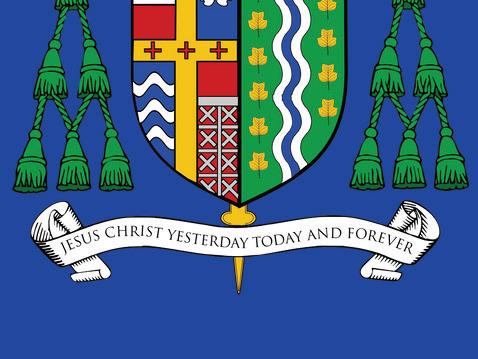
Bishop Beckman chose an episcopal motto, “Jesus Christ Yesterday Today and Forever,” in the weeks leading up to his ordination, and a coat of arms bearing the motto was then designed for him.
At the ordination and installation Mass on July 26, the new bishop received his crosier (or shepherd’s staff) along with his ring and miter.
Bishop Beckman’s coat of arms, or crest, was designed by Father Philip G. Bochanski, a priest in residence at the Cathedral of Sts. Peter and Paul in Philadelphia and vicar general and moderator of the curia for the Archdiocese of Philadelphia.
Father Bochanski has served the Church at the local and national levels for nearly 25 years as a parish priest, a high-school religion teacher, a spiritual director, a chaplain to the Philadelphia chapter of Courage, and as the executive director of Courage International. Ordained in 1999, he also has served the Church of Philadelphia as a chaplain to consecrated religious communities and as a spiritual director for seminarians.
Father Bochanski is the author of six books, five sets of audio lectures, and numerous articles and book chapters addressing various topics such as Church history, spirituality, evangelization, and pastoral care. His most recent book, Wisdom of the Desert Fathers: Ancient Advice for the Modern World, was published by TAN Books in April 2020.
Father Bochanski has served as a consultant to the Subcommittee for the Promotion and Defense of Marriage and to the Institute on the Catechism, both within the U.S. Conference of Catholic Bishops.
In December 2019, Pope Francis awarded him the Cross Pro Ecclesia et Pontifice. The ability to bestow this honor is reserved for the Supreme Pontiff, and it is given in recognition of sustained and exceptional service to the universal Church.
Coats of arms in the Diocese of Knoxville
The original Diocese of Knoxville coat of arms was designed in 1988 by Deacon Paul Sullivan. Deacon Sullivan also designed the coat of arms for the diocese’s first shepherd, Bishop Anthony J. O’Connell, and the crest for its second shepherd, Bishop Joseph E. Kurtz. Father Bochanski also designed the coat of arms for the diocese’s third bishop, Bishop Emeritus Richard F. Stika. Knoxville’s former bishops’ mottos were “The Harvest Is Plenty” (O’Connell), “Hope in the Lord” (Kurtz), and Iesu Confido in Te (“Jesus

Heraldic Achievement of Most Reverend James Mark Beckman Fourth bishop of Knoxville
Blazon: Quarterly gules and azure, on a cross Or between a fess the top edge dancetty of three points, a dogwood flower saltirewise, three bars wavy and a railroad trestle issuant from base all argent, three crosses couped of the first, impaling Vert, a pale wavy of three argent and azure, between twelve leaves of the tulip poplar (Liriodendron tulipifera) palewise. ■
I Trust in You”) (Stika).
In designing the shield—the central element in what is formally called the “heraldic achievement”— a bishop has an opportunity to depict symbolically various aspects of his own life and heritage and to highlight aspects of Catholic faith and devotion that are important to him. The formal description of a coat of arms, known as the “blazon” (see the box above), uses a technical language derived from medieval French
and English terms, which allows the appearance and position of each element to be recorded precisely.
A diocesan bishop shows his commitment to the flock he shepherds by combining his personal coat of arms with that of the diocese, in a technique known as “impaling.”
The shield is divided in half along the pale, or central vertical line. The arms of the diocese appear on the “dexter” side—that is, on the side of the shield to the viewer’s left, which
would cover the right side (in Latin, dextera) of the person carrying the shield. The arms of the bishop are on the “sinister” side—the bearer’s left, the viewer’s right. The central feature of the arms of the Diocese of Knoxville is a cross in gold (Or) taken from the arms of Pope St. John Paul II, who established the diocese. Three small red (gules) crosses on this large gold cross represent the three dioceses in Tennessee. The shield itself is divided quarterly into areas of red and blue (azure). Charges, or emblems, in these quarters allude to natural features that dominate the landscape of East Tennessee: mountains, a dogwood blossom, and the Tennessee River. A railroad trestle in the bottom-right quarter honors the Irish immigrants who brought the Catholic faith to the area, many of whom worked constructing railroads.
Bishop Beckman is an avid hiker and has a deep appreciation for the beauty of God’s creation. His first request was that his coat of arms
Pontificals continued on page C8
Behind the altar
Many people, a lot of hours go into planning an ordination Mass
By Emily Booker
It takes a diocese to elevate a bishop.
When guests stepped into the Knoxville Convention Center on July 26 for the ordination and installation of Mark Beckman as the fourth bishop of the Diocese of Knoxville, they were eager to begin a new chapter in the history of the Catholic Church in East Tennessee. But it took weeks of preparation and thousands of man-hours to take care of every detail to reach this monumental day.
The undertaking of such a large event involved many people, most working on short notice to finalize and execute plans in time ever since Bishop Beckman was appointed the next shepherd of the Diocese of Knoxville on May 7.
“Looking back upon these past three months, from the day when we first learned at the beginning of May that the Holy Father had selected then-Father Mark Beckman to be the fourth bishop of Knoxville until his ordination/installation on July 26, it was absolutely incredible how much work was accomplished in such a relatively short amount of time,” said Deacon Sean Smith, chancellor of the Diocese of Knoxville and chairman of the ordination/installation planning team. It was a busy but exciting time as the East Tennessee faithful prepared to welcome their new spiritual leader.
Deacon Smith worked closely with the bishop-elect from the very start to go over the numerous details in planning the ordination and installation while ensuring that as many people as possible could join in the celebration.
Planning included logistics, invitations to bishops and dignitaries, the liturgy and music, communications,

hospitality, transportation, hotels, and security.
The Knoxville Convention Center was chosen as the location for the ordination and installation Mass, as its capacity allowed the greatest
number of the faithful from East Tennessee, the Diocese of Nashville, and beyond to attend the historic event in person.
The convention center also served as the site for past ordinations. The

elevated platform serving as the sanctuary was 60 feet by 40 feet, providing enough space for such a large liturgy.
From exhibition hall to sacred space
But how does one turn such a large, open venue into a sacred space worthy of the Mass?
“Those that have a background in sacred architecture, designing churches, cathedrals, always say that you begin with the altar first and work your way out from the altar since that is the center of the holy sacrifice of the Mass,” said Paul Simoneau, vice chancellor of the Diocese of Knoxville, vice chair of the ordination team, and chair of the ordination logistics committee.
The altar for the ordination came from Holy Cross Church in Pigeon Forge. It was hand-carved by Deacon Otto Preske in the early 1990s and has been used in past diocesan events such as the 2013 Eucharistic Congress in Sevierville and the 2009 ordination of Bishop Richard F. Stika.
“It’s a very large altar. It’s a very beautiful altar. It has a carving beneath of the Last Supper. It’s very appropriate for this particular venue because of its size,” Mr. Simoneau said.
Holy Cross was not the only parish that contributed to the temporary sanctuary. The crucifix hanging above the altar came from St. Thomas the Apostle Church in Lenoir City. Holy Ghost Church in Knoxville supplied the ambo.
The tabernacle was handcrafted by Pedro Garcia, who works at St. John Neumann Church in Farragut. He originally designed the tabernacle for a retired priest to use in his residence.
The cathedra is the official seat Planning continued on page C12

Handle with care M&M Productions staff secure cables to the crucifix for suspension above the altar at the ordination Mass for Bishop Mark Beckman.
JIM WOGAN
Adding it all up Deacon Walt Otey, left, Jerry Bodie, right center, and Deacon A.J. Houston assist in setting up the altar for the ordination and installation of Bishop Beckman at the Knoxville Convention Center.
RENEÉ MCNUTT/BOPP


Bishop Beckman’s spiritual journey takes many trails
By Jim Wogan
Shortly after he was appointed as the fourth bishop of Knoxville, Bishop Mark Beckman adopted a new nickname. The “Bishop of the Mountains” wasn’t his idea, but he liked the sound of it, and he has become completely comfortable using it.
The Church recommends he be referred to as His Excellency, Most Reverend, and perhaps rather archaically as the Pontiff of Knoxville, but Bishop Beckman’s temperament appears less formal. For him, “Bishop of the Mountains” is perfect.
Growing up in Lawrenceburg, Tenn., young Mark Beckman found a special connection with the outdoors. It was hard to avoid. Lawrence County is remote and rural. With less than 50,000 residents, it’s not hard to find quiet space within its forests, on its hills, and along its creeks and rivers. His appreciation for nature was formed there in his childhood. It grew into something bigger and more profound after he became a priest in 1990.
“It happened in the spring of 1992. It was Holy Week, and I was working full-time at Father Ryan High School,” Bishop Beckman said. “I needed to get away to get some quiet time, so I think it was the morning of Good Friday I went over to a place called Radnor Lake, which is a state natural area in Nashville. I walked onto the trail, and the April wildflowers were carpeting the forest floor, and I was in tears. I had never seen such beauty in my life.
“Even though I grew up in the woods, I walked the path and there was such peace, and it was so beautiful, and I felt closeness with the Lord. I thought, He created all this, and I am right here in it. That was the day I got hooked on (hiking).”
Paul Davis remembers the forma-

tion of Mark Beckman as a priest and as a hiker. Mr. Davis is now the president of Father Ryan High School in Nashville.
In the late 1980s, Mr. Davis was a teacher at Father Ryan, and Bishop Beckman, by then a deacon, also taught there. A friendship developed, and over the next few years Father Beckman and another Nashville priest, Father Joe McMahon, were invited to Davis family gatherings, where they both met Bobby Davis—Paul’s dad—and another man, Neil Divine, one of Bobby’s camping buddies.
“They took me on my first backpacking trip to the Great Smoky Mountains National Park,” Bishop Beckman remembers. “We went to Abrams Creek. I brought all my new gear, and we spent two or three nights there. And I fell in love with backpacking. It’s hard work to be immersed in the wilderness overnight, the sense of community and camaraderie that you have. …”
While Bobby Davis was experienced at this kind of thing, it was Bishop Beckman’s first serious overnight adventure into the woods.
“My dad’s camping was a little unorthodox. He’d bring iron skillets and cans of sausages and then pull out a hunting knife to eat them. Father Beckman, I think, pushed him to kind of modernize their camping techniques,”
Paul Davis remembered fondly.
“They helped each other. My dad found peace in the outdoors, and he loved his relationship with the priests around the diocese, especially Father Beckman and Father McMahon.”
Bobby Davis passed away in 2019.
“My dad was kind of a quiet guy,” Paul Davis said. “I think the peace and quiet of nature allowed him to kind of refresh. I think he found peace in God’s creation, and I think that Father Beckman has found that as well. When I am hiking that’s what I feel. After a stressful day I look forward to getting out on a trail and I think that’s the gift (my dad) gave us, to take the time to be silent and to understand that these opportunities are gifts from God.”
The spark lit by Bobby Davis and others led Bishop Beckman


to expand his horizons. He hiked the Grand Tetons in Wyoming and systematically began plotting other adventurous trips out west. He also began to consider how he could use his passion for the outdoors to help others find God.
“The first time I did a big hike, we went to Roan Mountain, high in the Appalachians,” said Barney Shulte. “Father Mark was the pastor at St. Matthew (in Franklin), and he wanted to take a group of men on a spiritual hike into the Smokies. He picked Roan Mountain, and there is a beautiful area called ‘the balds.’ You are up on the border of North Carolina and Tennessee, and it's just beautiful.”
Walking on trails some 6,000 feet above sea level was a true test for the seven men who accompanied Bishop Beckman.
“We spent the night on a mountaintop in tents and then got back to the cabins on the third night,” the bishop said. “We prayed together. We did faith-sharing together. We celebrated the Eucharist together. We did morning and evening prayers together.”
Mr. Shulte said the excursion helped him better understand his Catholic faith.
“On the trip, he introduced us to the morning and evening prayers,” Mr. Shulte said. “I didn't know (they) even existed. I had been a Catholic all my life, and at that point I didn't know. He wanted us to do (prayers) in the morning before we started hiking and of course in the evening before we went to bed.”
That was in 2012, before the Camino.
The Camino de Santiago is a pilgrimage route—a vast network of hiking paths that cross France, Spain, and Portugal and eventually converge on the city of Santiago de Compostela in northwestern Spain, Hike continued on page C10



Camino brothers Bishop Mark Beckman, left, is accompanied by trail partner Barney Shulte on the historic Camino de Santiago in Europe in 2014


T H A N K Y O U


Bishops come full circle 40 years after seminary in Belgium
By Jim Wogan
Bishop Mark Beckman’s sister, Melissa, remembers the day her oldest brother left for Belgium.
“When he was headed to the airport, I hid because I didn’t want him to get on the plane, and it took them a while to find me,” she said, looking back almost 40 years. “We wrote letters back and forth, and he would call every now and then. He would send us chocolates from Belgium.”
In 1984, following his graduation from St. Ambrose College Seminary in Davenport, Iowa, Mark Beckman made a leap of faith—a giant step that took him 4,500 miles from his hometown of Lawrenceburg, Tenn., all the way to the small Belgian city of Leuven, also referred to as Louvain in French.
“Monsignor Tracy Ellis, the dean of Catholic-American Church history, gave a lecture at St. Ambrose in my senior year and said he believed that Louvain at that point was the center of Catholic thinking in the world because of how it impacted the theology of the Second Vatican Council,” Bishop Beckman said. “That made me want to study there, and a couple of my professors at St. Ambrose had studied there. That was a big draw.”
The Catholic University of Leuven (Katholieke Universiteit Leuven or KU-Leuven) was founded in 1425. It remains a focal point of learning, and as a testament to its place and prominence in Catholic history, Pope Francis will visit the university in September to help celebrate its 600th anniversary.
For the young bishop-to-be, studying in Belgium presented an appealing opportunity. The idea was also attractive to two other young seminarians who now wear a miter: Archbishop Shelton J. Fabre of Louisville and Bishop J. Mark Spalding of Nashville.


“The three of us were students together in Louvain. I believe Archbishop Fabre was a year behind me in studies, and I believe my fourth year was the first year Bishop Spalding was in Louvain. The American College where we lived, the residence, only had about 50 seminarians at the time. We all knew each other very well.”
— Bishop Mark Beckman
College at the Catholic University in Louvain, they taught me how to think theologically. They were both very foundational in my own life.”
Bishop Spalding, the youngest of the three, and a co-consecrator at Bishop Beckman’s episcopal ordination, remembers the rigorous academic standards and the challenge it presented to young seminarians who studied there. He received a master’s degree, a baccalaureate in sacred theology [STB] in religious studies in 1990, and a licentiate in canon law in 1992.
“We had a very good house at that time. The relationships across the board were good and fruitful,” the Nashville bishop said. “The students attending at that time were all gifted academically and gifted in other ways. We were strong in liturgy, formation, and homiletics. So, just sharing all those good experiences bind seminarians together. It was a good moment for me and a good moment for Bishop Beckman to live, and learn, and grow.
“Any strong academic-theological program helps all priests for the rest of their lives, and that was a strong part of the experience in Louvain. The theologians were world-known, well-published, and at the top of their field. It was good to go there at that time to truly take in that knowledge and wisdom that those professors gave us,” Bishop Spalding said.
“The three of us were students together in Louvain. I believe Archbishop Fabre was a year behind me in studies, and I believe my fourth year was the first year Bishop Spalding was in Louvain,” Bishop Beckman recalled. “The American College where we lived, the residence, only had about 50 seminarians at the time. We all knew each other very well.”
Archbishop Fabre, who served as the principal consecrator at Bishop Beckman’s episcopal ordination,

received a bachelor’s degree in religious studies from the Catholic University in 1987 and a master’s degree in religious studies in 1989.
“I went to four years of college seminary with the Benedictine Monks at St. Joseph Seminary College in Louisiana,” Archbishop Fabre said. “My next four years of theological education were in Louvain. I always say, St. Joseph Seminary College in Louisiana in the Benedictine tradition taught me how to pray. When I went to the American
While Bishop Spalding is the youngest of the three, he remembers Bishop Beckman as a seminarian who set a positive example when it came to attendance and punctuality.
“I am going to compliment him. I don't think I ever beat him into the chapel. He was always in the chapel before I got there, and he was seated in the same chair every day,” Bishop Spalding recalled. “Whether it was morning prayer, Mass, you name it, he was always sitting in that one Seminary continued on page C11


Study abroad The Catholic University of Leuven in Belgium is where Bishop Mark Beckman, Archbishop Shelton J. Fabre, and Bishop J. Mark Spalding attended seminary.
COURTESY OF THE CATHOLIC UNIVERSITY OF LEUVEN
Advice, and content
Bishops share their episcopal experiences when
“Say goodbye well so that you can say hello well.”
Archbishop Shelton J. Fabre
By Bill Brewer
Among bishops, there is a common thread woven through them that connects their episcopacies.
It is that unexpected moment when they said yes to becoming the shepherd of a diocese after years spent serving as a parish priest.
Common denominators they most often recall are faith, humility, grace, uncertainty, relationships, and even tears.
Bishop Mark Beckman is now attached by that thread following his July 26 ordination and installation as the Diocese of Knoxville’s fourth shepherd.
For the ordination, Bishop Beckman selected as his principal consecrator Archbishop Shelton J. Fabre and as co-consecrators Bishop J. Mark Spalding and Bishop James V. Johnston Jr. Bishop Beckman also asked Bishop Emeritus Joseph E. Kurtz, the third bishop of the Diocese of Knoxville and retired archbishop of the Archdiocese of Louisville, to sit near him at the altar.
The veteran bishops who joined with the newest member of the episcopal fraternity at his ordination last month recently recollected their experiences in saying “yes” at that unexpected moment and how it changed their lives and their ministries and impacted their vocations.
Archbishop Emeritus Kurtz
Archbishop Emeritus Kurtz was a senior member of the July 26 ordination Mass, having retired in February 2022 at age 75. He was succeeded in Louisville by Archbishop Fabre. His ordination to the episcopacy remains fresh on his mind.
“This October will be 25 years ago

that I received the call. And I’m coming up on the 25th anniversary of my anniversary as a bishop on Dec. 8,” Archbishop Emeritus Kurtz noted.
And like virtually every bishop, he remembers when he received “the call” and what he was doing. He recalled that he was pastor of Notre Dame Parish in Bethlehem, Pa., and had been visiting residents of a nursing home. His secretary informed him that he had received a phone call from Washington, D.C. It was Oct. 26,

1999.
“When I returned the call, the person said, ‘Could you hold on? The nuncio wishes to speak with you.’ I remember thinking, what in the world is going on,” Archbishop Emeritus Kurtz said. “Sure enough, it was Archbishop (Gabriel) Montalvo, who at that time was the papal nuncio, representative of the pope in the United States. He said, ‘The Holy Father has appointed you as the bishop of Knoxville; he actually said, ‘Kuh-noxville.’ And he said, ‘Do you accept?’”


Bishop Mark Beckman
Congratulations and prayerful best wishes on your installation.


Despite the surprise, the retired archbishop did not hesitate or equivocate.
“I’ve taken spiritual pride in being able to say yes to any appointment that I’ve been able to say yes to, from my diaconate all the way to the present. It’s very freeing because it’s really God’s will. I’m not seeking out anything specifically. So, I immediately said yes. I thought I’ll fill in the blanks later,” he remembered.
That common thread linking bishops also involves the post-acceptance whirlwind, when the realization of what is happening sets in. For Archbishop Emeritus Kurtz, it also was a bit of culture shock.
“It was a bit of a sleigh ride from then on. Before I knew it, there I was getting on an airplane to come down to East Tennessee. I had never been in Tennessee before in my life. It was quite an adventure,” he shared.
And for Archbishop Emeritus Kurtz, there were other considerations as well. He noted how his older brother, George, would be accompanying him to Knoxville to live. He was the caretaker of George, who had Down’s syndrome. George was beloved and a popular companion to then-Bishop Kurtz. George passed away in 2002.
“He and I were living together along with some other priests at the parish where I was. So, my mind was going like anyone who has a family. Gee, is Georgie going to adjust to this? Where am I going to stay, and is there room for Georgie? All the things that families go through. The adrenaline had me prepare, and it was only later on that I sat back in a deeper way and reflected on what had just happened,” the archbishop said.
And just as with his appointment as bishop, Archbishop Emeritus Kurtz keenly remembers a similar process when he was asked to lead the Archdiocese of Louisville. He Advice continued on page C17

Offering insight Above: Archbishop Shelton J. Fabre, center, served as principal consecrator for Bishop Mark Beckman at his July 26 ordination and installation Mass. Co-consecrators were Bishop James V. Johnston Jr., left, and Bishop J. Mark Spalding, right. Below: Archbishop Emeritus Joseph E. Kurtz lays hands on Bishop Beckman during the new bishop's ordination Mass at the Knoxville Convention Center.
TOM MCNUTT/BOPP
GABRIELLE NOLAN
reflect this part of his life, in which he has found much solace and communion with God in prayer. His personal arms display a symbolic natural setting on a field of green (vert), which also has ties to the bishop’s heritage and to sacred Scripture.
The bishop’s surname is German and derives from the word Beck, which means a stream or brook. This is depicted by the wavy vertical lines (pale wavy) painted white and blue (argent and azure) in the center of the shield. This also recalls the prophecy related by St. John the Evangelist about the City of God, the New Jerusalem, which he sees in a vision near the end of the Book of Revelation. “Then the angel showed me,” he writes, “the river of the water of life, bright as crystal, flowing from the throne of God and of the Lamb through the middle of the street of the city” (Revelation 22:1-2).
John also saw “on either side of the river, the tree of life with its twelve kinds of fruit, yielding its fruit each month. The leaves of the tree were for the healing of the nations” (Revelation 22:2). The tree of life and its fruit are alluded to here by 12 leaves of the tulip poplar (Liriodendron tulipifera). This was chosen as the state tree of Tennessee in 1947 because, as the Tennessee General Assembly wrote at the time, “it grows from one end of the state to the other” and “was extensively used by the pioneers of the state to construct houses, barns, and other necessary farm buildings.” It is an appropriate symbol for the state that comprises both the Diocese of Nashville, where the bishop was born and served as a priest, and the Diocese of Knoxville, which he will serve as its bishop.
The scroll below the shield is inscribed with the bishop’s motto. It is taken from the Letter to the Hebrews: “Jesus Christ is the same, yesterday, today, and forever” (Hebrews 13:8).
The shield is ensigned with external elements that identify the bearer as a bishop. A gold processional cross appears behind the shield. The galero or “pilgrim’s hat” is used heraldically in various colors and with specific numbers of tassels to indicate the rank of a bearer of a coat of arms. A bishop uses a green galero with three rows of green tassels.
Additional terms in the blazon for the Diocese of Knoxville’s coat of arms are “dancetty,” referring to the indentations indicating the mountains (“three points”) in the first quarter of the coat of arms, and “saltirewise,” meaning the diagonal placement of the dogwood blossom in the second quarter. “Fess” refers to the horizontal band in the diocesan coat of arms. “Palewise” indicates the vertical placement of the tulip poplar leaves in Bishop Beckman’s crest. “Of the first,” referring to the three small crosses, means they are the color or tincture of the first color mentioned in the blazon: red (“gules”).
Bishop Beckman’s crosier is the same one used by Bishop James D. Niedergeses throughout his time as ninth bishop of Nashville. Both bishops were born in Lawrenceburg, Tenn. The crosier, hand carved from cedar, was presented to Bishop Nie-


dergeses by the priests of the Diocese of Nashville at his episcopal ordination on May 20, 1975. Originally the crosier was in one piece. Bishop Niedergeses had one of his cousins, Pauly Niedergeses, make it into two sections that could be screwed back together and placed in a carrying case. Pauly also made the carrying case, which is painted with black enamel with brass hardware, and lined with red felt. Bishop Niederge-

ses used the crosier until his retirement on Oct. 13, 1992. The crosier is 74 inches tall.
Monsignor Owen Campion of Our Sunday Visitor, a native of the Diocese of Knoxville, said that Bishop Niedergeses served “as beloved chaplain” at St. Thomas Hospital in Nashville following his retirement as bishop.
Then-Father Niedergeses was appointed pastor of Our Lady of Perpetual Help in Chattanooga in 1962

when it was among the three largest parishes in Tennessee, Monsignor Campion said. He was instrumental in building Notre Dame High School’s current edifice, completed in 1965, from finding the land to funding to advising on construction and was “very much involved in Chattanooga civic and ecumenical activities,” the monsignor continued.
Father Niedergeses was transferred to Sts. Peter and Paul Parish in downtown Chattanooga in 1973 and was serving there when he was named bishop of Nashville.
Some of the younger priests of the Diocese of Nashville decided to present the new bishop a gift. Simplicity was very much the style under Pope St. Paul VI, who abolished many regalia of bishops, regarding them as too flashy and extravagant, Monsignor Campion said. For his pectoral cross, Bishop Niedergeses chose to wear a simple crucifix given him by his mother when he left Lawrenceburg to attend seminary.
With all this in mind, the young priest decided a crosier of gold, silverplate, or brass would not be fitting. Father David Choby, later bishop of Nashville, had heard of a woodworker in Lebanon, in Wilson County, where cedar trees are especially abundant. He contacted the man, who made the crosier with local cedar. When it was finished, the priests presented it to the new bishop in the second-floor conference room of the old Catholic Center in Nashville.
“He was delighted,” Monsignor Campion said. “He was a great student of the Scriptures, and immediately he recalled references to cedar in Isaiah. He found religious symbols in the fact that cedar is fragrant. It is evergreen, withstanding cold and winter. It stands tall and strong and straight. It repels pests. It is a hard, sturdy wood. It abounds in Tennessee and is deeply rooted in Tennessee, from the Smokies to the bluffs of the Mississippi [River] in the West.”
Archbishop Shelton J. Fabre, principal consecrator of Bishop Mark Beckman, also presented a ring and a miter to Knoxville’s new shepherd.
The archbishop presented the ring to Bishop Beckman with the words, “Receive this ring, the seal of fidelity: and adorned with undefiled faith, preserve unblemished the Bride of God, the holy Church.” The ring “symbolizes the bishop’s fidelity to the Bride of God, the Church.”
The presentation of the miter was made with the archbishop stating, “Receive the miter and let the splendor of holiness shine in you, so that when the chief Shepherd appears you may merit to receive an unfading crown of glory.”
The miter “signifies the bishop’s resolve to pursue holiness.”
The crosier is presented last, with the words from the archbishop, “Receive the crosier, the sign of the pastoral office, and keep watch over the whole flock in which the Holy Spirit has placed you as bishop to govern the Church of God.”
The pastoral staff is a symbol of “the duty of guiding and governing the Church entrusted to” the new bishop. ■

Bishop Mark Beckman: Beginning An Episcopate
GABRIELLE NOLAN
A good fit Archbishop Shelton J. Fabre, principal consecrator for the ordination and installation of Bishop Mark Beckman, places the miter on Bishop Beckman, who was kneeling for the important liturgical moment. Seminarian Bobby Denne is assisting
With this ring The ecclesiastical ring Bishop Mark Beckman will wear signifying his fidelity to the Church is shown resting on the papal bull officially declaring Bishop Beckman as the Diocese of Knoxville's fourth shepherd The decree was read by a papal nuncio representative during the ordination Mass
ELEYANA NAHIGIAN
Our new shepherd Bishop Beckman receives his crosier from Archbishop Fabre during the July 26 Mass of ordination and installation at the Knoxville Convention Center. Watching are Bishop James V. Johnston Jr. and Bishop J. Mark Spalding as Deacon Walt Otey and seminarian Bobby Denne assist
GABRIELLE NOLAN
Sacred chrism The holy oil used to consecrate Bishop Mark Beckman was placed in a small, crystal vessel next to the altar.
Consecrated Archbishop Shelton J. Fabre places sacred chrism on Bishop Mark Beckman's head as part of the Mass of ordination and installation
Papal bull The official Vatican decree declaring Bishop Mark Beckman as the next leader of the Catholic Church in East Tennessee.


and the Cathedral of St. James. The Camino, also known as “The Way of St. James,” has been calling pilgrims since the 10th century and was the subject of a 2010 movie called “The Way,” starring Martin Sheen and his son, Emilio Estevez.
Two years after the trip to Roan Mountain, Bishop Beckman fulfilled a dream to hike the Camino. He didn’t want to go alone. Mr. Shulte and fellow St. Matthew parishioner Jim Bauchiero went with him.
“I saw the film ‘The Way’ with Martin Sheen and Emilio Estevez, and I was deeply moved by it, and I thought, gosh, I feel like I am being called to do this, but my practical side kicked in, and I thought, when am I going to get enough time? A couple of years later, two men invited me to go with them, and I said that answers who was going to go with me. I then asked the bishop if I could go, and he said yes … ‘be careful of blisters,’” Bishop Beckman said.
Blisters would be a serious concern. The path Bishop Beckman and his friends selected was the Camino Frances, which starts in St. Jean Pied de Port, France, and terminates 800 kilometers (500 miles) later in the city of Santiago de Compostela. It takes about five weeks to complete.
“We averaged about 15 miles a day carrying everything thing we owned on our backs,” said Mr. Bauchiero. “It tests your spirituality; it tests your mind; and it tests your physical abilities. It was a challenge.
“I shouldn’t say ‘test’ when I say spirituality because everyone is going to have their own spiritual Camino, and it’s going to be very individual for everyone. For me, who had not been a huge people person, it changed me forever. I really felt the love of the Lord for me and the love of the Lord for other people … in an incredible way that really changed my life.”
One of Bishop Beckman’s goals on
Bishop

the Camino, according to his hiking companions, was to not draw attention to the fact that he was a Catholic priest. His goal was to travel as a pilgrim. But during multiple interactions with people on the pilgrimage, his cover was blown.
“People kind of always figured out Father Mark was a priest,” Mr. Shulte said. “We didn’t broadcast that as we walked, but people always seemed to figure that out. There is an aura there or something that comes across. People are always drawn to talk to him and get insights from him.”
Later in the journey, the Camino companions were joined by four other friends—Art Gonzalez, Joe Pouliot, Simon Riley, and Mr. Bauchiero’s wife, Nanci. And they all walked together for the final days until the group arrived at the Cathedral of St. James, believed to be the burial site of St. James the Great, one of the Twelve Apostles.
“Father Mark is the most Christlike person we know and what he did on the Camino is exactly what Christ did when he was journeying in Galilee,” Mrs. Bauchiero said.
“(Jesus) would spend time with the Father and become so centered that when he was with people, He


To Bishop Mark Beckman
exuded love and joy. (Father Mark) is a joy-filled man of God. We have seen him minister to people in a priestly role for as long as we’ve known him … but I never had seen him meet strangers the way he did and still exude the same love of the Lord that was so obvious that he couldn't disguise it even when he wanted to,” she added.
Over the miles, Bishop Beckman and his companions encountered believers and non-believers. They sometimes walked together, and they often walked alone.
“When we would walk into a new village, Barney would be standing at the edge of the village when I approached, and I would just see him.
Father Mark would have probably gone on to scope out accommodations for the night,” Jim Bauchiero remembers. “We walked at different paces, but then we had all kinds of stories to tell of people we met or things we saw along the way.”
“It brought us closer the further we went,” Barney Shulte said. “When you are getting to the end, you are anxious to get to Santiago, you are excited about that, you are excited about getting back home to see your family, but you also don’t want it to end. That’s where I was.”
It’s been 10 years since his Camino experience, but Bishop Beckman continues to find solace and peace on the trail. With a recent trip to Hawaii, he just completed a personal goal of visiting all 50 U.S. states.
As he begins his journey leading the Diocese of Knoxville, he also understands the demands of a bishop will likely determine how and when he will hike in the Smoky Mountains.
“There are two dimensions to spirituality. One is solitude, and the other is community. And hiking feeds both of those things for me,” Bishop Beckman said.
“When we are in our ordinary routine, at a desk answering e-mails or meeting with people, we are often consumed with practicalities. Getting outside of a structured human environment and walking in the wilderness, being in a forest, walking by a creek, being awed by mountains or canyons, in something far more immense than any individual one of us is, there is a certain degree of awareness that I am sort of at the mercy of something much bigger than me.
“If something happens, I am out here by myself, that awareness that I do depend upon God. He is bigger than I am. God is such an artist and creates such beauty at every moment. I will pray when I am walking, what I call the prayer of senses: ‘God help me to see today, the beauty of Your presence in creation. Help me to hear all the sounds, to taste the taste, to touch and feel the texture of things. Feel the earth beneath my feet. Help me know with Your knowing and to love with Your loving’ … so that conscious awareness of being present with all the senses,” Bishop Beckman said.
Bishop Beckman has traveled extensively to contemplate God’s creation. Now that he calls Knoxville home, the Bishop of the Mountains won’t have to travel quite as far to get there. ■


Off-road enthusiasts From left, Barney Shulte, Dr. Mark Peters, Steve Maher, Vic Arms, Bishop Mark Beckman, and Joe Pouliot hike in Tennessee's Pickett State Park in Pickett County. Bishop Beckman, an experienced hiker, has visited trails in all 50 states.
COURTESY OF BISHOP
BECKMAN
Mark Beckman:
chair right up near the altar. I remember coming back the year after he left, and I remember thinking, well, time passes … and we go on.”
Monsignor Mike Johnston, who has served for more than 50 years as a priest and pastor in the Diocese of Nashville, knew Bishop Beckman as a seminarian.
“At that time, we had seminarians that were assigned to go to Louvain for preparation for the priesthood. I think the theology there was very sound, very moderate, and middle of the road. It was relatively small at that time, but there (was) a good community there that he flourished in,” Monsignor Johnston said. “I know it was tough for him at the beginning, for anyone being that far away from home and family. I think the gloominess of that area (weather) was a challenge. But he got used to that and dealt with it.”
If there were adjustments to living and studying in a foreign country, the future bishop of Knoxville had no regrets. His time there helped shape his priesthood.
“Just being exposed so much to the Church universal by traveling throughout Europe. We spent a lot of time in Rome, a lot of time in Italy, and throughout Europe,” Bishop Beckman said. “Secondly, the theology there was extremely rigorous and tied to what we called the historical critical method. You studied a topic and how the understanding of that topic developed in each century of the Church’s history, even going back to the Old Testament. The academic rigor shaped me for sure. And I was a stranger in a country, right? So, I got the experience of what it felt like to be out of your own cultural milieu, and that has always given me a special heart for people who are new to our country because for four years I lived as a stranger in another country.”
Archbishop Fabre shares the same respect for his Belgian education and the impact it has had on his priesthood.
“I believe it taught me to think on my feet and to respond to situations as they present themselves,” he said. “I think it also taught me to think theologically in the moment, and to think theologically long term. I was very appreciative of the different cultures I was exposed to, the culture of Belgium and all the cultures across Europe and the Church, and the face of the Church in each one of those places.”
Because of their distance from home, many of the seminarians studying in Belgium became friends. For Bishop Beckman and Archbishop Fabre, their friendship was trusting (or daring) enough to justify a couple of mega-road trips, even by European standards.
“The archbishop and I and two other seminar-

ians, the four of us, rented a car one Easter break and drove from Belgium to Greece and back,” Bishop Beckman said.
For the record, that’s about 2,700 kilometers (1,670 miles) one-way.
“We were on Easter break, so we decided we would drive to Greece, the four of us. I remember we went to the Easter Vigil Mass at the Roman Catholic cathedral in Athens,” Archbishop Fabre said.
Like most college students of the time, it was a budget trip. They drove a small rental car packed with luggage and enough room to hold four people. Meals were often impromptu.
“I remember being so hungry we stopped at one place in Greece, and the people didn’t know English, and we didn't speak Greek, or whatever language they were speaking. So, they just kind of brought us the blue-plate special, and I still don’t know to this day what we ate,” Archbishop Fabre remembered. “I really think it was tongue. But I don’t want to think about it. I was just so hungry; I would have eaten anything.”
While in Greece, they visited Sparta, Corinth, Olympia, and Athens. Archbishop Fabre remembers they drove though Yugoslavia, which no longer exists.
The Greek road trip wasn’t the only adventure for the future bishops. They once drove to Berlin, which at the time was still a divided German city— democratic on one side (West Berlin) and communist on the other (East Berlin).
“It was just … ‘I want to go to Berlin’. So, the four of us drove to Berlin,” Archbishop Fabre said. “We (eventually) went into the communist part of the city. I had made a promise to my father before I left that I would not go to any communist country. My father was in World War II, and he didn't be-
lieve in that. Well, I broke that promise, and I went to Berlin, and then I remember we went into East Berlin, the four of us, Bishop Beckman, me, and two other seminarians. At that time, they required you to keep a close tally of what you bought and the money you spent. When we left to go back into West Berlin, they (East German border guards) looked at our records, and I will never forget, they pulled the four of us aside. Now, I thought, I am going to be arrested in a communist country, and my father is going to say, ‘I told you not to go there.’
“They took us into a room, and they yelled and screamed at us, and I remember one of the students spoke some German. And he was saying, they’re upset because our money does not equal out. They were basically saying we got money on the black market. None of us understood.”
Fortunately, the East Germans let the four seminarians leave, avoiding an international incident and a newspaper headline Archbishop Fabre’s dad wouldn’t want to see.
“Community was very important because we were all we had at significant moments like Christmas, Easter, and all those times,” Archbishop Fabre recalled. “Remember, there were no cell phones, there was no Facetime. It was just a telephone in the hallway. When you go on vacation, you would tell the seminary, ‘I am going to Berlin,’ and that was it. They didn’t know how to get in touch with you. Your family knew you were traveling, but they couldn't get in touch with you. You were as connected to your family as you could be, but that was just a phone in the hallway that would ring at all hours of the night because people forgot the time change.”
The bond that developed between the American seminarians living in Belgium 40 years ago remains strong. In addition to Archbishop Fabre and Bishop Spalding, Bishop Ed Weisenburger of Tucson, Ariz., another Catholic University alumnus, attended Bishop Beckman’s Mass of ordination and installation in Knoxville.
Their lives have come full circle since those days in Belgium. They are now Church leaders and shepherds of their diocesan flocks.
“It amazes me how the Holy Spirit has worked in each one of our lives to bring us together again in this wonderful moment of the Church for the Diocese of Knoxville,” Bishop Spalding said. “It is something quite special and fraternal. It's a moment of good friendship, but it’s also a moment in which you see how God has worked in all our lives. God works in mysterious ways, and when you sit back and look over the 30-plus years of all our priesthoods, it's amazing how the Spirit has worked to bring us together at this moment in time.” ■

Leuven alumni From left, Bishop J. Mark Spalding, Bishop-elect Mark Beckman, and Archbishop Shelton J. Fabre share a moment prior to Mass.
GABRIELLE NOLAN
Bishop Mark Beckman: Beginning
of the bishop. It is from the word cathedra that a cathedral gets its name.
Because the current cathedra in the Cathedral of the Most Sacred Heart of Jesus is made of marble and is not able to be transported, the presiding chair came from the Religious Sisters of Mercy of Alma convent in Knoxville. The chair was the wooden cathedra from the former Sacred Heart Cathedral and now serves as the presiding chair when the bishop celebrates Mass for the Sisters.
Jerry Dougherty oversaw the careful transport of the large sanctuary items as they were packed and moved to the convention center just two days before the Mass with the help of Mitchell Moving Co. Holy Cross Church, Holy Ghost Church, and the Chancery donated chairs for the bishops and priests.
Many hands make light work
From receptions to security to seating plans, dozens of lay volunteers gave their time to prepare for the day and to help during the ordination.
“To assist us in this monumental endeavor, we were blessed with the most talented cadre of volunteers and Knights of Columbus whose tireless work and many sacrifices made Bishop Beckman’s ordination and installation such a resounding success,” Deacon Smith said.
Deacon Smith particularly noted Mr. Simoneau’s role and efforts in the planning.
“I am most especially grateful for the herculean help and the scrupulous logistics talent and planning of my ‘right-hand-man’ Paul Simoneau … who did not take a single day off between the end of April until the week following the event, working 16-18 hour days in the final weeks leading up to July 26, with an average of four to four and half hours of sleep a night,” Deacon Smith said.
“I am also so very grateful to Paul’s wife, Ann Simoneau, whose yearlong cancer treatment ended in a most unexpected way the week before the ordination with a six-day hospitalization and two surgeries. Knowing Paul’s critical responsibilities, she told him to focus on all the final planning and to not worry about being with her as she saw it as a blessed occasion, as part of God’s providential will, for which to ‘offer up’ her surgeries for the blessing of this special occasion and for our new bishop,” he added.
Janie Hennessy, executive assistant to the chancellor and chair of the invitation committee, quickly developed invitations, mailed and recorded RSVPs, and maintained lists of the bishops, priests, deacons, religious, dignitaries, family members, and other special guests attending.
Lisa Morris of the Cathedral of the Most Sacred Heart of Jesus served as chair of the hospitality committee. Her team made sure that out-of-town and special guests were greeted and provided transportation the entire weekend. They also warmly welcomed all the guests who attended the ordination Mass and helped with the admissions process.
“The admissions process is very, very key to ensuring everybody’s first impression of this ordination and installation is a positive one,” Mr. Simoneau said. “The hospitality committee headed by Lisa Morris made huge amounts of effort to make that first impression the most positive experience possible so that it carried through to the rest of this memorable day.”
Members of the Knoxville Diocesan Council of Catholic Women helped prepare the thousands of seats with programs for guests. Knights of Columbus from both the Diocese of Knoxville and the Diocese of Nashville helped in several capacities, including manning the parking garages and giving directions, escorting bishops and dignitaries, and manning the aisles of the convention center during the
Mass.
“They’re always indispensable,” Mr. Simoneau said of the Knights.
Butch Bryant, who is retired from the Knox County Sheriff’s Office, headed security for the occasion.
Mr. Bryant also headed security for the cathedral dedication in 2018. He coordinated with the Sheriff’s Office, the Office of Homeland Security, and other security professionals to make sure the venue was secure and safe for all attending. Coordination with institutions and companies was another side of the logistics challenges to the day.
Mr. Simoneau was able to work with the University of Tennessee to rent out two of the university’s parking garages for the day, providing free parking and shuttle service for the thousands who descended on downtown Knoxville for the Mass.
Shuttles also helped the visiting bishops and Bishop Beckman’s family attend the Vespers service the night before at the cathedral.
“Special thanks go to Mike Wills, Walt Hanson, Jerry Dougherty, and Rich Cataldi. They manned the parking lot and garages that the diocese leased for the day and coordinated the golf-cart shuttles, borrowed through the generosity of No Limit Carts out of Kodak to assist with the ferrying of bishops and priests,” Deacon Smith said.
Mr. Simoneau also worked with several downtown hotels to offer discount rates for out-of-town guests.
He wanted to make it as easy as possible for guests, especially those coming from outside of Knoxville, to navigate the city and its Fridayafternoon traffic.
Jim Wogan, communications director for the Diocese of Knoxville and ordination communications committee chair, worked with M&M Productions of Oak Ridge to provide the needed and appropriate audiovisual elements at the convention center.
Mr. Simoneau noted that the lighting added to the effect of turning the convention center into a worshipful space for the celebration of Mass.
“With the lighting, I think people were very stunned by how beautiful it looked,” he said.
Spanish speakers attending the Mass were provided translation devices, with live translation of the events. Blanca Primm, director of the diocesan Office of Hispanic Ministry, contributed the translation with Coral Getino and Lilia Walker
The communications committee also was able to provide livestreaming of the ordination Mass so that people throughout East Tennessee and all over the world could watch and share in the historic event, only the fourth one in diocesan history.
Father Randy Stice, director of liturgy and worship for the Diocese of Knoxville, served as commentator for the livestream viewers, providing description and context to the rite.
With all this preparation, the stage was set, literally, for the grand celebration of ordaining a new bishop and installing him as the fourth shepherd of the diocese.
‘Making melody to the Lord’ Some 140 musicians volunteered their time and talents to elevate the ordination Mass with moving and pastoral sound.
“Afterwards, Bishop Beckman would comment to us that there were two things he repeatedly heard from family, friends, visiting bishops, and the many faithful the incredible hospitality and the music,” Deacon Smith said.
Glenn Kahler, director of music and liturgy for the Cathedral of the Most Sacred Heart of Jesus, coordinated the music liturgy. He put together the diocesan adult and youth choirs, who, along with the Tennessee Wind Symphony, created a heavenly, harmonious tone for the ordination Mass.
This wasn’t Mr. Kahler’s first time putting together a diocesan choir for a large celebration. He did

similarly for the dedication of the new cathedral in 2018, and that experience greatly helped when he began planning for the bishop’s ordination and installation.
“I was able to talk to music directors of every parish in the Diocese of Knoxville and start the process of developing a relationship, and with the individual music ministries that they have,” he said.
“We’ve managed to continue those relationships. So, when we had an opportunity again to bring everybody together, we already had a network of people to contact and reach out to.”
Those relationships proved especially important as the timeline between Bishop Beckman’s appointment in May and ordination in July gave musicians only a matter of weeks to put together ensembles and rehearse music.
Mr. Kahler noted how summertime is often when church music directors and musicians have a pause in the calendar, so finding available talent and asking them to forgo their summer breaks was a big ask. He cancelled his own family vacation to focus on preparing the music for the Mass, as well as developing the beautiful and detailed printed program.
Many other musicians also responded to the call in order to lend their talents for such an important moment in the history of the Catholic Church in East Tennessee.
Cathedral music coordinators
Michelle Pokelwaldt and Ashton Gallagher assisted in organizing the music and putting together the choir. Just over a hundred singers formed the diocesan choir, including youth and adults. They came from all over the diocese, and even beyond.
“We have people coming in from Nashville, Chattanooga, Tri-Cities, and they’ve been coming in ever since the auditions on a weekly basis,” Mr. Kahler said.
The choir was truly a demonstration of collaboration and even ecu-
Bishop

menical outreach.
“It’s not just Catholic churches,” Mr. Kahler said. “Singers of other denominations wanted to be a part of this really significant event.”
The singers represented almost every parish music ministry in the diocese, along with professional ensembles and other denominational churches.
Byong-Suk Moon, assistant director of music and organist for the Cathedral of the Most Sacred Heart of Jesus, was the organist for the Mass.
A large ensemble of the Tennessee Wind Symphony, directed by Dr. John Culvahouse, provided the rest of the instrumental music.
“They became artists in residence here at the cathedral back in 2020. We’ve hosted them on our campus, and they’ve reciprocated by always being there for us for these types of events,” Mr. Kahler said.
It takes much practice and dedication to put together a choir in just a few weeks. The musicians met for weekly rehearsals at the cathedral, some driving hours each way.
“I think we owe a debt of gratitude to every single person who’s spent time and sacrificed their own personal hours, their families’ hours, during a time that is supposed to be for travel and fun and leisure,” Mr. Kahler said. “They sacrificed a lot to prepare for this liturgy.”
He estimated that the 140 musicians of the choir and orchestra put in between 6,000 and 7,000 manhours over the summer to provide quality music for the bishop’s ordination Mass.
On the morning of July 26, the musicians were finally able to rehearse in the convention center for the first time. With just hours to set up their instruments and adjust to the acoustics of a new space, they still managed to produce glorious music and a prayerful sound.
In various ensembles, the musicians provided an hour of prelude music before the Mass began, welcoming attendees and setting the tone for the Mass.
Mr. Kahler said he had been working on the music and tone for
the ordination Mass even before Bishop Beckman’s appointment was announced.
“Ever since we found out that we were going to be getting a new bishop, that sort of started the wheels turning,” he said. “With the new version of the ordination rite coming out last year, that was helpful in giving us a starting point to begin looking through the liturgy, start looking through the prayers that are offered, and start thinking about what types of music would encapsulate that message.”
Mr. Kahler noted that selecting the music for a Mass always requires three questions: Is it liturgical? Is it musical? And is it pastoral? Music should always be in keeping with spreading the teachings of the Church and help people participate in worship during the Mass.
Once those objectives are met, then personal preferences about particular styles or pieces can be selected. Mr. Kahler worked with Bishop Beckman to makes sure the new bishop’s preferences and style showed through.
“We got to learn about who he is and his style. Every priest I’ve ever met has his own particular style or likes and dislikes, and having this opportunity to learn a new bishop’s likes and dislikes is fun,” he said.
That relationship will continue on as Bishop Beckman celebrates Mass and diocesan events at the cathedral.
Preparing the Lord’s table
Music isn’t the only part of a Mass that takes weeks to plan.
Every Mass involves careful planning and arranging all the proper elements necessary for worship. That is even more true for a Mass involving thousands of people and the ordination and installation of a bishop.
The Mass at the ordination of Bishop Beckman involved more than 5,000 hosts, four bottles of Communion wine, pounds of linens, and dozens of ciboria, the receptacles that hold the consecrated Eucharist dur-
Planning continued on page C14

JIM WOGAN
Detail-oriented Daniel Newgent, left, of M&M Productions, goes over technical details at the Knoxville Convention Center with, from left, Deacon Walt Otey, Deacon Sean Smith, Glenn Kahler, Sharon Brown of the convention center, Paul Simoneau, and Daniel Beckner of M&M Productions
Mark Beckman: Beginning An
ing Communion.
An anonymous donor made it possible for the diocese to purchase 24 new ciboria and cups for the ordination. The matching pieces can be used for future large liturgies as well.
The chalice used by Bishop Beckman was gifted to him by his former parish, St. Henry in Nashville.
Dorothy Curtis, sacristan at the Cathedral of the Most Sacred Heart of Jesus and receptionist for the Chancery, coordinated the hundreds of liturgical items for the ordination Mass.
“I staged a room in my house with all this equipment. It was everywhere,” she said, laughing.
Three Benedictines of the Divine Will, Father Elijah Cirigliano, Brother Joseph Harp, and Brother Martin Ellis, helped her organize the liturgical pieces and set up for the Mass.
“We [sacristans] have to know every piece and kind of live the liturgy days before so that we’re thinking ahead: What is next? What do we need there? Where’s this going to be?” Mrs. Curtis said.
While many pieces came from the Cathedral of the Most Sacred Heart of Jesus or from diocesan supplies used at the 2013 Eucharistic Congress in Sevierville, Mrs. Curtis also coordinated pieces from various parishes and individuals who were more than willing to contribute to making the ordination Mass a success.
The new altar cloth came from Holy Cross Church.
One of the altar cloths used on a side table, or credence table, came from the collection of Monsignor Xavier Mankel, one of the founding fathers of the Diocese of Knoxville.
“It’s very old, but it’s very nice,” Mrs. Curtis pointed out.
Yazmin Vidao, a native of Venezuela, provided and hand-stitched the purificators, the linen used to wipe the chalices and cups after each communicant. She hand-stitched a red cross on each one.


Jackie Foster sewed and provided the gremials, a special garment used during the ordination.
“A gremial is like an apron that the archbishop uses when he anoints the new bishop,” Mrs. Curtis explained.
“Jackie Foster is a seamstress, and she made the gremial for the

archbishop, and she made a special gremial for Bishop Beckman for when he got the oil poured on his head. We wanted to make that kind of special,” she added.
Ms. Foster also served as the assistant sacristan of the ordination Mass. Even regular vestments worn by
priests at Mass took special planning for a liturgy of this scale.
While Diocese of Knoxville and Diocese of Nashville priests wore their diocesan vestments, the visiting bishops needed vestments as well.
The Diocese of Owensboro, Ky., provided vestments for the bishops.
Deacon Fredy Vargas, facility coordinator for the Chancery, organized the vestments and helped coordinate the vesting areas for the 20 bishops and more than 100 priests. The altar flowers came from Always in Bloom florist. The florist, Leonard Palladino, who is a parishioner and a graduate of Knoxville Catholic High School, donated labor and transportation, and the Cathedral of the Most Sacred Heart of Jesus flower guild assisted in the arrangements. The cathedral flower guild, headed by Ann Bodie, also prepared the altar flowers for the July 25 Vespers service and the centerpieces for the honored-guests luncheon and Bishop Beckman’s family-dinner celebration.
The Cathedral of the Most Sacred Heart of Jesus also provided the bells and the Book of Gospels used in the ordination Mass.
Holy Ghost Parish provided the candles on the altar. Normally, there are six candles on the altar, but right after Bishop Beckman was ordained, a seventh candle was lit. This candle is called the episcopal candle, and it indicates the presence of the bishop of that diocese.
Similar to her efforts at priestly ordinations, one of Mrs. Curtis’ tasks was to provide a lemon. The acidic fruit helps break up the sacred chrism on the bishop’s hands after ordaining priests or conferring confirmation.
The chrism used for Bishop Beckman’s episcopal ordination is the same used for priestly ordinations.
“It’s a beautiful, sweet-smelling oil that was consecrated at the Chrism Mass during Holy Week,” Mrs. Curtis noted.


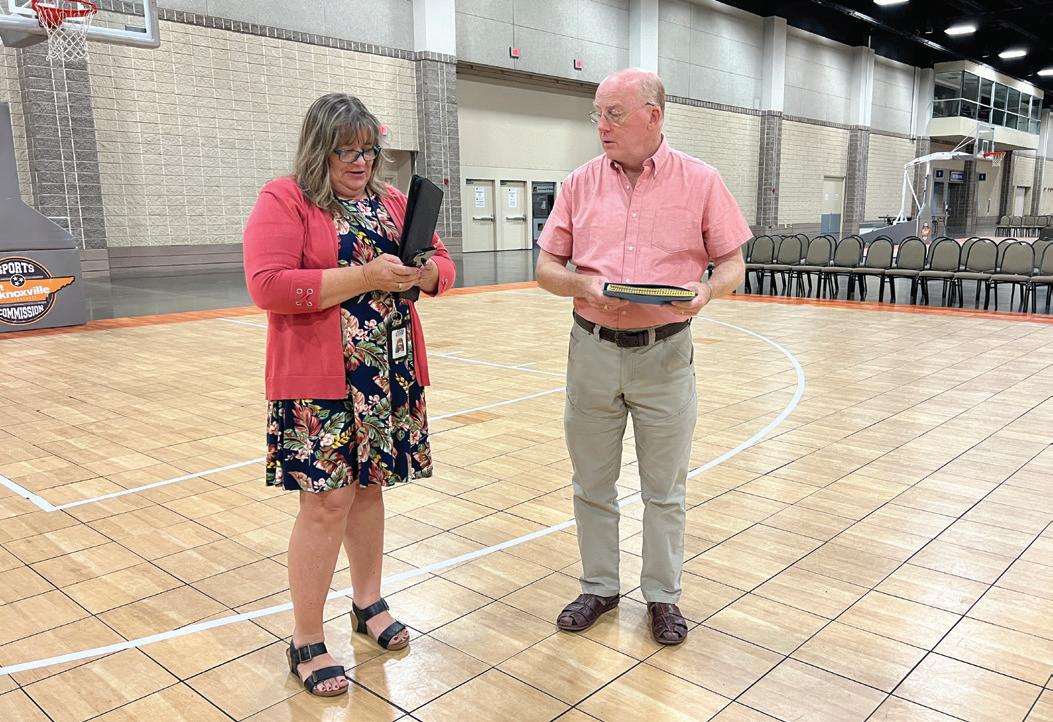
All hands on deck Above: Chancery receptionist and cathedral sacristan Dorothy Curtis packs boxes of purificators for the ordination/installation Mass. Below:
Deacon Fredy Vargas is assisted by Father Elijah Cirigliano, Brother Joseph Harp, and Brother Martin Ellis of the Benedictines of Divine Will in transporting chairs
Planning
BILL BREWER
Bishop Mark Beckman: Beginning An Episcopate
Bishop


It may seem overwhelming to keep track of these objects and more, like corporals, washing bowls, cruets, tables, trays, and cups, but Mrs. Curtis said being sacristan is a joy.
“This is what I just love to do, collecting these items, making sure that they’re all there for the MC (master of ceremonies) when he goes to grab something,” she said.
“Sacristans, we’re hidden you know. And I prefer to be hidden. We are for sure behind the scenes. We work really hard, and we take what we do really seriously. If the parts aren’t there, we take it to heart.”
‘The preeminent manifestation of the Church’
With the sanctuary staged, the musicians warmed up, and the vessels set, all that was left was the celebration of Mass.
But the liturgy itself also involved much planning and preparation. The sacrament of ordaining a new bishop along with the rite of installing him as the bishop of the Diocese of Knoxville involved plenty of coordination.
“The Mass, when a bishop is ordained and when a bishop celebrates, is always sort of the preeminent manifestation of the Church, because the bishop is the successor to the Apostles. He has the fullness of orders,” Father Stice said.
“When you have a Mass with a

“Looking back upon these past three months, from the day when we first learned at the beginning of May that the Holy Father had selected then-Father Mark Beckman to be the fourth bishop of Knoxville until his ordination/installation on July 26, it was absolutely incredible how much work was accomplished in such a relatively short amount of time.”
— Deacon Sean Smith,
Diocese of Knoxville chancellor and chairman of the ordination/installation planning team
bishop, he’s got his priests with him, he’s got ministers, he’s got deacons there. It shows, in a really profound way, the fullness of the Church. And the laity represent the people of God, so their presence is very important. It’s just a beautiful celebration.”
While the Mass is unchanging, there were certain elements of the ordination Mass in which Bishop Beckman got to select and personalize.
“There is a selection of readings for each of the sacraments that can be celebrated with a Mass,” Father Stice said. “He can pick the readings. He can pick the music. Part of the preparatory rites, he can add additional names to be included in the Litany of the Saints. Those are ways he can personalize [the Mass] a little bit.”
As the liturgical committee chair, Father Stice assisted Bishop Beckman in choosing the readings and prayers to be included for the ordination.
Bishop Beckman selected readings from Isaiah 61, which can be used for

the ordination of priests or bishops and 2 Corinthians 4, which can be used for the ordination of deacons, priests, or bishops. He selected John 20:19-23 as the Gospel reading.
The Rite of Ordination has many symbolic moments, from being anointed with the chrism to receiving the symbols of his office.
(See Father Randy Stice’s column in the July 2024 edition of The East Tennessee Catholic on the Rite of Ordination of a Bishop.)
During the Litany of the Saints, the bishop-elect lies prostrate in front of the altar. The saintly intercessions focus on the Apostles since bishops continue the ministry of the Apostles. Bishops may insert the names of additional saints who have special meaning to them. Bishop Beckman included St. Mark, St. Luke, St. Henry, St. Ambrose, St. Thérèse of Lisieux, St. Teresa of Kolkata, St. John XXIII, St. Paul VI, and St. John Paul II.
The bishop wanted to include St.
Mark, as that is his namesake. He also selected St. Henry after the parish in Nashville he most recently pastored before receiving his appointment as bishop.
Bishop Beckman said he chose St. Ambrose because the saint had been an inspiration for him since attending St. Ambrose College in Davenport, Iowa, where he graduated in 1984.
“St. Thérèse of Lisieux, I love her Story of a Soul, and I knew that she said when she got to heaven she wanted to pray for priests, especially troubled priests. So, when I’m troubled about something, I will turn to her,” the bishop said.
Bishop Beckman said St. Teresa of Kolkata was selected because he grew up watching her earthly witness and felt a special connection to her. St. John XXIII, St. Paul VI, and St. John Paul II were all chosen as they were popes who helped shaped the 20th century and the Church.
Bishop Beckman also noted that he loves St. Francis of Assisi and would have chosen him if he were not already included in the standard Litany of the Saints.
Father Stice noted that the prayer of ordination goes back as far as the third century and is still used by Greek and Latin churches, further showing the continuity of the Church and the succession of the Apostles.
Planning continued on page C17


Planning continued from page C14
EMILY BOOKER (2)
Practice makes perfect Glenn Kahler, standing, leads ordination Mass vocalists in practice at the Cathedral of the Most Sacred Heart of Jesus
The voices of youth Students in the ordination Mass youth choir practice at Sacred Heart Cathedral School, led by Ashton Gallagher at left
Mark Beckman: Beginning
Bishop Mark Beckman:




Planning an ordination 1. Beckman family dinner team, from left, Tami Hartmann, Carol Taylor, Dianne Kelly, and Carol Connor. 2. Deacon Fredy Vargas and Dorothy Curtis move Chancery chairs. 3. Ordination set-up team, including Benedictines of Divine Will, in action. 4. Ordination livestream team Jim Wogan and
Father Randy Stice. 5. Music director Glenn Kahler and organist Byong-Suk Moon lead music practice. 6. The Knoxville Diocesan Council of Catholic Women who placed programs on 4,000-plus Mass seats. 7. Hotel hospitality team members, from left, Tom Catani, Deanene Catani, Sally Sefton, Alan Sefton, Melissa Smith, and Polly Ailor Tullock (seated). 8. The ordination Mass tabernacle made by Pedro Garcia. 9. Ordination organizational leader Paul Simoneau with Knoxville Convention Center representative Sharon Brown. 10.
from
and
12. Bishop-elect Mark Beckman goes over Mass details with, from left, Deacon Sean Smith, Jerry Bodie, Deacon Walt Otey, and Deacon A.J. Houston at the Knoxville Convention Center.
received the call in 2007 from thennuncio Archbishop Pietro Sambi while he was in Colorado preparing for the funeral of the father of Deacon Sean Smith, Diocese of Knoxville chancellor.
“I said yes right away. If the Holy Father is going to appoint me, I will serve. Maybe that was a little different than other people, but I must say that has consistently been my reaction when I was asked, whether as a young priest to go to another diocese like Scranton to be director of Catholic Charities, or as pastor on two different occasions at two different parishes. My immediate response was yes, then I had to figure out what had just happened,” he said.
And while yes was an immediate reaction on both occasions, there also were moments of doubt, especially following the initial “yes.” Very early in his bishopry, Archbishop Emeritus Kurtz recalled humorously that the bishop’s secretary at the time, Andrea Cox, addressed him as bishop, “and I looked away to see who she was talking to.”
“It was an instinct. And I said to myself, ‘Oh my gosh, it’s going to be hard getting used to being called the bishop.’ And she said, ‘Oh, you’ll get used to it.’ We laughed about that,” he said.
And while he did adjust to the change, the learning curve made an impact.
“I never had a moment where I thought maybe I should have said no. But I will tell you this: I had never served in a Chancery, so I was never in a bishop’s office. I had either been a pastor or head of Catholic Charities. I did not worry as much, but I wondered if my lack of experience in a Chancery would be a negative. I hadn’t studied canon law like Bishop Vann (James V. Johnston Jr.), who went to study canon law, so he knew much more about Church law,” said Archbishop Emeritus Kurtz, noting that then-Father Johnston served as his chancellor in the Diocese of Knoxville with him.
“I had to learn it from the bootstraps. I must admit, that was the only wariness I had. I have not found that to be a negative. If anything, people ask me when you look back on it, what prepared you the most to be a good bishop? I would say the first thing is my family. Being a bishop is all about forming good relationships: your relationship with Christ; your relationship with priests and Sisters and deacons and lay leaders with whom you work; and obviously your relationship with the people you are serving. I think you learn an awful lot about that in your family,” he added. Also invaluable to him were his experiences as a pastor and his administrative work with Catholic Charities and the Pennsylvania Catholic Conference. While serving in Louisville, he also was president of the U.S. Conference of Catholic Bishops from 2013-16.
Archbishop Emeritus Kurtz was appointed bishop of Knoxville by Pope John Paul II and archbishop of Louisville by Pope Benedict XVI.
Archbishop Fabre
Archbishop Fabre immediately rec-
Planning continued from page C15
Following his anointing and consecration as bishop, Bishop Beckman was presented the symbols of his episcopal office: the ring, miter, and crosier.
The bishop’s ring signifies his union with the local Church and his lifetime commitment as a servant of the Lord. Bishop Beckman’s ring, designed by jeweler deBebians, is platinum with his personal coat of arms engraved on the outside and his episcopal motto, “Jesus Christ Yesterday, Today, and Forever” engraved on the inside.
The miter, or tall white hat, represents the bishop’s authority. The word miter comes from the Greek mitra, meaning crown. The diocesan miter was refitted to fit Bishop Beckman in time for the ordination.
The crosier, or pastoral staff, represents a shepherd’s crook and signifies the bishop’s role as shepherd of his diocese, entrusted with protect-
ollects receiving “the call” and agrees it is a moment no bishop ever forgets.
“I got that call the Monday after Thanksgiving in 2006. I was getting ready to go to bed. It was around 9:30 at night. I got my phone call from Archbishop Alfred Hughes of New Orleans. I was being appointed auxiliary bishop of New Orleans. The decision by Pope Benedict to name me a bishop came down when the nuncio was out of the country. So, Archbishop Hughes asked him if he could call and tell me. And the nuncio gave him permission.
Archbishop Fabre said he had worked with Archbishop Hughes when the latter was bishop of Baton Rouge, La., prior to becoming archbishop of New Orleans.
To say he was surprised is an understatement.
“I was shocked. I knew what I expected my priesthood to be was changing. I wanted to do what God wanted me to do, even though it’s not what I expected or maybe even wanted to do. I surrendered myself to what I believe was God’s will. But I knew at that moment my life was changing and going in a direction I did not expect.
“However, as I have told people many times, that moment was a call for me to believe what I profess, that I want what God wants, and the Lord speaks through the Church, and the Lord speaks through the pope. I either believe that or I don’t. So, I said I do believe that, and I surrendered myself to it. It has been a great joy, and I have known abundant grace serving as a bishop. But my heart is still in parish ministry. That is my real love,” Archbishop Fabre said.
He shared that saying no to Archbishop Hughes, who served as the shepherd of the Archdiocese of New Orleans from 2002-09, was never a consideration. He noted that the phone call from Archbishop Hughes was very conversational and lasted about an hour.
Another common denominator among bishops is that soon after receiving the call from the nuncio, they are required by canon law to make a personal retreat.
Archbishop Fabre shared that he offered advice to the Diocese of Knoxville’s new shepherd on transitioning from priest to bishop.
“I have learned that it is very important to say goodbye well so that you can say hello well. Part of that was in saying goodbye to the parish where I had been serving. Part of it was saying goodbye to the priests in service to the Lord that I had known. And I deeply entered into that. There were some tears. I will not deny that. There were lots of tears. I prepared to become a bishop by saying goodbye well to the people whom I was serving and to the priesthood that I knew at that time so I could say hello to what the Lord was calling me to, so that I could say hello in the best way that I could.
“That is a piece of advice that I gave to Bishop Beckman. I knew that I had to say goodbye well so that I could give myself over completely to the hello that I also was about to give,” said Archbishop Fabre, who was appointed bishop at the age of 43 by Pope Benedict XVI.
ing and guiding Christ’s flock.
The crosier of cedar wood that Bishop Beckman will be using has great significance for the Church in Tennessee. It was the crosier of Bishop James D. Niedergeses, who served as bishop of the Diocese of Nashville from 1975-92. He was the bishop who oversaw the formation of the Diocese of Knoxville out of the eastern counties of the Nashville diocese.
Both Bishop Niedergeses and Bishop Beckman are from Lawrence County, Tenn. The Diocese of Nashville has loaned Bishop Beckman the crosier in appreciation of the close ties between the two dioceses.
(For more on the meaning of and history behind Bishop Beckman’s symbols of office, see Dan McWilliams’ article on page C1.)
Father Stice said that while people will see the bishop as he visits parishes in the future, witnessing him receive that duty and calling to
While the appointments of Bishop Beckman, Bishop Spalding, Bishop Johnston, and Archbishop Emeritus Kurtz were to immediately lead dioceses, Archbishop Fabre feels he benefited as an auxiliary bishop with onthe-job training and the recipient of very good guidance and counseling along the way.
“I had been a priest for 17 years, and I was 43 years old. Did I feel ready? No, which is why I am deeply grateful to God and to the Holy Spirit and to the Church that I was named an auxiliary bishop. I got to be an auxiliary bishop for six years. As an auxiliary bishop, I had a chance to work with Archbishop Hughes and Bishop (Roger P.) Morin in New Orleans. They helped me to make my way through,” Archbishop Fabre said.
“It is a different challenge when, like Bishop Beckman, you are being named the bishop of a diocese, and you are going to be the bishop,” he added.
He also noted that while he was ordained a bishop on Feb. 28, 2007, in New Orleans, his installation as bishop did not occur until six years later when he became bishop of the Diocese of Houma-Thibodaux in Louisiana.
He fondly recalls that his parents attended his ordination as did family members and friends.
When asked what advice he would give a bishop-elect who had received the papal (phone) call to serve in the bishopry, Archbishop Fabre said, “Never ever forget that the people, in their faith example, and their lived faith experience, also have a lot to teach you. You have a lot to teach them. But they also have a lot to teach you. That would be the first thing I would say.
“The second thing I would say is stay very close to the lifelong friends you have made. They can lift you up and they can keep you humble. My final piece of advice would just be to pray and trust the Lord and to be consultative. You don’t have all the gifts. Be consultative and rely on the gifts of others as well. You don’t have to do it all by yourself. Though the decisions may be yours to make, that does not mean you have to make them (without guidance),” he noted.
Archbishop Fabre said he is grateful to the Catholic faithful of East Tennessee, including priests, deacons, and religious, for how they welcomed him and supported him during his time as apostolic administrator of the Diocese of Knoxville.
He pointed out that in every diocese he has served, he has valued and learned from the relationships he made. He encouraged Bishop Beckman to do the same.
“It’s the faith relationships that I was able to benefit from, from the people whom I serve. That’s very important for me. I always reference the diocese that I serve. I’m sent here to serve. To the best of my ability, I serve them, and I’m grateful and proud of the faith relationships that I have formed there in all of those places, even as a priest of Baton Rouge,” he said.
Bishop Johnston
Bishop Johnston instantly recalled
mind the meaning of those symbols reminds everyone of the role of a bishop in caring for God’s people.
“Here they see him being given the miter and told what it means, and he’s given his crosier and told what it means, and he’s given his ring.
“I think the chance to be a part of that and to hear that can be a really profound experience, and you learn a lot about the meaning of what is a bishop and what are his responsibilities, why is he so important in the life of the Church,” Father Stice said.
Through the herculean efforts of parishes, organizations, and volunteers, the Diocese of Knoxville was able to joyfully celebrate and welcome its new shepherd. Thousands from across East Tennessee and beyond witnessed this historic moment for the Church and shared in welcoming Bishop Beckman.
All the efforts came together by the grace of God to create a highly
receiving “the call” during the Christmas holiday in 2007. And while he said “yes” definitively, he asked for time to prayerfully digest the news. He was serving as pastor of Our Lady of Fatima Parish in Alcoa and the then-mission of St. Francis of Assisi in Townsend.
“It was two days after Christmas, Dec. 27, 2007, I remember very clearly. It was a quiet morning, as those mornings during Christmas week are. I was at the rectory, and Shelby McMillan, the receptionist at the Chancery, called and said, ‘Father, the nuncio called and wants to speak to you.’ At the time, we were awaiting a new bishop, and I thought he might be calling to talk about that. Bishop Kurtz had gone to Louisville.
“I called him back. At the time the nuncio was Archbishop Pietro Sambi, and he just came right to the point and said Pope Benedict XVI had appointed me the next bishop of Springfield-Cape Girardeau in Missouri. He encouraged me to respond as the first Apostles did when they were called by Christ. And then he said, ‘Do you accept?’
“I was in stunned silence for a while because it was a very to-thepoint call they make, especially if you’re not expecting to be asked that. It was kind of paralyzing in a way. You almost don’t know what to say or how you’re supposed to respond. But they immediately ask if you accept the appointment,” Bishop Johnston shared. “I said something along the lines of ‘Can I have some time to just absorb this and pray about it?’ He said, ‘Yes; I’ll give you 24 hours, so call me back tomorrow.’ While I did ask for some time, they didn’t give me a lot.”
Bishop Johnston also remembers the nuncio emphasizing to him that he couldn’t share their conversation with anyone. He also recalls coming to terms with the nuncio’s news.
“These conversations are under what is known as the pontifical secret, which means it is at the highest level of secrecy, so you really can’t tell anyone. I did have a chance to pray about it. So, I called him back the next day and accepted it. I don’t know if you would call it fear, but it was a sobering realization that my life was forever going to change. It wasn’t fear in the sense that you understand fear as being ‘I can’t do this.’ It was basically an awareness that my life will forever change and I’m heading into something totally unknown,” Bishop Johnston said.
“It was a spiritual time for me to pray and to really surrender and trust. But I realized I would be moving away from everything in East Tennessee, including my family and all the friends I had made over the course of my whole life, and would not get to see people nearly as often. Also, I would then be called to embrace another family in my new diocese and give my life to that.
“That’s a very sobering, awesome thing to contemplate. When you become a priest, you have a lot of these moments where you’re asked to do something, and you renew your own gift of yourself that you made on your ordination day to serve God’s kingdom. There’s a freedom in it, too,
Advice continued on page C18
significant, memorable day in the life of the Catholic Church in East Tennessee.
“As chairman of the ordination and installation team, I am grateful to God for bringing us a such a fantastic new bishop, and I am forever grateful for being blessed with such a great cadre of volunteers throughout this whole process,” Deacon Smith said. Mr. Simoneau reflected how, even after tirelessly working to address every detail, it is really the Holy Spirit who made such a day possible.
“They say the devil’s in the details. We like to say God’s in the details. It’s our job to try to exorcise those demons out by praying,” he said. “You know, if it doesn’t begin with prayer first and putting God first, then our planning efforts would not be what they should be. This is the ordination and installation of a successor of the Apostles, and we trust that God is going to give us what we need.” ■
Bishop Mark Beckman: Beginning
not just apprehension. There was a certain freedom in realizing this is part of my vocation, and this is what God is calling me to. If it’s God’s call, I can trust it,” he continued.
Once he said yes, he was permitted to share the news with a very small circle of people.
“If I remember right, I was then able to tell my parents, but that was pretty much it. I also received permission to talk to Bishop (John J.) Leibrecht, who was the bishop I was succeeding in Springfield-Cape Girardeau. I could talk to him. But that was it until the formal announcement, which was Jan. 24 (2008), the feast of St. Francis de Sales. No one in my family knew, other than my parents.
“My parents’ response was similar to mine. There was a part of them that was very sad that I wouldn’t be around them as frequently anymore. But I think they also were very proud of me. And they have been very supportive. But there was that element that I wouldn’t be dropping by for Sunday dinner as often as I had been,” Bishop Johnston recalled. He said his siblings two sisters and a brother also were sad that he would no longer be close by, but they were excited and happy for him that he was becoming a bishop. He has 10 nieces and nephews who received the news with the same mixed feelings.
Bishop Johnston, like his colleagues following their appointments, immediately began to study his new diocese, including having discussions with his predecessor, who was retiring.
“A lot of it was just learning as much as I could from my predecessor about the diocese. I had many conversations with Bishop Leibrecht, and I asked a lot of questions. He filled me in on the state of the diocese and some of the priests and the parishes, and some of the challenges but also some of the things that were really bearing a lot of fruit. I got to educate myself on where I was going. At the same time, I was beginning, in my own way, to think about where I was serving at Our Lady of Fatima and St. Francis of Assisi and also my role at the Chancery. I also was thinking about some of the things that were going to have to happen and anticipating all that was going to unfold once the announcement was made,” he said.
Although he would be managing a diocese for the first time, Bishop Johnston remembers having the benefit of serving in a chancery for several years, working closely with then-Bishop Kurtz, as well as serving in a variety of parishes.
“I felt like I could do it, but I knew there was going to be a lot I had to learn as well. I did have some confidence that I could catch up to what I didn’t yet know,” he said. “I had an idea of what a bishop’s life was like. I had the benefit of seeing the bishop from behind the scenes as well as in front of the scenes. I consider Bishop Kurtz as one of the best role models I could have ever had. I couldn’t have had a better role model and example as him. I had that added help going into this.”
Bishop Johnston said the transition from priest to bishop was unique in that a bishop is still a priest with pastoral responsibilities while at the same time managing a diocese and its clergy and employees.
“But you do have to get used to having a different kind of relationship, and you realize it fairly quickly. You’re still friends and a member of the local Church, but your role is unique among all the others. You also realize very quickly that there are a lot of decisions that only you can make. It’s important to find very good people that you can trust in talking to and getting advice. You need to be a quick study, and it’s good to be able to ask other bishops when you don’t know something,” he pointed out.
The bishops joked that the appointment does not come with instructions, which can contribute to any uncertainty about how to lead a diocese.
“At the time, I asked the nuncio how do I learn? Is there a workshop for new bishops? The nuncio’s answer was kind of funny, I thought. He just said, ‘Look at what other bishops do.’ There is no handbook that they give you. You can go back and look at canon law and some of the things that have been written officially about the office of bishop,” Bishop Johnston said. “A lot of it is wisdom you gained as a priest. Ultimately, you’re still a shepherd. A lot of the things that you do as a bishop are carried over from your time as a priest, as a pastor.”
He noted that unlike a priest or a pastor, who sees and visits with his flock at least once a week, a bishop is on the go, visiting many parishes and seeing many people from throughout the diocese. If he could share any advice to a priest who has just been named a bishop, Bishop Johnston said it boils down to faith.
“My advice would be to trust in God’s loving providence, and that if you are called, unless you have a compelling reason to say no, and there are sometimes reasons to say no, make the same act of faith that you did when you gave your ‘yes’ on your ordination day as a priest and as a deacon.
“Ultimately, we’re servants. And it’s Jesus’ Church. The Holy Spirit guides the Church, and we have that pledge. The Lord has chosen to need us and to call us into His service to His people. You can trust Him to give you the grace that you need to be a good shepherd. Like our Blessed Mother, if the Lord is calling you in this mysterious way, it’s always best to have faith and to give your ‘yes,’” he shared. He pointed out that the Church is the instrument that God uses to save the world. “The Lord
The green galero (pilgrim hat) and tassels denote rank of a bishop.
LThe "tree of life with its twelve kinds of fruit" mentioned in Rev. 22:2 .--...... are alluded to by 12 tulip poplar leaves. The tulip poplar is Tennessee's state tree, representing both the ..._._...... Diocese of Nashville, where the bishop was born and served as a priest, and the Diocese of Knoxville, which he will serve as bishop.

The bishop's coat of arms ��' is con1bined with that of his see, or diocese.
The gold cross represents a bishop's processional cross.

The scroll bears the bishop's episcopal rnotto "Jesus Christ Yesterday, Today, and Forever" taken fro1n Hebrews 13:8
is with us, and we just have to trust Him and step forward when we’re called to help Him.”
Bishop Spalding
Bishop Spalding was enjoying a relaxing cup of coffee on his day off when he received “the call.” It was Nov. 13, 2017.
“All of a sudden, I saw that on my cellphone. When you get a number you do not recognize, you’re always a little leery, thinking it’s going to be a spam call or something. I took the risk of answering it because it had a 202 area code, Washington, D.C. I decided, well, I’m going to see what this is. And the nuncio was on the other side of the call.
“It was humbling. It truly caused me to have a feeling of humility and wondering, OK, this is an awesome assignment; hoping in the midst of that if the Church is asking me to do this, and the Holy Father is asking me to do this, the Holy Spirit, I pray, will be with me. That is what was going through my mind at the time,” Bishop Spalding remembered.
After his initial pause during the conversation with papal nuncio Archbishop Christophe Pierre, Bishop Spalding said his priestly vows quickly came to mind.
“I paused, but my promise of obedience in my diaconate and priesthood ordination extends out through time. I’ve never said no to any of the assignments I’ve ever been asked to take. There was a pause, but I said to the nuncio I will serve with the gifts that God has given me. And his response was, ‘That’s a yes.’ From there we went on with the discussion,” he shared.
Bishop Spalding said he had been serving as pastor of a large parish in the Archdiocese of Louisville, Holy Trinity. And Holy Trinity at that time had attached to it a smaller parish in the inner city of Louisville, Holy Name. He also was serving as a vicar general. How did he prepare to become a bishop once he said yes?
“I started talking to all of the bishops who I knew, and, of course, talked to Archbishop Kurtz. He was very generous in giving advice and sharing his wisdom. I also have two good bishop friends: Archbishop (Charles C.) Thompson in Indianapolis and Bishop (William F.) Medley in Owensboro, Ky. I talked to them and listened carefully to any advice, wisdom, and direction they were willing to give me,” Bishop Spalding said.
He also noted that as a canon lawyer, he reviewed the Church canons, the Directory for the Pastoral Ministry of Bishops, and the Vatican II document concerning bishops.
“I read those resources to get my bearings and see what is asked of a man who will be serving as a bishop,” he said.
When asked, based on reviewing those resources, did he feel ready to be a bishop on his first day on the job, he laughed and said, “I don’t know if I was ready. Let’s just say the first week is a leap of faith, and you just start doing. You ask God to be with you in the actual activity of the job.”
“I came a few weeks early here (in Nashville) and had a two-week prep before I was ordained and installed. I wanted to get as much context and history as I could in a two-week period. I was able to hit the ground running on day one in a sense of making appointments and assignments that needed to be taken care of,” he noted.
He recalled that right away he had to make decisions that only a bishop could make. Those decisions had been on hold since the death of his predecessor, Bishop David R. Choby, who passed away on June 3, 2017, at age 70.
In preparation for his ordination and installation on Feb. 2, 2018, Bishop Spalding said he read over in detail and prayed over the Rite of Ordina-
The bishop's surname derives from the Gern1an word beck, rneaning stream or brook This is depicted by the wavy vertical lines of white and blue. This also alludes to the Scripture: "the 1iver of the water of life, bright as c1ystal, flowing from the throne of God and of the Larnb through the 1niddle of the street of the city" (Rev. 22:1).
tion. “I used that as a prayer moment for me,” adding that reading and understanding the rite also served as an intellectual and spiritual exercise that was uplifting for his formation.
He echoed Archbishop Fabre, Archbishop Emeritus Kurtz, and Bishop Johnston in pointing out that among his fondest memories of his ordination and installation was having family, friends, and colleagues present.
“It’s a wonderful sight of all the dear ones of your life are gathered around you in that moment. It’s an awesome experience, something that is wonderful and also can cause fear as well,” he said, laughing
He shared a bit of advice with Bishop Beckman, whom he has worked with closely in the Diocese of Nashville, based on his own experiences of the recent past.
“Continue to be the man of prayer that you are. In any service within the Church, but particularly being a bishop, you’re going to need a strong spiritual life. You have a good shepherd (Bishop Beckman) who knows that already, but it needs to be emphasized. First, be a man of prayer.
“Secondly, it’s not an easy job, but remember that overwhelmingly people are praying for your success in it. Particularly remember those people on the tough days. There will be moments of anxiety or crisis or trials or troubles. Just remember that overwhelmingly people are praying for you and want for your success personally and the success of the diocese as a whole.
“Get to know your priests and your people well. The best way to do that is to be out among them. I told him to get to as many places and parishes as he possibly can in the next weeks, months, and years. In all of our ministries within the Church, but particularly as priests and bishops, the ministry of presence is significant. In that presence, we bring forth the presence of Christ in Word and in sacrament. You just have to be there,” Bishop Spalding said.
The Diocese of Nashville bishop remarked that his episcopate will be seven years old in February. He is no longer Tennessee’s new bishop.
“It has gone by fast. … I still see myself as a young baby bishop in so many ways. There have been so many good things: the blessing of the ordinations of priests and deacons, the recruitment of vocations priestly, diaconate, and religious vocations is going well in the Diocese of Nashville, our Catholic schools are prospering here, we have a blessing of outreach in our Catholic Charities. Each one of these blessings requires constant attention and resources. You have to work at those in being a bishop.
“I see the working of the Holy Spirit in my life. I believe the Holy Spirit led me to say yes to priesthood in the first place and yes to all the assignments I had before I was a bishop, and the Holy Spirit was truly with me when I received that call from the nuncio to say yes in that moment. I see the Holy Spirit at work in my life still. I don’t think that will change,” Bishop Spalding said.
The four bishops agree that meeting and overcoming challenges is key to an episcopate. Among the challenges they have shared are COVID’s impact on a diocese, the Church sexual abuse scandal, and the growth of secularism in the world.
They also agree that Bishop Beckman will never have to shepherd the Diocese of Knoxville by himself.
“Another piece of advice I would give to Bishop Beckman is you do not do this job alone. Don’t let others allow you to do it alone. You need to have the wisdom of good people around you, women and men alike. They are there in the Diocese of Knoxville. Allow them to be in your life, and make sure they know you want them there to give advice on all the major issues that the diocese will be addressing,” Bishop Spalding concluded. ■