Food pantries in diocese navigate rising costs
Increasing prices at the grocery store mean more people are seeking assistance from the pantries
Atrip to the grocery store is all it takes to see how inflation is impacting individuals and families in this current economy.
Rising food costs limit how far a dollar can go, which means more people are seeking assistance for food.
Several food pantries throughout the diocese have experienced firsthand the increase in food prices and how that affects their increase in clients.

Ladies of Charity, Knoxville
The Ladies of Charity food pantry, located in Knoxville on Baxter Avenue, is open Tuesday through Friday from 9 a.m. to 12:30 p.m.
“Anyone can come in and get help with food,” said Susan Unbehaun, executive director of Ladies of Charity. “We do not exclude anyone from getting help at our pantry.”
Mostly, the clients are employed people in need of extra food. Six percent of the clients are homeless, while another 20 percent of clients receive government assistance from SNAP.
The Ladies of Charity food pantry saw an increase of clients by 23 percent from 2021 to 2022.
“We’re at 8,100 clients versus 6,600 [in 2021]. That’s distinct clients; that’s one or more times that they come in,” Mrs. Unbehaun said.
Monetary donations to the food pantry have also been affected.
“I would say prior to the fourth quarter (last year) our monetary donations are down, but I’m going to tell you during the fourth quarter, where most of the donations hit with food donations and food drives and things, have really gone over the top this year. I’m going to say that we have had such good support on those items.
“I looked in our current year over last year’s food costs, and it’s up 77 percent. We haven’t changed our food package. We pre-pack our food, and then we use food rescue
and donations in addition to what we pack normally,” Mrs. Unbehaun explained.
“Some of the things that we’ve had a harder time filling is the dairy products and the butter and eggs; those kind of come and go a little more infrequently than we’d like to have,” she continued.
However, consistent food donations to the pantry have helped retain the service that people have come to know at Ladies of Charity.
“Our cost per client has actually dropped $1.39 due to our food donations. So even though the food costs went up that much this year, our cost per person actually dropped with very little change in service,” Mrs. Unbehaun said.
St. Anthony Bread, Mountain City
St. Anthony of Padua Parish in Mountain City opens its food pantry, St. Anthony Bread, the first and third Thursdays of every month.
The food pantry, which is older than the church building, has existed for more than 25 years and serves anyone in need in Johnson County.
“It really is something that the community relies on,” said Leni Smith, director of St. Anthony Bread. “We’re the same hours and days for years, so the community is very reliant on it, and we are so happy to be able to do it, have the resources to be able to offer this to people.”
Ms. Smith noted that the food pantry has seen a 41 percent increase in clients over the past year.
“We’re averaging right now about 650 families/households a month, and so on a monthly basis that’s about 1,450 individuals that comprise those families,” she said. “Some were helped many times, some were only helped once or twice.”
In 2022, the food pantry served 2,749 individuals, as compared to 1,934 individuals in 2021.
The number of households served
steadily increased throughout 2022, with 474 households served in January and 635 served in December.
Last year’s high was 720 households served in November.
“It’s a lot of families; it’s a lot of people,” Ms. Smith said. “There’s a lot of need in Johnson County; we’re one of the poorer counties in Tennessee.”
The need has increased because of inflation and rising food costs, which affects the food pantry in a couple of different ways.
“If you look at it from just the
By Gabrielle Nolan
food pantry standpoint, we are affected by rising costs and groceries and other items, just like everyone else is,” Ms. Smith said.
“And then there’s the end where some of our families who were just managing to get along before the prices were so skyrocketed in the grocery store,” she continued. “We have more families that need us now. They can’t make their money go as far as it used to, so they are needing to come to us for some help.”
The St. Anthony Bread food pan-
Food pantries continued on page B2
Ministering to the men and women in blue
Two priests and one deacon from the diocese provide law enforcement support as chaplains

Law enforcement professionals keep us safe, maintain law and order, and run to dangerous situations when others are running away. Such an important and intense work calls for a special type of support.
During daily routines, as well as in times of crisis, chaplains are present to assist police officers and law enforcement staff. Chaplains are a necessary component to the law enforcement profession to provide encouragement, counsel, and prayer.
The Diocese of Knoxville currently has one deacon and two priests who serve in this important capacity, alongside their regular ministerial roles.
Each chaplain receives permission from Bishop Richard F. Stika to pursue chaplaincy.
“It’s very important work,” said Bishop Stika, who himself served as a law enforcement chaplain in St. Louis with the Metropolitan Police Department.
“Another term for who we call law enforcement is peace officer, to bring peace into a situation,” the bishop said. “As a priest, it’s part of our responsibility to bring peace and serenity in the lives of people by knowing God.”
‘Amazing relationships’
Deacon Patrick Murphy-Racey serves at St. John XXIII University Parish, and he also serves as a chaplain for the Knox County Sheriff’s Office.
“Most of my ministry is actually in the righthand seat of a squad car,” Deacon Murphy-Racey said. “I spend about 100 hours a month riding
By Gabrielle Nolan
along with officers on patrol, and I also go to K-9 training.” “I think there’s almost 1,000 employees of the Knoxville sheriff’s office, so through the grape-
vine I hear about people who have died, or I hear about people who have cancer, and I go visit them. I go out,” he continued. “I’m a deacon
page
Chaplains continued
on
B3
DAN MCWILLIAMS
‘We do not exclude anyone’ Judy James, a volunteer with the Akima women’s service organization, packages food for Ladies of Charity patrons.
GABRIELLE NOLAN
Chaplains, police officers, and Bishop Stika After the annual Blue Mass for first responders on Oct. 2 at the Cathedral of the Most Sacred Heart of Jesus, Bishop Richard F. Stika poses with (from left) Father Charlie Donahue, CSP, Father Martin Gladysz, cathedral rector Father David Boettner, Knoxville Police Chief Paul Noel, KPD Capt. Brian Evans, Deacon Walt Otey, and Deacon Patrick Murphy-Racey.
try purchases around 95 percent of its food from Second Harvest Food Bank of East Tennessee, which has a Feeding America facility located in Kingsport that provides food for pantries in eight counties in northeastern Tennessee.


“We are able to purchase [food] through individual monetary donations and grants,” Ms. Smith noted.
“It is a lot of work, but we have a lot of absolutely fantastic, committed volunteers,” she continued. “It is totally 100 percent volunteer-based, and the people work hundreds of hours each month to get all of it ready because when you have 400 cars coming through your parking lot in a five-hour period, you’ve got to be ready.”
In case inflation continues, St. Anthony Bread does have a contingency plan that would provide solutions for rising food costs and assisting more families in need.
“Some of those things include giving out less food or limiting the number of people and not accepting new clients,” Ms. Smith said. “We have not done any of these things yet; we don’t want to do them, but they are things that we might have to do.”
The food pantry currently does not have fundraisers, so beginning active fundraising is another option, as well as applying for more grants.
“All of these things are last-resort kind of things,” Ms. Smith said.
Peavine Care Center, Fairfield Glade
While St. Francis of Assisi Parish in Fairfield Glade supports three food pantries in Cumberland County, its primary food pantry is Peavine Care Center located in the Glade.


“We are more intimately involved with that pantry. In fact, our board, which is five people—four of them are from St. Francis. We do food distributions once a week as well as special events that we’ll do with Peavine Care Center,” said Mary Lampugnano, who serves as assistant director for the food pantry, which is open for food distribution from 10 a.m. to noon Wednesdays.
A partner of Second Harvest Food Bank, Peavine Care Center receives a delivery once a week from the food rescue program, where the free food is collected from overflow at grocery stores. The food pantry also purchases an order once a month from Second Harvest, where non-perishable foods are delivered for the month.
In addition, St. Francis of Assisi Parish continually has food baskets throughout the church, where parishioners can donate food regularly.
“We have a plethora of donations. And I have to tell you, the donations from St. Francis parishioners directly have been consistent,” Ms. Lampugnano said.
“Food inflation is horrible,” Ms. Lampugnano said. “Our costs with Second Harvest, our food costs tri-
pled since last year for two reasons. One, the prices went up obviously but also our client load. We’re up by 30 percent over last year.”
Ms. Lampugnano noted that they are “seeing a dramatic increase” in clients at Peavine, with new averages at approximately 130 people daily.
“Last year we averaged about 90-95 (per day), and two years before that we were in the 80s. It just makes sense, with inflation being so high; people are relying on us.”
About 90 percent of their clients receive food stamps.
“We hope people are in need, but the need is self-reported,” Ms. Lampugnano explained. “The question that I ask people when they come in and they say, I need food assistance, my question is, are you hungry? If the answer is yes, we serve them.”
Because of inflation, Peavine no longer provides a care closet of nonfood items, such as toilet paper, paper towels, wipes, shampoo, soap, and toothpaste.
“We have stopped doing that now,” Ms. Lampugnano said. “I do run a drive about twice a year at church asking for those kinds of items, so as we get them and people request them, we’ll distribute them, but we used to purchase them . . . We’re concentrating only on food, but I would like very much to continue that (care closet) because that’s a great need.”
“Anybody on food stamps, they can’t buy the non-food items,” Ms. Lampugnano continued. “We all need toothpaste, and we all need toilet paper.”
A unique aspect of the Peavine Care Center is that food can be delivered to clients’ homes, such as those who are handicapped or do not have transportation.
“More people are asking for deliveries because they’re having car issues . . . We’re kind of a rural community,” Ms. Lampugnano explained. “People are traveling quite a distance, 10-plus miles to get to us, and that’s been difficult. We’re getting more requests for deliveries as well as, again, every week we see a few more clients. As the word gets out, people want to come to us, and we turn no one away.”
Good Shepherd Center, Madisonville
“The Monroe County Catholic Community, the predecessor of St. Joseph the Worker Church, was one of four churches that established the Good Shepherd Center in 1986,” said Father Julius Abuh, pastor at St. Joseph the Worker. “Our parish supports Good Shepherd Center with volunteers as board members, pantry workers, and donators of food and monetary donations.”
The Good Shepherd Center, which is the sole food bank in Monroe County, is open Monday through Thursday from 9 a.m. to
12:15 p.m. Registered clients receive services for food assistance.
Father Abuh said the need for assistance in Monroe County is great, and that the capacity of the Good Shepherd Center is being stretched.
“Monroe County is one of the poorest communities in Tennessee,” he said. “The economic conditions currently in the county are taking a toll increasingly on the poor and at-risk individuals and families. Higher costs for food, rent, gas, and utilities result in more families and individuals seeking help.”
Thirty-five percent of food donations come from the four founding churches, while farmer’s markets and grocery stores also donate food. Additionally, the food pantry purchases items from Second Harvest. From the community, local individuals donate items and money regularly.
The Good Shepherd Center has seen a 30 percent decrease in food donations from individuals and companies.
“As a result of higher demand and less donations from government agencies, corporations, and individuals contributing fewer items, the
Good Shepherd Center is tapping into its reserve funds to meet the greater demand. They continued to ask for additional food and money donations,” Father Abuh explained.
However, food and monetary donations from local churches have increased.
The close relationship between St. Joseph the Worker Parish and the Good Shepherd Center ensures that help will continue to be provided.
“Over 70 percent of the volunteers at the Good Shepherd Center are from St. Joseph the Worker Catholic Church,” Father Abuh noted.
“Aside from the personnel working at the center, we take up monetary collections every Sunday, side by side with our regular Sunday offering for the Good Shepherd Center. We send one check to the center at the beginning of every month.”
The parish also posts in the bulletin what items the food pantry is in most need of and conducts a food drive on the second weekend of the month.
“Our common goal is to support our neighbors who are experiencing difficult times,” Father
n
THE EAST TENNESSEE CATHOLIC B2 n FEBRUARY 5, 2023 www.dioknox.org
Abuh said.
Food pantries continued from page B1
GABRIELLE NOLAN GABRIELLE NOLAN COURTESY OF MARY LAMPUGNANO GABRIELLE NOLAN
‘A lot of need’ Corinne Nicolas (left) and Myra Leichtweis assemble food packages for patrons of the Ladies of Charity.
Fighting against hunger Javan Schiferl (left) of Second Harvest, Susan Unbehaun, executive director of the Ladies of Charity of Knoxville, and Josh Shinpaugh of Second Harvest stand before a truck that just delivered food to the LOCK pantry.
No food goes to waste Josh Shinpaugh of Second Harvest Food Bank delivers pallets of food to the Ladies of Charity food pantry.
Sorting vegetables Francis Galvani is a delivery driver for the Peavine Care Center food pantry. Each week, he delivers food to clients who are elderly, handicapped, or do not have transportation to the pantry.
Volunteering at Peavine Rob Arcaro (front right), Francis Galvani (left), and Luke Hebert (back right) are St. Francis of Assisi-Fairfield Glade parishioners and longtime volunteers at the Peavine Care Center pantry. Mr. Hebert orders all of the food the pantry purchases from Second Harvest and also volunteers at the pantry’s Backpack Program, which distributes food to children on Fridays for weekend consumption. Mr. Arcaro is a Peavine Care Center board member who heads up the “Monday Crew,” the volunteers who sort through and repackage food on Mondays for distribution on Wednesdays.
COURTESY OF MARY LAMPUGNANO
that’s very much on offense every day.”
“I have amazing relationships with officers,” he added.
Deacon Murphy-Racey didn’t always want to be a chaplain for law enforcement.

“I blame Deacon Jim Lawson totally for this,” he explained. “During my formation time, Deacon Jim continually asked me over and over and over again. Every time I said no, he’d come back and ask me again, are you interested in doing law enforcement chaplaincy?”
Then during a visit to his hometown of Chicago, Deacon Murphy-Racey was leaving a bakery when he saw a police officer sitting in his car parked on the street. Two police officers in New York City had just been murdered, and so Deacon Murphy-Racey felt compelled to treat the officer to breakfast.
“I gave him this little bag of doughnuts and coffee, and I said, ‘Hey, man, I hope you don’t mind I got you some breakfast.’ I said, ‘I feel really terrible about what happened in Brooklyn yesterday.’ And a crazy thing happened; he started to sob, just bawling,” the deacon said.
“I was so freaked out by this; I literally gave him the stuff, and I ran away. I didn’t know what to do. I just never saw that reaction happening. And so, the following day I was driving back to Tennessee, and I called Deacon Jim, and I said, ‘Hey, man, I think I’m ready to get interested in chaplaincy because this crazy thing happened to me yesterday,’ and I told him about it.”
Deacon Murphy-Racey goes on calls with the sheriff’s office once or twice per month, attending to where he is needed.
“I go to suicides, I go to murders, I go to traffic accidents where people die, I go to natural deaths in homes, I go all the time. So, one of the things I do is respond to death, people who die in Knox County. And then the other thing I do, which is really sad, is death notifications,” he said. “To be able to take that away from officers is really, really important to me.”
“One way I look at my work as a chaplain is that I come every Sunday, and I get to assist at the altar as minister of the cup, and I breathe in deeply the Eucharist; and when I breathe out, it’s typically in police cars,” Deacon Murphy-Racey said.
“It’s an amazing ministry; it’s so powerful. The shared experiences I’ve had of trauma with officers has really been fascinating to go through things. I got shot at once on Clinton Highway. You wouldn’t believe the stuff I’ve gotten into; it’s pretty wild,” he said.
To counterbalance his work, Deacon MurphyRacey feeds his hobby of motorcycling.
“I have been very passionate about motorcycling,” he said. “And I have to say, too, that the motorcycling is really therapeutic for me, and it’s very much about mental health. It’s very difficult to be a chaplain and be as active as I am and see the things I see on a regular basis. It requires a lot of balance, and the motorcycling really, really balances me.”
“It helps me kind of recover from trauma . . . primary trauma that I experience myself but also secondary trauma where I get the trauma from others. I’m with them and praying with them and listening to them. . . . So, I think the motorcycling is really, really important for me. It helps me stay balanced . . . and the chaplaincy helps me, too, because it helps me realize what’s important.”
‘The ministry of presence’
Father Martin Gladysz, associate pastor at the Cathedral of the Most Sacred Heart of Jesus, is also a chaplain for the Knox County Sheriff’s Office. He was previously a chaplain for the Knoxville Police Department from September 2019 to May 2022.
“I love the service people,” he said. “I am so happy to go on the ride-along with the officers. This is really exciting to be with them.”

Once a month, all of the chaplains attend a meeting for the sheriff’s office and meet with different departments. A meeting at the airport allowed chaplains to ride with the pilots of the helicopters for the sheriff’s office.
“It was so perfect, and so cold at the same
time,” Father Gladysz laughed.
Father Gladysz noted that for chaplaincy in law enforcement, there are “two sides of this work.”
“One is work with and for officers and all employees of the sheriff’s office, and the second is for the community,” he said.
Father Gladysz has been called many times to emotionally support a family during a “terrible moment of their life.”
In dealing with the darker parts of this ministry, Father Gladysz compares it to hearing confessions.
“This is a gift; this is a privilege of the confessor that we don’t remember it,” he said. “If I will go to my room after the confession of 20 people, and I will think about their sins, I will be done. It’s too much for the one person. God’s grace is that . . . I am not thinking about it. I am finishing confession, and I am free of all of the memories, and I think the same grace from God is in this kind of situation. I’m talking about myself, I don’t know how the different chaplains are struggling with this.”
There are more than 30 chaplains working for the Knox County Sheriff Office, but Father Gladysz is the only Catholic priest. For many of the officers, he is the first Catholic priest they have ever met.
“I just love to be with them. I just love that they can meet, [for] the first time, the Catholic priest,” Father Gladysz said.
“This is the ministry of presence. I am not expecting any fruits,” he said. “I am not going to the ride-along with the officers and starting a homily for them or start evangelization for them. No, I am just with them. And I am so happy that some of them, they want to talk—we are making a conversation about God, with others we talk about what kind of movies we are watching.”
“To spend the time to be with them, for me this is the best prize of being a chaplain. . . . This is why I am a priest, to be with people. Maybe not always to preach to them about Jesus but to give a witness.”
Father Gladysz has one officer in particular he calls a friend.
“I have been with him like three times already on the ride-along, and with him it was the most beautiful conversation about God,” he explained. “But what is interesting, he is Muslim. He’s a great guy . . . it’s like a friendship between the Catholic priest and a Muslim. This is the person that I’m talking about God with a lot.”
The variety of denominations among chaplains also allows for ecumenical conversations.
“I’m so grateful I have an opportunity to meet so many of my brother pastors from the different denominations,” Father Gladysz said. “Probably I never would have met these guys in my ministry.”
‘Grace in all things’
Paulist Father Charlie Donahue, pastor at Immaculate Conception Parish in Knoxville, served as a chaplain for the Knoxville Police Department (KPD) from July 2011 to 2014, when he left the diocese for a new assignment. He returned to Knoxville in 2021 and resumed his chaplaincy work.
“I had done a program called Leadership Knoxville . . . and one of my partners in that was the new-then chief of police,” Father Donahue explained. “He told me about the chaplain corps.”
Father Donahue went through the four-month training to learn the intricacies of law enforcement and chaplaincy for law enforcement.
“First, we are there for the officers and staff of the KPD,” he said. “And then, [secondly], is to be of use to the KPD, particularly to help calm situations . . . in the aftermath of violence or in the aftermath of a death.”
There also is a request to attend as many roll calls as possible.
“A roll call is before every shift; there is a large meeting with all the officers and leadership that are going to be on for the next 10 or 12 hours, whatever the shift is going to be. So, you’re there with them, you pray with them, and you’re a known quantity for them, and they know that you’re a resource for them that day.”
“We have a duty day. It’s a 24-hour period where one of us is the principal chaplain, and on those days I try to be at KPD headquarters a lot, in and around the building, and at as many roll calls as I can make,” Father Donahue said.
Being present to the officers and unfortunate circumstances is also a reminder of faith to the chaplains themselves.
“You’re meeting people on what are some of the worst days of their lives, and that is a space that is difficult but in a weird way is beautiful because you can sort of bring God into whatever, even the most horrible things,” Father Donahue said. “The chaplain is kind of a reminder that God’s in control, and that the community is there to help.”
“In the end, what we want to convey to everyone is that they’re not alone,” he added.
A rewarding part of the ministry for Father Donahue is getting the chance to “talk to people who would not necessarily go to church.”
“It’s not that you’re getting them to come to your church; you’re just hearing them out, you’re listening to them, you’re seeing where they’re coming from,” he said. “It’s a chance to get to know people on a spiritual level that might be outside of my faith tradition, and it enables us
Father Donahue noted that the Knoxville Police Department is “aggressively looking for more chaplains” and that he is now the sole Catholic chaplain for the KPD.
“If you feel a tug and a call to seek further information, I’m happy to be a resource,” he said. n

THE EAST TENNESSEE CATHOLIC FEBRUARY 5, 2023 n B3 www.dioknox.org
to see grace in all things.”
Chaplains continued from page B1
‘It helps me realize what’s important’ “Most of my ministry is actually in the right-hand seat of a squad car,” said Knox County Sheriff’s Office chaplain Deacon Patrick Murphy-Racey.
FATHER MARTIN GLADYSZ
DEACON PATRICK MURPHY-RACEY
‘It’s very important work’ Bishop Richard F. Stika is a former law enforcement chaplain shown here sporting his chaplain jacket and hat.
‘I am so happy to go on the ride-along with the officers’ Father Martin Gladysz, a chaplain with the Knox County Sheriff’s Office, rides along in a K-9 unit.
JIM WOGAN
Chattanooga Deanery
St. Jude, Chattanooga
The next parish Trivia Night is set for 6:30 p.m. Friday, Feb. 17, in Siener Hall. The event will celebrate both Mardi Gras and pastor Father Charlie Burton’s birthday. Top prizes are $400, $250, and $100. Ages 21 and older only. Cost is $50 per table with up to eight people per team. Sign up on sheets available in the vestibule or at stjudechattanooga.org/news.
St. Jude School held an open house Jan. 29.
A men’s morning retreat with a talk titled “Unity and the Eucharistic Heart of a Man,” led by Deacon Jim Bello, was held Jan. 28.
A “Cheers for the Years” social event for those 60 and over took place Jan. 28.
The annual Father Charlie Chili CookOff was held Jan. 23. Each attendee could vote on a variety of chili and other items prepared by parishioners, with top prizes of $100, $75, and $50.
The Knights of Columbus’ most recent family-of-the-month honors went to Kyra and Tim King, Nora and Mike Monteith, and Ann Steciw and Gene Maras.
The Knights saluted St. Jude parishioners for generously donating to their annual Coats for Christmas drive.
Approximately 700 items, ranging from warm coats and socks to toiletry items, were donated. The Knights transported the items to the CHATT Foundation (formerly the Chattanooga Kitchen).
Bethel Bible Village, a children’s home in Hixson, thanked parishioners for an enormous donation of food that required two trips by Bethel staffers to transport.
St. Mary, Athens
A Mardi Gras dinner and dance will follow evening Mass on Saturday, Feb. 18.
The parish is awarding college scholarships for the ninth year. Applications and all required submissions will be accepted through March 31. Applications may be picked up in the parish office or in the back of the church. The scholarship program is open to any incoming college freshman or returning college student from Meigs, McMinn, Monroe, or Polk counties. A total of $60,000 will be awarded with a maximum of $10,000 per student.
St. Stephen, Chattanooga
A Valentine’s Day dinner and dance, sponsored by Knights of Columbus Council 6099, will be held at 6:30 p.m. Saturday, Feb. 11, in the parish hall. The Beaters will provide the music. Cost is $25, and raffle tickets are also available for $10. Call 423-899-9989 to reserve a table.
Because of the generosity of parishioners’ contributions to the St. Stephen Maintenance Fund, the parish will re-upholster the pews, kneelers, and chairs in the church in a project scheduled to start Feb. 27 that will take two weeks.
A Family Benefit Night, featuring information on power of attorney, wills, trusts, real estate, life insurance, securities, and Medicare, was held Jan. 29.
The Knights’ Ladies Auxiliary presented a Karaoke Night on Jan. 20
Anniversaries: Philip and Doreen
Wirchansky (54), Walter and Bonnie Skiba (45)
Cumberland Mountain Deanery
Blessed Sacrament, Harriman
After many years of volunteering for the parish, Brigette Strickler retired at the end of the year from making the flower arrangements for the interior of the church.
The Knights of Columbus’ Super Bowl
subs will be available for purchase Feb. 11 and 12. Cost is $8 per sub, and order forms are in the narthex.
Bill Hunt began teaching a nine-session class on the Book of Daniel on Jan. 12.
The parish has prayer blankets available for loved ones and friends in need of prayers or healing. Contact the parish office at 865-882-9838 or blessed sacramentoffice@gmail.com.
St. Francis of Assisi, Fairfield Glade
The parish welcomes Father John Matejek ,a new parishioner who moved to the Glade with his sister and brother-in-law, Tom and Michele Platt. Father Matejek served in the state House of Representatives for Illinois. He also was active in the Knights of Columbus and served as the state chaplain for Georgia. Father Matejek will assist pastor Father Michael Woods with Mass and confessions.
The Christmas Tree Program served 230 children. Virginia Smith and Kathy Small appreciate everyone’s help in making it successful for the children.
A joyful Christmas feast was served to the Bread of Life Rescue Mission in Crossville on Christmas Day. Parish volunteers, including planners, shoppers, bakers, cooks, decorators, musicians, and servers, all took part. The parish thanks Christina Seaman and Kathy Donley and all of the volunteers. Connie and Ralph Reagan, who run the Bread of Life Mission, stated that it was the best dinner ever served at the mission.
The Council of Catholic Women’s first speaker of the new year Jan. 11 was Capt. Mark Rosser of the Fairfield Glade Police Department. His topics were cyber safety and personal and home safety.
The Knights of Columbus held a Dignity of Life Day at St. Francis of Assisi Church on Jan. 17. The speaker was Paul Simoneau, director of the diocesan Office of Justice and Peace. Almost 100 people attended.
Anniversaries: Paul and Barbara Thrower (66), Gerald and Barbara Philips (61), Herman and Frances Eichner (60), Joseph and Loretta Kreskowiak (59), Carmin and Lynne Lynch (58), Mark and Carol Hafford (57), Edward and Sue Czysz (55), Robert and Martha Heck (55), Douglas and Christina Nawrock (52), Richard and Judy Lodes (51), John and Diane Schornack (51), Robert and Pat Cote (40), Bruce and Margaret Jodeski (35)
St. John Neumann, Farragut
An adult church social, “Casino and Game Night,” featuring a potluck dinner, blackjack, Texas hold ’em, roulette, board games, and more, is set for 5:30 p.m. Saturday, Feb. 11, in the gym. There is no cost to play. RSVP to sjnccwomensclub@gmail.com.
A Daddy Daughter Dance will be held from 6 to 8 p.m. Saturday, Feb. 25, in the gym.
The St. John Neumann School “Off to the Races” Derby Auction, will take place at 6 p.m. Saturday, March 4, in the gymnasium. This is an adults-only event. Purchase tickets at sjnknox.org/ derby.
The Knights of Columbus sponsored a parish buffet breakfast Jan. 8. Proceeds benefited the Shangri-La Therapeutic Academy of Riding (STAR) in Lenoir City and The Arc Knox County.
Five Rivers Deanery
Holy Trinity, Jefferson City
The Knights of Columbus awarded their family of the quarter honor to Bob and Deb Rave. They were presented with the award Jan. 7.
The Knights’ annual brunch followed Mass on Jan. 29.
Anniversaries: Tom and Nancy Maur-
Parish notes continued on page B8
OLPH Parish in LaFollette closes on new rectory

On Jan. 10, Our Lady of Perpetual Help Parish in LaFollette closed on a new rectory for pastor Father Sam Sturm and all future priests. After years of prayerful patience and waiting and all of the donations to the building fund from parishioners, an opportunity to purchase a new home within five minutes of OLPH and at no debt to the parish became the clear answer to prayers toward the end of 2022. Father Sturm will be moving in the near future, and demolition of the existing rectory will take place later this year. The parish thanks all who contributed to the building fund and those involved in the purchase process, including handling paperwork with the diocese and creating punch lists, as well as those who will help furnish and move Father Sturm into his new home soon.
St. Jude-Chattanooga Knights donate $500 to Pregnancy Help Center

The Philip Paul Breen Council of the Knights of Columbus from St. Jude Parish in Chattanooga recently donated $500 to the Catholic Charities of East Tennessee Pregnancy Help Center. As part of the Knights’ Aid and Support After Pregnancy (ASAP) Program, the Knights’ Supreme Council will donate another $100 to the Pregnancy Help Center. Pictured above is Grand Knight Naino Leo presenting a check to Pregnancy Help Center program leader Sheri Fava while the council’s Culture of Life chairman, Raleigh Cooper, looks on.
St. Henry Knights donate to Special Olympics
Knights of Columbus Council 8860 at St. Henry Parish in Rogersville presented a check for $2,500 and a $250 gift card to Area 32 Special Olympics on Jan. 16. In the center, Kelly Middleton, assistant coordinator for Area 32, Justin Middleton, and Grand Knight Bob McDaniel stand alongside council members.

Ladies of Charity of Knoxville awarding college scholarship
The Ladies of Charity of Knoxville are offering the Elizabeth Ann Seton Scholarship to high school seniors who are graduating in May and seeking funds for college.
To be eligible, a senior must be graduating by May, have a GPA of
3.0 or higher, be active in volunteer work in the community, and be no more than 19 years old by May. One annual scholarship of $1,000 will be awarded and is to be used for tuition only. Apply online by March 15 at ladiesofcharityknox. org n
THE EAST TENNESSEE CATHOLIC B4 n FEBRUARY 5, 2023 www.dioknox.org
Parish notes
COURTESY OF BILL HEWITT COURTESY OF OUR LADY OF PERPETUAL HELP PARISH COURTESY OF RALEIGH COOPER
All Saints Parish in Knoxville is sponsoring an End of Life Planning seminar from 10 a.m. to 2 p.m. Saturday, Feb. 11, in the parish hall. Three speakers will present: Janie McCullah, a licensed funeral director at Click Funeral Home, on “Frequently asked questions about funeral planning”; Father Doug Owens, All Saints pastor, on “Why this is this the best gift for your loved ones”; and Paul Simoneau, vice chancellor for the Diocese of Knoxville, on “The mystery of suffering and end-of-life decisions.” E-mail Chris Lucheon at clucheon@dioknox. org with questions. To register, visit www.allsaintsknoxville.org/events/ end-of-life-planning-seminar.
Holy Family Parish in Seymour will be hosting a Day of Reflection with Father David Mary Engo, OFM, on Saturday, Feb. 25. The day will begin with Mass at 9 a.m. and end with a Lenten confession session and Benediction about 4:30 p.m., followed by the vigil Mass for Sunday at 5:30 p.m. The day will include, along with Mass and confession, adoration, talks about the Eucharist, and light refreshment breaks throughout. All are welcome to attend, but registration is requested to make sure there are enough refreshments for everyone. The event is free, but donations will be greatly appreciated. To register or learn more, call the parish office at 865-573-1203.
“Philomena & Friends,” a communication and relational skills workshop for anyone with a helping heart, is set for 10 a.m. to 2 p.m. Saturday, Feb. 25, in the parish hall at All Saints Church in Knoxville. The event is sponsored by Father Michael Maples and Catholic Charities of East Tennessee in cooperation with the All Saints ministry of health and wellness. Father Maples, a licensed psychologist, will be the presenter. Topics covered will include how to recognize signs of common mental health and relationship concerns, active listening skills, how to communicate to someone that you’re concerned about them and how to encourage them to seek professional help, how to set boundaries regarding how much help you are able to offer, and how to recognize mental health crisis warning signs and respond appropriately. Lunch will be provided. For more information, call 865-314-8870 or e-mail counseling@ccetn.org. To register, e-mail clucheon@dioknox.org.

Speaker and author Laura Phelps will give a talk at a Lenten Evening of Reflection set for 6 to 8:30 p.m. Thursday, March 30, at St. John Neumann Church in Farragut. The evening will begin with a soup supper at 6 p.m., worship music at 6:30, the talk at 7, and adoration at 7:45. For more information, e-mail regnumchristi. knoxville@gmail.com.
The Sts. Francis & Clare Secular Franciscans of Knoxville will host a “Come & See” meeting at 2:30 p.m. Sunday, Feb. 19, in Seton Hall at St. John Neumann Church in Farragut. The event is for anyone who believes God is calling them to walk in the footsteps of St. Francis of Assisi, who wants to grow in their spirituality, or who feels the need to serve God and help others. For more information, call Jean Schneider at 865-250-3005.
Knoxville Catholic High School’s 12th annual Green & Gold Gala is set for Friday, Feb. 10, in the University of Tennessee Student Union ballroom.
“Irish legend” Father Chris Michelson will be the honoree. The gala includes a live auction, a silent auction, dinner, drinks, music, and more. The event begins with a cocktail hour and the silent auction at 6 p.m. Buy tickets or learn more at https://bit.ly/3V2FSO9.
The Ladies of Charity of Knoxville are offering the Elizabeth Ann Seton Scholarship to high school seniors who are graduating in May and seeking funds for college. To be eligible, a senior must be graduating by May, have a GPA of 3.0 or higher, be active in volunteer work in the community, and be no more than 19 years old by May. One annual scholarship of $1,000 will be awarded and is to be used for tuition only. Apply online by March 15
Healing prayers for individuals will now be offered at Our Lady of Fatima Church in Alcoa every third weekend of each month. This will begin for English speakers at noon Sunday, Feb. 19 (immediately following the 11 a.m. Mass), in the chapel. Individual healing prayer will be offered for the Hispanic community following the 7 p.m. Mass in Spanish on Saturday, Feb. 18, in the church. Leaders will be happy to pray over you for any physical, emotional, or spiritual needs that you have. You may invite anyone you know who would like to be prayed over. No reservations needed. Call Toni Jacobs at 561-315-5911 for more information.
A Young Adult Conference for ages 18-35 is scheduled for 9 a.m. to 5 p.m. Saturday, Feb. 18, in the cathedral hall of the Cathedral of the Most Sacred Heart of Jesus in Knoxville. The theme of the day is “Bold Faith in a Modern World.” Award-winning author, international speaker, daily Catholic radio host, and podcaster Katie Prejean-McGrady will be the guest speaker. Cost is $35 per person if you register online before the event or $40 at the door.
Lunch and refreshments are included. Download a flyer or register at https:// dioknox.org/events/young-adultconference. For more information, contact Brittany Garcia at bgarcia@ dioknox.org or 865-776-9635.
The Diocese of Knoxville is taking a group of teens to Steubenville Atlanta from July 7-9 in Duluth, Ga. The Steubenville youth conferences exist to bring high schoolers into a life-changing encounter with Jesus Christ. The 2023 theme is “Refuge.” “Come to me, all you who labor and are burdened, and I will give you rest”—Matthew 11:28. More details to come soon. More information can be found at steubenvilleconferences.com/ events/atl/.
Notre Dame High School in Chattanooga is currently accepting applications for the 2023-24 academic year. Apply by visiting www.myndhs. com and submit an online application. Contact Lisa Costello at 423-624-4618 or costello@myndhs.com with any questions.
St. Joseph School in Knoxville is enrolling grades pre-K (age 4) through eighth grade. Contact Andy Zengel at azengel@sjsknox.org or 865-689-3424 or visit www.sjsknox.org.
All women are invited to the Knoxville Diocesan Council of Catholic Women Convention, to be held April 20-22 at St. Thomas the Apostle Church in Lenoir City. The convention will feature keynote speakers Melissa Foley and Father John Orr. Breakout sessions will allow participants to choose from a variety of interactive sessions geared to their interests. Early-bird registration is $125. For more information and a description of each breakout session, visit KDCCW.org.
The Race for Kids 5K & Family Walk is Catholic Charities of East Tennessee’s (CCETN) annual premier event. This year’s race is set for 9:30 a.m. Saturday, April 29, at Victor Ashe Park in Knoxville. Participation supports all 11 of CCETN’s children’s and family programs across East Tennessee, including the Children’s Emergency Shelter, Columbus Home Assisting Parents, pregnancy and adoption services, counseling services, and the Office of Immigrant Services. Run or walk in the event to help deliver critical services to promote safety, stability, and opportunities for children and families to thrive by providing emergency food and shelter, education, access to resources, and compassionate support. Those who can’t make it to the race in person may still register and run or walk anywhere they like. Costs are $30 for adults ($35 on race day) and $15 for children under 18 ($20 on race day). Visit the CCETN Race for Kids site to register or learn more, at runsignup.com/Race/TN/Knoxville/ RaceforKids.
Our Lady of Perpetual Help (OLPH) Homeschool Support Group is a
Calendar continued on page B8
St. John Neumann Knights host wives appreciation dinner


Knights of Columbus Ted H. Denning Council 8781 at St. John Neumann Parish in Farragut hosted a wives appreciation dinner Jan. 14. Despite the dinner coming a couple weeks after everyone returned to their routines from the Christmas/New Year break, it being a long government weekend (with Martin Luther King Jr. Day), and there being a University of Tennessee home basketball game, the council had a great turnout. A total of 72 made reservations, representing more than 1,000 years of marriage based on anniversary dates. Couples ranged from close to four years to more than 60 years married. This council dinner tradition was again open to parishioners, and nine couples not from the council came. The Ted H. Denning Council hosted the priests in residence and the widows of deceased members. Pastor Father Joe Reed blessed the meal and received additional gratitude from the council and all present for having a “dinner date” with his “spouse,” the Church. Thank-yous went to the kitchen team of Matt Sturgill, Brian Briody, Terry Harrigan, Mo Molchan, Johnny Murphy, and Jack Passafiume. Also thanked were the set-up committee (third photo, from left) Roger Grieco, Bill McAdams, Dr. Pat O’Brien, Richard Tabler, Terry Scoggins, and Walt Hanson and the women of the decorations committee (above, from left) Loretta Jacobs, Robin Hanson, Pam Hoskins, Barbara O’Brien, Lisa Beldyk, and Krista McGrath. Not

THE EAST TENNESSEE CATHOLIC FEBRUARY 5, 2023 n B5 www.dioknox.org
at ladiesofcharityknox.org.
Calendar
COURTESY OF WALT HANSON (4)
pictured is Jane Lubert, who served as committee chair.
Jeremy of the college bookstore meets Tracy
Did Jesus come, disguised and unrecognized, as one of ‘the least of my brothers’?
The first time they met—if you want to call it that—was out back behind the store. Neither had expected the other to be there.
Jeremy, the manager of the college bookstore, our son-in-law and one of the two principal characters in this vignette, had stepped outside to trash some boxes when he looked up and was startled a bit by a disheveled looking male figure.
That man, knowing he probably wasn’t supposed to be there, was equally surprised, popped up, gathered what little he had, and began to scurry away.
He’d been crouched near the dumpster, having found a place away from the wind and a secluded spot where he could eat a small bite in peace.
“You don’t have to go anywhere,” offered Jeremy. “You can hang here. Just do me a favor and pick up your trash before you go.”
Neither knew nor predicted their paths would cross again. No numbers, no names, no money had been exchanged.
But there’d been no nastiness either.
Located smack dab in the middle of Little Rock, Ark., the store is in the perfect location to centrally serve the various schools whose students it supplies.
But college kids aren’t the only ones nearby. The U.S. Department of Housing and Urban Development estimates more than half a million people in this country walk the streets. Little Rock has not been spared.
Neither has his store been spared from the recent shortage of employees. So Jeremy found himself, then and for the foreseeable future, as employer and employee, stuck working every shift by himself.
A few weeks after their initial encounter, the December cold snap blanketed the country.
And the same disheveled man reappeared, again unexpectedly, this time venturing inside from the parking lot.
“Hey, man, is there any chance you’ve got something to eat you could give me?”
“Well, we don’t normally keep much food around here, but let me
I’m not saying that Tracy is Jesus; heck, he might not even know His name. But I do know he’s made in His image and likeness. Bad decisions and all. And that’s all that really matters. It’s all that mattered to Jeremy.
look.”
Jeremy returned from the back office with a single can of soup. “I found this, but I’m sorry, we don’t have any way to heat it up or anything to eat it with.”
“That’s OK, thanks so much, this will be great just like this.”
And before he had crossed the parking lot, he had already pulled the ring top and was devouring what was surely an infrequent meal, such as it was. Cold as it was.
Still, no money, no names. And no nastiness.
As the afternoon wore on, darkness approached, temperatures fell, and the man reappeared one more time.
“Hey, you were decent to me earlier. So I have to ask, is there any chance you might have an extra blanket around here?”
“No, I’m sorry, we don’t keep any here. But I tell you what, I know I’ve got an extra one at home. If you come back by tomorrow, I’ll have one for you.”
But knowing the freezing night that awaited, Jeremy offered, “Do you have any gloves? If not take these. And this.”
And he watched his favorite pair and a $20 bill walk out the door.
As closing time was approaching, Jeremy noticed the man yet again. He was still in the parking lot, nowhere to go, sitting on a cardboard mat, hunkered up against a wall and the cold.
And then I think Jeremy surprised them both.
“Hey, buddy, if you’ll hang over there for just a little more, I’ll be out here and give you a hand.”
At day’s end, he approached the man whom he noticed had been limping, “I’m Jeremy. What’s your name?”
“Tracy.” “Tracy, what’s wrong with your leg?”
“I’ve had frostbite twice. I went to the hospital once—they wouldn’t help me. But I guess I was too impatient. I walked out.”
“Where do you stay?”
“I find a spot.”
“How’d you get in this mess?”
“Things just went bad. My dad died a few years ago. And my mom won’t have anything to do with me anymore. No family other than her.”
“Because of some of your decisions?”
“Probably so.”
“Any friends?”
“One or two.”
“Well, I tell you what. I want to help you out. It’s not much, but I can help you today. I like to help people who need it, but I don’t like helping people who are doing crazy things. Have you ever done drugs?”
“Yeah, I’ve done some meth. But not now.”
“Have you ever stolen anything?”
“Yeah, I admit it. When things were bad, I stole some food from the store.”
“Have you ever hurt anybody?”
“No. I’d never hurt anybody.”
Admitted sins aside, Jeremy offered, “Well, Tracy, if you want, I’m gonna drive you over to the LaQuinta and get you a room for the night.”
Jeremy’s a big guy, capable of taking care of himself, but he’s not careless. “I should tell you, though, I’ve got a weapon in this truck. And you’ve got a big old jacket on. You got anything like that on you?”
“No. And I’ll tell you something. No one’s ever taken me anywhere before like this. So I’m kinda nervous, too.”
Three blocks over, and figuring the management wouldn’t want any part of a homeless guy, he left Tracy in the truck, went inside and paid the bill for a one-night stay.
“Tracy, I want you to rest up, warm up, take a shower, clean yourself up, and get a good night’s sleep. You know things aren’t gonna get much better if you keep doing that stuff.”
“Yeah, I know. Do you have any cigarettes?” Tracy asked for one last favor.
“No, I used to but not anymore. There’s a convenience store right
Thoughts and Prayers for the Faithful by Deacon Bob Hunt


across the street. I gave you $20, and it’s yours. You can do what you want with it. But I wish you wouldn’t spend it on cigarettes. But it’s yours.”
And as they said goodbye, “Oh, yeah, don’t forget to come by tomorrow, and I’ll have a blanket for you . . . and maybe a little food.”
I’m embarrassed to admit there are more than a few days when I struggle parting with even one of my dollar bills for those standing on the corner. And for some reason I’m never even certain if I should.
As for Jeremy, he never thought twice, even though his own future is uncertain. The owner-partners of the bookstore he manages recently decided to part ways. At month’s end, he and his store will fall victims to their divorce.
Thus, and oh so ironically, in the not-too-distant future, Jeremy’s looking at being as unemployed as Tracy is—at least until he finds what’s next.
He knew all that, and he helped him anyway. A lot.
That evening, Jeremy packed up one of the kids’ extra backpacks with a blanket, a few Little Debbies, and some peanut butter and crackers. But Tracy never returned. He wanders still.
I’ve never believed it entirely out of the question that Jesus does indeed occasionally return, disguised and unrecognized, to see how we might treat Him. Or maybe He’s sent someone.
“When did we see a stranger and welcome you? Or naked and clothe you?
“And the King will say to them in reply, ‘Whatsoever you do to the least of my brothers, you do unto me.’”
I’m not saying Tracy is Jesus; heck, he might not even know His name. But I do know he’s made in His image and likeness. Bad decisions and all. And that’s all that really matters.
It’s all that mattered to Jeremy.
Dear God—Please bless all who live like Tracy, and please help us live more like Jeremy. Amen. ■ George Valadie is a parishioner at St. Stephen Church in Chattanooga.
A reflection on Benedict’s ‘Deus Caritas Est’
The Holy Father writes that St. John’s First Letter gets to ‘the heart of the Christian faith’
In memory of our beloved Pope Benedict XVI, I would like to offer a reflection on Part I of Benedict’s 2005 encyclical, Deus Caritas Est, “God Is Love.” Next month, I intend to offer a reflection on Part II of the encyclical.
Benedict begins his encyclical quoting the First Letter of John: “‘God is love, and he who abides in God abides in love, and God abides in him.’ These words from the First Letter of John,” Benedict writes, “express with remarkable clarity the heart of the Christian faith: the Christian image of God and the resulting image of mankind and its destiny. In the same verse, St. John also offers a kind of summary of the Christian life: ‘We have come to know and to believe the love of God for us.’ We have come to believe in God’s love: in these words the Christian can express the fundamental decision of his life. Being Christian is not the result of an ethical choice or lofty idea but the encounter with an event, a person, which gives life a new horizon and a decisive direction.”
Being a Christian is not merely assenting to a series of doctrinal claims or following a set of moral rules. Neither is it adopting a particular
ideology, philosophy, or worldview. Most fundamentally, being a Christian is to encounter and enter into a relationship with Jesus Christ risen from the dead. This encounter, this relationship, becomes the defining factor of one’s life. It shapes the way the Christian sees the world and relates to it, as well as the way he or she sees the past, present, and future. Most importantly, it determines how the Christian understands God and understands oneself and one’s relationship with God.
Benedict writes that the Song of Songs, the beautiful poem in which two lovers communicate their desire for each other, describes the relationship between God and humanity. We can enter into union with God, but in doing so we do not lose who we are. Rather, we become all that we can be, all that we were meant to be in the first place. It is a union that creates love, so that God and the believer become one, while remaining themselves.
This union with God is not one that we initiate. It is God who acts to become one with us, and the supreme act of His doing so is the Incarnation, when God became “God with us” and in Jesus Christ came
in search of His lost sheep. Furthermore, His death on the cross is the act by which God even turns against Himself, giving Himself in order to raise us to eternal life. “This,” Benedict says, “is love in the most radical form. By contemplating the pierced side of Christ, we can understand [that] God is love. It is there that this truth can be contemplated. It is from there that our definition of love must begin. In this contemplation, the Christian discovers the path along which his life and love must move.”
This union, as well, is not simply for each of us individually. In receiving the sacramental presence of Christ in the Eucharist, I become one with the Lord, just as do all others who receive Him. “Union with Christ is also union with all those to whom He gives Himself.” All people are my neighbor, for Christ gave Himself for all. Love becomes the criterion for who I am before God. Benedict writes: “Jesus identifies himself with those in need . . . ‘As you did it for one of the least of my brethren, you did it for me.’ Love of God and love of neighbor become one: in the least of the brethren we find Jesus, and in Jesus we find God.”
Just as those in human relationships grow so close that they begin to share the same desires and same goals, so, too, in our relationship of love with God. We begin to think like God and desire to act according to His will, so that His will and our will become one. “Incline my heart according to your will, O God,” the psalmist sings (Psalm 119:36). God’s will is no longer foreign to me, imposed on me from outside of myself by moral rules or commandments. God’s will is now my will. We develop with God a communion of wills. This is how we come to love others as God loves them. I begin to see others as God sees them, as Jesus sees them. Those whom Jesus loves, I love. And Jesus loves everyone.
The love of God and the love of neighbor are linked. Only if I love God can I love my neighbor as God does. Only in service to my neighbor are my eyes open to see all that God does for me and how much He loves me.
Be Christ for all. Bring Christ to all. See Christ in all. ■
THE EAST TENNESSEE CATHOLIC B6 n FEBRUARY 5, 2023 www.dioknox.org
Praying for Perspective by George Valadie
Deacon Bob Hunt is a husband, father, grandfather, and parishioner at All Saints Church in Knoxville.
Encountering God in the Liturgy by Father Randy Stice
How we respond interiorly to God’s action
Opportunities for such participation make our experience of the Mass richer and more fruitful
Ibegan my January column with St. John Paul II’s assertion that “the liturgy is the privileged place for the encounter of Christians with God” (Vicesimus Quintus Annus, 7), an encounter that the Catechism of the Catholic Church (CCC) describes as “a meeting of God’s children with their Father, in Christ and the Holy Spirit” (1153). I also noted Pope Francis’ observation that “our culture has lost its sense of God’s tangible presence and activity in our world,” contrary to the Church’s perennial faith “in God’s tangible and powerful love which really does act in history . . . a love that can be encountered” (The Light of Faith, 27). We saw that this meeting involves the “conscious, active, and fruitful participation” of everyone (CCC, 1071), and we looked at examples of how God acts in the Mass.
The Church wants the people of God to participate “fully aware of what they are doing, actively engaged in the rite, and enriched by its effects” [Constitution on the Sacred Liturgy (SC), 11]. There are two dimensions to our participation in the Mass, external and internal. External forms of participation include “acclamations, responses, psalmody, antiphons, and songs, as well as by actions, gestures, and bodily attitudes” (SC, 30). At other points during the Mass, however, our participation is more interior. In this
column, I want to look at a few moments in the Mass when the Church invites us to respond interiorly to God’s action.
One of the first opportunities for interior participation follows the priest’s invitation, “Let us pray,” at the beginning of Mass. At this point, says the Church, “everybody, together with the priest, observes a brief silence so that they may become aware of being in God’s presence and may call to mind their intentions” [General Instruction of the Roman Missal (GIRM), 54]. We are invited to make two interior acts—be aware that we are in God’s presence and formulate our individual intentions for the Mass. The priest then proclaims the opening prayer, which is called the Collect because it “gathers up, as it were, all the petitions that the faithful have expressed privately” (The Church at Prayer: The Eucharist, Robert Cabié, p. 53).
The presentation of the gifts, when the bread and wine are brought forward, has both an external and an interior dimension. According to the Church, “It is desirable” that these gifts be brought in procession by members of the faithful—the external dimension— to “express their participation” (Roman Missal, Order of Mass, 22). But Pope Benedict XVI also notes an interior dimension to this act. “This humble and simple gesture is actually very significant: in the bread
and wine that we bring to the altar, all creation is taken up by Christ the Redeemer to be transformed and presented to the Father. In this way we also bring to the altar all the pain and suffering of the world, in the certainty that everything has value in God’s eyes” (The Sacrament of Charity, 47). The outward procession can also be a silent intercession for the needs of the world.
Another moment of interior participation follows the transformation of the bread and wine into the Body and Blood of Christ. The Eucharistic Prayer continues with a summary of Christ’s suffering, death, and resurrection and then offers the eucharistic sacrifice to the Father, beginning with the words “we offer you, Lord.” The “we” is crucial, as the Second Vatican Council taught. “Taking part in the Eucharistic Sacrifice, which is the source and summit of the whole Christian life, [the faithful] offer the divine victim to God, and offer themselves along with it” (Lumen Gentium, 11). This interior personal offering enables us “day by day to be brought, through the mediation of Christ, into unity with God and with each other, so that God may at last be all in all” (GIRM, 79f).
The final example is sacramental communion, our intimate encounter with the One who loves us. This, said Pope Benedict XVI, “is the moment for an interior conversa-
tion with the Lord who has given himself to us” without which “the external reception of the Sacrament becomes mere ritual and therefore unfruitful” (The Spirit of the Liturgy p. 210). St. Francis of Assisi told his friars, “Look…at the humility of God and pour out your hearts before Him! . . . Therefore, hold back nothing of yourselves for yourselves so that He Who gives Himself totally to you may receive you totally.” St. Teresa of Avila firmly believed that after receiving Communion we “have the Person Himself present,” and she encouraged her nuns, “If when He went about in the world the mere touch of His robes cured the sick, why doubt, if we have faith, that miracles will be worked while He is within us and that He will give what we ask of Him, since He is in our house? His Majesty is not accustomed to paying poorly for His lodging if the hospitality is good” (The Way of Perfection, chapter 34).
These opportunities for interior participation are brief and easily overlooked, but they make our experience of the Mass richer and more fruitful. And, as St. Teresa reminds us, we might even experience a miracle! ■
Father Randy Stice is director of the diocesan Office of Worship and Liturgy. He can be reached at frrandy@dioknox. org.

St. Stephen youth fill 150 backpacks for the homeless


The youth at St. Stephen Parish in Chattanooga took donations from the parish to complete their third annual project of filling backpacks for the homeless recently. The first year, they started with 50 backpacks, and this year they filled 150 backpacks. The students and some teachers took the backpacks to distribute them before the holidays.

Daily readings
Wednesday, Feb. 1 : Hebrews 12:47, 11-15; Psalm 103:1-2, 13-14, 1718; Mark 6:1-6
Thursday, Feb. 2 : Feast of the Presentation of the Lord, Malachi 3:14; Psalm 24:7-10; Hebrews 2:14-18; Luke 2:22-40
Friday, Feb. 3 : Hebrews 13:1-8; Psalm 27:1, 3, 5, 8-9; Mark 6:14-29
Saturday, Feb. 4 : Hebrews 13:1517, 20-21; Psalm 23:1-6; Mark 6:30-34
Sunday, Feb. 5 : Isaiah 58:7-10; Psalm 112:4-9; 1 Corinthians 2:1-5; Matthew 5:13-16
Monday, Feb. 6 : Memorial of St. Paul Miki and companions, martyrs, Genesis 1:1-19; Psalm 104:1-2, 5-6, 10, 12, 24, 35; Mark 6:53-56
Tuesday, Feb. 7 : Genesis 1:20–2:4; Psalm 8:4-9; Mark 7:1-13
Wednesday, Feb. 8 : Genesis 2:4-9, 15-17; Psalm 104:1-2, 27-30; Mark
7:14-23
Thursday, Feb. 9 : Genesis 2:18-25; Psalm 128:1-5; Mark 7:24-30
Friday, Feb. 10 : Memorial of St. Scholastica, virgin, Genesis 3:1-8; Psalm 32:1-2, 5-7; Mark 7:31-37
Saturday, Feb. 11 : Genesis 3:9-24; Psalm 90:2-6, 12-13; Mark 8:1-10
Sunday, Feb. 12 : Sirach 15:15-20; Psalm 119:1-2, 4-5, 17-18, 33-34;
1 Corinthians 2:6-10; Matthew 5:17-37
Monday, Feb. 13 : Genesis 4:1-15, 25; Psalm 50:1, 8, 16-17, 20-21; Mark 8:11-13
Tuesday, Feb. 14 : Memorial of Sts. Cyril, monk, and Methodius, bishop, Genesis 6:5-8 and 7:1-5, 10; Psalm 29:1-4, 9-10; Mark 8:14-21
Wednesday, Feb. 15 : Genesis 8:613, 20-22; Psalm 116:12-15, 18-19; Mark 8:22-26
Thursday, Feb. 16 : Genesis 9:1-13; Psalm 102:16-21, 29, 22-23; Mark
8:27-33
Friday, Feb. 17 : Genesis 11:1-9; Psalm 33:10-15; Mark 8:34–9:1
Saturday, Feb. 18 : Hebrews 11:1-7; Psalm 145:2-5, 10-11; Mark 9:2-13
Sunday, Feb. 19 : Leviticus 19:1-2, 17-18; Psalm 103:1-4, 8, 10, 12-13; 1 Corinthians 3:16-23; Matthew 5:38-48
Monday, Feb. 20 : Sirach 1:1-10; Psalm 93:1-2, 5; Mark 9:14-29
Tuesday, Feb. 21 : Sirach 2:1-11; Psalm 37:3-4, 18-19, 27-28, 39-40; Mark 9:30-37
Ash Wednesday, Feb. 22 : Joel 2:12-18; Psalm 51:3-6, 12-14, 17; 2 Corinthians 5:20–6:2; Matthew 6:16, 16-18
Thursday, Feb. 23 : Deuteronomy 30:15-20; Psalm 1:1-4, 6; Luke
9:22-25
Friday, Feb. 24 : Isaiah 58:1-9; Psalm 51:3-6, 18-19; Mark 9:14-15
Saturday, Feb. 25 : Isaiah 58:9-14;
Psalm 86:1-6; Luke 5:27-32
First Sunday of Lent, Feb. 26 : Genesis 2:7-9 and 3:1-7; Psalm 51:3-6, 12-13, 17; Romans 5:12-19; Matthew 4:1-11
Monday, Feb. 27 : Leviticus 19:1-2, 11-18; Psalm 19:8-10, 15; Matthew 25:31-46
Tuesday, Feb. 28 : Isaiah 55:10-11; Psalm 34:4-7, 16-19; Matthew 6:7-15
Wednesday, March 1 : Jonah 3:1-10; Psalm 51:3-4, 12-13, 18-19; Luke 11:29-32
Thursday, March 2 : Esther C:12, 14-16, 23-25; Psalm 138:1-3, 7-8; Matthew 7:7-12
Friday, March 3 : Ezekiel 18:21-28; Psalm 130:1-8; Matthew 5:20-26
Saturday, March 4 : Deuteronomy 26:16-19; Psalm 119:1-2, 4-7, 7-8; Matthew 5:43-48
Sunday, March 5 : Genesis 12:1-4; Psalm 33:4-5, 18-20, 22; 2 Timothy 1:8-10; Matthew 17:1-9 n
THE EAST TENNESSEE CATHOLIC FEBRUARY 5, 2023 n B7 www.dioknox.org
OF
(4)
COURTESY
KAREN UNDERWOOD
Catholic schools
New KCHS football head coach ready for the challenge
Dean Cokinos has ‘the answers to the test’ as he prepares to lead the Irish in a tough region

New Knoxville Catholic High School football head coach
Dean Cokinos is ready to take on the challenge of leading the Fighting Irish as they play in what many call the toughest region in the state in Division II, Class AAA.
Knoxville Catholic competes in the AAA-East Division with Baylor School of Chattanooga, Brentwood Academy, Lipscomb Academy of Nashville, McCallie School of Chattanooga, and Montgomery Bell Academy of Nashville. Lipscomb moves up to AAA after capturing the state title in II-AA last season, while Baylor is the defending IIAAA state champion.
After winning state titles in the non-financial-aid Division I in 2015 and 2017, KCHS moved to Division II in 2019 and in the last two years has found the going rough, compiling a combined record of 8-12.
Mr. Cokinos, named KCHS coach on Dec. 22, brings a broad range of football experience to the Fighting Irish, having been the head coach of arena football teams in Washington, D.C., New Orleans, and Atlanta; working in NFL international football operations in Germany; coaching in the collegiate level at UMass, Austin Peay, and West Ala-
Calendar continued from page B5
Catholic homeschool support group in Knoxville and surrounding areas that is recognized by the diocese as a private association of the faithful. The group supports one another as families who choose to educate their children at home in order to live, teach, and preserve their Catholic Christianity. The group celebrates Mass together and has a monthly holy hour; has regular park gatherings, field trips, and feast day celebrations; offers faith-based small groups for children, teens, and adults, as well as many other activities. For more information, contact Lenore Pacitti at lmgouge@gmail.com or 865-684-6358, or Sarah Bryant at jsbry412@gmail.com or 865-742-3534.
Chattanooga Search for Christian Maturity Retreat No. 167 is coming Feb. 24-26 to Christ Prince of Peace Retreat Center in Benton. Search helps Catholic high school juniors and seniors take a fresh look at their own faith journey, reflecting on their place within their families, schools, parishes, and community as disciples of Christ. This is accomplished through activities and experiences that lead participants to a renewed understanding of Christ at work in their lives. Search is facilitated by teens for teens with the guidance of adult Search coordinators. The main focus of the retreat is threefold: motivating the youth to seek a personal relationship with Christ, getting young people involved with their respective parishes, and promoting leadership. Registration is available at https:// dioknox.org/events/search-167.
“Shrines and Sites, a Pilgrimage to Switzerland,” is set for April 17-27. Join Father Michael Maples to experience the sacred sites and beauty of
Parish notes continued from page B4 setter (40), James and Doris Fernandez (20)
Notre Dame, Greeneville
The Council of Catholic Women met Jan. 15 with a baby shower theme and a speaker from the Hope Center in Greeneville. Those attending brought baby items to donate.
Anniversaries: Leslie and Mary Law (52), Norman and Nancy Clark (40) St. Patrick, Morristown
The parish thanked reader Richard Hidalgo and choirmaster Lonnie Knight, as well as the 9:30 a.m. Mass choir, for presenting songs of Advent and Christmas at December’s Lessons and Carols.
Anniversaries: Ramon and Onelia Rodri-
bama; and in the last three seasons as special teams and linebackers coach at both Brentwood Academy and Ensworth in Nashville. His head coaching regular-season record is 165-86-1, with an 11-6 postseason record. His teams qualified for the playoffs 13 times, appeared in the semifinals seven times, and were five-time conference champions and twice league champions.
“Having served in multiple roles as a head coach, general manager, director of operations, director of player personnel, in corporate sponsorship and fundraising as well as in community and media relations, I have obtained a wealth of knowledge in the process of building programs and teams,” Mr. Cokinos said.
“I have now been on both ends of the spectrum in regard to high school football, developing players to move on to the next level and evaluating players for the next level, and I have performed all the duties, from A to Z, required to run a program both on and off the field. I have the answers to the test. The value that I will bring to the staff and team players is to simplify things and focus on things of value that will enhance the build-
Switzerland. The group will have three nights in Lucerne, with stops at Muri Abbey to celebrate Mass and in Solothurn to visit St. Ursus Cathedral. There will be an excursion by coach to Engelberg Abbey and then by cable car to the top of Mount Titlis, considered one of Switzerland’s top destinations. Pilgrims will discover Europe’s highest train station on a full-day train tour to Jungfraujoch. On arrival, they will view the UNESCO-listed landscape and explore summit attractions, such as the Ice Palace and Sphinx Observatory, with views over Aletsch Glacier, Europe’s longest glacier. They will take the scenic Gotthard Panorama Express boat on Lake Lucerne before boarding a train to Lugano, where they will have a two-night stay. A day of sightseeing that includes Santa Maria Degli Angeli Church and a cable-car ride to Monte San Salvatore will follow. The exploration continues with a visit to the Cathedral of Lugano, St. Mary’s, the Rocco Church, San Lorenzo Cathedral, and the Museo D’ Arte. The group will visit the Marian Shrine of Switzerland to see the statue of the Black Madonna, Our Lady of Einsiedeln, and go on to Zurich. Pilgrims will visit St. Gallen Abbey and Library, the oldest in Europe, a UNESCO World Heritage Site. A boat ride down the Limmat River under the bridges and a visit to the Fraumunster Church to see the Chagall stainedglass windows will follow. For more information, contact Lisa Morris at 865567-1245 or lisam@select-intl.com.
A pilgrimage to Poland with Father Martin Gladysz is scheduled for July 17-26. The group will spend a day in Warsaw visiting the sites before continuing on to Czestochowa, where pilgrims will visit the Jasna Gora Mon-
guez (70), John and Bonnie Tomassoni (69), Vincent and Carole Liposky (60), Herbert and Timmi Oaks (55), Thomas and Rosalind Kilroy (50), Edward and Noelle Schaekel (30), Jorge and Maria Correa (25), Carlos Curiel-Beltran and Maria Curiel (20), Oscar Zavala and Mari Pantoja-Torres (15)
Smoky Mountain Deanery
Holy Ghost, Knoxville
The Knights of Columbus thanked Phil Oakley for planning and overseeing the annual youth free-throw competition at St. Joseph School in January. He was assisted by Sam Costadina, John Hitt, David Orzechowski, and John Saucier.
Immaculate Conception, Knoxville
As part of its Haiti Fest, IC will serve an
ing process and avoid the noise or busy work that can hinder player development.”
Mr. Cokinos said “the goal is simple” at KCHS: “Identify each
astery, the Treasury, and the famous icon of the Black Madonna, to which many miracles have been attributed. They will visit Wadowice, the hometown of Pope St. John Paul II, and visit his childhood home, and visit the church where he was baptized. They will visit the Shrine of Divine Mercy and visit St. Faustina’s convent chapel and her tomb, and have a tour led by one of the Sisters. Another visit will be to Europe’s oldest salt mine, which UNESCO has listed as a World Heritage Site. The mines are a unique place where many generations of Polish miners have created a world of underground chambers and decorated chapels carved out of salt, including the famous Chapel of St. Kinga. The group will visit the Shrine of Our Lady of Ludzmierz, the Niepokalanow Sanctuary, and the Franciscan Monastery, linked with St. Maximilian Kolbe, and have a chance to visit Auschwitz, where St. Maximilian Kolbe died a martyr. Other sites visited will be Kalwaria Zebrzydowska, a popular pilgrimage place for Pope St. John Paul II, and Zakopane, in the highlands of Poland, and the group will enjoy a peaceful river trip through the beautiful towering cliffs. Father Gladysz is from Krakow and is excited to be leading this pilgrimage to his homeland of Poland. For more information, contact Lisa Morris at 865-5671245 or lisam@select-intl.com.
A pilgrimage to Greece, including a four-day Aegean cruise, is set for Sept. 18-29. Join Glenmary Father Steve Pawelk “In the Footsteps of St. Paul” as pilgrims visit the places where St. Paul preached the Gospel—Thessaloniki, Philippi, Corinth, and Athens— and visit the Meteora Monasteries. The Aegean cruise stops on the islands of Mykonos, Santorini, Crete, Rhodes,
authentic Haitian meal from 5 to 7 p.m. Saturday, Feb. 11, and 12:30 to 2 p.m. Sunday, Feb. 12. Entrée options are ribs, gumbo, and vegan gumbo, each served with sides, or Soup Joumou. The IC women’s group will provide tropical cake. Cost is $20 per person or $60 per family of four or more. Proceeds will support IC’s sister parish in Fond des Blancs, Haiti.
The women’s group is collecting fleece or yarn blankets as well as quilts for its annual “Wrap It Up” project that began in January and runs through Lent. Bring new or gently used blankets or quilts to the marked basket at the entrance to the church. The blankets are given to folks in the Meals on Wheels program. Financial donations are always accepted. For more information on the program, call Jeanie Matthews at 865-320-4673.
By Dan McWilliams
player’s skill set and build a toolbox for each player that evolves around strong fundamentals, explaining and demonstrating ‘why’
and Patmos and will also visit the ancient city of Ephesus, featuring some of the most magnificent excavations in the world, and visit Mary’s house. For more information, contact Lisa Morris at 865-567-1245 or lisam@select-intl. com.
Join Father Michael Cummins on a pilgrimage to the Holy Land from Oct. 16-26, with an optional extension to Jordan from Oct. 26-29. Pilgrims will walk in the footsteps of Jesus, visiting the holy and sacred sites of His life, death, and resurrection. They will journey to Bethlehem, Bethany, Masada, Caesarea, Mount Carmel, and the Sea of Galilee area, including the Mount of Beatitudes, Nazareth, Capernaum, Magdala, and Tabgha. They will journey on to Mount Tabor, Jericho, the Mount of Temptation, the Jordan River, and the Dead Sea, then travel to Jerusalem, visiting the Mount of Olives, the church of the Holy Sepulchre, and the Wailing Wall. They will have the blessing of walking the way of the cross, the Via Dolorosa. There will be the opportunity to extend the pilgrimage for three days, visiting Jordan, including Petra. For more information, contact Lisa Morris at 865-567-1245 or lisam@select-intl. com.
Mass in the extraordinary form (“traditional Latin”) is celebrated at noon each Sunday at Holy Ghost Church in Knoxville; every Sunday at 8 a.m. at St. Mary Church in Athens; at 2 p.m. each Sunday at St. Mary Church in Johnson City; at 6 p.m. most Thursdays at St. Mary Church in Oak Ridge; and at 11:30 a.m. every Sunday at the Basilica of Sts. Peter and Paul in Chattanooga. For more information, visit www.Knox LatinMass.net. n
Knights of Columbus Council 645 sponsored a movie night, featuring “Mother Teresa: No Greater Love,” on Feb. 3. St. John XXIII, Knoxville
The parish Mardi Gras party and silent auction will be held Friday, Feb. 10. St. Joseph the Worker, Madisonville
The two new parish council members for this year are Richard Burris and Marguerite Lewis. They succeed Ken King and Mike Cummings.
Parishioner Rod Bennett, a nationally recognized author and speaker, gave a presentation on Church history Jan. 25.
The Knights of Columbus hosted for men an “Into the Breach” session on prayer Jan. 28. n
THE EAST TENNESSEE CATHOLIC B8 n FEBRUARY 5, 2023 www.dioknox.org
Experienced coach Dean Cokinos has coached teams in the Arena Football League and NFL Europe, at the collegiate level, and most recently in high school at Brentwood Academy and Ensworth.
COURTESY OF KNOXVILLE CATHOLIC HIGH SCHOOL
Coach Cokinos continued on page B10
Knights honor St. John Neumann School essayists

Knights of Columbus Council 8781 presented awards Jan. 13 to A.J. Sinclair and Molly Falvey, eighth-graders at St. John Neumann School in Farragut, for being the top boy and girl essayists in a parish competition. Both received certificates and $100 as prizes. A.J.’s essay was scored the highest and will represent the council and parish at the next level of an international competition. The council received 40 entries. Entrants were asked to explain, in 500 to 750 words, how young Catholics can evangelize the faith to families and friends who have turned away from religion and encourage them to return to the Church and embrace the sacraments. A.J. and Molly are pictured receiving their awards from Grand Knight Walt Hanson.

Three athletes from KCHS sign with universities in December
By Dan McWilliams
Knoxville Catholic High School hosted its second “National Signing Day” event of the 2022-23 school year Dec. 21 in the St. Gregory the Great Auditorium as three standout student-athletes signed with universities.

Held on the football early signing day, the event saw Fighting Irish place kicker Brock Taylor sign with Vanderbilt University and defensive lineman Trevor Duncan sign with the University of Tennessee. Volleyball outside hitter Blair Cherry signed with Carson-Newman University.
Brock is one of the state’s top kickers and had committed to Vanderbilt earlier in the year.
“It feels really good,” he said of his decision. “Today’s kind of like a surreal day, just making everything official, and I can’t wait to get to Nashville in the spring.”
He explained his choice of the Commodores’ program.
“The coaching staff is the best I’ve ever seen,” he said. “Coach [Justin] Lustig, the special teams coordinator, is like a GOAT [greatest of all time] in the special teams game. The whole staff is turning the whole program around in the right direction. It’s somewhere I wanted to be. Everything they said, they
USA’s No. 1 ranking ‘means so much’ to KCHS girls tennis team
By Dan McWilliams
The Knoxville Catholic High School girls tennis team is ranked as the nation’s No. 1 squad heading into this spring’s season. Global tennis player rating system Universal Tennis Rating recently ranked the Lady Irish as tops in the country.

“The No. 1 ranking means so much because the girls on the team work so hard year-round,” said head coach Rusty Morris. “They travel and play tournaments and have great results in the tournaments, but with tennis there is very little recognition for individual tournament successes. The No. 1 ranking is that recognition and will continue to help them to work hard on their games. The girls who were in the lineup last year already had to deal with the pressure of being undefeated and state champions the year before, and they have been tested and are up to the task. The great thing is that they are such special people that they will help the new players in the lineup to deal with the added stress of being No. 1 in the nation.”
Senior and Furman signee Maeve Thornton of Knoxville Catholic is the two-time defending state singles champion, and it might have been three had not her freshman season been canceled because of COVID. She received the Knoxville News Sentinel PrepXtra “best in Knoxville” award as female tennis player of the year and PrepXtra’s “best in Tennessee” female tennis player of the year honor. She was also selected for the Tennessee Sports Writers Association (TSWA) all-state team.
were firm about stuff moving in the right direction.”
KCHS prepared him well for Vanderbilt, Brock said.
“Knoxville Catholic’s been great for me,” he said. “Since I transferred here at the start of my sophomore year, I’ve nothing but good things to say about it. The teachers, the coaching staff, everything, the athletic director, Mr. [Dickie] Sompayrac—our president—my counselors. Everyone is just always willing to help. It’s been challenging at times with the academic parts, but it’s made me keep my grades solid. They’ve done everything right for me. I love Knoxville Catholic.”
Trevor said he was glad to remain in Knoxville for his college days.
“It means a lot, staying in town,” he said.
He praised UT’s defensive line coach.
“I loved the coaches,” Trevor said. “Rodney Garner helped me to develop the best I can.”
Trevor said he “had some great coaches” at KCHS.
“They really helped develop me,” he said. “Robert Ayers really helped me.”
Blair called the signing day “truly special.”
“I’m really excited. I’m just super
Lady Irish junior Eleni Liakonis and sophomore Lillie Murphy are the defending state doubles champions. Eleni and Lillie were honorees for PrepXtra’s tennis player of the year. They also made the TSWA all-state team.
The Lady Irish are also the two-time defending state team champions.
“The team greatly enjoys playing as a team and is looking forward to the high school season,” Mr. Morris said. “The players on the team spend so much time traveling to tournaments where they play as individuals. The experience of playing as a team against the top-notch teams in our division is a great experience for them, and we as a team look forward to the challenges and the opportunity to face the obstacles together. The outlook for the team is to enjoy the experience of competing as a team and winning as many matches as possible.”
Knoxville Catholic’s schedule includes Baylor, whom they defeated for the team state title in the finals last spring.
“We are excited to play Baylor at home this year. They have been our biggest rival, and we have had to travel to Chattanooga to play them the past two years,” Mr. Morris said. “We are playing Baylor on April 18 at 4 p.m. at Tyson Family Tennis Center. We have also scheduled Ensworth and Brentwood Academy, and both of those teams have been state semifinalist the past two years. The first match is against Christian Academy of Knoxville on March 21, and the girls team will play at CAK. CAK has the two-time singles champion in the small private division in Allie Faulkner, so it will be a great match.”
Mr. Morris has plenty of help in his coaching duties.
“Karen Lorino has been the assistant coach for Catholic for quite some time now,” he said. “She and I were teammates at East Tennessee State University, and her husband, Steve Lorino, was my doubles partner at ETSU. Karen is a tremendous assistant coach. She specializes in being a great in-game coach and helps players deal with the psychological side of tennis. Alicia Haub and Jacob Lorino are also assistant coaches and are a great help to the team. Jacob played for Catholic and won a state singles individual title and two team state championships.” n
THE EAST TENNESSEE CATHOLIC FEBRUARY 5, 2023 n B9 www.dioknox.org Catholic schools DAN
COURTESY OF ST.
MCWILLIAMS
JOHN NEUMANN PARISH
Recognition for state titles The Knoxville Catholic girls tennis team stands on Hollin Field at Blaine Stadium after being honored for its state championships Oct. 1 at a Fighting Irish home football game.
Holding the microphone Brock Taylor speaks to the audience at KCHS on signing day Dec. 21. With him are Trevor Duncan and Blair Cherry.
Signing continued on page B10
COURTESY OF PAM RHOADES COURTESY OF NOTRE DAME HIGH SCHOOL
Notre Dame teacher receives Golden Apple Award
Notre Dame High School visual arts instructor Michelle DeVilliers was recently honored with the Golden Apple Award, presented by WDEF-TV 12 in Chattanooga and Food City. For the last 15 years, WDEF and Food City have selected a deserving teacher for the award each week for 30 weeks during the school year. Honorees receive a basket of golden apples and a Food City gift card, and the station airs a two-minute story about them on the 7 and 11 p.m. Tuesday newscasts. Ms. DeVilliers is pictured with assistant head of school Jamie Goodhard.
Notre Dame students study ‘The Science of Happiness’

Notre Dame High School in Chattanooga offers a one-semester positive psychology course called “The Science of Happiness.” During the semester, students learn how to make small and large changes to their lives to enhance their well-being. As part of the course, students identify an area of research related to well-being in which they are interested, then design and execute a research project at Notre Dame’s Symposium of Happiness. Students and faculty have the opportunity to read a summary of each project and ask questions.
KCHS announces hiring of new girls soccer coach
Knoxville Catholic High School on Jan. 18 announced the hiring of Josh Martin as its new head girls soccer coach.

He replaces Chris Quinn, who was coach for one year.
Mr. Martin comes to Knoxville Catholic after seven seasons as head boys and girls coach at T.C. Roberson High School in Asheville, N.C. As head boys coach, his teams had an overall record of 111-32-13 and won five conference titles. As head girls coach, his teams had an overall record of 88-23-3 and won three conference titles and one region title (making the Final Four) in 2018 and were state runner-up in 2018. Mr. Martin has numerous conference coach-of-the-year awards and was named 2018 state girls coach of the year.
He graduated from Tennessee Wesleyan in 2002 after a four-year playing career. He currently serves as vice president of the North Carolina High School Soccer Coaches Association and holds a U.S. Soccer Federation D License. He has 19 years of experience as both a head coach and assistant coach at the club, high school, and college level.
“Leaving T.C. Roberson was one of the hardest decisions of my life, but the opportunity to lead the Knox Catholic program while being close to family was the absolute right decision,” Mr. Martin said. “I’m beyond excited to build
on what this program has done in the past and mold it into one that competes for state championships. We will represent Catholic on and off the field in a way that will make our community proud and build excitement for future players. I cannot wait to land in Knoxville and look forward to immersing myself in the community. Go Irish!”
Mr. Martin served as an assistant coach at Tennessee Wesleyan in 2001-02, as an assistant coach at McMinn Central High School from 2003 to 2005, as head coach at Bradley Central in 2005-06, as head coach at East Burke in North Carolina from 2006 to 2008, as head coach at Draughn High School in North Carolina from 2008 to 2010, and as head coach at Erwin High School from 2010 to 2012. He became the assistant boys and girls coach at T.C. Roberson in 2012 and head coach in 2016. n
KCHS athletes earn fall-sports honors
Knoxville Catholic High School athletes and a coach recently earned postseason recognition for their achievements in fall sports.
The Tennessee Sports Writers Association announced its Division II-Class AAA all-state teams for football. Fighting Irish offensive lineman Trevor Duncan, defensive back Braylon Harmon, and punter Brock Taylor were honored.
Making the TSWA all-state vol-
Signing continued from page B9
happy and can’t believe it,” she said.
leyball team for Division II-AA were KCHS outside hitters Blair Cherry and Kennedy Holley and setter Devyn Dunn.
Devyn also made the Knoxville News Sentinel’s All-PrepXtra volleyball team.
Lady Irish volleyball head coach Brent Carter was named the PrepXtra coach of the year after leading Knoxville Catholic to a third-place finish in the state tournament and a 27-13 overall record. n
Blake, plays for the Eagles.
Bishop Stika celebrates all-school Mass at St. Joseph
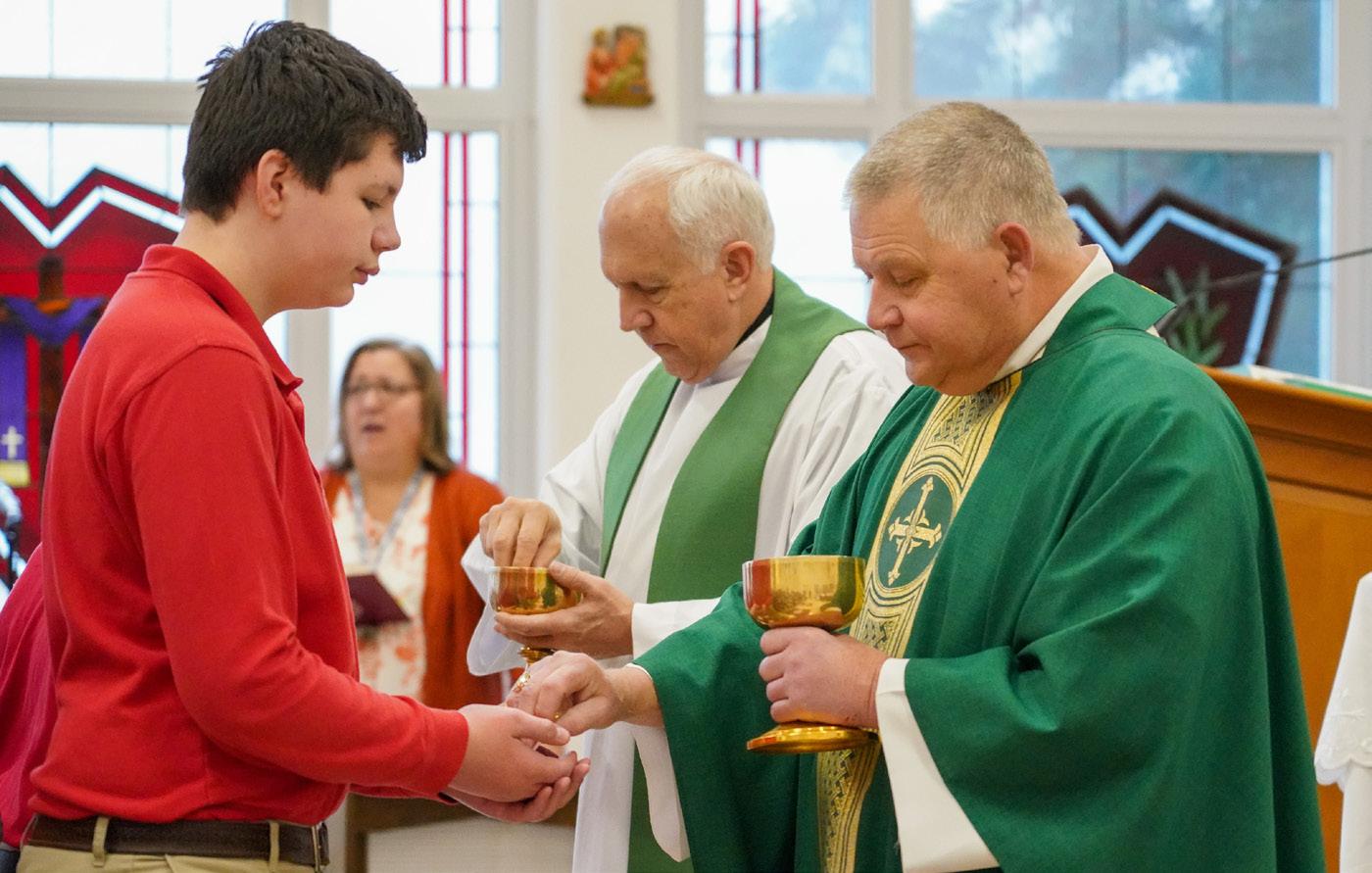
Bishop Richard F. Stika came to St. Joseph School in Knoxville to celebrate an allschool Mass on Jan. 18. After Mass, the bishop met with eighth-grade students in the chapel. He commented on how the school places an eighth-grader in each pew during all-school Masses to assist teachers and serve as role models for younger students. Bishop Stika encouraged the kids to keep serving as leaders in the faith and in every aspect of school life. Eighth-graders are currently doing research for National History Day, and, as a history buff, Bishop Stika was very interested in hearing about all of their projects. Above, the bishop distributes Holy Communion to eighthgrader Connor Brown as Father Chris Michelson assists in the background.
and what is being asked of them, which will in turn allow the players to play fast on game day, maximizing their ability. The most valuable lesson that I have learned in my coaching journey is the ability to communicate with the players as men. The players will always know where they stand and what is expected of them, they will have consistency from me—they will always get the same guy every day—and they will receive a detailed and efficient answer to their questions and will always know why we do things. My job is to develop a culture of winning, both on and off the field. Winning never rests—our focus will be on the things that will help our young men to become better football players every time they walk into the fieldhouse or step on the field.”
The competition in Division II-AAA East is ramped up even more this year with the addition of Lipscomb.
“One of the most attractive things about AAA high school football is that it is the highest/best level of competition of high school football in the state of Tennessee, where you will face the top players and
coaches in the state,” Mr. Cokinos said. “For Catholic football, it will start with developing a strong set of fundamentals within our players. We will teach our players the game in the simplest terms and develop each player’s skill set and get our guys playing fast and physical. Alignment and assignment and team concept will be extremely vital to our success. We have a strong senior class, two Power 5 quarterbacks, and a solid stable of some good-looking athletes participating in the off-season workouts.
“As the players develop physically and mentally over the next months and begin to develop an identity, we expect to be a competitive group in 2023. To reach the top level in the state will be a process that includes adding and developing quality coaches and most importantly attracting new players to our program, and developing these players the moment they step on campus to ensure that we have no gaps in our roster development. This process will require a village of support from our staff, community, parents, and boosters. This year’s senior class will be the group that starts this legacy, and these guys
Carson-Newman’s volleyball team will use her in a different position, Blair said.
“In college I’m going to be a setter. I’m just going to go and compete and try to get playing time,” she said.
Blair said Carson-Newman “just felt like it was right” when she went on a visit there. Plus, her sister,
are ready for the challenge ahead of them. We have a great group of young men that will lead us in the right direction.”
Mr. Cokinos came to Division II-AAA football in 2020 as the special-teams coordinator and inside linebackers coach for Brentwood Academy. He moved to Ensworth in 2021 and worked with the linebackers and served as a senior consultant to the defensive staff with game planning for the last two seasons. He coached the Mr. Football state kicker of the year and two first-team all-league linebackers at Brentwood Academy in 2020 and an all-region linebacker at Ensworth last fall.
Mr. Cokinos attended a Catholic high school, Archbishop Williams, in Boston. He earned a bachelor of science degree in elementary and secondary physical education from the University of Massachusetts and attended graduate school in physical education and health at Austin Peay. His experience includes coaching and GM work in the Arena Football League from 2007 to 2018 and work as a Tennessee Titans pro personnel scout from 2003 to 2007. He won AFL titles and
“That’s where my older sister goes to school right now, so I’ll be able to play with her next year,” she said.
KCHS volleyball head coach
Brent Carter helped prepare her for the next level, Blair said.
“I transferred here in junior year,” she said. “The volleyball here is just so much more aggressive, and Coach Brent is awesome.” n
coach-of-the-year honors in 2008 and 2013. From 1995 to 2001 he worked in the NFL Europe developmental league as a vice president of football operations and head coach in Munich and Berlin.
“We’re excited to welcome Coach Cokinos to Catholic High,” said KCHS president Dickie Sompayrac. “He has a solid understanding of the balance between winning and educating young men and developing lifetime skills. He is highly experienced in football operations and player development, and he builds programs that personify class and excellence. We look forward to Coach Cokinos leading the Fighting Irish on and off the field. Our student-athletes are fortunate to have him as their head coach.”
Mr. Cokinos and wife Trina have two daughters: Isidora, 13, and Alexandria, 11.
“I have been very fortunate and blessed with a great wife and two wonderful girls,” Mr. Cokinos said. “Trina has been the rock of our family. She really is the glue to our family structure—without her support and flexibility, this opportunity as well as many others in my coaching journey would not exist.” n
THE EAST TENNESSEE CATHOLIC B10 n FEBRUARY 5, 2023 www.dioknox.org Catholic schools
COURTESY OF MEAGHAN REDNER (2)
Coach Cokinos continued from page B8
Josh Martin
KATHY RANKIN
