Issue 58 Summer 2026
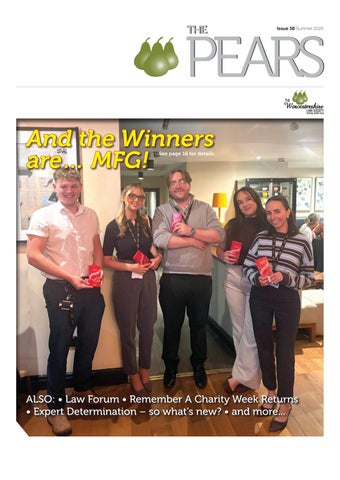
And the Winners are… MFG!
See page 16 for details
ALSO: • Law Forum • Remember A Charity Week Returns • Expert Determination – so what’s new? • and more...
Bulletin Sponsored by
Free Friday Care Tips
Practical advice and information for older people, families and carers When a loved one needs care or support, finding reliable information can be challenging. From understanding benefits and avoiding scams to finding local services and planning ahead, timely advice can make all the difference. Since 1980, Able Community Care has supported older people and adults with disabilities throughout England, Wales, Scotland and the offshore islands. Drawing on 46 years of experience, we share practical information through our Free Friday Care Tip. Delivered by email every Friday morning, each tip provides straightforward information on issues affecting older people, families and carers. Topics include benefits, home safety, health and wellbeing, community support, care planning and consumer alerts, etc. The example below is one of our previous Friday Care Tips.
You do NOT have to pay to apply for the Attendance Allowance or Scotland’s Pension Age Disability Payment (PADP). We recently heard of a pensioner who was contacted unexpectedly and told she could receive up to £114.60 per week and that their company could complete an application for her. A little research revealed that some businesses charge between £250 and £650 + VAT to help with Attendance Allowance claims, while others work on a “No Win, No Fee” basis or take a percentage of the award. Before paying anyone, remember: 1. You can apply yourself online or by requesting an application form. 2. Free help is available from trusted organisations, including: • Age UK – 0800 678 1602 or local branchesCambridge • Independent Age – 0800 319 6789 • Your local Citizens Advice branch Advice organisations consistently point out that you do not need to pay for assistance with an Attendance Allowance application. If you would like to receive The Friday Care Tip each week, please email to: info@ablecommunitycare.com No information is passed on and it is easy to unsubscribe. Able Community Care, The Old Parish Rooms, Trowse, Norwich. NR14 8TZ www.ablecommunitycare.com Trusted for 46 years.
This edition... Issue 58 Summer 2026 4 5 6 6 7 7 8 10 11 11 12 14
Committee Members and Member Firms President’s Introduction Andrew James wins construction industry achievement award Growing law firm celebrates five newly qualified solicitors Waldrons New starter – Elle-Mae Marsh HCR Law rankings rise in Chambers High Net Worth Guide 2026 WCCC v Kent - T20 Match HCR Law remains UK’s leading M&A adviser Trio of promotions announced as Kidderminster law firm mfg Solicitors Responsible business approach supports growth at HCR Law Black Country Cricket Street Sixes Law Forum
Published by: EAST PARK COMMUNICATIONS Ltd. Merseybank Business Centre 55-57 Seabank Road, Wallasey Merseyside CH45 7PA
Advertising Simon Castell
15 16 17 18 20 21 22 24 28 30
What Happens After a Forensic Laboratory Test Is Completed? WJLD Quiz AI-Powered Translation: Why Businesses Still Need Human Oversight Remember A Charity Week returns with new campaign to help drive legacy giving Legacy giving remains resilient, but the future depends on decisions made today Visible Scarring: An Overlooked Aspect of Rehabilitation Expert Determination – so what’s new? The 2026 Expert Witness Institute Online Conference 19th June 2026 Professional services: Key considerations for implementing AI The University of Worcester
Legal Notice © East Park Communications Ltd.
Accounts Tony Kay
Tel: 0151 651 2776
Design David Coffey
simon@eastparkcommunications.co.uk www.eastparkcomms.co.uk
Published August 2026
None of the editorial or photographs may be reproduced without prior written permission from the publishers. East Park Communications Ltd would like to point out that all editorial comment and articles are the responsibility of the originators and may or may not reflect the opinions of East Park Communications Ltd. Correct at time of going to press.
www.worcestershirelawsociety.com
3
Committee Members Kate Collins President Bradley Haynes Law katec@bradleyhayneslaw.co.uk
Elizabeth Miles Committee Member Greens Solicitors elizabeth.miles@greenssolicitors. org
Beth Whitsey Social Media Team beth@bradleyhayneslaw.co.uk
Laura Osborne Administrator Headturner Search laura@headturnersearch.co.uk
Paul Harris Mfg solicitors LLP paul.harris@mfgsolicitors.com
Owen McMullan Secretary owen.mcmullan@greenssolicitors.org
Nick Hughes Committee Member HB 121 Solicitors nah@hb121solicitors.co.uk
Luke Crocker Committee Member Bradley Haynes Law Luke@bradleyhayneslaw.co.uk
Molly Rowe Events Team molly.rowe@silverbacklaw.co.uk
Vishal Mahay Committee member Waldrons Solicitors Vishal.Mahay@waldrons.co.uk
Emma Delaney Equality, Diversity and Inclusivity Representative Bradley Haynes Law emma@bradleyhayneslaw.co.uk
Edward Malkin Events Team edward.malkin@greenssolicitors.org
James Osborne Treasurer Harrison Clark Rickerbys josborne@hcrlaw.com
4
Visit our website: www.worcestershirelawsociety.com or follow us on Twitter: @worcslawsociety
Worcestershire Junior Lawyer Division
Emily Stancer Charity Rep emily.stancer@mfgsolicitors.com
Amy McGowan-Docherty Editor of The Pears magazine Harrison Clark Rickerbys amydocherty@hcrlaw.com
Melissa Higley Chair mhigley@hcrlaw.com
Becky Parker Treasurer becky@bradleyhayneslaw.co.uk
Georgina Groves Committee Member Harrison Clark Rickerbys ghunt@hcrlaw.com
Leah Lewis Vice Chair leah@bradleyhayneslaw.co.uk
Marlena Wierzchowska National Rep marlena.wierzchowska@ mfgsolicitors.com
Jenny Watkins Committee Member University of Worcester jenny.watkins@worc.ac.uk
Isabelle Steven Social Media Team isteven@hcrlaw.com
Aaron Woodfeild Education Rep aaron.woodfield@silverbacklaw. co.uk
www.worcestershirelawsociety.com
President’s Introduction work being done across the county and some of the issues that matter to those working in law today. A big thank you goes to everyone who has contributed articles, news updates and who has helped to bring the publication together.
Dear Members... Welcome to this edition, which gives us another opportunity to celebrate the people and organisations that make up Worcestershire's legal community. In this edition, we take a closer look at the people behind the profession, the
Our next event will be the eagerly awaited Worcestershire Law Society Awards, which will take place on 18th September 2026 at the Bank House in Bransford. The nominations received this year were truly exceptional - what a testament to the quality of Solicitors and Barristers across our county. Congratulations to everyone who was nominated and to those who were shortlisted by our Committee. All those shortlisted were interviewed on 14th July 2026. Thank you to all those who were part of the shortlisting process and interviewing panel - we certainly had a tough job this year!
We have a new addition to our Committee in Emma Delaney from Bradley Haynes Law, who joins the Committee in a reporting role as Equality, Diversity and Inclusivity representative. Emma has accepted the role of EDIC representative from the Law Society and allows her to provide updates to our local teams and for us to provide feedback directly to the Law Society. Make sure you're signed up to receive updates from the Worcestershire Law Society on LinkedIn and by email about our next events and other updates. We look forward to seeing many of you at the WLS Awards 2026 for what is sure to be an exciting evening, showcasing amazing individuals who make up our supportive and engaging legal community. Katie Collins, President, Worcestershire Law Society
www.worcestershirelawsociety.com
5
News News News News News News value disputes (under £100,000), making adjudication more accessible for parties seeking to resolve payment disputes. Andrew led HCR Law’s Construction and Engineering and Planning teams until 2020 and also served on the management committee.
Andrew James receiving his award Andrew James wins construction industry achievement award Andrew James, a Partner in HCR Law’s Construction and Engineering team, has been awarded ‘Achiever of the Year’ at the Constructing Excellence Awards in Birmingham. The award recognises his significant contribution to the construction industry and, in particular, the Constructing Excellence movement. He has chaired the Herefordshire and Worcestershire Constructing Excellence Club (HAWCE) for over 15 years. HAWCE is regarded as one of the most active and successful clubs in the UK, hosting more than 10 events a year. These range from educational talks on topical matters such as the Building Safety Act and AI to site visits to exemplar projects and industry networking events. All are designed to improve the industry and bring people and disciplines together in what can often be a fragmented sector. Andrew was nominated for the award by his peers on the HAWCE committee, who range from contractors to consultants, in recognition of his hard work for both the club and the wider industry. In addition to his commitment to HAWCE, Andrew was recognised for his wider contributions, including serving as a committee member of the Technology and Construction Solicitors Association (TECSA) for over 10 years, where he also chaired the Adjudication Committee. In this role, he devised and implemented the first adjudication scheme for low-
6
Reflecting on his award, Andrew said: “I was delighted to receive this award and to be recognised by my peers in the Constructing Excellence movement in particular. Having been involved in construction law since 1988, I thought it was important to put something back into the industry. I’ve thoroughly enjoyed my time as Chairman of HAWCE and have learnt a great deal from colleagues across different disciplines, as well as making good friends along the way. “I would definitely encourage people to get involved in their local Constructing Excellence club to further their understanding of the industry, learn about the latest topics and get to know new people involved in the industry we admire so much.”
Growing law firm celebrates five newly qualified solicitors Five up and coming solicitors are celebrating after successfully completing their training contracts with mfg, one of the county’s fastest growing law firms.
Rachel Pick, Oscar McCracken, Lauren Collins, Emily Stancer and Sara Southall have now qualified as solicitors having completed their training contracts at the Worcestershire firm and will now take on more clients in their respected specialisms. Rachel joins the firm’s Private Client team and will be based at their Kidderminster office, whilst Oscar will focus on corporate and commercial law and work from the firm’s offices in Birmingham’s Colmore Business District. Trio Lauren, Emily and Sara will be based in Worcester, specialising in agriculture and rural affairs, commercial property and employment respectively. Iain Morrison, partner and chairman at mfg Solicitors, said: “Rachel, Oscar, Lauren, Emily and Sara have excelled and impressed at every turn during their time with us as trainees. “They have exactly the kind of talent, passion and professionalism we are looking for in our team. All five have what it takes to help us grow our reputation and the firm, especially in their chosen areas of law. “It is a lengthy and detailed process to train as a solicitor and every one of them deserve their success. I have no doubt they will go from strength to strength as they contribute further in the months and years ahead.”
Oscar McCracken, Emily Stancer, Rachel Pick, Sara Southall, Sam Pedley and Lauren Collins
www.worcestershirelawsociety.com
News News News News News News The appointment reflects NBB Waldrons’ continued investment in its Business Services Team as it expands the breadth of specialist advice available to businesses, employers and membership organisations across the West Midlands and beyond.
HCR Law rankings rise in Chambers High Net Worth Guide 2026 HCR Law has again been recognised among the UK’s leading law firms advising on private wealth in this year’s Chambers and Partners High Net Worth Guide. Courtney Stephenson and Elle-Mae Marsh, with Vishal Mahay Waldrons New starter – Elle-Mae Marsh NBB Waldrons is delighted to welcome Employment Law Solicitor Elle-Mae Marsh to its growing Business Services Team, further strengthening the firm’s specialist employment law offering for employers, associations and trade unions. Working alongside Partner and Head of Business Services, Vishal Mahay, and the wider Business Services Team, ElleMae will advise employers on a broad range of workplace matters, while also providing dedicated legal support to membership organisations. Her appointment further enhances NBB Waldrons’ employment law expertise, supporting businesses, organisations and membership bodies with practical, commercially focused advice across all aspects of the employment relationship, from contracts, policies and day-today HR issues through to disciplinary and grievance matters, redundancy, settlement agreements and Employment Tribunal claims.
Employment law continues to be a key area for businesses and associations alike. Elle-Mae’s appointment strengthens our ability to support employers with clear, commercially minded advice while continuing to provide an excellent service to our longstanding clients.” Elle-Mae Marsh added: “I’m really pleased to be returning to NBB Waldrons and to be joining the Business Services Team at such an exciting time for the firm. Having previously worked alongside many of the team, it’s fantastic to be back and building on those relationships. I’m looking forward to supporting employers and employees, helping them navigate workplace issues with practical, straightforward legal advice.”
This year 20 partners, alongside four associates and a senior consultant are listed in the rankings (up from 17 last year) with eight lawyers in band 1 and eight in band 2. Katherine Hague, Head of Private Wealth at HCR Law who has been listed in the rankings herself, said: “Chambers and Partners High Net Worth Guide is one of the most respected independent rankings for private wealth lawyers and law firms advising individuals, families, family businesses, trustees and landed estates. “It’s based on extensive client and professional interviews so for HCR Law to perform so consistently well is testament to the commitment, expertise and quality across our whole team.” Continues over page...
Vishal Mahay, Partner and Head of Business Services at NBB Waldrons, said: “We’re delighted to welcome ElleMae back to NBB Waldrons. Having worked with us previously, she already understands our culture and, most importantly, our commitment to delivering practical, client-focused legal advice.
www.worcestershirelawsociety.com
7
News News News News News News HCR Law has achieved its first UK-wide ranking for Landed Estates, which reveals the true growth and expansion of our Agriculture and Estates team, and we have our first ranking for Private Wealth Disputes with four rankings across three regions (Cambridgeshire, Midlands and Wales). This success has been boosted through our expansion across to Cambridge and Leamington Spa. Seven individuals have been ranked in Cambridge alone. These include Partners Daniel Curtis (Joint Head of the Private Client team), Bernadette O’Reilly, Elizabeth Davies and Katherine Hague (Head of Private Wealth sector) Five Solicitors are listed in the ‘Associates to Watch’: These are Keri Rowan, Legal Director Alex Hunt and Alexandra Francis – all based in our Cambridge office, Harriet Black who works across our Hereford and Worcester offices and Senior Associate Hauke Harrack in our Northampton office. Nia Griffiths, who was recently promoted to Head of Private Client in our Cardiff offices, has been named as a rising legal talent who is actively driving the firm's growth in Wales, as has Tom Murphy Kirkhope who is based in our Cheltenham office – this is the second year that Tom has been named as a Chamber’s 'Up and Coming lawyer'. In Cheltenham, Mark Hartley is again listed as senior statesperson, awarded to lawyers who maintain close links with major clients and continue to contribute to their firm’s success.
mfg Solicitors strengthens Contentious Probate team with new appointment A specialist solicitor has joined the nationally recognised Contentious Probate department at Kidderminster law firm, mfg Solicitors. Samantha Evans has joined the team as a solicitor based at the firm’s Birmingham Road offices, where she will advise and work with clients on a variety of complex matters, including disputed estates,
8
Samantha Evans with Andrew Chandler inheritance claims and challenges to the validity of wills. Joining from Worcester firm Bradley Haynes Law, and qualifying as a solicitor in 2025, Samantha will work closely with partner and head of department, Andrew Chandler. Andrew Chandler said: “Samantha is an extremely talented and committed solicitor, so we are delighted to welcome her to the firm. “She joins us at a time when more and more individuals look to us for specialist advice around extremely complex wills, inheritance and estate disputes. She is already making a strong impression with clients, which highlights what an important appointment this is for the department.” Samantha Evans added: “I wanted to join mfg Solicitors due to its exceptionally strong regional and national reputation. I worked closely with the firm on several occasions while at my previous company and was always impressed by their expertise, professionalism and pragmatic approach. “Joining the team at this stage of my career is a wonderful opportunity and I’m looking forward to making an impact in the months and years ahead.”
www.worcestershirelawsociety.com
For several years, the department has been ranked as one of the leading teams of its kind in the respected Legal 500 guide. The department is also recognised as one of the UK’s largest specialist contentious probate teams, which includes partner Robert Weston who has been named in the Legal 500’s ‘Hall of Fame’ list for five years in a row.
WCCC v Kent - T20 Match NBB Waldrons were delighted to welcome a full capacity crowd of clients, contacts and friends of the firm to Worcestershire County Cricket Club on Friday 3rd July as proud match sponsors for the Rapids’ memorable T20 victory over Kent. Held at New Road on a glorious summer evening, the event brought together businesses and organisations from across Worcestershire and the wider region for an evening of hospitality, networking and outstanding cricket. Guests enjoyed the opportunity to reconnect with familiar faces, build new relationships and watch one of the most memorable performances of the season. Worcestershire Rapids produced a record-breaking display, with one Continues on page 10...
News News News News News News The Midlands also climbs to the top spot year on year, and Wales records a standout performance, rising to first place. London ranks third this quarter. These results reinforce HCR’s position as a national adviser for corporate transactions of all sizes, with the depth and scale to support clients navigating a market increasingly defined by fewer, higher-value opportunities.
Rob Bhol, Sikandar Raza and Luke Boxall towering six even finding the roof of the NBB Waldrons marquee, adding another unforgettable moment to a remarkable evening. Congratulations also go to Player of the Match, Sikandar Raza, whose outstanding all-round performance helped inspire the Rapids to victory. Following the match, he was pictured (see above) with NBB Waldrons Founder & Group CEO, Rob Bhol, and Partner, Luke Boxall.
HCR Law remains UK’s leading M&A adviser HCR Law has retained its position as the UK’s leading legal adviser for mergers and acquisitions (M&A), according to
Experian’s MarketIQ Q1 2026 rankings. The firm again ranks first nationally, extending its lead in a market increasingly shaped by selectivity rather than volume, with a 37% margin over its nearest competitor. UK M&A continues to reflect a ‘volume down, value up’ trend, with deal value driven by fewer, larger and more strategic transactions. Buyers remain disciplined, with enhanced due diligence and longer timelines, while core activity is supported by resilient SMEled and domestic deals, alongside sustained inbound interest, particularly from US investors. Regionally, HCR Law continues to perform strongly across the UK. The firm holds first place in the South East and South West, while the East of England moves up to joint first.
Richard Wilkey, Head of Corporate, said: “It’s encouraging to see HCR remain number one nationally at a time when overall deal activity is down and the market has been more challenging, influenced by both international uncertainty and domestic pressures. “Against that backdrop, not only have we held the top UK position, but in several regions we’ve moved into first place, reflecting the strength and consistency of our regional teams. Clients are approaching transactions with greater discipline, supported by more extensive due diligence and longer timelines, and our role is to help them manage that complexity, assess risk and support transactions through to completion. “Our performance this quarter reflects the strength of our team and our regional reach, as the market continues to shift towards more selective, higher value transactions.”
HCR Corporate team rankings: 1st 3rd 1st 1st 1st 1st 1st
I United Kingdom I London I South East I South West I East of England I Midlands I Wales
*based on volume of deals
10
www.worcestershirelawsociety.com
News News News News News News Responsible business approach supports growth at HCR Law Supporting our people, contributing to local communities and managing our environmental impact have long been part of how HCR Law operates. Our Responsible Business Report 2025–26 demonstrates the impact we’re making to clients, current and prospective colleagues and the communities where our offices are based. It highlights the firm’s progress across environmental sustainability, staff wellbeing, equality, diversity and inclusion, community engagement and early careers development. Victoria Griffiths, Kennedy Langley and Rebecca Rogers Trio of promotions announced as Kidderminster law firm mfg Solicitors Kidderminster law firm mfg Solicitors has announced the promotions of three solicitors at its Birmingham Road office, recognising their expertise, dedication, and contribution to the firm's continued success. Head of Commercial Litigation, Rebecca Rogers, has been promoted to Legal Director. In addition, Family law specialist Kennedy Langley and Contentious Probate expert, Victoria Griffiths, have both been promoted to Senior Associates. The promotions form part of mfg Solicitors' ongoing commitment to developing talent across the business and recognising those who continue to deliver outstanding legal advice to clients.
She has built an excellent reputation both within the firm and across the legal sector. “Meanwhile, Kennedy and Victoria have also firmly established themselves as highly valued members of our Family and Contentious Probate teams. They have built strong reputations for delivering excellent client service and are trusted time and time again. “These promotions highlight the depth of talent we have across the firm. I look forward to seeing Rebecca, Kennedy and Victoria continue to thrive in their roles as they contribute to the firm’s ongoing success in the months and years ahead.”
During the year 2025–26, the firm reduced its total emissions by 7%, despite a 17% increase in turnover, as part of its commitment to achieving net zero by 2040. HCR also continues to invest in colleague wellbeing through Smart Working, staff-led initiatives and a range of benefits designed to support physical, mental and financial wellbeing. The firm has strengthened opportunities for future legal talent through partnerships with schools, colleges and universities, alongside initiatives such as HCR Spark and the Hewitson Grant, which provide mentoring, work experience and financial support. Apprenticeships also remain a key part of HCR’s commitment to widening access Continues over page...
Andrew Davies, partner and managing director at mfg Solicitors said: “All three promotions are thoroughly deserved and reflect their hard work and dedication. “Rebecca has been with the firm for 15 years and has become an integral part of our Commercial Litigation team, advising clients on a wide range of complex commercial litigation matters.
www.worcestershirelawsociety.com
11
News News News News News News and supporting social mobility, while the firm’s approach to equality, diversity and inclusion focuses on ensuring talent is the determining factor in opportunity.
Black Country Cricket Street Sixes
After the original fixture was postponed due to the recent heatwave, teams finally took to the streets for an evening of cricket, conversation and friendly competition.
Community impact continues to be a major focus. Over the years, HCR has raised £2m for charities through staff-led fundraising and community initiatives, while colleagues also contribute through volunteering and pro bono support. Programmes such as Impact55, which provides legal funding to start-ups using technology to create positive social or environmental change, help maximise the firm’s social impact through its business connections.
Businesses and organisations from across the Black Country and wider region competed throughout the evening before enjoying the opportunity to network over traditional fish and chips. The event builds on the success of the inaugural Black Country Street Sixes in 2025 and forms part of NBB Waldrons’ ongoing partnership with Worcestershire County Cricket Club.
Rod Thomas, Managing Partner, said: “We have always taken our responsibilities seriously: in how we run our business and support our people, in our contribution to local communities, and in the way we manage our environmental impact. “I believe our approach is authentically HCR – staff-led, meaningful to those involved and grounded in our local communities – and that is why it works.” If you want to be part of a firm where you can grow, contribute and make a difference, HCR offers the opportunity to do just that. Find out more in our Responsible Business Report 2025–26: https://www.hcrlaw.com/wp-content/ uploads/2026/07/HCR-Law-ResponsibleBusiness-Report-2025-26.pdf
This year’s tournament saw Taylors Estate Agents make an impressive Street Sixes debut, taking home the coveted trophy and becoming the 2026 Black Country Street Sixes champions. Businesses from across the region came together at the Black Country Living Museum for The Black Country Street Sixes 2026, a corporate cricket and networking event hosted in partnership by NBB Waldrons, Worcestershire County Cricket Club and Worcestershire Cricket Foundation. Now in its second year, Black Country Street Sixes combines friendly six-aside cricket with business networking,
The Taylors Estate Agents Street Sixes team
12
bringing organisations together in the unique surroundings of the Black Country Living Museum.
www.worcestershirelawsociety.com
Their victory followed a competitive evening played in great spirit by all the teams involved. NBB Waldrons are delighted to support Black Country Street Sixes for the second consecutive year, helping to create an informal setting where businesses can meet, build relationships and enjoy some friendly competition away from the usual networking environment.
Law Forum
Amy McGowan-Docherty The Law forum began alongside the creation of the School of Law. From its inception, the forum was chaired by well-known local figure Joathan Brew. Jonathan led the way for a successful committee of people to assist the School of Law in one of its principle aims of providing students with the opportunity to have close connections and engagements with local professionals. The Forum was also designed to assist the School of Law to have good links with those who may employ graduates of the University and/or provide them with work placement opportunities.
14
Following the retirement of Jonanthan, the forum was chaired by HHJ James Burbidge who continued the success of the forum, enabling forum members to provide guidance on how to ensure that graduates of the University have the best possible chance of securing employment. Over the years the School of Law of Worcester University has ranked highly in The Times & Sunday Times rankings for the employability of its graduates, showing the success of the forum. The School of Law would like to give great thanks to former chair Jonnathan Brew and also HHJ Burbidge who have both been brilliant supporters of the school of Law and excellent forum chairs. We are now delighted to welcome new chair Amy McGowan Doherty of HCR law, who is picking up the mantle and hoping to continue the success of the forum moving forwards.
www.worcestershirelawsociety.com
Head of Law, Michelle Clarke commented: “A Senior Associate in HCR Law's Worcester Family Law team, Amy brings professional expertise, strong local connections, and a proven commitment to the legal community. Her leadership, insight and enthusiasm will be invaluable as the Forum continues to grow and on behalf of the Law Forum, we welcome Amy as our new Chair”. Amy McGowan-Docherty, HCR Law commented: “I have been a member of the Law Forum for the past 3 years, and it was an honour to accept the invitation to step up as the new Chair. The Law Forum has been successfully run by HHJ Burbidge for several years and originally set up by Jonathan Brew to build connections between the university, its students and local legal professionals. I hope to continue to build on the success of the forum and I am extremely grateful to the university for this opportunity”
What Happens After a Forensic Laboratory Test Is Completed? passive exposure, cosmetic treatments or other influences relevant to the testing method. Interpretation helps avoid simplistic conclusions and explains both what results indicate and their limitations.
Forensic laboratory analysis is only one stage within a structured forensic analysis process. Once samples have been collected under strict chain of evidence, and analysis is complete, important steps must occur before results can be relied upon in legal or safeguarding contexts.
validated methods. Any anomalies or technical issues are resolved before reporting begins.
Understanding what happens after the laboratory analysis helps set realistic expectations and supports appropriate use of the evidence. Laboratory results are reviewed, verified, interpreted in conjunction with full details of the client’s circumstances, and reported within a formal framework designed to meet evidential standards required in legal proceedings.
Reports explain what was tested, how analysis was carried out and what the results show.
At Forensic Testing Service (FTS), post-testing processes focus on clarity, proportionality and evidential integrity to support balanced decisionmaking in line with the required burden of proof: the Balance of Probabilities. Laboratory Analysis Completion Once forensic analysis has been carried out, results are not released immediately as a standalone Certificate of Analysis. The first step is a review of all available data, and a validation check to ensure analytical integrity. This includes quality control checks, confirmation of findings and internal review to verify results are consistent with
Report Preparation Forensic reports are prepared in a structured and legally defensible format, presenting findings clearly and objectively without assumptions or advocacy.
Language is neutral and scientific, avoiding unnecessary technical complexity while remaining precise. FTS reports do not rely solely on Society of Hair Testing cut-off levels or binary terminology such as “detected” and “not detected”. Instead, results are interpreted in the context of the available evidence and the circumstances of the case. The information is presented clearly so that it can be understood by legal and safeguarding professionals and considered appropriately by the court, focusing on evidential value rather than volume of data. Expert Interpretation Interpretation is a critical part of forensic analysis. Results must be considered alongside relevant contextual information. Expert interpretation takes account of case background, declared information, biological variability and environmental factors that may influence findings. This can include
For the findings to be of evidential value, the expert must clearly describe the process, record the results and explain their potential significance in the context of the case. Industry guidance also emphasises the expert’s responsibility to report findings fully and faithfully. Communication and Expert Support Once reporting is complete, results are shared securely and confidentially only with those who instructed the testing, such as solicitors, local authorities, or private individuals. Sensitive information is handled in accordance with confidentiality and the latest UK GDPR requirements. Where appropriate, support remains available to explain methodology, address technical questions or clarify how findings relate to the case context. Additional documentation, such as expert statements, may also be prepared where necessary. Use of Results in Legal or Safeguarding Contexts Expert forensic analysis informs legal and safeguarding decisions rather than determining outcomes on their own. Reports may support risk assessment, clarify disputed facts or contribute to the wider evidential picture, alongside witness evidence, professional assessments and other relevant material. Forensic evidence provides objective information but does not replace judicial judgement or professional discretion.
Ultimately, this is expert opinion evidence and should be treated as such. Court guidance cautions against attributing a false sense of certainty to forensic findings, particularly where laboratory results are presented numerically. Record Handling and Evidential Integrity Evidential integrity does not end with reporting. Testing data, collected samples, and documentation are stored securely in accordance with legal and regulatory requirements. Confidential handling, secure storage and appropriate retention periods ensure evidence remains available and traceable should it be required at a later stage. Timelines and Expectations Reporting timeframes vary depending on the type of testing, case complexity and whether priority handling has been requested. Standard timelines are communicated at the point of instruction, with sample availability, confirmation requirements and case-specific considerations potentially influencing turnaround times. While efficiency is important, accuracy and evidential reliability are prioritised to ensure realistic expectations. Do you need forensic testing for a case? If you require guidance on the most appropriate testing approach or reporting requirements for your case, our experienced case managers are available to provide advice. You can request a quote, make an instruction or speak to a member of the FTS team via email: expert@forensic-testing. co.uk or call 01924 480272. www.forensic-testing.co.uk
www.worcestershirelawsociety.com
15
WJLD Quiz On 21st August 2026 the Worcester Junior Lawyers Division hosted a fantastic quiz with great food, brilliant atmosphere and plenty of laughs. Big congratulations to the winning firm, MFG Solicitors who took home the trophy. Thank you to everyone who joined and made the evening such a success.
16
www.worcestershirelawsociety.com
AI-Powered Translation: Why Businesses Still Need Human Oversight practitioners report that AI can produce multiple variants of the same term, inconsistent terminology, fragmented meaning and cultural inaccuracies.
Using artificial intelligence (AI) in language translation requires a hybrid system, balancing technology with strong regulation and human oversight, according to PAB Languages Centre. In its report, AI in Translation: Lessons from the front line at PAB, the organisation found that 60% of participating businesses use AI translation tools to enhance their communications. However, the study, based on feedback from PAB’s linguists and project managers, found fewer than 30% of organisations have clear governance frameworks in place for AI use. The report also found that 40% of employees report using AI tools without formal approval, guidance or training from their organisation. PAB works with law firms and regulated organisations supporting certified legal translation and multilingual communication. PAB Chief Executive, Iwona Lebiedowicz, said AI translations have their place, but must be embedded thoughtfully, not blindly. She said: “If used responsibly, AI can support efficiency and enhance workflows, but only alongside professional linguistic
expertise, supported by strong governance, transparent processes and human judgment where accuracy matters most. Organisations should also ensure AI tools comply with their information governance, confidentiality and data protection obligations before client information is processed. “In the legal sector, every clause is reviewed for risk, accountability and professional responsibility, and our practitioners report that editing AI-generated legal translations can take as long as, or longer than, human translation, offsetting any speed gains.” PAB’s project managers report that AI frequently produces multiple variants of the same term or phrase within a single document and said that real consistency requires human oversight and structured processes. Inaccurate legal translations can delay international contracts, create compliance risks and damage commercial relationships. Ms Lebiedowicz added: “Based on feedback from PAB's legal linguists and project managers, AI struggles with the ambiguity of the legal sector. Even with controlled terminology and glossary management,
“The gap between ‘sounds right’ and ‘is right’ is where risk quietly enters. Language models can produce well-formed, fluent translations, but fluency on the surface alone does not guarantee reliability.” She explained that detailed instructions, approved glossaries and documentlevel context can significantly improve AI accuracy. However, developing, maintaining and continuously refining these resources requires ongoing investment in governance, quality assurance and expert oversight, which should be considered when evaluating the true efficiency of AIenabled translation. PAB Languages Centre is hosting a free webinar in September to give organisations guidance on: • Compliance and confidentiality when adopting AI within legal environments • Protecting client trust in an AI-enabled practice • Ensuring people and technology evolve together • Practical frameworks organisations can implement immediately. Find out more and sign up for the webinar on https:// w w w. e v e n t b r i t e . c o . u k /e / real-world-findings-aicompliance-confidentialitythe-human-factor-tickets1996641766271?aff=oddtdtcre ator
About PAB Languages Centre Ltd PAB Languages Centre Ltd delivers certified translation and multilingual communication services, underpinned by the highest standards of quality and security, including Cyber Essentials Plus, ISO 9001:2015 and ISO/IEC 27001:2022. PAB helps UK organisations streamline operations and improve efficiency through an intuitive, easy-to-use platform designed around real business needs. With 24/7 their multilingual contact centre, organisations can now offer seamless conversations at every point of contact, enabling customers to communicate clearly, confidently, and without language barriers any time, in any language. PAB Languages Centre Ltd provides certified translation and multilingual communication services for legal, regulated and international organisations. Trusted by law firms, FTSE 100 companies, and global businesses, PAB delivers accurate, secure and compliant language solutions, supported by Cyber Essentials Plus, ISO 9001:2015 and ISO/ IEC 27001:2022 accreditation. Alongside certified translation services, PAB enables organisations to communicate confidently across languages through its secure 24/7 multilingual contact centre, helping clients deliver seamless customer experiences while maintaining the highest standards of quality, confidentiality and compliance.
www.worcestershirelawsociety.com
17
Remember A Charity Week returns with new campaign to help drive legacy giving Remember A Charity Week will return this September with a national awareness campaign, new assets and resources for member charities and partners, and a coordinated activation across the charity and professional adviser sectors. An awareness week with a long legacy Taking place from 7–13 September 2026, the annual awareness week, will once again bring together charities, professional advisers and partners across the UK. The aim is to spark widespread conversations around charitable legacies and the vital role they play in funding charities’ work, encouraging more people to consider leaving a charitable gift in their Will. This year’s advertising campaign builds on Remember A Charity’s popular ‘Be Remembered’ theme, which celebrates the unique and quirky things we remember about our loved ones, with the launch of three new adverts to reach and engage new audiences. The national multi-channel advertising campaign is designed to help normalise legacy conversation, with the new ads continuing to run on digital channels until December 2026. Remember A Charity Week forms a key part of the consortium’s ‘always on’ consumer workstream, keeping legacies front of mind across the year. Support for charities To help charities maximise the opportunity, Remember A Charity has developed an extensive suite of customisable campaign resources for members and partners. These assets are designed to help legacy and fundraising teams engage supporters, colleagues, volunteers and stakeholders in the campaign and extend its reach through their own channels. The resource pack features over 100 customisable assets, including a wide range of video assets for social, physical assets like posters and bookmarks, internal comms assets and campaign merchandise. An accompanying PR toolkit includes press release templates, key messages, and guidance for case study collation, showing how both internal and external spokespeople can use their voice to bring the legacy conversation to life. Crucially, Remember A Charity will also use the week as a platform to activate its professional adviser and partnership network, encouraging estate planners and financial professionals to raise awareness of charitable gifts in Wills with their clients. A growing sector Recent research from Remember A Charity’s consumer benchmarking study points to continued growth in legacy giving. Overall, 22% of charity supporters aged 40+ say they have included a charitable gift – up from 14% in 2010. A further 35% of supporters who have not yet done so are open to leaving a gift. Lucinda Frostick, Director at Remember A Charity, said: “Remember A Charity Week provides a unique opportunity for charities and professional advisers to come together and inspire
18
www.worcestershirelawsociety.com
more people to consider the difference a gift in their Will can make. This year’s campaign brings fresh creative content, new resources for members and a fully coordinated approach to help keep legacy giving front of mind. “Legacy gifts are a vital source of income for charities of all sizes and causes. By working together during Remember A Charity Week, we can encourage more conversations, reach new audiences and help secure future funding for the causes people feel most passionately about.” Charities are being encouraged to take part in the awareness week through a range of activities, from supporter communications and digital engagement to internal awareness initiatives and collaborative partnership activity. For more information about Remember A Charity Week and opportunities to take part in this year’s campaign visit rememberacharity.org.uk/join.
www.worcestershirelawsociety.com
19
Legacy giving remains resilient, but the future depends on decisions made today Solicitors have long played a central role in helping people put their final wishes into effect. Whether advising on estate planning, drafting wills or administering estates, legal professionals are often involved in some of life’s most significant decisions. Increasingly, that includes conversations about charitable giving. The latest Legacy Giving Report 2026, published by Legacy Futures and Smee & Ford, demonstrates just how important gifts in wills have become, not only for charities but also as part of the wider estate planning landscape. The report estimates that legacy income reached £4.4 billion in 2025. While this represents a modest reduction from the exceptional £4.6 billion recorded in 2024, the market has proved far more resilient than many anticipated. Following the clearance of the probate backlog by HM Courts and Tribunals Service last year, many expected a more significant slowdown in estate administration and, in turn, legacy income. Instead, estates containing a charitable gift remained close to record levels and average gift values continued to hold firm. A resilient market For charities, this resilience matters enormously. Among the UK’s 1,000 largest legacy supported charities, gifts in wills now account for around 30% of all fundraised income, with some sectors relying on them even more heavily. Legacy giving remains one of the most dependable sources of charitable funding at a time when many organisations face continuing economic uncertainty and changing patterns of public giving. For the legal profession, however, the findings also highlight a broader trend. Giving through wills is becoming an increasingly established part of estate planning, reflecting clients’ values alongside their financial and family priorities.
20
The report found that there were approximately 44,000 estates containing a charitable gift in 2025, making it the second highest year on record. Around 104,000 charitable bequests were made, while average gift values reached £44,000. Residual gifts averaged £98,000 and pecuniary gifts averaged £6,100. These figures demonstrate the continuing willingness of individuals to include charities in their wills, even during periods of wider economic uncertainty. They also underline the need for clients to have access to informed, balanced advice when making decisions about their estates. The solicitor’s role Solicitors are uniquely placed to facilitate those conversations. Research consistently shows that many people are unaware that they can leave a gift to charity alongside providing for family and friends. Others may not understand the inheritance tax implications of such giving, or the flexibility that exists when drafting a will. Importantly, the solicitor’s role is not to encourage charitable giving, but to ensure that those seeking advice are fully informed about the options available to them and that their wishes are accurately reflected. Where a client has charitable intentions, professional advice can help ensure those wishes are expressed clearly, reducing the risk of ambiguity or disputes during estate administration. The report also identifies several developments that will shape the future of the market. Planned inheritance tax changes and pension reforms are expected to increase the complexity of many estates and may temporarily affect the timing of legacy income reaching charities. At the same time, demographic change is creating significant opportunities. As the Baby Boomer generation transfers unprecedented levels of wealth over the coming decades, legacy income is forecast to grow to £5 billion by 2029 and potentially reach £10 billion annually by 2046. Looking to the future Legacy gifts received today are the result of decisions made many years, and often
www.worcestershirelawsociety.com
decades, earlier. Overall participation in charitable giving is declining, particularly among younger generations. If fewer people engage with charities during their lifetime, fewer may choose to remember them in their wills in future. This year’s report therefore asks an important question - who are tomorrow’s legators? Understanding the motivations, behaviours and demographics of people who choose to leave gifts in wills is becoming increasingly significant. The research suggests that will writing is happening earlier in life than in previous generations, creating opportunities for charities to build longer lasting relationships with supporters. It also means that advisers involved in estate planning may find themselves discussing charitable giving with clients at different stages of life than in the past. For legal professionals, this changing landscape reinforces the importance of robust will writing and estate planning advice. As peoples’ financial affairs become more complex and family structures more varied, carefully drafted wills are essential to ensuring that personal wishes, including charitable intentions where appropriate, are fulfilled. Acting today for tomorrow The report’s central message is ultimately one of cautious optimism. Today’s market remains strong, with estates containing gifts to charity, gift values and overall income performing better than expected. However, resilience alone is not enough to secure future growth. Legacy giving is, by its nature, a longterm endeavour. The gifts charities receive tomorrow depend on the conversations taking place today, and the legal profession has a vital role in helping clients make informed decisions about the legacy they wish to leave. For solicitors advising on wills and succession planning, these conversations are among the most meaningful and lasting they will facilitate. Ashley Rowthorn Executive Director, Legacy Futures
Visible Scarring: An Overlooked Aspect of Rehabilitation Successful wound healing does not always mean successful rehabilitation. Long after a scar has reached physical maturity, its visibility may continue to influence confidence, social interactions, employment, relationships and the everyday choices people make about how they present themselves. Specialist skin camouflage forms one part of a holistic rehabilitation approach, helping some individuals regain confidence and control while supporting the principle of reasonable restitution. Rehabilitation Beyond Wound Healing Rehabilitation following injury extends beyond physical healing. For individuals living with visible scarring, recovery may also involve addressing the psychological, social and functional consequences that persist after medical treatment has concluded. The aim is to maximise an individual's physical, psychological, social and vocational recovery, enabling them to resume everyday life as fully as possible. Where visible scarring continues to affect daily life, interventions that reduce its functional and psychosocial impact can support independence, participation and quality of life, reflecting the principle of reasonable restitution. Specialist Skin Camouflage: More Than Cosmetic Specialist skin camouflage is one such intervention. Unlike conventional cosmetics, it is a clinically informed process delivered by trained practitioners using individually matched, highly durable products and techniques to reduce the visible impact of scarring or skin disfigurement. Rather than replacing medical or psychological treatment, it complements them as part of a holistic rehabilitation programme.
Although specialist skin camouflage does not alter the scar itself, it can alter the way an individual experiences living with it. While the appearance of a mature scar may remain unchanged, its impact on everyday life is not necessarily fixed. Appropriate rehabilitation interventions can help reduce that impact. A Place Within Holistic Rehabilitation Specialist skin camouflage will not be appropriate in every case, nor does it replace medical or psychological treatment. Instead, it should be viewed as one component of a multidisciplinary rehabilitation pathway, working alongside surgical, dermatological and psychological interventions where appropriate. Greater awareness may help ensure specialist skin camouflage is considered, where appropriate, to reduce the ongoing impact of visible scarring. Considering it alongside other recognised rehabilitation interventions supports a holistic approach to recovery and the principle of reasonable restitution, helping some individuals resume everyday life with greater confidence, independence and dignity. Tonia Goman Founder of Skin Camouflage Bristol Skin Camouflage Consultant Certified Expert Witness
Evidence suggests that specialist skin camouflage can improve quality of life and reduce the psychosocial impact of visible skin conditions and scarring for appropriately selected individuals. Its aim is to reduce the visible impact of scarring where this supports rehabilitation and everyday participation. Supporting Everyday Recovery Visible scarring may influence far more than appearance alone. For some individuals, it can affect confidence in work, education, social situations and relationships. Others may experience unwanted attention, intrusive questions or feel the need to alter clothing, hairstyles or daily routines to conceal a scar. By reducing the visible impact of scarring, specialist skin camouflage may help lessen these barriers, enabling individuals to participate more confidently in everyday life while supporting broader rehabilitation goals. A key aspect of specialist skin camouflage is education and selfmanagement. Individuals are taught how to apply, maintain and safely remove camouflage products, enabling independent use within their daily routine. This promotes choice and selfmanagement, allowing camouflage to become a practical rehabilitation tool that can be used whenever its benefits are most needed. Individualised Rehabilitation Skin camouflage is not a one-size-fits-all intervention. Recommendations are tailored to the individual, considering scar maturity, anatomical location, skin characteristics, lifestyle, occupation and personal rehabilitation goals. For some individuals, camouflage may provide a temporary measure while scars continue to mature or other treatments are being undertaken. For others, it may form part of a longer-term strategy to support confidence, participation and quality of life.
www.worcestershirelawsociety.com
21
Expert Determination – so what’s new? I must declare an interest: I am a keen advocate for expert determination (ED). Why? Because I have Chris Makin been doing them since about 1995, because I was in the first group of 5 to be accredited as an ED by The Academy of Expert (the only professional body to award this accolade), because I am now their chief examiner in ED, but more than anything because I have done dozens of EDs and no-one has ever tried to appeal my decisions. When I give a decision the parties achieve finality to their dispute, which is their main aim. Mind you, it is difficult to appeal an ED’s decision. Many have tried, but they will only succeed on one of three grounds. Let’s look at them. 1. Fraud or collusion This goes back a long way. In the seminal case of Campbell -v- Edwards [1976] 1 WLR 403 dear old Lord Denning explained that the parties had to agree the expert’s decision because they had contracted to do so. But “If there was fraud or collusion, of course, the situation is entirely different. Fraud or collusion unravels everything.” Fortunately there have never been any elements of fraud in any of my EDs, so let’s move on. 2. Failure to follow instructions This is more prevalent. I give two examples. In Begum –v- Hossain [2015] EWCA Civ717 the expert (fortunately not an accountant) was instructed to value the 50% of shares in a company operating an Indian restaurant, giving a non-speaking decision (that is, without giving reasons). He gave reasons – not clever. Secondly, he was instructed to take into account not only the official financial records, but also the handwritten records of takings (one set of records for the taxman and
22
the other showing the true position? Disgraceful!) In the reasons which he was instructed not to give, he said he found the handwritten records too difficult, so he ignored them. Clearly he had not done was he had been instructed to do, and his decision was set aside. The parties would have to start again. Not good. Then with a more technical example we turn to Veba Oil Supply & Trading Gmbh -v- Petrograde Inc [2001] EWCA Civ 1832. This concerned the measurement of the flow of gas in a pipeline across Europe. This had often been measured by a particular brand of flow meter which was now regarded as rather inaccurate, and a new brand was now regularly used. So the expert used the new model. The court found that the expert was required to use the old model and he had not done so. Result: finding flawed, start again. Moral: the parties’ advisers must be very careful in drafting their instructions to the expert, and the expert must be very careful to do as he is told. 3. Manifest error Things have moved on since Lord Denning’s day. He said that the parties must accept the expert’s decision even if he is wrong, because they have contracted to do so. No longer. There are several cases where it was found that the decision should not be accepted if there was a manifest error. Drafting advice: as we now see in many DRCs (Dispute Resolution Clauses) the decision of the expert is final except in the case of fraud or manifest error. So what is a manifest error? Turning first to Amey Birmingham Highways Ltd v Birmingham City Council [2018] EWCA Civ 264, the court found that a manifest error was “…an error which is obvious or easily demonstrable
www.worcestershirelawsociety.com
without extensive investigation.” And the Veba case helps us further, where Simon Brown LJ said, obiter, that manifest errors are “…oversights and blunders so obvious and obviously capable of affecting the determination as to admit no difference of opinion.” So there must be oversights and blunders which are very obvious, and which can affect the decision; in other words, which can cause a party to pay more than they should. So, speaking personally, my view is that the expert must have acted in a particularly stupid way for his/her decision to be overturned. Let us turn then to two recent cases, which don’t tell us anything new, but which reinforce the decisions already described. First, WH Holdings Ltd -v- London Stadium LLP [2026] EWCA Civ 153, a case concerning the holding company of the recently-relegated West Ham UFC and the Olympic Park in East London, where they play. The question was whether an additional £3.6 million should be added to the purchase price, and argument surrounded the difference between “and” and “or”. Philips LJ said that if he had been asked to decide that in normal litigation he would not have agreed with the expert’s decision, but that was not the test here. The expert may have reached the wrong decision, but it was not a manifest error so the decision stood. Now for one which went the other way. In Hamid Nawaz-Khan & Ors -v- UAP Ltd [2026] EWHC 641 (Comm), a share purchase dispute, there were provisions on the liability side of the balance sheet for “Claims Provision” and “Deferred Fee Income”. These were apparently because payment had been received in advance for certain services. So the cash was already in the bank, but the services had not yet been delivered. The expert treated these as cash deposits, as assets not liabilities. By so doing, he counted the cash twice. As the judge said, he caused the Buyer to pay for fresh air. Impossibly stupid? Read on!
Because that is precisely what happened on one of my cases.
change his opinion. Se we were going to court to have his manifest error overturned.
I was approached by a man who had bought a company running an afterschool nursery. Parents would prepay the care costs, often a term at a time, and some £100,000 was in the bank. When consulted, I saw immediately that £100,000 was a liability for services which had not yet been provided. The expert struggled with this, had several meetings with my client, and eventually added the £100,000 to the value of the company! As in Hamid, he treated liabilities as assets and caused my client to pay £100,000 for fresh air.
In the event my client decided to sell his business (this was a branch of a much larger enterprise) and he couldn’t do that with ongoing litigation. So he swallowed the £100,000 – quite unfair.
I knew this expert well, so I wrote and asked him to reconsider. He first said it was none of my business, and then that he would not
But none of this quells my enthusiasm for ED with a competent expert. As with litigation, where I have said many times that lawyers must choose their experts carefully, so with expert determination, a fortiori. Biog: Chris Makin has practised as a forensic accountant and expert witness for 30 years, latterly as Head of Litigation Support at a national firm. He has given expert evidence about 100 times. He also
performs expert determinations. Chris is a fellow of the Institute of Chartered Accountants where he has served on the Forensic Committee, and as an ethical counsellor; he is a fellow of the Chartered Management Institute, a fellow of the Academy of Experts where he serves on the Investigations Committee, and a mediator accredited by the Chartered Arbitrators. He practises as a mediator, from his home in West Yorkshire and his rooms at 3 Gray’s Inn Square, London WC1R 5AH, telephone 020 7430 0333. He has mediated 100+ cases so far, on a huge range of subjects, with a settlement rate to date of 80%. For more see his website with videos: www.chrismakin.co.uk chris@chrismakin.co.uk
www.worcestershirelawsociety.com
23
The 2026 Expert Witness Institute Online Conference 19th June 2026 Sponsored by Bond Solon and Expert Genie Pro
Phillip Taylor MBE
Simon Berney-Edwards
Sir Geoffrey Vos KG
UNMISSABLE INSIGHTS FROM THE EXPERTS AS WE ENTER THE ERA OF AI A review by Phillip Taylor MBE, Richmond Green Chambers Each summer, the Expert Witness Institute (EWI) offers its members and inquisitive visitors what is now their well-established online Conference. It brings together expert witnesses, solicitors, barristers and eminent judges who discuss the key issues facing the expert community. It is always an event not to miss, and this year was no exception as we enter the era of Artificial Intelligence (AI). The Chief Executive, Simon BerneyEdwards opened this year’s Conference remarking on the importance of artificial intelligence to experts. As usual for the regular attenders, the conference this year aimed at a range of issues to cover all levels of expertise, from new experts looking to develop their understanding of key issues, to experienced experts who are looking to develop their practice. The event remains highly instructive for those colleagues who work with or instruct experts. The Opening Keynote Speech: Vos The main guest speaker, Sir Geoffrey Vos KG, who has been Master of the Rolls and Head of Civil Justice for England and Wales since 11 January 2021 addressed the conference as the first of two keynote speakers. “The use of generative AI is a very hot topic” said Vos with his rather teasing ice breaker to the experts – “what
24
piece of career advice will stick with you throughout your career?” The sensible answer should be “(don’t) be too helpful!” Vos submitted that there should be consultation on AI with a rule on what use of AI has made already plus an identification of what AI tools currently use, and distinctions drawn between different types of proceedings. “Costs and delays are reduced” he said, “but experts must follow the rules” even though they will change. There was an interesting review of GPT in his detailed speech. The uses made by unrepresented parties were referred to although the generally accepted view is that such use is “not universally a bad thing” because the legal landscape continues to change. Vos expressed the hope that “clients expect lawyers to use AI” because it is cheaper and quicker for them “so let’s dust off the crystal ball” to understand the uses of AI for the future! Next came the first panel discussion was chaired by Richard Edwards with panellists, Mrs Justice Joanna Smith, Fancourt J, and Samuel Townend KC. After a coffee break, another panel discussion on maintaining credibility and impact was chaired by Josef Cannon KC, with panellists Ram Kumar, Lynne Hannon, Adrian Parsons and Alexander
www.worcestershirelawsociety.com
Learmonth KC. The panel discussions are always very helpful for the exchange of views and the continue to work well online (if we know how to use the system to exchange views!) After lunch, there was a practical session on managing undue pressure and maintaining expert independence, chaired by Peter Mulhern. This session was of particular importance to many attendees. It gives an opportunity to equip experts with ethical frameworks for their work. For many new to the conference the session offered tips on communication techniques and the practical steps needed to manage and document what can sometimes be inappropriate attempts by those instructing experts “to influence their independent, professional opinion” (a problem sometimes more common that experts would like to admit!) In the afternoon there was a most useful legal and policy update led by Sean Mosby, the EWI Policy Manager. This session is often a highlight for attendees as it brings together recent developments and is often in the morning when we might be a bit fresher. We then had an excellent penultimate session from Beth Rigby (not the tv personality) on the communication (Continues on page 26)
The 2026 Expert Witness Institute Online Conference continued... of complex evidence. It goes without saying that this year’s conference had a mix of interesting sessions which would appeal to a very wide range of experts, and it included areas new to many as always. Responsible AI adoption, stronger professional standards, and more effective ways of working under increasing pressure remain the direction of the Bar Standard Board’s new Business Plan for the future. So, for many lawyers attending those priorities are already becoming operational realities. We are expected to manage growing complexity, respond faster, and maintain confidence in the quality and defensibility of their work, while adapting to new technologies and evolving expectations. And that is where we receive so much assistance from experts, so a big “thank you” from us. And, as expert witnesses come under continual scrutiny in the courts, this year’s conference provided essential insight and
26
practical advice to help further develop our knowledge and skills, get instructed, and win repeat business. We heard from senior members of the judiciary, solicitors, and experienced experts as we reflect on important legal updates and ethical issues when considering what instructing parties are looking for. There was great participation in a range of practical interactive sessions and discussions which will enable us to reflect on our work. Closing Keynote Speech: Linnell The EWI were very fortunate to hear from Dr Kay Linnell OBE as the closing speaker wrapping things up at the end of a long online Conference. Kay practices as a forensic accountant and she was the closing speaker. She is a Chartered Accountant, a Chartered Arbitrator amongst many qualifications with an international Forensic Accounting practice. She has given evidence to arbitrations and Courts worldwide in civil, commercial and criminal cases. Kay has acted as advisory accountant to the
www.worcestershirelawsociety.com
Kay Linnell OBE
Justice for Subpostmasters Alliance since 2012, so we received a great deal of sage and contemporary advice. From the flavour of this year’s Conference, it will be very interesting to see what emerges in the next twelve months as AI takes a much firmer hold on much of our work as experts and lawyers. The 2027 Conference will be one not to be missed.
Professional services: Key considerations for implementing AI Artificial intelligence (AI) tools are becoming increasingly embedded within professional services, with uses that range from automating routine tasks to conducting deeplevel data analysis. But embracing AI isn’t risk-free. A survey of underwriters conducted by the Lloyd’s Market Association (LMA) identifies Professional Indemnity (PI) as the insurance line most likely to experience AI-related losses,* driven by the potential for erroneous or hallucinated outputs. Against this backdrop, we’ve set out some key areas of risk that professional services firms may wish to keep in mind when developing and implementing AI tools. Governance and firm-wide policies As a starting point, all firms should have firm-wide policies in place which cover the responsible use of AI tools, bearing in mind that data inputs might differ depending on the nature and security parameters of the tool. The limitations of AI use should be explained to employees at all levels of the firm, including the potential for bias, generation of inaccurate information, as well as privacy concerns. Procedures, including escalation processes, should be established for the management of adverse incidents relating to the use of AI. Firms may also wish to prepare a guidance note to accompany any firmwide policy. Such guidance can include examples of how the policy applies in practice, and be periodically updated as the relevant technologies develop. Where a firm is considering developing AI tools in-house, it may wish to document how that development process took place. Key areas to cover might include a description of the tool, its anticipated function, as well as decisions made in relation to testing and evaluation, design oversight, and controls implemented regarding use of the tool. The document might also consider the likelihood of risk events
28
materialising and any potential impacts on the firm. Ultimately, practitioners need to remember that professional judgement remains crucial and should be exercised when conducting any independent evaluation of AI outputs. The quality of any services provided must not be undermined by undue reliance on technology. Confidentiality One of the major risks with unchecked AI usage is the potential for compromising confidential client data. Firms need to consider carefully how data is used when training AI models and framing prompts for AI tools, including how any data inputted could be subsequently disseminated, especially in the case of open-source AI tools. How such data is treated could also have an impact on material which would otherwise be subject to legal professional privilege. Similar considerations will apply when firms are contemplating purchasing AI tools. Firms should seek to understand exactly what data the tool can collect, where that data is stored, how long it is retained for, and whether customer or client data is used for training models. A vendor should also be able to provide specific details regarding encryption standards, model information, and the use of external data. If a vendor is unable to answer these questions in a clear manner, firms should think carefully before making a purchase. Considerations in this area frequently overlap with legal obligations concerning privacy, data protection, and intellectual property. It should be remembered that PI exposure is significantly heightened where there is an indication that confidentiality obligations might have been breached. Client knowledge of AI use Where a firm’s advice or work product
www.worcestershirelawsociety.com
contains inaccurate or hallucinated material as a result of AI use, and the client then relies on that advice, firms may risk being accused of negligence or misleading the client. From the outset, firms should consider informing prospective clients of any AI tools to be used while work is carried out on their file. Clients may also need to be made aware of the extent of any reliance placed on the tool’s output by the firm. This could take the form of a disclaimer, and may form part of the firm’s letter of engagement. Training Many professionals, and especially those in regulated sectors, are required to exercise due care in service delivery, as well as consistently maintaining good levels of professional knowledge and skill. With the rapid adoption of AI across the professional services sector, staying abreast of technological developments may now be considered necessary to ensure that clients continue to receive a competent professional service in 2026. Firms should therefore review their current training/CPD programmes and consider whether training on AI usage may need to be further embedded. This will ensure that employees remain capable of making informed decisions when using AI tools and that they are up to date on important technological developments, including having a working knowledge of an AI tool’s capabilities and limitations. Additional training on prompt usage and redflag outputs may also be useful. For more information, contact Nicola Anthony, Risk Manager, Lockton at: nicola.anthony@lockton.com This article is co-authored by Lockton in collaboration with Kingsley Napley LLP. *https://lmalloyds.com/lma-surveymaps-underwriters-views-of-ai-lossscenarios-across-key-lines/
The University of Worcester The legal profession continues to evolve at pace, and legal education must evolve with it. At the University of Worcester School of Law, we have introduced two innovative new programmes commencing in September 2026: the LLM in Legal Practice and the LLB (Hons) Law with Policing. Together, these programmes reflect our commitment to preparing students for the realities of modern legal practice, while maintaining the strong academic foundations for which legal education is renowned. Our new LLM in Legal Practice marks an exciting step forward for postgraduate legal education at Worcester. Delivered in partnership with the College of Legal Practice, and led by Dr. Michael Lane, the programme combines Master's level study with comprehensive preparation for Part One and Part Two of the Solicitors Qualifying Examination (SQE). This innovative approach enables students to gain a highly respected postgraduate qualification whilst developing the practical knowledge, skills and confidence required for contemporary legal practice.
30
The SQE preparation modules are delivered online by the College of Legal Practice, providing flexibility for those balancing study with employment or other commitments, while benefiting from the University’s renowned student support and practice-focused teaching. Importantly, the programme has been designed with employers in mind. Through the University of Worcester Law Forum, we consulted with local law firms to design a curriculum which meets the needs of the sector and, further strengthening relationships with the legal profession, the University of Worcester is pleased to offer a 10% tuition fee discount for trainees employed by Law Forum member firms who enrol on the LLM. This initiative demonstrates our commitment to supporting talent development across the region and creating accessible pathways into the profession. Alongside this postgraduate offering, we are also adding to our undergraduate LLB catalogue with the launch of the LLB (Hons) Law with Policing, led
www.worcestershirelawsociety.com
by Danielle Hopton-Jones. This is a distinctive undergraduate degree that explores the increasingly important relationship between law, policing and public protection. Students will develop a robust understanding of core legal principles whilst gaining practical insight into criminal investigations, evidence gathering, safeguarding and multi-agency working within the wider criminal justice system. Teaching is enriched through simulations, use of our purpose-built courtroom facilities, engagement with local police forces and volunteering opportunities within the police service (including within police legal departments) and our Legal Advice Centre. Both programmes share a common ambition: to equip graduates with the knowledge, practical skills and professional awareness needed to thrive in a rapidly changing legal landscape. We look forward to welcoming our first cohorts in September 2026 and to continuing our strong partnerships with legal professionals, employers and the wider community.