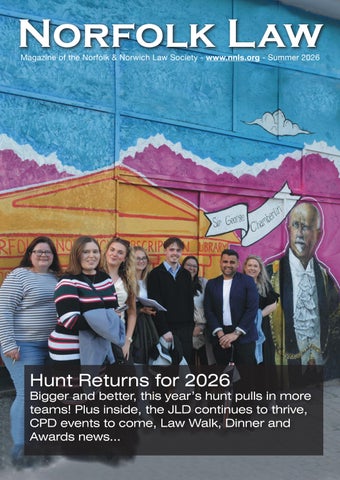
Norfolk Law Magazine of the Norfolk & Norwich Law Society - www.nnls.org - Summer 2026
Hunt Returns for 2026
Bigger and better, this year’s hunt pulls in more teams! Plus inside, the JLD continues to thrive, CPD events to come, Law Walk, Dinner and Awards news...
Norfolk Law - Contents - 3
This issue... Welcome to our Summer edition which includes details of our Excellence Awards nomination categories and coverage of the Treasure Hunt and JLD Wine and Wellbeing event. Autumn CPD programme, and links to Law Walk and Annual Dinner booking sites with the Dinner selling out fast!
Contents 4
President’s Report
15
End of one era...
5
Committee
16
Able Community Care
6
Events Roundup
18
Legacy Giving Report 2026 reveals resilient market
7
Annual Dinner & Excellence Awards
20
Remember A Charity Week returns
8
Wine & Wellbeing event
22
The 2026 Expert Witness Institute Online Conference
10
Routes to Qualification
27
What Makes FHM Forensic Different in Business
11
Excellence Awards Open!
12
Treasure Hunt ‘26
28
AI and the East Anglian Property Market
14
Norwich Legal Runner
30
Key considerations for implementing AI
Published by: EAST PARK COMMUNICATIONS Ltd. Merseybank Business Centre 55-57 Seabank Road, Wallasey, Merseyside CH45 7PA Tel: 0151 651 2776 simon@eastparkcommunications.co.uk www.eastparkcomms.co.uk
Advertising Simon Castell Managing Editor Sue Bailey Layout Stuart Turner pp. 1-17 David Coffey pp. 18-32
Valuation Services?
Accounts Tony Kay
Legal Notice © East Park Communications Ltd.
Published Summer 2026
None of the editorial or photographs may be reproduced without prior written permission from the publishers. East Park Communications Ltd would like to point out that all editorial comment and articles are the responsibility of the originators and may or may not reflect the opinions of East Park Communications Ltd. Correct at time of going to press.
© East Park Communications Ltd.
www.nnls.org
4 - Norfolk Law - President’s Report
President’s Report It is shaping up to be another busy year for the Society as we enter what promises to be a particularly vibrant autumn for our local legal community. Since my appointment, I have been continually encouraged by the warmth, professionalism, and commitment shown by members and I remain deeply grateful for the support of the Committee in driving forward our shared objectives. September and October bring several highlights. The Norwich Law Walk returns on Thursday 17 September, sponsored by East Anglian Chambers. This brilliantly supported event raises vital funds for Norfolk Community Law Service and
www.nnls.org
Norfolk Citizens Advice Bureau, and I warmly encourage firms and individuals to register and walk together. Our Annual Dinner sponsored by Lovewell Blake, incorporating our Excellence Awards will take place at The Assembly House, Norwich on 8 October. We are honoured to welcome I. Stephanie Boyce CBE FKC, Chair of The Solicitors’ Charity and Past President of The Law Society, as our guest of honour. With capacity slightly reduced this year, I urge those yet to secure tickets to book promptly. We are sending out membership renewal paperwork! Membership offers valuable professional development benefits and remains the backbone of our work, enabling us to deliver events, support access to justice initiatives, and strengthen collaboration with partners
including the JLD, UEA and NCLS. In light of ongoing developments in the Post Office Horizon scandal, including recent SRA referrals to the Solicitors Disciplinary Tribunal, the Society is planning a dedicated event later this autumn to examine lessons for the profession and the regulatory landscape, with John Hyde, Deputy Editor of the Law Society Gazette. See website for details. There is much to be done in the months ahead, and I am grateful for the continued engagement of our members. I encourage everyone to participate in our events, renew their membership, and help shape the future of our Society. Milan Pandit, President, Norfolk & Norwich Law Society 2026-27
Norfolk Law - Committee - 5
6 - Norfolk Law - Events
www.nnls.org
Norfolk Law - Events - 7
www.nnls.org
8 - Norfolk Law - Junior Lawyers Division
www.nnls.org
Norfolk Law - Junior Lawyers Division - 9
www.nnls.org
10 - Norfolk Law - Junior Lawyers Division
www.nnls.org
Norfolk Law - Excellence Awards 2026 - 11
www.nnls.org
12 - Norfolk Law - Treasure Hunt
www.nnls.org
Norfolk Law - Treasure Hunt - 13
www.nnls.org
14 - Norfolk Law - Legal Runner
www.nnls.org
Norfolk Law - NCLS - 15
www.nnls.org
16 - Norfolk Law - Advertorial
Meet Kate
Kate is the Norfolk Care Manager of Able Community Care. • For over 18 years Kate has been managing live-in, care support packages for her Cambridgeshire clients. Introducing them to carers who are appropriate and establishing care worker rota’s at her client’s request. • You can ask Kate or any of our other Care Managers about how our live-in care support works, how to set up a care package, how much it costs, the availability and care worker qualifications by calling Kate on 01603 764567. • Live-in care support is a true alternative to moving into a residential care setting and since 1980 we have enabled older people and people with a disability to remain living in their home of choice, their own. If you would like an information brochure about our live-in, care support please call Kate or email to: info@ablecommunitycare.com www.ablecommunitycare.com
www.nnls.org
18 - Norfolk Law - Charity Advertorial
Legacy Giving Report 2026 reveals Canine resilient £4.4 billion market as charities encouraged to act now to safeguard future income Poppy’s • Charitable estates remain near record levels at 44,000 in 2025 When Poppy’s Dog Guardian conta • Legacy income forecast to reach £5 billion by 2029 The Legacy Giving Report 2026,1 launched today by Legacy Futures2 and Smee & Ford3 shows that legacy giving continues to provide vital stability for the UK charity sector, with total legacy income reaching an estimated £4.4 billion in 2025. Despite an expected easing following 2024’s exceptional peak, the legacy market proved more resilient than anticipated. Legacy income remains one of the most dependable sources of charitable funding, accounting for around 30% of fundraised income among the top 1,000 legacy-supported charities, with even higher reliance in some sectors. The report provides the most comprehensive review of legacy giving for the charity sector, combining Smee & Ford’s probate-based data from the UK’s charity Notification Service, with Legacy Futures’ forecasting and analysis. It offers charities detailed insight into market performance, donor behaviour and future trends. Expert commentary from the Chartered Institute of Fundraising (CIOF), the Institute of Legacy Management (ILM), and Remember a Charity provides further sector-wide perspectives. More key findings from the report, include: • Legacy income reached £4.4 billion in 2025, with long-term annual growth rate of 4.3%. • Charitable estates totalled 44,000, the second highest level on record. • An estimated 104,000 charitable bequests were made, down 11% on 2024 following the clearing of the probate backlog. • Average gift values reached £44,000 overall, with residual gifts averaging £98,000 and pecuniary gifts £6,100. • Health charities remain the largest recipients, accounting for 34% of legacy income. • South East, South West and London together account for 44% of all legacy giving
www.nnls.org
•
Legacy income is forecast to grow to £5 billion by 2029 and £10 billion by 2046.
The bigger picture The report highlights that 2024’s record performance was driven in part by HM Courts & Tribunals Service clearing a backlog of probate cases. While some correction was expected in 2025, probate volumes and gift values held up better than forecast, underlining the strength of the market. However, the report warns of emerging long-term challenges. Fewer people are giving to charity overall, and engagement among younger generations is declining. As legacy gifts often reflect decisions made decades earlier, this trend could pose risks to future income. At the same time, upcoming policy changes including inheritance tax thresholds and pension reforms are expected to increase estate complexity and may slow the flow of legacy income in the short term. Who are the legators? This year’s report places a particular focus on “who are the legators?”, exploring the characteristics, behaviours and motivations of those who choose to leave charitable gifts in their wills, alongside how these are changing over time. It examines the impact of demographic shifts, with Baby Boomers expected to drive a significant increase in legacy income as they age, alongside the growing trend for will-writing and legacy decisions to happen earlier in life. This builds a clearer picture of how legacy giving is shaped and how charities can better understand and engage future supporters. Ashley Rowthorn, Executive Director at Legacy Futures and Smee & Ford, said: “This year’s report highlights both stability in the present and uncertainty ahead. Legacy income remains a cornerstone of charity funding, and the outlook is positive in the medium term, with steady growth forecast over the next decade. “However, the decisions that will shape
legacy income in the 2030s and beyond are being made today. Charities that invest in insight, strengthen supporter connections and adapt to changing behaviours will be best placed to realise the full potential of legacy giving in the years to come.” Claire Routley, Consultancy Director Legacy Futures, added: “Legacy giving continues to show remarkable resilience, even as charities face wider economic and societal pressures. What stands out in this year’s data is the strength of the underlying market, with income, estate numbers and gift values all holding up well despite an anticipated correction. “But the report also makes clear that future growth cannot be taken for granted. Charities need to understand who their supporters are, how motivations are evolving, and how to build lasting relationships that translate into long-term support through gifts in wills.” Adding her thoughts, Lucinda Frostick, Director at Remember A Charity, said: “At a time when charities are facing economic uncertainty and donor behaviours are changing, having access to strong, reliable insight really matters. The Legacy Giving Report 2026 brings together essential data and insights to help charities understand the trends shaping gifts in wills and make confident decisions about their future. We’d encourage charities large and small to dig into the report and use the findings to strengthen their legacy fundraising strategies for the years ahead.” The Legacy Giving Report 2026 can be downloaded for free here: https://144850878.fs1. hubspotusercontent-eu1.net/ hubfs/144850878/LTR/The%20 Legacy%20Giving%20Report%20 2026%20-%20Smee%20and%20 Ford%20and%20Legacy%20Futures.pdf
1
2
https://www.legacyfutures.com
3
https://smeeandford.com
20 - Norfolk Law - Charity Advertorial
Remember A Charity Week returns Canine with new campaign to help drive legacy giving Poppy’s
extend its reach through their own channels. The resource pack features over 100 customisable assets, including a wide range of video assets for social, physical assets like posters and bookmarks, internal comms assets and campaign merchandise. An accompanying PR toolkit includes press release templates, key messages, and guidance for case study collation, showing how both internal and external spokespeople can use their voice to bring the legacy conversation to life. Crucially, Remember A Charity will also use the week as a platform to activate its professional adviser and partnership network, encouraging estate planners and financial professionals to raise awareness of charitable gifts in Wills with their clients.
Remember A Charity Week will return this September with a When Poppy’s Dog Guardian conta national awareness campaign, new assets and resources for member charities and partners, and a coordinated activation across the charity and professional adviser sectors.
A growing sector Recent research from Remember A Charity’s consumer benchmarking study points to continued growth in legacy giving. Overall, 22% of charity supporters aged 40+ say they have included a charitable gift – up from 14% in 2010. A further 35% of supporters who have not yet done so are open to leaving a gift. Lucinda Frostick, Director at Remember A Charity, said:
An awareness week with a long legacy Taking place from 7–13 September 2026, the annual awareness week, will once again bring together charities, professional advisers and partners across the UK. The aim is to spark widespread conversations around charitable legacies and the vital role they play in funding charities’ work, encouraging more people to consider leaving a charitable gift in their Will. This year’s advertising campaign builds on Remember A Charity’s popular ‘Be Remembered’ theme, which celebrates the unique and quirky things we remember about our loved ones, with the launch of three new adverts to reach and engage new audiences. The national multi-channel advertising campaign is designed to help normalise legacy conversation, with the new ads continuing to run on digital channels until December 2026. Remember A Charity Week forms a key part of the consortium’s ‘always on’ consumer workstream, keeping legacies front of mind across the year. Support for charities To help charities maximise the opportunity, Remember A Charity has developed an extensive suite of customisable campaign resources for members and partners. These assets are designed to help legacy and fundraising teams engage supporters, colleagues, volunteers and stakeholders in the campaign and
www.nnls.org
Lucinda Frostick
mind.
“Remember A Charity Week provides a unique opportunity for charities and professional advisers to come together and inspire more people to consider the difference a gift in their Will can make. This year’s campaign brings fresh creative content, new resources for members and a fully coordinated approach to help keep legacy giving front of
“Legacy gifts are a vital source of income for charities of all sizes and causes. By working together during Remember A Charity Week, we can encourage more conversations, reach new audiences and help secure future funding for the causes people feel most passionately about.” Charities are being encouraged to take part in the awareness week through a range of activities, from supporter communications and digital engagement to internal awareness initiatives and collaborative partnership activity. For more information about Remember A Charity Week and opportunities to take part in this year’s campaign visit rememberacharity.org.uk/join.
Norfolk Law - Advertorial - 21
P We’ve We’ve
www.nnls.org
22 - Norfolk Law - EWI Online Conference
The 2026 Expert Witness Institute Online Conference Friday 19th June 2026 Sponsored by Bond Solon and Expert Genie Pro
Phillip Taylor MBE
Simon Berney-Edwards
Sir Geoffrey Vos KG
UNMISSABLE INSIGHTS FROM THE EXPERTS AS WE ENTER THE ERA OF AI A review by Phillip Taylor MBE, Richmond Green Chambers Each summer, the Expert Witness Institute (EWI) offers its members and inquisitive visitors what is now their well-established online Conference. It brings together expert witnesses, solicitors, barristers and eminent judges who discuss the key issues facing the expert community. It is always an event not to miss, and this year was no exception as we enter the era of Artificial Intelligence (AI). The Chief Executive, Simon BerneyEdwards opened this year’s Conference remarking on the importance of artificial intelligence to experts. As usual for the regular attenders, the conference this year aimed at a range of issues to cover all levels of expertise, from new experts looking to develop their understanding of key issues, to experienced experts who are looking to develop their practice. The event remains highly instructive for those colleagues who work with or instruct experts. The Opening Keynote Speech: Vos The main guest speaker, Sir Geoffrey Vos KG, who has been Master of the Rolls and Head of Civil Justice for England and Wales since 11 January 2021 addressed the conference as the first of two keynote speakers. “The use of generative AI is a very hot topic” said Vos with his rather teasing ice breaker to the experts – “what piece of career advice will stick with you throughout your
www.nnls.org
career?” The sensible answer should be “(don’t) be too helpful!”
to work well online (if we know how to use the system to exchange views!)
Vos submitted that there should be consultation on AI with a rule on what use of AI has made already plus an identification of what AI tools currently use, and distinctions drawn between different types of proceedings. “Costs and delays are reduced” he said, “but experts must follow the rules” even though they will change.
After lunch, there was a practical session on managing undue pressure and maintaining expert independence, chaired by Peter Mulhern. This session was of particular importance to many attendees. It gives an opportunity to equip experts with ethical frameworks for their work. For many new to the conference the session offered tips on communication techniques and the practical steps needed to manage and document what can sometimes be inappropriate attempts by those instructing experts “to influence their independent, professional opinion” (a problem sometimes more common that experts would like to admit!)
There was an interesting review of GPT in his detailed speech. The uses made by unrepresented parties were referred to although the generally accepted view is that such use is “not universally a bad thing” because the legal landscape continues to change. Vos expressed the hope that “clients expect lawyers to use AI” because it is cheaper and quicker for them “so let’s dust off the crystal ball” to understand the uses of AI for the future! Next came the first panel discussion was chaired by Richard Edwards with panellists, Mrs Justice Joanna Smith, Fancourt J, and Samuel Townend KC. After a coffee break, another panel discussion on maintaining credibility and impact was chaired by Josef Cannon KC, with panellists Ram Kumar, Lynne Hannon, Adrian Parsons and Alexander Learmonth KC. The panel discussions are always very helpful for the exchange of views and the continue
In the afternoon there was a most useful legal and policy update led by Sean Mosby, the EWI Policy Manager. This session is often a highlight for attendees as it brings together recent developments and is often in the morning when we might be a bit fresher. We then had an excellent penultimate session from Beth Rigby (not the tv personality) on the communication of complex evidence. It goes without saying that this year’s conference had a mix of interesting sessions which would appeal to a very wide range of experts, and it included areas new to many as always. Continues on p.28
Norfolk Law - Advertorial - 23
P We’ve We’ve
www.nnls.org
24 - Norfolk Law - Advertorial
EWI Conference continued... Responsible AI adoption, stronger professional standards, and more effective ways of working under increasing pressure remain the direction of the Bar Standard Board’s new Business Plan for the future. So, for many lawyers attending those priorities are already becoming operational realities. We are expected to manage growing complexity, respond faster, and maintain confidence in the quality and defensibility of their work, while adapting to new technologies and evolving expectations. And that is where we receive so much assistance from experts, so a big “thank you” from us. And, as expert witnesses come under continual scrutiny in the courts, this year’s conference provided essential insight and practical advice to help further develop our knowledge and skills, get instructed, and win repeat business. We heard from senior members of the judiciary, solicitors, and experienced
www.nnls.org
experts as we reflect on important legal updates and ethical issues when considering what instructing parties are looking for. There was great participation in a range of practical interactive sessions and discussions which will enable us to reflect on our work. Closing Keynote Speech: Linnell The EWI were very fortunate to hear from Dr Kay Linnell OBE as the closing speaker wrapping things up at the end of a long online Conference. Kay practices as a forensic accountant and she was the closing speaker. She is a Chartered Accountant, a Chartered Arbitrator amongst many qualifications with an international Forensic Accounting practice. She has given evidence to arbitrations and Courts worldwide in civil, commercial and criminal cases. Kay has acted as advisory accountant to the Justice for Subpostmasters Alliance since 2012, so we received a great deal of sage and contemporary advice.
Kay Linnell OBE
From the flavour of this year’s Conference, it will be very interesting to see what emerges in the next twelve months as AI takes a much firmer hold on much of our work as experts and lawyers. The 2027 Conference will be one not to be missed.
Norfolk Law - Advertorial - 27
What Makes FHM Forensic Different in Business Valuation Services? from the experienced senior team without the overheads and inefficiencies of a large firm.
The FHM team: (Back row) Kirsty Shuckford, Nick McCarthy, Tom Arnold, (Front row): Fiona Hotston Moore and Graham Hines
The team at FHM Forensic Accounting valued approximately 70 private companies in 2025. Typically, we are engaged to value businesses to assist in the resolution of financial disputes. Many of our formal valuation reports are prepared for court proceedings such as for divorces, shareholder and employee disputes and loss claims. Fiona regularly gives evidence in court, international arbitration and mediation. However, we are also engaged to value businesses for commercial purposes such as planning for a business sale or exit, employee share schemes and Employee Ownership Trusts (EOTs), family succession planning and tax reporting/planning. Let’s look at some specific areas where FHM Forensic stands out from other firms. Independence At FHM we are independent. We only provide business valuation and wider forensic accounting services. FHM does not provide accounting, tax compliance or wider advisory services. We are one of the largest dedicated and independent teams of forensic accountants in East Anglia with five senior team members and the capacity to work on both small and large assignments. We are regularly instructed directly by business owners who seek an independent view on the value of their business. Personal service Our experts, Fiona Hotston Moore and Tom Arnold have built a reputation for providing a personal, tailored and
responsive service for every project on which they are instructed. We aim to provide quotes within two working days of receiving an enquiry. We provide regular progress and cost updates to clients. The turnaround time for a valuation report depends on the nature of the instruction and timely provision of information. In most cases where information is readily available and queries are resolved quickly, we can report in three weeks. Logical, understandable and clear reports We provide valuation reports that are clear, logical and comprehensible. We conduct full financial analysis and in the report we will explain our key assumptions, the source of information and any limitations to our opinion. Recent feedback has included: • “Really pleased with your report. I think even a judge will understand it” • “Thank you ever so much for your help on my case. Your work was absolutely brilliant, and you were a pleasure to deal with. I really felt that you had my corner and that your professionalism came through in your report. I think that your report will no doubt have been the start of turning the defendants’ heads into reality and really made a difference for my case.” Cost-proportionate The senior team have considerable experience in undertaking forensic accounting and business valuations within large advisory firms. Fiona has been a senior partner in regional, national and international accountancy firms. However, at FHM Forensic Accounting we work remotely with modest overheads and can provide clients with personal service
Technical expertise backed up with decades of real-life experience Fiona is a qualified accountant and tax adviser, as well as an accredited business valuer (BVI UK) and expert witness. In a career spanning over three decades, Fiona has gained considerable experience advising clients in many sectors - from small companies to international groups. Tom is also a qualified accountant with considerable experience advising clients and has worked in industry and in professional practice. In addition to our experts Tom and Fiona, the dedicated team includes two further qualified and experienced forensic accountants, Kirsty Shuckford and Nick McCarthy. In addition to valuing private companies, we have the experience to value partnerships, sole traders and LLPs. The senior team are well-connected in the wider industry and can call on other specialists and further resource as required such as for complex tax, corporate finance and international matters. Additional support offered to our legal contacts We are delighted to run webinars for our legal contacts which provide insight into business valuation, interpretation of business accounts and tax. We also provide tax cards and budget updates. On our website you will find useful articles, our CVs and brochures. The FHM Minute We have recently launched the “FHM Minute” on our website. Accessed from the button on the home page, it is a regular “one-minute read” feature answering the typical questions we receive from lawyers. Over time this will become a useful library of knowledge for family and litigation lawyers on business valuation and related topics. Contact Fiona Hotston Moore for case enquiries: fiona@fhmforensic.co.uk +44 (0)7770 642491 www.fhmforensic.co.uk
www.nnls.org
28 - Norfolk Law - Feature
AI and the East Anglian Property Market
Silicon Fen Moves Home: How AI is Redefining the East Anglian Property Market previously unavailable to the average buyer. For the investor, AI tools are being used to predict rental yields, removing the ‘gut feeling’ and replacing it with robust ROI forecasting. Frictionless Finance: The 24-Hour Mortgage The most significant pain point in the UK property journey has always been the ‘dead time’ between offer and exchange. In East Anglia, where the legal complexities of historic titles or coastal erosion risks can slow down conveyancing, AI is proving to be a critical accelerant.
For decades, the East Anglian property market has been defined by its contradictions - the hypermodern tech biosphere of Cambridge sitting just miles from the medieval timber-frames of Lavenham and the untamed coastline of North Norfolk. Buying a home here has traditionally been a game of local knowledge, whispered leads, and a fair amount of patience. However, as we move through 2026, a new force is quietly harmonising these extremes. Artificial Intelligence is no longer a futuristic concept and will inevitably become the primary tool for how we find, value, and secure homes across the East of England. Beyond the Search Bar: The Death of the “Filter” For years, house hunting was a digital chore of ticking boxes: ‘three bedrooms’, ‘detached’, ‘garden’. This binary approach often failed the nuanced beauty of our region. You couldn’t search for ‘a cottage with the character of a Broadland retreat but the connectivity for a London commute’.
www.nnls.org
Now, AI is shifting the paradigm from searching to discovering. New platforms and enhanced tools on Rightmove allow buyers to use natural language. AI understands that a buyer in Norwich might value ‘walkability to the Lanes’ over a specific square footage. By using visual recognition to ‘see’ inside photos, AI can identify unlisted features - like original flint walls or south-facing solar potential that traditional metadata misses. The Valuation Revolution: Precision over Guesswork In a market as fragmented as East Anglia’s, where a townhouse in Bury St Edmunds can command a vastly different premium than one in Lowestoft, valuation has always been an art. AI is turning it into a highprecision science. By layering “hyper-local” data, everything from micro-fluctuations in local school ratings to real-time footfall data near new developments, AI-driven Automated Valuation Models are providing a level of transparency
We are also seeing the rise of the ‘SelfDriving Mortgage’. AI-powered lenders can now verify income, conduct credit stress tests and crossreference property data in seconds rather than weeks. When combined with AI-assisted conveyancing, which in the future may be able to flag planning discrepancies or boundary issues instantly, the dream of a “onemonth completion” is moving from a dream to reality. The Bottom Line East Anglia has always been a region of pioneers. Just as the physical landscape was once transformed by Dutch drainage engineers, its property market is now being reshaped by data scientists. For the modern buyer, the message is clear: the tools have changed. To secure a home in this competitive corner of the UK, embracing the Silicon Horizon isn’t just an advantage it’s a necessity. Tim O’Brien, Managing Director, TIDE Services Ltd
30 - Norfolk Law - Advertorial
Professional services: Key considerations for implementing AI Artificial intelligence (AI) tools are becoming increasingly embedded within professional services, with uses that range from automating routine tasks to conducting deeplevel data analysis. But embracing AI isn’t risk-free. A survey of underwriters conducted by the Lloyd’s Market Association (LMA) identifies Professional Indemnity (PI) as the insurance line most likely to experience AI-related losses,* driven by the potential for erroneous or hallucinated outputs. Against this backdrop, we’ve set out some key areas of risk that professional services firms may wish to keep in mind when developing and implementing AI tools. Governance and firm-wide policies As a starting point, all firms should have firm-wide policies in place which cover the responsible use of AI tools, bearing in mind that data inputs might differ depending on the nature and security parameters of the tool. The limitations of AI use should be explained to employees at all levels of the firm, including the potential for bias, generation of inaccurate information, as well as privacy concerns. Procedures, including escalation processes, should be established for the management of adverse incidents relating to the use of AI. Firms may also wish to prepare a guidance note to accompany any firm-wide policy. Such guidance can include examples of how the policy applies in practice, and be periodically updated as the relevant technologies develop. Where a firm is considering developing AI tools in-house, it may wish to document how that development process took place. Key areas to cover might include a description of the tool, its anticipated function, as well as decisions made in relation to testing and evaluation, design oversight, and controls implemented regarding use of the tool. The document might also consider the likelihood of risk events materialising and any potential impacts on the firm.
www.nnls.org
Ultimately, practitioners need to remember that professional judgement remains crucial and should be exercised when conducting any independent evaluation of AI outputs. The quality of any services provided must not be undermined by undue reliance on technology. Confidentiality One of the major risks with unchecked AI usage is the potential for compromising confidential client data. Firms need to consider carefully how data is used when training AI models and framing prompts for AI tools, including how any data inputted could be subsequently disseminated, especially in the case of open-source AI tools. How such data is treated could also have an impact on material which would otherwise be subject to legal professional privilege. Similar considerations will apply when firms are contemplating purchasing AI tools. Firms should seek to understand exactly what data the tool can collect, where that data is stored, how long it is retained for, and whether customer or client data is used for training models. A vendor should also be able to provide specific details regarding encryption standards, model information, and the use of external data. If a vendor is unable to answer these questions in a clear manner, firms should think carefully before making a purchase. Considerations in this area frequently overlap with legal obligations concerning privacy, data protection, and intellectual property. It should be remembered that PI exposure is significantly heightened where there is an indication that confidentiality obligations might have been breached. Client knowledge of AI use Where a firm’s advice or work product contains inaccurate or hallucinated material as a result of AI use, and the client then relies on that advice, firms may risk being accused of negligence or misleading the client.
From the outset, firms should consider informing prospective clients of any AI tools to be used while work is carried out on their file. Clients may also need to be made aware of the extent of any reliance placed on the tool’s output by the firm. This could take the form of a disclaimer, and may form part of the firm’s letter of engagement. Training Many professionals, and especially those in regulated sectors, are required to exercise due care in service delivery, as well as consistently maintaining good levels of professional knowledge and skill. With the rapid adoption of AI across the professional services sector, staying abreast of technological developments may now be considered necessary to ensure that clients continue to receive a competent professional service in 2026. Firms should therefore review their current training/CPD programmes and consider whether training on AI usage may need to be further embedded. This will ensure that employees remain capable of making informed decisions when using AI tools and that they are up to date on important technological developments, including having a working knowledge of an AI tool’s capabilities and limitations. Additional training on prompt usage and redflag outputs may also be useful. For more information, contact Nicola Anthony, Risk Manager, Lockton at: nicola.anthony@lockton.com This article is co-authored by Lockton in collaboration with Kingsley Napley LLP.
*https://lmalloyds.com/lma-surveymaps-underwriters-views-of-ai-lossscenarios-across-key-lines/