None of the editorial or photographs may be reproduced without prior written permission from the publishers. East Park Communications Ltd would like to point out that all editorial comment and articles are the responsibility of the originators and may or may not reflect the opinions of East Park Communications Ltd. Correct at time of going to press.
The beginning of this New Year presents an opportunity to reflect on past events and establish future plans for the year ahead. At the close of last year, the Northamptonshire Law Society bid a sad farewell to our manager, Carolyn, as she embarked upon new paths. We are all sincerely grateful for her dedication to the society and extend our best wishes for continued success in her future endeavours.
It is with pleasure that we welcomed Janine Mulligan as the new
Northamptonshire Law Society Manager at the start of this year. Some members may recall Janine from her previous experience as a family lawyer. We are delighted to have her join Northamptonshire Law Society and anticipate that members will have the opportunity to meet her at forthcoming social events throughout the year. Check out a piece about her in this bulletin.
The past several months has been eventful. In November, I was honoured to attend the Northamptonshire Community Foundation Annual Awards ceremony where I was impressed by the breadth of support provided to local charities by the Foundation. Our local law society located where we are, has many rural areas; the contributions to small local charities are crucial to our rural communities, and the inspiring stories shared at the awards ceremony were truly moving.
Additionally, I had the privilege of attending the High Sheriff of Northamptonshire’s Justice Service held at Holy Trinity Church in Rothwell, my local area and the site of the famous Bone Crypt. The service itself proved both uplifting and memorable.
Recent developments in the legal sector in 2025 have mapped out a schedule for significant legislative changes during 2026. Attention remains on subsequent updates concerning the Mazur appeal. In the world of conveyancing, the government is actively pursuing enhancements to the process; meanwhile, some of us I’m sure recall the era of Home Information Packs (HIPS). Notably, Private Client professionals are closely monitoring the forthcoming Wills Act, which is expected to be one of the most substantial reforms in this area. Last year’s budget and related amendments have also presented ongoing challenges. There is certainly never a dull moment in the legal profession.
I hope you enjoy this edition of the bulletin and please stay informed and engaged about upcoming Northamptonshire Law Society events.
Kind regards,
Laura Carter
President Northamptonshire Law Society
Northamptonshire Law Society Officers & Council Members 2026
President
Laura Carter
Vice President
Ika Částka
Immediate-Past President
Sarah Franklin
Honorary Secretary
Ika Castka
Honorary Treasurer
Jabeer Miah
Constituency Member
Steven Mather
Council Members:
Maurice Muchinda
Louise Tyler
Euan Temple
David Browne
Michael Orton-Jones
Lyndsey Ward
Oliver Spicer
Edward St John Smyth
Society Manager
Janine Mulligan
4 Grange Park Court, Roman Way, Northampton NN4 5EA
Tel: 01604 881154
Email: Sec.nls@outlook.com
All Council members should in the first instance be contacted through the Society Manager.
Northamptonshire
Manorial Rights
The background to Manorial Rights Manorial rights are ancient rights of former lords of the manor. In medieval Europe, under the feudal system, the lord of the manor would allow local inhabitants to occupy and work open land within the manor in return for payment or services. In addition, the lord of the manor retained rights over the land. These manorial rights attached to the lordship (i.e. the title ‘lord of the manor’) and not to the land of the manor.
Manorial rights can still exist in relation to land that:
• is former copyhold land -this was a form of tenure which sat alongside freehold and leasehold tenure. It existed subject to certain manorial rights which could be exercised by the lord of the manor. Copyhold was abolished by the Law of Property Act 1922 and the Law of Property Act 1925 converted a copyhold to a freehold or leasehold title. However the lord’s manorial rights were preserved ; or
• was inclosed pursuant to an inclosure award - the inclosure of common land, allowing it to be owned privately, has taken place since the 12th century and in the 18th and 19th centuries numerous Inclosure Acts were passed. Awards under these Acts sometimes preserved the rights of the lord of the manor
What are the rights?
A lord of the manor may exercise certain rights usually known as ‘manorial incidents’. Such rights could no longer be created after 1925. The main manorial rights can be summarised as:
• the lord’s sporting rights
• the lord’s or tenant’s rights to mines or minerals
• the lord’s right to hold fairs and markets
• the lord’s or tenant’s liability for the construction, maintenance and repair of dykes, ditches, canals and other works
These are just examples and it does not necessarily follow that such rights are legally exercisable. Whilst an index of manors is maintained by HM Land Registry, it is incomplete because registration was voluntary and even the lordships that were registered did not always disclose what, if any, manorial rights were associated with the lordship. The index has been closed to new registrations since 13 October 2003.
Protection of manorial rights
An owner of manorial rights which are claimed to affect a registered estate can protect those rights by either:
• substantive registration of them in their own right
• protecting them by way of an agreed or unilateral notice against the title
Prior to 13 October 2013, manorial rights were not registrable at HM Land Registry in relation to registered land as they qualified as overriding interests. As of 13 October, manorial rights ceased to qualify as overriding interests. Where a manorial right has not been protected by notice or caution against first registration before 13 October 2013, it does not automatically cease to exist on that date. They can still be protected provided they bind the then registered proprietor and the land will remain subject to the interest.
However, unless such a notice is already entered, a person who acquires the registered estate for valuable consideration by way of a registrable disposition after 12 October 2013 will take free from that interest. Until such a disposition is registered the person having the benefit of the interest may apply to protect it by entry of notice.
So there are still areas today where these manorial rights can be relevant, where the land has not changed hands for value post 12 October 2013.
Are the rights still relevant today?
Mineral rights deriving from manorial rights are not usually a serious problem for a landowner as the lord of the manor generally cannot work them without both the landowner’s consent and also the statutory permissions (including minerals planning permission) that are required for mining and extraction. However, manorial rights may have a potential nuisance value as regards future development of the surface land (on the basis that the development may involve a trespass into strata which are the subject of mineral rights or may prejudice future exploitation of any minerals which are present). Landowners may need to consider negotiating for a release of whatever rights may exist or seek indemnity insurance.
The Land Registry have a Practice Guide relating to manors - Practice guide 22: manors - GOV.UK: https://www.gov. uk/government/publications/manors/ practice-guide-22-manors#manorialrights
Land Registry Entries – what to look out for
An example of a Land Registry entry relating to manorial rights:
The way clients search for legal services is changing fast. AI-powered summaries, overviews, and conversational search results increasingly influence decisions before a client even visits a law firm’s website
For law firms, the question is: what does trust mean in an AI-driven world—and how can firms be seen as credible, reliable, and relevant when clients choose who to contact?
Here are five key signals of trust in today’s AI-driven landscape:
1.
Online Reviews from Independent Platforms
When a potential client searches “best conveyancing solicitor near me” or “employment lawyer for unfair dismissal,” AI overviews increasingly feature firms with strong, relevant, and recent client feedback—often before the firm’s website content is considered.
Verified client feedback on platforms like ReviewSolicitors, Google Reviews, and Trustpilot signals transparency and realworld validation.
Additionally, reviews focused on specific areas of law help AI better understand and provide more accurate suggestions.
2. Professional Accreditations Accreditations are a strong indicator of
legitimacy for both clients and AI systems. Major accreditations from the Law Society and regulatory bodies, as well as specialised certifications, enhance a firm’s expertise and ensure compliance. When these accreditations are prominently displayed online and consistently linked to a firm’s digital presence, they help build a more robust trust profile.
3. Clear, Consistent Online Presence
A professional website, active social media, and accurate business listings demonstrate to clients that a firm is established and reliable.
However, in today’s AI-driven search landscape, clients may come across summaries or review snippets before visiting the firm’s website. This highlights the growing importance of maintaining consistency across all digital platforms.
4. Thought Leadership Content
Expert-driven articles, blogs, and commentary demonstrate authority. When paired with reviews and professional credentials, they demonstrate a firm’s ability to handle legal matters effectively. This combination enhances the firm’s overall authority in the eyes of potential clients and the AI systems that influence their decisions.
5. Client Success Stories
People enjoy hearing about others’
Trust in the Age of AI: What Clients Look for When Choosing a Law Firm
experiences. Success stories, testimonials, and outcome-focused feedback are powerful tools for building trust.
Well-structured testimonials that are specific to legal matters, explain why a client chose a firm, and detail what they were helped with are much more likely to surface in relevant AI-generated results.
Why Reviews Are Central
Across all trust signals, one theme stands out: independent validation. Verified reviews—especially those collected and structured on legal-specific platforms like ReviewSolicitors—help AI systems and clients alike identify firms best suited to their needs. Our new website and intelligent search features make it easier than ever to showcase reputation in a way that is trusted, visible, and actionable.
Looking Ahead
AI isn’t replacing reputation—it’s amplifying it. Law firms that invest in authentic reviews, clear expertise, and a consistent online presence will earn client trust before the first conversation even begins.
Explore how ReviewSolicitors can help your firm today: Visit our new website: https:// www.reviewsolicitors.co.uk/
For direct enquiries, reach out to Adam Hall: adam.hall@reviewsolicitors.com
Free online courses – AI Law and Legal Training
Thanks to our colleagues at University of Northampton we’ve been given details of free online courses offered by The Open University on different aspects of AI.
AI Law and Legal Training is a collection of eight free courses funded by UKRI Responsible AI, and in partnership with Citizens Advice and academics at The Open University and the University of Lincoln.
The courses have been developed with support from lawyers at Fieldfisher, Mishcon de Reya and Browne Jacobson.
AI Law and Legal Training is designed to provide practical introductory training to support knowledge and understanding of the responsible and ethical use of Generative AI tools in advice and legal contexts.
These courses have been designed for members of the public, volunteers, advisers and managers in charities and free advice organisations, legal professionals and law students.
These can be accessed via the link https://www.open.edu/ openlearncreate/course/index.php?categoryid=2150
OLCreate: AI Law and Legal Training | OLCreate
It’s free to sign up and as AI becomes ever more relevant to the legal profession these courses are an excellent way to learn more about understanding AI and the legal profession: https://www.open.edu/openlearncreate/course/index. php?categoryid=2150
Fletchers Solicitors marks official opening of Northampton office
Fletchers Solicitors recently celebrated the official launch of its new Northampton office, an important milestone following the acquisition of Shoosmiths’ well-known serious injury and clinical negligence teams. The event brought colleagues, partners and friends together to mark the occasion and reflect on the strong foundations already built in Northampton, as well as the opportunities ahead as part of one of the largest specialist clinical negligence and personal injury firms in the UK.
The new office is based at Vulcan Works, 34-38 Guildhall Road, in the town centre. Head of Office Sharine Burgess, a Past President of Northamptonshire Law Society, said: “We’re really excited to officially open the office and to keep providing the same trusted local support to our clients, partners and the wider community - now with the added backing of Fletchers’ national reach and scale. It was lovely to see so many friendly and familiar faces joining us to celebrate.”
The opening underlines Fletchers’ continued commitment to the region and its focus on supporting clients across Northamptonshire and the wider East Midlands. With more than 80 colleagues joining Fletchers as part of the wider acquisition, the Northampton office brings together established local expertise with national scale and specialist focus - offering reassurance and continuity for clients while also marking a positive new chapter for the team.
Fletchers is pleased to be a part of the legal community in Northamptonshire and Legal Director and Team Leader Louise Tyler has stepped up as a member of the NLS Council.
Northamptonshire
You’ve used the track for years –but
is it
now a legal right?
A tribunal decision on long used access, neighbours’ land and alleged permission Case Name, Reference and Bailii Link Din v Edwards (Right of way - vehicular and pedestrian) [2025] UKFTT 1159 (PC) (23 September 2025) https://www.bailii.org/uk/ cases/UKFTT/PC/2025/1159.html
Summary
The decision of the First-tier Tribunal (Property Chamber) concerns an application to register a prescriptive right of way over a privately owned track. The applicant in this case relied on longstanding vehicular use of the track by herself and by previous owners of her property. The respondent objected to the application on the basis that use of the track had occurred through consent or by way of a licence. The Tribunal allowed the application.
Facts
The applicant is the owner of a residential property known as Bryn Pistyll. Access to the rear of the property is obtained via a track which crosses land owned by the respondent.
Prior to the applicant’s ownership, Bryn Pistyll was owned by Janet BoomsmaGeldard and later by Mr Walder. Throughout their respective periods of ownership, both parties used the track for access to their property. The respondent, Mr Edwards, has been the registered owner of the track since 1999.
On 9 September 2022, the applicant applied to HM Land Registry to register a right of
way over the track for the benefit of Bryn Pistyll. The application was supported by statutory declarations relating to long-standing prior use of the track. The respondent objected to the application, disputing whether the track had been used for vehicular access to the extent claimed and challenging that any such use had been exercised with his consent or pursuant to a licence.
The objection was referred to the Tribunal. The Tribunal heard evidence from the parties and carried out a site inspection in order to assess the physical characteristics of the track and the nature of the alleged use.
Issues
The Tribunal identified two principal issues for determination:
• whether the track had been used for vehicular access to Bryn Pistyll with sufficient continuity to support a claim to a prescriptive easement during the periods when the property was owned by Janet Boomsma-Geldard and Mr Walder; and
• whether the use by either or both of Janet Boomsma-Geldard and Mr Walder was exercised with the consent of, or pursuant to a licence granted by, Mr Edwards or his predecessors in title.
Decision
The Tribunal allowed the application.
The respondent accepted that the track had been used to access the rear of Bryn Pistyll for a period exceeding twenty years. It was satisfied that this long and uninterrupted use was enough to establish a legal right of way acquired through long use.
The respondent’s case was that use of the track occurred with his permission. In particular, he relied on discussions in 2014 about the possibility of granting a licence. The Tribunal concluded that no licence had ever been granted. It also found that later discussions about permission did not shed any light on how the track had been used in earlier years. There was no reliable evidence that access during the period relied upon
had been exercised with consent.
The Tribunal examined the statutory declarations, acknowledging that the declarants were not cross-examined and that one declaration contained a chronological error. Despite this, the Tribunal found that the evidence as a whole, strengthened by the respondent’s own admissions and the Tribunal’s observations at the site inspection, supported the applicant’s case.
On that basis, the Tribunal decided that a legal right of way had been acquired through long use and ordered that this be recorded on the official land register.
Comments
Din v Edwards provides a clear example of how long use can give rise to a legal right of way. The decision underlines that claims of permission must be supported by clear evidence demonstrating the basis on which access was allowed. It also shows that later attempts to formalise access arrangements will not usually defeat a right that has already arisen through long-standing use.
Sara Ali trainee solicitor, Wilson Browne
Previously published by Property Law UK
Property Law UK is an e-magazine and digital library of new and historical case law, catering to property lawyers, solicitors, students, and legal enthusiasts. Our esteemed guest editors, including experienced practitioners, trainers, and barristers, explore headline cases and critical issues. Subscribe now at: https://www. propertylawuk.net
When lawyers are silenced
Attacks on lawyers’ freedom of expression silence the voices essential to upholding justice and accountability, according to a new report from the Law Society of England and Wales.
When Lawyers are Silenced: How restrictions on lawyers’ expression undermine rights, justice and democracy* highlights a troubling global problem.
Through real-life examples, it illustrates how lawyers across the world face harassment, disbarment and imprisonment for speaking out in support of equal access to justice and human rights.
The report details many violations of lawyers’ freedom of expression, including ongoing criminal proceedings against the leadership of the Istanbul Bar Association.**
The charges come from a statement the Association issued calling for an independent investigation into the deaths of two journalists in Syria.
Prosecutors subsequently accused them of “terrorist propaganda” and “disseminating misleading information”.
Law Society president Mark Evans said:
“The intimidation and harassment of lawyers worldwide is extremely concerning, and urgent action is needed to protect freedom of expression in the legal profession.
“The rule of law underpins the rights, freedom and protections that touch the everyday lives of all people in all societies.
“If lawyers are not protected, the justice system collapses and every single one of us will become
vulnerable to injustice. One by one, all of our communities will be adversely affected.
“We call on governments to respect and protect lawyers’ rights in line with international law and to condemn all acts of violence, threats or reprisals against lawyers doing their job.
“Lawyers’ freedom of expression is central to a functioning justice system and a healthy democracy.
“We stand with our colleagues who work tirelessly to uphold the rule of law, human rights, access to justice and the very principles that safeguard our daily lives and families.”
The essential environmental ‘search pack’ for development deals
As a property or real estate lawyer, we know your clients rely on you to foresee risks before they become liabilities. Getting your due-diligence right before acquiring a site is essential to understand the sites development viability. That’s where Landmark1 and Argyll Environmental2 can help. With our recently remastered reports, we compile early insight through clever due diligence, which keep your clients protected and strengthens your advice.
Having a search pack that includes the key risks, but crucially is also compatible with a redevelopment context, means you can foresee issues before they materialise. This provides excellent client care that helps support your client’s decision making during the property transaction.
What trends can we expect in 2026?
Real estate continually adapts to changing macro trends that influence property needs. 2025 was undoubtedly all about the surge in demand for data centre space, driven by AI and cloud technology. In Savills UK cross sector outlook for 2026 they state “…that the biggest impacts of the data
centre boom in the UK in 2026 will be in terms of land deals and competition for land. Logistics developers in particular are already being outbid for key data and power-enabled sites, and we expect this trend to continue for the foreseeable future.”
Savills – Spotlight UK Cross Sector Outlook 2026.3
In addition, grey belt sites are emerging as prime opportunities. These locations, boasting strong transport links and clear local demand, are perfectly positioned to attract heightened interest from developers and investors alike.
At the same time, reforms to the National Planning Policy Framework 4 (NPPF) are intended to improve site supply. As these changes bed in, we’re hoping to see greater land acquisition activity throughout 2026.
Taken together, this suggests a cautiously optimistic outlook for 2026, with the potential for steady growth in development deals across the real estate sector.
Building a search pack for development acquisitions
Many firms already have packs configured for the various transactions they handle. If not, a brief conversation highlighting the benefits we will discuss can help establish these packs in the future. By adopting tailored reports for redevelopment transactions, clients receive outcomes that align precisely with their needs. Below are the reports we offer for redevelopment transactions and how each meets specific client requirements.
SiteSolutions Combined5 ensures environmental risks are fully understood and mitigated. The planning regime can significantly influence risk ratings and change outcomes and recommendations for key environmental risks when compared to a continued use context.
Landmark Utilities prevents costly surprises by mapping underground services. When acquiring land for development, understanding what lies beneath the surface is critical. The report provides a single, comprehensive source of
underground utility data, helping you make informed decisions.
SiteSolutions Highways5 secures clarity on access and rights of way obligations. This report addresses highways adoption status and rights of way, which are often overlooked but critical for site access and future use.
Why SiteSolutions Combined for development acquisitions?
The SiteSolutions Combined is a great starting point to understand what key environmental hazards such as land contamination and flood hazards may be present at the Site. It will help guide you to whether additional work will be required before you can start your construction.
Different assessment outcomes can arise between a “traditional” environmental search: assessing historical land contamination issues under Part 2A of the Environmental Protection Act, and the National Planning Policy Framework.
A change in context to a redevelopment scenario can be the difference between handing your client a Pass or Further Action report. The benefit of having a planning risk assessment embedded in your environmental search is to help spot future requirements early in the decision-making process.
Here are some more benefits….
• Safeguarding investments - Knowing the difference between a continued use transaction and redevelopment could result in a different outcome. But also, if redevelopment is proposed there is variation in effort required to alleviate that risk. Avoid tarnishing the site with the same brush.
• Gain Clarity – for complex sites, data can be plentiful. Not least because of its historical legacy and potential variety of former uses. A consultant will remove the noise and present you with actionable insights that can be easily explained to the end client.
• Technical findings to legal advice -
We are acutely aware that when there are potential issues with a site, just presenting technical findings is not useful. Therefore, you will need a report that translates this into clear next steps you can work with your client on. That’s where the SiteSolutions Combined report comes in.
• Mitigate exposure to liability –
Having a report that is compatible with any transaction context including redevelopment means you can continue to protect your client’s interest and foresee issues before they materialise.
What sets SiteSolutions Combined apart from other contaminated land assessments?
The table below is a concise summary of some of the key attributes that are embedded in the SiteSolutions Combined report, which showcase why there really is no other choice when it comes to redevelopment transactions.
Liability Assessment (Part 2A)
Manual Consultant Assessment for Contaminated Land and Flood
Risk Ratings (e.g. Low, Moderate, High)
Consultants Commentary to explain risk
Tailored recommendations (risk & outcome)
Direct access to the report writer
What’s next?
In the coming weeks you can expect to have more detail in the Landmark Utilities and SiteSolutions Highways report where we will uncover the key features and benefits that demonstrate why they are essential for redevelopment transactions.
Register your interest in Landmark’s upcoming webinar
Landmark Information will soon be hosting a webinar training session focused on the three essential reports for redevelopment transactions: SiteSolutions Combined, Landmark Utilities, and SiteSolutions Highways
Go here to complete the short registration form and secure your place: https://share.hsforms.com/1a-2fSnTBQHqEvIEjm5BIHQbz5ev
Go to https://share.hsforms.com/1a-2fSnTBQHqEvIEjm5BIHQbz5ev to complete the short registration form and secure your place.
Wilson Browne working with University of Northampton
Wilson Browne HR Director Sally Mitchell (left) recently organised an onsite careers event with University of Northampton.
Here’s what she had to say about the event:
When I look back on a successful careers event, I always feel a sense of pride for several reasons. In our people who have given up their time to talk about their journey into law and the jobs they do; in our community engagement, which is so important to us at WB, but more than anything, I feel a sense of pride in the young people that come into our office and take part. For some this may be far out of their
comfort zone, but it doesn’t take long for the questions to come. You see their eyes light up when they are discovering more about the career journey, they are hoping to be part of.
There is definitely a change in vibe as you go through the years and ages of the young people that you interact with at Careers events. From schools where some of the young people are there because they have to be but do want to know more; to those who have chosen their career already, and those that are studying their degrees. But all have something to bring and to learn at whatever stage they are at.
I recently had a meeting with Claire Parsons who is the Careers and Employability Partner for the Faculty of Business & Law at UoN. We had attended an event last year and wanted to follow up. We had recently decided to do something a little different at our offices with Business Studies college students and extended this invite to UoN. Ten young people came to our Grange Park office to have a chat about working in a law firm and the different routes our people have taken.
The students were studying Law in 2nd and 3rd year. They knew what they wanted to do but not necessarily which area of law. We had 8 representatives from our office, all of whom were at different stages in their careers and had different experiences
and journeys. We had 2 Trainees, a New Enquiries Assistant, 2 Solicitors, 1 Associate, 1 Chartered Legal Exec and a Partner, all working in different areas of law.
The students all engaged so well and asked some great questions, I could see some were more nervous than others but once we got going there was no stopping them. One young lady in particular wanted to know everything, which was brilliant, and I am sure she asked some questions others wanted to know about too. I always enjoy listening to our people talk about themselves, I always learn something new and love how passionate they are about the law and our firm.
You could also see the pride the students felt in their learning and knowledge, they had many different backgrounds and were brought together by their passion for the law. Two of our team had attended UoN too and really enjoyed giving back in this way.
But it was trying to get the young people out the door at the end which really made me smile, we had opened a legal can of worms and they just wanted to know more which was brilliant. Whatever area of law they find themselves in, I got the feeling they would be successful.
Ika Částka Vice President, NLS
One in three people with a Will include a charitable gift
With the largest intergenerational wealth transfer now underway, new data from our latest tracking study reveals that almost one in three people aged 40+ with a Will have included a gift to charity (32%) .
The study, based on over 2,000 people who donate to charity more than once a year, indicates that people often write their Will at a younger age than others might think. Almost half of those who have made a Will, did so before they reached their 50s (49%). However, it also shows that almost 2 in 5 people aged 40+ (37%) have not yet written a Will at all.
This New Year, we’re encouraging people, when writing or updating their Will, to consider all the things they care about; loved ones and good causes alike.
Importance of Will-writing
As New Year’s resolutions take shape, January remains the most natural time of year for a financial reset. Writing or updating a Will is essential for anyone who wants to influence how their assets will be distributed beyond their lifetime, while being a key opportunity to protect family, loved ones and any good causes they wish to support.
Good estate planning can also help families reduce their Inheritance Tax (IHT) bill. Charitable gifts in Wills are free of tax, with donations of 10% or more of the net value of the estate reducing the IHT rate from 40% to 36%. However, even amongst wealthier UK households, a significant knowledge gap remains about these tax incentives, with 30% of millionaires in this study saying they were unaware of the tax breaks on charitable gifts in Wills.
Evolving fiscal landscape
This news comes at a time when IHT receipts continue to rise. The Chancellor’s Autumn Budget statement revealed that IHT thresholds will be frozen for another year (until 2030/31). With the Government’s plans to draw inherited pension pots into the scope of IHT from April 2027, experts are predicting that around twice as many estates will be liable for IHT by 2031, 1 prompting more households to think carefully about how they preserve and pass on wealth.
Solicitors, Will-writers and financial advisers are already reporting a growing appetite for inheritance planning. In recent research, 60% said they have seen a rise in demand for estate or tax planning advice, and 65% say they expect charitable tax incentives to become even more important 2 to their clients in the years ahead.
With the UK entering the largest intergenerational wealth transfer in history and many more estates facing an Inheritance Tax liability, having an up-to-date Will in place has never mattered more.
Impact of charitable gifts in Wills
This January, Remember A Charity is urging people to reflect not only on their financial affairs, but the good causes they wish to support alongside their loved ones. Charitable gifts in Wills can make a considerable impact on good causes and communities across the UK – funding vital research, care in the community, emergency helplines, animal welfare, environmental causes and so much more.
Lucinda Frostick , Director of Remember A Charity, says: “The new year is a great opportunity for us all to get our affairs in order and it’s deeply inspiring to see that – for so many people – that includes good causes as well as our loved ones. We’re seeing a growing sense of social responsibility and a real desire to leave the world a little better. No matter the size of the gift, remembering a charity in your Will can be one of the most empowering things to do – helping to sustain urgently-needed charitable services for future generations.”
James Antoniou, Head of Estate Planning & Senior Solicitor at Co-op Legal Services, says: “Typically, the start of the year is the most popular time for putting a Will in place. It’s an essential part of planning for the future and a properly prepared Will is often much easier to do than people realise. Gaining peace of mind that your wishes will be legally recognised and your assets protected for your loved ones after you’re gone are often key incentives however we are increasingly seeing clients choose to include charitable causes in their Wills, leaving a lasting legacy that can make a real difference to the causes that matter to them.”
To explore how charitable gifts in Wills are changing the world, visit the Great Map of Willanthropy.3
Building on the Green Belt: The Hidden Planning Risks Facing East Anglia’s Conveyancers
Across England, the debate over developing on green belt land is growing, and East Anglia is no exception. As local authorities contend with housing demand and land shortages, developers are increasingly targeting protected areas as possible sites for expansion. For conveyancers, this shift introduces new layers of planning and environmental risks that require careful consideration.
According to the latest government data, England’s green belt covers around 1.63 million hectares, representing 12.5% of the country’s total land area. In the East of England, this equates to roughly 233,670 hectares, or 12.2% of the region’s land, with significant coverage across South Cambridgeshire, parts of Essex, and Bedfordshire. Although these figures have remained relatively stable in recent years, the pressure to release land for housing is rising sharply.
“Flood risk, traffic congestion and the lack of supporting infrastructure, such as schools, roads and healthcare, remain major concerns,” says Iain Grimes, Managing Partner at Fraser Dawbarns. “These are not just planning challenges; they directly impact the long-term sustainability of new developments.”
Infrastructure gaps and planning pressures
While housing targets continue to rise, infrastructure investment has struggled to keep up. A recent report from the Home Builders Federation found that the East of England delivered 28,640 homes in 202324, significantly short of the regional target of 45,429.
“Planning policy is not addressing the chronic underfunding of infrastructure,” explains Iain “Hospitals, roads, schools and the services expected by residents are not being planned
in a coordinated way to make development sustainable.”
This mismatch between planning approvals and infrastructure delivery creates uncertainty for conveyancers and their clients. In some cases, land may technically be approved for development but remain impractical to occupy or resell because the necessary facilities aren’t yet in place.
The conveyancer’s challenge
Conveyancers advising on potential or former green belt land face unique due diligence challenges. Having accurate, current information on planning restrictions, environmental risks, and infrastructure capacity is vital for managing client expectations.
“Having the correct information to
inform clients of environmental risks is critical,” notes Iain “Preoccupation conditions are one
of the biggest
issues we see, along with occupancy restrictions tied to local employment. These factors can delay completion or complicate future resale.”
Between 2019 and 2022, approximately 7,200 hectares of green belt land in England changed to developed use, with around
1,100 hectares converted for residential development. For conveyancers, these shifts highlight how planning boundaries and land designations can evolve, often faster than anticipated, bringing new considerations around flood risk, access, and sustainability.
Looking ahead
Most experts agree that pressure on green belt development in East Anglia will continue to rise over the next decade. Yet without coordinated investment in transport, drainage, schools and healthcare, the region risks overdevelopment without infrastructure, a trend that could erode community resilience and increase transaction risk.
“Overdevelopment without infrastructure investment is the biggest concern for the region,” adds Iain
At Geodesys, we help conveyancers manage these planning risks by providing trusted, combined risk and standalone planning reports to support informed decision-making. Our comprehensive searches enable solicitors to spot potential issues early, from flood and environmental factors to pre- occupation conditions, ensuring developments are both viable and sustainable.
East Anglia’s green belt presents both opportunity and risk. For conveyancers, understanding the balance between development potential and environmental impact is essential, and it all starts with reliable, data-led insight.
Ms Julia Tosh v Mr Vivek Gupta [2025] EWHC 2025 (KB)
Julia Tosh v Vivek Gupta - Find Case LawThe National Archives1
Summary
The Claimant brought a claim of clinical negligence after suffering a rare but serious complication (anal stenosis) of an operation performed by the Defendant to surgically remove her haemorrhoids. The judge found that the evidence of the Claimant’s expert was based on limited experience or expertise. There were also several instances where he had not acted in accordance with his duties as an expert.
Learning points
Leaning points for experts
• Expert witnesses are under a duty to assess the arguments of both sides and weigh them up fairly. It may damage or even be fatal to your evidence if you do not engage with the arguments of the opposing side.
• You risk losing credibility if you refuse to admit when you have changed your opinion or make reasonable concessions when you have been shown to have been wrong.
Learning points for instructing parties
• Ensure that the experts you instruct in a clinical negligence case have sufficient expertise and recent experience to identify the standard of a reasonably competent practitioner at the time of the index events.
The case
The Claimant brought a claim of clinical negligence after suffering a rare but serious complication (anal stenosis) of an operation performed by the Defendant to surgically remove her haemorrhoids. The original allegations of negligence in respect of the conduct of the surgery were discontinued after the joint statement, but the Claimant continued to the allege that the Defendant acting negligently in: (i) grading her haemorrhoids, (ii) failing to discuss non-surgical options, and (iii) failing to adequately explain the risk and benefits of the surgery (a ligature haemorrhoidectomy).
Haemorrhoids are graded in severity from Grade 1, small swellings on the inside lining of the anus, to Grade 4, haemorrhoids which permanently hang down from within the anus and cannot be pushed back inside.
The expert evidence
Mr T provided expert evidence for the Claimant and Professor P for the Defendant. Both experts retired from clinical practice prior to the date of the surgery. Counsel for the Claimant conceded that Mr T’s level of expertise in terms of the live issues in this case was limited given how few haemorrhoidectomies he had ever carried out, and how few patients he had seen with grade 3 or 4 haemorrhoids.
The evidence of Mr T
Mr T is a retired general and colorectal surgeon with over 25 years’ experience in a District General Hospital. In crossexamination, he said that by the 1990’s he was working almost exclusively as a colorectal surgeon, mainly cancer but also haemorrhoids. However, he said he had not done many haemorrhoidectomies and had never done a ligature haemorrhoidectomy. From 2009 he was doing very little operating on haemorrhoids and none after 2010. He agreed that it was “a reasonable point” that it was difficult for him to identify the standard of a reasonably competent haemorrhoid surgeon in 2019.
The judge reached the conclusion that Mr T’s evidence was based on limited experience or expertise.
During cross-examination, it emerged that in several instances he had not acted in accordance with his duties as an expert under CPR Part 35 and the Practice Direction to Part 35. These included:
• Referring in his witness statement dated 21 July 2021 to his having read the Claimant’s and Defendant’s witness evidence when this was only served in April 2024.
• Although he accepted that he was under a duty to assess the arguments of both sides and weigh them up fairly, neither his expert report, nor his subsequent report, made any reference to the Defendant’s case and he had not analysed the Defendant’s case.
• Asserting, without any evidence to support it, that the Defendant had graded the haemorrhoids based on their size alone, rather than by using the Grade 1-4 grading system which was consistent with the practice of a responsible body of Consultant Colorectal Surgeons.
• Denying that he had changed
his opinion despite stating in his first report that in his opinion the Claimant’s haemorrhoids were Grade 1 and in the Joint Statement that it was likely that the Claimant had Grade 1-2 piles.
• It was also clear in his report that he wrongly thought the fissure was not healed and therefore needing treating before changing his opinion in the Joint Statement which noted that “as the fissure is healed it needed no active treatment at that time”. Despite this Mr T denied he had changed his opinion. The judge found it concerning that Mr T was unable to make this reasonable concession and admit that he was wrong.
The evidence of Professor P
Until his retirement Professor P was a fulltime colorectal surgeon at the National Bowel Hospital where he undertook a combination of complex and anorectal work. He also ran several clinical trials relating to haemorrhoids in which he did all the surgery. He was made an Honorary Professor of Colorectal Surgery by Imperial College London in 2000. He is the author of 9 recent textbooks in colorectal surgery and has contributed to 300 original articles and 59 book chapters. The Joint Statement listed twelve publications by Professor P on haemorrhoids, including diagnosis and treatment, haemorrhoidectomy and evidence-based practice.
The judge noted that “[Professor P] has extensive experience of diagnosing, grading and treating haemorrhoids and of undertaking haemorrhoidectomies. I found him to be a forthright, straightforward witness who gave direct answers to questions and made concessions where appropriate (as set out in the body of this judgment below). In my judgment his evidence is reliable, objective and unbiased and I therefore consider it appropriate to place considerable reliance on it. I prefer his evidence in all respects to the evidence of Mr T save where he and Mr T agree.”
Testing for ketamine and other drugs in care proceedings
The use of ketamine1 is on the rise in the UK, especially among young people2 Media reports have highlighted the drug’s devastating impact on mental and physical health, such as irreversible damage to the bladder.
While we lack data about how widespread use of ketamine is in Northamptonshire, drug charities have indicated it is a growing problem.
Public concern about ketamine and other drugs have also brought forensic testing into focus. In the family courts, forensic toxicology plays a vital role in determining patterns of drug misuse.
However, not all tests are created equal. A recent case that FTS was involved in highlights this, when a court was almost misled about results.
When urine testing falls short
In this case, urine testing for ketamine had been performed for a parent and had come back negative. This urine test was a presumptive test, a form of screening testing3 for sweat, saliva and urine frequently used by employers, prisons and for court cases because it is quick and cheap.
Questioned in court about how long urine tests can detect drugs for, a rehabilitation centre worker stated that the ketamine urine screening test covered a 14-day period.
FTS’ review of the testing revealed a different story. The urine test, which had been outsourced, gave limited information. FTS reviewed documentation for the test from the outsourced lab, which revealed a detection window of only 1 to 3 days. The negative result and case worker testimony had been taken at face value, potentially overstating the evidence and misleading the courts.
The value of hair strand analysis At FTS, we believe that care proceedings deserve the most rigorous and reliable evidence possible.
This is why we specialise in confirmatory hair testing,4 which provides a long term, verifiable record of someone’s drug use over weeks and months, not just days. In this case, our hair strand analysis revealed a pattern of ongoing ketamine use that the urine testing missed.
Hair testing is a highly accurate method for detecting ketamine and its metabolites, and because FTS interprets all findings in the context of the case, our expert reports provide the court with evidence that is “beyond a reasonable doubt.” FTS can also provide expert witnesses to explain results in court.
This case is a powerful reminder that relying on imprecise information from non-experts can have consequences in family court proceedings. British law clearly states5 that hair strand analysis is to be treated not as a binary “yes or no” test, but as a form of expert opinion evidence.
An expert before the court must explain the testing process, record the results, clearly explain their possible significance, and fully and faithfully report all findings.
FTS boasts the most accreditations on the market for hair strand testing. We run our own UKAS-accredited testing laboratory,6 and our expert reports are specifically designed to meet the high standards of the family courts.
By providing a full forensic investigation and contextualising all findings, we ensure that the courts are equipped with precise, reliable data needed to make informed safeguarding decisions.
How FTS can help with testing for new drugs Ketamine isn’t the only drug of concern in Northamptonshire. Spice and Monkey Dust are just two of the newer synthetic drugs that have emerged in recent years. News reports have highlighted vapes circulating that are laced with Spice, showing many people are not aware of the drugs they are taking, or indeed that they are even consuming drugs.
This also poses a challenge to local authorities and solicitors when it comes to ordering the right drug test. Drugs are constantly evolving, with newly modified versions being introduced regularly.
Courts are still requesting tests for compounds that are no longer in circulation, while some laboratories are still screening for synthetic cannabinoids that have not been seen in the UK for over 10 years. At the same time, they lack the capacity to screen for the drugs on the streets now.
Getting a fuller picture of drug use
For public law proceedings, where costs and delays need to be kept to a minimum, it’s a waste of public funds to request tests for obsolete drugs. FTS is the industry leader in detecting new and emerging drugs. With one of the largest drug panels in the UK, we can test for a much wider range of substances, ensuring novel street drugs aren’t missed.
We lead the way on testing synthetic cannabinoids like Spice and we are the only company in the UK testing for the synthetic cannabinoid ADB Butinaca, currently one of the most used in the UK. FTS is also one of the few providers testing for MDPHP, the active ingredient in Monkey Dust.
We constantly monitor drug trends and develop new methods for testing novel substances. This way we can ensure the family courts can detect the right drugs and are empowered with the facts to make critical safeguarding decisions.
Do you have questions about testing for ketamine or other drugs? Speak to our team about our expert services on 01924 480 272 or email expert@forensic-testing.co.uk Website: Hair Strand Drug & Alcohol Testing for Court Proceedings | FTS7
AN UPDATED COMPREHENSIVE GUIDE TO CURRENT ADOPTION LAW FOR 2020s
For law students and practitioners alike, there has been concern in recent years that some fundamental reform of the law of adoption is urgently needed. We welcome the new, second edition of “Adoption Law: A Practical Guide” by Nasreen Pearce from Wildy, Simmonds and Hill Publishing for 2025.
The title arrives at an interesting time for the modern development of adoption as the strains on the system continue to show. Wildy have provided us again with another excellent book in their practical guide series of titles. We thank Nasreen Pearce for her wise counsel in offering a comprehensive guide to the law, practice, and procedure for lawyers, adoption agencies, support services and other professional bodies who are concerned with adoption for a wide readership. It can make all the difference to the advice we give clients.
For practitioners new to the work, the author covers each stage of the adoption process, including what are difficult issues of contact between the child and their birth parents. It includes the alternative options available by reference to the relevant case law and regulations in relation to domestic adoptions as well as adoptions involving overseas jurisdictions.
The title considers registration of adoption and the sensitive issue of disclosure of information which are explaining in straightforward terms to both knowledgeable readers and those new to this subject. Pearce explains the rights of those parties to challenge decisions made by the professional bodies involved in the process so do use the detailed index at the back for any specific areas you are interested in exploring further.
Nasreen Pearce in updating the second edition has included important developments in this principal area of family law for those wishing to adopt. The book
Appreciations by Elizabeth Robson Taylor of Richmond Green Chambers and Phillip Taylor MBE, Head of Chambers and Reviews Editor, “The Barrister”
looks at the impact of the Convention for the Protection of Human Rights and Fundamental Freedoms on all aspects of the law relating to adoption.
As we expect with all Wildy guides, recent case law has been included in areas such as the notification to fathers and the child’s birth families of any plans to place a child for adoption. We are grateful for the inclusion of the procedure relating to preparation before proceedings begin, and the procedure for applications in the Family Court and, where relevant, the High Court.
The book also includes case law citations in relation to placement orders. It covers leave to revoke a placement order and to oppose adoption and post-placement arrangements for contact. The text sets out new coverage of post-placement contact, and postadoption contact details to update advisers. The commentary covers recent reports and research plus the important decision in R & C (Adoption or Fostering) [2024].
We also found the inclusion of two recent lectures by the President of the Family Division on the modern approach to adoption and open adoption to be of great additional assistance.
The second edition of this hardback book from Wildy was published in 2025.
Discrimination In Housing Law
By
David Renton
ISBN 978 1 91364 856 5 LEGAL ACTION GROUP
The access to justice charity www.lag.org.uk
ESSENTIAL READING FOR HOUSING PRACTITIONERS ACTING FOR CLIENTS FACED WITH REPOSSESSION
There is very little that strikes more terror in the souls of its victims than the threat of impending homelessness via the judicial processes involved, which culminate in the process of eviction.
There ought to be an erudite and readable le book about it — and there is, thanks to this very useful publication from the Legal Action Group (LAG), the access to justice charity, who are justly famed for producing legal texts
accessible not only to lawyers, but to the average concerned reader. David Renton, the author, is a barrister who represents tenants and mortgage holders embroiled in possession hearings.
Published in handy paperback format, the book offers a broad and concise coverage of ‘the use of the principles of equality in housing law’ — and equally of prime importance — the duty of landlords to fulfil their duties under the general categories of fitness and repossession.
As the publishers point out, the book covers the often complex and controversial matters, for example, of council houses let by housing associations, as well as houses held in thrall either to mortgages, or long leases. It should be added that homeowners in mortgage arrears suffer the same anxieties as those who rent — hence the general and urgent need for all practitioners to be duly bound in support of clients who struggle with these and other difficulties in the housing sector.
Practitioners and clients alike coming to grips with these problems will find this book especially helpful. As a concise work of reference, it truly excels. The precise introduction points directly to the subject of the book, namely the Equality Act of 2010 and its related principles — which apply both to business premises and residential properties.
Straightforward to navigate, the book has a detailed table of contents, enabling the reader — lawyer of not — to find the necessary advice they may be looking for, and for those doing further research, the book contains extensive footnotes, plus a detailed and useful index at the back.
Note too, the particular advantage of a 30-page section of precedents — including for example, the precedent entitled ‘Case Summary Application to Set Aside Possession Order.’ Also included in this concise text are Tables of Statutes, Statutory Instruments and also a Table of European and International Legislation.
For practitioners and clients alike, this book emerges as a practical and indispensable purchase.
The date of publication of this paperback book is cited as 2024.
Bereaved are edging closer to financial risk
The proposals laid out in the Finance Bill 2025-26 could put personal representatives – often family or friends of the deceased – at greater financial risk, the Law Society of England and Wales said as the Lords SubCommittee publishes its report on the bill.
The bill reforms inheritance tax, unused pension funds and death benefits.
In its response to the draft legislation published and a call for written and oral evidence last year, the Law Society raised concerns about the proposed responsibilities of personal representatives (PRs), also known as an executor/administrator.
This included:
• lack of control over assets: PRs are taking on responsibilities for assets such as pensions or death benefits which they cannot control*
• liquidity challenges: if PRs are liable for
inheritance tax on these assets, they could face financial difficulties, especially if the assets have already been spent or are difficult to recover
• reluctance to act: family or friends may no longer want to act as PRs, or they may require costly advice if things go wrong. Professionals might not be willing to accept executorship appointments either
• unfair tax liability: the responsibility to pay inheritance tax should apply based on where assets are held. Making PRs responsible for tax on assets they do not control places them in a risky and potentially difficult position
Law Society vice president, Brett Dixon , said: “The death of a loved one is never easy, and managing their estate is an important process designed to distribute assets according to the individual’s wishes.
“The role of a personal representative – the person legally responsible for administering the estate of someone who has died – is extremely important.
“Inheritance tax should, wherever possible, be applied based on where it is held. Making personal representatives responsible for tax on assets they do not control, places them in a risky and potentially difficult position.
“We are pleased that the House of Lord’s Finance Bill Subcommittee has listened to evidence from stakeholders, including the Law Society, and has recommended that the UK government consider approaches that better support and protect personal representatives.
“It is essential that the government recognises the complexities personal representatives face when handling an estate and takes our recommendations into account as the Finance Bill progresses through Parliament.”
Thinking About Live-in Care Support?
• Are you considering Live-in Care for a person you know, or do you already have a care package in place?
• If the thought of Live-in Care is new to you, please call 01603 764567 for further details.
If you are already receiving Live-in Care but would like to compare costs, please call 01603 764567 and we will be happy to discuss.
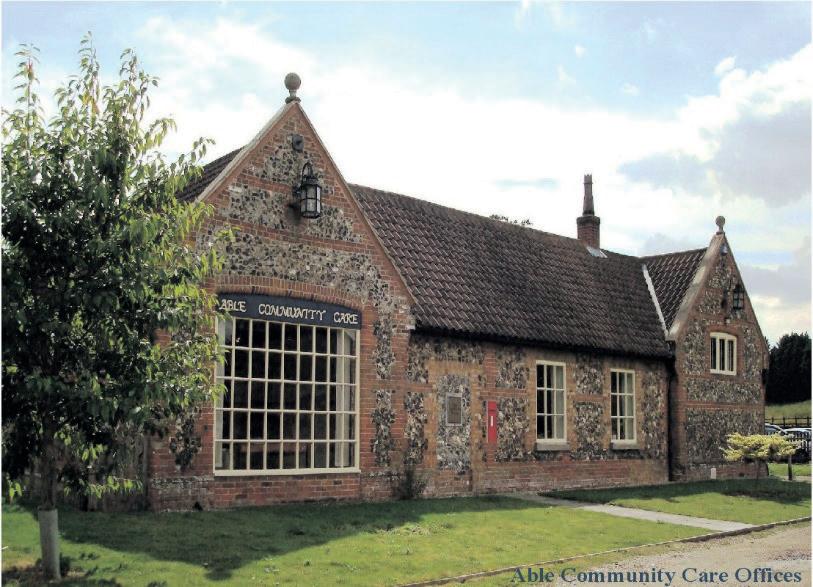
Able Community Care is a Specialist Live-in Care Provider - Established in 1980, we provide expert Live-in Care support. We are based in Norfolk, but our care support is available throughout the UK and the offshore islands.
Get in touch today: Call 01603 764567 or Email to: info@ablecommunitycare.com to request your information brochure or visit our website at: www.ablecommunitycare.com
Home of Able Community Care in Trowse, Norwich NR14 8TZ since 2003.
And Finally...
Hello to everyone and although a little late Happy New Year.
I would like to take this opportunity to introduce myself to you all and give you a little information about myself and my background.
I have taken over the role as the Society’s Manager in place of Carolyn Coles who held the role for over six years and did a fantastic job and has been immensely helpful and
supportive in transferring the reigns to me. This is a new and different role for me, and I am looking forward to working with you all.
I have worked in the legal profession for a considerable time with several firms in Northamptonshire. I was a Chartered Fellow of the Institute of Legal Executives and practised mainly in Family law and it has been nice to hear from some of you who I have dealt with over the years.
I live in Corby with my Husband Scott, and we have two children who are both qualified accountants following in Scott’s footsteps as opposed to mine in the law. Maybe I put them off this line of work..!
I love to walk and I have a passion for CrossFit and go to the gym every day. I like historical dramas and enjoy real time crime programmes – perhaps I should have been a criminal lawyer?
There will be lots to look forward to this year – we are hoping to arrange a Quiz night for Lawyers -v- Accountants, the Legal Walk, the
AGM and of course the Annual Awards Dinner which we are planning to hold in November.
I have contacted my fellow Law Society counterparts and will be meeting up with them in February so I hope I can continue to learn from them in sharing good practices and ideas to build on growing the Society.
Please keep an eye out on LinkedIn and in your inbox for more details.
The Society is always looking for new members so if you have any colleagues who would like to join as a member or Associate member then please do encourage them to contact me and I would be happy to discuss this with them. We are also looking for enthusiastic and enthusiastic individuals who would like to join Council. If this is something that is of interest to you, please reach out to any of the Council members or you can always contact myself. My details are: sec.nls@outlook.com