Breathe easy. This may be the most valuable investment of all.
Dartington is Cambridgeshire's most trusted firm of Chartered Financial Planners for clients seeking wealth management services including investment advice, retirement planning and mortgage advice. Our team includes Chartered Financial Planners, Chartered Accountants and a Chartered Financial Analyst.
Most of our business comes from personal recommendations from other professional advisers including solicitors, accountants, charities, and the Cambridge Colleges. Therefore, all in all, you can be confident that you’re dealing with professional advisers who aren't just full of hot air!
The appearance of advertising copy in this magazine does not constitute an endorsement of the individual advertisers by the Suffolk and North Essex Law Society.
At Framlingham we believe in the individual. There is no typical Framlinghamian, no singular path that we take. Often, we are many things within one. Every pupil is valued for who they are. We are a co-educational day and boarding school for ages 2 to 18, offering full, weekly, and flexi-boarding options from ages 7 to 18. Our extensive bus routes across East Anglia ensure convenient transport for our pupils.
Can’t make an Open Morning? Contact our Admissions team to arrange a private visit. Visit framlinghamcollege.co.uk, contact admissions@framlinghamcollege.co.uk or call +44 (0) 1728 727217.
OFFICERS OF THE SOCIETY 2025-2026
President Benjamin Carver
John Fowlers
Colchester
Tel: 01206 576151
Email: bencarver@johnfowlers.co.uk
Honorary Secretary
Ivana Radovic
Birketts, Ipswich
Tel: 01473 921 716
Email: ivana-radovic@birketts.co.uk
Honorary Treasurer
Louise Cardwell
Ashtons Legal
Tel: 01473 261320
Email: louise.cardwell@ashtonslegal.co.uk
Honorary Council Members
Duncan McGregor
Council Member for Suffolk
Tel: 020 7504 7071
Mob: 07484 761 525
Email: d.mcgregor@urbanchain.co.uk
Karen Dovaston
Council Member for Essex, Dovaston Iaw Southend on Sea. Essey
After what felt like an interminably long winter and spring — with grey skies and dreary weather stretching day after day — it is a genuine relief to welcome summer at last, and to face each morning with a little more spring in the step.
The unsettled weather did nothing to dampen our Residential & Commercial Conveyancing Update in March, which was a great success. My sincere thanks go to Ian Quayle and Ashley Peters (of X-press Legal Services) for making it such an excellent day. We are planning to hold a further update later in the year, provisionally scheduled for the 8th of October, and I will circulate details as soon as these are confirmed.
I hope that many of you have holidays, trips away and other plans to look forward to throughout the summer months — it always passes far too quickly. We too are keen to make the most of the season, and on 12th September we will be hosting a Wine and Pizza Evening at Thorrington Mill Vineyard. This is open to all as a chance to relax and connect with others across the profession, and you would be very warmly welcomed if you are able to join us.
Summer also feels like the right moment to pause and reflect. We are often our own worst enemies — pushing ourselves harder than we should, working longer hours than are good for us — and burnout remains a very real issue within the legal profession. So if I may use this space to pass on one message, it is simply this: please do take the time to enjoy this period with your friends, family and loved ones. Silence the emails, close the laptop, and allow yourself to properly rest and recharge.
Best wishes,
Ben Carver
Update from Suffolk Council Member of Law Society
The Law Society of England and Wales council has elected Jeff Lewis as its new deputy vice president. Jeff will take office in October 2026, become vice president in 2027 and president of the Law Society in 2028. As deputy district judge on the Northern Circuit since 2001, Jeff gained significant insight into the operations of the courts and the challenges facing access to justice.
In 2005, he joined Brabners Solicitors as a partner. Jeff also joined several Law Society advisory committees such as the Membership and Communications Committee and the Civil Justice Committee. In addition, he has been a member of the Manchester Civil Courts Users’ Committee. Jeff has represented Manchester on the Law Society council since 2016.
I have no doubt that Jeff will bring his considerable talents in the realms of litigation, mediation, advocacy and judgment making to bear to support all of the Solicitor’s profession.
Regulation
On 26 May 2026 I hosted a fire-side chat with Brian Rogers which was attended by members of SNELS, as well as Law Society Council Members and Devon and Somerset Law Society Members. The conversation was conducted under Chatham House Rules, but the main topics that were teased out were: concerns with the robustness of the CQC / Lexcel schemes; the imminent migration of AML functions from SRA to FCA, the need for firms to register with HMRC as a “tax adviser” to the extent that they submit SDLT returns; and, the future of the SRA more generally.
As I am sure you are aware the SRA is consulting on its draft business plan and proposed increase in the PC fee and Comp Fund. https://www.sra.org.uk/news/ news/press/bp-2026/ I would urge all members to respond to this consultation and also feel free to reach out to me or any other Law Society Council member that covers your practice area or characteristics if you need more support.
Duncan McGregor | Head of Legal
DT Defence Fund/ Support for
Solicitors
The Law Society has also been canvassing some of its members on the prospect of a fund to support solicitors who face SDT prosecution with legal costs. It remains the case that even if a solicitor is found not liable at SDT that they will bear their own costs and sometimes the SRA’s costs. The consultation closed on 31 May and I will be pushing for TLS to take the next steps.
In the interim relevant links to the supporting organisations are below:
• LawCare - The mental health charity for the legal sector https://www. lawcare.org.uk/
• The Solicitors’ Charity - Supporting the wellbeing of solicitors https:// www.solicitorscharity.org/
• SAS Solicitor’s Assistance Scheme. A lifeline for Solicitors https://www. thesas.org.uk/
There are over 10 million people in the UK living with arthritis. No two people experience arthritis in the same way.
Arthritis Action has worked tirelessly for over 75 years to ensure people living with arthritis gain the knowledge and confidence to self-manage their condition and live life to the full. Whether that’s a warm welcome at one of our local groups; someone at the end of the phone to provide advice; a tailored nutritional plan; or a consultation with one of our clinicians.
Gifts in wills have been critical to our work and are the only way we will be able to reach the increasing number of people living with arthritis.
If you’d lIke to leave a leGacy of hope, please consIder a GIft In your WIll to arthrItIs actIon today.
Beyond Being Good at Your Job: How Solicitors Become Truly Promotion-Ready
In most law firms, there is no shortage of technically strong lawyers. Files are progressed properly, deadlines are met, clients are advised well, and targets are broadly achieved. Yet many highly capable solicitors still find themselves stuck at the same level for years, despite consistently being described as reliable, hardworking and technically excellent.
The reality is that being good at your job and being seen as promotionready are not the same thing.
As careers progress, the question firms ask changes. Early on, success is largely measured by technical competence and output. Later, firms begin assessing something broader:
Does this person already operate like someone at the next level?
That means promotion decisions are rarely based on technical ability alone. Most firms already assume a solicitor at Associate or Senior Associate level can do the legal work. What differentiates people is how visible, commercial and strategically valuable they appear within the wider business.
Many lawyers unintentionally fall into the “safe pair of hands” category. They become the dependable person who quietly gets through a huge amount of work, fixes problems, supports others and rarely complains. While that
makes them invaluable, it can also leave them overlooked when progression conversations happen. Often the result is more responsibility and pressure, but not necessarily more influence or progression.
One of the biggest shifts firms look for at senior levels is commercial awareness. That does not mean being aggressively sales-focused. It means understanding how the firm actually functions as a business and recognising how your role contributes to growth, profitability and client retention.
One of the biggest shifts firms look for at senior levels is commercial awareness. That does not mean being aggressively sales-focused. It means understanding how the firm actually functions as a business and recognising how your role contributes to growth, profitability and client retention.
The solicitors who progress most successfully are often those who move beyond simply servicing work and begin contributing to the wider direction of the team or firm. That might include:
• building stronger client relationships,
• mentoring and developing junior lawyers,
• improving processes or efficiencies,
• contributing to business development,
• or becoming known for a particular niche or sector expertise.
• Visibility also becomes increasingly important. Many high performers remain almost invisible outside their immediate team because their entire focus is on delivery. They say yes to more technical work but no to opportunities that raise their profile.
Over time, this creates a difficult dynamic where someone becomes known as an excellent doer rather than a future strategic leader.
Written by Clara Rose LLB LLM
Clara Rose Consultancy
www.clararoseconsultancy.co.uk
020 3286 7884
Clara Rose
Leave a legacy of caring for Carers
This year marks the 25th anniversary of the forming of The Respite Association. Over those 25 years the organisation has grown immensely and now supports over 300 carers every year, allowing them to get a much needed break. Because carers are individuals we provide a truly bespoke service, asking what they need, rather than dictating what we think they need. And the feedback we get is incredible, here’s a note from Carole* after we offered her some help (*not her real name):
“Oh thank you SO very much. I have had a rather ‘stressful’ morning with mum and this news has made me want to cry! Very best wishes and thank you again.”
When you are caring for someone the task can be overwhelming. You can be ‘on duty’ for 24 hours a day, seven days a week, with no breaks or holidays. This is too much to ask of anyone.
So what do we actually do?
We are a small charity that makes a big impact. We provide short term assistance by funding appropriately qualified respite care for people with disabilities, long-term physical or mental health conditions, and those who are terminally ill in order that their regular unpaid carer can be allowed to take a much needed break.
Breaks can take the form of anything from enabling attendance at an evening class to a weekend break or longer. We also provide free week long seaside holidays to enable carers to recharge their batteries. We have four holiday facilities, caravans in North Wales and on the Yorkshire coast at Bridlington as well as two holiday bungalows on a park in Penzance in Cornwall. The scheme is so desperately needed that we get twice as many applications each year for the spaces we have available.
Who will we help?
Many of the people who are at home caring for loved ones are forced to live on very limited incomes. It is these people that we are working to help.
What does it cost?
Whilst providing suitably qualified carers in the home or funding a temporary place in a residential care centre can be expensive, the benefits to the carer are beyond measure. The cost and level of support varies dramatically from a few pounds to several hundred. Our average grant is around £450.
‘‘
Of all the unsung heroes in the world, carers come top of my list. It is humbling to read of the love, time and dedication that carers give so constantly to others: their voices are seldom heard, as they so seldom complain. When they DO call for help we must react at once, with support and understanding and gratitude.
And lovely money: what seems like peanuts to larger organisations would be a godsend to the Respite Association, as it means that we can help ease the burden (which would be intolerable in our own lives) and bring some comfort, escape and freedom to those who give their all to others every day and week after month after year.
These are my heroes: these are the stars I admire and applaud. Knowing that every gift to Respite will bring happiness touches me hugely.
The Respite Association is a Registered Charity No: 1193232 (Formerly 1086598 from 2001 to 2021
Engaged Couple Dispute Over Jewellery: RI v NG [2025] EWFC 9 (B)
The recent decision in the Central Family Court provides a fascinating insight into disputes arising from broken engagements and the ownership of valuable property. The case, RI v NG, concerned an application under the Married Women’s Property Act 1882, as extended by the Law Reform (Miscellaneous Provisions) Act 1970, for the return of jewellery worth nearly £68,000.
Background
RI (aged 59) and NG (aged 42) met in June 2023 and, according to RI, became engaged in early 2024, with a wedding planned for May. NG disputed this, claiming she never agreed to marry RI and that he was controlling and coercive. The engagement was allegedly called off in April 2024.
RI asserted that NG removed seven items of jewellery from his property without consent. These included an engagement ring, tennis bracelet, diamond earrings, necklaces, and other pieces intended as wedding gifts. NG admitted returning two items but denied knowledge of the others.
Legal Framework
The court relied on Section 17 of the Married Women’s Property Act 1882, which allows determination of property
2. Did the jewellery exist and belong to RI?
The court accepted RI’s evidence, supported by invoices and valuations, and rejected NG’s allegations of fabrication.
3. Has NG retained items that do not belong to her?
On the balance of probabilities, the judge concluded NG removed and retained the jewellery. Outcome
NG was ordered to return the jewellery within seven days of the final order or pay RI its value (£67,942). The judgment also hinted that NG may struggle to resist a costs order given the findings.
Why This Case Matters
This case underscores:
• The legal consequences of broken engagements.
• The importance of clear evidence in property disputes.
• How courts approach allegations of coercive behaviour when not pleaded or evidenced properly. For practitioners, it’s a reminder to ensure proper directions if conduct is to be raised and to advise clients on the presumption regarding engagement rings.
By Karen Dovaston
disputes between engaged couples, and Section 3(2) of the Law Reform (Miscellaneous Provisions) Act 1970, which presumes an engagement ring is an absolute gift unless proven conditional on marriage.
Key Issues
1. Was there an engagement?
The judge found compelling evidence of an engagement, including:
• Purchase and wearing of an expensive diamond ring.
• Instagram posts referring to RI as “future husband.”
• Emails to Chelsea Old Town Hall confirming a wedding date.
• NG’s introduction of RI as her fiancé to a broker.
• Attendance at a meeting about a prenuptial agreement.
Costs Lawyers, Law Costs Draftsmen & Legal Costs Consultants.
costs service to the legal profession, corporate organisations, trade unions, businesses and associations of all sizes.
Bills of Costs/Costs Estimates & Schedules
• Budgeting & Management
Points of Dispute/Replies
Court of Protection
• Negotiation Services
Assessment Hearings
Advice on Costs
Nationwide Detailed Assessment Agency & Advocacy
• Commissioners for Oaths Free, National, In-House Courier Service
01480 463499 info@rcostings.co.uk rcostings.co.uk
Professional services: Key considerations for implementing AI
Artificial intelligence (AI) tools are becoming increasingly embedded within professional services, with uses that range from automating routine tasks to conducting deeplevel data analysis. But embracing AI isn’t risk-free. A survey of underwriters conducted by the Lloyd’s Market Association (LMA) identifies Professional Indemnity (PI) as the insurance line most likely to experience AI-related losses, driven by the potential for erroneous or hallucinated outputs.
Against this backdrop, we’ve set out some key areas of risk that professional services firms may wish to keep in mind when developing and implementing AI tools.
Governance and firm-wide policies
As a starting point, all firms should have firm-wide policies in place which cover the responsible use of AI tools, bearing in mind that data inputs might differ depending on the nature and security parameters of the tool. The limitations of AI use should be explained to employees at all levels of the firm, including the potential for bias, generation of inaccurate information, as well as privacy concerns.
Procedures, including escalation processes, should be established for the management of adverse incidents relating to the use of AI. Firms may also wish to prepare a guidance note to accompany any firm-wide policy. Such guidance can include examples of how the policy applies in practice, and
be periodically updated as the relevant technologies develop.
Where a firm is considering developing AI tools in-house, it may wish to document how that development process took place. Key areas to cover might include a description of the tool, its anticipated function, as well as decisions made in relation to testing and evaluation, design oversight, and controls implemented regarding use of the tool. The document might also consider the likelihood of risk events materialising and any potential impacts on the firm.
Ultimately, practitioners need to remember that professional judgement remains crucial and should be exercised when conducting any independent evaluation of AI outputs. The quality of any services provided must not be undermined by undue reliance on technology.
Confidentiality
One of the major risks with unchecked AI usage is the potential for compromising confidential client data. Firms need to consider carefully how data is used when training AI models and framing prompts for AI tools, including how any data inputted could be subsequently disseminated, especially in the case of open-source AI tools. How such data is treated could also have an impact on material which would otherwise be subject to legal professional privilege.
Similar considerations will apply when firms are contemplating purchasing AI tools. Firms should seek to understand exactly what data the tool can collect, where that data is stored, how long it is retained for, and whether customer or client data is used for training models. A vendor should also be able to provide specific details regarding encryption standards, model information, and the use of external data. If a vendor is unable to answer these questions in a clear manner, firms should think carefully before making a purchase.
Considerations in this area frequently overlap with legal obligations concerning privacy, data protection, and intellectual property. It should be remembered that PI exposure is significantly heightened where there is an indication that confidentiality obligations might have been breached.
Silicon Fen Moves Home: How AI is Redefining the East Anglian Property Market
For decades, the East Anglian property market has been defined by its contradictions - the hyper-modern tech biosphere of Cambridge sitting just miles from the medieval timber-frames of Lavenham and the untamed coastline of North Norfolk. Buying a home here has traditionally been a game of local knowledge, whispered leads, and a fair amount of patience. However, as we move through 2026, a new force is quietly harmonising these extremes.
Artificial Intelligence is no longer a futuristic concept and will inevitably become the primary tool for how we find, value, and secure homes across the East of England.
Beyond the Search Bar:
The Death of the “Filter”
For years, house hunting was a digital chore of ticking boxes: ‘three bedrooms’, ‘detached’, ‘garden’. This binary approach often failed the nuanced beauty of our region. You couldn’t search for ‘a cottage with the character of a Broadland retreat but the connectivity for a London commute’.
Now, AI is shifting the paradigm from searching to discovering. New platforms and enhanced tools on Rightmove allow buyers to use natural language. AI understands that a buyer in Norwich might value
‘walkability to the Lanes” over a specific square footage.
By using visual recognition to ‘see’ inside photos, AI can identify unlisted features - like original flint walls or south-facing solar potential that traditional metadata misses.
This mismatch between planning approvals and infrastructure delivery creates uncertainty for conveyancers and their clients. In some cases, land may technically be approved for development but remain impractical to occupy or resell because the necessary facilities aren’t yet in place.
The Valuation Revolution: Precision over Guesswork
In a market as fragmented as East Anglia’s, where a townhouse in Bury St Edmunds can command a vastly different premium than one in Lowestoft, valuation has always been an art. AI is turning it into a highprecision science. By layering “hyperlocal” data, everything from microfluctuations in local school ratings to real-time footfall data near new developments, AI-driven Automated Valuation Models are providing a level of transparency previously unavailable to the average buyer. For the investor, AI tools are being used to predict rental
yields, removing the ‘gut feeling’ and replacing it with robust ROI forecasting.
Frictionless Finance: The 24-Hour Mortgage
The most significant pain point in the UK property journey has always been the ‘dead time’ between offer and exchange. In East Anglia, where the legal complexities of historic titles or coastal erosion risks can slow down conveyancing, AI is proving to be a critical accelerant.
We are also seeing the rise of the ‘SelfDriving Mortgage’. AI-powered lenders can now verify income, conduct credit stress tests and cross-reference property data in seconds rather than weeks. When combined with AIassisted conveyancing, which in the future may be able to flag planning discrepancies or boundary issues instantly, the dream of a “one-month completion” is moving from a dream to reality.
The Bottom Line
East Anglia has always been a region of pioneers. Just as the physical landscape was once transformed by Dutch drainage engineers, its property market is now being reshaped by data scientists. For the modern buyer, the message is clear: the tools have changed. To secure a home in this competitive corner of the UK, embracing the Silicon Horizon isn’t just an advantage it’s a necessity.
If you’re ready for the full picture, head over to the Geodesys website to get in touch or call on 0800 085 8050. The team is here to answer any questions you may
Unlock e ortless transactions
Your right hand in commercial property
Commercial property law is complex. Tight deadlines, high client expectations and complex sites demand more than a standard service. That’s why you need more than just a search provider. You need a partner.
With Geodesys, you unlock more than just a service. With nearly three decades of experience, we o er consultative guidance, helping you navigate complex matters with con dence. Our team combines in-depth expertise with the latest legislative knowledge, ensuring you and your clients are always one step ahead.
Your dedicated account manager is trained to advise on every stage of the process, from recommending the right searches for each transaction to supporting with client care letters.
This is all underpinned by our Conveyancing Concierge service. We take care of the details behind the scenes, managing searches, streamlining communication, and removing the roadblocks that cost you time. That means fewer delays, smoother transactions, and more time for you to focus on your clients.
Because conveyancing is complex enough. We make it e ortless.
Unlock e ortless transactions
Expert guidance, exactly when you need it
Your right hand in complex transactions
Concierge support that keeps matters moving
Contact our dedicated team of Account Managers for a product demonstration or to nd out more.
sales.team@geodesys.com 0800 085 8050
Geodesys. Commercial Conveyancing Matters.
Book Reviews
CHILD
CARE AND PROTECTION Law and Practice
7th Edition
By Safda Mahmood and Julie Doughty
ISBN 978 0 85490 306 1 WILDY, SIMMONDS & HILL PUBLISHING www.wildy.com
AN EXTENSIVELY UPDATED GUIDE TO THE COMPLEXITIES OF THE CHILDREN ACT BY MAHMOOD & DOUGHTY
The seventh edition of this important book from Wildy, Simmonds and Hill Publishing has been written and edited by Safda Mahmood and Julie Doughty. The work extensively updates the practical guidance it offers on the complexities of the Children Act 1989 and subsequent child protection legislation, guidance and case law.
Among the developments included in this edition are the changes brought about by the Public Law Outline in January 2023 to family justice, particularly in relation to expert evidence, time limits, care plans and delay. What we found particularly helpful was the advice during a period of change within child law litigation.
The authors give us a most useful commentary on the law surrounding deprivation of liberty (DoLs) with regard to children, exploring and explaining the interface between what always difficult care proceedings and Article 5 ECHR, and a consideration of pivotal case law, like the decision in Re T (A Child) [2021] UKSC 35.
For those readers who are in practice in family law as counsel or solicitors, there is a revision of leading Practice Directions, specifically PD12A (Care and Supervision Proceedings and other Part 4 Proceedings: Guide to Case Management), Child Arrangements Programme (PD 12(B), and Revised PD12J – Domestic Abuse and Child Arrangements, Pilot Reporting and Private Law Review. We would add that it is always useful to keep as well informed as possible with such changes at a time when procedure rules are being regularly reviewed.
We believe that the contents of the new edition will be of great use and support to students, graduates and those more recently qualified
practitioners because the authors have included significant case law developments in children law since the publication of the last edition. But do please remember that the case law itself can more of a guide on outcomes as every case is different in family proceedings.
Finally, there is a most important and excellent explanation of the revised edition of “Working Together to Safeguard Children” (2023), which has changed the position in relation to safeguarding and child death reviews, as well as assessments.
All these excellent publications from Wildy, Simmonds and Hill remain a practitioner’s friend during these times of increasing changes and revision in child law proceedings, plus the ever re-modelling of our process as more and more legislation and guidance is produced. Keep up to date!
The date of publication of the paperback seventh edition is cited as June 2024.
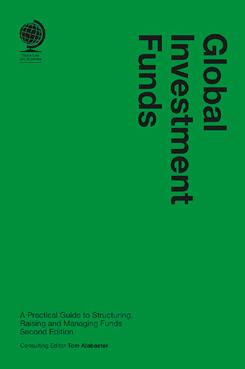
GLOBAL INVESTMENT FUNDS
A Practical Guide to Structuring, Raising and Managing Funds Second Edition Consulting Editor: Tom Alabaster
ISBN 978 1 83723 012 9 GLOBE LAW AND BUSINESS www.globelawandbusiness.com
EXPLAINING THE POPULARITY OF GLOBAL INVESTMENT FUNDS IN 2020s TO THE PROFESSIONALS
An appreciation by Elizabeth Robson Taylor MA of Richmond Green Chambers and Phillip Taylor MBE, Head of Chambers, Reviews Editor, “The Barrister”, and Mediator
Globe Law and Business always excel when offering advice to lawyers in business. And never more so than with private investment funds when Tom Alabaster, the consulting editor, has some involvement! What the publishers offer us here is a practical guide to the structuring, raising and managing of funds which will be of interest and help to a wide readership. Such funds are investing more capital than ever before, and the funds themselves are becoming larger than ever. And, of course, the industry’s
success comes against a backdrop of evolving market trends, increasing regulatory and tax compliance and the rise of ESG, mixed at a time with a new, incoming Labour government which has a (possibly) rather different approach to fiscal matters generally (at least as far as some practitioners are concerned) for the rest of this decade.
In relation to structuring, fund-raising, making deals, managing exits, maintaining investor relations and dealing with the press, investors and their advisers are faced with unprecedented challenges and opportunities so this new edition for 2024 comes in very handy.
Globe Law gives us, as practitioners and counsel, an excellent and practical new second edition of “Global Investment Funds”, edited by Tom Alabaster at Ropes & Gray. This hardback book is a mini classic which offers us contributions from leading industry specialists covering a wide range of issues arising at all the stages of a private investment fund‘s life cycle.
The new edition also offers the following topics which include formation and structuring, regulatory matters, deal-level considerations, environmental concerns, as well as covering jurisdictional/offshore matters, their jurisdictional differences and choice drivers (such as Ireland and Luxembourg). We found it to be a most successful and pragmatic guide which clearly paves the way for fuller explorations of the particular issues presented with regard to listed funds, energy funds, secondary transactions and GP-led recapitalisations.
Globe Law and Business have always provided lawyers in business with titles covering a wide range of specialisms to fit their needs and requirements. Here we have a practical guide to the legal, regulatory, tax and commercial elements of establishing and operating private investment funds.
And it remains our view that we consider that practitioners, advisers and other industry participants will almost certainly gain a significant benefit from applying its contents within their own businesses. Your business cannot really afford not to have a copy in the office library… and yes, we still do have legal and business libraries even in the digital 21st century!
The date of publication of the hardback second edition is cited as April 2024.
Grasping the Opportunities of a New Tax Year
Now that a New Tax Year has begun, it’s a great time to pause, take stock and give your finances a quick health check. It doesn’t need to be complicated and just a few small steps now can make a big difference later.
Whilst the following may be helpful for your own household, it may also be beneficial for your clients.
Review your financial advice
If you pay for financial advice, think about the support you’ve received over the past year. Has it been helpful? Do you feel confident about the decisions you’re making? Good advice should leave you feeling clearer, not more confused.
Make the most of your ISA
If you’re planning to put money into an ISA this year, starting earlier in the tax year means your money has more time to grow. Waiting until the last week of March might feel familiar but it’s not always the most effective approach.
Check your pension contributions
If you’re able to, consider whether you could increase what you’re paying into your pension. Even small increases can add up over time. It’s also worth checking when you last reviewed whether you’re on track for the retirement you want and when you want it.
Review your investments
Take a moment to look at where your money is invested. Are your investments still performing as expected and aligned with your goals? If you’re not sure, this may be a good time to ask for advice. Do you have a desire to change your investments to fit with your world view or ethics? Are your current arrangements aligned with these?
Revisit household subscriptions and bills
Streaming services, apps, gym memberships… they have a habit of quietly multiplying. A quick review might reveal you’re paying for something you rarely use (goodbye to that movie channel you forgot about). Alternatively, is there anything that you can ‘re-negotiate’ and get a little cheaper?
Consider charitable giving
If you support charities, using Gift Aid means they can claim an extra 25p for every £1 you donate at no extra cost to you. Higher-rate taxpayers may also be able to claim additional tax relief.
Start preparing your tax return early
If you complete a tax return, gathering information early can make the process much less stressful when the deadline comes around. A little time spent reviewing your finances now can help make the year ahead simpler and give you greater confidence about the future.
Legacy Giving Report 2026 reveals
• Charitable estates remain near record levels at 44,000 in 2025
• Legacy income forecast to reach £5 billion by 2029
The Legacy Giving Report 2026, launched today by Legacy Futures and Smee & Ford shows that legacy giving continues to provide vital stability for the UK charity sector, with total legacy income reaching an estimated £4.4 billion in 2025. Despite an expected easing following 2024’s exceptional peak, the legacy market proved more resilient than anticipated. Legacy income remains one of the most dependable sources of charitable funding, accounting for around 30% of fundraised income among the top 1,000 legacy-supported charities, with even higher reliance in some sectors.
The report provides the most comprehensive review of legacy giving for the charity sector, combining Smee & Ford’s probatebased data from the UK’s charity Notification Service, with Legacy Futures’ forecasting and analysis. It offers charities detailed insight into market performance, donor behaviour and future trends. Expert commentary from the Chartered Institute of Fundraising (CIOF), the Institute of Legacy Management (ILM), and Remember a Charity provides further sector-wide perspectives.
More key findings from the report, include:
• Legacy income reached £4.4 billion in 2025, with long-term annual growth rate of 4.3%.
• Charitable estates totalled 44,000, the second highest level on record.
• An estimated 104,000 charitable bequests were made, down 11% on 2024 following the clearing of the probate backlog.
• Average gift values reached £44,000 overall, with residual gifts averaging £98,000 and pecuniary gifts £6,100.
• Health charities remain the largest recipients, accounting for 34% of legacy income.
• The South East, South West and London together account for 44% of all legacy giving
• Legacy income is forecast to grow to £5 billion by 2029 and £10 billion by 2046.
The bigger picture
The report highlights that 2024’s record performance was driven in part by HM Courts & Tribunals Service clearing a backlog of probate cases. While some correction was expected in 2025, probate volumes and gift values held up better than forecast, underlining the strength of the market. However, the report warns of emerging long-term challenges. Fewer people are giving to charity overall, and engagement among younger generations is declining. As legacy gifts often reflect decisions made decades earlier, this trend could pose risks to future income.
At the same time, upcoming policy changes including inheritance tax thresholds and pension reforms are expected to increase estate complexity and may slow the flow of legacy income in the short term.
Who are the legators?
This year’s report places a particular focus on “who are the legators?”, exploring the characteristics, behaviours and motivations of those who choose to leave charitable gifts in their wills, alongside how these are changing over time. It examines the impact of demographic shifts, with Baby Boomers expected to drive a significant increase in legacy income as they age, alongside the growing trend for will-writing and legacy decisions to happen earlier in life. This builds a clearer picture of how legacy giving is shaped and how charities can better understand and engage future supporters.
Ashley Rowthorn, Executive Director at Legacy Futures and Smee & Ford, said:
“This year’s report highlights both stability in the present and uncertainty ahead. Legacy income remains a cornerstone of charity funding, and the outlook is positive in the medium term, with steady growth forecast over the next decade.
“However, the decisions that will shape legacy income in the 2030s and beyond are being made today. Charities that invest in insight, strengthen supporter connections and adapt to changing behaviours will be best placed to realise the full potential of legacy giving in the years to come.”
Claire Routley, Consultancy Director Legacy Futures, added: “Legacy giving continues to show remarkable resilience, even as charities face wider economic and societal pressures. What stands out in this year’s data is the strength of the underlying market, with income, estate numbers and gift values all holding up well despite an anticipated correction.
“But the report also makes clear that future growth cannot be taken for granted. Charities need to understand who their supporters are, how motivations are evolving, and how to build lasting relationships that translate into long-term support through gifts in wills.”
Adding her thoughts, Lucinda Frostick, Director at Remember A Charity, said: “At a time when charities are facing economic uncertainty and donor behaviours are changing, having access to strong, reliable insight really matters. The Legacy Giving Report 2026 brings together essential data and insights to help charities understand the trends shaping gifts in wills and make confident decisions about their future. We’d encourage charities large and small to dig into the report and use the findings to strengthen their legacy fundraising strategies for the years ahead.”
The Legacy Giving Report 2026 can be downloaded for free here.
Broken, battered and bewildered.
A gift in your will can offer a lifeline to the conservation of East Anglia’s wild owl population
Every year the Suffolk Owl Sanctuary cares for a wide range of wild owls and other birds of prey suffering from injuries, ailments & traumas. Our mission is to rescue, care and rehabilitate them back to their natural habitat whenever possible, fit & flying free.
Legacies and bequests provide a lifeline to help pay for the welfare, food, medication, veterinary services, accommodation and the indispensable care of our dedicated team of falconers as we strive to fulfill our mission
For more information please contact Suffolk Owl Sanctuary, Stonham Aspal IP14 6AT info@owl-help.org.uk www.owl-help.org.uk
We are a UK charity providing a fantastic selection of high-quality audiobooks, both online and via the post, to some 100,000 people across the UK who find it difficult or impossible to read due to an illness, disability, learning or mental health difficulty. We charge a membership fee to only half of our members- those who feel they can make some contribution and that is heavily subsidised. The other half need to be fully funded. Listening Books receives no central government funding whatsoever and very little local government funding. The reality is that Listening Books simply could not survive without the generous support of sponsors and the active co-operation of publishers.
Whether you have already written your will or are thinking about writing one in the near future, we ask that you consider leaving a legacy to Listening Books. Your legacy will make a vital difference to the lives of our members for years to come.
CALL US NOW on 020 7407 9417 or email us at: bdee@listening-books.org.uk
The Solicitors’ Charity explores burnout and “always on” culture
in latest Legal Pause podcast episode
The Solicitors’ Charity has released Episode 7 of The Legal Pause podcast, featuring Richard Martin, CEO of the Mindful Business Charter, in a candid conversation about burnout, workplace pressure, and the realities of modern legal life.
Titled “When ‘Just Keep Going’ Stops Working in Law”, the episode explores how inhumane working practices can lead to stress and ultimately, burnout. And that signs and symptoms can quietly build over time within the legal profession, and why many solicitors still find it difficult to ask for help before reaching crisis point.
Hosted by Nick Gallagher, CEO of The Solicitors’ Charity, the discussion draws on Richard’s personal experience of mental health breakdown and recovery following a successful legal career in London. Together, they explore the warning signs of stress, the impact of “always on” workplace culture, and the importance of creating healthier and more sustainable ways of working across the profession.
The episode also considers the emotional impact of legal work itself, including the pressures associated with demanding workloads, constant availability, and vicarious trauma transferred from their caseload.
Nick Gallagher, CEO of The Solicitors’ Charity, said: “Many solicitors are incredibly resilient people, but that can sometimes mean stress and pressure build quietly over time before support is sought. This episode is an important reminder of the value of recognising warning signs early and creating professional environments where people feel able to speak openly.”
Richard Martin added: “The legal profession attracts highly capable and conscientious people, but that can sometimes make it harder to stop, reflect, or ask for help. Conversations like this matter because they help normalise wellbeing and encourage people to seek support earlier.”
Alongside discussing Richard’s own recovery journey, the episode explores the wider work of the Mindful Business Charter and ongoing conversations around workplace culture, respect in business, and sustainable careers within law.
Mentioned in the podcast, individuals and firms are urged to look out for and act on the warning signs of potential mental health breakdown in themselves and colleagues.
The conversation also highlights the support available through organisations such as The Solicitors’ Charity and LawCare, while encouraging greater openness around mental health and wellbeing within the profession.
The Legal Pause – Episode 7 is available now on all major streaming platforms.
Losing a professional membership that underpins your credibility
JSC Commercial Bank Privatbank v Igor Valeryevich Kolomoisky & Ors - Find Case Law - The National Archives
Summary
The claimant brought an action against two of its founding shareholders, and companies owned or controlled by them, seeking compensation for harm caused by their alleged participation in a fraudulent scheme. The forensic accounting expert for the first defendant failed to inform the court, until shortly before he gave evidence, that he had ceased to hold a key professional membership.
Learning points
• You should inform the parties and the court if, after your expert report is filed, you cease to be the member of a professional organisation which is relevant to the expert evidence you have provided.
• Always consider whether you should inform your instructing party following any material change in your qualifications or accreditations.
The case
The claimant brought an action against two of its founding shareholders, and companies owned or controlled by them, seeking compensation for harm caused by their alleged participation in a fraudulent scheme. One of the areas of for expert evidence was forensic accountancy.
We have previously discussed the assertion by the judge in this case that Expert Witnesses have a duty to disclose previous criticisms of their evidence in judgments. In this case update, we look at another aspect of the case, the failure of the forensic accounting expert for the first defendant to inform the court, until shortly before he gave evidence, that he had ceased to hold a key professional membership.
Forensic accounting evidence
The parties were given permission to adduce expert evidence from forensic accountants. The claimant instructed Mr T, a Senior Managing Director in FTI Consulting, the first defendant instructed Mr D, the managing director of Honeycomb Forensic Accounting, and the second defendant instructed Mr S, a partner in Alvarez & Marsal Disputes and Investigations LLP.
Mr D’s status as a ICAEW member
At the time of their reports, all the experts were fellows of the Institute of Chartered Accountants of England and Wales (‘ICAEW’). However, during July 2023, after the trial had commenced, but before Mr D had given evidence, the claimant’s solicitors discovered that Mr D’s status as a member of the ICAEW was now recorded as Ceased with a sub-status recorded as Cessated. They wrote to first defendant’s solicitors drawing attention to the cessation and attaching a copy of the disciplinary record which indicated that Mr D had been subject to a severe reprimand, in respect of which there had been hearing on 8 March 2023. Mr D had not disclosed any of this information to the claimant or the court. Mr D provided an explanation in a witness
statement on 29 September 2023, five days before he was due to give evidence, intending to anticipate questions he expected during cross-examination. He disclosed that he had been the subject of two complaints in June and August 2021 in respect of which there had been no disciplinary proceedings. He had, however, been severely reprimanded for failure to provide the ICAEW with responses to those complaints. Mr D also disclosed that the Charity Commission had removed him as trustee of two charities and that those charities had been the subject of statutory enquiries by the Charity Commission. He also gave notice that he would rely on his privilege against selfincrimination to justify his refusal to answer any questions about the August 2021 complaint to the ICAEW and the Charity Commission inquiry.
The judge noted that, given the information provided, it was not possible for the court to obtain a full picture of what had occurred or the extent to which these matters might have been relevant to the quality of Mr D’s evidence. However, Mr D did accept during crossexamination that there was no excuse for his failure to provide the information sought by the ICAEW.
The judge concluded that:
“In my view, where an expert presents his evidence as a member of a professional organisation, which is expected by him to give the court assurance as to his ability to act in the case, he is under a duty to inform the court if his membership has ceased, more particularly where the cessation is linked to disciplinary proceedings against him. [Mr D] accepted in cross-examination that he knew that his presentation as a member of the ICAEW would give the court that assurance, but he had no explanation as to why he did not voluntarily inform the court or the Bank of the fact that he had ceased to be a member with effect from 19 April 2023. The manner in which [Mr D] approached this issue casts real doubt on his ability to be open and straightforward on matters which might affect the court’s assessment of the reliability of his evidence as an independent expert. More particularly it undermined the court’s confidence in his ability to give precedence to his overriding duty to the court when faced with other conflicting interests. It seems to me that this is a particularly significant failing when taken together with the fact that [Mr D] also failed to disclose that he had been the subject of a finding in another case that his opinion was based on wholly unsupported and fanciful assumptions, which ignored the objective facts and undermined his credibility as an independent expert (per Leggatt LJ in Al Nehayan v. Kent [2018] EWHC 333 (Comm) at [195]).”
Experts in Property & Construction
MS BITA MANZOURI
BSC MBBS MRCP FRCOPHTH PHD
CERTLRS PGDIP PGCERT
CONSULTANT OPHTHALMIC SURGEON
Ms Bita Manzouri is a consultant ophthalmic surgeon at Queen’s Hospital in Romford. She is a specialist in cataract, cornea and external disease.
Ms Manzouri undertakes expert witness instructions, including the preparation of medico legal reports and giving evidence in court, in personal injury and clinical negligence cases relating to all of these areas of expertise.
She has dual fellowship training in cornea/external disease and paediatric ophthalmology and has also obtained the Cardiff University Bond Solon (CUBS) Expert Witness Certificate. Ms Manzouri can act on behalf of either claimant or defendant or as a Single Joint Expert.
For enquiries, contact PA@bitamanzouri.com or phone 07711 357 211. Direct communication with Ms Manzouri is also available at BM@bitamanzouri.com
Daniel Connal Partnership is an established construction consultancy providing a comprehensive range of services to the property and construction sectors, including Quantity Surveying, Building Surveying, Property Management, and Health & Safety consultancy.
Drawing on this extensive experience we deliver practical, evidence‑based advice and clear, informed expert opinion on:
Norwich Robert Dale t 01603 629421 e rd@danielconnal.co.uk www.
• Building Defects & Workmanship Standards
• Construction Contracts
• Construction Costs & Quantum Meruit
• Homeowner/Builder Disputes
• Party Wall Matters
• Professional Negligence
Colchester Jonathan Dennis t 01206 751284 e jd@danielconnal.co.uk
John Read t 01603 629421 e JRead@danielconnal.co.uk
London Simon Jacklin t 0207 375 2535 e sjj@danielconnal.co.uk
danielconnal.co.uk
Bita Manzouri Quarter Page Advert.indd 1
Exploding the Valuation Myths:
A Lawyer’s Guide to What Really Matters
In this article the valuation experts at FHM Forensic Accounting, Fiona Hotston Moore and Tom Arnold, debunk some of the key myths that we frequently come across.
Myth 1 – A company with no assets has no value
We are often asked whether a company with minimal net assets (or even net liabilities) in the accounts can have any value. This can be relevant in family law cases in determining whether appointing a Single Joint Expert to value the company is cost proportionate.
The short answer is yes, a company with no assets or even net liabilities can have value. In most cases the net assets in the published accounts will give an indication of the “bottom line valuation” of the company but the market value of the business can be significantly higher.
It may also be the case that the company owners have chosen to distribute all or most the profits each year and thus the net assets (retained reserves) are minimal but the company may be generating significant earnings and thus will have a value far higher than its net assets.
In deciding if the company has value over and above its net assets, we need to assess its ability to generate a positive cash flow in the future. There are several methods to value a profitable company. Typically, the valuer will look at the historical profits to estimate a figure for the future maintainable earnings (“FME”) of the company and then apply a multiple to the FME to assess what we describe as “Enterprise Value”. If financial projections are available these will also be considered.
Unfortunately, smaller companies are not currently required to file their profit and loss account in the published accounts and therefore
A simplistic example – Traitors Limited
Net assets as at 31 December 2024 £10,000
Valuation based on net assets £10,000
However, from our enquiries we identify that the business is generating profits each year which are distributed in full to the owners each year and hence net assets are minimal.
Estimated future maintainable earnings
£50,000
Applying a multiple of, say, 4X gives an Enterprise Value of £200,000
In this instance the value of goodwill is approximately £190,000 (£200,000 less £10,000).
In conclusion, if the net assets on the balance sheet are minimal or even negative, this may suggest the company has negligible value. However, reaching an informed conclusion requires some information on the recent trading performance.
it is necessary to obtain either a copy of the accounts prepared for the shareholders or other information to assess if the business is generating a commercial return.
Myth 2 – Start-ups cannot be valued
Start-up valuations may be required in divorce, shareholder disputes or in raising funds or investment. As in all valuation, the reason for the valuation is relevant in deciding on the approach to the valuation.
Start-ups tend to have negative cash flows and possibly minimal or no sales, limited historical cashflows and the proof-of-concept may not yet have been proven. Traditional valuation methods such as capitalized earnings and net asset valuations may not be relevant depending on the stage of development.
There are several ways we can value start-ups and these are explained below. We may adopt more than one valuation method to get a broad range of valuation for the company.
The cost approach
The cost approach (also called “cost to duplicate”) looks at the costs incurred to get the start-up to its current point. The assumption is that an investor will at least cover the costs already incurred. This method gives no credit for the future value that may be generated and it gives no value to the intellectual property beyond the actual costs.
The venture capital method
Using this method, we estimate what the “exit-value” might be in a few years when the company is sold. This figure is then discounted back to arrive at the present value. The risk that this venture will not achieve the exit value will be factored into the calculation through the discount rate.
Kirsty Shuckford, Graham Hines, Fiona Hotston Moore and Tom Arnold
The scorecard method
This method assesses the business against various criteria that an investor considers important including the team, the product, the target market and the strategic relationship, and then applies a value to each one. This value is discounted for the risk attributed to the start-up. This method tends to be investor specific.
Discounted cashflow
If the start-up is at a point where future cashflows can be reasonably estimated, then we can adopt the discounted cashflow method and discount future cashflows back to give us the current value.
Market multiple
If sufficient information on estimated future income is available and we have data on recent acquisitions that are similar in nature, then we may be able to use a calculated market multiple.
In summary, valuing a start-up is highly subjective and, in all methods, requires an assessment of the risk and rewards as well as the likelihood of success of the enterprise.
Myth 3 - Partnership interests can be valued in the same way as a shareholding
The key to valuing a partnership interest is an understanding of the legal framework of the partnership. The valuer should consider if there is a partnership agreement or, for an LLP, a Members’ Agreement. If not, and if the entity is a general partnership, the valuer needs to understand the implications of the Partnership Act
The starting point to assess the value of a partnership interest is to establish the balance on the partner’s capital and current accounts (including any tax reserve). The balance on these accounts represents profits already earned and due to the partner.
The second point is to consider is whether there is any value to be attributed to goodwill (i.e. the ability to generate future profits from the partner’s interest).
The partnership agreement or LLP Members Agreement may include provisions regarding how a partner can exit the partnership agreement and how their interest in goodwill should be valued. It is typical in professional partnerships for an exiting partner to be precluded from realising any goodwill. Alternatively, the agreement may specify how any goodwill is to be valued.
Conclusion
Once the legal and commercial framework is understood, the valuer can determine if there is any value attributable to the partner’s interest beyond their capital and current accounts.
fiona@fhmforensic.co.uk
+44 (0)7770 642491
Tom@fhmforensic.co.uk www.fhmforensic.co.uk
DevAssist is the only interpreted planning data on the market.
BIRD & BIRD v ORIENTFIELD HOLDINGS
“If a solicitor orders a search or planning report, even if not instructed to do so, he or she creates a duty upon themselves to consider its contents and report back to the client.”
Lady Justice Gloster
t: 01342 890010
e: info@devassist.co.uk
w: devassist.co.uk
Our reports
See Bird and Bird case law to see why this is so important for property lawyers.
And that’s not all we do. Amongst other investigations DevAssist produces the only reports that reveal Strategic Housing and Economic Land Availability Assessments sites and land that has marketed for sale.
Electronic wills. Opportunity or undue influence?
Are electronic wills the future, or does going digital place some clients at greater risk of coercion and undue influence?
Andy Hitchon, Head of LEAP Estates, examines the main risks linked to digital will writing and what private client practitioners can do to overcome them.
Estate lawyers are well used to evolution. With legal technology advancing rapidly and many lawyers now comfortable managing their work through a screen, it is understandable that the Law Commission is reviewing the Wills Act 1837 to modernise the field. Proposals ranging from electronic signatures to video witnessing aim to make will making more accessible, efficient and digital. For clients who struggle to attend appointments or prefer to handle matters outside standard working hours, this shift could remove longstanding barriers.
However, practitioners know that the safeguards around the will making process are as important as the document itself. Any change should strengthen, not weaken, the protection of vulnerable clients.
Digitising the will writing process
The Law Commission’s new bill proposes that wills can be created, signed and stored electronically, witnessed remotely through video systems, and that the age of testamentary capacity is reduced from 18 to 16. It also suggests aligning the test for testamentary capacity with the Mental Capacity Act 2005 instead of the older Banks v Goodfellow case law.
Although many believe these updates will make will drafting simpler, quicker and more accessible, the shift to a fully digital process raises clear concerns. A will created without a physical pen ever touching paper presents risks of coercion, undue influence and increased vulnerability.
Electronic wills: progress or pitfall?
Coercion and undue influence have always been major considerations when taking instructions. These issues are difficult to prove in court, yet the proposals may heighten the risk. Without physical presence, how can lawyers be confident the testator is alone? Could someone off camera be exerting pressure?
The potential abuse of technology also creates new challenges. Deepfakes and AI generated audio could be used to imitate a testator’s instructions. Forged electronic signatures are another concern if strict verification is not implemented. If wills are stored on unsafe platforms, they may be accessed, corrupted or altered. Cyberattacks and data loss also present significant threats.
Crucial issues to consider when creating digital wills.
Safeguarding all clients in the digital age
Vulnerable clients must remain front of mind. Those who are elderly or living with physical or mental conditions often require in person meetings to assess capacity. Some wills need more than one meeting, particularly when instructions are complex.
Lowering the age of testamentary capacity to 16 also raises questions. With many legal rights still tied to the age of 18, there is a genuine risk of a will becoming outdated or accidentally revoked.
Overcoming the risks
While technology will shape the future of will writing, the transition must be gradual and inclusive. Legal software can help by prompting checks on capacity and understanding, flagging unusual instructions and advising clients to seek professional confirmation when needed. Facial recognition, ID verification and clear audit trails, combined with secure document storage that uses encryption, multi factor authentication and regulated platforms, will also reduce risk.
Andy Hitchon, Head of Estates, LEAP Legal Software.
Regulators join forces to remind the public of their responsibilities when fundraising
The Charity Commission and the Fundraising Regulator have today published new, joint guidance to help people who want to raise funds for charity.
The regulators are advising members of the public to follow this latest guidance so that people can fundraise in a way that protects themselves and the charity they are raising money for.
Each year, almost a third of sector income is raised from donations and legacies, including fundraising by the public.
The guide sets out practical steps for anyone thinking about setting up a fundraising appeal, including in response to an emergency. It is important that people follow the guidance because, when someone decides to raise money for charity they, not the charity, are responsible for ensuring the money goes where intended.
The steps include advising people to fundraise for a named charity from the outset, and to be transparent in all communications about what the money is being raised for, including the charity’s name and registered number.
While the Charity Commission and Fundraising Regulator already publish advice for members of the public to give safely when donating to good causes, this is the first time the regulators have published joint guidance for people looking to fundraise for charity.
The guidance recommends fundraisers:
• set a clear target and time limit for their appeal
• tell donors upfront about any expenses that will be deducted before funds are passed on to the charity
• use a reputable online fundraising platform over a personal bank account
Individuals can find a full list of steps in the guidance as well as advice on making contingency plans if circumstances change.
The regulators want members of the public to follow the guidance, explaining that taking care before setting up appeals can help them avoid problems later down the line. This includes unnecessary administrative steps (involving the regulators) or potential public criticism, for example that money isn’t reaching the end cause quickly enough. Taking care can help protect public trust and avoid the risk that an appeal is seen to be fraudulent.
David Holdsworth, Chief Executive of the Charity Commission, said:
“The British public are some of the most generous people in the world, whether they’re donating time or money. We see some truly inspiring acts every day - from running marathons to running community-led memory cafes for people managing Alzheimer’s and other forms of dementia.
“When you’re fundraising for a cause you care about, it’s important to know your legal responsibilities. That’s why we’ve partnered with the Fundraising Regulator to create this guide — helping you raise money for your chosen charity in a way that’s legal, ethical, and effective.”
Gerald Oppenheim, CEO, at the Fundraising Regulator said:
“Fundraising by members of the public makes an invaluable contribution to the charity sector each year. Whether raising money through sponsored challenges, community events or emergency appeals, fundraisers have an important responsibility to ensure donations reach their intended cause.
“This guidance gives members of the public the practical information they need to follow the law, build trust with donors and avoid problems that could prevent charities from accessing funds quickly and effectively. We encourage anyone planning a fundraising appeal to read the guidance before they begin.”