issue 68 Autumn 2026
Hertfordshire Law Society Gazette
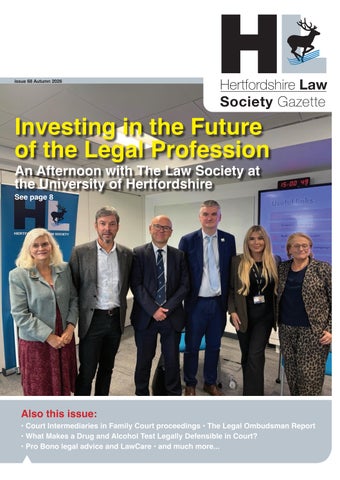
Investing in the Future of the Legal Profession An Afternoon with The Law Society at the University of Hertfordshire See page 8
Also this issue:
• Court Intermediaries in Family Court proceedings • The Legal Ombudsman Report • What Makes a Drug and Alcohol Test Legally Defensible in Court? • Pro Bono legal advice and LawCare • and much more...
▲
Contents
Hertfordshire Law Society Gazette
Contents issue 68 Autumn 2026
4 5 6 6 8 12 13
Council Members for 2026 From the President The Weather! The Legal Ombudsman Report Investing in the Future of the Legal Profession Council Member report Court Intermediaries and how they can assist vulnerable parties
14 15 16 20 22
in Family Court proceedings The Hidden Cost of Pension IHT Changes Pro Bono legal advice and LawCare Good practice guide for wealth advisers Remember A Charity Week highlights Book Reviews
Published by: EAST PARK COMMUNICATIONS Ltd. Merseybank Business Centre 55-57 Seabank Road, Wallasey Merseyside CH45 7PA
Advertising Simon Castell
Accounts Tony Kay
Managing Editor Steve Hamilton
Published: October 2026
Tel: 0151 651 2776 simon@eastparkcommunications.co.uk www.eastparkcomms.co.uk
Design East Park Studio David Coffey
24
26 28 30
The Solicitors’ Charity launches new Wellbeing Alliance with leading legal wellbeing organisations EWI release results of Workforce Mapping Research Behind the Numbers: Common issues in business valuation What Makes a Drug and Alcohol Test Legally Defensible in Court?
Legal Notice © East Park Communications Ltd. None of the editorial or photographs may be reproduced without prior written permission from the publishers. East Park Communications Ltd would like to point out that all editorial comment and articles are the responsibility of the originators and may or may not reflect the opinions of East Park Communications Ltd. Correct at time of going to press.
DISCLAIMER: the views expressed by the writers in this magazine are not necessarily those of the Hertfordshire Law Society
http://www.hertslawsoc.org.uk/
3▲
Council Listings
Council Members 2026 President Michael Scutt Crane & Staples Employment Vice President Laura Woolard Taylor Walton Family Hon Treasurer /secretary Judith Gower Immediate past president Massimo Trebar Lawtons Criminal
Council Members: Nicola Smyrl Taylor Walton Employment Marilyn Bell SA Law Family Jane -Louise Burrows Fullers Family Law Family Neil Johnson Burnside Partnership Civil Litigation
(From January 2026 until 31 December 2026)
Steven Hamilton Taylor Walton Probate and Trusts
Paul Davies Hamilton Davies Small Firms Division
Claire Sharp Debenhams Ottaway Probate and Trusts
Keira O’Connor Royal College of Nursing Public Inquiries and Regulatory Nursing and Midwifery council
Sylvia Goulding Perrin Myddleton Property & Commercial Josephine Duchenne National Council Member for Hertfordshire & Bedfordshire Consultant at Heritage Park Family Law
Sharmila O'Reilly University of Hertfordshire
Alexander McDowall Hertfordshire County Council Local Government
▲4
Hertfordshire Law Society Gazette
Editorial
From the President... I hope you all had a good summer. The blisteringly hot weather seems like a distant memory now and I am ten months into my year of office and wondering where the time has gone. However, HLS is still busy and there are some great events ahead
I also look forward to taking part and representing the Society at the High Sheriff’s annual justice parade at St Albans Abbey on 15th November.
By the time you read this column we will have had the visit from The national Law Society with Mark Evans, the current president, at The University of Hertfordshire. I am delighted that Law Society HQ has been able to visit us this year and I very much look forward to welcoming Mark to the university where we have two excellent events lined up. The first is a discussion with students about a career in the law. That will be an opportunity for students at the university to ask questions of The Law Society about what the Society does and about issues such as routes into law and a Q&A session. It will be designed to give guidance to people considering a career as a solicitor and I am sure it will be a great chance for them to get the questions answered and bring the role of The Law Society fully into their focus.
As ever, thank you for your support to Hertfordshire Law Society.
Then after that will be the AGM on 17 November which will be at The University of Hertfordshire. More details will be circulated shortly. As ever, all members are welcome to attend. I hope to see some of you or indeed many of you at any of the above events.
Kind regards, Michael Scutt President, Hertfordshire Law Society
After that event there will be a round table presentation, in which I will be one of the panelists, discussing the subject of wellbeing in the law. Some of you may be familiar with the recent report produced by Law Care called Life in the Law which is their snapshot of the issues facing people in the profession in 2025. It is a report well worth reading and we will discuss it in the panel discussion. I am delighted that Mark Evans will be involved as he has made wellbeing the theme of his year in office and I am also delighted that the current chair of Herts Junior Law Division, Emma Curtis Vegh will also be involved. Then later in the month we will have the first Hertfordshire Law Society quiz which is taking place on 22nd October at The View in Panshanger Golf Club Welwyn Garden City. We have been lucky enough to secure a celebrity guest quiz master (none other than Shaun Wallace who is the “Dark Destroyer” from ITV’s The Chase). Criminal practitioners amongst you may also know him as a barrister at Great James Street Chambers in London. There are still some tickets available but they are selling quickly. If you would like to buy a ticket please email hertslaws@virginmedia. com. Tickets cost £30 per person or £150 for a table. To my memory there has not been a Herts Law Society quiz before and I am really looking forward to this event as something which will be a lot less formal than our annual dinner earlier this year.
http://www.hertslawsoc.org.uk/
5▲
Expert Witness
The Weather! I
did say in my last article that I would probably be complaining about the weather being too wet and I am. I came in this morning wet and cold. How has it gone from too hot to bear to so wet? At least it is more like autumn weather. My hooman mother has started going away by herself – she recently drove miles from home to Addenbrookes Hospital then to Pontefract (that was apparently the cheapest Premier Inn near York (other hotels are available)) She stayed one night there and met up with a friend then drove to a park and ride on the outskirts of York. She then met up with more friends in York for a very expensive meal. She spent £64 on one lunch but it cost her friends £90 due the number of bottles of wine they drank! My mother doesn’t drink
alcohol so she didn’t have to pay for it. How many Dreamies would that of bought me?
haired angels who are now 6 and 3 would rather have another cat than another baby.
To end her northern adventure she then drove to Leeds to drop some things off at her niece’s house and stayed the night there. Her niece’s husband is a chef who used to work at Michelin starred restaurants in London. She surprisingly didn’t eat anything on Sunday.
@princessgigi2019 Here is me being angelic as always...
Rumour has it that in November she is going to Edinburgh to meet with the same group and staying overnight. She is going by train and getting back stupidly late as the ticket was just over £16!!! Still no news on the baby but we keep waiting. Apparently the golden
The Legal Ombudsman Report T
he Legal Ombudsman (LeO) on 1 October published new research examining how artificial intelligence (AI) is influencing the way consumers engage with complaints and redress processes. The report, AI and complaints: removing barriers, reinforcing divides?*, finds that consumers are increasingly using AI to understand whether they have grounds for complaint, learn about their rights, identify appropriate routes to redress and prepare communications with organisations. The findings reinforce that AI is becoming an important source of information and support during the early stages of the complaint journey. Alongside the report, LeO has published practical Spotlight guidance for legal service providers and consumers. The resources are intended to support the responsible use of AI throughout the complaints journey and encourage informed, effective engagement with complaints processes.
▲6
The guidance for legal service providers focuses on responding effectively to AI-assisted complaints, while the consumer guidance includes practical advice and an AI prompt tool designed to help individuals clearly communicate the issues they have experienced and the outcomes they are seeking. Together, the resources aim to support clear, accurate and resolutionfocused communication, helping to avoid unnecessarily lengthy, complex or inaccurate correspondence that can hinder effective complaint resolution. As AI use becomes increasingly common, we believe these insights and resources will be relevant to legal professionals and those responsible for complaints handling within firms. We would be grateful if you could share the report and Spotlight resources through your member communications, newsletters, and digital channels.
We would also be pleased to provide supporting content should that be helpful, and to explore opportunities to talk to your members about the research findings and resources we’ve published. * https://www.legalombudsman.org.uk/ media/fzkdyt2k/leo-ai-research-briefoctober-2026.pdf Resources Read the full report: https://www.legalombudsman.org.uk/media/ fzkdyt2k/leo-ai-research-brief-october-2026. pdf Service Provider Spotlight: https://www.legalombudsman.org.uk/forlegal-service-providers/learning-resources/ spotlight-series/spotlight-on-artificialintelligence-is-an-llm-better-than-an-llb/ Consumer Spotlight: https://www.legalombudsman.org.uk/forconsumers/factsheets/ai-and-complaints-aconsumer-guide/
Hertfordshire Law Society Gazette
Expert Witness
Investing in the Future of the Legal Profession: An Afternoon with The Law Society at the University of Hertfordshire
Josephine Duchenne (Council Member and national Law Society Council Member), Steven Drew (membership development manager at the Law Society), MichaelScutt (HLS President), Mark Evans (President of the Law Society), Kiera O’Conor (Hertfordshire Law Society Council Member and Vice Chair of The Law Society’s Junior Solicitors Network), and Judith Dwyer (HLS Secretary and Treasurer).
O
n Wednesday 7th October 2026, representatives of Hertfordshire Law Society attended the University of Hertfordshire for an afternoon of discussion and engagement with The Law Society of England and Wales, providing an opportunity to reflect upon two matters of considerable importance to the future of our profession- ensuring that aspiring solicitors are equipped with the knowledge, opportunities and support necessary to pursue their ambitions, and fostering a professional environment in which those who enter the legal sector are able not only to succeed, but to sustain fulfilling and rewarding careers. Hertfordshire Law Society was represented by its President, Michael Scutt, Secretary and Treasurer, Judith Gower, Council Member and national
▲8
Law Society Council Member, Josephine Duchenne, and myself, Kiera O'Connor. The afternoon brought together representatives from the national and local legal communities, alongside students and aspiring practitioners, for discussions encompassing routes into the profession, professional development, equality, diversity and inclusion, and the importance of wellbeing within legal practice. For me, the occasion held particular personal significance, having undertaken my own legal studies at the University of Hertfordshire. Returning in my capacity as a Council Member of Hertfordshire Law Society and Vice Chair of The Law Society’s Junior Solicitors Network provided a welcome opportunity to reflect upon my own professional journey whilst sharing the experiences and opportunities that have informed it.
Entering the Profession: Opportunity, Accessibility and Professional Development The afternoon commenced with a panel discussion for students, during which I had the pleasure of being joined by Mark Evans, President of The Law Society of England and Wales. The session provided an opportunity to offer practical guidance on entering the solicitors’ profession, navigating the qualification process and identifying the experiences and opportunities that can contribute to professional development. Our discussions also considered the wider attributes aspiring solicitors should seek to cultivate, including adaptability, resilience, effective communication and an appreciation of the responsibilities associated with becoming a member of a regulated profession.
Hertfordshire Law Society Gazette
Education
One of the principal messages I sought to convey was that there is no single, definitive route into the legal profession, nor should an individual’s potential be measured exclusively by their academic achievements, professional connections or access to conventional opportunities. Whilst academic commitment and practical legal experience remain important, the profession must also recognise the considerable value of transferable skills, lived experience and the different perspectives individuals bring to their work. Indeed, a profession entrusted with representing the interests of an increasingly diverse society ought to reflect, and be strengthened by, that diversity within its own membership. In this context, I was particularly keen to draw students’ attention to the initiatives established to improve accessibility and support those who may otherwise encounter barriers to qualification. I spoke about my own experience of being awarded The Law Society’s Diversity Access Scheme in 2023, through which I received a fully funded scholarship towards my postgraduate legal studies, together with access to work experience, mentoring and a diversity and inclusion award. The opportunities afforded to me through the scheme extended considerably beyond financial assistance, providing valuable exposure to the profession and access to individuals whose guidance and encouragement have contributed to my professional development. I encouraged students to explore the scheme and other available initiatives, emphasising that financial circumstances, personal adversity or a lack of established professional connections should not determine an individual’s ability to pursue a legal career. Our discussion also provided an opportunity to consider the importance of professional engagement and the benefits associated with becoming involved in representative bodies and professional networks at an early stage. Drawing upon my experience as Vice Chair of The Law Society’s Junior Solicitors Network,
http://www.hertslawsoc.org.uk/
I explained how participation in such networks can provide opportunities extending well beyond conventional networking, including developing leadership skills, increasing professional visibility and contributing to discussions that shape the future of the profession. I was particularly keen to challenge the perception that involvement in professional bodies should be reserved for those who have already qualified or reached senior positions. Students, paralegals, trainees and junior solicitors each have valuable perspectives to contribute, and their involvement should be welcomed and encouraged. Alongside highlighting the opportunities available through Hertfordshire Junior Lawyers Division and The Law Society, I encouraged students to explore resources provided by Aspiring Solicitors and Legal Cheek, both of which offer valuable career guidance, professional insights and opportunities for aspiring lawyers. Ultimately, the message I hoped to leave with students was that professional development is not determined solely by academic achievement or the ability to secure a particular opportunity, but equally by a willingness to seek guidance, establish meaningful relationships and recognise the value of one’s own experiences. Mental Health and Wellbeing: A Collective Professional Responsibility Following a short break, the afternoon continued with a second panel discussion addressing mental health and wellbeing within the legal profession. Hertfordshire Law Society President Michael Scutt joined Mark Evans, Emma CurtisVegh representing Hertfordshire Junior Lawyers Division, and representatives from LawCare and The Law Society to consider the challenges experienced by those working within the legal sector, the support available to practitioners and the responsibilities of the profession in promoting healthier and more inclusive working environments. The discussion was particularly pertinent to me, having attended a
roundtable on equality, diversity, inclusion and wellbeing hosted by Mark Evans at The Law Society in London the preceding day. That roundtable brought together individuals with differing professional experiences and perspectives, providing an opportunity to consider not only the challenges facing the profession, but also the measures necessary to achieve meaningful and sustainable improvement. Attending these discussions on consecutive days reinforced the importance of maintaining an open and continuing dialogue on matters that affect the wellbeing, retention and professional experiences of those working in law. A particularly important theme arising from my reflections on both occasions was the need for the profession to adopt a more preventative approach to wellbeing, rather than relying predominantly upon intervention once difficulties have already arisen. Whilst the availability of mental health resources, counselling services and other forms of assistance is undoubtedly important, the provision of support following the emergence of stress, burnout or other difficulties cannot, in isolation, constitute an effective organisational approach to wellbeing. Greater attention must be directed towards understanding and addressing the workplace conditions, professional expectations and cultural factors that may contribute to those difficulties in the first place. The legal profession is one in which demanding workloads, competing deadlines and significant professional responsibilities are often inherent features of practice. Difficulties arise, however, where expectations become unsustainable, where individuals perceive that seeking assistance may be interpreted as a lack of capability, or where organisational cultures inadvertently reward excessive working hours and discourage the acknowledgement of personal limitations. Encouraging practitioners to develop resilience and seek support has an important place within any wellbeing strategy, but these Continues over page...
9▲
Expert Witness
Investing in the Future of the Legal Profession continued... measures must not become a substitute for effective supervision, appropriate workload management and a workplace culture in which individuals feel sufficiently supported to raise concerns. Firms, senior leaders and managers have a particularly important responsibility in this regard. Meaningful commitments to wellbeing must extend beyond the existence of organisational policies or employee assistance programmes and be reflected in everyday management practices, including realistic expectations, regular supervision, inclusive leadership and the effective consideration of reasonable adjustments. These considerations are especially relevant to junior members of the profession, who may feel reluctant to acknowledge difficulties or question excessive workloads through fear of appearing incapable or jeopardising future progression opportunities. There is also an important relationship between equality, diversity, inclusion and wellbeing. A working environment in which individuals feel unable to disclose personal circumstances, request adjustments or express concerns about their treatment is unlikely to foster a genuine sense of belonging or psychological safety. Inclusion must therefore be measured not merely by recruitment statistics or the existence of policies, but by the experiences of individuals once they have entered the workplace, the opportunities available to them and the extent to which they feel valued and supported. The central question for the profession should not simply be whether adequate assistance is available when a practitioner experiences difficulties, but whether we are collectively doing enough to reduce the likelihood of those difficulties arising. This requires a willingness to scrutinise established practices, challenge assumptions about what constitutes professional dedication and recognise that the long-term success of legal organisations depends, in no small part, upon the wellbeing of the people working within them.
▲ 10
Accessing Support and Looking Ahead An important message arising from the afternoon was the breadth of support available to individuals throughout their legal careers. The Law Society of England and Wales provides extensive resources concerning qualification, professional development, equality, diversity and inclusion, and wellbeing, alongside opportunities to participate in professional networks and representative committees. For those seeking independent emotional support, LawCare is a particularly valuable resource, offering free, confidential assistance to individuals working and studying within the legal sector. Its support service can be contacted on 0800 279 6888, with further information available at www.lawcare.org.uk. For students and aspiring solicitors, organisations such as Aspiring Solicitors1 and Legal Cheek2 provide useful opportunities to develop their understanding of the profession, access careers information and engage with potential employers. At a local level, Hertfordshire Law Society and Hertfordshire Junior Lawyers Division continue to play an important role in connecting members of the legal community, promoting professional development and providing opportunities for individuals at different stages of their careers to establish meaningful professional relationships. I would encourage both students and existing practitioners to make use of these resources, and equally encourage firms and supervisors to actively promote them. Reflecting upon the afternoon, what struck me most was the natural connection between the two panel discussions. Although the first focused predominantly upon entering the profession and the second upon equality, diversity, inclusion and wellbeing, the issues explored are intrinsically linked. It is insufficient to devote considerable attention to widening access to legal careers if we do not demonstrate an equivalent commitment to ensuring
that those who enter the profession are supported, included and afforded meaningful opportunities to develop and progress. Recruitment, retention, professional development and wellbeing should not be regarded as separate considerations, but as interconnected elements of a broader commitment to building a representative, inclusive and sustainable legal profession. Events such as this demonstrate the considerable value of collaboration between universities, local law societies and the national representative body. They provide aspiring lawyers with opportunities to engage directly with those working within the profession, whilst enabling established practitioners and representative organisations to better understand the experiences, aspirations and concerns of the next generation. My thanks go to the University of Hertfordshire for hosting the afternoon, to Mark Evans and The Law Society for their continued engagement with aspiring and practising solicitors, and to my fellow panellists and representatives from LawCare for contributing to such important discussions. I would also like to acknowledge my fellow Hertfordshire Law Society representatives, Michael Scutt, Judith Gower and Josephine Duchenne, for their continued commitment to supporting our local legal community. Ultimately, the measure of our progress as a profession should not rest solely upon how successfully we encourage talented individuals to enter it, but also upon how effectively we support them to remain, develop and flourish within it. Kiera O’Connor Hertfordshire Law Society Council Member and Vice Chair of The Law Society’s Junior Solicitors Network Notes https://www.aspiringsolicitors.co.uk 2 https://www.legalcheek.com 1
Hertfordshire Law Society Gazette
Council Member Report
Council Member report SQE Kaplan’s engagement with Council at the July meeting was welcome; several aspects were discussed along with numerous questions submitted beforehand and from the floor; written answers also followed from both Kaplan and the SRA. The Law Society continues to monitor SQE and seek improvements.
Josephine Duchenne
M
ark Evans’ term of office comes to an end at the conclusion of the AGM on 14 October 2026. We welcomed him at our Annual Dinner and by the time you read this magazine, he will have made a second visit to the University of Hertfordshire to discuss issues facing aspiring solicitors and wellbeing, consistent with his presidential themes. I hope many of you have followed his travels and debates (and running), well documented in regular Linked in posts. He also provides Council Members with weekly updates as to what the office holder team are to be doing in the coming week. For his welcome address at the Local Law Societies conference (more below), he reflected on his time as President and emphasised how very well-respected TLS are abroad, having represented the profession at the highest levels. Legal aid provider survey Those who offer legal aid may have had time to complete a provider survey in the summer. The Law Society commissioned an independent consultancy, Frontier Economics, to undertake research on the administrative costs imposed by the burden of legal aid billing processes. The focus is on both billing and supervision requirements, with a view to identifying where reform could have the greatest practical impact.
▲ 12
Compliance There has been much publicity lately surrounding the Legal Services Board approving the SRA rule change to separate the COLP and COFA roles, which was to be effective from January 2027. After strong opposition from small and sole practitioner firms, who argue that the rules should be proportionate, evidence based and would otherwise add to regulatory costs passed on to clients, the SRA has paused implementation for now, pending further consultation. Annual General Meeting The hybrid AGM takes place on 14th October open to all solicitors who have registered in good time. In addition to the usual business there is an administrative matter to decide. Currently the office holders’ term of office coincides with the AGM, which is not necessarily convenient for Law Society business and other usual calendar events such as the Opening of the Legal Year and political party conferences. The proposal at the AGM is to consider providing flexibility in future, for the date when the term of office of those office holders (and also council members), is to take effect. Brett Dixon prepares to take the role of President. He set out something of his Presidential Year Plan at our July Council meeting. As a litigator having specialised in personal injury, his priorities include civil justice and access to justice. Local Law Societies conference ‘Engage, Manage, Grow’ was the title of the recent online Local Law Societies’ annual conference. Held in September, Judith and I attended and found it interesting, with many takeaways. It is always helpful to hear what other local
law societies offer their members, so we can learn from eachother. Ian Jeffrey, chief executive, provided a whistle stop tour of recent initiatives and achievements by TLS as well as horizon scanning. There were then a number of optional breakout sessions including panel discussions on AI, growing inhouse, how to create impactful online content, building better working lives in law and supporting local law societies. Whilst technology is changing rapidly, our course our responsibilities to clients remain consistent. Legal Heroes Twenty-one shortlisted worthy candidates were invited to Chancery Lane for an afternoon tea celebration on 24 September, after a pause last year for the bicentenary. Of the candidates, six were selected as winners, but all received a certificate for the lasting and tangible differences they have made to the lives of others, their community or society. Their stories and contributions were amazing. Other matters I continue to be a member of MCC the Membership and Communications Committee. It is within this committee’s remit to put forward the Legal Heroes competition and celebration; the committee also undertakes work on grant funding and devising frameworks, and also supporting Council and new council members. Lastly, it is not all work! After a full day in Council on 1st July, we had a social get together with Council Members, staff and guests on the terrace at the National Liberal Club, overlooking the Thames. I welcome hearing direct from practitioners to ensure your views are represented at TLS. Please contact me by email: josephine@duchennes. com. Occasionally I will also post on LinkedIn, if you prefer to contact me by that method. Josephine Duchenne Council Member of Bedfordshire and Hertfordshire
Hertfordshire Law Society Gazette
Education
Court Intermediaries and how they can assist vulnerable parties in Family Court proceedings F or anyone who has been involved in Family Court Proceedings or perhaps has supported a family member or friend through court proceedings, you will be aware that at times this can be very stressful for all involved. Whilst being legally represented will ensure you are provided with legal advice to ensure you understand what the legal process is and the merits of your case, sometimes further support is required when it comes to the Court proceedings themselves to allow you to take an active role throughout.
If your case cannot be resolved by way of reaching an agreement with the other party and you are required to provide evidence to the Court within proceedings, some vulnerable clients may benefit from having the assistance of a Court intermediary. It is essential that all parties involved in family proceedings understand what is
http://www.hertslawsoc.org.uk/
being communicated to them, in order that they can fully respond, engage and participate in proceedings. A Court Intermediary may be able to support vulnerable parties in these circumstances. If you a party to proceedings is neurodivergent, under 18, has additional needs or mental health difficulties this can make proceedings even more distressing and at times difficult to navigate. If a party struggles with communication, or misunderstands what is being asked of them, this could result in them not being able to provide evidence to the best of their ability and ultimately may well result in an unfair process. The decision to appoint an intermediary is made by the Court and the Court will need to consider whether it is necessary in each individual case. An intermediary assessment will help identify what additional support may be required throughout the proceedings. Court intermediaries are also designed to assist
the Court and legal representatives to ensure that a vulnerable party can fully participate, clearly understand what questions are being asked of them and enable them to answer any such questions. They can ensure that questions asked at a Court hearing are simplified as much as possible to avoid any misunderstanding and ensure that the Court is able to hear and properly consider the individual’s evidence. Taylor Walton solicitors recognise the important of ensuring that every client is properly supported throughout the family justice process. Where appropriate we can advise on whether intermediary support should be considered and assist with making the necessary arrangements or applications. If you require advice please contact Anna Patsalides of Taylor Walton Solicitors on 01727 818525 or anna.patsalides@ taylorwalton.co.uk.
13 ▲
Advertorial Feature
The Hidden Cost of Pension IHT Changes need to be updated consistently throughout the entire form. Detailed data entry and repetitive work likes this naturally creates risk of human error. And, as more estates become liable for inheritance tax, the volume of this administration is only likely to increase.
Philip Nairn
T
he proposed inheritance tax changes for unused pensions from April 2027, are inevitably sparking conversations around tax. Discussion around who will pay more, and how many more estates will become liable are certainly valid talking points. However, for private client professionals responsible for administering estates, a couple more pressing questions merit attention: what about the increased risk and how will firms cope with the additional workload? The reality is that the proposed changes will involve administering more complex estates and many more will fall under the new IHT rules then before, opening the door to increased risk. In reality this means more financial information will need to be gathered from multiple providers. It also means potential delays and the chance for human error. When most firms are already working at full capacity, it’s a challenge that needs to be planned for carefully. Complexity Adds Risk Estate administration has always involved a balance of legal expertise and detailed administration. The IHT400 for example, and its associated schedules, is already one of the most detailed and time-consuming forms in the estate administration process. Firms have shared with us that in some cases it can take a full day to complete properly. When additional asset information comes to light late in the process, figures then
▲ 14
It only takes a missed digit or a figure not updated following new asset discovery for inaccuracies to creep in. At the very least, one small error could lead to HMRC queries resulting in delays and dissatisfied beneficiaries. In the worst case, a firm could be liable for professional negligence. Technology Support Here’s where we believe technology can play a key role to support private client teams. The greatest gains come from removing repetitive administration that offers little value to clients. It also saves unbillable time that is often needed to amend or correct forms or accounts. Automatically populating forms, carrying information across documents, updating figures consistently and reducing manual data entry is a bread and butter for task for today’s advanced legal tech. In fact, tech can complete data replication and calculations far faster and more accurately than any person can and it’s more accurate therefore reducing risk. At Exizent, we see these benefits every day. Firms appreciating software that removes hours of administration, allowing those solicitors to spend more time advising clients and supporting bereaved families. Lara Waddell, Legal Assistant at Warners in Edinburgh uses Exizent and described just how significant that difference has been: “We have used Exizent since 2025 to help produce Estate Accounts, create correspondence to institutions to make enquiries about assets, and for IHT400 form completion. The Exizent platform is intuitive and brings everything together. A simple update or change needed within an IHT400 form for example needs to be reflected across the entire form. Exizent swiftly automates this process ensuring accuracy and saving hours, if not days, of
repetitive, detailed administration relating to form completion, while also removing any chance of human error.” This example shows how our technology can deliver real value for private client firms to remove unnecessary administration and also reducing risk. Questions There are still questions about exactly how the pension inheritance tax changes will operate when they come into force. However, we do know that many more estates are likely to require IHT reporting. This will result in more and complex administration placing pressure on already busy private client teams. Those that will be best prepared will have invested the time in looking at suitable technological solutions to help them create the most efficient processes such as Exizent. There can be a certain level of fear surrounding technology. However, these days, tech has been designed for ease of use and for specific real-world applications such as IHT 400 form automation and the creation of estate accounts. At Exizent, our solution helps private client solicitors manage higher workloads while reducing risk every day. As Lara Waddell, puts it: “Exizent ensures we get everything right first time every time, and this means we provide an even better service for our clients”. At Exizent, that's what drives us: helping private client professionals spend less time on paperwork and more time doing what they do best offering valuable legal advice and guiding families through their bereavement journey as smoothly as possible. In advance of the IHT changes in relation to pension, find out more about how Exizent’s award-winning solutions here: www. exizent.com Philip Nairn, Co-Managing Director, Exizent
Hertfordshire Law Society Gazette
Charity
Pro Bono legal advice and LawCare below), based on findings from the LawWorks Clinics Network Report 2025,3 provides a snapshot of clinic activity and pro bono support across the region. In the East of England, we would particularly welcome more volunteers to help meet the growing need for support.
I
’m getting in touch from LawWorks (the Solicitors Pro Bono Group)1 to share some insights into pro bono legal advice and the work of our Clinics Network in the East of England, which I believe will be of interest to you and your members. LawWorks is a charity committed to enabling access to justice through free legal advice and our mission is to encourage, facilitate, support and celebrate the contribution of pro bono by solicitors, law students and the wider legal pro bono community across England and Wales.
Our Clinics Team would be very happy to speak to individuals and organisations about the different ways they can support the Clinics Network and help them find an opportunity that works for them. We also have an upcoming hybrid Pro Bono Week event which may be of interest to your members. It’s an opportunity to learn more about the business case for pro bono and the value it can bring to their organisation, and members can attend remotely as well as in London.
You can find out more and register here: h t t p s : / / w e b - e u r. c v e n t . c o m / e v e n t / website/00a6bdac-6088-4345-9388f051efddfb86/landingPage For more information about volunteering, please contact clinics@ lawworks.org.uk. Many thanks for your support in helping us raise awareness of pro bono in the East of England. Notes 1. https://www.lawworks.org.uk/ 2. https://www.lawworks.org.uk/sites/ default/files/files/LawWorks-ClinicsProgramme.pdf 3. https://www.lawworks.org.uk/solicitorsand-volunteers/resources/lawworksclinics-network-report-2025
Local Law Societies are an important link to the solicitors, firms and legal teams in their communities, and we’re keen to work with you to raise awareness of opportunities to support access to justice within your region. Through the LawWorks Clinics Programme,2 we support a network of independent free legal advice clinics across England and Wales, connecting them with volunteer solicitors and helping to respond to unmet legal need. The time and expertise given by pro bono lawyers makes an enormous difference to people who might otherwise struggle to access legal advice. We’re incredibly grateful to the solicitors who give their time and skills to support their communities, but we know that the need for free legal advice continues to grow. Our East of England infographic (see
http://www.hertslawsoc.org.uk/
15 ▲
Charity
Good practice guide for wealth advisers launches to support growing client demand for philanthropy R
emember A Charity1 is launching a good practice guide for wealth advisers. The new guide, Integrating Charitable Legacies into Wealth Planning2, is designed to help advisers confidently incorporate charitable legacies into wealth planning discussions and better support their clients’ philanthropic ambitions. Developed in collaboration with Boon Philanthropy Consultancy and Boodle Hatfield, and with input from a host of industry experts, the free guide provides insights and practical tools to help advisers initiate and navigate conversations around legacy giving, particularly in the context of estate planning, succession and long-term wealth strategies. The launch of the guide comes at a time when demand for values-led advice is increasing. Research from the Charities Aid Foundation (CAF) shows that 86% of high-net-worth individuals donate to charity and 93% of those who discussed philanthropy with their adviser found the conversation beneficial.¹ This highlights a significant opportunity for advisers to better align clients’ wealth with their personal values and goals. A growing advice gap Further research from CAF shows that 6 in 10 high net worth individuals believe it is important for advisers to have a strong understanding of philanthropy². Meanwhile, economic modelling suggests that firms engaging clients in conversations about philanthropy could increase client lifetime value by almost 25% over ten years³. Despite this, philanthropy and legacy
▲ 16
giving in particular, are rarely core components of mainstream wealth planning services. The new guide aims to address this gap, equipping advisers with the confidence, language and context to incorporate these discussions into client relationships. The opportunity for legacy giving Charitable legacies represent a significant and growing area of giving, with an estimated £4.4 billion donated to UK charities last year through gifts in Wills4. A 2025 study found that half of UK millionaires have already included a charitable gift in their Will, with many more intending to do so 5. This points to a clear opportunity for advisers to support clients in turning intention into action. The guide outlines how advisers can play a pivotal role, not necessarily as philanthropy specialists, but as trusted professionals who can open up conversations, explore client values and connect them with the right expertise where needed. It also highlights the wider benefits of these discussions, from strengthening client relationships to supporting intergenerational engagement. Moving with the times Clare Stirzaker, Private Wealth Partner at Boodle Hatfield and Chair of Remember A Charity’s Wealth Adviser Committee3, says: “Legacy planning has always been a central part of private client work, but in recent years I have seen a marked shift in what clients are looking for from their
advisers. The traditional, purely technical approach to philanthropy is no longer enough on its own. Increasingly, clients want something more holistic. They want advisers who can help them explore what matters to them, articulate the purpose of their wealth, and understand the impact they hope to have during their lifetime and beyond it.” Lucinda Frostick, Director of Remember A Charity, says: “Clients increasingly want their wealth to reflect who they are and the impact they wish to have on the world. This guide has been developed to support advisers in responding to that shift, helping them to feel more confident introducing conversations about philanthropy and legacy giving, and to integrate these discussions naturally within broader financial planning.” Joe Crome, Head of Business Development and CAF American Donor Fund, at CAF, says: “Recent Charities Aid Foundation research found that although most donors consider philanthropy an important part of their lives, a significant proportion of charitable giving takes place without the involvement of a professional adviser. This is a missed opportunity — for greater impact, better alignment with personal values, and more thoughtful legacy planning. Being up to date on the options available and knowing where to signpost clients provides an opportunity for advisers to meet their wider needs and develop deeper client engagement.” Continued on page 18...
Hertfordshire Law Society Gazette
Charity
Good practice guide for wealth advisers continued... Sianne Haldane, Founder of Boon Philanthropy Consulting, says: “My clients see their philanthropy as ‘investments’, though in a way it is even more precious as there is no expectation of a financial return, but they do want the reassurance that the funding will be used well and most importantly have a lasting impact.” The launch of the new guide comes ahead of Remember A Charity Week4 (7-13 September 2026) – the national awareness week for legacy giving, bringing together charities, professional advisers and
▲ 18
partners across the UK. The aim is to spark widespread conversations around charitable legacies and the vital role they play in funding charitable services, encouraging more people to consider leaving a charitable gift in their Will. Accessing the guide The Remember A Charity good practice guide for wealth advisers is available to download for free here5. Remember A Charity offers a range of additional resources at its Wealth Adviser Hub. Explore the Hub here6. Advisers are encouraged to participate in Remember A Charity Week. Find out more here7.
Notes 1. https://www.rememberacharity.org.uk/ about-us/for-wealth-advisers/ 2. https://www.rememberacharity.org. uk/about-us/for-wealth-advisers/goodpractice-guide-for-wealth-advisers/ 3. https://www.rememberacharity.org.uk/ about-us/for-wealth-advisers/wealthadviser-committee/ 4. https://www.rememberacharity.org.uk/ about-us/remember-a-charity-week/ 5. https://www.rememberacharity.org. uk/about-us/for-wealth-advisers/goodpractice-guide-for-wealth-advisers/ 6. https://www.rememberacharity.org.uk/ about-us/for-wealth-advisers/ 7. https://www.rememberacharity.org.uk/ charity-champion/
Hertfordshire Law Society Gazette
http://www.hertslawsoc.org.uk/
19 ▲
Expert Witness
Remember A Charity Week highlights
R
emember A Charity Week launched on 7th September with the results of a new survey exploring what legacy means to people. The findings show that while wealth and career success form part of the picture, people also place importance on their relationships, values and the difference they make to others. The survey, commissioned by Remember A Charity, found that 92% of UK adults care about the legacy they leave behind. Being a good friend, partner or family member was identified as the most important aspect of legacy, cited by almost two thirds (64%) of respondents. One third (33%) highlighted helping others in times of need, and three in ten (30%) passing on values and life lessons. A successful career or business was a key part of their legacy for one in ten (10%). For professional advisers, the findings highlight the range of considerations that can form part of conversations about Wills, estate planning and intergenerational wealth – including the values, relationships and causes that matter to clients alongside the assets they wish to pass on.
▲ 20
Charitable giving and legacy planning More than six in ten (62%) of those surveyed said that supporting causes they care about is important to them, while more than one in five (22%) said they had already included a charitable gift in their Will or planned to do so when they write their Will. One in six estates (17.4%) at probate now include a charitable gift and, increasingly, people are choosing to remember good causes alongside family and other beneficiaries in their estate plans. As such, charitable legacies have become a vital income stream to sustain charitable services, raising around £4.5 billion a year for good causes across the UK.1
encouraging advisers to use the week to engage with clients and prospects, opening up conversation about their legacy and the opportunity to remember their favourite charity alongside their loved ones in their Will.” Further information is available at www.rememberacharity.org.uk. Sources 1 The Legacy Giving Report 2026, Smee & Ford / Legacy Futures
Lucinda Frostick, Director of Remember A Charity, said: “For most people, legacy isn’t about fame or fortune. It’s about the people they care about, the difference they make to others and the values they want to pass on. For professional advisers, these wider considerations can provide really useful context for conversations about estate planning and what clients ultimately want to achieve with their wealth. “This Remember A Charity Week, we’re
Hertfordshire Law Society Gazette
Expert Witness
Book Reviews
Appreciations by Elizabeth Robson Taylor of Richmond Green Chambers and Phillip Taylor MBE, Head of Chambers and Reviews Editor, “The Barrister”
ADOPTION LAW: A PRACTICAL GUIDE 2nd edition By Nasreen Pearce ISBN: 978 0 85490 308 5 Wildy, Simmonds & Hill Publishing www.wildy.com
developments in this principal area of family law for those wishing to adopt. The book looks at the impact of the Convention for the Protection of Human Rights and Fundamental Freedoms on all aspects of the law relating to adoption.
An updated, comprehensive guide to current adoption law for 2020s
As we expect with all Wildy guides, recent case law has been included in areas such as the notification to fathers and the child’s birth families of any plans to place a child for adoption. We are grateful for the inclusion of the procedure relating to preparation before proceedings begin, and the procedure for applications in the Family Court and, where relevant, the High Court.
For law students and practitioners alike, there has been concern in recent years that some fundamental reform of the law of adoption is urgently needed. We welcome the new, second edition of “Adoption Law: A Practical Guide” by Nasreen Pearce from Wildy, Simmonds and Hill Publishing for 2025. The title arrives at an interesting time for the modern development of adoption as the strains on the system continue to show. Wildy have provided us again with another excellent book in their practical guide series of titles. We thank Nasreen Pearce for her wise counsel in offering a comprehensive guide to the law, practice, and procedure for lawyers, adoption agencies, support services and other professional bodies who are concerned with adoption for a wide readership. It can make all the difference to the advice we give clients. For practitioners new to the work, the author covers each stage of the adoption process, including what are difficult issues of contact between the child and their birth parents. It includes the alternative options available by reference to the relevant case law and regulations in relation to domestic adoptions as well as adoptions involving overseas jurisdictions. The title considers registration of adoption and the sensitive issue of disclosure of information which are explaining in straightforward terms to both knowledgeable readers and those new to this subject. Pearce explains the rights of those parties to challenge decisions made by the professional bodies involved in the process so do use the detailed index at the back for any specific areas you are interested in exploring further. Nasreen Pearce in updating the second edition has included important
▲ 22
The book also includes case law citations in relation to placement orders. It covers leave to revoke a placement order and to oppose adoption and post-placement arrangements for contact. The text sets out new coverage of post-placement contact, and postadoption contact details to update advisers. The commentary covers recent reports and research plus the important decision in R & C (Adoption or Fostering) [2024].
protection legislation, guidance and case law for both established practitioners and those new to the subject. Among the developments included in this edition are the changes brought about by the Public Law Outline in January 2023 to family justice, particularly in relation to expert evidence, time limits, care plans and delay. In addition, the editors explore the law surrounding deprivation of liberty as it relates to children, regarding the interface between care proceedings and Article 5 ECHR, and consideration of key case law, such as Re T (A Child) [2021]. They cover the revision of important Practice Directions, such as PD12A (Care and Supervision Proceedings and other Part 4 Proceedings: Guide to Case Management), Child Arrangements Programme (PD 12(B), and Revised PD12J – Domestic Abuse and Child Arrangements, Pilot Reporting and Private Law Review.
The second edition of this hardback book from Wildy was published in 2025.
As is to be expected with all Wildy practitioner titles, there are significant case law developments in children law which are set out since publication of the last edition, together with a review of the revised edition of “Working Together to Safeguard Children” (2023), which has changed the position in relation to safeguarding and child death reviews, as well as assessments.
Child Care And Protection Law and Practice 7th edition By Safda Mahmood and Julie Doughty ISBN: 978 0 85490 306 1 Wildy, Simmonds & Hill Publishing www.wildy.com
Legal commentators have rightly welcomed this book for the breadth of the legal topics covered, plus their application and use within family practice. The specific references and analysis on updating legislative provisions, regulations, practice guidance, and case law are very well covered in our view.
We also found the inclusion of two recent lectures by the President of the Family Division on the modern approach to adoption and open adoption to be of great additional assistance.
A comprehensive short guide covering child care and protection for the busy family law practitioner Safda Mahmood and Julie Doughty have edited this popular family law title from Wildy for 2024. The book has been extensively updated to provide practical guidance over the complexities arising from the Children Act 1989 which we have found most helpful. The book examines subsequent child
Mahmood and Doughty offer us a breakdown of the issues that one must bear in mind in each chapter, so all we need to do is read it, apply it, and reap the benefits. And we described the last edition as “the practitioner’s friend during these times of increasing changes and revision in child law proceedings, plus the ever re-modelling of our process as more and more legislation and guidance is produced”. Ever more so now, as the authors have done that again, brilliantly, to keep us up to date! Thank you. The seventh edition of this paperback book from Wildy was published in 2024.
Hertfordshire Law Society Gazette
Charity
The Solicitors’ Charity launches new Wellbeing Alliance with leading legal wellbeing organisations president, Mark Evans, said: "Solicitors face significant wellbeing challenges and no single organisation can tackle them alone. By joining forces, we can raise awareness of the support already available, share expertise and help drive healthier workplace cultures across the profession. "The Alliance brings together organisations with a shared goal: ensuring solicitors can access the support they need to thrive.
L
awCare's Life in the Law 2025 research found that half of solicitors have experienced anxiety in the last 12 months, with three in five reporting poor mental wellbeing. Numbers like that are exactly why four organisations decided that working together, solicitors will have a stronger, more joined-up network of support. That’s why The Solicitors’ Charity is launching the Solicitor Wellbeing Alliance in partnership with the Law Society, LawCare, and the Mindful Business Charter – a new collaboration bringing together four organisations with a shared ambition: To improve wellbeing across the solicitors’ profession. The Solicitors' Charity is joining forces with the Law Society, LawCare, and the Mindful Business Charter to launch the Solicitor Wellbeing Alliance – four organisations who each already support the profession in their own way, now pulling in the same direction.
"Over the coming year, Alliance members will work together to develop and deliver practical outputs that improve awareness of support, share learning and help solicitors and legal organisations take positive action on wellbeing." shape healthier workplace cultures across the profession A more joined-up route to support The Solicitors' Charity has always taken a whole-person view – supporting emotional, physical, professional and financial wellbeing, tailored to individual need. What the Alliance adds is a better way in. Wherever a solicitor turns first – to us, to LawCare, to the Law Society or to their own firm – the aim is simple: they end up in the right place, faster. And they may need a combination of support from each organisation! The Law Society President hopes for healthier workplace cultures with easier-tofind support The Law Society of England and Wales
Nick Gallagher, CEO of The Solicitors’ Charity shared: "Solicitors are used to being the person others rely on. This Alliance is about making sure that when they need support themselves, it's easy to find – and that they're never having to look for it alone. We're proud to be part of a collaboration that's finally joining up to make that happen." Solicitors give so much of themselves to other people. This Alliance means there's more, and easier, support ready for them in return. Find out more about the Law Society's wellbeing hub* or read LawCare's Life in the Law 2025 research.** *https://www.lawsociety.org.uk/topics/ wellbeing **https://lawcare.org.uk/life-in-the-law/#2025
Four partners with shared ambitions • Improve awareness and signposting between organisations, so support is easier to find • Work on shared priorities – achieving together what none can alone • Share insight on the trends and emerging issues affecting solicitor wellbeing • Provide a unified voice, helping to
▲ 24
Hertfordshire Law Society Gazette
Expert Witness
EWI release results of Workforce Mapping Research T his year, the Expert Witness Institute (EWI) embarked on an ambitious project to gain more insight into the size and demographics of the Expert Witness workforce.
This research has provided the first-ever assessment of the size and characteristics of the Expert Witness workforce in the UK. Using national data sets and primary research, the EWI (working with White Space Strategy) have created a robust model and data set which estimates a workforce of 7,500 regular and 23,500 infrequent Expert Witnesses. Additional survey data has enabled us to identify the likely demographics of regular expert witnesses. This dataset will be invaluable in our policy, advocacy and lobbying work and as we deliver our 2026-2030 strategy.
•
• •
• •
62% undertake work as a Single Joint expert but only half of those have completed training in being a Single Joint expert. 33% of the workforce are over 65 and have been working as an Expert Witness for 10 years or more. Only 24% of the entire workforce is female, but there are signs that over time there will be greater representation with a far more balanced gender split in the 35-44 age group. 86% of the workforce is from a White background More work is required in the next survey to understand the needs of
•
the 6% who identify as having a disability. More work is needed to define and refine ‘regular’ and ‘infrequent’ Expert Witnesses in future surveys.
The full report will be published on Thursday 17th October at https://www. ewi.org.uk/workforce The EWI intends to run this exercise again in a few years to monitor changes in the workforce and further refine the model. Simon Berney-Edwards, Chief Executive Office, Expert Witness Institute
KEY INSIGHTS
The key findings identified in the report are: •
•
• • • • • • •
•
It is estimated that there are approximately 31,000 people in the UK undertaking expert witness work. This consists of 7,500 people in the UK undertaking expert witness work regularly and a further 23,500 who undertake cases infrequently. Specialist Medical Practitioners form the largest group with 40% of respondents. Construction and Building and Therapy professionals (including Occupational Therapy and Psychologists) are the next-largest groups. Over 50% have worked as an Expert Witness for over 15 years. 12% consists of “Professional Expert Witnesses” (those that only do Expert Witness work). 30% of Experts complete 100 or more cases on average per year. The average Expert Witness undertakes 60 cases per year. The majority of Expert Witnesses (77%) charge between £100 and £400 per hour. 41% do not hold any formal Expert Witness qualifications. Only 49% have completed core training in Law for Experts, Report Writing, and Expert Discussions/ Joint Statements 11% have not undertaken any Expert Witness training in the key competencies required of an Expert Witness.
▲ 26
Hertfordshire Law Society Gazette
http://www.hertslawsoc.org.uk/
27 ▲
Advertorial Feature
Behind the Numbers: Common issues in business valuation
The FHM team: Nick McCarthy, Tom Arnold, Fiona Hotston Moore, Graham Hines and Kirsty Shuckford
A
t FHM Forensic Accountants we have two experienced experts in the team. Both Fiona and Tom take instructions and focus exclusively on forensic accounting and business valuations. We typically accept 60 to 70 instructions annually and most are as expert witness. We also take instructions as Single Joint Expert, Party Expert and Shadow Adviser, and prepare business valuations for tax planning and commercial purposes. Team members Nick McCarthy, Kirsty Shuckford and Graham Hines help our experts and, beyond FHM, we work with a wider team of professional contacts when specific input is needed such as on international tax. In this article we take a look at some of the typical issues we come across when valuing businesses.
▲ 28
Audited statutory accounts are often the most reliable source of financial information, however they may still contain immaterial errors or omissions. Forecasts, management accounts and unaudited statutory accounts may contain material errors and are therefore less reliable than audited statutory accounts. If material errors are present, then the underlying valuation itself is likely to be materially incorrect unless they are identified and adjusted for within the valuation.
Exceptional items When preparing a valuation based on maintainable earnings it is reasonable to take into consideration any exceptional transactions that have occurred. For example, if a business had recently been through a restructuring and incurred a significant amount of oneoff expenses relating as a result, then the profitability of the business in that period may appear to be significantly lower than in other periods. If any such exceptional expenses are not adjusted for in a valuation, then this would result in an artificial decrease in future maintainable earnings which could have a material impact on the valuation of the company.
At FHM we perform a high-level review of the financial information provided to us and any unusual transactions and/or year-on-year movements are queried accordingly.
At FHM we not only ask our clients whether there are any exceptional costs included in the accounts, but we also perform a high-level review of the profit and loss statements provided to us to
Limitations The reliability of the underlying data on which a valuation is based heavily impacts the reliability of that valuation.
Hertfordshire Law Society Gazette
Advertorial Feature
check for profit and loss lines which look exceptionally high or low. Earnings multiples Determining the appropriate earnings multiple to apply in a valuation of a profitable business is highly subjective and can be influenced by various factors. We not only need to consider the inherent risk factors of the industry in which the business operates but the specific risk factors for the business being valued. Whilst it typically follows that the larger a company is, the higher the multiple that may be applicable, other factors such as reliance on a small number of key customers or reliance on one of the directors for continuation of the trade can have a significant impact on the earnings multiple that may be applicable. At FHM we review industry sector multiples from reliable sources and consider specific risk factors for the business when determining the most reasonable earnings multiple to apply in a valuation.
http://www.hertslawsoc.org.uk/
Market value vs Balance sheet value We often see assets on the balance sheet that have a market value which is materially different to the balance sheet value of the asset. For example, we are often instructed to value investment property businesses, and the market value of those investment properties can sometimes be very different to the value included on the balance sheet. At FHM we not only ask our clients whether there are any assets owned by the business which are valued materially differently to their balance sheet value, but we also perform a high level review of the balance sheets provided to identify any assets which could be under or over-valued. Minority discounts The application (or not) of a minority discount in the valuation of an individual shareholding in a company is a matter for the Court to decide however we are typically expected to give a view on whether a discount might be applicable and the likely percentage discount (if any).
Whether a minority discount is likely to be applicable and the likely percentage discount is dependent on various factors including the number of shares in the company, the rights attached to those shares and any additional limitations or rights set out in a Shareholders’ Agreement. This is a highly subjective area and for this reason it is likely that any two experts will not agree on the minority discount that may be applicable (if any). At FHM we consider the rights attached to each class of share and review any Shareholders’ Agreements to help us determine whether a minority discount is likely to be applicable and the amount of any such discount. Contact Fiona Hotston Moore for case enquiries: fiona@fhmforensic.co.uk +44 (0)7770 642491 www.fhmforensic.co.uk
29 ▲
Advertorial Feature
What Makes a Drug and Alcohol Test Legally Defensible in Court?
Why process matters as much as the result n legal & safeguarding settings, identifying whether a substance has been detected is only part of the picture.
I
For a result to be suitable for use in court or formal proceedings, the whole process must be robust and clearly documented. Where there are specific court order wording or Part25 applications, these must be carefully followed. Legally defensible testing depends on more than accuracy. It requires proper procedures, confirmatory laboratory analysis and clear reporting, so that the findings can be explained and, where necessary, scrutinised. It also requires the correct samples to be taken with appropriate windows of detection. Not All Drug Tests Are Suitable for Court Drug and alcohol tests are used for different purposes, and not all provide the level of evidence required for legal proceedings. Rapid (or on-site) screening tests can indicate whether a substance may be present but are not generally sufficient on their own. These are referred to as “presumptive positive” results and should always be supported by laboratory confirmation. Confirmatory laboratory testing uses highly specific analytical techniques to identify what has been detected and, where applicable, its concentration.
▲ 30
Legally defensible testing is not simply about the analytical result. Each stage, from sample collection through to interpretation, should be supported by appropriate procedures and records.
solicitors and the court understand their significance without overstating the evidence. Additional clarification can help explain the findings and their scientific context.
The result should be reliable, traceable and explainable, creating a clear evidential trail that can be reviewed if challenged.
Choosing the Right Test and Provider A test can be scientifically robust but still provide limited value if it does not answer the question being asked. The appropriate approach will depend on what needs to be established, the timeframe involved and the type of sample available.
Chain of Custody and Sample Collection A reliable result starts with the sample and the informed consent from the donor. Chain of custody provides a documented record from collection through to laboratory analysis and reporting. As part of consent, the collection process should be signed off by collector and donor as a true reflection of what took place. Providing a full audit trail from beginning to end. Collection by trained professionals should include appropriate identity checks, labelling, documentation, secure packaging and controlled transport. Procedures vary by sample type, but each stage should protect the integrity of the sample and minimise the risk of contamination, misidentification or dispute. Laboratory Standards, Interpretation and Reporting Forensic testing should be carried out using appropriate validated methods and quality controls. Samples collected through Certis BioLabs are analysed by UKAS-accredited testing partners operating under recognised technical and quality standards. Results need to be interpreted in context, taking account of factors such as the sample type, detection window, declared medication and possible environmental exposure. Clear reporting should explain what the findings do, and do not, show, helping
For example, testing may be required to assess recent consumption, longerterm patterns of use or abstinence. Choosing the appropriate test at the outset can help ensure the resulting evidence is relevant and proportionate to the case. An experienced provider can advise on the appropriate testing approach, as well as managing collection, chain of custody, laboratory analysis and reporting. How Certis BioLabs Supports Family Law Professionals Certis BioLabs supports solicitors and other family law professionals with drug and alcohol testing for legal and safeguarding matters. We can advise on the appropriate test based on the question being asked, relevant timeframe and samples available, with analysis provided through our UKASaccredited testing partners. Our aim is to make the process straightforward, providing clear, properly documented results that legal professionals can understand and use appropriately within proceedings. Speak to our Team Need drug or alcohol testing for legal proceedings? Contact Certis BioLabs on 01235 633040 or email testing@ certis-biolabs.co.uk.
Hertfordshire Law Society Gazette