F
D&DLS Bulletin Derby & District Law Society www.derbylaw.net
Oct/Nov2026
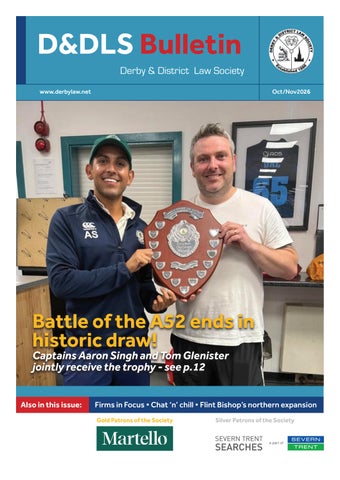
Battle of the A52 ends in historic draw! Captains Aaron Singh and Tom Glenister jointly receive the trophy - see p.12 Also in this issue:
Firms in Focus • Chat ‘n’ chill • Flint Bishop’s northern expansion Gold Patrons of the Society
Silver Patrons of the Society
D&DLS Bulletin Oct/Nov 2026
Derby & District Law Society
Contents 3 - Contents & Editorial
16 - Good practice guide for wealth advisers
4 - List of Officers
18 - Remember A Charity Week highlights
5 - President’s Page
20 - My Journey to Antarctica with HX Expeditions
6 - Council Member Report
22 - What Happens After a Forensic Laboratory Test Is Completed?
7 - Firms in Focus: Ellis-Fermor & Negus Solicitors
24 - Does your client have high principles and deep pockets?
8 - Chat and Chill - 8th September 2026
26 - EWI release results of Workforce Mapping Research
10 - Flint Bishop accelerates northern expansion
28 - Book Reviews
12 - Battle of the A52 Ends in Historic Draw
29 - Rethinking Risk
14 - Walk and Talk - 2nd September
30 - Law Society News
Editorial We are well and truly into Autumn now, with a busy programme of events taking place and plenty more in the pipeline. This Bulletin reflects the varied range of activities and opportunities offered by DDLS, from sporting events and a round table discussion for conveyancers, to a walk and a very well-attended lunchtime get-together in Chesterfield. As always the best way to get the most out of your membership is to come along and meet us so please make a point of booking in to one of the upcoming events or message me to come along to a committee meeting.
FINDING YOUR VOICE IN TODAY’S DIGITAL AND PRINT MEDIA
Published by: EAST PARK COMMUNICATIONS Ltd. Merseybank Business Centre 55-57 Seabank Road, Wallasey, Merseyside CH45 7PA Tel: 0151 651 2776 simon@eastparkcommunications.co.uk www.eastparkcomms.co.uk
The next committee meeting is on 11th November at 4.30pm just before the Diwali Curry at 6pm so why not come along to both? I have 10 teams signed up for the school debate competition already. The competition starts after Christmas and takes place at Derby University Law School on Wednesdays 4-6pm. Thank you to those of you who have contacted me to offer help judge the debates (I will be in touch soon) but anyone else willing to give up two hours of their time to pass on their expertise on speaking in public to 14/15 year olds please get in touch. Over the next couple of weeks, I will be sending out the nomination forms for the annual awards. The Awards Dinner is booked
Advertising Simon Castell Managing Editor Julia Saunders © East Park Communications Ltd.
at Pride Park on Friday 9th April 2027. Categories will be young lawyer, lawyer of the year, unsung hero award and team of the year so please start thinking who you want to nominate. A quick mention for the Christmas Carol Service which this year is on Tuesday 1st December at Derby Cathedral after work. Everyone is welcome and it is a lovely family event to get you in the Christmas mood. See you soon. Take care. Julia Saunders admin@derbylaw.net 01283 734989
Design David Coffey
Legal Notice © East Park Communications Ltd.
Accounts Tony Kay
None of the editorial or photographs may be reproduced without prior written permission from the publishers. East Park Communications Ltd would like to point out that all editorial comment and articles are the responsibility of the originators and may or may not reflect the opinions of East Park Communications Ltd. Correct at time of going to press.
Published October 2026
Officers and Committee Members for 2026 Officers President* Rachel Maxwell Rachel.maxwell@smithpartnership. co.uk Immediate Past President* Lucy Tissington lucy.tissington@familylawgroup. co.uk Vice-President* Debra Morris Affinity Law debra@affinitylaw.co.uk Deputy Vice-President* Stephen Parrott stephenp@killingworthandparrott. co.uk Honorary Secretary* Fiona Apthorpe Geldards LLP, Derby Fiona.Apthorpe@geldards.com
Other Committee Members Julie Skill, Elliot Mather LLP Chesterfield julie.skill@elliotmather.co.uk
Treasurer* Ben Lawson Elliot Mather LLP ben.lawson@elliotmather.co.uk
Felicity Coats felicity.coats@elliotmather.co.uk
Claire Rudkin Flint Bishop, Derby claire.rudkin@flintbishop.co.uk
Diana Copestake dianaohalloran@aol.com David Hardy david.hardy1630@gmail.com Oliver Maxwell Smith Partnership Oliver.Maxwell@smithpartnership. co.uk Martin Salt Martin@killingworthandparrott.co.uk Claire Twells claire.twells@smithpartnership. co.uk
Family Law Fiona Apthorpe Fiona.Apthorpe@geldards.com David Guthrie dg@aflp.co.uk Fiona Apthorpe Fiona.Apthorpe@geldards.com
Manesha Ruparel MRuparel@setfords.co.uk
Fiona Lazenby fiona.lazenby@knightsplc.com
John Ellis John.ellis@smithpartnership.co.uk
Julie Skill Julie.Skill@elliotmather.co.uk
Administrator / Bulletin Editor Julia Saunders, Email: admin@derbylaw.net
Kelly Mower kellym@eglegal.co.uk
Sub-Committees (Secretary in italics) Criminal Litigation Felicity Coats felicity.coats@elliotmather.co.uk
Sue Jennings sue.jennings@geldards.com
Andrew Oldroyd
Public Relations Officer (+) Vacant
Nosheen Tassaddiq nosheen.tassaddiq@flintbishop. co.uk
Education & Training Sue Jennings, & all Sub-Committee Secretaries
Derby Junior Lawyers Katie Morris katie@affinitylaw.co.uk
Catriona Smedley catriona.smedley@familylawgroup. co.uk
Employment and Business Law Sue Jennings
Liz Guyler lizguyler@eglegal.co.uk Lucy Tissington lucy.tissington@familylawgroup. co.uk Manesha Ruparel MRuparel@setfords.co.uk
(* = Ex-Officio)
Henna Aietan henna.aietan@familylawgroup.co.uk
Tina Attenborough tina@attenboroughlaw.co.uk
Amelia Sutcliffe amelia.sutcliffe@ smithpartnership. co.uk
Equality, Diversity and Inclusion Manesha Ruparel MRuparel@setfords.co.uk
Constituency Council Representative, Derbyshire (+) Shama Gupta shama.gupta@freeths.co.uk (+) attend Committee by invitation
4
www.derbylaw.net
Melanie Bridgen melanie.bridgen@nelsonslaw. co.uk Nick Herbert nh@aflp.co.uk Ruth Jones ruth.jones@smithpartnership.co.uk Sole Practitioners’ Group (SPG) Tina Attenborough tina@attenboroughlaw.co.uk
Tina Attenborough tina@attenboroughlaw.co.uk Sue Jennings sue.jennings@geldards.com
Last updated 05.10.26
Pipings from the President
Rachel Maxwell DDLS committee meeting September 2026 Our committee meeting today falls in the middle of National Inclusion Week 2026 and so it wouldn’t be right for me not to take a moment to reflect on what we are doing in light of this. Earlier this year, I spoke about how important is it is to be reaching all our members as our society covers such a big geographical area. I am pleased to report that we have been this into action.
We have been busy hosting a wide variety of events in lots of different locations making it more accessible for people to get involved.
have been in the sector for many years. It is fantastic that we were able to welcome such a wide variety of attendees each with their on valuable contribution to make.
In July we held our annual cricket match with Nottinghamshire Law Society. Congratulations to both teams. We arranged a Walk and Talk around Belper and had our second Chat and Chill in Chesterfield. All these events have been well attended. What become really apparent, from the conversations I have had with those attending, is how important our events are for those working remotely or in a smaller business. It seems that they really want and value the community and support that our society offers and provides.
But I think the biggest thing our society should be proud of this week is the extremely successful Q&A discussion with Mark Eants. A huge thank you to Henna and Maneesha for their efforts in putting this together and for their persistence in getting the Law Society involved. This event attracted National Interest as we saw attendees from outside of the Derbyshire area.
We have worked with our Gold Patron, Martello, to host a roundtable session. This was an interactive session that brought together those working in the property field and it provoked some very interest discussion and ideas – I particularly liked the idea of a mandatory spider survey when buying a house! At this CPD style event we had attendees just embarking on their legal career, those new to the Derbyshire area and those who
The few events that I have mentioned today really demonstrate that we have made great steps to ensure that we are inclusive, diverse and welcoming to all to join us. I’m looking forward to the calendar of events that we have lined up in the run up to Christmas, including our annual Bake Off, a Diwali celebration, and a Christmas celebration. I hope to see you all soon at one of our events. Rachel Maxwell President, 2026-2027
Council Member Report
Further reading: New Law Society guidance helps solicitors navigate English and Welsh laws | The Law Society1
TLS welcomes feedback from you and I would like to hear from you about anything you may wish to share concerning your professional needs. Schedule a 1:1 conversation online by contacting me at https://www.lawsociety.org.uk/about-us/ourgovernance/council-constituencies-and-currentmembers/shama-gupta.
New guidance for solicitors practicing in England and Wales TLS guidance is designed to help solicitors identify when English or Welsh law applies and ensure clients receive accurate
Further reading: SRA must rethink its separation of compliance and management roles | The Law Society2
Shama Gupta •
•
SRA COLP/COFA rules TLS responds to the SRA’s new rules requiring owners of law firms to separate compliance officers for legal practice (COLP) and compliance officers for finance and administration (COFA) roles from individuals with unilateral decisionmaking power.
•
SRA consultations To subscribe to SRA consultations, select SRA | Consultation alerts | Solicitors Regulation Authority3
advice that reflects the law applicable in each nation, as evolving Wales-specific legislation creates differing frameworks across devolved areas.
Don’t forget to update your personal information on My LS! Shama Gupta, DDLS Council Member https://tinyurl.com/pu269ays https://tinyurl.com/4x7upj5p 3 https://tinyurl.com/ybdpb6dv 1 2
www.derbylaw.net
5
Firms in Focus: Ellis-Fermor & Negus Solicitors The firm has seen remarkable growth in staff numbers and square footage over the years but still seeks to maintain a friendly and approachable attitude to clients both new and returning. Our team of professionals has increased by 60% since 2018 and over 40 members of staff have been with the firm for over a decade. This means we have increased capacity but also retain one of our core distinctives; the ability to understand our clients’ needs from years of experience. Ellis-Fermor & Negus Solicitors have been ‘Supporting clients since 1893’. This statement sits right at the top of the home page of the firm’s website because our clients come top of the list whether we are helping them to move house, drafting a Will, handling an estate, growing their business or settling a dispute. With six areas of law covered across five offices in Derbyshire and Nottinghamshire, EF&N are proud to assist clients both close to home and further afield.
Strong working relationships are built between firm and client enabling us to get to know the personal and professional circumstances which see the same people return to EF&N at various stages of life. Certain situations which require the assistance of a solicitor can be difficult and emotionally taxing so building trust with our clients is of high importance to create a personable and bespoke service for each person.
The firm strives to cultivate a feeling of ‘home away from home’ across all the offices because we appreciate how important the balance between work and home is. The firm seeks to ensure staff have the opportunity to enjoy a variety of activities and hobbies outside of the 9 to 5. Several members of staff keep horses and are involved in the equine world while others compete in various sports including challenges for charity and others are involved in local churches and community projects. The firm looks to ensure staff have time to spend with family and friends to contribute to our local area as well as recharging ready for the working week. We aim to be a trusted advisor and source of peace of mind for our clients for the duration of their journey. With respect, honesty and teamwork, we aim to be the firm with local roots and national reach and only ever be a phone call away.
EFN Beeston office
www.derbylaw.net
7
Chat and Chill - 8th September 2026 Putting the District into Derby and District Law Society - we had a fantastic turn out at our Chesterfield Chat and Chill on 8th September at Bottle and Thyme. Firms represented were Smith Partnership Affinity Law Limited Family Law Group Elliot Mather LLP Banner Jones Solicitors Derbyshire Law Centre MIDLANDS DOVE MEDIATION Anderson Partnership - Legal Services and Park Square Barristers and it was lovely to catch up with old friends and make new ones. Thank you to everyone who came along and we hope to see you again soon Julia Saunders admin@derbylaw.net
8
www.derbylaw.net
Flint Bishop accelerates northern expansion with new state-of-the-art Sheffield hub technology and local footprint to bring a formidable, full-service legal offering straight to Sheffield’s corporate sector.” “Sheffield is a strategically important market for us and these outstanding new premises provide the capacity, flexibility and facilities required to support our strategic plans. The new office will enhance collaboration and continue delivering the outstanding service and client experience for which Flint Bishop is recognised nationally.” “By positioning a highly capitalised, techforward firm right in the heart of Sheffield, Flint Bishop is offering local corporations and private individuals a compelling alternative: elite-tier national capability delivered by lawyers who live and work right in the city centre.” The Sheffield office relocation forms part of a wider programme of investment across Flint Bishop’s national office network, with further enhancements planned for the firm’s Birmingham, Leeds and York locations, alongside additional expansion opportunities under consideration.
Following a period of extraordinary national growth, Flint Bishop has officially solidified its regional presence by establishing prime, city-centre, state-of-the-art Grade A offices at 1 Holly Street in Sheffield, marking a major milestone in the firm’s aggressive expansion strategy across the North of England. The move follows a period of record-breaking financial growth, with firm surpassing a landmark £43 million in revenue for year ending 30 April 2026, effectively doubling the firm’s overall size in just two years. This momentum has continued into the new financial year, with Flint Bishop delivering a record first-quarter 2026/27 performance, representing 31% growth compared with Q1 of the previous year. The new office, officially opened on 10 August 2026, represents a broader strategic investment programme focused on people, office space and technology to support the firm’s significant growth. Overlooking Barker’s Pool and adjacent to City Hall, the premium workspace has been designed to enhance both the colleague and client experience.
10
www.derbylaw.net
The office provides more than 70 workstations, high-tech meeting facilities, contemporary collaboration and breakout areas, dedicated training and event space, and modern amenities that support flexible working, innovation and employee wellbeing. The acquisition of Lupton Fawcett, together with a number of strategic lateral hires across the firm and the subsequent office opening, has coincided with major infrastructural upgrades. Chief Executive Qamer Ghafoor has championed significant corporate investment in technology, IT systems and advanced legal innovation to ensure that the Sheffield workforce remains seamlessly integrated with the firm’s national hubs.
Employing more than 460 people nationwide, Flint Bishop continues to strengthen its position as one of the UK’s fastest-growing law firms through sustained investment in people, workspace, technology, client service and operational excellence to support long-term growth and deliver exceptional outcomes for clients. About Flint Bishop: Flint Bishop is a full-service award-winning national law firm with offices in Birmingham, Derby, Leeds, Sheffield, Swansea and York, employing over 460 solicitors and legal experts. Highly acclaimed for its exceptional legal expertise and outstanding service levels, Flint Bishop represents a broad range of clients, from government agencies, public sector bodies, and PLCs to SMEs, family-run businesses, and private individuals.
Ghafoor said: For media enquiries contact: “Establishing our permanent city-centre home at 1 Holly Street is a significant milestone development for Flint Bishop. Following our record financial performance, this office provides the high-specification infrastructure required to meet surging client demand across Yorkshire. We are investing heavily in our people,
Oliver Buckle Head of Marketing Flint Bishop Phone: +44 1332 226126 Email: marketing@flintbishop.co.uk
Battle of the A52 Ends in Historic Draw
Neville introduced into the attack. The pair began rebuilding the innings before Mooez was brilliantly caught by NLS captain Aaron Singh. With the score gradually increasing, James Birchell entered the fray. Peter Kidd contributed a valuable 13 runs before a superb catch by Paul Wakefield, making his NLS debut, brought his innings to an end. Rob Devine was next to bat and faced the bowling of Kassra Powles, while James Birchell found the boundary as Derby looked to accelerate. A bowling change brought Vikky Lai into the attack and she made an immediate impact, removing both James Birchell and Rob Devine.
The sun-baked outfield of Gedling & Sherwood Cricket Club provided the perfect backdrop for the latest instalment of the Battle of the A52, as the Nottinghamshire Law Society (NLS) and Derby & District Law Society (D&DLS) met once again for their annual cricket clash. After last year’s fixture was abandoned due to rain, there was no danger of that happening this year. Following the heatwave of 2026, the ground was dry, hard, and fast, promising plenty of runs and the prospect of a few painful landings for anyone unfortunate enough to fall on the outfield! Following some tactical discussions with umpires Paul Westbury and Neil Dudley, captains Aaron Singh (NLS) and Tom Glenister (D&DLS) agreed a 20-over format, with a batting change every 10 overs. The stage was set.
12
www.derbylaw.net
Derby Take to the Crease With Derby’s squad delayed by traffic across the city, Nottinghamshire had a full complement available to take the field as Derby opened the batting. Out first came David Birchell and George Ottewell, facing opening bowlers Shoaib Azad and Lakhvir Singh. David’s stay at the crease was brief as he became Derby’s first wicket, bringing Peter Kidd to the middle. Lakhvir continued to bowl with impressive accuracy and was rewarded when George Ottewell was caught. Derby captain Tom Glenister arrived at the crease and immediately signalled his intentions, striking the first boundary of the match. However, after helping Derby reach 14 runs, Tom was also dismissed. Mooez Iqbal joined Peter Kidd, with George
Martin Brierley then joined Tom Glenister, who returned to compensate for Derby’s player shortage. Together they produced the partnership Derby needed. Boundaries began to flow, confidence grew, and Derby’s hopes of reclaiming the shield strengthened as they reached 58 runs for six wickets after 11 overs. Tom, in particular, was in fine form, the sound of willow striking leather echoing around the ground. Derby Build Momentum When Alastair Rose stepped up to bowl, some nervous glances appeared among the Derby ranks as he carefully measured out his run-up. As David Birchell memorably remarked: “He’s measuring his run-up. That’s not a good sign!” Alastair and Ian Gill formed the next bowling partnership as Derby advanced to 78 runs after 13 overs.
With the game slipping away, George Neville and Kassra Powles mounted a determined fightback. Facing some excellent bowling from Mooez Iqbal and George Ottewell, the pair responded with a series of boundaries and kept Nottinghamshire’s hopes alive. As the tension built, spectators from both sides found their voices. Encouragement and cheers rang out from the Derby supporters, particularly from administrator Julia Saunders, urging her team forward. The Glenister-Brierley partnership continued to flourish. Tom eventually retired on an impressive 28 runs, while Martin carried on accumulating valuable runs. Jak Ward took over bowling duties as Derby approached the final stages of their innings. Returning batter Mooez Iqbal closed out the innings alongside Martin, who retired on an excellent 25 runs. Despite Nottinghamshire’s efforts, Derby finished strongly on 135 runs for 7 wickets from their 20 overs. With pizzas already en route, there was little time to waste before Nottinghamshire’s reply began. Nottinghamshire’s Chase Leading the chase were NLS captain Aaron Singh and debutant Harry Taylor. Unfortunately for Harry, his first appearance in NLS colours proved brief as he was bowled for a duck. The Derby opening attack of Peter Kidd and James Birchell then produced another surprise when Aaron Singh was dismissed soon afterwards, a rare sight for those accustomed to seeing the captain bat through until retirement.
From the sidelines, one notable contribution was recorded for posterity: Harry arrived, got bowled out, and went home. Match report request fulfilled. TFC Harry! After five overs, Nottinghamshire stood at 33 for 2 and the challenge of defending the shield looked increasingly difficult. Next to the crease came Jak Ward and Paul Wakefield, but Jak was soon run out, bringing Ian Gill to the wicket. Derby’s bowlers, particularly Mooez Iqbal and George Ottewell, began exerting real pressure. Wickets started to fall more frequently and Nottinghamshire struggled to maintain momentum. A moment of controversy followed when Nottinghamshire questioned a run-out decision, maintaining that: “Knocking down a stump with your hand before the ball hits it is not fair game!” Whether the appeal had merit remains a matter for the historians. At 67 runs after 12 overs with four wickets down, Nottinghamshire still had work to do. Shoaib Azad was then caught by Martin Brierley, while both Ian Gill and Alastair Rose departed in quick succession.
“Come on Nottinghamshire!” “Keep going Derby!” The runs continued to accumulate. The target drew closer. Every ball seemed to matter. And then it was over. A Historic Result It was a draw. For the first time in the history of the Battle of the A52, neither side could claim victory as the teams finished level after a thrilling afternoon of cricket. Players from both sides congratulated each other following a fiercely contested but thoroughly enjoyable match. Captains Aaron Singh and Tom Glenister thanked the umpires, Gedling & Sherwood Cricket Club for their hospitality, and everyone involved in organising the fixture. Special thanks, of course, go to Michelle for helping make the day happen. As a result, this year’s shield will carry both Nottinghamshire Law Society and Derby & District Law Society on the engraving. The only question that remains is: Who will win the Battle of the A52 in 2027?
www.derbylaw.net
13
Walk and Talk - 2nd September Thank you for joining us on our Walk and Talk round Belper on a damp Autumn evening. Lots of chatting done and connections made. Well done to Rachel Maxwell, Victoria Yeomans, Kirsty Dakin, Viktorija Aleksejeva and Maisie Marshall for braving the weather.
14
www.derbylaw.net
Free Friday Care Tips
Practical advice and information for older people, families and carers When a loved one needs care or support, finding reliable information can be challenging. From understanding benefits and avoiding scams to finding local services and planning ahead, timely advice can make all the difference. Since 1980, Able Community Care has supported older people and adults with disabilities throughout England, Wales, Scotland and the offshore islands. Drawing on 46 years of experience, we share practical information through our Free Friday Care Tip. Delivered by email every Friday morning, each tip provides straightforward information on issues affecting older people, families and carers. Topics include benefits, home safety, health and wellbeing, community support, care planning and consumer alerts, etc. The example below is one of our previous Friday Care Tips.
You do NOT have to pay to apply for the Attendance Allowance or Scotland’s Pension Age Disability Payment (PADP). We recently heard of a pensioner who was contacted unexpectedly and told she could receive up to £114.60 per week and that their company could complete an application for her. A little research revealed that some businesses charge between £250 and £650 + VAT to help with Attendance Allowance claims, while others work on a “No Win, No Fee” basis or take a percentage of the award. Before paying anyone, remember: 1. You can apply yourself online or by requesting an application form. 2. Free help is available from trusted organisations, including: • Age UK – 0800 678 1602 or local branchesCambridge • Independent Age – 0800 319 6789 • Your local Citizens Advice branch Advice organisations consistently point out that you do not need to pay for assistance with an Attendance Allowance application. If you would like to receive The Friday Care Tip each week, please email to: info@ablecommunitycare.com No information is passed on and it is easy to unsubscribe. Able Community Care, The Old Parish Rooms, Trowse, Norwich. NR14 8TZ www.ablecommunitycare.com Trusted for 46 years.
Good practice guide for wealth advisers launches to support growing client demand for philanthropy Remember A Charity1 is launching a good practice guide for wealth advisers. The new guide, Integrating Charitable Legacies into Wealth Planning2, is designed to help advisers confidently incorporate charitable legacies into wealth planning discussions and better support their clients’ philanthropic ambitions. Developed in collaboration with Boon Philanthropy Consultancy and Boodle Hatfield, and with input from a host of industry experts, the free guide provides insights and practical tools to help advisers initiate and navigate conversations around legacy giving, particularly in the context of estate planning, succession and long-term wealth strategies. The launch of the guide comes at a time when demand for values-led advice is increasing. Research from the Charities Aid Foundation (CAF) shows that 86% of high-net-worth individuals donate to charity and 93% of those who discussed philanthropy with their adviser found the conversation beneficial.¹ This highlights a significant opportunity for advisers to better align clients’ wealth with their personal values and goals. A growing advice gap Further research from CAF shows that 6 in 10 high net worth individuals believe it is important for advisers to have a strong understanding of philanthropy². Meanwhile, economic modelling suggests that firms engaging clients in conversations about philanthropy could increase client lifetime value by almost 25% over ten years³. Despite this, philanthropy and legacy giving in particular, are rarely core components of mainstream wealth planning services. The new guide aims to address this gap, equipping advisers with the confidence, language and context to incorporate these discussions into client relationships. The opportunity for legacy giving Charitable legacies represent a significant and growing area of giving, with an estimated £4.4 billion donated to UK charities last year through gifts in Wills4. A 2025 study found that half of UK millionaires have already included a charitable gift in their Will, with many more intending to do so5. This points to a clear opportunity for advisers to support clients in turning intention into action.
16
www.derbylaw.net
The guide outlines how advisers can play a pivotal role, not necessarily as philanthropy specialists, but as trusted professionals who can open up conversations, explore client values and connect them with the right expertise where needed. It also highlights the wider benefits of these discussions, from strengthening client relationships to supporting intergenerational engagement. Moving with the times Clare Stirzaker, Private Wealth Partner at Boodle Hatfield and Chair of Remember A Charity’s Wealth Adviser Committee3, says: “Legacy planning has always been a central part of private client work, but in recent years I have seen a marked shift in what clients are looking for from their advisers. The traditional, purely technical approach to philanthropy is no longer enough on its own. Increasingly, clients want something more holistic. They want advisers who can help them explore what matters to them, articulate the purpose of their wealth, and understand the impact they hope to have during their lifetime and beyond it.” Lucinda Frostick, Director of Remember A Charity, says: “Clients increasingly want their wealth to reflect who they are and the impact they wish to have on the world. This guide has been developed to support advisers in responding to that shift, helping them to feel more confident introducing conversations about philanthropy and legacy giving, and to integrate these discussions naturally within broader financial planning.” Joe Crome, Head of Business Development and CAF American Donor Fund, at CAF, says: “Recent Charities Aid Foundation research found that although most donors consider philanthropy an important part of their lives, a significant proportion of charitable giving takes place without the involvement of a professional adviser. This is a missed opportunity — for greater impact, better alignment with personal values, and more thoughtful legacy planning. Being up to date on the options available and knowing where to signpost clients provides an opportunity for advisers to meet their wider needs and develop deeper client engagement.”
Sianne Haldane, Founder of Boon Philanthropy Consulting, says: “My clients see their philanthropy as ‘investments’, though in a way it is even more precious as there is no expectation of a financial return, but they do want the reassurance that the funding will be used well and most importantly have a lasting impact.” The launch of the new guide comes ahead of Remember A Charity Week4 (7-13 September 2026) – the national awareness week for legacy giving, bringing together charities, professional advisers and partners across the UK. The aim is to spark widespread conversations around charitable legacies and the vital role they play in funding charitable services, encouraging more people to consider leaving a charitable gift in their Will. Accessing the guide The Remember A Charity good practice guide for wealth advisers is available to download for free here5. Remember A Charity offers a range of additional resources at its Wealth Adviser Hub. Explore the Hub here6. Advisers are encouraged to participate in Remember A Charity Week. Find out more here7. 1 https://www.rememberacharity.org.uk/ about-us/for-wealth-advisers/ 2 https://www.rememberacharity.org.uk/ about-us/for-wealth-advisers/good-practiceguide-for-wealth-advisers/ 3 https://www.rememberacharity.org.uk/ about-us/for-wealth-advisers/wealth-advisercommittee/ 4 https://www.rememberacharity.org.uk/ about-us/remember-a-charity-week/ 5 https://www.rememberacharity.org.uk/ about-us/for-wealth-advisers/good-practiceguide-for-wealth-advisers/ 6 https://www.rememberacharity.org.uk/ about-us/for-wealth-advisers/ 7 https://www.rememberacharity.org.uk/ charity-champion/
Remember A Charity Week highlights
Remember A Charity Week launched on 7th September with the results of a new survey exploring what legacy means to people. The findings show that while wealth and career success form part of the picture, people also place importance on their relationships, values and the difference they make to others. The survey, commissioned by Remember A Charity, found that 92% of UK adults care about the legacy they leave behind. Being a good friend, partner or family member was identified as the most important aspect of legacy, cited by almost two thirds (64%) of respondents. One third (33%) highlighted helping others in times of need, and three in ten (30%) passing on values and life lessons. A successful career or business was a key part of their legacy for one in ten (10%). For professional advisers, the findings highlight the range of considerations that can form part of conversations about Wills, estate planning and intergenerational wealth – including the values, relationships and causes that matter to clients alongside the assets they wish to pass on. Charitable giving and legacy planning More than six in ten (62%) of those surveyed said that supporting causes they
18
www.derbylaw.net
care about is important to them, while more than one in five (22%) said they had already included a charitable gift in their Will or planned to do so when they write their Will.
opportunity to remember their favourite charity alongside their loved ones in their Will.” Further information is available at www.rememberacharity.org.uk.
One in six estates (17.4%) at probate now include a charitable gift and, increasingly, people are choosing to remember good causes alongside family and other beneficiaries in their estate plans. As such, charitable legacies have become a vital income stream to sustain charitable services, raising around £4.5 billion a year for good causes across the UK.1 Lucinda Frostick, Director of Remember A Charity, said: “For most people, legacy isn’t about fame or fortune. It’s about the people they care about, the difference they make to others and the values they want to pass on. For professional advisers, these wider considerations can provide really useful context for conversations about estate planning and what clients ultimately want to achieve with their wealth. “This Remember A Charity Week, we’re encouraging advisers to use the week to engage with clients and prospects, opening up conversation about their legacy and the
Sources 1 The Legacy Giving Report 2026, Smee & Ford / Legacy Futures
www.derbylaw.net
19
Book Reviews Adoption Law: A Practical Guide 2nd edition By Nasreen Pearce
Appreciations by Elizabeth Robson Taylor of Richmond Green Chambers and Phillip Taylor MBE, Head of Chambers and Reviews Editor, “The Barrister”
Nasreen Pearce in updating the second edition has included important developments in this principal area of family law for those wishing to adopt. The book looks at the impact of the Convention for the Protection of Human Rights and Fundamental Freedoms on all aspects of the law relating to adoption. As we expect with all Wildy guides, recent case law has been included in areas such as the notification to fathers and the child’s birth families of any plans to place a child for adoption. We are grateful for the inclusion of the procedure relating to preparation before proceedings begin, and the procedure for applications in the Family Court and, where relevant, the High Court.
ISBN: 978 0 85490 308 5 WILDY, SIMMONDS & HILL PUBLISHING www.wildy.com AN UPDATED COMPREHENSIVE GUIDE TO CURRENT ADOPTION LAW FOR 2020s For law students and practitioners alike, there has been concern in recent years that some fundamental reform of the law of adoption is urgently needed. We welcome the new, second edition of “Adoption Law: A Practical Guide” by Nasreen Pearce from Wildy, Simmonds and Hill Publishing for 2025. The title arrives at an interesting time for the modern development of adoption as the strains on the system continue to show. Wildy have provided us again with another excellent book in their practical guide series of titles. We thank Nasreen Pearce for her wise counsel in offering a comprehensive guide to the law, practice, and procedure for lawyers, adoption agencies, support services and other professional bodies who are concerned with adoption for a wide readership. It can make all the difference to the advice we give clients.
The book also includes case law citations in relation to placement orders. It covers leave to revoke a placement order and to oppose adoption and post-placement arrangements for contact. The text sets out new coverage of postplacement contact, and post-adoption contact details to update advisers. The commentary covers recent reports and research plus the important decision in R & C (Adoption or Fostering) [2024]. We also found the inclusion of two recent lectures by the President of the Family Division on the modern approach to adoption and open adoption to be of great additional assistance. The second edition of this hardback book from Wildy was published in 2025.
Child Care And Protection Law and Practice 7th edition By Safda Mahmood and Julie Doughty
20
www.derbylaw.net
The book examines subsequent child protection legislation, guidance and case law for both established practitioners and those new to the subject. Among the developments included in this edition are the changes brought about by the Public Law Outline in January 2023 to family justice, particularly in relation to expert evidence, time limits, care plans and delay. In addition, the editors explore the law surrounding deprivation of liberty as it relates to children, regarding the interface between care proceedings and Article 5 ECHR, and consideration of key case law, such as Re T (A Child) [2021]. They cover the revision of important Practice Directions, such as PD12A (Care and Supervision Proceedings and other Part 4 Proceedings: Guide to Case Management), Child Arrangements Programme (PD 12(B), and Revised PD12J – Domestic Abuse and Child Arrangements, Pilot Reporting and Private Law Review. As is to be expected with all Wildy practitioner titles, there are significant case law developments in children law which are set out since publication of the last edition, together with a review of the revised edition of “Working Together to Safeguard Children” (2023), which has changed the position in relation to safeguarding and child death reviews, as well as assessments. Legal commentators have rightly welcomed this book for the breadth of the legal topics covered, plus their application and use within family practice. The specific references and analysis on updating legislative provisions, regulations, practice guidance, and case law are very well covered in our view.
For practitioners new to the work, the author covers each stage of the adoption process, including what are difficult issues of contact between the child and their birth parents. It includes the alternative options available by reference to the relevant case law and regulations in relation to domestic adoptions as well as adoptions involving overseas jurisdictions. The title considers registration of adoption and the sensitive issue of disclosure of information which are explaining in straightforward terms to both knowledgeable readers and those new to this subject. Pearce explains the rights of those parties to challenge decisions made by the professional bodies involved in the process so do use the detailed index at the back for any specific areas you are interested in exploring further.
Safda Mahmood and Julie Doughty have edited this popular family law title from Wildy for 2024. The book has been extensively updated to provide practical guidance over the complexities arising from the Children Act 1989 which we have found most helpful.
ISBN: 978 0 85490 306 1 WILDY, SIMMONDS AND HILL PUBLISHING www.wildy.com A COMPREHENSIVE SHORT GUIDE COVERING CHILD CARE AND PROTECTION FOR THE BUSY FAMILY LAW PRACTITIONER
Mahmood and Doughty offer us a break-down of the issues that one must bear in mind in each chapter, so all we need to do is read it, apply it, and reap the benefits. And we described the last edition as “the practitioner’s friend during these times of increasing changes and revision in child law proceedings, plus the ever re-modelling of our process as more and more legislation and guidance is produced”. Ever more so now, as the authors have done that again, brilliantly, to keep us up to date! Thank you. The seventh edition of this paperback book from Wildy was published in 2024.
Rethinking Risk That lightning strike came literally out of the blue, but there are situations where risk can be assessed more fully in advance. For example, I used to arrange cover for an luxury car dealership in Tewkesbury, an area renowned for flooding due to its proximity to the River Severn in Worcestershire. In those circumstances, sophisticated modelling and local risk data helped us determine exactly where and when flooding was most likely to hit. This informed the structure of the insurance contract, supporting better decisions around risk prevention, mitigation, and transfer.
Kevin Bonner The challenge with managing risk is that there are a multitude of things that can go wrong. Some risks are tangible, such as flood, fire, or physical damage, while others are less visible, including disruption, loss of confidence, or damage to reputation. Over the course of my career, I have come to understand that while not every risk can be anticipated, organisations are always better protected when insurance is considered part of a wider, proactive risk management conversation. Over the years, I have been involved in placing cover for a wide range of unusual and complex risks from hospitality venues like restaurants, high value livestock to more specialist assets such as the steel dome now protecting Reactor No. 4 at Chernobyl following the nuclear disaster. While organisations can take sensible steps to reduce risk, such as regularly inspecting unoccupied properties, there will always be unforeseen circumstances that no amount of preparation can prevent. That is where the right insurance contract plays an essential role. Take the example of a residential property near the coast that was struck by lightning during a severe storm. The roof was badly damaged, with replacement costs estimated at well over £100,000. The legal team responsible for the property was incredibly grateful that appropriate cover was in place through a comprehensive unoccupied property insurance policy. It was a clear reminder that even well-managed properties can be exposed to sudden, devastating risks.
Sometimes it is not a natural disaster but human error that creates the issue. Around 20 years ago, I worked on a risk involving an important historic building in central London, standing right in the shadow of St Paul’s Cathedral. A single careless act, a cigarette discarded in a wastepaper bin, led to a major fire that almost razed the site to the ground. In cases like this, the impact is rarely limited to the physical building; priceless documentation dating back to the thirteenth century was lost, and the resulting insurance claim was huge. Thankfully, the broker I worked for at the time had properly reinsured themselves against such massive losses, preventing what could have been a catastrophic financial jeopardy for the firm. Risks to the intangible aspects of a business must also be considered. I remember one leading London restaurant that suffered a serious E. coli outbreak, which severely affected several celebrities who had dined at the establishment. The business was forced to close temporarily, and the public fallout had far-reaching consequences for their reputation. Because this business had invested in a crisis containment policy, they were able to immediately deploy a legal team and a damage-limitation PR specialist to mitigate the effects of the crisis. Cyber and fraud risks are another excellent example of exposures that are not always immediately visible. Another restaurant I came across had their IT system hacked, and an employee inadvertently paid over £100,000 to a fraudster posing as a regular supplier. Because they did not have appropriate cyber cover in place, the business was forced to absorb the financial loss entirely on the chin. This underlines the importance of reviewing both physical assets and also digital systems, procedures, and human vulnerabilities.
So often, particularly with property, we think first of fire, flood, or storm damage. These are important, but they are only part of the picture. The best advice I can offer is to talk candidly to your broker, who can help identify both the tangible and intangible risks that your business may have otherwise overlooked. No matter what you do to mitigate risk, an insurance contract remains the ultimate safety net for unexpected events. Whether you are protecting tangible assets like property, or intangible assets like reputation, continuity, and confidence, it is well worth taking the time to rethink risk and ensure the right conversations have taken place. Estatesearch’s subsidiary, Estatesure, which is authorised and regulated by the Financial Conduct Authority, offers a range of insurance products covering a variety of situations which may arise during estate administration and distribution, including: • Unoccupied Property Insurance • Early Distribution • Missing Beneficiary • Missing or Lost Share Certificates • Missing Will • Section 27 For further information about our robust insurance solutions for probate professionals, please see www.estatesure.co.uk or email helpdesk@estatesure.co.uk. Kevin Bonner Group Head of Insurance Services, Estatesure
About the Author Kevin Bonner has 39 years’ experience in the insurance industry, joining Estatesearch from a Lloyd’s insurance broker in London, where he served for over three years. Throughout his career, Kevin has held senior roles with global insurance and reinsurance brokers, working with clients in the UK, Middle East, Latin America and Asia Pacific. During his last role, Kevin also gave his time to mentoring at the world-famous Lloyd’s Lab, a collaborative environment for startups, scale-ups and innovative companies to develop technology-driven solutions for the insurance and risk management industries.
www.derbylaw.net
21
What Happens After a Forensic Laboratory Test Is Completed? validated methods.
Forensic laboratory analysis is only one stage within a structured forensic analysis process. Once samples have been collected under strict chain of evidence, and analysis is complete, important steps must occur before results can be relied upon in legal or safeguarding contexts.
Understanding what happens after the laboratory analysis helps set realistic expectations and supports appropriate use of the evidence. Laboratory results are reviewed, verified, interpreted in conjunction with full details of the client’s circumstances, and reported within a formal framework designed to meet evidential standards required in legal proceedings. At Forensic Testing Service (FTS), post-testing processes focus on clarity, proportionality and evidential integrity to support balanced decisionmaking in line with the required burden of proof: the Balance of Probabilities. Laboratory Analysis Completion
Once forensic analysis has been carried out, results are not released immediately as a standalone Certificate of Analysis. The first step is a review of all available data, and a validation check to ensure analytical integrity. This includes quality control checks, confirmation of findings and internal review to verify results are consistent with
22
Any anomalies or technical issues are resolved before reporting begins. Report Preparation
Forensic reports are prepared in a structured and legally defensible format, presenting findings clearly and objectively without assumptions or advocacy. Reports explain what was tested, how analysis was carried out and what the results show. Language is neutral and scientific, avoiding unnecessary technical complexity while remaining precise. FTS reports do not rely solely on Society of Hair Testing cut-off levels or binary terminology such as “detected” and “not detected”. Instead, results are interpreted in the context of the available evidence and the circumstances of the case. The information is presented clearly so that it can be understood by legal and safeguarding professionals and considered appropriately by the court, focusing on evidential value rather than volume of data. Expert Interpretation
Interpretation is a critical part of forensic analysis. Results must be considered alongside relevant contextual information. Expert interpretation takes account of case background, declared information, biological variability and environmental factors that may influence findings. This can include passive
www.derbylaw.net
exposure, cosmetic treatments or other influences relevant to the testing method. Interpretation helps avoid simplistic conclusions and explains both what results indicate and their limitations.
as such. Court guidance cautions against attributing a false sense of certainty to forensic findings, particularly where laboratory results are presented numerically.
For the findings to be of evidential value, the expert must clearly describe the process, record the results and explain their potential significance in the context of the case. Industry guidance also emphasises the expert’s responsibility to report findings fully and faithfully.
Record Handling and Evidential Integrity
Communication and Expert Support
Confidential handling, secure storage and appropriate retention periods ensure evidence remains available and traceable should it be required at a later stage.
Once reporting is complete, results are shared securely and confidentially only with those who instructed the testing, such as solicitors, local authorities, or private individuals. Sensitive information is handled in accordance with confidentiality and the latest UK GDPR requirements. Where appropriate, support remains available to explain methodology, address technical questions or clarify how findings relate to the case context. Additional documentation, such as expert statements, may also be prepared where necessary. Use of Results in Legal or Safeguarding Contexts
Expert forensic analysis informs legal and safeguarding decisions rather than determining outcomes on their own. Reports may support risk assessment, clarify disputed facts or contribute to the wider evidential picture, alongside witness evidence, professional assessments and other relevant material. Forensic evidence provides objective information but does not replace judicial judgement or professional discretion. Ultimately, this is expert opinion evidence and should be treated
Evidential integrity does not end with reporting. Testing data, collected samples, and documentation are stored securely in accordance with legal and regulatory requirements.
Timelines and Expectations
Reporting timeframes vary depending on the type of testing, case complexity and whether priority handling has been requested. Standard timelines are communicated at the point of instruction, with sample availability, confirmation requirements and casespecific considerations potentially influencing turnaround times. While efficiency is important, accuracy and evidential reliability are prioritised to ensure realistic expectations. Do you need forensic testing for a case?
If you require guidance on the most appropriate testing approach or reporting requirements for your case, our experienced case managers are available to provide advice. You can request a quote, make an instruction or speak to a member of the FTS team via email: expert@forensic-testing. co.uk or call 01924 480272. www.forensic-testing.co.uk/
www.derbylaw.net
23
Does your client have high principles and deep pockets? In the old days – I’ve been doing this job from about 1988 – there was a breed of lawyers who churned cases to get as much out of them in fees as they could, and who were delighted when instructed by clients with high principles and deep pockets. You know the sort: determined they were Chris Makin right, and willing to pay whatever it cost to win. These lawyers were in a minority, but they did exist, and they often worked in league with expert witnesses who believed if was their job to assist in that winning; none of this overriding duty to the court in those bad old days. Then along came Lord Woolf with his Access to Justice leading, on 1 April 1999, to the Civil Procedure Rules. A new day had dawned. Judges controlled cases, the litigants had to be treated equally, we had a new word – proportionality – and experts had an overriding duty to assist the court within their expertise, irrespective of who gave them instructions or by whom they were to be paid. And as a very experienced expert witness, I have to say that I am a great deal more comfortable working under this regime. But we still have cases where the legal costs run out of all proportion to the value of the case. As a mediator, I often start a mediation where the parties have already spent in legal fees more than the original claim was worth. Litigation is like dancing with a gorilla; the dance stops only when the gorilla chooses to let go. But it’s a pity that the parties can’t agree to stop the dance much earlier. Symptomatic of these cases is the border dispute. I know they can be highly emotional, because the parties live on site, and blood pressure rises whenever there is a twitch of the curtain and one party believes they are being spied on. There is no getting away from the source of the problem. Few of my mediations fail, but I can think of two recent ones which, sadly, did, and they are extreme examples of costs being out of all proportion to quantum. With the first, we had a pair of semis with a shared drive. It had been unmade gravel, but one neighbour decided to smarten things up, and he laid paviours up to what he considered to be the half-way point. The other neighbour objected. We spent most of the day negotiating exactly where the border fell, and reached agreement; right-hand agreed to pull back a line of paviours. The problem was that, before the paviours, the other chap had erected a gate post to secure his back garden, and now it fell on the wrong side of the border! It now served no purpose, but would he remove it? No way! So the mediation failed. Trouble was, solicitors on each side estimated that it would cost £50,000 each to take the matter to trial. So, allowing say 70% of costs payable by the losing party as well as their own costs of £50,000, the loser would have a bill to pay of £85,000. And that was probably, after mortgage, more than the equity in their home. Outcome: the losing party would probably have to sell their home to pay legal fees. And all over a gate post. How ridiculous is that? The second example is as bad. Here, there were two detached houses with separate drives – so no problem there – but the left-hand house had a garage built right up to the border. Right-hand had built a flower bed with topsoil piled against the garage wall, and damp had got through. They had removed the soil and put a membrane against
24
www.derbylaw.net
the wall, but there was pointing to be done at a cost of £250. That derisory sum was the quantum of the claim. We agreed lots of things, including an offer by the right-hand owner to pay much of left-hand’s costs to date, though that was unmerited, and discussions were going well. But then we came to the fallpipe on the garage. This was on the right side of the garage, overlooking righthand’s garden, just by their barbecue area. In fact, it was on righthand’s side of the border. Right-hand insisted that it be moved to the front of the garage, and onto left-hand’s property where it belonged. But left-hand refused, saying that it would be unsightly! Despite the fact that right-hand had had to put up with unsightliness for years, and it wasn’t even their fallpipe! So again, what started with a claim of £250 was now heading for court with estimated costs of £50,000 each side. Ridiculous! I really do find border dispute mediations so frustrating. Now let’s talk about some bigger numbers. S994 of the Companies Act 2006 addresses unfair prejudice. This is where the company is being run by the directors to the detriment of one or more of the shareholders. It may be that shareholders who are directors are locked out of management meetings, or that high salaries are paid to some directors so that there is no profit left to pay dividends, or that bonus share are issued to give minority shareholders even less influence.
The aggrieved shareholder can petition the court for a remedy; under previous legislation it was called a prayer for relief. And the judge has complete discretion to order whatever may give that relief, though it is usually an order for the dissenting shareholder to have their shares bought at a value. And valuing such shares is one of the jobs I do.
As we came out of court, I spoke to the other expert, knowing he was a mediator as I am. I said this case cried out for mediation, and my side had often invited it, but your side had refused. Why? His reply was classic, to the effect that his side had often invited mediation but it was my side who always refused.
The trouble is, it is ferociously expensive to take such a matter to court. Each party is unlikely to get change out of £100,000. I am actively involved with two such cases just now, one of them to be heard at court very soon. My fees to date on each case exceed £25,000, and I have a minor part to play. Why couldn’t the parties talk to each other instead of dancing with this gorilla?
I rest my case.
I am reminded of a case in Leeds many years ago where I was expert for one party in a 50:50 shareholder dispute. The other expert I knew quite well – experts are a small community.
Chris is a fellow of the Institute of Chartered Accountants where he has served on the Forensic Committee, and as an ethical counsellor; he is a fellow of the Chartered Management Institute, a fellow of the Academy of Experts where he serves on the Investigations Committee, and a mediator accredited by the Chartered Arbitrators. He practises as a mediator, from his home in West Yorkshire and his rooms at 3 Gray’s Inn Square, London WC1R 5AH, telephone 020 7430 0333. He has mediated 100+ cases so far, on a huge range of subjects, with a settlement rate to date of 80%. For more see his website with videos: www.chrismakin.co.uk chris@chrismakin.co.uk
The case dragged on, and went part heard three times. At the start of the fourth session, the judge leaned out of his chair as far as he dared without bringing proceedings to an end – judges have to sit – and said words to this effect: “You two litigants at the back of my court. You used to be best friends. You are very sensible Yorkshire businessmen. I say to you, over the heads of all these expensive lawyers, talk to each other and reach a settlement, instead of wasting even more money in this court.” They didn’t, and the case eventually concluded. I can’t remember the outcome, but that is irrelevant.
Biog: Chris Makin has practised as a forensic accountant and expert witness for 30 years, latterly as Head of Litigation Support at a national firm. He has given expert evidence about 100 times. He also performs expert determinations.
www.derbylaw.net
25
EWI release results of Workforce Mapping Research This year, the Expert Witness Institute (EWI) embarked on an ambitious project to gain more insight into the size and demographics of the Expert Witness workforce. This research has provided the first-ever assessment of the size and characteristics of the Expert Witness workforce in the UK. Using national data sets and primary research, the EWI (working with White Space Strategy) have created a robust model and data set which estimates a workforce of 7,500 regular and 23,500 infrequent Expert Witnesses. Additional survey data has enabled us to identify the likely demographics of regular expert witnesses. This dataset will be invaluable in our policy, advocacy and lobbying work and as we deliver our 2026-2030 strategy. The key findings identified in the report are: •
•
• •
• • • • •
•
•
•
26
It is estimated that there are approximately 31,000 people in the UK undertaking expert witness work. This consists of 7,500 people in the UK undertaking expert witness work regularly and a further 23,500 who undertake cases infrequently. Specialist Medical Practitioners form the largest group with 40% of respondents. Construction and Building and Therapy professionals (including Occupational Therapy and Psychologists) are the nextlargest groups. Over 50% have worked as an Expert Witness for over 15 years. 12% consists of “Professional Expert Witnesses” (those that only do Expert Witness work). 30% of Experts complete 100 or more cases on average per year. The average Expert Witness undertakes 60 cases per year. The majority of Expert Witnesses (77%) charge between £100 and £400 per hour. 41% do not hold any formal Expert Witness qualifications. Only 49% have completed core training in Law for Experts, Report Writing, and Expert Discussions/Joint Statements 11% have not undertaken any Expert Witness training in the key competencies required of an Expert Witness. 62% undertake work as a Single Joint expert but only half of those have completed training in being a Single Joint expert. 33% of the workforce are over 65 and
www.derbylaw.net
•
• •
•
have been working as an Expert Witness for 10 years or more. Only 24% of the entire workforce is female, but there are signs that over time there will be greater representation with a far more balanced gender split in the 3544 age group. 86% of the workforce is from a White background More work is required in the next survey to understand the needs of the 6% who identify as having a disability. More work is needed to define and refine ‘regular’ and ‘infrequent’ Expert Witnesses in future surveys.
Key insights
The full report will be published on Thursday 17th October at https://www.ewi.org.uk/ workforce The EWI intends to run this exercise again in a few years to monitor changes in the workforce and further refine the model. Simon Berney-Edwards, Chief Executive Office, Expert Witness Institute
Email: bill.bailey1@nhs.net
www.derbylaw.net
27
My Journey to Antarctica with HX Expeditions comfortable lounges invite you to sit back and watch the ever-changing scenery. Guests can choose from a selection of excellent restaurants, enjoy informative lectures from the expedition team, and spend time in beautifully designed spaces that fully embrace the spirit of exploration. Every area of the ship is designed to connect you with the destination, building excitement for the incredible experiences that lie ahead in Antarctica. Crossing the Drake Passage The next stage of my journey involved crossing the legendary Drake Passage, a voyage that takes around two days.
Sarah Wilson arriving in Antarctica Travelling to one of the most remote places on Earth, where very few people ever get the chance to visit, naturally comes with plenty of questions. I had the privilege of travelling to Antarctica last December with HX Expeditions, and I wanted to share my experience for anyone considering this extraordinary adventure and wondering what it’s really like. I’ve always loved sharing my travel stories, which is one of the reasons I became a travel professional many years ago. So, here’s a snapshot of my unforgettable journey to Antarctica. The Journey Begins My adventure started at Heathrow Airport, flying with British Airways on a route that briefly touched down in Rio de Janeiro before continuing to the vibrant city of Buenos Aires, Argentina. As part of the HX Expeditions package, guests spend a night in Buenos Aires before travelling onwards. This ensures everyone is well rested for the early morning charter flight to Ushuaia, the world’s southernmost city and the gateway to Antarctica. Just three hours later, after a spectacular flight over the Andes, I arrived in Ushuaia, ready to board my home for the next adventure: the beautiful Roald Amundsen. A Different Kind of Expedition Ship The Roald Amundsen is a stunning Scandinavian-inspired hybrid expedition ship, thoughtfully designed with sustainability and mindful travel at its heart. Operating in one of the world’s most fragile environments, every detail reflects a commitment to responsible exploration without compromising on comfort. I was fortunate enough to be staying in a suite, which included access to the Arakur Spa before embarkation. a wonderful opportunity to relax and take in the breathtaking views of Patagonia before setting sail. Life Onboard From the moment I stepped onboard, it was clear that this wasn’t a traditional cruise experience. The atmosphere is relaxed and welcoming, attracting like-minded travellers who share a passion for nature, wildlife and discovery. Rather than thinking of it as a cruise ship, it’s better described as a floating expedition vessel. Large observation decks provide incredible viewing opportunities, while
28
www.derbylaw.net
The Drake often receives mixed reviews because of its reputation for rough seas. Some travellers experience the famous “Drake Shake,” while others are lucky enough to enjoy the much calmer “Drake Lake.” Whichever version you get, I found it to be the perfect opportunity to slow down, unwind and fully embrace expedition life. Rather than rushing from place to place, I spent time enjoying my spacious suite and exploring everything the ship had to offer. I treated myself to a relaxing massage in the spa, soaked in the outdoor hot tubs while surrounded by nothing but endless ocean, and watched the world drift by from the observation deck. Before reaching Antarctica, every guest is fitted with their waterproof landing boots and receives an expedition jacket, which is included as part of the experience. The expedition team ensures everything fits perfectly, so you’re fully prepared for your first landing on the White Continent. One of my favourite moments was sitting with a glass of wine, watching magnificent wandering albatrosses effortlessly glide alongside the ship. With their incredible wingspans, they seem to dance on the wind, rarely needing to flap their wings as they soar above the Southern Ocean. The crossing is also an opportunity to get to know your fellow travellers and the expert expedition team. Daily lectures and presentations cover everything from Antarctic wildlife and history to conservation and photography, building excitement for the adventure ahead. Guests are allocated into small landing groups and have access to the onboard app, with complimentary Wi-Fi included throughout the voyage. The app keeps you updated with daily schedules, landing times and Zodiac excursions, ensuring you never miss a moment of the experience. By the time the first icebergs appear on the horizon, you’ve had time to rest, learn and connect with both the destination and the people sharing the journey. The anticipation builds with every passing hour, making that first glimpse of Antarctica even more unforgettable. First Glimpse of Antarctica There is nothing quite as humbling as waking on your first morning in Antarctica, opening the curtains and witnessing a landscape that can only be described as magical. An endless world of pristine white stretches before you, illuminated by the most extraordinary light, with the sun sparkling and dancing across the snow and ice. Visiting during the Antarctic spring means the continent is full of life, with longer days, incredible wildlife activity and a sense of renewal that is impossible to put into words. For anyone who truly appreciates our planet and the extraordinary places that still exist untouched by mass tourism, it is an emotional moment. You realise just how small you are in comparison to the vastness of this frozen wilderness and how privileged you are to experience it.
Almost immediately, you feel an overwhelming desire to step ashore and become part of this remarkable environment. My first excursion was an evening Zodiac cruise. These large inflatable expedition boats, carrying around ten guests, allow you to get incredibly close to the wildlife while respecting the strict guidelines that protect this fragile ecosystem. As we glided silently through the icy waters, snowflakes began to fall around us, creating an atmosphere that felt almost dreamlike. In the distance, whales surfaced and gracefully disappeared beneath the water before reappearing moments later, while curious penguins played along the shoreline, completely unfazed by our presence. Many people imagine Antarctica to be unbearably cold, but the reality is surprisingly comfortable. With the right expedition clothing, the crisp air feels fresh and invigorating rather than harsh, adding to the sense of adventure. It was one of those rare travel moments when time seems to stand still. There was no noise apart from the gentle sound of the water, the calls of the wildlife and the quiet excitement shared by everyone onboard. It was, without question, one of the most memorable evenings I have ever experienced and the moment I truly fell in love with Antarctica. My First Steps on the White Continent The next morning, bathed in glorious sunshine beneath an endless blue sky, I stepped onto the Antarctic mainland for the very first time. It’s a moment that appears on so many bucket lists, and as I chatted with fellow travellers from every corner of the world, I realised we were all sharing the same feeling. For many, this was the experience they had dreamed about for years, a once-in-a-lifetime moment that had finally become reality. Equipped with walking poles and sturdy snow boots, we made our way across the pristine, snow-covered landscape, accompanied only by the sounds of nature and the company of hundreds of penguins. Already busy preparing their nests, they seemed completely unbothered by our presence. In fact, it often felt as though we were the visitors in their world. They confidently waddled past us, following the well-worn penguin highways that criss-crossed the snow, occasionally stopping to inspect us before continuing their way. One question I’m often asked is whether you need to be exceptionally fit to visit Antarctica. The answer is reassuringly simple: no. The expedition landings are designed to accommodate a wide range of abilities, and the experienced expedition team is always on hand to offer support and guidance. Whether you choose a gentle stroll along the shoreline or a slightly more challenging walk to a viewpoint, the pace is relaxed and there is never any pressure to keep up. The goal isn’t to cover miles—it’s to slow down, take in your surroundings and appreciate one of the most extraordinary landscapes on Earth. Every landing offers you something different, but they all share one thing in common: the feeling that you are experiencing a place that remains wonderfully wild, beautifully untouched and unlike anywhere else on the planet. There is so much more I could share and would be happy to talk to anyone who would like to know more to arrange your perfect expedition to Antarctica. Sarah Wilson Business Development, Sales & Marketing Director, Martins World Travel, Chesterfield
www.derbylaw.net
29
Law Society backs charities supporting access to justice and lawyers wellbeing The Law Society of England and Wales has today announced three more years of funding for LawWorks that helps people who cannot afford legal advice and LawCare that supports better mental health for the legal profession. The three-year funding will start from November 2026 to October 2029, with LawWorks receiving £130,000 and LawCare receiving £170,000 in the first year. Law Society executive director of membership and external affairs, Louise Hanson, said: “I am proud to announce the Law Society’s continued funding of LawWorks and LawCare, two charities which do so much to support members of the public and solicitors. “Lawyers face intense pressures including long
working hours, heavy workloads and burnout. Supporting the wellbeing of solicitors is a key priority for the Law Society.
“We are hugely grateful to the Law Society for its continued support of LawWorks through this new three-year grant.
“LawCare, through its Life in the Law research, support services, training and advocacy, helps legal professionals lead better and more fulfilling lives while building their career.”
“The multi-year funding is particularly welcome, as it gives us greater financial certainty and enables us to plan ahead with confidence, making longer-term strategic decisions about how we develop and sustain our work.”
Louise Hanson added: “Access to justice is fundamental and it is vital that there is support for those who cannot afford legal advice. “We work closely with LawWorks to bridge that gap. They enable our members to deliver pro bono support and serve their communities.” Rebecca Wilkinson, chief executive at LawWorks, said:
Trish McLellan, interim chief executive at LawCare, said: “Continuing this commitment to LawCare for another three years sends a strong message about the importance of mental health and wellbeing across the legal profession. “It means we can keep supporting people while also working to prevent poor mental health across the sector.”
Black History Month: celebrating the Black solicitors making a difference in communities The Law Society of England and Wales is marking Black History Month by recognising the contribution of Black solicitors whose work shapes, supports and sustains Black communities across the UK.
solicitors make up 3% of those in senior roles. In large law firms with 50 or more partners, minority ethnic solicitors hold 9% of partner positions, while Black solicitors hold just 1% of partner roles.
This year’s theme – Honouring Our Communities – provides an opportunity to celebrate the leadership, service and impact of Black solicitors, not only within the legal profession, but in the wider communities they serve.
Black solicitors continue to make important contributions across the legal profession, but these figures highlight their underrepresentation at senior levels.
From mentoring aspiring lawyers and supporting local organisations to helping individuals navigate some of life’s most challenging moments, Black solicitors make a difference every day, often without recognition. According to data from the Solicitors Regulation Authority (SRA)*, 20% of practising certificate holders are Black, Asian or from minority ethnic groups, with Black solicitors making up 3% of those who have shared their ethnicity. Among solicitors in senior roles, such as partners and directors, 14% are from Black, Asian and minority ethnic groups. Black
30
www.derbylaw.net
Law Society of England and Wales president, Mark Evans, said: “Black History Month is an opportunity to celebrate the Black solicitors whose contributions shape, support and sustain Black life across the UK, including the many everyday contributions that are not always visible. “Black history is an integral part of Britain’s national story. While October is a focused moment for reflection and celebration, the Law Society remains committed to supporting visibility, representation and inclusion throughout the year. “The Law Society’s equality, diversity and inclusion strategy focuses on strengthening diversity in senior leadership, including in relation to ethnicity, supporting disabled solicitors and
helping to create more inclusive workplace cultures where all solicitors can thrive.” The Law Society’s Ethnic Solicitors Network plays an important role in supporting solicitors from Black, Asian and minority ethnic backgrounds and their allies. The network provides career enhancing events, information and networking opportunities, as well as giving members a platform to make their voices heard on issues affecting the profession. Mark Evans concluded: “Many Black solicitors have helped open doors for those who followed them, often navigating barriers while creating opportunities for others. Their contribution is woven into the story of our profession and the communities it serves. “As we celebrate progress, we know there is more work to do. Black solicitors remain underrepresented in senior leadership positions. Creating a profession where talent can thrive regardless of background remains a priority, and we all have a role to play in making that ambition a reality.” * h t t p s : //w w w. s ra .o rg .u k /s ra /re s e a rc h publications/diversity-law-firms-workforce/