

Silver Patrons of

5 -
6 -
6 - Derby Court User

16 - It may not be the claim you expect that creates the greatest disruption
18 - Are lawyers numerate?
20 - Losing a professional membership that underpins your credibility 22 - Book Review 22 - Situations Vacant

Writing this I am looking forward to the Quiz which is always so well attended and fun, the Awards Dinner and the AGM on 5th May. We also have some more informal events to try and attract our members to come and meet us and other members.
We have a chat and chill on 18th March at Bishop Blaise between 1-2pm. No need to book, basically just a chance to come and catch up with your first drink on DDLS. Also, a darts evening on 23rd April from 6pm. More details to follow but again just
a chance to mingle with fellow members and do something different. If you have any ideas for events, please let me know but more importantly grab your friends and colleagues and come along to something.
We have announced shortlists for the awards and are grateful to our sponsors and presidents from other local law societies for being the independent judges for these awards. It was invaluable to have the input and ideas especially from the other local law societies all of whom run their own awards.
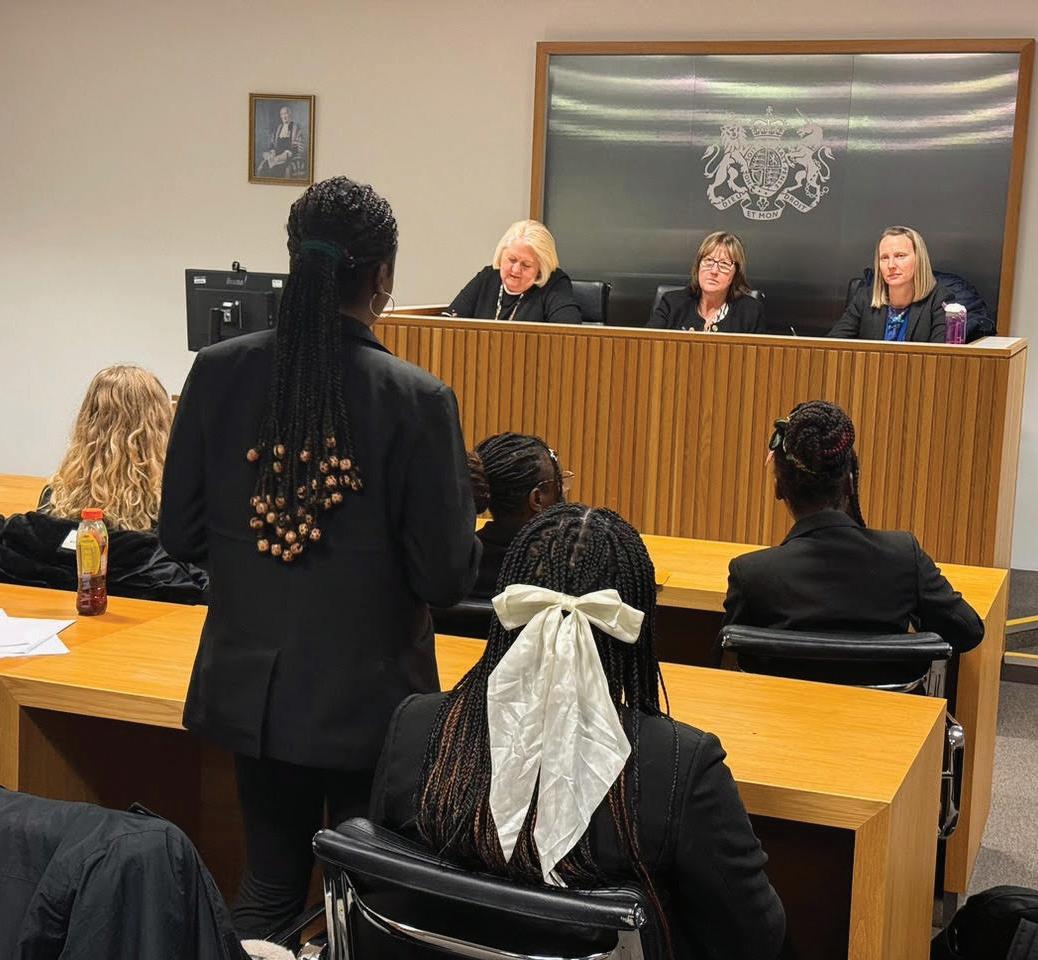
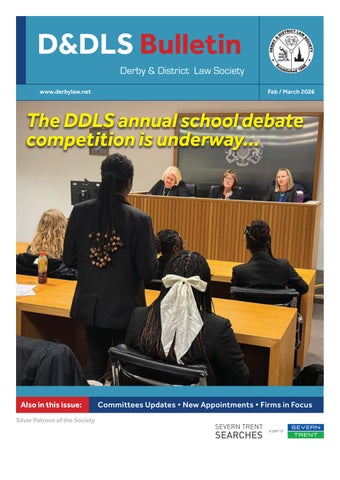
My highlight of the year is always the school debate competition. The front cover shows a photograph from the first heat and the final is on 11th March 2026 at the University of Derby Law School on Agard Street at
4pm. Everyone is welcome to attend and see the amazing standard that these 14/15 years olds reach with their public speaking.
Once again, I am pleased to include press releases from firms in the Bulletin if you e-mail them into me and Rothera Bray and Flint Bishop both have announcements in this edition.
Finally, there are a couple of updates from sub-committees in this issue. The contact details for the various sub-committees are on page 4 so please get involved.
Take care.
Julia Saunders admin@derbylaw.net
Officers
President*
Lucy Tissington lucy.tissington@familylawgroup. co.uk
Immediate Past President*
Tina Attenborough Attenborough Law, Derby tina@attenboroughlaw.co.uk
Vice-President*
Rachel Maxwell Rachel.maxwell@smithpartnership. co.uk
Deputy Vice-President*
Debra Morris Affinity Law debra@affinitylaw.co.uk
Honorary Secretary*
Fiona Apthorpe Geldards LLP, Derby Fiona.Apthorpe@geldards.com
(* = Ex-Officio)
Public Relations Officer (+) Vacant
Derby Junior Lawyers
Katie Morris katie@affinitylaw.co.uk
Henna Aietan henna.aietan@familylawgroup.co.uk
Amelia Sutcliffe amelia.sutcliffe@ smithpartnership. co.uk
Constituency Council Representative, Derbyshire (+) Shama Gupta shama.gupta@freeths.co.uk
(+) attend Committee by invitation
Other Committee Members
Julie Skill, Elliot Mather LLP Chesterfield julie.skill@elliotmather.co.uk
Felicity Coats felicity.coats@elliotmather.co.uk
Diana Copestake dianaohalloran@aol.com
David Hardy david.hardy1630@gmail.com
Oliver Maxwell
Smith Partnership
Oliver.Maxwell@smithpartnership. co.uk
Martin Salt Martin@killingworthandparrott.co.uk
Claire Twells claire.twells@smithpartnership. co.uk
Sue Jennings sue.jennings@geldards.com
Nosheen Tassaddiq nosheen.tassaddiq@flintbishop. co.uk
Catriona Smedley catriona.smedley@familylawgroup. co.uk
Treasurer*
Ben Lawson Elliot Mather LLP ben.lawson@elliotmather.co.uk
Claire Rudkin Flint Bishop, Derby claire.rudkin@flintbishop.co.uk
Manesha Ruparel MR@AandCo.co.uk
John Ellis John.ellis@smithpartnership.co.uk
Administrator / Bulletin Editor Julia Saunders, Email: admin@derbylaw.net
Sub-Committees (Secretary in italics)
Criminal Litigation Felicity Coats felicity.coats@elliotmather.co.uk
Andrew Oldroyd
Education & Training Sue Jennings, & all Sub-Committee Secretaries
Employment and Business Law Sue Jennings
Tina Attenborough tina@attenboroughlaw.co.uk
Equality, Diversity and Inclusion Manesha Ruparel mr@aandco.co.uk
Tina Attenborough tina@attenboroughlaw.co.uk
Sue Jennings sue.jennings@geldards.com
Family Law FionaApthorpe
David Guthrie dg@aflp.co.uk
Fiona Apthorpe Fiona.Apthorpe@geldards.com
Fiona Lazenby fiona.lazenby@knightsplc.com
Julie Skill Julie.Skill@elliotmather.co.uk
Kelly Mower kellym@eglegal.co.uk
Liz Guyler lizguyler@eglegal.co.uk
Lucy Tissington lucy.tissington@familylawgroup. co.uk
Manesha Ruparel MR@AandCo.co.uk
Melanie Bridgen melanie.bridgen@nelsonslaw. co.uk
Nick Herbert nh@aflp.co.uk
Ruth Jones ruth.jones@smithpartnership. co.uk
Sole Practitioners’ Group (SPG) Tina Attenborough tina@attenboroughlaw.co.uk
Last updated 24.02.26

Welcome
It has been a very busy couple of months.
I have had the privilege of judging the Birmingham Law Society Awards. This was a full day event hosted by No 5 Chambers in Birmingham. I was really impressed by the talent and it was great meeting and chatting with the other judges.
The DDLS dinner is coming up very quickly and we are due to go and have a chat with the event organiser at Pride Park. I cannot wait to see how the night turns out. This year we have a table magician, David Fox, a 360-photo booth and casino tables so it is set to be a little bit different. I know the nominations are coming in and I am looking forward to reading over them and celebrating the talent Derby and Derbyshire has to offer. As you may know, this year we have a new judging panel made up on the other law society members and the sponsors.
I really enjoyed judging the nominations for the Nottingham Law Society Awards. This took place on Teams, and judging by the number of muted coughs this turned out to be was the best idea to avoid spreading germs.

The talent in Nottingham was impressive as usual and I am very excited for those both shortlisted and the winners. As I had the great privilege of winning last year I know how excited and nervous they must be.
photos to raise money for Positive Social.
The Junior Lawyers get together the week before last was very enjoyable. They held it at Glamberry in Derby. There was huge turn out and I loved meeting and chatting with new faces and old.
Over the next few months I am very excited to be judging the school debate final, attending the amazing DDLS quiz at Derby Rugby Club on Wednesday 25 February and discovering who the judges have shortlisted for the annual awards.
We have the Co-Pilot course run by Central Technology, 4 March and the Chill and Chat on 18 March at the Bishops Blaise for people to come and have a chat with the committee with a free drink on us.
Then of course the DDLS Annual Dinner on Friday 20th March at Pride Park for which I am in equal parts excited and nervous.
Lucy Tissington President, 2025-26


National UK law firm Flint Bishop has announced the promotion of Kelly Savage and Catherine Marksman to Partner, recognising their exceptional contributions, leadership, and expertise across the firm’s Commercial Dispute Resolution and Debt Services practices.
Savage joined Flint Bishop in 2014 as a Paralegal and qualified as a solicitor in 2018.
Over the past eight years, she has built a highly regarded commercial litigation practice, advising on complex, high-value disputes including contractual and shareholder disputes, professional negligence claims, property litigation, insurance matters, and cross-border supply chain issues.
During her tenure, Savage has acted for and built strong relationships with a number of the firm’s most prominent clients and has contributed to several reported judgments in the High Court and Court of Appeal, underlining her expertise in contentious matters at the highest level.
Marksman began her career with Flint Bishop in 2012 as a Paralegal, qualifying as a solicitor in 2018. She progressed to Associate in 2021 and Senior Associate in 2023, becoming a central figure in the firm’s Debt Services division. She is responsible for helping to lead teams across a department comprising of over 120 fulltime employees, managing significant debt
portfolios on behalf of clients.
In addition, Marksman has played a crucial role in supporting senior management in expanding Flint Bishop’s offering into residential debt solutions for several of the UK’s ‘Big Six’ energy suppliers, as well as driving operational strategy and implementing the firm’s vulnerability and treating customers fairly policies.
Qamer Ghafoor, Chief Executive at Flint Bishop, said:
“Our latest partner promotions reflect Kelly’s and Catherine’s exceptional expertise, leadership, and long-term commitment to Flint Bishop. Both have consistently delivered outstanding outcomes for clients while making a significant contribution to the strategic growth of the firm. We are proud to celebrate this well-deserved milestone in their careers, which also demonstrates the strength of the career progression opportunities available at Flint Bishop.”
Thank you for your sponsorship of the Derby Courts Carol service in December.
I did say I would communicate again once we heard from the Cathedral as to monies received on the night. It was a good evening with 250 people present. Together with the collection on the night and sponsorship we raised £1829.45. We had expenses of £451.20.
Consequently, we had £1378.25 to be split equally between two local charities, Derby Food 4 Thought and the Derby Children’s contact centre.
So once again many thanks for the Society’s contribution.


Leading East Midlands law firm Rothera Bray has expanded its Family Law team with the appointments of Managing Associate Julie McCrery, Associate Sophie Spreckley, and Solicitor Jack English.
Julie, Sophie and Jack bring substantial family law expertise to the team, advising on matters including complex or high-value financial disputes and business, trust or international assets, arrangements for children, divorce and separation, and nuptial and cohabitation agreements. Julie and Sophie will be based at the firm’s Derby office, drawing on their extensive experience in both financial and children matters. Jack will strengthen the team at the firm’s Beeston office, offering support across all areas of family law including both court proceedings and alternative dispute resolution.
All three recruits are members of Resolution, the national organisation for
RESIDENTIAL PROPERTY SUB-COMMITTEE
Things to be aware of:
• On 2 February we were saw the unexpected closure of PM Law Ltd and their associated firms. It is understood that the SRA launched an immediate investigation into PM Law Ltd and after their initial investigations took the decision to intervene into the group of firms. This impacted our local firm John M Lewis & Co. It has caused significant disturbance to those in conveyancing with many practitioners and support staff losing their jobs. Thankfully, we have seen many members of staff successfully secure new employment already.
• Employees and client’s are directed to the SRA for further guidance but D&DLS are here to support those in need of support and signposting.
• A reminder that the TA6 6TH Edition,
family justice professionals committed to constructive, nonconfrontational approaches to resolving family issues. Julie also holds a specialist Resolution accreditation in Pensions on Divorce and Complex Financial Remedies and is a trained Collaborative lawyer.
The team also bring with them their existing involvement with the University of Law’s Family Advice Midlands (FAM) Clinic, which provides pro bono (no charge) initial advice to clients while offering valuable learning opportunities for students. The team’s work in this area has recently led to a nomination for Team of the Year at the 2026 Nottinghamshire Law Society Awards.
Julie McCrery said:
“Sophie, Jack and I are delighted to be joining Rothera Bray’s highly respected Family Law team. Supporting clients through some of the most challenging times in their lives is a privilege, and we look forward to bringing our experience to the firm’s growing practice. We are particularly excited to work with a team who share our commitment to providing clear, constructive and solutions-focused advice that enables families to move forward with confidence.”
Rebecca Emeleus , Partner and Head of Family Law at Rothera Bray, said:
“We are thrilled to welcome Julie, Sophie and Jack to the team. Each brings exceptional skill, dedication and compassion to their work, and their combined experience significantly enhances the support we can offer to families across the East Midlands. Their arrival strengthens not only our legal expertise but also our commitment to innovation, community engagement and client care. I am proud to see our Family Law team continue to grow in both talent and reputation.”
For more information about Rothera Bray Solicitors, visit: https:// rotherabray.co.uk/
will be replacing the previous editions on the 4th and 5th Edition and it’s use will be mandatory from 30 March 2026. Many have already made the switch.
• From May 2026, HMRC has confirmed that conveyancers must register as tax advisers with HMRC. Further detailed guidance is still awaited.
• We have the HM Land Registry event on 19th February at Nelsons Solicitors. All welcome to join and thanks to Nelsons Solicitors for hosting. We are looking forward to hearing from HM Land Registry on the developments they have made to their systems.
Rachel Maxwell Smith Partnership
CIVIL SUB-COMMITTEE UPDATE
Oliver Maxwell of Smith Partnership is keen
to re-establish this sub-committee, and has started to meet with member firms to see if we can get some interest from their litigation teams. The initial feedback has been positive, so please do agree to meet with Oliver as and when he makes an approach. Oliver’s aim is to build an offering that will work with and engage practitioners. We are aiming for a relaunch event in May to coincide with the new Presidential year of DDLS.
If you would like to be part of this event and possibly the sub-committee, please reach out to Oliver - Oliver.Maxwell@smithpartnership.co.uk
Anyone interested in attending the regular Civil Court User Group online meetings please e-mail Julia – admin@derbylaw.net
Oliver Maxwell
Smith Partnership



• Are you considering Live-in Care for a person you know, or do you already have a care package in place?
• If the thought of Live-in Care is new to you, please call 01603 764567 for further details.
If you are already receiving Live-in Care but would like to compare costs, please call 01603 764567 and we will be happy to discuss.
Able Community Care is a Specialist Live-in Care Provider - Established in 1980, we provide expert Live-in Care support. We are based in Norfolk, but our care support is available throughout the UK and the offshore islands.
Get in touch today: Call 01603 764567 or Email to: info@ablecommunitycare.com to request your information brochure or visit our website at: www.ablecommunitycare.com

With the largest intergenerational wealth transfer now underway, new data from our latest tracking study reveals that almost one in three people aged 40+ with a Will have included a gift to charity (32%).
The study, based on over 2,000 people who donate to charity more than once a year, indicates that people often write their Will at a younger age than others might think. Almost half of those who have made a Will, did so before they reached their 50s (49%). However, it also shows that almost 2 in 5 people aged 40+ (37%) have not yet written a Will at all.
This New Year, we’re encouraging people, when writing or updating their Will, to consider all the things they care about; loved ones and good causes alike.
Importance of Will-writing
As New Year’s resolutions take shape, January remains the most natural time of year for a financial reset. Writing or updating a Will is essential for anyone who wants to influence how their assets will be distributed beyond their lifetime, while being a key opportunity to protect family, loved ones and any good causes they wish to support.
Good estate planning can also help families reduce their Inheritance Tax (IHT) bill. Charitable gifts in Wills are free of tax, with donations of 10% or more of the net value of the estate reducing the IHT rate from 40% to 36%. However, even amongst wealthier UK households, a significant knowledge gap remains about these tax incentives, with 30% of millionaires in this study saying they were unaware of the tax breaks on charitable gifts in Wills.
Evolving fiscal landscape
This news comes at a time when IHT receipts continue to rise. The Chancellor’s Autumn Budget statement revealed that IHT thresholds will be frozen for another year (until 2030/31). With the Government’s plans to draw inherited pension pots into the scope of IHT from April 2027, experts are predicting that around twice as many estates will be liable for IHT by 2031,1 prompting more households to think carefully about how they preserve and pass on wealth.
Solicitors, Will-writers and financial advisers are already reporting a growing appetite for inheritance planning. In recent research, 60% said they have seen a rise in demand for estate or tax planning advice, and 65% say they expect charitable tax incentives to become even more important2 to their clients in the years ahead.
With the UK entering the largest intergenerational wealth transfer in history and many more estates facing an Inheritance Tax liability, having an upto-date Will in place has never mattered more.
This January, Remember A Charity is urging people to reflect not only on their financial affairs, but the good causes they wish to support alongside their loved ones. Charitable gifts in Wills can make a considerable impact on good causes and communities across the UK – funding vital research, care in the community, emergency helplines, animal welfare, environmental causes and so much more.

Lucinda Frostick, Director of Remember
A Charity, says: “The new year is a great opportunity for us all to get our affairs in order and it’s deeply inspiring to see that – for so many people – that includes good causes as well as our loved ones. We’re seeing a growing sense of social responsibility and a real desire to leave the world a little better. No matter the size of the gift, remembering a charity in your Will can be one of the most empowering things to do – helping to sustain urgently-needed charitable services for future generations.”


James Antoniou, Head of Estate Planning & Senior Solicitor at Co-op Legal Services, says: “Typically, the start of the year is the most popular time for putting a Will in place. It’s an essential part of planning for the future and a properly prepared Will is often much easier to do than people realise. Gaining peace of mind that your wishes will be legally recognised and your assets protected for your loved ones after you’re gone are often key incentives however we are increasingly seeing clients choose to include charitable causes in their Wills, leaving a lasting legacy that can make a real difference to the causes that matter to them.”
To explore how charitable gifts in Wills are changing the world, visit the Great Map of Willanthropy.3
1 https://obr.uk/efo/economic-and-fiscaloutlook-november-2025/
2 https://www.rememberacharity.org.uk/ about-us/latest-news/6-in-10-professionaladvisers-think-inheritance-tax-changes-willprompt-growth-in-charitable-legacies/
3 https://www.rememberacharity.org.uk/ great-map-of-willanthropy/




Being a Chair of Remember A Charity’s Wealth Adviser Committee has made me appreciate that it’s rare to find a space that connects such a thoughtful crosssection of advisers, bringing not only a wide breadth of expertise to the table, but also genuine honesty and openness to discussions on the topic of legacy giving. There’s a real willingness to share challenges as well as successes, and to learn from one another in a way that feels collaborative and progressive.
Whilst the latest Remember A Charity study on legacy giving amongst HNWIs revealed that 50% of millionaires have already included a charitable gift in their Will, there is still work to be done. It is in a large part the responsibility of the wealth adviser community to ensure that leaving a charitable legacy is a permanent fixture in wealth planning discussions and, as a committee, we’re hoping to make this happen.
Traditionally, philanthropy within legal and advisory work has been viewed through a very technical lens – with lawyers advising on charitable structures, tax efficiency, governance and administration. Though this, of course, will remain essential, it is also apparent that the role of an adviser is evolving.
Today, many of the clients we support are looking for something more holistic. They want to work with someone who can help them explore what matters to them and
what they want their wealth to achieve, both during and after their lifetime.
Values-based conversations give clients space for reflection
This shift does require us to move away from purely technical advice and towards more values-based conversations, giving our clients space for reflection - not just decision-making.
We will need to have the confidence to ask questions that don’t have easy or straightforward answers such as: what responsibility they feel comes with the wealth they have built; how they have built their wealth; and how their values around family and tax shape the legacy they want to leave after death. In short, we need to understand their philosophy of wealth.
These conversations may feel less structured, but when led carefully and without pressure, they can be deeply rewarding - strengthening trust and laying the foundations for more effective estate and philanthropic planning.
Integrating philanthropy across the advisory ecosystem
Within my role as Chair of the Wealth Adviser Committee, I’m reminded often that philanthropy advisers seldom work in isolation. There is a wide and wonderful ecosystem at play, encompassing legal, tax, financial planning, investment and community expertise. Philanthropy works best when it is integrated into a broader financial plan, not treated as an afterthought.
For clients to confidently commit to significant charitable gifts, they first need clarity around how much they need for their
own lifetime, what they want to leave to family, and how different assets should be allocated to different pots. As such, financial planners play a particularly important role. Clients also need to feel confident that the charitable causes they are leaving gifts to are aligned with their personal values and beliefs system. The adviser community can help close the gap between charities and their donors, to ensure all sides feel confident and supported through the process.
The Remember A Charity events and education programme for wealth advisers is building real momentum, and it’s been encouraging to see growing engagement across the sector. As we move into our second year, I’m excited about the committee’s continued growth, expanding pool of expertise, and increasing focus on training and shared learning.
Legacy conversations are not always easy, but they are powerful. When we make space for them, we don’t just help clients plan - we help them understand what truly matters to them. In doing so, we build stronger, more meaningful relationships that can last beyond a lifetime.
Clare Stirzaker is a Private Client and Tax Partner at Boodle Hatfield LLPand the Chair of Remember A Charity’s Wealth Adviser Committee.

Many law firms assume their primary exposure is a professional negligence claim.
In practice, some of the most financially disruptive events in the legal sector arise from operational, cyber or governance issues rather than incorrect legal advice.
Examples seen across the market include:
• Ransomware incidents disrupting access to case files
• Diverted client payments that cannot be recovered
• Employee disputes escalating into reputational exposure
• Regulatory enquiries following data breaches
Depending on the firm’s size, controls and client profile, the operational and financial impact of such events can be significant.
The risk landscape has evolved
Law firms remain attractive targets due to:
• The volume of sensitive data held
• Control of client funds
• Time-pressured transactions
Cyber crime and payment diversion fraud continue to increase in sophistication. Regulatory expectations regarding governance, oversight and operational resilience are also developing.
Many firms continue to assess risk primarily through professional indemnity insurance, with less structured consideration of business interruption, fraud exposure and regulatory scrutiny.
A serious cyber incident may involve:
• Lost billable time
• Delayed transactions
• Client dissatisfaction
• Regulatory notification requirements
• Reputational impact
• Increased scrutiny from senior leadership or regulators
The financial impact will vary by firm but is rarely confined to technical remediation costs alone.
Modern risk events often have multiple consequences.
For example:
• A cyber incident may lead to business interruption
• Business interruption may give rise to client complaints or claims
• Client issues may prompt regulatory engagement
Payment diversion fraud can also raise questions regarding internal controls, supervision and governance.
Employee disputes may extend beyond internal HR management and affect reputation or leadership oversight.
Risk exposures are frequently interconnected, even if reviewed separately within firms.
Governance expectations continue to develop
When incidents occur, common questions may include:
• Were appropriate controls in place?
• Was the risk identified and assessed?
• Were reporting obligations understood?
• Was oversight proportionate?
Directors, COLPs and senior managers operate in an environment of increasing regulatory scrutiny. In certain circumstances, regulatory review may extend to senior leadership, depending on the facts.
This does not imply personal liability is automatic. It does reflect evolving governance expectations.
Assumptions are not controls
Many firms rely on reasonable assumptions:
• “Our systems are adequate.”
• “Our staff would identify suspicious activity.”
• “We have not experienced issues previously.”
While past experience may be positive, historic absence of incidents does not in itself constitute a control measure.
The key issue is whether operational, cyber and governance risks have been assessed in structured financial and commercial terms.
A structured review of risk exposure
Regulated Risks offers a complimentary cyber and risk management review for law firms.
The review:
• Analyses publicly available information relating to the firm
• Draws on anonymised, aggregated industry claims data
• Highlights common exposure areas observed across comparable practices
It provides a commercial overview of:
• Exposure to cyber incidents, fraud and business interruption
• Potential operational and financial impact considerations
• Governance and oversight themes
• Areas where preventative controls may be strengthened
The review is provided without obligation and does not constitute regulated legal, insurance or investment advice.
Proactive assessment supports resilience
Risk management is increasingly a boardlevel matter rather than solely an insurance renewal discussion.
Firms that periodically assess operational, cyber and governance exposure may be better positioned to protect revenue, reputation and leadership.
Reliance on historic experience alone may not provide full visibility of emerging risk factors.
Request your complimentary cyber and risk management review
Scan the QR code to submit your details:

Or visit:
https://www.regulatedrisks.co.uk/freecyber-and-risk-management-review/
Regulated Risks is a trading name of Peacock Insurance Services Limited which is authorised and regulated by the Financial Conduct Authority and is entered on the Financial Services Register ( https://register. fca.org.uk/s/ ) under reference 603863. Please note: the FCA regulate insurance products. They do not regulate the other services we provide.
This communication is for information purposes only. The review is based on publicly available information and aggregated industry data and does not guarantee prevention of loss or regulatory action.

Well, are they? And do they understand business accounts? Some are, and some do – in fact, some are quite brilliant mathematicians - but there are many who don’t, and I will share with you a few examples.
First, we have lawyers who have confidence in the accounts filed at Companies House, and when a valuation is needed, in divorce for example, they take a printout of the micro accounts from Companies House, send them to me, and expect me to be able to value the company. This happened so frequently that I felt obliged to write a blog about it, which I called “Companies House Searches Are USELESS”. The blog is here: https://chrismakin.co.uk/ companies-house-searches-are-useless/. And I append a note: “This blog is retained on page one for its enduring relevance.” So next time a junior lawyer in the family department sends me such accounts, I have my explanations ready.
Then I turn to Kemp & Kemp The Quantum of Damages, the “bible” for personal injury practitioners. This was a lifetime work for David Kemp QC who, touchingly, included the second Kemp in the title. This was his wife, a very promising young barrister who died tragically young. I wrote for David a chapter on how to quantify loss of earnings for the selfemployed and family company director, and David was really pleased with it. It was in print for many years, but then David died and the publishers Sweet & Maxwell appointed a new editorial board, who re-wrote all of volume 1 so that my work was lost. I wrote to them and said how important it was for users of the work to understand business accounts, for example a barrister who was cross-examining an accountant expert witness.
The reply I got was that accountants understand accounts, and if interpretation was needed they could always instruct an accountant. I found that unconvincing. And my chapter is still available to you if you drop me a line. It’s in very simple language, but there is lots to learn.
Third, I turn to crime, and particularly to drug dealing. As readers will know, those convicted of drug dealing (and some other serious offences) are at risk of having their assets seized by the Crown under the Proceeds of Crime Act. It is said that doing jail time is just the price one pays for profiting from drugs, but that losing one’s wealth really hurts these people.
Perhaps so, but the court has to decide on a fair figure, both for the benefit of the crime and the available amount for confiscation.
I have just finished a case where the convict pleaded guilty to drug dealing in a minor way, and is now serving time, but his main activity was running a motor repair business and MOT testing station. The prosecution’s expert went through his bank accounts, totalled up some £353,000 going through the bank, and concluded both that this was all benefit from drug dealing (it wasn’t; there was even ample evidence of vehicles bought and sold) and that this same sum was the amount available for seizure.
That was even more unrealistic; how could money which had come into the business and gone out again still be sitting in a bank waiting for the authorities to collect it? Naïve!
My expert report showed that there was £6,336.36 sitting in bank accounts, so that was the available amount. A few days before trial, the prosecution agreed that the available amount was £6,336 – and thirty-six pennies. What a waste of time.
If you are still reading, that’s good because we now come to the most interesting bit.
Some months ago, I was expert in a criminal trial at Swansea Crown Court. Andrew Ling had been accused of stealing some £165,000 from his own company. After 11 years in the army doing bomb disposal, Andy had set up a business producing a very advanced form of battery; he had even sold 3,000 units to Sainsbury’s for their home delivery vehicles.
He fell in with some business angels, who borrowed £700,000 from the Welsh Development Bank, and they regularised the management of the company. Andy admits that his record-keeping was poor. The other directors – the angels – accused him of fiddling his expenses and taking money from the company without authority, he was investigated, and he was sacked for gross misconduct.
After he left, the others didn’t have his technical knowledge and the business failed.
Andy was charged with theft, and spent five years on remand.
As the trial came up, the prosecution’s expert was an AAT (Association of Accounting Technicians) a very low-scale qualification for those working in the back room of accountants’ offices. She added up all the amounts withdrawn but ignored all the amounts paid in: introduced from private funds, expenses not claimed, and so on. All of this was recorded in the director’s loan account.
At the end of the fourth day of the trial in Swansea, I gave evidence and had to explain how a director’s loan account works. And I gained the distinct impression that no-one else in that courtroom – judge, both counsel, the jury – had any idea. I was the last witness. The jury retired, and emerged a few minutes later with a verdict of Not Guilty. Andy’s five years of purgatory was over.
There was a long article about this recently in The Times Business Section. I am mentioned only once, as follows:
An expert witness commissioned by the defence helped convince the jury of his innocence, Ling believes. Chris Makin, a forensic accountant, supported Ling’s claims that he had only withdrawn money owed to him. On one calculation, far from stealing from the business, he was in fact still owed £20,000. “Chris was the first person in five years who believed me,” Ling says.
This is what makes my job so rewarding, but what a pity the lawyers working on the case didn’t know about directors’ loan accounts years ago!
Biog: Chris Makin has practised as a forensic accountant and expert witness for 30 years, latterly as Head of Litigation Support at a national firm. He has given expert evidence about 100 times. He also performs expert determinations.
Chris is a fellow of the Institute of Chartered Accountants where he has served on the Forensic Committee, and as an ethical counsellor; he is a fellow of the Chartered Management Institute, a fellow of the Academy of Experts where he serves on the Investigations Committee, and a mediator accredited by the Chartered Arbitrators. He practises as a mediator, from his home in West Yorkshire and his rooms at 3 Gray’s Inn Square, London WC1R 5AH, telephone 020 7430 0333. He has mediated 100+ cases so far, on a huge range of subjects, with a settlement rate to date of 80%. For more see his website with videos:
www.chrismakin.co.uk
chris@chrismakin.co.uk

JSC Commercial Bank Privatbank v Igor Valeryevich Kolomoisky & Ors -
Find Case Law - The National Archives1
The claimant brought an action against two of its founding shareholders, and companies owned or controlled by them, seeking compensation for harm caused by their alleged participation in a fraudulent scheme. The forensic accounting expert for the first defendant failed to inform the court, until shortly before he gave evidence, that he had ceased to hold a key professional membership.
• You should inform the parties and the court if, after your expert report is filed, you cease to be the member of a professional organisation which is relevant to the expert evidence you have provided.
• Always consider whether you should inform your instructing party following any material change in your qualifications or accreditations.
The case
The claimant brought an action against two of its founding shareholders, and companies owned or controlled by them, seeking compensation for harm caused by their alleged participation in a fraudulent scheme. One of the areas of for expert evidence was forensic accountancy.
We have previously discussed2 the assertion by the judge in this case that Expert Witnesses have a duty to disclose previous criticisms of their evidence in judgments. In this case update, we look at another aspect of the case, the failure of the forensic accounting expert for the first defendant to inform the court, until shortly before he gave evidence, that he had ceased to hold a key professional membership.
The parties were given permission to adduce expert evidence from forensic accountants. The claimant instructed Mr T, a Senior Managing Director in FTI Consulting, the first defendant instructed Mr D, the managing director of Honeycomb Forensic Accounting, and the second defendant instructed Mr S, a partner in Alvarez & Marsal Disputes and Investigations LLP.
Mr D’s status as a ICAEW member
At the time of their reports, all the experts were fellows of the Institute of Chartered Accountants of England and Wales (‘ICAEW’). However, during July 2023, after the trial had commenced, but before Mr D had given evidence, the claimant’s solicitors discovered that Mr D’s status as a member of the ICAEW was now recorded as Ceased with a substatus recorded as Cessated. They wrote to first defendant’s solicitors drawing attention to the cessation and attaching a copy of the disciplinary record which indicated that Mr D had been subject to a severe reprimand, in respect of which there had been hearing on 8 March 2023. Mr D had not disclosed any of this information to the claimant or the court.
Mr D provided an explanation in a witness statement on 29 September 2023, five days before he was due to give evidence, intending to anticipate questions he expected during cross-examination. He disclosed that he had been the subject of two complaints in June and August 2021 in respect of which there had been no disciplinary proceedings. He had, however, been severely reprimanded for failure to provide the ICAEW with responses to those complaints. Mr D also disclosed that the Charity Commission had removed him as trustee of two charities and that those charities had been the subject of statutory enquiries by the Charity Commission. He also gave notice that he would rely on his privilege against self-incrimination to justify his refusal to answer any questions about the August 2021 complaint to the ICAEW and the Charity Commission inquiry.
The judge noted that, given the information provided, it was not possible for the court to obtain a full picture of what had occurred or the extent to which these matters might have been relevant to the quality of Mr D’s evidence. However, Mr D did accept during crossexamination that there was no excuse for his
failure to provide the information sought by the ICAEW.
The judge concluded that:
“In my view, where an expert presents his evidence as a member of a professional organisation, which is expected by him to give the court assurance as to his ability to act in the case, he is under a duty to inform the court if his membership has ceased, more particularly where the cessation is linked to disciplinary proceedings against him. [Mr D] accepted in cross-examination that he knew that his presentation as a member of the ICAEW would give the court that assurance, but he had no explanation as to why he did not voluntarily inform the court or the Bank of the fact that he had ceased to be a member with effect from 19 April 2023. The manner in which [Mr D] approached this issue casts real doubt on his ability to be open and straightforward on matters which might affect the court’s assessment of the reliability of his evidence as an independent expert. More particularly it undermined the court’s confidence in his ability to give precedence to his overriding duty to the court when faced with other conflicting interests. It seems to me that this is a particularly significant failing when taken together with the fact that [Mr D] also failed to disclose that he had been the subject of a finding in another case that his opinion was based on wholly unsupported and fanciful assumptions, which ignored the objective facts and undermined his credibility as an independent expert (per Leggatt LJ in Al Nehayan v. Kent [2018] EWHC 333 (Comm) at [195]).”
1 https://caselaw.nationalarchives.gov.uk/ewhc/ ch/2025/1987?query=BL-2017-000665
2 https://www.ewi.org.uk/News/how-shouldexperts-disclose-criticisms-when-they-arefrequently-unaware-of-the-outcome-of-thecase




Email: bill.bailey1@nhs.net
PRIVATE EQUITY
A Transactional Analysis
5th edition
Consulting Editor: Chris Hale
ISBN: 978 1 78742 973 4
GLOBE LAW AND BUSINESS LTD
www.globelawandbusiness.com
AN UPDATED TRANSACTIONAL GUIDE TO PRIVATE EQUITY FOR 2020s

Much has happened in the years since the publication of the last edition of this book. In recent times, private equity houses have raised huge amounts of money to invest which has influenced the dynamics of the market hence the need for this transactional analysis.
There’s a broadening of potential buyers with several other organisations adopting private equity style strategies.
Chris Hale’s practical fifth edition introduces us to the world of private equity not just from a UK perspective, but also that of key European
An appreciation by Elizabeth Robson Taylor of Richmond Green Chambers and Phillip Taylor MBE, Head of Chambers and Reviews Editor, “The Barrister”
jurisdiction and in the United States of America. We consider that Hale’s explanation of the rise of private equity and its recent dynamics is of great value.
Hale explores in some detail the key ingredients of private equity transactions and the technical issues associated with them. The book gives us detailed updated chapters by leading private equity practitioners. It also includes a high-level analysis of private equity fund structures, equity and debt finance, acquisition documentation, due diligence, tax structuring, and public-to-privates, so you have most of what you are looking for in one volume.
What we get with this fifth edition are the following main areas of private equity including a new analysis of the fastest growing part of the private equity market, that dealing with secondary transactions, examining both those led by the investors in private equity funds and those led by those who manage the funds.
Hale offers a new discussion of the debt available at the fund level, the way it is structured and its uses, and there is a firsttime chapter on how ESG issues are affecting and being dealt with by private equity fund managers including an examination of the
Salary commensurate with experience and qualifications
We are a high street solicitors practice with an enviable reputation in the East Midlands for the quality of our work. We are looking for an experienced Commercial Property Lawyer to join our Belper team and contribute to the success of one of the region’s oldest practices.
You must have at least 2 years hands on experience of running your own commercial property cases from start to finish including conveyancing sales and purchases, drafting leases for landlords and tenants, and complex residential deals especially involving company buyers and sellers, preparing and checking documents and correspondence, negotiating on behalf of clients and meeting billing targets
The ability to work on your own initiative, hit billing targets, manage multiple work streams and meet deadlines whilst providing excellent levels of client care are essential. Qualification as a Solicitor or Legal Executive would be an advantage but more important is the experience you will bring to the role.
We work with a range of individuals, businesses and commercial enterprises including sales and purchases, leases, buy-to-let purchases and sales and development re-financing transactions so sound commercial understanding, excellent communication and IT skills and good business acumen are also vital.
In return we offer a range of benefits including a health cash plan scheme, wellbeing support, 24/7 advice and information line, discretionary bonus schemes, generous annual leave plus Christmas closure, selling annual
new and prospective regulation in this area. We are also given coverage of new UK pension legislation in relation to due diligence, and an insight on latest market trends and how these impact on deal dynamics and deal terms: an overview of the anatomy of a private equity fund, a description of fund terms, reflecting changes driven by industry requirements, and a laying out of common themes across all major relevant jurisdictions.
Of additional interest is a discussion of the ever-changing tax risk environment, and newer tax rules. There is a consideration of the regulatory changes required in governance of large private companies and transparency plus a review of the evolving shape of the leveraged buyout market, including the influx of new finance providers and a view on the new UK framework on restructurings.
We consider this book to be a must-have handbook for legal and other practitioners working or advising in private equity, as well as for senior private equity executives, investment houses and investors. Academics in corporate law and business schools, as well as their students, will also find this fifth edition to be of great value.
The third edition of this hardback book from Globe was published in 2024.

leave scheme, bonus exchange scheme, a supportive work environment and the opportunity to join a company that cares.
To arrange an informal discussion please contact Jackie Abbott on: Jackie.abbott@ellis-fermor.co.uk
or Simon Hale on: simon.hale@ellis-fermor.co.uk
For more information about Ellis-Fermor and Negus Solicitors please visit visit https://www. ellis-fermor.co.uk/contact-us/careers/
To apply please email your CV and covering letter to applications@ellis-fermor.co.uk outlining with some real-life examples, the breadth and depth of your commercial property legal experience.
Closing date - Open