CAMBRIDGESHIRE LAWYER Stronger Together, Better Connected
Issue 112 Summer 2026
The Cambridgeshire Law Society Newsletter
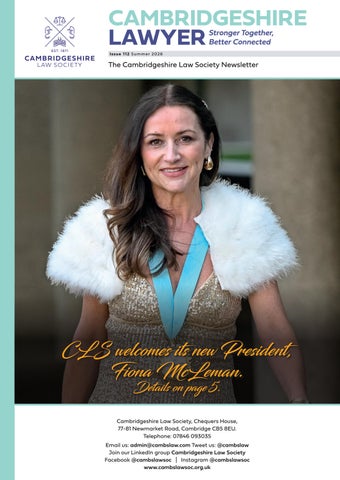
CLS welcomes its new President, Fiona McLeman. Details on page 5.
Cambridgeshire Law Society, Chequers House, 77-81 Newmarket Road, Cambridge CB5 8EU. Telephone: 07846 093035 Email us: admin@cambslaw.com Tweet us: @cambslaw Join our LinkedIn group Cambridgeshire Law Society Facebook @cambslawsoc | Instagram @cambslawsoc www.cambslawsoc.org.uk
CAMBRIDGESHIRE LAWYER
CONTENTS
The Cambridgeshire Law Society Newsletter
18 Silicon Fen moves home: How AI is redefining the East Anglian property market
4 Information & Events 5 President’s Page
20 Professional services: Key considerations for implementing AI
6 The View from Chancery Lane 7 Your brand is your business – trade marks in the age of the influencer 8 What I wish I had known 10 Wins and Deals of the Quarter
22 Unmissable insights from the experts as we enter the era of AI 26 Exploding the valuation myths: A Lawyer’s guide to what really matters
10 Movers and Shakers July 2026
28 Legacy giving remains resilient, but the future depends on decisions made today
11 Diversity Matters: Top Tips for LGBT+ inclusivity in your firm
31 Book Reviews
12 CJLD Update
31 Government's asylum reforms must be fair and fit for purpose
12 CYPG Update 13 A Day in the life of Niamh Mackenzie-Johnson of Tees, Cambridgeshire Law Society’s Junior Lawyer of the Year 2026 14 Cambridgeshire Law Society Legal Excellence Awards 2026
32 Reforms to solicitors’ costs must be evidence-based 34 Serious concern over impact of SRA funding increase on under pressure firms
17 An update from The President’s Charity: Centre 33
Published by: EAST PARK COMMUNICATIONS Ltd. Unit 27a, Price St. Business Centre, Price St, Birkenhead, Wirral, Merseyside CH41 4JQ Tel: 0151 651 2776 simon@eastparkcommunications.co.uk www.eastparkcommunications.co.uk
Advertising Simon Castell Managing Editor Kate Harris Administrator Penelope Harrington
Design Phil Grindley, East Park Studio Accounts Tony Kay Published Summer 2026 © East Park Communications Ltd.
Legal Notice © East Park Communications Ltd. None of the editorial or photographs may be reproduced without prior written permission from the publishers. East Park Communications Ltd would like to point out that all editorial comment and articles are the responsibility of the originators and may or may not reflect the opinions of East Park Communications Ltd. Correct at time of going to press.
www.cambslawsoc.org.uk | 3
INFORMATION & EVENTS OFFICERS
President Fiona McLeman FM Family Law Vice President Joanna Cotgrove Ashtons Legal Past President James Allen Birketts Honorary Secretary Anna Mortenson Nichino Europe Co., Ltd Honorary Treasurer Gary Hanson
COMMITTEE MEMBERS
Barristers Rep Richard Balchin Fenners Chambers University and Community Partnerships Officer John Wright Lawson West Corporate Sponsorship Officer Fiona McLeman FM Family Law Council Member Michael Frape Ashtons Legal CSR & Pro Bono Officer Alex Curnow Mills & Reeve Equality, Diversity & Inclusion Officer Scott Smith Thomson Webb & Corfield In House Lawyers Rep Guy Wheeler Cambridge University Press & Assessment Junior Lawyers Division Representative Ebony Flack Ward Gethin Archer LEA Officer Raina Victor Endomag L&D Officer Chris Hoole Appleyard Lees IP
4 | www.cambslawsoc.org.uk
Patent Attorneys Rep Kealan Fallon Appleyard Lees IP Peterborough Reps Mateusz Pysera & Nicolle Trust Greenwoods PR & Social Media Officer Amy Tinsley Birketts Publications Editor Kate Harris Birketts Social Events Officer Jonathan Dattani Ashtons Legal Administrator Penelope Harrington
MEETINGS 2026
Monday 7 September Sub-Committee – Member Offer 12.30-1.30pm Tuesday 8 September Sub-Committee – Relationships 12.30-1.30pm Tuesday 15 September Sub-Committee – Communities 12.30-1.30pm Wednesday 16 September Sub-Committee – Communications 12.30-1.30pm Tuesday 29 September Committee Meeting 12.30-1.30pm All above meetings are to be held on Zoom
EVENTS 2026
L & D Events Wednesday 9 September IP/Tech Panel Event with Networking Cass Centre. Cambridge 6.00-8.00pm, Registration from 5.30pm Thursday 8 October Webinar – Managing Stress & Building Resilience On Zoom 12.30-1.30pm. Social Events September Peterborough Welcome Drinks Details to follow
PRESIDENT’S PAGE Fiona McLeman President Cambridgeshire Law Society Managing Partner & Founder FM Family Law
I
t's 155 years since CLS started its journey. Established in 1871, CLS occupies an important place in the Cambridge legal and professional community, even more so now given the diverse and unique complexion of our members. 2026 is definitely a year for celebration and we will be doing just that at our Big 155th Birthday Garden Party at Trinity Hall on 8 July 2026.
I begin my two-year term with four guiding priorities to shape the direction of the Society: Community, Legacy, Succession, and Wellness. These are not abstract principles, but practical commitments that speak directly to the responsibilities I / we hold as professionals within a demanding and evolving profession.
COMMUNITY
A strong professional community is not incidental; it is foundational. CLS exists to foster meaningful connection between practitioners, creating opportunities for learning, relationships, dialogue, collaboration, friendship and mutual support. My goal is to strengthen and grow the CLS community and make it an association members enjoy being part of and want to be involved in. Not just a tick box. I welcome anyone to reach out to me any time.
LEGACY
CLS is defined by its membership, its leadership and also its legacy. My approach will be modern and dynamic, but also respectful of the hard work of those who have helped shape CLS to what it is today and the better aspects of tradition. I am looking forward to wearing my Civic Badge of Honour with pride.
SUCCESSION
My focus is on strengthening and developing the support of those at the start of their career and making sure they have a spotlight in this society. This is a time to celebrate and acknowledge their achievements – the career pathway
is not an easy feat given the demand of SQE. The Class of NQ 2025 celebration that I introduced in 2025 will be repeated in 2026. Categories in the Legal Excellence Awards such as Junior Lawyer and Rising Star will continue to be centre stage. I’ll also be thinking of other L&D opportunities throughout the year.
WELLNESS
Wellness within our profession is not a peripheral consideration; it is central to our sustainability and performance, and our health. The demands on us are significant. Vicarious trauma is real. It is incumbent upon CLS to acknowledge and respond to this reality. I am a (nearly qualified) reflective practice supervisor. Reflective practice is a must for all practitioners in all fields. If you are a supervising partner / leader in your firm, set this up for your staff. If you are a lawyer at any level, seek this out / suggest it to your supervising partner. Want to know more? Get in touch. Alongside reflective practice is encouraging open dialogue around workload and pressure, and ensuring that engagement with the Society enhances, rather than detracts from wellness and professional resilience. With this in mind we are looking into hosting sessions on wellness with e.g. MIND and other opportunities on the more holistic aspects of L&D and support.
PRESIDENT’S CHOSEN CHARITY: THE ANGELS FOUNDATION
I am proud to support The Angels Foundation as CLS chosen charity partner. The charity supports families who have fled domestic abuse in Cambridgeshire. They provide critical assistance to those re-starting their lives with basic items such as furniture (imagine fleeing your ex, moving into a new home with your children with no furniture - yes, it’s real). The Angels also facilitate social introduction into the community through their Back to
I BEGIN MY TWO-YEAR TERM WITH FOUR GUIDING PRIORITIES TO SHAPE THE DIRECTION OF THE SOCIETY: COMMUNITY, LEGACY, SUCCESSION, AND WELLNESS. Life support project, as well as provide specialist domestic abuse counselling and therapy to survivors. My work has brought me close to these experiences for clients and it is an honour to be able to support the Angels as my chosen charity.
LOOKING FORWARD
The CLS is a brilliant unique and important ecosystem. We are all lawyers, barristers and practitioners across different sectors and different stages of our careers. We get to do this in the brilliant space that is Cambridgeshire, a county that combines deep historical roots with innovation growth and cross sector collaboration, a global enterprise for research and development. An integral part of this is all of you – completing leases, fulfilling contracts, litigating, doing deals, planning estates, drawing up Wills, buying selling houses, the list goes on. As well as Cambridgeshire and our passion for law - we all have one thing in common - a shared commitment to professional excellence and collaboration through CLS. Aren’t we incredibly lucky? I am genuinely honoured to hold the role of President. I hope to meet both my own hopes and expectations and those of you, the members. I’ve got big shoes to fill, continuing the success story of Michael Frape and James Allen. It’s actually 30 years since I started my legal journey in Cambridge. I’d never dreamed that 30 years on I’d be President of Cambridgeshire Law Society. I am truly honoured and proud to take on this role and I hope I will serve you all with excellence. www.cambslawsoc.org.uk | 5
THE VIEW FROM CHANCERY LANE Michael Frape
Law Society Council Member for Cambridgeshire and Peterborough, Chairman Ashtons Legal LLP
DRAFTING A BUSINESS PLAN IS THE EASY BIT. IMPLEMENTING A BUSINESS PLAN IS THE DIFFICULT BIT.
THE SRA - A FAILING REGULATOR
A
s a solicitor you will be acutely aware of the chronic not serious failings of the SRA as our regulator. The Axiom Ince intervention in 2023 revealed a loss of c. £65.0M in client funds. The SSB Law collapse in 2024 left unsecured debts of c. £200M. In 2026, PM Law Group went insolvent following a fraud with a total value of c. £39.5M. The LSB took enforcement action against the SRA in respect of Axiom Ince and censured the regulator over SSB Law. That is a grand total of at least £304.5M gone missing on the SRA’s watch causing untold financial misery to many, often vulnerable, clients. The failings of the SRA over these large-scale collapses have been catastrophic for clients, the legal profession and public confidence in the rule of law and the justice system. Now these failings are going to increase significantly the financial burden on you. The SRA’s draft 2026/27 business plan, running from November 2026 to October 2027, is proposing a 29% budget increase from £86.5M to £111.5M (an increase of £25.0M). This will entail raising individual practising certificate fees by 26% from £190 to £240. At the same time the SRA is proposing and increasing Compensation Fund contributions for sole practitioners by 71% from £70 to £120 and firm contributions by 87% from £1,950 to £3,600. These are huge increases.
The SRA is a subsidiary of the Law Society Group and is therefore required to seek the Law Society’s approval of its business plan including budget. The business plan confirms that the SRA will have three priorities: l operational excellence l develop the ability to proactively identify and address risk l focus on the biggest issues The SRA should be commended for these priorities, but will they make a difference to its actual performance? 6 | www.cambslawsoc.org.uk
In my view, whatever a regulator might say about its priorities, and no matter how commendable those priorities may be, and no matter how many fine words are deployed in explaining how it will perform better in the future, I remain highly sceptical about how successful they will be in implementing their strategy. Drafting a business plan is the easy bit. Implementing a business plan is the difficult bit. We all know that, because many of us have been involved in drafting business plans and then trying to implement them. With a regulator there is an added obstacle in the path of implementation, and it is called Parkinson's Law. Parkinson's Law was defined by Cyril Northcote Parkinson in a 1955 essay in which he observed that bureaucracies naturally increase by roughly 5-7% annually. This followed a study of the British Admiralty where he discovered that its workforce expanded significantly even as the actual size of the Navy shrank significantly. Parkinson’s Law has developed over time adding sub-rules and inspiring the creation of other rules and observations, including Pournelle's Iron Law of Bureaucracy and President Reagan’s observation that “the first rule of a bureaucracy is to protect the bureaucracy”. Pournelle's Iron Law states that in any bureaucratic organisation, the people dedicated to the organisation itself will always gain
control over those dedicated to the organisation's actual goals. The SRA is a bureaucracy like any other bureaucracy and (for the reasons stated) is, in my view, almost bound to fail in achieving its regulatory objectives and in implementing its three priorities. I predict that it will continue to increase in size and budgetary cost, expand its regulatory powers, protect itself and its people, and fail both the legal profession and clients. I have outlined above the headline regulatory failures, but there have been many others. Furthermore, there has been a clear failure of governance at the SRA. Instead of holding senior executives to account, there has been a closing of ranks and supporting the leadership team when that was not justified. There are 11 non-executive directors on the SRA board. Why did they not demand the resignation of the SRA Board Chair Anna Bradley and the SRA CEO Paul Philip despite when the full extent of the SRA’s failings under their leadership became clear. Mr Philip presided over a series of unmitigated regulatory disasters having been in post for 11 years. Instead he retired in 2025 and Ms Bradley remains in post as do all the non-executive directors. None of this should come as a surprise however given the first law of a bureaucracy which is to protect itself and its top bureaucrats not those it is required to protect by law.
YOUR BRAND IS YOUR BUSINESS –
TRADE MARKS IN THE AGE OF THE INFLUENCER Oume Shamtally Disputes Paralegal, Appleyard Lees
B
eing an influencer is no longer a side hustle, it’s a multi-billionpound industry sitting on an intellectual property time bomb. Individuals have built enormously valuable personal brands, names, slogans, visual identities, often without a single trade mark registration to their name. While unregistered rights may provide some protection through passing off, the Trade Marks Act 1994 rewards those who secure registration first, granting powerful statutory rights that are difficult and costly to challenge. For influencers whose income depends on the distinctiveness of their personal identity, not registering their rights early risks their entire brand.
WHAT CAN ACTUALLY BE REGISTERED?
The scope of registrable trade marks is wider than many assume. Under the Trade Marks Act 1994, any sign capable of distinguishing the goods or services of one undertaking from another is potentially registrable, including names, logos, slogans and characteristic gestures. Usain Bolt registered his lightning bolt pose as a trade mark. Cole Palmer's management filed a motion mark for his 'cold' celebration in November 2024; by November 2025, all his applications, including his name, signature, nickname and photographic portrait, had been granted by the UK IPO - a landmark moment for personal brand protection. There are real limits. The UK IPO will refuse marks lacking distinctiveness, or those functioning merely as 'image carriers', photographs bearing a person's likeness where the mark does not act as a badge of commercial origin, therefore careful thought about classification and specification is essential.
THE CAUTIONARY TALES
The consequences are well illustrated by sport. When José Mourinho left Chelsea,
"I've built this from nothing, so surely I own it?" It's a common assumption, particularly among influencers whose personal brand has become their biggest commercial asset but who have never taken steps to protect it.
he discovered that the club owned UK trade marks for 'José Mourinho' and 'Mourinho', giving Chelsea control over certain commercial and merchandising uses of his name. Likewise, Roger Federer's famous 'RF' monogram was registered by Nike rather than Federer himself. After moving to Uniqlo in 2018, he was unable to use the logo he had built into a global brand until Nike transferred the trade mark to him in 2020. For influencers entering brand partnerships, these lessons are directly applicable. A creator who allows a brand to register a logo or catchphrase associated with them, without ensuring ownership is contractually retained, may find themselves legally separated from their own commercial identity.
THE PATCHWORK PROBLEM
Even where registration is secured, influencers face a broader structural problem: the UK has no statutory image right. Unlike the United States, where the right of publicity offers meaningful control over commercial exploitation of one's likeness, UK law offers only a patchwork, registered trade marks, passing off, data protection, contract, and ASA complaints.
EVEN WHERE REGISTRATION IS SECURED, INFLUENCERS FACE A BROADER STRUCTURAL PROBLEM: THE UK HAS NO STATUTORY IMAGE RIGHT.
Passing off, demonstrated in *Rihanna v Topshop* [2013], requires establishing goodwill, misrepresentation and damage, workable for established celebrities, but a high bar for a rising creator. Deepfake technology and AIgenerated synthetic media have sharpened these gaps. Unlike Denmark introducing copyright-style statutory protection for an individual's face, voice and likeness, the UK has made no similar protection available.
A NEW REGULATORY REALITY
The Digital Markets, Competition and Consumers Act 2024 significantly raised the stakes for influencer marketing. The CMA can now impose fines of up to 10% of global annual turnover for unfair commercial practices, including hidden advertising, proving that trade mark strategies alone are not effective in isolation. Liability is shared across the supply chain: brands, agencies and creators are all responsible for ensuring content is properly disclosed. An influencer's failure to label a post '#Ad' can expose the commissioning brand to substantial penalties, even where the contract placed that obligation on the creator. Those in advising in the trade mark space can tap into this market. Brands must consider not just who owns the trade marks in an influencer partnership, but how those marks appear in content, how disclosure is handled, and how liability is allocated across all parties. For millions of creators their personal brand is their single most valuable asset. Registration remains the most powerful tool available to protect it and in the influencer economy, the race to build an audience and the race to register the trade marks that underpin it, must run in parallel. www.cambslawsoc.org.uk | 7
WHAT I WISH I HAD KNOWN Michael Frape
Law Society Council Member for Cambridgeshire and Peterborough, Chairman Ashtons Legal LLP
O
ne hesitates to write an article for lawyers on this subject. Who will bother reading it? And even if they do, will they take any notice? Worse still, if they do, they will say they have evidence that I have even less wisdom than they had thought in the first place. And that was pretty minimal!
but develop also your spiritual side; Expand your mind, but focus on your career; Work very hard, consistently; Focus on what you are good at; Keep positive and keep going!
Therefore, I have picked up my pen with some trepidation. Nevertheless, I have done so and adopted an approach which may partially insulate me from such criticism by drawing on the wisdom of Shakespeare.
The Tragedy of Hamlet, Prince of Denmark is both one of the finest works of literary art ever written and also a searing exploration of the human condition. We are (or should be) grappling with our own human condition, because (as Socrates once said) the unexamined life is not worth living and also because (as Andrew Marvel once wrote) “time’s winged chariot is hurrying near.”
But first I will (like Polonius) indulge myself in some platitudinous advice: Read books, then read some more; Be self-reliant, but listen to others; Make lists; Make a plan every day for that day, for that week and for that month, but remain flexible; Have a life plan; Make your objectives SMART; Commit to your plan and execute; Develop yourself and others; Give more than you take; Be humble, but confident; Exercise, daily, 8 | www.cambslawsoc.org.uk
THE WISDOM TO BE FOUND IN SHAKESPEARE
“Who’s there?” The famous opening line is at once banal, but also profound. Barnardo is wondering who is approaching. But in Hamlet, Prince Hamlet is asking that question of all the characters, but especially of himself. We should do
the same of ourselves, our colleagues, friends and partner. Who are we, really? And who are they, really? “This above all: to thine own self be true.” Once you have worked out who you are, you need to be true to that person, always. I fell into litigation, because there were no other jobs going in the early ‘90s. I was lucky. Litigation fits my competitive temperament. But you can and should be choosy about what area of law you specialise in or whether being a lawyer is right for you in the first place. Many people choose law as a “safe bet” career, but aren’t really suited to it and would be happier and better off doing something else. “For the apparel oft proclaims the man” Polonius was talking about what his son Laertes should wear, but the wider sense of his guidance was that how we look and behave determines our reputation. This is especially true of lawyers and their dealings with colleagues, clients and connectors. You have a “brand” and how you
communicate with others can be more important than the substance of your advice. Clients can rate speed of response, how you communicate with them and whether you work with them collaboratively. I remember how a professional client felt patronised by a barrister even though the advice was fine. You can develop and improve your brand. Are you?
was very angry and wanted vengeance! But the wisdom is sound. Anger is a destructive emotion, which undermines rationality, a key trait in any lawyer. The play describes how Hamlet’s anger is destructive culminating with his death and that of Polonius, Ophelia, Claudius, Gertrude and Laertes. Sadness is not always the answer, but anger almost never is.
“Words, words, words.” When Polonius asked what Hamlet was reading, he answered dismissively making a joke about the emptiness of language without meaning behind it. In law, there is a super-abundance of words and sometimes the words can mask the importance of what lies behind those words. Lawyers are expert with words, but far less capable of action. Hamlet himself spends so long dithering in the play that he fails to act until it is too late and pays the ultimate price for his procrastination. Lawyers can become fixated by the drafting of the document or the development of the argument, but losing sight of what the client wants to achieve. The best lawyers do not just produce documents or arguments, but instead seek to understand fully the client’s objectives and achieve them.
“The slings and arrows of outrageous fortune” It is very unlikely that you will go through your professional life without experiencing serious challenges on top of the daily, ceaseless grind of producing client work and hitting those financial targets amongst other things. Mistakes will be made, promotions won’t happen, you could be made redundant, you could suffer discrimination or some form of harassment. Bad stuff happens and that is unavoidable. It is how you respond to those challenges that counts. Building your own resilience in different ways is vital, but support exists outside yourself through things like mentorship, peer support, friendship circles and faith communities. Don’t be isolated.
“Brevity is the soul of wit” Lawyers tend to be long-winded in speech and on the page. Lawyers also always know best, and they are going to tell you why, at length. This is not an approach welcomed by colleagues, clients or judges and unlikely to impress anyone. The best lawyers are able to distil complex arguments into a clear and succinct explanation. The worst do the opposite. “Our wills and fate do so contrary run.” Any legal career will be marked by ups and downs as well as wrong turns. You work in a hierarchy where not everyone has your best interests at heart and maybe quite the reverse. Colleagues may not be quite so pleased by your success as you are. And you are not in control of your destiny. There are many other factors which can blow you off course. Accept them, but overcome them. “More in sorrow than in anger” Horatio was describing the visage of the dead King. Ironically, old Hamlet
“But break my heart, for I must hold my tongue.” The human animal is an emotional being, but the practice of law requires us to be dispassionate not passionate, objective not subjective and firmly in control of our emotions. This is a challenge, but it is one that must be won in order to advise wisely in stressful circumstances and achieve professional success. We are stone age people with stone age brains in a modern data driven world. That’s very tough to navigate. But the prefrontal cortex must be in control of you and the amygdala firmly kept in check. At least recognising that challenge will help you try to overcome it. “There are more things in Heaven and Earth, Horatio, than are dreamt of in your philosophy.” Hamlet's rebuke to Horatio's narrow rationalism is a useful reminder of legal tunnel vision. The best lawyers are not only acknowledged experts in their field, but take a wider view of legal practice and understand the industries their clients operate in. Especially now, they are at the cutting edge
of developments in technology and regulation. More loftily, it is a reminder of the importance of putting your legal career in a clearly defined box and not letting it be your only north star. “Those friends thou hast, and their adoption tried, Grapple them unto thy soul with hoops of steel.” Polonius's advice to Laertes about friendship can be translated into advice about your professional network, and it is some of the shrewdest career counsel in the whole play. Legal careers are not built solely on technical competence. They are built on a network of relationships: the partner who mentors you, the colleagues who refer you work, the clients who follow you when you move firms, the peer group who tells you about opportunities before they're advertised. The mistake many lawyers make is treating networking as solely a transactional scenario, rather than a sustained practice of investing in people. Hamlet's world punishes those who trust the wrong people and neglect the right ones; your career will do the same. Identify the handful of relationships – mentors, sponsors, trusted peers – worth genuinely investing in, and invest in them even when you don't need anything from them. “Alas, poor Yorick! I knew him, Horatio: a man of infinite jest,… One of the most famous lines in all Shakespeare and one of the most famous images too. Hamlet stared at Yorick’s skull and saw his own mortality staring straight back at him. He had known Yorrick very well. Yorrick had been the life and soul of the Danish Court. But he had died. Legal careers are finite and those PQE years will fly by. Being a lawyer isn’t the be all and end all of you. There’s much more to life than law and being a lawyer. The world and those around us need as much help as it and they can get. We can all do our bit. In the words of William Blake: “He who would do good to another must do it in Minute Particulars: General Good is the plea of the scoundrel, hypocrite & flatterer.” www.cambslawsoc.org.uk | 9
WINS AND DEALS OF THE QUARTER Kate Harris Editor, Partner Birketts LLP
Birketts’ Corporate team advise on strategic acquisitions
Birketts has been active in the M&A space, advising Pump Supplies Ltd on its acquisition of PJT Pumping Services Limited. Pump Supplies, part of the Stockholmbased Vestum group, continues to expand through strategic acquisitions of technically driven businesses in essential services. PJT, a Gloucestershire-based provider of engineering solutions to the water, civil engineering and environmental sectors, offers a strong operational and geographic fit. The deal strengthens Pump Supplies’ presence in the Southwest and Midlands while enhancing its capabilities in the UK water and construction markets. Birketts also advised Moonstrike Capital Limited on its acquisition of HSWT Ltd and Wavetree Limited, an established IT services group. The transaction supports Moonstrike’s strategy to expand in the technology and managed services sector, particularly in IT support, cloud and cybersecurity. Wavetree’s strong client base and technical offering
We are continuing to celebrate the successes of our member firms and to bring you news of the biggest deals and wins from across the County. Here’s what’s been going on this quarter… position it well for further growth. Both deals were led by corporate partner Katy Jarratt Poole, supported by the firm’s Tax and Employment teams.
Mills & Reeve advise on successful appeal
Mills & Reeve advised the University of Sussex on a landmark judicial review that overturned a £585,000 fine imposed by the Office for Students (OfS) for alleged breaches of free speech rules.
strength in public law and complex regulatory disputes.
Mills & Reeve advises on creation of IonQ Quantum Innovation Centre at University of Cambridge
Mills & Reeve also advised the University of Cambridge on a major collaboration with IonQ, Inc. to establish the IonQ Quantum Innovation Centre at the Cavendish Laboratory.
In its judgment of 29 April 2026, the court found the OfS had acted unlawfully, showing bias and effectively predetermining its decision. It also concluded that the regulator had misunderstood the meaning of “freedom of speech within the law,” treating potential restrictions as breaches without proper justification.
The project includes installation of a 256-qubit quantum computer – the most powerful in the UK – alongside a 10-year research programme and new academic roles. Supported by Innovate UK, the initiative enables wider access to quantum technology for researchers and early-stage businesses, contributing to the UK’s National Quantum Strategy.
The ruling has significant implications for higher education and other regulated sectors, reinforcing the importance of fairness, proportionality and due process in regulatory action. Led by partner Helen Tringham, the case underscores Mills & Reeve’s
The transaction involved multiple interlinked agreements and crossborder elements, reflecting the growing complexity of technology partnerships. It highlights the firm’s capability in advising on cutting-edge innovation and large-scale research collaborations.
MOVERS AND SHAKERS JUNE 2026 Kate Harris Editor, Partner Birketts LLP
Birketts welcomes new Partners
Birketts strengthened its commercial and technology team with the appointment of partner Nathan Evans, who brings extensive experience advising on complex technology projects and providing legal support to software firms, trade-tech companies and technology 10 | www.cambslawsoc.org.uk
Here is a round-up of the latest moves, promotions and achievements of Cambridgeshire Law Society’s members… start-ups including Confluent Inc, HyBird, Vizrt, SoftwareOne, and Sandvik. The firm also expanded its family practice with Sebastian Burrows, a specialist in complex financial and children cases often involving allegations of dishonesty and abusive behaviour.
Ashtons Legal expands its Corporate and Commercial team
Ashtons Legal has appointed Matthew Davies as an associate in its corporate and commercial team, adding experience in M&A, restructurings and buyouts. Having started his corporate career specialising in healthcare and guiding clients through
mergers and acquisitions in that industry, he later transitioned to a larger regional firm to expand his expertise across various sectors including company restructurings and management buyouts, alongside developing his experience in corporate sales and acquisitions.
New solicitor joins FM Family Law
FM Family Law have recruited solicitor, Ellie Hills, to join their specialist team, enhancing their offering in the Cambridge market. Ellie specialises in all aspects of family law including private children law, divorce, finances, injunctions and relationship agreements.
Irwin Mitchell add to their Cambridge team
Irwin Mitchell has reinforced its regional presence with the arrival of family lawyer, Yazmine Lane, who combines local connections with London-based experience.
Promotions at Mills & Reeve
Mills & Reeve have welcomed 3 new Partners to their Cambridge office;
Peter Collins, a real estate lawyer with a particular focus on strategic land and development and patient capital investment; Katrina Anderson, a specialist in commercial law advising on compliance with regulation that touches on businesses’ relationships with consumers and Alastair Cotton, specialising in providing commercial and intellectual property advice to clients in the sport, media and technology sectors. The firm also promoted 12 additional lawyers in Cambridge to senior roles, alongside various other business services promotions.
DIVERSITY MATTERS: TOP TIPS FOR LGBT+ INCLUSIVITY IN YOUR FIRM Scott Smith EDI Officer Senior Associate, Thomson Webb & Corfield LLP
ENCOURAGE USE OF INCLUSIVE LANGUAGE This applies to all aspects of communications, whether it’s a firm website, an event invitation, a client email or an internal policy. Language is important and it’s an easy way to make everyone in the LGBT+ community feel included.
Gendered language can alienate LGBT+ people and can put onus on an LGBT+ person to come out when they may not feel able to do so. Instead consider using gender neutral alternatives to ensure everyone feels included. For example, that email to the team could start “Hi all” instead of “Hi guys”, that letter to the other side could be addressed “Dear [Firm Name]” rather than “Dear Sirs” and your people policies around family matters could use “partner” instead of gendered equivalents.
HIGHLIGHT ROLE MODELS
Not every LGBT+ person wants to be the centre of Pride campaigns, but where you have LGBT+ people within your organisation who are happy to share their stories, encourage them to be a visible
June marks Pride Month in the UK and our member firms across Cambridgeshire were marking the occasion with events and celebrations. As we move into July, it’s important to remember that LGBT+ people are here all year round, not just Pride Month! So what better time to think about some top tips and easy wins for creating a more inclusive environment for your LGBT+ staff, clients and connections. role model for others. Seeing LGBT+ colleagues, especially in senior positions can be really empowering for more junior staff, or new joiners who might be nervous about coming out at work.
SHARE PRONOUNS
Giving people the option to add their pronouns can be a great way to support LGBT+ people – both those who may use pronouns other than “he/him” or “she/her” and allies who want to support them. This might include allowing people to opt into sharing pronouns on website profiles, email signatures or name badges at events. Some people may also wish to share their pronouns at the start of a presentation or talk when introducing themselves.
AVOID ASSUMPTIONS
One very easy way to be more inclusive is to avoid stereotypes and assumptions when speaking to clients, colleagues and connections. Whether someone is or isn’t within the LGBT+ community is unlikely to be relevant in a work context and assuming one way or another may not be received well. There is also no one way to be LGBT+, and
assuming you know someone based on stereotypes is likely to cause confusion and may offend. Be open minded and respectfully curious when speaking to others and remember that whilst some people may be very open and happy to discuss their identities, others may not.
STAND UP FOR OTHERS
It can be really difficult for LGBT+ people to challenge inappropriate comments and behaviours at work, especially from clients or senior people. Not everyone will feel safe calling out this sort of behaviour, however, this is one area where straight allies can really show their support. It can be as simple as a calm but clear statement that the language or behaviour is not acceptable, and moving the conversation on. Seeing others standing up for LGBT+ people can be incredibly empowering for staff who might have felt uncomfortable but unsure how to address the situation. If you would like to contribute towards our Diversity Matters series, or have ideas for events our Diversity Network could run, please reach out to our EDI Officer, Scott Smith at ssmith@twclaw.co.uk. www.cambslawsoc.org.uk | 11
CJLD UPDATE Ebony Flack President CJLD, Paralegal, Ward Gethin Archer.
T
he CJLD has seen a lot of change this year with the largest Committee mix up in years, an updated event line up, a new monthly publication and modernisation of our membership and ticketing processes. My main priority as President was to digitalise the way we process memberships and event tickets, to replace our former invoicing system. This has made it much easier for firms/ attendees to engage with us and it’s with great thanks to the Committee and attendees for their patience whilst this system was tweaked. Please now visit Buy tickets – Cambridgeshire Junior Lawyers Division (CJLD) to purchase memberships.
activity, share legal news, promote local events and highlight the benefits of our memberships. To received the next edition, please sign up for the mailing list at: JOIN US | CJLD I’m incredibly pleased at the number of new attendees we are seeing so far this year, be that regular attendees bringing along new hires or enquires as a result of our growing social media engagement. To date we have run welcome drinks at Station Tavern, a St Patrick’s Day Quiz at Cambridge Tap, Darts & Shuffleboard at Boom Battle Bar and a Sip n Sculpt air-dry clay modelling event at Revolution. We’re trying to run both classic events that have proven popular over the years with
some newer ideas sprinkled in. We are currently planning our most anticipated event of the year, the Annual Charity Ball jointly run with CYPG. We’ll be raising funds for Cambridge City Foodbank again this year as it’s a cause we feel strongly about. At the time of writing, we have some final details to work out but keep your eyes peeled for the save the date comms! As always, it is with huge thanks to Errington Legal Recruitment, our fantastic sponsor, for their continued support of the CJLD. If you’re ready for a change, get in touch with them at www.erringtonlegal.co.uk!
Another exciting chapter for the CJLD this year was the introduction of The CJLD Brief, a publication set up by our VP Olga Kyriakoudi, assisted by Publicity Rep, Amira Qaiser, and Education Reps, Salamatu Musa and Izuchukwu Nzeukwu who have all been working really hard on this. The CJLD Brief is designed to update you on CJLD
CYPG UPDATE Amy Tinsley CYPD, Solicitor Birketts LLP CYPG continues to unite young professionals in the community, through events that combine meaningful networking with an enjoyable, social atmosphere. Our most recent gathering in May 2026 was at the Cambridge Fudge Kitchen, and offered a unique and interactive experience, with members trying their hand at traditional fudgemaking. The evening provided a fun and relaxed atmosphere, providing 12 | www.cambslawsoc.org.uk
attendees the opportunity to connect with peers and enjoy something a little different from the usual after-work event. As we look ahead, we have some exciting events in the pipeline – including a new and unique ‘Race across Cambridge’, a summer BBQ, and Puppy Yoga. We are also very pleased to confirm the return of the much-anticipated CYPG and CJLD Charity Ball, taking place on 26 September 2026 at Downing College. The event remains a highlight of the calendar, bringing together professionals from across the region for an evening of entertainment
and celebration and this year’s enchanted garden theme promises an unforgettable evening. Full details will be released in due course. Importantly, the event also provides an opportunity to support the wider community. This year, we are proud to be raising funds for It Takes a City and Cambridge City Foodbank, enabling guests to contribute to worthwhile causes while enjoying an exceptional evening. We look forward to welcoming both returning and first-time attendees to what promises to be another memorable occasion.
A DAY IN THE LIFE OF NIAMH MACKENZIE-JOHNSON OF TEES LAW
Cambridgeshire Law Society’s Junior Lawyer of the Year 2026
Fresh from being named Cambridgeshire Law Society's Junior Lawyer of the Year 2026, Niamh Mackenzie-Johnson offers a compelling example of the modern private client lawyer: technically accomplished, commercially aware, and actively Niamh Mackenzie-Johnson Associate Solicitor, Tees Law. involved in developing both her team and the wider profession.
A
n Associate in the Private Client team at Tees, Niamh joined the firm in March 2025 and specialises in Wills, Trusts, Powers of Attorney, Estate Administration and Inheritance Tax planning. Alongside her client-facing work, Niamh heads Tees' Complex Family Succession Planning team, a specialist group of 16 legal advisers supporting clients with non-traditional or complex family structures, advising on possible contentious estates. So, what does a typical day look like for one of Cambridgeshire’s rising legal stars?
5.00am:
Niamh's day starts earlier than most. As the owner of two dogs, the first task is a long walk before work. The early start provides an opportunity to clear her head and prepare for the day.
7.45am:
Niamh arrives at the Tees Cambridge office around 7.45am which allows her to avoid the worst of the traffic and have uninterrupted time before the office becomes busy. The quiet hours are spent reviewing emails and checking the day's diary so that everything is organised before the working day begins. Niamh also familiarises herself with key background information for any upcoming client meetings to ensure that she is prepared to provide Tees’ clients with tailored advice.
9.00am:
Niamh catches up with her assisting paralegal to discuss workloads and capacity. Effective delegation and supervision are essential in a busy private client practice, and these conversations help ensure matters progress efficiently.
9.30am:
As Niamh is regularly involved in crossdepartmental referral discussions, Niamh often catches up with Tees’
Residential Property team to discuss referrals that have been made to local estate agents and provide feedback on the service that clients have received to ensure that Tees is working with reliable local partners.
10.00am:
The morning is often dedicated to client meetings. Discussions frequently centre on estate planning or administration, including inheritance tax exposure, gifting strategies, and the structure of Wills.
11.00am:
Following meetings, attention turns to drafting and technical legal work. This may include preparing probate applications, drafting trust deeds and responding to enquiries. If estates include business assets, then Niamh may consult with a colleague in Tees’ Company and Commercial team to ensure that any commercial issues are addressed.
12.00pm:
In addition to her fee-earning responsibilities, Niamh is Training Coordinator for the Agricultural Estates team. She may spend part of the day meeting with the team's Professional Support Lawyers to discuss learning needs and develop training programmes.
1.00pm:
Niamh is also a chief charity liaison officer for one of the many local initiatives supported by Tees’ Better Future Fund, namely a bereavement café initiative, “Good Grief.” She often checks in on how the funds raised by the team at Tees are making a difference in the local area, and to offer any support required.
2.00pm:
Not every meeting takes place in the office. Niamh may spend part of the afternoon travelling to meet clients in care homes, hospitals or their own homes. Over the past year, Niamh has
undertaken numerous home and emergency visits for clients who are unable to attend the office due to illness or infirmity, reflecting her clientfocused approach.
3.30pm:
Back in the office, Niamh regularly conducts one-to-one meetings with junior colleagues, providing feedback, discussing career aspirations and helping identify development opportunities. Supporting the next generation of lawyers is a responsibility she particularly enjoys.
4.30pm:
As Head of the Complex Family Succession Planning team, Niamh also has wider strategic responsibilities. This may involve reviewing work generated by the team, preparing financial reports, or collaborating with complementary practice areas, such as the Family team.
5.00pm:
As the day draws to a close, Niamh focuses on urgent emails and preparing for the following day, helping to ensure that nothing is overlooked.
5.30pm:
Niamh is also actively involved in networking throughout Cambridgeshire and regularly attends events to build relationships with professional contacts and key business partners. Attending 3 or 4 events per month, Niamh often reaches out to local professionals to ensure that Tees’ clients have access to a trusted network of advisers as required. From early-morning dog walks to evening networking events, Niamh's day reflects the variety, responsibility and people-focused nature of modern private client practice. It is a role that combines technical expertise, leadership and compassion in equal measure, helping explain why she has already been recognised as one of Cambridgeshire's standout young lawyers. www.cambslawsoc.org.uk | 13
CAMBRIDGESHIRE LAW SOCIETY
Legal Excellence Awards 2026 CAMBRIDGESHIRE LAW SOCIETY CELEBRATES LEGAL EXCELLENCE ACROSS THE COUNTY
C
ambridgeshire Law Society (CLS) held its flagship annual Gala Dinner and Legal Excellence Awards on Friday, 17 April 2026 at Queens’ College, Cambridge and over 240 guests attended. The Legal Excellence Awards celebrate the collective and individual successes of CLS’ members; categories include firm awards, team awards and individual awards. James Allen, President, and Fiona McLeman, Vice-President, of CLS, hosted the event and presented the awards together with the event’s generous sponsors, including Mark Winchester from Rathbones Wealth Management (the Platinum Sponsor). Sarah Ferguson, Chair of Trustees for Centre 33, spoke at the event and a charity raffle took place to raise money for Centre 33. A special mention goes to Michael Frape from Ashtons Legal, who was presented with the most prestigious award of the night, the Outstanding Achievement Award. Michael has contributed significantly to the legal community in Cambridge and thoroughly deserves this recognition. James commented: “It is always a pleasure to celebrate the outstanding achievements of the legal profession in Cambridgeshire over the last 12 months and this year was no exception. It was a fantastic event, held for the first time at Queens’ College, with plenty of time and opportunity for networking and catching up with friends and colleagues.”
For more information about CLS or for details of next year’s Legal Excellence Awards please contact admin@cambslaw.com, or follow CLS on LinkedIn, X @cambslaw, or on Facebook and Instagram @cambslawsoc. 14 | www.cambslawsoc.org.uk
Michael Frape, Ashtons Legal - Outstanding Achievement Award Sponsored by FM Family Law
Tees Law Property Team of the Year Sponsored by Handelsbanken
HCR Law Business Law Team of the Year Sponsored by AJ Chambers
HCR Law Private Client Services/Family Law Team of the Year, Sponsored by PEM
AstraZeneca UK Limited In House Team of the Year Sponsored by Appleyard Lees
Slater and Gordon Litigation Team of the Year Sponsored by Price Bailey LLP
Venner Shipley Intellectual Property/IT Team of the Year Sponsored by AstraZeneca UK Limited
P L AT I N U M S P O N S O R
S I LV E R S P O N S O R S
GOLD SPONSORS
BAND SPONSOR
EVENT PRODUCTION SPONSOR
DRINKS SPONSOR
BRONZE SPONSORS
THE PRESIDENT’S CHARITY
Cambridge University Press & Assessment EDI Initiative Team of the Year Sponsored by Greenwoods
Ashtons Legal Criminal Law Team of the Year Sponsored by EBCam
Sarah Ferguson, Chair of Trustees
Greenwoods Firm of the Year Sponsored by Barclays
Niamh Mackenzie-Johnson, Tees Law Junior Lawyer of the Year Sponsored by BPP University Law School
Francesca Jus-Burke, Greenwoods Rising Star of the Year Sponsored by Fenners Chambers
Jacqui Appleton, Shelley & Co Senior Lawyer of the Year Sponsored by Clarke Edwards
Sharon Osborn, Keltie Outstanding Support Staff Member of the Year Sponsored by Ensors
ARU Law Clinic Community Award Sponsored by HCR Law
CLS LEGAL EXCELLENCE AWARDS 2026 AWARD WINNERS Trophy OUTSTANDING ACHIEVEMENT AWARD sponsored by FM Family Law MICHAEL FRAPE, ASHTONS LEGAL
Trophy PROPERTY TEAM OF THE YEAR sponsored by Handelsbanken TEES LAW Highly commended: Thomson Webb & Corfield Trophy BUSINESS LAW TEAM OF THE YEAR sponsored by AJ Chambers HCR LAW Highly commended: Greenwoods
Trophy PRIVATE CLIENT SERVICES/FAMILY LAW TEAM OF THE YEAR sponsored by PEM HCR LAW Highly commended: Irwin Mitchell & Mills & Reeve Trophy IN HOUSE TEAM OF THE YEAR sponsored by Appleyard Lees ASTRAZENECA UK LIMITED
Trophy LITIGATION TEAM OF THE YEAR sponsored by Price Bailey LLP SLATER AND GORDON Highly commended: Fletchers Solicitors & HCR Law
Trophy INTELLECTUAL PROPERTY/IT TEAM OF THE YEAR sponsored by AstraZeneca UK Limited VENNER SHIPLEY Highly commended: J A Kemp & Appleyard Lees Trophy EDI INITIATIVE TEAM OF THE YEAR sponsored by Greenwoods CAMBRIDGE UNIVERSITY PRESS & ASSESSMENT Highly commended: Ashtons Legal & HCR Law Trophy CRIMINAL LAW TEAM OF THE YEAR sponsored by EBCam ASHTONS LEGAL
Trophy FIRM OF THE YEAR sponsored by Barclays GREENWOODS Highly commended: Buckles Law & Woodfines
Trophy JUNIOR LAWYER OF THE YEAR sponsored by BPP University Law School NIAMH MACKENZIE-JOHNSON, TEES LAW Highly commended: Olga Kyriakoudi, Greene & Greene & Holly Redman, Appleyard Lees Trophy RISING STAR OF THE YEAR sponsored by Fenners Chambers FRANCESCA JUS-BURKE, GREENWOODS Highly commended: Lauren Basham, HCR Law & Katie Wilkins, Irwin Mitchell Trophy SENIOR LAWYER OF THE YEAR sponsored by Clarke Edwards JACQUI APPLETON, SHELLEY & CO Highly commended: Stephanie Northcott, AstraZeneca & Will Thomas, Greenwoods
Trophy OUTSTANDING SUPPORT STAFF MEMBER sponsored by Ensors SHARON OSBORN, KELTIE Highly commended: Sophie Stephens-Young, Fenners Chambers & Helen Smith, HCR Law Trophy COMMUNITY AWARD sponsored by HCR Law ARU LAW CLINIC Highly commended: Tees Law
www.cambslawsoc.org.uk | 15
AN UPDATE FROM THE PRESIDENT’S CHARITY
C
Nancy Hogg Communication Co-Ordinator
entre 33 supports young people (up to age 25) across Cambridgeshire and Peterborough with their emotional and practical needs. Founded in Cambridge in May 1981, this year Centre 33 celebrates its 45th year anniversary. We are so proud of all the young people who have reached out to us over the years and grateful to the support of our partners and community. But now, we are looking forward. It’s been a busy time at Centre 33, and we are thrilled to share an update on our work with everyone at Cambridgeshire Law Society. We had a wonderful team turn out for the Cambridge Half Marathon in March. This year, Team Centre 33 was 30 strong – our biggest team yet. We also had 4 runners take on the London Marathon to fundraise for local young people via Centre 33. Our Chief Executive Officer, Beth Green, took part as well as one wonderful runner who flew in from America to join the team. We will be rolling out these opportunities for next year, so please keep an eye on our website for updates. As a young person led organisation, we design our services to be as accessible as possible to young people. This includes offering a variety of ways for young people to contact us. We also aim to open our drop-in at times convenient for young people. In May we changed some of our working hours in order to extend our drop-in hours. We were also thrilled to be able to open our Peterborough hub on the 1st Saturday of each month. It has been very successful; young people, previously unable to attend due to work commitments, have been able to access the support they needed.
communities. Centre 33 provide support for young carers (up to age 18) and young adult carers (up to age 25) – last year we worked closely with over 1,000 young carers. We know that a whole community approach is essential to help provide these amazing young people with support and understanding. July sees the start of our annual programme of summer respite activities for our young carers. For many of these children and young people, these activities are the only chance they get to have a break from their caring responsibilities all year. More than just a chance to have fun, respite activities offer young carers the opportunity to try new things all in a safe and supportive environment. They also have the chance to meet with other young people in similar situations, enabling them to forge friendships and build networks; all the more important when they return to their caring responsibilities. One young carer said: ‘With the residential…I can’t believe it. It’s like I’m living my life!’ We shared with you previously the wonderful news that thanks to the support of our community, and some generous funders, we will be opening our new hub later this year. Well, the hard hats and high-vis jackets are out and building work has now started on our new hub at James Street in Cambridge. Beth Green, Chief Executive Officer at Centre 33, said: ‘This is such an exciting stage in this very important project for the young people of Cambridge. We are delighted to welcome Regent
Construction onto the professional team and can't wait to see the results.’
The new hub will enable double the number of young people to access support, and we are busy fundraising for the refurbishment so we can offer more space for one-to-one and group support, as well as room for partner organisations, ensuring joined-up support. In recognition of this integral part of our offer, we launched our Fund a Space campaign which shows what a difference a space can make. You can watch a short film here: FUND A SPACE FOR YOUNG PEOPLE | CENTRE 33 Lastly, we would love to share a quote from a young person who used our services. “Life can be good, and Centre 33 helped me see this.” Thank you to everyone at Cambridgeshire Law Society for choosing to support local young people.
As part of Carers Week in June, we shone a light on our work with young carers and young adult carers. The theme for this year focussed on the importance of building carer friendly www.cambslawsoc.org.uk | 17
Silicon Fen Moves Home: How AI is Redefining the East Anglian Property Market For decades, the East Anglian property market has been defined by its contradictions - the hyper-modern tech biosphere of Cambridge sitting just miles from the medieval timber-frames of Lavenham and the untamed coastline of North Norfolk. Buying a home here has traditionally been a game of local knowledge, whispered leads, and a fair amount of patience. However, as we move through 2026, a new force is quietly harmonising these extremes. Artificial Intelligence is no longer a futuristic concept and will inevitably become the primary tool for how we find, value, and secure homes across the East of England.
Beyond the Search Bar: The Death of the "Filter" For years, house hunting was a digital chore of ticking boxes: ‘three bedrooms’, ‘detached’, ‘garden’. This binary approach often failed the nuanced beauty of our region. You couldn’t search for ‘a cottage with the character of a Broadland retreat but the connectivity for a London commute’.
Now, AI is shifting the paradigm from searching to discovering. New platforms and enhanced tools on Rightmove allow buyers to use natural language. AI understands that a buyer in Norwich might value ‘walkability to the Lanes" over a specific square footage. By using visual recognition to ‘see’ inside photos, AI can identify unlisted features - like original flint walls or south-facing solar potential that traditional metadata misses.
The Valuation Revolution: Precision over Guesswork
In a market as fragmented as East Anglia’s, where a townhouse in Bury St Edmunds can command a vastly different premium than one in Lowestoft, valuation has always been an art. AI is turning it into a high-precision science. By layering "hyper-local" data, everything from microfluctuations in local school ratings to real-time footfall data near new developments, AI-driven Automated Valuation Models are providing a level of transparency previously unavailable to the average buyer. For the investor, AI tools are being used to predict rental yields, removing the ‘gut feeling’ and replacing it with robust ROI forecasting.
18 | www.cambslawsoc.org.uk
Frictionless Finance: The 24-Hour Mortgage
The most significant pain point in the UK property journey has always been the ‘dead time’ between offer and exchange. In East Anglia, where the legal complexities of historic titles or coastal erosion risks can slow down conveyancing, AI is proving to be a critical accelerant. We are also seeing the rise of the ‘Self-Driving Mortgage’. AIpowered lenders can now verify income, conduct credit stress tests and cross-reference property data in seconds rather than weeks. When combined with AI-assisted conveyancing, which in the future may be able to flag planning discrepancies or boundary issues instantly, the dream of a "one-month completion" is moving from a dream to reality.
The Bottom Line
East Anglia has always been a region of pioneers. Just as the physical landscape was once transformed by Dutch drainage engineers, its property market is now being reshaped by data scientists. For the modern buyer, the message is clear: the tools have changed. To secure a home in this competitive corner of the UK, embracing the Silicon Horizon isn't just an advantage it's a necessity. Tim O’Brien Managing Director, TIDE Services Ltd
PROFESSIONAL SERVICES: KEY CONSIDERATIONS FOR IMPLEMENTING AI Artificial intelligence (AI) tools are becoming increasingly embedded within professional services, with uses that range from automating routine tasks to conducting deeplevel data analysis. But embracing AI isn’t risk-free. A survey of underwriters conducted by the Lloyd’s Market Association (LMA) identifies Professional Indemnity (PI) as the insurance line most likely to experience AI-related losses, driven by the potential for erroneous or hallucinated outputs.
A
gainst this backdrop, we’ve set out some key areas of risk that professional services firms may wish to keep in mind when developing and implementing AI tools.
GOVERNANCE AND FIRM-WIDE POLICIES
As a starting point, all firms should have firm-wide policies in place which cover the responsible use of AI tools, bearing in mind that data inputs might differ depending on the nature and security parameters of the tool. The limitations of AI use should be explained to employees at all levels of the firm, including the potential for bias, generation of inaccurate information, as well as privacy concerns. Procedures, including escalation processes, should be established for the management of adverse incidents relating to the use of AI. Firms may also wish to prepare a guidance note to accompany any firmwide policy. Such guidance can include examples of how the policy applies in practice, and be periodically updated as the relevant technologies develop. Where a firm is considering developing AI tools in-house, it may wish to document how that development process took place. Key areas to cover might include a description of the tool, its anticipated function, as well as decisions made in relation to testing and evaluation, design oversight, and controls implemented regarding use of the tool. The document might also consider the likelihood of risk events materialising and any potential impacts on the firm. Ultimately, practitioners need to remember that professional judgement 20 | www.cambslawsoc.org.uk
remains crucial and should be exercised when conducting any independent evaluation of AI outputs. The quality of any services provided must not be undermined by undue reliance on technology.
CONFIDENTIALITY
One of the major risks with unchecked AI usage is the potential for compromising confidential client data. Firms need to consider carefully how data is used when training AI models and framing prompts for AI tools, including how any data inputted could be subsequently disseminated, especially in the case of open-source AI tools. How such data is treated could also have an impact on material which would otherwise be subject to legal professional privilege. Similar considerations will apply when firms are contemplating purchasing AI tools. Firms should seek to understand exactly what data the tool can collect, where that data is stored, how long it is retained for, and whether customer or client data is used for training models. A vendor should also be able to provide specific details regarding encryption standards, model information, and the use of external data. If a vendor is unable to answer these questions in a clear manner, firms should think carefully before making a purchase. Considerations in this area frequently overlap with legal obligations concerning privacy, data protection, and intellectual property. It should be remembered that PI exposure is significantly heightened where there is an indication that confidentiality obligations might have been breached.
CLIENT KNOWLEDGE OF AI USE
Where a firm’s advice or work product contains inaccurate or hallucinated material as a result of AI use, and the client then relies on that advice, firms may risk being accused of negligence or misleading the client. From the outset, firms should consider informing prospective clients of any AI tools to be used while work is carried out on their file. Clients may also need to be made aware of the extent of any reliance placed on the tool’s output by the firm. This could take the form of a disclaimer, and may form part of the firm’s letter of engagement.
TRAINING
Many professionals, and especially those in regulated sectors, are required to exercise due care in service delivery, as well as consistently maintaining good levels of professional knowledge and skill. With the rapid adoption of AI across the professional services sector, staying abreast of technological developments may now be considered necessary to ensure that clients continue to receive a competent professional service in 2026. Firms should therefore review their current training/CPD programmes and consider whether training on AI usage may need to be further embedded. This will ensure that employees remain capable of making informed decisions when using AI tools and that they are up to date on important technological developments, including having a working knowledge of an AI tool’s capabilities and limitations. Additional training on prompt usage and red flag outputs may also be useful. For more information, contact Nicola Anthony, Risk Manager, Lockton.
AS A STARTING POINT, ALL FIRMS SHOULD HAVE FIRM-WIDE POLICIES IN PLACE WHICH COVER THE RESPONSIBLE USE OF AI TOOLS
This article is co-authored by Lockton in collaboration with Kingsley Napley LLP.
UNMISSABLE INSIGHTS FROM THE EXPERTS AS WE ENTER THE ERA OF AI Each summer, the Expert Witness Institute (EWI) offers its members and inquisitive visitors what is now their well-established online Conference. It brings together expert witnesses, solicitors, barristers and eminent judges who discuss the key issues facing the expert community. It is always an event not to miss, and this year was no exception as we enter the era of Artificial Intelligence (AI).
T
he Chief Executive, Simon Berney-Edwards opened this year’s Conference remarking on the importance of artificial intelligence to experts. As usual for the regular attenders, the conference this year aimed at a range of issues to cover all levels of expertise, from new experts looking to develop their understanding of key issues, to experienced experts who are looking to develop their practice. The event remains highly instructive for those colleagues who work with or instruct experts.
THE OPENING KEYNOTE SPEECH: VOS
The main guest speaker, Sir Geoffrey Vos KG, who has been Master of the Rolls and Head of Civil Justice for England and Wales since 11 January 2021 addressed the conference as the first of two keynote speakers. “The use of generative AI is a very hot topic” said Vos with his rather teasing ice breaker to the experts – “what piece of career advice will stick with you throughout your career?” The sensible answer should be “(don’t) be too helpful!” Vos submitted that there should be consultation on AI with a rule on what 22 | www.cambslawsoc.org.uk
use of AI has made already plus an identification of what AI tools currently use, and distinctions drawn between different types of proceedings. “Costs and delays are reduced” he said, “but experts must follow the rules” even though they will change. There was an interesting review of GPT in his detailed speech. The uses made by unrepresented parties were referred to although the generally accepted view is that such use is “not universally a bad thing” because the legal landscape continues to change. Vos expressed the hope that “clients expect lawyers to use AI” because it is cheaper and quicker for them “so let’s dust off the crystal ball” to understand the uses of AI for the future! Next came the first panel discussion was chaired by Richard Edwards with panellists, Mrs Justice Joanna Smith, Fancourt J, and Samuel Townend KC. After a coffee break, another panel discussion on maintaining credibility and impact was chaired by Josef Cannon KC, with panellists Ram Kumar, Lynne Hannon, Adrian Parsons and Alexander Learmonth KC. The panel discussions are always very helpful for the exchange of views and the continue to work well online (if we know how to use the system to exchange views!) After lunch, there was a practical session on managing undue pressure and maintaining expert independence, chaired by Peter Mulhern. This session was of particular importance to many attendees. It gives an opportunity to equip experts with ethical frameworks for their work. For many new to the conference the session offered tips on communication techniques and the practical steps needed to manage and document what can sometimes be inappropriate attempts by those
instructing experts “to influence their independent, professional opinion” (a problem sometimes more common that experts would like to admit!) In the afternoon there was a most useful legal and policy update led by Sean Mosby, the EWI Policy Manager. This session is often a highlight for attendees as it brings together recent developments and is often in the morning when we might be a bit fresher. We then had an excellent penultimate session from Beth Rigby (not the tv personality) on the communication of complex evidence. It goes without saying that this year’s conference had a mix of interesting sessions which would appeal to a very wide range of experts, and it included areas new to many as always. Responsible AI adoption, stronger professional standards, and more effective ways of working under increasing pressure remain the direction of the Bar Standard Board’s new Business Plan for the future. So, for many lawyers attending those priorities are already becoming operational realities. We are expected to manage
IT GOES WITHOUT SAYING THAT THIS YEAR’S CONFERENCE HAD A MIX OF INTERESTING SESSIONS WHICH WOULD APPEAL TO A VERY WIDE RANGE OF EXPERTS, AND IT INCLUDED AREAS NEW TO MANY AS ALWAYS.
Continued from page 22
growing complexity, respond faster, and maintain confidence in the quality and defensibility of their work, while adapting to new technologies and evolving expectations. And that is where we receive so much assistance from experts, so a big “thank you” from us. And, as expert witnesses come under continual scrutiny in the courts, this year’s conference provided essential insight and practical advice to help further develop our knowledge and skills, get instructed, and win repeat business. We heard from senior members of the judiciary, solicitors, and experienced experts as we reflect on important legal updates and ethical issues when considering what instructing parties are looking for. There was great participation in a range of practical interactive sessions and discussions which will enable us to reflect on our work.
24 | www.cambslawsoc.org.uk
CLOSING KEYNOTE SPEECH: LINNELL
The EWI were very fortunate to hear from Dr Kay Linnell OBE as the closing speaker wrapping things up at the end of a long online Conference. Kay
practices as a forensic accountant and she was the closing speaker. She is a Chartered Accountant, a Chartered Arbitrator amongst many qualifications with an international Forensic Accounting practice. She has given evidence to arbitrations and Courts worldwide in civil, commercial and criminal cases. Kay has acted as advisory accountant to the Justice for Subpostmasters Alliance since 2012, so we received a great deal of sage and contemporary advice. From the flavour of this year’s Conference, it will be very interesting to see what emerges in the next twelve months as AI takes a much firmer hold on much of our work as experts and lawyers. The 2027 Conference will be one not to be missed. USER A REVIEW BY PHILLIP TAYLOR MBE, RICHMOND GREEN CHAMBERS
Exploding the valuation myths: A Lawyer’s guide to what really matters In this article the valuation experts at FHM Forensic Accounting, Fiona Hotston Moore and Tom Arnold, debunk some of the key myths that we frequently come across. n MYTH 1: A company with no assets has no value We are often asked whether a company with minimal net assets (or even net liabilities) in the accounts can have any value. This can be relevant in family law cases in determining whether appointing a Single Joint Expert to value the company is cost proportionate. The short answer is yes, a company with no assets or even net liabilities can have value. In most cases the net assets in the published accounts will give an indication of the “bottom line valuation” of the company but the market value of the business can be significantly higher. It may also be the case that the company owners have chosen to distribute all or most the profits each year and thus the net assets (retained reserves) are minimal but the company may be generating significant earnings and thus will have a value far higher than its net assets. In deciding if the company has value over and above its net assets, we need to assess its ability to generate a positive cash flow in the future. There are several methods to value a profitable company. Typically, the valuer will look at the historical profits to estimate a figure for the future maintainable earnings (“FME”) of the company and then apply a multiple to the FME to assess what we describe as “Enterprise Value”. If financial projections are available these will also be considered. Unfortunately, smaller companies are not currently required to file their profit and loss account in the published accounts and therefore it is necessary to obtain either a copy of the accounts prepared for the shareholders or other information to assess if the business is generating a commercial return. A simplistic example – Traitors Limited Net assets as at 31 December 2024 Valuation based on net assets
£10,000 £10,000
However, from our enquiries we identify that the business is generating profits each year which are distributed in full to the owners each year and hence net assets are minimal.
conclusion requires some information on the recent trading performance. n MYTH 2: Start-ups cannot be valued Start-up valuations may be required in divorce, shareholder disputes or in raising funds or investment. As in all valuation, the reason for the valuation is relevant in deciding on the approach to the valuation. Start-ups tend to have negative cash flows and possibly minimal or no sales, limited historical cashflows and the proofof-concept may not yet have been proven. Traditional valuation methods such as capitalized earnings and net asset valuations may not be relevant depending on the stage of development. There are several ways we can value start-ups and these are explained below. We may adopt more than one valuation method to get a broad range of valuation for the company. The cost approach The cost approach (also called “cost to duplicate”) looks at the costs incurred to get the start-up to its current point. The assumption is that an investor will at least cover the costs already incurred. This method gives no credit for the future value that may be generated and it gives no value to the intellectual property beyond the actual costs.
In this instance the value of goodwill is approximately £190,000 (£200,000 less £10,000).
The venture capital method Using this method, we estimate what the “exit-value” might be in a few years when the company is sold. This figure is then discounted back to arrive at the present value. The risk that this venture will not achieve the exit value will be factored into the calculation through the discount rate.
In conclusion, if the net assets on the balance sheet are minimal or even negative, this may suggest the company has negligible value. However, reaching an informed
The scorecard method This method assesses the business against various criteria that an investor considers important including the
Estimated future maintainable earnings Applying a multiple of, say, 4X gives an Enterprise Value of
26 | www.cambslawsoc.org.uk
£50,000 £200,000
team, the product, the target market and the strategic relationship, and then applies a value to each one. This value is discounted for the risk attributed to the start-up. This method tends to be investor specific. Discounted cashflow If the start-up is at a point where future cashflows can be reasonably estimated, then we can adopt the discounted cashflow method and discount future cashflows back to give us the current value. Market multiple If sufficient information on estimated future income is available and we have data on recent acquisitions that are similar in nature, then we may be able to use a calculated market multiple. In summary, valuing a start-up is highly subjective and, in all methods, requires an assessment of the risk and rewards as well as the likelihood of success of the enterprise. n MYTH 3: Partnership interests can be valued in the same way as a shareholding The key to valuing a partnership interest is an understanding of the legal framework of the partnership. The valuer should consider if there is a partnership agreement or, for an LLP, a Members’ Agreement. If not, and if the entity is a general partnership, the valuer needs to understand the implications of the Partnership Act
The starting point to assess the value of a partnership interest is to establish the balance on the partner’s capital and current accounts (including any tax reserve). The balance on these accounts represents profits already earned and due to the partner. The second point is to consider is whether there is any value to be attributed to goodwill (i.e. the ability to generate future profits from the partner’s interest). The partnership agreement or LLP Members Agreement may include provisions regarding how a partner can exit the partnership agreement and how their interest in goodwill should be valued. It is typical in professional partnerships for an exiting partner to be precluded from realising any goodwill. Alternatively, the agreement may specify how any goodwill is to be valued. Conclusion Once the legal and commercial framework is understood, the valuer can determine if there is any value attributable to the partner’s interest beyond their capital and current accounts.
fiona@fhmforensic.co.uk +44 (0)7770 642491 tom@fhmforensic.co.uk www.fhmforensic.co.uk
www.cambslawsoc.org.uk | 27
LEGACY GIVING REMAINS RESILIENT, BUT THE FUTURE DEPENDS ON DECISIONS MADE TODAY Solicitors have long played a central role in helping people put their final wishes into effect. Whether advising on estate planning, drafting wills or administering estates, legal professionals are often involved in some of life's most significant decisions. Increasingly, that includes conversations about charitable giving.
T
he latest Legacy Giving Report 2026, published by Legacy Futures and Smee & Ford, demonstrates just how important gifts in wills have become, not only for charities but also as part of the wider estate planning landscape. The report estimates that legacy income reached £4.4 billion in 2025. While this represents a modest reduction from the exceptional £4.6 billion recorded in 2024, the market has proved far more resilient than many anticipated. Following the clearance of the probate backlog by HM Courts and Tribunals Service last year, many expected a more significant slowdown in estate administration and, in turn, legacy income. Instead, estates containing a charitable gift remained close to record levels and average gift values continued to hold firm.
A RESILIENT MARKET
For charities, this resilience matters enormously. Among the UK's 1,000 largest legacy supported charities, gifts in wills now account for around 30% of all fundraised income, with some sectors relying on them even more heavily. Legacy giving remains one of the most dependable sources of charitable funding at a time when many organisations face continuing economic uncertainty and changing patterns of public giving. For the legal profession, however, the findings also highlight a broader trend. Giving through wills is becoming an increasingly established part of estate planning, reflecting clients' values alongside their financial and family priorities. 28 | www.cambslawsoc.org.uk
The report found that there were approximately 44,000 estates containing a charitable gift in 2025, making it the second highest year on record. Around 104,000 charitable bequests were made, while average gift values reached £44,000. Residual gifts averaged £98,000 and pecuniary gifts averaged £6,100. These figures demonstrate the continuing willingness of individuals to include charities in their wills, even during periods of wider economic uncertainty. They also underline the need for clients to have access to informed, balanced advice when making decisions about their estates.
THE SOLICITOR'S ROLE
Solicitors are uniquely placed to facilitate those conversations. Research consistently shows that many people are unaware that they can leave a gift to charity alongside providing for family and friends. Others may not understand the inheritance tax implications of such giving, or the flexibility that exists when drafting a will.
are accurately reflected. Where a client has charitable intentions, professional advice can help ensure those wishes are expressed clearly, reducing the risk of ambiguity or disputes during estate administration. The report also identifies several developments that will shape the future of the market. Planned inheritance tax changes and pension reforms are expected to increase the complexity of many estates and may temporarily affect the timing of legacy income reaching charities. At the same time, demographic change is creating significant opportunities. As the Baby Boomer generation transfers unprecedented levels of wealth over the coming decades, legacy income is forecast to grow to £5 billion by 2029 and potentially reach £10 billion annually by 2046.
LEGACY GIFTS RECEIVED TODAY ARE THE RESULT OF DECISIONS MADE MANY YEARS, AND OFTEN DECADES, EARLIER.
Importantly, the solicitor's role is not to encourage charitable giving, but to ensure that those seeking advice are fully informed about the options available to them and that their wishes
LOOKING TO THE FUTURE
Legacy gifts received today are the result of decisions made many years, and often decades, earlier. Overall participation in charitable giving is declining, particularly among younger generations. If fewer people engage with charities during their lifetime, fewer may choose to remember them in their wills in future. This year's report therefore asks an important question - who are tomorrow's legators? Understanding the motivations, behaviours and demographics of people who choose to leave gifts in wills is becoming increasingly significant. The research suggests that will writing is happening earlier in life than in previous generations, creating opportunities for charities to build longer lasting relationships with supporters. It also means that advisers involved in estate planning may find themselves discussing charitable giving with clients at different stages of life than in the past.
For legal professionals, this changing landscape reinforces the importance of robust will writing and estate planning advice. As peoples’ financial affairs become more complex and family structures more varied, carefully drafted wills are essential to ensuring that personal wishes, including charitable intentions where appropriate, are fulfilled.
For solicitors advising on wills and succession planning, these conversations are among the most meaningful and lasting they will facilitate. Ashley Rowthorn Executive Director Legacy Futures
ACTING TODAY FOR TOMORROW
The report's central message is ultimately one of cautious optimism. Today's market remains strong, with estates containing gifts to charity, gift values and overall income performing better than expected. However, resilience alone is not enough to secure future growth. Legacy giving is, by its nature, a long-term endeavour. The gifts charities receive tomorrow depend on the conversations taking place today, and the legal profession has a vital role in helping clients make informed decisions about the legacy they wish to leave.
www.cambslawsoc.org.uk | 29
BOOK REVIEWS HOUSING LAW HANDBOOK 6th edition By Diane Astin ISBN: 978 1 91364 895 4 LEGAL ACTION GROUP The access to justice charity www.lag.org.uk
A USER-FRIENDLY GUIDE FOR ALL INVOLVED IN HOUSING LAW IN THE 2020s An appreciation by Elizabeth Robson Taylor MA of Richmond Green Chambers and Phillip Taylor MBE, Head of Chambers, Reviews Editor, “The Barrister”, and Mediator. Diane Astin’s “Housing Law Handbook” is now established as an essential resource for housing lawyers and advisers. We are very lucky to have such useful information in this work of reference when handling housing matters in court or in conference. The sixth edition for 2026 combines comprehensive coverage of the substantive law with a practical approach, focusing on procedure and the common problems faced by practitioners, from court proceedings and the tactics of running a case, to challenging decisions and seeking remedies. Fortunately, the three Phases of the Renters’ Rights Act 2025 are set out at the beginning of the book to assist practitioners with
an understanding of the substantial changes this statute has enacted. This edition has been fully updated to include the important new legislation and the latest developments in homelessness, including Awaab's Law and enforcement of housing standards. As usual, Astin also covers the extensive case-law decisions since the previous edition in 2022 as much has happened in the last four years. For those new to housing law, the most importance change which the Renters’ Rights Act 2025 brings in is that private tenants will no longer be in the precarious situation of facing eviction for no reason after just six months’ occupation. Astin writes that “this will also mean that rights tenants already enjoy can be enforced without the fear that any complaint will result in the threat of eviction”. So, our legal landscape in housing law has really changed! There is a downside, too, because as Astin tersely states, “claims to remedy disrepair and poor housing conditions, as well as claims for damages for harassment and unlawful eviction, are expected to increase”. Additionally, changes to the process of increasing rents are “also likely to lead to a significant increase in referrals to the First-tier Tribunals” so practitioners will find this new edition invaluable for the advice Astin gives us.
Astin also offers some reassurance, suggesting that “the culture of renting will change over time, with more focus on a tenant’s right to a safe and secure home and less on housing as an investment, with private tenants treated as dispensable”. However, the problem remains that a shortage of secure and affordable homes may only really be addressed by a sincere commitment to the building of social housing which the new Labour Party leader and PM, Andy Burnham, seems to wish to pursue! We thank the Legal Action Group (LAG) who are to be commended for continuing to publish this new edition. For those new to LAG, it is a national, independent charity which campaigns for equal access to justice for all members of society. LAG’s mission aims to strengthen the voice of the people and communities denied access to justice; to support frontline charities, lawyers and advisers to deliver access to justice; and to influence law and policy to improve access to justice and create a fair legal system for all. This book remains an easy-to-use with detailed chapter indexes which makes the finding of information quick and accurate. The date of publication of this paperback is stated as 1st May 2026 when the main provisions of the Renters’ Rights Act 2025 came into force.
GOVERNMENT'S ASYLUM REFORMS MUST BE FAIR AND FIT FOR PURPOSE T
he Law Society of England of Wales has urged the UK government to scrap plans for an Independent Immigration Appeals Authority and focus on the true causes of asylum delays. “The government should drop plans to replace experienced professional immigration judges with a lay appeals body,” said Law Society president Mark Evans. “With no indication of how the lay appeals body will be independent, the government would damage people’s right to a fair hearing. This is particularly concerning as the Home Office is proposing a system to mark its own homework.
“Previous appeals systems that relied on adjudicators without legal qualifications were ultimately abandoned because they were not fit for purpose. “Immigration law is very complex, and it is unclear how this new appeals body would grapple with complex cases or with ensuring that processes are fair for everyone. There is a risk that poor appeal decisions would simply be challenged elsewhere. “The government should be building an asylum system that is fair and fit for purpose. To do so it should focus on tackling the true causes of delay. This means stabilising asylum policy, raising the quality of Home Office initial
decisions, improving efficiency in the current tribunal system and funding legal aid properly. “Unfair treatment in our justice system harms us all. The right to a fair hearing is not optional; it is central to our justice system, especially for people fleeing danger or persecution. “Asylum and removal decisions have a profound impact on people’s lives and must be justified, proportionate and in line with the international standards we’ve signed up to.”
www.cambslawsoc.org.uk | 31
REFORMS TO SOLICITORS’ COSTS MUST BE EVIDENCE-BASED T
he Law Society of England and Wales has today (26 June) backed reforms of solicitors’ costs rules but warned that proposals must be underpinned by robust evidence. This comes alongside concerns that plans to expand the Legal Ombudsman’s (LeO) role risks overloading a system already under significant pressure. The Law Society spoke to its members to inform its response to a Civil Justice Council (CJC) consultation on reforming solicitors’ costs in the Solicitors Act 1974, saying:
the proposals are not supported by sufficient evidence about how the current costs regime operates in practice l proposals to divert more costs disputes to LeO are concerning, as the ombudsman currently lacks the capacity, resources and specialist expertise for a significantly expanded role l any reforms must be fair to both clients and solicitors and keep pace l
32 | www.cambslawsoc.org.uk
with developments in legal practice, including AI, technology, litigation funding and new service delivery models Law Society vice president, Brett Dixon, said: “We support reforming solicitors’ costs in the Solicitors Act 1974 and hope that the changes will deliver a clearer, simpler and more modern system that is fair to both solicitors and clients. This is a pivotal opportunity to reform a system that is no longer fit for purpose. “However, the proposed reforms must be based on robust evidence. There is currently inadequate data about how the current costs regime operates in practice, making it difficult to assess whether the proposals are necessary, proportionate or workable. “LeO, meanwhile, has been battling a backlog of cases for years and has consistently failed to deliver its core statutory function, a speedy resolution service.
“These proposals will add to LeO’s workload and may not be feasible. The ombudsman must continue to focus on meeting consumer demand and improving its performance before taking on additional responsibilities.” Brett Dixon concluded: “The CJC’s proposals are well-intentioned, but any reforms must keep pace with the rapid changes taking place across the legal profession. “Solicitors and clients are using technology and AI, while the delivery of legal services is expanding via unbundled legal services and alternative forms of dispute resolution. Any reforms must keep up with this rapid pace of change. “We look forward to continuing to work with the CJC on behalf of our members to ensure any reforms are workable in practice.”
SERIOUS CONCERN OVER IMPACT OF SRA FUNDING INCREASE ON UNDER PRESSURE FIRMS
T
he Law Society of England and Wales has raised widespread and serious concerns over funding increases in the Solicitors Regulation Authority’s (SRA) 2026-2027 business plan. The SRA’s consultation proposes an unprecedented increase in funding to support a one year “reset”. The Legal Services Board (LSB) must now decide whether to approve the increase or not. “The LSB must not forget that the SRA’s proposed practising certificate (PC) fee increase is largely to fund remedial action to fix problems of the SRA’s own making. It is solicitors, already dealing with higher costs and heavy regulatory burdens, who are having to pay the price,” said Law Society president Mark Evans. “Any increase should not be a penny more than is necessary and it should deliver real and lasting change at the SRA. Success must be demonstrated through measurable improvements in effectiveness, consistency and trust, backed-up by independent assessment of the SRA’s progress.” To fund this programme, the SRA proposes a 29% increase in its overall funding requirement (to £111.5m).
34 | www.cambslawsoc.org.uk
This increases the SRA portion of the individual practising certificate fee from £190 to £240, alongside higher compensation fund contributions driven by recent firm failures, including the Axiom scandal, which the SRA failed to pick-up until it was too late. “We have to voice strong and widespread concerns from the profession about the increase in both the PC fee and the compensation fund levy,” added Mark Evans. “The SRA’s need for increased funding is a bitter pill driven by past institutional weakness. In this context the LSB and SRA must bear in mind the impact on firms and individual solicitors. “The cumulative financial pressures on the profession, especially smaller firms and those in lower-margin areas including legal aid providers, pose a risk to market sustainability, consumers of legal services, and access to justice. “In these circumstances, the SRA should look into the possibility of targeted fee reductions for legal aid firms, to support access to justice.” “We are relieved to see at last that the SRA is putting aside its work on
taking over the regulation of CILEX professionals. This was a wasteful distraction from the regulator’s core responsibilities, which we had opposed from the start,“ said Mark Evans. “The SRA must prioritise high-risk issues more rigorously, ensuring resources are focused on matters posing the greatest risk to the public, rather than lower-impact or easier cases. “Persistent concerns among solicitors about inconsistent decision-making, delays and variable investigator capability, have undermined confidence in the regulator, and need to be addressed. “The SRA’s plans to improve operational capacity and capability must be accompanied by culture change. This should include a shift away from overly process-driven and enforcement-led approaches and a greater emphasis on supporting compliance. “As a representative body we will act to hold the SRA to account. Our guarded acceptance of the need for more investment in its core regulatory functions is not a green light for yearon-year increases.”