

















President
James Allen Birketts
Vice President
Fiona McLeman FM Family Law
Deputy Vice President
Joanna Cotgrove Ashtons Legal
Honorary Treasurer
Gary Hanson
Barristers Rep
Miriam Mallon Fenners Chambers
University and Community Partnerships Officer
John Wright Lawson West
Corporate Sponsorship Officer
Fiona McLeman FM Family Law
Council Member
Michael Frape Ashtons Legal
CSR & Pro Bono Officer
Alex Curnow Mills & Reeve
Equality, Diversity & Inclusion Officer
Scott Smith Thomson Webb & Corfield
In House Lawyers Rep
Guy Wheeler Cambridge University Press & Assessment
Junior Lawyers Division Representative
Ebony Flack Ward Gethin Archer
LEA Officer
Raina Victor Endomag
L&D Officer
Chris Hoole Appleyard Lees IP
Patent Attorneys Rep
Kealan Fallon Appleyard Lees IP
Peterborough Reps
Mateusz Pysera & Nicolle Trust Greenwoods
PR & Social Media Officer
Amy Tinsley Birketts
Publications Editor
Kate Harris Birketts
Social Events Officer
Jonathan Dattani Ashtons Legal
Sole Practitioners and Small Firms Rep
Sophie Scotcher Myers Law
Administrator
Penelope Harrington
Monday 27 April
Sub-Committee – Relationships
1.30-2.30pm
Tuesday 28 April
AGM
5.30-6.30pm
Sub-Committee – Communications
12.30-1.30pm
Tuesday 5 May
Sub-Committee – Communities
12.30-1.30pm
Wednesday 6 May
Sub-Committee – Member Offer
12.30-1.30pm
Wednesday 3 June
Committee Meeting
5.30-6.30pm
All above meetings are to be held on Zoom
L & D Events
Wednesday 3 June
IP Event – Details to follow Cass Centre. Cambridge
Registration 5.30pm
Thursday 11 June
Webinar – Law Firm Marketing On Zoom 12.30-1.30pm
Social Events
Friday 17 April
Gala Dinner & Legal Excellence Awards, Queens’ College, Cambridge CB3 9ET
6.00pm-1.00am
Wednesday 8 July
Garden Party
Trinity Hall, Cambridge 6.00pm-8.00pm


AsJames Allen President, Partner, Head of Cambridge Corporate Team, Birketts LLP
my time as President of the Cambridgeshire Law Society draws to a close, it feels like a natural moment to pause and reflect. When I first took on the role, I anticipated opportunities to support the profession locally, to represent our members, and to help bring people together. What I did not fully appreciate at the time was just how much I would learn about the strength, generosity and spirit of the Cambridge legal community.
Law can sometimes feel like an intensely individual profession. We focus on our own cases, our own clients, and the demands of our own firms or organisations. Yet one of the great privileges of serving as President has been the chance to step slightly outside those day-to-day pressures and see the profession from a wider perspective. From that vantage point, what stands out most clearly is the importance of community.
Cambridge has a legal market that is both distinctive and collaborative. We have large national firms, specialist practices, high street firms that have served families and businesses for generations, and in-house teams supporting some of the most innovative organisations in the country. Despite this diversity, there is a strong sense that we are all part of the same professional ecosystem.
Over the past year, I have seen first-hand how willing people are to contribute their time and expertise for the benefit of others. Whether through mentoring junior lawyers, supporting events, speaking at training sessions, or simply making time for a conversation with someone earlier in their career, there is a quiet culture of generosity that underpins the local profession. These small acts often go unnoticed, but collectively they help shape the environment in which our profession develops.
the
Makes the
Supporting the next generation of lawyers has been a particularly rewarding aspect of the role. Trainees and newly qualified solicitors entering the profession today face a legal landscape that is evolving rapidly. Technology, changing client expectations, and new ways of working are all reshaping how legal services are delivered. At the same time, the fundamentals of our profession remain constant: integrity, judgement, empathy, and a commitment to serving clients well.
of the lessons I will take from this experience is how important those connections can be. Being part of a wider professional community provides perspective, encouragement and opportunities that might not otherwise arise.
Of course, none of the work of the Society happens in isolation. I have been fortunate to work alongside a dedicated committee whose members give their time voluntarily in support of the profession. Their efforts behind the scenes are what make events, initiatives and publications such as this newsletter possible. I am extremely grateful for their support throughout my presidency.
OVER THE PAST YEAR, I HAVE SEEN FIRST-HAND HOW WILLING PEOPLE ARE TO CONTRIBUTE THEIR TIME AND EXPERTISE FOR THE BENEFIT OF OTHERS.
One of the most encouraging things I have observed is the enthusiasm and curiosity that younger lawyers bring to the profession. Their willingness to adapt, embrace new ideas, and challenge established ways of thinking will be an important strength as the profession continues to evolve. Local organisations such as the Cambridgeshire Law Society play a small but meaningful role in supporting that journey by creating spaces for connection, learning and professional development.
Professional life can easily become dominated by deadlines, targets and the immediate demands of practice. In that context, it is easy to overlook the value of professional involvement beyond our own workplaces. Yet one
I would also like to thank the many members of the local profession who engage with the Society in different ways such as by attending events, sharing ideas, or simply offering words of encouragement. The continued strength of the organisation ultimately depends on the willingness of practitioners across the region to remain involved and connected.
As I hand over to the next President, Fiona, in April, I do so with great confidence in the future of the Society and the Cambridgeshire legal community more broadly. The profession here continues to evolve, but the qualities that define it; professionalism, collaboration and a commitment to supporting one another remain firmly in place.
Serving as President has been both an honour and a privilege. It has offered a valuable reminder that while the practice of law may often feel individual, the profession itself is built on relationships, shared values and a collective commitment to high standards. I look forward to seeing the Society continue to thrive in the years ahead and wish my successor every success in the role.

ANTHONY MCGURK, ONE OF THE MOST RESPECTED CORPORATE LAWYERS IN THE EAST OF ENGLAND, DIED AT HOME, SUDDENLY ON 17 JANUARY. HIS PASSING HAS SHOCKED HIS FAMILY, COLLEAGUES AND MANY FRIENDS.
Anthonystarted his legal career as an Articled Clerk with Daynes, Hill & Perks in 1987 which merged with three other firms in 1988 to create Eversheds, now Eversheds Sutherland. Upon qualification in 1989 he quickly came to be recognised as a talented corporate lawyer.
In addition to doing deals, Anthony took on the role of recruitment partner and showed his ability to spot talent. One of his recruits reflected on his passing: “… in the late 1990s, he saw past the ill-fitting suit and clumsy interview technique and offered me a training contract” adding “when I made it into the M&R partnership, guess who was the first to congratulate me?”
After being made partner, Anthony worked in Norwich and then, on 1 November 1998, he readily accepted the challenge to move to Cambridge on the merger of Eversheds and Palmer Wheeldon. His commitment was total and after a short while commuting on the A11, the family moved to Cambridge where he led the corporate team until, in 2011, he moved, literally, over the road to join Mills & Reeve.
In his Cambridge years, Anthony built a reputation as an outstanding deal lawyer. As the lead partner on any transaction he commanded respect from colleagues who were always
aware that he was on top of all of the details of the transaction – from employees to IP. Clients were guided with a calm efficiency that was his mark. He was never one to engage in point scoring with the other side’s lawyers. As one client put it “he always added the balanced view.” The aim was to understand the clients’ aims and to deliver them efficiently. Anthony was an early adopter of detailed scoping and pricing of any transaction, delivering price certainty for clients with no shocks when the bill landed.
Anthony played a pivotal role in developing the corporate practice of Mills & Reeve. A consummate networker, no vol- au-vent was ever safe in his quest to make new contacts.
Anthony developed a particular interest in the food sector and in 2012 he acted for the management of Weetabix on the sale by its private owners of a controlling interest to Chinese based Bright Food for £1.2 Billion.
Outside of the pressure cooker of corporate deals, Anthony had a warm human touch. As a colleague observed “Anthony was one of the first partners I met at Mills & Reeve and he couldn’t have made me feel any more welcome. As well as being a first rate lawyer, he was kind, caring, generous with his time and a true professional.”
Beyond the office Anthony was for some years a trustee of the Arthur Rank Hospice. He loved sport and supported Norwich City where he held a season ticket for years. He was also keen on Rugby and Twickenham was a magnet that drew him to countless internationals.
Closer to home, he became a keen supporter of Cambridge Rugby Club. When the 1st xv Club was founded in 2009 to raise money to support the first team, Anthony became an early member turning his experienced networking skills to helping to generate much needed funding. As a mark of respect the club held a minute’s silence for him at their game on 24 January.
A member of the Gog Magog golf club, Anthony applied his diligence and determination in pursuing an ever diminishing handicap. Always measured and precise he played the game in a friendly spirit that encouraged the less good and applauded the talented.
In May 2024 Anthony retired from the partnership at Mills & Reeve and took on a consultancy role which involved him mentoring others. A task for which he was well suited.
Anthony was a warm, caring gentleman with a wry sense of humour who was considerate to all. He will be greatly missed.
Anthony is survived by his wife Alison and their daughters Sophie, Olivia and Ellie.
A memorial service will be held at Great St Mary’s church, Cambridge at 12.30 on Tuesday 17 March and afterwards at Cambridge Rugby Club, Grantchester Road, Cambridge.
If planning to attend, please let the family know by email: Anthony.thanksgiving@gmail.com.
n Ian Mather
Friend and former partner with Anthony at Eversheds and Mills & Reeve.

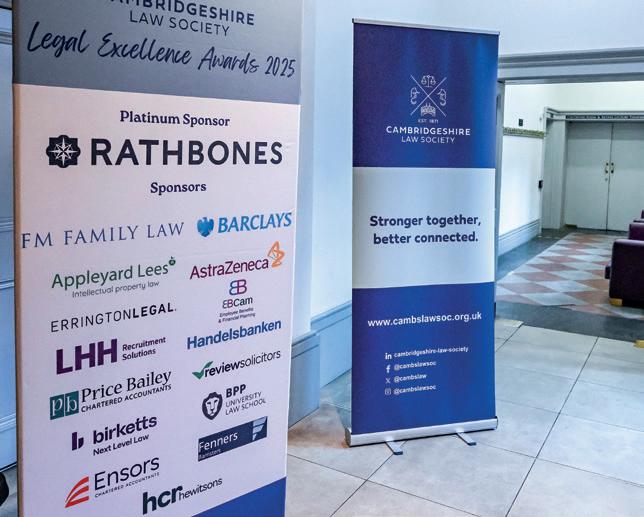
At Rathbones Cambridge, we are delighted to continue supporting Cambridgeshire Law Society (CLS) as the platinum sponsor of this year’s awards dinner. This year also marks 25 years of Rathbones’ presence in the local community. During that time, our team has worked closely with many CLS member firms, providing personal wealth management to private clients - including tax and pension planning, as well as managing investments through bespoke strategies.

As part of the team that opened the Cambridge office in 2001, and having led it since 2015, I am passionate about supporting Cambridgeshire Law Society and its professional members as they excel in their careers. We understand the unique challenges you face and have extensive experience working with successful professionals. At Rathbones, we’re proud to be part of your journey - engaging with your members and doing what’s right for our clients.
My team is committed to being both responsible and entrepreneurial in creating enduring value for the trusted partners we work alongside. We aim to deliver a seamless, end to end service: identifying your clients’ needs, placing them at the centre of our work, and helping them invest well so they can live well.

Baron D'Arignac Blanc de Blancs
Non-alcoholic
Pure Orange & Clementine Juice and water
King Prawn, Avocado and Endive Salad with Orange and Balsamic
Burella Mozzarella with Roasted Heritage
Tomatoes, Rocket and Balsamic
Wild Berries and Cider Braised Pork Belly, Honey and Mustard Pomme Pure, Roasted Courgettes, and Cider Jus
Asparagus and Pea Risotto with Grilled Baby Courgettes, Parmesan Crisps, Rocket and Balsamic
Summer Pudding with Clotted Cream and Berries
Fairtrade Coffee and Chocolates
Red: Merlot, SSW (South South West)
White: Rioja, Covila
Belvoir Pressés Elderflower and water

Charity Raffle in aid of CENTRE 33
RAFFLE TICKETS
£10 for a strip of 5
PRIZE DRAW
£10 per entry
PRIZE DRAW
£300 John Lewis Voucher
Ashtons Legal Hamper
Ebcam 6 Bottles of Harrods Malbec Mendoza 2023
Ensors £80 worth of chocolates from Hotel Chocolat
FHM Forensic Fortnam & Mason Accountants Hamper
FM Family Law £100 John Lewis Voucher
Greenwoods Beats Solo Buds
Irwin Mitchell Fortnum & Mason Springtime Hamper
Simmon & Simmons Hamper of Cheese Voucher
Tees Law £100 One4all Gift Voucher
Thomson Webb & Corfield
£50 Voucher
Woodfines Regency Hamper
Rathbones 3 prizes: one bottle of Chapel Down in a gift box per winner


Barclays are delighted to be sponsoring The Cambridgeshire Legal Excellence Awards for another year. Graham Martin, Professionals Relationship Director, at Barclays Corporate Banking for over 20 years, has supported the awards for several years. “It’s a great evening to acknowledge and celebrate the achievements of Individuals and Firms. The Professionals sector continues to be a key industry focus, with strong long-standing relationships across the sector.” says Graham.
We wish all Nominee’s the best of luck on the night, for what will again be a memorable evening of celebrations..
Supporting businesses turning over £6.5m pa, Barclays Corporate Banking has the banking excellence you’d expect with the data and insights you don’t.
We look beyond banking to help you see what really matters. Through our dedicated sector and regional specialists.
We can provide you with innovative financing solutions that help you achieve a more expansive, betterconnected future for your business. See things differently with Big Picture Banking at Barclays.
Visit barclayscorporate.com

FM Family Law is thrilled to sponsor the 2026 Legal Excellence Awards reflecting our commitment to the legal community and to Cambridgeshire Law Society.
OF:
EBCam Ltd is a trusted expert in employee benefits and independent financial advice. We begin by listening, taking time to understand our clients’ goals and priorities before delivering tailored, practical advice. As a fully independent firm, we are not tied to any provider, which allows us to explore the whole market and recommend solutions that truly meet our clients’ needs.
Our Corporate Employee Benefits team supports businesses with pensions and a wide range of employee benefits, from private medical insurance
to flexible benefit arrangements, ensuring value for employers and clear communication for employees. Our Financial Planning team works closely with individuals to help them achieve their personal and financial ambitions, building confidence and long term security.
We are proud to sponsor the award for Criminal Law Team of the Year this year. Supporting and celebrating the outstanding professional talent within the Cambridge community is something we greatly value, and we are delighted to continue our involvement in this special evening.
ponsoring the award of ‘Outstanding Achievement of the Year’ is important to us since nominees have the opportunity to showcase achievements beyond just law including work in the legal community or the wider community. The recipient of this award is also setting the bar high for excellence, making an enduring impact in their community and their legal sector and delivering the highest standards of work. This is key to us as we strive to deliver work at the highest level. We look forward to celebrating the success of everyone in our community and wish all nominees the best of luck.
FM Family Law is a boutique law firm specialising in divorce including mediation. We are committed to protecting clients’ interests while minimising conflict and guiding them through every stage of the legal process with professionalism and clarity.


OF:
Handelsbanken offers a wide range of banking products and services for Corporate and Private customers. Our award winning service offering is based on having a dedicated Cambridge based team of account managers and support team who take a long term approach to relationships with our customers and local professionals. Decision making is delegated to the local office which includes 95% of lending decisions, as well as pricing and all aspects of management, adapting strategy to suit the local market place.
Handelsbanken have supported CLS for some years and we are delighted to sponsor the Property Law Team Award, as a bank that works closely with property lawyers across the region, we know the value of having a strong legal partner. Those who go above and beyond deserve to be recognised.
AJ Chambers delivers specialist Recruitment, Careers Guidance, Mergers & Acquisitions consultancy and Market Intelligence across the Accountancy and Legal markets.
From expanding your firm with best-in-class talent across all areas, finding that next
OUR AWARD WINNING SERVICE OFFERING IS BASED ON HAVING A DEDICATED CAMBRIDGE BASED TEAM OF ACCOUNT MANAGERS AND SUPPORT TEAM.
PEM is proud to sponsor the ‘Private Client Services/Family Law Team of the Year’ Award at the Cambridgeshire Legal Excellence Awards, celebrating the outstanding expertise and commitment within our region’s legal community.
As Cambridge’s largest independent firm of accountants, tax and business advisers, PEM has
role through to even supporting you buying into equity, or eventually selling your practice - AJ Chambers will support you in achieving your goals throughout your entire career journey.
Supporting Cambridgeshire Law Society and celebrating excellence within Law is so important to industry health.
We are honoured to see the spotlight on these extraordinary individuals and the achievements that propel the Legal world into the future.
“Shaping Futures” is our mission. It is not just a tagline nor a hashtag. It’s our commitment to the profession.
supported individuals, families and entrepreneurs for more than 150 years. Our specialist team provides tailored advice across personal tax, trusts, estates and succession planning, helping clients protect and grow their wealth for future generations.
We understand the challenges faced by private individuals and family businesses, offering proactive solutions built on trusted relationships and deep local insight. Sponsoring this award reflects our shared values of integrity, collaboration and excellence, recognising those who deliver exceptional service across the private client and family law sectors.
We are delighted to celebrate the achievements of professionals who, like PEM, put people at the heart of everything they do.

Recognising the vital role in house legal teams play within their organisations is incredibly important, which is why Appleyard Lees is proud to sponsor the In House Team of the Year award. These teams sit at the centre of strategic decision making, guiding innovation, managing legal risk, and ensuring their organisations can grow with confidence.
As a leading intellectual property law firm, Appleyard Lees partners with in

SPONSORS OF: INTELLECTUAL PROPERTY/IT LAW TEAM OF THE YEAR
house teams across a broad range of industries, from multinational companies to emerging start ups.
This close collaboration gives us unique insight into the challenges and opportunities they navigate daily, and we deeply value their expertise, agility, and commercial understanding.
Supporting this event reflects our commitment to celebrating excellence across the legal community. Sponsoring this award gives us the opportunity to highlight the exceptional contributions of in house professionals who consistently deliver practical, effective, and forward thinking legal leadership. We are delighted to help recognise the teams driving meaningful impact within their organisations.”
Price Bailey is proud to sponsor the Litigation Team Award at this year’s Legal Excellence Awards. As a leading firm of chartered accountants and business advisors, working with a wide variety of clients, we recognise the important role that the legal sector plays in supporting our business community.
We are an award-winning accountancy and business
advisory firm with offices across London, Oxford, East Anglia, as well as international locations, providing a wide range of services, including corporate finance, complex and international tax, business advisory, and financial planning services to both businesses and private individuals.
Price Bailey values building strong, long-term relationships with clients and professional contacts through providing exceptional service, advice, diverse industry knowledge, and sector-specific insights.
We are excited to be involved again this year, and we would like to congratulate all finalists and look forward to celebrating the outstanding achievements on display on the night.


Ensors are delighted to be sponsoring the 'Outstanding Support Staff Member of the Year' award in partnership with Cambridgeshire Law Society. This award is an opportunity to recognize those who consistently go above and beyond, showing exceptional skill, dedication and commitment to excellence in their roles.
These are the often unsung heroes of legal and accountancy firms, keeping everything running smoothly. it is an honour to sponsor an award that not only celebrates individual achievement but also underscores the importance of teamwork, professionalism, and the essential contributions that support staff make to the legal industry.
We look forward to celebrating this year's winner and continuing to support the fantastic work being done by these invaluable team members.
OF:
Greenwoods is delighted to support the Cambridgeshire Law Society Legal Excellence Awards 2026 - a night that shines a light on the talent and ambition driving our region’s legal community. It’s a great opportunity to celebrate the people who make our profession stronger, and we’re looking forward to cheering on every nominee.
We’re not an identikit law firm. We don't do standard processes, off-the-shelf templates or generic advice. We invest time in understanding the businesses and people we work with - what matters to them, what they're trying to build, what success looks like for them. Our advice fits our clients. Not the other way around.
That’s why an evening like this resonates with us. Legal Excellence isn't just about technical ability - it's about the people behind the work and the communities they serve. Which is exactly how we think about what we do.
We're looking forward to celebrating with you - and thank you to everyone who's worked hard on this year’s Legal Excellence Awards.

SPONSORS OF: COMMUNITY
HCR Law is a Top 50 UK law firm with more than 1,000 people across 13 locations, offering comprehensive legal services to organisations, business leaders and individuals. Our nationally recognised sector teams combine deep industry insight with specialist expertise to support clients in Cambridgeshire and across England and Wales.
We’re proud to play an active role in the communities where we live and work. Since 1991, we’ve delivered Cambridge’s Chariots of Fire relay race, raising more than £1.6m for local charities, and through Impact55 we champion East Anglian start-ups using technology for social and environmental good. We’re supporting the Legal Excellence Awards 2026 - and sponsoring the Community Award - because recognising those who strengthen and uplift our region reflects our Passion for People. We look forward to celebrating the collective and individual successes of members.
SINCE 1991, WE’VE DELIVERED CAMBRIDGE’S CHARIOTS OF FIRE RELAY RACE, RAISING MORE THAN £1.6M FOR LOCAL CHARITIES...

The Clarke Edwards Partnership is a specialist legal recruitment practice built on integrity, market expertise and a genuine commitment to client service. The Clarke Edwards Partnership offers clients sensible, sound, and practical solutions to their recruitment needs and candidates a tailored, professional and non-pressurised approach to their career search. Claire Clarke and Lisa Edwards are both highly recommended for in-depth legal knowledge and for maintaining a collaborative and people-focused approach.
Supporting the Cambridgeshire Law Society Legal Excellence Awards reflects The Clarke Edwards Partnership’s desire to celebrate the legal profession and the incredible professionals within it. In an ever-changing and increasingly challenging landscape, the role of today’s lawyer extends far beyond technical expertise. It encompasses mentorship, business development, marketing and business/brand awareness, exceptional customer service and ongoing legal learning. The Awards recognise not only excellence in law, but the vital role the legal community plays in supporting and strengthening the wider business community. By supporting this event, The Clarke Edwards Partnership continues to celebrate high standards and innovation across Cambridge’s legal sector.

BPP University Law School is delighted to be sponsoring the Junior Lawyer of the Year Award
We speak regularly to the many law firms and other employers. Both they and we at BPP are acutely aware of the challenges faced by the next generation of solicitors in tackling the SQE assessments and in a rapidly
changing workplace and profession.
As a leading law school with SQE pass rates consistently 20% above the national pass rate, we pride ourselves in the quality of the training and guidance which we offer future solicitors. The winner, has displayed similar levels of excellence to have stood out against the competition and to have created such an impression in the local legal community that they have been deemed a worthy winner.
We look forward to following their career journey as they progress to qualification and beyond.
BPP University Law School runs SQE and Law Conversion programmes at all our centres including Cambridge.

Fenners Chambers is a leading regional set with more than 50 specialist Counsel practicing in family, crime, property, commercial probate, personal injury, employment, and public law. Chambers is ranked in both Chambers & Partners and the Legal 500, with many members who are recognised as leading individuals within their fields.
Fenners Chambers is committed to providing legal services of the highest quality to all clients. As well as expert advice and advocacy, Fenners offers mediation and arbitration, and is proud to launch our Non-Court Dispute Resolution service for both Children and Financial cases to build on our existing Private FDR service.
Fenners Chambers is run by a dedicated and experienced clerking team, led by Paul Green, who have been described in the Legal 500 as “friendly” and “accommodating”.
Fenners is proud to sponsor the ‘Rising Star’ award as we believe in the importance of a strong local legal community and encouraging growth from the bottom to the top.


Birketts LLP is proud to sponsor the Cambridgeshire Law Society Legal Excellence Awards, an event that celebrates the outstanding talent, dedication and professionalism within the region’s legal community. As a leading UK law firm with deep roots across East Anglia, Birketts is committed to supporting initiatives that elevate the standards of legal practice and recognise those who make a meaningful impact on clients, colleagues and the wider community.
For Birketts, sponsoring the Awards is more than a symbolic gesture - it reflects the firm’s belief in nurturing excellence at every stage of a legal career. The Awards provide an important platform for acknowledging exemplary work, encouraging innovation and spotlighting the next generation of legal professionals. Birketts values the opportunity to champion these achievements and contribute to a vibrant, collaborative legal ecosystem in Cambridgeshire. By supporting the Legal Excellence Awards,
Birketts reaffirms its long standing commitment to quality, integrity and the future of the profession.

We provide an end-to-end recruitment solution for clients and candidates, delivering a consultative, highquality service built on trust, longterm relationships and exceptional customer care.
OF:
LHH is an award-winning recruitment and executive search consultancy, recognised in the Sunday Times ‘100 Best Companies to Work For’ for four consecutive years. From our Cambridge office, we specialise in the legal sector, supporting both In-House and Private Practice markets.
LHH is proud to have supported the Cambridgeshire Law Society and the Legal Excellence Awards for the past six years, celebrating the outstanding talent and achievements within the region’s legal community. This year, we are delighted to be the drinks sponsor, raising a glass to the individuals and firms whose dedication and expertise continue to set the standard for legal excellence. We look forward to celebrating the continued success of the Cambridgeshire legal market.

Since 2013, Errington Legal has been helping law firms and businesses to grow and achieve their goals by introducing carefully selected candidates.
We have also helped hundreds of legal professionals to take the next step in their careers.
Based in East Anglia but operating nationally, we recruit for qualified solicitor roles at all levels, both private practice and in-house, and have recently launched a Fractional General Counsel service.
The values of CLS are very much aligned with ours, with a focus on diversity and inclusion, and we are delighted to support them yearround by sponsoring various events and seminars to benefit the local legal community.
The Legal Excellence Awards are always a particular highlight, showcasing Cambridgeshire’s top legal talent, and we very much look forward to attending as sponsors once again.
THE LEGAL EXCELLENCE AWARDS ARE ALWAYS A PARTICULAR HIGHLIGHT


Centre 33 has supported over 50,000 young people since it was founded in Cambridge in 1981. Here, Chief Executive Officer Beth Green explains why early support has never been more vital for young peopleand what's next for the charity.
Young people today have a lot to think about. They’re juggling worries about school, exams and friendships with the constant pressures of social media, the cost-of-living crisis, under-resourced services and global uncertainty.
And it’s having an impact. Rates of mental health problems are rising in young people, and suicide remains the leading cause of death in young people aged 16 to 24.
At Centre 33, we see how hard it can be. We support local young people with everything from caring responsibilities to housing problems and mental health. Last year, we helped 4,000 young people, including many dealing with anxiety, low mood, self-harm and suicidal thoughts.
Nearly half of those accessing Centre 33’s Someone to Talk to dropin service felt they had no family or friends they could turn to. Many others didn’t want to worry loved ones about the challenges they were facing.
Part of our role is to create a safe, non-judgemental space for young people to talk through their feelings. Sometimes that might be normal
emotions, rather than a mental health problem. Strong feelings can be a healthy response to difficult situations, particularly during adolescence and young adulthood.
We try to reassure young people that it’s okay to feel how they are, that their emotions will shift and things won’t always feel this hard.
But when those feelings become too much to manage alone, we’re here to listen, explore practical solutions and, if necessary, help them get the extra support they may need.
Our teams see first-hand the impact that support has on young people. Last year, 72% experienced improved mental health and 92% made progress towards their goals.
“I feel safe and listened to at Centre 33” Young person
We’re proud of the young people who come through our doors. They find us in different ways (via their schools, GPs and family members), but we find the most powerful route is when they decide they are ready to ask for help themselves.
We are lucky to have great support from our community with our supporters often choosing to fundraise to say thank you. Well, the feeling is mutual, we simply couldn’t do what we do without this support. There are many ways to support young people through Centre 33, you could:
l Take on a fundraising challenge such as a marathon or sponsored walk
l Set up a monthly direct debit to support Centre 33
l Spread the word about our services amongst your networks
So, what’s next for Centre 33? For many years there hasn’t been enough space at our hub in Clarendon Street to support the number of young people seeking our help. Last year Centre 33 launched the Building Stronger Futures appeal to create
a new support hub for young people in Cambridge.
I am thrilled to share with you that thanks to the support of our community and some generous funders we will be opening our new hub on Maids Causeway later this year. The new hub will enable double the number of young people to access support. We are busy fundraising for the refurbishment so that we can offer more space for one-to-one and group support, as well as room for partner organisations, ensuring joined-up support.
Early, flexible support without barriers makes all the difference, helping young people to develop life skills, move towards greater independence and thrive.
A Space That’s About Me: Arthur’s Story Arthur has more to think about than most 12-year-olds. He cares for his brothers Finley and Harrison, who live with a rare, life-limiting genetic condition called Batten disease which has caused them to lose their sight and will eventually lead to childhood dementia.
Arthur helps get his brothers ready for school, dinner and bed and is often their go-to when they need someone to talk to. Arthur loves looking after his brothers but often struggles to find time for himself. Arthur’s mum Sarah turned to Centre 33 for support and says Arthur has “flourished ever since”. Arthur’s project worker gave him oneto-one support and a chance to talk about his feelings, difficult emotions and challenges. Arthur said, “Centre 33 gave me a space that's just about me.” Watch the short film A Space That’s About Me: Arthur’s Story here


Michael Frape Law Society Council Member for Cambridgeshire and Peterborough, Chairman Ashtons Legal LLP
I recently attended the Law Society’s (TLS) Strategic Planning Event (SPE). We are already part way through Year 1 of TLS’s three-year Corporate Strategy 20252028. The purpose of the SPE included a discussion of TLS’s five Missions, which guide the Corporate Strategy. Those Missions are:
l Technology: technology, the practice of law and the consumer;
l Conditions for growth: promoting growth of legal services with a focus on better regulation;
l Justice and the rule of law: promoting access to justice and the rule of law in the UK and around the world; and
l Responsible business: supporting the profession on all aspects of responsible business;
l Member experience and value: championing our profession and member experience.
I was involved in a workshop on Justice and the rule of law. One of the foci of the workshop was how to improve access to justice. This is a perennial problem given the evermounting pressure on the budget of the Ministry of Justice (MoJ) and especially Legal Aid.
The MoJ is responsible for prisons, probation, courts, tribunals, the judiciary, legal aid, and other key functions of the justice system in England and Wales and therefore
The tragic destruction of the post-Second World War legal settlement
incredibly important institutions underpinning the rule of law.
The IFS have reported that in the 2010s, the MoJ budget was cut by the Conservative Government by about one-third having already been under increasing fiscal pressure for many years. In 2025–26, real-terms day-today spending by the MoJ will be 14% lower than in 2007–08, and 24% lower in per capita terms. This, despite recent substantial increases in the MoJ budget.
More attentive readers will remember TLS’s “Legal Aid Deserts” campaign of a few years back, which highlighted the dearth of Legal Aid solicitors in many parts of England and Wales. This was the result, at least partly, of LASPO (Legal Aid, Sentencing and Punishment of Offenders Act 2012), which dramatically reduced civil Legal Aid provision in England and Wales, but also the effect of many years of holding back Legal Aid rates making Legal Aid work uneconomic. Why has that been the case?
The absence of civil and criminal Legal Aid advice for people who really need it is a real and serious impediment to access to justice. Those of us who practice in dispute resolution know only too well the injustice that can be done by an inequality of arms. A legallyadvised litigant will generally win a legal case against a litigant in person, whatever the merits.
This has been the case since time immemorial. Shakespeare put it brilliantly well in King Lear when (in Act 4 Scene 6) the eponymous tragic hero in a moment of lucidity amongst his madness states as follows:
Through tattered clothes small vices do appear. Robes and furred gowns hide all. Plate sin with gold, And the strong lance of justice hurtless breaks.
One is of course immediately reminded of current days examples of such injustices such as President Trump and other plutocrats seeming to be unaffected by their multiple appearances in the Epstein files. By contrast of course, many of the victims of Epstein victims (all young women and girls) have not only been named by the US Government, but have failed to obtain any legal redress. The strong lance of justice does of course break on impact with serious wealth.
This is all entirely predictable. During WWII, at least 50 million people (mainly civilians) died, often in the most appalling circumstances. This caused the democratic nations to recognise the critical importance of protecting human rights and giving their citizens the ability to enforce those rights by access to legal advice and a fair justice system.
The system of universal access to justice was, however, unaffordable and the rise of neo-liberalism in the early 1980s heralded its slow and inevitable destruction over the last four decades.
The effect of the 2007-2008 financial crisis has been to accelerate the destruction of the post-WWII legal settlement. That is bound to continue into the future, because our economic priorities lie elsewhere and citizens do not value human rights or a functioning justice system. The rise of populist parties of the right is both evidence of this and a driver of this destruction.
What we see was an inevitability. It is not in the interests of the powerful (those robed in fur gowns and plated in gold) for there to be enforceable human rights, legal advice for all and an effective justice system. The neoliberal system supports the powerful and will ensure the destruction of the post-WWII legal settlement.

At LegalEx London on 25th February, LEAP was back with a clear message for the profession. In 2026, the challenges facing law firms are no longer abstract. They are practical, daily pressures around efficiency, productivity, risk management, cybersecurity, client service and staff burnout.

For Craig Matthews, CEO of LEAP, the conversations at this year’s event reflected a legal sector that is thinking seriously about how and when to use AI.
“Efficiency and productivity remain front of mind for every firm we speak to,” says Craig. “But alongside that is risk. Firms are rightly asking how they can use AI in a way that strengthens their practice rather than exposing it. The answer is not switching AI on and hoping for the best. It is about integration, governance and using the right tools in the right way.”
At LegalEx, LEAP demonstrated how AI is fully integrated within the LEAP technology stack, embedded into everyday workflows rather than bolted on as a separate tool. This enables firms to automate routine tasks, draft and review documents more efficiently, and manage matters with greater visibility, all within a secure environment designed specifically for legal practice.
“For me, LegalEx is about honest conversations,” Craig continues. “It is a chance to talk openly about how AI can genuinely make a difference in the practice of law, while also addressing concerns around data security, compliance and
professional responsibility. We are there to show that AI, when implemented correctly, mitigates risk rather than increases it.”
Craig also highlights the human impact. “Burnout is a real issue across the profession. If we can remove repetitive, low value administrative work and give lawyers more time to focus on clients and complex legal thinking, that is transformative. Technology should support people, not overwhelm them.”
LegalEx provides LEAP with direct feedback from firms of all sizes, shaping ongoing product development and ensuring the platform continues to respond to real world needs. “We come to LegalEx to listen as much as to demonstrate,” says Craig. “Our role is to ensure our clients have the very best experience of using LEAP day in and day out, and that they are equipped to use AI effectively, safely and confidently.”
For LEAP, the future of legal technology is not about hype. It is about practical tools that deliver measurable gains in efficiency, reduce risk and support a healthier, more productive profession.
LEAP Legal Software has been helping law firms to become more efficient and profitable globally for more than 25 years. LEAP is committed to consistently providing world-class legal practice productivity solutions and has innovation at the heart of its research and development so that users continually have the best possible experience.
Dedicated to delivering cutting-edge and intelligent legal software solutions, LEAP’s team of specialist developers present innovative AI solutions that automate routine tasks, simplify document management, and enhance decision-making, allowing lawyers to do what they do best - practise law.
For more information, please visit www.leap.co.uk

JSC Commercial Bank Privatbank v Igor Valeryevich Kolomoisky & Ors - Find Case Law - The National Archives
The claimant brought an action against two of its founding shareholders, and companies owned or controlled by them, seeking compensation for harm caused by their alleged participation in a fraudulent scheme. The forensic accounting expert for the first defendant failed to inform the court, until shortly before he gave evidence, that he had ceased to hold a key professional membership.
l You should inform the parties and the court if, after your expert report is filed, you cease to be the member of a professional organisation which is relevant to the expert evidence you have provided.
l Always consider whether you should inform your instructing party following any material change in your qualifications or accreditations.
The claimant brought an action against two of its founding shareholders, and companies owned or controlled by them, seeking compensation for harm caused by their alleged participation in a fraudulent scheme. One of the areas of for expert evidence was forensic accountancy.
We have previously discussed the assertion by the judge in this case that Expert Witnesses have a duty to disclose previous criticisms of their evidence in judgments. In this case update, we look at another
aspect of the case, the failure of the forensic accounting expert for the first defendant to inform the court, until shortly before he gave evidence, that he had ceased to hold a key professional membership.
The parties were given permission to adduce expert evidence from forensic accountants. The claimant instructed Mr T, a Senior Managing Director in FTI Consulting, the first defendant instructed Mr D, the managing director of Honeycomb Forensic Accounting, and the second defendant instructed Mr S, a partner in Alvarez & Marsal Disputes and Investigations LLP.
At the time of their reports, all the experts were fellows of the Institute of Chartered Accountants of England and Wales (‘ICAEW’). However, during July 2023, after the trial had commenced, but before Mr D had given evidence, the claimant’s solicitors discovered that Mr D’s status as a member of the ICAEW was now recorded as Ceased with a sub-status recorded as Cessated. They wrote to first defendant’s solicitors drawing attention to the cessation and attaching a copy of the disciplinary record which indicated that Mr D had been subject to a severe reprimand, in respect of which there had been hearing on 8 March 2023. Mr D had not disclosed any of this information to the claimant or the court.
Mr D provided an explanation in a witness statement on 29 September 2023, five days before he was due to give evidence, intending to anticipate questions he expected during crossexamination. He disclosed that he had been the subject of two complaints in June and August 2021 in respect of which there had been no disciplinary proceedings. He had, however, been severely reprimanded for failure to provide the ICAEW with responses to those complaints. Mr D also disclosed that the Charity Commission had removed him as trustee of two charities and that those charities had been the subject of statutory enquiries by the
Charity Commission. He also gave notice that he would rely on his privilege against self-incrimination to justify his refusal to answer any questions about the August 2021 complaint to the ICAEW and the Charity Commission inquiry.
The judge noted that, given the information provided, it was not possible for the court to obtain a full picture of what had occurred or the extent to which these matters might have been relevant to the quality of Mr D’s evidence. However, Mr D did accept during cross-examination that there was no excuse for his failure to provide the information sought by the ICAEW.
The judge concluded that:
“In my view, where an expert presents his evidence as a member of a professional organisation, which is expected by him to give the court assurance as to his ability to act in the case, he is under a duty to inform the court if his membership has ceased, more particularly where the cessation is linked to disciplinary proceedings against him. [Mr D] accepted in cross-examination that he knew that his presentation as a member of the ICAEW would give the court that assurance, but he had no explanation as to why he did not voluntarily inform the court or the Bank of the fact that he had ceased to be a member with effect from 19 April 2023. The manner in which [Mr D] approached this issue casts real doubt on his ability to be open and straightforward on matters which might affect the court’s assessment of the reliability of his evidence as an independent expert. More particularly it undermined the court’s confidence in his ability to give precedence to his overriding duty to the court when faced with other conflicting interests. It seems to me that this is a particularly significant failing when taken together with the fact that [Mr D] also failed to disclose that he had been the subject of a finding in another case that his opinion was based on wholly unsupported and fanciful assumptions, which ignored the objective facts and undermined his credibility as an independent expert (per Leggatt LJ in Al Nehayan v. Kent [2018] EWHC 333 (Comm) at [195]).”



When clients express a desire to "give something back," it often opens a conversation that goes well beyond standard legal advice. While you're experts in navigating the technical and legal aspects of wealth management, charitable giving brings its own set of questions: tax efficiency, appropriate structures, involving family members, and ensuring genuine impact.
The skills you already bring to client relationships – helping them think through complex decisions about their assets, family dynamics, and long-term planning – translate directly to philanthropic planning. Clients who work with their advisers on their charitable giving consistently report higher satisfaction and greater impact.
Clients typically consider charitable giving at significant moments: the sale of a business, retirement, receiving an inheritance, or preparing a will. In these instances, they're already consulting
you about their financial affairs, making it natural to explore whether they'd like to dedicate resources to causes they care about.
You can help clients articulate what they want to achieve. What issues do they care about? Do they want to see impact during their lifetime? How involved do they want to be? Would they like to involve family members? These conversations help clients fully consider their goals, and your guidance in achieving this clarity is itself valuable advice.
This is where Cambridgeshire Community Foundation can help. We understand local needs and the charity landscape, managing charitable endowments, grantmaking, and providing impact reporting. This allows you to offer clients a complete solution while focusing on what you do best: understanding their overall situation and ensuring their philanthropic plans integrate seamlessly with their wider financial and estate planning.
Clients benefit from this collaborative approach. They receive your trusted guidance on the "big picture" decisions while accessing specialist expertise on implementation. You strengthen your client relationship by demonstrating you can support their complete range of needs, not just their legal requirements.
With the anticipated generational great wealth transfer and clients seeking purpose alongside prosperity, your role in philanthropic planning becomes increasingly valuable. By embracing this role, you enhance your value to clients, helping them achieve something deeply meaningful.
If you're supporting clients who are considering their charitable giving, please get in touch to discuss how we could work alongside you.
E: michael@cambscf.org.uk
W: www.cambscf.org.uk/advisers
Being a Chair of Remember A Charity’s Wealth Adviser Committee has made me appreciate that it’s rare to find a space that connects such a thoughtful cross-section of advisers, bringing not only a wide breadth of expertise to the table, but also genuine honesty and openness to discussions on the topic of legacy giving. There’s a real willingness to share challenges as well as successes, and to learn from one another in a way that feels collaborative and progressive.
Whilst the latest Remember A Charity study on legacy giving amongst HNWIs revealed that 50% of millionaires have already included a charitable gift in their Will, there is still work to be done. It is in a large part the responsibility of the wealth adviser community to ensure that leaving a charitable legacy is a permanent fixture in wealth planning discussions and, as a committee, we’re hoping to make this happen.
Traditionally, philanthropy within legal and advisory work has been viewed through a very technical lens – with lawyers advising on charitable structures, tax efficiency, governance and administration. Though this, of course, will remain essential, it is also apparent that the role of an adviser is evolving.
Today, many of the clients we support are looking for something more holistic. They want to work with someone who can help them explore what matters to them and what they want their wealth to achieve, both during and after their lifetime.
This shift does require us to move away from purely technical advice and towards more values-based conversations, giving our clients space for reflection - not just decision-making.
We will need to have the confidence to ask questions that don’t have easy or straightforward answers such as: what responsibility they feel comes with the wealth they have built; how they have built their wealth; and how their values around family and tax shape the legacy they want to leave after death. In short, we need to understand their philosophy of wealth.
These conversations may feel less structured, but when led carefully and without pressure, they can be deeply rewarding - strengthening trust and laying the foundations for more effective estate and philanthropic planning.
Within my role as Chair of the Wealth Adviser Committee, I’m reminded often that philanthropy advisers seldom work in isolation. There is a wide and wonderful ecosystem at play, encompassing legal, tax, financial planning, investment and community expertise. Philanthropy works best when it is integrated into a broader financial plan, not treated as an afterthought.
For clients to confidently commit to significant charitable gifts, they first need clarity around how much they need for their own lifetime, what they want to leave to family, and how different assets should be allocated to different pots. As such, financial planners play a particularly important role. Clients also need to feel confident that the charitable causes they are leaving gifts to are aligned with their personal values and beliefs system. The adviser community can help close the gap between charities and their donors, to ensure all sides feel confident and supported through the process.
The Remember A Charity events and education programme for wealth advisers is building real momentum, and it’s been encouraging to see
growing engagement across the sector. As we move into our second year, I’m excited about the committee’s continued growth, expanding pool of expertise, and increasing focus on training and shared learning.
Legacy conversations are not always easy, but they are powerful. When we make space for them, we don’t just help clients plan - we help them understand what truly matters to them. In doing so, we build stronger, more meaningful relationships that can last beyond a lifetime.
Clare Stirzaker is a Private Client and Tax Partner at Boodle Hatfield LLP and the Chair of Remember A Charity’s Wealth Adviser Committee.
Remember A Charity's Private Client Advisory Committee for Legacy Giving aims to empower and equip advisers to support the growth of high value legacy giving. Find out more at www.rememberacharity.org.uk.




In this article our experts at FHM Forensic Accountants share their top tips for lawyers. Fiona Hotston Moore and Tom Arnold undertake 50 to 60 forensic accounting assignments each year. We are instructed on a range of matters including business valuations, financial investigations, professional negligence, shareholder and partnership disputes. We act as Single Joint Expert, Party Expert and Shadow Adviser.
Less than 5% of companies are subject to an external audit. An external audit gives assurance that an external qualified auditor has scrutinised the accounts both in terms of the numbers and the disclosures. An audit gives an assurance that the auditor has not identified a “material” error in the accounts. However, Accounting and Auditing Standards are principlesbased and you may need expert advice to interpret the accounts. If you do have audited accounts, we recommend first checking the Audit Report to see if the auditor was happy with the accounts. If the auditor was unable to give a “clean” audit report, you may see either a “Disclaimer of Opinion” or an “Adverse Opinion”. Read the qualification carefully and ideally obtain an interpretation from a qualified accountant. Additionally, the auditor may express a view as to whether the company is a “going concern” (i.e. is able to continue to trade and meet its liabilities as they fall due).
In respect of most limited companies other than the largest entities, the published accounts on Companies House, are of limited value. The accounts on public record will be extracted from the full accounts that are prepared for shareholders. Often the published accounts comprise only a balance sheet and a few notes. The profit and loss statement is not published and so there is no information on turnover or profitability. The accounts will normally include a note of the number of employees which gives an indication on the likely size of the company.
The balance sheet in the published accounts will give you the “net assets” - a very rough estimate of the baseline net worth of a company. However, but this may be very different from the market value of the company which takes into account the value of the trade and intangibles. Also remember that assets shown in the balance sheet may be at historical cost. The current market value of, say, a property may be substantially higher than its original cost.

Finally, as experts we all too often come across errors in accounts as well as accounts that show a misleading view of the financial position. Errors can include inclusion of provisions and liabilities that are not justifiable or failure to correctly account for a share premium. Occasionally we even see accounts that do not add up!
Tax impacts much of our work as forensic accountants. We may be giving a view on the after-tax valuation of a shareholding or the tax costs of extracting cash or assets from a company. The tax costs of a transaction can be substantially reduced if capital gains tax rates apply rather than income tax rates. Furthermore, there are various reliefs and exemptions that may be available.
There are also taxes that are easily overlooked in a transfer or transaction but that can be significant. For example, disposing of shares that were eligible for Business Asset Disposal Relief, may result in a substantial increase in the potential Inheritance Tax liability on an estate. Similarly, don’t overlook potential VAT on a business or asset transfer or Stamp Duty Land Tax on the transfer of a property.
The list of potential tax pitfalls is very long and early input from the company accountant or an independent expert is advisable.
We also come across tax liabilities arising from tax schemes or failed tax planning. This may include disputed Research & Development claims or Employee Ownership Trusts. In such situations an objective assessment of the likely liability is required.
3) Don’t overlook the option of engaging a shadow
We are instructed as shadow adviser in a range of cases. Typically, in a financial dispute where a Single Joint Expert is engaged, we may be instructed to help the clients and legal counsel to draft the instructions, to assess the expert report, formulate questions and decide on the litigation strategy.
In family cases we can review the initial disclosure and give a view on any valuation provided by a party or company accountant. We can give a view on whether the appointment of a Single Joint Expert should be sought.
The shadow adviser can help give your client reassurance on the reasonableness of the Single Joint Expert report and help contain costs.
CONTACT DETAILS
fiona@fhmforensic.co.uk
+44 (0)7770 642491
tom@fhmforensic.co.uk
www.fhmforensic.co.uk


Tribunals under the Tribunals, Courts and Enforcement Act 2007. 6th edition
By Edward Jacobs
ISBN: 978 1 91364 871 8 LEGAL ACTION GROUP www.lag.org.uk
An appreciation by Elizabeth Robson Taylor of Richmond Green Chambers and Phillip Taylor MBE, Head of Chambers and Reviews Editor, “The Barrister.”
Now in a sixth edition for 2024, Edward Jacobs’ celebrated book on Tribunals remains a comprehensive and authoritative guide to the integrated tribunal system created over ten years ago by the Tribunals, Courts and Enforcement Act 2007.
What the reader gets is a structured approach to the practice and procedure of tribunals, setting out what the rules of procedure are in their context and offering a framework for understanding and analysing the practices that apply to them.
The tribunal system has at this time in 2020s, attained a steadfast state though the matters over which it has jurisdiction continue to expand. This is especially important in the General Regulatory Chamber of the First-tier Tribunal and the Administrative Appeals Chamber of the Upper Tribunal. The judicial review work of the Immigration and Asylum Chamber of the Upper Tribunal has now established its position in place of the Administrative Court for that jurisdiction at a very testing time politically.
As well as dealing with the rules of procedure, this book contains practical advice for tribunal members and those who appear before them. For parties and their representatives, it deals with obtaining and assessing evidence, writing decisions, applying for adjournments, techniques of questioning and tribunal advocacy.
The sixth edition covers the following main areas depending on what you are looking for: the proposed change in status of Senior President of Tribunals as part of the “One Judiciary” reforms; devolved tribunals in Scotland; anticipated changes to devolved tribunals in Wales; abolition of Cart judicial reviews; updated reported case law of Upper Tribunal and the senior courts since 2019, including important decisions on the nature of an appeal;
amendments to TCEA and the rules of procedure; and extended coverage of rules on anonymity, confidentiality and disclosure.
The book remains essential reading for tribunal judges and panel members, representatives and anyone who appears before the tribunal or is interested in how they work. The Legal Action Group (LAG), continue to publish the book. LAG is the access to justice charity who are justly famed for producing legal texts accessible not only to lawyers, but to the average, concerned reader, and they are famed for the support they give us as practitioners today.
This work has been described is “the one book that every tribunal judge, member, adviser and representative should have at their fingertips”. Very true as it offers great advice and support for established and new practitioners. It remains unique for the depth of its coverage, and it guides us well with Jacobs’ considerable skill, experience and dedication of the subject matter setting out, as he does, the hugely important range of work undertaken by the modern tribunal system. Thank you LAG for continuing to publish this work.
The sixth edition of this paperback book from LAG was published in 2024.
A Transactional Analysis
5th edition
Consulting Editor: Chris Hale ISBN: 978 1 78742 973 4 GLOBE LAW AND BUSINESS LTD www.globelawandbusiness.com
AN UPDATED TRANSACTIONAL GUIDE TO PRIVATE EQUITY FOR 2020s
An appreciation by Elizabeth Robson Taylor of Richmond Green Chambers and Phillip Taylor MBE, Head of Chambers and Reviews Editor, “The Barrister”
Much has happened in the years since the publication of the last edition of this book. In recent times, private equity houses have raised huge amounts of money to invest which has influenced the dynamics of the market hence the need for this transactional analysis. There’s a broadening of potential buyers with several other organisations adopting private equity style strategies.
Chris Hale’s practical fifth edition introduces us to the world of private equity not just from a UK perspective, but also that of key European jurisdiction and in the United States of America. We consider that Hale’s
explanation of the rise of private equity and its recent dynamics is of great value.
Hale explores in some detail the key ingredients of private equity transactions and the technical issues associated with them. The book gives us detailed updated chapters by leading private equity practitioners. It also includes a high-level analysis of private equity fund structures, equity and debt finance, acquisition documentation, due diligence, tax structuring, and public-toprivates, so you have most of what you are looking for in one volume.
What we get with this fifth edition are the following main areas of private equity including a new analysis of the fastest growing part of the private equity market, that dealing with secondary transactions, examining both those led by the investors in private equity funds and those led by those who manage the funds.
Hale offers a new discussion of the debt available at the fund level, the way it is structured and its uses, and there is a first-time chapter on how ESG issues are affecting and being dealt with by private equity fund managers including an examination of the new and prospective regulation in this area.
We are also given coverage of new UK pension legislation in relation to due diligence, and an insight on latest market trends and how these impact on deal dynamics and deal terms: an overview of the anatomy of a private equity fund, a description of fund terms, reflecting changes driven by industry requirements, and a laying out of common themes across all major relevant jurisdictions.
Of additional interest is a discussion of the ever-changing tax risk environment, and newer tax rules. There is a consideration of the regulatory changes required in governance of large private companies and transparency plus a review of the evolving shape of the leveraged buyout market, including the influx of new finance providers and a view on the new UK framework on restructurings.
We consider this book to be a musthave handbook for legal and other practitioners working or advising in private equity, as well as for senior private equity executives, investment houses and investors. Academics in corporate law and business schools, as well as their students, will also find this fifth edition to be of great value.
The third edition of this hardback book from Globe was published in 2024.
As March marks Free Wills Month, the Law Society of England and Wales urges the UK government to modernise wills legislation or risk leaving many people’s final wishes unprotected and beneficiaries unable to access justice*.
It is recommended that people update their will every five years or when a major change occurs. That eases the probate process for loved ones and beneficiaries.
The current wills law passed in 1837, and many find that outdated laws undermine their wishes and do not reflect today’s digital society or the modern reality of family systems.
To reflect current public attitudes, the government should seize the opportunity to introduce necessary reforms on wills following the Law Commission’s report: Modernising Wills Law**.
Law Society president, Mark Evans, said: “Although the law on wills has barely changed in almost 190 years, modern life has. People still cannot make a legally recognised electronic will, and the law needs to reflect modern understandings of capacity, including conditions like dementia.
“We support proposals for courts to recognise taking a person’s intentions into account when looking at their will. This helps to level the playing field and may encourage more people to draft a will, even if the legal details in making a valid will were not entirely followed.
“We stand ready to work with
the government to discuss and implement the Law Commission’s recommendations and bring wills firmly into the 21st century.”