Table of Contents STUDIES 53 Seasonal Common Yellowthroat Populations at Chippewa Run, Leelanau County, Michigan (2011‑2024) Logan B. Clark, William C. Scharf, and Alice Van Zoeren 60 Do Environmental Factors During Nesting Influence the Band Size of Hatch Year Birds? Audrey J. Hicks, Mark H. Conway, and Timothy Brush NOTABLE SIGHTINGS 64 An Instance of Supernumerary Rectrices in a Carolina Chickadee in Arkansas Kevin J. Krajcir and Maureen R. McClung 66 Encounters of Banded Golden Eagles with Non-functional Satellite Transmitters Dale W. Stahlecker, Robert K. Murphy, and Kenneth V. Jacobson 68 Two Juvenile Gray Catbirds Undergo Likely Incomplete Molt in New Jersey Meadowlands Cailin O’Connor and Michael Turso INLAND FLYWAY REVIEW 70 2024 Fall Migration Report Compiled by Vernon Kleen LITERATURE REVIEW 82 Literature Reviews: Summer 2026 Compiled by Claire Stuyck SPECIES SNAPSHOT 85 Species Snapshot: Great-tailed Grackle (Quiscalus mexicanus) Steven Gabrey NEWS AND ANNOUNCEMENTS 89 Open Call for Banding (or Birding) Photos to be Featured in North American Bird Bander Kellie Hayden 90 Invitation to 2026 IBBA Annual Meeting: Oklahoma Biological Station, Oklahoma, 13 - 15 Nov 2026 Paula Cimprich 91 Inland Bird Banding Association 2025 Board of Directors Meeting Minutes The IBBA Board
Apr-Jun 2026 Vol. 51 No. 2
North American Bird Bander
A Publication of the Eastern, Inland, and Western Bird Banding Associations
Eastern Bird Banding Association
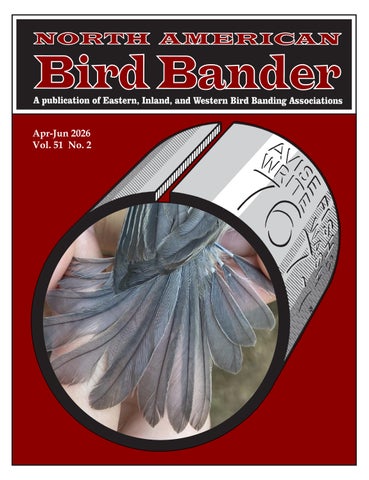
Front Cover: Carolina Chickadee (Poecile carolinensis) with supernumerary rectrices, Kevin J. Krajcir and Maureen R. McClung
North American Bird Bander (NABB) is a peer-reviewed, quarterly publication of the Eastern, Inland, and Western Bird Banding associations. This journal welcomes original papers on research on marked birds, molts, plumages, morphometrics, capture techniques, telemetry, and notable bird captures or encounters. Archived issues are included in the Searchable Ornithological Research Archive (SORA): www.digitalcommons.usf.edu/nabb/ Production Coordinator Kellie Hayden Omaha, NE
nabbproductioncoordinator@gmail.com
Literature Review Editor Claire Stuyck Tukwila, WA clairestuyck@gmail.com
Production Assistant Daniel Zmoda Pen Argyl, PA robinanddanielz@gmail.com
EBBA Editor Annie Lindsay Ligonier, PA LindsayA@carnegiemnh.org
IBBA Editor Peter Lowther Chicago, IL plowther@fieldmuseum.org
WBBA Editor Walter H. Sakai Thousand Oaks, CA DanauSakai@aol.com
Atlantic Flyway Coordinator Aaron Given Charleston, SC agiven@kiawahisland.gov
Inland Flyway Coordinator Steven Gabrey Van Buren, AR swgabrey@inlandbirdbanding.org
Inland MAPS Coordinator Steven Gabrey Van Buren, AR swgabrey@inlandbirdbanding.org
Caribbean Flyway Coordinator Daniela Ventura de Puerto Havana, Cuba dvpuerto19@gmail.com
Caribbean Flyway Coordinator Zoya E. A. Buckmire St. George’s, Grenada zoya.buckmire@gmail.com
Western Flyway Coordinator VACANT Contact Danielle Kaschube if you would like to volunteer for this role.
Editorial Team Members Maren Gimpel Andy Thiede
Ginny Boehme William Scharf
Michael Bishop Scott Rush
Danielle Kaschube
easternbirdbanding.org
Publication in NABB is free. We do not charge submission or printing fees for accepted articles. Studies, Methods, Notable Sightings, News, Announcements, and Short Communications should be sent to the NABB editor that oversees the region in which the corresponding editor resides. Banding regions are divided into 3 groups for North America (refer to the map on the back interior cover). If the corresponding author resides outside of this range, email the manuscript to NABBProductionCoordinator@gmail.com. Station reports for Flyway Reviews and ideas for Literature Reviews should be sent to the respective coordinators or editors listed above. For complete requirements for publishing in NABB, please refer to: www.easternbirdbanding.org/Submit-to-NABB ISSN-0363-8979
1st Vice President Clifford Berek Clifford.berek@gmail.com
Past President Aaron Given agiven@kiawahisland.gov
Secretary Maren Gimpel Maren.Gimpel@gmail.com
2nd Vice President Margaret Rohde margaret@wissahickontrails.org
Past Past President Ariane Giudicelli Arianeg01@hotmail.com
Treasurer Andy Thiede easternbirdbanding@gmail.com
3rd Vice President Cailin O’Connor cailin.oconnor@kean.edu
Membership Orion Metheny waterfowler98@yahoo.com
Councilor Class of 2027 Steffanie Munguía Lena Usyk Maggie MacNeil Gigi Gerben
Councilor Class of 2028 Grace Muench David Brinker Medha Pandey Dan Zmoda
Councilor Class of 2029 Alison Fetterman Nick Liadis Todd Alleger Orion Metheny
1st Vice President Tony Rothering tony.rothering@llcc.edu
Nominating Committee Chair Tom Bartlett hthomas.bartlett@gmail.com
Secretary 2nd Vice President Steven Gabrey Scott Rush swgabrey@inlandbirdbanding.org scott.rush@msstate.edu
NABC Council Representative Mark Shieldcastle markshieldcastle@bsbo.org
Inland Bird Banding Association President Paula Cimprich paula.cimprich@gmail.com
inlandbirdbanding.org
Treasurer & Membership Mike Eichman Redtail15@aol.com
Past President David Cimprich
Webmaster Amy Wilms davidcimprich@inlandbirdbanding.org wilmsab@miamioh.edu
2026 Board of Directors Erik Johnson (2nd term) erikjohnson@agcenter.lsu.edu
2027 Board of Directors Mike Bishop (2nd Term) bishop@alma.edu
2028 Board of Directors Roger Everhart (2nd Term) Roger.everhart@gmail.com
Linda Tossing (1st Term) ltossing@aol.com
Amy Wilms (2nd Term) wilmsab@gmail.com
Richard Keith (1st Term) warblerrke@iserv.net
President & Treasurer Danielle Kaschube dkaschube@birdpop.org
1st Vice President C.J. Ralph cjralph@humboldtl.com
Membership Coordinator Julie Hovis jahovis711@gmail.com
Secretary Cyndi Smith cyndi.smith9@gmail.com
2nd Vice President VACANT Contact D. Kaschube to volunteer
Board Members at Large Adam Hannuksela ahannuk@gmail.com
Allison Nelson nelson.allison@gmail.com
Claire Stuyck clairestuyck@gmail.com
Jason Kitting jason1991.bnow@gmail.com
Tania Romero t41romero@gmail.com
Colin Woolley
Western Bird Banding Association
Submitting Your Work to NABB
You do not need to be a member of the North American Bird Banding Associations (EBBA, IBBA, or WBBA) to contribute to North American Bird Bander (NABB). Anyone can contribute their work to NABB if the focus of the work is on bird banding with bird species from North America, including Canada, Greenland, Mexico, the United States, Central America to the Isthmus of Panama, and the Caribbean. Work done outside this region may be considered on a case-by-case basis.
President Annie Lindsay LindsayA@carnegiemnh.org
westernbirdbanding.org
colin.woolley@birdconservancy.org
Geographic coverage of Eastern, Inland, and Western Bird Banding Associations is shown on the map to the left. Send membership applications, subscription inquiries, manuscripts to the association representing your region.
Change of address? Inform the Treasurer or Membership chairperson
of your region’s banding association as soon as possible, or at least six week in advance of a planned change of address. The post office will not forward your paper copy of North American Bird Bander automatically. A copy cannot be guaranteed unless changes of address are received promptly. © Copyright 2026 Eastern Bird Banding Association, Inland Bird Banding Association, and Western Bird Banding Association. All rights reserved.
Seasonal Common Yellowthroat Populations at Chippewa Run, Leelanau County, Michigan (2011‑2024)
NA BB
Logan B. Clark 1, William C. Scharf *2, Alice Van Zoeren 3 *wcscharf@charter.net 1 Michigan Technological University, College of Forest Resources and Environmental Science, Houghton, MI 2 Professor Emeritus, Northwestern Michigan College, Traverse City, MI 3 Great Lakes Piping Plover Conservation Team, Maple City, MI
© 2026 Eastern Bird Banding Association, Inland Bird Banding Association, and Western Bird Banding Association. All rights reserved.
Abstract We summarized 13.5 years (2011- 2024) of Common Yellowthroat (Geothlypis trichas) captures: 758 banded and 109 recaptured (14.4%), with spring - fall tick screening from 2011 to 2020 at the Chippewa Run banding station, Empire, Michigan. Age and sex composition was consistent between years, and capture phenology followed a repeatable sequence (After Hatching Year [AHY] males most common in spring, AHY females most common through summer, and Hatching Year [HY] individuals most common in late summer to fall). AHY males were largest, exhibiting bimodal distributions in both mass and wing chord, with fall individuals showing longer wings than those captured during spring and summer. Oldest recaptured individuals were at minimum 4 yr 11 mo. Tick prevalence was 7.3% (involving 43 Ixodes scapularis and five Haemaphysalis leporispalustris) with seven reinfestations. Introduction Common Yellowthroats (Geothlypis trichas) occupy dense, low vegetation in wetlands and riparian edges across North America and migrate widely as Nearctic - Neotropical migrants, with some birds overwintering in the United States (Guzy and Ritchison 2020). Despite being common and frequently banded at songbird stations, few multi‑year summaries have been published from individual sites. Since 1960, more than 780,000 Common Yellowthroats have been banded across the United States and Canada, yet relatively few have been re‑encountered or reported. Recapture data remain limited and unevenly reported among programs, underscoring the value of site‑level long‑term datasets (Bird Banding Laboratory 2025). At Chippewa Run near Empire, Michigan, Common Yellowthroats were the most frequently captured species at our multi‑species station. This high frequency motivated us to do a focused summary for this warbler. Wing chord and body mass provide complementary measures of body size and condition, reflecting energy reserves, migratory capability, and geographic variation in morphology (Clark 1979). Tracking ticks found on captured birds aids public health by identifying vector types, timing of exposure, and bird‑driven tick movement northward – factors important to assessing disease risk (Ogden et al. 2014). Our objectives were to summarize capture age and sex composition, quantify annual and seasonal capture rates, report wing chord and mass distributions, Studies
use recaptures to estimate minimum longevity and site fidelity, and document tick species occurrence on captured birds. Methods Chippewa Run banding lanes lie about 1 km inland from Lake Michigan and about 1 km north of Empire, Michigan (44.82° N, 86.06° W). Vegetation in the net lanes consists of dense shrub thickets dominated by invasive honeysuckle (Lonicera maackii), autumn olive (Elaeagnus umbellata), and dogwood (Cornus sp.), with scattered chokecherry (Prunus virginiana), black cherry (Prunus serotina), paper birch (Betula papyrifera), and aspen (Populus spp.). Over the course of the study, tree growth has become more pronounced across the study site, which may have gradually increased the likelihood of birds flying above the nets. The riparian wetland bordering the channel is characterized by a dense assemblage of emergent vegetation, including rushes (Scirpus spp.), sedges (Carex spp.), and cattail (Typha latifolia), interspersed with royal fern (Osmunda regalis) and bracken fern (Pteridium aquilinum). Saturated margins along the channel support a mosaic of these emergents and sphagnum moss (Sphagnum spp.). We used four‑shelf, 12 m nylon mist nets with 30 mm mesh placed in lanes cleared of entangling vegetation within the riparian/wetland zone. We banded from early May through mid‑June and again from mid‑August through late September on
North American Bird Bander, Vol. 51, No. 2
53
Group
Male AHY
Figure 1. Annual Common Yellowthroat capture rates at the Chippewa Run banding station, 2011– 2024, effort‑weighted by total annual net‑hours. Bars show captures per net‑hour for adult males (black), adult females (gray), and Hatching Year birds of both sexes (white). Capture rates represent total captures in each group divided by the total mist net-hours operated in that year.
HY (both sexes) (all sexes)
Female AHY
0.125
Captures per net-hour
0.100
0.075
0.050
0.025
0.000 2011
2012
2013
2014
2015
2016
2017
2018
Year
2019
2020
Band Number
Sex
275084612
Fa 2018–Su 2022
137040098
Fa 2014–Sp 2018
235016156
Fa 2018–Fa 2021
235016220
Fa 2018–Su 2022
137040080
Fa 2011–Sp 2015
137040067
Sp 2017–Fa 2019
287090980
Fa 2020–Fa 2022
275084787
2022
Female
|| || | |
|
2023
2024
Male
||
| ||
2021
||
|
|
| | || |||
| ||
|||
|||
Fa 2017–Su 2020
287000469
Fa 2021–Su 2023
222081492
Fa 2013–Sp 2015
||||| | | ||
Fa 2013–Sp 2016 ||||
235016140
Fa 2013–Sp 2016 |
285046070 285046034
Fa 2011–Sp 2013
82079508
Fa 2013–Sp 2015
285046027
Sp 2017–Fa 2018
0
1
| ||
2
3
Min Estimated Age (Years)
4
5
Figure 2. Top 15 minimum estimated ages at last encounter for Common Yellowthroats captured at Chippewa Run, 2011–2024. Each horizontal bar represents the minimum estimated age of an individual at its last recorded capture, calculated as the time elapsed between first and last encounters plus its age class at initial capture. Ticks along each bar mark additional recaptures. Bars that begin at 0 years indicate birds first captured in their Hatching Year (HY), whereas bars that begin at 1 year represent birds initially captured as After Hatching Year (AHY) adults.
fair‑weather days, with additional opportunistic banding about once per week during midsummer. Depending on personnel and weather, we operated four to 11 nets per day and recorded net‑hours. Nets were opened at dawn for three to 54
four hours when conditions allowed. We did not operate in cold temperatures, rain, or high winds. All birds were weighed with a battery‑powered electronic balance, and wing chord was measured with a stoppered rule.
North American Bird Bander, Vol. 51, No. 2
Studies
Curve
0.00
1.00
0.00
May
May
Jun
Jul
Jun
Aug
Jul Calendar date Calendar date
AHY_M AHY_M
AHY_F AHY_F
0.2
Group
0.0
Density
n
Mean
Mean SD
SD
0.2
0.0 9
10
Weight (g)
11
12
13
AHY_F AHY_F
HY HY
0.8
0.4
Density
Density
n
AHY_M 10.45 AHY_M245 245 10.45 0.69 0.69 Group Mean SD AHY_F 179 9.98n 0.92 AHY_FHYAHY_M 179 9.98 0.920.69 189 10.15 0.69 245 10.45 AHY_F 179 9.98 HY 189 10.15 0.690.92 0.6 HY 189 10.15 0.69
8
Oct
AHY_M AHY_M
0.8
0.6
0.4
Oct
Sep
HY HY
Group
0.6
Sep
Aug
Group nn Group
Mean SD Mean AHY_M 156 54.80 2.45
SD
Group n 2.48 Mean AHY_M 156 54.80 2.45SD AHY_F 125 52.22 HYAHY_M 155 53.68 2453.03 10.45 0.69 AHY_F AHY_F 125 52.22 179 9.982.48 0.92 HY 189 0.69 HY 155 53.6810.15 3.03
0.2
Density
1.00
0.8
Figure 3. Effort‑weighted capture rates of Common Yellowthroats at the Chippewa Run banding station, 2011–2024. Smoothed lines show adult males (solid), adult females (dashed), and Hatching Year birds (dotted); shaded ribbons indicate 95% confidence intervals around the loess smoother. Rates calculated as the number of captures on each day of year divided by the total number of days nets were operated on that same day of year across all years.
HY (both sexes) (all sexes) HY (all sexes)
Female AHY Female AHY
2.00
Captures per banding day
Captures per banding day
2.00
Male AHY Male AHY
Curve
0.1
0.4
0.2
0.0
0.0 45
50
55
Wing Chord (mm)
60
Figure 4. Density plots of overlapping 8 9 10 11 12 weight 13 Weight (g) distributions for After Hatching Year males (AHY-M), After Hatching Year females (AHY-F), and Hatching Year (HY) Common Yellowthroats captured between 2011 and 2024 at Chippewa Run. Mean ± SD and sample size (n) are summarized in the inset table.
Figure 5. Density plots10 of overlapping wing chord 13 8 9 11 12 Weight (g) distributions for After Hatching Year males (AHY-M), After Hatching Year females (AHY-F), and Hatching Year (HY) Common Yellowthroats captured between 2011 and 2024 at Chippewa Run. Mean ± SD and sample size (n) are summarized in the inset table.
Netted Common Yellowthroats were identified to sex based on established accounts (Pyle 2022), and banded with US Geological Survey bands, making recapture identification and longevity assessment possible. We identified Hatching Year (HY) birds by carpal covert and alula molt limits (Rowe and Wolfe 2010, Pyle 1997). The alula is molted in approximately 50% of Common Yellowthroats during the prebasic molt (Guzy and
Ritchison 2020). In August, some birds replace one to three tertials and central rectrices, while others keep juvenile feathers or a faint gape. Sex of After Hatching Year (AHY) males was determined by dichromatic plumage. AHY females lack the carpal covert and alula molt limits typical of HY birds. From 2011 to 2020, captured birds were examined for ticks in the spring and fall, which were removed, labeled, and saved in preservative
Studies
North American Bird Bander, Vol. 51, No. 2
55
N bands
All recaps (n)
All recaps (%)
Recap in subsequent year (n)
Recap in subsequent year (%)
COYE (overall)
758
109
14.38
29
3.83
100
AHY
492
62
12.6
18
3.66
64.91
Group
Share of all first captures (%)
Share within AHY (%)
HY
266
47
17.67
11
4.14
35.09
AHY Female
205
29
14.15
6
2.93
27.04
41.67
AHY Male
272
31
11.4
12
4.41
35.88
55.28
AHY Unknown
15
2
13.33
0
0
1.98
3.05
Table 1. Summary of Common Yellowthroat captures and recaptures at Chippewa Run, 2011–2024, by age and sex. “All recaps” include same‑year or later encounters; “Recap in subsequent year” includes only captures in a different calendar year from initial banding.
for morphological identification.
for fall.
Results We banded 758 Common Yellowthroats from 2011 to 2024. During this interval we recorded 12,163.5 net‑hours in 625 banding days. First‑time captures yielded 65% AHY and 35% HY birds (Table 1). A total of 109 individuals were recaptured either within the year of banding or in subsequent years, with 55% of the initially captured AHY birds identified as male. We recaptured 29 individuals that survived at least one full migration cycle after initial capture. The two oldest birds reached a minimum estimated age of 4 yr 11 mo (Fig. 2).
Through 2020, we collected Ixodes scapularis (n = 43 ticks from 34 individuals) and Haemaphysalis leporispalustris (n = 5 ticks from four individuals); infestation prevalence was 7.3% of initial captures (Fig. 6). Seven recaptured individuals had become reinfested by Ixodes scapularis. Both tick species were collected in spring and fall.
AHY males had a higher capture rate than females in spring (Fig. 3). They are more frequently caught during the courtship and singing time‑period. Seasonal capture rate was highest for AHY females when incubation ended, and brood rearing became their chief activity. HY birds were encountered most frequently in late summer and fall. Weight and wing chord varied by age and sex: AHY males were heaviest (10.45 ± 0.69 g, n = 245) and had the longest wing chord (54.8 ± 2.45 mm, n = 156), HY were intermediate, and AHY females were smaller on average (Figs. 4 5). In both metrics, AHY males showed a bimodal distribution. When measurements were grouped by season, AHY males captured in fall (calendar day > 220) exhibited significantly longer wings (p < 0.001) compared to those captured in spring and summer (calendar day < 180); mean wing chord in fall was 56.00 ± 1.22 mm (n = 24) and for spring - summer, mean wing chord was 54.28 ± 1.47 mm (n = 127). In contrast, mean body mass showed a smaller, but nonsignificant difference between seasons (t98 = –1.34, p = 0.18): 10.41 ± 0.70 g (n = 183) for spring-summer and 10.55 ± 0.67 g (n = 57) 56
Discussion Local Common Yellowthroat captures at Chippewa Run show stable age - sex composition across years, with interannual variation in effort‑weighted totals, and a clear within‑season sequence. These patterns suggest consistent timing of territorial arrival, breeding, and post‑fledging movements at this site. Recapture histories document repeated use of the station and establish conservative minimum ages, including individuals approaching five years at last encounter, which supports site fidelity even though our longest records fall below the longevity record of 11 yr 10 mo (Bird Banding Laboratory 2025). The bimodal distributions observed in AHY male wing chord and body mass suggested that multiple populations might be moving through the site at different times. Plotting both variables by calendar day revealed higher average values among fall captures, and t‑tests confirmed that wing chord was significantly greater in fall than in spring/summer, while weight showed a similar pattern but had a nonsignificant difference (p = 0.183; Figs. 7 - 8). The seasonal increase in wing length – and to a lesser extent, mass – may reflect the passage of larger‑bodied individuals later in the year, possibly representing migrants originating from more northern breeding
North American Bird Bander, Vol. 51, No. 2
Studies
COYE tick infestations by calendar date (2011–2020) Stacked counts by species Tick species
Ixodes scapularis
Haemaphysalis leporispalustris
5
Total tick count
4
3
2
1
No Tick Collection 0 May
Jun
Jul
Calendar date
Aug
Sep
Figure 6. Tick infestations on Common Yellowthroats by calendar date, 2011–2020, showing counts of Ixodes scapularis and Haemaphysalis leporispalustris collected from infested birds.
60 12
(0.0, 0.1]
11
Weight (g)
Wing Chord (mm)
57
Density
54
(0.1, 0.2] (0.2, 0.3] (0.3, 0.4]
10
(0.4, 0.5] (0.5, 0.6] (0.6, 0.7]
9
(0.7, 0.8]
51
(0.8, 0.9] (0.9, 1.0]
8 48 120
160
200
240
Calendar Day (DOY)
120
160
200
240
Calendar Day (DOY)
Figure 7. Seasonal changes in wing chord and body mass among After Hatching Year (AHY) male Common Yellowthroats. Density shading shows the distribution of wing chord (left) and body mass (right) across calendar day (day of year) for AHY males captured between May and October. LOESS curves (solid black lines) represent smoothed seasonal trends, with shaded contours indicating relative sampling density. Studies
North American Bird Bander, Vol. 51, No. 2
57
12
11
Weight (g)
Wing Chord (mm)
57.5
55.0
52.5
t(37) = -6.12, p = 0.000 Spring/Summer = 54.28 ± 1.47 mm (n=127) Fall = 56.00 ± 1.22 mm (n=24)
10
9
8
Spring/Summer
Fall
t(98) = -1.34, p = 0.183 Spring/Summer = 10.41 ± 0.70 g (n=183) Fall = 10.55 ± 0.67 g (n=57)
Spring/Summer
Fall
Figure 8. Seasonal comparison of wing chord and body mass in After Hatching Year (AHY) male Common Yellowthroats.
populations. Indeed, wing morphology has been correlated with migration distance across some bird species and populations (Nowarkowski et al. 2014, Hahn et al. 2015, Matyjasiak et al. 2023) and thus may mark individuals from more distant breeding grounds. Future work could combine morphometrics with isotopic or genetic markers to assign seasonal captures to breeding populations, clarifying whether these bimodal patterns reflect distinct source populations or within‑population variation. We acknowledge that other alternatives may exist to explain these results, but investigating those alternatives were not within the scope of this study. Because tick checks were conducted in a subset of years and not during mid‑summer, parasite estimates and seasonal phenology should be interpreted cautiously and revisited with standardized parasite protocols and full summer coverage. We documented seven reinfestations in recaptured Common Yellowthroats after prior tick removal, consistent with reports that reinfestation is common (Mitra et al. 2010, Scharf 2004). Dominant honeysuckle thickets at the site create humid, shaded microclimates favorable to I. scapularis (Parker et al. 2017), and ground‑foraging 58
behavior in Common Yellowthroats increases exposure relative to other foraging guilds (Mitra et al. 2010). Previous work at this location found five tick species on birds; Common Yellowthroats ranked among the most infested of 90 species and harbored two of those five – H. leporispalustris and I. scapularis (Keith et al. 2015, Scharf et al. 2020). Both tick species are of human health importance. Ixodes scapularis may act as a vector of Lyme disease, anaplasmosis, and babesiosis by the transfer of infective organisms directly to humans in tick saliva. Haemaphysalis leporispalustris may vector Tularemia to rabbits. Contact with an infected rabbit may then transmit the disease to humans. Bird hosts enable the ticks to maintain the enzootic cycle. Acknowledgments Procedures described in this paper were authorized by permits from the Michigan Department of Natural Resources and a Master Banding Permit from the US Geological Survey to WCS. Drs. Sara Hamer and Lisa Aukland of Texas A&M University confirmed WCS identifications and archived ticks. Dr. William Lustig allowed access through his land and aided the project with mowing. Jenee Rowe and Emily Douglas approved our use of
North American Bird Bander, Vol. 51, No. 2
Studies
Leelanau Conservancy land surrounding the Chippewa Run creek. Lastly, we thank the many volunteers who assisted in banding operations, including local avid birdwatchers and National Park Service employees. Literature Cited Bird Banding Laboratory. 2025. Data Exploration Tool. www.pwrc.usgs.gov/BBL/Bander_Portal/. Accessed 19 Aug 2025. Bird Banding Laboratory. 2025. North American Bird Banding Program Longevity Records. www. pwrc.usgs.gov/BBL/Bander_Portal/. Accessed 22 Aug 2026. Clark, G.A. 1979. Body weights of birds: a review. Condor 81(2): 193‑202. digitalcommons.usf.edu/ condor/vol81/iss2/11. Guzy, M.J. and G. Ritchison. 2020. Common Yellowthroat (Geothlypis trichas), version 1.0. In Birds of the World (P.G. Rodewald, Editor). Cornell Lab of Ornithology, Ithaca, NY. doi.org/10.2173/ bow.comyel.01. Hahn, S., F. Korner-Nievergelt, T. Emmenegger, V. Amrhein, T. Csörgő, A. Gursoy, M. Ilieva, P. Kverek, J. Pérez-Tris, S. Pirrello, P. Zehtindjiev, and V. Salewski. 2015. Longer wings for faster springs – wing length relates to spring phenology in a long‑distance migrant across its range. Ecology and Evolution 6(1): 68-77. doi.org/10.1002/ ece3.1862. Keith, R.S., B.S. Keith, W.C. Scharf, and S.A. Hamer. 2015. Ixodes brunneus (Acari: Ixodidae) from two bird hosts: a new Michigan tick. The Great Lakes Entomologist 48(3): 201‑204. doi. org/10.22543/0090-0222.1028.
Nowakowski, J.K., J. Szulc, and M. Remisiewicz. 2014. The further the flight, the longer the wing: Relationship between wing length and migratory distance in Old World reed and bush warblers (Acrocephalidae and Locustellidae). Ornis Fennica 91(3): 178-186. doi.org/10.51812/of.133854. Ogden, N.H., M. Radojevic, X. Wu, V.R. Duvvuri, P.A. Leighton, and J. Wu. 2014. Estimated effects of projected climate change on the basic reproductive number of the Lyme disease vector Ixodes scapularis. Environmental Health Perspectives 122(6): 631‑638. doi.org/10.1289/ehp.1307799. Parker, C.M., J.R. Miller, and B.F. Allan. 2017. Avian and habitat characteristics influence tick infestation among birds in Illinois. Journal of Medical Entomology 54(3): 550‑558. doi.org/10.1093/jme/ tjw235. Pyle, P. 1997. Molt limits in North American passerines. North American Bird Bander 22(2): 49‑89. digitalcommons.usf.edu/nabb/vol22/iss2/1. Pyle, P. 2022. Identification Guide to North American Birds, Part I (Second Edition). Slate Creek Press, Forest Knolls, CA. Rowe, L.M. and J.D. Wolfe. 2010. Using alulas and the carpal covert to assess age in some formative and first alternative plumaged western passerines. North American Bird Bander 35(1): 23‑27. digitalcommons.usf.edu/nabb/vol35/iss1/6.
Matyjasiak, P., C. López‑Calderón, R. Ambrosini, J. Balbontín, A. Costanzo, Y. Kiat, A. Romano, and D. Rubolini. 2023. Wing morphology covaries with migration distance in a highly aerial insectivorous songbird. Current Zoology 69(3): 255-263. doi. org/10.1093/cz/zoac044.
Scharf, W.C. 2004. Immature ticks on birds: temporal abundance and reinfestation. Northeastern Naturalist 11(2): 143‑150. doi. org/10.1656/1092-6194(2004)011[0143:ITOBTA]2. 0.CO;2.
Mitra, S.S., P.A. Buckley, F.G. Buckley, and H.S. Ginsberg. 2010. Highly variable acquisition rates of Ixodes scapularis (Acari: Ixodidae) by birds on an Atlantic barrier island. Journal of Medical Entomology 47(6): 1019-1027. doi.org/10.1603/ me10086.
Scharf, W.C., L. Auckland, G.W. Shugart, and S.A. Hamer. 2020. Occurrence of ticks (Acari: Ixodidae) on birds in northwestern Lower Michigan, 2011‑2019. The Great Lakes Entomologist 53(2): 126‑137. doi.org/10.22543/0090-0222.2378.
Studies
North American Bird Bander, Vol. 51, No. 2
59
Do Environmental Factors During Nesting Influence the Band Size of Hatching Year Birds? Audrey J. Hicks *1, Mark H. Conway 2, Timothy Brush 3 *audreyjhicks@gmail.com 1 Denver Audubon, Littleton, CO 2 Lower Rio Grande Avian Research, Harlingen, TX 3 University of Texas Rio Grande Valley, School of Integrative Biological and Chemical Sciences, Edinburg, TX
NA BB
© 2026 Eastern Bird Banding Association, Inland Bird Banding Association, and Western Bird Banding Association. All rights reserved.
Abstract We analyzed the relationship between the band size given to three species of Hatching Year (HY) birds and the average temperature and total rainfall received between May and July of the year they hatched. We selected 3 species that breed locally and each of which are commonly given different band sizes: Long‑billed Thrashers (Toxostoma longirostre), Green Jays (Cyanocorax yncas), and White‑eyed Vireos (Vireo griseus). Data were collected across 18 locations in the Lower Rio Grande Valley of Texas between 1999 and 2024. There was a significant relationship between weather and band size given to HY Long‑billed Thrashers. The more rainfall and the cooler the average temperature at a given site and time, the more likely a bird was to receive a larger band size. In the case of Green Jays, the relationship between band size and total rainfall was approaching significance (p = 0.057) but the relationship to average temperature was not significant. Finally, for White‑eyed Vireos neither relationship was significant. Introduction Before placing a band on a captured bird, the bander first determines the appropriate band size by measuring the width of the tarsus using a leg gauge. Some species are reliably given the same band size every time no matter their range or sex, while other species will take varying sizes due to sex differences or due to geographical variation (Pyle 2022). At other times, the reason for the variation is not well understood. We hypothesized that this variation might correlate with environmental factors, such as average temperature or total rainfall, that the birds experienced while in the nest and which might affect their growth (Sauve et al. 2021). To our knowledge, no other research has examined these relationships. Our banding operation took place in the Lower Rio Grande Valley (LRGV) of southernmost Texas. The LRGV is partially in the historic floodplain of the Rio Grande River and supports a unique ecosystem of Tamaulipan brushland plants and animals (Jahrsdoerfer and Leslie 1988). Climate in LRGV is semi‑arid and subtropical with average rainfall ranging from 38 to 76 cm, though it is highly erratic both seasonally and annually (Jahrsdoerfer and Leslie 1988). Breeding season temperatures 60
are generally hot, but cooler in wetter seasons. Methods Between 1997‑2023, we conducted regular banding under USFWS permit 22758 at a rural study area within the 310‑ha Arroyo Colorado unit of Las Palomas Wildlife Management Area near Harlingen, Cameron County, and intermittent banding at many other locations across Cameron, Hidalgo and Willacy counties. Birds were captured using 12 m mist nets with 30 mm mesh. The number of nets used varied by site from 4 to 31 nets. Nets were typically opened at daylight and monitored for approximately 5 hours. A leg‑gauge was used to determine band size. To test our hypothesis, we looked through decades of our data for species that met three criteria: species that breed locally in the Rio Grande Valley, that have been frequently captured during our decades of bird banding providing us with sufficient data for analysis, and which regularly received different band sizes. Only Hatching Year (HY) birds were analyzed because for After Hatching Year birds the environmental data when they were growing cannot be determined without knowing the exact year the bird had hatched. Three
North American Bird Bander, Vol. 51, No. 2
Studies
Figure 1. Linear relationship between band size given to HY Long‑billed Thrashers and the total rainfall received from May‑July of the year the bird hatched. Open circles denote individual birds. The trendline denotes the ordinary least squares regression line and the curved band illustrates the standard error of the slope and y‑intercept of the regression line. Sample sizes are 201 birds receiving a size 2 band and 149 receiving a size 3 band. Seasonal rainfall varied from 21 mm to 514 mm, averaging 184.0 mm.
Figure 2. Linear relationship between band size given to HY Long‑billed Thrashers and the average daily temperature from May‑July of the year the bird hatched. Open circles denote individual birds. The trendline denotes the ordinary least squares regression line and the curved gray band illustrates the standard error of the slope and y‑intercept of the regression line. Sample sizes are 201 birds receiving a size 2 band and 149 receiving a size 3 band. Daily temperatures ranged from 27.2° C to 30.3° C, averaging 28.4° C.
species met these criteria: Long‑billed Thrashers (Toxostoma longirostre), Green Jays (Cyanocorax yncas), and White‑eyed Vireos (Vireo griseus). We used historical weather data from May to July to calculate an average temperature and Studies
total rainfall for this interval for the year in which each banded bird had hatched. We analyzed the relationships between the band size and average temperature, total rainfall, body mass, and wing length for each species using a linear regression in R and modeled the results using the ggplot
North American Bird Bander, Vol. 51, No. 2
61
graphing function.
although these relationships trended in the expected direction.
Results There was a significant positive relationship between the band size given to HY Long‑billed Thrashers (n = 350) and the total rainfall received between May and July of the year they hatched (p = 0.006). The greater amount of rainfall was associated with the captured bird being more likely to receive the larger band size. There was also a significant negative relationship between the band size given to HY Long‑billed Thrashers and the average daily temperature between May and July of the year they hatched (p = 0.0002). The cooler the average temperature, the more likely the captured bird was to receive a larger band size. Two‑sample t‑tests confirmed that both nesting‑season precipitation and mean daily temperature differed significantly between the two band‑size groups (precipitation: p = 0.0002; temperature: p = 0.0007). There was also a positive significant relationship between body mass and rainfall (p = 0.02), but there was no significant relationship between body mass and band size (p = 0.68) which suggests that though more rainfall can lead to a heavier Long‑billed Thrasher, a heavier thrasher does not necessarily receive a larger band size. The relationship between body mass and temperature was also not significant (p = 0.26). In the case of Green Jays (n = 77), the relationship between band size and total rainfall was approaching significance (p = 0.057) but the relationship to average temperature was not significant (p = 0.62), although both relationships trend in the same direction as did Long‑billed Thrashers. There was also a significant positive relationship between band size and body mass (p = 0.0006). There was not a significant relationship between body mass and rainfall (p = 0.95), nor between body mass and temperature (p = 0.22). For White‑eyed Vireos (n = 104) the relationship between band size and total rainfall was not significant (p = 0.31), nor was the relationship of band size with average temperature (p = 0.15), 62
Discussion There are many studies that examine the effect of precipitation on nesting and fledging success. The results vary widely based on the species and habitat, but it is well established that nestling growth can be influenced by environmental variation (Cunningham et al. 2013). Some studies conducted in cool climates found that higher precipitation led to lower growth or success rates, either because it negatively affected parents’ ability to forage or because the chicks had to expend energy on thermoregulation (Mainwaring and Hartley 2016; Öberg et al. 2015; Riggio et al. 2023). A recent study conducted along the Texas coast, on the other hand, found that all three of their study species (Northern Cardinal Cardinalis cardinalis, Painted Bunting Passerina ciris, and White-eyed Vireo) displayed a positive effect of precipitation on body condition at low to moderate levels of precipitation (McCloy et al. 2023), but that effect peaked around 14 cm of total precipitation for two of the three species and then reversed. These authors hypothesized that this threshold effect may be due to destruction of cover and food sources because of flooding, and the subsequent displacement of birds. In a study conducted in the 1980s, experimental transplants of Red‑winged Blackbird eggs between nests in different climates showed that in that species, a significant proportion of the regional differences in nestling development is nongenetic (James 1983). One review compiled associations between precipitation and nestling growth traits such as tarsus length, mass, head‑bill length, and wing length (Sauve et al. 2021), showing that results can vary widely from species to species. We could not find any studies, however, that examined the relationship of tarsus width or band size to environmental factors. Our analysis shows that, particularly in the case of Long‑billed Thrashers, the amount of rainfall and temperature might have a positive effect on tarsus growth and the resulting band size for HY birds. Though the relationships between environmental conditions and the band size given to Green Jays and White‑eyed Vireos
North American Bird Bander, Vol. 51, No. 2
Studies
were not statistically significant, they trended in the direction of our hypothesis. More study is needed with larger sample sizes to draw more confident conclusions, but our results indicate that, at least in the case of some species like the Long‑billed Thrasher, rainfall and temperature are significantly related to the growth of the tarsus in HY birds. Literature Cited Cunningham, S. J., R. O. Martin, C. L. Hojem, and P. A. R. Hockey. 2013. Temperatures in excess of critical thresholds threaten nestling growth and survival in a rapidly‑warming arid savanna: A study of Common Fiscals. PLoS ONE 8(9): e74613. www.doi.org/10.1371/journal.pone.0074613. James, F. C. 1983. Environmental component of morphological differentiation in birds. Science 221(4606): 184-186. www.doi.org/10.1126/science.221.4606.184. Jahrsdoerfer, S. E. and D. M. Leslie, Jr. 1988. Tamaulipan brushland of the Lower Rio Grande Valley of south Texas: description, human impacts, and management options. US Fish and Wildlife Service, Biological Report 88 (36). Mainwaring, M. C. and I. R. Hartley. 2016. Local weather conditions have complex effects on the growth of Blue Tit nestlings. Journal of Thermal Biology 60: 12-19.
Studies
www.doi.org/10.1016/j.jtherbio.2016.05.005. McCloy, M. W. D., S. Glasscock, and J. K. Grace. 2023. Local weather affects body condition of three North American songbird species on the Texas Coast. Ecology and Evolution 13(7): e10317. www.doi.org/10.1002/ece3.10317. Öberg, M., D. Arlt, T. Pärt, A. T. Laugen, S. Eggers, and M. Low. 2015. Rainfall during parental care reduces reproductive and survival components of fitness in a passerine bird. Ecology and Evolution Ecology and Evolution 5(2): 345-356. www.doi.org/10.1002/ece3.1345. Pyle, P. 2022. Identification Guide to North American Birds, Part I (Second Edition). Slate Creek Press, Forest Knolls, CA. Riggio, J., A. Engilis, H. Cook, E. de Greef, D. S. Karp, and M. L. Truan. 2023. Long‑term monitoring reveals the impact of changing climate and habitat on the fitness of cavity‑nesting songbirds. Biological Conservation 278: 109885. www.doi.org/10.1016/j.biocon.2022.109885. Sauve, D., V. L. Friesen, and A. Charmantier. 2021. The effects of weather on avian growth and implications for adaptation to climate change. Frontiers in Ecology and Evolution, 9: 56974. www.doi.org/10.3389/fevo.2021.569741.
North American Bird Bander, Vol. 51, No. 2
63
An Instance of Supernumerary Rectrices in a Carolina Chickadee in Arkansas Kevin J. Krajcir *1, Maureen R. McClung 2 *kjkrajcir@gmail.com 1 Arkansas Natural Heritage Commission, Arkansas Department of Parks, Heritage, and Tourism, Little Rock, AR 2 Biology Department, Hendrix College, Conway, AR
NA BB
© 2026 Eastern Bird Banding Association, Inland Bird Banding Association, and Western Bird Banding Association. All rights reserved.
While conducting our standard banding operations under the Monitoring Avian Productivity and Survivorship (MAPS) Program, we captured a Carolina Chickadee (Poecile carolinensis) with 13 rectrices (Figure 1) on 20 Jul 2020 at Stone Prairie Wildlife Management Area (34.978531, ‑92.319939) in Faulkner County, Arkansas. This additional tail feather is one more than is normally expected in Carolina Chickadees and North American parids (Pyle 2022). Upon initial capture and banding, this bird was identified as an After Hatching Year (AHY) individual of unknown sex. The r4‑r6 tail feathers on both sides and an extra rectrix feather positioned laterally to the right-side r6 were actively molting (Figure 1); the central six rectrices (i.e., r1‑r3 on both sides) were already fully grown. This evidence of molt in the tail, as well as active molt in the remiges and throughout the body, suggested that the bird was undergoing at least its second pre‑basic molt (M‑SPB) following the molt cycle aging system (Wolfe et al. 2010). This bird was later recaptured at the same site, and at the same net location, on 26 May 2022. During this second capture event, the bird was again identified as an AHY bird in at least its first‑cycle, formative plumage (M‑FCF) based on the skull ossification and plumage characteristics. However, based on this capture history, this bird was at least in its fourth calendar year and its definitive basic plumage (DCB). At this time, we were also able to determine that this individual was female based on
Figure 1. Female After Hatching Year Carolina Chickadee with an extra right, outer tail feather captured and banded at Stone Prairie Wildlife Management Area in Faulkner County, Arkansas on 20 Jul 2020. 64
the presence of a full brood patch. Unfortunately, the tail was not inspected at this time to determine if the 13th feather was still present due to a high volume of other birds at the station and the general infrequency of this trait. Although we would not expect an extra tail feather to have any detrimental impacts on survival, we were unable to find evidence in the literature for recaptures of birds with supernumerary flight feathers. We have not recaptured this individual again since May 2022 at our MAPS station, which remains in operation as of summer 2026. Although this is not the first report of supernumerary in the rectrices of a bird, this note appears to be the first to publish such an observation in a species of Paridae. Reports of abnormal numbers of remige and rectrix flight feathers have been made in at least one dozen other passerine families (e.g., Scott 1969, Kolb 1980, Hammer 1985, Baucells 1990, Humple 1999, Ottosson and Waldenström 2003, Cimprich 2008, Sakai and Kim 2021), including Cisticolidae and Acrocephalidae which are relatively closely related to Paridae (Hammer 1985, Barriocanal et al. 1993). Supernumerary remiges and rectrices have also been reported in numerous non‑passerine families, such as Accipitridae (Clark et al. 1988), Apodidae (De Roo 1967), Anatidae (Peterson 1976), Falconidae (Berger and Mueller 1958, Clark et al. 1988), Picidae (Test 1939), and Strigidae (Mueller and Berger 1966). These abnormalities occur more frequently in
North American Bird Bander, Vol. 51, No. 2
Notable Sightings
some groups, e.g., nearly 10% of Long‑tailed Ducks (Clangula hyemalis; Peterson 1976), but seem to occur relatively infrequently in passerines, e.g., 0.28% of Common Chaffinch (Fringilla coelebs; Baucells 1990); 0.4% of Black‑capped and 0.9% of White‑eyed Vireos (Vireo atricapilla and Vireo griseus; Cimprich 2008). Supernumerary flight feathers likely occur more often than realized both within and across avian species, but counting the number of each type of feather is often overlooked in most banding or research protocols. We recommend that when procedure allows, banders examine flight feathers, take note of extra feathers, and publish notes so that we may increase our understanding of the scale of this phenomenon. Acknowledgments We thank various partners and volunteers without whom our MAPS station and the observation described here would not be possible. We are especially grateful to Allison Fowler, Steven Fowler, and Noah Wyatt of the Arkansas Game and Fish Commission; Lauren Berry, Leah Crenshaw, Allison Monroe and Jaclyn Reifess (alums of Hendrix College); and Emily Donahue and Alexander Worm (Ph.D. candidates at Arkansas State University) for their assistance. Literature Cited Barriocanal, C., J. L. Copete, S. Galán, and R. Mariné. 1993. New cases of extra secondaries in passerines. Butlletí del Grup Català d’Anellament 10: 23‑24. www.ornitologia.org/mm/file/10_06.pdf. Baucells, J. 1990. Anisorrectricilia en el Pinsà Fringilla coelebs. Butlletí del Grup Català d’Anellament 7: 25‑26. www.ornitologia.org/mm/file/07_08.pdf. Berger, D. D. and H. C. Mueller. 1958. Supernumerary rectrices in some raptors. Wilson Bulletin 70(1): 90. www.digitalcommons.usf.edu/wilson_bulletin/ vol70/iss1/9. Cimprich, D. A. 2008. Frequency of supernumerary remiges in White‑eyed and Black‑capped Vireos. North American Bird Bander 33(4): 176‑178. www.digitalcommons.usf.edu/nabb/vol33/iss4/3. Clark, W., K. Duffy, E. Gorney, M. McGrady, and C. Schultz. 1988. Supernumerary primaries and rectrices in some Eurasian and North American raptors. Journal of Raptor Research 22(2): 53‑58. www.digitalcommons.usf.edu/jrr/vol22/iss2/3. Notable Sightings
De Roo, A. 1967. A swift, Apus a. apus, with twelve rectrices. Bulletin of the British Ornithologists’ Club 87: 141‑142. www.biodiversitylibrary.org/ page/40815859#page/189/mode/1up. Hammer, D. B. 1985. Abnormal numbers of tail feathers. Bulletin of the British Ornithologists’ Club 105: 91‑95. www.biodiversitylibrary.org/ page/40085108#page/319/mode/1up. Humple, D. L. 1999. House Wren with 14 rectrices. North American Bird Bander 24(4): 143. www.digitalcommons.usf.edu/nabb/vol24/iss4/6. Kolb, H. 1980. Another Dark‑eyed Junco with 13 rectrices. North American Bird Bander 5(2): 51. www.digitalcommons.usf.edu/nabb/vol5/iss2/4. Mueller, H. C. and D. D. Berger. 1966. Abnormalities in the remiges and the rectrices of the Saw‑whet Owl. Bird-Banding 37(4): 287. www.digitalcommons.usf. edu/bird_banding/vol37/iss4/11. Ottosson, U. and J. Waldenström. 2003. Two cases of Whitethroats Sylvia communis with extra wing feathers among the secondaries. Ringing and Migration 21(3): 154. www.doi.org/10.1080/030786 98.2003.9674284. Peterson, S. R. 1976. Variation in Oldsquaw rectrices numbers. The Auk 93(1): 190‑192. www.digitalcommons.usf.edu/auk/vol93/iss1/35 Pyle, P. 2022. Identification Guide to North American Birds, Part I (Second Edition). Slate Creek Press, Forest Knolls, CA. Sakai, W. H. and M. A. Kim. 2021. Examples of ansiorectrices, an abnormal number of rectrices. North American Bird Bander 46(1): 29‑30. www.digitalcommons.usf.edu/nabb/vol46/iss1/7. Scott, R. E. 1969. Corvus frugilegus Linnaeus with 14 rectrices. Bulletin of the British Ornithologists’ Club 89: 109. www.biodiversitylibrary.org/ page/40816839#page/147/mode/1up. Test, F. H. 1939. The form and pigmentation of a supernumerary secondary of a Flicker. Condor 41(1): 30‑32. www.digitalcommons.usf.edu/condor/ vol41/iss1/11. Wolfe, J. D., T. B. Ryder, and P. Pyle. 2010. Using molt cycles to categorize the age of tropical birds: an integrative new system. Journal of Field Ornithology 81(2): 186‑194. www.doi.org/10.1111/j.15579263.2010.00276.x.
North American Bird Bander, Vol. 51, No. 2
65
Encounters of Banded Golden Eagles with Non-functional Satellite Transmitters
NA BB
Dale W. Stahlecker*1, Robert K. Murphy 2, Kenneth V. Jacobson 3 *dale@eagleenvironmental.net 1 Eagle Environmental, Inc., Santa Fe, NM 2 US Fish and Wildlife Service, Albuquerque, NM (retired 2017); Eagle Environmental, Inc., Santa Fe, NM 3 Arizona Game and Fish Department, Phoenix, AZ
© 2026 Eastern Bird Banding Association, Inland Bird Banding Association, and Western Bird Banding Association. All rights reserved.
Millsap et al. (2022) estimated survival rates and causes of mortality of Golden Eagles (Aquila chrysaetos) in the western US based on encounters of 3,128 leg-banded individuals plus 512 individuals banded and tracked via Argos satellite or GPS-GSM transmitters. In conducting their survival analysis, the authors assumed that the probability of encountering Golden Eagles bearing transmitters that had “failed” equaled that of encountering Golden Eagles with only leg bands, although they did not indicate occurrence of the former in their overall sample. To our knowledge, such information has not been published for the species in western North America. Here we report three such encounters from a study in the US Southwest region and note their incidence relative to the total study sample of individuals tagged with transmitters. We avoid referring to non-functional transmitters as failed as that may imply an electronic component malfunction; a transmitter also may stop providing data because it has been destroyed, e.g., from vehicle-eagle collision impact, by poachers who killed the tagged eagle, or possibly from the powerful electromagnetic aura that can emanate from equipment on electrical transmission line poles when eagles perch close. In 2010 we began a study in collaboration with other researchers across the Southwest Region’s Four Corners area (southeastern Utah, southwestern Colorado, northeastern Arizona, and northwestern New Mexico), during which Golden Eagles were banded and tagged with satellite transmitters when 7- to 8-wk old (nearing fledging age); by Dec 2014, 66 of the tagged eagles
Figure 1. The type of satellite transmitter we used, pictured on a sub-adult GOEA we captured and released in New Mexico. 66
had fledged and dispersed from their natal areas (Murphy et al. 2017). Transmitters were 45 g and 70 g solar-GPS Platform Terminal Transmitters (PTTs) manufactured by Microwave Telemetry Inc (Columbia, MD) and attached by using Teflon ribbon in a “Y-harness” configuration (Buehler et al. 1995) (Figure 1). PTTs were programmed to provide 8–14 hourly GPS locations daily. Each PTT had a label with US Fish and Wildlife Service contact information for reporting purposes. Sex of each eagle was identified via DNA from blood samples. We tagged a nestling female with a 70 g PTT on 10 Jun 2010 in Rio Arriba County, northwestern New Mexico. After dispersing from her natal area in Jan 2011 she alternately used areas in southwestern Colorado and north central New Mexico. Data messages from her PTT ended on 21 May 2014, resumed intermittently during Dec 2015 - Mar 2016, then ceased. Her badly decomposed body bearing a non-functional PTT and leg band was found by the public on 13 Oct 2020, about 30 km from her last PTT location record and 91 km from her natal site (Figure 2). We tagged another nestling female with a 70 g PTT
North American Bird Bander, Vol. 51, No. 2
Notable Sightings
on 10 Jun 2011 in Archuleta County, southwestern Colorado. After dispersing from her natal area in Oct 2011 she wandered throughout southwestern Colorado and northwestern New Mexico until messages from her PTT ceased on 22 Mar 2016 except for several partial messages 1 wk later. While still bearing the PTT, she was struck by a car along a state highway in northwestern New Mexico on 15 Jun 2018, 52 km from her last PTT location record and 37 km from her natal site. Still alive, she was admitted to a wildlife rehabilitation center for treatment and subsequently was released without a transmitter of any type. We tagged a nestling male on 27 May 2015 in Mohave County, northwestern Arizona and subsequently tracked him as far north as Montana until messages from his PTT ceased in northern Wyoming on 2 Jun 2020. On 2 Oct 2024, he was killed when struck by a vehicle on a state highway only about 25 km from his natal site. His nonfunctional PTT still was affixed. The three above-mentioned eagles represent 4.5% of the 66 Golden Eagles that we tagged as large nestlings in the Four Corners area and that ultimately dispersed from natal areas. This practically equals a 4.8% encounter rate for 273 Golden Eagles banded (but not tagged) as nestlings in the same part of the Southwest region during 1996–2017 by DWS (unpublished data). However, as of this writing we continue to track six (9.1%) of the tagged eagles, now at 11 - 13 yr of age. Although PTTs on 15 (22.7%) other of the 66 eagles stopped functioning several months to years after being deployed, encounters of one or more of those tagged individuals also remains possible; 8.5% of 9,432 Golden Eagles banded as nestlings in the US since 1960 have been encountered (M. Rogosky, BBL, in lit). Acknowledgments This research was supported by the US Fish and Wildlife Service, which included employment of RKM through 2017, and the Arizona Game and Fish Department. Banding and tagging of eagles was authorized by permits held by DWS (permit 22389) and KVJ (06613) from the US Geological Survey’s Bird Banding Laboratory. Access to some Golden Eagle nest sites on each of the Navajo Nation, Jicarilla Apache Nation, and Southern Ute Indian Reservation were authorized and supported by the respective nations’ wildlife Notable Sightings
Figure 2. Hourly GPS locations of a female GOEA (circles) during the last month we tracked her before data messages from her transmitter ceased. Her decomposed body was found by the public 6 1/2 years later (triangle), just north of a small Colorado town. departments. Private landowners also graciously allowed access to several nests. Literature Cited Buehler, D.A., J. D. Fraser, M.R. Fuller, L. S. McAllister, and J.K. Seegar. 1995. Captive and field-tested radio transmitter attachments for Bald Eagles. Journal of Field Ornithology 66(2): 173-180. www.digitalcommons.usf.edu/jfo/vol66/iss2/1. Millsap, B.A., G.S. Zimmerman, W.L. Kendall, J.G. Barnes, M.A. Braham, B.E. Bedrosian, D.A. Bell, P.H. Bloom, R.H. Crandall, R. Domenech, D. Driscoll, A.E. Duerr, R. Gerhardt, S.E.J. Gibbs, A.R. Harmata, K. Jacobson, T.E. Katzner, R.N. Knight, J.M. Lockhart, C. McIntyre, R.K. Murphy, S.J. Slater, B.W. Smith, J.P. Smith, D.W. Stahlecker, and J.W. Watson. 2021. Agespecific survival rates, causes of death, and allowable take of Golden Eagles in the western United States. Ecological Applications 32(3): e2544. www.doi.org/10.1002/eap.2544. Murphy R.K., J.R. Dunk, B. Woodbridge, D.W. Stahlecker, D.W. LaPlante, B.A. Millsap, and K.V. Jacobson. 2017. First-year dispersal of Golden Eagles from natal areas in the southwestern United States and implications for second-year settling. Journal of Raptor Research 51(3): 216–233. www.doi.org/10.3356/JRR-16-80.1.
North American Bird Bander, Vol. 51, No. 2
67
Two Juvenile Gray Catbirds Undergo Likely Incomplete Molt in New Jersey Meadowlands Cailin O’Connor*1, Michael Turso 2 *coconnor@kean.edu 1 Bander-in-Charge, Meadowlands Bird Banding Station, Lyndhurst, NJ | Lecturer of Wildlife Ecology, Kean University, Union, NJ 2 Wildlife Biologist, Meadowlands Research and Restoration Institute, New Jersey Sports and Exposition Authority, Lyndhurst, NJ
NA BB
© 2026 Eastern Bird Banding Association, Inland Bird Banding Association, and Western Bird Banding Association. All rights reserved.
Juvenile Gray Catbirds (Dumetella caronlinensis) undergo a partial preformative molt, replacing some secondary coverts and occasionally 1-2 tertials (Pyle, 2022). Keith et al (1999) reported a Hatching Year (HY) catbird undergoing a complete preformative molt in July 1999, which Pyle (2022) suggests to have been anomalous. Several other mimids are known to sometimes or usually show an incomplete preformative molt in an eccentric pattern (outer but not inner primaries replaced), such as Leconte’s Thrasher (Toxostoma lecontei) (~11%), Bendire’s Thrasher (Toxostoma bendirei) (~25%), Curve-billed Thrasher (Toxostoma curvirostre) (~44%), and Crissal Thrasher (Toxostoma crissale) (~85%), while Northern Mockingbirds (Mimus polyglottos) often undergo an incomplete molt, replacing a variable number of primaries and secondaries in typical sequence, commencing distally from the innermost primary (Pyle, 2022). On 22 Sep 2023, two HY Gray Catbirds were captured as part of normal banding operations at the Meadowlands Bird Banding Station in Lyndhurst, New Jersey. One bird (“Bird A”) was encountered for the first time on this date while the second (“Bird B”) was a recapture originally banded on 23 Aug 2023 as an HY undergoing preformative molt with noted replacement of body feathers at the time. Both birds appeared to be going through an incomplete or complete molt of flight feathers on 22 Sep. Bird A was in roughly symmetrical molt of primaries and secondaries as well as molting many greater and some median coverts. The bird retained several of its salmon-colored, loosely constructed juvenal undertail coverts while molting other coverts and was just beginning to replace its dull dusky juvenal cap feathers with the black formative feathers characteristic of adults of this species. These retained juvenal feathers confirmed the bird as an HY undergoing the preformative molt. Bird B was symmetrically molting both primaries and secondaries and was missing several tertials and rectrices. Bird B retained more obvious juvenile characteristics, still having remnants of gape flanges along with juvenal undertail coverts and no hint of a black cap. Both birds had light gray irises characteristic of juvenile catbirds. Specifically, Bird A was molting p4-p6 on the left 68
wing from the outside in. P1-p3 were replaced formative feathers while p8-p10 were retained juvenal feathers. S1 was molting on this wing with s2-s6 still juvenal, s7 dropped, and s8-s9 replaced. The right wing was molting symmetrically except that p4-p7 were molting, seemingly starting in the middle of that series with p5 being the longest. P4 and p6 were the same length, shorter than p5, and p7 was newly growing in. Additionally, p7 was juvenal on the right wing and had not been dropped. No rectrices were actively molting on this bird. Not all primary coverts were being replaced with molted primaries, at least for p4-p6, which retained juvenal coverts. This bird was in heavy body molt, including molting into its black cap and growing in formative undertail coverts. When encountered for the first time on 23 Aug, Bird B was noted to be HY in active body molt only. On 22 Sep, it had dropped p8 on its left wing and was molting p7 while p1-p6 had been replaced and p9-p10 retained. S1-s2 were replaced on the left wing with s3-s5 molting as well as the inner two tertials. The primary coverts associated with molted primaries were replaced on this wing. The bird’s right wing was molting symmetrically except p7 had been replaced and at least four outer primary coverts remained juvenal on this wing, not molting with their corresponding primaries. This
North American Bird Bander, Vol. 51, No. 2
Notable Sightings
bird was also replacing r5-r6 on the right side but this was not symmetrical, as all other rectrices were juvenal. The bird was still undergoing body molt but was not yet molting into a black cap nor had it yet molted any of its undertail coverts, which remained fully juvenal. These two birds were molting primaries in typical distal molt sequence, except that Bird A was seemingly molting the central primaries out of order. Both birds were also undergoing typical molt sequence in their secondaries besides that Bird B should have fully grown in s8-9 by this time (P. Pyle, pers. comm.) The fact that neither of these birds were replacing certain primary coverts with the corresponding primaries, at least on one wing, points towards an incomplete molt rather than a complete molt, in which primary coverts would be expected to molt with corresponding primaries. Birds with eccentric preformative molts generally do not molt primary coverts with primaries. Additionally, in some flycatchers of genera Myiarchus, Contopus, and Empidonax, primary coverts are the only feathers retained during the preformative molt (Pyle 2022). It may be possible that the primary coverts were simply lagging behind the associated primaries and may have molted later, but such a pattern has not been documented before in passerines (P. Pyle, pers. comm.) The birds were not recaptured again in 2023 for further analysis; thus, whether molt of outer primaries and secondaries among s4-s6 had completed or molt had arrested and was incomplete is an open question. It is unknown if these two individuals were from the same or different clutches. The birds were captured towards the end of the banding day about an hour apart in spatially distinct areas of the station on 22 Sep. They were in different stages
Notable Sightings
of body molt: Bird B retained more clearly juvenile characteristics, suggesting this bird was younger than Bird A. However, Bird B was originally captured in the same net on 23 Aug as Bird A was on 22 Sep. Location of initial capture for each bird suggests the possibility that the birds were from the same clutch. Differences in the extent of molt might suggest they were from different clutches but could also relate to different rates of molt in similarly aged birds. Gray Catbirds are one of the most commonly encountered species at the Meadowlands Bird Banding Station during spring and fall migration as well as during Monitoring Avian Productivity and Survivorship (MAPS) banding. Neither incomplete nor complete molt has been observed in catbirds at the station before. After consultation with several Master Banders and molt experts on the Atlantic flyway who encounter catbirds regularly, this finding seems quite unique and worth reporting. It also supports the finding of Keith et al. (1999) that some Gray Catbirds may undergo a complete or at least nearly complete preformative molt. Acknowledgments Thank you to Dr. Andrea Lindsay, Jason Kitting, and Peter Pyle for their time and expert input on these birds’ molts. Literature Cited Keith, R., Keith, B., and Craves, J.A. 1999. Juvenile Gray Catbird undergoes complete prebasic molt. North American Bird Bander 24(4): 143-144. www.digitalcommons.usf.edu/nabb/vol24/iss4/7. Pyle, P. 2022. Identification Guide to North American Birds, Part I (Second Edition). Slate Creek Press, Forest Knolls, CA.
North American Bird Bander, Vol. 51, No. 2
69
Inland Flyway Review: Fall 2024 Migration Report Compiled by Vernon Kleen vkleen@comcast.net
© 2026 Eastern Bird Banding Association, Inland Bird Banding Association, and Western Bird Banding Association. All rights reserved.
This is the tenth fall‑season summary for the Inland Flyway Review (IFR) Report. This review includes information from 15 banding stations: three from Michigan, four from Ohio, one from Minnesota, five from Illinois, and one each from Missouri and Tennessee; the total is one fewer than last year. Reports were received from all but two of the regularly reporting stations (one of which was a long‑term station now, unfortunately, discontinued). The station report from Minnesota is a welcome new addition. Other new IBBA‑area stations would be welcomed. The reporting stations are identified by the following initials: BIBO Belle Isle Bird Observatory, MI KNC Kalamazoo Nature Center, MI PBS Pitsfield Banding Station, MI NBS Black Swamp Bird Observatory/ Navarre Banding Station, OH SMNP Spring Marsh Nature Preserve, OH PWE Palatial Woods Estate, OH BF Bowyer Farm, OH CNC Carpenter Nature Center, MN SBBO Sand Bluff Bird Observatory, IL PTBS Phillips Tract Banding Station, IL IRCBS Illinois Raptor Center Banding Station, IL LLCC BBS Lincoln Land Community College Bird Banding Station, IL JFBS Jubilee Farm Banding Station, IL LREC Litzsinger Road Ecology Center, MO WPNC Warner Park Nature Center, TN The accompanying table provides a summary of the basic station information for each site as well as its top ten species banded. Select numbers from the Table show that a) ten stations were in operation for 20 or more days, the most, 74 (NBS); the rest operated on a one‑or‑two day per week basis, short‑term basis, or with a low number of nets; b) 53,224 total net-hours were utilized with 12 stations reporting 500 or more, seven reporting 1000 or more with the largest being SBBO with 20,238 net-hours; c) the earliest start‑up date was 1 Aug (CNC); the majority of starting from mid‑to‑late 70
NA BB
August; d) the last day of operations ranged from 12 Oct (SMNP) to 29 Nov (CNC); e) the largest daily catch for six stations occurred on either 9 or 10 Oct with the 266 birds banded at SBBO being the greatest number banded. The number of birds banded from all reporting stations combined this fall, 17,522, was about 5,000 fewer than last year’s 16 reporting stations; 1,000 or more birds were banded at five stations with NBS banding the greatest number, 3701. As for each station’s ten most commonly banded species, the White‑throated Sparrow topped the list at four stations, and Gray Catbird, American Goldfinch, and Swainson’s Thrush at two, each. Four others were single representatives topping the list. Overall, 40 species, a typical number, were represented in the Top Ten. The White‑throated Sparrow (12 stations), Gray Catbird (10), American Goldfinch (10), Magnolia Warbler (9) and Swainson’s Thrush (9) were among the ten most often in the Top Ten. These were followed by Tennessee Warbler and Ovenbird (7), and American Robin and Myrtle Warbler (6). The Top Ten species accounted for 56% to 86% of the birds banded at each station (only 1% difference than last year). The total number of “top ten” birds banded was 10,499 or 59.9% (compared to 62.2% last year and relatively similar percentages of the past seven years). This year there were 1,000 or more birds banded for four species in the top ten list with the White‑throated Sparrow at the top (at 1,894), followed by Gray Catbird, Swainson’s Thrush, and American Goldfinch. The 2024 stations also reported 460 returns. As part of their reports each station was asked to provide a supportive narrative: basic habitat description of the station (for first time reports or stations with significant recent changes), general summary of the weather conditions and how it may have affected operations, station highlights (such as new species banded), new high/low records, analysis of long‑term trends, information on returns of banded birds or foreign encounters, comments on banding demos/ education programs, visitors, noteworthy events, issues
North American Bird Bander, Vol. 51, No. 2
Flyway Reviews
that caused problems and how (if) they were resolved, support from volunteers, acknowledgments, etc. The next six paragraphs (one for each state) are highlights from those narratives with full station accounts following. Michigan: BIBO: This is a new location replacing the former “discontinued” LSCMP (Lake St. Sinclair Metropark). Banding at BIBO did not begin until 5 Oct and was limited to two days per week. Not only were deer a problem, Wild Turkeys may be a concern as well. KNC + PBS (KVOB): The protocol for fall migration banding was initiated in 1974 and is still in use today; the Pitsfield Banding Station (PBS) was added to the study area in 1989. The name Kalamazoo Valley Bird Observatory (KVBO) was adopted in 2007 to include both the KNC and the PBS to better reflect the combined avian investigations. When combining the KNC and PBS (KVBO) results for the 2024 fall season, there were 4,587 newly banded birds (of which 1,486 were warblers of 27 species and 115 net‑caught hummingbirds) and 791 recaptures recorded. One of the Motus‑tagged thrushes was detected in Panama. Ohio: NBS: This was the station’s 34th year of fall season of banding. The station’s 52.6 birds per 100 nethours was one of the station’s slowest seasons ever and much of it could be attributed to the very low numbers of Blackpoll and Myrtle warblers. The White‑throated Sparrows and Gray Catbirds were well above average numbers. SMNP: First‑time bandings at the station (after 53 years of banding) were a Dickcissel and Barred Owl. For the most part, the season was slightly above normal. The best return of the season was an 11‑year old Blue Jay. PWE: This was the station’s tenth fall banding season. Hurricane Helen caused trees to fall over several nets and severely damaged the nearby Motus tower. Wood Thrush, Eastern Towhee, Ovenbird and House Wren were captured in well‑below average numbers. BF: This was the station’s fifth fall banding season. An unusually large number of Ovenbirds and Bay‑breasted Warblers were caught this fall. Minnesota: CNC: This is a first‑time report for this station; it operates on a year‑round basis and has been active weekly for 43 years. By August, when fall migration began, river levels were in flood state which returned local drought conditions back to “normal.” September, October and November were the hottest months on record for this three month period. Early captures were two Gray‑cheeked Thrushes in August and a Winter Wren in September. Flyway Reviews
Illinois: SBBO: It was an excellent season for the station with weather being a major factor. The one‑day high was 266 birds; overall, there were nine days with 100 or more birds banded. PTBS: This was the station’s sixth fall banding season. It appeared that warblers came through the station earlier than in past years and the 13 Cedar Waxwings were a pleasant surprise (at least for this station). IRCBS: This is a fairly new banding station so the Common Grackle banded there this fall (the station’s 103rd species) was not unexpected. Notable returns included a Barred Owl originally banded on 15 Nov 2023 and a “unique” Red‑shouldered Hawk banded in the summer. LLCC BBS: This was the station’s 13th fall banding season after the change from six to four days per week (which, along with other factors, reduced total net-hours). With this change, the number of nethours and number of banded birds was considerably reduced; however, the number of birds per net-hour remained similar. Amazingly, there were no major leaf‑falls on days the station was in operation. Sixteen of the 73 species banded were single birds. The four oldest of the 64 returns were an American Goldfinch (2017), a Red‑bellied Woodpecker (2018) and two Black‑capped Chickadees (2018). American Goldfinch and Slate‑colored Junco continued their streak in the top ten list but this year they ranked third and fourth, respectively. The Myrtle Warbler continued its unusual trend of the past twelve years: fewer than 100 banded in the odd‑numbered years (2013‑2023) and more than 100 in the even‑numbered years (2014‑2024); this fall was a very big year with 246 – a new season high. The American Woodcock was declared the “best” bird of the season because it was a first for the station – species number 136); other highlights were the station’s second Red‑shouldered Hawk, a Blue‑winged Warbler with “Brewster’s” characteristics, and the station’s second fall Red‑winged Blackbird. JFBS: This was the station’s fourth fall banding season. Although the number of birds captured this fall was well below normal, there was one significant “day” (1 Nov). Missouri: LREC: This was the station’s fourth fall banding blitz (15-30 Sep). During that time 446 American Goldfinches were banded. Tennessee: WPNC: This was the station’s 43rd fall banding season. As part of the season’s Motus study, 17 thrushes were radio‑tagged (2 Gray‑cheeked, 12 Swainson’s and 5 Hermit).
North American Bird Bander, Vol. 51, No. 2
71
MICHIGAN Belle Isle Bird Observatory (BIBO) Detroit, Wayne County, MI Allen T. Chartier, amazilia3@gmail.com Primary Assistants: Cassandra F. Arsenault, Alexa C. Blankenship, Michael P. Charlebois, Guadalupe Cummins, Danielle Hawkins, Wren Haynes, Pierre Hendricks, Kimberly A. Johnson, Dave J. Lancaster, Guy M. Lenk, Nolan Lenk, Mark F. Schaller, Ben Sehl, Leah, F. Stafford, Erika Van Kirk, Blanche H. Wicke, Susan B. Wright, Nicholas Yerkes A New Beginning. Bird banding at the Lake St. Clair Metropark “Meadow” Station (LSCMP) was “discontinued” in early 2024 when the managing park authority decided not to renew the required research permit. The 27‑year history of banding at that station (and an earlier “Marsh” Station) was published in the Jul‑Sep 2016 issue of North American Bird Bander (NABB 41: 138‑140), with seasonal summaries annually in NABB through fall of 2023. During the spring and summer of 2024, a new partner [the Michigan Department of Natural Resources (MI‑DNR)] was found that is actively engaged in bird conservation and promotes research and education. The selected banding site was Belle Isle Park within the city of Detroit. Belle Isle is the gem of the Detroit park system; it was designed by the same architect that designed Central Park in New York, and for many years, was operated by the city. The cumulative bird species list for the island exceeds 260. Starting in 2014 the MI‑DNR began managing the island as a State Park under a 30‑year lease with the City of Detroit. Personal banding on Belle Isle was done in October and November 2006 as a project to collect feathers from foraging Rusty Blackbirds for a chemical and isotope study being conducted by the Smithsonian Migratory Bird Center. Although 257 birds of 25 species were banded there that fall, none were Rusty Blackbirds. The potential for banding on the island has always been excellent, being both figuratively and literally an island of habitat amid an urban landscape. Fortunately, the MI‑DNR and many other conservation friends and organizations agreed. After an intensive search 72
throughout the island an approximate 4 ha site on the eastern side and adjacent to the Nature Center was selected for the banding station. Two sets of six mist nets were set up on the northeastern edge of the wet‑mesic flatwoods, in an area that falls within a 4 ha circle. Six nets were placed along the roadsides to study response of bird diversity and populations to the habitat regeneration and improvements and six were adjacent to a new trail in older and less disturbed second‑growth habitat away from the roadsides. The station will adhere to the long‑established protocol at the former station, to band two days each week. On completion of all formalities, the 2024 banding actually began on 5 Oct. Two nets in an “L” array on the edge of an open meadow were baited with bird feeders for goldfinches and, beginning next year, for hummingbirds. Audio‑luring for Northern Saw‑whet Owls was conducted in late October and early November at this same “L” array. A second “L” array was located within the second‑growth woods. Tail feather samples were collected from selected species in coordination with the Bird Genoscape Project at Colorado State University (www.birdgenoscape.org/). A single “flat fly” (family: Hippoboscidae) was collected from a Golden‑crowned Kinglet for a project conducted by Drexel University in Philadelphia. A Motus tower with 3 antennas is present on the Belle Isle Nature Center. It is planned that this banding station will draw in volunteers, interns, researchers, and possible new banders, from the surrounding area with the goal of training and encouraging historically underserved communities at this urban banding location. This is intended to be a long‑term migration monitoring and stopover ecology station. The number of possible banding days during the five weeks from 5 Oct to 3 Nov 2024 was ten (based on two days each week). However, because of the set‑up day and rain, there were only eight full banding days. The total net-hours (nh) was 554 including 26.0 nh of audio‑luring for Northern Saw‑whet Owls on four mornings. Net damage by deer was a problem; however, the presence of Wild Turkeys suggest that they may be a problem as well. In general, temperatures throughout October and into early November were above normal with starting temperatures being below 4°
North American Bird Bander, Vol. 51, No. 2
Flyway Reviews
C on only one morning and ending temperatures exceeding 16° C on three days. Cloud cover, which helped to conceal the nets from birds and increase captures, was limited or nonexistent on five of eight days. Calm winds, which are preferred as windy conditions can make the nets more visible, were low on four of eight days and moderate to marginally too windy on the other four days. Banding could not be conducted in steady rain, but light (mist) or intermittent light rain would allow banding; an effort should be made to close nets when conditions deteriorate. Final total, 412 birds of 33 species were banded this fall. (A much more comprehensive account of this new banding station is available from Allen Chartier (address in heading.)
Kalamazoo Nature Center (KNC) Kalamazoo, Kalamazoo County, MI John Brenneman, warblerrke@gmail.com Primary Assistants: Richard Keith, Brenda Keith, Liam Brenneman, Olivia DeMarchi, Connor Jordan, Mary Cook, Seth Chapman, Pamela Rups, Karen Kolbasa, Bob Nixon, Margret Hahn, Jean Lundberg, Daniel Sullivan, Rebecca Robinson, Kathryn Blair, Liz Kuras, Matt Gelbaugh, Laruel Ridgway, Lindsey Dolinski When the Kalamazoo Nature Center (KNC) was established in 1960, Dr. H. Lewis Batts was already using banding as an education tool, teaching his classes at Kalamazoo College. The protocol for fall migration banding was initiated in 1974 and is still in use today; the Pitsfield Banding Station (PBS) was added to the study area in 1989. The name Kalamazoo Valley Bird Observatory (KVBO) was adopted in 2007 to include both the KNC and the PBS to better reflect the combined avian investigations. Both the KNC and PBS banding stations were previously farmland last farmed in the early 1960s. The banding trail at KNC is along an old fence row and a prairie restoration about 20 years old. At PBS the banding area is among gravel pits last used in the early 1970s. The PBS has several ponds and small prairie plots with mature trees interspersed. Active management of habitat for bird captures is practiced at both sites. Flyway Reviews
More than 600,000 birds of 183 species have been banded at KVBO through migration and other projects. Over the last 51 years, 142 species have been captured during fall migrations; no new species were added in 2024. When combining the KNC and PBS (KVBO) results for the 2024 fall season, there were 4,587 newly banded birds and 791 recaptures recorded. Although there were no rarities this fall, highlights included 1,456 warblers of 27 species, 667 White‑throated Sparrows and 115 (net‑caught) Ruby‑throated Hummingbirds. Perhaps the best highlight of the season was the station’s first Motus tagging. After tagging 28 breeding Wood Thrushes, 18 more thrushes (12 Wood, 3 Gray‑cheeked and 3 Veery) were tagged this fall. In addition to a great deal of stopover activity 16 of these tagged birds were detected at other sites, one as distant as Panama. With only six days missed due to weather it was an average effort this fall.
Pitsfield Banding Station (PBS) Vicksburg, Kalamazoo County, MI Richard Keith, warblerrke@gmail.com Primary Assistants: John Brenneman, Brenda Keith, Connor Jordan Olivia DeMarchi, Brisa Leighton, EJ Jonitis, Hannah Fisher, Jamie Smith, Kathryn Blair, Laurel Ridgway, Lily Hendershot, Levi Wilson, Margaret Lorenz, Mairin Boshoven, Mary Benjamin, Pam Woodruff and Time Parker See narrative combined with Kalamazoo Nature Center above for our station report.
OHIO Black Swamp Bird Observatory/Navarre Banding Station (NBS) Lacarne, Ottawa County, OH Ryan Jacob and Annalise Bokenkamp, ryanjacob@ bsbo.org Chief Assistant: Lizabeth Held This was the 34th fall season for passerine banding operations at Black Swamp Bird Observatory’s
North American Bird Bander, Vol. 51, No. 2
73
Navarre Marsh Banding Station (NBS). Overall, conditions were suitable for banding throughout much of the season with only seven days lost due to inclement weather. That being said, winds were not always ideal for banding (being the primary reason for our cancellations) and some days were cut short as wind speeds escalated in the afternoon. During the 74 days of the passerine migration period, 3,701 birds were banded over 7,034 net-hours totaling 52.6 birds/100 nh. The average number of birds banded for fall is 4,207 at 63 birds/100 nh, making 2024 one of the station’s slower seasons. The biggest discrepancy from previous years was a lack of Blackpoll and Myrtle warblers. Blackpoll Warbler has steadily dropped over the past few years, with only 159 banded this season (average of previous years, 450.2). Based on long‑term trends, though, Blackpoll Warbler numbers seem cyclic with one or two years of abundance, followed by three or so years of sparseness. Myrtle Warbler, too, was on the low end at only 75 birds banded (average 229.5). However, Myrtle Warblers could be found in abundance at sites farther inland during the same time frame, exemplifying the “hit‑or‑miss” nature of this roving species. Despite a few lows from typically abundant species, most species were near or above average. White‑throated Sparrow, with 464 banded at 6.6/100 nh, was the top species for the season, surpassing its average of 331.8 and 4.99/100 nh. And similar to trends at BSBO’s breeding stations, Gray Catbird has steadily been on the rise with 327 banded this fall at 4.65/100nh (average 241.8 at 3.58/100 nh). With a slower pace this fall and no surprise encounters to
Yellow-rumped Warbler (Setophaga coronata coronata), Emma Weatherston.
74
punctuate the days, much time was spent training volunteers and students on the use of WRP ageclassification system (Wolfe et al. 2010, Journal of Field Ornithology 81(2): 186-194) and highlighting the incredible nature of refueling. One exceptional HY‑U Gray‑cheeked Thrush was banded on 10 Sep at 31.3 g and upon its last recapture on 1 Oct, it had reached 53.7 g. The oldest return of the season was a Northern Cardinal, banded as an SY‑F in Apr 2018. While many of the return birds were most likely breeders in the region, there were two White‑throated Sparrows that passed through (closest breeding range ~260 km north), one of which had been banded in Apr 2024 and the other Oct 2023. One of the station’s own birds, an American Robin, was caught on 19 Oct; it had been banded originally 4 Jul (HY‑M) at one of BSBO’s MAPS stations ~11 km west of the migration station. Many thanks to the station’s dedicated corps of volunteers, interns, and techs whose service makes this project possible and successful. Thanks, too, to the Ottawa National Wildlife Refuge for its continued support of this research and management of habitat throughout the region; and Vistra’s Davis‑Besse Nuclear Power Station for its preservation of the incredible Navarre Marsh and cooperation in allowing access to the area by numerous researchers.
Springville Marsh Nature Preserve (SMNP) Springville, Seneca County, OH H. Thomas Bartlett, hthomas.bartlett@gmail.com Chief assistants: Paula Bartlett, Eric Mullholand, Mark Joliat, Vince Capozziello, Jane Riker, Steve Henthorne Typical fall banding provided numbers slightly above normal. Highlights of the season were a Dickcissel in August and a Barred Owl in early September; both were first‑time species banded at the marsh and first‑time bandings for me (53 years of banding). The best recaptures were a Blue Jay banded 28 May 2014 as SY‑U (11 years old) and a Gray Catbird banded 16 Jun 2018 as SY‑F (7 years old). The marsh now has data for 41 years of some fall banding. Although there were too many days of southerly winds, the numbers were still a bit
North American Bird Bander, Vol. 51, No. 2
Flyway Reviews
above a typical fall season. Palatial Woodland Estate (PWE) Bolin’s Mills, Vinton County, OH Bob Scott Placier, coturnicops@yahoo.com Primary Assistants: None This was the tenth fall season of migration banding at the PWE station in southeastern Ohio’s hill country. The season began at the height of one of the most significant droughts in this region since at least the late 1980s, receiving the most severe rankings (D4 – Exception Drought) from the National Weather Service. When the first rain of any consequence arrived in late September, it was the result of Hurricane Helene, whose strong winds felled trees over several nets and severely damaged a Motus tower a few kilometers away (which had been personally financed for ornithological research by Ohio University researchers). That storm, followed by lane clearing and net replacements were the only disruptions of consequence for the season. The drought resulted in early leaf fall and the failure of some important food resources for both resident and migrant birds. This may have been the reason why only one hummingbird was captured in 49 days of operation. It may also explain why there was a near collapse in reproductive success in breeding residents. In the first nine fall seasons the average number of banded Wood Thrushes was 85 (range 66‑127); this fall, only 28. The results for other local breeding species (including Eastern Towhee, Ovenbird and House Wren) also averaged well below normal. In contrast, the long‑distant migrants passing through were seemingly unaffected by the drought and were captured in normal numbers (example: Swainson’s Thrush, average, 106, number banded, 111). Overall, there were no species significantly above average.
Bowyer Farm (BF) Mason, Warren County, OH Sylvia Hadley, sylviahadley2@gmail.com Primary Assistants: none 2024 was the fifth year of consistent migration Flyway Reviews
banding at this site. An unusually large number of Ovenbirds (92% HY) and Bay‑breasted Warblers (67% HY) were caught this fall. In‑season recaptures documented significant weight gains during stopover of Ovenbirds. One individual had a weight gain of 7% within 4 days of initial capture and 16% 11 days after initial capture. Another Ovenbird showed a 23.5% weight increase 11 days after banding and 27.3% after 17 days. As the banding site is a conservation area with native plant propagation and restoration programs, these data suggest preliminary confirmation of the beneficial effects of these efforts.
WISCONSIN Carpenter Nature Center (CNC) Prescott, Washington County, WI Randal Newton, jennifer@carpenternaturecenter.org Chief assistants: Wendy Langley, Marilyn Kinsey, Sonia Martinez The Carpenter Nature Center’s (CNC) banding site operates year‑round and has been active weekly for 43 years. CNC’s 172 ha Minnesota Campus, located on the river bluff near the confluence of the St. Croix and Mississippi Rivers, encompasses a mix of restored tall grass prairie, pine stands, deciduous forests, oak savannah, and riparian habitat. The St Croix River upstream of the CNC was one of the eight original National Wild and Scenic River systems. The habitat immediately surrounding the banding site is primarily restored oak savannah. The exact net locations have experienced minor location variation through the years as habitat and facilities usage shifted. Currently the nets and Potter traps are placed in standard locations all within a 5 minute walk of the main facilities. The micro habitats include: mature mixed deciduous and coniferous tree stands with significant understory brush, restored tall prairie at the edge of an Integrated Pest Management (also called IPM)‑managed apple orchard, mowed lawn and display gardens with bird feeders, adjacent to a man‑made water garden featuring a small waterfall and a man‑made wetland installed in 2005 as part of a mitigation project through the local department of transportation. As part of a
North American Bird Bander, Vol. 51, No. 2
75
2024 Big Year Challenge 212 species of birds were identified at the site. 2024 was the hottest year on record for the Twin Cities and much of Minnesota. The winter of 2023‑2024 was very warm and very dry. River levels were near record spring lows. Spring of 2024 and continuing through much of the summer had normal temperatures but were exceptionally wet (river stages were in flood) which turned local “drought” conditions to “normal” by August when banding for this report began. The period of September, October and November were the hottest on record for this three month period. How these weather anomalies impacted breeding bird populations or the migration schedules of birds is unclear since we have not yet analyzed the banding results of the past years for this period. In 2024 a new group of volunteer data analysts joined the team which will enable more research into the nature center’s dataset. Re-encounters of birds from past seasons were normal. Newly banded birds seemed to have a typical mix of migrants and resident species. Species of note included two Gray‑cheeked Thrushes which were banded in August, the very beginning of fall arrival for this species. A Winter Wren banded in September is also an uncommon bird for this banding site though the encounter was just ahead of typical peak migration for this species. A Mourning Warbler which is an uncommon fall migrant was also banded this season. In addition to mist nets, 24 Potter or walk In traps were utilized. One of the station’s goals in the next year is to start tracking long term trends for the banding site which will also allow comparisons of observations to other banding sites in the upper Midwest. Each year CNC’s team provides educational bird banding demonstrations for local universities, high schools, elementary schools and the general public. This long‑standing project would not be possible without a core team of passionate and dedicated volunteers. ILLINOIS Sand Bluff Bird Observatory (SBBO) Shirland, Winnebago County, IL Mike Eickman, redtail15@aol.com Primary Assistants: John Longhenry, Dave Seal, Debra Eickman, Steve Gent, Donna Hilton, Stacy Taritas, Anna Gray, Sharon McCoy, Ivy Otto, Steve Reischel, Thelma Bottom, Reita Baird, Abby 76
Baird, Lee Johnson, Kathy Hoel, Steve Haas, Ethan Brown, Cindy Brown, Dawn Skupien, Nora Loncar, Esther Schippers, Gracie and Kristine McMahon, Averi Bronnimann, Ellen Plunkett, Sara Aavang and Patty Meissen Fall banding at Sand Bluff Bird Observatory (SBBO) experienced an excellent season with weather being a major factor (only a couple of days of poor weather caused cancellations). The fall season was conducted from 17 Aug through 17 Nov, totaling 55 banding days; that compared with 55 banding days last year, but 200+ more birds were captured this year than last year. The 2024 fall totals were 3,293 birds of 88 species banded. During the season there were nine days with 100 or more birds per day and a high of 266 birds on 9 Oct. The top birds on the species lists were Dark-eyed Juncos (Slate‑colored), followed by Gray Catbirds and Swainson’s Thrushes. Warblers and some sparrows were still lacking in numbers. Bow nets were also used to capture raptors. The success at Sand Bluff can only be attributed to the volunteers who help make the station run. Without the time and effort put forth by these volunteers the station would not be able to function.
Phillips Tract Banding Station (PTBS) Urbana, Champaign County, IL Tara Beveroth, beveroth79@gmail.com Chief assistants: Mike Avara and Janice Enos This was the station’s sixth fall banding season. The banding site, a 52.6 ha former farm, continues to undergo invasive plant removal, and has cyclical prairie burns. The area contains reconstructed prairie, old and agricultural fields, rotating 1‑ to 5‑year‑old successional old field plots, and old field/successional woods (released about 1970). Bush honeysuckle (Lonicera maackii) dominates the understory of most successional wooded areas; however, it continues to be removed from the site during the winter. Its removal has opened up more of the understory, especially around the perimeter of the banding area. Birds continue to make use of the brush piles made from the invasive species removal and, it is believed, add to the habitat quality. The site includes many hawthorn and cherry trees and some Pawpaws. Based on capture dates, it appeared that warblers came through the
North American Bird Bander, Vol. 51, No. 2
Flyway Reviews
station earlier than in prior years. Cedar Waxwings (13 this season) were also a pleasant surprise in the nets on two separate dates; only one had been previously banded. Unfortunately, deer continue to be a problem and impacted the net-hours this season. The station again had weekly visits by University of Illinois Wildlife Society members. Volunteers continue to consist of university staff and graduate students; however there are now a few trained undergraduates who volunteer as well. Additionally, two outreach events were hosted, one for a university group and one for a community group.
Illinois Raptor Center Banding Station (IRCBS) Decatur, Macon County, IL Travis Wilcoxen and Jacques Nuzzo, twilcoxen@ millikin.edu Primary assistants: Delaney Haubner, Hailey Gula and Sophie Sass
Sue Ellen Weitekamp, Tricia Becker, Melissa Blood, Karina Davis, Joe Gardner, Wayne Huckabee, Stephanie Lightfoot, Angie Muhs and Nancy Redman The LLCC BBS, initiated in September, 2012, began its 24th season of operations and 13th consecutive fall season on Wednesday, 14 Aug 2024. With a loss of five days due to weather and another to attend the IBBA annual meeting, the scheduled number of operational days was reduced by six. Another 33% were lost when the station changed from six to four operational days per week, reducing the number to 47. And finally, for record purposes, that number was further reduced to 36 days based on the number of daily net-hours (nh). Since the number of operating nets and hours varied from day to day, especially those days when ten or more of the “standard” 26 nets were not in operation because of the lack of volunteers
This fall there were 147 visitors to the banding station. They included two first‑year Biology majors classes from Millikin University, and 73 visitors on the station’s September 21st Band‑a‑Thon fundraiser for the Illinois Raptor Center’s wildlife rehabilitation efforts. Four scheduled banding days (12.5%) were cancelled due to weather. The Common Grackle banded at the station this fall was the station’s 103rd species. Notable returns included a Barred Owl originally banded on 15 Nov 2023 and a Red‑shouldered Hawk (a bird that been admitted as a young bird to the Illinois Raptor Center for rehabilitation in May 2024), was banded and released as an independent juvenile on 5 Jul, then recaptured in one of the mist nets on 7 Nov. In addition to mist nets, a bal‑chatri trap was utilized on three days and a Swedish goshawk trap on four days.
Lincoln Land Community College Bird Banding Station (LLCC BBS) Springfield, Sangamon County, IL Vernon Kleen and Anthony Rothering, vkleen@ comcast.net Primary Assistants: Carla Potts, Natalia Maass, Flyway Reviews
Cedar Waxwing (Bombycilla cedrorum), Annie Lindsay.
North American Bird Bander, Vol. 51, No. 2
77
or the weather required an early net shut‑down, those days were not considered equal. Therefore, a full day of operations was recorded when there were 76 or more nh; ¾ of a day when there were 51‑75 nh; a ½ day for 26‑50 nh; and ¼ day for 25 or fewer nh. When taking these modifications into consideration there were only 36 banding days this fall. This modification certainly affected many of the year to year number comparisons and averages most of which were lower; however, the number of birds per day and per net-hour were above normal. Both the number of birds (1,199) and species (73) banded were record lows. The limited prairie habitat, one of the five habitat types at the site, had not yet fully recovered from a past burn; therefore it was not as productive (both in numbers or species) as anticipated. Of the 73 species banded, 16 were represented by a single bird and six more by just two birds. Since 2016 (except for one year) there has been a steady annual decline of between 80 to 300 banded birds. This year the largest number banded in a single day was 89; there were only five other days with 50 or more. In contrast, there were two days with five or fewer birds banded. Of the 64 birds (15 species) captured as returns, seven were migrants (including a Chipping Sparrow from the spring of 2023). The four oldest returns were an American Goldfinch (2017), a Red‑bellied Woodpecker (2018) and two Black‑capped Chickadees (2018). The American Goldfinch and Dark-eyed Junco (Slate‑colored) continued their streak in the top ten list and often switch places as being the most commonly banded
each year; this year the goldfinch ranked third and junco, fourth. The House Finch, usually in the top five dropped to eighth. The Myrtle Warbler continued its unusual trend of the past twelve years: fewer than 100 banded in the odd‑numbered years (2013‑2023) and more than 100 in the even‑numbered years (2014‑2024); this fall was a big year as it was the top species of the season (246 banded), 151 more than the next high, Chipping Sparrow (at 95). The bird declared the best bird of the season was the American Woodcock (a first for the station ‑‑ species number 136); another highlight was the station’s 2nd Red‑shouldered Hawk. Other highlights included two Marsh Wrens, a Blue‑winged Warbler with “Brewster’s” characteristics, and a Red‑winged Blackbird (only the 2nd caught in a fall season). With the low total of birds banded, it was obvious that many species were missed and several more were captured in low numbers. According to the daily BIRDCAST, a huge migration of birds (in the millions) passed over en masse during the season; however, such evidence was not apparent at this station. On three nights in early November an attempt was made to lure and capture Northern Saw‑whet Owls; only two were caught – both early on the first night. And, as usual, the station’s deer problem continued despite a 60‑day bow‑season in the area; however, hunting did not occur around the netting area this year and there was no evidence of successful results. Finally, the banding station appreciates the support of the administration and staff of the Lincoln Land Community College, many dedicated volunteers and generous donors. The full fall report is available by email.
American Redstart (Setophaga ruticilla), Marissa Jensen.
78
North American Bird Bander, Vol. 51, No. 2
Flyway Reviews
Jubilee Farm Banding Station (JFBS) Springfield, Sangamon County, IL Anthony Rothering, arothering94@gmail.com Primary assistants: Samantha Reif, Grace Norris, Natalia Maass, Jim Mordacq, Matt Hayes, Stevie Emmons, David Park, Melissa Blood, Sophie Sass This was the fourth fall season for the Jubilee Farm Banding Station (JFBS), and the eighth overall. The JFBS is located on a 64.7 ha parcel owned by the Dominican Sisters within which the tillable portion has undergone restoration in efforts to re‑establish native vegetation. Ten nets were in operation ‑ six were within riparian corridors and four were placed along the prairie/woodland corridor edge. The early fall was relatively dry, and water levels were very low or completely absent in the two creeks that run through the banding area; and, fortunately, there were no major leaf falls on any of the banding days. This fall, there were 48 recaptures (27 returns and 21 repeats). This total was higher than the previous fall‑season average (36.3 total recaptures). The number of birds banded this fall (313) was well below the previous fall average (364.7 birds banded). In regards to diversity, the number of species banded (55) was down slightly as compared to the previous fall season average (58 species). Three new species were added to the cumulative station total (now 97): Harris’s Sparrow, Spotted Towhee, and Eurasian Tree Sparrow. Interestingly, all three were caught on 1 Nov. As the sisters welcome all visitors to the farm, individuals of all ages stop by practically every day the station is in operation. Many thanks to the crew of banding assistants/extractors and to the Dominican Sisters for their dedication to sustainable restoration and conservation!
MISSOURI Litzsinger Road Ecology Center (LREC) St. Louis, St. Louis County, MO Colleen Crank, crankcolleen@gmail.com Primary assistants: Samantha Matchefts, Tara Hohman This was the fourth year of the station’s fall migration blitz of daily banding (15‑30 Sep) at Flyway Reviews
Litzsinger Road Ecology Center (LREC). During the blitz 446 American Goldfinches were banded – there were 351, 237 and 263 respectively in the previous years. Notable recaptures included two birds banded in August 2021, an Indigo Bunting (banded as an HY) and an American Goldfinch (banded as an ASY).
TENNESSEE Warner Park Nature Center (WPNC) Nashville, Davidson County, TN Laura Cook, Jenna Atma, Sandy Bivens, sandy.bivens@ nashville.gov and laura.cook@nashville.gov Primary Assistants: Kathy Shaw, Diana McLusky, Patty Ghertner, Kim Bailey, Teresa Marchetti, Graham Gerdeman, Rachel Anderson, Rachael Payton, Vera Roberts, Joe McLaughlin, Olivia LaGrand, Jiaying Yang, KrenTeren, Bailey Crable This was the station’s 43rd fall banding season. The WPNC is a banding station where park visitors can be engaged in and educated about the importance of birds, avian research, habitat restoration, and conservation. In the spring 2023, the main trail head that bisected the banding area was removed; in addition, the invasive Japanese honeysuckle and privet were also removed. This opened the understory in the forest near the net lanes but did not appear to impact capture rates. The understory was planted with native shrubs with the intent of rebuilding the mid‑canopy structure and cover for native birds. Although the average precipitation in September was below normal, the local creek maintained adequate water. The season’s temperatures were very nice. And, even though there was an abundance of yellow‑jackets, they did not affect net operations. As part of the station’s Motus study, 17 thrushes were radio‑tagged (2 Gray‑cheeked, 12 Swainson’s and 5 Hermit) with leg‑loop harnesses using 434 MHz Hybrid LifeTags from Cellular Tracking Technologies.
North American Bird Bander, Vol. 51, No. 2
79
North American Bird Bander, Vol. 51, No. 2
NAWA 71
DOWO 9
10
Top 10 Percentage of Total
86%
64%
691
MAWA 83
NOCA 10
9
354
AMGO 95
WIWR 10
8
Sum of Top 10 Banded Species
SWTH 112
TEWA 138
SOSP 48
5
AMGO 12
CEDW 157
RCKI 48
4
7
GRCA 186
GCKI 58
3
RTHU 115
MYWA 229
WTSP 66
2
SWSP 25
WTSP 505
HETH 68
1
6
PBS
BIBO
60%
1156
GRCA 71
NAWA 75
MAWA 82
GCKI 90
SWTH 101
RCKI 104
TEWA 126
MYWA 136
WTSP 162
AMGO 209
KNC
65%
2408
GCTH 104
OVEN 118
BLPW 159
HETH 171
RCKI 184
AMRO 260
GCKI 327
GRCA 327
SWTH 334
WTSP 464
NBS
66%
415
GCKI 20
AMGO 21
AMRO 22
SWSP 24
OVEN 30
MAWA 34
RTHU 39
COYE 43
WTSP 47
GRCA 135
SMNP
63%
310
BBWA 18
HOWR 19
TEWA 19
WTSP 20
HETH 20
OVEN 22
MAWA 25
WOTH 28
GCTH 28
SWTH 111
PWE
66%
227
COYE 11
CACH 11
BBWA 11
FISP 15
SWTH 17
INBU 20
OVEN 24
WTSP 32
SOSP 42
GRCA 44
BF
77%
212
GRCA 6
OVEN 6
ATSP 8
AMGO 13
HOFI 15
BCCH 17
DOWO 21
WBNU 23
SCJU 49
WTSP 54
CNC
65%
2146
TEWA 85
MYWA 86
GCKI 103
AMRO 117
HETH 143
RCKI 151
WTSP 275
SWTH 318
GRCA 363
SCJU 505
SBBO
Table 1. Banding statistics for reporting stations in the 2024 Fall Inland Flyway Review.
Top 10 Banded Species
80
c
Flyway Reviews
76%
425
MAWA 12
CEDW 13
GCTH 19
OVEN 25
GRCA 28
RCKI 30
HETH 31
AMRO 56
SWTH 90
WTSP 121
PTBS
58%
440
MAWA 18
AMRE 21
TEWA 25
SCJU 36
OVEN 36
GRCA 38
NOCA 48
AMGO 54
WTSP 77
SWTH 87
IRCBS
61%
726
SWSP 31
AMRO 31
HOFI 40
MAWA 40
HOSP 44
NOCA 50
SCJU 58
AMGO 91
CHSP 95
MYWA 246
LLCC BBS
57%
177
(as above)
9
5 species
AMGO 10
SCJU 10
MYWA 10
NOCA 11
SOSP 12
MAWA 23
WTSP 26
GRCA 30
JFBS
SUTA 12
MAWA 12
SWTH 13
NOCA 15
TUTI 19
MYWA 31
TEWA 36
AMGO 42
AMRO 43
WPNC
89%
582
74%
230
DOWO DOWO 7 7
SWSP 9
TEWA 11
COYE 11
CACH 12
EAPH 13
NAWA 22
SOSP 25
INBU 26
AMGO 446
LREC
Flyway Reviews
North American Bird Bander, Vol. 51, No. 2
81
76 9759 27 26 to 30 25 Aug 28 Oct 62 134 10 Oct
33
528
78
12
5 Oct
3 Nov
8
126
10 Oct
WTSP
34
27%
18
Species
Net-Hours
Capture Rate (b/100 nh)
Nets Used
Start
End
Largest Day
Most Common on Best Day
Common Species Number
Common Species Percent
Most Species Any Date
Date Most Species
Large Day Catch
Days open
10 Oct
15
x
x
Repeats
23 Sep
26
30%
40
WTSP
48
x
1
Returns
25 Sep
26
21%
16
NAWA
22 Sep
78
54
29 Oct
25 Aug
4011
84
x
x
1938
2649
412
Birds Banded
KNC
PBS
BIBO
8 Oct
28
43%
79
GCKI
10 Oct
184
74
30 Oct
2 Aug
23
53
7034
82
498
53
3701
NBS
14 Sep
23
27%
24
GRCA
14 Sep
88
11
12 Oct
17 Aug
15 to 16
38
757
57
39
26
629
SMNP
21 Sep
12
33%
7
SWTH
21 Sep
21
49
30 Oct
20 Aug
11 to 15
16
3136
48
12
21
491
PWE
6 Sep
13
41%
17
WTSP
10 Oct
41
20
12 Nov
1 Sep
5
95
360
43
17
15
343
BF
34 29 Aug
27 Sep, 4 Oct
28%
75
SCJU
9 Oct
266
55
17 Nov
17 Aug
6 to 40
16
20238
89
544
115
3293
SBBO
10
47%
14
SCJU
18 Oct
30
23
29 Nov
1 Aug
2 to 12
40
680
46
28
50
275
CNC
Table 2. Banding statistics for reporting stations in the 2024 Fall Inland Flyway Review.
9 Oct
18
43%
35
WTSP
13 Nov
81
13
13 Nov
1 Aug
10 to 12
80
702
54
5
4
559
PTBS
12 Sep
29
27%
25
SWTH
12 Sep
94
24
12 Nov
13 Aug
6 to 22
64
1176
70
143
32
758
IRCBS
7 Oct
23
63%
56
MYWA
9 Oct
89
36
11 Nov
14 Aug
11 to 26
34
3547
73
169
64
1199
LLCC BBS
6 Sep
21
30%
14
MAWA
6 Sep
46
12
15 Nov
23 Aug
10
54
585
55
21
27
313
JFBS
14 Oct
15
74%
66
AMGO
19 Sep
89
24
28 Oct
5 Aug
5
183
357
34
53
30
653
LREC
18 Sep
18
41%
22
AMGO
13 Nov
54
13
13 Nov
27 Aug
9 to 10
87
354
43
50
22
309
WPNC
Literature Reviews: Summer 2026 Compiled by Claire Stuyck clairestuyck@gmail.com
NA BB
© 2026 Eastern Bird Banding Association, Inland Bird Banding Association, and Western Bird Banding Association. All rights reserved.
If you would like to help review articles of interest to banders, please contact clairestuyck@gmail.com, and feel free to mention if you have a particular journal or geographic area of interest. Potential subjects include but are not limited to: Books; Analytical Methods; Banding History and Biographies; Equipment, Techniques, and Station Reports; Identification, Molts, Plumage, Weights, and Measurements; Banding Results; or Human Dimensions, Ethics, and Welfare. Contributors to this issue: AML = Annie Lindsay JKS = Judit K. Szabo MSW = Meredith S. Walker
MDS = Miles D. Scheuering NMC = Nolan Clements SKA = Steve Keith Albert
BANDING RESULTS Shared origins of six songbird species occurring as vagrants in California. Heiser, E. R., A. Farnsworth, J. R. Tietz, M. J. Iliff, and B. M. Van Doren. 2026. Ornithology 143(1): 1-11. www.doi.org/10.1093/ornithology/ukaf057. In this recent paper, Heiser et al. sought to determine the geographic origin of six species of boreal-breeding Parulidae warblers that vagrate to California. Of the 155 samples, 127 were from individuals captured at a wellknown vagrant hotspot, Southeast Farallon Island (SEFI), California between 2016 and 2022, and the remaining were samples from specimens collected across the state. Because such a large proportion of total captures on SEFI are vagrants (8.9% vs <1% on the mainland), the banding station is uniquely suited to facilitate the study of vagrants. The authors collected rectrices from these birds and analyzed hydrogen stable isotope ratios, allowing them to probabilistically assign individuals to regions of origin by pairing feather isotope signatures with established isotopic landscapes. Across all 82
six species, the authors found strong support for origins at the western margins of their respective boreal breeding ranges, with substantial overlap among species. This study shows vagrants of these species originate from geographically proximate populations. While the scope of this paper is limited, it is one of the first to empirically derive the geographic origins of vagrants in North America. It similarly provides support for the mirror-image misorientation hypothesis suggested by DeSante as the driver of Parulidae warbler vagrancy to California (DeSante 1973, DeSante 1983). MDS and NMC
From declines to recovery: 52 years of changes in autumn migratory songbird abundance at an island stopover site in southern New England. Michael, L. E., S. E. Reinert, and S. R. McWilliams. 2025. Ornithological Applications 127(4): 1-13. www.doi.org/10.1093/ornithapp/duaf045. Historically, linear models have been used to study temporal trends, with the slope showing the rate of change. However, ecologists have
North American Bird Bander, Vol. 51, No. 2
Literature Reviews
begun to use piecewise regression, sometimes called breakpoint models or ecological hockey stick models, to identify whether and when a trend has an abrupt change, that is, whether there is a threshold at which a trend becomes more or less acute. Piecewise regression has recently been used to show consequences of climate change and other anthropogenic disturbances, often with startling results that describe a tipping point in the late 1970s and early 1980s. After this point, trends seem to accelerate, indicating that the breakpoint is when effects of climate change become increasingly challenging for ecosystems. For example, piecewise regression has been used to show abrupt changes in plant phenology, with increasingly earlier leaf out since the 1970s. Similarly, in a preliminary analysis, bird banding data shows abrupt changes in migration phenology since roughly 1980.
of spring migration data will take into account mortality experienced during the non-breeding season. These results emphasize the importance of temporal and spatial scale when studying the trajectory of ecological trends. AML
HUMAN DIMENSIONS, ETHICS, AND WELFARE Public engagement at North American bird banding stations: Widespread prevalence with emerging evidence of knowledge-and beliefbased outcome considerations. Davis, C. M., J. G. DeSimone, J. C. Owen, A. M. Lindsay, and E. B. Cohen. 2026. Ornithological Applications 128 (2):110. www.doi.org/10.1093/ornithapp/duag011. This study highlights the value of banding stations as important venues to connect the
In this study, the authors analyzed 52 years of fall migration bird banding data from Block Island Banding Station in Rhode Island to look for population trends in hatching year (first cycle) birds for 22 species of migratory songbirds. Rather than using a simple linear regression approach that shows an overall long-term trend in abundance over time, this study compared linear trends to three other models (no change, quadratic, and breakpoint) to determine which best describe population trends in young migratory songbirds at Block Island, and, for the majority of species, it was a breakpoint model. And the good news: contrary to long-term linear trends that show often severe population decreases, such as those seen in Breeding Bird Survey data, this study found steady or increasing population trends for the majority of species analyzed, but only after a breakpoint. It should be noted that only data for hatching year (first cycle) birds were analyzed, indicating that productivity during the breeding season is increasing for most of the species in this study. The addition Literature Reviews
North American Bird Bander, Vol. 51, No. 2
Yellow Warbler (Setophaga petechia), Sarah Bailey.
83
public with avian research and conservation through interactive, first-hand experiences. It also calls for additional research to understand and improve public-engagement efforts, such as examining ways to design public engagement around well-defined intended outcomes that ultimately support bird conservation goals. The authors surveyed bird banding station leaders in the US, Mexico, and Canada to study public engagement practices and intended knowledge- and belief-based outcomes as well as visitors at two US banding stations to assess impacts. According to surveyed station leaders, 89% of banding stations in North America engaged the public in interactive learning experiences focused on bird biology and the banding process. Station leaders designed these experiences around intended knowledge- and belief-based outcomes (i.e., specific changes among visitors that stations hoped to achieve through public engagement). While leaders prioritized knowledge gains, they also sought changes in visitors’ beliefs about science transparency and science professionals’ competency, willingness to listen, and care for society. This finding aligns with the broad understanding that beliefs play a significant role in changing participants’ behavior. It also matches visitor data, which showed the highest impacts on outcomes associated with their
Gray Catbird (Dumetella carolinensis), Joe Saxfield.
84
beliefs about science professionals’ caring and listening and transparency of science research. JKS
Ampliar el monitoreo de la migración y aumentar la colaboración para la conservación de las aves migratorias NeotropicalesNearcticas [Expanding migration monitoring and increasing collaboration for the conservation of Neotropical-Nearctic migratory birds]. Albert, S., R. R. Hernandez, B. E. Hernández-Baños, K. Ruegg, and T. B. Smith. 2024. Ornitología Neotropical 35(2): 103-106. www.doi.org/10.58843/ornneo.v35i2.655. This manuscript is a published summary of a paper that was presented at the 12th biennial Neotropical Ornithological Congress in Costa Rica. The protection and conservation of Nearctic-Neotropical migratory landbirds is a shared responsibility of many countries in the Western Hemisphere. However, collaborating across borders with multiple organizations, missions, and languages can be challenging. The Institute for Bird Populations, Colorado State University, The University of California at Los Angeles, and the National Autonomous University of Mexico have embarked on an ambitious research and monitoring initiative that will foster hemispheric collaboration, and aims to improve conservation outcomes for migratory birds by providing information to conservation practitioners through: (1) determining landbird migration patterns and linking breeding, migration, and wintering areas at the population level; (2) describing vital rates and movements of Neotropical migratory landbirds; (3) understanding key aspects of the basic ecology of Neotropical resident birds; (4) defining movements of target species using electronic markers; (5) training researchers locally in Latin America; and (6) exploring new lines of research and collaboration. The initiative relies on use of genetic samples, mostly collected at bird banding stations across the hemisphere, for understanding migratory movements of birds. MSW and SKA
North American Bird Bander, Vol. 51, No. 2
Literature Reviews
Species Snapshot: Great-tailed Grackle (Quiscalus mexicanus) Steven Gabrey swgabrey@inlandbirdbanding.org
This is the 20th installment in our regular feature presenting a brief synopsis of the banding and encounter records submitted to the Bird Banding Lab for a particular species. Each installment will feature a new species; suggestions for species to be covered or data to be presented are welcome (swgabrey@ inlandbirdbanding.org). Space limitations of NABB prohibit any in-depth analysis of the data and these notes are not meant to show any trends in population parameters such as population density or growth rate, geographic distribution, etc. and should not be viewed as a definitive analysis of the status of the species. Although the banding program began in the 1920s, the currently available digital records
NA BB
© 2026 Eastern Bird Banding Association, Inland Bird Banding Association, and Western Bird Banding Association. All rights reserved.
for banding data include only those records from 1960 to the present (pre-1960 banding data are available in other formats, however). All encounters, including those of birds banded before 1960, are available in digital format. This summary includes only those birds banded in the United States between 1960 and February 2026. Records of birds banded in Mexico (n = 93), El Salvador (n =6), Guatemala, Costa Rica (n = 2 each), and Panama (n = 1) are not included here. Banded birds Numbers and Age and Sex Categories Since 1960, 10,916 Great-tailed Grackles have been banded in the United States (Table 1). Sex was identified (either at banding or upon encounter)
Great-tailed Grackle (Quiscalus mexicanus), Mary Clausen.
Species Snapshot
North American Bird Bander, Vol. 51, No. 2
85
Figure 1. Number of Great-tailed Grackles banded in the United States between January 1960 and February 2026 (n = 10,916).
for 96% (n = 10,473); of these, 38% were males (M; n = 4,017) and 62% were females (F; n = 6,456). Forty-five percent of the males were aged as “first year” (Hatching Year [HY], local [L], n = 1,805), 53% were aged as “adult” (After Hatching Year [AHY], Second Year [SY], After Second Year [ASY]; n = 2,141), and 2% were aged as unknown (U [n = 71]). Fifty-two percent of the females were aged as first year (n = 3,354), 45% were aged as adult (n = 2,930), and 3% were aged as U (n = 172). Ninety-seven percent of the 443 grackles for which sex was not identified were aged as first year (n = 427), 24% were aged as adult (n = 10), and 1% were aged as U (n = 6). Geographic distribution Great-tailed Grackles have been banded in 11 United States (Figure 1). Texas accounted for 87% of all banded grackles (n = 9,476). Three states (Oklahoma, n = 661; New Mexico, n = 371; and Arizona, n = 186) together accounted for another 11% of banded grackles. Fewer than 100 grackles were banded in each of the remaining states. 86
Seasonal distribution Overall, 39% of all Great-tailed Grackles were banded in Summer (May - Aug; n = 4,209), 25% in Fall (Sep - Oct; n = 2,705), 21% in Winter (Nov - Feb; n = 2,339), and 15% in Spring (Mar Apr; n = 1,663). Encounters Numbers and Age and Sex Categories There have been 221 encounters of Great-tailed Grackles banded in the United States between Jan 1960 and Feb 2026, all of which were encountered once. One encounter occurred on the same day as banding and was excluded from the following discussion. No encounters indicated age, sex, or species mismatch errors. Sex was identified for 98% (n = 216) of the 220 encountered grackles, of which 52% (n = 113) were males and 48% (n = 103) were females (Table 1). Forty-six percent of the males were aged as first
North American Bird Bander, Vol. 51, No. 2
Species Snapshot
Table 1. Number of Great-tailed Grackles banded and encountered in the United States between January 1960 and February 2026 by age at banding and sex (either sex at banding or sex updated upon encounter). Banded Birds
Male
Female Unknown
Total by age
First Year
1,805
3,354
427
5,586
HY
1,369
2,779
100
4,148
L
436
575
317
1,011
Adult
2,141
2,930
10
5,081
AHY
1,220
2,659
10
3,879
SY
509
101
0
610
ASY
412
170
0
582
Unknown
71
172
6
249
Total by sex
4,017
6,456
443
10,916
Encountered Birds
Male
Female Unknown
Total by age
First Year
52
59
4
115
HY
46
48
3
97
L
6
11
1
18
Adult
59
43
0
102
AHY
33
39
0
72
SY
18
0
0
18
ASY
8
4
0
12
Unknown
2
1
0
3
Total by sex
113
103
4
220
Band Region
Same as Banded
Oklahoma
Texas
Total
Arizona
4
4
California
2
2
New Mexico
6
1
7
Oklahoma
6
2
8
3
220
Texas
197
2
Total
215
2
year (n = 52), 59% as adult (n = 59), and 2% as unknown (n = 2). Fifty-seven percent of the female grackles were aged as first year (n = 59); 42% as adult (n = 43), and 1% as unknown (n = 1). All four grackles for which sex was not determined were aged as first year (Table 1). Fifteen of the 220 encountered grackles had a Species Snapshot
Table 2. Banding region and encounter region of Greattailed Grackles banded in the United States between January 1960 and February 2026 (n = 220).
199
minimum age at encounter (MAE) of 6 yr 01 mo or greater, 12 had a MAE between 5 yr 01 mo and 6 yr 00 mo, 17 had a MAE between 4 yr 01 mo and 5 yr 00 mo; 25 had a MAE between 3 yr 01 mo and 4 yr 00 mo, 39 had a MAE between 2 yr 01 mo and 3 yr 00 mo, 59 had a MAE between 1 yr 01 mo and 2 yr 00 mo, and 53 had a MAE of 1 yr 00 mo or
North American Bird Bander, Vol. 51, No. 2
87
less or no MAE estimated. The oldest grackle overall, and the oldest known female, was banded as an AHY-F in March 1982 near College Station, Texas encountered at the same location in May 1993 (MAE = 11 yr 11 mo). The oldest known male, and second oldest overall, was banded as an HY-M in June 1997 in Harris County, Texas, and encountered at the same location in September 2008 (MAE = 11 yr 03 mo). The oldest grackle banded and aged as L, and the 10th oldest overall, were banded as an L-F in May 1987 near College Station, Texas, and encountered at the same location in May 1994 (MAE = 7 yr 00 mo). Geographic distribution Two hundred fifteen of the 220 Great-tailed Grackles (98%) were encountered in the same state in which they were banded (Table 2). Sixteen of the 220 were encountered 151 km or more from the banding location, 42 were encountered between 51 and 150 km, 159 were encountered 50 km or less from the banding location, and three had no distance reported.
encountered. These grackles were banded in Harris County, Texas between 1988 and 2025. Birds banded before 1960 Two Great-tailed Grackles banded before 1960 have been encountered. The first was a AHY-F banded near McAllen, Texas in April 1929 and found poisoned (how obtained code = 25) in May 1931. The second was a L-U banded near San Antonio, New Mexico in June 1955 and found dead in May 1958. Reported distance between banding and encounter locations for both grackles was 0 km. The MAE for both grackles was 2 yr 11 mo. Acknowledgments I thank the more than 120 permit holders, including Harris County Public Health Mosquito and Vector Control (permit 9415) who have banded Great-tailed Grackles over the years, all the individuals who reported encounters, and staff at the Bird Banding Lab for supplying the data.
The greatest distance between banding and encounter locations for any grackle and for a known male was 609 km for a HY-M banded in Texas in November 1982 and encountered (how obtained = 0, found dead) in Texas in May 1984. The greatest distance for a known female grackle (and the third greatest overall) was 483 km for an AHY-F banded in Oklahoma in May 1974, and found dead in Oklahoma in December 1977. The greatest distance for a grackle banded and aged as L was 136 km (21st greatest distance) for L-F banded in Oklahoma in May 1970 and found dead in Oklahoma in November 1971. Two permits were responsible for 68% of all banded grackles and 75% of all encounters. Permit 8336 was responsible for 5,864 banded grackles, of which 153 have been encountered. All but 11 of the grackles banded under this permit were banded near College Station, Texas between 1970 and 1984. Permit 9415 was responsible for 1,576 banded grackles, of which 14 have been 88
Great-tailed Grackle (Quiscalus mexicanus), Kellie Hayden.
North American Bird Bander, Vol. 51, No. 2
Species Snapshot
Open Call for Banding (or Birding) Photos to be Featured in North American Bird Bander Kellie Hayden NABBProductionCoordinator@gmail.com Are you a photography fiend? Did you wait hours in the wind and cold to get the perfect shot of a rare bird? Do you have in-hand photos of an unusual (or a common) species that were taken during banding operations? North American Bird Bander (NABB) wants to publish your photography! With NABB’s redesign, the editorial team hopes to feature more photography from students, banders, and EBBA, IBBA, and WBBA members. We are looking for high-quality photos of birds both in-hand and in the field. These images would be published in future issues of NABB. Photos should be ethically obtained. Photos of birds in the field should be captured without the use of excessive playback or “chasing.” Photos of birds in-hand should align with North American Banding Council’s (NABC) photographic guidelines. Generally speaking: • Permission to photograph birds during banding operations (and to share these photographs with NABB for potential use) should be obtained from the bander-in-charge • Birds in-hand should not appear stressed. We specifically want to avoid publishing photos where birds have a hunched-over posture, closed or squinted eyes, fluffed or ruffled plumage, are widely gaping, or appear to be wildly flapping their wings • Birds must be held by an experienced handler • Birds must be in a grip that is appropriate and safe for the depicted species • Flash photography should be avoided NABC’s photographic policy can be found here (as a tip: guidelines for songbirds, raptors, waterfowl, shorebirds, and hummingbirds are similar): www.nabanding.net/passerines/photographicguidelines News and Announcements
NA BB
© 2026 Eastern Bird Banding Association, Inland Bird Banding Association, and Western Bird Banding Association. All rights reserved.
Please make sure to follow our photo guidelines: • The image should belong to you and no one else. • The image should be at least 150 dpi. • The image should be at least 1500 x 1500 pixels in size. • The image format should be JPG, PNG, or TIF and in full color. We will publish images in color format digitally, and will convert images to be gray-scale for the print publication. • The image is minimally processed or edited. If your image is edited, please disclose the extent of the processing or manipulations. Full guidelines for images can be found in NABB’s style guide. In some cases, I may be able to help check whether or not your images are highresolution, but please do what you can to ensure this on your own. Ready to send us an image? In the body of your email please include the following: • Your full name as you want to be credited • The species depicted in the photograph • Any processing or manipulation disclosures necessary Some fine print: Sending a photo for consideration does not mean we will automatically use your image. If we decide to use your image, we may not use it in NABB right away. If accepted, we may store your photo for use at a later time. As a courtesy, we will notify you that your photo has been selected for use in NABB prior to publication. If a person who can be readily identified is in your photo, please make sure you have permission to share that photo before sending it to us. The editorial team is looking forward to seeing your photos. If you have any questions, you are more than welcome to reach out to me at NABBProductionCoordinator@gmail.com.
North American Bird Bander, Vol. 51, No. 2
89
Invitation to 2026 IBBA Annual Meeting: Oklahoma Biological Station, Oklahoma, 13 - 15 Nov 2026 Paula Cimprich p7cimpr@gmail.com
Save the dates! The Inland Bird Banding Association’s 2026 meeting will be held 13 - 15 November at the Oklahoma Biological Station in Oklahoma, next to Lake Texoma. Attendees will have the option to stay at the biological station in rooms where two people can bunk in a room for $32 USD per person. Our first keynote speaker, Dr. Doug Wood, will take the stage at 7:30 pm on Saturday night after check-in. We have a lot planned for Saturday, including a morning field trip, poster sessions, presentations, a large banquet followed by a talk from keynote speaker Chris Butler, and nighttime trivia! We have another morning field trip planned for Sunday morning, with check-out at 12:00 pm for those who are staying at the station. Keep an eye out for details on registration and meal pricing, as well as a link to register. We would also like to take this opportunity to solicit speakers and poster presentations for
© 2026 Eastern Bird Banding Association, Inland Bird Banding Association, and Western Bird Banding Association. All rights reserved.
Saturday afternoon. If you would like to present something, please follow the QR code or fill out the form provided here: https://forms.gle/ct1qp8e93KK8jhBF6. The registration fee will be reduced (and the banquet will be free!) for speakers, poster presentations, and students. As we have done in the past, we would also like to have a raffle of donated items. The raffle will occur Saturday afternoon/evening. Some raffle items we’ve had in the past have included art, banding pliers, nets, poles, bird bags, calipers, nest boxes, and lightlyused binoculars. If you have items you would like to donate to the raffle, please contact me. We are looking forward to seeing you in Oklahoma!
Photos of University of Oklahoma Biological Station. Left: view from the lakeside. Right: view outside of the dining room. Photos courtesy of Skylair Lee-Brinkman and Heather Ketchum. 90
North American Bird Bander, Vol. 51, No. 2
News and Announcements
Inland Bird Banding Association 2025 Board of Directors Meeting Minutes The IBBA Board p7cimpr@gmail.com
24 Oct 2025 Carpenter Nature Center, Hudson, WI • Members present: Paula Cimprich, Roger Everhart, Mike Eickman, Rich Keith, David Cimprich, Bob Scott Placier, Mike Bishop, Jennifer Vieth, Tony Rothering, Linda Tossing • Others present: Mark Shieldcastle, IBBA representative to NABC, Peter Lowther, NABB editor for IBBA.
© 2026 Eastern Bird Banding Association, Inland Bird Banding Association, and Western Bird Banding Association. All rights reserved.
The Committee for 2026 will be Scott Rush (2nd VP, committee chair), David Cimprich (past President), and Tony Rothering. The deadline for submissions for the 2026 grant cycle is 31 Dec 2025. David Cimprich moved to accept the report; Mike Eickman seconded. Passed unanimously.
Treasurer’s and Membership Reports (Mike Eickman) As of 24 September, the checking account had a balance of $8,212.21. This is about $2,200 more than the balance at last year’s meeting ($5,952.52 on 29 September 2024), mostly due to the increase in membership fees and proceeds from the 2024 annual meeting in Little Rock. Tony Rothering’s name has been added to the checking account. Many members who register online through PayPal have also been covering the PayPal charge.
NABC Update (Mark Shieldcastle) Highlights from Mark’s summary of the most recent meeting of the North American Banding Council in September in Cape May, New Jersey, include the following:
Current membership is 119 regular, 52 life, and seven institutional.
The NABC approved programmatic certification for Klamath, Long Point, and Powdermill bird observatories.
David Stage is the new registered agent in Nebraska. Roger Everhart moved to accept the reports; Bob Placier seconded. Passed unanimously. Grant Committee Report (Tony Rothering) There were three applicants for the Stewart grant. The Committee awarded $1,000 to Jeanette Kelly for a Cohort Range-wide Wood Thrush Motus Project at the Beaver Creek Reserve in Eau Claire, Wisconsin. There was one applicant for the IBBA Research Award. The Committee awarded $483 to Tabitha Olsen of Texas A&M University for “An Assessment of Syntopic Divergence of Sympatric Sparrows Through Fecal Metabarcoding.” News and Announcements
The hummingbird and raptor working groups continue to work on the manuals. The passerine manual is going through final editing. The waterfowl manual is done, and currently in use by the Atlantic Flyway banders.
NABC wrote a letter to the Department of Interior in support of the Bird Banding Lab during the federal government shutdown and downsizing. NABC plans a large umbrella organization that would include the flyway councils, banding associations, and NGOs such as Audubon Society and American Bird Conservancy to support the BBL. The next meeting will likely be in March 2026 before the spring migration banding season. IBBA can have an alternate representative attend via Zoom. David Cimprich moved that the board include
North American Bird Bander, Vol. 51, No. 2
91
Mark’s update in the official record of this board meeting; Roger Everhart seconded. Passed unanimously. Editor’s Report (Peter Lowther via email) Two issues have come out in 2025. There are 2 articles and three sets of flyway reviews inpress. IBBA has contributed about one-third of the content. Bob Pantle has been managing production of NABB for the last several decades and has stepped down. The next issue will possibly be a double issue to catch up on the backlog. Additional content is always welcome. Bob Placier moved to accept the report, Linda Tossing seconded. Passed unanimously. Nominating Committee Report (Tom Bartlett via email) Proposed officers for 2026: • President: Paula Cimprich • 1st Vice President: Tony Rothering • 2nd Vice President: Scott Rush • Board of Directors: Amy Wilms (will complete Sandy Bivens’ 3-year term, to expire in 2027), Richard Keith (1st 3-year term expiring in 2028, replacing Bob Placier as he terms out), Roger Everhart (2nd term 3-year term expiring in 2028) • Members will vote on the nominees at the annual membership meeting on Sat, 25 October 2025. Officers and board members will assume their roles immediately following the membership meeting.
do the layout: Kellie Hayden (Iowa). Kellie will do the next two issues using the “old” layout; Bob Pantle will handle printing and mailing. The NABB committee is open to using a new format, so after the last 2025 issues go out, Kellie may opt for a new layout. Other volunteers (all IBBA members) will hopefully handle printing and mailing, perhaps other tasks. The NABB committee plans to meet with volunteers to discuss this in November 2025. The committee agreed to pay Kellie a stipend for this work (TBD). This cost will be split among the 3 organizations but we have not agreed on an amount or what each organization’s share would be. The official term for this has not been determined but needs to be considered for tax purposes. Sites for Future Meetings (David Cimprich) • 2026: University of Oklahoma Biological Station (UOBS) near Lake Texoma, Oklahoma, 13 - 15 November. • 2027: Last Mountain Bird Observatory operated by Nature Saskatchewan (primary organizer: Jordan Rustad). • 2028: WBBA is interested in possibly doing a joint meeting in Texas (any year).
Secretary’s report (Steven Gabrey) Summary of the 2024 meeting included changes in the dues and discussion regarding the future of NABB. Roger Everhart moved to accept the report; Linda Tossing seconded. Passed unanimously. NABB Update (David Cimprich) Bob Pantle handled the layout, printing, and mailing of NABB for decades at no cost to IBBA. The expense of producing NABB will increase in the future as Bob ceases to do this work. The NABB committee has identified a new person to 92
A Northern Saw-whet Owl banding demonstration was held at Carpenter Nature Center during the 2025 IBBA meeting. Photo courtesy of Steven Gabrey.
North American Bird Bander, Vol. 51, No. 2
News and Announcements
North American Bird Bander
A Publication of the Eastern, Inland, and Western Bird Banding Associations
Eastern Bird Banding Association
Front Cover: Carolina Chickadee (Poecile carolinensis) with supernumerary rectrices, Kevin J. Krajcir and Maureen R. McClung
North American Bird Bander (NABB) is a peer-reviewed, quarterly publication of the Eastern, Inland, and Western Bird Banding associations. This journal welcomes original papers on research on marked birds, molts, plumages, morphometrics, capture techniques, telemetry, and notable bird captures or encounters. Archived issues are included in the Searchable Ornithological Research Archive (SORA): www.digitalcommons.usf.edu/nabb/ Production Coordinator Kellie Hayden Omaha, NE
nabbproductioncoordinator@gmail.com
Literature Review Editor Claire Stuyck Tukwila, WA clairestuyck@gmail.com
Production Assistant Daniel Zmoda Pen Argyl, PA robinanddanielz@gmail.com
EBBA Editor Annie Lindsay Ligonier, PA LindsayA@carnegiemnh.org
IBBA Editor Peter Lowther Chicago, IL plowther@fieldmuseum.org
WBBA Editor Walter H. Sakai Thousand Oaks, CA DanauSakai@aol.com
Atlantic Flyway Coordinator Aaron Given Charleston, SC agiven@kiawahisland.gov
Inland Flyway Coordinator Steven Gabrey Van Buren, AR swgabrey@inlandbirdbanding.org
Inland MAPS Coordinator Steven Gabrey Van Buren, AR swgabrey@inlandbirdbanding.org
Caribbean Flyway Coordinator Daniela Ventura de Puerto Havana, Cuba dvpuerto19@gmail.com
Caribbean Flyway Coordinator Zoya E. A. Buckmire St. George’s, Grenada zoya.buckmire@gmail.com
Western Flyway Coordinator VACANT Contact Danielle Kaschube if you would like to volunteer for this role.
Editorial Team Members Maren Gimpel Andy Thiede
Ginny Boehme William Scharf
Michael Bishop Scott Rush
Danielle Kaschube
easternbirdbanding.org
Publication in NABB is free. We do not charge submission or printing fees for accepted articles. Studies, Methods, Notable Sightings, News, Announcements, and Short Communications should be sent to the NABB editor that oversees the region in which the corresponding editor resides. Banding regions are divided into 3 groups for North America (refer to the map on the back interior cover). If the corresponding author resides outside of this range, email the manuscript to NABBProductionCoordinator@gmail.com. Station reports for Flyway Reviews and ideas for Literature Reviews should be sent to the respective coordinators or editors listed above. For complete requirements for publishing in NABB, please refer to: www.easternbirdbanding.org/Submit-to-NABB ISSN-0363-8979
1st Vice President Clifford Berek Clifford.berek@gmail.com
Past President Aaron Given agiven@kiawahisland.gov
Secretary Maren Gimpel Maren.Gimpel@gmail.com
2nd Vice President Margaret Rohde margaret@wissahickontrails.org
Past Past President Ariane Giudicelli Arianeg01@hotmail.com
Treasurer Andy Thiede easternbirdbanding@gmail.com
3rd Vice President Cailin O’Connor cailin.oconnor@kean.edu
Membership Orion Metheny waterfowler98@yahoo.com
Councilor Class of 2027 Steffanie Munguía Lena Usyk Maggie MacNeil Gigi Gerben
Councilor Class of 2028 Grace Muench David Brinker Medha Pandey Dan Zmoda
Councilor Class of 2029 Alison Fetterman Nick Liadis Todd Alleger Orion Metheny
1st Vice President Tony Rothering tony.rothering@llcc.edu
Nominating Committee Chair Tom Bartlett hthomas.bartlett@gmail.com
Secretary 2nd Vice President Steven Gabrey Scott Rush swgabrey@inlandbirdbanding.org scott.rush@msstate.edu
NABC Council Representative Mark Shieldcastle markshieldcastle@bsbo.org
Inland Bird Banding Association President Paula Cimprich paula.cimprich@gmail.com
inlandbirdbanding.org
Treasurer & Membership Mike Eichman Redtail15@aol.com
Past President David Cimprich
Webmaster Amy Wilms davidcimprich@inlandbirdbanding.org wilmsab@miamioh.edu
2026 Board of Directors Erik Johnson (2nd term) erikjohnson@agcenter.lsu.edu
2027 Board of Directors Mike Bishop (2nd Term) bishop@alma.edu
2028 Board of Directors Roger Everhart (2nd Term) Roger.everhart@gmail.com
Linda Tossing (1st Term) ltossing@aol.com
Amy Wilms (2nd Term) wilmsab@gmail.com
Richard Keith (1st Term) warblerrke@iserv.net
President & Treasurer Danielle Kaschube dkaschube@birdpop.org
1st Vice President C.J. Ralph cjralph@humboldtl.com
Membership Coordinator Julie Hovis jahovis711@gmail.com
Secretary Cyndi Smith cyndi.smith9@gmail.com
2nd Vice President VACANT Contact D. Kaschube to volunteer
Board Members at Large Adam Hannuksela ahannuk@gmail.com
Allison Nelson nelson.allison@gmail.com
Claire Stuyck clairestuyck@gmail.com
Jason Kitting jason1991.bnow@gmail.com
Tania Romero t41romero@gmail.com
Colin Woolley
Western Bird Banding Association
Submitting Your Work to NABB
You do not need to be a member of the North American Bird Banding Associations (EBBA, IBBA, or WBBA) to contribute to North American Bird Bander (NABB). Anyone can contribute their work to NABB if the focus of the work is on bird banding with bird species from North America, including Canada, Greenland, Mexico, the United States, Central America to the Isthmus of Panama, and the Caribbean. Work done outside this region may be considered on a case-by-case basis.
President Annie Lindsay LindsayA@carnegiemnh.org
westernbirdbanding.org
colin.woolley@birdconservancy.org
Geographic coverage of Eastern, Inland, and Western Bird Banding Associations is shown on the map to the left. Send membership applications, subscription inquiries, manuscripts to the association representing your region.
Change of address? Inform the Treasurer or Membership chairperson
of your region’s banding association as soon as possible, or at least six week in advance of a planned change of address. The post office will not forward your paper copy of North American Bird Bander automatically. A copy cannot be guaranteed unless changes of address are received promptly. © Copyright 2026 Eastern Bird Banding Association, Inland Bird Banding Association, and Western Bird Banding Association. All rights reserved.
Table of Contents STUDIES 53 Seasonal Common Yellowthroat Populations at Chippewa Run, Leelanau County, Michigan (2011‑2024) Logan B. Clark, William C. Scharf, and Alice Van Zoeren 60 Do Environmental Factors During Nesting Influence the Band Size of Hatch Year Birds? Audrey J. Hicks, Mark H. Conway, and Timothy Brush NOTABLE SIGHTINGS 64 An Instance of Supernumerary Rectrices in a Carolina Chickadee in Arkansas Kevin J. Krajcir and Maureen R. McClung 66 Encounters of Banded Golden Eagles with Non-functional Satellite Transmitters Dale W. Stahlecker, Robert K. Murphy, and Kenneth V. Jacobson 68 Two Juvenile Gray Catbirds Undergo Likely Incomplete Molt in New Jersey Meadowlands Cailin O’Connor and Michael Turso INLAND FLYWAY REVIEW 70 2024 Fall Migration Report Compiled by Vernon Kleen LITERATURE REVIEW 82 Literature Reviews: Summer 2026 Compiled by Claire Stuyck SPECIES SNAPSHOT 85 Species Snapshot: Great-tailed Grackle (Quiscalus mexicanus) Steven Gabrey NEWS AND ANNOUNCEMENTS 89 Open Call for Banding (or Birding) Photos to be Featured in North American Bird Bander Kellie Hayden 90 Invitation to 2026 IBBA Annual Meeting: Oklahoma Biological Station, Oklahoma, 13 - 15 Nov 2026 Paula Cimprich 91 Inland Bird Banding Association 2025 Board of Directors Meeting Minutes The IBBA Board
Apr-Jun 2026 Vol. 51 No. 2