NORTH CAROLINA LITERARY
creative nonfiction by Kyle Abbott Smith n poetry by Michael Loderstedt and Julian P. Seddon
n reviews of books by Barbara Presnell and Michael Ramos n art by Amy Louise Brown
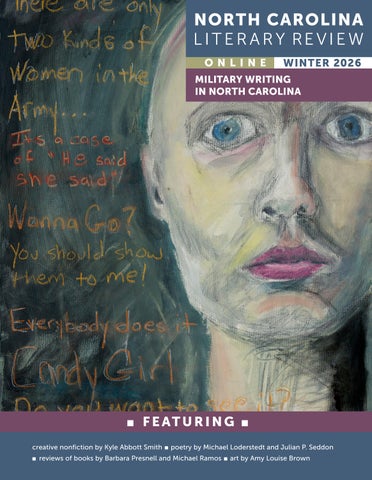
COVER ART
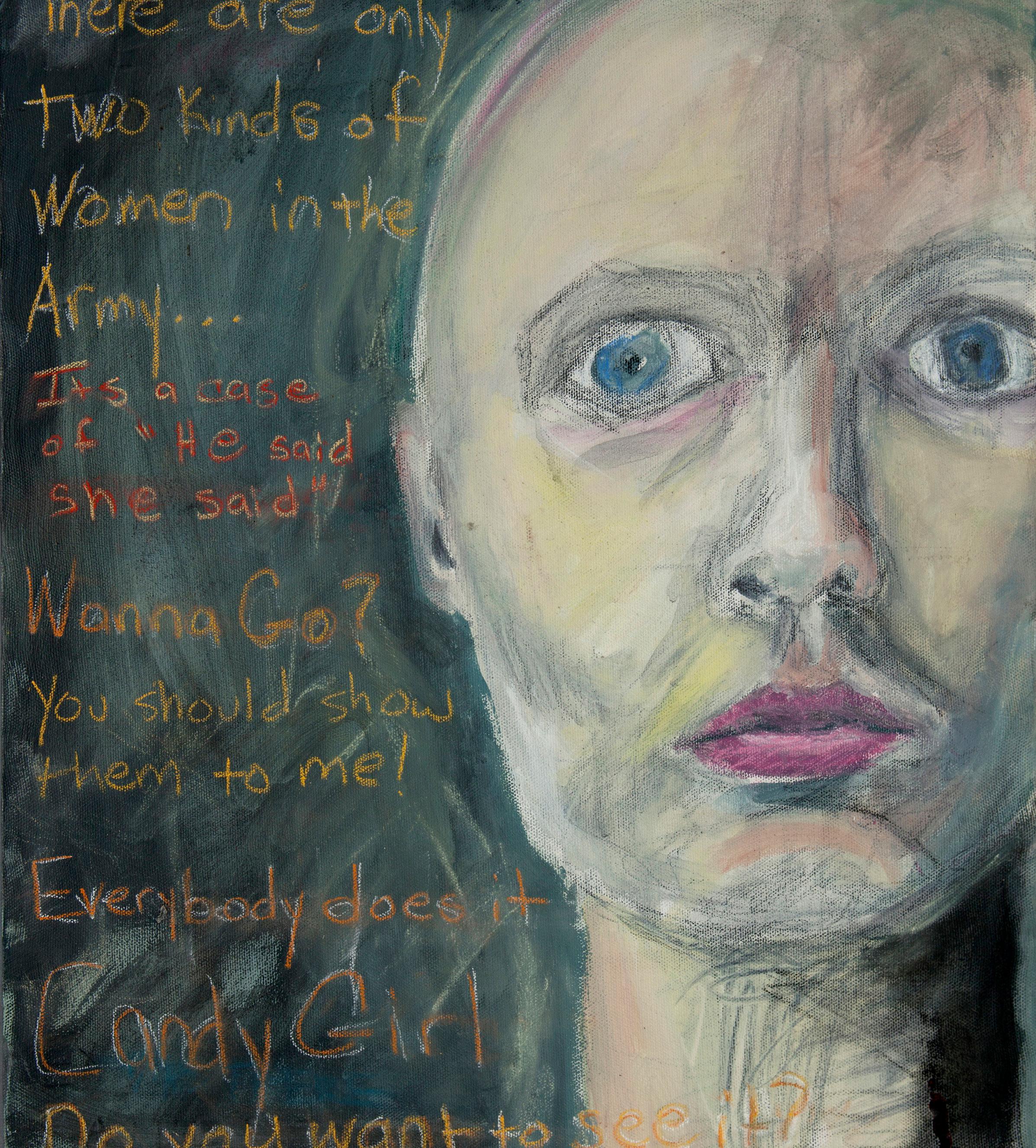
Candy Girl (pastel on canvas, 20x16) by
Amy Louise Brown; courtesy of the U.S. Army Art Collection
AMY LOUISE BROWN retired from twenty years of Army service as a sergeant major. For three years, she served as the Army’s artist-in-residence, creating art from the challenges of soldiers in the field. Her works include paintings of the military in Afghanistan and the US, including its relief efforts after Hurricane Sandy. SFC Brown’s last position was at the Army Public Affairs Center at Fort Meade. Before joining the military, Brown taught art at East Wake High School in Raleigh, having earned a degree in studio art from Meredith College. More of Brown’s work can be seen at Fine art Reproduction from the U.S. Army Art Collection.
COVER DESIGNER
NCLR Art Director DANA EZZELL designed the cover. She earned an MFA in Graphic Design from the Rhode Island School of Design in Providence and is a Professor at Meredith College in Raleigh. Her design work has been recognized by the CASE Awards and in such publications as Print Magazine’s Regional Design Annual, the Applied Arts Awards Annual, American Corporate Identity, and the Big Book of Logos 4. She has been designing for NCLR since the fifth issue, and in 2009 created the current style and design. In 2010, the “new look” earned NCLR a second award for Best Journal Design from the Council of Editors of Learned Journals. In addition to the cover of this issue, she designed the Albright Prize essays inside.
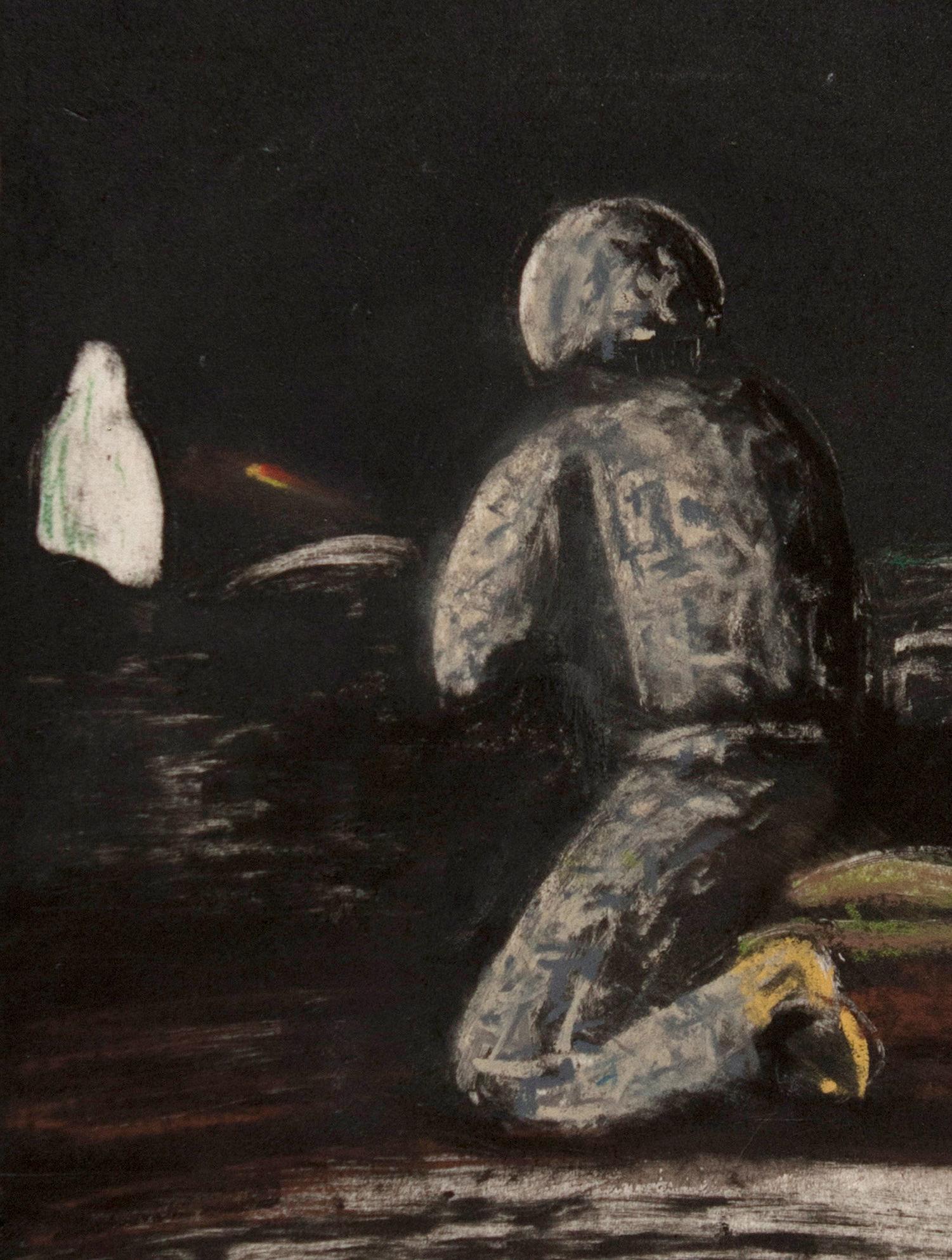
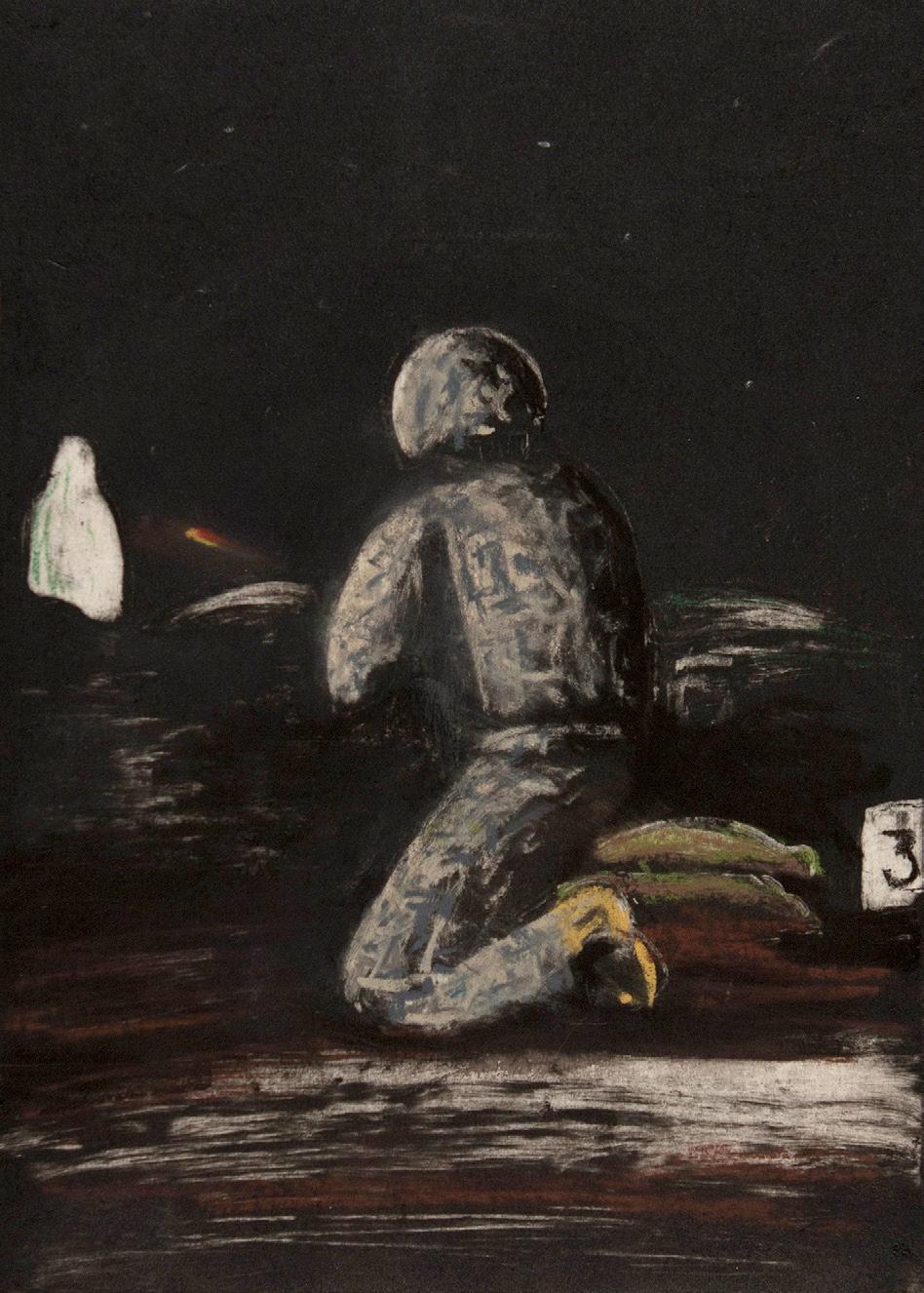
Night Fire Range (ink on paper, 7.5x9.5) by Amy
courtesy of the U.S. Army Art Collection
Produced annually by East Carolina University and by the North Carolina Literary and Historical Association © COPYRIGHT 2026 NC LR
Louise Brown;
NORTH CAROLINA LITERARY REVIEW ONLINE
MILITARY WRITING IN NORTH CAROLINA
IN THIS ISSUE
6 n Military Writing in North Carolina includes poetry, creative nonfiction, and book reviews
Anna Froula
Michael Loderstedt
Barbara Presnell
Michael Ramos
Julian P. Seddon
Kyle Abbott Smith
Elaine Thomas
18 n Flashbacks: Echoes of Past Issues includes poetry, creative nonfiction, book reviews, and literary news
J.S. Absher
Carol Baldwin
Mildred Kiconco Barya
Joseph Bathanti
Lisa Wenger Bro
Wayne Caldwell
Wiley Cash
Jim Clark
Jessica Cory
Katherine Scott Crawford
Sayantani Dasgupta
Jeff Davis
David C. Dickson
Nathan Dixon
Rebecca Duncan
Rebecca Godwin
Patrice Gopo
Blake Hobby
Dorianne Laux
Jennifer McGaha
Kevin McIlvoy
Sheila Smith McKoy
Dale Neal
Sterling Neill
Alessandro Porco
Glenis Redmond
Lorraine Hale Robinson
Crystal Simone Smith
Dean Marshall Tuck
Eric Walker
Michele Walker
Carole Boston Weatherford
Susan Wilson Lee Zacharias
69 n North Carolina Miscellany includes poetry, creative nonfiction, and book reviews
Joan Barasovska
Barbara Bennett
Evelyn Berry
Mikayla Carmichael
Andrew K. Clark
Laura Dennis
Joan Gelfand
Britt Kaufmann
Karen Salyer McElmurray
Sheila Smith McKoy
David E. Poston
Forrest Rapier
n North Carolina Artists in this issue n
Jenn Adams
Amy Louise Brown
Jason Craighead
Amy Freeman
Ann Harwell
Michael Loderstedt
Dru Scott Warmath
Richard Wilson
Tony Robles
Lindsay Starck
Jacinta V. White
Zachariah Claypole White
Annie Woodford
North Carolina Literary Review is published annually in the summer by the University of North Carolina Press. The journal is sponsored by East Carolina University with additional funding from the North Carolina Literary and Historical Association. NCLR Online, published in the winter, spring, and fall, is an open access supplement to the print issue.
NCLR is a member of the Council of Editors of Learned Journals and the Council of Literary Magazines and Presses, and it is indexed in EBSCOhost, the Humanities International Complete, the MLA International Bibliography, Proquest, and the Society for the Study of Southern Literature Newsletter.
Address correspondence to Dr. Margaret D. Bauer, NCLR Editor ECU Mailstop 555 English Greenville, NC 27858-4353
252.328.1537 Telephone 252.328.4889 Fax BauerM@ecu.edu Email NCLRstaff@ecu.edu
https://NCLR.ecu.edu Website
NCLR has received 2025–2026 grant support from the North Caroliniana Society and from the North Carolina Arts Council, a division of the North Carolina Department of Natural and Cultural Resources.


Subscriptions to the print issues of NCLR are, for individuals, $20 (US) for one year or $34 (US) for two years, or, for institutions and foreign subscribers, $30 (US) for one year, $54 for two. Libraries and other institutions may purchase subscriptions through subscription agencies. Individuals or institutions may also receive NCLR through membership in the North Carolina Literary and Historical Association. More information on our website
Individual copies of the annual print issue are available from retail outlets and from UNC Press. Back issues of our print issues are also available for purchase, while supplies last. Find prices and tables of contents of the back issues on the NCLR website
Submissions
NCLR invites proposals for articles or essays about North Carolina literature, history, and culture. Much of each issue is thematically focused, but a portion of each issue is open for developing interesting proposals, particularly interviews and literary analyses (without academic jargon). NCLR also publishes high-quality poetry, fiction, drama, and creative nonfiction by North Carolina writers or set in North Carolina. We define a North Carolina writer as anyone who currently lives in North Carolina, has lived in North Carolina, or has used North Carolina as subject matter.
Consult our website for submission guidelines for the various sections of each issue. Submissions to each issue’s special feature section are due August 31 of the preceding year, though proposals may be considered through early fall.
2027 issues will feature Southern Gothic Literature by North Carolina Writers, guest edited by Barbara Bennett
2028 issues will feature Latino/a Writers of North Carolina, guest edited by Amy Wright
Please email your suggestions for other special feature topics to the editor.
Book reviews are usually assigned, though suggestions will be considered as long as the book is by a North Carolina writer, is set in North Carolina, or deals with North Carolina subjects. NCLR prefers review essays that consider the new work in the context of the writer’s canon, other North Carolina literature, or the genre at large. Publishers and writers are invited to submit North Carolina–related books for review consideration. See the index of books that have been reviewed in NCLR on our website NCLR does not review self-/subsidy-published or vanity press books.
2165-1809
EDITORIAL BOARD
Joseph Bathanti
English, Appalachian State University
Jim Clark
Emeritus, Barton College
Paul Crenshaw
Writer, Lawrence, KS
Kevin Dublin
Elder Writing Project, Litquake Foundation
William Eddins
English, East Carolina University
Gabrielle Brant Freeman
English, East Carolina University
Editor
Margaret D. Bauer
Art Director
Dana Ezzell
Guest Feature Editor
Anna Froula
Digital Editor
Devra Thomas
Book Review Editor
Kristi Southern
Art Editors
Donna Kain
Diane A. Rodman
Fiction Editor
Rebeccca Bernard
Poetry Editors
Jeff Franklin
Amber Flora Thomas
Founding Editor
Alex Albright
Original Art Director
Eva Roberts
Graphic Designer
Karen Baltimore
Senior Associate Editor
Christy Alexander Hallberg
Assistant Editors
Desiree Dighton
Anne Mallory
Randall Martoccia
Editorial Assistant
Trevor Mason
Senior Intern
Abby Trzepacz
Interns
Morgan Boyce
Matt Cole
Aija Everett
Samantha Higgins
Josefine Klaker
Vicki Maas
Axel Snyder
Regina Garcia
English & Humanities
Pitt County Community College
Brian Glover
English, East Carolina University
Rebecca Godwin
Emeritus, Barton College
Rebecca Hardin-Thrift
English, Wayne Community College
George Hovis
English, SUNY-Oneonto
Ken Parille
English, East Carolina University
Angela Raper
English, East Carolina University
Kirstin L. Squint
English, East Carolina University
Lyra Thomas
English, East Carolina University
Dean Tuck
English, Wayne Community College
Zackary Vernon
English, Appalachian State University
Robert M. West
English, Mississippi State University
Spotlighting Military Writing
by Anna Froula, Guest Feature Editor
As a nation we are ever quicker to go to war. To rattle our rhetorical sabers, bomb boats in the sea, remove leaders of sovereign nations, put warships in tense regions, assemble boots on the ground, discharge new weaponry, and flex our might from the “Department of War.”
As a nation we are ever reticent to think deeply about the impacts of those actions within those countries, on the personnel ordered to carry them out, and within the families of those mustered into action. We listen to pundits reporting on reasons for aggression but do not hear how to deal with its aftereffects. We sign petitions that may or may not be read by our elected representatives, grow weary of years of fighting, turn off the news, and avoid speaking about it at holiday dinners.
We civilians thank veterans for their service, which is often an endpoint of our overt support of those who fight in our names. We see well-worn but unproductive tropes of returning veterans in our entertainment media. We try to make sense of current and past conflicts – and our loved ones, once sent to fight for us, now returned with knowledge that is often difficult to convey.
I am honored to serve as the feature editor for NCLR’s 2026 issues on military writing, which, I hope, will open new avenues for conversation and understanding of the unique experiences of military service and the long absence it creates for families. What you will read in these issues are
perspectives both from those reflecting on deployments and those who bear the impacts of the more belligerent side of the United States’ foreign policy in invisible and visible ways – the children growing up with untold stories and parents with unresolved traumatic memories, the siblings feeling their way around the invisible changes within their older brothers and sisters, the partners of those whose physical return outpaces their psychological odyssey of homecoming.
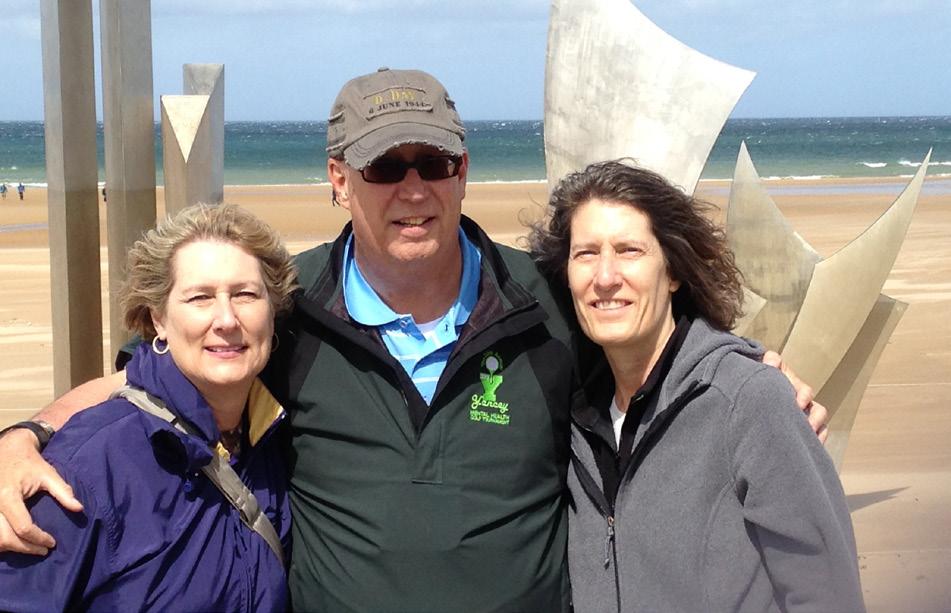
We begin this first issue’s feature section with Elaine Thomas’s “Unresolved Grief and World War II Memories,” a review of Otherwise, I’m Fine by Barbara Presnell. Thomas relates Presnell’s struggle to grapple with the loss of her World War II veteran father at fourteen years old in a home atmosphere that discouraged talking through grief. To recapture who her father was, Presnell retraces his steps in western Europe with her siblings. Then, Michael Loderstedt’s poem “Love During War Time” takes the reader through a sensory journey of a romance heightened by the potential of the military draft.
“When the Devil Walked on Water” by Kyle Abbott Smith follows with a creative nonfiction portrayal of an otherworldly experience of night patrol in Iraq. Perhaps the devil truly does follow us into war before we re-emerge into the light. I am also pleased to include a finalist of the 2025 Barrax/ Bayes Poetry Contest, Julian P. Seddon’s “resin,” a poem that brings home the taste of a combat zone.
My review of The After: A Veteran’s Notes on Coming Home by Michael Ramos rounds out the writing in this issue. Ramos provides a sense of a blueprint of conversations we could have that might address some of the issues I listed at the beginning of this introduction. “An American Odyssey” is also a preview for an interview I conducted with Ramos, as well as a panel discussion with three other veterans from the November 2025 North Carolina’s Writers’ Network Conference, which will appear in the 2026 print issue feature section.
The art of Army veteran Amy Louise Brown circulates through this section, affording us pauses to consider our own insights into some of the visual mysteries of warfare. Her “Candy Girl” provides the cover of this issue, highlighting how older expectations about gender still color the experiences of women in the military. This art provides a glimpse of what military-themed work is to come in the print issue, which will include the experiences of women in the military: essays by Leah Hampton, Jessica Cory, Kimberly Towers-Kubik, an interview with Tracy Crow, and a poem by Morrow Dowd. And that is just some of what is ahead, so be sure to subscribe to NCLR, if you haven’t yet, to receive this important issue that will carry on these needed discussions through the writing and artwork of military personnel and their family members. Meanwhile, enjoy the thought-provoking pages that follow. n
in North Carolina MILITARY WRITING
8 Unresolved Grief and World War II Memories a review by Elaine Thomas n Barbara Presnell, Otherwise, I’m Fine
10 Love During War Time a poem and photograph by Michael Loderstedt
12 When the Devil Walked on Water creative nonfiction by Kyle Abbott Smith art by Amy Louise Brown
15 resin a poem by Julian P. Seddon art by Amy Louise Brown
16 An American Odyssey a review by Anna Froula n Michael Ramos, The After: A Veteran’s Notes on Coming Home
UNRESOLVED GRIEF AND WORLD WAR II MEMORIES
a review by Elaine Thomas
Barbara Presnell. Otherwise, I’m Fine. University of South Carolina Press, 2025.
ELAINE THOMAS, the daughter of a World War II veteran, has worked as a hospital chaplain, a college communications director, and a journalist. She holds an MDiv from Duke University and a BA from St. Andrews Presbyterian College. She is retired and lives in Wilmington, NC.
BARBARA PRESNELL taught writing for forty years at UNC Charlotte and other colleges and universities. She studied writing and literature at UNC Greensboro and the University of Kentucky. She is the author of several poetry collections, including Piece Work (Cleveland State University Poetry Center, 2007; reviewed in NCLR 2008) and Blue Star (Press 53, 2016; reviewed in NCLR Online 2018 ). Her work is also featured in Listen Here: Women Writing (University of Kentucky Press, 2006).
Barbara Presnell’s father died in 1969, when she was only fourteen years old. In this moving memoir, Otherwise, I’m Fine, Presnell excavates layers of her own unresolved grief, carried across decades. The book’s opening lines explain in part her inability to grieve sufficiently at such a tender age: “My father didn’t have to die twice, but he did, first from a failed surgery and second from my mother’s words: ‘We won’t talk about him. It’ll be easier that way’” (1).
With an older brother and sister, Presnell is the youngest of three children. Just as “no two children have the same parents,” no two children lose the same parent. Each child occupies a specific spot in the family structure. Each child’s development differs. Each responds to parental loss in their own way. Presnell found herself unable to talk about her father not only with her mother, but also with her siblings.
A reader need look no further into the text than the prologue’s opening lines to understand the high stakes for Presnell, even as an adult. In a classic internal/external struggle of pain and demeanor, she learned to keep her sense of loss and confusion bottled up inside while carrying on a successful outer life and career. But following two miscarriages, severe sadness set in: “When loss piles on loss . . . its weight increasing like snow on a roof, eventually the rafters give way, and the house comes down” (1).
Presnell worked with a caring, gently probing therapist who helps her confront the “lie” she
carried nearly her entire life: “I was supposed to have forgotten about him years ago; instead I carried him around with me daily, unable to let him go. . . . I was holed up in a broken house of old grief, deep sorrow, a daughter’s inability to let go, and the walls around me were beginning to crumble” (3–4).
What Presnell does with this awareness will inspire anyone who’s dealing with, or has dealt with, unresolved grief. She breaks the old patterns. Instead of recriminations she digs into what her father’s death meant to her, work so intense that her empathy expands toward her late mother and her siblings, whose losses and responses differed from her own but had affected each of them in their own significant ways. In reclaiming a vital part of herself, Presnell grasps the enormity of loss they each had experienced. Her brother, a college student at the time, struggled with perceived expectations that he should become the man of the family. Her mother had lost a beloved mate: “Their twentytwo-year marriage had ended; their love for one another never would” (53).
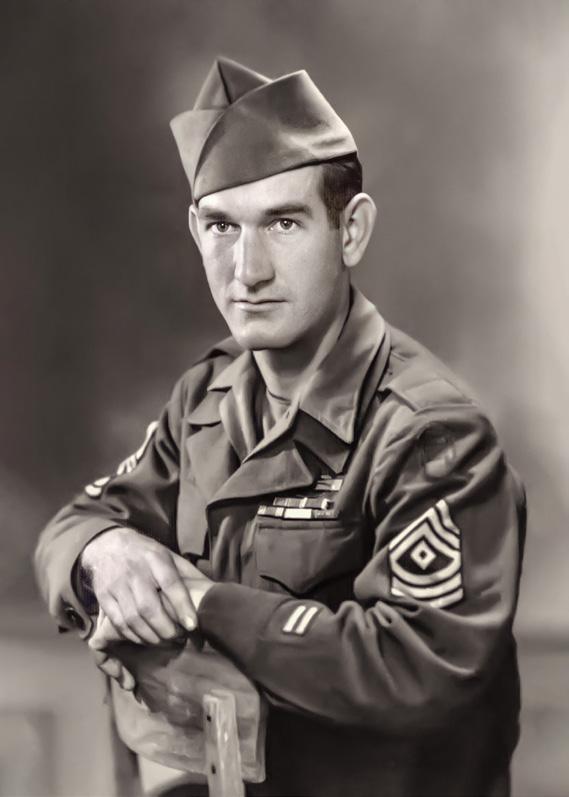
RIGHT BarbaraPresnell’sfather, BillPresnell
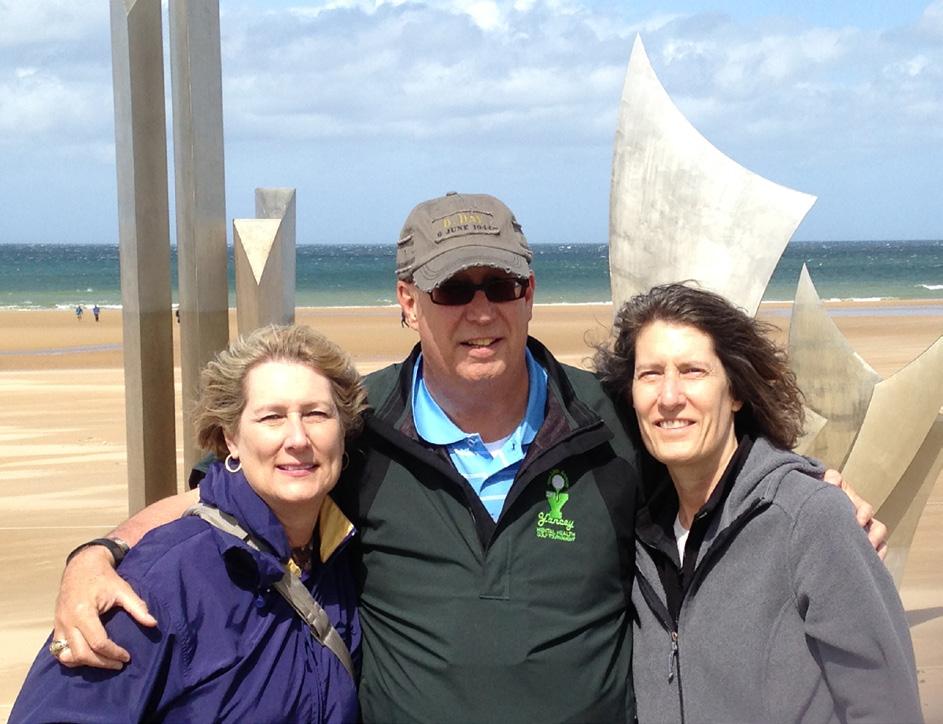
Going through memorabilia from her father’s World War II service, Presnell came up with a plan. She would visit western Europe and retrace his steps during the war. Gazing at a photograph of him as a young soldier, she says, “Your daughter, who never had a chance to tell you goodbye, is on her way to you” (39). Her brother and sister chose to join her on the trip. From Omaha Beach, through France and into the Netherlands, they traveled their father’s exact route. In rediscovering his living memory, they also rediscover their bonds as siblings.
unintentional, the author speaks not only as an individual who has literally lost a father but also for a generation that could not ever fully know what their fathers experienced as young men. To share their experiences in this manner is a way to know them on a more profound level.
lands. At one point, Presnell’s brother Edwin muses, “It’s like we are the heroes just by being children of a soldier” (34–35).
In reclaiming and celebrating the memory of her father, the author reclaims a vital part of herself. She and her siblings find bonds not only among the three of them, but with citizens in lands where their father fought in battles as a young man. Through the journey, she feels the enormity of his loss to others, including how her mother’s pragmatism – “We don’t need to dwell on this, we don’t need to fall apart. We are strong. We will move on” (52) – hid her own devastation.
Presnell is a poet; her pages are filled with sensory images of both her childhood memories and her European experiences and encounters. An emotional excavation, Otherwise, I’m Fine is also in and of itself a healing read, well worth your time. n
Any World War II buff, especially any child of a World War II veteran, should read this book. The “greatest generation” carried their own unique wounds. Some of those wounds could be seen physically, yes, but also there were many unseen wounds. In a manner perhaps
In telling her story, the author intersperses scenes from happy early days spent with the father she adored and the terrible times following his death, and the tales of the siblings’ journey across western Europe, retracing their father’s steps as a young soldier during World War II. It’s a structure that holds the reader’s interest and evokes satisfactory cause-and-effect realizations.
Locals along the path of their journey expressed gratitude for the role the siblings’ father had played in helping their home-
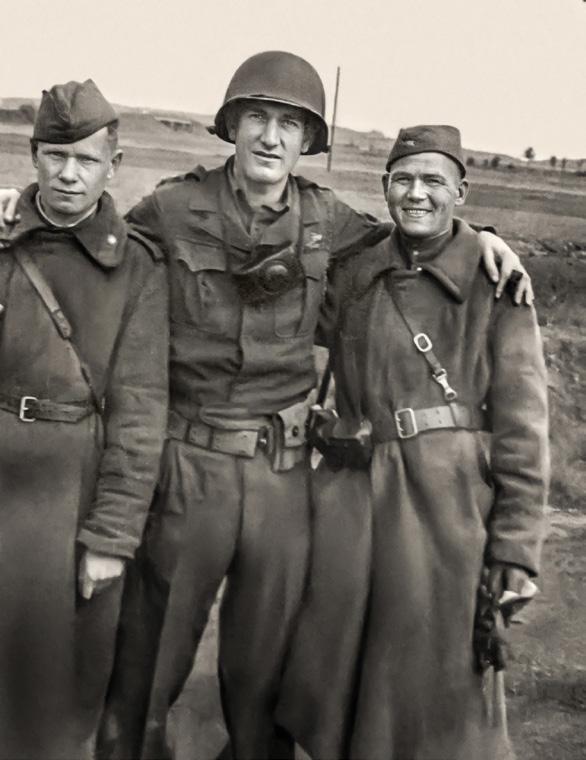
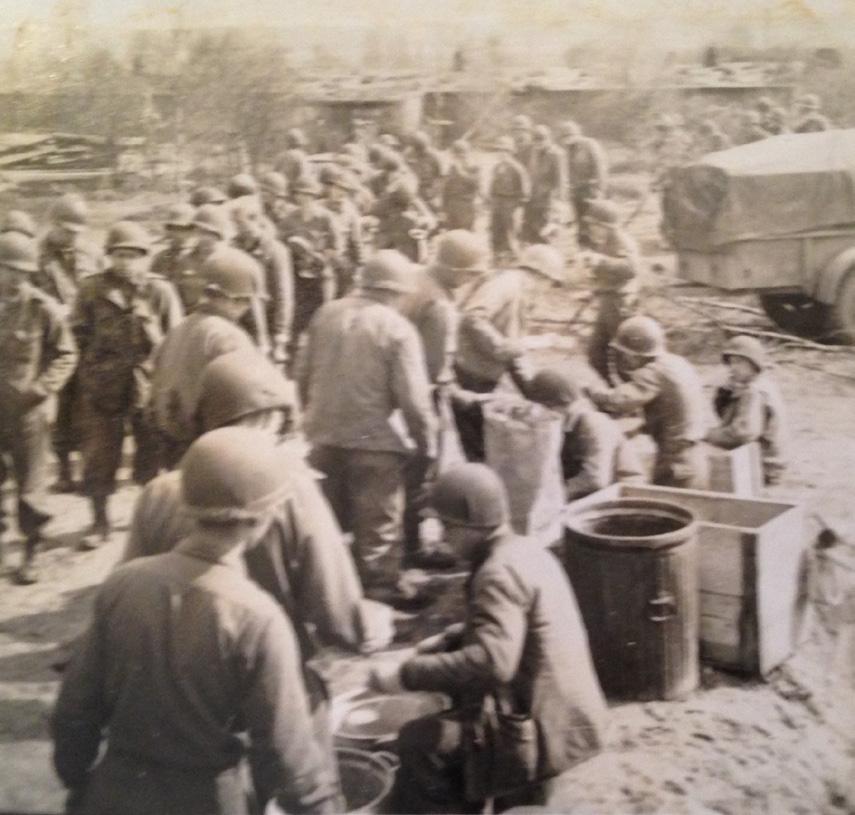
ABOVE BOTTOM The author’s father (center) with two Soviets on the Elbe River in Magdeburg, Germany, 25 Apr. 1945 (the celebratory day US and Soviet troops met at the river)
ABOVE TOP Taken by Sgt. William Presnell of the 120th Regiment, 30th Infantry Division during World War II
MIDDLE Barbara Presnell and her siblings, Edwin and Ellen, during their travels
2025 JAMES APPLEWHITE POETRY PRIZE SEMIFINALIST
BY MICHAEL LODERSTEDT
Love During Wartime
Wooden crates wash ashore, green cans marked POTTED MEAT-USMC, bits of pork floating in gelatin & round Saltines in tins, still crisp.
If anyone can stack up crackers, it’s the Marine Corps.
Under convenience store yellow lights swarming with black bugs jarheads trade us cheap wine for weed. In the backseat of the Corolla, you wait for the clink of bottles,
MICHAEL LODERSTEDT grew up on Bogue Banks in the mid-’60s through late ’70s and frequently returns to the area to research, write, and photograph for ongoing writing projects. He earned his BFA in Printmaking from East Carolina University where he studied poetry with Peter Makuck. He also earned an MFA from Kent State University where he was the Interim Director of the School of Art and is Professor Emeritus. His visual art is in the collections of the Cleveland Museum of Art, Progressive Insurance, and the Cleveland Clinic Foundation. His written work is published by Muleskinner Journal, Bangalore Review, Musepaper and NCLR , which included his photography with his poetry. His poem “Why We Fished” won the 2021 James Applewhite Poetry Prize and is published in NCLR 2022.
think of a secluded beach bonfire to drink and hope your number isn’t drawn to get your head shaved too.
The inlet is ablaze again, parachute flares hot as two suns.
Your mouth tastes like Boone’s Farm apples, and saliva slides across nipples while tracer fire streams red dashes on black paper sky, helicopter gunship lights up the night we swam naked hiding white bodies beneath white foam, tumbling bodies broken seashells.
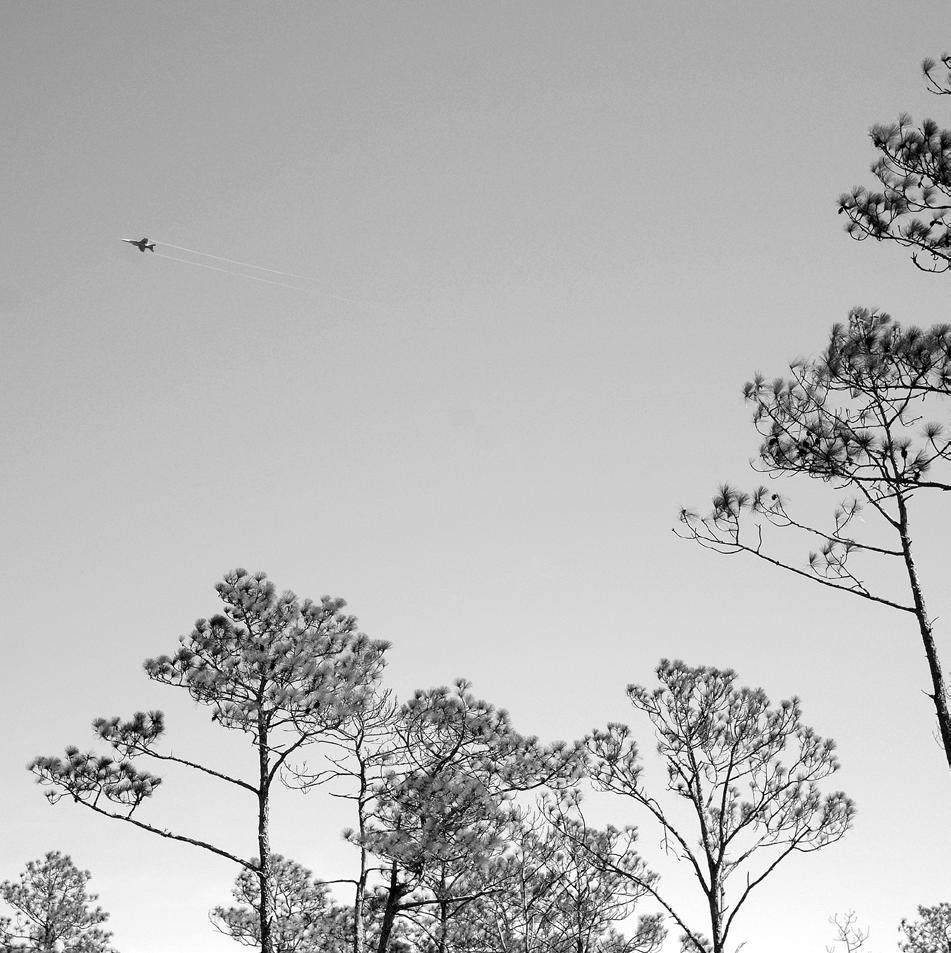
F35B over Croatan National Forest, Bogue, NC, 2021 (digital photograph) by Michael Loderstedt
When the Devil
BY KYLE ABBOTT SMITH

art by Amy Louise Brown
Walked on Water
I saw the devil standing atop a lake, in Iraq. It was during the calm of night, and I was walking to the Command Center for my shift on radio watch. From the bungalow I shared with three other Marines, it was a solid mile and a half walk within the interior at Camp Baharia. Though safely within the base, I was alone – a rarity as an infantryman in a hostile country. My steps led me along the winding road that followed the contours of a manmade lake.
I looked up and saw the devil sitting in an armchair that floated on the lake water. He was reading a novel and, sensing my approach – as if he had been waiting for me all along – closed the book and rose to stand.
There were stories. Marine talk. Scuttlebutt. It was said that the compound previously belonged to Uday Hussein, one of Saddam Hussein’s sons, and that he kept a harem of women living in the many one-room bungalows that my battalion had overtaken within the defensible walls that Uday had presumably ordered built. There were tales that in the lake bottom lay the remains of the women from his meticulously curated coterie who had displeased him. Uday would drown them and leave them to rot in the depths as he and his family continued their tyranny through theatrical demonstrations of violence.
The nights in Iraq were cool. I often wrapped my neck in a layer of issued PolyPro fabric to stay warm or wore a field jacket. It was always easy to see. The night desert brightened so far removed
KYLE ABBOTT SMITH served in the US Marine Corps infantry from 2001 to 2005. He completed two combat tours of duty, to include the initial invasion of Iraq and a second deployment to Fallujah. He was honorably discharged at the rank of Corporal. Smith went on to complete multiple degrees, including a PhD in engineering, after which he lived and worked in Fayetteville, NC, for a couple of years. After an initial first career in construction management and as a business consultant, he is now an academic. He splits his time living in both the US and Switzerland.
from the lights of men. Our eyes adjusted. The stars shone bright and clear, illuminating the road and buildings and walls about me as the wind excited the surface of the lake and created gentle lapping motions at the water’s edge. I had passed the mess hall tent and turned onto a switchback road bounded on one side by a small grove of trees and the other by water. There were no structures here. I was alone with my thoughts, even as I knew Marines were manning machine gun positions on the periphery, all about me, and were likely tracking my every move if only out of boredom alone.
I have always tended to look at my feet as I walk. Perhaps in the way of tall men used to stooping to better connect to those shorter, or perhaps to counter my occasional clumsiness. I was staring at my boots then, seeing my footfalls in sand that was more like a chalk-fine powder of dust than any kind of sand I had ever seen. My thoughts, untethered from my body and its place in the physical world, were elsewhere. I looked up and saw the devil sitting in an armchair that floated on the lake surface. He was reading a novel and, sensing my approach – as if he had been waiting for me all along – closed the book and rose to stand. There was an upright floor lamp, floating behind the chair, providing a gentle backlight for his reading, much the same scene as a comfortable reading nook from back home in the States.
AMY LOUISE BROWN retired in 2025 after over twenty years in the Army. For three years, she served as the Army’s artist-inresidence, creating art from the challenges of soldiers in the field. Her works include paintings of the military in Afghanistan and the US, including its relief efforts after Hurricane Sandy. Brown’s last position was at the Army Public Affairs Center at Fort Meade as a Seargeant Major. Before joining the military, Brown taught art at East Wake High School in Raleigh, having earned a degree in studio art from Meredith College. More of Brown’s work can be seen at Fine art Reproduction from the US Army Art Collection
He stood slowly, himself a tall being, and paused for moment, watching me walk.
I am unsure how I came to understand this to be the devil. He bore no horns, no tail of any kind. He was mildly handsome, with what seemed to be the patient features of an educated man in middle age. I later came to wonder if he had assumed the form of my older self as a cunning maneuver to foster a sense of ease with his chosen shape. Intuition alone alerted me to the true nature of the visitation.
I continued walking, assuming the vision a trick of my imagination, but keenly aware of how alone I felt in that moment. How isolated. My heart, quiet before, swelled as if cancered by fear until it was pounding the whole of my chest.
I strode woodenly forward, mocking my panic as my fellow Marines would have boisterously done had they known the inner workings of my thoughts. I sought refuge in logic, noting to myself that I was armored in Kevlar and equipped with an M16A4 rifle cradled heavily in my arms. My imagination commonly got the best of me, not unlike the time I had stared for too long into the depths of the Pacific Ocean from the edge of the USS Tarawa and imagined leviathan creatures of the sea emerging from the great depths in a spray and drawing the whole of my ship, incomprehensively, into its maw.
At times, I saw images in my mind that I was later unable to differentiate between reverie or reality. Not long before, on the same nightly walk, I had confronted similar questions of metaphysics as I gradually became aware that I was being trailed by wild dogs. Hearing their footfalls behind me, I refused to believe they had been allowed to run loose within the walls of the base. I became convinced of their reality only when they came so close to my heels that I whirred about
with my lock-blade unlatched and shouted them away. Such uncertainty has always been the basis for men’s fears. To see what is not there to be seen. To suffer the echoes of one’s unintended thoughts, unsure if they were waking dreams painted atop what instead might be touched and known. Thus skeptical, I walked on, but maintained constant eye contact with the devil standing before the reading chair, his book now resting with its pages halved to either side of the reading chair’s furthest arm.
The vision, certainly a falsification of my imagination, took a few steps forward and waited. He said nothing, unless it was his presence alone that said all that needed saying. I guessed he was proposing that I join him there within the bowled recess of the lake’s center, inexplicably atop the water. For what? For talk of the universe? For an offer as it was told through time and story immemorial was his typical opening gambit? Perhaps
the ruse was a siren’s call, and once I stepped fantastically upon the water’s surface, he would summon Uday’s wronged prostitutes from the water below to pull me forever under to my death.
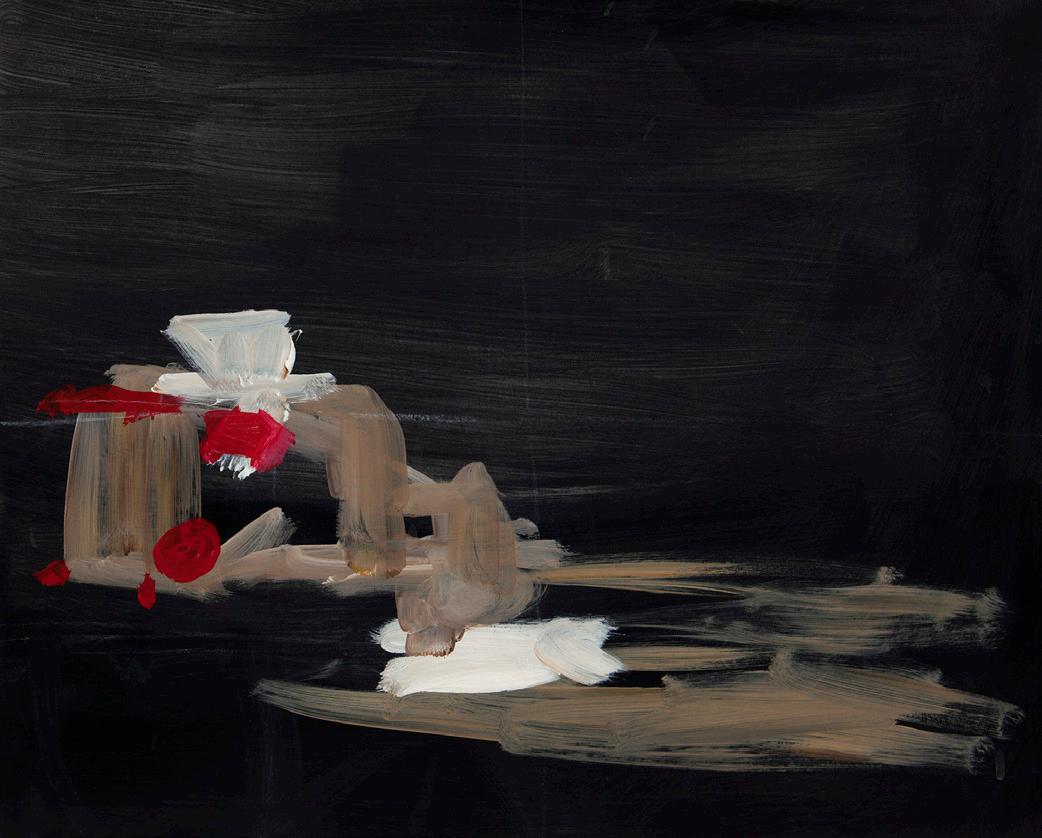
Composition Painting of “Night Ops” (acrylic on paper, 19x15)
by Amy Louise Brown; courtesy of the U.S. Army Art Collection

The idea of conversing with the devil terrified me and, whether a trick of my mind or the manifestation of an other-worldly creature, I chose to run.
I veered to the left at an angle, shortcutting through the trees and an open field toward the Command Center while keeping the apparition in my sight. I was at a full run and fatigued almost instantly by the weight of my gear. Strapped to my body was the machine heft of ammunition, protective ceramic plates swathed in Kevlar, a canteen full of water, and light pack. I had clipped my helmet to my chest, and it swung wildly in protest to my frenzied movements.
A spotlight came from an unknown source in the sky, illuminating the being on the lake as if he stood on a theater stage. Adrenaline pushed me forward despite the lure of my burning curiosity to know what words had been written in his chosen book and what thoughts he might have spoken into being. I ran like a man with the breath of
I ran like a man with the breath of death upon his neck . . .
death upon his neck, certain that the devil would have been amused by my claimed pantheism. More certain still that to even engage such a being was to assure my own undoing.
I scrabbled through the night to my post accompanied only by the worried sounds of my carelessly applied gear. I slowed to a self-conscious walk, preparing to open the door and take my place among men of strength. I steadied my breathing, not wanting to appear out of sorts and betray my fears of the dark. I glanced around and saw nothing but the desert night lightly veiling the interior of our Forward Operating Base. The dust was still as it must have been for thousands of years. I exhaled slowly, considering if anyone would notice the sheen of sweat on my forehead. I removed my camouflaged boonie, recently modernized into a pixelated desert color scheme, and used it to wipe away the sweat. I opened the make-shift door.
Light spilled over me, and I walked in. n
2025 BARRAX/BAYES POETRY CONTEST FINALIST
BY JULIAN P. SEDDON
resin down in river a valley endlessly beyond civilization, across the Registan Desert small fires spark at dusk. we cooked onion rings & fried tomatoes, then, thinly sliced potatoes we fried in an acquired, battle-hardened pot. the scent was savored the oil crackled blood was spilt as we hungered in a mystic land, where poppy fields were worth more than human lives –a racket, that taxed our souls – forever.
JULIAN P. SEDDON is a US Marine veteran from Philadelphia, PA. In 2008, he was deployed to Afghanistan. After he was honorably discharged, he moved to Wilmington, NC, and he graduated from UNC Wilmington with a BFA in creative writing in 2021. His poetry has appeared in Atlantis and in volumes II and III of The Anthology of Poet Warriors (Dead Reckoning Collective, 2020, 2025). He lives in Western North Carolina as a full-time writer. He is working on a collection of war poetry, and he has been part of a veteran writing project with the 03XX Series podcast.
AMY LOUISE BROWN retired in 2025 after over twenty years in the Army. For three years, she served as the Army’s artist-in-residence, creating art from the challenges of soldiers in the field. Her works include paintings of the military in Afghanistan and the US, including its relief efforts after Hurricane Sandy. Brown’s last position was at the Army Public Affairs Center at Fort Meade as a Seargeant Major. Before joining the military, Brown taught art at East Wake High School in Raleigh, having earned a degree in studio art from Meredith College. More of Brown’s work can be seen at Fine art Reproduction from the US Army Art Collection
Night Fire Range (ink on paper, 7.5x9.5) by Amy Louise Brown; courtesy of the U.S. Army Art Collection
AN AMERICAN ODYSSEY
a
review
by Anna Froula
Michael Ramos. The After: A Veteran’s Notes on Coming Home. University of North Carolina Press, 2024.
ANNA FROULA is guest feature editor of the 2026 issues of NCLR and Professor of English at ECU. She has published widely on gender and representations of US warfare and is co-editor of Reframing 9/11: Film, Popular Culture and the “War on Terror” (Bloomsbury, 2010) and American Militarism on the Small Screen (Routledge, 2016). She is the founder and co-director of ECU’s summer bridge program for new veteran students, the Veteran to Scholar Boot Camp. Read her and some of these veterans’ interview with Ben Fountain in NCLR 2022.
MICHAEL RAMOS is an Assistant Professor in Creative Nonfiction at UNCW. He is an Iraq war veteran and focuses his work on dispelling myths about war and veterans while actively working to bridge military and civilian communities.
In the film side of American war studies, William Wyler’s multiple Academy Award-winning, World War II-era The Best Years of Our Lives (1946) remains the quintessential homecoming text that other filmmakers have tried to emulate with the nation’s subsequent wars, always falling short. In its refreshingly honest portrayal of the myriad obstacles World War II veterans faced during their demobilization, their visible and invisible wounds, the film reminds the viewer what Homer taught in The Odyssey millennia earlier It remains true that military training makes citizens into warfighters and other critically important parts of the national war machine. On the other side of deployment, however, the return is an odyssey in and of itself. The participants in my Veteran to Scholar Boot Camp at ECU agree that the film holds up: transition journeys last far longer than the myriad photo ops and YouTube videos of returning veterans hugging loved ones at the end of deployment.
Enter Michael Ramos’s The After: A Veteran’s Notes on Coming Home, a collection of personal essays reflecting on his training, deployments, and his own version of the American Odyssey. “I have long suspect-
ed,” he writes, “it’s the leaving [the military] that hurts the most, makes the moving forward the hardest for war-fighters” (114).
Ramos knows he’s part of a long tradition of memoirists and writers who attempt to capture in words the unrepresentable side of combat and warfare. He explicitly enters existing conversations with other veterans in his chapter “What It’s Like to Come Home.” “Billy Pilgrim became unstuck in time,” he reminds us. “Norman Bowker drove around a lake in circles. Nick Adams went fishing. They did these things, not because they went to war, but because they came home” (47). In this explicit conversation with the writings of Vonnegut, O’Brien, and Hemingway, Ramos translates the legacy of the return for a twenty-first century audience, ever reminding the reader that coming home is “a bait and switch” (47).
In his introduction, “Comm Check,” Ramos, who enlisted in the US Navy two weeks before the terrorist attacks on September 11, 2001, makes an overture to civilians like me to help us approach his book. He even thanks us for being curious enough to read it. He’s not angry at us, but casual readers of war memoirs will realize through a
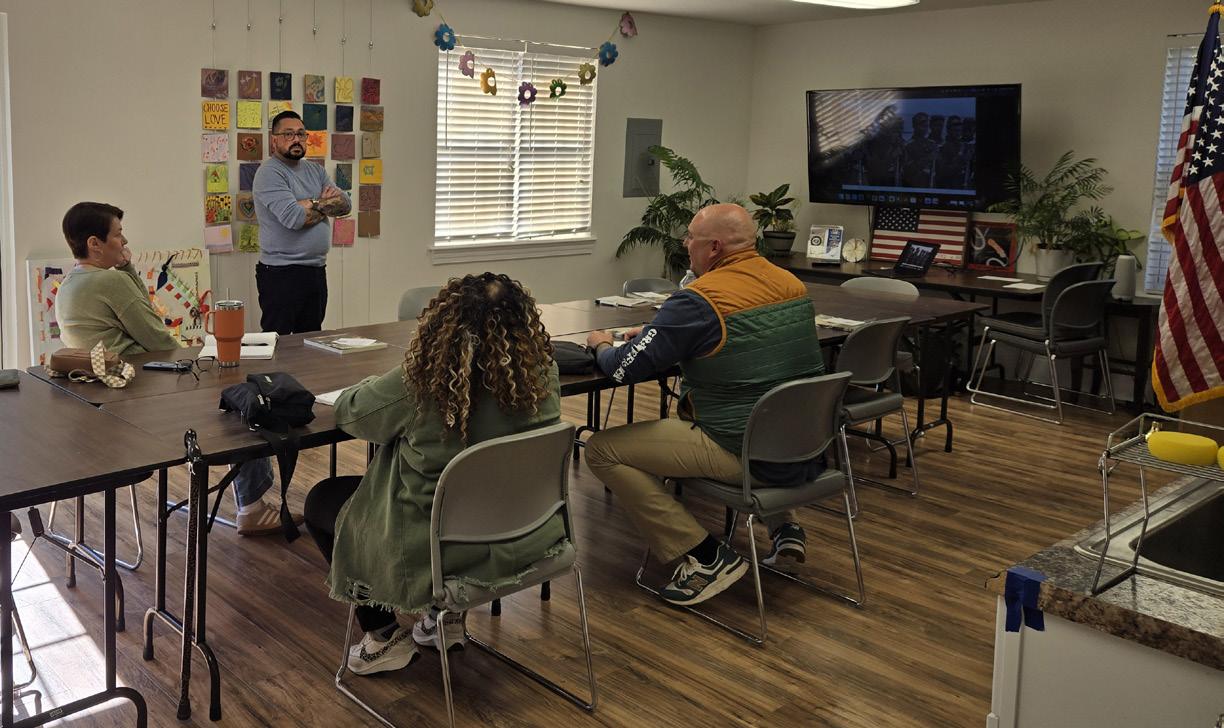
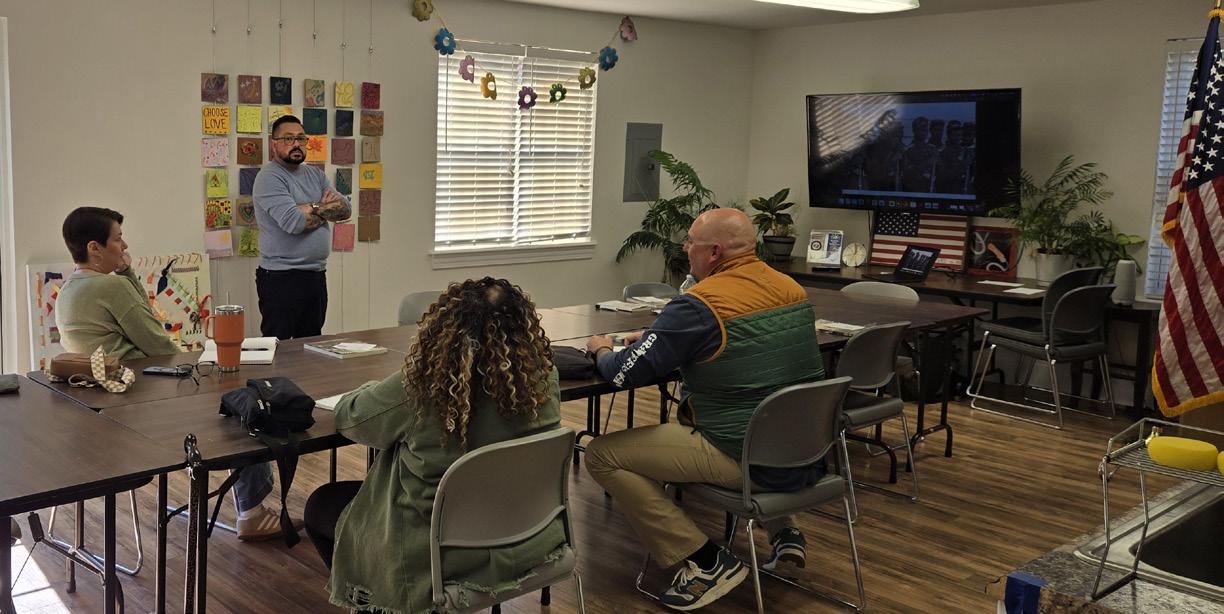
RIGHT Michael Ramos workshopping with military writers at the Joel Fund, Durham, NC, 1 Nov. 2025 (This workshop was funded by a North Carolina Arts Council Military and Veterans Healing Arts Grant.)
multitude of examples that the gap – and its concomitant lack of civilian attention to the lived realities of the long wars in the Middle East – is embarrassing at best and potentially dangerous at worse. The expected inobservant litany of civilian commentary is explicit: “what was it like to kill someone or I wish I had free college . . . or you just have to move past all that PTSD stuff or I always thought people joined the military because they had no future” (127). We should pay heed and think of ways to update the “thank you for your service” conversation with veterans we encounter. But it doesn’t take awkward civilian contact to make the transition difficult. Ramos remarks on “the lethargy of this new civilian existence” (101). Merely being at home without the adrenaline surge, mission, and willingness to lay down one’s life for the warfighter next to them is enough of a challenge. Here, he echoes Shakespeare’s Coriolanus: “Peace is a very apoplexy, lethargy; mulled, deaf, sleepy, insensible; a getter of more bastard children than war’s a destroyer of men.” Militaries make fighters out of civilians; they are less successful at reversing the process. Scholars of American war literature will hear echoes of the voices of the World War I trench poets alternate with the eviscerating memoirists and storytellers who served in Vietnam. Ramos captures the universal conditions of warfare – boredom, rage, elation, camaraderie, as well as the shame of surviving and not redeploying – as
refracted through such works as John Dos Passos’s Three Soldiers (1921), Michael Herr’s Dispatches (1977), and Tim O’Brien’s The Things They Carried (1990) For the more contemporary wars in Afghanistan and Iraq, The After should stand on bookshelves next to such works as Helen Benedict’s Sand Queen (2011), Kevin Powell’s Yellow Birds (2012), Hugh Martin’s Stick Soldiers (2013), and Phil Klay’s Redeployment (2014)
In a nation such as the United States, where only one percent of the population serves in the military, the gap between civilians and military personnel persists in uncomfortable and alienating ways, many that serve to prolong the homecoming odyssey. The After emerges in this gap, not as a balm or panacea but a bridge – if civilians are willing to cross it. Its gripping prose is intense; I did have to put the book down several times to absorb the stories, but every time I couldn’t wait to pick it back up. The impact of war on military families, bodies, perceptions and souls, he paints in small, viscerally sharp, blink-and-you’ll-miss-it scenes: a punctured lung here, an almost-kill there. The After is a multi-sensed memoir, recording the sights, smells, sounds, tastes of a body at the prime of its life and bearing the weight of it all in the after.
Ultimately, Ramos opens his life to the reader, speaking bluntly and compellingly about his combat experience, divorce, new relationship, writing workshops, and other happenings
on his path to becoming a professor of creative writing in Wilmington, NC. There is no glossary of military terms, but the curious reader will persevere, reinforcing the fact that just reading about warfare and deployments doesn’t teach us what it was really like. Ramos gives us glimpses of “what it was like” if we’re willing to sit with them and see them.
In his 1984 essay, “Why Men Love War,” Vietnam veteran William Broyles, Jr., addresses the civilian, stating, “I was there. You were not. Only these facts matter.”* Ramos’s writing also references this crucial gap in knowledge, but he writes in a way that lets us in to see.
So, if you’re a civilian who wants to know more about our post-deployment veterans, about the universal experience of homecoming, read The After. If you’re not, take some time to consider why that is. n
* William Broyles, Jr., “Why Men Love War,” Esquire Nov. 1984: 61.
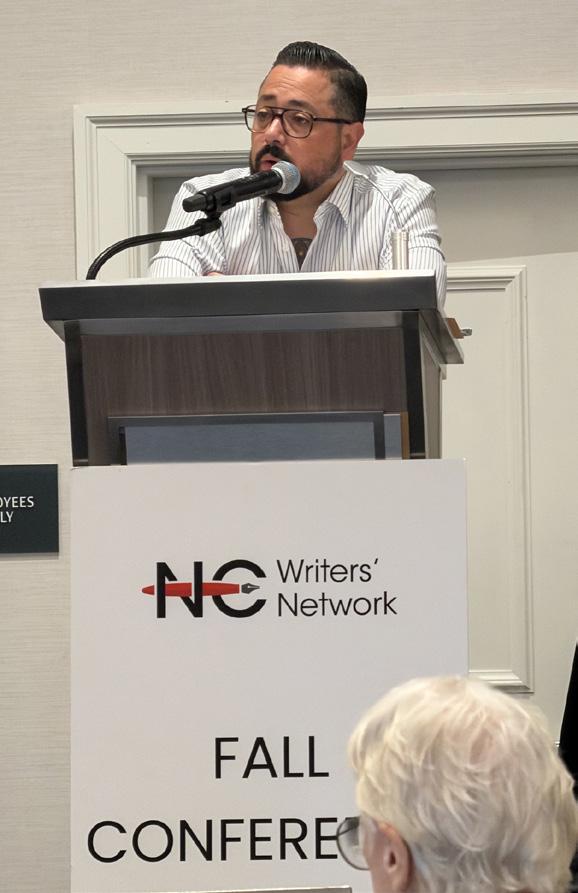
ABOVE Michael Ramos workshopping at the North Carolina Writers' Network Fall Conference, Wrightsville Beach, NC, 8 Nov. 2025
Award-Winning Writers and Books Abound in North Carolina
by Margaret D. Bauer, Editor
So many congratulations are in order: NCLR’s own Alex Albright Creative Nonfiction Prize winner Susan Wilson and honorees Makayla Carmichael and Mildred Kiconco Barya to start. Susan has been an Albright Prize honoree in the past, and we published another prize-winning essay by Mildred some years ago. Read both of their essays in this section. Find Makayla’s essay in the next section, as she is new to our pages. Also here, J.S. Absher’s poem, which received honorable mention in the 2025 James Applewhite Poetry Prize contest. This is the poet’s eighth time to have his poetry selected as a finalist and published in NCLR
It is not surprising that most of the North Carolina literary award winners are “flashbacks” to previous issues. Wiley Cash, the 2025 recipient of the North Carolina Award for Literature, was interviewed for the 2013 issue after his first novel was published to critical acclaim in 2012. In 2006, we published fiction by the premiere George Moses Horton award winner Carole Boston Weatherford. In 2019, we published poetry by Roanoke Chowan Award winner Crystal Simone Smith. The 2025 Raleigh Award winner, Katherine Scott Crawford, is new to NCLR, but her novel, The Miniaturist’s Assistant, echoes our 2017 theme, North Carolina Literature and the Other Arts. And of course, both of the recipients of the Young People’s Literature Award, given by the AAUW of North Carolina, Patrice Gopo for children’s literature and Carol Baldwin for young adult literature, remind us
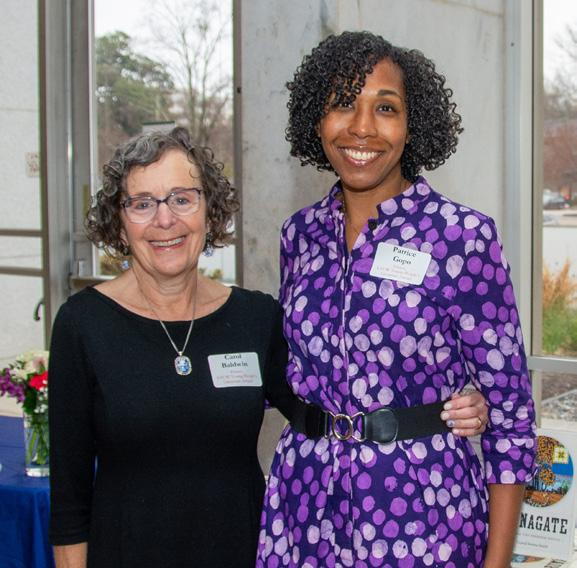
of what we discovered when we featured children’s and young adult literature in 2006: that the literary talent of North Carolina includes authors of books for readers of all ages.
This section also celebrates national award winner and ECU alumnus Dean Marshall Tuck, whose first novel won the James Alan McPherson Award, given by the Association of Writing Programs (AWP). Readers may recall that in 2007, in celebration of the centennial anniversary of our home institution, we celebrated 100 Years of Writers and Writing at East Carolina University. Dean was working on his master’s degree at ECU at that time, concentrating in creative writing. His professors were among the writers featured in that issue, and now we are reviewing his novel. Stay tuned for an interview with him forthcoming in either the print issue or our 2027 issue, featuring Gothic North Carolina literature. And by the way, the 2007 issue was popular, so if you do not yet have it in your collection, buy now. We are running short.
Other reviews in this section relate to our 1995 issue featuring Black Mountain College, the 2010 issue featuring Appalachian literature, and the 2022 theme, North Carolina Writers Who Teach and Teachers Who Write. And enjoy reviews of several books by writers whose fiction, poetry, and nonfiction have appeared in our pages over the years. Congratulations to all of these writers on their new books. n
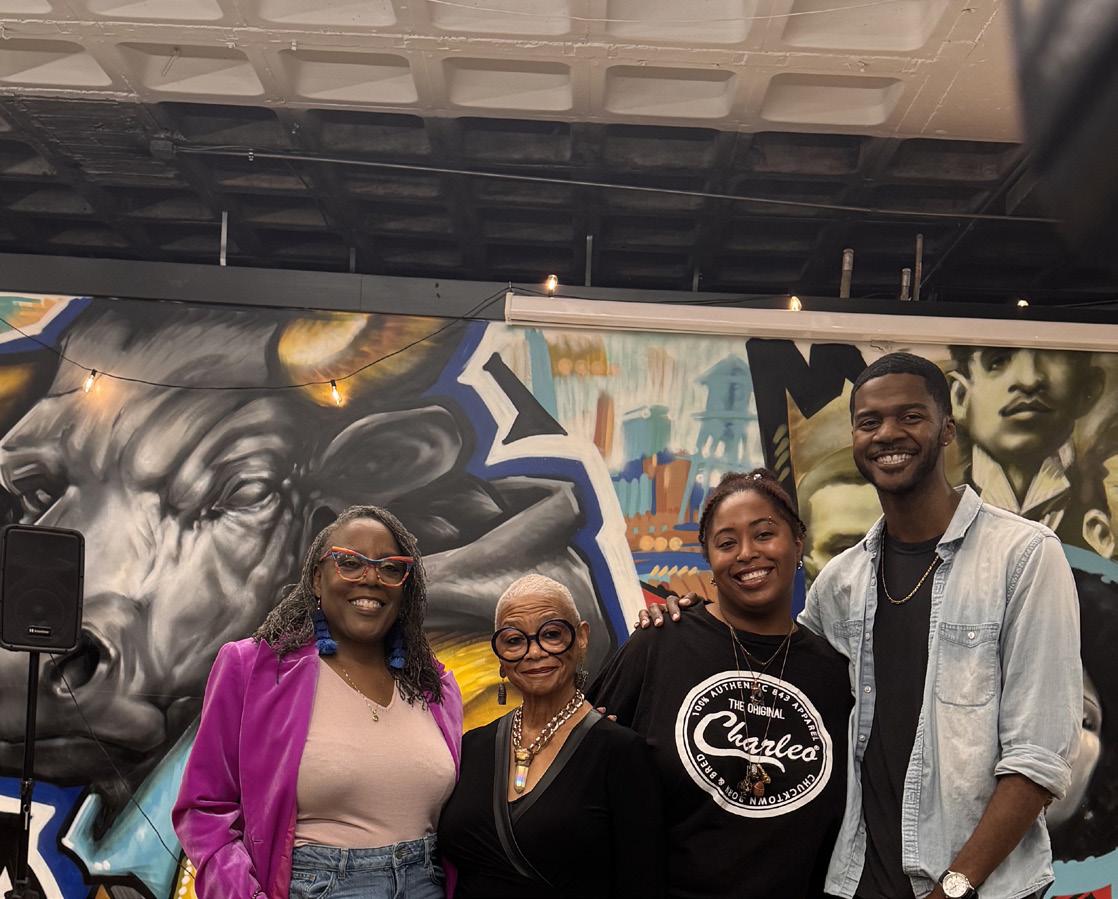
20 Wiley Cash Adds the North Carolina Award for Literature to His Long List of Honors by Michele Walker
22 Railroads, Relationships, and Reality a review by Jessica Cory
n Dean Marshall Tuck, Twinless Twin
24 Making History: Another First for Carole Boston Weatherford by Lorraine Hale Robinson
26 Interrogating Partiality: Questioning as a Path Toward the Whole Truth a review by Sterling Neill n Carol Baldwin, Half-Truths
28 Patrice Gopo: One of Two AAUP of North Carolina Young People’s Literature Award Recipients
30 Temporal Healings a review by Sheila Smith McKoy
n Glenis Redmond, The Listening Skin
n Crystal Simone Smith, Runagate: Songs of the Freedom Bound
34 Wounding and Healing an essay by Mildred Kiconco Barya art by Richard Wilson
41 Timelessness and Human Connection a review by Lisa Wenger Bro
n Katherine Scott Crawford, The Miniaturist’s Assistant
44 Foundation Issues Albright Creative Nonfiction Prize essay by Susan Wilson art by Dru Scott Warmath
47 Two Writer’s Diverged: New Destinations for Short Fiction a review by Rebecca Duncan
n David C. Dickson, Down to the Root
n Nathan Dixon, Radical Red
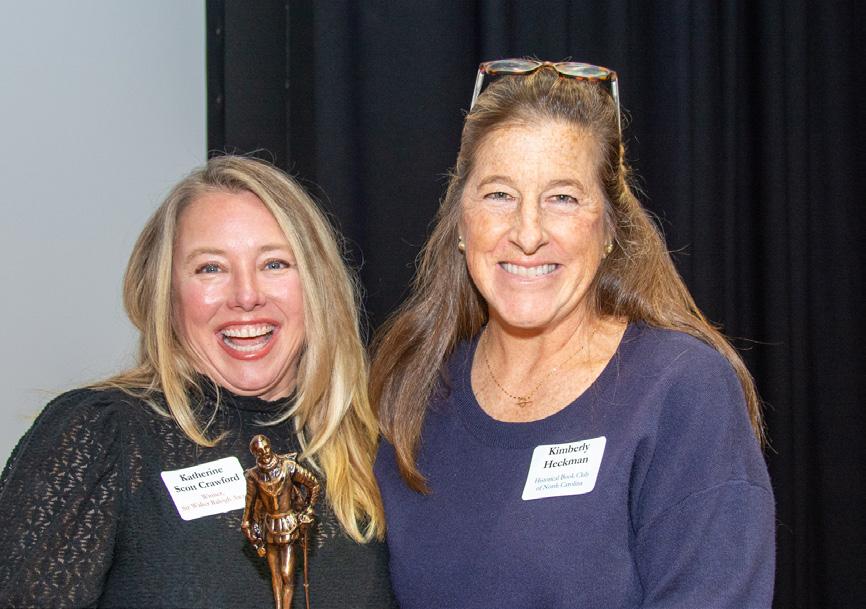
Echoes of Past Issues FLASHBACKS:
50 Mystic Neighborhood a poem by J.S. Absher art by Jenn Adams
52 Paying Closer Attention to the Word and the World: McIlovy’s Radical Reordering of Writerly Advice a review by Dale Neal n Kevin McIlvoy, Willingness: A Writer’s Meditations on Crossing the Flood
54 Remembering the Poetry of Black Mountain College a review by Jeff Davis n Blake Hobby, Alessandro Porco, and Joseph Bathanti, editors, The Anthology of Black Mountain College Poetry
56 Art as Practice a review by Sayantani Dasgupta n Dorianne Laux, Finger Exercises for Poets
58 Blessed Memory a review by Jim Clark n Lee Zacharias, Remember Me
60 Nature and Writing Memoir from Appalachia a review by Rebecca Godwin n Jennifer McGaha, Bushwhacking: How to Get Lost in the Woods and Write Your Way Out
62 Before Helene a review by Eric Walker n Wayne Caldwell, River Road and Shadow Family
WILEY CASH ADDS THE NORTH CAROLINA AWARD FOR LITERATURE TO HIS LONG LIST OF HONORS
by Michele Walker
For his contributions to Southern literature, Wiley Cash receives the 2025 North Carolina Award for Literature.
Cash’s debut novel, A Land More Kind Than Home (2012), is a Gothic thriller set in a small town in the North Carolina mountains. The novel won the Thomas Wolfe Book Prize, the Maine Reader’s Choice Award, the Southern Book Prize, the Crook’s Corner Book Prize, the Appalachian Writers Association’s Book of the Year, and the Crime Writers Association’s Debut of the Year in the UK. It was a finalist for the American Bookseller Association’s Debut of the Year and the PEN/Robert W. Bingham Prize.
His second novel, This Dark Road to Mercy (2014), was a national bestseller and received the Crime Writers Association’s Novel of the Year Award in the United Kingdom. Also set in western North Carolina, the novel follows two sisters whose father kidnaps them out of foster care after their mother dies. It was a finalist for both the Edgar Award for Best Novel and the Southern Book Prize.
In 2017, his novel The Last Ballad was an American Library Association Book of the Year and a Chicago Public Library Best Book of 2017. The novel is a fictionalized version of the 1929 Loray Mill strike in Cash’s hometown of Gastonia and is centered on the murder of activist and musician Ella May Wiggins. The novel received the Southern Book Prize, the Sir Walter Raleigh Award for Fiction, the Weatherford Award, and the Bloodroot Mountain Prize.
Published in 2021, Cash’s fourth novel, When Ghosts Come Home, a literary murder mystery set in the 1980s and focused on a mysterious plane crash in Oak Island, NC, was a national bestseller, an Indie Next Pick, and winner of the Southern Book Prize.
Cash has received the Pat Conroy Legacy Award from the Southern Independent Booksellers’ Alliance, the Mary Frances Hobson Prize from Chowan University, the Appalachian Heritage Writer’s Prize from Shepherd University, and the Patrick Henry History Fellowship from Washington College. He has taught
MICHELE WALKER is the Assistant Communications Director with the North Carolina Department of Natural and Cultural Resources.
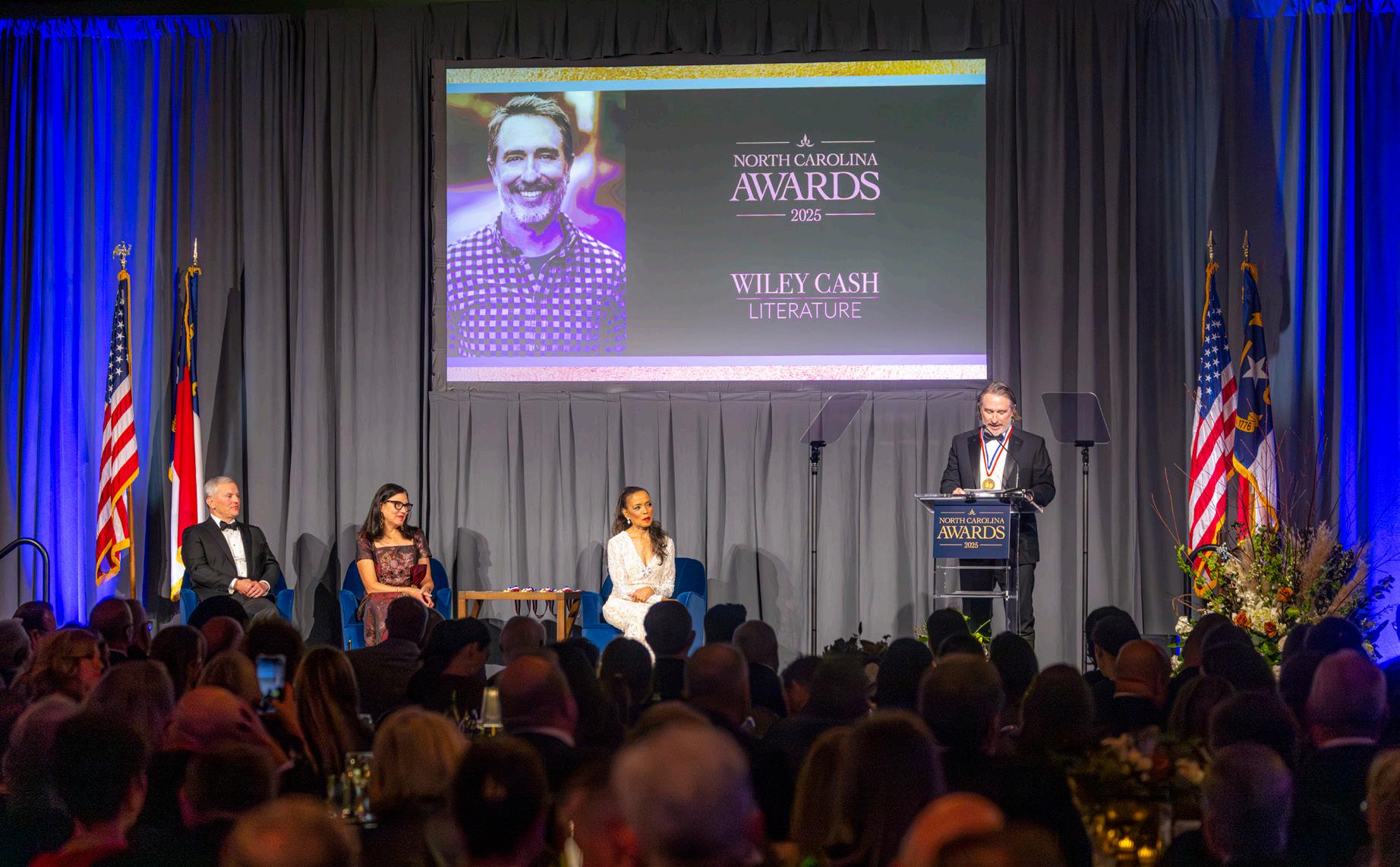
ABOVE Left to right, Governor Josh Stein, Secretary of the North Carolina Department of Natural and Cultural Resources Pamela Brewington Cashwell, the evening’s M.C. Frances Weller, and Wiley Cash at the North Carolina Awards ceremony at Grove Park Inn, Asheville, NC, 13 Nov. 2025
creative writing and literature at UNC Chapel Hill, Bethany College, UNC Asheville, and the University of Louisiana at Lafayette. He holds a PhD in American Literature from the University of Louisiana Lafayette, an MA in English from UNC Greensboro, and a BA in Literature from UNC Asheville.
Cash lives in North Carolina with his wife, photographer Mallory Cash, and their daughters, Early and Juniper. The Cash family plans to open an independent bookstore called Floodplain Books in Wilmington, NC, in the summer of 2026. n n n
acceptance remarks by Wiley Cash
I’m going to tell you a story about libraries, public education, independent bookstores, taxes, and love. I was raised in Gastonia, NC, by two parents who’d been raised in mill villages by parents who’d been raised on tenant farms. My parents encouraged us to read. In my family, when you turned six, you got your own library card, and our mom took us to Gastonia’s beloved main branch on Garrison Boulevard, which is funded by taxpayers.
Also on Garrison and also funded by taxpayers is Grier Junior High School. There, an English teacher named Carol Lowery was the first adult to make me feel like I was a writer. A few years later I enrolled at the University of North Carolina Asheville, which is funded by taxpayers. During my senior year I took a class on Appalachian History with Dr. Dan Pierce, who joins me here tonight. From him I learned about the Holiness Movement and snake handling, which would later inform my debut novel, A Land More Kind Than Home. When that book was published in 2012 the biggest event on my book tour that summer and fall was at Malaprop’s. Since then Malaprop’s has sold more of my books than any other bookstore in the country. Malaprop’s has paid taxes on each of those sales, and, friends, so have I.
You might purchase books from that obscure website named for a river in South America, but chances are you found out about those books because a librarian put them on the shelf or a bookseller featured them in a store. I stand here tonight as the product of public libraries, public education, and independent bookstores. I would not be here with you if not for these institutions.
None of us were able to rent out Venice for our star-studded weddings. None of us were able to launch Katie Perry into outer space. But we did support our communities and we did pay taxes.
But this story is also about love. Twenty years ago a girl and I were walking along Wrightsville Beach when we climbed into an empty lifeguard stand. I told her I was working on a novel set in the mountains of North Carolina. From that moment forward she believed in me more than I believed in myself. She still does. She is the most important person in my life, and she has been the most important person in my career. Mallory, if not for you, then nothing. Early and Juniper, every time I put words on the page I wonder about what you will think when you read them, and I hope you will love this state and its people as much as I do, and I hope you will understand the dignity of work and struggle and the importance of knowing where you come from.

Writing has taken me across the country and around the world, but in my heart I’ve never left North Carolina. To quote NBA champion and Hall of Famer James Worthy, who was also a product of public education and whose mother also took him to the library on Garrison Boulevard, the first time James was trash-talked by Larry Bird, he said, “Man, do you know where I’m from. I’m from Gastonia.” n
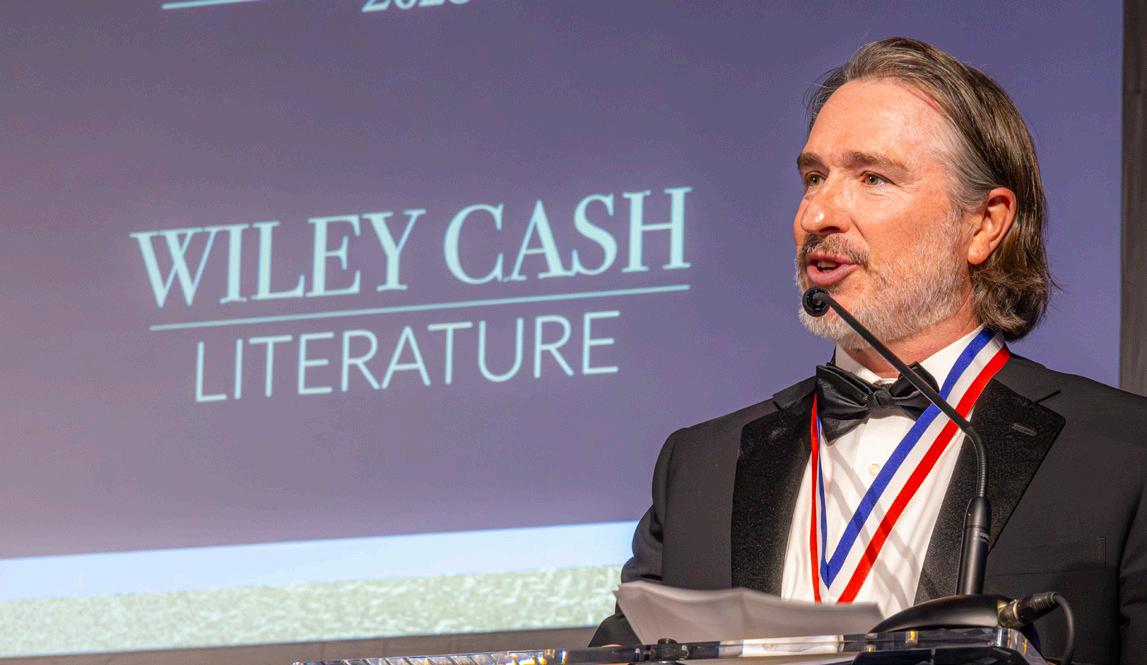
ABOVE Wiley Cash at the 2025 North Carolina Awards ceremony
RAILROADS, RELATIONSHIPS, AND REALITY
a review by Jessica Cory
Dean Marshall Tuck. Twinless
Twin: A Novel. University of Nebraska Press, 2025.
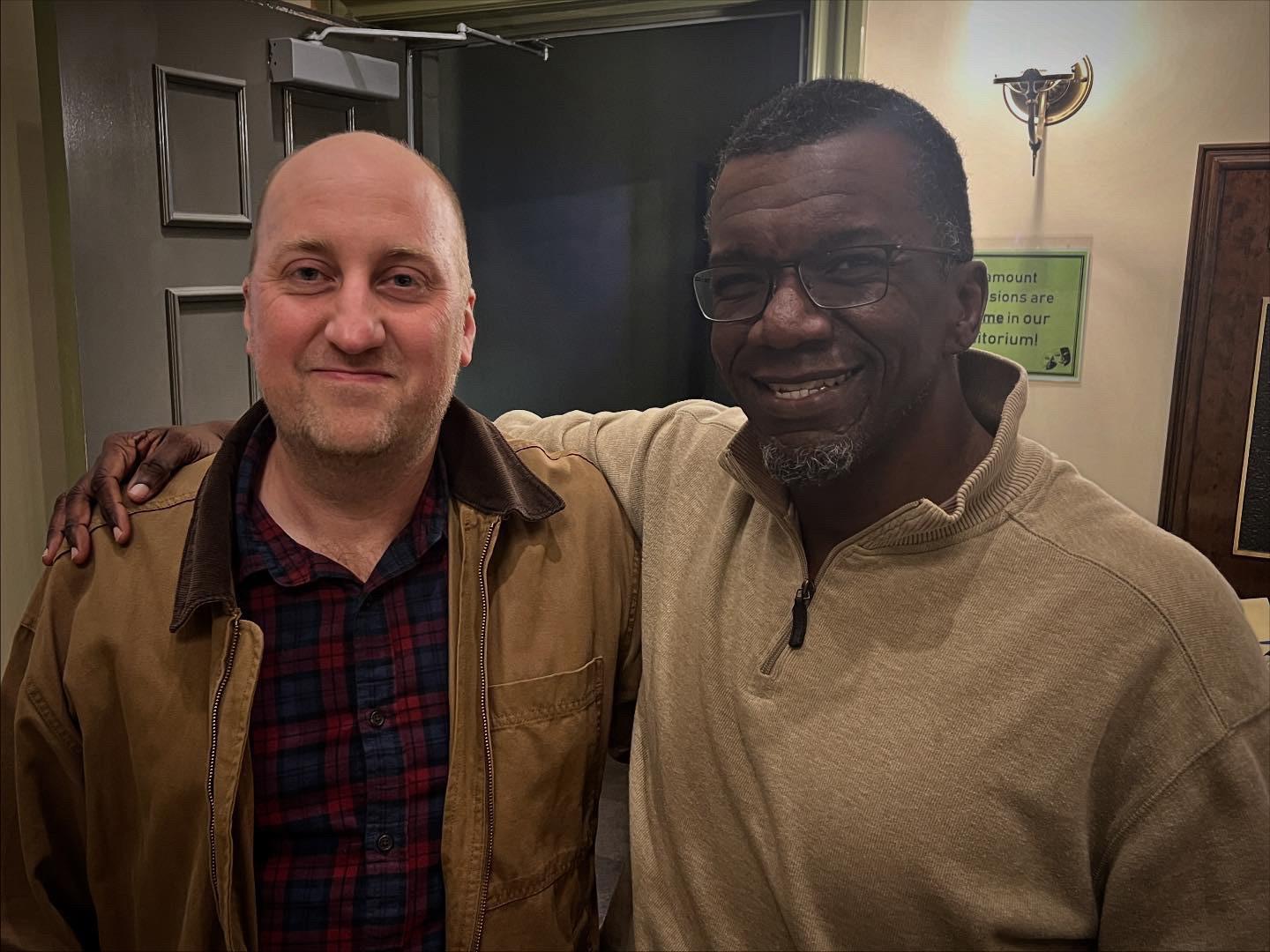
JESSICA CORY is a settler scholar and the editor of Appalachian Journal: A Regional Studies Review . She holds a PhD in Native American, African American, and environmental literatures from UNC Greensboro and is the editor of Mountains Piled upon Mountains: Appalachian Nature Writing in the Anthropocene (West Virginia University Press, 2019) and the co-editor (with Laura Wright) of Appalachian Ecocriticism and the Paradox of Place (University of Georgia Press, 2023). Her creative and scholarly writings have been published in NCLR , the North Dakota Quarterly , and Northern Appalachia Review, among other publications.
DEAN MARSHALL TUCK is a writer living in Eastern North Carolina with his wife and daughters. He teaches writing at Wayne Community College in Goldsboro, NC. Excerpts from this novel can be found in Epoch, South Carolina Review, Alaska Quarterly Review , and Beloit Fiction Journal. His poetry has appeared in Witness Magazine, Rattle, NCLR, and Litmosphere: Journal of Charlotte Lit. A graduate from ECU, with a BA and MA in English, Tuck serves on the editorial board for NCLR
Dean Marshall Tuck’s Twinless Twin won the 2024 James Alan McPherson Prize for the Novel, and judge Jason Mott described the book as “a dreamy tale that unravels with hypnotic precision. A story of love and secrets, all played out against a backdrop of meticulous, flowing writing . . . that relies heavily on the established traditions of rural storytelling – with its tropes of magic, danger, and folklore – while grappling with contemporary themes with no loss of momentum or impact.”* Mott’s assessment rings true, and there is much more to this haunting novel that remains with the reader long after it’s finished.
Twinless Twin follows a family as they move through the decades and choices that separate them from one another and bring them back together. Among the characters presented are Cindy; her unnamed older brother; his stillborn twin, Aaron; their mother, Martha; and their father, Ray, who aban-
* Quoted from the judge’s statement for the 2024 James Alan McPherson Prize for the Novel, Association of Writers and Writing Programs, web
dons the family. The chapters offer multiple, shifting narrators, and it’s not always clear who is narrating until midway through, which I found added an air of mystery and a sense of unknowing that meshed well with the aura of the book.
The academic in me wants to draw attention to how this novel engages uncertainty and liminal spaces – those locations, states of being, and perceptions that exist in the in-between, not in clearcut binaries. Much of the novel is set in spaces that are neither public nor private, such as the woods near one’s home or a party with coworkers. In fact, environment plays a significant role in Twinless Twin, which is primarily set in the foothills and mountains, but also travels to western deserts and other landscapes. These landscapes, however, are more than just settings, as Tuck’s attention to the details of these places provides them with an almost agential energy, as in the
ABOVE Dean Marshall Tuck (left) and Jason Mott at the Foundation of Wayne Community College’s Arts and Humanities Lecture series, Goldsboro, NC, 6 Oct. 2025
author’s description of an old tree in the family’s woods: “This ancient oak among the cedars had sprawling roots that spun a kind of wild, serpentine web in the ground, creating spiral stairsteps here and undulating like massive tentacles there” (34). The ability of this tree and its roots to “spin,” “create,” and “undulate” add to the story’s mysterious thematics and also brings to bear the relationships between the characters and the environments in which they find themselves.
Tuck then furthers this liminality through much of the plot, which moves between one’s inner life and how the choices we make or what we believe is countered by others’ judgements and understandings. The narrators’ ample considerations of time adds to this liminality with Tom, a long-time acquaintance of Cindy, observing of the woods and the outside world in the chapter “Debutante”:
Yeah. There’s always a barking dog or a loud truck or a honking car or a shouting drunk on my street, but here it feels like we’re stepping into the past – like before this land was settled. Imagine how peaceful it must’ve been. No one for miles. We’re like two deer moving unseen through the forest. Hell, why stop there? Through the river of time, we’re two trilobites tickling the ground, millennia before the first uttered sounds. (177)
Such attention to time and one’s place in its murky palimpsest is furthered by Tuck’s emphasis on dreams and dreaming, as both highlight how much of our lives is spent existing in between.
The theme of dreams shows up most poignantly in the novel’s final chapter, in which Cindy shares a dream with her brother and offers her interpretation of the dream. Her brother then gives a very different interpretation, reflective of their problematic family dynamic on display in the earlier parts of the novel. This return to family (dys)function at the end of the novel gives the reader a sense that the plot has come full circle, even though some ends remain seemingly unresolved.
More than once, a character seems to disappear into thin air, leaving one character to ask of another, “I need you to tell me that he was a real person who really exists because the more I think about this summer, every conversation we had, the more I think maybe you’re right that we knew nothing about him. Now I’m doubting if there even was a him, and maybe this whole thing has been some vivid, fevered dream” (165). Other entities seem to shapeshift or morph before the narrators’ very eyes:
In the span of thirty seconds, its skin turned a paler gray, its spine straight-
ened, its limbs shortened, as did its hair, so that by the time it turned to face me, it was closer to human –even its gait seemed more upright – than when I’d first seen it crest the tracks. To illustrate the creature would have taken several separate sketches, and it occurred to me then that perhaps I’d witnessed the thing mid-metamorphosis, wounded in its evolution, struggling to become. (120)
Twinless Twin, however, is not a story of scary monsters lurking in the woods, but rather how we perceive monsters, human and otherwise and, if we’re unafraid, what they might teach us. Thus, some of the interactions that lack conclusive resolutions seem best interpreted as the narrators’ reflections on events or responses to their actions, both of which we can understand as learning experiences for these characters (and perhaps ourselves).
In the spirit of this magical in-betweenness, Twinless Twin also seems to exist amid multiple genres – it has elements of environmental literature, horror, fantasy, sci-fi, bildungsroman, and other subgenres. Yet, the novel’s lack of clear categorization also means that it will likely appeal to a broad swath of readers who will certainly glean different takeaways from Tuck’s wonderful writing, especially if one returns to its pages again and again. n

MAKING HISTORY: ANOTHER FIRST FOR CAROLE BOSTON WEATHERFORD
award presentation remarks by Lorraine
Hale Robinson
There is always much to celebrate at the North Carolina Literary and Historical Association’s Annual Meeting and Awards ceremony. But 2025 marks the celebratory inauguration of a new “Lit and Hist” achievement award: the George Moses Horton Memorial Award for Significant Contributions to North Carolina Literature.
The poet Horton (1798–1883) is also the central character in the forthcoming North Carolina film industry’s The Bard , a historical drama that mines North Carolina talent, has created jobs, and inspired new storytellers. Lit and Hist’s own Marjorie Hudson was an early consultant on the script.
This new George Moses Horton award honors those who have made important literary contributions to the state and is presented to either individuals or organizations that exemplify the highest levels of literary achievement. The award promotes awareness of our state’s rich literary heritage and celebrates diverse voices and genres in the state’s literary community.
Horton’s own poetry invites, frees, and inspires writers and audiences:
Come Liberty, thou cheerful sound, Roll through my ravished ears! . . .
Soar on the pinions of that dove Which long has cooed for thee, And breathed her notes from Afric’s grove, The sound of Liberty.
Those “cheerful sounds of liberty” certainly resonate in the literary works of the George Moses Horton award’s first recipient: Carole Boston Weatherford. Born in Baltimore, MD, Weatherford holds degrees from American University, the University of Baltimore, and the University of North Carolina at Greensboro. Her works include children’s and adult nonfiction, historical fiction, poetry, and poetic novels. She received the 2022 Coretta Scott King Illustrator and
Author Award and North Carolina’s 2024 RoanokeChowan Award for Poetry and was a finalist for the prestigious Caldecott Medal. Weatherford’s substantial and lasting contributions to children’s literature are also recognized in this year’s Children’s Literature Legacy Award from the Association for Library Service to Children.
How does Weatherford accomplish all this? She “mine[s] the past for family stories, fading traditions, and forgotten struggles that center on African American resistance, resilience, remarkability, rejoicing, and remembrance.”
It is with sincere rejoicing that I announce Carole Michele Boston Weatherford as the inaugural recipient of Lit and Hist’s 2025 George Moses Horton Memorial Award for Significant Contributions to North Carolina Literature. n n n
LORRAINE HALE ROBINSON served as Senior Associate Editor of NCLR from 1998 to 2013, during which time she compiled the serialized Dictionary of North Carolina Writers and wrote numerous reviews, award stories, and sidebars. She continues to serve North Carolina’s literary (and historical) community via membership on the North Carolina Literary and Historical Association Executive Board.
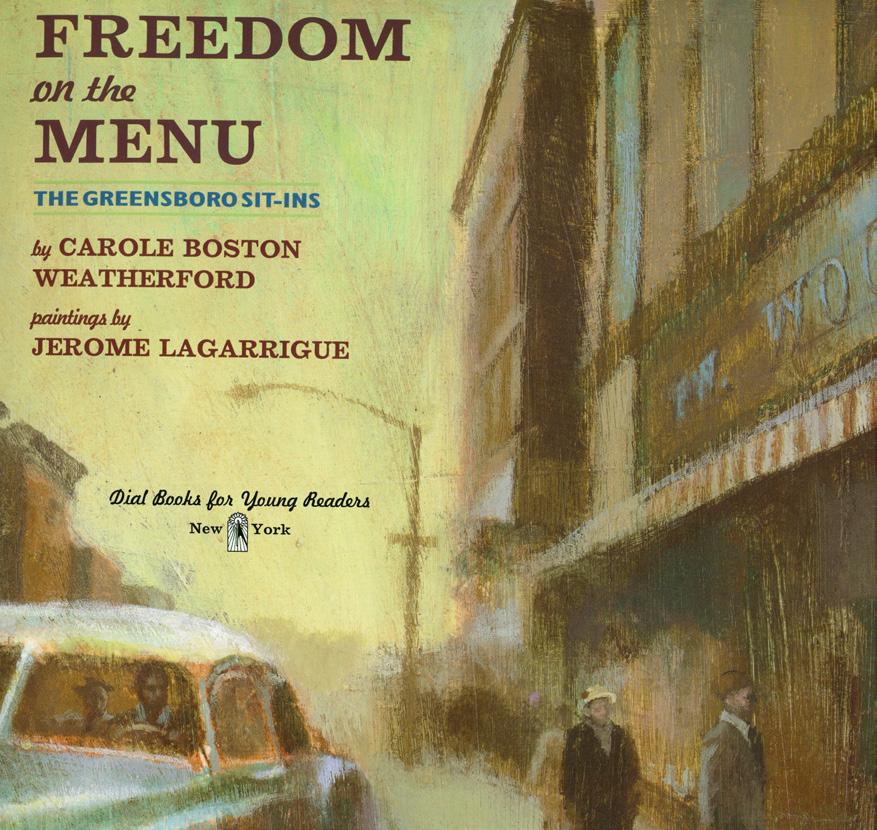
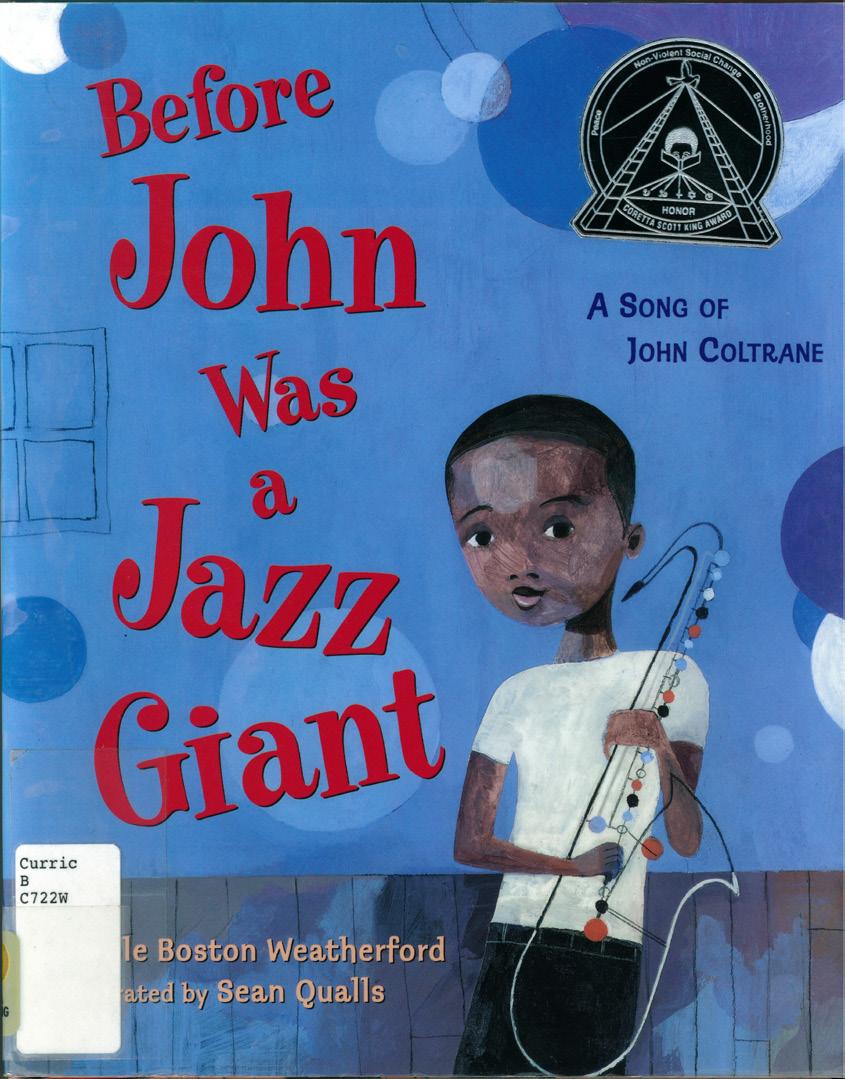
ABOVE Title page and AND OPPOSITE cover of two of Weatherford’s North Carolina-inspired picture books for children
acceptance remarks by Carole Boston Weatherford
When I was considering a move from Washington, DC, to North Carolina in 1984, God assured me that if I relocated I would get everything I wanted. Well, I didn’t always know what I wanted but I have gotten more than I ever dreamed. My greatest blessings are Caresse and Jeffery, the two masterpieces I gave birth to here.
I credit them and High Point Public Library story times with introducing me to a new crop of children’s literature – books more diverse than those of my childhood. Those “colorful” books shifted my focus from writing poetry for adults to writing children’s books. The decision proved to be destiny.
As an emerging poet, I found a creative community in the newly formed North Carolina Writers’ Network. I received two writer’s fellowships from the North Carolina Arts Council. And a Black History Month reading at Fayetteville State University led to a serendipitous job offer to serve as a writer-inresidence. I was on the FSU faculty for twenty-two years, retiring in 2024 as a full professor.
Like the cultural network, North Carolina’s slower pace was conducive to writing. Most importantly, ,the state’s rich history offered a wealth of subjects, from jazz saxophonist John Coltrane, folk artist Vollis Simpson, and the all-Black Pea Island lifesaving crew to Rosenwald schools.
history I spotlighted. Again, I was wrong. I now know that my books do double duty, enlightening not only the intended audience of children but also their teachers and parents who were never taught that history.
"the state’s rich history offered a wealth of subjects . . . jazz saxophonist John Coltrane, folk artist Vollis Simpson, and the all-Black Pea Island lifesaving crew to Rosenwald schools.”
My mission is to mine the past for family stories, fading traditions and forgotten struggles that center African American resistance, resilience, rejoicing, remarkability and remembrance. To quote an African proverb: “Until the lion tells his story, the hunter will always be the hero.” Despite the recent spate of book bans and challenges, I remain true to my mission because children are the most important audience.
When I wrote my bestselling book, Freedom on the Menu: The Greensboro Sit-ins (2005), I presumed that students in this state knew about the protests. I was wrong. Similarly, I used to assume that parents and teachers were aware of the Black
In the process of documenting history, I occasionally managed to make history. When my book Remember the Bridge (2002) won the North Carolina Juvenile Literature Award, I was the first African American winner in the award’s fifty-year history. When I received the North Carolina Award for Literature, I was the first children’s book author so honored. Likewise, Kin: Rooted in Hope (2023), a family history illustrated by my son Jeffery, was the first book for young people to win the Roanoke-Chowan Award for Poetry. And I’d be willing to wager that I am the first children’s book author to win a lifetime achievement award from the North Carolina Literary and Historical Association.
It is not lost on me that I am receiving this award just as it has been renamed for the enslaved poet George Moses Horton. Today, George is smiling down on me, right along with my parents Joseph and Carolyn Boston, who encouraged every creative endeavor that I pursued. n
INTERROGATING PARTIALITY: QUESTIONING AS A PATH TOWARD THE WHOLE TRUTH
a review by Sterling Neill
Carol Baldwin, Half-Truths. Monarch Educational Services, 2025.
STERLING S. NEILL is a budding Southern scholar who completed her BA from Mercer University, and her MA from Georgia State University where she continues to pursue a PhD in literary studies. With her educational background in literature and medicine paired with her position as a secretary for the Emerging Scholars Organization (ESO), an affiliate of the Society for the Study of Southern Literature (SSSL), Sterling has explored a multitude of Southern works, uniquely qualifying her asaSouthernliteratureresearcher.
CAROL BALDWIN grew up in Cherry Hill, NJ, and now lives in Charlotte, NC Her writing began in nonfiction with works like Friendship Counseling; Biblical Foundations for Helping Others (Zondervan, 1988) and Teaching the Story: Fiction Writing in Grades 4–8 (Maupin House Publishing, 2008). HalfTruths, her first novel, received the 2025 North Carolina AAUW Award for Young AdultLiterature.
Fueled by her love of reading and sharing stories, particularly those that help people cope or inform them of nuanced ways to navigate life, Carol Baldwin has released her debut novel, Half-Truths, historical fiction set in Tabor City and Charlotte, NC. A novel geared toward Young Adult audiences, Half-Truths is reminiscent of Harper Lee’s To Kill a Mockingbird. Baldwin’s novel follows fifteen-year-old Kate Dinsmore, a budding journalist who is confronted with her own privilege and prejudices when she moves in with her grandmother. With tenacity and curiosity, Kate seeks to uncover her family secrets and to distinguish the truth among lies and omissions. Her grandmother points out, “Another way to describe a ‘small lie’ is a halftruth,” but also that “half-truths are whole lies” (273). Half-Truths is ultimately a novel about how familial, social, and societal histories coalesce to create complicated and conflicting futures.
To expose how partial truths cultivate emotional ambiguity, Baldwin embeds a story within a story, allowing inquiry to drive the exposition of the narrative. The first story centers around Kate and her struggle to find herself in her family, social circles, and future career, while the second story focuses on uncovering and assessing the long-held family secret about her great-grandfather Edward and an enslaved woman, Zula Belle. The first narrative narrows in on Kate’s difficulty acclimating to family members she is less familiar with and a new social environment. Her acclimation is hindered by her inability to understand the situations of others. Kate initially has issues distinguishing between genuinely empathizing with those around her and using them for her personal pursuit of her journalism career. Kate wants to be more like her personal idol Mr. Horace Carter, who gave her the advice, “If you aspire to become a journalist, sometimes you must enter worlds that feel uncomfortable” (125). But she struggles with balancing her empathy for those she wishes to help with her desire to find and report an important story: “I want to write about important things people should think about. I want to have a
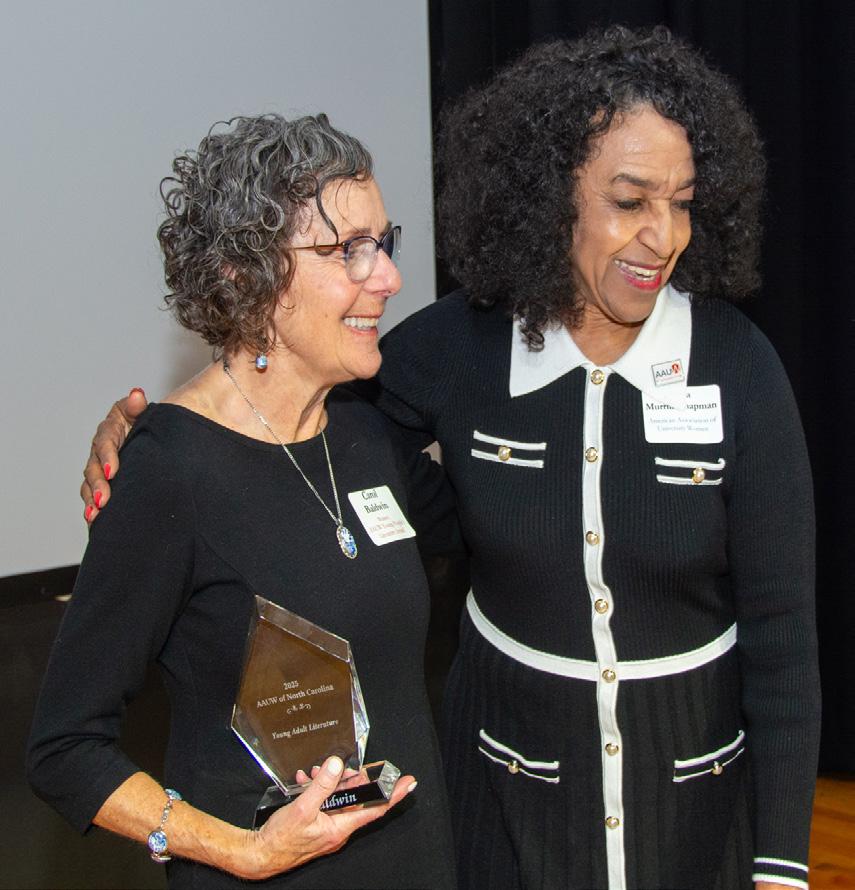
ABOVE Carol Baldwin (left) receiving the 2025 Young People’s Literature Award for YA Literature from Lena Murrill-Chapman, President of AAUW North Carolina, Raleigh, NC, 5 Dec. 2025; courtesy of the North Carolina Department of Natural
voice” (133). Kate’s longing to have a voice of her own further complicates how she sees those she wishes to report about. For instance, Kate is unable to perceive the discomfort in the room when she explains to Lillian’s parents why she wants to write an article about the local Black funeral home: “I want the students at my school to understand the problems you people face” (179; emphasis added).
While the first story follows Kate’s struggle to find herself amid a new environment, the second story is shrouded in mystery. The mystique begins when Kate meets her grandmother’s maid, a white presenting African American young woman, Lillian. While the seemingly coincidental similarities in appearance between Lillian and Kate are initially overlooked, the material evidence found within her grandmother’s old chest makes Kate question their family lineage.
In fact, asking questions is at the heart of this novel. This work positions partial knowledge as the jumping off point for real exploration of how words can actively wonder, unsettle, and open up spaces for communication. To situate the argument that intellectual curiosity is better than complacent closure, Baldwin dictates that half-truths are not benign but, rather, tend to create distortions, omissions, and ultimately silences that craft personal history and memory. Baldwin considers how hiding the truth produces lasting consequences across familial, cultural, and institutional histories and challenges audiences
to consider how partial truths affect their lives.
The novel’s insistence on questioning knowledge is exemplified in the discrepancy between Lillian’s and Kate’s understanding of history. In a conversation about enslavement, Lillian points out that the enslaved did not want or choose to stay with their enslavers, which catches Kate off guard. Kate recounts, “My Social Studies book says slaves chose to stay with their masters. . . . [S]he read the same thing I did” (143). Although they read the same book, Lillian questions and critiques what she read instead of immediately accepting it as fact, as Kate does.
Not only does Baldwin’s work critique social and institutionalized knowledge; more generatively it analyzes how telling the whole truth acts as a form of resistance against dominant narratives, distortion, and forgetting. Dominant narratives are often difficult to combat. For example, when Kate seeks information about an old family photograph, an incomplete tea set, and familial slave-owning records, she is met with silence or outright animosity. In one instance when Kate attempts to learn the truth about her family, her grandmother retorts, “In my time, young ladies were raised to be seen and not heard. I would have never pried into my family’s business!” (272). Her family members’ insistence on silencing, forgetting, or erasing past truths initially prevents Kate from connecting with those around her and prompts her inability to reflect on her own
behavior, further demonstrating the need for constructive conversations founded on truth to build or strengthen connection and create positive change. Baldwin’s novel Half-Truths provides a contribution to contemporary literature that melds literary experimentation of inquiry driven narrative with ethical reflection. Additionally, through her narrative Baldwin asserts that ethical reflection is a necessary step for change. Kate’s motivation to change not only herself in response to the knowledge she gains about her family but also the minds of others is evident when she states, “I can’t change the past. But maybe my article will show that something can be done differently in the future” (197). Her longing for personal and social change is driven by her ability to seek out answers to questions. By crafting a question driven narrative that centers words that wonder, Baldwin challenges readers to consider how stories are made and who has the right to report them. n
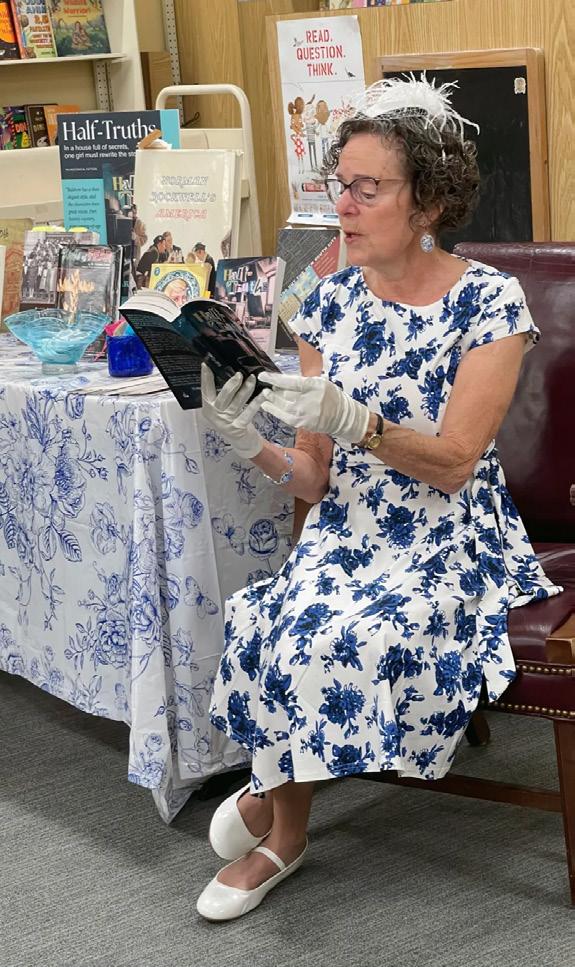
RIGHT Carol Baldwin at her book launch at Park Road Books, Charlotte, NC, 5 April 2025
PATRICE
GOPO: ONE OF TWO 2025 AAUW OF NORTH CAROLINA YOUNG PEOPLE’S LITERATURE AWARD RECIPIENTS
Patrice Gopo received the 2025 American Association of University Women of North Carolina’s Young People’s Literature Award for her children’s picture book Ripening Time (WorthyKids, 2025). Ripening Time, illustrated by Carlos Vélez Aguilera, was also a finalist for the 2026 Southern Book Prize, representing “the most beloved “handsells” of the year in fiction, nonfiction, and literature for young readers.”1
The Young People’s Literature Award is given annually, by the North Carolina AAUW and the North Carolina Literary and Historical Association to “the most significant work of original juvenile literature published over the course of the last year by a North Carolina author.”2 New as of 2025, the judges may elect to give two awards: one for children’s literature and another for young adult literature. Gopo’s Ripening
Time is a book for children celebrating the connection between food and family, touching specifically on the author’s Jamaican heritage: she is the child of Jamaican immigrants.
In addition to Ripening Time , Gopo’s children’s books include All the Places We Call Home (2022) and Beyond Alaska’s Window (forthcoming in 2026). She also hosts the podcast Picture Books Are for GrownUps, Too! And Gopo writes for adults as well. She is the author of three collections of essays for adult readers: Autumn Song: Essays on Absence (2023), recipient of the inaugural Pattis Family Foundation Creative Arts Book Award; All the Colors We Will See: Reflections on Barriers, Brokenness, and Finding Our Way (2018), a Barnes & Noble Discover Great New Writers selection; and We Deserve to Heal (2026).
Statement from one of the judges, Elizabeth Swaggerty, Professor and Chair of the Department of Literacy and Special Education at East Carolina University
Ripening Time by Patrice Gopo and illustrated by Carlos Vélez Aguilera is a vibrant picture book that celebrates the plantain. Told through the eyes of a young girl, readers experience the joyful anticipation of this sweet, treasured treat from the grocery cart to the sizzling frying pan. This story beautifully honors generational food memories and traditions, making it a perfect choice for building connections between children and adults. With just the right balance of lyrical text and rich illustrations, Ripening Time is ideal for cozy lap reading or as a whole-class read-aloud in the pre-K and elementary classroom. The author’s note at the end explains her Jamaican heritage and the idea behind the book. There’s also an informational page about the difference between plantains and bananas and how to pronounce plantain in Jamaican with the “ai” making the short /i/ sound.
1 Quoted
2 Quoted from the “Young People’s Literature Award” information
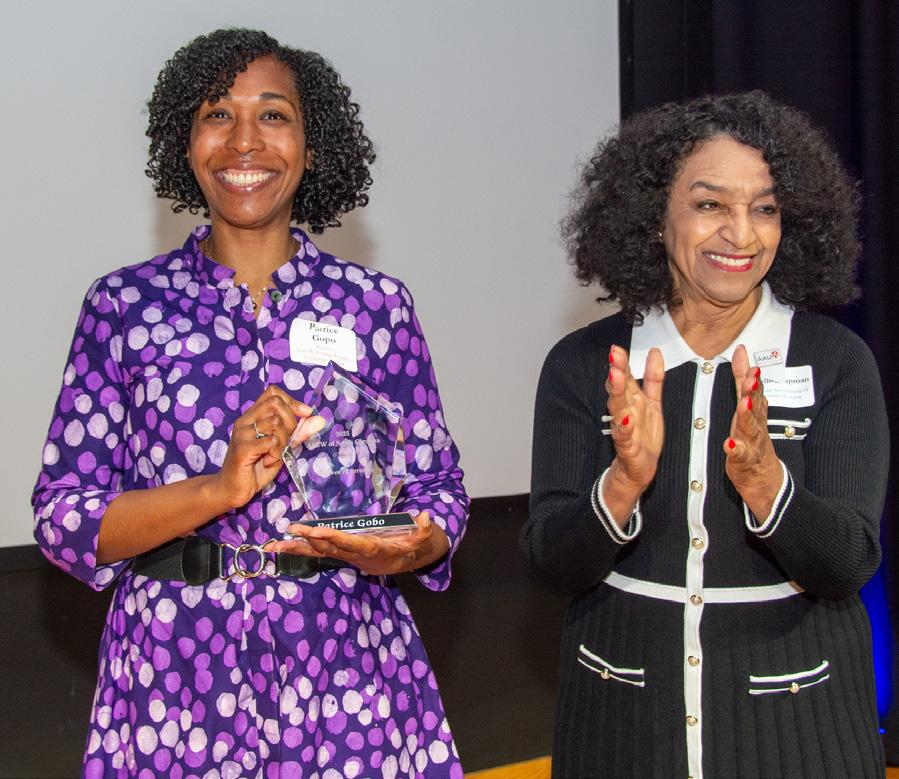
acceptance remarks by Patrice
Gopo
Thank you so much, Lena Murrill-Chapman, for the generous presentation of this award. And thank you so much to the North Carolina Literary and Historical Association, the North Carolina Literary Review, and all the judges. It is an honor to be here.
Almost fifteen years ago, in January of 2011, my family moved to Charlotte, NC, in the aftermath of a huge snow storm. Fifteen years ago, as I walked down sidewalks of melting snow, I couldn’t even begin to imagine the impact that living in North Carolina would have on my literary career. But all these years later, I can say that the impact has been tremendous, and I am the writer I am today because of living in this place. I am filled with deep gratitude to accept this award in a state that has become another home to me.
Thank you so much to organizations such as the North Carolina Arts Council, the Arts & Science Council of Charlotte Mecklenburg County, the North Carolina Writers’ Network, the Charlotte Center for the Literary Arts, and the Carolinas chapter of the Society of Children Book Writers and Illustrators. The support these organizations have offered me is immense. Thank you as well to the many magnificent indie booksellers who bring such delight to our state. Thank you for all you do to support local and regional authors. Thank you to North Carolina’s amazing public library systems who ensure readers can access books. Thank you also to all the talented writers in North Carolina. It is an honor to be part of such a wonderful group of people!
Specific to this beautiful honor, thank you the entire American Association of University Women of North Carolina. Your commitment to celebrat-
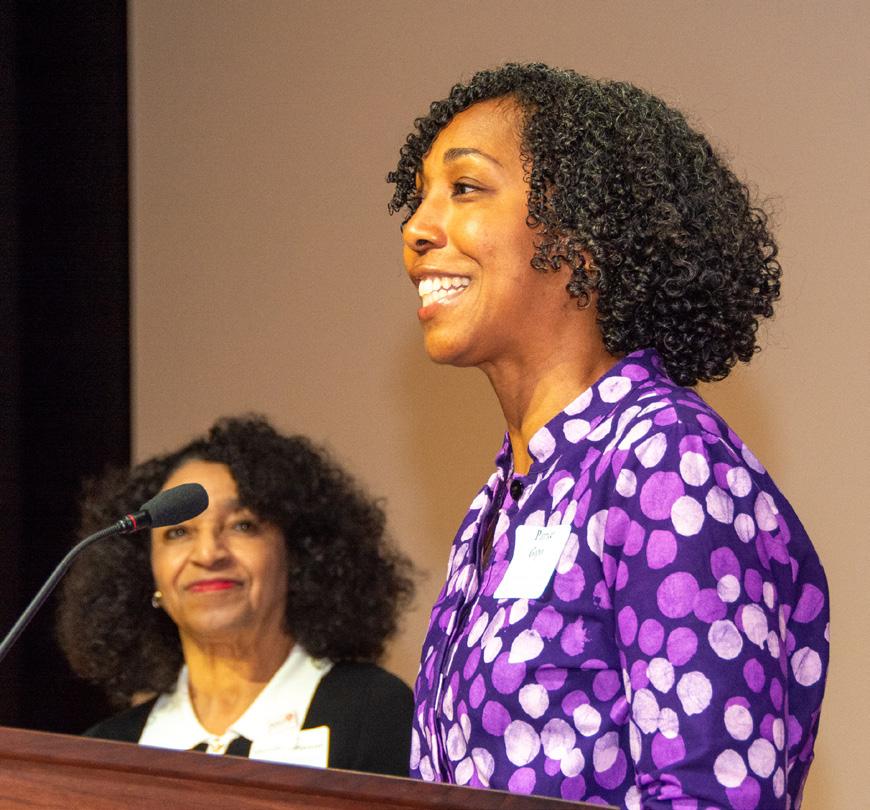
ing writing that is having an impact on young readers is beautiful and necessary–especially in a time when some in our society are seeking to take away our children’s access to many books through book bans. AAUW of North Carolina, your work matters and reminds authors afresh that our work matters as well. Thank you for seeing such wonder, joy, delight, and importance in Ripening Time’s words and Carlos Vélez Aguilera’s gorgeous illustrations. As the Black American daughter of Jamaican immigrants, I am committed to telling stories that expand representation and work to circumvent historic messages that marginalize Black children and other children of color. This award encourages me to continue with that work. Thank you to my publisher WorthyKids and the wonderful and talented Carlos Vélez Aguilera for the captivating and colorful illustrations that brought this story to life. Thank you to my parents for giving me the beautiful childhood that inspired this story. Finally, to my beloved family, my husband Nyasha and my precious girls. You encourage me each day to write the stories I wish I’d had when I was a child. Thank you for always and forever inspiring me and celebrating me. I love you with my whole heart. n
OPPOSITE AND ABOVE Patrice Gopo receiving and accepting the 2025 Young People’s Literature Award for Children’s Literature from Lena Murrill-Chapman, President of AAUW North Carolina, Raleigh, NC, 5 Dec. 2025; courtesy of the North Carolina Department of Natural and Cultural Resources
TEMPORAL HEALINGS
a review by Sheila Smith McKoy
Glenis Redmond. The Listening Skin. Four Way Books, 2022.
Crystal Simone Smith. Runagate: Songs of the Freedom Bound. Duke University Press, 2025.
The poems in Crystal Simone Smith’s Runagate: Songs of the Freedom Bound and Glenis Redmond’s The Listening Skin are deeply connected to the American South, its striking beauty and the ever-presence of America’s racial woes. Storytellers who center Black voices, Smith and Redmond focus on the possibilities of cross-generational healing and on giving voice to the lurking American traumas that make that healing necessary.
Crystal Simone Smith’s Runagate takes readers on a journey through America’s divisive past, delving into the experiences of the enslaved, their enslavers, and the ongoing pursuit of freedom, even though it is often illusive. Runagate responds to the political conversations that minimize the horrors of enslavement in favor of teaching that enslaved people – the branded, the sold and resold, the denigrated – benefited from the institution of enslavement. Runagate showcases Smith’s dual mastery of Black American freedom narratives and what she calls “Zen-inspired” Japanese poetic forms of haiku, tanka, and haibun (xix). Based on wanted notices for runaways that are catalogued in Cornell University’s Freedom on the Move: A Database of Fugitives from American Slavery, these poems respond to the postings written
SHEILA SMITH MCKOY is an awardwinning poet, fiction writer, filmmaker, and scholar. She earned a PhD in English from Duke University, an MA in English from UNC Chapel Hill, and a BA in English from NC State University. She is the recipient of the 2020 Muriel Craft Bailey Memorial Prize in Poetry; served as an editor of Obsidian: Literature in the African Diaspora; and has written, produced, and directed several documentary films. She is the author of The Bones Beneath (Black Lawrence Press, 2024; reviewed in this issue), and her poetry is included in One Window’s Light: A Collection of Haiku (Unicorn Press, 2017; reviewed in NCLR Online 2019), a collaboration of five Black poets in celebration of the haiku tradition.
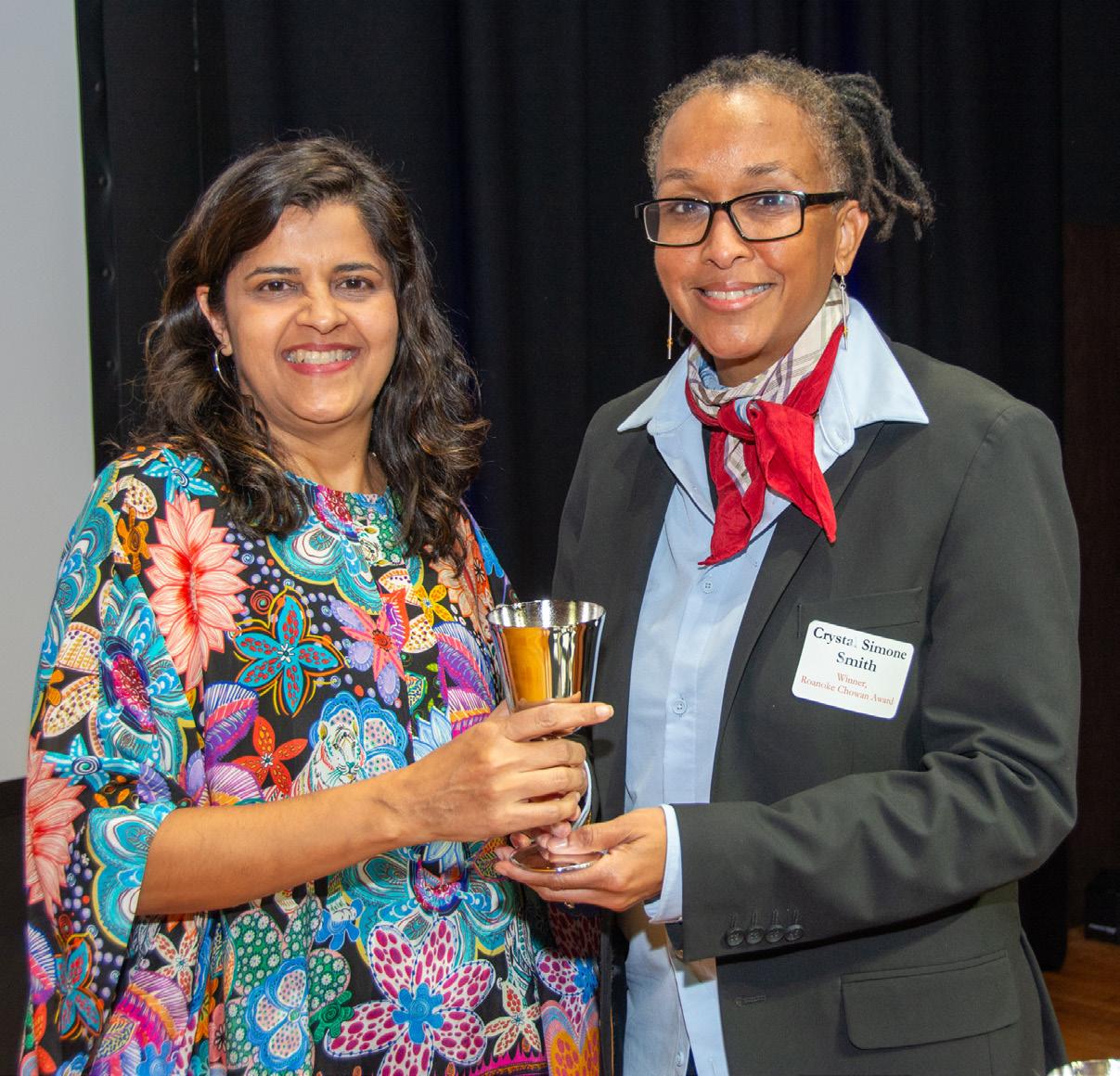
ABOVE Crystal Simone Smith (right) receiving the 2025 Roanoke-Chowan Award for her collection Runagate from Sejal Mehta, a North Carolina Literary and Historical Association board member and one of the 2025 judges, Raleigh, NC, 5 Dec. 2025
As founder and editor of Backbone Press, CRYSTAL SIMONE SMITH published new and emerging poets for over a decade. She currently serves as the president of the Haiku Society of America. Runagate, her third full-length volume of poetry, received the 2025 Roanoke-Chowan Award for Poetry from the North Carolina Literary and Historical Association. She is also the author of three poetry chapbooks.
by enslavers offering rewards for the return of people who fled. Runagate is bookended by two poems that connect these competing historical experiences – those of the owner and the enslaved, of the freedom bound and the enslavers – to the ongoing search for freedom and equality in the current cultural moment. The opening poem, “Runagate: What to the Slave is the Semiquincentennial,” is at once a nod to Frederick Douglass’s 1852 keynote address and the reaction to the question posed in the poem’s subtitle, “When the White Orthopedist at the Track Meet Asks Me Why We Run So Well.” It is also a deep explication of how the Black
body continues to be unfree. The epilogue is composed of a single poem, “Haibun for Ancestor Ernestine Turner (B. 1827),” in which Smith describes the discovery of her own enslaved ancestor in the process of her research for Runagate. It reminds readers of the transient nature of “freedom” for Black Americans in the American cultural landscape.
This dichotomy is continually reinforced in the structure of the haiku sequences in the first section of the collection. Entitled “Freedom on the Move: Rediscovering the Stories of Self-Liberating People,” Smith’s haiku sequences claim the fugitives’ humanity. The narratives
RUNAGATE RECEIVES THE 2025 ROANOKE-CHOWAN AWARD FOR POETRY
acceptance remarks by Crystal Simone Smith
. . . I accept this award in honor of the enslaved folks who labored and died in this country never realizing the dreams and hopes this nation offers.
Elevating voices of the enslaved became important to me after I encountered slave narratives in UNC’s Documenting the American South archive. While often transcribed and ghost-written by editors, their voices and stories were resolute and resonated soundly with me as a descendent of slaves. Beyond those narratives, it is important to know that enslaved laborers were not perpetually silent during their captivity. As witnessed in research, and in Runagate , they did not relinquish their identities or culture. They worshipped, sang songs with pots turned down at doors to mute the sound, they danced, told stories, and expressed their desires for freedom through harrowing acts of escape.
Runagate is, at best, a work that celebrates folks who brought hope into a world that enslaved them. I am grateful to the present-day hands that helped usher this work into life: Liz Nealon, Tsitsi Jaji, Dean Smith and the team at Duke University Press, and the audiences and supporters who work to preserve historical narratives. Thank you. n
written by enslavers in search of their human “property” and Smith’s haiku appear on facing pages. The juxtaposed narratives demonstrate the stark differences between the impossibilities of slavery and the possibilities that made escape necessary. One striking example is the sterile language of the slaveholder, Lucien LaBranche, whose notice describes the “absconding” Clinton as a thirty-year-old “boy” who has previously escaped, though LaBranche seemingly cannot fathom the reason why. We find it in Smith’s shaping of Clinton’s freedom narrative: “choosing my / own death field – / the quiet thicket.” This is the ultimate declaration of choosing freedom even if it means choosing the circumstances of one’s death. It is a stark reminder of the horrors of slavery.
Among the compelling stories in this section of the collection is the narrative of Robbin, who, according to his enslaver, John Charles, escaped “without the least provocation, having never received a lick either from me or anyone under me.” Yet, Charles also writes that the “somewhat Tawney” Robbin bears whip scars on his eyelid and back. He reveals that Robbin has a wife in another county, without noting that Robbin was sold away from her. While we cannot know what transpired in Robbin’s life after his escape, Smith offers a hopeful possibility in her description of Robbin’s return to his wife, despite the personal cost: “we made silent love / under bellshaped / blossoms.” Freedom, as the poet conceives of it, lies in the reclamation of Robbin’s right to live his full humanity.
Smith unflinchingly portrays women as having agency despite the double yoke of being enslaved and female. Of note is Grace, who the wanted poster describes as a “MULATTO WENCH” hired out as labor and whose husband is “a tall MULATTO FELLOW, named TOM.” Smith’s portraiture of Grace is one of full personhood and choice, perfected in her recognition that “Now I move free / between plantations – / if I run, he’ll follow.” Grace’s certainty underscores the simple right to love, even when held in bondage. In the sequence’s final haiku, Smith writes of “Harriet, Bella, Elsy and Millie,” who “concluded to claim / our weary bodies / as our own.” For the poet, true freedom lies in ownership of one’s body.
One of the volume’s gifts is that Smith renders a range of experiences: mothers whose children are sold away (especially noteworthy in “Aint You My Child”), children whose parents are sold away, family members who keep fugitives secreted and fed despite the risks, and myriad other separations that defined the practice. Just as vivid are the reunions, the ability of escapees to reclaim their economic gifts in support of themselves. Consider “After the Stars Fell,” in which the poet begins a tanka sequence about Sarah Gudger, formerly enslaved in Asheville, NC, with a verse about the Leonid meteor storm on November 13, 1833. Gudger witnessed this event at 121 years old, mentioning it in an interview for the
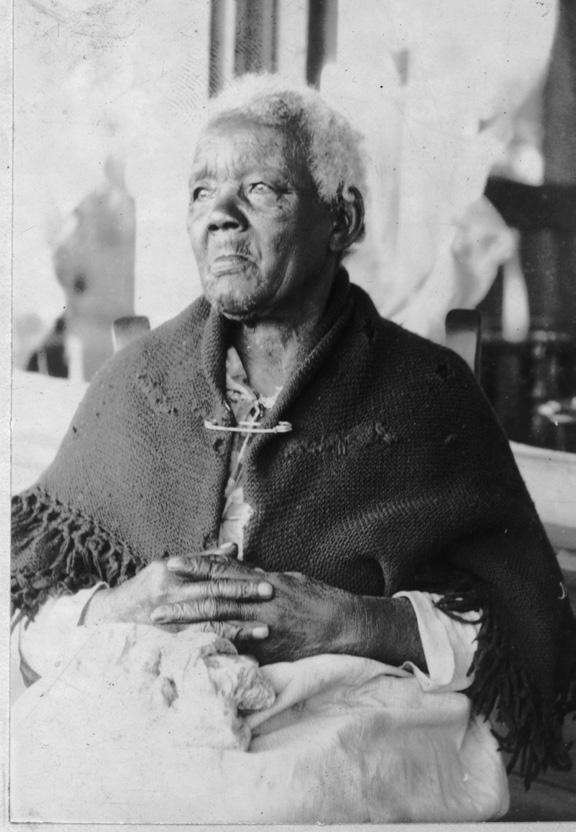
1936 Federal Writers Project. The interview also provides details about enslavement: the persistent and brutal lashings, the lack of health care, and the meager food they were given, all of which she summarizes as “dey wah bettah t’ de animals den t’ us’nsn.”* Smith is likely the first to render Gudger’s poignant story in poetry, connecting the cosmic with the improbability of Gudger’s survival and longevity. The ultimate gift, however, is Smith’s use of structured Japanese poetic forms to dissect the logic of American slavery and its racial dynamics. Runagate offers healing to readers precisely because they are called to bear witness to these journeys. Smith’s readers are invited –required – to witness, imagine, and potentially heal.
This striving towards healing is also at the heart of Glenis Redmond’s The Listening Skin Perhaps Redmond notes it best
in “How I Summer (Read Simmer)”: “I am full of this past present heat / I carry.” In “AfroCarolinian,” Redmond signals the importance of time that is both changing and unchanging in the portrait of a/her/our grandmother: “grounded in her own wisdom, / a Baptist Buddha woman teaching / Be Here Now.” Structured in sections entitled “Flinch,” “Fester,” “Flashback” and “Flight,” The Listening Skin connects with the innate human flight-or-fight response. These are embodied poems, written across the timelines and contours of Redmond’s medical, familial, and social histories. She emphasizes the intergenerational causality of our collective disease. In “Make No Apologies for Yourself,” she asserts, “Dear you, make no apologies for yourself / because you are covered in a listening skin,” later adding that, “Because your heart is the vehicle you choose to ride this go round / Because it can go forward and backwards in time.” She asks readers to hold the collective weight of the past and its presentness and to witness the personae’s journeys towards wholeness as if it is their own.
Throughout the collection, Redmond embraces music, dance, “poetry miles,” illness and recovery, and time as vehicles through which to create collective healing. In “You Know You Are Not from Here,” for example, Redmond begins with the notion of her father’s retirement and the family’s subsequent return “home” where nothing is familiar to the
* Sarah Gudger, Federal Writers’ Project: Slave Narrative Project (1936) 354.
ABOVE Sarah Gudger, age 121, Asheville, NC, circa 1936–38; courtesy of the Library of Congress
narrator. She ends the poem by focusing on the trickster nature of unhealed generational trauma: “but when you’ve been here long enough / you feel how blood circles back / when you truly understand Dorothy’s decree as doubleedged / There’s no place like home There’s no place like home.” Here and throughout the collection, Redmond questions and reshapes the very idea of “home.” She suggests
that home is reachable, that it is possible to heal across time and generations.
The epistolary poem, “An Exercise in Restraint, a Letter to Ann Cunningham,” is addressed to the mistress of the plantation where Redmond’s family was likely enslaved. Redmond acknowledges that “two centuries separate” them but offers the possibility that Cunningham might respond to her “through time.” The request is simple: she
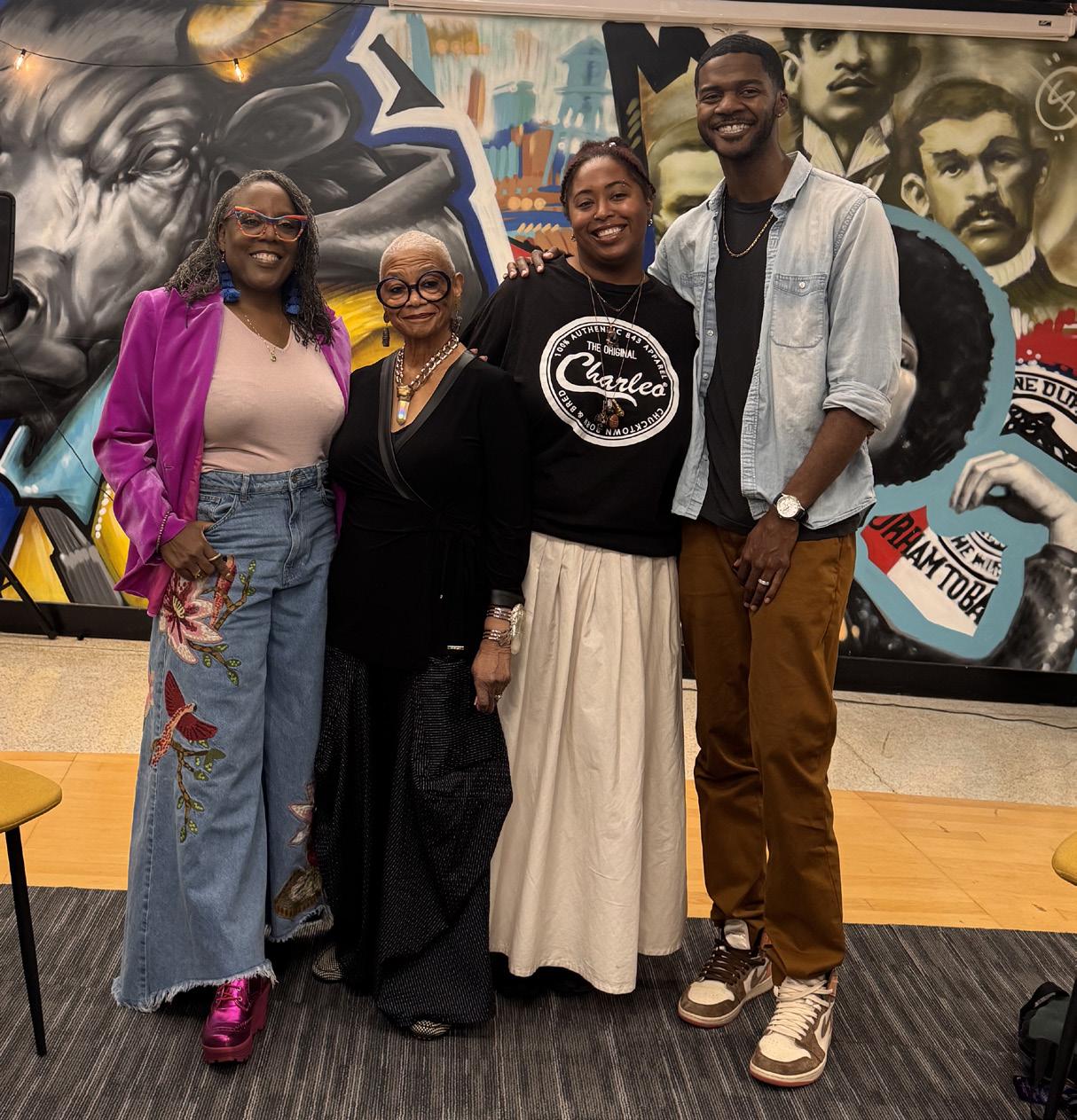
wishes to know the names of the ancestors whom the Cunninghams “owned”: “I do not consider this too much to ask, as my freedom is intricately woven into theirs. I am waiting for their feathers to add to my wings.” Refusing to accept that her ancestors were merely nameless entries in a ledger, Redmond calls for bearing witness and reminds us that understanding our histories is essential to our collective healing. She highlights this shared responsibility in the concluding section of the collection where she honors a litany of creative and radical voices including Elizabeth Acevedo, Maya Angelou, Billie Holiday, Lucille Clifton, Malcolm X, and Frida Kahlo. They become a part of the healing process.
Smith’s Runagate and Redmond’s The Listening Skin bend time to communicate undertold narratives. They call for public acknowledgment of living histories, certain that these stories will lead to our individual and communal survival. Runagate and The Listening Skin are crafted to engender reckonings and remembrance. These poems may well contribute to our collective healing, especially in the face of current political calls for collective dis-remembering. n
GLENIS REDMOND , a resident of Greenville, SC, who began her writing career in Asheville, NC, is a performance poet, a Kennedy Center Teaching Artist, and a Cave Canem alumnus. Since 2014, she has served as the mentor poet for the National Student Poets Program through Scholastic Art and Writing Awards. In this capacity, in 2014-16 she prepared youth poets to read at the Library of Congress, the Department of Education, and for First Lady Michelle Obama at The White House. She is the author of several poetry collections, and her poetry has been showcased on NPR and PBS and published in NCLR , Orion Magazine, storySouth, and The New York Times. In 2020, she received the highest arts award in her home state of South Carolina, the Governor’s Award; in 2022, she was inducted into the South Carolina Academy of Authors; and in 2025, she was inducted into the Order of the Palmetto. Read an interview with her in NCLR 2019.
ABOVE Left to right, Glenis Redmond with North Carolina Poet Laureate Jaki Shelton Green, South Carolina Poet Laureate Asiah Mae, and Chapel Hill Poet Laureate Donovan Livingston at the 2025 Griot & Grey Owl Conference in Durham, NC
HONORABLE MENTION, 2025 ALEX ALBRIGHT CREATIVE NONFICTION PRIZE
WOUNDING AND HEALING
by Mildred Kiconco Barya
with art by Richard Wilson
Uganda native MILDRED KICONCO BARYA is a North Carolinabased writer and scholar. She teaches creative writing workshops globally and is the author of five full-length poetry collections, most recently, Hands in Clay (Serving House Books), which was listed among Brittle Paper’s 100 Notable African Books of 2025. The Animals of My Earth School (Terrapin Books), also listed among Brittle Paper’s 100 Notable African Books of 2023, received honorable mention in the 2024 Eric Hoffer Poetry Award. Barya is a recipient of the 2025 Jacobs/Jones African American Literary Prize and the 2020 Linda Flowers Literary Award; read the latter essay in NCLR 2021. She has served as the Gilbert-Chappell Distinguished Poet for the North Carolina Poetry Society, and her work is published in the New England Review, The Cincinnati Review, Shenandoah, and elsewhere.
Raleigh-based RICHARD WILSON is an internationally acclaimed award-winning fine artist and a native of Robersonville, NC, whose work offers a profound exploration of Black history and culture. Wilson attended Barton College and received a degree in Advertising and Graphic Design from Pitt Community College. His 30-year career spans that of a professional artist, freelance and corporate graphic designer, and college art teacher. His works are held in numerous public and private collections. Frequent commissions include a portrait of Mary Frances Early, the first African American to graduate from the University of Georgia and his portrait of Henry White, the last former slave to serve in Congress, which is displayed in the Edgecombe County Superior Courthouse in Tarboro, NC. His work has been featured in Fine Art Connoisseur, Wall Street Journal, Our State, and Pastel Journal.
First Intention
The healing of a wound by natural contact of the parts involved.
My partner introduced me to Jackie Robinson after I introduced him to Black Panther, and we both fell in love with Chadwick Boseman. Chadwick’s onstage presence and poise profoundly moved us. With the intention of checking out every one of his movies, we googled him. My partner excitedly announced that we must watch 42, a 2013 sports film starring Chadwick as Jackie Robinson – the first Black athlete to break the color barrier and integrate Major League Baseball. COVID-19 had officially closed our world, so we turned to the screen, rewatched Black Panther, 42, Marshall, 21 Bridges, and Get on Up until we could do some of James Brown’s moves.
In late August 2020, news of Chadwick’s death shocked us to the core. Given his age (only fortythree), we were expecting more outstanding performances in the coming years. When I logged on social media, I realized how dearly loved Chadwick had been to a multitude of fans. In our separate ways, we mourned the loss of a brilliant and inspiring Black actor. A generous brother, husband, and friend. When we revisited his movies, I looked for the shadow of death on his face but couldn’t see it. I was deeply touched that he’d been diagnosed with stage three colon cancer in 2016, but it had not stopped him from stretching his limits and taking on important subjects that melted my heart in both Marshall (2017), and Black Panther (2018). What could have fueled his momentum other than a strong intention to be of service to the world, especially to the Black people?
I will confess though, the first time I watched Black Panther at a movie theater in North Carolina, my inner critic came up and said, What’s the big deal? I thought it was common knowledge that the African continent had great empires in the past: the Nubian Civilization of the Nile Valley, the Kingdom of Kush that reigned for 2000 years BC (historically known as Kemet), land peopled by Blacks. Then there was the Songhai Empire, the largest and last of the three major pre-colonial empires stretching all the way from western Sudan to the coastal cities of West Africa’s Atlantic Ocean.
IN OUR SEPARATE WAYS, WE MOURNED THE LOSS OF A
BRILLIANT AND INSPIRING BLACK ACTOR. A GENEROUS BROTHER, HUSBAND, AND FRIEND.
WHEN WE REVISITED HIS MOVIES, I LOOKED FOR THE SHADOW OF DEATH ON HIS FACE BUT COULDN’T SEE IT.
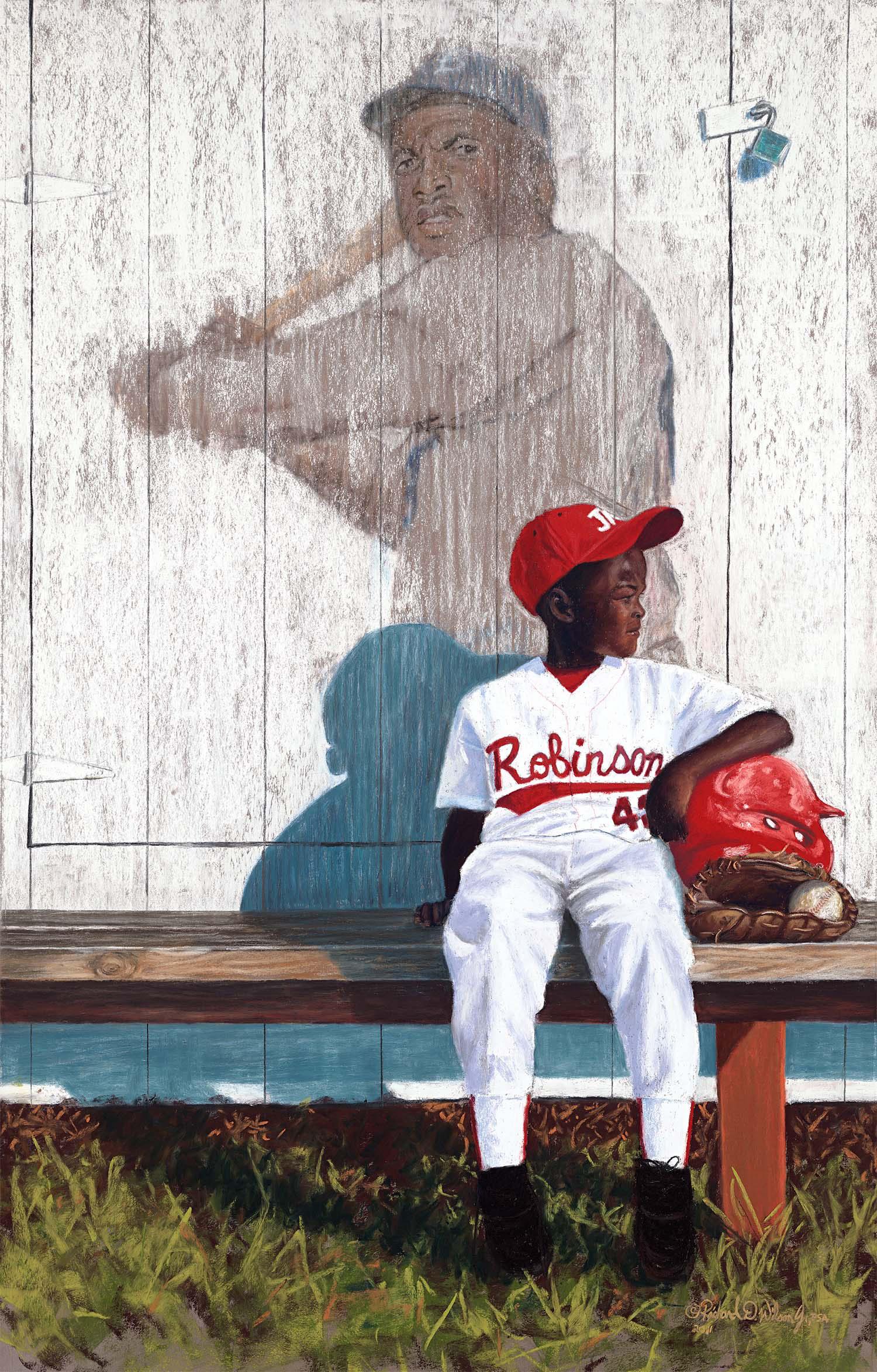
In
His Shadow: Jackie Robinson (soft pastels, 16.3x24) by Richard Wilson
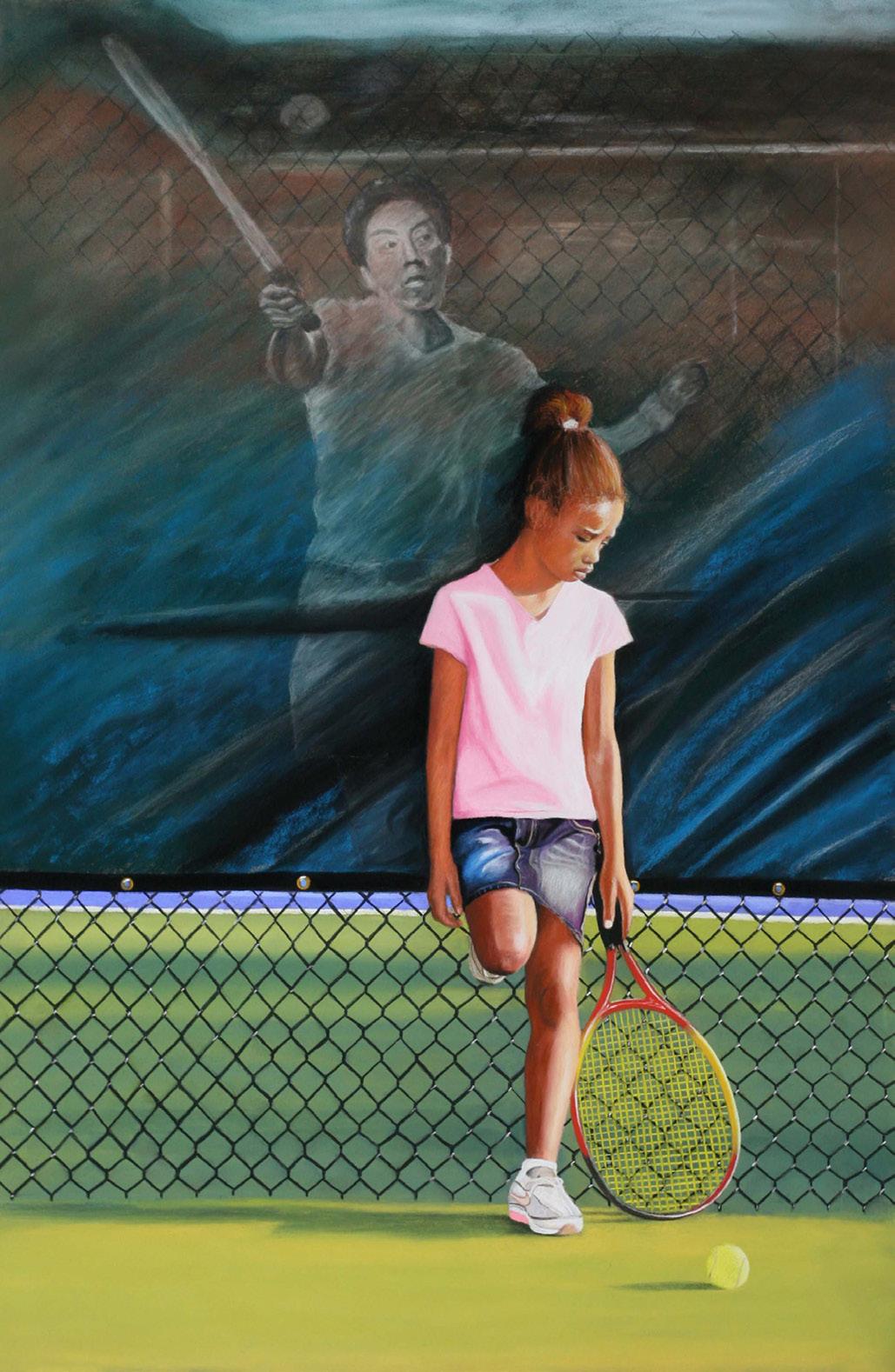
I CANNOT CLAIM TO KNOW CHADWICK’S INTENTION, BUT I LIKE HOW
In history lessons in my native Uganda, I was proud of the role that Timbuktu had played as one of the world’s vibrant centers of commerce and learning, thriving through the fifteenth and sixteenth centuries. But it’s the nature of civilizations to rise and fall for the next civilization elsewhere to begin. Africa’s golden age ended with the arrival of guns, European colonizers, and the Transatlantic Slave Trade. Black Panther’s Wakanda rekindled my knowledge of Africa’s ancient kingdoms. So, my greatest criticism was that it took us back in time rather than forward. Then I happened to look at my feet – the place where I was, not where I grew up in Africa – and I awakened to a new reality.
I imagined all the little girls and boys growing up in the States without a culture hero to look to, without a connection to their great-great ancestors who were kings and queens on their own land in Africa. I even considered the adults who had grown up with no means or opportunities to learn African history (authored by African scholars), in their communities and schools. I became aware of what Chadwick had truly done through his role as T’Challa, the African prince: he not only restored the dignity of the African people in the New World, but also bridged the gap between the African diaspora and the Black imagination on the continent. He opened dialogue for these two groups on different continents to begin to realize a shared Black consciousness and humanity. It made perfect sense that his co-star and heroine of the movie was the Kenyan actress, Lupita Nyong’o. Seeing them standing together, they awakened a new reality – a strong symbolic statement that the African people on the continent and diaspora belong together. I cried then. No movie had ever done that.
I cannot claim to know Chadwick’s intention, but I like how the dictionary defines intention in medicine as the healing process of a wound. The first kind is the healing of a wound by natural contact of the parts involved. We’ll get to the second kind later.
Chadwick’s embodiment of his character in Black Panther comes across as one of the most natural and organic performances, integral to the
In Her Shadow: Althea Gibson (soft pastels, 23.5x34) by Richard Wilson
movie’s success. I’ll argue that he heals the wound that had been open for centuries. He unites Blacks and African Americans. One might say it’s too big a stretch, there’s too much trauma in the way to be cleared by one movie, and, yes, healing often takes time. But the bridging of the severed connection, the contact of the parts involved, was accomplished, and that’s what touched many of us. His stellar performance felt authentic and invigorating.
Intentio(n-)
From Latin – stretching, purpose
I’ve tried to imagine the amount of control Jackie Robinson had to muster while paving the way for inclusion in a white-dominated space. Since I never saw him play in real life, I rely on Chadwick to convey the grace and indomitable courage through the movie 42. It makes me wasp-mad that for Robinson to win, he has to stretch many many miles away from who he really is – a man who speaks his mind – to a silent, enduring, anguished fellow. In one visceral scene when he’s with his team – the Brooklyn Dodgers playing against the Philadelphia Phillies in Brooklyn – I cannot stomach the racial slurs hurled at him. The moment I hear, “Go back to the cotton fields,” I throw pillows and punch walls, and anxiously perch on the edge of my seat looking forward to when he’ll strike back.
Thing is, Branch Rickey, general manager of the Dodgers had cautioned Robinson to not retaliate because of the fragile vision he’s carrying – the egg of inclusion came at a very high cost. So, Robinson runs on hot coal with the precious egg perched on his shoulder. When, finally, he returns the fire, egg still intact, I holler with the force of
the good lungs God gave me. I watch with pride as he stretches not only his personality, but also, his capabilities as a sportsman, this time on his own terms. He shines as the best sportsman the Brooklyn Dodgers ever had. An exceptional, artful dodger, who enables me, the viewer, to enter the flow of the game in pure ecstasy. There’s fun and joy and risk and thrill stirring my blood. Time dissolves. Years of hard work, training, and discipline crystalize into what comes across as effortless ease.
Despised and denigrated for his skin color, we cannot fully know how all the emotional and physical abuse that Robinson repressed must have contributed to his death in the end. I can’t help but think that it shortened his life. Had circumstances been different, had he been openly embraced from the beginning as a human being and an American with inalienable rights and opportunities, I think he’d have lived beyond fifty-three years. There are two occasions in 42 that make me burst into tears, this time because Robinson is seen for who he is – human – and accepted. The first scene happens at Crosley Field where the Brooklyn Dodgers are meeting the Cincinnati Reds. The latter’s fans are nasty, unleashing a barrage of insults at Robinson. At this point, Robinson’s teammate Pee Wee Reese has heard enough. He walks over to Robinson and puts his arm around his shoulders. As if the gesture couldn’t be louder, Reese says, “I’ve got family here from Louisville up there somewhere. I need them to see who I am.” This powerful moment has been chronicled at great length, even monumented at the entrance of Brooklyn Cyclones. Its accuracy, however, is questioned. Some records suggest that the incident is dramatized because the public desperately wants it to be true. I want it to be true. Whether it’s the stuff of myth or truth, for me, it accomplishes the ethos of Namaste – the light in me sees and

Despised and denigrated for his skin color, we cannot fully know how all the emotional and physical abuse that Robinson repressed must have contributed to his death in the end.
“ As I am witnessing his excellence from a place of safety, I feel healing, pride, and joy. I realize that he is the lion that becomes the sacrificial lamb. He seems to know fundamentally that this is the work he was designed for, the purpose he was destined to accomplish.”
celebrates the light in you. The best in Reese rises to recognize the best in Robinson and, together, they stand.
The second example takes place in the shower. Robinson is alone on a bench, waiting. One of his teammates enters and asks, “Why do you wait for the rest of us to finish before you shower?” Robinson mentions not wanting to make anyone uncomfortable, but the teammate insists, “Take a shower with me.” The moment, already awkward, is now wound with risk, potential for intimacy, and tragicomedy. This is a vulnerable space where I linger as the white fellow tries to explain, “I mean take a shower with us – ahem – you know – with the team.” Then he’s released from further awkwardness as Robinson laughs and steps into the shower. The nakedness of truth and bodies win.
It surprises me that in my studies about the Civil Rights Movement, I never came across Jackie Robinson as one of the key players. Ken Burns’s 2016 PBS documentary corrects this error, this missing out in the history that finally led to the recognition of African Americans as human beings with rights to vote and cross color barriers in sports, education, and other fields. The documentary clarifies how Robinson’s activism wasn’t limited to sports. He not only turned baseball into an art form, but an act of resistance as well. There was no telling where one began and the other ended. For Robinson, art, sport, lived experiences, and resistance became one force. Through this fusion he defied every voice that attempted to put him down or exclude him from expressing himself in the best way he knew. As soon as this first Black man to play in a Major League baseball game retired, his curiosity and desire to support Black lives took him into business and political activism. He never wavered in his extended role as a champion and advocate of social justice.
On his tombstone in Cypress Hills Cemetery in New York is the epitaph: “A life is not important except in the impact it has on other lives.”
I think these words encapsulate how Robinson lived. In the documentary when he’s on the field, it’s as though some force higher and larger than himself is propelling him into action, lifting his limbs in liquid pleasure. Something like a holy intentionality combined with the fight for fairness, aware that what will prevail in the end isn’t just great sportsmanship, but justice. The wounds he bears are those of a martyr. As I am witnessing his excellence from a place of safety, I feel healing, pride, and joy. I realize that he is the lion that becomes the sacrificial lamb. He seems to know fundamentally that this is the work he was designed for, the purpose he was destined to accomplish. But let’s be clear: martyrdom isn’t sexy. Too much of it kills the spirit. Period. As Robinson directs his attention to the bigger picture – the vision beyond the struggle itself, liberation of generations after him – he overturns the sacrifice. We see the lion triumphant. Without such a vision, without the integrity to hold onto and carry that vision forward, struggle gets ugly.
Every struggle that uplifts humanity, takes the people to the mountaintop – whether it involves saving dolphins from mercury poisoning or ending police violence that targets marginalized groups –comes with stress, toil, and fatigue. When there’s little or no desirable systemic change, the toll from physical, mental, and emotional exhaustion can cause total breakdown in the relations between the disagreeing parties. But the true heroes of freedom never forget what they are fighting for even when things get messy. Robinson belongs in this category of heroes. He encounters open hatred but keeps his hand on the door to let other equally talented Black athletes in to participate. He suffers
with dignity, which, to paraphrase Martin Luther King Jr., is preferred over accepting segregation in humiliation. When Robinson leaves the game, I am left with a feeling of ennoblement.
I’d have loved for Robinson and Chadwick to live long lives. “Longevity has its place,” Dr. King said in his last speech and then explained that he was past that – in other words, transcended concerns to live a long life. It strikes me that he knew at that point that he wouldn’t see another day. What does he do? He requests his favorite jazz musician, Ben Branch, to play his favorite song to usher him into glory, for he has his gaze on the promised land. He tells Branch to play “Precious Lord” (1932) like he’s never played it before. “Play it real pretty.” Then he gets shot and dies that evening. Perhaps like Dr. King, in giving their best, Robinson and Chadwick understood that their lives’ legacy would not be lost on us. I see in them the role of the artist as highlighted by James Baldwin in his “Creative Process” essay (1962) to conquer not only their own wilderness, but also, “to illuminate that darkness, blaze roads through that vast forest, so that we will not, in all our doing, lose sight of its purpose, which is, after all, to make the world a more human dwelling place.”*
The Second Intention
The healing of a wound in which the edges do not meet, a new epithelium must form across granulation tissue. This is called healing by second intention.
In high school I was an athlete. I went to a boarding school and represented my house in sprints, high jump, long jump, javelin, and long-distance running. I was small, quick, and nimble, which earned me the nickname Mosquito. While some talented sportspeople have impressive names like “the Beast” or “Black Mamba,” I was a tiny insect. I didn’t have a personal coach, but, somehow, I knew that winning any game depended on how I paced myself. When time came to compete for my school in the National Championships for long-distance running, the speed I started with remained steady throughout the twenty-five km race.
After high school, I dropped sports to focus on my studies but brought into learning the discipline and passion I’d experienced in my running practice. In college, I joined the rugby team for fun, to taste
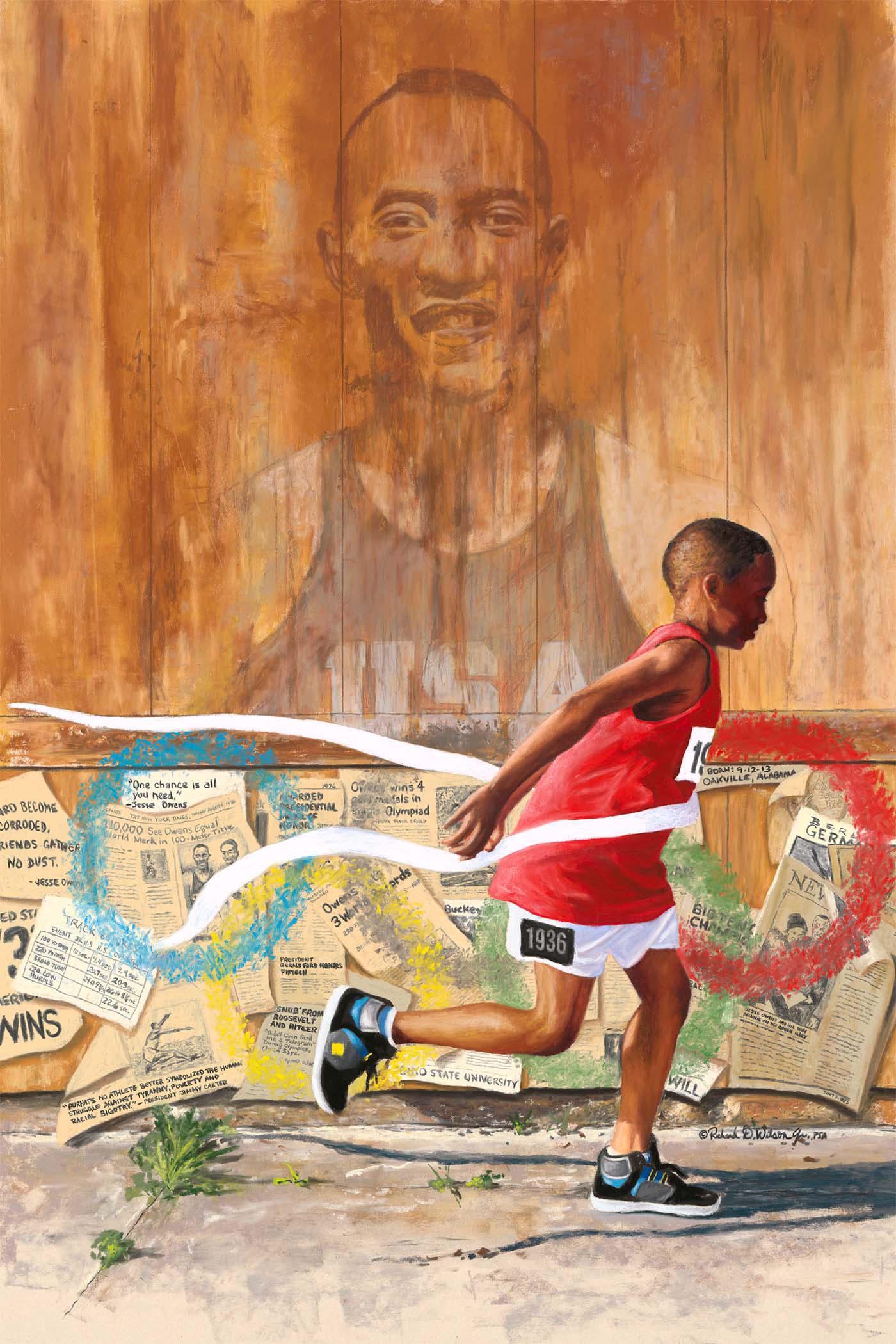
“ LONGEVITY HAS ITS PLACE,” DR. KING SAID IN HIS LAST SPEECH, GOING ON TO EXPLAIN THAT HE’S PASSED THAT – IN OTHER WORDS, TRANSCENDED CONCERNS TO LIVE A LONG LIFE.
In His Shadow: Jesse Owens (soft pastels, 24x36) by Richard Wilson
again the bliss I’d felt when running. Once I had the ball, no one could free it from my grip. I was a badger! While I do not regret the academic path I’ve taken, sometimes I wonder how my life would have turned out if I’d been in a country that invested in sports as a professional career option.
Among the East African countries, Kenya does better promoting its sportspeople, but not without hiccups. The fastest African sprinter in 2022 was Kenyan Ferdinand Omanyala, clocking 9.77 seconds in the one hundred meters and defeating the United States’ fastest man, Fred Kerley, in May 2022. When Omanyala was scheduled to participate in the World Athletics Championships on June 24, 2022, at Hayward Field in Eugene, Oregon, officials at the US Embassy in Nairobi delayed his visa. Omanyala eventually left Kenya on Thursday evening for the race in Eugene the next day. He boarded Qatar Airways from Nairobi to Doha (five hours, plus layover), then Seattle (fifteen hours, plus layover), and finally arrived in Oregon two and a half hours before his hundred-meter race. Upon joining his fellow contestants, he powered forward and qualified for the semifinals, regardless of jetlag, flight fatigue, and being in a new place with no time to adjust. His relaxed appearance amazed the reporters rushing to interview him. They kept dangling the visa impediment in his face, wanting him to comment or blame someone, at least. “The main thing is that I’m here. That’s what I’ll focus on,” Omanyala said, all smiles, and eager to move on. He hadn’t even checked into his hotel room yet.
Omanyala’s wounds, like all injuries, are visible and invisible. The kind to gradually heal without the edges meeting. Once in a while they show up in the curious questions of a reporter, a concerned fan, and most annoyingly at three a.m., the prickly mind scratching the scar, asking, What if? If only you’d had time to warm up, run a few laps before the competition. Imagine what you’d have accomplished, how well you’d fare. . . . For many African sportspeople competing internationally, just like their counterparts living in the States, their Achilles’ heels are in structural bodies and systems, manifesting as visa and racial prejudice, respectively.
Interestingly, Omanyala began his athletics career in 2015 while a chemistry student at the
University of Nairobi. He was playing rugby, and a friend noticing his speed suggested track. Just like that, Omanyala switched. Kenya has always celebrated female and male champions in long-distance running, but Omanyala is the nation’s first son of speed. In an interview on August 3, 2022, after winning Kenya’s first gold medal in one hundred meters at the Commonwealth games in Birmingham in which seventy-two nations participated, Omanyala said he’s inspired to change the narrative, the notion that Kenyans can’t sprint. He’s twenty-six years old, and I hope he’ll continue to challenge the status quo, not only in sports, but also in political systems that are more likely to undermine his participation and progress in international sports.
In pursuits that stretch the human body, mind, and spirit, like sports, creative arts, and activism, I find it immensely rewarding when a person who has endured setbacks emerges victorious. In this arena that’s all persistence and resilience, heat and guts, achieving greatness comes through mastering the long game in which one’s life merges with the artform. This requires an uncanny ability to ignore distractions and stay focused on the larger vision.
Among the males of my people, I celebrate Jackie Robinson, Chadwick Boseman, Martin Luther King Jr., and James Baldwin for traveling this path, so that those to come after them would not walk alone. These gallant ancestors surround me with their beauty and influence, despite the scars. I can walk and run in their light with my head held high. I can fly on their shoulders because they’re my giants. In them I find wounding and healing all at once. This, perhaps, is the great mystery and salvation of my kind. n
These gallant ancestors surround me with their beauty and influence, despite the scars. I can walk and run in their light with my head held high.
TIMELESSNESS AND HUMAN CONNECTION
a review by Lisa Wenger Bro
Katherine Scott Crawford. The Miniaturist’s Assistant. Regal House Publishing, 2025.
LISA WENGER BRO is a Professor of English at Middle Georgia State University, specializing in Postmodern American Literature with a focus on magical realism and science fiction. She is a co-editor of Monsters of Film, Fiction, and Fable: The Cultural Links between the Human and Inhuman (Cambridge Scholars Publishing, 2018) and the author of Bodies for Profit and Power: Science Fiction and Biopolitics (McFarland & Company, Inc., 2023).
KATHERINE SCOTT CRAWFORD has a BA in English and Speech and Communications Studies from Clemson University, an MA in English from the College of Charleston/The Citadel, and an MFA in Writing from the Vermont College of Fine Arts. Her first novel, Keowee Valley (Bell Ridge Books, 2012), was a finalist in the Amazon Breakthrough Novel Contest. She has received fellowships from the North Carolina Arts Council and the Vermont Studio Center and the Thomas H. McDill Award from the North Carolina Poetry Society, and she served as Writer-inResidence at the Montana Artists Refuge. Her work has appeared in Colombia College Chicago’s South Loop Review, Wilderness House Literary Review, Appalachian Review, and Pinesong
Katherine Scott Crawford’s The Miniaturist’s Assistant is an affecting tale of time and human connection that captures how art and stories interlink, emphasizing the importance of wonder and the ability to look at the world with fresh eyes. The novel follows thirty-two-year-old Gamble Vance, an art historian, curator, and restorer of miniature portraits popularized in the seventeenth century. Gamble lives in the heart of historic Charleston, SC, and works for the Galliard Museum of Art. The ethereal city, with its ghosts lurking around each corner, suits Gamble, who delights in the mysterious and wondrous – like the ghost she sees at the far end of Stoll’s Alley on her walk to work, a ghost whose face is captured in one of her recent miniature restorations. This ghostly encounter begins Gamble’s journey across time, a journey that restores her faith in human connection, human nature, and love as she seeks the lost art and stories that connect past to present.
The setting of Charleston plays a key role in Gamble’s experiences. A transplant from the Blue Ridge Mountains of Asheville, NC, Gamble falls in love with the city as a child. Pouring over National Standard’s Walking Guide to Charleston, South Carolina for a school project, Gamble delights in the book’s “illuminat[ion of] cobblestoned streets, waving palmettos and moss-filled live oaks” (3). Once in Charleston for graduate school, Gamble finds the soul of the city tucked away
from the densely populated tourist areas at “the confluence of Church and Broad Streets,” where, she says, if you “Arrive at dusk . . . you attain that special and absolute sense of the otherworldly. The loveliness and the history here will vie with the distinct realization that you are simply not meant for this place: You are not of it, not at all” (2). Charleston is a city of old streets, buildings, money, and names, as she discovers when she marries Harry, who “held one of those venerated surnames” (4). Gamble soon learns, however, that while Harry loves her, he “loved himself more. . . . Harry . . . thought only about Harry” (27). Her four-year marriage quickly unravels after a miscarriage and the discovery of Harry’s infidelities. Gamble also learns how beautiful exteriors often hide the ugliness within.
Like Harry, Charleston has its own ugliness hidden behind its beauty. Slavery “is the central, horrific, and undeniable thread” in Charleston’s history (143), and as Gamble says, it “stains like blood. And bloodstains never go away, no matter how hard you scrub” (150). As for slavery’s history and impact in Charleston, Gamble believes that “[t]hose who deny it do so in ignorance and at their own peril” (243). In fact, she’s seen the contemporary remnants of slavery, the still prevalent racism and discrimination, through her friendship and bond with Tolliver Jackson, a Black man of mixed race who holds a PhD in African American studies from Harvard and who is the director of Charleston’s
Cox Research Center for African American History and Culture. Despite his GQ style and education, Tolliver – or Tol, as Gamble calls him – still acts and speaks carefully around the wealthy, old-family, White Charlestonians. Gamble also sees the remnants in the gentrification of the neighborhoods containing the old and “dilapidated” homes of former slaves, the restoration driving “out the poorer, ancient Black families whose ancestors had made lives on these streets for centuries” (142). This beauty and ugliness as well as the stories and connections from past to present are what Gamble must untangle when she follows her ghost girl down Stoll’s Alley in 2004 and steps out the other side in 1804.
Slipping through time, Gamble encounters what she’s long believed, something both her soul and art have long told her:
There’s an excitement historians feel . . . When we uncover something about a life, or from a time, that no one has seen or perhaps made a connection to before . . . That somehow through era and age, across millennia, we are connected. That our stories matter. That we share them, despite the often-dissociating construct of space and time . . . A historian makes the promise that stories matter. That our choices matter, and that they ripple out, creating as many reverberations as there are waves in the ocean. (20)
Art is what tells the history, the stories, of all people, connecting them across time and place. As an art historian, Gamble views time as “flimsy,” “looping,” and, as she experi-
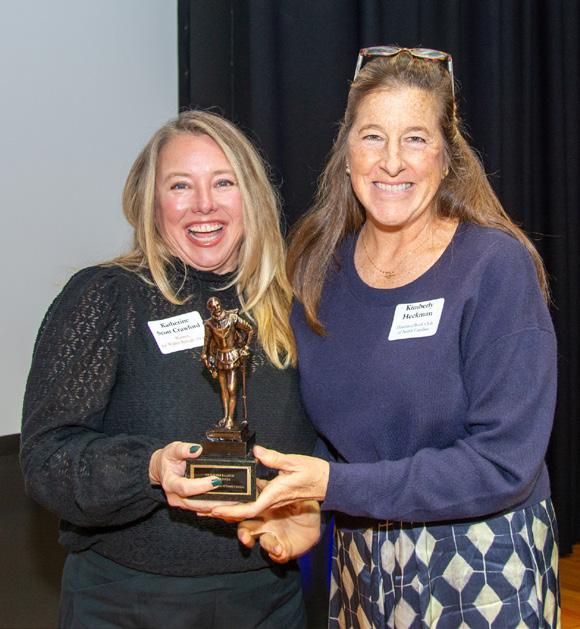
ences herself, as a border one can pass through. Art shows that while a person might be lost to history, their stories can still be rediscovered, or in other words, their stories never end, making people infinite. Like her ghost in the alley, the same one wearing a fox stole in the miniature Gamble labels “Lady. Anonymous, ca. 1804” (30). Gamble’s quest to uncover the girl’s identity and the miniature’s artist sets in motion her journey through time. Stepping out of the alley and into 1804 Charleston, she enters the Petigru siblings’ home and lives: Honor Petigru, the miniature’s subject and Gamble’s ghost and Honor’s brother, Daniel, the artist. Working side-by-side with Daniel, she not only begins healing following her miscarriage and divorce but also discovers the very connections that link those from the past, the wealthy, white Quaker Petigru, to those in the present and the violent history of slavery and racism that connect all. Gamble’s journey, then, reinforces the way that art immortalizes, continuing stories across centuries. Even
further, those who delve into those stories connect to those people, places, and times. For this reason, Gamble finds that there’s “something rarefied, even holy, about being around art” (30), and when art touches her, she feels “changed, a part of something larger. A member of humanity unbound by place and time” (78). This interconnectedness found through art blurs boundaries, letting other worlds and times touch our own, which in turn keeps alive the sense of wonder and magic often lost after childhood. All those whose lives art touches “grow distracted by other worlds, our heads in the clouds. Even when we walk through the here and now, it’s often difficult for us to clear away the fog of the ephemeral worlds in which we’ve been living. . . . some people –say friends who are in business, banking or law . . . assume we don’t live in ‘the real world.’ . . . They call us airheaded, fanciful, strange” (77–78). Here, Gamble echoes artists and writers across the ages like Percy Shelley in “Ode to the West Wind” where he wants the winds to carry his pages, to carry his words to others across time and space, thus immortalizing him, or Walt Whitman’s “Crossing Brooklyn Ferry” where he ponders how future generations will experience the same sights, sounds, and sensations as he does and the interconnectedness of people across generations. Time loses its linearity, a singular world its boundaries, and people become both eternal and linked across time through Gamble’s
wonder and art’s ability to transport her to new worlds.
It’s also her childlike wonder and awe that draws in all who meet Gamble, invigorating and enriching their lives. We see these aspects in Gamble from the beginning with Gamble delightedly referencing childhood stories in relation to her experiences and actions. When talking about her conservation and restoration of miniatures, she comments, “You don’t need all the king’s horses and all the king’s men when you have the right set of tools” (11). When her ghost in the alley disappears, she wants to dig into the mystery, not like an adult detective but like “Nancy Drew looking for a secret door” (18). And when she hears the evening bells toll their “time-ago, time-lost sort of
sound,” she touches her “heels together, à la Dorothy” (39). Despite experiencing “a miscarriage, a divorce, and a distinct disillusionment with the charm and welcome of the city” (4–5), Gamble retains her sense of wonder, reveling in the world and mysteries surrounding her. She never closes herself off but instead remains open to others (even though Tol tells her she gives her heart away too easily). Her delight is infectious. When she tells Tol he looks like the Chesire Cat, he replies, “‘Then that makes you Alice’” (34), and later tells her, “‘There’s mystery in you. A hundred stories’” (168). Daniel finds her “not of this world,” a “mischievous mythological creature plucked from the pages of a faery tale” (108, 109). In this way, Gamble
touches and transforms the lives of those she meets, sending out her own “reverberations” that ripple through the ocean of time and people. For both Tol, an orphan whose “story” is lost, and Daniel, grieving over the death of his parents, Gamble brings about healing, connection, and love.
Gamble’s story in The Miniaturist’s Assistant is about openness, understanding, and healing. Through her own life and the lives of those she touches – characters and readers alike – she shows the joy and enrichment gained when hearts and minds are open to the world and the stories that live in it. It’s this openness and wonder, in conjunction with art, that transforms history from the dead past to a living entity and connects us to those who came before. n
2025 SIR WALTER RALEIGH AWARD FOR FICTION
acceptance remarks by Katherine Scott Crawford
When I was very young, we would pile into the family station wagon, and disappear into the mountains of North Carolina – a place my ancestors had called home for centuries, though I really didn’t know that then. All I knew was that, as the tall pines and queenly firs whipped by the car windows, and the car slowed to a crawl, to me, the shadowed trails and blue mountains held adventure, history, and deeply-held secrets. And that every single time, it felt in my bones like a homecoming.
As a child of the Carolinas, I am profoundly grateful for this honor, and deeply aware of its significance.
My thanks to everyone involved with the North Carolina Book Awards – the North Carolina Literary and Historical Society and its board, the North Carolina Department of Natural and Cultural Resources, the North Carolina Literary Review, the Historical Book Club of North Carolina, and anyone I may have forgotten – for your dedication to recognizing the work of North Carolina writers and artists. Ours is a vital and special community, and I’m ridiculously proud and grateful to be part of it.
The Miniaturist’s Assistant is, at its heart, a novel that asks us to consider the wild and complicated
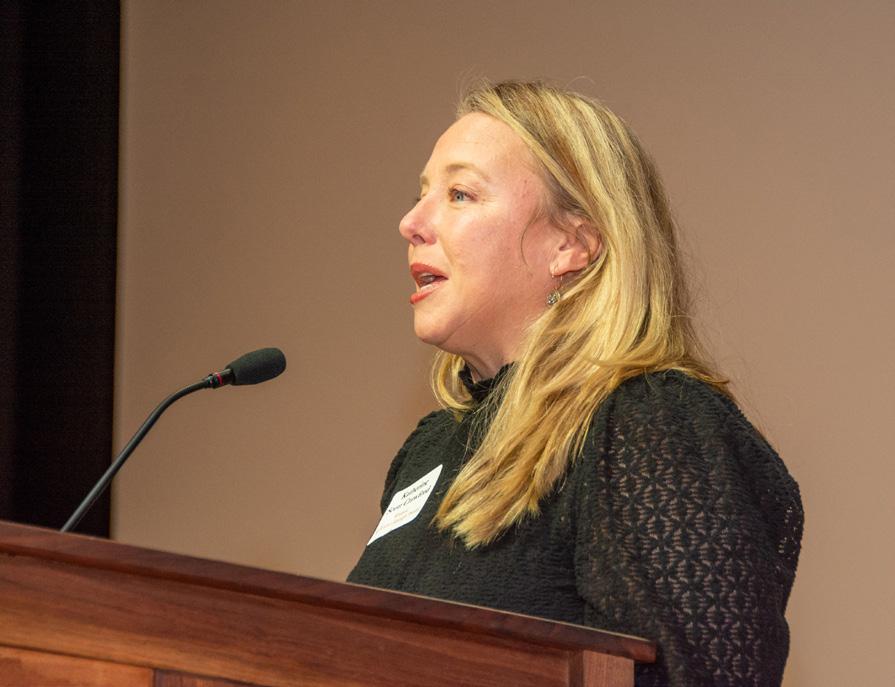
nature of our shared humanity. It was my attempt to play with the mysteries of time and history, to try and share what I know to be true: that history is fickle and porous, that there are holes in the surface of things. And that we all share the same stories.
There is infinite risk, and infinite loss, in believing that there is only one story to tell.
Thank you for seeing The Miniaturist’s Assistant, for seeing me, and all of us North Carolina writers in the room today.” n
2025 ALEX ALBRIGHT CREATIVE NONFICTION PRIZE WINNER
Foundation Issues
BY SUSAN WILSON
with art by Dru Scott Warmath
Our neighbor is banging away on something. Hammering, knocking, pounding, thudding; sometimes dull, sometimes sharp, sometimes slow, distinct and measured, sometimes rapid, muddled and chaotic. At first it was a mammoth swing set jungle gym for the children. Four boys, the youngest just three, the oldest eleven. All of them homeschooled. Then it was the daily hacking away at scrubby tilting pines that posed a danger to windows and shingles. Then it was something undetermined. Now it is a fence to fence in two dogs the boys received as a gift. They already had a small basset beaglesomething that often came over to do a walk about and flaunt his independence to my fenced-in retriever. The new dogs are Great Pyrenees. Each one weighs 140 pounds or so. Combined, all four boys might outweigh one of them. When the neighbor is not hammering together pieces of fencing the dogs are out. Barking at nothing and everything. Introducing themselves to the neighborhood over and over again. Shattering the peace of this quiet place. They bark when we walk our dog, they bark when we stand at the
kitchen sink to wash dishes, they bark when the sun comes up, they bark when the sun goes down. The boys often venture out and yell at the dogs to be quiet then shout pleas to their parents for assistance when the dogs are unresponsive to youthful voices. My own dog never lifts her head during these commotions. She remains uninterested in neighborhood gossip.
The neighbors ask if the barking is a bother. What does one say? The answer is an obvious yes and yet we are obliged to say, “Not too much. We hear them, but it isn’t too bad.” But we do not have young children that need to be sleeping. Or suffer from migraines. Or speak unfiltered.
The neighbors ask if the barking is a bother. What does one say? The answer is an obvious yes and yet we are obliged to say, “Not too much . . .”
At home, to each other, we lift eyebrows, sigh deeply and turn up the volume on the television. Trading one obtrusive loudness for another, we can drown out the barking for a bit. We wonder aloud what the other neighbors think. We wonder if, when the fence is complete, the dogs will be out all day. We wonder how the neighbors stand it themselves.
We were not the only neighbors to notice the incessant barking. It is alarming to have your door beaten on before 7:00 a.m. It is alarming when you open your door to a deputy sheriff. I wanted
prize. Read her honorable mention essay in NCLR Online 2021.
Final Judge Paul Crenshaw said of his selection of this story for the prize: “Some essays are subtle. They whisper instead of shouting. They allow the reader to come to the conclusion without cataclysm or fanfare. When the world is shouting, as it seems to be all the time now, I was drawn to this quiet essay. I think it’s hard to be subtle. It’s hard not to say too much, it is hard to trust the reader to pick up what you’re putting down. ‘Foundation Issues’ leaves hints, like Hemingway’s iceberg, that there’s a tremendous amount of story lurking just below the surface. A whole other world we can sense through the things not said. Through the hammering and noise. The loneliness and longing. Masterfully done.”
SUSAN WILSON is a North Carolina native and a graduate of UNC Chapel Hill. Her work has been published in Barely South Review, Flying South, and multiple anthologies. She has previously been a semifinalist, a finalist, and received an honorable mention for this
to tell him that, but I didn’t. A neighbor had lodged a complaint. That neighbor was a coward and used our address to lodge the complaint. We explained. He understood, said it happened more often than one might think. He asked about the dogs anyway. We explained again. Yes, they bark. A lot. No, we were not angry about it, or particularly inconvenienced by it. He advised the dogs should not be let out before seven-a.m. Perhaps that is a law, perhaps he made it up. It is a rural neighborhood; we expect the sound of animals. Coyotes often squeal and howl in the woods. They do not abide by the seven a.m. start of day rule. Neither do the birds once the sun rises. One animal’s constant sound a nuisance; another’s often welcome.
The neighbors called us after the deputy, who left us and drove up our long driveway and then down the long driveway of our neighbors, had chatted and advised them of the same 7 a.m. rule. We discussed the cowardly caller and promised our own neighborly courage to confront issues in person. We would never call the sheriff first. We would never call the sheriff at all in truth.
They started keeping the dogs inside most of the day. Their excursions to the backyard now clockwork in their routine. The first outing at 7:15 a.m. with barking to greet the day, the last at 8:30 p.m. with a hearty round of goodnights to all, and back inside by 9:45 p.m. The evening curfew must be 10:00 p.m. The deputy never mentioned that, but if there is a beginning there must be an end as well.
We don’t know these new neighbors well. We don’t know any of our neighbors well. We are an acre-plus community. The comfort of having a neighbor without most of the bother of having a neighbor. We know names, occupations, child status. We know if they have a dog. We do not check on each other though we notice when things seem amiss. We are quietly nosy while minding our own business.
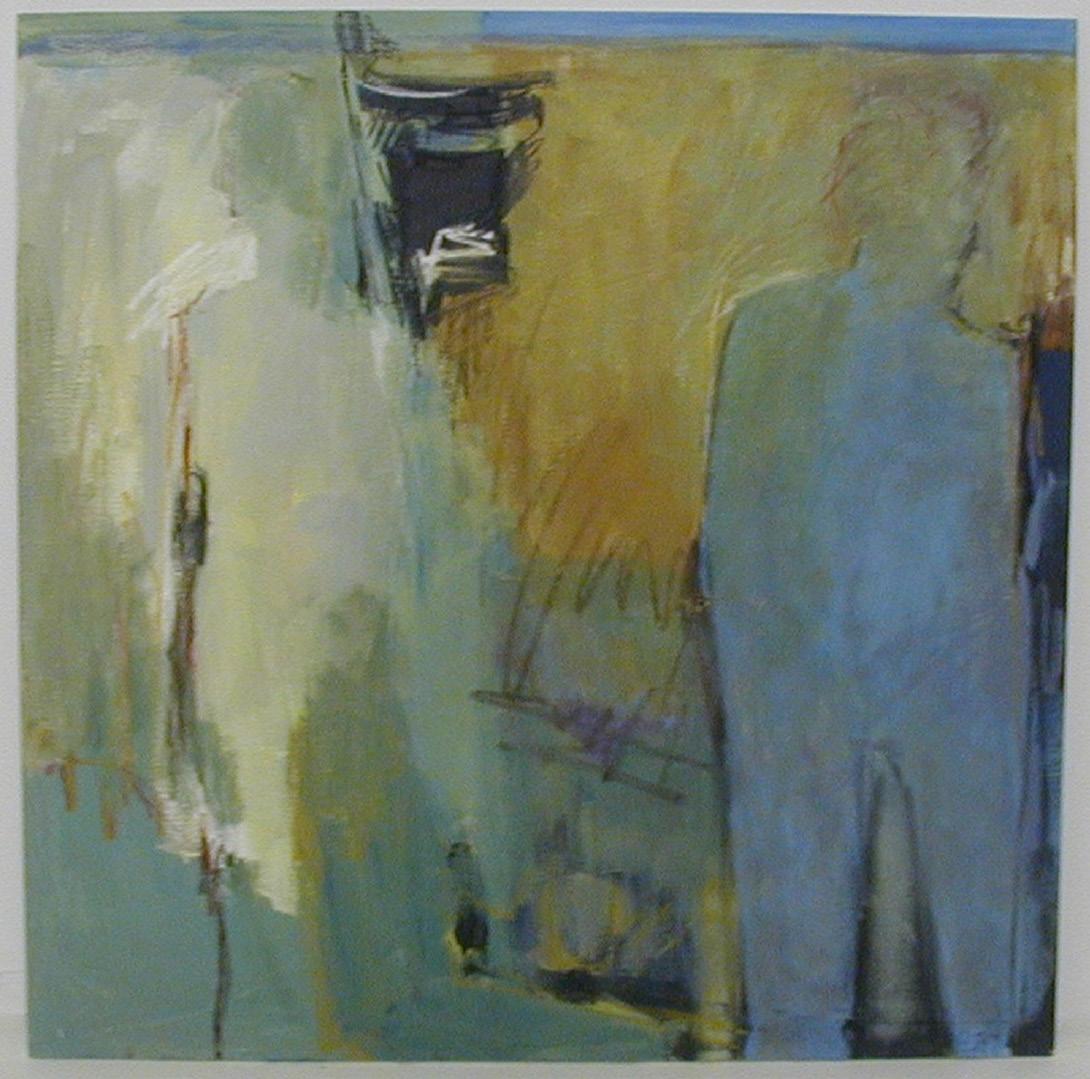
They are the third family to live in the house. The first were acquaintances with two children the same age as our oldest boys. They paired well, the older and the younger having similar interests. Two insiders two outsiders. Our youngest was still a toddler. He paired well with me. My youngest,
Charlotte, NC, artist DRU SCOTT WARMATH has been a full-time, professional artist since 1990. She is an elected member of the National Watercolor Society. Her art has won major awards in numerous regional and national shows and is in the collections of Arts & Health at Duke in Durham, NC. She is represented by Providence Gallery in Charlotte, NC, located in historic Myers Park.
Distance (oil on canvas, 36x36) by Dru Scott Warmath
my last, my speed bump to becoming someone else. My husband believes he saved our marriage. Saved is a strong word. Perhaps prolonged is more accurate.
The second owners were trashy. Literally. Their trash cans overflowed and seemed to live at the curb. We were thankful for our own tall, well-constructed fence. They often left home for the day with their front door open so their dogs could go in and out at will. Small dogs that never barked. They barely acknowledged their owners much less their neighbors or squirrels or delivery men. Their roaming was curtailed by a short chicken wire fence that extended from the front porch and enclosed their small front yard. A structure they removed when trying to sell the house. Despite the removal, the house languished on the market. We never dropped by during their open houses to assess the current state of the interior. The chicken wire spoke for itself.
The third owners, our current neighbors, confirmed our suspicions when we first met. The house needed work. Lots of work. Hence the constant banging. He is a handyman of sorts, good not only with power tools but large machinery. Forklifts and cherry pickers arrive and depart, and a small backhoe has taken up residence. He says there are foundation issues. Issues hard for neighbors to see.
Our youngest child has returned home. It is his turn. The older two left, returned, then left again. The oldest, being the oldest and fiercely independent, stayed only a few months. The second, the middle child, stayed over two years, content to take his time. Detours are often unavoidable even when the path seems straightforward. Plans so often not going to plan. The youngest is beginning graduate school. The university chosen with free housing in mind. Ten months of pleasant welcome company and cooking more meals and paying higher water bills. Ten months of distraction and pretending it isn’t so bad.
Then he will leave again. And we will be left with the constant banging. The constant barking an antidote to silence. The foundation still in need of repair. n
TWO WRITERS DIVERGED: NEW DESTINATIONS FOR SHORT FICTION
a review by
Rebecca Duncan
David C. Dickson. Down to the Root: Stories. Redhawk Publications, 2024.
Nathan Dixon. Radical Red: Stories. BOA Editions Ltd., 2025.
If a brief Internet dive into genealogy is correct, authors Nathan Dixon and David C. Dickson share a common aristocratic ancestor traceable to thirteenth-century Scotland. Both variations of this surname denote sons of Richard Keith, erstwhile royal bodyguards and custodians of the Crown Jewels. The family, which dispersed into Ireland, Australia, Canada, and America, forfeited its title when an earl joined the Jacobite Uprising in 1715.
Despite this shared family tree, one is hard pressed to find common ground between Dixon’s Radical Red and Dickson’s Down to the Root. Each of these collections takes the genre of short fiction to a new destination.
unhurried Southern voice giving each story added layers of depth and texture in the back corner of a little bookstore.
REBECCA DUNCAN is Professor of English and Director of General Education at Meredith College in Raleigh, NC. She teaches and writes on British and post-colonial literature. Her fiction and essays have appeared in Genre, Mosaic, Southeast Review, Journal of Commonwealth Literature , and Pisgah Review. Read her essay on Zoe Kincaid Brockman in NCLR 2019. She reviews frequently for NCLR
David C. Dickson’s characters in Down to the Root lead tough lives. A generation of bootleggers begets one of drug dealers running meth labs. Aging parents are seen as obstacles to a better life for morally empty, financially insolvent thirtysomethings. Some of these younger adults view murder as an acceptable solution to life’s challenges or a personal grudge. Yet a compelling storytelling voice draws us into these disordered lives, especially to the random encounters between strangers, both in Texas and North Carolina. A bartender and collector of motorcycle parts and memorabilia meets an artsy, cosmopolitan photographer. An aspiring documentary filmmaker, young and privileged, pursues a reclusive artist. Throughout the collection, the dialogue is fresh and authentic. It is not difficult to “hear” an
Dickson also works the fine line between the eccentric and the grotesque. In the title story, for instance, we follow Samantha Green up a remote and “greasy with carrion” (63) mountain road to find Danny Ray “Pinky” Pack, a black albino folk artist. Pinky creates masks and dioramas and carvings out of natural materials and leaves them on the roadside to be scavenged. Samantha’s mother was one such scavenger, and now she promotes Pinky to her wealthy friends. And so, along with Samantha, we expect to encounter the man who engaged with the mother’s cocktail party guests: “Wearing a second-hand Dashiki, jeans and brogans, he looked every bit the part of the outsider artist” (66). At his junk-littered home, however, Pinky presents more grotesquely, in nothing but cut-off jeans, his sunbaked skin translucent and unworldly. He unleashes a constant stream of sexual innuendos and shows the well-dressed, well-mannered Samantha crude renderings of genitalia and sex acts carved from tree roots. His concept of a film leans more toward pornography than art. Samantha rallies her inspiration and persists, but it is hard to imagine a reader who shares her concluding desire “to capture his existence on film” (76).
Our response to Dickson’s grotesques is intensified by a thoughtful choice of narrators. Like Samantha, the narrator who gives us the homicidal Mark Frierson in “Matters of Honor” is at first innocent and naïve. In
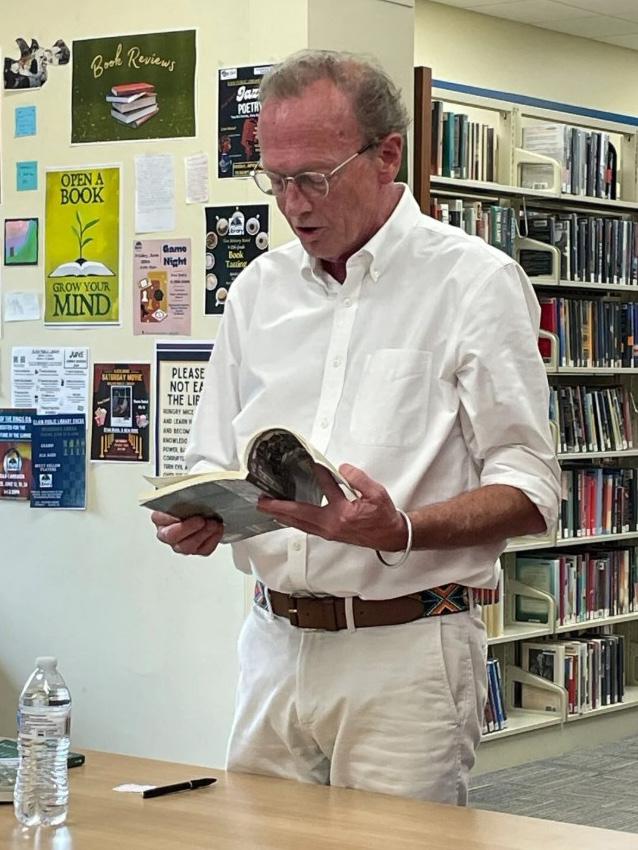
their youth, he and Mark bond over some stolen donuts (Krispy Kreme, of course). Against background noise of gossip about Frierson’s family, the narrator expresses sympathy for this boy and his strange appearance, mannerisms, and behaviors. As with Samantha, we have the choice to read with or against the narrator as he watches Mark slide from harmless eccentric into the darker realm of the grotesque.
Readers looking for redemption or even the hint of a moral compass in Dickson’s characters will be disappointed. These folks are more likely to rationalize their bad choices than to act on any beneficent insight they stumble upon. The most enlightened character, a detective of sorts tracking an extramarital affair, resolves his moral dilemma with a final act of dishonesty.
Nathan Dixon, in contrast, exposes the societal and personal shortcomings that Dickson’s characters are more inclined to ignore or conceal. Radical Red, winner of the BOA Editions Short Fiction Prize, announces itself as protest literature, and most of the interlocking stories take aim at political and cultural conservatism as it has emerged in the United States since the midtwentieth century.
These stories do not seem to aim for subtlety. They are written for readers who are dissatisfied with the current state of American politics and who want to stay that way until things change. From among the many forms and techniques available to fiction writers, Dixon has assembled a unique combination of allegory, parody, intertextuality, surrealism, and deus ex machina
Using ironic titles for the characters in place of names, Dixon asks us to read allegorically.
A conservative youth leader is simply “the president.” A friend who admires and supports her is “puppy dog boy.” Others serve as stand-ins for easily identified real people: there is a radioman with a prescription pain pill habit and a lustful televangelist. A “paunchy,” “bald,” “teetering” scientist disparages the “climate mafia,” and a “blonde news anchor” evokes a female stereotype prevalent on a certain conservative television network. Only four characters, all
powerless women and girls, are named. As a result, readers are encouraged to view the characters as ideas, rather than identify with them as individuals or respond to them with empathy.
Allegory also comes to mind in “The Doctor’s Declarations,” which reads like a nod to Nathaniel Hawthorne. A doctorturned-politician has received good attention from radioman and seeks the governor’s endorsement. At an event at the governor’s mansion, the doctor slips into a surreal, anachronistic wooded scene representing the country’s original struggle for freedom. The scene and its tone echo elements of Hawthorne’s “Young Goodman Brown” and The Scarlet Letter
The use of instructions, most exaggerated and dismissive, also asserts a parodic mood that continues in the characters’ actions and words. The president, for instance, calls on women to “use their lady smarts, not their lady parts” (65). Her pro-life rhetoric is gruesomely extremist, and at the university she expects the sort of princess treatment she enjoys at home. Throughout the collection, there is hardly a powerful man who can refrain from acting upon his most base sexual urges.
The parody amps up to the level of deus ex machina, most notably when a blemish on the president’s nose contorts into a phallic protrusion that awak-
ABOVE David Dickson reading from this short story collectiom at the Elkin Public Library in Elkin, NC, 7 Aug. 2024
DAVID C. DICKSON divides his time between Sherman, TX, and Surry County, NC, where he resides with his wife and two sons. He taught high school history for twenty-seven years and has twice attended the Wildacres Writers Workshop held each summer at the Wildacres retreat in the Blue Ridge Mountains. Read his short story “The Jumping Off Place” in NCLR 2000.

SUBMISSIONS ACCEPTED
Doris Betts Fiction Prize
Winner receives $250, publication in NCLR and a Pushcart nomination,
SEPTEMBER 15–OCTOBER 31
All finalists considered for publication and honoraria. All published stories nominated for the O. Henry Prize
Submission guidelines here
ens her sexuality and prompts shaming from friends and family alike. In “Mermaids in the Floodplain,” young conservatives attending a climate change denial conference are swept away in a flood. The doubleedged sword of social media raises the stakes of this literary
device, as a gloating viral post can abruptly pivot to the demise of self and others.
Intertextuality occurs in the collection’s dialogue between fiction and history. Each story is anchored in a set of epigraphs quoting figures ranging from Thomas Jefferson to Ronald Reagan and Bill Clinton. Beyond stagesetting, there is enough contradiction in these passages to foster further dialogue between historical perspectives and the fiction itself.
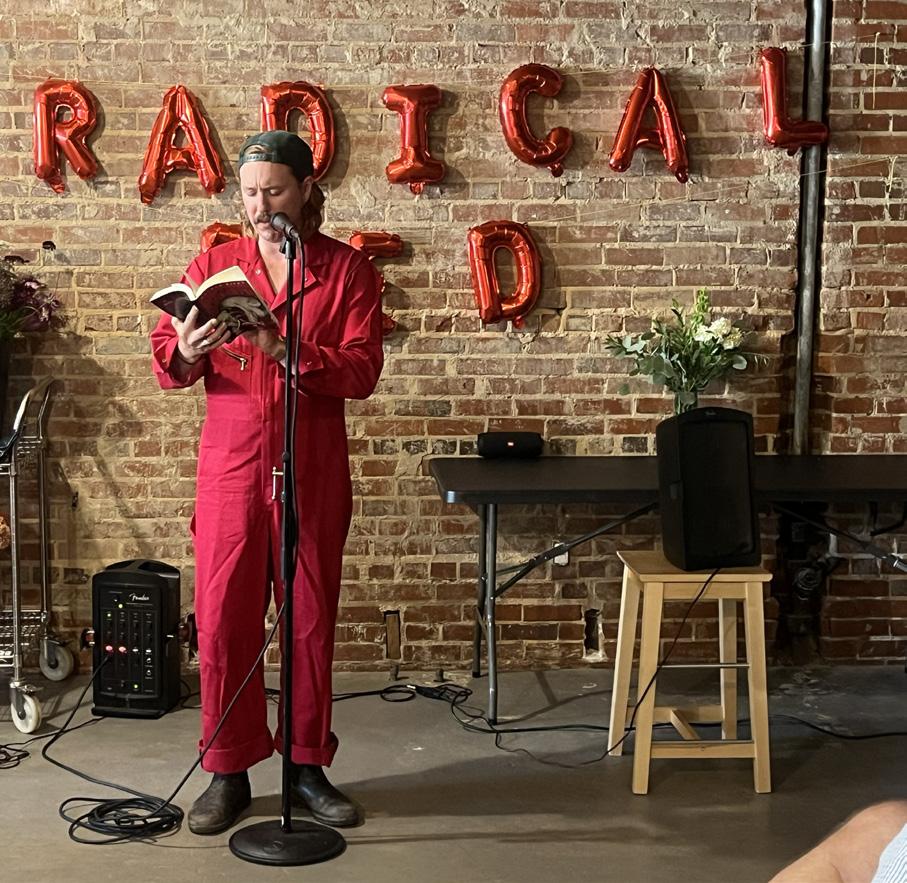
A contrasting and unique approach to protest literature appears in
“Unidentified Black Male” and “Conquistador,” the opening and closing stories, respectively. While distance and cynicism infuse the rest of the collection, these stories compensate with intimacy and an invitation to empathize. The “unidentified black male” is arrested and detained for no apparent crime, and he enters a system determined to break him in every possible way. The “citizen” in “Conquistador” undergoes a physical transformation from Caucasian to Latino. His dilemma is perceived internally and externally in his observation that “the whole world turned Mexican in a heartbeat” (184). The close third person narration invites the reader to witness and to feel each character’s emerging awareness and vanishing sense of self. These are stories with the potential to change us, if not the world, in a substantive way. n
HONORABLE MENTION, 2025 JAMES APPLEWHITE POETRY PRIZE
BY J.S. ABSHER
Mystic Neighborhood
A Canzone
Three ways on foot are open to the ponds, three ways to the waterside and the three hard benches beside the ponds to read or to take pictures of the ponds, the oaks and pines beyond, the yellow fringe of iris, the surface where heaven descends to become a pond, or vice versa, with upturned pines and oaks. Ponds easily become a daily custom, an hourly delight: at bottom, all our happiness is a pond with a high-branched mulberry to feed squirrels and birds, blackberries for me and the birds.
Our townhomes are turning fifty. The bird songs never age, the ponds renew with changing light, with paddling birds (mallards and honking geese) and wading birds (the visiting green and great blue herons). The bankside sustains our burrowing muskrat (she, shy as a bird, vanishes faster than a diving bird), Oxalis triangularis, purple so-called false shamrock (it’s toxic – beware!), bluebird, redbird, and goldfinch flitting by. Come summer, diatoms may turn the ponds slime green, symptom
the yardmen can treat, but not our symptoms: we’re becoming the debris of aging. The young succeed us; atom by atom the neighborhood renews. Tom just lost his wife of fifty years. She’d abandoned pond, her immaculately weeded garden, her custom of giving us cuttings. We have our phantoms, like Sue, that gifted gardener – by whose side our light is ash, she said – inside a psych unit hitting bottom. Louise’s old bones struggle to walk Bert, axis of her routine, her oasis
of cheer: she says they take the world as is. She asks about the stray tom then if I’ve seen the geese cross North Bend (it’s our busiest street) – the gander first, his head high to scout danger, she says; then five goslings birddogging him; then the goose, head down, ensuring all is moving in good order, that her treasure is intact, an egg concealed in the world-pond, for coyotes patrol the pond devouring whatever there is.
Louise walks on up the gently sloping hillside toward home, slow Bert by her slow side.
Not that we don’t have a harsh underside that shows itself in crisis.
Flounders with an eye side and a blindside, we’re apt to line up on opposing sides out of human nature, a sanguinary custom of envious, backbiting beasts with human outsides. Rooted in neighborhood, we should lay aside petty dislikes to peacefully watch birds, or watch our artist paint the birds, imaginary foals inside imaginary paddocks, paddlers in the ponds, or turtles basking by the ponds –
or foxes, muskrats, and snakes: they respond not to our yearnings, and so they reside in the heart of longing for the ageless real that is beyond our power. What are we at bottom –beautiful though toxic, singing but wingless birds?
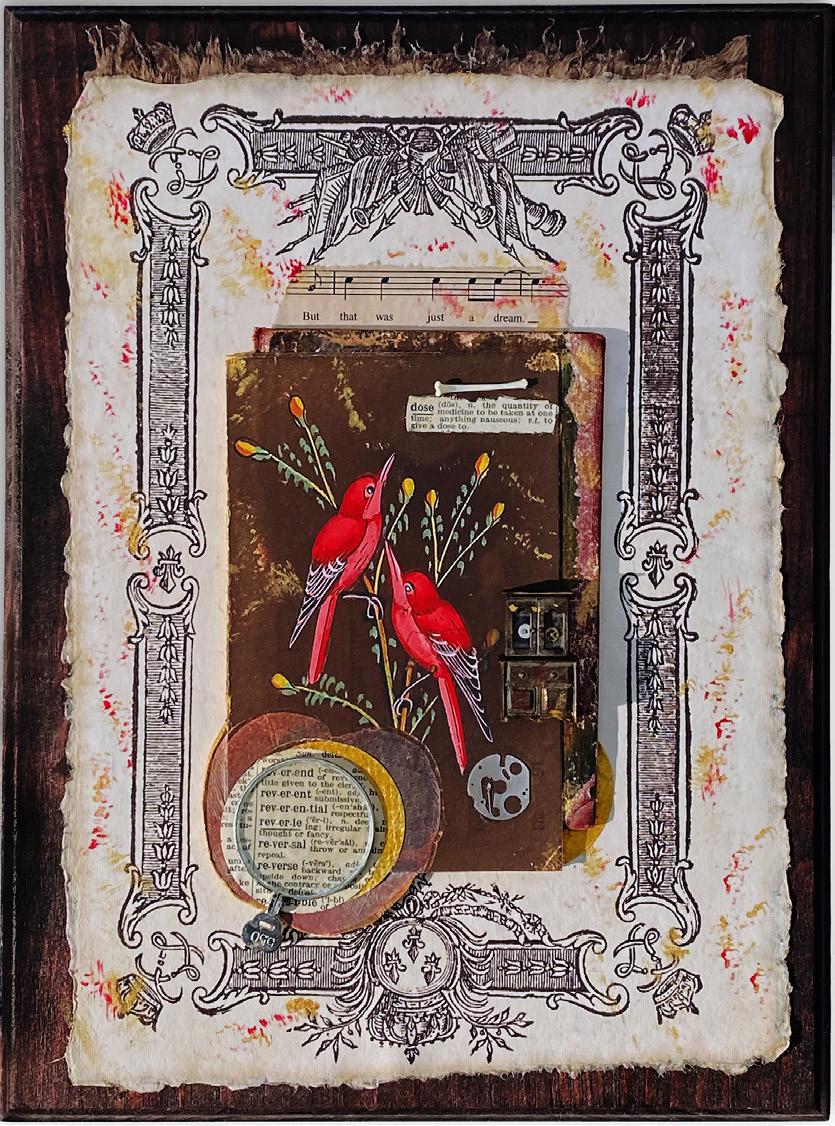
J.S. ABSHER is an eight-time finalist in the James Applewhite Poetry Prize contest. He has published two full-length collections of poetry, Skating Rough Ground (Kelsay Books, 2022; reviewed in NCLR Winter 2022) and Mouth Work (St. Andrews University Press, 2016; reviewed in NCLR Online 2017), winner of the 2016 Lena Shull Award from the North Carolina Poetry Society. His poems have won prizes from BYU Studies Quarterly and Dialogue and have recently been published by NCLR, The McNeese Review, Triggerfish Critical Review, New Verse Review, and Tar River Review. He lives in Raleigh, NC, with his wife, Patti.
JENN ADAMS was born in Cambridge, MA. She moved to North Carolina after over three decades in New York’s publishing industry. She holds a BA in Art History and Classical Civilization from New York University and an MA in Studio Art from a collaborative program between NYU and the International Center of Photography, including a semester in Paris. She has showcased her artwork in various venues across the US. She is a participating artist and member of the Orange County Artists Guild, as well as a participating artist and member of Triangle Book Arts. Her artwork is privately held, as well as in the collections of the McCabe Library at Swarthmore College and the Butler Library at Columbia University, among many others.
Viral Reverie, 2020 (mixed-media assemblage, 12x9x1) by Jenn Adams
PAYING CLOSER ATTENTION TO THE WORD AND THE WORLD: MCILVOY’S RADICAL REORDERING OF WRITERLY ADVICE
a review by Dale Neal
Kevin McIlvoy. Willingness: A Writer’s Meditations on Crossing the Flood. WTAW Press, 2025.
DALE NEAL , a lifelong North Carolina resident, was a prize-winning writer for the Asheville Citizen-Times . He is now the author of five novels published since 2009, including two published in 2025 (read reviews of both in NCLR Online Spring 2025 ). His novella Floodmarks is forthcoming from Regal House in 2026. Read more of his writing on his Substack, Dale Neal: Mountains & Rivers
KEVIN MCILVOY (1953–2022) is the author of several books, including One Kind Favor (WTAW Press, 2021; reviewed in NCLR Online Winter 2022). He is a recipient of a National Endowment for the Arts Fellowship in Fiction and taught in the Warren Wilson College MFA Program in creative writing from 1987 to 2019. He lived in Asheville, NC. Read Marjorie Hudson’s article on his life and work in NCLR Online Spring 2025.
Kevin McIlvoy never bought into the myth of the tortured artist. By his own account, he enjoyed his life as a writer and teacher, felt privileged to create books, to find meaning through art simply by paying more and closer attention to the world around him. Affectionately known as Mc to his friends and students, he signed his correspondence and copies of his novels, short story collections and poetry with the same complimentary close: “In Joy.”
McIlvoy could find joy in unexpected places and circumstances, like getting stung in the face by a swarm of whitefaced wasps while tending to his Asheville, NC, garden. He experienced “exquisite and instantaneous fiery pain that gave me an intimate reminder of my own unique ways of responding to what finds me that I never sought. Immediately afterward I had pleasure in remembering them calling me by name as they attacked: “Mmmmmmack! Mmmmmmmack! Mmmmmackmmmmmack-mmmmack!” (51).
Wonderfully funny and painful, wildly joyful. You can bet that McIlvoy spent time getting just the exact number of m’s in that sequence to convey just the right sound. He believed in writing that touches on pleasure and pain, that is unafraid of the dark luminosity of life.
McIlvoy even welcomed his own death with a premonition of a heart attack described in a funny story from his collection Is It So (WTAW Press, 2023) published after his death from a heart attack he suffered while playing tennis in September 2022. He was only sixty-nine
years old, but he left behind a legacy of stunning novels, short stories, prose poems, and poetry from his long career.
Now in Willingness: A Writer’s Meditations on Crossing the Flood, his widow and fellow writer Christine Hale has collected and seamlessly stitched together McIlvoy’s interviews and craft lectures (many delivered at the Warren Wilson College MFA Program for Writers where he taught for two decades.)
Instead of predictable linear chapters, Hale followed McIlvoy’s unique style, dividing the book along the lines of a Zen Buddhist koan. McIlvoy had a fondness for dynamically projecting both sides of an idea, balancing, shifting, doubling back, always making us think twice. Example: “Holding to a fluid understanding of unity, unify/Holding to fluid understanding of instability, destabilize” (21).
As his colleague Peter Turchi points out in his introduction, Willingness is no craft book in the traditional sense. Craft books are typically aimed at novice writers who want shortcuts and easy answers: How to Write Your Best Seller in 10 Easy Steps
Instead of workshop adages of Write What You Know, Show Don’t Tell, or reproducing a diagram of rising action along the Freytag Triangle, McIlvoy asks writers to look at revision more radically. Just as Einstein’s theory of relativity and later quantum mechanics upended the commonsense formulas of Newton’s physics, McIlvoy goes beyond craft formulas, exploring sentences and language on an almost subatomic level and
in space-time, searching for spooky actions and hidden variables in syntax itself.
He is upfront about his preferences for writing that radically decenters the writer and the reader, which can sound intimidatingly experimental in theory. In practice, McIlvoy likes the energies of the oral storyteller, with digressions and always surprises, the roundabout way rather than the linear get-tothe-point.
He distinguishes between art that aims for Completeness or perhaps fine technical control and the art of Fullness, which is more comfortable with mystery and ambiguity. He’s not particularly taken with the slide-and-glide prose that powers quickly over the surface, making the reader mindlessly turn the pages, a transactional process that gets to the plot and the point. He champions the wisdom tradition that makes the reader stop mid-page and suddenly think, gazing off into a middle distance, drifting through an expected door that the artist has opened.
McIlvoy’s “Willingness” may be a necessary antidote to the age of Artificial Intelligence and the current pirating of copyrighted novels to teach large tools how to mimic and mirror humanmade fiction and poetry.
ChatGPT made its debut in November 2022, only about a month after McIlvoy’s untimely death, but he may have proved prescient to its challenges. Why write a book in a style that a machine can mimic in only seconds?
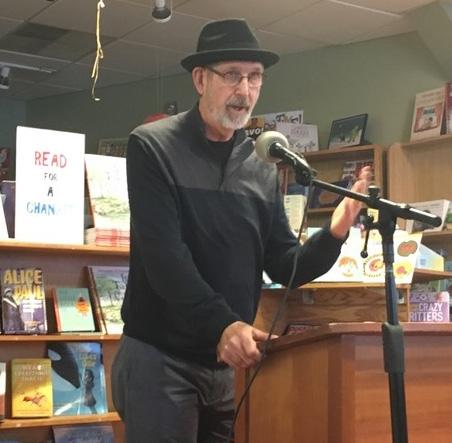
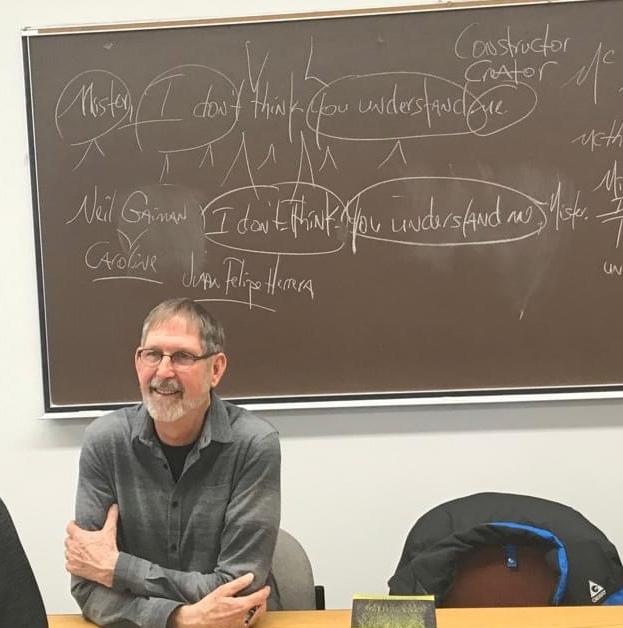
“Twenty-first century American realism has so dedicated itself to avoiding condemnation as “touchy-feely” that our work too often merely says instead of sings, articulates instead of expresses. We American writers lean on false assumptions that there is only, after all, one legitimate mode because there is only one dominant mode” (90). His teaching philosophy borrows liberally from the
Buddhism he practiced in later life, especially the Zen teaching of Beginner’s Mind, the idea that the novice has more options available than the narrowing and binary choices of a so-called expert. Thus, you get anecdotes of Zen Masters who treat serious inquiries from their students with seeming non sequiturs or even pulling their noses – the teacher’s trick for getting students out of their heads, their ideas, and into their physical bodies.
McIlvoy admits, “Any specific advice I offer you will be welcome and not welcomed, invaluable and useless, serious and foolish. If my ill-advised advice will provide a way for you to re-enter your draft and ask from within it how to more deeply respect its paradoxes, I regret/celebrate those blessed/ cursed conditions” (38).
McIlvoy is not against thinking or reasoning, nor is he saying merely trust your gut. McIlvoy urges writers to get out of their
ABOVE TOP Kevin “Mc” McIlvoy reading at Malaprop’s Bookstore, Asheville, NC, 2017; and LEFT in his classroom
rigid, rule-bound reasoning. Yes, look for the flaws in a draft, not so much to fix, but to explore more deeply. He gives permission to ignore that know-it-all inner critic who’s always looking over the writer’s shoulder, pointing out all the mistakes. Overthinking can lead to overcorrection when flaws in the work can be the writer’s friend. McIlvoy elaborates: “By such a method of correction you proudly and willfully identify the flaws you have caused in your novel. By this method you are not involved in willingly entering your novel’s flawtranscending qualities. You have placed your will over the will of the work” (26).
What Willingness offers the serious writer is a way of selfexamination by paying close attention to the sentence in revision, as well as cultivating the “long gaze,” or what the poet John Berryman called the “stance of wonder.”
It is that practice that makes the writer’s life not a tormented existence but “inherently a life of pleasure,” McIlvoy says (161). And the willingness to discard certainties, to probe at paradoxes, to explore the unknown energies swirling in the syntactical heart of sentences, he counts at the end of his career as a blessing.
And McIlvoy, with all his trademark joy, offers the same generous blessing to his readers.
“There is a gift before you, dear writer, and it is your own unique gift. Offer it your all. Be attentive to all that it offers you. It will not bring you more than the world (place of loving, place of being loved) brings you, but it will bring more of you to the world” (163). n
REMEMBERING THE POETRY OF BLACK MOUNTAIN COLLEGE
a review by Jeff Davis
Blake Hobby, Alessandro Porco, and Joseph Bathanti, editors. The Anthology of Black Mountain College Poetry. University of North Carolina Press, 2025.
The Anthology of Black Mountain College Poetry, years in the gathering, is at last at hand. It’s fascinating that so many Black Mountain faculty and students wrote poetry that’s survived the decades. From its founding to its closing roughly fifteen hundred people went through Black Mountain College as faculty or students. An amazing number of them (John Cage, Merce Cunningham, Robert Rauschenberg – the list goes on) went on to significant careers in the arts, sometimes revolutionary ones. Many others found a place in the world as educators. Many of them find voice here.
DAVIS is the producer of WordPlay, an Asheville, NC, talk show aired on 103.3 Asheville FM, and General Manager for the arts non-profit MadHat, Inc. He is a founding member of Asheville Free Media and was an instructor for the Great Smokies Writing Program. His work on Charles Olson has appeared in Appalachian Journal and elsewhere.
BLAKE HOBBY works as a Senior HR Leader. He is a former instructor at UNC Asheville and former executive editor of Black Mountain College Studies. He received his MA from the University of Dallas and his PhD in English Language and Literatures from the University of Miami. He lives in Phoenix, AZ.
There’s nothing in this collection to displace the historic ten poets –among them Olson, Creeley, Dorn, and Duncan – identified as “Black Mountain Poets” in Donald Allen’s still historically useful New American Poetry, 1945–1960. They had such an impact on the measure of American poetry, written (and spoken) in the second half of the last century, down to the very roots of poetic prosody, and their gifts continue to resonate through the worlds of writing nearly seventy years since the college closed its doors. This new volume, while it includes work of the original ten – different works than in Allen’s anthology – is a much more inclusive look at the scene. It expands our view of Black Mountain College and the poetry that found voice because it was there.
PORCO is an Associate Professor at UNC Wilmington. He received his BA from Queen’s University, his MA from Concordia University, and his PhD in English (in The Poetics Program) from the State University of New York at Buffalo. He is the author of The Jill Kelly Poems (a misFit book, 2005) and Augustine in Carthage, and Other Poems (a misFit book, 2008). His research centers around twentieth-century AngloAmerican literature, with an emphasis on poetry and poetics.
JEFF
ALESSANDRO

This anthology includes writing from many we do not know primarily as poets. Josef Albers, who did so much to define the character of the college as its rector and is best known as a painter and masterful teacher of painting, surfaces here as a poet, too. Ray Johnson, a collagist and artist, and John Cage, musician, painter, and sage of Silence (1961), likewise. The poems of Lou Harrison, best known as a pioneering composer and musician, remind us that he was indeed also a poet. Jonathan Williams’ Jargon Society published his collection Joys & Perplexities in 1992, long after the college had become constellations of memories.
Some here we don’t know as artists at all. Creativity was not limited by genre or medium, or even by an artist’s avocation. Everyone at Black Mountain
studied the full range of the arts. Poets, mathematicians, dancers, painters, and weavers all ate together in the one dining hall, all hashed out ideas with each other on its steps overlooking Lake Eden and in the studios.
Some of the works here are by writers whom we might know very well as poets, but whom we wouldn’t think to categorize as “Black Mountain poets.” Galway Kinnell, May Sarton, and Russell Edson, for instance, come to mind. Some who would have qualified for Allen’s collection, but whose work hadn’t yet begun appearing by 1960 (Michael Rumaker, Hilda Morley, and Paul Metcalf) sparkle up from the table of contents. The editors, thankfully, have looked far and wide. All whose work finds a place here responded to the unique
JOSEPH BATHANTI is MacFarlane Family Distinguished Professor of Interdisciplinary Studies at Appalachian State University and the author of several books of poetry, fiction, and nonfiction. A native of Pittsburgh, he came to Huntersville, NC, as a volunteer with VISTA, working in prison outreach, and has served his second home state from 2012 to 2014 as North Carolina Poet Laureate. His numerous honors include the North Carolina Award for Literature and induction into the North Carolina Literary Hall of Fame. Read more about him in “Celebrating the 2024 North Carolina Literary Hall of Fame Inductees” in NCLR Online Winter 2025
ambiance of Black Mountain College, its openness and love of experimentation. May Sarton, for instance, described her 1940 visit to Black Mountain with clear enthusiasm: “I am being used . . . to the top of my energies and bent . . . and it is wonderful. . . . People come at all hours and sit on my bed. . . . I am seeing so much that my eyes burn all the time and my mind bursts like a rocket. . . . I feel so busy inside it’s wonderful” (131).
This rich anthology is a testament to the spirit of the very special place and time, to the unique chemistry of intentional principles and accidental characters that, now more than at any time during its short institutional life, make Black Mountain College a beacon for writers, artists, and educators around the world. If this anthology piques your interest in the phenomenon that was Black Mountain College, there are now more ways to follow up than ever before. Michael Rumaker’s Black Mountain Days (2012) remains a vital testament of the last years, and Mary Emma Harris’s The Arts at Black Mountain College (2002) beautifully covers the work at the College of the many artists whose education stood at the center of its mission. Start anywhere but be careful. You might be swept up as the fascinating stories unfold.* n
* Black Mountain College is the featured subject of the 1995 issue of NCLR. See additional Black Mountain College content in the 1996, 1997, 2002, and 2025 NCLR issues
ABOVE Lake Eden, near Black Mountain, NC; from the North Carolina Postcard Collection, Photographic Archives, Wilson Library, UNC Chapel Hill
ART AS PRACTICE
a review by Sayantani
Dasgupta
Dorianne Laux. Finger Exercises for Poets. W. W. Norton & Company, 2024.
When the opportunity presented itself to read and review Finger Exercises for Poets, I said “yes” despite or perhaps because I have taken only one poetry class in my entire life. Though I am no poet, at least not yet, I do share a close bond with the task and wonder that is daily writing. I write (and teach) fiction and creative nonfiction, and I seek writing prompts of all shapes and sizes. In recent years, in addition to journaling in the morning over coffee, my daily writing practice has come to include flipping open a book of writing prompts, choosing one at random, and responding to it. It goes without saying that nearly every single time I do this, I am surprised by the direction and turns the writing takes, even if at first read, the prompt may appear lackluster to me, almost to the point of prompting me to ignore it completely.
My mother played piano. She would say she “practiced” piano. Every day before she began to play, she did what she called “finger exercises.” . . . My instrument is the immensity of language, the techniques and effects of crafting images, shaping sound and rhythm. . . . There are eighty-eight keys on a piano, six hundred thousand words in the English language. The patterns, sequences, and permutations of both are endless. (xiv)
From here, each chapter of Finger Exercises guides its readers through one or more lessons, poems that serve as examples of the technique(s) at work, followed by prompts. My favorite chapter, “The Personal Universe,” begins by asking questions such as, “what makes your voice uniquely your own?” (19). It introduces the reader to the poet Ruth Stone, born in 1915, 2002 recipient of the National Book Award when she was eighty-seven years old.
SAYANTANI DASGUPTA, born in Calcutta and raised in New Delhi, is the author of Women Who Misbehave (Penguin Random House India, 2021) and Brown Women Have Everything: Essays on (Dis) comfort and Delight (University of North Carolina Press, 2024) reviewed together in NCLR Online Spring 2025 ). Her previous books include Fire Girl: Essays on India, America, and the In-Between (Two Sylvias Press, 2016) and the chapbook The House of Nails: Memories of a New Delhi Childhood (Red Bird Press, 2016). An Associate Professor of Creative Writing at UNC Wilmington, she has also taught in India, Italy, Colombia, and Mexico.
I approached Finger Exercises with a similar mindset. It posed an extra challenge because it’s aimed at poets more so than prose writers. I settled into my role as novice poet but one eager to learn and expand her horizon. The first indication that I was in good hands came through in the introduction when Laux shares her reason for writing this book, the concept of “art as practice at mastery”:
When I came across these details, I reread them several times, marveling at how deftly Laux reminds the reader that art and creativity are for everyone, at any age. There isn’t one “right” age or time for publication, though it’s probably one of the most frequently asked questions from students in any creative writing classroom.
The first of Stone’s poems we read is “Pokeberries,” which Laux
DORIANNE LAUX’S latest collection of poetry is Life On Earth (W.W. Norton & Company, 2024). Norton also published her Only As the Day is Long: New and Selected Poems (2019; reviewed in NCLR Online 2021), which was a finalist for the 2020 Pulitzer Prize for Poetry; The Book of Men (2011), which was awarded The Paterson Prize; Facts About the Moon (2005), which won the Oregon Book Award and was shortlisted for the Lenore Marshall Poetry Prize; and the celebrated volume The Poet’s Companion: A Guide to the Pleasures of Writing Poetry (1997), which she co-authored. Laux is also the author of three collections from BOA Editions, Ltd.: Awake (1990); What We Carry (1994), a finalist for the National Book Critic’s Circle Award; and Smoke (BOA Editions, Ltd, 2000). Red Dragonfly Press published a fine small press edition of her The Book of Women (2012). Laux taught at NC State University, as well as University of Oregon and Pacific University.
analyzes for craft tools such as voice, imagery, and colloquialism, then moves on to the poem “Curtains,” also by Stone. It’s the most unexpected kind of mourning poem. The last line could be read in so many ways. Is the outburst one of anger, passion, or complaint? Or is it playful and meant to be laughout-loud funny? It’s the best kind of text because it grants permission to the reader-writer to take similar risks in their own writing and imagination and go to unexpected places. The writing exercise accompanying this chapter – to curate a hundred words that might describe our personal universe – is also seemingly simple, but so unique and useful.
Two chapters – “Death and the Passage of Time” and “Why Poetry?” – are perhaps less craft lessons and more medita-
tions. I have now learned of the Japanese Zen practice of writing death poems and read similar poems by Rumi and Rabindranath Tagore. My favorite, however, is the playful yet poignant “When I Die” by Rochelle Germond. The book ends with about twenty additional prompts, each paired with a matching poem.
Having now read through the book and having attempted at least one exercise from each chapter, I am happy to report that I have ended up with nearly twenty flash essays/prose poems. These are early drafts, far from complete, but they are headed somewhere interesting. Thanks to Finger Exercises, I have found poets whose voice I loved so much that I have looked them up and found more of their work to read. I have thoroughly enjoyed and learned
from the sheer variety of poems Laux has included. If there are “political” poems such as “Rock Me, Mercy” by Yusef Komunyakaa (though one can perhaps argue that every poem is political), there are also “blessings” such as “blessing the boats” by Lucille Clifton.
Finger Exercises will serve as a useful guide to anyone who wishes to read more poems, beginner or seasoned poets who wish to acquaint themselves better with the nuts and bolts of writing technically strong poems, non-poets who wish to generate new writing, whether poems or otherwise, and teachers who wish to bring new ideas into their classrooms and workshops. The reader will find a wise and warm teacher in Laux. My admiration for the book extends to its bright, thoughtful cover and its terrific title. n
BLESSED MEMORY
a review by Jim Clark
Lee Zacharias. Remember Me. Unicorn Press, 2024.
JIM CLARK is Professor Emeritus of English at Barton College in Wilson, NC, where he was the Elizabeth H. Jordan Professor of Southern Literature from 2007 to 2019 and served as Dean of the School of Humanities. Some of his honors include the Randall Jarrell Scholarship, the Harriette Simpson Arnow Short Story Award, and the Merrill Moore Writing Award. He served as the President of the South Atlantic Modern Language Association in 2015 and the Chair of the North Carolina Writers Conference in 2017.
LEE ZACHARIAS is Professor Emerita of English at UNC Greensboro. She served as editor for the Greensboro Review for ten years. She is the author of several books, including fiction and nonfiction. Two of her novels received the Sir Walter Raleigh Award for Fiction: Lessons (Houghton Mifflin, 1981) and Across the Great Lake (University of Wisconsin Press, 2018; reviewed in NCLR Online 2020 ). Her numerous other publications include essays in NCLR 2004 and 2008.
Perhaps I shouldn’t begin this review by admitting that the first thing that popped into my head when I looked at the cover of Lee Zacharias’s lovely little collection of essays Remember Me is the early 1960s doo wop song by The Earls “Remember Then,” with its unforgettable earworm bass vocal intro “Re-Mem-MemRe-Mem-Remember,” etc., etc. But then, that’s why we retain memories, right? Because they are unforgettable. And I could well imagine Zacharias’s largerthan-life, ebullient father-in-law, (“Koke”? or is it “Pap”?) vividly rendered for us in the book’s second essay, “Across the River,” liking that song. I thought of other things, too – the old spiritual “Do Lord Remember Me,” for instance. But since I am now in my seventies and memento mori are everywhere, I thought of the sweetly touching Jewish condolence now appropriated by just about everyone, “May his (or her) memory be a blessing,” because that’s what this little book offers the reader, blessings of various kinds.
The book itself is unique due to its brevity – just seventy pages long. Too long, perhaps, to qualify as a chapbook, and one generally thinks of those as short collections of poetry, rather than prose. A gift book, then, or a keepsake. Or, given the reputation of the book’s publisher, Unicorn Press, an example of the art of the book. I belabor its taxonomy only so as to suggest that Remember Me is a special little book. One final thing to note about the book is that, appropriately, it is prefaced by a dedication – “In memory of James Lester Clark 1945–2017.” Many North Carolina readers will recognize him as the Jim Clark who was the
long-time director of the MFA Creative Writing Program at the University of North Carolina Greensboro.
The first essay, “The Village Idiot,” is a fondly indelible portrait of Wayne, the neighbors’ developmentally disabled son who spends most of his days playing with the neighborhood children, even though he is on the cusp of adulthood. More than that, though, the essay is a tour de force of regional writing, recreating for the reader a gray, gritty midwestern community just as it is teetering on the edge of becoming a part of “the rust belt.” “Our fathers worked in the steel mills and oil refineries; our mothers stayed home,” Zacharias writes. “We were Leave It to Beaver without Ward’s whitecollar wisdom or June’s pearls . . . children born since the war” (5). Because of his unique position within the neighborhood – omnipresent and generally tolerated, despite Zacharias’s mother’s fear that he might be the rumored neighborhood Peeping Tom – Wayne wanders from house to house picking up and distributing bits of news the neighbors might otherwise never know about each other. Zacharias relates Wayne’s role in her community to the figure of “the village idiot” in European folklore with the eloquent realization that “We were mistaken to think of Wayne stalled in time, as if he would not travel with us. All these years he has been by our sides, though we were so blinded by our futures, so arrogant with health and certain of our luck, we did not know it was the idiot who made us a village” (14).
If a community can be said to offer one sort of blessing, family can offer another, and as previ-
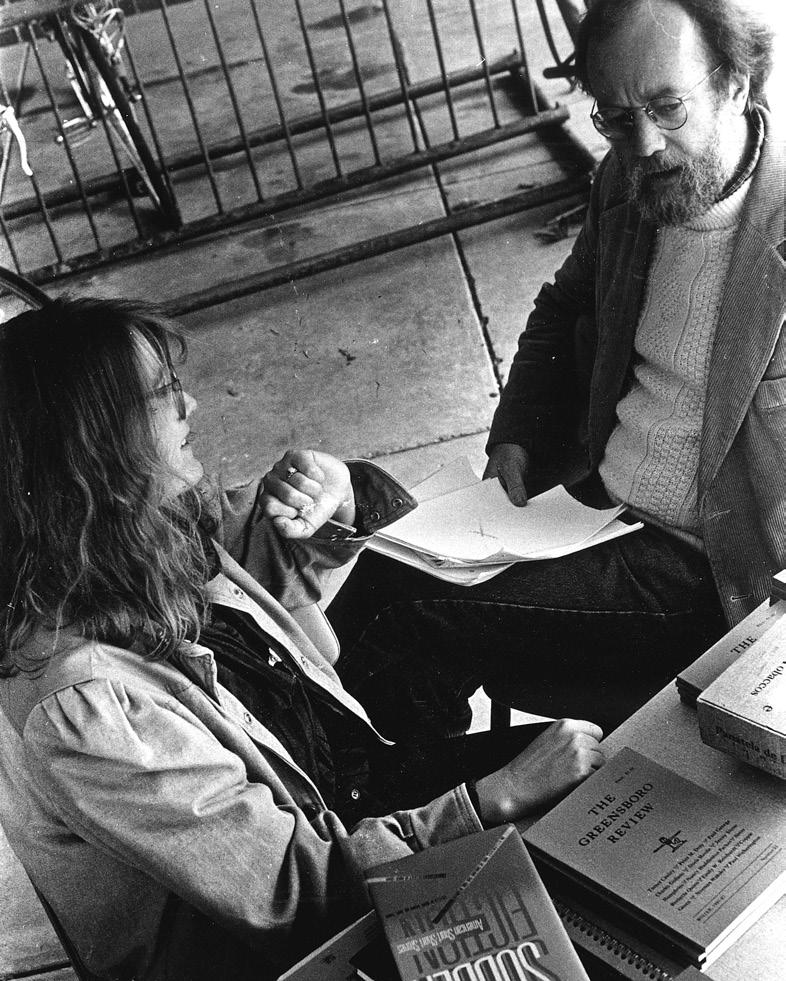
ously mentioned, the second essay, “Across the River,” brings to life Zacharias’s father-in-law, Alman Gaspeny, so vividly he seems to leap from the page with his pill bottles full of saved rubber bands, giant bottle of Listerine with which he always washed his hair, his crabbiness, his tenderness, his mastery of penny-ante poker, and his trademark dismissal of his own mortality with, “Hell, I’ll be crossing the river soon” (16).
And yet, “crossing the river” is exactly what the entire last half of this essay focuses on –the final month of Alman Gaspeny’s life – and it is the most riveting, wrenching, tender, and transcendent account of death I have read since I first encountered Katherine Anne Porter’s short story “The Jilting of Granny Weatherall” so many years ago. Taking her tack from the Victorian tradition of deathbed transcription in which
a scribe was posted by the bedside of a dying person to record his or her final words, Zacharias lovingly travels with her father-in-law on “our own private tour of death” (33). The scenes play out, sometimes sublime, sometimes mysterious, sometimes ridiculous. “You’re exhausted,” the nurse finally tells her, “You need to get some sleep.” At 4:30 a.m. she calls to say, “He wasn’t going to die in front of you,” and at long last, Alman Gaspeny has crossed the river (34).
The blessings of friendship can often be complex, conflicted, even fraught, and it is this complexity Zacharias explores in the book’s third essay, “Inside the Palace,” a eulogy for her friend Tom who committed suicide. Charming, handsome, wickedly humorous, but also perfectionistic, Quixotic, and prone to bouts of brooding depression, Tom is almost the prototype “difficult friend.” Known for his amazing garden, Zacharias describes it as “perfect”; Tom would “grow angry and rip it out” if it was anything less (36). When his beloved dog Betsy is run over by a car, grief stricken and wracked with guilt, he comes to believe she has returned from the dead and revealed to him a scientific theory, “something to do with the brain having evolved out of the stomach” (42), and sets off
on a manic quest to prove it, hoping to win the Nobel Prize, even as he is flunking out of vet school. And yet despite his obvious problems and shortcomings Tom remains a fascinating and unforgettable character, a credit to Zacharias’s abilities as a writer, as well as her humanity.
In “The Bride Beneath My Bed,” the book’s final essay, Zacharias tackles the mystery of identity. “Know thyself” is probably the oldest philosophical injunction of the Western world, inscribed over the entrance to the Temple of Apollo at Delphi, and a judicious appraisal of oneself may well be the source of all other blessings. Who, or what, are we talking about when we say “I”? The oracle Zacharias consults to attempt to unlock this mystery is her own youthful self, metaphorically embodied in the wedding gown from her first marriage, stored underneath the bed. Stylistically, Zacharias pulls out all the stops for this bravura piece. Part lyric essay, part rhapsody, and claiming distant kin such as Judy Syfers’s “I Want a Wife,” or even Sylvia Plath’s “Daddy,” “The Bride Beneath My Bed” ultimately becomes Gilbert and Gubar’s Madwoman in the Attic by the time Zacharias has completed her “autopsy.” And yet, ever the empathetic humanist, Zacharias concludes this essay, and her book of remembering, by acknowledging, “[A]ll she wants – all she ever has – is for me to find her and say, Hello. It’s okay, you can stay with me, you’re safe here. I remember you” (68). Powerful stuff, such memories, such blessings. n
ABOVE Lee Zacharias with her colleague, Jim Clark (not to be confused with the Jim Clark who wrote this review) at UNC Greensboro, 1983
NATURE AND WRITING MEMOIR FROM APPALACHIA
a review by Rebecca Godwin
Jennifer McGaha. Bushwhacking: How to Get Lost in the Woods and Write Your Way Out. Trinity University Press, 2023.
REBECCA GODWIN, Professor of English Emerita at Barton College, is a board trustee and vice chair of North Carolina Humanities. She serves on the boards of the North Caroliniana Society and the Thomas Wolfe Society and twice chair of the North Carolina Writers Conference. Her scholarship on such writers as Fred Chappell, Lee Smith, and Robert Morgan has been published in Mississippi Quarterly, Pembroke Magazine , and Southern Quarterly, and she is the author of Community Across Time: Robert Morgan’s Words for Home (West Virginia University Press, 2023; reviewed in NCLR Online Spring 2024. Read her interviews with Morgan in NCLR 2014 and NCLR Online 2017
JENNIFER MCGAHA is an Appalachian native and former coordinator of the Great Smokies Writing Program at UNC Asheville, where she still regularly teaches. Jennifer is the author of three books including The Joy Document: Creating A Midlife of Surprise and Delight (Broadleaf, 2024; reviewed in NCLR Online Spring 2025 ). Her writing has also appeared in many magazines and literary journals, including Image, The Huffington Post, The New Pioneer, and Lumina Bushwhacking is a Thomas Wolfe Memorial Literary Award finalist.
In Bushwhacking: How to Get Lost in the Woods and Write Your Way Out, Appalachian memoirist Jennifer McGaha offers advice for writing and living, weaving encouragement and gentle instruction for keeping pen to paper into personal narratives of running, mountain hiking and biking, canine and human friendships, frustrations and achievements. Fewer than two hundred pages, this book is accessible to a general audience and suitable for a classroom of beginning creative nonfiction writers, particularly those leaning toward personal essays and memoir. While McGaha rightly confides that her book shares “nothing new . . . no groundbreaking, insider tips about the writing life” (xiii), she also rightly suggests that her particular framing and analogies will appeal to many readers. Vivid imagery and narrative action make gems of conventional wisdom relatable and memorable.
North Carolina’s mountains provide a spectacular setting for McGaha’s personal narratives. Her descriptions of natural formations such as Caesars Head and Looking Glass Rock tout the area’s beauty, with details such as mountains’ heights or dates of fires showing that she did her homework to include facts complementing her observations of breathtaking views and soaring peregrine falcons. Each of the fourteen chapters begins in the great outdoors, with scenes of long-distance runs or hikes or training muchloved dogs to be running companions. Through these narratives, McGaha establishes her love-of-nature credentials as well as her athleticism, both
promoting a healthy lifestyle that readers would do well to emulate. Her appreciation of her Appalachian home – its black balsam, Pink Beds, and bears – gives all readers a lesson in observation.
McGaha finds parallels between her outdoors adventures and writing, and she smoothly integrates these two themes. The power of nature to teach and transform us threads into writing’s ability to do the same. Observing our sensory experiences in the woods correlates to the necessity of using concrete details evoking the five senses to convey abstract ideas. Taking detours or stopping to contemplate when running or hiking mirrors the course that writers take to find their point. Focusing just ahead, not too far in the distance, helps writers as well as bikers feel confident in their ability to complete the journey, not worrying about the “big picture” before grasping it but conceiving of the project in “manageable chunks” (54).
Readers leave Bushwhacking with mental pictures of a sweating McGaha pushing herself to complete a long run or bike ride, relating that concrete image to the challenging task of making words, sentences, paragraphs, and chapters coalesce into a meaningful whole. The book’s consistent return to such analogies creates its satisfying unity. Other strategies and writing prompts scattered throughout the book give writers and instructors helpful direction. And as personal stories embody permission to fail or a challenge to push out of one’s comfort zone in writing and life, they help readers to see themselves
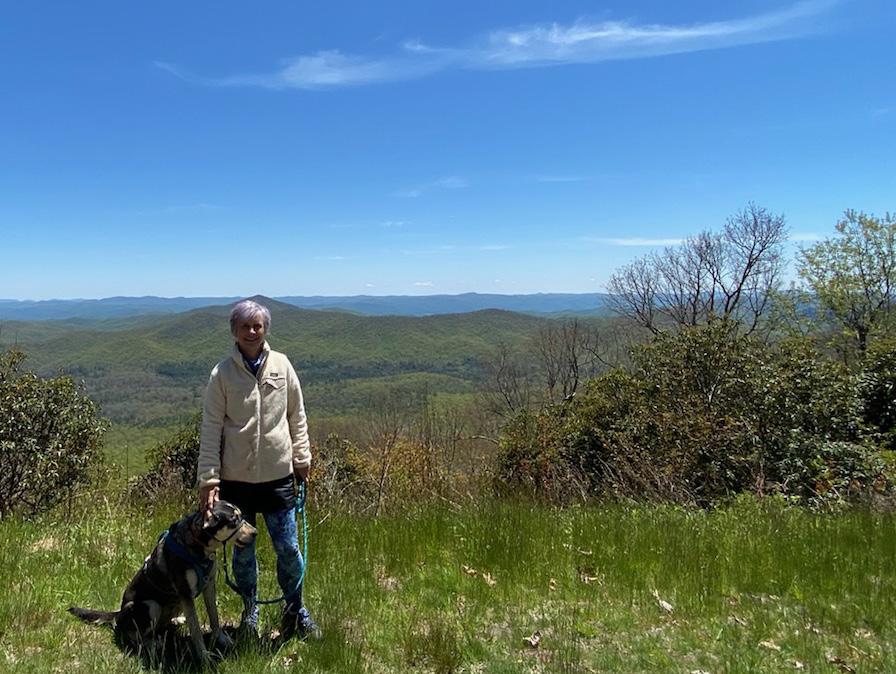
as vulnerable but capable human beings, seeking like their fellow travelers a way to make meaning in a messy world.
Along with her memoir Flat Broke with Two Goats (2018), a narrative growing out of her move into a century-old cabin after losing her home because of financial mistakes, McGaha references other books and writers whose lessons in the writing life she admires. Annie Dillard, Louise Dickinson Rich, Ann Patchett, Connie May Fowler, and Robert Olen Butler are among the luminaries she cites, a plus for readers wishing to broaden their reading about the art of writing. Using wisdom from such writers along with her own experiences in graduate classrooms and woods, McGaha gives particularly useful advice
for discovering one’s point and steeling oneself against criticism when writing memoir, a genre making negative responses feel personal. As she clarifies that memoirists are in charge of readers’ reactions and explains that she has to keep revising to discover and release her own emotional truth about events, especially painful ones, we see McGaha writing as the teacher she is, sharing honestly that writing well requires time, persistence, and respect for the joys it brings. One of the book’s best points is the referencing of a podcast clarifying that remembering alters original memories over time. These discussions and others enhance the book’s value for memoirists.
Readers need not find themselves most at home in the
woods, as McGaha does, to identify with her quest for a meaningful life. What she has learned by completing an MFA at age fifty, challenging herself to run marathons, overcoming physical fears and self-doubts, seeing work through to publication, and embracing the natural world becomes a philosophy of risk and acceptance that she willingly shares with the rest of us. As she begins and ends Bushwhacking with the COVID pandemic, explaining how she and her family dealt with the isolation and uncertainty, she reminds us that pushing ahead despite ambiguities, worry, and grief taps our inner resources. While we wish that she had credited Walt Whitman and not just Bob Dylan when saying that a joyful crowd gathering to hear live music when pandemic distancing requirements lifted “contained multitudes” (185), we appreciate the positivity, practicality, and clarity that McGaha conveys in this book. May she continue bushwhacking, discovering new routes to help us chart our own journeys on the page, in the woods, or wherever we find ourselves in life. n
Jennifer McGaha and her dog Pippi on a trail
BEFORE HELENE
a review by Eric C. Walker
Wayne Caldwell. River Road: Poems. Blair, 2024.
—. Shadow Family: A Novel Madville Publishing, 2025.
ERIC C. WALKER is Professor of English emeritus at Florida State University. An alumnus of Davidson College and UNC Chapel Hill, he is the author of Haphazard Families: Romanticism, Nation, and the Prehistory of Modern Adoption (Ohio State University Press, 2024). He was baptized in 1953 beside one of the tributaries of the Helene flood, but closer to the time of the fabled 1916 flood. He now divides writing time between Annapolis, MD, and the North Carolina mountains.
WAYNE CALDWELL is the author of two novels, Cataloochee (Random House, 2007) and Requiem by Fire (Random House, 2010), and his first volume of poetry, Woodsmoke (Blair, 2021), a companion work to River Road . He has won the Thomas Wolfe Memorial Library Award from the Western North Carolina Historical Association and the James Still Award from the Fellowship of Southern Writers. Read an interview with him in NCLR 2010.
In late September 2024, the North Carolina mountains suffered a fierce storm brewed in the Gulf of Mexico. Already saturated after days of rain, on the night of September 27, the hillsides endured record-breaking tropical storm wind and torrents from slow-moving Helene. The damage along rivers was catastrophic, especially the Swannanoa flowing west into Asheville and the French Broad north from there. Madison County was battered in towns such as Marshall and Hot Springs.
Earlier in the same year, Wayne Caldwell published his second volume of poems, River Road, whose many characters shine vividly in this exact territory in an album framed just before what is now the latest Storm of the Century. Devastated, longtime locals along the French Broad were not entirely surprised: “The French Broad, being a river, floods,” Caldwell writes in the poem “French Broad River.” “The river is mostly calm, but memory of its rampages / Stays in one’s mind. I keep a ‘flood kit’ handy / In case I have to hightail it downstream. / It’s only a matter of time before another big one.”
Before Helene, those rampages were headlined by the 1916 flood: “The worst (in the last century) was in July 1916. / Asheville’s Riverside Park was washed away, / Parts of which one could have seen rushing by my house.” The eighty-three poems in River Road just barely got out the door before the next big one hit.
Whose house is this on River Road? All the River Road poems are spoken in the voice of a woman, Susan McFalls, who
names herself in the final words of the ninth poem, “Basement,” which tells the story of a former owner’s whiskey still. To this point in the volume, readers new to Caldwell’s work will know her only as “Miss Susan,” so named in the opening poem, “Be Careful,” by a character named Posey. But readers of Caldwell’s debut poetry volume, Woodsmoke (2021), will recognize her as the neighbor and friend of that volume’s primary speaker and character, Posey Green. Of the eighty poems in the earlier Woodsmoke, nine are italicized contributions by Susan McFalls (“Posey Green. A Poem by Susan McFalls”), which signals the governing engine of interruption in Caldwell’s workshop. As he explains in the Acknowledgments to Woodsmoke, “A few years ago I was hard at work on a novel that had nothing to do with woodsmoke, firewood, or quirky old men. One day a character I came to know as Posey Green walked into my mind, sat down, and started talking. I stopped work on the novel and invited him to stay.” In River Road, published three years later, the same misdirection has happened again, as we learn once more in the Acknowledgments: “After Woodsmoke, I left a chair on my mental porch for Posey. He didn’t come back to talk. I tried to replicate his voice, but the poems were, as he would have said, deader’n doornails. So I welcomed Susan to that chair. River Road is the fruit of our musings. Hope I haven’t heard the last from her” (85). Caldwell is a master of mountain voices. Posey Green is exhibit A, in Woodsmoke, and
he keeps chatting in Susan’s memory, opening River Road in the poem “Be Careful”:
You be careful now. The last thing Posey said to me
Not funny, like one day on my way to church
He said, Be careful. There’s Christians there. (But maybe That wasn’t joking.) The afternoon before he died
He brought a bag of cherry tomatoes, Little bursts of August sunshine in your mouth.
Them little tommy-toes has overrun my garden.
Tired of stepping on them. Enjoy.
He looked fine. A little tired, but fit.
Well, Miss Susan. I’ll be getting on home. You be careful, now.
Posey has an avatar in River Road, a handyman, Old Gabe, who helps Susan settle in her new abode along River Road in “Central Heat”:
That first time Old Gabe came, he looked around Worked on the back doors, took a break midmorning.
He packed his lip with Skoal, looked at me, Asked: Ye fixing to overwinter here?
I nodded. Fall of the year, nights already Turning to what Daddy called “scrooching weather.”
Miz McFalls, you’d be right sorry about that, Way your place is.
Late in the book, in “Cherry Casket,” Old Gabe takes on another woodworking invitation:
A week after first frost, I decided to make
A batch of vegetable soup. I’d just finished
When Old Gabe dropped by to leave
A jar of beautiful persimmon jelly
He’d put up last week. I gave him a quart
Of soup, then we sat on the porch in the sun.
I have a project for you, I said.
You fixing to add on? he asked, Blue eyes twinkling. No, I’m past that.
I want you to make me a casket. He cocked one eyebrow at me. For what?
The two of them begin to sort out the details. “He scratched his chin. Where you figure to store it? / In the spare bedroom. I’m not going to sleep / In it, like the old poet John Donne did. / That the Dunn with a funeral home up in Asheville?”
On full display in both his poetry and his new novel, Caldwell renders women’s voices particularly well, a generous talent that sails past gatekeeper finger-wagging about appropriation. In the novel, two women powerfully carry the narrative bulk of that book, as I detail later. In River Road, Susan McFalls commands center stage. She is less homespun than Posey Green, which we learn in scattered bits of personal history. She’s not quite a mountain homegrown; she tells Old Gabe that she hails from “near Winston-Salem.” In the prose poem “About the Best That I Can Do,” we learn that “Parents said I could be anything I aspired to be. I wanted to study engineering at N.C. State. But I was female, so settled for an English major at Women’s College. So there was that.” She’s a writer, which gives River Road an undercurrent of literariness missing from Woodsmoke.
The poem “Bookcase” inventories her keepsakes, from a King James Bible to Jane Kenyon’s Collected Poems, “a treasure.” French Broad River life from Susan’s angle also features, here and there, Wilma Dykeman, Julian of Norwich, George Herbert, Thomas Wolfe, Malaprop’s (an Asheville bookstore), and, regularly, Shakespeare (“the Bard”). Also shelved on that Bookcase altar are “Randall’s poems,” which previews two poems devoted to her Woman’s College poetry professor. “For Randall Jarrell” recalls that “I took Modern Poetry my second year / At Woman’s College, as they called it then,” where she was fired up by “the deepest mind I’ve ever known.” “Fleas and Ticks” follows with a snapshot of a Jarrell class leaping from John Donne to Prufrock.
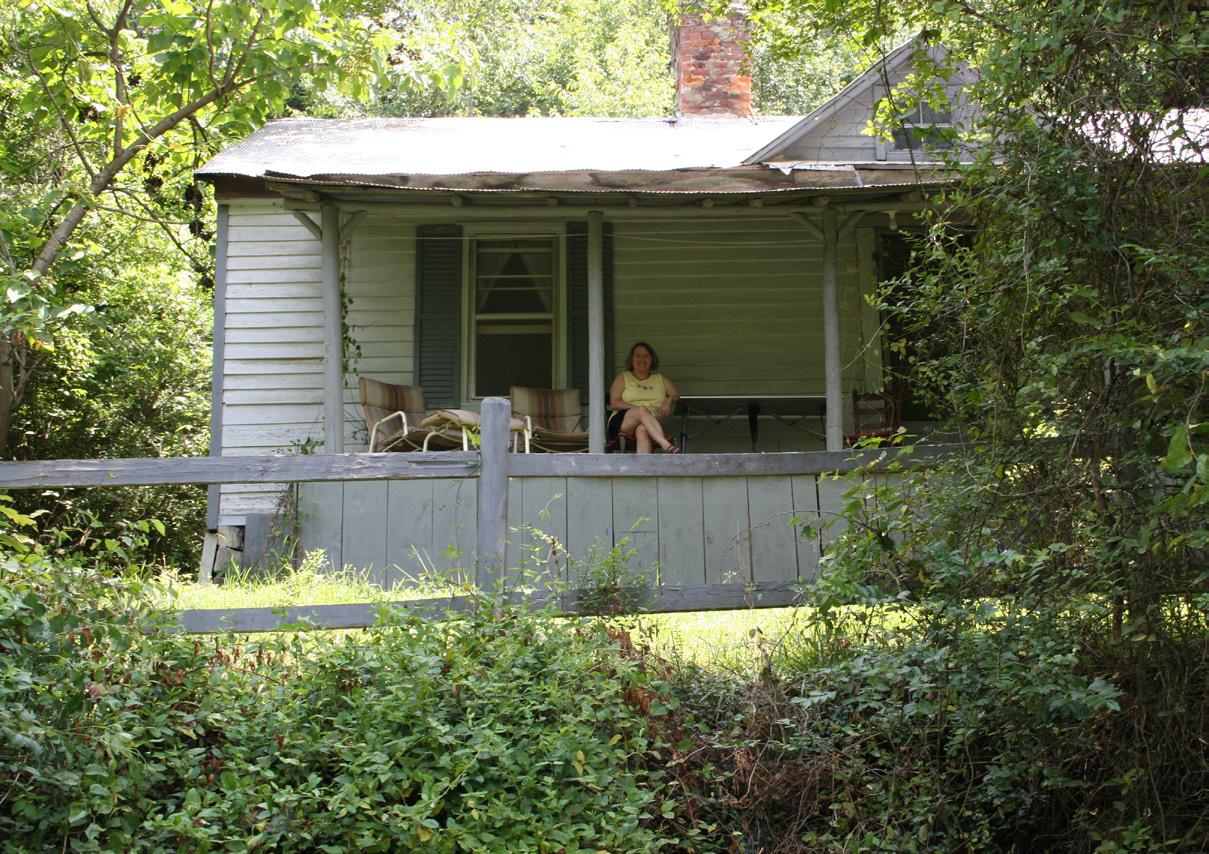
But those poems are lit-anthology detours from the primary
mountain riverscapes of River Road. In addition to its strong voices, a primary engine of the book is the anecdotal. In “Fugitives,” two strangers “came skulking up the road like stragglers / From a Grimm tale.” Susan, wary of the young male and younger female and making sure she knows the whereabouts of her pistol, gives them a ride to town and “left them at the caboose that doubled as a welcome center.” The next day she catches up on the story from the local constabulary and the local paper; the couple had been picked up down the road: “She had been reported missing / In Missouri. She was thirteen.” We learn that “He was in jail – she had been returned to her guardian. / Made me wonder. What if they had pulled a weapon.”
Under road and river, straight to his still.
DOT happily kept this system up in return
For his wares. I’d like to have seen that.
Some of the best tales cluster around Walker Shelton, the moonshiner who once operated out of Susan’s rehabbed house, “The old Shelton place on River Road.” In “Walker,” we learn that
Walker Shelton rolled Prince Albert smokes That he stuck in the corner of his mouth, lit, And spit out when a threat to burn his lips. Some folks never saw him without one, Except in church, when his wife Ethel made him go.
In “Basement,” Walker locks an intruding “revenue man” under the house in the room where he stored “corn, sugar, needful things, you know.” A full day later,
He stepped inside and shot the ground a foot Away from the man’s considerably shaking boots. Walker stepped out to watch. Took about half an hour For the deafened man to poke his head out, smelling of bladder
And bowels and looking ready for Dorothea Dix. Git, said Walker, and stood aside.
“Huff Island” rounds off the Walker Shelton saga:
They say old Walker Shelton made his liquor over there –From water from a spring behind my house piped
These sharp-edged shorter poems counterpoint the longer and most ambitious poem in the book, “French Broad River,” which Susan previews in “Writing Studio (II)”: “I’m working on a long poem about the river.” Packed with history and data that too often seem rote and obligatory, the long poem falls flat in comparison:
The sixties and seventies saw vast improvement
In environmental law. Forty or fifty years later, fish
Can now be eaten safely, eagles have returned,
And during dry weather I can see the bottom
All the way across to Huff Island. This is real progress.
The memorable news about Huff Island happens elsewhere in the book.
When not telling stories about Posey Green, Old Gabe, and Walker Shelton, Susan McFalls worships at what, in “Church,” she calls “my true church”:
I attend the Methodist church in town
Every now and then – and even drop a little money
In the collection plate. But my true church
Is with the river and its choir –
Water over rocks is organ music
And heron and eagle and deer and geese
Are preachers and acolytes and elders.
Scattered like weeds and wildflowers throughout the volume, the book offers four four-poem
sequences of haiku stanzas each devoted to, by title: 1) periwinkle, dandelion, trumpet vine, blueeyed grass; 2) ironweed, asters, chicory, jewelweed; 3) ditch lilies, fire pinks, trilliums, wild iris; 4) silver bells, Joe-Pye weed, cardinal flower, ferns. These short prayers enact a deeply engrained unchurched Protestant Christianity habitually Biblical. When Susan does drop into a sanctuary and suffers a rookie pastor fresh from seminary, she escapes unharmed: “I have to say, he landed that sermon smooth as seaplane on river, / Where bright angel feet have trod. I was impressed, if exhausted. / Well, he’s young yet – he’ll learn, the Gospel is simple – Grace abounds.”
Still showing up a year after Helene in volunteer squads to help clear impossible dams of storm debris, outsiders mostly experience the French Broad on rafting excursions, which Susan McFalls eyeballs in “Rafters”:
. . . Some are solitary, In johnboats or kayaks, or homemade crafts Requiring bail buckets as standard equipment. There are groups, some tied together by guides And inner tubes, kids from summer camps, Or families taking Mother for a river ride.
Given the gendered structure of voice in the book (an older male who writes in the voice of a solitary older woman with a clear affinity for homespun older men), the poem ends at a rare erotic temperature, which mixes simple pleasure at simple sights while risking bathetic shoals of euphemism:
. . . One afternoon
A lone woman in an open boat towing a small raft With a cooler inside floated by. She wore sunglasses. That was all.
People ask if I enjoy rafting. I say I’d rather watch. I have plenty adventure on the porch, pen in hand.
Elsewhere in the book, in the poem “January Twenty-Second,” Susan reveals a moment that made “my young blood boil,” but it occurs in a poem about anger instead of homoerotic gaze. “January Twenty-Second” presents Susan in an uncharacteristically bitter mood, explaining why she never again spoke to her paternal grandmother after “Granny” complained that Susan’s father had rudely chosen to die on Granny’s birthday: “I pray heaven’s an enormous place / So I’ll not have to see her face.”
Such fraught family dynamics are the lifeblood of narrative fiction. Published in the immediate wake of River Road, Caldwell’s new novel, Shadow Family, seems to be the book that shuffled on and off the workshop stove with the poems. In the novel’s appended “Thanks,” Caldwell addresses those who might read this tale of adoption as autobiography:
Autobiography? No. Autobiographical? Well, with Thomas Wolfe, I have “used the clay of life” . . . An adoptee handed to his adoptive parents at some six weeks old, I was always told I was adopted, and thought that perfectly normal. No “abandonment issues,” no bad-mouthing my birth mother. I was raised by parents who loved me probably beyond what I deserved. (326)
In effect, what might have become an adoption memoir in the autobiographical voice of a male adoptee is instead hijacked by two women, for the rewarding bulk of the book.
Shadow Family is set in rural communities immediately west of Asheville; most of the action occurs in the several decades following World War II. The book opens in the voice of Priscilla Lance, who invites the reader into Part I, which is titled “April Fool” (it’s her birthday): “Want to know who I am? Couldn’t answer that with a kabillion words. But I can sure say who I was. Maybe that will help with the first question –then maybe we’ll both know” (2). As an unwed nineteen-yearold in 1949, she gives birth at an Asheville hospital to a baby whom she immediately relinquishes to state social services. Her load of guilt and regret is twofold: she is engaged to a serviceman, Pat Allen, who is away on duty and whom she fully intends to marry, but she has dallied with a dancing stranger with consequence. While pregnant, she bunks with a maternal relative in town to keep her condition secret, especially from her father. Part I ends with the birth: “In the delivery room they gave me a shot, then strapped my hands to the bed. By that time I was too woozy to resist. I don’t remember a thing about the delivery. And I never saw the baby. Boy, girl, I didn’t know. Who was I? Empty. That was all” (64). Priscilla returns home to Crawford to await the return of her soldier, Pat Allen. In adoption studies, this plot follows the Baby Scoop period of mid-century forced family separations. Most of these stories are nonfiction first-person memoirs by birth mothers, most of whom are bitter, with good reason. Shadow Family also offers a first-person tale, but it’s
a remarkably sympathetic fiction invented not by another woman but by a man who is also an adoptee, which alone makes it worth notice for students of adoption narrative. Where the book breaks significantly new narrative ground is in Part II, “A Slot in Time,” narrated at length by Martha Atkins Blaine, who in a closed adoption becomes the adoptive mother of Priscilla Lance’s baby.
Martha has not one voice, but two. The first voice dwells in a journal Martha keeps in the state mental hospital in Morganton, where we learn she has been committed for electroshock therapy, but we’re not told why. Part II opens in the journal voice: “My doctor gave me this blank journal and said to write down things that happen. Or things that used to happen. So, I can figure out why. That might be too hard. I’ve heard God never gives you more than you can bear, but I’m living proof of the untruth of that” (66). Part II stays in the fiction of journal entries, tracking Martha’s life up through the adoption of a longed-for baby in 1949. The life narrative in the journal entries occasionally pulls back and ponders the palpable fictionality of the enterprise, which it shares with adoption itself: “Reading this journal, it’s the funniest thing. There’s times I feel like I’m reading about somebody else, a character in some book. I mean, on one hand I know this happened to me – but on another it seems so far away, so strange, like it’s Martha Blaine –a woman in some dreary soap opera. I’d not believe a lot of it had I not lived through at least some of it” (86). Martha grows
up in a country neighborhood named Sand Hill, sandwiched between Asheville and Priscilla’s Crawford. Martha’s family runs a country store, which in the wake of her father’s death they rechristen The Top of the Hill Grocery. The family, a notch or two downscale from Priscilla’s Crawford circle, lives above the store. Martha marries a local, Henry Blaine, and they try to start a family before he is posted to Europe for four years of World War II, but they fail. Wrestling with infertility of whatever cause, Martha, who “ached for the noise of a child” (96), works hard to counter ingrained resistance to adoption from Henry, her family, and the mid-century country community, until the wake of war and Henry’s return: “My ache worsened in 1947 because all these women got pregnant after their men came home. You couldn’t go ten feet downtown without seeing a bulging belly or a baby carriage. In church, too, sitting there all glowing, pleased as prunes, me staring like a starved stray dog. When Reverend Dixon sprinkled babies, more water streamed down my face than on their little heads. I almost quit going” (97).
Part II ends with a glad adoption and closes the journal: “This winds up the hospital blank book” (104). But the final sentences leave us hanging with no answer to the question, Why is Martha hospitalized at Broughton in Morganton?
Parts III and IV continue the contrapuntal vocal structure of the first two parts. Just as the first two parts operate in tandem to bring the plot up to the birth of a baby who is put up for adoption, these next two
parts also operate in tandem to advance the plot. In Part III, “Missing Pat,” the birthmother, takes up the aftermath of pregnancy and birth and paints her new self-image: “Priscilla Vance, teenaged mother, child relinquisher. A woman abandoned by the baby’s father and orphaned by, or at least estranged from, her mother. Engaged, however precariously, to a man not the father” (106).
Once home from service, Pat and Priscilla marry, and the two move for his work to Tidewater, VA, where two children are born. Priscilla meanwhile imagines her abandoned baby as a girl, whom she names Millie, and in the last sentence of Part III, Priscilla recounts her ritual remembrance of her first child’s birthdate: “See, I never slept a wink the night before. And on her day, my heart raced and I stayed short of breath. Always afraid Millie might wander up. Or wouldn’t. Always wondering where she was. What she was doing. Always, always” (161).
Part IV, “Tears of Shelter,” returning to the voice of the adoptive mother Martha Blaine, opens on the pivot of the abandoned baby’s name, which is
not Millie: “We named him William Lee Blaine. I did, anyhow, Henry didn’t care as long as the boy got a middle name. William after my mother’s father, who she said was kind and gentle, and Lee, because it sounded nice and, after all, we are southerners, even if we live in the mountains” (163). In Martha’s account, the narrative of Willie Lee’s adoptive childhood offers textbook adoption moments: the parental conversation, whether and when to tell Willie that he’s adopted, and how to handle Willie’s puzzlement and hurt at being called a bastard at church and school.
Shadow Family shifts at this point to a new voice in the adoption constellation – the adoptee – who opens Part V, “Call Me Will,” by renaming himself: “Will Blaine. Not William, per birth certificate, or Willie Lee, which Mom and nearly everybody she knows used to call me. Sounds hick, doesn’t it? Right out of these backasswards North Carolina mountains. People, call me Will” (190). The novel accelerates as Will reports what Yeats calls the ignominy of boyhood and growing up. Meanwhile,
from the point of view of Will, the adoptee, the reader tracks to conclusion unresolved family mysteries.
With good historical reasons, current orthodoxy in adoption studies maintains that the voice of the adoptee trumps all other voices in the adoption constellation. But this novel instead gives powerful voice to a birth mother and an adoptive mother before winding up with Will, whose autobiographical voice ghosts the adoption memoir that Caldwell, an adoptee, chose not to write. For the bulk of the book, those two women testify to the power of fiction to cast a different kind of imaginative spell than memoir
To end returning to the equally powerful poems, this reader wonders how Susan McFalls and her River Road neighbors weathered the perils of Helene. We need another book of poems, at the very least to hear about how, post-Helene, hellbenders and snot-otters are making out in the retooled pools of the French Broad. Here’s hoping she pulls up that chair again on Caldwell’s richly productive porch. n
THE NORTH CAROLINA BOOK AWARDS
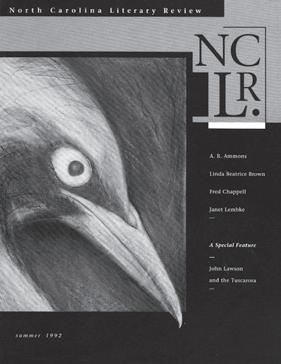
Grackle Golds:
Byer Bunch:
Chappell Champs:
Albright A-Levels:
The 1992 Society
Special
Friends of NCLR
Levels
$35 Annually
$36 to $249 Annually
$250 to $499 Annually
$500 to $999 Annually
Celebrate 35 years of NCLR by giving at this level.
“Everyone at the North Carolina Literary Review is a hero to me.” - Kathryn Stripling Byer, former NC Poet Laureate
Be a hero to NCLR with a gift at this level.
Show appreciation like former NC Poet Laureate Fred Chappell and his beloved wife Susan have done so many years, with an annual gift pledge at this level.
Pay tribute to NCLR founder, writer, and entrepreneur Alex Albright with an annual gift at this level.
Dual membership in NCLR’s 1992 Society and ECU’s Chancellor’s Society with an annual gift at this level.
Opportunities to Engage with NCLR
First Book Fellows:

$1,000+ Annually SUPPORT NCLR TODAY!
Invited to tell their NCLR stories, review for NCLR, and to interview each other for NCLR.
(Randall) Kenan Collaborators:
Open to creative writing faculty across North Carolina interested in involving NCLR in their classes.
For more information, email the editor, Margaret Bauer at bauerm@ecu.edu
Miscellany NORTH CAROLINA
Raising the Bar by
Margaret D. Bauer, Editor
Regular readers may recall that I bragged in our fall 2025 issue and the issue’s press release that we published reviews of sixty-nine books in 2025. With this issue’s reviews of twenty-five more books, we are well on our way to meeting, if not exceeding, that high bar. Thank you again to Book Review Editor Kristi Southern for guiding these reviews through the process and to the many reviewers, repeat and new. At the end of the fall semester, NCLR interns created a new page on our website to list those reviewers. Now don’t you want us to add your name to that list? Find on our website a list of books available for review and the form to volunteer to review for us. Reviewers receive a complimentary subscription to the print issue, which means they can submit to our contests, too (our contests require a subscription rather than submission fee to submit).
Allow me here to call your attention to the art selected for Makayla Carmichael’s “Lent.” I do so to put everyone’s mind at ease after I recently announced the retirement of our longtime Art Editor Diane Rodman. Ann Harwell’s work is the first selected by our incoming Art Editor Donna Kain, who put my mind at rest as I pondered how we would survive Diane’s departure. I can cover a lot, but art selection is not in my wheelhouse. Thank you, Diane, for all those years of amazing art selections (some featured in this issue), and thank you, Donna, for joining the staff. See her other selections in the feature section of this issue.
Finally, this last section of each issue is where we publish writers and reviews of writers new to our pages. It certainly does seem that North Carolina produces a bottomless well of literary talent. We would love to publish interviews with some of these new writers and encourage authors to find that reader who really gets your work and ask them to interview you for us. Find our submission guidelines here n
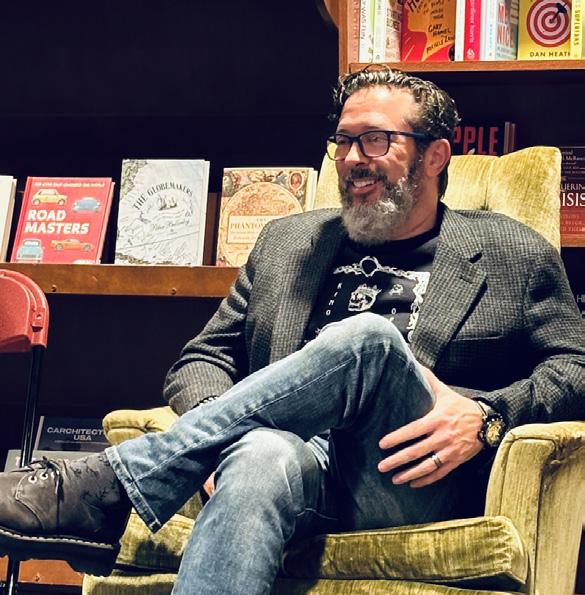
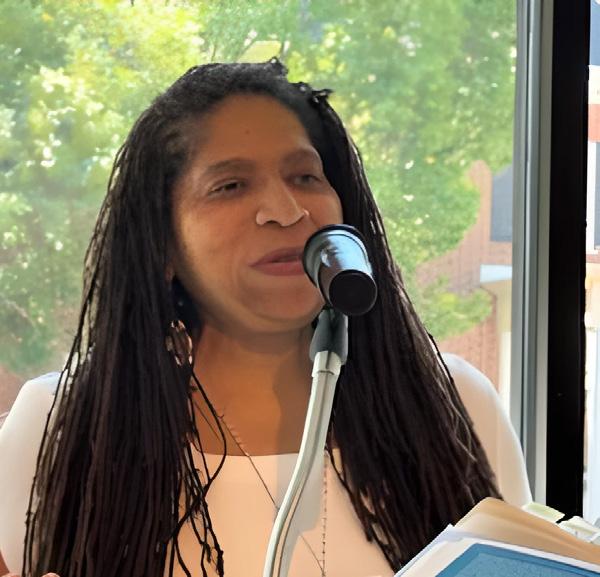
70 what i remember most of church a poem by Zachariah Claypole White art by Jason Craighead
72 Lent by Makayla Carmichael art by Ann Harwell
79 A Poem About Us Composed of Cliches, Part 2 a poem by Joan Barasovska art by Amy Freeman
80 A Place Called Vulnerable a review by Laura Dennis
n Karen Salyer McElmurray, I Could Name God in Twelve Ways
82 Monsters, Preachers, and Young Lovers in Southern Appalachia a review by Evelyn Berry
n Andrew K. Clark, Where Dark Things Grow and Where Dark Things Rise
84 Virtually Real a review by Barbara Bennett
n Lindsay Starck, Monsters We Have Made
87 The Speech of the Place a review by David E. Poston
n Britt Kaufmann, Midlife Calculus
n Tony Robles, Where the Warehouse Things Are
92 Perceptions Beyond the Tangible World a review by Joan Gelfand
n Sheila Smith McKoy, The Bones Beneath
94 “Sweet Sweat” and “Plainsongs”: The Lyrical Reclamation of Place a review by Annie Woodford
n Forrest Rapier, As the Den Burns
n Jacinta V. White, Resurrecting the Bones
ALSO IN THIS ISSUE
6 n Military Writing in North Carolina poetry, creative nonfiction, and book reviews
18 n Flashbacks: Echoes of Past Issues poetry, creative nonfiction, book reviews, and literary news
2025 JAMES APPLEWHITE POETRY PRIZE FINALIST
BY ZACHARIAH CLAYPOLE WHITE
what i remember most of church in all my dream. i sing with someone else’s voice –of my grandfather not the words themselves, you understand, but their echo, those rooms left behind: the lullaby. architecture of an alcoholic’s faith filling the pews. and lifting the buttress – even now though
CLAYPOLE WHITE is originally from North Carolina and lives now in Philadelphia. He holds a BA from Oberlin College and an MFA from Sarah Lawrence College, where he was a Jane
He teaches at the Community College of Philadelphia, Saint Joseph’s University, Manor College, and the Writing Institute at Sarah Lawrence College. His poetry and fiction have appeared or are forthcoming in Southeast Review, Prairie Schooner, and The Rumpus, among others. His awards include Flying South’s poetry prize as well as two nominations for the Best of the Net and one for a Pushcart Prize.
ZACHARIAH
Cooper Poetry Fellow.
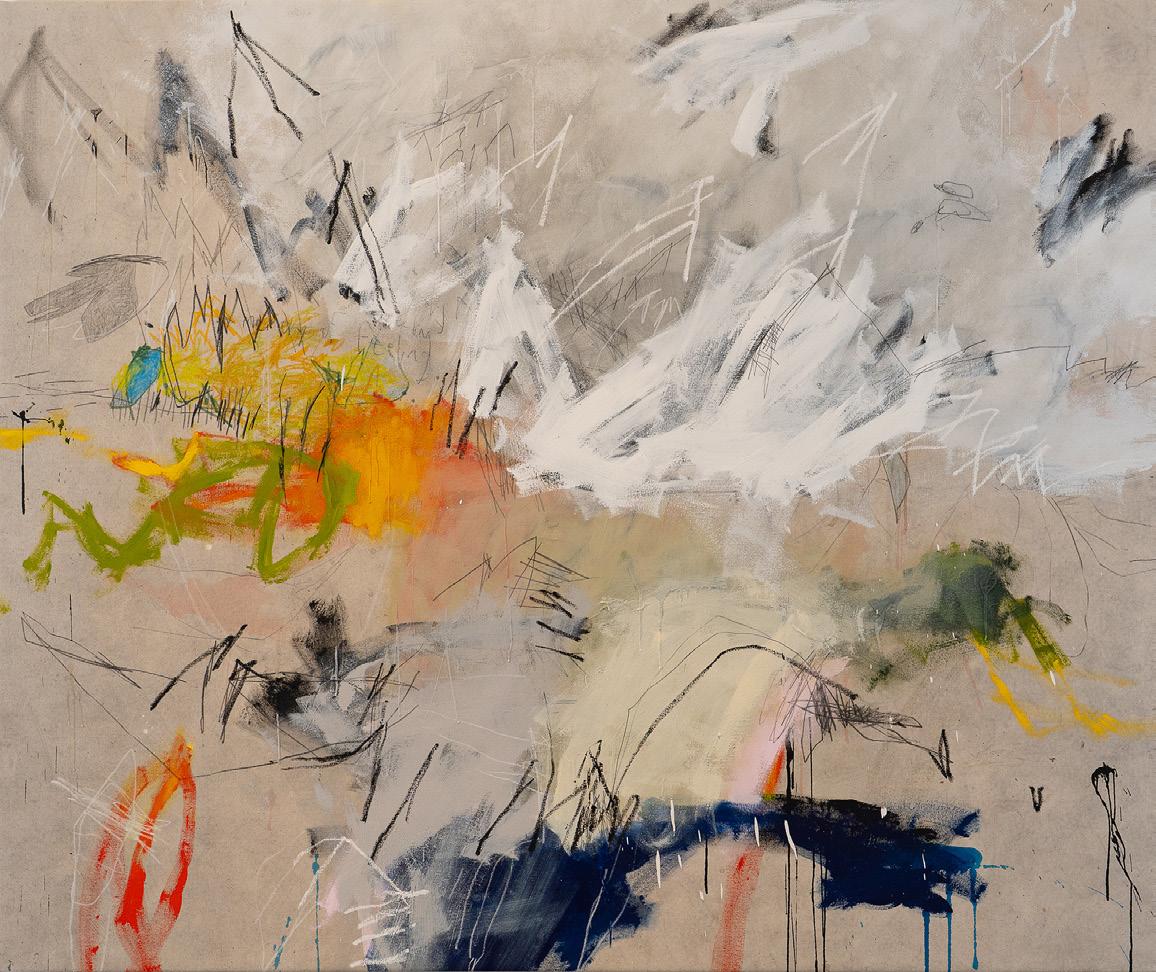
i’m lying to you [the church was not his. and the man dead long before the memory] but when the priest spoke mercy to the tyrant, i heard again, my grandfather, all the dead [of any god] gathered in the country of his voice.
Florida native JASON CRAIGHEAD lives and works in Raleigh, NC. He studied art at Gulf Coast Community College and at Florida State University. He often serves as an art juror, including for the Visual Arts Exchange (VAE) in Raleigh and the Greensboro Center for the Visual Arts. His award-winning work has appeared in many solo and group exhibitions in the US, including CAM Raleigh, K Contemporary in Denver, Monica King Contemporary in New York, and Makasiini Contemporary in Turku, Finland.
A Memory of Feeling, 2025 (acrylic, graphite, and oil pastel on canvas, 72x86) by Jason Craighead
SECOND PLACE, 2026 ALBRIGHT CREATIVE NONFICTION PRIZE
by Makayla Carmichael
LENT
I would never say it to my mother, but I am here for her, and so I will sit quietly, except when we are supposed to speak or stand or kneel, and I will listen, but not listen. My mind will wander like it always does in this labyrinth of stone and candles and stained glass that is St. Paul’s Episcopal Church. All that stone, great slabs of it, cold beneath my feet and molded into columns throughout the chapel, dividing the pews. I remember the hardness of it from the time we were children, my brother, David, and I, being told not to run down the aisle as we might slip and fall on its unforgiving surface. I will be here. I will hold the prayer book, read at the appropriate times, even close my eyes in prayer, but I will be far from here. There is nothing to hold me. There never has been. I’m sorry, Mom. I know that fact would hurt and disappoint her. Growing up, she brought me to church. I was baptized. I was confirmed. I take
MAKAYLA CARMICHAEL graduated from Appalachian State University and has a master’s degree from Seton Hall University. She is retired from a career as a CPA in the corporate world and now lives in Winston-Salem, NC. She has published short stories with The Broken Teacup, DUMBO Press, Mania Magazine, Daikaijuzine, The Taborian, and Nude Bruce Review
communion. I believe in God, really, I do, but I feel nothing in this place. It is just a place to me, cold, familiar, but it could be anywhere. And how does she do it, I wonder as I sit here beside her. She holds the Bible, and it is her own. She will take it with her when she leaves. I’ll place mine in the back of the pew when the service is over, and it will go into the hands of another who will feel or not feel. My mother will come back several nights this week like she comes most weeks, two or sometimes even three times in a single week. She will pray at the Stations of the Cross. She will walk the labyrinth next door. During Holy Week she will come every night. She always invites me, even though I’ve asked her to stop. I’ve told her I will let her know when I want to come. But it is the beginning of Lent, and that is one of the services like Easter and Christmas Eve when it is understood that I will attend.
Final judge Paul Crenshaw wrote of this essay: “This one was subtle, relying a lot on the unsaid. I enjoyed the clipped and cut voice. The feeling of so much hurt and loss between mother and child, the universe – both religious and cosmic – that has grown between them, a universe the narrator is trying to navigate, as each new day unfolds some new dimension. The eternal struggle for meaning as we try to go about our lives, to make sense of everything when the loss we have experienced seems senseless. The search continues – through religion, through relationships, through life. Nicely, and sadly, done.”

WITH ART BY ANN HARWELL
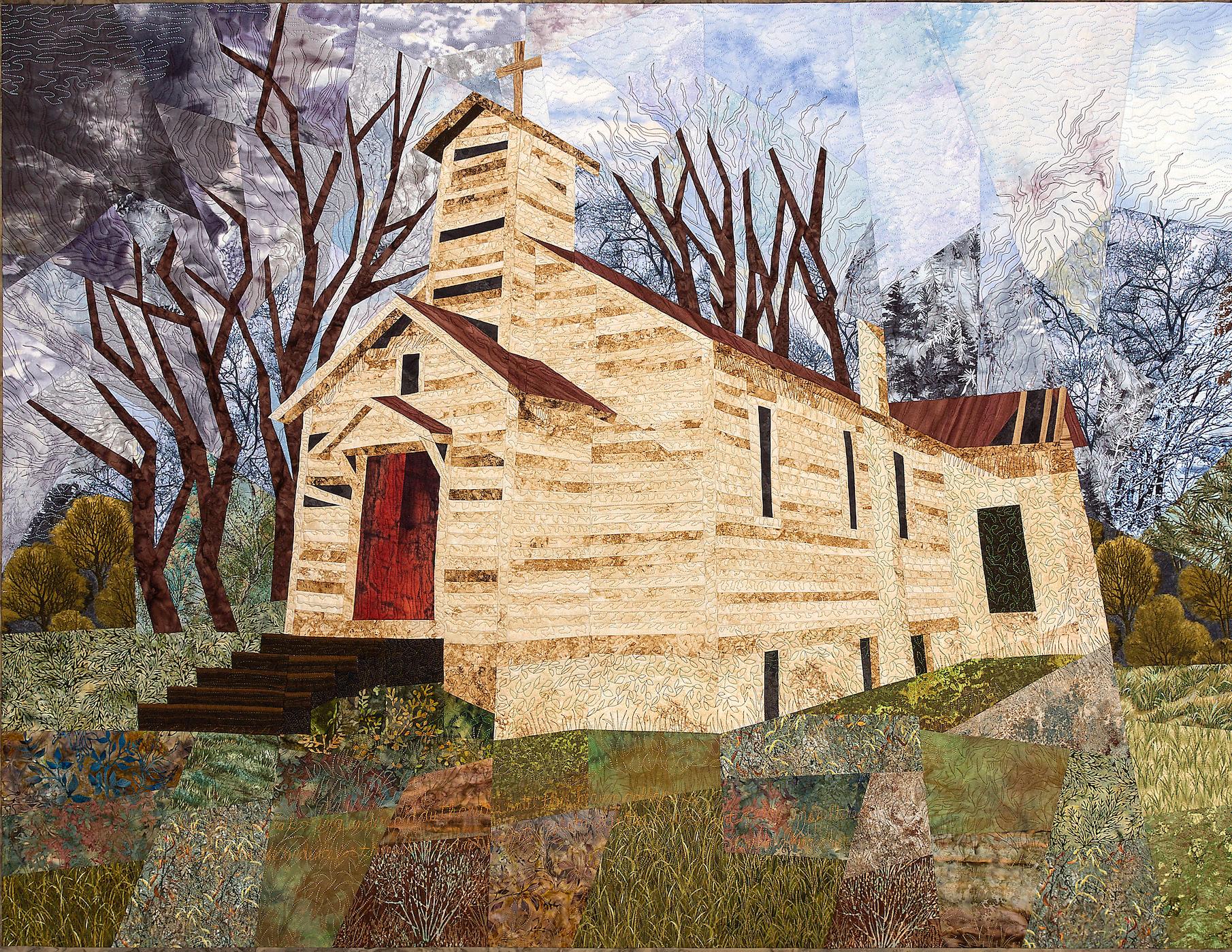
I don’t mind, although I feel foolish, a charlatan, like I’ve missed something. And I think, like I do whenever I come, that maybe tonight I will find it. Sometimes I feel a tingling of excitement before entering as if this time it will be different for me. There is beauty here. In the ceilings that stretch so high – to the heavens, I learned in history class. In the candles that project a subdued hue of light, softening everything. And in the congregational prayers that sound like low chanting and seem profound in their obedience. In the prayers I can hear them all, the weak and the strong voices, the leaders that finish quickly and the lagging that echo at the end. It is like listening to the healthy and the sick, the young and the old, the ones that have and the needy, all together, all at once, as one. I hear all of them. I don’t mind
THERE IS BEAUTY HERE. IN THE CEILINGS THAT STRETCH SO HIGH – TO THE HEAVENS, I LEARNED IN HISTORY CLASS. IN THE CANDLES THAT PROJECT A SUBDUED HUE OF LIGHT, SOFTENING EVERYTHING.
HARWELL is an award-winning fabric artist. Originally from Sparta, Ann lived in the Triangle for over forty years, eventually moving her studio to Wendell, NC. Much of her work captures the beauty of North Carolina and the magic of the cosmos in quilts that she constructs on her 1945 Singer Featherweight machine. Harwell’s work is displayed in many corporate collections throughout North Carolina, including at SAS, Duke University, Duke Hospital, the City of Raleigh, and Wingate University. Her numerous awards include the Exhibition Award, Artfields, Lake City, SC; Best Interpretation on Theme, Mid-Atlantic Quilt, Hampton, VA; First Place, Handcrafted, Imperial Centre, Rocky Mount, NC;
Centre,
and Honorable
ANN
Merit Award, 56th National Juried Art Show, Imperial
Rocky Mount, NC;
Mention, Quilt Nihon, Tokyo, Japan.
Heaven Collapsing (fabric, 44x57) by Ann Harwell
I AM TO GIVE UP SOMETHING. IT’S REQUESTED, ADVISED, SUGGESTED, TAUGHT EACH YEAR. BUT SOMEHOW, I FEEL LIKE I’VE GIVEN UP ENOUGH.
sitting here, but my mind wanders so far away sometimes. Surely, if this were working the way that it’s supposed to, I would not wander like this. I am to give up something. It’s requested, advised, suggested, taught each year. But somehow, I feel like I’ve given up enough. (Doesn’t she?) Still, I contemplate what must be given up, just for a little while. I have vices. I have things I love to do. I have possessions, and surely that is a sin, to love my things like I sometimes do. What will she give up, I wonder. She’s given up so much. Still, I know she will give up something. It will be some little thing, an activity or habit or routine that exists in her day, but it will be something that has meaning to her, and she will give it up willingly. I admire that. I am envious of it, too. She gives so freely. I think I would hate if I’d been asked to give up so much, but there is no hatred in her, and that’s why I ask myself, really, how does she do it? Where does she put her bitterness? Where did she put her loss? It must be somewhere.
And I pray. I pray for the bitterness to leave me, but it hasn’t. I can taste it like metal in my mouth. I imagine one of them, Carol, David’s girlfriend, or one of her friends, in his place, dead, and I know it hasn’t gone. I saw it in the paper, those obituaries that I read with fascination since
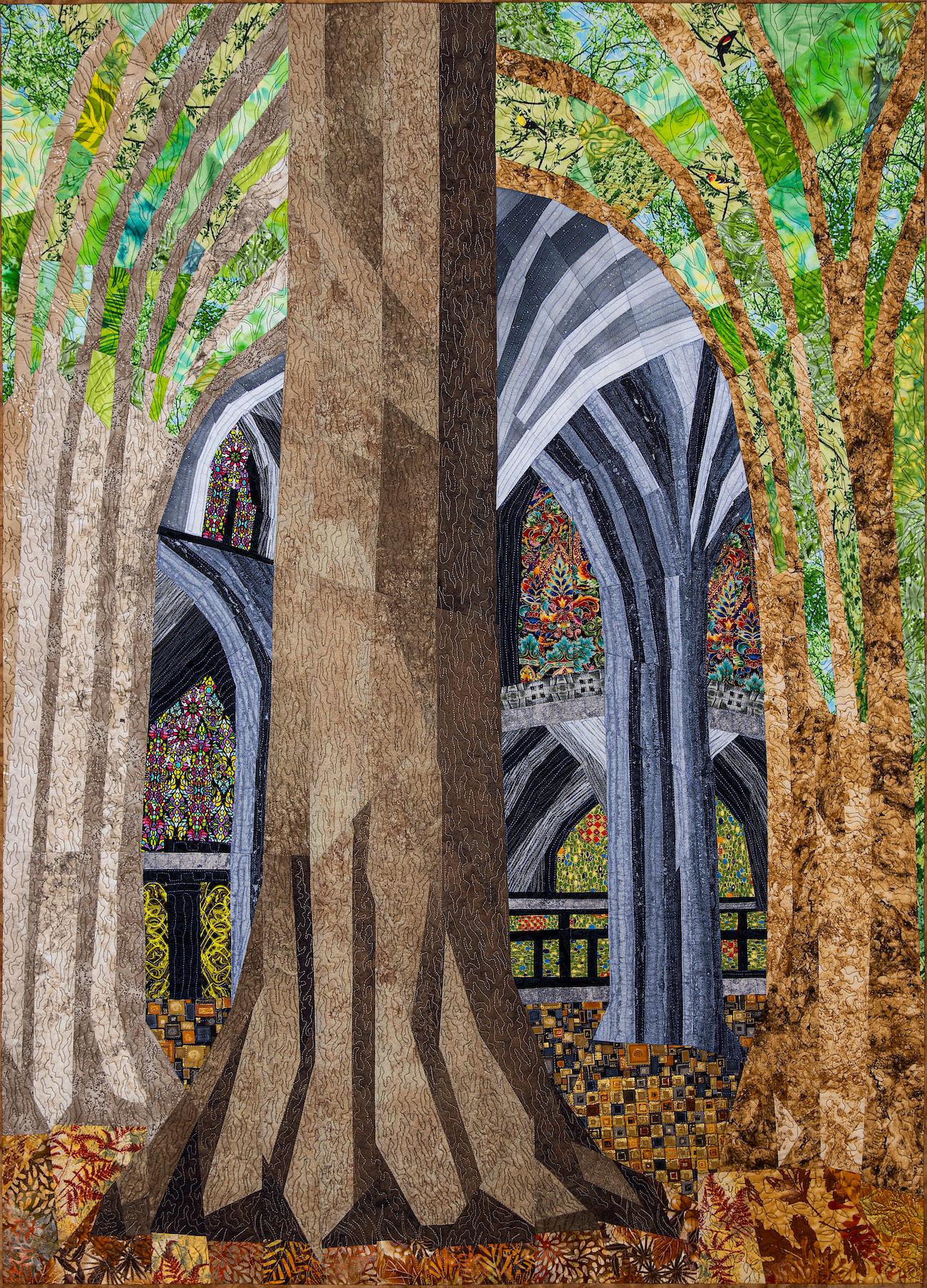
David’s death. Carol’s son died by suicide. I saw it, and I felt bad for her, had even called to express my sympathy. But part of me had thought, good. Now she’ll know what loss is. She will carry this one. And so, I know the bitterness is still there, and it feasts on me. I hate them for living like I hate him – yes, that is it, sometimes I hate him –for dying, for leaving. I’d told Mom about Carol, looking for her bitterness, but there was only empathy, so I knew she’d discarded it, was relieved of it, somehow had left it. Dear God, I am sick and so sorry. Please take it away before it consumes my soul. Because that’s what hatred does. It devours things, and I can’t disappear beneath it. I want to live. The hatred must be released somehow. It must
Forest Cathedral (fabric, 51x37) by Ann Harwell
leave me, but for the life of me I don’t see why it is any more apt to leave me in this place of worship than it is as I’m walking down the street or leaving the bed of another lover. What is the difference? Really, what difference does it make where I am? I am the same in all places. Just take it
to the meadow where he wanted to be let go and where we left most of him. I guess I can find him there sometimes. Like that first time.
And sometimes we will mention him, something he did or some funny thing he said, and that is enough it seems. That is enough for my mother. I would like to say more, but sense that I am morbid. So I don’t. And he is all around us here. This is where we publicly said goodbye. Mom brings things to him, although she’s not supposed to leave anything in Dalton Memorial Garden. Still, she will place things: a tiny flag on Independence Day, a palm Cross at Easter, then some sort of memento to mark his birthday. At Christmas it will be a small plain wreath, and sometimes it is just a single flower for no particular occasion. She puts the things on his marker in the garden where we laid only a handful of his ashes. The marker is brass and has turned black. David’s name, his birth date, the date of his death can hardly be read now. She has scrubbed it, polished it, whatever you are supposed to do to brass, but the elements are winning just like fate when it took him from her. She doesn’t seem particularly bothered by the fading inscription or the loss that she has faithfully embraced. Somehow, she has taken it and tucked it safely away, seemingly at peace, and again I am envious of her peace. The loss doesn’t show on her person, but I’ve seen it. It is in those piles of things in her home, the things she cannot seem to find a place for, the things she keeps buying and leaving unopened, stacking in her closets – sometimes five or six rows deep of the same things – or leaving on her floor. The things are in her car, too, and go with her when she goes. They surround her. They somehow keep the real loss away. I, however, purge things. Too many things around and I start to get nervous, edgy, panic stricken. I must give them up. They will suffocate me, and I already cannot breathe sometimes. But purging things doesn’t lessen or hide or ease the loss of him. It just lets me breathe again. It can be an expensive type of oxygen. I don’t care. If I keep the things, they will strangle me. But that’s just our little issues, our adjustments, our ways of coping. So, she will visit the marker, but I rarely do. I cannot find him there. Sometimes I will go back
It had been a calm day when I’d gone up to MacRae Meadows, but as soon as I’d parked and gotten out of my car, started walking over to the spot, the wind had come up strong, the rain, pellets of it, hitting my face and arms and body. I had to walk bent over like an old woman to get to the spot, a half-mile at least. It came so suddenly and so fast, that storm, like they do up there sometimes, and I had a silly notion that he didn’t want me visiting. My mind plays tricks sometimes, and I’d thought it a sign, a communication. I looked for those so futilely at first, so foolishly. I could never find one. One of my friends had been with me that day, and she seemed a little knocked over by it all, a little unnerved. We’d laughed about it later, after we’d left, when laughter found us again. So, here I am once more in the church where my mom and I were both raised, and I guess it just sunk in differently for each of us. Or maybe she’s a giver and I’m a taker, waiting for something to be brought to me. What is this place to her? She was baptized here, confirmed here, married here, twice, and even worked here for a while when she faced that problem that she had which miraculously disappeared after her stay at the rehab center. I had been amazed at how it never came back, never resurfaced, even for a day, even after David died. She is strong, much stronger than I’d known. Maybe, I sinisterly think, she just traded one addiction for another when I see what surrounds her
OR MAYBE
SHE’S A GIVER AND I’M A TAKER, WAITING FOR SOMETHING TO BE BROUGHT TO ME. WHAT IS THIS PLACE TO HER?
these days. After she conquered the booze, she left this church for another one on the other side of town. I think she had been embarrassed. But that judgmental minister that presided here finally left, sick now and confined to a wheelchair, so frail. And does she smile when she thinks of him like that? No, that is my thought, my vengeance. Even tually, she’d come back to this church and made a stronger presence, or at least a more frequent one.
She never knew her father. He died when she was just five. Nana had four other kids to raise besides Mom, but she was so capable, so strong. Sometimes I think she made Mom need her too much, if that is possible, if a mother can possibly do that to a child, make her dependent. Remem ber how we had looked at each other and laughed when Nana in her dotage at eighty-four had made us get down on the floor and clean her house so obsessively? She would point to something with her cane, and we would pass a rag across the item, rubbing it so that she could see how we were fol lowing her instructions, cleaning her home. But there was nothing there. There was no dirt. We wiped anyway. Nana ruled. I remember how we’d have done just about anything to keep her with us a little while longer. That last week in the hospital when her organs began to fail one at a time, the doctor telling us, “any hour, any minute now,” and we waited. All of us waited. Nana’s death scared Mom. She was alone again. She would start gath ering the things then, the more the better, canned goods, clothes. She stacked two-liter Pepsis three deep on each of the stairs going down to her base ment. David accidentally knocked one of them down one night and it started a domino effect of cascading Pepsis, tumbling around and down and exploding at the bottom. He’d gotten pissed but then had laughed. It was funny really, all those Pepsis. Why were they there and why so many? We didn’t understand what was happening, that the Pepsis were just the beginning. It was loss that started it, and it would just get worse after he died. And now she clings to me. I feel it when I’m with her, and I feel it when we’re apart. The phone will ring. She must hear my voice each day. If I don’t answer she will worry, am I ok? Am I still alive? That is why she calls once, twice, sometimes more every day, nothing to say, no real news, just checking. And that panic in her voice. I am smothering beneath it. And the things that she
has gathered, I don’t know what I’ll do with it all when I am left to deal with it. Maybe that is when I’ll leave this place for good. Everyone will be gone. The ringing phone will suddenly stop. There will be no reason to stay. I’ll leave this place and her things because I don’t think I’ll be able to sort through it all. I just won’t be able to do it. These are the things I worry about now.
And sometimes it scares me to think that she still loves him. But when Dad comes to visit me, she insists on seeing him. He doesn’t visit often, but when he comes, we all get together, Mom, Dad, and his current wife, even some of Mom’s siblings Dad was friendly with growing up. We will usually go out for a meal, and we will talk and laugh and remember. I see a glimpse of that remembered love sometimes in her eyes as she is listening to him. I know it’s real because I can also feel his wife’s irritation. But it isn’t the same of course, too much water under that bridge and forgiveness only goes so far. Even so, it’s there in some kind of faded form like a dusty old valen-
AND NOW SHE CLINGS TO ME. I FEEL IT WHEN I’M WITH HER, AND I FEEL IT WHEN WE’RE APART. THE PHONE WILL RING. SHE MUST HEAR MY VOICE EACH DAY. IF I DON’T ANSWER SHE WILL WORRY, AM I OK?
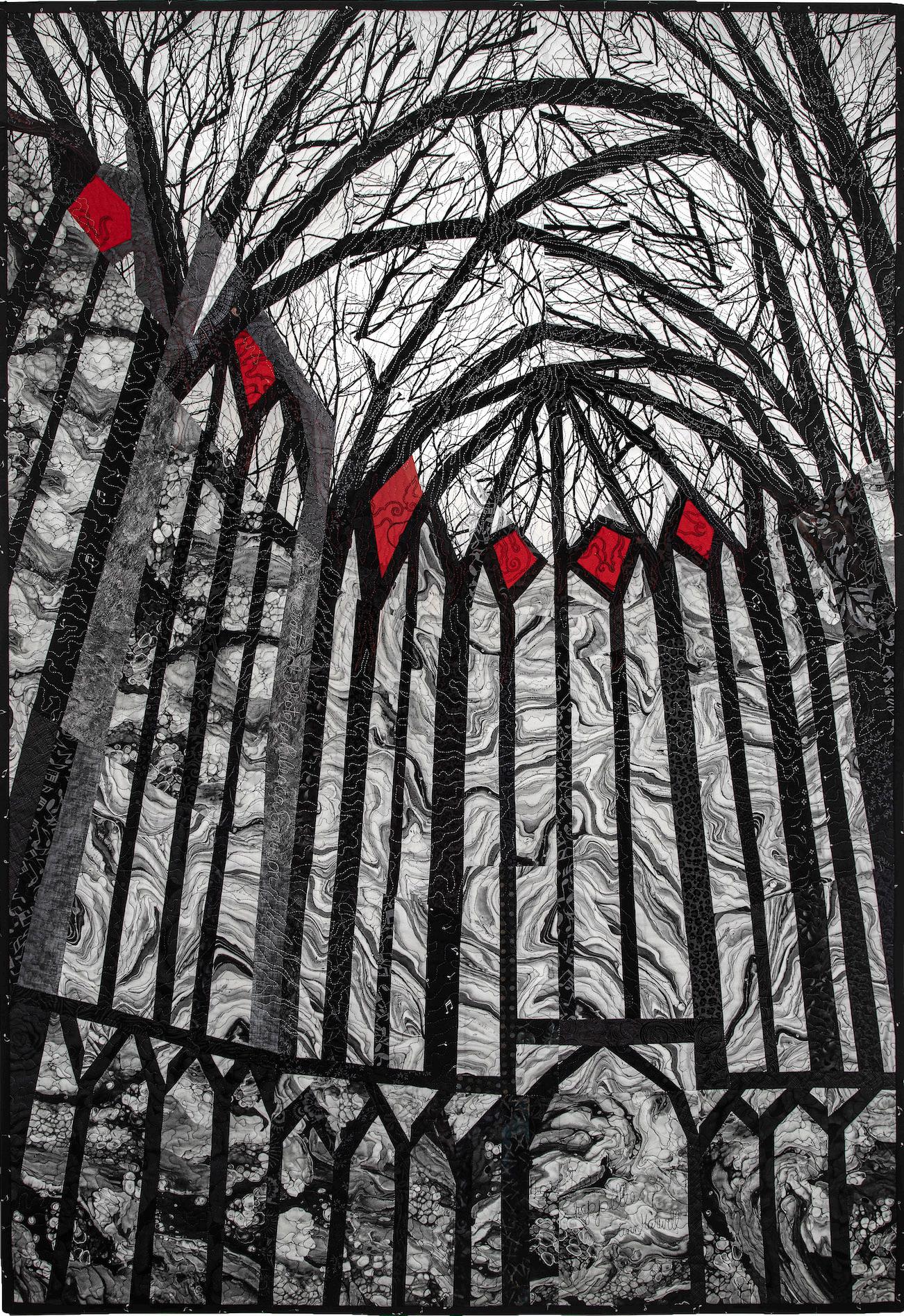
tine, folded between the pages of a book, forgotten and left to fall out on occasion. Even though they are two different people now. Even though the things that passed between them, good and bad, are no longer relevant. Love that transcends like that sometimes makes me feel afraid. I’m not sure why. It seems too powerful, too off balance and unfair. Why does someone always love more, and what is to become of her? Has she been happy in all these years since? Was it worth the losses? Sometimes I search her face for answers. I remember those days after Dad left. And sometimes we would laugh, sharing a small joke between us. Like when I was a child and we went to get pizza. Dad had left us not too long before, but we saw something funny, or one of us said something funny as we were bringing it into the house, and we’d laughed. We’d laughed so hard that she’d peed her pants and that had made us laugh even harder.
NOW EVERYONE IS STANDING. WE ARE BEING DISMISSED. AND THAT WAS PRETTY FAST THIS TIME, I THINK, DARKLY ACKNOWLEDGING, NOTHING STILL. I FEEL NOTHING.
David had thought us silly, but the laughter had made us forget, just forget for a while that we’d been left, the three of us. And that laughter has stayed with us and saved us, hasn’t it?
Now everyone is standing. We are being dismissed. And that was pretty fast this time, I think, darkly acknowledging, nothing still. I feel nothing. It’s okay. I hand my program to my mother. She knows where they go. As we start milling out, she begins the introductions, “I’d like you to meet my daughter.” Some of them I have never met and some I met the last time I was here, but they don’t remember because I am such an infrequent visitor. The minister knows me. He has a good sense of humor I can tell as he jibes, “Nice of you to drop by again,” with a wink. That’s cool. He’s alright. I don’t feel too uncomfortable.
Then Mom says, “Let’s go over to the memorial garden. Just for a few minutes.” I consent. We walk across the street, and I open the gate for her. We walk in, and I feel a little anxious like I always do when I come here with Mom or Dad. I’m never sure what they will say and if it will make me feel
Noir Sainte Chappelle,(fabric, 54x37) by Ann Harwell
like I’m choking again. So, I dread it. Sometimes that happens when I think of him, think of things I shouldn’t anymore. She says, “They are going to expand this garden. They’re already running out of spots for markers.”
“Oh.” I look around and there are so many burned up bodies scattered around. And see where I go sometime? I remember the spot where I stood in the sunshine five years ago, where we all stood, unbelieving. I will not stand there today. I will step over it and around it as if the spot might grab and hold me if I linger too long on it, if I try to walk through it.
“They’ll have to expand it into the parking lot. There’s no other place.” Maybe it keeps her safe, these tedious little observations.
“Yes,” I agree. “There’s nowhere else for it to go.” It’s easier just to go along with it. And it is easier to talk about things like this rather than some of the things that I still wonder about. How can a soul be silenced, burn up, and disappear? Was his soul in the ashes that were left? Would it be better if we had a grave to visit? Why can’t I ask questions that have no answers? Will I always think them?
She bends down over his marker and touches it with her finger. “Sweet David. We miss you.” Okay, I think, you’re getting into dangerous territory now. I feel the tightness, the closure of my throat. It’s time to leave. And really, what do you want me to say? That I miss him too? Do you want me to cry? Why do you pull me in here like this? I am mute. I can’t do this, any of this, in front of you. Let’s just be ourselves again. Let’s be ourselves as if we haven’t lost anything! But I just look at her, bending down, the way she bent to kiss his body that day at the funeral home. And I stand back, the way I stood watching them then, Mom and Dad, walking up close to his dead body, touching their son one last time. I stood apart then, behind them, unable to approach, incapable of such an intimate farewell and unwilling to let go of a life that was so intertwined with my own. I watch her and, like that day, I cannot approach today either. It is her acceptance, and I won’t broach it. I wait for her to finish, to get up. I wait for her to come back to me so that we can both leave. I wait for this strangulation to stop. I feel tears that I won’t cry. I will hold them in and walk out of here. I want to walk out and forget this. I
just want to have a regular day back again. not detour anymore, okay? I really can’t take it. She doesn’t prod me for words or rush to leave. She just stands and says, “Such a pretty day. The mountains are going to be beautiful when we go up for Easter,” and I am saved. Maybe she doesn’t know, but I know better. She is my mother. She knows. Like she knows the things that I don’t feel when I’m sitting beside her in church. She has patience that will extend to her last breath.
“Yes,” I say. “I can’t wait to get up there again.” We walk out and talk about it, a trip we’ve made every Easter for so many years now, before his death and after his death, having nothing to do with him, a trip even my uncle comes along on, the three of us, taking a long weekend. We will go to church there on Good Friday, and I won’t mind. St. Luke’s is so unlike St. Paul’s. The church is within walking distance of the university I at tended and where I was so happy. The sanctuary is small and filled with rich woods. There is wood in the flooring, grainy narrow planks of it. The wood is in the ceiling and the rafters that languidly creak as if stretching to embrace us and it is in the pews that make crescents across the sanctuary. The large cross which hangs above the barren and stripped alter is made of wood. The church itself is nestled in woods. I can see them as I sit inside, imagining the snows that must appear in winter. They are visible through the clear windows, all those woods and I can’t help but notice, wood is so much warmer than stone.
I STOOD APART THEN, BEHIND THEM, UNABLE TO APPROACH, INCAPABLE OF SUCH AN INTIMATE FAREWELL AND UNWILLING TO LET GO OF A LIFE THAT WAS SO INTERTWINED WITH MY OWN.
2025 JAMES APPLEWHITE POETRY PRIZE FINALIST
BY JOAN BARASOVSKA
A Poem About Us Composed of Clichés, part 2
And when I see your old familiar face, I remember the clutter of your huge shoes in our closets, shoes I’ll never fill, and Lord knows I’ve tried, but enough is enough. The truth being – putting aside your poor showing as a husband –
I was no great shakes as a wife, looking up to you as if you were the Great and Mighty Oz, and that’s no way to be,
biting my tongue, walking on eggshells for thirty-odd years, a balancing act, a three-ring circus of mother/wife/mouse.
I performed the perfect servant, a round of applause for Master at the ready. Knowing what I know now, you look a bit weak – or maybe it’s hollow – like a ringmaster forced to live without live acts or standing ovations –
no top hat or whip, no bullhorn.
JOAN BARASOVSKA serves as an officer on the board of the North Carolina Poetry Society and hosts a monthly poetry series at McIntyre’s Books in Pittsboro, NC. She is the author of four poetry collections, including Orange Tulips (Redhawk Publications, 2022; reviewed in NCLR Online Winter 2024), and her most recent collection, Unblessed, Unsung (Main Street Rag, 2025). She has been nominated for Best of the Net and four times for a Pushcart Prize. She lives in Chapel Hill, NC.
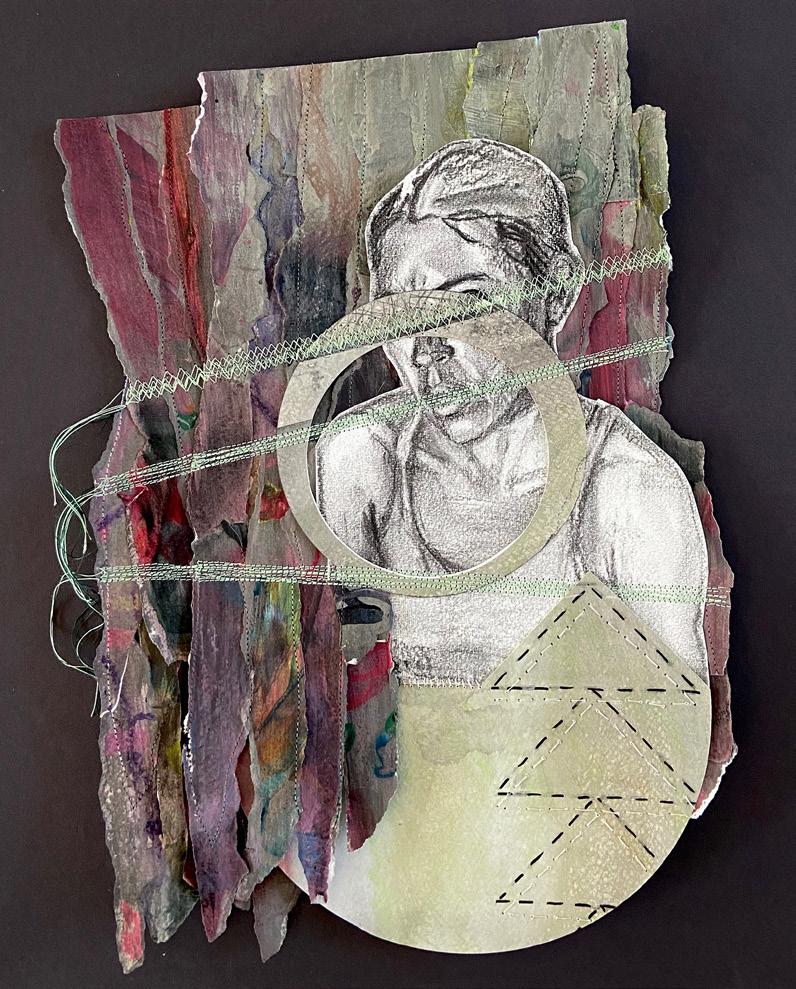
Hushed, 2020 (mixed media on paper and canvas, 11x15) by Amy Freeman
Artist AMY FREEMAN earned a BA in Studio Arts-Painting from the University of Massachusetts Dartmouth and an MFA in Painting from the University of Wyoming, Laramie. For many years, she has taught and developed art-related coursework at several colleges and universities (including East Carolina University) and is currently also offering innovation and creativity courses through the Innovation Academy at the University of Florida, Gainesville, where she is an Assistant Professor in the Department of Art and Art History. Her work has been exhibited widely throughout the US and is held in numerous private and public collections worldwide.
A PLACE CALLED VULNERABLE
a review by Laura Dennis
Karen Salyer McElmurray. I Could Name God in Twelve Ways. University Press of Kentucky, 2024.
LAURA DENNIS teaches in southeast Kentucky. Her creative nonfiction has appeared in various publications, including Change Seven , Northern Appalachia Review, McNeese Review, Still: The Journal, Bluff & Vine, and Bethlehem Writers Roundtable , where she was the Spring 2020 Featured Author. She received honorable mention for the 2017 Betty Gabehart Prize and was a finalist in the 2019 Tucson Festival of Books Literary Awards. She writes Rural Reflections – The Reboot on Substack, reviews books for a number of publications, and serves as co-editor of book reviews for MER. Her first book, an essay collection, is under contract with the University Press of Kentucky.
Why travel? The question is not new, as Karen Salyer McElmurray points out in the Prologue to her recent essay collection, I Could Name God in Twelve Ways (xi). She cites Italo Calvino’s Invisible Cities (1972; trans. 1974), Robyn Davidson’s Tracks (1980), William Least HeatMoon’s Blue Highways (1982), and Anne Dillard’s Teaching a Stone to Talk (1982) as being among the books that have helped inform her response to this age-old question.
Like these predecessors, the thirteen lyric essays in McElmurray’s volume provide a range of possible answers. These include not only the perhaps expected quest for novelty and enlightenment, but also an exploration of the far edges and depths of grief. The word “seeker” occurs time and again as we follow McElmurray through time and space, moving from confinement in a psychiatric ward to the freedom of travel, from Kentucky to Crete, from the Grand Canyon to the Ganges.
Two voyages recur throughout the text: the many returns to Appalachia, both literally and in the space of memory, and a multi-year backpacking trip in the company of her thenboyfriend Paul. The “then” of that description is significant, for the evolution of their relationship receives nearly as much attention as the journey they undertake.
Paul first appears in the fourth essay, “And Then the Holy River,” which interweaves their earliest encounters with their stay in Varanasi. The reader soon understands that the speaker’s “longing” (her word) will not suffice to sustain their connection. Paul’s subsequent appearances in the book bear this out. In fact, in its most literal sense, the title refers to their differences: “I can name God in twelve ways and in ten times and places in history, but I can’t name one of the varieties of poppies Paul once planted by the house where we lived” (61). Despite their many conflicts, the journey continues, the gulf between them growing ever wider. The breakup does not come until after their return. It must be said that McElmurray does not take the trip merely to follow her lover. She is also running both away from and toward her own life, from past events that have broken her heart, body, and soul. These include ancestral stories, childhood memories, the son she surrendered for adoption, and the abortion that allowed her to travel with Paul. Along the way, she addresses a number of themes seen elsewhere in her oeuvre, including explorations of liminal space, the practice and teaching of writing, climate change, the nature of desire, and what it means to live in a body, especially a female one. Throughout, the reader feels her
KAREN SALYER MCELMURRAY is the author of several award-winning works of fiction and nonfiction, including The Motel of the Stars (Sarabande Books, 2008), part of which takes place in North Carolina; Wanting Radiance: A Novel (University Press of Kentucky, 2020); Voice Lessons: Essays (Iris Press, 2021; reviewed in NCLR Online Winter 2022); and the memoir Surrendered Child: A Birth Mother’s Journey (University of Georgia Press, 2004), which won the AWP Award for Creative Nonfiction and was named a National Book Critics Circle Notable Book. Other awards include multiple mentions in Best American Essays, the Annie Dillard Prize, the New Southerner Literary Prize, the Orison Anthology Award, and grants from the North Carolina Arts Council and the National Endowment for the Arts.
OPPOSITE “one of Granny’s Trip Around the World quilts,” courtesy of Karen Salyer McElmurray
deep hunger for something like absolution, a quest for healing perhaps impossible to attain.
As mentioned, grief is a central theme of the text, as is mourning, which may explain the apparent conflation of the French words “deuil” and “douleur” (109). Grief is so prevalent, in fact, that the collection could almost have been titled “I Could Name Grief in Twelve Ways.” Not that grief and God are entirely dissimilar – both are ineffable, unknowable, and unlike most voyages, infinite, without discernable beginning or end.
This connection is reinforced by some of the recurring images in the collection, most notably knots, mazes or labyrinths, and quilts, particularly the “Trip Around the World” quilt her grandmother made. In “Supplication,” McElmurray describes the pattern: “The quilt is made of successive journeys of color around the circumference until you reach the center, one solid
square of yellow, like a light in the middle of a maze” (62). She goes on to map her family history onto the design, imagining her Kentucky ancestors, followed by her father, her parents’ marriage, her childhood, “And all the journeys after that. Trip upon trip upon trip. Orange and white. Lavender and rose. India. Nepal. Thailand. A back alley in a forgotten street in another unremembered country” (63).
As befits this central image, these essays move alternately away from and toward a center that threatens not to hold. At some points, McElmurray dives straight to the core of her pain and encourages her students to do the same. “Find the heart of your piece, I said. And I meant the deepest place” (104). Thus, readers bear witness not only to her time with Paul, but also to her traumas, from the tragedies of her ancestors both named and unnamed, to her own mental breakdown and recovery in the opening essay, “Blue Glass.”
Other times, McElmurray takes the reader down various winding paths, as uncertain as her fictional characters where the next turn might lead. “What does it mean, I’ve asked my pages again and again, to come from the center of a labyrinth and find one’s way out?” (68). It’s an apt question, for each of these essays provides multiple threads for readers to follow, strands that often turn back on themselves until, as she writes in the prologue, “That time transformed into this one, a veritable Gordian knot” (xi).
Knots, labyrinths, and quilts also fittingly describe the structure of these thirteen pieces, which range in length from seven to eighteen pages, each divided into shorter sections.
Some, like “Holy River,” mainly shuttle back and forth between different moments in the speaker’s life, while others, like “The Land Between,” weave research into the narrative. The image of “word quilts,” introduced in the prologue (xii) and repeated elsewhere, suits both the way sections are pieced together and the writing itself. Images such as “the swinging bridge between calm and fear” (17), “a memory canyon filled with light” (21), or “God could slide, like music” (56), stay with the reader long after the book is done. These moments of lyricism far outweigh the occasional minor discrepancy such as the number of essays – given as twelve at one point in the prologue – or the two different spellings of her great-grandfather’s name. Why travel? I Could Name God in Twelve Ways raises almost as many questions as it answers. Does travel ease our fears, or does it add to them? Maybe we travel to find home, as McElmurray sometimes seems to suggest, even if “home” means facing new griefs such as a global pandemic or her parents’ deaths. Perhaps its greatest benefit is that it teaches us how to move through a world where all manner of demons might lie around one bend, moments of transcendent glory around the next, with most of the journey occurring somewhere in between. As McElmurray writes, “Somewhere between meanness and beauty is a place called vulnerable, and if we are lucky, we learn to ride through that country, all the windows down and the wind in our faces, telling us we are alive” (17). We must take risks, remain curious, receptive, and soft, in order to navigate that space. n
MONSTERS, PREACHERS, AND YOUNG LOVERS IN SOUTHERN APPALACHIA
a review by Evelyn Berry
Andrew K. Clark. Where Dark Things Grow. Cowboy Jamboree Press, 2024.
—. Where Dark Things Rise. Quill & Crow Publishing House, 2025.
A fresh voice has emerged from the southern Appalachian Mountains with two linked novels in just two years that blend the folklore horror of the Old Gods of Appalachia podcast, the historic lens of Taylor Brown’s Rednecks (2024), and the social analysis of David Joy’s When These Mountains Burn (2020).
Andrew K. Clark, a poet and writer living in Candler, NC, has followed up his debut Southern gothic horror novel Where Dark Things Grow, set in the 1930s, with Where Dark Things Rise, set in the 1980s. Drawing on elements of supernatural horror, the novels center teenagers who, while dealing with family problems and teenage crushes, must confront malevolent forces with newfound (possibly nefarious) powers. Both novels also offer smart critiques on class, religion, and patriarchy.
sex workers from a local brothel, friends to Leo since his father frequents there) who have been kidnapped and taken to a secret lodge, where the mysterious Blue Man imprisons them. With the Shadow Wulver at his side and Lilyfax along for the journey, he ascends the mountain on a mission to free the girls. Ezra, whom Leo nicknames the Little Priest, and Mattis, a young Black boy searching for a friend, round out the group who venture to The Temple.
EVELYN BERRY is the author of the poetry collection Grief Slut (Sundress Publications, 2024) and the chapbooks Buggery (Bateau Press, 2020) and T4T (Small Harbor Publishing, 2026). She is the recipient of a 2023 National Endowment for the Arts Poetry Fellowship and a 2024 South Carolina Individual Artist Fellowship for Poetry. She lives in Columbia, SC.
ANDREW K. CLARK is from Western North Carolina where his people settled before the Revolutionary War. His poetry collection, Jesus in the Trailer (Main Street Rag Press, 2019), was shortlisted for the Able Muse Book Award. His debut novel, Where Dark Things Grow, was shortlisted for the Manly Wade Wellman Award and won an IPPY Award for Horror. His work has appeared in The American Journal of Poetry, Appalachian Review, Rappahannock Review , and many other journals. He received his MFA from Converse College.
Leo, the fifteen-year-old protagonist of Where Dark Things Grow, cares for his mentally ill mother and sick sister in his alcoholic father’s absence during the Great Depression. After a terrifying encounter with a Shadow Wulver, Leo discovers he can command the terrifying beast. With this new powerful ally, Leo takes revenge on those who have terrorized him. He sics the Wulver on his cousin, who claimed to have kissed Leo’s tomboy best friend and crush, Lilyfax. With the Wulver’s influence, he reduces a local priest, Reverend Wormley, to a sniveling heap in retribution for preying on Leo’s mother. The novel’s central conflict revolves around a cadre of missing girls (mostly
At its core, Where Dark Things Grow is a classic story of Good triumphing over Evil. The majority of the characters we meet are divided into these camps: Mr. Goodman, an old man building a church in the forest, is (as one might infer) Good, while Reverend Wormley is selfish and cowardly. As the naming here implies (Good, Worm), sometimes Clark’s name choices are a bit overt in their categorization. In contrast to the Shadow Wulver’s dark influence, he introduces the Silver Wulver, a wolf-like creature who represents Goodness.
Clark manages to portray a more nuanced conflict between good and evil through Leo’s internal character arc. To save the girls on the mountain –where they have been trapped inside of trees – he must overcome his desire for revenge, quickness to anger, and resentment. If he hopes to save his friends, he must confront the evil within himself, and the stark realities of the adult world. Clark uses themes of light and dark to critique organized religion and its predatory nature and
to introduce a horror element to what might have otherwise been a young adult romp. The Blue Man’s actions are horrifying; fundamentally, Where Dark Things Grow focuses on the twin threats of institutionalized faith and rape culture. Leo’s character arc depicts his embrace of a healthier form of masculinity in contrast to the patriarchal power irresponsibly wielded by other characters.
In his second novel, Where Dark Things Rise, Clark continues to refine his exploration of these themes, including toxic masculinity, religious fundamentalism, and the nature of evil. In the mid-1980s, five decades after the events of Where Dark Things Grow, Papa Leo and LilyMa (Lilyfax’s adorable grandmother moniker) raise their grandson, Gabe, in the aftermath of his parents’ death in a car crash. Ezra, a relatively minor character in Clark’s first novel, has succumbed to the desire for dark power and terrorizes Gabe. Mina, who grew up in a trailer park with an alcoholic father and harbors a crush on Gabe, has found herself in possession of a grim and seductive power; she can summon the Shadow Faces. The teen romances in Where Dark Things Rise are more mature than in Where Dark Things Grow, a natural evolution due to the new time period during which the second novel is set. Whereas Clark depicts an innocent crush in his first novel, Where Dark Things Rise features more nuanced teenaged relationships including frank discussions
about sex and sexuality that allow Clark to bring the romance subplot to the fore.
Mina’s romance with Gabe is juxtaposed with scenes of increasing dread as Ezra, in the form of a vicious Red Wolf, becomes more influential and dangerous. At the midpoint of the book, Clark inserts an extended series of chapters from the point of view of Erin, one of Mina’s friends. Erin, who has been dubbed sexually immoral by her parents, is sent to the Purity Sojourn, where she and other teens endure a mixture of abusive conversion and wilderness “therapy” practices. Eventually, Erin and other young girls are kidnapped; imprisoned by Ezra, Mina, and Gabe; and equipped with Mina’s sinister powers and Gabe’s inherited trauma. They climb the mountain to save the girls and stop history from repeating itself.
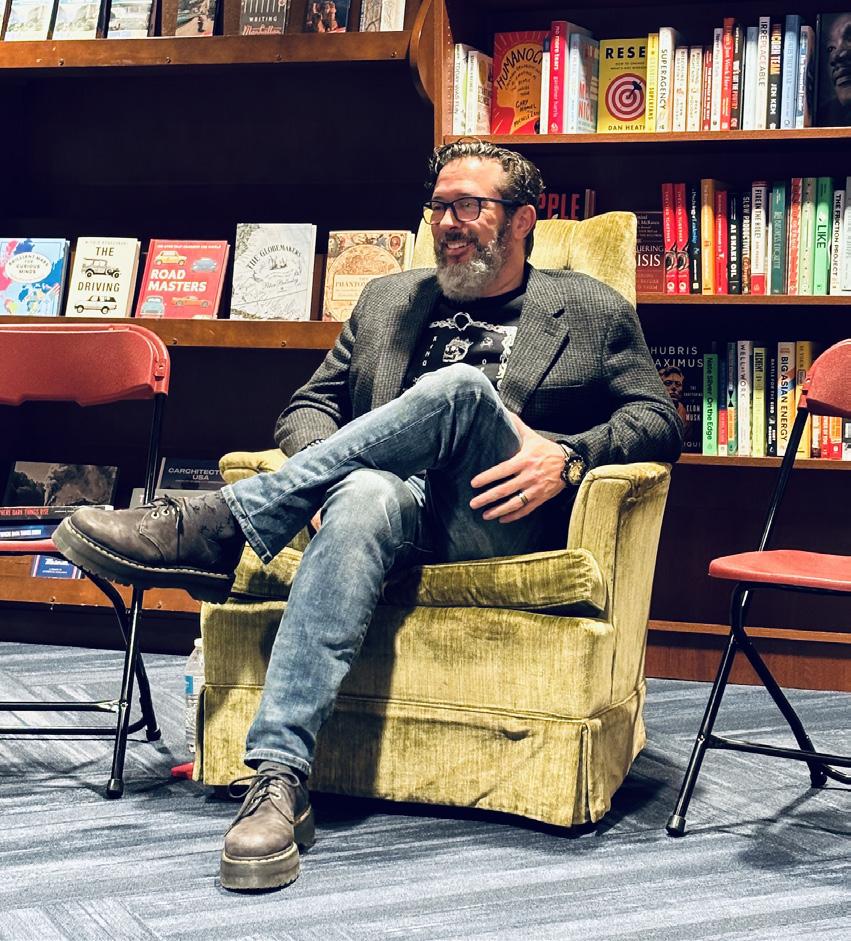
forms of coercion. Where Dark Things Rise asks the reader to consider what happens when those without any power gain it, and how does power change someone’s motivations? What justifications do people make when they abuse the power they have gained?
While it is not necessary to read Clark’s first novel to enjoy his second, Where Dark Things Rise serves as a perfect spiritual successor to Where Dark Things Grow, expanding its lore and refining its themes. As the novel progresses, Clark introduces new horror elements, which complicate the supernatural environment of Southern Appalachia. The author also continues to focus on themes of patriarchy and religion as
Where Dark Things Rise, like Where Dark Things Grow, ends on a cliffhanger during which a character for whom we’ve been cheering gives in to the seduction of power. With two novels already under his belt, I’m curious to see how Clark will expand his Appalachian universe populated with monsters and wicked men. His work so far has managed to capture much about his home region: the creepiness of the dark woods when alone at night, the suffocating grip of religious fanaticism, the beauty and brutality of nature, and the resilience of the people who live there. n
ABOVE Andrew K. Clark at Quail Ridge Books in Raleigh, NC, 26 Sept. 2025
VIRTUALLY REAL
a review by Barbara Bennett
Lindsay Starck. Monsters We Have Made. Vintage, 2024.
BARBARA BENNETT is a Professor of English at NC State University. Her areas of specialty include Southern literature, women’s writing, and ecofeminism. She is the author of five books and numerous articles, interviews, and reviews. Read her essay on Jill McCorkle in NCLR 2006, her interview with McCorkle and Lee Smith in NCLR 2016, and her essay on the film adaptation of Daniel Wallace’s Big Fish in NCLR Online 2019. A regular reviewer for NCLR, she will serve as guest feature editor for the 2027 issues and invites submissions on Gothic North Carolina literature for these issues
LINDSAY STARCK was born in Wisconsin. She studied literature and writing at Yale, Notre Dame, and UNC Chapel Hill. She currently teaches at Augsburg University in Minneapolis. Her scholarship has been published in Modern Fiction , The Journal of Modern Periodical Studies, and Adaptation.
In 2014, in Waukesha, WI, two twelve-year-old girls stabbed their friend nineteen times under the presumption of appeasing a fictional character they discovered online. They believed the character “Slenderman” would hurt their families if they didn’t complete the act. Since then, there have been movies, books, videogames, and documentaries dramatizing the girls’ claims and so furthering the mythology of Slenderman.
The idea of children killing children isn’t new in literature (or in life). Consider Lord of the Flies and The Hunger Games. But that doesn’t mean reading about it doesn’t still shock us. In her second novel, Monsters We Have Made, Lindsay Starck channels the Slenderman myth, setting her version in North Carolina.
The plot begins much like the Wisconsin attack: two girls, Faye and Anna, attack and almost kill their babysitter on a hike through the woods – all in the name of their Internet siren called the Kingman. Jump forward thirteen years, and both girls have completed their juvenile incarceration sentences. Anna has optimistically changed her name to Elizabeth the Good, but Faye has gone back to her delusion. She disappears from her halfway house in pursuit of the Kingman, leaving her three-year-old daughter with her estranged and nowdivorced parents.
The attempted murder story becomes an adventure/mystery with Faye’s mother seeking her
daughter, knowing that Faye has gone in search of the elusive Kingman in the remote wilderness of northern Minnesota. It’s a clever and crafty plot that keeps the reader wondering if maybe the Kingman is real – or if believing in him will make him real. I don’t want to spoil it for you, so I won’t reveal any more details, but be assured, with its tight narrative and engaging characters, it’s definitely worth the ride. Starck has pulled off what is touted often but is rarely the truth: you can’t put down the book until you know the ending. Without revealing plot surprises, this review will explore its thematic and cultural lessons about the power of the Internet to shape minds, especially of children who spend as much time in the virtual world as they do in the real world. In fact, according to author Jonathan Haidt in his book The Anxious Generation (a must-read for any parent or teacher of a Gen Z child), teens spend “six to eight hours per day” on screenbased activities.* This means the Internet often teaches and shapes them – for good or bad – more than their teachers or their parents.
One idea the novel wrestles with is whether people behind the Internet sites (or AI) bear any responsibility for the consequences of their lies. Slenderman was created by a young man named Eric Knudsen in 2009 when he manipulated two Photoshopped images for a contest showing children
* Jonathan Haidt, The Anxious Generation: How the Great Rewiring of Childhood is Causing an Epidemic of Mental Illness (Penguin, 2024) 119; subsequently cited parenthetically.
CALL FOR SUBMISSIONS
The 2027 issues will feature
Southern Gothic Literature of North Carolina
SUBMISSION DEADLINE August 31, 2026 for Interviews with and Critical Analyses of North Carolina writers
Submit creative writing via our annual contests:
n poetry: deadline April 30November 15
n fiction: deadline October 31
n creative nonfiction: deadline March 1
Our definition of a North Carolina writer is anyone who currently lives in North Carolina, has lived in North Carolina, or uses North Carolina as subject matter.
Email queries to 2027 Guest Feature Editor Barbara Bennett (BaBennet@NCSU.edu).
For more information, writers’ guidelines, and submission instructions, go to:
with a sinister tall man watching them in the background. The novel inspires us to ask ourselves if this is any different from the stories that have existed for millennia. In the novel, Faye’s parents admit that they “could get lost in stories” (25), and when Anna becomes Elizabeth, she gains an interest in history, realizing that “history was simply stories by another name.” Like life, history is not simple; it is “layered, it’s tangled. It keeps coming back” (60). Even though Jack and Sylvia want the judge in the girls’ trial to “blame the technology, the blogs and message boards, the warping
of reality, the merging of fact and fiction, the dissolution of boundaries, and the proliferation of illusions that occur every single day online” (175), the novel does not offer this option. Leonard Wolff, a professor who teaches a class about monsters (including the Kingman), tells Sylvia that the story her daughter read on the Internet is just “a story. . . . That’s what stories do. They make you see things and feel things that aren’t really there” (155). Most adults understand that, but the novel prompts us to ask, how do we teach our children to distinguish reality from illusion when we
tell them about Santa Claus and the Easter Bunny and read them fairy tales at night?
Sylvia’s sister Rosie explains that incidents like the stabbing can be termed “folie à deux,” which means “the madness of two . . . a clinical term for when a delusion is passed or shared between minds. . . . The more voices that lay claim to a fiction, the more likely it seems to be real.” Without Faye, Anna never would have stabbed the babysitter – and vice versa: Anna believes that “they could face any danger as long as they were together” (90). But when one adds the Internet, with millions
of voices “that lay claim” to every fiction (227), the world becomes a scary place, especially for parents. Any delusion strengthens through repetition. How many “likes” and “shares” does it take to make something real, the novel asks.
The parents of these deluded girls are especially deserving of empathy, and Starck plays particular attention to the dangers of parenthood in the modern world. First, she describes the fear of abandonment that Sylvia experienced as a child. Her mother fostered newborn babies who, of course, left when a permanent home could be found, so Sylvia remembers a home of “disappearing children” (5). Faye seems to have inherited that fear when she names her daughter after Amelia Earhart, who “went missing. . . . Poof! In midair! And nobody ever found her” (59). Of course, Sylvia does lose her daughter, first to jail, then to a halfway house, and finally as an adult when Faye abandons her own daughter and leaves to find the real Kingman.
Sylvia believes that “motherhood is simply one loss after another” (269). She also muses that “no matter how old we grow or how far we travel, we can never escape our childhood” (9). In the novel, even the judge blames the parents. He reflects, “To me that must have been the most monstrous part: . . . Trying to see where you went wrong” (93). Parents of other children also accuse the offending children’s parents, believing if “people could figure out exactly how they’d failed as parents, everyone would know what not to do” (108).
The parents of the daughters who stabbed their babysitter in Wisconsin wonder how their daughters could have done what they did – and if they were also guilty as parents. In a documentary about the Slenderman myth, the parents of both of the girls express their dismay and disbelief at their daughters’ violence. Their daughters had seemed like “normal teenage girls,” and the “Internet stuff” didn’t seem any more dangerous than horror stories with monsters that they loved as children. In a fictional radio show Starck includes in one of her interchapters, the host claims, “Literature scholars say that the monsters of any era are expressions of specific fears, desires, preoccupations.” She goes on to blame the girls’ attack on “helicopter parenting” and “late-stage-capitalist anxieties” (54). Starck’s academic scholar pontificates that “Monsters carry the blame for tragedies beyond our control. They provide a way to explain the inexplicable; they’re manifestations of our own fears, our desires. They are the shapes we have given to grief and terror in order to contain them, wrestle with them, and banish them away” (233).
Perhaps Professor Wolff is correct. But I can’t help but notice that Sylvia alludes to the story of the Pied Piper, another fictional character who lured children away from their homes – much like the Kingman and Slenderman. One doctor in the novel labels it “The Kingman Effect,” referring “to the phenomenon by which this mythical being pulls people – almost always young people, but not exclusively, so deeply into his lore that they
lose their ability to distinguish between fiction and reality” (77). The Pied Piper led the children away to punish the parents for not living up to their financial obligations; therefore, those parents were not able to protect their children. Peter Pan also lured away children while their parents weren’t paying attention. Monsters are on the Internet, but parents may not be seeing them. Haidt argues strongly in his book that “we are overprotecting our children in the real world while underprotecting them online” (68). In the palms of their children’s hands lie a portal to every danger in the world.
Professor Wolff claims that the Kingman is “not a lie. . . . It’s a story” (261). What is the difference, and how do we figure out how this works in both the virtual world and the real world? Wolff tells Faye, “’You know better than anyone that stories are living, breathing things. They weasel through your skin, your bones; they wriggle through your blood. They hunt you, haunt you. They’re a part of you, yes, and also separate from you. It’s impossible to articulate the boundaries’” (261). With Internet stories – some real and some false – the power of stories is even greater. The novel’s doctor explains that the Internet “is designed so that you click and keep clicking, so that you tunnel deeper into a world that feels real but is only virtual” (77). Starck’s novel walks this blurry line, writing this story that alludes to and expands the story of Slenderman, which is a story in a real world. Complicated? Strap yourself in. It’s only just getting started. n
THE SPEECH OF THE PLACE
a review by David E. Poston
Britt Kaufmann. Midlife Calculus: Poems. Press 53, 2024.
Tony Robles. Where the Warehouse Things Are. Redhawk Publications, 2024.
It must have been great fun for Thomas Love Peacock in 1820, tweaking the noses of the Romantics in “The Four Ages of Poetry,” provoking Shelley’s high-flown response in “A Defence of Poetry.” Two centuries separate that philosophic spat from Kathryn Campbell’s excoriation of TikTok poets for writing “sandbar sentences that could be written by just about any fourteen-year-old.” Sven Birkerts’s words bemoaning “young media-infected poet[s]” in his 1989 essay “The Rage of Caliban” (from The Electric Life) seem both prophetic and quaint in this post-truth age, with all our anxieties ratcheted up.1 Who can blame us for that anxiety when looming over us is the specter of AI, able to play all the parlor games of the OuLiPo poets in a nano-second.
of them repurposes that speech to fruitful ends for both themselves and for readers.
Britt Kaufmann’s Midlife
Calculus chronicles her experience as a high school math tutor (which she describes as a combination of kindergarten aide and embedded wartime reporter) during the early, most frightening days of the Covid epidemic. That experience causes her to confront the various pathologies with which her students grapple: dysfunctional families, gun violence, addiction and alcoholism, hunger and poverty. It also coincides with her own midlife grapplings with identity, mortality, and purpose. In the esoteric language of mathematics, Kaufmann finds a way to explore and express these struggles.
DAVID E. POSTON lives in Gastonia, NC. He has taught at UNC Charlotte, at Charlotte’s Young Writers’ Workshop, and for thirty years in North Carolina public schools. He is the author of two award-winning poetry chapbooks and the full-length collection Slow of Study (Main Street Rag, 2015; reviewed in NCLR Online 2017) and Letting Go (Fernwood Press, 2025). He is a regular NCLR reviewer, and he won third place in the 2020 James Applewhite Poetry Prize (his poem then published in the 2021 print issue). His poetry, fiction, and reviews have appeared in Broad River Review, Cider Press Review, Flying South, The MacGuffin, Pembroke Magazine, and others. A past editor of Kakalak , he currently serves on the board of directors of the North Carolina Poetry Society.
And yet – Chen Chen looks up at the night sky, as poets have done since the dawn of time, and writes “i love you to the moon &.”2 The CantoMundo poets nurture each other in ways the Lake Poets could not have foreseen. And poets Britt Kaufmann and Tony Robles, meanwhile, are at work in the real world, facing real-life exigencies that do not allow time for literary squabbling. Their new collections employ the kind of language that Wallace Stevens prescribed in “Of Modern Poetry” when he said, “It has to be living, to learn the speech of the place.”3 Each
A thread of prayer runs through this collection, appearing first as a supplication for guidance in “Coastal Prayer”: “Give me a rule to follow: / The constant rule through all these changes, / The power rule to not give in, / Devise some rule so I can make a difference.” There are prayers for healing in the face of a Covid epidemic that her poem “Scaffolding” describes as “increasing in amplitude / as though the full moon refused to wane, / would, rather, spiral in to meet the sea.” There are prayers drawn from Julian of Norwich or, in “Teaching on a Full Moon
1 Kathryn Campbell, “Modern Poetry Has Decayed into an Unsubstantial, Shallow Form of Minimalism,” The Central Trend 4 Oct. 2024: web; Sven Birkerts, “The Rage of Caliban,” The Electric Life: Essays in Modern Poetry (Morrow, 1989) 55.
2 Chen Chen, “i love you to the moon &,” Poem-a-Day, The Academy of American Poets, 31 May 2021): web.
3 Wallace Stevens, “Of Modern Poetry,” The Collected Poems of Wallace Stevens (Knopf, 1954) 254.
Friday,” from the intonations of her mother’s church: “Peace before me, / Peace behind me. / Peace beneath my feet. . .”
After an opening trio of poems establishing where Kaufmann is as a person and as a writer, the next two poems confront the tensions between the daily exigencies she faces and her existential concerns. “This year I will . . . ” begins by addressing funding needs and how to explain algebraic equations. The poem’s conclusion, though, with its artfully employed zeugma, expands to a much broader concern applying to both her students and herself, as Kaufmann must fill in for missing teachers, bust vapers in the bathroom, work literal equations and maybe wonders, figure the balance between expectations and grace.
Not surprising to anyone who’s worked in a public school, grace is needed daily. Her poem “∆Math,” which – with a perhaps deliberate touch of irony – precedes a series of poems that grumble about students, parents, interpersonal agendas, and social media distraction, ends with this: “change my grumblings to prayer: / work through me / the miracle due these students.”
“Bucket List” uses the language of mathematics and academic concerns: finding a value, pursuing tangents to a point, the daily routine of working things, and the career goals one might encourage students to pursue. Its conclusion, though, reaches beyond grades and degrees: “Become a polyglot in self-forgiveness. / The differences between become / small and smaller as we approach infinity.”
Throughout the collection, the poems expand the meanings of their terms. “Constant,” for example, begins with a pair of clichés: “the only con-
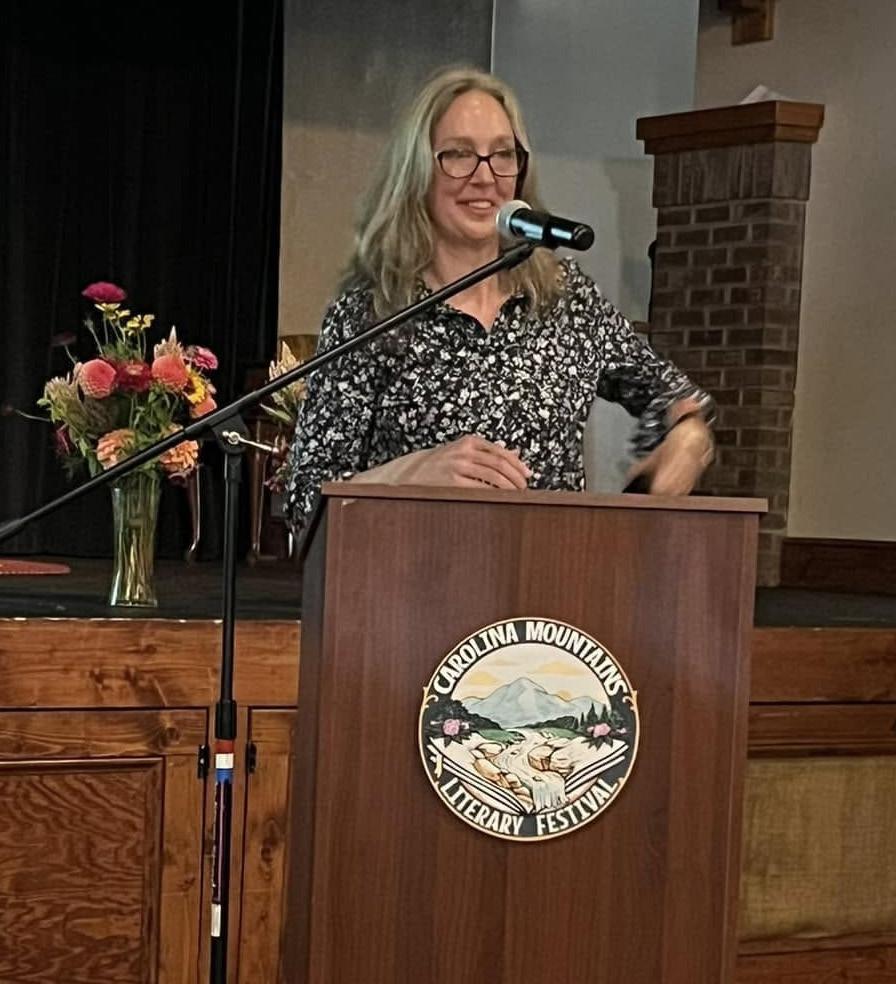
stant is change” and “it is what it is.” But Kaufmann begins to push us beyond clichés:
The coach’s wife says to him, “Nothing changes if nothing changes.” He says nothing, but nods.
Always plot time on the x-axis: It’s the independent variable, always marching on. Until it isn’t.
The poem turns on the line, “How flat our first knowledge becomes,” when platitudes are left behind and the poem takes us through the mysteries of the earth goddess Pachamama, into the spirals of DNA, and then outward to celestial motion, all in order to close with this view: “How precious this tiny world we burn. A magi’s gift: / watch chain and tortoise shell become slag and ash. / For what purpose, this rain of myrrh?”
BRITT KAUFMANN is the author of the poetry chapbook belonging (Finishing Line Press, 2011) and two plays, An Uncivil Union: The Battle of Burnsville (2011) and Between the Tackles (2012), co-written with Stephanie Stark-Poling. Both plays premiered at the Parkway Playhouse in Burnsville, NC. The National Association of Independent Writers and Editors selected Midlife Calculus as the winner in its Poetry Book category, and the collection received a Silver distinction from IPNE (Independent Publishers of New England). For a number of years, Kaufmann was a teaching artist with Penland School of Craft’s Subs with Suitcases program. Her poems have appeared in Scientific American, Kakalak, J Journal: New Writing on Justice, Pedestal, Now & Then, Pinesong, and SoftStar Magazine , among others. She is a founding organizer of the Carolina Mountains Literary Festival and served as a core board member for many years.
ABOVE Britt Kaufmann reading on the day of her book launch at the Carolina Mountains Literary Festival in Burnsville, NC, 6 Sept. 2024
When her students ask another age-old question, when will they ever use calculus or trigonometry, Kaufmann’s poem “Series & Rotations” provides a stark (and ever more pertinent) answer:
Drop the needle on this blues song:
You cannot use knowledge never learned, though it can be used against you. And in your ignorance you will depend on the mercies, or the lack thereof, of those calculating their own interests, who do master numbers –for math and money are links in chains of power and oppression.
As readers become acclimatized to Kaufmann’s language, they will recognize that the “oscillating regression” of “No One really Understands Gravity” is depression, that the barycenter of that poem is a mother’s grief “with voids so heavy / they buckle our knees.” Yet there are prayers of thankfulness in poems such as “When dyslexics learn trigonometry” and “Abigail 1/700,” a clever riff on Leonard Cohen. There are similar witty gems throughout this collection, and always compassion is central. “We focus on circles – / what is within our control, / and what we must let go,” Kaufmann writes in “New Math.” That poem begins with a litany of exercises for coping with anxiety and ends with
Some days we break the rules and hold each other through tears, promise, You are not alone.
The collection’s emotional arc ends with something less than resolution but more than acceptance. The last few poems form a sort of coda, after the school year has been wiped away. “Psalms” echoes “Enrolled,” the first poem in the collection, giving new meaning to that poem’s curious ending: “Sign me up. / It is all self-inflicted.” In the conclusion to “Psalms,” Kaufmann writes, “The hurts I hold / in my heart are mine – / of my own making.” Don’t mistake either of these comments as self-pitying or resigned. Take them as an acceptance of self, an assertion of agency in the progression of one’s life, whether line or arc or algorithm.
“Methods” employs the trope of the palimpsest, used earlier to compare the mind to a dry erase board that is never quite clear or the promise of a new year in a pristine new notebook. This time it is the surf that can “wash errant steps smooth, / turn over a sparkling new view” as a mother and daughter fill their hands with shells. The final poem, “Fata Morgana,” looks out from that shore and seems to end in a moment of Keatsian numbness, pondering whether to drift or chart a course.
Before taking leave of these poems, one should have another look at the collection’s title poem, which illustrates one of the volume’s key accomplishments: how Kaufmann takes the language and concepts of mathematics and employs them to express a more transcendent meaning. Yes, there is a formula to measure the volume of a glass, but learning how to measure a life is a different matter:
I have learned enough, now, to measure precisely how much it holds, the irregular curves –less the difference of the holes life left –and yet, my heart is still full.
The poems in this collection lead one to believe that Kaufmann found a heart-filling purpose and made a meaningful difference in the lives of these students.
In the introduction to Where the Warehouse Things Are, Tony Robles describes his experience in the title setting as a time of “building and repairing what was broken in me.” The introduction and the poem “Warehouse Part II” relate an anecdote about a trainer describing his boxer’s need to summon inner resources: “courage / heart / fortitude.” After his introduction describes the circumstances that led Robles to the warehouse job assembling wheelchairs and walkers and commodes, his poems incrementally flesh out the story and its effects on him.
In some ways it is a familiar story in a society where writing alone seldom pays the bills. “Paperback” asks,
How many writers work in warehouses? How many stories are on the shelves waiting?
How many poems are collected by the dust mop, sweeping across floor’s memory?
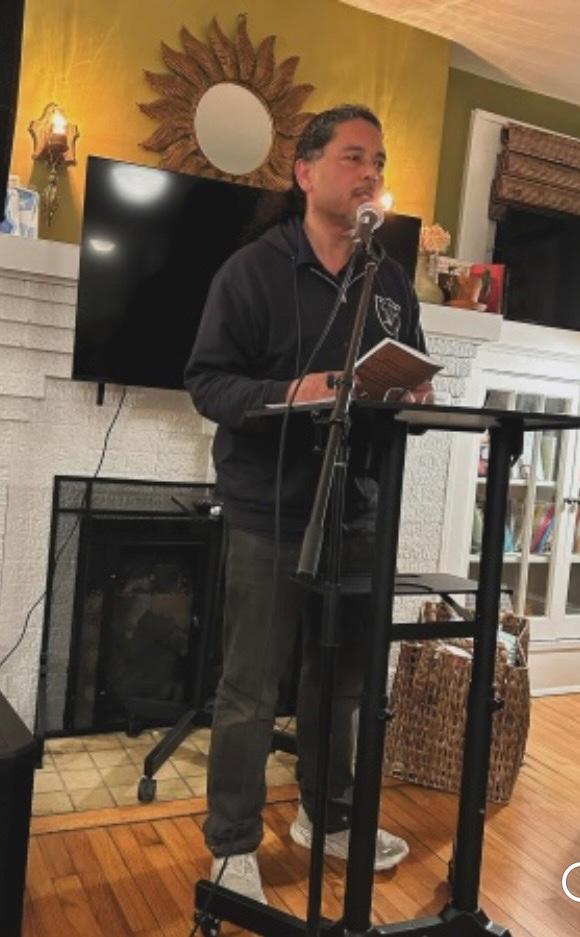
For Robles, however, the job provides much more than just a paycheck. As “Pushcart” puts it, in every part of this experience, he is “pushed // towards poetry.” “Warehouse Part II” illustrates how Robles imagines elements of his surroundings come to life as “an audience of / cardboard boxes of all sizes / storing cheers, boos, hisses.” The language of tools – leaf blowers, forklifts, pushcarts, dustmops, and all manner of hand tools –is ubiquitous. He employs his new vocabulary in “Wrench of the earth,” which begins,
To wrench a poem from between one’s teeth while working in a warehouse
using the wrench as if a toothpick is an act of genius
participating
“Wrenches have names,” the poem continues, scrolling their names down the page:
Crowfoot socket lug dogbone spoke torque impact
Of course, Robles is enamored with the sounds of these names, and being enamored with unfamiliar words and sounds is central to the story of his regeneration.
The poem titled simply “Warehouse” describes how working with boxes prompts Robles to make an introspective list:
I ask myself which box I will check:
African-American Filipino 55 or older college grad single married divorced
His poem “Fork Lift” fleshes out his personal and family history:
I think of my father, a working man who made it possible for me to lift a fork to my mouth I stabbed at food with a fork that my father had provided And sometimes he put down his fork and ate with his hands, thick brown hands like a true Filipino
“Internee” presents a roll call of names from a dark chapter in the history of both his family and his nation:
Poston
Manzanar
Tule Lake
Gila River
Jerome
Roher
Granada
Minindoka
As Robles is accepted into the easy camaraderie of the warehouse, as he listens to the background music, or even as he cuts open a box, memories of family arise to become poems.
The tender and empathetic way that Robles describes his coworkers is central to their power. “Warehouse kind men” is dedicated to seven of them:
Every tool in the book kind men
Drills and bits and pieces kind men
Top 40 hit from the past, jazz and classical and eclectic sounds from lung’s chambers kind men
The poem is an expansive and joyful portrait of how they share friendship and “laughter like / confetti from their / guts.”
“The Girls Part I” is a portrait in miniature that focuses on a woman’s hands, swollen by work and time. It begins
Swollen with Water the fragrance of Crushed flowers
TONY ROBLES was named the Carl Sandburg Writer in Residence by the Friends of Carl Sandburg in Flat Rock, NC, in 2020. Where the Warehouse Things Are was shortlisted for the 2025 Roanoke-Chowan Award for Poetry. His previous works include Cool Don’t Live Here No More – A Letter to San Francisco (Ithuriel’s Spear, 2015), Fingerprints of a Hunger Strike (Ithuriel’s Spear, 2017), and Thrift Store Metamorphosis (Redhawk, 2023). His poetry, short stories, and essays have appeared in numerous publications. A self-described “janitor by day, professor by night,” he continues to work as a warehouse tech and to teach creative writing in the MFA graduate program at Lenoir-Rhyne University in Hickory, NC.
ABOVE Tony Robles
in the Juniper Bends reading series at Story Parlor, Asheville, NC, 19 Sept. 2025
Swollen with The dirt of her mother’s Grave
The poem goes on to describe her humble, deferential manner, then ends by describing
Her hands
Holding the sorrow of The sweetest flower afloat
Tending the garden
That is the warehouse
Pulling light from flowers
Trapped in boxes
shaping it with her hands
Laughter is a thread throughout Robles’s collection. In “Warehouse Veteran,” a coworker whose uniformed picture is on display is described as
A quiet man who can’t escape the air, the earth of that other part of the world
His laughter comes out in rapid fire reveille
an ambush of riddles
More often the laughter sprouts from joy and shared experience with people whom Robles has clearly come to love.
There are stylistic distractions here: often haphazard capitalization, sometimes unfortunate choices of line breaks, and
places where the poetic energy lags. But the voice is sincere and engaging, the imagery is fresh and arresting, and the insights into his mental journey capture one’s attention and sympathy. Along with poems about memories, several describe surreal moments. For example, in “Laid to rest,” while disinfecting cots for the VA, Robles imagines a conversation with a veteran who might have died on one of those cots. Though Robles first envisions the man as elderly, the man is dressing for his senior prom. Their conversation ends,
“This way, sir,” I say And the man walks towards the garage door and the light hits him and now he is young
“Where are you going?” I ask To the prom he says, smiling
He walks away and I watch until he disappears
Robles is at his best when he uses shorter lines to maintain intensity. A good example of that energy and his memorable imagery is “Warehouse Leaf Blower,” in which
Leaves are Blown across concrete Off course leaves of every color tumbling like starfish
Seeking escape
To Satchmo’s Lips
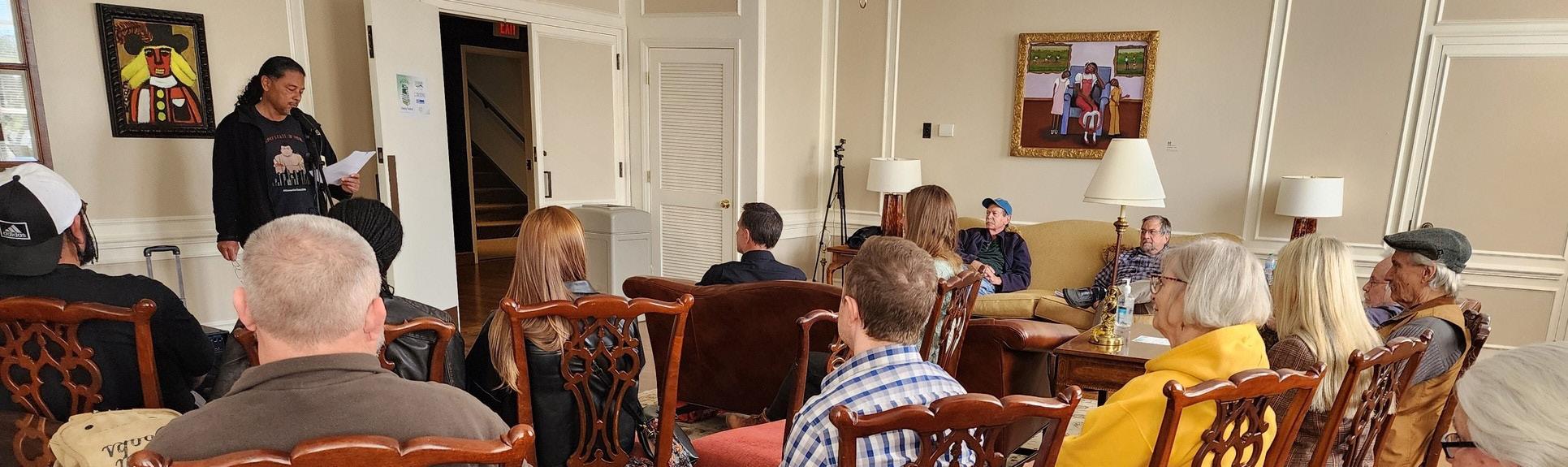
“Warehouse Veteran” provides another searing image, that of flags “Stitched in silence / Rung with blood cursed hands.” This image illustrates a key feature of the collection, how Robles gives us insights into the experiences, both good and bad, which have shaped him and his coworkers.
In the collection’s final poem, “Warehouse Clock,” Robles imagines the clock telling him that his coworkers “are where they’re supposed to be,” using the tools they need to do their work. To Robles, however, it says, “you have nothing more to / prove here.” For him, it is time to pick up his pen and to “Go out and / do what you were meant to do // Be a witness . . . testify.”
These poems are a compelling and emotionally rich testimony. Kaufmann and Robles’s collections chronicle journeys of self-discovery spent doing good work from which these poets gained as much as they gave. In each case, “the speech of the place” gave them new stylistic resources, new tropes to share their experience. But more important than quadratic equations or Allen wrenches are the stories they articulate with kindness and insight. Apart from any critical assessment of how well either follows formulae or uses the tools of poetry, Kaufmann and Robles have accomplished what the best poetry has always done: expanded our awareness of the human condition. n
LEFT Tony Robles at the Hickory Literary Festival in Hickory, NC, 12 Apr. 2025
PERCEPTIONS BEYOND THE TANGIBLE WORLD
a review by Joan Gelfand
Sheila Smith McKoy. The Bones Beneath. Black Lawrence Press, 2024.
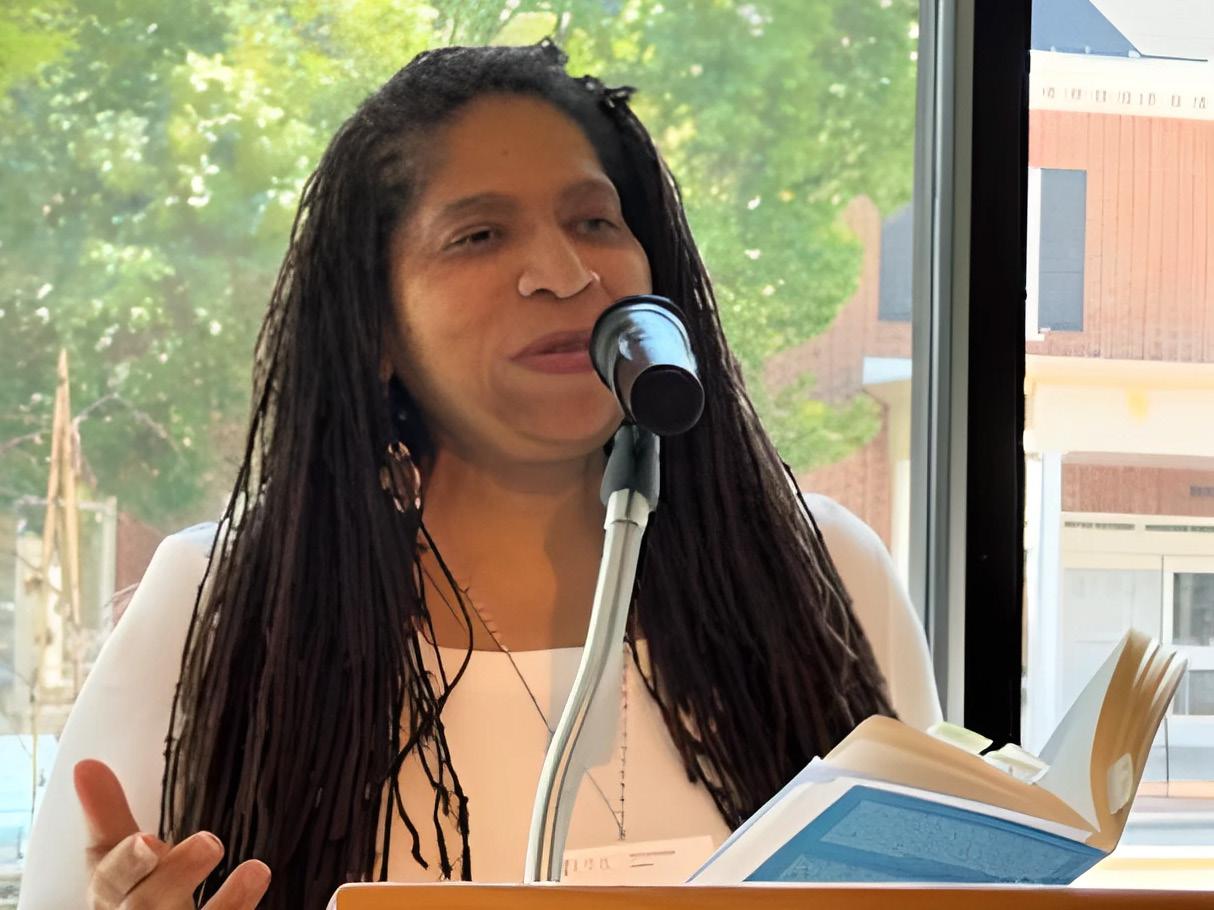
With her debut poetry collection, Sheila Smith McKoy shines her miner’s light on ancestral lore. Growing up the granddaughter of a French woman and traveling to Africa to get to the source of her personal history while confronting the issue of slavery is like dancing the tango while listening to Mozart on headphones; the moves are of the moment, the structure hews to the classic.
After nearly losing her son, a victim of a college hate crime, Smith McKoy crafts poems that demonstrate patience, faith, and perseverance while embracing poetry’s power to heal, the brilliant instruction of remembered dreams, and facing head on the hard work of social justice. In The Bones Beneath we read the new news.
JOAN GELFAND is a poet, author, and literary critic living in San Francisco, CA. She earned an MFA in Creative Writing from Mills College and a BA in English with a Creative Writing emphasis from San Francisco State University. A member of the National Book Critics Circle, her reviews have appeared in Los Angeles Review of Books , Huffington Post , Sycamore Review, PANK!, and Rattle. She is President Emeritus of the Women’s National Book Association.
Sheila Smith McKoy at Epilogue Books Chocolate Brews in Chapel Hill, NC, 26 May 2025
Racism, living in the world as a Black woman, and bearing witness to a hate crime against one’s son do not make up a simple menu of circumstances to parse. But coming to terms with cultures that clash, understanding the past, and unpacking what it means to have roots on a continent where you are in the majority, not the minority, is an admirable, if daunting task.
Through the agony of loss, the almost insurmountable task of showing up as her full self, and the poignancy of “stabs of love,” Smith McKoy attempts to make peace with generational pain while managing daily life in America as a woman of color, juggling the responsibilities of being a mother, all while holding fast to grace, lyricism, and literature. The poems are unceasing in their search for lessons in the challenges.
SMITH MCKOY earned a PhD in English from Duke University, an MA in English from UNC Chapel Hill, and a BA in English from NC State University. She is the recipient of the 2020 Muriel Craft Bailey Memorial Prize in Poetry, served as an editor of Obsidian: Literature in the African Diaspora, and has written, produced, and directed several documentary films. Her work is also featured in One Window’s Light: A Haiku Collection (Unicorn Press, 2017; reviewed in NCLR Online 2019), a collaboration of five Black poets in celebration of the haiku tradition. A native of Raleigh, NC, she returned in 2024 from living in the San Francisco Bay Area.
ABOVE
SHEILA
Having been brought to the world of letters by her grandmother, Smith McKoy demonstrates an extraordinary affinity for language, which she describes in “Speaking in Tongues”:
if not for my affinity for language how it slips out of the mind off the tongue in the air lingering, sometimes leaving a bit on my lips you would not know me but I know well . . .
Therein lies the kernel of The Bones Beneath, a poet’s keen perception beyond the physical, tangible world, beyond culture and race, the “different tastes / of truths & fantasies / of lost nibbles of history.”
And so we enter Smith McKoy’s particular world. The first section includes “Plumes,” a finely crafted ghazal that employs lyricism to express a hard truth of “the hood.” In this poem, Mr. Peacock is a pimp, and the neighbors live with women who are “puzzle pieces of bare breasts and emptying hearts, missing some / essential part, plain and broken on a deadened street.” (I bet you five dollars this is the first ghazal with a pimp as protagonist.)
Some pages later, “Waverings” begins a series of Africa poems. Hearing “accents from Lagos, Accra, and beyond,” Smith McKoy
realized that I and them . . . that we . . .
Are all straddling an indecisive but resolute line
That belongingness
Between here
And a place called home
“Amnesiac” amplifies this significant journey: Our passports call us American Undocumented, we all carry Africa some on our skins others in the burden of forgetting Africa always makes her mark pauses for a generation returns to unveil shared humanity
Along the way, between “The Nightly News,” “Liberations,” and “The Street,” hard poems recounting the daily shocks of life (Vietnam War dead, a neighbor killing his wife, and grief) are what I call the “songs,” with joyous, lay-theburden down moments. These include “Oracle,” “Like Lovers Do,” and “If I Could Only.” My favorite is “Kemuel’s Song,” in which, “We knew you could scat / had heard your riffs / the funk and rhythm / of your heart’s song.” Throughout the collection, five gorgeous pages of haiku are strategically placed, offering readers a breath of air while swimming long distance. For example, in “Fall” she observes: “Near the end of time – / a bird finds the last red leaf / witnessed by the lost.”
Much remains unresolved in The Bones Beneath, as it does in life. As my meditation teacher, Zoketsu Norman Fischer says, “We will die with our to-do lists.” I get the sense that Smith McKoy has a to-do list to last the rest of her days. Changing the world is a tall order, requiring the strength of a warrior. To this reviewer, Sheila Smith McKoy shows her mettle. She’s got what it takes. n
“SWEET
SWEAT” AND
“PLAINSONGS”:
THE LYRICAL RECLAMATION OF PLACE
a review by Annie Woodford
Forrest Rapier. As the Den Burns. Texas Review Press, 2022.
Jacinta V. White. Resurrecting the Bones: Born from a Journey through African American Churches & Cemeteries in the Rural South. Press 53, 2019.
Though Forrest Rapier’s As the Den Burns and Jacinta V. White’s Resurrecting the Bones are different in context and voice, both are potent examinations of language as the medium between place and myth. These deeply Southern poets relish the lyrical cadence of their region’s language and the complicated history that informs it. Speech patterns absorbed in churches, at parties, on basketball courts, at funerals, and at gas stations alchemize in these poems that give voice to both the human and the geographic.
In Virginia photographer Sally Mann’s memoir, Hold Still, she quotes British historian John Keegan’s observation about the South: “Pain is a dimension of old civilizations. The South has it. The rest of the United States does not.”* Each of these collections depicts not only the heat-wavered air of Southern weather, but the violent and kinclose history of the land.
is empty brackets. The poet is confronted with “the density of our past / drops of red blood dried in green grass” and how “southern dirt buries all alike.”
Here is the fusion of religion, history, geography, and suffering – the “gumbo soil” as White terms it – that is the profound project of this book. The speaker yearns to connect to the lives represented by these physical places. In the penultimate poem of the collection, as the speaker contemplates “the hours it took / to get the red clay out of” her hair, she reminds herself that “beneath the bed where I stay is dirt.”
ANNIE WOODFORD is the author of Peasant (Pulley Press, 2025) and Bootleg (Groundhog Poetry Press, 2019; reviewed in NCLR Online 2021); Where You Come From Is Gone (Mercer University Press, 2022), which won the 2022 Weatherford Award for Appalachian Poetry; and a micro-chapbook, When God Was a Child (Bull City Press, 2023).
Jacinta V. White’s Resurrecting the Bones is subtitled Born from a Journey through African American Churches & Cemeteries in the Rural South and uses the location (and dislocations) of African American churches and cemeteries to explore the poet’s spiritual quest to know her community and her history in the dirt and wood, the tombstones and choirs of the South.
In a poem set in the “Second African American Graveyard in East Salem Ave & Cemetary St, Winston-Salem, NC,” the title
* Sally Mann, Hold Still: A Memoir with Photographs (Back Bay, 2016) 82.
In addition to dirt, the body –its feet, hair, skin, nipples, “ribs and spine” – are evoked over and over again in Resurrecting the Bones, a corporeal yearning toward ancestors, toward the “body of the church,” and ultimately toward the body of humanity and therefore toward God, who is “a woman” and whose “hair naturally coils.” This attention to the body, the Black body, the body of Christ as a source of strength, beauty, and object of white violence culminates at the end of the book in a poem titled, simply, “Body,” which ends with the refrain “this is the body, this is the body, this is the body / that was broken.”
The wood found in churches also plays a central role in connecting the physical with the metaphysical in White’s book, becoming part of the “resurrected bones.” White lovingly details how a much-used table
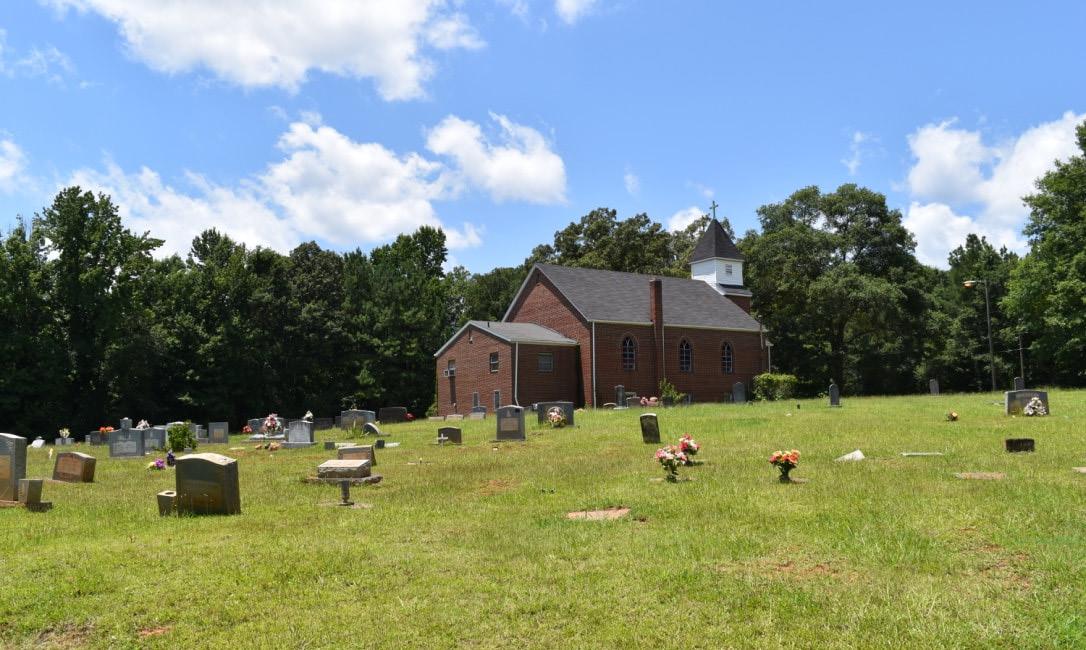
where “poor people rich in gifts” feed the pastor has “spots darkened / in the wood where pots sat hot and full.” The spiritual reverberations of the sanctuary’s wooden floor form a motif across multiple poems, where “Under baseboards and wooden planks / not yet rotten, there is rocking.” These are living churches: “This wooden floor is laughing, my toes tapping.”
What begins in WinstonSalem as a journey with her uncle LeRoy to visit churches – documented with resonant, koan-like black and white pictures interspersed throughout the collection – becomes a sort of beatitudes, an “Ameritudes” as the first poem of the last section is titled, blessing “the dying and the burying / the mourning toil of grief” inherent in our regional and national histories. This final section is preceded by a photo of a communion rail stained by wine, allowing “insight into the individual histories of the collective ritual,”
as the poet explains in her end notes. The image resonates with life, with the sense of the many presences that have knelt there, as does this book, obsessed with how physical spaces – the earth, the dirt, the wood, the “cup of wine – your lip / print still moist on the rim” – are perhaps a way to access “the questions that are lived.” The speaker often addresses ancestors, who were not able to write their own poems, though in this book she makes a poem of their lives: “sweet sweat // give me // your hands / that had no time to write.”
This is a poet who was raised in the church, whose father was a preacher (she visits churches where he preached). She has sneaked “a taste of the juice that saved” from “the latched box sitting on the back seat of Dad’s ’77 / black Sedan deVille.”
In the poem “Church Mothers” she is greeted by “women in white dresses” who tell her how “they knew my folks, and how
they knew me.” Though her own faith has become a complex affair in which she is drawn to the “the gospel of Nina Simone” and now offers “praise to the God I know instead,” she obeys when the “Church Mothers” take her to the altar: “I am caught up in their strength / speechless and well-taught to not / resist this kind of salvation.”
Her familiarity with the custom of the country, though, is in a constant state of defamiliarization, of deepening the poet’s quest to find “a voice” to “penetrate the stillness.”
This is a spiritual quest, a quest to understand the South as a microcosm of the larger national character. Preceding the first section of poems in Resurrecting the Bones is a photograph of a handmade gravestone, its raw dirt decorated with flowerpots and a fallen cross made of planks. The poet invokes the
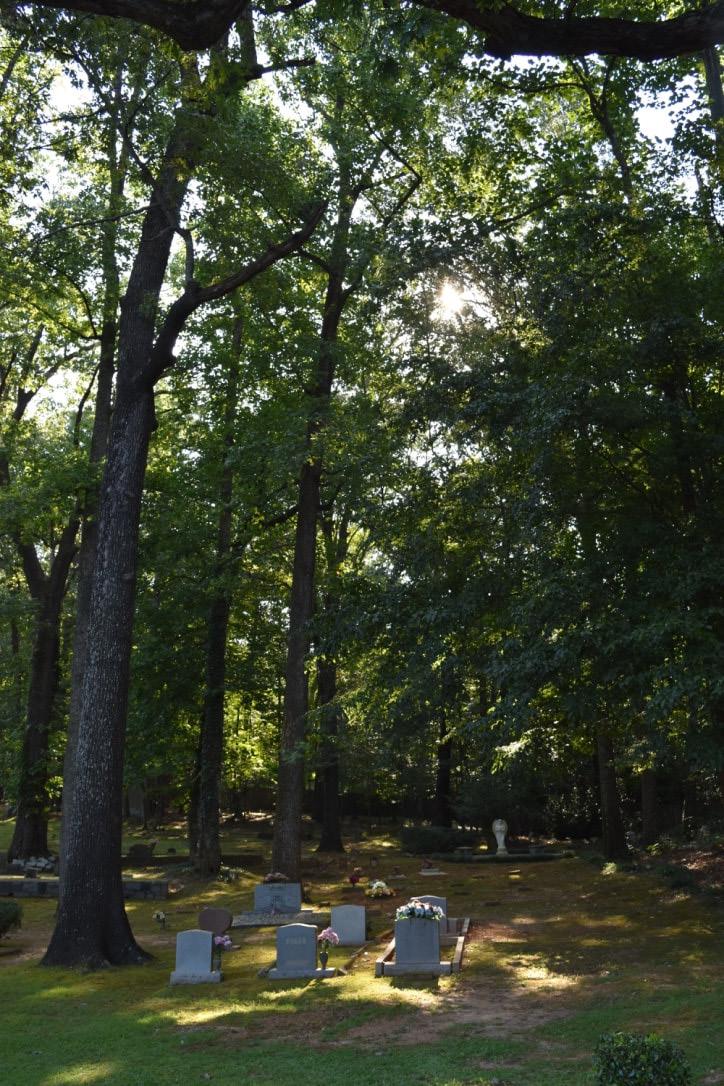
JACINTA V. WHITE is the author of a chapbook, broken ritual (Finishing Line Press, 2012). Her poetry has
ABOVE Cemeteries visited by White during her travels across the South
land as the place where bodies are laid to rest in all of these cemeteries she visits, but also as the source of spiritual, cultural knowledge: “I drink / while body broken like lands / open.” She addresses the dead under “red dirt” to “Tell us, who has forgotten / you breathing under the earth.” In an age when a white supremacist shot up one of the oldest Black churches in the country, she says that she prays “that the dead are watching / over us if God blinks.”
Forrest Rapier’s As the Den Burns is haunted by its own beloved dead. It is haunted by human stories – funny, tragic, and tender – and how the words we use to tell those stories ravish and beguile. It’s rich with the old words for places, words that predate European genocide: Apalachicola, Tampa, Lackawanna, Okeechobee, Ichetucknee, Appaloosa, Seminole, Calusa, Immokalee, Catawba, Tennessee – and, being deeply Floridian, full of
flowers – wild roses, hogweed, azaleas, camellias, hibiscus, knockout roses, acacias, hyacinth, firewheel, jasmine, and magnolia. This is a book about language and how language emerges from place, and in that merging one finds myth. This is landscape as psychology, the hallucinatory beauty and sickness of the South, of capitalism, of America, “much like the land: / translated from Calusa to Seminole to asphalt / to sheet metal to billboard to mean my home.”
The language in As the Den Burns is “skittery batty unto a savage horizon,” at the edge of dissolution through the sheer weight of how much it tries to contain.
After all, as the speaker in a poem titled “Primordial Soup” observes, “Humanity is obsessed
with creating / impossible structures.” Part of the “impossible structures” of these “tempesttempled” poems, these poems of “buckshot language,” though, is their compelling, controlled use of syntax to build energy. For example, in “Neptune Beach” the sentences build action, like a waterspout “Raised out of eroded dunes,”
“Raised out of tightenedup nets,” “Out of sawgrass,” “Raised out of Tropical Storm Tammy,” “Raised out of low tide mussel beds mouthing,” “Out of Neptune Beach magnolia gravel crunch.”
Rapier’s poems are a dense knit of our rag-tag American English, some warp and weft of slang and King James, Southern accent and something stranger, something Floridian.
As the Den Burns is a “slipknot,” a “poetic étouffée,” a “Neanderthal tongue” of “spliff reek piques,” “cherry Slurpees,” “Ford Explorers,” “velvet guitar case,” “Blackhawk / helicopters.” It is “brackish.” It contains “barflies,” and the “Panhandle,” “Stratocasters,” “mallrats,” a “truckbed,” “Pepsi lips,” and a “dozen honey-butter-chicken-biscuits.”
It uses “ash” as a verb: “oaks ash Spanish moss across dark grass.” It advises, “Try to make movies with your words, try to carve / Mary Magdalene from scrap wood,” and “Smooth the poem-stone with plain lingo / for the reader. Write into the meat.” Rapier even draws upon
Old English-style kennings across multiple poems as the speaker appeals to his dead father as “fathermark,” “fatherbeast,” “fathermyth.”
This is a speaker who has heard “God’s heartbeat” as it “thumped in the forest,” who has “drank enough to drown a draft horse” as he plumbs the past for his ghosts and the present for sensory and sensual delights. “Let long vowels be untouchable strings / of the Aeolian harp inside your throat,” he implores. Rapier plays across many registers of language and accent in these poems that are just as likely to contain a Toyota Corolla as they are vestiges of older tongues (“I was Odysseus / waking up rock-wrecked”).
These poems celebrate language’s vibrant music across time and find inspiration in both the “strawberry Pop-Tart” and “Caravaggio’s red / shawls painted around the bone-thin / shoulders of insane saints.”
He wills himself into a wild
exuberance with words and other substances in poems that take us through the woods and waterways and neighborhoods and dreamscapes of Florida: “For listless years, I went after wicked angel / dust.”
Once he “drank a whole creek bottle dry.” He takes us into the past, where his dead father, an “Unmedicated visionary” sent him “postcards / signed love” from the “County jail” and an elderly woman who took care of him as a child (a grandmother, an aunt?) had a “voice / . . . bent like muddy offshoots of the Catawba.”
Rapier’s language reflects the geographic and mongrel cultural sensibilities of his home state, which is both deeply Southern and very much its own “edenic lush” place. “Florida is a constant state of flux,” Rapier observes, “Everything here is feeding off something.” He ends one poem with the advice: “Go missing in Florida, die and get found.” In “Tallahassee Nightwatch,” the speaker is “a hyacinth-throated / peacock plucking a cedar guitar,” an ars poetica distinctly born of semitropical Florida. One must “Meet God in the glade”
and “Navigate the gorgeous / circle-of-all experience.” Most importantly, “Keep honeypots / inside the pantry – leave your love-door ajar.”
As the Den Burns is a deeply intimate, exuberant history that marries the origins of language and pain and magic and admonishes both the wild, seeking speaker and the reader to “Unbury your family plainsongs from the grave deep / inside your throat.”
It feels a bit like creating another kind of kenning to try to join these two collections in one review. They do, however, resonate with each other as they present a lyrical reclamation of place and history. Each book makes place sacred in the way Kiowa writer N. Scott Momaday defined: “Sacred ground is in some way earned. It is consecrated, made holy with offerings – song and ceremony, joy and sorrow, the dedication of the mind and heart, offerings of life and death. n
OPPOSITE AND ABOVE, LEFT TO RIGHT magnolia, hyacinth, hibiscus, rose; photography by Karen Weyler
NORTH CAROLINA
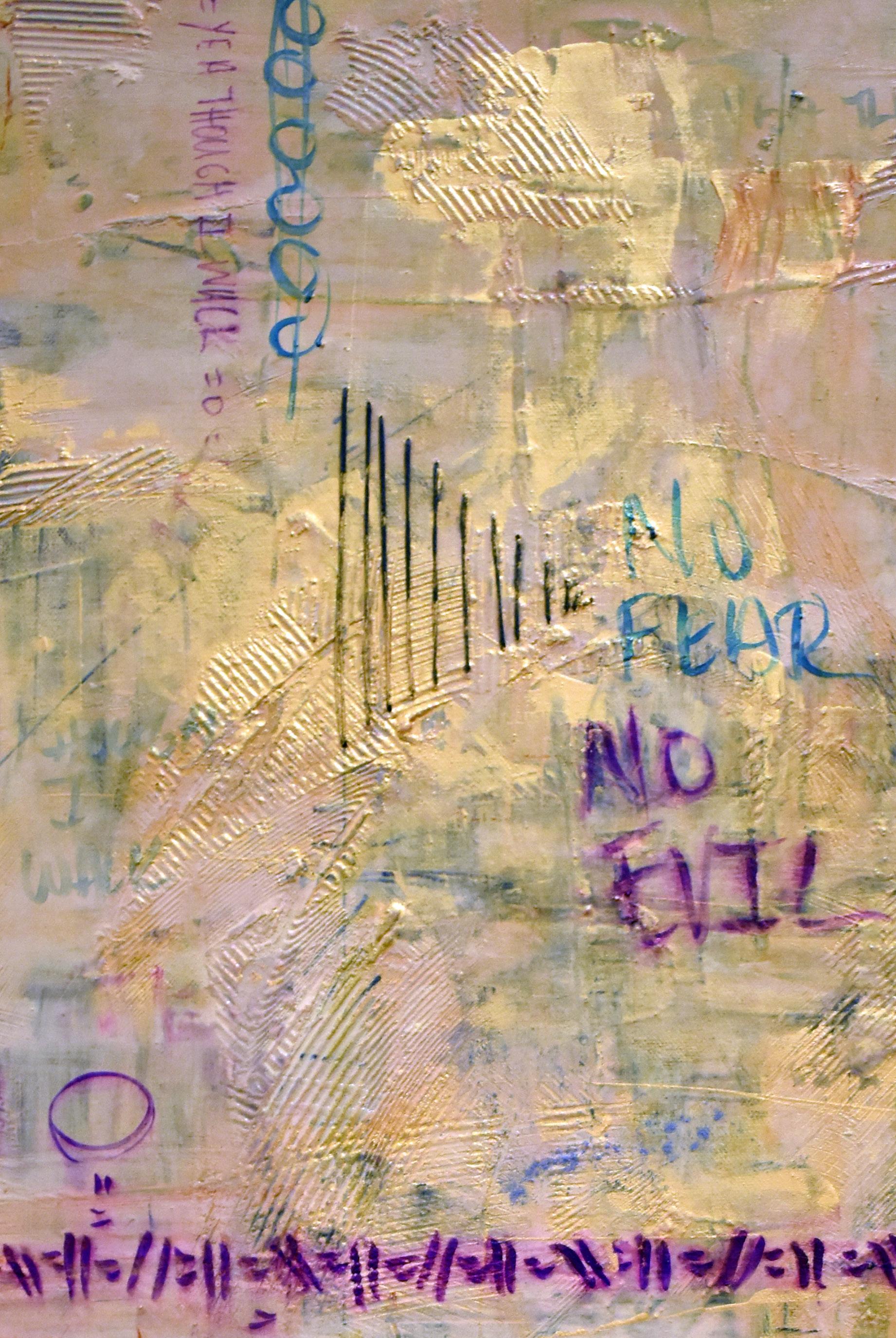
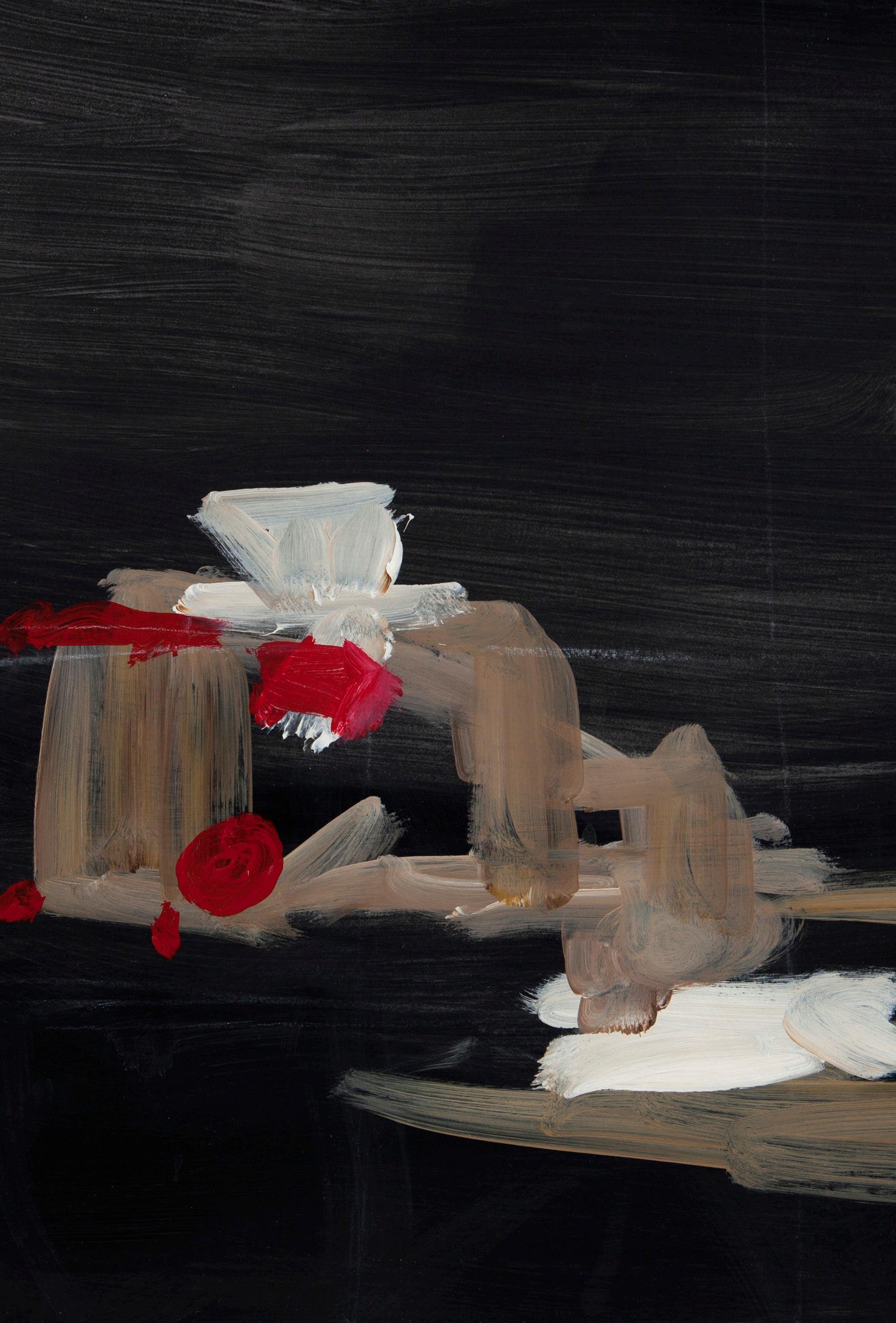
Composition Painting of “Night Ops” (acrylic on paper, 19x15) by Amy Louise Brown courtesy of the U.S. Army Art Collection ;