NORTH CAROLINA LITERARY
SPRING 2026
poetry by Walter Bennett, Louis Girón, and Joseph Shea n prose by Michael Ramos n a review of a memoir by Paul Crenshaw n art by Amy Louise Brown, Jacob Joubert, and Reuben Jarvis Mabry
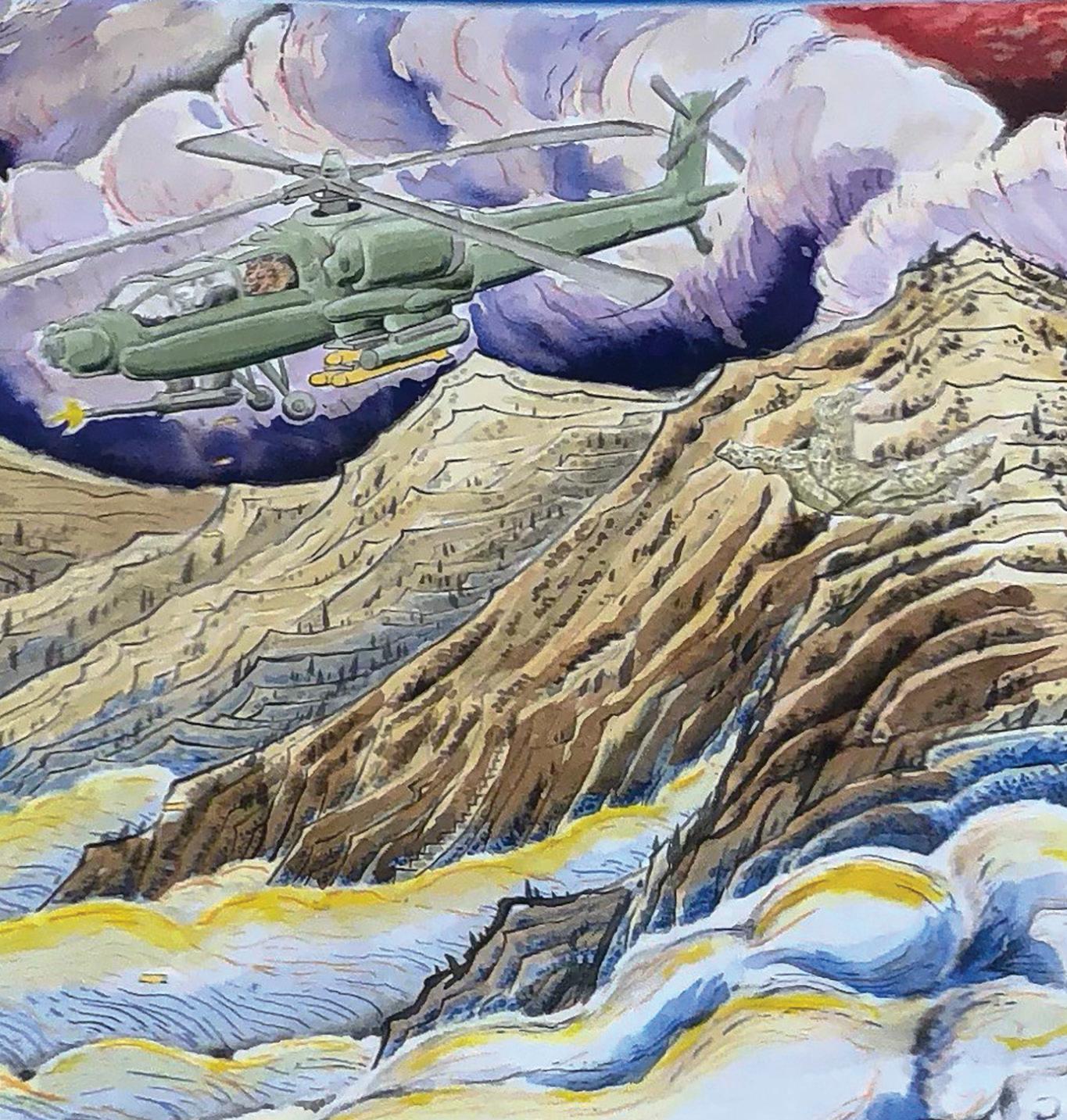
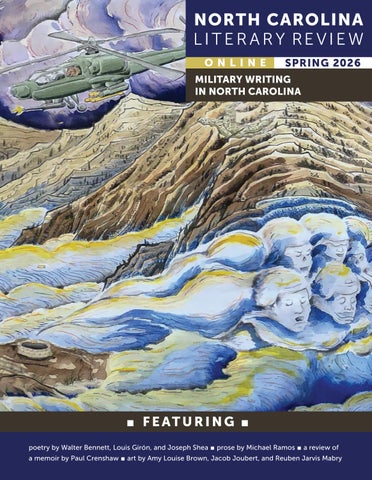
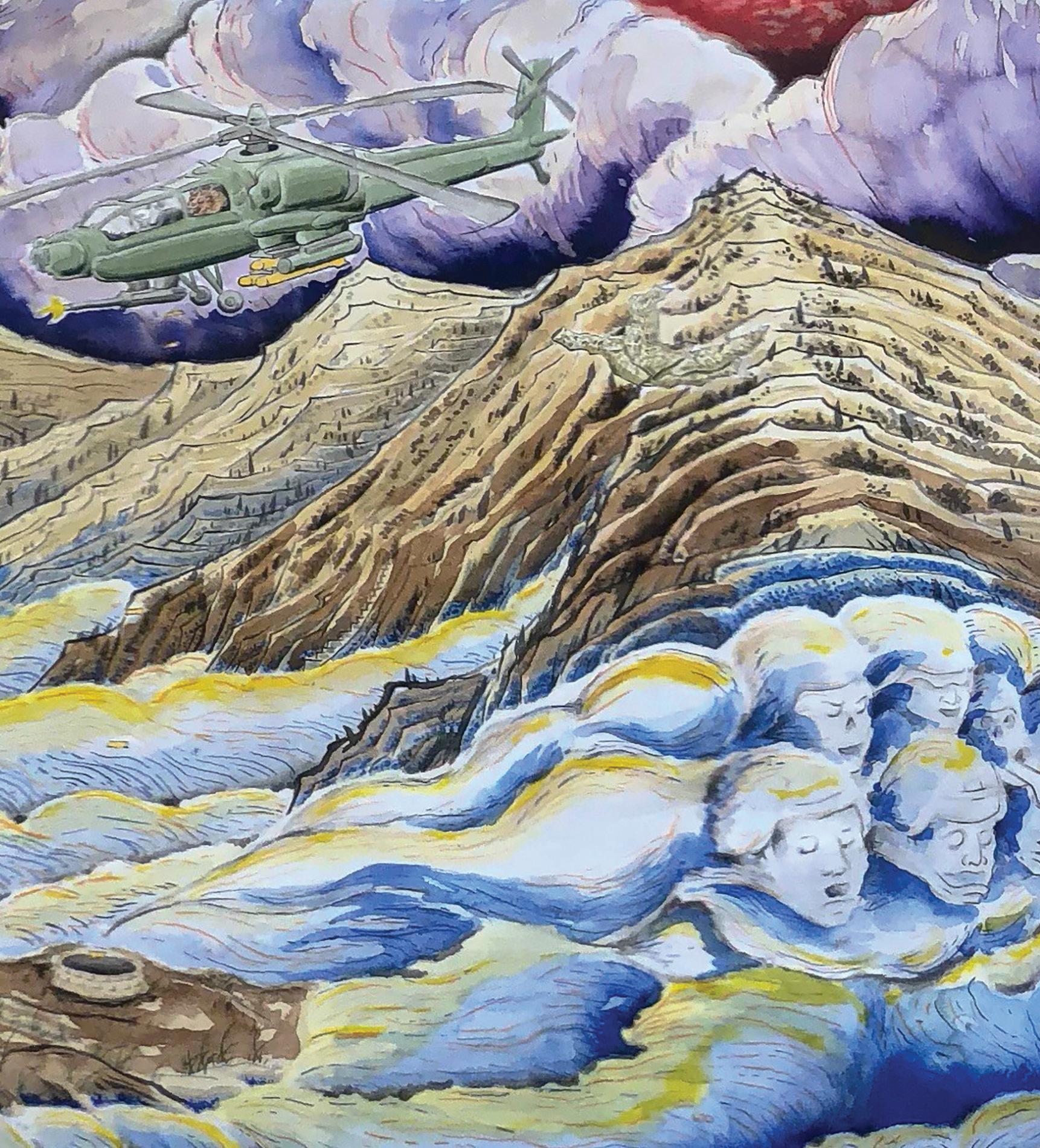
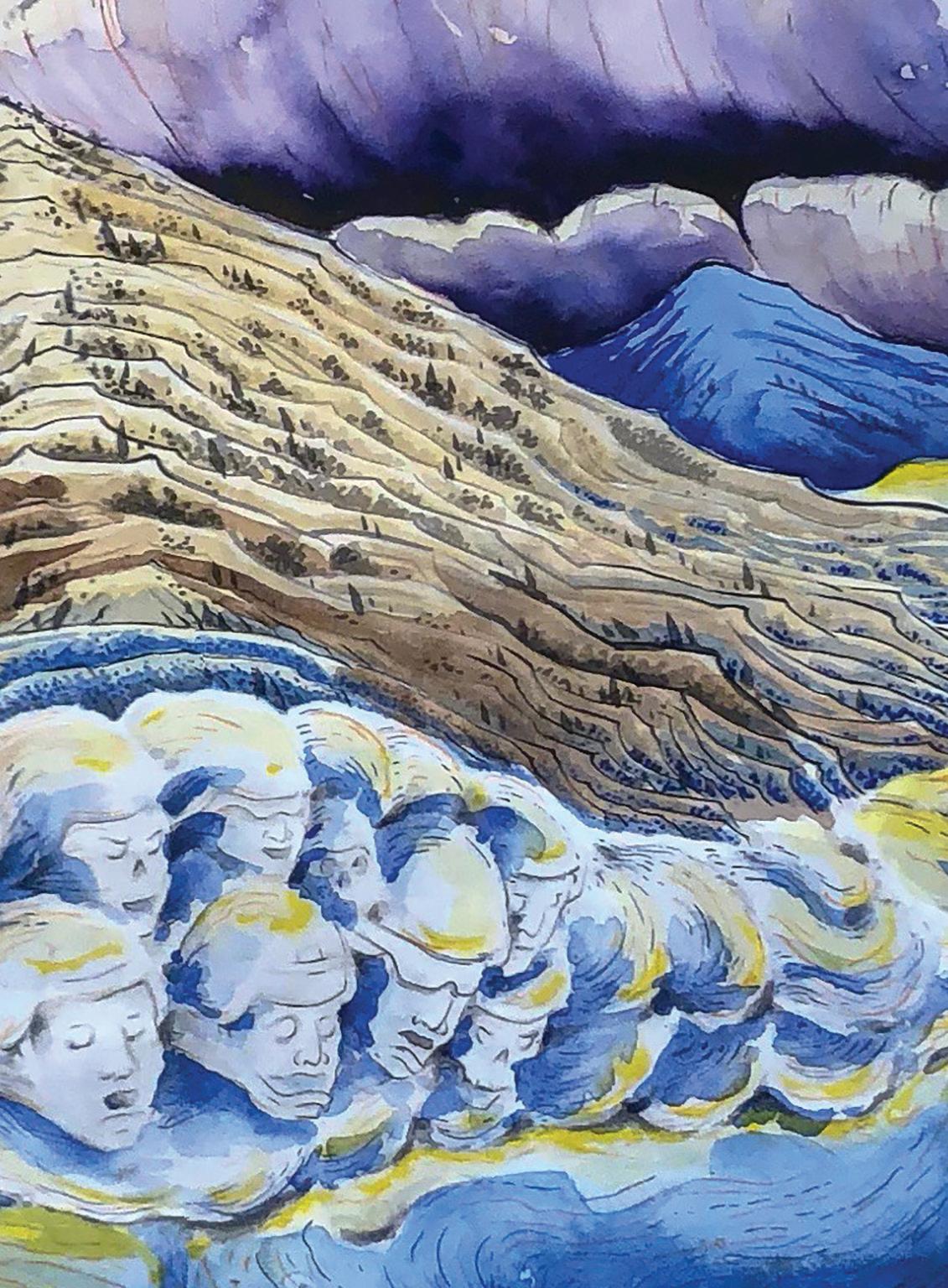
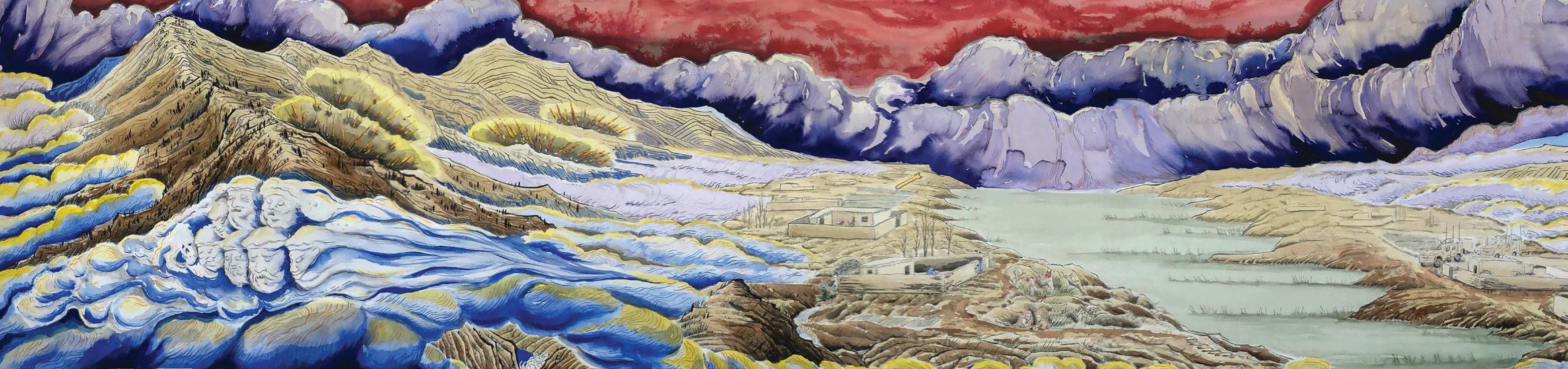
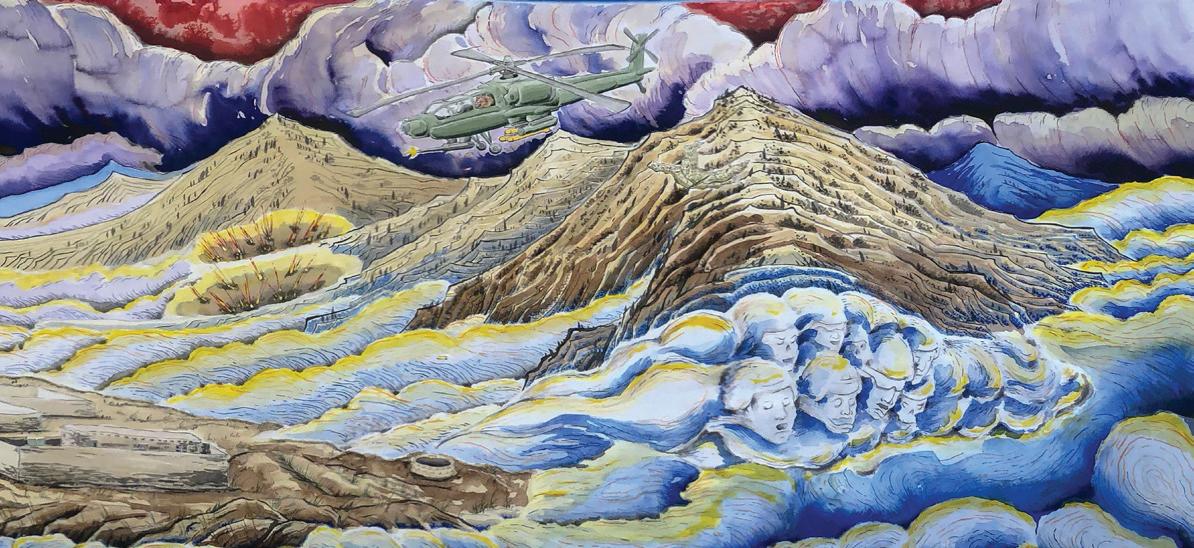
COVER ART Reflections of Afghanistan, 2017 (ink, watercolor, and graphite on paper, 22x102) by Reuben Jarvis Mabry; detail below and on the back also from this work (See the full painting on the bottom of pages 6–7.)
REUBEN JARIVS MABRY is a Tennesseeborn artist from a multicultural KoreanAmerican military family. He earned a BA in Studio Art from Austin Peay State University in 2008 before serving over eight years as a US Army AH 64D helicopter pilot, with deployments to Korea and Afghanistan, keeping a sketch book, paper, paints close. He later completed an MFA in Studio Art at UNC Chapel Hill. See more of his work inside and in the 2026 print issue feature section.
NCLR Art Director DANA EZZELL designed the cover of this issue. She earned an MFA in Graphic Design from the Rhode Island School of Design in Providence and is a Professor at Meredith College in Raleigh. Her design work has been recognized by the CASE Awards and in such publications as Print Magazine ’s Regional Design Annual, the Applied Arts Awards Annual, American Corporate Identity, and the Big Book of Logos 4. She has been designing for NCLR since the fifth issue, and in 2009 created the current style and design. In 2010, the “new look” earned NCLR a second award for Best Journal Design from the Council of Editors of Learned Journals.
Produced annually by East Carolina University and by the North Carolina Literary and Historical Association © COPYRIGHT 2026 NC LR

IN THIS ISSUE
NORTH CAROLINA LITERARY REVIEW ONLINE
SPRING 2026
MILITARY WRITING IN NORTH CAROLINA
6 n Military Writing in North Carolina includes poetry, creative nonfiction, and a book review
Walter Bennett
Paul Crenshaw
Louis Girón
Jon Kesler
Michael Ramos
Joseph Shea
20 n Flashbacks: Echoes of Past Issues includes book reviews and literary news
Austin Allran
Barbara Bennett
Benjamin Bradley
Vanessa Brantley-Newton
James W. Clark, Jr.
Carol Ann
Jessica Cory
Alyssa Froemel
Rebecca Godwin
Jim Gulledge
Harriet Jacobs
Jon Kesler
Kathryn Kirkpatrick
Jason Mott
Beth Revis
E. Thomson Shields, Jr.
Bland Simpson
Evan Peter Smith
Archer Sullivan
Donna Summerlin
Hannah Thurman
Mark I. West
Tracey Enerson Wood
Lauren Yero
John Thomas York
58 n North Carolina Miscellany includes poetry, fiction, and book reviews
Asma Abike
Michael Beadle
Benjamin Bradley
Martin Brinkley
Gary Carden
Nora Shalaway Carpenter
Oliva Cash
Carol Ann Collins
Sheryl Cornett
Kenly Corya
Sayantani Dasgupta
Tracy Deonn
Lynn Domina
Claudia Emerson
Jim Gulledge
Shelby Hans
Terah Shelton Harris
Sharon Kurtzman
Sterling Neill
Christopher Lee Nelson
Grace C. Ocasio
Ilari Pass
Gail Peck
Terry Roberts
Etaf Rum
Martin Settle
Archer Sullivan
Richard Allen Taylor
Eric “L.B.” Thompson
Abby Trzepacz
Zachariah Claypole White
Willis Whichard
Adrienne Young
n North Carolina Artists in this issue n
Amy Louise Brown
Horace Farlowe
Layton Hower
Jacob Joubert
Reuben Jarvis Mabry
Beverly McIver
George L. Scott
Kulsum Tasnif
Antoine Williams
North Carolina Literary Review is published annually in the summer by the University of North Carolina Press. The journal is sponsored by East Carolina University with additional funding from the North Carolina Literary and Historical Association. NCLR Online, published in the winter, spring, and fall, is an open access supplement to the print issue.
NCLR is a member of the Council of Editors of Learned Journals and the Council of Literary Magazines and Presses, and it is indexed in EBSCOhost, the Humanities International Complete, the MLA International Bibliography, Proquest, and the Society for the Study of Southern Literature Newsletter.
Address correspondence to Dr. Margaret D. Bauer, NCLR Editor ECU Mailstop 555 English Greenville, NC 27858-4353
252.328.1537 Telephone 252.328.4889 Fax BauerM@ecu.edu Email NCLRstaff@ecu.edu
https://NCLR.ecu.edu Website
NCLR has received 2025–2026 grant support from the North Caroliniana Society and from the North Carolina Arts Council, a division of the North Carolina Department of Natural and Cultural Resources.


Subscriptions to the print issues of NCLR are, for individuals, $20 (US) for one year or $34 (US) for two years, or, for institutions and foreign subscribers, $30 (US) for one year, $54 for two. Libraries and other institutions may purchase subscriptions through subscription agencies. Individuals or institutions may also receive NCLR through membership in the North Carolina Literary and Historical Association. More information on our website
Individual copies of the annual print issue are available from retail outlets and from UNC Press. Back issues of our print issues are also available for purchase, while supplies last. Find prices and tables of contents of the back issues on the NCLR website
Submissions
NCLR invites proposals for articles or essays about North Carolina literature, history, and culture. Much of each issue is thematically focused, but a portion of each issue is open for developing interesting proposals, particularly interviews and literary analyses (without academic jargon). NCLR also publishes high-quality poetry, fiction, drama, and creative nonfiction by North Carolina writers or set in North Carolina. We define a North Carolina writer as anyone who currently lives in North Carolina, has lived in North Carolina, or has used North Carolina as subject matter.
Consult our website for submission guidelines for the various sections of each issue. Submissions to each issue’s special feature section are due August 31 of the preceding year, though proposals may be considered through early fall.
2027 issues will feature Southern Gothic Literature by North Carolina Writers, guest edited by Barbara Bennett
2028 issues will feature North Carolina Latinx Writers, guest edited by Amy Wright
Please email your suggestions for other special feature topics to the editor.
Book reviews are usually assigned, though suggestions will be considered as long as the book is by a North Carolina writer, is set in North Carolina, or deals with North Carolina subjects. NCLR prefers review essays that consider the new work in the context of the writer’s canon, other North Carolina literature, or the genre at large. Publishers and writers are invited to submit North Carolina–related books for review consideration. See the index of books that have been reviewed in NCLR on our website NCLR does not review self-/subsidy-published or vanity press books.
2165-1809
EDITORIAL BOARD
Joseph Bathanti
English, Appalachian State University
Jim Clark
Emeritus, Barton College
Paul Crenshaw
Writer, Lawrence, KS
Kevin Dublin
Elder Writing Project, Litquake Foundation
William Eddins
English, East Carolina University
Gabrielle Brant Freeman
English, East Carolina University
Editor
Margaret D. Bauer
Art Director
Dana Ezzell
Guest Feature Editor
Anna Froula
Digital Editor
Devra Thomas
Book Review Editor
Kristi Southern
Art Editors
Donna Kain
Diane A. Rodman
Fiction Editor
Rebeccca Bernard
Poetry Editors
Jeff Franklin
Amber Flora Thomas
Founding Editor
Alex Albright
Original Art Director
Eva Roberts
Graphic Designer
Karen Baltimore
Senior Associate Editor
Christy Alexander Hallberg
Assistant Editors
Desiree Dighton
Anne Mallory
Randall Martoccia
Senior Editorial Assistant
Kenly Corya
Editorial Assistants
Azner Alvarez
Trevor Mason
Cody Messer
Senior Intern
Abby Trzepacz
Interns
Morgan Boyce
Matt Cole
Aija Everett
Samantha Higgins
Layla Hope
Josefine Klaker
Vicki Maas
Sam Raia
Axel Snyder
Casey Wild Jayden Willis
Regina Garcia
English & Humanities
Pitt County Community College
Brian Glover
English, East Carolina University
Rebecca Godwin
Emeritus, Barton College
Leah Hampton
English, University of Idaho
Rebecca Hardin-Thrift
English, Wayne Community College
George Hovis
English, SUNY-Oneonto
Ken Parille
English, East Carolina University
Kirstin L. Squint
English, East Carolina University
Lauren Teneriello
English, East Carolina University
Lyra Thomas
English, East Carolina University
Dean Tuck
English, Wayne Community College
Zackary Vernon
English, Appalachian State University
Robert M. West
English, Mississippi State University
SNAFU
by Anna Froula, Guest Feature Editor
April 2026. We are at war again. The grinding sameness of deployment, whether the casus belli is of choice or of necessity. The weapons, medical care, and understandings of post-traumatic stress advance, but the elation, boredom, camaraderie, fear, and grief of in-theater personnel remain constant. Updated, computerized, manned, and unmanned, the vehicles that deliver death from above claim warfighters and civilians alike. We don’t have to keep choosing this violent human condition, but we do, again and again, again and again. The decisions made in DC, often by those who have never worn the uniform create fracturing reverberations domestically and internationally – vast and unplanned.
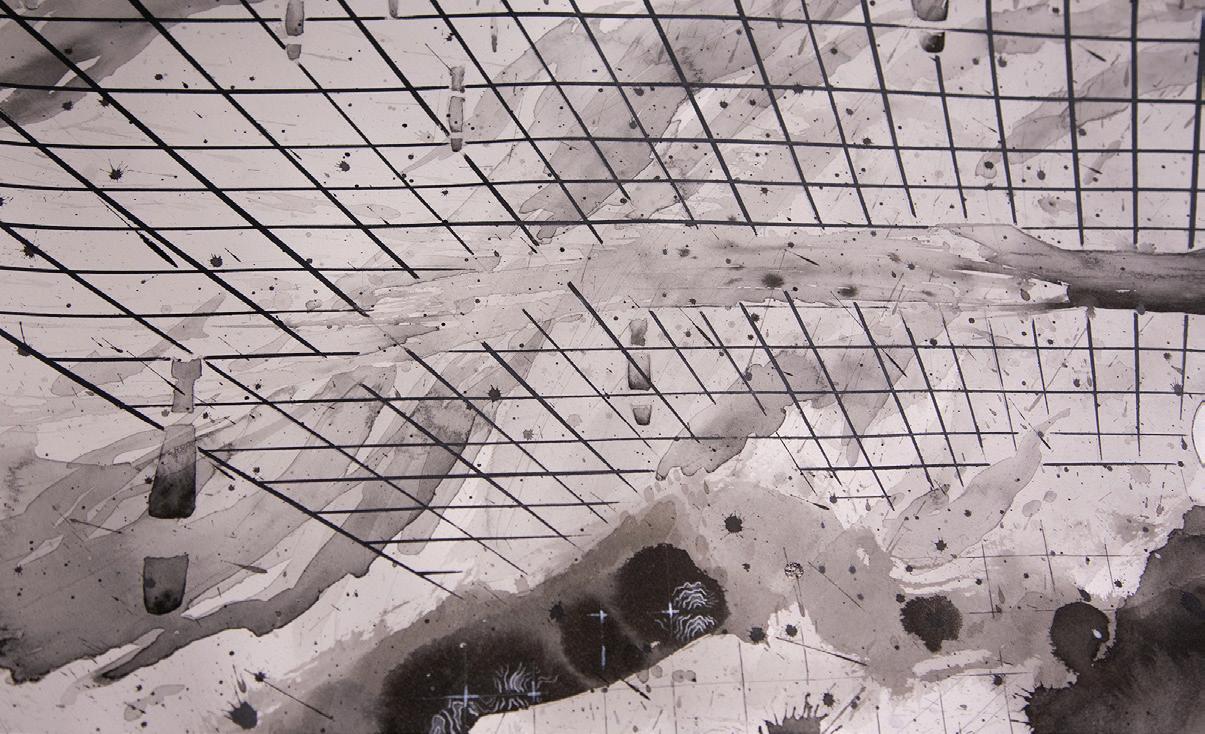
These universal truths are known by the helmeted warfighters floating cloudlike from some arena as if held aloft by invisible Valkyries in Army Veteran Reuben Jarvis Mabry’s gorgeous cover art. Mabry also created the Bombs Away art that accompanies Army Veteran Walter Bennett’s “Map Men.” Bennett’s poem connects the reader from the wretched transcontinental debris of World War II to the more recent desolation of Gaza. Then, former Battalion surgeon Louis Girón’s poem “From the Montvale Veterans Home: The Now and the Then” weaves us through the haze of memories of wartime Vietnam and their long reach into the present. Army veteran Joseph Shea’s poem “Dog Days Ft Leonard Wood, August ‘53” shares a rare glimpse into boot camp five years after the US Military was integrated. Next, Air Force Veteran Jon Kesler reviews former National Guardsman Paul Krenshaw’s memoir This We’ll Defend, A Noncombat Veteran on War and its
Aftermath, reminding us that military personnel do not have to deploy abroad to experience the war machine and its aftermaths. Finally, in his creative nonfiction essay, Navy Veteran Michael Ramos prompts us to consider what we mean when we call a veteran “Decorated.”
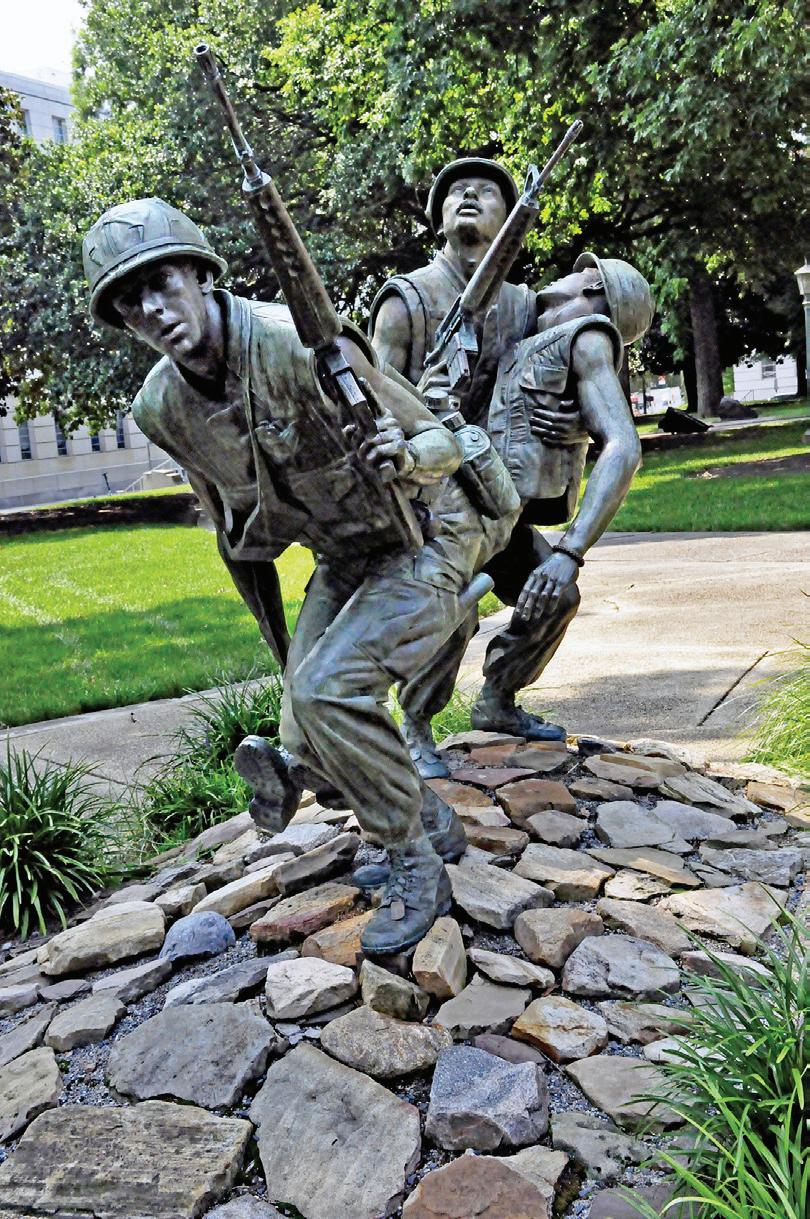
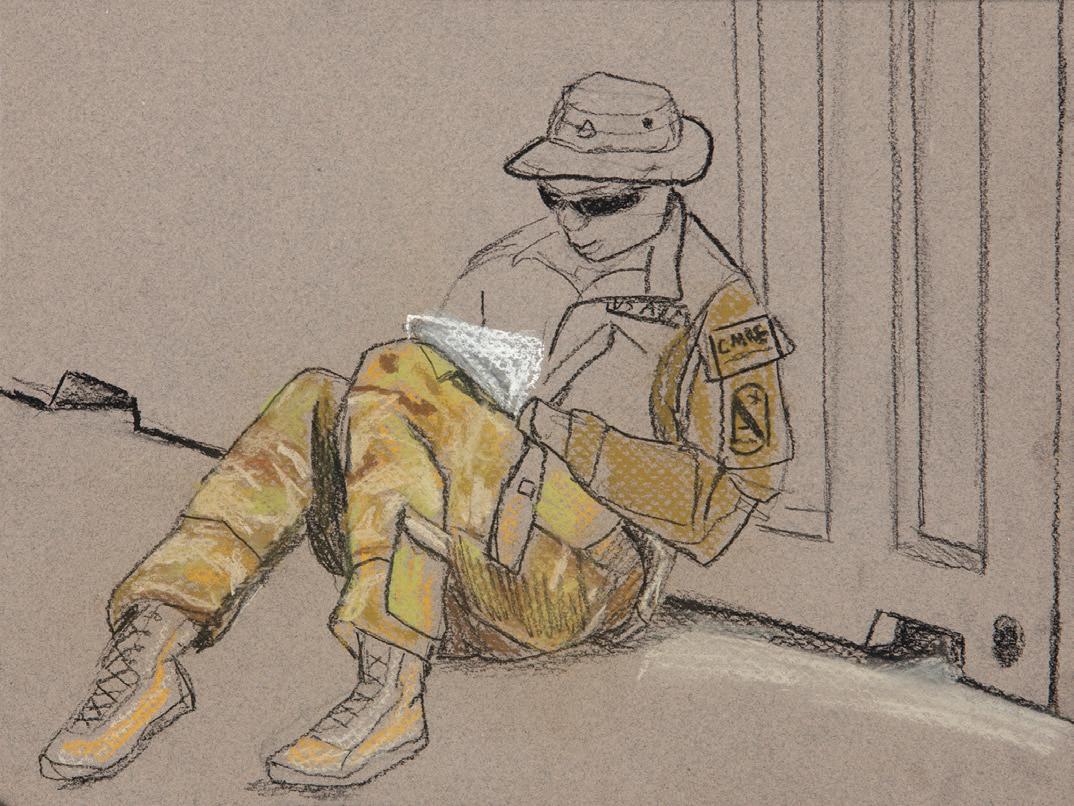
More veteran-created artwork populates this section. Navy Veteran Jacob Joubert’s Smiley Face captures the absurdity of war. Army Veteran Amy Louise Brown, feature artist of the Winter issue, returns with a depiction of the writing soldier in Sitting Soldier. Also, state war memorials appear in photographs. Abbe Godwin’s After the Firefight, the North Carolina Vietnam Veterans Memorial in Raleigh, was the first sculpture by a woman on Union Square and the first to depict a Black soldier. An aerial view of the North Carolina Vietnam Veterans Memorial Park reminds us, as all war art attempts to do, not to forget those who fought and perished and will fight and die in our name. What kind of stories and art will emerge from this new war in Iran? How many new war memorials must we go on to build? How much memorialization will it take us as a nation, as a species, to grasp how wars affect us all to varying degrees? Will we ever pay enough attention? As war photographer James Natchtwey reminded us, “we must look at it. We’re required to look at it. We’re required to do what we can about it. If we don’t, who will?”* I hope that these pages will provide needed space for contemplation and prepare you for what’s to come in the print issue.
In addition to the works by Leah Hampton, Jessica Cory, Kimberly Towers-Kubik, Morrow
in North Carolina MILITARY WRITING
Dowdle, and the interview with Tracy Crow by Alyssa Froemel I mentioned in the Winter issue introduction, we will feature poetry by Elisabeth Lewis Corley, essays by Paul Crenshaw and Joseph Bathanti, a short story by Laura Cruser, as well as my interview with Michael Ramos and my panel discussion with veterans El’Ja Bowens, Russell Worth Parker, and Mariah Smith at the North Carolina Writers’ Network fall conference. The issue will also feature art by Reuben Jarvis Mabry, as well as by Gene Locklear, Erin O’Hara Slavick, Darrold Peters, Ida Mae, A.R. Ammons, Mary Kramerer, Dan Nelson, Skip Rhodes, and Glenn Eure. You won’t want to miss a thing, so be sure to subscribe to NCLR to receive the print issue this summer. n
* Quoted from War Photographer, Dir. by Christian Frei (Christian Frei Film production, 2001).
8 Map Men a poem by Walter Bennett art by Reuben Jarvis Mabry
10 From the Montvale Veterans Home: The Now and the Then a poem by Louis Girón
14 Dog Days Ft Leonard Wood, August, ‘53 a poem by Joseph Shea art by Jacob Joubert
16 Always Ready, Always There: Musings of a Citizen Soldier a review by Jon Kesler n Paul Crenshaw, This We’ll Defend, A Noncombat Veteran on War and its Aftermath
19 Decorated creative nonfiction by Michael Ramos art by Amy Louise Brown
20 n Flashbacks: Echoes of Past Issues book reviews and literary news
58 n North Carolina Miscellany poetry, fiction, and book reviews
FINALIST, BARRAX/BAYES POETRY CONTEST
BY WALTER BENNETT
Map Men
Stroll among the ruins of Berlin at the War’s end, the rubble of Stalingrad, the burnt corpses of Nagasaki, the flames of London during the blitz. Smell the fear in the blasted concrete and martyred stone, the heat that lingers in the crooked fingers of steel. Watch the people stumble in the gloom, their faces dazed into distant frames of time, eyes lit by still smoldering fires. They search the rubble for ghosts that lie within. Their laments rise skyward, where no one listens and no one wants to hear.
Men did this –hard men with mallet fists, cancer minds, and rubber faces. They issue orders; they drink coffee; they stab their fingers at maps and growl and murmur at the wind.
In Deir el-Balah, the bombs rain down, people run through the streets, “. . . clutching what little they have left. They’ve lost their homes, loved ones and livelihoods – and now they are on the verge of losing their minds.”
“‘We have nothing left.’”
“‘I have never felt so worthless,’”
“‘Where shall we go?’”
“‘Our hearts are broken; our minds are frayed.’”
WALTER BENNETT , an Alabama native, served in the US Army as an artillery officer in Vietnam (1966–1967) before attending graduate school at UNC Chapel Hill where he earned his MA in English. He has been a North Carolina resident since 1972, first in Charolotte as a lawyer and judge, then in Chapel Hill as a law professor and writer. He has published short fiction and essays in both print and online journals, including Blackbird, The Courtland Review, Eclipse, and Voices. His first novel, Leaving Tuscaloosa (Fuze Publishing, 2012), won The Alabama Author’s Award and
was a finalist for the PEN/Bellwether Prize for Socially Engaged Fiction and the Crook’s Corner Book Prize for debut novels set in the American South. His second novel is The Last First Kiss (Lystra Books, 2021). His third novel, Sayla Is My Name, is due out from Regal House Publishing in 2026. The quotations in the poem are from Maram Humaid, “‘I’ve never felt so worthless’: The Pain of Deir el-Balah’s Obliteration,” Aljazeera Reporter’s Notebook 22 Aug. 2024: web
Through the camera’s eye, the rubber-faced men watch the bombs’ silent fall, the numb concussions, the buildings’ slow collapse; hospitals, patients, children. They drink coffee and murmur at the wind. Around them, electric maps stare out patterns of desert yellow and red, the relentless blue of the sea. The fingers of their minds sketch lines of inky black through streets and villages and souls.
“Never again,” they say, “never again!” Their coffee steams.
The camera’s eye will not stop. Hands rest quietly on table tops. Vengeance smears the air.
In Deir el-Balah, the rubble bounces; within it, the ghosts moan, they twist and turn.
“‘Our hearts are broken; our minds are frayed.’”
“‘I have never felt so worthless.’”
The bombs shriek and fall. Boom, they go, boom, boom, boom.
REUBEN JARIVS MABRY is a Tennessee-born artist from a multicultural Korean-American military family. He earned a BA in Studio Art from Austin Peay State University in 2008 before serving over eight years as a US Army AH 64D helicopter pilot, with deployments to Korea and Afghanistan. He later completed an MFA in Studio Art at UNC Chapel Hill. See more of his work on the cover of this issue and in the 2026 print issue feature section.
Bombs Away, 2019; detail from Weapons Actioned TM (Ink, acrylic, graphite, oil pencil on paper) by Reuben Jarvis Mabry
FINALIST, BARRAX/BAYES POETRY CONTEST
BY LOUIS GIRÓN
From the Montvale Veterans Home: The Now and the Then
“By the first quarter of this century, it had been established that memories are never truly lost. However, it was unknown at that time that separate coherent personalities, akin to sub-programs, could access these memories and could operate autonomously at levels near or just below consciousness. At this point, it is still unclear whether or how these personalities interact with each other or with the core personality.”—A Century’s Readings in Neurocognition, 2099
Most of my days get lost on their own without any work on my part. I hope some Saturdays, from the best weekends on leave, – if they had to be forgot were wiped out by the funhouse. Like white phosphorus lighting up avgas, shaking, then taking down a mountain.
I almost remember best when I first wake up. Sleepy now.
Sometimes I wish you could hear me the way I hear you. Of course, I don’t get everything you say. I do remember more. Some memories are burnt in. I itch from and can still feel the sunburn from the first patrol in Nam, but better, I can smell and draw deep that strong and righteous weed. And I feel the doughnut dollies clinging to my arm, squealing and strutting, and now the boom-boom girls are coming on to me again. Our body knows why pimps wear more gold than priests.
Days, the best days, and years and friends and family and lovers, cannot simply drift away like haze from a smoke grenade. Can they? I must have had good times, must have had a life. This nurse’s aide tells me so. Maybe. Her hands are cold. Her eyes do not smile.
Most of all in this twilight (I can never leave this twilight), I feel, nearly taste, the breaths of absent buddies (I can’t see their faces) mostly those I never had a chance to say good-bye to. We did not want the medals they won but could not wear. The chains of Cain. Each link so small. So heavy. Unbearable. One is too many.
LOUIS GIRÓN grew up in San Antonio, TX, and was a battalion surgeon in Vietnam. His poems have appeared in numerous venues, including Kakalak 2025 , Snapdragon , Songs of Eretz , Sunflower Petals, The Great Smokies Review, VietNow, Warscape, and Winning Writers, among others. Retired from his career as a neurologist and clinical pharmacologist, he lives in North Carolina.
Maybe if you can’t remember that funhouse – or the bleeding, or the claymores, or the how of the scars or how you got from there to here, it’s Like. They. Never. Were. Like snowflakes in South Texas. You can’t feel them on your tongue.
We did live through firefights, choked down LRPs, and ate fast dirt at the bottoms of foxholes. (Fear, fear is the fastest, the hottest hot sauce.) We slogged through grass with leaves that sliced like razors, walked point around trip wires and whip traps, humped through monsoons, picked off leeches, brushed rats off our ass, and counter-punched through ambushes.
We can’t remember all the IEDs, the staggers, lost days, and the foggy times.
After the Firefight, the North Carolina Vietnam Veterans Memorial on the grounds of the State Capitol in Raleigh, designed by Abbe Godwin of Colfax, NC; photograph by Karen Duquette
KAREN DUQUETTE and LEE DUQUETTE are photographers who met and married at Pearl Harbor, Hawaii while serving in the US Navy and US Marine Corps respectivelly. After settling in Hollywood, Florida they travelled the country documenting their stops through photos such as this one. You can read about their adventures and see more photos on their website
Dedicated on May 23, 1987, the North Carolina Vietnam Veterans Memorial at the State Capitol in Raleigh honors over 206,000 state residents who served in the Vietnam War. Designed by ABBE GODWIN of Colfax, NC, it uses items loaned by Vietnam veterans. Godwin spent four years researching and consulting with veterans for the project. The monument was the first sculpture by a woman on Union Square and the first to depict an African American.
Some nights I wake up on the floor fighting. Don’t remember what about. Or who with. And firing. Pigs? Uh? Still hardest to remember is where all the weekdays go.
We offed snakes, monkeys, and yes, you’re right, even mother-ugly pigs, and VCs. We survived remfs, butter-bar eltees, friendly fire, fubars, and the orders of idiots. We knew the why of the fraggings. And I watched buddies next to me buy it. After all the years, I no longer ask the war why we were there. Or ask myself why we were the ones to live.
“We just got here. It can’t be nap time already.”
I prayed when the mortars started walking towards us, first prayers since First Communion. Not my last.
But there are still those shaggy Sundays with sad eyes that never open, like the old dog slumped over by the fireplace, too tired to scratch.
Our altar-boy tears were also mixed with the mud that filled the empty spaces in the body bags. The body bags that took our buddies and prayers back to the world but left our hopes behind with the bamboo, the punji sticks, the mosquitos, and the jungle rot.
I feel that there is someplace that I have to be. Some things that I still need to do. People I need to say something to. Maybe I’ve done all these things already and don’t know it.
If you could wake, I would want us together to remember these instead: the colors and clouds of all our sunsets, placid lakes, Grace Slick, hoedowns, chasing the dragon (I don’t mean Puff), the whirr of hummingbirds, the way old Scotch burns as it goes down, the smell of salt and the sound of waves along our beach,
Maybe I can’t remember because it’s better that way and so I trained myself not to remember. Because if I do remember, then maybe I’ll remember but not be able to forget. Seriously heavy that notion. I’ve got heavy Heavy Metal beats beating in my head. . . . What did I just say?
. . . as well as sweet times and long nights, riffs that don’t want to end, her caresses with promises, that forever smile of hers that only deepened with caresses, and that kind of dance. These we need to remember, but you would not, cannot hear me. If I could tell you, I would leave this twilight and would dissolve and leave you – if only to tell you, that you would know and remember, but I can’t do that either.
What comes after Sunday?
Some days I remember breakfast.
Did she die?
Why am I crying?
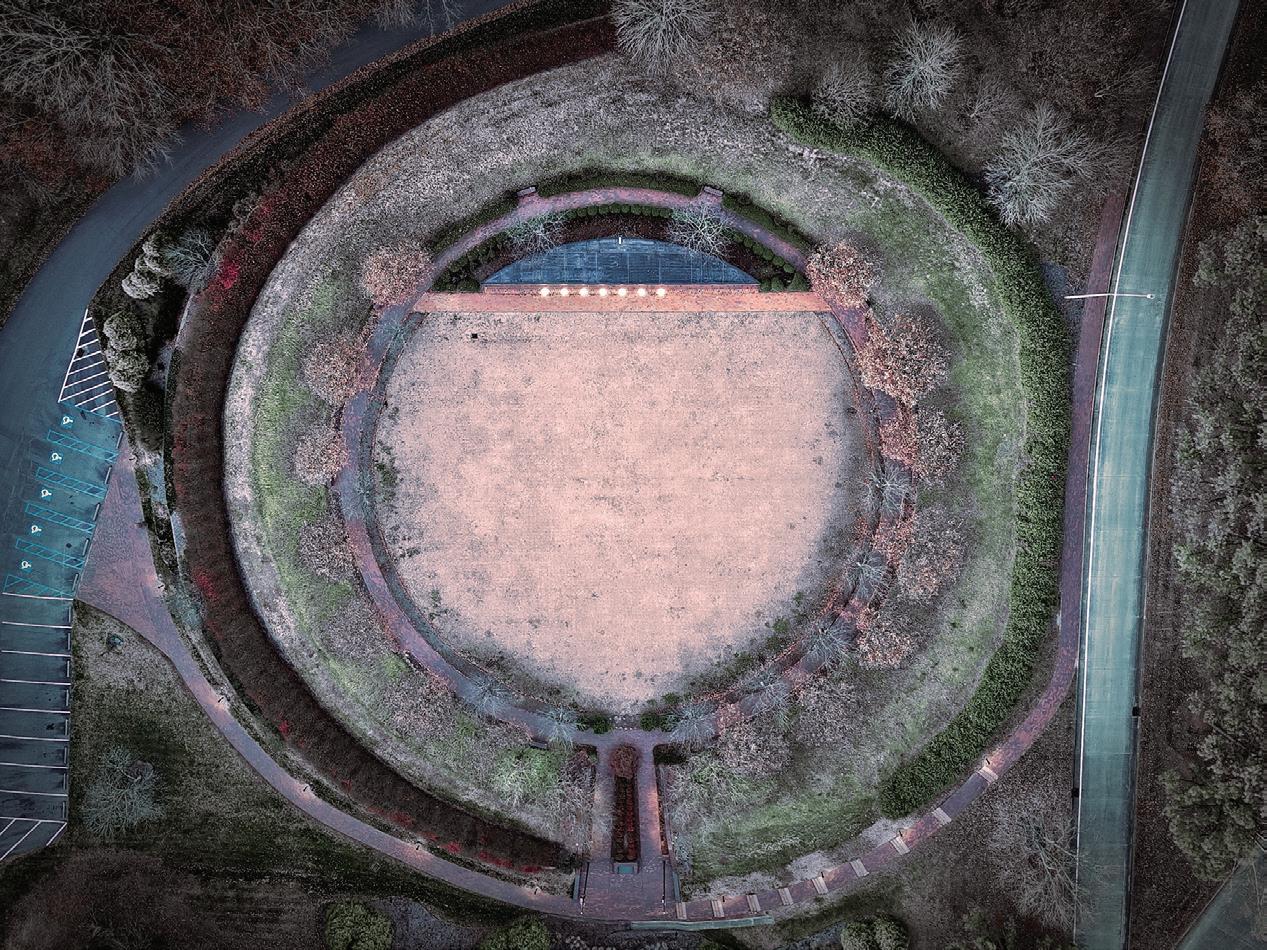
Installed May 27, 1991, the North Carolina Vietnam Veterans Memorial Park was dedicated to the 216,000 North Carolinians who served and the 1,620 who were killed or went missing in the Vietnam War. The memorial is surrounded by evergreen trees planted by the North Carolina Forest Service. A total of 58,000 seeds were planted to represent each American who lost their life fighting in the war.
North Carolina Vietnam Veterans Memorial Park, aerial view, 19 Nov. 2023; courtesy of Creative Commons
FINALIST, BARRAX/BAYES POETRY CONTEST
BY JOSEPH SHEA
Dog Days Ft Leonard Wood, August ’53
I’m seventeen on a water discipline march. A black man marches beside me. He is twenty-five, thirty. His eyes ooze pus. He staggers. I’m afraid to be near him, Sarge has refused him sick call, said, you’re a malingerer, said, you need to tough-up, shine.
Our boots stir up Missouri dust chokes our noses and throats our dicks drip sweat. Lister bags await us at the turn halfway into the day under a burning sun I never tasted water so wet, so sweet slurping my second canteen I overhear the black man say,
Sarge, I forgot my canteen
That’s tough shit shine, remember next time.
JOSEPH SHEA was raised in East Stroudsburg, PA, son and grandson of military men: his grandfather was with Pershing’s Expeditionary Army on the Mexican Boarder in 1916; his father was in the third wave of the Normandy invasion. In 1953, Joseph was recruited by (among others) Vince Lombardi to play football for West Point when Colonel “Red” Blaik was coach. As a student at the US Military Academy, he completed basic training. “Dog Days” is inspired by that period. He graduated in 1959 and was stationed in Hawaii as an officer with the 25th Infantry Division from 1960 to 1963. He resigned his commission in 1963 and began what became a long and lucrative business career. He is retired now and living in Davidson, NC, near his children and grandchildren. His granddaughter, also a West Point alumna, was an Apache pilot; his son-in-law is a retired Brigadier General of the 82nd Airborne; and his son was awarded The Silver Star as a Navy Seal in Afghanistan.
The black man’s shoulders sag. He looks down at the ground, beaten. Then he looks up at Sarge with blood in his eyes.
I slip the coffee cup from the bottom of my canteen and hand it to him. He looks at me as if I am Jesus. And from Sarge a look of contempt for me but no slur for a white man.
When the black man returns my cup he has gathered himself, says, thanks man.
Sure, I say.
We stand close enough to smell each other but, in two different worlds. We do not speak again.
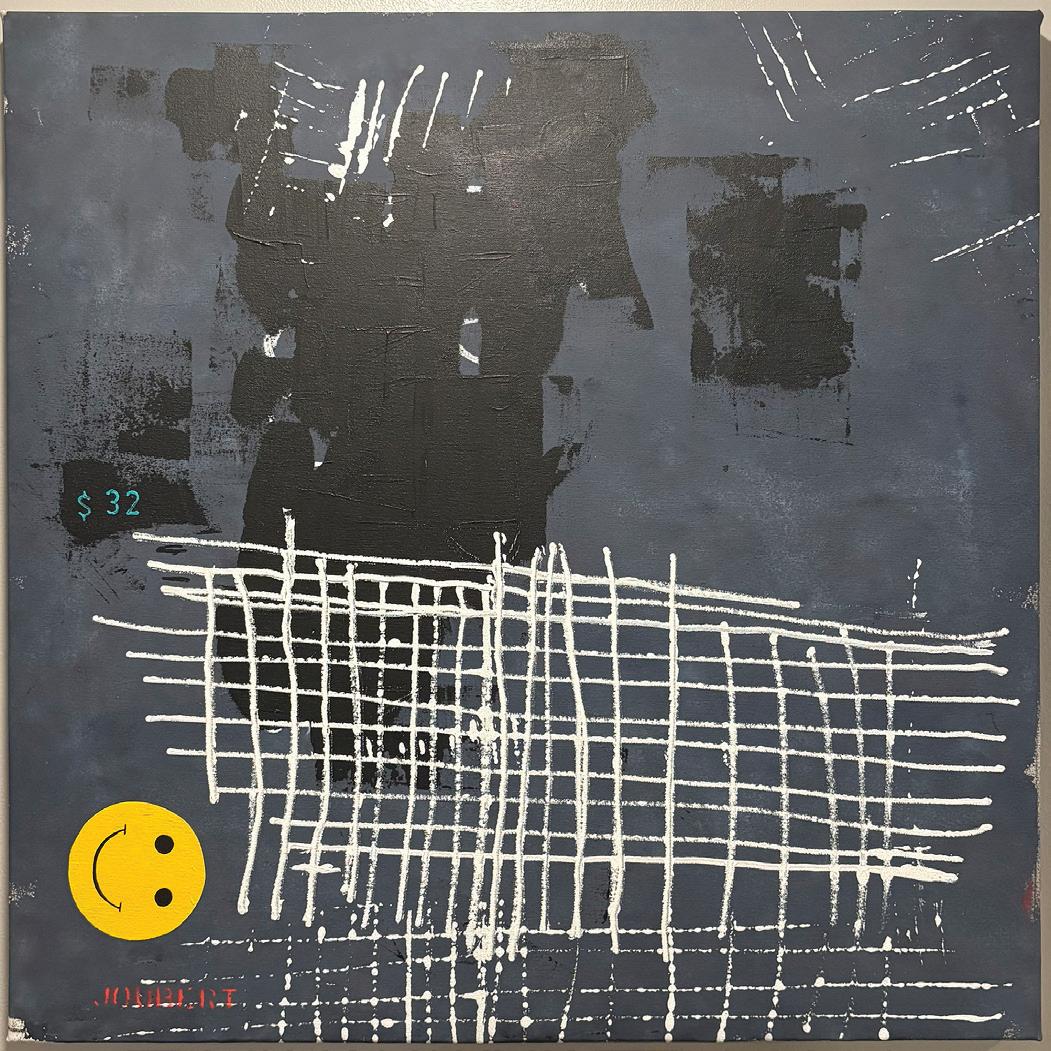
JACOB JOUBERT , a native of Chicago, IL, enlisted in the Navy after high school, becoming a Navy officer and serving on the guided-missile frigate USS Rodney M. Davis. As a Lieutenant, he was later assigned to the Naval ROTC program at NCSU to serve as an instructor to future Naval Officers. He stil lives in a Raleigh, NC. His art includes an In Memoriam series of paintings to honor casualties from major wars. More of his work can be seen on Instagram @aksoul32.
Smiley Face (acrylic and spray paint on canvas, 36x36), from the Intrinsic Value series, by Jacob Joubert
ALWAYS READY, ALWAYS THERE: MUSINGS OF A CITIZEN SOLDIER
a review by Jon Kesler
Paul Crenshaw. This We’ll Defend, A Noncombat Veteran on War and its Aftermath.
University of North Carolina Press, 2019.
JON KESLER is a retired organization development consultant and retired Air Force officer, living in Greensboro, NC. His short stories have been published in Teach. Write. and Sooner or Later. He is currently writing a novel while researching a future project loosely inspired by the letters his father wrote to his mother during World War II. Active in both the North Carolina Writers’ Network and Winston-Salem Writers, he is a frequent reviewer for NCLR.
PAUL CRENSHAW is the author of two other books, both published by Ohio State University Press: This One Will Hurt You (2019) and Melt with Me (2023; reviewed in NCLR Online Spring 2025). He is a Pushcart Prize recipient and has been published twice in Best American Essays . His work has also appeared in Best American Nonrequired Reading , anthologies by W.W. Norton and Houghton Mifflin, Oxford American, Glimmer Train , Tin House , North American Review , and Brevity , among others. Crenshaw earned his BFA in creative writing from Arkansas Tech and his MFA in creative writing from UNC Greensboro. He taught for fourteen years at Elon University. He currently lives in Kansas with his wife and daughters. Read an essay by him in the 2026 print issue of NCLR
In his memoir This We’ll Defend, Paul Crenshaw provides an intimate view of how his time in the Arkansas National Guard, the events leading up to his enlistment, and his post-service life shaped his current beliefs. Crenshaw’s work remains as relevant today as it was when first published in 2019. Balancing wit and sobriety Crenshaw shares perspectives on military training, war, and service as a citizen soldier. He speaks emphatically about veterans who served in the War on Terror. Writing from the gut, he discusses the politics of war and civilian reactions to service members. He also provides insight into the critical services Guard members provide in their home states.
Crenshaw reminisces about childhood experiences playing soldier with his brother and their friends and how growing up in a military family shaped his development. His grandfather, a retired colonel, served in the National Guard from World War II to the Vietnam era. His father joined the National Guard during the Vietnam War to avoid the draft. Crenshaw’s stepfather was also a member of the National Guard and served multiple tours in the Gulf.
Enlisting while still in high school in 1989, Crenshaw never viewed the military as a career. However, he speaks of a drive to serve his country, likely influenced by the examples of his father, stepfather, and grandfather. Shortly after graduation he attended basic training at Fort Sill, OK, and was still in basic when Saddam Hussein invaded Kuwait. Although never activated for the first Gulf War, Crenshaw confesses that shortly after the war ended, he
found himself telling people he had tried to go. “This was a lie I told whenever the conversation rolled around to war, or the military, or dying or honor or death, but after the third or fourth time I said it I started to believe it” (4). Throughout the memoir, he remains candid about his perceived shortcomings.
Crenshaw’s descriptions of basic training and barracks life begin with insight into the development of relationships among new recruits. The use of humor rather than bravado to overcome fears was delightfully displayed in the variety of nicknames the recruits dubbed upon one another. “Keller was Killer and Weaver was Weiner and Penn was Penis or just a dick . . . [S]ome fear lingering deep inside that made us think such jokes were funny” (1).
Crenshaw brings to life the seriousness of training and the absurdities that sometimes accompanied the lessons, such as learning about military rules and punishments. He tells, for example, about a soldier who received an Article Fifteen sanction for eating a candy bar: a reduction in pay and was sentenced to guarding the candy machine for three hours a night.
“He is given a rubber M16 and forced to march three steps back and forth before it, warning away any soldier who might draw near” (37).
A chilling section of This We’ll Defend introduces the many uses of the term “no go,” which Crenshaw lumps under the general heading of failure. He explores the personal toll borne by soldiers after serving multiple tours in Iraq and Afghanistan: “Roughly twenty U.S. Armed Forces veterans commit
suicide every day. In 2014, the latest year statistics are available, almost 7,400 veterans took their own lives . . . the suicide rate for female military service members rose 85 percent. The rate for men rose 40 percent” (48). Crenshaw then dives into his personal feelings about the effect of war on service members and his apparent distain for the military establishment.
Of the 1.7 million soldiers who have served in Iraq and Afghanistan, 300,000 suffer from PTSD or depression . . . although the bombs or bullets didn’t get them, something else did. It also means that all of them, every single one, would be declared no go. Unfit for military service, now that their service is done. Which means it was the service that made them no go and not the other way around. (49)
In an anecdote about a co-ed’s failed attempt to seduce him during a class, Crenshaw dismisses the actions of those who offer gratuitous acknowledgement to service members with equal distain. “Thank you for your service’ is a quick release, a way of avoiding any responsibility for actions outside our own. It’s comforting ourselves so we can claim we’ve done something, a hand job to the idea of hero we’ve formed from an ignorant understanding of war” (84–85).
In a lighter section of This We’ll Defend, Crenshaw describes the night his mother nervously relayed a coded message to him. She answered the phone and heard “Roaring Bull” (129), which she recognized as a likely deployment order after seeing her husband deployed numerous times. In tears she drove to the pool hall where Crenshaw was gathered
with high school friends during Christmas break from college.
“For the two years since the Gulf War ended, I had been telling people I wish I would have gone too, but that night, my mother crying in a shitty pool hall where sad country music played endlessly on the 60s jukebox, I would have given anything to be out of the guard” (130).
The deployment turned out to not be a war order, but rather the implementation of “Operation Save the Chickens” (131). Crenshaw then describes the several days he spent assisting farmers in warming their chicken houses in the remote back country of Arkansas following a severe winter storm. With power knocked out, farmers faced devastating losses. Crenshaw contrasts the seriousness of the blackout with the overall humor of the story.
His wife brought coffee she’d made over the fireplace, and we stood sipping as the farmer eyed the temperature gauge. Every few minutes he’d walk through the chicks to keep them moving. They’re coming around,’ he’d say. ‘I can’t tell you how glad I am you came. . . . And in 1993, I saved
the lives of hundreds of thousands of chickens, which, translated, means I saved the chicken-industrial complex millions of dollars. (134, 137)
In his final chapter, Crenshaw succinctly verbalizes his beliefs in response to a question about whether he would let one of his daughters join the military: “I’d tell them about my time in the military and how my beliefs changed after I got out, that I was proud of my service but now I question the constant need for it, and I’d say that war seems to be the default state we live in, that there’s only a brief pause now between battles, before the shooting starts again” (197). Throughout This We’ll Defend Crenshaw wields a humorous side and a sharp edge to relay how and why his perspectives on service and war evolved. This We’ll Defend is engaging for all and would be of particular interest to those veterans, who like Crenshaw, have served in a noncombat status. Drawing on his self-examination of service and war Crenshaw pulls readers into his world and subtly prods the exploration of their own beliefs. n
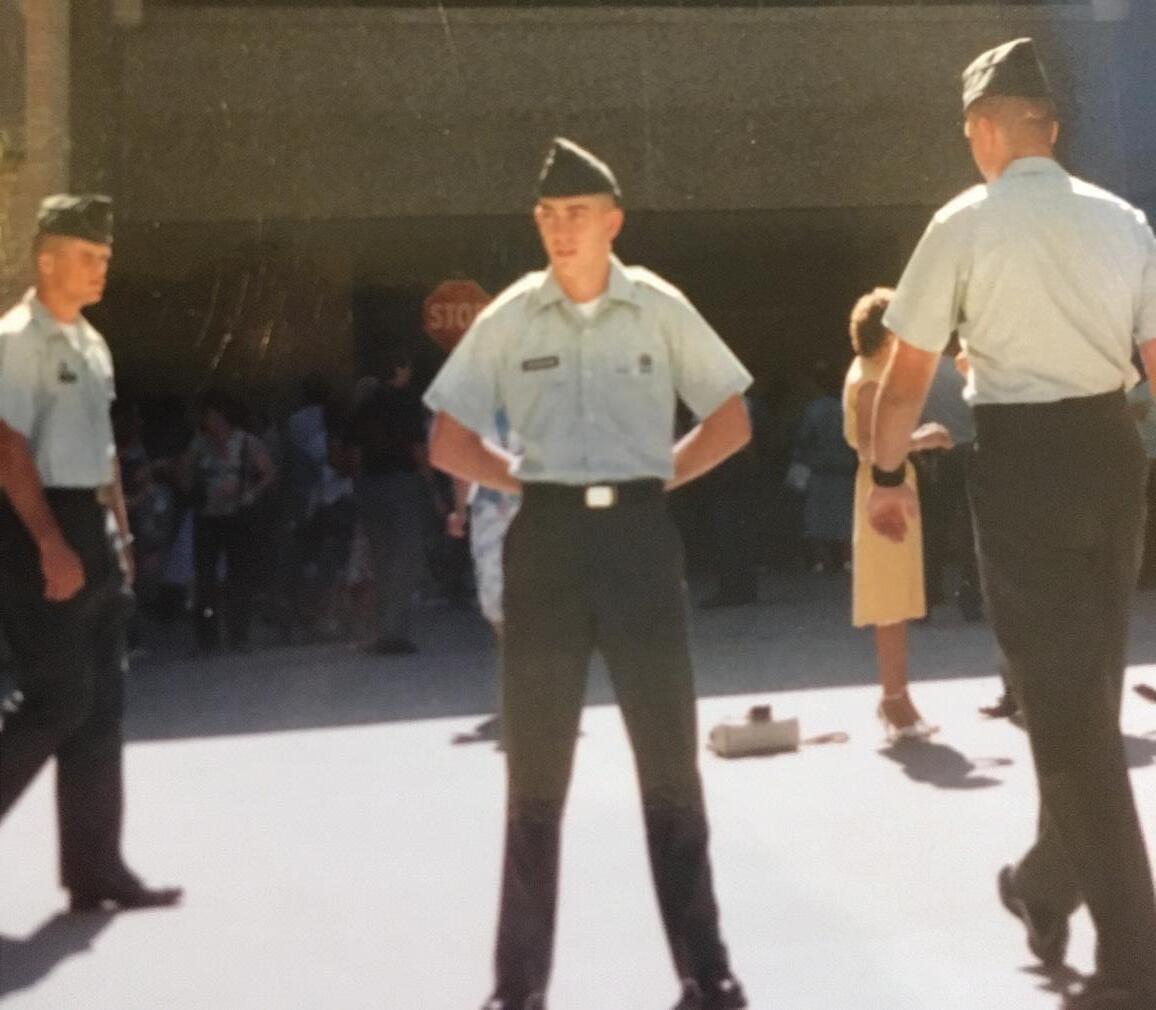
RIGHT Paul Crenshaw, Ft.Sill, OK, Aug. 1990
Decorated with art by Amy Louise Brown
BY MICHAEL RAMOS
Decorated like how, like a Christmas tree? All store-bought tinsel and lights, cheap glass balls and cheaper garland, garish star at the top? So decorated that the green boughs bend from all the candy canes and color, so decorated with ribbons and medals and color that the left breast of the uniform sags under the weight of storebought-but-earned awards? Decorated, because a plain tree is just plain but a tree with decorations is more christmasier, perfect for celebrating and Christmas cheer and giving [empty] gifts and singing hokey songs like a vet without decorations is just a plain vet but a vet with decorations is more vettier, perfect for celebrating patriotism and [empty] thanks for servings and cheap God Bless the U.S.A.s?
Decorated like how, like an Easter egg? All hard-boiled with smooth edges, painted spring pastels or the cheap plastic ones filled with even cheaper jelly beans and chocolate, the cheap special one hidden high with money, amount varied and determined by socio-economic class, chased after by children in Sunday best, decorated in fruit salad, bits of recognition unchased after by children in their dress uniform best, all hard-boiled with smooth edges?
Decorated like how, like an HGTV show house? All color-coordinated and furnished with perfect hosts with perfect hair and perfect timelines and perfect budgets, with shiplap and granite, landscaped yards and patios, open space and bright light, the unreal American experience, the unlived-in picturesque ideal, dream home, fantasy home with no story or personality? Like that? All dressed up in uniform with perfect regulation hair and regulation ribbon and medal spacing perfect for a picture or a postcard the picturesque American white knight, static with ribbons and medals with no stories just decorations perfect for modeling and maybe a parade? n
MICHAEL RAMOS is an Assistant Professor in Creative
at UNC Wilmington.
is an Iraq war veteran and focuses his work on dispelling myths about war and veterans while actively working to bridge military and
communities. His work has been
Fourth
and
and
The After: A Veteran’s Notes on Coming Home (University of North Carolina Press, 2024) was reviewed in NCLR Online Winter 2026.
AMY LOUISE BROWN retired in 2025 after over twenty years in the Army. For three years, she served as the Army’s artistinresidence, creating art from the challenges of soldiers in the field. Her works include paintings of the military in Afghanistan and the US, including its relief efforts after Hurricane Sandy. Brown’s last position was at the Army Public Affairs Center at Fort Meade as a Seargeant Major. Before joining the military, Brown taught art at East Wake High School in Raleigh, having earned a degree in studio art from Meredith College. More of Brown’s work can be seen at Fine art Reproduction from the US Army Art Collection and in NCLR Online Winter 2026
Nonfiction
He
civilian
published in
Genre, Slice,
PANK Daily. His essay collection
memoir,
Sitting Soldier (pastel on brown paper, 11x8.5) by Amy Louise Brown; courtesy of the US Army Collection
Celebrating a Mentor, NCLR Alumni, and North Carolina’s Inspiration to Writers on So Many Subjects and for All Ages
by Margaret D. Bauer, Editor
The familiar authors in this section include my mentor, Jim Clark (“Raleigh” Jim Clark, to distinguish him from the other literary Jim Clarks of North Carolina), who was inducted into the Order of the Long Leaf Pine. We have covered Jim’s numerous lifetime achievement honors over the years. This one makes me smile. Recipients of this honor must be retired. Jim has been retired from his long tenure at NCSU almost as long as I’ve known him (that’s about thirty years now), and yet, he’s never stopped actively serving his beloved literary community in leadership positions – and as a mentor to people like me and Rebecca Godwin, who wrote the story of his latest honor.
The other NCLR alum here is Bland Simpson. His books (with photography by Ann Cary Simpson) just keep coming. Retired from UNC now, Bland has taken the helm of the North Caroliniana Society following Jim Clark’s presidency, and I foresee that he will continue to serve all of us literary folks – and his beloved home state’s well-being – for many years to come.
And Harriet Jacobs, the subject of one of the books reviewed, is certainly a writer who has appeared in numerous issues of NCLR, as has the reviewer, my colleague Tom Shields (also retired now), whose articles on the Lost Colony and book reviews in NCLR are aplenty. Thank you, Tom, for your continued service to the North Carolina literary community in this capacity. (Fun fact: Tom is the person who brought the then four back issues of NCLR to me at a conference before my ECU interview thirty years ago this spring, so I could see what I was getting myself into if I got this job. And still, I had no idea.)
Also reviewed, Jason Mott’s latest novel. NCLR published an interview with him in 2019, which
put him on our radar, so when his 2021 novel Hell of a Book was longlisted, then shortlisted for the National Book Award, we watched, waited, then celebrated his win.
The other reviews in this section are of books that “flash back” to many of our previous special feature sections (even as the writers may be new to our pages). I am reminded by the review of an historical novel inspired by the Wright brothers’ sister of when the College Dean and NCLR’s “grandfather” Keats Sparrow called me to his office to suggest we feature “Flight” in the 2003 issue to commemorate the hundredth anniversary of the Wright brothers’ first flight. At the time, I could not imagine a full feature on flying in North Carolina literature, though it turns out, we had no problem filling that issue. Another historical novel, with a fictionalized Dorothea Dix hospital, calls back our 2021 feature on Writing Toward Healing. We have two reviews that cover stories that move from the mountains (2010: Appalachian Literature) to the coast (2005: Outer Banks Literature). There is even a cat-related novel reviewed here. The 1996 “cat” issue is before my time, and the idea of it does raise eyebrows (“You published a cat issue?”) Yes, we did. And it has some great stuff in it, people discover. It is dedicated to and was inspired by one of Founding Editor Alex Albright’s beloved editors, Bertie Fearing. And finally, after our 2006 issue focus on children’s and young adult literature showed us that the writingest state applies to writing for all ages, we are committed to including reviews of such books in these pages. Our hope is to reach parents and teachers who will introduce the concept of North Carolina as inspiration for great literature to readers of all ages – and perhaps the next generation of North Carolina writers.

22 “Raleigh Jim Clark” Inducted into the Order of the Long Leaf Pine by Rebecca Godwin
23 History, Memoir, and Novel a review by E. Thomson Shields, Jr.
n Lynn Domina, Approaches to Teaching Jacobs’s Incidents in the Life of a Slave Girl
28 Story of a Place a review by Evan Peter Smith
n Bland Simpson, Clover Garden, A Carolinian’s Piedmont Memoir
30 Learning to Listen in Western North Carolina a review by Jessica Cory
n Kathryn Kirkpatrick, Creature
n John Thomas York, The Charge
34 Gulledge’s Love Letter a review by Shelby Hans
n Jim Gulledge, Green Forest, Red Earth, Blue Sea
36 First in Flight: The Woman Behind the Wright Brothers a review by Rebecca Godwin
n Tracey Enerson Wood, Katharine, the Wright Sister
38 From Peaks to Pirates: Mysteries of North Carolina a review by Benjamin Bradley
n Carol Ann Collins, The Seafarer’s Secret Archer Sullivan, The Witch’s Orchard
Echoes of Past Issues FLASHBACKS:
42 Lifting the Veil: The Invisible World of Mental Health Care a review by Donna Summerlin
n Hannah Thurman, Mercy Hill
44 Coming of Age and Finding Faith a review by Jon Kesler
n Austin Allran, The Legend of the Isle of Cats
47 “a voice out here in the chaos” a review by Barbara Bennett
n Jason Mott, People Like Us
50 Between Legacy and Liberation a review by Abby Trzepacz
n Tracy Deonn, Oathbound
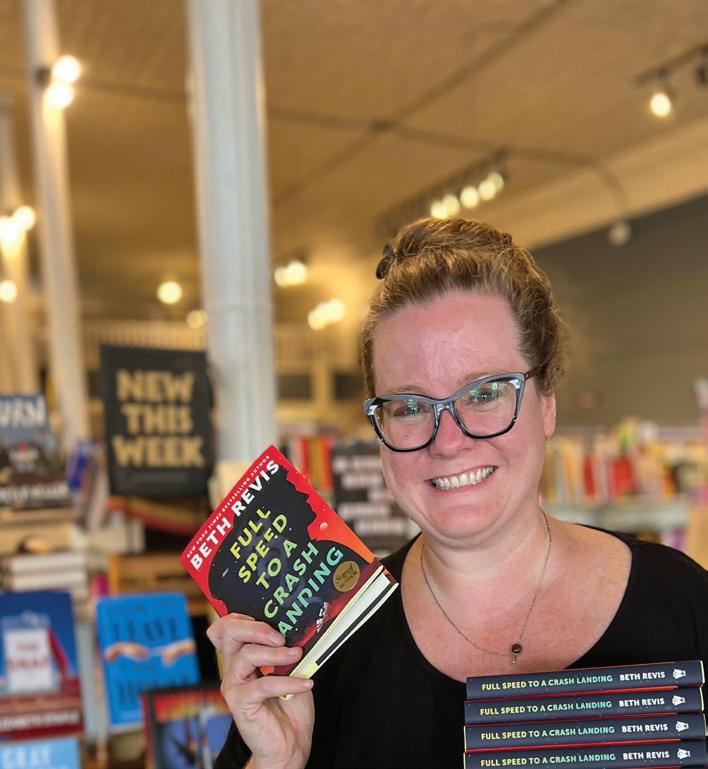
53 Journey Through Forgetful Skies and Crash Landings: Near-Future Young Adult Literature a review by Alyssa Froemel
n Beth Revis, Full Speed to a Crash Landing
n Lauren Yero, Under This Forgetful Sky
56 Stories of Self-Acceptance a review by Mark I. West
n Vanessa Brantley-Newton, Becoming Vanessa
n Maya Myers, Not Perfect

ALSO IN THIS ISSUE
n North Carolina Miscellany fiction, creative nonfiction, poetry, and book reviews ALSO IN THIS ISSUE
n North Carolina LGBTQ+ Literature fiction and book reviews
6 n Military Writing in North Carolina poetry, creative nonfiction, and a book review
58 n North Carolina Miscellany poetry, fiction, and book reviews
“RALEIGH JIM CLARK” INDUCTED INTO THE ORDER OF THE LONG LEAF PINE
by Rebecca Godwin
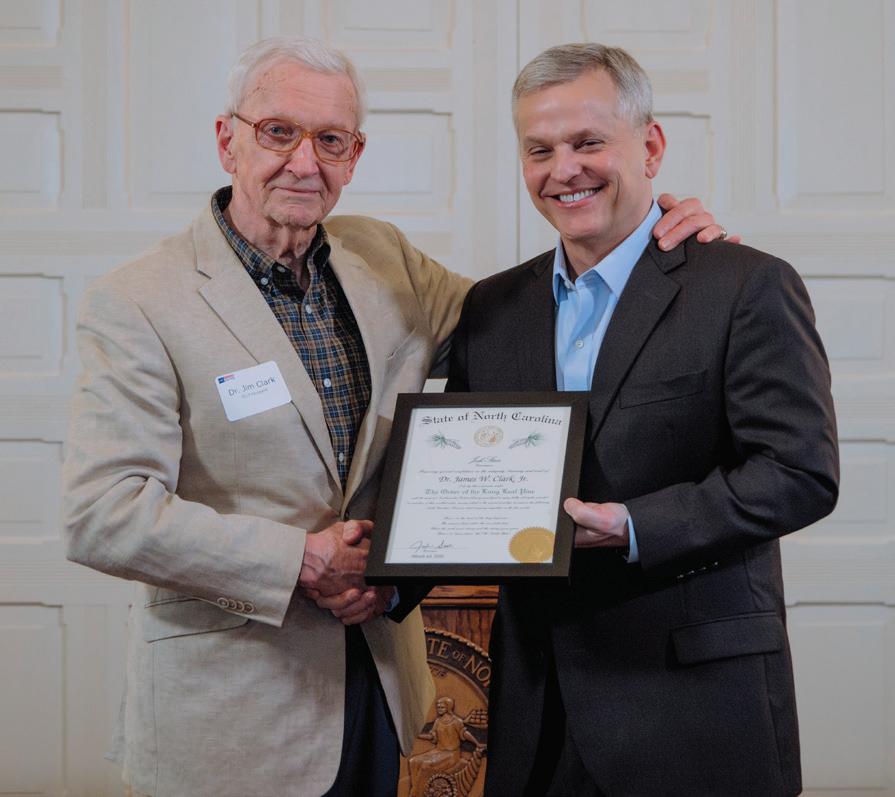
James W. Clark, Jr., received The Order of the Long Leaf Pine Award on March 10, 2026, at a ceremony hosted by Governor Josh Stein. Since 1963, North Carolina’s governors have recognized citizens whose accomplishments, civic leadership, and exemplary service merit the highest honor they can bestow. Calling him “both a scholar and a public servant,” Governor Stein highlighted Clark’s endeavors on behalf of public education, history, culture, and our beautiful but often neglected rural communities.
After growing up in Warren County, Clark educated himself for a future supporting his state. With a bachelor’s degree in English from UNC Chapel Hill and a master’s and PhD in English from Duke University, Clark taught for thirty-eight years at NC State University. For twenty years, he also led that university’s Humanities Extension/Publications Program, producing social studies textbooks for grades four through seven and videos for a Talk About Writing series that introduced public school students to North Carolina writers. In NC State’s Encore Center for Lifelong Enrichment and its revised configuration as an Osher Lifelong Learning Institute, Clark introduced adults to the joys of the humanities, often focusing on North Carolina writers and sometimes leading trips that showcased the state’s cultural geography. His creative writing courses encouraged adult learners to record their life stories, preserving a legacy for future generations. Honoring his rural roots, Dr. Clark helped to establish 4-H camps throughout the state, an achievement recognized by his induction into the National 4-H Hall of Fame. In 2010, he published Clover All Over: North Carolina’s First 4-H Century, 1909-2009 , an expanded edition of his earlier history of the state’s youth development program. Clark’s leadership strengthened the state’s literary and historical organizations and legacies. As President of the North Carolina Literary and Historical Association, the Thomas Wolfe Society, and the Paul Green Foundation, a position he held for a decade, he encouraged citizens to appreciate their state’s rich literary and cultural heritage. In 1992, he edited
and wrote an introduction to The Lost Boy , bringing Thomas Wolfe’s novella to the reading public in its original form. German and French editions of the novella followed. Chairing the North Carolina Writers Conference when it honored Margaret Maron at a meeting in Smithfield, Clark guided attendees to a reception at the Ava Gardner Museum, highlighting the town’s achievement in creating this tribute to the famous actress. As longtime President of the North Caroliniana Society, Clark championed the William Friday Teacher Retreats that the organization offers in partnership with Carolina Public Humanities to support K-12 teachers’ continuing education. His promotion of the digitization of free educational materials provides more evidence of his passion for learning. Two additional honors of note affirm the respect that Clark has earned through tireless service to his state. In 2020, he received the John Tyler Caldwell Award for the Humanities, the highest award given by NC Humanities, and in 2018, he was inducted into the North Carolina Literary Hall of Fame after years of chairing the selection committee for that prestigious institution. The Order of the Long Leaf Pine has gained a worthy new member, indeed. n
ABOVE James W. Clark, Jr. with Governor Josh Stein inducted into the Order of the Long Leaf Pine, Raleigh, NC, 10 March 2026, courtesy of North Carolina Governor’s Office
REBECCA GODWIN is Professor Emerita in English at Barton College in Wilson, NC. She currently serves as Vice-Chair of North Carolina Humanities and on the boards of the North Caroliniana Society and the Thomas Wolfe Society. She has also served as President of the North Carolina Literary and Historical Association and Chair of the North Carolina Writers Conference.
HISTORY, MEMOIR, AND NOVEL
a review by
E. Thomson Shields, Jr.
Lynn Domina, editor. Approaches to Teaching Jacobs’s Incidents in the Life of a Slave Girl. Approaches to Teaching World Literature 176. The Modern Language Association of America, 2024.
E. THOMSON SHIELDS, JR. has a PhD from the University of Tennessee and taught American literature at ECU until his retirement. He has published on Spanish and English literature and culture of colonial North America with a particular focus on what is now the southeastern United States, on early North Carolina literature (including on the “Lost Colony” and on John Lawson), and on Latin American and Hispanic American writers. Read several of his articles in issues of NCLR
LYNN DOMINA earned a BA in English from Michigan State University, an MFA in creative writing/poetry from the University of Alabama, a PhD in English from Stony Brook University, and an MDiv from the Earlham School of Religion, where she took courses in the Ministry of Writing. She is the author of several poetry collections, most recently Killing Him (Harvard Square Press, 2025). She is also the editor of a collection of essays, Poets on the Psalms (Trinity University Press, 2008).
Reading Approaches to Teaching Jacobs’s Incidents in the Life of a Slave Girl, I remembered meeting Jean Fagin Yellin some thirty-five years ago, soon after she had published her 1987 Harvard University Press edition of Harriet Jacobs’s 1861 autobiographical Incidents in the Life of a Slave Girl. Using the pseudonym Linda Brent, Jacobs tells about growing up in slavery, including being sexually pressured by her owner; running away to hide in a crawlspace above her freedwoman grandmother’s cottage, where she stayed for seven years and could watch her enslaved children through a peep hole; and ultimately escaping to the North. Yellin was at East Carolina University to talk about Jacobs near Edenton, NC, where Jacobs’s story began and where Yellin had done research. Yellin told me how the women of the Edenton Historical Commission were very helpful, providing any materials she requested without hesitation while, at the same time, they didn’t believe Incidents in the Life of a Slave Girl to be actual history. They did not deny what Incidents illustrated – that slavery had been harsh on enslaved women – but they believed that the experiences written about were fiction and probably by someone who had not been enslaved. Among Yellin’s accomplishments in her 1987 edition of Incidents was to show that the work was very much about Jacobs’s life – and that Jacobs herself had written the book, despite having grown up in a North Carolina that had generally kept its enslaved population illiterate.
Even in an era when Jacobs’s text is accepted as historically true and written by Jacobs herself, the work draws people to look at Incidents as both history and literature, as autobiography and novel. A major strength of Approaches to Teaching Jacobs is its interdisciplinary approach, connecting Incidents to historical studies, cultural studies, and literary studies, including the techniques of fiction. An incomplete list of fields identified as being used in the collection’s twenty-seven essays includes African American literature; African American studies; American literature; American studies; American print culture; archival studies; Black feminist theory; composition, writing, and rhetorical theory; creative writing; digital humanities; environmental humanities; literature and medicine; modern American and Canadian fiction; multicultural American literature; pedagogy; performance studies; religious studies; social work; Victorian literature; visual studies; women’s literature; and women and gender studies.
To bring together these various perspectives, Lynn Domina, the book’s editor, opens the collection with “Part One: Materials,” an overview of resources available for using Jacobs’s Incidents in the classroom. The materials Domina discusses include not only teaching editions of Jacobs’s book, but also a sampling of excerpts included in several American literature anthologies. “Further Reading for Students” presents contextual works such as Frederick Douglass’s 1845 Narrative and Angela Davis’s 1971 essay “Reflections on the Black
Woman’s Role in the Community of Slaves,” and Domina rounds out Part One with “The Instructor’s Library,” an overview of biographical materials, critical essays, background readings, and audiovisual and digital resources related to Incidents
Domina then moves on to the larger section of the book, “Part Two: Approaches.” Following her introduction to Part Two, Domina divides the collection’s twenty-seven essays into four subsections: “Thematic Approaches,” “Intertextual Approaches,” “Teaching Strategies,” and “Contextual Approaches.” Here is where the wide range of valid and revealing approaches to Incidents becomes apparent. As Domina points out, not only in the eight essays in “Thematic Approaches,” but throughout the collection, “Nearly every essay discusses gender and sexuality, often as those ideas relate to motherhood and the cult of true womanhood.” But, Domina continues, four other major themes emerge, each explored in several of the essays: individual autonomy and agency, genre characteristics and expectations, sentimentalism, and Christianity (18). Just as interesting are themes discussed in individual essays aside from the major ones, themes readers may not have considered before. For example, Josh Doty emphasizes the work’s medical contexts, in terms of both the nineteenth century as well as more recent questions about racially biased health disparities. Sometimes less considered themes come
out as part of a discussion of a larger theme. Marilyn Judith Atlas highlights the theme of nature as she looks at how Jacobs’s text can be seen in part as an exploration of “the art of storytelling,” with a narrator who “refuses to be erased and silenced,” so that “[a]s the narrative progresses, Brent finds strength in the natural world and faces and slays her demons, becoming increasingly able to inhabit her rightful place in the world as a person, not an object to be owned” (19).
The nine essays that make up the section “Intertextual Approaches” continue the exploration of themes in Incidents, but now by juxtaposing Incidents alongside an assortment of other texts. These include historical docu-
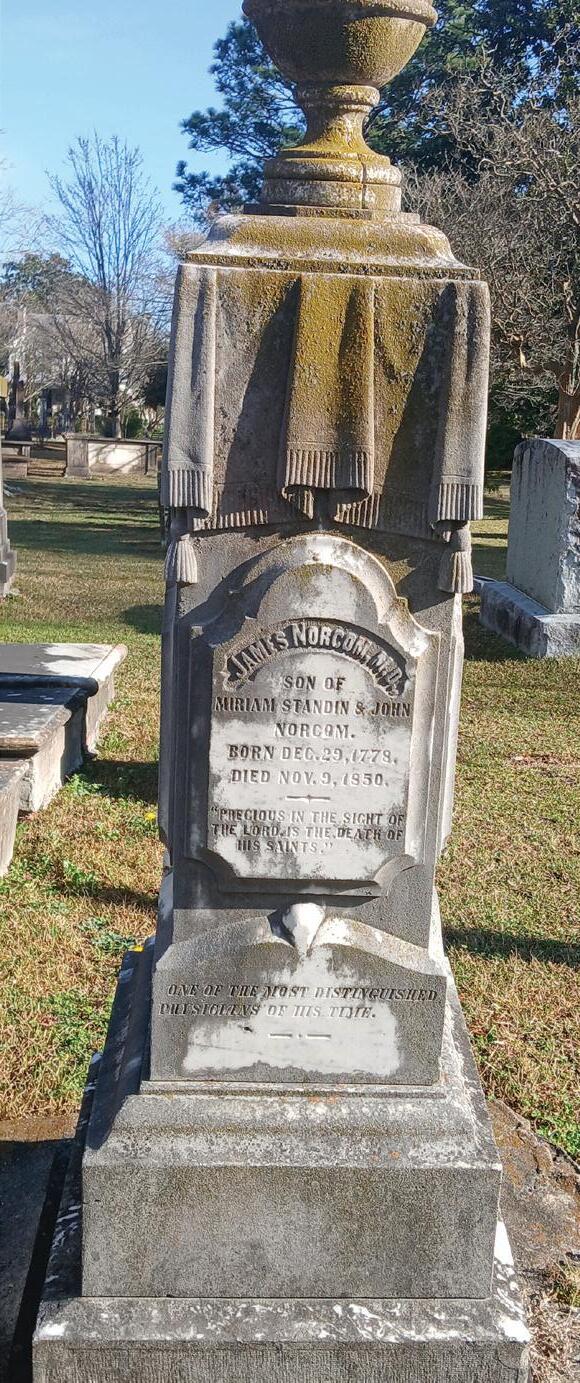
ments, such as the advertisement Jacobs’s enslaver, James Norcom, posted when Jacobs escaped to her grandmother’s attic crawlspace, as suggested in the essays by Eric Sterling and by John Hay. Norcom’s advertisement can be compared to the version Jacobs attributes to Dr. Flint included at the end of Chapter Seventeen in Incidents, reworked both for thematic emphasis and to retain her anonymity. And both Norcom’s original and Jacobs’s revised advertisements can be compared to other “runaway slave” ads, setting up the conventions, especially the language, of the “runaway slave” genre. Other suggested intertextual readings include putting Incidents alongside 1850s antebellum African American novels, such
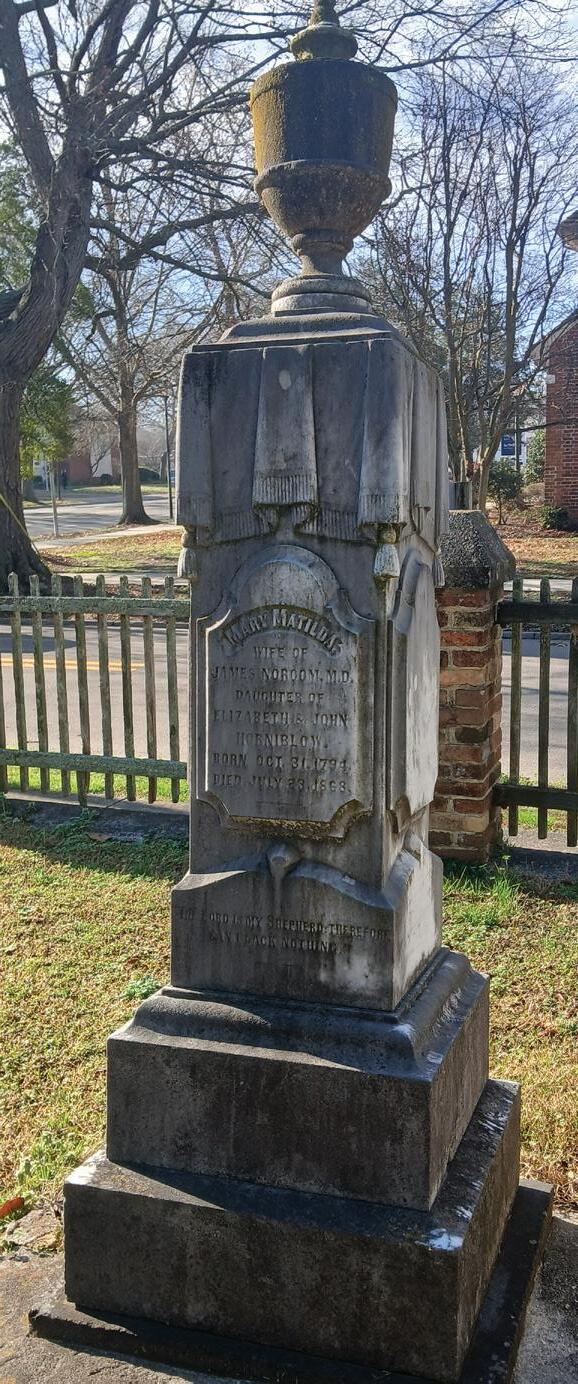
RIGHT The Norcoms’ shared grave marker, James (inscription showing on the left) and Matilda (on the right); photographs by Claire Shields
as Harriet E. Wilson’s Our Nig and The Bondswoman’s Narrative by Hannah Bond (using the name Hannah Crafts), as John Hay suggests. But Hay goes on to also suggest reading Incidents alongside three mid-nineteenth century fictional autobiographies – Charlotte Brontë’s Jane Eyre (1847), Herman Melville’s Typee (1846), and Fanny Fern’s Ruth Hall (1854)–each of which raises questions about the line between fiction and real life. Amina Gautier tells about teaching Incidents alongside late twentieth- and early twenty-first century neoslave narratives in a course on narratives of slavery, including Toni Morrison’s Beloved (1987), Charles Johnson’s Middle Passage (1990), Edward Jones’s The Known World (2003), and Colson Whitehead’s The Underground Railroad (2016). Kimberly Southwick-Thompson pairs Incidents with Black Panther Party and Black Liberation Army member Assata Shakur’s Assata: An Autobiography (1988), allowing students to “recognize how long injustices like those that twenty-first-century social justice movements fight against have existed, despite these injustices’ many different masks” (124). Jericho Williams even pairs Incidents with Mark Twain’s Pudd’nhead Wilson (1894) to examine themes of slavery and childhood alongside issues of mixed literary genres.
Interestingly, while comparisons (and mostly contrasts) between Frederick Douglass’s Narrative of the Life of Frederick Douglass (1845) and Jacobs’s Incidents come up elsewhere in Approaches to Teaching Jacobs, Douglass gets only brief mention in the section “Intertextual Approaches” – another sign of how this collection shows Incidents can be seen and taught from numerous perspectives. And not only in this section, but in the entire collection, John S. Jacobs’s autobiography, A True Tale of Slavery, by Harriet Jacobs’s brother and serialized in the London weekly newspaper The Leisure Hour in 1861, gets only one brief mention.1 While classroom examples are found throughout Approaches to Teaching Jacobs, the seven essays in the section “Teaching Strategies” highlight how specific pedagogical tools have been used to teach themes and literary forms in Incidents. For example, Alex W. Black discusses how he brings out the defining features of melodrama – “sensational plots, and its exaggerated characterization” (141) – presenting the genre of melodrama in a positive rather than derogatory light and using its features as an entree for students into the themes, plot, and characters of Incidents. In her American literature survey classes, Susanna Hoeness-Krupsaw prompts students to think about Jacobs in
the context of early nineteenthcentury American literature by having students break into groups to role-play as Jacobs, Ralph Waldo Emerson, and Henry David Thoreau participating in a television talk show. It is an assignment that works well both in face-to-face classes and in synchronous online sections, she reports (139).
The point about in-person and online classes highlights that, since the call for submissions to this volume went out in 2019, the essays were written during the COVID-19 pandemic when many if not most instructors were having to move classes online. And a number of excellent online sources are given throughout this section. So, for example, while Carrie Johnston focuses on an in-person archival assignment using bills of sale for enslaved African Americans in the Wake Forest University archives, she includes online sources she used when she moved the course – and assignment – online in the Fall of 2020. And Kristin Moriah, who teaches at Queens University in Kingston, Ontario, focuses on how she brought in the Black geography of Jacobs’s life in Edenton, NC, as COVID moved her class online. She includes topics such as the geographic misinformation believed by much of the town’s African American population. Ultimately, Moriah focuses on
1 “A True Tale of Slavery” is a condensed version of John S. Jacobs’s autobiography. Recently the recovered 1855 version of John Jacobs’s full narrative, The United States Governed by Six Hundred Thousand Despots: A True Story of Slavery, ed. Jonathan D.S. Schroeder (U of Chicago P, 2024), has been published (after the essays in Approaches to Teaching Jacobs were written). Serialized in the Sydney, Australia, newspaper The Empire, one of the interesting differences between the 1855 and 1861 versions is that in the earlier publication, John Jacobs gives full names, especially of enslavers/owners, while in the 1861 condensed version, only initials are given, such as Dr. Norcom being identified as Dr. Norcom in 1855 but only as Dr. N---- in 1861 – and as the pseudonym Dr. Flint by Harriet Jacobs.
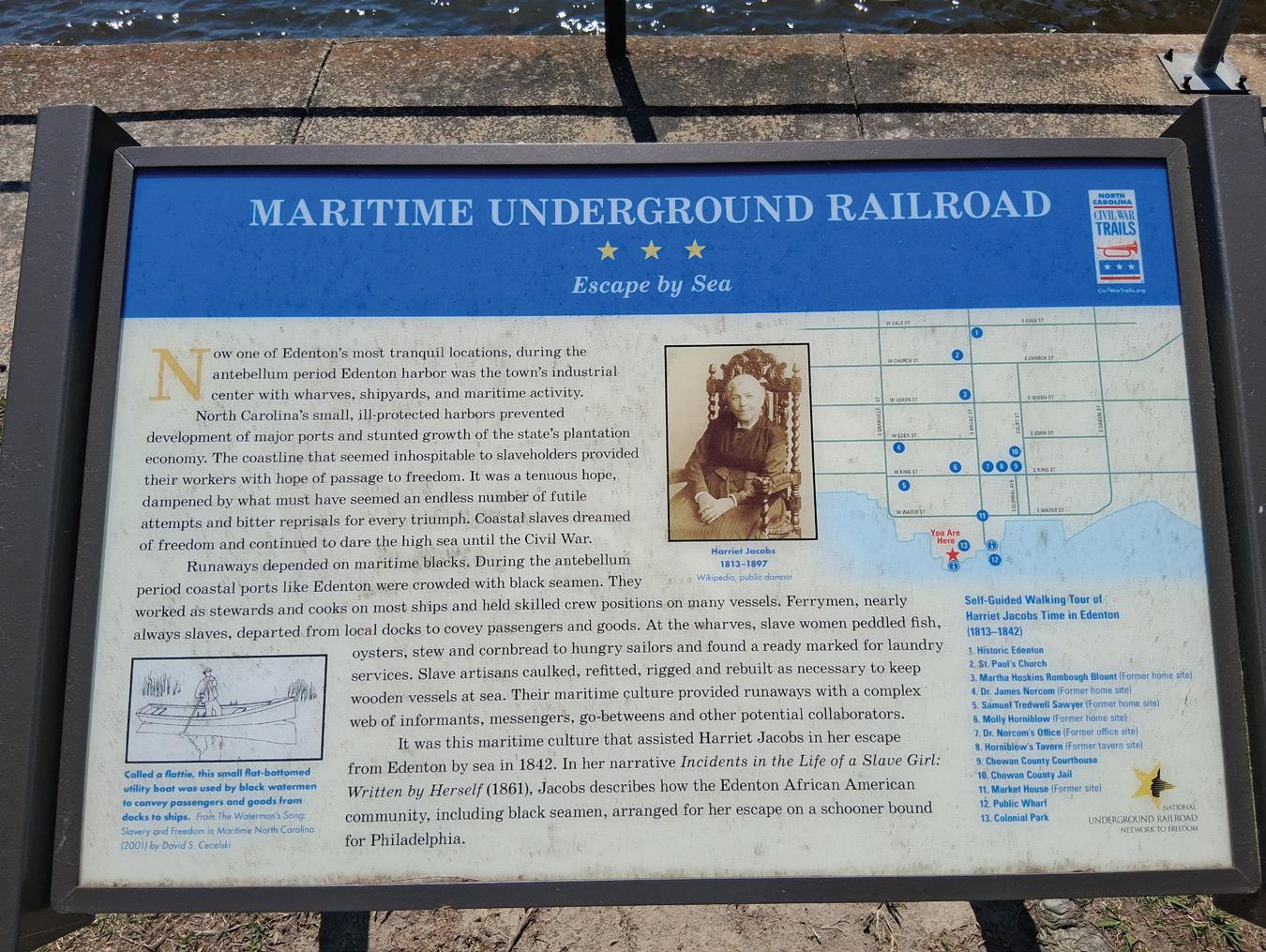
specifics connected with Jacobs and Edenton. For example, how does Jacob’s surveying her world through the lens of her peephole affect the way she sees the world, or how can using a brochure map from the Historic Edenton State Historic Site alongside Google Maps help students see that the Norcom home Jacobs had escaped from and the attic of Molly Horniblow’s cottage she escaped to were just one block apart.
Approaches to Teaching Jacobs finishes with three essays in the section titled “Contextual Approaches.” This final section, as Domina notes, “focuses primarily on the context of the student, that is, the course in which the text is
taught” (17). Heidi M. Hanrahan tells about teaching Incidents in part of an Introduction to Gender and Women’s Studies class taught by an interdisciplinary team (a historian, a sociologist, and a literature specialist). The course includes a service-learning component, which Jacobs’s text is part of. As Hanrahan writes, “since Incidents invites –in fact, demands – an engaged, activist audience” (169), by the end of the course, “students did see themselves as agents of change, people who could do the kind of work Jacobs calls us to do” (173). Melissa J. Lingle-Martin tells how she has focused on the visual in teaching Incidents at various levels, from high school students
through to upper-level college seminars. The visual includes the visual imagery in Jacobs’s text as well as the graphics used in both proslavery and abolitionist pamphlets, advertising, etc. And Lorraine Dubuisson tells about teaching Incidents in the wide-ranging context of a senior-level college survey on “Literature by Women,” covering women writers from the Middle Ages to the present day.
By showing the variety of themes in Incidents and the various texts Incidents can be read alongside, as well as the numerous ways the work has been successfully taught, Approaches to Teaching Jacob is a useful work for anyone thinking about how to interpret Jacobs’s autobiography. Even so, there are a few limitations to the work. The most significant one is that while Jean Yellin’s historical work is given a good deal of credit and is cited throughout, Yellin’s edition of Incidents in the Life of a Slave Girl is omitted in the discussion of editions available for classroom use. At the same time, while several editions aimed specifically at classroom use are noted, the Norton Critical Edition is given precedence over others, not only by being discussed first, but by having
ABOVE Maritime Underground Railroad marker in Edenton, NC,, providing a selfguided walking tour of Harriet Jacobs’s time in Edenton (1813–42); erected by North Carolina Civil War Trails and National Underground Railroad Network to Freedom; photograph by E. Thomson Shields, Jr.
all the essays cite the Norton for passages from Incidents. An explanation of why the Norton Critical Edition was chosen for citations, and a discussion of what audience, especially what classroom audience, each of the mentioned editions might be best for would be useful. For instance, I generally used the Yellin edition when teaching upper-level undergraduate and graduate classes because not only does it provide good historical context, but its extensive notes – even if somewhat overwhelming – model for advanced students the sort of data needed to make academically sound claims. At the same time, I’ve used inexpensive editions like the Dover Thrift Edition ($6.00 for the paperback, 99¢ for the eBook) in lowerlevel classes where I want to save students money and have them focus on the text first, using class time to provide context.
I will admit that in part I may be emphasizing Yellin’s edition because it is where the map of Jacobs’s Edenton used by Moriah was originally published, having been drawn by a staff member of the North Carolina State Archives for the 1987 edition.2 From there it was picked up by the Historic Edenton State Historic Site for its brochure. And Moriah’s essay hits home for me because I moved to Edenton almost twenty five years ago. When I walk through
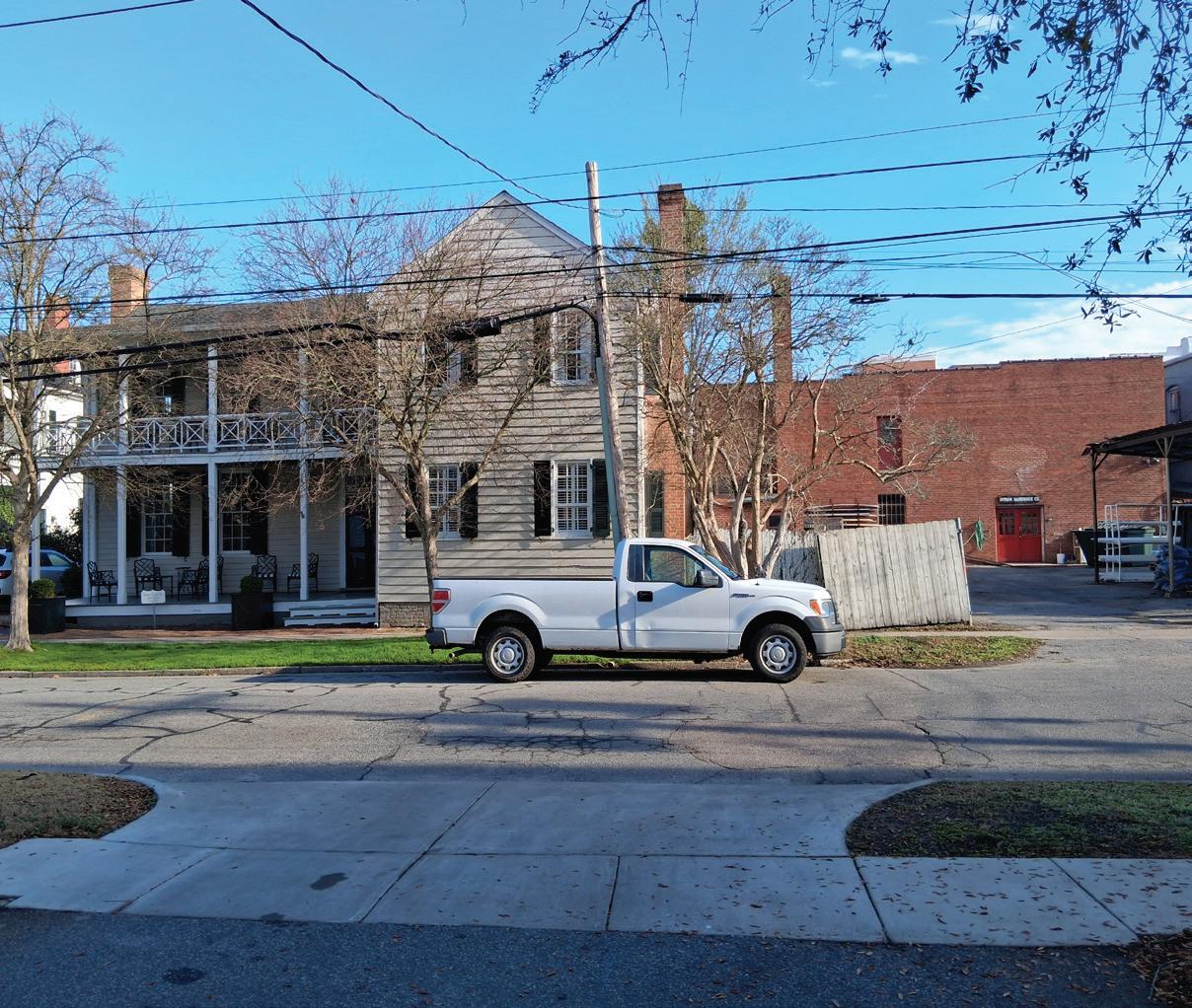
town, I think about how the historic homes I pass would fit into Jacobs’s life – was that house there when Jacobs was born? built while she was growing up? built during the seven years (1835–1842) that Jacobs lived in her “loophole of a retreat”? Or was that house not part of Jacobs’s life in Edenton at all? Some of the most important structures in Incidents no longer exist. Both Molly Horniblow’s and Dr. Norcom’s houses have long since been torn down, the sites of each now parking lots – the Horniblow cottage is the backdoor loading area for a local hardware store, and the Norcom house site is a parking lot for the local Baptist Church.
Moriah’s Canadian students imagine Jacobs’s Edenton through Google Maps while I physically walk the places, yet I am also imagining Jacobs’s and Edenton’s history and geography. By including a large variety of perspectives, Approaches to Teaching Jacobs highlights both the factual history in Incidents Yellin brought out starting in the 1980s as well as how Jacobs’s nonfiction uses techniques more common to writing fiction. Approaches to Teaching Jacobs’s Incidents in the Life of a Slave Girl gives teachers and general readers a sense of the line that Jacobs doesn’t just walk, but crosses over, back and forth, throughout her autobiography. n
2 As Moriah notes, this map is no longer available directly on the Historic Edenton State Historic Site website. However, aside from being in Yellin’s 1987 and 2009 editions of Incidents, a version can be found by starting from the Historic Site’s main page, clicking on the “History” tab, and from there following the “Harriet Jacobs” link, which goes to the separate Harriet Jacobs website, at which point, after clicking on the “Maps” tab at the top, one can scroll down to the section “Self-Guided Tour of Harriet Jacob’s Edenton Years” and find the “self-guided tour brochure” link, which will bring up the map in a pop-up window, scrolling down to see the map’s legend.
ABOVE James Iredell, Jr. Law Office, next to site of Molly Horniblow’s house; photograph by E. Thomson Shields, Jr.
STORY OF A PLACE
a review by Evan Peter Smith
Bland Simpson. Clover Garden: A Carolinian’s Piedmont Memoir. University of North Carolina Press, 2024.
EVAN PETER SMITH is a writer and journalist based in the Carolinas. A first prize winner of the South Carolina Press Association Awards, he is the author of Here by the Owl (Claude Perry Press, 2021). Smith previously served as the managing editor of the Greenville Journal , a county-wide newspaper in Greenville, SC, and Upstate Business Journal , a statewide business publication focused on Upstate of South Carolina. A descendant of a long lineage of North Carolina cattle farmers, his family runs Shipley Farms on Linville Creek Road in Vilas, NC.
BLAND SIMPSON , a longtime contributor to NCLR, was, until his recent retirement, Kenan Distinguished Professor of English & Creative Writing at UNC Chapel Hill. He is the pianist and composer of the Tony Award-winning string band The Red Clay Ramblers. His numerous awards and honors include the North Carolina Award for Fine Arts and induction into the North Carolina Literary Hall of Fame. Read more about him in the induction story published in NCLR Online Winter 2023.
If there is a single moment that best sums up North Carolina author and musician Bland Simpson’s gorgeous, charming, and occasionally frustrating new book, Clover Garden: A Carolinian’s Piedmont Memoir, it is the story of when a dairy cow kicked a man in the head. Decades ago, Simpson was helping a group of men rebuild an old barn that had caught fire. During a break from the work, the patriarch of the farm told Simpson a story about an old friend of his who now lay hospitalized after that unfortunate head-kick from one of his Holsteins. “I been knowing him my whole life,” the patriarch said of the injured man, “and now he don’t have no idea where he is, or even who he is. He don’t even know his own name” (32). Eventually the patriarch shook his head and offered one of the simplest and truest statements about life: “You know, Bland –the years go by.” If Simpson had ended the story there, it would have been a well-told, compact meditation on the sadness of aging. But Simpson is by nature a good-humored writer, and he had a twist up his sleeve.
He ends the story by describing what happened after the barn was rebuilt, when he was about to drive off in his truck. The patriarch, suffering an old man’s moment of confusion, said, “Jim, Jim, I can’t thank you enough, Jim.” Another man corrected the patriarch. “His name ain’t Jim at all. This is Bland Simpson, lives down on the creek.” To which the patriarch responded, without missing a beat: “I know what his real name is. I just call him Jim because I like him so much.” As
Simpson writes, “I do not know how I kept my truck on the road all the way back down to the cabin, I was laughing so hard at the sheer goofiness of the patriarch’s calm, self-protective retort” (43).
This is the work of Bland Simpson in a nutshell: beautiful, reflective, and goofily funny. His new book, Clover Garden, which Simpson bills as a memoir, is really a biography of a place – the titular Clover Garden, a historic, rural community in southwest Orange County, NC, where Simpson has resided since the 1970s. He tells the history of this community in a casual, meandering style, familiar to anyone who has ever sat on a front porch and listened to a longtime resident of a small town wax poetic about its history. “To be a citizen of Clover Garden here in the Old Fields, to be a part of its membership, has been and remains a great wonder in my life,” Simpson writes in the book’s opening pages, “and what follows are stories from within that wonder” (5).
True to his word, that’s exactly what this book is: stories of unique people, strange incidents, unfortunate traumas, lost loves, broken lives, and hilarious encounters. From wise dog breeders to rural politicians, hardscrabble BBQ pitmasters to Pulitzer Prize-winning historians, musicians to fishermen, just about every character Simpson encounters in this book seems to beg for a book of their own. My personal favorite is a gentleman named Mr. Stacy, who preferred to walk everywhere he went, and who was eulogized at his funeral with the words, “God bless Mr. Stacy. He was a
walking man, amen” (67). The dignified understanding of his community members just about brought a tear to my eye when I read that.
All the tales in this book are imbued with Simpson’s warm, comforting voice. He’s as adept at landing a punchline as he is a tragic surprise. This is a book that flows like a creek, winding gently through a specific place, in all sorts of weather.
“To awaken later at first light,” Simpson writes of a nocturnal rain storm, “and rise just enough to see the big mists the rain is making in the field and hanging in the woods, deer moseying through those mists, one finds oneself in a gray winter’s forest, with smoke from our little Upland woodstove falling down the slope, mixing with the rain, drifting into the field, and melding with the mists there. The Danes have a saying for such spectral moments: The Bog Witch is brewing” (141).
I could have excerpted a description of the land, the weather, and the atmosphere from just about any page, and there would be admirable
poetry there. Simpson has a natural ability to find the offbeat but perfect description for the goings-on around him. The lowing of dairy cows is “bluesy” (139); he hears the “child-like screaming of a rabbit in the talons of an owl” (139); starlight contains “every other creation in the true wild blue yonder, from a distance so endless and divine we shall never know it, rolling across our skies every single night in the endless scroll of years” (6).
But I must admit, the book does suffer slightly from the author presuming his readers’ familiarity with the people he writes about. Simpson has a habit of mentioning people in his life, especially his family, with little or no introduction, as though we are entering a story whose characters we should already know. In one story, for instance, Simpson has his twin children in the car, even though we have known him so far in the book as a childless bachelor. Timelines blur and shift in a way that can occasionally be disorienting; I was never confused about what was happening,
merely confused by the author’s intention to organize events in the way he did. The book’s structure also left me puzzled. It consists of two sections: “Part 1: Clover Garden” and “Part 2: When Ann Came” – Ann being his wife, the photographer Ann Cary Simpson, whose images appear in these pages. Because the first section was replete with so many stories and details about the community of Clover Garden, I was excited by the prospect of the second section telling the story of his and his wife’s relationship living on the land. But Ann appears so relatively rarely in the second part of the book, which consists mainly of yet more stories of the community’s characters and events, that I found myself wondering why Simpson felt the need to designate a new section at all. Indeed, at times I felt I learned more about Ann from her photographs – from the stark beauty of her blackand-white images of nature, from the noble loneliness she captures of old homes, solitary flowers, and curious animals –than I did from the stories Simpson told of her.
But these are minor gripes, set against what is a beautiful, loving book. If you have ever sat on a porch and listened to a local historian tell tales of the place he loves, you know to expect a certain amount of backtracking, meandering, and side stories to unfold. But when the teller of the tales is this good, when the voice is this rich, you can sit on that porch for hours, knowing that when night falls, you’ll be in for a beautiful account of the starlight. n
LEARNING TO LISTEN IN WESTERN NORTH CAROLINA
a review by Jessica Cory
Kathryn Kirkpatrick. Creature. Jacar Press, 2025.
John Thomas York. The Charge Redhawk Publications, 2024.
JESSICA CORY is a settler scholar and the editor of Appalachian Journal: A Regional Studies Review . She holds a PhD in Native American, African American, and environmental literatures from UNC Greensboro and is the editor of Mountains Piled upon Mountains: Appalachian Nature Writing in the Anthropocene (West Virginia University Press, 2019) and the co-editor (with Laura Wright) of Appalachian Ecocriticism and the Paradox of Place (University of Georgia Press, 2023). Her creative and scholarly writings have been published in NCLR, the North Dakota Quarterly, and Northern Appalachia Review.
From two North Carolina-based presses come two wonderful collections of poetry that capture the breadth of life in the western part of the state and instruct us how to listen – truly listen – to these lives. From John Thomas York’s poetic sense of the Watson family in Deep Gap to the sounds of moths, horses, dogs, and other beings with whom we share space in Kathryn Kirkpatrick’s examinations of place intertwined with grief and loss, we learn that by listening to these stories, we can learn what it means to be human in these mountains, and all of the relationships, reciprocity, and obligations such a role entails.
A note inside the cover of John Thomas York’s newest collection, The Charge, and a QR code near the back mention his daughter Rachel York’s hand in the project, turning these poems into a multimedia experience. Much like the multigenerational poems within the book is an intergenerational collaboration between father and daughter, a celebration of traditions heard and handed down.
York’s poems follow the Watson family, made famous beyond the High Country by Doc Watson’s picking styles and knowledge of traditional American music. For readers less familiar with the Watson
JOHN THOMAS YORK was educated at Appalachian State, Wake Forest, and Duke, and has an MFA in Creative Writing from UNC Greensboro. He has been a Mellon Fellow at UNC Chapel Hill and a recipient of fellowships from the Council for Basic Education and the National Endowment for the Humanities. For over thirty years he has taught English in the public schools and, in 2003, was named Teacher of the Year by the North Carolina English Teachers Association. His work has appeared in many regional journals, as well as in anthologies such as Word and Witness: 100 Years of North Carolina Poetry and The Southern Poetry Anthology, Volume III: Contemporary Appalachia. He has published three chapbooks. In 2011, he received the first annual James Applewhite Poetry Prize from NCLR.
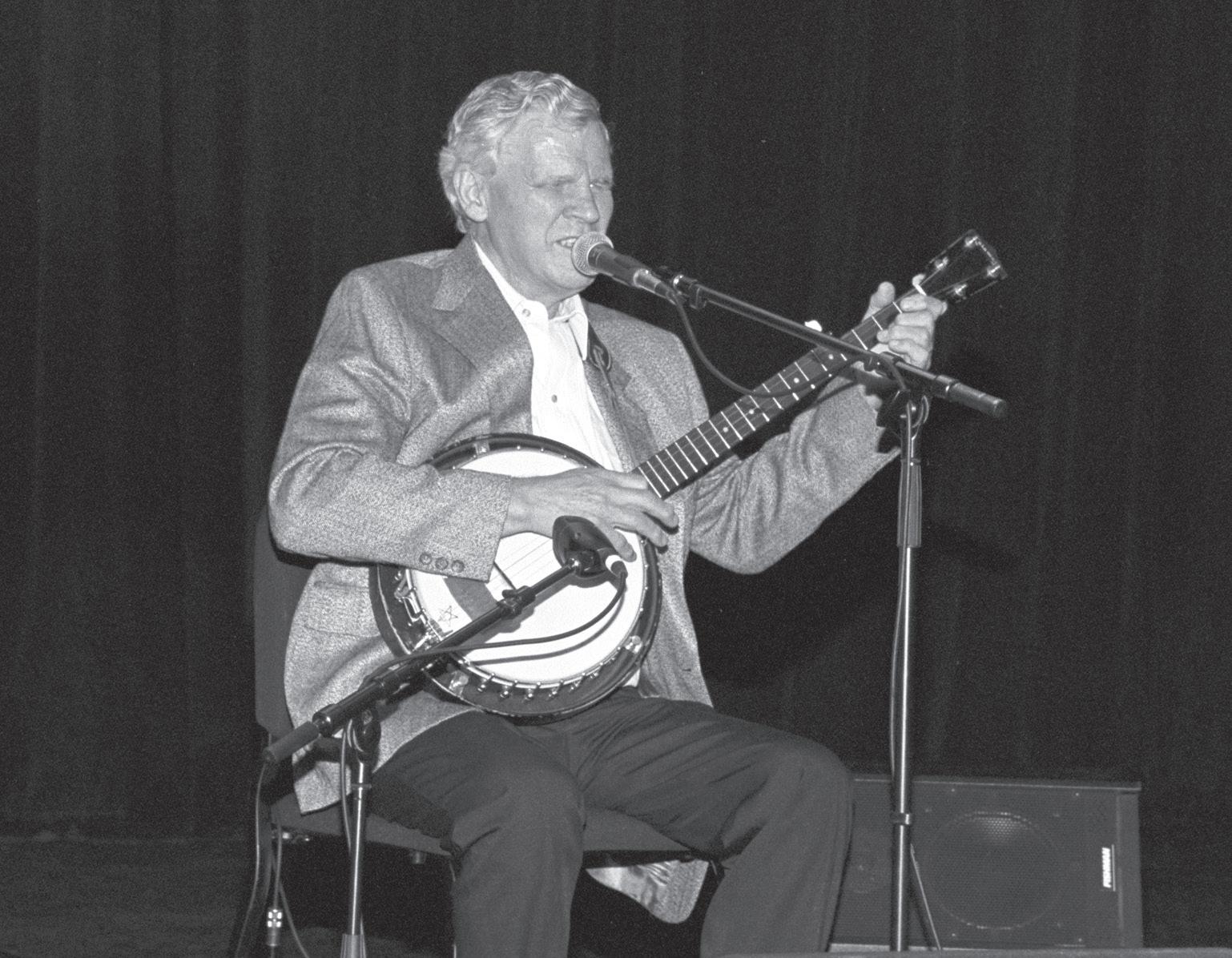
ABOVE Doc Watson at the North Carolina Folk Heritage Awards, Raleigh, NC, 1994; courtesy of the North Carolina State Archives
family and Watson’s legacy, York includes helpful notes in the back of the book to introduce readers to this talented and rooted lineage.
While York’s poems are place-based and Watsonfocused, they stretch beyond what, in the hands of a lesser writer, might be limitations. Rather than refusing to move beyond the Watson family and western North Carolina, York expertly draws connections between Watson’s music, his family’s experiences, and the places they called home to places and people far afield. Building these bridges allows readers who are less familiar with Watson’s music or his home turf to still find themselves relating to these poems.
York begins to establish these broad-based relationships from the first page. In “1. The View from Deep Gap,” he writes,
And the ridge on yon side might’ve been the Hills of County Down,
Or the Highlands, the Beacons, the Atlas Mountains: who knew they were
so close, the Mothers and Fathers, their songs like seeds in black furrows
Such lines bring to mind the many travels and travails of one’s ancestors yet highlight how some songs, traditions, and stories, like the one York is telling, survive, sometimes against seemingly insurmountable odds. York builds on these notions of the ancient and deep within us in the second poem, “2. Singing School, The Sacred Harp”:
as if a fiddler were tuning as he played –maybe there was an ancestral memory
of bagpipes, of reeds that made the feet twitch and the hair stand at attention –
York then offers readers an image of this ancestry by invoking our own first homes – our mothers:
Arthel Watson, sat on your mother’s lap and smelled the salt, but tasted your Mama’s sweet
voice, the first you heard, nine months of ballad and lullaby – the first songs learned by heart.
These closing lines nod to important themes in the book – family and music. While The Charge serves as somewhat of a story-behind-the-music in regard to Doc Watson and his kin, and the book has a
multimedia musical component with Rachel York’s wonderful compositions, the poems themselves carry tunes and ballads throughout the collection. York’s masterful use of onomatopoeia brings readers into the family fold and positions them not only as an audience to the poems but to the music happening in the Watson home and beyond. In “3. Barnyard Bourdon,” the reader is captivated in the confines of Doc Watson’s childhood homestead, in which Watson’s “Mama shooed him out to the porch, there to play / brush and washtub, milk bucket, nail can / (boom-chinka-boom-chinka),” which become “The barnyard drone booming over the farm, a bourdon, / an echo, a spirit wandering the hills.”
These sounds and musicality not only of language and lyric, but song, continue to appear throughout the collection. For instance, the fourth poem, “4. Sing-Song Kitty” captures a tale of Doc’s father, General (as York points out, that was his name, not his rank), skinning a dead cat in order to craft a banjo. While some readers may be appalled at this use of a feline friend, York changes the tone of the poem by including song lyrics from “Sing Song Kitty” as the last two stanzas of the poem:
“The old daddy cat sure loved to croon, Sing-song kitty, catch a high me-oh, Now they can heard ‘im up on the moon. Sing-song kitty, catch a high me-oh!”
“He-mo, hi-mo, beetle bug jingo, Me-hoo, my-hoo, pretty penny wingo, Chicken-fat-a-pitty-pat, a blue-eyed pussycat, Sing-song kitty, catch a high me-oh!”
This incorporation of Doc’s song lyrics into York’s poems continues the collaborative nature of The Charge. Even when song lyrics are not used expressly, the family stories interwoven throughout this chapbook highlight how poets, like musicians, do not work alone. Whether constructing stanzas or choruses, we all draw inspiration from somewhere.
The Charge is not only about an accomplished musician and his talented family but also about how the places and people to which we belong shape us, from our very beginnings to what and who we become late in life. However, he seems to suggest that often, it is not the monumental moments of others’ lives that we recall – not
their marriages or graduations or new jobs – but the quotidian songs while making biscuits, the summer afternoons spent banging on a tin pan or wandering nearby railroad tracks, and thus, it’s these moments that others will remember of our lives as well. These relationships and connections to place have a soundscape of their own, a soundtrack to our lives, if only we will listen.
Kathryn Kirkpatrick’s latest poetry collection, Creature, examines the grief and loss that permeate the lives of humans and other creatures, as well as the care all beings require. In true ecocritical and animal studies fashion, these poems move beyond the human experience to bring birds, dogs, chipmunks, silk moths, and other critters into the fold and onto the pages, not always in their relations to and with humans, but as entities worthy of words themselves.
The first section, “Creatures,” primarily revolves around the lives of more-than-human beings, such as cows, horses, and the aforementioned silk moths and birds, and considers how humans often impact them in unpleasant and deadly ways. However, these poems move beyond well-deserved condemnation to offer a glimpse of what a different world may look like. For example, in “Silk Moth,” Kirkpatrick writes:
Gandhi spun cotton not to hurt
any living thing not to boil her
alive as she works her transformation what I see now when I see silk
The poet expands upon humans’ exploitation of silk moths to consider the beef industry, the act of artificially inseminating cows (“up to his elbow with his iron limb / his cache of bull semen,”), separating the calves far too soon from their mothers, and “harnessing mother love / to their money machine.” Yet, in grief, anger, and desperation, Kirkpatrick crafts a scene of care:
Have a heart, I whisper over barbed wire.
What has struggled into life, breathed through blizzards,
is more than bones on a plate.
Context, topic, and theme aside, in both of the poems quoted above and in several other pieces, Kirkpatrick masterfully uses spacing to emphasize the line breaks. While she does use more traditional left alignment in particular poems throughout Creature, in this section, the use or absence of punctuation works together with line spacing and breaks to high-
light the duality of animal and human experiences, the silence with which we far too often meet injustices in this world.
An extension of “Creatures,” the second section, “Created,” explores the role of mothering and memory in human and beyond-human lives, moving from the creatures themselves to the nature and nurture behind their existences. Several of the section’s human-inspired poems depict the speaker’s mother struggling with cognitive decline and eventual earthly departure, as well as the speaker’s memory of their mother. Rather than departing from the previous section, Kirkpatrick uses themes of grief and loss to connect these poems to their predecessors. In “Mother Gone,” for example, she writes, “you stayed awake. Across long days / and nights, you were present for your death. // You never wanted to miss a thing.”
These observations and sentiments are echoed in “The Bath”: “…the memories / come on, and I’m awash again // in grief,” ending with the desire that comes with such a profound loss: “Now that I never hear it, I / want to bathe in your voice.”
These powerful emotions, though, expand to encompass more than a parent’s passing. The current state of the world, for instance, also brings forth these wounds, and yet Kirkpatrick again inspires action as a means to provoke hope: “The large death is like the small /
KATHRYN KIRKPATRICK, poet and literary scholar, is the author of eight collections of poetry. Her work as a scholar and a poet includes Enraptured Space: Gender, Class, and Ecology in the Work of Paula Meehan (West Virginia University Press, 2025). Kirkpatrick is also the editor of two collections of essays on Irish writers, Border Crossings: Irish Women Writers and National Identities (University of Alabama Press, 2000) and, with Borbála Faragó, Animals in Irish Literature and Culture (Palgrave, 2015).
OPPOSITE Photography by James O. Reynolds (See more of his photography on his website.)
one, fever and racing pulse. / It is time to save what we can.” This notion to “save what we can” is an all-encompassing instruction. Perhaps we can save the cows, their calves, and the silk moths. And while we may not be able to protect our elders from aging, we can preserve our shared memories and the lessons they taught. We can even, as the poems “Vaccine,” “Harry Potter’s Cancer,” “Unaccompanied,” and “Now Then,” save and protect ourselves, even in a world that is patriarchal, unfair, and cruel.
Following the previous section that highlighted caregiving and care-receiving, the collection’s final section, “Canines,” centers the relationships between humans and their canine companions. From puppyhood in “Pandemic Puppy” to untimely death in “Rescue Dog,” to being cradled by humans in old age in “Ceilidh’s Villanelle,” these poems highlight how each dog, like each human, is unique, with their own needs and desires. Because of the frequent extroversion of dogs, or the forced extroversion of their walking companions, this section, more than others, features run-ins with neighbors. When new neighbors move onto a ridge where the speaker once walked and begin to surveil the lands’ visitors, they spot “my shetland sheepdog framed / first day of spring” and the speaker is subsequently threatened: “registered / mail. ‘Not authorized.’ ‘Legal action.’”
Another neighbor’s free-roaming dog engages the speaker’s dog in a bit of a battle, resulting in a lack of “friendly // chats, the neighborliness / across
borders.” While these losses of friendship and place impact the lives of the speaker and her canine companions, there is some solace in that “The mountains stay. They stay,” much like a furry friend waiting at the door after a long day at work. Kirkpatrick’s Creature illuminates the webs of relation between beings, humans, and the greater world we all share. Her observations are not sugarcoated. These poems have grit; these poems have teeth.
While York and Kirkpatrick certainly differ in the foci of their poems, they are connected not
only through geography, but also through sound. We hear the panting of Kirkpatrick’s dogs and the hymns of Doc Watson’s guitar. These poems collectively capture the soundscapes and associated emotions of life in these mountains, illustrating how we share this place and these soundscapes with other humans. Kirkpatrick’s pups hear her voice just as the squirrels in the woods heard the Watson family practicing their instruments. Our senses link us to lives in more ways than we might realize. Thankfully, we have these talented poets to point out those relationships. n

GULLEDGE’S LOVE LETTER
a review by Shelby Hans
Jim Gulledge. Green Forest, Red Earth, Blue Sea Koehler Books, 2024.
SHELBY HANS, a native of Rocky Mount, NC, has a BA and MA in English from East Carolina University. During her master’s degree program, she served as an NCLR editorial assistant
JIM GULLEDGE , a lifelong resident of North Carolina, has an AB from Pfeiffer University, an MA from Clemson University, and a DMin from GordonConwell Theological Seminary.
In an Author’s Note, North Carolina writer Jim Gulledge calls his debut novel, Green Forest, Red Earth, Blue Sea, his “love letter to the Old North State” (n.p.), and with its focus on the state’s diverse landscape and population, the statement rings true. In three parts, each focused on a region of North Carolina, Gulledge weaves an expert story of time and place as he explores how wealth, love, mental health, and war affect three families across generations. While each family may live in a different region during a different post-war time period, Gulledge links them together through their common struggles and through a common object: a gold pocket watch.
Gulledge’s novel begins with Vancie Keller and Josiah Buckland in the “green forests” of North Carolina’s mountains in Saluda, NC, after the Civil War. The two teens come from very
different circumstances: Josiah comes to Saluda following the death of his parents and the deforestation of the mountain where he grew up; Vancie, born and raised in Saluda, is the last hope for her family’s once prosperous farm after the death of her veteran father. When the two meet, Josiah’s mentor sees an opportunity for the two, handing over his mother’s wedding pocket watch to Josiah, with the newly engraved initials V.K. and J.B. But, to save her family’s farm, Vancie has been promised to Jagger Hill, a rich entrepreneur in town. Jagger is abusive and manipulative, and Vancie, a woman of her time, is powerless to do more than watch as he builds a monopoly, threatening to turn on his family at the slightest hit to their reputation. Experiencing firsthand how wealth can corrupt, Vancie does the only thing she can to protect her family and creates a plan that
sets the gold pocket watch into motion across the state.
The watch makes its next appearance in the second part of the novel, just after World War I. The Elliot family, living in another North Carolina town, Peachland of the “red earth” Piedmont region, is joined on the family farm by Rory Faulkner, who saved Paul Elliot’s life during the war. Gulledge’s story of the Elliots is one of identity and recovery. The family is a melting pot: Jule, a Choctaw woman; Pearline, of Scottish descent from a Presbyterian family; Paul, from a Scottish Methodist family; and John Rudolph, despite his parents’ religious affiliations, grows up influenced by the Black Baptists of the area. In addition to religion and family ties, mental health plays a large role in this section as Rory is nonverbal and Paul suffers from panic attacks due to trauma from his war experience. Gulledge also explores what it is like to live in rural post-war North Carolina, where corruption runs rampant in the local law enforcement, and punishment for crimes like sexual assault are handled by the victim’s family. Without spoiling too much of the story of the Elliot family, suffice it to say that this section ends with Rory heading to the mountains, pocket watch in hand.
The final part of the novel propels us post-Vietnam to the 1970s, and to coastal Beaufort, NC, where Tristan McClure lives with his uncle Marcus. Tristan’s discovery of a gold coin ignites
a feud between the two, and the resulting weeks prompt a coming-of-age for Tristan. An orphan and outsider in Beaufort, he finds himself unsure of his identity, and he ends up falling in love with Marcus’s girlfriend, Iris Hill. With Tristan’s experiences, Gulledge ties together several storylines from the previous two parts of the novel. Iris, described as coming from generations of bad men, is most likely a descendant of Jagger Hill. Tristan’s mother, Carol, hails from the mountains, and is implied to have been related to Josiah or Vancie in some way. Bringing in the past storylines of these characters, Gulledge asks if the actions of our ancestors influence whether we are good or bad people. Iris answers this question for herself, determining that being good is a choice and refusing to be like her ances-
tors. Tristan, on the other hand, is faced with questions of how strongly blood truly ties people together, as Marcus both betrays Tristan and saves him. When the two finally forgive each other and as Tristan begins to fully come into his identity, it’s no surprise that the pocket watch makes another appearance.
In Green Forest, Red Earth, Blue Sea, the pocket watch acts as a physical representation of how people – and their stories – move from place to place. Love, war, and family are all driving forces behind human migration. Gulledge’s characters are credibly drawn, and readers from North Carolina will recognize the diversity of the state that Gulledge highlights. Readers from outside of the state will enjoy a glimpse into the terrain of North Carolina from the mountains to the sea. n
ABOVE Beaufort, NC; courtesy of Durwood Barbour Collection of North Carolina Postcards, North Carolina Collection Photographic Archives, Wilson Library, UNC Chapel Hill
FIRST IN FLIGHT: THE WOMAN BEHIND THE WRIGHT BROTHERS
a review by Rebecca Godwin
Tracey Enerson Wood. Katharine, the Wright Sister: A Novel. Sourcebooks Landmark, 2024.
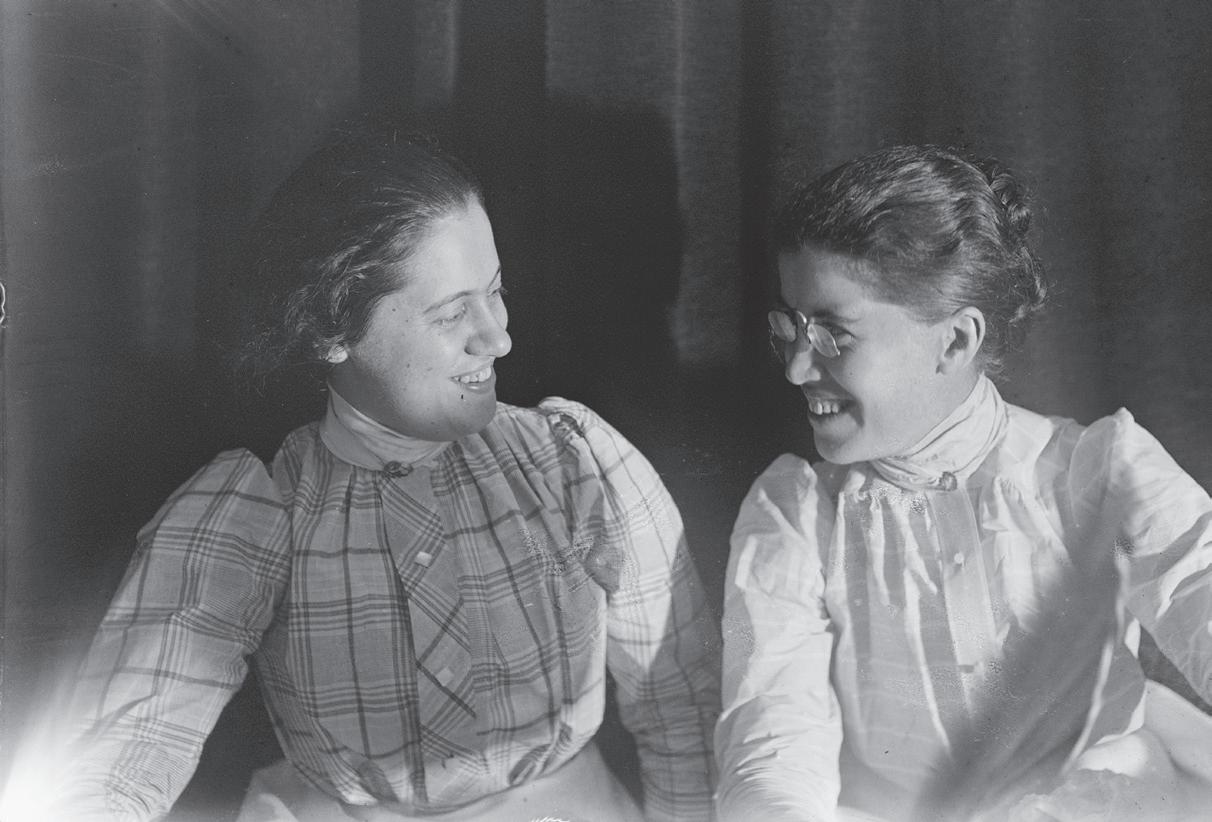
REBECCA GODWIN is Professor Emerita in English at Barton College in Wilson, NC, where she was Elizabeth H. Jordan Chair of Southern Literature. She currently serves as Vice-Chair of North Carolina Humanities and on the boards of the North Caroliniana Society and the Thomas Wolfe Society. She has also served as President of the North Carolina Literary and Historical Association and Chair of the North Carolina Writers Conference. She is the author of Community Across Time: Robert Morgan’s Words for Home (West Virginia University Press, 2023; reviewed in NCLR Online Spring 2024). Read her interviews with Robert Morgan in NCLR 2014 and NCLR Online 2017
TRACEY ENERSON WOOD, an international bestselling author of historical fiction based upon American women. Wood has also written and directed plays of various lengths. Katharine, the Wright Sister was selected by North Carolina Humanities to be featured at the 2025 Library of Congress National Book Festival in Washington, DC.
While history lauds Orville and Wilbur Wright for initiating human flight, the record neglects, unsurprisingly, the role that the brothers’ sister played in their success. Katharine, the Wright Sister clarifies that all three siblings dedicated themselves to figuring out how to keep a flying machine in the air. Telling the story through their alternating voices, Tracey Enerson Wood shows the love, cooperation, and complementary skills that fueled this consequential accomplishment. Using extensive research into flight details, geography, and historical facts, Wood allows the siblings to chronicle a rapidly changing America, the competition behind the creation of air travel, and women’s struggle to balance family obligations and private desires in a patriarchal world. Like all well-done historical fiction, Katharine, the Wright Sister depicts the personalities and interpersonal dynamics behind important public events. Its main achievement, though, is lifting a woman’s intelligence, can-do spirit, and work ethic to
their rightful place in the saga of aviation.
When Wilbur opens the book in Kitty Hawk in a 1900 prologue confirming that Katharine chose the site giving North Carolina First-in-Flight bragging rights, he establishes the book’s significance for this state’s as well as women’s history. While most of the story takes place in Dayton, OH, where the Wrights worked on airplane design while running a print shop and then building, repairing, and selling bicycles during the burgeoning bicycle craze, its chapters set in Kitty Hawk and Kill Devil Hills (at the time an unincorporated part of Kitty Hawk) confirm that dunes and coastal winds were absolutely essential for hoisting the Wright brothers off the ground. At the seashore, they learned to adapt wing warping and pitch for lift and control, enabling their progress toward powered flight. The Wrights praised the sand, wind, and local men and boys who helped them haul flyers, capture flight images with a newfangled camera, and survive during their four trips to the
ABOVE Katharine Wright (right) and her friend Harriet Silliman, circa 1900; from the Wright Brothers Negatives Collection, courtesy of the Library of Congress
Outer Banks. Descendants of John Daniels, Bill and Dan Tate, and others no doubt take great pride in their relatives’ part in the December 17, 1903, historymaking flight.
That Katharine was in Dayton teaching school, running the bicycle shop, and caring for their father when Wilbur and Orville made history in Kill Devil Hills signifies the supporting role that women played at the turn of the twentieth century no matter their professional abilities. Cared for by her father and brothers after her mother died of consumption, Katharine gladly did her part as loving family member, cook, nurse, housekeeper, and also financial supporter once she finished her Oberlin College degree and found a teaching job despite male candidates receiving hiring preference. Yet the book makes clear that Katharine played a pivotal role in aviation history. She pushed her brothers, fearing that a competitor might claim the victory of first achieving manned flight. In 1899, she agreed to Orville’s proposed pact: “We three will devote our time and energy from this day forward to each other and to our project, forsaking all others [except their father], no matter how long it takes” (43), a pact superseding the earlier deal that they support Katharine through four years of college if she then partially supported their flying endeavors for the next four.
Four years turned into decades. Katharine coached the brothers on how to write letters seeking information or support, not signing her “feminine name” (46) that would invite dismissal of requests. She figured
out what materials they needed and ordered them, often from Europe. She insisted that they control their flyer before trying to add an engine for power. She helped with their speeches. She made clay models of wings for them to study. She had the idea to order an engine block and then let their shop assistant, Charley, build the rest of an engine out of lightweight aluminum. It was her idea to separate the steering mechanisms for better control. Katharine’s understanding of scientific concepts led to Wilbur’s and Orville’s revised calculations and construction. Yet, when they belatedly invited her to Kill Devil Hills to witness aviation history, Katharine chose to stay in Dayton to give final exams, fearing she would lose her position if she missed crucial school days. “I knew the boys didn’t really want me out there,” she mused (150). “I was just the sister, the bit of encouragement when needed, maker of hot meals and substitute businessperson who kept all things running for them. It was enough. It had to be” (163). Although Wilbur and Orville considered their sister an equal in many ways, they also operated within their time period’s gender assumptions, for instance seeing their Outer Banks accommodations as too crude for a woman. Katharine, for her part, worked within her given place, keeping her mind busy and wielding her language and social skills for human progress, her love for her brothers and energy for life overcoming any resentments. Wood highlights Katharine’s work on national and international stages as Wilbur and Orville made their name. Katharine
found a patent lawyer, urged US military officials to invest in her brothers’ work, obtained an extension of their contract with the War Department while nursing Orville back to health after a crash, took Europeans’ orders for planes, and engaged with manufacturers of component parts, finally feeling “part of the team” (269) as she interpreted French and met Spanish, Italian, and British royalty when Europe’s enthusiastic embrace of the Wrights far exceeded America’s. Katharine continued nurturing her family as their fame grew at home, shielding Orville, especially, from social expectations that he found overwhelming. Insisting upon their building a new, grand home outside Dayton to better maintain some privacy, she gave up her teaching career and assisted with their New York offices and manufacturing and pilot-training facilities in several states. Katharine found her niche as a progressive woman, organizing women’s suffrage marches in Dayton, work that her father and brothers whole-heartedly supported. Despite a few romantic attractions, Katharine stayed committed to the family business until age fifty, when she accepted a marriage proposal. Orville, depending upon Katharine more than ever after Wilbur’s death from typhoid fever at age forty-five, rejected Katharine for even contemplating marriage, a stance highlighting Orville’s eccentric introversion and inability to read other people’s feelings. This heartbreaking rift shed new light on Katharine’s long service to the family dream.
Katharine, the Wright Sister reveals that this in many ways ordinary, close-knit family (that
included two other brothers) moved with tenacity, curiosity, and keen observation, including of birds’ flight, that paid off in a world-changing invention and fulfilled personal lives. It details the Wrights’ competition with figures such as Samuel Pierpont Langley and Glenn Curtiss, as well as their long fight to convince the Smithsonian Institution to give them credit for being first in powered flight. It shows us Orville’s enthusiastic embrace of automobiles as well as his conflicted reflections on the airplane’s role in World War I. It features new technologies such as indoor bathrooms and assembly line furniture manufacturing along with Jazz Age Charleston and Black Bottom dancing. Most importantly, it shows us Wood’s skillful uncovering of women’s history, a focus evident in her earlier books such as The President’s Wife (2023), about the remarkable Edith Wilson, or The War Nurse (2021), about the fifth superintendent of the Army Nurse Corps. Katharine, the Wright Sister is Katharine’s book, but by balancing this strong woman’s story with equal attention to the historical context and Wilbur’s and Orville’s points of view, Wood enhances Katharine’s place in the public sphere, her contributions to the advancement of human travel. Wilbur’s thought that his sister “always knew how to piece together all our ideas to make something whole” (302) succinctly summarizes Katharine’s skills, developed in keeping a household running but extending seamlessly to the world stage. Such acknowledgement confirms that women’s participation is simply the way that history unfolds. n
FROM PEAKS TO PIRATES: MYSTERIES OF NORTH CAROLINA
a review by Benjamin Bradley
Carol Ann Collins. The Seafarer’s Secret. Beaufort Books, 2024.
Archer Sullivan. The Witch’s Orchard. Minotaur Books, 2025.
The Tar Heel State stretches nearly five hundred miles, from the mist-covered peaks of the western mountains to the pristine beaches that line its eastern edge. Between these extremes, amid rolling farmland, bustling cities, and quiet backroads, mystery seems to linger in the air. It is often at the boundaries, where landscapes shift and contrasts sharpen, that the most vivid settings emerge and lend a mystery novel its depth and dimension.
Scattered among cities and small towns alike, stories from long ago still echo. Whether whispered folklore passed down through generations or tales rooted in local history, these stories hold power, and perhaps more than anything, they hold intrigue. In both The Witch’s Orchard and The Seafarer’s Secret, history reaches into the present, intertwining with contemporary crimes. Each novel’s Carolina-based protagonist must sift through old legends and hidden truths, parsing fact from fiction in the hope that the past might illuminate the dark corners of the present.
BENJAMIN BRADLEY is a member of both Mystery Writers of America and International Thriller Writers. His latest novel is What He Left Behind (CamCat Books, 2025). He pens the Shepard & Kelly Mystery series, published by Indies United Publishing House, and his short fiction has appeared in literary magazines such as Reckon Review and Flash Fiction Magazine. In addition to writing, Bradley works in public health and homelessness.
CAROL ANN COLLINS is a resident of Asheville, NC. Her writing blends together history and fiction, typically leaning towards historical romance. She is a New York Times bestselling author under a different, undisclosed pen name. The Seafarer’s Secret was a National Indie Excellence Awards finalist.
Gripping, atmospheric, and eerie, The Witch’s Orchard by Archer Sullivan brings to life a cast of wounded, complex characters and a slow burn, pro-
ARCHER SULLIVAN is a ninth generation Appalachian, though she has moved around a lot throughout her life, from Monticello, KY, to Manhattan, NY, and from Black Mountain, NC, to Beverly Hills, CA. Her work has appeared in Ellery Queen Mystery Magazine, Tough, Shotgun Honey, Reckon Review, and Rock and a Hard Place Magazine.
pulsive mystery that highlights how past trauma festers in communities that don’t, or can’t, talk about it. Some wounds never quite scar over and are made raw again with each disappearance, rumor, and half-remembered tale.
As the book opens, the reader meets Annie Gore, who joined the military right after high school to escape unspoken issues with her homelife in small-town Appalachia. Now, she’s getting by as a private investigator with some success, and reluctantly, her latest case draws Annie to an Appalachian holler not unlike the one where she grew up:
It’s a little run-down mountain town like a lot of other little run-down mountain towns where enterprise and lack of internet have drained away most of the population over eighteen and under forty. There’s a couple of boarded-up storefronts on Main Street but there’s also a pharmacy, a hair salon, and an apparently flourishing funeral parlor with a sign out front that says to ask inside about specials. (10)
Ten years ago, three little girls went missing from their tiny mountain town. While one girl returned days later, she is unable to speak to what she saw, and the other two were never seen again. After decades without answers, Max, the brother of one of the still-missing girls, wants to hire an outsider, and he wants Annie. While she may not be from his town, he recognizes that she understands mountain

towns, mountain people. Both Annie and Max seem aware of the odds stacked against finding anything meaningful after all these years, but Annie needs the cash, and Max needs to exhaust every avenue for answers. In the shadow of the Blue Ridge, Annie begins to track down the truth, poking a hornet’s nest of locals with a connection to the missing girls with each stop along the way and navigating a decade’s worth of
secrets, folklore of witches and crows, and a whole town that prefers to forget. But while the case may have been forgotten by some, echoes of the past linger. And Annie’s arrival stirs someone into action, transforming the case entirely.
As Annie draws closer to answers, she grapples with the suffocating politics and realities of small-town Appalachia, all the while fighting for the truth about the legend of the Witch of
ABOVE Western Appalachian Mountains in North Carolina; photography by James O. Reynolds (See more of his photography on his website).
Quartz Creek and how it relates to the missing girls. To explore the gripping plot any further would rob readers of myriad surprises, quirky three-dimensional characters, and an investigation that moves at a frenetic pace. Annie operates armed with empathy and skepticism, an outsider in a community that isn’t fully ready to let anybody new in, but each conversation and clue moves the case forward, a truly impressive balancing act by Sullivan landed gracefully.
All of the DNA of Sullivan’s ninth-generation Appalachian family is baked into the setting and scenery of the novel, which largely becomes a character unto itself. The well-known small-town tropes apply, but they’re layered with depth and humanity in a way that brings them to life. Residents of Appalachia will find relatable characters and stories, like the toy factory that closed and robbed the community of reliable income or the whispers of locals earning cash by cooking meth. This is an accurate, grounded version of mountain towns, one that embraces peculiarities and overcomes the shadow of past crimes. Sullivan’s slowpaced start quickly shifts into a propulsive page-turner where each chapter leaves you hungry for more answers, all of which winds into a stunning, satisfying conclusion.
Of particular note is Sullivan’s subtle illustration of how folklore can have multiple interpretations and meanings, and even
retellings. As Annie navigates through the town, it’s illuminating to hear each individual’s take on the legend of the Witch of Quartz Creek, one of the many ways Annie starts to understand the inner workings of the town and its people. Folklore bends over time with generational retellings and rememberings. Sullivan’s handling of this matter shines a light on small town life in a unique and refreshing way, showcasing the unique challenges of such an upbringing.
The Witch’s Orchard is perfect for fans of rural mysteries backlit with stunning natural landscapes, especially those drawn to Stacy Willingham’s A Flicker in the Dark (2022), Megan Miranda’s All the Missing Girls (2016), or Eryk Pruitt’s Something Bad Wrong (2023). Sullivan has crafted a debut that’s both haunting and heartfelt, a literary mystery that captures the soul of Appalachian life while delivering a genuinely compelling whodunit. A second Annie Gore mystery, Brimstone Hollow, is scheduled for publication in 2026, and readers will have ample reason to return to Sullivan’s dark and lyrical world.
Thrilling, entertaining, and twisty throughout, The Seafarer’s Secret by Carol Ann Collins is an intriguing Southern historical novel that blends mystery and romance against the sweeping backdrop of the Atlantic Ocean. Collins immerses readers in a world where the sea holds both opportunity and peril, where
secrets and lost treasures can reshape lives, and where mystery lurks around every corner.
This multi-point of view mystery novel first introduces William Templeton, the widowed police chief of Eden, NC, who is called to the scene of a local woman’s drowning. When the victim is found to have an old gold coin in her pocket, Templeton is shocked to discover that it’s identical to a coin found on the body of his estranged wife, Catherine. Initially ruled a tragic accident, Catherine’s case is reopened, forcing William to step down as chief and grapple with his own unresolved guilt.
As the investigation widens, we meet historian and Blackbeard expert, Eva Knightly, who is roped into helping identify the mysterious coins. As a close friend of Catherine’s, her connection to the case is personal, and Eva is stunned that Catherine never mentioned anything about these coins. When more coins surface at a local church, both Eva and William begin to suspect that there’s something sinister afoot. With the town abuzz with rumors of cursed treasure and the infamous pirate Blackbeard, it becomes increasingly difficult to separate myth from reality.
As Collins writes, “William had grown up in Eden listening to stories of ghost ships, wandering lost souls, and the assorted demon or two. As an adult, it wasn’t that he didn’t believe in such things, he just hadn’t made his mind up quite yet…Buried

treasure, on the other hand, was different” (69).
The characters, particularly Eva and William, are richly developed. William’s personal demons, including his unresolved grief over Catherine’s death, add a layer of emotional depth to his character. Eva, on the other hand, is both passionate about history and driven by her own curiosity and determination. She is a strong female lead hungry for answers about her old friend and determined to uncover the truth, no matter what it takes. As the two are drawn closer together, their chemistry grows naturally, though the simmering romance takes a backseat to the mounting tension and suspense. Chapters bring new discoveries that reveal both key pieces of the mystery and key pieces of the budding relationship
between Eva and William. Collins crafts a cinematic mystery, one that is not just about solving a crime but about uncovering the past. The historical journal entries of a mysterious woman detailing her time spent with Blackbeard and other notorious pirates give readers a peek into the world of pirate life and a world far removed from Eden’s quiet, contemporary streets. As the present-day mystery unfolds, the sins and secrets of the past are still very much alive, threatening to destroy the present. The idyllic setting of Eden, NC, becomes as integral to the story as any character. The rugged coastline, the ever-changing sea, and the town’s hidden past all contribute to an atmosphere of suspense and intrigue. Collins blends well-researched historical details with the fictional
storylines, allowing the Blackbeard legend to feel both real and haunting, while accessible to even those without a deep knowledge of nautical history.
With deliberate and expert pacing, Collins uses each chapter to build tension and draw readers deeper into the tangled web of past and present. The slow-burn romance between Eva and William feels organic, developing alongside the investigation and keeping readers invested in both the mystery and their personal journey. With a unique set of secondary characters rounding out the cast, Collins demonstrates a true knack for bringing three-dimensional characters to the page.
In the acknowledgements, Collins mentions the years of drafts and edits that went into bringing The Seafarer’s Secret to life. This labor of love is evident in the novel’s layered storytelling and the deep emotional development of its characters. The plot is intricately crafted, with clever twists and revelations that keep readers turning the pages, and the atmospheric setting is a character in itself, adding to the novel’s sense of timeless mystery.
If you’re a fan of seafaring tales, deep family secrets, historical adventures, or just a good old-fashioned mystery, The Seafarer’s Secret is definitely worth the read. Collins blends history, suspense, and romance into a gripping narrative that lingers long after the final page. n
ABOVE Cape Point on Hatteras Island, NC, Feb. 2007; photograph by Jerry D. Greer (See more of his photography on his website.)
LIFTING THE VEIL: THE INVISIBLE WORLD OF MENTAL HEALTH CARE
a review by Donna Summerlin
Hannah Thurman. Mercy Hill: A Novel. Doubleday, 2026.
DONNA SUMMERLIN is Chair of the Department of Language and Literature at Lee University in Cleveland, TN. She earned her PhD in English at the University of Tennessee Knoxville and an MA and an MEd at the University of Tennessee Chattanooga. Her dissertation focused on the woman as artist in the works of five Appalachian women writers. Read her essay on mental health care in Lee Smith’s novel Guests on Earth in NCLR 2013.
Originally from Raleigh, NC, though she currently resides in Brooklyn, NY, HANNAH THURMAN has received widespread recognition for her short fiction. Her stories have been published in such notable journals as Southern Indiana Review , Michigan Quarterly Review, and the Iowa Review. She has completed residencies at Yaddo, Ragdale, Vermont Studio Center, and Virginia Center for the Creative Arts and was awarded Florida Review’s 2023 Editor’s Prize for Fiction. In 2024 she was selected by the New York State Council for the Arts/New York Foundation for the Arts as an Artist Fellow in Fiction.
In the prologue to Mercy Hill by Hannah Thurman, the narrator speaks retrospectively: “I wonder if, given everything that happened, she’d choose to do it all again. The cottage, the isolation, the daily shadow running across our family until it darkened each one of us in turn. Was it worth it, for what we saved?” (3). Thurman offers a compelling glimpse into the struggle for adequate mental health care and the effects of this struggle on a family.
Modeled on North Carolina’s first mental health facility, Dorothea Dix Hospital, the fictional Mercy Hill is depicted as the state’s first and largest mental health facility, reaching its zenith between 1856 and 1970. Constructed on land that was then safely outside the city limits of Raleigh, NC, the hospital expanded, adding to its four central buildings a school of nursing and staff housing, surrounded by acres of land belonging to the institution. However, by the 1970s, the growing population of the city brought pressure on the institution to relinquish portions of the surrounding land and eventually to close one after another of the patient wards.
Set against the evolving landscape of mental healthcare conditions between the late 1980s and early 2020s, Hannah Thurman’s historical novel, Mercy Hill, explores the relentless struggle to provide care for mental patients and its devastating effects on a family closely connected to the institution. Mercy Hill’s Director of Psychiatry, Dr. Lisa Cross is driven to preserve this institution by her personal history of a mother who “saw shadows” (18) and
died when Cross was nine years old. Viewed through the lens of Cross’s youngest daughter, Denise, who is nine when she begins her narration, the novel portrays the gradual disintegration of family relationships as Cross and her daughters do battle with political and economic pressures to close the facility.
Following a brief prologue that offers some historical context, the opening chapter introduces the family: Dr. Cross; her husband; and her four daughters, J.J., Caro, Mimi, and Denise. Thurman immediately engages the reader with a dramatic scene that foreshadows later events. Driven by curiosity, the four sisters climb a tree to peer over a fence into Ward C, the building where the most severely disturbed patients are housed. The most adventurous and later the most rebellious sister, Mimi climbs too far, out onto a weak limb which breaks and sends her crashing to the ground inside the fence. The oldest sisters, J.J. and Caro, quickly descend the tree while Denise remains frozen in place, watching as one of the ward’s most dangerous patients closes in on the injured Mimi, immobile and trapped inside the fence. When the girls’ mother arrives on the scene, her authority is heralded in the description, “Lisa Cross, MD, stepped around the warring men, white coat blinding in the midday sun” (10). Scooping Mimi up in her arms, Dr. Cross orders the girls to go home, where their father attempts unsuccessfully to mediate between his wife and the girls. The manner in which Lisa Cross takes charge of the situation, marshalling the staff
and her family into action, demonstrates that she is the authority figure both for the institution and the family. Denise explains,
Our mother was not like the mothers of my classmates, or the ones I read about in books. She was brilliant and not modest about it, and although she could charm anyone she wanted to, rarely bothered. She was frequently brusque and snappish with us, even when we were very young. In return, we knew her word as bond—that she would meet us eye to eye with truth as if we were grownups ourselves. (2–3)
When Cross and the girls arrive at the onsite cabin that is their home, her husband goes into action, revealing his role as the nurturer for the family and the support for his wife.
Denise’s explanation is telling – “In the panic, all of us had stripped down to the most animal versions of ourselves” (11) –and truly this moment provides a glimpse into the psyche of each of the main characters. Lisa Cross, desperate to save Mercy Hilll, will use her daughters as pawns to achieve her political goals. The girls’ father, unable to curb his wife’s obsession, will ultimately relinquish power and withdraw. Although they idolize and support their mother, eventually each of the daughters will come to a realization of her own needs. J.J., wearing her father’s masculine clothing, will later identify as lesbian. Caro will find redemption in Nurse Jenny’s church. Mimi will continue to act out, eventually spending several
years in a juvenile detention home, while Denise will remain close to home long after the other sisters have escaped. Driven by the desire to please her mother and to hold the family together, Denise will face isolation and trauma as she seeks to fulfill her mother’s dreams.
The incident of Mimi’s injury leads to an investigation by the state’s Department of Health and Human Services, introducing the conflict that drives the family throughout the novel: the desperate struggle to save Mercy Hill, spanning the years between 1999 and 2024. In the course of this fight to save the institution, Thurman examines a family in crisis, ultimately revealing the motives behind Lisa Cross’s determination to preserve this once-thriving mental hospital and the impossible demands she brings to bear on her marriage and her family in this struggle.
Determined that her daughters will have opportunities that she missed, Cross enrolls the girls in a magnet school, advancing each of them ahead by two grades. For Denise, this means an immediate transition from elementary to middle school, where she is surrounded by students who label her “Psycho
Denise” (42) when they learn that she lives on the premises of Mercy Hill. Driven by the desire to find a friend, Denise becomes involved in a predatory relationship that threatens to destroy her hopes for the future.
All of the girls, but especially Denise, become active participants in their mother’s campaign to keep Mercy Hill open. They accompany her and speak at political meetings locally and nationally. As funding dwindles and staff drift away, the girls even volunteer to help the understaffed Ward B even though this is legally forbidden because of their age. They make friends with Nurse Jenny and with several of the patients and share their mother’s concern for the patients on a personal level, leading to a tragedy that drives each of the girls more deeply into herself and threatens to divide the family.
In Mercy Hill Hannah Thurman offers a powerful glimpse into political and economic realities of providing mental health care in the recent past alongside a compassionate and complex portrait of a contemporary family confronting psychological and social realities of their own while fighting to preserve a common dream. n
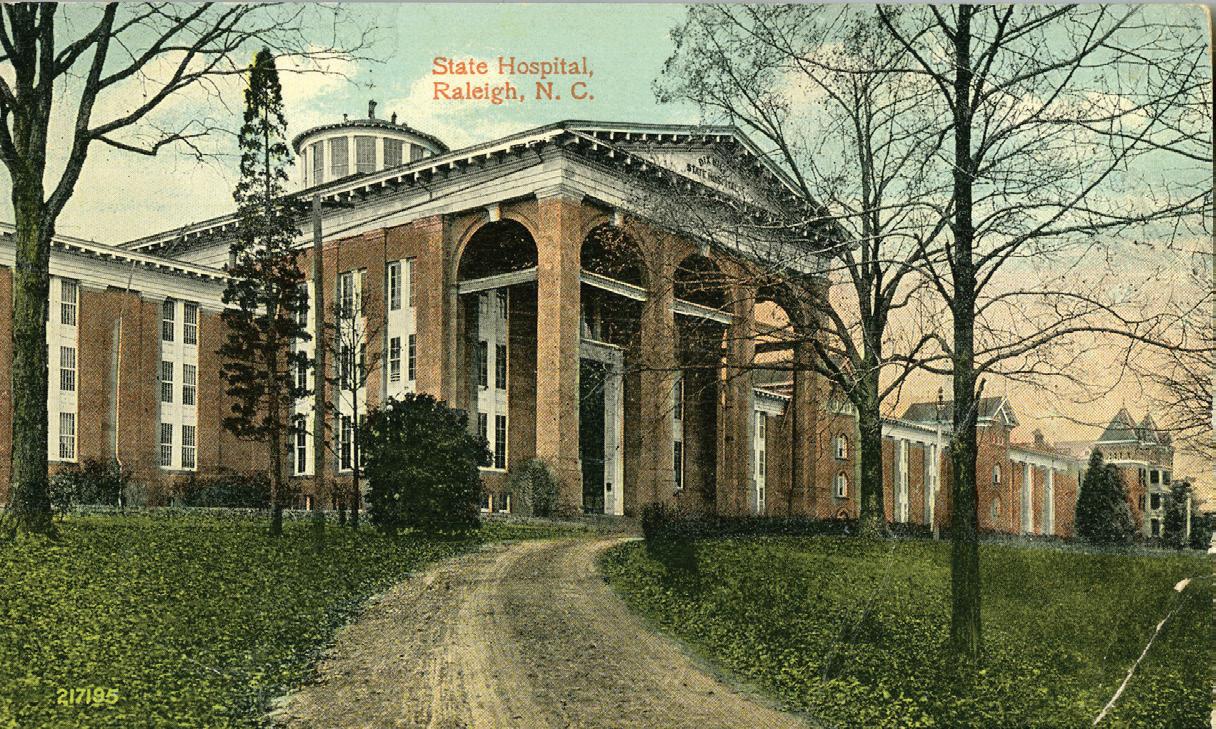
RIGHT Dorothea Dix Hospital main building, Raleigh, NC, circa 1910; from the Karl Larson Photograph Collection, State Archives of North Carolina
COMING OF AGE AND FINDING FAITH, A LIFELONG JOURNEY
a review by Jon Kesler
Austin Allran. The Legend of the Isle of Cats. Redhawk Publications, 2022.
Austin Allran’s debut mystery novel, The Legend of the Isle of Cats, explores self-doubt, friendship, family, and personal growth, with an overlay of clairvoyance. Through the first-person voice of Matthew Goodheart, the protagonist, Allran provides insight into Goodheart’s relationships with family and friends, as well as his innermost conflict, a decadeslong search for a relationship with God. The book weaves together all of these relationships and Goodheart’s first and subsequent journeys to the Isle of Cats, a small island off the North Carolina coast that is cloaked in the mysteries of betrayal, hidden treasure, traitorous activity, and genetic experimentation, culminating in murder.
and Jennie, which speaks to the trust shared among them. At some undisclosed point, Celia too becomes aware of the past relationship between her husband and Jennie. Eventually, well into adulthood and their respective successful marriages, Jennie and Goodheart come to terms with their past.
JON KESLER is a retired organization development consultant and Air Force officer, living in Greensboro, NC. He earned his bachelor’s degree in education at the University of Wisconsin-Superior and his master’s in human resource development at George Washington University. He is currently writing an arc of life novel about the expanded lives of two familiar pop culture figures, while researching a future effort loosely inspired by the letters his father wrote to his mother during World War II. He is active in the North Carolina Writers’ Network, has had short stories published in Teach Write and Sooner or Later, and regularly volunteers as a reviewer for NCLR
AUSTIN ALLRAN is a writer, attorney, a former senator in the North Carolina General Assembly, and a current commissioner in Catawba County. He earned degrees in English and history from Duke University and in creative writing and film from NC State University before attending law school at Southern Methodist University. Austin has authored numerous short stories, poems, and newspaper articles, and his honors include the Hugh T. Lefler Award.
Allran provides a brief introduction to each principal character as they appear and then seeds more elements of character as the tale evolves, keeping the story moving forward. Croom is Goodheart’s best friend and confidant. They grew up together in Hickory, NC, and their family ties go back two generations to an illicit card game at Duke University. After graduating from Duke, they maintain a strong tie. Jennie is another friend from their childhood in Hickory and college days at Duke. The final member of the foursome is Celia, whom they meet at Duke. Holding back from a mutual attraction between himself and Jennie that tracks back to childhood, Goodheart dates and eventually marries Celia, while Jennie dates and marries Croom after an offagain, on-again relationship. Being lifelong friends, Croom is well aware of and unfazed by the history between Goodheart
It is in their college years that the four make their first visit to the Isle of Cats in a quest for adventure off the beaten path. As Croom describes the trip, “I’m not talking about places where Yankees and tourists go – I’m talking about a desert isle” (19). On that first trip they violate the single rule that was laid down to them by their boatman: to not go near the one house on the island. Caught in the open during a severe thunderstorm, they seek shelter at the house where they are greeted not so warmly by the resident, Miss Smiley, who claims to be clairvoyant. Apprehensively, they allow her to read their palms. She tells of events that they assume will occur in the distant future. Before the evening is out, Goodheart, Croom, Jennie, and Celia witness the old lady’s death. Years later, they discover that Miss Smiley’s death was actually a murder, the surrounding circumstances of which she foretold in her palm readings. Although the storyline skips over portions of their lives, the author provides enough background for the reader to not feel as though there are holes in the growth of their relationships or Goodheart’s maturation from college student to state senator. Allran portrays Goodheart as a man of privilege who never lacks materially, but remains consis-
tently appreciative, even when he risks losing the tangibles in his life – the business he grew from scratch and the financial independence he has built up without drawing on his parents’ fortunes – as well as the intangibles of his family’s love and respect, his stature in the community, and his coveted career in North Carolina politics. Allran gives a similar sense of interiority to Goodheart’s inner circle.
Four additional characters are critical to the storyline: the aforementioned Miss Smiley, Roger Gaskill, Rudy Casper, and Cindy Peppercorn. Miss Smiley is the mysterious sole human resident of the Isle of Cats. Her history on the island dates back to her father’s questionable experiments on cats and traitorous activity in the World War II era. The experimental cats’ descendants are Miss Smiley’s companions on the island. Roger Gaskill, Miss Smiley’s cousin, is a North Carolina waterman out of the fictional Outer Banks town of Hoophole, the jumping off point for a ride to the Isle of Cats. Gaskill is the type who would be right at home hoisting a drink with Robert Shaw’s Quint from Jaws. Rudy Casper, a recent transplant to Hoophole, appears as a moderating figure who befriends and assists Goodheart in his quest to uncover the underlying mystery of the island. Cindy Peppercorn also traces to Goodheart’s youth. After years of estrangement, Cindy reappears with a significant contribution to the storyline. Goodheart’s struggle to find a meaningful relationship with God evolves over time. Early in his
college years he appears unwilling to do the work, as though God will come to him rather than him seeking God out: “I’ve been promising myself for months that I’d get up on a Sunday and go to church at the Chapel in search of God and the actual meaning of life. I’d like to know both. . . . When I was still living at home with my parents, I was a regular churchgoer” (7). His quest for God spans several momentous events in his life. Throughout much of the book, Goodheart’s thoughts about God are framed within his self-imposed confines of the foursome’s first visit to the Isle of Cats and his belief that their encounter with Miss Smiley foreshadowed every dark event that befell them: “Everything I touched had poisoned everyone around me and blighted my life. . . . I didn’t think any of us really believed there was a curse on us, but it seemed to me now that Miss Smiley’s foresight had somehow got it right. . . . Regardless of the why and wherefore, it seemed that God had abandoned me” (306).
Goodheart’s first visit to the Isle of Cats with his companions and their experience with Miss Smiley bear heavily on him throughout his life. He, wrongly
it turns out, associates most of the negative turns in his life as the fulfillment of Miss Smiley’s prophesies. Driven by his inner connection to the island and Miss Smiley, Goodheart returns to the island on a solo trip following a particularly climactic turn of events in his business – discovering that his trusted assistant has been embezzling from the company for years. Now, severely over leveraged, he is rapidly approaching financial ruin.
The solo visit opens Goodheart’s understanding of what actually happened the night of
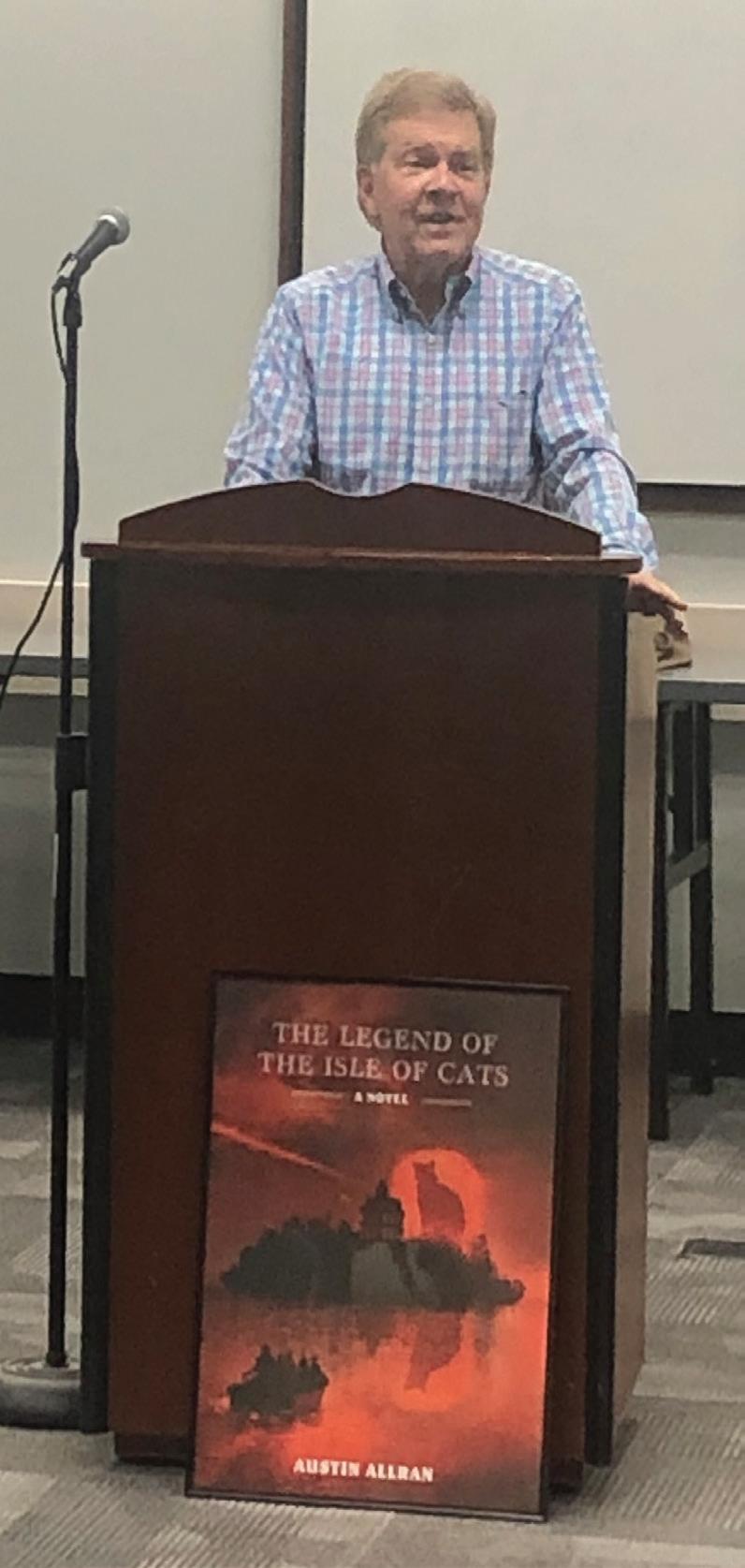
RIGHT Austin Allran at the Catawba County Library, Newton, NC, 23 Mar. 2023
Miss Smiley’s death, that she was murdered, who murdered her, and how closely his three companions came to being murdered that same evening. Most importantly, on his solo visit Goodheart learns the motive behind Miss Smiley’s murder, which is the genesis of the legend for which the book is named. Goodheart’s search for God culminates with a climactic misstep and a neardrowning from which he is rescued by an otherworldly force that engages in a probing conversation that takes Goodheart back to his guilt about the Isle of Cats and the death of his dog. This light tells Goodheart,
Everybody has something in his or her life for which they need to be forgiven. And something for which they need to forgive others. . . . Do not be afraid. You will have the insight to do the right thing. Walk with me, confident and humble, and you will be inspired to know what to say. After all, it’s not so much that you found me, but that I found you. I was always there for you – though you did not know it – carrying you when you couldn’t walk on your own. (401–402)
Allran’s deep connection with North Carolina comes through in the novel. As Allran describes scenes that take place along the coast, he captures the sights, scents, and culture of coastal villages, the raw beauty of the Outer Banks, and the lore of North Carolina’s barrier islands. One can easily visualize Goodheart’s experiences at Duke University, life within the Senate Chamber, and his hometown of Hickory. “I invited them to meet us for lunch at The Brewery in the Olde Town section of Hickory. Here, the sidewalks were brick and the building dated back to the years after the Civil War . . . the restaurant would be full of people I knew, but that was okay: I wanted to see friends and constituents” (412). And Allran describes fully the sensibilities and peculiarities of the characters Goodheart meets in passing. For example, Rudy Casper says of Hank Phillagraw, an insular, lifelong resident of Hoophole, “Trust me; he’s no mute. He’s just peculiar as hell. Never been married. Probably never been with a woman. He won’t talk to a
stranger without company present – someone he knows and is comfortable with” (356).
The Legend of the Isle of Cats lays out an interesting arc of life tale about the protagonist’s quest for a relationship with God and the strengthening of bonds among family and friends, all the while shrouded in a cloak of mystery. The book contains some interesting Easter eggs, for example the prologue’s description of a poker game at Duke that bears significant weight to the overall story, yet doesn’t come into play until late in the narrative. However, there are also some distractors in Allran’s writing with the use of extraneous descriptive language, the introduction of characters who serve no clear purpose in the story, and the tooquick acceptance (even conversion) of Croom and Jennie of the religious passion Goodheart has developed over his lifetime. Even given these distractors, The Legend of the Isle of Cats makes for a good casual read and would be perfectly at home on the bookshelf of any guest house in the Outer Banks. n
“A VOICE OUT HERE IN THE CHAOS”
a review by Barbara Bennett
Jason Mott. People Like Us: A Novel. Dutton, 2025.
BARBARA BENNETT is a Professor of English at NC State University. Her areas of specialty include Southern literature, women’s writing, and ecofeminism. She is the author of five books and numerous articles, interviews, and reviews. Read her essay on Jill McCorkle in NCLR 2006, her interview with McCorkle and Lee Smith in NCLR 2016, and her essay on the film adaptation of Daniel Wallace’s Big Fish in NCLR Online 2019. A regular reviewer for NCLR, she will serve as guest feature editor for the 2027 issues and invites submissions on Gothic North Carolina literature for these issues.
JASON MOTT earned his BFA and MFA from UNC Wilmington. He received the 2021 National Book Award and the Sir Walter Raleigh Award for his novel Hell of a Book (Dutton, 2021; reviewed in NCLR Online Winter 2022). His first novel, The Returned (MIRA, 2013), was a New York Times Bestseller and was adapted as a television series titled Resurrection . His other novels are The Crossing (Park Row Books, 2018) and The Wonder of All Things (MIRA, 2014), and he has two poetry collections with Main Street Rag, We Call This Thing Between Us Love (2009) and “. . . hide behind me. . .” (2011). Read an interview with Mott in the 2019 print issue of NCLR
If you read Jason Mott’s National Book Award-winning novel, Hell of a Book and wondered just what happens to those characters after the end, you’ll be happy to hear that he’s continued their escapades in his latest novel, People Like Us The unnamed narrator is back, Soot is back, The Kid is back (though now named Dylan), Kelly the funeral director is back – even Nic Cage gets a mention. There’s also a nice parallel scene to the first novel in which a naked Kelly runs through a hotel hallway and jumps into an elevator – with the narrator this time standing there – just ahead of the angry wife of a man she was found in bed with. One difference in the new novel is that our narrator has now won the National Book Award – and so has Soot – bringing more questions to those you had at the end of the last novel: Are they the same person? Is The Kid real? Is Soot dead or alive? Is the narrator Jason Mott? Don’t worry about being confused –because it will only get worse before it gets better, and it wouldn’t be wise to worry yet.
The narrator has left guninfested America for a European book tour. Europe, he is told by his agent, is full of smart, bookreading people who “know how to treat people like you.” She continues, “It’s not like it is over here. . . . Over there, you can be who you are” (32). All of this is carefully coded references to race, a word Mott steers clear of throughout the book. But he uses the term “people like us” numerous times. (I stopped counting at twenty.) America has guns, but Europe only has knives. That’s a big difference
for “people like us,” who believe their lives are always at risk.
Interspersed with the narrator’s chapters are those that tell the story of Soot, who is on a speaking trip to a Minnesota college in the middle of winter, immediately after a school shooting that took the lives of several students on campus.
The National Book Awardwinning book he is discussing is about gun violence, and most of the people in the school think the timing of his speech is offensive. But the trip was planned long ago, he’s there, and so he’s facing a barrage of criticism. In Hell of a Book, Soot believes he could become invisible as a way to keep bullies from making fun of his dark skin. In this novel, he has developed the ability to time travel, and he jumps around to various moments in his life – before his divorce and before the death of his daughter, mainly. He seems, in the words of Kurt Vonnegut, “unstuck in time.”
One puzzling thing (of many) is that both of the characters in this book – although having experienced gun violence in their own lives – come to the same conclusion: “Maybe I should get a gun” (36). The narrator admits he’s “never owned a gun” but believes deep down that “there’s something magic in a gun” (43–44). He throws around words like “confidence” and “safety,” but what he really means is “power.” Power over other human beings. Deadly power. Soot also carries a gun. Unlike the narrator, Soot says he’s “owned a gun in some shape or form as far back as he could remember.” He also uses the word “safety” when
he describes the feeling it gives him. Most significantly, he states, “It was simply what people like him did” (72). People like him – again. People who don’t feel safe in the world because of the color of their skin. For a while, Soot feels safer because he has become a famous author. He’d say, “Hell, but I’ve got a National Book Award. I’ll be okay” (73). He used to carry his book instead of a gun, leaving it on the passenger seat in his car or in the “little pocket in the bottom of the driver’s side door” with his name on the spine in big, bold letters (70). If red and blue lights forced him to pull over, he waited, hands on the steering wheel, for the flashlight to find the book and match the name to his driver’s license. More than once, he saw a policeman go back to his car, Google his name, and come back up and be “just a little friendlier than they had been before,” letting him go on his way (72). But in the end, the book didn’t feel like enough,
so he started carrying a gun. Everywhere he went. Just like the narrator on the book tour in Europe, who somehow managed to smuggle his gun across the Atlantic Ocean. Both of Mott’s novels seem aimed to ask their readers a question. Dylan/The Kid has a meltdown after meeting two of his heroes in the music industry who have abandoned America for Europe and hearing them
reject everyone in the USA with “Fuck . . .” listing various Southern states, Democrats, Republicans, conservatives, liberals, the Supreme Court, and “the red, the white, and the goddamned blue,” and “fuck anybody that wants me to stay in a place that does nothing but suffocate me” (184). When the narrator tries to console him, Dylan’s question is basically, “Where can I call home?” He explains, “I’m tired of being outnumbered. I’m tired of not fitting in even when I do everything I can to fit in. I’m tired of standing out. I’m tired of having to be small so that I don’t make waves and I’m tired of having to scream at the top of my lungs just to keep the world from swallowing me up” (192).
Like Hell of a Book, this novel makes you laugh, scream in rage, shake your head in disbelief, and even cry. By the end, you’ll figure out most of the puzzles, but you’ll be left with the problems. Mott explores the dream many “people like
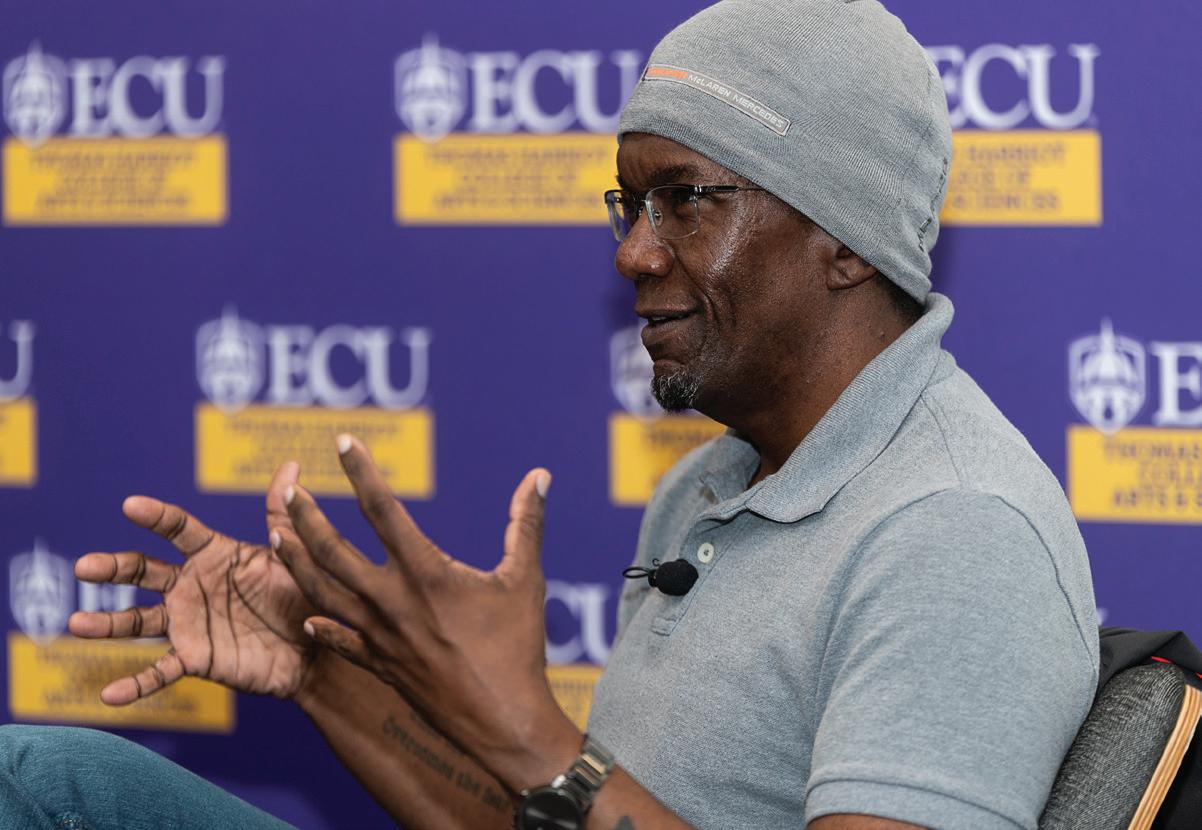
ABOVE Jason Mott at the Voyages of Discovery lecture series, East Carolina University, Greenville, NC, 3 Mar. 2023; photograph by Rob Taylor Photography & Design
us” may have of escaping from a broken America and moving to Europe instead. It’s easier to leave an America that currently suffers from “cops,” “abortion bans,” “book bans,” “Columbine,” “Selma, Alabama,” “the tragedies of Trayvon Martin and George Floyd,” “student loans,” “medical debt,” and “presidents who ‘Grab ‘em by the pussy’” than stay and try to change it –or at least endure it (265–66). He knows “’You can’t fix everyone. And you damned sure can’t fix the world’” (267).
explains that his writing is “just a voice out here in the chaos” (193) and that “all I’m ever doing – every second of every day – trying to find the words to fix people” (195). This comment is reminiscent of William Faulkner’s Nobel Prize speech in 1950, when he counseled writers and artists of all kinds that they must teach themselves “that the basest of all things is to be afraid; and, teaching himself that, forget it forever, leaving no room in his workshop for anything but the old verities and

The narrator admits that this is the sorry state of being Black in America – in the world, actually. When Dylan sobs, “I wonder what it feels like to be somewhere in the world and not feel like an outsider” (194), the narrator can only soothe him with his own means of survival: “I don’t know for sure if I’ve ever felt at home in this world. Maybe that’s why I live in my head so much” (194). He also
truths of the heart, the old universal truths lacking which any story is ephemeral and doomed – love and honor and pity and pride and compassion and sacrifice.” Jason Mott knows that the world is broken in so many ways, but his job is to tell stories that help heal it. His benefactor in France who bankrolls his European tour tells the narrator that “it is those who are broken in the way that you are broken
who keep the stories” (80). What he does as a writer is important and necessary. He knows that. He tells the reader early on that “sometimes imagination is the only weapon and the only salvation we have in the world” (35). Besides the repetition of the phrase “people like us,” Mott also repeats varieties of the phrase “’It all comes out okay’” (4, 14, 57, 110, 149). Of course it doesn’t turn out completely okay. There are guns. There are “people like us” who are afraid and so they keep those guns handy. There are murderers who also have those guns. There are suicides: the narrator’s uncle shot himself leaving his nephew to wonder if his uncle “never saw a student try to explain, through a poem, how afraid they are of living under the gun. Maybe he never found his art. Maybe he never found the words. Maybe he told all his stories to no one” (268). And our narrator – who finally reveals his real name near the end – knows that his writing “won’t fix things, this story of mine. No story ever has. But, sometimes, the right fistful of words can be a help to people like us” (270). Unfortunately, guns are here to stay in America for the foreseeable future. Racism is here, and violence is here as well. We can work to fix that, but mostly, Jason Mott is telling us, in the meantime, we have to hold onto our imaginations. We have to tell stories, as Faulkner advises, of “love and honor and pity and pride and compassion and sacrifice.” This is what will sustain us. n
BETWEEN LEGACY AND LIBERATION
by Abby Trzepacz
Tracy Deonn. Oathbound. Simon & Schuster, 2025.
Tracy Deonn’s Oathbound, the third installment of the Legendborn Cycle, is a masterfully crafted YA contemporary fantasy that pushes its characters, mythology, and emotional stakes to a new level within the series. The Legendborn Cycle has never been simply a magical adventure; from the very start, Deonn has woven together fantasy, Arthurian legend, Southern history, trauma, memory, and identity into a complex tapestry. This tapestry speaks directly to the realities of being a young Black woman in spaces shaped by whiteness, tradition, and inherited power. Oathbound pushes these ideas even further, through its rich characterization and worldbuilding.
yet he is not invulnerable” (229).
At the same time, Bree’s disappearance signals catastrophe for the world she has left behind: “The Crown Scion has been taken hostage by a demon of unknown origin. A demon who can disappear into thin air. She could be dead. The war could already be lost” (66).
ABBY TRZEPACZ is an English major at East Carolina University, graduating in 2026 with a double minor in Professional Writing and Information Design and Communication Studies. She is a Senior Intern on the NCLR staff. This is her fourth review in NCLR Online since she’s been on staff.
TRACY DEONN is the #1 New York Times bestselling and Coretta Scott King-John Steptoe award-winning author of the Legendborn cycle, which includes the internationally bestselling titles, Legendborn (Margaret K. McElderry Books/ Simon & Schuster, 2020; reviewed in NCLR Online Winter 2022 ), and Bloodmarked (Simon & Schuster Books for Young Readers, 2024; reviewed in NCLR Online Fall 2025). A fourth novel is to follow. Deonn grew up in central North Carolina. She earned bachelor’s and master’s degrees in Communication and Performance Studies from UNC Chapel Hill and has worked in theater and video game production, as well as teaching at both the K-12 and university level.
Oathbound begins in the aftermath of the chaos unleashed in Bloodmarked, with Bree, protagonist of The Legendborn Cycle, separated from the Order and newly aware of the explosive power running through her. Bree, the awakened Scion of Arthur and a Rootcrafter, finds herself separated from the Order and newly aware of the explosive power running through her. Her connection to an ancient king and to her Rootcraft lineage creates a dual inheritance that can be seen as both a blessing and a burden. The novel quickly establishes the scale of threat surrounding Bree, particularly through the presence of the Shadow King, who “seems to have no equal. He is his own kind of greater demon, maybe the oldest, and possesses abilities I didn’t think possible. And
The novel’s opening chapters immediately emphasize this tension: Bree is powerful, but her power isolates her. The Order views her as a disruption, the Regents fear her potential, and even her allies struggle to understand the weight she carries. Deonn uses Bree’s internal and external conflicts to highlight the cost of being chosen, especially for a young woman who never asked to be. The plot’s forward momentum is driven not only by external threats but by Bree’s need to define her own identity within clashing inheritances.
Bree’s growth and maturity had developed immensely since the beginning of the series, but in this installment she grapples with her identity in a far more intricate way. She is no longer trying to figure out who she is, but rather how to be who she is in a world that is constantly trying to reshape her. Deonn does not rush her growth; she lets Bree stumble, question, and rebuild. This pacing reflects the real process of healing and selfdefinition. Bree’s determination is captured when she declares, “‘I will fulfill Vera’s wish. I will honor her sacrifice. But if neither she nor my other ancestors
can teach me how, then I must become something they never could.’ I gasp twice, then swipe my tongue over my chapped lips. Hoarse words burst from my chest before I can second-guess them. ‘I must become untouchable” (46). Her resolve is further reinforced when she states, “Once I am strong enough, once I am powerful enough, and once I have total control, it won’t matter what I face next. It won’t matter whether my opponent is human or demon, cambion or spirit, Morgaine or Regent . . . because no matter who they are, I will never let them hurt me again” (22).
While the novel’s stakes are epic, Deonn grounds the story in intimate moments that deepen the worldbuilding. Quiet scenes set in Asheville, NC, emphasize a sense of place and realism: “February is cold in Asheville, but at least it’s not currently freezing. There’s no snow on the ground, and the wind is calm” (184). Small domestic details ground the fantasy in lived human experience; for example, “And from what I’ve gleaned from grocery expeditions over the past three months, the twins have no appreciation for Southern breakfast foods. They don’t glance twice at grits, never ask about hash browns, and don’t crave biscuits. That last one is a shame, really” (185). These moments remind readers that the world in Oathbound is vast, layered, and deeply rooted in history.
An outstanding quality in Oathbound is its handling of grief and anger. Deonn never

treats these moments as obstacles to be “overcome” for the sake of neatness. Instead, they are forces that shape characters’ decisions, identities, and personal histories. Grief becomes a teacher, a motivator, and sometimes a barrier. Anger becomes a signal, a source of strength, and a reminder of injustice. The novel acknowledges the lasting pain of loss while refusing to diminish its impact, as reflected in the line, “‘Loving other people and losing them hurts. And loving them
when they’re gone? Opens up the wound again. Now, I’m no expert, but I think the only way to live with grief is to seek its antidote’” (593). These emotional moments add warmth to the narrative.
Much like the previous Legendborn installments, racism remains an essential lens through which Bree experiences the Order and the world around her. Even though she is becoming one of the most powerful figures in the Arthurian system, she remains the target of suspicion
ABOVE Appalachian mountain photography by James O. Reynolds (See more of his photography on his website.)
and hostility, which reveals how deeply racism is embedded in the Order’s structure. In a moment of passion, Nick, the Scion of Lancelot, says, “In the months since the revelation of Briana’s true lineages – being born of not one Line of power but two – she was lied to and deceived, drugged, imprisoned, tortured, and possessed by the malevolent spirit we Scions were raised to worship. And every act against her was not committed by demonkind enemies, but by the very Order that should be kneeling at her feet” (127). Nick’s declarations expose the hypocrisy of a system that claims to value lineage and loyalty yet refuses to acknowledge Bree’s legitimacy because it challenges their historic whiteness, control, and assumptions. Racism in this novel is not depicted as an isolated event; it is systematic and ongoing. Oathbound also expands its exploration of marginalization beyond racism. Zoe’s experience with gender expectations mirrors Bree’s experience with racial stereotypes: “I’m not there to see people treat Zoe any dif-
ferently than they might treat me, but I don’t have to see it to believe her. To believe that when she’s just being herself, people try to punish her into their too-small boxes of gender” (202). These moments suggest that oppression is multifaceted. The characters who face it must navigate both magical danger and the social worlds.
The character development within this novel shines. Bree’s relationships – with Nick, her ancestors, and allies – create a web of tension and loyalty that drives the narrative. Selwyn Kane, the moody Kingsmage and Merlin, especially, is a standout figure in Oathbound, with a more detailed backstory, vulnerability, and nuance. Selwyn’s complexity adds tremendous emotional weight to the narrative, and his dynamic with Bree grows increasingly layered. Bree’s ongoing situation with Nick poses as yet another challenge, which her friends start to notice: “[Y]our love life remains unmatchedly messy. First it’s the Golden Boy, then it’s Grumpy Wizard, and now it’s back to the Golden Boy, but instead of
a normal, happy reunion, you’re accidentally brawling in the basement? Girl” (432), Zoe fusses. Deonn is skilled at crafting characters who never feel like background figures; each person is shaped by their own history, responsibilities, and emotional journeys. Even characters who appear briefly feel like full people rather than plot tools.
Oathbound stands as a significant achievement in contemporary fantasy. By blending mythology and real-world issues, Deonn crafts a narrative that’s both epic and intimate. The novel’s continued exploration of racism, ancestry, and institutional resistance gives depth to its magical conflict while its character development keeps the story emotionally grounded. Deonn’s commitment to portraying the complexity of Black girlhood – its burdens and its brilliance – makes the novel resonate far beyond its fantasy framework. As a continuation, Oathbound expands the series’ scope without sacrificing its heart. The result is a novel that is rich, challenging, and ultimately unforgettable. n
Click the logo to find our Bookshop affiliate listing of books reviewed in this issue.

JOURNEY THROUGH FORGETFUL SKIES AND CRASH LANDINGS IN NEAR-FUTURE YOUNG ADULT LITERATURE
a review by Alyssa Froemel
Beth Revis. Full Speed to a Crash Landing. DAW Books, 2024.
Lauren Yero. Under This Forgetful Sky. Atheneum, 2023.
Young Adult literature serves as an opportunity for adolescents to critically examine societal issues. Often, the genre focuses on themes of power, resistance, and social change in which a young character navigates, usually disrupting the status quo. That is no different in Beth Revis’s Full Speed to a Crash Landing and Lauren Yero’s Under This Forgetful Sky. These two novels transport readers to distant, future worlds that explore crumbling societies, star-crossed lovers, and highstakes conflict while maintaining distinct characteristics that show the depth of both authors’ writing as well as the variety of the genre.
ALYSSA FROEMEL, a Navy veteran, was a graduate student intern with NCLR during her master’s degree program at ECU. During her time in the military, Alyssa pursued her bachelor’s degree in English and a master’s in multicultural and transnational literatures at ECU. Her master’s thesis explored the role of Indigenous YA literature in decolonization, while also analyzing her subjects’ relationship to canonical YA literature. Read an interview she conducted with Tracy Crow in the 2026 print issue of NCLR
Full Speed to a Crash Landing by Beth Revis is a fast-paced science fiction novella that follows the protagonist, Ada Lamarr, through a space heist mystery. The story opens when the reader learns that Ada’s ship has been breached, and she is running out of oxygen. After sending out a distress signal, she is rescued by a government salvage crew on a classified mission. Throughout the story, she grows closer to one of the government agents, Rian. The government crew is highly suspicious of Ada, but she is able to chip away at that suspicion and eventually joins the crew on an expedition to a lava-filled planet that holds a valuable item that both Ada and the government are after.
Under This Forgetful Sky is a dystopian novel that is heavily inspired by Lauren Yero’s Cuban American background and time spent in Chile. The book follows a dual first-person point-ofview of the two protagonists,
Rumi and Paz. Rumi is from a privileged background, growing up in the highly protected and technological Upper City. The story kicks off with Rumi’s father traveling to the lower cities, known to be poorer and more dangerous, and being cornered by a rebel group and infected with a deadly disease. Rumi sets off on an unsanctioned mission to find the cure. In the lower city of Paraíso, he meets Paz, who grew up in the lower cities and has known only struggle. Due to her deformed arm, caused by radiation exposure, she is forced to work for the Library. As they both learn of each other’s backgrounds, they realize how those with power have only expanded the division between citizens of the Upper and Lower Cities.
These books are united by their similar portrayal of the future: dystopian worlds caused by environmental catastrophe that led to the disenfranchisement of several communities. In Revis’s novel, Ada is actually one of the few characters born on Earth. Since discovering space travel, humans have begun to immigrate to various planets, but several billion still remain on Earth, which Ada describes as “little bubbles of tourist locations that hide the last dying gasps of a world that’s been polluted to death” (62). As we get to know Ada and the other characters, it is clear that humans did not learn from their actions on Earth, and they carry their issues and consequences into space and to other human populated planets. In contrast, Yero describes the Upper Cities through the eyes of Rumi, stating, “each house in my neighborhood looked like
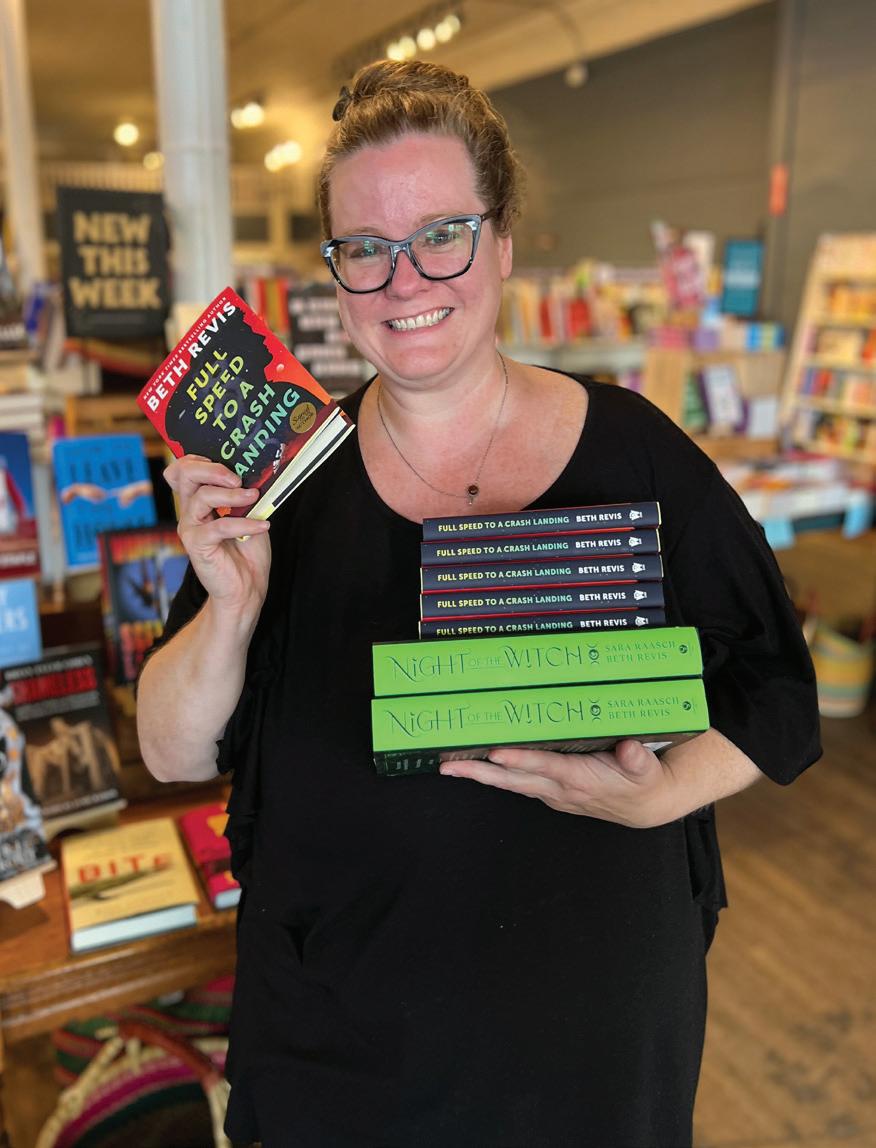
a painting. Windows glowed warmly. Walkways bloomed. Stately trees arched their limbs over perfect, peaceful gardens” (13). In Upper City, the citizens wear specs, which are digital glasses that alter the way they see the world. Without the specs, Rumi states that Upper City “streets had lost their brightness. The trees were gone. The adverts and street lamps and brightly lit storefronts – all gone” (44). Paraíso, in contrast, is filled with poverty, disease, crime, and hunger. The area outside of Paraíso is referred to as the Waste, where the land is ravaged with pollution and occupied by dangerous rebel groups.
Revis and Yero paint pictures of what a distant future could
look like if we continue to live the way we do on Earth. Revis imagines space travel as a pathway to the future, and the reader recognizes a realm of science fiction. Yero’s depiction, however, seems closer to reality. Large metropolitan areas already struggle with division, poverty, hunger, while certain areas of the world also grapple with large amounts of pollution. Tech companies are advancing, with things like Meta glasses and Apple Vision Pro that resemble the specs in Yero’s novel. While both stories force the reader to consider the consequences of pollution and environmental disaster, only Yero addresses what life is like for those living in those areas. Through Rumi’s character, the reader experiences the shock of recognizing how the other side of society is living while Rumi begins to deconstruct what he is taught and what the government controls.
Throughout these novels, the reader experiences fun, flirty banter between Ada and Rian, and a growing friendship and romance between Rumi and
Paz. Both couples are examples of star-crossed lovers whose relationships defy the societal norms of their respective worlds. Aboard the Halifax, the government salvage ship, Ada gains the trust of the crew members and embarks on their salvage mission with them. While Ada helps the crew, her true motives and background remain hidden as every action spirals them towards the said crash landing. Throughout the novel, the readers are left to question whether or not Ada is a reliable narrator who is pursuing a path she believes in or if her actions are in her own self-interest or preservation. As the story closes, many questions are left unanswered, making space for the two unreleased books left in the series. Will they uncover who Ada really is and how she got the crew to trust her? Similarly, Paz has ulterior motives for getting closer with Rumi. Rumi and Paz both become entangled with the rebel group Las Oscuras, whose influence shapes the nature of their relationship from the start. As part of their entanglement, they are tasked with traveling through the Wastes to find a cure for Rumi’s father. The Library assigned Paz to accompany him, and throughout their travels they are attacked, robbed, and threatened. Rumi is a target, being from Upper City, and these dangers intensify as the story progresses. Throughout these trials, they start to grow closer, with Paz growing guiltier every day. When they
ABOVE Beth Revis at Highland Books in Brevard, NC, 14 Aug. 2024
BETH REVIS is a New York Times bestselling author, who has published more than a dozen novels, including The Princess and the Scoundrel (Random House Worlds, 2022) and Give the Dark My Love (Razorbill, 2018). She is a co-owner of Wordsmith Workshops, where she teaches about writing and publishing.
reach the conclusion of this journey, they are forced to confront where their loyalties lie and whether or not their beliefs have been shaped by forces that are not entirely truthful. Since Paz has been left in the dark about Las Oscuras’ true motives, and Rumi is unaware of the scope of atrocities Upper City commits, the relationship between Rumi and Paz was doomed from the beginning as forces outside of them worked against their interests. Their own internal conflicts also got in the way of establishing a solid relationship. Rumi tries to rationalize the things he sees and experiences in the Lower Cities, exposing his privileged life to Paz and other people they encounter, which only fuels their skepticism about him. Where Rumi is open and trusting, Paz is guarded and paranoid.
Both novels reveal how societal expectations can often get in the way of relationships. Where these novels most notably differ is in the voice and cadence of the stories. In Full Speed to a Crash Landing, the novel is told in an upbeat, quick, and friendly voice, making it a fun, short, science fiction read. The reader is kept engaged through witty banter and characters with hidden agendas all working toward a similar goal. Under This Forgetful Sky carries heavier themes, with Rumi’s voice being confused, determined, and curious, and Paz being angry, paranoid, and guilty. Overall, the stakes are higher in
Yero’s novel as her characters navigate death, responsibility, and the implication of power dynamics. The enemy is made clear in Under This Forgetful Sky – essentially every institution has had a hand in the disenfranchisement of those in the Lower Cities, and even Las Oscuras sees its members as expendable and tools to their larger goals. In Full Speed to a Crash Landing, even by the end, the reader is left questioning who the enemy is and if they even appeared in the first book of the series.
Young Adult literature is often, at its core, about the protagonist’s journey and rebellion against authority. In Full Speed to a Crash Landing, Ada’s journey is displayed through the unraveling of her hidden
agenda and working against the government. Being the first of three books, her journey is not yet complete so you might be left with more questions after you finish reading. Under This Forgetful Sky, however, explores the convergent journeys of Rumi and Paz, who begin on the opposite sides of social, economic, and political upbringing. Their journey is an unraveling of the belief systems put in place by authoritative figures, where they discover their own independence. These two novels are representations of the creative scope of the genre and showcase how imagined futurities can invite the reader to critically engage with text that has historical and scientific underpinnings. n
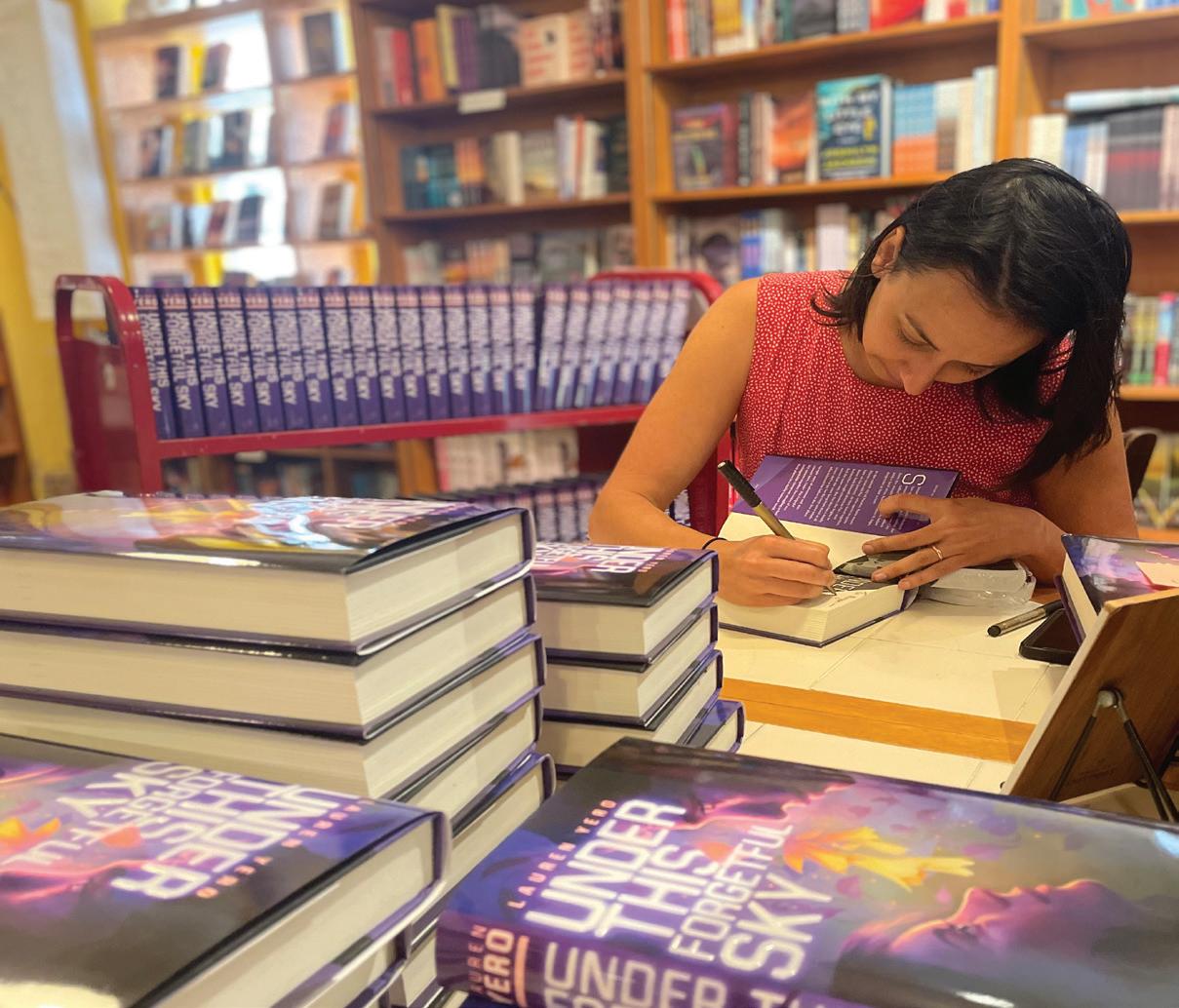
ABOVE Lauren Yero preparing for her book launch at Malaprop’s Bookstore in Asheville, NC, 2023
LAUREN YERO’s debut novel, Under This Forgetful Sky, was a Poets & Writers Get the Word Out pick and named as one of the best books of the year by Kirkus Reviews and Book Riot. She is a Cuban American currently living in the mountains of North Carolina, where she teaches at a small farm-and-arts school.
STORIES OF SELFACCEPTANCE
a review by Mark I. West
Vanessa Brantley-Newton. Becoming Venessa. Knopf Books for Young Readers, 2021.
Maya Myers. Illustrated by Heyewon Yum. Not Perfect. Neal Porter Books, 2024.
MARK I. WEST is a Professor of English at UNC Charlotte, where he teaches courses on children’s and young adult literature. He has written or edited twenty-five books, including Liminal Spaces in Children’s and Young Adult Literature: Stories from the In Between (Lexington Books, 2024). His articles have appeared in various national publications, such as the New York Times Book Review, Publishers Weekly, Americana, and British Heritage, as well as many academic journals. Read his interview with Martin Gardner in NCLR 2001.
Charlotte picture book authors Maya Myers and Vanessa Brantley-Newton know that many young children worry about being accepted when they make the transition from home to school. Children worry about making new friends, and they wonder what they need to do to be liked by their peers. Such concerns can cause some children to strive for perfection or try to seem extra special so that they will be noticed and become popular. Myers and Brantley-Newton write about two such children in their new picture books. The young girls in Myers’s Not Perfect and Brantley-Newton’s Becoming Vanessa initially worry about not being good enough to be liked by their peers, but they eventually learn that self-acceptance is the key to being accepted by their classmates.
Dot, the central character in Maya Myers’s Not Perfect, constantly compares herself to the other members of her family. She feels inadequate because they are all “perfect” at something. As Dot sees it, her sister is perfect at art because
she won a blue ribbon for a selfportrait, her twin brothers are perfect at spelling because they tied for first place in a spelling bee, her mother is perfect because she has a black belt in tae kwon do, and her father is perfect because he is the lead singer in a band. In an effort to keep up, she sets out “to be perfect at something.” She tries to be perfect in all sorts of activities, but she never feels satisfied with the results.
Toward the end of the book, her teacher gives her a poster project to be completed at home. She is supposed to make a poster about a person whom she admires, and she decides to make a poster about her friend Sam. No matter how many times she tries, however, her picture of her friend does seem perfect to her. The illustrations in the book by Hyewon Yum depict
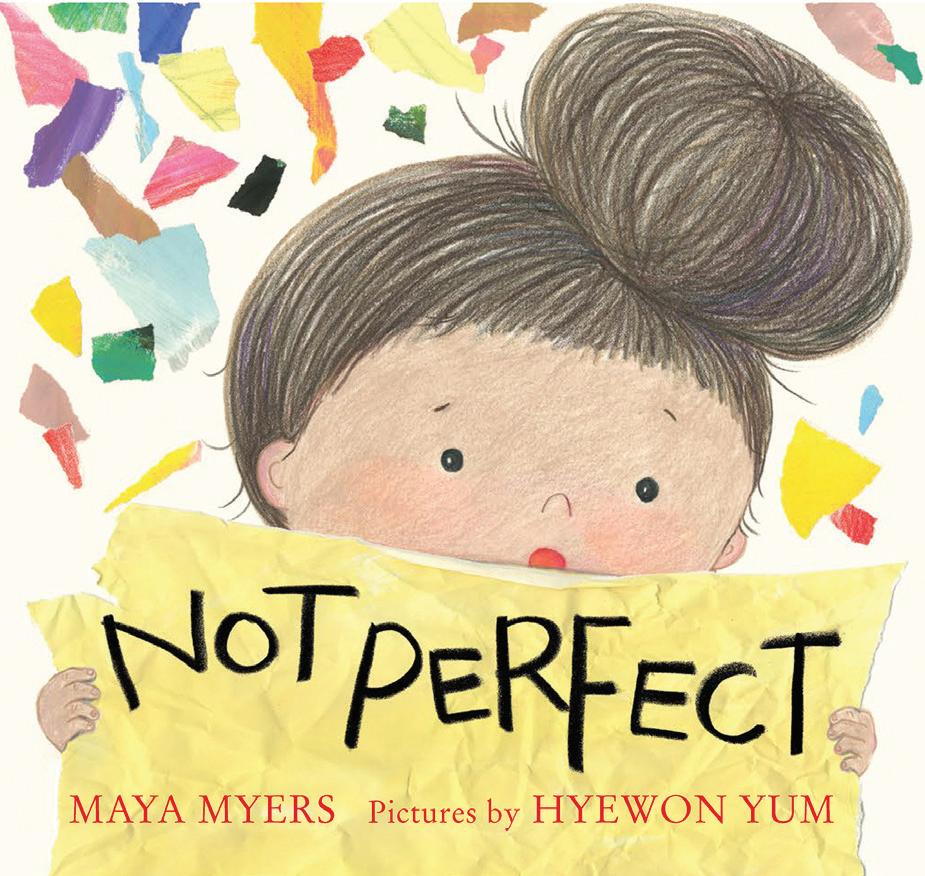
MAYA MYERS currently lives in Charlotte, NC. She grew up in Maine, but she moved to North Carolina when she enrolled at Duke University as an English major. She has lived in North Carolina ever since. Before becoming a picture book author, she worked as an elementary school teacher. Her debut picture book, Not Little (Neal Porter Books, 2021) was named an ALSC Notable Children’s Book in 2022.
ABOVE Cover illustrated by Hyewon Yum; courtesy of Neal Porter Books/ Holiday House
Dot’s growing frustration with her numerous attempts to make a perfect poster. Over a series of images, Dot’s face goes from having a hopeful look, to seeming a bit perturbed, to radiating a sense of self-directed rage. Dot ends up ripping her pictures and stomping out the door, but after her temper tantrum, she picks up the ripped-up pieces of paper and starts over.
The next day Dot and her classmates are expected to show their posters to the rest of the class. Her friend Sam goes first, and Dot is sure that his poster will be perfect because he is always so neat. She is surprised that the picture on his poster is “definitely not perfect,” but she is very pleased when she sees the sentiments that Sam expresses in his poster. When Dot shows her poster to the class, she is thrilled that Sam likes it even though “she made a lot of mistakes.” The book closes with Dot learning that perfectionism is not nearly as important as friendship.
Vanessa, the central character in Vanessa Brantley-Newton’s Becoming Venessa, is a bit younger than Dot. When the book opens, Vanessa is getting ready for her first day of school. She thinks that the best way for her to make friends in her new school is to show her classmates that she is special, and she attempts to accomplish this goal by picking out a special outfit to wear. She selects a tutu, a
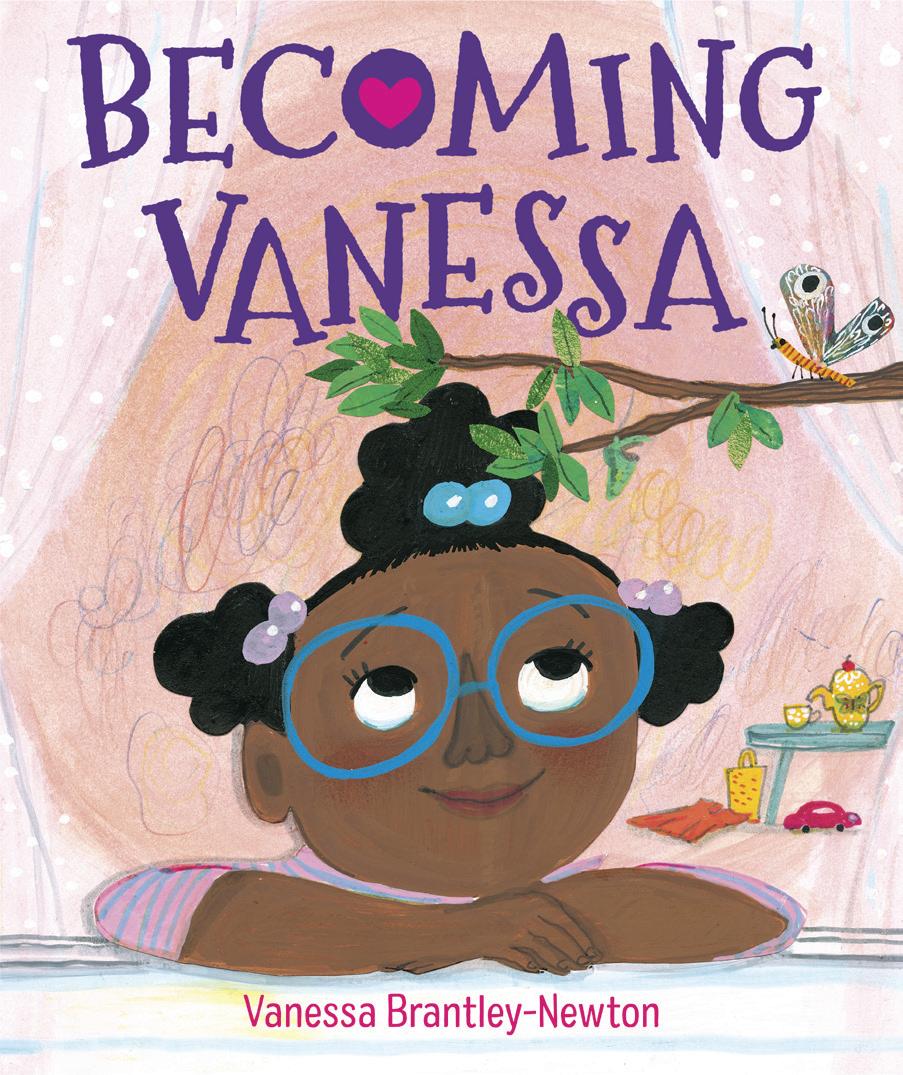
yellow feather boa, polka-dot leggings, new shiny shoes, and a big green hat. Brantley-Newton, who is both the illustrator and author of this book, depicts Vanessa’s unusual outfit in all its zany and colorful glory. Vanessa hopes that her classmates will be impressed with her outfit, but their response is not what she expected. They complain about the feathers that she sheds over the course of the day, and one student says that he “can’t see past her hat.” When Vanessa returns home, she feels that her “day wasn’t special” and her “outfit wasn’t special” either. The next day Vanessa wears a more ordinary outfit. She tells her mother, “I don’t want to be special today. I don’t want to
be Vanessa.”
As her second day of school progresses, however, everything turns out far better than she had expected. During circle time, she shows her classmates her drawing of a butterfly, and they respond positively to her picture and her passion for butterflies. At the end of the story, she realizes that she “didn’t need a boa or new shoes for them to see that she had something special to share.”
For both Dot and Vanessa, learning to accept themselves proves to be a prerequisite for having others accept them for who they truly are. In the span of about forty pages, these picture books show how perfectionism and putting on airs can undercut children’s ability to make friends and succeed in school. These picture books are intended for young children, but their focus on the importance of self-acceptance applies to adults as well as children. Perhaps the parents reading to their children will appreciate the lesson as well. n
VANESSA BRANTLEY-NEWTON grew up in Newark, NJ, and currently lives in Charlotte, NC. She attended both the Fashion Institute of Technology and the School of Visual Arts in New York City, where she studied fashion and children’s book illustration. She has written and illustrated many picture books, including Grandma’s Purse (Knopf Books for Young Readers, 2018), Just Like Me (Knopf Books for Young Readers, 2020), and Shake It Off! (Nancy Paulsen Books, 2024).
ABOVE Cover illustrated by Vanessa Brantley-Newton; courtesy of Penguin Random House
Quite
a Miscellany: A Memorium, New NCLR Writers, A Note of Appreciation, and a Call for Support
by Margaret D. Bauer, Editor
I open this section with an homage to another mentor, Justice Willis Whichard, publishing his eulogy by Martin Brinkley. This is the “Miscellany” section, so this piece seems appropriate here. I thought as I listened to Martin’s eulogy live, not being able to attend in person, this is the stuff of literature. This is what fine writers do, have done, for centuries, memorializing their heroes in words. And I thank Martin for allowing NCLR to publish his essay.
I was privileged to have known Justice Whichard. How kind he was to write a letter to me when I received the North Carolina Award for Literature. And he has offered me much appreciated advice over the years, particularly whenever we met during a meeting of the North Carolina Literary and Historical Association. I was thrilled to return the favor before meetings of the board of the North Caroliniana Society when he would sit next to me and ask what he should read next. He had dubbed me his librarian, and I was happy to recommend to him writers he’d not discovered yet: David Joy in particular, as I recall. Start with his new one, Those We Thought We Knew, I told him, and then try When These Mountains Move and The Line that Held Us. He read all three, he reported at the next meeting, thanked me for the recommendation, and asked, “What next?”
As always in this section, we publish writers new to our pages. In this case, several poets who were finalists in the 2025 James Applewhite Poetry Prize contest. Congratulations to them, and thank you to the artists who allowed us to feature their work with these poems. Congratulations, too, to one of these artists, Beverly McIver, who was just inducted by Governor Josh Stein into the Order of the Long Leaf Pine this year.
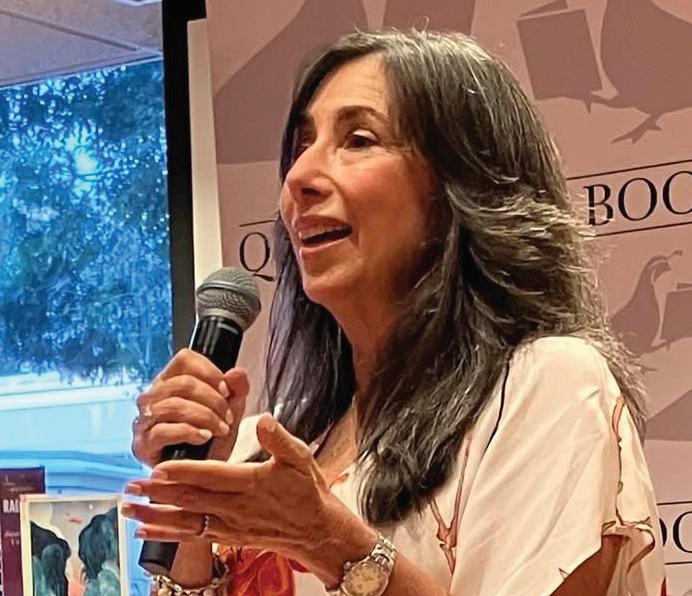
The reviews in this section cover writers whose work has not yet been published in our pages, though the late Claudia Emerson and Gary Carden are certainly familiar names. The review of Sharon Kurtzman’s new novel by Sheryl Cornett anticipates Sheryl’s interview with the debut novelist forthcoming in the North Carolina Miscellany section of the print issue.
I want to take a moment here, where we have a couple of poetry reviews, to recognize retiring Assistant Editor Anne Mallory. I (often) confess, I am not a poetry person, and I have relied for years now on Anne reading the poetry reviews for me. She is such an excellent editor, and she is definitely a poetry person. So I’ve always known that after a poetry review went through Anne, it was ready for publication, and I thank her for all of her years of service to NCLR. She has also been a regular screener for the Applewhite Poetry Prize contest and helped to select poems from our pages to nominate for various prizes. We will miss her. Thank you, Anne.
People like Anne, volunteering their service, have been vital to NCLR for thirty-five years now. I could not be more grateful, and I know that the writers whose work we publish are as well. If you can help NCLR's sustainability with a donation, please know that we will put these funds to good use: paying honoraria to the writers and artists in our pages, for example. We are also seeking endowment funding to cover the work of the Book Review Editor, who makes sure we have at least fifty-two book reviews a year, so we can release one per week, and the Art Editor, who matches the literary content to North Carolina fine art. Please contact me if you would like to support either of these positions. And thank you from all of us at NCLR. n
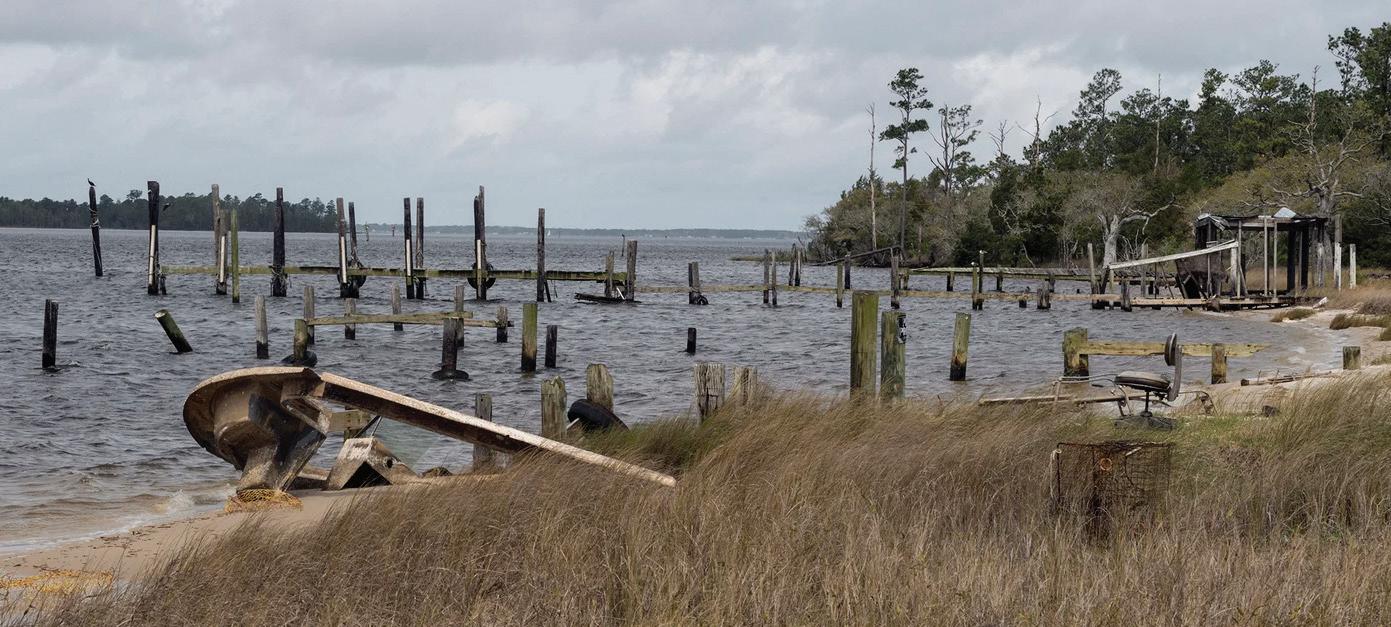
60 The Willis Whichard I Knew by Martin Brinkley
64 Fruit of the Vine: Poems to Savor and Sustain a review by Michael Beadle n Claudia Emerson, ungrafted
66 Ode to a Blackbird a poem by Martin Settle art by Layton Hower
68 The Children, Like Birds a short story by Zachariah Claypole White art by George L. Scott
71 A Family by Any Other Name a review by Sheryl Cornett n Sharon Kurtzman, The Lost Baker of Vienna
74 Ghazal for the Jinn a poem by Ilari Pass art by Kulsum Tasnif
76 History is in Your Veins: Etaf Rum Examines Healing from Generational Trauma a review by Olivia Cash n Etaf Rum, Evil Eye
78 At Midnight a poem by Asma Abike art by Beverly McIver
Miscellany NORTH CAROLINA
80 Inheriting Emotional Repression: Love, Loss, and Legacy a review by Sterling Neill n Terah Shelton Harris, Long After We Are Gone
82 After Palm Sunday a poem by Eric “L.B.” Thompson art by Antoine Williams
84 The Summer I Left a poem and photograph by Veronica Schorr
85 Cursed throughout Time a review by Kenly Corya n Adrienne Young, The Unmaking of June Farrow
88 In Praise of Time a poem by Richard Allen Tayler art by Horace Farlowe
90 Telling Stories to Live a review by Terry Roberts n Gary Carden, Stories I Lived to Tell n Christopher Lee Nelson, Where You Are From
92 The Power of Redemption in Poetry a review by Grace C. Ocasio n Gail Peck, In the Shadow of Beauty
95 A Writer’s Toolkit a review by Sayantani Dasgupta n Nora Shalaway Carpenter, Spinning Toward the Sun: Essays on Writing, Resilience, & the Creative Life


THE WILLIS WHICHARD I KNEW
eulogy for Willis Padgett Whichard (1940–2025)
by Martin Brinkley
Duke University Chapel, Durham, NC, 23 January 2026
My first encounter with Willis Whichard took place in a classroom at the UNC Law School, on a Friday afternoon in January 1991. This is now a point so remote in time that the UNC law students of 2026 would describe it, with that look of wonder mingled with flippant derision peculiar to the almost-butnot-quite-adult, as “back in the day.” The classroom where we met was then known as the Haywood Room. (Nowadays all our classrooms are just faceless numbers.) Having both learned and taught there, I can attest that it is small, narrow, tight, and generally uncomfortable.
Nevertheless, it was in the Haywood Room, that Friday afternoon in January, when one of the great friendships of my life was born. About fifteen of us were there to meet our professor for the first day of a seminar on the Judicial Process. Willis Whichard was then in his fifth year as an Associate Justice of the Supreme Court of North Carolina. It felt as though we were about to be presented as foreign ambassadors at the Court of St. James’s.
The moment I knew Justice Whichard and I were destined for friendship occurred when he wrote the name of a seventeenth-century English judge on the blackboard. Now it came to pass, as I followed the piece of chalk in his hand, that this judge’s last name was spelled C O K E. Turning around to face the class, Justice Whichard asked which of us knew how to pronounce it. I raised my hand and said I thought it rhymed with “book.”
Why I was in possession of this more or less useless factoid at the age of twenty-four must remain one of the eternal mysteries. Surely my classmates in the Haywood Room considered it evidence of a misspent youth. My knowing it does explain a few things, though. For example, my faculty colleagues at the law school figured out to their relief, a long time ago, that there was no meaningful risk of my displacing Lissa
MARTIN BRINKLEY is the William Rand Kenan, Jr. Distinguished Professor at the UNC School of Law, where he served as Dean from 2015 to 2025. A Wake County native, Brinkley clerked for Chief Judge Sam J. Ervin, III on the US Court of Appeals for the Fourth Circuit and was in private practice in Raleigh for over twenty years before becoming Dean. Brinkley has an AB in Classics from Harvard University and a JD from UNC School of Law. He is a late-in-life PhD candidate in Classics (Philology) at UNC Chapel Hill and a passionate amateur oboist.

Broome as Carolina’s Faculty Athletics Representative. Yet the fact remains that from that day, and because of Sir Edward Coke – bless his heart – a bond of friendship sprang up between me and Willis Whichard. I first called him “Justice,” later “Bill” – although I heard him assure many people that “Willis” was just fine, too; and because some of us knew him as Bill, and others as Willis, I will use those names interchangeably in what follows.
That Judicial Process course was far and away one of the most enriching academic experiences of my time in law school. Years later, my wife Carol told Bill that if he had announced that that seminar would meet at seven a.m. on Sunday mornings, I would have shown up fifteen minutes early.
My friendship with Bill was strong and intimate for thirty-four years. Its flame burned as brightly as ever the last time I saw him, at the beginning of this past fall semester. That day we had dedicated ourselves to a serious, if not sacramental, task: We were doing rough justice to a couple of high season BLTs from Merritt’s while sitting at his dining room table at The Cedars. When we two good and consistent trenchermen got down to the short rows, he asked me to speak at his memorial service. I told him I would happily do so, but that he needed to understand that whatever I said would be personal, not biographical. He nodded assent to that. So, I will now endeavor to
ABOVE Justice Whichard at an annual meeting of the North Carolina Literary and Historical Association, Raleigh, NC, 2016 (”There’s the Willis Whichard I knew, always with a sparkle in his eye.”—Margaret Bauer, Editor); courtesy of the North Carolina Department of Natural and Cultural Resources
share something of the Willis Whichard I knew. Not the CV, but the core, the essential impetus of the man.
Who of us, in the end, can fathom the endless array of factors, most of them only dimly understood, that propel us to live the lives we have been given by grace? We can only grab onto the mountains, the promontories, that thrust up highest in our souls; pull ourselves upon them; and survey our hearts’ rugged landscape. When it came to the soul of Willis Whichard, one mountain’s looming height and bulk threw every legislative seat, every high court judgeship, every deanship, presidency, and board chairmanship into deep shadow.
That mountain, that Everest, was the University of North Carolina at Chapel Hill. It is simply impossible to gauge or fathom the University’s importance in Bill’s life. His dedication to Carolina transcended the parts of the University he himself had attended and earned degrees from – the College of Arts and Sciences and the Law School. His love for the place slopped over the lip of his bucket and washed over the School of Education, the School of Social Work, the University Library (particularly its North Carolina and Southern Historical Collections), and the General Alumni Association.
A young Willis Whichard arrived in Chapel Hill in the high noon of a golden age that began under Presidents Edward Kidder Graham and Harry Woodburn Chase; flowered through years of economic depression and war under Frank Porter Graham; and reached a kind of apotheosis under President William Friday, Chancellor William Brantley Aycock, and their immediate successors. UNC was, during this period, the most prestigious and progressive academic institution in the New South, a beacon of light exercising a lifting power over state, region, and country.
that campus where a darker shade of blue prevails; for it was the nickels and quarters of which he unburdened wealthy Duke alumni in exchange for the soft drinks and peanuts he hawked at Duke home football games that shored up his teenage solvency. Thank Heavens he had the sense to turn them into a decent education down the road.
“ A young Willis Whichard arrived in Chapel Hill in the high noon of a golden age . . .”
Many years ago now, a high-ranking officer of one of North Carolina’s great private universities, himself a graduate of that university and of its law school, said this to me: “I have no personal connection to the University of North Carolina. But anybody who loves this state knows that of the one hundred good things that ever happened in North Carolina, ninety-five have come through Chapel Hill some way, somehow.” That statement is as true today as it was on a sultry August day in 1958, when Bill Whichard drove the eight miles from Durham to Chapel Hill with his father to enroll as a freshman. He found a university of eight thousand students, overwhelmingly Tar Heel in breeding and origin: the sons and daughters of the small cities, the county seats, the mill towns, and the farming communities scattered across all one hundred counties. (In that day students at Carolina were identified by their counties of origin.) Bill’s father, also named Willis, had been a graduate of the UNC Class of 1930, when there were just two thousand students on campus.
After the unpacking, just before getting in the car to drive the eight miles back up Tobacco Road, the elder Whichard said it was a shame the place had gotten so big that eighteen-year-old Willis wouldn’t be able to get to know anybody.
That Willis Whichard would go to college was never in doubt. But it was the offer of a 150 dollars per semester scholarship to UNC that determined the direction of his life. He combined that scholarship with his savings from eight years’ delivering his hometown’s afternoon paper, the Durham Sun , on foot and by bicycle, to more than 130 homes, earning a dime a week from each customer. He added to that sum what he made during summer breaks from high school, working for the book and maintenance departments of the Durham City Schools. It seems fitting that we say goodbye to him in his hometown, on
One of Willis’s lasting memories of his first week in Chapel Hill was of a Sunday afternoon walk when he passed William and Ida Friday moving at a “fairly rapid clip” towards Franklin Street from Cameron Avenue and the South Building. Friday had just celebrated his thirty-eighth birthday. He had been President of the University for two years. Later that same week, the new freshman encountered the chancellor of one year’s standing, William B. Aycock, who told the awed freshman class that they were there “to draw interest on the intellectual, moral, and spiritual capital provided by the work, effort, and sacrifice of many generations” of North Carolinians. *
Willis plunged into the life of the campus, becoming active in student government and being elected to half a dozen leadership organizations, among them the Order of the Golden Fleece, the University’s oldest
* Willis P. Whichard, “How Chancellor Aycock and President Friday Shaped the Course for Today’s University,” Remarks for Reunion Weekend, 9 May 2014, Chapel Hill, NC: YouTube; subsequent quoted passage also from these remarks.
and highest honorary society. Undergraduate student leaders were personally known to President Friday. He sought out opportunities to interact with them. Willis once recounted to me how, on one Sunday night every spring, the air heavy laden with the fragrance of azaleas and dogwoods blooming, the Fridays would host the members of the Golden Fleece at the President’s house on Franklin Street to consider the problems and possibilities of the University and the state as a whole. As he remembered it:
These occasions had a steady refrain. A small but influential corps of people really ran the state, [Friday] would say. They were a mix from the business, professional, and academic communities. They might not always determine who would be the Governor, but they did determine who could be the Governor. They solicited responsible candidates for lesser positions as well, and saw to it that they had the funding to make their candidacies viable. It was implicit, if not explicit, that your turn might come to serve the state in some way, and if it did, the ancient concept of civic virtue demanded that you do it. You were getting a worldclass education in Chapel Hill, at considerable expense to the taxpayers, and for that you owed something back.
Some of my conversations with Bill over the years were about politics. Whenever we hit upon that subject, it was hard not to notice the change that came over him. The calm, rational, even-tempered, fairminded, emollient jurist gave way, in a lightning flash, to the keen strategist, the fierce fighter bent on nothing less than total victory for his party and his people and total annihilation for the enemy. Perhaps he was not exactly a ward heeler, but there was no doubt where his loyalties lay and where he thought everyone else’s should, too. It had been like that since his childhood, when the radio in the family dining room was always tuned to the six o’clock state news on WPTF, followed at 6:15 by Carl Goerch’s Doings of the Legislature program and, every Sunday evening, Goerch’s Carolina Chats, a midcentury precursor to North Carolina People with William Friday.
Once again, it was Chapel Hill that sowed the seeds of Willis’s career in electoral politics. During his sophomore year he worked actively for Terry Sanford in the gubernatorial campaign of 1960, drawn into that effort in part by the importunings of a 1959 North Carolina State University graduate from Wilson County who introduced himself as Jimmy Hunt. Bill took a leave of absence from the law school during his second year in order to devote his full time to Judge L. Richardson Preyer’s gubernatorial campaign.
The culmination of Willis Whichard’s political career came in 1986, when he was elected to the

Supreme Court of North Carolina. The tribunal he joined was as good a high court as North Carolina has ever had. Chief Justice James G. Exum, Jr. was joined on the bench by Associate Justices Louis Meyer, Burley Mitchell, Henry Frye, Harry Martin, John Webb, and Bill as the junior justice. Chief Justice Exum once told me of those days: “All of us enjoyed what we were doing. We got along as people and professionals, and we cared deeply about reaching a principled resolution to every case.” There was a palpable sense that here, in this courtroom and on these halls, the sacred duty of appellate judging was being honored to the fullest, with pleasure and joy. Justice Louis Meyer personified this joy when he went down the halls humming and singing, often stopping by other chambers to ask justices, secretaries, and law clerks alike, “Are you happy in your work?”
But life at the Supreme Court was not all work – or at least, not all of the work was law work. Beth Tillman was a member of the UNC Law School Class of 1993, the class after mine. She had interviewed for a clerkship with Justice Whichard during the spring of my third year, her second. Knowing that Beth and I were friends, Bill asked what I thought of her. I told him he should rise up like the Israelites, sound the shofar, let fall the walls of Jericho, and hire her with the greatest possible expedition. Bill then said, “Do you give me
ABOVE North Carolina Supreme Court Justice Willis P. Whichard; courtesy of the North Carolina Collection, Durham County Library
an uncapped, no-deductible representation and warranty as to her qualifications to serve as my clerk?” I responded with all the alacrity of which I was capable. I only learned later that there had in fact occurred a breach of my warranty – a breach of major proportions – but one on which Justice Whichard graciously allowed the statute of limitations to run. The story of this breach needs to be told in Beth’s own words. With her permission, I do so now:
When I first started clerking for the judge, I became aware that my understanding of UNC basketball was going to be as important as my ability to draft an opinion.
During my first year of clerking, the ACC tournament conflicted with the Supreme Court oral arguments schedule – usually the clerks would sit in the courtroom and listen to the arguments, but the judge said I had a special, important assignment. I was to go in the break room where a TV had been set up for the tournament and watch the Tar Heels who were playing Florida State.
My job was to replicate the judge's score sheet which he kept for every game he watched. [And by every game, I mean every game, over decades and decades, in Carmichael, in the Smith Center, and at home.—Martin Brinkley] He would list the top six players with a column for baskets and one for fouls.
Pretty easy – I thought – so I dutifully watched the game, which I was kind of thrilled to have as my job – and the Court got finished and the judge came straight to the break room to see what was going on with the game. I told him the score – the Tar Heels were easily ahead of the Seminoles by a sixpoint lead, so I wasn't doublechecking my stats. I handed him my chart and he immediately calculated that I was missing a basket when he compared it to the stats he saw on the TV. I had shorted Eric Montross a goal.
“Well,” he said, “clearly you can’t be trusted with important work,” and winked at me. For the next thirty years whenever we watched a game together, he’d give me a hard time – “I know who is not to be consulted about the score,” or “I can’t leave for a bathroom break because I know you can’t handle the stats.”
When Carol and I went to Beth’s office a couple of years ago to have our estate documents redrawn, Bill came into the conference room where the three of us were sitting. Pointing at Beth, he said: “You know you’ve got the very best.” We knew it already.
I doubt any North Carolinian of the last century was a more diligent dues-paying member of humanity than Willis Whichard. Certainly I know of none who lent his talents and inexhaustible work ethic to a wider and more numerous array of foundational causes and institutions in his beloved home state. Whether it was state government (two branches of which he graced); or charitable organizations (some prominent, others deliberately self-effacing); or public libraries; or citizen commissions; or scholarly work on neglected public figures of our past: To these and so many other decent, honorable things, for more than half a century, there he was, saying yes again and again, with a kind of desperate profligacy. The list of his benefactions of time and care is so long that to cover even a fraction would risk turning our time together into a veritable Homeric Catalogue of Ships.
As I reflect on the life of our friend, I cannot help but ponder, in the harrowing times that are now passing before our eyes, what life would have been like these last eight and a half decades without him. Thucydides puts the question in the mouth of the statesman Pericles, who tells his fellow Athenians about the source of decay at the heart of a nation:
“I doubt any North Carolinian of the last century was a more diligent dues-paying member of humanity than Willis Whichard.”
The great wish of some people is to avenge themselves on a particular enemy; the great wish of others is to save their own pockets. They devote only a small fraction of their time to consideration of public objects, most of it to the prosecution of their own objects. Meanwhile each fancies no harm will come of his neglect, that it is the business of somebody else to look after the life of the community for him; and so, with everybody entertaining the same notion separately, the common cause imperceptibly decays.
As many of you know, Bill joined Beth Tillman in her law practice in the later years of his life. Beth says that it was the high point of her career when Zeus came down from the mountain and wanted to practice law with her. She adds:
We had a very fine time. Bill’s memory for names, dates, and events was singular. I would come out of a consult and tell him about the new client, and invariably he would respond with some form of, “Oh, I knew Bob's parents. They were on my paper route. They lived at 163 Elm Street. His father went to DePaul University and was a dentist.”
When the selfish people of our own era, the “me first” people Thucydides was describing, encountered Willis Whichard, they didn’t stand a chance. He remained, for more than thirty years, a polar star in the firmament of my life. I was blessed – truly blessed – to know him, and to have him know me. And I pray that for decades to come, as the shadows lengthen and the evening comes, as the fevers of life burn and subside, until the work of my earthly course is run, I will hold close the memory of his wisdom and counsel, and glimpse there the kind and patient twinkle of an everlasting friend. n
FRUIT OF THE VINE: POEMS TO SAVOR AND SUSTAIN
a review by Michael Beadle
Claudia Emerson. ungrafted: New and Selected Poems. LSU Press, 2025.
MICHAEL BEADLE is a poet, author, and teaching artist in Raleigh, NC. His poetry has appeared in NCLR Online Fall 2025 and Winter 2025 , Kakalak , Broad River Review, River Heron Review, and assorted anthologies. His fiction has appeared in Apple Valley Review , moonShine review , and BOMBFIRE, and his book reviews have appeared in several issues of NCLR Online A former journalist and magazine editor, he has written local history books on Haywood County and served as poet-in-residence at the North Carolina Zoo, student poetry contest manager for the North Carolina Poetry Society, and emcee for the state North Carolina Poetry Out Loud Finals.
CLAUDIA EMERSON (1957–2014), a native of Chatham, VA, received her MFA degree in Creative Writing at UNC Greensboro in 1991. Her awards include the 1991 Academy of American Poets Prize and the 2006 Pulitzer Prize for her collection late wife (Louisiana State University Press, 2005; reviewed in NCLR 2007), and she was named the Poet Laureate of Virginia in 2008. She taught English at Washington and Lee University, Randolph-Macon College, the University of Mary Washington, and Virginia Commonwealth University.
O, to roam an apple orchard at dawn! What joy to pluck the ripened fruit of harvest! But instead of apples, imagine an orchard of delicious verses. Such is the delight of reading through Claudia Emerson’s life work, ungrafted: New and Selected Poems. Compiled by her longtime LSU Press editor, Dave Smith, the collection features poems from eight of her books, as well as more than two dozen posthumously published poems. Nearly half the book includes poems published after her death in 2014. More than a museum of words or a glorious homage to this celebrated Virginia Poet Laureate, Pulitzer Prize-winner, and professor, ungrafted allows its readers to immerse themselves in Emerson’s incredible range and depth as a writer. The title poem refers to the process of grafting, attaching shoots from a tree or plant to another to create a hybrid or new life –but the word “ungrafted” could also draw upon other connotations like unbroken, uncorrupted, or unrestrained.
Keen and incisive in her observations, tender and intrepid with her subjects, Emerson trained her eye on the natural beauty and bucolic places of her native Virginia, but also on tragic events, death-haunted scenes, and people facing private fears and misgivings. She imbues lonely and lonesome characters with a genuine empathy and admiration that makes them timeless. These named and nameless people have been beaten down by injustice or indifference, while others face death or its consequences with whatever courage they can muster – amputees and cancer patients, veterans and nurses,
postal carriers and church ministers, a widow who dresses a scarecrow with her dead husband’s clothes, and the first woman electrocuted in Virginia history. Emerson had a knack for illuminating and admiring the quirky and bizarre – a Main Street mannequin displayed above an auto repair shop, the reliquary-like exhibit featuring a lock of hair from Emily Dickinson, an ocularist who creates artificial eyes, and the curious sounds of a piano set on fire.
In “Early Elegy: Thyroid,” a woman in a doctor’s office ponders the removal of her thyroid gland with a plastic model of the thyroid that reminds her of a butterfly: “like the one resting at the base of her throat, wings open, / basking, for now, just above the sternum’s notch, / the way it might above a drying puddle.” In a mere eight lines, a patient narrator imagines both a tranquil moment and an impending procedure that captures loss, transformation, mortality and vulnerability in the body of a butterfly, whose fleeting life may have reminded Emerson of her own impending death. The poet’s language is not bitter or sentimental; it is precise and unflinching. Reflecting on a childhood rite of passage in “Learning to Dive,” Emerson uses lyrical couplets that could also suggest an Ars Poetica, imparting advice on how the artist crafts a narrative upon the blank page. “I imagined,” she writes, “Myself a bow, a blade // Of flexed tempered steel – or water pouring / From an invisible pitcher.” These metaphors of physical preparation before the plunge keep us alert for what is to come: the inevitable dive, whether in per-
fect posture or a bellyflopping disaster. Emerson allows the tension to build as she lingers in the sensory details of the lake: “In water tea-like, warm enough to dissolve / Sugar, floating dock a tethered planet // Of rough boards.” By the end, we don’t get an easy splash landing. We discover an adult voice reflecting on this childhood moment of performing the physical act of diving while heeding the muse’s invitation to create an original impression: “seeking the form mine, / Imperfect, there, but shaping itself.”
Continuing to mine the depths of water and imagination, Emerson takes us to a watery abyss in “Bus in the Quarry” where emergency responders practice for diving rescues but where daring hikers take the plunge to tragic consequences:
His name disappears from the roster, from the mouths of those
who called out for him that day, and the rope, still hanging straight and still as a plumb rule –
Beckons with spring, wisteria climbing
Emerson’s metaphorical description of the ravine as an open, “watery jaw” echoes through later lines as search-and-rescue crews and friends use their mouths to call out for another missing, voiceless victim swallowed up by death’s gaping maw. She also sandwiches the commonplace –eating sandwiches, enjoying an afternoon outing – with the danger that awaits at the cliff’s edge.
In this rich collection, Emerson fans will enjoy some of her greatest hits from previously published
collections such as the Pulitzer Prize-winning late wife and figure studies (2008). In the sampled poems from the latter collection, Emerson gives us as perfect an observation of “Synchronized Swimming” as any you will ever find:
Upside-down now to assume the vertical figure, stillness is as much part of this execution
as motion. Hands fluttering, the scull supports legs scissoring the air before they close,
plunging into the shimmering screen of water.
Using antithesis, she plays with opposing ideas of movement and stillness, upside-down angles and upright perspective. Water seems to take on an almost ethereal form. The alliterative “s” sounds give the poem’s mood a mesmerizing calm. Her tight composition, precise word choice, and vivid imagery capture an enchanting water ballet with graceful arms and legs rising and falling in and out of the water, bodies arranging and re-arranging themselves like “bright fragments inside a kaleidoscope / dialing inflorescent patterns of glass.”
The poems in ungrafted remind us of our shared humanity, that we, too, enter blindly beautiful places in our imaginations, and that we, too, hesitate before the unknown mysteries of death and the paralyzing terrors of shame and guilt. Though Emerson’s life was cut short by cancer, her life’s work lives on, each verse and poem like grafts attached to the fertile minds of the next generation of writers who plant the seeds of great literature. n
2025 JAMES APPLEWHITE POETRY PRIZE FINALIST
BY MARTIN SETTLE
Ode to a Mockingbird
every group needs the trickster to break the tedium of territory and mating to tell the truth in the presence of cloying seriousness
I’m entertained when I hear you atop a telephone pole imitating one bird song after another –cardinal, jay, chickadee wren, warbler, cowbird –if you truly wanted to dissemble you’d just pick one
but you are by nature a showoff impressing your women or making the proud blush at how easily they can be mocked
MARTIN SETTLE of Charlotte, NC, has taught English for over thirty years, the last seventeen of which at UNC Charlotte. He has published seven books: a memoir, an art design book, a joke book, and four collections of poetry. He has been awarded the Thomas H. McDill Award and the Poetry of Courage Award from the North Carolina Poetry Society, the Nâzim Hikmet Poetry Award, and the Griffin-Farlow Haiku Award, and he has been published in The New York Times.
even your attire is clownish with a tail too long like a poorly made paper plane a suit with white splotches on wings you like to flash with pretend militance some would say to be original you must have your own song but what if you improve the songs of others and make unique chains of their work?
Is this why great poets steal lines and rhymes from others to raise themselves up in their imitation? Or why we still hear strains of Keats repeated by present poets who build songs from past heard melodies?

resident
and his family moved to North Carolina from New York City, where he had worked in finance, managment, human resources, and accounting, including at the Cunnington Dance Foundation and the Baryshnikov Arts Center, all while pursuing an art career. He studied at the University of Colorado Boulder and is a graduate of Davidson College with a BA in Fine and Studio Arts in 2003. Since 2018, he has served as Vice President of Finance and Operations for the Asheville Area Chamber of Commerce. Prior to his work at the Chamber, he was the Chief Financial Officer at United Way of Asheville and Buncombe County. An accomplished
his
Feathers, 2019 (acrylic on canvas, 36x36) by Layton Hower
Asheville
LAYTON HOWER
artist,
works have been exhibited in Albuquerque, New York City, and Asheville, among others.
HONORABLE
MENTION, 2025 DORIS BETTS FICTION PRIZE
The Children, Like Birds
by Zachariah Claypole White
The boy does not look down. The route is steep, but the night is clear and the moon bright. He moves confidently along the granite rockface, pausing only to find the next hold or glance up the mountainside. Soon, he thinks.
The first bird he sees is a finch, perched on a ledge above. Once the boy draws level with it, the finch darts to the next outcropping, like a bonfire spark caught in a sudden wind. It tracks his progress, eyes glittering in the dark.
As the boy climbs higher, more birds appear: wrens and warblers, then hummingbirds and hawks. They dart from crevice-sheltered nests and flock across the slope in a cacophony of feathers. The boy thinks of a playground’s roar or the echo of a church choir. The birds never come within arm’s reach. But they keep pace. Occasionally, one will land on the rocks beside him. Occasionally, one will call out to the boy.
He is not surprised to see the birds at night, or to notice predators flying alongside prey. They will not interfere with his journey. The boy understands this just as he understands what their presence means: he has almost reached the stairs.
All the town’s children know about the stairs. They begin halfway up the mountainside, carved into its granite skin. No one has ever counted them because no child has ever trekked back down from the mountain. A second grader, one of the transfers, claimed to have made the climb and seen exactly
ZACHARIAH CLAYPOLE WHITE is a Philadelphia-based writer and educator, originally from North Carolina. He holds a BA from Oberlin College and an MFA from Sarah Lawrence College, where he was a Jane Cooper Poetry Fellow. His poetry and fiction have appeared in, or are forthcoming from, Southeast Review, Prairie Schooner, and The Rumpus, among others. Zachariah has received support from the Kenyon Review Writers Workshop, Writer’s Digest, and Disquiet International. His awards include Flying South’s poetry prize as well as two nominations for the Best of the Net and one for a Pushcart Prize. He teaches at the Community College of Philadelphia, Saint Joseph’s University, Manor College, and the Writing Institute at Sarah Lawrence College. Read a poem by him in NCLR Online Winter 2026.
three hundred and thirty-seven steps. He was new in town, wanted to fit in. He did not understand the mountain. The other children kicked him bloody during recess.
If the parents know about the stairs, they do not say. They barely acknowledge the mountain, think of it only in passing when the train is late or the Wi-Fi down. Then they look out their windows or up from their crumpled newspapers. What an eyesore, they think. Those miners should’ve blown the whole fucking thing away. Then the train pulls into the station, or the baking show resumes, and once more they forget about the mountain.
The boy grasps the first step and hauls himself forward. The stairs are smaller than he expected, barely wide enough to find purchase, and surprisingly warm to his cramping hands. The surrounding stone is worn smooth, but the stairs themselves are untouched by wind or rain, their angles sharp and clear as if cut yesterday. They scaffold the mountainside in a zigzag ascent. Feathers dot each step like drifts of snow. Overhead, the finch circles.
Then the train pulls into the station, or the baking show resumes, and once more they forget about the mountain.
Raleigh resident GEORGE L. SCOTT grew up in Monroe, NJ. He graduated with honors from NC State University with a degree in graphic design. He spent five years in the Army and served in Operation Desert Storm as a member of the 82nd Airborne. His art has been exhibited in several shows in Raleigh, NC, including two exhibitions at Theatre Art Galleries in 2019 and 2021. The artist and his wife, Sara Birkemeier, own and operate 8 Dot Graphics in Raleigh. See more of his work in NCLR Online 2013, 2014, and 2015
with art by George L. Scott
Just as the children know about the stairs, they know who has climbed them: friends, neighbors, classmates, siblings. The names are rarely spoken, but the children remember. They map their town by the absence of those who have climbed. There is the park where Liam set up his trampoline, they say. That is the driveway where Amelia shattered her elbow. This is the bedroom where we first saw her take the pills.
Some nights the children lie awake imagining all those who have made the climb.
Some nights the children lie awake imagining all those who have made the climb. The children can almost see them, chasing one another across the mountaintop, picking blueberries from hidden vines, laughing through the cold, sharp air.
The boy is not the first to climb this year. Before him there was Eric, the gapped-toothed third grader who tried to dye his hair with pasta sauce.
He came to the mountain a few days after his father started sharing his bed.
Then there was Laura, from two houses down, who would throw acorns at anyone daring to compliment her. She made the climb three weeks ago, after her stepmother found a new dealer. The children understand.
The mountain, they say, is how we escape.
The stairs wind up and up. Sometimes the boy can almost walk in measured strides. Sometimes he is forced to scramble upwards on all fours. Still, the birds follow.
Will the others understand his reasons for climbing? He hopes they won’t blame his family or assume that they forced him up the slope, like Laura and Eric. No, the boy climbs because he is exhausted. Exhausted of the hours spent curled on his bedroom floor, sobbing for no reason he can name, of the gut-churning effort it takes to navigate the simple business of living. He wants to climb above the pitying looks from friends, the endless rotation of too-kind therapists in floral dresses, the promise that this time the medication will help.
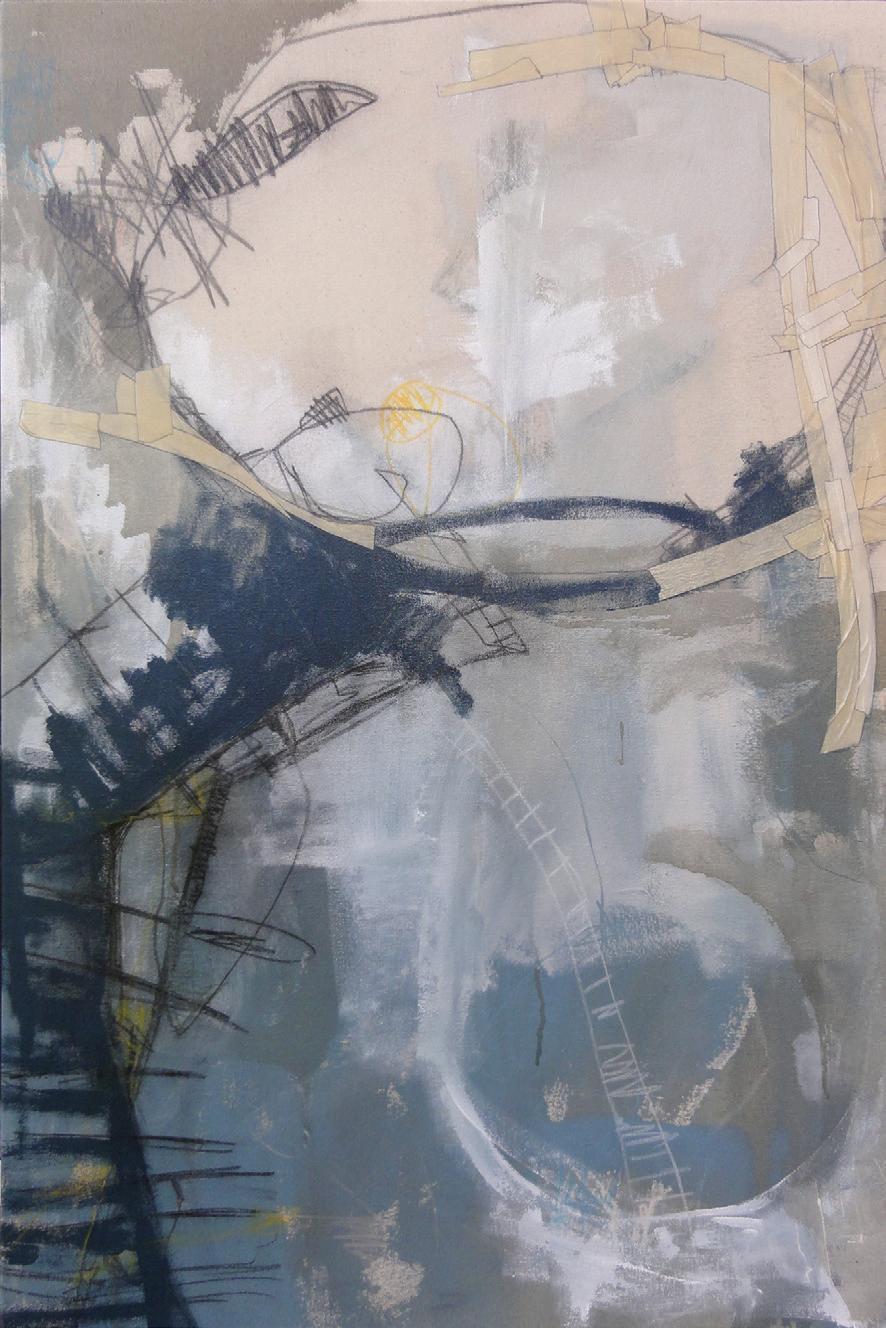
He wants to climb past the weight of his own poisoned mind.
The stairs end in a wound, a ragged plateau of gravel and tortured rock. Like a funeral, the boy thinks. Though he cannot say why. Miners ripped the peak away in ’79, following a local man’s promise of coal. A few months after digging began, the miners left. Some in the town say there was never any coal to begin with, others that the mining company went bankrupt or forget to pay off the mayor and sheriff. Either way, all the parents hope – though they would not admit it – that one day the company will return with drills, explosives, and generous offers for purchasing the land.
The children know this will not happen. The mountain is long past the reach of greed. They remember how, a year after the miners left, the
Blue Ladder (acrylic, masking tape on canvas, 25x38) by George L. Scott
The mountain is long past the reach of greed.
Can he return from the mountain? No one ever has, and if he does, what then?
mayor’s son found the stairs. And even though the welts were still fresh from his father’s morning attention, he began to climb.
The boy looks around; the birds have fallen silent. Moonlight slips across fissures and mounds of pulped rock. The night is quiet. The air is heavy with the scent of honeysuckle, even though no plants have taken root since the mining stopped.
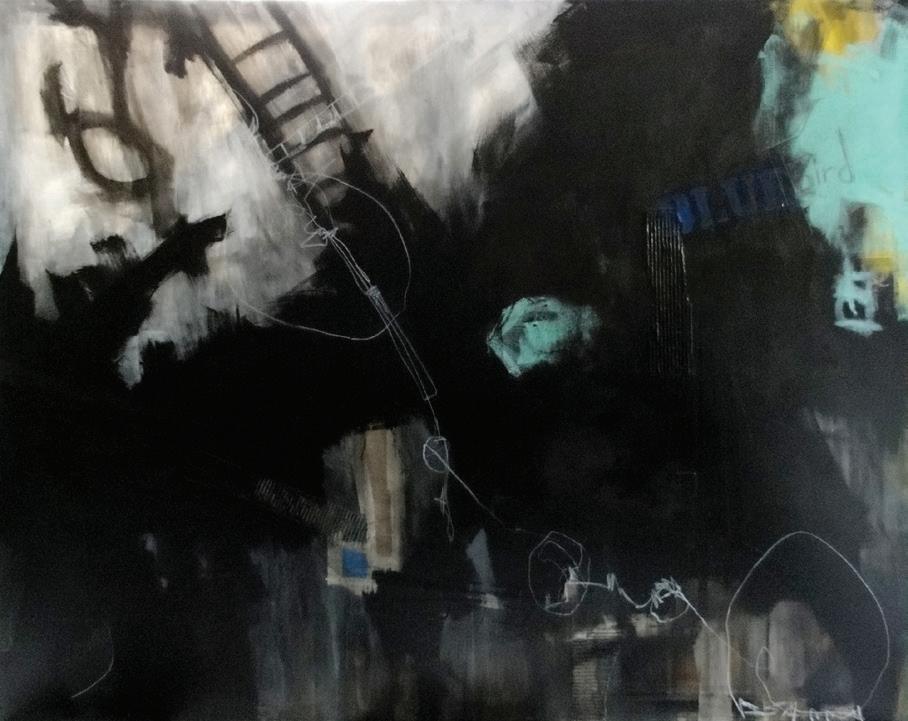
Standing freely, at the center of the plateau, is a blue door. Its frame does not lean against any rock or wall. The summit extends behind it. A welcome mat, scuffed with mud, as if others have recently passed this way, sits in front. If not for its location, the door could lead to any house in the town below: Eric’s, Laura’s, the boy’s own.
The finch calls to him from atop the door; the other birds begin to settle around him. All watch the boy.
Daylight will arrive soon. He turns and wanders back to the edge. Gravel crunches beneath his sneakers, and a pair of hawks shuffle out of his
path. Below, the town begins to stir. Lights wink on in first-floor windows, and pick-up trucks reverse out of driveways. The coffee maker will soon chime in his parents’ kitchen. His sister will snooze her alarm, hands wrapped around the purple bear she won at last year’s state fair. She didn’t actually win it. Their father bribed the booth worker when no one was looking. The boy has never told his father what he saw or shared the truth with his sister.
He imagines leaving this place, descending the stairs, hurrying back through the still-awakening town, back through the bedroom window he left ajar. Would his parents hear him return and ask where he had been? Can he return from the mountain? No one ever has, and if he does, what then? He will spend day after day, gazing up towards the mountain, remembering the stairs and the door. And what will the others say? Will they know that he made the climb – just as the boy knew when Laura and Eric stopped coming to school? Will they welcome him back? Will they stare and whisper? Or will they ignore him? Ashamed of what he did, what he failed to do. Which would be worse?
Dawn laps like a tired wave across the mountain. Grey rocks glint with flecks of mica. The morning wind blows from the east, carrying the smell of fresh pastries, wet leaves, and gasoline. The birds are restless, twittering to one another. To the boy’s left, a cardinal, almost neon red, leaps from stone to stone, dodging acorns that a sparrow tosses from its beak. One rolls over the edge, and the boy can hear it bounce off the stairs below. He looks back. The finch sits motionless. Beneath it, the wood of the door begins to ripple. The handle shakes.
The birds depart, some glide toward town, some follow what remains of night, some cast shadows like dancing children.
The boy knows he will return from the mountain. He wonders if it will be on foot or feather. n
of night, some cast shadows like dancing children.
bluebird & the mint bus (mixed media on canvas, 60x48) by George L. Scott
The birds depart, some glide toward town, some follow what remains
A FAMILY BY ANY OTHER NAME
a review by Sheryl Cornett
Sharon Kurtzman. The Lost Baker of Vienna. Pamela Dorman Books/Viking Press, 2025.
Sharon Kurtzman writes a compelling novel based on her family’s experiences, a tale discovered while interviewing her Holocaust-survivor mother for a college assignment. The Lost Baker of Vienna is a beautifully told story about the fictionalized Rosenzweig family’s history. Poignant with horror, heartbreak, and heartache; laced with chutzpah, courage, and tenderness, Kurtzman’s debut novel offers a hopeful dual timeline story of the Holocaust and its reverberations following the end of World War II. Reverberations continue for decades through to the present day’s last living Rosenzweig and speak to modern readers.
time when [she] turn[s] twenty” (47) is shattered, but Chana vows to keep it – and Papa’s memory – alive.
SHERYL CORNETT taught English and Creative Writing at NC State University for many years before turning to writing fulltime. She and her husband divide their year between North Carolina and South Louisiana. Her poems, stories, critical essays, and creative nonfiction appear in numerous publications including NCLR , Image , Pembroke Magazine , Mars Hill Review, The Independent Weekly, and Art House America
SHARON KURTZMAN worked in television marketing before pursuing her dream of becoming a writer. She earned her MFA in fiction from Vermont College of Fine Arts, and BA from Syracuse University’s Newhouse School of Public Communications. The Lost Baker of Vienna was inspired by the war and postwar experiences of her own family, who were Holocaust survivors. Kurtzman lives in North Carolina with her husband; they have two adult children.
I began reading The Lost Baker of Vienna as soon as the Advance Reader’s edition landed on my doorstep. I fully expected to engage with the story since I’m a dedicated student of World War II history. I could not, however, know that I’d be immediately immersed in a page-turner of such largesse. The Lost Baker of Vienna tells of one family’s unlikely survival of the Holocaust and how their bedrock bonds of love and loyalty help them save one another’s lives. The reader witnesses how the Rosenzweig family carries this legacy of hope into the twentyfirst century.
In 1946, nineteen-year-old Chana Rosenzweig is a talented baker who, before the war, apprenticed her father’s art of pastries, cakes, and breads. Chana believes that “when a person smells something sweet, their body leans toward it as if yearning to eat the air.” When Papa is murdered by Nazis, the dream of “baking together full-
When Chana, her mother, and brother Aron take refuge in postwar Vienna, she finds herself gratefully employed as a dishwasher and kitchen worker in the Empress Hotel’s restaurant. She befriends the Hotel’s pastry chef apprentice, Elias, and they develop a young-love kind of friendship, bonding over their shared passion for creating artistic, top-quality cakes, pastries, and breads. Enter Meyer Suconick, a powerful Polish underground resistance worker and blackmarket dealer supplying necessities to Jewish refugees as well as to such powers as the Gentile head-chef of the Empress’s restaurant. It is Meyer who originally gets them safely to Vienna (with forged/black market papers) and who gets Chana, Aron, and their mother, Ruth, jobs at the Hotel. “Build your lives back. That will be your sweet revenge,” Meyer says to Chana (45). Meyer –good looking, powerful, sexy – also offers marriage as protection for Chana, and by extension, care for her family, thus creating a compelling love-triangle between Chana, Elias, and Meyer that drives the story to its astonishing end.
Fast forward to 2018, Raleigh, NC. Zoe Rosenzweig, Chana’s great-niece who knows little about her late aunt, is a talented foodie herself, a professional writer for a glossy, international gourmet magazine called Savories. As beloved grandpa Aron (Chana’s brother) is passing from this life, he mistakes Zoe for Chana and thus tells her about Chana while talking to
her in his dying moments. The gene pool – her aunt’s famed beauty – lives on in Zoe, so the moment is believable.
Devastated by her grandfather’s death and at a lonely crossroads in her profession, Zoe is struck by the reality that her last living relative dies with Grandpa Aron. The finality of Grandpa Aron’s death galvanizes Zoe to learn all she can, and we see her innate determination and charisma emerge.
It seems also to be Grandpa’s wish that Zoe learns their family’s story, since he leaves her several clues: a Life magazine article, postcards from 1946, emigration travel papers for Chana and himself – clues leading Zoe down a path to Vienna. In Vienna, Zoe encounters stories of her great-aunt Chana through Henri Martin, head of a global, award-winning Australian baking company. Zoe learns of Aunt Chana’s resilience and ingenuity for saving herself, her mother, and her brother from further persecution as she interviews Henri Martin for Savories The storytelling framework, via alternating chapters set in 1946 and 2018, works seamlessly throughout Lost Baker. There are also flashbacks to pre-1946 wartime to give the reader more Rosenzweig family backstory under Nazi occupation, including searing memories of teenage Chana’s work as a courier for the Polish resistance in Vilna and her time in Stutthof concentration camp. Kurtzman handles these flashbacks with objective strength and grace.
Kurtzman’s imagistic and eloquent writing immerses the reader in 1946 war-scarred, bombed-out Vienna. Jews are still being persecuted by Nazis and fellow displaced persons and are betrayed by Soviets and greedy black-market dealers. Chana and her family navigate ongoing rations, food scarcity, and a dearth of basic necessities. When they arrive in
Vienna, Chana takes in the city: “As in other parts of Europe . . . bombs had blasted apart buildings. Fire had scorched countless walls. Rubble littered the sidewalks. . . . A filthy doll stuck out from a pile of bricks” (46). The elements of Kurtzman’s setting after the war is technically over illuminate the reality that the wartime actualities lingered through the visible
ABOVE Sharon Kurtzman at her book launch event at Quail Ridge books in Raleigh, NC, Aug. 2025
destruction, physical damages, privations, unofficial pogroms, and the continued Nazi-infused persecution of “undesirables.”
American culture facilitates a view that when World War II officially ended, and victory parades and parties subsided, that was it. Kurtzman shows how long the horrors continued. She writes the difficult, violent material so thoughtfully that I recommend this story to Young Adult readers as well as to all those drawn to historical fiction: it is a post-war story that needs to be read. Still, the author does not leave the reader too long in the world of grinding hardship and fear for one’s life; she weaves throughout the novel bright spots of friendship, of gratitude for bellies full of basic nourishment (via working in the hotel’s kitchen), of blossoming romance – and the sweet-fragrant joy of hands-on pastrymaking and baking – Chana’s soul-art and creative lifeline. She keeps her dear papa’s memory alive, sneaking out at night to do so: “her mind traveled to . . . those nights . . . Though the city’s ongoing rations made baking difficult, their ingenuity at stretching and substituting ingredients had allowed them to make croissants . . . Linzer Torte,” and more (139–40). By contrast to 1946 Vienna, our immersion in 2018 Vienna is a wealth of gloriously rebuilt architecture in the restored, majestic Empress Hotel and of high-speed internet and the role of social media in the competitive food writing world. Zoe stays at the Empress to interview Henri Martin, combining the stay with a food writers conference
where soon Henri will receive the annual Boucher Award (the international equivalent of a James Beard award). We travel alongside Zoe, as her family story unfolds through Martin’s firsthand account, through contemporary Vienna as a portal to World War II Vienna. Kurtzman’s vivid descriptions are transporting, providing arm-chair travel, including a side trip to Dürnstein Castle and village. The excursion includes contentious encounters with those who have a reason to see Zoe fail at finding the truths about Chana. And there go the pages, turning again. The chapters set in 2018 offer a delicious and suspenseful contemporary setting in counterbalance to post-war, bomb-scarred, dingy Vienna and its moments of violent suffering and “crushing sadness” (335).
With the currently available abundance of World War II books revealing the Nazi atrocities and detailed murders of millions of innocent Jewish people, do we need yet another? Yes, we do. The living history-as-fiction rendered in The Lost Baker of Vienna is timely for our world today – politically, globally, culturally. So many of humanity’s battles for justice, and for history not repeating itself, are still being fought. At this writing, the chaotic, frightening, and inhumane changes to US immigration policies are matters that resonate with the novel’s desperate measures Jewish persons needed to emigrate anywhere during the 1940s.
The Lost Baker of Vienna and novels of this substance keep these truths in our public consciousness as the first generation
of Holocaust survivors passes away along with World War II veterans the world over. And, as we mark the eightieth anniversary of that war’s end, novels like this one keep their stories alive and accessible to current and future generations. The artistry of The Lost Baker of Vienna’s storytelling connects the past to the present and may possibly build bridges to the future by keeping Holocaust survivors’ truths alive for readers now and those to come.
Besides all of the historical and cultural significance mentioned, what’s not to love about a riveting good read populated with believable characters we care about and come to care for – Kurzman’s close third-person points of view invite us into the’ mindscapes of individuals whose lives and existence as a people are threatened by evil, delusional Nazis and their systems. The Lost Baker of Vienna has all the essentials of an enthralling read: good versus evil tension, wartime confusion and turmoil, life-or-death suspense, a love triangle, forged identities, narrow escapes, running for one’s life under cover of darkness. Then there’s the captivating, hopeful ending, and delectable food writing along the way.
Early in the novel, as Henri Martin is beginning his account to Zoe of her Rosenzweig relatives, he says, “Picture a beautiful girl, an apprentice baker, a black-market dealer . . . it was . . . a love story, and they are all survivors in one way or another” (27–28). At the heart of the Rosenzweig family’s survival is love – on so many levels that it brings forth miracles. n
2025 JAMES APPLEWHITE POETRY PRIZE FINALIST
BY ILARI PASS
Ghazal for the Jinn
I created the jinn and humankind only that they might worship me.
—Surah Adh-Dhariyat, The Winnowing Winds
For my fashioned companion, the one that winnows with a winnowing with me, this is the jinn that bears the burden of rain, and glides with ease upon the sea with me – this is the jinn.
When the jinn came into existence, there were reasons not to show themselves – an invisibility with a pulse in their own place in the cosmos – simply looking after themselves, and other jinn.
People ask me to tell them what a jinn looks like: But I can’t see any jinn – Muhammad and Solomon (Peace Be Upon Them) used to be in good company, both humans and the jinn.
ILARI PASS is originally from Maplewood, NJ, and currently lives in Greensboro, NC. She is a Pushcart Prize and Best of the Net nominee who writes poetry, fiction, and personal essays. Her work can be found in Does It Have Pockets, BULL, South Dakota Review, DIALOGIST, Free State Review, SWWIM, Pithead Chapel, and others.

Alhamdulillah (calligraphy on acrylic mixed media, 24x24) by Kulsum Tasnif
There are righteous jinn and malicious jinn, some jinn can be as small as a flea, some jinn can fill the horizon with the sunset – the Qur’an has a Surah about the revelation to the jinn.
The world’s heaven is beautified with lamps, made into missiles for the devils and jinn –a soothsayer presents lies with truth, truth with lies, all shared alike by the jinn.
The jinn have been granted their generous sense of plot: a perfect sense of timing is their waswasu – the whisper of false hope is how the tale begins . . . this is the jinn.
Here I am left mute, and so much is left as it wafts in silence, seeps between the syllables of my lost thoughts – I see pages in your fire – smokeless, a failed poet – this is the jinn.
Raleigh, NC-based artist KULSUM TASNIF identifies as Pakistani American Muslim. She was born in England and grew up with her family traveling between London and Muscat. Her family moved to the US when she was in high school. Encouraged by her parents and teachers, she realized her ambition to be an artist. She holds a BA in Studio Art and Creative Writing from UC Davis and an MA in Art and Design from NC State University. Her works have been exhibited widely in North Carolina, including at VAE in Raleigh, Durham Art Guild, Skylight Gallery, and at Meredith College’s Frankie G. Weems Gallery. She serves on the Board of Directors of VAE Raleigh, and in 2023, founded Artist Ummah, a non-profit cultural arts organization for the Triangle Muslim American community and beyond.
HEALING FROM GENERATIONAL TRAUMA
a review by Olivia
Cash
Etaf Rum. Evil Eye: A Novel. Harper, 2023.
OLIVIA CASH grew up in Arkansas and received her MA in English with a specialization in Southern literature and culture from the University of Arkansas, where she is currently a PhD student.
ETAF RUM is a Palestinian-American author who is most well known for her New York Times bestselling novel A Woman is No Man (HarperCollins Publishers, 2019), reviewed in NCLR Online 2020 Evil Eye, her second novel, was named as an NPR Best Book of the Year in 2023. She has a master’s degree in American and British literature, as well as undergraduate degrees in Philosophy and English composition. She currently lives in Rocky Mount, NC.
Etaf Rum’s novel Evil Eye is a thoughtful examination of how cross-generational trauma and cross-cultural experiences shape the self in ways that are deeply rooted in the past. Yara, the protagonist, charts a series of forced and chosen patterns of migration including her grandmother’s forced relocation to a refugee camp in Palestine after their home was bombed by Israeli forces, her mother’s immigration to the United States to get married and live in New York City, and her own movement across the US to North Carolina after her arranged marriage. The novel presents an urgent and striking examination of the ways our sense of self is never truly divested from our past and family legacy.
One of the overriding questions in Evil Eye seems to be not just how does one live with the past, but how does one live well with the past? On the surface, Yara has a life that seems to be great, especially in her carefully curated Instagram feed. She has a handsome and hard-working husband, two adorable daughters, and a stable job where she can make use of her art degree. However, Yara feels she has to keep her guard up at work and around her in-laws as she tries to be a perfect wife, mother, and employee. In her head, Yara is constantly pushing against deeply ingrained generational trauma from war and relocation, as well as the more immediate trauma of growing up watching her father abuse her mother and suffering from abuse herself.
Yara has not processed the past, and as her daughters grow
up and she starts to recognize that she and her husband, Fadi, are repeating certain patterns from both their parents, the need for change becomes urgent. The fear of ending up like her mother has worked so well as a control tactic that Yara is often selfpolicing her own thoughts and behaviors to a large extent. Fadi only has to step up his control tactics the more that Yara integrates the two disparate parts of herself. After an outburst in a staff meeting where she calls a co-worker racist, Yara is told that attending therapy would be in her best interest if she would like to keep her job. However, she feels uncomfortable accessing the deepest parts of herself with the white male therapist whom her employment provides. Yara senses that he lacks the cultural context and understanding she needs to heal.
Rum weaves together different types of narration, writing a third person limited perspective with Yara as the focus and journal entries from Yara’s therapy that highlight Yara’s internal conflict. The bulk of the novel is narrated from a third-person limited perspective, following Yara as she interacts with her family and co-workers, as well as following her inner daily monologue. However, the novel opens with a journal entry, presumably written by Yara at the behest of her therapist. In this and other such entries in the novel, readers get a sense of how conflicted Yara is and how much she is struggling to make sense of both the generational and direct trauma she has endured. Rum creates a narrative structure that clearly
demonstrates the bifurcation between the self that makes it through the day, accomplishing mundane tasks and family maintenance, and the deeper self, where she stores her repressed traumatic childhood. It becomes clear that Yara needs to attend to the repressed parts of herself as her ability to live her daily life becomes more complicated and fraught the more she represses her past. Toward the end of the book, instead of lengthy thirdperson chapters with journal entries gradually interspersed, these different modes of narration are just one or two pages at a time, coming in closer physical proximity to each other as Yara gets closer to integrating her repressed trauma into her identity. Allowing the repressed to surface allows Yara to go from making it through the day to making actionable changes in her life. At this point in the novel, Yara has to work hard to undo the narrative about her mother that has been spun by her father her whole life: that her mother has the “evil eye” and is cursed.
young daughters ask her about her childhood, Yara’s memories of cooking with Teta are the happiest and most easily accessible to her. The novel reflects how evocative food is and how it can bring to the surface memory, culture, and the self. In fact, one of Yara’s understandings of Southerners when she makes the move from Brooklyn to North Carolina is shaped by similar food cultures: “[S]he’d gathered that southern culture was not so unlike her own . . . with an adherence to recipes that were passed down through generations. Even the obsession with tea at every possible social

One of the many areas in which this book shines is in how Yara eventually makes connections with other adults, and how connections outside of the home help Yara process her home environment. In particular, she befriends Silas, a colleague and culinary instructor. Food is important to Yara, who tries to recreate recipes to taste the way her Teta (grandmother) in Palestine made them, and when her
gathering – though Southerners preferred it iced while Arabs served it boiling – felt like a point of connection” (13). Silas and Yara are able to form a connection through a genuine interest in and appreciation of each other’s culinary skills and the similarities and differences in which they each approach the task of feeding others. Throughout the novel, food preparation and appreciation convey much
about how Yara is relating to those around her. For example, the care and time she puts into cooking for Fadi is greeted with excitement, but then the couple eats dinner while watching TV, not acknowledging each other, as opposed to the connections that Yara forges with Silas while preparing and appreciating pimento cheese biscuits or stuffed grape leaves together. This review cannot be exhaustive of all of the wonderful qualities of this novel. Rum shines with place-based descriptions of North Carolina. She artfully addresses issues of social media and the self. Ultimately, the readers may or may not be able to anticipate the revelation at the end of the novel, but either way it is narratively satisfying and cuts to the heart of Rum’s questions about how culture, generational trauma, and family relationships both define and defy self-formation. In a journal entry in which Yara is pondering why her grandmother still possesses the key to a long-since destroyed house, she recalls Teta saying, “That’s why I hold onto the past so strongly, I want our identity – who we are – to live on. . . .[O]ur history runs through our veins” (207). Yara ultimately realizes that history is not just in her veins, but in her thoughts and feelings, and Rum directs her readers to understand that addressing the past in service of a better future can help heal the individual, their children, and their community. n
2025 JAMES APPLEWHITE POETRY PRIZE FINALIST
BY ASMA ABIKE
At Midnight
Corner stores be the brightest beacon at midnight
Streetlights call in the kids at midnight
The kitchen is closed at midnight
Some war somewhere got the gas prices rising at midnight
So you gotta clock in for third shift at midnight
Be careful at midnight
I remember getting that talk at midnight
Same talk my Ummi got from her Ummi at midnight
Don’t reach for your wallet at midnight
Just come home alive at midnight
Not much has changed at midnight
And the news ain’t been news since nothing new been on at midnight
Y’all must have forgot at midnight
Skittles and Arizona mean something at midnight
We all look like midnight at midnight
But they found her home at midnight
She was in bed at midnight
She dreamed of tomorrow at midnight
Didn’t know tomorrow was just a dream at midnight
They didn’t even knock at midnight
Forced entry at midnight
They just knew there were twenty-five lighters on her drawer at midnight
Gotta get paid at midnight
Skin gets you killed at midnight
Bullets always nameless at midnight
As long as you fit the description at midnight
Act now, justify later at midnight
Shots meant for a drug dealer at midnight
Like that makes it better at midnight
No judge or jury at midnight
They deciding fate on-site at midnight
ASMA ABIKE is a poet and painter from Houston, TX, now based in Charlotte, NC. A first-generation Nigerian American Muslim woman, her work explores the rich intersections and dualities of her identity, weaving together themes of heritage, faith, and belonging. Through both visual and literary art, she creates spaces for complex stories to breathe and be heard. Her dedication to her craft has earned her numerous accolades, including being named the inaugural Blackberry Peach National Poetry Champion and receiving the 2025 Jaki Shelton Green Performance Poetry Prize from NCLR and the North Carolina Poetry Society. Watch her winning performance here
My name is still my name
But hers is a riot at midnight
Louisville a burning plantation at midnight
I’ve seen the clouds bleed and streets cry at midnight
Need no tear gas at midnight
All we got is bars and hooks anyway at midnight
Ask the rapper what they think at midnight
We all Nonames in a Cole world regardless at midnight
She got her own billboard at midnight
Vanity cover makes it fair at midnight
There goes a Hulu special at midnight
All these Breathless condolences at midnight
I still can’t breathe at midnight
The whole country marching but nothing moving at midnight
I’ve seen nights turn to day at midnight
So what can you tell me about change at midnight
How do they murder so peacefully at midnight
And then rest in their bones in their beds at midnight
Fireworks sound like gunshots at midnight
What have they been celebrating for so long at midnight
I can’t sleep at midnight
I can only speak with the perspective I’ve been cursed with at midnight
So how do you think I feel about sirens at midnight
Red, white, and blue at midnight
Obama was not enough at midnight
Don’t you get tired at midnight
Tired of hearing at midnight
Me too at midnight
I haven’t said her name once at midnight
But you know who I’m talking about at midnight
Don’t need any more trauma for inspiration at midnight
Here’s another black poem at midnight
All the evidence is everywhere at midnight
Everything happened at midnight
And nothing
The morning after
Renowned artist BEVERLY MCIVER was born and raised in Greensboro, NC. She earned a BA in Painting and Drawing from NC Central University and an MFA in Painting and Drawing from Pennsylvania State University. In 2007, NCCU bestowed upon her an honorary doctorate. She is Professor of the Practice Emeritus of Art, Art History & Visual Studies at Duke University. Her work can be found in the Smithsonian National Portrait Gallery, NC Museum of Art, Weatherspoon Art Museum, and Mint Museum, among many others. Recent honors include election to the 2024 class of National Academicians with New York’s National Academy of Design and a yearlong residency at the American Academy in Rome. Her featurelength film Raising Renee (HBO, 2011) played at festivals around the US and was nominated for an Emmy for Outstanding Arts and Culture Programming. In 2026, she was inducted into the Order of the Long Leaf Pine by Governor Josh Stein.
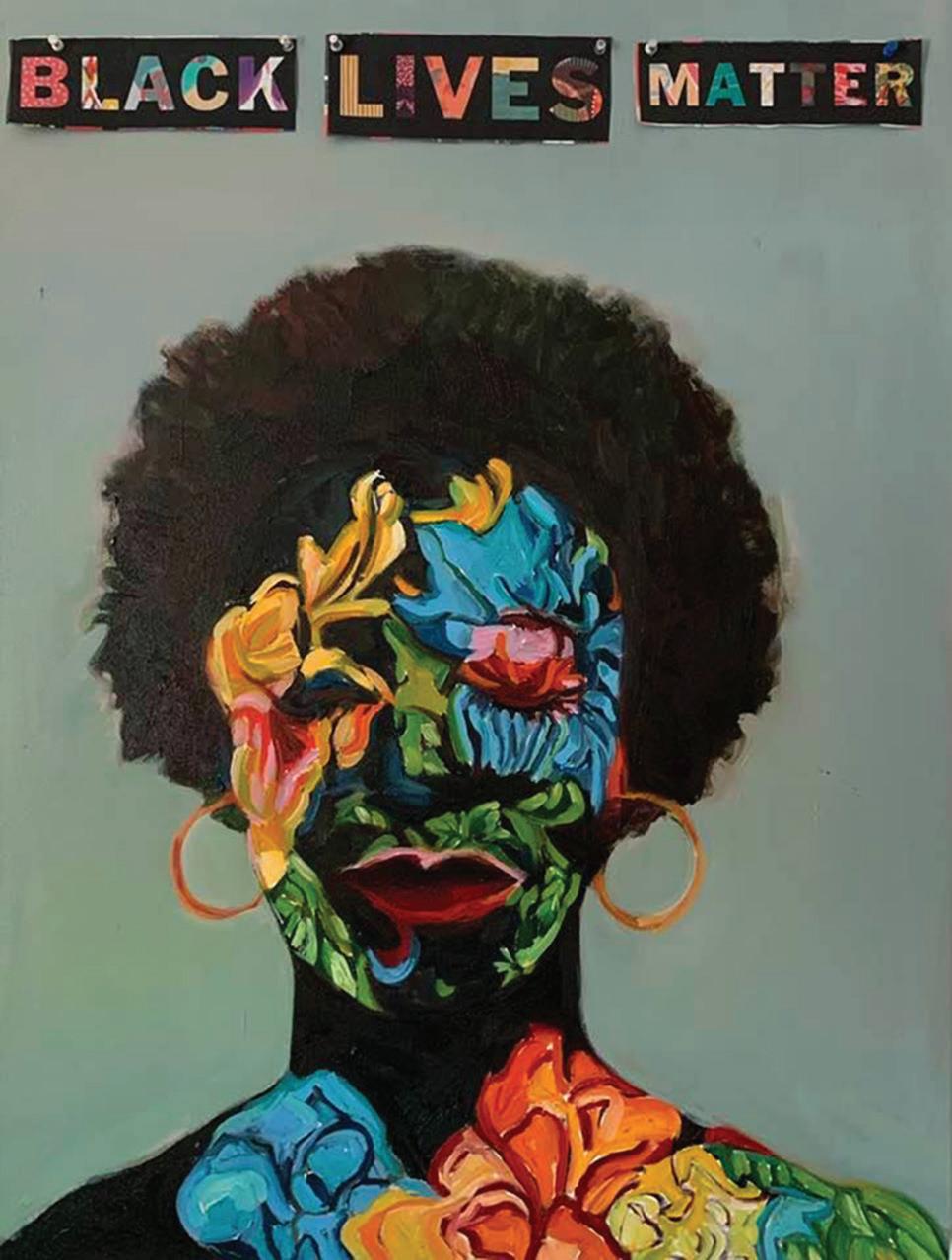
Black Lives Matter (oil and collage on canvas, 40x30) by Beverly McIver
INHERITING EMOTIONAL REPRESSION: LOVE, LOSS, AND LEGACY
a review by Sterling Neill
Terah Shelton Harris. Long After We Are Gone: A Novel. Sourcebooks Landmark, 2024.
The human body is a living archive of past histories, both familial and societal. As demonstrated in Terah Harris’s Long After We Are Gone, suppressing histories written on and expressed by the body can have detrimental consequences. Harris ties the familial history of the Solomon family to the corporeal bodies of each character, presenting their afflictions through a multi-narrative scope, and uses the Solomon family home as a metaphor for societal constraints of inequality, discrimination, and inequity. Inspired by the real-life story of Melvin Davis and Licurtis Reels, African American brothers who were jailed for eight years for refusing to leave land purchased by their great-grandfather in Carteret County, NC, Harris underscores in her novel how legacies of abuse and neglect manifest corporeally and materially.
STERLING NEILL earned her BA from Mercer University, and her MA from Georgia State University where she is now pursuing a PhD. She is secretary of the Emerging Scholars Organization (ESO), an affiliate of the Society for the Study of Southern Literature (SSSL) and is becoming a regular NCLR reviewer
TERAH SHELTON HARRIS is a former librarian and the author of two other books, also published by Sourcebooks: One Summer in Savannah (2023) and Where the Wildflowers Grow (2026). Her books have been chosen for a multitude of accolades, including Target Book Club pick, Kobo Best Book, and Goodreads Choice Awards Nominee for Best Debut. Most prominently, Harris was awarded Target’s Author of the Year.
In this novel, Harris continues to explore themes from her debut novel, One Summer in Savannah, of how tragic pasts, personal and familial, compound the issues of the present, haunting the characters but reflecting how individualized suffering can be overcome with personal reflection and growth. In Long After We Are Gone, Harris utilizes multiple perspectives from the Solomon family – Junior, Mance, Cecily (called CeCe), and Angeline (called Tokey) – to provide readers with an individualized experience for each character, creating a lenticular-lensed story that focuses on the characters’ personal lives and their collective struggle of trying to prevent the legal pilfering of their two hundred-acre ancestral land, The Kingdom.
Harris masterfully juxtaposes the personal problems of each character with their collective hardship of protecting their ancestral land, exposing the similarities between the siblings’ and their parents’ ways of handling pain and sorrow. After the loss of their reticent father, King Solomon, and the absence of their mother, Hazel, the siblings attempt to understand how Malone & Kincaid, a development company, were able to acquire five acres of their land, when there was “a long-standing family promise to never sell the Kingdom. Not a plot of land. Not an acre. Not one inch” (136). Amid the discovery of their uncle Shad’s involvement in selling land to Malone & Kincaid, a pattern of behavior arises in the Solomon siblings: emotional suppression. Slowly, as the characters realize how their parents’ history is reflected in their current lives and motivates the decisions they make, the reader is able to assess how all of the siblings tend to repress their feelings.
While emotional suppression is evident when Junior attempts to deny his feelings for his secret boyfriend Simon, when Cece restricts herself from expressing her love for Ellis, or when Tokey stifles her pain with food, Mance’s emotional suppression is less obvious, yet exposed by his inability to restrain his anger, demonstrating suppression of his softness. Harris strategically positions each character’s situation to reflect disruptions in their sense of identity, initially causing isolated experiences for the characters through a disconnect between self-awareness, personal pasts, and relationships
with one another and exposing the repetitive nature of intergenerational suffering. For example, the emotional avoidance of romantic interests for Junior and Cece mimics the love story between King and Hazel Solomon. While Junior attempts to suppress his longing for Simon under the guise of playing a doting husband and father, Cece suppresses her love for Ellis underneath her fixation on acquiring enough money to replace the money she stole from the clients of the law firm she worked for. Both Junior and Cece use smiling to conceal their true feelings: “Junior knows something about secrets, how to smile through them while keeping a straight face, and how to swallow one” (185), and Cece uses smiles as “a shield and a seal against the rush of emotion bubbling to the surface” (243).
In contrast, Tokey and Mance avoid emotional attachments to their family. Tokey’s overeating suppresses her longing to better know and understand her family, while Mance’s trouble with the law is related to fighting his urge to show tenderness to his deaf son. Harris highlights both characters’ aversions to facing their feelings: while reading their mother’s letters, “Tokey closes her eyes to keep the tears in” (219); “Mance clenches his fists, the rattlesnake in him slithering to the surface” (199–200).
To overcome their traumas, both personal and collective, each character is forced to assess and address their own flaws, including pettiness, abusive behavior, and outright
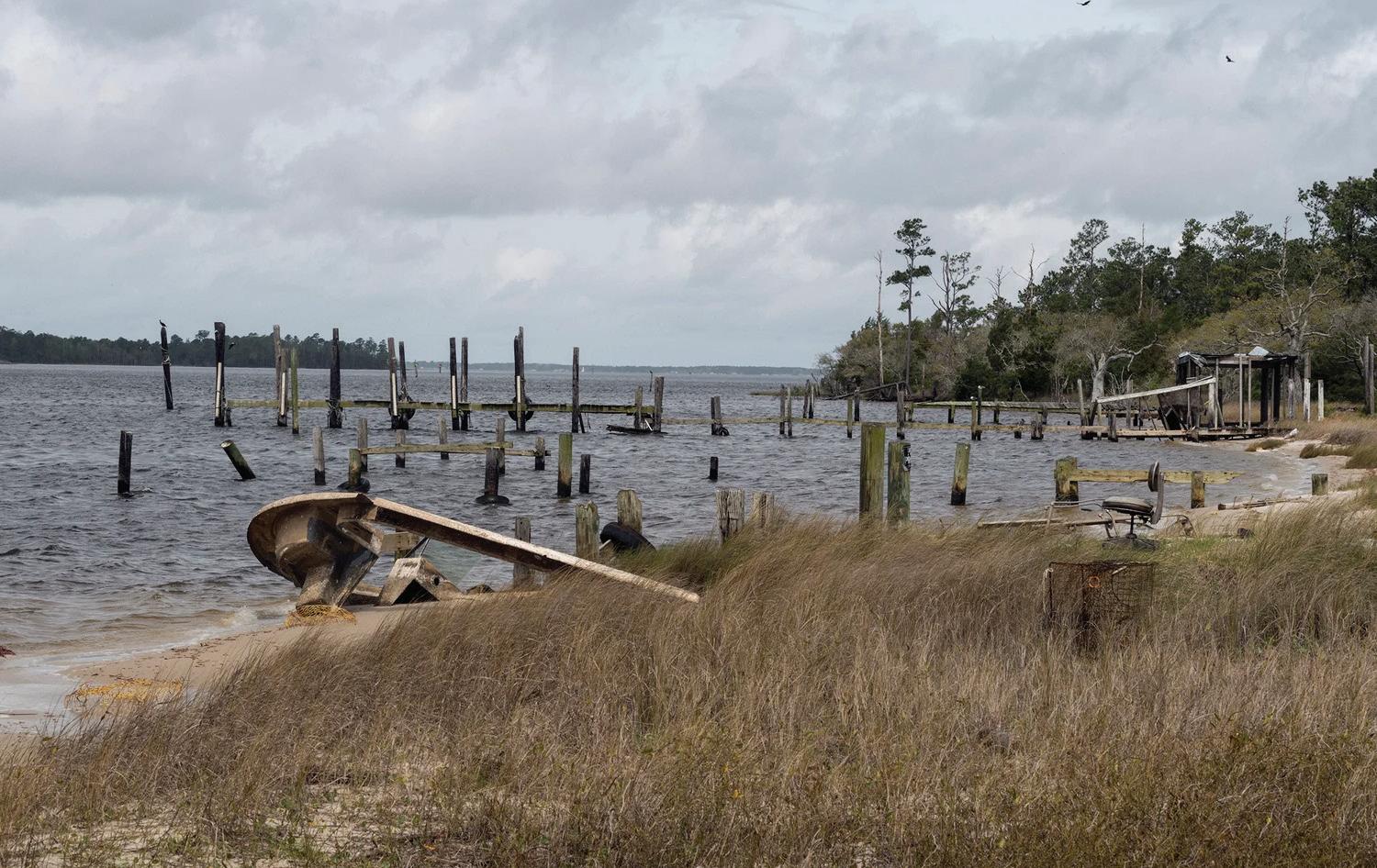
selfishness. While Junior gets in touch with his anger, Mance embraces his tenderness and restraint. Cece takes responsibility for her thievery, and Tokey realizes her family does rely on her, solidifying her voice and reconciling her relationship with her family. In the end, the Kingdom serves as “a place where intergenerational trauma died” and more crucially, a place that “saved them, freed them from a life they didn’t want to live, freed them from the handcuffs of the past” (395). Through reclaiming their land, their birthrights, each character is able to find release and resolution. Ultimately, the complexity of the realistic characters, fluctuating perspectives, and plot structure provide a powerful representation of Black strength and resilience.
Besides the overwhelmingly effective shifts between character viewpoints, one obvious strength of Harris’s writing is her use of symbolism. With King’s sledgehammer, his means of solving challenges, and the gavel of the courtroom,
Harris manifests two types of justice: one dispensed by violence and determination and the other issued through the legal system. In juxtaposing the sledgehammer with the gavel, Harris implies that true justice can only be found in dismantling unjust systems. The characters’ shared struggle over potential, yet somehow legal land loss paired with their individual personal obstacles highlight the impact that systemic structures of violence and abuse have on marginalized individuals. As a work that challenges dominant narratives in literature, culture, and society by centering the marginalized, Long After We Are Gone elucidates how race, sexuality, and class intersect to simultaneously mold individual and collective lives, providing invaluable insights for teachers, scholars, and researchers alike into how systems predicated on racism and discrimination can be resisted and reclaimed through personal and familial reflection and reconciliation. n
ABOVE The waterfront on the property of Melvin Davis and Licutis Reels (the inspiration for this novel), Carteret County, NC, 2019; photograph by Wayne Lawrence
2025 JAMES APPLEWHITE POETRY PRIZE SEMIFINALIST
BY ERIC “L.B.” THOMPSON
After Palm Sunday
when they find the black body leaking life you eroding over it your palms holding a Sunday of soot and gun smoke tell them, that you are the church and this country will always be in need of a bible belt say forgiveness is for wrongdoers and this be righteousness be about policing the policy commandments then compliance now, before they even think murder show them your badge remind them that this is a shield you were merely standing your holy ground exactly what a church is built on tell them a sermon is always in need of a sinner somebody has to be the offering
but when they remember and they will that a church is a service and just a building next to the graveyard say Lazarus say Jesus came back and so will this dead when we release the body cam footage
remind them that you felt threatened it looked like they were reaching for a weapon hands up looked like a hallelujah and ain’t nothing more destructive than God
North Carolina native ERIC “L.B.” THOMPSON is a poet and spoken word artist based in Durham. His work explores memory, survival, Black Southern identity, and the sacred spaces between inheritance and transformation. He has performed at venues across the US and featured in VoyageRaleigh. His poetry blends lyrical storytelling with a deep reverence for cultural legacy, often weaving the physical and spiritual into layered, evocative narratives and drawing inspiration from North Carolina’s landscapes, histories, and communities.
when they question you and they will show them why they deserved it show them the violence of their neighborhoods not the lack of resources that put it there show them the gangs, the poverty not the hands that took away opportunities show them the drugs in their systems not when you put them there Tell them you don’t see color, only darkness when they ask why do you equate that with blackness remind them that their skin is brown, a minority and blue is a primary color a part of the visual spectrum remind them of all you have killed in the name of the light remind them of the holy crusades, when they say those were brown bodies too say, messiah . . . gone . . . somebody had to die for all these sins say, he should have seen you as the church all praise the lord and pass the ammunition he should have known better than to pray like a target he should be grateful for a death so biblical the people will remember his name for three holy days and you have to be back to work on Sunday these streets they won’t police themselves to death this country, they believe in you like a gospel expect your heart to preach deliverance with a pistol remind them of how you are the church and steeples don’t get going home services they just get to go home
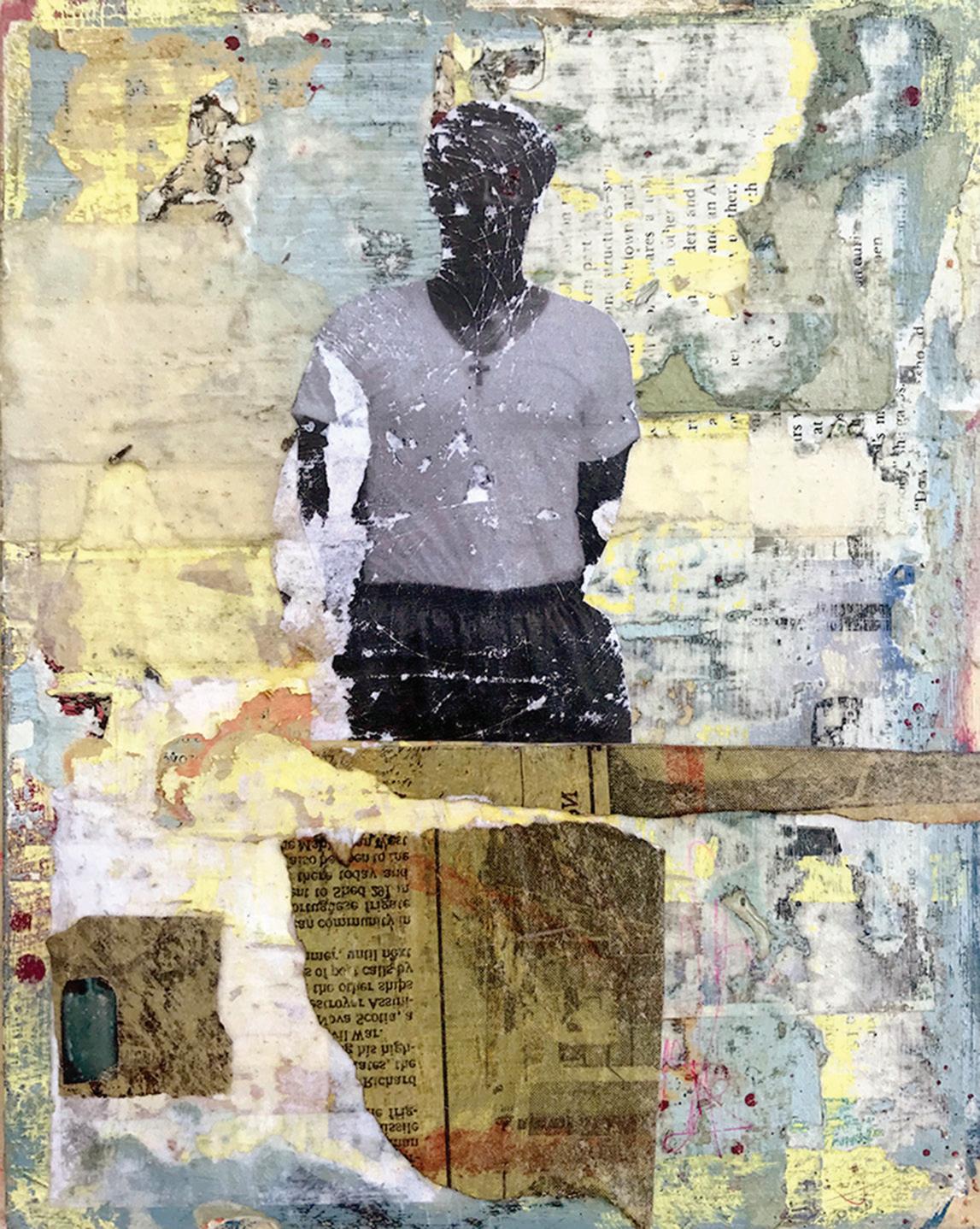
ANTOINE WILLIAMS is a multimedia artist whose practice is at the intersection of cultural mythologies, critical Black study, surrealism, and his working-class upbringing in Red Springs, NC. He received his BFA from UNC Charlotte and his MFA from UNC Chapel Hill. He is Assistant Professor of Drawing in the Expanded Field at the University of Florida. His many residencies include the Joan Mitchell Residency in New Orleans, Center for Afrofuturist Studies, McColl Center, and Rubenstein Arts Center at Duke University. Among his many honors is the 2017 Joan Mitchell Award for Painters and Sculptors, and the 2022 National Academy of Design’s Abbey Mural Prize. His work has been exhibited widely in the US, including in NC at Nasher Museum of Art, Weatherspoon Museum, 21c Museum, and North Carolina Museum of Art. His work is in the collections of Nasher Museum of Art and NC Museum of Art, among others.
There Will Be No Miracles Here series, 2021 (printed material and acrylic on wood panel, 9x12) by Antoine Williams
COURTESY OF THE ARTIST
2025 JAMES APPLEWHITE POETRY PRIZE FINALIST
BY VERONICA SCHORR
The Summer I Left
Turn on the tap –
Hot like a cherry, cold like cola, that blue vein at your temple when you laugh
Miller Lite can bent in a smirk on the lake’s edge where your clothes lie
Vanilla cone from the gas station, licked before the pump clicks me back in time
Your pink cap in the blueberry field where the sun never began to set
We eat the last days of August, spit out the pits

VERONICA SCHORR is both writer and photographer. She is the author of Conscious Blue (Finishing Line Press, 2021), and her writing appears in Bellingham Review, Honey Literary, The Banyan Review, and elsewhere. She is Assistant Poetry Editor at EcoTheo Review and an MFA candidate in Poetry at UNC Greensboro, where she serves as Poetry Editor of The Greensboro Review. This is her first publication in NCLR.
Beach No. 1, 2021 (Polaroid 600 film, 4.2x 3.5) by Veronica Schorr
CURSED THROUGHOUT TIME
a review by Kenly Corya
Adrienne Young. The Unmaking of June Farrow: A Novel Delacorte Press, 2023.
Everybody knows everybody in Jasper, NC, so when June’s mother, Susanna Farrow, disappeared over thirty years ago, the news spread quickly throughout the small town. The townspeople claimed Susanna was mad – after all, why else would a pregnant woman run away by herself into the woods of the Blue Ridge Mountains? In Adrienne Young’s The Unmaking of June Farrow, the titular character must investigate the curse that has plagued the women in her family for generations, and in doing so, she discovers why her mother disappeared into the Appalachian Mountains before she was born.
was simply in two places at once” (11). June is not sure if she should refer to this sickness as hallucinations or delusions, but she knows that she’s seeing, hearing, and smelling things that aren’t real: a man smoking a cigarette on her porch, a horse running down the road, windchimes, a song on the radio, blood in her bathroom sink and under her fingernails, a red door, and a man with his arms around her, whispering her name.
After earning a BA in English and Comparative Literature at UNC Chapel Hill, KENLY CORYA received her MA in English Studies at East Carolina University, where she taught composition and served as Senior Editorial Assistant with NCLR . She has worked as a freelance ghostwriter and editor, and her poetry can be found in The Lookout.
ADRIENNE YOUNG is the New York Times bestselling author of the Fable series and the Sky and Sea duology, young adult fantasy and adult fiction. She currently lives in the Blue Ridge Mountains of North Carolina.
As with all the Farrow women before her, June believes she is cursed with madness and will meet the same fate as her mother and grandmother. Early in the novel, June reasons, “The easiest and most widely accepted explanation for my mother’s strange disappearance was madness – the same affliction to befall every woman in my family for as far back as anyone could remember. We were cursed – the Farrow women” (4). After her mother’s disappearance with her baby, June mysteriously reappeared in Jasper as a seven-month-old baby, but Susanna was nowhere to be found. Without any other family, June’s grandmother, Margaret, raised her. Together, they operated the Farrow family business: the Adeline River Flower Farm.
Now an adult, June not only works at the flower farm, but she also cares for her grandmother as her health declines. As June begins having “episodes,” Margaret insists that she’s not sick and instead claims that “she
After witnessing her grandmother’s declining mental health, hearing stories about her mother, and experiencing these “episodes” herself, June is determined to be the one to end the Farrow curse:
It came for my grandmother, as it came for my mother, and now it had come for me. For years, the town of Jasper had been watching me, waiting for the madness to show itself. They didn’t know it was already there, brimming beneath the surface. . . . That was why I’d never fall in love. Why I’d never have a child. Why I’d never seen any point in the dreams that lit the eyes of everyone else around me. I had only one ambition in my simply built life, and that was to be sure the Farrow curse would end with me. It was as good a place as any to end a story. I wasn’t the first Farrow, but I would be the last. (13)
After Margaret’s death at the beginning of the novel, June learns that she had been keeping secrets from her granddaughter. Days after the funeral, June receives a letter in the mail from her grandmother, postmarked before her death. Upon opening the letter, she finds a photograph from 1911 featuring the subject of Jasper’s greatest mystery: Nathaniel Rutherford, the town’s minister whose murder in
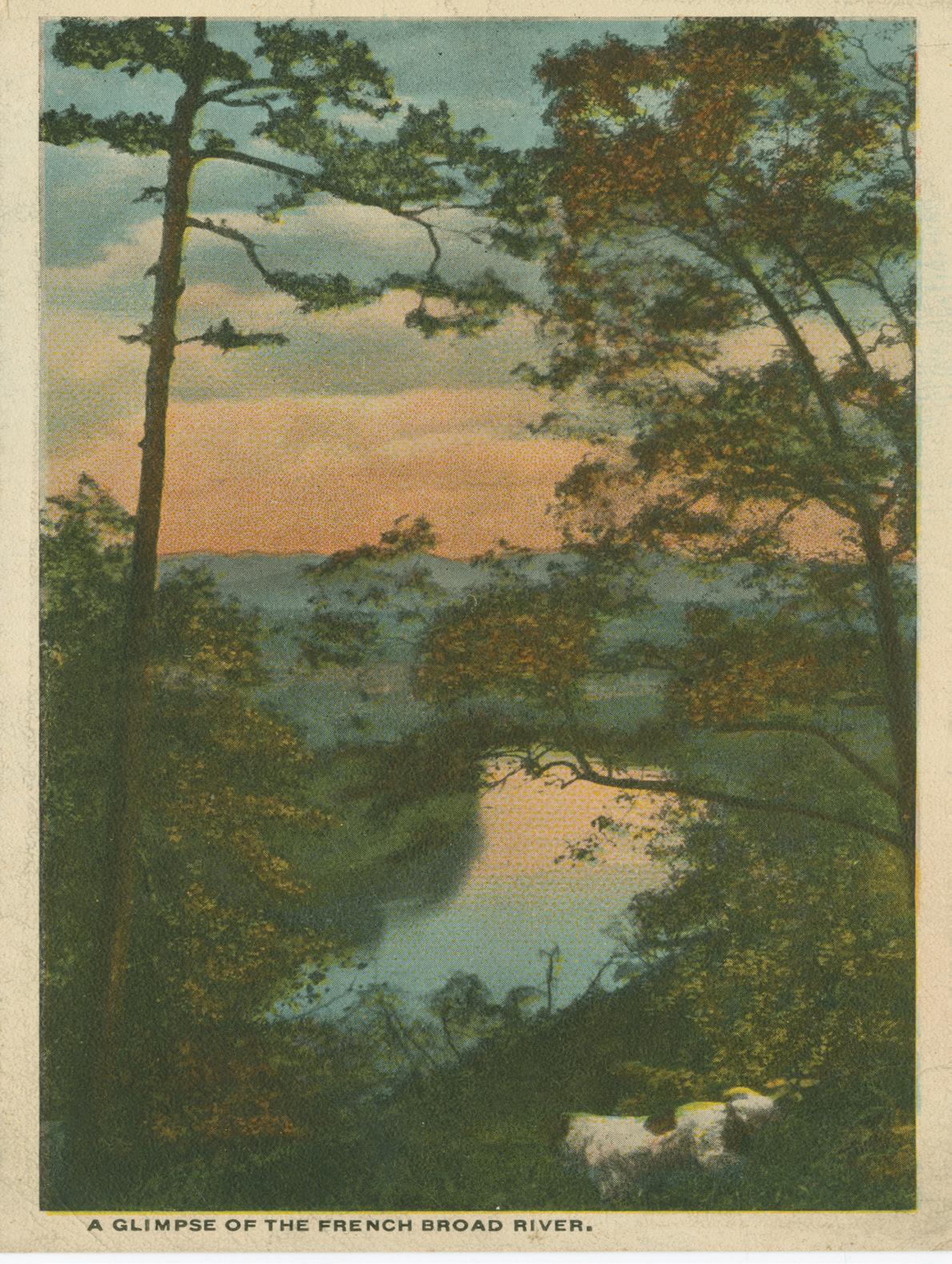
1950 remains unsolved. Standing next to him in the photograph is his wife and June’s mother, Susanna Farrow.
Given that the year is 2023, June is perplexed to see an image of her mother in 1911, and even stranger, the picture is captioned in her grandmother’s handwriting. This image propels June toward a series of shocking discoveries. With the help of Birdie, a woman who lived with Margaret and June and who was “a rare constant” in June’s life
(8), June begins to uncover her grandmother’s secrets and make sense of her “episodes.” For the first time, she considers whether the Farrow women have ever been truly sick or if there could be a supernatural reason for their delusions.
One recurring vision June has is that of “a single red door . . . It was set into a frame, like it had been pried loose from a wall, and yet, it didn’t look at all out of place. Like one brushstroke in a painting” (54). This
door appears to June in random places: at “the farm, once downtown, and . . . in the cemetery” (55). Birdie is shocked to learn that June has seen the red door, and she refuses to elaborate on her secret knowledge of this vision beyond a simple command: “Next time you see the door, open it” (81).
Following the novel’s elaborate exposition, June’s life transforms throughout the remainder of the novel. Upon stepping through the red door, she is plunged into a mystery far more immense than anything she experienced before. Young gradually reveals pieces of this mind-bending, time-traveling mystery as June finds unexpected love and navigates complex, multigenerational family relationships in both the past and present.
While Jasper is a fictional town in Western North Carolina, Adrienne Young claims that she spent a lot of time in Marshall, NC while writing The Unmaking of June Farrow She imagines that Jasper “is full of rolling green farmlands” and “sits on the French Broad River.”* Young’s atmospheric novel features a thoughtful and authentic depiction of Appalachian scenery and culture. The novel’s vivid imagery roots the reader in the lush Appalachian landscape and makes for an ideal backdrop for her mysterious, supernatural story.
Young tactfully navigates grief within her novel, and she highlights relatable experiences after losing a loved one. After
*
her grandmother dies, June remarks, “With a pang of guilt, I realized . . . mundane things . . . went on, even when your world stopped spinning. Edison’s Cafe still closed at 8 P.M., the morning glories still bloomed at dawn, and the mail was still delivered every day but Sunday” (9). While Young examines grief through June’s losses, she also thoughtfully explores the grief that comes with concluding a period of your life and the grief and fear associated with mental health concerns. When June first realizes she is hearing things that aren’t real at the beginning of the novel, she compares the feeling
to “being hit by a rogue wave, the rush of it coming all at once. It didn’t matter that I’d been standing on that shore my whole life, waiting for it. It still felt like the world split in two when it finally arrived” (67). As June’s life is disrupted, her grief becomes palpable, particularly once she believes she can no longer trust her own mind.
Young writes a combination of adult and young adult fiction and fantasy novels, and as a resident of the Blue Ridge Mountains, she effortlessly implements supernatural elements into her realistic and familiar North Carolina settings.
Although supernatural in nature, The Unmaking of June Farrow prompts readers to consider the life we most desire and the challenges that impede our ability to live our dream life. Everyone may not be a time traveler, but perhaps we all have some kind of curse or selfimposed barrier that prevents us from chasing our dreams. Young encourages readers to seek the life they dream, even if that dream feels impossible. With themes of memory, grief, hope, and family connection, Adrienne Young’s evocative novel is equal parts captivating and unforgettable. n
2025 JAMES APPLEWHITE POETRY PRIZE SEMIFINALIST
BY RICHARD ALLEN TAYLOR
In Praise of Time
Give time a little credit. It deserves thanks for all it does with its clock-job, the alarms it’s obliged to deliver, its faithful execution of so many onerous duties. It’s required at all times to be on time, or just in time, or out of time, nighttime, daytime, standard or daylight savings, playtime, olden times, modern times or it’s about time. It must be tired, don’t you think, of having its days numbered, having to work 24/7, not just regular business hours. Surely it must dream of being something else for a decade or two – something less strenuous, a piano, perhaps, with all its keys removed, no notes to strike or chords to play, yet able to imagine, like a deaf Beethoven, the most exquisite syncopations you can bear, the kind that could make a clock smile, if it had a face – but wait, it does have a face – I mean, if you accept that a clock is the face we give to time, such a face would be nothing like those we see on Mount Rushmore, the sort of hardened art that takes a long time to complete. But then we might together face the fact that we don’t really know what time is, only that it can go fast or slow and have waves, like gravity and oceans, and bend to be whatever it is or wants to be.
RICHARD ALLEN TAYLOR is the author of several poetry collections including Letters to Karen Carpenter and Other Poems (Main Street Rag Publishing Company, 2023). His poems, articles and reviews have appeared in Rattle, The Comstock Review, The Pedestal, Litmosphere, Gyroscope Review, and South Carolina Review, among others. Several of his poems have been nominated for Pushcart Prizes and Best of the Net. Taylor formerly served as review editor for The Main Street Rag and co-editor of Kakalak. He earned an MFA in Creative Writing from Queens University of Charlotte and currently resides in the Greenville, SC, area.
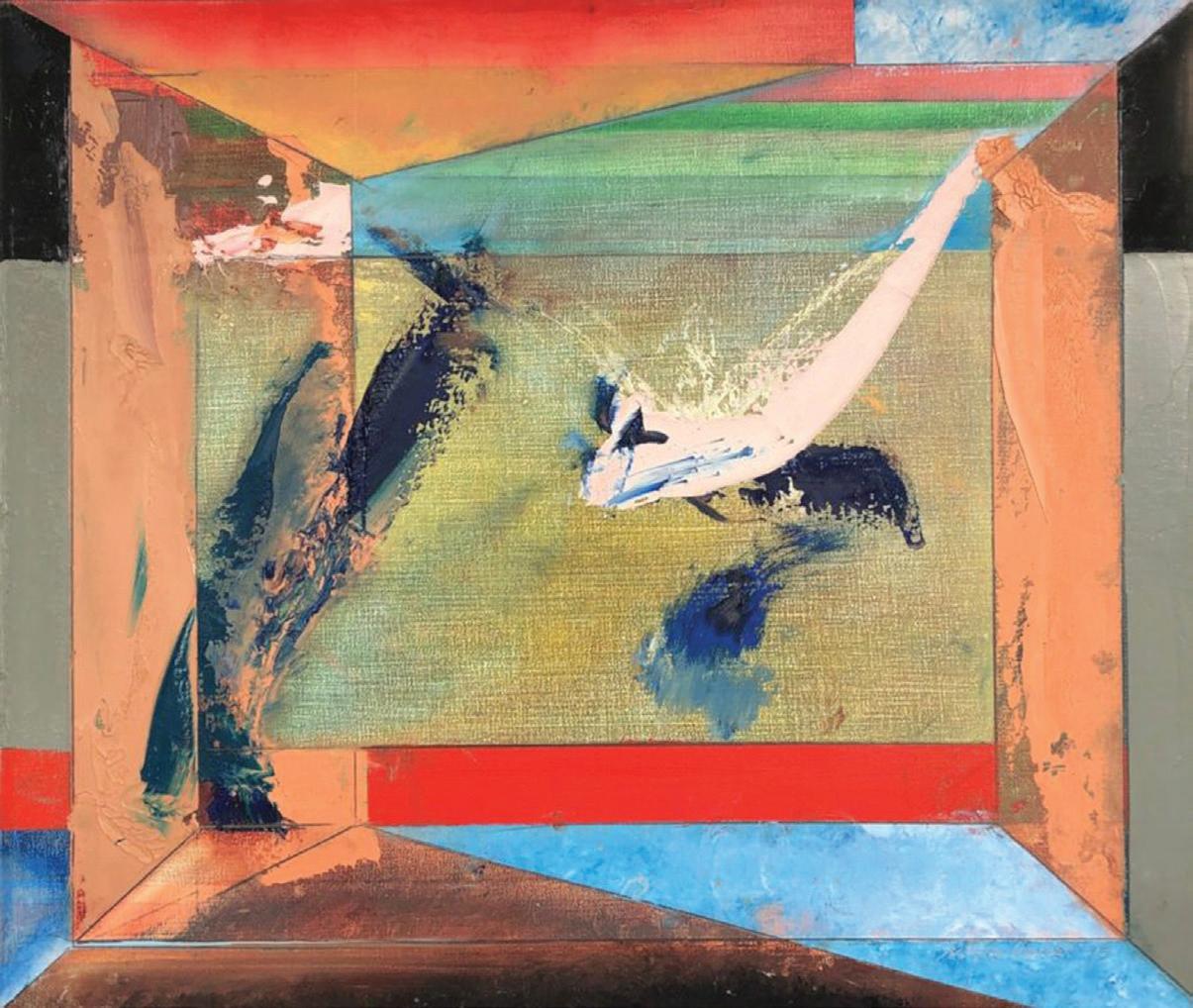
Think of all we would lose without time. Music, progress, growth, memories, planning, nostalgia would all bounce into the gutter like pearls flung from a broken string. We might not miss decay, deterioration, and erosion at first, but eventually would see that without them, rebirth is impossible. Even the word eventually would vanish, along with countless other words and species. If time could speak for itself, it might prefer to communicate in writing. My guess would be a letter, written yesterday in longhand, delivered tomorrow. Or it might show up as a fortune cookie, telling us some fish can’t be caught.
Robbins, NC, native HORACE FARLOWE (1933–2006), joined the US Navy and served in Korea before returning stateside in 1957 to begin his study of art at NCSU. He earned a second bachelor’s degree in painting from Atlantic Christian College and enrolled at ECU in the master’s program in sculpture, graduating in 1964. From that point on, he was an active artist and held no fewer than five professorships. His public sculptural commissions include the NC Zoological Park in Asheville, the Complex Esportiu Municipal in Barcelona, Elon University, and the Museum of Texas Tech University. His sculptures are in numerous permanent collections, including the NC Museum of Art, Mint Museum, and the Greenville Museum of Art. See more of his art at Gallery C in Raleigh.
Time Shift II, 1995 (oil on canvas, 19.5x24) by Horace Farlowe
TELLING STORIES TO LIVE
a review by Terry Roberts
Gary Carden. Stories I Lived to Tell. University of North Carolina Press, 2024.
Christopher Lee Nelson. Where You Are From. Redhawk Publications, 2025.
TERRY ROBERTS was born in Asheville and raised in Weaverville, NC. HIs novels have been awarded the Willie Morris Prize for Southern Fiction and the Sir Walter Raleigh Award for Fiction, the Thomas Wolfe Memorial Literary Award, the James Still Award for Writing about the Appalachian South. He reviews often for NCLR and has contributed content on John Ehle and Elizabeth Spencer as well. Read an interview with him in NCLR 2014.
Revered storyteller GARY CARDEN was raised by his grandparents in the mountains of Western North Carolina. Carden lives near Sylva, NC, and is the author of several books, numerous plays, and the recipient of the North Carolina Award for Literature.
Born in Hickory, NC, and raised in Caldwell County, CHRISTOPHER LEE NELSON earned his MFA from NC State University. After having spent time working as a university instructor, he now begins his writing debut with this story collection set in his hometown streets of Lenoir. Where You Are From was shortlisted for the 2025 Sir Walter Raleigh Award for Fiction.
These two collections – Stories I Lived to Tell by Gary Carden and Where You Are From by Christopher Lee Nelson – provide the reader with an interesting comparison. At first glance, they could not seem more different. Nelson’s collection of more traditional short stories is primarily concerned with the economic decline and fall of a thinly disguised Lenoir, NC, and the surrounding Caldwell County. And while the action in these stories takes place in the shadow of the state’s western mountains, the setting is that of a Piedmont mill town rather than an Appalachian vastness. Carden’s Stories I Lived to Tell, on the other hand, is aptly subtitled “An Appalachian Memoir.” Much of the action is set in and around Carden’s home in Sylva, NC, and consists mostly of his experiences over almost ninety years of mountain life. In the final analysis, however, these two collections –different in so many ways – are alike in a few important ones. It’s in these similarities that we learn significant truths about the human need to both tell and hear stories.
Where You Are From by Christopher Lee Nelson con-
tains nine stories, all of which relate in one way or another to Tucker, NC:
Tucker was a furniture town, prided itself on the fact. The sign on US-321 marking the southern edge of the city limits welcomed visitors to: “Tucker: Furniture Capital of the South.” The first factories were built at the end of the nineteenth century following the explosion of logging north of town. The families, the Hills and Dales, that founded those companies have their name everywhere to this day. (127)
It’s readily apparent from Nelson’s dedication as well as the stories themselves that Tucker is a fictionalized portrait of Lenoir, and the “Hills and Dales” a similarly fictionalized representation of the Bernhardt and Broyhill families who put Lenoir on the map. In creating Tucker, however, Nelson provides a ready template for any number of Piedmont mill towns that suffered a slow economic death from the mid-1970s on, which in turn precipitated a general social and psychological malaise that affected almost all inhabitants whether their income depended on the mill or not. This decline is particularly painful to watch when it pits one

ABOVE Lenoir, NC, 2008, during major transformations to Lenoir’s economy; photograph by Christopher Lee Nelson
generation and its values against the next, which Nelson captures with devastating detail.
Gary Carden’s Stories I Lived to Tell comes from a very different place, both literally and figuratively. Carden is, among many other things, an award-winning author and playwright, but he is first and foremost a storyteller, emphasis on the teller His genius is firmly rooted in the oral tradition of the face-to-face performance of storytelling. Furthermore, he is adamant that he didn’t learn the art of oral performance at festivals but drew from the drama (often tragic) of his own lived experience. As filmmaker Neal Hutcheson explains in his introduction to the book,
The stories collected here, in another medium, can’t replicate the experience of hearing Gary tell stories extemporaneously, but they do capture and preserve a lot of the raw material from which Gary draws in those moments. The stories all originated individually, but they work together beautifully, conspiring to bring an Appalachian community intact from the first half of the twentieth century into the present. (xiv)
In other words, Carden’s tales taken together are a kind of memoir – both of his life and that of his particular Appalachian community – but a memoir delivered with all the rhetorical embellishment of any good raconteur. Carden is not drawing on any sort of literary tradition but rather the oral traditions that preceded the literary.
Gary Carden’s stories are an interesting mix of folk tradition and memoir. They have evolved
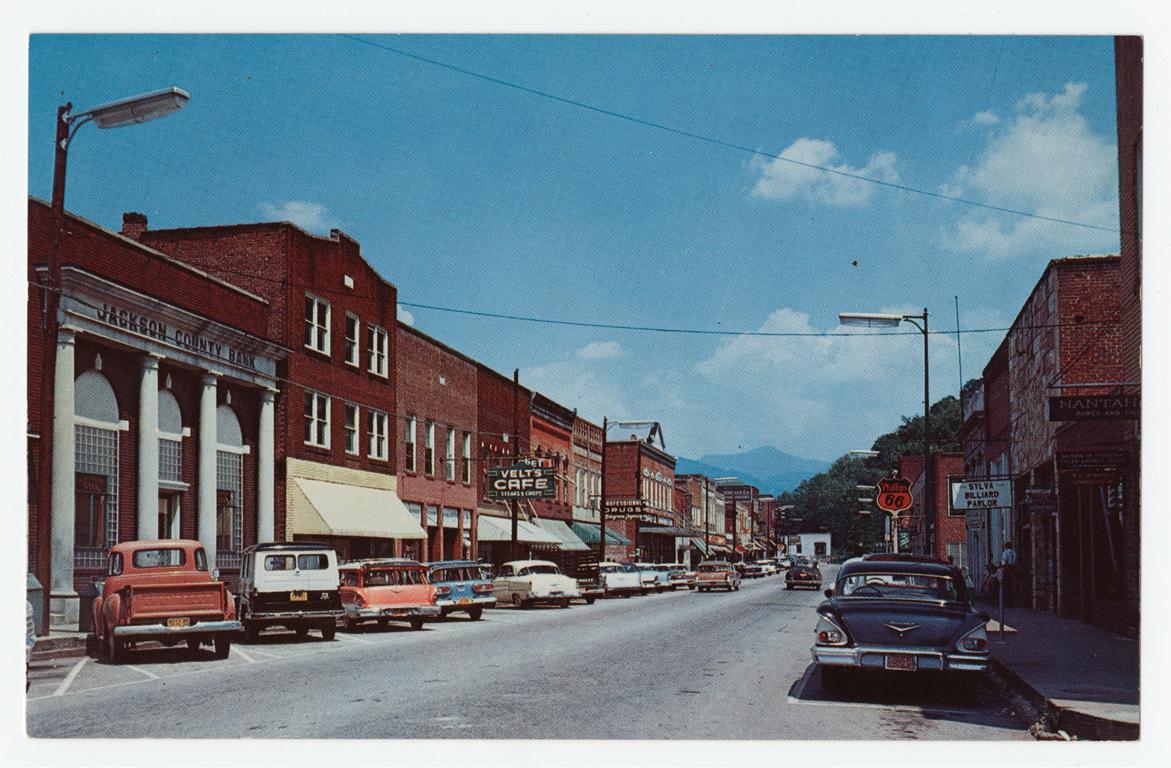
in the same way that folk tales or folk ballads morph over time. In this case, Carden himself has told these stories countless times before dozens of audiences over the course of a lifetime, so that they have “grown in the telling.” They are uniquely his own even though other Appalachian writers have borrowed some of his better-known yarns. To the extent that they have been “revised” by the author, it is through decades of spontaneous interaction between Carden the teller and his listeners.
Christopher Lee Nelson’s stories, on the other hand, are literary creations in that they were created and revised on paper. Where certain stories appeared before, they appeared in print (in the Monongahela Review or The Saturday Evening Post). Whereas Carden honed his craft and sharpened his narratives before live audiences, Nelson learned his craft from other writers in MFA programs and the Sewanee Writers’ Conference. It is an important distinction that one set of stories has been told, the other written.
A second significant difference is that of fiction versus nonfiction. Although the lines between the two genres are blurred in both these collections, most of Carden’s tales are based on his life, while Nelson’s stories are presented as fiction. The subtitle of Carden’s book is “An Appalachian Memoir,” emphasis on memoir. Even so, as Hutcheson remarks in his introduction: “If the particulars occasionally press the limits of credulity, need it be said that embellishment goes with the territory?” (xiv). It’s also worth noting that the title story of Nelson’s collection, “Where You Are From,” suggests strongly that it is about where Nelson himself is from despite the use of the second-person pronoun throughout. Regardless of the shared ambiguity, Carden is clearly recreating his own life and his own community in an overt way, while Nelson seems to be doing so in a more covert fashion. Ironically, this results in fiction that is pointedly “realistic” (Nelson) and memoir that is often quite “fantastic” (Carden).
ABOVE Sylva, NC; courtesy of Durwood Barbour Collection of North Carolina Postcards, North Carolina Collection Photographic Archives, Wilson Library, UNC Chapel Hill
Despite these differences, the two collections of stories converge in important ways. It seems clear that the range of protagonists in Nelson’s stories are all trying to make sense of life in a town that is slowly dying around them. They are all defying the odds in families and communities that are slowly dissolving, primarily due to the economic collapse of the American furniture industry in general and the loss of manufacturing in their hometown. At the end of the story titled “Where You Are From,” the narrator tells “you” that the people remain, struggling to make sense of it all and that “your mother asked you not to forget them” (135). It’s apparent that the story itself and the book that surrounds it are ways of remembering, even honoring, those who have suffered.
In a similar fashion, Gary Carden’s subject – his own life – has been marked by tragedy and suffering. His father was murdered when he was two years old, and his mother left him suddenly and unexpectedly with her in-laws. He was raised solely by his grandparents, who often thought him a strangely imaginative child who was constantly telling people what they didn’t want to hear. There is every sort of illness, loss, disaster, and death recorded in Carden’s stories, but in the end it is the act of telling that redeems both Carden and his audience.
Ultimately, for both Gary Carden and Christopher Lee Nelson, narrative has the power to recall the lost and mend the broken. And that is powerful indeed. n
THE POWER OF REDEMPTION IN POETRY
a review by Grace C. Ocasio
Gail Peck. In the Shadow of Beauty. Finishing Line Press, 2025.
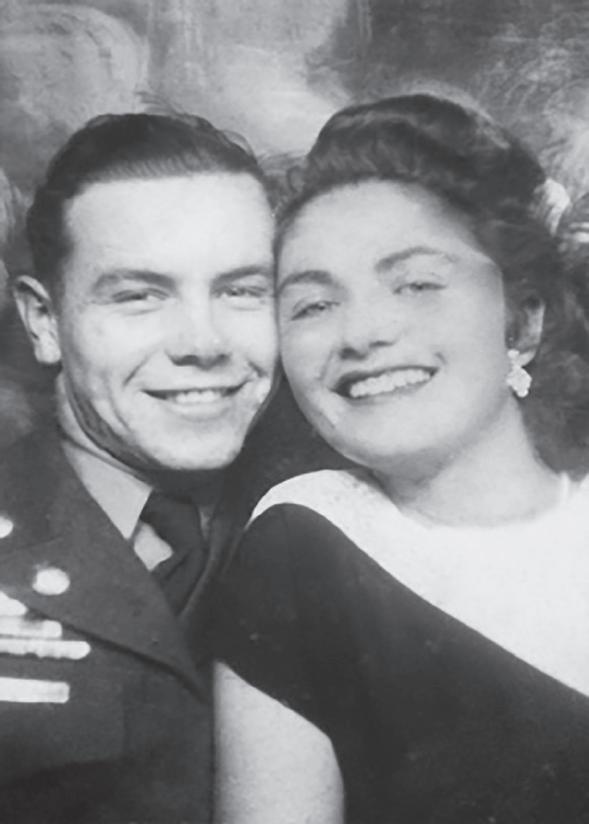
GRACE C. OCASIO is an awardwinning poet, author, and literary critic residing in Charlotte, NC. She earned her MFA in Poetry from Sarah Lawrence College and her MA in English from UNC Charlotte. She has published poetry in Rattle, Court Green, Black Renaissance Noire, The Chaffin Journal, Minerva Rising, and many more. She is a member of the North Carolina African American Writers’ Collective.
GAIL PECK is an award-winning poet, fiction writer, and essayist. She earned her MFA at Warren Wilson College in Asheville, NC. Her poems and essays have appeared in Southern Review, Greensboro Review, Nimrod, Rattle, Southern Poetry Review, and Brevity, among others . Her collection The Braided Light (Mainstreet Press, 2015) won the Lena Shull Poetry Award.
Gail Peck’s collection In the Shadow of Beauty brims with poems that showcase the contradictory nature of the human condition. Peck imbues her language with a boldness that feels unprecedented at times. Occasionally overstepping the boundaries of polite conversation, Peck peels away the surface of familial bonds to reveal how palpable human frailties are. As she unpacks truths on the nature of human existence, her words compel us, ushering us into her private world. What we glean is that human interactions are often fraught with conflicts that upend relationships. Yet Peck’s words offer us moments of grace – redemptive moments in human relationships that seemingly outweigh and outlast these fractures. Many poems in Peck’s first section center around photographs. “Photo Booth, around 1946” grounds us in the reality of Peck’s parents’ unfolding circumstances. First, we learn of their auspicious beginning, followed by the untimely unraveling of their rela-
ABOVE The poet’s mother and father, circa 1946
tionship. Peck opens the poem considering their promising start: “How long had they known each other / when they stepped into that booth – / my mother leaning toward my father.” But if the relationship commences well, we soon realize its flaws as Peck explains her mother’s perspective: “She said she knew it was over / the day he left her, pregnant, in a car / and went in to see another woman.” Appearing early in the poem, these lines constitute a pivotal turn in Peck’s parents’ relationship, shifting the poem in a more ominous direction. The culmination of Peck’s parents’ spiraling relationship occurs when she informs us that her mother “started believing it was a sin to remarry / if you’d ever been divorced,” preceded by Peck’s musing: “Perhaps her guilt was somewhat lifted / once she found out my father was dead. / Now
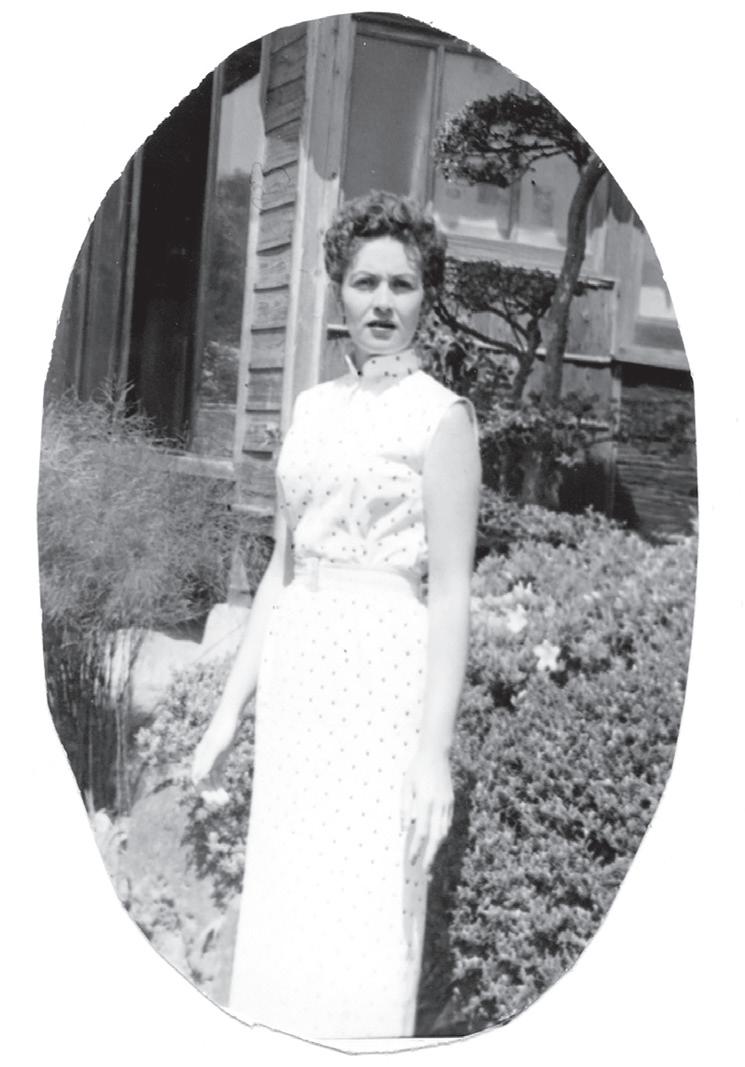
he was truly gone as he had been / from her life and mine for years.” Peck conveys a sense of hopelessness here, sounding a note of resignation. Furthermore, the effect of her father’s death is twofold: severing both the relationship between Peck’s father and mother and between Peck and her father as well. All is not lost, though, as Peck regenerates her parents’ relationship in the poem’s final lines: “When this photograph slid / through the slot, they looked at it / and must have smiled again / at the radiance of that moment.” Using choice diction, Peck elevates the moment when she opines that her parents “must have smiled again” viewing the photograph. Her words suggest that the photograph itself functions as a touchstone, the basis on which to judge the merit of their relationship. We leave the poem with a renewed sense of the vast beauty captured in the smallest of instances.
Juxtaposed against “Photo Booth, around 1946” is “Two Photographs of Me as a Child.” Although Peck explains that the first photograph is of her with her grandfather, she interjects her father into the poem with two questions: “Will they send this picture to my
father / so he won’t forget me? Do they know where he is?”
Peck assumes a child’s voice, exuding both bewilderment and vulnerability. Her father’s absence from her life comes into focus through the vehicle of her questions. Peck chronicles the event that leads to his absence: “I cried when he left with his suitcase, / watched him put his clothes and shoes inside, / shoes he’d worn while I put my feet on his / and danced about the room.” We may conclude that Peck’s unhappy childhood memory of her father leaving her exacerbates the reality of his absence in the present. The image of a young Peck dancing with her father is a charming one and may resonate for us with a more famous poem, Theodore Roethke’s “My Papa’s Waltz.” Although Roethke’s poem is darker in scope, both
poems possess universal appeal as they highlight an intimate moment shared between father and child. Both Peck and Roethke undergo a schism in the parent-child relation, albeit for different reasons. At the same time, both poets offer images that present youths who apparently adore their parents despite fractured relationships. Perhaps Peck’s adoration of her father is clearest in the latter part of her poem where she manages to reinvent/reimagine her relationship with him. She describes herself as sporting a bathing suit with a “dragon on it.” This is the most transformative part of the poem: “My dragon would roar – and if my father came back, / I’d rush to him and show him / how pretty I am, and he wouldn’t care / about getting wet and would lift me into the air.” Thus, what once was her loss (absence of father) now becomes her gain as she reclaims him, her words suggesting that she re-envisions him as suitor/father/superhero. This mythical figure, who can do no wrong, thrives in her imagination, a rival to her real father. Where the first section of Peck’s volume grapples with her early childhood memories, the second evolves into a study of Peck’s young adulthood as well as a montage of portraits of several female relations with special emphasis on her mother. Of all the poems in this section, the one that possesses arguably the most symbolic import is “Writing My Mother’s Obit.” Here we find a reckoning of sorts contained within this poem as Peck unsheathes raw emotion recounting final moments spent with her mother along with a
telling instance of introspection. This more reformative tone and contemplative material is offset by the routine catalogue of major events in Peck’s mother’s life. We learn that she was “an army wife” and “loved by her church family” in the first stanza. But it isn’t until the third stanza that we gain access to Peck’s outlook. Her thoughts function simultaneously as a self-examination and a moment of self-questioning: “Whatever I’d never asked / would remain unasked, and could she / hear what I said?” These lines suggest a reluctant acceptance of the past on the poet’s part as well as angst that her mother would discover something that Peck wishes to remain undisclosed. Yet another sizing up of the relationship with her mother appears near the end of the poem: “A month before she died / I’d stood by her bed, asking to be forgiven / for any slight or shortcoming” As readers, we witness this act of Peck drawing closer to her mother. We sense the genuineness of Peck’s love language and that her repentance is heartfelt, not contrived.
The third and final section of Peck’s collection constitutes a retrospective vision of her life. She weaves in and out of her poems, creating snapshots of herself and various members of her extended and nuclear family – her grandmother, sisters, father, and mother. Apart from a few stray pieces, the entire section serves as an homage – in part to one of her sisters and grandmother but mostly to her mother. The final poem, “Birthplace,” is epochal, her words so vivid that it’s as if we enjoy a dress circle view of scenes
described as the poet explains her origins. Masterfully crafted and lyrical to its core, if the poem were a pop song, it would be ripe for a band like Fleetwood Mac to cover. Peck opens with these words: “You were my beginning and again I am with you, / mother, in the song of the bird perched / in the dogwood of Virginia where both of us / were born.” We may very well hear the lilt of Christine McVies’s vocals as we read these words. But beyond the musicality of the words lies their meaning as when Peck shows us the wonderfully symbiotic relationship she shared with her mother in the third stanza where she reminisces about how she would “pick dandelions” as a child, dandelions her mother would “place / in a glass on the windowsill.” Further down, we observe what Peck has internalized and claimed for her own from her mother: “Listen, you’d say. A mockingbird I couldn’t always see in the distance. You’d repeat the sounds / that I hear now in this silence.” Not only can we visualize this image, but we can hear it. As the sounds echo in Peck’s mind, we mimic her experience, imagining the sounds echoing. Perhaps we will even absorb the echo as though it were a memory of our own. Reading Peck’s In the Shadow of Beauty is an engaging pursuit. Each poem is revelatory, informing us of familial woes and triumphs. Her exploration of her life becomes an exploration of our own lives as we draw parallels between her experiences and our own. Peck’s words honor human relations, lending value to all of life’s moments, great and small. n
A WRITER’S TOOLKIT
a review by Sayantani Dasgupta
Nora Shalaway Carpenter, Curator. Spinning Toward the Sun: Essays on Writing, Resilience, & the Creative Life. Burlwood Books, 2025.
Perhaps the reason this book drew me in is because I am a writer and a professor of creative writing. Maybe it’s because I want to spend all my life being a student, hyperaware that there is no end to learning. Or it’s because I find nothing more enthralling than discovering how other creative people (and not just writers) function on a day-to-day basis. How do they energize themselves? Where do they go to teach themselves new tools and techniques? How do they show up to the page (or stage or canvas) knowing that rewards can sometimes feel so frustratingly out of reach?
SAYANTANI DASGUPTA , born in Calcutta and raised in New Delhi, is the author of Women Who Misbehave (Penguin Random House India, 2021) and Brown Women Have Everything: Essays on (Dis)comfort and Delight (University of North Carolina Press, 2024), both reviewed in NCLR Online Spring 2025, and also the winner of the 2024 Foreword INDIES Book of the Year Awards. Her previous books include Fire Girl: Essays on India, America, & the In-Between (Two Sylvias Press, 2016) and the chapbook The House of Nails: Memories of a New Delhi Childhood (Red Bird Press, 2016). An Associate Professor of Creative Writing at UNC Wilmington, she has also taught in India, Italy, Colombia, and Mexico.
I am happy to report that Spinning Toward the Sun fits perfectly well with other books on the shelf about how creative people do “it.” As Nora Shalaway Carpenter writes in the book’s introduction, the goal behind this anthology is to give readers “insight into the craft of writing and the struggles we all share no matter where we live” (I). However, that’s not all. There is a larger, more noble goal behind this anthology, which is to contribute one hun-
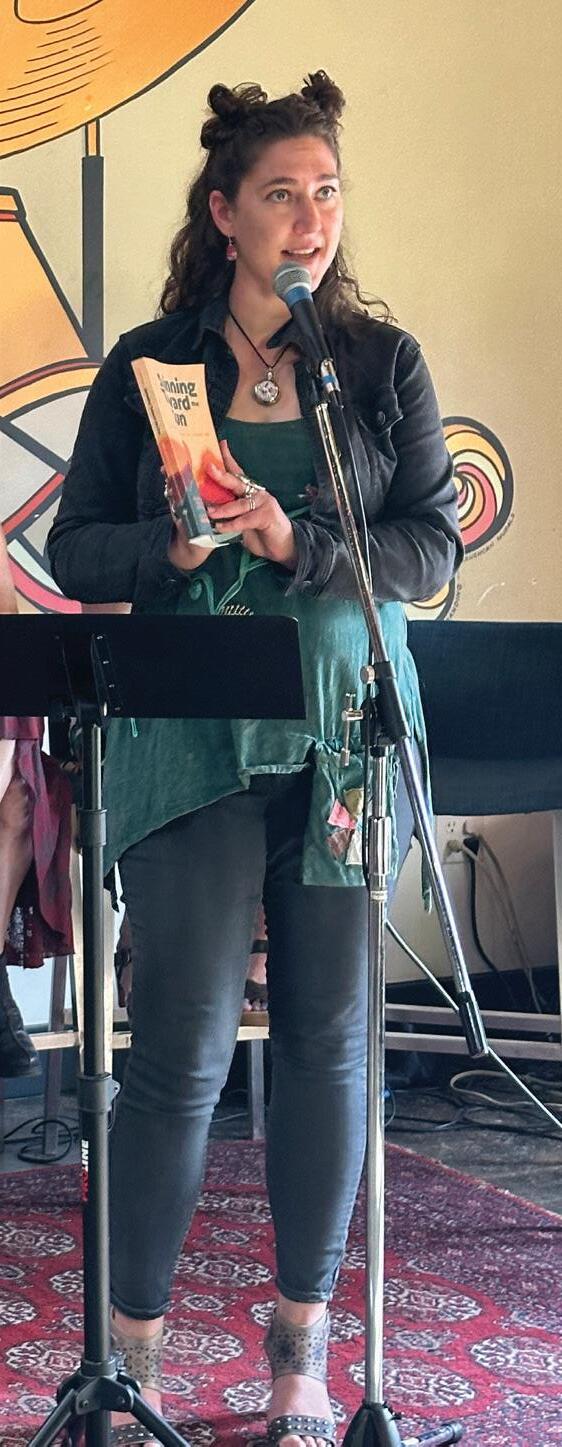
dred percent of the profits acquired from all formats of this book to two groups – Asheville, NC, and World Central Kitchen – so they may continue their efforts to provide resources for victims of Hurricane Helene, the deadly hurricane that tore through the southeastern United States in September 2024.
NORA SHALAWAY CARPENTER’s novel The Edge of Anything (Running Press, 2020) was named a Best Book of the Year by Kirkus Reviews and was North Carolina Humanities’ selection for the Library of Congress’s Discover Great Places Through Reading list. Her novel Fault Lines (Running Press, 2023) won the Green Earth Book Award for YA fiction and was named to the prestigious Texas Library Association TAYSHAS State Reading List. NPR named her anthology Rural Voices: 15 Authors Challenge Assumptions About SmallTime America (Candlewick Press, 2020) to its Best of the Year list. Other accolades include the Junior Library Guild Gold Standard Selection and the Nautilus Award championing “better books for a better world.” Carpenter holds an MFA from Vermont College of Fine Arts and teaches writing at The Whole Novel Workshop at Boyds Mills (formerly the Highlights Foundation). She lives in Asheville, NC.
ABOVE Nora Shalaway Carpenter speaking at the book’s launch at Firestorm Books in Asheville, NC, 30 March 2025

On the one hand, if you are anything like me, you might read the book from cover to cover and gain much from its diversity, to the point where the arrangement of the essays might remind you of braided essays and why they are so easy to admire. In “traditional” braided essays, the braids might include the writer’s personal story plus their research into topics that the rest of us might find “peculiar.” In the hands of competent essayists, however, those same topics, presented with unique analysis and worldview, become fascinating. The same is true of the essays in this anthology.
On the one hand, there are essays that contain writing
prompts, such as “Prophesy and Kinesthesia” by William Alexander and “The Time for Creativity” by Sarah Aronson. Others, such as “Translating Zappa in Moscow” by Linda-Marie Barrett, serve as reminders on why traveling to unfamiliar places is sometimes the best gift we can give ourselves. In “Hold Onto Your (Writer) Friends in Dark Times,” Rob Costello offers the powerful reminder that “publishing is not a zero-sum game” and that one writer’s success does not take away from another’s (71).
Lizzie Brooks, in her essay “Laughing, Crying, and Barreling Toward Acceptance,” makes you feel as if you are in the middle of a conversation with your best friend because only she can remind you of how far you have
come. Cinda Williams Chima, in “Imposter Syndrome and the Value of the Day Job,” offers useful and practical reminders, such as that a day job is a place “to gather material for story” and also where you can be successful when everyone everywhere else might be saying no to you as a writer (61).
If, however, you are not like me, you might go by the titles and bios of the contributors and read the essays in an order that makes sense to you. No matter your approach, I hope you will further recommend or teach essays such as David Macinnis Gill’s “Missed Connections, Misunderstandings, and Misbeliefs,” which is about how to introduce and weave in conflict in fiction. Or learn from Padma Venkatraman how and why to pay attention to body language so the writer may be able to introduce additional layers to their characters, and from Halli Gomez, who extols the value of the creative process in her essay “Life in Small Doses.”
My favorite essay might be by Robin Gow, who in “Counting Beads” offers us all a reminder of why we can never and must never stop making art. Working as a creative person in a capitalist
world, we learn to tie so much of our words to how much money we make and how much we can produce. Likewise, those very things are what determine if we can survive or not.
If, like me, you love stationery, do not skip Kelsey Lecky’s “Shared Light: A Love Letter to Letters.” Besides reminding us
of the value of writing letters – they “are an opportunity to think slowly, deeply, physically” (128) – it is also packed with recommendations on what kind of paper and fountain pens to use to elevate your writing. The diversity that I see as the core strength of this collection may also appear to some readers as its weakness. Is it a book of craft techniques? Yes. But is it also a book on how to be a great (literary) citizen by paying attention to resilience, confidence, and community, three foundational elements without which no writer or creative person can survive? Yes, that too. Why isn’t it one over the other? Perhaps it’s so we can make room for a variety of writers and conversations at the table.
Ultimately, this is a book with a generous and mighty heart at its core, and more of us, and our students and families, will do well to consume art like this. n