NORTH CAROLINA L I T E R A R Y RE VI E W ONLINE
FALL 2026
MILITARY WRITING IN NORTH CAROLINA
n
F E AT U R I N G n
Fiction by Russell Worth Parker and Mariah Smith n Poetry by Louis Girón n reviews of books by Daniel Kraus and Stan Lake n art by Rob Bates, Kristopher J. Battles, Amy Louise Brown, Phillip W. Jones, and Ben Long n and more n n n
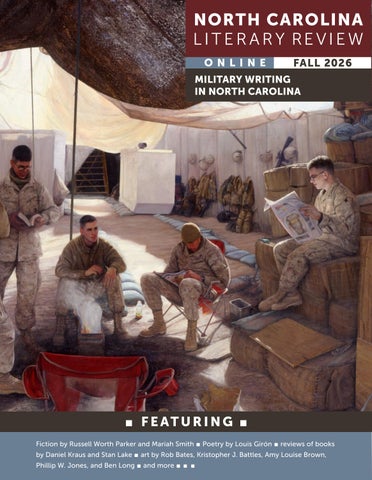
COVER ART TA Little Light Reading (oil on canvas) by Kristopher J. Battles; courtesy of the National Museum of the Marine Corps, Triangle, VA KRISTOPHER J. BATTLES graduated with a BFA in Painting from Truman State University in 1991, and earned his MFA in Illustration from the University of Hartford in 2013. He served as a Marine Reservist from 1986 to 1996 and became a Marine combat artist after reenlisting in 2006, deploying to Overseas Contingency Operations several times to create art for the United States Marine Corps. While much of his high-profile active-duty service involved overseas deployments to Iraq, Afghanistan, and Haiti, his assignments frequently brought him to major Marine Corps installations in North Carolina, including Camp Johnson in 2021, where he spent time sketching US Marines inside the Combat Operations Center. Battles has also served at Camp Lejeune / Camp Devil Dog, creating a series of field drawings titled “Getting There,” which depict students undergoing training. He also spent time observing and documenting North Carolina-based units as they staged for deployment. Battles is currently the Marine Corps Artist in Residence, on staff at the National Museum of the Marine Corps in Triangle, VA. See more of his art with the Parker story inside the feature section of this issue.
COVER DESIGNER NCLR Art Director DANA EZZELL designed the cover of this issue. She earned an MFA in Graphic Design from the Rhode Island School of Design in Providence and is a Professor at Meredith College in Raleigh. Her design work has been recognized by the CASE Awards and in such publications as Print Magazine’s Regional Design Annual, the Applied Arts Awards Annual, American Corporate Identity, and the Big Book of Logos 4. She has been designing for NCLR since the fifth issue, and in 2009 created the current style and design. In 2010, the “new look” earned NCLR a second award for Best Journal Design from the Council of Editors of Learned Journals. In addition to the cover, she designed the Loderstedt essay, the Smith novel excerpt, the Paul Green content, the Jaki Shelton Green news, and the Busto short story in this issue.
Produced annually by East Carolina University and by the North Carolina Literary and Historical Association © COPYRIGHT 2026 NCLR
NORTH CAROLINA L I T E R A R Y RE VI E W ONLINE
FALL 2026
MILITARY WRITING IN NORTH CAROLINA IN THIS ISSUE 6
n
Military Writing in North Carolina includes poetry, fiction, creative nonfiction, and book reviews Malaika King Albrecht Elisabeth Lewis Corley Anna Froula Louis Girón
Daniel Kraus Stan Lake Michael Loderstedt Russell Worth Parker
Annalise Quesnelle Mariah Smith Jonathan Vincent
38 n Flashbacks: Echoes of Past Issues
includes poetry, creative nonfiction, an interview, book reviews, and literary news Naisa Beaumont Bridget Bell Melissa D. Birkhofer Hannah Bonner Nora Shalaway Carpenter Mae Miller Claxton Laura Dennis Wilma Dykeman
Oswaldo Estrada Georgann Eubanks Nora Gaskin Jaki Shelton Green Paul Green Robin Hemley Shannon Hitchcock Jeremy B. Jones
85 n North Carolina Miscellany includes fiction and book reviews
Justine Busto Sharon E. Colley Patricia L. Hudson Nell Joslin Stephanie S. Marshall Tita Ramírez
n North Carolina Artists
Letitia Alvarez Rob Bates Kristopher J. Battles Amy Louise Brown Phillip W. Jones Ben Long
in this issue n
Teresa Martín Luisa Menéndez Nancy Peacock Ali Standish Devra Thomas Paul M. Worley
4
NORTH CAROLINA L I T E R A R Y RE V I E W
North Carolina Literary Review is published annually in the summer by the University of North Carolina Press. The journal is sponsored by East Carolina University with additional funding from the North Carolina Literary and Historical Association. NCLR Online, published in the winter, spring, and fall, is an open access supplement to the print issue. NCLR is a member of the Council of Editors of Learned Journals and the Council of Literary Magazines and Presses, and it is indexed in EBSCOhost, the Humanities International Complete, the MLA International Bibliography, Proquest, and the Society for the Study of Southern Literature Newsletter. Address correspondence to Dr. Margaret D. Bauer, NCLR Editor ECU Mailstop 555 English Greenville, NC 27858-4353 252.328.1537 Telephone 252.328.4889 Fax BauerM@ecu.edu Email NCLRstaff@ecu.edu https://NCLR.ecu.edu Website NCLR has received 2025–2026 grant support from the North Caroliniana Society and from the North Carolina Arts Council, a division of the North Carolina Department of Natural and Cultural Resources.
Fall 2026
Subscriptions to the print issues of NCLR are, for individuals, $20 (US) for one year or $34 (US) for two years, or, for institutions and foreign subscribers, $30 (US) for one year, $54 for two. Libraries and other institutions may purchase subscriptions through subscription agencies. Individuals or institutions may also receive NCLR through membership in the North Carolina Literary and Historical Association. More information on our website. Individual copies of the annual print issue are available from retail outlets and from UNC Press. Back issues of our print issues are also available for purchase, while supplies last. Find prices and tables of contents of the back issues on the NCLR website. Submissions NCLR invites proposals for articles or essays about North Carolina literature, history, and culture. Much of each issue is thematically focused, but a portion of each issue is open for developing interesting proposals, particularly interviews and literary analyses (without academic jargon). NCLR also publishes high-quality poetry, fiction, drama, and creative nonfiction by North Carolina writers or set in North Carolina. We define a North Carolina writer as anyone who currently lives in North Carolina, has lived in North Carolina, or has used North Carolina as subject matter. Consult our website for submission guidelines for the various sections of each issue. Submissions to each issue’s special feature section are due August 31 of the preceding year, though proposals may be considered through early fall. 2027 issues will feature Southern Gothic Literature by North Carolina Writers, guest edited by Barbara Bennett 2028 issues will feature North Carolina Latinx Literature, guest edited by Amy Wright Please email your suggestions for other special feature topics to the editor. Book reviews are usually assigned, though suggestions will be considered as long as the book is by a North Carolina writer, is set in North Carolina, or deals with North Carolina subjects. NCLR prefers review essays that consider the new work in the context of the writer’s canon, other North Carolina literature, or the genre at large. Publishers and writers are invited to submit North Carolina–related books for review consideration. See the index of books that have been reviewed in NCLR on our website. NCLR does not review self-/subsidy-published or vanity press books.
ISSN: 2165-1809
N C L R ONLINE
5
Editor Margaret D. Bauer Art Director Dana Ezzell Guest Feature Editor Anna Froula Digital Editor Devra Thomas Book Review Editor Kristi Southern Art Editor Donna Kain Fiction Editor Rebeccca Bernard Poetry Editor Amber Flora Thomas Founding Editor Alex Albright Original Art Director Eva Roberts
Graphic Designers Karen Baltimore Sarah Elks Senior Associate Editor Christy Alexander Hallberg Assistant Editors Desiree Dighton Randall Martoccia Editorial Assistants Azner Alvarez Michael M. Dillow Marra Haugh Cody Messer Sam Raia Interns Gracie Hatch Des’Tynee Johnson Erin McLaughlin Cairo Ofoemezie Jayden Willis
EDITORIAL BOARD Joseph Bathanti English, Appalachian State University
Leah Hampton English, University of Idaho
Lyra Thomas English, East Carolina University
Barbara Bennett English, North Carolina State University
Rebecca Hardin-Thrift English, Wayne Community College
C.G. Thompson Poet, Greenville, NC
Jim Clark Emeritus, Barton College
George Hovis English, SUNY-Oneonto
Melinda Thomsen Poet, Greenville, NC
Paul Crenshaw Writer, Lawrence, KS
Grace C. Ocasio Poet, Charlotte, NC
Dean Tuck English, Wayne Community College
William Eddins English, East Carolina University
Ken Parille English, East Carolina University
Zackary Vernon English, Appalachian State University
Gabrielle Brant Freeman English, East Carolina University
Kirstin L. Squint English, East Carolina University
Robert M. West English, Mississippi State University
Rebecca Godwin Emeritus, Barton College
Lauren Teneriello English, East Carolina University
Amy Wright English and Foreign Languages and Literatures, East Carolina University
6
NORTH CAROLINA L I T E R A R Y RE V I E W
Fall 2026
The Wages of War by Anna Froula, Guest Feature Editor I was born in 1974 on the cusp of the United States’ final withdrawal from its protracted war in Vietnam. My Gen X childhood was the last of its kind, existing in sporadic, relative peace, despite Reagan’s movie-motivated flexing in Grenada and Libya and the elder Bush’s challenge to Saddam Hussein to “make [his] day” in Iraq. As a university professor, I’ve long wondered about what impact growing up in a constant state of warfare is having on my students, who were born after the younger Bush’s casus belli of 9/11. And given how little coverage we have gotten of our perpetual state of war, how many even notice what the effects upon them are? I remember a lightning bolt of revelation when I realized that the children of the first wave of warfighters in Afghanistan and then Iraq were old enough to serve in the same wars their parents had. This generation of students has never known peace. Under the leadership of the “Department of War,” drone warfare with Iran is changing the face of the US presence in the Middle East, and not in the victorious way they envisioned, given the large-scale damage done to at least thirteen military bases in the region. Jonathan Vincent’s review of Daniel Kraus’s Pulitzer Prize-winning Angel Down calls reveille to NCLR’s last installment of war literature this year, highlighting its grisly portrayal of the hunger for “the next war, the next, the next” in the gaping
maw of World War I (Kraus 263). Next, Louis Girón’s two poems weave the reader in and out of Vietnam War memories. Michael Loderstedt’s piece follows, recalling the ambient stateside violence of Atlantic Beach during the Vietnam War. Elisabeth Lewis Corley takes a beat to remind us to breathe, before my review of three volumes of Brothers and Sisters Like These, and then, Mariah Smith’s excerpt of her forthcoming novel paints an intimate picture of the 2003 invasion of Iraq. Finally, Annalise Quesnelle’s review of Stan Lake’s poetry collection captures the imagistic ties between his toad-catching childhood and his service, followed by Russell Worth Parker’s short story, which muses on the carnage of war and reminisces about the different trajectories of warfighters. Art by Phillip W. Jones, Ben Long, Amy Louise Brown, Rob Bates, and Kristopher J. Battles complement the writing in this section, capturing still moments in an endlessly shifting, violent landscape. Perhaps my prophetical fears will come to nought, and things will soon settle down between the US and Iran, so that future students will finally know and live in an era of peace, or at least the absence of US-led warfare. But even if not, at least we can marshal faith that an admirable and courageous array of writers and artists will always remember the feelings of war and its indelible impressions upon the humanity that such violent conflict sacrifices and leaves behind. n
N C L R ONLINE
MILITARY WRITING
in North Carolina
8 Angels of War a review by Jonathan Vincent n Daniel Kraus, Angel Down 10 Gardening, or At Such a Price, Sight and Pizza Delivery, Evenings, Firebase Currahee, I Corps, South Vietnam, two poems by Louis Girón art by Phillip W. Jones 12 The War Next Door creative nonfiction by Michael Loderstedt 19 The Winged Horse Will Not Be Televised a poem by Elisabeth Lewis Corley art by Ben Long 20 Family Forged in and After War a review by Anna Froula n Brothers and Sisters Like These anthologies 22 From This Far Place: Chapter One: March 19, 2003 – Kuwait a novel excerpt by Mariah Smith art by Amy Louise Brown 29 When Song Birds Fall Silently: War, Nature, and the Toads Along the Way a review by Annalise Quesnelle n Stan Lake, A Toad in a Glass Jar 32 The Ghosts Who Live Among Us a short story by Russell Worth Parker art by Kristopher J. Battles 36 The Want Heart a poem by Malaika King Albrecht art by Rob Bates
ALSO IN THIS ISSUE 38 n
Flashbacks: Echoes of Past Issues
85 n
North Carolina Miscellany
poetry, creative nonfiction, an interview, book reviews, and literary news
fiction and book reviews
7
8
NORTH CAROLINA L I T E R A R Y R E V I E W
ANGELS OF WAR a review by Jonathan Vincent Daniel Kraus. Angel Down. Atria Books, 2025.
JONATHAN VINCENT is a Professor of English at Towson University. He specializes in nineteenth- and twentieth-century US literature and culture, critical social theory, and American intellectual history. He has also written the book The Health of the State: Modern US War Narrative and the American Political Imagination, 1890– 1964 (Oxford University Press, 2017). DANIEL KRAUS‘s Angel Down won the Pulitzer Prize for Fiction in 2026. It was also a New York Times Top 10 Book of 2025 and a national bestseller. His novel Whalefall (MTV Books, 2023) was reviewed on the cover of The New York Times Book Review, won the Alex Award, was a Los Angeles Times Book Prize finalist, and was a Best Book of the Year for The New York Times, The Chicago Tribune, and NPR, among others. He has written over a dozen novels and for television and film. His books have also been named Library Guild selections, YALSA Best Fiction for Young Adults picks, Bram Stoker finalists, and more. His work has been translated into over twenty languages. A Chicago resident now, he lived in Wilmington, NC, in the 1990s and early 2000s.
World War I, in countless historical accounts, gestated the modern world. It’s magnitude and brutality constituted (in the sense of re-founding) the “disenchanted” new order that followed, an abject profaning and desacralization of an older, metaphysical cosmology – if not for all, at least for many. Unfurled in a whimsy of theocratized nationalism, endowed with all the fervor of a soul-making vision quest, the Great War inducted its participants, rather, into a devastating technological apocalypse that – amid the gore of nine million eviscerated human carcasses, nameless numbers of which were dumped into mass graves – laid to rest forever mythologies of the heroic tradition as well as the cultural reassurances of both “providential” human meaning and “progressive” historiography. For the generation that survived it, there was no “mythic structure” to make it cognizable. No pattern of narrative framing could be found to assimilate it, as synthesis, into a cohesive story of “tradition” and “reality.” It would be this desecration of grounding assurances that would propel the modernist search for new aesthetic forms: for formal innovation, for a new materialist poetics, in an attempt – to borrow from Ezra Pound’s often-rehearsed mantra – to “make it new.” Or at least this is the story that, for twenty years now, has sustained my courses on World War I and modernism. Daniel Kraus’s most recent novel, Angel Down, is a blistering World War I tour de force in which, central to its cast of characters is an angel felled from the sky into the Bois du Fays battlefield of the Meuse-
Fall 2026
Argonne Offensive. The recipient of 2026’s Pulitzer Prize for fiction, Angel Down tells the story of five American GIs sent by their commander, Major General Lyon Reis, to investigate a harrowing “shriek” emanating out of No Man’s Land in the wake of a furious artillery barrage and engagement with the enemy. Having themselves just survived its pandemonium of fire and violence, they are charged with fulfilling the honor code protocol of “leaving no man behind” – even if that means simply delivering a merciful coup de grâce to end a comrade’s torturous struggle. It is in many respects also a suicide mission. The men – especially Private Cyril Bagger, through whose eyes events are narrated – are the company’s lowest of degenerates sent deliberately, as disposables, since their loss would mean no real subtraction from the unit’s more talented core. What the men encounter instead, however, is a beautiful and beatified angel, a radiant and celestial beacon of light, downed into as unholy a scene of destitution as I’ve ever encountered in writing. This is, without a doubt, the most demented and revolting human world I have ever seen depicted. In relentless, bludgeoning, hyperventilating, propulsive, whiplashing prose, Kraus carries readers through a go-for-broke hellscape in which not a single portrait of human putrescence has been omitted. Disfiguring every page are sustained descriptions of ditches dripping with mortared human viscera, living cadavers with face-rotting trench mouth, sexual organs festering with gonorrhea, vermin-infested local
Military Writing in North Carolina
villagers living off dead rats. It is a grotesque and morbid world of modern gargoyles. Elliptical on both ends, the novel is, moreover, highly experimental in form. Obviously indebted to magical realism, it is nonetheless aesthetically innovative: beginning with a comma and unrolling, for the duration, without a period, it is even taken in its three-hundred-page entirety – a single, redounding sentence fragment. The effect is to produce in writing what the single-take, rolling “long shot” hopes to capture in film (one has to assume that Kraus was at least partially inspired by Sam Mendes’s 2019 film 1917). From the start, the reader is hurled into a ramifying mayhem – the world of which is an aesthetictemporal mash-up of medieval gothic, industrial-era steam punk, and twenty-first-century anime. But to describe the novel as a revolting modern dystopia is precisely to catch onto something: Kraus’s is an entirely experimental literary canvas, but he’s working in a well-established and venerated tradition – one likely grounded in the Old Testament before moving into Dante Alighieri’s Inferno, Edward Munch’s The Scream, and Pablo Picasso’s Guernica. It is World
War I’s own Otto Dix updated for our time: “a psychedelic pageant of a world in total rupture” (276). Why, then, re-enchant The Waste Land with images from a religious provenance? Why repopulate Paradise Lost with spiritualized relics – angels! – from anachronistic mythic symbology? Because Angel Down is not a novel for the early twentieth century; it is a novel, allegorically, for our own moment – for a time of Putins, and Netanyahus, and Trumps; a time of intoxicated nationalism, paranoid conspiracy theory, and End Times prognostication. (At the time of this writing, the White House lawn has been transformed into a UFC cage fighting arena, the manosphere is redounding with fantasies of Spartan and Roman remasculinization, and the Department of Defense has been rechristened the Department of War.) If World War I squelched older assumptions of progressive historical promise and change, and if we can imagine the generations since as cogs in an ongoing machine of perpetual, industrial war, then we might see Kraus as taking us back to the scene of primal rupture in order to raise some vivifying questions about where we go from here.
ABOVE 113 Field Artillery arriving from France, circa 1919;
courtesy of Military Collections, State Archives of North Carolina
N C L R ONLINE
9
Especially over the last half century, amid a social imaginary paralyzed by postmodern malaise and non-possibility, remembering the inaugural event in what Kraus describes as an ongoing “chain of traumatic violence,” and “at a scale necessary to satisfy global demand,” a demand for “the next war, the next, the next” (263), might constitute a muchneeded reckoning with the shape and futurity of modern history itself. Suffocating, unbearable, escapeless – Angel Down is hard to read, and that’s the point. It’s a novel coextensive with our own contemporary news cycle. And perhaps it’s precisely this inaugural scene of twentieth-century war – the scene of a world in a threshold of intense historical change, a disorienting transition from then to now – that conveys the social optic so missing in our own time: mutability, transformation, possibility. One hopes – and hope is the operative word here to answer the “why celestial sourcing?” question – that, as none other than Lincoln himself once mused in addressing his own moment of social collapse and war, it is precisely in these reckonings with crisis that we might discover, instead, its alternative possibility: “the better angels of our nature.” n
10
NORTH CAROLINA L I T E R A R Y R E V I E W
Fall 2026
2026 JAMES APPLEWHITE POETRY PRIZE SEMIFINALIST BY LOUIS GIRÓN
Gardening or At Such a Price, Sight Patients, blind from birth, whose vision is restored late in life, must be taught to see.—Observation from experimental psychology A pencil-thick silver rope with many legs scurries away from my trowel and tosses a grenade of mulch up my nose. At the same time, directly above, a helicopter banks with an accelerating thwack-thwack. Double-struck, I was back in Vietnam. From the jungle, fine needles, acidic, rotten and sweet, attacked my nose. Two Cobra gunships, late to the dance, hunted above, prowled low, snarled in my ear, beat loud and louder.
The End Of The Day (pastel on paper, 20x26) by Phillip W. Jones
Black bags lay on the ground. Some were flat. I would fill them. Beside me and about me, bodies, all young, of all colors, caked with dirt, some with scraggly patrol beards or timid first-time moustaches. Uniforms torn, some burned and blackened Limbs twisted. Boonie hats ripped. Eyes open, fixed. Faces sallow, gray, without the play of anger, fear, or pain. All in repose, a repose I could not match. Amid the stench of av-gas and accelerants, the nose-stabbing reek from the jungle, the pounding sound, shrouds pretending to be clouds, despite or perhaps because of absent limbs, the earth ground beneath the skin and into their flesh, the mummy-like faces, and the unblinking sightless stares, for the first time, I saw the physical beauty of men. *** I did my duty, I did not weep. Today, I say, the mulch burns strong.
Military Writing in North Carolina
N C L R ONLINE
11
2026 JAMES APPLEWHITE POETRY PRIZE SEMIFINALIST BY LOUIS GIRÓN
Pizza Delivery, Evenings, Firebase Currahee, I Corps, South Vietnam Night, as if projected in black by a mercury lamp, snapped on. Bird calls and our sales patter to the VCs began. The 105s trumpeted our pitch: “Thanks for the sappers last night, keep the coupons on these pizzas. You can order again. Enjoy the toppings. Extra spicy: They will take the roof off and out of your mouth. Custom made. No charge for fast home delivery. Right to your doorstep. We’ve got your address.” In the bunker, foot bouncing faster than the beat of the outgoing salvos, not wanting to hear the rustling of rats in the tunnels, I waited for lulls in our sales pitch, then I taped a reassuring letter home, fell into a kind of sleep, sapper-special/fat rat-special .45 under the pillow, soothed by the backup, to dream of pizza in the real world.
LOUIS GIRÓN grew up in San Antonio, TX, and was a Battalion Surgeon in Vietnam. His poems have appeared in numerous venues, including Kakalak 2025, Snapdragon, Songs of Eretz, Sunflower Petals, The Great Smokies Review, VietNow, Warscapes, and Winning Writers, among others. Read another of his military-themed poems in NCLR Online Spring 2026. Retired from his career as a neurologist and clinical pharmacologist, he lives in North Carolina.
Chow Time (pastel on paper, 20x26) by Phillip W. Jones
Private First Class PHILLIP W. JONES was born in Greensboro, NC, in 1944. He studied at the Ringling School of Art in Sarasota, FL, and served with Combat Artist Team V in Vietnam from November 1967 to March 1968.
12
NORTH CAROLINA L I T E R A R Y R E V I E W
Fall 2026
2026 ALEX ALBRIGHT CREATIVE NONFICTION PRIZE SEMIFINALIST
BY MICHAEL LODERSTEDT
THE WAR NEXT DOOR
That night I listened while a colonel explained the war in terms of protein. We were a nation of high protein, meat-eating hunters, while the other guy just ate rice and a few grungy fish heads. We were going to club him to death with our meat; what could you say except, Colonel, you’re insane? –Michael Herr, Dispatches
Charlie don’t surf and we think he should Charlie don’t surf and you know that it ain’t no good Charlie don’t surf for his hamburger Momma Charlie’s going to be a napalm star –The Clash, “Charlie Don’t Surf ”
IT WAS A TYPICAL SATURDAY NIGHT. We’d finished dinner at our grandparents, bathed, and were lying on the big round rug in our pajamas. As we settled into an episode of Bonanza, Grandpop noticed some large plumes of smoke coming from the beach in front of their house. He’d taken a part-time job as the island’s Justice of Peace, which meant enforcing the town’s rules. Mom was probably in Atlantic Beach, dancing and smoking with her girlfriends, hoping to meet a nice guy. She had been alone since she split from Dad and we had moved to the island. “I’m going to check out that smoke,” he said as he slipped out the door, hopped in his Scout,
and headed for the cut between the dunes. I stayed home watching TV; the rest of the story Grandpop recounted later. Grandpop drove up on fire and two Marines and their girlfriends laughing loudly. He didn’t get out of his buggy. “Hey buddy,” Grandpop called out to them, “You’re gonna have to put the bonfire out. There’s no fires allowed on the beach in Emerald Isle.” “Yeah, Pops,” the bigger guy replied. “You and what army’s going to make me put it out?” The others started to snicker. One of the Marines got up and walked behind my granddad’s beach buggy. “Hey, Mac,” Grandpop said, “I don’t want any trouble, but you guys are going to have to put the
MICHAEL LODERSTEDT grew up on Bogue Banks, NC, in the mid-’60s through late ’70s and returns frequently to the area to research, write, and photograph for ongoing writing projects. Professor Emeritus of Kent State University where he was the Interim Director of the School of Art, he earned his BFA in Printmaking from East Carolina University. He also earned an
MFA from Kent State University. His visual art is in the Cleveland Museum of Art, Progressive Insurance, and the Cleveland Clinic Foundation. His poem “Why We Fished” won NCLR’s 2021 James Applewhite Poetry Prize and is the title poem of his debut collection of poetry, Why We Fished (Redhawk Publications, 2023; reviewed in NCLR Online Spring 2024).
Military Writing in North Carolina
N C L R ONLINE
13
VIETNAM MAY HAVE
BEEN A MILLION
MILES AWAY
FROM OUR LITTLE
PARADISE, BUT IT
WAS ALL AROUND US
ON EMERALD ISLE.
fire out.” Suddenly, the guy who’d walked behind the buggy reached in the driver’s window and clenched one arm around my grandpa’s neck, then punched the side of his head. My grandfather stomped the accelerator, dragging the guy down the beach as he hung onto the buggy window, eventually falling into the sand. Granddad headed back home, not before considering running the guy over. His ear was bleeding, but it was just a minor injury. Grandpop returned, burst through the door, agitated and out of breath. We were engrossed in the Bonanza episode; the Cartwright sons were chasing outlaws through a canyon on horseback. Grandma jumped up, “Larry, what the hell happened?” “Chub, get my pistol. These assholes messed with the wrong guy.” “Larry, for Christ sakes, call the cops. You’re an old man that’s gonna get yourself killed.” Grandpop was shuffling through his dresser drawer looking for his pistol and ammo. Grandpop was near sixty. He’d been in his share of scrapes, and
Tree Swing at Haywood’s Landing (silver gelatin print) by Michael Loderstedt
The photography with this essay includes one by the author of a local hangout on the White River. The others are from Vietnam Photographs from North Carolina Veterans – The Memories They Brought Home (Arcadia Publishing, 2019), compiled by Martin Tucker, a Vietnam-era US Navy veteran and an award-winning photojournalist, author, and filmmaker. Martin is the recipient of the Distinguished Service Award from The Military Order of the Purple Heart for creating the exhibit A Thousand Words: Photographs by Vietnam Veterans. The exhibit includes sixty black-and-white and color reproductions of photographs taken by North Carolina Vietnam veterans during their tours; it is housed in the permanent collection at the North Carolina Museum of History. His book is based on that exhibit; it received the Best Photography Book Award from the Military Writers Society of America. Tucker was Director of Photography at the Sawtooth School for Visual Art and taught digital photography and photojournalism at Summit School, both in Winston-Salem, NC.
14
NORTH CAROLINA L I T E R A R Y R E V I E W
Fall 2026
AS WE GREW OLDER, ALL THE
YOUNG MEN OF THE ISLAND WERE
SCARED AS SHIT THAT ONE DAY
THEIR NUMBER WOULD BE CHOSEN.
For In Country, 1968 (photography) by Joe Anthony, US Marine Corps; courtesy of Martin Tucker, from Vietnam Photographs from North Carolina Veterans – The Memories They Brought Home
he wasn’t afraid of much, certainly not a couple of punk Marines. “Larry, put the gun away, and call the goddamn cops. Use your head for once,” Nana implored. Finally, he went into his home office. I could hear him calling the county sheriff, describing the guys’ appearances. But it would be an hour before the sheriff would get there from Morehead City. Those Marines would be long gone by then. There was little he could do at this point. Grandpop was always respectful of servicemen. His son Lee was stationed in Hanoi, an operations officer in the Air Force. Most every weekend evening, we spent the night with our grandparents. It gave our mother a chance to mingle with folks her own age, perhaps a potential husband. My brother, sister, and I would stare out the big picture window of their beach house, watch the surf trying to crest the dunes. After dinner, we’d get cleaned up and into pajamas, the three of us lying at their feet around the television. The daily casualty report
would flash across the television screen as Walter Cronkite wrapped up the news with “and that’s the way it is, March 16th, 1968.” Our uncle Lee was serving in Vietnam. After dinner, my grandmother would lead us to bed. She’d listen at the door to make sure we said our prayers. Now I lay me down to sleep, and pray the Lord my soul to keep, and if I should die before I wake, I pray the Lord my soul to take. But I didn’t want my soul taken from our warm house on this sandy beach. I certainly didn’t want my grandmother’s only son to die fighting in Vietnam. On my knees beside that bed, my face pressed against the chenille bedspread, I’d end that prayer a little more loudly so Nana could hear me. “Dear God, keep Uncle Lee safe in Vietnam,” I said as she listened by the door. As we grew older, all the young men of the island were scared as shit that one day their number would be chosen. We talked about our secret plans
Military Writing in North Carolina
of running away, comparing the merits of our new lives in Canada or Mexico. We’d heard the news stories of Lieutenant William Calley and his men gunning down those women and children in that ditch in My Lai. The massacre was discussed within our family, but not my secret plans to dodge the draft. Grandpop would have been furious, like the time he yelled at the television when Cassius Clay announced he would not serve. I didn’t want Grandpop to think less of me, that I didn’t love my country. But I was afraid to go to Vietnam. “Son, you know one of those kids would’ve thrown a hand grenade to kill our boys,” Grandpop said in a solemn tone. I quietly nodded my head. But the vision of bodies piled one on top of another, children and mothers covered in their own blood, kept coming back to me, the cries of these people in that ditch growing faint amidst the automatic gunfire. I couldn’t get it out of my head. I wanted no part of this. Grandpop told us stories of how he tried to enlist into the Army as World War II broke out. First at just seventeen, then multiple times after, the answer the same – F4: disqualification for flat feet. Back then, servicemen were expected to march. Grandpop’s feet had little arch to them. His feet probably saved his life, and for that I was quietly grateful. Vietnam may have been a million miles away from our little paradise, but it was all around us on Emerald Isle. The Marine Corp fighter jets roared over the island practicing “jump landings” across the sound at nearby Bogue Field. Our house shook so hard the dishes fell to the floor. Each night, you could hear the rumbling of artillery practice from Lejeune or watch the dotted red lines of tracer fire beyond Bogue Inlet. Grandpop would call the Bogue Air Station, “Your goddamn jets are breaking all my dishes,” asking to have their flight patterns changed. The reply, “There’s a war on, sir. You’ll have to get used to the sound of freedom.” One day we were fishing the Point for bluefish, and a black plume of smoke arose from the marshes on the backside of the island. Twenty minutes later a military firetruck came barreling down the hard-packed beach toward us.
N C L R ONLINE
15
“Hey, lady,” a corpsman yelled over the truck’s engine. “How do you get to that smoke?” “Now you kids stay put,” my grandmother told us. She left us with our fishing poles, leading the truck over the sand road behind the Coast Guard station to the closest point to that downed plane. A Marine flyboy had lost control of his jet, ejecting before dumping it in the marsh. He was only bruised and battered from hitting that hard wall of rushing air, but others weren’t so lucky. My grandmother had known several Air Force pilots, friends of her son Lee. If she could aid a rescue, she would. As the Vietnam War raged on, I often dodged other dudes who wanted to fight – the Marines who’d yell out “fucking hippie” on the beach, even the drunken road paver my mother started dating who swung his fists at us. Violence was prevalent. It seemed to be the default solution to conflict. There had to be other ways for men to interact instead of kicking someone’s ass. As a small, scrawny boy, I was so tired of being someone’s punching bag. Grandpop had taught me how to fish, and later gave me his custom Browning 12-guage. He and I built custom trout rods together in his basement. Using an old sewing machine motor, we fabricated a rod-spinning lathe to wrap colored nylon threads to hold the guides in place. Our spinning rods were the best around and we began to create a following of dedicated fishermen who purchased them. I also became an excellent marksman, hunting ducks on the wing. Grandpop’s trust taught me there were other paths besides the military to becoming a man. All island folk gathered the abandoned military’s flotsam on their daily trips down the beach – the washed-up cases of C-rations tossed overboard from nearby landing craft maneuvers, the remains of hot-air-balloon flares, steel cartridge boxes and
”THERE’S A WAR ON, SIR. YOU’LL HAVE TO GET USED TO THE SOUND OF FREEDOM.”
16
NORTH CAROLINA L I T E R A R Y R E V I E W
Fall 2026
ALL US TROOPS WOULD COME HOME IN SIXTY DAYS, MY UNCLE LEE AMONG THEM. IT SEEMED LIKE THE END OF A BAD DREAM WITH 58,220 DEAD AND NOBODY WINNING.
the jettisoned aircraft fuel tanks. This was free material for new projects, perhaps a go-for-broke pontoon boat made from lashed together aluminum jet aircraft tanks. There was no lack of imaginative uses for military discard. The canned crackers and Spam were welcomed snacks for hungry island teens. Finding this stuff reminded us of the vast reach and resources of the US military. Servicemen loved our island, too, mostly the bars and amusement park of nearby Atlantic Beach at the opposite end of Bogue Banks. The large dance halls attracted young locals and servicemen looking for a good time. Women from outside the region would be there, too, some whose stories you didn’t know and who didn’t know yours. But it also became a battleground every weekend. All that hormonal energy and alcohol fueled constant fistfights between the jarheads and the long hairs. When all hell broke loose and the pool cues started swinging, it was easy to determine whose side you were on by the length of your hair, the cut of your jib. If you got in legal trouble back then, the judge might offer enlistment over jail time. In this way, a lot of knuckleheads ended up in the service – druggies, losers, petty criminals with little direction or ambition. The island kids bought and sold drugs to these dudes. In exchange, they’d buy us alcohol if we were underage. Occasionally, we’d bring them into our circle of friends, but only if they were a “cool Marine” or maybe in the Coast Guard. They had to be able to “maintain” while using drugs or booze. Hotheads that liked to fight were avoided. The young women of the area sometimes married Marines. It was a hard-won ticket off the island, maybe to another country where you could start anew, re-invent yourself. The local boys would
cynically joke that a beautiful island girl who married a jarhead would be haggard, skinny, with a snotty-nosed baby on her hip in a year. It was a cruel stereotype, but like many, it had a ring of truth to it. When you’re young and cute in a beach community, without much education or direction, all you have is your body. It is your currency and everyone wants to spend it for you, sometimes with or without your permission. This was doubly true for young women. Island girls were forced to gain a certain toughness for self-preservation. Visitors to the island assumed you were easy to bed; after all, you’d chosen to live at beach-party central. Island boys needed to protect their sisters and the sisters of their friends. We had each other’s back and could usually sense those with bad intentions. There was a tribal bond between the island’s children, an unspoken code that we abided by for our own survival. Finally came the announcement of the end of the war in January, 1973, a year before I was scheduled to register for the draft. All US troops would come home in sixty days, my uncle Lee among them. It seemed like the end of a bad dream with 58,220 dead and nobody winning. A psychic load had been lifted off the younger island boys. We’d dodged the bullets, missed the trip wires, and would not smell the napalm (in the morning or any other time). The older local boys who served came back. They still wanted to smoke all our dope, drink beer, and chase pretty island girls. They flexed their new tattoos like we owed them something we could never repay. The punches thrown in the local bars came back too, now with a little more behind them. Some servicemen told stories of getting spat upon, or called baby-killers. A few called
Military Writing in North Carolina
us pussies for not having served. That war came back home for a bit, not like it had ever left, this time fueled by more and better drugs. Our teenage rite of passage would be to pile in Lacey Mabe’s little Toyota and drive the twentysome miles to the legendarily violent Court Street in Jacksonville (home of Camp Lejeune) on a Saturday night. Lacey was a few years older than the rest of us, maybe twenty. He ran the island’s general store owned by his father. He had long, straight, blond-almost-white hair like Johnny Winter. To other Marines looking to get wasted,
N C L R ONLINE
he looked like he’d be holding good drugs. Lacey could make the best trades with the Marines – an eight-ball of coke or a half-dozen hits of windowpane acid for some decent weed. We’d watch Marines toss each other across the bars, tumbling, kicking and biting their way toward an eventual night in the brig to sober up, but not before grabbing some other Marine’s girl or kicking some hippie’s ass. We’d try to ride that edge of this spectacle, hoping to get back to the island without a broken nose. It was dangerous, like running the streets of Pamplona with angry bulls or swimming in an ocean of sharks and an open wound. You knew you’d get hurt, but your aim was brushing close enough for bragging rights. Court Street brought it all together in one flashy strip, an amped-up, mega-hormonal playground. Girls were there in the sleazy strip joints. From the open doors of the bars, sticky booze poured out onto the sidewalk. Rock and roll music blasted from every doorway’s loudspeaker. You had to yell to be heard. Marine MPs, arms crossed, stood around waiting to break up fights. It all seemed so choreographed, a Technicolored man-circus. The grimaced faces lit in neon colors, dragged in a headlock to an awaiting van. As much as I abhor violence, there was something fascinating about watching it.
THE GRIMACED FACES LIT IN NEON
COLORS, DRAGGED IN A HEADLOCK
TO AN AWAITING VAN. AS MUCH
AS I ABHOR VIOLENCE, THERE WAS For In Country 2, 1970 (photography) by Mike Callahan, US Army; courtesy of Martin Tucker, from Vietnam Photographs from North Carolina Veterans – The Memories They Brought Home
17
SOMETHING FASCINATING ABOUT
WATCHING IT.
18
NORTH CAROLINA L I T E R A R Y R E V I E W
I was under eighteen. I could only mill about the street and peer into the bars through doorways. IDs were checked everywhere, unlike the island bars that would serve us without much question. I had long hair, so was repeatedly asked, “Are you holding?” or “What you got, man?” Some of the young Marines seemed rather pathetic, puppy-like, so desperate for a high. In the ’70s, everyone had our own demons and cravings. Things seemed to be moving faster and faster, tourists took over the island; every square inch of sand got something built on it. The war had pushed us too far, our little island seemed about to tip over. I rarely visited Court Street again. When I did, I couldn’t wait for the ride back home. In the car, we’d trade stories of what we’d seen, the narrow escapes or plans for the drugs we scored. The accounts were always funnier from the safe interior of that Toyota driving back over the high-rise bridge to the island. The novelty of Court Street had with limited shelf life. I never returned after I became eighteen. Intuitively perhaps, I knew the likelihood of suffering a beating would be greater after I was no longer a dopey high school kid. Even though it seemed a remote possibility, I took the SAT test one Saturday morning during a blistering hangover and completed an application to the closest state college. I’d met a new group of friends who worked at a seafood restaurant. I washed dishes and bussed tables, working late nights, then partied after hours listening to music with the waitresses off from college. Nobody ever wanted to fight or punch me. Fighting Marines, I’d had my fill. n
Fall 2026
THINGS SEEMED
TO BE MOVING
FASTER AND
FASTER, TOURISTS
TOOK OVER THE
ISLAND; EVERY
SQUARE INCH
OF SAND GOT
SOMETHING BUILT
ON IT. THE WAR
HAD PUSHED US
TOO FAR, OUR
LITTLE ISLAND
SEEMED ABOUT
TO TIP OVER.
Military Writing in North Carolina
N C L R ONLINE
19
2026 JAMES APPLEWHITE POETRY PRIZE FINALIST BY ELISABETH LEWIS CORLEY
The Winged Horse Will Not Be Televised When you learn to draw – breath, lines – you quickly inhale, slowly exhale. And often you yearn for the skills of others. Stern instructors help. And don’t. Some lines don’t meet. What we can bring to life, or can’t, outlines us. We use words but words can’t bring you what I see – the red-tailed hawk against the grey, the way his still perch, the barred wings folded above the barn, want to mean – something. I mean, I want them to – his presence – I want it to signal the white mare in the winter field, the one who might be coming over some time horizon, something splintering like my vision, the visions my hand can’t draw. I draw back the spine of the book and the book
The Morning After (mixed media, 7.0625x9.5) by Ben Long; courtesy of the National Museum of the Marine Corps, Triangle, VA
of my body, breathing in slowly and out like the hawk’s cry as I try at the last to learn to live in the world, how not to want to leave it. How to allow the spare words – the ones that still come – and how to bear the ones that don’t. The skittish mare is a horse – the hawk, a bird. Start here.
ELISABETH LEWIS CORLEY’s poems have appeared in Michigan Quarterly Review, Southern Poetry Review, Hyperion, Carolina Quarterly, Feminist Studies, BigCityLit, New Haven Review, Cold Mountain Review, NCLR, and others. Read her Applewhite third-place poem in NCLR 2026. She holds an MFA in poetry from the Warren Wilson Program for Writers and a BA with Highest Honors in Poetry from UNC Chapel Hill. She was awarded a 2018 North Carolina Arts Council Fellowship in Poetry. Her father, Colonel Robert J. Corley, served a tour in Korea and two tours in Vietnam. The poet has written a collection of poetry and a novel inspired by her father’s military experiences.
BEN LONG, a native of North Carolina, enlisted in the Marines and served over two tours of duty in Vietnam as a Marine Corps Combat Officer; during his last tour he served as Commander of the Combat Art Team. Much of his work from that period is on display at the US National Marine Corps Museum. He is one of few artists recognized today as a master of the art of fresco painting on wet plaster, the process used by Michelangelo in the Sistine Chapel. His honors include the prestigious Leonardo da Vinci International Art Award. See a sampling of his frescos in NCLR 2021.
20
NORTH CAROLINA L I T E R A R Y R E V I E W
Fall 2026
China Beach (ABC 1988–1991), the only television series about the Vietnam war anchored by a female character, strove to honor the veterans who inspired the show. Each season’s filming began with a seminar called “Vets Day,” where “veterans shared their experiences with the cast and set a tone of consequence for the coming episodes.” 1 But consultations with Vietnam veterans didn’t end there. Late in the second season, the series aired “Vets,” an episode that played scenes from the fictional show against interviews with veterans recalling similar situations from their own experiences. Star Dana Delaney subsequently helped two participants, Diane Carlson Evans and Nellie Coakley, raise money for the Vietnam Veterans Women’s Memorial in Washington, DC (Dukes 136). “Vets” received a Peabody Award, and, years later, its interview segments were incorporated into the Lyndon B. Johnson Presidential Library (Dukes 138). The work this single episode did in the late 1980s, elevating the stories of Vietnam War veterans – combat soldiers and support roles alike – Joseph Bathanti’s veteran-centered writing workshop continues to do in the twenty-first century. Bathanti describes how he approached and continues to expand his method in NCLR’s print issue, so I won’t retread that ground here.2 But he does remind us, crucially, that “stories
FAMILY FORGED IN AND AFTER WAR a review by Anna Froula Brothers Like These: Vietnam War Veterans. St. Andrews Press, 2017. Brothers & Sisters Like These: An Anthology of Writing by Veterans. Redhawk Publications, 2023. Brothers & Sisters Like These: An Anthology of Writing by Veterans, Volume III. Redhawk Publications, 2025.
ANNA FROULA, Professor of Film Studies at ECU, served as Guest Feature Editor of the 2026 issues of NCLR. She has published widely on gender and representations of US warfare and is co-editor of Reframing 9/11: Film, Popular Culture, and the “War on Terror” (Continuum, 2010), American Militarism on the Small Screen (Routledge, 2016), and Televising True Crime in the Digital Age: Critical Feminist Perspectives (Routledge, 2026). She is the founder and co-director of ECU’s summer bridge program for new veteran students, the Veteran to School Boot Camp, which worked with its tenth squad Summer 2026. Read her and some of those veterans’ interview with Ben Fountain in NCLR 2022 and her interviews with veterans in the 2026 print issue. 1
Brad Dukes, China Beach: A Book About a TV Show About a War (Short/Tall Press, 2018) 130–31; subsequently cited parenthetically. 2
Joseph Bathanti, “Miraculous,” NCLR 35 (2026): 96–109; subsequently cited parenthetically.
can save us” (97), both, I would add, the writing and the reading of them. Writing down one’s painful stories to understand them can be a grueling gutpunch of a process, but on the other side is some semblance of peace or at least a sliver of understanding. As one participant from the first unit of writers explained, “We found a voice we didn’t know we had and that we weren’t alone or different” (qtd. in Bathanti 107). These writers capture the universality of the war experience. The 2017 anthology, Brothers Like These, was the first published edition of workshop material, and it features Vietnam veterans with prose and poetry arranged in sections delineated as “Before,” “In Country,” and “After.” The 2023 volume spans multiple conflicts, as does the 2025, which notes that postCOVID pandemic adjustments have called for zoom writing classes that also make possible international participation. “Stories are for joining the past to the future,” notes Bathanti in his NCLR essay (98), and it is on us as a nation to make those connections. As Russell Worth Parker pointed out in the veteran panel interview, also in the 2026 print issue, civilians are the back end of the spear, and the military is the pointed front.3 We’re all in it together. These anthologies are thick with history lessons, memorializations, releases of emotion, emergences of survivor’s guilt 3
Anna Froula, “Grabbing Us by the Ears: A Panel Discussion with Three Veteran Writers,” NCLR 35 (2026): 86–93.
Military Writing in North Carolina
mixed with gratitude, and the grasping toward an understanding of PTS(D) and its symptoms. Some of the stories detail positive experiences and missions. One captures scenes in rural Iraq, where the writer helped conduct humanitarian missions, such as fitting a wheelchair for a polio-stricken twelve-year-old boy (2023: 21). Another crafts an ode to North Carolina’s Veterans Healing Farm outside Asheville (2025: 112). A third writer works to bolster those veterans who didn’t deploy to war zones and personally enter the conflicts (2025: 114–115). The writers draw the reader into such moments of cultural contact, such as when a US warfighter noticed a man as a “thermal signature” a few kilometers away with his finger on the trigger (2023: 50). When his unit confronted him, they learned he was a shepherd who was confused about why the US personnel were in his country in the first place and shared his
only meager provisions with these strangers (51). Another author retains the hope that a young Vietnamese girl remembers the kindness of one US soldier (2025: 44). Still another captures the beauty of landscapes that also linger in memories (2025: 65). Much of the work delves into physical injuries and their aftermaths. A veteran remembers that “On the ship, I was given an M-16 rifle. But it wouldn’t fire until I cleaned the blood off it” (2017: 15). Another piece delves into the factory-like setting of the Graves Registration unit and the mechanical processing of human remains (2017: 35). The reader must consider such material realities of war as “cadavers . . . piled up like discarded ragdolls in a makeshift bin” (2023: 166). Writers detail how war claims lives decades later by lingering in the body as lethal chemicals and haunted memories (2025: 46). Wars also linger in other formations, such as broken relationships, affinity with past enemies, and moral injuries. Readers encounter the pain of the Jodie figure, who ravishes your loved one while you are deployed (2025: 119), grieving
ABOVE Several of the veterans from the writing group gathered with their instructor,
former NC Poet Laureate Joseph Bathanti (far right) for the performance of Brothers Like These: A Staged Reading of Writing by Vietnam Veterans, in Duck, NC, 23 May 2019; front row: Pete Ramsey, Army; George Durden, Army; Ed Norris, Marine; a restaurant employee (name unknown); Wayne Heflin, Army; David Robinson, Army; Ed Spangler, Marines; Alan Perkal, Air Force; Bathanti; back row: Mike Smith, Navy; Charles Erskine, Army; Stephen Henderson, Marine; James Watts, Army; John Hoffman, Army; Michael Ireland, Army; David Rozzell, Army; Bruce Kelly, VA doctor; Butch Gudger, Marine
N C L R ONLINE
21
and acknowledging loved ones on both sides of the battlefield (2025: 80), and the lasting scars of moral injuries. One piece reminds us of deployments to lesser-known missions to US territories like Vieques, Puerto Rico (2023: 163). Another gives us the blunt explanation that the “whole damn encounter” of the Vietnam War “was a giant, monumental, big fat lie” (2023: 84). An Army nurse narrates memories of receiving the young, evacuated children and infants of Operation Babylift, memories triggered by a photo of a child handed over barbed wire to a Marine in Kabul during the evacuation forty-five years later (2023: 78). A story reiterates the need for military women to have bathroom buddies because of the potential threat some of their brothers-in-arms pose (2025: 57–58), and the same author’s poem recounts in lyrics how women survived rape and other sexual assaults to the Commanding Officers who were too angry about their mere presence to protect them (71– 73). An additional story conveys the unspoken horror of keeping the foot on the gas as ordered when the enemy tried to stop her by throwing a child in front of her truck (2023: 172). The selections in these anthologies are not easy reads, but I encourage readers to take on the mantle of reading them to understand the experiences of those we continue to send to wars. n
22
NORTH CAROLINA L I T E R A R Y R E V I E W
Fall 2026
from This Far Place Chapter One: March 19, 2003 – Kuwait by Mariah Smith
with art by Amy Louise Brown
Dusk was falling in the desert, and I could barely see the map in front of me. Our military police team of three was tucked inside our
Humvee, trying to stay out of the blowing sand while we ate. My team leader, Sergeant Norris, stretched the paper map in the center of the truck on the gunner’s platform where I usually stood to look out of the roof turret, manning our crew-served weapons. Private First Class Jose Ramirez, the driver on our team and my best friend in the platoon, dozed in the driver’s seat, his empty MRE packet on his lap. Norris broke the comfortable silence. “The war is going to start soon. The President is just waiting for a break in the sandstorms to start the invasion.”
MARIAH SMITH served twenty years in the US Army as a Military Police Officer, including two tours at Fort Bragg, NC. She was a platoon leader in the initial invasion into Iraq in 2003 and later served three tours in Afghanistan between 2007and 2014. She is a graduate of the FBI National Academy and recently completed Stanford’s Continuing Education Novel Writing Certificate Program where she drafted her novel, This Far Place. She now works for a defense tech company and serves on the Board of Directors for No One Left Behind, a national nonprofit dedicated to assisting our Afghan and Iraqi wartime allies. An avid rider since childhood, she owns some land in Vass, NC, where she dreams of building a horse farm someday.
AMY LOUISE BROWN retired from twenty years of Army service as a sergeant major. For three years, she served as the Army’s artist -in-residence, creating art from the challenges of soldiers in the field. Her works include paintings of the military in Afghanistan and the US, including its relief efforts after Hurricane Sandy. SFC Brown’s last position was at the Army Public Affairs Center at Fort Meade. Before joining the military, Brown taught art at East Wake High School in Raleigh, having earned a degree in studio art from Meredith College. More of Brown’s work can be seen at Fine art Reproduction from the US Army Art Collection. Her work was also featured on the cover and inside of NCLR Online Winter 2026 and in NCLR Online Spring 2026.
Military Writing in North Carolina
N C L R ONLINE
23
“They gave us the plan for the platoon and the company,” Norris continued. “We’re going to be screening for the main force of Third Infantry Division when they move across the border. Each platoon occupies a breech lane.
Norris traced the border between Kuwait and Iraq on the map with a dirty finger and pointed to eleven hash marks dotted along the border. I leaned forward for a better look in the fading light. I had always loved maps. Norris moved his finger upward, along a thin line of road and gestured at the first few inches of Iraq above the Kuwait border, where we now sat. When he looked up, his round, kind face was serious. “This is the road we’ll be screening along for the first forty-eight hours.” “They gave us the plan for the platoon and the company,” Norris continued. “We’re going to be screening for the main force of Third Infantry Division when they move across the border. Each platoon occupies a breech lane. We have the west-
ernmost one. They’re calling it Breech Lane Appling; they’re in alphabetical order, and there are eleven of them.” Our other three platoons were already positioned at their breech lanes, just like we had been since that morning. We’d driven north for about an hour from a military camp in Kuwait where we had spent the last three weeks. Now we were part of a circle of trucks, composed of the rest of our platoon – ten trucks in all. Our OE-254 antenna, all twenty-six feet of it that allowed us to talk to other platoons in the company, looked like a naked, slender tree in the center of our circular formation. All around us, hundreds of military vehicles had been gathering throughout the day.
Defensive Position (watercolor on paper, 9.75x15) by Amy Louise Brown; courtesy of U.S. Army Art Collection
24
NORTH CAROLINA L I T E R A R Y R E V I E W
“Once we’re through the breech lane, there won’t be any US troops west of us,” Norris said. “So, anything we encounter coming from the west won’t be friendly forces and we’ll have to stop them while the main invasion force – 3rd ID – moves north.” “When will it begin?” Jose asked, his eyes on the map, leaning over from the driver’s seat. Dark stubble had started to sprout on his chin; we hadn’t showered in days. “Don’t know; probably sometime in the next day or two,” Norris replied. “We have to be ready to go at any point. They’re going to start a bombing campaign tonight and then mainly it’s waiting for the weather to let up for better visibility before ground forces go in.” “My dad said that Bush is determined to get Saddam Hussein because he wants to finish what his dad started during Desert Storm,” Jose said, running a hand over his short black hair which was creased from wearing his helmet most of the day. “Was your dad in Desert Storm?” I asked. “No, he’d been out of the Marine Corps for a long time by then. He was in Vietnam for two tours though. In 1971 and 1973. When he was our age, before he married my mom.” “Did he say what it was like?” Norris asked, pulling a pack of cigarettes from the pocket of his quilted chemical suit top. “Yeah, some. I remember him telling my brother Ric a lot of stories of how bad Vietnam was before Ric went to Parris Island for boot camp. I was only fourteen when Ric joined the Corps and Dad let me listen. He said I needed to know what I was getting into in case I joined too.” Norris unzipped the flexible plastic window of our truck’s door and folded down the top a few inches before lighting his cigarette. “I did the rotation in Kosovo with the company three years ago, before September 11, but it was pretty quiet,” Norris said. Norris was about six years older than us and
Fall 2026
I realized he had never told me much about World War II.
Definitely nothing bad. Only good things, like running into his brother on a transport ship home or getting to see Paris . . .
a sergeant, which is why he was our team leader. He’d been my boss since I joined the company last October as a private, fresh out of Basic and Advanced Individual Training. His patience and willingness to explain things to Jose and me made me consistently grateful I was in his team. Jose had arrived at the unit about eight months before I had and seemed to have everything figured out. From the start he showed me the ropes and offered his friendship. I was grateful for him too. “Ric’s here somewhere with his Marine unit. I wonder what he’s doing tonight, where they’re waiting,” Jose said. “Maybe we’ll run into him,” I said. Jose smiled at the possibility. I thought of my own grandfather, who had inspired me to join the Army. I realized he had never told me much about World War II. Definitely nothing bad. Only good things, like running into his brother on a transport ship home or getting to see Paris after the war was over. Now I wished I had asked him more about what it had really been like, as Jose’s dad had told his sons. In the fall and winter of 2001, after the attacks of 9/11, American special forces soldiers rode on horseback with Afghanistan’s Northern Alliance in the distant Hindu Kush mountains. This gallant group searched for the world’s newest enemy, Osama Bin Laden, and dismantled the Taliban’s control of Afghanistan. Watching them on the news my senior year, I felt with great certainty what I wanted to do after high school. I would join the fight and find adventure like my grandfather had. Everyone
Military Writing in North Carolina
had been surprised when rumblings of a second war – to search for weapons of mass destruction in Iraq – began brewing. And now, here we were. Norris folded up the map. Meals were done and darkness was falling. There was nothing to be done but wait. Yesterday we filled sandbags and placed them on the floor of the truck and underneath each seat. Norris had told us it was to stop any mines we might drive over, but I was doubtful that a bag of sand would be enough to protect us. I was the tallest of the three of us by far, and the sandbags had stolen precious leg room in the truck. The three of us got as comfortable as we could in the hard seats of the Humvee, closed our eyes, and like soldiers throughout time, were asleep almost instantly. Sometime later, I woke to the sound of a truck door opening. It was so dark I could barely make out the stocky shape of Norris sticking his head in the front passenger side. “Guys, wake up. We’re going.” Jose snorted and jerked upright in the driver’s seat. Reflexively, he cranked the Humvee. “Leave the lights off, Ramirez; we’ll be driving in blackout mode all the way in,” Norris said. We had practiced this earlier in the week, driving back and forth on a set portion of the empty Kuwait desert road. The Humvees had small infrared lights under their regular taillights, and it was possible to see a very faint glow from them if your eyes were accustomed to the dark. Under our night vision devices, these lights stood out as glowing green spots.
N C L R ONLINE
25
“Huddleston, hand me that ammo can,” Norris said. I reached behind me with a grunt and pulled forward the heavy ammo can that contained numerous thirty-round magazines of the 5.56mm ammo that our rifles shot. Each of us already carried three magazines, with a fourth in our weapons. Sergeant Norris had told us that when the war kicked off we would go to our full basic load of seven magazines. Two other identical ammo cans waited in the back cargo area along with cans containing fragmentation grenades in cardboard cylinders and smoke rounds that could be fired from a secondary barrel mounted under Norris’s rifle or from special devices attached to the roof of the Humvee, to create a smoke screen. The crowning pieces of this truck-borne arsenal were the two anti-tank shoulder-fired missiles we had been issued. These missiles, called AT4s, were currently slung around the open roof hatch of the Humvee where I stood in the gunner’s turret. Jose and I had already had a half-serious argument over who would get to fire the missile if the moment arrived. In reality, it would most likely be me as the gunner, and the thought both thrilled and terrified me. What if we identified a target wrong? There was no calling a missile back once you sent it on its way. I had never actually fired one of these before, although the whole platoon had practiced on a dummy model weeks prior, when we first got our deployment orders. The in-
What if we identified a target wrong? There was no calling a missile back once you sent it on its way.
26
NORTH CAROLINA L I T E R A R Y R E V I E W
An accidental discharge of one of those, one wrong push of the trigger under my thumb, would destroy one of the friendly vehicles around us.
structions were printed on the side of the AT4, so I guess if it came down to it, I could stop and read the directions if needed. It was more ammunition and explosives than I’d ever seen during my short time in the Army. When we got the orders to deploy, ammunition was so low across all of Fort Campbell that the entire company was only given nine hundred rounds total for 150 soldiers to zero in our weapons. That meant about six bullets per person to fire at paper targets at twenty-five yards and determine if our rifle sights were accurate. I had heard our platoon leader, Lieutenant Taylor, swearing over that at the range the week we left. At least it was no longer a problem. We had picked up all this ammo in Kuwait from the stockpile at Camp Arifjan a few days ago. Norris popped the top of the ammo can and began handing out magazines. I opened my second ammo pouch which contained my disposable camera and snacks, withdrew the camera and some candy wrappers, and stuffed the other three magazines in. It was a tight fit. The disposable camera went into the gas mask carrier around my waist. All around us other vehicles were firing up, and voices were rising in volume. Across the flat desert, with the moon coming up, I could see activity from the other units. A few trucks here and there had their white lights on briefly before they blinked off. In the center of the platoon circle, two soldiers were hastily pulling down the tall antenna. My heart was hammering in my chest as I climbed
Fall 2026
into the gun turret and checked the MK19 grenade launcher that was mounted there. I wanted to pull back the heavy charging handle and chamber one of the small 40-mm grenades that fed into the weapon from an ammo can mounted on the roof of the truck, but I knew I had to wait until told to do so. An accidental discharge of one of those, one wrong push of the trigger under my thumb, would destroy one of the friendly vehicles around us. At my feet between the driver and passenger seats, Jose leaned into the center console of the truck and started bringing the radio to life, his other major responsibility besides driving. The radio was complicated, relying on a series of encrypted codes that constantly changed and needed updating. Although I had been shown a few times, I still wasn’t confident about working it. Sergeant Norris returned from the center of the circle where he had been conferring with other non-commissioned officers and Lieutenant Taylor. He grabbed the hand mic for the radio as it crackled to life. “Bounty Hunter elements, this is Bounty Hunter Six.” The voice of our lieutenant, going by his call sign and the platoon’s name, came softly over the radio. Jose reached over and turned up the volume. “Radio check in order. Over,” the lieutenant said, instructing each MP team to respond in turn that our radios were working and we were up on communications. Norris led the count with “Bounty Hunter 1-1, over,” indicating that we were the first team of the first squad. At the end of the count off the lieutenant came back on the radio again. “Alright Bounty Hunters, move out in order, follow my vehicle. Over, out.” Within minutes the whole platoon made it to the breech lane. It looked completely foreign in the dark. From the roof of the truck, I could see the pale sand road stretching north and irregular shapes of mounded sand in all directions. The wire that had been neatly stretched across the border earlier that day was peeled back and knotted into huge tangles on either side of the road. That must have been the
Military Writing in North Carolina
N C L R ONLINE
27
I didn’t know what I would do if I ever had to do all three things at once,
No Man’s Land a.k.a. Night Ops (acrylic and pastel on canvas, 24x20) by Amy Louise Brown; courtesy of U.S. Army Art Collection
work of the combat engineers. The platoon’s trucks idled, the drivers confused about where to go. I reached out and touched my night vision goggles which hung around my neck on a piece of parachute cord. The goggles were supposed to mount to my helmet, but the unit didn’t have all the pieces for the devices and there hadn’t been time to order them before we left. We had never even trained with them prior to arriving in Kuwait a few weeks ago. The goggles were expensive and carefully controlled, “sensitive” items, and the lieutenant had never wanted to take them on exercises for fear they would be lost or broken. A few helmet mounts for the goggles had been scraped together, and the lieutenant had one so his goggles were securely fastened to his helmet with a flexible arm so he could tilt them down over his eyes and still have both hands free to use his weapon. The design made him easy to pick out in the dark or at a distance, because they made his helmet
return fire, rotate the turret, and watch for movement in the dark through my night vision.
profile different from everyone else. If I wanted to use my night vision goggles, I had to pick them up with one hand and hold them against my eyes. I could shoot the MK19 with one hand because it was mounted on a pintle to the truck turret, but my other hand was supposed to be free to reach down to the turret handle and swing it around in the direction of fire. I didn’t know what I would do if I ever had to do all three things at once, return fire, rotate the turret, and watch for movement in the dark through my night vision. Holding the goggles to my eyes now, I watched as Lieutenant Taylor strode purposefully through our platoon trucks, a green silhouette against the crackly black of the night vision. He was a tall, handsome West Pointer, but even with all that going for him, I’d never seen him in a good mood in the entire six months I’d been in his platoon. I tended to give him a wide berth. Tonight, even in the dark he looked angry. He made a circular gesture with his arms in the air that meant he wanted all his squad and team leaders to come to him. Summoned, they assembled and held a brief
28
NORTH CAROLINA L I T E R A R Y R E V I E W
Fall 2026
Powdery dust kicked up by the moving trucks got into my nose and mouth and swirled eerily green in the goggles’ view. The desert swarmed with tiny glowing pairs of eyes, thousands of them stretching into the distance.
conference in front of the line of trucks. The other platoons from our company were at other breech lanes east of us, and I wondered what was happening for them. My long, coiled braid itched under my helmet, and I wished I had gone to the bathroom before we started moving, but there had been no privacy on the wide stretch of desert, with trucks in every direction. I wondered what the other women in the platoon had done. I felt Jose swat my leg and I ducked my head into the dark cab, the weak glow from the radio the only light. “Check out behind us, back from where we came, look through your NVGs. It’s really something else,” he said. I stood back up and lifted my goggles to my eyes. Powdery dust kicked up by the moving trucks got into my nose and mouth and swirled eerily green in the goggles’ view. The desert swarmed with tiny glowing pairs of eyes, thousands of them stretching into the distance. I was momentarily confused. Then it hit me. It was the blackout-drive infrared headlights from the American military vehicles, hundreds and hundreds of them, stretching back for miles, moving in
lines like ants, converging on this point, this breech lane. The same scene was being repeated at every other breech lane tonight across the desert. Norris returned to the truck from the brief leader powwow, his eyes were wide and startled. I wondered what the lieutenant had said to him, but I didn’t have a chance to ask. The truck ahead of us eased down the berm into the ditch and up the other side, through the breech lane, following the lieutenant’s truck into Iraq. The invasion had begun. “Huddleston, get on the gun,” Norris said, picking up the radio hand mic again. I stood back up in the turret and placed my hands on the handles of the MK19, refusing to let them tremble. A sense of awe and adrenaline rushed through me. In the years that followed, I’d return to Iraq over and over again, finding it and myself different each time. But at that moment, our truck poised on the berm, I had no inkling this conflict would take me on a journey that stretched over two decades. Norris gripped the hand mic like it was a weapon itself and slapped the dashboard with his other hand, causing Jose to jump slightly. “Okay team, let’s go to war.” n
Military Writing in North Carolina
WHEN SONG BIRDS FALL SILENTLY: WAR, NATURE, AND THE TOADS ALONG THE WAY a review by Annalise Quesnelle Stan Lake. A Toad in a Glass Jar. Dead Reckoning Collective, 2025.
ANNALISE QUESNELLE is completing her master’s degree in English: Text/Community/ Discourse at Brock University, where she also earned a BA in Writing, Rhetoric, and Discourse Studies. Her research focuses on contemporary poetry and poetics, particularly the relationships among literary form, memory, embodiment, and recognition. STAN L AKE is an author, veteran, photographer, and filmmaker, living in Bethania, NC. His poetry has been published in venues such as The Havok Journal, Backcountry Journal, and Dirtbag Magazine. He is also the author of three children’s books and a Christian devotional book.
The North Carolina child who would become a punk frontman, author, Iraq veteran, and amateur naturalist, Stan Lake, may have encountered a toad with a sense of innocent awe and curiosity; however, his debut poetry collection, A Toad in a Glass Jar, begins with the unsettling dissonance of inhabiting the toad’s perspective, moving from the wonder of observation to the vulnerability of becoming the observed, as he writes in the title poem, what it means to be “An oddity collected / But quickly neglected.” Of the collection’s 150 poems, A Toad in a Glass Jar is organized into four acts that follow the life cycle of a toad. As a poetic memoir tracing the shifting thresholds of Lake’s life, the collection reflects his conviction that veterans need an outlet, a space where they can articulate their trauma openly and vulnerably. In the documentary Hammer Down (2016), which Lake co-directed with fellow “battle buddy” Daniel Charles, the former Army National Guard soldier explains that his work is grounded in “the importance of veterans telling our stories.”* A Toad in a Glass Jar realizes this ethos through its remarkable attentiveness to the natural world. Frogs, cicadas, Iraqi bats, and camel spiders become recurring companions in Lake’s struggle to find his way back to himself. In the first act, “Beginnings,” readers are invited into the fragile yet formative moments from which Lake’s values and worldview emerge. In “Mawmaw’s Garden,” Lake reflects on the location where he devel-
* Stan Lake and Daniel Charles, Hammer Down (HammerdownFilm.com, 2019) YouTube.
N C L R ONLINE
29
oped his lifelong fascination with catching toads as a place where children ran barefoot, even through the snow, and “where love grew.” The garden is a testament to the enduring influence of his grandmother, whose presence continues to animate his life: “A memory forever, / I hope she knows. / Her impact, her value, / As my smile grows.” Lake repeatedly turns to the natural world as a way of understanding human experience. In “I Dreamed I Saw a Turtle,” a turtle stranded upon a sidewalk, far from the safety of its habitat, becomes an image of endurance. Faced with the danger of crossing open pavement in search of food, the turtle presses on because “the turtle learned long ago that scars heal, / and moving forward is the only way to his next meal.” Here, Lake suggests that survival often requires accepting the possibility of harm and continuing despite it. The remainder of the section broadens this portrait of the influences that have shaped him, and the section closes with “Old Sages,” a tribute to the writers who helped shape Lake’s imagination. Reading the poem, one might imagine a rather improbable literary family reunion: Robert Frost, George Orwell, and Rachel Carson gathered around the table, realizing their strange poetic offspring had become a toad-catching punk frontman with a notebook full of environmental wonder. In the second act, “Larval Phase,” Lake enters the developmental stage suggested by the section’s title: a period of irreversible transformation. Yet these poems do not present
30
NORTH CAROLINA L I T E R A R Y R E V I E W
trauma as the erasure of the vulnerably reflective and attentive Stan Lake introduced in “Beginnings,” but as a force that inscribes itself across various facets of the self. This transformation leaves behind an ongoing insecurity, as he asks in “Saves the Day,” “How much more / Will I change?” In “Scania Toads,” after completing a convoy, Lake recalls that “Spring in Iraq made me forget convoy attacks, / With yellow flowers in roadside cracks.” Hearing a familiar noise brings him back to the “ancient Mesopotamian marshlands,” where, to his surprise, he discovers that they have “produced a green toad in my hands.” He writes, “the deployment and exhaustion melted away. / In this moment, I was me again, in every way.” Within the memoryscapes of war, even his own body seems to recognize what it means to feel at home while positioned within an imminent world of danger. The gentle end-rhymes that recur throughout the col-
lection similarly create moments of belonging, reflecting the intentionality Lake brings to organizing and making sense of his many fraught worlds. In “War Dreams,” readers witness Lake begging for rest as he wrestles with the paradoxes between honor and remorse, reflecting on “a war I never cared about. / A cause I didn’t buy into.” This admission reveals his struggle to reconcile his experiences of war within a clear ideological framework, confronting the deeper, messier reality of being embroiled in a conflict one does not believe in while still carrying the responsi-
Fall 2026
bility of healing from it. “Homesick Dreams,” the final poem in “Larval Phase,” ends with Lake’s return from war and the confession that “I’ve been homeless since I left you,” an almost love-stricken, nostalgic declaration that foreshadows the concerns of the collection’s third act, “Metamorphosis.” Twenty-three-year-old Lake, now home from the sobering realities of war, navigates the turmoil of integrating back into civilian life. The poems trace his battle with alcoholism through moments of painful and deeply affecting vulnerability, inviting readers beyond familiar narratives of military heroism to encounter the more difficult aftermath of survival. Here, Lake confronts government paranoia and skepticism, a pervasive sense of apathy, and the enduring burden of outliving those who did not return or could not go on. In “Reflected Ghosts,” he wrestles with the uncanny experience of recognizing his fallen
ABOVE Stan Lake (who earned the moniker critter getter from his
ABOVE Stan Lake filming an episode of
unit) outside of Abu Ghraib prison, circa late 2005 or early 2006
Catching Creation at Stone Mountain (view on YouTube)
Military Writing in North Carolina
friend in the faces of his friend’s children: “Why did you leave them both behind? / You may be dead but you live in both of their eyes, / Like reflected ghosts.” The metaphor of ghosts comes to haunt the section, giving form to the intangible griefs that accompany a veteran home from war and continue to shape everyday life long after the conflict has ended. Notably absent from this shortest section of the collection, however, are the poems that foreground Lake’s naturalist eye. Instead, his attentiveness turns inward, examining the psychological and emotional aftermath of violence. In the final act, “Adult Phase,” Lake turns to what the title suggests: his present-day life. What is immediately striking is how many of the themes established in “Larval Phase” continue to persist. Rather than affirming the linear life cycle implied by the collection’s organization, these poems suggest that heal-
ing from trauma is recursive, with old wounds continually resurfacing in new forms. This pattern is made explicit in “The Cycle Repeats,” where Lake continues to write of the “nocturnal demons of wide-eyed stimuli” that sustain his “vigilant awareness of my finite existence.” Yet, like the turtle introduced in the collection’s opening act, Lake gradually develops the resilience to confront what has pursued him throughout the collection. In “Monster,” Lake writes: You have the power
N C L R ONLINE
pests dancing on the wind, as if they knew me.” The natural world, once the backdrop of his childhood curiosity, becomes the site through which he rediscovers a sense of belonging. As Lake writes in his book’s epilogue, “The poems in this collection made me evaluate what it means to be at home, both physically in a place and metaphorically as a concept.” A Toad in a Glass Jar ultimately suggests that coming home for a veteran is a gradual return to the practices of attention that make healing possible. Lake’s poems demonstrate how a sustained and courageous commitment to tenderness and observation offers a way of moving forward without denying the persistence of the past. n
To conquer Any monster. Even the ones You make up.
This hard-won resilience is accompanied by a recognition that he had lost sight of the things that once sustained him, particularly the creatures and landscapes that shaped his formative years. By “Gnats on the Wind,” however, the collection returns to the early images of wildlife that had gradually fallen away over the course of the collection. Sitting upon a dilapidated dock, Lake becomes absorbed by the movement of “tiny
ABOVE Stan Lake at at Bookmarks in Winston-Salem, NC, Aug. 2026
31
ABOVE Lake at his Veteran’s Day book launch at
Book Ferret in Winston-Salem, NC, 11 Nov. 2025
32
NORTH CAROLINA L I T E R A R Y R E V I E W
Fall 2026
WITH ART BY KRISTOPHER J. BATTLES
THE
GHOSTS WHO LIVE AMONG US a short story by Russell Worth Parker
RUSSELL WORTH PARKER is a retired United States Marine. He writes for a wide array of publications including The New York Times, Garden and Gun Magazine, The Bitter Southerner, Backcountry Journal, Shooting Sportsman Magazine, Salt Magazine, and a number of commercial and non-profit websites. He is a graduate of the University of Colorado, the Florida State University College of Law, and the UNC Wilmington Master’s in Conflict Management and Resolution Program. He lives in Wilmington, NC with his wife and daughter.
KRISTOPHER J. BATTLES graduated with a BFA in Painting from Truman State University in 1991, and earned his MFA in Illustration from the University of Hartford in 2013. He served as a Marine Reservist from 1986 to 1996 and became a Marine combat artist after reenlisting in 2006, deploying to Overseas Contingency Operations several times to create art for the United States Marine Corps. While much of his high-profile active-duty service involved overseas deployments to Iraq, Afghanistan, and Haiti, his assignments frequently brought him to major Marine Corps installations in North Carolina, including Camp Johnson in 2021, where he spent time sketching US Marines inside the Combat Operations Center. Battles has also served at Camp Lejeune / Camp Devil Dog, creating a series of field drawings titled “Getting There,” which depict students undergoing training. He also spent time observing and documenting North Carolina-based units as they staged for deployment. Battles is currently the Marine Corps Artist in Residence, on staff at the National Museum of the Marine Corps in Triangle, VA.
Military Writing in North Carolina
N C L R ONLINE
33
When I was nineteen years old, I saw Tommy LewFIRST SERGEANT SAID HEADS es reach into a Humvee turned blast furnace to save ARE LIKE CIGARETTE BUTTS, a man who had no chance of living. Older now, he stares empty-eyed beyond a diner parking lot to a YOU DON’T LEAVE THEM ON highway exit sunrise that would look the same for THE GROUND. . . . I GOT SO a hundred miles in either direction he drove. The TIRED OF PICKING UP heat outside and the air conditioning within leave HEADS, DUDE. the window streaked with rivulets, bars of light and fog. The static hiss of the grill and the smell of cooking meat are a whisper from lives past. and says, “I stepped on a cock and balls once in Tommy turns to look at me. His eyes are shot Baghdad.” He says it offhand. Like you might say, through with red, sclera knotted with veins like “I drove a Toyota Corolla in high school.” I don’t lines on a map to somewhere I don’t want to go. know what to say. I wasn’t in Baghdad with him. But he called me at four o’clock in the morning That was later. and asked me to meet him, and I got in the car We were children in the desert, teenage Maand drove 127 miles. I look back across the table rines with muscles and bad tattoos and farmer’s at Tommy. He tans. I would have pulls hard on a known what to Camel Red, then say back then. exhales out of We would have the corner of his laughed because mouth. There’s that’s the gift the no smoking here, Corps gives young but no one is men who aren’t bitching. Maybe promised the next because it’s 6:43 day. But then we a.m. Maybe bewere home, and I cause Tommy was in college, and looks like it’s not he was pulling worth taking it duct work, and we up with him. My Untitled, Abstract Desert Landscape – Iraq, 2007 (oil on canvas) by just slowly ran out eyes sting from Kristopher J. Battles; courtesy of the National Museum of the Marine of things to talk the smoke. I never Corps, Triangle, VA about other than took to smoking, Jonas and whether even bored and scared, when we were the men we Vaquerano even felt the rocket propelled grenade thought we’d be forever. that cut him in half. The man Tommy pulled from that Humvee, I went to grad school. Tommy joined the NaSergeant Jonas, died in the air somewhere over tional Guard. I got married and he went to Baghdad. Greenland. But Tommy affirmed the dignity of “Fuck. Baghdad was just suicide bombers, Jonas’s twenty-three years by giving him a chance man. Heads and dicks. Fuckers’d clack off and the at twenty-seven hours of morphine dreams before heads and dicks’d get left behind. Rest of the mothhe was finally, blessedly gone. Now Tommy is here, erfucker is pink mist, but the head is somewhere but not here. He’s there. Sometimes I’m there too. around and you have to find it. First Sergeant said His eyes are flat when he locks them onto my own heads are like cigarette butts, you don’t leave them on the ground. Ought to have just left that shit in the street, man. It’s like those fuckers go to paradise and still get to see what they did.” His voice trails off. “I got so tired of picking up heads, dude.”
34
NORTH CAROLINA L I T E R A R Y R E V I E W
We’re old enough that “dude” feels like a regression. I have a mortgage. I belong to an HOA. Tommy stares down into a plate of eggs and hash browns he hasn’t touched since our waitress Samantha laid it there. The lights on poles in the parking lot switch off. When Tommy looks up from his plate, he’s gazing at me from a distance measured in years. “Anyway, we get called out after this one shitstick did his thing,” he said. “We roll out in five vics. We get there, there’s people dead all the fuck over. Women. Kids. Men. There’s a crater in the pavement. There’s a woman, not a damn thing wrong with her. Except there’s only half of her there. That half looks like she’s asleep. Like she just laid down in the street and went to sleep.” He shakes his head, bemused. “Anyway, we clean all that up with snow shovels, man. But I know there’s a head somewhere, and I got to find it. I never let my guys pick up heads. Feet and shit was on them, but I picked up the heads. I learned that shit in Ramadi with Vaquerano.” As if I’m a congregant I say, “He never felt it.” It’s call and response. Peace be with you. And also with you. Vaquerano. He never felt it.
I’VE SPENT ALMOST AS LONG GETTING AWAY FROM THE PLACES WE SHARED AS I SPENT GETTING TO THEM AND I DON’T KNOW TOMMY ANYMORE. . . . I DON’T KNOW ANY OF THOSE BROTHERS FOREVER ANYMORE. I JUST KNOW WHO WE THOUGHT WE WERE WHEN WE WERE GOLDEN AND STRONG AND NOTHING HURT.
Fall 2026
The door opens and the air conditioner kicks on in response. Two old men walk in, both of them all skinny legs and mustaches and melanoma. They look at us. Weighing risk. One looks me in the eye and offers a lift of his chin and a tight smile. Then they sit down at the bar and give us their backs. They say nothing to us. But they know everything about us, as we are coming to know them. To be them. Tommy and I are both quiet for a minute. Me looking at him. Him waiting like an ambush. “Anyway, I spotted this fucker’s head. I turned around to tell Jorgenson I was walking over to bag it, to watch out for me while I was moving. I was walking backwards and I stepped on something I thought was donkey shit. I lift up my boot and there’s a cock and balls. Not on my boot. On the pavement. Goddamn. Fucking cock and balls, man. I mean, what the fuck is that?” My eyes shift to Samantha wiping the booth next to us. She heard it all and now we’re both trying to pretend she didn’t. But the part of me my wife will never meet wants to see Samantha scraping torn and spattered meat off the asphalt with a snow shovel rather than wiping down that table. I want her to know. Tommy comes back to me suddenly, drinks deeply from his thick handled coffee cup. He has aged in the journey. I feel the distance between us. I can barely recognize the guy from the barracks room where we drank beer under age, Ramadi’s dust still falling from our boots onto waxed linoleum tile. I’ve spent almost as long getting away from the places we shared as I spent getting to them and I don’t know Tommy anymore. I don’t know where he got the scars on his knuckles. I don’t know what happened to the light in his eyes. I don’t know any of those brothers forever anymore. I just know who we thought we were when we were golden and strong and nothing hurt. Eyes still on his plate, he pushes a fork through cold eggs for the first time and asks, “How you been?”
Military Writing in North Carolina
N C L R ONLINE
35
Tommy’s eyes are more focused as he says, “It’s good to see you. We should talk more. Maybe hang once in a while.” I wait a beat too long before I nod and say sure, that sounds good, and Tommy I don’t know how to answer that. I’m fine. I’m looks away to signal for the check. Samantha lays happy. I love my wife and kid. I have friends I like it down silently, picks up our plates, and retreats. I and a job I don’t hate. I’m fatter than I want to be, protest enough that Tommy agrees to let me get but not enough to care. Sometimes I’m alone in a the tip. We both know there’s more than 127 miles crowd and I miss the sound of diesel engines and between us now, but we ignore it because when I the smell of sweat and gun oil and the authority of was nineteen Tommy Lewes reached into a Humsteel and brass. I miss walking amongst an army of vee turned blast furnace to save a man who had no kings. I tell Tommy a lie that’s completely true. He chance of living. knows it and acts like he doesn’t. By the time I get home, Beth is dozing on the “I’m OK, man. Nothing much to tell. Beth is couch as she does on weekend mornings; spooned good, Hailey is growing up. You heard from any- around Hailey, long lost to the Disney Channel. I body lately?” drop my wallet and keys on the hall table and reHe inhales sharply through his nose and the member shrugging off forty pounds of body armor creases on his face deepen. He immediately looks rimed with months of salt and thick with the smell older than thirty-seven and I know someday we of me. Beth smiles, but her eyes are dark with conwill be old men if we are lucky. cern. She reminds me I promised to take Hailey “Yeah. Sometimes.” to a birthday party that afternoon. I think of talkHe looks back ing about jobs and out at the parking investments and lot. It’s daylight athletes I’ve never now and traffic is heard of with Potpicking up as the tery Barn parents I world awakens. He don’t even know. I rests his forearms see Tommy Lewes on the table; burn bumping my gloved scars still vivid, fist then staring shiny scales. The down his rifle as I tattoo on the inprepared to swing side of his forearm, a sledgehammer at a rifle topped by a a blue steel gate. I helmet jutting uphear the sound of wards from a pair of snow shovels scrapboots, is diffuse and ing hot pavement. faded. I can barely Iron Mike en plein air (oil on canvas on hard board panel, 9x12) Then I lean down make out the names by Kristopher J. Battles; courtesy of the National Museum of the to kiss my wife and Marine Corps, Triangle, Virginia flanking the rifle. child and head to I know Jonas and Vaquerano are there. I look for the shower to try, once again, to wash away the man them and they materialize in blue-green. The oth- I thought I would be forever. n er three are unknown to me. They sit on Tommy’s side of the booth. I wasn’t there when they went across the river.
36
NORTH CAROLINA L I T E R A R Y R E V I E W
2027 APPLEWHITE POETRY PRIZE FINALIST BY MALAIKA KING ALBRECHT
The Want Heart I feel it inside its cage sounding a dull tattoo: I want, I want—Rita Dove A human heart may beat over three billion times in a lifetime. That fist-sized organ never rests When hands can’t sleep or close night shut like a rusty gate, our pillows hide bees and the anvilshaped heads of thunderclouds. Are we safe in this country, this house, these bodies? Sleeping, you’re at war again, running legs, purposeful hands, shouting to someone I can’t see. You once told me you saw an angel on fire in a street of empty sandals blown free of their owners’ feet near a woman gathering body parts in a sheet in Iraq.
MALAIKA KING ALBRECHT was the inaugural Heart of Pamlico Poet Laureate and is the author of five poetry collections, including most recently The Long Apprenticeship (Main Street Rag, 2026). She is the founding editor of Redheaded Stepchild, an online magazine that only accepts poems that have been rejected elsewhere. After many years in Ayden, NC, she now lives on Freckles Farm in Virginia. She works as the Programs and Outreach Specialist at the Richmond County Public Library and is also a yoga instructor, an award-winning metal artist, and an equine specialist in mental health and learning. She has worked with veterans through Wounded Warrior programming as a PATH International Equine Specialist in Mental Health and Learning. Her partner served with the 82nd Airborne in Iraq in 2003.
Fall 2026
Military Writing in North Carolina
N C L R ONLINE
37
Decades later, you said, The dead live a long time. And what of the living? If I lay my head on your chest, you’ll hold your breath then snore until your breathing’s an ocean, until I’m adrift in the ebb and flow, listening to your slowing I want refrain What does the heart want? The same heart which drags us to an edge can call us back. Light enters as crows exit every window.
Alive Day (pencil) by Rob Bates
We wake in our single use bodies with a madness, bright as daylight, and say, I’ll stay. Stand my ground.
ROB BATES graduated with Distinction from UNC Charlotte with a Bachelor of Fine Arts in Art, with concentrations in Illustration and Art Education and a minor in Art History. As a former combat artist, freelance illustrator, and art educator, his work has been commissioned by The New York Observer, Sports Illustrated, and Charlotte Magazine. His art documenting the post 9/11 war effort has been the subject of various news outlets, including American Public Media, Charlotte Talks, the Charlotte Observer, and The New York Times. Drawings and paintings from his two combat tours in Afghanistan as a Marine infantryman and his 2012 trip to Afghanistan as a civilian war correspondent now reside in the permanent collections of the Smithsonian Institution, the National Museum of the Marine Corps, the American Embassy in Beijing, China, and UNC Charlotte. “Alive Day,” the anniversary of a narrow escape from death, was coined by Vietnam War veteran. The artist reports that this work depicts the boot he wore when an IED hit his truck, a washer from that truck, and a bracelet he made out of parachute cord.
38
NORTH CAROLINA L I T E R A R Y RE V I E W
Fall 2026
Celebrating NCLR Alumni – and Inviting You to the NCLR Family by Margaret D. Bauer, Editor I love to hear about new books by writers who have published in NCLR’s pages. In this section, find reviews of books that include an essay (the 2023 John Ehle Prize essay by Melissa D. Birkhofer and Paul M. Worley), a short story (by Oswaldo Estrada), and a poem (by Hannah Bonner) first published in NCLR. Another review, of Jeremy Jones’s latest nonfiction book, brings him back to our pages with new work, a fascinating volume of speculative nonfiction. And since it was NCLR alumnus Robin Hemley who explained that term to me some years ago, I asked him to review this book in which the author not only deciphers his ancestor’s coded journals, but then reimagines the man’s life for his readers. Let this introduction serve as an enthusiastic invitation to all of our “alumni” to submit your new book for review. I will recognize your name. One of the literary events NCLR editors enjoyed in Spring 2026 was a gathering of the Paul Green and Rassie McLeod descendants in Harnett County. The Paul Green Foundation purchased a bench to memorialize the friendship between the writer and his childhood friend, an African American boy, son of sharecroppers on the Green land. This friendship, brought to an end far too soon due to Rassie’s untimely death, profoundly influenced Green’s life and writings. Foundation Executive Director Georgann Eubanks told about this friendship, and then we heard the prose poem by North Carolina Poet Laureate Jaki Shelton Green, memorializing the friendship in words for all of us, even if unable to visit the Harnett County Public Library where the bench has been placed. In this issue, you can also read Green’s telling about his friend Rassie, which we share with the Foundation’s permission. And speaking of Jaki Shelton Green, read here about her latest honoring – by the North Carolina
Writers Conference – and read a taste of her years serving writers of all ages. It is our hope that the stories she shared with the conference attendees, which you can read here, might inspire a biographer to reach out to her to hear more. In 2022, NCLR featured writer-teachers. Adding another writer to those interviewed in that issue, is Nora Gaskin’s interview with Nancy Peacock, in which we learn about the writer’s passion for teaching and some of the lessons the writer passes on to her writing students. Finally, since the 2006 feature on children’s and YA literature, NCLR has been pleased to share reviews of books our readers might seek for the young readers in their lives. One of these books is a picture book biography of Wilma Dykeman, which reminds me to repeat what I wrote in my introduction to the Flashbacks section of the 2026 print issue, which included Terry Roberts’s essay on several Appalachian writers, including Dykeman: NCLR would welcome an essay on Dykeman. And I ask: are there any previously unpublished interviews with her out there? This invitation prompts me to share with you an opportunity offered by the North Caroliniana Society (to whom we are grateful for grant funding): the Archie K. Davis Fellowships, which, “on a competitive basis,” provide funding “to assist scholars in gaining access to resources contributing to knowledge of the state’s past.” Lastly, I share here the news of James W. Clark’s latest honor: the 2026 North Caroliniana Society Award. A short news story cannot do that evening justice, so I invite you to the Society’s website, to read about Jim, his inspiring acceptance remarks (about writing, as well as the remarks from the panelists who shared how their amazing programs “protect, preserve, and tell the story of North Carolina.” You can also watch the panel on YouTube. n
N C L R ONLINE
39
FLASHBACKS:
Echoes of Past Issues 40 Indigenous Women Speak to Power: Paradigm Shifts in Indigenous Studies a review by Mae Miller Claxton n Melissa D. Birkhofer and Paul M. Worley, Editors, Teresa Martín & Luisa Menéndez: Indigenous Women from Appalachia in the Spanish Colonial Record 42 Picking Old Bones a review by Robin Hemley n Jeremy B. Jones, Cipher: Decoding My Ancestor’s Scandalous Secret Diaries 44 Rassie by Paul Green 54 A Friendship Memorialized in Harnett County
by Georgann Eubanks 56 Dear Rassie by Jaki Shelton Green 60 Jaki Shelton Green Honored by the
North Carolina Writers Conference keynote address by Jaki Shelton Green
66 Giving Shape to Her Story: An Interview with Writer and Teacher Nancy Peacock by Nora Gaskin 74 Beyond the Melting Pot a review by Laura Dennis n Oswaldo Estrada, Dreams in Times of War: Stories / Soñar en tiempos de guerra: cuentos 77 Scienta per Explorationem a review by Devra Thomas n Ali Standish, The Improbable Tales of Baskerville Hall series 80 Unearthing the Unsung Hero a review by Naisa Beaumont n Shannon Hitchcock, Of Words & Water: The Story of Wilma Dykeman – Writer, Historian, Environmentalist 82 Hope for the Sisyphean Task a review by Naisa Beaumont n Nora Shalaway Carpenter, Editor, Onward: 16 Climate Fiction Stories to Inspire Hope
64 The Whims of Men a review by Bridget Bell n Hannah Bonner, Another Woman
ALSO ALSOIN INTHIS THISISSUE ISSUE 66 nn Military Writing LGBTQ+ in North Literature Carolina North Carolina poetry, fiction, creative nonfiction, fiction and book reviews and book reviews 68 n North Carolina Miscellany 85 n North Miscellany fiction,Carolina creative nonfiction, poetry, fiction and book reviews and book reviews
40
NORTH CAROLINA L I T E R A R Y RE V I E W
INDIGENOUS WOMEN SPEAK TO POWER: PARADIGM SHIFTS IN INDIGENOUS STUDIES a review by Mae Miller Claxton Melissa D. Birkhofer and Paul M. Worley, Editors. Teresa Martín & Luisa Menéndez: Indigenous Women from Appalachia in the Spanish Colonial Record. University Press of Kentucky, 2025.
MAE MILLER CLAXTON is a Professor at Western Carolina University, teaching classes in Southern, Appalachian, and Native American literature. She is the editor of Conversations with Dorothy Allison (University Press of Mississippi, 2012) and co-editor of Conversations with Ron Rash (University Press of Mississippi, 2017), with Rain Newcomb, and Horace Kephart: Writings (University of Tennessee Press, 2020; reviewed in NCLR Online Winter 2025), with George Frizzell. Read her essay on Annette Saunooke Clapsaddle’s nonfiction in NCLR 2023. Her scholarship has also appeared in Mississippi Quarterly, South Atlantic Review, and Southern Quarterly, among others. MELISSA D. BIRKHOFER and PAUL M. WORLEY are white settler scholars working and living on the ancestral lands of the DhBÖ^ (tsa/LA/gi – Cherokee) and the yeh is-WAH h’reh (Catawba). Both on the faculty of Appalachian State University, Birkhofer is an Assistant Professor of English, and Worley is a Professor of Spanish and Chair of the Department of Languages, Literatures, and Cultures.
At the heart of this groundbreaking book is a text from 1600 that has implications for Appalachian studies, Latine/x studies, Latin American studies, and scholarship of the Native South/Indigenous studies. The contributions to this book illustrate the complexity and richness of this document and its relevance for future scholars. As Annette Saunooke Clapsaddle claims in the foreword, the scholarship included in the book “represents a complete paradigm shift” (x) for the way we think about the history of the US Southeast, early Indigenous literature, and global contexts. In 1600, the governor of a region called “La Florida,” Gonzalo Méndez de Canzo, received a letter from the King of Spain requesting detailed information about land in the interior before sending an expedition to La Tama, thought to be forty leagues from the garrison at St. Augustine and two hundred leagues from New Mexico. This official request had several goals. Officials in Spain wished to find out about mineral wealth, trading routes to their settlements in Mexico and what became the US Southwest, food resources, and, interestingly, information about “English Settlement.” Created in St. Augustine, it is a written recording, a “relación,” of the oral testimonies of several people, two of whom are indigenous women who have special knowledge about the region called La Tama, an area (debatably) extending from the foothills of North Carolina to Virginia. The text, while requesting information about a local area, connects to global history because it links “La Florida” to Latin America
Fall 2026
and Europe. One of the copies resides in the archives in Seville. Several years ago, I became aware of Melissa D. Birkhofer and Paul M. Worley’s scholarship on an archival document from 1600 with the testimony of an Indigenous woman, Teresa Martín, from the Appalachian region. Even before they published any of their findings, I was fascinated by the implications for Appalachian and Cherokee scholarship for the region of Western North Carolina. Following Kimberly C. Borchard’s book Appalachia as Contested Borderland of the Early Modern Atlantic 1528–1715 (2021), Birkhofer and Worley’s archival work showed Appalachia as being at the center of an imperial tug of war between European nations and the Indigenous people who already inhabited the Americas. Previous histories of the Appalachian region often began with a narrative of Anglo-Europeans moving down the Great Wagon Road in the 1700s. This scholarship opens up the history of settlement before English was spoken, when Spanish-speaking soldiers, traders, and officials came to the Southeast looking for trade routes, for mineral wealth, and for food from the interior to supply coastal settlements. Birkhofer and Worley note in their introduction that their claim of officially recorded “testimonios” as “Indigenous literature” “may seem strange to students and scholars of US literature schooled in the dominant, Anglophilic US canon” (11). However, such a text would be common for Latin American literary scholars. In addition to opening up new understandings of early exploration in the Americas, this document acts
Flashbacks: Echoes of Past Issues
as a complex rhetorical text, telling us much about relationships between the Indigenous people and the Spanish officials. In their article “She Said that Saint Augustine is Worth Nothing Compared to her Homeland: Teresa Martín and the Méndez Cancio Account of La Tama” (first published in NCLR in 2023), Birkhofer and Worley focus on these early oral “testimonios” by Indigenous women and what they can tell us about culture, language, relationships, and rhetorical power. What pressures did these women feel as they were called to testify before the governor and the notary? How did these women use their linguistic agency to influence the officials who recorded their words? At the beginning of the book, Birkhofer and Worley include extensive information about the document, its historical significance, and the time and place in which it was created. In addition, Kimberly C. Borchard provides further context with her article “Spanish Appalachia: The Canzo Inquiry in the Context of La
Florida.” Birkhofer and Worley then include transcriptions and translations of the document in both Spanish and English. Thus, their book reminds readers that we are only recently an Englishspeaking country. During this time, the inhabitants spoke many Indigenous languages, along with French, Spanish, Dutch, English, and various African languages. Other articles in the volume explore further scholarly implications of the text. For example, Rachel V. Briggs, Christopher B. Rodning, Robin A. Beck, and David G. Moore write “Indigenous Women and the Un/Making of Spanish Men in Northern La Florida, 1540–1568.” As the wives of Spanish soldiers, and as indigenous women, Martíne and Menéndez occupy particularly tenuous roles in the community. At the same time, the authors suggest that because indigenous women historically controlled food resources and cooking in their communities, they possessed a great deal of power. The Spaniards did not have
ABOVE Header (designed by NCLR Art Director Dana Ezzell) of the chapter of this book first
published in NCLR 2023, which featured Native American Literature of North Carolina (The authors received NCLR’s 2023 John Ehle Prize for this essay.)
N C L R ONLINE
41
secure food sources and were thus forced to appeal to indigenous communities to survive. Other contributors to the volume discuss Native American women’s leadership roles in their communities and the erasure of these voices in Anglo-European narratives. Several contributors read this text in the context of past and future. Dolores FloresSilva and Keith Cartwright claim, for example, “Certain narratives challenge us and seem to speak from gulfs between us. They speak from a time beyond our accustomed timelines and from a space and set of perspectives outside our maps. These narratives pull us into unacknowledged pasts, have us listening to submerged histories and voices, pointing out otherwise unimagined futures” (138). Gina Caison, in her article “Here, Now: Mapping Southeastern Indigenous Literature across Time,” sees the text as an early example of Indigenous women’s literature stretching across time and space, “writing home” in the ways that women have always contributed to the tribalography of their communities, whether in “glyph texts, material cultures and craftwork (including baskets, pottery, and beadwork), earthworks, and oral storytelling traditions” (186). She traces a line from Teresa Martín and Luisa Menéndez to contemporary poet Joy Harjo, a poetics reflecting, as Clapsaddle notes, “new understanding regarding the diaspora of the Americas – an understanding critical to the future of Indigenous sovereignty” (x). n
42
NORTH CAROLINA L I T E R A R Y RE V I E W
Fall 2026
PICKING OLD BONES a review by Robin Hemley Jeremy B. Jones. Cipher: Decoding My Ancestor’s Scandalous Secret Diaries. Blair, 2025.
ROBIN HEMLEY has published sixteen books of fiction and nonfiction and has received numerous awards, including most recently, a 2026 Gold Medal in the Essay category from the Independent Publishers Book Awards for How to Change History, a Salvage Project (University of Nebraska Press, 2025). He is the Founder of the international nonfiction conference, NonfictioNOW; the former director of the Nonfiction Writing Program at the University of Iowa; and the co-founder and president of Authorsatlarge.com. His Substack is “Turning Life into Fiction.” JEREMY B. JONES was born and raised in the North Carolina mountains. His first book, Bearwallow: A Personal History of a Mountain Homeland (John F. Blair, Publisher, 2014; reviewed in NCLR Online 2015), was named the Appalachian Book of the Year by the Tennessee Mountain Heritage Literary Festival and was awarded gold in the 2015 Independent Publisher Book Awards in memoir. His essays appear in Oxford American, Garden & Gun, and The Bitter Southerner, among others, and he is an Associate Professor of English Studies at Western Carolina University.
Cipher opens with the words, “In 1859, a forgettable man died,” and the rest of this fascinating book quietly disproves that claim. On the contrary, the life of this man, William Thomas Prestwood, haunts his great-great-great-greatgrandson, Jeremy B. Jones, for all 280 pages of this book, and presumably beyond. The irony here is that William Prestwood undoubtedly wanted to be forgotten, but a series of remarkable coincidences, unless one prefers to think of it as kismet, landed his secret diaries in the hands of Jones over a hundred and fifty years later. Prestwood went to great pains to code his diary entries into undecipherable (he assumed) symbols. How could he have known or imagined that his future descendant would go to equally great pains to not only understand Prestwood’s words, but to speculate on the larger implications of this “forgettable” man’s life, both historically and personally? In 1975, a young man walking along the sidewalk in Wadesboro, NC, stumbled upon an abandoned house in the process of being demolished. All its remaining contents had been
placed on the sidewalk, much of it in trash bags, but something caught his eye. There, amid the detritus of a widow’s life and the needles and trash left by squatters after her death, he noticed a bundle of twenty-eight palm-sized notebooks stitched together with sewing thread. The markings inside made no sense to him. Still, they looked old and maybe valuable, so he claimed them as his own. For several years, he tried to interest historical societies and others in his find, but no one thought much of the notebooks until a state archivist in Raleigh said he’d show them to a friend, a retired cryptologist. The cryptologist, Nathaniel Browder, was immediately interested. He bought the notebooks from the young man who had found them for thirty-five dollars and spent the next six years decoding and recording the notebooks for posterity. In 1984, he self-published a run of seventyfive copies of the diaries and shortly thereafter passed away. No one in Jones’s family ever spoke to him about the diaries until he ran across a 1979 article about them and asked his grandmother if she was aware
Flashbacks: Echoes of Past Issues
of them. Yes, she was aware, but to her they were no big deal. For Jones, however, they represented a tectonic shift in how he thought about his ancestors and their legacies, the land in North Carolina on which they had lived (and continue to live) for generations, his own relationship to the many historical wrongs in which his ancestor was implicated, and the world his young sons have inherited. William Prestwood was not a man of many words, at least not on paper. His diaries, spanning more than fifty years from the early 1800s to the eve of the Civil War, are tersely written and often mundane in what they report. His early obsessions are what one might expect of a young man: he’s mostly interested in young women, one in particular who vexes him and with whom he has a push-and-pull courtship, as well as other women he simply wants to bed. There’s a lot of belt-notching around his conquests. And perhaps this is one of the reasons he began his diary and why he decided to write in code (though this is my inference, not Jones’s). Like many young men, he has a fraught relationship with his father, in his case a Revolutionary War veteran from whom he seeks distance. It’s not simply this one man’s growing pains that are being recorded in these diaries, but very much the adolescence and growing pains of the young nation in which he lives. And where these pains and troubles intertwine is where Jones must reassess the legacy of a family he thought he already knew.
Jones grew up believing that his people had been too poor to have anything to do with the slave trade that was still very much a part of the fabric of America during Prestwood’s life. Many of Jones’s relatives had even fought on the Union side of the war. But to his great dismay, he discovers that Prestwood enslaved a young woman named Binah, who bore several children, undoubtedly his. Not only did Prestwood enslave and rape this woman, but he apparently sold her children off, except perhaps for a son whom he favored and possibly helped escape the South to freedom. The problem is that Jones doesn’t know for certain. Because of Prestwood’s terseness and the absence of crucial records, he doesn’t know and will never know. There are a lot of gaps, but Jones writes impressively into them, turning speculation into a narrative engine, conducting research outside of the diaries, some of it involving DNA, contacting Binah’s descendants, and speculating. He even writes several letters to his long-dead ancestor, questioning his life and what it means for the lives of Jones and his sons. If only such a man were forgettable, but the life of Prestwood weighs heavily on Jones as he sorts through the evidence that paints a picture of a man who seemed to have occasional misgivings about the oppressive system he
OPPOSITE The first two pages of Prestwood’s original diary and RIGHT an 1813 excerpt from it; courtesy of Nathanial C. Browder
Collection of Cryptography Manuals and William Thomas Prestwood Diaries, MC 00098, Special Collections Research Center, North Carolina State University Libraries, Raleigh, NC
N C L R ONLINE
43
was a part of but who benefitted from it nonetheless. Prestwood, a schoolteacher, surveyor, and militia man, even participates, though half-heartedly, in the forced removal of the Cherokee from their lands in Western North Carolina, part of the shameful Trail of Tears. Jones is fascinated and haunted by these legacies, not only in his own sense of responsibility to live a life in contrast to those historical wrongs, but in his genetic connection to Prestwood. DNA plays a large role in the book, not only as a means of investigating the past but in acknowledging the many people who have lived before him who in a way still live inside him. The book is not about atonement per se, and Jones doesn’t spend it in handwringing, which would quickly become tedious. The book is more about acknowledgment, and that restraint is part of its power. That’s what makes it such an ultimately satisfying, if troubling and quietly haunting, read. n
44
NORTH CAROLINA L I T E R A R Y RE V I E W
RASSIE
Fall 2026
republished with permission of the Paul Green Foundation
by Paul Green
THE PERSON I LEARNED MOST FROM WHEN PERHAPS IT COUNTED MOST WAS A LITTLE NEGRO BOY BY THE NAME OF RASSIE MCLEOD WHOM I USED TO KNOW WHEN I WAS A CHILD THERE ON MY FATHER’S FARM IN EASTERN NORTH CAROLINA.
PAUL GREEN originally collected this story as “Rassie and the Barlow Knife” in Home to My Valley (University of North Carolina Press, 1970). Green’s numerous plays include the Pulitzer Prize play In Abraham’s Bosom and the outdoor symphonic drama (a genre Green originated) The Lost Colony, which is still performed annually in Manteo, NC, during the summer. He is also the author of numerous stories and essays and two novels.
I have met many smart men in my time and learned much from them all – artists, philosophers, scientists, teachers, farmers, contractors, engineers, doctors all and sundry, and even a few preachers. But the person I learned most from when perhaps it counted most was a little Negro boy by the name of Rassie McLeod whom I used to know when I was a child there on my father’s farm in eastern North Carolina. Now in these latter days and looking out far and wide across the stressful sweet earth and my own beloved country, I think much on Rassie and some of the things he taught me when we were both tiny boys and bosom buddies back in the long, long ago. I remember vividly as if it were yesterday the day he and I first met up with each other. I was out in front of my father’s house playing in the sand-clogged flat water ditch. I was little enough to be wearing some sort of a dress then but big enough already to be about my own business which was the making of a frog house. This was done by burrowing one bare foot in the sand and piling the damp dirt carefully patted and packed over it and then at the proper time gently pulling the foot out and leaving a snug little cave for any home-seeking frog. Will McLeod, a Negro tenant who had recently moved to my father’s farm to live in the one single tenant shack the land afforded, came by. He had a little black boy about my size with him. “Whatcha doing, fellow?” Will asked me with the genial indulgence Negroes had in those days for small white children.
The photographs within this layout are from the Library of Congress, Prints & Photographs Division, Farm Security Administration/Office of War Information Collection. They were taken in 1939 Orange County, NC, by Marion Post Wolcott (pages 43–44); in 1940 Granville County, NC, by Jack Delano (page 45); and 1939 Wake County, NC, by Dorothea Lange (pages 46 and 49)
Flashbacks: Echoes of Past Issues
N C L R ONLINE
45
her pretty pink face and tumbled dark hair. “Now you be quiet,” she said. “I’m getting ready to fix you some britches like Rassie’s.” And I was quiet. “He and Rassie done sizing up each other’s manhood a’ready,” Will said. “How old is he, Mis’ Betty?” “He’ll be four next spring, Will.” “Rassie’s ’bout four too,” said Will. “Can they play together, Mis’ Betty?” “If they don’t fight,” she said. When she had finished, she rose, turned and went back into the house where her other work as always was waiting. 2.
“Fixing a wog house,” I said. “Now, Lord, ain’t that nice. A what?” “A wog house.” “Whatcha going to put in it?” “Wogs.” “You mean frogs.” “Wogs.” This seemed to tickle Will, and he laughed and then patted my head when he saw my mother coming across the yard. The little black boy stood there and grinned at me too, and I smiled back. “Mis’ Betty, you ought to hear him talk,” Will called out politely as my mother came up with a partly finished waist piece in one hand and a pair of scissors in the other. “Yessuh, talks right up with any the boys,” he said. “I want to try his waist pattern,” my mother said. “Bring him here, Will.” Will reached down and pulled me up, and I began yelling and kicking. Mama got down on her knees in front of me, put the waist piece on my shoulders and pinned it in the back for measurement. I can still remember
ABOVE Four-year-old Billy Compton, Orange County, NC;
photograph by Marion Post Wolcott; courtesy of the Library of Congress, Prints & Photographs Division, FSA/OWI Collection
From that day on Rassie and I were cronies. And how free I could run now in my little waist-buttoned trousers Mama soon provided! And most every evening I would beg her and Papa to let me go spend the night at Rassie’s house. “Why, you wouldn’t think of going down there, would you?” my much older half-sister Ellie asked. “I wouldn’t want to go and sleep with n[—]s.” “Rassie ain’t no n[—],” I said. “Oh yes, he is,” Ellie said. “Can’t you see he’s black as sut? And you can smell him too.” But just the same I kept pleading. One day Papa crinkled his eyes toward Mama and said, “Let him go, Betty.” And that evening I went joyfully home with Rassie. Will’s Zella, a bigbosomed, smoky-eyed woman, as I remember her, had supper already on a table lighted by a flickering lamp, and her three sons were all lined up waiting around it. The oldest was Herbert the next Preacher and then Rassie. And when she put me and all of the little fellows on benches around the table and poured out some black sorghum molasses and gave us each a piece of ragged cornbread, I thought it was nice and fine, everybody seemed to be feeling so good. But still I wasn’t hungry. Three pairs of skinny black hands grabbed the bread and sopped it into the molasses and the Negro boys ate greedily away. But I didn’t eat. In the dusky darkness that filled the room a million flies it seemed were humming about and swarming above our heads, and a queer smell was in the air. In our house there were lots of flies too, but not that smell. A great lump kept rising up and sticking in my throat, and all of a sudden I knew I
46
NORTH CAROLINA L I T E R A R Y RE V I E W
was going to cry. My big bragging and boasting to my papa and mama about how I would like to live in Rassie’s house always were now clear forgot. “Why don’t he eat?” Will said. “Help him, Zella.” And Zella broke off a piece of bread, dipped it into the molasses and stuck it into my mouth. I choked and blubbered and a shower of crumbs blew out over the table. Herbert and Preacher and Rassie all giggled together. but Rassie was silent first. “I don’t want nothing,” I mumbled, and a flood of hot tears gushed to my eyes as I began to cry with a hog-wild grief. “Huh,” said Zella. “I know, he wants his mammy.” The two older brothers looked at me in wide astonishment, and Rassie came over and put his arms around me. I hugged him tight, sniveling and sputtering with sobs. The next thing I remember was the lonely dark road and Will walking back up the sand-bed with me. holding me by the hand, and now and then when the sand was too deep, lifting and carrying me in his arms. For many a day after that my older sister Ellie teased me about being a ’fraidy-cat and a cry-baby, and I was so burnt up with shame at first that I went off behind the barn where the hired fodder hands did their business and wiped themselves with corncobs, and I leant my face against the cold boards there in the stink and wept bitterly. feeling too that Rassie might be ashamed of me.
Fall 2026
But he wasn’t, as I found out next day when he came to play. 3.
He and I were too small to plow or do much hoeing in the fields for the next two or three years, though in the fall we would pick cotton with the rest of the folks. And through the long summertimes we went exploring in the swamps and wading in the cool sluggish creek, looking for pikes and jacks and other fish that might be lying still and asleep in the shallow sunny water. We made ourselves a couple of bows out of small split hickory saplings and arrows and gigs out of umbrella ribs to spear fish there in the deep swamp. We went hunting for birds too, wandering hours and hours in the woods with bean-shooters made out of strips of old bicycle inner-tubes. We got so we could knock a sapsucker off a limb same as a man with a rifle or so we said we could. And we made rabbit-boxes and vainly set them in the fence jambs where the gnawings on the bottom rails showed that Br’er Rabbit was used to travel. In confidential discussion our schemes grew vast and manifold for selling furs and making ourselves rich with silver and gold. We had already figured it out that in the fall we would pick enough cotton for hire at twenty-five cents a hundred to buy steel traps. These we’d set along the creek where the otters had their slide and the muskrats their home. Two dollars a hide that
. . . I LEANT MY FACE AGAINST THE COLD BOARDS THERE IN THE STINK AND WEPT BITTERLY, FEELING TOO THAT RASSIE MIGHT BE ASHAMED ABOVE The Compton family on a tobacco farm near Carr, NC,
in Orange County, 1939; photograph by Marion Post Wolcott; courtesy of the Library of Congress, Prints & Photographs Division, FSA/OWI Collection
OF ME.
Flashbacks: Echoes of Past Issues
N C L R ONLINE
47
RASSIE TAUGHT ME MANY THINGS –
man over in Lillington had said he would pay for them on delivery. Rassie was especially anxious to make some money so we could buy a whole box of Apple chewing tobacco. But we never got any steel traps or made any money from furs. Still we got a bit of tobacco now and then. I found where Papa kept his plugs of chewing in the tray compartment of his old trunk and I used to slip in there with a butcher knife or scissors and peel off little thin slices across the ends which he never would notice, and I always gave Rassie his half. And Rassie taught me many things – taught me how to pop my finger joints, how to spit tobacco juice through my front teeth, how to put my two fingers in my mouth and give a keen and ear-tingling whistle, how to put my cupped hand under my arm and with pumpings of my crooked elbow make vulgar breaking-wind sounds that tickled us both into gales of giggles – taught me too how to bandage up sores with jimpson weeds and chew sassafras bark or green pine needles to kill off the power of nicotine and the smell of chewing tobacco on our breath. He taught me also how to put peas up my nose and snort them out like dogwood berries from a popgun. Then he told me that if we would get a fishswimmer out of a little fish and I would swallow it, I would then be able to swim like that fish. So with a hook baited with a flathead worm out of a rotten log we finally caught a little pike, cut him open, took out the inflated tiny air sac, and with great swallows of creek water I finally got the sac down. Then to Rassie’s prompting I took off my clothes and dived into the creek. But I sank to the bottom like a rock and Rassie had to jump in clothes and all and pull me out – laughing and whooping and confessing then that he’d been tricking me the way old man Cofield had once tricked him. I was mad as hops for a while, but I soon forgave my partner, for in the next few weeks he showed me really how to swim – and how to tread water and float on my back like a cork too. Rassie knew all kinds of games, like driving imaginary horses with strips of mulberry bark for reins while he gave his loud commands of gee and haw, and yoking little pigs for fun. We would go
TAUGHT ME HOW TO POP MY FINGER JOINTS, HOW TO SPIT TOBACCO JUICE THROUGH MY FRONT TEETH, HOW TO PUT MY TWO FINGERS IN MY MOUTH AND GIVE A KEEN AND EAR-TINGLING WHISTLE . . .
down into Papa’s hog pasture and catch a baby pig and put a small forked limb we’d trimmed with Rassie’s Barlow knife around its neck, tie it with a string, and then we would watch the pig run and turn somersaults when the tongue of the yoke caught in the earth. And we would roll on the ground ourselves in fun. One day I received a surprise. When I thought about it later I knew I shouldn’t have been surprised, but at the time I was. Rassie was trimming a dogwood sprout fork to make a bean-shooter staff, when his knife slipped and he nicked his finger. It bled a bit. “Look-a there at that!” I said. ABOVE Mrs. Hubbard, a tenant farmer near Farrington, NC, in
Chatham County, 1940; photograph by Jack Delano; courtesy of the Library of Congress, Prints & Photographs Division, FSA/ OWI Collection
48
NORTH CAROLINA L I T E R A R Y RE V I E W
Fall 2026
“MEBBE ’CAUSE I’M BLACK YOU WAS THINKING MY BLOOD WOULD BE BLACK. GO ‘WAY FROM HERE, BOY, WHERE YOU GOT YOUR BRAINS – IN YOUR SETTER?” . . . AND I SAID I WAS GLAD HIS BLOOD WAS THE SAME COLOR AS MINE. AND AFTER THAT I FELT CLOSER
“Look-a there at what?” said Rassie unconcernedly as he wrapped a green oak leaf around his finger and went on scraping and notching the staff. “At – at you – you bleed like that,” I said. “Lawd, just a scratch,” said Rassie, “It didn’t hurt none, and I ain’t no whiny-baby. It’s ’bleeged to bleed some.” “I mean it’s red – red same like me when I have the nosebleed.” Rassie stared at me a moment. I can still see him wrinkling his nose. “Co’sen it’s red,” he said. And then he spoke up a little sharply, “You figure it’d be differenter?” “I ’spected maybe – I don’t know,” I answered, a little shamefacedly now before my partner’s searching look. Rassie let out his little dog-yelping laugh. “Mebbe ’cause I’m black you was thinking my blood would be black. Go ‘way from here, boy, where you got your brains – in your setter?” And I said I was glad his blood was the same color as mine. And after that I felt closer to my friend than ever. And the days were swift and golden then, and I loved my little black playmate better than father or mother or anybody else in the whole wide world and I planned that we would stay together always.
ABOVE Son of a sharecropper in Wake County, NC, 1939;
photograph by Dorothea Lange; courtesy of the Library of Congress, Prints & Photographs Division, FSA/OWI Collection
TO MY FRIEND THAN EVER.
Then came the end of that year and bitter separation. Will’s crop had turned out poorly, and he and his family moved over to Mr. Darius Hodges’ place, a landlord a few miles away. But in the third year the McLeods were back in their little shack on Papa’s land, there to remain for several years now that a lull seemed to have come in both their tenant farm curiosity and their hopes. And my and Rassie’s friendship was fervently renewed. 4.
That was a terrible summer around the neighborhood the year he and I were ten. At the supper table I would hear Papa and Mama speak about old Mrs. Morgan or Mr. Jones’ family or somebody being sick with the fever. The scourge had spread up and down among the tenant farmers along the Cape Fear River swamps like cholera among hogs. The people kept dying, the hammer kept ringing, and most of the dried boards in the farmers’ sheds had been used up for coffins. One day in the road near our house I heard Dr. Joe McKay speaking to Papa about flies and filth causing the typhoid fever to be so bad.
Flashbacks: Echoes of Past Issues
“You ought to screen that tenant house of yours down there, Billy,” the doctor said. And Papa replied that once he had screened the house and the low-down tenants had knocked the screens out and kept on answering the call of nature beside the well curb or off the edge of the porch wherever and whenever the need struck them. “I’ve grown up with tenants, worked with ’em, lived with ’em, and you can’t change ’em,” he said firmly. I knew he was talking about Rassie’s people and my face burnt with shame. And then Doctor Joe said maybe Papa was right at that and after all no man need hope to live long enough to teach these n[—]s any sense, but anyway he thought he’d speak about it. And the angel of death kept going up and down the land knocking on people’s doors. But he never knocked at our door. Maybe it was because my mama who was an up-and-coming woman, as all the neighbors said, had long ago seen to it that we had a nice garden house at the back with lime and ashes sprinkled in it and there were screens on the windows and doors of our house. But finally this dread summons came to Will McLeod’s family. The first to fall sick was Herbert, the oldest son, and then the second son, Preacher, was taken down. Papa was run ragged with all this sickness and grassy crops around, and I heard him telling my older half-sister Ellie that she would have to go down to Will’s house and see what she could do. He had to mow his crow-foot grass hay in the bottom and besides that he had to see about getting his late nitrate of soda and top-dressing stuff brought from the railroad-siding – a world of things to do. And as for Mama she was all big and swollen now with the new baby we all knew would soon be coming, and had to stay quiet. So Ellie got her sunbonnet and went off across the field. I followed her. “Is Rassie sick?” I asked anxiously. “Not that I know of,” said Ellie. ‘I’m going down there to see,” I said. “No, I reckon you won’t,” she answered.
N C L R ONLINE
49
“You’ve got to keep out of this business.” But I followed her on by the mulberry orchard, and when I didn’t go back, she picked up a stick and chased me off same as if I had been a little dog. The next morning when I went in to eat my breakfast, there Ellie sat all tired and hollow-eyed. “Rassie’s sick, too,” she was saying to Papa and Mama, “and Will and Zella are on the puny list.”
AND THE ANGEL OF DEATH KEPT GOING UP AND DOWN THE LAND KNOCKING ON PEOPLE’S DOORS. BUT HE NEVER KNOCKED AT OUR DOOR. MAYBE IT WAS BECAUSE MY MAMA WHO WAS AN UP-AND-COMING WOMAN, AS ALL THE NEIGHBORS SAID, HAD LONG AGO SEEN TO IT THAT WE HAD A NICE GARDEN HOUSE AT THE BACK WITH LIME AND ASHES SPRINKLED IN IT AND THERE WERE SCREENS ON THE WINDOWS AND DOORS OF OUR HOUSE.
50
NORTH CAROLINA L I T E R A R Y RE V I E W
“Is he bad?” I whispered. “Yes, it’s bad!” she almost shouted. “That’s the way it is,” said Mama, “when the fever strikes, it usually has to run through the whole family.” And Papa sat there blowing on the hot coffee in his saucer to cool it and staring through the door toward the open field. “It’s hard on Will,” he said, “hard on us all. I just heard that Mis’ Delaney Morgan died last night. Aye, the Lord giveth, the Lord taketh away.” And he got up as if stung by some irritating and frustrating thought and strode out of the house. “I got to go down there again,” Ellie said, pulling herself up out of her chair. “It’s bad, I tell you.” “I’m going with you this time, Ellie,” I said stoutly as she passed out onto the porch. “No, you ain’t. The doctor don’t want nobody messing around there, only I’ve got to go.” And Mama spoke up and said for me to stay at home. 5.
The next day when I took the water jug down in the field for Papa and his new hired hand I slipped off by a hedge and prayed a little prayer for Rassie, and I cried a little bit. And after that I felt good and knew that Rassie must already be better. It seemed like the Lord had answered me to say so. I would slip down across the pasture there to Will’s house and see. When I came by the log crib I saw one of the pigs sleeping there in the sun. He was lying on his side and had on a yoke Rassie and I had tied on him a few days before. Rassie had stumped his big toe bad and torn the nail trying to catch that very pig.
MY EYES KEPT SEARCHING AROUND THE SHADOW-FILLED ROOM FOR RASSIE.
Fall 2026
When I got in the edge of the yard, I heard a low moaning and wailing going on in the house that chilled the heart in me and shortened my steps in two. I had heard that kind of racket before at some of the buryings in Pleasant Plains churchyard. Yes, something was wrong, bad wrong. Doctor Joe was there too, his buggy-horse hitched to a swinging limb before the little shack of a house. And then I heard Will’s loud voice calling out like a mourner at a funeral service – “He’s done gone, gone, gone, Done passed over the icy water!” And creeping shiveringly up by the stick-anddirt chimney, I looked in through the window. There Will and Zella were squatted down on the floor weaving their heads back and forth and flinging up their hands, then lowering their heads again with bumps against the planking and pouring out a roll of disjointed prayers and moaning sounds. Ellie came out on the porch and stared at me. “You better go right on back home,” she ordered. “How is he?” I asked. “How is he?” “Nohow,” she answered in the same tired hopeless way, turning back into the house. I crept up on the porch and looked in at the door. How clear it all comes back to me now. Over in the corner was a homemade plank bed, and Doctor Joe was standing by it with his watch in his hand. Among the tangle of dirty quilts lay two moaning shuddering black creatures with rolling delirious eyes, and in their poor faces, peaked and thin from their great suffering and fever-burning, I recognized Herbert and Preacher. Herbert was making low guttural sounds in his throat and smacking his feverish lips, and out of Preacher’s mouth a flock of awful noises was pouring, and gurgles like a half-strangled suckling pig. But I wasn’t looking at him now. My eyes kept searching around the shadow-filled room for Rassie. Ellie came in from the lean-to kitchen at the back with a cloth and a pan and a big cake of homemade soap in her hand. She went across to the other corner of the room and knelt down, and then I saw Rassie lying there on a pallet by the hearth with a piece of Zella’s old skirt thrown over him and his head resting on a little bed-ticking pillow stuffed with straw. He was asleep. “Rassie, Rassie!” Will moaned.
Flashbacks: Echoes of Past Issues
N C L R ONLINE
51
DIPPING THE RAGS INTO THE PAN AND WRINGING THEM OUT AGAIN, THE TWO OF US WASHED THE LITTLE DARK BODY AND MADE IT READY FOR THE GRAVE.
“Rassie, Rassie!” Zella shrieked in wild lament. And I began shaking as if with a chill, shaking like old Miss Minty Gaskins with the palsy. No, no, it couldn’t be that. Rassie was asleep, he was resting now. Ellie set the pan of water down, dipped the cloth in it, and held the wet wad padded in her hand as if waiting for something. Then Doctor Joe snapped the lid of his big gold watch to with a sound like the bite of a steel-trap, or so the sound seemed to me. And he picked up his little black bag and started out of the room. “Yeh, let him stay if he wants to,” he said, glaring red-eyed down at me. “Let him stay! Let ’em all stay – and die!” Turning around in the room as if blind with anger, he spoke above the bed on which the two boys lay. “Look-a there, will you, stink-hole of filth! Why in the name of God a good man like Billy Green allows his tenants to live so – ah!” And he threw up his free hand, baffled and despairing. Then jamming on his big white panama hat, he stamped out of the house, calling back to Ellie as he clomped down the rickety porch, “I’ll come again tomorrow or the next day. It don’t do no good, but I’ll come. You got some medicine there. Give it to ’em.” ABOVE Ten-year-old son of a tobacco sharecropper, Granville
County, NC; photograph by Dorothea Lange; courtesy of the Library of Congress, Prints & Photographs Division, FSA/OWI Collection
And Ellie kept dipping the cloth into the water and wadding it in her hand. Now she suddenly slipped off the old skirt that covered Rassie and showed him lying there helpless and cold in death. “Rassie, Rassie!” I screamed. “Shut your mouth,” Ellie muttered. Rassie’s little thin legs were stuck out straight as two pencils from a stomach stretched and bloated like a watermelon or a rubber balloon you get at a circus. And purging, oozing stuff was coming out of his mouth. Will and Zella kept moaning and beating their fists and foreheads on the floor and crying out, “God done took him! God done took him away!” And all the while, like a limb scraping against the shingles of a house, the shucking, blubbering sound from Preacher’s throat kept rising and falling in the room. And now Ellie began to bathe Rassie’s forehead and then the top of his head, kinky wool and all. I dropped down on my knees and held out my hand. With a look out of her tired hollow eyes, she unfolded the cloth, tore it in two, and handed me a piece. Dipping the rags into the pan and wringing them out again, the two of us washed the little dark body and made it ready for the grave.
52
NORTH CAROLINA L I T E R A R Y RE V I E W
“What caused him to swell up like that?” I whispered, and even above the moans of Will and Zella, Ellie heard me. “Gas, the doctor said.” “When did it happen?” I mumbled. And I didn’t wait to hear what she said, for now I had to wipe that purging stuff again that kept seeping out from Rassie’s lips. “This morning about day,” she said. Then she got up and told me to finish, and I knew she was ashamed to wash between Rassie’s legs and all. And so I did as softly and gently as I could. But when I got to Rassie’s sore toe with its torn nail, I let that be, for I didn’t want to hurt him so. Finally when I was through, I sat back on my haunches and looked at my dead comrade, and I still remember the trickles of hot tears that kept running down on either side of my nose and dropping between my feet to the floor. Ellie came back and knelt down again, unrolled a paper parcel and took out a clean white sleeping-shirt. “I don’t reckon you’ll mind,” she said, shaking it out and running it back over her crooked arm. I saw that it was my own nightshirt, the one I bought cloth for a few weeks before with my quarter I’d earned from helping Mis’ Tew clean the nutgrass out of her vegetable garden. “I’m glad for him to have it,” I said. “Help me,” she gestured. We lifted Rassie’s scrawny shoulders, and I later remembered – though I didn’t think of it then – how pitifully cold he was to my touch, and we slipped the shirt over him, straightened him out, and laid him back cool and peaceful on his quilt. Ellie now took a knife from the mantelpiece and handed it to me. It was Rassie’s Barlow, the one we’d used so much in cutting the yokes for the pigs and carving our little pine-bark ships and little water-wheel whirligigs when the freshets were on in the ditches and field furrows.
Fall 2026
6.
“This morning before day he reared up from his pallet and pointing over there, said to give it to you. I reckon it’s a fair swap,” she went on in her tired voice, “he gets the shirt and you the knife, and they fit the needs of both of you. Now go home and tell Pa somebody’s got to fix him a coffin. Will and Zella ain’t worth a cent to help.” That afternoon Papa and I sawed boards and made a wooden box for Rassie. And I got a roll of soft cotton from a bale in the yard and put it as a pillow for his head. Then we carried the box down to Will’s house and laid Rassie gently in it. And when he was fixed and easy there, we took the hammer and nails and fastened down the lid over him.
BUT HE SAID NOTHING ABOUT RASSIE’S BEING IN HEAVEN, FOR LIKE A GREAT MANY FOLKS IN NORTH CAROLINA AT THAT TIME HE WAS STILL A BIT UNCERTAIN AS TO WHETHER NEGROES REALLY HAD FULLFLEDGED SOULS AND WOULD BE ALLOWED IN HEAVEN. BUT I KNEW THAT RASSIE HAD GONE STRAIGHT TO HEAVEN.
Flashbacks: Echoes of Past Issues
N C L R ONLINE
53
BUT HE SAID NOTHING ABOUT RASSIE’S BEING IN HEAVEN, FOR LIKE A GREAT MANY FOLKS IN NORTH CAROLINA AT THAT TIME HE WAS STILL A BIT UNCERTAIN AS TO WHETHER NEGROES REALLY HAD FULLFLEDGED SOULS AND WOULD BE ALLOWED IN HEAVEN. BUT I And Will said, “Bury him anywhere, Mr. Billy, anywhere you will. Maybe up there in the field by the cedar tree. I ain’t got no heart to help.” It was evening now and almost dark, but I got an old shovel from the little crib, and we went up into the fields and there under the big cedar tree we dug Rassie’s grave and buried him. And when we were ready to go, I said, “Ain’t you going to say a little something over him, Papa?” My father hesitated a moment, pulled off his hat, and then murmured out a few words in the thickening gloom, “In such an hour as ye know not the Son of Man cometh and we all got to be ready to go at the last day, blessed be his Holy Name.” But he said nothing about Rassie’s being in Heaven, for like a great many folks in North Carolina at that time he was still a bit uncertain as to whether Negroes really had full-fledged souls and would be allowed in Heaven. But I knew that Rassie had gone straight to Heaven and was right at that moment standing close by the throne of God and was being petted and taken care of by the lovely angels gathered round. And when Papa went on home ahead of me, calling back for me
KNEW THAT RASSIE HAD GONE STRAIGHT TO HEAVEN.
to come on, I drove a sharp little piece of plank down for a headboard. It was good dark now and the evening star was shining close by the little up-turned moon low in the west. I took out the Barlow knife and in the gloom carved as best I could a rough cross on the plank. Next day when it was good daylight I would come and cut some words – “Rassie – he sleeps here” – to his memory, real words, yes. “I’ll do it, Rassie,” I said aloud, “I’ll do it. Rest, Rassie, rest right good,” I said. A long while I stood there, looking down at the grave, the hot tears again scalding my face. Then with swelling, breaking heart I turned and followed after my father. n
54
NORTH CAROLINA L I T E R A R Y RE V I E W
Fall 2026
A FRIENDSHIP MEMORIALIZED IN HARNETT COUNTY by Georgann Eubanks
PHOTOGRAPHS BY DONNA CAMPBELL
On May 16, 2026, the Paul Green Foundation and Harnett County Public Library celebrated a friendship that was cut short but lasted a lifetime in the heart and mind of the county’s most celebrated writer, the playwright Paul Green, born in 1894. Green’s first real friend, Rassie McLeod, also born in 1894, was the fifth of sixteen children born to William McKoy McLeod and Rozella Ray McLeod from Barton Township. They were the tenant farming family that worked in the cotton fields owned by Paul’s parents, William Archibald Green and Betty Byrd Green. Of those sixteen McLeod children, six died at birth or in childhood. Rural life was rough, the work was hard, living conditions for the tenants were poor, and it was not easy being a person of color in this county at that time. Rassie was one of those lost. He was overtaken by typhoid fever as a boy.
But not before he taught his friend Paul the lore of the woods, the names of trees and birds, how to imitate the call of a hawk, how to pop his finger joints, how to spear a fish, how to spit tobacco juice through his front teeth. When Rassie came down with the fever, his loss taught Paul about the toll of poverty and racism. Paul and his father built Rassie’s coffin, laid his head on a pillow of cotton, and Paul never forgot the site of his friend’s grave, though it went unmarked near the edge of a field of cotton. This story and many more have stayed with us through Green’s work, and we at the Paul Green Foundation consider ourselves enormously lucky to have met the descendants of Rassie McLeod. Members of Rassie McLeod’s family still live in North Carolina and gather for reunions on occasion. A year ago, at the Harnett County Main Library, I met Rassie’s great nephew William McLeod of Fayetteville, a retired educator and
GEORGANN EUBANKS is the Director of the Paul Green Foundation. Her books include the Literary Trails of North Carolina series for the North Carolina Arts Council and, most recently, The Fabulous Ordinary (University of North Carolina Press, 2025; reviewed in NCLR Online Spring 2026), among several other books.
ABOVE Family members of Rassie McLeod
and Paul Green gathered for the memorial bench ribbon cutting, Harnett County Public Library, Lillington, NC, 16 May 2026; photograph by Donna Campbell
Flashbacks: Echoes of Past Issues
his (since deceased) wife, Joyce, who was the writer Jill McCorkle’s guidance counselor in a Lumberton public school. I also met that day with LaTonya McKoy of Knightdale, who works in social services. She is Rassie’s great niece. This past May, members of the Paul Green Foundation board, the Green family, and the McLeod family gathered at the same library to honor the friendship between Paul and Rassie with a day of remembrance and celebration of a commemorative bench and plaque outside the Harnett County Main Library to help preserve this important story for future generations. For this occasion, The Foundation commissioned a poem from the North Carolina Poet Laureate, Jaki Shelton Green, who knew and visited with Paul Green in his last years. He took a real interest in her work. He knew excellence when he saw it. n n n
N C L R ONLINE
We at the Paul Green Foundation consider ourselves enormously lucky to have met the descendants of Rassie McLeod.
Rural life was rough, the work was hard, living conditions for the tenants were poor, and it was not easy being a person of color in this county at that time.
ABOVE TOP Joanna Green, granddaughter
ABOVE BOTTOM Lilly Mae Elliott, great-niece
of the writer, and William McCleod, greatnephew of Rassie, at the memorial bench ribbon cutting, Harnett County Public Library, Lillington, NC, 16 May 2026; photograph by Donna Campbell
of Rassie, and Paul Mac Green, grandson of the writer, and at the memorial bench ribbon cutting, Harnett County Public Library, Lillington, NC, 16 May 2026; photograph by Donna Campbell
55
NORTH CAROLINA L I T E R A R Y RE V I E W
56
Fall 2026
Dear Rassie by Jaki Shelton Green
Dear Rassie, I wonder what the stars, the lonely fox, the tadpoles at the bottom of our favorite pond were thinking when your mother called you into this life. I wonder how this ground will remember our tiny feet growing into bigger and then bigger feet. I wonder about this moon we share and how we can outspit the hooting owls that you believe are dead spirits looking for their kin. What I know for sure is that I don’t wonder about me and you and how we are the best ones to inhabit these woods, these southern creeks, these made-up boy adventures. What I know for sure is you and your people ain’t no niggers. I don’t care what my daddy or sister Ellie say, I know better. Thank you for showing me your blood that day you cut yourself or I might be thinking the same ignorant things just like my sister.
JAKI SHELTON GREEN is the Poet Laureate of North Carolina, appointed in 2018 by Governor Roy Cooper. She is a 2019 Academy of American Poet Laureate Fellow, a 2014 North Carolina Literary Hall of Fame Inductee, and a 2003 recipient of the North Carolina Award for Literature, to name only a few of her many honors. She is the author of eight poetry collections, including i want to undie you (Jacar Press, 2018; reviewed in NCLR Online 2017) and an LP poetry album, The River Speaks of Thirst (Soul City Sounds and Clearly Records, 2020). She is also the founder of SistaWRITE, which hosts writing retreats for women writers in Ocracoke NC; Sedona, AZ; Martha’s Vineyard; Morocco; and Tullamore, Ireland.
Dear Paul, I am glad that we met that f irst time in front of your house. Even though we were both only four, I couldn’t believe you still didn’t wear pants. I’ll never forget you in that long dress. Even then you wer e a good thinker and a good problem solver because you were already making frog hou ses with your feet. You sometimes thou ght too much or didn’t think something all the way through but that’s what I loved abo ut you except when you didn’t think fast enough to think us out of trouble. Did I eve r tell you what my name means in some far off plac e that even your daddy don’t know abo ut? My name means rope, line, string, or cord , or a snake. Superstitious women in that far away place where there are many boys named Rassi believe that sayi ng the word snake will cause one to appear. Nope, I ain ’t making it up Paul. I know some things too. We are both smart in so many differen t ways.
Dear Rassie, w so we me how to swim and nobody kne ght tau you er aft e tim t tha ber Remem wn water and ing in the middle of the high bro pretended to drown, disappear your brothers seeing ater to the other side without swimming all the way underw brothers whooping the creek bank watching your on sh bru the er und ing hid us, until our ribs ached ing for your dad. We laughed and crying and running scream t the hardest ng my daddy gave both of us. Bu tchi swi t tha m fro s scar got l but I stil s a hard week er for a whole week. That wa part was we couldn’t play togeth of my own family. who knew me better than any without my closest companion
Flashbacks: Echoes of Past Issues
N C L R ONLINE
57
Dear Paul, father will simply write Remember the day I died? I do. I also know that your your grief at my death. I my family into history as inventory but I could feel still alive, still witnessing was dead in body but my senses and emotions were boy, and the unstoppable my parent’s unbearable sorrow of losing their baby lift my head, come back so tears of my brothers. I tried so hard to scream out, I felt you and your sister you all could see that I was still alive but I couldn’t. d new white sleeping shirt. Ellie lift my cold withering shoulder into your bran white shirt that my best I’d never had a white shirt and certainly not a new for. I felt so bad that I had friend saved his hard-earned mone y to buy cloth just poor sharecropping hurt the people I loved so much by dying. We were and caring for all of us. tenants but my mama and daddy were rich in love us and wanted us to have the I know they worked themselves to the bone just for I’m gone and I’ll have to learn kind of education that you had, Paul. But now . . . thankful that even though whatever it is I’m supposed to learn up here. I’m just . . . living, learning, and I can’t talk to all of y’all, I can see you all from up here getting on with your lives.
Dear R assie, I remember the da y you died, R assi, of course I do. If it that you were the wasn’t you that di f irst dead person ed, I could have to I’d ever touched. W ld you an honor it was fo he n I became a grow r me to help my sis n m an , I te un r wash the body of derstood what burial. Now, I un my f irst tr ue com derstand and cher ra de an d ish pr ep w are it for ha t a sacred moment touching you gent that was. I’m so gl ly and with respec ad t, but I remember that it was me ever y night to drea how I wanted to scr m you back alive. ea m yo u ba I ck alive. I tried ke pt thinking over an that he ought to scr d over about D r. een the house that Jo e telling my Papa you and your fam screens would have ily lived in. I was saved you from th so an gr y because maybe th e typhoid fever th how mad I was at e at took your life. I my Papa because of do n’ t know . . . but I kn how he felt about you died when I sa ow all of your people. w how angr y that I was so ashamed D r. Joe was with the day providing better fo m y “good man” fath r his tenants. I still er , Bi lly G re ca en for not rr y this shame, an driven me to be be ger, and pain. It ’s tter and required been useful becaus me to do better. e it ’s
OPPOSITE Paul Green, age three,
with his sister Mary, 1897; courtesy of the Paul Green Foundation
ABOVE LEFT W illiam Green, father of the wr iter, 1889; courtesy of the Paul Green Foundation
ABOVE RIGHT Rassie’s parents, Will and Rozella McLeod; courtesy of Ma cKenzie McLeod
58
NORTH CAROLINA L I T E R A R Y RE V I E W
Fall 2026
Dear Paul, It was hard to understand the things I’d hear your Papa say that were so different than how you thought of me and my daddy, my mama, and my brothers. I guess I died before any of it made sense but I’ve been watching you my old friend from up here and I see the man you have made out of yourself. There have been times that I know you could have used me to tell you that “you might want to think about that again, Paul,” but you always had a good sense of how you were going to get things done. I wish I could be there with you as two grown men, one Black, one white, f ighting for all the equalities and dignities that my people deserve and are entitled to.
I understand when I respond to the hatreds and atrocities of my people towards your people that I am a free man who as a child stood over his best friend’s grave crying out loud . . . “I’ll do it, Rassie. I’ll do it. Rest, Rassie, rest right good.”
Dear Rassie, There have been so many times that I could have used your advice because like me, you knew these people of “our South,” Black and white. So many summers unrolled like carpets into the worst of memories where I spent so many days being honest with myself and a South that still refuses to love you back, Rassie. If you’d lived you would have been alongside me maybe witnessing so many events that would have made you angrier than knowing that my daddy wouldn’t pray over your grave. You taught me f irst how to understand how I am never alone because I live in a body that can make sounds, move mysteriously, contort and heal itself, and provide me with endless discoveries. Thank you for teaching me about how magical the everyday, ordinariness of our lives are. Thank you for roaming through the natural world with me exploring all of its mysteries and healing. Because of our friendship . . . Because of your Barlow knife that tells its own story of “us” I am truly free in my soul. I understand when I respond to the hatreds and atrocities of my people towards your people that I am a free man who as a child stood over his best friend’s grave crying out loud . . . “I’ll do it, Rassie. I’ll do it. Rest, Rassie, rest right good.” Hot tears still scald my face when I think of you but my heart aches now for the inequities I witness perpetuated by “good men” like my father against your people.
Flashbacks: Echoes of Past Issues
N C L R ONLINE
59
Dear Paul, Just keep writing, old friend. Who knows, I know we don’t talk much like we used to because you’re busy getting in good trouble and writing all these things that get you in all kinds of hot water with some people. But remember, I still see everything, and I am proud of you for bringing that famous writer, Richard Wright, to Chapel Hill. I saw how you protected him (even though I might have handled them rowdy men a little different), and who knows, I thought to myself . . . if that typhoid hadn’t gotten me, maybe that could have been me up in some fancy building on that university writing right alongside you, Paul. I expect it would have been a much different experience since we both know “our South” upfront and personal. We know “our South” through a shared lens and sensibility. We understand the call and response between humans, four legs, the wind, and the water. We know “our South” with all of its codes, secrets, history, humor, and hysteria. We know how to read a full page inside the upspoken words inside a glance, gesture, or nuance. We know when a yes means no and a no means yes. We know that Bless your heart ain’t . no compliment. But I’m alright Paul . . . up here watching All the saints come marching home . . all my family is here with me now. When your daddy came, he thought it was going to be different at when he got here and was so shocked that Saint Peter sent me to meet him and bring him To Feast the Golden Table. My Lord, What a Morning Beside the Jordan River flowing through this City No Called Heaven. You keep writing Paul . . . I’m going on Down by the Riverside and Study War on children these More. I still wear your white gown, Paul. It feels really good when I’m boarding s The Gospel Train with my wings guiding me across the same sky, the same f ields, the same riverbank of our childhood. Keep writing yourself and all of us free, Paul. I’ll be waiting to put on your crown when you cross over but for now you keep wrestling on like Jacob . . . you keep walking just like John. You keep stealing away with that typewriter writing us all free.
ABOVE Richard
Dear Rassie, Your spirit has always danced with my hands across paper and typewriter. Our lives are foreve like a wishbone. I’d like to thi r nk that we mutually remained each other’s good luck and you did not snap the bone apart. I r dea th car ry all of your teachings ins ide of me still. They continue instruct, guide, and often protect to direct, me. I wrote a stor y about you, Rassie (but you already know since you see everything). I hav that e continued to write about all the beauty, ugliness, and fascina I have about the human spirit, tion the land, the people, and all of our possibilities for setting our free together but so many shackle selves s of racism, classism, capitalism , sexism, and ageism (just to nam a few) still hold us hostage. I’m e an old man now, enjoying thi s land of my youth, visiting you grave and the graves of family, r still eating wild strawberries, muscadines, watermelon, cantalo (just like we used to), and eve upe ry once in a while, when the dra gonflies and hummingbirds vis get a glimpse of you riding the it, I wind, floating above my favori te persimmon trees. I’ll be wa my friend, dressed in a white iting night shirt matching yours . . . waiting, for you to hand me and bring me to a place called my wings freedom, our home again, togeth er. n
Wright and Paul Green working on the adaptation of Wright’s Native Son for the Broadway stage, UNC Chapel Hill, 1940
60
NORTH CAROLINA L I T E R A R Y RE V I E W
Fall 2026
JAKI SHELTON GREEN HONORED BY THE NORTH CAROLINA WRITERS CONFERENCE Conference Keynote by Jaki Shelton Green
Durham, NC, 24 July 2026
North Carolina Poet Laureate Jaki Shelton Green was the 2026 Honoree of the North Carolina Writers Conference, which meets annually in late July to celebrate a North Carolina writer. The conference theme this year, “Crossing Borders, Building Community,” which one could say summarizes the author’s work as our Poet Laureate. Listening to Jaki tell the story of her long history working with and advocating for North Carolina writers left me hoping that someone is recording all of this toward a literary biography of our state’s first African American Poet Laureate. In the meantime, I asked her if the North Carolina Literary Review might record her story in our pages. After all, our mission is “to preserve the state’s rich literary history.” She agreed. Prepare to be awed . . . —Margaret D. Bauer, Editor
“Crossing Borders, Building Community,” which one could say summarizes the author’s work as our Poet Laureate. —Margaret D. Bauer
ABOVE Jaki Shelton Green delivering this keynote address at the
North Carolina Writers Conference, Durham, NC, 24 July 2026 photograph by Katrina Denza
Thank you to the North Carolina Writer’s Conference for the invitation to be with you and for honoring me this year. I cannot think of a time in my adulthood when I have not been actively supporting the mission of promoting and serving the writers of this state. Over a span of many years I have worked with the North Carolina Writers’ Network, the North Carolina Poetry Society, and the North Carolina Writers Conference, providing instruction on the craft of writing, critiquing the literary work of writers at all stages and development of their writing, serving as conference panelist and judge, or delivering keynotes. I’ve happily served early boards of trustees, selected executive directors, served on the North Carolina Literary Hall of Fame Selection Committee, and the laureate panel that selected our beloved Fred Chappell. I was a principal resource for the creation of the Black Voices Initiative in the 1980s which identified and created a substantive database of writers of color in North Carolina, all in the spirit of commitment and supporting the foundation and advocacy for the literary heritage of our state. I have fond memories of long residency weekends at Weymouth, exhausting nights stuffing envelopes at the North Carolina Writers’ Network White Cross office, serving on literary advisory committees, and many trips across the state supporting literary programs in libraries, universities, community centers, museums, zoos, prisons. It is an honor to witness the vigor of service, strong literary partnerships, and the future visions of the North Carolina Writers Conference and our literary sisters in this time when technology and funding have changed every aspect of our lives including communication. This evening I’d like to indulge my own visions as they relate to our youth, based on my observations of traveling both physically and virtually across the state of North Carolina visiting a big chunk of our one hundred counties.
Flashbacks: Echoes of Past Issues
The truth I know is that our youth are hungry for the arts and resources that foster their creativity. I am bearing witness regularly to how art affects culture and society. These observations loom large when I am working with hundreds and hundreds of children who often have not experienced how art fosters their human needs for self-expression. We all know that art influences society by changing opinions, instilling values, and translating experiences across space and time. Research has shown that art affects the fundamental sense of self. Painting, sculpture, music, literature, and the other arts are often considered to be the repository of a society’s collective memory. Art preserves what fact-based historical records cannot do – which is how it felt to exist in a particular place at a particular time. During COVID, I spent hundreds of hours working virtually with school systems across the state. I requested public school children, third graders through twelve graders to: one, write a love letter to COVID-19; two, write an I hate you letter to COVID-19; three, identify, glean, and write the poems living inside the letters. The voices of young high school male students over and over again, some crying, and others very emotional, expressed how grateful they were to write about how it felt to exist in a particular place at a particular time. They told me that no one had asked them what it felt like.
ABOVE Panelists who lauded Green after the North Carolina Writers
Conference Saturday banquet, Durham, NC, 25 July 2026; left to right, Tamara Brothers, Director of Outreach and Engagement, NC Department of Natural and Cultural Resources; Rishi Janakiraman,
N C L R ONLINE
61
The truth I know is that our youth are hungry for the arts and resources that foster their creativity. In that moment their letters and poems became art as communication, allowing students from different cultures and backgrounds to communicate with each other through their images, sounds, and stories. Working with youth writers over and over reemphasizes that art is a powerfully significant vehicle for social change. In addition to our youth, I witness art providing voice to the politically and socially disenfranchised. In my tenure as the North Carolina Poet Laureate, I am very excited to continue this conversation with young people about the availability of programming and resources that will assist and guide them to think about what a repository of their generation’s collective memory looks like to them. I am deeply invested in designing teaching and leadership methodologies best suitable for youth programming through my High School Poet Laureate Initiative and expanding the state North Carolina Youth Poet Laureate Program (now in its second year) in partnership with the National Youth Poet Laureate Program and Davidson College. In 2019 I was awarded one of the inaugural Academy of American Poet Laureate Fellows award of seventy-five thousand dollars to support my project, Literary ChangeMakers, which identifies and works with youth writers across the state whose voices influence and guide the creation of literary programming in public libraries, art councils, community-based projects, and nonprofit organizations. Literary ChangeMakers in 2026 continues to create opportunities for youth writers across the state to showcase their projects, to receive feedback and interactions with published writers, and to assist them in creating their own necessary skill sets for expanding their literary genius. I am seriously committed to the literary health of our children who love writing and reading and
2025–26 NC Youth Poet Laureate; Jaki Shelton Green, Honoree and NC Poet Laureate; Maia L. Butler, UNC Wilmington Associate Professor of African American Studies; photograph by Sally Greene
62
NORTH CAROLINA L I T E R A R Y RE V I E W
making sure that their writing experiences love them back. This may not have been the keynote speech you envisioned to kick off your weekend, but in a few years I will embark on my glorious eighties and I am most concerned with compassionate listening, literary citizenship, accountability, measurable outcomes, built-in programmatic renewability, and demonstrating that being a good steward of all humanity matters. I am looking forward to going deeper into unknown landscapes of literature that are growing all around me, taking risks, becoming more masterful, and showing up as a committed literary citizen tackling the human condition through a variety of perspectives. All the while, I am called continually to shape and stretch the ideas and visions of what we understand and cultivate literary citizenship to be. For some folks within the literary community who have made comments that I talk too much – Well, I’ve only just begun to guide our young and often dispossessed writers to a place of not shutting up and reframing the narrative of who gets to decide if we are too much, if we take up too much space, or if we are allowed to show up. I’ve only just begun to guide nontraditional writers to a place of using their voices in order to address the erasure of their voices, to remove the belittlement, the scrutiny, and the mean-spiritedness that seeks to minimalize, disenfranchise, mute, and often rewrite or reinvent their stories. I’m going to be talking for a while to help them understand and demand the equitable currency of all of our literary literacies.
ABOVE Green with Robin Miura, Senior Editor and Associate
Publisher at Blair during the NC Writers Conference Saturday panel honoring Blair, formerly Carolina Wren Press, for “supporting North Carolina Literature since 1976”; photograph by Maureen Sherbondy
Fall 2026
Our youth need models of wisdom and healthy hands and hearts willing to help them assess what it means to be a practitioner of the word, what it means to thrive as a writer, what it means to construct meaningful writing in the midst of wanna-be gatekeepers, nasty unnecessary competition, and the normalized racism, classism, sexism, capitalism, homophobia, transphobia, ageism, gender biases, and ableism. I am here to help them understand that there is more than one table. There are enough tables where we all can gather and celebrate our journeys of becoming the writers we need to be more than the writers that we want to be. I stand before you because of people who poured into me, disciplined me, embraced me, and helped ensure that I never experience the desperation that is rampant today – to move with urgency but never desperation. Judy Hogan created Carolina Wren Press as a table for writers like me in North Carolina who were often disregarded, dismissed, and excluded. When Playmakers Theatre opened in 1976, Paul Green called me at my Aunt Alice’s house. He’d heard about me reading poetry on Sunday afternoons in Chapel Hill and wanted me to be his guest at a luncheon he was hosting for Dr. John Hope Franklin and Richard Wright’s widow and daughter who had flown in from France. Paul Green said, I want to introduce you to some folks. The afternoon itself was a validation of belonging and being seen. Reynolds Price invited me for Thursday suppers at his home if we didn’t meet at our mutually favorite spot in Durham – just the two of us enjoying wonderful food and conversations about our shared feelings of otherness in our hometowns. He offered me much advice about the art of how to thrive inside of prickly literary spaces. The encouragement of Daphne Athas, who shared many meals in my parent’s home in the late ’60s, modeled what persistence and standing up in my power would look like as a woman. Sam Ragan, Fred Chappell, Ron Bayes, and Doris Betts constantly pulled me aside beyond and behind public gazes to give me substantial support. Uncle Leroi Jones, not Amiri Baraka as you know him now, would always have random brothers on the streets of New York looking for me whenever I was in New York in the ’70s. No cell phones, no texts, just the drum of the community and he’d
Flashbacks: Echoes of Past Issues
I am here to help them understand that there is more than one table. There are enough tables where we all can gather and celebrate our journeys of becoming the writers we need to be more than the writers that we want to be. track me down with the same questions every time – Where you staying? Who you with? You got some money? You eat? And always – I got some readings lined up for you while you here. I always had places to read in New York because he made the calls. Lee Smith hosted dinners at her home for me and Lucille Clifton frequently when Lucille was in residence at Duke. Lee said, You need to know Lucille, and she needs to know you. Lucille Clifton became a trusted pal, mentor, and frequent social companion, tasking me with finding her a husband just like mine. Robert Hayden, Gwendolyn Brooks, Elizabeth Cox, Jayne Cortez, David Bradley, Ahmos ZuBolton were instrumental in holding my hand, reminding me where my tears belonged, and how to stay centered and focused. Gary Johnston of Blind Beggar Press in New York published some of my earliest poetry throughout the ’70s. When I was pregnant with my second child in the ’70s, Sonia Sanchez allowed me to audit her classes at UMass and invited my two-year-old Imani to sit on her lap and draw pictures while she lectured. Sonia edited my poems and offered lessons I continue to practice today. Imani and Sonia would reconnect in the ’90s and forge their own meaningful sisterhood. About a year before Audre Lorde died, one Saturday afternoon outside the library in Frederiksted, St. Croix, she held my hand so tight that my ring was cutting into my skin but I couldn’t pull away. I was literally in a trance listening to her whispered screams, telling me forcefully to keep writing. She whispered, They will try to kill you but keep writing. They will try to take away your voice but keep writing. Through tears and whispers, she kept saying, Do you hear me? And all I could do was nod yes through my own tears. There is a much bigger story with Audre Lorde, but this isolated moment with her is the one I share this evening to remind myself why I require so much of myself as I honor
N C L R ONLINE
63
so many literati and not-literati who not only lit torches for me on the path and cleared the path but taught me how to see in the dark. So many taught me how to walk steady in my worthiness and never undervalue the currency of life’s work. As you spend your wondrous hours tomorrow engaged with the content of “Crossing Borders, Building Community,” I hope you will explore our collective potential for providing services and mentorship to young writers, nontraditional writers, or homebound writing audiences in our unique North Carolina regions. I am always remembering these words by United States Poet Laureate Joy Harjo when I think of myself as a creative being in relationship to everyone else, “There is no separation. We are all from the same place. As long as there is respect and acknowledgement of connections, things continue working. When that stops, we all die.” I believe that North Carolina is not just the writingest state but we are also the strongest writing state raising even stronger, wiser writers who are making good medicine and compassionate fire with their words and services. Our relationships should always be cemented in the work because in many ways the product of the collective weaves a thread among us all, bringing our humanities even closer to one another, helping us to understand that the work is ritual but the product and the technology is our art. It is my hope that we will continue writing and speaking our legacies into existence. It is my hope that we will continue to light the paths especially when no one is looking or listening. Again, thank you for this blessing of celebration and the honor to serve as the ninth Poet Laureate of North Carolina. n
I believe that North Carolina is not just the writingest state but we are also the strongest writing state raising even stronger, wiser writers who are making good medicine and compassionate fire with their words and services.
64
NORTH CAROLINA L I T E R A R Y RE V I E W
THE WHIMS OF MEN a review by Bridget Bell Hannah Bonner. Another Woman. EastOver Press, 2024.
BRIDGET BELL is the author of the poetry collection All That We Ask of You Is to Always Be Happy (CavanKerry Press, 2025; reviewed in NCLR Online Fall 2025), which The New York Times Book Review called an “urgent, clear-eyed debut.” In addition to writing poetry, the author is a perinatal mental health advocate, works in communications at UNC Health, and proofreads manuscripts for Four Way Books. HANNAH BONNER’s poetry has appeared in the 2014 issues of NCLR. She is a native of Asheville, NC, and earned a BA in English and Creative Writing from UNC Chapel Hill. She also has an MA (in Film Studies) and MFA (in Creative Nonfiction) from the University of Iowa. She served as the 2024–2025 CLAS Visiting Writer in Creative Nonfiction at the University of Iowa and currently serves as the Editor in Chief of Brink as well as the Film Editor of TriQuarterly. She received a 2023–2024 National Book Critics Circle Emerging Critics Fellow, and her writing has been supported by the Breadloaf Environmental Writers’ Conference and the Vermont Studio Center, among others.
In the same way that people project individual tribulations onto song lyrics, belting Whitney or Dolly or Britney with a fervor that temporarily transforms the lyrics into their reality, it’s difficult for me to read poetry without looking at it through the lens of my personal world. So, as I opened Hannah Bonner’s debut poetry collection, Another Woman, I knew I would apply my own ordeal – a recent divorce and mid-life foray into dating – to its pages. This opportunity for introspection and self-reflection is one of the reasons I think we turn to poetry; it is cathartic to see our experiences – particularly hard, heartbreaking experiences – reflected back to us in lyricism and beauty. Bonner’s collection does just that. She takes all the pain, the confusion, and the disillusionment of an ended relationship and crafts those emotions into compact verse, turning tumult into precise poetics. I saw myself in the speaker’s moments of self-doubt and triumph, in the moments of despair akin to “walking inside a nightmare” (“The Ascetic”) and the moments of strength derived from “no longer begging” (“Still Life with Citrus in February”). In “In Kind,” Bonner writes, “The scream lives in the mirror,” and as I peered into the mirror of these poems, I recognized myself in their vulnerability and ache and honesty and bad choices and the ultimate wisdom gained from becoming “Another Woman” (a poem’s title, as well as the book’s)
Fall 2026
who “walks out of the space,” from which she can declare in “Remember This,” “I love myself. / I am the garden of wonder.” The collection opens with an epigraph from Franz Wright: “Rumi says, out beyond ideas / of doing good and evil / there is a field // I’ll meet you there.” For Bonner’s speaker in “Inventory of Shimmers,” that field, unburdened by concepts of good and evil, “could be any place: / endless expanses / of grasses amidst the golden rod.” This metaphorical field outside of moral or ethical confines is one concept I love about this collection. It argues for a nuanced look at an extramarital affair – not rooting the poems solely in the betrayal normally attached to such relationships, but offering a complete picture, an opportunity for the reader to understand the motivations and humanity of “another woman.” This book provides a full arc, opening with “Before the First” in the tense, fraught space before a line has been crossed but when an impending infraction is certain, when the affair will commence “any day now.” And after that line is crossed, the poems relish the early moments that make new relationships so alluring, a time when “our hunger is never enough” (“Trance”) and the physical connection is so fresh and raw that is feels “honey-streaked” and “foaming” (“Black Mountain, Highway 9”), “erotic as the pulse of skin before skin” (“Fireflies in July”). Ultimately, however, Bonner’s speaker is functioning from a space of aftermath and remem-
Flashbacks: Echoes of Past Issues
brance. From this vantage point where hindsight is 20/20, the reader develops sympathy for the anti-hero speaker, feels the whiplash of this on-again-offagain affair, winces at heartache that exudes from the title “And when he told her it was truly over this time.” It feels bizarre to side with the mistress, and yet that is the genius of this collection. We hurt when the mistress hurts in all her waiting, “waiting for the coffee,” and “more waiting // for that ache / and after, echo // of the ache.” (“Waking Without You”). The expected title of this collection might be “The Other Woman,” that idiomatic phrase to describe an illicit female lover, but such a title would be too singular for these poems. “The other woman” implies one other woman, but the speaker in Bonner’s poem is a multitude of women. She is Lot’s Wife. She is Mary. She is Dido. In short, the speaker of these poems refuses to be reduced to a stereotype, to an easy-to-despise caricature, declaring in “Instructions for Finishing,” “I won’t hate myself more than necessary.” She is “Another Woman,” as in any
Click the logo to find our Bookshop aff iliate listing of books reviewed in this issue.
other woman – she could be you or me. Form-wise, many of these poems are sparse, mimicking how a relationship’s end can whittle the world down to a singular point of ache as in “Sun in January, Three Months Since You’ve Left,” a title with as many words as the poem itself: “I can hear ice / all around me / breathing.” Inversely, this tight form is also used to capture moments of beautiful relief when the haze of heartache begins to lift and moving on suddenly seems possible as in the poem “This Morning”: “Wind devours me like a whole life / left open. / Space, allowance, stars — everything I’ll take.” Readers will also notice a recurring motif throughout these poems: a deer appears repeatedly in the lines, functioning as a residual presence, as “deer print tracking / the perimeter of the house” (“Still Life with Citrus in February) often lingering on the periphery, often appearing in “the middle of the night” (“Night Memory”) or in dreams. The deer imagery is concentrated predominantly in the center of the book with
N C L R ONLINE
65
the final mention of this symbol occurring in the poem “Untitled” when the speaker says: “I know I am safe / when I sense the deer. // Only I can / startle them.” In these two sparse couplets, there is a major tonal pivot. The speaker’s attunement with the deer – this ability to sense the deer and therefore to choose to startle or not to startle the deer – represents an empowering, calm control, one we are hopeful has seeped over into the speaker’s own life. As I contemplated poem after poem of this lyrically compact collection, particularly as I progressed towards the book’s end, I kept thinking of the Toni Morrison quote: “I only know that I will never again trust my life, my future, to the whims of men.”* Morrison’s line captures the parting ethos of these poems that declare in “Another Ending for Aphrodite, at the end of the volume, it is “better to be alone . . . than beholden to another” – a hard-won truth. n
* Qtd. in Elissa Schappell, Claudia Brodsky Lacour, “Toni Morrison: The Art of Fiction,” Paris Review 128 (1993): web.
66
NORTH CAROLINA L I T E R A R Y RE V I E W
Fall 2026
Giving Shape to Her Story: An Interview with Writer and Teacher Nancy Peacock BY NORA GASKIN
I have known Nancy Peacock for more than twenty years. We met through a writing group that met in a member’s living room in Carrboro twice a month. I knew her name from having read her two novels even before I met her. Her presence and the work she brought to the group were both luminous. I came to appreciate her generosity to other writers as much as I appreciate her prose. She is a born teacher, as well as a born writer. Nancy spent most of her growing up years in Chapel Hill, and she now lives in Hillsborough. Her first publication was a short story that appeared in the St. Andrews Review in 1987. In the decades since, she has published short stories and essays, a number of which have won awards. Her first novel, Life Without Water (Longstreet Press, 1996), was a New York Times Notable Book of the Year. She has published two other novels, Home Across the Road (Taylor Trade Publishing, 2002) and The Life and Times of Persimmon Wilson (Lystra Books, 2013), and a book of essays, A Broom of One’s Own: Words on Writing, Housecleaning, and Life (Harper Perennial, 2008). Her latest book, Wildwood: A Memoir, was released in 2026 by Lystra Books & Literary Services, LLC. Wildwood has evoked praise from other writers. Georgann Eubanks says, “it is essential reading, a well-wrought story that confirms the persistence, constant learning, and faith it takes to be a writer – truly the work of a lifetime.” For Lee Smith, “It is one of the most unusual, painful, honest, and finally moving memoirs I have ever read…a triumph of the spirit.” Nancy was born in the mid-’50s in a family that valued the traditional post-World War II role for middle-class women – marriage, children, homemaking, church. Wildwood opens with a vivid recounting of how the assassinations of the 1960s, a televised war in Vietnam, and glimpses of the counterculture represented by Woodstock made Nancy aware of a world outside her family and its expectations. If it was hard for her to see how her urge to be a storyteller would fit into the life prescribed for her, it was equally hard to see how it could survive in the world beyond. Wildwood is Nancy’s origin story. She says that writing it changed her life because writing it allowed her to understand the mysterious creation of a writer. The Wildwood of Nancy’s origin story was a real place, comprised of rather primitive and eccentric rental houses in rural Orange NORA GASKIN lives in northern Chatham County on the outskirts of Chapel Hill. She is a UNC Chapel Hill graduate and the founder and editor of Lystra Books, a small, nontraditional publishing company.
ABOVE Nancy Peacock
Flashbacks: Echoes of Past Issues
N C L R ONLINE
67
County, built without the zoning rules and building codes of today. Nancy lived there. Some of the houses still exist and are now privately owned. Life in Wildwood centered around firewood, water, and hardship. It was a life that could end a writer’s dreams. By Nancy’s own telling, her writing eventually led her to her true calling – teaching and helping other people to tell their stories. For more than two decades, she has offered free prompt-writing classes, and there are always waiting lists for her workshops. As the Piedmont Laureate in 2018, she focused on public education about writing. Nancy is known as a generous, wise mentor and teacher. She is an active and formative member of the writing community in North Carolina.
NORA GASKIN: Your book A Broom of One’s Own is a collection of essays about cleaning houses and writing, and your new book, Wildwood, is also about writing, and specif ically about a place in Chatham County that gave you strength after you’d torn up your own writing and given it up. Did writing these stories change your life?
I think there are two reasons to write memoir. One, to understand yourself and your own story and two, to heal something.
NANCY PEACOCK: I think there are two reasons to write memoir. One, to understand yourself and your own story and two, to heal something. In the case of Broom, I came to understand that housecleaning, which was my job for many years, and which I loathed at times, was actually a very good job for me to have as a beginning writer. I had spaciousness, I had time alone, I had a job that didn’t require much thought, and because of all this I was able to mull over stories I was working on. If I had a problem with a particular scene, I’d put it in my head and go about my day cleaning a house. I wouldn’t consciously think about it. It was just there, and often I came up with a solution. We can be writing when we’re not actually writing.
We can be writing when we’re not actually writing.
What is an example of a diff iculty in a story that you f inally resolved? Sometimes we writers, with our fabulous imaginations, can make things harder on ourselves than they need to be. I wasn’t cleaning houses when I wrote The Life and Times of Persimmon Wilson. The story takes place before and after the Civil War. I needed to get Persy across the Mississippi River into Texas. I remember having a devil of a time figuring out how to do that. He couldn’t swim, but he had to get across the river. At first, I had him building a raft, and that was ridiculous. The Mississippi River is wide. Then I had him hooking up with a buffalo hunter who’d come to New Orleans after the war to recruit freedmen to help with the hunt, then I found out the buffalo weren’t being hunted in Texas yet. I just couldn’t get my man across the river.
68
NORTH CAROLINA L I T E R A R Y RE V I E W
Fall 2026
I’ve read the book. I know he got across the river. I finally did the most practical thing available to me. I put him in a boat. Basically, I’d created a problem that wasn’t there. That’s crazy, isn’t it? But interesting things happen when you’re writing. When I was working on the scenes with the buffalo hunter, I found that I really liked the character. His mannerisms, his constant tobacco chewing and spitting, his name – Mo Tilly. I wanted to work with him. He just needed a career change. In the story he shows up in Texas to round up the loose cattle that were roaming about after the Civil War and sell them to the army. And he picked Persy up in his wagon as Persy was traveling and talked him into joining him. Mo Tilly ended up being very central to the story – and not just in logistical ways. In an emotional way that was important to Persimmon Wilson.
I think writing is more about listening to the story than it is about thinking things up. Do things like this happen often when you’re writing f iction? All the time. I think writing is more about listening to the story than it is about thinking things up. And a story speaks in different ways. Serendipitous ways. You have to pay attention. Also while writing Persimmon Wilson, I was seeking a name for the town in Texas where Persy is about to be hanged. I heard a story on NPR about a town called Drunken Bride. I loved that name, but I felt I couldn’t use it because it was a real place somewhere with some sort of strife going on. I hadn’t heard the whole story. I heard the same story again later that day and realized I’d misheard the name of the town. Which meant Drunken Bride was available to me. I think that was the story speaking to me. The f irst essay in A Broom of One’s Own is about you being featured in The National Enquirer as the writing maid. Can you speak to us about that? How did that feel? It felt weird. I wouldn’t have known about it except that one of my housecleaning clients called me up and said, “Congratulations! You’re in The National Enquirer.” You could have knocked me over with a feather, as they say. I was due to clean her house in a few hours, and when I arrived, she showed me the article.* How did it happen that this article was written about you? And sold to The National Enquirer?
* James McCandlish, “Here’s One for the Books!: Cleaning Lady Is an Acclaimed Author,” National Enquirer 12 Sept. 2000.
Flashbacks: Echoes of Past Issues
N C L R ONLINE
69
I spoke with a reporter on the phone about my work. I never met him. He said he was working on something for a national women’s magazine. Was he f ibbing? I don’t think so. I think he was on the up and up. But I mentioned that I cleaned houses for a living. I’d mentioned this in interviews before and was met with strange silence. And once, at a conference, another writer told me to never mention that I hadn’t been to college or that I cleaned houses for a living. He might have been trying to be helpful, but I was offended. These didn’t seem like things I should feel ashamed about. Sometimes a reporter would say, after I spoke of cleaning houses, “Well, I won’t mention that.” And it bothered me. Like I was supposed to pretend I was someone I wasn’t and not be the someone I was. I didn’t become a writer to do that, so I kept mentioning it. It was like I was putting a stake in the ground, saying, “Hey, you may as well write about this. Artists and writers have to do all kind of things to keep their boat afloat.” I didn’t like the aggrandizement of a writing life. I wrote an essay about it, and someone in our writing group suggested I write a book about housecleaning, beginning each essay with a house I cleaned and bringing in writing. And Broom was born. That brings me to a side of the writing life, or any life, that isn’t talked about much, and that is money. Those pesky bills won’t just pay themselves. Therefore, most writers have a day job. I bring this up because I think information about money in publishing is hard to come by. It’s hard for writers who are starting out and want to publish to get the information they need. The realities are hidden from readers, even though I think readers are curious about it. I think the expectation is, a successful writer has a college degree, maybe an MFA, maybe a PhD. They teach at a college or university and that allows them plenty of time to write. Some of the people reading this interview will f it that model, and they probably just rolled their eyes at some part of the description – probably the part about time to write. But you are an accomplished writer whose path has been very different. I don’t think many writers have had the breadth of day jobs that you have. Talk about that, please. I feel very grateful for the time I spent working all these jobs. A favorite quote of mine is from Hemingway. He said, “In order to write about life, first you must live it.” I’ve milked cows. I’ve worked as a costumer. I’ve worked in retail. I’ve worked in drug stores. I’ve worked in a grocery store. I’ve
ABOVE Nancy Peacock at the Regulator
Bookshop, Durham, NC, 2017
70
NORTH CAROLINA L I T E R A R Y RE V I E W
Fall 2026
tended bar. I’ve been a cocktail waitress. I’ve worked construction. I’ve certainly cleaned houses. Honestly, I think people who have just worked white collar jobs their whole lives, or whose exposure to blue collar work was temporary with the knowledge that they would move on when school started again, have missed out on a lot of experience. A lot of knowledge about the world. That’s been very valuable to me. Besides the need to pay bills, another pesky thing is the need to classify books. In the author’s note for Wildwood, you say, “A memoir is not f iction, nor is it nonf iction. A memoir is a story teased out of a life, and a life is made up of many stories.” You write both f iction and memoir, so my question for you is, could we flip that and say a novel is not nonf iction, nor is it f iction? Where and how do you f ind the boundaries between f iction and nonf iction? Well, historical fiction has to adhere to, or be influenced by, historical facts. In the case of memoir, there are people who want everything to be exactly true. I don’t think that makes for exceptionally good storytelling. When I’m writing memoir, I don’t remember everything in the sense of remembering the exact truth. Fiction and memoir are both shaped in the same way. I always say that writing is manipulating people’s emotions to the best of the writer’s ability. And that’s what we’re doing in both fiction and memoir. We’re trying to get people to feel something. What’s the point of art if not to feel something? The writer is the first human that gets to feel something in a story. Then the reader gets to feel something – we hope. But it’s all in service to a good story well told. People say that you have to think about your reader when writing. I agree that you have to think about your reader in the sense that you’re asking yourself, “Does this sentence read well? Is this the right word? Is the rhythm clunky here?” But all that is revision stuff. I think the first person you must please
The writer is the first human that gets to feel something in a story. Then the reader gets to feel something – we hope. is your character. Do your novels always begin with character? They should. And I think they all end up beginning with character eventually. When a writer has a character or story tapping on them, there are only two things to say: you can either say, “Yes, I’ll take you on. I’ll do my best to write your story.” Or you can say, “No, I’m not interested enough to pursue this.” Character is not always where I begin, but it’s where I get to eventually. It takes time, doesn’t it?
Flashbacks: Echoes of Past Issues
N C L R ONLINE
71
It does. And there’s a lot of pressure in the publishing world to write books fast, to get a book out every year, as though writing is nothing more than typing. But the mind needs to mull. The mind needs space. Computers make speed possible, but it’s not always in the best interest of story. I joke with my husband that I might be a happier writer if I had to make my own ink and make my own paper. The process of gathering those materials and making those necessities would give my subconscious plenty of time to mull and build a story and listen to the voices of characters. By the time I had ink and paper made, I’d be ready to write again. I know you are a close observer of the natural world. How does your walking and how do your observations of the natural world come into play with your writing and your storytelling? I don’t think I’d be a writer without – I don’t think I’d be alive without – the natural world. I live in Hillsborough now. I don’t do it anymore, but for a time, I got up in the dark to walk in a natural area ten miles from my house. Walking in the dark is so powerful. I wasn’t on asphalt. I was in the woods on a path I couldn’t always see. My feet got to know the earth, and I wasn’t scared. I had a little penlight with me that I could turn on occasionally, but not often. I would reach the river about the time the light was just dawning. And I saw so many things that most people don’t see. I saw otters – so many otters – owls, fox, deer, of course, coyote. I always wanted to see a bobcat, and they might have been around, but I never saw one. It’s both disturbing and comforting to know that the animals and nature are struggling and yet still plugging along. I don’t know how the natural world informs my writing, but it informs my life. What’s the best bit of advice you’ve been given about writing? Oh, that’s an easy one. I tell the story in Wildwood. Early on, I audited a class taught by Lee Smith at NC State. I wrote a short story about an incestuous couple, a brother and a sister. She was emotionally involved with him, which I think can happen. And many of the students went to Lee and told her they were disturbed by it. Lee called me into her office, and she told me that they were complaining about my story, and she said, “writing is about making people emote. You made people emote.” She was telling me it didn’t matter that they were upset or that I hadn’t written a sweet little story. I made them feel, and that was good. When I got my manuscripts back with their comments, several wrote that they “read to be entertained.” And that’s fine, but there’s a whole lot of stuff out there that’s going to take you somewhere else other than being, you know, amused. But, outside of a writing class, people get to choose what they want to read. If you were teaching a class for beginning writers – really beginning writers – where would you start?
72
NORTH CAROLINA L I T E R A R Y RE V I E W
Fall 2026
I’d start with prompts. I would start with getting them used to just being on the page and not thinking about where they’re going and not trying to figure it all out ahead of time. I’d just want them to get used to scribbling, writing for writing’s sake, seeing where something takes them. Play. Just play. You mentioned that writing about oneself can change a person’s life. Did writing Wildwood change your life? I’d been taking a stab at writing Wildwood for decades. Sometimes a book is just not ready to be born. Sometimes the gestation period is longer than it is for other books. It certainly changed my life in that I finally brought it to fruition.
Sometimes a book is just not ready to be born. Sometimes the gestation period is longer than it is for other books. What was the hold up? I think I wasn’t ready or able to understand the story. I think I wasn’t ready or able to face my upbringing, my feelings about the church and my mother, my feelings about how I was raised as a girl – the expectations, the let-downs, the sexist crap that is so insidious we don’t even know it’s there. So, to answer more deeply the question of how writing Wildwood changed me: Giving shape to that story helped me understand who I was back then, why I did the things I did, why I got married at age eighteen, what my hopes and dreams were. And what I did that caused pain – to others and to myself. Particularly to me. The opening scene of Wildwood, its prologue, is me physically tearing up all my work. There were no shredders back then, so I had to tear my pages in half and half again and half again until I couldn’t tear them anymore, and then I separated the pages and tore some more. It was quite physical and violent. Clearly you returned to writing. Many times. I want to talk too about your more formal teaching. You have been teaching for a long time, and a number of students have themselves found success as published writers. I could name four or f ive right off the top of my head. For the last few months, I have been telling people about your new book and how good it is, and so many of them say, oh I know Nancy or I took a class with Nancy. You really have touched a lot of people with your teaching. You’re obviously very encouraging and nurturing to bring people along. How do you convey to students the bad news that something isn’t working?
Flashbacks: Echoes of Past Issues
There’s always a certain discomfort in the middle of a book as you’re writing it. Sometimes you want out. To no longer feel that discomfort. But the only way out is through.
N C L R ONLINE
73
I try to tell them why it isn’t working for me and I also try to empower them. I say, here’s what I’m feeling from it. I might tell them I’m feeling removed from the story. I’m feeling distracted. The biggest question of all is is this element serving the story? A writer friend told me about going to a workshop. One of the students had written a book and the story was going along in a certain way. As I remember, the story took place on a ship, and the writer said, “I’m thinking about having this tiara float by, and the main character picks it up and, and it takes her to another world.” And the teacher said, “Well, I don’t want to burst your bubble but fuck that.” And I thought the same thing, but I never would have said this. I was forced to wonder what I would have said. I think I would have said, you’ve created a wonderful fictional world here. Why would you want to move us out of that world and stop working with it and take us to another world? There’s always a certain discomfort in the middle of a book as you’re writing it. Sometimes you want out. To no longer feel that discomfort. But the only way out is through. I know people who start a book and never finish it and then they just start another one and never finish it. Because it’s fun to start a book. It’s fun to build a world, and it’s hard to finish something. It’s hard to stay in that world. As writers, I think we’re all prone to creating new worlds. We call it the messy middle for a reason. Exactly. You know, my f irst thought with the tiara story was, tiaras don’t float. I bet some of them do. It is fiction after all. You’ve said you don’t outline. Many people do. How do you manage students who do outline, when you don’t? I encourage my students to find their own path, what works for them. It’s different for all of us. And it might even be different from book to book. You have to find your own entry point and your own portal and your own journey. The writing life is never easy, no matter what path you take. It’s never what you expect it to be. And in my case, at this point in my life, I would say I was called to be a teacher almost more than I was called to be a writer, but I had to become a writer first to get to that. I had to write to understand that. I like all the writing that I’ve done and I'm proud of it. It was not always easy, but the most satisfying thing about it is, it led me to where I am, helping other people tell stories. Honestly, I have a great life. People tell me stories all the time. Three times a week, sometimes more often, people tell me stories. Amazing stories. I feel like the story goddess, with people making story offerings to me. n
74
NORTH CAROLINA L I T E R A R Y RE V I E W
BEYOND THE MELTING POT a review by Laura Dennis Oswaldo Estrada. Dreams in Times of War: Stories / Soñar en tiempos de guerra: cuentos. Translated by Sarah Pollock. University of New Mexico Press, 2025.
LAURA DENNIS writes and teaches French and Spanish language, literature, and culture at the University of Cumberland in Williamsburg, Kentucky. Her creative nonfiction and short fiction have appeared in Change Seven, Northern Appalachia Review, McNeese Review, Still: The Journal, Bluff & Vine, and Bethlehem Writers Roundtable, in which she was the Spring 2020 Featured Author. She also received recognition in the 2017 Betty Gabehart Prize and the 2019 Tucson Festival of Books Literary Awards. She writes “Rural Reflections – The Reboot” on Substack and reviews books for several publications. Her first book, an essay collection, is under contract with the University Press of Kentucky.
Where are you from? Why have you come? How long do you plan to stay? Such questions are among the hundreds immigrants must answer at any given minute of any given day, regardless of legal status, regardless of who occupies the White House. As numerous as the questions may be, the answers are both greater in number and more complex, as we see in Oswaldo Estrada’s bilingual story collection Dreams in Times of War / Soñar en tiempos de guerra. These twelve stories feature a variety of migration plots, each with its own distinct protagonist, who often also serves as the first-person narrator of the tale. This person might be of any age; citizen, refugee, or an undocumented alien; male, female, or transgender. Many characters, like the author, have roots in Peru; Mexico and Central America are also represented. Moreover, the characters come from diverse professions and social classes, from nannies, nursing home aides, and migrant workers to journalists, professors, and an art historian. The settings prove as varied as the characters who inhabit them. While some tales take place outside the US or near our southern border, others take place further inland, including some set in North Carolina. Of these, “Under My Skin” / “Debajo de mi piel” merits particular notice for several reasons: its depiction of green tobacco sickness in migrant farm workers
OSWALDO ESTRADA is a scholar, essayist, and storyteller whose oeuvre includes works of cultural and literary criticism, several short story collections, and the novel Las guerras perdidas (The Lost Wars). A 2024 Fulbright Senior Scholar, Estrada’s work has been recognized by the International Latino Book Awards (2020 and 2022), the Premio CampoyAda Award (2021), and the International Latino and Latin American Book Fair Prize (2020). Estrada is currently a Professor of Latin American Literature at UNC Chapel Hill.
Fall 2026
as filtered through the eyes of a child; the fact that it is one of four stories Estrada wrote first in English; and because it appeared in NCLR,* having been short-listed for the Doris Betts Fiction Prize. Although some stories feel as though they could occur any time in the late twentieth or early twenty-first centuries, others contain details referencing specific eras, for example 1980s TV shows in the English title story, “Dream in Times of War,” whose Spanish title, “Las locas ilusiones,” differs from that of the collection. Stories may last the time and space of a single memory or scene, or they may traverse borders and lifetimes. Throughout, readers appreciate Estrada’s gift for complicating the oft-oversimplified immigrant experience, a phrase typically deployed in the singular, as if all those deemed “other” can be tossed onto an undifferentiated heap. The young narrator of “Under My Skin” / “Debajo de mi piel” highlights this oversimplification in her scathing reflections on a reading assignment given by a teacher whose name, ironically enough, suggests she too has Latino roots: Ms. Gutiérrez is making us read that Manzanar memoir that gives me the creeps. She looks at us like we’re in a concentration camp or in jail. As if she were doing us a favor by discussing a book that “perhaps mirrors our own hardships and difficulties.” What is that supposed to mean? (38–39)
* Read “Under My Skin” in NCLR Online Fall 2022.
Flashbacks: Echoes of Past Issues
aquí la Miss Gutiérrez nos está haciendo leer esa historia de Manzanar que me pone los pelos de punta. Nos mira como si estuviéramos en un campo de concentración o en la cárcel. Como si nos hiciera un favor discutiendo un libro que tal vez refleja nuestros propios problemas y dificultades. ¿Qué quiere decirnos con eso? (130 – 131).
Each of these twelve stories refuses such flattening, whether
it be the young college student in “A Sip of Benadryl” / “Un traguito de Benadryl” addressing her professor’s assumptions; the transgender El Salvadoran granted asylum in “Help Wanted;” or the two Mexican men in “The Weed Whacker” / “Mala Hierba,” one a yard worker and dishwasher who turns out to be a child sexual predator, the other a middle-class single
SARAH POLLACK is a scholar and literary translator who teaches at CUNY-Staten Island, where she serves as Chair of World Languages & Literatures. Her research focuses on literary translation, contemporary Latin American poetry, and orientalism in Latin America. An Andrew W. Mellon Transformative Learning in the Humanities Faculty Fellow, Pollack’s other translations include Mariana Graciano’s Passages (Chatos Inhumanos, 2018), Alain-Paul Mallard’s An Evocation of Matthias Stimmberg (Wakefield Press, 2021), and Ida Vitale’s Time Without Keys: Selected Poems (New Directions, 2023).
N C L R ONLINE
75
father trying to provide a safe and pleasant life for his adolescent daughter. As these brief descriptions and the volume’s title suggest, violence recurs throughout this collection. The world is often unkind to these characters. Some witness atrocities; others experience them firsthand; and still others manage to escape in the nick of time. The brutality may be political – terrorism, gangs, corrupt law enforcement – but it is just as often personal, with several characters scarred physically, mentally, and emotionally by domestic and gender-based violence. They migrate, sometimes proactively, sometimes reactively, in search of safety, not realizing that cruelty may also await them on the other side. These acts of desperation and hope bring to mind the book’s original Spanish title, Las locas ilusiones y otros relatos de migración, under which it was first published in 2020, winning First Prize for Testimonial Literature at the International Latino and Latin American Book Fair at Tufts University. Translated as “wild” or “crazy” illusions, this title references the way so many of the characters hold on to visions of better lives, of forging or maintaining connections with others both within and across borders. While there are few examples of happy romantic partnerships, examples of found family and friendship appear in many of the tales. Although the
ABOVE Opening page of Oswaldo
Estrada’s short story “Under My Skin,” first published in NCLR Online Fall 2022; designed by Stephanie Whitlock Dicken
76
NORTH CAROLINA L I T E R A R Y RE V I E W
pursuit of their dreams might seem loco, the protagonists of these tales keep on trying. This brings up both a final salient theme and an important structural feature of this volume: language, or better put, languages, namely Spanish and English. Within the stories, each shows up in intriguing and sometimes troubling ways, as exemplified in the “The Swings” / “Los columpios,” in which a nanny addresses one of her colleagues. She describes how early on, immigrant women such as herself sought caregiver work to improve their English – “inglés sin barreras” (55, 147; phrase in Spanish in both versions). Now, however, she notes, well-off parents want the opposite, for the nanny to make their children fluent in Spanish. In this and other stories, Spanish becomes a status symbol for white families even as the Spanish-speaking characters, such as the aides in “Assisted Living,” are scolded for using their native tongue. The question of language choice becomes the hot potato referenced in that
same story when one character advises another: Don’t speak to her in Spanish. She’s Mexican, but when she was little, they talked to her in English so she wouldn’t struggle. That’s why she says ‘gracias’ as if she had a hot potato stuffed in her mouth. Or nonsense like ‘vamos a quitar las sías’ when we have an event in the activity room. (24) No le hables en español. Es mexicana, pero de chiquita le hablaban en inglés para que no sufriera. Por eso dice “gracias” como si tuviera una papa caliente en la boca. O tonterías como “vamos a quitar las sías” cuando tenemos una actividad en el salón. (115–16)
Such scenes emphasize both the difficulties and the hard-earned wins of successful literary translation. On my first read, I read each story in Spanish, followed by its English version. Then I read it straight through cover to cover – first in English, complete with paratext (epigraph, poem by Ida Vitale, preface, then at the end, acknowledgements), then the Spanish. Only then did I look more closely at Sarah Pollack’s
Fall 2026
excellent translation and admire the close collaboration between translator and author. The ensemble coheres nicely in both English and Spanish, whether one reads in one language or both, whether one reads it a story at a time or consumes it in a single sitting. According to the US Census Bureau, by 2060, 27.5% of all people living in the United States will speak Spanish, making the US the second-largest Spanish-speaking country in the world after Mexico. This likely explains why in 2023, Publishers Weekly highlighted increased interest in and publication of bilingual titles like this, released as part of University of New Mexico Press’s Encrucijadas/Crossroads series. Such texts form part of the ongoing conversation our country needs to have in lieu of asking the tired old questions that opened this review. They remind us we can listen, truly listen to everyone’s stories so that we might build a world richer and more nuanced than a mere melting pot. n
CALL FOR SUBMISSIONS The 2028 issues will feature
N O R NTOHR T H CAROLINA CAROLINA L I T E R LRAIETREVYRI AERWY REVIEW
North Carolina Latinx Literature
Guest Feature Editor, Amy Wright, ECU Whichard Distinguished Professor SUBMISSION DEADLINE August 31, 2027 for Interviews and Critical Analyses Submit creative writing via our annual contests.
email QUERIES to wrightamy25@ecu.edu Our definition of a North Carolina writer is anyone who currently lives in North Carolina, has lived in North Carolina, or uses North Carolina as a subject matter.
For more information, writers’ guidelines, and submission instructions, go to:
nclr.ecu.edu/submissions
Flashbacks: Echoes of Past Issues
SCIENTA PER EXPLORATIONEM a review by Devra Thomas Ali Standish. The Improbable Tales of Baskerville Hall. HarperCollins, 2023. —. The Improbable Tales of Baskerville Hall: Sign of the Five. HarperCollins, 2024. —. The Improbable Tales of Baskerville Hall: The Valley of Lies. HarperCollins, 2025.
DEVRA THOMAS has a Master’s of Arts Administration from Goucher College and a BA in Communications and Publishing from Guilford College. She has managed theaters across North Carolina, including Carteret Community Theatre, Cape Fear Regional, Common Ground, and Deep Dish. In addition to being NCLR’s Digital Editor, she is Director of Kirby Cultural Arts Complex in Person County, NC. ALI STANDISH grew up in North Carolina. Her debut novel, The Ethan I Was Before (HarperCollins, 2017), received the the AAUW of North Carolina Young People’s Literature Award. Read her award acceptance remarks in NCLR Online 2018. Her other awards include the Jane Addams Children’s Book Award, Yonder (HarperCollins, 2022). She has an MA in Children’s Literature from the University of Cambridge.
Full disclosure: I cut my teeth on mysteries as a reader of Agatha Christie and watching Murder, She Wrote and Matlock with my parents on Sunday nights. That is the level of mystery I can handle, even to this day. As I got older, I started into Sherlock Holmes, enjoying both the original stories and the many permutations and interpretations. I like a mystery to be on the puzzle side, not the violent side, which is why I so enjoy reading Young Adult mystery fiction: these authors are writing intricately woven puzzles that are delightful to solve but don’t have jump scares or gore. Ali Standish, already an adept and award-winning author of juvenile literary fiction (her book The Ethan I Was Before was awarded the American Association of University Women of NC Young People’s Literature Award in 2017), got the blessing of The Conan Doyle Estate to write a Sherlock Holmes (both character and style) story about his creator, Arthur Conan Doyle. The Improbable Tales of Baskerville Hall series has three books so far. A young Arthur – bright and poor, family-oriented, and adventurous – is a recipient of a surprise scholarship to the extraordinary and expensive Baskerville Hall school for gifted young minds. Sticking firmly to the correct time period, Standish takes us into a Victorian United Kingdom with just enough overlap of steampunk to keep the story feeling contemporary but not overly straight history or science fiction (although that would have worked for Conan Doyle, too). All three books include biographical information, pictures, and drawings from The Conan Doyle Estate as addendums.
N C L R ONLINE
77
In the first installment of the series, Standish introduces all the familiar names: Arthur, as the main character; Moriarity, a fellow student, Jimmie; Irene, now Eagle, a new chum from America; Mary becomes Pockets, a spritely engineer nicknamed for her unusual and helpful garment; Dr. Watson, an older, wheelchairbound teacher; and Sherlock himself, now also a professor at the school. Standish also builds out intriguing new characters: Grover, obsessed with the occult (as was Conan Doyle); Headmaster Challenger, a boisterous adventurer who cares about his students; and others. Mrs. Hudson remains the tough but fair housekeeper, only now with a wolf sidekick. True to Standish’s literary roots from both Appalachia and her time overseas in rural England, she creates a lush setting full of follies, hedge mazes, crumbling towers, secret caves, greenhouses filled with tropical plants, all places the reader feels comfortable in. I’m surprised there isn’t a map in the book (hint to publisher Harper Collins for a possible add-on!). Headmaster Challenger tells new students, Welcome to Baskerville Hall. You’ll find that we do things very differently here than at other so-called schools. We will not waste time on grammar lessons, and we do not concern ourselves with etiquette. At this school, innovation and creativity are rewarded. There are no clucking governesses or needling tutors to watch over your shoulder. We understand that risks must be taken in the service of knowledge. We expect you to take those risks. (48–49)
In proper juvenile mystery fiction fashion, Standish thereby
78
NORTH CAROLINA L I T E R A R Y RE V I E W
sets the stage for both her series’ throughline mystery and for Arthur’s own motivations. She also gives the reader a booklength (mostly) puzzle. This first book’s puzzle revolves around Doyle and his friends trying to find a mysterious object before the Clovers – the school’s secret student group – do. There is a cloaked figure in the woods, a perplexing family lineage, and characters scurrying across the campus at midnight. All five of our core group help in significant ways to solve the mystery, and the reveal is as sweet as it is surprising, which is to humbly say, I solved the puzzle only
Fall 2026
slightly before the characters did. While the book’s particular puzzle is solved, the ending leaves room for speculation and sets up the next book. In Sign of the Five, the second installment, Standish starts in Edinburgh again – Conan Doyle’s home – before taking the reader back to Baskerville Hall for the second term of Arthur’s first year. This story bookends with parents being with their kids at the school: the reader gets to meet the original Moriarty; Irene’s parents, who the reader knows as opera singers, but young Arthur suspects may be spies; and other professors. We get a nice referential scene between Holmes and the original Moriarty playing chess, and Conan Doyle’s well-known curiosity about spiritualism and ghosts has full play in this story. This book’s puzzle is a bit darker as three professors are poisoned, and Arthur and best friend Jimmie are on the outs. This time, another detective shows up to help – or does he? While a juvenile reader may overlook the clues, the careful adult reader will recognize the signs Standish has written to reveal the characters of her characters. And while the mystery solution to this book does dovetail with the larger mystery of the series, I do feel the denouement of the book needed a little more oomph to it: after all the fabulous inventions Standish gives us up to and through the climax, the actual
ABOVE Ali Standish at So & So
Books, Raleigh, 13 Sep. NC, 2023
Flashbacks: Echoes of Past Issues
Invention Convention reads a bit emotionally neutral. The Valley of Lies takes Conan Doyle’s travels for the inciting incident in the third installment. “Every class of first years makes the trip to the Lake District,” Holmes explains. “It is the first of many field trips you will take during your time at Baskerville Hall. Once there, you will learn not just from your professors but from yourselves, from the other members of your Circle, and from the world at large” (33). Enigmas of all kinds abound in this volume: just where did Moriarity, Sr. go, and are the Eagles following him; who is the woman on the train and why was someone stealing her folio; is a storied magi-
cal artifact even real and if so, where is it hidden; and perhaps most heart-wrenching, what happens to Arthur’s sister and to his friendship with Jimmie? The original Holmes stories stuck firmly within realism; in Standish’s books, however, young Arthur tries valiantly but in vain to find a real-world explanation for the strange puzzles he resolves. The books in this Standish series are more speculative fiction than realism. No surprise Standish has a master’s degree in children’s literature from the University of Cambridge. Literary references run throughout the books. In the first, she gives nod to that classic of Victorian literature, Lewis Carroll. Then in the sec-
N C L R ONLINE
79
ond, there’s a very nice hat-tip to our American patron of the detective genre, Edgar Allan Poe. The third novel revolves around both the poet and poetry of William Wordsworth. Standish even manages to work into all three books a delightfully cute reference to Doyle’s adventure novel, The Lost World. If your child has graduated from Nancy Drew and Hardy Boys, Standish’s Baskerville Hall will appeal to readers of Grabenstein’s Mr. Lemoncello’s Library or Stewart’s Mysterious Benedict Society, before heading into the North Carolina-based Serafina Stories by Rudolfo Anaya or Carriger’s Etiquette and Espionage series. No blood and gore to any of these mysteries, just fun enigmas around every turn. n
CALL FOR SUBMISSIONS TEACHING NORTH CAROLINA LITERATURE
Pedagogical Essays for K-12 and post-secondary classes Help us to “preserve and promote the state’s rich literary history” Submission guidelines and details here
80
NORTH CAROLINA L I T E R A R Y RE V I E W
Fall 2026
UNEARTHING THE UNSUNG HERO a review by Naisa Beaumont Shannon Hitchcock. Of Words & Water: The Story of Wilma Dykeman – Writer, Historian, Environmentalist. Reycraft Books, 2024.
NAISA BEAUMONT completed her graduate certificate in Children’s Book Writing and Illustration through the University of California San Diego Division of Extended Studies. Naisa was the recipient of the 2022 WriteMentor Programme award and the 2023 Highlights Foundation Novel Workshop scholarship. Raised in New York City, she now lives near the Blue Ridge Mountains in northern Virginia with her husband and two daughters. She volunteers for her local residential conservancy non-profit. SHANNON HITCHCOCK is a children’s and young adult author. She grew up in rural North Carolina. Her books have been featured on many state awards lists and have received acclaimed reviews. Of Words & Water received the 2024 INDIES Bronze Award for Juvenile Nonfiction, the 2024 National Science Teaching Association Award, and was a 2025 Thomas Wolfe Memorial Literary Awards Honorable Mention. Her recent novel is Wild Mountain Ivy (Lerner Publishing Group, 2026).
ABOVE AND OPPOSITE Illustrations from
the book by Sophie Page; courtesy of Reycraft Books
Many of us have heard the names Rachel Carson or John Muir, Americans who were at the forefront of the twentiethcentury environmental movement. Carson’s name may conjure images of a woman walking near a stream holding binoculars or peering through a microscope. Muir’s name evokes the image of a bristly, silverbearded man sauntering about the redwood forests. These names are familiar to many of us, and their connection to the American environmental movement is well established and clear, perhaps even to those who may not be the outdoorsy or nature-loving type. But like any social or political movement, there are those iconic figures who take the center stage, and those who, although just as influential and important, might remain hidden in plain sight or along the sidelines. This is where picture book biographies help fill the gap for young readers and grown-ups alike. I love picture book biographies for this very
reason: the best ones introduce us to hidden figures who may have been left out of our traditional education. Of Words & Water: The Story of Wilma Dykeman – Writer, Historian, Environmentalist is one of these biographies. Written by Shannon Hitchcock and illustrated by Sophie Page, this lyrical picture book brings the story of North Carolina native Wilma Dykeman to the surface. Activist, speaker, teacher, and writer, Wilma Dykeman was born and raised near Asheville, NC, in 1920 to a retired dairy farmer and homemaker. She spent her childhood exploring the woods and streams of her family’s eleven-acre farm. At eighteen, she studied acting at Northwestern University and was set to work as a faculty member at the Finch School in New York City – quite the accomplishment for a young woman in the 1930s. Then in 1940, Wilma married James R. Stokely, Jr., the son of the president of a successful canned food company, and found her-
Flashbacks: Echoes of Past Issues
self back home in Appalachia. Over the next two decades, Wilma raised two sons while writing fiction and nonfiction books and articles on the natural environment and civil rights. In her book, The French Broad (1965), Dykeman details the historical significance, geological aspects, and modern-day exploitation of the French Broad River, a two hundred-fiftymillion-year-old waterway (the third oldest in the world) spanning 218 miles from Asheville to Knoxville, TN. Long before the term “sustainable development” was coined, Wilma argued that the health of the local economy and people’s livelihoods depended on the conservation of the river. Her work brought local industry’s degradation of the French Broad to the forefront of public consciousness. She made some of the earliest economic arguments against water pollution, well before Rachel Carson’s Silent Spring. In Of Words & Water Hitchcock tells the story of Wilma’s contributions to environmentalism through beautiful lyrical prose that often mimics the gentle yet steady rhythm of
water itself. Hitchcock writes of Wilma’s “streams of words” that “flow” from her pen, carrying messages as “constant as rivers rolling towards the sea.” Evocative descriptions of “black water” and “dying trout” show the tremendous challenge that lay before Wilma and the people of Appalachia. The text is complimented well by Sophie Page’s unique mixed media illustrations. Using colorful clay and paper, Page’s artistic depiction lends a telluric and earthy quality to the story. The texture of the artwork is so rich and soothing that one can almost smell the aroma of wet earth along a riverbed. A good picture book biography informs and inspires. A great one acts as a gateway, launching the reader further into a rabbit hole in the person’s life and work. I entered this rabbit hole after enjoying Of Words and Water, seeking more about Dykeman’s pioneering arguments for civil rights, environmental justice, and economic sustainability. Even today, there are those who would have us believe in the false choice between prosperity and conservation. Dykeman acknowl-
N C L R ONLINE
81
edged the “anxious people who [weighed] the expense of cleaning the river” and their own livelihoods, yet dispelled the myth that we have to choose only one or the other. Librarians and educators looking to bolster their STEAM collections or curriculum will certainly benefit from this book. Teachers can use Of Words & Water to discuss responsible decision-making or what it means to be a good citizen. For example, Wilma refused to omit information in The French Broad about industrial poison even though her publishers wanted her to. Of Words & Water can also help educators draw parallels to and initiate discussions of modern-day pollution sources like data centers. Readers aged seven to twelve interested in nature, history, and women in science will love this book (although I am a firm believer that one is never too old for picture books). History is made up of countless unsung heroes and heroines. It’s up to storytellers and readers alike to unearth them from history’s shadows. n
82
NORTH CAROLINA L I T E R A R Y RE V I E W
HOPE FOR THE SISYPHEAN TASK a review by Naisa Beaumont Nora Shalaway Carpenter, Editor. Onward: 16 Climate Fiction Stories to Inspire Hope. Penguin Random House, 2026. NAISA BEAUMONT completed her graduate certificate in Children’s Book Writing and Illustration through the University of California San Diego Division of Extended Studies. She was the recipient of the 2022 WriteMentor Programme award and the 2023 Highlights Foundation Novel Workshop scholarship. NORA SHALAWAY CARPENTER’s novel, Edge of Anything (Running Press Kids, 2020), was named Best Book of the Year by Kirkus Reviews and was North Carolina Humanities’ selection for the Library of Congress’s Discover Great Places Through Reading list. Her novel Fault Lines (Running Press Kids, 2023) won the Green Earth Book Award for YA fiction and was named to the prestigious Texas Library Association TAYSHAS State Reading List. NPR named her anthology Rural Voices: 15 Authors Challenge Assumptions About Small-Time America (Candlewick Press, 2020) to its Best of the Year list. Other accolades include the Junior Library Guild Gold Standard Selection and the Nautilus Award championing “better books for a better world.” Her book Spinning Toward the Sun: Essays on Writing, Resilience, & the Creative Life (Burlwood Books, 2025), was reviewed in NCLR Online Spring 2026. Carpenter holds an MFA from Vermont College of Fine Arts and teaches writing at the Whole Novel Workshop at Boyds Mills (formerly the Highlights Foundation). She lives in Asheville, NC.
RIGHT Hurricane Helene damage in
Buncombe County, NC, 13 Oct. 2023; courtesy of NCDOTcommunications
I finished my second reading of Onward: 16 Climate Fiction Short Stories to Inspire Hope just as the first snowfall of the season began here in Virginia. An anthology that is as moving as it is disquieting, this collection, targeted at “aspiring teen activists,” is a beautiful example of how stories build resilience, activate hope, and unstick us from our complacency in the climate crisis. But the most meaningful personal takeaway is that it makes me, and all my emotions about climate change, feel seen and validated. Outside of my window, the houses, cars, and sycamore trees are slowly dusted with white. It seems the entire landscape is falling under a sleepy winter spell. But this serene scene is in stark contrast to an undeniable truth: the world is on fire. 2025 was the hottest year on record to date, with each new year surpassing the previous as the hottest year (2020 was an exception). In October 2025, Hurricane Melissa devastated Jamaica, causing roughly seven billion dollars in damage to an already vulnerable island nation. And while the continental US
Fall 2026
remained unscathed from hurricanes in 2025, we had our share of wildfires and floods. The deadly July 4th floods in Texas seem to have already dissipated from our collective short-term memory. While some areas suffered drought, water overtook wind as the major threat in Asia. Across Indonesia, Malaysia, Philippines, Sri Lanka, Thailand, and Vietnam over two thousand people are confirmed dead, over eight hundred missing, and millions have fled their homes from landslides, and storms. I know these facts are bleak, and many of us have become desensitized to the headlines. Where and how do we find the energy to battle the devastation from human-made climate change? We volunteer. We vote. We compost. We purchase sustainable items or decrease our meat intake as small yet meaningful actions that align with our concerns. But we do not see the immediate results or tangible progress, at least not yet. We are Sisyphus, pushing the boulder up only to feel the most powerful and influential human forces pushing the boulder back down on us, seemingly canceling our
Flashbacks: Echoes of Past Issues
efforts. The people who wield the most influence continue to outright deny or obfuscate the issue. In November 2025, the largest global summit on climate change occurred: the United Nations 30th Conference of the Parties (UN COP30). The summit’s outcomes fell short on the global transition from fossil fuels, failing to create a roadmap that shifts away from the cause. Instead, some of the most influential people in the world have resigned to limited voluntary initiatives. Reading Onward, though, demanded I reflect on where the real power comes from. I can’t help but question my own assumption that power is only in the hands of tech giants, lobbyists, politicians, and other “masters of the universe.” In Onward, hope, in all its manifestations, is the source that fuels power, whether literal or symbolic. In Erin Entrada Kelly’s speculative fiction “The Care and Feeding of Mother,” hope comes in the form of a simple plant. In Kelly’s post-famine world, elements of nature like sunlight and water are artificially produced by a corporation. Orphan Shayta believes optimism is useless, while her friend Coco believes it’s all they have. After a destructive dust storm decimates Coco’s home, Shayta shares her secret: a real plant she’s named Mother, which she grew from a packet of seeds that a previus storm blew in. Sometimes the same force that brings destruction also brings the possibility of regeneration. In this world of scarce resources, optimism is one resource that is accessible – renewable even – if the characters are willing: “She wanted to bring Mother back to the land. She wanted to see her grow and multiply. She wanted to know what the world looked like, before” (13). Hope is not something to be cradled close to one’s chest, it’s meant to be shared and propagated. Jeff Zenter’s verse story “Tellico Lake” takes place in 1970s Tennessee. William and his family have lived on their land for five generations, their names like “embers we passed in a clay vessel to keep a fire alive,” a beautiful reference to a Cherokee tradition using “fire pots” to transport small fires across long distances. When the Tennessee Valley Authority’s dam project threatens to flood their land, William, his father, and their community organize to save their homes. The author leaves us with a message that feels both universal and crafted for the specific challenge before us:
N C L R ONLINE
83
The hope is not that you will always win the fight for your world. Sometimes you will lose. The hope is that you will never lose your love of your world enough to stop fighting. (61)
In Nora Shalaway Carpenter’s “Armadillo by Morning,” hope comes in the form of an animal. When a group of kids encounter an armadillo at their bus stop, some are mystified by its appearance while others feel threatened. Armadillos are moving north, displaced by climate change. Emaline and Zeke secretly set off to protect it before it is harmed. Lance, however, feels compelled to eliminate it since his grandfather sees the armadillo as an invader and threat to their sustenance garden. For Zeke, the armadillo is a sentimental connection to his loved ones who were killed by weather disasters. For Lance, it is an eminent threat to his goals and livelihood. For Emaline, the armadillo is just as much a victim of climate change as Zeke and Lance. An innocent armadillo is threatened by climate change, and an innocent garden is threatened by an armadillo. Like naturalist John Muir says in My First Summer in the Sierra, “When we try to pick out anything by itself, we find it hitched to everything else in the Universe.”* Armadillos symbolize resilience and survival in many indigenous cultures. They are a kind of ecological engineer, a harbinger of restoration considered important for the recovery of burned soil. Drawn by the abundance of insects that arrive to the scorched earth, armadillos are usually the first animal to return to an area after a forest fire. Their digging creates natural cavities for organic matter to gather, which helps build essential soil nutrients needed to nurture new saplings. Carpenter leaves us on a hopeful note: “Loss was a devastating, lifechanging thing. But it wasn’t everything. And who knew what might be just a dirtroad-bend away? What might be the next armadillo?” (87) Sometimes, hope is in the last place we look for it: inward. Sarah Aronson’s “A Trashy Love Story” is a refreshing and humorous perspective of someone who doesn’t start out caring all that much about the environment. That is, until she is voluntold for a trash cleanup with a hunk from her past. It is this unexpected interaction that thrusts sassy Rona to look internally for the will
* John Muir, My First Summer in the Sierra (Houghton Mifflin, 1911) 211.
84
NORTH CAROLINA L I T E R A R Y RE V I E W
to change: “I was a person who thought I could be anything. / I want that person back. I want that hope back. / I want to be more than a thief, more than a bad girl, more than an unhappy, unsuccessful daughter who shuts down her own dreams – who lets nobody in.” I can’t but help hear Aronson’s words as a call for humanity to turn inward: “I can’t go back and take the roads I didn’t take. I can’t undo my / mistakes. But I can think about why I turned away from myself – / why I settled for something less than I was – why I chose armor / over honesty. I can look for a better path now” (263). What strikes me about Onward is the agency the characters possess, and sometimes the lack thereof. This agency is not always obvious or a given. Often it is a dormant power that is earned or realized, usually in the face of danger. In Aleese Lin’s “Graveyard for the Sky,” protagonist Amy’s agency comes in the form of holding up a mirror, or rather a screen, to the monsters that society has created and would otherwise never see. In “Blue Glass,” Anuradha D. Rajurkar’s story of loss and grief, we see the power of transforming “garbage” into something mesmerizing and memorializing, and how that creates room for the possibility of loving again. In “Critobis” by Aya de Leon, Yuisa’s sight power enables her to see the stories behind objects she touches. In “The Stealth Arborist” by Rachel Hylton, Rosalie learns to literally step into her power, a power she doesn’t necessarily want at first, one that’s disturbing or inconvenient for her. It isn’t until she meets someone else with a similar power that she learns that the future is unwritten. Instead of a tunnel, the future is a tree branching out before us with infinite possibilities. And in Padma Venkatraman’s verse story “One Piece at a Time,” Riddhi, a South Asian immigrant, finds a channel for her activism through writing: Writing isn’t that different from fighting climate change, If you think about the whole huge picture you might just give up. Instead, you have to think about just one piece, one beach to clean up rather than a whole coast, one more ear that might hear a marcher’s chants. (129)
Gloria Muñoz’s “The Manatee Is Not a Meme” centers around Esperanza’s path to finding her agency, her voice. In this semi-dystopian society,
Fall 2026
teachers can be reported for “stepping out of line” and the anti-immigrant president issues border bans. The last manatee known to exist, Matilda, has died. Esperanza can’t ignore the performative mourning of Matilda and the commercialization of her persona, the emphasis on the marketability of the manatee rather than on her species’ survival. She also can’t ignore what she saw last July: a wild manatee with a name carved into its back. The hope represented by a wild manatee and the fear of what humans are capable of doing to an innocent creature coexist “like a dance,” not cancel each other out. Her classmate Chad, (a name that has become synonymous for entitled and domineering toxic males), is running uncontested for class president. “Why do we listen to the loudest person with the microphone?” Esperanza asks (22). But in her last act of the story, Esperanza subverts the complacency that has taken hold of her peers and gives us something to hope for. What this story brought up for me is that complacency, whether intentional or not, collective or individual, makes us complicit in the problem. Complacency often means we are complicit. Karina Iceberg’s “Worldfall” takes place after ecological devastation, where each member of Chena’s tribe has the power to wield a natural force. Chena does not know her power yet, unlike her friends who can manipulate the elements. Chena’s aunt and closest guardian assures her that “the power – it’s there, but it’s waiting.” Chena’s power is dormant, but that doesn’t mean it is nonexistent. “The power, it’s there, but it’s waiting. . . . It’ll come when you’re not looking for it” (103). There are many more captivating stories, and one essay, spanning the genres of magical surrealism, contemporary, speculative, and science fiction. While the book is written for young and new adult audiences, adult readers of all ages will find these stories eye-opening. As I found myself moving through these stories, sometimes chuckling, sometimes angry, sometimes tearful, I realized that these characters and voices reflect the diversity and the complexity of the climate crisis itself. The crisis feels nebulous, abstract, and ubiquitous. The challenge we are facing is large. Monstrous, even. Standing against this monster is an equally matched strength and resilience as shown through these stories. Our power, like Chena’s, may come when and from where we least expect it. n
N C L R ONLINE
85
NORTH CAROLINA
Miscellany Strong Female Voices by Rebecca Bernard, Fiction Editor Sometimes the past that haunts us also serves as a reminder of our origins and those we’ve loved and lost along the way. In this issue’s North Carolina Miscellany section, you will find an unexpected cross-generational (and cultural) friendship, whispers of the dreams we’re afraid to speak aloud, and the untold histories that (rightfully) refuse to stay buried. Additionally, the three reviews and the new fiction all center the voices of women whose stories have been neglected or silenced. Sharon E. Colley reviews two works of historical fiction – Patricia L. Hudson’s Traces and Nell Joslin’s Measure of Devotion. Hudson’s novel brings us the untold stories of the Boone women (family to Daniel), and a complex portrayal of the pioneer conflict with the indigenous populations they colonized. Meanwhile Joslin’s novel takes on a fictional female point of view set during the Civil War. Stephanie S. Marshall reviews Tita Ramírez’s Tell it to Me Singing which follows the mother and daughter of the Campo family, Cuban exiles navigating impossible situations and familial secrets. Finally, we present new fiction, “Espejo Mágico” by Justine Busto, which was an honorable mention in the 2025 Doris Betts Fiction Contest. In Busto’s story we follow Yesenia, a young woman recently emigrated to the United States to join her mother after the death of her grandmother. While washing windows with her mother, she meets an unlikely mirror to the grandmother and teacher she lost, and the chance to attain some of her dream seems possible once again. In this fiction, and with the reviews, the strength of female voices then and now shines through. n
86 Women in Historical Fiction a review by Sharon E. Colley n Patricia L. Hudson, Traces n Nell Joslin, Measure of Devotion 90 Espejo Mágico a short story by Justine Busto art by Leticia Alvarez 98 Mirrored Melodrama a review by Stephanie S. Marshall n Tita Ramírez, Tell It to Me Singing
ALSO ALSOIN INTHIS THISISSUE ISSUE 66 nn Military Writing LGBTQ+ in North Literature Carolina North Carolina poetry, fiction, creative nonfiction, and book reviews fiction and book reviews 38 n Flashbacks: Echoes of Past Issues 68 n North Carolina Miscellany poetry, creative nonfiction, an interview, book reviews, fiction, creative nonfiction, poetry, and literary news and book reviews
86
NORTH CAROLINA L I T E R A R Y RE V I E W
Fall 2026
WOMEN IN HISTORICAL FICTION a review by Sharon E. Colley Patricia L. Hudson. Traces. Fireside Industries, 2022. Nell Joslin. Measure of Devotion. Regal House Publishing, 2025.
SHARON E. COLLEY is a Professor of English at Middle Georgia State University, researching and teaching Southern, Appalachian, and American literature, in particular. She is a regular book reviewer for NCLR and published an essay on Lee Smith in NCLR 2021. PATRICIA L. HUDSON has been a freelance writer for more than thirty years. Her books include Inns of the Southern Mountains (EPM Publications, 1985) and Listen Here: Women Writing in Appalachia (UP of Kentucky, 2003). Traces is the winner of the 2024 May Sarton Award for Historical Fiction; a finalist for the 2023 Weatherford Award and the Clara Johnson Award for Women’s Literature, and longlisted for the 2023 Crook’s Corner Book Prize. NELL JOSLIN is a native of Raleigh, NC, and received her MFA from NC State University. Aside from writing fiction, she has been a public school teacher, medical librarian, copy editor, freelance journalist, and attorney. Measure of Devotion was a finalist in the Indie Book Awards “First Novel” category and also a finalist for the 2025 Sir Walter Raleigh Award for fiction.
The distinct historical setting of each novel shapes its narrative and themes. Patricia L. Hudson’s title Traces refers both to the physical paths the Boone women follow in frontier North America and their near absence in historical records. In her “Author’s Note,” Hudson observes, “There’s only a trace of them in the tales told about the celebrated explorer Daniel Boone” (vii; emphasis added). Of necessity, the stories are largely imagined, though Hudson states, “On a few occasions, I’ve quoted historical documents that include language now considered insensitive. I’ve chosen to reproduce the language accurately rather than alter the historical record” (viii). It’s unclear when these sources are used or even what they are (perhaps a list in an appendix of sources would be nice?). Nonetheless, the late 1700s settings from North Carolina through the trail to frontier Kentucky shape the characters’ struggles with cold, hunger, danger, and isolation.
Patricia L. Hudson depicts the conflict between Native American and white settlers in Traces with thoughtful complexity. While some Native Americans cruelly murder the Boone sons, others offer friendship or reasonable resistance to encroachments on their land. Whites are similarly complicated. Daniel both deceives Native American friends for his own advantage and bemoans ignorant moves of other white settlers. Though Daniel over-traps on Native American lands, he criticizes white settlers for only taking the choice parts of felled bison; “There’s nothing we could do that would anger the Indians more. They kill only what’s necessary as a rule, and then use every part of the beast. Not only are these idiots making it harder for us to find game easily, the entire Shawnee nation will be ready to march against us when they hear about this slaughter” (157). The competing needs and desires of Native Americans and white settlers are explored with
ABOVE Capture of the Daughters of Daniel Boone and Richard Callaway by the Indians”
by Karl Bodmer (hand-colored lithograph, 14x20 7/8); courtesy of Yale University Art Gallery, Everett V. Meeks, B.A. 1901, Fund
North Carolina Miscellany
nuance. Near the novel’s end, daughter Jemima Boone states, “I’ve thought it a lot, Mama; the Indians are just like us – some good, some bad” (196), an observation that eschews cliché in historical context. Though the novel at times seems more sympathetic to Native Americans and their land rights, both Native American and white communities include good and bad actors, as Jemima notes. Each chapter in Traces features the perspective of Rebecca Boone or one of her daughters, Susannah or Jemima. The narrative highlights not only their physical challenges, such as cold and hunger, but also the limitations that their roles as women impose, even on the frontier. Daniel repeatedly leaves the family for months at a time, sometimes for hunting, but also for exploring new territories. His preference for hunting and trapping over farming creates
lengthy separations that strain family life. Rebecca does not like the situation but has little influence on Daniel’s choices. Additionally, unfounded gossip about Rebecca’s rumored infidelity tarnishes her reputation. Whispers that Daniel’s brother fathered Jemima plague both the mother and daughter throughout their lives. In the novel, the supposed tryst is a misinterpretation of a relatively innocent situation; nonetheless, Rebecca and her family are unable to quell the rumor, which damages her reputation as a wife. Even more disturbingly, Susannah’s young marriage to a mean drunk leads to disturbing scenes of domestic violence not tempered until her brother realizes she is abused and intervenes. In addition to the physical hardships of frontier life, the women suffer from a lack of respect and autonomy due to their status as females. Despite or perhaps because of these limitations, the narrative gives voice to the thoughts of the three women, at least indirectly. As noted earlier, the chapters are from the perspectives of the women, though the point of view is limited omniscient. This choice lets contemporary
N C L R ONLINE
87
readers connect with the female characters while also quietly elevating the tone. For example, when Daniel’s brother, Ned, returns for a visit, Rebecca’s chapter reads: She stood rooted to the porch, watching him walk down the rutted path toward the barn, feeling many things at that moment: shock at his sudden appearance; regret for her rudeness; wistfulness at the memory of the camaraderie she’d once shared with this man; and most of all the realization that however deeply the past is buried, from time to time it will work its way to the surface. (238)
The reader sees Rebecca’s perspective, but it is calmed and distanced by the third-person narrator. The limited omniscient voice echoes the composed style of a history book or biography as it relates the compelling narrative from the women’s perspectives. Nell Joslin’s Measure of Devotion focuses on the life of a fictional woman during the Civil War. The title alludes to the Gettysburg Address and Lincoln’s statement that the dead troops “gave the last full measure of devotion.” The phrase also describes protagonist Susannah’s sacrifices for her beloved but indifferent son. The bulk of the novel follows Susannah through war-torn South Carolina and Tennessee as she travels to Lookout Mountain to help her seriously injured son. He cannot be safely moved, so Susannah stays with him, even as the front lines approach and pass them, leaving them de facto prisoners
LEFT Patricia L. Hudson with fellow North Carolina writer
Katherine Scott Crawford at Pages Books and Coffee, Mt. Airy, NC, 5 Mar. 2026
88
NORTH CAROLINA L I T E R A R Y RE V I E W
of war. Historical battles and familiar Civil War characters are included, typically with embellishment. Just as the privations of the frontier shape Rebecca’s story, Susannah’s is molded by the conflicts of her day. Measure of Devotion offers similarly complicated depictions of settings and characters. Born in pre-Civil War, small-town North Carolina, fifteen-year-old Susannah is courted by Jacob, twenty-five years her senior. She grew up hearing whispers about her deceased mother and has never had serious suitors. Jacob’s attention leads Susannah to ask her minister father whether her mother was part Native American, as rumors claim; he admits she was. Susannah resents her father hiding her identity and, though she is not in love with Jacob, she accepts his marriage proposal, hoping for a fresh start. Her father accepts the choice partly because Jacob possesses abolitionist sentiments; Susannah
accepts partly because Jacob knows about her Native American heritage and still welcomes her as his wife. The three African American servants on Susannah and Jacob’s South Carolina farm actually have free papers and are paid for their work, though their freedom is secret, for safety. Susannah reflects, “Like education, giving Negroes both freedom and a steady income was considered seditious by most whites here” (41). Still, other characters in the novel hint at progressive views such as the German Dr. Andreas, who works with the Union to teach gangrene prevention but provides aid to Susannah and Francis. Such depictions help Joslin avoid binary divisions and oversimplification of her characters. Susannah’s husband and beloved son develop a complicated relationship that leads to conflict.
Fall 2026
Susannah centers her world on son Francis while Jacob holds him at a distance, creating a hurtful family dynamic. As a teenager, part of Francis’s interest in joining the Confederacy is a search for recognition. As an embittered adult, he raves to Susannah, “Leading up to the war you didn’t even realize how everyone else regarded you, did you? That I made excuses for you, covered up for your peculiar ways, told lies to protect you? Then the war came and that was my chance to show you a better way to be” (196). He wants to return to town as a Confederate hero, changing his parents’ minds about abolition. His rejection of Susannah and Jacobs’s principles is partially a rejection of their family dynamics. These complicated individual relationships reflect the social complexity of the novel. Confederate and Union troops both engage in brutality as well as unexpected kindness. Francis recalls stumbling upon the farm
ABOVE AND LEFT Nell Joslin at Quail Ridge Books with
the Wonderland Book Club, Raleigh NC, 24 Apr. 2026
North Carolina Miscellany
of a Union soldier. While Francis had left the wife and children in peace, his Confederate commanding officer brought him back and made Francis kill the family milk cow in front of the children (116). While in Union custody, Susannah is kicked in the head by a drunk Union soldier. The injury robs her of vision in her right eye for days. Another corrupt official asks for sexual favors in exchange for her son’s safety. While the narrative clearly sides with the abolitionists and the Union, neither army is innocent of cruelty. Susannah’s identity as a woman both helps and hinders her attempted rescue of Francis. She encounters some sympathetic soldiers who, admiring her bravery and concern for her son, offer protection and assistance. Captain Perry, for example, meets Susannah on the train and helps her locate Francis among many other injured men. Yet she never forgets that she is a woman in a man’s space. She reflects that “Rape, I knew, was one of the perennial spoils of war. It could happen
n
to a woman of any age and my standing as a mother would not protect me” (130). Susannah’s own experience with violence reinforces her vulnerability as a woman on a Civil War battlefield, subject to the kindness or cruelty of the men around her. Measure of Devotion utilizes a first-person narrative for Susannah. Better educated than the Boone women, Susannah takes control of her narrative. The sometimes abrupt rhythm of her narrative arguably reflects the chaos of war. For example, as Susannah arrives at Chickamauga Station to search among the wounded, her civilian shock at the carnage informs her language: It was like a staged drama about the underworld. The night sky was a mossy black behind a few needles of light from scattered lanterns. On the platform were dozens – or perhaps hundreds – of men. Some lay on stretchers, but most sat on the ground in uneven rows, their heads and elbows resting on their knees. . . . I pressed the back of my gloved hand against my mouth and turned my head to one side. (43)
N C L R ONLINE
89
The point of view gives immediacy to Susannah’s experience near the front. Her emotional responses give power to the depictions of wartime violence and survival. The novel’s eventual conclusion is simultaneously dramatic and unexpected; though it would be telling to share more, the resolution provides an ending as satisfying as the conclusion to Traces provides for the Boone women’s lives. Though the frontier and Civil War settings of Traces and Measure of Devotion are distinct, both novels skillfully adapt historical fiction to explore unexpected perspectives on well-known events. The texts’ attention to the women’s perspectives offers a fresh look at the familiar past. Each has a distinctive style and a compelling, complex narrative that will challenge thoughtful readers. Inspired by specific historical eras without slavishly attempting verisimilitude, both Traces and Measure of Devotion enrich our complicated American literature.n
AT T E N T I O N N E W B O O K A U T H O R S n SUBMIT YOUR BOOK FOR A PRESTIGIOUS
NORTH CAROLINA BOOK AWARD n Sir Walter Raleigh Award for Fiction
n Ragan Old North State Award for Nonfiction
n Roanoke-Chowan Award for Poetry
n NC AAUW Young People’s Literature Awards
JULY 1 DEADLINE
Guidelines and nomination form here
90
NORTH CAROLINA L I T E R A R Y RE V I E W
Fall 2026
HONORABLE MENTION, 2025 DORIS BETTS FICTION PRIZE
I
Thinking of Klimt (arcylic painting on canvas, 18x18) by Leticia Alvarez
WITH ART BY LETICIA ALVAREZ Originally from Mexico, LETICIA ALVAREZ lives and teaches art in her studio in Raleigh, NC. She studied art at the University of Monterrey (UDEM) and earned a master’s degree in Education through Art from the University of Nuevo León. She married and moved to the US, where she received a scholarship to the University of Virginia Tech and earned a master’s degree in Latin American Studies, History, and Literature. She has collaborated with the North Carolina Museum of Art as an art teacher, as well as with Artspace and the COR Museum, where she has made the altar for the Day of the Dead for the past four years.
North Carolina Miscellany
ESPEJO MÁGICO YESENIA’S MOTHER TOLD HER NOT TO SPY ON PEOPLE. But she was doing it anyway, looking through a window, when a beautiful face gazed back at her. She almost lost her balance, leaning sideways to get a better view of the dark eyes, the mountain of hair, the sparkly crown. It was a photo inside a golden frame hanging on a wall, like the picture in her grandmother’s house in México. Abuelita’s quinceañera photo. Yesenia’s bucket sloshed. Soapy water dripped down the ladder. Mamá rounded the corner of the apartment building with her own bucket, wiping an arm across her forehead. They were assigned the first level. The men had done the second floor on their high ladders in the morning. Yesenia focused back on the grime, the gray-white paint peeling around each pane, sopping the glass with a rag and dragging the squeegee down the mirrored surfaces. After they finished the outside, they were going inside to clean the entrance and hallways. A relief to get out of the heat. They stopped for a cooling drink at the truck, then Yesenia claimed the first floor, calculating where the magic window would be, probably in the last apartment on the hallway
N C L R ONLINE
91
BY JUSTINE BUSTO
to the left. Her mother raised an eyebrow. The first floor was more work, with all those windows in the lobby. “Take a break, Mamá,” Yesenia said, reminding her that Papito had called for more white, for the house the crew was painting around the block. “Buena idea, I return soon.” Mamá got back in the truck as Yesenia headed inside. Afternoon sun illuminated a dusty cobweb swaying from the high ceiling of the lobby. A chandelier shot sparkles up the curving staircase. The place was quiet. The only sounds the creak of wood floors, her rubber squeegee’s squeak, and the rag slopping in the bucket. The cleaning solution smelled stronger indoors, like vomit mixed with perfume. An old señor with a little dog on a leash shuffled through the entrance, back from a walk.
AFTERNOON SUN ILLUMINATED A DUSTY COBWEB SWAYING FROM THE HIGH CEILING OF THE LOBBY. JUSTINE BUSTO is a member of Authors Lab at the Charlotte Center for the Literary Arts. She has an MA in English from Emory University, taught speakers of other languages in the US and Mexico, and now helps first-generation students write their college application essays with the nonprofit GenOne in Charlotte, NC. Find her stories and essays in Prime Number Magazine, Litmosphere, and elsewhere. “Espejo Mágico” is a story from her recently completed novel-in-stories, “Queens Road East.” Other stories from this manuscript have been published in Gulf Stream Lit Mag and The Write Launch.
92
NORTH CAROLINA L I T E R A R Y RE V I E W
YESENIA LOOKED AWAY FROM THE PHOTO TO STUDY HER IVORY TEETH AND DARK HAIR, NOW SHOT WITH SILVER.
She went outside to dump dirty water, the emptied bucket thumping against her leg as she pulled her battered phone from her back pocket. No messages. After refilling at the spigot on the side of the building, she carried the bucket back through the lobby, careful not to splash, then turned down the left hallway, passing the door she thought was the magic one, noting the curling numbers 108 on the brass plate. At the end of the hallway, she set the bucket under a window, got her ladder, clipped the bucket to the side and climbed to reach the top of the window frame. With a damp rag she thwapped at spiderwebs clinging to the corners. A door opened behind her. 108. A señora in a straw hat, a market bag under her arm, stepped into the hall. So much like Abuelita that Yesenia froze. And then the lady said the most miraculous thing. “Would you like a glass of water, dear?” She nodded, breaking another of Mamá’s rules on the job – Do Not accept food or drink. If she asked to use the toilet, maybe the señora would let her in the apartment. “Ehm, I use the toilet, please?” Mamá would be furiosá. But the lady said she could come in. Descending the ladder, she noticed dirt on her sneakers and slid them off by the door before entering a dim, cool living room. The lady put her bag on the sofa and pointed down a hall toward the bathroom. Yesenia’s socked feet sank into soft rug, then stepped onto polished wood, passing an open door. Sunlight from a window, maybe the window, poured through the door onto the floor in a honey-colored pattern. But no peeking, not yet. First, she had to pretend pee. Inside the bathroom, a ceramic bowl next to the sink held
Fall 2026
soaps shaped like mermaids. She chose one and the others watched as she sudsed her hands and dried with a plushy towel. The lavender mermaid scent drifted back out in the hall with her. She paused at the sunlit room, startled by what she saw through the door. A grand, three-way mirror, reflecting a girl standing at the threshold in white socks, jeans, and wrinkled T-shirt, black hair pulled severely back from her frowning forehead. Her eyes shifted from the mirror to scan the room. A sewing machine, piles of fabric and lace, a red tomato pincushion. She understood the mirror now. The señora is a costurera, like Abuelita. “Go inside if you like.” The lady appeared, handing her a glass of water with a wobbly, spotted hand. Yesenia stepped into the room, turning around to check the wall next to the door. There was the photo of the face like her abuela’s at fifteen, shining down from its gilded frame. The same lustrous black hair styled into a tower, a glittering tiara nestled in the dark waves. “Can you believe? That was me,” said the lady as she entered the room. Yesenia looked away from the photo to study her ivory teeth and dark hair, now shot with silver. She was taller and a little plumper than Abuelita. Just as pretty. Then, from the hallway outside the apartment, she heard her mother calling. She couldn’t let Mamá know she’d entered one of the apartments. Rule Número Uno – NEVER go inside. They will think you are stealing. “Thank you,” she said as she handed back the glass, the spell broken. She sprinted out, slipped through the door, shoved her feet in her sneakers as Mamá came down the hall, glaring at her shoes. “¿Sus zapatos? You remove them?”
North Carolina Miscellany
She bent to tighten a shoe lace while thinking up an answer. The señora came to the door. As Yesenia stood, she put a trembling hand on her shoulder. “I was offering her some shoes,” she said. “You’re size seven?” She looked her question at Yesenia. “She not bother you?” asked Mamá. “Oh no. Please come back. Will you be here tomorrow?” “No, we finish today.” Mamá shook her head. Damp hair from her ponytail plastered down one cheek. “Stop by before you leave then,” said the señora, the crinkles at the corners of her brown eyes deepening. Yesenia wanted to hug her. Mamá bowed her head and told Yesenia to get back to work. For the next hour, as she scrubbed and squeegeed, she practiced her English – I can sew, my grandmother teach me. She thought about the size seven shoes, a way to get her feet back in the door. She knew her mother would not permit her to go back to Apartment 108. She also knew she would get a scolding. You don’t understand how things are here, Mamá would say. Most of the people don’t like us. They say we take their jobs and rob.
N C L R ONLINE
93
They call La Migra. Over and over, Yesenia had heard this. It had been a different story when Mamá was persuading her to come to North Carolina. After eleven years away, sending money to Abuelita but never visiting – the border too risky – Mamá said she was ready for her daughter to join her. She talked about the computer Yesenia could buy. How she could learn English. But Yesenia’s new family, Mamá and her husband Papito and his son Hector, didn’t speak much English. They left early every morning in their clean work shirts, returning at night, paint-stained and hungry. Happy that Yesenia would have frijoles and tortillas warm on the stove. The first month she was not allowed to walk outside their apartment alone. Mamá said someone could molest her. She was incarcerated, with only her cell phone for company, sitting on her princess bed in the pink bedroom they had decorated as a surprise. The walls painted in Sherwin Williams “Rosy Outlook.” Mamá didn’t know Yesenia hated pink. When she started school – a gigantic, frightening place – she liked riding the yellow bus. She wished it would go more places than school. She
MOST OF THE PEOPLE DON’T LIKE US. THEY SAY WE TAKE THEIR JOBS AND ROB.
Alebrijes (arcylic painting on canvas, 40x30) by Leticia Alvarez
94
NORTH CAROLINA L I T E R A R Y RE V I E W
missed the combi buses in Saltillo, painted by their drivers with thorny roses and guitarras. They farted down the road and squealed at every stop, but she could ride wherever she wanted. After school, in her navy and white uniform, she squeezed onboard and rode with her friends to buy sweet bread at the vanilla-scented panadería. They walked home, past the lacy branches of the pepper trees sweeping the sidewalk, stopping at the zapatería to study shoes in the window. Here she was only allowed to ride bus number 367 to school and back. Now it was summer. School was out, and Yesenia was working every day with her new family. At least she got to see more of this city called Charlotte. On Saturday, she was determined to go back to apartment 108. She’d watched the map on her phone as they drove home. She remembered Queens Road, Providence, and crossing Independence Boulevard. A city bus passed in front of her apartment complex and went back across Independence. She would be brave, get on that bus, ride as far as she could and then walk. But Mamá wanted her to work. They were cleaning and painting at another apartment building. Yesenia stayed in her pajamas, groaned and held her stomach, making a sour face. “No siento bien.” Papito and Hector, ready and waiting by the door, watched with patient eyes as Mamá put a hand on her forehead, patted her arm, and sent her back to bed. Yesenia stared out the window from her pink prison, while Shakira sang “Amarillo” into her ear. She turned the volume down to listen for the rumble of their van. Morning sun peeked over the neighboring building, spotlighting the lid of the trash dumpster in the middle of the parking lot, pushed upward by bursting bags. Some were tumbling down outside the dumpster, plastic cups
Fall 2026
and take-out trays skittering across the parking lot, making their escape. Estoy escapando tambien. She got out of her pajamas to get ready. At the bus stop, a mother and three children were waiting. The older girls shared sweets with their little brother, wiping his sticky palms with a napkin. A bus approached, swayed, and settled to the curb, like a kneeling elephant. The door hissed open. The mother grabbed her children’s hands. Yesenia followed up the steps, put the coins she’d carefully counted to jangle in the fare box, and chose a seat close to the driver on the nearly empty bus. When they crossed Independence, she gazed down at the river of cars. At Providence Road, the bus turned in the correct direction so she stayed on, trees and houses whipping by, until the stone church she remembered and signs for Queens Road, where she got off. A whoosh of hot air blew her ponytail as the bus glided away. This was Queens Road according to her phone. Back at the intersection, the cross-street also had a sign saying Queens Road. She puzzled, then started walking, watching the confident blue dot, trying to picture what she’d seen yesterday from Papito’s truck. There had been a statue in the middle of the road. A man in a hat and rumpled clothing, leaning and pointing his finger forward. Strips of toilet paper hung from his extended arm. When she got to the intersection, there was the man, his arm still draped. Yesenia didn’t understand the toilet paper, but now she was sure of her direction, opposite the way the statue was pointing. She walked along the sidewalk under the giant arms of trees stretching over the street. On either side, driveways crossed sunny lawns to houses with white columns framing porches. The porches had empty rocking chairs. In México you would not
North Carolina Miscellany
have chairs in front of a grand home. You would sit in your garden, behind a wall, away from the street – especially where cars whizzed by like this Queens Road. Yesenia imagined the people relaxing on other chairs, behind their big homes. She imagined Abuelita, next to a fig tree and a tiled fountain, embroidery on her lap, enjoying the shade. Even under the shade of the trees, Yesenia’s eyes stung with sweat. The phone said it was noon and dinged a message. She texted back, “feeling better, eating chicken soup,” then crossed the street at the church pointing its top like a needle into the sky. The brick apartment building appeared around the next curve, set back from the road on a velvet lawn, bright marigolds lining the walkway. As she entered the lobby, she wiped a finger on the window by the door. Still clean. The polished floor creaked under her steps. When she knocked at apartment 108, an electric thrum ran up her arm. Her mouth was dry, her face hot. The señora cracked the door, peering out with a troubled brow. She didn’t recognize her. “I clean windows yesterday,” said Yesenia. The lady opened the door a little wider, examining her from head to toe, stopping at her sneakers. “And I – ehm – ” Yesenia moved her hand with an imaginary needle. “You sew? Not many girls sew these days.” The door opened a little more. She could see the lady was wearing an apron, her hair tied back with a scarf. She motioned for her to enter, then disappeared and returned with a tall glass of amber liquid. A lemon slice perched like a butterfly on the edge of the glass.
YOU WOULD SIT IN YOUR GARDEN, BEHIND A WALL, AWAY FROM THE STREET – ESPECIALLY WHERE CARS WHIZZED BY LIKE THIS QUEENS ROAD.
N C L R ONLINE
95
“You like sweet tea?” Yesenia’s hand froze through the paper napkin wrapped around the lower half of the glass. She followed the señora to the sewing room and stood, drinking the frigid tea and drinking in the photo in the golden frame on the wall above. “That’s when I was Miss North Carolina,” said the lady. “You look Mexican, very beautiful,” said Yesenia. The lady smiled and said some people thought she was Italian. Her name was Miss Luella. “You can call me Miss Lu. And your name?” Her voice lilted upward. She reached out to touch Yesenia’s arm, then leaned in, “All my gowns have to go, and I want you to have one, dear.” She turned to a rack of garment bags and unzipped one with her shaky hands, revealing emerald green satin. “This would be lovely on you. How do you say, a ‘Quincy Anera’ dress?” She swept the liquid satin skirt out of the bag. “Sometimes I made those gowns for the Latin girls.” Yesenia was already fifteen, but she nodded. She liked the color. “And I’ve got shoes to match.” Miss Lu opened a closet with rows of high heels, a crayon box of colors hanging in honeycomb order. She pulled out a green pair. Then she turned to a dresser and opened a drawer of evening purses, some encrusted with sparkly sequins. Abuelita had been the champion of sequins and embroidery in Saltillo. Yesenia learned how to embellish charro suits and quinceañera gowns from her. She was fast, almost as fast as Abuelita, and even more perfectionista. Yesenia pointed to one of the purses with sequins missing. “Right. That one needs repair. But I don’t have the hands anymore.” “I can do it,” Yesenia said. “You can? Look inside for the extra sequins.” Miss Lu took the purse from its crinkly nest of tissue paper. Yesenia found a string of the iridescent discs in the satin belly of the purse. “Now tell me how you learned to sew, honey.” Miss Lu’s inquisitive eyes blinked. Yesenia gripped the tea glass. It was dripping with condensation, the napkin soaked. She thought about all the soggy tissues at Abuelita’s funeral. “My grandmother teach me,” said Yesenia. “Do you live with her?”
96
NORTH CAROLINA L I T E R A R Y RE V I E W
Fall 2026
YESENIA WIPED HER EYES AND NOSE. SHE TRIED TO EXPLAIN HOW HER GRANDMOTHER MADE GOOD MONEY AS A COSTURERA, UNTIL THE ECONOMY WENT BAD. WOMEN STARTED BUYING DRESSES ONLINE, OR ACROSS THE BORDER IN TEXAS. HER MOTHER COULD MAKE MORE MONEY HERE, CLEANING AND PAINTING. “No, she is die.” Yesenia watched Miss Lu’s eyes grow big and sad. Her own eyes filled, tears spilling over her lashes. Miss Lu got a tissue box and asked her to sit in the chair by the window. She pulled out her own chair from the sewing table, turning it toward hers. Yesenia wiped her eyes and nose. She tried to explain how her grandmother made good money as a costurera, until the economy went bad. Women started buying dresses online, or across the border in Texas. Her mother could make more money here, cleaning and painting. “I learn everything from grandmother,” said Yesenia. She wasn’t sure Miss Lu understood. Pointing at the lace and the fabrics, the yellow measuring tape, she smoothed her hands along her waist to describe the gowns they had made together, the fancy needlework her grandmother could do. The hours of work. Miss Lu nodded. “I want to have a shop like grandmother.” Yesenia had never said this aloud. She looked down at her rough, red hands twisting a damp tissue into shreds. Miss Lu scooted closer and put a hand on her shoulder, nodding “Yes, yes you will.” Two hours later, riding home on the bus, with the sequined purse in its own linen bag, Yesenia worried she might not make it back in time. Miss Lu had given her needle and thread, and Yesenia had promised to return so they could make alterations to the emerald gown. While the bus swooshed along, hugging the curves of the streets, she took the purse
Golden girl (mixed media on canvas, 12x36) by Leticia Alvarez
North Carolina Miscellany
out of the linen bag. It glistened in the light like a silvery fish. A three-inch gash along one side was the only thing marring its perfectly formed scales. Her fingers itched to mend the precious fish she’d come so far to catch. At home, she hid it under the ruffles of her bed and pretended she was still sick when everyone came back from work. Seeing her puffy eyes, Mamá made some chamomile tea and brought it to her room. The next morning, she woke early and sat on her bed, sewing sequins on the purse while the others slept. She carefully attached each tiny disc to fill in the missing rows, and had just doubled her needle back through the fabric to secure the last one when Mamá walked in. “¿Qué es eso?” Yesenia shrank into the pillows. “You take that from the old lady on Friday?” “No Mamá. I repaired it.” She held up her handiwork, the needle still attached, swinging on the string. Mamá frowned. “It’s true. I learned from Abuelita!” “We are going to take that purse back today.” Mamá told Yesenia to get dressed for work. Around noon, Papito and Hector were loading Hector’s van, moving slowly in their white coveralls, their hair still specked with paint from the day before. Mamá said she and Yesenia would take the truck and meet later at the job site. On their way to Miss Lu’s, Yesenia prayed she would be home and not at church. How Mamá could navigate the disorganized streets of Charlotte without a phone Yesenia did not understand. On Providence Road, a policeman directed traffic. Ladies in dresses and heels, little boys in suits like their fathers were crossing and getting into cars parked along the street. “Most people drive to church here,” her mother explained. When they passed the statue of the rumpled man, Yesenia asked about the toilet paper. “Sometimes he holds flowers,” Mamá answered with a shrug.
N C L R ONLINE
97
They arrived at the apartment building, parked in the small lot for visitors in front, then walked up the entrance steps. Yesenia cradled the purse in the linen bag. They passed a tall man in a suit, getting his mail in the lobby. When they stood together in front of apartment 108, Yesenia tucked in her Tshirt, smoothed her hair. Her mother raised both eyebrows, daring her to knock. They waited, long moments, before they heard movement inside. The señora answered the door, in a hat with a ribbon that matched her pale suit. Yesenia could feel her mother crumple. Miss Lu recognized her this time and invited them in. She extended her hand to Mamá and said in her musical voice, “Now tell me your name, dear.” “Esmeralda. Please call me ‘Es-may’. We return your purse?” Mamá lifted her chin toward the bag in Yesenia’s hand. As Yesenia removed the purse, Miss Lu’s mouth opened. “My purse?” Her eyes clouded, her brow wrinkled. Yesenia felt her mother’s thoughts poking into her side. You see, like I thought. Miss Lu took the purse and turned it over, smoothing the silver ridges with her trembling hands, saying “You finished already?” She turned from Yesenia to her mother. “Beautiful, beautiful work.” Mamá looked down at the floor. “Please, you two come with me. I want to show you something.” Miss Lu waved her hand for them to follow to the sewing room. As they entered, they faced their reflections in the big mirror, in their Hector & Son T-shirts, strict faces, identical ponytails. Mamá stopped, her eyes sweeping the room, pausing on the sewing machine, the fabric, the garment bags. Miss Lu went to the garment bag hanging next to her sewing table, with the emerald shoes side by side underneath. She started to unzip the bag, then hesitated and glanced back at them. Yesenia and Mamá were staring up at her picture on the wall. Yesenia cut a sideways peek at her mother. She saw a little tear in the corner of her eye. “She is so much like your Abuelita, Yesenia. Mucho.” “Sí, yes, I know.” n
98
NORTH CAROLINA L I T E R A R Y RE V I E W
MIRRORED MELODRAMA a review by Stephanie S. Marshall Tita Ramírez. Tell it to Me Singing. Simon & Schuster, 2024.
STEPHANIE S. MARSHALL has been a librarian for over two decades. She previously worked in the CharlotteMecklenburg public library system and started her librarian journey at Sheppard Memorial Library while a student at East Carolina University. She lives in Charlotte, NC, where she is Director of Library & Research Services at Robinson Bradshaw law firm and serves on the board of Monroe Road Advocates. TITA RAMÍREZ grew up in Miami, the daughter of a Cuban exile and a Kentucky native. Her fiction and nonfiction have appeared in LitHub, The Normal School, Black Warrior Review, and elsewhere. She currently lives in North Carolina with her husband and children and teaches creative writing at Elon University.
“The past is never dead. It’s not even past,” according to Faulkner in Requiem for a Nun, and in Tita Ramírez’s debut novel, Tell It to Me Singing, the past isn’t just a quiet haunting – it’s a dramatic re-run of a soap opera, complete with love triangles, cliffhangers, and shocking reveals. This novel explores the critical distinction between forgiveness and acceptance, which “are not the same thing, you know, but sometimes they are close enough” (90). Ramírez’s cast of characters, the Campo family, confront their buried secrets while navigating a very messy present. A mother and a daughter, the heart of this family, are at eerily similar crossroads across different eras, navigating impossible choices with no clear answers. One wants to keep the past in its place; the other explores her own truths for the first time in her life. Both do their best to find grace without necessarily condoning the past or disparaging the future. Mónica Campo is the dutiful daughter of Cuban exiles who made their way to Miami during the Mariel Boatlift exodus in 1980. The opposite of her easygoing, oblivious, workaholic older brother, Pablo, Mónica is dutiful, perhaps to a fault. She knows her mother’s mood (stubborn), psyche (hypochondriac), and vices (lotion and beauty products) better than she knows herself. Mónica talks to her mother, Mirta, every day, acts as her mother’s personal internet search-engine, printing pages from websites explaining any ailments her mother thinks she has, and visits her parents every week for dinner, coffee, and watching the latest episode
Fall 2026
of her mother’s favorite telenovela Abismo de pasión. Mónica does what is expected of her, even in a moment when Mónica is debating her own healthcare choices and her father shouts to Mónica and the doctors, “You’re not refusing anything.” Mónica’s inner voice speaks volumes: “I never do. I never get to” (74). Mónica desperately wants her world to expand beyond the confines of her current existence. She works at the front desk of a dermatology office but aspires to be an interior designer, dreaming of a creative life that feels perpetually out of reach. She has her own tiny apartment lovingly called the Mouse-House, a modest sanctuary she carved out for herself after moving out of her parents’ home in her late twenties. Still wounded after ending a longterm relationship with an oftenabsent military man, Mónica finds herself in a rebound relationship and unexpectedly with a rebound baby on the way, her life begins taking turns she never expected. Mirta, her mother, is the center of Mónica’s world. Her father, Rolando, and Mirta risked their lives escaping Cuba for a free and better future in America. Mirta sacrificed her past life in Cuba for her family’s future. This is the story Mónica knows, but Mirta has secrets – more than secrets, a secret other life Mónica could never imagine, secrets Mirta planned to keep forever until a medical emergency and powerful pre-surgery pharmaceuticals had her singing like a canary. Is this the drugs talking? Is she remembering a scene from Abismo de pasión? Mónica does not know whether to believe what her mother tells
North Carolina Miscellany
her, but her world is about to crack wide open. This dramedy bursts from the pages with the plot devices and energy of a soap opera: medical emergencies, lost loves, many secrets, and even an international hostage situation. Expect some twists and turns. Ramírez’s punchy writing keeps the reader hooked during the slow-burnpacing of a soap opera unfolding in the suspense of whispers and doubt. “You know – all the lies, deceit, betrayals. All I need now is some vampires” (201). Santería practitioners, a goodhearted ex-con, Mónica’s brother and sister-in-law with their attached-at-the-hip dynamic, along with tios, primos, and amigas, round out this large ensemble cast. Collectively, they add energy and levity to the storylines – and sometimes serve as the unlikely voice of reason: “I believe some people are just carved into our souls,” Rack (the ex-con), says to Mónica. Agreeing with the sentiment Mónica humorously – and relatably – replies to herself, “Sucks” (217). Tell It to Me Singing reveals its secrets narrating Mónica’s present and Mirta’s flashbacks, which have more in common than either realizes. Mirta’s aneurysm, coma and frequent memory lapses and confusion between past and present propel the plot forward as Mónica (and the reader) work to put the pieces of the past together. Mónica’s own fainting spell while visiting Mirta in the hos-
pital reads like a scene ripped from a soap opera. One can imagine the close-ups: Mónica trying to prevent her new boyfriend, Robert, from seeing that her old boyfriend, Manny, has called. Cue the dramatic pause, a tight shot of Mónica’s face, then Robert’s face as the camera zooms in on the cell phone. Also soap opera-like, old loves reappear to both Mónica and Mirta at the exact wrong moment, when both women are trying to start new lives. When a still-confused Mirta (who is dressed like it’s the 1980s) chases her lost love to Costa Rica, a pregnant Mónica, with her ex-boyfriend Manny in tow, chases Mirta to Costa Rica. From here, the pace quickens and tension builds as they find themselves held hostage by shady smugglers on a Costa Rican farm. Regret and promises are shared with their eyes, and if they survive this, a dif-
N C L R ONLINE
99
ferent future awaits them all. This heart-thumping hostage episode is followed by the big heart-swelling reveal, and this family can finally free themselves of lifelong secrets, pain, and shame. Will Mónica choose her own happiness over familial pressure to do the right thing? Her choices are messy but out in the open, unlike her mother’s twenty-nine years earlier. By the novel’s end, I found myself more fascinated, concerned, and intrigued by Mónica’s journey than I was at the start. How will she navigate her love life, career pursuits, and her parents while raising a baby? My interest and concern are a testament to Ramírez’s ability to craft a compelling, deeply relatable character. If she decides to serialize the Campos family’s story, I’d absolutely tune in. After all, doesn’t a good telenovela keep you coming back for more? n
ABOVE Tita Ramírez (with the microphone), one of the “Latina Voices in the Carolinas”
who appeared at Sheppard Memorial Public Library, Greenville, NC, 19 Mar. 2026; the other panelists, left to right, Stephanie Elizondo Griest, Von Diaz, and Dailihana Alfonseca; sponsored by the Whichard Distinguished Professorship at ECU (This event was recorded for the Hablemos Escritoras podcast; listen here. Listen here for Ramirez’s separate interview with the podcaster; photograph by Rob Taylor Photography & Design; courtesy of Thomas Harriot College of Arts and Sciences, ECU
NCLR 2026
I SSN: 21 65-18 09
NORTH CAROLINA L I T E R A R Y RE V I E W
O N L I N E
FALL 2026
HOW MIGHT YOU HELP NCLR TODAY
o Yes! I’d like to support another 35 years of this award-winning publication for North Carolina writers and readers everywhere.
Click here to see a list of NCLR’s Friends.
PRODUCTION NOTES Design Adobe Indesign CC 2026 on Macintosh computers
Type Families Museo Sans, Adobe Caslon Pro
PUBLISHED BY North Carolina Literary and Historical Association