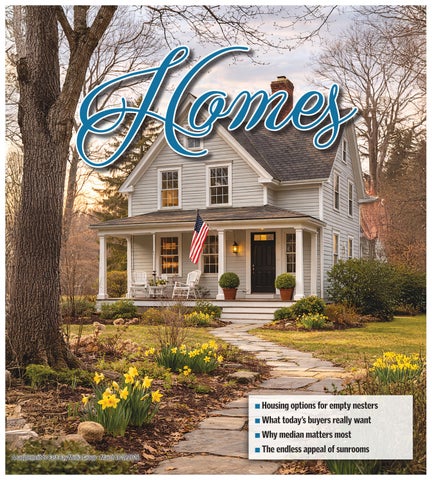
Homes

n Housing options for empty nesters
n What today’s buyers really want
n Why median matters most
n The endless appeal of sunrooms


![]()

n Housing options for empty nesters
n What today’s buyers really want
n Why median matters most
n The endless appeal of sunrooms


remains low throughout the East Bay, but buyers are still picky and demanding in
BY VANESSA COMBS vcombs@eastbaymediagroup.com
The East Bay housing market continues to attract a wide range of buyers, all drawn to the region’s coastal beauty, historic charm, and strong sense of community. While the intensity of the pandemic housing boom has eased, demand remains throughout the region, where multiple types of buyers are competing for a relatively limited supply of homes.
“Everyone is active right now,” said Realtor Sarah Principe, of William Raveis. “Families, first-time buyers, and secondhome buyers — they’re all in the market and they’re all fighting for the limited inventory that exists here.”
Principe said one noticeable shift in recent years has been the growing presence of buyers coming from outside Rhode Island.
“I’m finding that more out-of-state buyers are entering the market than in previous years,” she said.
According to Kim Marion, of Engel & Völkers, families remain one of the most consistent drivers of the East Bay market, particularly those looking for strong school systems and a high quality of life near the water.
“The East Bay attracts a nice mix of buyers right now,” Marion said. “Families are always a big part of the market, especially those looking for great schools and a coastal lifestyle.”
Barrington continues to be a major draw for these buyers thanks to its highly regarded schools and waterfront neighborhoods. At the same time, first-time buyers are exploring opportunities in nearby communities like Warren and parts of Bristol.
“I’m seeing first-time buyers discovering Warren and parts of Bristol,” Marion said. “Those areas can be a little more approachable while still offering an active, community-based lifestyle.”
Second-home buyers also remain an important part of the East Bay market, particularly those drawn to the region’s waterfront and seasonal appeal.
“Second-home buyers are really looking for those waterfront or spectacular water-view homes,” Principe said.
What buyers are looking for
Across nearly every demographic group, single-family homes remain the most sought-after property type in the


“I’m finding that the majority of buyers are looking for ‘turn-key’ homes. Renovated kitchens remain the number one demand, followed by bathrooms.”
SARAH PRINCIPE, REALTOR
East Bay. “I would say that single-family homes are what the majority of buyers are interested in,” Principe said.
One style that has gained popularity in recent years is the executive ranch — a spacious single-level home with open layouts and modern features. However,
Principe notes that the East Bay has limited inventory of that particular style.
“Unfortunately, there just isn’t enough of that very specific type of inventory in our area,” she said. “Most homes here are Cape styles, raised ranches, cottages, and historic multi-level homes.”
Historic homes remain a defining feature of many East Bay neighborhoods, especially in Bristol and Warren, where architecture and local history are closely tied to the community’s identity.
Waterfront and water-view homes are also consistently in high demand, reflecting the coastal lifestyle that attracts many buyers to the region.
“That coastal lifestyle is a big part of why people choose this area,” Marion said.
In terms of features, many buyers are prioritizing homes that are move-in ready.
“I’m finding that the majority of buyers are looking for ‘turn-key’ homes,” Principe said. “Renovated kitchens remain the number one demand, followed by bathrooms.”
Marion said rising home prices over the past several years have contributed to that trend.
“I’ve seen a real appreciation for homes that are already updated,” she explained. “Prices have increased so much that buyers don’t want to take on major renova-
tions right after they purchase.”
While smaller cosmetic improvements are manageable, large-scale renovations can add significant costs to an already expensive purchase.
“A kitchen renovation alone can run anywhere from $20,000 to $100,000,” Marion said. “If someone is already paying significantly more for the house than they would have a few years ago, it can be hard to take on that additional expense.”
Outdoor living spaces are another major selling point. Decks, patios, gardens, and other areas that allow homeowners to enjoy the coastal setting are highly valued throughout the East Bay.
Neighborhoods buyers are targeting
Buyer preferences often depend on lifestyle needs, but several East Bay communities consistently attract strong interest.
Barrington remains one of the most competitive markets due to its school system, coastal neighborhoods, and proximity to Providence. Bristol continues to appeal to buyers who appreciate historic homes and a vibrant, walkable downtown filled with restaurants, marinas, and community events.
Warren has also emerged as a particularly appealing option for buyers seeking
From Page 3
character and energy in a smaller community.
“Warren has gotten so much fun in the last five years,” Marion said. “It has great restaurants, music, and a really cool energy.”
Principe adds that location is often the deciding factor for buyers.
“Location remains a number one factor,” she said.
Limited inventory has forced many buyers to stay flexible in their home search.
Principe recently worked with a client whose experience reflects a common trend in today’s market.
“She originally wanted a renovated townhouse in Bristol with easy access to the water and the highway,” Principe said. “But we had to pivot several times because of the lack of inventory.”
Eventually, the buyer expanded the search to include several property types.
“She ended up purchasing a singlefamily home in the Highlands neighborhood that needed to be gutted to the

“Warren

KIM MARION, REALTOR
studs,” Principe said. “But it was in the neighborhood she wanted, and she couldn’t be happier.”
Even with a competitive market, both agents say preparation and flexibility are key for buyers.


“My advice is to be patient and openminded,” Principe said. “The spring market is here and more inventory is coming.”
Marion adds that buyers should be financially prepared and ready to act when the right property appears.
“It’s still amazing to me how fast the market can move,” she said.
For sellers, presentation and preparation remain just as important. Even though the market continues to favor sellers, buyers are more selective than they

were during the height of the pandemic housing surge.
“It is still a seller’s market,” Principe said. “But with more inventory coming, it’s important to make sure your home is truly move-in ready.”
With its waterfront views, historic streets, and vibrant community life, the East Bay continues to offer something for nearly every type of buyer — and demand shows no signs of slowing down.


January 2026 saw the fewest single-family home sales in Rhode Island since 2011
Rhode Island’s housing market was off to a slow start in 2026, having experienced the lowest single-family home sales at the beginning of the year since 2011. With just 429 homes sold statewide in January, sales activity fell 7.3% from 12 months prior. The lack of sales did nothing to increase housing options for buyers. Inventory remained unchanged from December at just 1.7 months of supply. As a result, the median sales price continued to rise, reaching $499,000, a 7.3% annual increase. In other areas of the market, condominium sales fell 14.2% while their median sales price rose 12.2% to $452,250. Multifamily home closings fell 5.8% and the median price of those sales rose 9.1% to $600,000. While still under-supplied, both
multifamily home market is recovering fastest with a 2.3-month supply of listings, though that remains well under the five- to six-month supply that typically indicates a balanced market.
The drop in Rhode Island’s residential home sales dwarfed that seen nationwide, which experienced a 4.4% decline last month, according to the National Association of Realtors. January’s harsh weather patterns likely played a part in the lull in activity.
“If inflation and employment trends remain stable, that should help with some of our affordability problems. It’s critical though, that our elected officials don’t add to the woes of the housing market by tacking on more real estate taxes and regula tions during the 2026 session. If we want to get a strong foothold in our housing mar ket’s recovery, it’s critical that we keep costs down for buyers and sellers and remove barriers to development,” said


BY VANESSA COMBS vcombs@eastbaymediagroup.com
For many homeowners in Rhode Island’s East Bay, there comes a point when a once-busy family house begins to feel larger than necessary. But downsizing today doesn’t always mean moving into the smallest home possible. Instead, many empty nesters are looking to “rightsize,” finding a home that better matches their lifestyle while allowing them to remain in the communities they love.
“Most empty nesters are looking to simplify their lifestyle without leaving the community they’re connected to,” said Mary Jo Fidalgo-Tavares, a veteran Realtor with Century 21 Topsail. “Condominiums, townhouses, and smaller singlefamily homes are very popular because they offer less maintenance while still providing enough space for visiting family or hobbies.”
At the same time, the idea of downsizing can mean different things to different buyers. According to Bridget Torrey, who joined Gustave White Sotheby's International Realty in 2019 and manages the firm’s Tiverton office, empty nesters are often drawn to two different types of homes: low-maintenance properties or homes designed for gathering.
“Some buyers are looking for condos or something with little to no maintenance,” Torrey said. “Others are buying homes where everyone can congregate — places on the water or somewhere fun where their grown children and potentially grandchildren want to visit.”
For many buyers, the goal is not necessarily to shrink their living space but to simplify their day-to-day responsibilities.
Age-restricted communities are one option for buyers seeking a more maintenance-free lifestyle, although options within the immediate East Bay are somewhat limited.
“We don’t have many 55+ communities directly in the East Bay,” FidalgoTavares said. “The closest options are communities in Tiverton and Rehoboth. Because of that, many empty-nesters choose traditional neighborhoods in towns like Bristol, Barrington, and Warren so they can stay close to the waterfront, walkable downtown areas, and the community connections they already have.”
One of the most popular nearby communities is The Villages at Mount Hope Bay in Tiverton. Located along the waterfront, the development offers scenic

This Tiverton townhouse is currently on the market for $1,549,000. The home offers three bedrooms, 3.5 baths, and two primary suites — including one on the main level — all within walking distance of the water.

“Sometimes downsizing — or right-sizing — isn’t about the square footage. It’s about lifestyle — finding a home that lets you enjoy this next stage of life.”
BRIDGET TORREY, REALTOR
views along with amenities such as a clubhouse, tennis courts, swimming, and a full calendar of social activities.
“A lot of people who move to the Villages are downsizing from homes in the East Bay,” Torrey said. “Others come from different parts of the country because their children have settled here and they want to be closer to their grandchildren.”

“Buyers are often looking for single-level living, firstfloor primary bedrooms, newer systems, and manageable outdoor space like a patio or small yard instead of a large property to maintain.”
MARY JO FIDALGO-TAVARES, REALTOR
Beyond planned communities, many empty nesters are drawn to coastal neighborhoods throughout the region. Towns like Bristol, Barrington, Warren, and Portsmouth remain especially
appealing.
“These towns continue to attract downsizers because people already have strong ties to the community,” FidalgoTavares said. “Walkability and proximity to the water are big draws.”
In Tiverton and Portsmouth, several waterfront neighborhoods that were once seasonal cottage communities have become increasingly popular with buyers seeking smaller homes with coastal charm. Areas such as Riverside Drive in Tiverton, along with Common Fence Point and Island Park in Portsmouth, have seen many older cottages renovated or replaced with year-round residences.
“Years ago, many of these homes were just summer cottages,” Torrey said. “But people have remodeled them, rebuilt them, or combined lots to create larger homes. There are some really beautiful houses there now.”
Features empty nesters are looking for
When it comes to home design, both agents say buyers are prioritizing comfort and convenience.
“Low maintenance is the biggest priority,” Fidalgo-Tavares said. “Buyers are often looking for single-level living, firstfloor primary bedrooms, newer systems, and manageable outdoor space like a
patio or small yard instead of a large property to maintain.”
Torrey said layout can be just as important as size.
“Single-level living with a primary bedroom on the main floor is definitely a popular request,” she said. “People also want open, casual spaces where everyone can gather rather than formal living rooms or formal dining rooms.”
Bathroom design has also shifted in recent years. Walk-in showers with seating are increasingly preferred over large soaking tubs, which many homeowners find difficult to use as they get older.
While many empty nesters are ready to make a move, limited housing inventory can make the search more challenging.
“One of the biggest challenges right now is inventory,” Fidalgo-Tavares said. “In Bristol, for example, there are currently only about 14 single-family homes and condos on the market, and four of those are priced over one million dollars.”
Because the supply of smaller homes is
limited, many homeowners looking to downsize need to be patient while waiting for the right property to come on the market.
Fidalgo-Tavares recently worked with homeowners who had lived in their home for decades but were ready for something easier to maintain. Rather than rushing into a purchase that wasn’t the right fit, they chose to rent temporarily while continuing their search.
“That gave them the flexibility to take their time and ultimately find a home with first-floor living that kept them close to the community they love,” she said.
For many East Bay homeowners, the decision to move is less about cutting down space and more about making everyday life easier. Some choose smaller homes, while others simply want to leave behind the upkeep that comes with larger properties.
“Sometimes downsizing — or rightsizing — isn’t about the square footage,” Torrey said. “It’s about lifestyle — finding a home that lets you enjoy this next stage of life.”


The old dining room can be whatever makes the most sense for your family
Traditional formal dining rooms are not as necessary as they were a generation or two ago. A recent study by Realtor.com found formal dining rooms are often the most underutilized square footage in homes, and a significant percentage of Millennial and Gen Z homeowners prefer flexible “lifestyle rooms” over dining spaces.
So what can homeowners whose dining room tables are covered in mail or the kids’ homework do to repurpose the space into something they will actually use? The following are five ideas to repurpose a formal dining room into a more usable space.
Those who enjoy hosting friends or family without sitting down to formal dinners might appreciate transforming the dining space into a cocktail lounge.
Swapping the dining room table and chairs for low swivel chairs around a coffee table or high-backed bar stools around bar tables easily converts the seating space. A built-in wet bar or a bar cart helps complete this social hub for intimate conversation. Paint the room in darker colors or use textured wallpaper to simulate an after-hours feel that separates the space from the rest of the house.
Homeowners can create a digital detox zone by way of a cozy library. A timeless choice, a library can feature floor-to-ceiling bookshelves or builtins and comfortable reading chairs stationed by a window.
Homeowners who play an instru ment may appreciate a designated space for jam sessions. Dining rooms with high ceilings and bare floors often provide excellent acoustics for music. Complement the space with a high-

Dining spaces may be going the way of the dinosaur, reflecting modern homeowners’ preferences for more flexible and useful spaces.
Hybrid work is a permanent fixture in today’s career landscape. A dining room located near the front of the home presents a prime location for a professional workspace. Replace a table with a sleek executive desk. An existing buffet or sideboard can be repurposed as printer storage or for filing. Consider adding French doors or partitions to provide privacy without compromising on light flow.
Active families may need to transform


The chart above shows examples of 2025 sales (one per community) representing the median sale price for that community last year.
See the median sale price for sold homes in each East Bay community in 2025
The definition of median value is the value at the midpoint of a frequency of distribution or observed values, such that there is an equal probability of a number falling above it, as well as below it.

Most people are more familiar with the average than the median. The average is also referred to as the mean. The average or mean is derived by adding all the values in a data set and dividing them by how many numbers were in the data set.
The median is a more reliable indicator of real estate market data, because the average can be influenced by a cluster of data points, whereas the median is not affected per se. If a real estate market sold prices were trending upward, the median is a reliable indicator of how much the market is increasing. Conversely, if sales prices are declining, the median will also be declining. If the data set is too small, a trend in values cannot be relied upon. In the East Bay for example, Little Compton often has the least number of sales each year, and I analyze that data with a skeptical eye. In 2025, there were only 31 singlefamily sales in Little Compton. On the other hand, East Providence had more than 10 times as many sales, with 372, a far more reliable data set to analyze and rely upon with confidence.
In my end of the year column that was published in January in these newspa-

pers, I reported on the median percentage increase or decrease of each East Bay community. For example, the Town of Bristol single-family median sold price, comparing 2024 to 2025, increased 15% to $661,000. The average in 2025 was $809,000. So why is the median more indicative when analyzing real estate market data and more relied upon?
Both the average/mean and the median are measures of central tendency, but they summarize data in different ways and respond differently to outliers and skewed distributions of data, which is the key difference when analyzing real estate market data. It is because the median is more resistant to outliers and provides a better sense of “typical value.”
Conversely, the average, or mean, can be pulled away from the center of the rest of the data set. So, in analyzing the 2025 Bristol data, I would conclude that the higher average is higher than the median, because of a cluster of higher sales prices and not as centrally indicative as the median value of the market movement. Conversely, if the average were lower than the median, I could conclude that a market trend may be developing towards a decrease in values.
In this column I present an example of
a median priced home sold in each East Bay municipality during 2025. It is not scientifically representative, as houses are influenced by so, so many variables, like neighborhood location, appeal, design, quality, square footage, waterfront or view, lot size, location, busy road, etc., etc.
Therefore, a small waterfront home could sell for the median price, but so could an exceptionally large home in bad condition in an inferior neighborhood. But it is worth reviewing as an example of the median priced sale in each East Bay community.
In the accompanying chart, I present a specific sale in each East Bay municipality, as well as pertinent data regarding that sold property, which is representative of the median sale price in 2025.
Douglas Gablinske owns AppraiseRI, a 30 year old statewide real estate appraisal company located in Bristol, RI. He also owns East Bay Real Estate Sales & Appraisals, serving the east bay communities. He is a Certified RI Appraiser and Licensed Broker. He is Chairman of the Warren Taxpayer Appeal Board and Vice-Chairman of the RI Real Estate Appraisal Board. He can be reached at Doug@AppraiseRI.biz


The options, prices, styles and choices can vary greatly
Kitchen renovations continue to top the list of improvements that offer a high rate of return on investment. Buyers pay attention to kitchens, which undoubtedly affects the ROI of kitchen renovations.
According to the Journal of Light Construction’s “Cost vs. Value Report 2025,” a minor kitchen remodel offers an ROI of 113 percent, while a midrange remodel offers an ROI of 51 percent. Replacing a kitchen countertop can help homeowners see improvements to the functionality of their spaces and improve the value of their homes.
According to data from Grand View Research, the U.S. countertops market is projected to reach $35.57 billion in 2026, driven by homeowners who desire highvalue renovations over relocating. Those thinking about overhauling their spaces with new countertops can consider the leading materials and how they rank in cost, maintenance and durability.
The National Kitchen & Bath Associa-
tion reports that 78 percent of design professionals expect quartz to be the preferred countertop material over the next several years. Quartz is non-porous, so it will resist stains, scratches and bacteria infiltration without having to be sealed. Unlike natural stone, quartz offers pattern uniformity, which makes it easier to map out seamless transitions. Quartz costs between $50 and $150 per square foot installed.
Granite still holds a considerable chunk of the countertops market and remains a solid standard for those who value a oneof-a-kind look of natural stone. Granite has exceptional heat resistance and adds significant resale value. However, it requires periodic sealing to maintain its good looks. Costs range from $40 to $190 per square foot.
Porcelain tiles and slabs are projected to become the fastest-growing segment in the ceramic tiles market, according to reports from Yahoo Finance. High-precision printing technology enables porcelain to mimic rare marble and other stone


with superior accuracy.
Porcelain is even harder than granite and effectively impervious to UV rays. This makes the material a solid choice for outdoor kitchens. Plus, at a cost of $60 to $120 per square foot, it is competitive with other similar materials.
Those who appreciate a soft, organic texture and “warmth” in their spaces can look to butcher block. Wood is making a comeback, as many homeowners are moving away from stark, white designs. Butcher block is self-healing, meaning scratches can be sanded out. Butcher block costs between $50 and $150 per square foot.
Laminate is a budget-friendly option for homeowners at $20 to $80 per square foot, but is not as durable as other materials. Some laminates mimic the look of high-end materials, and they don’t require much maintenance.
Countertops affect the look and feel of kitchens and other interior and exterior spaces. Choosing materials comes down to cost, durability and maintenance.


There is no denying the appeal of a sunroom. Sunrooms bring more of the outdoors inside by bridging the gap between home and yard. Demand is shifting, with more than 61 percent of homeowners now preferring four-season insulated rooms for year-round use, according to Market Reports World. A sunroom has the potential to offer a roughly 50 percent return on investment and can cost anywhere from $22,000 to $72,000 on average.
A sunroom addition is a significant investment and a decision not to take lightly, as it changes both the interior floor plan and backyard space. To decide if a sunroom really is a worthwhile endeavor, it’s important for homeowners to consider the footprint of their homes/ yards, how they plan to use the space, and the amount of sun the home receives.
Professionals with the National Association of Realtors say that a sunroom should not consume more than 30 percent of the remaining backyard and urge homeowners to avoid over-developing a lot. If installing a sunroom will leave a homeowner with only a small patch of yard afterwards, the result can feel heavy and unbalanced. It also won’t match the neighborhood.
Another consideration is the local zoning ordinances where a person lives. The City of Los Angeles, for example, warns that most towns require a setback between the sunroom structure and the property line. It’s also important to look at the home’s roof and whether or not the sunroom will fall right under the eaves or
if it will require an expensive tie-in to the existing roof.
It is vital that homeowners determine how they will use the space and when. This will dictate the type of sunroom that should be built. A three-season room is typically uninsulated with only singlepane glass. This is ideal if someone is looking for a screened-in retreat without all of the bugs and a little weather protection. Four-season rooms are fully insulated and tie into a home’s HVAC system. This space will be functional all year long, but it is a more expensive undertaking as well.
The purpose of a sunroom is to benefit from the sun. The value of the space will depend entirely on which way the room faces. North-facing sunrooms have soft light with minimal heat or glare that likely can be used all day. Morning people can appreciate an east-facing sunroom while drinking coffee or reading, and the space will cool down in the afternoon. Southfacing rooms will be bright most of the day and may need high-end HVAC hookups or shades to stay comfortable, even in cooler months. West-facing sunrooms are great for watching sunsets, but the hot afternoon sun must be considered. UVrated glass to prevent floor fading and even sunburn likely will be needed.
It is important to work with a company that specializes in sunrooms. Such firms are experienced in helping homeowners design and ultimately build these spaces to avoid common pitfalls.
In general, a sunroom is not a DIY project since it typically involves a major structural change. It can be a viable addition to a home when built correctly to remain durable through every season.


Natural wood flooring is a stunning feature of millions of homes. Wood floors are appreciated for their durability and aesthetic appeal, each of which is bolstered when floors are properly maintained.
A host of variables can affect how long wood flooring lasts and how its appearance holds up over time. Wood flooring in homes with pets that roam around the house, such as cats and dogs, may require more frequent maintenance than those without pets. The same goes for homes with children, who may routinely track dirt in from outside or spill food and drinks with greater frequency than adults. But even wood flooring in homes without pets and children requires consistent maintenance. Homeowners who want to protect their wood floors and ensure they maintain their aesthetic appeal for the long haul can consider the following maintenance tips, courtesy of the National Wood Flooring Association.


The NWFA recommends daily maintenance to remove dust and dirt that accumulates each day. Such cleaning can prevent damage that can compromise the aesthetic appeal of the floors and potentially affect their longevity.
Spills are inevitable, especially in homes where young children live. Though spills might not be preventable, the damage they can cause can be avoided with a prompt response. Cleaning spills immediately with a dry or slightly damp cloth can ensure the floors do not soak up the spilled liquids. The NWFA notes that mopping wood floors with a wet mop or steam mop will damage the finish and the wood over long periods of time. If allowed to soak into the floor, spilled liquid can contribute to warping, swelling and staining. Each of those issues can be costly to address, but a quick and immediate cleanup can prevent all three from happening.
Vacuum once per week on the bare floor setting. Utilizing a vacuum is less taxing on wood floors than sweeping so long as the vacuum is on the bare floor setting. Sweeping is best avoided to prevent small particles from being dragged across the floor, which gradually wears down the finish and ultimately contrib-
utes to a dull look. Vacuuming vertically lifts the debris off the floor, ensuring nothing is dragged along the surface of the floor. If you’re using a manual vacuum instead of a robotic vacuum, vacuum with the grain to reduce the risk of damage.
Apply wood flooring cleaner once per month. If your wood floors are newly installed, ask your installer to recommend a cleaner specifically designed for the finish on your floor. If your floors are not new, contact a flooring professional for a recommendation. Wood flooring cleaners specific to a given floor’s finish are important because these products are specialized and formulated with both cleaning and protection of the floor itself in mind. The right wood floor cleaner won’t lead to dull-looking floors nor damage the finish.
Recoat floors if they start to look dull. The NWFA notes that recoating with wood floor finish every three to five years can renew the appearance of natural wood flooring that might be starting to look a little dull.
Well-maintained wood floors add much to a home’s interiors. Some simple maintenance can ensure wood floors remain
and aesthetically appealing for


INTERIOR PAINTING & CABINET REFINISHING
Refresh your rooms and give cabinetry a beautiful factory-finish.
COLOR
Re-imagine color with our complimentary color consultation.
EXTERIOR PAINTING, RESTORATION & MAINTENANCE
Expert exterior painting and stain application, siding and trim restoration, and professional pressure washing.
CARPENTRY & RESTORATION
Repair wall & ceiling cracks, restore defects in wood trim, doors & built-ins.