Earlhamite
NOTES FROM THE FIELD
Earlham's four-year college-to-career program blends guided reflection, internships, and hands-on learning to help students shape fulfilling careers and lives.
Educating
and minds
Earlham has both a legacy for providing an outstanding education and for cultivating outstanding educators.
Earlhamite
The magazine of Earlham College
EDITOR
Alicia Anstead
CLASS NOTES EDITOR
Cooper Cox
DESIGNERS
Liz Johnson
Sara Misak
MANAGING EDITOR
Brian Zimmerman
WRITERS
Abbie Proeschel
VICE PRESIDENT FOR ENROLLMENT MANAGEMENT, MARKETING, AND COMMUNICATIONS
Jeffrey Perkins ‘94
Read the latest alumni profiles, submit class notes, check out upcoming events and more at earlham.edu/alumni.
Earlhamite magazine is the oldest college alumni magazine in continuous publication in the United States. Today it is published twice yearly and continues to follow the statement of purpose that has guided it since its 1873 founding: “a regular messenger going out and bearing tidings of prosperity and vicissitudes of Earlham to its friends and supporters, and bringing all associated here into communication with one another.”
Opinions expressed in the magazine are those of its contributors and do not necessarily represent the views of the editors or the official position of Earlham College.
Send story ideas to earlhamite@earlham.edu
Send class notes, obituaries and address changes to alums@earlham.edu
Please recycle after reading. Paper for the Earlhamite is printed from 10% recycled fiber and is FSC and PEFC certified.
©2026 Earlham College.
PRESIDENT’S MESSAGE
Birds are the most readily observable form of wildlife for many people. With their amazing variety of sizes, shapes, sounds, colors, and behaviors, birds provide an entry for many (as they did for me) to the scientific exploration of living things. In this issue of Earlhamite, we celebrate the history and exciting present of the study of birds at Earlham and the mentors who shape these experiences. Our campus and surrounding areas provide ready opportunities for our students, faculty, and staff to go birding year-round and engage in the scientific study of birds. Our faculty-led trips abroad bring our students in close contact with birds and other creatures in natural areas around the world.
Though not all birds can fly, powered flight is the most remarkable and visible attribute of birds and has fascinated humans throughout time, giving birds an almost magical status in many cultures around the world.
For centuries, people wondered how birds stay aloft and propel themselves through the air and how they navigate. Though we now have scientific answers to many of these kinds of questions, watching birds take flight and soar remains as inspiring as ever.
For birds, taking flight and staying aloft requires extraordinary stamina, alertness, and continual course correction. The same could be said for a college. Earlham first took flight in 1847 as a boarding school “for the guarded religious education of the children of Friends” and remains deeply dedicated to its Quaker heritage and Quaker-derived principles and practices. Over the past 179 years, Earlham has soared effortlessly at times and at other times has labored to stay aloft. Earlham is not alone in facing stiff financial headwinds these days, and like many other colleges and universities we have
had to take serious actions in recent months to correct our budgetary course so that we can soar again. This spring, we are embarking on a strategic planning process that will give us a birds-eye view of where we need to lead so that our students can continue to navigate a complex world, guided by mentors who help them build their stamina, alertness and discernment. While this issue highlights the rich history and living tradition of ornithology at Earlham, it also reflects the broader culture of mentorship that defines this institution. Within these pages, you’ll encounter faculty and coaches who challenge and champion their students, leaders in our Japan and Japanese Studies programs who help students grow across cultures, and alumni educators carrying Earlham’s spirit into grade schools and communities around the country. Across disciplines and generations, a common thread endures: transformative relationships that steady, inspire, and prepare students to lead lives of purpose — relationships that remain constant even as Earlham adapts and evolves.
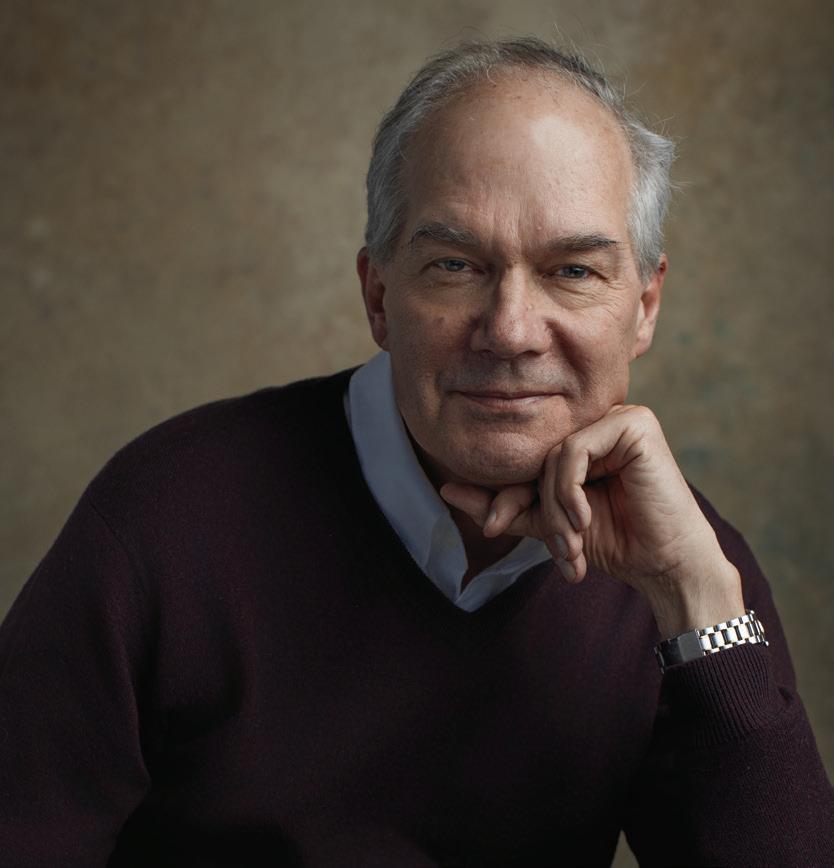
Paul Sniegowski President, Earlham College and Earlham School of Religion
A defining work by Simone Leigh ’90 at Earlham
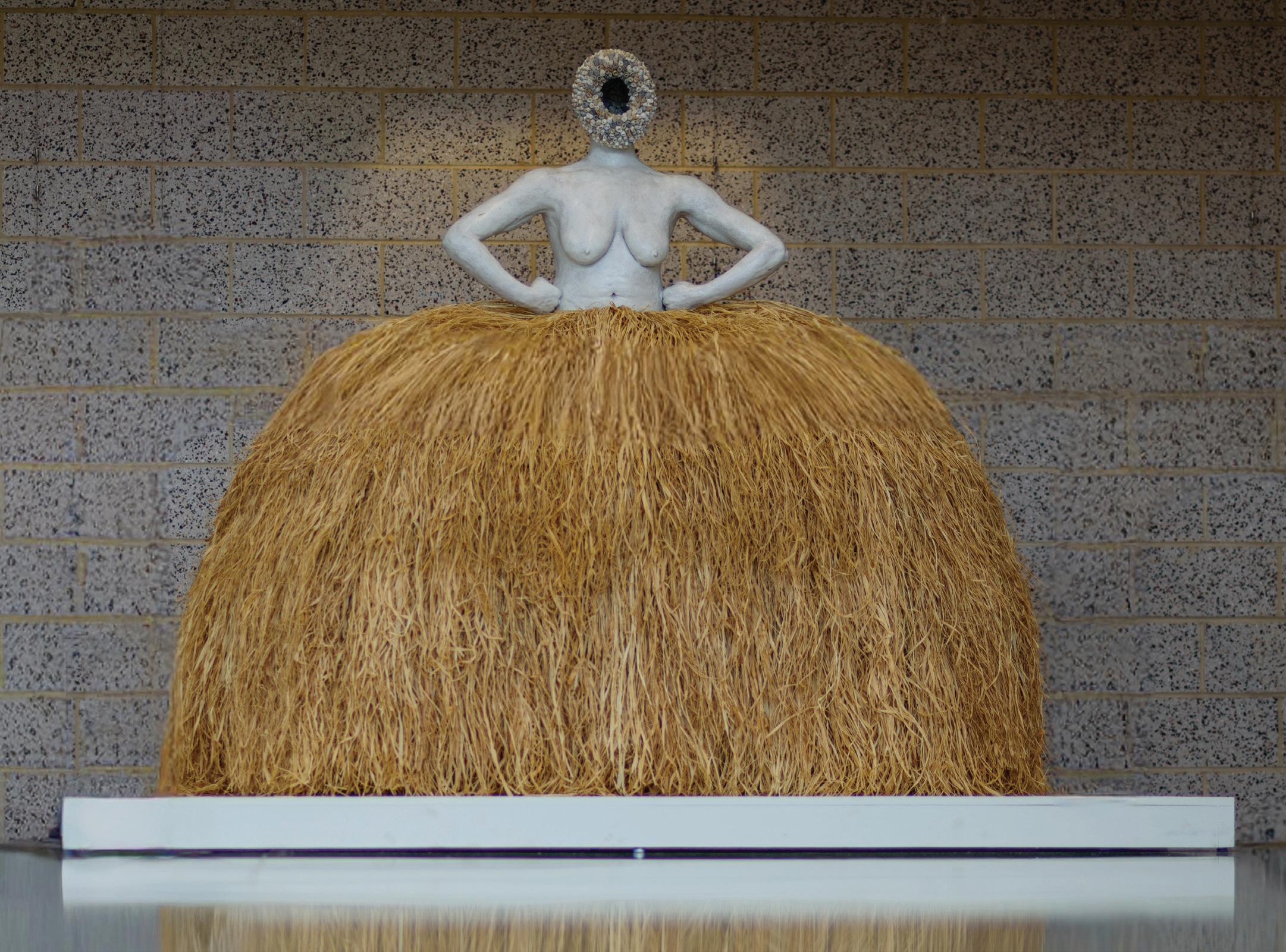
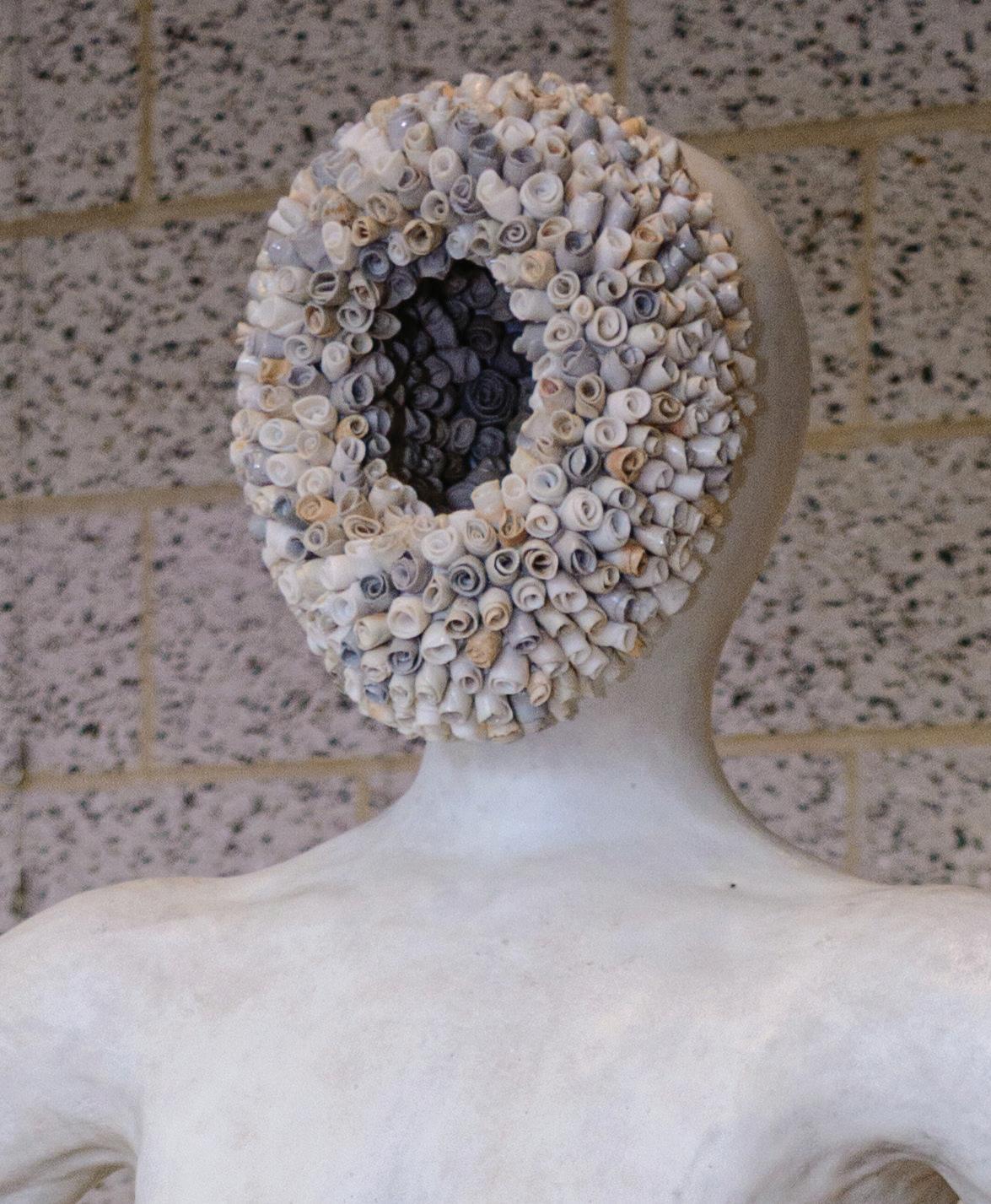
Las Meninas II, a sculpture by acclaimed artist Simone Leigh ’90, is on loan from the Art Bridges Foundation in Bentonville, Arkansas, and on exhibition in the Center for Visual and Performing Arts atrium at Earlham through November 2026. The sculpture is inspired by Las Meninas, the 1656 Diego Velázquez painting and “addresses pressing questions of racial and gender equity by delving into the complex history of Western imperialism, slavery, and the portrayal of female subjecthood,” according to Art Bridges Foundation materials.
The arrival of Leigh’s life-size work is the result of a three-year effort by Christian Adams, Earlham’s Art Curator. “When I started looking for a Simone Leigh sculpture for Earlham, I knew this would be a challenging request,” Adams says. “The opportunity to celebrate the success of another Earlham graduate was the motivating force behind this project.” His search led him to Bentonville’s Crystal Bridges Museum and the Art Bridges Foundation, whose mission emphasizes expanding access to American art.
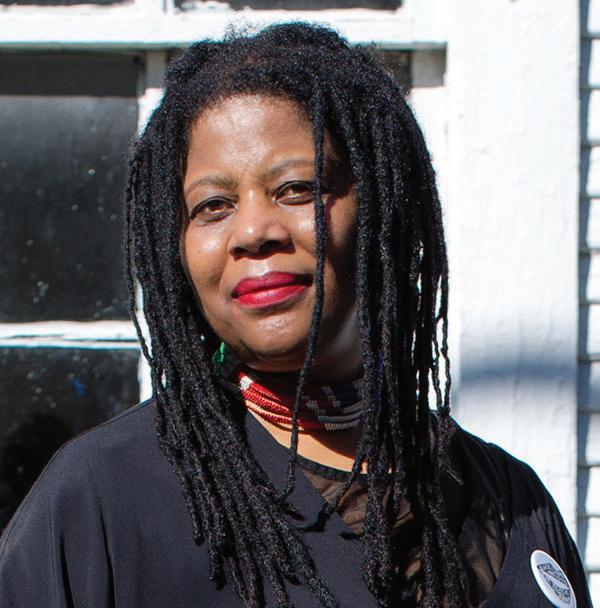
“The focus of Art Bridges’ mission is to remove barriers of access to art sharing and support community engagement,” says Ashley Holland, curator and director of curatorial Initiatives at the Foundation. “The Art Bridges Collection contributes to this goal by providing loans of American art to museums across the country, free of cost. We are thrilled about this partnership and the opportunity to lend Las Meninas II by Simone Leigh to Earlham College.”
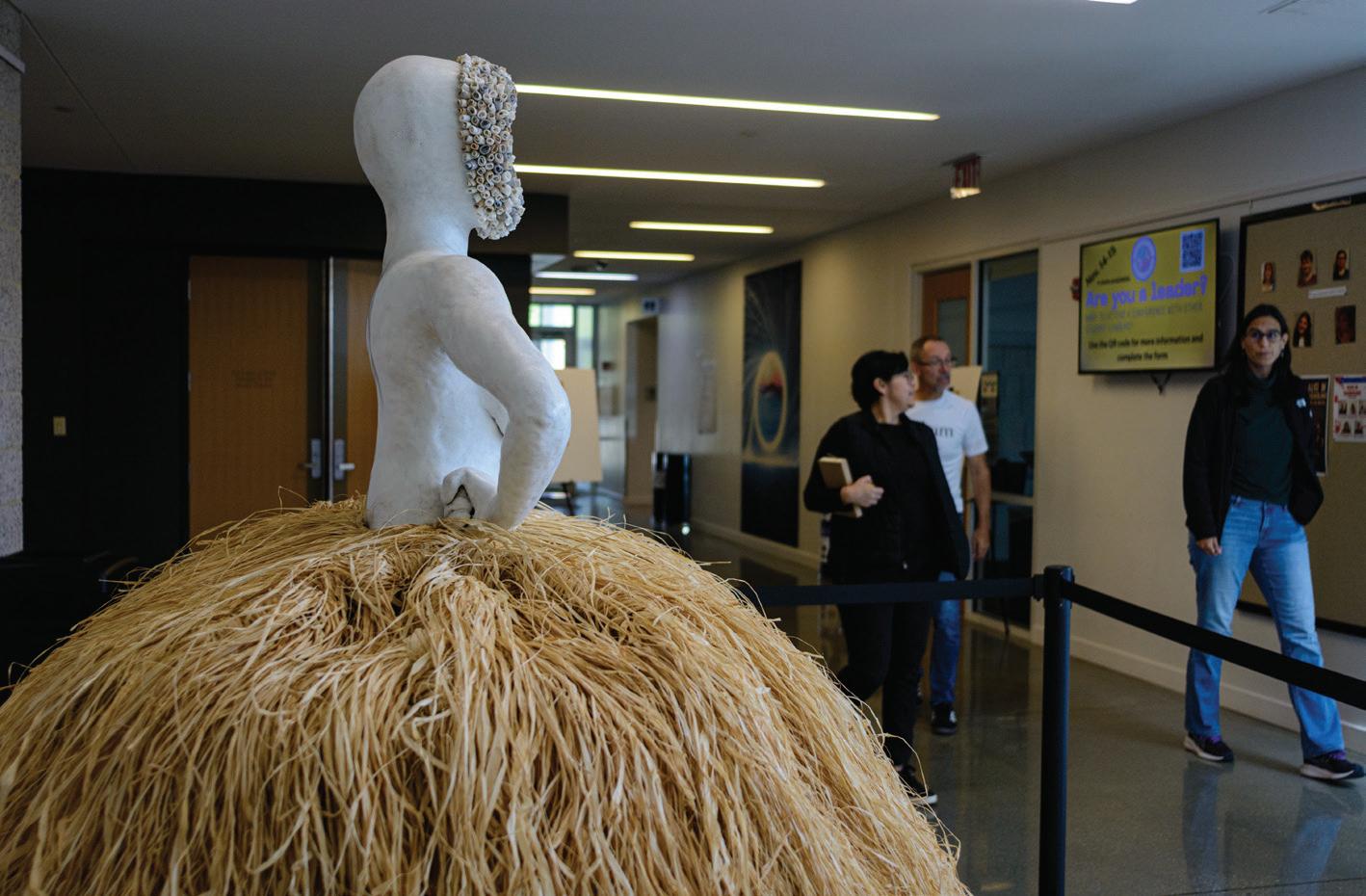
Leigh, an internationally recognized artist, creates work centered on Black female experience. Her reinterpretation of Velázquez’s composition, according to the Foundation, “stands defiant and imposing, squarely confronting the spectator with a faceless void composed of small and light-colored ceramic rosettes.” ■
Story by Abbie Proeschel.
Photos by Josh Smith.
“The opportunity to celebrate the success of another Earlham graduate was the motivating force behind this project.”
– CHRISTIAN ADAMS
Bringing smarter recycling to Richmond
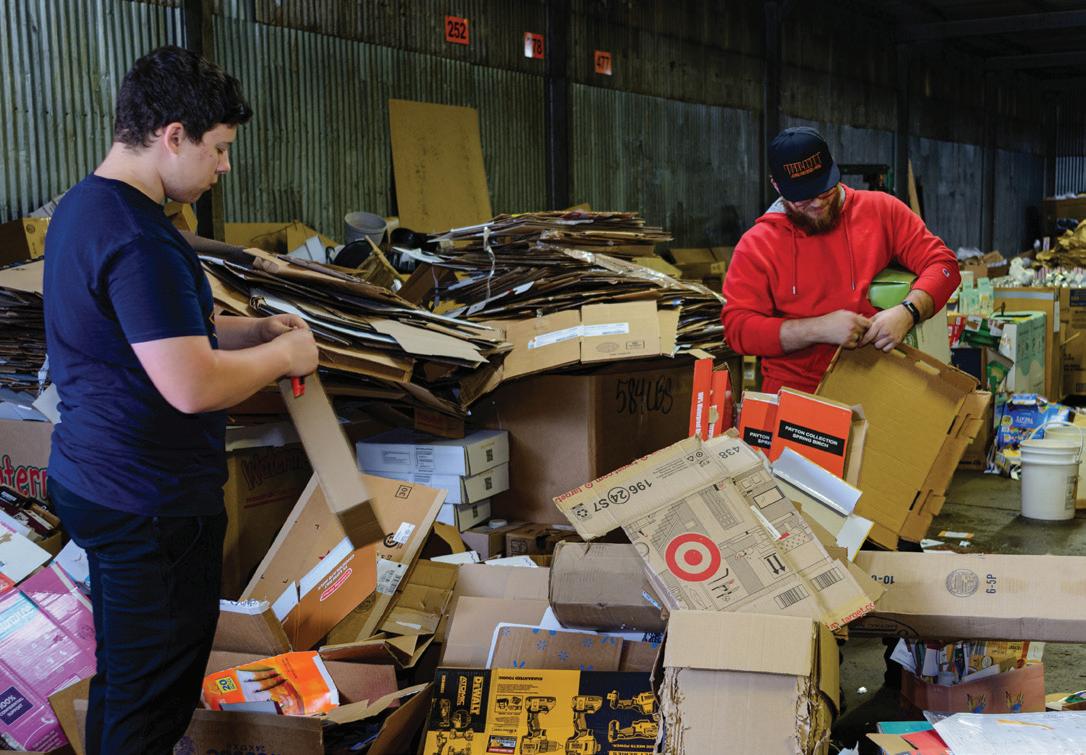
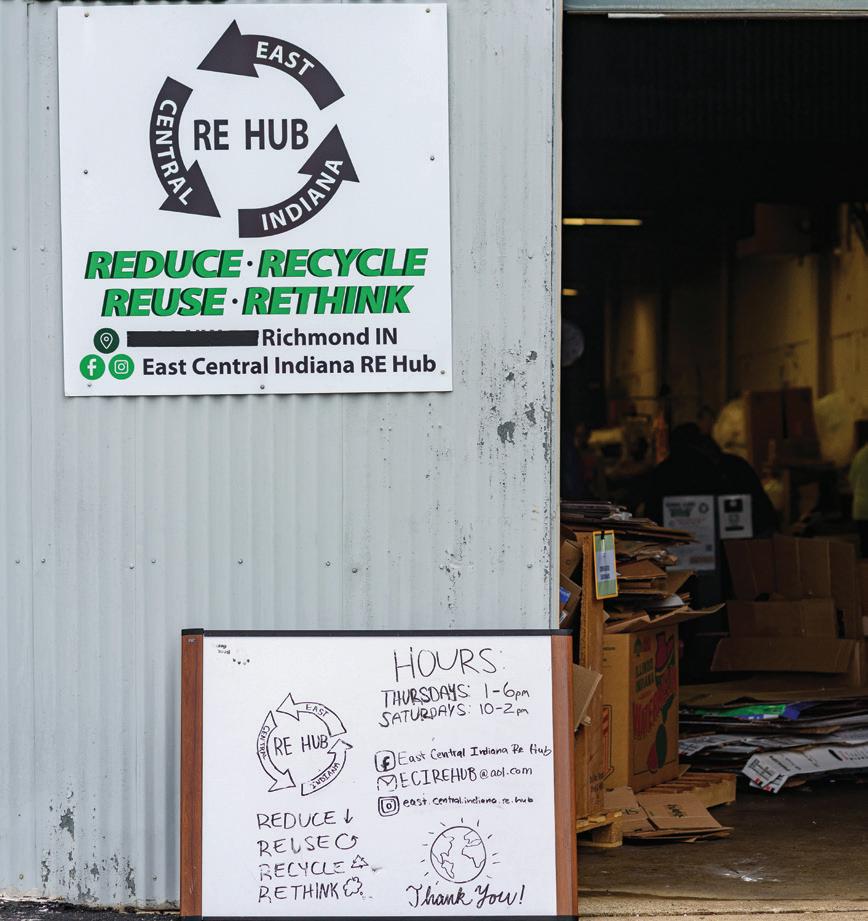
When local entrepreneur Penny Ausmus envisioned a regional recycling and reuse hub for Richmond, she saw more than a drop-off site. She imagined a community resource that would educate and empower residents to think differently about waste. In 2024, that vision became reality with the opening of the East Central Indiana Recycling and Reuse Hub – RE Hub – the first nonprofit center of its kind in Wayne County.
A new partnership with Earlham College is helping Ausmus expand her impact. Working with Doug Harms, instructor of computer science, and Gaby Chacón ’19, career advisor in the Center for Career Education, Ausmus collaborated on a proposal for a mobile education and collection unit. The idea earned
the $5,000 grand prize from Community-Engaged Alliance’s Idea to Action Incubator Pitch Competition.
“Working with Earlham was easy,” Ausmus says. “We meshed right off the bat. After a couple of meetings together we landed on this idea for a mobile trailer. I realized this could be a successful project. It was a eureka moment.”
The collaboration reflects Earlham’s broader commitment to community-based learning through the Center for Social Justice and the Center for Entrepreneurship, Innovation and Creativity. Faculty and staff have helped refine RE Hub’s growth strategy and identify opportunities for expanded service across Wayne County.
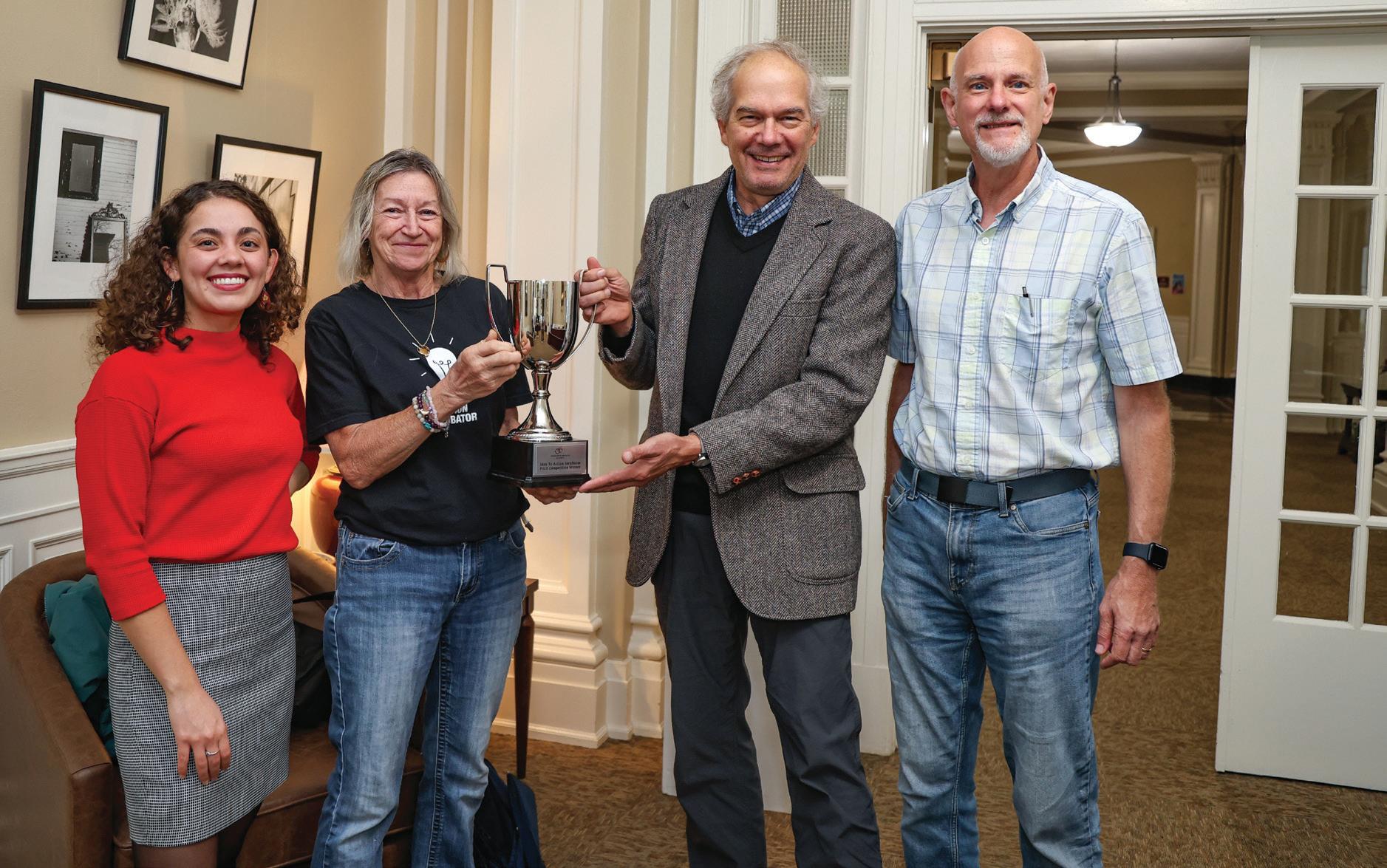
Gaby Chacon ‘19, Penny Ausmus, Earlham President Paul Sniegowski, and Doug Harms with the CommunityEngaged Alliance’s Idea to Action trophy.
RE Hub plans to expand operations to mobile units.
“I’ve been living in Richmond for 10 years now, and recycling has always been a bit of a challenge because the city only collects certain types of materials,” Chacón says.
With new support and momentum, the RE Hub is continuing to expand its operations — and preparing to take recycling education directly into neighborhoods through its forthcoming mobile unit. ■ Story by Brian Zimmerman. Photos by Josh Smith and Tsitsi Makufa.
About Community-Engaged Alliance
As a 501(c)(3) nonprofit, Community-Engaged Alliance is dedicated to advancing the field of community engagement through education, support, and collaboration with their members and additional partners in higher education. Through funding, professional development, and collaboration opportunities, Community-Engaged Alliance supports capacity and enables students to graduate with the knowledge and skills necessary to create positive social change. Visit www.communityengagedalliance.org for more information.
10 consecutive years OF outstanding classroom experiences
For the 10th consecutive year, The Princeton Review has ranked Earlham College a “Best Classroom Experience,” ranking 17th on the list. The distinction is based directly on student survey responses about faculty expertise, classroom engagement, and the overall learning environment.
Earlham’s reputation for excellence is also reflected in U.S. News & World Report’s “Best Colleges” guide for 2026. The College remains a Top 100 national liberal arts institution, placing 76th overall. Other rankings include 17th for “Best Value,” 47th among “Most Innovative Colleges,” and 21st for “Best Undergraduate Teaching,” highlighting the College's commitment to expert faculty and meaningful student support.
Together, these honors affirm Earlham’s long-standing tradition of academic quality, exceptional teaching, and a learning experience that prepares students for purposeful lives and careers.
From team-teaching, to protecting world heritage
When Earlham asked Ray Hively to team-teach a new interdisciplinary course about 50 years ago, he was up for the challenge. Hively taught in astronomy and physics, and his team teacher, Bob Horn, was from philosophy.
“We designed a course on the history of Cosmology. I met Bob Horn; we got together and designed a course called Cosmology from Stonehenge to the Big Bang,” says Hively. Both Hively and Horn are professors emeritus in their departments.
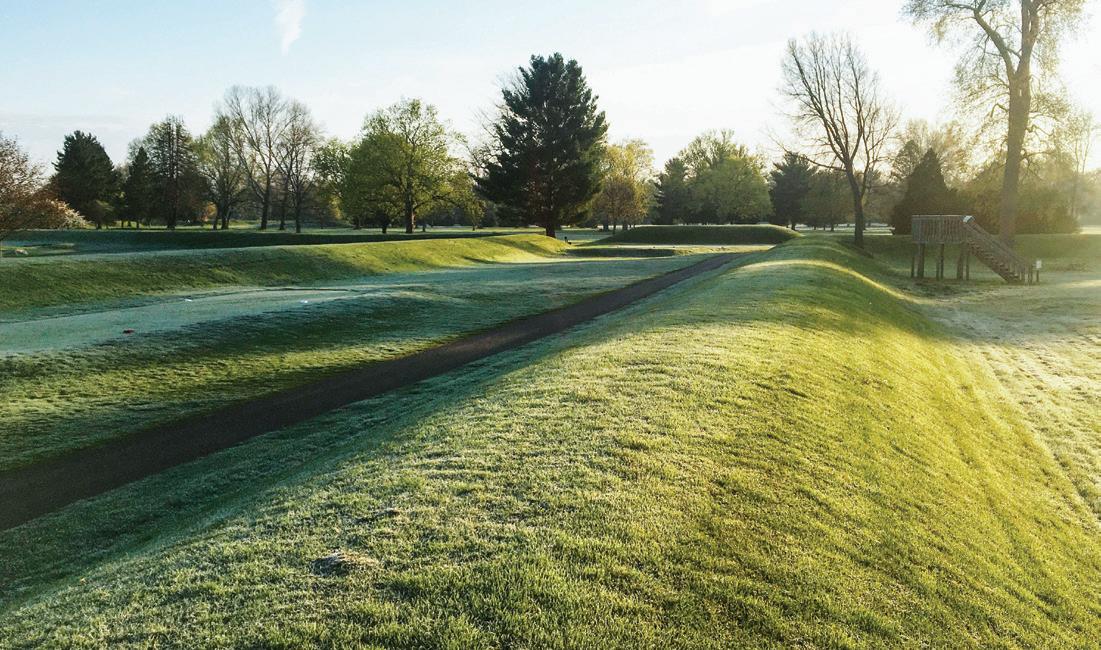
Hively wanted to take the students to do surveying-based research at an ancient site. Octagon Earthworks, a network of large prehistoric structures in Newark, Ohio, fit the bill.
“The site was different than I expected, with earthen walls that are about 4.5 feet tall and 40 feet wide, very long so that you can’t see what they enclose,” says Hively.
It took about two years of fieldwork to get an accurate survey of the 50-acre octagonal portion. While surveying work was painstaking –detail-oriented work in the best of circumstances – it didn’t help that the Octagon Earthworks were at the time leased to the Moundbuilders Country Club, and the surveying work was often happening on an active golf course, with Hively dodging golf balls while taking measurements and observations.
The Octagon Earthworks were built by the ancient Hopewell
culture, most likely between 1 to 400 AD. The Hopewell were a pre-contact network of Native American cultures, and before Hively and Horn began doing their surveying work on the Octagon, a particular structure within the Octagon Earthworks, they weren’t known for sophisticated geometry and astronomical knowledge.
“The Octagon Earthworks and the seven other locations of the Hopewell Ceremonial Earthworks in central and southern Ohio are remarkable wonders of 2,000-year-old monumental landscape architecture,” said Neil Thompson, marketing department manager of the Ohio History Connection. “In addition to their beauty and evidence of creative genius of the American Indians who were the people of the Hopewell culture, these sacred places provide glimpses into the ancient history of our region.”
Hively and Horn persisted in the work and discovered that the Octagon’s alignments were precisely associated with an 18.6-year cycle known as the Lunar Standstill cycle, which corresponds to the relative position of the moon in the sky as it moves between extremes.
“When I saw the first black-and-white photo from 500 feet above the Earthworks, I could really appreciate the magnitude of their achievement," says Hively.
Discover more earthworks and where to find them at hopewellearthworks.org

But another question persisted: “Why would they go to the trouble of building a structure so precise and so elegant when you can’t appreciate it from the ground?”
While interpretations vary and there aren’t written records to confirm, Hively sees the Octagon as a kind of cosmic prayer, a way to establish a bond with forces above or beyond.
In 2023, the Hopewell Ceremonial Earthworks received the designation as a UNESCO World Heritage Site. The next year, the courts ruled that the Ohio History Connection had the authority to buy out the lease the country club had held on the land since 1910. The Ohio History Connection then reached an out-of-court settlement to buy out the lease in August 2024 and officially took control
of the leasehold. The Octagon Earthworks opened to the public on Jan. 1, 2025.
Hively sees the fingerprints of the Earlham experience throughout his life and the journey of academic inquiry he took. “I don’t think this would have happened anywhere but Earlham,” says Hively. “I have been told by archaeologists that the work we did was critical to getting the UNESCO status. The site has to show uncommon human creativity or genius, and the level of geometrical and astronomical knowledge that was embedded in those mounds was uncommon. It doesn’t exist in any site anywhere in the world, not in Stonehenge, not in the Parthenon, not in the Egyptian pyramids, nowhere else but Newark.” ■ Story by Laura Leavitt. Photos courtesy of the Ohio History Connection. Illustration by Sara Misak.
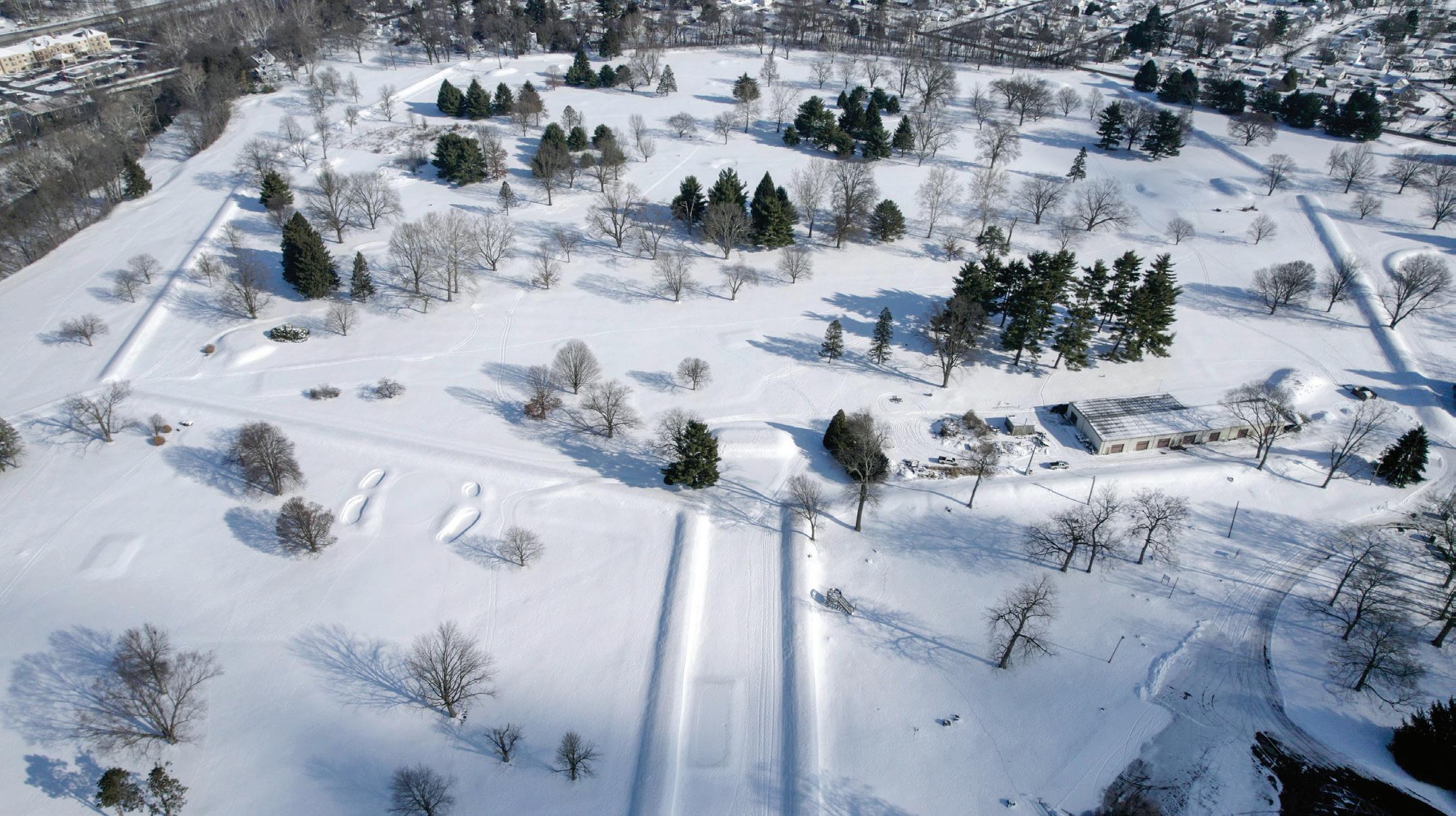
Octagon Earthworks covered in snow
View of the mounds from ground level
Speakers bring national conversation to Earlham
Earlham kicked off its 2025–26 event season with a lecture from New York Times columnist and bestselling author David Brooks on Nov. 20, 2025. Appearing as part of the Earlham Artist and Lecture Series, Brooks drew a packed crowd in Goddard Auditorium and featured a Q&A moderated by Professor of Politics and Public Policy Thor Hogan. Brooks also met with students prior to the event.
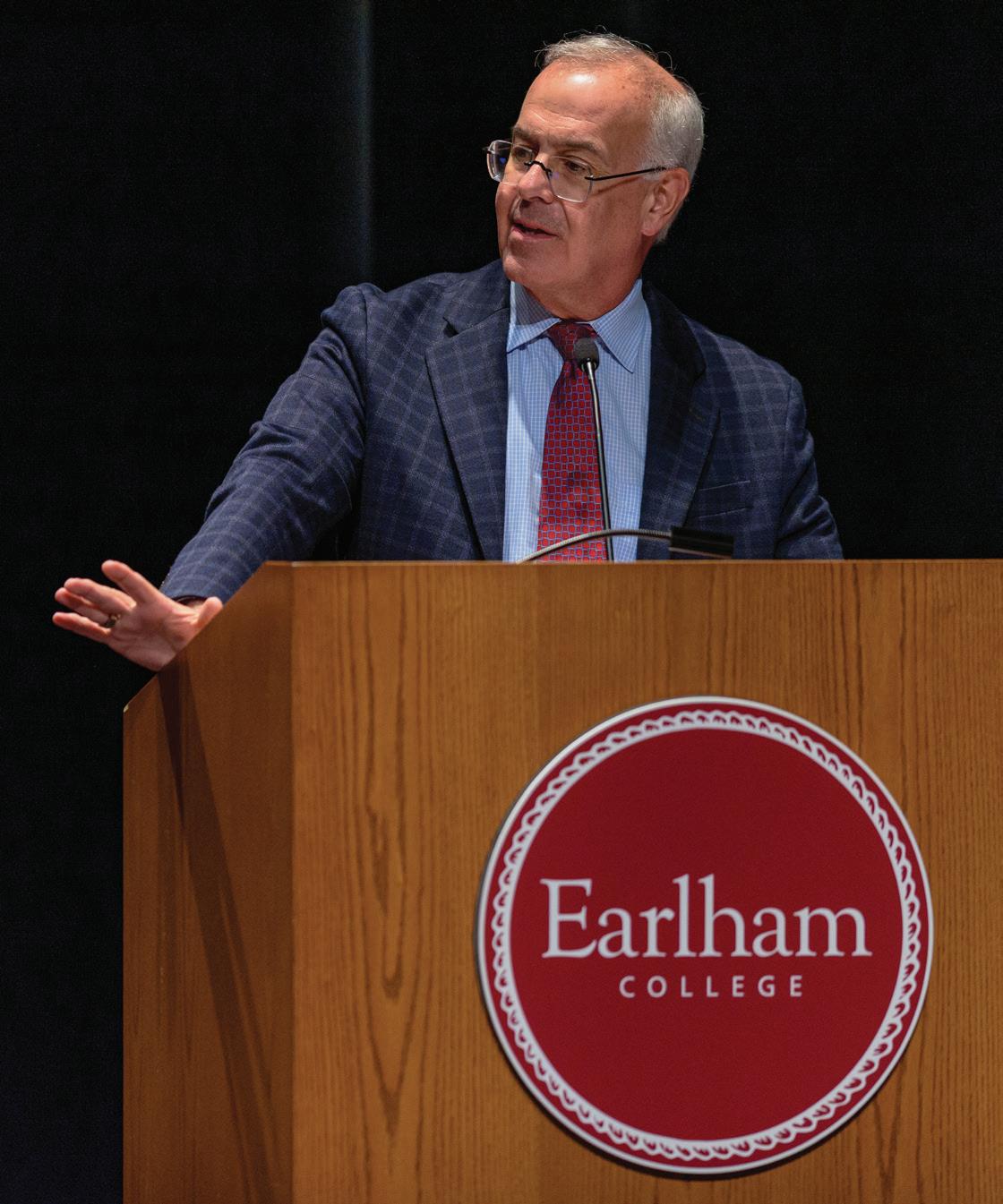
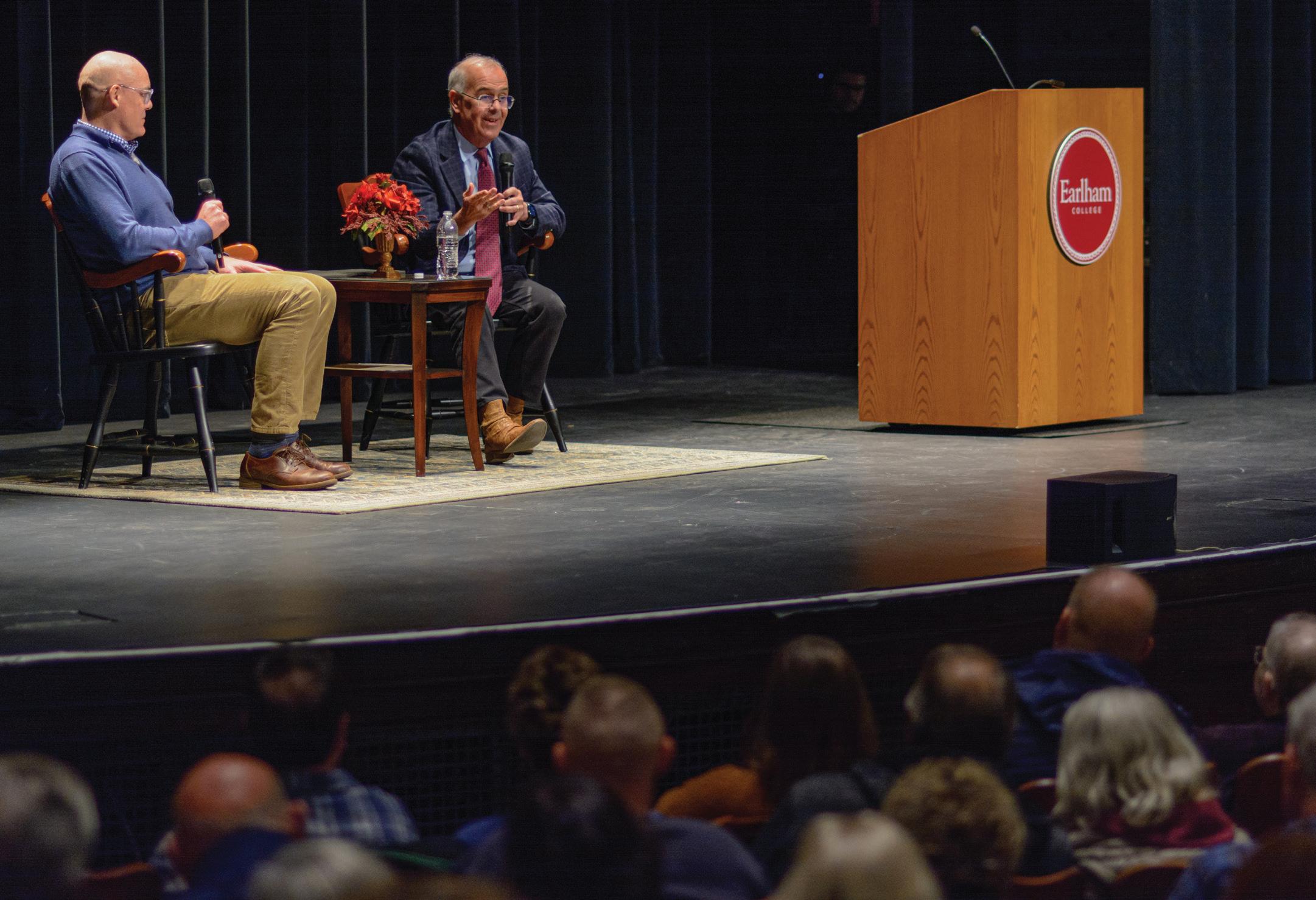
DAVID BROOKS AND PETE BUTTIGIEG
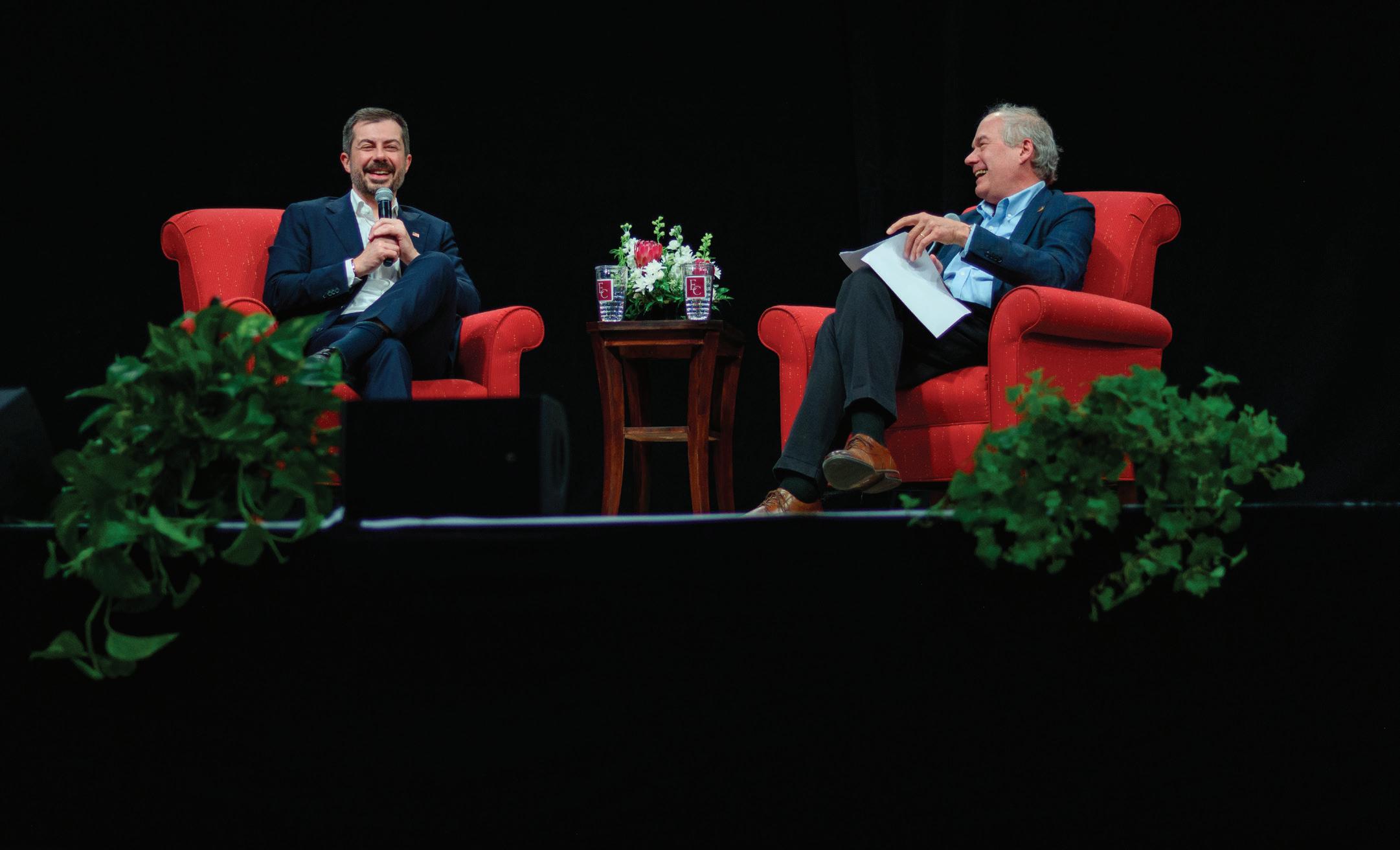
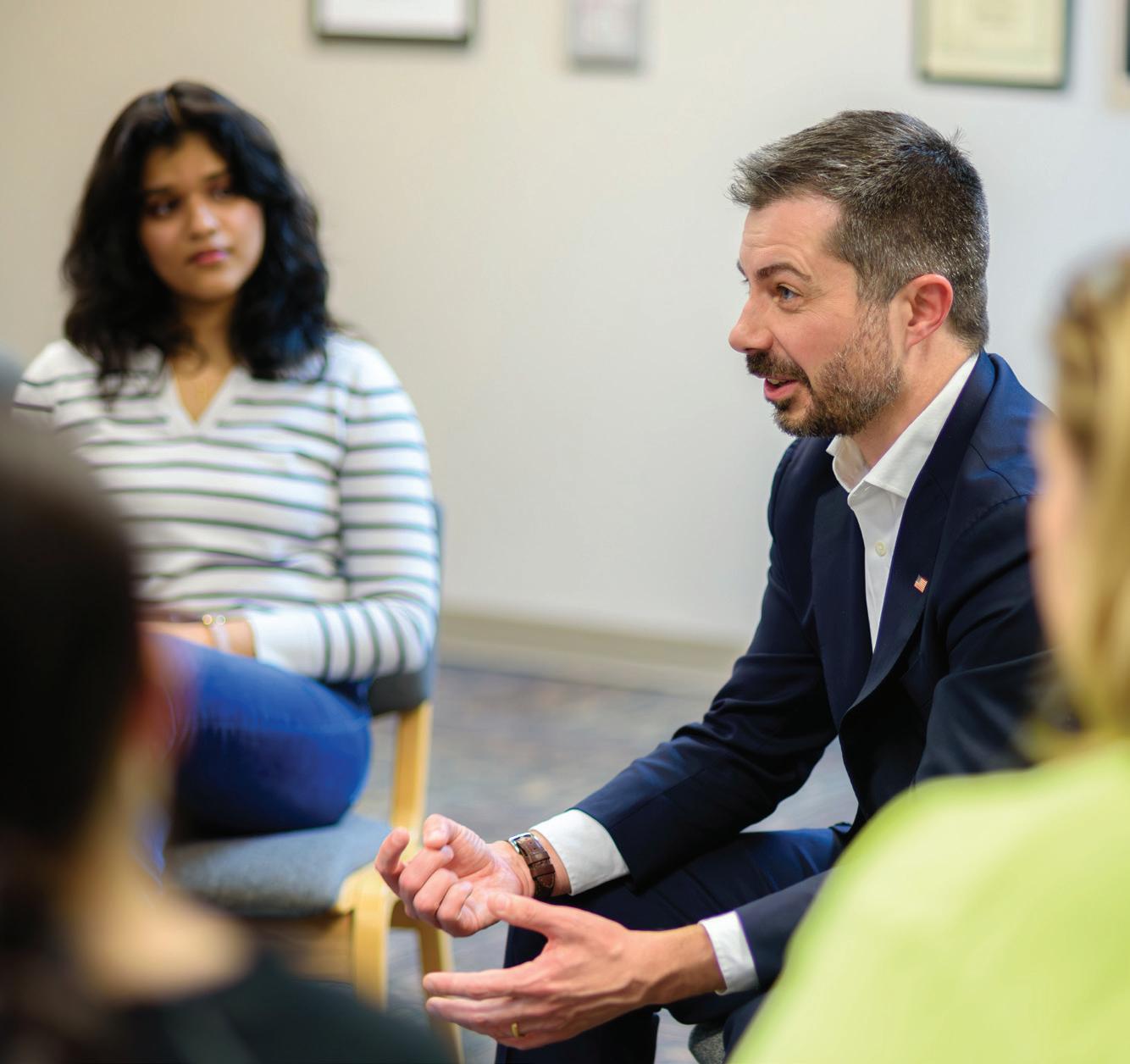
In February, former U.S. Secretary of Transportation Pete Buttigieg attracted a packed audience to the Druley Performance Gym for his appearance in the Presidential Lecture Series. The series, which debuted in 2023, is supported by the Hawkins Just Society Lecture Fund, the Artist and Lecture Series, and the President’s Discretionary Fund.
Together, these events underscored Earlham’s commitment to bringing influential, thought-provoking voices to campus – and creating meaningful opportunities for shared learning and dialogue. ■ Photos by Josh Smith
View a photo gallery from the event at earlham.edu/lectures

Revitalize Richmond updates: Downtown housing, trails taking shape
In late 2023, Lilly Endowment Inc. awarded a transformative $25 million grant to Earlham College as part of its College and Community Collaboration initiative to support projects that have a mutual benefit for the College and its neighbors in Richmond.
Earlham has named its work under this grant Revitalize Richmond. In partnership with local leaders — and supported by an additional $83 million in matching investments — Revitalize Richmond represents more than $100 million dedicated to positioning Richmond and Wayne County for long-term success.
Revitalize Richmond targets the downtown area in particular as a hub for both local Richmond residents and students of Earlham College. Everyone benefits from an economically strong Richmond, and this grant
program and its fleet of associated projects are making major progress, building town-and-gown cooperation and collaboration while accomplishing many other goals related to making Richmond a vibrant place to live, work, and play.
Now, more than two years after the grant award, many projects are moving forward or are completed, with about three years left on the project’s timeline. Substantial progress has been made that hints at even more exciting news soon to come.
Downtown building revitalization
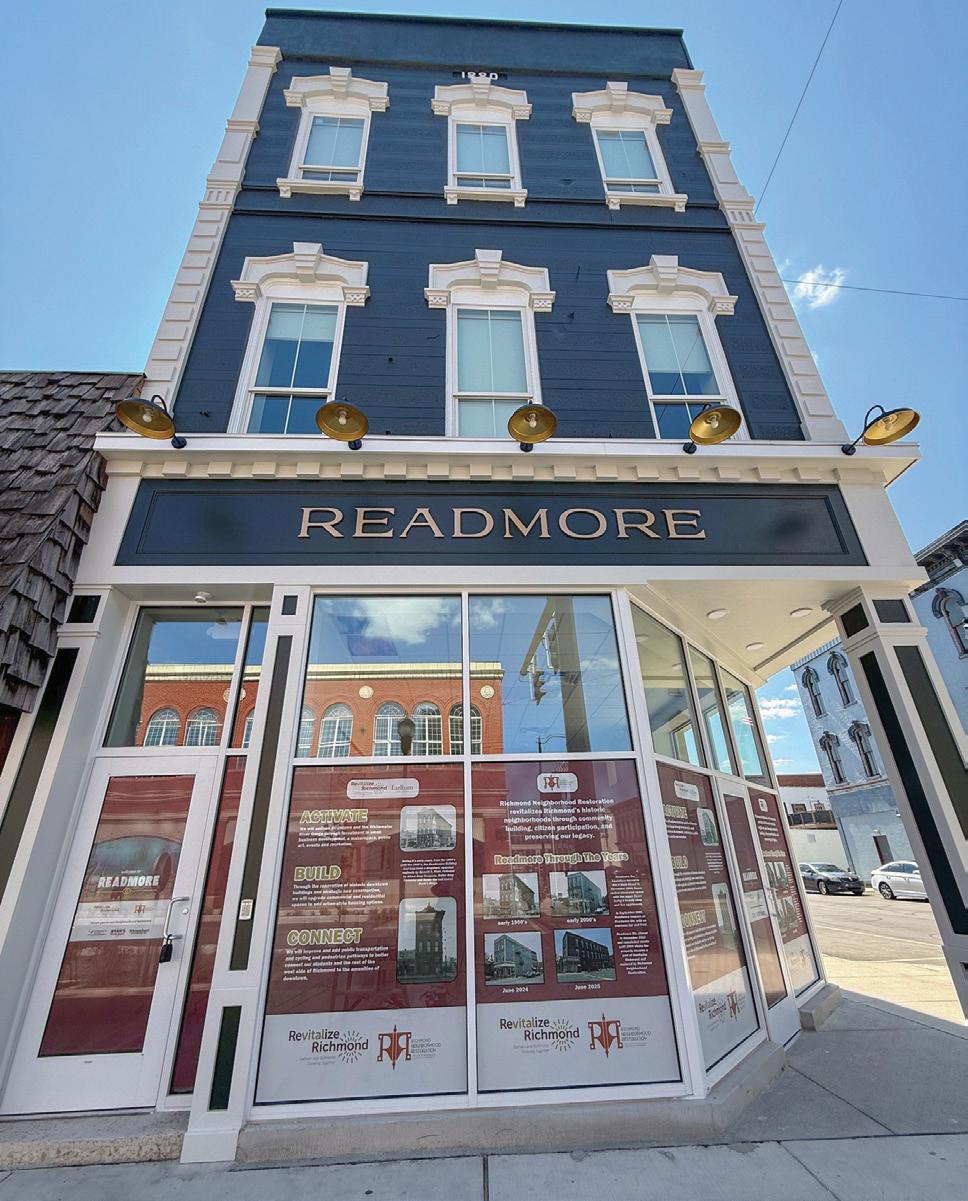
“The Readmore Building is done, and it’s fantastic!” says Dakota Collins ’15, who serves as Earlham’s Director of Community Relations and Revitalize Richmond.
The Readmore Building, a three-story structure built in the 1880s, has been a cornerstone of the downtown area but had been vacant since 2008 until 2025. In partnership with Earlham, Richmond Neighborhood Restoration purchased
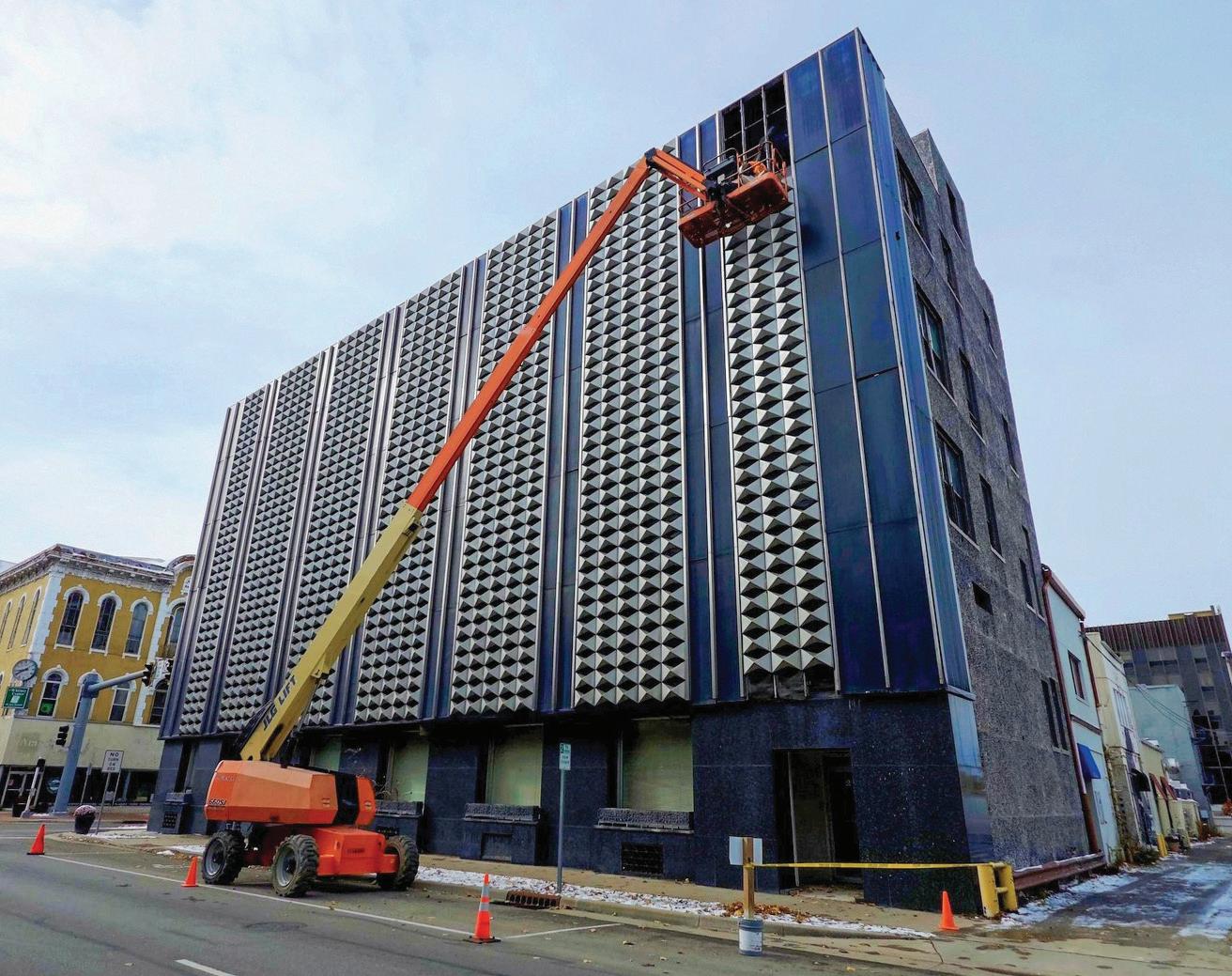
Renovated Readmore Building completed in 2025. AP development began peeling back the metal facade to assess the state of the BMO Harris Bank building in November of 2025.

the building and converted the upper floors into four apartments and the ground floor into retail space, ready for future tenants to add the finishing personalized touches.
Another major renovation initiative in downtown is also underway, with five historic buildings being renovated into 100 apartment units and 20,000 square feet of renovated ground-floor retail space. The historic buildings chosen for this project include the Knollenberg Building, the Hittle Building, the Former BMO Harris Building, the Jenkins Building, and the Odd Fellows Building.
From environmental studies to cleanout to make way for the new development, the work is well underway, with partnership from an Indiana-based private developer who specializes in renovating historic properties.
“The Economic Development Corporation has partnered with Revitalize Richmond predominantly by recruiting the private developer, AP Development, to partner with us and co-invest in downtown Richmond,” says Valerie Shaffer, president of the Economic Development Corporation of Wayne County, Indiana (EDC). “As part of the project, the EDC worked alongside AP Development and Revitalize Richmond to identify buildings prime for revitalization and aided in negotiating with former property owners. We are proud of the scope of the project that has been finalized that will completely restore and fully utilize five historic downtown properties.”

more online
Join current students in touring Richmond. Scan the QR code to see the video.
Creating these renovated spaces brings new life to parts of downtown that have been underutilized. More downtown residents in these new apartments will want to be in walking distance to shopping and restaurants, creating a positive feedback loop that builds new attractions for both those downtown residents and for nearby locals and Earlham students who also visit downtown.
Emphasizing natural resources
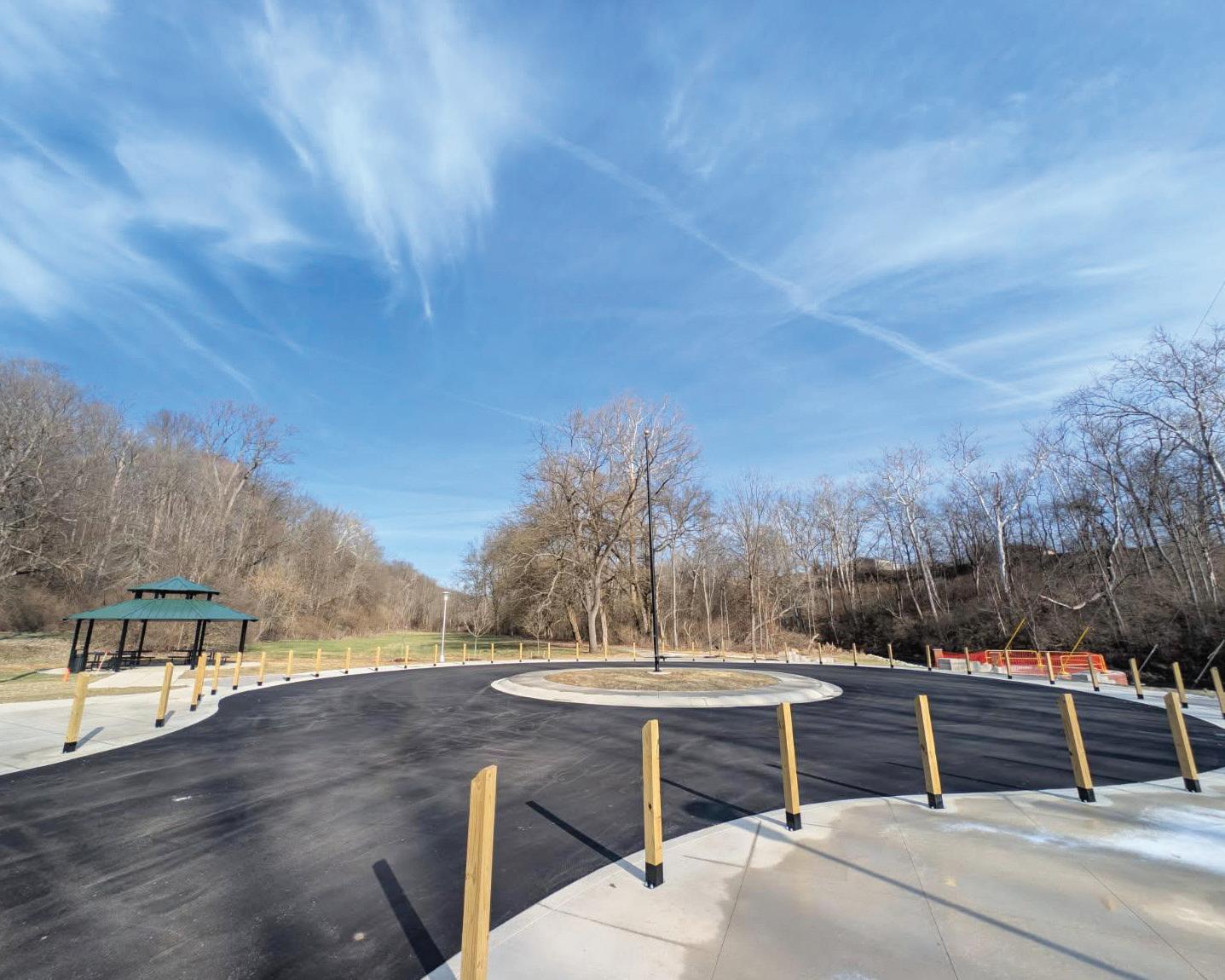
Revitalize Richmond has also partnered with the city's Parks and Recreation Department as part of the larger Whitewater Gorge Activation Plan to work on the Test Road Trailhead and build a launch site there for kayaking on the Whitewater River.
This beautiful area was previously harder to access by boat, causing locals and folks from out of town to turn to other nearby navigable waterways for kayaking opportunities. The goal of the planned developments over the coming years is to make the Whitewater River’s access points in Richmond a place that draws tourism and creates positive memories for locals.
“We have opportunities to build a boulder garden and a playground, and even add ziplining,” says Collins. “We’re turning this into something that is really a destination, not only for residents but also for bringing people into this community.”
continued on next page
A staged apartment living room in the Readmore Building.
Test Road Trailhead
RICHMOND PARKS AND RECREATION
Boosting small business strength
On the Revitalize Richmond website, you’ll see that the ABCs of the Revitalize Richmond project are activate, build, and connect. A major part of the activate component is new support for locals and students who want to start small businesses or bring their businesses to the heart of Richmond in the coming years.
Revitalize Richmond works one-on-one with entrepreneurs to help them build business plans, develop marketing ideas, and connect with the various resources available in Wayne County. The initiative has also identified and brought in resources that allow small businesses to continue developing at their own pace.
A partnership with Downtown Strategies in Birmingham, Alabama, provides learning modules that guide entrepreneurs through business formation, branding, and other foundational skills, while mentorships connect new business owners with experienced entrepreneurs in Richmond.
The initiative emphasizes that small business support is individually tailored to each business’s needs, and that business leaders can work with both Revitalize Richmond and representatives from the Indiana Small Business Development Center. With this on-the-ground work, Richmond can have a strong entrepreneurial base ready when newly renovated spaces open in the coming years.
Bringing students into the community
A big part of the work of Eva Marotta ’23, associate director of community relations at Earlham, and Collins are focused on Revitalize Richmond, but their work is broader than the individual projects within Revitalize Richmond. Some days they are finding ways for students to connect with the Richmond Meltdown Winter Ice Festival; other days, they are strengthening partnerships for local externship opportunities for students from Earlham.
“It’s been so rewarding to see how the community is responding to Revitalize Richmond,” says Marotta. “There’s been a historic bubble between Earlham and Richmond, and I feel like I keep hearing about how it is dissolving. People in Richmond and at Earlham have really good hearts and want to see good things happen.”
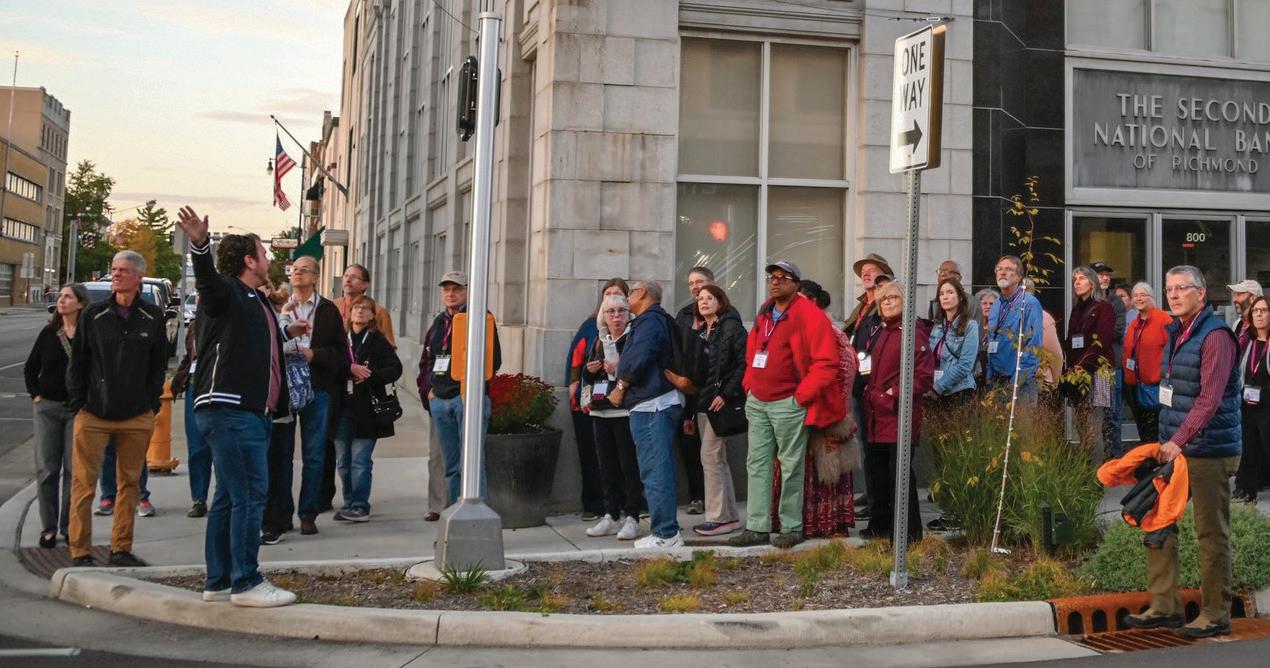
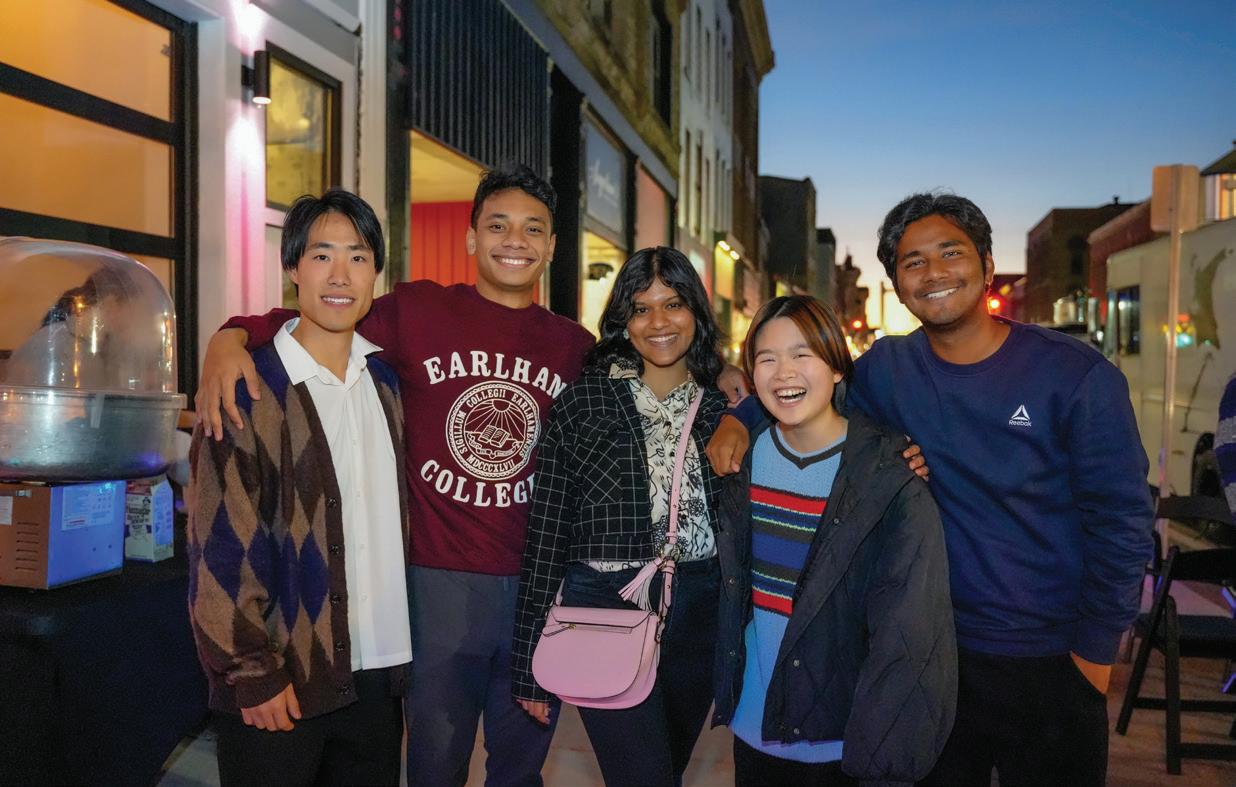
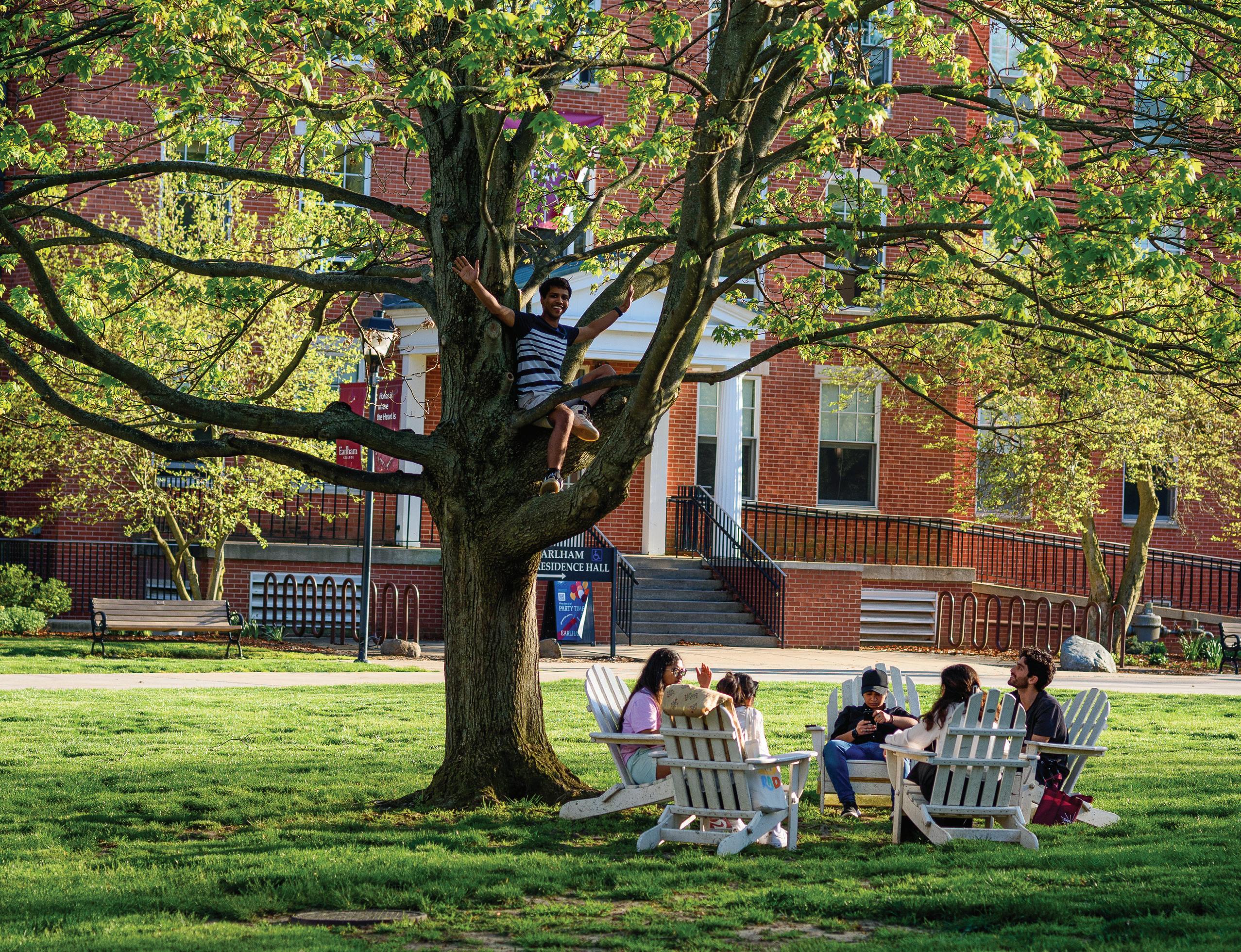
Collins, who grew up in Richmond, sees the work being done as a sign that coming back to Richmond could be a beautiful next step for people who have loved Earlham and Richmond in the past but who have moved away.
“We want you to know the Earlham experience is alive and full of meaning still,” says Collins. “Richmond and Earlham are continuing to grow together, and if you’re looking for a place to call home again, Richmond is an exciting place to live, to be, and to open up a business. Come back and check out Richmond.”
■ Story by Laura Leavitt.
Photos by Josh Smith, Ed DeLaPaz, and Tsitsi Makufa.
“Richmond and Earlham are continuing to grow together, and if you’re looking for a place to call home again, Richmond is an exciting place to live, to be, and to open up a business. Come back and check out Richmond.” – DAKOTA COLLINS ’15
Dakota Collins ’15 giving a tour of downtown Richmond to Earlham alums.

Ready to get started? Scan the QR code to learn more, or visit earlham.edu/alumni.
Your support helps us grow
Four ways you can make an impact today!
Alumni support is invaluable. Here are a few ways you can help Earlham thrive right now :
• Nominate a future Earlhamite. Know a student who would love Earlham? Help them experience their own Epic Journey by referring them for the Alumni Referral Scholarship and unlock a $1,000/year scholarship.
• Engage on social media. Follow, like and share Earlham’s posts to help the spread the word about our community. Find us on social media at linktr.ee/earlhamcollege1847
• Give back, change lives. No matter the size, your gift will change the world — one Earlhamite at a time — for generations to come.
• Become a volunteer. Share your journey with prospective students, mentor current students, or help build community by serving on your reunion committee or planning a local event. Your lived experience is one of Earlham’s most powerful stories.
FACULTY FOCUS: MOLLY GALLOP
Making national headlines about diet and metabolism
Surrounded by nutrition headlines, food trends, and no-fat diet advice of the 1990s, Molly Gallop, assistant professor of anatomy and physiology, grew up asking questions about what was real and what was simply popular opinion. The steady stream of health claims and shifting food rules sparked an early curiosity about how metabolism actually works — and why so much of what people believe about diet persists without strong scientific backing. That curiosity soon turned into a calling.
In graduate school at Columbia University, Gallop found her focus in studying metabolism and body weight.
“Growing up with my own body image struggles, there was a lot of conflicting information out there,” Gallop says. “It really made me wonder what was true, what wasn’t, and how information about diets and metabolism came to be accepted by the general public, and I wanted to study more about that.”
The more she learned, the more Gallop wanted to understand how biology, behavior, and culture intersect.
Gallop credits her exceptional graduate school program for her understanding how the behavioral side of science could play a role in research. “I ended up studying at a place that was awesome for researching weight regulations,” she says. “I was struck by the compassion people showed when talking about body weight. I wanted to be able to continue that work with the same intentionality.”
Building on her early curiosity about diet and metabolism, Gallop investigates how dietary macronutrients — fats, carbohydrates, and proteins — influence both metabolic health and food preferences. Her recent work with mice examined diets varying in fat content, revealing that higher-fat diets reduced metabolic health and physical fitness, though weight changes didn’t
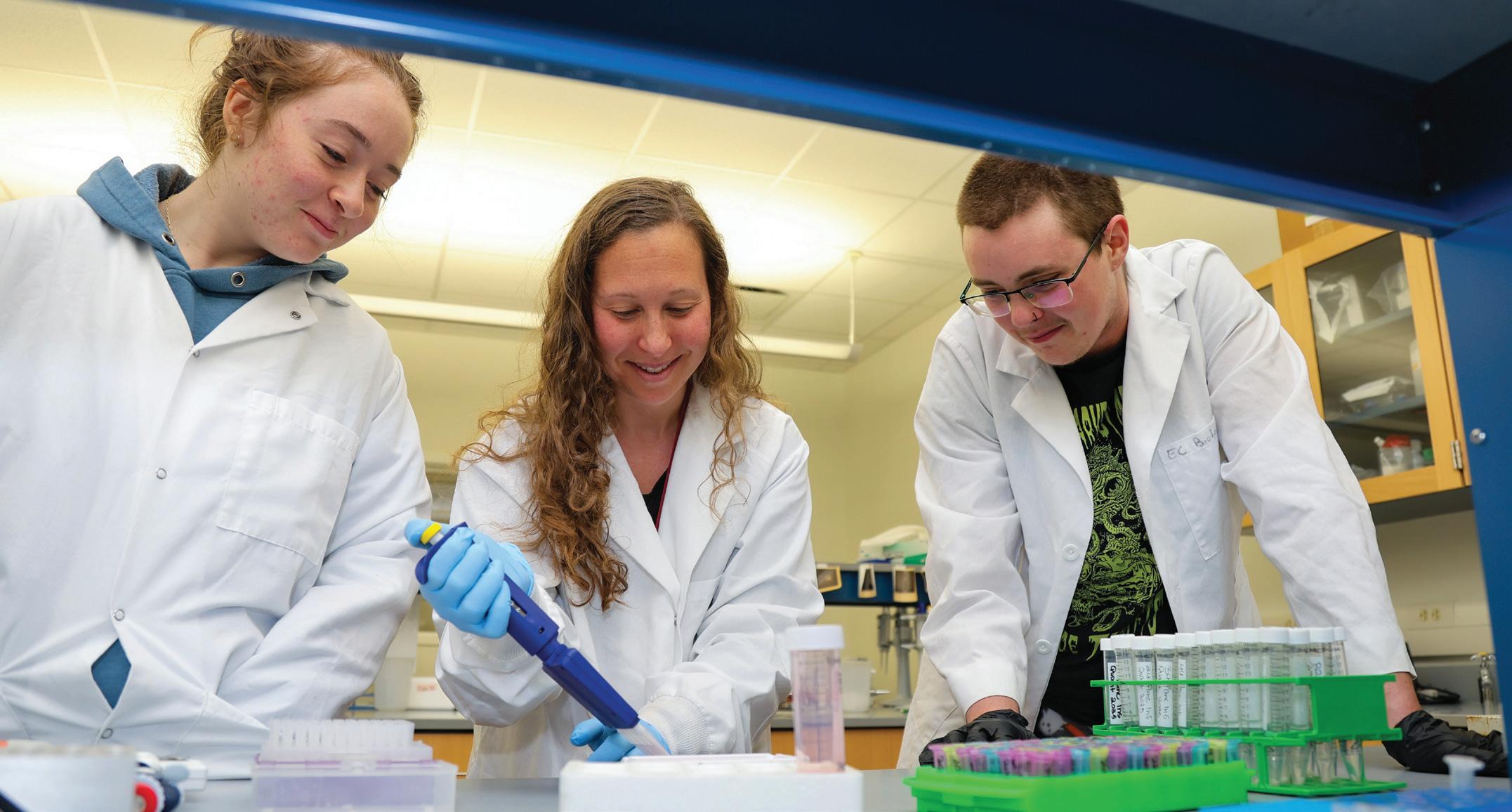
Professor Molly Gallop, center, works with two students in a science lab in Stanley Hall.
always follow a straightforward pattern. This finding underscores a key insight: Weight and overall health are connected but distinct.
Gallop’s findings have reached audiences beyond academia, with her work featured in Science News and Men’s Journal, in which she discusses the potential health risks of long-term ketogenic diets. These articles stem from a study she co-authored, originally published in Science Advances, connecting complex metabolic science to real-world conversations about nutrition and health.
She is also exploring how fat in the gastrointestinal tract affects food cravings and preferences, a line of inquiry she began during grad school. In these projects, students contribute by helping design experiments, build equipment, collect data, and analyze results, as they gain hands-on experience that prepares them for advanced research while shaping the direction of the work.
Gallop also studies why certain diets capture the public’s imagination despite limited scientific support. The ketogenic diet, for example, was originally developed as a high-fat, low-carb therapy for epilepsy, but popular versions often misrepresent how the diet actually works.
People are drawn to fad diets because of simple rules, quick results, or social media success stories, even when these approaches don’t match individual biology.
“Weight, health, and appearance are often conflated,” she says. “People try what seems to work for someone else without realizing that metabolism, genetics, and lifestyle all influence results.” Her research aims to separate scientific fact from trend, helping people make informed nutrition choices.
Through her work, Gallop has uncovered how different diets affect metabolism in complex ways. High-fat diets, for example, can increase blood lipid levels and lead to fat accumulation in the liver, while very low-carb diets may challenge the body’s ability to process glucose efficiently. Her studies highlight that diet impacts individuals differently,
depending on physiology, genetics, and lifestyle. “Many fad diets create visible results in the short term, but it’s important to look beneath the surface at long-term health,” she says. Her research continues to explore how macronutrient composition, particularly protein, influences both weight regulation and overall metabolic health.
“Many fad diets create visible results in the short term, but it’s important to look beneath the surface at long-term health.”
– MOLLY GALLOP
At Earlham, Gallop combines rigorous scientific inquiry with a commitment to student collaboration and mentorship. Students — including those engaged in the College’s premed and pre-health programs — help design experiments, collect and analyze data, and explore their own questions alongside her, gaining hands-on experience that extends beyond the classroom. The College’s emphasis on community and holistic learning allows her to study metabolism and nutrition through both scientific and human-centered lenses, connecting biology with behavior and culture. This integration of research, education, and empathy is what makes the work meaningful to Gallop — and why Earlham feels like the perfect place to pursue it. ■
Story
by Abbie Proeschel. Photos by Tsitsi Makufa
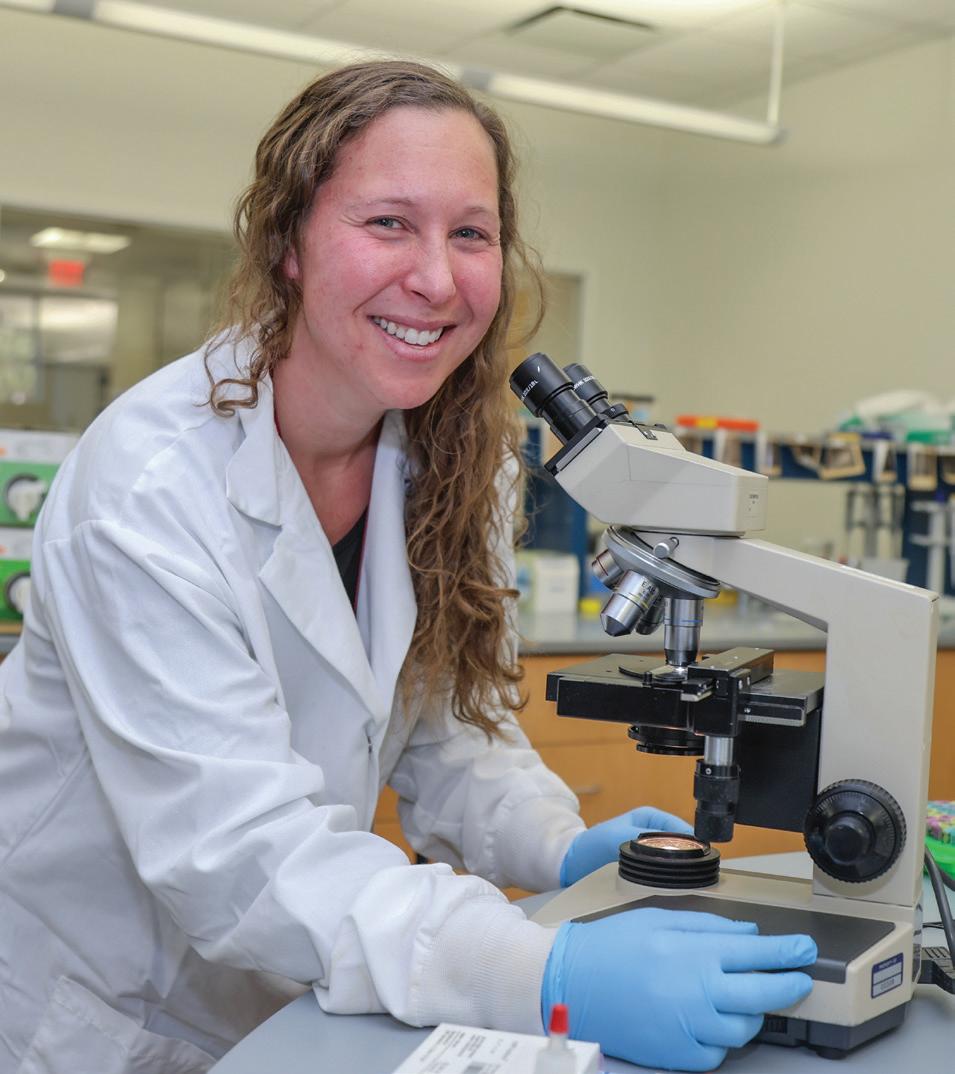
Molly Gallop, assistant professor of anatomy and physiology
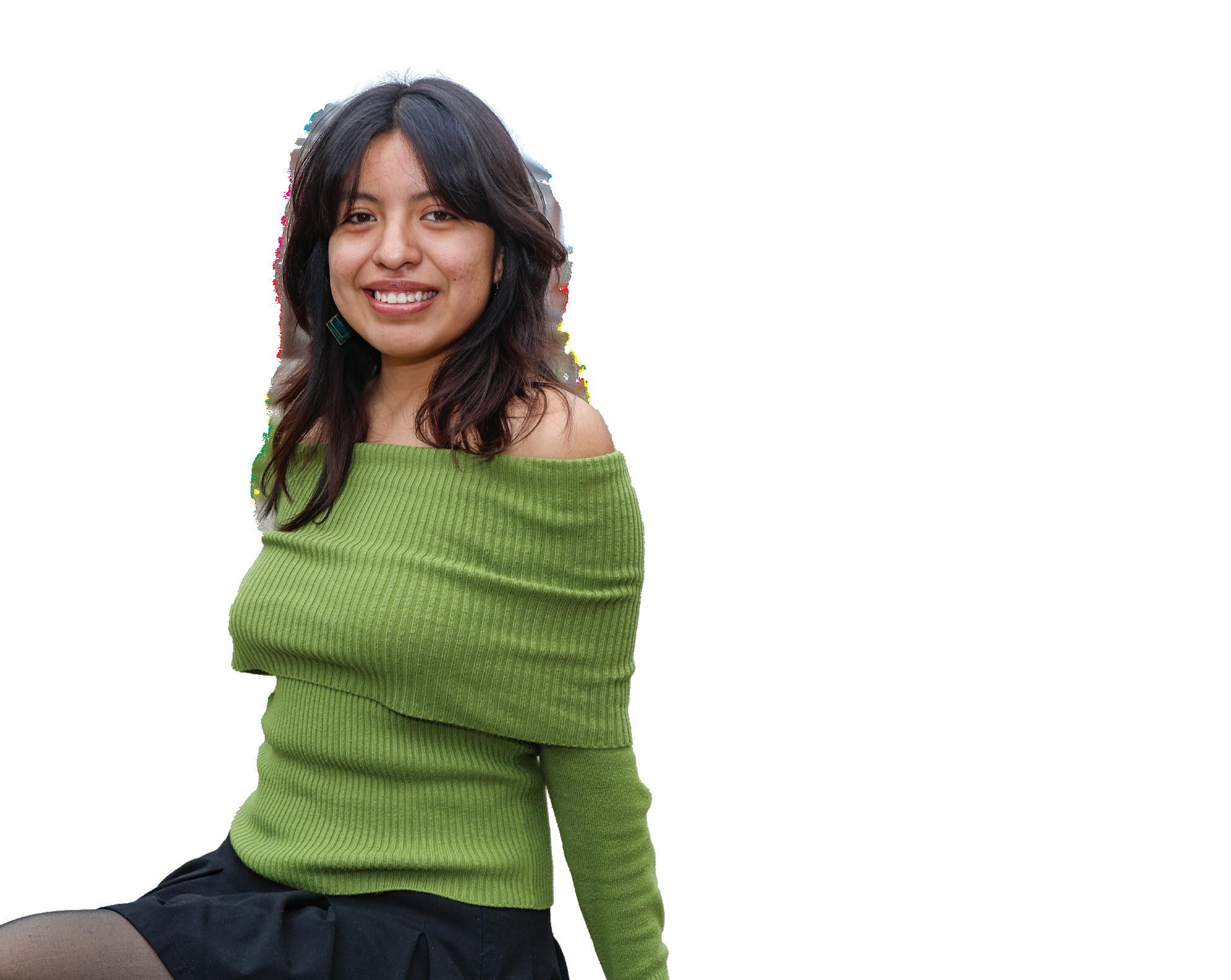
Alejandres ’28
Finding JOY and PU R POSE through the Epic

Lina Kremer ’26
Grady Smitley ’26
Jenny Yakarta Perez
At Earlham College, the Epic Journey is more than a four year, co-curricular college-tocareer framework — it’s a pathway for discovery. “To do meaningful work, you have to know yourself meaningfully, which is a big part of the Epic Journey,” says Career Coach Nico Quijano Franco ’23. “When it comes to career coaching, other colleges are often transactional, where we work to be transformative. We get to know students from day one and help them understand who they are and what they value.”

Established in 2017, this distinctive program has evolved to blend guided reflection, internships, and hands-on learning to help students shape purposeful careers and fulfilling lives. Through one-on-one coaching, students identify their core values and a personal “mission word” that motivates them — a process that encourages them to look inward and consider how they want to contribute to the world. For many, it’s a time of exploration and growth — testing their skills out in the world and discovering who they want to become.
Every Epic Journey is unique, but all begin with curiosity and exploration. Working closely with career coaches and mentors, students are empowered to design their future. The Journey is supported by a career-discerning experience, including funded internships and research experiences up to $5,000 through the Epic Advantage, and the opportunity to earn verified microcredentials.
Later this spring, the College will launch a new initiative called Ask an Earlhamite, which will help current students find mentors, allow alums to share their expertise, and create a vibrant ecosystem of engagement that supports students’ future pursuits.
“The Epic Journey is a natural fit at Earlham as a liberal arts and sciences institution that thrives on interdisciplinary learning where we combine things that might not be possible elsewhere,” says Career Strategist John Wessel-McCoy. “The key is that students take what they learn through coaching and mentorship and connect it to the world through experiential learning.
“Some come in unsure of what they want to do, while others have many ideas. The Epic Journey helps them explore, find clarity, and chart a path forward that’s entirely their own.”
DISCOVERING A CALLING
For many students, the Epic Journey is a defining element of their college experience. Each project, internship, or research opportunity reveals something new about who they are and what brings them joy.
For Lina Kremer ’26, a senior psychology major, her Epic Advantage-funded internship at the Chinese American Service League (CASL) in Chicago became a pivotal moment in her journey and a clear window into her future career.
“My internship at CASL granted me the space to observe nonprofit work and management,” Kremer says. “I feel very passionately about the work I did because there is a systemic issue in America of overlooking anti-Asian hate. Working at CASL inspired me to consider a social work master's degree in my future.”
Kremer’s experience reflects the kind of personal and professional growth the Epic Journey is designed to foster — where hands-on learning deepens purpose and ignites a commitment to meaningful work.
“I feel very passionately about the work I did because there is a systemic issue in America of overlooking anti-Asian hate. Working at Chinese American Service League inspired me to consider a social work master's degree in my future.” – LINA KREMER ’26
Journey
By Abbie Proeschel
CHALLENGING ASSUMPTIONS
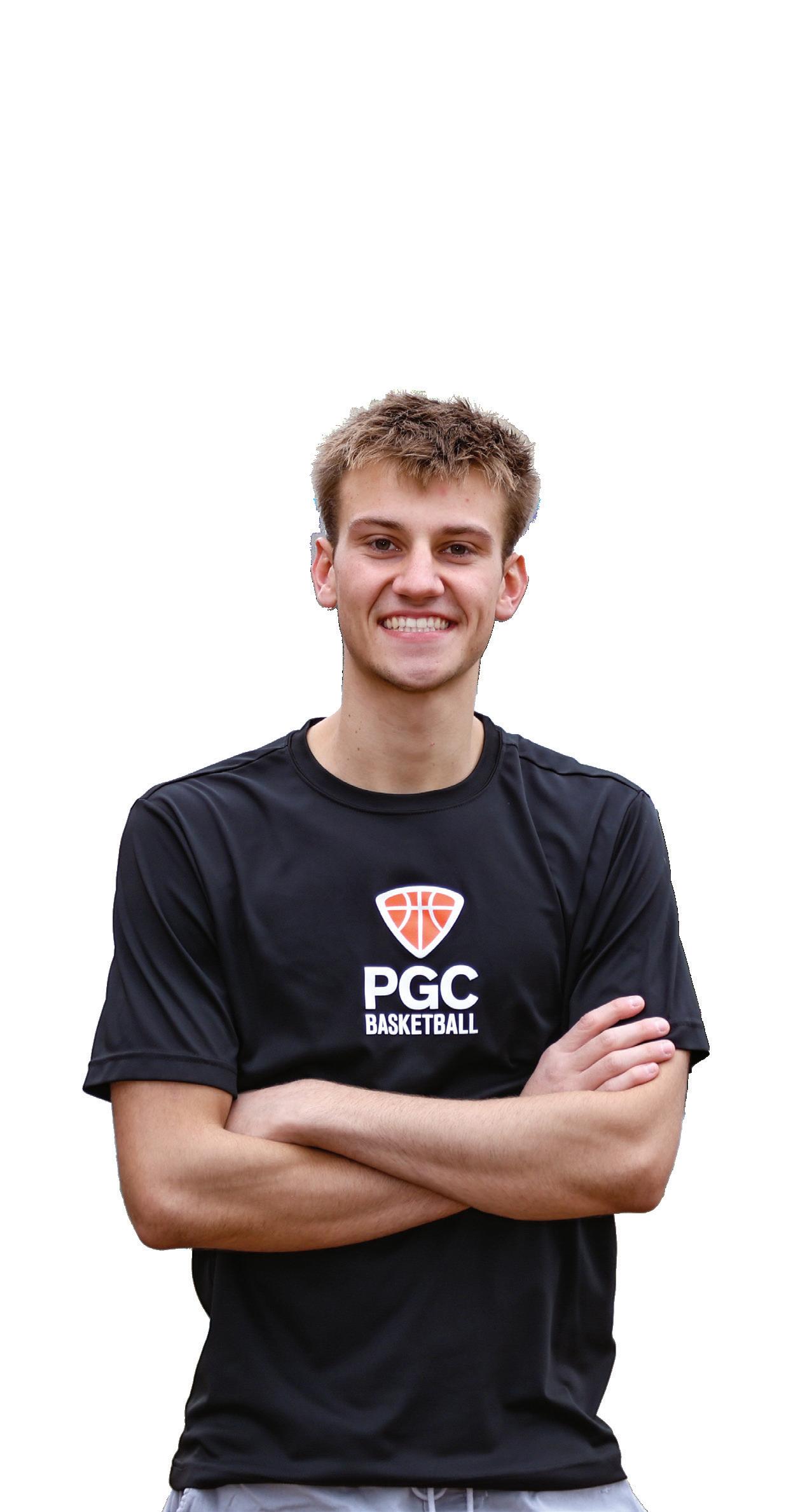
Grady Smitley ’26, a senior business major and member of the men’s basketball team, completed an internship with PGC Basketball, further developing his coaching experience and exploring a future career.
During the internship, Smiley was assigned to lead a girls’ basketball team for the week. “I had previously carried a negative perception of women’s basketball without truly understanding it,” he says. "Throughout that week, I saw how disciplined, talented, and coachable the athletes are. I built strong relationships and helped develop their skills while keeping the environment fun and competitive. That experience completely shifted my perspective and opened the door to coaching both men’s and women’s basketball in the future.”
Grady’s experience shows how the Epic Journey pushes students to challenge assumptions and grow personally and professionally. Epic Expo, an annual showcase of student scholarship and creativity, celebrates these journeys by giving students a platform to display their work, reflect on their learning, and honor the community that supported them along the way.
“Epic Expo speaks to how the Epic Journey reflects the College’s Quaker values,” says Corey Kundert, assistant director of coaching innovation. “Expo is a real testament to the Quaker idea that everyone has something to teach and learn from the community, and by coming together and sharing our contributions, students can learn from one another and feel the support of the community behind them.”
MAKING AN IMPACT
While internships are one way students explore potential career paths, Earlham’s Epic Journey supports discernment through many kinds of applied experiences including support for creative, community-based projects. Jenny Yakarta Perez Alejandres ’28, a sophomore computer science major with a passion for fashion design, exemplifies this through her project on sustainable fashion, which earned her one of the inaugural Earlham-Ullberg Prize for Environmental Innovation. Her project addressed inequities in the fashion industry while allowing her to explore new dimensions of her passions.
“Winning the Ullberg Prize challenged me to step out of my comfort zone and rethink how I see my career path,” Alejandres says. “I learned about sustainability, honed professional skills like networking and adaptabil-
ity, and most importantly, discovered how to connect with people and their missions.”
Her experience highlights how the Epic Journey fosters both personal growth and tangible contributions, showing that learning with purpose extends far beyond the classroom.
Across these journeys, a common thread emerges: joy through discovery and growth through experience. With guidance from mentors and coaches, students learn not only what they want to do, but why it matters. At its heart, the Epic Journey reflects Earlham’s belief that education connects knowledge with meaning. Graduates carry these lessons forward, pursuing lives and careers of purpose, impact, and continuous learning, with experiences that shape who they are and the difference they make in the world. ■
Photos by Tsitsi Makufa and Josh Smith
EARLHAMITE ASK AN
Something big is coming this spring — and we want you to be part of it.
Ask an Earlhamite is a new initiative designed to connect students and alumni across generations. Both students and alumni can submit questions through the platform. When a question aligns with your background or experience, you will receive an email inviting you to respond. You choose whether and how to reply — by email, phone, or a virtual conversation. Alumni are only
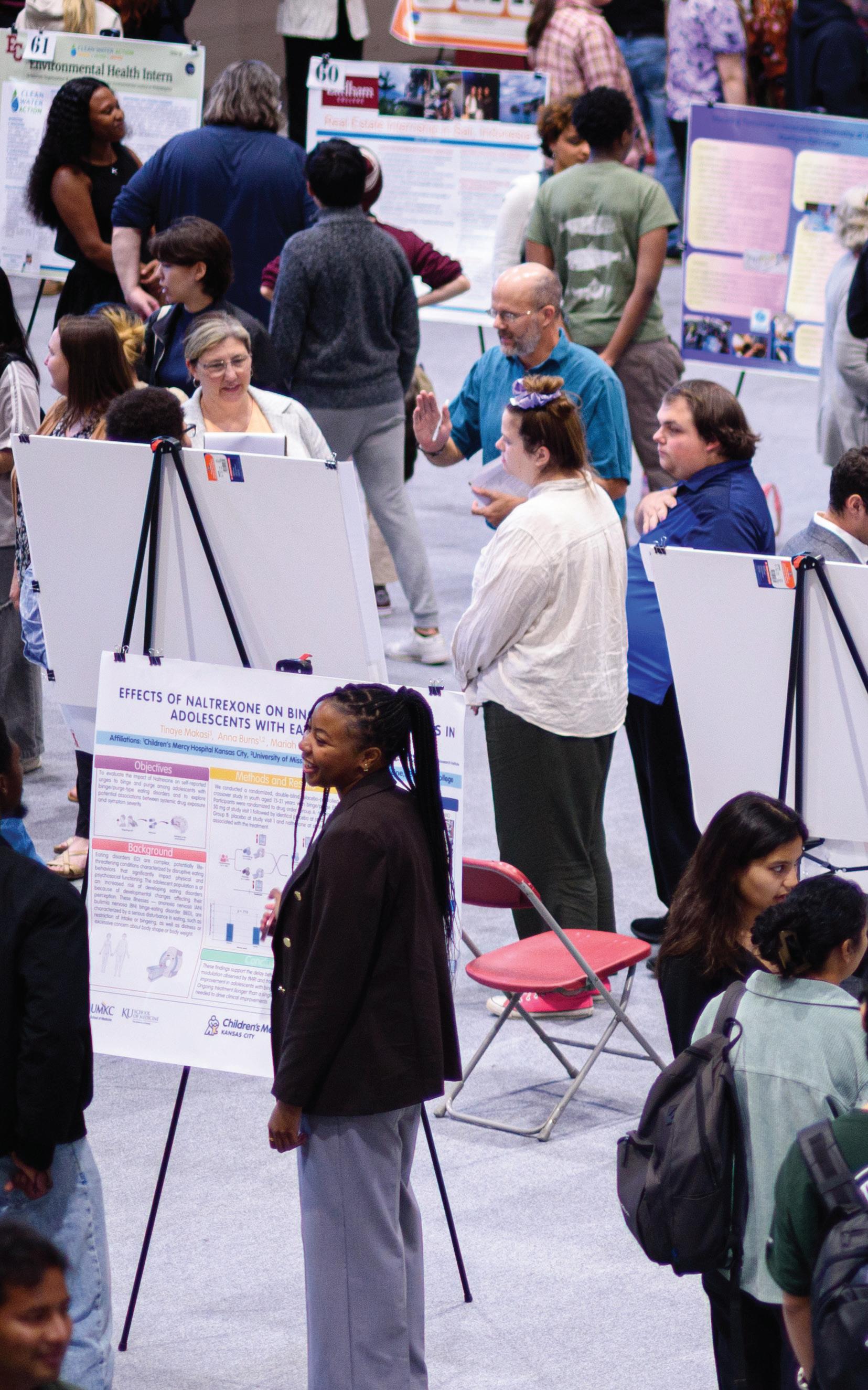
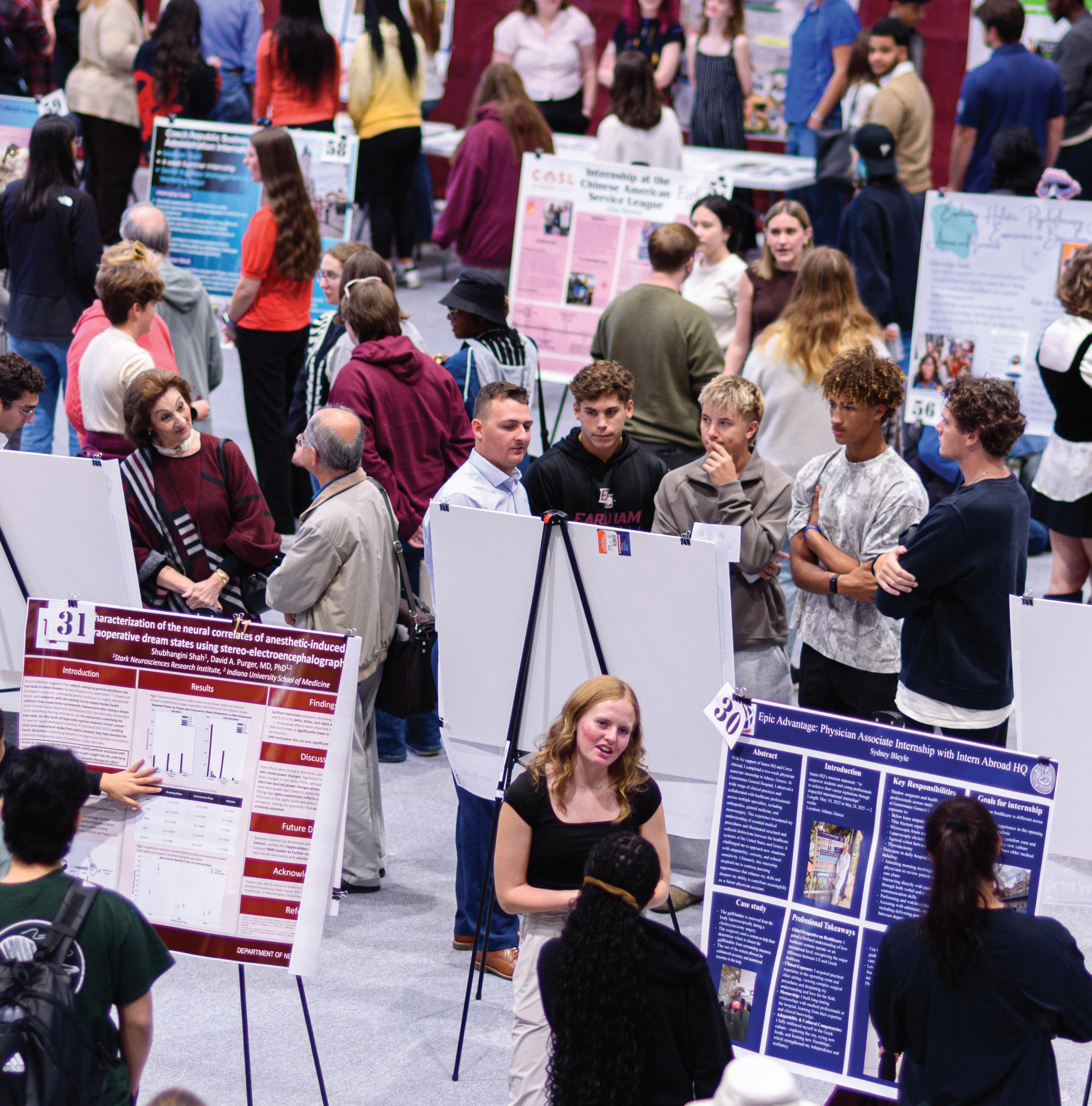
At a packed Epic Expo, students present posters highlighting internships, research, and off-campus study experiences.
contacted when there is a specific question that matches their expertise.
It’s a simple way to share expertise, answer a question, offer advice, or make an introduction — all on your own schedule. No heavy lifting. Just a meaningful connection.
This network creates opportunities for students to seek guidance and for alumni to connect with collaborators, industry peers, and local Earlhamites within our global community. Before we launch, make sure we have your current email address, professional position, and title, so you are ready to answer a question, offer insight, and tap into the network yourself.
Update your information here:
Educating hearts and minds
By Laura Leavitt
Earlham has both a legacy for providing an outstanding education and also for cultivating outstanding educators.
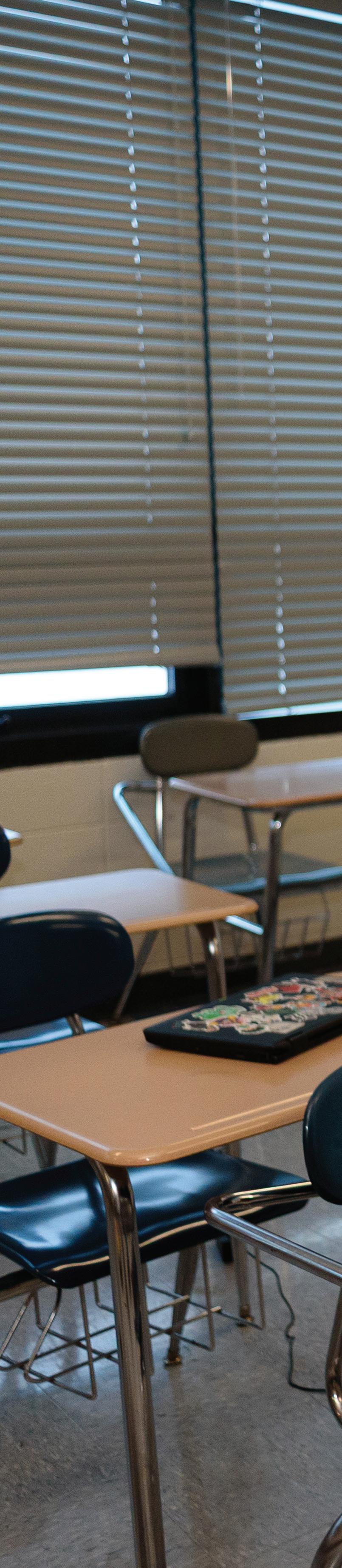
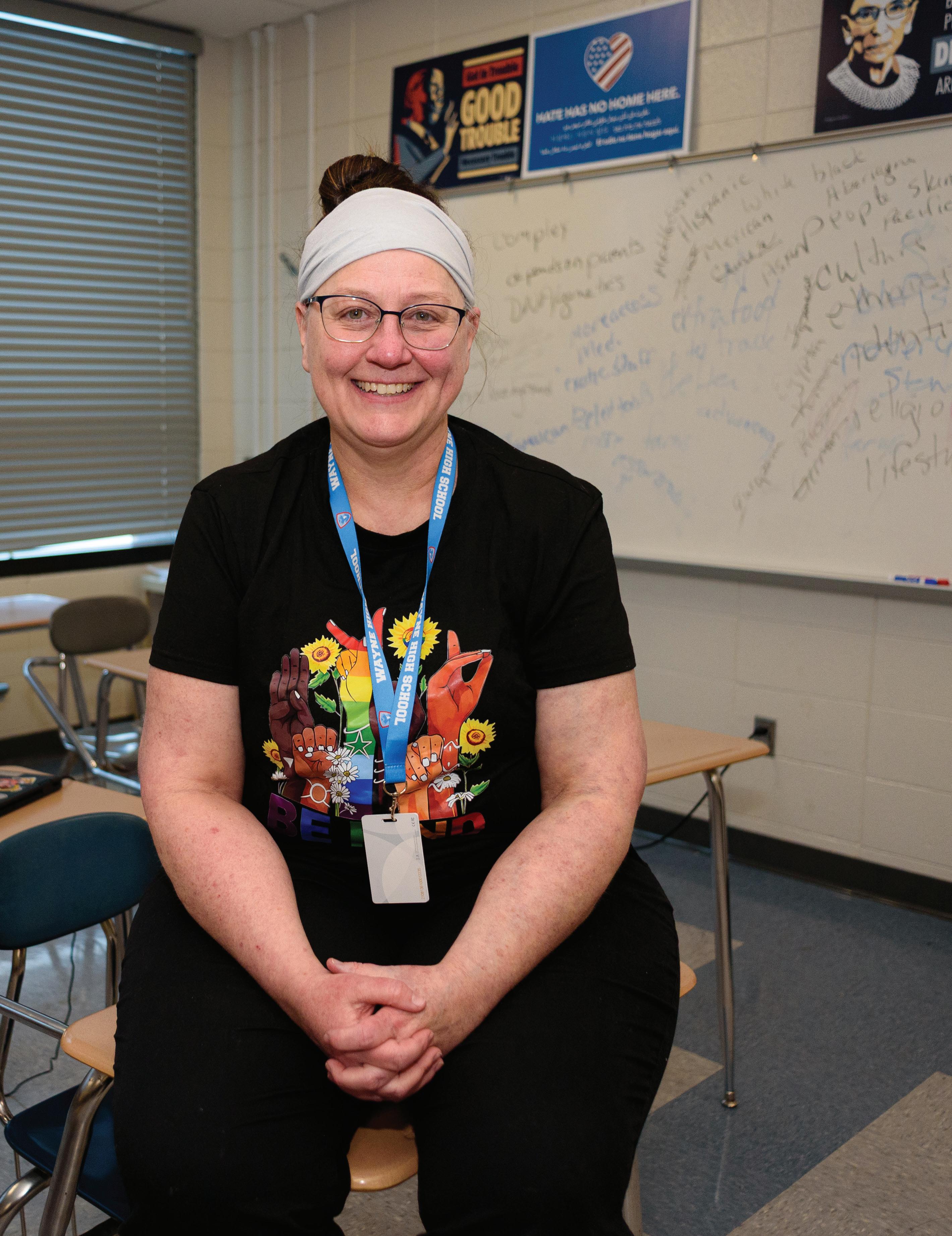
Earlham has built a strong national reputation for outstanding teaching and classroom excellence in all subjects and disciplines. Additionally, it has a legacy of producing graduates who go on, immediately or later, to become educators and mentors themselves. These educators bring to their teaching the same valuable and distinctive qualities that once made them dynamic students at Earlham. They also carry forward a spark from their Earlham education that continues to spread light and knowledge as they move out into the wider world.
It often takes a leap of faith to bring one’s knowledge, research, and pedagogical prowess to the classroom. Both public and private education have had their challenges in the past few decades. Everything from the role that technology plays in modern classrooms to the upheaval of remote and hybrid learning in the early 2020s has tested educators’ creativity and perseverance. They have responded by diving deeper into strengths, bringing even more creativity, cleverness, and compassion to their work. They don’t do it alone. Their colleagues, mentors, and Earlham connections lend support.
Making long-term impact
Thomas Schutt ’08 knows what it means to come from a long line of Earlham graduates; he's a sixth generation Earlham alum. That type of long-term impact is a thread in his career and an enduring commitment to his role as a mathematics teacher since 2009 at Columbia Heights Educational Campus, a Washington, D.C. public school.This role has seen him through important life milestones, but he credits both his undergraduate experience at Earlham and the College’s Master of Arts in Teaching Program with having launched his teaching career.
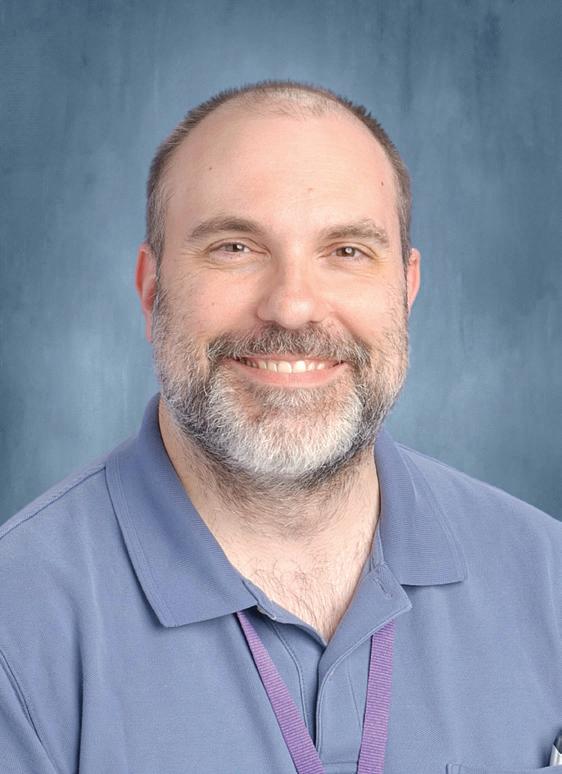
“I studied with Debbie Rickey and Randy Wisehart, and I had a practicum experience at Richmond High School, which was helpful for giving me real-world experience. It helped me feel
confident moving to D.C.,” says Schutt.
Other experiences, such as attending the London program with Bob Johnstone, a retired professor of politics, offered Schutt an international perspective. He has built his life around living in Washington and raising a family, and his career as an educator, working his way up to teaching his preferred courses AP Calculus AB and BC.
Schutt returned to Earlham over the years to talk math with his former professors, a full-circle journey that reconnected him with the elements of math that first inspired his interest.
These days, he weathers challenging times in education through strong connections. “I’ve got a core group of close friends who have stuck it out, and they help keep me going,” says Schutt.
Buoyed by collective support
Cristen Chapman ’94 has weathered major changes in 29 years of teaching. For 10 years, she as been at John Hancock College Preparatory High School, a selective enrollment school in Chicago, where she teaches while also sponsoring a poetry club and serving as department chair.
Chapman studied peace and global studies at Earlham and went on the Great Lakes Jerusalem program. She fondly remembers one class in particular: Howard Richards’ Methods of Peacemaking, which still informs her sociology teaching.
“I also took classes and worked on a grant with Carol Hunter, a history teacher, and my thesis was infused with ideas that I learned from her about how to be a social science educator,” says Chapman.
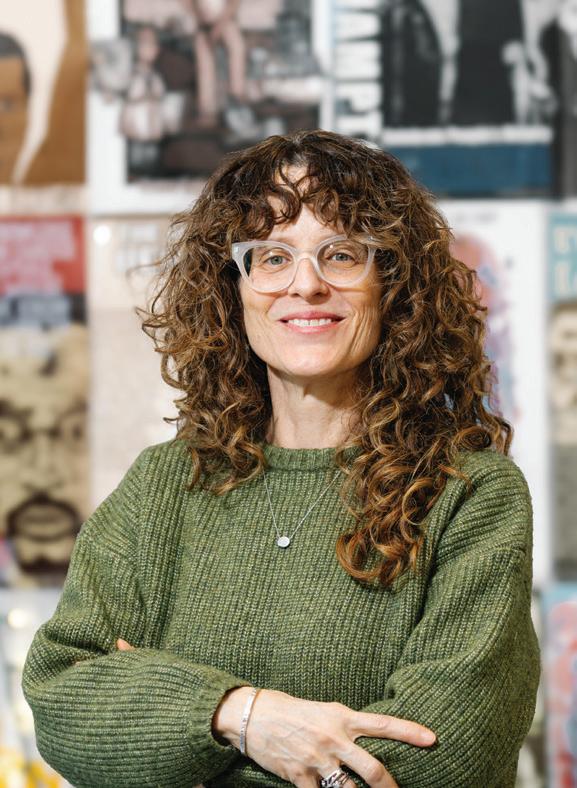
Chapman learned that valuable seeds are being sown at all times. She strives to make social justice issues come alive in her AP government, AP U.S. history, and sociology classes, with the hope of making those subjects crucial parts of her students' identities going forward. Beyond the students, working with other passionate
educators is very important to her; she stays connected through professional development experiences and the Chicago Teachers Union, among other groups.
“Feeling connected to other people who are committed to social justice in education is what keeps me here,” says Chapman. “I stay in touch with allies throughout the city committed to the same things.”
Choosing challenges
While Wilmer Chavarria ’13 spent time as a classroom teacher, he sensed early on that his path would eventually carry him to educational administration work. “The superintendent who visited our high school when I was a first-time teacher left a very good impression on me. I had a lot of respect for her. The more I got to know her work, the more I learned how much I wanted to be a leader like that,” says Chavarria.
Chavarria sought out that same superintendent as a mentor, and with further education and work experience, he has become the superintendent for the Winooski Schools in Vermont. He sees the power to influence others as a very important part of both teaching and administration.
“At the superintendent level, you have a role to play; you have to ask yourself, ‘Are you able to sustain your commitment to your values in the role where you’ll be?’ Even when you become the boss, you want to remain true to your values," says Chavarria.
Chavarria’s tenure as a superintendent has coincided with undeniable challenges and barriers, but he believes that what the teaching profession has always required remains the core source of tools for modern education and the excitement behind choosing a career in teaching.
“I push back on the idea that young people or children are substantially different than they are at any other time in history,” Chavarria says. “What makes teaching exciting is that there isn’t a playbook; there isn’t just one plan to follow. The teachers figure this out: If you’re a person who enjoys creativity and resourcefulness, you should see the variability in humanity as an opportunity. If you feel up to the task, be a teacher.”
The Earlham impact
After her first career in telecommunications and business, Carrie Bubb ’92 returned to her roots in Fort Wayne, Indiana, and pursued teaching with a particular interest in languages, English, world history, and ethnic studies. “I’m licensed in five subjects. It means there’s always something interesting to do,” Bubb says.
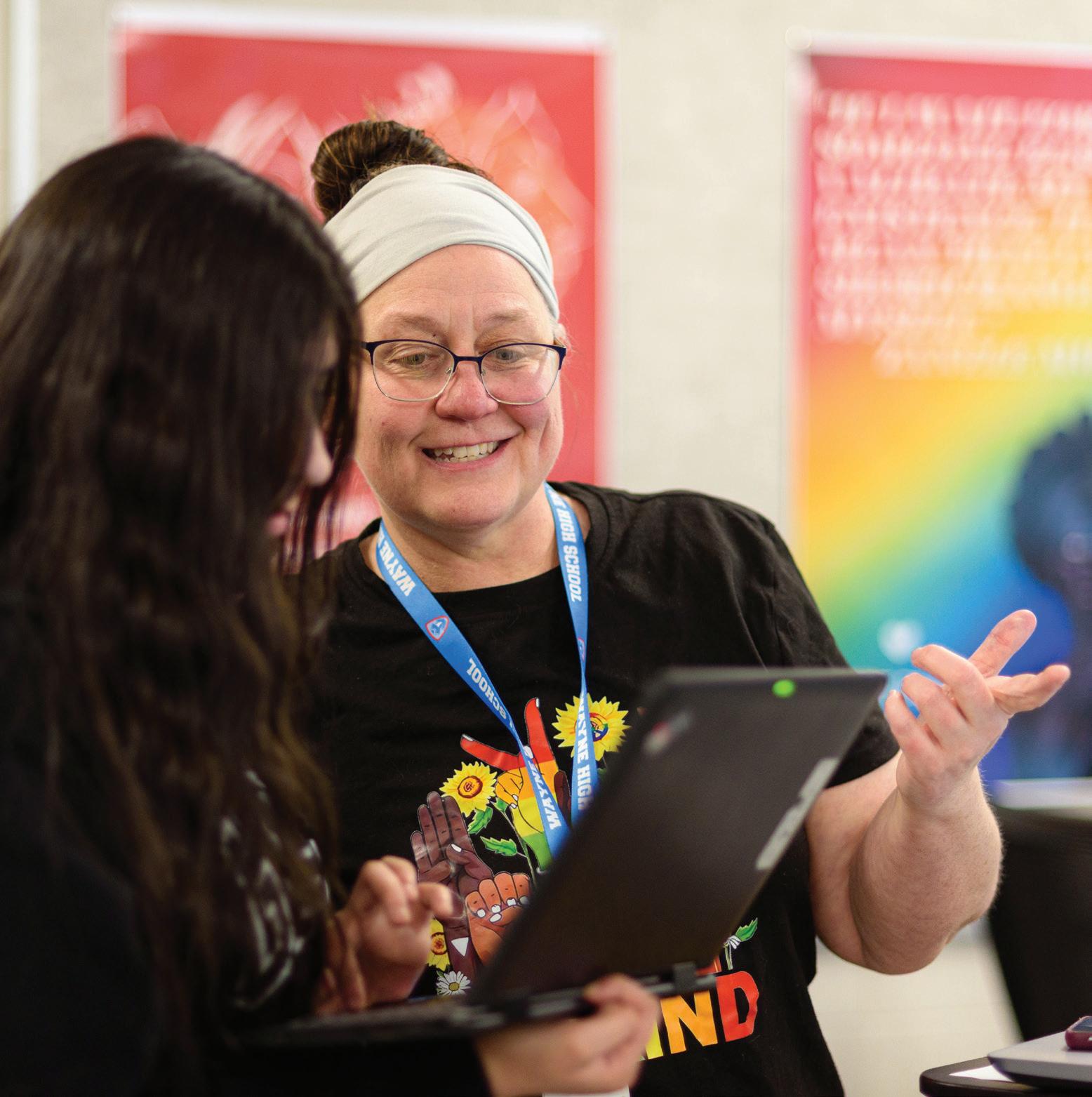
Since 2019, she has taught at Wayne High School. “For the most part, it’s been great. I love the kids, I love the school, and I love my colleagues,” says Bubb.
She has treasured each time she can give students unique opportunities, and some students who have gone on to amazing careers still reach back out to Bubb and give her updates.
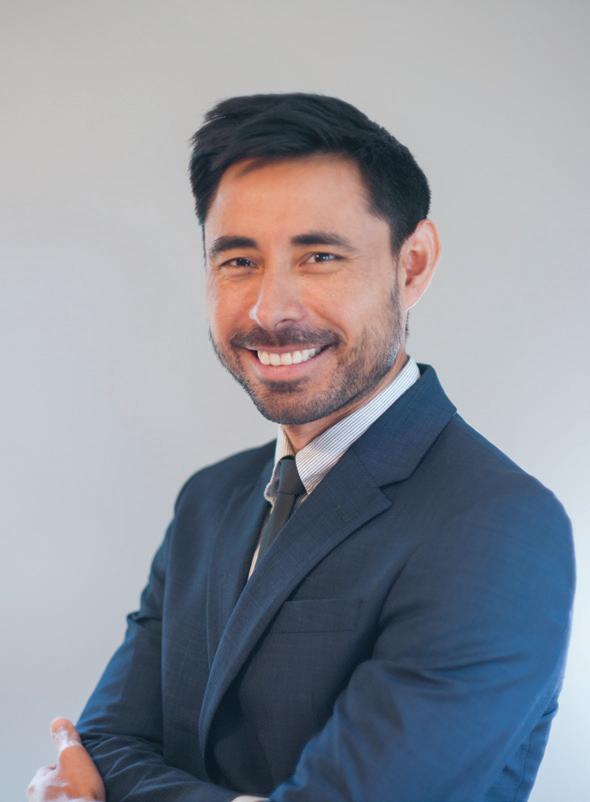
“If you’re a person who enjoys creativity and resourcefulness, you should see the variability in humanity as an opportunity. If you feel up to the task, be a teacher.”
– WILMER CHAVARRIA ’13
Earlham Educator Network
Recently, a collaboration between the offices of Admissions and Institutional Advancement, and Alumni Council has launched the Earlham Educator Network. This connecting initiative is a way for alums to:
• Connect to other educator alums
• Share Earlham with their own students
• Get involved in alum panels and events
“Earlham has a unique story to tell — one that stands out in the national and international higher education landscape. Together, we can
“Every time I get so tired, I get a message on social media from a student who might be 30 now, telling me that they were using an activity that I did with them in their own classroom, or letting me know that they are in France right now and they wouldn’t have gotten there without taking my class,” says Bubb.
The interdisciplinary/transdisciplinary approach at Earlham informs much of how she crafts her classroom, she says, but more broadly she credits much of her perspective to her Earlham experience as well.
“I would not be the person I am if I hadn’t gone to Earlham, personally, academically, in every way. I’m not stagnant, but the direction was set at Earlham,” says Bubb. ■
Photos submitted by Schutt and Chavarria. Bubb photos by Josh Smith. Photo of Chapman by Fatima Salgado-Patron.
bring more students to Earlham who are seeking a community like ours,” says Jeffrey Perkins ’94, Earlham vice president for enrollment management, marketing, and communications.
Are you an alum educator? Join other Earlham alumni educators who have already signed up to support this initiative today.

Celebrating 20-plus years of educating educators
For more than 20 years, Earlham’s Graduate Programs in Education helped shape thoughtful, committed educators who brought Earlham’s values into classrooms and communities across the country. Rooted in reflection, relationship-building, and learning by doing, the programs left a lasting mark on hundreds of graduates and the students they would go on to teach. As Earlham’s Graduate Programs in Education come to a close in May, we pause to honor the vision, leadership and learning that defined them. Founders, former directors and a graduate reflect on the program’s enduring impact on their lives and on the communities they served.
“The Master of Arts in Teaching and Master of Education programs were different from other teacher education programs due to our commitment to infusing Earlham Principles and Practices, thus Quaker principles, into the programs. Respect for Persons. Integrity. Peace and Justice. Simplicity. Community. Instructors breathed life into these principles as an integral part of becoming good teachers and no student could graduate without showing they had internalized and applied these principles. We were able to help our students understand that these principles were fundamental to creating a classroom culture that helped students become actively involved in their own learning. In addition, I became more aware of how I was applying Quaker principles as a teacher and a leader.”
— Randy Wisehart ’75, retired director of the Graduate Programs in Education, Richmond, Indiana
“I would not be an educator today without the GPE program at Earlham. At the time, I had changed my major and lacked a clear sense of direction or calling. While volunteering in a halfway program, I discovered the power of education to truly change lives. That experience led me to meet Stan Hill ’94, former director of admissions for the Graduate Programs in Education, who introduced me to a program designed to develop educators with purpose. One visit was all it took and I knew it was where I belonged. Because of this program, I found my voice and the responsibility we carry as educators to help shape and change a generation.”
— Tyler G. Arnold ’10 M.A.T., principal, Princeton City Schools, Cincinnati, Ohio
“The GPE/M.A.T. differed from other programs by having Earlham’s Quaker principles and practices at its heart. The goal was to “awaken the teacher within.”
These values were captured by Quaker Parker Palmer’s brilliant The Courage To Teach. His observation that “technique is what teachers use until the real teacher arrives” helps to highlight the program’s focus. The subject, not the teacher, is at the center of learning. All members of the classroom, including the teacher, are learning together. For Palmer, no teaching will ever really succeed 'unless it connects with the inward, living core of . . . students’ lives, with . . . students’ inward teachers.' Thus, teaching is as much a social as intellectual process.
This approach helped not only our GPE students but also established teachers in east central Indiana. On the occasion of the program’s second accreditation review, the representative from the state of Indiana (who participated in all accreditation reviews of all Indiana teacher education programs) offered a valuable insight. She observed that GPE was the only teacher education program in Indiana that was not only respected by local teachers but also changing the school culture in east central Indiana.”
— Randall Shrock ’68, co-founder of the M.A.T. program, Richmond, Indiana
“To me, the element of the Graduate Programs in Education that made it the most unique and successful was the coaching model. We observed our student teachers 10-20 times, debriefing with them about what went well and what we wanted them to work on next — just like athletes. They then got to work. The same faculty who were doing this coaching also taught all of the classes, and we created a seamless experience that eliminated overlap or gaps. We developed positive relationships with our students, which were essential for them to be able to meet our high expectations.”
— Becky Dimick Eastman ’97, former assistant director and director of the Graduate Programs in Education. Currently Head of School at Richmond Friends School, Richmond, Indiana
A LIVING LEGACY WITH
A SHARED HISTORY BETWEEN EARLHAM AND JAPAN SUPPORTS
ACADEMIC EXCELLENCE AND CULTURAL EXCHANGE. A NEW ROLE FOR THE COLLEGE IS BROADENING THESE VALUED PROGRAMS AND CONNECTIONS TO INCLUDE INDIANA YOUTH.
By Ray Mark Rinaldi
1887
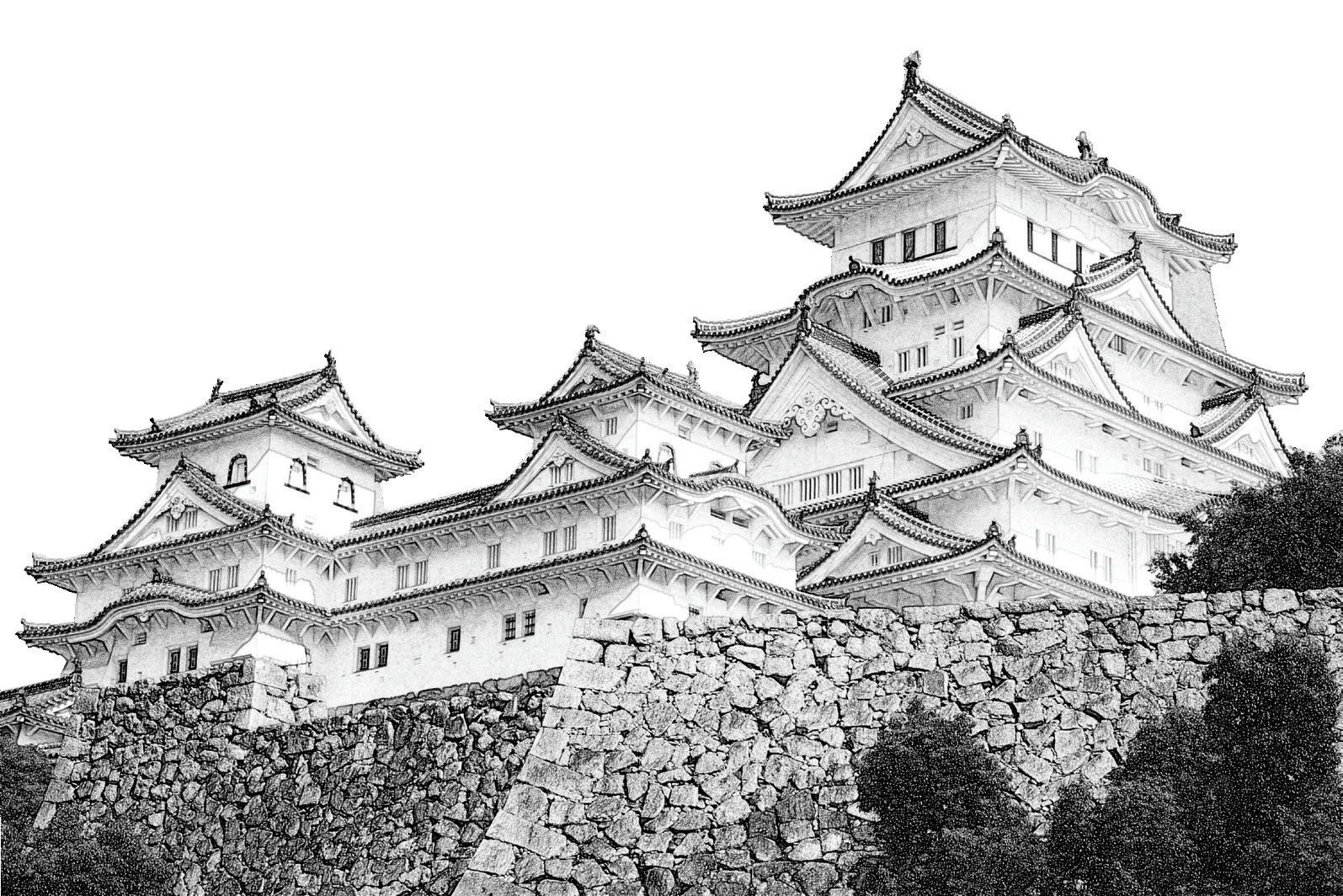
Earlham alums Joseph and Sarah Ann Cosand founded what is now the Tokyo Friends School.
1893
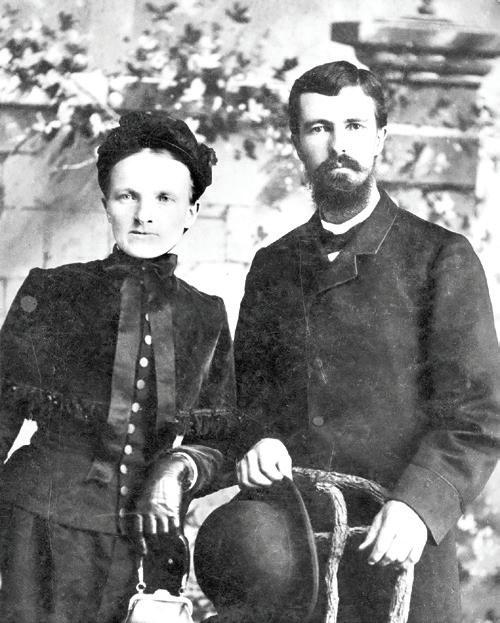

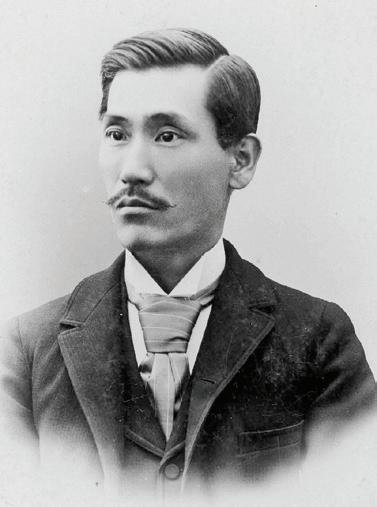
Chuzo Kaifu became the first Japanese man to earn a bachelor’s degree at Earlham. In 1896, May Morikawa became the first Japanese woman to earn an undergraduate degree at Earlham.
1962
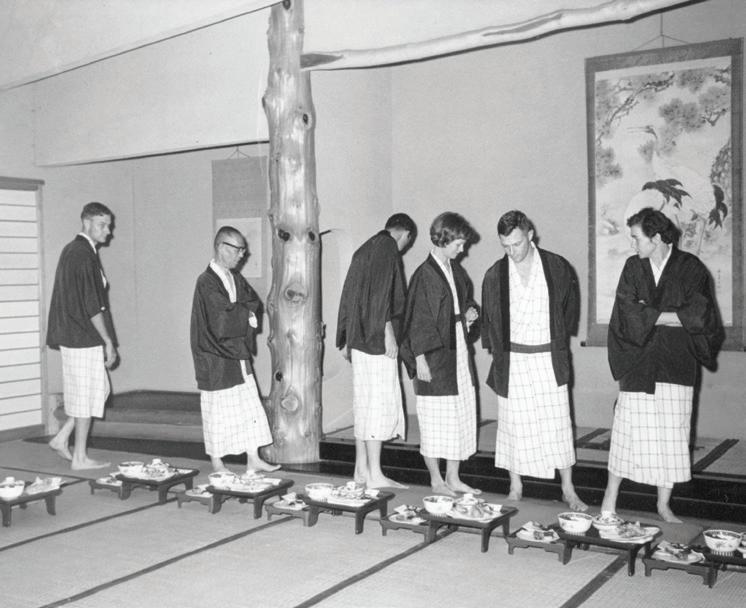
Earlham received a major grant from the Ford Foundation for the development of Japanese Studies at Earlham. Eight faculty members spent the summer developing expertise and pursuing research in Japan.
JAPAN, 140 YEARS AND GROWING
1963PRESENT
Formal exchanges of students and faculty started in 1963.

2026
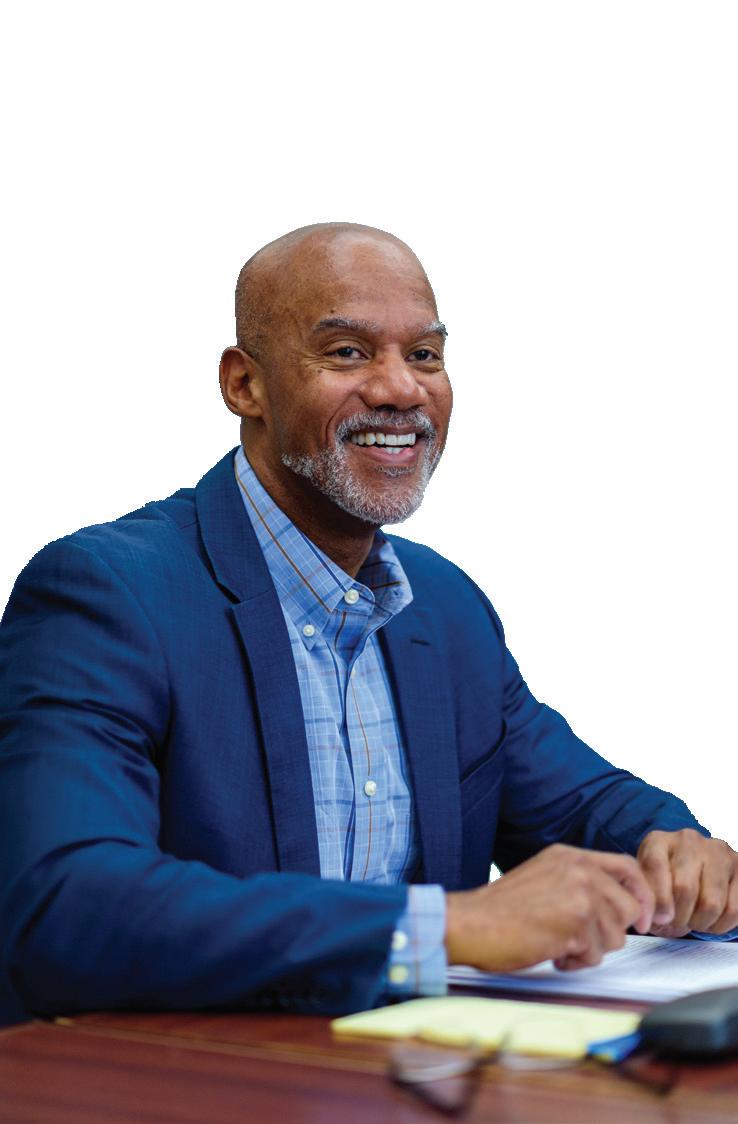
Dyron Dabney, director of the Earlham Institute for Education on Japan, went to the Tokyo Friends School as a scholar-in-residence.
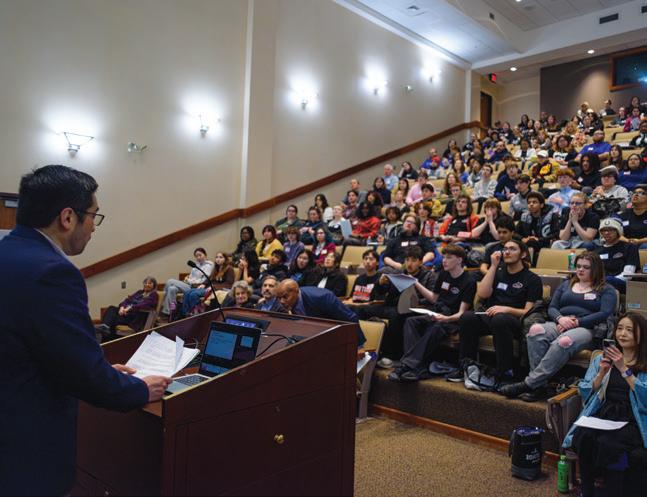
Earlham College hosted the Japanese Olympiad of Indiana.
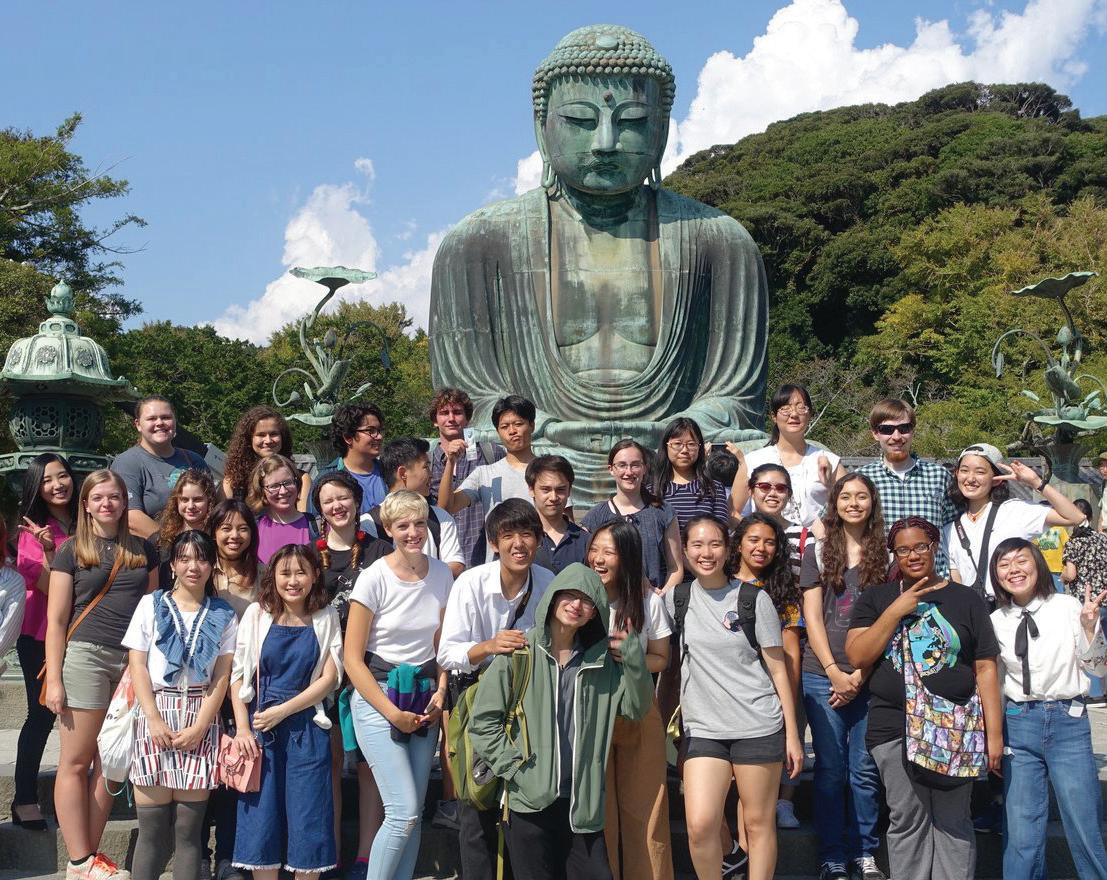
Semesters abroad. Faculty exchanges. Alumni trips. Teaching internships. Public film screenings. All of these ongoing activities represent Earlham’s vibrant and varied connections to Japan and the Japanese community in Indiana, and the deep link between the college and the country that goes back a considerable 140 years — when Earlham College alums Joseph and Sarah Ann Cosand went to Japan as a missionaries and founded what is now the Tokyo Friends School.
Since then, Earlham students and staff have kept the bond strong, both through academic work and the professional careers that followed. And it continues to evolve in new directions.
The College hosted the 2026 Japanese Olympiad of Indiana, the first time since 2018, and will do so again for the next two years. The annual competition, held each February, brings together high school students from across the state to test their knowledge of Japanese language and culture. The high-drama face-off lasts just one afternoon, but the prepara-
questions about age-old proverbs. For the first time in the event’s history, there will be actual prizes, making the stakes a bit higher for the participants.
“Every member of the teams that make it to the finals has the chance to apply for a $1,500 scholarship to Earlham,” said Yasumasa Shigenaga, an associate professor of Japanese language and linguistics at Earlham and a member of the Olympiad’s organizing committee.
Those scholarships are supported by the Newton K. Wesley Foundation, which got on board as a sponsor after Earlham agreed to host the competition for three consecutive years. It’s the first institution to make that kind of commitment, said Dyron Dabney, who directs Earlham's Institute for Education on Japan and was a key force behind the effort.
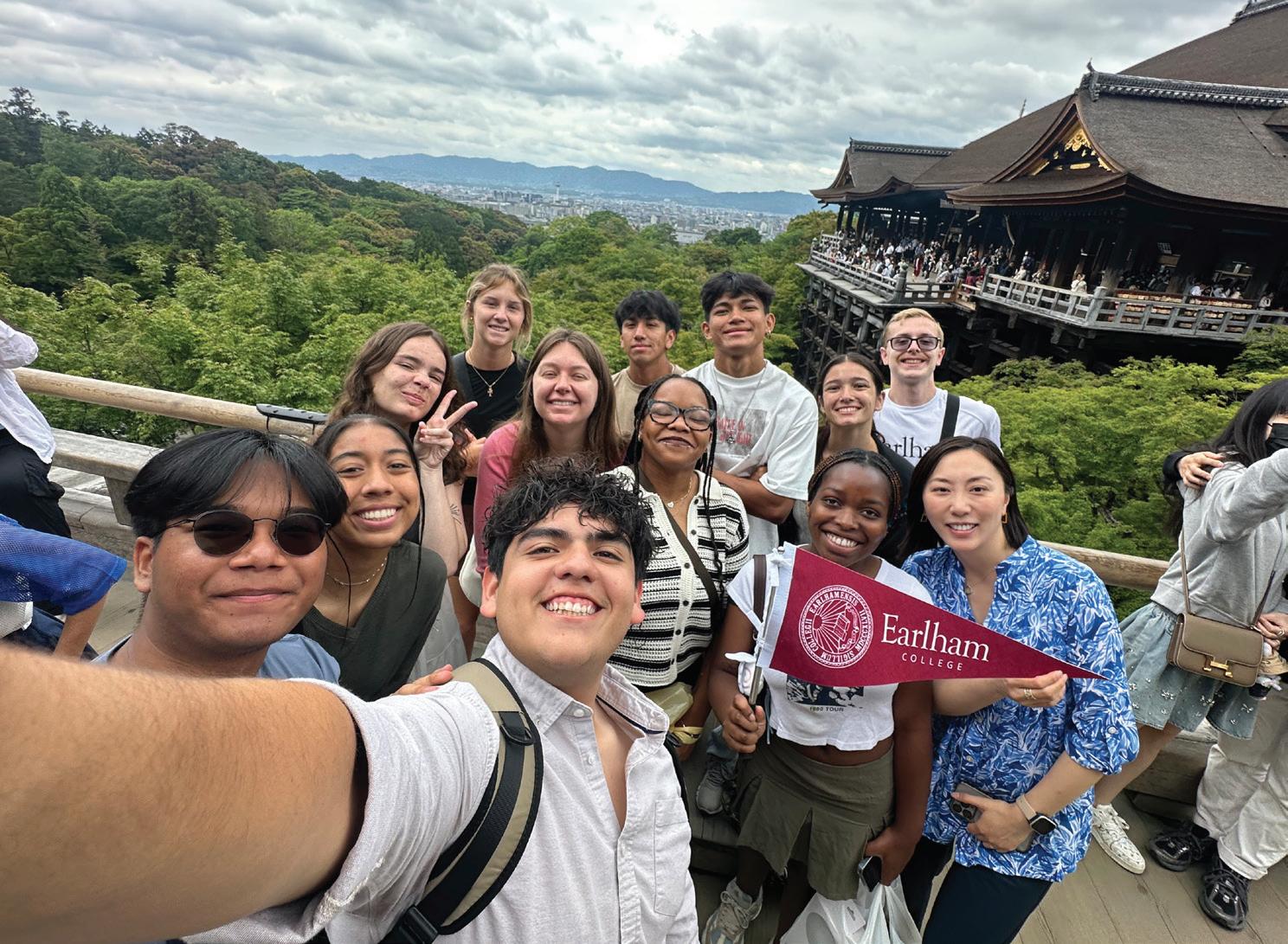
tion takes months. A committee from the Association of Indiana Teachers of Japanese, which organizes the event, sends out study guides well ahead of time so the students can prepare.
One contest day, they might be asked to translate dialogue or pinpoint a Japanese city on a map or answer
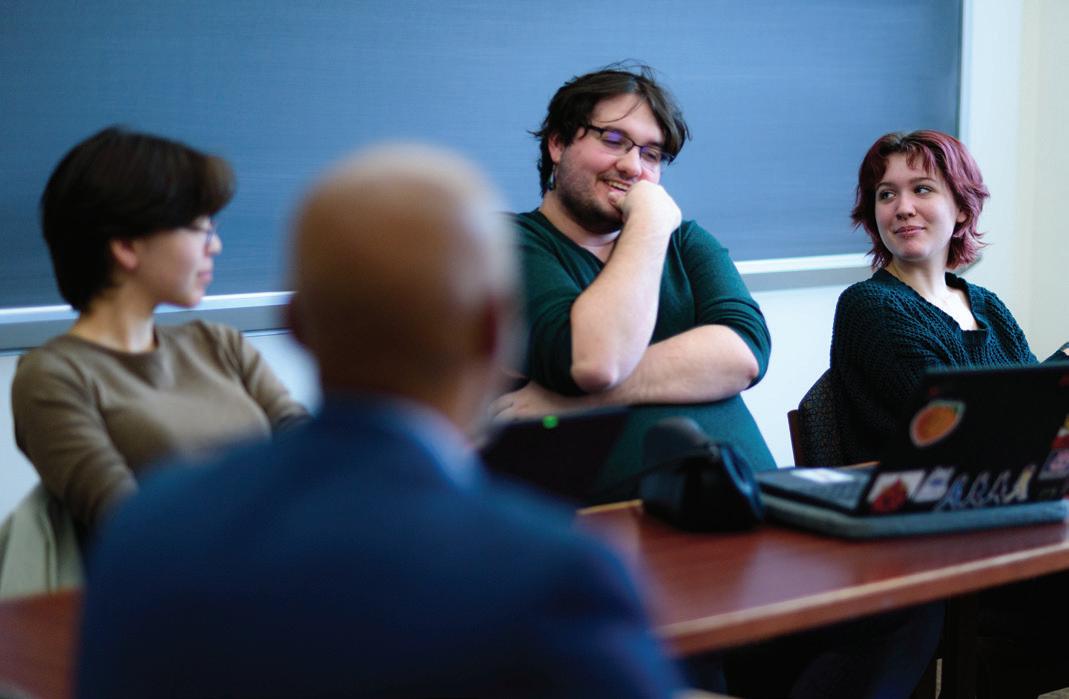
The Institute, which was created in 1986, plays a crucial role in the ecosystem of Earlham’s Japanese programs and its tasks are varied. There is a community aspect to Dabney’s work — the institute serves as a public liaison between the College and the region, raising funds to support study abroad programs, arranging and consulting with Japanese businesses establishing operations in Indiana or Indiana businesses looking to enrich relationships in Japan. It sponsors an annual lecture series and supports community events, such as a screening of Japanese films.
On the ground, working across the two countries, it also builds relationships that help Earlham students who study in Japan find jobs as teachers if they choose to stay in that country.
One model of success for that effort is Daniel Stifler ’02, who has been working as a teacher at the Friends School in Tokyo since the summer after graduation. He has now been a resident of Japan for more time than he lived in the U.S.
“Being at Earlham helped me to learn not only how to speak Japanese but also how to listen to people, to take people seriously, and to be curious about how they see the world,” Stifler said via email from Japan. “It is that ability to listen, I think, more than any ability that I have to speak Japanese, that has helped me to find a meaningful life and career in Japan.”
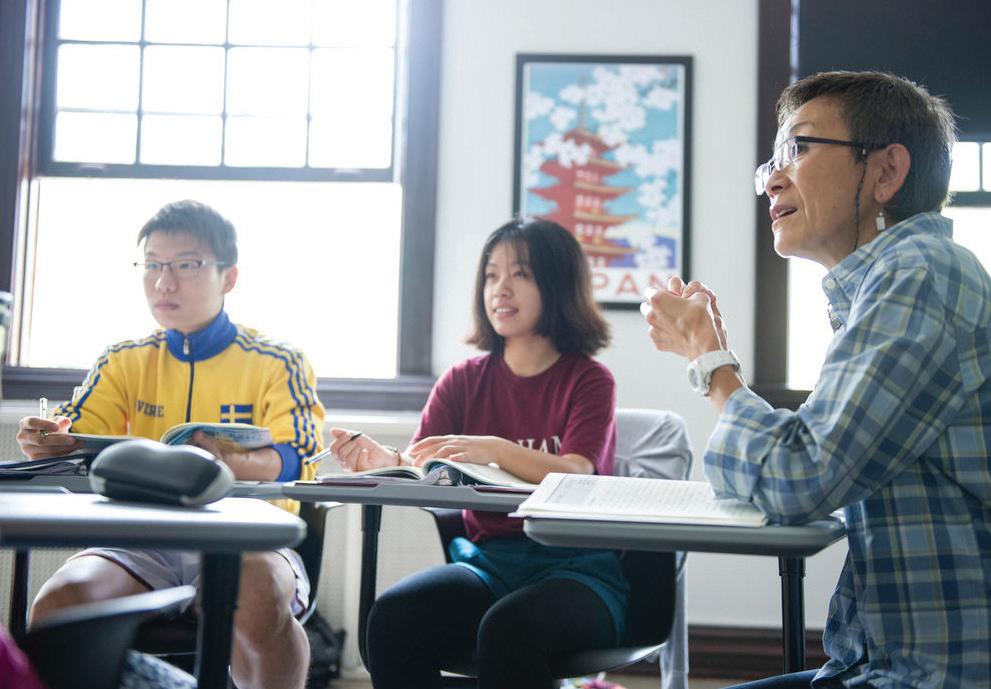
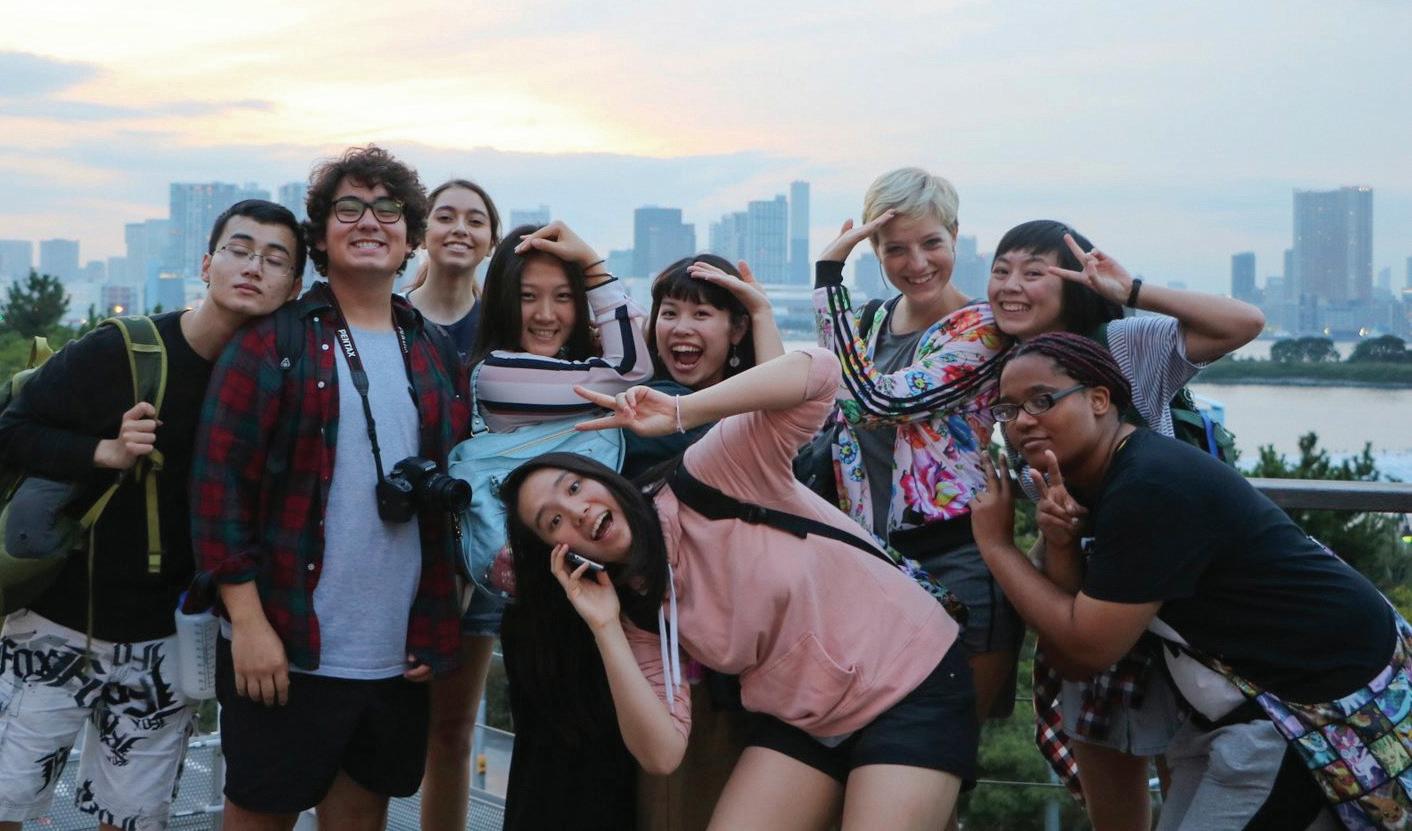
Earlham now has a small, permanent staff in Japan and its programs are robust. Students have multiple options for the time they spend there, explained Robb King, senior director of Japan programs. Some take classes at Waseda University in Tokyo. Others participate in Earlham's Studies in Cross-Cultural Education program (SICE), headquartered in the city of Morioka. SICE provides students a deeper immersion in the culture, staying with local families and working as English teachers for younger students.
Beyond that, Earlham is a regional leader in the U.S. in the area of academic exchanges, coordinating Japan programs for about 20 schools in the Great Lakes College Association. That includes overseeing the study experiences for as many as 50 students per year, King said. Nearly two dozen Earlham students study or complete summer internships in Japan each year, and Japanese students attend Earlham in return. That goes back to 1893, when Chuzo Kaifu became the first Japanese man to earn a bachelor’s degree at Earlham. In 1896, May Morikawa became the first Japanese woman to earn an undergraduate degree at Earlham, according to extensive research on the topic done by Tom Hamm, professor emeritus of history and Earlham’s Quaker scholar-in-residence.
Earlham alums have undertaken notable activities in Japan that cross beyond the academic and into the political. One example: Esther Rhoads, who graduated in 1917 and later served as a tutor to the Japanese Crown Prince.
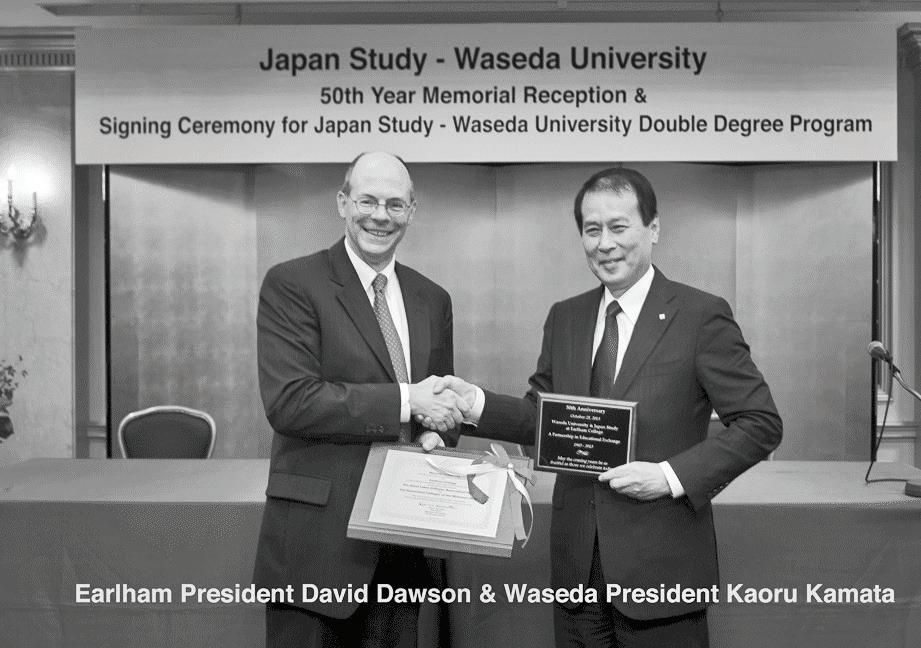
Formal exchanges of students and faculty started in 1963, and have continued in various forms, including a three-week residency for Earlham faculty at the Tokyo Friends School. That exchange fell off for some years (due partly to the Covid pandemic) but was resurrected in 2025, when Dabney went there as a scholar-in-residence, using the time to teach but also to build pipelines for students there to attend Earlham after they graduate.
Dabney’s trip is just one of the ways the Earlham-Japan connection remains dynamic today, and it still goes both ways. Toru Shinoda, a professor from Waseda University, is in residence for the 2025-2026 academic year at Earlham, teaching courses about the history of Japanese companies in the Midwest. He has spent time in Earlham’s archives going through papers, including those collected about Bailey, a former history professor who helped establish a program in East Asian Studies on campus, and was registered as a conscientious objector in the 1940s.
“I feel like I was sent here to renew the bridge between two significant peacemaker schools over the Pacific,” said Shinoda. “It was meant to be.”
“I was able to study abroad in Japan and live with a host family for 10 months. That experience was invaluable.”
– Grace Russell '26
Another: Bonner Fellers, who graduated in 1916, went on to study at the U.S. Military Academy at West Point. He later acted as a key advisor to General Douglas MacArthur on Japanese matters in the aftermath of World War II.
Other connections have mirrored the peace-minded Quaker values that have long-driven Earlham’s mission. In 1927, as anti-Japanese sentiments were swirling the U.S., Earlham students raised money to send Wilfred V. Jones as a goodwill ambassador to study at Tokyo Imperial University, now the University of Tokyo.
When Japanese-Americans were being sent to internment camps in the western U.S. in the 1940s, Earlham students and alums intervened again, inviting Japanese-Americans to study on campus and avoid confinement.
Over the years, other notable Earlham figures served as advocates for the relationship, including Landrum Bowling, Jackson Bailey, Wendell M. Stanley, Gordon T. Bowles, Barbara Ruch, Chuck Yates, and Richard Wood.
The connection also continues through the links that many students who passed through exchange programs have kept active through their lives and careers, including Jay Coffman ’02 who has worked with Japanese automobile companies both in Japan and the U.S.
In October, Coffman, who now lives in Columbus, Ohio, organized a reunion in Tokyo, near Waseda University, and invited anyone who had been through exchange programs to attend. He said he was “blown away” when 38 people quickly signed up.
Students and faculty from across three decades got reacquainted with old colleagues or met new ones who had shared overlapping educational and work histories. “The feedback has been overwhelmingly positive about what a great experience it was,” he said.
But at its core, the connection stays the most vibrant through the waves of students who cross continents every year, not just to study language and history, but to get to know a culture a world away first-hand. That includes people such as Grace Russell ’26, a senior in Japanese studies who recently completed the Japan Study program at Waseda University.
“I was able to study abroad in Japan and live with a host family for 10 months,” she said. “That experience was invaluable, and my knowledge of both the language and culture greatly increased from it.” ■
Photos of Japanese Studies classroom by Josh Smith. Additional photos courtesy of Earlham College Archives and the College's LIFT Program.
Taking flight
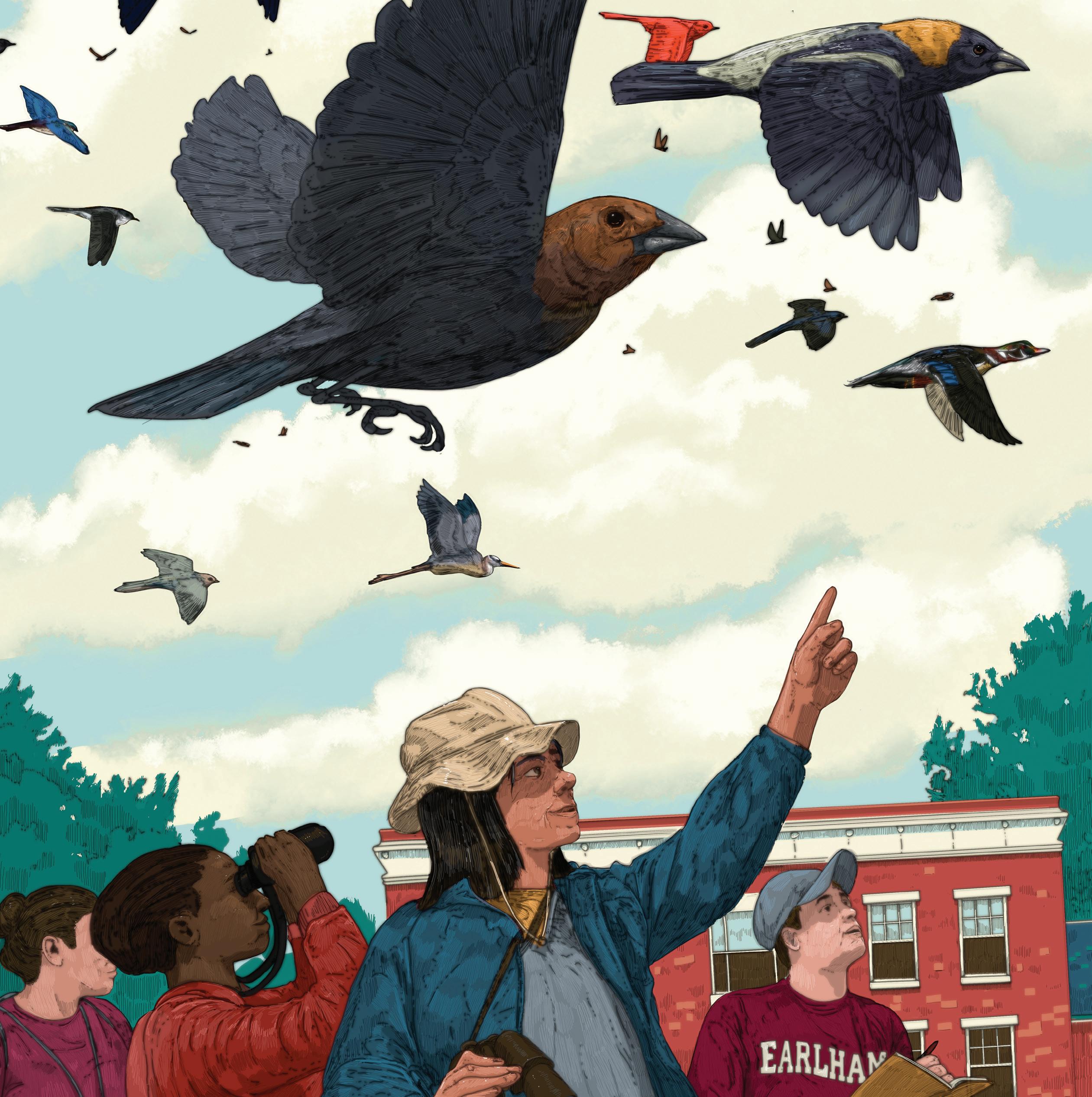
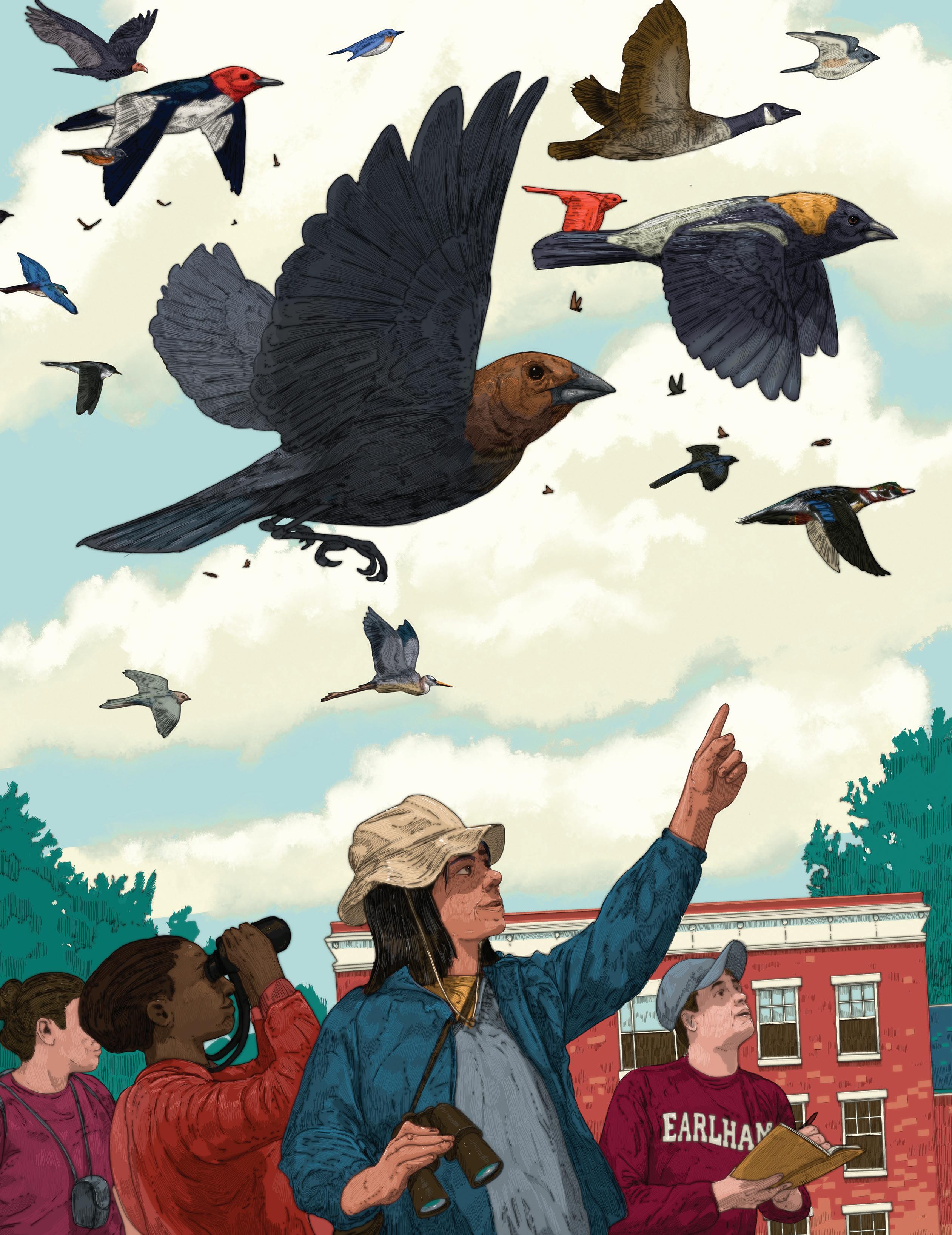
A love of birding shapes the Earlham experience and provides a skyward frame for academic pursuits in the field.
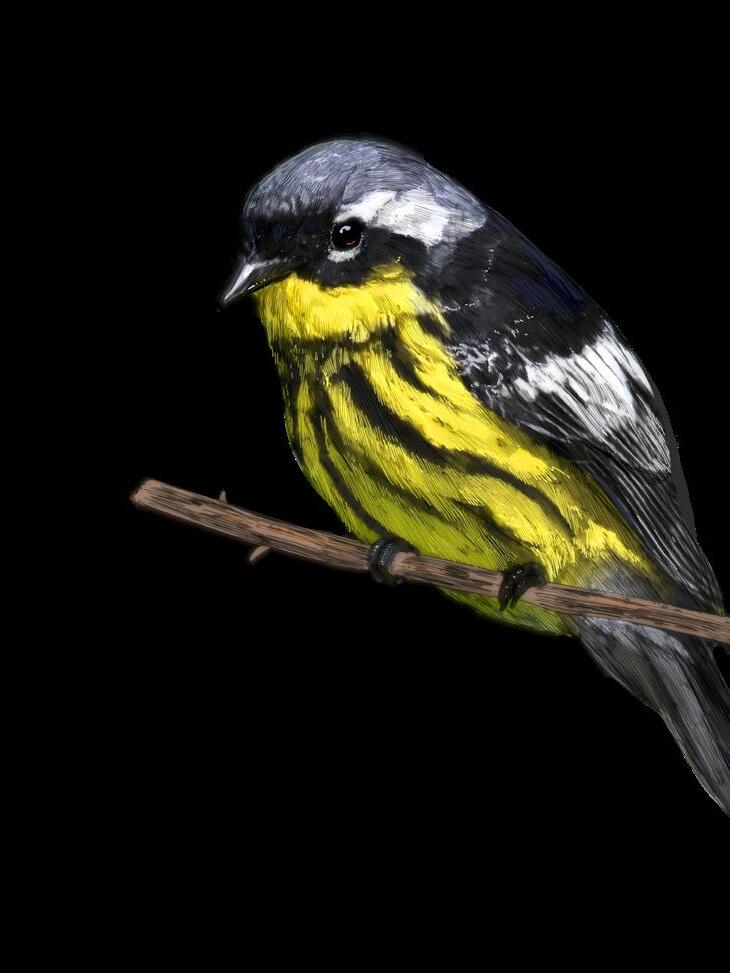
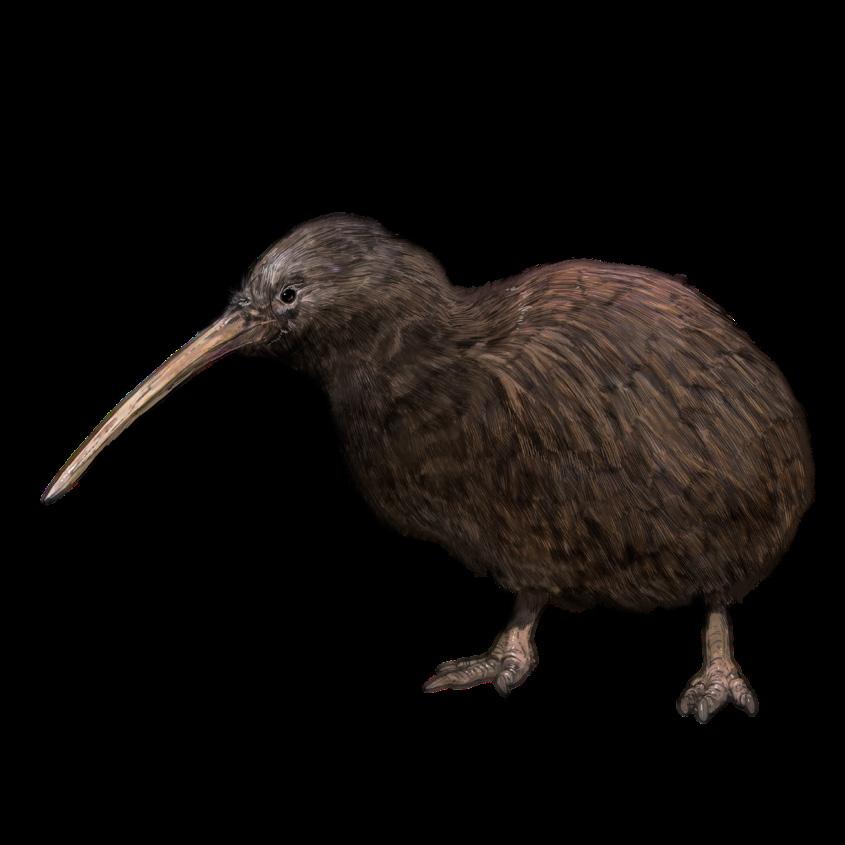
The long-eared owl, with its ear tufts and perpetually surprised expression, is a shy and secretive bird rarely seen in Indiana. So when word spread on a brilliant fall day that one was roosting on Earlham’s back campus, the news electrified the College’s bird-loving community.
And that community is large.
Students, retired faculty, professors, and Richmond residents flocked to the site to marvel at the visitor, from a respectful distance of course. Among them was Wendy Tori, professor of biology and Martha Sykes Hansen Endowed Chair in Ornithology. She had a meeting scheduled with her ornithology teaching assistant, Harley Pickett ’26, but the owl changed their plans.
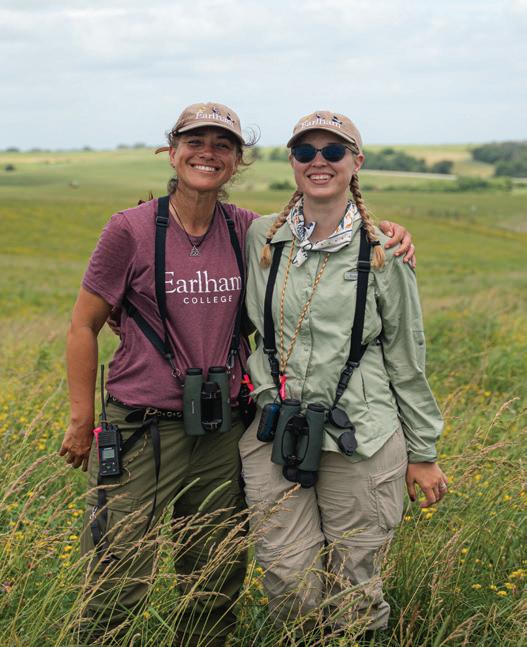
“Birds bring people together – everybody. Whatever you were doing, nothing was more important. That’s a super cool thing that happens here.”
Jaime Coon, assistant professor of biology and environmental sustainability, also dropped everything that day. “We show up for the birds,” she said. “We were in community there, just looking at this rare, beautiful long-eared owl. That just shows you – birds are a thing here. When the email goes out, we all run.”
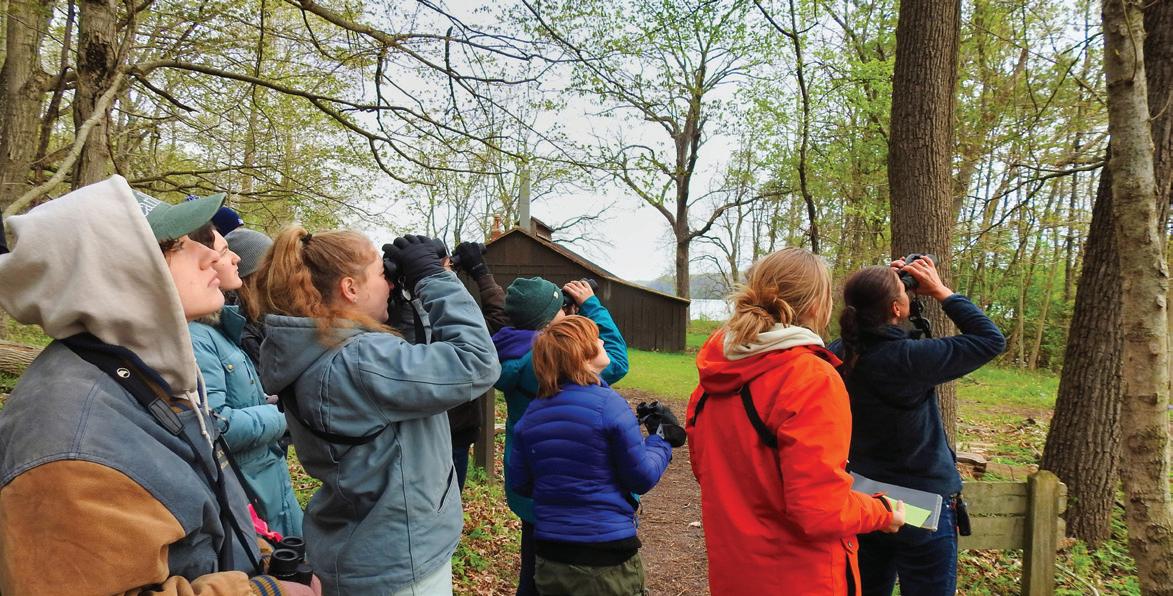
At Earlham, birding and ornithology courses are popular with students, regardless of major or future plans. The owl incident is a vivid example of how that passion comes to life. The students and professors who went to back campus armed with binoculars,
By Abigail Curtis
Illustrations by Corbin Rainbolt ’20
telescopes, cameras, and notebooks might not have been in a classroom, but they were somewhere equally important: in nature, where the owl belongs.
It was the kind of experiential learning that sparks curiosity and leads to deep, self-directed inquiry, the same blend of scientific clarity and genuine excitement that has long made Earlham a haven for bird-lovers and a launchpad for careers in wildlife research. The owl’s brief visit served as a reminder of how faculty, students, alums, and important annual events like Birding Big Day all contribute to a community where a love for birds isn’t just encouraged — it thrives.
Tending the seeds
Values that make good naturalists — truth-seeking, stewardship, respect for nature, awareness of life’s interconnectedness — have long been nurtured at Earlham. Joseph Moore, the College’s second presi dent, studied with leading biologists of his day, and his natural history collection formed the basis of the Joseph Moore Museum. Among the College’s notable alums is ecol ogist W.C. Allee, Class of 1908 pacifist and pioneer of research in social ecology.
More recent alums have also helped the field, including Carrie Seltzer ’04. She works as the head of engagement at iNaturalist, an online social network of people sharing biodiversity informa tion to help each other learn about nature.
Another influential Earlham figure is Bill Buskirk ’66, emeritus professor of biology, whom Coon describes as “absolutely a legend.” As a student, Buskirk reveled in experiential learning: spring break
wildflower trips to the Smoky Mountains with botanist Carolle Markle, and cave expeditions to southern Indiana and Kentucky to study bats with biology professor and museum director Jim Cope.
He has an indelible memory of Cope handing him an armful of bats to band. It was the kind of moment that equalized the relationship between student and teacher, something that Earlham, with its focus on student-faculty collaboration, research, and relationship, aims for.
“It’s those things that have really shaped me and given me models I wanted to follow,” Buskirk said.
During his 34 years on the faculty and years of post-retirement field trips for alums and friends, Buskirk has seen both continuity and change. Through it all, experiential learning and ornithology continue to be a singular thread woven through the biology curriculum.
“The main thing I love is that it gets students outdoors and in touch with the organisms that share the earth with us,” he said. “Bird watching develops skills, requires study, and gives people enjoyment from seeing something always fresh and changing. Hopefully, it’s the spark that starts their interest in bigger things.”
Fanning the spark
For Tori, Coon, and Melanie Kazenel, assistant professor of climate change ecology, continuing
Earlham’s legacy of field biology matters. Most of their courses include extensive fieldwork including collecting data, observing animals and plants, and understanding how they interact with people.
“A lot of how we look at ornithology and field biology is hands-on and experiential,” Tori said. “It gives students a sense of purpose and belonging. It blends rigorous training with a supportive culture.”
It’s also rare for a small liberal arts college to have multiple scientists on the faculty who are entirely focused on field ecology, with funds available to them to support their research.
Tori, Coon, and Kazenel all teach Ecological Biology, nicknamed EcoBio, which is one of the most popular courses on campus. The course has a long-standing history of engaging students in their own self-directed, hands-on field research, with students spending a month collecting and analyzing their own data that they then present to the class and professor.
“There’s often a spark,” Coon said. “It doesn’t always mean, ‘I’m going to be a bio major.’ It means, ‘I understand my place in the natural world now.’ Earlham’s interdisciplinarity means we have art majors in our bio classes and bio majors in art classes. They’re in it for the love of the game.”
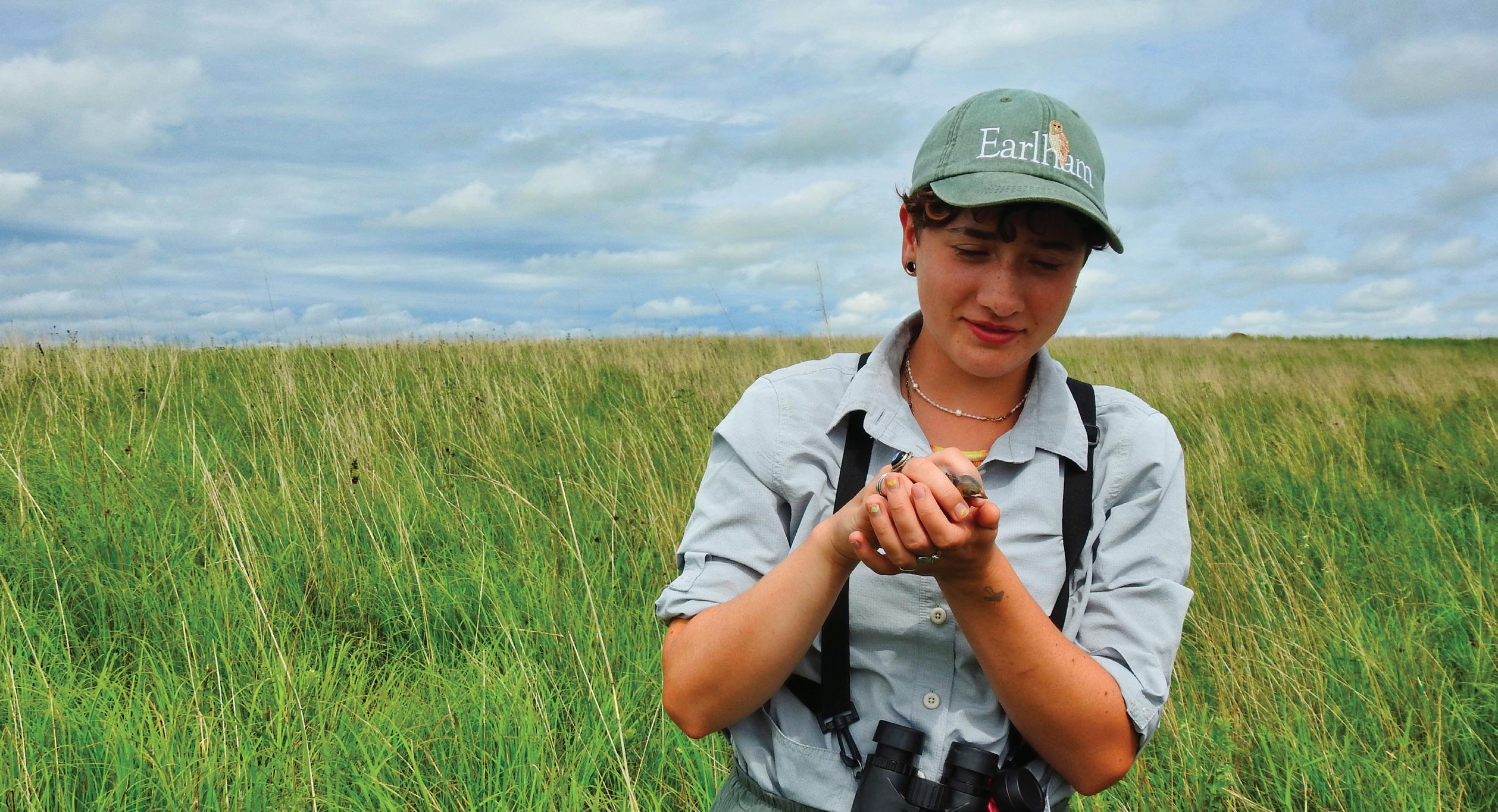
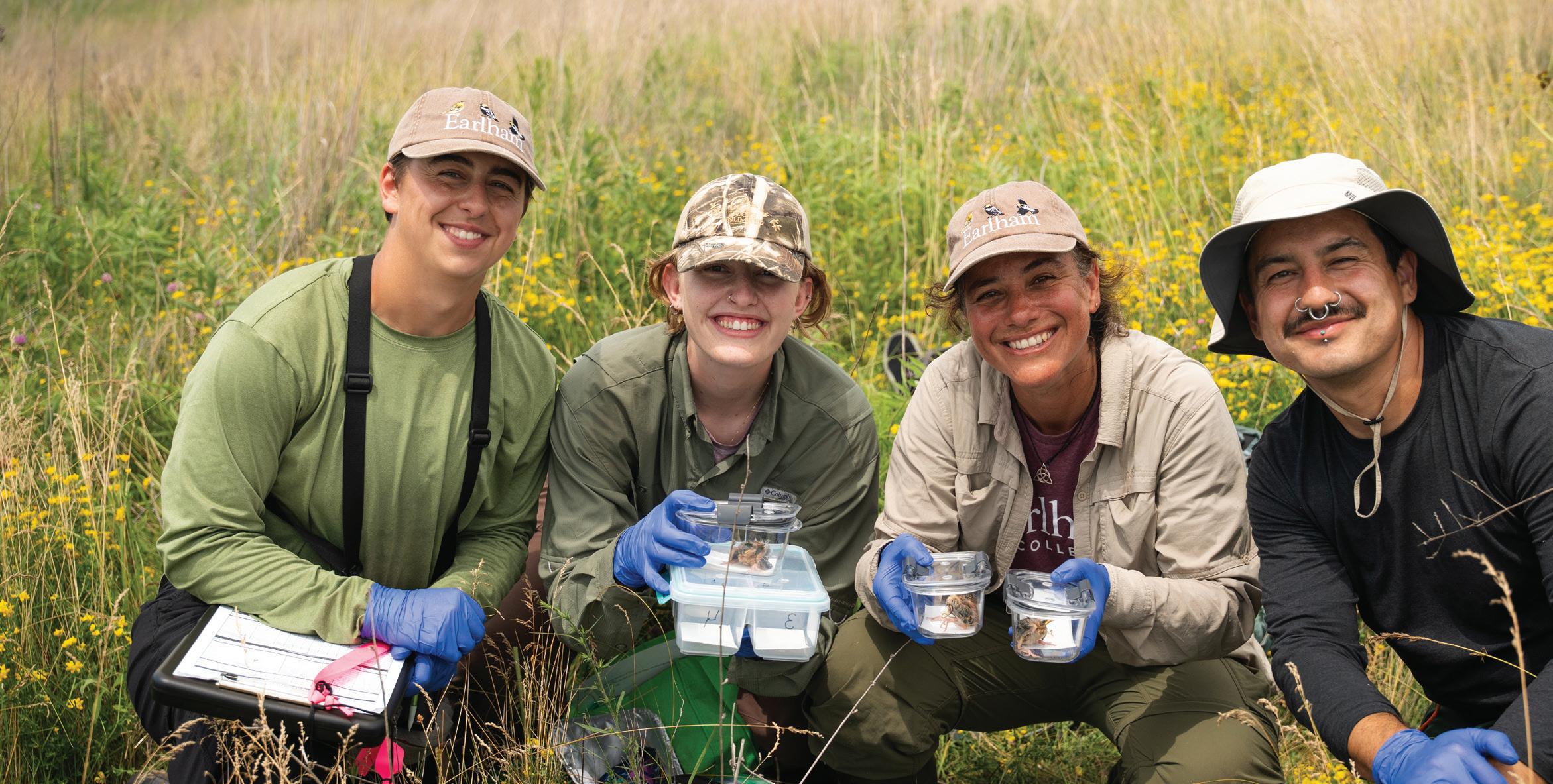
Many students follow that spark. Every summer, Tori and Coon take up to six students into the field for two months of grassland bird research, and many of the students they teach continue on to graduate school
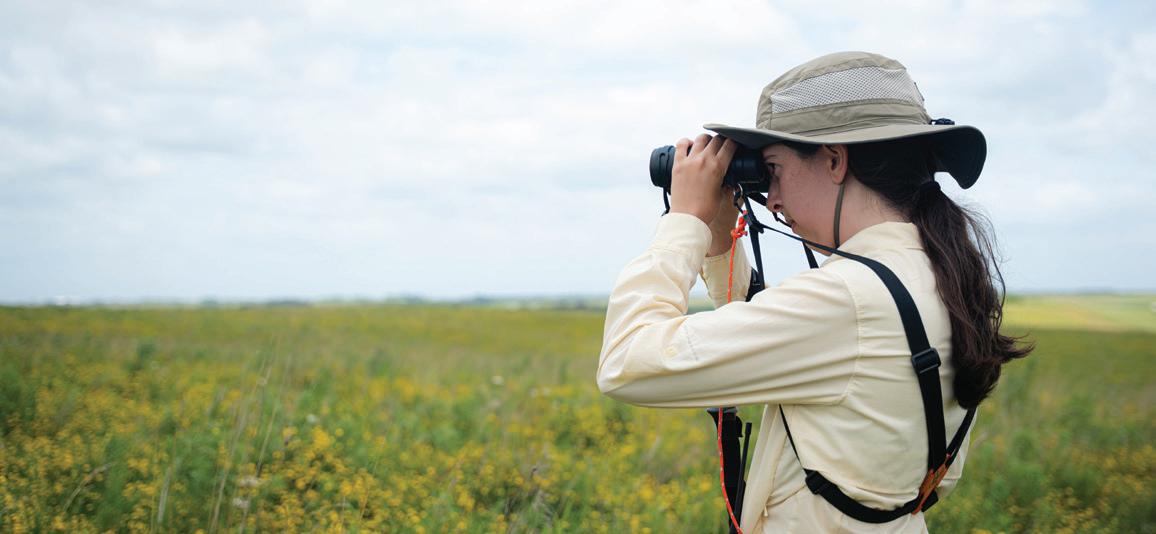
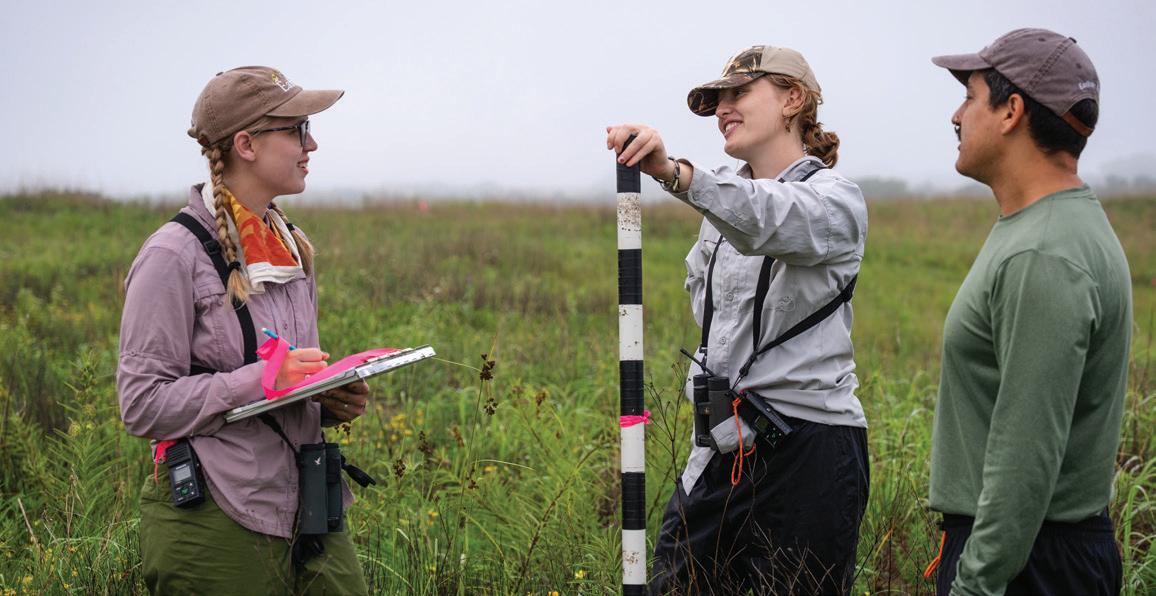
and pursue opportunities for research and study in places such as Borneo, Namibia, and Peru. From their first year, students learn how to think like scientists.
“When you go into the field and you hear a bird sing, and you observe its behavior, you start to understand your relationship to that bird in a very different way. You learn how to ID it, and recognize it, and greet it as a friend in the future,” Coon said. “That’s something that I think is special about how we teach field science here.”
“We all become lifelong collaborators,” Coon said. “We have WhatsApp groups upon WhatsApp groups, and we send each other photos of cool birds we see.”
Nurturing a sense of place
“There’s often a spark. It doesn’t always mean, ‘I’m going to be a bio major.’ It means, ‘I understand my place in the natural world now.
– Jaime Coon
The spark has become a flame for students such as Sarah Osburn ’28 and recent alums such as Hannah Grushon ’23. Osburn arrived at Earlham already interested in birds, but didn’t realize how central they were to campus culture. “I’d say that’s the main way I’ve made more of a community here,” she said.
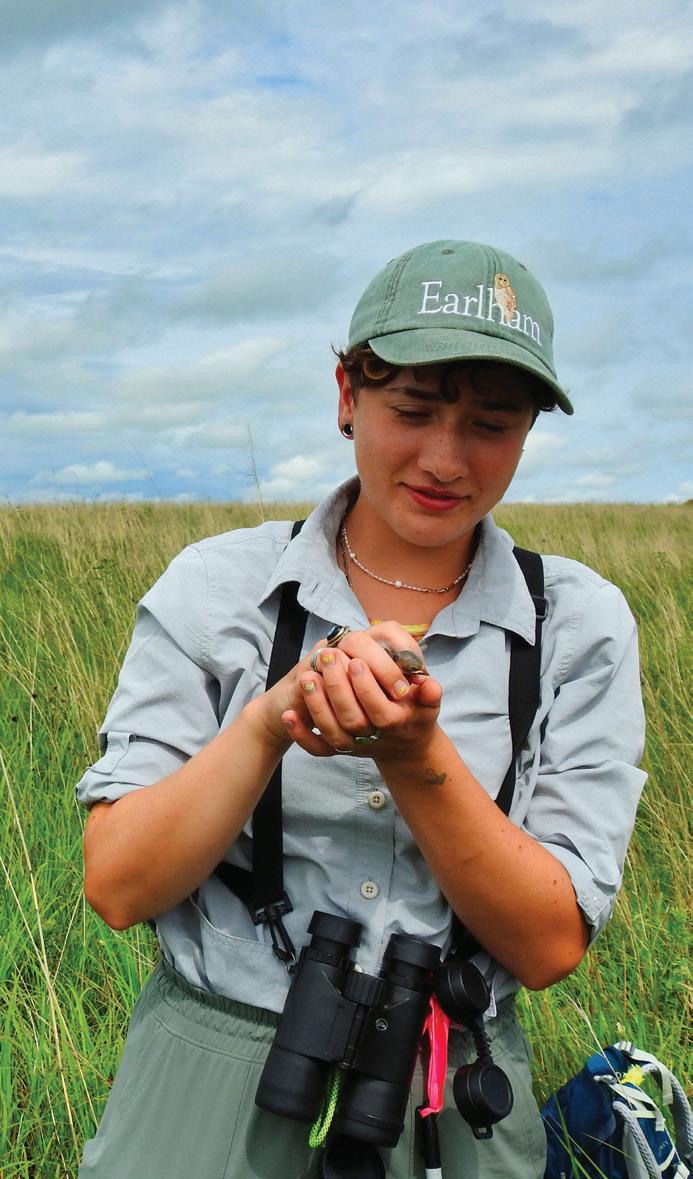
A freshman-year natural history trip to Goose Pond Fish & Wildlife Area in Linton, Indiana, where the group saw more than 70 species, deepened her enthusiasm. She joined the grassland bird research project last summer, plans to start an ornithology club on campus, and hopes to work in wildlife conservation one day. In her animal behavior research project during the fall semester, Osburn investigated optimal foraging behavior in birds with the help of a feeder situated in back campus.
“Birds are so accessible, and they help you know more about where you are. And there are always birds,” she said. “Yesterday it was 20 degrees, windy, almost snowing, and that was the day we got the most birds at the feeder.”
Grushon, who is pursuing a master’s degree focused on birds at the University of Illinois Urbana-Champaign, grew up watching birds with her mom in their backyard. It was EcoBio and ornithology, both taught by Tori, that opened the door to serious study.
“She’s very enthusiastic about wildlife, and that really shows in her teaching,” Grushon said of the professor. “That’s what made me want to get into ecology and studying birds.”
She spent three summers working on the grassland
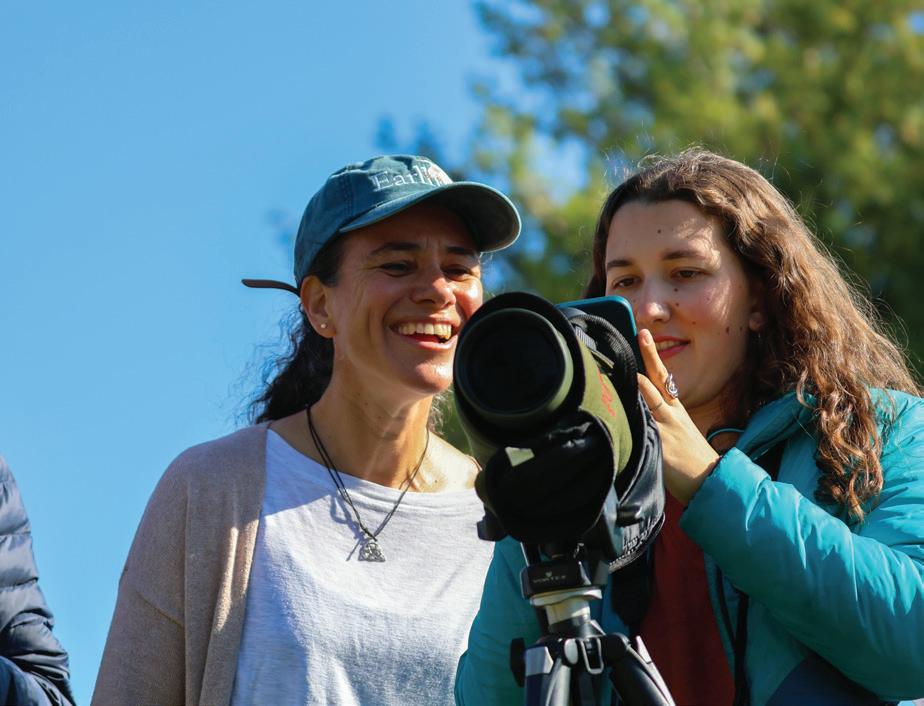
Earlham supports an immersive summer collaborative research program in the Iowa grasslands where students research birds and conservative strategies.
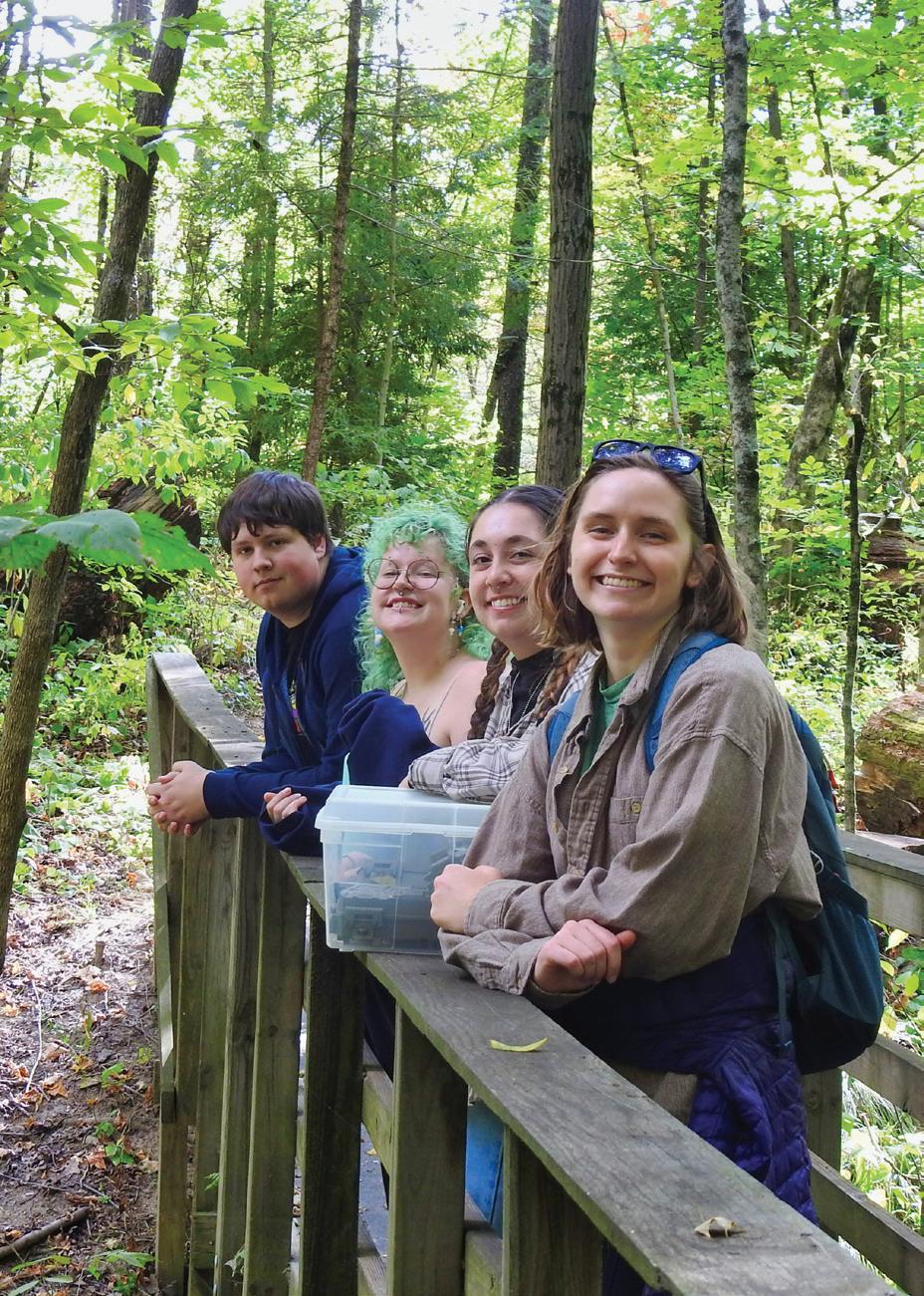
Cope Environmental Center
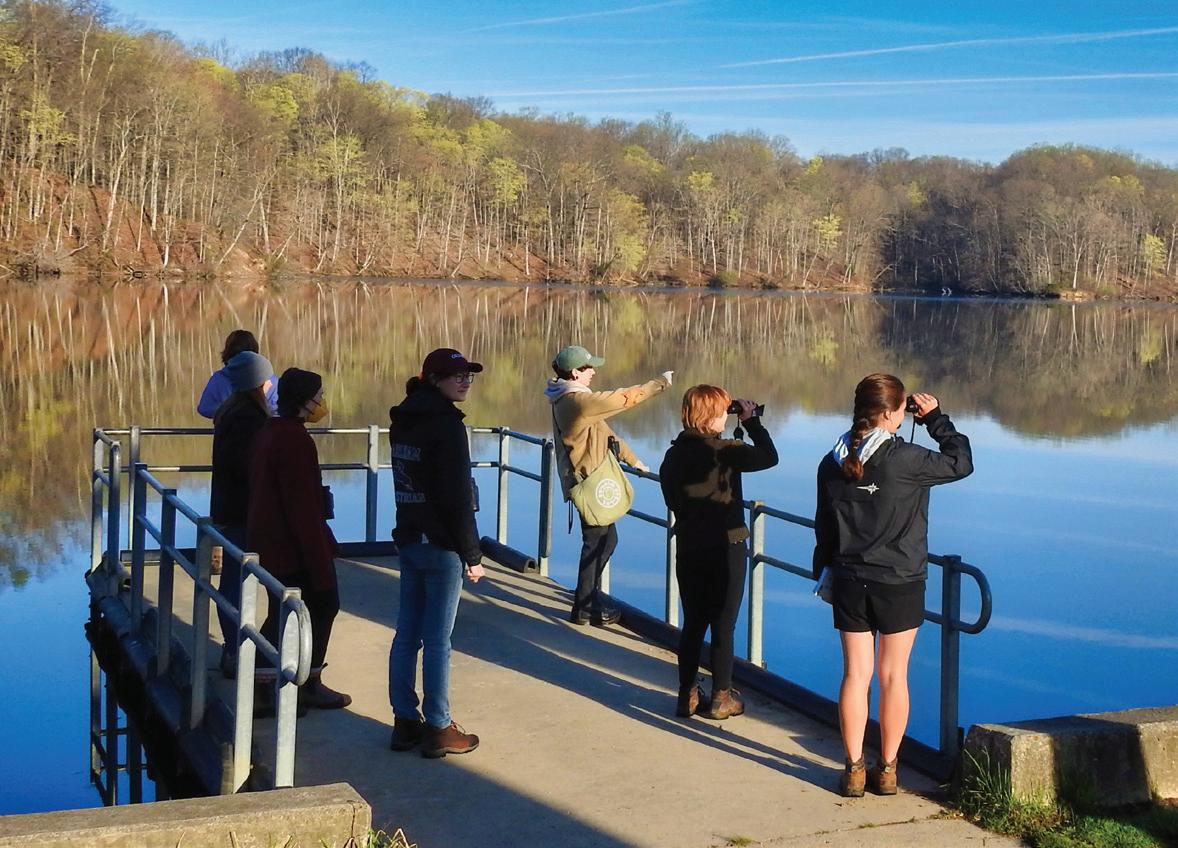
Hueston Woods State Park
Hueston Woods State Park
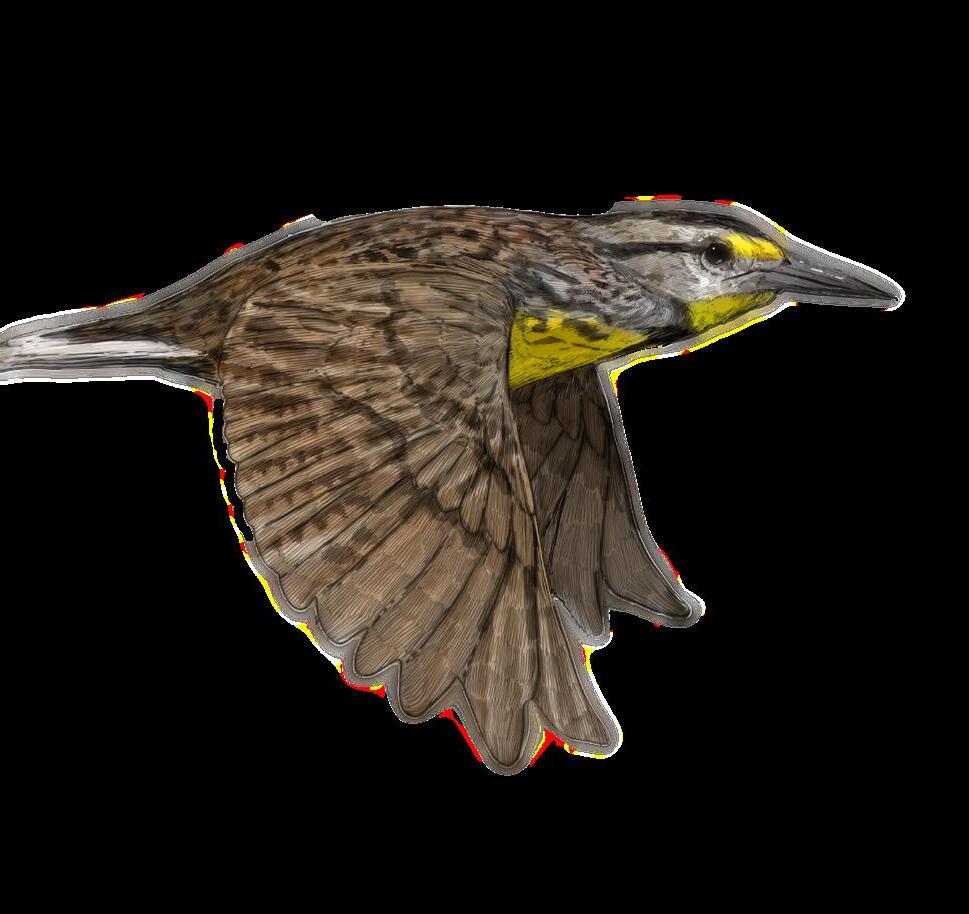
bird project, studying bobolinks, grasshopper sparrows, and dickcissels, many of which are declining due to habitat loss. The fieldwork convinced her she wanted a research-based career.
“Being out in the grasslands doing research made me realize that that’s what I wanted to do. Up at dawn and spending all day with the birds. It’s just very beautiful out there,” Grushon said. “You really feel a connection to the land and to the species when you feel like you’re the only human among thousands of birds and plants. It really gave me a sense of place.”
Coming home to roost
Birders hold an important place in the greater Earlham ecosystem, too. The College sponsors beloved events like Birding Big Day, a bird-a-thon started in 1982 by Buskirk and Cope, and the homecoming bird walk.
During Birding Big Day 2025, more than 100 Earlham birders came together to spot 790 unique species, including 60-plus species never before recorded.
“Birding Big Day is probably my favorite weekend of the year,” Tori said. “It brings people together with a common purpose: Get outside, enjoy birds, and help a good cause.”
There’s often a good-natured competitive spirit that permeates the weekend, as people strive to see more species than anyone else (or at least more than they saw the year before). Money raised during the event, more than $1 million since it began, supports scholarships, faculty development, international study, and more.
“I think Birding Big Day really encapsulates what Earlham is about. It brings the community together,” Tori said.
The homecoming bird walk is another tradition that unites alums, students, faculty, retired faculty, and others for an early-morning campus stroll. Cooper Cox, associate director of development research and communications, loves to join the walk, and said over the five years he’s worked at the College, a casual interest in birding has morphed into serious enthusiasm.
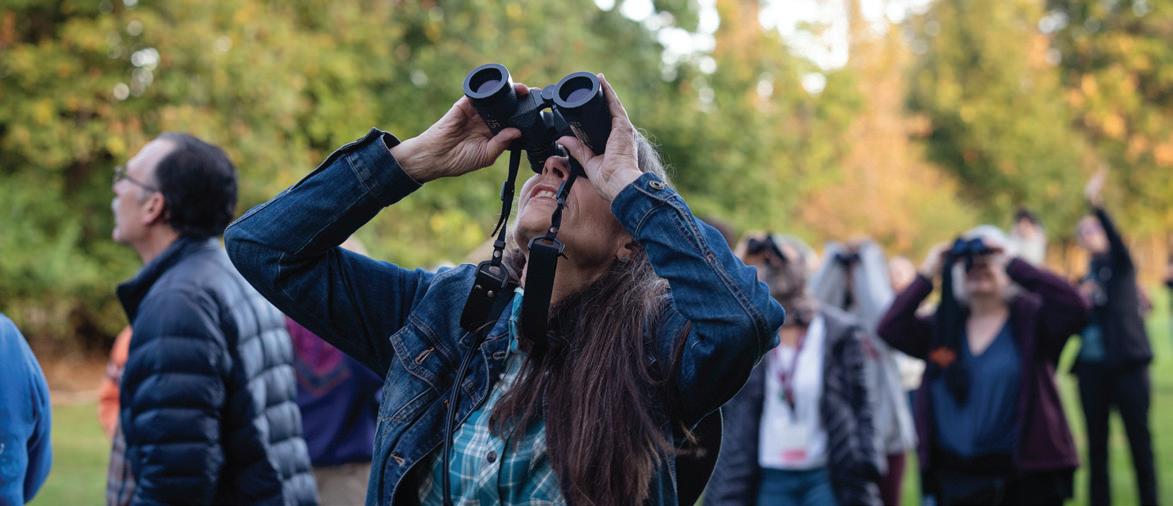
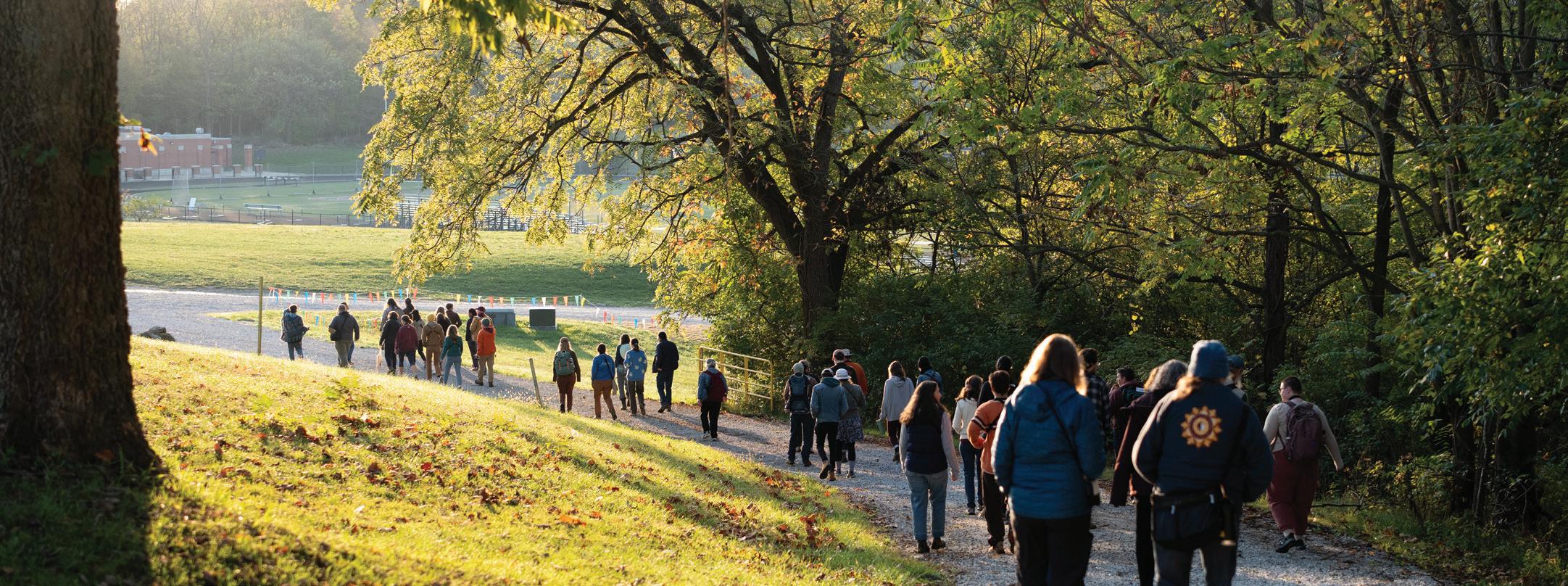
“We go on a very slow and quiet but kind of loud walk on our back campus. A bunch of people are pointing out birds, and it’s a really infectious atmosphere, being around so many people who enjoy this niche thing. It can open you up to a whole new world,” Cox said. “I’ve definitely entered a birding fanatic phase.”
Last spring, he and several colleagues road-tripped from Earlham to Winnipeg, Manitoba and back for Birding Big Day, covering 2,700 miles in search of new species.
“We really hoofed it, but it was great,” Cox said. “We got five unique species that nobody else got.”
For Cox, birding feels inherently Quaker — quiet, attentive, rooted in listening.
“It fits the ethos of the College,” he said. “Birding only requires two things: curiosity and effort. And those have flourished at Earlham for years. It’s hard to pull birding out of the fabric here. It’s part of the thread itself.” ■
“Birding only requires two things: curiosity and effort. And those have flourished at Earlham for years.
– Cooper Cox
Mark your calendars:
Birding Big Day returns May 8–10, 2026 — three days of bird watching, community, and feathered wonders with Earlham birders. Learn more at earlham.edu/bbd
Earlham Summer, a pre-college immersion program for high school students, offers a special course, "Bird Biology: Wings to Songs," from June 7-12 and June 14-19 Learn more at earlham.edu/summer
New in 2027: Young Birders scholarship
Starting next year, Earlham will award a Young Birders Scholarship — $2,500 per year for four years — to support students eager to combine academic study with field-based discovery.
This scholarship is made possible by a generous gift from Michael Melampy ’71 and Nance Fikes and will expand access for talented, curious young birders. Eligibility requirements will be announced at a later date.
Photos by Kate Young and Josh Smith
Volleyball captures HCAC regular season championship
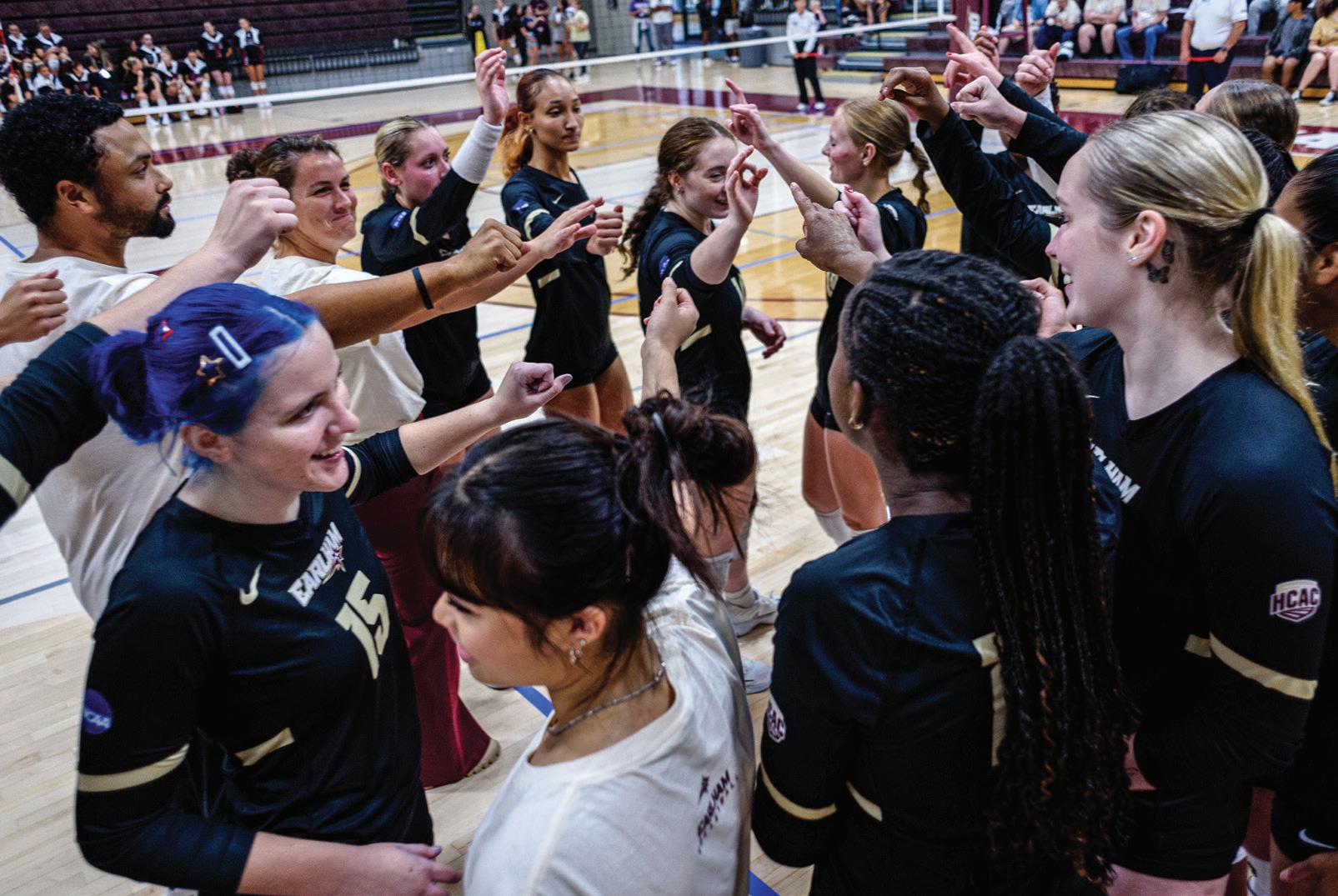
The Earlham women’s volleyball season was chock full of wins, accolades and significant moments. The squad finished the fall 2025 season with a 21-9 record, including 8-1 in conference play, and a homecoming win over perennial powerhouse Transylvania University.
The Quakers claimed the 2025 Heartland Collegiate Athletic Conference (HCAC) Regular Season Championship, earning the No.1 seed and homecourt advantage heading into postseason play. After a 3-1 win over Bluffton University, the team was eliminated from the HCAC Tournament after a five-set loss to Hanover College. This marked the team’s best season since 2021.
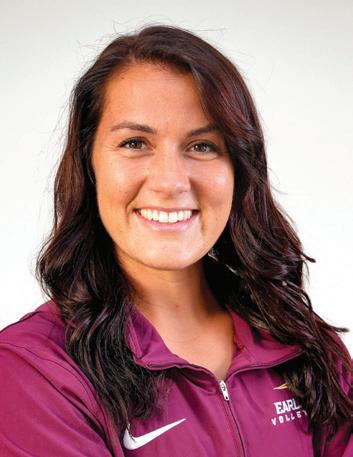
Honors rained down on the Quakers, including HCAC Coach of the Year honors for Lauren Horton, her third; Madison Bizjak ’27
was named Co-Defensive Player of the Year; and Addison Piatt ’28, Caylee Brandes ’27 and Aniyah Harrington ’26 all earned spots on the first team AllHCAC.
The slogan “do the work” is displayed throughout recruiting materials, players’ packets, and in the locker room. The players were reminded of this every time they entered the facility, and coaches consistently instilled the ethos that there is no substitute for hard work.
“I knew that this year would be special,” said Brandes. “We knew that we could make history. I knew that I would have a big role on the team, so I trained my mental toughness even more than normal by trying to always have a positive mindset going into challenging moments.”
Halfway through the season the Quakers bested Ohio Northern, a team they had never beaten, sweeping them in a convincing 3-set match. This was
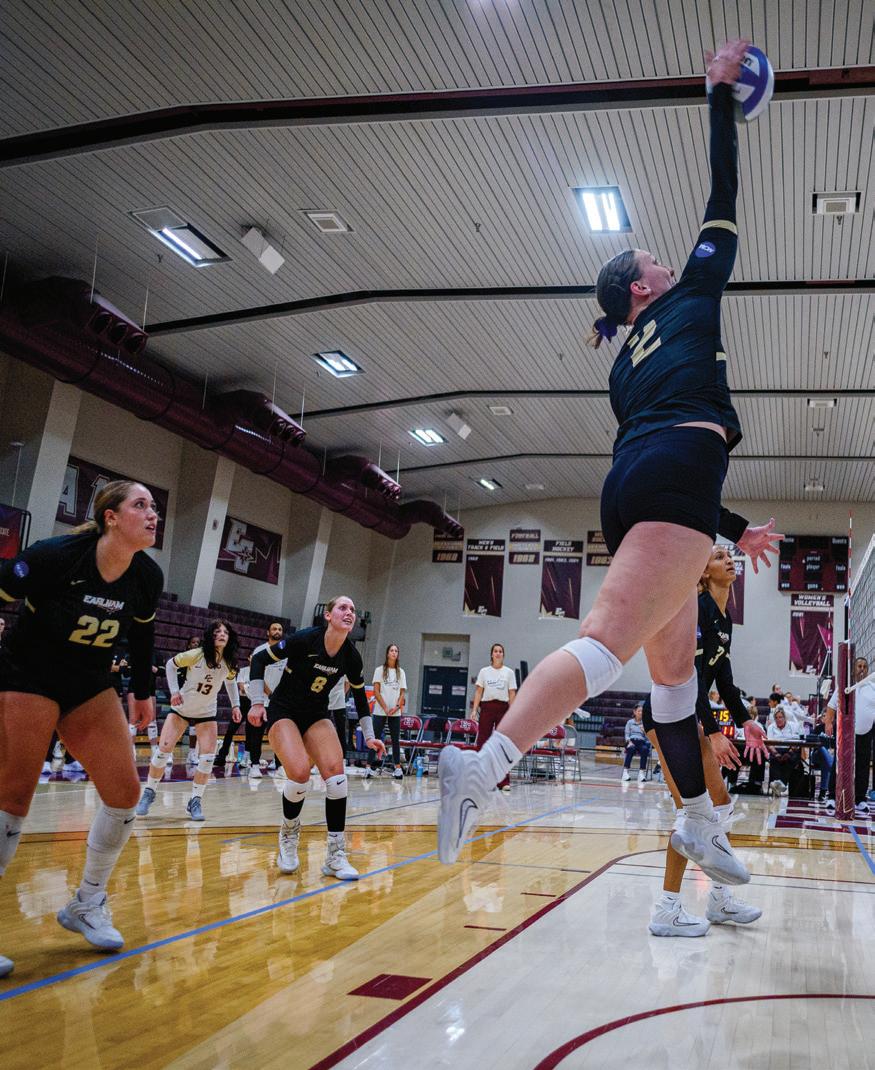
Caylee Brandes ’27 spikes at the Bill Brandes Memorial Invitational.
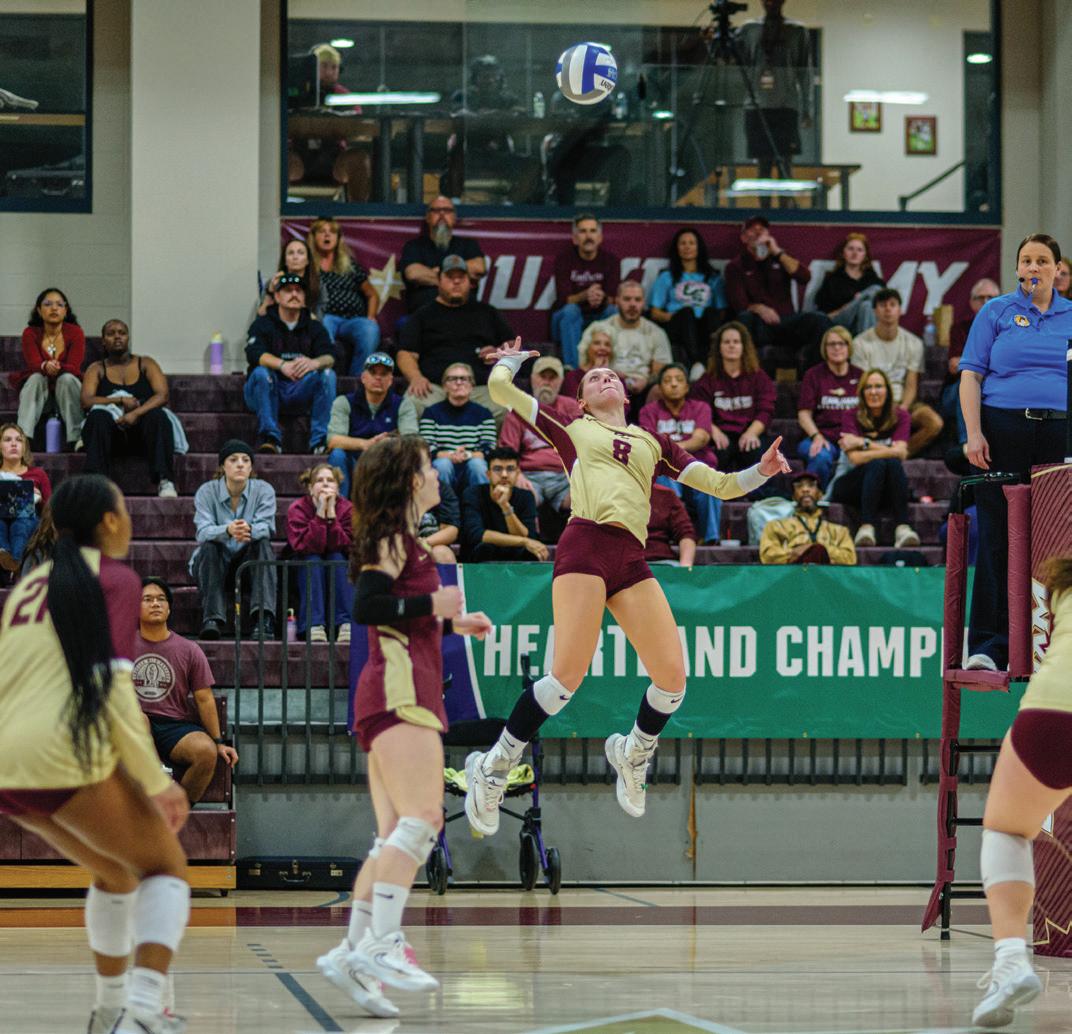
followed by a 3-2 win over Transylvania, which bolstered their confidence and led to a strong finish to an already promising season.
“Statistically, Transylvania played a better game, but it was the heart, the hustle, and determination of our play that triumphed at the end of the five-set match,” said Coach Horton.
Out of the Quakers' 28 matches, 21 went to extra points, and nine went to five sets. The team posted an impressive 13-2 record at home, with Druley Performance Gymnasium proving to be a winning environment.
Brandes led the team in kills with 387, while Ava Walters ’26 contributed 758 assists and Bizjak recorded 44 aces. Additionally, Bizjak broke the Quaker record for most digs in a season with 725.
“The fact that we could endure so many extra sets and come out on top in most of them speaks volume to our training and determination,” said Horton, who highlighted the strong senior cohort as a key factor to the successful season.
The 2026 season will look different after that group of influential seniors is set to graduate this spring and will be one of the toughest schedules the volleyball team has faced. The Quakers will host some tri-matches, which will include teams who are annual conference tournament winners with NCAA tournament appearances.
“What makes this challenge unique is that the team has asked for it,” said Horton. “The team wants to compete against the best and wants to prepare so that we can be at our best when its needed.”
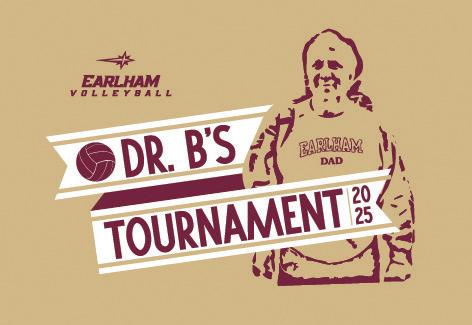
In September, Earlham hosted the inaugural Dr. Bill Brandes Memorial Invitational, honoring Brandes’ father. The tournament featured two courts of action, and the Quakers swept all five of their games in convincing fashion. Brandes remembered her father as the ultimate sports dad, always showing up to her matches or calling for a post-game analysis.
“Having the opportunity to name the tournament after my dad and seeing all the people that came to cheer and support my team really means so much,” said Brandes. “It put into perspective how much I love and care for the people at Earlham.” ■ Story by Aubrey Everett. Photos by Josh Smith.
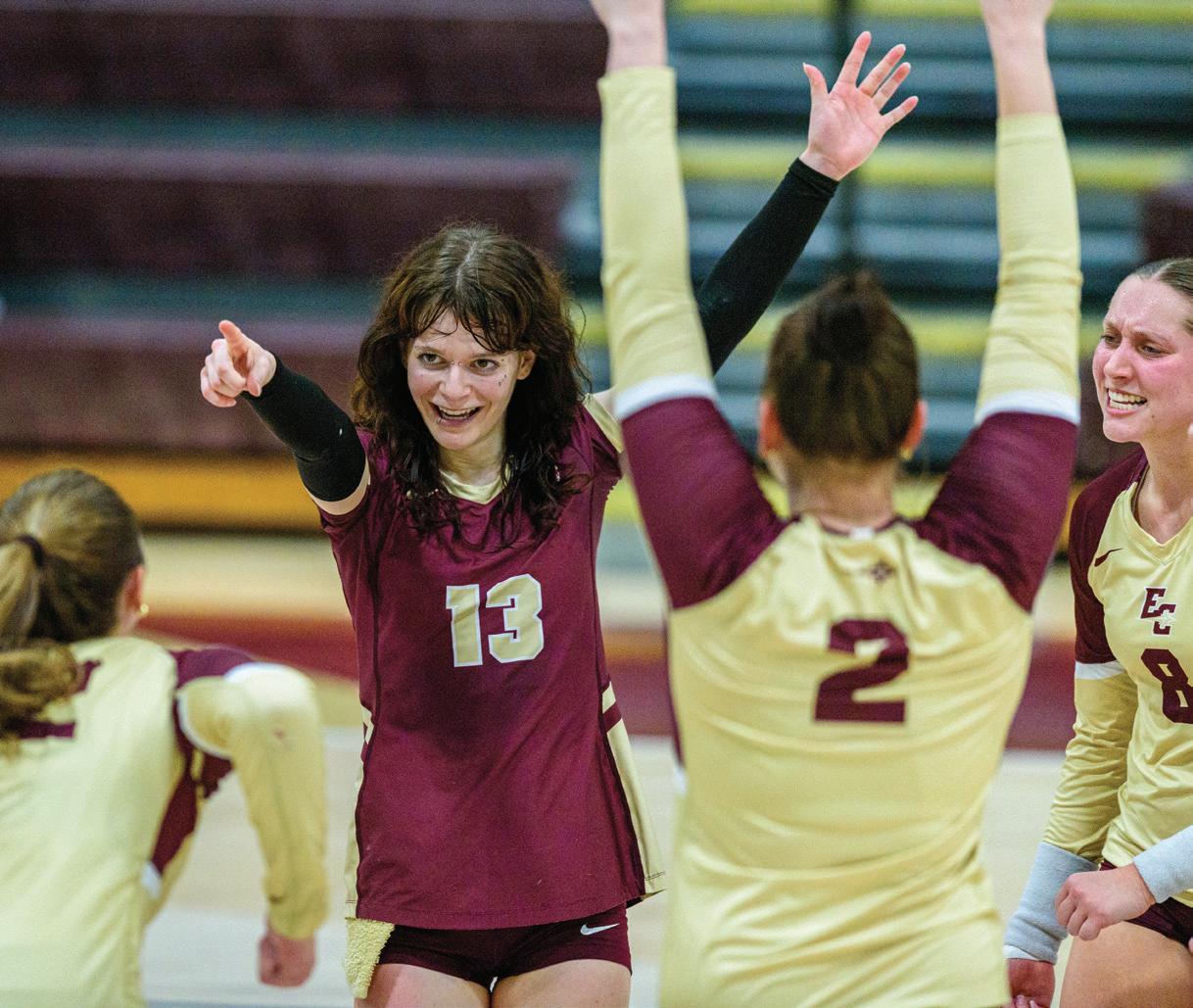
Madison Bizjak ’27 celebrates with teammates during the Post-Season Tournament.
Women’s Soccer mounts a resurgence
After several rebuilding years and dedicated strategic efforts by the coaching staff, the women’s soccer team closed the season on a high note, earning its first Heartland Collegiate Athletic Conference post-season tournament appearance in more than a decade.
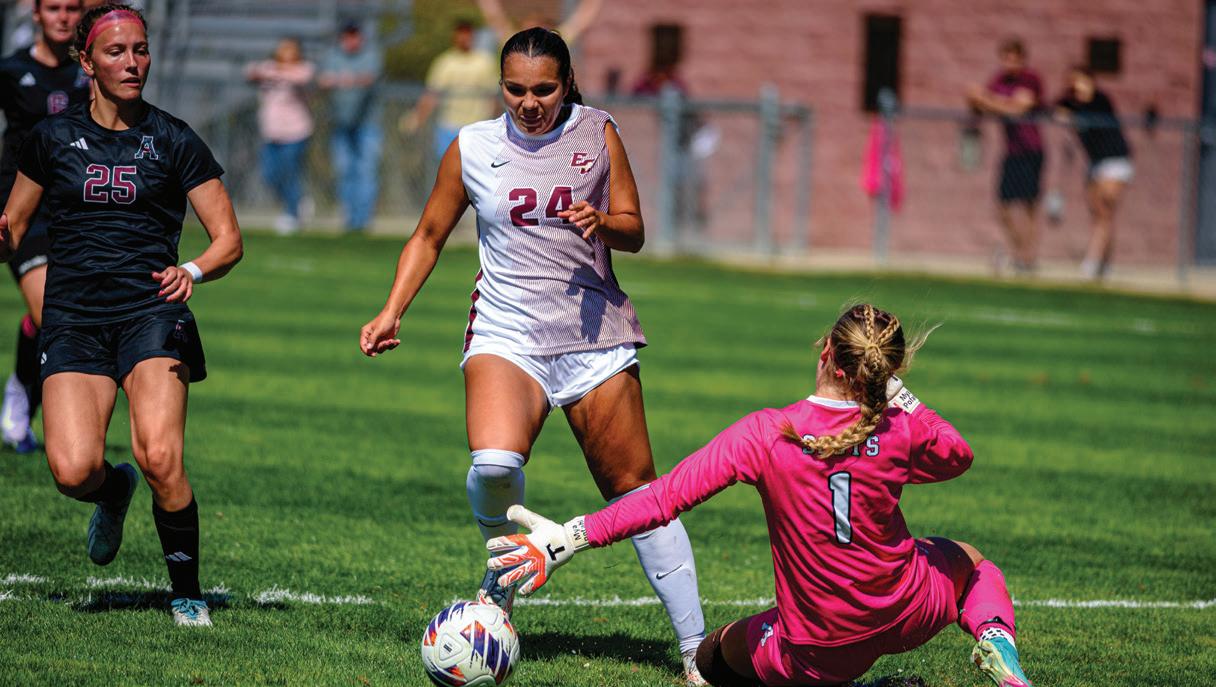
The team finished with a 5-12-1 overall record, including 4-4-1 in conference play. A season-defining moment came in the penultimate match when the Quakers scored on Hanover College, a feat not accomplished since 2013. After a near miss on goal in the final minutes, which would have handed them the victory, the match ended in a 1-1 tie. The squad followed that up by finishing the regular season with a 2-1 win over Berea College, clinching their postseason appearance.
“Reaching the postseason has created real momentum and belief to continue to build into the future,” said Head Coach Lydia Harvey ’19. “Our success this season is a credit to the players and their perseverance. They worked through injuries, pressure moments, and the weight of expectations.”
Harvey and Padgett Gustavson ’20 took over as the coaching duo in 2022, inheriting low roster numbers, injuries, forfeits, and the prospect of playing matches with reduced numbers. They committed to a rebuild, and their first recruiting class was this year’s group of seniors.
“One of the biggest shifts this year was in our messaging as a staff. In previous years, making the
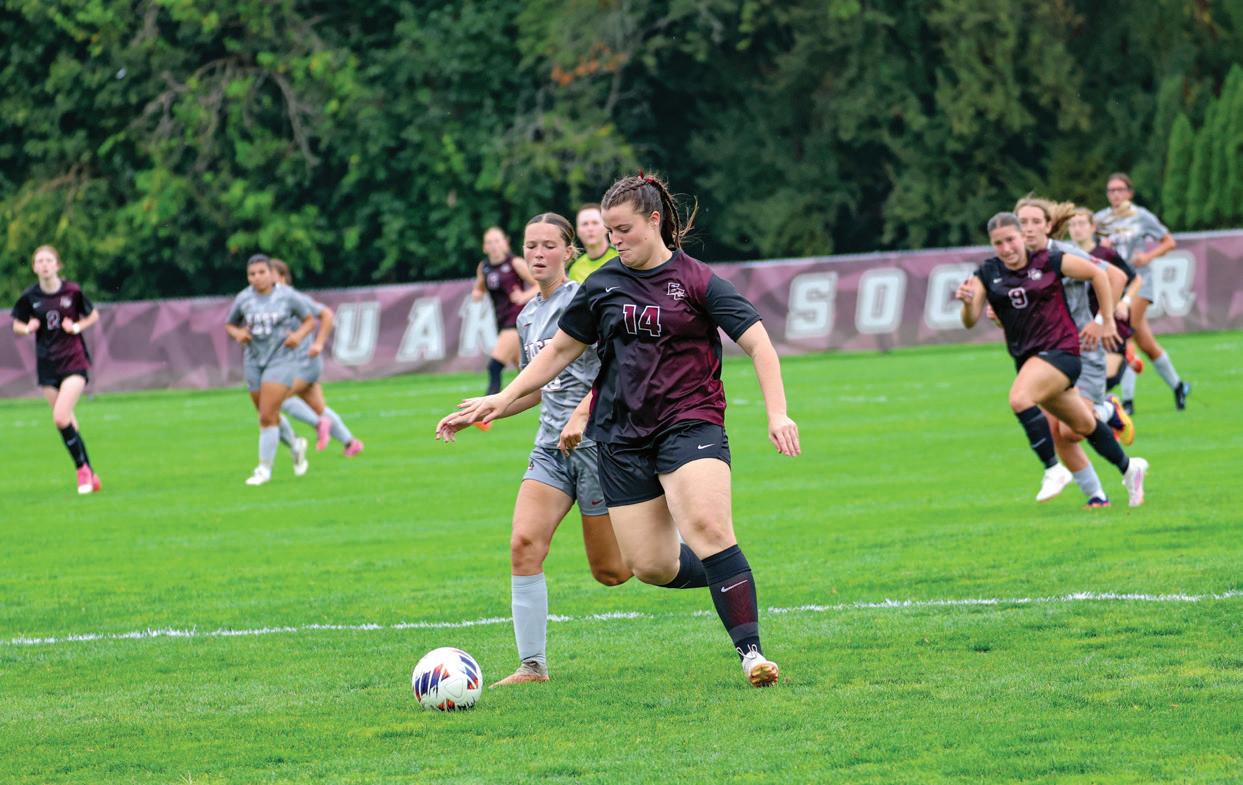
conference tournament was framed as a long-term goal we were building toward. This season, the timing felt right, and we were clear from our very first preseason meeting that this was the year,” said Harvey. “No ifs, ands, or buts.”
“This year was a very nice reminder of hard work paying off,” said four-year starter and senior Mallory Smith ’26, who led the team in goals. “This proved to us what we were capable of and felt incredible to accomplish knowing how much time, effort, and hard work had gone into it.”
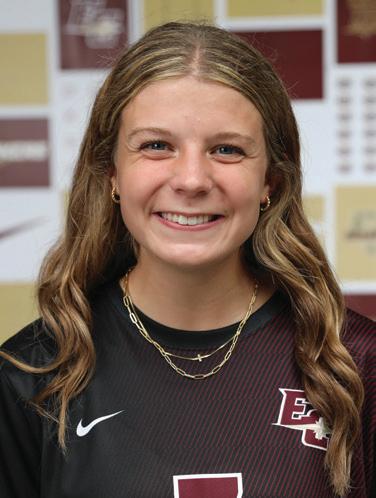
Smith said she and her classmates put in significant work over the offseason to build camaraderie, such as initiating team phone calls with incoming players, meeting up with local teammates for training sessions, and hosting early morning practices.
“Although every year looked slightly different as people graduated and others came in, the friendships, joy, hard work, and genuine care for each other is something that remained constant,” said Smith.
Harvey said the team is committed to building on this season’s success and taking the winning momentum into next year. The Quakers will head into next season with the most veteran roster to date.
“Our ultimate goal is to win conference and go compete on the national stage, and we would love to engage alumni in the pursuit of that goal,” she said. ■
Story by Aubrey Everett. Photos by Josh Smith.
Lydia Harvey ’19
Mallory Smith ‘26
Earlham College competes against Indiana University East in September 2025.
Earlham College competes against Alma College in August 2025.
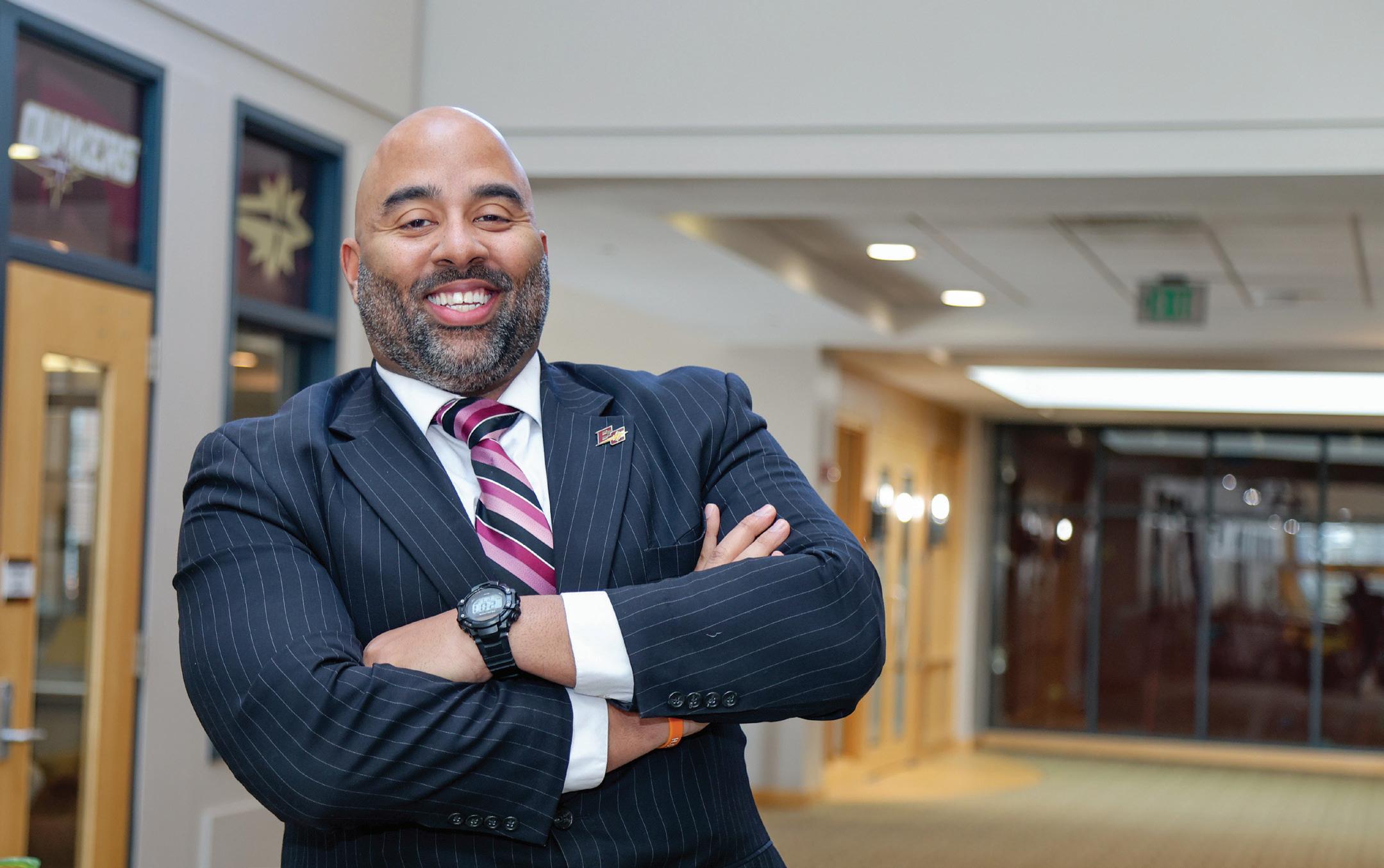
Nick Johnson ’01, a longtime Earlham coach and administrator, was promoted to director of athletics in January. He succeeds Adam Hutchinson, who retired in December, after more than four years of outstanding service to the College.
Johnson brings more than two decades of experience at Earlham as a student-athlete, coach, and administrator. Since returning to Earlham Athletics in 2021, he has led academic success initiatives for student-athletes and supported departmental diversity, equity, and inclusion programs. He previously served the College as associate director of alumni engagement beginning in 2019.
Nick Johnson promoted to director of athletics
Bonita Washington-Lacey ’78, vice president for student life and dean of students, said Johnson is the right person to lead Earlham Athletics into the future.
“Earlham continues to serve as a model for excellence in Division III athletics, supported by outstanding facilities and a commitment to educating the whole student,” Washington-Lacey said.
“Earlham is a significant part of my life, my legacy, and my experiences.”
– NICK JOHNSON ’01
“We have a great group of folks here — special people who work incredibly hard for Earlham,” Johnson said. “It’s invigorating to be part of their lives and their work. I’m excited to come alongside them and continue building a program that helps our student-athletes become the best version of themselves — on the field, in the classroom, and in the broader context of their lives.”
“He understands the needs of today’s students, has built long-standing relationships with our coaches and players. He is invested in our students’ academic lives and partners with teaching faculty to support their learning.”
A four-year letterwinner in both football and track, Johnson said stepping into the director’s role feels deeply personal.
“I bleed maroon and white,” he said. “Earlham is a significant part of my life, my legacy, and my experiences. Everything good in my life is because of this place. I want to do everything I can to help Earlham thrive.” ■
Story by Brian Zimmerman
by Tsitsi Makufa
Photo
Homecoming 2025
Homecoming and Reunion Weekend 2025 brought more than 800 alums and friends back to Earlham for a celebration defined by connection, tradition, and investment in the College’s future. The weekend blended joyful reunions and milestone anniversaries with moments that looked decisively forward, as Earlham dedicated new spaces made possible through the generosity of alumni donors.
Among the highlights was the dedication of the May and Crossen Courtyard and Patio, established through a major gift from Jeff May ’75 and Karen Crossen ’76.
Athletics supporters also celebrated the opening of the Bud McCollum–Earlham College Baseball Hitting and Pitching Lab, made possible by Randy ’73 and Melissa Sadler, and additional support from Charlie and Esther Krieger and proceeds from a fundraising campaign led by the baseball program.
The weekend featured signature events including the Black Alumni Celebration, the 60th anniversary performance of Gospel Revs, the 35th anniversary of Dance Alloy, class reunions for years ending in “0” and “5,” and many athletics contests. Alums were also recognized during the Alumni Awards and Athletics Hall of Fame ceremony, celebrating Earlhamites whose impact extends far beyond campus.
Save the date for the next Homecoming and Reunion Weekend on Oct.15-18, 2026.
more online
Find more homecoming photos at earlham.edu/homecoming.
Photos by Tsitsi Makufa, John Ozai, and Josh Smith.
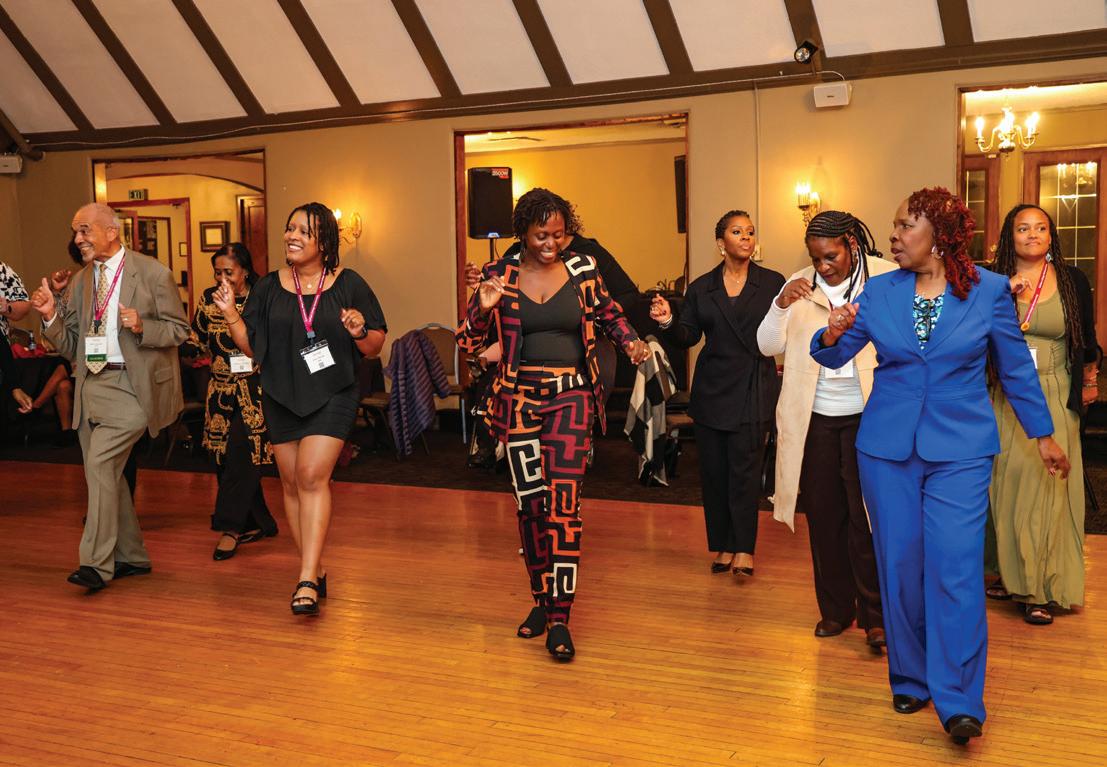
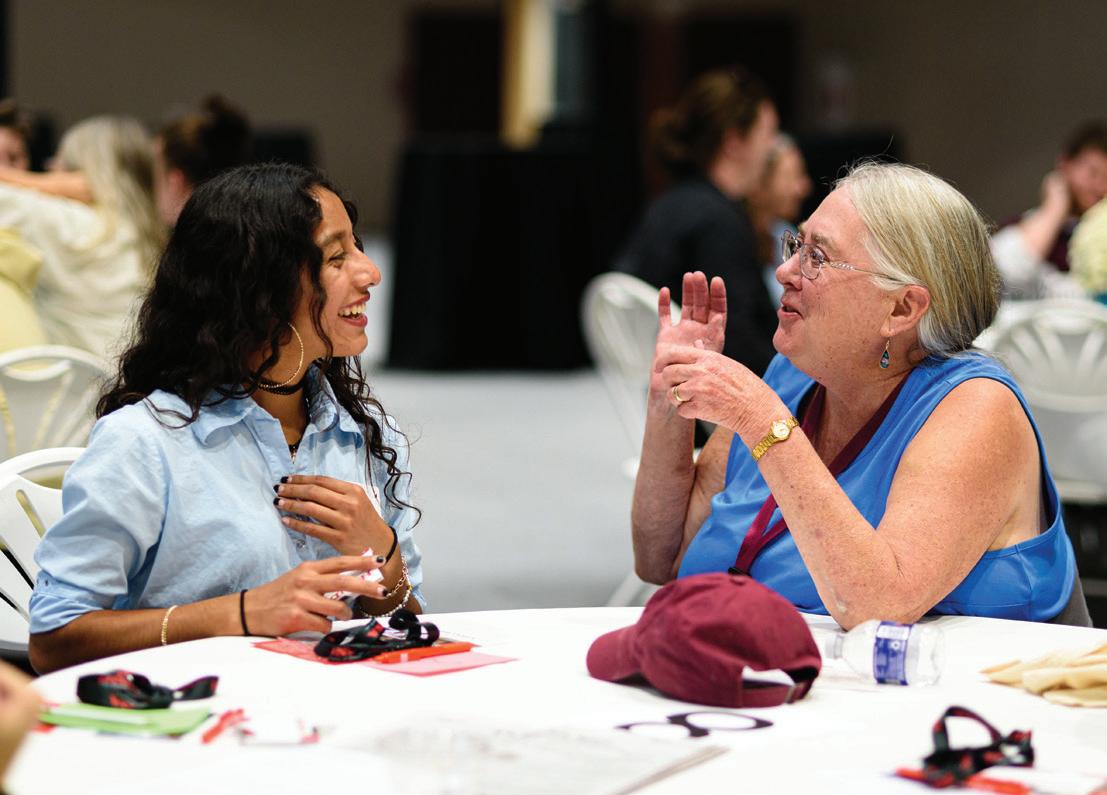
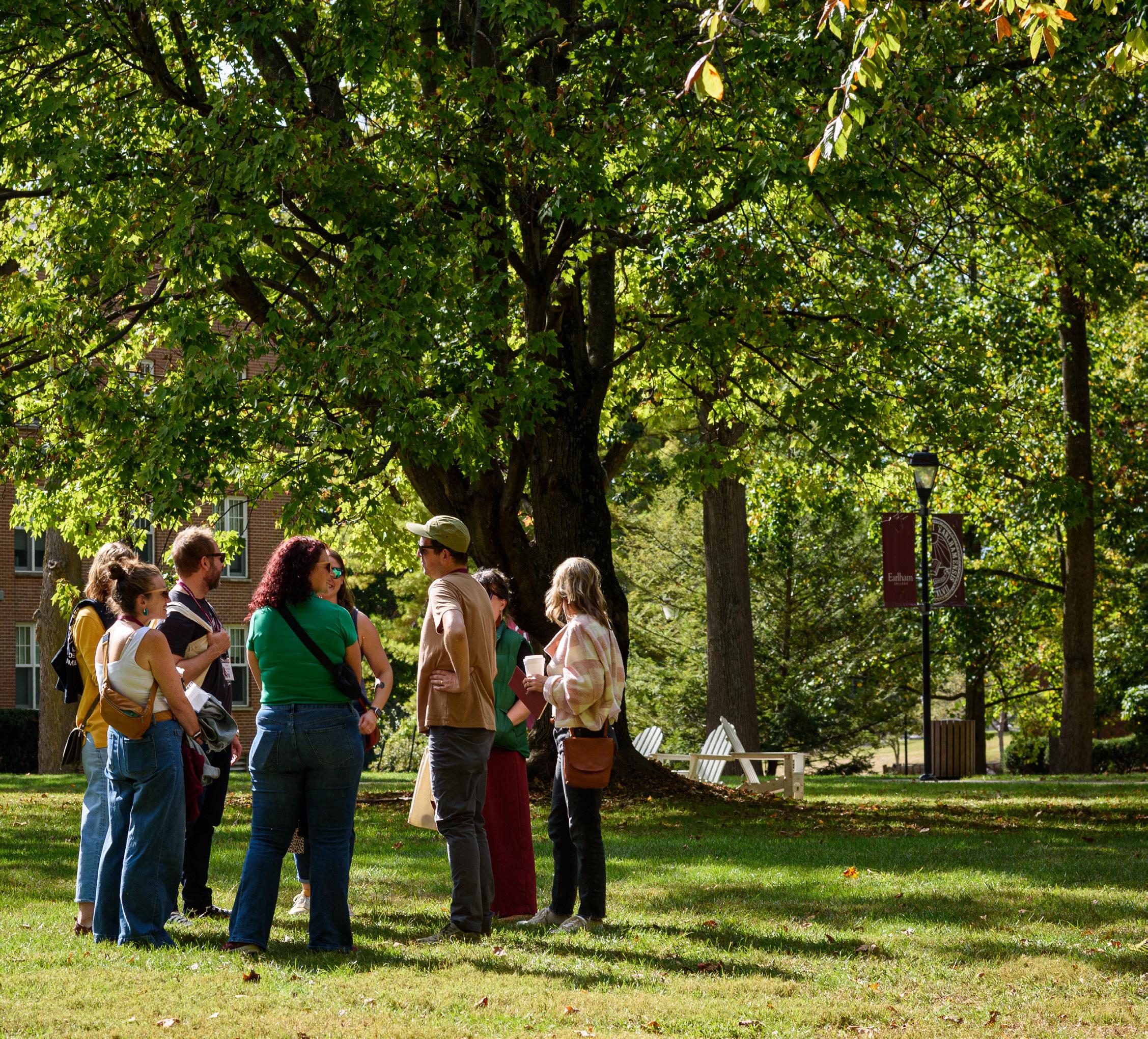
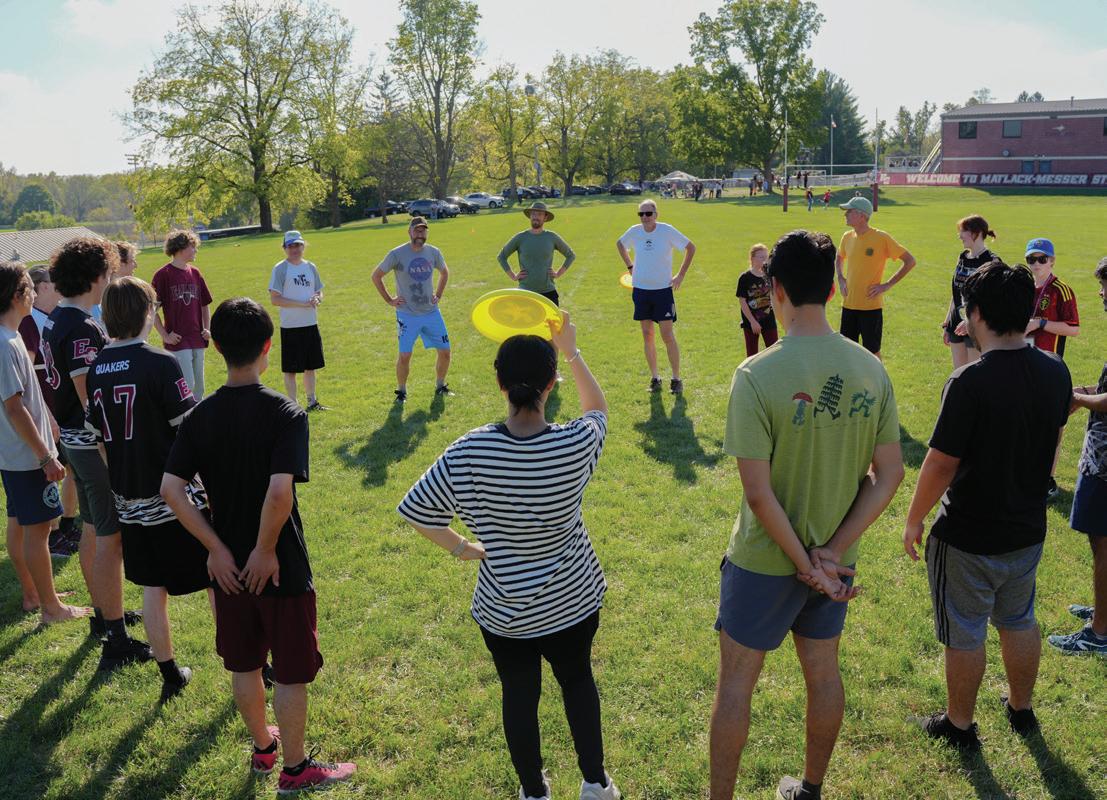
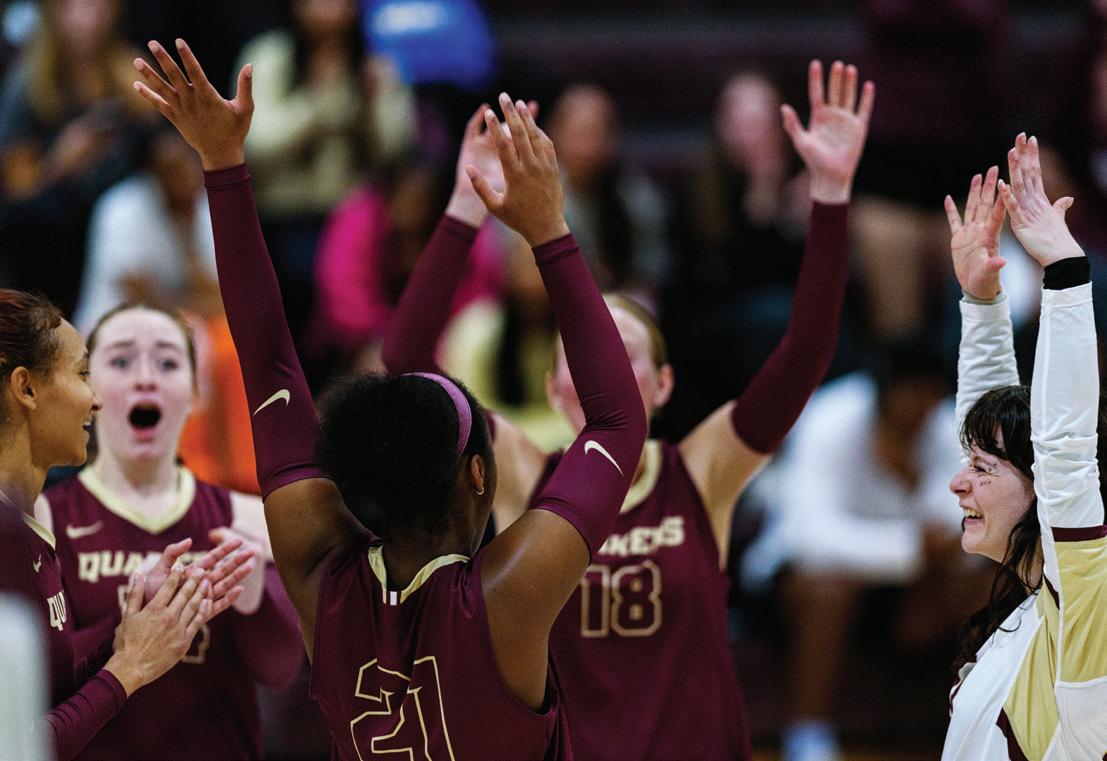
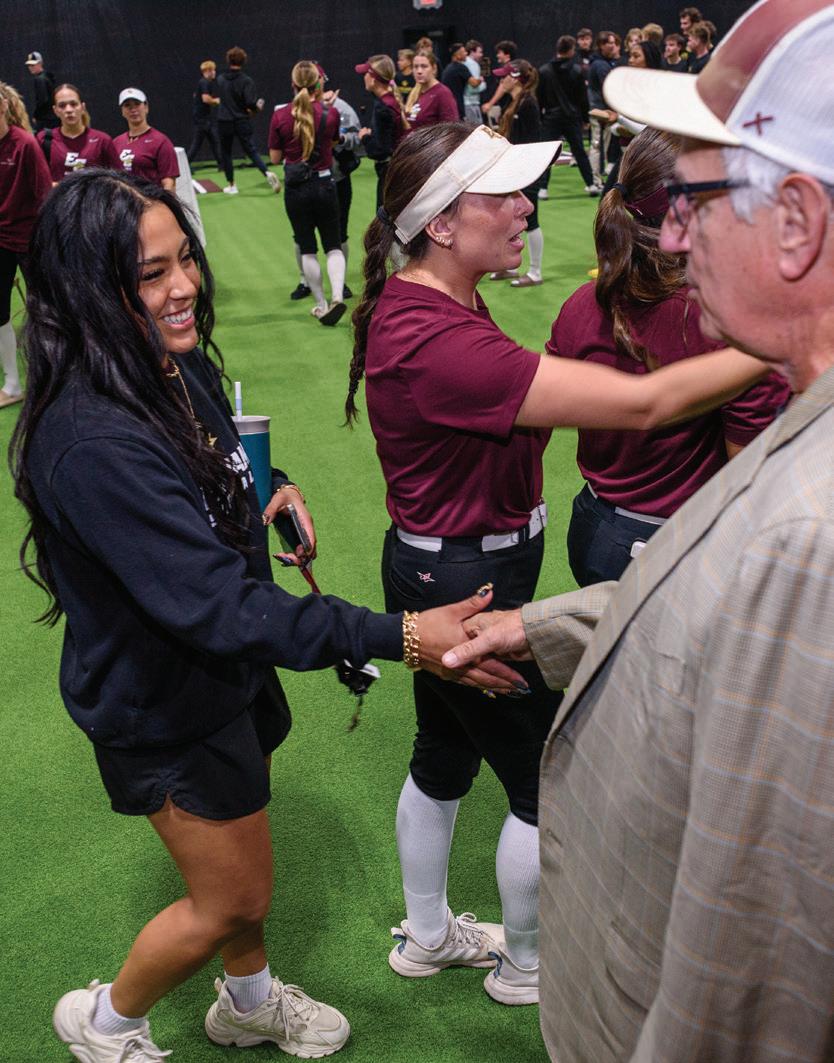
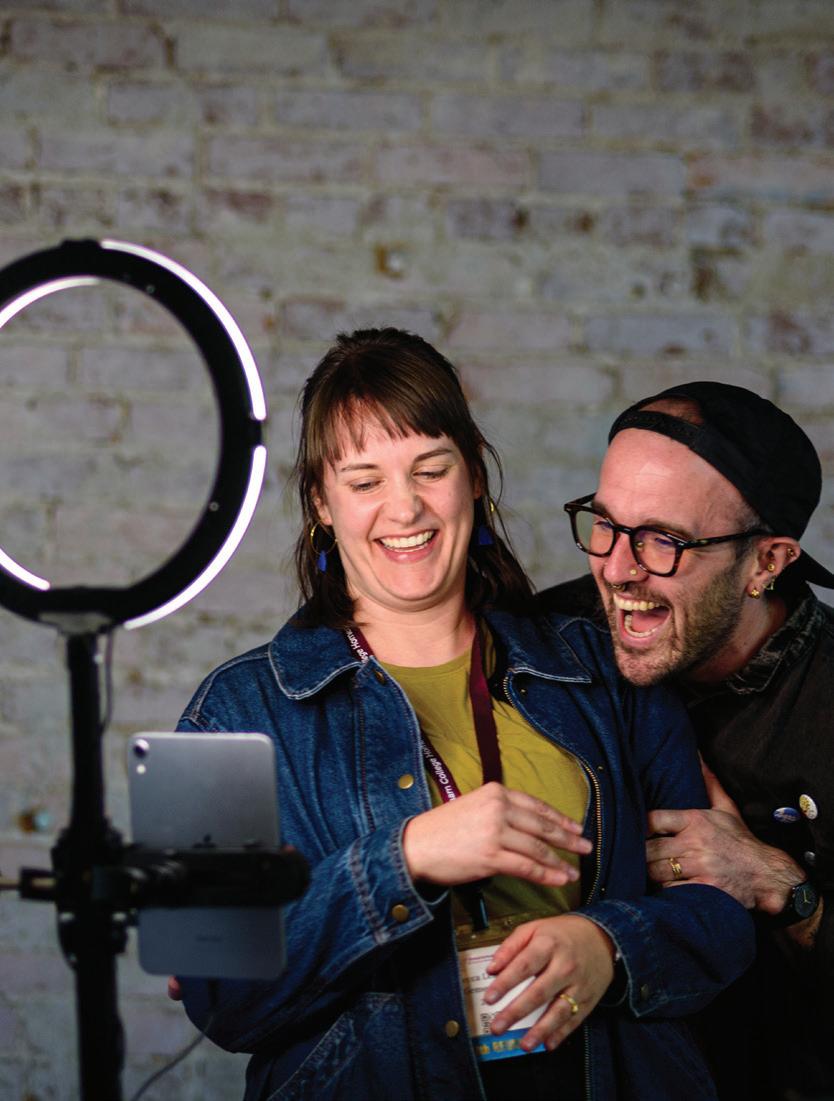
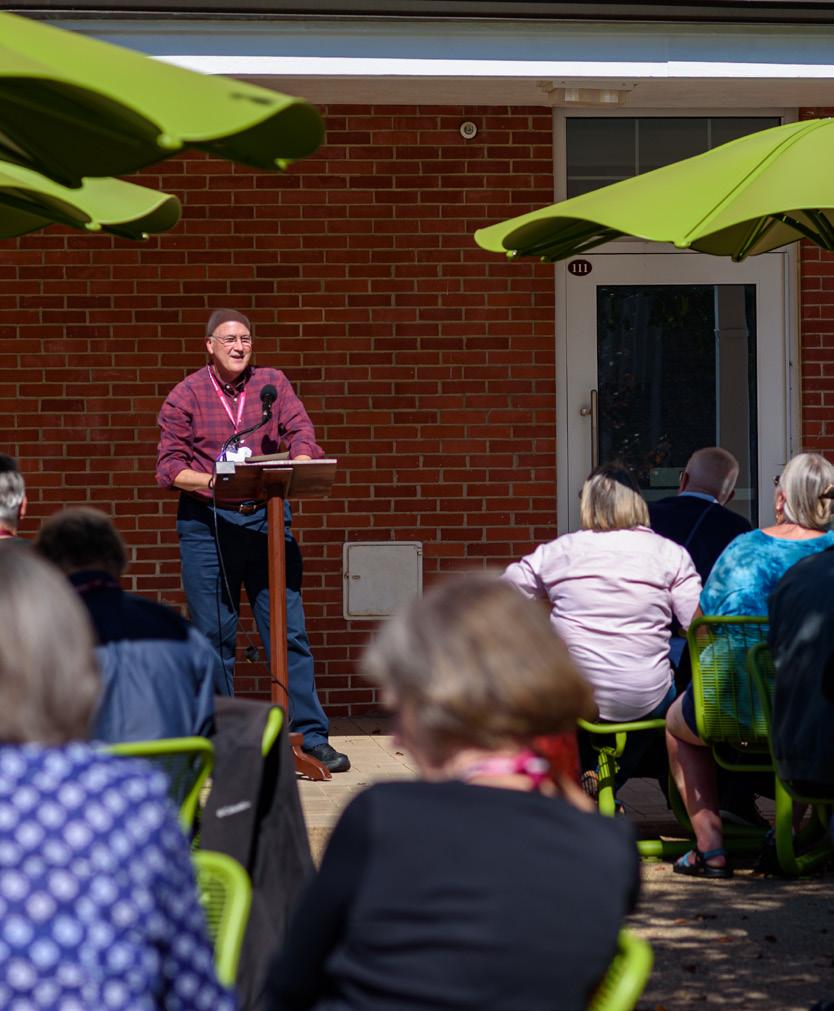
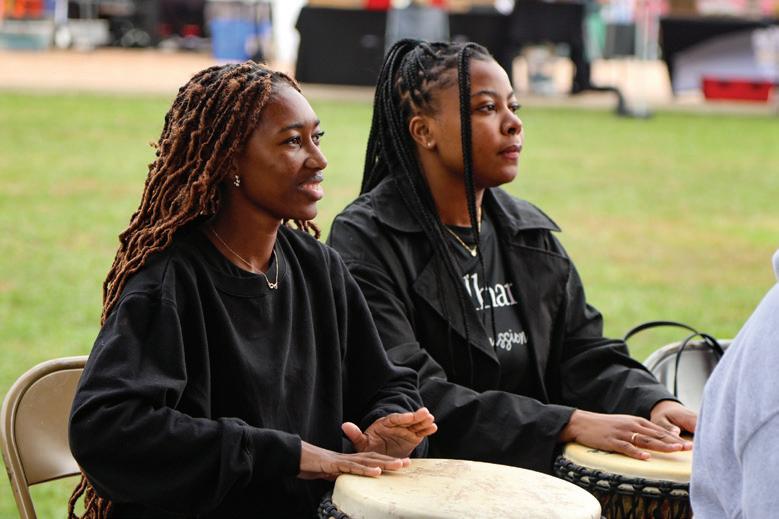
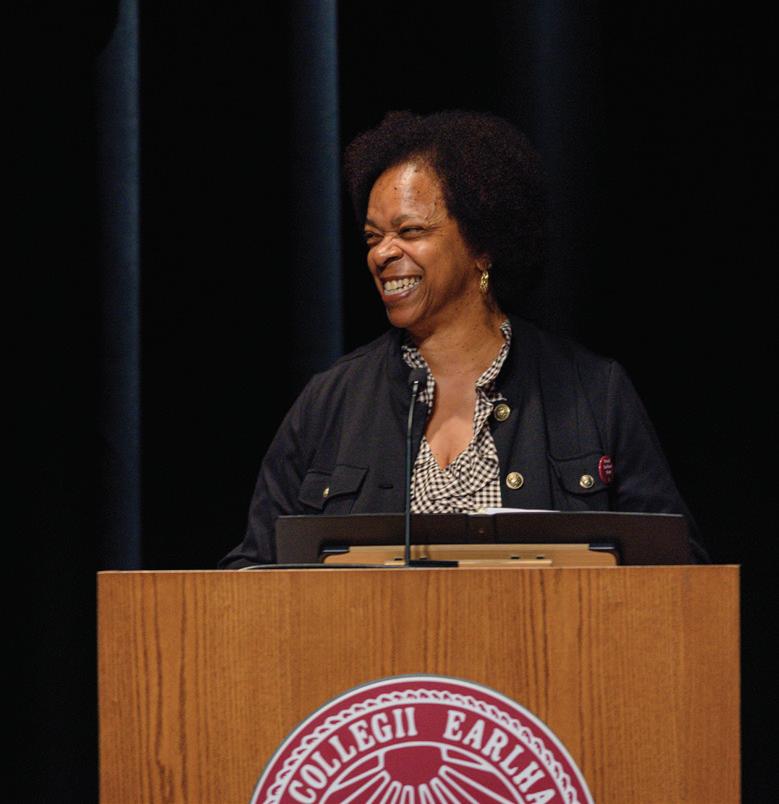
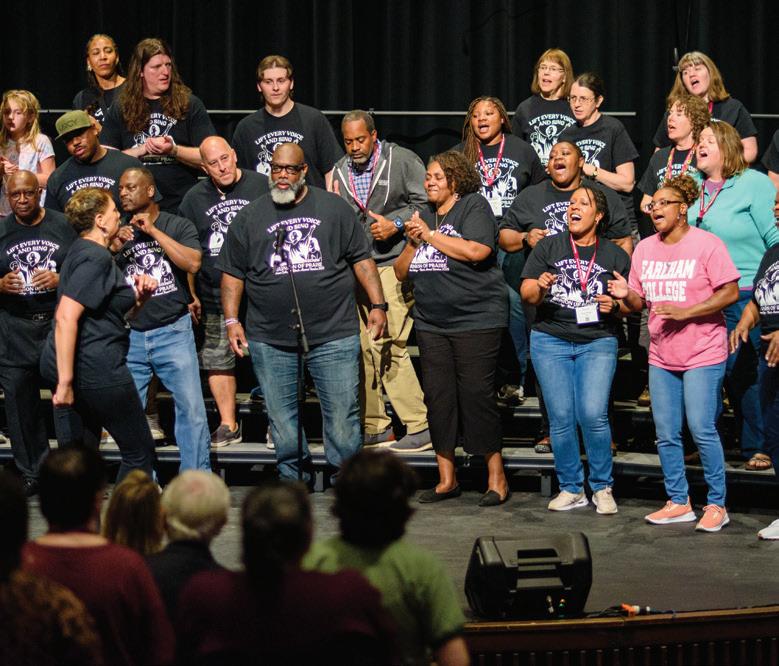
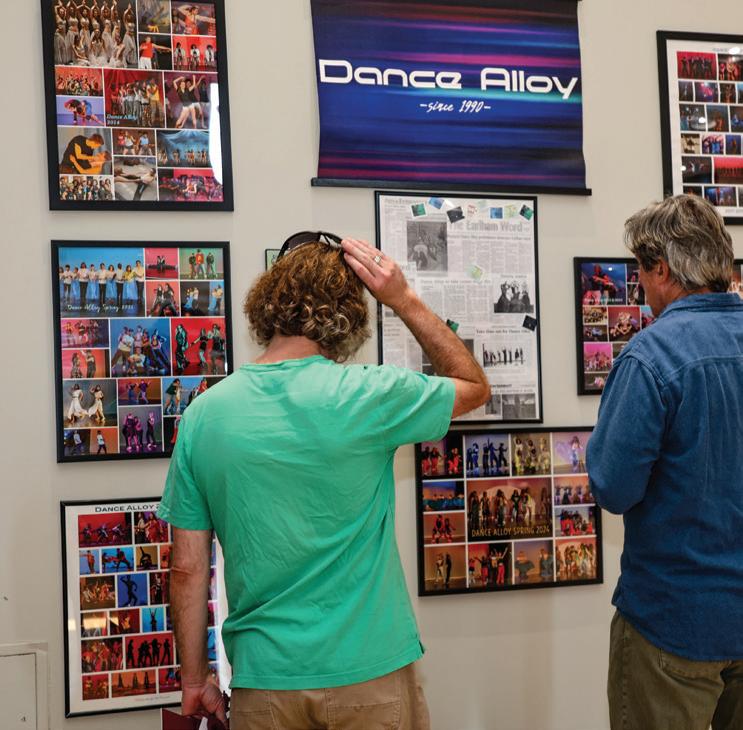
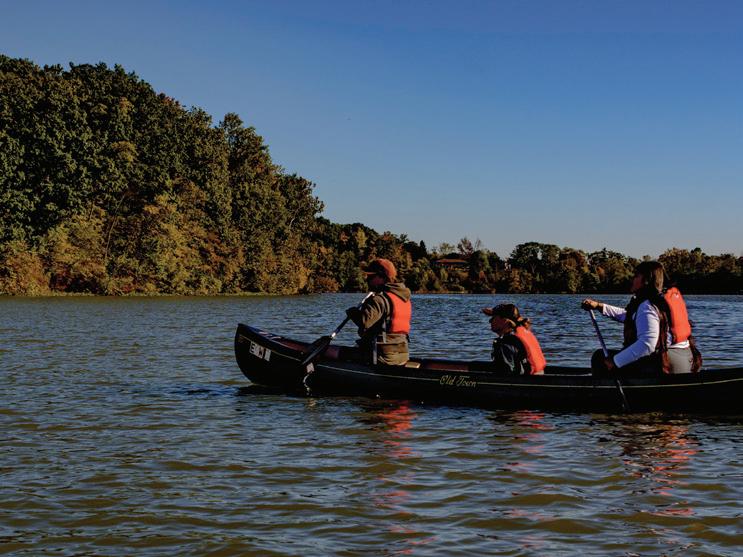
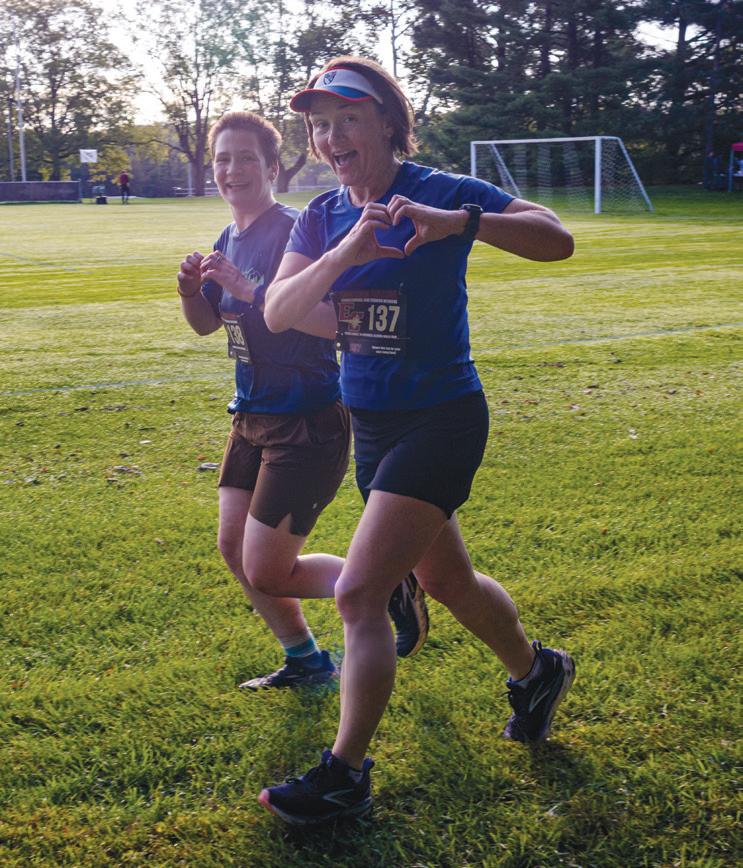
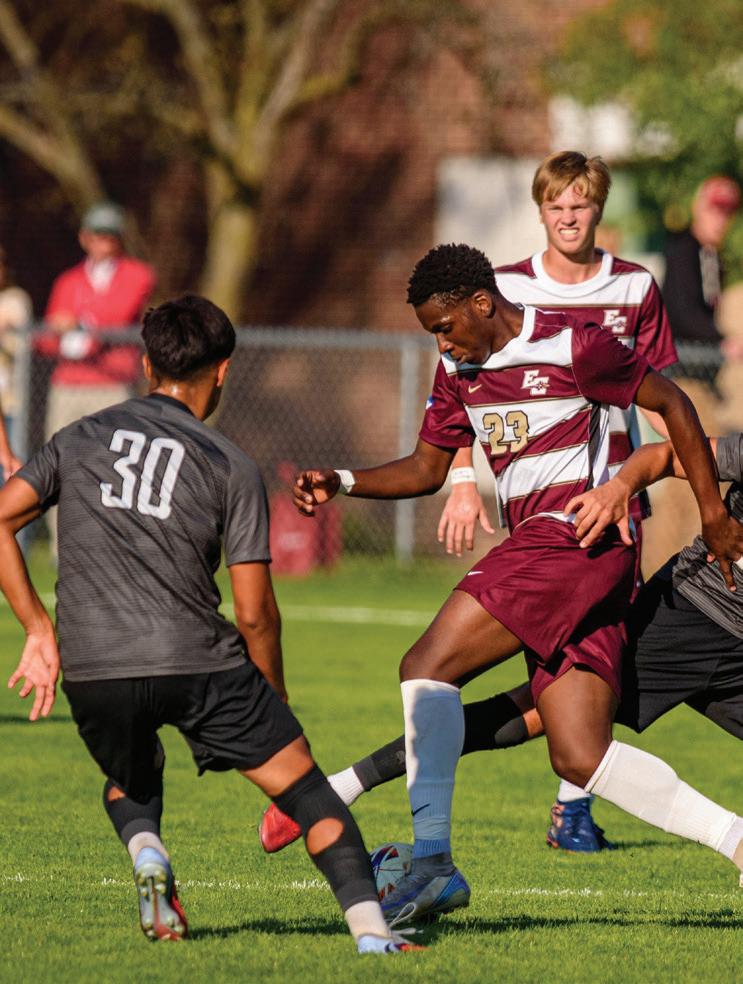
CLASS NOTES
Send us your news > The deadline to submit entries for the next issue is June 1, 2026. Go to earlham.edu/classnotes to submit yours, or write to alums@earlham.edu. Submissions may be edited for length of other editorial considerations. This issue of Earlhamite magazine includes notes and obituaries received by December 1, 2025.
2015
Phoebe Jones: Tim O’Donoghue ’15 and I tied the knot in September 2025! It was a sweet celebration full of Earlhamites. We then attended our 10-year Earlham reunion a few weeks later — a full circle celebration.
2013
Mary Williams Kyriacopoulos: In July 2024, Dylan Kyriacopoulos ’13 and I welcomed our son August Rainier (future Class of 2046) to the world! We continue to work in progressive fields hoping to fight for and salvage our country’s democracy where we can. Mary just celebrated her 10th anniversary working as the billing manager at a civil rights law firm specializing in federal employment law (it has been an especially trying year), and Dylan celebrated his 10th anniversary working at a leading software provider for democratic campaigns and progressive nonprofits. We live in Silver Spring, Maryland.
2012
Alma Raymer: The last couple of years have been full of transitions for me. A little over a year ago, I moved from Austin, Texas, down to the gulf coast. Galveston, Texas, has incredible and fascinating history (birthplace of Juneteenth, for instance), and it’s been so good for me to spend time close
to the sea again. I also transitioned earlier this year from a decade-plus career in the space of accessibility and equity in higher education to operations and data analytics in the renewables and climate space. I’m loving this new professional space I’ve created for myself, and would love to support and offer solidarity to fellow Earlham alums trying to make a professional pivot or career transition during this time. If anyone is ever in the Houston metro area, give me a shout!
Rebecca Ogle: Lucas Williams ’11 and I moved to from Chicago to Indianapolis in 2023. Our daughter recently turned 4 and began attending Montessori preschool full-time. Lucas works as a respiratory therapist at IU-University Hospital. I just passed the sixth anniversary of running my private practice Grounded Counseling, which provides virtual psychotherapy services to folks who live in Indiana and Illinois, and inperson services to the Indianapolis area. We attend North Meadow Circle of Friends sporadically.
2007
Donna Vincent Storch: Donna served as a General Magistrate for the 4th Judicial Circuit Court in
Jacksonville, Florida, presiding over dependency (child welfare cases), including two problem-solving courts — Early Childhood Court (which focuses on infant mental health from a multidisciplinary approach) and Family Treatment Court (which focuses on substance misuse treatment). On September 4, 2025, Magistrate Vincent was selected as the 2025 William E. Gladstone Recipient. The Gladstone Award is presented to one judicial officer for judicial leadership who has made significant contributions to serving dependent children and families.
2004
Nancy Stalnaker: Nancy is increasing her involvement in Generation Data, the nonprofit she founded that trains people to be data staff for progressive organizations. While there are only a few hundred people in this niche profession, at least four are Earlhamites. She hopes that more Earlham students and alumni with an interest in both computers and politics will get involved in the organization as a student or supporter.
1993
MaryAnne LoVerme: After 12 years living in Los Angeles, I’ve moved to Paris! I’ll be teaching at the American
School of Paris and would love to connect with other Earlham alumni who are nearby.
1991
Lisa Kamins: I recently joined Speak for the Trees in Boston as the director of advancement. We work to grow tree equity in Boston, especially in environmental justice communities. It would be great to connect with alumni in the area who are interested in urban forestry and social justice. Our website is treeboston.org.
1988
Robert Strasser: Following a bout with cancer in 2021, another bout and a stem cell transplant in 2022, and complications that move along in time with me as I go through life, things assumed a relative normalcy finally in 2025. This is life for me. I am grateful to be alive and changed forever. I dream of spending a long time abroad, perhaps in Europe if anyone knows of a low-cost situation. I am very excited to announce the release of a book of 50 poems in December 2025, something that came to me in part from going through so much hardship. It’s about nature, healing slowly, philosophical and spiritual reflection, as well as the environment and the cancer journey. Mystics Recourse – A Poetic Journey is available as an e-book, paperback and color hardcover on various platforms online. Enjoy and write with news. Always good to hear from EC alums. Write to 5257 Buckeystown Pike, #297, Frederick, MD 21704 or email Rcs52025@gmail.com.
1983
Neil Levine: What do you get when you take an EC Humanities informed book list, a bunch of EC
alums, and 90 minutes? You get the Class of ’83 and Friends Book Club. Sparked by the 2024 book Fever in the Heartland by Timothy Egan, we invited alums from 1983 and 1984 and the Alumni Council to explore the history of the KKK and its near takeover of the State of Indiana in the 1920s. We asked retired professor and archivist Tom Hamm to share his research and reflections on this era and the role of Earlham and Quakers in relation to the Klan. The book club has about two dozen regular participants, along with several others who attend when they can. In addition to alums from ’83 and ’84, we are joined by Earlhamites spanning several decades, including Howell Gatchell ’69, Deborah Roose ’71, Jeff Perkins ’94 , and Mayah MacColl Nicholson ’23 . Books are suggested by our members and voted on each month; we alternate between fiction and nonfiction choices. Our choices to date have included fiction like James by Percival Everett and Small Things Like These by Claire Keegan, Jelly Roll, Bix and Hoagy: Gennett Records and the History of America’s Musical Grassroots, about local Richmond history by Rick Kennedy, and War by Other Means, a history of WWII conscientious objectors, by Daniel Akst. We enjoyed a particularly rich discussion, including reflections by former professor George Lopez on his journey as a Catholic CO and the EC colleagues he met and worked with, many of whom were COs. Our discussion drew on several classmates who shared stories about their fathers’ CO experience and its shaping of their own lives. The book club meets from 6:30–8 p.m. on the second or third Monday of every month, with a break over the summer. We would love others to join our discussions! For more information, please contact nelevine37@gmail.com.
1981
Pat Murphy: Happily embracing retirement these days. Hope others in the class are enjoying the same. After graduate school, I spent my life to date in Maryland and now have more time to explore its glorious outdoors. I’m in a walking group on Saturdays in Howard County if anyone in the area wants to join. It’s We Promote Health.
1978
Amy Garner White: We recently celebrated the birth of our fifth grandchild, Mary Anastasia White, in July. She joins siblings Isaac (7), Hannah (5), Samuel (3), and James (2). They are the children of our older son, Peter, and his wife Sophea. They live in New Jersey, where Peter is an electrician. Our daughter Rebecca ’06, lives in Seattle, where she is a social worker for the VA. I spent two weeks with her in May, when she was living on Vashon Island at the time. Our younger son, Allister, is a wildland firefighter with the U.S. Forest Service. In February, he moved from Montana to Virginia, pulling behind him his tiny house that he had built on a trailer. Paul and I drove his car for him from Montana to Virginia, taking a southern route, and visited several national parks on the way. Our kids are spread far and wide, and it has been a real treat to have seen them all this year.
1974
Christopher Gelfand: After 20 years in the Navy’s Submarine Nuclear Propulsion program as an Engineering Laboratory Technician, four years working at a Department of Energy Site in South Carolina as a Radiological Worker, and finally 17
years at Newport News Shipbuilding in Virginia as an instructor/ instructional developer, I retired to Halifax, Virginia for the last seven years with Edith, my wife of 43 years. We enjoy working the veggie garden and our 13 chickens. We visit our two children and seven grandchildren as we can. Life as farmers and enjoying the quiet rural life brings both of us great joy.
1971
Barbara Foster Reynolds: Barbara “Kitti” Foster Reynolds is happy to announce the birth of Maxwell Augustus Reynolds, May 6, 2025, in Washington, D.C. Max is the son of Ryan Levi Foster Reynolds, who is the son of Kitti and the late Lee James Reynolds II ’71. Max is the great-grandson of Leon Martindale Reynolds ’36 and the great-great grandson of Lee James Reynolds — both EC graduates. Ryan, his partner Jes, and Max are all doing well and live in Silver Spring, Maryland.
1967
Steve Kaeuper: Last year, I had the opportunity to visit with several classmates several times. In June, John Khanlian ’67, Pete Reuman ’67, Nina Nichols ’67, and I all attended the memorial service with Barbara MacAlpine ’67 for her husband, Gordon ’67, in Estes Park, Colorado. In late July, my wife Wendy and I drove to Indianapolis to visit with Steve and Lynn Mills. Then we went on to Clark Lake, MI to visit with Vic Marshall ’67 and Gretchen Marshall ’69. In August, there was a Denver/Boulder area gathering of Earlham alums where Barb MacAlpine,
Mary Barstow ’66 and I represented 1960s grads. In late September, our annual gathering of old Pitmen was held in Bar Harbor, Maine. Attending were John Khanlian (Janet), Al Kellum ’67 (Henriette), Burt Mills ’67 (Sally), Vic and Gretchen Marshall, Loring Presser ’67 and Beth Prosser ’69, Pete Reuman (Alice), Barb MacAlpine and I (Wendy). It is always a great joy to connect with Earlham grads. If anyone will be in the Denver area anytime soon, please get in touch.
1966
Richard Berliner: Richard “Dick” Berliner has published the book A Different Journey: Vietnam 19651973. Dick went to Vietnam with International Voluntary Services, along with three other Earlham classmates, in the middle of the war, not as a soldier but as an “agent of change” who wanted to help build the country. While working with various youth organizations, he quickly discovered that little in the way of development could happen in the midst of war. The Tet Offensive forced an abrupt change as he pivoted to refugee and medical relief, and ultimately as a newspaper reporter. His book presents a view of the war from the perspective of South Vietnamese youth and gives voice to their frustrations at being caught in the middle of two warring powers. With a reporter’s eye and the ability to converse in Vietnamese, he wrote 100-plus letters home in which he shares scenes from everyday life and provides a glimpse into the internal political struggles among the Vietnamese leadership. Along the way there were a few harrowing experiences — but nothing like what U.S. soldiers faced at the same
time. The book is based on the letters and additional research to confirm historical events. The book is available from your local book store and from online retailers.
1964
Robert Olson: The bulk of my career was serving as research director of the Institute for Alternative Futures, a nonprofit organization dedicated to promoting visioning and foresight. After retiring from the Institute, my wife Marge and I lived half-time in the tiny town of Lincolnville, Maine, where we developed wonderful friendships and had some of the best years of our lives. We spent the other half of each year in our longtime home in Arlington, Virginia, where our two sons and their families continue to live. Marge passed away in 2022. I couldn’t imagine ever having another such relationship, but it’s my great good fortune to have that happen during this past year. I’ve kept in contact with a few of my Earlham classmates, especially my former roommate Russ Marcus ’64 . Russ married a Japanese woman and has spent most of his life in Japan. I’ve also renewed a friendship with Gretchen Pohnert ’64 , whom I dated at Earlham. Gretchen is a sweet, talented woman who was lead soprano in the concert choir. Looking back, attending Earlham during the period of social and political idealism of the early 1960s had a major impact on my views and interests, for which I’ll always be grateful.
1961
Donald Peck: My seventh book, Washington’s Footsteps: The Power of Revolutionary Places and Spaces in Central New Jersey, was published by Garden State Legacy in 2025. Since 1961, I continue to be actively engaged
1975
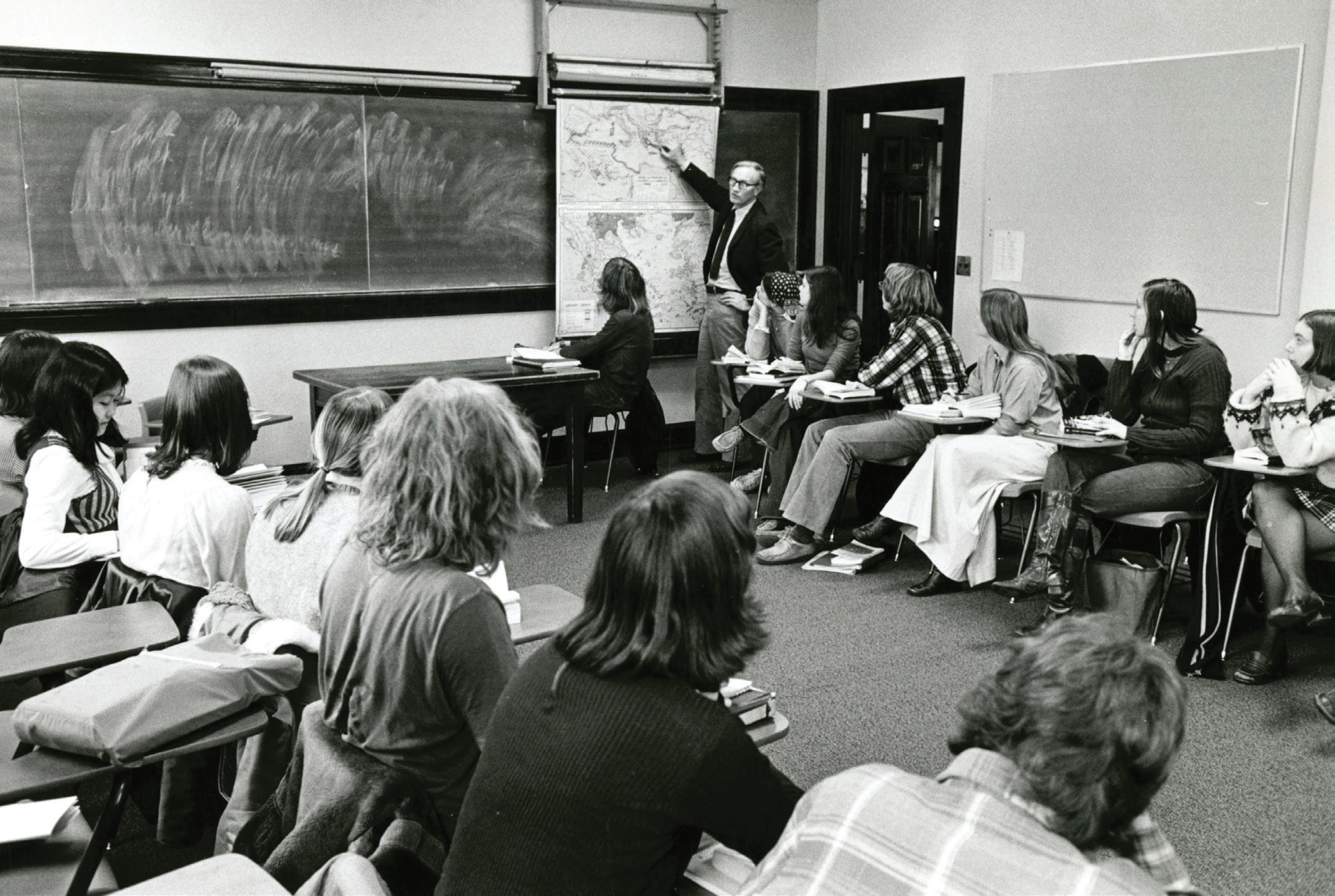
LOOKING BACK
Franklin Wallin teaching history, January 1975
Franklin W. Wallin served as president from 1974-1983.
in my business of manufacturing automotive refinishing products as well as several historical associations in New Jersey. I look forward to hearing from Earlhamites!
1956
Janet Zollinger Giele: In response to no news from the class of 1956 in recent Earlhamite issues, I decided to pick up the challenge of sending some news about myself. I retired in 2004 from Brandeis University in Waltham, Massachusetts, as professor emerita of sociology, social policy and women’s studies. In 2013, I published Family Policy And The American Safety Net (Sage 2013). Since then, I have been working on a book of advice for dissertation students based on my many years as an advisor for Ph.D. students
at Brandeis. The published book has just arrived: Dissertation Advice for Social Research: a Guidebook for Doctoral Students and Their Advisors (Routledge 2025). Since retirement I have also served as a member of Wellesley Town Meeting and helped to found a local version of the Village-to-Village will movement for seniors that we call Wellesley Neighbors. My husband David died in 2021, at the age of 96 having enjoyed remarkably good health up to that moment. I on the other hand suffered a fall in 2023 that makes me use a walker. In mid-November, I will be moved to a facility for assisted living at Waterstone in Wellesley. I am blessed with many friends, my two outstanding children, Elizabeth and Benjamin, and two grandchildren. There is so much
to be thankful for, including our excellent Earlham education. Now I hope we can hear news from all of you.
1954
Christina Nicholson Baldwin: I have been around Richmond ever since 1949. I have been here at Friends Fellowship Community ever since March of 2023. I am in assisted living on the third floor of the main building. Before I came to FFC, I lived independently in a house my daughter, Barbara Nicholson ’84 , bought, which was one block from West Richmond Friends Meeting, one block from the main entrance to Earlham and to other friends and neighborhood services. I enjoyed living there by myself until January 2023, when I was visited by a stroke.
It was time to activate my application for FFC. Earlhamites I see regularly here at FFC are Lois Harned Jordan ’51 and Cliff Dickman ’53 . Another bright part of my life has been the arrival of four great-grandchildren. Two of them live right here in Richmond, Sophia Bartel (5) and Otto Bartel (3), children of Robin Nicholson and Scott Bartel. Isabel (3) and Nico (8 months) Rodarte live in Durham, North Carolina, the children of Jorge and Amelia Rodarte.
Lost Classmates
The Office of Institutional Advancement needs your help finding information for several alums not currently in our records. Visit earlham.edu/lost-classmates to see if any of your friends are on the list.
Alumni
1982
Susan Ruvio
1979
Michael Rellahan
1975
Susan Barnes Whyte
Emily Sippel
1974
Charles Coe
1971
Mary Ryder Link
Judith Nagel Knapp
1970
Thomas Cadwallader
Gregory Paul Dinkins
1968
Thomas Hooker
1966
Barbara Ann Thompson
Gerry Cooper
Barbara Tharp Thompson
Brent Bowers
1965
Thomas Wolf
Lew Fikes
1962
Robert Tompkins
1957
Toni Meredith-Reinke
1956
Margaret Spicer
Edwin Everett Hinshaw
Helen Mills Sanders
1953
Vera Crumley Effinger
1950
Sara Ross
Carolyn North Miller
1949
Caroline Weis Panzer
1948
Howard Byron Cress
1947
Patricia Hornbrook Bond
more online
Obituaries are available online at earlham.edu/obits.
Celebrate all things Earlham on WEDNESDAY, APRIL 22, 2026
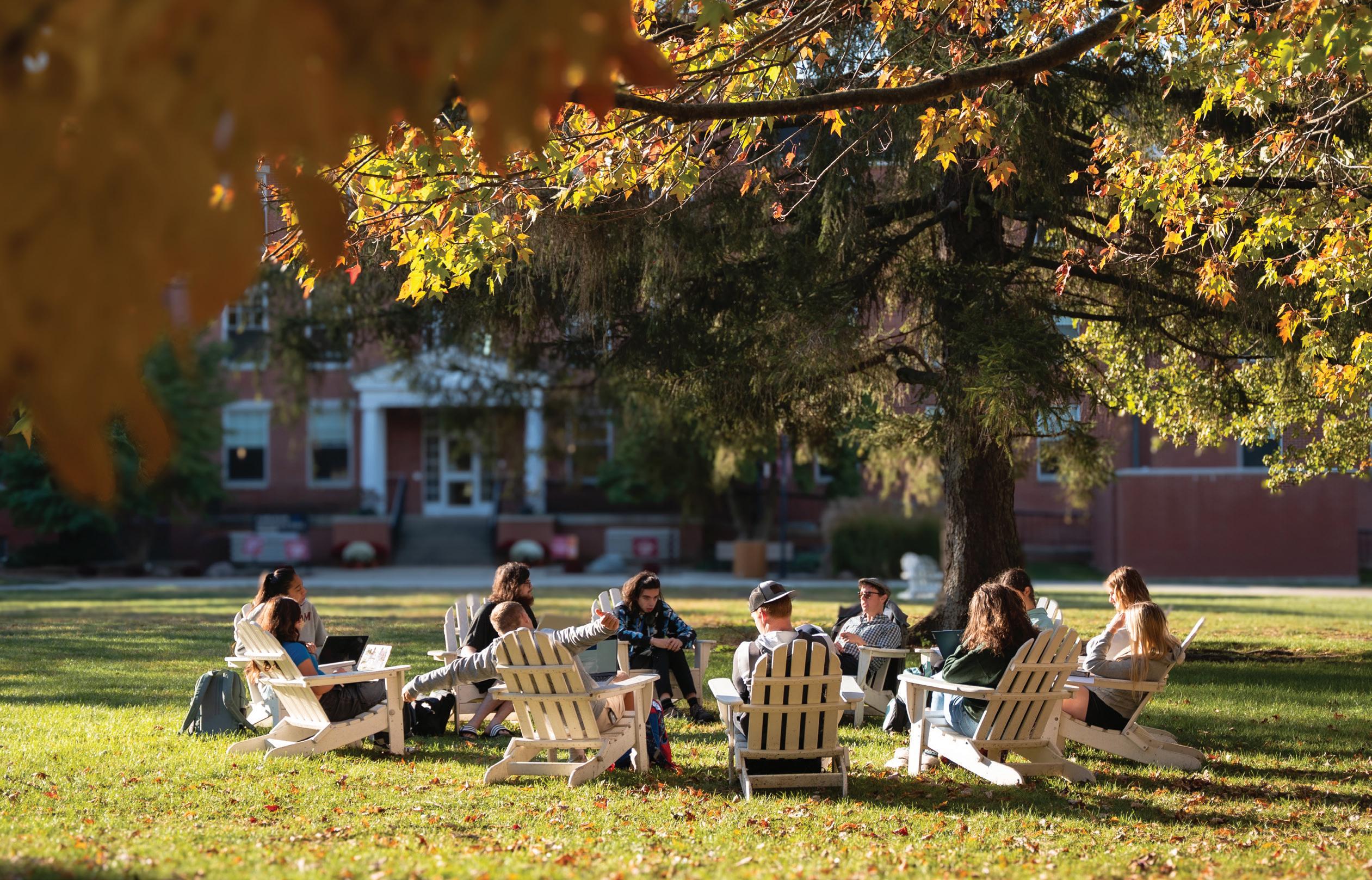
Earlham Day brings us together to amplify the transformative opportunities that define Earlham. When you make a gift of any size, it unlocks an additional $200 (per donor) for the Earlham Fund. Your generosity helps ensure every student experiences the full depth of Earlham — a place to discover their passions, grow with purpose, and chart their path toward good.

THE FINAL WORD
“The best thing my Earlham professors did was ask me to demand more of myself — to think deeper, to ask better questions, and
to write with more intention and care.
My first mentor was Nelson Bingham, who helped me cultivate a love of broad discussion with no clear answers or resolutions. Vince Punzo modeled joy and levity as an essential part of the learning journey. Jo Swanger taught me how to create spaces that foster trust, community, and courageous shared inquiry. Howard and Patty Lamson gave me a life-changing study abroad experience that cultivated a global mindset and awareness that shapes my interactions with students now. I would never be the educator I am now without Earlham.”
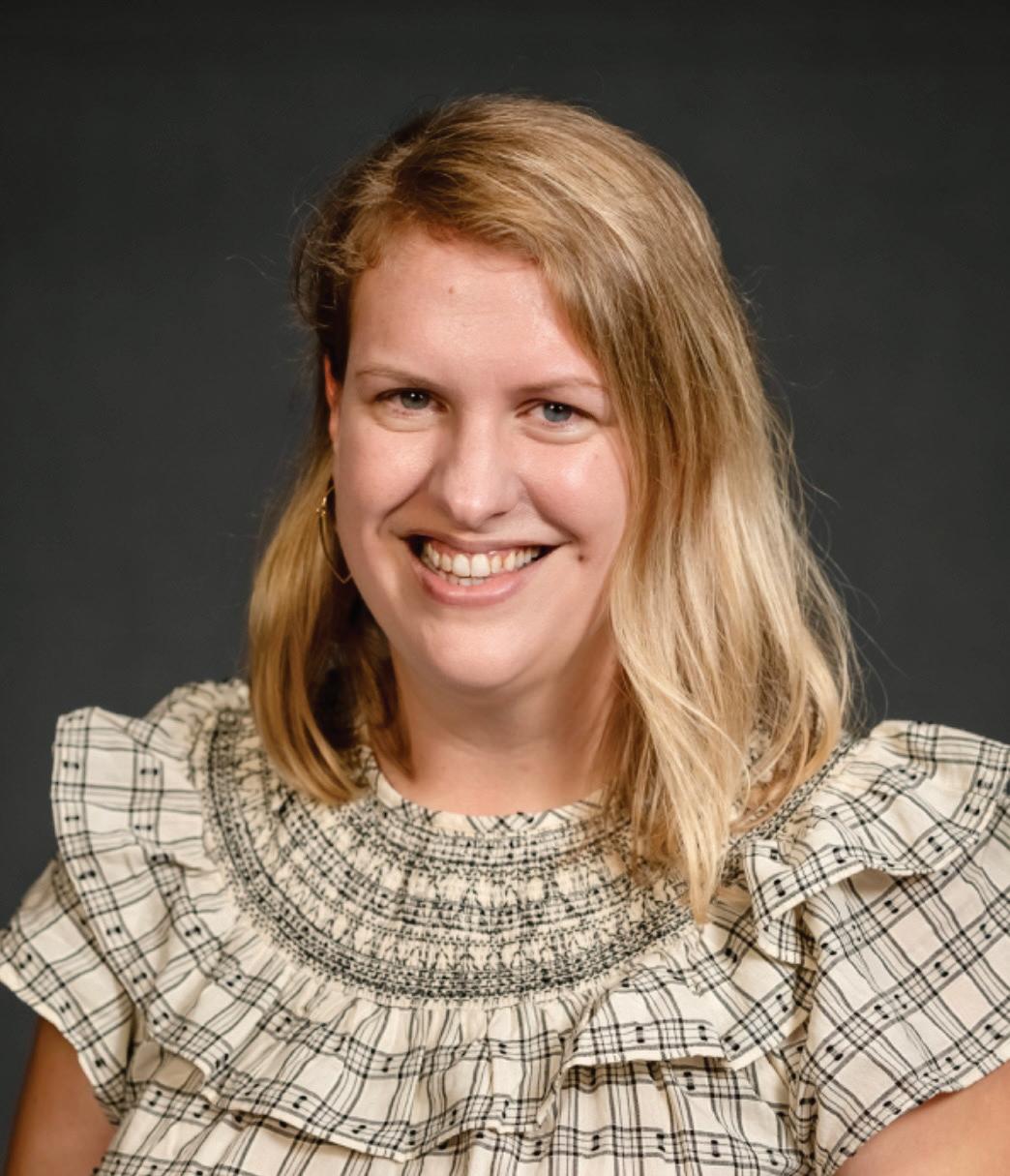
— Hannah Reed ’10, associate dean of college counseling, Cranbrook Kingswood Upper School, Bloomfield Hills, Michigan
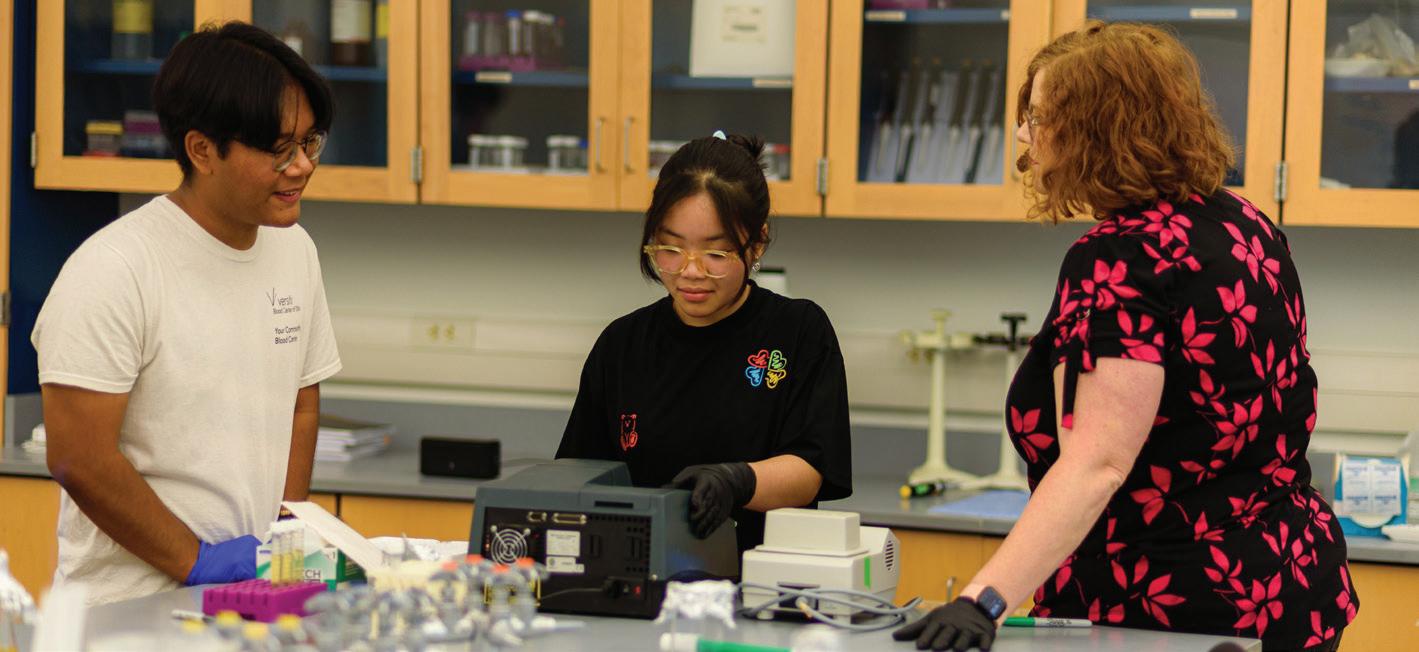
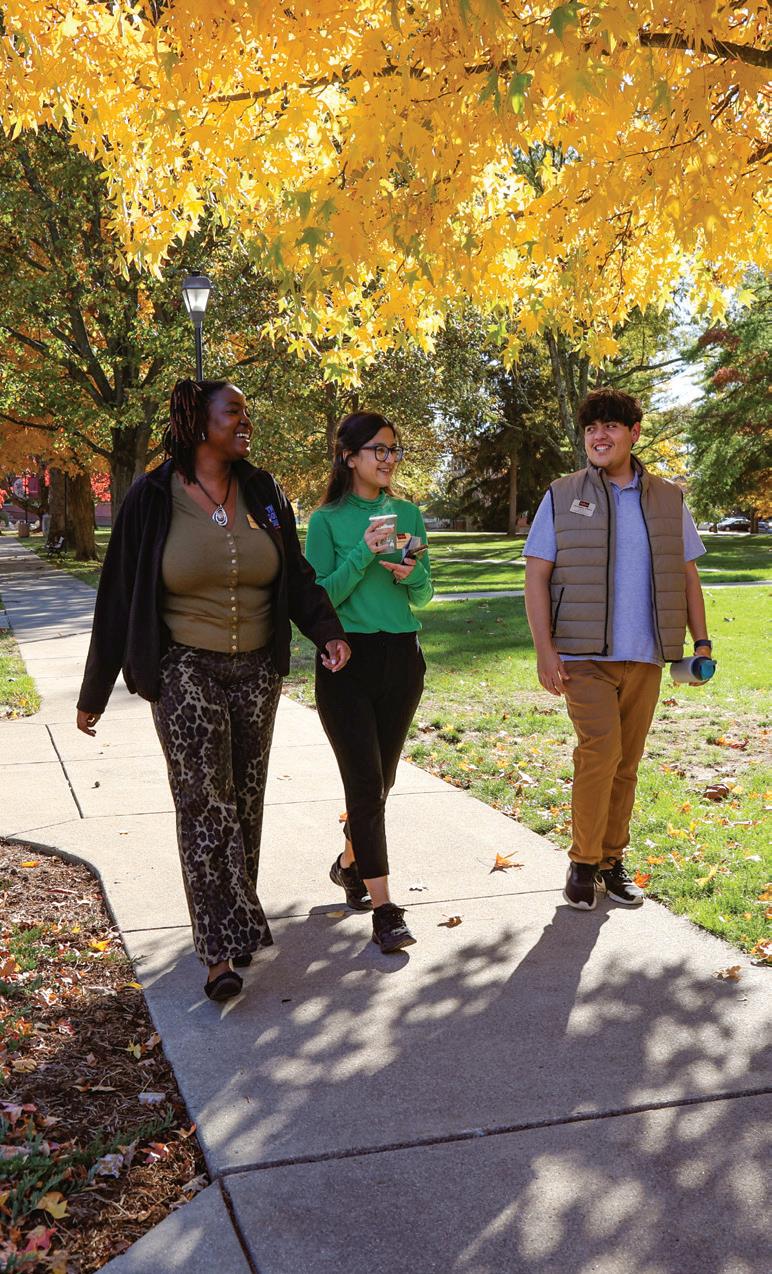
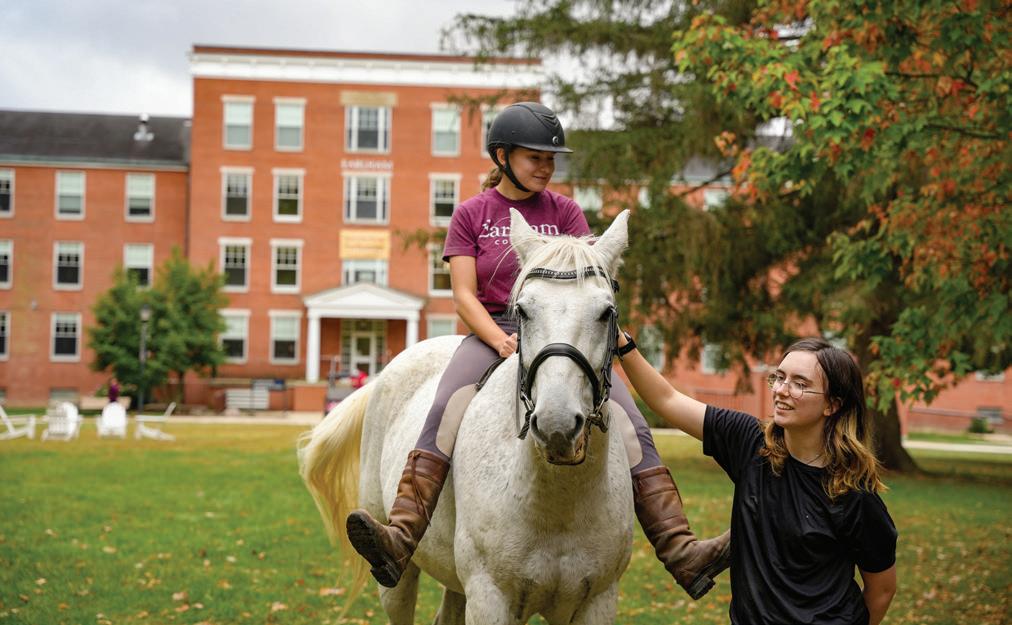
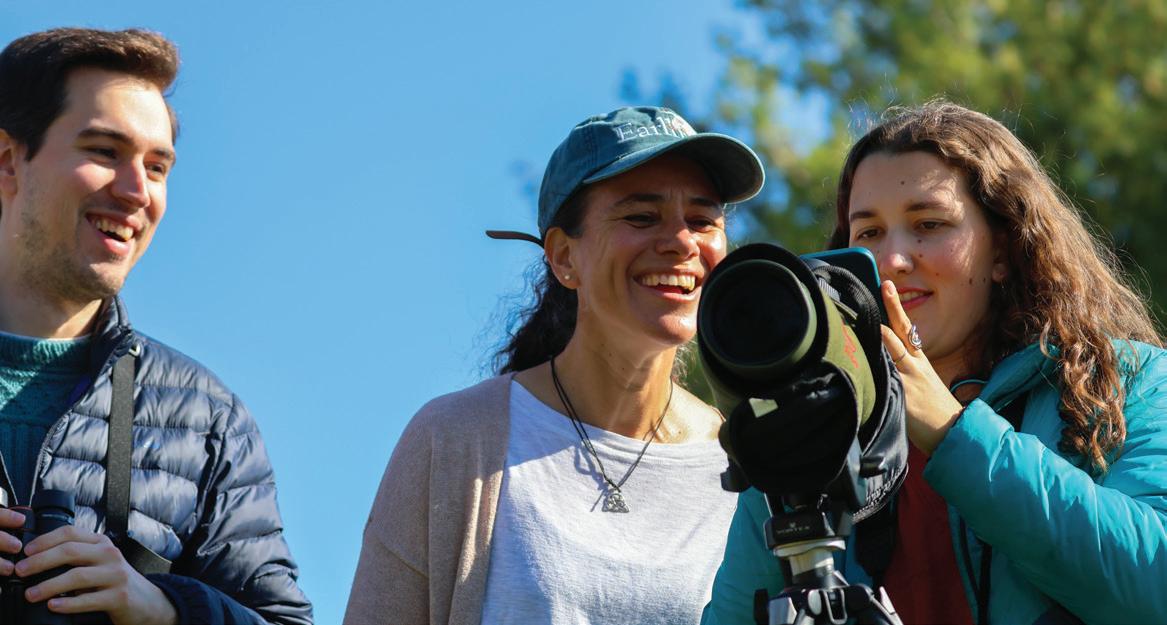
801 National Road West
Richmond, Indiana 47374