
The Eagle Spring 2026

Page 1


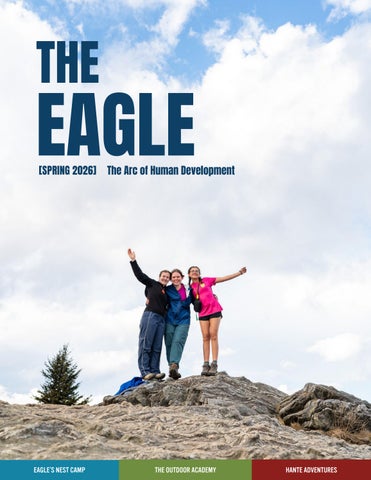
THE EAGLE

[SPRING 2026] The Arc of Human Development

3 2 4

scavenger hunt: Perspective of a 5 year old, Can you guess where on Campus these pictures were taken? Key on p. 11

Photo

EDITOR’S NOTE

What do children need to thrive over the span of their development? This is an essential challenge in the creation and ongoing support of Eagle’s Nest programs. You can see the imprint of this question across all of our programs. Fun and joy are part of everything we do, and they are in service to the finale of our mission, “the betterment of human character.”

Check out Ellen’s piece on identity development at Eagle’s Nest Camp on page 4. Then grow up a little bit with Beth’s article about Hante Adventures about how adventures and novelty go hand in hand with the adolescent nervous system. Let Jesse and The Outdoor Academy faculty remind you how developing agency is part of what makes teenagers amazing. And then circle back to the littlest learners of Fledgling Forest School who we can all learn a lot from. Enjoy!

-BETH VENABLE, EXECUTIVE DIRECTOR

2026 UPCOMING EVENTS

Fledgling Forest School - 4 one-week sessions June 1st-26th

Eagle’s Nest Camp Sessions 1-4 - June 6th-August 9th

The Outdoor Academy Fall Semester 63 - August 22nd-December 12th

Hante Scout (New for age 21+) - August 29th-September 5th

Writer’s Nest & Craft Nest - October 9th-12th

Fall Fest at the Nest - October 16th-18th

Ellen Fox, Camp Director

here is a moment that happens at camp — usually somewhere in the first week — when a child departs from being who they usually are in the “Ordinary World,” and starts experimenting with who they might become. For me, it was trying on a new nickname (“Wacko”). For others, it’s when they make the “On belay?” agreement at the rock wall and trust the person with all their weight. Or when one inevitably finds themselves laughing at an inside joke with a bunkmate who lives in a totally different part of the country. Developmental science tells us these simple, less adrenaline-drenching moments may be one of the most important things a young person does all year.

The American Psychological Association (APA) identifies identity formation as the central task of adolescence — the foundational struggle with who am I, and who do I want to be? The struggle is that many environments young people inhabit in the Ordinary World are already saturated with fixed expectations: teachers know them as the quiet kid, parents know them as the one who procrastinates, society knows them as oddballs. These identities, however lovingly held, can calcify and pigeonhole a young person.

Camp is a rare chance to break the mold. When a child attends Camp, they typically arrive without a predetermined role. This clean social slate, combined with a structured community of peers and caring adults, creates precisely the conditions researchers identify as optimal for healthy identity exploration.

Peter Gray, in Free to Learn: Why Unleashing the Instinct to Play Will Make Our Children Happier, More Self-Reliant, and Bettwe Students for Life, argues that young people learn most deeply through self-directed engagement with peers — especially in contexts of genuine challenge and free play. The peer group is not a distraction from development during adolescence; it is the medium of development. But not all peer communities are equal. The ones most modern, young people navigate — from school hallways to social media — are governed by status hierarchies and the anxiety of social judgment. Camp deliberately disrupts those traditional hierarchies. Popularity isn’t earned by clothes, “likes,” or how well you can do a TikTok dance. When you’re paddling in an open canoe together or taking on your chore for Cabin Clean-Up, what matters is character, contribution, and connection. (Okay, and maybe ice cream from Dolly’s.)

Gray further argues that free engagement among mixed-age groups — a hallmark of Eagle’s Nest Camp — accelerates social and emotional learning because it requires constant perspective-taking. Eagle’s Nest is unique with how regularly we blend age groups and create whole-camp socializing spaces. Sitting with a table family, strategizing how to capture the flag with members of your Kindred, or the multi-aged Ultimate Frisbee class, are all spaces when older campers organically mentor younger ones, and younger campers learn to navigate both deference and selfadvocacy. These are the building blocks of emotional intelligence.

One of the most underappreciated gifts camp gives is the gift of trying. A child who has never thought of themselves as musical can learn three chords on the banjo and then perform at Coffee House. A teenager who has been bullied at school can volunteer for pots and dishes and become a hero for the afternoon. These are not performances of mastery or cool — they are genuine experiments in identity, conducted in a community safe enough to support the risk. Every Coffee House performance or Dish Pit volunteer receives thunderous applause, signaling status and approval in our community. The risk to try is often rewarded, intrinsically and extrinsically, unlike the Ordinary World.

Empathy, too, is a skill developed through practice — and camp provides constant experiential practice in reading and responding to new people and new contexts. Young people must navigate conflict without a parent to intervene, notice when to give space to a struggling cabinmate, and experience the natural consequences of how their own behavior impacts someone else. The volume in which kids receive these opportunities to practice empathy inside our community is incredibly enriching for their social literacy. They don’t always nail it, and that’s okay: that’s where learning happens.

Our mission names the natural world as central to our purpose, and the research supports why. Extended time outdoors restores attention, reduces stress, and quiets the ambient noise of performance and judgment — making young people more available to themselves and to each other. Conversations that would never happen in a cafeteria happen around the fire on your cabin campout. I still recall these empowering, vulnerable moments as a camper and counselor myself. Authenticity always felt more achievable when I was under the stars.

The APA also emphasizes that being recognized and accepted by trusted adults outside the family is central to healthy adolescent development — not incidental to it. Camp counselors occupy a uniquely powerful role: close enough in age to be credible, but positioned as guides who choose to show up with genuine care. For many campers, this is a relationship they carry forward long after the summer ends. I have loved interviewing former campers to be on summer staff: they often reference, by name, the counselor who made them feel seen, feel funny, or taught them a skill that has blossomed into a passion.

What we are doing here is not supplemental enrichment. It is how young people grow. When a camper packs their bags at summer’s end, they carry something home they didn’t arrive with: a slightly more formed sense of who they are, a wider capacity for empathy, and the lived knowledge that they belong to a community that saw them. That is the work of our camp, and what’s good for the soul is also good for the brain.

References: American Psychological Association, “Developing Adolescents: A Reference for Professionals” (2002); Peter Gray, Free to Learn: Why Unleashing the Instinct to Play Will Make Our Children Happier, More Self-Reliant, and Bettwe Students for Life (2013); Erik Erikson, Identity: Youth and Crisis (1968).

It is such a privilege to see kids grow into themselves in our programs!
Beth Venable, Executive Director

uring these cool spring mornings it’s easy to start imagining adventures in warmer weather. The chilly air when you step away from the campfire. The bracing iciness of cold mountain water splashing as the canoe launches into the river. The automatic, deep inhale of the earthy, mineral air as the pack is shouldered up the shady, damp trail.

There is so much technology in our lives now. We can measure and search for instant information about ourselves and the world around us. Even this document is guessing how to complete my sentences as I type. When we send our trips out to camp and adventure, one of the most important tasks the instructors complete each day is the message from the group’s GPS device back to campus. This message pings off of satellites and tells us exactly where they are and how the group is faring. It’s pretty incredible to have so much at our fingertips.

Between those fingertips and the brain, though, are a whole host of other electrical signals firing in nanoseconds. This is especially true in the developing brain of an adolescent. Emotions and physical responses bloom as a young person interacts with and interprets their environment. Heart racing and a light sweat as they step up to the front of the class to share a presentation. Throat and stomach tightening

as they receive grades or scores. The dopamine hit as success or accomplishments are realized. Cortisol dumping as a social moment falls flat, pushing out as a notification for all to see, embarrassment spreading across their skin in a flush of increased blood supply. Is it any wonder young people crave more moments of authenticity, genuine connection, and intrinsic judgement of their own lived experience?

More and more our society increases the pace and expectations for young people, selling them an incomplete idea of efficiency that comes from external resources (often monetized). Stay on the treadmill, they say. You will be able to rest and regroup after the next diploma, degree, promotion, etc. Neurologically, when we repeat functions and experiences, our brains increase in efficiency. Our brains are primed to recognize frequent tasks, habits, or items of elevated importance and “grease the wheels,” or more accurately, myelinate the synapses.

When, however, we are met with new circumstances and novelty our brains increase in capacity. Each new experience is another rep, another log on the wisdom woodpile, growth of our ability to adapt and contextualize the lived experience. Note that this is not exclusive to desirable experiences. Think about the first break up for a teenager when the data set is

singular. There will never be another crush! There will never be another connection that feels as meaningful. Ugh! The. Worst. But by the time that same teen is on break up number 4, the emotional stakes have typically lessened and the frame of reference allows that young person to recognize the pattern and set their expectations accordingly. The ability to interpret and re-regulate increases.

From a nervous system perspective, novelty is a productive agitator. As we make final preparations for our 2026 Hante Adventures to Scotland, and plan ahead for exciting trips in 2027 (see page 16), we are constantly looking for the liminal opportunity where the nervous system can dysregulate and re-regulate over and over, like a life experience muscle being toned, without tipping the balance into a perceived threat or danger. We want our participants to experience the excitement and satisfaction that come from rising to these new challenges. But, and this is a really important “but”...they also need time to make intrinsic meaning out of their experiences.

Technology cannot do this for them. There is no AI bot for genuine meaning, despite what the algorithm might claim. For young people to navigate this world with their brilliant, individual, passionate perspectives, they must be given space to interpret and create. Going

on the backpacking, paddling, climbing, and cultural trip slows things down. Way down. Slow enough for discomfort and disorientation. Naturally, “these kids today” are primed to reach for the search engine or “socials.” At Eagle’s Nest, reaching for technology is, thankfully, not an option. Instead, they reach for conversation and community. They embrace the uncertainty and reflect it back with poetry, music, and curiosity. Their nervous systems become more flexible and expansive. The period between dysregulation and the deep breath comes easily and more quickly. Without the immediate data from a watch or ring, they still know their heart rate variability has increased right along with their capacity to respond. They record the experience as it is lived and shelve it in that part of their brain that will inform how to approach future uncertainty. And, as if these kids could get any more amazing, their brains are simultaneously increasing in efficiency as they pack and repack after each campsite.

As you hike the trail, dip your paddle into the water, and sink into your Spring adventures, what will you do or bring to make your own meaning and note the varying rhythms of your own tension and release?

Jesse Pyles, The Outdoor Academy Director

hen I interviewed to be the Director of The Outdoor Academy (OA), Ted Wesemann –OA’s founding Director (and still our tireless champion) – told me very clearly that OA staff should think that “teenagers are really cool.” I’d worked with teens much of my professional life, but I was hard pressed in that moment to articulate why I think “teenagers are really cool.” Now several seasons into my post, and seeing dozens of teens operate in the unique Outdoor Academy environment, I’ve come to realize that I love working with teens because they are so eager and so capable. Adolescence is rife with challenges, but it is also teeming with beautiful opportunity. The teenagers I know – and especially the self-selecting group that winds their way to OA – are eager to become more fully themselves and are often hungry for the opportunity to effect change in their lives and in the world. They crave agency!

Damien Cave wrote about this beautifully in the NY Times in 2024, recounting when his 13-year-old daughter went away to a “screen-free” bush school in Australia, not unlike our semester school program. His essay explored two themes that really relate to my experience of students at OA: 1., that his daughter had the time and opportunity to develop her own thoughts and voice through the medium of writing letters home -- no quick text exchanges, no air tags or shared locations, no instant response or interruption, no Google; 2., we have to work a little harder to find opportunities for “gradual divergence” in our modern world -- the space afforded to adolescents to begin to chart their own path into adulthood separate from the primary caregivers in their lives. He goes on to express tremendous gratitude for that “gift of agency. Far from home at 13, in a messed-up world, she has landed where there is intellectual space and the means to practice a method for asserting and exploring who she is and wants to become” (Cave).

Building agency is a hallmark of the OA experience, where students are given the responsibility to care for themselves, their learning, and for their community, many of them away from their childhood homes and families for the first time. Building on OA’s shared values with Eagle’s Nest Camp and a long history of crafting meaningful education experiences, our students are deeply engaged in what researchers refer to as a “cycle of identity formation.” In their study of the outcomes and impacts of semester schools (conducted in 2018) – including The Outdoor

Academy – Drs. Meerts-Brandsma, Riley, and Sibthorp reported that “identity development was the most noticeable outcome of participation in semester school programming, and semester school programs provided an environment and experiences that helped students to better understand themselves” (Meerts-Brandsma 674). This understanding allows adolescents to be more confident in themselves and their abilities. In fact, I’d argue that agency is the remedy for hopelessness; and in a world that can offer plenty of reasons to lose hope, a self-possessed young person, bound socially to the community and connected meaningfully to the natural world may be the best hope we have for a just and sustainable future.

At The Outdoor Academy our community traditions, academic focus, and immersion in the outdoors help us to cultivate what William Throop calls “resilience skillful habits” in his book Flourishing in the Age of Climate Change. Throop suggests that “flourishing” means that we: can meet our basic needs, have the capability to be self-directed, and “have some understanding of the forces shaping our lives and some reasonable confidence in our capacity to navigate those forces” (Throop 3): agency. He goes on to enumerate a number of skills that, taken together, approximate the values of Eagle’s Nest’s programs -- character traits exercised with intention through shared experiences close to nature. As Eagle’s Nest teens in our Camp, Hante, and OA programs match their eagerness to know themselves (and to be known) with their newfound capacity to impact their community and direct their lives and learning, the results can be transformative. So, yeah, with their sense of self, burgeoning capabilities, and rapidly forming sense of agency, “teenagers are really cool!”

References: Damien Cave, “What We Gained (and Lost) When Our Daughter Unplugged for a School Year.” (2024); Lisa Meerts-Brandsma, Michael Riley, Jim Sibthorp, Situating semester schools in the landscape of high school learning (2023); William Throop, Flourishing in the Age of Climate Change (2024)

“There’s a lot of things that [teenagers] are experiencing for the first time. It’s fun to help guide them through those discoveries.” – Aidan, OA Dean of Academics

“Teens actually have led a lot of the world’s social movements throughout history, and so I feel like it’s valid, valuable that they do feel like they can really make changes.” – Colleen, OA Dean of Students

“They have varying levels of curiosity, but all they need is that spark . . . and they can be fully onboard with something.” – Corley, OA Resident

“How surprising they are! Because they’re still in childhood and moving into adulthood, they think in both ways.” – Sidney, OA Faculty Memeber

“I like teenagers, ‘cause you don’t have to ask them to rebel; it’s just natural.” – chris, OA Faculty Memeber

“When you get the teenagers outside, they can bring back that childlike state, but then also make things happen, and plan the revolution: perfect combination.” – Katie, OA Admissions Director

“[Teenagers] have this amazing paradox in them of: ‘my independence is the most important thing in the world,’ and, also, ‘my community is the most important thing in the world.’ And they fight for those things equally hard in a way that is hard for adults to do.” – Eva, OA Resident

News:

Juno Rogers (Camp & OA) had a fun crossover moment in her role as tour guide at Bates College. Former OA Dean of Students Susan Daily and her son were on Juno’s tour. Susan wasn’t working at OA during Juno’s semester but she remained a wonderful community partner even after she left.

Camp Counselors from all over the world had an impromptu reunion in Dublin. What started as two counselors visiting Ireland ended up as a weekend reuniting with Eagle’s Nest Camp friends.

Hawk Clapper (Camp & OA) and his dad Skunk went backcountry skiing in Alaska.

Aidan Daly (OA Faculty) ran a half marathon in Greenville SC.

Dr. Katherine K. Wilkinson (OA Alumni) has a new book out- Climate Wayfinding: Healing Ourselves and the Planet We Call Home. Order a copy, learn about reading groups, and find book tour events at www. climatewayfinding.earth.

Tyler Bales (OA Alumni) thru-hiking the AT last summer.

Babies:

Baby boy Bylur (pronounced Bay-lur) born 2/14/26 to Sasha Lipton Galbraith (Camp) in Norway. Bylur means blizzard or snowstorm.

Baby girl Summer Eliza born 2/11/26 to Alex (Camp) and Sammi Masi

Preview of 2027 Hante Adventures

HANTE ALASKA - Session 2

Connecting backpacking with kayaking Prince William Sound with artistic and scientific exploration near the polar circle.

HANTE RIVERS AND REEDS - Session 3

Paddling rivers of the South Carolina Piedmont and Lowcountry while learning the artform of weaving natural fibers and the cultural significance of both.

Camp Reunion
Juno & Susan
Aidan & friends
Katharine W.
Tyler Bales

WHAT THE YOUNGEST AMONG US HAVE TO TEACH US:

Lessons from the Forest Floor at Eagle’s Nest Fledgling Forest School

n a cool mountain morning in the Little River Valley, a small group of three-, four-, and fiveyear-olds gather at the edge of the woods. Their classroom has no walls. Instead, there are moss covered logs, winding trails, and the quiet rhythm of wind moving through the trees. This is Fledgling Forest School; a pilot early childhood program at Eagle’s Nest, where the forest itself becomes both teacher and playground. It is this all-weather outdoor play where learning begins and the foundation is built for “green” literacy creating a deeper bond with the environment, cultivating essential values like empathy, affection, and stewardship for our land.

Across the country, educators and researchers are increasingly recognizing the importance of early childhood experiences in shaping lifelong learning. The years between three and five are a time of extraordinary brain development, when curiosity, independence, and emotional awareness are rapidly forming. Programs like Fledgling Forest School are part of a growing movement in early childhood education that seeks to reconnect children with the natural world while honoring the developmental needs of young learners. Studies link nature-based education with improved focus, reduced stress, and stronger environmental stewardship later in life.

What emerges from nature-based learning is not chaos, but a different kind of order—one driven by curiosity and wonder.

In the forest, challenges are real and immediate. A slippery rock requires balance. A fallen branch demands teamwork to move. Even weather becomes part of the curriculum. Rain invites mud kitchens and puddle experiments, while cold asks children to consider warmth, shelter, and resilience.

These moments cultivate something educators often call “risk competence”—the ability to assess and respond to challenges thoughtfully. For young children, learning to climb a log safely or navigate uneven terrain builds both physical confidence and emotional resilience.

But perhaps the most profound lessons are quieter.

When a child pauses to watch ants carrying leaves across the trail, time slows. Attention deepens. In a world increasingly shaped by screens and schedules, the forest invites children to notice small details: the shape of a leaf, the sound of a woodpecker, the feeling of soil in their hands.

If we are willing to listen, the smallest voices among us have quite a lot to say.

Turn static files into dynamic content formats.
Create a flipbook
The Eagle Spring 2026 by Eagle's Nest Foundation - Issuu