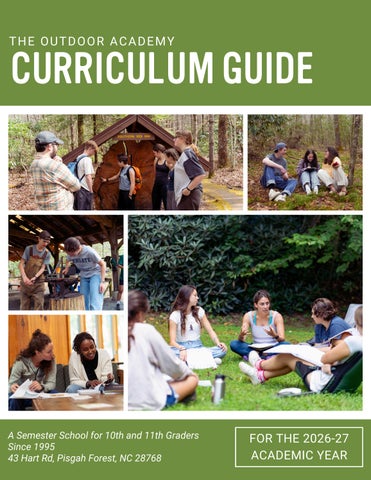
OA Curriculum Guide 2026-27

Page 1


INTRODUCTION

The Outdoor Academy is an accredited, academic semester boarding school for 10th and 11th graders. Since 1995, over 1300 students have come to our campus from across the country and around the world to engage deeply in their own education Today, OA provides students with a versatile and valuable set of skills that prepares them to be resilient citizens of the 21st century through four key Cornerstones: Intellect, Environment, Craft, and Community. Through this interdisciplinary lens, OA prepares students not only for college but for lifelong learning.

Intellect: Through a rigorous and integrated academic curriculum, students are encouraged to take ownership of their education and ask the questions that develop those key skills of critical thinking, collaboration, communication, and creativity. Our school’s accreditation through Cognia certifies that the academic program meets curricular and institutional standards of excellence and that credits earned are honored at schools across the country Students who have attended OA have later enrolled at many prestigious colleges and universities including Bates, Bowdoin, Brown, Cal Tech, Cambridge, Colorado College, Columbia, Cornell, Dartmouth, Davidson, Duke, Harvard, Middlebury, Oberlin, Princeton, Smith, Stanford, Swarthmore, University of Pennsylvania, University of Virginia, and Yale.

Environment: Our environmental education curriculum empowers students to find their place in the world, create practical and sustainable solutions, and effect positive change. At The Outdoor Academy, we do this by exploring our setting in the beautiful Blue Ridge Mountains of Western North Carolina Classes in English, mathematics, science, history, language, and crafts are taught both in the classroom and in the forest Our outdoor programming - which constitutes nearly a quarter of the semesterteaches camp skills, backpacking, canoeing, and rock climbing as a vehicle for leadership and team development, as well as promotion of a deeper appreciation for the natural world. Our unique regional biome is our primary classroom and provides the solid ground from which all of our work grows.

Craft: The Outdoor Academy asks students to strive for quality in all that we do, especially in Craft courses. Thus, students are expected to do their best work as they develop capability and mastery in a variety of skills The traditional crafts of the Appalachian Mountains are a central part of our school and give students a greater sense of the histories and communities of this place Students choose from an array of offerings that varies from semester to semester, such as blacksmithing, woodcarving, fiber arts, and music. By emphasizing the craft of our both hands and minds, students learn to take true responsibility for their work, their education, and their lives.

Community: Finally, each of the other three Cornerstones is situated within our small, intentional community of students and faculty. By intentionally building the skills and personal responsibility necessary to create a close-knit community, The Outdoor Academy teaches students to live well together and be their best selves We develop the character required for life-long success by practicing our seven principles: simple living, work ethic, curiosity, integrity, stewardship, self-reliance, and gratitude. Our culture of challenge and support builds the persistence and flexibility that allows students to translate their skills to their sending schools and their home communities.

ACADEMIC PROFILE

School Calendar and Classroom Time

One semester is generally sixteen weeks in length All classes meet the equivalent of three to five hours per week, not including scheduled study periods, frequent contact with faculty outside of the classroom, and experiential programming that integrates outdoor skills and craft with in-class curriculum. Regular classes meet Monday through Friday in 50 or 90-minute time blocks, depending on the subject and day. On-campus weekends provide time to work in and explore the arts, our campus and garden, and the wider community. Students also spend up to the equivalent of four weeks on outdoor expeditions

Admissions Information

Over the past 31 years, The Outdoor Academy has enrolled nearly 1400 high school sophomores and juniors, along with select 9th graders. We have worked with students from over 270 public and independent schools, as well as some who are normally home-schooled.

Students who attend The Outdoor Academy are highly motivated and eager to be challenged intellectually and personally We seek students who have demonstrated self-determination in their academic work. Interested applicants generally express a desire to live and learn in a close, caring community set in the rich natural world of the Blue Ridge Mountains. Admissions decisions are based on an applicant’s motivation, intellectual curiosity, academic record, and commitment to work and service No prior outdoor and wilderness experience is needed Additionally, admissions is need-blind, meaning that an application for financial assistance in no way impacts that student’s admissions decision.

Curriculum Overview

The Outdoor Academy is committed to ensuring students are prepared to competently and confidently rejoin their sending school communities Credit weights can vary based upon a sending school’s schedule (i e traditional bimester, block, trimester, etc) All OA students participate in the following academic courses:

English Honors

Environmental Science Honors

U S History Honors or World History Honors

Physical Education & Outdoor Leadership

Art: Appalachian Craft Health & Wellness

Based on curricular needs and scheduling, students may also choose two of the following courses: Mathematics: Algebra II, Geometry, Pre-Calculus, Math 3 (all Honors)

Spanish: Levels I and above (all Honors) or Independent Language Study

Nature Writing Independent Study

Spanish and Mathematics Curricula: Because students come to The Outdoor Academy from a variety of academic backgrounds, there may be inconsistencies between sending school and OA curricula Students should carefully review course syllabi to determine any such inconsistencies, and coordinate with the Dean of Academics to ensure a smooth transition back to their sending school If you have any questions concerning curricular continuity between your sending school and The Outdoor Academy, please contact the Dean of Academics.

In addition to the classes above, all students participate in the following curricular components (additional information on pages 17-18):

● Bridge: Once a week our English, Environmental Science, US History, and World History classes merge together and move off campus into our surrounding community for an afternoon of hands-on, transdisciplinary investigation During this time, students explore the various ways in which what they are learning in class manifest in our world. Bridge also allows students the time to speak, interview, and consult with various local experts. While Bridge is not a distinct credit-bearing course, students’ participation and work during this time is crucial and is reflected in their English, Environmental Science, World History, and US History course grades A Bridge capstone project serves as both a demonstration of each student’s learning and a culmination of their academic experience during their semester at OA

● CIRCLE & Community Curriculum: Our Dean of Students and Residential Life faculty teach a comprehensive course focusing on Community, Identity, Relationships, Communication, Leadership, and Ethics (see course syllabus on pg 15). Additionally, Community Meeting time, dorm discussions, and special workshops cover topics such as healthy relationships, diversity & privilege, leadership styles, group dynamics, and conflict resolution. Students can earn a Health & Wellness credit from this curriculum

● Outdoor Education and Wilderness Activities: Students earn Physical Education/Outdoor Leadership credit through regular participation in athletic activities and our wilderness program Specific activities include rock climbing, whitewater paddling, backpacking, and team sports like Ultimate Frisbee

● Work Crew: Students participate in weekly campus Work Crews alongside faculty Projects include splitting firewood for our wood stoves, maintaining campus trails, working in the garden that provides a portion of our seasonal produce, and many more. Students may receive 30-50 community service hours for their work on campus and in the larger community.

Academic Policies

● Independent Studies: Students needing to take courses that OA does not offer may be able to do an independent study, depending on the course and the student’s OA class schedule. Independent studies need to be approved by the Dean of Academics prior to the OA semester.

● Standardized Tests: Students should plan to take standardized tests (PSAT, SAT, SSAT, AP exams, etc ) before or after their OA semester if possible Requests to take standardized tests during the semester should be directed to the Dean of Academics OA cannot guarantee that access to these tests will be available due to the semester schedule

● Attendance: Students are expected to attend all classes Occasional exceptions are made for illness or family commitments Family plans that interfere with class attendance should be arranged with the school administration well in advance. Any student who is unable to meet academic commitments at The Outdoor Academy will be asked to leave the program.

● Assessment: In order to accurately and honestly assess success in our classes, our faculty employs a wide variety of conventional and innovative tools. Active, engaged, and informed participation in discussions is a central expectation of all our classes. Furthermore, collaborative projects and oral presentations occur in most classes All courses emphasize critical thinking and writing skills, and all classes include a writing component Tests and quizzes comprise another portion of certain course grades Students can expect regular feedback on their performance, including: check-ins with teachers during office hours, advisor comments and conferences, midterm grades and narrative comments, and final grades and comments from each faculty member.

Grading & Transcripts

The Outdoor Academy uses the following grade scale:

A+ = 97-100

A = 93-96

A- = 90-92

B+ = 87-89

B = 83-86

B- = 80-82 C+ = 77-79

C = 73-76 C- = 70-72 D+ = 67-69 D = 63-66 D- = 60-62

At the conclusion of the semester, each student’s transcript is provided to their sending school alongside grading information and final narrative comments Transcripts will not be released until a student’s tuition has been paid in full.

Upon written request to The Outdoor Academy Registrar, OA alumni may receive unofficial copies of their academic transcripts or have official transcripts mailed to agencies or institutions Official transcripts, bearing validating signatures, are not issued to individuals but are mailed as directed to agencies or institutions as confidential information All transcripts include each student’s entire academic record. No partial or incomplete statements are issued as transcripts. Students should request transcripts at a reasonable time prior to need. Delays in issuing transcripts may occur immediately before or after a term break.

COURSE DESCRIPTIONS

Please contact the Dean of Academics to request a specific syllabus or coursework.

ENGLISH HONORS

This discussion and writing-based course focuses on exploring the dynamic interplay between peoples, places, and ideas across a range of writing styles and genres During our semester, students will explore their sense of self and place through engaging in close textual readings, open-format class discussion, daily journaling, and a series of short essays. Along the way, students will read a diverse set of short stories, book chapters, narrative and creative writing texts, and a range of poetry that draws on a variety of genres and writing traditions.

At the start of the semester, students will learn how to construct and bind their own personal writing journal, and this journal will be their daily English reflection journal for writing throughout the semester. Over the course of the semester students will draft, revise, and engage in a series of writing projects designed to help them develop and refine their ability as writers, including learning about citation practices and grammar issues, and going through the writing, editing, revising, and final revising stages in peer review (Writers Circle) writing groups. The class culminates in a final creative project that will allow students to draw together their learning across their arts & humanities and sciences classes to demonstrate the depth and breadth of their learning.

EXCERPTED

TEXTS:

Hastings Shade, Cherokee Stories of the Turtle Island Liars' Club

Diana Ferguson, Tales of the Plumed Serpent: Aztec, Incan and Mayan Myths

Barbara Kingsolver, Animal, Vegetable, Miracle: A Year of Food Life

Richard Powell, Wabi Sabi for Writers

Basho, The Complete Haiku of Matsuo Bashō

Frank X Walker, Black Bone: 25 Years of the Affrilachian Poets

Italo Calvino, Cosmocomics

Julio Cortázar, Blow-Up Stories

Carlos Fuentes, The Masked Days

Tom Brown Jr , Tom Brown’s Field Guide to Living with the Earth

Aldo Leopold, The Sand County Almanac

Loyal Jones, Appalachia: Social Context Past and Present

Cory Doctorow, Various stories

Derrick Jensen, A Language Older Than Words

Val Plumwood, The Ultimate Journey

Margaret Lynn Brown, The Wild East: A Biography of the Great Smoky Mountains

Note: Readings may vary from semester to semester; others may be included

ENVIRONMENTAL SCIENCE HONORS

In this course, students will acquire the skills for identifying and solving environmental issues Students will begin by diving deep into scientific thinking. Utilizing examples of environmental issues in the Southern Appalachian region, students will hone their critical thinking and problem solving skills. Students will apply scientific thinking to understand the complexity of the ecological, social, economic, political, and personal webs surrounding present-day environmental discussions and decision-making on a local and global level Outdoor academy students will acquire skills to ask scientific questions and analyze their surroundings to answer them, think critically about complex environmental issues, and most importantly, find creative solutions.

The foundational text for this course is Robin Wall Kimmerer’s nonfiction book Braiding Sweetgrass: Indigenous Wisdom, Scientific Knowledge, and the Teachings of Plants Through this text, students gain an understanding of ecological systems while simultaneously deepening their connection to the world around them A day in science class at OA ranges from in-depth discussions of that day's reading, to time spent in our on-campus garden investigating how compost is utilized to create closed systems, to explorations of our expansive trail system identifying trees and exploring the history of logging in our region.

EXCERPTED TEXTS

Robin Wall Kimmerer, Braiding Sweetgrass: Indigenous Wisdom, Scientific Knowledge, and the Teachings of Plants

Paul Crutzen, “Geology of Mankind”

Ayana Elizabeth Johnson & Katherine K Wilkinson, All We Can Save: Truth, Courage, and Solutions for the Climate Crisis”

Natalie Angier, The Canon: A Whirling Tour of The Beautiful Basics of Science

Articles from The National Park Service, The National Resource Defense Council, The Environmental Protection Agency, etc.

Note: Readings may vary from semester to semester; others may be included

MATHEMATICS

In each math course at OA, the goal is to strengthen students’ conceptual understanding of mathematical topics, investigate how to critically and logically approach problems, collaborate and communicate mathematical ideas, and understand more of the surrounding world through mathematics. Emphasis is placed on asking questions and making connections, rather than simply using the formulaic algorithm to find an answer Creativity, persistence, and discipline are practiced every day to help students connect mathematical concepts to real-life situations Courses question what math is, math’s importance to humans, and why we learn math, while also delving into fun and diverse topics such as topology and abstract algebra. Students will leave understanding math as a more holistic and applicable discipline, integral to communication and creation in our world.

Class discussions, cooperative projects, oral presentations, building opportunities, creating mathematical models out of various materials, writing, as well as traditional coursework, are all part of the OA math curriculum Classes use technology when appropriate and learn how to be conscientious about its opportunities and confines.

The majority of students attending The Outdoor Academy are enrolled in Algebra II, Geometry, PreCalculus, or Math 3 On occasion, The Outdoor Academy has also offered other math courses based on student needs and staff availability If an applicant’s math requirement is not included in the courses listed, the student can discuss this during the admissions process All math classes are designed for motivated, mid-range to upper-level students. Because students come to The Outdoor Academy from a variety of academic backgrounds, there may be inconsistencies between sending school and OA curricula. Students should carefully review course syllabi to determine any inconsistencies, and coordinate with the Admissions Director and Dean of Academics to ensure a smooth transition back to their sending school

ALGEBRA II HONORS

Fall semester studies typically include: linear equations, functions, and inequalities; systems of equations and inequalities; and quadratic functions. Spring semester studies typically include: powers, roots, and radicals; polynomials; exponential, logarithmic functions and compound interest; parabolas; and intro to trigonometry Both semesters emphasize practical applications of concepts

TEXT

Algebra 2, Larson, Boswell, Kanold, and Stiff; McDougal Littell

Basic calculator highly recommended

GEOMETRY HONORS

Fall semester studies typically include: a review of Algebra; basics of Geometry; parallel lines and coordinate planes; congruence and similarity; properties of triangles; and constructions. Spring semester studies typically include: a review of Algebra; quadrilaterals and polygons; right triangles;

introduction to Trigonometry; area and volume of 3D solids; circles; and transformations. As in Algebra II, both semesters emphasize practical applications of concepts

TEXTS

Primary: Glencoe Mathematics: Geometry, Glencoe-McGraw Hill

Secondary: A Beginner’s Guide to Constructing the Universe: The Mathematical Archetypes of Nature, Art, and Science, Michael S. Schneider

Basic calculator highly recommended

PRECALCULUS HONORS

Precalculus builds upon the properties and graphs of functions studied in Algebra II, while preparing students for a college-level Calculus course. This course concentrates on the application of functions to the world around us. Fall semester studies typically include: Trigonometry; power functions; polynomials; exponential and logarithmic functions; and parametric equations Spring semester studies typically include: Trigonometry, sequences and series; probability; and introduction to Calculus

TEXTS

Advanced Mathematical Concepts: Precalculus with Applications, Glencoe

Precalculus with Trigonometry, Paul Foerster

Basic calculator highly recommended

MATH 3

This full credit/block course covers the standard Math 3 curriculum. Math 3 at The Outdoor Academy extends a student’s knowledge of algebraic and geometric concepts from Math 1 and Math 2 to prepare a student for their next high-level math course During the semester we will dig deeper into functions such as inverse functions and trigonometric functions including the unit circle We will discuss the complex number system and its application to the world around us As time permits and student needs arise we will include topics such as conics, circles, and probability distributions. Students and parents are encouraged to submit any form of a Math 3 course of study available from their sending school and/or textbook table of contents to help further individualize the student’s education

Prerequisites for this course: Math 1 and Math 2

Note: If a student is scheduled for a math course not listed above at their sending school during the year they will be attending OA, please contact the Admissions Director to discuss. Our Admissions Director and/or Dean of Academics will work with you and your school to figure out the best course of action.

SPANISH HONORS

OA’s immersion-style Spanish courses pursue the goal of learning to understand the Spanish language through the exploration of community, identity, culture, and craft. Students arrive at Spanish class each day ready for a wide variety of activities, from yoga class to a guest speaker’s presentation to a trip to the local Hispanic community market, all with a focus on hearing the language spoken and practicing its use in practical application These activities develop communication skills appropriate for different levels in interpretation, interpersonal communication, and presentation, with the aim of richer fluency At the same time, students grow in awareness that success in second languages is dependent upon commitment to their personal learning experience and engagement in the global community. Classes immerse students in the language, culture, culinary traditions, history, art, and music of the countries where Spanish is spoken.

The small, personalized class setting supports students to progress through their objectives, connecting their Spanish class to other OA coursework while preparing them to transition home with experience on level with their sending school classmates. Levels II and III are structured to help students pull together all the elements studied in previous classes, emphasizing grammatical construction, while applying the use of the Spanish language to their experiences at OA. Levels IV and above are based on more focused analysis of written Spanish, with the measurable goal of holding conversations in a variety of contexts with supporting details, probing questions, and successfully navigating complications in familiar topics

Spanish courses utilize a variety of texts, poetry, songs, musical productions, films, extracts from plays and novels, and current material from newspapers, magazines, and other online sources. Students receive assignments that include grammar, vocabulary and verb use, evaluative and creative writing, reading, and informal journaling Students are expected to come prepared to use functional language that enriches their Outdoor Academy experience by:

● Integrating language studies into the Southern Appalachian environment and our school campus

● Connecting language study to the academic and community goals unique to the OA curriculum.

● Learning the language in nature, and thus better appreciating the interconnectedness of living organisms and their responsibilities to and dependence upon complex ecosystems.

● Including expression in the language using music, composition, poetry, dance, and drama Evaluations often take the shape of student-organized productions: a play, a world market with lunch and presentations, a community talent show, etc

INDEPENDENT STUDIES IN WORLD LANGUAGES

While Spanish is our only formal language course, students can also pursue independent studies in other world languages if necessary Through online courses and/or studies directed by sending schools, OA students have successfully completed the coursework needed to stay on track in French, Mandarin, Latin, Hebrew, German, and other world languages Please contact our Admissions Director or the Dean of Academics to discuss this option.

UNITED STATES HISTORY HONORS

US History at OA explores the history, culture, politics, economics, laws, and environment of North America while foregrounding the diverse histories and peoples that have called this place home, from the original Indigenous communities to later European settler colonists. We explore how early interactions between Indigenous peoples and Europeans shaped narratives about how interactions with the Spanish, French, and British all gave rise to the new US republic We also explore some of these key historical dynamics through the lens of the US Southeast and Appalachia, and how human-nature-culture relations shaped the early republic and its evolution between the 17th and 20th century, from early fur trade and frontier settlements to roadbuilding and commercial natural resource expansions that fundamentally altered the environmental landscape across the US.

Along the way students will consider how settler colonial historical narratives shape the story of our founding and how new voices and perspectives have attempted to challenge some of these stories, a debate we explore through the lens of a "People's versus Patriot's" history. We also examine a few seminal moments in US history in more detail, including the 1787 Constitutional Convention, the 1830 Cherokee Removal Act and Trail of Tears, and the 1960s Civil Rights movements to address segregation and racial injustice Students will have the chance to engage in some of these exciting topics through a case method approach that helps them analyze and explore the complex cultural landscape and socio-political motivations of diverse actors in these key events, helping to bring history to life. Students will be assessed through a mixture of written weekly reading reflections on class readings, class discussions and debates, group activities, and a comprehensive final project that brings together what they have learned in their History, English, and Science classes.

EXCERPTED TEXTS:

Howard Zinn, A People's History of the United States

Ronald Takaki, A Different Mirror: The Making of Multicultural America

Larry Schweikart and Michael Allen, A Patriot's History of the United States 1776 Commission, The 1776 Commission Report

Roxanne Dunbar-Ortiz, An Indigenous Peoples' History of the United States

Donald Davis, Where There Are Mountains: An Environmental History of the Southern Appalachians

Peter Stearns, Perspective on History

Bill of Rights Institute (Various authors), Life, Liberty, and the Pursuit of Happiness

Case Method Institute Case Studies (US Constitution, Cherokee Removal, Civil Rights)

Note: Readings may vary from semester to semester; others may be included.

WORLD HISTORY HONORS

World History at OA introduces students to the global history, from the early days of our Homo sapien ancestors in East Africa to the various revolutions that have defined our history as a species–from the Neolithic Revolution and the Industrial Revolution to the birth of agriculture and the rise of city-states and early human civilizations Students will learn more about these and other key moments in world history, such as the famous Columbian Exchange that brought the "Old" and "New" Worlds back together again We'll explore some of the forces that led to these events and think about how they helped to create our modern world

Students will study how everything from the birth of writing and early trash practices to emerging social hierarchies and global environmental risks can be analyzed and understood through an integrated, global approach to world history. Students will dive into some of these historical periods through hands-on activities, which might include learning how primitive tools were made, constructing ancient cities and managing the challenges that come with a growing population, and thinking about how to address climate change and urban planning in cities of the future. Students will be assessed through a mixture of written weekly reading reflections on class readings, class discussions and debates, group activities, and a comprehensive final project that brings together what they have learned in their History, English, and Science classes.

EXCERPTED

MATERIALS & TEXTS

Peter Stearns, Why Study History?

John Arnold, History: A Very Short Introduction

Peter Stearns et al , World Civilizations: The Global Experience

Jared Diamond, Guns, Germs & Steel: The Fates of Human Societies

Charles Mann, The Columbian Exchange

Sarah Hill, Making Garbage, Making Land, Making Cities: A Global History of Waste In and Out of Place

James Scott, Seeing Like A State

Andrew Robinson, Writing and Script: A Very Short Introduction

British Library, Why Study Cuneiform?

Sarah Maza, Thinking About History

Luis Hernandez de Biedma, A Translation of a Recently Discovered Manuscript Journal of the Expedition of Hernando de Soto into Florida

Garcilaso de la Vega, the Inca, The De Soto Chronicles: The Expedition of Hernando de Soto to North America in 1539-1543

Johnson Donald Hughes, An Environmental History of the World

Ian Douglas, Cities: An Environmental History

Various primary sources documents and material objects

Note: Readings may vary from semester to semester; others may be included

CIRCLE (Community, Identity, Relationships, Communication, Leadership, Ethics)

Our CIRCLE Health & Wellness class focuses on Social-Emotional Learning, personal identity development, interpersonal and relational skills, leadership, and ethical decision-making. The Outdoor Academy provides the students with the perfect learning lab to practice these skills within an intentional community so that they can apply them when they return to their home and school communities In addition to our weekly Monday Community Meeting, where we gather together as a community of students and faculty to work through issues that naturally arise while living together, we meet at the end of the week on Friday to learn and practice specific skills or discuss a topic. Students are given a Health & Wellness credit for this class. Our efforts to create spaces and opportunities for adolescent social and emotional growth are supported by Eagle’s Nest Foundation’s mission to promote “the betterment of human character”

MAJOR TOPICS

Identity and Communication

● Glasser’s Basic Needs

● Self-Awareness and Personal Identity

● Interpersonal Skills

● Positive Mental Health , Mindfulness, Self-Care

● Gender, Gender Spectrum, Sexual Orientation, Sexism, and Homophobia

● Resiliency

● Assertiveness

● Adolescent Brain Development

● Alcohol, Drugs, and the Adolescent Brain

● Developing a Healthy Relationship with Technology

Community and Relationships

● Giving and Receiving Feedback

● The Tragedy of the Commons

● Personal Boundaries and Consent

● Stages of Group Development

● How to Live Within a Community

● Preparing for a Relationship, Healthy vs Unhealthy Relationships, Sexual Education, Sexual Harassment and Assault, Technology and Relationships, STIs and Protection

● Communication Styles, Assertiveness and Conflict Resolution

● Diversity, Equity, Inclusion, and Privilege

● Transition Home after OA

Leadership and Ethics

● Leadership Styles and Leader-of-the-Day

● Ethical Decision-Making

● Ethical Temptations and Dilemmas

PHYSICAL EDUCATION & OUTDOOR LEADERSHIP

Students will spend approximately a quarter of their semester on a variety of expeditions in the mountains surrounding campus. Placed intentionally these experiences serve to broaden students' understanding of the natural world and their place within it while deepening their connection to each other and providing insight into who they are as individuals Although in moments all expeditions present challenges, we seek to see the outdoors not as an obstacle to be conquered but instead as a force to be cherished and respected

On expedition, students learn the technical skills required to live comfortably, communicate effectively, and manage risk carefully. But our primary focus is not on developing the perfect paddle stroke nor covering the most miles We go to the woods to live deliberately in the company of others, to ask ourselves hard questions, and to refine the person we want to become Students will build competence, courage, and compassion under the guidance of their faculty instructors and then take that knowledge with them back into their dorms and the campus community. Guided reflections, trek journals, and community conversations carry the learnings from the field back into our lives on campus, and CIRCLE lessons, science readings, and dinner conversations bring context to our experiences in the field. No previous experience is required, and by the end, most students leave with the baseline knowledge to plan their own adventures on foot

In addition to off-campus expeditions, students participate in two Outdoor Education classes each week. The class aims to give students a well-rounded understanding of the work it takes to put together an expedition and expose them to a variety of outdoor pursuits while providing a dedicated venue for movement and physical activity Students can expect a balance of expedition prep/cleanup, physical activity, and general outdoor pursuits Students will be exposed to preserving and packing food and organizing and maintaining equipment

Additionally, students will improve and/or maintain their fitness level by participating in group activities such as ultimate Frisbee, soccer, and yoga or by doing cardio and strength training workouts. Activities are designed to accommodate all students

APPALACHIAN CRAFT

The craft program at The Outdoor Academy is rooted in the deep history and heritage of the Blue Ridge Mountains. Students are encouraged to focus on skill-building as opposed to product and to embrace the creative process within a supportive community. Craft classes themselves are small, which allows for focused instruction and feedback. Additionally, these classes seek to spend time outside and incorporate the natural world and our understanding of our place in it Each semester students have the opportunity to explore multiple craft mediums both inside and outside our formal class offerings Below are a few examples of typical courses

BLACKSMITHING

This course gives students an opportunity to manipulate hot steel into useful implements. Our blacksmithing forge is in the woods and we tend to focus on process, practice, and patience. At the anvil, students use nineteenth-century tools and techniques to taper, bend, twist, and temper iron. Projects have included hooks, kitchen utensils, and fireplace tools

SLOYD WOODCARVING

This course is designed to give students hands-on experience carving woodenware for the home using just a hatchet and carving knives. Most projects begin as salvaged timber from campus or our community. Logs are split into blanks using a froe and roughed shaped using a carving ax. Students refine the shape using sloyd carving knives and specific traditional carving techniques. The emphasis in this class is on using tools safely, understanding and executing good design, and continuously refining one’s skills

CROCHET AND KNITTING

Out of the wide variety of textiles and fiber arts, this course focuses specifically on yarn crafts. Students are taught a variety of basic crochet stitches, including single, double, half double and treble crochet; and knitting stitches, such as knitting, purling, cabling, and ribbing. Students then apply this to work written and chart-based patterns After completing an introductory project, students have the freedom to design and complete projects at their own pace Completed projects often include sweaters, tops, hats, and stuffed animals

STAINED GLASS

This course guides students through the multistep process of designing and crafting a stained glass piece. First, students design their piece on paper, then select glass, cut and shape the glass to fit their design, and solder it together By teaching safety practices at the start, students have freedom to complete their projects at their own pace, starting with simpler designs and working towards more complex projects Final pieces are often multicolored window hangings, but can also take the shape of boxes, earrings, picture frames, and more.

In addition to the above examples, we have also taught the following classes in the past: ceramics, music, quilting, sewing, weaving, wool felting and dying, gardening and preserving, block printing, paper making, leatherworking, hide tanning, cooking, and book binding.

NATURE WRITING

This elective course offers students an individually-tailored curriculum to encourage their growth as both “nature writers” and as ecocritics After an introduction to nature writing and ecocriticism more broadly, students will then propose a central question or theme to explore Through weekly readings and exercises, written responses, and discussions with peers and faculty, students will explore their essential questions and connections to the environment.

This course is set up like an independent study Students will meet weekly with their advisor and classmates to create and adhere to their individualized benchmarks and assignment timelines Assignments primarily take the form of weekly readings and written reflections Students will also complete a number of sensory enhancement experiences of their own design to inform their writing. Additionally, they will periodically engage with their peers and faculty to share and discuss their work. All notes, musings, questions and drafts will be kept in a personal field journal.

Students can elect to take this class in place of a math or language credit, and can choose to either receive credit or audit it In order to receive credit, students must submit a final portfolio to their advisor as demonstration of their learning and progress over the course of the semester.

SAMPLE AUTHORS

Wendell Berry

Jamaica Kincaid

Alice Walker

Annie Dillard

Edward Abbey

Barry Lopez

Evelyn White

Barbara Kingsolver

Robin Wall Kimmerer

Terry Tempest Williams

ADDITIONAL CURRICULAR COMPONENTS

BRIDGE

Life is transdisciplinary. Your education should be too.

Once a week our English, Environmental Science, US History, and World History classes merge together and move off campus into our surrounding communities for an afternoon of hands-on, transdisciplinary investigation. During this time our communities become our classroom and students get to explore the various ways in which Human Ecology manifests in our world.

Bridge gives students the time to speak, interview, and consult with various experts It also provides an opportunity for students to further explore the interdisciplinary questions that knit each of their OA classes together Students may also be asked to draw on their math, craft, wilderness, and community-building skills. This key curricular component is co-taught by faculty members alongside local community members and experts.

EXAMPLE BRIDGE SCHEDULE

● Week 1: Exploring Origin Stories on OA’s Campus

● Week 2: Warren Wilson Farm with Student Leaders

● Week 3: Transylvania County Solid Waste Department with Director Kenn Webb

● Week 4: Trail Restoration with The Carolina Mountain Club

● Week 5: The History of our Place with experts at The Translyvania County Library

● Week 6: Our Built Environments with Brevard City Planner

● Week 7: Tour of the Burton Street Community in Asheville, NC with Hood Huggers International

● Week 8: Intro to Final Projects

● Week 9: Live Storytelling Event at The Moth in Asheville, NC

● Weeks 10 & 11: Final Projects

While Bridge is not a distinct credit-bearing course, students’ participation and work during this time is crucial and is reflected in their bridged course grades A final capstone project serves as both a demonstration of each student’s learning from the semester and a culmination of their academic semester experience at OA.

WORK CREW

Work Crew is an integral component of the OA curriculum. By working through goal-oriented tasks, our students gain and hone skills that are essential for sound personal development Each week we put on our work gloves and boots and tackle the bigger projects beyond our daily chores and dish crews Staff and student crews split firewood, tend the gardens, maintain our forest trails, and generally care for our campus home. We also extend our efforts to our neighborhood by working on local farms and pitching

in with community needs by organizing service projects. Students learn their place in their community through direct experience, and as they work with their friends and fellow students they find that their work takes on value in and of itself

COMMUNITY LIFE

At The Outdoor Academy, we pay attention to the way we live in community, always reflecting on interdependence and learning to support and lead one another. Students learn formal leadership and conflict resolution skills through progressive workshops and employ these skills when confronted with the challenges of living in a tight-knit community By creating a culture of honesty and productive engagement, students learn from each other and celebrate differences while finding common ground

Formal leadership roles like the Leader of the Week ensure that all students develop their personal leadership style, such as motivating the student group to express more gratitude, mediating a conflict between their peers, and implementing creative projects to enhance their semester experience. When they venture into the wilderness on Outdoor Programming trips, physical exertion and unpredictable natural elements amplify community challenges, requiring students to depend on each other in order to succeed

After students have mastered the essential systems and skills to live in a community, they are given the freedom and responsibility to solve community problems, create new traditions, and focus the energy of the community

FAQ & ADDITIONAL INFORMATION

Will I receive academic credit for my schoolwork at The Outdoor Academy?

Yes, and you will receive an official transcript at the end of your semester. The Outdoor Academy was one of the first semester schools to become fully accredited as an independent private school. OA is accredited by Cognia Since you will be taking a complete semester of honors-level courses including English, science, history, and electives, and your school can accept these credits, you are not skipping a semester Grades here are based on our grading scale, and the scale is provided so that sending schools can convert to their appropriate markings.

Who are the teachers at The Outdoor Academy?

Most OA faculty hold advanced degrees and have diverse classroom and experiential teaching backgrounds. Their academic training and teaching experience are apparent in their dynamic and rigorous approach in the classroom and in the field. Faculty members have wide interests and skills beyond their field of expertise They are weavers, gardeners, woodworkers, knitters, bakers, artists, musicians, dancers, farmers, and chefs Our staff members also hold high qualifications in outdoor leadership such as rock-climbing, trekking, white-water paddling, including many who are also certified Wilderness First Responders. They are committed to promoting community and self-responsibility, and they work hard to excite and encourage the growth of students through mental and physical challenges. They love to teach, share, and mentor new students each semester.

How will my classes at OA correlate with classes for my sending school?

We strongly recommend that all interested students talk with both the OA Admissions Director and their home academic advisor while applying to The Outdoor Academy School advisors can assist in scheduling your remaining classes, advise you on which semester would be best to study away, help identify how credits will transfer to your transcript, and consider any additional coordination that may be required in order to attend OA. For example, you may find that in order to study away for a semester, you need to rearrange some classes in your 11th and 12th grade schedules. The OA Admissions Team has worked with hundreds of schools over the years, and can help you figure this out as well

OA’s Spanish and Math courses aim to correlate to sending school courses whenever possible. Enrolled students receive curriculum request forms for each of these courses These forms can be completed either by the teacher at your sending school who will be teaching that course during your semester at OA or by the department head at your school Your OA teachers will use the submitted information to help you stay on track with your peers and experience a smooth academic transition home.

English and Environmental Science take their own direction at The Outdoor Academy, as they focus on the human relationship to place and the power of story in the Southern Appalachians and the world at large In English class, students explore these themes by way of a diverse and inclusive collection of readings and through consistent exploration of their own experience Environmental Science is a

field-based course exploring our local public lands and how they can be used to identify broader concepts related to humans and their interactions with their environments Our teachers are eager to work with the sending school teachers so that this experience is an enrichment of a student’s high school experience, not an interruption

How does it work if my school is on a trimester or semester/block schedule?

There are many different types of schedules. Aside from a traditional bimester or trimester, the two most common are Traditional and A/B Block. Traditional block scheduling means that students take their core academic classes for one semester and cover an entire year’s curriculum, earning a full credit for the course For example, a student may take a language class in the fall semester and a math class in the spring, and earn full credit for each A/B Block scheduling means that students have a rotating daily schedule, but core academic classes span over the course of an entire year, rather than just one semester. Some schools may also have a combination of these schedules, or something entirely different.

For those students on traditional or combination block scheduling, we are able to provide up to five full course credits.

● All students take English, Environmental Science, and either US or World History The content covered in those courses is equivalent to a year’s worth of curriculum and will allow a student to seamlessly step into the next course level at their sending school.

● Students may also receive one block or two half-year/elective courses from their PE/Outdoor Education, Art/Appalachian Craft, and Health & Wellness courses. Students will still participate in Craft, outdoor programming, and leadership-building activities regardless of the credit awarded

● Students on a block schedule will need to choose to take either Math or Spanish/Language Independent Study during their semester at OA The other can be taken during the semester you are at home Because these courses are so content-specific, we must dedicate two class periods to cover one year’s worth of curriculum during the semester We have found that it generally is easiest to take your sending school’s block math course during your semester at home.

If you have any questions about sending school schedules or the credits earned at OA, please contact our Admissions Director or Dean of Academics.

What

if I need a specific credit on my transcript?

Some sending schools may request specific names for classes in order to award transfer credit from OA. Our Dean of Academics can approve a different name for a class on your transcript as long as it is aligned with the curriculum Let us know how we can help!

Do I need to withdraw from public school?

Many public schools require their students to officially “withdraw” from the school in order to study away for a semester. Upon returning to your sending school, you will then re-register as a student. Please check with your advisor and school registrar to complete any required paperwork The Admissions Office will happily provide your sending school with an Enrollment Confirmation letter including semester dates and official documentation of your attendance at OA

How do Independent Studies work?

If you are looking to take a course not offered in this Curriculum Guide, please contact our Admissions Director or Dean of Academics to discuss your options. Pending approval from OA administrators, students may take online courses, hire personal tutors, or work with their sending school teachers to create an Independent Study curriculum. Your OA advisor or the Academic Dean will serve as your advisor for this course However, the responsibility of completing all course assignments and expectations is solely on the student Note that, in most cases, OA cannot credit independent study courses and they will not appear on our transcript, and it is the responsibility of the student to arrange credits with their sending school.

Students who are interested in taking an Independent Study at OA should be:

● Excelling academically in the subject area of the Independent Study

● Organized with their assignments and time management

● Able to work independently, without supervision, and maintain academic integrity

● Prepared to take an online course if their sending school cannot support their class at OA

Students who choose to take an independent study at OA should also recognize that this course will often replace a math or language course while at OA Should you choose not to take an independent study while at OA, your options include completing the course over the summer, online, or at a different time in your junior or senior year schedule.

Do you offer Honors and Advanced Placement courses?

All of OA’s courses are taught at the honors level, which indicates the high level of engagement required for their assignments and college-style seminars. OA does not offer AP courses, nor do we award AP credit for any of our classes If you are interested in continuing an AP course while at OA, please contact our Dean of Academics to discuss your options For some AP classes, students are able to continue studying the curriculum and prepare for the AP exam either on their own time or during a study period in their OA schedule (see the “Independent Study” section above). Other students choose to switch which years they take APs in order to attend OA.

What will my school days look like at OA?

Days at The Outdoor Academy are busy and fulfilling. We strive to use our time well, and to integrate academic work with other activities like Craft class, community Work Crew, and free time. Each

student’s daily schedule usually provides at least one free period for personal needs or study time. Evenings provide study time and additional free time in cabins

Example Weekday Schedule:

7:30 Morning Watch & Chores

8:00 Breakfast

9:00 Spanish

10:00 Study Hall & Choice Time

11:00 Algebra II

12:15 Lunch

1:15 Office Hours & Choice Time

2:00 Science

3:00 English

4:00 US History

6:15 Dinner

7:30 Study Hall

9:00 Goodnight Circle & Cabin Time

Other days’ schedules will combine academic classes with Craft, Community Meeting, Bridge field trips, Work Crew, etc. Weekends offer a balance of structured group activities and free time, and are mostly planned by students with support from Residential Life faculty

THOUGHTS FROM PARENTS & STUDENTS

“We consider The Outdoor Academy to be an educational work of art. Our initial expectation was that OA would be an especially valuable experience outside of academics. Somewhat to our surprise, Zach gained as much academically as non-academically”

- Parent, University School of Nashville, Nashville, TN

“I wish I could express how many things OA has done well. The Outdoor Academy will push your comfort zone, that I can guarantee. I don’t know where else in life I could find an experience so expansive, especially in a modern world that emphasizes comfort and entertainment over challenge and exploration In OA’s case, the challenges you face lead to so many new and amazing experiences. You won’t regret it.”

- Student, Chapel Hill High School, Chapel Hill, NC

“OA was hands down the best decision we've made for our child She was challenged physically and emotionally in ways you just can't get in 'normal' life. And the faculty and community were there 100% of the way to help her grow, learn, and thrive. She learned that she can do hard things, that she loves herself, and she loves life! I just can't speak more highly about OA 100/10!”

- Parent, Boyle County High School, Danville, KY

“Your dedication, creativity, nurturance, and ability to connect with the kids is truly a gift! The combination of academics, community living, outdoor adventures, and friendships with the staff as well as other students has enriched her life beyond our wildest dreams. We can’t thank you enough.”

-Parent, The Bolles School, Jacksonville, FL

“You’ve returned to us a much more mature, patient daughter than we sent you Katie’s experience at The Outdoor Academy was such an IMPORTANT influence on her life. I was tempted to say that it changed her dramatically, but what it actually did was call forth interests and abilities that were always there but deeply hidden -- so that she is more fully herself now as a result of her time with all of you ”

-Parent, Heathwood Hall, Columbia, SC

“The daily experience of living together in an interdependent community with high expectations of each person teaches us to better understand, forgive, cooperate, listen, and learn…. I think that at OA I learned to see the positive in what I do. I am making my life more meaningful to me. I’m taking a welding class, something that I have been interested in for years now, and I am looking for a community service project that I can help with such as habitat restoration in the city. OA has helped me mature and think clearly about my life. I learned much more there than what was taught in classes, and I am still learning from what I accomplished there as I return to my life here, at home ”

-Student, St. Ignatius College Preparatory, San Francisco, CA

AFFILIATED SCHOOLS 1995-2026

FOUNDING SCHOOLS

Albuquerque Academy (NM)

Heathwood Hall Episcopal School (SC)

Hume-Fogg Academic High School (TN)

Greensboro Day School (NC)

SENDING SCHOOLS

The Bolles School (FL)

The Lovett School (GA)

University School of Nashville (TN)

** This is an extensive but non-comprehensive list Please contact the OA Admissions Office if you are not sure whether students from your school have ever attended The Outdoor Academy

A&M Consolidated High School (TX); A.C Flora High School (SC); A.C Reynolds High School (NC); Academy at Charlemont (MA); Agnes Irwin School (PA); Albuquerque Academy (NM); Aldo Leopold Charter School (NM); Alexander Hamilton Humanities Magnet (CA); Alonzo and Tracy Mourning Senior High School (FL); Alta Vista Alternative High School (CA); American School Foundation (Mexico); American School in Switzerland (Switzerland); American School of Madrid (Spain); Amherst Regional High School (MA); Andover High School (MA); Annie Wright School (WA); Apex Friendship High School (NC); Apex High School (NC); Arizona State University Prep Digital (AZ); Arthur Morgan School (NC); Artspace Charter School (NC); Asheville High School (NC); Athens High School (OH); Atkins High School (NC); Atlanta International School (GA); Auckland Grammar School (New Zealand); Austin High School (TX); Bangor High School (ME); Barrington High School (IL); Baton Rouge Magnet High School (LA); Bay School (CA); Baylor School (TN); Beacon Academy (IL); Ben Franklin Academy (GA); Berkeley High School (CA); Berkeley Springs High School (WV); Bethesda-Chevy Chase High School (MD); Blacksburg High School (VA); Bolles School (FL); BORG/The American School (Slovakia); Bosque School (NM); Boulder High School (CO); Bowdon High School (GA); Boyle County High School (KY); Bradley-Bourbonnais Community High School (IL); Brearley School (NY); Brentwood Academy (TN); Brentwood College School (Canada); Brevard High School (NC); Brewster Academy (NH); Brimmer and May School (MA); Brookline High School (MA); Brooks School (MA); Broughton High School (NC); Bryn Mawr (MD); Buchholz High School (FL); Buckingham, Browne, & Nichols (MA); Burlington High School (VT); Cambridge Rindge and Latin School (MA); Cambridge-Isanti High School (MN); Camden High School (SC); Camden Hills Regional High School (ME); Canterbury School (FL); Capital High School (WV); Cardinal Gibbons High School (NC); Carmel Catholic High School (IL); Carmel High School (IN); Carolina Day School (NC); Carolina Friends School (NC); Carrboro High School (NC); Cary Academy (NC); Cary High School (NC); Casco Bay High School (ME); Catlin Gabel School (OR); Cedar Ridge High School (NC); Central High School (MN); Central High School (NC); Century High School (MN); Chamblee Charter High School (GA); Chapel Hill High School (NC); Charleston County School of the Arts (SC); Charlotte Latin School (NC); Charlottesville High School (VA); Christ School (NC); Christian Brothers Academy (NY); Classical High School (RI); Clayton High School (MO); Coffee County Central School (TN); Collegiate School (VA); Colorado Rocky Mountain School (CO); Columbia River High School (WA); Columbus Academy (OH); Columbus School for Girls (OH); Community High School (TN); Conestoga High School (PA); Connections Visual and Performing Arts Academy (CA); Coral Gables Senior High School (FL); Corvallis High School (OR); Cox High School (VA); Crescent Valley High School (OR); Crisp County High School (GA); Croton-Harmon High School (NY); D.W Daniel High School (SC); Decatur High School (GA); Deerfield Academy (MA); Dekalb School of the Arts (GA); Denver Academy (CO); DePaul College Prep (IL); deToledo High School (CA); Discovery High School (NC); Dreher High School (SC); Druid Hills High School (GA); Dunwoody High School (GA); Durham Academy (NC); Durham School of the Arts (NC); E.C Glass High School (VA); Eagle hill School (MA); East Chapel Hill High School (NC); East Rutherford High School (NC); East Syracuse Minoa-Central High School (NY); East Wilkes High School (NC); Eastside High School (FL); Eastside Preparatory School (WA); Edmund Burke School (DC); El Cerrito High School (CA); Eleanor Roosevelt High School (MD); Elkins High School (WV); Emerson Waldorf School (NC); Eno River Academy (NC); Ensworth High School (TN); Episcopal High School (FL); Etna High School (CA); Father Lopez High School (FL); First Flight High School (NC); Fletcher School (NC); Fletcher Senior High School (FL); Forsyth Country Day School (NC); Fort Mill High School (SC); Fox Chapel Area High School (PA); Francis W. Parker Charter School (MA); Franklin High School (TN); Franklin School of Innovation (NC); Frederica Academy (GA); Freedom High School (NC); Friends

School of Baltimore (MD); Gainesville High School (FL); Gaithersburg High School (MD); Galloway School (GA); George Mason High School (VA); George Stevens Academy (ME); George Washington High School (VA); Georgetown Day School (DC); Gifft Hill School (VI); Girls Preparatory School (TN); Glenelg Country School (MD); Glenn High School (MI); Golden Eagle Charter School (OR); Grace Christian School (VA); Grace Church School (NY); Grand County High School (UT); Grauer School (CA); Great Valley High School (PA); Green Hope High School (NC); Greensboro Day School (NC); Greenwood High School (KY); Grimsley High School (NC); Gulliver Preparatory (FL); H.B Plant High School (FL); Hackley School (NY); Hamden High School (CT); Hampton Roads Academy (VA); Hanover High School (NH); Harpeth Hall School (TN); Harrison High School (IN); Harvey School (NY); Harwood Union High School (VT); Hawbridge School (NC); Heathwood Hall Episcopal School (SC); Helena High School (MT); Hendersonville High School (NC); Heritage High School (GA); Hertford County High School (NC); Hickory High School (NC); Highland Park High School (IL); Hillsboro High School (TN); Hillsborough High School (FL); Hillsdale High School (CA); Hilton Head Christian Academy (SC); Hilton Head High School (SC); Hockaday School (TX); Holton-Arms School (MD); Holy Innocents' Episcopal School (GA); Hot Springs High School (AR); Howard Blake High School (FL); Hume-Fogg Academic High School (TN); Hunterdon Central Regional High School (NJ); IC Imagine Public Charter School (NC); Indian Springs School (AL); Insight Colearning Center (NC); Interlochen Arts Academy (MI); Irvington High School (NY); Isleboro Central School (ME); J.F Kennedy High School (MD); J.H Rose High School (NC); J.T Hoggard High School (NC); Jackson-Reed High School (DC); James Island Charter School (SC); Jamesville-Dewitt High School (NY); Jefferson County High School (TN); Jefferson High School (TN); Johns Creek High School (GA); Julia R. Masterman High School (PA); Kearsarge Regional High School (NH); Kennesaw Mountain High School (GA); Kentucky Country Day School (KY); Key West High School (FL); Keystone High School (FL); Keystone School (TX); Kimball Union Academy (NH); Kimberton Waldorf School (PA); King's Academy (FL); Kohler High School (WI); Laguna Blanca School (CA); Lake Brantley High School (FL); Lake Norman High School (NC); Lakeside High School (GA); Lander Valley High School (WY); Las Lomas High School (CA); Latin School of Chicago (IL); Le Jardin Academy (HI); Leffell School (NY); Leon High School (FL); Lexington High School (MA); Lima Central Catholic High School (OH); Loften High School (FL); Louisville Collegiate (KY); Lovett School (GA); Loyola Blakefield (MD); Lusher Charter School (LA); Lutheran High School South (MO); Madison Early College High School (NC); Madison East High School (WI); Magnet Innovation STEAM School at South Walton High School (FL); Maplewood-Richmond Heights High School (MO); Marietta High School (GA); Martin Luther King Jr. Magnet School (TN); Mascoma Valley Regional High School (NH); MAST Academy (FL); Maynard H Jackson High School (GA); McCallie School (TN); McCallum High School (TX); Metairie Park Country Day (LA); Miami Arts Charter School (FL); Miami Beach Senior High School (FL); Miami Palmetto Senior High (FL); Middlebury Union High School (VT); Midtown High School (GA); Mill Springs Academy (GA); Millbrook School (NY); Mills E. Godwin High School (VA); Milton High School (GA); Monteverde Friends School (Costa Rica); Montgomery Blair High School (MD); Mount Abraham Union High School (VT); Mount Airy High School (NC); Mount Mansfield High School (VT); Mount Pleasant High School (DE); Mount Tabor High School (NC); Mountain Brook High School (AL); Mountain Heritage High School (NC); Mukwonago High School (WI); Myers Park High School (NC); Nandua High School (VA); Nashville School of the Arts (TN); Nauset Regional High School (MA); Nelson County High School (VA); New Albany Plains Local (OH); New Garden Friends School (NC); New Hanover High School (NC); New Hope Solebury High School (PA); Newark Academy (NJ); Newton South High School (MA); Norcross High School (GA); Norfolk Academy (VA); Norman High School (OK); North Atlanta High School (GA); North Buncombe High School (NC); North Mecklenburg High School (NC); North Shore Country Day (IL); North Springs High School (GA); Northwest Guilford High School (NC); Nova High School (WA); Oak Hall School (FL); Oak Hill Academy (MS); Oakcrest School (VA); Oakwood Friends School (NY); Odyssey Community School (NC); O'Neal School (NC); Open World Learning Community (MN); Osceola Fundamental High School (FL); Owen High School (NC); Oxford High School (MS); P.K Yonge School (FL); Pace Academy (GA); PACE-Brantley Hall (FL); Pacifica High School (CA); Paideia School (GA); Paisley IB Magnet School (NC); Palo Alto Senior High School (CA); Panther Creek High School (NC); Paonia Experiential Leadership Academy (CO); Park High School (VT); Parkland School (IL); Parkview High School (GA); Parry McCluer High School (VA); Pembroke Pines Charter High School (FL); Pine School (FL); Polk County High School (NC); Putney School (VT); Quince Orchard High School (MD); R.J Reynolds High School (NC); Ramapo High School (NJ); Ransom Everglades School (FL); Reagan High School (NC); Richland Northeast High School (SC); Rio Americano High School (CA); Riverside High School (NC); Riverwood High School (GA); River Ridge High School (GA); Rockdale High School (GA); Ronald Reagan High School (NC); Ronan High School (MT); Roswell High School (GA); Roxborro Community School (NC); Rudolf Steiner School (MI); Rudolf Steiner School (NYC); Rye Country Day School (NY); Sacred Heart Cathedral Preparatory (CA); Saint Andrews Sewanee (TN); Saint Patrick Catholic School (NC); Salem Academy (MA); Salem Academy (NC); Salem Public High School (MA); Salisbury High School (NC); San Rafael High School (CA); Sandia Preparatory School (NM); Sandy Creek High School (GA); Sandy Spring Friends School (MD); Santa Barbara High School (CA); Santa Fe Preparatory School (NM); Santa Teresa High School (GA); Sarasota Military Academy (FL); Savannah High School (GA); Sayre

School (KY); School for Creative & Performance Arts (OH); Scituate High School (MA); Seminole High School (FL); Service High School (AK); Shawnee Mission East (KS); Shining Mountain Waldorf School (CO); SILSA (NC); Skyline High School (UT); Smoky Mountain High School (NC); South Carol High School (MD); South High School (CO); South High School (DE); South Hunterdon Regional High School (NJ); Southeast Guilford High School (NC); Southland Academy (GA); Southwest Christian School (TX); Southwest Guilford High School (NC); Southwest Miami Senior High (FL); Spanish River Community High School (FL); Spartanburg Day School (SC); Spartanburg High School (SC); Spring Hill High School (SC); Spruce Creek High School (FL); St. Albans School (DC); St. Andrews College (New Zealand); St. Augustine High School (FL); St. Bernard's School (NY); St. Charles North High School (IL); St. Francis High School (GA); St. Helena High School (CA); St. Ignatius College Preparatory (CA); St. James High School (SC); St. Louis Park High School (MN); St. Paul's School for Boys (MD); St. Paul's School for Girls (MD); St. Stephen's Episcopal School (FL); St. Vincent Pallotti High School (MD); Statesville High School (NC); Stephen Decatur High School (MD); Stoneman Douglas High School (FL); Stuart Hall High School (CA); Summit School (NC); Sun Valley Community School (ID); T.C Roberson High School (NC); Tamalpais High School (CA); Tampa Preparatory School (FL); Tappan Zee High School (NY); TC Roberson High (NC); The New School (GA); The Oakwood School (NC); The Univ of Chicago Laboratory Schools (IL); The Weber School (GA); Thomas Jefferson Classical Academy (NC); Townview School for the Talented and Gifted (Texas); Trilogy School (FL); Trinity Collegiate School (SC); Trinity Preparatory School (FL); Trinity School of Durham and Chapel Hill (NC); Tucker High School (GA); Tuscola High School (NC); UNCSA High School (NC); University City High School (MO); University of Chicago Laboratory Schools (IL); University Prep (WA); University School of Nashville (TN); Vienna International School (Austria); Walt Whitman High School (MD); Walter Johnson High School (MD); Walter Williams High School (NC); Walton High School (GA); Wando High School (SC); Waring School (MA); Washburn High School (MN); Washington Academy (NC); Watauga High School (NC); Watchung Hills Regional High School (NC); Waverly-Shell Rock High School (IA); Waynflete School (ME); Weaver Academy (NC); Webb School of Knoxville (TN); Weber School (GA); Webster Groves High School (MO); Wellesley High School (MA); Wellington School (OH); West Carteret High School (NC); West Florence High School (SC); West Forsyth High School (NC); West Henderson High School (NC); West High School (TN); West Potomac High School (VA); West Ridge High School (TN); Western Branch High School (VA); Westminster Schools (GA); Whittier Vocational Technical High School (MA); William A. Hough High School (NC); William Henry Harrison High School (IN); Windsor Forest High School (GA); Winona Senior High School (MN); Winston Churchill High School (MD); Winter Park High School (FL); Woodlands Academy of the Sacred Heart (IL); Woodward Academy (GA)

The Outdoor Academy is a program of Eagle’s Nest Foundation, which also runs Eagle’s Nest Camp and Hante Adventures.

EAGLE’S NEST FOUNDATION

Eagle’s Nest Foundation, chartered as a non-profit in 1950, supports an experiential learning center whose intention is to elevate the individual within community life to active understanding of what it means to belong: to nature, to ecosystems, to spirit, to work, to society, to history, to friends, and to the process of transition.

EAGLE’S NEST CAMP

Founded in 1927, Eagle’s Nest Camp is dedicated to creating a meaningful community of belonging for children and teens Our campers are celebrated for the unique individuals they are, and are supported in creating connections with nature and with friends in our compassionate, encouraging community. We fill our days with educational activities that promote the character strengths of kindness, confidence, curiosity, self-reliance, resilience, and hope At Eagle’s Nest, children are able to slow down, build genuine friendships, and live joyfully

HANTE ADVENTURES

Hantes are two or three week wilderness adventures that provide new experiences within the Appalachians, across our country, and abroad These trips engage teens in a unique, shared group experience in order to help them reach a deeper understanding of themselves and the world around them. Whether trekking the Camino de Santiago in Spain, climbing the cliffs in Acadia National Park in Maine, paddling the Rogue River in Oregon, or sleeping under the stars in the Smokies, every experience provides a meaningful opportunity aimed at inspiring and supporting our participants Explore with others, find meaning, discover yourself.

The Outdoor Academy

43 Hart Road, Pisgah Forest, NC 28768

A program of Eagle’s Nest Foundation www.enf.org | (828) 877-4349 | enf@enf.org

Turn static files into dynamic content formats.

Create a flipbook